

IEC 62623:2022
(Main)Desktop and notebook computers - Measurement of energy consumption
General Information
- Abstract
IEC 62623:2022 covers personal computing products. It applies to desktop and notebook computers as defined in 4.1 that are marketed as final products and that are hereafter referred to as the equipment under test (EUT) or product. This document specifies:
- a test procedure to enable the measurement of the power and/or energy consumption in each of the EUT's power modes;
- formulas for calculating the typical energy consumption (TEC) for a given period (normally annual);
- a majority profile to be used with this document which enables conversion of average power into energy within the TEC formulas;
- a pre-defined format for the presentation of results.
This document does not set any pass/fail criteria for the EUTs. Users of the test results define such criteria. IEC 62623:2022 cancels and replaces the first edition published in 2012. This edition constitutes a technical revision. The first edition of this standard was originally based on ECMA-383. This edition includes the following significant technical changes with respect to the previous edition:
a) Additions to terms & definitions and modification to short & long idle descriptions.
b) Test setup modifications for notebooks where battery pack cannot be removed for testing.
c) Categorisation procedure based on ECMA-389 removed.
d) Replace majority profile with new duty cycle study including new duty cycle attributes for desktop and notebook in a residential and enterprise application.
e) Removal of any reference and test methodology to ENERGY STAR V5.
- Status
- Published
- Publication Date
- 26-Apr-2022
- Drafting Committee
- MT 62623 - TC 100/TA 19/MT 62623
- Current Stage
- PPUB - Publication issued
- Start Date
- 27-Apr-2022
- Completion Date
- 02-May-2022
Buy Documents
IEC 62623:2022 RLV - Desktop and notebook computers - Measurement of energy consumption Released:4/27/2022
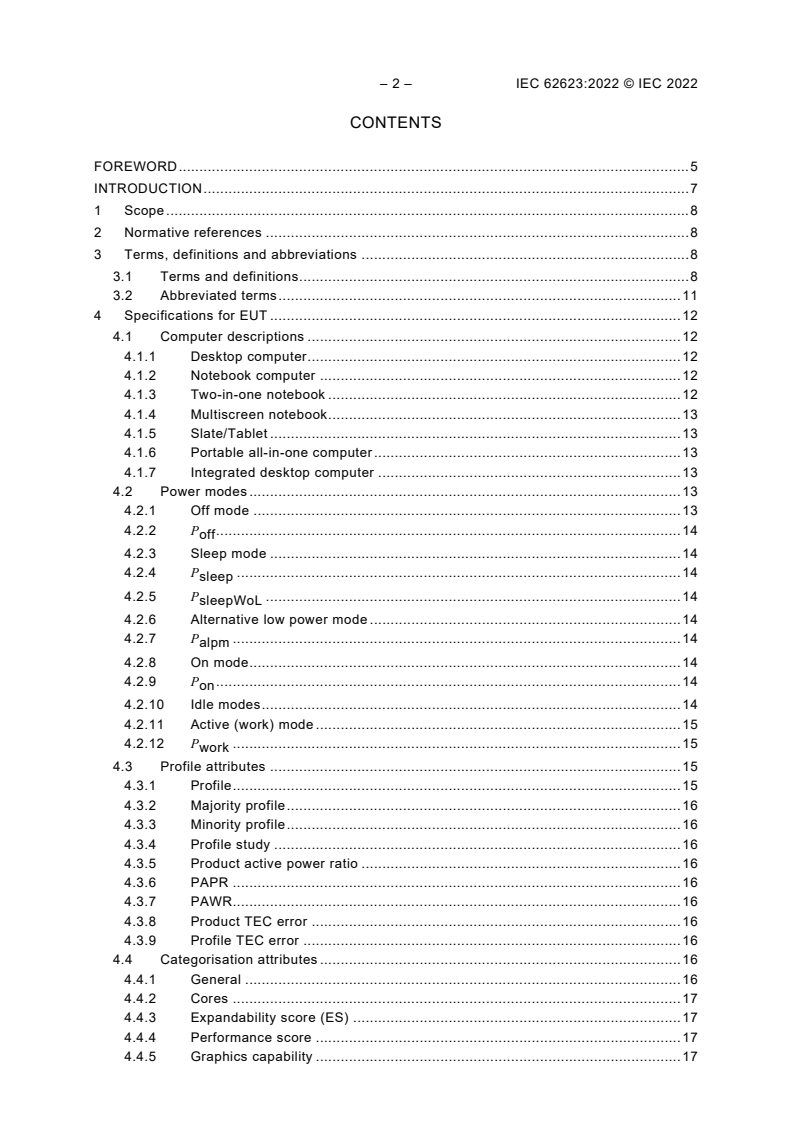
IEC 62623:2022 - Desktop and notebook computers - Measurement of energy consumption Released:4/27/2022
Overview
IEC 62623:2022 - Desktop and notebook computers: Measurement of energy consumption defines a standardized test method for measuring power and energy use of personal computing products marketed as final desktop and notebook computers. The standard specifies procedures to measure power in each defined power mode, provides formulas to calculate Typical Energy Consumption (TEC) (normally annualized), includes a duty-cycle profile study for converting average power to energy, and prescribes a pre-defined results format. IEC 62623:2022 replaces the 2012 edition and constitutes a technical revision; it does not set pass/fail criteria - users define those.
Key Topics and Requirements
- Power-mode measurements: Procedures to measure energy and power in Off, Sleep, Idle (short/long), Alternative Low Power Mode, On and Active (work) modes for desktop and notebook computers.
- TEC calculation: Formulas for estimated and measured annualized energy consumption (TEC), including criteria for applying an active workload.
- Duty-cycle / profile study: Replacement of the previous majority profile with a new duty-cycle study and attributes for residential and enterprise applications to convert average power to energy.
- Test setup and conditions: Detailed test setup, meter specifications, and environmental/test conditions (e.g., ambient light measurement where applicable).
- Meter requirements: True RMS watt meter specifications and accuracy guidance for reliable power measurement.
- Special notebook considerations: Test setup modifications where battery packs cannot be removed.
- Reporting format: Pre-defined format for presenting measured values and TEC calculations; annexes include sample TEC calculations and a profile methodology overview.
- Updates from prior edition: Added/updated terms and definitions (including idle mode descriptions), removal of ECMA-389 categorisation procedure, and removal of ENERGY STAR V5 test references.
Practical Applications
- Product energy benchmarking and internal R&D comparisons
- Laboratory test protocols for energy measurement and certification preparation
- Procurement and vendor selection based on annual energy consumption estimates
- Energy labeling programs and voluntary efficiency initiatives (where pass/fail criteria are defined by the program)
- Supporting regulatory compliance development and policy analysis
Who would use this standard
- Computer manufacturers and design teams
- Independent test laboratories and conformity assessment bodies
- Energy program administrators, policy makers, and procurement officers
- Environmental and sustainability teams conducting lifecycle energy assessments
Related standards and references
- Replaces IEC 62623:2012 (first edition)
- Historically based on ECMA-383; ENERGY STAR V5 methodology references removed in this edition
- Annexes provide methods, sample calculations and a profile-study methodology to support implementation
Keywords: IEC 62623:2022, energy consumption measurement, TEC, desktop and notebook computers, duty cycle, power modes, test procedure, watt meter.
Relations
- Effective Date
- 05-Sep-2023
Buy Documents
IEC 62623:2022 RLV - Desktop and notebook computers - Measurement of energy consumption Released:4/27/2022
IEC 62623:2022 - Desktop and notebook computers - Measurement of energy consumption Released:4/27/2022
Get Certified
Connect with accredited certification bodies for this standard

BSI Group
BSI (British Standards Institution) is the business standards company that helps organizations make excellence a habit.

NYCE
Mexican standards and certification body.
Sponsored listings
Frequently Asked Questions
IEC 62623:2022 is a standard published by the International Electrotechnical Commission (IEC). Its full title is "Desktop and notebook computers - Measurement of energy consumption". This standard covers: IEC 62623:2022 covers personal computing products. It applies to desktop and notebook computers as defined in 4.1 that are marketed as final products and that are hereafter referred to as the equipment under test (EUT) or product. This document specifies: - a test procedure to enable the measurement of the power and/or energy consumption in each of the EUT's power modes; - formulas for calculating the typical energy consumption (TEC) for a given period (normally annual); - a majority profile to be used with this document which enables conversion of average power into energy within the TEC formulas; - a pre-defined format for the presentation of results. This document does not set any pass/fail criteria for the EUTs. Users of the test results define such criteria. IEC 62623:2022 cancels and replaces the first edition published in 2012. This edition constitutes a technical revision. The first edition of this standard was originally based on ECMA-383. This edition includes the following significant technical changes with respect to the previous edition: a) Additions to terms & definitions and modification to short & long idle descriptions. b) Test setup modifications for notebooks where battery pack cannot be removed for testing. c) Categorisation procedure based on ECMA-389 removed. d) Replace majority profile with new duty cycle study including new duty cycle attributes for desktop and notebook in a residential and enterprise application. e) Removal of any reference and test methodology to ENERGY STAR V5.
IEC 62623:2022 covers personal computing products. It applies to desktop and notebook computers as defined in 4.1 that are marketed as final products and that are hereafter referred to as the equipment under test (EUT) or product. This document specifies: - a test procedure to enable the measurement of the power and/or energy consumption in each of the EUT's power modes; - formulas for calculating the typical energy consumption (TEC) for a given period (normally annual); - a majority profile to be used with this document which enables conversion of average power into energy within the TEC formulas; - a pre-defined format for the presentation of results. This document does not set any pass/fail criteria for the EUTs. Users of the test results define such criteria. IEC 62623:2022 cancels and replaces the first edition published in 2012. This edition constitutes a technical revision. The first edition of this standard was originally based on ECMA-383. This edition includes the following significant technical changes with respect to the previous edition: a) Additions to terms & definitions and modification to short & long idle descriptions. b) Test setup modifications for notebooks where battery pack cannot be removed for testing. c) Categorisation procedure based on ECMA-389 removed. d) Replace majority profile with new duty cycle study including new duty cycle attributes for desktop and notebook in a residential and enterprise application. e) Removal of any reference and test methodology to ENERGY STAR V5.
IEC 62623:2022 is classified under the following ICS (International Classification for Standards) categories: 35.160 - Microprocessor systems. The ICS classification helps identify the subject area and facilitates finding related standards.
IEC 62623:2022 has the following relationships with other standards: It is inter standard links to IEC 62623:2012. Understanding these relationships helps ensure you are using the most current and applicable version of the standard.
IEC 62623:2022 is available in PDF format for immediate download after purchase. The document can be added to your cart and obtained through the secure checkout process. Digital delivery ensures instant access to the complete standard document.
Standards Content (Sample)
IEC 62623 ®
Edition 2.0 2022-04
REDLINE VERSION
INTERNATIONAL
STANDARD
colour
inside
Desktop and notebook computers – Measurement of energy consumption
All rights reserved. Unless otherwise specified, no part of this publication may be reproduced or utilized in any form
or by any means, electronic or mechanical, including photocopying and microfilm, without permission in writing from
either IEC or IEC's member National Committee in the country of the requester. If you have any questions about IEC
copyright or have an enquiry about obtaining additional rights to this publication, please contact the address below or
your local IEC member National Committee for further information.
IEC Secretariat Tel.: +41 22 919 02 11
3, rue de Varembé info@iec.ch
CH-1211 Geneva 20 www.iec.ch
Switzerland
About the IEC
The International Electrotechnical Commission (IEC) is the leading global organization that prepares and publishes
International Standards for all electrical, electronic and related technologies.
About IEC publications
The technical content of IEC publications is kept under constant review by the IEC. Please make sure that you have the
latest edition, a corrigendum or an amendment might have been published.
IEC publications search - webstore.iec.ch/advsearchform IEC Products & Services Portal - products.iec.ch
The advanced search enables to find IEC publications by a Discover our powerful search engine and read freely all the
variety of criteria (reference number, text, technical publications previews. With a subscription you will always
committee, …). It also gives information on projects, replaced have access to up to date content tailored to your needs.
and withdrawn publications.
Electropedia - www.electropedia.org
IEC Just Published - webstore.iec.ch/justpublished
The world's leading online dictionary on electrotechnology,
Stay up to date on all new IEC publications. Just Published
containing more than 22 300 terminological entries in English
details all new publications released. Available online and
and French, with equivalent terms in 19 additional languages.
once a month by email.
Also known as the International Electrotechnical Vocabulary
(IEV) online.
IEC Customer Service Centre - webstore.iec.ch/csc
If you wish to give us your feedback on this publication or
need further assistance, please contact the Customer Service
Centre: sales@iec.ch.
IEC 62623 ®
Edition 2.0 2022-04
REDLINE VERSION
INTERNATIONAL
STANDARD
colour
inside
Desktop and notebook computers – Measurement of energy consumption
INTERNATIONAL
ELECTROTECHNICAL
COMMISSION
ICS 35.160 ISBN 978-2-8322-1103-8
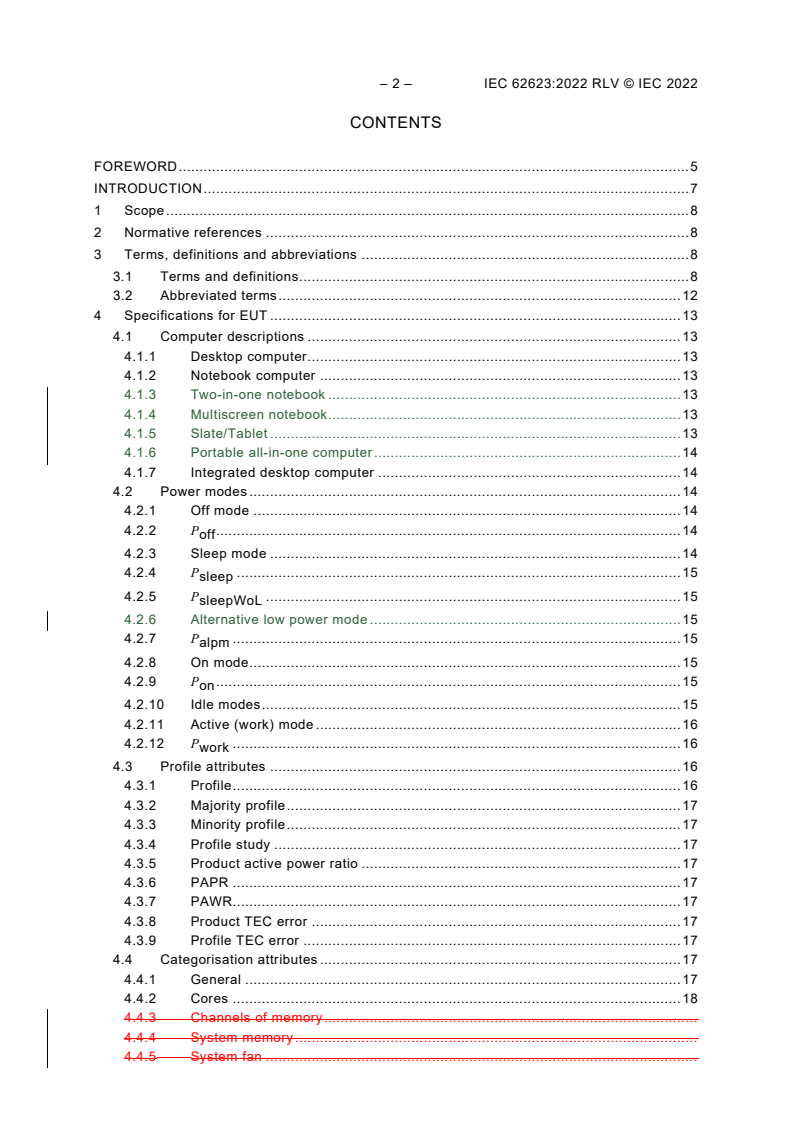
– 2 – IEC 62623:2022 RLV © IEC 2022
CONTENTS
FOREWORD . 5
INTRODUCTION . 7
1 Scope . 8
2 Normative references . 8
3 Terms, definitions and abbreviations . 8
3.1 Terms and definitions . 8
3.2 Abbreviated terms . 12
4 Specifications for EUT . 13
4.1 Computer descriptions . 13
4.1.1 Desktop computer . 13
4.1.2 Notebook computer . 13
4.1.3 Two-in-one notebook . 13
4.1.4 Multiscreen notebook . 13
4.1.5 Slate/Tablet . 13
4.1.6 Portable all-in-one computer . 14
4.1.7 Integrated desktop computer . 14
4.2 Power modes . 14
4.2.1 Off mode . 14
4.2.2 P . 14
off
4.2.3 Sleep mode . 14
4.2.4 P . 15
sleep
4.2.5 P . 15
sleepWoL
4.2.6 Alternative low power mode . 15
4.2.7 P . 15
alpm
4.2.8 On mode . 15
4.2.9 P . 15
on
4.2.10 Idle modes . 15
4.2.11 Active (work) mode . 16
4.2.12 P . 16
work
4.3 Profile attributes . 16
4.3.1 Profile . 16
4.3.2 Majority profile . 17
4.3.3 Minority profile . 17
4.3.4 Profile study . 17
4.3.5 Product active power ratio . 17
4.3.6 PAPR . 17
4.3.7 PAWR. 17
4.3.8 Product TEC error . 17
4.3.9 Profile TEC error . 17
4.4 Categorisation attributes . 17
4.4.1 General . 17
4.4.2 Cores . 18
4.4.3 Channels of memory .
4.4.4 System memory .
4.4.5 System fan .
4.4.3 Expandability score (ES) . 18
4.4.4 Performance score . 18
4.4.5 Graphics capability . 18
4.4.6 TEC adders . 18
5 Test procedure and conditions, categorisation, TEC formula, meter specifications
and results reporting . 18
5.1 General . 18
5.2 Test setup . 19
5.3 Test procedure . 21
5.3.1 General . 21
5.3.2 Measuring off mode . 21
5.3.3 Measuring sleep mode . 21
5.3.4 Measuring alternative low power mode . 22
5.3.5 Measuring long idle mode . 22
5.3.6 Measuring short idle mode . 22
5.3.7 Measuring active power mode (optional, see 5.6) . 23
5.4 Test conditions . 23
5.5 Categorisation . 24
5.5.1 General . 24
5.5.2 ULE category .
5.5.2 TEC adders . 24
5.6 Annualised energy consumption formulas . 25
5.6.1 General . 25
5.6.2 Estimated annualised energy consumption formula (estimated active
workload) . 25
5.6.3 Measured annualised energy consumption formula (with an active
workload) . 26
5.6.4 Criteria for an active workload . 27
5.7 True RMS watt meter specification . 28
5.8 True RMS watt meter accuracy . 29
5.9 Ambient light meter specification. 30
5.10 Reporting of results . 30
Annex A (informative) Overview of profile methodology. 33
Annex B (informative) Majority profile . 35
Annex C (informative) Method for conducting a profile study . 38
C.1 General . 38
C.2 Profile study example . 38
Annex D (informative) Sample TEC calculations . 42
D.1 General . 42
D.2 Notebook computer example . 42
D.3 Desktop computer example . 43
Annex E (informative) ENERGY STAR V5 compliant testing methodology .
Annex E (informative) Power measurement methodology . 48
E.1 General . 48
E.2 Sampling method . 48
E.3 Average reading method . 49
E.4 Direct meter reading method . 50
Annex G (normative) Procedure for the registration of categories for IEC 62623 .
– 4 – IEC 62623:2022 RLV © IEC 2022
Bibliography . 54
Figure 1 – Typical test setup . 20
Figure 2 – Example of estimated annualised energy consumption formula (estimated
active workload) . 26
Figure 3 – Measured annualised energy consumption formula (with an active
workload) . 27
Figure A.1 – Example of a typical profile . 33
Figure B.1 – TEC error summary chart .
Table 1 – External display connection priority . 19
Table 2 – Test conditions . 24
Table 3 – Ambient light meter specifications . 30
Table B.1 – Duty cycle attributes for the enterprise and residential majority profile duty
cycle study . 35
Table B.2 – Summary of the enterprise energy study .
Table C.1 – Profile study 1 . 39
Table C.2 – ENERGY STAR® V5 computer study .
Table C.2 – Profile study, duty cycles . 40
Table C.3 – Profile study, TEC and TEC calculations . 40
actual estimated
Table E.1 – Duty cycle attributes for V5 compliant testing .
INTERNATIONAL ELECTROTECHNICAL COMMISSION
____________
DESKTOP AND NOTEBOOK COMPUTERS –
MEASUREMENT OF ENERGY CONSUMPTION
FOREWORD
1) The International Electrotechnical Commission (IEC) is a worldwide organization for standardization comprising
all national electrotechnical committees (IEC National Committees). The object of IEC is to promote international
co-operation on all questions concerning standardization in the electrical and electronic fields. To this end and
in addition to other activities, IEC publishes International Standards, Technical Specifications, Technical Reports,
Publicly Available Specifications (PAS) and Guides (hereafter referred to as "IEC Publication(s)"). Their
preparation is entrusted to technical committees; any IEC National Committee interested in the subject dealt with
may participate in this preparatory work. International, governmental and non-governmental organizations liaising
with the IEC also participate in this preparation. IEC collaborates closely with the International Organization for
Standardization (ISO) in accordance with conditions determined by agreement between the two organizations.
2) The formal decisions or agreements of IEC on technical matters express, as nearly as possible, an international
consensus of opinion on the relevant subjects since each technical committee has representation from all
interested IEC National Committees.
3) IEC Publications have the form of recommendations for international use and are accepted by IEC National
Committees in that sense. While all reasonable efforts are made to ensure that the technical content of IEC
Publications is accurate, IEC cannot be held responsible for the way in which they are used or for any
misinterpretation by any end user.
4) In order to promote international uniformity, IEC National Committees undertake to apply IEC Publications
transparently to the maximum extent possible in their national and regional publications. Any divergence between
any IEC Publication and the corresponding national or regional publication shall be clearly indicated in the latter.
5) IEC itself does not provide any attestation of conformity. Independent certification bodies provide conformity
assessment services and, in some areas, access to IEC marks of conformity. IEC is not responsible for any
services carried out by independent certification bodies.
6) All users should ensure that they have the latest edition of this publication.
7) No liability shall attach to IEC or its directors, employees, servants or agents including individual experts and
members of its technical committees and IEC National Committees for any personal injury, property damage or
other damage of any nature whatsoever, whether direct or indirect, or for costs (including legal fees) and
expenses arising out of the publication, use of, or reliance upon, this IEC Publication or any other IEC
Publications.
8) Attention is drawn to the Normative references cited in this publication. Use of the referenced publications is
indispensable for the correct application of this publication.
9) Attention is drawn to the possibility that some of the elements of this IEC Publication may be the subject of patent
rights. IEC shall not be held responsible for identifying any or all such patent rights.
This redline version of the official IEC Standard allows the user to identify the changes made to
the previous edition IEC 62623:2012. A vertical bar appears in the margin wherever a change has
been made. Additions are in green text, deletions are in strikethrough red text.
– 6 – IEC 62623:2022 RLV © IEC 2022
IEC 62623 has been prepared by technical area 19: Environmental and energy aspects for
multimedia systems and equipment, of IEC technical committee 100: Audio, video and
multimedia systems and equipment. It is an International Standard.
This second edition cancels and replaces the first edition published in 2012. This edition
constitutes a technical revision.
The first edition of this standard was originally based on ECMA-383.
This edition includes the following significant technical changes with respect to the previous
edition:
a) Additions to terms & definitions and modification to short & long idle descriptions.
b) Test setup modifications for notebooks where battery pack cannot be removed for testing.
c) Categorisation procedure based on ECMA-389 removed.
d) Replace majority profile with new duty cycle study including new duty cycle attributes for
desktop and notebook in a residential and enterprise application.
e) Removal of any reference and test methodology to ENERGY STAR V5.
The text of this International Standard is based on the following documents:
Draft Report on voting
100/3583/CDV 100/3669/RVC
Full information on the voting for its approval can be found in the report on voting indicated in
the above table.
The language used for the development of this International Standard is English.
This document was drafted in accordance with ISO/IEC Directives, Part 2, and developed in
accordance with ISO/IEC Directives, Part 1 and ISO/IEC Directives, IEC Supplement, available
at www.iec.ch/members_experts/refdocs. The main document types developed by IEC are
described in greater detail at www.iec.ch/standardsdev/publications.
In this standard, the following print types or formats are used:
– requirements proper and normative annexes: in roman type;
– notes/explanatory matter: in smaller roman type;
– terms that are defined in 3.1: bold.
The committee has decided that the contents of this document will remain unchanged until the
stability date indicated on the IEC website under webstore.iec.ch in the data related to the
specific document. At this date, the document will be
• reconfirmed,
• withdrawn,
• replaced by a revised edition, or
• amended.
IMPORTANT – The "colour inside" logo on the cover page of this document indicates
that it contains colours which are considered to be useful for the correct understanding
of its contents. Users should therefore print this document using a colour printer.
INTRODUCTION
This document includes provides definitions of energy saving modes and generic energy saving
guidance for designers of desktop and notebook computers, by defining a methodology on how
to measure the energy consumption of a product whilst providing key categorisation criteria
attributes that enable energy consumption comparisons of similar products.
This document is originally based on ECMA-383 and complements the guidance given in
IEC 62075.
– 8 – IEC 62623:2022 RLV © IEC 2022
DESKTOP AND NOTEBOOK COMPUTERS –
MEASUREMENT OF ENERGY CONSUMPTION
1 Scope
This document covers personal computing products. It applies to desktop and notebook
computers as defined in 4.1 that are marketed as final products and that are hereafter referred
to as the equipment under test (EUT) or product.
This document specifies:
– a test procedure to enable the measurement of the power and/or energy consumption in
each of the EUT's power modes;
– formulas for calculating the typical energy consumption (TEC) for a given period (normally
annual);
– a majority profile that should to be used with this document which enables conversion of
average power into energy within the TEC formulas;
– a system of categorisation enabling like for like comparisons of energy consumption
between EUTs;
– a pre-defined format for the presentation of results.
This document does not set any pass/fail criteria for the EUTs. Users of the test results should
define such criteria.
2 Normative references
The following documents, in whole or in part, are normatively referenced in this document and
are indispensable for its application. For dated references, only the edition cited applies. For
undated references, the latest edition of the referenced document (including any amendments)
applies.
ECMA-389, Procedure for the Registration of Categories for ECMA-383 2nd edition
There are no normative references in this document.
3 Terms, definitions and abbreviations
For the purposes of this document, the following terms and definitions apply.
ISO and IEC maintain terminological databases for use in standardization at the following
addresses:
• IEC Electropedia: available at http://www.electropedia.org/
• ISO Online browsing platform: available at http://www.iso.org/obp
3.1 Terms and definitions
3.1.1
active workload
simulated amount of productive or operative activity that the EUT performs as represented in
(see 4.2.12) and T (see 3.1.11.6) attributes of the TEC equation (see 5.6)
the P
work work
3.1.2
category
grouping of EUT configurations
classification within a product type that is based on product features and installed components
3.1.3
duty cycle
divisions of time the EUT spends in each of its individual power modes
Note 1 to entry: A duty cycle is expressed as a percentage totalling 1.
3.1.4
energy use
energy used by a product when measured from the mains power supply over a given period of
time
Note 1 to entry: Energy is measured in kilowatt hour.
3.1.5
external power supply
EPS
equipment contained in a separate physical enclosure external to the computer casing and
designed to convert mains power supply to lower DC voltage(s) for the purpose of powering the
computer
Note 1 to entry: This note applies to the French language only.
Note 2 to entry: The EPS is sometimes referred to as an AC brick.
Note 3 to entry: A reference to a document which outlines the testing procedures for measuring EPS efficiencies
(External Power Supply Efficiency Test Method) can be found in the Bibliography.
3.1.6
internal power supply
IPS
component contained in the same physical enclosure to inside the computer casing and
designed to convert AC voltage from the mains power supply to lower DC voltage(s) for the
purpose of powering the computer components
Note 1 to entry: This note applies to the French language only.
Note 2 to entry: A reference to a document which outlines the testing procedures for measuring IPS efficiencies
(Generalized Internal Power Supply Efficiency Test Protocol) can be found in the Bibliography.
3.1.7
local area network
LAN
computer network located on a user’s premises within a limited geographical area
[SOURCE: IEC 60050-732-01-04]
Note 1 to entry: This note applies to the French language only.
Note 2 to entry: Currently the two primary technologies used in computers are IEEE 802.3 Ethernet or Wired LAN,
and IEEE 802.11 WiFi or Wireless LAN.
3.1.8
manufacturer
organization responsible for the design, development and production of a product in view of its
being placed on the market, regardless of whether these operations are carried out by that
organization itself or on its behalf
– 10 – IEC 62623:2022 RLV © IEC 2022
3.1.9
red green blue
RGB
primary colours that make up a pixel on a computer display
Note 1 to entry: The RGB values represent the intensity settings of each colour of that pixel to specify an exact
colour.
3.1.9
typical energy consumption
TEC
number for the consumption of energy of a computer that is used to compare the energy
performance of like computers, which focuses on the typical energy consumed by an EUT for a
given profile while in normal operation during a representative period of time
Note 1 to entry: This note applies to the French language only.
Note 2 to entry: For desktops and notebook computers, the key criterion of the TEC approach is a value for typical
annual energy use, measured in kilowatt-hours (kWh), using measurements of average operational mode power
levels scaled by an assumed typical duty cycle that represent annualized use for a profile.
3.1.10
actual energy consumption
TEC measured using P
work
Note 1 to entry: The actual energy consumption is referenced as TEC .
actual
3.1.12
estimated energy consumption
TEC estimated by substituting P for P
sidle work
Note 1 to entry: The estimated energy consumption is referenced as TEC .
estimated
Note 2 to entry: P is defined in detail in 4.2.
sidle
Note 3 to entry: P is defined in detail in 4.2.
work
3.1.11
duty cycle attributes
percentage of time the EUT spends in each of its individual power modes
Note 1 to entry: Examples of duty cycle attributes are defined in 3.1.12.1 to 3.1.12.7.
3.1.11.1
off component of duty cycle
T
off
percentage of time the EUT is in the off mode
3.1.11.2
sleep component of duty cycle
T and T
sleep sleepWoL
percentage of time the EUT is in the sleep modes
3.1.11.3
on components of duty cycle
T
on
percentage of time the EUT is in the on mode
Note 1 to entry: The T duty cycle is equal to the sum of the T + T + T T .
on work sidle lidle idle
3.1.11.4
short idle component of duty cycle
T
sidle
percentage of time the EUT is in the short idle mode
3.1.11.5
long idle component of duty cycle
T T
lidle idle
percentage of time the EUT is in the long idle mode
3.1.11.6
alternative low power component of duty cycle
T
alpm
percentage of time the EUT is in the alternative low power mode
3.1.11.7
active component of duty cycle
T
work
percentage of time the EUT is in the active (work) mode
3.1.12
user of the test results
entity that will utilise the test results to apply to their needs
Note 1 to entry: Examples of such an entity are voluntary agreement owners, regulators, private companies, etc.
3.1.13
wake on LAN
WoL
functionality that allows a computer to wake from sleep or off to an active state when directed
by a network wake request via Ethernet
Note 1 to entry: This note applies to the French language only.
3.1.14
graphics processor unit
GPU
integrated circuit, separate from the CPU, designed to accelerate the rendering of either 2D
and/or 3D content to displays
Note 1 to entry: GPU may be paired with a CPU, on the system board of the computer or elsewhere to offload
display capabilities from the CPU
3.1.15
discrete graphics
graphics processor (GPU) which must contain a local memory controller interface and local
graphics-specific memory
3.1.16
integrated graphics
graphics solution that does not contain discrete graphics
3.1.17
switchable graphics
functionality that allows discrete graphics to be disabled when not required in favour of
integrated graphics
– 12 – IEC 62623:2022 RLV © IEC 2022
Note 1 to entry: This functionality allows lower power and lower capability integrated GPUs to render the display
while on battery or when the output graphics are not overly complex while then allowing the more power consumptive
but more capable discrete GPU to provide rendering capability when the user requires it.
3.1.18
system memory bandwidth
rate at which data can be read or stored into computer system’s memory
Note 1 to entry: System memory bandwidth is measured in gigabytes per second (GB/s).
3.2 Abbreviated terms
For the purposes of this document, the following abbreviated terms apply.
ACPI advanced configuration and power interface
NOTE 1 ACPI specification can be found here: http://www.uefi.org/acpi/specs
ALPM alternative low power mode
CF crest factor
CFR crest factor ratio
CPU central processing unit
DVI Digital Visual Interface
EPS external power supply
EUT equipment under test
NOTE 2 Also referred to as product in this standard and sometimes referred to as UUT (unit under test) in other
specifications.
FB_BW frame buffer bandwidth
GPU graphic processing unit
HDD hard disk drive
®1
HDMI High Definition Multimedia Interface
IPS internal power supply
LAN local area network
LPM low power mode
MCF Meter Crest Factor
MCR maximum current ratio
OS operating system
PAPR profile active power ratio
PAWR profile active workload ratio
PCF product crest factor
PF power factor
RAM random access memory
RGB red green blue
RMS root mean square
SSD Solid State Drive
TEC typical energy consumption
THD total harmonic distortion
___________
1 ® ®
HDMI and HDMI High-Definition Multimedia Interface are trademarks of HDMI Licensing Administrator, Inc.
This information is given for the convenience of users of this document and does not constitute an endorsement
by IEC of the product named. Equivalent products may be used if they can be shown to lead to the same results.
ULE Ultra Low Energy
UPS uninterruptible power supply
VGA Video Graphics Array
WoL wake on LAN
4 Specifications for EUT
4.1 Computer descriptions
4.1.1 Desktop computer
A desktop computer is a computer where the main unit is intended to be located in a permanent
location, often on a desk or on the floor. Desktops are not designed for portability and utilize an
external computer display, keyboard, and mouse. Desktops are designed for a broad range of
home and office applications.
4.1.2 Notebook computer
A notebook computer is a computer designed specifically for portability and intended to be
operated for extended periods of time either with or without a direct connection to an AC mains
power supply. Notebooks utilize an integrated computer display and are capable of operation
from an integrated battery. In addition, most notebooks use an EPS or AC brick and have an
integrated a non-detachable mechanical keyboard (using physical, moveable keys) and pointing
device. Notebook computers are typically designed to provide similar functionality to desktops,
including operation of software similar in functionality as that used in desktops. For the
purposes of this document, docking stations are considered accessories and, therefore, should
not be considered as part of the EUT. Tablet computers, which may use touch-sensitive screens
along with, or instead of, other input devices, are considered notebook computers in this
standard. Netbook computers which are typically identified by a smaller screen size
(constrained) and base memory size are also considered notebook computers in this standard.
4.1.3 Two-in-one notebook
A computer which resembles a traditional notebook computer with a clam shell form factor, but
has a detachable display which can act as an independent slate/tablet when disconnected. The
keyboard and display portions of the product must be shipped as an integrated unit. Two-in-one
notebooks are considered notebooks in the remainder of this standard and are therefore not
referenced explicitly.
4.1.4 Multiscreen notebook
A computer which resembles a traditional notebook computer with a clam shell form factor but
has a secondary display with touch and/or pen capability that can be used as a touch screen
keyboard in place of a traditional mechanical keyboard. These products are considered to be
notebook computers for purposes of this standard.
4.1.5 Slate/Tablet
A computing device designed for portability that meets all of the following criteria:
a) Includes an integrated display with a diagonal size greater than 6,5 inches and less than
17,4 inches;
a) lacking an integrated, physical attached keyboard in its as-shipped configuration;
b) includes and primarily relies on touchscreen input; (with optional keyboard);
c) includes and primarily relies on a wireless network connection (e.g., Wi-Fi, 3G, etc.); and
d) includes and is primarily powered by an internal battery (with connection to the mains for
battery charging, not primary powering of the device).
– 14 – IEC 62623:2022 RLV © IEC 2022
4.1.6 Portable all-in-one computer
A computing device designed for limited portability that meets all of the following criteria:
a) Includes an integrated display with a diagonal size greater than or equal to 17,4 inches;
b) lacking keyboard integrated into the physical housing of the product in its as-shipped
configuration;
c) includes and primarily relies on touchscreen input; (with optional keyboard);
d) includes wireless network connection (e.g. Wi-Fi, 3G, etc.); and
e) includes an internal battery, but is primarily powered by connection to the ac mains.
4.1.7 Integrated desktop computer
An integrated desktop computer is a desktop computer where the computer and computer
display function as a single unit receiving its and which is connected to AC mains power through
a single mains cable. Integrated desktop computers come in one of two possible forms:
– a product where the computer display and computer are physically combined into a single
unit; or
– a product packaged as a single product where the computer display is separate but is
connected to the main chassis by a DC power cord and both the computer and computer
display are powered from a single power supply.
As a subset of desktop computers, integrated desktop computers are typically designed to
provide similar functionality as desktop computers.
NOTE 1 An integrated desktop computer can also be referred to as an all-in-one computer.
4.2 Power modes
4.2.1 Off mode
Off mode is the lowest power mode which cannot be switched off (influenced) by the user and
that may persist for an indefinite time when the EUT is connected to the main electricity supply
and used in accordance with the manufacturer’s instructions. For products where ACPI
standards are applicable, off mode correlates to ACPI system level S5 state.
NOTE 1 Some international regulations also refer to this mode as standby mode.
4.2.2 P
off
P represents the average power measured in the off mode.
off
4.2.3 Sleep mode
Sleep mode is the lowest a low power mode that the EUT is capable of entering automatically
after a period of inactivity or by manual selection. An EUT with sleep capability can quickly
wake to a readable display in response to a wake event from network connections or user
interface devices with a latency of ≤ 5 s from initiation of wake event to product becoming fully
usable including rendering of display. For products where ACPI standards are applicable, sleep
mode most commonly correlates to ACPI system level S3 (suspend to RAM) state. When the
EUT is tested with the WoL capability disabled in the sleep state, it is referred to as sleep mode.
When the EUT is tested with the WoL capability enabled in the sleep state, it is referred to as
WoL sleep mode.
NOTE 1 Low power sleep modes other than ACPI S3 can be supported.
4.2.4 P
sleep
P represents the average power measured in the sleep mode with the WoL capability
sleep
disabled.
4.2.5 P
sleepWoL
P represents the average power measured in the sleep mode with the WoL capability
sleepWoL
enabled.
4.2.6 Alternative low power mode
A low power mode that the computer enters automatically after a period of inactivity or by
manual selection that is defined by the display turning off and the computer entering a state of
reduced functionality. A computer with alternative low power mode must maintain immediate
responsiveness to network connections or user interface devices.
4.2.7 P
alpm
P represents the average power measured when in the Alternative Low Power Mode.
alpm
4.2.8 On mode
The on mode represents the mode the EUT is in when not in the sleep or off modes. The on
mode has several sub-modes that include the long idle mode, the short idle mode and the active
(work) mode.
4.2.9 P
on
P represents the average power measured when in the on mode.
on
4.2.10 Idle modes
4.2.10.1 General
The idle modes are modes in which the operating system and other software have completed
loading, a user profile is created, the product is not in sleep mode or an alternative low power
mode, and activity is limited to those basic applications that the product starts by default. There
are two forms of idle that comprise the idle modes: short idle mode (see 4.2.10.2) and long idle
mode (see 4.2.10.4).
4.2.10.2 Short idle mode
Short idle is the mode where the EUT has reached an idle condition (for example, 5 min after
OS boot or after completing an active workload or after resuming from sleep, one can also use
15 min in order to conform to legacy testing procedures), the screen is on for at least 30 min to
allow it to warm up, and set to at least a brightness level detailed in test procedure 5.3, and
long idle power management features should not have engaged (for example, HDD (if available)
is spinning and the EUT is prevented from entering sleep mode).
The short idle mode is where the EUT screen is on, and long Idle power management features
have not engaged (e.g. HDD is spinning and the EUT is prevented from entering sleep mode or
alternative low power mode). This condition shall be up to 5 min after:
– ceased user input or
– OS boot or
– after completing an active workload or
– 16 – IEC 62623:2022 RLV © IEC 2022
– after resuming from sleep mode or alternative low power mode
4.2.10.3 P
sidle
P represents the average power measured when in the short idle mode.
sidle
4.2.10.4 Long idle mode
Long idle mode is the mode where the EUT has reached an idle condition (for example, 15 min
after OS boot or after completing an active workload or after resuming from sleep), the screen
of the primary display has just blanked but EUT remains in the working mode (ACPI G0/S0).
Power management features, if configured as shipped, should have engaged (for example,
primary display is on, HDD may have spun-down) but the EUT is prevented from entering sleep
mode.
NOTE The screen has just blanked” refers to the main computer display (integrated panel or external display)
having entered a low power state where the screen contents cannot be observed (for example, backlight has been
turned off turning the screen black).
Long idle mode is where the EUT’s display has entered a low-power state where display
contents cannot be observed (that is backlight has been turned off) but EUT remains in the
working mode (ACPI G0/S0). If power management features are enabled as-shipped, such
features shall be enabled prior to evaluation of long Idle (e.g. display is in a low power state,
HDD may have spun down), but the EUT is prevented from entering sleep mode or alternative
low power mode.
This condition shall be between 15 to 20 min after
– ceased user input or
– OS boot or
– after completing an active workload or
– after resuming from sleep mode or alternative low power mode
4.2.10.5 P P
idle lidle
P P represents the average power measured when in the long idle mode.
idle lidle
4.2.11 Active (work) mode
Active mode is the mode in which the EUT is carrying out user-initiated work in response to
– prior or concurrent user input; or
– prior or concurrent instruction over the network.
This mode includes active processing, seeking data from storage, memory, or cache, while
awaiting further user input or acting on concurrent user input and before entering other low
power modes. In this mode, the screen is on and set to as-shipped brightness.
4.2.12 P
work
P represents the average power measured when in the active mode.
work
4.3 Profile attributes
4.3.1 Profile
A profile is a combination of duty cy
...
IEC 62623 ®
Edition 2.0 2022-04
INTERNATIONAL
STANDARD
NORME
INTERNATIONALE
colour
inside
Desktop and notebook computers – Measurement of energy consumption
Ordinateurs de bureau et ordinateurs portables – Mesurage de la consommation
d'énergie
All rights reserved. Unless otherwise specified, no part of this publication may be reproduced or utilized in any form
or by any means, electronic or mechanical, including photocopying and microfilm, without permission in writing from
either IEC or IEC's member National Committee in the country of the requester. If you have any questions about IEC
copyright or have an enquiry about obtaining additional rights to this publication, please contact the address below or
your local IEC member National Committee for further information.
Droits de reproduction réservés. Sauf indication contraire, aucune partie de cette publication ne peut être reproduite
ni utilisée sous quelque forme que ce soit et par aucun procédé, électronique ou mécanique, y compris la photocopie
et les microfilms, sans l'accord écrit de l'IEC ou du Comité national de l'IEC du pays du demandeur. Si vous avez des
questions sur le copyright de l'IEC ou si vous désirez obtenir des droits supplémentaires sur cette publication, utilisez
les coordonnées ci-après ou contactez le Comité national de l'IEC de votre pays de résidence.
IEC Secretariat Tel.: +41 22 919 02 11
3, rue de Varembé info@iec.ch
CH-1211 Geneva 20 www.iec.ch
Switzerland
About the IEC
The International Electrotechnical Commission (IEC) is the leading global organization that prepares and publishes
International Standards for all electrical, electronic and related technologies.
About IEC publications
The technical content of IEC publications is kept under constant review by the IEC. Please make sure that you have the
latest edition, a corrigendum or an amendment might have been published.
IEC publications search - webstore.iec.ch/advsearchform IEC Products & Services Portal - products.iec.ch
The advanced search enables to find IEC publications by a Discover our powerful search engine and read freely all the
variety of criteria (reference number, text, technical publications previews. With a subscription you will always
committee, …). It also gives information on projects, replaced have access to up to date content tailored to your needs.
and withdrawn publications.
Electropedia - www.electropedia.org
IEC Just Published - webstore.iec.ch/justpublished
The world's leading online dictionary on electrotechnology,
Stay up to date on all new IEC publications. Just Published
containing more than 22 300 terminological entries in English
details all new publications released. Available online and
and French, with equivalent terms in 19 additional languages.
once a month by email.
Also known as the International Electrotechnical Vocabulary
(IEV) online.
IEC Customer Service Centre - webstore.iec.ch/csc
If you wish to give us your feedback on this publication or
need further assistance, please contact the Customer Service
Centre: sales@iec.ch.
A propos de l'IEC
La Commission Electrotechnique Internationale (IEC) est la première organisation mondiale qui élabore et publie des
Normes internationales pour tout ce qui a trait à l'électricité, à l'électronique et aux technologies apparentées.
A propos des publications IEC
Le contenu technique des publications IEC est constamment revu. Veuillez vous assurer que vous possédez l’édition la
plus récente, un corrigendum ou amendement peut avoir été publié.
Recherche de publications IEC - IEC Products & Services Portal - products.iec.ch
webstore.iec.ch/advsearchform Découvrez notre puissant moteur de recherche et consultez
La recherche avancée permet de trouver des publications IEC gratuitement tous les aperçus des publications. Avec un
en utilisant différents critères (numéro de référence, texte, abonnement, vous aurez toujours accès à un contenu à jour
comité d’études, …). Elle donne aussi des informations sur adapté à vos besoins.
les projets et les publications remplacées ou retirées.
Electropedia - www.electropedia.org
IEC Just Published - webstore.iec.ch/justpublished
Le premier dictionnaire d'électrotechnologie en ligne au
Restez informé sur les nouvelles publications IEC. Just
monde, avec plus de 22 300 articles terminologiques en
Published détaille les nouvelles publications parues.
anglais et en français, ainsi que les termes équivalents dans
Disponible en ligne et une fois par mois par email.
19 langues additionnelles. Egalement appelé Vocabulaire
Electrotechnique International (IEV) en ligne.
Service Clients - webstore.iec.ch/csc
Si vous désirez nous donner des commentaires sur cette
publication ou si vous avez des questions contactez-nous:
sales@iec.ch.
IEC 62623 ®
Edition 2.0 2022-04
INTERNATIONAL
STANDARD
NORME
INTERNATIONALE
colour
inside
Desktop and notebook computers – Measurement of energy consumption
Ordinateurs de bureau et ordinateurs portables – Mesurage de la consommation
d'énergie
INTERNATIONAL
ELECTROTECHNICAL
COMMISSION
COMMISSION
ELECTROTECHNIQUE
INTERNATIONALE
ICS 35.160 ISBN 978-2-8322-1095-6
– 2 – IEC 62623:2022 © IEC 2022
CONTENTS
FOREWORD . 5
INTRODUCTION . 7
1 Scope . 8
2 Normative references . 8
3 Terms, definitions and abbreviations . 8
3.1 Terms and definitions . 8
3.2 Abbreviated terms . 11
4 Specifications for EUT . 12
4.1 Computer descriptions . 12
4.1.1 Desktop computer . 12
4.1.2 Notebook computer . 12
4.1.3 Two-in-one notebook . 12
4.1.4 Multiscreen notebook . 13
4.1.5 Slate/Tablet . 13
4.1.6 Portable all-in-one computer . 13
4.1.7 Integrated desktop computer . 13
4.2 Power modes . 13
4.2.1 Off mode . 13
4.2.2 P . 14
off
4.2.3 Sleep mode . 14
4.2.4 P . 14
sleep
4.2.5 P . 14
sleepWoL
4.2.6 Alternative low power mode . 14
4.2.7 P . 14
alpm
4.2.8 On mode . 14
4.2.9 P . 14
on
4.2.10 Idle modes . 14
4.2.11 Active (work) mode . 15
4.2.12 P . 15
work
4.3 Profile attributes . 15
4.3.1 Profile . 15
4.3.2 Majority profile . 16
4.3.3 Minority profile . 16
4.3.4 Profile study . 16
4.3.5 Product active power ratio . 16
4.3.6 PAPR . 16
4.3.7 PAWR. 16
4.3.8 Product TEC error . 16
4.3.9 Profile TEC error . 16
4.4 Categorisation attributes . 16
4.4.1 General . 16
4.4.2 Cores . 17
4.4.3 Expandability score (ES) . 17
4.4.4 Performance score . 17
4.4.5 Graphics capability . 17
4.4.6 TEC adders . 17
5 Test procedure and conditions, categorisation, TEC formula, meter specifications
and results reporting . 17
5.1 General . 17
5.2 Test setup . 17
5.3 Test procedure . 20
5.3.1 General . 20
5.3.2 Measuring off mode . 20
5.3.3 Measuring sleep mode . 20
5.3.4 Measuring alternative low power mode . 20
5.3.5 Measuring long idle mode . 21
5.3.6 Measuring short idle mode . 21
5.3.7 Measuring active power mode (optional, see 5.6) . 22
5.4 Test conditions . 22
5.5 Categorisation . 22
5.5.1 General . 22
5.5.2 TEC adders . 23
5.6 Annualised energy consumption formulas . 23
5.6.1 General . 23
5.6.2 Estimated annualised energy consumption formula (estimated active
workload) . 23
5.6.3 Measured annualised energy consumption formula (with an active
workload) . 24
5.6.4 Criteria for an active workload . 25
5.7 True RMS watt meter specification . 26
5.8 True RMS watt meter accuracy . 27
5.9 Ambient light meter specification. 28
5.10 Reporting of results . 28
Annex A (informative) Overview of profile methodology. 31
Annex B (informative) Majority profile . 33
Annex C (informative) Method for conducting a profile study . 34
C.1 General . 34
C.2 Profile study example . 34
Annex D (informative) Sample TEC calculations . 38
D.1 General . 38
D.2 Notebook computer example . 38
D.3 Desktop computer example . 39
Annex E (informative) Power measurement methodology . 40
E.1 General . 40
E.2 Sampling method . 40
E.3 Average reading method . 41
E.4 Direct meter reading method . 42
Bibliography . 44
Figure 1 – Typical test setup . 19
Figure 2 – Example of estimated annualised energy consumption formula (estimated
active workload) . 24
Figure 3 – Measured annualised energy consumption formula (with an active
workload) . 25
– 4 – IEC 62623:2022 © IEC 2022
Figure A.1 – Example of a typical profile . 31
Table 1 – External display connection priority . 18
Table 2 – Test conditions . 22
Table 3 – Ambient light meter specifications . 28
Table B.1 – Duty cycle attributes for the enterprise and residential majority profile duty
cycle study . 33
Table C.1 – Profile study 1 . 35
Table C.2 – Profile study, duty cycles . 35
Table C.3 – Profile study, TEC and TEC calculations . 36
actual estimated
INTERNATIONAL ELECTROTECHNICAL COMMISSION
____________
DESKTOP AND NOTEBOOK COMPUTERS –
MEASUREMENT OF ENERGY CONSUMPTION
FOREWORD
1) The International Electrotechnical Commission (IEC) is a worldwide organization for standardization comprising
all national electrotechnical committees (IEC National Committees). The object of IEC is to promote international
co-operation on all questions concerning standardization in the electrical and electronic fields. To this end and
in addition to other activities, IEC publishes International Standards, Technical Specifications, Technical Reports,
Publicly Available Specifications (PAS) and Guides (hereafter referred to as "IEC Publication(s)"). Their
preparation is entrusted to technical committees; any IEC National Committee interested in the subject dealt with
may participate in this preparatory work. International, governmental and non-governmental organizations liaising
with the IEC also participate in this preparation. IEC collaborates closely with the International Organization for
Standardization (ISO) in accordance with conditions determined by agreement between the two organizations.
2) The formal decisions or agreements of IEC on technical matters express, as nearly as possible, an international
consensus of opinion on the relevant subjects since each technical committee has representation from all
interested IEC National Committees.
3) IEC Publications have the form of recommendations for international use and are accepted by IEC National
Committees in that sense. While all reasonable efforts are made to ensure that the technical content of IEC
Publications is accurate, IEC cannot be held responsible for the way in which they are used or for any
misinterpretation by any end user.
4) In order to promote international uniformity, IEC National Committees undertake to apply IEC Publications
transparently to the maximum extent possible in their national and regional publications. Any divergence between
any IEC Publication and the corresponding national or regional publication shall be clearly indicated in the latter.
5) IEC itself does not provide any attestation of conformity. Independent certification bodies provide conformity
assessment services and, in some areas, access to IEC marks of conformity. IEC is not responsible for any
services carried out by independent certification bodies.
6) All users should ensure that they have the latest edition of this publication.
7) No liability shall attach to IEC or its directors, employees, servants or agents including individual experts and
members of its technical committees and IEC National Committees for any personal injury, property damage or
other damage of any nature whatsoever, whether direct or indirect, or for costs (including legal fees) and
expenses arising out of the publication, use of, or reliance upon, this IEC Publication or any other IEC
Publications.
8) Attention is drawn to the Normative references cited in this publication. Use of the referenced publications is
indispensable for the correct application of this publication.
9) Attention is drawn to the possibility that some of the elements of this IEC Publication may be the subject of patent
rights. IEC shall not be held responsible for identifying any or all such patent rights.
IEC 62623 has been prepared by technical area 19: Environmental and energy aspects for
multimedia systems and equipment, of IEC technical committee 100: Audio, video and
multimedia systems and equipment. It is an International Standard.
This second edition cancels and replaces the first edition published in 2012. This edition
constitutes a technical revision.
The first edition of this standard was originally based on ECMA-383.
This edition includes the following significant technical changes with respect to the previous
edition:
a) Additions to terms & definitions and modification to short & long idle descriptions.
b) Test setup modifications for notebooks where battery pack cannot be removed for testing.
c) Categorisation procedure based on ECMA-389 removed.
d) Replace majority profile with new duty cycle study including new duty cycle attributes for
desktop and notebook in a residential and enterprise application.
e) Removal of any reference and test methodology to ENERGY STAR V5.
– 6 – IEC 62623:2022 © IEC 2022
The text of this International Standard is based on the following documents:
Draft Report on voting
100/3583/CDV 100/3669/RVC
Full information on the voting for its approval can be found in the report on voting indicated in
the above table.
The language used for the development of this International Standard is English.
This document was drafted in accordance with ISO/IEC Directives, Part 2, and developed in
accordance with ISO/IEC Directives, Part 1 and ISO/IEC Directives, IEC Supplement, available
at www.iec.ch/members_experts/refdocs. The main document types developed by IEC are
described in greater detail at www.iec.ch/standardsdev/publications.
In this standard, the following print types or formats are used:
– requirements proper and normative annexes: in roman type;
– notes/explanatory matter: in smaller roman type;
– terms that are defined in 3.1: bold.
The committee has decided that the contents of this document will remain unchanged until the
stability date indicated on the IEC website under webstore.iec.ch in the data related to the
specific document. At this date, the document will be
• reconfirmed,
• withdrawn,
• replaced by a revised edition, or
• amended.
IMPORTANT – The "colour inside" logo on the cover page of this document indicates
that it contains colours which are considered to be useful for the correct understanding
of its contents. Users should therefore print this document using a colour printer.
INTRODUCTION
This document provides definitions of energy saving modes and generic energy saving
guidance for designers of desktop and notebook computers, by defining a methodology on how
to measure the energy consumption of a product whilst providing key categorisation attributes
that enable energy consumption comparisons of similar products.
This document is originally based on ECMA-383 and complements the guidance given in
IEC 62075.
– 8 – IEC 62623:2022 © IEC 2022
DESKTOP AND NOTEBOOK COMPUTERS –
MEASUREMENT OF ENERGY CONSUMPTION
1 Scope
This document covers personal computing products. It applies to desktop and notebook
computers as defined in 4.1 that are marketed as final products and that are hereafter referred
to as the equipment under test (EUT) or product.
This document specifies:
– a test procedure to enable the measurement of the power and/or energy consumption in
each of the EUT's power modes;
– formulas for calculating the typical energy consumption (TEC) for a given period (normally
annual);
– a majority profile to be used with this document which enables conversion of average power
into energy within the TEC formulas;
– a pre-defined format for the presentation of results.
This document does not set any pass/fail criteria for the EUTs. Users of the test results define
such criteria.
2 Normative references
There are no normative references in this document.
3 Terms, definitions and abbreviations
For the purposes of this document, the following terms and definitions apply.
ISO and IEC maintain terminological databases for use in standardization at the following
addresses:
• IEC Electropedia: available at http://www.electropedia.org/
• ISO Online browsing platform: available at http://www.iso.org/obp
3.1 Terms and definitions
3.1.1
active workload
simulated amount of productive or operative activity that the EUT performs as represented in
the P (see 4.2.12) and T (see 3.1.11.6) attributes of the TEC equation (see 5.6)
work work
3.1.2
category
classification within a product type that is based on product features and installed components
3.1.3
duty cycle
divisions of time the EUT spends in each of its individual power modes
Note 1 to entry: A duty cycle is expressed as a percentage totalling 1.
3.1.4
energy use
energy used by a product when measured from the mains power supply over a given period of
time
Note 1 to entry: Energy is measured in kilowatt hour.
3.1.5
external power supply
EPS
equipment contained in a separate physical enclosure external to the computer casing and
designed to convert mains power supply to lower DC voltage(s) for the purpose of powering the
computer
Note 1 to entry: This note applies to the French language only.
Note 2 to entry: The EPS is sometimes referred to as an AC brick.
Note 3 to entry: A reference to a document which outlines the testing procedures for measuring EPS efficiencies
(External Power Supply Efficiency Test Method) can be found in the Bibliography.
3.1.6
internal power supply
IPS
component contained inside the computer casing and designed to convert AC voltage from the
mains power supply to lower DC voltage(s) for the purpose of powering the computer
components
Note 1 to entry: This note applies to the French language only.
Note 2 to entry: A reference to a document which outlines the testing procedures for measuring IPS efficiencies
(Generalized Internal Power Supply Efficiency Test Protocol) can be found in the Bibliography.
3.1.7
local area network
LAN
computer network located on a user’s premises within a limited geographical area
[SOURCE: IEC 60050-732-01-04]
Note 1 to entry: This note applies to the French language only.
Note 2 to entry: Currently the two primary technologies used in computers are IEEE 802.3 Ethernet or Wired LAN,
and IEEE 802.11 WiFi or Wireless LAN.
3.1.8
manufacturer
organization responsible for the design, development and production of a product in view of its
being placed on the market, regardless of whether these operations are carried out by that
organization itself or on its behalf
3.1.9
typical energy consumption
TEC
number for the consumption of energy of a computer that is used to compare the energy
performance of like computers, which focuses on the typical energy consumed by an EUT for a
given profile while in normal operation during a representative period of time
Note 1 to entry: This note applies to the French language only.
Note 2 to entry: For desktops and notebook computers, the key criterion of the TEC approach is a value for typical
annual energy use, measured in kilowatt-hours (kWh), using measurements of average operational mode power
levels scaled by an assumed typical duty cycle that represent annualized use for a profile.
– 10 – IEC 62623:2022 © IEC 2022
3.1.10
actual energy consumption
TEC measured using P
work
Note 1 to entry: The actual energy consumption is referenced as TEC .
actual
3.1.11
duty cycle attributes
percentage of time the EUT spends in each of its individual power modes
Note 1 to entry: Examples of duty cycle attributes are defined in 3.1.12.1 to 3.1.12.7.
3.1.11.1
off component of duty cycle
T
off
percentage of time the EUT is in the off mode
3.1.11.2
sleep component of duty cycle
T and T
sleep sleepWoL
percentage of time the EUT is in the sleep modes
3.1.11.3
on components of duty cycle
T
on
percentage of time the EUT is in the on mode
Note 1 to entry: The T duty cycle is equal to the sum of the T + T + T .
on work sidle lidle
3.1.11.4
short idle component of duty cycle
T
sidle
percentage of time the EUT is in the short idle mode
3.1.11.5
long idle component of duty cycle
T
lidle
percentage of time the EUT is in the long idle mode
3.1.11.6
alternative low power component of duty cycle
T
alpm
percentage of time the EUT is in the alternative low power mode
3.1.11.7
active component of duty cycle
T
work
percentage of time the EUT is in the active (work) mode
3.1.12
user of the test results
entity that will utilise the test results to apply to their needs
Note 1 to entry: Examples of such an entity are voluntary agreement owners, regulators, private companies, etc.
3.1.13
wake on LAN
WoL
functionality that allows a computer to wake from sleep or off to an active state when directed
by a network wake request via Ethernet
Note 1 to entry: This note applies to the French language only.
3.1.14
graphics processor unit
GPU
integrated circuit, separate from the CPU, designed to accelerate the rendering of either 2D
and/or 3D content to displays
Note 1 to entry: GPU may be paired with a CPU, on the system board of the computer or elsewhere to offload
display capabilities from the CPU
3.1.15
discrete graphics
graphics processor (GPU) which must contain a local memory controller interface and local
graphics-specific memory
3.1.16
integrated graphics
graphics solution that does not contain discrete graphics
3.1.17
switchable graphics
functionality that allows discrete graphics to be disabled when not required in favour of
integrated graphics
Note 1 to entry: This functionality allows lower power and lower capability integrated GPUs to render the display
while on battery or when the output graphics are not overly complex while then allowing the more power consumptive
but more capable discrete GPU to provide rendering capability when the user requires it.
3.1.18
system memory bandwidth
rate at which data can be read or stored into computer system’s memory
Note 1 to entry: System memory bandwidth is measured in gigabytes per second (GB/s).
3.2 Abbreviated terms
For the purposes of this document, the following abbreviated terms apply.
ACPI advanced configuration and power interface
NOTE 1 ACPI specification can be found here: http://www.uefi.org/acpi/specs
ALPM alternative low power mode
CF crest factor
CFR crest factor ratio
CPU central processing unit
DVI Digital Visual Interface
EPS external power supply
EUT equipment under test
NOTE 2 Also referred to as product in this standard and sometimes referred to as UUT (unit under test) in other
specifications.
FB_BW frame buffer bandwidth
– 12 – IEC 62623:2022 © IEC 2022
GPU graphic processing unit
HDD hard disk drive
®1
HDMI High Definition Multimedia Interface
IPS internal power supply
LAN local area network
LPM low power mode
MCR maximum current ratio
OS operating system
PAPR profile active power ratio
PAWR profile active workload ratio
PCF product crest factor
PF power factor
RAM random access memory
RMS root mean square
TEC typical energy consumption
THD total harmonic distortion
UPS uninterruptible power supply
VGA Video Graphics Array
WoL wake on LAN
4 Specifications for EUT
4.1 Computer descriptions
4.1.1 Desktop computer
A desktop computer is a computer where the main unit is intended to be located in a permanent
location, often on a desk or on the floor. Desktops are not designed for portability and utilize an
external computer display, keyboard, and mouse. Desktops are designed for a broad range of
home and office applications.
4.1.2 Notebook computer
A notebook computer is a computer designed specifically for portability and intended to be
operated for extended periods of time either with or without a direct connection to an AC mains
power supply. Notebooks utilize an integrated computer display and are capable of operation
from an integrated battery. In addition, most notebooks use an EPS or AC brick and have a
non-detachable mechanical keyboard (using physical, moveable keys) and pointing device.
Notebook computers are typically designed to provide similar functionality to desktops,
including operation of software similar in functionality as that used in desktops. For the
purposes of this document, docking stations are considered accessories and, therefore, should
not be considered as part of the EUT.
4.1.3 Two-in-one notebook
A computer which resembles a traditional notebook computer with a clam shell form factor, but
has a detachable display which can act as an independent slate/tablet when disconnected. The
keyboard and display portions of the product must be shipped as an integrated unit. Two-in-one
___________
1 ® ®
HDMI and HDMI High-Definition Multimedia Interface are trademarks of HDMI Licensing Administrator, Inc.
This information is given for the convenience of users of this document and does not constitute an endorsement
by IEC of the product named. Equivalent products may be used if they can be shown to lead to the same results.
notebooks are considered notebooks in the remainder of this standard and are therefore not
referenced explicitly.
4.1.4 Multiscreen notebook
A computer which resembles a traditional notebook computer with a clam shell form factor but
has a secondary display with touch and/or pen capability that can be used as a touch screen
keyboard in place of a traditional mechanical keyboard. These products are considered to be
notebook computers for purposes of this standard.
4.1.5 Slate/Tablet
A computing device designed for portability that meets all of the following criteria:
a) Includes an integrated display with a diagonal size greater than 6,5 inches and less than
17,4 inches;
b) lacking an integrated, physical attached keyboard in its as-shipped configuration;
c) includes and primarily relies on touchscreen input; (with optional keyboard);
d) includes and primarily relies on a wireless network connection (e.g., Wi-Fi, 3G, etc.); and
e) includes and is primarily powered by an internal battery (with connection to the mains for
battery charging, not primary powering of the device).
4.1.6 Portable all-in-one computer
A computing device designed for limited portability that meets all of the following criteria:
a) Includes an integrated display with a diagonal size greater than or equal to 17,4 inches;
b) lacking keyboard integrated into the physical housing of the product in its as-shipped
configuration;
c) includes and primarily relies on touchscreen input; (with optional keyboard);
d) includes wireless network connection (e.g. Wi-Fi, 3G, etc.); and
e) includes an internal battery, but is primarily powered by connection to the ac mains.
4.1.7 Integrated desktop computer
An integrated desktop computer is a desktop computer where the computer and computer
display function as a single unit and which is connected to AC mains power through a single
mains cable. Integrated desktop computers come in one of two possible forms:
– a product where the computer display and computer are physically combined into a single
unit; or
– a product packaged as a single product where the computer display is separate but is
connected to the main chassis by a DC power cord and both the computer and computer
display are powered from a single power supply.
As a subset of desktop computers, integrated desktop computers are typically designed to
provide similar functionality as desktop computers.
NOTE 1 An integrated desktop computer can also be referred to as an all-in-one computer.
4.2 Power modes
4.2.1 Off mode
Off mode is the lowest power mode which cannot be switched off (influenced) by the user and
that may persist for an indefinite time when the EUT is connected to the main electricity supply
and used in accordance with the manufacturer’s instructions. For products where ACPI
standards are applicable, off mode correlates to ACPI system level S5 state.
– 14 – IEC 62623:2022 © IEC 2022
NOTE 1 Some international regulations also refer to this mode as standby mode.
4.2.2 P
off
P represents the average power measured in the off mode.
off
4.2.3 Sleep mode
Sleep mode is a low power mode that the EUT is capable of entering automatically after a period
of inactivity or by manual selection. An EUT with sleep capability can quickly wake to a readable
display in response to a wake event from network connections or user interface devices. For
products where ACPI standards are applicable, sleep mode most commonly correlates to ACPI
system level S3 (suspend to RAM) state. When the EUT is tested with the WoL capability
disabled in the sleep state, it is referred to as sleep mode. When the EUT is tested with the
WoL capability enabled in the sleep state, it is referred to as WoL sleep mode.
NOTE 1 Low power sleep modes other than ACPI S3 can be supported.
4.2.4 P
sleep
P represents the average power measured in the sleep mode with the WoL capability
sleep
disabled.
4.2.5 P
sleepWoL
P represents the average power measured in the sleep mode with the WoL capability
sleepWoL
enabled.
4.2.6 Alternative low power mode
A low power mode that the computer enters automatically after a period of inactivity or by
manual selection that is defined by the display turning off and the computer entering a state of
reduced functionality. A computer with alternative low power mode must maintain immediate
responsiveness to network connections or user interface devices.
4.2.7 P
alpm
represents the average power measured when in the Alternative Low Power Mode.
P
alpm
4.2.8 On mode
The on mode represents the mode the EUT is in when not in the sleep or off modes. The on
mode has several sub-modes that include the long idle mode, the short idle mode and the active
(work) mode.
4.2.9 P
on
P represents the average power measured when in the on mode.
on
4.2.10 Idle modes
4.2.10.1 General
The idle modes are modes in which the operating system and other software have completed
loading, a user profile is created, the product is not in sleep mode or an alternative low power
mode, and activity is limited to those basic applications that the product starts by default. There
are two forms of idle that comprise the idle modes: short idle mode (see 4.2.10.2) and long idle
mode (see 4.2.10.4).
4.2.10.2 Short idle mode
The short idle mode is where the EUT screen is on, and long Idle power management features
have not engaged (e.g. HDD is spinning and the EUT is prevented from entering sleep mode or
alternative low power mode). This condition shall be up to 5 min after:
– ceased user input or
– OS boot or
– after completing an active workload or
– after resuming from sleep mode or alternative low power mode
4.2.10.3 P
sidle
P represents the average power measured when in the short idle mode.
sidle
4.2.10.4 Long idle mode
Long idle mode is where the EUT’s display has entered a low-power state where display
contents cannot be observed (that is backlight has been turned off) but EUT remains in the
working mode (ACPI G0/S0). If power management features are enabled as-shipped, such
features shall be enabled prior to evaluation of long Idle (e.g. display is in a low power state,
HDD may have spun down), but the EUT is prevented from entering sleep mode or alternative
low power mode.
This condition shall be between 15 to 20 min after
– ceased user input or
– OS boot or
– after completing an active workload or
– after resuming from sleep mode or alternative low power mode
4.2.10.5 P
lidle
P represents the average power measured when in the long idle mode.
lidle
4.2.11 Active (work) mode
Active mode is the mode in which the EUT is carrying out user-initiated work in response to
– prior or concurrent user input; or
– prior or concurrent instruction over the network.
This mode includes active processing, seeking data from storage, memory, or cache, while
awaiting further user input or acting on concurrent user input and before entering low power
modes.
4.2.12 P
work
P represents the average power measured when in the active mode.
work
4.3 Profile attributes
4.3.1 Profile
A profile is a combination of duty cycle attributes and a given use case (for example, office
users, home users, gamers).
– 16 – IEC 62623:2022 © IEC 2022
NOTE 1 Refer to Annex A, Annex B and Annex C for further information on profiles.
4.3.2 Majority profile
The majority profile is the most common profile of users for desktop and notebook computers.
The majority profile should be used with this standard and is documented in Annex B. It provides
the duty cycle attributes and the profile TEC error that is used to determine the TEC equation
to be used in 5.6.
4.3.3 Minority profile
The minority profiles represent less common profiles of users of desktop and notebook
computers that are not represented in the majority profile. As an example, extreme gamers
represent a very specific profile but are a very small percentage of computer users.
4.3.4 Profile study
A profile study is a study performed to create a new profile for this standard. The study shall
generate, together with supporting data, the following:
– all the duty cycle attributes;
– the PAPR (see 4.3.6);
– the profile TEC error (see 4.3.9);
– the PAWR (see 4.3.7).
All data shall be derived from a statistically significant sample size that is representative of the
user population as a whole. Annex C provides guidance on how to conduct a profile study.
4.3.5 Product active power ratio
The product active power ratio is the ratio of P /P , or the average on power divided by short
on sidle
idle power for an individual product within a profile study.
4.3.6 PAPR
PAPR is the average of all the product active power ratios recorded in a profile study.
4.3.7 PAWR
PAWR represents the average ratio of P /P conducted on profile study products and is
work sidle
used to validate that the active workload closely matches the profile study (through its PAWR).
4.3.8 Product TEC error
The pro
...