

ISO/IEC 13961:2000
(Main)Information technology - Scalable Coherent Interface (SCI)
General Information
- Abstract
The scalable coherent interface (SCI) provides computer-bus-like services but, instead of a bus, uses a collection of fast point-to-point unidirectional links to provide the far higher throughput needed for high-performance multiprocessor systems. SCI supports distributed, shared memory with optional cache coherence for tightly coupled systems, and message-passing for loosely coupled systems. Initial SCI links are defined at 1 Gbyte/s (16-bit parallel) and 1 Gb/s (serial). For applications requiring modular packaging, an interchangeable module is specified along with connector and power. The packets and protocols that implement transactions are defined and their formal specification is provided in the form of computer programs. In addition to the usual read-and-write transactions, SCI supports efficient multiprocessor lock transactions. The distributed cache-coherence protocols are efficient and can recover from an arbitrary number of transmission failures. SCI protocols ensure forward progress despite multiprocessor conflicts (no deadlocks or starvation).
- Status
- Published
- Publication Date
- 30-Jul-2000
- Technical Committee
- ISO/IEC JTC 1/SC 25 - Interconnection of information technology equipment
- Current Stage
- PPUB - Publication issued
- Start Date
- 31-Jul-2000
- Completion Date
- 30-Nov-1998
Overview - ISO/IEC 13961:2000 (Scalable Coherent Interface, SCI)
ISO/IEC 13961:2000 (IEEE Std 1596) specifies the Scalable Coherent Interface (SCI) - a high-performance multiprocessor interconnect that delivers computer-bus-like services using fast point-to-point links instead of a shared bus. SCI supports distributed shared memory with optional cache coherence for tightly coupled systems and message-passing for loosely coupled systems. The standard defines physical modules and connectors for modular packaging, packet formats and protocols (formally specified as programs), and transaction types including efficient multiprocessor lock transactions. Initial link rates are defined at 1 Gbyte/s (16-bit parallel) and 1 Gb/s (serial). SCI protocols guarantee forward progress (no deadlocks or starvation) and can recover from arbitrary transmission failures.
Key topics and technical requirements
- Physical and electrical interfaces
- Modular interchangeability, connector and power specifications for packaging.
- Defined initial link speeds: 1 Gbyte/s (parallel) and 1 Gb/s (serial).
- Packet and protocol specification
- Formal packet formats, request/response and send/echo encodings, CRC handling, idle symbols.
- Logical packet encodings, transaction commands, lock subcommands and move/broadcast transactions.
- Cache-coherence and distributed directories
- Support for distributed cache-coherence protocols, sharing lists and directory-based updates.
- Mechanisms for TLB purges and coherence update sequences.
- Transaction services
- Read/write, lock transactions, remote transactions (agents), DMA hints, message-passing primitives.
- Reliability, availability and serviceability (RAS)
- Autoconfiguration, transmission-error detection and isolation, alternative routing, online replacement, and recovery from transmission failures.
- Performance and flow control
- Bandwidth allocation, ringlet priorities, queue allocation and elastic buffering to support scalable topologies (rings, meshes, switches).
Applications and target users
- Who uses this standard
- Hardware architects and system designers building high-performance multiprocessor systems.
- Network/interconnect ASIC and switch designers requiring packet-level protocol compliance.
- Operating system and firmware developers implementing distributed shared memory, cache-coherence handlers, and low-level I/O drivers.
- HPC system integrators and embedded-system vendors needing low-latency, high-throughput interconnects.
- Practical applications
- Tightly coupled symmetric multiprocessors and NUMA systems requiring coherent shared memory.
- Loosely coupled clusters using SCI for low-latency message passing.
- Modular boards and backplane systems using specified connectors and interchangeable modules.
Related standards
- IEEE Std 1596 (1998) - the IEEE edition of the same Scalable Coherent Interface specification (ISO/IEC 13961:2000 aligns with IEEE Std 1596).
Keywords: Scalable Coherent Interface, SCI, ISO/IEC 13961, cache coherence, distributed shared memory, multiprocessor interconnect, packet protocol, lock transactions, RAS, 1 Gbyte/s, IEEE Std 1596.
Get Certified
Connect with accredited certification bodies for this standard

BSI Group
BSI (British Standards Institution) is the business standards company that helps organizations make excellence a habit.

NYCE
Mexican standards and certification body.
Sponsored listings
Frequently Asked Questions
ISO/IEC 13961:2000 is a standard published by the International Electrotechnical Commission (IEC). Its full title is "Information technology - Scalable Coherent Interface (SCI)". This standard covers: The scalable coherent interface (SCI) provides computer-bus-like services but, instead of a bus, uses a collection of fast point-to-point unidirectional links to provide the far higher throughput needed for high-performance multiprocessor systems. SCI supports distributed, shared memory with optional cache coherence for tightly coupled systems, and message-passing for loosely coupled systems. Initial SCI links are defined at 1 Gbyte/s (16-bit parallel) and 1 Gb/s (serial). For applications requiring modular packaging, an interchangeable module is specified along with connector and power. The packets and protocols that implement transactions are defined and their formal specification is provided in the form of computer programs. In addition to the usual read-and-write transactions, SCI supports efficient multiprocessor lock transactions. The distributed cache-coherence protocols are efficient and can recover from an arbitrary number of transmission failures. SCI protocols ensure forward progress despite multiprocessor conflicts (no deadlocks or starvation).
The scalable coherent interface (SCI) provides computer-bus-like services but, instead of a bus, uses a collection of fast point-to-point unidirectional links to provide the far higher throughput needed for high-performance multiprocessor systems. SCI supports distributed, shared memory with optional cache coherence for tightly coupled systems, and message-passing for loosely coupled systems. Initial SCI links are defined at 1 Gbyte/s (16-bit parallel) and 1 Gb/s (serial). For applications requiring modular packaging, an interchangeable module is specified along with connector and power. The packets and protocols that implement transactions are defined and their formal specification is provided in the form of computer programs. In addition to the usual read-and-write transactions, SCI supports efficient multiprocessor lock transactions. The distributed cache-coherence protocols are efficient and can recover from an arbitrary number of transmission failures. SCI protocols ensure forward progress despite multiprocessor conflicts (no deadlocks or starvation).
ISO/IEC 13961:2000 is classified under the following ICS (International Classification for Standards) categories: 35.160 - Microprocessor systems. The ICS classification helps identify the subject area and facilitates finding related standards.
ISO/IEC 13961:2000 is available in PDF format for immediate download after purchase. The document can be added to your cart and obtained through the secure checkout process. Digital delivery ensures instant access to the complete standard document.
Standards Content (Sample)
INTERNATIONAL ISO/IEC
STANDARD
IEEE
Std 1596
First edition
2000-07
Information technology –
Scalable Coherent Interface (SCI)
Reference number
IEEE Std 1596, 1998 Edition
Abstract: The scalable coherent interface (SCI) provides computer-bus-like services but,
instead of a bus, uses a collection of fast point-to-point unidirectional links to provide the far
higher throughput needed for high-performance multiprocessor systems. SCI supports
distributed, shared memory with optional cache coherence for tightly coupled systems, and
message-passing for loosely coupled systems. Initial SCI links are defined at 1 Gbyte/s (16-bit
parallel) and 1 Gb/s (serial). For applications requiring modular packaging, an interchangeable
module is specified along with connector and power. The packets and protocols that implement
transactions are defined and their formal specification is provided in the form of computer
programs. In addition to the usual read-and-write transactions, SCI supports efficient
multiprocessor lock transactions. The distributed cache-coherence protocols are efficient and
can recover from an arbitrary number of transmission failures. SCI protocols ensure forward
progress despite multiprocessor conflicts (no deadlocks or starvation).
Keywords: bus architecture, bus standard, cache coherence, distributed memory, fiber optic,
interconnect, I/O system, link, mesh, multiprocessor, network, packet protocol, ring, seamless
distributed computer, shared memory, switch, transaction set.
––––––––––
The Institute of Electrical and Electronics Engineers, Inc.
345 East 47th Street, New York, NY 10017-2394, USA
Copyright © 1998 by the Institute of Electrical and Electronics Engineers, Inc.
All rights reserved. First published in 1998.
ISBN 2-8318-5375-3
No part of this publication may be reproduced in any form, in an electronic retrieval system or otherwise, without
the prior written permission of the publisher.
INTERNATIONAL ISO/IEC
STANDARD
IEEE
Std 1596
First edition
2000-07
Information technology –
Scalable Coherent Interface (SCI)
Sponsor
Microprocessor and Microcomputer Standards Subcommittee
of the IEEE Computer Society
PRICE CODE
XC
For price, see current catalogue
– 2 – ISO/IEC 13961:2000(E)
IEEE Std 1596, 1998 Edition
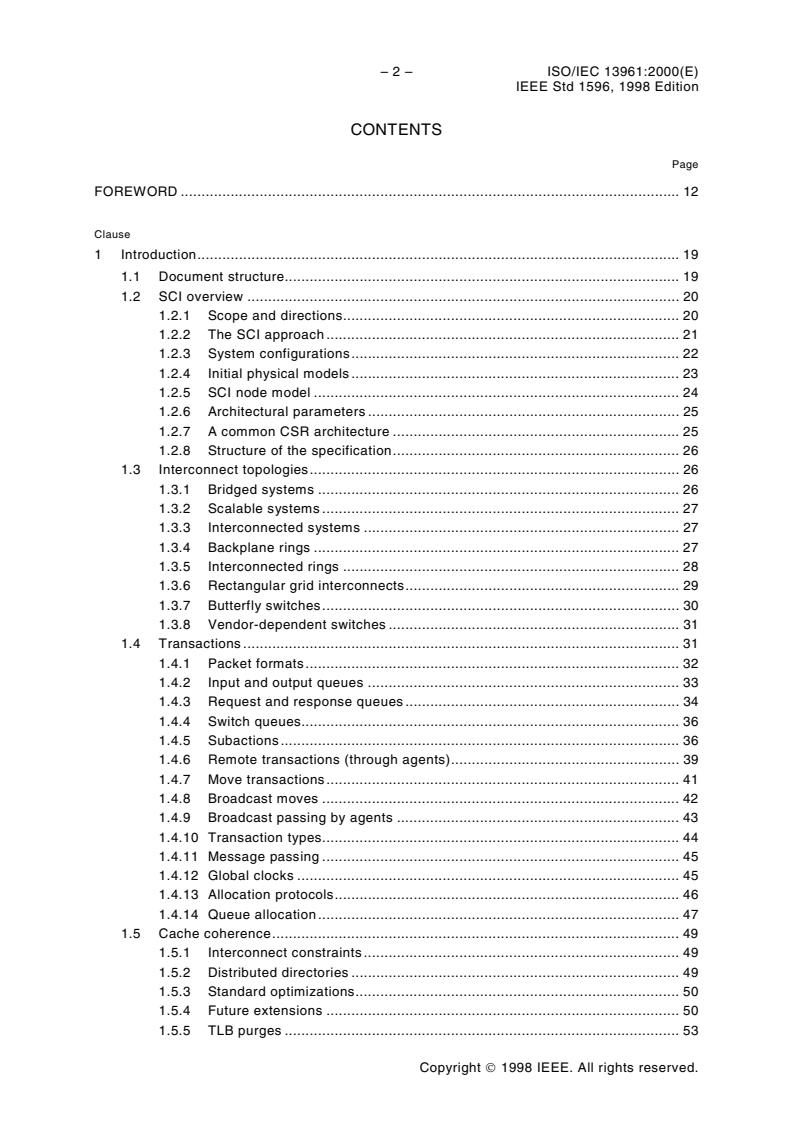
CONTENTS
Page
FOREWORD .12
Clause
1 Introduction. 19
1.1 Document structure. 19
1.2 SCI overview . 20
1.2.1 Scope and directions. 20
1.2.2 The SCI approach . 21
1.2.3 System configurations. 22
1.2.4 Initial physical models . 23
1.2.5 SCI node model . 24
1.2.6 Architectural parameters . 25
1.2.7 A common CSR architecture . 25
1.2.8 Structure of the specification. 26
1.3 Interconnect topologies. 26
1.3.1 Bridged systems . 26
1.3.2 Scalable systems . 27
1.3.3 Interconnected systems . 27
1.3.4 Backplane rings . 27
1.3.5 Interconnected rings . 28
1.3.6 Rectangular grid interconnects. 29
1.3.7 Butterfly switches. 30
1.3.8 Vendor-dependent switches . 31
1.4 Transactions . 31
1.4.1 Packet formats. 32
1.4.2 Input and output queues . 33
1.4.3 Request and response queues . 34
1.4.4 Switch queues. 36
1.4.5 Subactions. 36
1.4.6 Remote transactions (through agents). 39
1.4.7 Move transactions. 41
1.4.8 Broadcast moves . 42
1.4.9 Broadcast passing by agents . 43
1.4.10 Transaction types. 44
1.4.11 Message passing . 45
1.4.12 Global clocks . 45
1.4.13 Allocation protocols. 46
1.4.14 Queue allocation. 47
1.5 Cache coherence. 49
1.5.1 Interconnect constraints . 49
1.5.2 Distributed directories . 49
1.5.3 Standard optimizations. 50
1.5.4 Future extensions . 50
1.5.5 TLB purges . 53
Copyright 1998 IEEE. All rights reserved.
IEEE Std 1596, 1998 Edition
Clause Page
1.6 Reliability, availability, and support (RAS). 54
1.6.1 RAS overview . 54
1.6.2 Autoconfiguration. 54
1.6.3 Control and status registers . 54
1.6.4 Transmission-error detection and isolation . 55
1.6.5 Error containment . 55
1.6.6 Hardware fault retry (ringlet-local, physical layer option) . 56
1.6.7 Software fault recovery (end-to-end) . 56
1.6.8 System debugging . 57
1.6.9 Alternate routing . 57
1.6.10 Online replacement. 57
2 References, glossary, and notation . 58
2.1 Normative references. 58
2.2 Conformance levels . 58
2.3 Terms and definitions . 59
2.4 Bit and byte ordering. 66
2.5 Numerical values . 68
2.6 C code. 68
3 Logical protocols and formats . 68
3.1 Packet formats. 68
3.1.1 Packet types . 68
3.2 Send and echo packet formats. 69
3.2.1 Request-send packet format . 69
3.2.2 Request-echo packet format . 72
3.2.3 Response-send packet. 74
3.2.4 Standard status codes . 76
3.2.5 Response-echo packet format. 78
3.2.6 Interconnect-affected fields . 79
3.2.7 Init packets . 80
3.2.8 Cyclic redundancy code (CRC) . 81
3.2.9 Parallel 16-bit CRC calculations. 82
3.2.10 CRC stomping. 84
3.2.11 Idle symbols. 85
3.3 Logical packet encodings. 86
3.3.1 Flag coding . 86
3.4 Transaction types . 89
3.4.1 Transaction commands . 89
3.4.2 Lock subcommands . 92
3.4.3 Unaligned DMA transfers . 94
3.4.4 Aligned block-transfer hints. 95
3.4.5 Move transactions. 97
3.4.6 Global time synchronization . 98
3.5 Elastic buffers. 99
3.5.1 Elasticity models . 99
3.5.2 Idle-symbol insertions . 100
3.5.3 Idle-symbol deletions . 101
Copyright 1998 IEEE. All rights reserved.
– 4 – ISO/IEC 13961:2000(E)
IEEE Std 1596, 1998 Edition
Clause Page
3.6 Bandwidth allocation. 101
3.6.1 Fair bandwidth allocation . 102
3.6.2 Setting ringlet priority. 104
3.6.3 Bandwidth partitioning. 106
3.6.4 Types of transmission protocols . 108
3.6.5 Pass-transmission protocol . 108
3.6.6 Low-transmission protocol. 111
3.6.7 Idle insertions . 114
3.6.8 High-transmission protocol. 114
3.7 Queue allocation. 116
3.7.1 Queue reservations. 116
3.7.2 Multiple active sends. 118
3.7.3 Unfair reservations. 119
3.7.4 Queue-selection protocols. 119
3.7.5 Re-send priorities. 119
3.8 Transaction errors. 120
3.8.1 Requester timeouts (response-expected packets) . 120
3.8.2 Time-of-death timeout (optional, all nodes) . 120
3.8.3 Responder-processing errors . 122
3.9 Transmission errors . 123
3.9.1 Error isolation . 123
3.9.2 Scrubber maintenance . 125
3.9.3 Producer-detected errors . 126
3.9.4 Consumer-detected errors. 128
3.10 Address initialization. 129
3.10.1 Transaction addressing. 129
3.10.2 Reset types. 131
3.10.3 Unique node identifiers . 132
3.10.4 Ringlet initialization. 133
3.10.5 Simple-subset ringlet resets. 135
3.10.6 Ringlet resets. 135
3.10.7 Ringlet clears (optional) . 137
3.10.8 Inserting initialization packets . 138
3.10.9 Address initialization . 139
3.11 Packet encoding . 140
3.11.1 Common encoding features (L18) . 140
3.11.2 Parallel encoding with 18 signals (P18). 141
3.11.3 Serial encoding with 20-bit symbols (S20). 141
3.12 SCI-specific control and status registers . 144
3.12.1 SCI transaction sets. 144
3.12.2 SCI resets. 145
3.12.3 SCI-dependent fields within standard CSRs . 145
3.12.4 SCI-dependent CSRs. 148
3.12.5 SCI-dependent ROM. 151
3.12.6 Interrupt register formats. 155
3.12.7 Interleaved logical addressing. 157
Copyright 1998 IEEE. All rights reserved.
IEEE Std 1596, 1998 Edition
Clause Page
4 Cache-coherence protocols. 158
4.1 Introduction. 158
4.1.1 Objectives. 158
4.1.2 SCI transaction components . 158
4.1.3 Physical addressing . 159
4.1.4 Coherence directory overview . 159
4.1.5 Memory and cache tags . 160
4.1.6 Instruction-execution model . 161
4.1.7 Coherence document structure . 162
4.2 Coherence update sequences. 163
4.2.1 List prepend. 163
4.2.2 List-entry deletion . 165
4.2.3 Update actions. 167
4.2.4 Cache-line locks . 167
4.2.5 Stable sharing lists. 168
4.3 Minimal-set coherence protocols. 171
4.3.1 Sharing-list updates . 171
4.3.2 Cache fetching. 171
4.3.3 Cache rollouts. 173
4.3.4 Instruction-execution model . 174
4.4 Typical-set coherence protocols. 175
4.4.1 Sharing-list updates . 175
4.4.2 Read-only fetch. 175
4.4.3 Read-write fetch. 177
4.4.4 Data modifications . 178
4.4.5 Mid and head deletions . 179
4.4.6 DMA reads and writes . 181
4.4.7 Instruction-execution model . 183
4.5 Full-set coherence protocols . 184
4.5.1 Full-set option summary. 184
4.5.2 CLEAN-list creation. 184
4.5.3 Sharing-list additions . 185
4.5.4 Cache washing . 187
4.5.5 Cache flushing . 189
4.5.6 Cache cleansing . 191
4.5.7 Pairwise sharing . 192
4.5.8 Pairwise-sharing faults. 196
4.5.9 QOLB sharing . 197
4.5.10 Cache-access properties. 200
4.5.11 Instruction-execution model . 201
4.6 C-code naming conventions. 202
4.7 Coherent read and write transactions. 203
4.7.1 Extended mread transactions. 204
4.7.2 Cache cread and cwrite64 transactions. 205
4.7.3 Smaller tag sizes . 206
Copyright 1998 IEEE. All rights reserved.
– 6 – ISO/IEC 13961:2000(E)
IEEE Std 1596, 1998 Edition
Clause Page
5 C-code structure . 207
5.1 Node structure . 207
5.1.1 Signals within a node . 207
5.1.2 Packet transfers among node components . 208
5.1.3 Transfer-cloud components. 208
5.2 A node's linc component . 210
5.2.1 A linc's subcomponents. 210
5.2.2 A linc's elastic buffer . 212
5.2.3 Other linc components . 213
5.3 Other node components. 213
5.3.1 A node's core component. 213
5.3.2 A node's memory component . 213
5.3.3 A node's exec component . 214
5.3.4 A node's proc component. 215
6 Physical layers. 216
6.1 Type 1 module . 217
6.1.1 Module characteristics . 217
6.1.2 Module compatibility considerations . 217
6.1.3 Module size. 218
6.1.4 Warpage, bowing, and deflection . 224
6.1.5 Cooling . 225
6.1.6 Connector . 226
6.1.7 Power and ground connection . 227
6.1.8 Pin allocation for backplane parallel 18-signal encoding. 229
6.1.9 Slot-identification signals . 231
6.2 Type 18-DE-500 signals and power control . 232
6.2.1 SCI differential signals . 233
6.2.2 Status lines. 233
6.2.3 Serial Bus signals . 233
6.2.4 Signal levels and skew. 233
6.2.5 Power-conversion control. 236
6.3 Type 18-DE-500 module extender cable . 238
6.4 Type 18-DE-500 cable-link. 240
6.5 Serial interconnection . 242
6.5.1 Serial interface Type 1-SE-1250, single-ended electrical. 243
6.5.2 Optical interface, fiber-optic signal type 1-FO-1250. 249
6.5.3 Test methods . 252
Annex A (informative) Ringlet initialization . 254
Annex B (informative) SCI design models. 257
B.1 Fast counters . 257
B.2 Translation-lookaside-buffer coherence . 257
B.3 Coherent lock models . 261
B.4 Coherence-performance models . 263
Bibliography . 265
Copyright 1998 IEEE. All rights reserved.
IEEE Std 1596, 1998 Edition
Page
Figure 1 – Physical-layer alternatives. 23
Figure 2 – SCI node model. 24
Figure 3 – 64-bit-fixed addressing . 25
Figure 4 – Bridged systems . 26
Figure 5 – Backplane rings. 28
Figure 6 – Interconnected rings . 29
Figure 7 – 2-D processor grids . 29
Figure 8 – Butterfly ringlets . 30
Figure 9 – Switch interface. 31
Figure 10 – Subactions. 32
Figure 11 – Send-packet format, simplified. 32
Figure 12 – Responder queues. 34
Figure 13 – Logical requester/responder queues . 35
Figure 14 – Paired request and response queues. 35
Figure 15 – Basic SCI bridge, paired request and response queues . 36
Figure 16 – Local transaction components . 37
Figure 17 – Local transaction components (busied by responder). 38
Figure 18 – Remote transaction components. 40
Figure 19 – Remote move-transaction components . 41
Figure 20 – Broadcast starts . 43
Figure 21 – Broadcast resumes. 43
Figure 22 – Transaction formats . 44
Figure 23 – Bandwidth partitioning . 46
Figure 24 – Resource bottlenecks . 47
Figure 25 – Queue allocation avoids starvation . 48
Figure 26 – Distributed cache tags . 49
Figure 27 – Request combining . 52
Figure 28 – Binary tree. 52
Figure 29 – TLB purging. 53
Figure 30 – Hardware fault-retry sequence. 56
Figure 31 – Software fault-retry on coherent data. 57
Figure 32 – Big-endian packet notation . 67
Figure 33 – Big-endian register notation. 67
Figure 34 – Send- and echo-packet formats . 69
Figure 35 – Request-packet format. 70
Figure 36 – Request-packet symbols. 70
Figure 37 – Request-echo packet format . 72
Figure 38 – Response-packet format. 74
Figure 39 – Response-packet symbols . 75
Figure 40 – Response-echo packet format . 78
Figure 41 – Initialization-packet format. 80
Figure 42 – Initialization-packet format example (companyId-based uniqueId value) . 81
Figure 43 – Serialized implementation of 16-bit CRC. 82
Figure 44 – Parallel CRC check. 84
Figure 45 – Remote transaction components (local request-send damaged). 85
Figure 46 – Logical idle-symbol encoding. 85
Figure 47 – Flag framing convention. 86
Figure 48 – Logical send- and init-packet framing convention. 87
Figure 49 – Logical echo-packet framing convention . 87
Figure 50 – Logical sync-packet framing convention. 88
Figure 51 – Logical abort-packet framing convention. 88
Figure 52 – Selected-byte reads and writes. 91
Figure 53 – Simplified lock model. 92
Figure 54 – Selected-byte locks (quadlet access). 93
Figure 55 – Selected-byte locks (octlet access). 94
Figure 56 – Expected DMA read transfers . 94
Figure 57 – Expected DMA write transfers. 95
Figure 58 – DMA block-transfer model. 96
Figure 59 – Time-sync on SCI . 98
Figure 60 – Elasticity model . 99
Copyright 1998 IEEE. All rights reserved.
– 8 – ISO/IEC 13961:2000(E)
IEEE Std 1596, 1998 Edition
Page
Figure 61 – Input-synchronizer model. 100
Figure 62 – Idle-symbol insertion. 100
Figure 63 – Idle-symbol deletion. 101
Figure 64 – Fair bandwidth allocation . 103
Figure 65 – Increasing ringlet priority . 105
Figure 66 – Restoring ringlet priority. 105
Figure 67 – Idle-symbol creation, fair-only node . 106
Figure 68 – Idle-symbol creation, unfair-capable node. 107
Figure 69 – Idle consumption, fair-only node . 107
Figure 70 – Idle consumption, unfair-capable node. 108
Figure 71 – Pass-transmission model (fair-only node) . 109
Figure 72 – Pass-transmission enabled . 109
Figure 73 – Pass-transmission active . 110
Figure 74 – Pass-transmission recovery. 110
Figure 75 – Low/high-transmission model. 111
Figure 76 – Low-transmission enabled . 111
Figure 77 – Low-transmission active. 112
Figure 78 – Low/high-transmission recovery. 113
Figure 79 – Low/high-transmission debt repayment . 113
Figure 80 – Low/high-transmission idle insertion . 114
Figure 81 – High-transmission enabled. 115
Figure 82 – Consumer send-packet queue reservations . 116
Figure 83 – A/B age labels . 118
Figure 84 – Response timeouts (request and no response) . 120
Figure 85 – Time-of-death discards . 121
Figure 85 – Packet life-cycle intervals . 121
Figure 87 – Time-of-death generation model . 122
Figure 88 – Responder's address-error processing. 122
Figure 89 – Response timeouts (request and no response) . 123
Figure 90 – Error-logging registers . 124
Figure 91 – Scrubber maintenance functions. 125
Figure 92 – Detecting lost low-go bits. 126
Figure 93 – Producer's address-error processing . 127
Figure 94 – Producer's echo-timeout processing . 127
Figure 95 – Producer fatal-error recovery (optional) . 128
Figure 96 – Consumer error recovery . 129
Figure 97 – SCI (64-bit fixed) addressing . 129
Figure 98 – Forms of node resets. 132
Figure 99 – Receiver synchronization and scrubber selection. 134
Figure 100 – Reset-closure generates idle symbols. 134
Figure 100 – Idle-closure injects go-bits in idles . 134
Figure 101 – Initialization states. 136
Figure 103 – Initialization states (clear option) . 137
Figure 104 – Output symbol sequence during initialization . 138
Figure 105 – Insert-multiplexer model . 139
Figure 106 – NodeIds after ringlet initialization and monarch selection. 139
Figure 107 – NodeIds after emperor selection, final address assignments. 140
Figure 108 – Flag framing convention. 141
Figure 109 – S20 symbol encoding. 142
Figure 110 – S20 symbol decoding. 143
Figure 111 – S20 sync-packet encoding . 143
Figure 112 – NODE_IDS register. 145
Figure 113 – STATE_CLEAR fields . 146
Figure 114 – SPLIT_TIMEOUT register-pair format . 147
Figure 115 – ARGUMENT register-pair format. 147
Figure 115 – CLOCK_STROBE_THROUGH format (offset 112). 148
Figure 117 – ERROR_COUNT register (offset 384) . 149
Figure 118 – SYNC_INTERVAL register (offset 512) . 149
Figure 119 – SAVE_ID register (offset 520). 150
Figure 120 – SLOT_ID register (offset 524) . 150
Copyright 1998 IEEE. All rights reserved.
IEEE Std 1596, 1998 Edition
Page
Figure 121 – SCI ROM format (bus_info_block). 151
Figure 122 – ROM format, CsrOptions. 152
Figure 123 – ROM format, LincOptions. 153
Figure 124 – ROM format, MemoryOptions. 154
Figure 125 – ROM format, CacheOptions . 155
Figure 126 – DIRECTED_TARGET format. 156
Figure 127 – Logical-to-physical address translation . 157
Figure 128 – SCI transaction components . 159
Figure 129 – Distributed sharing-list directory. 160
Figure 130 – SCI coherence tags (64-byte line, 64K nodes) . 161
Figure 131 – Prepend to ONLYP_DIRTY (pairwise capable). 163
Figure 132 – Memory mread and cache-extended cread components. 164
Figure 133 – Deletion of head (and exclusive) entry . 165
Figure 134 – Cache cwrite64 and memory-extended mread components. 166
Figure 135 – ONLY_DIRTY list creation (minimal set) . 171
Figure 136 – GONE list additions (minimal set) . 172
Figure 137 – FRESH list additions (minimal set).
...