

IEC 61000-4-4:2004
(Main)Electromagnetic compatibility (EMC) - Part 4-4: Testing and measurement techniques - Electrical fast transient/burst immunity test
General Information
- Abstract
Establishes a common and reproducible reference for evaluating the immunity of electrical and electronic equipment when subjected to electrical fast transient/bursts on supply, signal, control and earth ports. The test method documented in this part of IEC 61000-4 describes a consistent method to assess the immunity of an equipment or system against a defined phenomenon. The standard defines: - test voltage waveform; - range of test levels; - test equipment; - verification procedures of test equipment; - test set-up; - test procedure. The standard gives specifications for laboratory and post-installation tests. The contents of the corrigenda of August 2006 and June 2007 have been included in this copy.
- Status
- Published
- Publication Date
- 29-Mar-2011
- Technical Committee
- SC 77B - High frequency phenomena
- Drafting Committee
- WG 11 - TC 77/SC 77B/WG 11
- Current Stage
- DELPUB - Deleted Publication
- Start Date
- 30-Apr-2012
- Completion Date
- 28-Aug-2026
Buy Documents

IEC 61000-4-4:2004 - Electromagnetic compatibility (EMC) - Part 4-4: Testing and measurement techniques - Electrical fast transient/burst immunity test Released:7/8/2004

IEC 61000-4-4:2004 - Compatibilité électromagnétique (CEM) - Partie 4-4: Techniques d'essai et de mesure - Essais d'immunité aux transitoires électriques rapides en salves Released:7/8/2004
IEC 61000-4-4:2004 - Electromagnetic compatibility (EMC) - Part 4-4: Testing and measurement techniques - Electrical fast transient/burst immunity test Released:7/8/2004
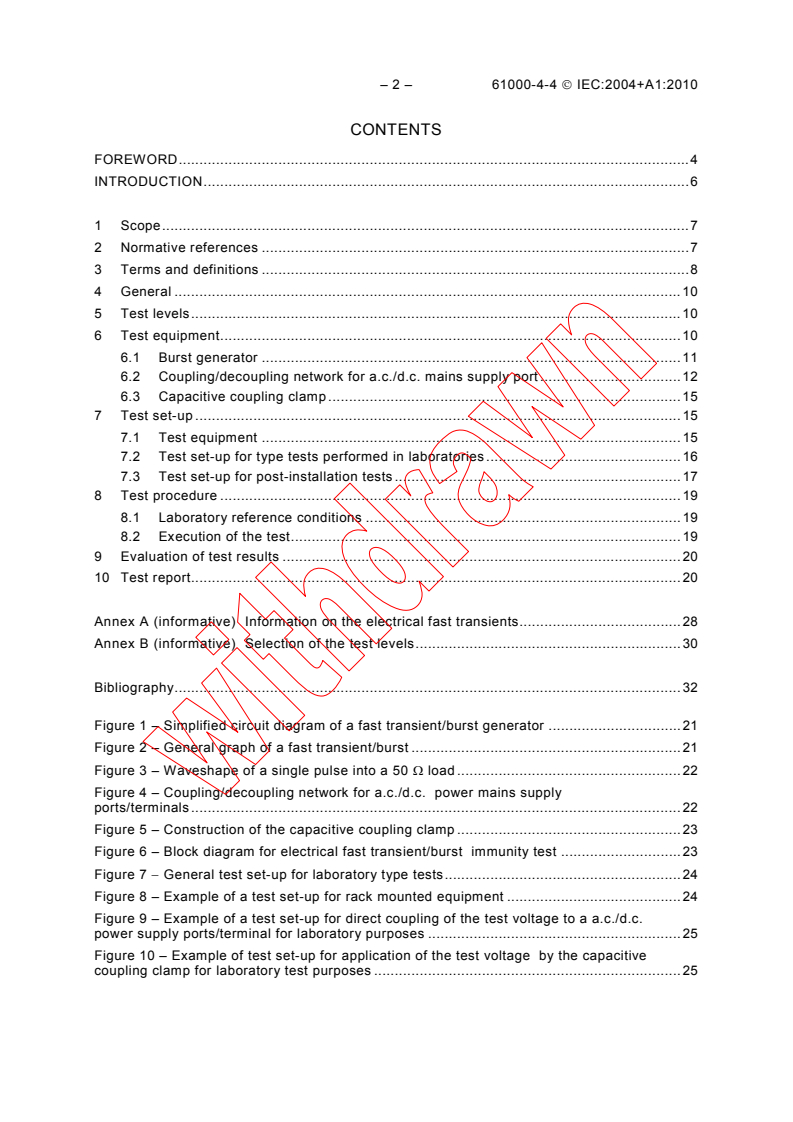
IEC 61000-4-4:2004+AMD1:2010 CSV - Electromagnetic compatibility (EMC) - Part 4-4: Testing and measurement techniques - Electrical fast transient/burst immunity test Released:3/30/2011
Overview
IEC 61000-4-4:2004 is a globally recognized international standard published by the International Electrotechnical Commission (IEC). It defines requirements and test methods for evaluating the immunity of electrical and electronic equipment to electrical fast transients/bursts (EFT/B). The standard ensures that devices maintain electromagnetic compatibility (EMC) in environments subject to fast, repetitive electrical disturbances, a crucial factor in ensuring reliable operation and preventing malfunctions.
IEC 61000-4-4 provides a common, reproducible reference for assessing how systems withstand electrical fast transient events on supply, signal, control, and earth ports. The standard specifies the required test waveform, a range of test levels, the necessary test equipment, procedures for verifying test setups, and both laboratory and post-installation test methods.
Key Topics
- Electrical Fast Transient/Burst Immunity: Defines the methods for simulating EFT/B phenomena and measuring immunity, focusing on sharp, high-frequency disturbances typically caused by switching transients (e.g., relay contact bounce, interruption of inductive loads).
- Test Voltage Waveform: Describes the parameters of the burst waveform, including rise time, duration, and polarity, ensuring a consistent approach across test labs.
- Test Levels: Outlines standard test voltages for power and I/O ports, allowing for broad applicability across devices and sectors.
- Test Equipment: Specifies characteristics for generators, coupling/decoupling networks, and capacitive coupling clamps, ensuring equipment can accurately replicate electrical fast transient scenarios.
- Verification Procedures: Details procedures to confirm the performance and calibration of test equipment, guaranteeing the reliability and repeatability of test results.
- Test Set-Up and Procedures: Provides requirements for correct installation, earthing, cable placement, and environmental considerations to ensure meaningful results in both laboratory and real-world (post-installation) settings.
Applications
IEC 61000-4-4 is used to assess EMC performance across a wide array of electrical and electronic equipment. Its practical applications include:
- Product Development and Certification: Ensuring new devices comply with market or regulatory requirements for immunity to electrical transients, facilitating global market access.
- Quality Assurance: Supporting routine testing as part of factory inspections or batch verification, reducing field failures and warranty claims.
- Installation Validation: Verifying immunity compliance of equipment after installation in the field, particularly in sensitive or demanding environments such as industrial facilities, data centers, and critical infrastructure.
- Regulatory Compliance: Aligning products with international EMC legislation and directives, aiding manufacturers in meeting national and regional EMC requirements.
- Product Comparison: Providing a baseline for the comparative assessment of equipment from different manufacturers or designs under standardized conditions.
Industries benefiting from this standard include:
- Industrial automation
- Telecommunications
- Consumer electronics
- Automotive electronics
- Medical device manufacturing
Related Standards
For comprehensive EMC compliance, IEC 61000-4-4 should be considered alongside related standards, including:
- IEC 61000-4-2: Electrostatic discharge (ESD) immunity test
- IEC 61000-4-3: Radiated, radio-frequency, electromagnetic field immunity
- IEC 61000-4-5: Surge immunity test
- IEC 61000-4-6: Immunity to conducted disturbances, induced by radio-frequency fields
- IEC 61000-4-11: Voltage dips, short interruptions and voltage variations immunity tests
- IEC 60050-161: International Electrotechnical Vocabulary (Electromagnetic compatibility)
- IEC Guide 107: EMC guidance for standard development
Each of these standards addresses a specific electromagnetic phenomenon and collectively ensures a holistic approach to electromagnetic compatibility testing and product robustness.
By adhering to IEC 61000-4-4:2004, manufacturers and test laboratories can ensure devices meet robust EMC immunity requirements, supporting safe, reliable, and compliant operation in today’s complex electrical environments. Use of this standard facilitates confidence in product performance, reduces the risk of interference, and streamlines both domestic and international product approvals.
Relations
- Effective Date
- 05-Sep-2023
- Effective Date
- 05-Sep-2023
- Effective Date
- 05-Sep-2023
- Effective Date
- 05-Sep-2023
- Effective Date
- 05-Sep-2023
- Effective Date
- 05-Sep-2023
Buy Documents
IEC 61000-4-4:2004 - Electromagnetic compatibility (EMC) - Part 4-4: Testing and measurement techniques - Electrical fast transient/burst immunity test Released:7/8/2004
IEC 61000-4-4:2004 - Compatibilité électromagnétique (CEM) - Partie 4-4: Techniques d'essai et de mesure - Essais d'immunité aux transitoires électriques rapides en salves Released:7/8/2004
IEC 61000-4-4:2004 - Electromagnetic compatibility (EMC) - Part 4-4: Testing and measurement techniques - Electrical fast transient/burst immunity test Released:7/8/2004
IEC 61000-4-4:2004+AMD1:2010 CSV - Electromagnetic compatibility (EMC) - Part 4-4: Testing and measurement techniques - Electrical fast transient/burst immunity test Released:3/30/2011
Get Certified
Connect with accredited certification bodies for this standard

ANCE
Mexican certification and testing association.

Intertek Slovenia
Intertek testing, inspection, and certification services in Slovenia.

LNE (Laboratoire National de Métrologie et d'Essais)
French national laboratory for metrology and testing.
Sponsored listings
Frequently Asked Questions
IEC 61000-4-4:2004 is a standard published by the International Electrotechnical Commission (IEC). Its full title is "Electromagnetic compatibility (EMC) - Part 4-4: Testing and measurement techniques - Electrical fast transient/burst immunity test". This standard covers: Establishes a common and reproducible reference for evaluating the immunity of electrical and electronic equipment when subjected to electrical fast transient/bursts on supply, signal, control and earth ports. The test method documented in this part of IEC 61000-4 describes a consistent method to assess the immunity of an equipment or system against a defined phenomenon. The standard defines: - test voltage waveform; - range of test levels; - test equipment; - verification procedures of test equipment; - test set-up; - test procedure. The standard gives specifications for laboratory and post-installation tests. The contents of the corrigenda of August 2006 and June 2007 have been included in this copy.
Establishes a common and reproducible reference for evaluating the immunity of electrical and electronic equipment when subjected to electrical fast transient/bursts on supply, signal, control and earth ports. The test method documented in this part of IEC 61000-4 describes a consistent method to assess the immunity of an equipment or system against a defined phenomenon. The standard defines: - test voltage waveform; - range of test levels; - test equipment; - verification procedures of test equipment; - test set-up; - test procedure. The standard gives specifications for laboratory and post-installation tests. The contents of the corrigenda of August 2006 and June 2007 have been included in this copy.
IEC 61000-4-4:2004 is classified under the following ICS (International Classification for Standards) categories: 33.100.20 - Immunity. The ICS classification helps identify the subject area and facilitates finding related standards.
IEC 61000-4-4:2004 has the following relationships with other standards: It is inter standard links to IEC 61000-4-4:2004/AMD1:2010, IEC 61000-4-4:2004/COR1:2006, IEC 61000-4-4:2004/COR2:2007, IEC 61000-4-4:2012, IEC 61000-4-4:1995/AMD1:2000, IEC 61000-4-4:1995/AMD2:2001. Understanding these relationships helps ensure you are using the most current and applicable version of the standard.
IEC 61000-4-4:2004 is available in PDF format for immediate download after purchase. The document can be added to your cart and obtained through the secure checkout process. Digital delivery ensures instant access to the complete standard document.
Standards Content (Sample)
INTERNATIONAL IEC
STANDARD 61000-4-4
Second edition
2004-07
BASIC EMC PUBLICATION
Electromagnetic compatibility (EMC) –
Part 4-4:
Testing and measurement techniques –
Electrical fast transient/burst immunity test
This English-language version is derived from the original
bilingual publication by leaving out all French-language
pages. Missing page numbers correspond to the French-
language pages.
Reference number
Publication numbering
As from 1 January 1997 all IEC publications are issued with a designation in the
60000 series. For example, IEC 34-1 is now referred to as IEC 60034-1.
Consolidated editions
The IEC is now publishing consolidated versions of its publications. For example,
edition numbers 1.0, 1.1 and 1.2 refer, respectively, to the base publication, the
base publication incorporating amendment 1 and the base publication incorporating
amendments 1 and 2.
Further information on IEC publications
The technical content of IEC publications is kept under constant review by the IEC,
thus ensuring that the content reflects current technology. Information relating to
this publication, including its validity, is available in the IEC Catalogue of
publications (see below) in addition to new editions, amendments and corrigenda.
Information on the subjects under consideration and work in progress undertaken
by the technical committee which has prepared this publication, as well as the list
of publications issued, is also available from the following:
• IEC Web Site (www.iec.ch)
• Catalogue of IEC publications
The on-line catalogue on the IEC web site (www.iec.ch/searchpub) enables you to
search by a variety of criteria including text searches, technical committees
and date of publication. On-line information is also available on recently issued
publications, withdrawn and replaced publications, as well as corrigenda.
• IEC Just Published
This summary of recently issued publications (www.iec.ch/online_news/ justpub)
is also available by email. Please contact the Customer Service Centre (see
below) for further information.
• Customer Service Centre
If you have any questions regarding this publication or need further assistance,
please contact the Customer Service Centre:
Email: custserv@iec.ch
Tel: +41 22 919 02 11
Fax: +41 22 919 03 00
INTERNATIONAL IEC
STANDARD 61000-4-4
Second edition
2004-07
BASIC EMC PUBLICATION
Electromagnetic compatibility (EMC) –
Part 4-4:
Testing and measurement techniques –
Electrical fast transient/burst immunity test
” IEC 2004 Copyright - all rights reserved
No part of this publication may be reproduced or utilized in any form or by any means, electronic or mechanical,
including photocopying and microfilm, without permission in writing from the publisher.
International Electrotechnical Commission, 3, rue de Varembé, PO Box 131, CH-1211 Geneva 20, Switzerland
Telephone: +41 22 919 02 11 Telefax: +41 22 919 03 00 E-mail: inmail@iec.ch Web: www.iec.ch
PRICE CODE
Commission Electrotechnique Internationale V
International Electrotechnical Commission
ɆɟɠɞɭɧɚɪɨɞɧɚɹɗɥɟɤɬɪɨɬɟɯɧɢɱɟɫɤɚɹɄɨɦɢɫɫɢɹ
For price, see current catalogue
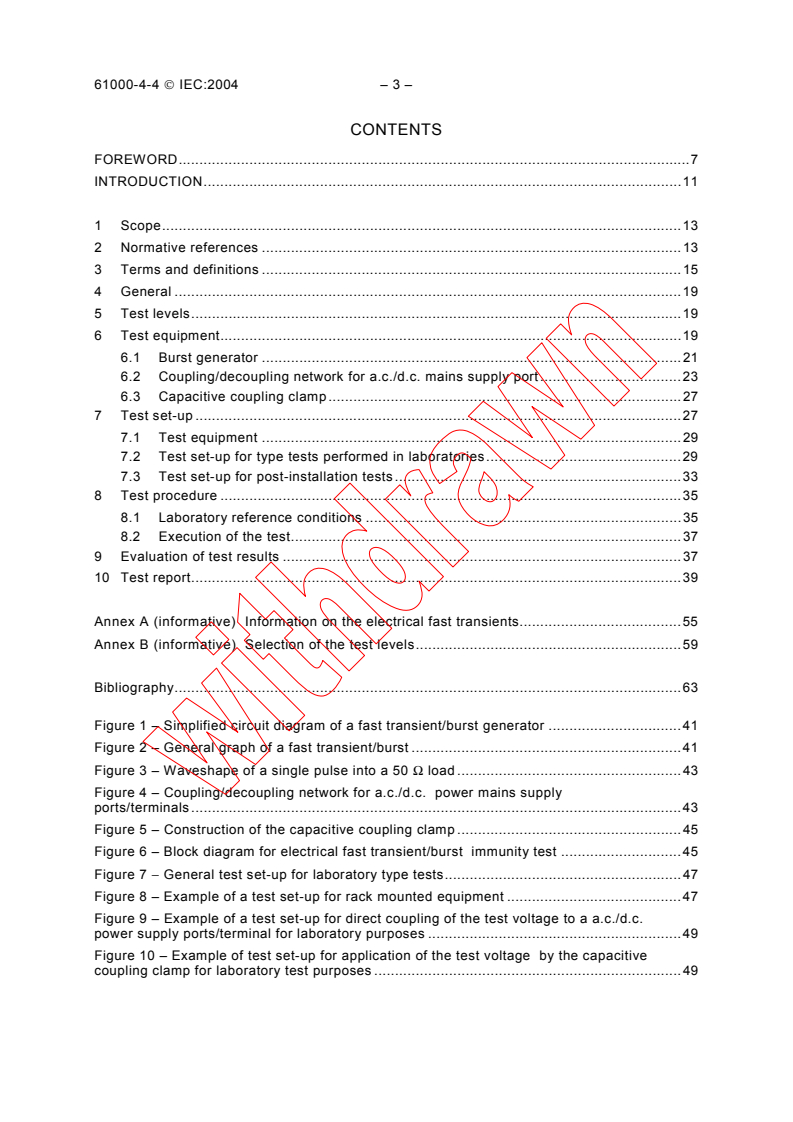
61000-4-4 © IEC:2004 – 3 –
CONTENTS
FOREWORD.7
INTRODUCTION.11
1 Scope.13
2 Normative references.13
3 Terms and definitions .15
4 General.19
5 Test levels.19
6 Test equipment.19
6.1 Burst generator.21
6.2 Coupling/decoupling network for a.c./d.c. mains supply port.23
6.3 Capacitive coupling clamp.27
7 Test set-up.27
7.1 Test equipment.29
7.2 Test set-up for type tests performed in laboratories.29
7.3 Test set-up for post-installation tests .33
8 Test procedure.35
8.1 Laboratory reference conditions .35
8.2 Execution of the test.37
9 Evaluation of test results .37
10 Test report.39
Annex A (informative) Information on the electrical fast transients.55
Annex B (informative) Selection of the test levels.59
Bibliography.63
Figure 1 – Simplified circuit diagram of a fast transient/burst generator .41
Figure 2 – General graph of a fast transient/burst .41
Figure 3 – Waveshape of a single pulse into a 50 Ω load .43
Figure 4 – Coupling/decoupling network for a.c./d.c. power mains supply
ports/terminals.43
Figure 5 – Construction of the capacitive coupling clamp .45
Figure 6 – Block diagram for electrical fast transient/burst immunity test .45
Figure 7 − General test set-up for laboratory type tests.47
Figure 8 – Example of a test set-up for rack mounted equipment .47
Figure 9 – Example of a test set-up for direct coupling of the test voltage to a a.c./d.c.
power supply ports/terminal for laboratory purposes .49
Figure 10 – Example of test set-up for application of the test voltage by the capacitive
coupling clamp for laboratory test purposes .49
61000-4-4 © IEC:2004 – 5 –
Figure 11 – Example for post-installation test on a.c./d.c. power supply ports and
protective earth terminals for stationary, floor-mounted EUT .51
Figure 12 – Example for post-installation test on a.c. mains supply port and protective
earth terminals for non-stationary mounted EUT .53
Figure 13 – Example of post-installation test on communications and I/O ports without
the capacitive coupling clamp .53
Figure 14 – Verification of the waveform at the common mode output of the
coupling/decoupling network .25
Table 1 – Test levels.19
Table 2 – Output voltage peak values and repetition rates .23
61000-4-4 © IEC:2004 – 7 –
INTERNATIONAL ELECTROTECHNICAL COMMISSION
___________
ELECTROMAGNETIC COMPATIBILITY (EMC) –
Part 4-4: Testing and measurement techniques –
Electrical fast transient/burst immunity test
FOREWORD
1) The International Electrotechnical Commission (IEC) is a worldwide organization for standardization comprising
all national electrotechnical committees (IEC National Committees). The object of IEC is to promote
international co-operation on all questions concerning standardization in the electrical and electronic fields. To
this end and in addition to other activities, IEC publishes International Standards, Technical Specifications,
Technical Reports, Publicly Available Specifications (PAS) and Guides (hereafter referred to as “IEC
Publication(s)”). Their preparation is entrusted to technical committees; any IEC National Committee interested
in the subject dealt with may participate in this preparatory work. International, governmental and non-
governmental organizations liaising with the IEC also participate in this preparation. IEC collaborates closely
with the International Organization for Standardization (ISO) in accordance with conditions determined by
agreement between the two organizations.
2) The formal decisions or agreements of IEC on technical matters express, as nearly as possible, an international
consensus of opinion on the relevant subjects since each technical committee has representation from all
interested IEC National Committees.
3) IEC Publications have the form of recommendations for international use and are accepted by IEC National
Committees in that sense. While all reasonable efforts are made to ensure that the technical content of IEC
Publications is accurate, IEC cannot be held responsible for the way in which they are used or for any
misinterpretation by any end user.
4) In order to promote international uniformity, IEC National Committees undertake to apply IEC Publications
transparently to the maximum extent possible in their national and regional publications. Any divergence
between any IEC Publication and the corresponding national or regional publication shall be clearly indicated in
the latter.
5) IEC provides no marking procedure to indicate its approval and cannot be rendered responsible for any
equipment declared to be in conformity with an IEC Publication.
6) All users should ensure that they have the latest edition of this publication.
7) No liability shall attach to IEC or its directors, employees, servants or agents including individual experts and
members of its technical committees and IEC National Committees for any personal injury, property damage or
other damage of any nature whatsoever, whether direct or indirect, or for costs (including legal fees) and
expenses arising out of the publication, use of, or reliance upon, this IEC Publication or any other IEC
Publications.
8) Attention is drawn to the Normative references cited in this publication. Use of the referenced publications is
indispensable for the correct application of this publication.
9) Attention is drawn to the possibility that some of the elements of this IEC Publication may be the subject of
patent rights. IEC shall not be held responsible for identifying any or all such patent rights.
International Standard IEC 61000-4-4 has been prepared by sub-committee 77B: High
frequency phenomena, of IEC technical committee 77: Electromagnetic compatibility.
It forms Part 4-4 of IEC 61000. It has the status of a basic EMC publication in accordance
with IEC Guide 107, Electromagnetic compatibility – Guide to the drafting of electromagnetic
compatibility publications.
This second edition cancels and replaces the first edition published in 1995 and its amend-
ments 1 (2000) and 2 (2001) and constitutes a technical revision.
This second edition improves and clarifies simulator specifications, test criteria and test set-
ups. Only common mode injection is required.
61000-4-4 © IEC:2004 – 9 –
The text of this standard is based on the following documents:
FDIS Report on voting
77B/419/FDIS 77B/424/RVD
Full information on the voting for the approval of this standard can be found in the report on
voting indicated in the above table.
This publication has been drafted in accordance with the ISO/IEC Directives, Part 2.
The committee has decided that the contents of this publication will remain unchanged until
the maintenance result date indicated on the IEC web site under "http://webstore.iec.ch" in
the data related to the specific publication. At this date, the publication will be
• reconfirmed;
• withdrawn;
• replaced by a revised edition, or
• amended.
The contents of the corrigendum of August 2006 and June 2007 have been included in this
copy.
61000-4-4 © IEC:2004 – 11 –
INTRODUCTION
IEC 61000 is published in separate parts, according to the following structure:
Part 1: General
General considerations (introduction, fundamental principles)
Definitions, terminology
Part 2: Environment
Description of the environment
Classification of the environment
Compatibility levels
Part 3: Limits
Emission limits
Immunity limits (in so far as they do not fall under the responsibility of the product
committees)
Part 4: Testing and measurement techniques
Measurement techniques
Testing techniques
Part 5: Installation and mitigation guidelines
Installation guidelines
Mitigation methods and devices
Part 6: Generic standards
Part 9: Miscellaneous
Each part is further subdivided into several parts, published either as international standards
or as technical specifications or technical reports, some of which have already been published
as sections. Others will be published with the part number followed by a dash and a second
number identifying the subdivision (example: 61000-6-1).
This part is an international standard which gives immunity requirements and test procedures
related to electrical fast transients/bursts.
61000-4-4 © IEC:2004 – 13 –
ELECTROMAGNETIC COMPATIBILITY (EMC) –
Part 4-4: Testing and measurement techniques –
Electrical fast transient/burst immunity test
1 Scope
This part of IEC 61000-4 relates to the immunity of electrical and electronic equipment to
repetitive electrical fast transients. It gives immunity requirements and test procedures related
to electrical fast transients/bursts. It additionally defines ranges of test levels and establishes
test procedures.
The object of this standard is to establish a common and reproducible reference for evaluating
the immunity of electrical and electronic equipment when subjected to electrical fast
transient/bursts on supply, signal, control and earth ports. The test method documented in
this part of IEC 61000-4 describes a consistent method to assess the immunity of an
equipment or system against a defined phenomenon.
NOTE As described in IEC Guide 107, this is a basic EMC publication for use by product committees of the IEC.
As also stated in Guide 107, the IEC product committees are responsible for determining whether this immunity
test standard should be applied or not, and if applied, they are responsible for determining the appropriate test
levels and performance criteria. TC 77 and its sub-committees are prepared to co-operate with product committees
in the evaluation of the value of particular immunity tests for their products.
The standard defines:
– test voltage waveform;
– range of test levels;
– test equipment;
– verification procedures of test equipment;
– test set-up;
– test procedure.
The standard gives specifications for laboratory and post-installation tests.
2 Normative references
The following referenced documents are indispensable for the application of this document.
For dated references, only the edition cited applies. For undated references, the latest edition
of the referenced document (including any amendments) applies.
IEC 60050-161:1990, International Electrotechnical Vocabulary (IEV) – Chapter 161: Electro-
magnetic compatibility
61000-4-4 © IEC:2004 – 15 –
3 Terms and definitions
For the purposes of this document, the following terms and definitions, together with those in
IEC 60050-161 apply.
NOTE Several of the most relevant terms and definitions from IEC 60050-161 are presented among the definitions
below.
3.1
burst
sequence of a limited number of distinct pulses or an oscillation of limited duration
[IEV 161-02-07]
3.2
calibration
set of operations which establishes, by reference to standards, the relationship which exists,
under specified conditions, between an indication and a result of a measurement
NOTE 1 This term is based on the "uncertainty" approach.
NOTE 2 The relationship between the indications and the results of measurement can be expressed, in principle,
by a calibration diagram.
[IEV 311-01-09]
3.3
coupling
interaction between circuits, transferring energy from one circuit to another
3.4
common mode (coupling)
simultaneous coupling to all lines versus the ground reference plane
3.5
coupling clamp
device of defined dimensions and characteristics for common mode coupling of the
disturbance signal to the circuit under test without any galvanic connection to it
3.6
coupling network
electrical circuit for the purpose of transferring energy from one circuit to another
3.7
decoupling network
electrical circuit for the purpose of preventing EFT voltage applied to the EUT from affecting
other devices, equipment or systems which are not under test
3.8
degradation (of performance)
undesired departure in the operational performance of any device, equipment or system from
its intended performance
NOTE The term "degradation" can apply to temporary or permanent failure.
[IEV 161-01-19]
61000-4-4 © IEC:2004 – 17 –
3.9
EFT/B
electrical fast transient/burst
3.10
electromagnetic compatibility (EMC)
ability of an equipment or system to function satisfactorily in its electromagnetic environment
without introducing intolerable electromagnetic disturbances to anything in that environment
[IEV 161-01-07]
3.11
EUT
equipment under test
3.12
ground reference plane
flat conductive surface whose potential is used as a common reference
[IEV 161-04-36]
3.13
immunity (to a disturbance)
ability of a device, equipment or system to perform without degradation in the presence of an
electromagnetic disturbance
[IEV 161-01-20]
3.14
port
particular interface of the EUT with the external electromagnetic environment
3.15
rise time
interval of time between the instants at which the instantaneous value of a pulse first reaches
10 % value and then the 90 % value
[IEV 161-02-05, modified]
3.16
transient
pertaining to or designating a phenomenon or a quantity which varies between two
consecutive steady states during a time interval which is short compared with the time-scale
of interest
[IEV 161-02-01]
3.17
verification
set of operations which is used to check the test equipment system (e.g. the test generator
and the interconnecting cables) and to demonstrate that the test system is functioning within
the specifications given in Clause 6
NOTE 1 The methods used for verification may be different from those used for calibration.
NOTE 2 The procedure of 6.1.2 and 6.2.2 is meant as a guide to insure the correct operation of the test
generator, and other items making up the test set-up so that the intended waveform is delivered to the EUT.
NOTE 3 For the purpose of this basic EMC standard this definition is different from the definition given in
IEV 311-01-13.
61000-4-4 © IEC:2004 – 19 –
4 General
The repetitive fast transient test is a test with bursts consisting of a number of fast transients,
coupled into power supply, control, signal and earth ports of electrical and electronic
equipment. Significant for the test are the high amplitude, the short rise time, the high
repetition rate, and the low energy of the transients.
The test is intended to demonstrate the immunity of electrical and electronic equipment when
subjected to types of transient disturbances such as those originating from switching
transients (interruption of inductive loads, relay contact bounce, etc.).
5 Test levels
The preferred test levels for the electrical fast transient test, applicable to power, ground,
signal and control ports of the equipment are given in Table 1.
Table 1 – Test levels
Open circuit output test voltage and repetition rate of the impulses
On I/O (input/output) signal, data
On power port, PE
and control ports
Level
Voltage peak Repetition rate Voltage peak Repetition rate
kV kHz kV kHz
1 0,5 5 or 100 0,25 5 or 100
2 1 5 or 100 0,5 5 or 100
3 2 5 or 100 1 5 or 100
4 4 5 or 100 2 5 or 100
a
X Special Special Special Special
NOTE 1 Use of 5 kHz repetition rates is traditional; however, 100 kHz is closer to reality. Product committees
should determine which frequencies are relevant for specific products or product types.
NOTE 2 With some products, there may be no clear distinction between power ports and I/O ports, in which case
it is up to product committees to make this determination for test purposes.
a
"X" is an open level. The level has to be specified in the dedicated equipment specification.
These open-circuit output voltages will be displayed on the EFT/B generator. For selection of
levels, see Annex B.
6 Test equipment
The verification procedures of 6.1.2 and 6.2.2 are meant as a guide to insure the correct
operation of the test generator, coupling/decoupling networks, and other items making up the
test set-up so that the intended waveform is delivered to the EUT.
61000-4-4 © IEC:2004 – 21 –
6.1 Burst generator
The simplified circuit diagram of the generator is given in Figure 1. The circuit elements C ,
c
R , R , and C are selected so that the generator delivers a fast transient under open circuit
s m d
conditions and with a 50 Ω resistive load. The effective output impedance of the generator
shall be 50 Ω.
The major elements of the test generator are:
– high-voltage source;
– charging resistor;
– energy storage capacitor;
– high voltage switch;
– impulse duration shaping resistor;
– impedance matching resistor;
– d.c. blocking capacitor.
6.1.1 Characteristics of the fast transient/burst generator
The characteristics of the fast transient/burst generator are the following:
– Output voltage range with 1 000 Ω load shall be at least 0,25 kV to 4 kV
– Output voltage range with 50 Ω load shall be at least 0,125 kV to 2 kV
The generator shall be capable of operating under short-circuit conditions.
Characteristics:
– polarity: positive/negative
– output type: coaxial, 50 Ω
– d.c. blocking capacitor 10 nF ± 20 %
– repetition frequency: (see Table 2) ± 20 %
– relation to power supply: asynchronous
– burst duration: 15 ms ± 20 % at 5 kHz
(see Figure 2) 0,75 ms ± 20 % at 100 kHz
– burst period: 300 ms ± 20 %
(see Figure 2)
– wave shape of the pulse
• into 50 Ω load rise time t = 5 ns ± 30 %
r
duration t (to 50 %) = 50 ns ± 30 %
d
peak voltage = according to Table 2, ±10 %
(see Figure 3 for the 50 Ω waveshape)
• into 1 000 Ω load rise time t = 5 ns ± 30 %
r
duration t (to 50 %) = 50 ns with a tolerance of
d
–15 ns to +100 ns
peak voltage = according to Table 2, ±20%
(see Note 2 below Table 2)
61000-4-4 © IEC:2004 – 23 –
– test load impedance 50 Ω ± 2 %
1 000 Ω ± 2 % in parallel with ≤ 6 pF. The resistance
measurement is made at d.c. and the capacitance
measurement is made using a commercially
available capacitance meter that operates at low
frequencies.
6.1.2 Verification of the characteristics of the fast transient/burst generator
The test generator characteristics shall be verified in order to establish a common reference
for all generators. For this purpose, the following procedure shall be undertaken.
The test generator output shall be connected to a 50 Ω and 1 000 Ω coaxial termination
respectively and the voltage monitored with an oscilloscope. The –3 dB bandwidth of the
measuring equipment and the test load impedance shall be at least 400 MHz. The test load
impedance at 1 000 Ω is likely to become a complex network. The rise time, impulse duration
and repetition rate of the impulses within one burst shall be monitored as well as the burst
duration and burst period.
For each of the set voltages of Table 2, measure the output voltage at a 50 Ω load
[V (50 Ω)]. This measured voltage shall be [0,5 × V (open circuit)] ± 10%.
p p
With the same generator setting (set voltage), measure the voltage at a 1 000 Ω load –
[V (1 000 Ω)]. This measured voltage shall be V (open circuit) ± 20%.
p p
NOTE 1 Measures should be taken to ensure that stray capacitance is kept to a minimum.
Table 2 – Output voltage peak values and repetition rates
Set voltage V (open circuit) Repetition
V (1 000 Ω) V (50 Ω)
p
p p
frequency
kV kV kV kV
kHz
0,25 0,25 0,24 0,125 5 or 100
0,5 0,5 0,48 0,25 5 or 100
1 1 0,95 0,5 5 or 100
2 2 1,9 1 5 or 100
4 4 3,8 2 5 or 100
NOTE 2 Use of a 1 000 Ω load resistor will automatically result in a voltage reading that is 5 % lower than the set
voltage as shown in column V (1 000 Ω). The reading V at 1000 Ω = V (open circuit) multiplied times
p p p
1000/1050 (the ratio of the test load to the total circuit impedance of 1000 Ω plus 50 Ω).
NOTE 3 With the 50 Ω load, the measured output voltage is 0,5 times the value of the unloaded voltage as
reflected in the table above.
6.2 Coupling/decoupling network for a.c./d.c. mains supply port
The coupling/decoupling network is required for acceptance tests of a.c./d.c. power supply
ports.
61000-4-4 © IEC:2004 – 25 –
The circuit diagram (example for a three-phase power mains supply) is given in Figure 4.
The waveform of the EFT/B generator shall be verified at the output of the coupling network
according to 6.2.2.
6.2.1 Characteristics of the coupling/decoupling network
The characteristics of the coupling/decoupling network are the following:
– coupling capacitors: 33 nF;
– coupling mode: common mode.
6.2.2 Verification of the characteristics of the coupling/decoupling network
The requirements given in 6.1.2 also apply to the measurement equipment that is used for the
verification of the characteristics of the coupling/decoupling network.
The waveform shall be verified at the common mode output of the coupling/decoupling
network with all outputs tied together and a single 50 Ω termination as shown in Figure 14. In
addition to verification of the waveform at the common mode output of the
coupling/decoupling network, it is recommended that each individual output be checked to
ensure that all outputs are functional."
Signal from test generator
Decoupling
L
L
Termination
L
resistor
N
50 Ω
U
meas
PE
IEC 1033/07
Figure 14 – Verification of the waveform at the common mode output
of the coupling/decoupling network
The verification is performed with the generator output voltage set to a nominal voltage of
4 kV. The generator is connected to input of the coupling/decoupling network. The output of
the CDN (normally connected to the EUT) is terminated with a 50 Ω load. The peak voltage
and waveform are recorded.
Rise time of the pulses (10 % to 90 % value) shall be 5 ns ± 30 %.
Impulse duration (50 % value) shall be 50 ns ± 30 % with the 50 Ω load.
61000-4-4 © IEC:2004 – 27 –
Peak voltage ±10 % according to Table 2.
The residual test pulse voltage on the inputs of the coupling/decoupling network when the
EUT and the power network are disconnected shall not exceed 10 % of applied test voltage.
NOTE Coupling/decoupling networks designed in accordance with Edition 1 of IEC 61000-4-4 (1995) may need
minor modifications to meet the common mode requirements of this document.
6.3 Capacitive coupling clamp
The clamp provides the ability of coupling the fast transients/bursts to the circuit under test
without any galvanic connection to the terminals of the EUT's ports, shielding of the cables or
any other part of the EUT.
The coupling capacitance of the clamp depends on the cable diameter, material of the cables,
and cable shielding (if any).
The device is composed of a clamp unit (made, for example, of galvanized steel, brass,
copper or aluminium) for housing the cables (flat or round) of the circuits under test and shall
be placed on a ground reference plane of minimum area of 1 m . The ground (reference)
plane shall extend beyond the clamp by a least 0,1 m on all sides.
The clamp shall be provided at both ends with a high-voltage coaxial connector for the
connection of the test generator at either end. The generator shall be connected to that end of
the clamp which is nearest to the EUT.
The clamp itself shall be closed as much as possible to provide maximum coupling
capacitance between the cable and the clamp.
The mechanical arrangement of the coupling clamp is given in Figure 5 and determines its
characteristics, such as frequency response, impedance, etc.
Characteristics:
− typical coupling capacitance between cable and clamp: 100 pF to 1 000 pF;
− usable diameter range of round cables: 4 mm to 40 mm;
− insulation withstand capability: 5 kV (test pulse: 1,2/50 µs).
The coupling method using the clamp is required for acceptance tests on lines connected to
I/O and communication ports. It may also be used on ac/dc power supply ports only if the
coupling/decoupling network defined in 6.2 cannot be used.
7 Test set-up
Different types of tests are defined based on test environments. These are:
– type (conformance) tests performed in laboratories;
– post-installation tests performed on equipment in its final installed conditions.
The preferred test method is that of type tests performed in laboratories.
The EUT shall be arranged in accordance with the manufacturer's instructions for installation
(if any).
61000-4-4 © IEC:2004 – 29 –
7.1 Test equipment
The test set-up includes the following equipment (see Figure 6):
– ground reference plane;
– coupling device (network or clamp);
– decoupling network;
– test generator.
7.2 Test set-up for type tests performed in laboratories
7.2.1 Test conditions
The following requirements apply to tests performed in laboratories with the environmental
reference conditions specified in 8.1.
EUTs, whether stationary floor-mounted or table top, and equipment designed to be mounted
in other configurations, shall be placed on a ground reference plane and shall be insulated
from it by an insulating support 0,1 m ± 0,01 m thick (see Figure 7).
In the case of table-top equipment, the EUT should be located 0,1 m ± 0,01 m above the
ground reference plane (see Figure 7). Equipment normally mounted on ceilings or walls shall
be tested as table-top equipment with the EUT located 0,1m ± 0,01 m above the ground
reference plane.
The test generator and the coupling/decoupling network shall be placed directly on, and
bonded to, the ground reference plane.
The ground reference plane shall be a metallic sheet (copper or aluminium) of 0,25 mm
minimum thickness; other metallic materials may be used but they shall have 0,65 mm
minimum thickness.
The minimum area of the ground reference plane is 1 m × 1 m. The actual size depends on
the dimensions of the EUT.
The ground reference plane shall project beyond the EUT by at least 0,1 m on all sides.
The ground reference plane shall be connected to the protective earth.
The EUT shall be arranged and connected to satisfy its functional requirements, according to
the equipment installation specifications.
The minimum distance between the EUT and all other conductive structures (e.g. the walls of
a shielded room), except the ground reference plane shall be more than 0,5 m.
All cables to the EUT shall be placed on the insulation support 0,1 m above the ground
reference plane. Cables not subject to electrical fast transients shall be routed as far as
possible from the cable under test to minimize the coupling between the cables.
The EUT shall be connected to the earthing system in accordance with the manufacturer's
installation specifications; no additional earthing connections are allowed.
The connection impedance of the coupling/decoupling network earth cables to the ground
reference plane and all bondings shall provide a low inductance.
61000-4-4 © IEC:2004 – 31 –
Either a direct coupling network or a capacitive clamp shall be used for the application of the
test voltages. The test voltages shall be coupled to all of the EUT ports including those
between two units of equipment involved in the test, unless the length of the interconnecting
cable makes it impossible to test.
Decoupling networks shall be used to protect auxiliary equipment and public networks.
When using the coupling clamp, the minimum distance between the coupling plates and all
other conductive surfaces, except the ground reference plane beneath the coupling clamp,
shall be 0,5 m.
Unless otherwise specified in the product standard or the product family standard, the length
of the signal and power lines between the coupling device and the EUT shall be
0,5 m ± 0,05 m.
If the manufacturer provides a non-detachable supply cable more than 0,5 m ± 0,05 m long
with the equipment, the excess length of this cable shall be folded to avoid a flat coil and
situated at a distance of 0,1 m above the ground reference plane.
Examples of the test set-up for laboratory tests are given in Figures 7 and 8.
In Figure 8, an additional ground plane, connected to the chassis of the EUT is used.
7.2.2 Methods of coupling the test voltage to the EUT
The method of coupling the test voltage to the EUT is dependent on the type of EUT port (as
indicated below).
7.2.2.1 Power supply ports
An example for the test set-up for direct coupling of the EFT/B disturbance voltage via a
coupling/decoupling network is given in Figure 9. This is the preferred method of coupling to
power supply ports.
If a suitable coupler/decoupler cannot be obtained, i.e. for a.c. mains currents >100 A,
alternative methods can be employed; however, use of the capacitive clamp is discouraged
since its efficiency in coupling the bursts is considerably less than direct injection using the
33 nF capacitors.
7.2.2.2 I/O and communication ports
The examples in Figures 7 and 10 show how to use the capacitive coupling clamp for
application of the disturbance test voltage to I/O and communication ports. When using the
capacitive coupling clamp, non-tested or auxiliary equipment connected should be
appropriately decoupled.
7.2.2.3 Cabinet earth port
The test point on the cabinet shall be the terminal for the protective earth conductor.
The test voltage shall be applied to the protective earth (PE) connection through a 33 nF
coupling capacitor according to Figure 11.
61000-4-4 © IEC:2004 – 33 –
7.3 Test set-up for post-installation tests
These tests are optional. They may be applied only when agreed between manufacturer and
customer. It has to be considered that the test itself may be destructive to the EUT and other
co-located equipment may be damaged or otherwise unacceptably affected.
The equipment or system shall be tested in the final installed conditions. Post-installation
tests shall be performed without coupling/decoupling networks in order to simulate the actual
electromagnetic environment as closely as possible.
If equipment or system other than the EUT are unduly affected during the test procedure,
decoupling networks shall be used by agreement between the user and the manufacturer.
7.3.1 Test on power supply ports and earth ports
7.3.1.1 Stationary, floor-mounted equipment
The test voltage shall be applied simultaneously between a ground reference plane and all of
the power supply terminals, a.c. or d.c., and the protective or functional earth port on the EUT
cabinet.
For the test set-up, see Figure 11.
A ground reference plane of minimum area of 1 m (as described in 7.2.1) shall be mounted
near the EUT and connected to the protective earth conductor at the power supply mains
outlet.
The EFT/B generator shall be located on the ground reference plane. The length of the "hot
wire" from the coaxial output of the EFT/B-coupling device to the ports on the EUT shall be
0,5 m ± 0,05 m. This connection shall be unshielded but well insulated. If a.c./d.c. blocking
capacitors are necessary, their capacitance shall be 33 nF. All other connections of the EUT
should be in accordance with its functional requirements.
7.3.1.2 Non-stationary mounted EUT, connected to the mains supply by flexible cord
and plugs
The test voltage shall be applied simultaneously between each of the power supply
conductors and the protective earth at the power supply (see Figure 12).
7.3.2 Test on I/O and communication ports
The capacitive coupling clamp is the preferred method for coupling the test voltage into I/O
and communication ports. However, if the clamp cannot be used due to mechanical problems
(size, cable routing) in the cabling, it shall be replaced by a tape or a conductive foil
enveloping the lines under test. The capacitance of this coupling arrangement with foil or tape
should be equivalent to that of the standard coupling clamp.
An alternative method is to couple the EFT/B generator to the terminals of the lines via
discrete 100 pF capacitors instead of the distributed capacitance of the clamp or of the foil or
tape arrangement.
61000-4-4 © IEC:2004 – 35 –
If an EUT contains many similar ports, the manufacturer can elect to test a representative
number of cables as long as those are clearly identified.
Earthing of the coaxial cable from the test generator shall be made in the vicinity of the
coupling point. Application of the test voltage to the connectors (hot wires) of coaxial or
shielded communication lines is not permitted.
The test voltage should be applied in a way that the shielding protection of the equipment will
not be reduced. See Figure 13 for the test configuration.
The test results obtained with the discrete capacitor coupling arrangement are likely to be
different from those obtained with the coupling clamp or the foil coupling. Therefore, the test
levels specified in Clause 5 may be amended by a product committee in a product standard in
order to take significant installation characteristics into consideration.
In the post installation test it can be agreed between manufacturer and user that external
cables can be tested by routing all cables simultaneously in the coupling clamp.
8 Test procedure
The performance of the test equipment shall be checked prior to the test. This check can
usually be limited to the existence of the burst for the generator at the output of the coupling
device.
The test procedure includes:
– the verification of the laboratory reference conditions;
– the preliminary verification of the correct operation of the equipment;
– the execution of the test;
– the evaluation of the test results.
8.1 Laboratory reference conditions
In order to minimize the effect of environmental parameters on test results, the test shall be
carried out in climatic and electromagnetic reference conditions as specified in 8.1.1 and
8.1.2.
8.1.1 Climatic conditions
Unless otherwise specified by the committee responsible for the generic or product standard,
the climatic conditions in the laboratory shall be within any limits specified for the operation of
the EUT and the test equipment by their respective manufacturers.
Tests shall not be performed if the relative humidity is so high as to cause condensation on
the EUT or the test equipment.
NOTE Where it is considered that there is sufficient evidence to demonstrate that the effects of the phenomenon
covered by this standard are influenced by climatic conditions, this should be brought to the attention of the
committee responsible for this standard.
61000-4-4 © IEC:2004 – 37 –
8.1.2 Electromagnetic conditions
The electromagnetic conditions of the laboratory shall be such to guarantee the correct
operation of the EUT in order not to influence the test results.
8.2 Execution of the test
The test shall be carried out on the basis of a test plan that shall include the verification of the
performances of the EUT as defined in the technical specification.
The EUT shall be in the normal operating conditions.
The test plan shall specify:
– type of test that will be carried out;
– test level;
– polarity of the test voltage (both polarities are mandatory);
– internal or external generator;
– duration of the test not less than 1 min (1 min has been chosen in order to speed up the
test; however, to avoid synchronization, the test time may be broken down into six 10 s
bursts separated by a 10 s pause. In the real environment, bursts will occur randomly as
single events. It is not intended that the burst be synchronized with EUT signals. Product
committees may choose other test durations.)
– number of applications of the test voltage;
– EUT's ports to be tested;
– representative operating conditions of the EUT;
– sequence of application of the test voltage to the EUT's ports, each one after the other or
to cables belonging to more than one circuit, etc.;
– auxiliary equipment.
9 Evaluation of test results
The test results shall be classified in terms of the loss of function or degradation of
performance of the equipment under test, relative to a performance level defined by its
manufacturer or the requestor of the test, or agreed between the manufacturer and the
purchaser of the product. The recommended classification is as follows:
a) normal performance within limits specified by the manufacturer, requestor or purchaser;
b) temporary loss of function or degradation of performance which ceases after the
disturbance ceases, and from which the equipment under test recovers its normal
performance, without operator intervention;
c) temporary loss of function or degradation of performance, the correction of which requires
operator intervention;
d) loss of function or degradation of performance which is not recoverable, owing to damage
to hardware or software, or loss of data.
The manufacturer's specification may define effects on the EUT which may be considered
insignificant, and therefore acceptable.
61000-4-4 © IEC:2004 – 39 –
This cla
...
NORME CEI
INTERNATIONALE 61000-4-4
Deuxième édition
2004-07
PUBLICATION FONDAMENTALE EN CEM
Compatibilité électromagnétique (CEM) –
Partie 4-4:
Techniques d'essai et de mesure –
Essais d’immunité aux transitoires
électriques rapides en salves
Cette version française découle de la publication d’origine
bilingue dont les pages anglaises ont été supprimées.
Les numéros de page manquants sont ceux des pages
supprimées.
Numéro de référence
CEI 61000-4-4:2004(F)
Numérotation des publications
Depuis le 1er janvier 1997, les publications de la CEI sont numérotées à partir de
60000. Ainsi, la CEI 34-1 devient la CEI 60034-1.
Editions consolidées
Les versions consolidées de certaines publications de la CEI incorporant les
amendements sont disponibles. Par exemple, les numéros d’édition 1.0, 1.1 et 1.2
indiquent respectivement la publication de base, la publication de base incorporant
l’amendement 1, et la publication de base incorporant les amendements 1 et 2.
Informations supplémentaires
sur les publications de la CEI
Le contenu technique des publications de la CEI est constamment revu par la CEI afin
qu'il reflète l'état actuel de la technique. Des renseignements relatifs à cette
publication, y compris sa validité, sont disponibles dans le Catalogue des publications
de la CEI (voir ci-dessous) en plus des nouvelles éditions, amendements et corrigenda.
Des informations sur les sujets à l’étude et l’avancement des travaux entrepris par le
comité d’études qui a élaboré cette publication, ainsi que la liste des publications
parues, sont également disponibles par l’intermédiaire de:
• Site web de la CEI (www.iec.ch)
• Catalogue des publications de la CEI
Le catalogue en ligne sur le site web de la CEI (http://www.iec.ch/searchpub/cur_fut.htm)
vous permet de faire des recherches en utilisant de nombreux critères, comprenant des
recherches textuelles, par comité d’études ou date de publication. Des informations en
ligne sont également disponibles sur les nouvelles publications, les publications rem-
placées ou retirées, ainsi que sur les corrigenda.
• IEC Just Published
Ce résumé des dernières publications parues (http://www.iec.ch/online_news/
justpub/jp_entry.htm) est aussi disponible par courrier électronique. Veuillez
prendre contact avec le Service client (voir ci-dessous) pour plus d’informations.
• Service clients
Si vous avez des questions au sujet de cette publication ou avez besoin de
renseignements supplémentaires, prenez contact avec le Service clients:
Email: custserv@iec.ch
Tél: +41 22 919 02 11
Fax: +41 22 919 03 00
NORME CEI
INTERNATIONALE 61000-4-4
Deuxième édition
2004-07
PUBLICATION FONDAMENTALE EN CEM
Compatibilité électromagnétique (CEM) –
Partie 4-4:
Techniques d'essai et de mesure –
Essais d’immunité aux transitoires
électriques rapides en salves
” IEC 2004 Droits de reproduction réservés
Aucune partie de cette publication ne peut être reproduite ni utilisée sous quelque forme que ce soit et par aucun
procédé, électronique ou mécanique, y compris la photocopie et les microfilms, sans l'accord écrit de l'éditeur.
International Electrotechnical Commission, 3, rue de Varembé, PO Box 131, CH-1211 Geneva 20, Switzerland
Telephone: +41 22 919 02 11 Telefax: +41 22 919 03 00 E-mail: inmail@iec.ch Web: www.iec.ch
CODE PRIX
Commission Electrotechnique Internationale V
International Electrotechnical Commission
ɆɟɠɞɭɧɚɪɨɞɧɚɹɗɥɟɤɬɪɨɬɟɯɧɢɱɟɫɤɚɹɄɨɦɢɫɫɢɹ
Pour prix, voir catalogue en vigueur
– 2 – 61000-4-4 © CEI:2004
SOMMAIRE
AVANT-PROPOS.6
INTRODUCTION.10
1 Domaine d'application .12
2 Références normatives.12
3 Termes et définitions .14
4 Généralités.18
5 Niveaux d'essai .18
6 Matériel d'essai .18
6.1 Générateur de salves .20
6.2 Réseau de couplage/découplage pour accès d'alimentation en courant
alternatif et continu.22
6.3 Pince de couplage capacitive .26
7 Montage d'essai .26
7.1 Matériel d'essai .28
7.2 Montage d'essai pour les essais de type en laboratoire .28
7.3 Montage d'essai pour les essais sur site .32
8 Procédure d'essai.34
8.1 Conditions de référence en laboratoire .34
8.2 Exécution de l'essai.36
9 Evaluation des résultats d’essai .36
10 Rapport d’essai .38
Annexe A (informative) Information sur les transitoires électriques rapides .54
Annexe B (informative) Sélection des niveaux d’essai.58
Bibliographie.62
Figure 1 − Schéma simplifié d’un générateur de transitoires rapides en salves .40
Figure 2 − Allure générale d’un transitoire rapide en salve.40
Figure 3 − Forme d’onde d’une impulsion unique sur une charge de 50 Ω.42
Figure 4 – Réseau de couplage/découplage pour accès et bornes d'alimentation en
courant alternatif ou en courant continu .42
Figure 5 – Construction de la pince de couplage capacitive .44
Figure 6 – Diagramme synoptique de l'essai d'immunité de transitoires électriques
rapides en salves.44
Figure 7 – Montage général d'essai pour les essais de type en laboratoire .46
Figure 8 – Exemple de dispositif d’essai pour un équipement monté en rack .46
Figure 9 – Exemple de montage d'essai pour le couplage direct de la tension d'essai
aux accès ou aux bornes d'alimentation en courant alternatif ou en courant continu
pour les essais en laboratoire .48
Figure 10 – Exemple de montage d'essai pour l'application de la tension d'essai au
moyen de la pince de couplage capacitive pour les essais en laboratoire .48
– 4 – 61000-4-4 © CEI:2004
Figure 11 – Exemple d'essai sur site sur les accès d'alimentation en courant alternatif
ou en courant continu sur les bornes de terre de protection pour des EST fixes
montés sur le sol .50
Figure 12 – Exemple d'essai sur site sur l'accès d'alimentation en courant alternatif et
sur les bornes de terre de protection pour des EST mobiles .52
Figure 13 – Exemple d'essai sur site sur les accès de communication et d'entrée/sortie
sans la pince de couplage capacitive .52
Figure 14 – Vérification de la forme d’onde à la sortie de mode commun du réseau de
couplage/découplage.24
Tableau 1 – Niveaux d'essai .18
Tableau 2 – Fréquences de répétition des impulsions et valeurs de crête des tensions
de sortie .22
– 6 – 61000-4-4 © CEI:2004
COMMISSION ÉLECTROTECHNIQUE INTERNATIONALE
____________
COMPATIBILITÉ ÉLECTROMAGNÉTIQUE (CEM) –
Partie 4-4: Techniques d'essai et de mesure –
Essais d'immunité aux transitoires électriques
rapides en salves
AVANT-PROPOS
1) La Commission Electrotechnique Internationale (CEI) est une organisation mondiale de normalisation
composée de l'ensemble des comités électrotechniques nationaux (Comités nationaux de la CEI). La CEI a
pour objet de favoriser la coopération internationale pour toutes les questions de normalisation dans les
domaines de l'électricité et de l'électronique. A cet effet, la CEI – entre autres activités – publie des Normes
internationales, des Spécifications techniques, des Rapports techniques, des Spécifications accessibles au
public (PAS) et des Guides (ci-après dénommés "Publication(s) de la CEI"). Leur élaboration est confiée à des
comités d'études, aux travaux desquels tout Comité national intéressé par le sujet traité peut participer. Les
organisations internationales, gouvernementales et non gouvernementales, en liaison avec la CEI, participent
également aux travaux. La CEI collabore étroitement avec l'Organisation Internationale de Normalisation (ISO),
selon des conditions fixées par accord entre les deux organisations.
2) Les décisions ou accords officiels de la CEI concernant les questions techniques représentent, dans la mesure
du possible, un accord international sur les sujets étudiés, étant donné que les Comités nationaux de la CEI
intéressés sont représentés dans chaque comité d’études.
3) Les Publications de la CEI se présentent sous la forme de recommandations internationales et sont agréées
comme telles par les Comités nationaux de la CEI. Tous les efforts raisonnables sont entrepris afin que la CEI
s'assure de l'exactitude du contenu technique de ses publications; la CEI ne peut pas être tenue responsable
de l'éventuelle mauvaise utilisation ou interprétation qui en est faite par un quelconque utilisateur final.
4) Dans le but d'encourager l'uniformité internationale, les Comités nationaux de la CEI s'engagent, dans toute la
mesure possible, à appliquer de façon transparente les Publications de la CEI dans leurs publications
nationales et régionales. Toutes divergences entre toutes Publications de la CEI et toutes publications
nationales ou régionales correspondantes doivent être indiquées en termes clairs dans ces dernières.
5) La CEI n’a prévu aucune procédure de marquage valant indication d’approbation et n'engage pas sa
responsabilité pour les équipements déclarés conformes à une de ses Publications.
6) Tous les utilisateurs doivent s'assurer qu'ils sont en possession de la dernière édition de cette publication.
7) Aucune responsabilité ne doit être imputée à la CEI, à ses administrateurs, employés, auxiliaires ou
mandataires, y compris ses experts particuliers et les membres de ses comités d'études et des Comités
nationaux de la CEI, pour tout préjudice causé en cas de dommages corporels et matériels, ou de tout autre
dommage de quelque nature que ce soit, directe ou indirecte, ou pour supporter les coûts (y compris les frais
de justice) et les dépenses découlant de la publication ou de l'utilisation de cette Publication de la CEI ou de
toute autre Publication de la CEI, ou au crédit qui lui est accordé.
8) L'attention est attirée sur les références normatives citées dans cette publication. L'utilisation de publications
référencées est obligatoire pour une application correcte de la présente publication.
9) L’attention est attirée sur le fait que certains des éléments de la présente Publication de la CEI peuvent faire
l’objet de droits de propriété intellectuelle ou de droits analogues. La CEI ne saurait être tenue pour
responsable de ne pas avoir identifié de tels droits de propriété et de ne pas avoir signalé leur existence.
La Norme internationale CEI 61000-4-4 a été établie par le sous-comité 77B: Phénomènes
haute fréquence, du comité d'études 77 de la CEI: Compatibilité électromagnétique.
Elle constitue la Partie 4-4 de la CEI 61000. Elle a le statut de publication fondamentale en
CEM en accord avec le Guide 107 de la CEI, Compatibilité électromagnétique – Guide pour la
rédaction des publications sur la compatibilité électromagnétique.
Cette deuxième édition annule et remplace la première édition, parue en 1995, et ses
amendements 1 (2000) et 2 (2001). Cette deuxième édition constitue une révision technique.
Cette deuxième édition améliore et clarifie les spécifications du simulateur, les critères de test
et les montages d'essai. Seule l'injection en mode commun est demandée.
– 8 – 61000-4-4 © CEI:2004
Le texte de cette norme est issu des documents suivants:
FDIS Rapport de vote
77B/419/FDIS 77B/424/RVD
Le rapport de vote indiqué dans le tableau ci-dessus donne toute information sur le vote ayant
abouti à l'approbation de cette norme.
Cette publication a été rédigée selon les Directives ISO/CEI, Partie 2.
Le comité a décidé que le contenu de cette publication ne sera pas modifié avant la date de
maintenance indiquée sur le site web de la CEI sous «http://webstore.iec.ch» dans les
données relatives à la publication recherchée. A cette date, la publication sera
• reconduite;
• supprimée;
• remplacée par une édition révisée, ou
• amendée.
Le contenu des corrigenda d’août 2006 et juin 2007 a été pris en considération dans cet
exemplaire.
– 10 – 61000-4-4 © CEI:2004
INTRODUCTION
La CEI 61000 est publiée sous forme de plusieurs parties séparées, conformément à la
structure suivante:
Partie 1: Généralités
Considérations générales (introduction, principes fondamentaux)
Définitions, terminologie
Partie 2: Environnement
Description de l'environnement
Classification de l'environnement
Niveaux de compatibilité
Partie 3: Limites
Limites d'émission
Limites d'immunité (dans la mesure où elles ne relèvent pas des comités de produits)
Partie 4: Techniques d'essai et de mesure
Techniques de mesure
Techniques d'essai
Partie 5: Guide d'installation et d'atténuation
Guide d'installation
Méthodes et dispositifs d'atténuation
Partie 6: Normes génériques
Partie 9: Divers
Chaque partie est à son tour subdivisée en plusieurs parties, publiées soit comme normes
internationales soit comme spécifications techniques ou rapports techniques, dont certaines ont
déjà été publiées comme sections. D’autres seront publiées avec le numéro de partie, suivi d’un
tiret et complété d’un second numéro identifiant la subdivision (exemple: 61000-6-1).
La présente partie est une Norme internationale qui donne les exigences d'immunité et les
procédures d'essai relatives aux transitoires électriques rapides en salves.
– 12 – 61000-4-4 © CEI:2004
COMPATIBILITÉ ÉLECTROMAGNÉTIQUE (CEM) –
Partie 4-4: Techniques d'essai et de mesure –
Essais d'immunité aux transitoires électriques
rapides en salves
1 Domaine d'application
La présente partie de la CEI 61000-4 concerne l'immunité des matériels électriques et
électroniques aux transitoires rapides répétitifs. Elle donne les exigences d’immunité et les
procédures d’essai relatives aux transitoires électriques rapides en salves. Elle définit en
outre des gammes de niveaux d'essais et établit des procédures d'essai.
L’objet de cette norme est d’établir une référence commune et reproductible dans le but
d'évaluer l’immunité des matériels électriques et électroniques, quand ils sont soumis aux
transitoires électriques rapides en salves sur les accès d’alimentation, de signal, de
commande et de terre. La méthode d’essai documentée dans cette partie de la CEI 61000-4
décrit une méthode cohérente dans le but d’évaluer l’immunité d’un matériel ou système vis-
à-vis d’un phénomène défini.
NOTE Comme décrit dans le Guide 107 de la CEI, c’est une publication fondamentale en CEM pour utilisation par
les comités de produits de la CEI. Comme indiqué également dans le Guide 107, les comités de produits de la CEI
sont responsables de déterminer s’il convient d’appliquer ou non cette norme d’essai d’immunité et, si c’est le cas,
ils sont responsables de déterminer les niveaux d’essai et les critères de performance appropriés. Le comité
d’études 77 et ses sous-comités sont prêts à coopérer avec les comités de produits à l’évaluation de la valeur des
essais d’immunité particuliers pour leurs produits.
Cette norme définit:
– la forme d'onde de l'essai en tension;
– la gamme des niveaux d'essais;
– le matériel d'essai;
– les procédures de vérification du matériel d’essai;
– l'installation d'essai;
– la procédure d'essai.
Cette norme donne des spécifications pour les essais menés en laboratoire et les essais in
situ réalisés sur le matériel dans l'installation finale.
2 Références normatives
Les documents de référence suivants sont indispensables pour l'application du présent
document. Pour les références datées, seule l'édition citée s'applique. Pour les références
non datées, la dernière édition du document de référence s'applique (y compris les éventuels
amendements).
CEI 60050-161:1990, Vocabulaire Electrotechnique International (VEI) − Chapitre 161:
Compatibilité électromagnétique
– 14 – 61000-4-4 © CEI:2004
3 Termes et définitions
Pour les besoins du présent document, les termes et définitions suivantes s'appliquent, ainsi
que celles de la CEI 60050-161.
NOTE Plusieurs des termes et définitions les plus pertinents de la CEI 60050-161 sont présentés parmi les
définitions ci-dessous.
3.1
salve
suite d'un nombre fini d'impulsions distinctes ou oscillation de durée limitée
[VEI 161-02-07]
3.2
étalonnage
ensemble des opérations établissant, en référence à des étalons, la relation qui existe, dans
les conditions spécifiées, entre une indication et un résultat de mesure
NOTE 1 Cette définition est conçue dans l'approche « incertitude ».
NOTE 2 La relation entre les indications et les résultats de mesures peut être donnée, en principe, dans un
diagramme d'étalonnage.
[VEI 311-01-09]
3.3
couplage
interaction entre circuits avec transfert d'énergie d'un circuit dans un autre
3.4
mode commun (couplage)
couplage simultané de toutes les lignes par rapport au plan de sol
3.5
pince de couplage
dispositif de dimensions et de caractéristiques définies pour le couplage en mode commun du
signal perturbateur dans le circuit en essai sans aucune connexion galvanique avec ce
dernier
3.6
réseau de couplage
circuit électrique dont le but est de transférer de l'énergie d'un circuit dans un autre
3.7
réseau de découplage
circuit électrique dont le but est d'empêcher la tension de TER/S appliquée à l'EST
d'influencer d'autres appareils, équipements ou systèmes qui ne font pas partie de l'essai
3.8
dégradation (de fonctionnement)
écart non désiré des caractéristiques de fonctionnement d'un dispositif, d'un appareil ou d'un
système par rapport aux caractéristiques attendues
NOTE Une dégradation peut être un défaut de fonctionnement temporaire ou permanent.
[VEI 161-01-19]
– 16 – 61000-4-4 © CEI:2004
3.9
TER/S
transitoire électrique rapide en salve
3.10
compatibilité électromagnétique (CEM)
aptitude d'un matériel ou d'un système à fonctionner dans son environnement électro-
magnétique de façon satisfaisante et sans produire lui-même des perturbations électro-
magnétiques intolérables pour tout ce qui se trouve dans cet environnement
[VEI 161-01-07]
3.11
EST
matériel soumis à l'essai
3.12
plan de sol
surface conductrice plate dont le potentiel est pris comme référence
[VEI 161-04-36]
NOTE Le terme plan de référence peut être utilisé en lieu et place de plan de sol.
3.13
immunité (à une perturbation)
aptitude d'un dispositif, d'un matériel ou d'un système à fonctionner sans dégradation en
présence d'une perturbation électromagnétique
[VEI 161-01-20]
3.14
accès
interface particulier entre l'EST et l'environnement électromagnétique extérieur
3.15
temps de montée
durée de l'intervalle de temps entre les instants auxquels la valeur instantanée d'une
impulsion atteint pour la première fois une valeur de 10 % puis une valeur de 90 %
[VEI 161-02-05, modifié]
3.16
transitoire
se dit d'un phénomène ou d'une grandeur qui varie entre deux régimes établis consécutifs
dans un intervalle de temps relativement court à l'échelle des temps considérée
[VEI 161-02-01]
3.17
vérification
ensemble des opérations utilisées pour vérifier le système de test (par exemple le générateur
d'essai et les câbles d'interconnexion) et pour démontrer que le système de test fonctionne à
l'intérieur des spécifications données à l'Article 6
NOTE 1 Les méthodes utilisées pour la vérification peuvent être différentes de celles utilisées pour l'étalonnage.
NOTE 2 La procédure de 6.1.2 et 6.2.2 est destinée à être un guide assurant le fonctionnement correct du
générateur d'essai et des autres dispositifs constituant l'installation d'essai, de telle sorte que la forme d'onde
prévue soit délivrée à l'EST.
NOTE 3 Pour les besoins de la présente norme fondamentale en CEM, cette définition est différente de celle
donnée dans le VEI 311-01-13.
– 18 – 61000-4-4 © CEI:2004
4 Généralités
L'essai avec des transitoires rapides répétitifs est un essai comportant des salves composées
d'un certain nombre de transitoires rapides, couplés sur les accès d'alimentation, de
commande, de signal et de terre de matériels électriques et électroniques. Les éléments
significatifs de cet essai sont l’amplitude élevée, la brièveté du temps de montée, la grande
fréquence de répétition et la faible énergie des transitoires.
L'essai est destiné à démontrer l'immunité des matériels électriques et électroniques lorsqu'ils
sont soumis à des perturbations transitoires du type de celles provenant de transitoires de
commutation (coupure de charges inductives, rebondissements de contacts de relais, etc.).
5 Niveaux d'essai
Les niveaux d'essai préférentiels pour l'essai aux transitoires rapides, applicables à
l'alimentation, la terre de protection, les accès de signal et de commande du matériel sont
donnés dans le Tableau 1.
Tableau 1 – Niveaux d'essai
Tension d'essai de sortie en circuit ouvert et taux de répétition des impulsions
Sur l'accès Sur les signaux E/S (entrée/sortie), les
de puissance, PE accès de données et de commande
Niveau Fréquence Fréquence
Tension de crête Tension de crête
de répétition de répétition
kV kV
kHz kHz
1 0,5 5 ou 100 0,25 5 ou 100
2 1 5 ou 100 0,5 5 ou 100
3 2 5 ou 100 1 5 ou 100
4 4 5 ou 100 2 5 ou 100
a
X Spécial Spécial Spécial Spécial
NOTE 1 Il est traditionnel d’utiliser des fréquences de répétition de 5 kHz; cependant, 100 kHz est plus près de
la réalité. Il convient que les comités de produits déterminent quelles fréquences sont adaptées à des produits
particuliers ou à des types de produits.
NOTE 2 Avec certains produits, il peut ne pas y avoir de distinction claire entre accès de puissance et
d'entrées/sorties, auquel cas c'est aux comités de produits de le déterminer pour les besoins de l'essai.
a
«X» est un niveau ouvert. Ce niveau doit être défini dans la spécification du matériel approprié.
Ces tensions de sortie en circuit ouvert seront indiquées sur le générateur TER/S. Pour le
choix des niveaux, voir l'Annexe B.
6 Matériel d'essai
Les procédures de vérification de 6.1.2 et 6.2.2 sont destinées à être un guide en vue
d’assurer le fonctionnement correct du générateur d’essai, des réseaux de couplage/
découplage, ainsi que des autres dispositifs constituant l’installation d’essai, de façon que la
forme d’onde prévue soit délivrée à l’EST.
– 20 – 61000-4-4 © CEI:2004
6.1 Générateur de salves
La Figure 1 montre le schéma simplifié du générateur. Les éléments du circuit C , R , R et
c s m
C , sont sélectionnés de telle sorte que le générateur fournisse un transitoire rapide dans des
d
conditions de circuit ouvert et avec une charge résistive de 50 Ω. L’impédance de sortie
efficace du générateur doit être de 50 Ω.
Les éléments principaux du générateur d'essai sont:
– la source haute tension;
– la résistance de charge;
– le condensateur de stockage d'énergie;
– l’interrupteur haute tension;
– la résistance déterminant la durée de l'impulsion;
– la résistance d'adaptation d'impédance;
– le condensateur de blocage du courant continu.
6.1.1 Caractéristiques du générateur de transitoires rapides en salves
Les caractéristiques du générateur de transitoires rapides en salves sont les suivantes.
− La plage de tensions de sortie avec une charge de 1 000 Ω doit être d’au moins 0,25 kV à
4 kV.
− La plage de tensions de sortie avec une charge de 50 Ω doit être d’au moins 0,125 kV à
2 kV.
Le générateur doit pouvoir fonctionner en court-circuit.
Caractéristiques:
– polarité: positive/négative
– type de sortie: coaxiale, 50 Ω
– condensateur de blocage du
courant continu: 10 nF ± 20 %
– fréquence de répétition: (voir Tableau 2) ±20 %
– relation avec l’alimentation: asynchrone
– durée de la salve: 15 ms ± 20 % à 5 kHz
(voir Figure 2) 0,75 ms ± 20 % à 100 kHz
– période de la salve: 300 ms ± 20 %
(voir Figure 2)
– forme d’onde de l’impulsion
• sur charge de 50 Ω: temps de montée t = 5 ns ± 30 %
r
durée t (à 50 %) = 50 ns ± 30 %
d
tension crête = selon le Tableau 2, ±10 %
(voir Figure 3 pour la forme d’onde sur 50 Ω)
• sur charge de 1 000 Ω: temps de montée t = 5 ns ± 30 %
r
durée t (à 50 %) = 50 ns avec une tolérance
d
de –15 ns à +100 ns
tension crête = selon le Tableau 2, ±20 %
(voir Note 2 sous le Tableau 2)
– 22 – 61000-4-4 © CEI:2004
– impédance de la charge d’essai: 50 Ω ± 2 %
1 000 Ω ± 2 % en parallèle avec ≤6 pF. La
mesure de la résistance est faite en courant
continu, et celle de la capacité l’est en utilisant
un capacimètre commercialement disponible
qui fonctionne aux basses fréquences.
6.1.2 Vérification des caractéristiques du générateur de transitoires rapides
en salves
Les caractéristiques du générateur d’essai doivent être vérifiées de manière à établir une
référence commune pour tous les générateurs. A cette fin, la procédure suivante doit être
entreprise.
La sortie du générateur d’essai doit être connectée à une charge coaxiale de 50 Ω ainsi qu’à
une charge coaxiale de 1 000 Ω, et la tension enregistrée avec un oscilloscope. La bande
passante à –3 dB de l’équipement de mesure et de l’impédance de la charge d’essai doit être
d’au moins 400 MHz. L’impédance de la charge d’essai à 1 000 Ω devient vraisemblablement
un réseau complexe. Le temps de montée, la durée de l’impulsion et la fréquence de
répétition des impulsions à l’intérieur d’une salve doivent être enregistrés ainsi que la durée
et la période de la salve.
Pour chacune des tensions de consigne du Tableau 2, mesurer la tension de sortie sur une
charge de 50 Ω [V (50 Ω)]. Cette tension mesurée doit être [0,5 × V (circuit ouvert)] ± 10 %.
c c
Avec le même réglage du générateur (tension de consigne), mesurer la tension sur une
charge de 1 000 Ω [V (1 000 Ω]). Cette tension mesurée doit être V (circuit ouvert) ± 20 %.
c c
NOTE 1 Il convient de prendre des mesures pour que la capacité parasite soit minimale.
Tableau 2 – Fréquences de répétition des impulsions et valeurs de crête
des tensions de sortie
Fréquence de
Tension de consigne V (circuit ouvert)
V (1 000 Ω) V (50 Ω)
c
c c
répétition
kV kV
kV kV
kHz
0,25 0,25 0,24 0,125 5 ou 100
0,5 0,5 0,48 0,25 5 ou 100
1 1 0,95 0,5 5 ou 100
2 2 1,9 1 5 ou 100
4 4 3,8 2 5 ou 100
NOTE 2 L’utilisation d’une résistance de charge de 1 000 Ω va automatiquement entraîner la lecture d’une
tension de 5 % inférieure à la tension de consigne comme indiqué à la colonne V (1 000 Ω). La lecture V à
c c
1 000 Ω = V (circuit ouvert) multipliée par 1 000/1 050 (le rapport de la charge d’essai à l’impédance totale du
c
circuit de 1 000 Ω plus 50 Ω).
NOTE 3 Avec la charge de 50 Ω, la tension de sortie mesurée est égale à 0,5 fois la valeur de la tension en
circuit ouvert comme cela apparaît dans le tableau ci-dessus.
6.2 Réseau de couplage/découplage pour accès d'alimentation en courant alternatif
et continu
Le réseau de couplage/découplage est requis pour les essais de recette sur les accès de
l'alimentation c.a./c.c.
– 24 – 61000-4-4 © CEI:2004
Le schéma du circuit (exemple donné pour une alimentation triphasée) est donné à la Figure 4.
La forme d’onde du générateur de TER/S doit être vérifiée à la sortie du réseau de couplage
selon 6.2.2.
6.2.1 Caractéristiques du réseau de couplage/découplage
Les caractéristiques du réseau de couplage/découplage sont les suivantes:
– condensateurs de couplage: 33 nF;
– mode de couplage: mode commun.
6.2.2 Vérification des caractéristiques du réseau de couplage/découplage
Les exigences données en 6.1.2 s’appliquent aussi au matériel de mesure qui est utilisé pour
la vérification des caractéristiques du réseau de couplage/découplage.
La forme d’onde doit être vérifiée à la sortie de mode commun du réseau de
couplage/découplage avec une seule terminaison 50 Ω, toutes les sorties étant reliées
ensemble, comme représenté à la Figure 14. En complément à la vérification de la forme
d’onde à la sortie de mode commun du réseau de couplage/découplage, il est recommandé
que chaque sortie individuelle soit vérifiée pour s’assurer que toutes les sorties sont
fonctionnelles.
Signal du générateur d’essai
Découplage
L
L
Résistance de
L
terminaison
N
50 Ω
U
mes
PE
IEC 1033/07
Figure 14 – Vérification de la forme d’onde à la sortie de mode commun
du réseau de couplage/découplage
La vérification est effectuée avec la tension de sortie du générateur fixée à une tension
nominale de 4 kV. Le générateur est connecté à l'entrée du réseau de couplage/découplage.
La sortie du RCD (connectée normalement à l'EST) est terminée par une charge de 50 Ω. La
tension crête et la forme d'onde sont enregistrées.
Le temps de montée des impulsions (valeur de 10 % à 90 %) doit être 5 ns ± 30 %.
La durée d’impulsion (valeur à 50 %) doit être 50 ns ± 30 % avec la charge de 50 Ω.
– 26 – 61000-4-4 © CEI:2004
Tension de crête ±10 % selon le Tableau 2.
Quand l’EST et le réseau d’alimentation sont déconnectés, la tension impulsionnelle
résiduelle d’essai sur les entrées du réseau de couplage/découplage ne doit pas excéder
10 % de la tension d’essai appliquée.
NOTE Des réseaux de couplage/découplage conçus conformément à l'édition 1 de la CEI 61000-4-4 (1995)
peuvent nécessiter des modifications mineures pour satisfaire aux exigences de mode commun de ce document.
6.3 Pince de couplage capacitive
Ce dispositif offre la possibilité de coupler les transitoires rapides en salves au circuit en
essai sans aucune liaison galvanique avec les bornes des accès de l'EST, les blindages des
câbles ou toute autre partie de l'EST.
La capacité de couplage de la pince dépend du diamètre et du matériau des câbles, et de leur
blindage (s'il y en a).
Le dispositif est composé d'une pince (en acier galvanisé, en laiton, en cuivre ou en
aluminium, par exemple) permettant de loger les câbles (plats ou ronds) des circuits en essai;
il doit être placé sur un plan de référence d'une surface d'au moins 1 m . Le plan de
référence doit dépasser de la pince d'au moins 0,1 m sur tous les côtés.
La pince doit être équipée aux deux extrémités d'un connecteur coaxial haute tension pour le
raccordement au générateur d'essai à l'une ou l'autre extrémité. Le générateur doit être
connecté à l'extrémité de la pince la plus proche de l'EST.
La pince doit être fermée au maximum afin d'obtenir une capacité de couplage maximale
entre le câble et la pince.
La disposition mécanique recommandée de la pince de couplage est donnée à la Figure 5;
elle détermine ses caractéristiques, telles que la réponse en fréquence, l'impédance, etc.
Caractéristiques:
– capacité de couplage typique entre câble et pince: 100 pF à 1 000 pF;
– diamètres utilisables des câbles ronds: 4 mm à 40 mm;
– tenue diélectrique: 5 kV (impulsion d'essai: 1,2/50 µs).
La méthode de couplage par pince est exigée pour les essais de recette sur les lignes
connectées aux accès d'entrée/sortie et aux accès de communication. Elle peut aussi être
utilisée aux accès d'alimentation en courant alternatif ou continu seulement si le réseau de
couplage/découplage défini en 6.2 n'est pas utilisable.
7 Montage d'essai
Des types d’essais différents basés sur des environnements d’essai sont définis. Ce sont:
– les essais de type (de conformité) réalisés en laboratoire;
– les essais après installation effectués sur les matériels dans les conditions finales
d'installation.
La méthode des essais de type effectués en laboratoire est préférable.
La disposition de l'EST doit être en accord avec les instructions d'installation fournies par le
fabricant (si elles existent).
– 28 – 61000-4-4 © CEI:2004
7.1 Matériel d'essai
Le montage d'essai comporte l'équipement suivant (voir Figure 6):
– plan de référence;
– dispositif de couplage (réseau ou pince);
– réseau de découplage;
– générateur d'essai.
7.2 Montage d'essai pour les essais de type en laboratoire
7.2.1 Conditions d'essai
Les exigences suivantes s'appliquent aux essais exécutés en laboratoire dans les conditions
d'environnement de référence décrites en 8.1.
Les EST fixes montés sur le sol, de table et les matériels conçus pour être montés dans
d'autres configurations doivent être placés sur un plan de référence et doivent en être isolés
par un support isolant de 0,1 m ± 0,01 m d'épaisseur (voir Figure 7).
Dans le cas du matériel de table, il convient de disposer l'EST à 0,1 m ± 0,01 m au-dessus du
plan de référence (voir Figure 7). Le matériel normalement monté sur des plafonds ou des
murs doit être testé comme du matériel de table avec l'EST situé à 0,1 m ± 0,01 m au-dessus
du plan de référence.
Le générateur d’essai et le réseau de couplage/découplage doivent être placés directement
sur le plan de référence et y être fixés.
Le plan de référence doit être une feuille de métal (cuivre ou aluminium) d'au moins 0,25 mm
d'épaisseur; d'autres matériaux métalliques peuvent être utilisés, mais ils doivent alors avoir
une épaisseur d'au moins 0,65 mm.
La dimension minimale du plan de référence est de 1 m × 1 m. La dimension réelle dépend
des dimensions de l'EST.
Le plan de référence doit dépasser d'au moins 0,1 m de toutes les faces de l'EST.
Le plan de référence doit être connecté à la terre de protection («ground» dans la
terminologie US).
L'EST doit être disposé et connecté de manière à satisfaire à ses prescriptions fonctionnelles
conformément aux spécifications d'installation du matériel.
La distance minimale entre l'EST et toutes les autres structures conductrices (par exemple les
parois d'une cabine blindée), à l'exception du plan de référence, doit être supérieure à 0,5 m.
Tous les câbles de l’EST doivent être disposés sur le support isolant, à 0,1 m au-dessus du
plan de référence. Les câbles non soumis aux transitoires électriques rapides doivent être
routés le plus loin possible du câble en essai afin de minimiser le couplage entre les câbles.
L'EST doit être relié au circuit de mise à la terre suivant les spécifications d'installation du
fabricant; aucun raccordement supplémentaire à la terre n'est autorisé.
L’impédance de connexion des conducteurs de terre du réseau de couplage/découplage au
plan de référence ainsi que toutes les liaisons doivent avoir une inductance minimale.
– 30 – 61000-4-4 © CEI:2004
Soit un réseau de couplage direct soit une pince capacitive doivent être utilisés pour
l’application des tensions d’essai. Celles-ci doivent être couplées à tous les accès de l’EST, y
compris ceux qui se trouvent entre deux unités du matériel impliqué dans l’essai, à moins que
la longueur du câble d’interconnexion rende l’essai impossible.
Des réseaux de découplage doivent être utilisés pour protéger les équipements auxiliaires et
les réseaux publics.
Lors de l'utilisation de la pince de couplage, la distance minimale entre les plaques de
couplage et toutes les autres structures conductrices, à l'exception du plan de référence situé
sous la pince de couplage et sous l'EST, doit être de 0,5 m.
Sauf spécifié différemment dans la norme de produit ou de famille de produits, la longueur
des lignes de signaux et d'alimentation entre le dispositif de couplage et l'EST doit être
0,5 m ± 0,05 m.
Si le fabricant a muni son équipement d'un câble secteur non amovible d'une longueur
supérieure à 0,5 m ± 0,05 m, la longueur en excès de ce câble doit être repliée afin d’éviter
une bobine plate et doit être située à une distance de 0,1 m au-dessus du plan de référence.
Les Figures 7 et 8 donnent des exemples du montage d'essai pour des essais de type en
laboratoire.
A la Figure 8, un plan de référence additionnel connecté au châssis de l’EST est utilisé.
7.2.2 Méthode de couplage de la tension d'essai à l'EST
La méthode du couplage de la tension d'essai à l’EST dépend du type d’accès (comme
indiqué ci-dessous).
7.2.2.1 Accès d'alimentation
Un exemple de montage d'essai de la tension perturbatrice de TER/S utilisant un réseau de
couplage/découplage pour le couplage direct est donné à la Figure 9. C’est la méthode
préférentielle de couplage aux accès d’alimentation.
Si un réseau de couplage/découplage approprié ne peut être obtenu, c'est-à-dire pour des
courants alternatifs >100 A, d’autres méthodes peuvent être employées; cependant,
l’utilisation de la pince capacitive n’est pas encouragée car son efficacité à coupler les salves
est considérablement plus faible que l’injection directe par condensateurs de 33 nF.
7.2.2.2 Accès d'entrée/sortie et de communication
Les exemples donnés aux Figures 7 et 10 montrent comment utiliser la pince de couplage
capacitive pour appliquer la tension d'essai perturbatrice aux accès d'entrée/sortie et de
communication. Quand on utilise la pince de couplage capacitive, il convient de correctement
découpler le matériel non testé ou auxiliaire.
7.2.2.3 Connexions de terre des armoires
Le point d'essai de l'armoire doit être la borne du conducteur de terre de protection.
La tension d'essai doit être appliquée à la connexion de terre de protection (PE) par le réseau
de couplage/découplage selon la Figure 11.
– 32 – 61000-4-4 © CEI:2004
7.3 Montage d'essai pour les essais sur site
Ces essais sont optionnels. Ils peuvent être appliqués uniquement après entente entre le
constructeur et le client. On doit considérer que l'essai lui-même peut être destructif pour
l'EST et que d'autres matériels situés à proximité peuvent être endommagés ou autrement
affectés de façon inacceptable.
L'équipement ou le système doit être essayé dans les conditions finales d'installation. Les
essais sur site doivent être effectués sans réseaux de couplage/découplage afin de simuler
d'une façon aussi réaliste que possible l'environnement électromagnétique réel.
Si des matériels ou des systèmes autres que l'EST sont indûment affectés pendant la
procédure d'essai, des réseaux de découplage doivent être utilisés après accord entre
l'utilisateur et le fabricant.
7.3.1 Essai sur les accès d'alimentation et sur les bornes de terre de protection
7.3.1.1 Matériel fixe, monté sur le sol
La tension d'essai doit être appliquée simultanément entre un plan de terre de référence et
toutes les bornes de l'alimentation, alternative ou continue, et la borne de terre de protection
ou la borne de terre fonctionnelle sur l'armoire de l'EST.
Pour le montage d'essai, se reporter à la Figure 11.
Un plan de référence d'une surface minimale de 1 m (comme décrit en 7.2.1) doit être monté
à proximité de l'EST et connecté au conducteur de terre de protection sur l'embase
d'alimentation secteur.
Le générateur de TER/S doit être posé sur le plan de référence. La longueur du «fil chaud»
de la sortie coaxiale du générateur de TER/S aux bornes de l'EST doit être 0,5 m ± 0,05 m.
Cette connexion doit être non blindée, mais bien isolée. Si des condensateurs de blocage
continu/alternatif sont nécessaires, leur capacité doit être de 33 nF. Il convient que toutes les
autres connexions de l'EST soient réalisées conformément à son mode de fonctionnement.
7.3.1.2 EST mobile, connecté au secteur d'alimentation par un câble souple et des
fiches
La tension d'essai doit être appliquée entre chacun des conducteurs de l'alimentation et la
terre de protection de l'embase secteur sur laquelle l'EST doit être connecté (voir Figure 12).
7.3.2 Essai sur les accès d'entrée/sortie et de communication
La pince de couplage capacitive est la méthode préférentielle pour le couplage de la tension
d'essai aux accès d’entrée/sortie et de communication. Cependant, si l'on ne peut pas utiliser
la pince du fait de problèmes mécaniques dans le câblage (dimensions, cheminement des
câbles), elle doit être remplacée par une bande conductrice ou une feuille métallique
enveloppant les câbles en essai. Il convient que la capacité de ce montage de couplage
utilisant une bande ou une feuille soit équivalente à celle de la pince de couplage normalisée.
Une autre méthode consiste à coupler le générateur de TER/S aux bornes des lignes par
l'intermédiaire de condensateurs discrets de 100 pF, à la place de la capacité répartie de la
pince ou du montage utilisant une bande ou une feuille métallique.
– 34 – 61000-4-4 © CEI:2004
Si un EST contient beaucoup d'accès similaires, le fabriquant peut choisir de tester un
nombre représentatif de câbles dans la mesure où ils sont clairement identifiés.
La mise à la terre du câble coaxial du générateur d'essai doit être faite à proximité du point
de couplage. L'application de la tension d'essai aux connecteurs (fils chauds) de lignes de
communications coaxiales ou blindées n'est pas permise.
Il convi
...
IEC 61000-4-4
Edition 2.0 2004-07
INTERNATIONAL
STANDARD
NORME
INTERNATIONALE
BASIC EMC PUBLICATION
PUBLICATION FONDAMENTALE EN CEM
Electromagnetic compatibility (EMC) –
Part 4-4: Testing and measurement techniques – Electrical fast transient/burst
immunity test
Compatibilité électromagnétique (CEM) –
Partie 4-4: Techniques d'essai et de mesure – Essais d'immunité aux transitoires
électriques rapides en salves
All rights reserved. Unless otherwise specified, no part of this publication may be reproduced or utilized in any form or by
any means, electronic or mechanical, including photocopying and microfilm, without permission in writing from either IEC or
IEC's member National Committee in the country of the requester.
If you have any questions about IEC copyright or have an enquiry about obtaining additional rights to this publication,
please contact the address below or your local IEC member National Committee for further information.
Droits de reproduction réservés. Sauf indication contraire, aucune partie de cette publication ne peut être reproduite
ni utilisée sous quelque forme que ce soit et par aucun procédé, électronique ou mécanique, y compris la photocopie
et les microfilms, sans l'accord écrit de la CEI ou du Comité national de la CEI du pays du demandeur.
Si vous avez des questions sur le copyright de la CEI ou si vous désirez obtenir des droits supplémentaires sur cette
publication, utilisez les coordonnées ci-après ou contactez le Comité national de la CEI de votre pays de résidence.
IEC Central Office
3, rue de Varembé
CH-1211 Geneva 20
Switzerland
Email: inmail@iec.ch
Web: www.iec.ch
About the IEC
The International Electrotechnical Commission (IEC) is the leading global organization that prepares and publishes
International Standards for all electrical, electronic and related technologies.
About IEC publications
The technical content of IEC publications is kept under constant review by the IEC. Please make sure that you have the
latest edition, a corrigenda or an amendment might have been published.
ƒ Catalogue of IEC publications: www.iec.ch/searchpub
The IEC on-line Catalogue enables you to search by a variety of criteria (reference number, text, technical committee,…).
It also gives information on projects, withdrawn and replaced publications.
ƒ IEC Just Published: www.iec.ch/online_news/justpub
Stay up to date on all new IEC publications. Just Published details twice a month all new publications released. Available
on-line and also by email.
ƒ Electropedia: www.electropedia.org
The world's leading online dictionary of electronic and electrical terms containing more than 20 000 terms and definitions
in English and French, with equivalent terms in additional languages. Also known as the International Electrotechnical
Vocabulary online.
ƒ Customer Service Centre: www.iec.ch/webstore/custserv
If you wish to give us your feedback on this publication or need further assistance, please visit the Customer Service
Centre FAQ or contact us:
Email: csc@iec.ch
Tel.: +41 22 919 02 11
Fax: +41 22 919 03 00
A propos de la CEI
La Commission Electrotechnique Internationale (CEI) est la première organisation mondiale qui élabore et publie des
normes internationales pour tout ce qui a trait à l'électricité, à l'électronique et aux technologies apparentées.
A propos des publications CEI
Le contenu technique des publications de la CEI est constamment revu. Veuillez vous assurer que vous possédez
l’édition la plus récente, un corrigendum ou amendement peut avoir été publié.
ƒ Catalogue des publications de la CEI: www.iec.ch/searchpub/cur_fut-f.htm
Le Catalogue en-ligne de la CEI vous permet d’effectuer des recherches en utilisant différents critères (numéro de référence,
texte, comité d’études,…). Il donne aussi des informations sur les projets et les publications retirées ou remplacées.
ƒ Just Published CEI: www.iec.ch/online_news/justpub
Restez informé sur les nouvelles publications de la CEI. Just Published détaille deux fois par mois les nouvelles
publications parues. Disponible en-ligne et aussi par email.
ƒ Electropedia: www.electropedia.org
Le premier dictionnaire en ligne au monde de termes électroniques et électriques. Il contient plus de 20 000 termes et
définitions en anglais et en français, ainsi que les termes équivalents dans les langues additionnelles. Egalement appelé
Vocabulaire Electrotechnique International en ligne.
ƒ Service Clients: www.iec.ch/webstore/custserv/custserv_entry-f.htm
Si vous désirez nous donner des commentaires sur cette publication ou si vous avez des questions, visitez le FAQ du
Service clients ou contactez-nous:
Email: csc@iec.ch
Tél.: +41 22 919 02 11
Fax: +41 22 919 03 00
IEC 61000-4-4
Edition 2.0 2004-07
INTERNATIONAL
STANDARD
NORME
INTERNATIONALE
BASIC EMC PUBLICATION
PUBLICATION FONDAMENTALE EN CEM
Electromagnetic compatibility (EMC) –
Part 4-4: Testing and measurement techniques – Electrical fast transient/burst
immunity test
Compatibilité électromagnétique (CEM) –
Partie 4-4: Techniques d'essai et de mesure – Essais d'immunité aux
transitoires
électriques rapides en salves
INTERNATIONAL
ELECTROTECHNICAL
COMMISSION
COMMISSION
ELECTROTECHNIQUE
PRICE CODE
INTERNATIONALE
V
CODE PRIX
ICS 33.100.20 ISBN 2-8318-7567-6
– 2 – 61000-4-4 © IEC:2004
CONTENTS
FOREWORD.4
INTRODUCTION.6
1 Scope.7
2 Normative references.7
3 Terms and definitions .8
4 General.10
5 Test levels.10
6 Test equipment.10
6.1 Burst generator.11
6.2 Coupling/decoupling network for a.c./d.c. mains supply port .12
6.3 Capacitive coupling clamp .14
7 Test set-up.14
7.1 Test equipment.15
7.2 Test set-up for type tests performed in laboratories .15
7.3 Test set-up for post-installation tests.17
8 Test procedure.18
8.1 Laboratory reference conditions .18
8.2 Execution of the test .19
9 Evaluation of test results .19
10 Test report.20
Annex A (informative) Information on the electrical fast transients .28
Annex B (informative) Selection of the test levels.30
Bibliography .63
Figure 1 – Simplified circuit diagram of a fast transient/burst generator.21
Figure 2 – General graph of a fast transient/burst .21
Figure 3 – Waveshape of a single pulse into a 50 Ω load .22
Figure 4 – Coupling/decoupling network for a.c./d.c. power mains supply
ports/terminals.22
Figure 5 – Construction of the capacitive coupling clamp .23
Figure 6 – Block diagram for electrical fast transient/burst immunity test .23
Figure 7 − General test set-up for laboratory type tests.24
Figure 8 – Example of a test set-up for rack mounted equipment .24
Figure 9 – Example of a test set-up for direct coupling of the test voltage to a a.c./d.c.
power supply ports/terminal for laboratory purposes .25
Figure 10 – Example of test set-up for application of the test voltage by the capacitive
coupling clamp for laboratory test purposes.25
61000-4-4 © IEC:2004 – 3 –
Figure 11 – Example for post-installation test on a.c./d.c. power supply ports and
protective earth terminals for stationary, floor-mounted EUT .26
Figure 12 – Example for post-installation test on a.c. mains supply port and protective
earth terminals for non-stationary mounted EUT .27
Figure 13 – Example of post-installation test on communications and I/O ports without
the capacitive coupling clamp .27
Figure 14 – Verification of the waveform at the common mode output of the
coupling/decoupling network .13
Table 1 – Test levels.10
Table 2 – Output voltage peak values and repetition rates .12
– 4 – 61000-4-4 © IEC:2004
INTERNATIONAL ELECTROTECHNICAL COMMISSION
___________
ELECTROMAGNETIC COMPATIBILITY (EMC) –
Part 4-4: Testing and measurement techniques –
Electrical fast transient/burst immunity test
FOREWORD
1) The International Electrotechnical Commission (IEC) is a worldwide organization for standardization comprising
all national electrotechnical committees (IEC National Committees). The object of IEC is to promote
international co-operation on all questions concerning standardization in the electrical and electronic fields. To
this end and in addition to other activities, IEC publishes International Standards, Technical Specifications,
Technical Reports, Publicly Available Specifications (PAS) and Guides (hereafter referred to as “IEC
Publication(s)”). Their preparation is entrusted to technical committees; any IEC National Committee interested
in the subject dealt with may participate in this preparatory work. International, governmental and non-
governmental organizations liaising with the IEC also participate in this preparation. IEC collaborates closely
with the International Organization for Standardization (ISO) in accordance with conditions determined by
agreement between the two organizations.
2) The formal decisions or agreements of IEC on technical matters express, as nearly as possible, an international
consensus of opinion on the relevant subjects since each technical committee has representation from all
interested IEC National Committees.
3) IEC Publications have the form of recommendations for international use and are accepted by IEC National
Committees in that sense. While all reasonable efforts are made to ensure that the technical content of IEC
Publications is accurate, IEC cannot be held responsible for the way in which they are used or for any
misinterpretation by any end user.
4) In order to promote international uniformity, IEC National Committees undertake to apply IEC Publications
transparently to the maximum extent possible in their national and regional publications. Any divergence
between any IEC Publication and the corresponding national or regional publication shall be clearly indicated in
the latter.
5) IEC provides no marking procedure to indicate its approval and cannot be rendered responsible for any
equipment declared to be in conformity with an IEC Publication.
6) All users should ensure that they have the latest edition of this publication.
7) No liability shall attach to IEC or its directors, employees, servants or agents including individual experts and
members of its technical committees and IEC National Committees for any personal injury, property damage or
other damage of any nature whatsoever, whether direct or indirect, or for costs (including legal fees) and
expenses arising out of the publication, use of, or reliance upon, this IEC Publication or any other IEC
Publications.
8) Attention is drawn to the Normative references cited in this publication. Use of the referenced publications is
indispensable for the correct application of this publication.
9) Attention is drawn to the possibility that some of the elements of this IEC Publication may be the subject of
patent rights. IEC shall not be held responsible for identifying any or all such patent rights.
International Standard IEC 61000-4-4 has been prepared by sub-committee 77B: High
frequency phenomena, of IEC technical committee 77: Electromagnetic compatibility.
It forms Part 4-4 of IEC 61000. It has the status of a basic EMC publication in accordance
with IEC Guide 107, Electromagnetic compatibility – Guide to the drafting of electromagnetic
compatibility publications.
This second edition cancels and replaces the first edition published in 1995 and its amend-
ments 1 (2000) and 2 (2001) and constitutes a technical revision.
This second edition improves and clarifies simulator specifications, test criteria and test set-
ups. Only common mode injection is required.
61000-4-4 © IEC:2004 – 5 –
The text of this standard is based on the following documents:
FDIS Report on voting
77B/419/FDIS 77B/424/RVD
Full information on the voting for the approval of this standard can be found in the report on
voting indicated in the above table.
This publication has been drafted in accordance with the ISO/IEC Directives, Part 2.
The committee has decided that the contents of this publication will remain unchanged until
the maintenance result date indicated on the IEC web site under "http://webstore.iec.ch" in
the data related to the specific publication. At this date, the publication will be
• reconfirmed;
• withdrawn;
• replaced by a revised edition, or
• amended.
The contents of the corrigendum of August 2006 and June 2007 have been included in this
copy.
– 6 – 61000-4-4 © IEC:2004
INTRODUCTION
IEC 61000 is published in separate parts, according to the following structure:
Part 1: General
General considerations (introduction, fundamental principles)
Definitions, terminology
Part 2: Environment
Description of the environment
Classification of the environment
Compatibility levels
Part 3: Limits
Emission limits
Immunity limits (in so far as they do not fall under the responsibility of the product
committees)
Part 4: Testing and measurement techniques
Measurement techniques
Testing techniques
Part 5: Installation and mitigation guidelines
Installation guidelines
Mitigation methods and devices
Part 6: Generic standards
Part 9: Miscellaneous
Each part is further subdivided into several parts, published either as international standards
or as technical specifications or technical reports, some of which have already been published
as sections. Others will be published with the part number followed by a dash and a second
number identifying the subdivision (example: 61000-6-1).
This part is an international standard which gives immunity requirements and test procedures
related to electrical fast transients/bursts.
61000-4-4 © IEC:2004 – 7 –
ELECTROMAGNETIC COMPATIBILITY (EMC) –
Part 4-4: Testing and measurement techniques –
Electrical fast transient/burst immunity test
1 Scope
This part of IEC 61000-4 relates to the immunity of electrical and electronic equipment to
repetitive electrical fast transients. It gives immunity requirements and test procedures related
to electrical fast transients/bursts. It additionally defines ranges of test levels and establishes
test procedures.
The object of this standard is to establish a common and reproducible reference for evaluating
the immunity of electrical and electronic equipment when subjected to electrical fast
transient/bursts on supply, signal, control and earth ports. The test method documented in
this part of IEC 61000-4 describes a consistent method to assess the immunity of an
equipment or system against a defined phenomenon.
NOTE As described in IEC Guide 107, this is a basic EMC publication for use by product committees of the IEC.
As also stated in Guide 107, the IEC product committees are responsible for determining whether this immunity
test standard should be applied or not, and if applied, they are responsible for determining the appropriate test
levels and performance criteria. TC 77 and its sub-committees are prepared to co-operate with product committees
in the evaluation of the value of particular immunity tests for their products.
The standard defines:
– test voltage waveform;
– range of test levels;
– test equipment;
– verification procedures of test equipment;
– test set-up;
– test procedure.
The standard gives specifications for laboratory and post-installation tests.
2 Normative references
The following referenced documents are indispensable for the application of this document.
For dated references, only the edition cited applies. For undated references, the latest edition
of the referenced document (including any amendments) applies.
IEC 60050-161:1990, International Electrotechnical Vocabulary (IEV) – Chapter 161: Electro-
magnetic compatibility
– 8 – 61000-4-4 © IEC:2004
3 Terms and definitions
For the purposes of this document, the following terms and definitions, together with those in
IEC 60050-161 apply.
NOTE Several of the most relevant terms and definitions from IEC 60050-161 are presented among the definitions
below.
3.1
burst
sequence of a limited number of distinct pulses or an oscillation of limited duration
[IEV 161-02-07]
3.2
calibration
set of operations which establishes, by reference to standards, the relationship which exists,
under specified conditions, between an indication and a result of a measurement
NOTE 1 This term is based on the "uncertainty" approach.
NOTE 2 The relationship between the indications and the results of measurement can be expressed, in principle,
by a calibration diagram.
[IEV 311-01-09]
3.3
coupling
interaction between circuits, transferring energy from one circuit to another
3.4
common mode (coupling)
simultaneous coupling to all lines versus the ground reference plane
3.5
coupling clamp
device of defined dimensions and characteristics for common mode coupling of the
disturbance signal to the circuit under test without any galvanic connection to it
3.6
coupling network
electrical circuit for the purpose of transferring energy from one circuit to another
3.7
decoupling network
electrical circuit for the purpose of preventing EFT voltage applied to the EUT from affecting
other devices, equipment or systems which are not under test
3.8
degradation (of performance)
undesired departure in the operational performance of any device, equipment or system from
its intended performance
NOTE The term "degradation" can apply to temporary or permanent failure.
[IEV 161-01-19]
61000-4-4 © IEC:2004 – 9 –
3.9
EFT/B
electrical fast transient/burst
3.10
electromagnetic compatibility (EMC)
ability of an equipment or system to function satisfactorily in its electromagnetic environment
without introducing intolerable electromagnetic disturbances to anything in that environment
[IEV 161-01-07]
3.11
EUT
equipment under test
3.12
ground reference plane
flat conductive surface whose potential is used as a common reference
[IEV 161-04-36]
3.13
immunity (to a disturbance)
ability of a device, equipment or system to perform without degradation in the presence of an
electromagnetic disturbance
[IEV 161-01-20]
3.14
port
particular interface of the EUT with the external electromagnetic environment
3.15
rise time
interval of time between the instants at which the instantaneous value of a pulse first reaches
10 % value and then the 90 % value
[IEV 161-02-05, modified]
3.16
transient
pertaining to or designating a phenomenon or a quantity which varies between two
consecutive steady states during a time interval which is short compared with the time-scale
of interest
[IEV 161-02-01]
3.17
verification
set of operations which is used to check the test equipment system (e.g. the test generator
and the interconnecting cables) and to demonstrate that the test system is functioning within
the specifications given in Clause 6
NOTE 1 The methods used for verification may be different from those used for calibration.
NOTE 2 The procedure of 6.1.2 and 6.2.2 is meant as a guide to insure the correct operation of the test
generator, and other items making up the test set-up so that the intended waveform is delivered to the EUT.
NOTE 3 For the purpose of this basic EMC standard this definition is different from the definition given in
IEV 311-01-13.
– 10 – 61000-4-4 © IEC:2004
4 General
The repetitive fast transient test is a test with bursts consisting of a number of fast transients,
coupled into power supply, control, signal and earth ports of electrical and electronic
equipment. Significant for the test are the high amplitude, the short rise time, the high
repetition rate, and the low energy of the transients.
The test is intended to demonstrate the immunity of electrical and electronic equipment when
subjected to types of transient disturbances such as those originating from switching
transients (interruption of inductive loads, relay contact bounce, etc.).
5 Test levels
The preferred test levels for the electrical fast transient test, applicable to power, ground,
signal and control ports of the equipment are given in Table 1.
Table 1 – Test levels
Open circuit output test voltage and repetition rate of the impulses
On I/O (input/output) signal, data
On power port, PE
and control ports
Level
Voltage peak Repetition rate Voltage peak Repetition rate
kV kHz kV kHz
1 0,5 5 or 100 0,25 5 or 100
2 1 5 or 100 0,5 5 or 100
3 2 5 or 100 1 5 or 100
4 4 5 or 100 2 5 or 100
a
X Special Special Special Special
NOTE 1 Use of 5 kHz repetition rates is traditional; however, 100 kHz is closer to reality. Product committees
should determine which frequencies are relevant for specific products or product types.
NOTE 2 With some products, there may be no clear distinction between power ports and I/O ports, in which case
it is up to product committees to make this determination for test purposes.
a
"X" is an open level. The level has to be specified in the dedicated equipment specification.
These open-circuit output voltages will be displayed on the EFT/B generator. For selection of
levels, see Annex B.
6 Test equipment
The verification procedures of 6.1.2 and 6.2.2 are meant as a guide to insure the correct
operation of the test generator, coupling/decoupling networks, and other items making up the
test set-up so that the intended waveform is delivered to the EUT.
61000-4-4 © IEC:2004 – 11 –
6.1 Burst generator
The simplified circuit diagram of the generator is given in Figure 1. The circuit elements C ,
c
R , R , and C are selected so that the generator delivers a fast transient under open circuit
s m d
conditions and with a 50 Ω resistive load. The effective output impedance of the generator
shall be 50 Ω.
The major elements of the test generator are:
– high-voltage source;
– charging resistor;
– energy storage capacitor;
– high voltage switch;
– impulse duration shaping resistor;
– impedance matching resistor;
– d.c. blocking capacitor.
6.1.1 Characteristics of the fast transient/burst generator
The characteristics of the fast transient/burst generator are the following:
– Output voltage range with 1 000 Ω load shall be at least 0,25 kV to 4 kV
– Output voltage range with 50 Ω load shall be at least 0,125 kV to 2 kV
The generator shall be capable of operating under short-circuit conditions.
Characteristics:
– polarity: positive/negative
– output type: coaxial, 50 Ω
– d.c. blocking capacitor 10 nF ± 20 %
– repetition frequency: (see Table 2) ± 20 %
– relation to power supply: asynchronous
– burst duration: 15 ms ± 20 % at 5 kHz
(see Figure 2) 0,75 ms ± 20 % at 100 kHz
– burst period: 300 ms ± 20 %
(see Figure 2)
– wave shape of the pulse
• into 50 Ω load rise time t = 5 ns ± 30 %
r
duration t (to 50 %) = 50 ns ± 30 %
d
= according to Table 2, ±10 %
peak voltage
(see Figure 3 for the 50 Ω waveshape)
• into 1 000 Ω load rise time t = 5 ns ± 30 %
r
(to 50 %) = 50 ns with a tolerance of
duration t
d
–15 ns to +100 ns
peak voltage = according to Table 2, ±20%
(see Note 2 below Table 2)
– 12 – 61000-4-4 © IEC:2004
– test load impedance 50 Ω ± 2 %
1 000 Ω ± 2 % in parallel with ≤ 6 pF. The resistance
measurement is made at d.c. and the capacitance
measurement is made using a commercially
available capacitance meter that operates at low
frequencies.
6.1.2 Verification of the characteristics of the fast transient/burst generator
The test generator characteristics shall be verified in order to establish a common reference
for all generators. For this purpose, the following procedure shall be undertaken.
The test generator output shall be connected to a 50 Ω and 1 000 Ω coaxial termination
respectively and the voltage monitored with an oscilloscope. The –3 dB bandwidth of the
measuring equipment and the test load impedance shall be at least 400 MHz. The test load
impedance at 1 000 Ω is likely to become a complex network. The rise time, impulse duration
and repetition rate of the impulses within one burst shall be monitored as well as the burst
duration and burst period.
For each of the set voltages of Table 2, measure the output voltage at a 50 Ω load
[V (50 Ω)]. This measured voltage shall be [0,5 × V (open circuit)] ± 10%.
p p
With the same generator setting (set voltage), measure the voltage at a 1 000 Ω load –
[V (1 000 Ω)]. This measured voltage shall be V (open circuit) ± 20%.
p p
NOTE 1 Measures should be taken to ensure that stray capacitance is kept to a minimum.
Table 2 – Output voltage peak values and repetition rates
Set voltage V (open circuit) V (1 000 Ω) V (50 Ω) Repetition
p p p
frequency
kV kV kV kV
kHz
0,25 0,25 0,24 0,125 5 or 100
0,5 0,5 0,48 0,25 5 or 100
1 1 0,95 0,5 5 or 100
2 2 1,9 1 5 or 100
4 4 3,8 2 5 or 100
NOTE 2 Use of a 1 000 Ω load resistor will automatically result in a voltage reading that is 5 % lower than the set
voltage as shown in column V (1 000 Ω). The reading V at 1000 Ω = V (open circuit) multiplied times
p p p
1000/1050 (the ratio of the test load to the total circuit impedance of 1000 Ω plus 50 Ω).
NOTE 3 With the 50 Ω load, the measured output voltage is 0,5 times the value of the unloaded voltage as
reflected in the table above.
6.2 Coupling/decoupling network for a.c./d.c. mains supply port
The coupling/decoupling network is required for acceptance tests of a.c./d.c. power supply
ports.
61000-4-4 © IEC:2004 – 13 –
The circuit diagram (example for a three-phase power mains supply) is given in Figure 4.
The waveform of the EFT/B generator shall be verified at the output of the coupling network
according to 6.2.2.
6.2.1 Characteristics of the coupling/decoupling network
The characteristics of the coupling/decoupling network are the following:
– coupling capacitors: 33 nF;
– coupling mode: common mode.
6.2.2 Verification of the characteristics of the coupling/decoupling network
The requirements given in 6.1.2 also apply to the measurement equipment that is used for the
verification of the characteristics of the coupling/decoupling network.
The waveform shall be verified at the common mode output of the coupling/decoupling
network with all outputs tied together and a single 50 Ω termination as shown in Figure 14. In
addition to verification of the waveform at the common mode output of the
coupling/decoupling network, it is recommended that each individual output be checked to
ensure that all outputs are functional."
Signal from test generator
Decoupling
L
L
Termination
L
resistor
N
50 Ω
U
meas
PE
IEC 1033/07
Figure 14 – Verification of the waveform at the common mode output
of the coupling/decoupling network
The verification is performed with the generator output voltage set to a nominal voltage of
4 kV. The generator is connected to input of the coupling/decoupling network. The output of
the CDN (normally connected to the EUT) is terminated with a 50 Ω load. The peak voltage
and waveform are recorded.
Rise time of the pulses (10 % to 90 % value) shall be 5 ns ± 30 %.
Impu t n e 50 Ω load.
lse dura io (50 % value) shall be 50 ns ± 30 % with th
– 14 – 61000-4-4 © IEC:2004
Peak voltage ±10 % according to Table 2.
The residual test pulse voltage on the inputs of the coupling/decoupling network when the
EUT and the power network are disconnected shall not exceed 10 % of applied test voltage.
NOTE Coupling/decoupling networks designed in accordance with Edition 1 of IEC 61000-4-4 (1995) may need
minor modifications to meet the common mode requirements of this document.
6.3 Capacitive coupling clamp
The clamp provides the ability of coupling the fast transients/bursts to the circuit under test
without any galvanic connection to the terminals of the EUT's ports, shielding of the cables or
any other part of the EUT.
The coupling capacitance of the clamp depends on the cable diameter, material of the cables,
and cable shielding (if any).
The device is composed of a clamp unit (made, for example, of galvanized steel, brass,
copper or aluminium) for housing the cables (flat or round) of the circuits under test and shall
be placed on a ground reference plane of minimum area of 1 m . The ground (reference)
plane shall extend beyond the clamp by a least 0,1 m on all sides.
The clamp shall be provided at both ends with a high-voltage coaxial connector for the
connection of the test generator at either end. The generator shall be connected to that end of
the clamp which is nearest to the EUT.
The clamp itself shall be closed as much as possible to provide maximum coupling
capacitance between the cable and the clamp.
The mechanical arrangement of the coupling clamp is given in Figure 5 and determines its
characteristics, such as frequency response, impedance, etc.
Characteristics:
− typical coupling capacitance between cable and clamp: 100 pF to 1 000 pF;
− usable diameter range of round cables: 4 mm to 40 mm;
− insulation withstand capability: 5 kV (test pulse: 1,2/50 µs).
The coupling method using the clamp is required for acceptance tests on lines connected to
I/O and communication ports. It may also be used on ac/dc power supply ports only if the
coupling/decoupling network defined in 6.2 cannot be used.
7 Test set-up
Different types of tests are defined based on test environments. These are:
– type (conformance) tests performed in laboratories;
– post-installation tests performed on equipment in its final installed conditions.
The preferred test method is that of type tests performed in laboratories.
The EUT shall be arranged in accordance with the manufacturer's instructions for installation
(if any).
61000-4-4 © IEC:2004 – 15 –
7.1 Test equipment
The test set-up includes the following equipment (see Figure 6):
– ground reference plane;
– coupling device (network or clamp);
– decoupling network;
– test generator.
7.2 Test set-up for type tests performed in laboratories
7.2.1 Test conditions
The following requirements apply to tests performed in laboratories with the environmental
reference conditions specified in 8.1.
EUTs, whether stationary floor-mounted or table top, and equipment designed to be mounted
in other configurations, shall be placed on a ground reference plane and shall be insulated
from it by an insulating support 0,1 m ± 0,01 m thick (see Figure 7).
In the case of table-top equipment, the EUT should be located 0,1 m ± 0,01 m above the
ground reference plane (see Figure 7). Equipment normally mounted on ceilings or walls shall
be tested as table-top equipment with the EUT located 0,1m ± 0,01 m above the ground
reference plane.
The test generator and the coupling/decoupling network shall be placed directly on, and
bonded to, the ground reference plane.
The ground reference plane shall be a metallic sheet (copper or aluminium) of 0,25 mm
minimum thickness; other
metallic materials may be used but they shall have 0,65 mm
minimum thickness.
The minimum area of the ground reference plane is 1 m × 1 m. The actual size depends on
the dimensions of the EUT.
The ground reference plane shall project beyond the EUT by at least 0,1 m on all sides.
The ground reference plane shall be connected to the protective earth.
The EUT shall be arranged and connected to satisfy its functional requirements, according to
the equipment installation specifications.
The minimum distance between the EUT and all other conductive structures (e.g. the walls of
a shielded room), except the ground reference plane shall be more than 0,5 m.
All cables to the EUT shall be placed on the insulation support 0,1 m above the ground
reference plane. Cables not subject to electrical fast transients shall be routed as far as
possible from the cable under test to minimize the coupling between the cables.
The EUT shall be connected to the earthing system in accordance with the manufacturer's
installation specifications; no additional earthing connections are allowed.
The connection impedance of the coupling/decoupling network earth cables to the ground
reference plane and all bondings shall provide a low inductance.
– 16 – 61000-4-4 © IEC:2004
Either a direct coupling network or a capacitive clamp shall be used for the application of the
test voltages. The test voltages shall be coupled to all of the EUT ports including those
between two units of equipment involved in the test, unless the length of the interconnecting
cable makes it impossible to test.
Decoupling networks shall be used to protect auxiliary equipment and public networks.
When using the coupling clamp, the minimum distance between the coupling plates and all
other conductive surfaces, except the ground reference plane beneath the coupling clamp,
shall be 0,5 m.
Unless otherwise specified in the product standard or the product family standard, the length
of the signal and power lines between the coupling device and the EUT shall be
0,5 m ± 0,05 m.
If the manufacturer provides a non-detachable supply cable more than 0,5 m ± 0,05 m long
with the equipment, the excess length of this cable shall be folded to avoid a flat coil and
situated at a distance of 0,1 m above the ground reference plane.
Examples of the test set-up for laboratory tests are given in Figures 7 and 8.
In Figure 8, an additional ground plane, connected to the chassis of the EUT is used.
7.2.2 Methods of coupling the test voltage to the EUT
The method of coupling the test voltage to the EUT is dependent on the type of EUT port (as
indicated below).
7.2.2.1 Power supply ports
An example for the test set-up for direct coupling of the EFT/B disturbance voltage via a
coupling/decoupling network is given in Figure 9. This is the preferred method of coupling to
power supply ports.
If a suitable coupler/decoupler cannot be obtained, i.e. for a.c. mains currents >100 A,
alternative methods can be employed; however, use of the capacitive clamp is discouraged
since its efficiency in coupling the bursts is considerably less than direct injection using the
33 nF capacitors.
7.2.2.2 I/O and communication ports
The examples in Figures 7 and 10 show how to use the capacitive coupling clamp for
application of the disturbance test voltage to I/O and communication ports. When using the
capacitive coupling clamp, non-tested or auxiliary equipment connected should be
appropriately decoupled.
7.2.2.3 Cabinet earth port
The test point on the cabinet shall be the terminal for the protective earth conductor.
The test voltage shall be applied to the protective earth (PE) connection through a 33 nF
coupling capacitor according to Figure 11.
61000-4-4 © IEC:2004 – 17 –
7.3 Test set-up for post-installation tests
These tests are optional. They may be applied only when agreed between manufacturer and
customer. It has to be considered that the test itself may be destructive to the EUT and other
co-located equipment may be damaged or otherwise unacceptably affected.
The equipment or system shall be tested in the final installed conditions. Post-installation
tests shall be performed without coupling/decoupling networks in order to simulate the actual
electromagnetic environment as closely as possible.
If equipment or system other than the EUT are unduly affected during the test procedure,
decoupling networks shall be used by agreement between the user and the manufacturer.
7.3.1 Test on power supply ports and earth ports
7.3.1.1 Stationary, floor-mounted equipment
The test voltage shall be applied simultaneously between a ground reference plane and all of
the power supply terminals, a.c. or d.c., and the protective or functional earth port on the EUT
cabinet.
For the test set-up, see Figure 11.
A ground reference plane of minimum area of 1 m (as described in 7.2.1) shall be mounted
near the EUT and connected to the protective earth conductor at the power supply mains
outlet.
The EFT/B generator shall be located on the ground reference plane. The length of the "hot
wire" from the coaxial output of the EFT/B-coupling device to the ports on the EUT shall be
0,5 m ± 0,05 m. This connection shall be unshielded but well insulated. If a.c./d.c. blocking
capacitors are necessary, their capacitance shall be 33 nF. All other connections of the EUT
should be in accordance with its functional requirements.
7.3.1.2 Non-stationary mounted EUT, connected to the mains supply by flexible cord
and plugs
The test voltage shall be applied simultaneously between each of the power supply
conductors and the protective earth at the power supply (see Figure 12).
7.3.2 Test on I/O and communication ports
The capacitive coupling clamp is the preferred method for coupling the test voltage into I/O
and communication ports. However, if the clamp cannot be used due to mechanical problems
(size, cable routing) in the cabling, it shall be replaced by a tape or a conductive foil
enveloping the lines under test. The capacitance of this coupling arrangement with foil or tape
should be equivalent to that of the standard coupling clamp.
An alternative method is to couple the EFT/B generator to the terminals of the lines via
discrete 100 pF capacitors instead of the distributed capacitance of the clamp or of the foil or
tape arrangement.
– 18 – 61000-4-4 © IEC:2004
If an EUT contains many similar ports, the manufacturer can elect to test a representative
number of cables as long as those are clearly identified.
Earthing of the coaxial cable from the test generator shall be made in the vicinity of the
coupling point. Application of the test voltage to the connectors (hot wires) of coaxial or
shielded communication lines is not permitted.
The test voltage should be applied in a way that the shielding protection of the equipment will
not be reduced. See Figure 13 for the test configuration.
The test results obtained with the discrete capacitor coupling arrangement are likely to be
different from those obtained with the coupling clamp or the foil coupling. Therefore, the test
levels specified in Clause 5 may be amended by a product committee in a product standard in
order to take significant installation characteristics into consideration.
In the post installation test it can be agreed between manufacturer and user that external
cables can be tested by routing all cables simultaneously in the coupling clamp.
8 Test procedure
The performance of the test equipment shall be checked prior to the test. This check can
usually be limited to the existence of the burst for the generator at the output of the coupling
device.
The test procedure includes:
– the verification of the laboratory reference conditions;
– the preliminary verification of the correct operation of the equipment;
– the execution of the test;
– the evaluation of the test results.
8.1 Laboratory reference conditions
In order to minimize the effect of environmental parameters on test results, the test shall be
carried out in climatic and electromagnetic reference conditions as specified in 8.1.1 and
8.1.2.
8.1.1 Climatic conditions
Unless otherwise specified by the committee responsible for the generic or product standard,
the climatic conditions in the laboratory shall be within any limits specified for the operation of
the EUT and the test equipment by their respective manufacturers.
Tests shall not be performed if the relative humidity is so high as to cause condensation on
the EUT or the test equipment.
NOTE Where it is considered that there is sufficient evidence to demonstrate that the effects of the phenomenon
covered by this standard are influenced by climatic conditions, this should be brought to the attention of the
committee responsible for this standard.
61000-4-4 © IEC:2004 – 19 –
8.1.2 Electromagnetic conditions
The electromagnetic conditions of the laboratory shall be such to guarantee the correct
operation of the EUT in order not to influence the test results.
8.2 Execution of the test
The test shall be carried out on the basis of a test plan that shall include the verification of the
performances of the EUT as defined in the technical specification.
The EUT shall be in the normal operating conditions.
The test plan shall specify:
– type of test that will be carried out;
– test level;
– polarity of the test voltage (both polarities are mandatory);
– internal or external generator;
– duration of the test not less than 1 min (1 min has been chosen in order to speed up the
test; however, to avoid synchronization, the test
...
IEC 61000-4-4 ®
Edition 2.1 2011-03
INTERNATIONAL
STANDARD
NORME
INTERNATIONALE
colour
inside
BASIC EMC PUBLICATION
PUBLICATION FONDAMENTALE EN CEM
Electromagnetic compatibility (EMC) –
Part 4-4: Testing and measurement techniques – Electrical fast transient/burst
immunity test
Compatibilité électromagnétique (CEM) –
Partie 4-4: Techniques d'essai et de mesure – Essais d'immunité aux transitoires
électriques rapides en salves
All rights reserved. Unless otherwise specified, no part of this publication may be reproduced or utilized in any form or by
any means, electronic or mechanical, including photocopying and microfilm, without permission in writing from either IEC or
IEC's member National Committee in the country of the requester.
If you have any questions about IEC copyright or have an enquiry about obtaining additional rights to this publication,
please contact the address below or your local IEC member National Committee for further information.
Droits de reproduction réservés. Sauf indication contraire, aucune partie de cette publication ne peut être reproduite
ni utilisée sous quelque forme que ce soit et par aucun procédé, électronique ou mécanique, y compris la photocopie
et les microfilms, sans l'accord écrit de la CEI ou du Comité national de la CEI du pays du demandeur.
Si vous avez des questions sur le copyright de la CEI ou si vous désirez obtenir des droits supplémentaires sur cette
publication, utilisez les coordonnées ci-après ou contactez le Comité national de la CEI de votre pays de résidence.
IEC Central Office
3, rue de Varembé
CH-1211 Geneva 20
Switzerland
Email: inmail@iec.ch
Web: www.iec.ch
About the IEC
The International Electrotechnical Commission (IEC) is the leading global organization that prepares and publishes
International Standards for all electrical, electronic and related technologies.
About IEC publications
The technical content of IEC publications is kept under constant review by the IEC. Please make sure that you have the
latest edition, a corrigenda or an amendment might have been published.
Catalogue of IEC publications: www.iec.ch/searchpub
The IEC on-line Catalogue enables you to search by a variety of criteria (reference number, text, technical committee,…).
It also gives information on projects, withdrawn and replaced publications.
IEC Just Published: www.iec.ch/online_news/justpub
Stay up to date on all new IEC publications. Just Published details twice a month all new publications released. Available
on-line and also by email.
Electropedia: www.electropedia.org
The world's leading online dictionary of electronic and electrical terms containing more than 20 000 terms and definitions
in English and French, with equivalent terms in additional languages. Also known as the International Electrotechnical
Vocabulary online.
Customer Service Centre: www.iec.ch/webstore/custserv
If you wish to give us your feedback on this publication or need further assistance, please visit the Customer Service
Centre FAQ or contact us:
Email: csc@iec.ch
Tel.: +41 22 919 02 11
Fax: +41 22 919 03 00
A propos de la CEI
La Commission Electrotechnique Internationale (CEI) est la première organisation mondiale qui élabore et publie des
normes internationales pour tout ce qui a trait à l'électricité, à l'électronique et aux technologies apparentées.
A propos des publications CEI
Le contenu technique des publications de la CEI est constamment revu. Veuillez vous assurer que vous possédez
l’édition la plus récente, un corrigendum ou amendement peut avoir été publié.
Catalogue des publications de la CEI: www.iec.ch/searchpub/cur_fut-f.htm
Le Catalogue en-ligne de la CEI vous permet d’effectuer des recherches en utilisant différents critères (numéro de référence,
texte, comité d’études,…). Il donne aussi des informations sur les projets et les publications retirées ou remplacées.
Just Published CEI: www.iec.ch/online_news/justpub
Restez informé sur les nouvelles publications de la CEI. Just Published détaille deux fois par mois les nouvelles
publications parues. Disponible en-ligne et aussi par email.
Electropedia: www.electropedia.org
Le premier dictionnaire en ligne au monde de termes électroniques et électriques. Il contient plus de 20 000 termes et
définitions en anglais et en français, ainsi que les termes équivalents dans les langues additionnelles. Egalement appelé
Vocabulaire Electrotechnique International en ligne.
Service Clients: www.iec.ch/webstore/custserv/custserv_entry-f.htm
Si vous désirez nous donner des commentaires sur cette publication ou si vous avez des questions, visitez le FAQ du
Service clients ou contactez-nous:
Email: csc@iec.ch
Tél.: +41 22 919 02 11
Fax: +41 22 919 03 00
IEC 61000-4-4 ®
Edition 2.1 2011-03
INTERNATIONAL
STANDARD
NORME
INTERNATIONALE
colour
inside
BASIC EMC PUBLICATION
PUBLICATION FONDAMENTALE EN CEM
Electromagnetic compatibility (EMC) –
Part 4-4: Testing and measurement techniques – Electrical fast transient/burst
immunity test
Compatibilité électromagnétique (CEM) –
Partie 4-4: Techniques d'essai et de mesure – Essais d'immunité aux transitoires
électriques rapides en salves
INTERNATIONAL
ELECTROTECHNICAL
COMMISSION
COMMISSION
ELECTROTECHNIQUE
PRICE CODE
INTERNATIONALE
CODE PRIX CL
ICS 33.100.20 ISBN 978-2-88912-412-1
– 2 – 61000-4-4 IEC:2004+A1:2010
CONTENTS
FOREWORD . 4
INTRODUCTION . 6
1 Scope . 7
2 Normative references . 7
3 Terms and definitions . 8
4 General . 10
5 Test levels . 10
6 Test equipment . 10
6.1 Burst generator . 11
6.2 Coupling/decoupling network for a.c./d.c. mains supply port . 12
6.3 Capacitive coupling clamp . 15
7 Test set-up . 15
7.1 Test equipment . 15
7.2 Test set-up for type tests performed in laboratories . 16
7.3 Test set-up for post-installation tests . 17
8 Test procedure . 19
8.1 Laboratory reference conditions . 19
8.2 Execution of the test . 19
9 Evaluation of test results . 20
10 Test report. 20
Annex A (informative) Information on the electrical fast transients. 28
Annex B (informative) Selection of the test levels . 30
Bibliography . 32
Figure 1 – Simplified circuit diagram of a fast transient/burst generator . 21
Figure 2 – General graph of a fast transient/burst . 21
Figure 3 – Waveshape of a single pulse into a 50 Ω load . 22
Figure 4 – Coupling/decoupling network for a.c./d.c. power mains supply
ports/terminals . 22
Figure 5 – Construction of the capacitive coupling clamp . 23
Figure 6 – Block diagram for electrical fast transient/burst immunity test . 23
Figure 7 − General test set-up for laboratory type tests . 24
Figure 8 – Example of a test set-up for rack mounted equipment . 24
Figure 9 – Example of a test set-up for direct coupling of the test voltage to a a.c./d.c.
power supply ports/terminal for laboratory purposes . 25
Figure 10 – Example of test set-up for application of the test voltage by the capacitive
coupling clamp for laboratory test purposes . 25
61000-4-4 IEC:2004+A1:2010 – 3 –
Figure 11 – Example for post-installation test on a.c./d.c. power supply ports and
protective earth terminals for stationary, floor-mounted EUT . 26
Figure 12 – Example for post-installation test on a.c. mains supply port and protective
earth terminals for non-stationary mounted EUT . 27
Figure 13 – Example of post-installation test on communications and I/O ports without
the capacitive coupling clamp . 27
Figure 14 – Verification of the waveform at the common mode output of the
coupling/decoupling network . 13
Figure 14 – Verification of the waveform at the output of the coupling/decoupling
network . 14
Table 1 – Test levels. 10
Table 2 – Output voltage peak values and repetition rates . 12
– 4 – 61000-4-4 IEC:2004+A1:2010
INTERNATIONAL ELECTROTECHNICAL COMMISSION
___________
ELECTROMAGNETIC COMPATIBILITY (EMC) –
Part 4-4: Testing and measurement techniques –
Electrical fast transient/burst immunity test
FOREWORD
1) The International Electrotechnical Commission (IEC) is a worldwide organization for standardization comprising
all national electrotechnical committees (IEC National Committees). The object of IEC is to promote
international co-operation on all questions concerning standardization in the electrical and electronic fields. To
this end and in addition to other activities, IEC publishes International Standards, Technical Specifications,
Technical Reports, Publicly Available Specifications (PAS) and Guides (hereafter referred to as “IEC
Publication(s)”). Their preparation is entrusted to technical committees; any IEC National Committee interested
in the subject dealt with may participate in this preparatory work. International, governmental and non-
governmental organizations liaising with the IEC also participate in this preparation. IEC collaborates closely
with the International Organization for Standardization (ISO) in accordance with conditions determined by
agreement between the two organizations.
2) The formal decisions or agreements of IEC on technical matters express, as nearly as possible, an international
consensus of opinion on the relevant subjects since each technical committee has representation from all
interested IEC National Committees.
3) IEC Publications have the form of recommendations for international use and are accepted by IEC National
Committees in that sense. While all reasonable efforts are made to ensure that the technical content of IEC
Publications is accurate, IEC cannot be held responsible for the way in which they are used or for any
misinterpretation by any end user.
4) In order to promote international uniformity, IEC National Committees undertake to apply IEC Publications
transparently to the maximum extent possible in their national and regional publications. Any divergence
between any IEC Publication and the corresponding national or regional publication shall be clearly indicated in
the latter.
5) IEC itself does not provide any attestation of conformity. Independent certification bodies provide conformity
assessment services and, in some areas, access to IEC marks of conformity. IEC is not responsible for any
services carried out by independent certification bodies.
6) All users should ensure that they have the latest edition of this publication.
7) No liability shall attach to IEC or its directors, employees, servants or agents including individual experts and
members of its technical committees and IEC National Committees for any personal injury, property damage or
other damage of any nature whatsoever, whether direct or indirect, or for costs (including legal fees) and
expenses arising out of the publication, use of, or reliance upon, this IEC Publication or any other IEC
Publications.
8) Attention is drawn to the Normative references cited in this publication. Use of the referenced publications is
indispensable for the correct application of this publication.
9) Attention is drawn to the possibility that some of the elements of this IEC Publication may be the subject of
patent rights. IEC shall not be held responsible for identifying any or all such patent rights.
This consolidated version of IEC 61000-4-4 consists of the second edition (2004)
[documents 77B/419/FDIS and 77B/424/RVD], its amendment 1 (2010) [documents
77B/621/FDIS and 77B/627/RVD] and its corrigenda of August 2006 and June 2007. It
bears the edition number 2.1.
The technical content is therefore identical to the base edition and its amendment and
has been prepared for user convenience. A vertical line in the margin shows where the
base publication has been modified by amendment 1. Additions and deletions are
displayed in red, with deletions being struck through.
61000-4-4 IEC:2004+A1:2010 – 5 –
International Standard IEC 61000-4-4 has been prepared by sub-committee 77B: High
frequency phenomena, of IEC technical committee 77: Electromagnetic compatibility.
It forms Part 4-4 of IEC 61000. It has the status of a basic EMC publication in accordance
with IEC Guide 107, Electromagnetic compatibility – Guide to the drafting of electromagnetic
compatibility publications.
This second edition improves and clarifies simulator specifications, test criteria and test set-
ups. Only common mode injection is required.
This publication has been drafted in accordance with the ISO/IEC Directives, Part 2.
The committee has decided that the contents of the base publication and its amendments will
remain unchanged until the stability date indicated on the IEC web site under
"http://webstore.iec.ch" in the data related to the specific publication. At this date, the
publication will be
• reconfirmed,
• withdrawn,
• replaced by a revised edition, or
• amended.
IMPORTANT – The “colour inside” logo on the cover page of this publication indicates
that it contains colours which are considered to be useful for the correct understanding
of its contents. Users should therefore print this publication using a colour printer.
– 6 – 61000-4-4 IEC:2004+A1:2010
INTRODUCTION
IEC 61000 is published in separate parts, according to the following structure:
Part 1: General
General considerations (introduction, fundamental principles)
Definitions, terminology
Part 2: Environment
Description of the environment
Classification of the environment
Compatibility levels
Part 3: Limits
Emission limits
Immunity limits (in so far as they do not fall under the responsibility of the product
committees)
Part 4: Testing and measurement techniques
Measurement techniques
Testing techniques
Part 5: Installation and mitigation guidelines
Installation guidelines
Mitigation methods and devices
Part 6: Generic standards
Part 9: Miscellaneous
Each part is further subdivided into several parts, published either as international standards
or as technical specifications or technical reports, some of which have already been published
as sections. Others will be published with the part number followed by a dash and a second
number identifying the subdivision (example: 61000-6-1).
This part is an international standard which gives immunity requirements and test procedures
related to electrical fast transients/bursts.
61000-4-4 IEC:2004+A1:2010 – 7 –
ELECTROMAGNETIC COMPATIBILITY (EMC) –
Part 4-4: Testing and measurement techniques –
Electrical fast transient/burst immunity test
1 Scope
This part of IEC 61000-4 relates to the immunity of electrical and electronic equipment to
repetitive electrical fast transients. It gives immunity requirements and test procedures related
to electrical fast transients/bursts. It additionally defines ranges of test levels and establishes
test procedures.
The object of this standard is to establish a common and reproducible reference for evaluating
the immunity of electrical and electronic equipment when subjected to electrical fast
transient/bursts on supply, signal, control and earth ports. The test method documented in
this part of IEC 61000-4 describes a consistent method to assess the immunity of an
equipment or system against a defined phenomenon.
NOTE As described in IEC Guide 107, this is a basic EMC publication for use by product committees of the IEC.
As also stated in Guide 107, the IEC product committees are responsible for determining whether this immunity
test standard should be applied or not, and if applied, they are responsible for determining the appropriate test
levels and performance criteria. TC 77 and its sub-committees are prepared to co-operate with product committees
in the evaluation of the value of particular immunity tests for their products.
The standard defines:
– test voltage waveform;
– range of test levels;
– test equipment;
– verification procedures of test equipment;
– test set-up;
– test procedure.
The standard gives specifications for laboratory and post-installation tests.
2 Normative references
The following referenced documents are indispensable for the application of this document.
For dated references, only the edition cited applies. For undated references, the latest edition
of the referenced document (including any amendments) applies.
IEC 60050-161:1990, International Electrotechnical Vocabulary (IEV) – Chapter 161: Electro-
magnetic compatibility
– 8 – 61000-4-4 IEC:2004+A1:2010
3 Terms and definitions
For the purposes of this document, the following terms and definitions, together with those in
IEC 60050-161 apply.
NOTE Several of the most relevant terms and definitions from IEC 60050-161 are presented among the definitions
below.
3.1
burst
sequence of a limited number of distinct pulses or an oscillation of limited duration
[IEV 161-02-07]
3.2
calibration
set of operations which establishes, by reference to standards, the relationship which exists,
under specified conditions, between an indication and a result of a measurement
NOTE 1 This term is based on the "uncertainty" approach.
NOTE 2 The relationship between the indications and the results of measurement can be expressed, in principle,
by a calibration diagram.
[IEV 311-01-09]
3.3
coupling
interaction between circuits, transferring energy from one circuit to another
3.4
common mode (coupling)
simultaneous coupling to all lines versus the ground reference plane
3.5
coupling clamp
device of defined dimensions and characteristics for common mode coupling of the
disturbance signal to the circuit under test without any galvanic connection to it
3.6
coupling network
electrical circuit for the purpose of transferring energy from one circuit to another
3.7
decoupling network
electrical circuit for the purpose of preventing EFT voltage applied to the EUT from affecting
other devices, equipment or systems which are not under test
3.8
degradation (of performance)
undesired departure in the operational performance of any device, equipment or system from
its intended performance
NOTE The term "degradation" can apply to temporary or permanent failure.
[IEV 161-01-19]
61000-4-4 IEC:2004+A1:2010 – 9 –
3.9
EFT/B
electrical fast transient/burst
3.10
electromagnetic compatibility (EMC)
ability of an equipment or system to function satisfactorily in its electromagnetic environment
without introducing intolerable electromagnetic disturbances to anything in that environment
[IEV 161-01-07]
3.11
EUT
equipment under test
3.12
ground reference plane
flat conductive surface whose potential is used as a common reference
[IEV 161-04-36]
3.13
immunity (to a disturbance)
ability of a device, equipment or system to perform without degradation in the presence of an
electromagnetic disturbance
[IEV 161-01-20]
3.14
port
particular interface of the EUT with the external electromagnetic environment
3.15
rise time
interval of time between the instants at which the instantaneous value of a pulse first reaches
10 % value and then the 90 % value
[IEV 161-02-05, modified]
3.16
transient
pertaining to or designating a phenomenon or a quantity which varies between two
consecutive steady states during a time interval which is short compared with the time-scale
of interest
[IEV 161-02-01]
3.17
verification
set of operations which is used to check the test equipment system (e.g. the test generator
and the interconnecting cables) and to demonstrate that the test system is functioning within
the specifications given in Clause 6
NOTE 1 The methods used for verification may be different from those used for calibration.
NOTE 2 The procedure of 6.1.2 and 6.2.2 is meant as a guide to insure the correct operation of the test
generator, and other items making up the test set-up so that the intended waveform is delivered to the EUT.
NOTE 3 For the purpose of this basic EMC standard this definition is different from the definition given in
IEV 311-01-13.
– 10 – 61000-4-4 IEC:2004+A1:2010
4 General
The repetitive fast transient test is a test with bursts consisting of a number of fast transients,
coupled into power supply, control, signal and earth ports of electrical and electronic
equipment. Significant for the test are the high amplitude, the short rise time, the high
repetition rate, and the low energy of the transients.
The test is intended to demonstrate the immunity of electrical and electronic equipment when
subjected to types of transient disturbances such as those originating from switching
transients (interruption of inductive loads, relay contact bounce, etc.).
5 Test levels
The preferred test levels for the electrical fast transient test, applicable to power, ground,
signal and control ports of the equipment are given in Table 1.
Table 1 – Test levels
Open circuit output test voltage and repetition rate of the impulses
On I/O (input/output) signal, data
On power port, PE
and control ports
Level
Voltage peak Repetition rate Voltage peak Repetition rate
kV kHz kV kHz
1 0,5 5 or 100 0,25 5 or 100
2 1 5 or 100 0,5 5 or 100
3 2 5 or 100 1 5 or 100
4 4 5 or 100 2 5 or 100
a
X Special Special Special Special
NOTE 1 Use of 5 kHz repetition rates is traditional; however, 100 kHz is closer to reality. Product committees
should determine which frequencies are relevant for specific products or product types.
NOTE 2 With some products, there may be no clear distinction between power ports and I/O ports, in which case
it is up to product committees to make this determination for test purposes.
a
"X" is an open level. The level has to be specified in the dedicated equipment specification.
These open-circuit output voltages will be displayed on the EFT/B generator. For selection of
levels, see Annex B.
6 Test equipment
The verification procedures of 6.1.2 and 6.2.2 are meant as a guide to insure the correct
operation of the test generator, coupling/decoupling networks, and other items making up the
test set-up so that the intended waveform is delivered to the EUT.
61000-4-4 IEC:2004+A1:2010 – 11 –
6.1 Burst generator
The simplified circuit diagram of the generator is given in Figure 1. The circuit elements C ,
c
R , R , and C are selected so that the generator delivers a fast transient under open circuit
s m d
conditions and with a 50 Ω resistive load. The effective output impedance of the generator
shall be 50 Ω.
The major elements of the test generator are:
– high-voltage source;
– charging resistor;
– energy storage capacitor;
– high voltage switch;
– impulse duration shaping resistor;
– impedance matching resistor;
– d.c. blocking capacitor.
6.1.1 Characteristics of the fast transient/burst generator
The characteristics of the fast transient/burst generator are the following:
– Output voltage range with 1 000 Ω load shall be at least 0,25 kV to 4 kV
– Output voltage range with 50 Ω load shall be at least 0,125 kV to 2 kV
The generator shall be capable of operating under short-circuit conditions.
Characteristics:
– polarity: positive/negative
– output type: coaxial, 50 Ω
– d.c. blocking capacitor 10 nF ± 20 %
– repetition frequency: (see Table 2) ± 20 %
– relation to power supply: asynchronous
– burst duration: 15 ms ± 20 % at 5 kHz
(see Figure 2) 0,75 ms ± 20 % at 100 kHz
– burst period: 300 ms ± 20 %
(see Figure 2)
– wave shape of the pulse
• into 50 Ω load rise time t = 5 ns ± 30 %
r
duration t (to 50 %) = 50 ns ± 30 %
d
peak voltage = according to Table 2, ±10 %
(see Figure 3 for the 50 Ω waveshape)
• into 1 000 Ω load rise time t = 5 ns ± 30 %
r
duration t (to 50 %) = 50 ns with a tolerance of
d
–15 ns to +100 ns
peak voltage = according to Table 2, ±20%
(see Note 2 below Table 2)
– 12 – 61000-4-4 IEC:2004+A1:2010
– test load impedance 50 Ω ± 2 %
1 000 Ω ± 2 % in parallel with ≤ 6 pF. The resistance
measurement is made at d.c. and the capacitance
measurement is made using a commercially
available capacitance meter that operates at low
frequencies.
6.1.2 Verification of the characteristics of the fast transient/burst generator
The test generator characteristics shall be verified in order to establish a common reference
for all generators. For this purpose, the following procedure shall be undertaken.
The test generator output shall be connected to a 50 Ω and 1 000 Ω coaxial termination
respectively and the voltage monitored with an oscilloscope. The –3 dB bandwidth of the
measuring equipment and the test load impedance shall be at least 400 MHz. The test load
impedance at 1 000 Ω is likely to become a complex network. The rise time, impulse duration
and repetition rate of the impulses within one burst shall be monitored as well as the burst
duration and burst period.
For each of the set voltages of Table 2, measure the output voltage at a 50 Ω load
[V (50 Ω)]. This measured voltage shall be [0,5 × V (open circuit)] ± 10%.
p p
With the same generator setting (set voltage), measure the voltage at a 1 000 Ω load –
[V (1 000 Ω)]. This measured voltage shall be V (open circuit) ± 20%.
p p
NOTE 1 Measures should be taken to ensure that stray capacitance is kept to a minimum.
Table 2 – Output voltage peak values and repetition rates
Set voltage V (open circuit) Repetition
V (1 000 Ω) V (50 Ω)
p
p p
frequency
kV kV kV kV
kHz
0,25 0,25 0,24 0,125 5 or 100
0,5 0,5 0,48 0,25 5 or 100
1 1 0,95 0,5 5 or 100
2 2 1,9 1 5 or 100
4 4 3,8 2 5 or 100
NOTE 2 Use of a 1 000 Ω load resistor will automatically result in a voltage reading that is 5 % lower than the set
voltage as shown in column V (1 000 Ω). The reading V at 1000 Ω = V (open circuit) multiplied times
p p p
1000/1050 (the ratio of the test load to the total circuit impedance of 1000 Ω plus 50 Ω).
NOTE 3 With the 50 Ω load, the measured output voltage is 0,5 times the value of the unloaded voltage as
reflected in the table above.
6.2 Coupling/decoupling network for a.c./d.c. mains supply port
The coupling/decoupling network is required for acceptance tests of a.c./d.c. power supply
ports.
The circuit diagram (example for a three-phase power mains supply) is given in Figure 4.
The waveform of the EFT/B generator shall be verified at the output of the coupling network
according to 6.2.2.
61000-4-4 IEC:2004+A1:2010 – 13 –
6.2.1 Characteristics of the coupling/decoupling network
The characteristics of the coupling/decoupling network are the following:
– coupling capacitors: 33 nF;
– coupling mode: common mode.
6.2.2 Verification of the characteristics of the coupling/decoupling network
The requirements given in 6.1.2 also apply to the measurement equipment that is used for the
verification of the characteristics of the coupling/decoupling network.
The waveform shall be verified at the common mode output of the coupling/decoupling
network with all outputs tied together and a single 50 Ω termination as shown in Figure 14. In
addition to verification of the waveform at the common mode output of the
coupling/decoupling network, it is recommended that each individual output be checked to
ensure that all outputs are functional."
Signal from test generator
Decoupling
L
L
Termination
L
resistor
N
50 Ω
U
meas
PE
IEC 1033/07
Figure 14 – Verification of the waveform at the common mode output
of the coupling/decoupling network
The verification is performed with the generator output voltage set to a nominal voltage of
4 kV. The generator is connected to input of the coupling/decoupling network. The output of
the CDN (normally connected to the EUT) is terminated with a 50 Ω load. The peak voltage
and waveform are recorded.
Rise time of the pulses (10 % to 90 % value) shall be 5 ns ± 30 %.
Impulse duration (50 % value) shall be 50 ns ± 30 % with the 50 Ω load.
Peak voltage ±10 % according to Table 2.
The residual test pulse voltage on the inputs of the coupling/decoupling network when the
EUT and the power network are disconnected shall not exceed 10 % of applied test voltage.
– 14 – 61000-4-4 IEC:2004+A1:2010
NOTE Coupling/decoupling networks designed in accordance with Edition 1 of IEC 61000-4-4 (1995) may need
minor modifications to meet the common mode requirements of this document.
The requirements given in 6.1.2 also apply to the measurement equipment that is used for the
verification of the characteristics of the coupling/decoupling network.
The waveform shall be individually verified for each coupling line at each output terminal (L1,
L2, L3, N and PE) of the coupling/decoupling network with a single 50 Ω termination to
reference ground. Figure 14 shows one of the five verification measurements; the verification
measurement of L1 to reference ground.
NOTE Verifying each coupling line separately is done to ensure that each line is properly functioning and
calibrated.
Signal from test generator
Power
EUT port
supply
port
L1
L2
Open Decoupling L3 Termination
network resistor
N 50 Ω
U
meas
PE
Reference ground
IEC 126/10
Figure 14 – Verification of the waveform at the output of the
coupling/decoupling network
The verification is performed with the generator output at a set voltage of 4 kV. The generator
is connected to the input of the coupling/decoupling network. The individual outputs of the
CDN (normally connected to the EUT) are terminated with a 50 Ω load while the other outputs
are open. The peak voltage and waveform are recorded.
Rise time of the pulses (10 % to 90 % value) shall be 5 ns ± 1,5 ns.
Impulse duration (50 % value) shall be 50 ns ± 15 ns.
Peak voltage shall be 2 kV ± 0,2 kV according to Table 2.
The residual test pulse voltage on the inputs of the coupling/decoupling network when the
EUT and the power network are disconnected shall not exceed 10 % of the applied test
voltage.
61000-4-4 IEC:2004+A1:2010 – 15 –
6.3 Capacitive coupling clamp
The clamp provides the ability of coupling the fast transients/bursts to the circuit under test
without any galvanic connection to the terminals of the EUT's ports, shielding of the cables or
any other part of the EUT.
The coupling capacitance of the clamp depends on the cable diameter, material of the cables,
and cable shielding (if any).
The device is composed of a clamp unit (made, for example, of galvanized steel, brass,
copper or aluminium) for housing the cables (flat or round) of the circuits under test and shall
be placed on a ground reference plane of minimum area of 1 m . The ground (reference)
plane shall extend beyond the clamp by a least 0,1 m on all sides.
The clamp shall be provided at both ends with a high-voltage coaxial connector for the
connection of the test generator at either end. The generator shall be connected to that end of
the clamp which is nearest to the EUT.
The clamp itself shall be closed as much as possible to provide maximum coupling
capacitance between the cable and the clamp.
The mechanical arrangement of the coupling clamp is given in Figure 5 and determines its
characteristics, such as frequency response, impedance, etc.
Characteristics:
− typical coupling capacitance between cable and clamp: 100 pF to 1 000 pF;
− usable diameter range of round cables: 4 mm to 40 mm;
− insulation withstand capability: 5 kV (test pulse: 1,2/50 µs).
The coupling method using the clamp is required for acceptance tests on lines connected to
I/O and communication ports. It may also be used on ac/dc power supply ports only if the
coupling/decoupling network defined in 6.2 cannot be used.
7 Test set-up
Different types of tests are defined based on test environments. These are:
– type (conformance) tests performed in laboratories;
– post-installation tests performed on equipment in its final installed conditions.
The preferred test method is that of type tests performed in laboratories.
The EUT shall be arranged in accordance with the manufacturer's instructions for installation
(if any).
7.1 Test equipment
The test set-up includes the following equipment (see Figure 6):
– ground reference plane;
– coupling device (network or clamp);
– decoupling network;
– test generator.
– 16 – 61000-4-4 IEC:2004+A1:2010
7.2 Test set-up for type tests performed in laboratories
7.2.1 Test conditions
The following requirements apply to tests performed in laboratories with the environmental
reference conditions specified in 8.1.
EUTs, whether stationary floor-mounted or table top, and equipment designed to be mounted
in other configurations, shall be placed on a ground reference plane and shall be insulated
from it by an insulating support 0,1 m ± 0,01 m thick (see Figure 7).
In the case of table-top equipment, the EUT should be located 0,1 m ± 0,01 m above the
ground reference plane (see Figure 7). Equipment normally mounted on ceilings or walls shall
be tested as table-top equipment with the EUT located 0,1m ± 0,01 m above the ground
reference plane.
The test generator and the coupling/decoupling network shall be placed directly on, and
bonded to, the ground reference plane.
The ground reference plane shall be a metallic sheet (copper or aluminium) of 0,25 mm
minimum thickness; other metallic materials may be used but they shall have 0,65 mm
minimum thickness.
The minimum area of the ground reference plane is 1 m × 1 m. The actual size depends on
the dimensions of the EUT.
The ground reference plane shall project beyond the EUT by at least 0,1 m on all sides.
The ground reference plane shall be connected to the protective earth.
The EUT shall be arranged and connected to satisfy its functional requirements, according to
the equipment installation specifications.
The minimum distance between the EUT and all other conductive structures (e.g. the walls of
a shielded room), except the ground reference plane shall be more than 0,5 m.
All cables to the EUT shall be placed on the insulation support 0,1 m above the ground
reference plane. Cables not subject to electrical fast transients shall be routed as far as
possible from the cable under test to minimize the coupling between the cables.
The EUT shall be connected to the earthing system in accordance with the manufacturer's
installation specifications; no additional earthing connections are allowed.
The connection impedance of the coupling/decoupling network earth cables to the ground
reference plane and all bondings shall provide a low inductance.
Either a direct coupling network or a capacitive clamp shall be used for the application of the
test voltages. The test voltages shall be coupled to all of the EUT ports including those
between two units of equipment involved in the test, unless the length of the interconnecting
cable makes it impossible to test.
Decoupling networks shall be used to protect auxiliary equipment and public networks.
When using the coupling clamp, the minimum distance between the coupling plates and all
other conductive surfaces, except the ground reference plane beneath the coupling clamp,
shall be 0,5 m.
61000-4-4 IEC:2004+A1:2010 – 17 –
Unless otherwise specified in the product standard or the product family standard, the length
of the signal and power lines between the coupling device and the EUT shall be
0,5 m ± 0,05 m.
If the manufacturer provides a non-detachable supply cable more than 0,5 m ± 0,05 m long
with the equipment, the excess length of this cable shall be folded to avoid a flat coil and
situated at a distance of 0,1 m above the ground reference plane.
Examples of the test set-up for laboratory tests are given in Figures 7 and 8.
In Figure 8, an additional ground plane, connected to the chassis of the EUT is used.
7.2.2 Methods of coupling the test voltage to the EUT
The method of coupling the test voltage to the EUT is dependent on the type of EUT port (as
indicated below).
7.2.2.1 Power supply ports
An example for the test set-up for direct coupling of the EFT/B disturbance voltage via a
coupling/decoupling network is given in Figure 9. This is the preferred method of coupling to
power supply ports.
If a suitable coupler/decoupler cannot be obtained, i.e. for a.c. mains currents >100 A,
alternative methods can be employed; however, use of the capacitive clamp is discouraged
since its efficiency in coupling the bursts is considerably less than direct injection using the
33 nF capacitors.
7.2.2.2 I/O and communication ports
The examples in Figures 7 and 10 show how to use the capacitive coupling clamp for
application of the disturbance test voltage to I/O and communication ports. When using the
capacitive coupling clamp, non-tested or auxiliary equipment connected should be
appropriately decoupled.
7.2.2.3 Cabinet earth port
The test point on the cabinet shall be the terminal for the protective earth conductor.
The test voltage shall be applied to the protective earth (PE) connection through a 33 nF
coupling capacitor according to Figure 11.
7.3 Test set-up for post-installation tests
These tests are optional. They may be applied only when agreed between manufacturer and
customer. It has to be considered that the test itself may be destructive to the EUT and other
co-located equipment may be damaged or otherwise unacceptably affected.
The equipment or system shall be tested in the final installed conditions. Post-installation
tests shall be performed without coupling/decoupling networks in order to simulate the actual
electromagnetic environment as closely as possible.
If equipment or system other than the EUT are unduly affected during the test procedure,
decoupling networks shall be used by agreement between the user and the manufacturer.
– 18 – 61000-4-4 IEC:2004+A1:2010
7.3.1 Test on power supply ports and earth ports
7.3.1.1 Stationary, floor-mounted equipment
The test voltage shall be applied simultaneously between a ground reference plane and all of
the power supply terminals, a.c. or d.c., and the protective or functional earth port on the EUT
cabinet.
For the test set-up, see Figure 11.
A ground reference plane of minimum area of 1 m (as described in 7.2.1) shall be mounted
near the EUT and connected to the protective earth conductor at the power supply mains
outlet.
The EFT/B generator shall be located on the ground reference plane. The length of the "hot
wire" from the coaxial output of the EFT/B-coupling device to the ports on the EUT shall be
0,5 m ± 0,05 m. This connection shall be unshielded but well insulated. If a.c./d.c. blocking
capacitors are necessary, their capacitance shall be 33 nF. All other connections of the EUT
should be in accordance with its functional requirements.
7.3.1.2 Non-stationary mounted EUT, connected to the mains supply by flexible cord
and plugs
The test voltage shall be applied simultaneously between each of the power supply
conductors and the protective earth at the power supply (see Figure 12).
7.3.2 Test on I/O and communication ports
The capacitive coupling clamp is the preferred method for coupling the test voltage into I/O
and communication ports. However, if the clamp cannot be used due to mechanical problems
(size, cable routing) in the cabling, it shall be replaced by a tape or a conductive foil
enveloping the lines under test. The capacitance of this coupling arrangement with foil or tape
should be equivalent to that of the standard coupling clamp.
An alternative method is to couple the EFT/B generator to the terminals of the lines via
discrete 100 pF capacitors instead of the distributed capacitance of the clamp or of the foil or
tape arrangement.
If an EUT contains many similar ports, the manufacturer can elect to test a representative
number of cables as long as those are clearly identified.
Earthing of the coaxial cable from the test generator shall be made in the vicinity of the
coupling point. Application of the test voltage to the connectors (hot wires) of coaxial or
shielded communication lines is not permitted.
The test voltage should be applied in a way that the shielding protection of the equipment will
not be reduced. See Figure 13 for the test configuration.
The test results obtained with
...