


IEC TS 62878-2-10:2024
(Main)Device embedding assembly technology - Part 2-10: Design specification for cavity substrate
Device embedding assembly technology - Part 2-10: Design specification for cavity substrate
IEC TS 62878-2-10:2024 provides a general specification for the design of cavity substrates.
General Information
- Status
- Published
- Publication Date
- 30-Jan-2024
- Technical Committee
- TC 91 - Electronics assembly technology
- Drafting Committee
- WG 6 - TC 91/WG 6
- Current Stage
- PPUB - Publication issued
- Start Date
- 31-Jan-2024
- Completion Date
- 16-Feb-2024
Overview
IEC TS 62878-2-10:2024 is a critical Technical Specification developed by the International Electrotechnical Commission (IEC) that focuses on the design specification for cavity substrates in device embedding assembly technology. As part of the IEC 62878 series, this document provides a comprehensive framework for designing cavity substrates used in System in Package (SiP) applications. It addresses the increasing industry demands for smaller form factor packages, particularly by enabling reduced thickness in embedded device packages while maintaining cost-effectiveness and reliable assembly processes.
This standard is essential for professionals engaged in electronic assembly and printed board design, offering guidance on the structural and dimensional parameters of cavity substrates, including cavity formation methods and design rules.
Key Topics
- Cavity Substrate Design Principles: Establishes general specifications for cavity substrate dimensions and geometry necessary for optimizing embedded device assembly.
- Cavity Formation Methods: Details three primary types of cavity formation:
- Milling type: Creates deep cavities through mechanical milling.
- Etching type: Produces isotropic, shallow cavities by chemical etching of dielectric materials.
- Laser type: Utilizes laser cutting and detachment for shallow cavity fabrication.
- Design Guidelines: Defines critical design parameters such as:
- Top and bottom cavity sizes (A and B)
- Cavity wall proximity to internal patterns (C)
- Cavity opening clearances to solder resist and inner layers (D and E)
- Cavity taper and depth (F and G)
- Drawing Designators: Specifies standardized designator codes for easy identification of cavity substrate features, enhancing communication and documentation accuracy.
- Examples and Visuals: Includes schematic representations and practical cavity formation examples for both etching and laser types to aid understanding and implementation.
Applications
IEC TS 62878-2-10:2024 is instrumental in the design and manufacture of advanced electronic packages, particularly where embedding devices reduce overall package thickness and improve integration density. Key applications include:
- System in Package (SiP) Solutions: Supports faster development cycles and cost reduction in small form factor electronic modules that require embedded components.
- Wafer-Level Package (WLP) and Panel-Level Package (PLP) Manufacturing: Serves as a design foundation for cavity substrates catering to ultra-thin packaging needs.
- Embedded Component Assembly: Enables reliable substrate design that improves embedding processes, thus enhancing device performance and assembly yield.
- Printed Circuit Board (PCB) Technology: Provides integrated requirements to PCB manufacturers to ensure compliance with state-of-the-art embedding technologies.
Related Standards
To fully apply IEC TS 62878-2-10:2024, the following standards are pertinent:
- IEC 60194-2 – Printed boards design, manufacture and assembly – Vocabulary relevant to electronic technologies and assembly, ensuring consistent terminology and comprehension.
- IEC 62878 Series – Covers other parts of device embedding assembly technology essential for holistic design and production practices.
- ISO/IEC Directives – Provide overarching guidelines for standard development and document presentation aligned with this technical specification.
Practical Value
By implementing IEC TS 62878-2-10:2024, manufacturers and design engineers can achieve:
- Optimized cavity substrate designs that meet modern electronic packaging demands.
- Enhanced cost-efficiency by selecting appropriate cavity formation techniques tailored to thin package development.
- Increased reliability and reproducibility in embedding assembly through standardized design schemes.
- Reduced product form factor, enabling more compact and high-performance electronic devices.
- Seamless collaboration and communication across international manufacturing and design teams, thanks to standardized designators and terminology.
IEC TS 62878-2-10:2024 empowers the electronics industry to meet evolving packaging challenges, ensuring that cavity substrate design supports future-ready embedded device assembly technologies.
Frequently Asked Questions
IEC TS 62878-2-10:2024 is a technical specification published by the International Electrotechnical Commission (IEC). Its full title is "Device embedding assembly technology - Part 2-10: Design specification for cavity substrate". This standard covers: IEC TS 62878-2-10:2024 provides a general specification for the design of cavity substrates.
IEC TS 62878-2-10:2024 provides a general specification for the design of cavity substrates.
IEC TS 62878-2-10:2024 is classified under the following ICS (International Classification for Standards) categories: 31.180 - Printed circuits and boards; 31.190 - Electronic component assemblies. The ICS classification helps identify the subject area and facilitates finding related standards.
IEC TS 62878-2-10:2024 is available in PDF format for immediate download after purchase. The document can be added to your cart and obtained through the secure checkout process. Digital delivery ensures instant access to the complete standard document.
Standards Content (Sample)
IEC TS 62878-2-10 ®
Edition 1.0 2024-01
TECHNICAL
SPECIFICATION
colour
inside
Device embedding assembly technology –
Part 2-10: Design specification for cavity substrate
All rights reserved. Unless otherwise specified, no part of this publication may be reproduced or utilized in any form
or by any means, electronic or mechanical, including photocopying and microfilm, without permission in writing from
either IEC or IEC's member National Committee in the country of the requester. If you have any questions about IEC
copyright or have an enquiry about obtaining additional rights to this publication, please contact the address below or
your local IEC member National Committee for further information.
IEC Secretariat Tel.: +41 22 919 02 11
3, rue de Varembé info@iec.ch
CH-1211 Geneva 20 www.iec.ch
Switzerland
About the IEC
The International Electrotechnical Commission (IEC) is the leading global organization that prepares and publishes
International Standards for all electrical, electronic and related technologies.
About IEC publications
The technical content of IEC publications is kept under constant review by the IEC. Please make sure that you have the
latest edition, a corrigendum or an amendment might have been published.
IEC publications search - webstore.iec.ch/advsearchform IEC Products & Services Portal - products.iec.ch
The advanced search enables to find IEC publications by a Discover our powerful search engine and read freely all the
variety of criteria (reference number, text, technical publications previews, graphical symbols and the glossary.
committee, …). It also gives information on projects, replaced With a subscription you will always have access to up to date
and withdrawn publications. content tailored to your needs.
IEC Just Published - webstore.iec.ch/justpublished
Electropedia - www.electropedia.org
Stay up to date on all new IEC publications. Just Published
The world's leading online dictionary on electrotechnology,
details all new publications released. Available online and once
containing more than 22 500 terminological entries in English
a month by email.
and French, with equivalent terms in 25 additional languages.
Also known as the International Electrotechnical Vocabulary
IEC Customer Service Centre - webstore.iec.ch/csc
(IEV) online.
If you wish to give us your feedback on this publication or need
further assistance, please contact the Customer Service
Centre: sales@iec.ch.
IEC TS 62878-2-10 ®
Edition 1.0 2024-01
TECHNICAL
SPECIFICATION
colour
inside
Device embedding assembly technology –
Part 2-10: Design specification for cavity substrate
INTERNATIONAL
ELECTROTECHNICAL
COMMISSION
ICS 31.180; 31.190 ISBN 978-2-8322-8165-9
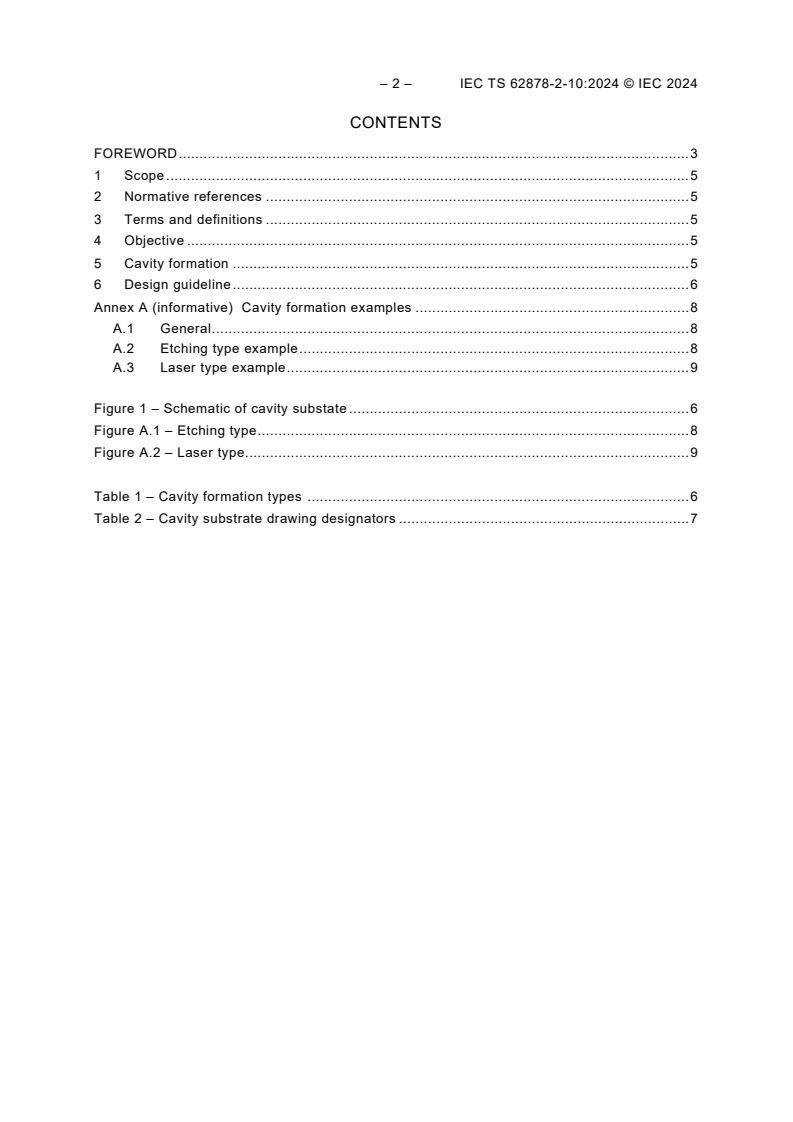
– 2 – IEC TS 62878-2-10:2024 © IEC 2024
CONTENTS
FOREWORD . 3
1 Scope . 5
2 Normative references . 5
3 Terms and definitions . 5
4 Objective . 5
5 Cavity formation . 5
6 Design guideline . 6
Annex A (informative) Cavity formation examples . 8
A.1 General . 8
A.2 Etching type example . 8
A.3 Laser type example . 9
Figure 1 – Schematic of cavity substate . 6
Figure A.1 – Etching type . 8
Figure A.2 – Laser type . 9
Table 1 – Cavity formation types . 6
Table 2 – Cavity substrate drawing designators . 7
INTERNATIONAL ELECTROTECHNICAL COMMISSION
____________
DEVICE EMBEDDING ASSEMBLY TECHNOLOGY –
Part 2-10: Design specification for cavity substrate
FOREWORD
1) The International Electrotechnical Commission (IEC) is a worldwide organization for standardization comprising
all national electrotechnical committees (IEC National Committees). The object of IEC is to promote international
co-operation on all questions concerning standardization in the electrical and electronic fields. To this end and
in addition to other activities, IEC publishes International Standards, Technical Specifications, Technical Reports,
Publicly Available Specifications (PAS) and Guides (hereafter referred to as “IEC Publication(s)”). Their
preparation is entrusted to technical committees; any IEC National Committee interested in the subject dealt with
may participate in this preparatory work. International, governmental and non-governmental organizations liaising
with the IEC also participate in this preparation. IEC collaborates closely with the International Organization for
Standardization (ISO) in accordance with conditions determined by agreement between the two organizations.
2) The formal decisions or agreements of IEC on technical matters express, as nearly as possible, an international
consensus of opinion on the relevant subjects since each technical committee has representation from all
interested IEC National Committees.
3) IEC Publications have the form of recommendations for international use and are accepted by IEC National
Committees in that sense. While all reasonable efforts are made to ensure that the technical content of IEC
Publications is accurate, IEC cannot be held responsible for the way in which they are used or for any
misinterpretation by any end user.
4) In order to promote international uniformity, IEC National Committees undertake to apply IEC Publications
transparently to the maximum extent possible in their national and regional publications. Any divergence between
any IEC Publication and the corresponding national or regional publication shall be clearly indicated in the latter.
5) IEC itself does not provide any attestation of conformity. Independent certification bodies provide conformity
assessment services and, in some areas, access to IEC marks of conform
...
Questions, Comments and Discussion
Ask us and Technical Secretary will try to provide an answer. You can facilitate discussion about the standard in here.
Loading comments...