

IEC 62498-1:2010
(Main)Railway applications - Environmental conditions for equipment - Part 1: Equipment on board rolling stock
General Information
- Abstract
IEC 62498-1:2010 covers the use of on board electrical, electromechanical and electronic equipment for rolling stock, for the following parameters:
- altitude,
- temperature,
- humidity,
- air movement,
- rain,
- snow and hail,
- ice,
- solar radiation,
- lightning,
- pollution,
- vibrations and shocks,
- electromagnetic interference environment,
- acoustic noise environment,
- supply system characteristics.
IEC 62498-1 defines:
- interface conditions between the vehicle and its environment;
- general environmental rules for the equipment of rolling stock, especially for the main sub-systems. The contents of the corrigendum of November 2010 have been included in this copy.
- Status
- Published
- Publication Date
- 26-Aug-2010
- Technical Committee
- TC 9 - Electrical equipment and systems for railways
- Drafting Committee
- WG 44 - TC 9/WG 44
- Current Stage
- PPUB - Publication issued
- Start Date
- 27-Aug-2010
- Completion Date
- 31-Aug-2010
Overview
IEC 62498-1:2010 is an international standard published by the International Electrotechnical Commission (IEC) that specifies environmental conditions for electrical, electromechanical, and electronic equipment installed on board railway rolling stock. This part 1 standard focuses on equipment installed on rolling stock, defining the interface conditions between vehicles and their environment to ensure reliable operation under defined environmental stresses. It addresses typical conditions experienced worldwide as well as special cases.
This standard supports manufacturers, operators, and purchasers by providing a consistent framework for assessing equipment performance and environmental resilience during bidding and design. It is key for railway applications requiring robust operation amid varied and often harsh environmental parameters.
Key Topics
IEC 62498-1 covers a wide range of environmental conditions influencing equipment performance on rolling stock, including:
- Altitude: Defines classes of maximum operating altitude relative to sea level, impacting pressure and related factors.
- Temperature: Specifies temperature ranges and classifications for operation, storage, and transportation.
- Humidity: Details relative humidity ranges correlated with temperature classes to ensure equipment functionality without damage.
- Air Movement: Considers the effects of airflow on equipment performance.
- Precipitation: Includes rain, snow, hail, and ice, addressing the physical impact on devices.
- Solar Radiation: Accounts for UV exposure and heating caused by sunlight.
- Lightning: Considers transient overvoltages and protection needs.
- Pollution: Addresses contamination risks from dust, chemical residues, and other pollutants.
- Vibrations and Shocks: Considers mechanical stresses typical of railway motion.
- Electromagnetic Interference (EMI): Defines standards to ensure electromagnetic compatibility around rolling stock equipment.
- Acoustic Noise: Addresses noise levels impacting equipment operation and durability.
- Supply System Characteristics: Outlines electrical supply conditions pertinent to traction and on-board systems.
This standard references several related IEC documents, such as IEC 61373 for shock and vibration tests and IEC 62236-3 for electromagnetic compatibility, ensuring comprehensive coverage of environmental and operational considerations.
Applications
IEC 62498-1:2010 is essential for:
- Rolling Stock Manufacturers: To design and test equipment that meets global environmental conditions on board trains.
- Railway Operators and Purchasers: To specify environmental requirements in tenders ensuring fair and equitable equipment assessments.
- Component Suppliers: To develop compliant electrical and electronic modules that withstand defined environmental stresses.
- Safety and Reliability Engineers: To evaluate environmental impacts on equipment longevity and operational safety.
By adhering to this standard, stakeholders can improve equipment reliability, reduce maintenance costs, and ensure passenger safety through durable component performance under varied climatic and operational environments.
Related Standards
IEC 62498-1 references and complements a range of key standards, including:
- IEC 60721 Series: Classification of environmental conditions and severities.
- IEC 61373: Rolling stock shock and vibration testing to ensure mechanical resilience.
- IEC 62236-3-1 and 3-2: Electromagnetic compatibility for rolling stock equipment and complete trains.
- IEC 60529: Protection degrees provided by enclosures (IP Code).
- IEC 60850: Supply voltages of traction systems, relevant for electrical supply parameters.
- IEC 62497-2: Insulation coordination addressing overvoltage protection.
These interconnected standards help ensure a well-rounded and consistent approach for electrical and electronic equipment deployed in the railway sector.
By implementing IEC 62498-1:2010, railway industry stakeholders align on clear, globally recognized criteria for environmental conditions affecting on-board equipment. This supports improved design, testing, and procurement processes that contribute to safer, more reliable railway operations worldwide.
Relations
- Referred By
EN IEC 60310:2026 - Railway applications - Transformers and inductors on board rolling stock - Effective Date
- 26-May-2026
- Referred By
EN IEC 63522-7:2025 - Electrical relays - Tests and measurements - Part 7: Functional tests - Effective Date
- 10-Feb-2026
- Effective Date
- 10-Feb-2026
- Effective Date
- 10-Feb-2026
- Effective Date
- 10-Feb-2026
- Effective Date
- 10-Feb-2026
- Effective Date
- 10-Feb-2026
- Referred By
EN IEC 62928:2018 - Railway applications - Rolling stock - Onboard lithium-ion traction batteries - Effective Date
- 10-Feb-2026
- Effective Date
- 10-Feb-2026
- Effective Date
- 10-Feb-2026
- Effective Date
- 10-Feb-2026
- Effective Date
- 10-Feb-2026
- Effective Date
- 10-Feb-2026
- Effective Date
- 10-Feb-2026
- Effective Date
- 10-Feb-2026
Get Certified
Connect with accredited certification bodies for this standard

IRIS Certification (UNIFE)
International Railway Industry Standard certification.

TÜV SÜD Rail GmbH
TÜV SÜD railway certification services.

Bureau Veritas Railway Certification
Railway and transportation certification.
Sponsored listings
Frequently Asked Questions
IEC 62498-1:2010 is a standard published by the International Electrotechnical Commission (IEC). Its full title is "Railway applications - Environmental conditions for equipment - Part 1: Equipment on board rolling stock". This standard covers: IEC 62498-1:2010 covers the use of on board electrical, electromechanical and electronic equipment for rolling stock, for the following parameters: - altitude, - temperature, - humidity, - air movement, - rain, - snow and hail, - ice, - solar radiation, - lightning, - pollution, - vibrations and shocks, - electromagnetic interference environment, - acoustic noise environment, - supply system characteristics. IEC 62498-1 defines: - interface conditions between the vehicle and its environment; - general environmental rules for the equipment of rolling stock, especially for the main sub-systems. The contents of the corrigendum of November 2010 have been included in this copy.
IEC 62498-1:2010 covers the use of on board electrical, electromechanical and electronic equipment for rolling stock, for the following parameters: - altitude, - temperature, - humidity, - air movement, - rain, - snow and hail, - ice, - solar radiation, - lightning, - pollution, - vibrations and shocks, - electromagnetic interference environment, - acoustic noise environment, - supply system characteristics. IEC 62498-1 defines: - interface conditions between the vehicle and its environment; - general environmental rules for the equipment of rolling stock, especially for the main sub-systems. The contents of the corrigendum of November 2010 have been included in this copy.
IEC 62498-1:2010 is classified under the following ICS (International Classification for Standards) categories: 45.060.01 - Railway rolling stock in general. The ICS classification helps identify the subject area and facilitates finding related standards.
IEC 62498-1:2010 has the following relationships with other standards: It is inter standard links to EN IEC 60310:2026, EN IEC 63522-7:2025, EN 60349-4:2013, prEN IEC 62973-1:2025, EN 60349-2:2010, EN 62864-1:2016, prEN IEC 62973-3:2025, EN IEC 62928:2018, EN 62625-1:2013, EN IEC 63341-3:2026, EN 60077-1:2017, EN IEC 61810-4:2020, EN IEC 63341-1:2025, EN 61881-2:2012, EN 60349-1:2010. Understanding these relationships helps ensure you are using the most current and applicable version of the standard.
IEC 62498-1:2010 is available in PDF format for immediate download after purchase. The document can be added to your cart and obtained through the secure checkout process. Digital delivery ensures instant access to the complete standard document.
Standards Content (Sample)
IEC 62498-1 ®
Edition 1.0 2010-08
INTERNATIONAL
STANDARD
NORME
INTERNATIONALE
Railway applications – Environmental conditions for equipment –
Part 1: Equipment on board rolling stock
Applications ferroviaires – Conditions d'environnement pour le matériel –
Partie 1: Equipement embarqué du matériel roulant
All rights reserved. Unless otherwise specified, no part of this publication may be reproduced or utilized in any form or by
any means, electronic or mechanical, including photocopying and microfilm, without permission in writing from either IEC or
IEC's member National Committee in the country of the requester.
If you have any questions about IEC copyright or have an enquiry about obtaining additional rights to this publication,
please contact the address below or your local IEC member National Committee for further information.
Droits de reproduction réservés. Sauf indication contraire, aucune partie de cette publication ne peut être reproduite
ni utilisée sous quelque forme que ce soit et par aucun procédé, électronique ou mécanique, y compris la photocopie
et les microfilms, sans l'accord écrit de la CEI ou du Comité national de la CEI du pays du demandeur.
Si vous avez des questions sur le copyright de la CEI ou si vous désirez obtenir des droits supplémentaires sur cette
publication, utilisez les coordonnées ci-après ou contactez le Comité national de la CEI de votre pays de résidence.
IEC Central Office
3, rue de Varembé
CH-1211 Geneva 20
Switzerland
Email: inmail@iec.ch
Web: www.iec.ch
About the IEC
The International Electrotechnical Commission (IEC) is the leading global organization that prepares and publishes
International Standards for all electrical, electronic and related technologies.
About IEC publications
The technical content of IEC publications is kept under constant review by the IEC. Please make sure that you have the
latest edition, a corrigenda or an amendment might have been published.
ƒ Catalogue of IEC publications: www.iec.ch/searchpub
The IEC on-line Catalogue enables you to search by a variety of criteria (reference number, text, technical committee,…).
It also gives information on projects, withdrawn and replaced publications.
ƒ IEC Just Published: www.iec.ch/online_news/justpub
Stay up to date on all new IEC publications. Just Published details twice a month all new publications released. Available
on-line and also by email.
ƒ Electropedia: www.electropedia.org
The world's leading online dictionary of electronic and electrical terms containing more than 20 000 terms and definitions
in English and French, with equivalent terms in additional languages. Also known as the International Electrotechnical
Vocabulary online.
ƒ Customer Service Centre: www.iec.ch/webstore/custserv
If you wish to give us your feedback on this publication or need further assistance, please visit the Customer Service
Centre FAQ or contact us:
Email: csc@iec.ch
Tel.: +41 22 919 02 11
Fax: +41 22 919 03 00
A propos de la CEI
La Commission Electrotechnique Internationale (CEI) est la première organisation mondiale qui élabore et publie des
normes internationales pour tout ce qui a trait à l'électricité, à l'électronique et aux technologies apparentées.
A propos des publications CEI
Le contenu technique des publications de la CEI est constamment revu. Veuillez vous assurer que vous possédez
l’édition la plus récente, un corrigendum ou amendement peut avoir été publié.
ƒ Catalogue des publications de la CEI: www.iec.ch/searchpub/cur_fut-f.htm
Le Catalogue en-ligne de la CEI vous permet d’effectuer des recherches en utilisant différents critères (numéro de référence,
texte, comité d’études,…). Il donne aussi des informations sur les projets et les publications retirées ou remplacées.
ƒ Just Published CEI: www.iec.ch/online_news/justpub
Restez informé sur les nouvelles publications de la CEI. Just Published détaille deux fois par mois les nouvelles
publications parues. Disponible en-ligne et aussi par email.
ƒ Electropedia: www.electropedia.org
Le premier dictionnaire en ligne au monde de termes électroniques et électriques. Il contient plus de 20 000 termes et
définitions en anglais et en français, ainsi que les termes équivalents dans les langues additionnelles. Egalement appelé
Vocabulaire Electrotechnique International en ligne.
ƒ Service Clients: www.iec.ch/webstore/custserv/custserv_entry-f.htm
Si vous désirez nous donner des commentaires sur cette publication ou si vous avez des questions, visitez le FAQ du
Service clients ou contactez-nous:
Email: csc@iec.ch
Tél.: +41 22 919 02 11
Fax: +41 22 919 03 00
IEC 62498-1 ®
Edition 1.0 2010-08
INTERNATIONAL
STANDARD
NORME
INTERNATIONALE
Railway applications – Environmental conditions for equipment –
Part 1: Equipment on board rolling stock
Applications ferroviaires – Conditions d'environnement pour le matériel –
Partie 1: Equipement embarqué du matériel roulant
INTERNATIONAL
ELECTROTECHNICAL
COMMISSION
COMMISSION
ELECTROTECHNIQUE
PRICE CODE
INTERNATIONALE
R
CODE PRIX
ICS 45.060 ISBN 978-2-88912-095-6
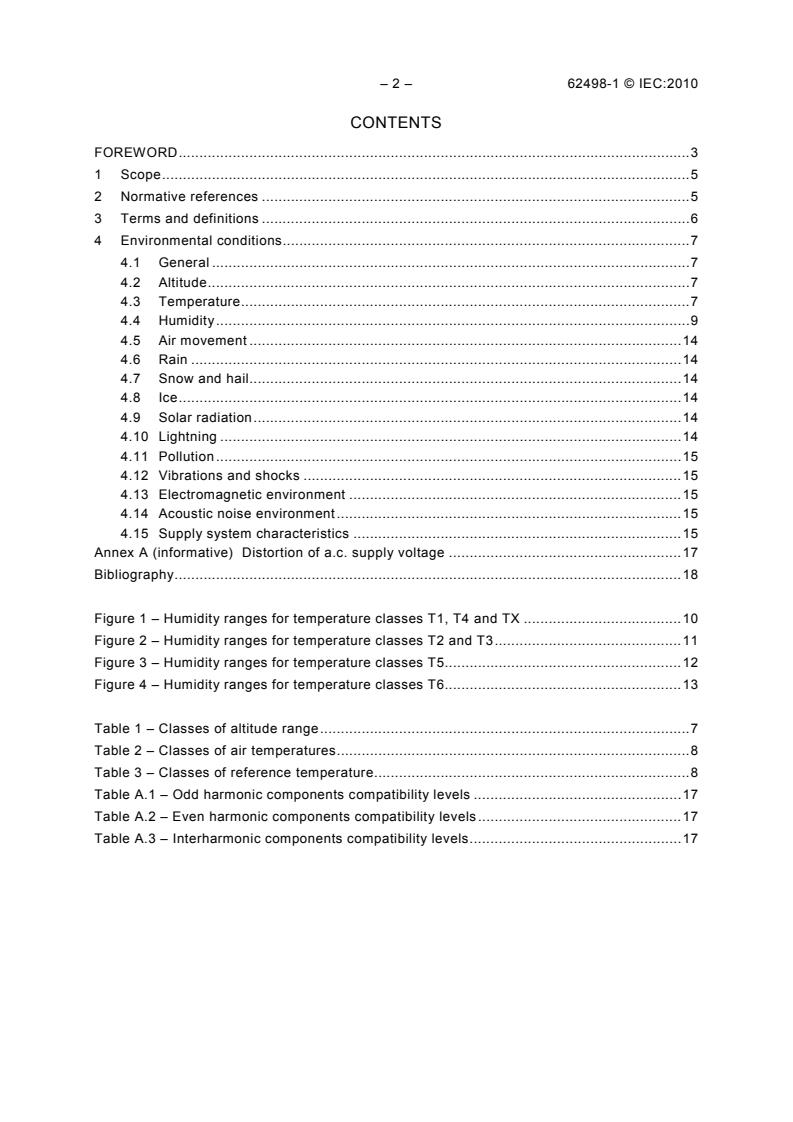
– 2 – 62498-1 © IEC:2010
CONTENTS
FOREWORD.3
1 Scope.5
2 Normative references .5
3 Terms and definitions .6
4 Environmental conditions.7
4.1 General .7
4.2 Altitude.7
4.3 Temperature.7
4.4 Humidity.9
4.5 Air movement .14
4.6 Rain .14
4.7 Snow and hail.14
4.8 Ice.14
4.9 Solar radiation.14
4.10 Lightning .14
4.11 Pollution.15
4.12 Vibrations and shocks .15
4.13 Electromagnetic environment .15
4.14 Acoustic noise environment.15
4.15 Supply system characteristics .15
Annex A (informative) Distortion of a.c. supply voltage .17
Bibliography.18
Figure 1 – Humidity ranges for temperature classes T1, T4 and TX .10
Figure 2 – Humidity ranges for temperature classes T2 and T3.11
Figure 3 – Humidity ranges for temperature classes T5.12
Figure 4 – Humidity ranges for temperature classes T6.13
Table 1 – Classes of altitude range.7
Table 2 – Classes of air temperatures.8
Table 3 – Classes of reference temperature.8
Table A.1 – Odd harmonic components compatibility levels .17
Table A.2 – Even harmonic components compatibility levels.17
Table A.3 – Interharmonic components compatibility levels.17
62498-1 © IEC:2010 – 3 –
INTERNATIONAL ELECTROTECHNICAL COMMISSION
____________
RAILWAY APPLICATIONS –
ENVIRONMENTAL CONDITIONS FOR EQUIPMENT –
Part 1: Equipment on board rolling stock
FOREWORD
1) The International Electrotechnical Commission (IEC) is a worldwide organization for standardization comprising
all national electrotechnical committees (IEC National Committees). The object of IEC is to promote
international co-operation on all questions concerning standardization in the electrical and electronic fields. To
this end and in addition to other activities, IEC publishes International Standards, Technical Specifications,
Technical Reports, Publicly Available Specifications (PAS) and Guides (hereafter referred to as “IEC
Publication(s)”). Their preparation is entrusted to technical committees; any IEC National Committee interested
in the subject dealt with may participate in this preparatory work. International, governmental and non-
governmental organizations liaising with the IEC also participate in this preparation. IEC collaborates closely
with the International Organization for Standardization (ISO) in accordance with conditions determined by
agreement between the two organizations.
2) The formal decisions or agreements of IEC on technical matters express, as nearly as possible, an international
consensus of opinion on the relevant subjects since each technical committee has representation from all
interested IEC National Committees.
3) IEC Publications have the form of recommendations for international use and are accepted by IEC National
Committees in that sense. While all reasonable efforts are made to ensure that the technical content of IEC
Publications is accurate, IEC cannot be held responsible for the way in which they are used or for any
misinterpretation by any end user.
4) In order to promote international uniformity, IEC National Committees undertake to apply IEC Publications
transparently to the maximum extent possible in their national and regional publications. Any divergence
between any IEC Publication and the corresponding national or regional publication shall be clearly indicated in
the latter.
5) IEC itself does not provide any attestation of conformity. Independent certification bodies provide conformity
assessment services and, in some areas, access to IEC marks of conformity. IEC is not responsible for any
services carried out by independent certification bodies.
6) All users should ensure that they have the latest edition of this publication.
7) No liability shall attach to IEC or its directors, employees, servants or agents including individual experts and
members of its technical committees and IEC National Committees for any personal injury, property damage or
other damage of any nature whatsoever, whether direct or indirect, or for costs (including legal fees) and
expenses arising out of the publication, use of, or reliance upon, this IEC Publication or any other IEC
Publications.
8) Attention is drawn to the Normative references cited in this publication. Use of the referenced publications is
indispensable for the correct application of this publication.
9) Attention is drawn to the possibility that some of the elements of this IEC Publication may be the subject of
patent rights. IEC shall not be held responsible for identifying any or all such patent rights.
International Standard IEC 62498-1 has been prepared by IEC technical committee 9:
Electrical equipment and systems for railways.
This standard is based on EN 50125-1.
The text of this standard is based on the following documents:
FDIS Report on voting
9/1402/FDIS 9/1451/RVD
Full information on the voting for the approval of this standard can be found in the report on
voting indicated in the above table.
A list of all parts of IEC 62498 series, under the general title Railway applications –
Environmental conditions for equipment, can be found on the IEC website.
– 4 – 62498-1 © IEC:2010
This publication has been drafted in accordance with the ISO/IEC Directives, Part 2.
The committee has decided that the contents of this publication will remain unchanged until
the stability date indicated on the IEC web site under "http://webstore.iec.ch" in the data
related to the specific publication. At this date, the publication will be
• reconfirmed,
• withdrawn,
• replaced by a revised edition, or
• amended.
The contents of the corrigendum of November 2010 have been included in this copy.
62498-1 © IEC:2010 – 5 –
RAILWAY APPLICATIONS –
ENVIRONMENTAL CONDITIONS FOR EQUIPMENT –
Part 1: Equipment on board rolling stock
1 Scope
This part of IEC 62498 intends to define environmental conditions.
The scope of this standard covers the use of on board electrical, electromechanical and
electronic equipment for rolling stock, for the following parameters: altitude, temperature,
humidity, air movement, rain, snow and hail, ice, solar radiation, lightning, pollution, vibrations
and shocks, electromagnetic interference environment, acoustic noise environment, supply
system characteristics.
In particular the standard defines:
– interface conditions between the vehicle and its environment;
– general environmental rules for the equipment of rolling stock, especially for the main sub-
systems.
In this respect it gives general guidance in order to allow the fairness of bid assessments.
The defined environmental conditions are considered as normal in service; occasionally more
severe conditions may be specified.
Microclimates surrounding components may be defined by relevant product standards or by
special requirements.
This standard is not intended to apply to cranes, mining vehicles, cable cars.
Passenger effects on the equipment and equipment effects on the passengers are not
considered in this standard.
2 Normative references
The following referenced documents are indispensable for the application of this document.
For dated references, only the edition cited applies. For undated references, the latest edition
of the referenced document (including any amendments) applies.
IEC 60529, Degrees of protection provided by enclosures (IP Code)
IEC 60721-1, Classification of environmental conditions – Part 1: Environmental parameters
and their severities
IEC 60721-2-3, Classification of environmental conditions – Part 2: Environmental conditions
appearing in nature – Section 3: Air pressure
IEC 60721-3-5, Classification of environmental conditions – Part 3: Classification of groups of
environmental parameters and their severities – Section 5: Ground vehicle installations
IEC 60850, Railway applications – Supply voltages of traction systems
– 6 – 62498-1 © IEC:2010
IEC 61373, Railway applications – Rolling stock equipment – Shock and vibration tests
IEC 62236-3-1, Railway applications – Electromagnetic compatibility – Part 3-1: Rolling
stock – Train and complete vehicle
IEC 62236-3-2, Railway applications – Electromagnetic compatibility – Part 3-2: Rolling
stock – Apparatus
IEC 62497-2, Railway applications – Insulation coordination – Part 2: Overvoltages and
related protection
3 Terms and definitions
For the purposes of this document, the following terms and definitions apply.
3.1
environmental conditions
physical, chemical or biological condition, external to a product to which it is subjected at a
certain time
3.2
vehicle compartment
compartment of vehicles in which people may enter during normal operation
3.3
vehicle cubicle
any enclosure for housing of mechanical, electrical and/or electronic equipment
3.4
environmental parameters
one or more physical, chemical or biological properties characterising an environmental factor
(e.g. temperature, acceleration)
EXAMPLE The environmental factor ‘vibration’ is characterised by the parameters: type of vibration (sinusoidal,
random), acceleration and frequency.
3.5
severity of environmental parameters
a value of each quantity characterising the environmental parameter
EXAMPLE The severity of sinusoidal vibration is defined by values of the acceleration (in m/s ) and frequency
(in Hz).
3.6
performance range
the range of parameters in which the equipment works with the specified performance
3.7
operation range
the performance range in which the equipment works with the limited performance range
3.8
storage temperature
the ambient temperature of storage without damage on the stored goods and/or equipment in
no powered states
62498-1 © IEC:2010 – 7 –
4 Environmental conditions
4.1 General
In the following clauses the environmental parameters are given at which the vehicle and its
equipment shall function as specified.
In the text, normal environmental conditions are considered as being those of all over the
world. They are classified with a suffix 1, 2, 3, etc. and special conditions with a suffix X, Y,
etc.
The purchaser shall specify clearly in his specification the class to consider, otherwise class
with suffix 1 shall be assumed.
NOTE Except otherwise stated in this standard, general information is given by IEC 60721-3-5, IEC 60721-2-1,
IEC 60721-2-2, IEC 60721-2-3 and IEC 60721-2-7.
The severities specified are those which will have a low probability of being exceeded. All
specified values are maximum or limiting values. These values may be reached, but do not
occur permanently. Depending on the situation there may be different frequencies of
occurrence related to a certain period of time. Such frequencies of occurrence have not been
included in this standard, but should be considered for any environmental parameter. They
should additionally be specified if applicable.
4.2 Altitude
The equipment shall perform as specified for the different classes of altitude range relative to
sea level given in Table 1.
Table 1 – Classes of altitude range
Altitude range relative to
sea level
Classes
m
A1 up to 1 400
A2 up to 1 000
A3 up to 1 200
AX more than 1 400
Using AX class, the maximum altitude shall be specified by the purchaser.
Altitude is relevant, in particular for air pressure level and its consequence on cooling systems.
The air pressure shall be considered according to IEC 60721-2-3.
Particular local air pressure conditions may exist due to the effects of wind, vehicle movement,
fans, etc. In this case, the relevant data will be exchanged between the appropriate interested
parties engaged in the project.
4.3 Temperature
The equipment shall operate as specified for the different classes of temperatures given in
Table 2.
“Performance range” and “operation range” can be set respectively in Table 2 by agreement
between purchaser and supplier.
– 8 – 62498-1 © IEC:2010
Table 2 – Classes of air temperatures
(1) (2) (3)
Air temperature Inside vehicle Inside
Classes
external to compartment cubicle
(Typical application area) vehicle temperature temperature
°C °C °C
T1
–25 +40 –25 +50 –25 +70
(ex. middle Europe)
T2
–40 +35 –40 +45 –40 +65
(ex. northern Europe)
T3
–25 +45 –25 +55 –25 +70
(ex. southern Europe)
T4
–10 +40 –10 +50 –10 +70
(mild climate area in mid-
latitude)
T5
+5 +45 +5 +55 +5 +70
(tropical area except
desert)
–20 +55 –20 +65 –20 +75
T6
(tropical area in desert)
TX –40 +50 –40 +60 –40 +75
Class T1 of Table 2 corresponds to class 5K2 of IEC 60721-3-5.
Values given in columns (2) and (3) of Table 2 are temperatures that the system or equipment
designer is not allowed to exceed in a given part because too much power is dissipated with
insufficient cooling. They are also temperatures which the equipment manufacturer shall take
into account in the design.
The storage temperature range without operation for equipment, devices, sub-assembly and
parts should be defined between the purchaser and the supplier.
A reference temperature is considered as being the permanent temperature for which the
effects on, for example, the insulating material ageing are equivalent to those of the climatic
temperature during the lifetime.
The reference temperature should be chosen between Class TR1 of 20 °C and Class TR2 of
25 °C of Table 3.
Table 3 – Classes of reference temperature
Classes Reference temperature
°C
TR1 20
TR2 25
The yearly average temperature for column (3) in Table 2 is conventionally taken as 45 °C for
all classes (e.g. for reliability calculation).
When stated in product standards, particular requirements apply.
The temperatures inside vehicle and cubicle are values measured in free air out of the heat
emitting elements.
62498-1 © IEC:2010 – 9 –
If the equipment is to be installed in a controlled climatic environment, provided that the
equipment is not required to operate outside of those conditions, the temperature range shall
be agreed between purchaser and supplier.
It shall be taken into account that the external ambient air temperature in special locations
such as near the ballast or over the roof may exceed the external open air temperature. In
this case the temperature level to be considered shall be agreed between purchaser and
supplier.
To ensure correct co-ordination of the temperature levels indicated in columns (1) to (3) in
Table 2 and verification of good thermal design of all installed equipment, the relevant data
shall be exchanged between purchaser and supplier, such as:
– geometrical characteristics of sub-assemblies;
– localisation of the main heat emitting elements and their heat dissipation;
– thermal time profile;
– characteristics of the cooling system;
– storage temperature condition for equipment, devices, and sub-assemblies when not
applying current.
Deviation from the temperature table shall be subject to agreement between purchaser and
supplier.
4.4 Humidity
The following external humidity levels shall be considered:
– yearly average: ≤ 75 % relative humidity;
– on 30 days in the year continuously: between 75 % and 95 % relative humidity;
– on the other days occasionally: between 95 % and 100 % relative humidity.
The psychrometric charts of Figures 1, 2, 3 and 4, assuming the maximum absolute humidity
in tunnel, give the ranges of variation of the relative humidity for the different
of 30 g/m
temperature classes that will not be exceeded for more than 30 days per year.
– 10 – 62498-1 © IEC:2010
Absolute air humidity (g/m )
TX T1 T4
T1 TX
T4
–80 –70 –60 –50 –40 –30 –20 –10 0 10 20 30 40 50 60
Air temperature (°C)
Maximum for tunnel
IEC 1856/10
Figure 1 – Humidity ranges for temperature classes T1, T4 and TX
Relative air humidity (%)
0,001
0,002
0,003
0,005
0,01
0,02
0,03
0,05
0,1
0,2
0,3
0,5
1,0
2,0
3,0
5,0
10,0
20,0
30,0
50,0
70,0
62498-1 © IEC:2010 – 11 –
Absolute air humidity (g/m )
T2 T3
T2 T3
–80 –70 –60 –50 –40 –30 –20 –10 0 10 20 30 40 50 60
Air temperature (°C)
Maximum for tunnel
IEC 1857/10
Figure 2 – Humidity ranges for temperature classes T2 and T3
Relative air humidity (%)
0,001
0,002
0,003
0,005
0,01
0,02
0,03
0,05
0,1
0,2
0,3
0,5
1,0
2,0
3,0
5,0
10,0
20,0
30,0
50,0
70,0
– 12 – 62498-1 © IEC:2010
Absolute air humidity (g/m )
T5
T5
–80 –70 –60 –50 –40 –30 –20 –10 0 10 20 30 40 50 60
Air temperature (°C)
Maximum for tunnel
IEC 1858/10
Figure 3 – Humidity ranges for temperature classes T5
Relative air humidity (%)
0,001
0,002
0,003
0,005
0,01
0,02
0,03
0,05
0,1
0,2
0,3
0,5
1,0
2,0
3,0
5,0
10,0
20,0
30,0
50,0
70,0
62498-1 © IEC:2010 – 13 –
Absolute air humidity (g/m )
T6 T6
–80 –70 –60 –50 –40 –30 –20 –10 0 10 20 30 40 50 60
Air temperature (°C)
Maximum for tunnel
IEC 1859/10
Figure 4 – Humidity ranges for temperature classes T6
Relative air humidity (%)
0,001
0,002
0,003
0,005
0,01
0,02
0,03
0,05
0,1
0,2
0,3
0,5
1,0
2,0
3,0
5,0
10,0
20,0
30,0
50,0
70,0
– 14 – 62498-1 © IEC:2010
At cooled surfaces, 100 % relative humidity may occur causing condensation on parts of
equipment, this shall not lead to any malfunction or failure. Sudden changes of the air
temperature local to the vehicle may cause condensation of water on parts of equipment with
a rate of 3 K/s and a maximum variation of 40 K. These conditions particularly occurring when
entering or leaving a tunnel shall not lead to any malfunction or failure of the equipment.
4.5 Air movement
4.5.1 Wind
The maximum speed of wind shall be taken as 35 m/s.
Exceptionally higher wind speed, up to maximum 50 m/s, may occur. In this case, the
equipment and/or vehicle performance may be temporarily affected but no permanent damage
shall occur.
4.5.2 Surrounding air
The relative movement of surrounding air in respect to the vehicle shall be defined where
applicable. Pressure pulses (e.g. due to passing of vehicles or entering a tunnel) shall be also
taken into account.
4.6 Rain
Rain rate of 6 mm/min shall be taken into account according to class 5K3 of IEC 60721-3-5. The effect
of rain shall be considered depending on the equipment installation together with wind and
vehicle movement.
4.7 Snow and hail
Consideration shall be given to the effect of snow and/or hail. The maximum diameter of the
hailstones shall be taken as 15 mm, larger diameter may occur exceptionally.
Consideration shall be given to all forms of snow which may occur. Large quantities of snow
in powder form may pass into the vehicle and melt. Rear vehicles of a moving train are most
affected. Moreover, during standstill periods, the melted snow may freeze again.
4.8 Ice
The effect of ice forming or falling shall be considered on all equipment installed both inside
and outside the vehicle. In such conditions the performance of equipment shall be specified
either in product standard or by the purchaser.
4.9 Solar radiation
Equipment exposed to the effect of solar radiation, which is prescribed in IEC 60721-3-5, shall
remain unaffected.
For equipment directly exposed to solar radiation, the maximum level shall be considered in
accordance with IEC 60721-3-5.
NOTE 1 120 W/m² of Classes 5K3 and 700 W/m² of 5K2 are used in Europe and Japan, respectively.
Care shall be taken for the effect of UV radiation on the equipment exposed to solar radiation.
The maximum duration of the exposure to solar radiation shall be conventionally taken as 8 h
unless otherwise specified. See also IEC 60721-1.
4.10 Lightning
Consideration shall be given to the effects of lightning on the vehicle. For protection against
lightning on the vehicle refer to IEC 62497-2.
62498-1 © IEC:2010 – 15 –
4.11 Pollution
The effects of pollution shall be considered in the design of equipment and components. The
severity of pollution will depend upon the location of the equipment.
Means may be provided to reduce pollution by the effective use of protection. In this case the
protection against water and solid objects shall be specified using the protection degree
definition of IEC 60529.
The effects of the following kinds of pollution shall be considered:
− chemically active substances:
a) class 5C2 of IEC 60721-3-5
Salinity
Other chemical substances
b) cleaning products specified by the purchaser;
− contaminating fluids: class 5F2 (electrical engine) and 5F3 (thermal engine) of
IEC 60721-3-5;
− biologically active substances: class 5B2 of IEC 60721-3-5 (flora and fauna);
− dust: defined by class 5S2 of IEC 60721-3-5. Due to the presence of carbon and metallic
powder, dust may become electrically conductive with the presence of humidity;
− stones coming from the ballast, other objects of maximum 15 mm diameter;
− grasses and leaves, pollen, flying insects, fibres, etc., for the design of ventilation ducts;
− fire extinguishing means;
− sand, if specified for the application, using IEC 60721-3-5.
There are also internal causes of pollution due to the equipment itself (ionisation, etc.).
4.12 Vibrations and shocks
4.12.1 Vibrations
The requirements of IEC 61373 shall be fulfilled. However, another equivalent standard may be
applied by agreement between purchaser and supplier.
4.12.2 Shocks
The requirements of IEC 61373 shall be fulfilled. However, another equivalent standard may
be applied by agreement between purchaser and supplier.
4.13 Electromagnetic environment
The requirements of IEC 62236-3-1 and IEC 62236-3-2 shall be fulfilled.
4.14 Acoustic noise environment
Void.
4.15 Supply system characteristics
4.15.1 Voltage and frequency variations
The voltage variations for the supply voltage for traction system with d.c. supply, and the
voltage and frequency variations for the supply voltage for traction system with a.c. supply,
are given by IEC 60850. The equipment shall perform as specified under those variations.
Where the equipment is supplied by an autonomous supply such as battery, static converter,
– 16 – 62498-1 © IEC:2010
rotating set, etc., adequate rated values and limit values shall be stated for the voltage and
impedance of the supply, and in the case of a.c. supply, the frequency and wave forms.
4.15.2 Distortion of a.c. supply voltage
This depends on several not standardizable conditions external to the equipment. Annex A
gives an example, however equivalent standards can be applied by agreement between
purchaser and supplier.
4.15.3 Distortion of d.c. supply voltage
It is assumed that the supply voltage is the d.c. voltage converted from a three-phase
sinusoidal voltage by full wave six-pulse rectification.
Any other connection (e.g. 12 pulses rectification) shall be stated by the purchaser.
4.15.4 Distortion of autonomous supply voltage
The distortion shall be stated by the purchaser.
4.15.5 Overvoltages
The equipment shall operate as specified when subject to long term, short term and medium
term overvoltages as defined by IEC 60850.
4.15.6 AC supply impedance
Since the a.c. supply impedance affects the performance characteristics of the equipment and
may vary with the position of the vehicle, the characteristics including maximum and minimum
values of this impedance shall be specified by agreement between purchaser and supplier.
If necessary and where possible, resonant frequencies of the a.c. system shall be specified by
agreement between purchaser and supplier, either directly or by means of a model of the
system.
The effect that the presence of other vehicles has on supply impedance and resonance
frequencies should also be taken into account.
4.15.7 DC supply inductance and resistance
Since the inductance and resistance of the supply affect the performance characteristics of
the equipment and may vary with the position of the vehicle, the maximum and minimum
values of inductance and resistance shall be specified by agreement between purchaser and
supplier.
The presence of other vehicles should also be taken into account.
62498-1 © IEC:2010 – 17 –
Annex A
(informative)
Distortion of a.c. supply voltage
The supply voltage is assumed to be sinusoidal to a great extent. Tables A.1 to A.3 give, as
an example, harmonic components of the a.c. supply voltage in steady state at which the
equipment shall perform as specified.
Table A.1 – Odd harmonic components compatibility levels
Order of the harmonic 3 5 7 9 11 13 15 17 19 21 23 25 > 25
½
Percentage of nominal line 15,0 8,0 7,0 6,0 5,0 4,5 4,5 4,0 4,0 4,0 3,5 3,5 5(11/h)
voltage
h: order number of harmonic component
Table A.2 – Even harmonic components compatibility levels
Order of the harmonic 2 4 > 6
Percentage of nominal line 3,0 1,5 1,0
voltage
Table A.3 – Interharmonic components compatibility levels
Order of the harmonic < 11 11-13 13-19 19-23 23-25 > 25
Percentage of nominal line 2,50 2,25 2,00 1,75 1,50 1,00
voltage
NOTE 1 During transient conditions (inrush current of a vehicle transformer) the values of interharmonic
components compatibility levels may be exceeded significantly.
NOTE 2 Definition: (Electromagnetic) Compatibility level, IEC 60050-161, 161-03-10: The specified maximum
electromagnetic disturbance level expected to be impressed on a device, equipment or system operated in
particular conditions.
NOTE 3 In practice the electromagnetic compatibility level is not an absolute maximum level but may be
exceeded by a small probability.
– 18 – 62498-1 © IEC:2010
Bibliography
IEC 60050-161, International Electrotechnical Vocabulary (IEV) – Chapter 161:
Electromagnetic compatibility
IEC 60050-811, International Electrotechnical Vocabulary (IEV) – Chapter 811: Electric
traction
IEC 60077-1, Railway applications – Electric equipment for rolling stock – Part 1: General
service conditions and general rules
IEC 60310:2004, Railway applications – Traction transformers and inductors on board rolling
stock
IEC 60349-2, Electric traction – Rotating electrical machines for rail and road vehicles –
Part 2: Electronic convertor-fed alternating current motors
IEC 60349-3, Electric traction – Rotating electrical machines for rail and road vehicles –
Part 3: Determination of the total losses of convertor-fed alternating current motors by
summation of the component losses
IEC 60494-1, Railway applications – Rolling stock – Pantographs: Characteristics and tests –
Part 1: Pantographs for mainline vehicles
IEC 60494-2, Railway applications – Rolling stock – Pantographs: Characteristics and tests –
Part 2: Pantographs for metros and light rail vehicles
IEC 60571, Electronic equipment used on rail vehicles
IEC 60721-2-1, Classification of environmental conditions – Part 2-1: Environmental
conditions appearing in nature – Temperature and humidity
IEC 60721-2-2, Classification of environmental conditions – Part 2: Environmental conditions
appearing in nature – Section 2: Precipitation and wind
IEC 60721-2-7, Classification of environmental conditions – Part 2: Environmental conditions
appearing in nature – Section 7: Fauna and flora
IEC 60721-3-0, Classification of environmental conditions – Part 3: Classification of groups of
environmental parameters and their severities – Introduction
IEC 61133, Railway applications – Rolling stock – Testing of rolling stock on completion of
construction and before entry into service
IEC 62497-1, Railway applications – Insulation coordination – Part 1: Basic requirements –
Clearances and creepage distances for all electrical and electronic equipment
____________
– 20 – 62498-1 © CEI:2010
SOMMAIRE
AVANT-PROPOS.21
1 Domaine d’application .23
2 Références normatives.23
3 Termes et définitions .24
4 Conditions d’environnement .25
4.1 Généralités.25
4.2 Altitude.25
4.3 Température.26
4.4 Humidité.27
4.5 Mouvement d’air.32
4.6 Pluie.32
4.7 Neige et grêle.32
4.8 Glace .32
4.9 Rayonnement solaire.32
4.10 Foudre .33
4.11 Pollution.33
4.12 Vibrations et chocs.33
4.13 Environnement électromagnétique.33
4.14 Environnement acoustique .33
4.15 Caractéristiques des réseaux d’alimentation.34
Annexe A (informative) Distorsion de la tension d’alimentation en courant alternatif .35
Bibliographie.36
Figure 1 – Plages d’humidité pour les classes de température T1, T4 et TX.28
Figure 2 – Plages d’humidité pour les classes de température T2 et T3 .29
Figure 3 – Plages d’humidité pour les classes de température T5 .30
Figure 4 – Plages d’humidité pour les classes de température T6 .31
Tableau 1 – Classes de plage d’altitude.25
Tableau 2 – Classes de température de l’air ambiant.26
Tableau 3 – Classes de température de référence .26
Tableau A.1 – Niveaux de compatibilité des composantes harmoniques de rang impair .35
Tableau A.2 – Niveaux de compatibilité des composantes harmoniques de rang pair.35
Tableau A.3 – Niveaux de compatibilité des composantes interharmoniques .35
62498-1 © CEI:2010 – 21 –
COMMISSION ÉLECTROTECHNIQUE INTERNATIONALE
____________
APPLICATIONS FERROVIAIRES –
CONDITIONS D'ENVIRONNEMENT POUR LE MATÉRIEL –
Partie 1: Equipement embarqué du matériel roulant
AVANT-PROPOS
1) La Commission Electrotechnique Internationale (CEI) est une organisation mondiale de normalisation
composée de l'ensemble des comités électrotechniques nationaux (Comités nationaux de la CEI). La CEI a
pour objet de favoriser la coopération internationale pour toutes les questions de normalisation dans les
domaines de l'électricité et de l'électronique. A cet effet, la CEI – entre autres activités – publie des Normes
internationales, des Spécifications techniques, des Rapports techniques, des Spécifications accessibles au
public (PAS) et des Guides (ci-après dénommés "Publication(s) de la CEI"). Leur élaboration est confiée à des
comités d'études, aux travaux desquels tout Comité national intéressé par le sujet traité peut participer. Les
organisations internationales, gouvernementales et non gouvernementales, en liaison avec la CEI, participent
également aux travaux. La CEI collabore étroitement avec l'Organisation Internationale de Normalisation (ISO),
selon des conditions fixées par accord entre les deux organisations.
2) Les décisions ou accords officiels de la CEI concernant les questions techniques représentent, dans la mesure
du possible, un accord international sur les sujets étudiés, étant donné que les Comités nationaux de la CEI
intéressés sont représentés dans chaque comité d’études.
3) Les Publications de la CEI se présentent sous la forme de recommandations internationales et sont agréées
comme telles par les Comités nationaux de la CEI. Tous les efforts raisonnables sont entrepris afin que la CEI
s'assure de l'exactitude du contenu technique de ses publications; la CEI ne peut pas être tenue responsable
de l'éventuelle mauvaise utilisation ou interprétation qui en est faite par un quelconque utilisateur final.
4) Dans le but d'encourager l'uniformité internationale, les Comités nationaux de la CEI s'engagent, dans toute la
mesure possible, à appliquer de façon transparente les Publications de la CEI dans leurs publications
nationales et régionales. Toutes divergences entre toutes Publications de la CEI et toutes publications
nationales ou régionales correspondantes doivent être indiquées en termes clairs dans ces dernières.
5) La CEI elle-même ne fournit aucune attestation de conformité. Des organismes de certification indépendants
fournissent des services d'évaluation de conformité et, dans certains secteurs, accèdent aux marques de
conformité de la CEI. La CEI n'est responsable d'aucun des services effectués par les organismes de
certification indépendants.
6) Tous les utilisateurs doivent s'assurer qu'ils sont en possession de la dernière édition de cette publication.
7) Aucune responsabilité ne doit être imputée à la CEI, à ses administrateurs, employés, auxiliaires ou
mandataires, y compris ses experts particuliers et les membres de ses comités d'études et des Comités
nationaux de la CEI, pour tout préjudice causé en cas de dommages corporels et matériels, ou de tout autre
dommage de quelque nature que ce soit, directe ou indirecte, ou pour supporter les coûts (y compris les frais
de justice) et les dépenses découlant de la publication ou de l'utilisation de cette Publication de la CEI ou de
toute autre Publication de la CEI, ou au crédit qui lui est accordé.
8) L'attention est attirée sur les références normatives citées dans cette publication. L'utilisation de publications
référencées est obligatoire pour une application correcte de la présente publication.
9) L’attention est attirée sur le fait que certains des é
...