


FprEN IEC 63341-2:2025
(Main)Railway applications - Hydrogen and fuel cell systems for rolling stock - Part 2: Hydrogen fuel system
General Information
- Abstract
IEC 63341-2:2025 applies to on-board hydrogen fuel systems (HFSs) used to supply the fuel cells for the traction power and the auxiliaries supply of railway vehicles (such as hybrid vehicles as defined in IEC 62864-1). This document applies to hydrogen storage in gaseous form. Other means of storage (such as liquid, liquid cryo-compressed, metal hydrides) are not covered in this document. This document applies to any rolling stock type (e.g. light rail vehicles, tramways, streetcars, metros, commuter trains, regional trains, high speed trains, locomotives). This document addresses the on-board mechanical, fluidic and electrical interfaces between the on-board hydrogen fuel system and fuelling station. The fuelling station, fuelling protocol and communication for the fuelling protocol are not in the scope of this document. This document defines: – the scope of supply of hydrogen fuel system and the description of the interfaces with sub systems internal and external to the rolling stock such as fuel cell power system, fuelling station systems; – the environmental constraints; – the design requirements to support HFS compliance with railway applications; – the safety and reliability requirements to design and install the HFS for railway applications; – the marking and labelling requirements; – the requirements related to storage, transportation, installation and maintenance; – the validation (type, routine and investigation tests) requirements.
- Status
- Not Published
- Publication Date
- 19-Nov-2026
- Technical Committee
- CLC/TC 9X - Electrical and electronic applications for railways
- Drafting Committee
- IEC/TC 9 - IEC_TC_9
- Current Stage
- 5060 - Voting results sent to TC, SR - Formal Approval
- Start Date
- 06-Jun-2025
- Completion Date
- 06-Jun-2025

Overview
The CLC standard FprEN IEC 63341-2:2025 addresses hydrogen fuel systems (HFS) specifically for railway rolling stock applications. This crucial standard applies to on-board hydrogen fuel systems that supply fuel cells powering traction and auxiliary systems in various types of railway vehicles, including hybrid trains, light rail vehicles, metros, trams, and high-speed trains. The scope focuses exclusively on gaseous hydrogen storage and excludes other storage types such as liquid or metal hydrides.
This document sets comprehensive requirements to ensure the safety, reliability, and environmental compatibility of hydrogen fuel systems integrated into rolling stock. It details mechanical, fluidic, and electrical interfaces within the fuel system and to the refueling infrastructure, though it excludes the refueling station design and communication protocols beyond physical interfaces.
Key Topics
- Hydrogen Storage & Handling: Defines requirements for compressed hydrogen storage modules and hydrogen handling systems to ensure safe containment, transfer, and processing of gaseous hydrogen onboard.
- Interfaces: Specifies fluidic, electrical, and communication interfaces between the hydrogen fuel system and onboard control systems as well as the refueling station.
- Environmental Constraints: Includes conditions such as ambient temperature, humidity, altitude, corrosivity, and mechanical stresses from shock and vibration relevant to railway environments.
- Design Requirements:
- Materials compatibility with hydrogen
- Pressure ranges and flow rates for hydrogen supply
- Structural integrity and mechanical integration of the HFS within rolling stock
- Fire protection and lifetime/duty cycle considerations
- Safety and Reliability: Imposes hazard identification, explosive atmosphere management, and safety of the refueling process, including monitoring systems and risk assessments (RAMS: Reliability, Availability, Maintainability, Safety).
- Marking and Labelling: Safety signs and nameplates for easy identification and compliance during operation and maintenance.
- Testing and Validation:
- Type and routine tests for mechanical durability, electrical compliance, gas tightness, fire safety, and electromagnetic compatibility.
- Validation of design through environmental cycling, burst tests, drop tests, and other railway-specific resilience tests.
Applications
This standard supports the advancement of hydrogen fuel cell technologies in rail transport by providing a robust framework for developing safe and efficient hydrogen fuel systems. It is applicable across a broad spectrum of rolling stock:
- High-speed and regional passenger trains
- Locomotives and freight trains
- Trams, streetcars, light rail, and metro systems
- Hybrid vehicles incorporating hydrogen fuel cells
By following the standard, manufacturers and operators ensure hydrogen systems meet stringent operational, safety, and environmental requirements, enabling:
- Cleaner, zero-emission railway propulsion solutions.
- Integration of hydrogen technology into existing railway infrastructure.
- Enhanced safety protocols and interoperability among different fuel system components and refueling stations.
- Efficient maintenance and inspection procedures facilitated by standardized marking and documentation.
Related Standards
- IEC 62864-1 – Defines hybrid vehicles for railways, relevant for vehicles combining fuel cells with other power sources.
- IEC 63341-1 – Addresses general requirements for hydrogen and fuel cell systems used in rolling stock.
- EN/IEC 62282 Series – Covers fuel cell technologies, including terminology, system requirements, and testing methods.
- Railway rolling stock standards focusing on mechanical, electrical, and environmental considerations.
- ISO 19880-1 – Specification for hydrogen fueling stations, complementary to the on-board system interfaces.
Keywords: hydrogen fuel system, railway applications, rolling stock, hydrogen storage, fuel cells, hydrogen safety, compressed hydrogen, rail transport hydrogen, IEC 63341-2, hydrogen fuel standards, hydrogen refueling interface, fuel cell propulsion, railway hydrogen fuel system design, hydrogen system testing, RAMS railway standards.
Relations
- Refers
EN IEC 61373:2026 - Railway applications - Rolling stock equipment - Shock and vibration tests - Effective Date
- 15-Sep-2026
- Effective Date
- 10-Feb-2026
- Effective Date
- 10-Feb-2026
- Effective Date
- 10-Feb-2026
- Effective Date
- 09-Feb-2026
- Effective Date
- 09-Feb-2026
- Effective Date
- 09-Feb-2026
- Effective Date
- 03-Feb-2026
- Effective Date
- 03-Feb-2026
- Effective Date
- 14-Jan-2025
Get Certified
Connect with accredited certification bodies for this standard

DNV
DNV is an independent assurance and risk management provider.

Lloyd's Register
Lloyd's Register is a global professional services organisation specialising in engineering and technology.
DNV Energy Systems
Energy and renewable energy certification.
Sponsored listings
Frequently Asked Questions
FprEN IEC 63341-2:2025 is a draft published by CLC. Its full title is "Railway applications - Hydrogen and fuel cell systems for rolling stock - Part 2: Hydrogen fuel system". This standard covers: IEC 63341-2:2025 applies to on-board hydrogen fuel systems (HFSs) used to supply the fuel cells for the traction power and the auxiliaries supply of railway vehicles (such as hybrid vehicles as defined in IEC 62864-1). This document applies to hydrogen storage in gaseous form. Other means of storage (such as liquid, liquid cryo-compressed, metal hydrides) are not covered in this document. This document applies to any rolling stock type (e.g. light rail vehicles, tramways, streetcars, metros, commuter trains, regional trains, high speed trains, locomotives). This document addresses the on-board mechanical, fluidic and electrical interfaces between the on-board hydrogen fuel system and fuelling station. The fuelling station, fuelling protocol and communication for the fuelling protocol are not in the scope of this document. This document defines: – the scope of supply of hydrogen fuel system and the description of the interfaces with sub systems internal and external to the rolling stock such as fuel cell power system, fuelling station systems; – the environmental constraints; – the design requirements to support HFS compliance with railway applications; – the safety and reliability requirements to design and install the HFS for railway applications; – the marking and labelling requirements; – the requirements related to storage, transportation, installation and maintenance; – the validation (type, routine and investigation tests) requirements.
IEC 63341-2:2025 applies to on-board hydrogen fuel systems (HFSs) used to supply the fuel cells for the traction power and the auxiliaries supply of railway vehicles (such as hybrid vehicles as defined in IEC 62864-1). This document applies to hydrogen storage in gaseous form. Other means of storage (such as liquid, liquid cryo-compressed, metal hydrides) are not covered in this document. This document applies to any rolling stock type (e.g. light rail vehicles, tramways, streetcars, metros, commuter trains, regional trains, high speed trains, locomotives). This document addresses the on-board mechanical, fluidic and electrical interfaces between the on-board hydrogen fuel system and fuelling station. The fuelling station, fuelling protocol and communication for the fuelling protocol are not in the scope of this document. This document defines: – the scope of supply of hydrogen fuel system and the description of the interfaces with sub systems internal and external to the rolling stock such as fuel cell power system, fuelling station systems; – the environmental constraints; – the design requirements to support HFS compliance with railway applications; – the safety and reliability requirements to design and install the HFS for railway applications; – the marking and labelling requirements; – the requirements related to storage, transportation, installation and maintenance; – the validation (type, routine and investigation tests) requirements.
FprEN IEC 63341-2:2025 is classified under the following ICS (International Classification for Standards) categories: 27.070 - Fuel cells; 45.060.01 - Railway rolling stock in general. The ICS classification helps identify the subject area and facilitates finding related standards.
FprEN IEC 63341-2:2025 has the following relationships with other standards: It is inter standard links to EN IEC 61373:2026, IEC 62497-1:2010, IEC 60571:2012, IEC 62498-1:2010, EN ISO 9223:2012, EN 2155-14:1993, EN ISO 17268-1:2025, EN 61373:2010, EN IEC 63341-1:2025, FprEN IEC 63341-2:2025/FprAA:2026. Understanding these relationships helps ensure you are using the most current and applicable version of the standard.
FprEN IEC 63341-2:2025 is available in PDF format for immediate download after purchase. The document can be added to your cart and obtained through the secure checkout process. Digital delivery ensures instant access to the complete standard document.
Standards Content (Sample)
SLOVENSKI STANDARD
oSIST prEN IEC 63341-2:2024
01-maj-2024
Železniške naprave - Vozna sredstva - Sistemi gorivnih celic za vozna sredstva - 2.
del: Sistem za shranjevanje vodika
Railway applications - Rolling stock - Fuel cell systems for propulsion - Part 2: Hydrogen
storage system
Ta slovenski standard je istoveten z: prEN IEC 63341-2:2024
ICS:
27.070 Gorilne celice Fuel cells
45.060.01 Železniška vozila na splošno Railway rolling stock in
general
oSIST prEN IEC 63341-2:2024 en
2003-01.Slovenski inštitut za standardizacijo. Razmnoževanje celote ali delov tega standarda ni dovoljeno.
oSIST prEN IEC 63341-2:2024
oSIST prEN IEC 63341-2:2024
9/3050/CDV
COMMITTEE DRAFT FOR VOTE (CDV)
PROJECT NUMBER:
IEC 63341-2 ED1
DATE OF CIRCULATION: CLOSING DATE FOR VOTING:
2024-03-08 2024-05-31
SUPERSEDES DOCUMENTS:
9/2923/CD, 9/2963A/CC
IEC TC 9 : ELECTRICAL EQUIPMENT AND SYSTEMS FOR RAILWAYS
SECRETARIAT: SECRETARY:
France Mr Denis MIGLIANICO
OF INTEREST TO THE FOLLOWING COMMITTEES: PROPOSED HORIZONTAL STANDARD:
TC 105
Other TC/SCs are requested to indicate their interest, if any, in
this CDV to the secretary.
FUNCTIONS CONCERNED:
EMC ENVIRONMENT QUALITY ASSURANCE SAFETY
SUBMITTED FOR CENELEC PARALLEL VOTING NOT SUBMITTED FOR CENELEC PARALLEL VOTING
Attention IEC-CENELEC parallel voting
The attention of IEC National Committees, members of
CENELEC, is drawn to the fact that this Committee Draft for Vote
(CDV) is submitted for parallel voting.
The CENELEC members are invited to vote through the
CENELEC online voting system.
This document is still under study and subject to change. It should not be used for reference purposes.
Recipients of this document are invited to submit, with their comments, notification of any relevant patent rights of which they are
aware and to provide supporting documentation.
Recipients of this document are invited to submit, with their comments, notification of any relevant “In Some Countries” clauses to
be included should this proposal proceed. Recipients are reminded that the CDV stage is the final stage for submitting ISC clauses.
(SEE AC/22/2007 OR NEW GUIDANCE DOC).
TITLE:
Railway applications – Hydrogen and fuel cell systems for rolling stock – Part 2: Hydrogen fuel system
PROPOSED STABILITY DATE: 2028
NOTE FROM TC/SC OFFICERS:
electronic file, to make a copy and to print out the content for the sole purpose of preparing National Committee positions.
You may not copy or "mirror" the file or printed version of the document, or any part of it, for any other purpose without
permission in writing from IEC.
oSIST prEN IEC 63341-2:2024
9/3050/CDV – 2 – IEC CDV 63341-2 © IEC 2024
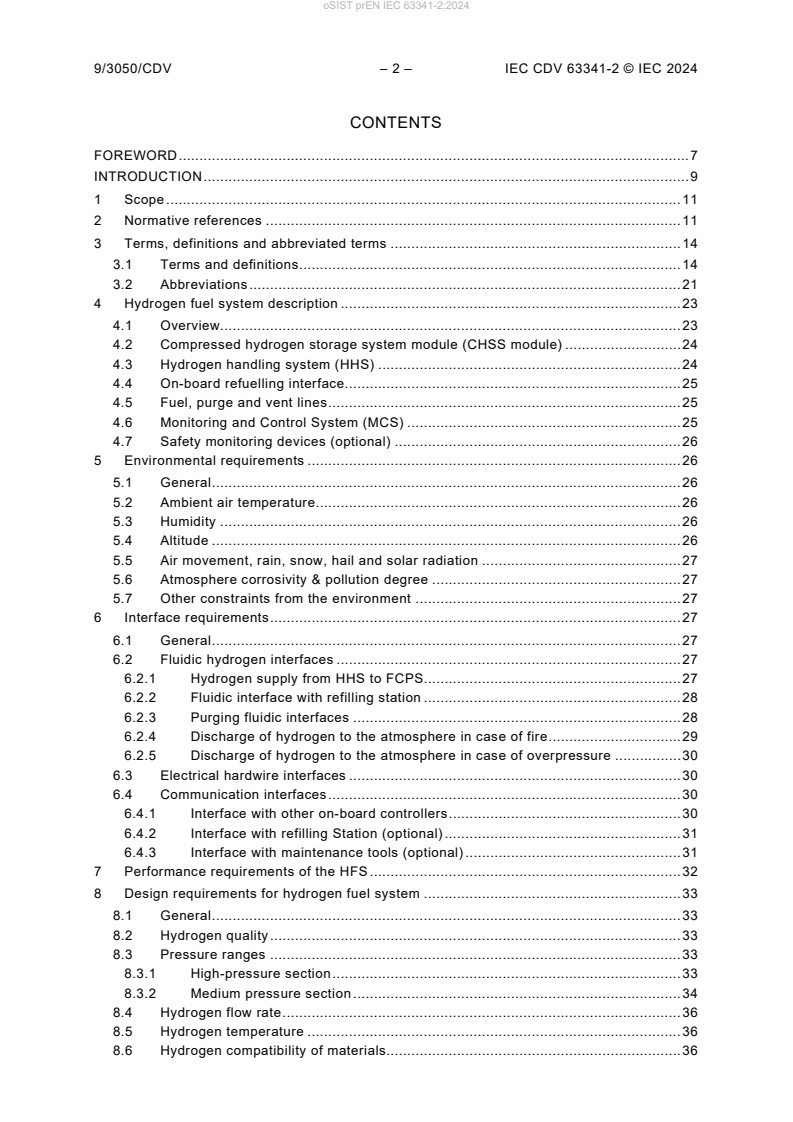
CONTENTS
FOREWORD . 7
INTRODUCTION . 9
1 Scope . 11
2 Normative references . 11
3 Terms, definitions and abbreviated terms . 14
3.1 Terms and definitions . 14
3.2 Abbreviations . 21
4 Hydrogen fuel system description . 23
4.1 Overview. 23
4.2 Compressed hydrogen storage system module (CHSS module) . 24
4.3 Hydrogen handling system (HHS) . 24
4.4 On-board refuelling interface . 25
4.5 Fuel, purge and vent lines . 25
4.6 Monitoring and Control System (MCS) . 25
4.7 Safety monitoring devices (optional) . 26
5 Environmental requirements . 26
5.1 General . 26
5.2 Ambient air temperature . 26
5.3 Humidity . 26
5.4 Altitude . 26
5.5 Air movement, rain, snow, hail and solar radiation . 27
5.6 Atmosphere corrosivity & pollution degree . 27
5.7 Other constraints from the environment . 27
6 Interface requirements . 27
6.1 General . 27
6.2 Fluidic hydrogen interfaces . 27
6.2.1 Hydrogen supply from HHS to FCPS. 27
6.2.2 Fluidic interface with refilling station . 28
6.2.3 Purging fluidic interfaces . 28
6.2.4 Discharge of hydrogen to the atmosphere in case of fire . 29
6.2.5 Discharge of hydrogen to the atmosphere in case of overpressure . 30
6.3 Electrical hardwire interfaces . 30
6.4 Communication interfaces . 30
6.4.1 Interface with other on-board controllers . 30
6.4.2 Interface with refilling Station (optional) . 31
6.4.3 Interface with maintenance tools (optional) . 31
7 Performance requirements of the HFS . 32
8 Design requirements for hydrogen fuel system . 33
8.1 General . 33
8.2 Hydrogen quality . 33
8.3 Pressure ranges . 33
8.3.1 High-pressure section . 33
8.3.2 Medium pressure section . 34
8.4 Hydrogen flow rate . 36
8.5 Hydrogen temperature . 36
8.6 Hydrogen compatibility of materials. 36
oSIST prEN IEC 63341-2:2024
IEC CDV 63341-2 © IEC 2024 – 3 – 9/3050/CDV
8.7 Electrical & network . 36
8.7.1 General . 36
8.7.2 General electrical principles. 36
8.8 Mechanical . 37
8.8.1 Mechanical integration of the HFS . 37
8.8.2 Structural design . 38
8.8.3 Bolted assemblies . 38
8.8.4 Lifting points . 38
8.8.5 Degree of protection . 38
8.8.6 Shock & vibration. 38
8.9 Fire protection . 38
8.10 Lifetime and refilling & duty cycles . 39
8.11 Eco-design . 39
8.12 Storage and transportation . 40
9 Design requirements for specific HFS sub-assemblies and components . 40
9.1 Introduction . 40
9.2 Methodology . 40
9.3 Compressed hydrogen storage system (CHSS) . 41
9.3.1 Hydrogen containers . 41
9.3.2 Mandatory fuel components . 41
9.3.3 Optional fuel components . 41
9.3.4 Structural frame of CHSS module . 42
9.4 Hydrogen handling system . 43
9.4.1 Introduction . 43
9.4.2 Mandatory fuel components . 43
9.4.3 Optional fuel components . 43
9.5 Rigid and flexible fuel and vent lines . 43
9.6 Hydrogen Refuelling Interface . 44
9.6.1 On-board hydrogen receptacle . 44
9.6.2 Optional refuelling components . 44
9.6.3 Refuelling communication devices (optional) . 44
9.7 General electrical principles . 45
9.7.1 Electronic devices . 45
9.7.2 Cabling & connectors . 45
9.7.3 EMC requirements . 45
9.8 Monitoring and Control System (MCS) . 45
9.8.1 Hardware . 45
9.8.2 Software . 45
9.9 Monitoring devices (optional) . 46
10 Control and monitoring requirements . 46
11 RAMS requirements. 46
11.1 Reliability & availability . 46
11.2 Safety . 47
11.2.1 Methodology . 47
11.2.2 Hazard identification . 48
11.2.3 Explosive atmosphere management. 48
11.2.4 Safety of refuelling process . 50
11.3 Maintenance . 51
11.3.1 Maintenance requirements . 51
oSIST prEN IEC 63341-2:2024
9/3050/CDV – 4 – IEC CDV 63341-2 © IEC 2024
11.3.2 Maintenance documentation . 51
11.3.3 Flushing & inertizing processes . 52
11.3.4 Leak testing . 53
12 Marking and labelling . 54
12.1 Safety signs . 54
12.2 Nameplate on sub-assemblies of HFS . 55
13 Testing . 55
13.1 Introduction . 55
13.2 Validation file content . 55
13.3 Test categories . 56
13.4 Type tests . 56
13.5 Routine tests. 56
13.6 Investigation tests . 56
13.7 List of type and routine tests . 57
13.8 Acceptance criteria . 57
13.9 Reference test conditions. 58
13.9.1 Laboratory conditions . 58
13.9.2 Installation and operating conditions of the system . 58
13.9.3 Quality of hydrogen . 58
13.10 Tests at HFS system level . 58
13.10.1 Mechanical tests . 58
13.10.2 Electrical tests . 59
13.10.3 Gas tests . 59
13.10.4 Control and monitoring tests . 60
13.10.5 Communication tests between on-board systems . 60
13.10.6 Interface tests with the refilling station . 60
13.10.7 Shock and vibration tests . 60
13.10.8 Electromagnetic compatibility . 61
13.10.9 Fire test at CHSS module level (Optional) . 61
Annex A (Informative) Recognized referentials and minimal essential subjects to be
considered for container design and validation . 62
A.1 Recognized referentials . 62
A.2 Minimal essential subjects to be considered for component design and
validation . 62
A.2.1 Cycling tests (Ambient and extreme temperature) . 62
A.2.2 Environmental test . 62
A.2.3 Hydrostatic burst strength . 63
A.2.4 Flaw tolerance test . 63
A.2.5 Drop test . 63
A.2.6 Fire test . 63
A.2.7 High temperature static test . 63
A.2.8 Strain rate impact test. 63
A.2.9 Permeation test . 63
A.2.10 Boss torque . 63
A.2.11 Hydrogen gas cycling test . 64
A.2.12 Vibration resistance – Railway life specific. 64
A.2.13 Pre-cooled hydrogen exposure . 64
A.2.14 Hydrogen compatibility . 64
oSIST prEN IEC 63341-2:2024
IEC CDV 63341-2 © IEC 2024 – 5 – 9/3050/CDV
Annex B (Informative) Recognized referentials and minimal essential subjects to be
considered for fuel component design and validation . 65
B.1 Recognized referentials . 65
B.2 Minimal essential subjects to be considered for component design and
validation . 65
B.2.1 Hydrostatic strength . 65
B.2.2 Leakage . 65
B.2.3 Excess torque resistance . 65
B.2.4 Continuous operation – Railway life specific . 66
B.2.5 Corrosion resistance – Railway life specific . 66
B.2.6 Ultraviolet resistance . 66
B.2.7 Atmospheric exposure . 66
B.2.8 Chemical exposure – Railway life specific . 66
B.2.9 Vibration resistance – Railway life specific. 66
B.2.10 Stress corrosion cracking . 67
B.2.11 Pre-cooled hydrogen exposure . 67
B.2.12 Electromagnetic compatibility - Railway life specific . 67
B.2.13 Hydrogen compatibility . 67
B.2.14 Fit – Refitment repetitions (optional) . 67
Annex C (Informative) H35VHF - Very High Flow hydrogen receptacle for heavy duty
applications . 68
Annex D (Informative) Standards, laws and regulations applicable in specific countries
or regions . 69
D.1 Fire protection . 69
D.1.1 Europe. 69
D.1.2 China . 69
D.1.3 Japan . 69
D.2 Mechanical requirements . 69
D.2.1 Europe. 69
D.2.2 China . 69
D.3 Dimensions for rigid fuel lines . 70
D.3.1 Europe. 70
D.3.2 NAM . 70
D.4 Labelling and signs . 70
D.4.1 Germany . 70
D.4.2 France . 70
D.4.3 China . 70
D.5 Leak tests . 70
D.5.1 Europe. 70
D.5.2 China . 70
D.6 Preferred refuelling receptacle . 70
D.6.1 China . 70
Annex E (Informative) Recommendations for Fire protection of the HFS . 71
E.1 General . 71
E.2 Fire detection . 71
E.3 Fire barriers . 71
Annex F (Informative) Recommendations for minimum maintenance checks and tasks . 72
Bibliography . 73
oSIST prEN IEC 63341-2:2024
9/3050/CDV – 6 – IEC CDV 63341-2 © IEC 2024
Figure 1 - Hierarchy of standards related to IEC 63341 . 10
Figure 2 - Scope of the hydrogen fuel system for railway applications . 24
Figure 3 – Hydrogen discharge location and flow orientation for CHSS . 29
Figure 4 – Pressures of high pressure section . 33
Figure 5 – Pressures of medium pressure section . 35
Figure 6 – Difference between duty and Filling cycles . 39
Figure 7- Flow chart demonstrating qualification of containers and components . 41
Figure 8 – Excess Flow Valve activation principle . 42
Figure 9 – Scheme of Flushing <-> inertizing process . 52
Figure 10 - H35VHF receptacle . 68
Table 1 – Overview of tests for the HFS . 57
oSIST prEN IEC 63341-2:2024
IEC CDV 63341-2 © IEC 2024 – 7 – 9/3050/CDV
INTERNATIONAL ELECTROTECHNICAL COMMISSION
____________
RAILWAY APPLICATIONS –
HYDROGEN AND FUEL CELL SYSTEMS FOR ROLLING STOCK –
Part 2: Hydrogen Fuel System
FOREWORD
1) The International Electrotechnical Commission (IEC) is a worldwide organization for standardization comprising
all national electrotechnical committees (IEC National Committees). The object of IEC is to promote international
co-operation on all questions concerning standardization in the electrical and electronic fields. To this end and
in addition to other activities, IEC publishes International Standards, Technical Specifications, Technical Reports,
Publicly Available Specifications (PAS) and Guides (hereafter referred to as “IEC Publication(s)”). Their
preparation is entrusted to technical committees; any IEC National Committee interested in the subject dealt with
may participate in this preparatory work. International, governmental and non-governmental organizations liaising
with the IEC also participate in this preparation. IEC collaborates closely with the International Organization for
Standardization (ISO) in accordance with conditions determined by agreement between the two organizations.
2) The formal decisions or agreements of IEC on technical matters express, as nearly as possible, an international
consensus of opinion on the relevant subjects since each technical committee has representation from all
interested IEC National Committees.
3) IEC Publications have the form of recommendations for international use and are accepted by IEC National
Committees in that sense. While all reasonable efforts are made to ensure that the technical content of IEC
Publications is accurate, IEC cannot be held responsible for the way in which they are used or for any
misinterpretation by any end user.
4) In order to promote international uniformity, IEC National Committees undertake to apply IEC Publications
transparently to the maximum extent possible in their national and regional publications. Any divergence between
any IEC Publication and the corresponding national or regional publication shall be clearly indicated in the latter.
5) IEC itself does not provide any attestation of conformity. Independent certification bodies provide conformity
assessment services and, in some areas, access to IEC marks of conformity. IEC is not responsible for any
services carried out by independent certification bodies.
6) All users should ensure that they have the latest edition of this publication.
7) No liability shall attach to IEC or its directors, employees, servants or agents including individual experts and
members of its technical committees and IEC National Committees for any personal injury, property damage or
other damage of any nature whatsoever, whether direct or indirect, or for costs (including legal fees) and
expenses arising out of the publication, use of, or reliance upon, this IEC Publication or any other IEC Publications.
8) Attention is drawn to the Normative references cited in this publication. Use of the referenced publications is
indispensable for the correct application of this publication.
9) Attention is drawn to the possibility that some of the elements of this IEC Publication may be the subject of patent
rights. IEC shall not be held responsible for identifying any or all such patent rights.
International Standard IEC 63341-2 has been prepared by IEC technical committee 9: Electrical
equipment and systems for railways.
The text of this International Standard is based on the following documents:
FDIS Report on voting
9/XX/FDIS 9/XX/RVD
Full information on the voting for the approval of this International Standard can be found in the
report on voting indicated in the above table.
This document has been drafted in accordance with the ISO/IEC Directives, Part 2.
oSIST prEN IEC 63341-2:2024
9/3050/CDV – 8 – IEC CDV 63341-2 © IEC 2024
The committee has decided that the contents of this document will remain unchanged until the
stability date indicated on the IEC website under "http://webstore.iec.ch" in the data related to
the specific document. At this date, the document will be
• reconfirmed,
• withdrawn,
• replaced by a revised edition, or
• amended.
This document is to be used in conjunction with the other parts of the standard along with other
related IEC and ISO standards for hydrogen fuel systems used for railway and road vehicle
applications.
The National Committees are requested to note that for this document the stability date
is 20XX.
THIS TEXT IS INCLUDED FOR THE INFORMATION OF THE NATIONAL COMMITTEES AND WILL BE DELETED
AT THE PUBLICATION STAGE.
IMPORTANT – The 'colour inside' logo on the cover page of this publication indicates
that it contains colours which are considered to be useful for the correct understanding
of its contents. Users should therefore print this document using a colour printer.
oSIST prEN IEC 63341-2:2024
IEC CDV 63341-2 © IEC 2024 – 9 – 9/3050/CDV
1 INTRODUCTION
2 This document considers general requirements for gaseous Hydrogen Fuel System installed
3 onboard rolling stock for railway applications.
4 ISO/TC 197 'Hydrogen technologies', ISO/TC 22/SC 37 ' Electrically propelled vehicles' and
5 SAE 'Fuel Cell Standards Committee' carry out normalization activities on hydrogen storage
6 technologies such as:
7 • ISO 17268 Gaseous hydrogen land vehicle refuelling connection devices
8 • ISO 19881 Gaseous hydrogen — Land vehicle fuel containers
9 • ISO 19882 Gaseous hydrogen — Thermally activated pressure relief devices for
10 compressed hydrogen vehicle fuel containers
11 • ISO 19887 Gaseous Hydrogen — Fuel system components for hydrogen fuelled vehicles
12 • ISO 23273 Fuel cell road vehicles — Safety specifications — Protection against
13 hydrogen hazards for vehicles fuelled with compressed hydrogen
14 These documents are mainly oriented to road vehicle applications. Therefore, the present
15 document is intended to augment them by adding specific requirements for the railway
16 applications.
17 IEC 63341 series consists of the following parts:
18 • Part 1: Fuel cell power system
19 • Part 2: Hydrogen fuel system
20 • Part 3: Performance test methods for fuel cell power system
21 This document is developed by IEC/TC 9 'Electrical equipment and systems for railways' in the
22 frame of the standards related to rolling stock with on-board energy storage systems.
oSIST prEN IEC 63341-2:2024
9/3050/CDV – 10 – IEC CDV 63341-2 © IEC 2024
23 The hierarchy of standards is shown in Figure 1 (non-exhaustive list).
26 Figure 1 - Hierarchy of standards related to IEC 63341
oSIST prEN IEC 63341-2:2024
IEC CDV 63341-2 © IEC 2024 – 11 – 9/3050/CDV
30 RAILWAY APPLICATIONS –
31 HYDROGEN AND FUEL CELL SYSTEMS FOR ROLLING STOCK –
33 Part 2: Hydrogen fuel system
37 1 Scope
38 This document applies to hydrogen fuel systems (HFS) installed onboard rolling stock for
39 railway applications and used to supply the fuel cells for the traction power and the auxiliaries
40 supply of railway vehicles such as hybrid vehicles as defined in IEC 62864-1.
41 NOTE This document can also be used as informative recommendations for applications with
42 hydrogen internal combustion engines.
43 This document applies to hydrogen storage in gaseous form, being the primary technology
44 currently used for land transport vehicles. Other means of storage (such as liquid, liquid cryo-
45 compressed, metal hydrides), are not treated in the present revision of the standard.
46 This document applies to any rolling stock type (e.g. light rail vehicles, tramways, streetcars,
47 metros, commuter trains, regional trains, high speed trains, locomotives).
48 This document addresses the mechanical, fluidic and electrical interfaces between the on-board
49 hydrogen fuel system and refilling station. The refilling station, refuelling protocol and
50 communication for the refuelling protocol are not in the scope of this document.
51 For design, performance requirements & test methods for fuel cell power systems see
52 IEC 63341-1 and IEC 63341-3 respectively.
53 This document focuses on:
54 – the scope of supply of hydrogen fuel system and the description of the interfaces with sub-
55 systems internal and external to the rolling stock such as fuel cell power system, refilling
56 station systems,
57 – the environmental constraints,
58 – the design requirements to support HFS compliance with railway applications,
59 – the safety and reliability requirements to design and install the HFS for railway applications,
60 – the marking and labelling requirements,
61 – the requirements related to storage, transportation, installation and maintenance,
62 – the validation (type, routine and investigation tests) requirements.
63 2 Normative references
64 The following documents are referred to in the text in such a way that some or all of their content
65 constitute requirements of this document. For dated references, only the edition cited applies.
66 For undated references, the latest edition of the referenced document (including any
67 amendments) applies.
oSIST prEN IEC 63341-2:2024
9/3050/CDV – 12 – IEC CDV 63341-2 © IEC 2024
68 UN ECE R134, Uniform provisions concerning the approval of motor vehicles and their components
69 with regard to the safety related performance of hydrogen-fuelled vehicles (HFCV)
70 GTR 13, Global technical regulation on hydrogen and fuel cell vehicles
71 IEC 60077-1, Railway applications - Electric equipment for rolling stock - Part 1: General service
72 conditions and general rules - Edition 2.0
73 IEC 60571, Railway applications - Electronic equipment used on rolling stock
74 IEC 60529, Degrees of Protection Provided by Enclosures (IP Code)
75 IEC 61373, Railway applications – Rolling stock equipment – Shock and vibration tests
76 IEC 61375 series, Electronic railway equipment - Train communication network (TCN)
77 IEC 61991, Railway applications – Rolling stock – Protective provisions relating to electrical hazards
78 IEC 62236-3-2, Railway applications – Electromagnetic compatibility – Part 3-2: Rolling stock –
79 Apparatus
80 IEC 61709, Electric Components – Reliability – Reference conditions for failure rates and stress
81 models for conversion
82 IEC 62497 series, Railway applications - Insulation coordination
83 IEC 62498-1, Railway applications - Environmental conditions for equipment - Part 1: Equipment on
84 board rolling stock
85 IEC/TR 62635, Guidelines for end-of-life information provided by manufacturers and recyclers and for
86 recyclability rate calculation of electrical and electronic equipment
87 IEC 62847, Railway applications – Rolling stock – Electrical connectors – Requirements and test
88 methods
89 IEC 62995, Railway applications – Rolling stock – Rules for installation of cabling
90 IEC 63341-1, Railway applications – Rolling stock – Fuel cell systems for propulsion - Part 1: Fuel Cell
91 System
92 ISO 14687, Hydrogen fuel quality – Product specification
93 ISO/TR 15916, Basic considerations for the safety of hydrogen systems
94 ISO 17268 series, Gaseous hydrogen land vehicle refuelling connection devices
95 ISO 19881, Gaseous hydrogen — Land vehicle fuel containers
96 ISO 19882, Gaseous hydrogen — Thermally activated pressure relief devices for compressed
97 hydrogen vehicle fuel containers
98 ISO 19887, Gaseous Hydrogen — Fuel system components for hydrogen fuelled vehicles
oSIST prEN IEC 63341-2:2024
IEC CDV 63341-2 © IEC 2024 – 13 – 9/3050/CDV
oSIST prEN IEC 63341-2:2024
9/3050/CDV – 14 – IEC CDV 63341-2 © IEC 2024
100 3 Terms, definitions and abbreviated terms
101 3.1 Terms and definitions
102 For the purpose of this document, the following terms and definitions apply.
104 ISO and IEC maintain terminological databases for use in standardization at the following
105 addresses:
106 — ISO Online browsing platform: available at http://www.iso.org/obp
107 — IEC Electropedia: available at http://www.electropedia.org/
109 3.1.1
110 hydrogen fuel system
111 HFS
112 system designed to store and process hydrogen to supply the fuel cell power system.
114 Note 1 for entry: It includes the CHSS, on-board refuelling devices, fuel / purge / vent lines and the
115 associated monitoring & control & safety devices
117 3.1.2
118 compressed hydrogen storage system
119 CHSS
120 system designed to store hydrogen fuel for a hydrogen-fuelled vehicle and composed of a pressurised
121 container, pressure relief devices and shut off device(s) that isolate the stored hydrogen from the
122 remainder of the fuel system and its environment
124 [SOURCE: UN ECE R134:2015, 2.3]
126 3.1.3
127 CHSS module
128 assembly comprising one or more CHSS(s) assembled on structural elements and connected together
129 via piping for refuelling, defueling and venting / purging.
131 Note 1 for entry: The CHSS module can include additional sensors, valves and other devices for
132 monitoring and control (e.g. temperature and pressure sensors, manometers automatic shut-off valves)
134 3.1.4
135 hydrogen handling system
136 HHS
137 system that processes, conditions, and/or conveys hydrogen (or hydrogen-rich gas) to the fuel cell or
138 engine
140 [SOURCE: SAE J2579:2018, 3.6]
142 3.1.5
143 container
144 pressure-bearing component on the vehicle that stores the primary volume of hydrogen fuel in a single
145 chamber or in multiple permanently interconnected chambers
147 Note 1 to entry: the hydrogen container includes the permanently fixed parts (such as liner, reinforcement wrap and
148 boss) and does not include the add-on such as shut-off valves, check-valves, filters, TPRD if any, sensors.
150 Note 2 to entry: In the document, the terms of hydrogen 'container' or 'tank' are used as synonyms.
152 [SOURCE: ISO 19881:2024, 3.4.4 modified - The notes 1 and 2 to entry have been added]
154 3.1.6
155 container type 3
156 container which contains a metal liner (see 3.1.11) reinforced with a resin impregnated continuous
157 filament (fully-wrapped)
oSIST prEN IEC 63341-2:2024
IEC CDV 63341-2 © IEC 2024 – 15 – 9/3050/CDV
159 Note 1 to entry: See 3.1.8
161 [SOURCE: ISO 19881:2018, 3.5.3]
163 3.1.7
164 container type 4
165 container which contains a resin impregnated continuous filament with a non-metallic liner (see 3.1.11)
167 Note 1 to entry: See 3.1.10
169 [SOURCE: ISO 19881:2018, 3.5.4]
171 3.1.8
172 full-wrapped
173 reinforced by a composite (3.1.10) material applied over the entire liner (3.1.11) including the domes
175 [SOURCE: ISO 19881:2018, 3.10]
177 3.1.9
178 hoop-wrapped
179 reinforced by a composite (3.1.10) material applied in a substantially circumferential pattern over the
180 cylindrical portion of the liner (3.1.11) so that the filament does not transmit any significant stresses in a
181 direction parallel to the container longitudinal axis
183 [SOURCE: ISO 19881:2018, 3.11]
185 3.1.10
186 composite
187 filament and resin system
189 [SOURCE: ISO 19881:2018, 3.3]
191 3.1.11
192 liner
193 inner gas tight container or gas container to which the overwrap is applied
195 [SOURCE: ISO 19881:2018, 3.14]
197 3.1.12
198 valve
199 a component by which the flow of a fluid can be controlled
201 [SOURCE: ISO 19887:2024, 3.27]
203 3.1.13
204 automatic valve
205 an on/off valve for controlling flow of gas that is not manually operated
207 Note 1 to entry: An automatic valve may also be considered a "Shut-off valve", which is defined
208 in UN GTR No. 13 as a valve between the container and the vehicle fuel system that must
209 default to the "closed" position when not connected to a power source.
211 [SOURCE: ISO 19887:2024, 3.27.1 modified - The notes 1 has been copied from ISO 19887,
212 3.27.2]
214 3.1.14
215 check valve
216 valve that allows gas to flow in only one direction
218 [SOURCE: ISO 19887:2024, 3.27.3]
oSIST prEN IEC 63341-2:2024
9/3050/CDV – 16 – IEC CDV 63341-2 © IEC 2024
220 3.1.15
221 manual valve
222 a hand-operated device for controlling the flow of gas
224 [SOURCE: ISO 19887:2024, 3.27.6]
226 3.1.16
227 service valve
228 a valve intended for use only during maintenance or repair and requiring tools to operate
230 [SOURCE: ISO 19887:2024, 3.27.7]
232 3.1.17
233 Fitting
234 connector used to join sections of pipe, tube, hose, or components
236 [SOURCE: ISO 19887:2024, 3.10]
238 3.1.18
239 pressure regulator
240 device used to control the delivery pressure of gaseous fuel
...