

IEC TR 62699-1:2014
(Main)Mapping rules and exchange methods for heterogeneous electronic parts libraries - Part 1: Building an integrated search system
General Information
- Abstract
IEC TR 62699-1:2014 describes mapping rules and exchange methods for the development of general and extendable integrated services utilizing heterogeneous multi-national or multi-enterprise electronic parts library data. The scope of this technical report is as follows:
a) identification and classification of mapping types for mapping heterogeneous electronic parts libraries;
b) definition of general mapping rules and specific mapping rules commonly applying to various mapping types.
The following aspects are out of the scope of this technical report:
- schematic definition and management of the electronic parts libraries to be mapped;
- maintenance process for the parts libraries during changes.
- Status
- Published
- Publication Date
- 15-Dec-2014
- Technical Committee
- TC 91 - Electronics assembly technology
- Drafting Committee
- WG 14 - TC 91/WG 14
- Current Stage
- PPUB - Publication issued
- Start Date
- 16-Dec-2014
- Completion Date
- 15-Mar-2015
Overview
IEC TR 62699-1:2014 - "Mapping rules and exchange methods for heterogeneous electronic parts libraries – Part 1: Building an integrated search system" defines a methodology to integrate and search electronic parts information that is distributed across heterogeneous, multi-national or multi-enterprise parts libraries. The technical report focuses on identification and classification of mapping types and on defining general and specific mapping rules to enable interoperable, extendable services such as integrated search and e‑sourcing across disparate parts databases.
Key points:
- Targets integration of heterogeneous parts classification and property systems.
- Enables deterministic search results where direct 1:1 correspondence does not exist (covers 1:1, 1:N, N:1 and 1:0/0:1 mapping cases).
- Excludes schematic library management and ongoing maintenance processes.
Key Topics and Requirements
- Application architecture & interoperability: Describes an interoperability system, data flow and sequence diagrams to support integrated services.
- Utilized dictionary format: Defines formats and rules for a common dictionary (UD_Class, root properties, property formats) to act as the integration pivot.
- Mapping types & classification: Identifies mapping scenarios (e.g., one-to-one, one-to-many, many-to-one, absent mappings) and provides classification guidance.
- Mapping rules: Specifies a general mapping model and concrete rules for each mapping type to produce consistent search and integration results.
- Interfaces & message formats: Defines information exchange patterns and message blocks (query/detail request/response, error/warning messages) for parts list and detailed part information exchange.
- Practical constraints: Clarifies out-of-scope elements (schematic definition/management and maintenance processes) so implementers focus on mapping and exchange.
Applications
IEC TR 62699-1 is practical for:
- Building integrated search systems and multinational e‑sourcing platforms that query multiple parts libraries in real time.
- Enabling cross-border procurement and supplier/distributor search where libraries use incompatible classifications.
- Integrating PLM/ERP/ECAD systems with multiple parts repositories through standardized mapping and message exchange.
Who should use this standard
- Software vendors and system integrators developing parts search, procurement, and catalog aggregation tools.
- OEMs, distributors and electronic component data managers needing multi-source parts integration.
- Standards bodies, national parts library custodians and technical committees focused on parts classification and interoperability.
Related standards
- Other parts in the IEC 62699 series (see IEC catalog for the series).
- Drafting and publication follows ISO/IEC Directives (referenced in the TR foreword).
Keywords: IEC TR 62699-1, mapping rules, heterogeneous electronic parts libraries, integrated search system, parts data exchange, interoperability, mapping types, utilized dictionary, e‑sourcing.
Get Certified
Connect with accredited certification bodies for this standard

DVS-ZERT GmbH
German welding certification society.
CARES (UK Certification Authority for Reinforcing Steels)
UK certification for reinforcing steels and construction.
EWF/IIW (European/International Welding Federation)
International welding personnel certification.
Sponsored listings
Frequently Asked Questions
IEC TR 62699-1:2014 is a technical report published by the International Electrotechnical Commission (IEC). Its full title is "Mapping rules and exchange methods for heterogeneous electronic parts libraries - Part 1: Building an integrated search system". This standard covers: IEC TR 62699-1:2014 describes mapping rules and exchange methods for the development of general and extendable integrated services utilizing heterogeneous multi-national or multi-enterprise electronic parts library data. The scope of this technical report is as follows: a) identification and classification of mapping types for mapping heterogeneous electronic parts libraries; b) definition of general mapping rules and specific mapping rules commonly applying to various mapping types. The following aspects are out of the scope of this technical report: - schematic definition and management of the electronic parts libraries to be mapped; - maintenance process for the parts libraries during changes.
IEC TR 62699-1:2014 describes mapping rules and exchange methods for the development of general and extendable integrated services utilizing heterogeneous multi-national or multi-enterprise electronic parts library data. The scope of this technical report is as follows: a) identification and classification of mapping types for mapping heterogeneous electronic parts libraries; b) definition of general mapping rules and specific mapping rules commonly applying to various mapping types. The following aspects are out of the scope of this technical report: - schematic definition and management of the electronic parts libraries to be mapped; - maintenance process for the parts libraries during changes.
IEC TR 62699-1:2014 is classified under the following ICS (International Classification for Standards) categories: 25.040.99 - Other industrial automation systems. The ICS classification helps identify the subject area and facilitates finding related standards.
IEC TR 62699-1:2014 is available in PDF format for immediate download after purchase. The document can be added to your cart and obtained through the secure checkout process. Digital delivery ensures instant access to the complete standard document.
Standards Content (Sample)
IEC TR 62699-1 ®
Edition 1.0 2014-12
TECHNICAL
REPORT
colour
inside
Mapping rules and exchange methods for heterogeneous electronic parts
libraries –
Part 1: Building an integrated search system
All rights reserved. Unless otherwise specified, no part of this publication may be reproduced or utilized in any form
or by any means, electronic or mechanical, including photocopying and microfilm, without permission in writing from
either IEC or IEC's member National Committee in the country of the requester. If you have any questions about IEC
copyright or have an enquiry about obtaining additional rights to this publication, please contact the address below or
your local IEC member National Committee for further information.
IEC Central Office Tel.: +41 22 919 02 11
3, rue de Varembé Fax: +41 22 919 03 00
CH-1211 Geneva 20 info@iec.ch
Switzerland www.iec.ch
About the IEC
The International Electrotechnical Commission (IEC) is the leading global organization that prepares and publishes
International Standards for all electrical, electronic and related technologies.
About IEC publications
The technical content of IEC publications is kept under constant review by the IEC. Please make sure that you have the
latest edition, a corrigenda or an amendment might have been published.
IEC Catalogue - webstore.iec.ch/catalogue Electropedia - www.electropedia.org
The stand-alone application for consulting the entire The world's leading online dictionary of electronic and
bibliographical information on IEC International Standards, electrical terms containing more than 30 000 terms and
Technical Specifications, Technical Reports and other definitions in English and French, with equivalent terms in 14
documents. Available for PC, Mac OS, Android Tablets and additional languages. Also known as the International
iPad. Electrotechnical Vocabulary (IEV) online.
IEC publications search - www.iec.ch/searchpub IEC Glossary - std.iec.ch/glossary
The advanced search enables to find IEC publications by a More than 55 000 electrotechnical terminology entries in
variety of criteria (reference number, text, technical English and French extracted from the Terms and Definitions
committee,…). It also gives information on projects, replaced clause of IEC publications issued since 2002. Some entries
and withdrawn publications. have been collected from earlier publications of IEC TC 37,
77, 86 and CISPR.
IEC Just Published - webstore.iec.ch/justpublished
Stay up to date on all new IEC publications. Just Published IEC Customer Service Centre - webstore.iec.ch/csc
details all new publications released. Available online and If you wish to give us your feedback on this publication or
also once a month by email. need further assistance, please contact the Customer Service
Centre: csc@iec.ch.
IEC TR 62699-1 ®
Edition 1.0 2014-12
TECHNICAL
REPORT
colour
inside
Mapping rules and exchange methods for heterogeneous electronic parts
libraries –
Part 1: Building an integrated search system
INTERNATIONAL
ELECTROTECHNICAL
COMMISSION
PRICE CODE
V
ICS 25.040 ISBN 978-2-8322-1978-2
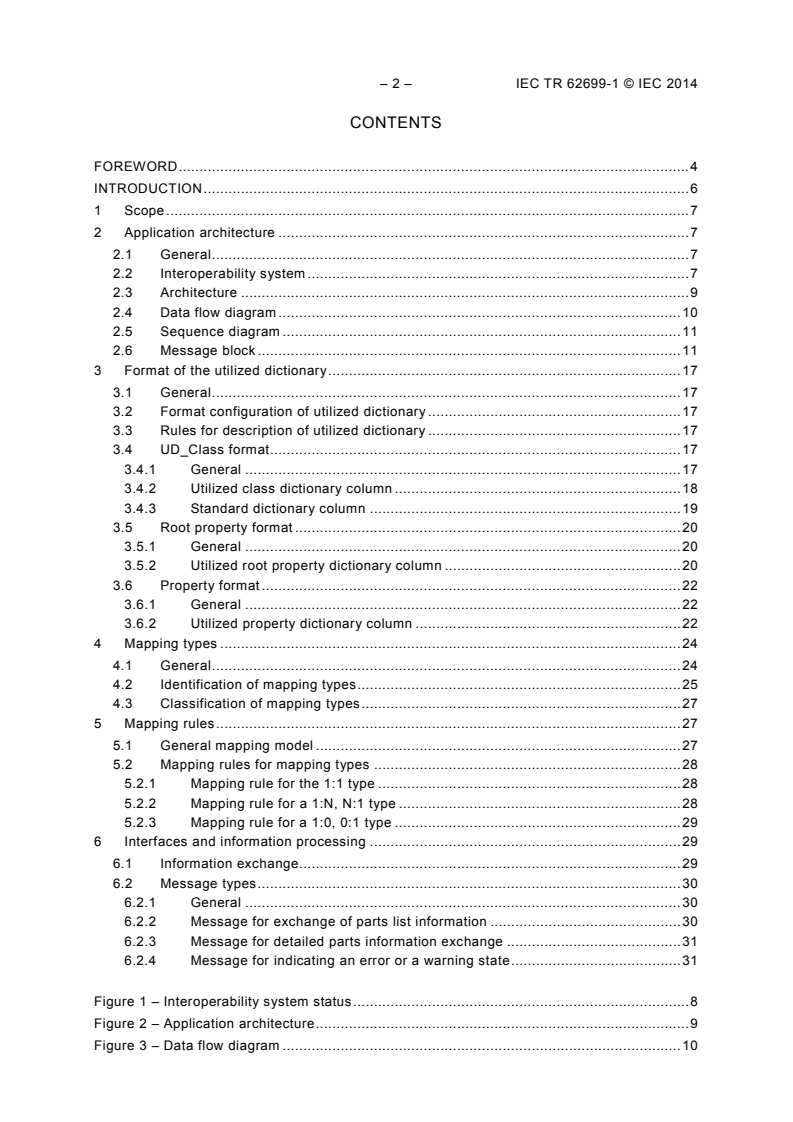
– 2 – IEC TR 62699-1 © IEC 2014
CONTENTS
FOREWORD . 4
INTRODUCTION . 6
1 Scope . 7
2 Application architecture . 7
2.1 General . 7
2.2 Interoperability system . 7
2.3 Architecture . 9
2.4 Data flow diagram . 10
2.5 Sequence diagram . 11
2.6 Message block . 11
3 Format of the utilized dictionary . 17
3.1 General . 17
3.2 Format configuration of utilized dictionary . 17
3.3 Rules for description of utilized dictionary . 17
3.4 UD_Class format . 17
3.4.1 General . 17
3.4.2 Utilized class dictionary column . 18
3.4.3 Standard dictionary column . 19
3.5 Root property format . 20
3.5.1 General . 20
3.5.2 Utilized root property dictionary column . 20
3.6 Property format . 22
3.6.1 General . 22
3.6.2 Utilized property dictionary column . 22
4 Mapping types . 24
4.1 General . 24
4.2 Identification of mapping types . 25
4.3 Classification of mapping types . 27
5 Mapping rules . 27
5.1 General mapping model . 27
5.2 Mapping rules for mapping types . 28
5.2.1 Mapping rule for the 1:1 type . 28
5.2.2 Mapping rule for a 1:N, N:1 type . 28
5.2.3 Mapping rule for a 1:0, 0:1 type . 29
6 Interfaces and information processing . 29
6.1 Information exchange. 29
6.2 Message types . 30
6.2.1 General . 30
6.2.2 Message for exchange of parts list information . 30
6.2.3 Message for detailed parts information exchange . 31
6.2.4 Message for indicating an error or a warning state . 31
Figure 1 – Interoperability system status . 8
Figure 2 – Application architecture . 9
Figure 3 – Data flow diagram . 10
IEC TR 62699-1 © IEC 2014 – 3 –
Figure 4 – Sequence diagram . 11
Figure 5 – Message block . 11
Figure 6 – Message control block. 12
Figure 7 – Message contents block . 12
Figure 8 – Message contents block (query request) . 13
Figure 9 – Message contents block (detail request) . 14
Figure 10 – Message contents block (query response) . 15
Figure 11 – Message contents block (detail response) . 16
Figure 12 – Message contents block (error response) . 17
Figure 13 – Example of UD_Class format . 18
Figure 14 – Example of root property format . 20
Figure 15 – Example of property formats . 22
Figure 16 – Example of a case of integration of two parts libraries . 25
Figure 17 – Example of mapping table between SD1 and SD2 . 26
Figure 18 – Example of mapping the properties of the classes . 26
Figure 19 – Example of cases of each mapping type on the utilized dictionary . 27
Figure 20 – Example of a case of user interface through a utilized dictionary . 30
Figure 21 – Example of request and response on information exchange . 30
Table 1 – Example of a case of a 1:1 mapping type . 28
Table 2 – Example of a case of a 1:N, N:1 mapping type . 28
Table 3 – Example of a case of a 1:0 mapping type . 29
Table 4 – Types of message . 31
– 4 – IEC TR 62699-1 © IEC 2014
INTERNATIONAL ELECTROTECHNICAL COMMISSION
____________
MAPPING RULES AND EXCHANGE METHODS FOR
HETEROGENEOUS ELECTRONIC PARTS LIBRARIES –
Part 1: Building an integrated search system
FOREWORD
1) The International Electrotechnical Commission (IEC) is a worldwide organization for standardization comprising
all national electrotechnical committees (IEC National Committees). The object of IEC is to promote
international co-operation on all questions concerning standardization in the electrical and electronic fields. To
this end and in addition to other activities, IEC publishes International Standards, Technical Specifications,
Technical Reports, Publicly Available Specifications (PAS) and Guides (hereafter referred to as “IEC
Publication(s)”). Their preparation is entrusted to technical committees; any IEC National Committee interested
in the subject dealt with may participate in this preparatory work. International, governmental and non-
governmental organizations liaising with the IEC also participate in this preparation. IEC collaborates closely
with the International Organization for Standardization (ISO) in accordance with conditions determined by
agreement between the two organizations.
2) The formal decisions or agreements of IEC on technical matters express, as nearly as possible, an international
consensus of opinion on the relevant subjects since each technical committee has representation from all
interested IEC National Committees.
3) IEC Publications have the form of recommendations for international use and are accepted by IEC National
Committees in that sense. While all reasonable efforts are made to ensure that the technical content of IEC
Publications is accurate, IEC cannot be held responsible for the way in which they are used or for any
misinterpretation by any end user.
4) In order to promote international uniformity, IEC National Committees undertake to apply IEC Publications
transparently to the maximum extent possible in their national and regional publications. Any divergence
between any IEC Publication and the corresponding national or regional publication shall be clearly indicated in
the latter.
5) IEC itself does not provide any attestation of conformity. Independent certification bodies provide conformity
assessment services and, in some areas, access to IEC marks of conformity. IEC is not responsible for any
services carried out by independent certification bodies.
6) All users should ensure that they have the latest edition of this publication.
7) No liability shall attach to IEC or its directors, employees, servants or agents including individual experts and
members of its technical committees and IEC National Committees for any personal injury, property damage or
other damage of any nature whatsoever, whether direct or indirect, or for costs (including legal fees) and
expenses arising out of the publication, use of, or reliance upon, this IEC Publication or any other IEC
Publications.
8) Attention is drawn to the Normative references cited in this publication. Use of the referenced publications is
indispensable for the correct application of this publication.
9) Attention is drawn to the possibility that some of the elements of this IEC Publication may be the subject of
patent rights. IEC shall not be held responsible for identifying any or all such patent rights.
The main task of IEC technical committees is to prepare International Standards. However, a
technical committee may propose the publication of a technical report when it has collected
data of a different kind from that which is normally published as an International Standard, for
example "state of the art".
IEC TR 62699-1, which is a technical report, has been prepared by IEC technical committee
91: Electronics assembly technology.
IEC TR 62699-1 © IEC 2014 – 5 –
The text of this technical report is based on the following documents:
Enquiry draft Report on voting
91/1187/DTR 91/1200/RVC
Full information on the voting for the approval of this technical report can be found in the
report on voting indicated in the above table.
A list of all parts in the IEC 62699 series, published under the general title Mapping rules and
exchange methods for heterogeneous parts libraries, can be found on the IEC website.
This publication has been drafted in accordance with the ISO/IEC Directives, Part 2.
The committee has decided that the contents of this publication will remain unchanged until
the stability date indicated on the IEC website under "http://webstore.iec.ch" in the data
related to the specific publication. At this date, the publication will be
• reconfirmed,
• withdrawn,
• replaced by a revised edition, or
• amended.
IMPORTANT – The 'colour inside' logo on the cover page of this publication indicates
that it contains colours which are considered to be useful for the correct
understanding of its contents. Users should therefore print this document using a
colour printer.
– 6 – IEC TR 62699-1 © IEC 2014
INTRODUCTION
This technical report describes the methodology for integrated use of heterogeneous libraries
of electric and electronic product parts to provide integrated services utilizing existing
heterogeneous libraries. Integrated search of electronic parts information, for example,
requires to integrate the electronic parts classification systems and the property classification
systems that are possibly maintained by different nations in incompatible ways, in that not all
the electronic parts information has one-to-one correspondence between parts libraries.
Recently, Korea, China, and Japan jointly built an integrated search system to enable search
of parts information across parts libraries that are independently operated by each country.
The biggest challenge in this project was bridging the gap between these heterogeneous
parts libraries by providing rules to integrate related parts information. The integration of
information that has one-to-one (1:1) relation between different parts libraries is
straightforward. However, integration of information that has one-to-many (1:N), or many-to-
one (N:1) relation demands a standard rule of integration to provide a determinant search
result, or service in general.
The integration rules specified in this technical report provide a foundation for utilization of the
electronic parts libraries, possibly heterogeneously constructed by different organizations.
The information systems constructed by the application of these integration rules can be the
basis for constructing an integrated electronic parts e-sourcing system enabling real-time
search of multinational electronic part databases with minimized loss of information.
IEC TR 62699-1 © IEC 2014 – 7 –
MAPPING RULES AND EXCHANGE METHODS FOR
HETEROGENEOUS ELECTRONIC PARTS LIBRARIES –
Part 1: Building an integrated search system
1 Scope
This part of IEC 62699 describes mapping rules and exchange methods for the development
of general and extendable integrated services utilizing heterogeneous multi-national or multi-
enterprise electronic parts library data. The scope of this technical report is as follows:
a) identification and classification of mapping types for mapping heterogeneous electronic
parts libraries;
b) definition of general mapping rules and specific mapping rules commonly applying to
various mapping types.
The following aspects are out of the scope of this technical report:
• schematic definition and management of the electronic parts libraries to be mapped;
• maintenance process for the parts libraries during changes.
2 Application architecture
2.1 General
This clause illustrates the application architecture on which the mapping rules and methods
are based. The information exchange methodology and interoperability are required for
performing an integrated search by linkage of heterogeneous electronic parts libraries on the
basis of the mapping dictionary.
2.2 Interoperability system
Figure 1 shows an interoperability system (IOS). It is constructed with common exchange
rules and a mapping dictionary that apply between parties A, B and C. Each system,
connected with the Internet, provides the communications environment that enables data
exchange.
– 8 – IEC TR 62699-1 © IEC 2014
IEC
Figure 1 – Interoperability system status
The following items are involved in the construction of an application architecture.
• Interoperability system (IOS)
It consists of the mapping dictionary, suppliers' list and the parts data base (DB) intended
to design communications protocols and message exchange rules enabling interoperation,
and to provide and exchange developed data communications programs and data.
• Mapping dictionary
It constructs electronic parts libraries into the mapping dictionary for information exchange
between sites.
• Part DB
As detailed information of the parts listed in the mapping dictionary. It can be either
operated on the same server as the interoperability system or constructed into a separate
system depending on the information system environments of the concerned site.
IEC TR 62699-1 © IEC 2014 – 9 –
2.3 Architecture
IEC
Figure 2 – Application architecture
Figure 2 shows the organization of the application architecture in which each component
provides the functions as described below.
• Presentation layer (User Interface)
It inputs search conditions for search of parts information and provides the user screen on
which search results are displayed.
• Interface layer (request & response adapter)
It consists of the request demanding the interoperability system to search the parts
information according to search conditions (class, suppliers' list, property, etc.) and the
response transporting the parts information search results corresponding to the requested
search conditions in response to the request.
• Conversion layer (transportation, mapping)
It executes data conversion and mapping in accordance with the requested search
conditions and the IOS through the mapping dictionary and suppliers' list.
• Suppliers' list
It is the supplier information corresponding to a parts class and includes information such
as URL, address, etc.
• Mapping dictionary
It is the repository in which parts classes of each interoperability system site to be
exchanged are mapped. All the sites whose information will be exchanged should always
be synchronized to ensure accurate information exchange.
– 10 – IEC TR 62699-1 © IEC 2014
• Part DB
As the repository of detailed information of supplier’s parts, it is the supplier system which
is constructed outside the interoperability system and configured to be linked to the
interoperability system.
• Logger
It monitors the transaction processing of the interoperability system such as request,
response, etc., and the system management. It contains the standard message protocol,
standard mapping dictionary and parts information for exchange of parts information. The
standard message protocol defines the method of communications used for data transport
and the method of packaging data in the message.
2.4 Data flow diagram
Figure 3 depicts the data flow in the application architecture.
IEC
Key
The following numbers represent a common data flow.
①. Selecting parts classes for search of parts information.
②. Mapping parts classes to the corresponding IOS classes through the mapping dictionary.
③. Bringing the suppliers' lists corresponding to the parts classes.
④. Requesting search of parts information to the IOS.
⑤. Bringing the detailed parts information of the IOS to be searched.
⑥. Transporting searched parts information to the requesting IOS.
⑦. Displaying search results on the user’s screen.
Figure 3 – Data flow diagram
IEC TR 62699-1 © IEC 2014 – 11 –
2.5 Sequence diagram
Figure 4 shows the sequence diagram for the components of the application architecture.
IEC
Figure 4 – Sequence diagram
2.6 Message block
On the interoperability system, the message for exchange of parts information consists of a
control block and a contents block as shown in Figure 5.
The details of the message block are listed below.
IEC
Element Attribute
Cardinality
Name Description Name Description
EpiaCatalogMsg IOS message
MsgControl Control block 1
MsgContents Contents block 1
Figure 5 – Message block
• Control block
It is the message header for exchange of message contents, and consists of the
information such as message ID, message kind, status, etc., as shown in Figure 6.
– 12 – IEC TR 62699-1 © IEC 2014
IEC
Element Attribute
Cardi-
nality
Name Description Name Description
“1”: Query request
kind
“2”: Detail request
“0”: Request
status “1”: Response (normal)
Header information for
message exchange
“2”: Response (error)
MsgControl consisting of message
kind, status, message
Used as check ID for
ID, etc.
information exchange in
a request and response
identifier
system
MemberID +
“YYYYMMDDHHMMSS”
Message user ID and identifier Member ID
MemberInfo password for message
security password Member PASSWORD
Figure 6 – Message control block
• Contents block
It consists of the formats for request and response with the parts list and detailed parts
information, and its contents depends on the type of message as shown in Figure 7.
IEC
Element Attribute
Cardi-
nality
Name Description Name Description
Containing message
MsgContents
contents
Query Request for information 1
Response with search
Response 1
results
Figure 7 – Message contents block
IEC TR 62699-1 © IEC 2014 – 13 –
The contents block consists of the “Query“ message requesting the parts information and the
“Response“ message responding to the requested parts information as shown in Figure 8.
Depending on the message kind, “Query“ and “Response” messages are configured as
follows:
• Query request
Is the message requesting the parts list information to a counterpart enterprise (nation). It
consists of the general search conditions and the specified property required for
information request.
IEC
Element Attribute
Cardi-
nality
Name Description Name Description
Query Request for parts list 1
General query
QueryParams parameters set up by 1
user and system
Products (parts) class
ClassCode 1
code
PropertyList Property list 1
MakerList Suppliers' list 1
Number of queries,
SrchConfig 1
response time
Specified property
Conditions 0.n
Search conditions
code Property condition code 1.n
PropCondition Property condition
prefix Property condition prefix 1.n
Figure 8 – Message contents block (query request)
• Detail request
Is the message requesting detailed parts list information to a counterpart enterprise
(nation), it consists of the detailed search parameters required for information request as
shown in Figure 9.
– 14 – IEC TR 62699-1 © IEC 2014
IEC
Element Attribute
Cardi-
nality
Name Description Name Description
Request for detailed
Query 1
parts information
Detailed search
DetailParams 1
parameters
Products (parts) class
ClassCode 1
code
MakerCode Supplier code 1
MakerPartName Supplier parts name code Supplier parts code 1
Number of queries,
SrchConfig 1
response time
Figure 9 – Message contents block (detail request)
• Query response
Is the message of response with search results to the request of a counterpart enterprise
(nation) for the parts list information, it consists of the search conditions requested and the
search results as shown in Figure 10.
IEC TR 62699-1 © IEC 2014 – 15 –
IEC
Element Attribute
Cardi-
nality
Name Description Name Description
Response with search
Response 1
results
Query request message
QueryParams 1
search conditions
Products (parts) class
ClassCode 1
code
PropertyList Property list 1
MakerList Suppliers' list 1
Number of queries,
SrchConfig 1
response time
Response with search
QueryResponse 1
results
Number of search
ResponseCount 1
results
DataSet Searched data 0.n
code Supplier code
MakerInfo Supplier info 1
url Supplier URL
code Class code
ClassInfo Parts class info 1
level Class level
PartInfo Parts info code Part code 1
type Related file type
RelatedFile Related file info 0.1
url Related file URL
code Property code
name Property name
PropertyInfo Property info unit Property unit 0.n
prefix Property prefix
data type Property data type
Figure 10 – Message contents block (query response)
– 16 – IEC TR 62699-1 © IEC 2014
• Detail response
Is the message of response with search results to the request of a counterpart enterprise
(nation) for the detailed parts information, it consists of the detailed search results for
suppliers and parts as shown in Figure 11.
IEC
Element Attribute
Cardi-
nality
Name Description Name Description
Response with search
Response 1
results
Response with detailed
DetailResponse 1
search results
code Supplier code
MakerInfo Supplier info 1
url Supplier URL
code Class code
ClassInfo Class info 1
level Class level
PartInfo Part info code Part code 1
code Property code
name Property name
PropertyInfo Property info unit Property unit 0.n
prefix Property prefix
data type Property data type
Figure 11 – Message contents block (detail response)
• Error response
It consists of an error code and error contents by type of error occurring in the search of
parts information as shown in Figure 12.
IEC TR 62699-1 © IEC 2014 – 17 –
IEC
Element Attribute
Cardi-
nality
Name Description Name Description
Response Search results response 1
ErrorResponse Search error response type Error type 1
ErrorCode Error code 1
ErrorDescription Error description 1
Figure 12 – Message contents block (error response)
3 Format of the utilized dictionary
3.1 General
This clause presents the configuration and constraints to be used for integrating or linking
different parts libraries using the utilized dictionary.
3.2 Format configuration of utilized dictionary
The utilized dictionary management format is divided into three parts as follows:
• UD_Class format;
• UD_Root property format;
• UD_Property format.
3.3 Rules for description of utilized dictionary
In these rules, each configuration item of the utilized dictionary is described based on the
following elements.
• Objective: describing the objective of each configuration item.
• Description: prescribing the description method of each configuration item.
• Obligation: if the configuration item value is “obligation”, its property is required.
• Formulation: form of expression of an item. In case of a character string, its maximum
length is included.
• Example: describing an example of an item.
3.4 UD_Class format
3.4.1 General
UD_Class defines separately the utilized class, utilized parent, etc. including all classes of
each organization. Also each defined utilized class includes the class information of the
dictionary of each organization as shown in Figure 13.
– 18 – IEC TR 62699-1 © IEC 2014
Utilized dictionary SD1 SD2
UD_Class UD_Parent UD_Leaf UD_ DISPLAY Parent Class Parent
UD_Class name Class code Class name Class name
code code class level _ NO class code class
Utilized
UTD0000 $ROOT$ N L0 1 XEA000 $ROOT$ Root XJA001 $ROOT$ Root
dictionary root
Analog and Analog and mixed
UTD0001 UDT0000 N L1 2 XEA0061 XEA0000
mixed signal signal
Standard
UTD0002 UDT0001 N L2 3 Amplifier IC XEA0062 XEA0061 Amplifier IC XJA682 XJA001
linear ICS
Instrumentation Instrumentation
UTD0003 UDT0002 Y L3 4 X
...