


IEC 61000-2-2:2002/AMD2:2018
(Amendment)Amendment 2 - Electromagnetic compatibility (EMC) - Environment - Compatibility levels for low-frequency conducted disturbances and signalling in public low-voltage power supply systems
Amendment 2 - Electromagnetic compatibility (EMC) - Environment - Compatibility levels for low-frequency conducted disturbances and signalling in public low-voltage power supply systems
Amendement 2 - Compatibilité électromagnétique (CEM) - Environnement - Niveaux de compatibilité pour les perturbations conduites à basse fréquence et la transmission des signaux sur les réseaux publics d'alimentation basse tension
General Information
- Status
- Published
- Publication Date
- 08-May-2018
- Technical Committee
- SC 77A - EMC - Low frequency phenomena
- Drafting Committee
- WG 8 - TC 77/SC 77A/WG 8
- Current Stage
- PPUB - Publication issued
- Start Date
- 09-May-2018
- Completion Date
- 18-May-2018
Relations
- Effective Date
- 05-Sep-2023
Overview
IEC 61000-2-2:2002/AMD2:2018 is an important amendment to the international standard addressing electromagnetic compatibility (EMC) concerning the environmental compatibility levels for low-frequency conducted disturbances and signalling in public low-voltage power supply systems. Developed by the International Electrotechnical Commission (IEC), this amendment updates guidance on compatibility levels primarily within the frequency range from 30 kHz to 150 kHz to help manage the impact of electromagnetic disturbances on electrical and electronic equipment connected to public low-voltage networks.
This standard plays a crucial role in coordinating emission limits and immunity requirements to maintain reliable operation of sensitive equipment such as multi-carrier communication systems (MCS), electronic meters, clocks, and filter capacitors, by controlling disturbances generated by devices like switching power converters and photovoltaic inverters.
Key Topics
Compatibility levels definition:
The amendment establishes reference levels for voltage distortion in differential mode within 30 kHz to 150 kHz, which facilitate the design of emission limits and immunity tests for low-voltage power systems.Voltage fluctuations and flicker:
Detailed numerical values for voltage fluctuation points corresponding to flicker curves are provided to enable precise measurement and evaluation, essential for maintaining power quality.Disturbance measurement scope:
Measurement methods for disturbance levels are noted to be outside the scope of this document, focusing the standard on compatibility levels rather than measurement techniques.Impact on EMC:
The standard addresses not only disturbance levels but also factors such as mains impedance, attenuation effects, global voltage spectrum, and temporal behaviour of conducted emissions influencing electromagnetic compatibility.Annexes for detailed guidance:
- Annex D (informative): Basis for defining compatibility levels in the 30 kHz to 150 kHz range, elaborating on the rationale and the balance achieved between emission limits and equipment performance.
- Annex E (normative): Provides numerical values for voltage fluctuation for calibration and precise reference, aiding consistent implementation.
Applications
Public low-voltage power supply systems:
The standard is integral to ensuring EMC in public power supply networks, improving the resilience of connected devices to low-frequency disturbances.Multi-carrier communication systems (MCS):
Compatibility levels help mitigate interference that can cause functional failures in communication systems that utilize power lines for signal transmission.Electronic metering and timing devices:
By defining disturbance thresholds, the standard supports the accurate and reliable operation of advanced metering infrastructure and synchronized clocks powered via the public grid.Power conversion equipment:
Helps limit emissions from switching power supplies, photovoltaic inverters, and other converters, enabling them to coexist without causing harmful interference.EMC design and testing:
Offers manufacturers and EMC engineers a reference framework to design products and set emission limits compliant with international compatibility goals.
Related Standards
IEC 61000 series:
This amendment complements other parts of the IEC 61000 series on EMC, particularly related to immunity testing and emission measurements.CISPR 15:
Recommended as a guideline for emission limits on lighting equipment, which also informs emission limit setting within the 30 kHz to 150 kHz frequency range referenced in this amendment.IEC 61000-4-15:
Provides calibration-related specifications relevant to flicker measurement, using numerical values referenced in this amendment.
Conclusion
IEC 61000-2-2:2002/AMD2:2018 serves as a foundational update that enhances clarity and precision in defining EMC compatibility levels for low-frequency conducted disturbances on public low-voltage power supply systems. It supports stakeholders including policymakers, manufacturers, and system integrators in ensuring electrical and electronic devices operate reliably within controlled electromagnetic environments, minimizing interference risks and fostering enhanced power network stability.
Frequently Asked Questions
IEC 61000-2-2:2002/AMD2:2018 is a standard published by the International Electrotechnical Commission (IEC). Its full title is "Amendment 2 - Electromagnetic compatibility (EMC) - Environment - Compatibility levels for low-frequency conducted disturbances and signalling in public low-voltage power supply systems". This standard covers: Amendment 2 - Electromagnetic compatibility (EMC) - Environment - Compatibility levels for low-frequency conducted disturbances and signalling in public low-voltage power supply systems
Amendment 2 - Electromagnetic compatibility (EMC) - Environment - Compatibility levels for low-frequency conducted disturbances and signalling in public low-voltage power supply systems
IEC 61000-2-2:2002/AMD2:2018 is classified under the following ICS (International Classification for Standards) categories: 33.100.01 - Electromagnetic compatibility in general. The ICS classification helps identify the subject area and facilitates finding related standards.
IEC 61000-2-2:2002/AMD2:2018 has the following relationships with other standards: It is inter standard links to IEC 61000-2-2:2002. Understanding these relationships helps ensure you are using the most current and applicable version of the standard.
IEC 61000-2-2:2002/AMD2:2018 is available in PDF format for immediate download after purchase. The document can be added to your cart and obtained through the secure checkout process. Digital delivery ensures instant access to the complete standard document.
Standards Content (Sample)
IEC 61000-2-2 ®
Edition 2.0 2018-05
INTERNATIONAL
STANDARD
NORME
INTERNATIONALE
BA SIC EMC PUBLICATION
P UBLICATION FONDAMENTALE EN CEM
AMENDMENT 2
AMENDEMENT 2
Electromagnetic compatibility (EMC) –
Part 2-2: Environment – Compatibility levels for lowfrequency conducted
disturbances and signalling in public low-voltage power supply systems
Compatibilité électromagnétique (CEM) –
Partie 2-2: Environnement – Niveaux de compatibilité pour les perturbations
conduites à basse fréquence et la transmission des signaux sur les réseaux
publics d’alimentation basse tension
IEC 61000-2-2:2002-03/AMD2:2018-05(en-fr)
All rights reserved. Unless otherwise specified, no part of this publication may be reproduced or utilized in any form
or by any means, electronic or mechanical, including photocopying and microfilm, without permission in writing from
either IEC or IEC's member National Committee in the country of the requester. If you have any questions about IEC
copyright or have an enquiry about obtaining additional rights to this publication, please contact the address below or
your local IEC member National Committee for further information.
Droits de reproduction réservés. Sauf indication contraire, aucune partie de cette publication ne peut être reproduite
ni utilisée sous quelque forme que ce soit et par aucun procédé, électronique ou mécanique, y compris la photocopie
et les microfilms, sans l'accord écrit de l'IEC ou du Comité national de l'IEC du pays du demandeur. Si vous avez des
questions sur le copyright de l'IEC ou si vous désirez obtenir des droits supplémentaires sur cette publication, utilisez
les coordonnées ci-après ou contactez le Comité national de l'IEC de votre pays de résidence.
IEC Central Office Tel.: +41 22 919 02 11
3, rue de Varembé info@iec.ch
CH-1211 Geneva 20 www.iec.ch
Switzerland
About the IEC
The International Electrotechnical Commission (IEC) is the leading global organization that prepares and publishes
International Standards for all electrical, electronic and related technologies.
About IEC publications
The technical content of IEC publications is kept under constant review by the IEC. Please make sure that you have the
latest edition, a corrigenda or an amendment might have been published.
IEC Catalogue - webstore.iec.ch/catalogue Electropedia - www.electropedia.org
The stand-alone application for consulting the entire The world's leading online dictionary of electronic and
bibliographical information on IEC International Standards, electrical terms containing 21 000 terms and definitions in
Technical Specifications, Technical Reports and other English and French, with equivalent terms in 16 additional
documents. Available for PC, Mac OS, Android Tablets and languages. Also known as the International Electrotechnical
iPad. Vocabulary (IEV) online.
IEC publications search - webstore.iec.ch/advsearchform IEC Glossary - std.iec.ch/glossary
The advanced search enables to find IEC publications by a 67 000 electrotechnical terminology entries in English and
variety of criteria (reference number, text, technical French extracted from the Terms and Definitions clause of
committee,…). It also gives information on projects, replaced IEC publications issued since 2002. Some entries have been
and withdrawn publications. collected from earlier publications of IEC TC 37, 77, 86 and
CISPR.
IEC Just Published - webstore.iec.ch/justpublished
Stay up to date on all new IEC publications. Just Published IEC Customer Service Centre - webstore.iec.ch/csc
details all new publications released. Available online and If you wish to give us your feedback on this publication or
also once a month by email. need further assistance, please contact the Customer Service
Centre: sales@iec.ch.
A propos de l'IEC
La Commission Electrotechnique Internationale (IEC) est la première organisation mondiale qui élabore et publie des
Normes internationales pour tout ce qui a trait à l'électricité, à l'électronique et aux technologies apparentées.
A propos des publications IEC
Le contenu technique des publications IEC est constamment revu. Veuillez vous assurer que vous possédez l’édition la
plus récente, un corrigendum ou amendement peut avoir été publié.
Catalogue IEC - webstore.iec.ch/catalogue Electropedia - www.electropedia.org
Application autonome pour consulter tous les renseignements
Le premier dictionnaire en ligne de termes électroniques et
bibliographiques sur les Normes internationales,
électriques. Il contient 21 000 termes et définitions en anglais
Spécifications techniques, Rapports techniques et autres
et en français, ainsi que les termes équivalents dans 16
documents de l'IEC. Disponible pour PC, Mac OS, tablettes
langues additionnelles. Egalement appelé Vocabulaire
Android et iPad.
Electrotechnique International (IEV) en ligne.
Recherche de publications IEC -
Glossaire IEC - std.iec.ch/glossary
webstore.iec.ch/advsearchform
67 000 entrées terminologiques électrotechniques, en anglais
La recherche avancée permet de trouver des publications IEC et en français, extraites des articles Termes et Définitions des
en utilisant différents critères (numéro de référence, texte, publications IEC parues depuis 2002. Plus certaines entrées
comité d’études,…). Elle donne aussi des informations sur les antérieures extraites des publications des CE 37, 77, 86 et
projets et les publications remplacées ou retirées. CISPR de l'IEC.
IEC Just Published - webstore.iec.ch/justpublished Service Clients - webstore.iec.ch/csc
Restez informé sur les nouvelles publications IEC. Just Si vous désirez nous donner des commentaires sur cette
Published détaille les nouvelles publications parues. publication ou si vous avez des questions contactez-nous:
Disponible en ligne et aussi une fois par mois par email. sales@iec.ch.
IEC 61000-2-2 ®
Edition 2.0 2018-05
INTERNATIONAL
STANDARD
NORME
INTERNATIONALE
BA SIC EMC PUBLICATION
P UBLICATION FONDAMENTALE EN CEM
AMENDMENT 2
AMENDEMENT 2
Electromagnetic compatibility (EMC) –
Part 2-2: Environment – Compatibility levels for lowfrequency conducted
disturbances and signalling in public low-voltage power supply systems
Compatibilité électromagnétique (CEM) –
Partie 2-2: Environnement – Niveaux de compatibilité pour les perturbations
conduites à basse fréquence et la transmission des signaux sur les réseaux
publics d’alimentation basse tension
INTERNATIONAL
ELECTROTECHNICAL
COMMISSION
COMMISSION
ELECTROTECHNIQUE
INTERNATIONALE
ICS 33.100.01 ISBN 978-2-8322-5656-5
– 2 – IEC 61000-2-2:2002/AMD2:2018
© IEC 2018
FOREWORD
This amendment has been prepared by subcommittee 77A: EMC – Low frequency
phenomena, of IEC technical committee 77: Electromagnetic compatibility.
The text of this amendment is based on the following documents:
CDV Report on voting
77A/980/CDV 77A/992/RVC
Full information on the voting for the approval of this amendment can be found in the report
on voting indicated in the above table.
The committee has decided that the contents of this amendment and the base publication will
remain unchanged until the stability date indicated on the IEC website under
"http://webstore.iec.ch" in the data related to the specific publication. At this date, the
publication will be
• reconfirmed,
• withdrawn,
• replaced by a revised edition, or
• amended.
_____________
1 Scope and object
Renumber the existing note, as modified by Amendment 1, into NOTE 1.
After the existing note, add the following new note:
NOTE 2 The measurement methods of disturbance levels are outside the scope of this document.
4.2 Voltage fluctuations and flicker
Add, after Figure 1, the following new text:
In some cases, it is necessary to use the numerical values for points on the curves in
Figure 1. These values are given in Table E.1.
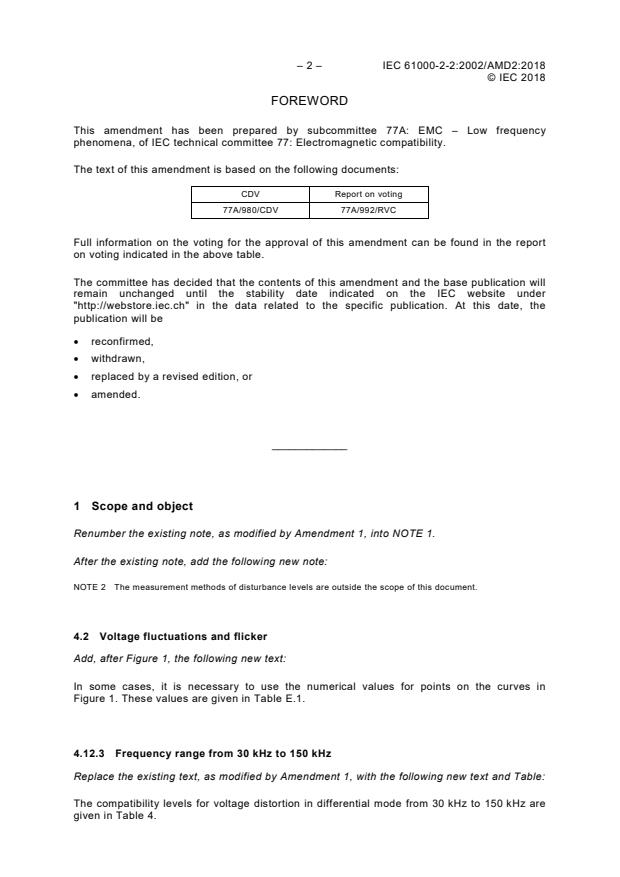
4.12.3 Frequency range from 30 kHz to 150 kHz
Replace the existing text, as modified by Amendment 1, with the following new text and Table:
The compatibility levels for voltage distortion in differential mode from 30 kHz to 150 kHz are
given in Table 4.
© IEC 2018
Table 4 – Compatibility levels for voltage distortion
a
in differential mode from 30 kHz to 150 kHz
Frequency range Compatibility levels
kHz dB(µV)
b c
30 to 50 122 to 119
b c
50 to 150 113 to 89
a
For EMC coordination in the setting of emission limits for unsymmetrical voltage
distortion, see 4.12.1.
b
At the transition frequency, the lower level applies.
c
The level decreases linearly with the logarithm of the frequency in the ranges
30 kHz to 50 kHz and 50 kHz to 150 kHz.
Annex D has been prepared in order to provide the basis for the definition of compatibility
levels in the frequency range from 30 kHz to 150 kHz.
Add the following new Annexes D and E:
– 4 – IEC 61000-2-2:2002/AMD2:2018
© IEC 2018
Annex D
(informative)
Basis for the definition of the compatibility levels for voltage
distortion in differential mode from 30 kHz to 150 kHz
D.1 General
A number of electromagnetic interference cases due to disturbances in the frequency range
from 2 kHz to 150 kHz have been collected by IEC and CENELEC. Consequently, it was
decided to start the maintenance of IEC 61000-2-2 mainly to define compatibility levels in this
frequency range, from which associated emission limits and immunity requirements can be
derived.
D.2 Compatibility levels
The compatibility levels for voltage distortion in differential mode from 30 kHz to 150 kHz are
reference levels for coordination in the setting of emission limits and immunity levels, in order
to improve EMC (including long-term degradation) for equipment such as MCSs, static
electricity meters, clocks, filter capacitors, etc, supplied by public low voltage power supply
systems, against disturbances generated by equipment such as switching power converters,
switch mode power supplies, photovoltaic inverters, etc. Several additional parameters other
than the disturbance level can have an impact on EMC in this frequency range, such as
impedance behaviour of the mains and attenuation effects, global voltage spectrum and time
behaviour of conducted emissions, as well as the expected amount of equipment supplied by
public low voltage power supply systems (see the note in 4.12.1).
In particular, MCSs cannot work properly when the levels of disturbance are too high. Today,
in 2017, emission limits for the frequency range from 30 kHz to 150 kHz are defined only for a
few types of equipment. When defining emission limits in this range, CISPR 15 limits should
be considered, when possible. Their use would allow a better design of the
...
Questions, Comments and Discussion
Ask us and Technical Secretary will try to provide an answer. You can facilitate discussion about the standard in here.
Loading comments...