

IEC TS 61000-3-16:2023
(Main)Electromagnetic compatibility (EMC) - Part 3-16: Limits - Limits for harmonic currents produced by the inverter of inverter-type electrical energy-supplying equipment, with a reference current less than or equal to 75 A per phase, connected to public low-voltage systems
General Information
- Abstract
IEC TS 61300-3-16:2023 which is a technical specification, deals with the limits for harmonic (including grouped interharmonic) currents produced by the inverter of inverter-type electrical energy-supplying equipment (ESE) as defined in 3.2, but which does not include energy storage. The limits given in this document are applicable to inverters with a reference current as defined in 3.3 (see also 5.2.3) less than or equal to 75 A per phase, intended to be connected to public low-voltage AC distribution systems of the following types:
- single-phase, two or three wires; nominal voltage up to 240 V
- three-phase, three or four wires; nominal voltage up to 690 V
- nominal frequency of 50 Hz or 60 Hz.
This document specifies:
a) requirements and emission limits for equipment;
b) methods for type tests and simulations.
Tests in accordance with this document are type tests of complete pieces of equipment.
Equipment which mainly absorbs energy but which is capable of supplying energy to the public supply as a secondary function is out of the scope of this document.
EXAMPLE An elevator motor drive returning energy during braking.
This document provides limits and testing procedures for equipment in the range up to harmonic order 40 (h40), i.e. 2 000 Hz or 2 400 Hz depending on line frequency.
NOTE 1 It is possible that limits for frequencies in the range from 2 kHz to 9 kHz will be added in a future edition of this document.
NOTE 2 It is possible that limits and procedures for storage systems will be added in a future edition of this document.
- Status
- Published
- Publication Date
- 08-Nov-2023
- Technical Committee
- SC 77A - EMC - Low frequency phenomena
- Drafting Committee
- WG 1 - TC 77/SC 77A/WG 1
- Current Stage
- PPUB - Publication issued
- Start Date
- 09-Nov-2023
- Completion Date
- 11-Aug-2023
Buy Documents

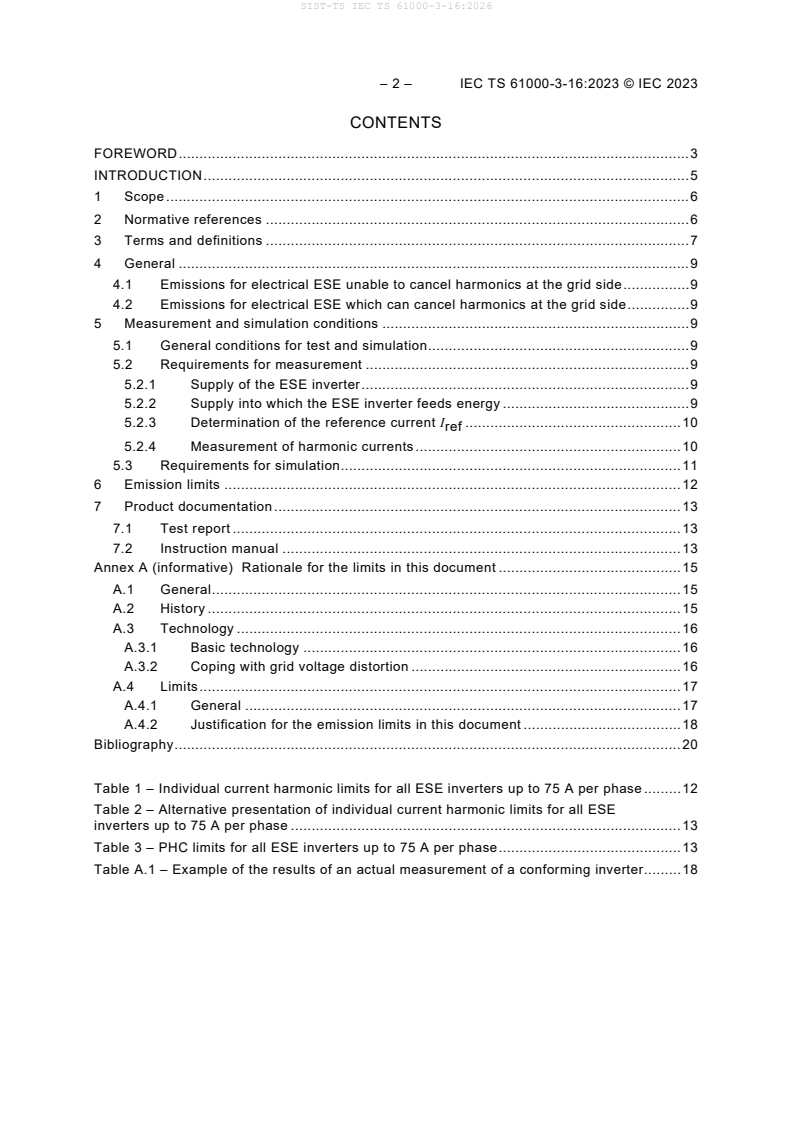
IEC TS 61000-3-16:2023 - Electromagnetic compatibility (EMC) - Part 3-16: Limits - Limits for harmonic currents produced by the inverter of inverter-type electrical energy-supplying equipment, with a reference current less than or equal to 75 A per phase, connected to public low-voltage systems Released:11/9/2023
Overview
IEC TS 61000-3-16:2023 is a Technical Specification in the IEC 61000 series on electromagnetic compatibility (EMC). It sets limits for harmonic currents (including grouped interharmonics) produced by the inverter of inverter-type electrical energy‑supplying equipment (ESE) - excluding energy storage - with a reference current ≤ 75 A per phase. The standard applies to equipment intended for connection to public low‑voltage AC distribution systems (single‑phase up to 240 V; three‑phase up to 690 V) at 50 Hz or 60 Hz, and specifies emission limits and methods for type tests and simulations for harmonics up to order 40 (≈2 000 Hz / 2 400 Hz).
Key Topics and Requirements
- Scope and applicability: Inverter‑type ESE without storage, reference current definition, exclusion of primarily energy‑absorbing equipment that only secondarily supplies energy.
- Emission limits: Individual harmonic limits, partial harmonic current (PHC) and total harmonic current (THC) metrics for harmonics 2–40.
- Measurement conditions: Test supply, point of connection, and procedures for measuring harmonic currents in accordance with IEC 61000‑4‑7 guidance.
- Reference current (Iref): Defined RMS output current used to scale limits and determine rated apparent power.
- Type tests and simulations: Methods for performing laboratory type tests on complete equipment and simulation requirements to demonstrate compliance.
- Documentation: Required test reports and instruction manual content that evidence conformity and operational guidance.
- Definitions and grid interaction: Parameters such as short‑circuit power, short‑circuit ratio and treatment of zero‑sequence and triplen harmonics.
Applications and Who Uses This Standard
IEC TS 61000‑3‑16:2023 is intended for:
- Inverter and PV inverter manufacturers designing grid‑tied converters without storage.
- EMC and compliance engineers performing type tests, simulations and preparing test reports.
- Independent test laboratories and certification bodies conducting harmonic emission testing.
- Grid operators and distribution network planners assessing power quality impact from distributed inverters.
- Product designers and integrators specifying inverters to meet public low‑voltage grid harmonic limits.
Practical use cases include validating inverter designs for market access, reducing power quality issues, and ensuring distributed generation meets emission limits to protect other customers and network equipment.
Related Standards
- IEC 61000 series (general EMC framework)
- IEC 61000‑4‑7 (harmonics and interharmonics measurement techniques)
- IEC 61000‑2‑2 (compatibility levels for low‑frequency disturbances)
- IEC TR 60725 (reference and network impedances)
- IEC 60038 (standard voltages)
Keywords: IEC TS 61000-3-16:2023, EMC, harmonic currents, inverter, low-voltage systems, emission limits, type tests, reference current ≤ 75 A, harmonic order 40.
Buy Documents
IEC TS 61000-3-16:2023 - Electromagnetic compatibility (EMC) - Part 3-16: Limits - Limits for harmonic currents produced by the inverter of inverter-type electrical energy-supplying equipment, with a reference current less than or equal to 75 A per phase, connected to public low-voltage systems Released:11/9/2023
Get Certified
Connect with accredited certification bodies for this standard

ANCE
Mexican certification and testing association.

Intertek Slovenia
Intertek testing, inspection, and certification services in Slovenia.

LNE (Laboratoire National de Métrologie et d'Essais)
French national laboratory for metrology and testing.
Sponsored listings
Frequently Asked Questions
IEC TS 61000-3-16:2023 is a technical specification published by the International Electrotechnical Commission (IEC). Its full title is "Electromagnetic compatibility (EMC) - Part 3-16: Limits - Limits for harmonic currents produced by the inverter of inverter-type electrical energy-supplying equipment, with a reference current less than or equal to 75 A per phase, connected to public low-voltage systems". This standard covers: IEC TS 61300-3-16:2023 which is a technical specification, deals with the limits for harmonic (including grouped interharmonic) currents produced by the inverter of inverter-type electrical energy-supplying equipment (ESE) as defined in 3.2, but which does not include energy storage. The limits given in this document are applicable to inverters with a reference current as defined in 3.3 (see also 5.2.3) less than or equal to 75 A per phase, intended to be connected to public low-voltage AC distribution systems of the following types: - single-phase, two or three wires; nominal voltage up to 240 V - three-phase, three or four wires; nominal voltage up to 690 V - nominal frequency of 50 Hz or 60 Hz. This document specifies: a) requirements and emission limits for equipment; b) methods for type tests and simulations. Tests in accordance with this document are type tests of complete pieces of equipment. Equipment which mainly absorbs energy but which is capable of supplying energy to the public supply as a secondary function is out of the scope of this document. EXAMPLE An elevator motor drive returning energy during braking. This document provides limits and testing procedures for equipment in the range up to harmonic order 40 (h40), i.e. 2 000 Hz or 2 400 Hz depending on line frequency. NOTE 1 It is possible that limits for frequencies in the range from 2 kHz to 9 kHz will be added in a future edition of this document. NOTE 2 It is possible that limits and procedures for storage systems will be added in a future edition of this document.
IEC TS 61300-3-16:2023 which is a technical specification, deals with the limits for harmonic (including grouped interharmonic) currents produced by the inverter of inverter-type electrical energy-supplying equipment (ESE) as defined in 3.2, but which does not include energy storage. The limits given in this document are applicable to inverters with a reference current as defined in 3.3 (see also 5.2.3) less than or equal to 75 A per phase, intended to be connected to public low-voltage AC distribution systems of the following types: - single-phase, two or three wires; nominal voltage up to 240 V - three-phase, three or four wires; nominal voltage up to 690 V - nominal frequency of 50 Hz or 60 Hz. This document specifies: a) requirements and emission limits for equipment; b) methods for type tests and simulations. Tests in accordance with this document are type tests of complete pieces of equipment. Equipment which mainly absorbs energy but which is capable of supplying energy to the public supply as a secondary function is out of the scope of this document. EXAMPLE An elevator motor drive returning energy during braking. This document provides limits and testing procedures for equipment in the range up to harmonic order 40 (h40), i.e. 2 000 Hz or 2 400 Hz depending on line frequency. NOTE 1 It is possible that limits for frequencies in the range from 2 kHz to 9 kHz will be added in a future edition of this document. NOTE 2 It is possible that limits and procedures for storage systems will be added in a future edition of this document.
IEC TS 61000-3-16:2023 is classified under the following ICS (International Classification for Standards) categories: 33.100.01 - Electromagnetic compatibility in general. The ICS classification helps identify the subject area and facilitates finding related standards.
IEC TS 61000-3-16:2023 is available in PDF format for immediate download after purchase. The document can be added to your cart and obtained through the secure checkout process. Digital delivery ensures instant access to the complete standard document.
Standards Content (Sample)
SLOVENSKI STANDARD
01-februar-2026
Elektromagnetna združljivost (EMC) - 3-16. del: Mejne vrednosti - Mejne vrednosti
harmonskih tokov, ki jih povzroča pretvornik pretvorniškega tipa električne
napajalne opreme z referenčnim faznim tokom manjšim ali enakim 75 A,
priključene na javne nizkonapetostne sisteme
Electromagnetic compatibility (EMC) - Part 3-16: Limits - Limits for harmonic currents
produced by the inverter of inverter-type electrical energy-supplying equipment, with a
reference current less than or equal to 75 A per phase, connected to public low-voltage
systems
Ta slovenski standard je istoveten z: IEC TS 61000-3-16:2023
ICS:
33.100.01 Elektromagnetna združljivost Electromagnetic compatibility
na splošno in general
2003-01.Slovenski inštitut za standardizacijo. Razmnoževanje celote ali delov tega standarda ni dovoljeno.
IEC TS 61000-3-16 ®
Edition 1.0 2023-11
TECHNICAL
SPECIFICATION
Electromagnetic compatibility (EMC) –
Part 3-16: Limits – Limits for harmonic currents produced by the inverter of
inverter-type electrical energy-supplying equipment with a reference current
less than or equal to 75 A per phase connected to public low-voltage systems
INTERNATIONAL
ELECTROTECHNICAL
COMMISSION
ICS 33.100.01 ISBN 978-2-8322-7822-2
– 2 – IEC TS 61000-3-16:2023 © IEC 2023
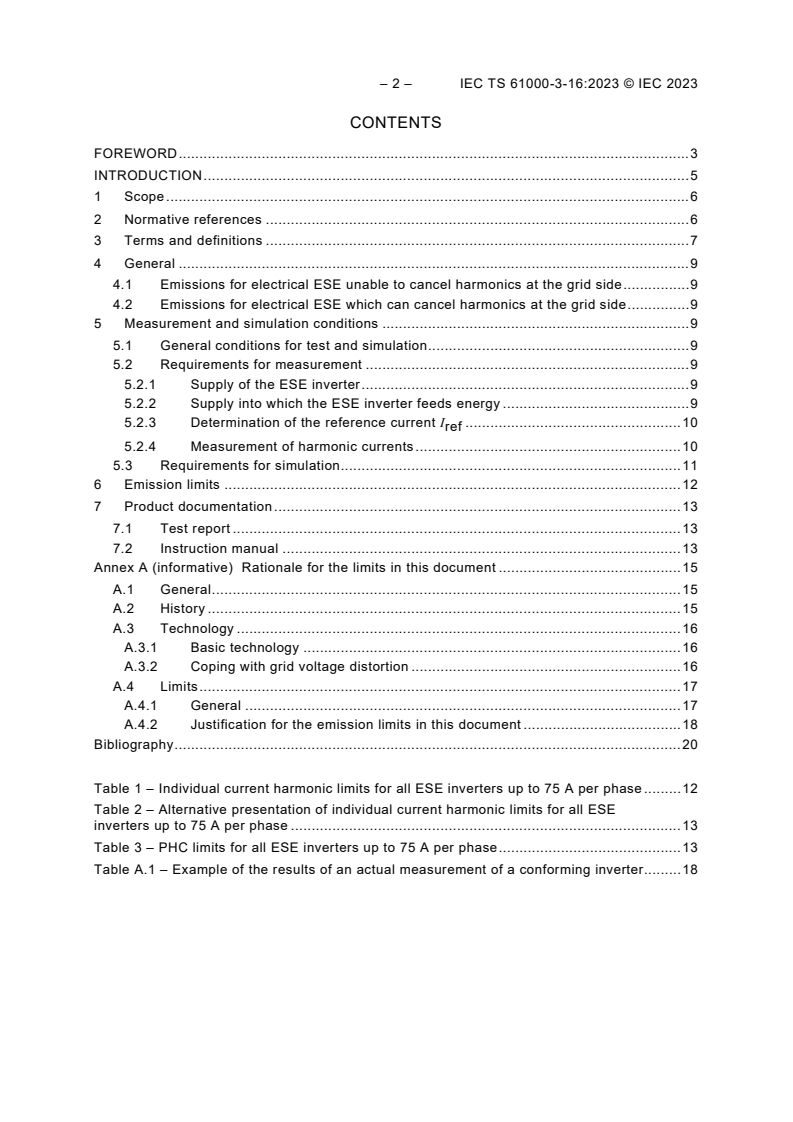
CONTENTS
FOREWORD . 3
INTRODUCTION . 5
1 Scope . 6
2 Normative references . 6
3 Terms and definitions . 7
4 General . 9
4.1 Emissions for electrical ESE unable to cancel harmonics at the grid side . 9
4.2 Emissions for electrical ESE which can cancel harmonics at the grid side . 9
5 Measurement and simulation conditions . 9
5.1 General conditions for test and simulation . 9
5.2 Requirements for measurement . 9
5.2.1 Supply of the ESE inverter . 9
5.2.2 Supply into which the ESE inverter feeds energy . 9
5.2.3 Determination of the reference current I . 10
ref
5.2.4 Measurement of harmonic currents . 10
5.3 Requirements for simulation . 11
6 Emission limits . 12
7 Product documentation . 13
7.1 Test report . 13
7.2 Instruction manual . 13
Annex A (informative) Rationale for the limits in this document . 15
A.1 General . 15
A.2 History . 15
A.3 Technology . 16
A.3.1 Basic technology . 16
A.3.2 Coping with grid voltage distortion . 16
A.4 Limits . 17
A.4.1 General . 17
A.4.2 Justification for the emission limits in this document . 18
Bibliography . 20
Table 1 – Individual current harmonic limits for all ESE inverters up to 75 A per phase . 12
Table 2 – Alternative presentation of individual current harmonic limits for all ESE
inverters up to 75 A per phase . 13
Table 3 – PHC limits for all ESE inverters up to 75 A per phase . 13
Table A.1 – Example of the results of an actual measurement of a conforming inverter . 18
INTERNATIONAL ELECTROTECHNICAL COMMISSION
____________
ELECTROMAGNETIC COMPATIBILITY (EMC) –
Part 3-16: Limits – Limits for harmonic currents produced by the inverter
of inverter-type electrical energy-supplying equipment, with a reference
current less than or equal to 75 A per phase, connected to public low-
voltage systems
FOREWORD
1) The International Electrotechnical Commission (IEC) is a worldwide organization for standardization comprising
all national electrotechnical committees (IEC National Committees). The object of IEC is to promote international
co-operation on all questions concerning standardization in the electrical and electronic fields. To this end and
in addition to other activities, IEC publishes International Standards, Technical Specifications, Technical Reports,
Publicly Available Specifications (PAS) and Guides (hereafter referred to as “IEC Publication(s)”). Their
preparation is entrusted to technical committees; any IEC National Committee interested in the subject dealt with
may participate in this preparatory work. International, governmental and non-governmental organizations liaising
with the IEC also participate in this preparation. IEC collaborates closely with the International Organization for
Standardization (ISO) in accordance with conditions determined by agreement between the two organizations.
2) The formal decisions or agreements of IEC on technical matters express, as nearly as possible, an international
consensus of opinion on the relevant subjects since each technical committee has representation from all
interested IEC National Committees.
3) IEC Publications have the form of recommendations for international use and are accepted by IEC National
Committees in that sense. While all reasonable efforts are made to ensure that the technical content of IEC
Publications is accurate, IEC cannot be held responsible for the way in which they are used or for any
misinterpretation by any end user.
4) In order to promote international uniformity, IEC National Committees undertake to apply IEC Publications
transparently to the maximum extent possible in their national and regional publications. Any divergence between
any IEC Publication and the corresponding national or regional publication shall be clearly indicated in the latter.
5) IEC itself does not provide any attestation of conformity. Independent certification bodies provide conformity
assessment services and, in some areas, access to IEC marks of conformity. IEC is not responsible for any
services carried out by independent certification bodies.
6) All users should ensure that they have the latest edition of this publication.
7) No liability shall attach to IEC or its directors, employees, servants or agents including individual experts and
members of its technical committees and IEC National Committees for any personal injury, property damage or
other damage of any nature whatsoever, whether direct or indirect, or for costs (including legal fees) and
expenses arising out of the publication, use of, or reliance upon, this IEC Publication or any other IEC
Publications.
8) Attention is drawn to the Normative references cited in this publication. Use of the referenced publications is
indispensable for the correct application of this publication.
9) Attention is drawn to the possibility that some of the elements of this IEC Publication may be the subject of patent
rights. IEC shall not be held responsible for identifying any or all such patent rights.
IEC 61000-3-16 has been prepared by subcommittee 77A EMC – Low frequency phenomena,
of IEC technical committee 77: Electromagnetic compatibility. It is a Technical Specification.
The text of this Technical Specification is based on the following documents:
Draft Report on voting
77A/1167/DTS 77A//RVDTS
Full information on the voting for its approval can be found in the report on voting indicated in
the above table.
The language used for the development of this Technical Specification is English
– 4 – IEC TS 61000-3-16:2023 © IEC 2023
This document was drafted in accordance with ISO/IEC Directives, Part 2, and developed in
accordance with ISO/IEC Directives, Part 1 and ISO/IEC Directives, IEC Supplement, available
at www.iec.ch/members_experts/refdocs. The main document types developed by IEC are
described in greater detail at www.iec.ch/standardsdev/publications.
A list of all parts in the IEC 61000 series, published under the general title Electromagnetic
compatibility (EMC), can be found on the IEC website.
This document has the status of a product family standard.
The committee has decided that the contents of this document will remain unchanged until the
stability date indicated on the IEC website under "http://webstore.iec.ch" in the data related to
the specific document. At this date, the document will be
• reconfirmed,
• withdrawn,
• replaced by a revised edition, or
• amended.
INTRODUCTION
IEC 61000 is published in separate parts according to the following structure:
Part 1: General
General considerations (introduction, fundamental principles)
Definitions, terminology
Part 2: Environment
Description of the environment
Classification of the environment
Compatibility levels
Part 3: Limits
Emission limits
Immunity limits
(in so far as they do not fall under the responsibility of product committees)
Part 4: Testing and measurement techniques
Measurement techniques
Testing techniques
Part 5: Installation and mitigation guidelines
Installation guidelines
Mitigation methods and devices
Part 6: Generic standards
Part 9: Miscellaneous
Each part is further subdivided into several parts, published either as international standards
or as technical specifications or technical reports, some of which have already been published
as sections. Others will be published with the part number followed by a dash and a second
number identifying the subdivision (example: IEC 61000-6-1).
– 6 – IEC TS 61000-3-16:2023 © IEC 2023
ELECTROMAGNETIC COMPATIBILITY (EMC) –
Part 3-16: Limits – Limits for harmonic currents produced by the inverter
of inverter-type electrical energy-supplying equipment, with a reference
current less than or equal to 75 A per phase, connected to public low-
voltage systems
1 Scope
This part of IEC 61000 deals with the limits for harmonic (including grouped interharmonic)
currents produced by the inverter of inverter-type electrical energy-supplying equipment (ESE)
as defined in 3.2, but which does not include energy storage. The limits given in this document
are applicable to inverters with a reference current as defined in 3.3 (see also 5.2.3) less than
or equal to 75 A per phase, intended to be connected to public low-voltage AC distribution
systems of the following types:
• single-phase, two or three wires; nominal voltage up to 240 V
• three-phase, three or four wires; nominal voltage up to 690 V
• nominal frequency of 50 Hz or 60 Hz.
This document specifies:
a) requirements and emission limits for equipment;
b) methods for type tests and simulations.
Tests in accordance with this document are type tests of complete pieces of equipment.
Equipment which mainly absorbs energy but which is capable of supplying energy to the public
supply as a secondary function is out of the scope of this document.
EXAMPLE An elevator motor drive returning energy during braking.
This document provides limits and testing procedures for equipment in the range up to harmonic
order 40 (h ), i.e. 2 000 Hz or 2 400 Hz depending on line frequency.
NOTE 1 It is possible that limits for frequencies in the range from 2 kHz to 9 kHz will be added in a future edition
of this document.
NOTE 2 It is possible that limits and procedures for storage systems will be added in a future edition of this
document.
2 Normative references
The following documents are referred to in the text in such a way that some or all of their content
constitutes requirements of this document. For dated references, only the edition cited applies.
For undated references, the latest edition of the referenced document (including any
amendments) applies.
IEC 60038:2009, IEC standard voltages
IEC 61000-2-2:2002, Electromagnetic compatibility (EMC) – Part 2-2: Environment –
Compatibility levels for low-frequency conducted disturbances and signalling in public low-
voltage power supply systems
IEC 61000-2-2:2002 AMD1:2017
IEC 61000-2-2:2002 AMD2:2018
IEC 61000-4-7:2002, Electromagnetic compatibility (EMC) – Part 4-7: Testing and
measurement techniques – General guide on harmonics and interharmonics measurements and
instrumentation, for power supply systems and equipment connected thereto
IEC 61000-4-7:2002 AMD:2008
IEC TR 60725:2012, Consideration of reference impedances and public supply network
impedances for use in determining the disturbance characteristics of electrical equipment
having a rated current ≤ 75 A per phase
3 Terms and definitions
For the purposes of this document, the following terms and definitions apply.
ISO and IEC maintain terminological databases for use in standardization at the following
addresses:
• IEC Electropedia: available at http://www.electropedia.org/
• ISO Online browsing platform: available at http://www.iso.org/obp
3.1
electrical energy-supplying equipment
ESE
equipment or system whose main function is to supply electrical energy into public power supply
systems
Note 1 to entry: An ESE can also include an energy storage system.
3.2
inverter-type electrical energy-supplying equipment
ESE that includes an inverter taking a DC supply from an energy source but does not include
an energy storage system
3.3
reference current
I
ref
RMS output current stated in the equipment specification
Note 1 to entry: See 5.2.2 and 5.2.3 for the conditions for determining I .
ref
3.4
short-circuit power
S
sc
value of the three-phase short-circuit power calculated from the nominal interphase system
voltage U and the line impedance Z of the system at the point of connection of the ESE:
n
S = UZ
sc n
3.5
rated apparent power
S
equ
apparent power value calculated from the reference output current I of
ref
the ESE inverter stated by the manufacturer and the rated voltage U (single phase) or U
p i
(interphase) as follows:
S
a) = U I for single-phase equipment;
equ p ref
– 8 – IEC TS 61000-3-16:2023 © IEC 2023
S
b) = √3U I for three-phase equipment;
equ i ref
Note 1 to entry: In the case of a voltage range, U or U is a nominal system voltage according to IEC 60038 (for
p i
example: 120 V or 230 V for single-phase or 400 V line-to-line for three-phase).
3.6
short-circuit ratio
R
sce
characteristic value of a piece of ESE defined as follows:
R
= S / (3 S ) for single-phase ESE
sce sc equ
R
= S / S for three-phase ESE
sce sc equ
3.7
partial harmonic current
PHC
total RMS value of the harmonic current components of orders 14 to 40
PHC= I
∑ h
h=14
3.8
total harmonic current
THC
total RMS value of the harmonic current components of orders 2 to 40
THC= I
∑ h
h=2
3.9
partial triplen harmonic current
PHC
triplen
th th st th th th
total RMS value of the harmonic current components of the 15 , 18 , 21 , 24 , 27 , 30 ,
rd th th
33 , 36 and 39 harmonic
PHC = I
triplen ∑ h
h 15, 18…
3.10
partial zero-sequence harmonic current
PHC
zero
total RMS value of the modulus of the harmonic zero-sequence current components of orders
14 to 40
I ++I I
hh,L1 ,L2 h,L3
PHC =
zero ∑
h=14
where I , I and I are the complex vectors of the harmonic phase currents
h,L1 h,L2 h,L3
Note 1 to entry: PHC is only applicable to three-phase equipment.
zero
=
Note 2 to entry: I + I + I is typically identical to the harmonic current in the neutral conductor.
h,L1 h,L2 h,L3
Note 3 to entry: For equipment without connection to a neutral conductor, PHC is typically zero.
zero
4 General
4.1 Emissions for electrical ESE unable to cancel harmonics at the grid side
The performance of a piece of ESE depends on its design and configuration (filter type, pulse
width modulation technique, control algorithm and switching frequency), thus a piece of ESE
that cannot generate harmonics above 1 % does not affect the power quality of the network.
Three sets of limits are specified in Table 1, Table 2 and Table 3 in Clause 6 for harmonic
emissions of ESE inverters. The permitted PHC depends on the value of R .
sce
4.2 Emissions for electrical ESE which can cancel harmonics at the grid side
If a piece of ESE can compensate harmonics at the grid side, then a system test, in addition to
the product test, is required to be performed in order to validate the quality and the performance
of the ESE inverter. System testing will be addressed in a future version of this document.
Further analysis and development are required in order to define suitable limits for harmonic
current emissions to validate both harmonic cancellation and ESE performance under distorted
network voltage conditions. This will be addressed in a future edition of this document.
5 Measurement and simulation conditions
5.1 General conditions for test and simulation
Conformity with this document may be determined by either of the two methods as follows:
a) direct measurement (see 5.2);
b) calculation by validated simulation (see 5.3).
Direct measurement or simulation shall be conducted with the user's operation controls or
automatic programs set to the mode expected to produce the maximum total harmonic current
(THC) under normal operating conditions. This defines the equipment set-up during emission
tests and not a requirement to conduct searches for worst-case emissions.
The ESE inverter is tested as presented, and in accordance with information provided by the
manufacturer.
5.2 Requirements for measurement
5.2.1 Supply of the ESE inverter
The inverter of the ESE shall be supplied with DC power from a power source that does not
contribute to current emissions, for all load conditions presented by the ESE.
NOTE The inverter can be designed to accept input from a current source, such as a solar photo-voltaic array, or
from a voltage source.
5.2.2 Supply into which the ESE inverter feeds energy
As a first step in the measurement process, the manufacturer shall choose a trial value of R ,
sce
(symbol R ), based on knowledge of the product design, expected to allow the ESE inverter
sce min
to comply with the requirements in Table 1 or Table 2, and Table 3.
The supply source shall then meet the following requirements:
– 10 – IEC TS 61000-3-16:2023 © IEC 2023
a) the supply voltage U shall be equal to the rated output voltage of the ESE inverter. In the
case of a voltage range, the output voltage shall be a nominal system voltage in accordance
with IEC 60038 (for example: 120 V or 230 V for single-phase or 400 V line-to-line for three-
phase);
b) while the measurements are being made, the output voltage shall be maintained within
±2,0 % and the frequency within ±0,5 % of the nominal value;
c) in the case of a three-phase supply, the voltage unbalance shall be less than 2 %;
d) the harmonic ratios of the supply voltage U shall not exceed:
• 1,5 % for harmonics of order 5;
• 1,25 % for harmonics of order 3 and 7;
• 0,7 % for harmonics of order 11;
• 0,6 % for harmonics of order 9 and 13;
• 0,4 % for even harmonics of order 2 to 10;
• 0,3 % for harmonics of order 12 and 14 to 40;
e) the impedance of the supply source is lower than the reference impedance given in
IEC TR 60725; moreover, for the application of Table 1, the impedance of the supply source
is such that the R is higher than or equal to 33, and for the application of Table 2, the
sce
R is equal to or higher than R , the value expected to allow the compliance of the
sce sce min
ESE inverter;
f) the impedance of the current-sensing part and the wiring is included in the impedance of
the supply source.
NOTE The limit for the voltage unbalance in 5.2.2 c) corresponds to the compatibility level given in IEC 61000-2-
2:2002, 4.6, which is also 2 %.
5.2.3 Determination of the reference current I
ref
The reference current shall be measured using the averaging method specified in 5.2.4 for
harmonic currents. The measurement shall be made under the conditions specified in 5.1.
5.2.4 Measurement of harmonic currents
5.2.4.1 General
The ESE inverter output shall be connected to the supply source and the inverter DC input
current or voltage set so that, after a waiting time of at least 10 s, the reference current I
ref
flows into the supply source. The currents shall then be measured in accordance with 5.2.4.2
for an observation period of 1 min.
Measurements shall be made at the point of connection between the source and the ESE
inverter. For ESE connected to a single-phase supply, it is permitted to measure the current in
the neutral conductor instead of the current in the line.
The requirements for the measurement instrumentation are given in IEC 61000-4-7. The current
limits for ESE inverters as specified in this document apply to each of the line currents.
5.2.4.2 Measurement procedure
The measurement of currents shall be performed as follows:
• for each harmonic order, measure the 1,5 s smoothed RMS current in each discrete
Fourier transform (DFT) time window as defined in IEC 61000-4-7:2002 and IEC 61000-4-
7:2002/AMD:2008, Figure 1, OUT 2b. For the purpose of testing ESE, grouping as described
in IEC 61000-4-7:2002 and IEC 61000-4-7:2002/AMD:2008, 5.5.1, shall be active, with the
following exception:
– for the calculation of the PHC, the ungrouped values of harmonic currents may be used.
...
IEC TS 61000-3-16 ®
Edition 1.0 2023-11
TECHNICAL
SPECIFICATION
Electromagnetic compatibility (EMC) –
Part 3-16: Limits – Limits for harmonic currents produced by the inverter of
inverter-type electrical energy-supplying equipment with a reference current less
than or equal to 75 A per phase connected to public low-voltage systems
All rights reserved. Unless otherwise specified, no part of this publication may be reproduced or utilized in any form
or by any means, electronic or mechanical, including photocopying and microfilm, without permission in writing from
either IEC or IEC's member National Committee in the country of the requester. If you have any questions about IEC
copyright or have an enquiry about obtaining additional rights to this publication, please contact the address below or
your local IEC member National Committee for further information.
IEC Secretariat Tel.: +41 22 919 02 11
3, rue de Varembé info@iec.ch
CH-1211 Geneva 20 www.iec.ch
Switzerland
About the IEC
The International Electrotechnical Commission (IEC) is the leading global organization that prepares and publishes
International Standards for all electrical, electronic and related technologies.
About IEC publications
The technical content of IEC publications is kept under constant review by the IEC. Please make sure that you have the
latest edition, a corrigendum or an amendment might have been published.
IEC publications search - webstore.iec.ch/advsearchform IEC Products & Services Portal - products.iec.ch
The advanced search enables to find IEC publications by a Discover our powerful search engine and read freely all the
variety of criteria (reference number, text, technical publications previews. With a subscription you will always have
committee, …). It also gives information on projects, replaced access to up to date content tailored to your needs.
and withdrawn publications.
Electropedia - www.electropedia.org
IEC Just Published - webstore.iec.ch/justpublished
The world's leading online dictionary on electrotechnology,
Stay up to date on all new IEC publications. Just Published
containing more than 22 300 terminological entries in English
details all new publications released. Available online and once
and French, with equivalent terms in 19 additional languages.
a month by email.
Also known as the International Electrotechnical Vocabulary
(IEV) online.
IEC Customer Service Centre - webstore.iec.ch/csc
If you wish to give us your feedback on this publication or need
further assistance, please contact the Customer Service
Centre: sales@iec.ch.
IEC TS 61000-3-16 ®
Edition 1.0 2023-11
TECHNICAL
SPECIFICATION
Electromagnetic compatibility (EMC) –
Part 3-16: Limits – Limits for harmonic currents produced by the inverter of
inverter-type electrical energy-supplying equipment with a reference current
less than or equal to 75 A per phase connected to public low-voltage systems
INTERNATIONAL
ELECTROTECHNICAL
COMMISSION
ICS 33.100.01 ISBN 978-2-8322-7822-2
– 2 – IEC TS 61000-3-16:2023 © IEC 2023
CONTENTS
FOREWORD . 3
INTRODUCTION . 5
1 Scope . 6
2 Normative references . 6
3 Terms and definitions . 7
4 General . 9
4.1 Emissions for electrical ESE unable to cancel harmonics at the grid side . 9
4.2 Emissions for electrical ESE which can cancel harmonics at the grid side . 9
5 Measurement and simulation conditions . 9
5.1 General conditions for test and simulation . 9
5.2 Requirements for measurement . 9
5.2.1 Supply of the ESE inverter . 9
5.2.2 Supply into which the ESE inverter feeds energy . 9
5.2.3 Determination of the reference current I . 10
ref
5.2.4 Measurement of harmonic currents . 10
5.3 Requirements for simulation . 11
6 Emission limits . 12
7 Product documentation . 13
7.1 Test report . 13
7.2 Instruction manual . 13
Annex A (informative) Rationale for the limits in this document . 15
A.1 General . 15
A.2 History . 15
A.3 Technology . 16
A.3.1 Basic technology . 16
A.3.2 Coping with grid voltage distortion . 16
A.4 Limits . 17
A.4.1 General . 17
A.4.2 Justification for the emission limits in this document . 18
Bibliography . 20
Table 1 – Individual current harmonic limits for all ESE inverters up to 75 A per phase . 12
Table 2 – Alternative presentation of individual current harmonic limits for all ESE
inverters up to 75 A per phase . 13
Table 3 – PHC limits for all ESE inverters up to 75 A per phase . 13
Table A.1 – Example of the results of an actual measurement of a conforming inverter . 18
INTERNATIONAL ELECTROTECHNICAL COMMISSION
____________
ELECTROMAGNETIC COMPATIBILITY (EMC) –
Part 3-16: Limits – Limits for harmonic currents produced by the inverter
of inverter-type electrical energy-supplying equipment, with a reference
current less than or equal to 75 A per phase, connected to public low-
voltage systems
FOREWORD
1) The International Electrotechnical Commission (IEC) is a worldwide organization for standardization comprising
all national electrotechnical committees (IEC National Committees). The object of IEC is to promote international
co-operation on all questions concerning standardization in the electrical and electronic fields. To this end and
in addition to other activities, IEC publishes International Standards, Technical Specifications, Technical Reports,
Publicly Available Specifications (PAS) and Guides (hereafter referred to as “IEC Publication(s)”). Their
preparation is entrusted to technical committees; any IEC National Committee interested in the subject dealt with
may participate in this preparatory work. International, governmental and non-governmental organizations liaising
with the IEC also participate in this preparation. IEC collaborates closely with the International Organization for
Standardization (ISO) in accordance with conditions determined by agreement between the two organizations.
2) The formal decisions or agreements of IEC on technical matters express, as nearly as possible, an international
consensus of opinion on the relevant subjects since each technical committee has representation from all
interested IEC National Committees.
3) IEC Publications have the form of recommendations for international use and are accepted by IEC National
Committees in that sense. While all reasonable efforts are made to ensure that the technical content of IEC
Publications is accurate, IEC cannot be held responsible for the way in which they are used or for any
misinterpretation by any end user.
4) In order to promote international uniformity, IEC National Committees undertake to apply IEC Publications
transparently to the maximum extent possible in their national and regional publications. Any divergence between
any IEC Publication and the corresponding national or regional publication shall be clearly indicated in the latter.
5) IEC itself does not provide any attestation of conformity. Independent certification bodies provide conformity
assessment services and, in some areas, access to IEC marks of conformity. IEC is not responsible for any
services carried out by independent certification bodies.
6) All users should ensure that they have the latest edition of this publication.
7) No liability shall attach to IEC or its directors, employees, servants or agents including individual experts and
members of its technical committees and IEC National Committees for any personal injury, property damage or
other damage of any nature whatsoever, whether direct or indirect, or for costs (including legal fees) and
expenses arising out of the publication, use of, or reliance upon, this IEC Publication or any other IEC
Publications.
8) Attention is drawn to the Normative references cited in this publication. Use of the referenced publications is
indispensable for the correct application of this publication.
9) Attention is drawn to the possibility that some of the elements of this IEC Publication may be the subject of patent
rights. IEC shall not be held responsible for identifying any or all such patent rights.
IEC 61000-3-16 has been prepared by subcommittee 77A EMC – Low frequency phenomena,
of IEC technical committee 77: Electromagnetic compatibility. It is a Technical Specification.
The text of this Technical Specification is based on the following documents:
Draft Report on voting
77A/1167/DTS 77A//RVDTS
Full information on the voting for its approval can be found in the report on voting indicated in
the above table.
The language used for the development of this Technical Specification is English
– 4 – IEC TS 61000-3-16:2023 © IEC 2023
This document was drafted in accordance with ISO/IEC Directives, Part 2, and developed in
accordance with ISO/IEC Directives, Part 1 and ISO/IEC Directives, IEC Supplement, available
at www.iec.ch/members_experts/refdocs. The main document types developed by IEC are
described in greater detail at www.iec.ch/standardsdev/publications.
A list of all parts in the IEC 61000 series, published under the general title Electromagnetic
compatibility (EMC), can be found on the IEC website.
This document has the status of a product family standard.
The committee has decided that the contents of this document will remain unchanged until the
stability date indicated on the IEC website under "http://webstore.iec.ch" in the data related to
the specific document. At this date, the document will be
• reconfirmed,
• withdrawn,
• replaced by a revised edition, or
• amended.
INTRODUCTION
IEC 61000 is published in separate parts according to the following structure:
Part 1: General
General considerations (introduction, fundamental principles)
Definitions, terminology
Part 2: Environment
Description of the environment
Classification of the environment
Compatibility levels
Part 3: Limits
Emission limits
Immunity limits
(in so far as they do not fall under the responsibility of product committees)
Part 4: Testing and measurement techniques
Measurement techniques
Testing techniques
Part 5: Installation and mitigation guidelines
Installation guidelines
Mitigation methods and devices
Part 6: Generic standards
Part 9: Miscellaneous
Each part is further subdivided into several parts, published either as international standards
or as technical specifications or technical reports, some of which have already been published
as sections. Others will be published with the part number followed by a dash and a second
number identifying the subdivision (example: IEC 61000-6-1).
– 6 – IEC TS 61000-3-16:2023 © IEC 2023
ELECTROMAGNETIC COMPATIBILITY (EMC) –
Part 3-16: Limits – Limits for harmonic currents produced by the inverter
of inverter-type electrical energy-supplying equipment, with a reference
current less than or equal to 75 A per phase, connected to public low-
voltage systems
1 Scope
This part of IEC 61000 deals with the limits for harmonic (including grouped interharmonic)
currents produced by the inverter of inverter-type electrical energy-supplying equipment (ESE)
as defined in 3.2, but which does not include energy storage. The limits given in this document
are applicable to inverters with a reference current as defined in 3.3 (see also 5.2.3) less than
or equal to 75 A per phase, intended to be connected to public low-voltage AC distribution
systems of the following types:
• single-phase, two or three wires; nominal voltage up to 240 V
• three-phase, three or four wires; nominal voltage up to 690 V
• nominal frequency of 50 Hz or 60 Hz.
This document specifies:
a) requirements and emission limits for equipment;
b) methods for type tests and simulations.
Tests in accordance with this document are type tests of complete pieces of equipment.
Equipment which mainly absorbs energy but which is capable of supplying energy to the public
supply as a secondary function is out of the scope of this document.
EXAMPLE An elevator motor drive returning energy during braking.
This document provides limits and testing procedures for equipment in the range up to harmonic
order 40 (h ), i.e. 2 000 Hz or 2 400 Hz depending on line frequency.
NOTE 1 It is possible that limits for frequencies in the range from 2 kHz to 9 kHz will be added in a future edition
of this document.
NOTE 2 It is possible that limits and procedures for storage systems will be added in a future edition of this
document.
2 Normative references
The following documents are referred to in the text in such a way that some or all of their content
constitutes requirements of this document. For dated references, only the edition cited applies.
For undated references, the latest edition of the referenced document (including any
amendments) applies.
IEC 60038:2009, IEC standard voltages
IEC 61000-2-2:2002, Electromagnetic compatibility (EMC) – Part 2-2: Environment –
Compatibility levels for low-frequency conducted disturbances and signalling in public low-
voltage power supply systems
IEC 61000-2-2:2002 AMD1:2017
IEC 61000-2-2:2002 AMD2:2018
IEC 61000-4-7:2002, Electromagnetic compatibility (EMC) – Part 4-7: Testing and
measurement techniques – General guide on harmonics and interharmonics measurements and
instrumentation, for power supply systems and equipment connected thereto
IEC 61000-4-7:2002 AMD:2008
IEC TR 60725:2012, Consideration of reference impedances and public supply network
impedances for use in determining the disturbance characteristics of electrical equipment
having a rated current ≤ 75 A per phase
3 Terms and definitions
For the purposes of this document, the following terms and definitions apply.
ISO and IEC maintain terminological databases for use in standardization at the following
addresses:
• IEC Electropedia: available at http://www.electropedia.org/
• ISO Online browsing platform: available at http://www.iso.org/obp
3.1
electrical energy-supplying equipment
ESE
equipment or system whose main function is to supply electrical energy into public power supply
systems
Note 1 to entry: An ESE can also include an energy storage system.
3.2
inverter-type electrical energy-supplying equipment
ESE that includes an inverter taking a DC supply from an energy source but does not include
an energy storage system
3.3
reference current
I
ref
RMS output current stated in the equipment specification
Note 1 to entry: See 5.2.2 and 5.2.3 for the conditions for determining I .
ref
3.4
short-circuit power
S
sc
value of the three-phase short-circuit power calculated from the nominal interphase system
voltage U and the line impedance Z of the system at the point of connection of the ESE:
n
S = UZ
sc n
3.5
rated apparent power
S
equ
apparent power value calculated from the reference output current I of
ref
the ESE inverter stated by the manufacturer and the rated voltage U (single phase) or U
p i
(interphase) as follows:
S
a) = U I for single-phase equipment;
equ p ref
– 8 – IEC TS 61000-3-16:2023 © IEC 2023
S
b) = √3U I for three-phase equipment;
equ i ref
Note 1 to entry: In the case of a voltage range, U or U is a nominal system voltage according to IEC 60038 (for
p i
example: 120 V or 230 V for single-phase or 400 V line-to-line for three-phase).
3.6
short-circuit ratio
R
sce
characteristic value of a piece of ESE defined as follows:
R
= S / (3 S ) for single-phase ESE
sce sc equ
R
= S / S for three-phase ESE
sce sc equ
3.7
partial harmonic current
PHC
total RMS value of the harmonic current components of orders 14 to 40
PHC= I
∑ h
h=14
3.8
total harmonic current
THC
total RMS value of the harmonic current components of orders 2 to 40
THC= I
∑ h
h=2
3.9
partial triplen harmonic current
PHC
triplen
th th st th th th
total RMS value of the harmonic current components of the 15 , 18 , 21 , 24 , 27 , 30 ,
rd th th
33 , 36 and 39 harmonic
PHC = I
triplen ∑ h
h 15, 18…
3.10
partial zero-sequence harmonic current
PHC
zero
total RMS value of the modulus of the harmonic zero-sequence current components of orders
14 to 40
I ++I I
hh,L1 ,L2 h,L3
PHC =
zero ∑
h=14
where I , I and I are the complex vectors of the harmonic phase currents
h,L1 h,L2 h,L3
Note 1 to entry: PHC is only applicable to three-phase equipment.
zero
=
Note 2 to entry: I + I + I is typically identical to the harmonic current in the neutral conductor.
h,L1 h,L2 h,L3
Note 3 to entry: For equipment without connection to a neutral conductor, PHC is typically zero.
zero
4 General
4.1 Emissions for electrical ESE unable to cancel harmonics at the grid side
The performance of a piece of ESE depends on its design and configuration (filter type, pulse
width modulation technique, control algorithm and switching frequency), thus a piece of ESE
that cannot generate harmonics above 1 % does not affect the power quality of the network.
Three sets of limits are specified in Table 1, Table 2 and Table 3 in Clause 6 for harmonic
emissions of ESE inverters. The permitted PHC depends on the value of R .
sce
4.2 Emissions for electrical ESE which can cancel harmonics at the grid side
If a piece of ESE can compensate harmonics at the grid side, then a system test, in addition to
the product test, is required to be performed in order to validate the quality and the performance
of the ESE inverter. System testing will be addressed in a future version of this document.
Further analysis and development are required in order to define suitable limits for harmonic
current emissions to validate both harmonic cancellation and ESE performance under distorted
network voltage conditions. This will be addressed in a future edition of this document.
5 Measurement and simulation conditions
5.1 General conditions for test and simulation
Conformity with this document may be determined by either of the two methods as follows:
a) direct measurement (see 5.2);
b) calculation by validated simulation (see 5.3).
Direct measurement or simulation shall be conducted with the user's operation controls or
automatic programs set to the mode expected to produce the maximum total harmonic current
(THC) under normal operating conditions. This defines the equipment set-up during emission
tests and not a requirement to conduct searches for worst-case emissions.
The ESE inverter is tested as presented, and in accordance with information provided by the
manufacturer.
5.2 Requirements for measurement
5.2.1 Supply of the ESE inverter
The inverter of the ESE shall be supplied with DC power from a power source that does not
contribute to current emissions, for all load conditions presented by the ESE.
NOTE The inverter can be designed to accept input from a current source, such as a solar photo-voltaic array, or
from a voltage source.
5.2.2 Supply into which the ESE inverter feeds energy
As a first step in the measurement process, the manufacturer shall choose a trial value of R ,
sce
(symbol R ), based on knowledge of the product design, expected to allow the ESE inverter
sce min
to comply with the requirements in Table 1 or Table 2, and Table 3.
The supply source shall then meet the following requirements:
– 10 – IEC TS 61000-3-16:2023 © IEC 2023
a) the supply voltage U shall be equal to the rated output voltage of the ESE inverter. In the
case of a voltage range, the output voltage shall be a nominal system voltage in accordance
with IEC 60038 (for example: 120 V or 230 V for single-phase or 400 V line-to-line for three-
phase);
b) while the measurements are being made, the output voltage shall be maintained within
±2,0 % and the frequency within ±0,5 % of the nominal value;
c) in the case of a three-phase supply, the voltage unbalance shall be less than 2 %;
d) the harmonic ratios of the supply voltage U shall not exceed:
• 1,5 % for harmonics of order 5;
• 1,25 % for harmonics of order 3 and 7;
• 0,7 % for harmonics of order 11;
• 0,6 % for harmonics of order 9 and 13;
• 0,4 % for even harmonics of order 2 to 10;
• 0,3 % for harmonics of order 12 and 14 to 40;
e) the impedance of the supply source is lower than the reference impedance given in
IEC TR 60725; moreover, for the application of Table 1, the impedance of the supply source
is such that the R is higher than or equal to 33, and for the application of Table 2, the
sce
R is equal to or higher than R , the value expected to allow the compliance of the
sce sce min
ESE inverter;
f) the impedance of the current-sensing part and the wiring is included in the impedance of
the supply source.
NOTE The limit for the voltage unbalance in 5.2.2 c) corresponds to the compatibility level given in IEC 61000-2-
2:2002, 4.6, which is also 2 %.
5.2.3 Determination of the reference current I
ref
The reference current shall be measured using the averaging method specified in 5.2.4 for
harmonic currents. The measurement shall be made under the conditions specified in 5.1.
5.2.4 Measurement of harmonic currents
5.2.4.1 General
The ESE inverter output shall be connected to the supply source and the inverter DC input
current or voltage set so that, after a waiting time of at least 10 s, the reference current I
ref
flows into the supply source. The currents shall then be measured in accordance with 5.2.4.2
for an observation period of 1 min.
Measurements shall be made at the point of connection between the source and the ESE
inverter. For ESE connected to a single-phase supply, it is permitted to measure the current in
the neutral conductor instead of the current in the line.
The requirements for the measurement instrumentation are given in IEC 6100
...