

IEC 60674-2:2016
(Main)Specification for plastic films for electrical purposes - Part 2: Methods of test
General Information
- Abstract
IEC 60674-2:2016 is applicable to plastic films used for electrical purposes. This part of IEC 60674 gives methods of test. This second edition cancels and replaces the first edition published in 1988 and Amendment 1 (2001). This edition constitutes a technical revision. This edition includes the following significant technical changes with respect to the previous edition:
- this document was completely revised editorially and technically and included in the IEC 60674 series of standards;
- the test methods are updated to reflect today's state of the art;
- a method to obtain DC electric strength is now specified according to IEC 60243-2. Keywords: plastic films for electrical purposes
The contents of the corrigendum of December 2017 have been included in this copy.
- Status
- Published
- Publication Date
- 23-Jan-2019
- Technical Committee
- TC 15 - Solid electrical insulating materials
- Drafting Committee
- MT 3 - TC 15/MT 3
- Current Stage
- PPUB - Publication issued
- Start Date
- 18-Nov-2016
- Completion Date
- 15-Feb-2017
Buy Documents
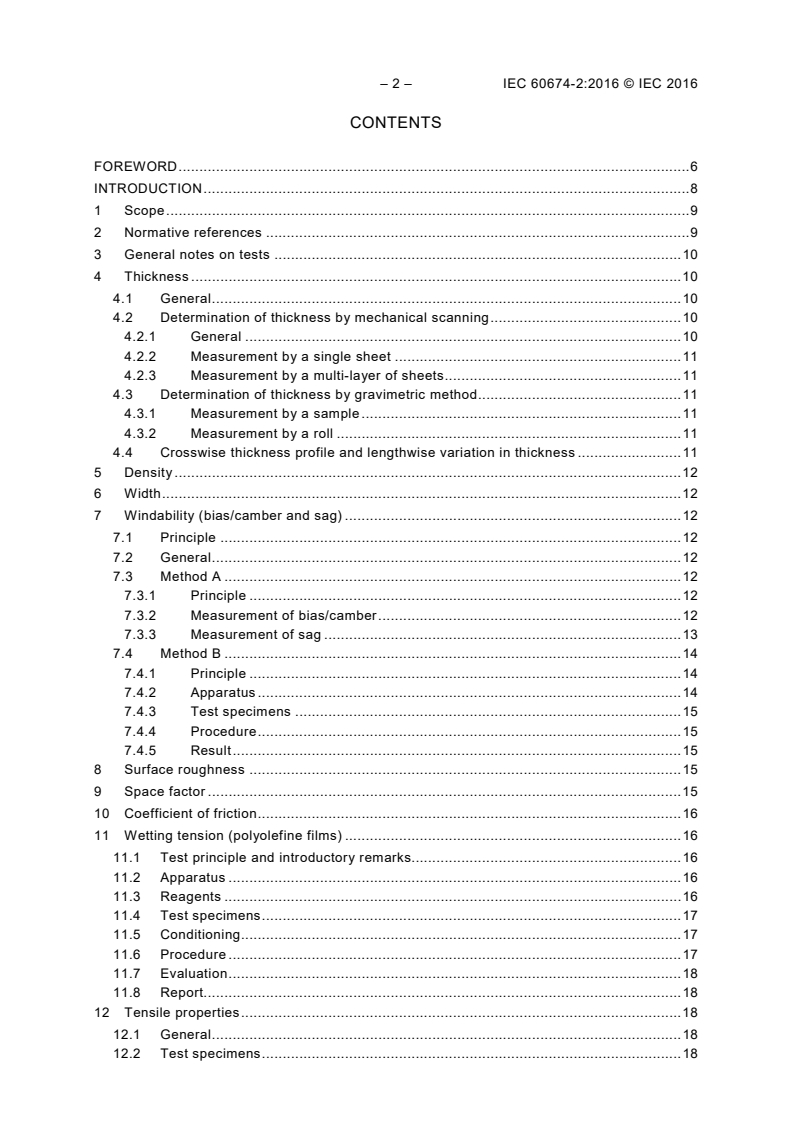
IEC 60674-2:2016 - Specification for plastic films for electrical purposes - Part 2: Methods of test Released:11/18/2016
IEC 60674-2:2016 - Specification for plastic films for electrical purposes - Part 2: Methods of test Released:1/17/2019

IEC 60674-2:2016+AMD1:2019 CSV - Specification for plastic films for electrical purposes - Part 2: Methods of test Released:1/24/2019
Overview
IEC 60674-2:2016 - Specification for plastic films for electrical purposes (Part 2: Methods of test) defines standardized test methods for plastic films used as electrical insulating materials. Edition 2.0 (2016) is a technical revision that replaces the first edition (1988) and Amendment 1 (2001), incorporates the December 2017 corrigendum, modernizes test procedures, and adds a DC electric strength method referenced to IEC 60243-2. This part is intended to ensure reproducible, state-of-the-art testing for manufacturers, test laboratories and specifiers of electrical insulating films.
Key Topics
The standard provides detailed methods of test covering a broad range of physical, electrical and thermal properties of plastic films for electrical purposes, including:
- Dimensional and physical tests: thickness (mechanical scanning and gravimetric), width, density, surface roughness, space factor, windability (bias/camber and sag), and coat/roll measurements.
- Mechanical tests: tensile properties, stiffness, tear and edge-tearing resistance, dimensional change and stability under temperature/tension/pressure.
- Surface and handling properties: coefficient of friction, wetting tension (polyolefin films), and surface roughness.
- Electrical tests: surface resistivity, volume resistivity (electrode and wound-capacitor methods), dissipation factor and permittivity (contacting and non-contacting electrodes), electric strength (AC and DC methods), resistance to breakdown by surface discharges, and detection of electrical weak spots.
- Thermal and ageing tests: melting point, volatile content (loss on heating), thermal endurance, resistance to penetration at elevated temperature.
- Fire and environmental tests: burning characteristics, electrolytic corrosion, water absorption in damp atmosphere.
- Inclusion of a specified method to obtain DC electric strength in accordance with IEC 60243-2.
Applications
IEC 60674-2 is applied where consistent, reproducible testing of electrical insulating films is required:
- Quality control and incoming inspection in film manufacturing and film-converting plants
- Type testing and R&D for insulating materials used in capacitors, cables, transformers, switchgear and flexible electrical components
- Independent test laboratories and certification bodies performing electrical and thermal safety assessments
- Procurement and specification authors who require objective test methods for compliance and material acceptance
Who should use this standard
- Film manufacturers and converters
- Electrical component OEMs (capacitors, cables, insulation systems)
- Independent testing laboratories and compliance engineers
- Standards writers and procurement/specification teams
Related Standards
- Other parts of the IEC 60674 series (specifications for plastic films for electrical purposes)
- IEC 60243-2 - referenced for the DC electric strength method
By using IEC 60674-2:2016 test methods, stakeholders ensure consistent measurement of critical material properties-such as permittivity, resistivity and electric strength-supporting safer, higher‑quality electrical insulation products.
Relations
- Effective Date
- 05-Sep-2023
- Effective Date
- 05-Sep-2023
- Revises
IEC 60674-2:1988 - Specification for plastic films for electrical purposes. Part 2: Methods of test - Effective Date
- 05-Sep-2023
- Effective Date
- 05-Sep-2023
Buy Documents
IEC 60674-2:2016 - Specification for plastic films for electrical purposes - Part 2: Methods of test Released:11/18/2016
IEC 60674-2:2016 - Specification for plastic films for electrical purposes - Part 2: Methods of test Released:1/17/2019
IEC 60674-2:2016+AMD1:2019 CSV - Specification for plastic films for electrical purposes - Part 2: Methods of test Released:1/24/2019
Get Certified
Connect with accredited certification bodies for this standard

IMQ S.p.A. (Certification)
Italian electrical product certification.

SLG Prüf- und Zertifizierungs GmbH
German testing and certification body.

UL Solutions
Global safety science company with testing, inspection and certification.
Sponsored listings
Frequently Asked Questions
IEC 60674-2:2016 is a standard published by the International Electrotechnical Commission (IEC). Its full title is "Specification for plastic films for electrical purposes - Part 2: Methods of test". This standard covers: IEC 60674-2:2016 is applicable to plastic films used for electrical purposes. This part of IEC 60674 gives methods of test. This second edition cancels and replaces the first edition published in 1988 and Amendment 1 (2001). This edition constitutes a technical revision. This edition includes the following significant technical changes with respect to the previous edition: - this document was completely revised editorially and technically and included in the IEC 60674 series of standards; - the test methods are updated to reflect today's state of the art; - a method to obtain DC electric strength is now specified according to IEC 60243-2. Keywords: plastic films for electrical purposes The contents of the corrigendum of December 2017 have been included in this copy.
IEC 60674-2:2016 is applicable to plastic films used for electrical purposes. This part of IEC 60674 gives methods of test. This second edition cancels and replaces the first edition published in 1988 and Amendment 1 (2001). This edition constitutes a technical revision. This edition includes the following significant technical changes with respect to the previous edition: - this document was completely revised editorially and technically and included in the IEC 60674 series of standards; - the test methods are updated to reflect today's state of the art; - a method to obtain DC electric strength is now specified according to IEC 60243-2. Keywords: plastic films for electrical purposes The contents of the corrigendum of December 2017 have been included in this copy.
IEC 60674-2:2016 is classified under the following ICS (International Classification for Standards) categories: 17.220.99 - Other standards related to electricity and magnetism; 29.035.20 - Plastics and rubber insulating materials. The ICS classification helps identify the subject area and facilitates finding related standards.
IEC 60674-2:2016 has the following relationships with other standards: It is inter standard links to IEC 60674-2:2016/AMD1:2019, IEC 60674-2:2016/COR1:2017, IEC 60674-2:1988, IEC 60674-2:1988/AMD1:2001. Understanding these relationships helps ensure you are using the most current and applicable version of the standard.
IEC 60674-2:2016 is available in PDF format for immediate download after purchase. The document can be added to your cart and obtained through the secure checkout process. Digital delivery ensures instant access to the complete standard document.
Standards Content (Sample)
IEC 60674-2 ®
Edition 2.0 2016-11
INTERNATIONAL
STANDARD
Specification for plastic films for electrical purposes –
Part 2: Methods of test
All rights reserved. Unless otherwise specified, no part of this publication may be reproduced or utilized in any form
or by any means, electronic or mechanical, including photocopying and microfilm, without permission in writing from
either IEC or IEC's member National Committee in the country of the requester. If you have any questions about IEC
copyright or have an enquiry about obtaining additional rights to this publication, please contact the address below or
your local IEC member National Committee for further information.
IEC Central Office Tel.: +41 22 919 02 11
3, rue de Varembé Fax: +41 22 919 03 00
CH-1211 Geneva 20 info@iec.ch
Switzerland www.iec.ch
About the IEC
The International Electrotechnical Commission (IEC) is the leading global organization that prepares and publishes
International Standards for all electrical, electronic and related technologies.
About IEC publications
The technical content of IEC publications is kept under constant review by the IEC. Please make sure that you have the
latest edition, a corrigenda or an amendment might have been published.
IEC Catalogue - webstore.iec.ch/catalogue Electropedia - www.electropedia.org
The stand-alone application for consulting the entire The world's leading online dictionary of electronic and
bibliographical information on IEC International Standards, electrical terms containing 20 000 terms and definitions in
Technical Specifications, Technical Reports and other English and French, with equivalent terms in 15 additional
documents. Available for PC, Mac OS, Android Tablets and languages. Also known as the International Electrotechnical
iPad. Vocabulary (IEV) online.
IEC publications search - www.iec.ch/searchpub IEC Glossary - std.iec.ch/glossary
The advanced search enables to find IEC publications by a 65 000 electrotechnical terminology entries in English and
variety of criteria (reference number, text, technical French extracted from the Terms and Definitions clause of
committee,…). It also gives information on projects, replaced IEC publications issued since 2002. Some entries have been
and withdrawn publications. collected from earlier publications of IEC TC 37, 77, 86 and
CISPR.
IEC Just Published - webstore.iec.ch/justpublished
Stay up to date on all new IEC publications. Just Published IEC Customer Service Centre - webstore.iec.ch/csc
details all new publications released. Available online and If you wish to give us your feedback on this publication or
also once a month by email. need further assistance, please contact the Customer Service
Centre: csc@iec.ch.
IEC 60674-2 ®
Edition 2.0 2016-11
INTERNATIONAL
STANDARD
Specification for plastic films for electrical purposes –
Part 2: Methods of test
INTERNATIONAL
ELECTROTECHNICAL
COMMISSION
ICS 17.220.99; 29.035.20 ISBN 978-2-8322-3747-2
– 2 – IEC 60674-2:2016 © IEC 2016
CONTENTS
FOREWORD . 6
INTRODUCTION . 8
1 Scope . 9
2 Normative references . 9
3 General notes on tests . 10
4 Thickness . 10
4.1 General . 10
4.2 Determination of thickness by mechanical scanning . 10
4.2.1 General . 10
4.2.2 Measurement by a single sheet . 11
4.2.3 Measurement by a multi-layer of sheets . 11
4.3 Determination of thickness by gravimetric method . 11
4.3.1 Measurement by a sample . 11
4.3.2 Measurement by a roll . 11
4.4 Crosswise thickness profile and lengthwise variation in thickness . 11
5 Density . 12
6 Width . 12
7 Windability (bias/camber and sag) . 12
7.1 Principle . 12
7.2 General . 12
7.3 Method A . 12
7.3.1 Principle . 12
7.3.2 Measurement of bias/camber . 12
7.3.3 Measurement of sag . 13
7.4 Method B . 14
7.4.1 Principle . 14
7.4.2 Apparatus . 14
7.4.3 Test specimens . 15
7.4.4 Procedure . 15
7.4.5 Result . 15
8 Surface roughness . 15
9 Space factor . 15
10 Coefficient of friction . 16
11 Wetting tension (polyolefine films) . 16
11.1 Test principle and introductory remarks. 16
11.2 Apparatus . 16
11.3 Reagents . 16
11.4 Test specimens . 17
11.5 Conditioning . 17
11.6 Procedure . 17
11.7 Evaluation . 18
11.8 Report. 18
12 Tensile properties . 18
12.1 General . 18
12.2 Test specimens . 18
12.3 Speed of testing . 18
12.4 Result . 18
13 Edge tearing resistance . 19
13.1 General . 19
13.2 Principle . 19
14 Tear resistance . 19
15 Stiffness of film . 19
16 Surface resistivity . 19
17 Volume resistivity . 19
17.1 Method 1: Electrode method . 19
17.2 Method 2: Method for wound capacitor dielectric films or films too thin for
Method 1. 19
17.2.1 Principle . 19
17.2.2 Test specimens . 20
17.2.3 Procedure . 20
17.2.4 Result . 20
18 Dissipation factor and permittivity . 20
18.1 General . 20
18.2 Method 1. 20
18.2.1 General . 20
18.2.2 Sample and specimen handling . 21
18.2.3 Sample conditioning prior to measurement . 21
18.2.4 Measurements with contacting electrodes . 21
18.2.5 Measurements with non-contacting electrodes . 23
18.2.6 Test procedure . 23
18.2.7 Report . 23
18.3 Method 2. 23
18.3.1 General . 23
–4
18.3.2 Dissipation factor at or above 5 × 10 . 24
–4
18.3.3 Dissipation factor below 5 × 10 . 24
19 Dissipation factor under impregnated conditions . 24
20 Electric strength . 24
20.1 AC and DC tests of film sheet sandwiched by metal electrodes . 24
20.2 DC test using a wound capacitor . 24
21 Electrical weak spots . 24
21.1 General . 24
21.2 Method A: Testing narrow strips of film in long lengths . 25
21.2.1 Test equipment . 25
21.2.2 Procedure . 25
21.2.3 Results . 25
21.3 Method B: Testing wide strips of film . 25
21.3.1 General . 25
21.3.2 Test equipment . 25
21.3.3 Procedure . 26
21.3.4 Results . 26
21.4 Method C: Testing of film in rolls . 26
21.4.1 General . 26
21.4.2 Unreeling system . 26
– 4 – IEC 60674-2:2016 © IEC 2016
21.4.3 Fault counter . 27
21.4.4 Procedure . 27
21.4.5 Results . 27
22 Resistance to breakdown by surface discharges . 28
23 Electrolytic corrosion . 28
24 Melting point . 28
25 Dimensional change . 28
25.1 Test specimens . 28
25.2 Procedure . 28
25.3 Results . 28
26 Dimensional stability under tension with rising temperature . 29
26.1 Test specimens . 29
26.2 Procedure . 29
26.3 Results . 29
27 Dimensional stability under pressure with rising temperature . 29
27.1 Test equipment . 29
27.2 Test specimens . 29
27.3 Procedure . 29
27.4 Results . 30
28 Resistance to penetration at elevated temperature . 30
28.1 General . 30
28.2 Principle . 30
29 Volatile content (loss of mass on heating) . 30
29.1 Test specimens . 30
29.2 Procedure . 30
29.3 Result . 30
30 Thermal endurance . 30
31 Burning characteristics . 31
31.1 Principle . 31
31.2 Apparatus . 31
31.3 Test specimens . 31
31.4 Conditioning . 31
31.5 Procedure . 32
31.6 Interpretation of results . 32
32 Water absorption in a damp atmosphere . 33
32.1 Apparatus . 33
32.2 Test specimens . 33
32.3 Procedure . 33
32.3.1 Water absorption of material as-received . 33
32.3.2 Water absorption of dry material . 33
32.4 Results . 34
33 Absorption of liquid . 34
33.1 Principle . 34
33.2 Apparatus . 34
33.3 Test specimens . 34
33.4 Procedure . 34
33.5 Calculations . 35
33.6 Result . 35
34 Ionic impurities . 35
35 Effect of insulating varnishes . 35
35.1 Procedure . 35
35.2 Results . 35
36 Effect of polymerisable resinous compounds in a liquid state . 36
36.1 Procedure . 36
36.2 Results . 36
Figure 1 – Windability of film – Measurement of bias/camber – Method A . 36
Figure 2 – Windability of film – Apparatus for measurement of sag – Method A . 37
Figure 3 – Windability of film – Measurement of sag – Method A. 37
Figure 4 – Three-terminal electrode system for low frequencies (up to 50 kHz) . 38
Figure 5 – Two-electrode system for high frequencies (above 50 kHz) . 38
Figure 6 – Equipment for testing for electrical weak spots by Method A . 39
Figure 7 – Equipment for testing for electrical weak spots by Method B . 40
Figure 8 – Equipment for testing for electrical weak spots by Method C1 . 40
Figure 9 – Equipment for testing for electrical weak spots by Method C2 . 41
Figure 10 – Equipment for testing for electrical weak spots by Method C3 . 41
Table 1 – Concentrations of ethylene-glycol-monoethyl-ether, formamide mixtures
used in measuring wetting tension of polyethylene and polypropylene films . 17
Table 2 – Classification of materials regarding self-extinguishing properties . 33
– 6 – IEC 60674-2:2016 © IEC 2016
INTERNATIONAL ELECTROTECHNICAL COMMISSION
____________
SPECIFICATION FOR PLASTIC FILMS
FOR ELECTRICAL PURPOSES –
Part 2: Methods of test
FOREWORD
1) The International Electrotechnical Commission (IEC) is a worldwide organization for standardization comprising
all national electrotechnical committees (IEC National Committees). The object of IEC is to promote
international co-operation on all questions concerning standardization in the electrical and electronic fields. To
this end and in addition to other activities, IEC publishes International Standards, Technical Specifications,
Technical Reports, Publicly Available Specifications (PAS) and Guides (hereafter referred to as “IEC
Publication(s)”). Their preparation is entrusted to technical committees; any IEC National Committee interested
in the subject dealt with may participate in this preparatory work. International, governmental and non-
governmental organizations liaising with the IEC also participate in this preparation. IEC collaborates closely
with the International Organization for Standardization (ISO) in accordance with conditions determined by
agreement between the two organizations.
2) The formal decisions or agreements of IEC on technical matters express, as nearly as possible, an international
consensus of opinion on the relevant subjects since each technical committee has representation from all
interested IEC National Committees.
3) IEC Publications have the form of recommendations for international use and are accepted by IEC National
Committees in that sense. While all reasonable efforts are made to ensure that the technical content of IEC
Publications is accurate, IEC cannot be held responsible for the way in which they are used or for any
misinterpretation by any end user.
4) In order to promote international uniformity, IEC National Committees undertake to apply IEC Publications
transparently to the maximum extent possible in their national and regional publications. Any divergence
between any IEC Publication and the corresponding national or regional publication shall be clearly indicated in
the latter.
5) IEC itself does not provide any attestation of conformity. Independent certification bodies provide conformity
assessment services and, in some areas, access to IEC marks of conformity. IEC is not responsible for any
services carried out by independent certification bodies.
6) All users should ensure that they have the latest edition of this publication.
7) No liability shall attach to IEC or its directors, employees, servants or agents including individual experts and
members of its technical committees and IEC National Committees for any personal injury, property damage or
other damage of any nature whatsoever, whether direct or indirect, or for costs (including legal fees) and
expenses arising out of the publication, use of, or reliance upon, this IEC Publication or any other IEC
Publications.
8) Attention is drawn to the Normative references cited in this publication. Use of the referenced publications is
indispensable for the correct application of this publication.
9) Attention is drawn to the possibility that some of the elements of this IEC Publication may be the subject of
patent rights. IEC shall not be held responsible for identifying any or all such patent rights.
International Standard IEC 60674-2 has been prepared by IEC technical committee 15: Solid
electrical insulating materials.
This second edition cancels and replaces the first edition published in 1988 and Amendment 1
(2001). This edition constitutes a technical revision.
This edition includes the following significant technical changes with respect to the previous
edition:
a) this document was completely revised editorially and technically and included in the
IEC 60674 series of standards;
b) the test methods are updated to reflect today’s state of the art;
c) a method to obtain DC electric strength is now specified according to IEC 60243-2.
The text of this standard is based on the following documents:
CDV Report on voting
15/742/CDV 15/760/RVC
Full information on the voting for the approval of this International Standard can be found in
the report on voting indicated in the above table.
This document has been drafted in accordance with the ISO/IEC Directives, Part 2.
A list of all parts in the IEC 60674 series, published under the general title Specification for
plastic films for electrical purposes, can be found on the IEC website.
The committee has decided that the contents of this document will remain unchanged until the
stability date indicated on the IEC website under "http://webstore.iec.ch" in the data related to
the specific document. At this date, the document will be
• reconfirmed,
• withdrawn,
• replaced by a revised edition, or
• amended.
A bilingual version of this publication may be issued at a later date.
The contents of the corrigendum of December 2017 have been included in this copy.
– 8 – IEC 60674-2:2016 © IEC 2016
INTRODUCTION
This document is one of a series which deals with plastic films for electrical purposes. The
series consists of three parts:
Part 1: Definitions and general requirements (IEC 60674-1)
Part 2: Methods of test (IEC 60674-2)
Part 3: Specifications for individual materials (IEC 60674-3 (all parts))
SPECIFICATION FOR PLASTIC FILMS
FOR ELECTRICAL PURPOSES –
Part 2: Methods of test
1 Scope
This part of IEC 60674 is applicable to plastic films used for electrical purposes. This part of
IEC 60674 gives methods of test.
2 Normative references
The following documents are referred to in the text in such a way that some or all of their
content constitutes requirements of this document. For dated references, only the edition
cited applies. For undated references, the latest edition of the referenced document (including
any amendments) applies.
IEC 60212:2010, Standard conditions for use prior to and during the testing of solid electrical
insulating materials
IEC 60216 (all parts), Electrical insulating materials – Thermal endurance properties
IEC 60243-1:2013, Electric strength of insulating materials – Test methods – Part 1: Tests at
power frequencies
IEC 60243-2, Electric strength of insulating materials – Test methods – Part 2: Additional
requirements for tests using direct voltage
IEC 60250:1969, Recommended methods for the determination of the permittivity and
dielectric dissipation factor of electrical insulating materials at power, audio and radio
frequencies including metre wavelengths
IEC 60343, Recommended test methods for determining the relative resistance of insulating
materials to breakdown by surface discharges
IEC 60394-2:1972, Varnished fabrics for electrical purposes – Part 2: Methods of test
IEC 60426, Electrical insulating materials – Determination of electrolytic corrosion caused by
insulating materials – Test methods
IEC 60454-2:2007, Pressure-sensitive adhesive tapes for electrical purposes – Part 2:
Methods of test
IEC 60589, Methods of test for the determination of ionic impurities in electrical insulating
materials by extraction with liquids
IEC TR 60648, Method of test for coefficients of friction of plastic film and sheeting for use as
electrical insulation
IEC 60674-3 (all parts), Specification for plastic films for electrical purposes – Part 3:
Specifications for individual materials
– 10 – IEC 60674-2:2016 © IEC 2016
IEC 62631-3-1, Dielectric and resistive properties of solid insulating materials – Part 3-1:
Determination of resistive properties (DC methods) – Volume resistance and volume
resistivity – General method
IEC 62631-3-2, Dielectric and resistive properties of solid insulating materials – Part 3-2:
Determination of resistive properties (DC methods) – Surface resistance and surface
resistivity
ISO 527-3:1995, Plastics – Determination of tensile properties – Part 3: Test conditions for
films and sheets
ISO 534, Paper and board – Determination of thickness, density and specific volume
ISO 1183, Plastics – Methods for determining the density of non-cellular plastics – Part 1:
Immersion method, liquid pyknometer method and titration method
ISO 4591:1992, Plastics – Film and sheeting – Determination of average thickness of a
sample, and average thickness and yield of a roll, by gravimetric techniques (gravimetric
thickness)
ISO 4592, Plastics – Film and sheeting – Determination of length and width
ISO 4593, Plastics – Film and sheeting – Determination of thickness by mechanical scanning
ISO 6383-1, Plastics – Film and sheeting – Determination of tear resistance – Part 1: Trouser
tear method
ISO 6383-2, Plastics – Film and sheeting – Determination of tear resistance – Part 2:
Elmendorf method
ISO 11357-3:2011, Plastics – Differential scanning calorimetry (DSC) – Part 3: Determination
of temperature and enthalpy of melting and crystallization
3 General notes on tests
3.1 Discard at least the first three layers of film from the roll to be tested before removing
test specimens.
3.2 Sample rolls shall be exposed for at least 24 h to the standard atmosphere 23 °C ± 2 K
and 50 % ± 5 % RH before test specimens are removed for test. Unless otherwise specified,
all individual test specimens shall be conditioned for 1 h and tested in the same standard
atmosphere.
4 Thickness
4.1 General
Thickness shall be measured by any one or more of the methods given below as required by
IEC 60674-3 (all parts).
4.2 Determination of thickness by mechanical scanning
4.2.1 General
Two methods, the first using a single sheet and the second using a stack of sheets, are given
individually as follows.
4.2.2 Measurement by a single sheet
4.2.2.1 Principle
The method is based on ISO 4593 using a precision micrometre to measure the thickness of a
single sheet test specimen.
4.2.2.2 Test specimens and measuring points
Cut three strips about 100 mm wide across the width of the sample. The test strips shall not
contain creases or other defects.
Determine the thickness of the test strips in accordance with the requirements of ISO 4593
using a micrometre having plane or radiused measuring surfaces.
Measurements shall be made at nine points at approximately equally spaced intervals along
the length of the test strips. In the case of samples less than 300 mm wide make the
measurements every 50 mm along the length of the test strips. In the case of untrimmed rolls,
readings shall not be taken within 50 mm of the edges.
4.2.2.3 Result
The thickness is the central value of all the measurements, the highest and lowest values on
each strip being reported.
4.2.3 Measurement by a multi-layer of sheets
Bulking (micrometric) thickness shall be measured according to ISO 534, except that the
method for obtaining sample pieces is different. Before taking samples, some outer layers of
the roll should be removed to obtain undamaged film surface. The four test pieces are initially
made up of 12 film layers, the layers being cut together using a suitable template (preferably
250 mm × 200 mm, the 200 mm dimension being in the machine direction) from a stack of film
pieces. Discard the first and last layer of each pack or test piece just prior to placing the pack
between the pressure faces of the micrometre.
4.3 Determination of thickness by gravimetric method
4.3.1 Measurement by a sample
Principle: calculation of the thickness of a sample from measurements of mass, area and
density in accordance with Clause 3 of ISO 4591:1992.
4.3.2 Measurement by a roll
Principle: calculation of the average thickness from measurements of the length, average
width and net mass of the roll and the density of the film in accordance with Clause 4 of
ISO 4591:1992.
4.4 Crosswise thickness profile and lengthwise variation in thickness
The non-contacting measurement methods, for example using radiation or laser light, are
commonly used. The apparatus may be installed in the production line by the manufacturer if
the profile and the variation in a roll are required. The minimum resolution for the
measurement, its accuracy and testing surface area (width and length) are the subjects
specified in IEC 60674-3 (all parts).
– 12 – IEC 60674-2:2016 © IEC 2016
5 Density
Density shall be determined in accordance with ISO 1183. The particular method is specified
in IEC 60674-3 (all parts).
6 Width
The width is to be determined in accordance with ISO 4592, except that a 5 m sample length
is used. Determine the width five times along the length at equal intervals after the film has
relaxed for 1 h.
Record each width measured and report the central value as the width of the roll.
7 Windability (bias/camber and sag)
7.1 Principle
An assessment is made of the distortion of the film as supplied in the roll.
Two forms of distortion may be apparent in the film which can impair its subsequent winding
characteristics. These distortions are:
1) the film may exhibit bias or camber and therefore its edges may not be straight
(see Figure 1);
2) the film may sag below its general level in areas where it has been stretched (see Figures
2 and 3).
7.2 General
Two methods are given. Method A is appropriate for narrow (i.e. less than 150 mm) films
where distortion is apparent mainly as bias/camber and also for the measurement of sag for
very thick films where the tension required for extension by Method B is excessive.
Method B is appropriate for wider (i.e. greater than 150 mm) films where distortion is apparent,
mainly as sag.
7.3 Method A
7.3.1 Principle
To assess bias/camber, a length of film is unwound and laid on a flat surface and the
deviation of each of its edges from a straight line is measured (see Figure 1).
To assess sag, a length of film is unwound and laid orthogonally over two parallel bars under
defined conditions and the deviation from a uniform catenary is measured (see Figure 2). It
may sometimes be convenient to make this measurement using the rollers of a winding
machine, but in cases of dispute the dimensions and distances shall be as given below.
7.3.2 Measurement of bias/camber
7.3.2.1 Apparatus
A flat, horizontal table of any suitable material having a satin finish (not polished) of sufficient
width to accommodate the maximum width of film to be tested and of length
1 500 mm ± 15 mm with ends parallel to within 0,1° (or 1,8 mm per 1 metre of table width).
Alternatively, the table may be longer than the above length but shall then have two reference
lines clearly marked on its surface 1 500 mm ± 15 mm apart and parallel to the same
accuracy.
• A soft brush suitable for smoothing the film specimen on the table surface.
• A long (in excess of 1 525 mm) steel straight-edge.
• A 150 mm steel rule with 1 mm graduations.
7.3.2.2 Test specimens
The first three layers of film from the roll are discarded. For each specimen a fresh length of
approximately 2 m is taken, being drawn from the roll with the lightest tension necessary to
unwind it slowly (at about 300 mm/s).
7.3.2.3 Procedure
The specimen length of film is placed lengthwise over the table as shown in Figure 1. Starting
from one end, the soft brush is used to lightly press the film into intimate contact with the
table surface, expelling any trapped air as far as possible.
The steel straight-edge is then placed along one edge of the film so that any deviation of the
film edge from a straight line can be readily observed. The straight-edge is adjusted to
coincide with the film edge at the two table ends (or at the reference marks if these are used)
and the distance between these points shall be 1 500 mm ± 15 mm. The distance between the
straight edge and the film edge is measured to the nearest 1 mm at approximately mid-span
by means of the steel rule.
The deviation of the second film edge is then measured using the same procedure.
The sum of the distances in millimetres of the two edges of the film from the steel straight-
edge at the mid-span is the bias/camber value for that test specimen.
The above procedure is repeated for two further test specimens.
7.3.2.4 Results
The bias/camber is the central value of the three determinations, the other two values being
reported.
7.3.3 Measurement of sag
7.3.3.1 Apparatus
A rigid framework supporting two parallel, freely rotatable metal rollers, each roller
100 mm ± 10 mm in diameter and of sufficient length to accommodate the maximum width of
film are to be tested. The axes of the rollers shall be in the same horizontal plane and set
mutually parallel to within 0,1° (i.e. within 1,8 mm per 1 m length of roller) with a separation of
1 500 mm ± 15 mm. The roller surfaces shall be accurately cylindrical to within 0,1 mm with
any suitable satin finish (not polished) (see Figure 2). The framework shall be fitted with a
device for mounting the roll of film being tested immediately below one of the rollers. The
mounting shall be such that the axis of the film roll is parallel to the superior roller to within 1°
and the film may be drawn off the roll against an adjustable unwind tension. At the opposite
end of the framework a weighted or sprung clamp is fixed to the film web hanging freely from
the second roller. The weight or spring loading and its position on the film may be adjusted so
as to give a substantially uniform tension across the web as specified in IEC 60674-3 (all
parts).
A device for measuring along a line midway between the rollers the distance of the film below
the plane of those rollers is set up (see Figure 3). The device may comprise simply a long (in
excess of 1,525 mm) steel straight-edge and a 150 mm steel rule with 1 mm graduations, or
more complex devices may be employed whereby the film position is noted automatically or
semi- automatically.
– 14 – IEC 60674-2:2016 © IEC 2016
7.3.3.2 Test specimens
The first three layers of film from the roll are discarded. For each specimen a fresh length of
approximately 2 m is drawn from the roll with the lightest tension necessary to unwind it
slowly (at about 300 mm/s).
7.3.3.3 Procedure
The specimen length of film is placed over the apparatus rollers. the free end of the film is
clamped in the tensioning device, the tension adjusted to the value given for the film in
IEC 60674-3 (all parts) and the lateral position of the film as it passes over the second roller
adjusted so that the film web lies approximately horizontal at mid-span.
Using the steel straight-edge and graduated steel ruler or other suitable device, the film is
checked across the film width at mid-span and any edge sag or sag lanes noted. The
maximum depth of any sag lane below the general film surface surrounding it is measured to
the nearest 1 mm (see Figure 3) and reported as the sag value for that test.
The above procedure is repeated for two further test specimens.
7.3.3.4 Result
The sag value is the central value of the three determinations, the other two values being
reported.
7.4 Method B
7.4.1 Principle
The total amount of sag and bias/camber is assessed by one measurement. A length of film is
unwound and laid orthogonally over two parallel bars under defined conditions. The film is
strained until free of visible sag and bias/camber and the extension necessary to achieve this
is measured. It may sometimes be convenient to make this measurement using the rollers of a
winding machine but in cases of dispute the dimensions and distances shall be as given in
7.4.2.
7.4.2 Apparatus
A rigid framework supporting two parallel, freely-rotatable metal rollers, each roller
100 mm ± 10 mm in diameter and of sufficient length to accommodate the maximum width of
film are to be tested. The axes of the rollers shall be in the same horizontal plane and set
mutually parallel to within 0,1° (i.e. within 1,8 mm per 1 m length of roller) with a separation of
1 500 mm ± 15 mm. The roller surfaces shall be accurately cylindrical to within 0,1 mm with
any suitable satin finish (not polished). The framework shall be fitted with a device for
mounting the roll of film being tested immediately below one of the rollers. The mounting shall
be such that:
a) the axis of the film roll is parallel to the superior roller to within 2°;
b) the lateral position of the film may be adjusted as desired, and
c) the film may be drawn off the roll against an adjustable unwind tension.
At the opposite end of the framework a weighted or
...
IEC 60674-2 ®
Edition 2.0 2016-11
INTERNATIONAL
STANDARD
NORME
INTERNATIONALE
Specification for plastic films for electrical purposes –
Part 2: Methods of test
Spécification pour les films en matière plastique à usages électriques –
Partie 2: Méthodes d'essai
All rights reserved. Unless otherwise specified, no part of this publication may be reproduced or utilized in any form
or by any means, electronic or mechanical, including photocopying and microfilm, without permission in writing from
either IEC or IEC's member National Committee in the country of the requester. If you have any questions about IEC
copyright or have an enquiry about obtaining additional rights to this publication, please contact the address below or
your local IEC member National Committee for further information.
Droits de reproduction réservés. Sauf indication contraire, aucune partie de cette publication ne peut être reproduite
ni utilisée sous quelque forme que ce soit et par aucun procédé, électronique ou mécanique, y compris la photocopie
et les microfilms, sans l'accord écrit de l'IEC ou du Comité national de l'IEC du pays du demandeur. Si vous avez des
questions sur le copyright de l'IEC ou si vous désirez obtenir des droits supplémentaires sur cette publication, utilisez
les coordonnées ci-après ou contactez le Comité national de l'IEC de votre pays de résidence.
IEC Central Office Tel.: +41 22 919 02 11
3, rue de Varembé info@iec.ch
CH-1211 Geneva 20 www.iec.ch
Switzerland
About the IEC
The International Electrotechnical Commission (IEC) is the leading global organization that prepares and publishes
International Standards for all electrical, electronic and related technologies.
About IEC publications
The technical content of IEC publications is kept under constant review by the IEC. Please make sure that you have the
latest edition, a corrigendum or an amendment might have been published.
IEC publications search - webstore.iec.ch/advsearchform Electropedia - www.electropedia.org
The advanced search enables to find IEC publications by a The world's leading online dictionary on electrotechnology,
variety of criteria (reference number, text, technical containing more than 22 000 terminological entries in English
committee,…). It also gives information on projects, replaced and French, with equivalent terms in 16 additional languages.
and withdrawn publications. Also known as the International Electrotechnical Vocabulary
(IEV) online.
IEC Just Published - webstore.iec.ch/justpublished
Stay up to date on all new IEC publications. Just Published IEC Glossary - std.iec.ch/glossary
details all new publications released. Available online and 67 000 electrotechnical terminology entries in English and
once a month by email. French extracted from the Terms and Definitions clause of
IEC publications issued since 2002. Some entries have been
IEC Customer Service Centre - webstore.iec.ch/csc collected from earlier publications of IEC TC 37, 77, 86 and
If you wish to give us your feedback on this publication or CISPR.
need further assistance, please contact the Customer Service
Centre: sales@iec.ch.
A propos de l'IEC
La Commission Electrotechnique Internationale (IEC) est la première organisation mondiale qui élabore et publie des
Normes internationales pour tout ce qui a trait à l'électricité, à l'électronique et aux technologies apparentées.
A propos des publications IEC
Le contenu technique des publications IEC est constamment revu. Veuillez vous assurer que vous possédez l’édition la
plus récente, un corrigendum ou amendement peut avoir été publié.
Recherche de publications IEC - Electropedia - www.electropedia.org
webstore.iec.ch/advsearchform Le premier dictionnaire d'électrotechnologie en ligne au
La recherche avancée permet de trouver des publications IEC monde, avec plus de 22 000 articles terminologiques en
en utilisant différents critères (numéro de référence, texte, anglais et en français, ainsi que les termes équivalents dans
comité d’études,…). Elle donne aussi des informations sur les 16 langues additionnelles. Egalement appelé Vocabulaire
projets et les publications remplacées ou retirées. Electrotechnique International (IEV) en ligne.
IEC Just Published - webstore.iec.ch/justpublished Glossaire IEC - std.iec.ch/glossary
Restez informé sur les nouvelles publications IEC. Just 67 000 entrées terminologiques électrotechniques, en anglais
Published détaille les nouvelles publications parues. et en français, extraites des articles Termes et Définitions des
Disponible en ligne et une fois par mois par email. publications IEC parues depuis 2002. Plus certaines entrées
antérieures extraites des publications des CE 37, 77, 86 et
Service Clients - webstore.iec.ch/csc CISPR de l'IEC.
Si vous désirez nous donner des commentaires sur cette
publication ou si vous avez des questions contactez-nous:
sales@iec.ch.
IEC 60674-2 ®
Edition 2.0 2016-11
INTERNATIONAL
STANDARD
NORME
INTERNATIONALE
Specification for plastic films for electrical purposes –
Part 2: Methods of test
Spécification pour les films en matière plastique à usages électriques –
Partie 2: Méthodes d'essai
INTERNATIONAL
ELECTROTECHNICAL
COMMISSION
COMMISSION
ELECTROTECHNIQUE
INTERNATIONALE
ICS 17.220.99; 29.035.20 ISBN 978-2-8322-6425-6
– 2 – IEC 60674-2:2016 © IEC 2016
CONTENTS
FOREWORD . 6
INTRODUCTION . 8
1 Scope . 9
2 Normative references . 9
3 General notes on tests . 10
4 Thickness . 10
4.1 General . 10
4.2 Determination of thickness by mechanical scanning . 10
4.2.1 General . 10
4.2.2 Measurement by a single sheet . 11
4.2.3 Measurement by a multi-layer of sheets . 11
4.3 Determination of thickness by gravimetric method . 11
4.3.1 Measurement by a sample . 11
4.3.2 Measurement by a roll . 11
4.4 Crosswise thickness profile and lengthwise variation in thickness . 11
5 Density . 12
6 Width . 12
7 Windability (bias/camber and sag) . 12
7.1 Principle . 12
7.2 General . 12
7.3 Method A . 12
7.3.1 Principle . 12
7.3.2 Measurement of bias/camber . 12
7.3.3 Measurement of sag . 13
7.4 Method B . 14
7.4.1 Principle . 14
7.4.2 Apparatus . 14
7.4.3 Test specimens . 15
7.4.4 Procedure . 15
7.4.5 Result . 15
8 Surface roughness . 15
9 Space factor . 15
10 Coefficient of friction . 16
11 Wetting tension (polyolefine films) . 16
11.1 Test principle and introductory remarks. 16
11.2 Apparatus . 16
11.3 Reagents . 16
11.4 Test specimens . 17
11.5 Conditioning . 17
11.6 Procedure . 17
11.7 Evaluation . 18
11.8 Report. 18
12 Tensile properties . 18
12.1 General . 18
12.2 Test specimens . 18
12.3 Speed of testing . 18
12.4 Result . 18
13 Edge tearing resistance . 19
13.1 General . 19
13.2 Principle . 19
14 Tear resistance . 19
15 Stiffness of film . 19
16 Surface resistivity . 19
17 Volume resistivity . 19
17.1 Method 1: Electrode method . 19
17.2 Method 2: Method for wound capacitor dielectric films or films too thin for
Method 1. 19
17.2.1 Principle . 19
17.2.2 Test specimens . 20
17.2.3 Procedure . 20
17.2.4 Result . 20
18 Dissipation factor and permittivity . 20
18.1 General . 20
18.2 Method 1. 20
18.2.1 General . 20
18.2.2 Sample and specimen handling . 21
18.2.3 Sample conditioning prior to measurement . 21
18.2.4 Measurements with contacting electrodes . 21
18.2.5 Measurements with non-contacting electrodes . 23
18.2.6 Test procedure . 23
18.2.7 Report . 23
18.3 Method 2. 23
18.3.1 General . 23
–4
18.3.2 Dissipation factor at or above 5 × 10 . 24
–4
18.3.3 Dissipation factor below 5 × 10 . 24
19 Dissipation factor under impregnated conditions . 24
20 Electric strength . 24
20.1 AC and DC tests of film sheet sandwiched by metal electrodes . 24
20.2 DC test using a wound capacitor . 24
21 Electrical weak spots . 24
21.1 General . 24
21.2 Method A: Testing narrow strips of film in long lengths . 25
21.2.1 Test equipment . 25
21.2.2 Procedure . 25
21.2.3 Results . 25
21.3 Method B: Testing wide strips of film . 25
21.3.1 General . 25
21.3.2 Test equipment . 25
21.3.3 Procedure . 26
21.3.4 Results . 26
21.4 Method C: Testing of film in rolls . 26
21.4.1 General . 26
21.4.2 Unreeling system . 26
– 4 – IEC 60674-2:2016 © IEC 2016
21.4.3 Fault counter . 27
21.4.4 Procedure . 27
21.4.5 Results . 27
22 Resistance to breakdown by surface discharges . 28
23 Electrolytic corrosion . 28
24 Melting point . 28
25 Dimensional change . 28
25.1 Test specimens . 28
25.2 Procedure . 28
25.3 Results . 28
26 Dimensional stability under tension with rising temperature . 29
26.1 Test specimens . 29
26.2 Procedure . 29
26.3 Results . 29
27 Dimensional stability under pressure with rising temperature . 29
27.1 Test equipment . 29
27.2 Test specimens . 29
27.3 Procedure . 29
27.4 Results . 30
28 Resistance to penetration at elevated temperature . 30
28.1 General . 30
28.2 Principle . 30
29 Volatile content (loss of mass on heating) . 30
29.1 Test specimens . 30
29.2 Procedure . 30
29.3 Result . 30
30 Thermal endurance . 30
31 Burning characteristics . 31
31.1 Principle . 31
31.2 Apparatus . 31
31.3 Test specimens . 31
31.4 Conditioning . 31
31.5 Procedure . 32
31.6 Interpretation of results . 32
32 Water absorption in a damp atmosphere . 33
32.1 Apparatus . 33
32.2 Test specimens . 33
32.3 Procedure . 33
32.3.1 Water absorption of material as-received . 33
32.3.2 Water absorption of dry material . 33
32.4 Results . 34
33 Absorption of liquid . 34
33.1 Principle . 34
33.2 Apparatus . 34
33.3 Test specimens . 34
33.4 Procedure . 34
33.5 Calculations . 35
33.6 Result . 35
34 Ionic impurities . 35
35 Effect of insulating varnishes . 35
35.1 Procedure . 35
35.2 Results . 35
36 Effect of polymerisable resinous compounds in a liquid state . 36
36.1 Procedure . 36
36.2 Results . 36
Figure 1 – Windability of film – Measurement of bias/camber – Method A . 36
Figure 2 – Windability of film – Apparatus for measurement of sag – Method A . 37
Figure 3 – Windability of film – Measurement of sag – Method A. 37
Figure 4 – Three-terminal electrode system for low frequencies (up to 50 kHz) . 38
Figure 5 – Two-electrode system for high frequencies (above 50 kHz) . 38
Figure 6 – Equipment for testing for electrical weak spots by Method A . 39
Figure 7 – Equipment for testing for electrical weak spots by Method B . 40
Figure 8 – Equipment for testing for electrical weak spots by Method C1 . 40
Figure 9 – Equipment for testing for electrical weak spots by Method C2 . 41
Figure 10 – Equipment for testing for electrical weak spots by Method C3 . 41
Table 1 – Concentrations of ethylene-glycol-monoethyl-ether, formamide mixtures
used in measuring wetting tension of polyethylene and polypropylene films . 17
Table 2 – Classification of materials regarding self-extinguishing properties . 33
– 6 – IEC 60674-2:2016 © IEC 2016
INTERNATIONAL ELECTROTECHNICAL COMMISSION
____________
SPECIFICATION FOR PLASTIC FILMS
FOR ELECTRICAL PURPOSES –
Part 2: Methods of test
FOREWORD
1) The International Electrotechnical Commission (IEC) is a worldwide organization for standardization comprising
all national electrotechnical committees (IEC National Committees). The object of IEC is to promote
international co-operation on all questions concerning standardization in the electrical and electronic fields. To
this end and in addition to other activities, IEC publishes International Standards, Technical Specifications,
Technical Reports, Publicly Available Specifications (PAS) and Guides (hereafter referred to as “IEC
Publication(s)”). Their preparation is entrusted to technical committees; any IEC National Committee interested
in the subject dealt with may participate in this preparatory work. International, governmental and non-
governmental organizations liaising with the IEC also participate in this preparation. IEC collaborates closely
with the International Organization for Standardization (ISO) in accordance with conditions determined by
agreement between the two organizations.
2) The formal decisions or agreements of IEC on technical matters express, as nearly as possible, an international
consensus of opinion on the relevant subjects since each technical committee has representation from all
interested IEC National Committees.
3) IEC Publications have the form of recommendations for international use and are accepted by IEC National
Committees in that sense. While all reasonable efforts are made to ensure that the technical content of IEC
Publications is accurate, IEC cannot be held responsible for the way in which they are used or for any
misinterpretation by any end user.
4) In order to promote international uniformity, IEC National Committees undertake to apply IEC Publications
transparently to the maximum extent possible in their national and regional publications. Any divergence
between any IEC Publication and the corresponding national or regional publication shall be clearly indicated in
the latter.
5) IEC itself does not provide any attestation of conformity. Independent certification bodies provide conformity
assessment services and, in some areas, access to IEC marks of conformity. IEC is not responsible for any
services carried out by independent certification bodies.
6) All users should ensure that they have the latest edition of this publication.
7) No liability shall attach to IEC or its directors, employees, servants or agents including individual experts and
members of its technical committees and IEC National Committees for any personal injury, property damage or
other damage of any nature whatsoever, whether direct or indirect, or for costs (including legal fees) and
expenses arising out of the publication, use of, or reliance upon, this IEC Publication or any other IEC
Publications.
8) Attention is drawn to the Normative references cited in this publication. Use of the referenced publications is
indispensable for the correct application of this publication.
9) Attention is drawn to the possibility that some of the elements of this IEC Publication may be the subject of
patent rights. IEC shall not be held responsible for identifying any or all such patent rights.
International Standard IEC 60674-2 has been prepared by IEC technical committee 15: Solid
electrical insulating materials.
This bilingual version (2019-01) corresponds to the monolingual English version, published in
2016-11.
This second edition cancels and replaces the first edition published in 1988 and Amendment 1
(2001). This edition constitutes a technical revision.
This edition includes the following significant technical changes with respect to the previous
edition:
a) this document was completely revised editorially and technically and included in the
IEC 60674 series of standards;
b) the test methods are updated to reflect today’s state of the art;
c) a method to obtain DC electric strength is now specified according to IEC 60243-2.
The text of this standard is based on the following documents:
CDV Report on voting
15/742/CDV 15/760/RVC
Full information on the voting for the approval of this International Standard can be found in
the report on voting indicated in the above table.
The French version of this standard has not been voted upon.
This document has been drafted in accordance with the ISO/IEC Directives, Part 2.
A list of all parts in the IEC 60674 series, published under the general title Specification for
plastic films for electrical purposes, can be found on the IEC website.
The committee has decided that the contents of this document will remain unchanged until the
stability date indicated on the IEC website under "http://webstore.iec.ch" in the data related to
the specific document. At this date, the document will be
• reconfirmed,
• withdrawn,
• replaced by a revised edition, or
• amended.
The contents of the corrigendum of December 2017 have been included in this copy.
– 8 – IEC 60674-2:2016 © IEC 2016
INTRODUCTION
This document is one of a series which deals with plastic films for electrical purposes. The
series consists of three parts:
Part 1: Definitions and general requirements (IEC 60674-1)
Part 2: Methods of test (IEC 60674-2)
Part 3: Specifications for individual materials (IEC 60674-3 (all parts))
SPECIFICATION FOR PLASTIC FILMS
FOR ELECTRICAL PURPOSES –
Part 2: Methods of test
1 Scope
This part of IEC 60674 is applicable to plastic films used for electrical purposes. This part of
IEC 60674 gives methods of test.
2 Normative references
The following documents are referred to in the text in such a way that some or all of their
content constitutes requirements of this document. For dated references, only the edition
cited applies. For undated references, the latest edition of the referenced document (including
any amendments) applies.
IEC 60212:2010, Standard conditions for use prior to and during the testing of solid electrical
insulating materials
IEC 60216 (all parts), Electrical insulating materials – Thermal endurance properties
IEC 60243-1:2013, Electric strength of insulating materials – Test methods – Part 1: Tests at
power frequencies
IEC 60243-2, Electric strength of insulating materials – Test methods – Part 2: Additional
requirements for tests using direct voltage
IEC 60250:1969, Recommended methods for the determination of the permittivity and
dielectric dissipation factor of electrical insulating materials at power, audio and radio
frequencies including metre wavelengths
IEC 60343, Recommended test methods for determining the relative resistance of insulating
materials to breakdown by surface discharges
IEC 60394-2:1972, Varnished fabrics for electrical purposes – Part 2: Methods of test
IEC 60426, Electrical insulating materials – Determination of electrolytic corrosion caused by
insulating materials – Test methods
IEC 60454-2:2007, Pressure-sensitive adhesive tapes for electrical purposes – Part 2:
Methods of test
IEC 60589, Methods of test for the determination of ionic impurities in electrical insulating
materials by extraction with liquids
IEC TR 60648, Method of test for coefficients of friction of plastic film and sheeting for use as
electrical insulation
IEC 60674-3 (all parts), Specification for plastic films for electrical purposes – Part 3:
Specifications for individual materials
– 10 – IEC 60674-2:2016 © IEC 2016
IEC 62631-3-1, Dielectric and resistive properties of solid insulating materials – Part 3-1:
Determination of resistive properties (DC methods) – Volume resistance and volume
resistivity – General method
IEC 62631-3-2, Dielectric and resistive properties of solid insulating materials – Part 3-2:
Determination of resistive properties (DC methods) – Surface resistance and surface
resistivity
ISO 527-3:1995, Plastics – Determination of tensile properties – Part 3: Test conditions for
films and sheets
ISO 534, Paper and board – Determination of thickness, density and specific volume
ISO 1183, Plastics – Methods for determining the density of non-cellular plastics – Part 1:
Immersion method, liquid pyknometer method and titration method
ISO 4591:1992, Plastics – Film and sheeting – Determination of average thickness of a
sample, and average thickness and yield of a roll, by gravimetric techniques (gravimetric
thickness)
ISO 4592, Plastics – Film and sheeting – Determination of length and width
ISO 4593, Plastics – Film and sheeting – Determination of thickness by mechanical scanning
ISO 6383-1, Plastics – Film and sheeting – Determination of tear resistance – Part 1: Trouser
tear method
ISO 6383-2, Plastics – Film and sheeting – Determination of tear resistance – Part 2:
Elmendorf method
ISO 11357-3:2011, Plastics – Differential scanning calorimetry (DSC) – Part 3: Determination
of temperature and enthalpy of melting and crystallization
3 General notes on tests
3.1 Discard at least the first three layers of film from the roll to be tested before removing
test specimens.
3.2 Sample rolls shall be exposed for at least 24 h to the standard atmosphere 23 °C ± 2 K
and 50 % ± 5 % RH before test specimens are removed for test. Unless otherwise specified,
all individual test specimens shall be conditioned for 1 h and tested in the same standard
atmosphere.
4 Thickness
4.1 General
Thickness shall be measured by any one or more of the methods given below as required by
IEC 60674-3 (all parts).
4.2 Determination of thickness by mechanical scanning
4.2.1 General
Two methods, the first using a single sheet and the second using a stack of sheets, are given
individually as follows.
4.2.2 Measurement by a single sheet
4.2.2.1 Principle
The method is based on ISO 4593 using a precision micrometre to measure the thickness of a
single sheet test specimen.
4.2.2.2 Test specimens and measuring points
Cut three strips about 100 mm wide across the width of the sample. The test strips shall not
contain creases or other defects.
Determine the thickness of the test strips in accordance with the requirements of ISO 4593
using a micrometre having plane or radiused measuring surfaces.
Measurements shall be made at nine points at approximately equally spaced intervals along
the length of the test strips. In the case of samples less than 300 mm wide make the
measurements every 50 mm along the length of the test strips. In the case of untrimmed rolls,
readings shall not be taken within 50 mm of the edges.
4.2.2.3 Result
The thickness is the central value of all the measurements, the highest and lowest values on
each strip being reported.
4.2.3 Measurement by a multi-layer of sheets
Bulking (micrometric) thickness shall be measured according to ISO 534, except that the
method for obtaining sample pieces is different. Before taking samples, some outer layers of
the roll should be removed to obtain undamaged film surface. The four test pieces are initially
made up of 12 film layers, the layers being cut together using a suitable template (preferably
250 mm × 200 mm, the 200 mm dimension being in the machine direction) from a stack of film
pieces. Discard the first and last layer of each pack or test piece just prior to placing the pack
between the pressure faces of the micrometre.
4.3 Determination of thickness by gravimetric method
4.3.1 Measurement by a sample
Principle: calculation of the thickness of a sample from measurements of mass, area and
density in accordance with Clause 3 of ISO 4591:1992.
4.3.2 Measurement by a roll
Principle: calculation of the average thickness from measurements of the length, average
width and net mass of the roll and the density of the film in accordance with Clause 4 of
ISO 4591:1992.
4.4 Crosswise thickness profile and lengthwise variation in thickness
The non-contacting measurement methods, for example using radiation or laser light, are
commonly used. The apparatus may be installed in the production line by the manufacturer if
the profile and the variation in a roll are required. The minimum resolution for the
measurement, its accuracy and testing surface area (width and length) are the subjects
specified in IEC 60674-3 (all parts).
– 12 – IEC 60674-2:2016 © IEC 2016
5 Density
Density shall be determined in accordance with ISO 1183. The particular method is specified
in IEC 60674-3 (all parts).
6 Width
The width is to be determined in accordance with ISO 4592, except that a 5 m sample length
is used. Determine the width five times along the length at equal intervals after the film has
relaxed for 1 h.
Record each width measured and report the central value as the width of the roll.
7 Windability (bias/camber and sag)
7.1 Principle
An assessment is made of the distortion of the film as supplied in the roll.
Two forms of distortion may be apparent in the film which can impair its subsequent winding
characteristics. These distortions are:
1) the film may exhibit bias or camber and therefore its edges may not be straight
(see Figure 1);
2) the film may sag below its general level in areas where it has been stretched (see Figures
2 and 3).
7.2 General
Two methods are given. Method A is appropriate for narrow (i.e. less than 150 mm) films
where distortion is apparent mainly as bias/camber and also for the measurement of sag for
very thick films where the tension required for extension by Method B is excessive.
Method B is appropriate for wider (i.e. greater than 150 mm) films where distortion is apparent,
mainly as sag.
7.3 Method A
7.3.1 Principle
To assess bias/camber, a length of film is unwound and laid on a flat surface and the
deviation of each of its edges from a straight line is measured (see Figure 1).
To assess sag, a length of film is unwound and laid orthogonally over two parallel bars under
defined conditions and the deviation from a uniform catenary is measured (see Figure 2). It
may sometimes be convenient to make this measurement using the rollers of a winding
machine, but in cases of dispute the dimensions and distances shall be as given below.
7.3.2 Measurement of bias/camber
7.3.2.1 Apparatus
A flat, horizontal table of any suitable material having a satin finish (not polished) of sufficient
width to accommodate the maximum width of film to be tested and of length
1 500 mm ± 15 mm with ends parallel to within 0,1° (or 1,8 mm per 1 metre of table width).
Alternatively, the table may be longer than the above length but shall then have two reference
lines clearly marked on its surface 1 500 mm ± 15 mm apart and parallel to the same
accuracy.
• A soft brush suitable for smoothing the film specimen on the table surface.
• A long (in excess of 1 525 mm) steel straight-edge.
• A 150 mm steel rule with 1 mm graduations.
7.3.2.2 Test specimens
The first three layers of film from the roll are discarded. For each specimen a fresh length of
approximately 2 m is taken, being drawn from the roll with the lightest tension necessary to
unwind it slowly (at about 300 mm/s).
7.3.2.3 Procedure
The specimen length of film is placed lengthwise over the table as shown in Figure 1. Starting
from one end, the soft brush is used to lightly press the film into intimate contact with the
table surface, expelling any trapped air as far as possible.
The steel straight-edge is then placed along one edge of the film so that any deviation of the
film edge from a straight line can be readily observed. The straight-edge is adjusted to
coincide with the film edge at the two table ends (or at the reference marks if these are used)
and the distance between these points shall be 1 500 mm ± 15 mm. The distance between the
straight edge and the film edge is measured to the nearest 1 mm at approximately mid-span
by means of the steel rule.
The deviation of the second film edge is then measured using the same procedure.
The sum of the distances in millimetres of the two edges of the film from the steel straight-
edge at the mid-span is the bias/camber value for that test specimen.
The above procedure is repeated for two further test specimens.
7.3.2.4 Results
The bias/camber is the central value of the three determinations, the other two values being
reported.
7.3.3 Measurement of sag
7.3.3.1 Apparatus
A rigid framework supporting two parallel, freely rotatable metal rollers, each roller
100 mm ± 10 mm in diameter and of sufficient length to accommodate the maximum width of
film are to be tested. The axes of the rollers shall be in the same horizontal plane and set
mutually parallel to within 0,1° (i.e. within 1,8 mm per 1 m length of roller) with a separation of
1 500 mm ± 15 mm. The roller surfaces shall be accurately cylindrical to within 0,1 mm with
any suitable satin finish (not polished) (see Figure 2). The framework shall be fitted with a
device for mounting the roll of film being tested immediately below one of the rollers. The
mounting shall be such that the axis of the film roll is parallel to the superior roller to within 1°
and the film may be drawn off the roll against an adjustable unwind tension. At the opposite
end of the framework a weighted or sprung clamp is fixed to the film web hanging freely from
the second roller. The weight or spring loading and its position on the film may be adjusted so
as to give a substantially uniform tension across the web as specified in IEC 60674-3 (all
parts).
A device for measuring along a line midway between the rollers the distance of the film below
the plane of those rollers is set up (see Figure 3). The device may comprise simply a long (in
excess of 1,525 mm) steel straight-edge and a 150 mm steel rule with 1 mm graduations, or
more complex devices may be employed whereby the film position is noted automatically or
semi- automatically.
– 14 – IEC 60674-2:2016 ©
...
IEC 60674-2 ®
Edition 2.1 2019-01
CONSOLIDATED VERSION
INTERNATIONAL
STANDARD
NORME
INTERNATIONALE
colour
inside
Specification for plastic films for electrical purposes –
Part 2: Methods of test
Spécification pour les films en matière plastique à usages électriques –
Partie 2: Méthodes d'essai
All rights reserved. Unless otherwise specified, no part of this publication may be reproduced or utilized in any form
or by any means, electronic or mechanical, including photocopying and microfilm, without permission in writing from
either IEC or IEC's member National Committee in the country of the requester. If you have any questions about IEC
copyright or have an enquiry about obtaining additional rights to this publication, please contact the address below or
your local IEC member National Committee for further information.
Droits de reproduction réservés. Sauf indication contraire, aucune partie de cette publication ne peut être reproduite
ni utilisée sous quelque forme que ce soit et par aucun procédé, électronique ou mécanique, y compris la photocopie
et les microfilms, sans l'accord écrit de l'IEC ou du Comité national de l'IEC du pays du demandeur. Si vous avez des
questions sur le copyright de l'IEC ou si vous désirez obtenir des droits supplémentaires sur cette publication, utilisez
les coordonnées ci-après ou contactez le Comité national de l'IEC de votre pays de résidence.
IEC Central Office Tel.: +41 22 919 02 11
3, rue de Varembé info@iec.ch
CH-1211 Geneva 20 www.iec.ch
Switzerland
About the IEC
The International Electrotechnical Commission (IEC) is the leading global organization that prepares and publishes
International Standards for all electrical, electronic and related technologies.
About IEC publications
The technical content of IEC publications is kept under constant review by the IEC. Please make sure that you have the
latest edition, a corrigendum or an amendment might have been published.
IEC publications search - webstore.iec.ch/advsearchform Electropedia - www.electropedia.org
The advanced search enables to find IEC publications by a The world's leading online dictionary on electrotechnology,
variety of criteria (reference number, text, technical containing more than 22 000 terminological entries in English
committee,…). It also gives information on projects, replaced and French, with equivalent terms in 16 additional languages.
and withdrawn publications. Also known as the International Electrotechnical Vocabulary
(IEV) online.
IEC Just Published - webstore.iec.ch/justpublished
Stay up to date on all new IEC publications. Just Published IEC Glossary - std.iec.ch/glossary
details all new publications released. Available online and 67 000 electrotechnical terminology entries in English and
once a month by email. French extracted from the Terms and Definitions clause of
IEC publications issued since 2002. Some entries have been
IEC Customer Service Centre - webstore.iec.ch/csc collected from earlier publications of IEC TC 37, 77, 86 and
If you wish to give us your feedback on this publication or CISPR.
need further assistance, please contact the Customer Service
Centre: sales@iec.ch.
A propos de l'IEC
La Commission Electrotechnique Internationale (IEC) est la première organisation mondiale qui élabore et publie des
Normes internationales pour tout ce qui a trait à l'électricité, à l'électronique et aux technologies apparentées.
A propos des publications IEC
Le contenu technique des publications IEC est constamment revu. Veuillez vous assurer que vous possédez l’édition la
plus récente, un corrigendum ou amendement peut avoir été publié.
Recherche de publications IEC - Electropedia - www.electropedia.org
webstore.iec.ch/advsearchform Le premier dictionnaire d'électrotechnologie en ligne au
La recherche avancée permet de trouver des publications IEC monde, avec plus de 22 000 articles terminologiques en
en utilisant différents critères (numéro de référence, texte, anglais et en français, ainsi que les termes équivalents dans
comité d’études,…). Elle donne aussi des informations sur les 16 langues additionnelles. Egalement appelé Vocabulaire
projets et les publications remplacées ou retirées. Electrotechnique International (IEV) en ligne.
IEC Just Published - webstore.iec.ch/justpublished Glossaire IEC - std.iec.ch/glossary
Restez informé sur les nouvelles publications IEC. Just 67 000 entrées terminologiques électrotechniques, en anglais
Published détaille les nouvelles publications parues. et en français, extraites des articles Termes et Définitions des
Disponible en ligne et une fois par mois par email. publications IEC parues depuis 2002. Plus certaines entrées
antérieures extraites des publications des CE 37, 77, 86 et
Service Clients - webstore.iec.ch/csc CISPR de l'IEC.
Si vous désirez nous donner des commentaires sur cette
publication ou si vous avez des questions contactez-nous:
sales@iec.ch.
IEC 60674-2 ®
Edition 2.1 2019-01
CONSOLIDATED VERSION
INTERNATIONAL
STANDARD
NORME
INTERNATIONALE
colour
inside
Specification for plastic films for electrical purposes –
Part 2: Methods of test
Spécification pour les films en matière plastique à usages électriques –
Partie 2: Méthodes d'essai
INTERNATIONAL
ELECTROTECHNICAL
COMMISSION
COMMISSION
ELECTROTECHNIQUE
INTERNATIONALE
ICS 17.220.99; 29.035.20 ISBN 978-2-8322-6482-9
IEC 60674-2 ®
Edition 2.1 2019-01
CONSOLIDATED VERSION
REDLINE VERSION
VERSION REDLINE
colour
inside
Specification for plastic films for electrical purposes –
Part 2: Methods of test
Spécification pour les films en matière plastique à usages électriques –
Partie 2: Méthodes d'essai
– 2 – IEC 60674-2:2016+AMD1:2019 CSV
© IEC 2019
CONTENTS
FOREWORD . 6
INTRODUCTION . 8
1 Scope . 9
2 Normative references . 9
3 General notes on tests . 10
4 Thickness . 10
4.1 General . 10
4.2 Determination of thickness by mechanical scanning . 11
4.2.1 General . 11
4.2.2 Measurement by a single sheet . 11
4.2.3 Measurement by a multi-layer of sheets . 11
4.3 Determination of thickness by gravimetric method . 11
4.3.1 Measurement by a sample . 11
4.3.2 Measurement by a roll . 11
4.4 Crosswise thickness profile and lengthwise variation in thickness . 11
5 Density . 12
6 Width . 12
7 Windability (bias/camber and sag) . 12
7.1 Principle . 12
7.2 General . 12
7.3 Method A . 12
7.3.1 Principle . 12
7.3.2 Measurement of bias/camber . 12
7.3.3 Measurement of sag . 13
7.4 Method B . 14
7.4.1 Principle . 14
7.4.2 Apparatus . 14
7.4.3 Test specimens . 15
7.4.4 Procedure . 15
7.4.5 Result . 15
8 Surface roughness . 15
9 Space factor . 15
10 Coefficient of friction . 16
11 Wetting tension (polyolefine films) . 16
11.1 Test principle and introductory remarks. 16
11.2 Apparatus . 16
11.3 Reagents . 16
11.4 Test specimens . 17
11.5 Conditioning . 17
11.6 Procedure . 18
11.7 Evaluation . 18
11.8 Report. 18
12 Tensile properties . 18
12.1 General . 18
12.2 Test specimens . 18
© IEC 2019
12.3 Speed of testing . 18
12.4 Result . 19
13 Edge tearing resistance . 19
13.1 General . 19
13.2 Principle . 19
14 Tear resistance . 19
15 Stiffness of film . 19
16 Surface resistivity . 19
17 Volume resistivity . 19
17.1 Method 1: Electrode method . 19
17.2 Method 2: Method for wound capacitor dielectric films or films too thin for
Method 1. 20
17.2.1 Principle . 20
17.2.2 Test specimens . 20
17.2.3 Procedure . 20
17.2.4 Result . 20
18 Dissipation factor and permittivity . 21
18.1 General . 21
18.2 Method 1. 21
18.2.1 General . 21
18.2.2 Sample and specimen handling . 21
18.2.3 Sample conditioning prior to measurement . 21
18.2.4 Measurements with contacting electrodes . 22
18.2.5 Measurements with non-contacting electrodes . 23
18.2.6 Test procedure . 23
18.2.7 Report . 23
18.3 Method 2. 24
18.3.1 General . 24
–4
18.3.2 Dissipation factor at or above 5 × 10 . 24
–4
18.3.3 Dissipation factor below 5 × 10 . 24
19 Dissipation factor under impregnated conditions . 24
20 Electric strength . 24
20.1 AC and DC tests of film sheet sandwiched by metal electrodes . 24
20.2 DC test using a wound capacitor . 24
20.3 DC test for film thinner than or equal to 6 μm . 25
21 Electrical weak spots . 26
21.1 General . 26
21.2 Method A: Testing narrow strips of film in long lengths . 26
21.2.1 Test equipment . 26
21.2.2 Procedure . 27
21.2.3 Results . 27
21.3 Method B: Testing wide strips of film . 27
21.3.1 General . 27
21.3.2 Test equipment . 27
21.3.3 Procedure . 27
21.3.4 Results . 27
21.4 Method C: Testing of film in rolls . 28
21.4.1 General . 28
– 4 – IEC 60674-2:2016+AMD1:2019 CSV
© IEC 2019
21.4.2 Unreeling system . 28
21.4.3 Fault counter . 29
21.4.4 Procedure . 29
21.4.5 Results . 29
22 Resistance to breakdown by surface discharges . 29
23 Electrolytic corrosion . 29
24 Melting point . 29
25 Dimensional change . 29
25.1 Test specimens . 29
25.2 Procedure . 30
25.3 Results . 30
26 Dimensional stability under tension with rising temperature . 30
26.1 Test specimens . 30
26.2 Procedure . 30
26.3 Results . 31
27 Dimensional stability under pressure with rising temperature . 31
27.1 Test equipment . 31
27.2 Test specimens . 31
27.3 Procedure . 31
27.4 Results . 31
28 Resistance to penetration at elevated temperature . 31
28.1 General . 31
28.2 Principle . 31
29 Volatile content (loss of mass on heating) . 31
29.1 Test specimens . 31
29.2 Procedure . 32
29.3 Result . 32
30 Thermal endurance . 32
31 Burning characteristics . 32
31.1 Principle . 32
31.2 Apparatus . 32
31.3 Test specimens . 32
31.4 Conditioning . 33
31.5 Procedure . 33
31.6 Interpretation of results . 34
32 Water absorption in a damp atmosphere . 34
32.1 Apparatus . 34
32.2 Test specimens . 34
32.3 Procedure . 35
32.3.1 Water absorption of material as-received . 35
32.3.2 Water absorption of dry material . 35
32.4 Results . 35
33 Absorption of liquid . 35
33.1 Principle . 35
33.2 Apparatus . 35
33.3 Test specimens . 35
33.4 Procedure . 36
© IEC 2019
33.5 Calculations . 36
33.6 Result . 36
34 Ionic impurities . 36
35 Effect of insulating varnishes . 36
35.1 Procedure . 36
35.2 Results . 37
36 Effect of polymerisable resinous compounds in a liquid state . 37
36.1 Procedure . 37
36.2 Results . 37
Figure 1 – Windability of film – Measurement of bias/camber – Method A . 38
Figure 2 – Windability of film – Apparatus for measurement of sag – Method A . 39
Figure 3 – Windability of film – Measurement of sag – Method A. 39
Figure 4 – Three-terminal electrode system for low frequencies (up to 50 kHz) . 40
Figure 5 – Two-electrode system for high frequencies (above 50 kHz) . 40
Figure 6 – Equipment for testing for electrical weak spots by Method A . 41
Figure 7 – Equipment for testing for electrical weak spots by Method B . 42
Figure 8 – Equipment for testing for electrical weak spots by Method C1 . 42
Figure 9 – Equipment for testing for electrical weak spots by Method C2 . 43
Figure 10 – Equipment for testing for electrical weak spots by Method C3 . 43
Figure 11 – Schematic diagram of breakdown measurement system for the film thinner
than 6 μm . 26
Table 1 – Concentrations of ethylene-glycol-monoethyl-ether, formamide mixtures
used in measuring wetting tension of polyethylene and polypropylene films . 17
Table 2 – Classification of materials regarding self-extinguishing properties . 34
– 6 – IEC 60674-2:2016+AMD1:2019 CSV
© IEC 2019
INTERNATIONAL ELECTROTECHNICAL COMMISSION
____________
SPECIFICATION FOR PLASTIC FILMS
FOR ELECTRICAL PURPOSES –
Part 2: Methods of test
FOREWORD
1) The International Electrotechnical Commission (IEC) is a worldwide organization for standardization comprising
all national electrotechnical committees (IEC National Committees). The object of IEC is to promote
international co-operation on all questions concerning standardization in the electrical and electronic fields. To
this end and in addition to other activities, IEC publishes International Standards, Technical Specifications,
Technical Reports, Publicly Available Specifications (PAS) and Guides (hereafter referred to as “IEC
Publication(s)”). Their preparation is entrusted to technical committees; any IEC National Committee interested
in the subject dealt with may participate in this preparatory work. International, governmental and non-
governmental organizations liaising with the IEC also participate in this preparation. IEC collaborates closely
with the International Organization for Standardization (ISO) in accordance with conditions determined by
agreement between the two organizations.
2) The formal decisions or agreements of IEC on technical matters express, as nearly as possible, an international
consensus of opinion on the relevant subjects since each technical committee has representation from all
interested IEC National Committees.
3) IEC Publications have the form of recommendations for international use and are accepted by IEC National
Committees in that sense. While all reasonable efforts are made to ensure that the technical content of IEC
Publications is accurate, IEC cannot be held responsible for the way in which they are used or for any
misinterpretation by any end user.
4) In order to promote international uniformity, IEC National Committees undertake to apply IEC Publications
transparently to the maximum extent possible in their national and regional publications. Any divergence
between any IEC Publication and the corresponding national or regional publication shall be clearly indicated in
the latter.
5) IEC itself does not provide any attestation of conformity. Independent certification bodies provide conformity
assessment services and, in some areas, access to IEC marks of conformity. IEC is not responsible for any
services carried out by independent certification bodies.
6) All users should ensure that they have the latest edition of this publication.
7) No liability shall attach to IEC or its directors, employees, servants or agents including individual experts and
members of its technical committees and IEC National Committees for any personal injury, property damage or
other damage of any nature whatsoever, whether direct or indirect, or for costs (including legal fees) and
expenses arising out of the publication, use of, or reliance upon, this IEC Publication or any other IEC
Publications.
8) Attention is drawn to the Normative references cited in this publication. Use of the referenced publications is
indispensable for the correct application of this publication.
9) Attention is drawn to the possibility that some of the elements of this IEC Publication may be the subject of
patent rights. IEC shall not be held responsible for identifying any or all such patent rights.
This consolidated version of the official IEC Standard and its amendment has been prepared
for user convenience.
IEC 60674-2 edition 2.1 contains the second edition (2016-11) [documents 15/742/CDV and
15/760/RVC] and its corrigendum 1 (2017-12), and its amendment 1 (2019-01) [documents
15/839/CDV and 15/864/RVC].
In this Redline version, a vertical line in the margin shows where the technical
content is modified by amendment 1. Additions are in green text, deletions are in
strikethrough red text. A separate Final version with all changes accepted is
available in this publication.
© IEC 2019
International Standard IEC 60674-2 has been prepared by IEC technical committee 15: Solid
electrical insulating materials.
This second edition constitutes a technical revision.
This edition includes the following significant technical changes with respect to the previous
edition:
a) this document was completely revised editorially and technically and included in the
IEC 60674 series of standards;
b) the test methods are updated to reflect today’s state of the art;
c) a method to obtain DC electric strength is now specified according to IEC 60243-2.
The French version of this standard has not been voted upon.
This document has been drafted in accordance with the ISO/IEC Directives, Part 2.
A list of all parts in the IEC 60674 series, published under the general title Specification for
plastic films for electrical purposes, can be found on the IEC website.
The committee has decided that the contents of the base publication and its amendment will
remain unchanged until the stability date indicated on the IEC web site under
"http://webstore.iec.ch" in the data related to the specific publication. At this date, the
publication will be
• reconfirmed,
• withdrawn,
• replaced by a revised edition, or
• amended.
IMPORTANT – The 'colour inside' logo on the cover page of this publication indicates
that it contains colours which are considered to be useful for the correct
understanding of its contents. Users should therefore print this document using a
colour printer.
– 8 – IEC 60674-2:2016+AMD1:2019 CSV
© IEC 2019
INTRODUCTION
This document is one of a series which deals with plastic films for electrical purposes. The
series consists of three parts:
Part 1: Definitions and general requirements (IEC 60674-1)
Part 2: Methods of test (IEC 60674-2)
Part 3: Specifications for individual materials (IEC 60674-3 (all parts))
© IEC 2019
SPECIFICATION FOR PLASTIC FILMS
FOR ELECTRICAL PURPOSES –
Part 2: Methods of test
1 Scope
This part of IEC 60674 is applicable to plastic films used for electrical purposes. This part of
IEC 60674 gives methods of test.
2 Normative references
The following documents are referred to in the text in such a way that some or all of their
content constitutes requirements of this document. For dated references, only the edition
cited applies. For undated references, the latest edition of the referenced document (including
any amendments) applies.
IEC 60212:2010, Standard conditions for use prior to and during the testing of solid electrical
insulating materials
IEC 60216 (all parts), Electrical insulating materials – Thermal endurance properties
IEC 60243-1:2013, Electric strength of insulating materials – Test methods – Part 1: Tests at
power frequencies
IEC 60243-2, Electric strength of insulating materials – Test methods – Part 2: Additional
requirements for tests using direct voltage
IEC 60250:1969, Recommended methods for the determination of the permittivity and
dielectric dissipation factor of electrical insulating materials at power, audio and radio
frequencies including metre wavelengths
IEC 60343, Recommended test methods for determining the relative resistance of insulating
materials to breakdown by surface discharges
IEC 60394-2:1972, Varnished fabrics for electrical purposes – Part 2: Methods of test
IEC 60426, Electrical insulating materials – Determination of electrolytic corrosion caused by
insulating materials – Test methods
IEC 60454-2:2007, Pressure-sensitive adhesive tapes for electrical purposes – Part 2:
Methods of test
IEC 60589, Methods of test for the determination of ionic impurities in electrical insulating
materials by extraction with liquids
IEC TR 60648, Method of test for coefficients of friction of plastic film and sheeting for use as
electrical insulation
IEC 60674-3 (all parts), Specification for plastic films for electrical purposes – Part 3:
Specifications for individual materials
– 10 – IEC 60674-2:2016+AMD1:2019 CSV
© IEC 2019
IEC 62631-3-1, Dielectric and resistive properties of solid insulating materials – Part 3-1:
Determination of resistive properties (DC methods) – Volume resistance and volume
resistivity – General method
IEC 62631-3-2, Dielectric and resistive properties of solid insulating materials – Part 3-2:
Determination of resistive properties (DC methods) – Surface resistance and surface
resistivity
ISO 527-3:1995, Plastics – Determination of tensile properties – Part 3: Test conditions for
films and sheets
ISO 534, Paper and board – Determination of thickness, density and specific volume
ISO 1183, Plastics – Methods for determining the density of non-cellular plastics – Part 1:
Immersion method, liquid pyknometer method and titration method
ISO 4591:1992, Plastics – Film and sheeting – Determination of average thickness of a
sample, and average thickness and yield of a roll, by gravimetric techniques (gravimetric
thickness)
ISO 4592, Plastics – Film and sheeting – Determination of length and width
ISO 4593, Plastics – Film and sheeting – Determination of thickness by mechanical scanning
ISO 6383-1, Plastics – Film and sheeting – Determination of tear resistance – Part 1: Trouser
tear method
ISO 6383-2, Plastics – Film and sheeting – Determination of tear resistance – Part 2:
Elmendorf method
ISO 8295, Plastics – Film and sheeting – Determination of the coefficients of friction
ISO 11357-3:2011, Plastics – Differential scanning calorimetry (DSC) – Part 3: Determination
of temperature and enthalpy of melting and crystallization
3 General notes on tests
3.1 Discard at least the first three layers of film from the roll to be tested before removing
test specimens.
3.2 Sample rolls shall be exposed for at least 24 h to the standard atmosphere 23 °C ± 2 K
and 50 % ± 5 % RH before test specimens are removed for test. Unless otherwise specified,
all individual test specimens shall be conditioned for 1 h and tested in the same standard
atmosphere.
4 Thickness
4.1 General
Thickness shall be measured by any one or more of the methods given below as required by
IEC 60674-3 (all parts).
© IEC 2019
4.2 Determination of thickness by mechanical scanning
4.2.1 General
Two methods, the first using a single sheet and the second using a stack of sheets, are given
individually as follows.
4.2.2 Measurement by a single sheet
4.2.2.1 Principle
The method is based on ISO 4593 using a precision micrometre to measure the thickness of a
single sheet test specimen.
4.2.2.2 Test specimens and measuring points
Cut three strips about 100 mm wide across the width of the sample. The test strips shall not
contain creases or other defects.
Determine the thickness of the test strips in accordance with the requirements of ISO 4593
using a micrometre having plane or radiused measuring surfaces.
Measurements shall be made at nine points at approximately equally spaced intervals along
the length of the test strips. In the case of samples less than 300 mm wide make the
measurements every 50 mm along the length of the test strips. In the case of untrimmed rolls,
readings shall not be taken within 50 mm of the edges.
4.2.2.3 Result
The thickness is the central value of all the measurements, the highest and lowest values on
each strip being reported.
4.2.3 Measurement by a multi-layer of sheets
Bulking (micrometric) thickness shall be measured according to ISO 534, except that the
method for obtaining sample pieces is different. Before taking samples, some outer layers of
the roll should be removed to obtain undamaged film surface. The four test pieces are initially
made up of 12 film layers, the layers being cut together using a suitable template (preferably
250 mm × 200 mm, the 200 mm dimension being in the machine direction) from a stack of film
pieces. Discard the first and last layer of each pack or test piece just prior to placing the pack
between the pressure faces of the micrometre.
4.3 Determination of thickness by gravimetric method
4.3.1 Measurement by a sample
Principle: calculation of the thickness of a sample from measurements of mass, area and
density in accordance with Clause 3 of ISO 4591:1992.
4.3.2 Measurement by a roll
Principle: calculation of the average thickness from measurements of the length, average
width and net mass of the roll and the density of the film in accordance with Clause 4 of
ISO 4591:1992.
4.4 Crosswise thickness profile and lengthwise variation in thickness
The non-contacting measurement methods, for example using radiation or laser light, are
commonly used. The apparatus may be installed in the production line by the manufacturer if
the profile and the variation in a roll are required. The minimum resolution for the
– 12 – IEC 60674-2:2016+AMD1:2019 CSV
© IEC 2019
measurement, its accuracy and testing surface area (width and length) are the subjects
specified in IEC 60674-3 (all parts).
5 Density
Density shall be determined in accordance with ISO 1183. The particular method is specified
in IEC 60674-3 (all parts).
6 Width
The width is to be determined in accordance with ISO 4592, except that a 5 m sample length
is used. Determine the width five times along the length at equal intervals after the film has
relaxed for 1 h.
Record each width measured and report the central value as the width of the roll.
7 Windability (bias/camber and sag)
7.1 Principle
An assessment is made of the distortion of the film as supplied in the roll.
Two forms of distortion may be apparent in the film which can impair its subsequent winding
characteristics. These distortions are:
1) the film may exhibit bias or camber and therefore its edges may not be straight
(see Figure 1);
2) the film may sag below its general level in areas where it has been stretched (see Figures
2 and 3).
7.2 General
Two methods are given. Method A is appropriate for narrow (i.e. less than 150 mm) films
where distortion is apparent mainly as bias/camber and also for the measurement of sag for
very thick films where the tension required for extension by Method B is excessive.
Method B is appropriate for wider (i.e. greater than 150 mm) films where distortion is apparent,
mainly as sag.
7.3 Method A
7.3.1 Principle
To assess bias/camber, a length of film is unwound and laid on a flat surface and the
deviation of each of its edges from a straight line is measured (see Figure 1).
To assess sag, a length of film is unwound and laid orthogonally over two parallel bars under
defined conditions and the deviation from a uniform catenary is measured (see Figure 2). It
may sometimes be convenient to make this measurement using the rollers of a winding
machine, but in cases of dispute the dimensions and distances shall be as given below.
7.3.2 Measurement of bias/camber
7.3.2.1 Apparatus
A flat, horizontal table of any suitable material having a satin finish (not polished) of sufficient
width to accommodate the maximum width of film to be tested and of length
© IEC 2019
1 500 mm ± 15 mm with ends parallel to within 0,1° (or 1,8 mm per 1 metre of table width).
Alternatively, the table may be longer than the above length but shall then have two reference
lines clearly marked on its surface 1 500 mm ± 15 mm apart and parallel to the same
accuracy.
• A soft brush suitable for smoothing the film specimen on the table surface.
• A long (in excess of 1 525 mm) steel straight-edge.
• A 150 mm steel rule with 1 mm graduations.
7.3.2.2 Test specimens
The first three layers of film from the roll are discarded. For each specimen a fresh length of
approximately 2 m is taken, being drawn from the roll with the lightest tension necessary to
unwind it slowly (at about 300 mm/s).
7.3.2.3 Procedure
The specimen length of film is placed lengthwise over the table as shown in Figure 1. Starting
from one end, the soft brush is used to lightly press the film into intimate contact with the
table surface, expelling any trapped air as far as possible.
The steel straight-edge is then placed along one edge of the film so that any deviation of the
film edge from a straight line can be readily observed. The straight-edge is adjusted to
coincide with the film edge at the two table ends (or at the reference marks if these are used)
and the distance between these points shall be 1 500 mm ± 15 mm. The distance between the
straight edge and the film edge is measured to the nearest 1 mm at approximately mid-span
by means of the steel rule.
The deviation of the second film edge is then measured using the same procedure.
The sum of the distances in millimetres of the two edges of the film from the steel straight-
edge at the mid-span is the bias/camber value for that test specimen.
The above procedure is repeated for two further test specimens.
7.3.2.4 Results
The bias/camber is the central value of the three determinations, the other two values being
reported.
7.3.3 Measurement of sag
7.3.3.1 Apparatus
A rigid framework supporting two parallel, freely rotatable metal rollers, each roller
100 mm ± 10 mm in diameter and of sufficient length to accommodate the maximum width o
...