

IEC 60086-3:2021
(Main)Primary batteries - Part 3: Watch batteries
General Information
- Abstract
IEC 60086-3-5:2021 specifies dimensions, designation, methods of tests and requirements for primary batteries for watches. In several cases, a menu of test methods is given. When presenting battery electrical characteristics and/or performance data, the manufacturer specifies which test method was used.
The contents of the corrigendum of June 2023 have been included in this copy.
- Status
- Published
- Publication Date
- 26-Apr-2021
- Technical Committee
- TC 35 - Primary cells and batteries
- Drafting Committee
- MT 13 - TC 35/MT 13
- Current Stage
- PPUB - Publication issued
- Start Date
- 27-Apr-2021
- Completion Date
- 14-May-2021
Buy Documents
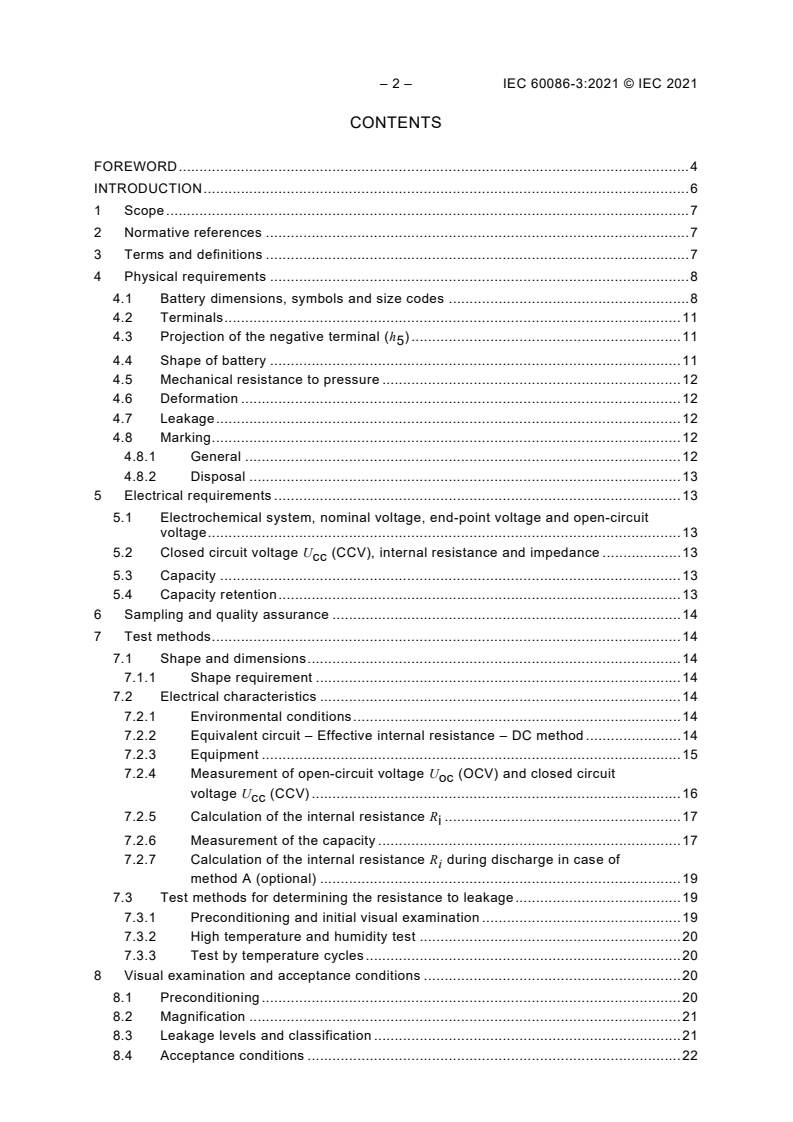
IEC 60086-3:2021 - Primary batteries - Part 3: Watch batteries Released:4/27/2021
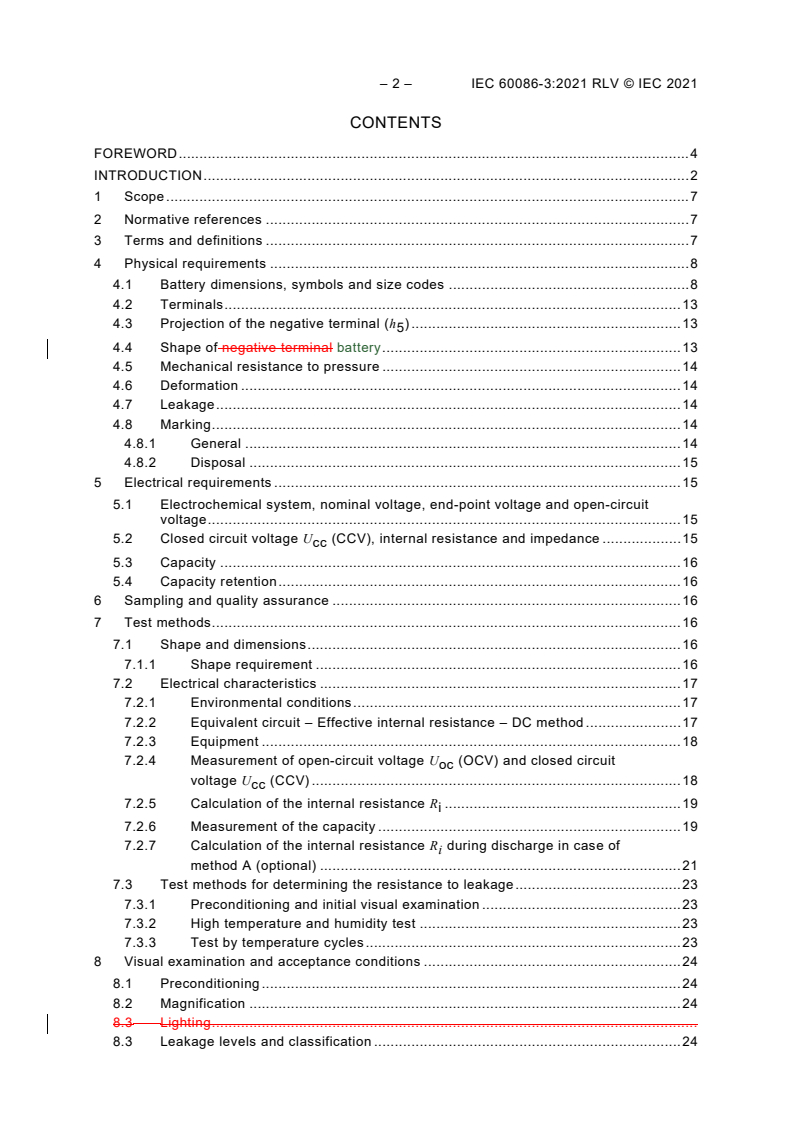
IEC 60086-3:2021 RLV - Primary batteries - Part 3: Watch batteries Released:4/27/2021
IEC 60086-3:2021 - Primary batteries - Part 3: Watch batteries Released:4/27/2021
Overview
IEC 60086-3:2021 - Primary batteries, Part 3: Watch batteries - is the IEC international standard that specifies dimensions, designation, test methods and performance requirements for primary (non‑rechargeable) watch batteries. Edition 5.0 (2021‑04) with the June 2023 corrigendum included, this standard ensures mechanical and electrical compatibility between watch movements and button/coin cells from different manufacturers.
Key topics and requirements
The standard focuses on practical, testable requirements for watch batteries, including:
Physical requirements
- Standardized dimensions, symbols and size codes for zinc and lithium systems (see dimensional drawings and tables).
- Terminal design, shape, and projection tolerances to ensure mechanical fit and contact.
- Mechanical resistance to pressure and allowable deformation.
- Mandatory marking and disposal information.
Electrical requirements
- Defined electrochemical systems, nominal and end‑point voltages, and open‑circuit voltage (OCV) minima.
- Measurement of closed‑circuit voltage (CCV), internal resistance / impedance, and capacity.
- Capacity retention criteria and reporting practices.
Test methods and quality
- Menu of standardized test methods for shape, electrical characteristics and leakage resistance.
- Environmental conditions for testing (temperature, humidity, storage).
- Tests for leakage resistance (high temperature/humidity, temperature cycles).
- Sampling, visual examination and acceptance criteria for production control.
Important: when presenting electrical or performance data, the manufacturer must specify which test method was used, allowing apples‑to‑apples comparison.
Practical applications and users
IEC 60086-3:2021 is essential for stakeholders who design, manufacture, test or certify watch batteries and watch movements:
- Battery manufacturers - to design cells that meet global dimension, electrical and safety expectations and to document test methods and results.
- Watch designers and OEMs - to ensure battery compatibility, contact design and expected runtime/performance for watch models.
- Test laboratories and QA teams - to perform standardized tests for capacity, internal resistance, leakage and mechanical robustness.
- Distributors, importers and compliance officers - to verify markings, declarations and conformity for market access.
- Standards developers and regulators - to align national rules with international practice.
Related standards
- IEC 60086-1 - Primary batteries: General
- IEC 60086-2 - Primary batteries: Physical and electrical specifications
- IEC 60086-4 / -5 - Safety of lithium and aqueous electrolyte batteries
- ISO/TC 114 - Horology (collaboration on watch‑related requirements)
By following IEC 60086-3:2021, manufacturers and designers can achieve consistent watch battery interchangeability, reliable performance data and improved consumer safety.
Relations
- Corrected By
IEC 60086-3:2021/COR1:2023 - Corrigendum 1 - Primary batteries - Part 3: Watch batteries - Effective Date
- 05-Sep-2023
- Effective Date
- 05-Sep-2023
Buy Documents
IEC 60086-3:2021 - Primary batteries - Part 3: Watch batteries Released:4/27/2021
IEC 60086-3:2021 RLV - Primary batteries - Part 3: Watch batteries Released:4/27/2021
IEC 60086-3:2021 - Primary batteries - Part 3: Watch batteries Released:4/27/2021
Get Certified
Connect with accredited certification bodies for this standard

IMQ S.p.A. (Certification)
Italian electrical product certification.

SLG Prüf- und Zertifizierungs GmbH
German testing and certification body.

UL Solutions
Global safety science company with testing, inspection and certification.
Sponsored listings
Frequently Asked Questions
IEC 60086-3:2021 is a standard published by the International Electrotechnical Commission (IEC). Its full title is "Primary batteries - Part 3: Watch batteries". This standard covers: IEC 60086-3-5:2021 specifies dimensions, designation, methods of tests and requirements for primary batteries for watches. In several cases, a menu of test methods is given. When presenting battery electrical characteristics and/or performance data, the manufacturer specifies which test method was used. The contents of the corrigendum of June 2023 have been included in this copy.
IEC 60086-3-5:2021 specifies dimensions, designation, methods of tests and requirements for primary batteries for watches. In several cases, a menu of test methods is given. When presenting battery electrical characteristics and/or performance data, the manufacturer specifies which test method was used. The contents of the corrigendum of June 2023 have been included in this copy.
IEC 60086-3:2021 is classified under the following ICS (International Classification for Standards) categories: 29.220.10 - Primary cells and batteries; 39.040.10 - Watches. The ICS classification helps identify the subject area and facilitates finding related standards.
IEC 60086-3:2021 has the following relationships with other standards: It is inter standard links to IEC 60086-3:2021/COR1:2023, IEC 60086-3:2016. Understanding these relationships helps ensure you are using the most current and applicable version of the standard.
IEC 60086-3:2021 is available in PDF format for immediate download after purchase. The document can be added to your cart and obtained through the secure checkout process. Digital delivery ensures instant access to the complete standard document.
Standards Content (Sample)
IEC 60086-3 ®
Edition 5.0 2021-04
INTERNATIONAL
STANDARD
Primary batteries –
Part 3: Watch batteries
All rights reserved. Unless otherwise specified, no part of this publication may be reproduced or utilized in any form
or by any means, electronic or mechanical, including photocopying and microfilm, without permission in writing from
either IEC or IEC's member National Committee in the country of the requester. If you have any questions about IEC
copyright or have an enquiry about obtaining additional rights to this publication, please contact the address below or
your local IEC member National Committee for further information.
IEC Central Office Tel.: +41 22 919 02 11
3, rue de Varembé info@iec.ch
CH-1211 Geneva 20 www.iec.ch
Switzerland
About the IEC
The International Electrotechnical Commission (IEC) is the leading global organization that prepares and publishes
International Standards for all electrical, electronic and related technologies.
About IEC publications
The technical content of IEC publications is kept under constant review by the IEC. Please make sure that you have the
latest edition, a corrigendum or an amendment might have been published.
IEC publications search - webstore.iec.ch/advsearchform IEC online collection - oc.iec.ch
The advanced search enables to find IEC publications by a Discover our powerful search engine and read freely all the
variety of criteria (reference number, text, technical publications previews. With a subscription you will always
committee, …). It also gives information on projects, replaced have access to up to date content tailored to your needs.
and withdrawn publications.
Electropedia - www.electropedia.org
IEC Just Published - webstore.iec.ch/justpublished
The world's leading online dictionary on electrotechnology,
Stay up to date on all new IEC publications. Just Published
containing more than 22 000 terminological entries in English
details all new publications released. Available online and
and French, with equivalent terms in 18 additional languages.
once a month by email.
Also known as the International Electrotechnical Vocabulary
(IEV) online.
IEC Customer Service Centre - webstore.iec.ch/csc
If you wish to give us your feedback on this publication or
need further assistance, please contact the Customer Service
Centre: sales@iec.ch.
IEC 60086-3 ®
Edition 5.0 2021-04
INTERNATIONAL
STANDARD
Primary batteries –
Part 3: Watch batteries
INTERNATIONAL
ELECTROTECHNICAL
COMMISSION
ICS 29.220.10; 39.040.10 ISBN 978-2-8322-9686-8
– 2 – IEC 60086-3:2021 © IEC 2021
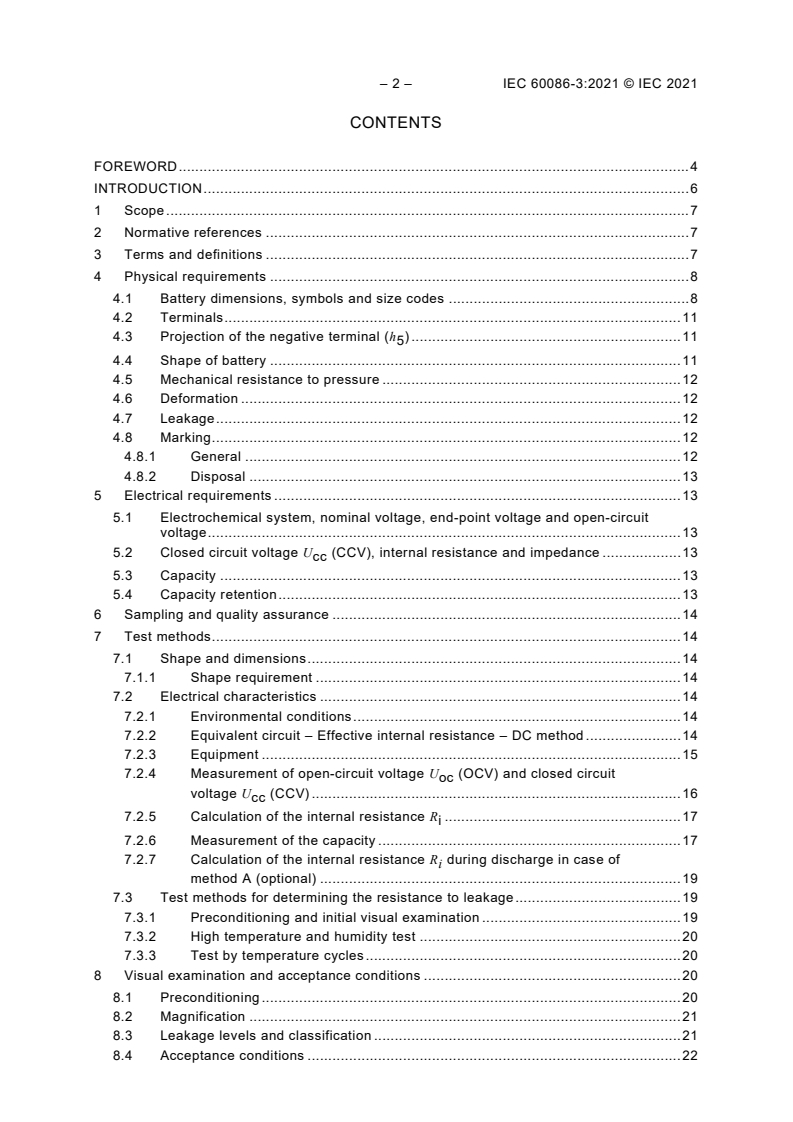
CONTENTS
FOREWORD . 4
INTRODUCTION . 6
1 Scope . 7
2 Normative references . 7
3 Terms and definitions . 7
4 Physical requirements . 8
4.1 Battery dimensions, symbols and size codes . 8
4.2 Terminals . 11
4.3 Projection of the negative terminal (h ) . 11
4.4 Shape of battery . 11
4.5 Mechanical resistance to pressure . 12
4.6 Deformation . 12
4.7 Leakage . 12
4.8 Marking . 12
4.8.1 General . 12
4.8.2 Disposal . 13
5 Electrical requirements . 13
5.1 Electrochemical system, nominal voltage, end-point voltage and open-circuit
voltage . 13
5.2 Closed circuit voltage U (CCV), internal resistance and impedance . 13
cc
5.3 Capacity . 13
5.4 Capacity retention . 13
6 Sampling and quality assurance . 14
7 Test methods . 14
7.1 Shape and dimensions . 14
7.1.1 Shape requirement . 14
7.2 Electrical characteristics . 14
7.2.1 Environmental conditions . 14
7.2.2 Equivalent circuit – Effective internal resistance – DC method . 14
7.2.3 Equipment . 15
7.2.4 Measurement of open-circuit voltage U (OCV) and closed circuit
oc
voltage U (CCV) . 16
cc
7.2.5 Calculation of the internal resistance R . 17
i
7.2.6 Measurement of the capacity . 17
7.2.7 Calculation of the internal resistance R during discharge in case of
i
method A (optional) . 19
7.3 Test methods for determining the resistance to leakage . 19
7.3.1 Preconditioning and initial visual examination . 19
7.3.2 High temperature and humidity test . 20
7.3.3 Test by temperature cycles . 20
8 Visual examination and acceptance conditions . 20
8.1 Preconditioning . 20
8.2 Magnification . 21
8.3 Leakage levels and classification . 21
8.4 Acceptance conditions . 22
Annex A (normative) Designation . 23
Bibliography . 24
Figure 1 – Dimensional drawing . 8
Figure 2 – Shape of battery. 11
Figure 3 – Shape requirement . 14
Figure 4 – Schematic voltage transient . 15
Figure 5 – Curve: U = f(t) . 16
Figure 6 – Circuitry principle . 16
Figure 7 – Circuitry principle for method A . 18
Figure 8 – Circuitry principle for method B . 19
Figure 9 – Test by temperature cycles . 20
Table 1 – Zinc systems L and S dimensions and size codes . 9
Table 2 – Lithium systems B and C dimensions and size codes . 10
Table 3 – Values of l . 11
Table 4 – Applied force F by battery dimensions . 12
Table 5 – Standardised electrochemical systems . 13
Table 6 – Test method for U (CCV) measurement . 17
cc
Table 7 – Test method A for U (CCV) measurement . 18
cc
Table 8 – Storage conditions for the recommended test . 20
Table 9 – Storage conditions for optional test . 20
Table 10 – Leakage levels and classification . 21
– 4 – IEC 60086-3:2021 © IEC 2021
INTERNATIONAL ELECTROTECHNICAL COMMISSION
____________
PRIMARY BATTERIES –
Part 3: Watch batteries
FOREWORD
1) The International Electrotechnical Commission (IEC) is a worldwide organization for standardization comprising
all national electrotechnical committees (IEC National Committees). The object of IEC is to promote international
co-operation on all questions concerning standardization in the electrical and electronic fields. To this end and
in addition to other activities, IEC publishes International Standards, Technical Specifications, Technical Reports,
Publicly Available Specifications (PAS) and Guides (hereafter referred to as “IEC Publication(s)”). Their
preparation is entrusted to technical committees; any IEC National Committee interested in the subject dealt with
may participate in this preparatory work. International, governmental and non-governmental organizations liaising
with the IEC also participate in this preparation. IEC collaborates closely with the International Organization for
Standardization (ISO) in accordance with conditions determined by agreement between the two organizations.
2) The formal decisions or agreements of IEC on technical matters express, as nearly as possible, an international
consensus of opinion on the relevant subjects since each technical committee has representation from all
interested IEC National Committees.
3) IEC Publications have the form of recommendations for international use and are accepted by IEC National
Committees in that sense. While all reasonable efforts are made to ensure that the technical content of IEC
Publications is accurate, IEC cannot be held responsible for the way in which they are used or for any
misinterpretation by any end user.
4) In order to promote international uniformity, IEC National Committees undertake to apply IEC Publications
transparently to the maximum extent possible in their national and regional publications. Any divergence between
any IEC Publication and the corresponding national or regional publication shall be clearly indicated in the latter.
5) IEC itself does not provide any attestation of conformity. Independent certification bodies provide conformity
assessment services and, in some areas, access to IEC marks of conformity. IEC is not responsible for any
services carried out by independent certification bodies.
6) All users should ensure that they have the latest edition of this publication.
7) No liability shall attach to IEC or its directors, employees, servants or agents including individual experts and
members of its technical committees and IEC National Committees for any personal injury, property damage or
other damage of any nature whatsoever, whether direct or indirect, or for costs (including legal fees) and
expenses arising out of the publication, use of, or reliance upon, this IEC Publication or any other IEC
Publications.
8) Attention is drawn to the Normative references cited in this publication. Use of the referenced publications is
indispensable for the correct application of this publication.
9) Attention is drawn to the possibility that some of the elements of this IEC Publication may be the subject of patent
rights. IEC shall not be held responsible for identifying any or all such patent rights.
International Standard IEC 60086-3 has been prepared by IEC technical committee 35: Primary
cells and batteries, and ISO technical committee 114: Horology.
This fifth edition cancels and replaces the fourth edition published in 2016. This edition
constitutes a technical revision.
This edition includes the following significant technical changes with respect to the previous
edition:
a) reformatted Table 1 and Table 2. The reformatted tables are now divided by system.
Dimensional tolerances were changed when appropriate. Cell sizes were removed or added
based on the size prevalence in the market place;
b) in Table 3 the minimum values of l were reformatted;
c) the minimum OCV for the S system in Table 5 was changed to 1,55 V.
The text of this International Standard is based on the following documents:
FDIS Report on voting
35/1467/FDIS 35/1470/RVD
Full information on the voting for the approval of this International Standard can be found in the
report on voting indicated in the above table.
The language used for the development of this International Standard is English.
This document was drafted in accordance with ISO/IEC Directives, Part 2, and developed in
accordance with ISO/IEC Directives, Part 1 and ISO/IEC Directives, IEC Supplement, available
at www.iec.ch/members_experts/refdocs. The main document types developed by IEC are
described in greater detail at www.iec.ch/standardsdev/publications.
A list of all parts in the IEC 60086 series, published under the general title Primary batteries,
can be found on the IEC website.
The committee has decided that the contents of this document will remain unchanged until the
stability date indicated on the IEC website under "http://webstore.iec.ch" in the data related to
the specific document. At this date, the document will be
• reconfirmed,
• withdrawn,
• replaced by a revised edition, or
• amended.
– 6 – IEC 60086-3:2021 © IEC 2021
INTRODUCTION
This part of IEC 60086 provides specific requirements and information for primary watch
batteries. This part of IEC 60086 was prepared through joint work between the IEC and ISO to
benefit primary battery users, watch designers and battery manufacturers by ensuring the best
compatibility between batteries and watches.
This part of IEC 60086 will remain under continual scrutiny to ensure that the publication is kept
up to date with the advances in both battery and watch technologies.
NOTE Safety information is available in IEC 60086-4 and IEC 60086-5.
PRIMARY BATTERIES –
Part 3: Watch batteries
1 Scope
This part of IEC 60086 specifies dimensions, designation, methods of tests and requirements
for primary batteries for watches. In several cases, a menu of test methods is given. When
presenting battery electrical characteristics and/or performance data, the manufacturer
specifies which test method was used.
2 Normative references
The following documents are referred to in the text in such a way that some or all of their content
constitutes requirements of this document. For dated references, only the edition cited applies.
For undated references, the latest edition of the referenced document (including any
amendments) applies.
IEC 60086-1, Primary batteries – Part 1: General
IEC 60086-2, Primary batteries – Part 2: Physical and electrical specifications
IEC 60086-4, Primary batteries – Part 4: Safety of lithium batteries
IEC 60086-5, Primary batteries – Part 5: Safety of batteries with aqueous electrolyte
3 Terms and definitions
For the purposes of this document, the terms and definitions given in IEC 60086-1 and the
following apply.
ISO and IEC maintain terminological databases for use in standardization at the following
addresses:
• IEC Electropedia: available at http://www.electropedia.org/
• ISO Online browsing platform: available at http://www.iso.org/obp
3.1
capacitive reactance
part of the internal resistance that leads to a voltage drop during the first seconds under load
3.2
capacity
electric charge (quantity of electricity) which a cell or battery can deliver under specified
discharge conditions
Note 1 to entry: The SI unit for electric charge is the coulomb (1 C = 1 As) but, in practice, capacity is usually
expressed in ampere hours (Ah).
3.3
fresh battery
undischarged battery 60 days maximum after date of manufacture
– 8 – IEC 60086-3:2021 © IEC 2021
3.4
ohmic drop
part of the internal resistance that leads to a voltage drop immediately after switching the load
on
4 Physical requirements
4.1 Battery dimensions, symbols and size codes
Dimensions and tolerances of batteries for watches shall be in accordance with Figure 1,
Table 1 and Table 2. The dimensions of the batteries shall be tested in accordance with 7.1.
The symbols used to denote the various dimensions in Figure 1 are in accordance with
IEC 60086-2:2021, Clause 4.
Dimensions in millimetres
Key
h maximum overall height of the battery
h minimum distance between the flats of the positive and negative contacts
h minimum projection of the flat negative contact
maximum and minimum diameter of the battery
d
d minimum diameter of the flat positive contact
d minimum diameter of the flat negative contact
NOTE This numbering follows the harmonization in the IEC 60086 series.
Figure 1 – Dimensional drawing
Table 1 – Zinc systems L and S dimensions and size codes
Dimensions in millimetres
Height h /h
Diameter
1 2
a
Code
10 12 14 16 20 21 26 27 30 31 36 42 54
d
a
d
Tolerance
Code
Tolerances
0 0 0 0 0 0 0 0 0 0 0 0 0
−0,10 −0,15 −0,15 −0,18 −0,20 −0,20 −0,20 −0,20 −0,20 −0,25 −0,25 −0,25 −0,25
4 4,8 1,05 1,65 2,15
−0,15
5 5,8 2,6 1,05 1,25 1,65 2,15 2,70
−0,15
6 6,8 3,0 1,45 1,65 2,15 2,60
−0,15
7 7,9 3,5 1,25 1,45 1,65 2,10 2,60 3,10 3,60 5,40
−0,15
9 9,5 4,5 1,05 1,25 1,45 1,65 2,05 2,
...
IEC 60086-3
Edition 5.0 2021-04
REDLINE VERSION
INTERNATIONAL
STANDARD
colour
inside
Primary batteries –
Part 3: Watch batteries
All rights reserved. Unless otherwise specified, no part of this publication may be reproduced or utilized in any form
or by any means, electronic or mechanical, including photocopying and microfilm, without permission in writing from
either IEC or IEC's member National Committee in the country of the requester. If you have any questions about IEC
copyright or have an enquiry about obtaining additional rights to this publication, please contact the address below or
your local IEC member National Committee for further information.
IEC Central Office Tel.: +41 22 919 02 11
3, rue de Varembé info@iec.ch
CH-1211 Geneva 20 www.iec.ch
Switzerland
About the IEC
The International Electrotechnical Commission (IEC) is the leading global organization that prepares and publishes
International Standards for all electrical, electronic and related technologies.
About IEC publications
The technical content of IEC publications is kept under constant review by the IEC. Please make sure that you have the
latest edition, a corrigendum or an amendment might have been published.
IEC publications search - webstore.iec.ch/advsearchform IEC online collection - oc.iec.ch
The advanced search enables to find IEC publications by a Discover our powerful search engine and read freely all the
variety of criteria (reference number, text, technical publications previews. With a subscription you will always
committee, …). It also gives information on projects, replaced have access to up to date content tailored to your needs.
and withdrawn publications.
Electropedia - www.electropedia.org
IEC Just Published - webstore.iec.ch/justpublished
The world's leading online dictionary on electrotechnology,
Stay up to date on all new IEC publications. Just Published
containing more than 22 000 terminological entries in English
details all new publications released. Available online and
and French, with equivalent terms in 18 additional languages.
once a month by email.
Also known as the International Electrotechnical Vocabulary
(IEV) online.
IEC Customer Service Centre - webstore.iec.ch/csc
If you wish to give us your feedback on this publication or
need further assistance, please contact the Customer Service
Centre: sales@iec.ch.
IEC 60086-3
Edition 5.0 2021-04
REDLINE VERSION
INTERNATIONAL
STANDARD
colour
inside
Primary batteries –
Part 3: Watch batteries
INTERNATIONAL
ELECTROTECHNICAL
COMMISSION
ICS 29.220.10; 39.040.10 ISBN 978-2-8322-9760-5
– 2 – IEC 60086-3:2021 RLV © IEC 2021
CONTENTS
FOREWORD . 4
INTRODUCTION . 2
1 Scope . 7
2 Normative references . 7
3 Terms and definitions . 7
4 Physical requirements . 8
4.1 Battery dimensions, symbols and size codes . 8
4.2 Terminals . 13
4.3 Projection of the negative terminal (h ) . 13
4.4 Shape of negative terminal battery . 13
4.5 Mechanical resistance to pressure . 14
4.6 Deformation . 14
4.7 Leakage . 14
4.8 Marking . 14
4.8.1 General . 14
4.8.2 Disposal . 15
5 Electrical requirements . 15
5.1 Electrochemical system, nominal voltage, end-point voltage and open-circuit
voltage . 15
5.2 Closed circuit voltage U (CCV), internal resistance and impedance . 15
cc
5.3 Capacity . 16
5.4 Capacity retention . 16
6 Sampling and quality assurance . 16
7 Test methods . 16
7.1 Shape and dimensions . 16
7.1.1 Shape requirement . 16
7.2 Electrical characteristics . 17
7.2.1 Environmental conditions . 17
7.2.2 Equivalent circuit – Effective internal resistance – DC method . 17
7.2.3 Equipment . 18
7.2.4 Measurement of open-circuit voltage U (OCV) and closed circuit
oc
voltage U (CCV) . 18
cc
7.2.5 Calculation of the internal resistance R . 19
i
7.2.6 Measurement of the capacity . 19
7.2.7 Calculation of the internal resistance R during discharge in case of
i
method A (optional) . 21
7.3 Test methods for determining the resistance to leakage . 23
7.3.1 Preconditioning and initial visual examination . 23
7.3.2 High temperature and humidity test . 23
7.3.3 Test by temperature cycles . 23
8 Visual examination and acceptance conditions . 24
8.1 Preconditioning . 24
8.2 Magnification . 24
8.3 Lighting .
8.3 Leakage levels and classification . 24
8.4 Acceptance conditions . 25
Annex A (normative) Designation . 27
Bibliography . 28
Figure 1 – Dimensional drawing . 8
Figure 2 – Shape of negative terminal battery . 13
Figure 3 – Shape requirement . 16
Figure 4 – Schematic voltage transient . 17
Figure 5 – Curve: U = f(t) . 18
Figure 6 – Circuitry principle . 19
Figure 7 – Circuitry principle for method A . 20
Figure 8 – Circuitry principle for method B . 21
Figure 9 – Test by temperature cycles . 23
Table 1 – Zinc systems L and S dimensions and size codes . 9
Table 2 – Lithium systems B and C dimensions and size codes . 11
Table 3 – Minimum Values of l . 14
Table 4 – Applied force F by battery dimensions . 14
Table 5 – Standardised electrochemical systems . 15
Table 6 – Test method for U (CCV) measurement . 19
cc
Table 7 – Test method A for U (CCV) measurement . 20
cc
Table 8 – Discharge resistance (values) .
Table 8 – Storage conditions for the recommended test . 23
Table 9 – Storage conditions for optional test . 23
Table 10 – Leakage levels and classification . 24
– 4 – IEC 60086-3:2021 RLV © IEC 2021
INTERNATIONAL ELECTROTECHNICAL COMMISSION
____________
PRIMARY BATTERIES –
Part 3: Watch batteries
FOREWORD
1) The International Electrotechnical Commission (IEC) is a worldwide organization for standardization comprising
all national electrotechnical committees (IEC National Committees). The object of IEC is to promote international
co-operation on all questions concerning standardization in the electrical and electronic fields. To this end and
in addition to other activities, IEC publishes International Standards, Technical Specifications, Technical Reports,
Publicly Available Specifications (PAS) and Guides (hereafter referred to as “IEC Publication(s)”). Their
preparation is entrusted to technical committees; any IEC National Committee interested in the subject dealt with
may participate in this preparatory work. International, governmental and non-governmental organizations liaising
with the IEC also participate in this preparation. IEC collaborates closely with the International Organization for
Standardization (ISO) in accordance with conditions determined by agreement between the two organizations.
2) The formal decisions or agreements of IEC on technical matters express, as nearly as possible, an international
consensus of opinion on the relevant subjects since each technical committee has representation from all
interested IEC National Committees.
3) IEC Publications have the form of recommendations for international use and are accepted by IEC National
Committees in that sense. While all reasonable efforts are made to ensure that the technical content of IEC
Publications is accurate, IEC cannot be held responsible for the way in which they are used or for any
misinterpretation by any end user.
4) In order to promote international uniformity, IEC National Committees undertake to apply IEC Publications
transparently to the maximum extent possible in their national and regional publications. Any divergence between
any IEC Publication and the corresponding national or regional publication shall be clearly indicated in the latter.
5) IEC itself does not provide any attestation of conformity. Independent certification bodies provide conformity
assessment services and, in some areas, access to IEC marks of conformity. IEC is not responsible for any
services carried out by independent certification bodies.
6) All users should ensure that they have the latest edition of this publication.
7) No liability shall attach to IEC or its directors, employees, servants or agents including individual experts and
members of its technical committees and IEC National Committees for any personal injury, property damage or
other damage of any nature whatsoever, whether direct or indirect, or for costs (including legal fees) and
expenses arising out of the publication, use of, or reliance upon, this IEC Publication or any other IEC
Publications.
8) Attention is drawn to the Normative references cited in this publication. Use of the referenced publications is
indispensable for the correct application of this publication.
9) Attention is drawn to the possibility that some of the elements of this IEC Publication may be the subject of patent
rights. IEC shall not be held responsible for identifying any or all such patent rights.
This redline version of the official IEC Standard allows the user to identify the changes made to
the previous edition IEC 60086-3:2016. A vertical bar appears in the margin wherever a change
has been made. Additions are in green text, deletions are in strikethrough red text.
International Standard IEC 60086-3 has been prepared by IEC technical committee 35: Primary
cells and batteries, and ISO technical committee 114: Horology.
This fifth edition cancels and replaces the fourth edition published in 2016. This edition
constitutes a technical revision.
This publication is published as a double logo standard.
This edition includes the following significant technical changes with respect to the previous
edition:
a) reformatted Table 1 and Table 2. The reformatted tables are now divided by system.
Dimensional tolerances were changed when appropriate. Cell sizes were removed or added
based on the size prevalence in the market place;
b) in Table 3 the minimum values of l were reformatted;
c) the minimum OCV for the S system in Table 5 was changed to 1,55 V.
The text of this International Standard is based on the following documents:
FDIS Report on voting
35/1467/FDIS 35/1470/RVD
Full information on the voting for the approval of this International Standard can be found in the
report on voting indicated in the above table.
The language used for the development of this International Standard is English.
This document was drafted in accordance with ISO/IEC Directives, Part 2, and developed in
accordance with ISO/IEC Directives, Part 1 and ISO/IEC Directives, IEC Supplement, available
at www.iec.ch/members_experts/refdocs. The main document types developed by IEC are
described in greater detail at www.iec.ch/standardsdev/publications.
A list of all parts in the IEC 60086 series, published under the general title Primary batteries,
can be found on the IEC website.
The committee has decided that the contents of this document will remain unchanged until the
stability date indicated on the IEC website under "http://webstore.iec.ch" in the data related to
the specific document. At this date, the document will be
• reconfirmed,
• withdrawn,
• replaced by a revised edition, or
• amended.
IMPORTANT – The 'colour inside' logo on the cover page of this publication indicates that it
contains colours which are considered to be useful for the correct understanding of its
contents. Users should therefore print this document using a colour printer.
The contents of the corrigendum 1 (2023-06) have been included in this copy.
– 6 – IEC 60086-3:2021 RLV © IEC 2021
INTRODUCTION
This part of IEC 60086 provides specific requirements and information for primary watch
batteries. This part of IEC 60086 was prepared through joint work between the IEC and ISO to
benefit primary battery users, watch designers and battery manufacturers by ensuring the best
compatibility between batteries and watches.
This part of IEC 60086 will remain under continual scrutiny to ensure that the publication is kept
up to date with the advances in both battery and watch technologies.
NOTE Safety information is available in IEC 60086-4 and IEC 60086-5.
PRIMARY BATTERIES –
Part 3: Watch batteries
1 Scope
This part of IEC 60086 specifies dimensions, designation, methods of tests and requirements
for primary batteries for watches. In several cases, a menu of test methods is given. When
presenting battery electrical characteristics and/or performance data, the manufacturer
specifies which test method was used.
2 Normative references
The following documents are referred to in the text in such a way that some or all of their content
constitutes requirements of this document. For dated references, only the edition cited applies.
For undated references, the latest edition of the referenced document (including any
amendments) applies.
IEC 60086-1:2015, Primary batteries – Part 1: General
IEC 60086-2:2015, Primary batteries – Part 2: Physical and electrical specifications
IEC 60086-4:2014, Primary batteries – Part 4: Safety of lithium batteries
IEC 60086-5:- , Primary batteries – Part 5: Safety of batteries with aqueous electrolyte
3 Terms and definitions
For the purposes of this document, the terms and definitions given in IEC 60086-1 and the
following apply.
ISO and IEC maintain terminological databases for use in standardization at the following
addresses:
• IEC Electropedia: available at http://www.electropedia.org/
• ISO Online browsing platform: available at http://www.iso.org/obp
3.1
capacitive reactance
part of the internal resistance that leads to a voltage drop during the first seconds under load
3.2
capacity
electric charge (quantity of electricity) which a cell or battery can deliver under specified
discharge conditions
Note 1 to entry: The SI unit for electric charge is the coulomb (1 C = 1 As) but, in practice, capacity is usually
expressed in ampere hours (Ah).
___________
To be published.
– 8 – IEC 60086-3:2021 RLV © IEC 2021
3.3
fresh battery
undischarged battery 60 days maximum after date of manufacture
3.4
ohmic drop
part of the internal resistance that leads to a voltage drop immediately after switching the load
on
4 Physical requirements
4.1 Battery dimensions, symbols and size codes
Dimensions and tolerances of batteries for watches shall be in accordance with Figure 1,
Table 1 and Table 2. The dimensions of the batteries shall be tested in accordance with 7.1.
The symbols used to denote the various dimensions in Figure 1 are in accordance with
IEC 60086-2:20152021, Clause 4.
Dimensions in millimetres
Key
h maximum overall height of the battery
h minimum distance between the flats of the positive and negative contacts
h minimum projection of the flat negative contact
d maximum and minimum diameter of the battery
d minimum diameter of the flat positive contact
d minimum diameter of the flat negative contact
NOTE This numbering follows the harmonization in the IEC 60086 series.
Figure 1 – Dimensional drawing
Table 1 – Zinc systems L and S dimensions and size codes
Dimensions in millimetres
Height h /h
Diameter
1 2
a
Code
10 12 14 16 20 21 25 26 27 30 31 32 36 42 54
d
Tole-
a
d
Code
Tolerance
rance
0 0 0 0 0 0 0 0 0 0 0 0 0 0 0
–0,10 –0,15 –0,15 –0,18 –0,20 –0,20 –0,20 –0,20 –0,20 –0,25 –0,25 –0,25 –0,25 –0,25 –0,25
4 4,8 1,65 2,15
–0,15
5 5,8 2,6 1,05 1,25 1,45 1,65 2,15 2,70
–0,15
6 6,8 3,0 1,05 1,25 1,45 1,65 2,15 2,60
–0,15
7 7,9 3,5 1,05 1,25 1,45 1,65 2,10 2,60 3,10 3,60 5,40
–0,15
9 9,5 4,5 1,05 1,25 1,45 1,65 2,05 2,10 2,70 3,60
–0,15
10 10,0 3,0 2,50
–0,30
11 11,6 6,0 1,05 1,25 1,45 1,65 2,05 2,10 2,60 3,05 3,60 4,20 5,40
–0,20
12 12,5 4,0 1,20 1,60 2,00 2,50
–0,25
NOTE Open boxes in the above matrix are not necessarily available for standardisation due to the concept of overlapping tolerances.
a
See Annex A.
– 10 – IEC 60086-3:2021 RLV © IEC 2021
Dimensions in millimetres
Height h /h
Diameter
1 2
a
Code
10 12 14 16 20 21 26 27 30 31 36 42 54
d
a
d
Code Tolerance
Tolerances
0 0 0 0 0 0 0 0 0 0 0 0 0
−0,10 −0,15 −0,15 −0,18 −0,20 −0,20 −0,20 −0,20 −0,20 −0,25 −0,25 −0,25 −0,25
4 4,8 1,05 1,65 2,15
−0,15
5 5,8 2,6 1,05 1,25 1,65 2,15 2,70
−0,15
6 6,8 3,0 1,45 1,65 2,15 2,60
−0,15
7 7,9 3,5 1,25 1,45 1,65 2,10 2,60 3,10 3,60 5,40
−0,15
9 9,5 4,5 1,05 1,25 1,45 1,65 2,05 2,70 3,60
−0,15
11 11,6 6,0 1,65 2,05 3,05 3,60 4,20 5,40
−0,20
NOTE Open boxes in the above matrix are not necessarily available for standardization due to the concept of overlapping tolerances.
a
See Annex A.
Table 2 – Lithium systems B and C dimensions and size codes
Dimensions in millimetres
Height h /h
Diameter
1 2
a
Code
12 16 20 25 30 32
d
a
d
Tolerance
Code
Tolerances
0 0 0 0 0 0
–0,20 –0,20 –0,25 –0,30 –0,30 –0,30
16 16 5,00 1,20 1,60 2,00 2,50 3,20
–0,25
20 20 8,00 1,20 1,60 2,00 2,50 3,20
–0,25
23 23 8,00 1,20 1,60 2,00 2,50 3,00
–0,30
24 24,5 8,00 1,20 1,60 3,00
–0,30
NOTE Open boxes in the above matrix are not necessarily available for standardisation due to the concept of
overlapping tolerances.
a
See Annex A.
– 12 – IEC 60086-3:2021 RLV © IEC 2021
Dimensions in millimetres
Height h /h
Diameter
1 2
a
Code
12 16 20 25 30 32 50
d
a
d
Code Tolerance
Tolerances
0 0 0 0 0 0 0
−0,15 −0,18 −0,20 −0,20 −0,20 −0,25 −0,30
10 10,0 3,0 2,50
−0,15
12 12,5 4,0 1,60 2,00 2,50
−0,25
16 16 5,0 1,20 1,60 2,00 3,20
−0,25
20 20 8,0 1,20 1,60 2,50 3,20
−0,25
23 23 8,0 2,00 2,50
−0,25
24 24,5 8,0 3,00 5,00
−0,25
NOTE Open boxes in the above matrix are not necessarily available for standardization due to the concept of overlapping tolerances.
a
See Annex A.
4.2 Terminals
Negative contact (–): The negative contact (dimension d ) shall be in accordance with
Table 1 and Table 2. This is not applied to those batteries with
a two-step negative contact.
The cylindrical surface is connected to the positive terminal.
Positive contact (+):
Positive contact should be made to the side of the battery but
may be made to the base.
4.3 Projection of the negative terminal (h )
The dimension h shall be as follows:
h ≥ 0,02 for h /h ≤ 1,65
5 1 2
h ≥ 0,06 for 1,65 < h /h < 2,5
5 1 2
≥ 0,08 for h /h ≥ 2,5
h
5 1 2
The negative contact should be the highest point of the battery.
4.4 Shape of negative terminal battery
The space requirements shall be contained within secure the area enclosed by an angle of 45°
(see Figure 2).
The minimum values of l , for different heights of h /h , are given in Table 3.
1 1 2
l
45°
d
IEC
a) Figure 2a b) Figure 2b
Figure 2 – Shape of negative terminal battery
h /h
1 2
– 14 – IEC 60086-3:2021 RLV © IEC 2021
Table 3 – Minimum Values of l
Dimensions in millimetres
h /h l
1 2 1 min
1 < h /h ≤ 1,90
0,20
1 2
1,90 < h /h ≤ 3,10
0,35
1 2
3,10 < h /h ≤ 3,60
0,50
1 2
3,60 < h /h ≤ 4,20
0,70
1 2
4,20 < h /h ≤ 5.40
0,80
1 2
5,40 ≤< h /h
0,90
1 2
4.5 Mechanical resistance to pressure
A force F (N), as specified in Table 4, applied for 10 s through a steel ball of 1 mm diameter, at
the centre of each contact area, shall not cause any deformation prejudicial to the proper
functioning of the battery, i.e. after this test, the battery shall pass the tests specified in Clause 7.
Table 4 – Applied force F by battery dimensions
Battery dimensions Force
d h /h F
1 1 2
mm mm N
<3,0 5
< 7,9
≥3,0 10
<3,0 10
≥ 7,9
≥3,0 10
4.6 Deformation
The dimensions of batteries shall conform with the relevant specified dimensions at all times
including discharge to the defined end-point voltage.
NOTE 1 A battery height increase up to 0,25 mm can occur, if discharged below this voltage.
NOTE 2 A battery height decrease can occur in B and C systems as discharge continues.
Refer to IEC 60086-1 for dimensional stability.
4.7 Leakage
Undischarged batteries and, if required, batteries tested according to 7.2.6 shall be examined
as stated in 7.3. The acceptable number of defects shall be agreed between the manufacturer
and the purchaser.
4.8 Marking
4.8.1 General
The designation and the polarity shall be marked on the battery. Battery marking should not
impede electrical contact. All other markings may be given on the packing instead of on the
battery:
The battery and/or its packaging must be marked with the following:
a) designation according to normative Annex A, or common;
b) expiration of a recommended usage period or year and month or week of manufacture.
The year and month or week of manufacture may be in code. The code is composed of the
last digit of the year and of a number indicating the month. October, November and
December should be represented by the letters O, Y and Z respectively;
EXAMPLE
4191: January 20142019;
4Y9Y: November 20142019.
c) polarity of the positive (+) terminal;
d) nominal voltage;
e) name or trade mark of the supplier;
f) cautionary advice;
g) caution for ingestion of batteries shall be given. Refer to IEC 60086-4:20142019, 7.2 a) and
9.2, and IEC 60086-5:- 2016, 7.1 l) and 9.2, for details.
NOTE Examples of the common designations can be found in Annex D of IEC 60086-2:2015.
Battery marking should not impede electrical contact. The designation and the polarity shall be
marked on the battery. All other markings may be given on the packing instead of the battery.
4.8.2 Disposal
Marking of batteries with respect to the method of disposal shall be in accordance with local
legal requirements.
5 Electrical requirements
5.1 Electrochemical system, nominal voltage, end-point voltage and open-circuit
voltage
The requirements concerning the electrochemical system, the nominal voltage, the end-point
voltage and the open-circuit voltage are given in Table 5.
Table 5 – Standardised electrochemical systems
Letter Negative Electrolyte Positive electrode Nominal End- Open-circuit
electrode voltage point voltage
voltage
(V U ) (EV) (U or OCV)
n n OC
V V V
Max. Min.
B Lithium (Li) Organic electrolyte Carbon monofluoride (CF) 3,0 2,0 3,70 3,00
x
C Lithium (Li) Organic electrolyte Manganese dioxide (MnO ) 3,0 2,0 3,70 3,00
L Zinc (Zn) Alkali metal hydroxide Manganese dioxide (MnO ) 1,5 1,0 1,68 1,50
S Zinc (Zn) Alkali metal hydroxide Silver oxide (Ag O) 1,55 1,2 1,63 1,57
1,55
5.2 Closed circuit voltage U (CCV), internal resistance and impedance
cc
Closed circuit voltage and internal resistance shall be measured according to 7.2.
– 16 – IEC 60086-3:2021 RLV © IEC 2021
AC impedance should be measured with an LCR meter.
Limit values shall be agreed between the manufacturer and the purchaser.
5.3 Capacity
The capacity shall be agreed between the manufacturer and the purchaser on the basis of a
continuous discharge test lasting approximately 30 days, according to 7.2.6.
5.4 Capacity retention
The capacity retention is the ratio between the capacities under the given discharge conditions
measured on fresh batteries and a sample of the same lot stored during 365 days at (20 ± 2) °C
and a relative humidity between (55 ± 20) %.
The ratio of capacity retention shall be agreed between the manufacturer and the purchaser.
The minimum value should be at least 90 % for a period of 12 months. The capacity
measurement is carried out according to 7.2.6.
For the purpose of verifying compliance with this document, conditional acceptance may be
given after completion of the initial capacity tests.
6 Sampling and quality assurance
The use of sampling plans or product quality indices should be agreed between manufacturer
and purchaser.
Where no agreement is specified, refer to ISO 2859 and ISO 21747 for sampling and quality
compliance assessment advice.
7 Test methods
7.1 Shape and dimensions
7.1.1 Shape requirement
The shape of the negative contact is checked preferably by optical projection or by an open
gauge according to Figure 3.
The measurement method shall be agreed between the manufacturer and the purchaser.
Figure 3 – Shape requirement
Procedure:
The procedure to inspect with the open gauge is shown. The battery is moved toward the side
A of the gauge while applying the outer periphery of the positive electrode to the side B and
maintaining the flat part of the negative electrode terminal at 90 ° with respect to the side B. A
battery having a gap without contact between the side A of the gauge and the flat part of the
negative electrode terminal does not satisfy the requirements.
NOTE The surface of the open gauge is made of non-conductive hard resin to prevent external short circuit.
7.2 Electrical characteristics
7.2.1 Environmental conditions
Unless otherwise specified, the sample batteries shall be tested at a temperature of (20 ± 2) °C
+20
and a relative humidity between (55 ) %.
−40
During use, batteries may can be exposed to low temperatures; it is therefore recommended to
carry out complementary tests at (0 ± 2) °C and at (−10 ± 2) °C.
7.2.2 Equivalent circuit – Effective internal resistance – DC method
Resistance of any electrical component is determined by calculating the ratio between the
voltage drop ΔU across this component and the range of current Δi passing through this
component and causing the voltage drop R = ΔU / Δi.
NOTE As an analogy, the internal DC resistance R of any electrochemical cell is defined by the following relation:
i
∆U V()
R ()Ω=
(1)
i
∆i A()
The internal DC resistance is illustrated by the schematic voltage transient as given below in
Figure 4.
Figure 4 – Schematic voltage transient
As can be seen from the diagram in Figure 4, the voltage drop ΔU of the two components differs
in nature, as shown in the following relation:
(2)
∆U = ∆U +∆Ut
( )
Ω
– 18 – IEC 60086-3:2021 RLV © IEC 2021
The first component ΔU for (t = t ) is independent of time (ohmic drop), and results from the
Ω 1
increase in current Δi according to the relation:
∆U =∆×iR (3)
ΩΩ
In this relation, R is a pure ohmic resistance. The second component ΔU (t) is time dependent
Ω
and is of electrochemical origin (capacitive reactance).
7.2.3 Equipment
The equipment used for the voltage measurements shall have the following specifications:
– accuracy: ≤ 0,25 %;
– precision: ≤ 50 % of last digit;
– internal resistance: ≥ 1 MΩ;
– measurement time: in the tests proposed in the following subclauses, it is important
to make sure that the measurement is taken during the flat period
of the voltage transient (see Figure 5). Otherwise, a measurement
error due to the capacitive reactance may occur (lower internal
resistance).
The time Δt' necessary for the measurement shall be brief in comparison to Δt, and the
measurement equipment compatible with these criteria.
Key
1 open-circuit voltage U (OCV)
oc
2 effect of capacitive reactance
3 closed circuit voltage U (CCV)
cc
4 Δt' (measurement U )
cc
Figure 5 – Curve: U = f(t)
7.2.4 Measurement of open-circuit voltage U (OCV) and closed circuit voltage
oc
U (CCV)
cc
Refer to Figure 6:
First measurement U : The switch is left open while this measurement is being carried
oc
out.
Next measurement U : The battery being tested shall be connected to the load R . The
cc m
switch shall be left closed during the duration Δt according to Table 6.
Key
1 reading U / U
cc oc
2 R resistance of measurement
m
Figure 6 – Circuitry principle
Table 6 – Test method for U (CCV) measurement
cc
a
Test method All other batteries
Battery with KOH electrolyte
R Δt R Δt
m m
Ω s Ω ms
b
150 ± 0,5 % 1 ± 5 % 1 500 ± 0,5 % 10 ± 5 %
A
c
150 ± 0,5 % 0,5 – 2 470 ± 0,5 % 500 – 2 000
B
d
200 ± 0,5 % 5 ± 5 % 2 000 ± 0,5 % 7,8 ± 5 %
C
R should take into consideration the resistance of the connection lines of the battery being tested and the contact
m
resistance of the switch.
a
Application with high peak current.
b
Method A (recommended test): requires specialised test equipment.
c
Method B: to be used in the absence of method A test equipment.
d
Method C: to be used only by agreement between the manufacturer and the purchaser.
7.2.5 Calculation of the internal resistance R
i
The internal resistance may be determined by the following calculation:
U − U
oc cc
R = (4)
i
UR/
cc m
NOTE The relation U / R corresponds to the current delivered through the discharge resistance R (see 7.2.4).
cc m m
7.2.6 Measurement of the capacity
7.2.6.1 General
There are two methods for measuring capacity:
– the recommended method is method A, which is more indicative of watch requirements;
– method B is a more general method and is already specified in IEC 60086-1 and
IEC 60086-2.
When presenting capacity data, the manufacturer shall specify which test method was used.
– 20 – IEC 60086-3:2021 RLV © IEC 2021
7.2.6.2 Method A
a) Circuitry principle (see Figure 7).
Key
1 reading U / U’
cc oc
2 R resistance of measurement
m
3 R resistance of continuous discharge
d
Figure 7 – Circuitry principle for method A
b) Procedure
The duration of the discharge test at the resistor R approximates to 30 days.
d
Value of the resistance R : the value of the resistive load (specified in Tables 7 and 8) shall
d
include all parts of the external circuit and shall be accurate to within ±0,5 %.
c) Determination of the capacity
The measurements of the open-circuit voltage U' and that of the closed circuit voltage U
oc cc
are carried out at least once a day on the battery permanently connected to R , until the first
d
passage of the U under the end-point voltage defined in Table 5 is obtained.
cc
1) First measurement U' : the resistance R being much higher than R , U' approximates
oc d m oc
to U .
oc
The switch is left open while the measurement is being carried out.
: the battery being tested is connected to R . The switch is left
2) Next measurement U
cc m
closed during the duration Δt according to Table 7.
Table 7 – Test method A for U (CCV) measurement
cc
Batteries with KOH electrolyte All other batteries
R Δt R Δt
m m
Ω s Ω ms
150 ± 0,5 % 1 ± 5 % 1 500 ± 0,5 % 10 ± 5 %
3) Calculation of the capacity C: the capacity of the battery is obtained by adding the partial
capacity amounts C , calculated after each measurement by the following formula:
p
′
Ut×
oc i
C = (5)
p
R
d
where t is the time between two measurements
i
C = Σ C (6)
p
4) Near the end of discharge, it is recommended to carry out several measurements of U’
oc
a day in order to obtain sufficient accuracy.
7.2.6.3 Method B
a) Circuitry principle (see Figure 8).
Key
1 reading U
cc
2 R resistance of continuous discharge
d
Figure 8 – Circuitry principle for method B
b) See procedure in 7.2.6.2 b).
c) Determination of the capacity: when the on-load voltage of the battery under test drops for
the first time below the specified end point voltage as specified in Table 5, the time t is
calculated and defined as service life.
The capacity is calculated by the following formula:
U (average)
cc
C = t
R
d
(7)
where
C is the capacity;
U (average) is the average voltage value of U during discharge duration time
cc cc
(0 – t);
t is the service life.
7.2.7 Calculation of the internal resistance R during discharge in case of method A
i
(optional)
After each measurement of U' and U is carried out according to the procedure described in
oc cc
7.2.6, it is possible to calculate the internal resistance R of the battery by using the following
i
formula:
UU' −
oc cc
R = (8)
i
UR/
cc m
– 22 – IEC 60086-3:2021 RLV © IEC 2021
Table 8 – Discharge resistance (values)
Letter for electrochemical Letter for electrochemical
systems systems
Code number Code number
L S C B
according to the according to the
dimensions dimensions
Discharge resistance Discharge resistance
kΩ kΩ
416 1025 68
421 1212
510 1216 62
512 1220 62
514 1225 30
516 82 1612
521 68 1616 30
527 56 1620 47
610 1625
612 1632
614 120 2012 30
616 100 2016 30 30
621 68 2020 30
626 47 2025 15
710 2032 15
712 100 2312
714 68 2316
716 68 2320 15 15
721 47 2325 15
726 33 2412
731 27 2416
736 22 22 2330 15
754 15 2430 15
916 47
920 33
921 33
927 22
936 15
1116 39
1120 22
1121 22 22
1126 15
1130 15 15
1136 15
1142 10 10
1154 6,8 6,8
NOTE Blank values under consideration.
7.3 Test methods for determining the resistance to leakage
7.3.1 Preconditioning and initial visual examination
Before carrying out the tests specified in 7.3.2 and 7.3.3, the batteries shall be submitted to a
visual examination according to the requirements stated in Clause 8.
For tests in 7.3.2.1 and 7.3.2.2, batteries shall be pre-stored at the specified temperature (40 °C
and 45 °C respectively) for 2 h. Batteries shall be moved from the preconditioning (alternative
pre-stored) chamber (or oven) into the high temperature and humidity test chamber within
minutes in order to avoid cooling of the battery and the risk of condensation at elevated humidity.
7.3.2 High temperature and humidity test
7.3.2.1 Recommended test
The battery shall be stored under the conditions specified in Table 8.
Table 8 – Storage conditions for the recommended test
Temperature Relative humidity Test time
°C % days
40 ± 2 90 to 95 30 or 90
The test time of 30 days may be used for an accelerated routine quality control test,
whereas the test time of 90 days applies to qualification testing of new batteries.
7.3.2.2 Optional test
After agreement between the manufacturer and purchaser, the following testing conditions may
be chosen (see Table 9).
Table 9 – Storage conditions for optional test
Temperature Relative humidity Test time
°C % days
45 ± 2 90 to 95 20 or 60
The test time of 20 days may be used for an accelerated routine quality control test,
whereas the test time of 60 days applies to qualification testing of new batteries.
7.3.3 Test by temperature cycles
The battery shall be submitted to 150 temperature cycles according to the schedule in Figure 9:
Figure 9 – Test by temperature cycles
– 24 – IEC 60086-3:2021 RLV © IEC 2021
8 Visual examination and acceptance conditions
8.1 Preconditioning
Before carrying out the initial visual examination or after the tests specified in Clause 7, the
batteries shall be stored for at least 24 h at room temperature and at a relative humidity between
(55 ± 20) %.
The leakage should be observed after crystallisation of the electrolyte. The time of the storage
of 24 h can be prolonged if necessary. This examination may be applied to new or used batteries,
or to batteries which have been submitted to different tests.
8.2 Magnification
The visual examination shall be carried out at a magnification of x15.
8.3 Lighting
The visual examination shall be carried out under a diffuse white light of 900 lx to 1 100 lx at
the surface of the battery to be inspected.
8.3 Leakage levels and classification
The visual examination shall be carried out under a diffuse white light of 900 lx to 1 100 lx at
the surface of the battery to be inspected (see Table 10).
Table 10 – Leakage levels and classification
Leakage levels
Diagram Definition
Classification Grade
Little salting found near the gasket,
affecting less than 10 % of the
perimeter of the gasket, detected while
S1
observing at a magnification of x15.
The leak is not detectable with the
naked eye.
Salting
Traces of salting near gasket can be
detected with the naked eye. At a
S2 magnification of x15, it may be noted
that these salts affect more than 10 %
of the perimeter of the gasket.
Leakage levels
Diagram Definition
Classification Grade
Salt spreads on both sides of the
gasket can be detected with the naked
S3
eye, but do not reach the flat of the
negative contact.
Leaks spread in clouds on both sides of
the gasket, do reach the flat of the
C1
negative contact but do not reach the
central part of the flat negative contact.
Clouds
Leaks spread in clouds, which reach
C2 the central part of the flat negative
contact.
The accumulation of crystallised liquid
coming from the electrolyte swells up
L1 on part of the cloud spread, which
covers the entire surface of the flat
negative contact.
Leaks
The accumulation of crystallised liquid
coming from the electrolyte swells up
L2 on the entire cloud spread, which
covers the entire surface of the flat
negative contact.
8.4 Acceptance conditions
The acceptable level, as well as the proportion of defective pieces, shall be agreed between
the manufacturer and the purchaser.
– 26 – IEC 60086-3:2021 RLV © IEC 2021
Fresh batteries, with a level of leakage exceeding S1, shall not be submitted for qualification.
The acceptance criteria may be less restrictive for batteries which have been tested according
to 7.3.2. If necessary, photographic references m
...
IEC 60086-3
Edition 5.0 2021-04
INTERNATIONAL
STANDARD
NORME
INTERNATIONALE
Primary batteries –
Part 3: Watch batteries
Piles électriques –
Partie 3: Piles pour montres
All rights reserved. Unless otherwise specified, no part of this publication may be reproduced or utilized in any form
or by any means, electronic or mechanical, including photocopying and microfilm, without permission in writing from
either IEC or IEC's member National Committee in the country of the requester. If you have any questions about IEC
copyright or have an enquiry about obtaining additional rights to this publication, please contact the address below or
your local IEC member National Committee for further information.
Droits de reproduction réservés. Sauf indication contraire, aucune partie de cette publication ne peut être reproduite
ni utilisée sous quelque forme que ce soit et par aucun procédé, électronique ou mécanique, y compris la photocopie
et les microfilms, sans l'accord écrit de l'IEC ou du Comité national de l'IEC du pays du demandeur. Si vous avez des
questions sur le copyright de l'IEC ou si vous désirez obtenir des droits supplémentaires sur cette publication, utilisez
les coordonnées ci-après ou contactez le Comité national de l'IEC de votre pays de résidence.
IEC Central Office Tel.: +41 22 919 02 11
3, rue de Varembé info@iec.ch
CH-1211 Geneva 20 www.iec.ch
Switzerland
About the IEC
The International Electrotechnical Commission (IEC) is the leading global organization that prepares and publishes
International Standards for all electrical, electronic and related technologies.
About IEC publications
The technical content of IEC publications is kept under constant review by the IEC. Please make sure that you have the
latest edition, a corrigendum or an amendment might have been published.
IEC publications search - webstore.iec.ch/advsearchform IEC online collection - oc.iec.ch
The advanced search enables to find IEC publications by a Discover our powerful search engine and read freely all the
variety of criteria (reference number, text, technical publications previews. With a subscription you will always
committee, …). It also gives information on projects, replaced have access to up to date content tailored to your needs.
and withdrawn publications.
Electropedia - www.electropedia.org
IEC Just Published - webstore.iec.ch/justpublished
The world's leading online dictionary on electrotechnology,
Stay up to date on all new IEC publications. Just Published
containing more than 22 000 terminological entries in English
details all new publications released. Available online and
and French, with equivalent terms in 18 additional languages.
once a month by email.
Also known as the International Electrotechnical Vocabulary
(IEV) online.
IEC Customer Service Centre - webstore.iec.ch/csc
If you wish to give us your feedback on this publication or
need further assistance, please contact the Customer Service
Centre: sales@iec.ch.
A propos de l'IEC
La Commission Electrotechnique Internationale (IEC) est la première organisation mondiale qui élabore et publie des
Normes internationales pour tout ce qui a trait à l'électricité, à l'électronique et aux technologies apparentées.
A propos des publications IEC
Le contenu technique des publications IEC est constamment revu. Veuillez vous assurer que vous possédez l’édition la
plus récente, un corrigendum ou amendement peut avoir été publié.
Recherche de publications IEC - IEC online collection - oc.iec.ch
webstore.iec.ch/advsearchform Découvrez notre puissant moteur de recherche et consultez
La recherche avancée permet de trouver des publications IEC gratuitement tous les aperçus des publications. Avec un
en utilisant différents critères (numéro de référence, texte, abonnement, vous aurez toujours accès à un contenu à jour
comité d’études, …). Elle donne aussi des informations sur adapté à vos besoins.
les projets et les publications remplacées ou retirées.
Electropedia - www.electropedia.org
IEC Just Published - webstore.iec.ch/justpublished
Le premier dictionnaire d'électrotechnologie en ligne au
Restez informé sur les nouvelles publications IEC. Just
monde, avec plus de 22 000 articles terminologiques en
Published détaille les nouvelles publications parues.
anglais et en français, ainsi que les termes équivalents dans
Disponible en ligne et une fois par mois par email.
16 langues additionnelles. Egalement appelé Vocabulaire
Electrotechnique International (IEV) en ligne.
Service Clients - webstore.iec.ch/csc
Si vous désirez nous donner des commentaires sur cette
publication ou si vous avez des questions contactez-nous:
sales@iec.ch.
IEC 60086-3
Edition 5.0 2021-04
INTERNATIONAL
STANDARD
NORME
INTERNATIONALE
Primary batteries –
Part 3: Watch batteries
Piles électriques –
Partie 3: Piles pour montres
INTERNATIONAL
ELECTROTECHNICAL
COMMISSION
COMMISSION
ELECTROTECHNIQUE
INTERNATIONALE
ICS 29.220.10; 39.040.10 ISBN 978-2-8322-1030-9
– 2 – IEC 60086-3:2021 © IEC 2021
CONTENTS
FOREWORD . 4
INTRODUCTION . 6
1 Scope . 7
2 Normative references . 7
3 Terms and definitions . 7
4 Physical requirements . 8
4.1 Battery dimensions, symbols and size codes . 8
4.2 Terminals . 11
4.3 Projection of the negative terminal (h ) . 11
4.4 Shape of battery . 11
4.5 Mechanical resistance to pressure . 12
4.6 Deformation . 12
4.7 Leakage . 12
4.8 Marking . 12
4.8.1 General . 12
4.8.2 Disposal . 13
5 Electrical requirements . 13
5.1 Electrochemical system, nominal voltage, end-point voltage and open-circuit
voltage . 13
5.2 Closed circuit voltage U (CCV), internal resistance and impedance . 13
cc
5.3 Capacity . 13
5.4 Capacity retention . 13
6 Sampling and quality assurance . 14
7 Test methods . 14
7.1 Shape and dimensions . 14
7.1.1 Shape requirement . 14
7.2 Electrical characteristics . 14
7.2.1 Environmental conditions . 14
7.2.2 Equivalent circuit – Effective internal resistance – DC method . 14
7.2.3 Equipment . 15
7.2.4 Measurement of open-circuit voltage U (OCV) and closed circuit
oc
voltage U (CCV) . 16
cc
7.2.5 Calculation of the internal resistance R . 17
i
7.2.6 Measurement of the capacity . 17
7.2.7 Calculation of the internal resistance R during discharge in case of
i
method A (optional) . 19
7.3 Test methods for determining the resistance to leakage . 19
7.3.1 Preconditioning and initial visual examination . 19
7.3.2 High temperature and humidity test . 20
7.3.3 Test by temperature cycles . 20
8 Visual examination and acceptance conditions . 20
8.1 Preconditioning . 20
8.2 Magnification . 21
8.3 Leakage levels and classification . 21
8.4 Acceptance conditions . 22
Annex A (normative) Designation . 23
Bibliography . 24
Figure 1 – Dimensional drawing . 8
Figure 2 – Shape of battery. 11
Figure 3 – Shape requirement . 14
Figure 4 – Schematic voltage transient . 15
Figure 5 – Curve: U = f(t) . 16
Figure 6 – Circuitry principle . 16
Figure 7 – Circuitry principle for method A . 18
Figure 8 – Circuitry principle for method B . 19
Figure 9 – Test by temperature cycles . 20
Table 1 – Zinc systems L and S dimensions and size codes . 9
Table 2 – Lithium systems B and C dimensions and size codes . 10
Table 3 – Values of l . 11
Table 4 – Applied force F by battery dimensions . 12
Table 5 – Standardised electrochemical systems . 13
Table 6 – Test method for U (CCV) measurement . 17
cc
Table 7 – Test method A for U (CCV) measurement . 18
cc
Table 8 – Storage conditions for the recommended test . 20
Table 9 – Storage conditions for optional test . 20
Table 10 – Leakage levels and classification . 21
– 4 – IEC 60086-3:2021 © IEC 2021
INTERNATIONAL ELECTROTECHNICAL COMMISSION
____________
PRIMARY BATTERIES –
Part 3: Watch batteries
FOREWORD
1) The International Electrotechnical Commission (IEC) is a worldwide organization for standardization comprising
all national electrotechnical committees (IEC National Committees). The object of IEC is to promote international
co-operation on all questions concerning standardization in the electrical and electronic fields. To this end and
in addition to other activities, IEC publishes International Standards, Technical Specifications, Technical Reports,
Publicly Available Specifications (PAS) and Guides (hereafter referred to as “IEC Publication(s)”). Their
preparation is entrusted to technical committees; any IEC National Committee interested in the subject dealt with
may participate in this preparatory work. International, governmental and non-governmental organizations liaising
with the IEC also participate in this preparation. IEC collaborates closely with the International Organization for
Standardization (ISO) in accordance with conditions determined by agreement between the two organizations.
2) The formal decisions or agreements of IEC on technical matters express, as nearly as possible, an international
consensus of opinion on the relevant subjects since each technical committee has representation from all
interested IEC National Committees.
3) IEC Publications have the form of recommendations for international use and are accepted by IEC National
Committees in that sense. While all reasonable efforts are made to ensure that the technical content of IEC
Publications is accurate, IEC cannot be held responsible for the way in which they are used or for any
misinterpretation by any end user.
4) In order to promote international uniformity, IEC National Committees undertake to apply IEC Publications
transparently to the maximum extent possible in their national and regional publications. Any divergence between
any IEC Publication and the corresponding national or regional publication shall be clearly indicated in the latter.
5) IEC itself does not provide any attestation of conformity. Independent certification bodies provide conformity
assessment services and, in some areas, access to IEC marks of conformity. IEC is not responsible for any
services carried out by independent certification bodies.
6) All users should ensure that they have the latest edition of this publication.
7) No liability shall attach to IEC or its directors, employees, servants or agents including individual experts and
members of its technical committees and IEC National Committees for any personal injury, property damage or
other damage of any nature whatsoever, whether direct or indirect, or for costs (including legal fees) and
expenses arising out of the publication, use of, or reliance upon, this IEC Publication or any other IEC
Publications.
8) Attention is drawn to the Normative references cited in this publication. Use of the referenced publications is
indispensable for the correct application of this publication.
9) Attention is drawn to the possibility that some of the elements of this IEC Publication may be the subject of patent
rights. IEC shall not be held responsible for identifying any or all such patent rights.
International Standard IEC 60086-3 has been prepared by IEC technical committee 35: Primary
cells and batteries, and ISO technical committee 114: Horology.
This fifth edition cancels and replaces the fourth edition published in 2016. This edition
constitutes a technical revision.
This publication is published as a double logo standard.
This edition includes the following significant technical changes with respect to the previous
edition:
a) reformatted Table 1 and Table 2. The reformatted tables are now divided by system.
Dimensional tolerances were changed when appropriate. Cell sizes were removed or added
based on the size prevalence in the market place;
were reformatted;
b) in Table 3 the minimum values of l
c) the minimum OCV for the S system in Table 5 was changed to 1,55 V.
The text of this International Standard is based on the following documents:
FDIS Report on voting
35/1467/FDIS 35/1470/RVD
Full information on the voting for the approval of this International Standard can be found in the
report on voting indicated in the above table.
The language used for the development of this International Standard is English.
This document was drafted in accordance with ISO/IEC Directives, Part 2, and developed in
accordance with ISO/IEC Directives, Part 1 and ISO/IEC Directives, IEC Supplement, available
at www.iec.ch/members_experts/refdocs. The main document types developed by IEC are
described in greater detail at www.iec.ch/standardsdev/publications.
A list of all parts in the IEC 60086 series, published under the general title Primary batteries,
can be found on the IEC website.
The committee has decided that the contents of this document will remain unchanged until the
stability date indicated on the IEC website under "http://webstore.iec.ch" in the data related to
the specific document. At this date, the document will be
• reconfirmed,
• withdrawn,
• replaced by a revised edition, or
• amended.
– 6 – IEC 60086-3:2021 © IEC 2021
INTRODUCTION
This part of IEC 60086 provides specific requirements and information for primary watch
batteries. This part of IEC 60086 was prepared through joint work between the IEC and ISO to
benefit primary battery users, watch designers and battery manufacturers by ensuring the best
compatibility between batteries and watches.
This part of IEC 60086 will remain under continual scrutiny to ensure that the publication is kept
up to date with the advances in both battery and watch technologies.
NOTE Safety information is available in IEC 60086-4 and IEC 60086-5.
PRIMARY BATTERIES –
Part 3: Watch batteries
1 Scope
This part of IEC 60086 specifies dimensions, designation, methods of tests and requirements
for primary batteries for watches. In several cases, a menu of test methods is given. When
presenting battery electrical characteristics and/or performance data, the manufacturer
specifies which test method was used.
2 Normative references
The following documents are referred to in the text in such a way that some or all of their content
constitutes requirements of this document. For dated references, only the edition cited applies.
For undated references, the latest edition of the referenced document (including any
amendments) applies.
IEC 60086-1, Primary batteries – Part 1: General
IEC 60086-2, Primary batteries – Part 2: Physical and electrical specifications
IEC 60086-4, Primary batteries – Part 4: Safety of lithium batteries
IEC 60086-5, Primary batteries – Part 5: Safety of batteries with aqueous electrolyte
3 Terms and definitions
For the purposes of this document, the terms and definitions given in IEC 60086-1 and the
following apply.
ISO and IEC maintain terminological databases for use in standardization at the following
addresses:
• IEC Electropedia: available at http://www.electropedia.org/
• ISO Online browsing platform: available at http://www.iso.org/obp
3.1
capacitive reactance
part of the internal resistance that leads to a voltage drop during the first seconds under load
3.2
capacity
electric charge (quantity of electricity) which a cell or battery can deliver under specified
discharge conditions
Note 1 to entry: The SI unit for electric charge is the coulomb (1 C = 1 As) but, in practice, capacity is usually
expressed in ampere hours (Ah).
3.3
fresh battery
undischarged battery 60 days maximum after date of manufacture
– 8 – IEC 60086-3:2021 © IEC 2021
3.4
ohmic drop
part of the internal resistance that leads to a voltage drop immediately after switching the load
on
4 Physical requirements
4.1 Battery dimensions, symbols and size codes
Dimensions and tolerances of batteries for watches shall be in accordance with Figure 1,
Table 1 and Table 2. The dimensions of the batteries shall be tested in accordance with 7.1.
The symbols used to denote the various dimensions in Figure 1 are in accordance with
IEC 60086-2:2021, Clause 4.
Dimensions in millimetres
Key
h maximum overall height of the battery
h minimum distance between the flats of the positive and negative contacts
h minimum projection of the flat negative contact
maximum and minimum diameter of the battery
d
d minimum diameter of the flat positive contact
d minimum diameter of the flat negative contact
NOTE This numbering follows the harmonization in the IEC 60086 series.
Figure 1 – Dimensional drawing
Table 1 – Zinc systems L and S dimensions and size codes
Dimensions in millimetres
Height h /h
Diameter
1 2
a
Code
10 12 14 16 20 21 26 27 30 31 36 42 54
d
a
d
Tolerance
Code
Tolerances
0 0 0 0 0 0 0 0 0 0 0 0 0
−0,10 −0,15 −0,15 −0,18 −0,20 −0,20 −0,20 −0,20 −0,20 −0,25 −0,25 −0,25 −0,25
4 4,8 1,05 1,65 2,15
−0,15
5 5,8 2,6 1,05 1,25 1,65 2,15 2,70
−0,15
6 6,8 3,0 1,45 1,65 2,15 2,60
−0,15
7 7,9 3,5 1,25 1,45 1,65 2,10 2,60 3,10 3,60 5,40
−0,15
9 9,5 4,5 1,05 1,25 1,45 1,65 2,05 2,70 3,60
−0,15
11 11,6 6,0 1,65 2,05 3,05 3,60 4,20 5,40
−0,20
NOTE Open boxes in the above matrix are not necessarily available for standardization due to the concept of overlapping tolerances.
a
See Annex A.
– 10 – IEC 60086-3:2021 © IEC 2021
Table 2 – Lithium systems B and C dimensions and size codes
Dimensions in millimetres
Height h /h
Diameter
1 2
a
Code
12 16 20 25 30 32 50
d
a
d
Tolerance
Code
Tolerances
0 0 0 0 0 0 0
−0,15 −0,18 −0,20 −0,20 −0,20 −0,25 −0,30
10 10,0 3,0 2,50
−0,15
12 12,5 4,0 1,60 2,00 2,50
−0,25
16 16 5,0 1,20 1,60 2,00 3,20
−0,25
20 20 8,0 1,20 1,60 2,50 3,20
−0,25
23 23 8,0 2,00 2,50
−0,25
24 24,5 8,0 3,00 5,00
−0,25
NOTE Open boxes in the above matrix are not necessarily available for standardization due to the concept of overlapping tolerances.
a
See Annex A.
4.2 Terminals
Negative contact (–): The negative contact (dimension d ) shall be in accordance with
Table 1 and Table 2. This is not applied to those batteries with
a two-step negative contact.
The cylindrical surface is connected to the positive terminal.
Positive contact (+):
Positive contact should be made to the side of the battery but
may be made to the base.
4.3 Projection of the negative terminal (h )
The dimension h shall be as follows:
h ≥ 0,02 for h /h ≤ 1,65
5 1 2
h ≥ 0,06 for 1,65 < h /h < 2,5
5 1 2
≥ 0,08 for h /h ≥ 2,5
h
5 1 2
The negative contact should be the highest point of the battery.
4.4 Shape of battery
The space requirements shall secure the area enclosed by an angle of 45° (see Figure 2).
The values of l , for different heights of h /h , are given in Table 3.
1 1 2
a) Figure 2a b) Figure 2b
Figure 2 – Shape of battery
Table 3 – Values of l
Dimensions in millimetres
l
h /h
1 2
1 < h /h ≤ 1,90
0,20
1 2
1,90 < h /h ≤ 3,10
0,35
1 2
3,10 < h /h ≤ 3,60
0,50
1 2
3,60 < h /h ≤ 4,20
0,70
1 2
4,20 < h /h ≤ 5.40
0,80
1 2
5,40 < h /h
0,90
1 2
– 12 – IEC 60086-3:2021 © IEC 2021
4.5 Mechanical resistance to pressure
A force F (N), as specified in Table 4, applied for 10 s through a steel ball of 1 mm diameter, at
the centre of each contact area, shall not cause any deformation prejudicial to the proper
functioning of the battery, i.e. after this test, the battery shall pass the tests specified in Clause 7.
Table 4 – Applied force F by battery dimensions
Battery dimensions Force
d h /h F
1 1 2
mm mm N
<3,0 5
< 7,9
≥3,0 10
<3,0 10
≥ 7,9
≥3,0 10
4.6 Deformation
Refer to IEC 60086-1 for dimensional stability.
4.7 Leakage
Undischarged batteries and, if required, batteries tested according to 7.2.6 shall be examined
as stated in 7.3. The acceptable number of defects shall be agreed between the manufacturer
and the purchaser.
4.8 Marking
4.8.1 General
The battery and/or its packaging must be marked with the following:
a) designation according to normative Annex A, or common;
b) expiration of a recommended usage period or year and month or week of manufacture.
The year and month or week of manufacture may be in code. The code is composed of the
last digit of the year and of a number indicating the month. October, November and
December should be represented by the letters O, Y and Z respectively;
EXAMPLE
91: January 2019;
9Y: November 2019.
c) polarity of the positive (+) terminal;
d) nominal voltage;
e) name or trade mark of the supplier;
f) cautionary advice;
g) caution for ingestion of batteries shall be given. Refer to IEC 60086-4:2019, 7.2 a) and 9.2,
and IEC 60086-5:2016, 7.1 l) and 9.2, for details.
NOTE Examples of the common designations can be found in Annex D of IEC 60086-2:2015.
Battery marking should not impede electrical contact. The designation and the polarity shall be
marked on the battery. All other markings may be given on the packing instead of the battery.
4.8.2 Disposal
Marking of batteries with respect to the method of disposal shall be in accordance with local
legal requirements.
5 Electrical requirements
5.1 Electrochemical system, nominal voltage, end-point voltage and open-circuit
voltage
The requirements concerning the electrochemical system, the nominal voltage, the end-point
voltage and the open-circuit voltage are given in Table 5.
Table 5 – Standardised electrochemical systems
Letter Negative Electrolyte Positive electrode Nominal End- Open-circuit
electrode voltage point voltage
voltage
(U ) (EV) (U or OCV)
n OC
V V V
Max. Min.
B Lithium (Li) Organic electrolyte Carbon monofluoride (CF) 3,0 2,0 3,70 3,00
x
C Lithium (Li) Organic electrolyte Manganese dioxide (MnO ) 3,0 2,0 3,70 3,00
L Zinc (Zn) Alkali metal hydroxide Manganese dioxide (MnO ) 1,5 1,0 1,68 1,50
S Zinc (Zn) Alkali metal hydroxide Silver oxide (Ag O) 1,55 1,2 1,63 1,55
5.2 Closed circuit voltage U (CCV), internal resistance and impedance
cc
Closed circuit voltage and internal resistance shall be measured according to 7.2.
AC impedance should be measured with an LCR meter.
Limit values shall be agreed between the manufacturer and the purchaser.
5.3 Capacity
The capacity shall be agreed between the manufacturer and the purchaser on the basis of a
continuous discharge test, according to 7.2.6.
5.4 Capacity retention
The capacity retention is the ratio between the capacities under the given discharge conditions
measured on fresh batteries and a sample of the same lot stored during 365 days at (20 ± 2) °C
and a relative humidity between (55 ± 20) %.
The ratio of capacity retention shall be agreed between the manufacturer and the purchaser.
The minimum value should be at least 90 % for a period of 12 months. The capacity
measurement is carried out according to 7.2.6.
For the purpose of verifying compliance with this document, conditional acceptance may be
given after completion of the initial capacity tests.
– 14 – IEC 60086-3:2021 © IEC 2021
6 Sampling and quality assurance
The use of sampling plans or product quality indices should be agreed between manufacturer
and purchaser.
Where no agreement is specified, refer to ISO 2859 and ISO 21747 for sampling and quality
compliance assessment advice.
7 Test methods
7.1 Shape and dimensions
7.1.1 Shape requirement
The shape of the negative contact is checked preferably by optical projection or by an open
gauge according to Figure 3.
The measurement method shall be agreed between the manufacturer and the purchaser.
Figure 3 – Shape requirement
Procedure:
The procedure to inspect with the open gauge is shown. The battery is moved toward the side
A of the gauge while applying the outer periphery of the positive electrode to the side B and
maintaining the flat part of the negative electrode terminal at 90 ° with respect to the side B. A
battery having a gap without contact between the side A of the gauge and the flat part of the
negative electrode terminal does not satisfy the requirements.
NOTE The surface of the open gauge is made of non-conductive hard resin to prevent external short circuit.
7.2 Electrical characteristics
7.2.1 Environmental conditions
Unless otherwise specified, the sample batteries shall be tested at a temperature of (20 ± 2) °C
+20
and a relative humidity between (55 ) %.
−40
During use, batteries can be exposed to low temperatures; it is therefore recommended to carry
out complementary tests at (0 ± 2) °C and at (−10 ± 2) °C.
7.2.2 Equivalent circuit – Effective internal resistance – DC method
Resistance of any electrical component is determined by calculating the ratio between the
voltage drop ΔU across this component and the range of current Δi passing through this
component and causing the voltage drop R = ΔU / Δi.
NOTE As an analogy, the internal DC resistance R of any electrochemical cell is defined by the following relation:
i
∆U V()
R ()Ω=
(1)
i
∆i A()
The internal DC resistance is illustrated by the schematic voltage transient as given below in
Figure 4.
Figure 4 – Schematic voltage transient
As can be seen from the diagram in Figure 4, the voltage drop ΔU of the two components differs
in nature, as shown in the following relation:
∆U=∆U +∆Ut (2)
()
Ω
The first component ΔU for (t = t ) is independent of time (ohmic drop), and results from the
Ω 1
increase in current Δi according to the relation:
∆U =∆×iR (3)
ΩΩ
In this relation, R is a pure ohmic resistance. The second component ΔU (t) is time dependent
Ω
and is of electrochemical origin (capacitive reactance).
7.2.3 Equipment
The equipment used for the voltage measurements shall have the following specifications:
– accuracy: ≤ 0,25 %;
– precision: ≤ 50 % of last digit;
– internal resistance: ≥ 1 MΩ;
– measurement time: in the tests proposed in the following subclauses, it is important
to make sure that the measurement is taken during the flat period
of the voltage transient (see Figure 5). Otherwise, a measurement
error due to the capacitive reactance may occur (lower internal
resistance).
– 16 – IEC 60086-3:2021 © IEC 2021
The time Δt' necessary for the measurement shall be brief in comparison to Δt, and the
measurement equipment compatible with these criteria.
Key
1 open-circuit voltage U (OCV)
oc
2 effect of capacitive reactance
3 closed circuit voltage U (CCV)
cc
4 Δt' (measurement U )
cc
Figure 5 – Curve: U = f(t)
7.2.4 Measurement of open-circuit voltage U (OCV) and closed circuit voltage
oc
U (CCV)
cc
Refer to Figure 6:
First measurement U : The switch is left open while this measurement is being carried
oc
out.
Next measurement U : The battery being tested shall be connected to the load R . The
cc m
switch shall be left closed during the duration Δt according to Table 6.
Key
1 reading U / U
cc oc
2 R resistance of measurement
m
Figure 6 – Circuitry principle
Table 6 – Test method for U (CCV) measurement
cc
a
Test method All other batteries
Battery with KOH electrolyte
R R
Δt Δt
m m
Ω s Ω ms
b
150 ± 0,5 % 1 ± 5 % 1 500 ± 0,5 % 10 ± 5 %
A
c
150 ± 0,5 % 0,5 – 2 470 ± 0,5 % 500 – 2 000
B
d
200 ± 0,5 % 5 ± 5 % 2 000 ± 0,5 % 7,8 ± 5 %
C
R should take into consideration the resistance of the connection lines of the battery being tested and the contact
m
resistance of the switch.
a
Application with high peak current.
b
Method A (recommended test): requires specialised test equipment.
c
Method B: to be used in the absence of method A test equipment.
d
Method C: to be used only by agreement between the manufacturer and the purchaser.
7.2.5 Calculation of the internal resistance R
i
The internal resistance may be determined by the following calculation:
U − U
oc cc
R=
(4)
i
UR/
cc m
NOTE The relation U / R corresponds to the current delivered through the discharge resistance R (see 7.2.4).
cc m m
7.2.6 Measurement of the capacity
7.2.6.1 General
There are two methods for measuring capacity:
– the recommended method is method A, which is more indicative of watch requirements;
– method B is a more general method and is already specified in IEC 60086-1 and
IEC 60086-2.
When presenting capacity data, the manufacturer shall specify which test method was used.
7.2.6.2 Method A
a) Circuitry principle (see Figure 7).
– 18 – IEC 60086-3:2021 © IEC 2021
Key
1 reading U / U’
cc oc
2 R resistance of measurement
m
3 R resistance of continuous discharge
d
Figure 7 – Circuitry principle for method A
b) Procedure
approximates to 30 days.
The duration of the discharge test at the resistor R
d
Value of the resistance R : the value of the resistive load shall include all parts of the
d
external circuit and shall be accurate to within ±0,5 %.
c) Determination of the capacity
The measurements of the open-circuit voltage U' and that of the closed circuit voltage U
oc cc
are carried out at least once a day on the battery permanently connected to R , until the first
d
passage of the U under the end-point voltage defined in Table 5 is obtained.
cc
1) First measurement U' : the resistance R being much higher than R , U' approximates
oc d m oc
to U .
oc
The switch is left open while the measurement is being carried out.
2) Next measurement U : the battery being tested is connected to R . The switch is left
cc m
closed during the duration Δt according to Table 7.
Table 7 – Test method A for U (CCV) measurement
cc
Batteries with KOH electrolyte All other batteries
R R
Δt Δt
m m
Ω s Ω ms
150 ± 0,5 % 1 ± 5 % 1 500 ± 0,5 % 10 ± 5 %
3) Calculation of the capacity C: the capacity of the battery is obtained by adding the partial
capacity amounts C , calculated after each measurement by the following formula:
p
′
Ut×
oc i
C = (5)
p
R
d
where t is the time between two measurements
i
C = Σ C (6)
p
4) Near the end of discharge, it is recommended to carry out several measurements of U’
oc
a day in order to obtain sufficient accuracy.
7.2.6.3 Method B
a) Circuitry principle (see Figure 8).
Key
1 reading U
cc
2 R resistance of continuous discharge
d
Figure 8 – Circuitry principle for method B
b) See procedure in 7.2.6.2 b).
c) Determination of the capacity: when the on-load voltage of the battery under test drops for
the first time below the specified end point voltage as specified in Table 5, the time t is
calculated and defined as service life.
The capacity is calculated by the following formula:
U (average)
cc
(7)
C= t
R
d
where
C is the capacity;
U (average) is the average voltage value of U during discharge duration time
cc cc
(0 – t);
t is the service life.
7.2.7 Calculation of the internal resistance R during discharge in case of method A
i
(optional)
After each measurement of U' and U is carried out according to the procedure described in
oc cc
7.2.6, it is possible to calculate the internal resistance R of the battery by using the following
i
formula:
UU' −
oc cc
R= (8)
i
UR/
cc m
7.3 Test methods for determining the resistance to leakage
7.3.1 Preconditioning and initial visual examination
Before carrying out the tests specified in 7.3.2 and 7.3.3, the batteries shall be submitted to a
visual examination according to the requirements stated in Clause 8.
– 20 – IEC 60086-3:2021 © IEC 2021
For tests in 7.3.2.1 and 7.3.2.2, batteries shall be pre-stored at the specified temperature (40 °C
and 45 °C respectively) for 2 h. Batteries shall be moved from the preconditioning (alternative
pre-stored) chamber (or oven) into the high temperature and humidity test chamber within
minutes in order to avoid cooling of the battery and the risk of condensation at elevated humidity.
7.3.2 High temperature and humidity test
7.3.2.1 Recommended test
The battery shall be stored under the conditions specified in Table 8.
Table 8 – Storage conditions for the recommended test
Temperature Relative humidity Test time
°C % days
40 ± 2 90 to 95 30 or 90
The test time of 30 days may be used for an accelerated routine quality control test,
whereas the test time of 90 days applies to qualification testing of new batteries.
7.3.2.2 Optional test
After agreement between the manufacturer and purchaser, the following testing conditions may
be chosen (see Table 9).
Table 9 – Storage conditions for optional test
Temperature Relative humidity Test time
°C % days
45 ± 2 90 to 95 20 or 60
The test time of 20 days may be used for an accelerated routine quality control test,
whereas the test time of 60 days applies to qualification testing of new batteries.
7.3.3 Test by temperature cycles
The battery shall be submitted to 150 temperature cycles according to the schedule in Figure 9:
Figure 9 – Test by temperature cycles
8 Visual examination and acceptance conditions
8.1 Preconditioning
Before carrying out the initial visual examination or after the tests specified in Clause 7, the
batteries shall be stored for at least 24 h at room temperature and at a relative humidity between
(55 ± 20) %.
The leakage should be observed after crystallisation of the electrolyte. The time of the storage
of 24 h can be prolonged if necessary. This examination may be applied to new or used batteries,
or to batteries which have been submitted to different tests.
8.2 Magnification
The visual examination shall be carried out at a magnification of x15.
8.3 Leakage levels and classification
The visual examination shall be carried out under a diffuse white light of 900 lx to 1 100 lx at
the surface of the battery to be inspected (see Table 10).
Table 10 – Leakage levels and classification
Leakage levels
Diagram Definition
Classification Grade
Little salting found near the gasket,
affecting less than 10 % of the
perimeter of the gasket, detected while
S1
observing at a magnification of x15.
The leak is not detectable with the
naked eye.
Traces of salting near gasket can be
detected with the naked eye. At a
Salting
S2 magnification of x15, it may be noted
that these salts affect more than 10 %
of the perimeter of the gasket.
Salt spreads on both sides of the
gasket can be detected with the naked
S3
eye, but do not reach the flat of the
negative contact.
– 22 – IEC 60086-3:2021 © IEC 2021
Leakage levels
Diagram Definition
Classification Grade
Leaks spread in clouds on both sides of
the gasket, do reach the flat of the
C1
negative contact but do not reach the
central part of the flat negative contact.
Clouds
Leaks spread in clouds, which reach
C2 the central part of the flat negative
contact.
The accumulation of crystallised liquid
coming from the electrolyte swells up
L1 on part of the cloud spread, which
covers the entire surface of the flat
negative contact.
Leaks
The accumulation of crystallised liquid
coming from the electrolyte swells up
L2 on the entire cloud spread, which
covers the entire surface of the flat
negative contact.
8.4 Acceptance conditions
The acceptable level, as well as the proportion of defective pieces, shall be agreed between
the manufacturer and the purchaser.
Fresh batteries, with a level of leakage exceeding S1, shall not be submitted for qualification.
The acceptance criteria may be less restrictive for batteries which have been tested according
to 7.3.2. If necessary, photographic references may be established.
Annex A
(normative)
Designation
Watch batteries manufactured with the express purpose of complying with this document should
be designated by a system of coded letters and numbers as shown below. However, the letter
W is used to indicate compliance with IEC 60086-3.
EXAMPLE: S R 7 21 S W
Electrochemical system
letter according to Table 5
Round cell: (according to IEC 60086-1)
Dimension: diameter in millimetres
Dimension: height in tenths of millimetres
Electrolyte:
– S: Sodium hydroxide NaOH (optional)
– P: Potassium hydroxide KOH (optional)
Letter P may be left out in the case of electrochemical system letter S.
– Organic electrolyte: null
Letter W: compliance with IEC 60086-3
– 24 – IEC 60086-3:2021 © IEC 2021
Bibliography
IEC 60068-2-78:2001, Environmental testing – Part 2-78: Tests – Test Cab: Damp heat, steady
state
ISO 2859, Sampling procedures for inspection by attributes
ISO 8601:2004, Data elements and interchange formats – Information interchange –
Representation of dates and times
ISO 21747, Statistical methods – Process performance and capability statistics for measured
quality characteristics
___________
– 26 – IEC 60086-3:2021 © IEC 2021
SOMMAIRE
AVANT-PROPOS . 28
INTRODUCTION . 30
1 Domaine d’application . 31
2 Références normatives . 31
3 Termes et définitions .
...