

IEC 61966-7-1:2001
(Main)Multimedia systems and equipment - Colour measurement and management - Part 7-1: Colour printers - Reflective prints - RGB inputs
- Abstract
Specifies a set of data in colour digital image files for measurements, sampling of successive prints, measurement conditions and forms of reporting the results so as to make possible the characterization of the colour printer and comparison of the results of measurements. Are applicable to reflective colour prints for consumer use
- Status
- Published
- Publication Date
- 27-May-2001
- Technical Committee
- TC 100 - Audio, video and multimedia systems and equipment
- Drafting Committee
- WG 3 - TA 5/WG 3
- Current Stage
- DELPUB - Deleted publication - 99 Deleted
- Start Date
- 11-May-2006



Overview
IEC 61966-7-1:2001 - "Multimedia systems and equipment – Colour measurement and management – Part 7-1: Colour printers – Reflective prints – RGB inputs" is an international standard that defines the data sets, measurement procedures and reporting forms required to characterize colour printers that produce reflective (opaque) prints from RGB digital image files. It is aimed at enabling consistent, comparable colour measurements for consumer-use reflective prints produced by non‑impact technologies such as inkjet, thermal transfer, dye‑sublimation and electrophotography. The standard links equipment-dependent RGB outputs to the default sRGB space (IEC 61966-2-1) to support colour management in open systems.
Key topics and requirements
The standard sets out technical topics and measurement requirements including:
- Measurement scope and sampling: specifies sampling of successive prints, environmental and sampling conditions for repeatable testing.
- Measurement conditions and methods: required conditions for instruments, measurement geometries and calculation methods.
- Spectral characteristics: how to measure and report spectral reflectance of primaries, secondaries, grey scale, black and white.
- Basic colorimetric characteristics: gamut plotting in CIE 1976 Lab* and presentation of colorimetric results.
- Tone reproduction: procedures and presentation for tone‑reproduction curves and tonal response.
- Spatial non‑uniformity: methods to measure and report spatial variations across the print surface.
- Temporal instability: short‑term and long‑term instability measurement procedures (stability over prints and time).
- Dependency on illuminants: measurement and reporting of how reproduced colours change under different standard illuminants.
- Normative and informative annexes: Annex A–C (normative) specify values in the colour digital image file, measurement positions and short‑term instability procedures; Annex D–F (informative) include RGB→CIELAB interpolation guidance, backing material effects and sample file layouts.
Applications and who uses it
IEC 61966-7-1 is used by:
- Printer manufacturers for objective characterization and quality documentation of colour printers.
- Colour management engineers and software developers to relate device RGB to sRGB and to support open system colour workflows.
- Test laboratories and QA teams for standardized measurement, reporting and comparison between devices and print runs.
- Print service providers, photographers and imaging professionals seeking consistent colour reproduction on consumer reflective prints.
Practical benefits include reproducible printer characterization, consistent reporting formats, and data to inform device profiles and colour management strategies.
Related standards
- IEC 61966-2-1:1999 (sRGB) - referenced for mapping device RGB to the default RGB colour space.
- CIE and ISO colorimetry documents (e.g., standard illuminants, observers) - used as normative references for measurement conditions and colour calculations.
Keywords: IEC 61966-7-1, colour printers, reflective prints, RGB inputs, colour measurement, colour management, sRGB, printer characterization, spectral reflectance, tone reproduction.
Relations
- Effective Date
- 05-Sep-2023
Get Certified
Connect with accredited certification bodies for this standard

BSI Group
BSI (British Standards Institution) is the business standards company that helps organizations make excellence a habit.

NYCE
Mexican standards and certification body.

ANCE
Mexican certification and testing association.
Sponsored listings
Frequently Asked Questions
IEC 61966-7-1:2001 is a standard published by the International Electrotechnical Commission (IEC). Its full title is "Multimedia systems and equipment - Colour measurement and management - Part 7-1: Colour printers - Reflective prints - RGB inputs". This standard covers: Specifies a set of data in colour digital image files for measurements, sampling of successive prints, measurement conditions and forms of reporting the results so as to make possible the characterization of the colour printer and comparison of the results of measurements. Are applicable to reflective colour prints for consumer use
Specifies a set of data in colour digital image files for measurements, sampling of successive prints, measurement conditions and forms of reporting the results so as to make possible the characterization of the colour printer and comparison of the results of measurements. Are applicable to reflective colour prints for consumer use
IEC 61966-7-1:2001 is classified under the following ICS (International Classification for Standards) categories: 33.160.60 - Multimedia systems and teleconferencing equipment; 35.180 - IT terminal and other peripheral equipment; 37.100.10 - Reproduction equipment. The ICS classification helps identify the subject area and facilitates finding related standards.
IEC 61966-7-1:2001 has the following relationships with other standards: It is inter standard links to IEC 61966-7-1:2006. Understanding these relationships helps ensure you are using the most current and applicable version of the standard.
IEC 61966-7-1:2001 is available in PDF format for immediate download after purchase. The document can be added to your cart and obtained through the secure checkout process. Digital delivery ensures instant access to the complete standard document.
Standards Content (Sample)
INTERNATIONAL IEC
STANDARD
61966-7-1
First edition
2001-05
Multimedia systems and equipment –
Colour measurement and management –
Part 7-1:
Colour printers – Reflective prints –
RGB inputs
Reference number
Publication numbering
As from 1 January 1997 all IEC publications are issued with a designation in the
60000 series. For example, IEC 34-1 is now referred to as IEC 60034-1.
Consolidated editions
The IEC is now publishing consolidated versions of its publications. For example,
edition numbers 1.0, 1.1 and 1.2 refer, respectively, to the base publication, the
base publication incorporating amendment 1 and the base publication incorporating
amendments 1 and 2.
Further information on IEC publications
The technical content of IEC publications is kept under constant review by the IEC,
thus ensuring that the content reflects current technology. Information relating to
this publication, including its validity, is available in the IEC Catalogue of
publications (see below) in addition to new editions, amendments and corrigenda.
Information on the subjects under consideration and work in progress undertaken
by the technical committee which has prepared this publication, as well as the list
of publications issued, is also available from the following:
• IEC Web Site (www.iec.ch)
• Catalogue of IEC publications
The on-line catalogue on the IEC web site (www.iec.ch/catlg-e.htm) enables
you to search by a variety of criteria including text searches, technical
committees and date of publication. On-line information is also available on
recently issued publications, withdrawn and replaced publications, as well as
corrigenda.
• IEC Just Published
This summary of recently issued publications (www.iec.ch/JP.htm) is also
available by email. Please contact the Customer Service Centre (see below) for
further information.
• Customer Service Centre
If you have any questions regarding this publication or need further assistance,
please contact the Customer Service Centre:
Email: custserv@iec.ch
Tel: +41 22 919 02 11
Fax: +41 22 919 03 00
INTERNATIONAL IEC
STANDARD
61966-7-1
First edition
2001-05
Multimedia systems and equipment –
Colour measurement and management –
Part 7-1:
Colour printers – Reflective prints –
RGB inputs
IEC 2001 Copyright - all rights reserved
No part of this publication may be reproduced or utilized in any form or by any means, electronic or
mechanical, including photocopying and microfilm, without permission in writing from the publisher.
International Electrotechnical Commission 3, rue de Varembé Geneva, Switzerland
Telefax: +41 22 919 0300 e-mail: inmail@iec.ch IEC web site http://www.iec.ch
Commission Electrotechnique Internationale
PRICE CODE
X
International Electrotechnical Commission
For price, see current catalogue
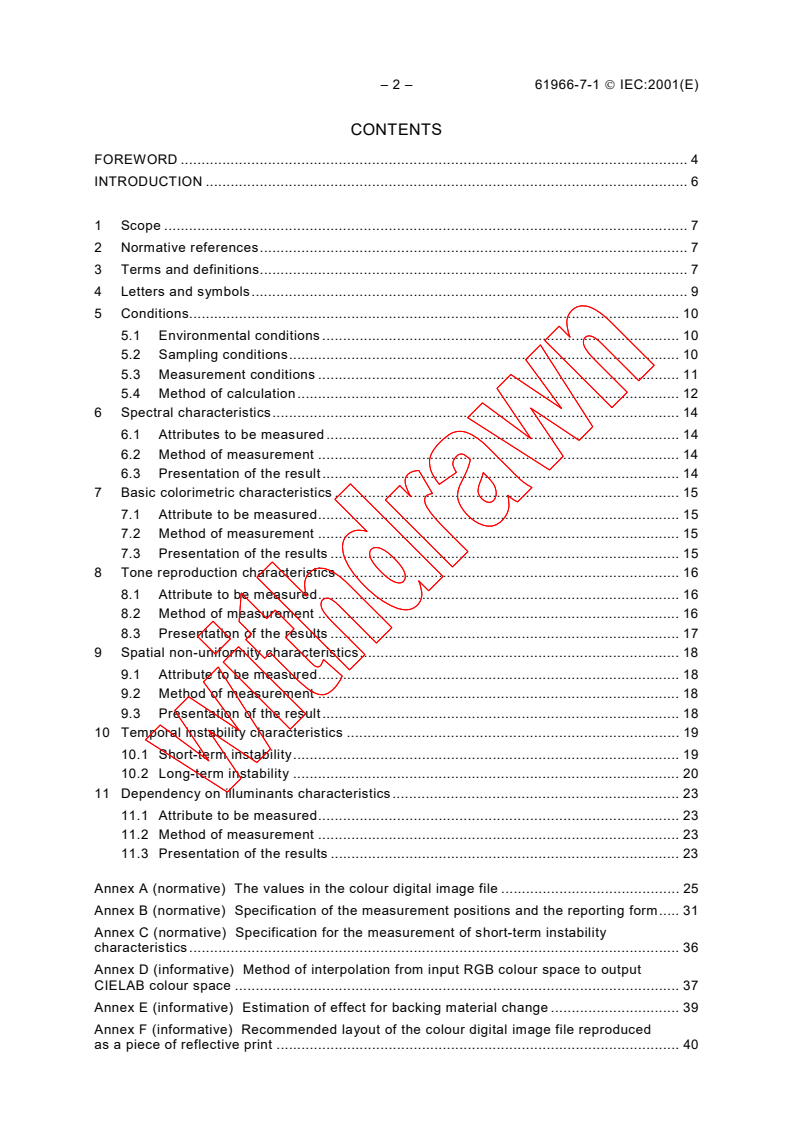
– 2 – 61966-7-1 IEC:2001(E)
CONTENTS
FOREWORD . 4
INTRODUCTION .6
1 Scope . 7
2 Normative references. 7
3 Terms and definitions. 7
4 Letters and symbols. 9
5 Conditions. 10
5.1 Environmental conditions . 10
5.2 Sampling conditions. 10
5.3 Measurement conditions . 11
5.4 Method of calculation. 12
6 Spectral characteristics. 14
6.1 Attributes to be measured . 14
6.2 Method of measurement . 14
6.3 Presentation of the result. 14
7 Basic colorimetric characteristics . 15
7.1 Attribute to be measured. 15
7.2 Method of measurement . 15
7.3 Presentation of the results . 15
8 Tone reproduction characteristics . 16
8.1 Attribute to be measured. 16
8.2 Method of measurement . 16
8.3 Presentation of the results . 17
9 Spatial non-uniformity characteristics. 18
9.1 Attribute to be measured. 18
9.2 Method of measurement . 18
9.3 Presentation of the result. 18
10 Temporal instability characteristics . 19
10.1 Short-term instability. 19
10.2 Long-term instability . 20
11 Dependency on illuminants characteristics. 23
11.1 Attribute to be measured. 23
11.2 Method of measurement . 23
11.3 Presentation of the results . 23
Annex A (normative) The values in the colour digital image file . 25
Annex B (normative) Specification of the measurement positions and the reporting form. 31
Annex C (normative) Specification for the measurement of short-term instability
characteristics. 36
Annex D (informative) Method of interpolation from input RGB colour space to output
CIELAB colour space . 37
Annex E (informative) Estimation of effect for backing material change . 39
Annex F (informative) Recommended layout of the colour digital image file reproduced
as a piece of reflective print . 40
– 3 –
61966-7-1 IEC:2001(E)
Bibliography . 41
Figure 1 – Spectral reflectance of the primary and secondary saturated colours, and
white, grey and black .15
* * *
Figure 2 – Example plots for gamut of colours in the CIE 1976 L a b colour space . 16
Figure 3 – An example of reporting tone reproduction characteristics . 17
Figure D.1 – Cubic R , G and B input space . 37
Table 1 – Reference to table A.1 (a). 14
Table 2 – Reference to table A.1 (c) . 17
Table 3 – Conditions for sampling and measurements. 19
Table 4 – Specification of data in the colour digital image file and the form for reporting
the result in the long-term instability measurement. 22
Table 5 – Specification of colour patches . 23
Table 6 – Specification of data in the colour digital image file and the form of reporting
the result of dependency on illuminants measurement. 24
Table A.1 – Specification of the colour digital image file and the form for reporting . 25
Table B.1 – Form of reporting with measurement positions. 31
Table C.1 – Short-term instability characteristics. 36
– 4 – 61966-7-1 IEC:2001(E)
INTERNATIONAL ELECTROTECHNICAL COMMISSION
___________
MULTIMEDIA SYSTEMS AND EQUIPMENT –
COLOUR MEASUREMENT AND MANAGEMENT –
Part 7-1: Colour printers – Reflective prints – RGB inputs
FOREWORD
1) The IEC (International Electrotechnical Commission) is a worldwide organization for standardization comprising
all national electrotechnical committees (IEC National Committees). The object of the IEC is to promote
international co-operation on all questions concerning standardization in the electrical and electronic fields. To
this end and in addition to other activities, the IEC publishes International Standards. Their preparation is
entrusted to technical committees; any IEC National Committee interested in the subject dealt with may
participate in this preparatory work. International, governmental and non-governmental organizations liaising
with the IEC also participate in this preparation. The IEC collaborates closely with the International
Organization for Standardization (ISO) in accordance with conditions determined by agreement between the
two organizations.
2) The formal decisions or agreements of the IEC on technical matters express, as nearly as possible, an
international consensus of opinion on the relevant subjects since each technical committee has representation
from all interested National Committees.
3) The documents produced have the form of recommendations for international use and are published in the form
of standards, technical specifications, technical reports or guides and they are accepted by the National
Committees in that sense.
4) In order to promote international unification, IEC National Committees undertake to apply IEC International
Standards transparently to the maximum extent possible in their national and regional standards. Any
divergence between the IEC Standard and the corresponding national or regional standard shall be clearly
indicated in the latter.
5) The IEC provides no marking procedure to indicate its approval and cannot be rendered responsible for any
equipment declared to be in conformity with one of its standards.
6) Attention is drawn to the possibility that some of the elements of this international standard may be the subject
of patent rights. The IEC shall not be held responsible for identifying any or all such patent rights.
International Standard IEC 61966-7-1 has been prepared by TC 100/TA 2: Colour
measurement and management, of IEC technical committee 100: Audio, video and multimedia
systems and equipment.
The text of this standard is based on the following documents:
FDIS Report on voting
100/238/FDIS 100/248/RVD
Full information on the voting for the approval of this standard can be found in the report on
voting indicated in the above table.
This publication has been drafted in accordance with the ISO/IEC Directives, Part 3.
Annexes A, B and C form an integral part of this standard.
Annexes D, E and F are for information only.
– 5 –
61966-7-1 IEC:2001(E)
IEC 61966 consists of the following parts, under the general title: Multimedia systems and
equipment – Colour measurement and management:
Part 1: General
Part 2-0: Colour management in multimedia systems
Part 2-1: Colour management – Default RGB colour space – sRGB
Part 2-2: Colour management – Extended RGB colour space – sRGB64
Part 2-3: Colour management – Default YCC colour space – sYCC
Part 3: Equipment using cathode ray tubes
Part 4: Equipment using liquid crystal display panels
Part 5: Equipment using plasma display panels
Part 6: Equipment used for digital image projection
Part 7-1: Colour printers – Reflective prints – RGB inputs
Part 7-2: Colour printers – Reflective prints – CMYK inputs
Part 7-3: Colour printers – Transparent prints
Part 8: Multimedia colour scanners
Part 9: Digital cameras
Part 10: Quality assessment – Colour image in network systems
Part 11: Quality assessment – Impaired video in network systems
The committee has decided that the contents of this publication will remain unchanged until
2004. At this date, the publication will be
• reconfirmed;
• withdrawn;
• replaced by a revised edition, or
• amended.
A bilingual version of this standard may be issued at a later date.
– 6 – 61966-7-1 IEC:2001(E)
INTRODUCTION
This part of IEC 61966 is applicable to characterization of colour printers that produce colour
images on opaque substrate corresponding to digital data files in which colour image
information is expressed in a red – green – blue colour space. The characterization will be
realized by objective measurements to be utilized for colour management in open systems.
The measured and reported results are used to relate the equipment-dependent and
undefined red – green – blue colour space to the default RGB colour space defined as the
sRGB by IEC 61966-2-1. This standard is also applicable to assessment of colour image
attributes on reflective prints reproduced from colour digital image files.
– 7 –
61966-7-1 IEC:2001(E)
MULTIMEDIA SYSTEMS AND EQUIPMENT –
COLOUR MEASUREMENT AND MANAGEMENT –
Part 7-1: Colour printers – Reflective prints – RGB inputs
1 Scope
This part of IEC 61966 specifies a set of data in colour digital image files for measurements,
sampling of successive prints, measurement conditions and forms of reporting the results so
as to make possible the characterization of the colour printer and comparison of the results of
measurements. The sets of data for measurements are in colour digital image files expressed
in a red – green – blue colour space, to which corresponding colour images are reproduced
on reflective substrate. The methods of measurement in this standard are designed to be
applicable to reflective colour prints for consumer use. The reflective colour prints may be
produced by non-impact colour printers, incorporating such technologies as ink-jet,
sublimation transfer, thermal transfer, electro-photography and other similar technologies.
This standard does not specify limiting values for various attributes.
2 Normative references
The following normative documents contain provisions which, through reference in this text,
constitute provisions of this part of IEC 61966. For dated references, subsequent amend-
ments to, or revisions of, any of these publications do not apply. However, parties to
agreements based on this part of IEC 61966 are encouraged to investigate the possibility of
applying the most recent editions of the normative documents indicated below. For undated
references, the latest edition of the normative document referred to applies. Members of IEC
and ISO maintain registers of currently valid International Standards.
IEC 60050(845):1987, International Electrotechnical Vocabulary (IEV) – Chapter 845: Lighting
/ CIE 17.4: 1987, International Lighting Vocabulary (joint IEC/CIE publication)
IEC 61966-2-1:1999, Multimedia systems and equipment – Colour measurement and
management – Part 2-1: Colour management – Default RGB colour space – sRGB
ISO/CIE 10526: 1999, CIE standard illuminants for colorimetry
ISO/CIE 10527:1991, CIE standard colorimetric observers
CIE 15.2:1986, Colorimetry
ISO 216:1975, Writing paper and certain classes of printed matter – Trimmed sizes – A and B
series
3 Terms and definitions
For the purpose of this part of IEC 61966, terms which relate to lighting in
IEC 60050(845)/CIE 17.4 and the following definitions apply.
– 8 – 61966-7-1 IEC:2001(E)
3.1
colour printer
system composed of application program to handle colour digital image files, driver for
equipment that produces colour images on a substrate, and the equipment itself which
accepts equipment specific data for each input channel and is able to process by such
technologies as ink jet, sublimation transfer, thermal transfer, or electro-photography and
other similar technologies
NOTE The colour printer includes a system whereby the equipment that reproduces prints is directly connected to
another piece of equipment in which a set of colour digital image data is contained.
3.2
driver
software code which converts output data from an application program to feed a series of
digital signals to the equipment which produces reflective prints
3.3
application program
any software which has access to the colour digital image file and output colour image
information to the driver, and possibly renders the colour image on displays
3.4
consumable
any material necessary to run colour printers; for example, sheets of paper, toners, ink, fuser
oil, etc.
3.5
half-tone screen
set of rules for two dimensional pixel layouts to render a tone
3.6
image
visible two-dimensional representation of electronic signals intended to form a picture
3.7
substrate
opaque substance providing support for a medium
3.8
reflective print
colour image reproduced on a piece of substrate
3.9
gamut of colours
* * *
three-dimensional maximum range of reproducible colours expressed in CIE 1976 L a b
colour space defined in CIE 15.2
3.10
primary colours
colours used to define a colour space incorporated in the colour digital image file
NOTE Red, green and blue are the primary colours for this standard.
3.11
secondary colours
colours to be defined by a mixture of two primary colours except black
NOTE Cyan, magenta and yellow are the secondary colours for this standard.
– 9 –
61966-7-1 IEC:2001(E)
3.12
saturated colours
primary colours and secondary colours intended to be reproduced corresponding to their
maximum excitation of electronic signals
NOTE Saturation means the maximum excitation purity (chromaticity), limited by each specific system.
3.13
reproduced colours
colorimetric information measured from the reflective print, expressed in the CIE 1976 colour
space defined in CIE 15.2
3.14
tone reproduction
relationship between data in the colour digital image file which are intended to reproduce the
images of primary, secondary and achromatic colours and the CIE 1976 lightness values of
reflective prints actually reproduced
3.15
characterization
process of obtaining the spectral characteristics, basic colorimetric characteristics, tone
reproduction characteristics, spatial non-uniformity characteristics, temporal instability
characteristics or dependency on illuminant characteristics. In general, these characteristics
relate the input RGB signal to some measured CIE colour values
3.16
electronic signal
data prepared as a colour digital image file intended to form a picture
4 Letters and symbols
The letters and symbols consistently adopted in this part of IEC 61966 are summarized below.
The number of samples of reflective prints for measurements
N
s
*
N
u
Metric in colour difference ΔE for spatial non-uniformity within a page
ab
*
Metric in colour difference ΔE for short-term instability among successive
N ab
t
reflective prints
p
Printing speed of the colour printer
S(λ) Spectral power distribution of the illuminant D50
ρ(λ) Spectral reflectance of a printed image
D , D , D Digital data in integers fed to colour printers
R G B
N
R , G , B
Data normalized by 2 −1, where N is the number of bits per channel
~
~
* * *
~ Colour in CIE 1976 UCS in reference to printed colour white, see also
L , a , b
equation (4)
– 10 – 61966-7-1 IEC:2001(E)
5 Conditions
5.1 Environmental conditions
Sampling and measurements shall be carried out within the environmental conditions
specified by the manufacturer of the equipment that produces reflective prints, unless other-
wise specified by this standard. The environmental conditions, at least the room temperature
and the relative humidity, during sampling and measurement, shall be reported together with
the presentation of the results of measurements.
NOTE Recommended environmental conditions are a temperature of 20 °C ± 5 °C, a relative humidity of
65 % ± 10 % and atmospheric pressure from 86 kPa to 106 kPa, unless otherwise specified.
5.2 Sampling conditions
5.2.1 Substrate
The substrate shall be opaque as specified by the manufacturer of the equipment that
produces reflective prints as either recommended or default. The substrate shall be exposed
for at least one day in order to be accustomed to the environmental conditions.
5.2.2 Settings and operation
5.2.2.1 Half-tone screen
All sampling shall be carried out in the half-tone screen mode whenever applicable. This shall
be as specified by the manufacturer of the equipment that produces reflective prints as either
recommended or default. When multiple options such as half-tone screen for texts, graphics,
and natural pictures are available, the choices shall be reported together with the
presentation of the results of measurements.
If the half-tone screen is not applicable, this shall be reported together with the presentation
of the results.
5.2.2.2 Resolution
All sampling shall be carried out with the resolution setting specified by the manufacturer of
the equipment that produces reflective prints as either recommended or default. When
multiple options such as resolution for texts, graphics, natural pictures are available, the
choices shall be reported together with the presentation of the results of measurements.
5.2.2.3 Miscellaneous settings
Colour rendering, digital filtering and tone reproduction characteristics shall be set as
specified by the manufacturer of the printing equipment that produces reflective prints as
either recommended or default.
The application programme used should provide no extra colour processing or enhancement.
Otherwise, a type of colour processing or enhancement shall be reported.
5.2.3 Number of samples
To minimize an error due to short-term variation and non-uniformity within a page, the number
of samples of reflective prints N should be decided by equation (1), except for clause 9, and
s
subclauses 10.1 and 10.2.
2 2
N = N + N (1)
s u t
– 11 –
61966-7-1 IEC:2001(E)
*
where is the metric in colour difference Δ for spatial non-uniformity within a page as
N E
u ab
*
defined in equation (7) and N is the metric in colour difference ΔE for short-term instability
t ab
among successive reflective prints as defined in equation (8).
The number of samples less than N shall be reported together with the presentation of the
s
results of measurements.
NOTE For simplicity of the characterization procedure, N = 1 may be allowed.
s
5.2.4 Operation of colour printers
All sampling shall be carried out in line with the conditions specified in the operation manuals
of the colour printer, unless otherwise specified in this standard.
5.2.5 Electric power source
All sampling shall be carried out with an a.c. power source with nominal voltage ±10% of
stable frequency.
5.2.6 Consumables
All sampling shall be carried out with the consumables for the equipment that produces
reflective prints as specified by the manufacturer of the equipment.
5.2.7 Other conditions
All sampling shall be carried out after the warm-up time specified by the manufacturer of the
equipment that produces reflective prints, unless otherwise specified in this standard.
NOTE If the equipment that produces reflective prints has multiple paper trays, any paper tray can be used for
sampling.
5.3 Measurement conditions
5.3.1 General
To minimize an error due to instability of the instruments for colorimetric measurement, the
reflective prints shall be measured at least three times and the measured data shall be
averaged. The number of average times less than three shall be reported together with the
presentation of the results of measurements.
5.3.2 Spectrophotometric and colorimetric measurements
Reflective prints shall be measured successively without any time interval, unless otherwise
specified.
For spectrophotometric measurement, spectral reflectance of the reflective prints shall be
measured over the wavelengths at least from 400 nm to 700 nm every 10 nm for the reflective
print illuminated by incandescent lamps and every 5 nm for the reflective print illuminated by
fluorescent lamps.
NOTE 1 The measurement over the wavelengths from 380 nm to 780 nm is recommended.
NOTE 2 The spectral reflectance should be measured using a spectrophotometer with either 0°/45° or 45°/0°
geometry as specified in ISO 5-4, in order to remove specular component of the reflected light.
For colorimetric measurement, the spectral radiance of the illumination shall be approximated
to the illuminant D50 defined in table 1.1 of CIE 15.2.
– 12 – 61966-7-1 IEC:2001(E)
The name of the manufacturer of the measuring instrument, the model number and the
manufactured date shall be reported together with the measured results.
5.3.3 Backing material
White backing material, such as five pieces or more of the same substrate, on which the
colour image is printed, shall be used. When other backing materials are used, the
specification of the material shall be reported together with the presentation of the results of
measurements.
NOTE For estimation of the effect of backing material changes, refer to annex E.
5.4 Method of calculation
5.4.1 Illuminants and colorimetric observers
The illuminant D50 defined in table 1.1 of CIE 15.2 and the CIE 1931 Standard Colorimetric
Observer defined in ISO/CIE 10527 shall be used for calculation of the tristimulus values from
the measured spectral data. If any other illuminants are used, it shall be reported.
NOTE For some measurements, optical reflective density may be used, but it should be noted that the measured
values depend on the instruments used for the measurement.
5.4.2 Tristimulus values
The tristimulus values X , Y and Z in the CIE 1931 XYZ colour space for object colours and
illuminant colours shall be calculated by the summations of the products of the spectral power
distribution )S(λ of the illuminant D50, the spectral reflectance ρ(λ) of the printed image, and
the colour matching functions x(λ), y(λ) , z(λ) , in accordance with equation (2);
X = S(λ)ρ(λ)x(λ)dλ
∫
vis
K
Y = S(λ)ρ(λ)y(λ)dλ (2)
∫
vis
K
Z = S(λ)ρ(λ)z(λ)dλ
∫
vis
K
K S()y()d
where = λ λ λ .
∫
vis
5.4.3 CIELAB colour space
* * * * * *
The CIELAB values L , a and b in the CIE 1976 L a b colour space shall be calculated as
in equation (3) in accordance with CIE 15.2.
3
Y
*
L = 116 − 16
Y
n
1 1
X 3 Y 3
*
a = 500 − (3)
X Y
n n
1 1
Y 3 Z 3
*
b = 200 −
Y Z
n n
– 13 –
61966-7-1 IEC:2001(E)
where the tristimulus values , and correspond to the illuminant D50; = 96,42,
X Y Z X
n n n n
Y = 100,00 and Z = 82,49 .
n n
Relative values to the colour white shall also be calculated when it is required in accordance
with equation (4).
~ 3
Y
*
L = 116 − 16
Y
W
1 1
X 3 Y 3
~*
a = 500 − (4)
X Y
W W
1 1
~ 3 3
Y Z
*
b = 200 −
Y Z
W W
where the tristimulus values , and correspond to the printed colour white resulting
X Y Z
W W W
N
from 1D = D =D = 2 − under the illuminant D50.
R G B
5.4.4 Averaging CIELAB values
The colorimetric values in the CIELAB colour space for reproduced colour chips obtained by
multiple printing jobs shall be averaged over all the measured and calculated values as in
equation (5),
N
s
* *
L = L
n
∑
N
s
n=1
N
s
* *
a = a (5)
∑ n
N
s
n=1
N
s
* *
b = b
∑ n
N
s
n=1
for clauses 6, 7 and 8, where N is the number of printing jobs defined in equation (1); and
s
M
* *
L = L
∑ m
M
m=1
M
* *
a = a (6)
∑ m
M
m=1
M
* *
b = b
m
∑
M
=1
m
* *
for 10.1, where M is the number of printing jobs defined in 10.1.2. For simplicity, L , a and
*
b are written without the bars in the following clauses.
– 14 – 61966-7-1 IEC:2001(E)
6 Spectral characteristics
6.1 Attributes to be measured
Spectral reflectance of reflective prints for primary colours, secondary colours, black and
white.
6.2 Method of measurement
The colour digital image file containing data for red – green – blue as the primary colours,
cyan – magenta – yellow as the secondary colours, and black, grey and white shall be
prepared. The names of the colours and the identification numbers in table A.1 (a) are shown
in table 1 below.
Table 1 – Reference to table A.1 (a)
Identification Identification
Colour Colour
number number
Red 1 Yellow 6
Green 2 Black 7
Blue 3 Grey 8
Cyan 4 White 9
Magenta 5
NOTE Actual data in a red – green – blue colour space in table A.1 (a) provide examples for the case of 8 bit
quantization for each channel.
All colours shall be reproduced as a piece of reflective print on one sheet of substrate, as
shown in annex F. It shall be repeated for N times as specified in equation (1). Spectral
s
reflectance )ρ(λ of each reproduced colour patch shall be measured by the spectrophoto-
meter in accordance with the specification in 5.3.2.
6.3 Presentation of the result
The spectral reflectance, ρ(λ), averaged at each wavelength, for the primary saturated
colours, the secondary saturated colours, and black and white shall be plotted as in figure 1.
The measured spectral reflectance of each colour shall be converted to the CIE 1931 XYZ
* * *
values using equation (2), and the CIELAB values in the CIE 1976 L a b colour space shall
be calculated from the tristimulus values in the CIE 1931 XYZ colour space in accordance
with equation (3). The CIELAB values shall be averaged as in equation (5) and entered in the
form shown in table A.1 (a) at the column positions specified in table 1.
– 15 –
61966-7-1 IEC:2001(E)
1 1
9 6
0,8 0,8
1 5
0,6 0,6
0,4 0,4
0,2 0,2
0 0
400 450 500 550 600 650 700
400 450 500 550 600 650 700
Wavelength nm
Wavelength nm
IEC 832/01 IEC 833/01
Figure 1a – Spectral reflectance of the primary Figure 1b – Spectral reflectance of the secondary
saturated colours, grey and white saturated colours and black
NOTE Identification numbers of the plots are the same as in table 1.
Figure 1 – Spectral reflectance of the primary and secondary saturated colours,
and white, grey and black
7 Basic colorimetric characteristics
7.1 Attribute to be measured
Relationship between the data in red – green – blue in the colour digital image file and
reproduced corresponding colours as reflective prints.
7.2 Method of measurement
The colour digital image file containing data for the 6-by-6-by-6 cubic data points specified by
the data identification numbers 10 to 225 in table A.1 (b) shall be used. The file shall be
processed to obtain a piece of reflective print on one sheet of substrate as an arrangement of
colour patches, as shown in annex F, for N times, as specified in equation (1).
s
NOTE The number of the cubic data points may be increased, for example, to account for discontinuities or non-
monotonic artefacts indicated in figure 3.
The spectral reflectance of each colour patch of the reflective print should be measured. The
measured data shall be calculated according to equation (2). The tristimulus values X, Y and
* * *
Z shall be converted to the CIELAB colour space, L , a and b in accordance with equation
(3), which shall be averaged as in equation (5).
NOTE For simplicity of the measurement procedure, colorimeters may be used to acquire the tristimulus values
X, Y and Z directly in accordance with the specification in 5.3.2.
7.3 Presentation of the results
Results of the measurement followed by the calculation shall be entered in the corresponding
column positions of table A.1 (b). The reported CIELAB values shall also be plotted as in
figure 2.
Reflectance
Reflectance
– 16 – 61966-7-1 IEC:2001(E)
–50
–100
–100 –50 0 50 100
a*
IEC 834/01
* *
Figure 2a – Gamut of colours in b versus a plane
L* L*
100 100
80 80
60 60
40 40
20 20
0 0
–100 –50 0 50 100
–100 –50 0 50 100
a*
b*
IEC 835/01 IEC 836/01
* * * *
Figure 2b – Gamut of colours in L versus a plane Figure 2c – Gamut of colours in L versus b plane
NOTE The relationship between the input ( R , G , B ) and output ( L * , a * , b * ) colour spaces should also be
formulated for use in colour management as shown in annex D using the tri-linear interpolation.
* * *
Figure 2 – Example plots for gamut of colours in the CIE 1976 L a b colour space
8 Tone reproduction characteristics
8.1 Attribute to be measured
Relationship between the input data for the primary and secondary colours and black, and the
CIE 1976 lightness of the reproduced colours.
8.2 Method of measurement
The colour digital image file containing data specified by table 2 for the input full scale ranges
shall be prepared for the primary colours, the secondary colours, and black. Table 2 shows
the identification numbers corresponding to table A.1 (c) for each set of colours for
reproduction and measurements.
b*
– 17 –
61966-7-1 IEC:2001(E)
Table 2 – Reference to table A.1 (c)
Colour Identification numbers Colour Identification numbers
Red From 226 to 240 Magenta From 286 to 300
Green From 241 to 255 Yellow From 301 to 315
Blue From 256 to 270 Black From 316 to 336
Cyan From 271 to 285
The file shall be processed to obtain a piece of reflective print on one sheet of substrate as an
arrangement of colour patches, as shown in annex F, for N times, as specified in equation
s
(1).
NOTE The number of cubic data points may be increased, for example, to account for discontinuities or non-
monotonic artefacts indicated in figure 3.
The spectral reflectance of each colour patch of the reflective print shall be measured and the
measured data shall be calculated according to equation (2). One of the tristimulus values, Y ,
*
shall be converted to the lightness L in the CIELAB colour space in accordance with
*
equation (3). The lightness L shall be averaged as in equation (5).
NOTE For simplicity of the measurement procedure, colorimeters may be used to acquire one of the tristimulus
values Y directly in accordance with the specification in 5.3.2.
8.3 Presentation of the results
The measured and calculated results, including the rest of the CIELAB values shall be
*
reported in the columns specified in table 2 to table A.1. The averaged lightness L versus
normalized input data shall also be reported as the plots shown in figure 3, where normalized
input data for red and cyan is (2R + G + B) 4, for green and magenta is (R + 2G + B) 4 and for
black is (R + G + B) 3 .
100 100
90 90
80 80
yellow
70 70
green
cyan
black
60 60
black
magenta
50 50
red
40 40
30 blue 30
20 20
10 10
0 0
0 0,2 0,4 0,6 0,8 1,0 0 0,2 0,4 0,6 0,8 1,0
Normalized input Normalized input
IEC 837/01 IEC 838/01
Figure 3a – Tone reproduction for red, green, blue Figure 3b – Tone reproduction for cyan, magenta,
and black yellow and black
NOTE Output characteristics such as lightness versus chroma may be reported to show gradiations.
Figure 3 – An example of reporting tone reproduction characteristics
CIE 1976 lightness
CIE 1976 lightness
– 18 – 61966-7-1 IEC:2001(E)
9 Spatial non-uniformity characteristics
9.1 Attribute to be measured
Non-uniformity of achromatic image reproduced within one sheet of substrate.
9.2 Method of measurement
The data in the achromatic digital image file for this measurement shall be 80 % of the full
scale for red – green – blue.
The size of the substrate shall be either A4 defined by ISO 216 or letter size . If the other size
is recommended by the manufacturer of the equipment that reproduces the reflective print, it
shall be reported together with the presentation of the results of measurements.
The location of the measurement points should be defined from top-left of the substrate in
landscape and 15 mm ± 2 mm distance to the bottom-right repeatedly, until the next data
point is outside of the substrate. An example of the points is shown in table B.1. If the location
of data points is different from the recommendation, it shall be reported together with the
presentation of the results of measurements.
The spectral reflectance of the reproduced achromatic image should be measured and the
acquired data shall be calculated according to equation (2). The tristimulus values X , Y and
* * *
Z shall be converted to the CIE 1976 L , a , b colour space in accordance with equation
(3).
NOTE For simplicity of the measurement procedure, colorimeters may be used to acquire the tristimulus values X,
Y and Z directly in accordance with the specification in 5.3.2.
9.3 Presentation of the result
Results of the measurement followed by the calculation shall be filled in to the corresponding
*
columns of table B.1. The colour differences from the average of the CIELAB values ΔE at
ab
i
the position i shall also be calculated and reported in table B.1, where the colour difference
shall be
2 2 2
* * * * * * *
ΔE = L − L + a − a + b − b
ab i i i
i
The metric N for use in equation (1) shall also be calculated by the following equation (7):
u
n
*
N = ΔE (7)
u
∑
ab
i
n
i=1
where n is the number of positions of the measurement.
NOTE The other colour difference based on CIE 116 may also be reported.
___________
A paper size used only in North America.
– 19 –
61966-7-1 IEC:2001(E)
10 Temporal instability characteristics
10.1 Short-term instability
10.1.1 Attribute to be measured
Colour variation amongst successive reflective prints.
10.1.2 Method of measurement
A colour digital image data as combinations of data 0 % – 50 % – 100 % for each of red,
green and blue shall be prepared as specified in table C.1 for 1 ≤ j ≤ 27. The colour digital
image file containing 27 colour images in a single page shall be processed to obtain printed
samples in accordance with a basic sampling sequence. The basic sampling sequence shall
consist of seven printing jobs corresponding to the sequence number 1 ≤ i ≤ 7 in table C.1.
The basic sampling sequence shall be conducted under each of the environmental conditions
1 ≤ k ≤ 4 as specified in table 3.
Table 3 – Conditions for sampling and measurements
Conditions ( k ) Ambient temperature Relative humidity
20 °C ± 5 °C 65 % ± 10 %
30 °C ± 5 °C 85 % ± 10 %
10 °C ± 5 °C 15 % ± 10 %
20 °C ± 5 °C 65 % ± 10 %
NOTE It should be noted that atmospheric pressure remains in the range from 86 kPa to 106 kPa during the four
environmental conditions in table 3.
The number of reflective prints M for each sampling sequence for the first and the seventh
printing jobs should be M = round(10 p), where p is the printing speed of the colour printer
under measurement in terms of the number of reflective prints per minute, and should be
M = round(3 p) for the rest of the printing jobs (from the second to the sixth printing job).
NOTE Only the first and the last prints under each environmental condition may be allowed to be used in order to
simplify the measurement procedure.
In order to initiate the basic sampling sequence, the colour printer under measurement shall
be powered off for at least one day to acclimate the colour printer to each of the
environmental conditions in table 3. The first printing job in the sequence shall be started after
the colour printer has been powered on and warmed up in accordance with the manufacturer’s
specifications. The rest of the printing jobs shall be conducted with the time interval of four to
five minutes.
NOTE In the case where the colour printer shuts down at the i -th printing job in the basic sampling sequence
due to any trouble, the sampling sequence should be resumed from the beginning of the i -th printing job after
fixing the trouble.
The spectral reflectance of each of the reproduced colour images should be measured by the
spectrophotometer. The measured spectral data shall be calculated in accordance with
* *
equation (2). The tristimulus values X , Y and Z shall be converted to the CIE 1976 L , a ,
*
b colour space in accordance with equation (3) which shall further be averaged over the
number of reproduced colour images under the same colour ( j ) and the same environmental
condition ( k ).
– 20 – 61966-7-1 IEC:2001(E)
All reproduced colour images, except the set of colour prints obtained in the seventh printing
job under the environmental condition k = 4, shall be discarded. The spectral reflectance of
the colour patches for 1 ≤ j ≤ 27 of the number of prints M for k =4 and i =7 should be
measured by the spectrophotometer. The measured spectral data shall be calculated in
accordance with equation (2).
NOTE For simplicity of the measurement procedure, colorimeters may be used to acquire the tristimulus values
X, Y and Z directly in accordance with the specification in 5.3.2.
10.1.3 Presentation of the result
* * *
The averaged CIELAB values, L , a and b shall be filled in to the corresponding columns of
*
table C.1 together with the environmental condition k . The colour difference ΔE for the
ab
ij
i -th sampling sequence and for the j -th image shall be calculated as follows and reported in
table C.1.
2 2 2
* * * * * * *
ΔE = L − L + a − a + b − b
ab ij j ij j ij j
ij
* * *
where L , a and b are the averages calculated as follows:
j j j
* *
L = L
j ∑ ij
i =1
* *
a = a
j ∑
...