

IEC TR 60943:1998
(Main)Guidance concerning the permissible temperature rise for parts of electrical equipment, in particular for terminals
General Information
- Abstract
Is intended for guidance in estimating the permissible values for temperature and temperature rise of component parts of electrical equipment carrying current under steady state conditions. The present report is intended to supply: - general data on the structure of electric contacts and the calculation of their ohmic resistance; - the basic ageing mechanisms of contacts; - the calculation of the temperature rise of contacts and connection terminals; - the maximum "permissible" temperature and temperature rise for various components, in particular the contacts, the connection terminals and the conductors connected to them; - the general procedure to be followed by product committees for specifying the permissible temperature and temperature rise.
- Status
- Published
- Publication Date
- 23-Mar-2009
- Technical Committee
- TC 32 - Fuses
- Drafting Committee
- WG 2 - TC 32/WG 2
- Current Stage
- PPUB - Publication issued
- Start Date
- 23-Jan-1998
- Completion Date
- 31-Jul-1997
Buy Documents
IEC TR 60943:1998 - Guidance concerning the permissible temperature rise for parts of electrical equipment, in particular for terminals Released:1/23/1998
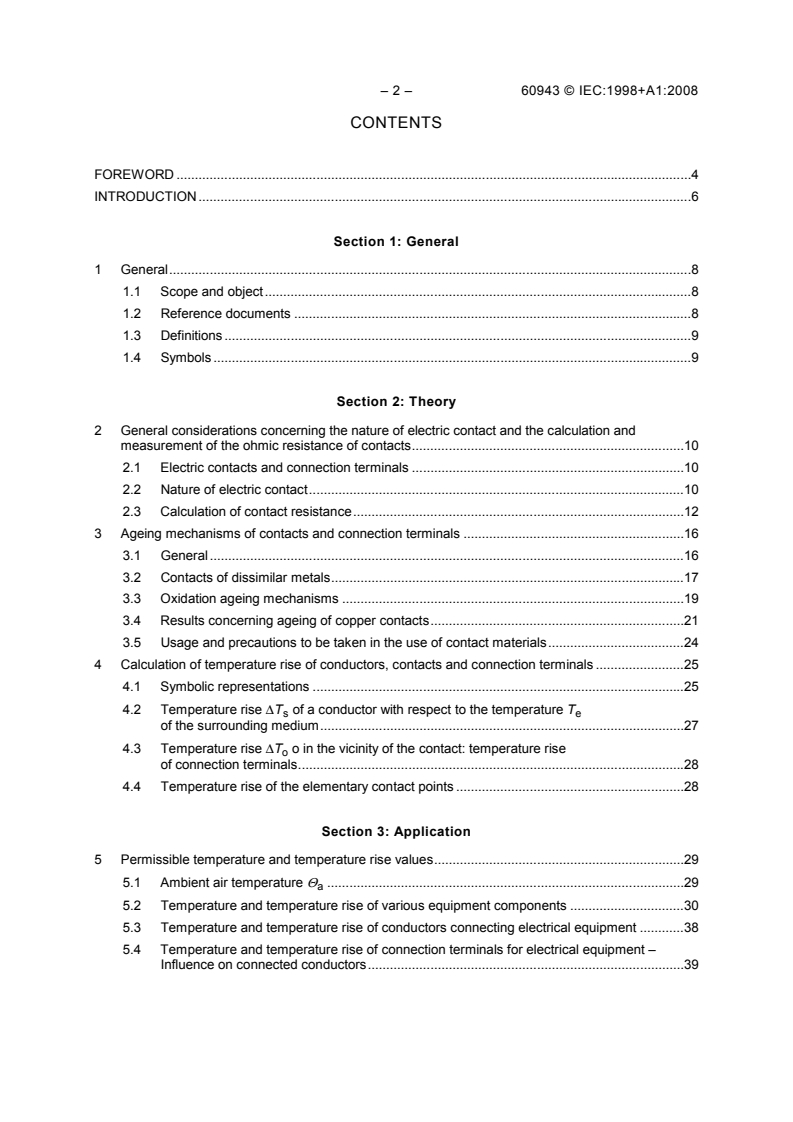
IEC TR 60943:1998+AMD1:2008 CSV - Guidance concerning the permissible temperature rise for parts of electrical equipment, in particular for terminals Released:3/24/2009
Overview
IEC TR 60943:1998 is a technical report published by the International Electrotechnical Commission (IEC) providing comprehensive guidance on the permissible temperature rise for parts of electrical equipment, specifically focusing on terminals. It serves as an essential reference for manufacturers, engineers, and product committees involved in the design, testing, and regulation of electrical assemblies and components that carry current under steady-state conditions.
This standard addresses the calculation, assessment, and specification of allowable temperature increases to prevent damage and ensure longevity of electrical contacts, terminals, and connected conductors. By offering a thorough understanding of heat generation and ageing mechanisms in electrical contacts, IEC TR 60943 plays a crucial role in enhancing safety, reliability, and performance in electrical equipment design.
Key Topics
Temperature Rise Estimation
The document provides formulaic approaches to estimate the temperature rise of conductors, contacts, and terminals during operation. Detailed theory covers the ohmic resistance of electric contacts and the influence of temperature on electrical resistance.Electric Contact Structure and Ageing
Discussions include the material composition of contacts, the nature of electrical contact interfaces, and ageing factors such as oxidation and metal deterioration that impact contact resistance and performance over time.Permissible Temperature Levels
IEC TR 60943 specifies maximum allowable temperatures and temperature rises for various components, ensuring compatibility with insulation materials and minimizing risks of premature equipment failure.General Procedures for Specification
The report guides product committees on defining temperature limits and testing methodologies necessary to confirm compliance with safety and performance criteria under typical and extreme conditions.Environmental and Application Considerations
Guidance addresses factors such as ambient temperature, enclosure design, and heat dissipation mechanisms, highlighting the importance of real-world conditions in temperature rise evaluations.
Applications
IEC TR 60943 is widely applied in the electrical and electronics industries for:
Designing Electrical Assemblies
Engineers utilize the standard to ensure terminals, fuses, conductors, and contactors are designed with appropriate temperature tolerances, reducing thermal stress and extending equipment lifespan.Type Testing and Certification
Manufacturers apply the guidance during type tests to verify that terminal temperature rises do not exceed prescribed limits, supporting certification and regulatory compliance.Product Standards Development
Technical committees use the procedures and data in IEC TR 60943 to establish or update product-specific standards regarding temperature limits for electrical components.Maintenance and Safety Assessments
Facility managers and safety inspectors refer to the standard when evaluating existing electrical installations to detect potential risks related to excessive temperature rises at terminals and contacts.Material Selection for Contacts
The insights on ageing and oxidation mechanisms inform material choices and protective measures in component manufacturing to improve the reliability of electrical connections.
Related Standards
IEC 60947 – Low-voltage Switchgear and Controlgear
Applies especially regarding permissible temperature rises for terminals within switchgear assemblies, complementing guidance in IEC TR 60943.IEC 60204 – Safety of Machinery - Electrical Equipment of Machines
Covers electrical equipment safety requirements including thermal considerations relevant to machine wiring terminals.IEC 60364 – Electrical Installations of Buildings
Addresses installation practices and insulation temperature ratings impacting temperature rise limits of conductors connected to terminals.IEC 61558 – Safety of Power Transformers, Power Supplies, Reactors, and Similar Products
Includes thermal performance criteria related to terminals and electrical connections.UL 486A/B – Wire Connectors and Soldering Lugs for Use with Copper Conductors (Underwriters Laboratories)
Covers mechanical connectors, relevant to permissible temperature rise considerations from a regional perspective.
Summary
IEC TR 60943:1998 is an authoritative resource offering scientific and practical guidance on managing temperature rises in electrical equipment terminals. Understanding and applying this standard enables stakeholders to mitigate thermal risks, guarantee insulation integrity, and sustain reliable electrical connections. It is a vital tool for standardization, design optimization, quality assurance, and compliance within the international electrotechnical community.
Relations
- Effective Date
- 10-Feb-2026
- Effective Date
- 10-Feb-2026
- Effective Date
- 05-Sep-2023
Buy Documents
IEC TR 60943:1998 - Guidance concerning the permissible temperature rise for parts of electrical equipment, in particular for terminals Released:1/23/1998
IEC TR 60943:1998+AMD1:2008 CSV - Guidance concerning the permissible temperature rise for parts of electrical equipment, in particular for terminals Released:3/24/2009
Get Certified
Connect with accredited certification bodies for this standard

IMQ S.p.A. (Certification)
Italian electrical product certification.

SLG Prüf- und Zertifizierungs GmbH
German testing and certification body.

UL Solutions
Global safety science company with testing, inspection and certification.
Sponsored listings
Frequently Asked Questions
IEC TR 60943:1998 is a technical report published by the International Electrotechnical Commission (IEC). Its full title is "Guidance concerning the permissible temperature rise for parts of electrical equipment, in particular for terminals". This standard covers: Is intended for guidance in estimating the permissible values for temperature and temperature rise of component parts of electrical equipment carrying current under steady state conditions. The present report is intended to supply: - general data on the structure of electric contacts and the calculation of their ohmic resistance; - the basic ageing mechanisms of contacts; - the calculation of the temperature rise of contacts and connection terminals; - the maximum "permissible" temperature and temperature rise for various components, in particular the contacts, the connection terminals and the conductors connected to them; - the general procedure to be followed by product committees for specifying the permissible temperature and temperature rise.
Is intended for guidance in estimating the permissible values for temperature and temperature rise of component parts of electrical equipment carrying current under steady state conditions. The present report is intended to supply: - general data on the structure of electric contacts and the calculation of their ohmic resistance; - the basic ageing mechanisms of contacts; - the calculation of the temperature rise of contacts and connection terminals; - the maximum "permissible" temperature and temperature rise for various components, in particular the contacts, the connection terminals and the conductors connected to them; - the general procedure to be followed by product committees for specifying the permissible temperature and temperature rise.
IEC TR 60943:1998 is classified under the following ICS (International Classification for Standards) categories: 29.020 - Electrical engineering in general. The ICS classification helps identify the subject area and facilitates finding related standards.
IEC TR 60943:1998 has the following relationships with other standards: It is inter standard links to CLC/TR 50479:2007, EN 50521:2008, IEC TR 60943:1998/AMD1:2008. Understanding these relationships helps ensure you are using the most current and applicable version of the standard.
IEC TR 60943:1998 is available in PDF format for immediate download after purchase. The document can be added to your cart and obtained through the secure checkout process. Digital delivery ensures instant access to the complete standard document.
Standards Content (Sample)
RAPPORT
CEI
TECHNIQUE
IEC
TECHNICAL
Deuxième édition
REPORT
Second edition
1998-01
Guide concernant l’échauffement admissible
des parties des matériels électriques,
en particulier les bornes de raccordement
Guidance concerning the permissible
temperature rise for parts of electrical equipment,
in particular for terminals
Numéro de référence
Reference number
CEI/IEC 60943:1998
Numéros des publications Numbering
Depuis le 1er janvier 1997, les publications de la CEI As from 1 January 1997 all IEC publications are issued
sont numérotées à partir de 60000. with a designation in the 60000 series.
Publications consolidées Consolidated publications
Les versions consolidées de certaines publications de Consolidated versions of some IEC publications
la CEI incorporant des amendements sont disponibles. including amendments are available. For example,
Par exemple, les numéros d’édition 1.0, 1.1 et 1.2 edition numbers 1.0, 1.1 and 1.2 refer, respectively,
indiquent respectivement la publication de base, la to the base publication, the base publication incor-
publication de base incorporant l’amendement 1, et la porating amendment 1 and the base publication
publication de base incorporant les amendements 1 incorporating amendments 1 and 2.
et 2.
Validité de la présente publication Validity of this publication
Le contenu technique des publications de la CEI est The technical content of IEC publications is kept under
constamment revu par la CEI afin qu'il reflète l'état constant review by the IEC, thus ensuring that the
actuel de la technique. content reflects current technology.
Des renseignements relatifs à la date de reconfirmation Information relating to the date of the reconfirmation of
de la publication sont disponibles dans le Catalogue de the publication is available in the IEC catalogue.
la CEI.
Les renseignements relatifs à ces révisions, à l'établis- Information on the revision work, the issue of revised
sement des éditions révisées et aux amendements editions and amendments may be obtained from IEC
peuvent être obtenus auprès des Comités nationaux de la National Committees and from the following IEC
CEI et dans les documents ci-dessous: sources:
• Bulletin de la CEI • IEC Bulletin
• Annuaire de la CEI • IEC Yearbook
Accès en ligne* On-line access*
• Catalogue des publications de la CEI • Catalogue of IEC publications
Publié annuellement et mis à jour régulièrement Published yearly with regular updates
(Accès en ligne)* (On-line access)*
Terminologie, symboles graphiques Terminology, graphical and letter
et littéraux symbols
En ce qui concerne la terminologie générale, le lecteur For general terminology, readers are referred to IEC
se reportera à la CEI 60050: Vocabulaire Electro- 60050: International Electrotechnical Vocabulary (IEV).
technique International (VEI).
Pour les symboles graphiques, les symboles littéraux et For graphical symbols, and letter symbols and signs
les signes d'usage général approuvés par la CEI, le approved by the IEC for general use, readers are
referred to publications IEC 60027: Letter symbols to
lecteur consultera la CEI 60027: Symboles littéraux à
utiliser en électrotechnique, la CEI 60417: Symboles be used in electrical technology, IEC 60417: Graphical
graphiques utilisables sur le matériel. Index, relevé et symbols for use on equipment. Index, survey and
compilation des feuilles individuelles, et la CEI 60617: compilation of the single sheets and IEC 60617:
Symboles graphiques pour schémas. Graphical symbols for diagrams.
Publications de la CEI établies par IEC publications prepared by the same
le même comité d'études technical committee
L'attention du lecteur est attirée sur les listes figurant à The attention of readers is drawn to the end pages of
la fin de cette publication, qui énumèrent les this publication which list the IEC publications issued
publications de la CEI préparées par le comité d'études by the technical committee which has prepared the
qui a établi la présente publication. present publication.
* Voir adresse «site web» sur la page de titre. * See web site address on title page.
RAPPORT
CEI
TECHNIQUE – TYPE 3
IEC
TECHNICAL
Deuxième édition
REPORT – TYPE 3
Second edition
1998-01
Guide concernant l’échauffement admissible
des parties des matériels électriques,
en particulier les bornes de raccordement
Guidance concerning the permissible
temperature rise for parts of electrical equipment,
in particular for terminals
IEC 1998 Droits de reproduction réservés Copyright - all rights reserved
Aucune partie de cette publication ne peut être reproduite ni No part of this publication may be reproduced or utilized in
utilisée sous quelque forme que ce soit et par aucun any form or by any means, electronic or mechanical,
procédé, électronique ou mécanique, y compris la photo- including photocopying and microfilm, without permission in
copie et les microfilms, sans l'accord écrit de l'éditeur. writing from the publisher.
International Electrotechnical Commission 3, rue de Varembé Geneva, Switzerland
Telefax: +41 22 919 0300 e-mail: inmail@iec.ch IEC web site http: //www.iec.ch
CODE PRIX
Commission Electrotechnique Internationale
PRICE CODE XA
International Electrotechnical Commission
Pour prix, voir catalogue en vigueur
For price, see current catalogue
– 2 – 60943 © CEI:1998
SOMMAIRE
Pages
AVANT-PROPOS . 6
INTRODUCTION . 10
Articles
Section 1: Généralités
1 Généralités . 14
1.1 Domaine d’application et objet . 14
1.2 Documents de référence . 14
1.3 Définitions. 16
1.4 Symboles . 16
Section 2: Théorie
2 Généralités sur la nature du contact électrique, le calcul et le mesurage de la
résistance ohmique des contacts . 18
2.1 Contacts électriques et bornes de raccordement . 18
2.2 Nature du contact électrique. 18
2.3 Calcul de la résistance de contact . 22
3 Mécanismes de vieillissement des contacts et des bornes de raccordement . 30
3.1 Généralités . 30
3.2 Contacts de métaux différents . 32
3.3 Mécanismes de vieillissement par oxydation . 36
3.4 Résultats relatifs au vieillissement des contacts en cuivre . 40
3.5 Mise en oeuvre et précautions à prendre lors de l’utilisation des matériaux
de contact. 46
4 Calcul des échauffements des conducteurs, des contacts et des bornes
de raccordement . 48
4.1 Représentation symbolique . 48
4.2 Echauffement ΔT d’un conducteur par rapport à la température T du fluide
s e
environnant . 52
4.3Echauffement ΔT au voisinage du contact: échauffement des bornes de
o
raccordement . 54
4.4 Echauffement des points de contact élémentaires . 54
Section 3: Application
5 Valeurs admissibles des températures et des échauffements . 56
5.1 Température de l’air ambiant Θ . 56
a
5.2 Température et échauffement des différents organes d’un matériel
électrique . 58
5.3 Température et échauffement des conducteurs de raccordement
d’un matériel électrique . 74
5.4 Températures et échauffements des bornes de raccordement d’un matériel
électrique – Influence sur les conducteurs raccordés . 76
60943 © IEC:1998 – 3 –
CONTENTS
Page
FOREWORD . 7
INTRODUCTION . 11
Clause
Section 1: General
1 General. 15
1.1 Scope and object . 15
1.2 Reference documents. 15
1.3 Definitions. 17
1.4 Symbols. 17
Section 2: Theory
2 General considerations concerning the nature of electric contact and the calculation
and measurement of the ohmic resistance of contacts . 19
2.1 Electric contacts and connection terminals . 19
2.2 Nature of electrical contact. 19
2.3 Calculation of contact resistance . 23
3 Ageing mechanisms of contacts and connection terminals . 31
3.1 General. 31
3.2 Contacts of dissimilar metals. 33
3.3 Oxidation ageing mechanisms. 37
3.4 Results concerning ageing of copper contacts . 41
3.5 Usage and precautions to be taken in the use of copper contact materials . 47
4 Calculation of temperature rise of conductors, contacts and connection terminals . 49
4.1 Symbolic representation. 49
4.2 Temperature rise ΔT of a conductor with respect to the temperature T of the
s e
surrounding medium. 53
4.3 Temperature rise ΔT in the vicinity of the contact: temperature rise
o
of connection terminals . 55
4.4 Temperature rise of the elementary contact points. 55
Section 3: Application
5 Permissible temperature and temperature rise values. 57
5.1 Ambient air temperature Θ . 57
a
5.2 Temperature and temperature rise of various equipment components . 59
5.3 Temperature and temperature rise of conductors connecting electrical
equipment. 75
5.4 Temperature and temperature rise of connection terminals for electrical
equipment – Influence on connected conductors. 77
– 4 – 60943 © CEI:1998
Articles Pages
6 Marche générale à suivre pour la détermination des températures et échauffements
admissibles . 78
6.1 Paramètres fondamentaux . 78
6.2 Méthode à suivre pour déterminer les températures et les échauffements
maximaux admissibles . 78
Annexes
A Exemples numériques de l’application de la théorie et autres caractéristiques . 82
B Caractéristiques physiques de quelques métaux et alliages . 88
C Caractéristiques physiques de fluides diélectriques . 90
D Données sur la réaction des métaux de contact avec les substances de l’atmosphère 92
E Echauffement d’un conducteur refroidi par rayonnement et convection près
d’une borne. 94
F Liste des symboles littéraux utilisés . 112
G Bibliographie . 116
60943 © IEC:1998 – 5 –
Clause Page
6 General procedure to be followed for determining permissible temperature and
temperature rise. 79
6.1 Basic parameters. 79
6.2 Method to be followed for determining maximum permissible temperature
and temperature rise . 79
Annexes
A Numerical examples of the application of the theory and other data . 83
B Physical characteristics of selected metals and alloys. 89
C Physical characteristics of fluid dielectrics . 91
D Information on the reaction of contact metals with substances in the atmosphere. 93
E Temperature rise of a conductor cooled by radiation and convection
in the vicinity of a terminal . 95
F List of symbols used in this report. 113
G Bibliography . 117
– 6 – 60943 © CEI:1998
COMMISSION ÉLECTROTECHNIQUE INTERNATIONALE
__________
GUIDE CONCERNANT L'ÉCHAUFFEMENT ADMISSIBLE
DES PARTIES DES MATÉRIELS ÉLECTRIQUES, EN PARTICULIER
LES BORNES DE RACCORDEMENT
AVANT-PROPOS
1) La CEI (Commission Electrotechnique Internationale) est une organisation mondiale de normalisation composée
de l'ensemble des comités électrotechniques nationaux (Comités nationaux de la CEI). La CEI a pour objet de
favoriser la coopération internationale pour toutes les questions de normalisation dans les domaines de
l'électricité et de l'électronique. A cet effet, la CEI, entre autres activités, publie des Normes Internationales.
Leur élaboration est confiée à des comités d'études, aux travaux desquels tout Comité national intéressé par le
sujet traité peut participer. Les organisations internationales, gouvernementales et non gouvernementales, en
liaison avec la CEI, participent également aux travaux. La CEI collabore étroitement avec l'Organisation
Internationale de Normalisation (ISO), selon des conditions fixées par accord entre les deux organisations.
2) Les décisions ou accords officiels de la CEI concernant les questions techniques, représentent, dans la mesure
du possible un accord international sur les sujets étudiés, étant donné que les Comités nationaux intéressés
sont représentés dans chaque comité d’études.
3) Les documents produits se présentent sous la forme de recommandations internationales. Ils sont publiés
comme normes, rapports techniques ou guides et agréés comme tels par les Comités nationaux.
4) Dans le but d'encourager l'unification internationale, les Comités nationaux de la CEI s'engagent à appliquer de
façon transparente, dans toute la mesure possible, les Normes internationales de la CEI dans leurs normes
nationales et régionales. Toute divergence entre la norme de la CEI et la norme nationale ou régionale
correspondante doit être indiquée en termes clairs dans cette dernière.
5) La CEI n’a fixé aucune procédure concernant le marquage comme indication d’approbation et sa responsabilité
n’est pas engagée quand un matériel est déclaré conforme à l’une de ses normes.
6) L’attention est attirée sur le fait que certains des éléments de la présente Norme internationale peuvent faire
l’objet de droits de propriété intellectuelle ou de droits analogues. La CEI ne saurait être tenue pour
responsable de ne pas avoir identifié de tels droits de propriété et de ne pas avoir signalé leur existence.
La tâche principale des comités d’études de la CEI est l’élaborer des Normes internationales.
Exceptionnellement, un comité d’études peut proposer la publication d’un rapport technique de
l’un des types suivants:
• type 1, lorsque, en dépit de maints efforts, l’accord requis ne peut être réalisé en faveur
de la publication d’une Norme internationale;
• type 2, lorsque le sujet en question est encore en cours de développement technique
ou lorsque, pour une raison quelconque, la possibilité d’un accord pour la publication
d’une Norme internationale peut être envisagée pour l’avenir mais pas dans l’immédiat;
• type 3, lorsqu’un comité d’études a réuni des données de nature différente de celles qui
sont normalement publiées comme Normes internationales, cela pouvant comprendre, par
exemple, des informations sur l’état de la technique.
Les rapports techniques des types 1 et 2 font l’objet d’un nouvel examen trois ans au plus tard
après leur publication afin de décider éventuellement de leur transformation en Normes
internationales. Les rapports techniques du type 3 ne doivent pas nécessairement être révisés
avant que les données qu’ils contiennent ne soient plus jugées valables ou utiles.
La CEI 60943, rapport technique de type 3, a été établi par le comité d’études 32 de la CEI:
Coupe-circuit à fusibles.
Cette deuxième édition annule et remplace la première édition parue en 1989.
60943 © IEC:1998 – 7 –
INTERNATIONAL ELECTROTECHNICAL COMMISSION
__________
GUIDANCE CONCERNING THE PERMISSIBLE TEMPERATURE RISE
FOR PARTS OF ELECTRICAL EQUIPMENT,
IN PARTICULAR FOR TERMINALS
FOREWORD
1) The IEC (International Electrotechnical Commission) is a worldwide organization for standardization comprising
all national electrotechnical committees (IEC National Committees). The object of the IEC is to promote
international co-operation on all questions concerning standardization in the electrical and electronic fields. To
this end and in addition to other activities, the IEC publishes International Standards. Their preparation is
entrusted to technical committees; any IEC National Committee interested in the subject dealt with may
participate in this preparatory work. International, governmental and non-governmental organizations liaising
with the IEC also participate in this preparation. The IEC collaborates closely with the International Organization
for Standardization (ISO) in accordance with conditions determined by agreement between the two
organizations.
2) The formal decisions or agreements of the IEC on technical matters express, as nearly as possible, an
international consensus of opinion on the relevant subjects since each technical committee has representation
from all interested National Committees.
3) The documents produced have the form of recommendations for international use and are published in the form
of standards, technical reports or guides and they are accepted by the National Committees in that sense.
4) In order to promote international unification, IEC National Committees undertake to apply IEC International
Standards transparently to the maximum extent possible in their national and regional standards. Any
divergence between the IEC Standard and the corresponding national or regional standard shall be clearly
indicated in the latter.
5) The IEC provides no marking procedure to indicate its approval and cannot be rendered responsible for any
equipment declared to be in conformity with one of its standards.
6) Attention is drawn to the possibility that some of the elements of this International Standard may be the subject
of patent rights. The IEC shall not be held responsible for identifying any or all such patent rights.
The main task of IEC technical committees is to prepare International Standards. In
exceptional circumstances, a technical committee may propose the publication of a technical
report of one of the following types:
• type 1, when the required support cannot be obtained for the publication of an
International Standard, despite repeated efforts;
• type 2, when the subject is still under technical development or where for any other
reason there is the future but no immediate possibility of an agreement on an International
Standard;
• type 3, when a technical committee has collected data of a different kind from that
which is normally published as an International Standard, for example "state of the art".
Technical reports of types 1 and 2 are subject to review within three years of publication to
decide whether they can be transformed into International Standards. Technical reports of
type 3 do not necessarily have to be reviewed until the data they provide are considered to be
no longer valid or useful.
IEC 60943, which is a technical report of type 3, has been prepared by IEC technical
committee 32: Fuses.
This second edition cancels and replace the first edition which was issued in 1989.
– 8 – 60943 © CEI:1998
Le texte de ce rapport technique est issu des documents suivants:
Projet de comité Rapport de vote
32/142/CDV 32/148/RVC
Le rapport de vote indiqué dans le tableau ci-dessus donne toute information sur le vote
ayant abouti à l'approbation de ce rapport technique.
Les annexes sont données à titre d’information.
60943 © IEC:1998 – 9 –
The text of this technical report is based on the following documents:
Committee draft Report on voting
32/142/CDV 32/148/RVC
Full information on the voting for the approval of this technical report can be found in the report
on voting indicated in the above table.
Annexes are for information only.
– 10 – 60943 © CEI:1998
INTRODUCTION
a) Les échauffements rencontrés dans les matériels électriques, résultant des différentes
pertes dissipées dans les conducteurs, contacts, circuits magnétiques, etc., prennent une
importance croissante avec le développement des nouvelles techniques de construction et
d'exploitation des appareils.
Cette évolution a été particulièrement sensible dans le domaine des matériels où de
nombreux organes dissipant de l'énergie (contacteurs, fusibles, résistances, etc.), en
particulier les dispositifs modulaires, se trouvent réunis à l'intérieur d'enveloppes en
matériaux synthétiques peu perméables à la chaleur.
Ces échauffements se traduisent par une température relativement élevée des éléments
essentiels que représentent les contacts électriques: une température élevée favorise
l'oxydation à l'interface du contact, augmente sa résistance, ce qui aboutit à un
échauffement plus important, donc à une température encore plus élevée. Si le matériau
constituant le contact est inadapté ou insuffisamment protégé, le contact peut être détruit
avant que la durée de vie escomptée de l'appareil qui l'emploie ne soit écoulée.
Ces échauffements affectent également les bornes de raccordement ainsi que les
conducteurs qui y sont raccordés, et il convient d'en limiter les effets pour la bonne tenue
des isolants de ces conducteurs pendant la durée de vie de l'installation.
b) Compte tenu de ces problèmes, le présent rapport a été établi avec les objectifs suivants:
– analyser les différents phénomènes d'échauffement et d'oxydation auxquels sont sujets
les contacts, les bornes de raccordement et les conducteurs qui y aboutissent, en
fonction de leur environnement et de leur disposition;
– fournir aux comités de produit des règles élémentaires afin de leur permettre de préciser
des températures et des échauffements admissibles.
c) L'attention est tout particulièrement attirée sur les précautions à prendre pour les
ensembles de constituants lorsqu'il y a rassemblement d'organes à l'intérieur d'une même
enveloppe.
Il convient d'attirer l'attention des utilisateurs sur le fait que les échauffements des bornes
admis par les normes particulières d'appareillage résultent de situations conventionnelles
pendant les essais de type; celles-ci peuvent s'écarter notablement de situations
rencontrées en pratique, dont il y a lieu de tenir compte, en particulier à cause des
températures admises par les isolants des conducteurs qui peuvent être reliés aux bornes
dans des conditions normales.
d) L'attention est attirée sur le fait que, dans les normes de produit correspondantes, la
température et les échauffements admissibles des bornes externes sont mesurés au cours
d'essais de type conventionnels et peuvent donc ne pas refléter la situation susceptible de
se produire en usage normal.
Il convient donc d'adopter des précautions particulières pour éviter une exposition à des
températures qui peuvent avoir une incidence sur la durée de vie des matériaux reliés aux
bornes des composants.
Il est essentiel, dans ce cas, de bien distinguer la notion de «température ambiante
externe» qui règne à l'extérieur d'une enveloppe de celle de «température du fluide
environnant un organe» qui est la somme de la température ambiante externe et de
l'échauffement interne dû aux organes. Ces notions, et d'autres notions complémentaires
telles que la résistance thermique d'une enveloppe, sont présentées dans l'article 5 et
développées concrètement dans des exemples numériques.
Afin de faciliter un calcul complet, ce rapport relie la température du fluide environnant un
organe à la température ambiante externe grâce à l'introduction de la notion de «coefficient
de remplissage» et donne un exemple numérique (5.2.3.2.) qui précise les valeurs du
coefficient de remplissage à utiliser dans quelques cas pratiques.
60943 © IEC:1998 – 11 –
INTRODUCTION
a) The temperature rise encountered in electrical assemblies as a result of the various losses
in the conductors, contacts, magnetic circuits, etc. is of growing importance as a result of
the development of new techniques of construction and operation of equipment.
This development has been particularly significant in the field of assemblies, where
numerous components dissipating energy (contactors, fuses, resistors, etc.), in particular
modular devices are found within enclosures of synthetic materials which are somewhat
impermeable to heat.
This temperature rise results in a relatively high temperature of the basic elements
constituting the electric contacts: a high temperature favours oxidation at the contact
interface, increases its resistance and thereby leads to further heating, and thus to an even
higher temperature. If the component material of the contact is unsuitable or insufficiently
protected, the contact may be irreparably damaged before the calculated useful life of the
equipment has expired.
Such temperature rises also affect connection terminals and the connected conductors, and
their effects should be limited in order to ensure that the insulation of the conductors
remains satisfactory throughout the life of the installation.
b) In view of these problems, this report has been prepared with the following objectives:
– to analyze the various heating and oxidation phenomena to which the contacts, the
connection terminals and the conductors leading to them are subjected, depending on
their environment and their arrangement;
– to provide elementary rules to product committees to enable them to specify permissible
temperatures and temperature rises.
c) Attention is drawn to the precautions to be taken for sets of components when parts are
grouped together in the same enclosure.
The attention of users should be drawn particularly to the fact that the temperature rise of
terminals permitted by particular switchgear standards results from conventional situations
during type tests; these can differ appreciably from the situations met with in practice, which
have to be taken into account, particularly because of the temperatures permitted by the
insulation of the conductors which may be connected to the terminals under normal
conditions.
d) Attention is drawn to the fact that in the relevant product standards, the permissible
temperature and temperature rise for the external terminals are measured during
conventional type tests and therefore they may not reflect the actual situation likely to occur
in normal use.
Suitable precautions should then be adopted to avoid exposure to temperatures that may
affect the life of materials adjacent to the terminals of components.
In this case, it is essential to distinguish the concept of "external ambient temperature"
which prevails outside the enclosure from that of "the temperature of the fluid surrounding a
part" which comprises the external ambient temperature plus the internal temperature rise
due to the parts. These concepts, as well as other complementary concepts such as the
thermal resistance of an enclosure, are dealt with in clause 5 and explained by means of
numerical examples.
In order to facilitate complete calculation, this report links up the temperature of the fluid
surrounding a component to the external ambient temperature by the introduction of the
concept of "coefficient of filling" and gives a numerical example (5.2.3.2) which specifies the
values of the coefficient of filling to be used in several practical cases.
– 12 – 60943 © CEI:1998
Les grandeurs intervenant dans le calcul de la résistance de constriction d'un contact sont
sujettes à de grandes variations dues aux conditions physiques et au degré de
contamination des surfaces en contact. Par le calcul uniquement, la résistance de contact
peut être estimée, mais avec une précision n'excédant pas un ordre de grandeur.
Des valeurs plus précises peuvent être obtenues par mesure directe sur des matériels
électriques donnés, car en pratique, il arrive souvent que d’autres phénomènes de
dégradation imprévisibles par le calcul prédominent. C'est pourquoi les forces de contact
basées sur l'expérience à long terme du constructeur d'un matériel donné doivent être
prises en compte lors de la conception.
Ce rapport n’est pas supposé guider pour le déclassement des composants.
Il est fortement conseillé d'étudier les ouvrages cités en référence à l’annexe G du présent
rapport avant de tenter d'appliquer les données à un problème pratique.
60943 © IEC:1998 – 13 –
The quantities involved in calculating contact constriction resistance are subject to wide
variations due to the physical conditions and degree of contamination of the surface in
contact. By calculation alone, therefore, the contact resistance can be estimated to an
accuracy of no better than an order of magnitude.
More precise and more accurate values should be obtained by direct measurement on given
items of electrical equipment, because in practice it is often the case that other incalculable
degradation mechanisms predominate.
This report is not meant to give guidance on the derating of components.
It is strongly advised that the reference literature quoted at the end of this report be studied
before attempting to apply the data to a practical problem.
– 14 – 60943 © CEI:1998
GUIDE CONCERNANT L'ÉCHAUFFEMENT ADMISSIBLE
DES PARTIES DES MATÉRIELS ÉLECTRIQUES, EN PARTICULIER
LES BORNES DE RACCORDEMENT
Section 1: Généralités
1 Généralités
1.1 Domaine d’application et objet
Le présent rapport est destiné à servir de guide lorsqu’il s’agit d’estimer des valeurs
admissibles pour les températures et les échauffements des parties conductrices de matériels
électriques en régime établi.
Ce rapport s’applique aux raccordements électriques de puissance, ainsi qu’aux matériaux
avoisinants.
Le présent rapport est concerné par les effets thermiques du courant passant au travers des
connexions; il n’y a pas de limites de tension pour sa mise en application.
Le présent rapport est applicable seulement lorsqu’il y est fait référence dans la norme de
produit applicable.
Les comités d’études individuels seront responsables de l’extension et de la façon dont les
termes du présent rapport sont utilisés dans leurs documents normatifs.
Lorsqu’il est fait référence à des valeurs «admissibles» dans le présent rapport, il s’agit des
valeurs autorisées par les normes de produit s’y rapportant.
Le présent rapport se propose de fournir:
– les données générales sur la structure des contacts électriques et le calcul de leur
résistance ohmique;
– les mécanismes fondamentaux du vieillissement des contacts;
– le calcul de l’échauffement des contacts et des bornes de connexion;
– les températures et échauffements maximaux admissibles pour différents organes de
matériels, en particulier les contacts, les bornes de connexion et les conducteurs qui leur
sont raccordés;
– la marche générale à suivre par le comité de produit pour spécifier les températures et
échauffements admissibles.
1.2 Documents en références
CEI 60050(441):1984, Vocabulaire Electrotechnique International (VEI) – Chapitre 441:
Appareillage et fusibles
CEI 60085:1984, Evaluation et classification thermiques de l'isolation électrique
60943 © IEC:1998 – 15 –
GUIDANCE CONCERNING THE PERMISSIBLE TEMPERATURE RISE
FOR PARTS OF ELECTRICAL EQUIPMENT,
IN PARTICULAR FOR TERMINALS
Section 1: General
1 General
1.1 Scope and object
This report is intended for guidance in estimating the permissible values for temperature and
temperature rise of component parts of electrical equipment carrying current under steady
state conditions.
This report applies to electrical power connections and materials adjacent to them.
This report is concerned with the thermal effects of currents passing through connections,
therefore there are no voltage limits to its application.
This report is only applicable when referred to in the appropriate product standard.
The extent and manner to which the contents of this report are used in standards is the
responsibility of individual Technical Committees.
Whenever "permissible" values are stated in this report, they mean values permitted by the
relevant product standard.
The present report is intended to supply:
– general data on the structure of electric contacts and the calculation of their ohmic
resistance;
– the basic ageing mechanisms of contacts;
– the calculation of the temperature rise of contacts and connection terminals;
– the maximum “permissible” temperature and temperature rise for various components, in
particular the contacts, the connection terminals and the conductors connected to them;
– the general procedure to be followed by product committees for specifying the permissible
temperature and temperature rise.
1.2 Reference documents
IEC 60050(441):1984, International Electrotechnical Vocabulary (IEV) – Chapter 441: Switch-
gear and controlgear and fuses
IEC 60085:1984, Thermal evaluation and classification of electrical insulation
– 16 – 60943 © CEI:1998
CEI 60216-1:1990, Guide pour la détermination des propriétés d'endurance thermique de
matériaux isolants électriques – Première partie: Guide général relatif aux méthodes de
vieillissement et à l’évaluation des résultats d’essai
CEI 60364-4-42:1980, Installations électriques des bâtiments – Quatrième partie: Protection
pour assurer la sécurité – Chapitre 42: Protection contre les effets thermiques
CEI 60694:1996, Spécifications communes aux normes de l’appareillage à haute tension
CEI 60721-2-1:1982, Classification des conditions d'environnement – Deuxième partie:
Conditions d’environnement présentes dans la nature – Température et humidité
CEI 60890:1987, Méthode de détermination par extrapolation des échauffements pour les
ensembles d’appareillage à basse tension dérivés de série (EDS)
CEI 60947-1:1988, Appareillage à basse tension – Première partie: Règles générales.
1.3 Définitions
Pour les besoins du présent rapport, les définitions du Vocabulaire Electrotechnique
International s’appliquent, ainsi que les suivantes:
1.3.1
température de l'air ambiant ΘΘ
a
température de l'air environnant un appareil complet, et définie suivant des conditions
prescrites [VEI 441-11-13]
NOTE – Pour les appareils installés à l'intérieur d'une enveloppe, c'est la température de l'air à l'extérieur de
l'enveloppe.
1.3.2
contact (d'un appareil mécanique de connexion)
pièces conductrices destinées à établir la continuité d'un circuit lorsqu'elles se touchent et qui,
par leur mouvement relatif pendant la manoeuvre, ouvrent et ferment un circuit, ou dans le cas
de contacts pivotants ou glissants, maintiennent la continuité du circuit.
[VEI 441-15-05]
NOTE – Ne pas confondre cette définition avec celle du VEI 441-15-06 (pièce de contact: une des parties
conductrices formant contact).
1.3.3
raccord (par boulons ou dispositifs équivalents)
ensemble de pièces conductrices destinés à assurer la continuité permanente d’un circuit
lorsqu’elles sont assemblées au moyen de vis, de boulons ou de dispositifs équivalents.
[3.5.10 de la CEI 60694]
1.4 Symboles
La liste des symboles utilisés dans le présent rapport est donnée dans l’annexe F.
60943 © IEC:1998 – 17 –
IEC 60216-1:1990, Guide for the determination of thermal endurance properties of electrical
insulating materials – Part 1: general guidelines for ageing procedures and evaluation of the
test results
IEC 60364-4-42:1980, Electrical installations of buildings – Part 4: Protection for safety -
Chapter 42: Protection against thermal effects
IEC 60694:1996, Common specifications for high-voltage switchgear and controlgear standards
IEC 60721-2-1:1982, Classification of environmental conditions – Part 2: environmental
conditions appearing in nature. Temperature and humidity
IEC 60890:1987, A method of temperature-rise assessment by extrapolation for partially type-
tested assemblies (PTTA) of low voltage switchgear and controlgear
IEC 60947-1:1988, Low-voltage switchgear and controlgear – Part 1: General rules
1.3 Definitions
Definitions of terms used in this report may be found in the International Electrotechnical
Vocabulary. For the purposes of this technical report, the following terms also apply:
1.3.1
ambient air temperature ΘΘ
a
the temperature, determined under prescribed conditions, of the air surrounding the complete
device [IEV 441-11-13]
NOTE – For devices installed inside an enclosure, it is the temperature of the air outside the enclosure.
1.3.2
contact (of a mechanical switching device)
conductive parts designed to establish circuit continuity when they touch and which, due to
their relative motion during an operation, open or close a circuit or, in the case of hinged or
sliding contacts, maintain circuit continuity [IEV 441-15-05]
NOTE – Do not confuse with "IEV 441-15-06 Contact (piece): one of the conductive parts forming a contact."
1.3.3
connection (bolted or the equivalent)
two or more conductors designed to ensure permanent circuit continuity when forced together
by means of screws, bolts, or the equivalent [3.5.10 of IEC 60694]
1.4 Symbols
A list of symbols used in this report is given in annex F.
– 18 – 60943 © CEI:1998
Section 2: Théorie
NOTE – La présente théorie s’applique aussi bien aux «contacts» qu’aux «connexions», tels que définis en 1.3.2
et 1.3.3. Pour des raisons pratiques, seul le mot «contact» est utilisé dans la section 2.
2 Généralités sur la nature du contact électrique, le calcul et le mesurage
de la résistance ohmique des contacts
2.1 Contacts électriques et bornes de raccordement
Le contact électrique, dans sa configuration la plus simple et la plus générale, résulte de la
mise en contact de deux pièces en matériau conducteur, généralement métallique. Dans le cas
des bornes de raccordement, il s'agit de la borne elle-même et du conducteur qui lui est
raccordé.
La zone active est l’«interface» de contact qui est le siège du passage du courant d'une pièce
à l'autre. C'est dans cette région que réside la résistance de contact, source d'échauffement
par effet Joule, et c'est aussi où s'exerce le vieillissement par réaction chimique avec
l'atmosphère ambiante.
2.2 Nature du contact électrique
Lorsqu'on applique deux pièces métalliques l'une contre l'autre, le contact ne s'effectue pas
sur toute la surface apparente de contact, mais seulement en un certain nombre de points
appelés «contacts élémentaires».
)
La section effective totale de ces contacts est égale à la surface d'appui S si l'on néglige à
a
l'interface des contacts la présence éventuelle d'impuretés (poussières, etc.). En outre, une
fine couche d'air ou d'oxyde, dont l'effet sur la résistance de contact sera examiné
ultérieurement (voir 2.3), est normalement présente.
Dans ce qui suit, pour la commodité des calculs et pour une meilleure compréhension des
mécanismes de contact, on suppose qu'il existe, sur la surface apparente de contact, n
contacts élémentaires, uniformément répartis, de rayon moyen constant a (voir figure 1). La
distance moyenne entre contacts élémentaires est l.
La surface réelle de contact est alors:
S = n π a
a
¶¶¶¶¶¶¶¶¶¶
)
Pour l’explication des symboles utilisés dans la présente norme, se reporter à l’annexe F.
60943 © IEC:1998 – 19 –
Section 2: Theory
NOTE – This theory applies to both "contacts" and "connections" as defined in 1.3.2 and 1.3.3. For convenience,
only the word "contact" only is used in this section to cover both applications.
2 General considerations concerning the nature of electric contact and
the calculation and measurement of the ohmic resistance of contacts
2.1 Electric contacts and connection terminals
Electric contact, in its simplest and most general configuration, results from contact
established between two pieces of (usually metallic) conducting material. In the case of
connection terminals, these are the terminal itself and the conductor which is connected to it.
The active zone is the contact "interface" which is the region where the current passes from
one piece to the other. It is in this area that the contact resistance occurs, causing heating by
Joule effect, and it is also where ageing occurs through chemical reaction with the surrounding
atmosphere.
2.2 Nature of electric contact
When one piece of metal is applied to another, contact is not made over the whole apparent
contact area, but only at a certain number of points called "elementary contacts".
The effective total cross-sectional area of these contacts is equal to the effective contact area
)
S if the possible presence of impurities is ignored (dust, etc.) at the contact interface.
a
There is also a fine layer of air or of oxide normally present, the effect of which upon the
contact resistance will be examined later (see 2.3).
In the following, for ease of calculation and for a better understanding of the c
...
IEC TR 60943 ®
Edition 2.1 2009-03
CONSOLIDATED VERSION
TECHNICAL
REPORT
RAPPORT
TECHNIQUE
Guidance concerning the permissible temperature rise for parts of electrical
equipment, in particular for terminals
Guide concernant l’échauffement admissible des parties des matériels
électriques, en particulier les bornes de raccordement
All rights reserved. Unless otherwise specified, no part of this publication may be reproduced or utilized in any form
or by any means, electronic or mechanical, including photocopying and microfilm, without permission in writing from
either IEC or IEC's member National Committee in the country of the requester. If you have any questions about IEC
copyright or have an enquiry about obtaining additional rights to this publication, please contact the address below or
your local IEC member National Committee for further information.
Droits de reproduction réservés. Sauf indication contraire, aucune partie de cette publication ne peut être reproduite
ni utilisée sous quelque forme que ce soit et par aucun procédé, électronique ou mécanique, y compris la photocopie
et les microfilms, sans l'accord écrit de l'IEC ou du Comité national de l'IEC du pays du demandeur. Si vous avez des
questions sur le copyright de l'IEC ou si vous désirez obtenir des droits supplémentaires sur cette publication, utilisez
les coordonnées ci-après ou contactez le Comité national de l'IEC de votre pays de résidence.
IEC Central Office Tel.: +41 22 919 02 11
3, rue de Varembé Fax: +41 22 919 03 00
CH-1211 Geneva 20 info@iec.ch
Switzerland www.iec.ch
About the IEC
The International Electrotechnical Commission (IEC) is the leading global organization that prepares and publishes
International Standards for all electrical, electronic and related technologies.
About IEC publications
The technical content of IEC publications is kept under constant review by the IEC. Please make sure that you have the
latest edition, a corrigenda or an amendment might have been published.
IEC Catalogue - webstore.iec.ch/catalogue Electropedia - www.electropedia.org
The stand-alone application for consulting the entire The world's leading online dictionary of electronic and
bibliographical information on IEC International Standards, electrical terms containing 20 000 terms and definitions in
Technical Specifications, Technical Reports and other English and French, with equivalent terms in 15 additional
documents. Available for PC, Mac OS, Android Tablets and languages. Also known as the International Electrotechnical
iPad. Vocabulary (IEV) online.
IEC publications search - www.iec.ch/searchpub IEC Glossary - std.iec.ch/glossary
The advanced search enables to find IEC publications by a 65 000 electrotechnical terminology entries in English and
variety of criteria (reference number, text, technical French extracted from the Terms and Definitions clause of
committee,…). It also gives information on projects, replaced IEC publications issued since 2002. Some entries have been
and withdrawn publications. collected from earlier publications of IEC TC 37, 77, 86 and
CISPR.
IEC Just Published - webstore.iec.ch/justpublished
Stay up to date on all new IEC publications. Just Published IEC Customer Service Centre - webstore.iec.ch/csc
details all new publications released. Available online and If you wish to give us your feedback on this publication or
also once a month by email. need further assistance, please contact the Customer Service
Centre: csc@iec.ch.
A propos de l'IEC
La Commission Electrotechnique Internationale (IEC) est la première organisation mondiale qui élabore et publie des
Normes internationales pour tout ce qui a trait à l'électricité, à l'électronique et aux technologies apparentées.
A propos des publications IEC
Le contenu technique des publications IEC est constamment revu. Veuillez vous assurer que vous possédez l’édition la
plus récente, un corrigendum ou amendement peut avoir été publié.
Catalogue IEC - webstore.iec.ch/catalogue Electropedia - www.electropedia.org
Application autonome pour consulter tous les renseignements
Le premier dictionnaire en ligne de termes électroniques et
bibliographiques sur les Normes internationales,
électriques. Il contient 20 000 termes et définitions en anglais
Spécifications techniques, Rapports techniques et autres
et en français, ainsi que les termes équivalents dans 15
documents de l'IEC. Disponible pour PC, Mac OS, tablettes
langues additionnelles. Egalement appelé Vocabulaire
Android et iPad.
Electrotechnique International (IEV) en ligne.
Recherche de publications IEC - www.iec.ch/searchpub
Glossaire IEC - std.iec.ch/glossary
La recherche avancée permet de trouver des publications IEC
65 000 entrées terminologiques électrotechniques, en anglais
en utilisant différents critères (numéro de référence, texte,
et en français, extraites des articles Termes et Définitions des
comité d’études,…). Elle donne aussi des informations sur les
publications IEC parues depuis 2002. Plus certaines entrées
projets et les publications remplacées ou retirées.
antérieures extraites des publications des CE 37, 77, 86 et
CISPR de l'IEC.
IEC Just Published - webstore.iec.ch/justpublished
Restez informé sur les nouvelles publications IEC. Just Service Clients - webstore.iec.ch/csc
Published détaille les nouvelles publications parues. Si vous désirez nous donner des commentaires sur cette
Disponible en ligne et aussi une fois par mois par email. publication ou si vous avez des questions contactez-nous:
csc@iec.ch.
IEC TR 60943 ®
Edition 2.1 2090-03
CONSOLIDATED VERSION
TECHNICAL
REPORT
RAPPORT
TECHNIQUE
Guidance concerning the permissible temperature rise for parts of electrical
equipment, in particular for terminals
Guide concernant l’échauffement admissible des parties des matériels
électriques, en particulier les bornes de raccordement
INTERNATIONAL
ELECTROTECHNICAL
COMMISSION
COMMISSION
ELECTROTECHNIQUE
INTERNATIONALE
ICS 29.020 ISBN 978-2-8891-0335-5
– 2 – 60943 © IEC:1998+A1:2008
CONTENTS
FOREWORD .4
INTRODUCTION.6
Section 1: General
1 General.8
1.1 Scope and object.8
1.2 Reference documents.8
1.3 Definitions.9
1.4 Symbols.9
Section 2: Theory
2 General considerations concerning the nature of electric contact and the calculation and
measurement of the ohmic resistance of contacts.10
2.1 Electric contacts and connection terminals .10
2.2 Nature of electric contact.10
2.3 Calculation of contact resistance.12
3 Ageing mechanisms of contacts and connection terminals .16
3.1 General.16
3.2 Contacts of dissimilar metals.17
3.3 Oxidation ageing mechanisms .19
3.4 Results concerning ageing of copper contacts.21
3.5 Usage and precautions to be taken in the use of contact materials.24
4 Calculation of temperature rise of conductors, contacts and connection terminals .25
4.1 Symbolic representations .25
4.2 Temperature rise ΔT of a conductor with respect to the temperature T
s e
of the surrounding medium.27
4.3 Temperature rise ΔT o in the vicinity of the contact: temperature rise
o
of connection terminals.28
4.4 Temperature rise of the elementary contact points .28
Section 3: Application
5 Permissible temperature and temperature rise values.29
Θ .29
5.1 Ambient air temperature
a
5.2 Temperature and temperature rise of various equipment components .30
5.3 Temperature and temperature rise of conductors connecting electrical equipment .38
5.4 Temperature and temperature rise of connection terminals for electrical equipment –
Influence on connected conductors.39
60943 © IEC:1998+A1:2008 – 3 –
6 General procedure to be followed for determining permissible temperature
and temperature rise .40
6.1 Basic parameters.40
6.2 Method to be followed for determining maximum permissible temperature
and temperature rise .
Annex A Numerical examples of the application of the theory and other data . 42
Annex B Physical characteristics of selected metals and alloys. 45
Annex C Physical characteristics of fluid dielectrics . 46
Annex D nformation on the reaction of contact metals with substances in the atmosphere . 47
Annex E Temperature rise of a conductor cooled by radiation and convection in the vicinity
of a terminal. 48
Annex F List of symbols used in this report . 57
Annex G Bibliography .59
– 4 – 60943 © IEC:1998+A1:2008
INTERNATIONAL ELECTROTECHNICAL COMMISSION
__________
GUIDANCE CONCERNING THE PERMISSIBLE TEMPERATURE RISE
FOR PARTS OF ELECTRICAL EQUIPMENT,
IN PARTICULAR FOR TERMINALS
FOREWORD
1) The IEC (International Electrotechnical Commission) is a worldwide organization for standardization comprising
all national electrotechnical committees (IEC National Committees). The object of the IEC is to promote
international co-operation on all questions concerning standardization in the electrical and electronic fields. To
this end and in addition to other activities, the IEC publishes International Standards. Their preparation is
entrusted to technical committees; any IEC National Committee interested in the subject dealt with may
participate in this preparatory work. International, governmental and non-governmental organizations liaising
with the IEC also participate in this preparation. The IEC collaborates closely with the International Organization
for Standardization (ISO) in accordance with conditions determined by agreement between the two
organizations.
2) The formal decisions or agreements of the IEC on technical matters express, as nearly as possible, an
international consensus of opinion on the relevant subjects since each technical committee has representation
from all interested National Committees.
3) The documents produced have the form of recommendations for international use and are published in the form
of standards, technical reports or guides and they are accepted by the National Committees in that sense.
4) In order to promote international unification, IEC National Committees undertake to apply IEC International
Standards transparently to the maximum extent possible in their national and regional standards. Any
divergence between the IEC Standard and the corresponding national or regional standard shall be clearly
indicated in the latter.
5) The IEC provides no marking procedure to indicate its approval and cannot be rendered responsible for any
equipment declared to be in conformity with one of its standards.
6) Attention is drawn to the possibility that some of the elements of this International Standard may be the subject
of patent rights. The IEC shall not be held responsible for identifying any or all such patent rights.
The main task of IEC technical committees is to prepare International Standards. In
exceptional circumstances, a technical committee may propose the publication of a technical
report of one of the following types:
• type 1, when the required support cannot be obtained for the publication of an
International Standard, despite repeated efforts;
• type 2, when the subject is still under technical development or where for any other
reason there is the future but no immediate possibility of an agreement on an International
Standard;
• type 3, when a technical committee has collected data of a different kind from that
which is normally published as an International Standard, for example "state of the art".
Technical reports of types 1 and 2 are subject to review within three years of publication to
decide whether they can be transformed into International Standards. Technical reports of
type 3 do not necessarily have to be reviewed until the data they provide are considered to be
no longer valid or useful.
IEC 60943, which is a technical report of type 3, has been prepared by IEC technical
committee 32: Fuses.
60943 © IEC:1998+A1:2008 – 5 –
This consolidated version of the official IEC Standard and its amendment has been
prepared for user convenience.
IEC 60943 edition 2.1 contains the second edition (1998) [documents 32/142/CDV and
32/148/RVC] and its amendment 1 (2008) [documents 32/187/DTR and 32/188/RVC].
A vertical line in the margin shows where the base publication has been modified by
amendment 1.
Annexes are for information only.
The committee has decided that the contents of the base publication and its amendments will
remain unchanged until the maintenance result date indicated on the IEC web site under
"http://webstore.iec.ch" in the data related to the specific publication. At this date,
the publication will be
• reconfirmed,
• withdrawn,
• replaced by a revised edition, or
• amended.
– 6 – 60943 © IEC:1998+A1:2008
INTRODUCTION
a) The temperature rise encountered in electrical assemblies as a result of the various losses
in the conductors, contacts, magnetic circuits, etc. is of growing importance as a result of
the development of new techniques of construction and operation of equipment.
This development has been particularly significant in the field of assemblies, where
numerous components dissipating energy (contactors, fuses, resistors, etc.), in particular
modular devices are found within enclosures of synthetic materials which are somewhat
impermeable to heat.
This temperature rise results in a relatively high temperature of the basic elements
constituting the electric contacts: a high temperature favours oxidation at the contact
interface, increases its resistance and thereby leads to further heating, and thus to an even
higher temperature. If the component material of the contact is unsuitable or insufficiently
protected, the contact may be irreparably damaged before the calculated useful life of the
equipment has expired.
Such temperature rises also affect connection terminals and the connected conductors, and
their effects should be limited in order to ensure that the insulation of the conductors
remains satisfactory throughout the life of the installation.
b) In view of these problems, this report has been prepared with the following objectives:
– to analyze the various heating and oxidation phenomena to which the contacts, the
connection terminals and the conductors leading to them are subjected, depending on
their environment and their arrangement;
– to provide elementary rules to product committees to enable them to specify permissible
temperatures and temperature rises.
c) Attention is drawn to the precautions to be taken for sets of components when parts are
grouped together in the same enclosure.
The attention of users should be drawn particularly to the fact that the temperature rise of
terminals permitted by particular switchgear standards results from conventional situations
during type tests; these can differ appreciably from the situations met with in practice, which
have to be taken into account, particularly because of the temperatures permitted by the
insulation of the conductors which may be connected to the terminals under normal
conditions.
d) Attention is drawn to the fact that in the relevant product standards, the permissible
temperature and temperature rise for the external terminals are measured during
conventional type tests and therefore they may not reflect the actual situation likely to occur
in normal use.
Suitable precautions should then be adopted to avoid exposure to temperatures that may
affect the life of materials adjacent to the terminals of components.
In this case, it is essential to distinguish the concept of "external ambient temperature"
which prevails outside the enclosure from that of "the temperature of the fluid surrounding a
part" which comprises the external ambient temperature plus the internal temperature rise
due to the parts. These concepts, as well as other complementary concepts such as the
thermal resistance of an enclosure, are dealt with in clause 5 and explained by means of
numerical examples.
In order to facilitate complete calculation, this report links up the temperature of the fluid
surrounding a component to the external ambient temperature by the introduction of the
concept of "coefficient of filling" and gives a numerical example (5.2.3.2) which specifies the
values of the coefficient of filling to be used in several practical cases.
60943 © IEC:1998+A1:2008 – 7 –
The quantities involved in calculating contact constriction resistance are subject to wide
variations due to the physical conditions and degree of contamination of the surface in
contact. By calculation alone, therefore, the contact resistance can be estimated to an
accuracy of no better than an order of magnitude.
More precise and more accurate values should be obtained by direct measurement on given
items of electrical equipment, because in practice it is often the case that other incalculable
degradation mechanisms predominate.
This report is not meant to give guidance on the derating of components.
It is strongly advised that the reference literature quoted at the end of this report be studied
before attempting to apply the data to a practical problem.
– 8 – 60943 © IEC:1998+A1:2008
GUIDANCE CONCERNING THE PERMISSIBLE TEMPERATURE RISE
FOR PARTS OF ELECTRICAL EQUIPMENT,
IN PARTICULAR FOR TERMINALS
Section 1: General
1 General
1.1 Scope and object
This report is intended for guidance in estimating the permissible values for temperature and
temperature rise of component parts of electrical equipment carrying current under steady
state conditions.
This report applies to electrical power connections and materials adjacent to them.
This report is concerned with the thermal effects of currents passing through connections,
therefore there are no voltage limits to its application.
This report is only applicable when referred to in the appropriate product standard.
The extent and manner to which the contents of this report are used in standards is the
responsibility of individual Technical Committees.
Whenever "permissible" values are stated in this report, they mean values permitted by the
relevant product standard.
The present report is intended to supply:
– general data on the structure of electric contacts and the calculation of their ohmic
resistance;
– the basic ageing mechanisms of contacts;
– the calculation of the temperature rise of contacts and connection terminals;
– the maximum “permissible” temperature and temperature rise for various components, in
particular the contacts, the connection terminals and the conductors connected to them;
– the general procedure to be followed by product committees for specifying the permissible
temperature and temperature rise.
1.2 Reference documents
IEC 60050(441):1984, International Electrotechnical Vocabulary (IEV) – Chapter 441: Switch-
gear and controlgear and fuses
IEC 60085:1984, Thermal evaluation and classification of electrical insulation
60943 © IEC:1998+A1:2008 – 9 –
IEC 60216-1:1990, Guide for the determination of thermal endurance properties of electrical
insulating materials – Part 1: general guidelines for ageing procedures and evaluation of the
test results
IEC 60364-4-42:1980, Electrical installations of buildings – Part 4: Protection for safety -
Chapter 42: Protection against thermal effects
IEC 60694:1996, Common specifications for high-voltage switchgear and controlgear standards
IEC 60721-2-1:1982, Classification of environmental conditions – Part 2: environmental
conditions appearing in nature. Temperature and humidity
IEC 60890:1987, A method of temperature-rise assessment by extrapolation for partially type-
tested assemblies (PTTA) of low voltage switchgear and controlgear
IEC 60947-1:1988, Low-voltage switchgear and controlgear – Part 1: General rules
1.3 Definitions
Definitions of terms used in this report may be found in the International Electrotechnical
Vocabulary. For the purposes of this technical report, the following terms also apply:
1.3.1
ambient air temperature Θ
a
the temperature, determined under prescribed conditions, of the air surrounding the complete
device [IEV 441-11-13]
NOTE For devices installed inside an enclosure, it is the temperature of the air outside the enclosure.
1.3.2
contact (of a mechanical switching device)
conductive parts designed to establish circuit continuity when they touch and which, due to
their relative motion during an operation, open or close a circuit or, in the case of hinged or
sliding contacts, maintain circuit continuity [IEV 441-15-05]
NOTE Do not confuse with "IEV 441-15-06 Contact (piece): one of the conductive parts forming a contact."
1.3.3
connection (bolted or the equivalent)
two or more conductors designed to ensure permanent circuit continuity when forced together
by means of screws, bolts, or the equivalent [3.5.10 of IEC 60694]
1.4 Symbols
A list of symbols used in this report is given in annex F.
– 10 – 60943 © IEC:1998+A1:2008
Section 2: Theory
NOTE This theory applies to both "contacts" and "connections" as defined in 1.3.2 and 1.3.3. For convenience,
only the word "contact" only is used in this section to cover both applications.
2 General considerations concerning the nature of electric contact and
the calculation and measurement of the ohmic resistance of contacts
2.1 Electric contacts and connection terminals
Electric contact, in its simplest and most general configuration, results from contact
established between two pieces of (usually metallic) conducting material. In the case of
connection terminals, these are the terminal itself and the conductor which is connected to it.
The active zone is the contact "interface" which is the region where the current passes from
one piece to the other. It is in this area that the contact resistance occurs, causing heating by
Joule effect, and it is also where ageing occurs through chemical reaction with the surrounding
atmosphere.
2.2 Nature of electric contact
When one piece of metal is applied to another, contact is not made over the whole apparent
contact area, but only at a certain number of points called "elementary contacts".
The effective total cross-sectional area of these contacts is equal to the effective contact area
)
S if the possible presence of impurities is ignored (dust, etc.) at the contact interface.
a
There is also a fine layer of air or of oxide normally present, the effect of which upon the
contact resistance will be examined later (see 2.3).
In the following, for ease of calculation and for a better understanding of the contact
mechanisms, the simplifying assumption is made that there are n elementary contacts on the
apparent contact area, uniformly distributed, of average constant radius a (see figure 1). The
average distance between these elementary contacts is l.
The effective contact area is then:
S = n π a
a
──────────
)
For an explanation of the symbols used in this report, see annex F.
60943 © IEC:1998+A1:2008 – 11 –
IEC 1 286/97
Figure 1 – Illustration of apparent contact and effective contact areas
The contact area S depends upon how hard the contacts are pressed against each other, i.e.
a
upon the force applied, the surface state of the contacts, and the hardness of the material
used.
For the forces normally found in electrical technology, the contact area is, in practice, the area
over which the force applied reaches the ultimate strength of the contact material characterised
by the "hardness" of that material.
In fact, the asperities on each of the two surfaces before they are brought into contact and
which are due to previous preparation of the surface are of small dimension (of the order of
1/100 mm) and are crushed even by small forces of the order of 0,1 N.
Assuming that the pressure exerted upon the contact area is equal to the contact hardness of
the metal (H), then the following equation is obtained:
F
= ξ H
S
a
However, this equation applies only for a contact force of F ≥ 50 N, in fact:
F
Sn==πa²
a
ξ H
where ξ is a dimensionless "coefficient of flatness" dependent upon the state of the surfaces in
contact, usually having a value of between 0,3 and 0,6 for normal forces, but which can be
much smaller after extensive polishing of the contact surfaces against each other.
As a result, the elementary contact radius a is given by the equation:
F
a =
(1)
πξ
nH
– 12 – 60943 © IEC:1998+A1:2008
The number n of elementary contacts can be worked out approximately by the formula:
0,625 0,2
nn= H F (2)
k
–5
where n ≈ 2,5 × 10 (SI units)
k
The above expression gives only the order of magnitude of the number of elementary contacts.
–5
Values of n can differ significantly from the value estimated, for example between 0,5 × 10
k
–5
and 30 × 10 (SI units).
2.3 Calculation of contact resistance
Contact resistance is made up of two components:
a) constriction resistance, due to the drawing together of the lines of current as they pass
through the elementary contacts;
b) film resistance, corresponding to the film of oxide or of adsorbed molecules at the interface.
2.3.1 Calculation of the constriction resistance
Consider (see figure 2) an idealised elementary contact of radius a. If the electrical conductors
are large in relation to the elementary contact, the lines of current are hyperbolae with foci
located at the ends of the elementary contact diameter and the equipotential surfaces are
flattened ellipsoids of the same foci.
IEC 1 287/97
Figure 2 – Equipotentials and lines of current at an elementary contact point
60943 © IEC:1998+A1:2008 – 13 –
The resistance R between the point of contact (heavy broken line in figure 2) and the semi-
(a,l)
ellipsoid of major semi-axis l (l being the average distance between neighbouring elementary
contacts and ρ the resistivity of the metal) is equal to half the contact resistance, and is written:
ρ la−
R = arctan
(a,l )
2.π a a
If l is large compared with a, which is the more common case:
ρ
R =
(a,ll)( /a→∞)
4a
since the constriction resistance is the sum of both halves
ρ
R = (3)
()e
2a
For an actual contact comprising n relatively widely spread elementary contact points, the
constriction resistance is thus:
ρ
R = (4)
e
2na
2.3.2 Calculation of the film resistance
The elementary contact points generally do not have a corrosion-free interface. Indeed, any
initially pure metal surface becomes covered with a molecular layer of oxygen, leading in a few
minutes to the formation of a homogeneous layer of oxide a few nanometres thick. If this layer
is sufficiently compact and uniform, it protects the metal to some extent, the oxidation can then
stop and the metal is "passivated"; this is particularly the case with aluminium and stainless
steel at ordinary temperatures.
For other metals (copper, nickel and tin in the presence of oxygen; silver in the presence of
sulphurous gases), the formation of this first layer of reaction product produced by oxidation or
corrosion slows up the subsequent reaction which nevertheless continues, but more and more
slowly.
For certain other metals (iron), the "oxidation" speed is more or less constant because the
surface is not protected by the layer formed.
The main formulae for surface chemical reactions giving the thickness s formed as a function
of time t and thermodynamic temperature T are contained in annex D for different metals.
They are derived from the general formula:
w
⎛ ⎞
sX=⋅exp− ⋅ t (5)
⎜ ⎟
⎝ ⎠
2kT
If the activation energy w is expressed in electronvolts, it is necessary to multiply w by 1,6021 ×
–19
10 J/eV. X is a constant and k is the Boltzmann constant.
– 14 – 60943 © IEC:1998+A1:2008
This thin layer of oxide does not present a purely ohmic resistance to the passage of the
current, such as could be evaluated by the formula:
ρ × length
cross-sectional area
The electrons can in fact pass through it by a "tunnel-effect" mechanism.
The "tunnel resistivity" σ (surface resistivity), which is used to characterize the conductive
o
properties of this layer, is expressed in Ωm (see table 1 for typical values). Tunnel resistivity
depends on the nature of the oxide (or other products of reaction with the atmosphere) and its
thickness. Its thickness generally does not exceed 10 nm.
If the layer of "oxide" covers the actual contact area S uniformly, the apparent resistance R
a
i
between the two faces is written:
σ
o
R =
i
S
a
In the case of n elementary contacts of radius a, the resistance R , due to the layer of oxide at
i
the interface, is expressed by the equation:
σσ
oo
R== (6)
i
total area in contact
n πa
Table 1 – Typical values of tunnel resistivity
σ
Metal State
o
Ω m
–12 –11
Copper New
2 × 10 to 3 × 10
–10
Oxidised
–12 –11
10 to 4 × 10
Tinned
–13 –12
Silver
4,6 × 10 to 4 × 10
–11
exceptionally up to 2,5 × 10
–11 –9
Aluminium 7 × 10 to 10
–13
The values obtained are low for new contacts. The minimum value of 4,6 × 10 for silver
corresponds to the limit thickness of two adsorbed mono-molecular layers of oxygen, i.e.
2 × 0,272 nm = 0,54 nm.
2.3.3 Expression of the total contact resistance
The contact resistance R is the sum of the constriction resistance R (equation (4)) and the
c e
film resistance R (equation (6)), i.e:
i
60943 © IEC:1998+A1:2008 – 15 –
σ
ρ
R=+ (7)
c
2na
naπ
If n and a in this equation are replaced by their values:
06,,25 02
–5
nn= H F with n ≈ 2,5 × 10 (SI units)
k k
F
a= with ξ = 0,45
nHπξ
we obtain the following expression for R :
c
ρπξ
0,,1875−−0 6 1
R=+HF HF
σξ
c o
2 n
k
This formula, applied to the different contact metals, gives the values of k and k shown in
1 2
table 2.
If one metal is thinly plated onto another, the hardness must be taken as that of the plating and
the resistivity as that of the base metal.
In the case of contacts of dissimilar metals, the overall resistance is the average of the
resistance calculated using the constants for each metal.
Table 2 – Typical values of contact resistance constants, calculated for relatively clean
–0,6 –1
surfaces (For substitution in: R = k F + k σ F )
c 1 2 0
Constriction resistance k Film resistance k
1 2
Metal
–6 6
× 10 × 10
Copper 90 247
Brass 360 450
Aluminium 130 135
Almelec 150 135
Silver 81 225
Tin 400 22,5
Nickel 420 585
Silvered copper 88 225
Tinned copper 57 22,5
Tinned aluminium 93 22,5
Silvered brass 310 225
Tinned brass 200 22,5
– 16 – 60943 © IEC:1998+A1:2008
2.3.4 Electrical resistance of contacts when new
Tinned copper contacts theoretically show the lowest resistance compared with other kinds of
contacts. However, this is only true provided two conditions are met: the layer of tin must be
sufficiently thin to prevent its resistivity from being involved, and sufficiently thick for the
hardness involved to actually be that of the tin. In practice, the resistivity obtained in the case
of new tinned contacts is comparable with that of silvered copper and slightly less than that of
copper. However, in the case of tinned contacts of the flexible type or those subject to
vibration, account must be taken of "fretting corrosion" phenomena on the layer of tin,
mentioned in 3.5.
Constriction resistance is particularly high in the case of tin and nickel, which rules out the use
of these materials in the solid state.
Film resistance is high in the case of nickel and nickel-plated copper, which may be admissible
in certain cases, bearing in mind the good corrosion resistance of nickel in corrosive
atmospheres (battery rooms, atmospheres containing H S etc.).
2.3.5 Measurement of contact resistance
Contact resistance measurement is useful either for development tests or as routine tests to
check production by comparison with a specimen which passed the temperature-rise test.
Contact resistance is usually measured by injecting a d.c. current through the junction (so as to
avoid effects of inductance), and measuring the resulting voltage drop across the junction.
For comparison purposes, it is important to measure the voltage drop at a defined location.
Measuring the contact resistance with a current much smaller than the normal current in
service could give incorrect values, in particular when spring-loaded contacts have been
operating on “no-load”.
In addition, the voltage of the test supply should be sufficient to break down any possible
surface layer, without exceeding the working voltage of the equipment under test. Care should
be taken to avoid errors due to thermo-electric effects.
3 Ageing mechanisms of contacts and connection terminals
3.1 General
The ageing of closed electric contacts not subjected to arc erosion (the case with terminals in
particular) is essentially due to the reaction of the metals with the surrounding environment at
the contact interface.
This reaction can be:
– of electrochemical origin (corrosion): as with bi-metallic contacts having incompatible
electrochemical potentials in the presence of significant humidity (> 50 % r.h.);
– of chemical origin: the oxidation being due to the ambient medium (oxygen in the air,
sulphurous vapours such as H S or SO ).
2 2
These two aspects are covered in this report.
60943 © IEC:1998+A1:2008 – 17 –
In addition, there are thermo-mechanical effects, involving stress relaxation, creep and
dimensional variations, which are also thermally activated, and have the effect of reducing
contact force and increasing contact resistance, but these are not included in this report. This
complex degradation process is in principle difficult to model, because it is dependent on
design and materials of manufacture. For certain devices, for example connectors, the effects
are so complicated and varied, that no general simple temperature-dependent degradation
curve exists.
3.2 Contacts of dissimilar metals
IEC 1 288/97
Figure 3 – Contact between dissimilar metals in the presence of humidity
(water adsorption)
Corrosion of contacts of dissimilar metals M and M will occur if the following conditions are
1 2
met:
a) different metals – The difference in electrochemical potential between terminals A and B
before contact must in practice be in the order of 0,35 V or more;
b) presence of an electrolyte – The film of water adsorbed on the surfaces in contact as a
result of ambient humidity can play this role;
c) presence of an oxidising agent – The term "oxidising" is taken here in the general sense of
transfer of electrons, whose presence is necessary to depolarise the cell formed and allow
the passage of current. Ambient air is sufficient;
d) contact closed, in order to conduct the corrosion current.
The potential differences appearing at the contact surfaces of M and M in figure 3 with the
1 2
contacts open are given in table 3.
– 18 – 60943 © IEC:1998+A1:2008
Table 3 – Voltages developed on bimetallic junction
Values in millivolts
negative pole
positive pole
Silver 0 150 170 190 190 210 230 250 260 330 470 480 510 560 710 720 770 770 790 1090 1100 1110 1590
Nickel 0 020 040 040 060 080 100 110 160 320 330 360 410 530 570 620 620 640 940 950 960 1440
Monel (30 % Cu) 0 020 020 040 060 080 090 160 300 310 340 390 540 550 600 600 620 920 930 940 1420
Cu/Ni (70/30) 0 0 020 040 060 070 140 280 290 320 370 520 530 580 580 600 900 910 920 1400
Copper 0 020 040 060 070 140 260 290 320 370 520 530 580 580 600 900 910 920 1400
Silver solder 0 020 040 050 120 260 270 300 350 500 510 560 560 580 880 890 900 1380
Bronzes* 0 020 030 100 240 250 280 330 480 490 540 540 560 860 870 880 1360
Red bronze 0 010 080 220 230 260 310 460 470 520 520 540 840 850 860 1340
Brasses* 0 070 210 220 250 300 450 460 510 510 530 830 840 850 1330
Stainless steel* 0 140 150 180 230 380 390 440 440 460 760 770 780 1280
Tin 0 010 040 090 240 250 300 300 320 620 630 640 1120
Sn-Pb eutectic 0 030 080 230 240 290 290 310 610 620 630 1110
Sn-Ag solder 0 050 200 210 260 260 280 580 590 600 1080
Lead 0 150 160 210 210 230 530 540 550 1030
Cast Iron 0 010 060 060 080 380 390 400 880
Mild steel 0 050 050 070 370 380 390 870
Al alloys* 0 0 020 320 330 340 820
Aluminium 0 020 320 330 340 820
Cadmium 0 300 310 320 800
Galvanised Fe 0 010 020 500
Zinc alloys* 0 010 490
Zinc 0 450
Mg alloy* 0
NOTE The above values are for guidance only. More exact values may apply for specific grades of metals and the value specified by the supplier should
be used, if available. Otherwise consult specialized textbooks.
* Typical values.
60943 © IEC:1998+A1:2008 – 19 –
Acceptable combinations to avoid corrosion should have potential differences less than
350 mV; the lower, the better.
It can be seen that the potential differences developed between dissimilar contacts of the
principal contact materials are low, apart from silver-tin and silver-aluminium combinations
which should be avoided, particularly in corrosive atmospheres.
3.3 Oxidation ageing mechanisms
Since each terminal or contact in fact consists of the joining of numerous small elementary
contact points, it is here that the corrosion mechanisms operate. There are two processes of
oxidation, both of which may take place simultaneously:
– the side surfaces of the elementary contact points are progressively attacked, reducing the
cross-section of the conducting area;
– the layer of oxide of surface resistivity σ gradually thickens
o
These two mechanisms are considered below.
3.3.1 Reduction in cross-section of the elementary contacts
IEC 1 289/97 IEC 1 290/97
Figure 4 – Elementary contact point Figure 5 – Oxidation of an
of radius a elementary contact point
On a non-oxidised contact an elementary contact point of radius a is considered (see figure 4).
The contact surface AA´ contains relatively little air, which is partly expelled by the closure of
the contact, and is sufficient only to produce slight oxidation.
By contrast, the side surfaces such as BC and B´C´ are exposed to the air and are subject to
progressive oxidation.
– 20 – 60943 © IEC:1998+A1:2008
As a result, the elementary contact radius gradually decreases and the contact resistance rises
(see figure 5).
In fact, the reduction in cross-section to which this type of oxidation leads is so slow that
several decades would be needed to bring about a major deterioration of the contact, even at
high temperatures. However, experience shows that this is not so in practice and that another
physical phenomenon must be involved; in fact, it is frequently found that contacts subjected to
current cycles deteriorate more quickly than those carrying a constant current. These cycles
result in differential thermal expansion at the contact area which leads to micro-movements of
the faces in contact with each other.
Because of these small relative movements, which may also be caused by electrodynamic
vibrations or mechanical shock, the contact width AA´ shown in figure 5 may be reduced to DD´
(see figure 6). The surfaces AD and D´A´ (initially protected) are now exposed to corrosion
and, when the contacts return to their initial position, the non-oxidised region in contact is very
small.
This apparently causes a considerable increase in the effect of oxidation at the point of
contact. The effects of micro-movement are thus equivalent in this case to an acceleration of
the oxidation.
This phenomenon is obviously more serious on electrically closed contacts (see 1.3.2) than on
tightened-dow
...