


IEC 60164:1964
(Main)Recommendations in the field of quantities and units used in electricity
Recommendations in the field of quantities and units used in electricity
IEC 61298-3:2008 specifies general methods and procedures for conducting tests and reporting on the functional and performance characteristics of process measurement and control devices. The tests are applicable to any such devices characterized by their own specific input and output variables, and by the specific relationship (transfer function) between the inputs and outputs, and include analogue and digital devices. For devices that require special tests, this standard should be used, together with any product-specific standard specifying special tests. It covers tests for the effects of influence quantities.
Recommandations dans le domaine des grandeurs et unités utilisées en électricité
La CEI 61298-3:2008 spécifie les méthodes et procédures générales pour l'exécution des essais portant sur les caractéristiques fonctionnelles et les caractéristiques de performance des dispositifs de mesure et de commande de processus. Ces essais sont applicables à tout dispositif à condition que ce dispositif soit caractérisé par ses propres grandeurs d'entrée et de sortie et par la relation spécifique (fonction de transfert) entre les entrées et les sorties. Ils concernent les dispositifs analogiques et numériques. Pour les dispositifs nécessitant des essais spéciaux, il convient que la présente norme soit utilisée en conjonction avec la norme particulière de produit spécifiant ces essais spéciaux. Elle couvre les essais réalisés pour la détermination des effets des grandeurs d'influence.
General Information
- Status
- Published
- Publication Date
- 31-Dec-1963
- Technical Committee
- SC 65B - Measurement and control devices
- Drafting Committee
- WG 6 - TC 65/SC 65B/WG 6
- Current Stage
- DELPUB - Deleted Publication
- Start Date
- 01-Oct-1993
- Completion Date
- 26-Oct-2025
Relations
- Effective Date
- 05-Sep-2023
Overview
IEC 61298-3:2008 is an international standard published by the International Electrotechnical Commission (IEC) that provides general methods and procedures for testing and evaluating the effects of influence quantities on process measurement and control devices. These devices, both analog and digital, are assessed based on their unique input-output relationships, defined by their transfer functions. The standard outlines comprehensive test criteria covering environmental, electrical, mechanical, and operational factors, ensuring robust performance evaluation in real-world industrial settings.
This standard serves as a foundational reference for manufacturers, testers, and regulatory bodies involved in the design, verification, and certification of process instrumentation, ensuring that devices maintain functional integrity under various influence conditions.
Key Topics
Scope and General Procedures
IEC 61298-3 applies to process measurement and control devices characterized by specific input and output variables. It includes guidelines on test criteria, general testing procedures, and electromagnetic compatibility (EMC) requirements.Environmental Influence Tests
- Ambient temperature and relative humidity effects
- Vibration testing including resonance search and endurance conditioning
- Shock, drop, and topple tests to assess mechanical robustness
- Effects of mounting position on device performance
- Atmospheric and static line pressure impact
- Influence of process medium conditions such as temperature and flow rate
Electrical Influence Tests
- Variations in power supply voltage, frequency, and transient conditions
- Fast transient/burst and surge immunity requirements
- Effects of harmonic distortion and magnetic fields
- Electrostatic discharge and electromagnetic field immunity
- Supply interruptions and voltage depressions
- Reverse polarity and supply pressure variability
Operational and Long-Term Performance
- Accelerated operational life testing
- Optional long-term drift measurement tests to evaluate device aging effects
Applications
IEC 61298-3:2008 is crucial for industries and sectors where precise and reliable process control instrumentation is essential. Applications include:
Industrial Automation
Ensuring process controllers, sensors, and actuators operate reliably despite changes in environmental and electrical conditions.Energy and Utilities
Verifying measurement devices used in power generation and distribution maintain accuracy in fluctuating supply conditions.Chemical and Pharmaceutical Manufacturing
Providing consistent process variable control under influence quantities such as temperature and pressure variations.Oil and Gas
Assessing the robustness of devices exposed to harsh environmental stressors like vibration, shock, and extreme temperatures.Equipment Certification and Regulatory Compliance
Serving as a reference standard for manufacturers and certifying bodies to demonstrate conformity with international testing requirements.
Related Standards
IEC 61298 Series
Part of the broader IEC 61298 set covering general methods and procedures for evaluating performance of process measurement and control devices.IEC 60654-2
Pertains to power supply classifications referenced for testing supply voltage variations in IEC 61298-3.IEC 61326-1
Governs EMC requirements and parameters such as burst and surge characteristics vital for immunity testing.ISO/IEC Directives
Guidelines followed in drafting this standard, providing structure and consistency in international standard development.
Practical Value
By following IEC 61298-3:2008, manufacturers and users of process measurement devices can:
- Identify and quantify potential performance deviations caused by physical and electrical influence factors.
- Develop product designs incorporating enhanced resilience against environmental and operational stress.
- Ensure compliance with international testing protocols, facilitating global market acceptance.
- Improve safety and reliability in critical process control applications through standardized test methodologies.
- Optimize maintenance and calibration routines by understanding device behavior under various influence conditions.
This standard establishes a uniform framework for robust testing, enhancing the overall quality and dependability of industrial measurement and control systems globally.
Frequently Asked Questions
IEC 60164:1964 is a standard published by the International Electrotechnical Commission (IEC). Its full title is "Recommendations in the field of quantities and units used in electricity". This standard covers: IEC 61298-3:2008 specifies general methods and procedures for conducting tests and reporting on the functional and performance characteristics of process measurement and control devices. The tests are applicable to any such devices characterized by their own specific input and output variables, and by the specific relationship (transfer function) between the inputs and outputs, and include analogue and digital devices. For devices that require special tests, this standard should be used, together with any product-specific standard specifying special tests. It covers tests for the effects of influence quantities.
IEC 61298-3:2008 specifies general methods and procedures for conducting tests and reporting on the functional and performance characteristics of process measurement and control devices. The tests are applicable to any such devices characterized by their own specific input and output variables, and by the specific relationship (transfer function) between the inputs and outputs, and include analogue and digital devices. For devices that require special tests, this standard should be used, together with any product-specific standard specifying special tests. It covers tests for the effects of influence quantities.
IEC 60164:1964 is classified under the following ICS (International Classification for Standards) categories: 25.040.40 - Industrial process measurement and control. The ICS classification helps identify the subject area and facilitates finding related standards.
IEC 60164:1964 has the following relationships with other standards: It is inter standard links to IEC 61298-3:1998. Understanding these relationships helps ensure you are using the most current and applicable version of the standard.
IEC 60164:1964 is available in PDF format for immediate download after purchase. The document can be added to your cart and obtained through the secure checkout process. Digital delivery ensures instant access to the complete standard document.
Standards Content (Sample)
IEC 61298-3
Edition 2.0 2008-10
INTERNATIONAL
STANDARD
NORME
INTERNATIONALE
Process measurement and control devices – General methods and procedures
for evaluating performance –
Part 3: Tests for the effects of influence quantities
Dispositifs de mesure et de commande de processus – Méthodes et procédures
générales d'évaluation des performances –
Partie 3: Essais pour la détermination des effets des grandeurs d'influence
IEC 61298-3:2008
All rights reserved. Unless otherwise specified, no part of this publication may be reproduced or utilized in any form or by
any means, electronic or mechanical, including photocopying and microfilm, without permission in writing from either IEC or
IEC's member National Committee in the country of the requester.
If you have any questions about IEC copyright or have an enquiry about obtaining additional rights to this publication,
please contact the address below or your local IEC member National Committee for further information.
Droits de reproduction réservés. Sauf indication contraire, aucune partie de cette publication ne peut être reproduite
ni utilisée sous quelque forme que ce soit et par aucun procédé, électronique ou mécanique, y compris la photocopie
et les microfilms, sans l'accord écrit de la CEI ou du Comité national de la CEI du pays du demandeur.
Si vous avez des questions sur le copyright de la CEI ou si vous désirez obtenir des droits supplémentaires sur cette
publication, utilisez les coordonnées ci-après ou contactez le Comité national de la CEI de votre pays de résidence.
IEC Central Office
3, rue de Varembé
CH-1211 Geneva 20
Switzerland
Email: inmail@iec.ch
Web: www.iec.ch
About the IEC
The International Electrotechnical Commission (IEC) is the leading global organization that prepares and publishes
International Standards for all electrical, electronic and related technologies.
About IEC publications
The technical content of IEC publications is kept under constant review by the IEC. Please make sure that you have the
latest edition, a corrigenda or an amendment might have been published.
ƒ Catalogue of IEC publications: www.iec.ch/searchpub
The IEC on-line Catalogue enables you to search by a variety of criteria (reference number, text, technical committee,…).
It also gives information on projects, withdrawn and replaced publications.
ƒ IEC Just Published: www.iec.ch/online_news/justpub
Stay up to date on all new IEC publications. Just Published details twice a month all new publications released. Available
on-line and also by email.
ƒ Electropedia: www.electropedia.org
The world's leading online dictionary of electronic and electrical terms containing more than 20 000 terms and definitions
in English and French, with equivalent terms in additional languages. Also known as the International Electrotechnical
Vocabulary online.
ƒ Customer Service Centre: www.iec.ch/webstore/custserv
If you wish to give us your feedback on this publication or need further assistance, please visit the Customer Service
Centre FAQ or contact us:
Email: csc@iec.ch
Tel.: +41 22 919 02 11
Fax: +41 22 919 03 00
A propos de la CEI
La Commission Electrotechnique Internationale (CEI) est la première organisation mondiale qui élabore et publie des
normes internationales pour tout ce qui a trait à l'électricité, à l'électronique et aux technologies apparentées.
A propos des publications CEI
Le contenu technique des publications de la CEI est constamment revu. Veuillez vous assurer que vous possédez
l’édition la plus récente, un corrigendum ou amendement peut avoir été publié.
ƒ Catalogue des publications de la CEI: www.iec.ch/searchpub/cur_fut-f.htm
Le Catalogue en-ligne de la CEI vous permet d’effectuer des recherches en utilisant différents critères (numéro de référence,
texte, comité d’études,…). Il donne aussi des informations sur les projets et les publications retirées ou remplacées.
ƒ Just Published CEI: www.iec.ch/online_news/justpub
Restez informé sur les nouvelles publications de la CEI. Just Published détaille deux fois par mois les nouvelles
publications parues. Disponible en-ligne et aussi par email.
ƒ Electropedia: www.electropedia.org
Le premier dictionnaire en ligne au monde de termes électroniques et électriques. Il contient plus de 20 000 termes et
définitions en anglais et en français, ainsi que les termes équivalents dans les langues additionnelles. Egalement appelé
Vocabulaire Electrotechnique International en ligne.
ƒ Service Clients: www.iec.ch/webstore/custserv/custserv_entry-f.htm
Si vous désirez nous donner des commentaires sur cette publication ou si vous avez des questions, visitez le FAQ du
Service clients ou contactez-nous:
Email: csc@iec.ch
Tél.: +41 22 919 02 11
Fax: +41 22 919 03 00
IEC 61298-3
Edition 2.0 2008-10
INTERNATIONAL
STANDARD
NORME
INTERNATIONALE
Process measurement and control devices – General methods and procedures
for evaluating performance –
Part 3: Tests for the effects of influence quantities
Dispositifs de mesure et de commande de processus – Méthodes et procédures
générales d'évaluation des performances –
Partie 3: Essais pour la détermination des effets des grandeurs d'influence
INTERNATIONAL
ELECTROTECHNICAL
COMMISSION
COMMISSION
ELECTROTECHNIQUE
PRICE CODE
INTERNATIONALE
U
CODE PRIX
ICS 25.040.40 ISBN 978-2-88910-485-7
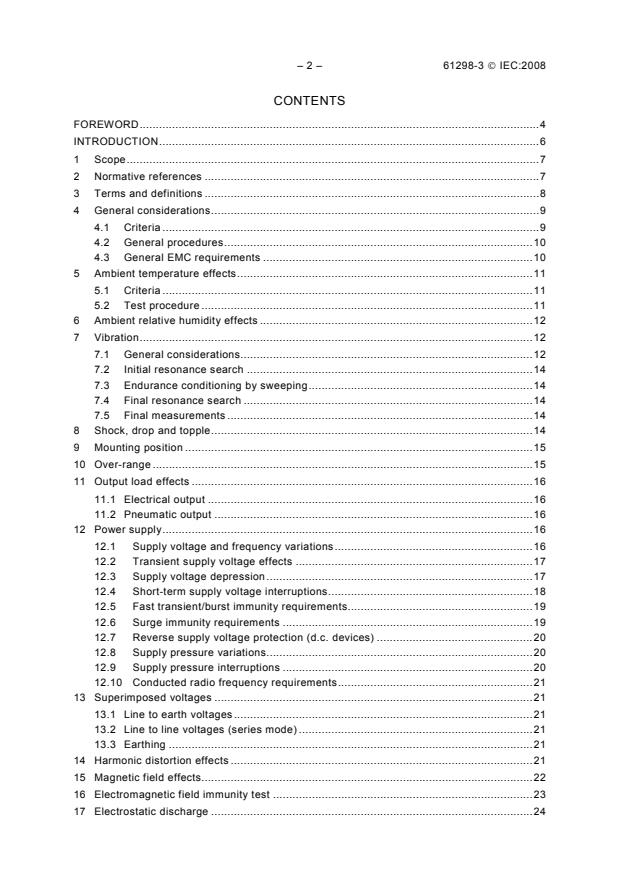
– 2 – 61298-3 © IEC:2008
CONTENTS
FOREWORD.4
INTRODUCTION.6
1 Scope.7
2 Normative references .7
3 Terms and definitions .8
4 General considerations.9
4.1 Criteria .9
4.2 General procedures.10
4.3 General EMC requirements .10
5 Ambient temperature effects.11
5.1 Criteria .11
5.2 Test procedure .11
6 Ambient relative humidity effects .12
7 Vibration.12
7.1 General considerations.12
7.2 Initial resonance search .14
7.3 Endurance conditioning by sweeping.14
7.4 Final resonance search .14
7.5 Final measurements .14
8 Shock, drop and topple.14
9 Mounting position .15
10 Over-range .15
11 Output load effects .16
11.1 Electrical output .16
11.2 Pneumatic output .16
12 Power supply.16
12.1 Supply voltage and frequency variations.16
12.2 Transient supply voltage effects .17
12.3 Supply voltage depression.17
12.4 Short-term supply voltage interruptions.18
12.5 Fast transient/burst immunity requirements.19
12.6 Surge immunity requirements .19
12.7 Reverse supply voltage protection (d.c. devices) .20
12.8 Supply pressure variations.20
12.9 Supply pressure interruptions .20
12.10 Conducted radio frequency requirements.21
13 Superimposed voltages .21
13.1 Line to earth voltages.21
13.2 Line to line voltages (series mode) .21
13.3 Earthing .21
14 Harmonic distortion effects .21
15 Magnetic field effects.22
16 Electromagnetic field immunity test .23
17 Electrostatic discharge .24
61298-3 © IEC:2008 – 3 –
18 Effect of open-circuited and short-circuited input .25
19 Effect of open-circuited and short-circuited output .25
20 Effects of process medium conditions.25
20.1 Temperature of process fluid .25
20.2 Flow of process fluid through the device.26
20.3 Static line pressure effect.26
21 Atmospheric pressure effects .27
22 Flow of purge gas through the device .27
23 Accelerated operational life test.27
24 Operational long-term drift test (optional) .27
Bibliography.29
Figure 1 – Arrangement for supply voltage depression or interruption tests.18
Figure 2 – Arrangement for harmonic distortion effects test .22
Figure 3 – Examples of application of the test field .23
Figure 4 – Test set-up of the effects of static pressure.26
Figure 5 – Time schedule of input changes and changes of ambient temperature .28
Table 1 – Ambient temperature test ranges.11
Table 2 – Vibration test levels.13
Table 3 – Power supply classes (IEC 60654-2) .17
Table 4 – Power supply commutations-interruptions (IEC 60654-2).18
Table 5 – Burst characteristics (IEC 61326-1) .19
Table 6 – Surge characteristics (IEC 61326-1).20
Table 7 – Conducted RF characteristics (IEC 61326-1).21
– 4 – 61298-3 © IEC:2008
INTERNATIONAL ELECTROTECHNICAL COMMISSION
–––––––––––
PROCESS MEASUREMENT AND CONTROL DEVICES –
GENERAL METHODS AND PROCEDURES
FOR EVALUATING PERFORMANCE –
Part 3: Tests for the effects of influence quantities
FOREWORD
1) The International Electrotechnical Commission (IEC) is a worldwide organization for standardization comprising
all national electrotechnical committees (IEC National Committees). The object of IEC is to promote
international co-operation on all questions concerning standardization in the electrical and electronic fields. To
this end and in addition to other activities, IEC publishes International Standards, Technical Specifications,
Technical Reports, Publicly Available Specifications (PAS) and Guides (hereafter referred to as “IEC
Publication(s)”). Their preparation is entrusted to technical committees; any IEC National Committee interested
in the subject dealt with may participate in this preparatory work. International, governmental and non-
governmental organizations liaising with the IEC also participate in this preparation. IEC collaborates closely
with the International Organization for Standardization (ISO) in accordance with conditions determined by
agreement between the two organizations.
2) The formal decisions or agreements of IEC on technical matters express, as nearly as possible, an international
consensus of opinion on the relevant subjects since each technical committee has representation from all
interested IEC National Committees.
3) IEC Publications have the form of recommendations for international use and are accepted by IEC National
Committees in that sense. While all reasonable efforts are made to ensure that the technical content of IEC
Publications is accurate, IEC cannot be held responsible for the way in which they are used or for any
misinterpretation by any end user.
4) In order to promote international uniformity, IEC National Committees undertake to apply IEC Publications
transparently to the maximum extent possible in their national and regional publications. Any divergence
between any IEC Publication and the corresponding national or regional publication shall be clearly indicated in
the latter.
5) IEC provides no marking procedure to indicate its approval and cannot be rendered responsible for any
equipment declared to be in conformity with an IEC Publication.
6) All users should ensure that they have the latest edition of this publication.
7) No liability shall attach to IEC or its directors, employees, servants or agents including individual experts and
members of its technical committees and IEC National Committees for any personal injury, property damage or
other damage of any nature whatsoever, whether direct or indirect, or for costs (including legal fees) and
expenses arising out of the publication, use of, or reliance upon, this IEC Publication or any other IEC
Publications.
8) Attention is drawn to the Normative references cited in this publication. Use of the referenced publications is
indispensable for the correct application of this publication.
9) Attention is drawn to the possibility that some of the elements of this IEC Publication may be the subject of
patent rights. IEC shall not be held responsible for identifying any or all such patent rights.
International Standard IEC 61298-3 has been prepared by sub-committee 65B: Devices and
process analysis, of IEC technical committee 65: Industrial-process measurement, control and
automation.
This second edition cancels and replaces the first edition published in 1998. This second
edition constitutes a technical revision.
This edition is a general revision with respect to the previous edition and does not include any
significant changes (see Introduction).
61298-3 © IEC:2008 – 5 –
The text of this standard is based on the following documents:
FDIS Report on voting
65B/687/FDIS 65B/695/RVD
Full information on the voting for the approval of this standard can be found in the report on
voting indicated in the above table.
This publication has been drafted in accordance with the ISO/IEC Directives, Part 2.
A list of all parts of the IEC 61298 series, under the general title Process measurement and
control devices – General methods and procedures for evaluating performance, can be found
on the IEC website.
The committee has decided that the contents of this publication will remain unchanged until
the maintenance result date indicated on the IEC web site under "http://webstore.iec.ch" in
the data related to the specific publication. At this date, the publication will be
• reconfirmed,
• withdrawn,
• replaced by a revised edition, or
• amended.
– 6 – 61298-3 © IEC:2008
INTRODUCTION
This standard is not intended as a substitute for existing standards, but is rather intended as a
reference document for any future standard developed within the IEC, or other standards
organizations, concerning the evaluation of process instrumentation. Any revision of existing
standards should take this standard into account.
This common standardized basis should be utilized for the preparation of future relevant
standards, as follows:
– any test method or procedure, already treated in this standard, should be specified and
described in the new standard by referring to the corresponding clause of this standard.
Consequently new editions of this standard are revised without any change in numbering
and scope of each clause;
– any particular method or procedure, not covered by this standard, should be developed
and specified in the new standard in accordance with the criteria, as far as they are
applicable, stated in this standard;
– any conceptual or significant deviation from the content of this standard should be clearly
identified and justified if introduced in a new standard.
61298-3 © IEC:2008 – 7 –
PROCESS MEASUREMENT AND CONTROL DEVICES –
GENERAL METHODS AND PROCEDURES
FOR EVALUATING PERFORMANCE –
Part 3: Tests for the effects of influence quantities
1 Scope
This part of IEC 61298 specifies general methods and procedures for conducting tests and
reporting on the functional and performance characteristics of process measurement and
control devices. The tests are applicable to any such devices characterized by their own
specific input and output variables, and by the specific relationship (transfer function) between
the inputs and outputs, and include analogue and digital devices. For devices that require
special tests, this standard should be used, together with any product-specific standard
specifying special tests.
This standard covers tests for the effects of influence quantities.
2 Normative references
The following referenced documents are indispensable for the application of this document.
For dated references, only the edition cited applies. For undated references, the latest edition
of the referenced document (including any amendments) applies.
IEC 60050-300, International Electrotechnical Vocabulary (IEV) – Electrical and electronic
measurements and measuring instruments (composed of Part 311, 312, 313 and 314)
IEC 60050-351, International Electrotechnical Vocabulary (IEV) – Part 351 : Control
technology
IEC 61298-1:2008, Process measurement and control devices – General methods and
procedures for evaluating performance – Part 1: General considerations
IEC 61298-2:2008, Process measurement and control devices – General methods and
procedures for evaluating performance – Part 2: Tests under reference conditions
IEC 61298-4:2008, Process measurement and control devices – General methods and
procedures for evaluating performance – Part 4: Evaluation report content
IEC 60068-2-1, Environmental testing – Part 2-1: Tests – Test A: Cold
IEC 60068-2-2, Environmental testing – Part 2-2: Tests – Test B: Dry heat
IEC 60068-2-6, Environmental testing – Part 2-6: Tests – Test Fc: Vibration (sinusoidal)
IEC 60068-2-30, Environmental testing – Part 2-30: Tests – Test Db: Damp heat, cyclic (12 +
12 h cycle)
IEC 60068-2-31, Environmental testing – Part 2-31: Tests – Test Ec: Drop and topple,
primarily for equipment-type specimens
– 8 – 61298-3 © IEC:2008
IEC 60654-1:1993, Operating conditions for industrial-process measurement and control
equipment – Part 1: Climatic conditions
IEC 60654-2:1992, Operating conditions for industrial-process measurement and control
equipment – Part 2: Power
IEC 60654-3:1983, Operating conditions for industrial-process measurement and control
equipment – Part 3: Mechanical influences
IEC 61326 (all parts), Electrical equipment for measurement, control and laboratory use –
EMC Requirements
IEC 61326-1:2005, Electrical equipment for measurement, control and laboratory use – EMC
Requirements – Part 1: General requirements
IEC 61000-4-2:2001, Electromagnetic compatibility (EMC) – Part 4-2: Testing and
measurement techniques – Electrostatic discharge immunity test. Basic EMC publication
IEC 61000-4-3:2002, Electromagnetic compatibility (EMC) – Part 4-3: Testing and
measurement techniques – Radiated, radio-frequency, electromagnetic field immunity test.
Basic EMC publication
IEC 61000-4-4:2004, Electromagnetic compatibility (EMC) – Part 4-4: Testing and
measurement techniques – Electrical fast transient/burst immunity test. Basic EMC publication
IEC 61000-4-5:1995, Electromagnetic compatibility (EMC) – Part 4-5: Testing and
measurement techniques – Surge immunity test. Basic EMC publication
IEC 61000-4-6:2006, Electromagnetic compatibility (EMC) – Part 4-6: Testing and
measurement techniques – Immunity to conducted disturbances, induced by radio-frequency
fields
IEC 61000-4-8:2001, Electromagnetic compatibility (EMC) – Part 4-8: Testing and
measurement techniques – Power frequency magnetic field immunity test. Basic EMC
publication
IEC 61000-4-11:2004, Electromagnetic compatibility (EMC) – Part 4-11: Testing and
measurement techniques – Voltage dips, short interruptions and voltage variations immunity
tests . Basic EMC publication
3 Terms and definitions
For the purpose of this document, the following relevant terms and definitions, some of them
based on IEC 60050(300) or IEC 60050(351), apply.
3.1
influence quantity
test parameter chosen to represent a condition representing one aspect of the environment
under which a device may operate
3.2
variable
quantity or condition whose value is subject to change and can usually be measured (e.g.
temperature, flow rate, speed, signal, etc.)
[IEV 351-21-01, modified]
61298-3 © IEC:2008 – 9 –
3.3
signal
physical variable, one or more parameters of which carry information about one or more
variables which the signal represents
[IEV 351-21-51, modified]
3.4
range
range of values defined by the two extreme values within which a variable can be measured
within the specified accuracy
[IEV 351-27-11, modified]
3.5
span
algebraic difference between the values of the upper and lower limits of the measuring range
[IEV 311-03-13]
3.6
unexpected event
device breakdown, failure to work, anomaly, or inadvertent damage occurring during an
evaluation which requires correction by the device manufacturer
3.7
test procedure
statement of the tests to be carried out, and the conditions for each test, agreed between the
manufacturer, the test laboratory, and the purchaser/user before the evaluation starts
3.8
type tests
a test of one or more devices made to a certain design to show that the design meets certain
specifications
NOTE The type tests are in principle applied only on a sample. Normally are not repeated on all the individual
units of equipment made in series.
4 General considerations
4.1 Criteria
Unless otherwise stated, any effects of the tests described in this standard shall be assessed
by determining the change in the functional and performance characteristics due to the single
influence quantity applied. A test is only to be performed if it is applicable to the Device Under
Test (DUT). If the specification of the DUT states limits for the influence considered, these
limits shall be noted and respected.
NOTE It is recommended to perform each influence test described in this standard, except if the DUT operates
under an environment that excludes the influence considered.
Rates of change of influence quantities shall be sufficiently slow to ensure that no overshoot
of the influence quantities occurs at any point in the DUT. Sufficient time shall be allowed for
stabilization at each value or state of the influence quantity before taking readings. It may be
useful to check, by means of specific measurements of the effects, whether the influence
quantities cause variations in the characteristics of the DUT other than those addressed in
this part of the standard.
In the case of discontinuous-output devices such as alarms, the tests shall be conducted to
establish the effects of the specified influence.
– 10 – 61298-3 © IEC:2008
Only that influence quantity for which a specific test is being conducted shall be applied
during a specified test. All other influences shall be maintained at the reference operating
conditions.
However, consideration should be given to any combination of two or more influence
quantities which may aggravate the operating conditions (e.g. for an electrical device,
temperature and supply voltage).
The limit values of influence quantities specified in this standard should be used if no other
limit values are specified by the manufacturer or by the user. Testing at these values shall be
agreed by the parties and the results of tests shall be added to the report.
4.2 General procedures
The procedures used for the determination of the effects of influence quantities depend on the
kind of test, on the type of device and on its most significant characteristics (e.g. zero, span,
etc.).
The procedures should be established in accordance with the criteria given in 5.1 and 5.2 of
IEC 61298-1 in order to avoid tests which are too severe.
To satisfy these criteria, the DUT should be tested by assessing the effects of all the
quantities which might influence the performance of the DUT; this general statement is strictly
valid for performance evaluation and for type tests.
For routine and sampling tests, only the influence quantity which is considered to have the
most effect or is agreed between the parties should be applied. Wherever possible, all the
tests shall be carried out by measurement of the change of the output of the DUT.
The deviations caused by the effect of the specific influence quantity should be expressed
generally as a percentage of the output span. On certain devices, it may be more convenient
to express it in terms of the input span (see 4.1.6 of IEC 61298-2). It is important that the
input should be set so that the output is not limited; so in all tests, inputs corresponding to, for
example, 5 % and 95 % may be used instead of 0 % and 100 %. For the same reason, tests
that can produce large deviations on output (for example, supply voltage interruptions,
electrical fast transients, and so on) may be executed at input levels held at a value which
produces 50 % output signal.
In the case of discontinuous output devices such as alarms, the tests shall be conducted in
the same way to establish the conditions at which the performance is affected, with the
alarm/switching level set to 10 % above or below the nominal output.
4.3 General EMC requirements
In the first edition of this standard, some EMC requirements were described with reference to
IEC 61326. In the meantime, IEC 61326 has been transferred into the IEC 61326 series with
more detailed requirements. If a reference to this standard series is given in the following
clauses, this standard series shall be applied, if applicable, and as far as the DUT is not
covered by a more dedicated IEC product standard. In the latter case, the more dedicated IEC
product standard shall be applied.
As far as no other performance criteria are specified, the following performance criteria
(conforming to the IEC 61326 series) shall be applied.
• Performance criteria A for continuously present disturbances (electromagnetic field,
magnetic field, HF currents induced by RF transmitters).
• Performance criteria B for short time transient disturbances (EDS, bursts, surges).
• Performance criteria C for long time transient disturbances (supply voltage interruption).
61298-3 © IEC:2008 – 11 –
As far as no other test severity levels are specified, the test severity levels shall be at least
according to Table 1 of IEC 61326-1:2005.
5 Ambient temperature effects
5.1 Criteria
Sufficient time shall be allowed at each test temperature to permit thermal stabilization of the
DUT before test measurements are taken (as specified in IEC 60068-2-1 and 60068-2-2).
The stabilization period is a function of the DUT mass and of energy dissipation. It is normally
checked by recording the output signal of the DUT. It may be as long as 3 h.
Whatever the temperature cycle prescribed, during the temperature cycles, it is important to
carry out the measurements at the same temperatures during repeat cycles so as to permit
comparison.
Pneumatic devices shall have sufficient air supply tubing inside the test chamber to ensure
that the supply and input air are at the same temperature as the DUT.
5.2 Test procedure
The effects of ambient temperature shall be measured in the temperature range specified by
the manufacturer or, if no value is specified, between the limits shown in Table 1 (according
to the standard range specified in IEC 60654-1).
The test limits for ambient temperature should be appropriate to the temperatures at the
intended operational location of the DUT.
The test shall be carried out by conducting the same performance test at each selected test
ambient temperature, beginning at the reference temperature (+20 °C).
Table 1 – Ambient temperature test ranges
Temperature Temperature Typical service
class (IEC 60654-1) application
°C
min. max.
+5 +40 B2 Heated or/and cooled enclosed
locations
–25 +55 C2 Sheltered locations
–33 +40 D1 Outdoor locations
–40 +85 DX Special outdoor locations
NOTE For others temperature classes, see IEC 60654-1.
The test ambient temperatures should be chosen generally at 20 °C intervals, up to the
specified limit temperatures for the DUT.
For example, for the temperature class C2, the test temperature cycle should be +20 °C
(reference), +40 °C, +55 °C, +20 °C, 0 °C, -25 °C, +20 °C.
If agreed by all parties in the test programme, a test at only four temperatures, 20 °C
(reference), maximum, minimum, and 20 °C, may be sufficient.
– 12 – 61298-3 © IEC:2008
The tolerance for each test temperature should be ±2 °C and the rate of change of ambient
temperature should be less than 1 °C per minute. No adjustments to the DUT shall be made
during the test cycle.
A second or third temperature cycle, without any adjustment of the DUT, may be specified in
the test programme. At each test temperature, data shall be recorded for increasing and
decreasing values of output at each 25 % of span.
The output changes at each test value shall be calculated from the average of the upscale
and downscale readings and reported in percent of ideal output span. Any significant changes
in hysteresis, linearity or repeatability shall also be calculated and reported. See IEC 61298-4.
Any effects on a digital display indicator shall also be reported, including loss of contrast,
brightness, distortion or missing bits.
6 Ambient relative humidity effects
The effects of ambient relative humidity shall be determined by placing the DUT in a humidity
test chamber in which the value of relative humidity should be controlled within +2 % to -3 %
of the specified relative humidity levels (as specified in IEC 60068-2-30).
The DUT shall be stabilized at the reference relative humidity < 60 % at the temperature of
40 °C ± 2 °C.
Measurements shall be taken at each 25 % of output span in each direction.
+2
The relative humidity shall then be increased in not less than 3 h to ( 93 ) % avoiding the
−3
deposition of condensation on the DUT and maintained at this value for a period of at least
48 h. If agreed in the test programme, the DUT may be de-energized during this period.
The measurements shall again be taken at 25 % intervals of output span in each direction.
With the DUT remaining in operation, the relative humidity shall be reduced in not less than
3 h to the original reference value of < 60 %.
After stabilization for at least 12 h, the measurements shall be repeated.
Any changes in lower range value and span shall be calculated and reported in per cent of
output span.
In addition, any significant changes in hysteresis, linearity or repeatability should be
calculated and reported.
In addition, a visual examination shall be made after the test to check for indications of
component deterioration or moisture having entered sealed enclosures.
7 Vibration
7.1 General considerations
The general procedures of this test comply with the test procedure Fc of IEC 60068-2-6 and
the vibration ranges and values are in according with those reported in IEC 60654-3.
61298-3 © IEC:2008 – 13 –
The effect of vibration shall be determined by the following procedure using the peak
amplitudes, acceleration levels, and frequency ranges reported in Table 2 or specified by the
manufacturer.
Measurements shall be made before and after the vibration exposure.
The DUT shall be mounted, in accordance with the manufacturer's instructions for a normal
installation, on a vibration table where it shall be subjected to rectilinear sinusoidal vibrations
in each of three mutually perpendicular axes, one of which shall be the vertical.
The rigidity of the vibration table and of the mounting means for the DUT shall be such that
the vibration is transferred to the normal mounting point of the DUT with a minimum of loss or
gain.
The test vibration level shall be measured at the normal mounting point of the DUT.
Vibrations shall be applied with the DUT powered and operating with 50 % input signal.
The output signal shall be recorded in order to report any change in output.
Table 2 – Vibration test levels
Typical Test Displacement Acceleration
application frequency peak amplitude
Note1
range amplitude
mm m/s
Hz
Note 2
Control room or field with low 10 to 150 0,35 1
vibration level
Note 2
Control room or field with 10 to 150 0,75 2
medium vibration level
Note 3
Field with general application 10 to 1 000 0,15 20
or pipeline with low vibration
Note 3
Field with high vibration level or 10 to 1 000 0,35 50
pipe line with high vibration
NOTE 1 For a list of all test frequency ranges, see IEC 60654-3.
NOTE 2 Test frequency range derived from low-frequency classes (IEC 60654-3), but limited
to 10 Hz (instead of 0,1 Hz) and with crossover frequency at 8÷9 Hz.
NOTE 3 Test frequency range derived from high-frequency classes (IEC 60654-3), but
limited to 1 000 Hz (instead of 10 000 Hz) and with crossover frequency at 57÷62 Hz.
The crossover frequency is the region of change from constant amplitude and constant
acceleration.
The vibration tests shall include three stages:
– an initial resonance search;
– an endurance conditioning by sweeping the frequency over the appropriate frequency
range specified in Table 2 (or over another range reported in IEC 60654-3), or as specified
by the manufacturer or by the user;
– a final resonance search.
These three stages shall be performed in sequence. At each stage, the DUT shall be vibrated
in each of the three major axes before proceeding to the next stage.
– 14 – 61298-3 © IEC:2008
7.2 Initial resonance search
The initial resonance search shall be carried out to study behaviour of the DUT to determine
any component resonances and the corresponding resonance frequencies, and to obtain
information for comparison with the final resonance search.
The sweep rate shall be not greater than 0,5 octave per minute.
During the resonance search, frequencies shall be noted which cause
a) significant changes in the output signal;
b) mechanical resonances of components or sub-assemblies.
All the amplitudes and frequencies at which these effects occur shall be noted in order to be
compared with those found during the final resonance search specified below.
7.3 Endurance conditioning by sweeping
The test is carried out by sweeping the vibration frequency at a rate of one octave per minute
over the range selected.
The total number of sweep cycles should be 60, being 20 in each of the three mutually
perpendicular directions.
7.4 Final resonance search
The final resonance search shall be made in the same way as the initial resonance search
and with the same vibration characteristics.
The resonance frequencies, and the frequencies which cause significant changes in the
output signal, found in the initial resonance search and final resonance search shall be
compared.
7.5 Final measurements
The satisfactory mechanical condition of the DUT shall be verified at the end of the tests with
a visual examination for any deformation or cracks in the components or mountings.
The satisfactory performance of the DUT shall be verified with a measurement test; any
change in the lower range value and span shall be recorded in percent of output span.
8 Shock, drop and topple
The test shall be made according to the test procedure Ec of IEC 60068-2-31 and according
to the free fall method reported in IEC 60654-3
Before the test, reference measurements of lower range-value and span shall be recorded.
During the test, the power supply and inputs may be switched off.
The object of this test is
– to represent knocks and jolts likely to occur during repair work or rough handling in use;
– to verify the minimum degree of mechanical ruggedness.
The procedure of "dropping on to a face" shall be applied as follows:
61298-3 © IEC:2008 – 15 –
The DUT, standing in its normal position of use on a smooth, hard, rigid surface of concrete or
steel, is tilted about one bottom edge so that the distance between the opposite edge and the
test surface is 25 mm, 50 mm or 100 mm (value chosen by agreement between manufacturer
and use), or so that the angle made by the bottom and the test surface is 30°, whichever
condition is the less severe. It is then allowed to fall freely onto the test surface.
The DUT shall be subjected to one drop about each of the four bottom edges.
After this test, the DUT shall be examined for damage.
Any change in lower range-value and span shall be recorded.
If any changes are noted, it shall be verified that the DUT can be readjusted so that the initial
performance can be re-established.
NOTE In special cases, by agreement, one of the other shock tests in IEC 60068-2-31 may be used, or the free
fall method, reported in IEC 60654-3 (from height 25 mm to 1 000 mm or more), may be used.
9 Mounting position
Where the DUT might be position sensitive, the change in lower range-value and span caused
by 10° inclinations from the position(s) specified by the manufacturer shall be measured and
recorded in percent of output span.
Four measurements shall be made with tilt applied in two planes at right angles to each other.
Where a 10° inclination is excessive due to the design of the DUT, the maximum inclination
specified by the manufacturer shall be used.
10 Over-range
This test shall be carried out by measuring any residual changes in lower range-value and
span which result from over-ranging the input by 50 % at the minimum and maximum span
settings if not otherwise specified by the manufacturer.
The input shall be increased gradually from the lower range-value to the over-range selected
for the test.
After the over-range has been applied for 1 min, the input shall be reduced to the nominal
lower range-value.
After a further 5 min have elapsed, the lower range-value and the span shall be determined in
per cent of output span.
If the DUT is to be tested for over-range effect in both directions, as with differential
measuring devices and devices whose input may be both below the lower range-value and
above the upper range-value, it shall be tested as described above, first over-ranging above
the upper range-value, and then over-ranging below the lower range-value.
Any changes of lower range-value and span determined after over-ranging in each direction
shall be recorded.
NOTE If over-ranging produces significant thermal effects, the duration of application should be increased
accordingly.
– 16 – 61298-3 © IEC:2008
11 Output load effects
The purpose of this test is to determine any effects on the output signal when the output load
is varied.
11.1 Electrical output
To determine any effect on an electrical output signal, the load resistance shall be varied from
the minimum to the maximum value specified by the manufacturer. Any changes in lower
range-value and span caused by the variations shall be expressed as a percentage of the
output span. The output voltage drop at the DUT at the upper range value shall also be noted
when the DUT is a two-wire transmitter. Consideration should be given to the effect of
connecting capacitive or inductive loads.
11.2 Pneumatic output
This test shall be carried out as specified in 6.6 of IEC 61298-2.
12 Power supply
12.1 Supply voltage and frequency variations
For two-wire transmitters, reference should be made to 11.1 of this standard.
NOTE Power inputs for voltages up to 75 V d.c. or voltages up to 50 V a.c. with superimposed output signals (for
example 4 mA to 20 mA current loop with two-wire technology) are tested as input/output lines.
For electrical devices except two-wire transmitters, the test shall be carried out first setting
the values of the lower range and span at nominal supply vol
...
Questions, Comments and Discussion
Ask us and Technical Secretary will try to provide an answer. You can facilitate discussion about the standard in here.
Loading comments...