

IEC 60747-1:2006
(Main)Semiconductor devices - Part 1: General
General Information
- Abstract
IEC 60747-1:2006 gives the general requirements applicable to the discrete semiconductor devices and integrated circuits covered by the other parts of IEC 60747 and IEC 60748 (see Annex A). This second edition of IEC 60747-1 cancels and replaces the first edition (1983) and its amendments 1 (1991), 2 (1993) and 3 (1996). The main changes with respect to the previous edition are listed below:
a) The terminology which is now given in the IEV (or which was in conflict with the IEV) has been omitted.
b) There has been a general revision of guidance on essential ratings and characteristics.
c) The distinction between general and reference methods of measurement has been removed.
d) A clause on product discontinuation notice has been added.
- Status
- Published
- Publication Date
- 22-Aug-2010
- Technical Committee
- TC 47 - Semiconductor devices
- Drafting Committee
- WG 1 - TC 47/WG 1
- Current Stage
- PPUB - Publication issued
- Start Date
- 21-Feb-2006
- Completion Date
- 15-May-2006
Buy Documents
IEC 60747-1:2006 - Semiconductor devices - Part 1: General Released:2/21/2006
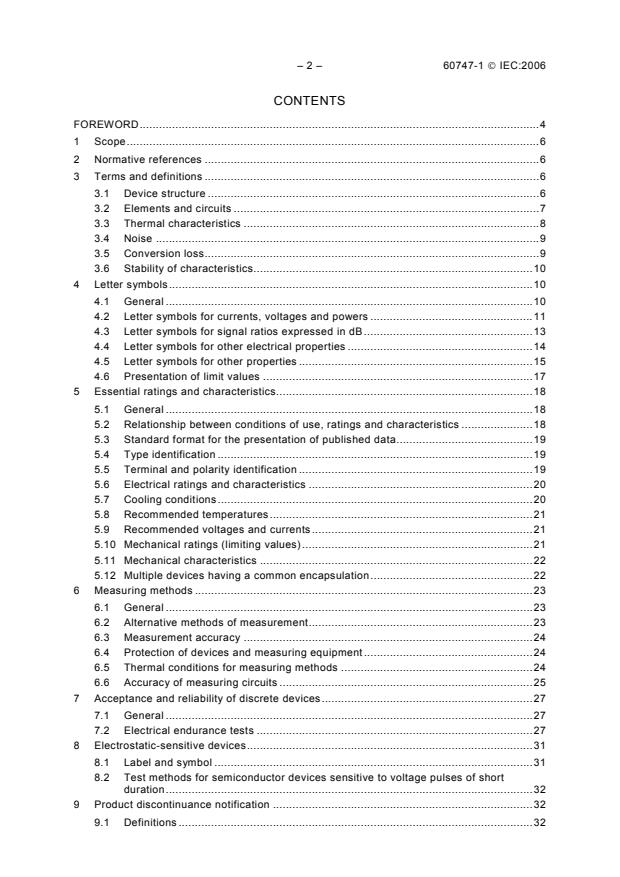
IEC 60747-1:2006 - Semiconductor devices - Part 1: General Released:2/21/2006
IEC 60747-1:2006+AMD1:2010 CSV - Semiconductor devices - Part 1: General Released:8/23/2010
Overview
IEC 60747-1:2006 - Semiconductor devices, Part 1: General defines the general requirements that apply to discrete semiconductor devices and integrated circuits covered by the IEC 60747 and IEC 60748 series. This second edition (2006) consolidates earlier amendments and updates guidance on essential ratings and characteristics, measurement methods and adds a clause on product discontinuation notice. The standard establishes common terminology, data presentation formats and fundamental test/measurement expectations used across semiconductor device specifications and datasheets.
Key topics and requirements
- Scope and definitions: Common terms for device structure, elements, circuits and thermal/noise characteristics to ensure consistent interpretation across parts of the series.
- Essential ratings and characteristics: Guidance on what ratings (voltages, currents, temperatures, mechanical limits) and characteristics should be published and how to present them for clarity and comparability.
- Letter symbols and presentation: Standardized letter symbols for currents, voltages, powers and signal ratios, plus rules for presenting limit values and published data formats.
- Measuring methods and accuracy: General requirements for measurement conditions, thermal considerations, measurement accuracy and protection of devices and equipment during testing.
- Acceptance, reliability and endurance: Principles for electrical endurance testing and reliability data presentation for discrete devices.
- Electrostatic-sensitive devices (ESD): Labelling and test-method expectations for ESD-sensitive components (references include IEC 60749-26 and IEC 61340).
- Product discontinuation notification: Requirements and recommended content for notifying customers when a product is to be discontinued.
- Ancillary clauses: Thermal reference points, mechanical ratings, multiple-device packages, and conformity to environmental/testing standards.
Applications and who uses it
IEC 60747-1 is intended for:
- Semiconductor manufacturers - to prepare datasheets, specify test methods, label ESD sensitivity and manage product lifecycle notices.
- Test engineers and qualification labs - to align measurement set-ups and report formats with international practice.
- Component spec writers and procurement teams - to compare parts and verify essential ratings and characteristics.
- Quality and reliability engineers - to define acceptance criteria and endurance-test approaches.
- Design engineers - to interpret published device limits for system integration and thermal management.
Practical uses include harmonizing datasheet content, defining test procedures, implementing ESD handling policies and formalizing product discontinuation communications.
Related standards
- IEC 60747 (all parts) - Semiconductor devices series
- IEC 60748 (all parts) - Integrated circuits
- IEC 60027 - Letter symbols in electrical technology
- IEC 60050 - IEV (semiconductor-related parts)
- IEC 60068 - Environmental testing
- IEC 60749-26 - ESD sensitivity testing (HBM)
- IEC 61340 - Electrostatics
- ISO 9000 - Quality management fundamentals
Keywords: IEC 60747-1, semiconductor devices, integrated circuits, essential ratings, measurement methods, ESD, datasheet standards, product discontinuation.
Relations
- Effective Date
- 05-Sep-2023
- Effective Date
- 05-Sep-2023
- Effective Date
- 05-Sep-2023
Buy Documents
IEC 60747-1:2006 - Semiconductor devices - Part 1: General Released:2/21/2006
IEC 60747-1:2006 - Semiconductor devices - Part 1: General Released:2/21/2006
IEC 60747-1:2006+AMD1:2010 CSV - Semiconductor devices - Part 1: General Released:8/23/2010
Frequently Asked Questions
IEC 60747-1:2006 is a standard published by the International Electrotechnical Commission (IEC). Its full title is "Semiconductor devices - Part 1: General". This standard covers: IEC 60747-1:2006 gives the general requirements applicable to the discrete semiconductor devices and integrated circuits covered by the other parts of IEC 60747 and IEC 60748 (see Annex A). This second edition of IEC 60747-1 cancels and replaces the first edition (1983) and its amendments 1 (1991), 2 (1993) and 3 (1996). The main changes with respect to the previous edition are listed below: a) The terminology which is now given in the IEV (or which was in conflict with the IEV) has been omitted. b) There has been a general revision of guidance on essential ratings and characteristics. c) The distinction between general and reference methods of measurement has been removed. d) A clause on product discontinuation notice has been added.
IEC 60747-1:2006 gives the general requirements applicable to the discrete semiconductor devices and integrated circuits covered by the other parts of IEC 60747 and IEC 60748 (see Annex A). This second edition of IEC 60747-1 cancels and replaces the first edition (1983) and its amendments 1 (1991), 2 (1993) and 3 (1996). The main changes with respect to the previous edition are listed below: a) The terminology which is now given in the IEV (or which was in conflict with the IEV) has been omitted. b) There has been a general revision of guidance on essential ratings and characteristics. c) The distinction between general and reference methods of measurement has been removed. d) A clause on product discontinuation notice has been added.
IEC 60747-1:2006 is classified under the following ICS (International Classification for Standards) categories: 31.080.01 - Semiconductor devices in general. The ICS classification helps identify the subject area and facilitates finding related standards.
IEC 60747-1:2006 has the following relationships with other standards: It is inter standard links to IEC 60747-1:2006/AMD1:2010, IEC 60747-1:2006/COR1:2008, IEC 60747-1:1983/AMD3:1996. Understanding these relationships helps ensure you are using the most current and applicable version of the standard.
IEC 60747-1:2006 is available in PDF format for immediate download after purchase. The document can be added to your cart and obtained through the secure checkout process. Digital delivery ensures instant access to the complete standard document.
Standards Content (Sample)
INTERNATIONAL IEC
STANDARD 60747-1
Second edition
2006-02
Semiconductor devices –
Part 1:
General
Reference number
Publication numbering
As from 1 January 1997 all IEC publications are issued with a designation in the
60000 series. For example, IEC 34-1 is now referred to as IEC 60034-1.
Consolidated editions
The IEC is now publishing consolidated versions of its publications. For example,
edition numbers 1.0, 1.1 and 1.2 refer, respectively, to the base publication, the
base publication incorporating amendment 1 and the base publication incorporating
amendments 1 and 2.
Further information on IEC publications
The technical content of IEC publications is kept under constant review by the IEC,
thus ensuring that the content reflects current technology. Information relating to
this publication, including its validity, is available in the IEC Catalogue of
publications (see below) in addition to new editions, amendments and corrigenda.
Information on the subjects under consideration and work in progress undertaken
by the technical committee which has prepared this publication, as well as the list
of publications issued, is also available from the following:
• IEC Web Site (www.iec.ch)
• Catalogue of IEC publications
The on-line catalogue on the IEC web site (www.iec.ch/searchpub) enables you to
search by a variety of criteria including text searches, technical committees
and date of publication. On-line information is also available on recently issued
publications, withdrawn and replaced publications, as well as corrigenda.
• IEC Just Published
This summary of recently issued publications (www.iec.ch/online_news/ justpub)
is also available by email. Please contact the Customer Service Centre (see
below) for further information.
• Customer Service Centre
If you have any questions regarding this publication or need further assistance,
please contact the Customer Service Centre:
Email: custserv@iec.ch
Tel: +41 22 919 02 11
Fax: +41 22 919 03 00
INTERNATIONAL IEC
STANDARD 60747-1
Second edition
2006-02
Semiconductor devices –
Part 1:
General
IEC 2006 Copyright - all rights reserved
No part of this publication may be reproduced or utilized in any form or by any means, electronic or
mechanical, including photocopying and microfilm, without permission in writing from the publisher.
International Electrotechnical Commission, 3, rue de Varembé, PO Box 131, CH-1211 Geneva 20, Switzerland
Telephone: +41 22 919 02 11 Telefax: +41 22 919 03 00 E-mail: inmail@iec.ch Web: www.iec.ch
PRICE CODE
Commission Electrotechnique Internationale X
International Electrotechnical Commission
МеждународнаяЭлектротехническаяКомиссия
For price, see current catalogue
– 2 – 60747-1 IEC:2006(E)
CONTENTS
FOREWORD.4
1 Scope.6
2 Normative references .6
3 Terms and definitions .6
3.1 Device structure .6
3.2 Elements and circuits .7
3.3 Thermal characteristics .8
3.4 Noise .9
3.5 Conversion loss.9
3.6 Stability of characteristics.10
4 Letter symbols.10
4.1 General .10
4.2 Letter symbols for currents, voltages and powers .11
4.3 Letter symbols for signal ratios expressed in dB.13
4.4 Letter symbols for other electrical properties .14
4.5 Letter symbols for other properties .15
4.6 Presentation of limit values .17
5 Essential ratings and characteristics.18
5.1 General .18
5.2 Relationship between conditions of use, ratings and characteristics .18
5.3 Standard format for the presentation of published data.19
5.4 Type identification .19
5.5 Terminal and polarity identification .19
5.6 Electrical ratings and characteristics .20
5.7 Cooling conditions.20
5.8 Recommended temperatures.21
5.9 Recommended voltages and currents.21
5.10 Mechanical ratings (limiting values).21
5.11 Mechanical characteristics .22
5.12 Multiple devices having a common encapsulation.22
6 Measuring methods .23
6.1 General .23
6.2 Alternative methods of measurement.23
6.3 Measurement accuracy .24
6.4 Protection of devices and measuring equipment.24
6.5 Thermal conditions for measuring methods .24
6.6 Accuracy of measuring circuits .25
7 Acceptance and reliability of discrete devices.27
7.1 General .27
7.2 Electrical endurance tests .27
8 Electrostatic-sensitive devices.31
8.1 Label and symbol .31
8.2 Test methods for semiconductor devices sensitive to voltage pulses of short
duration.32
60747-1 IEC:2006(E) – 3 –
9 Product discontinuance notification .32
9.1 Definitions .32
9.2 General aspects for discontinuation.33
9.3 Information for the discontinuance notification.33
9.4 Notification .33
9.5 Retention .34
Annex A (informative) Presentation of IEC 60747 and IEC 60748 .35
Annex B (informative) Clause cross-references from the previous edition of IEC 60747-1.39
Bibliography.
Figure 1 – Example of the application of the rules to a periodic current.11
Figure 2 – Derating curve .28
Figure 3 – Symbol to be used for the electrostatic sensitive devices that require special
handling.31
Table 1 – Presentation of limit values with the two conventions .18
Table 2 – Failure rate operating conditions .29
– 4 – 60747-1 IEC:2006(E)
INTERNATIONAL ELECTROTECHNICAL COMMISSION
____________
SEMICONDUCTOR DEVICES –
Part 1: General
FOREWORD
1) The International Electrotechnical Commission (IEC) is a worldwide organization for standardization comprising
all national electrotechnical committees (IEC National Committees). The object of IEC is to promote
international co-operation on all questions concerning standardization in the electrical and electronic fields. To
this end and in addition to other activities, IEC publishes International Standards, Technical Specifications,
Technical Reports, Publicly Available Specifications (PAS) and Guides (hereafter referred to as “IEC
Publication(s)”). Their preparation is entrusted to technical committees; any IEC National Committee interested
in the subject dealt with may participate in this preparatory work. International, governmental and non-
governmental organizations liaising with the IEC also participate in this preparation. IEC collaborates closely
with the International Organization for Standardization (ISO) in accordance with conditions determined by
agreement between the two organizations.
2) The formal decisions or agreements of IEC on technical matters express, as nearly as possible, an international
consensus of opinion on the relevant subjects since each technical committee has representation from all
interested IEC National Committees.
3) IEC Publications have the form of recommendations for international use and are accepted by IEC National
Committees in that sense. While all reasonable efforts are made to ensure that the technical content of IEC
Publications is accurate, IEC cannot be held responsible for the way in which they are used or for any
misinterpretation by any end user.
4) In order to promote international uniformity, IEC National Committees undertake to apply IEC Publications
transparently to the maximum extent possible in their national and regional publications. Any divergence
between any IEC Publication and the corresponding national or regional publication shall be clearly indicated in
the latter.
5) IEC provides no marking procedure to indicate its approval and cannot be rendered responsible for any
equipment declared to be in conformity with an IEC Publication.
6) All users should ensure that they have the latest edition of this publication.
7) No liability shall attach to IEC or its directors, employees, servants or agents including individual experts and
members of its technical committees and IEC National Committees for any personal injury, property damage or
other damage of any nature whatsoever, whether direct or indirect, or for costs (including legal fees) and
expenses arising out of the publication, use of, or reliance upon, this IEC Publication or any other IEC
Publications.
8) Attention is drawn to the Normative references cited in this publication. Use of the referenced publications is
indispensable for the correct application of this publication.
9) Attention is drawn to the possibility that some of the elements of this IEC Publication may be the subject of
patent rights. IEC shall not be held responsible for identifying any or all such patent rights.
International Standard IEC 60747-1 has been prepared by IEC technical committee 47:
Semiconductor devices.
This second edition of IEC 60747-1 cancels and replaces the first edition (1983) and its
amendments 1 (1991), 2 (1993) and 3 (1996).
The main changes with respect to the previous edition are listed below.
a) The terminology which is now given in the IEV (or which was in conflict with the IEV) has
been omitted.
b) There has been a general revision of guidance on essential ratings and characteristics.
c) The distinction between general and reference methods of measurement has been
removed.
d) A clause on product discontinuation notice has been added.
60747-1 © IEC:2006(E) – 5 –
The text of this standard is based on the following documents:
FDIS Report on voting
47/1841/FDIS 47/1848/RVD
Full information on the voting for the approval of this standard can be found in the report on
voting indicated in the above table.
This publication has been drafted in accordance with the ISO/IEC Directives, Part 2.
The list of all parts of IEC 60747 series, under the general title Semiconductor devices, can
be found on the IEC website.
The committee has decided that the contents of this publication will remain unchanged until
the maintenance result date indicated on the IEC web site under "http://webstore.iec.ch" in
the data related to the specific publication. At this date, the publication will be
• reconfirmed;
• withdrawn;
• replaced by a revised edition, or
• amended.
A bilingual version of this publication may be issued at a later date.
The contents of the corrigendum of September 2008 have been included in this copy.
– 6 – 60747-1 IEC:2006(E)
SEMICONDUCTOR DEVICES –
Part 1: General
1 Scope
This part of IEC 60747 gives the general requirements applicable to the discrete
semiconductor devices and integrated circuits covered by the other parts of IEC 60747 and
IEC 60748 (see Annex A).
2 Normative references
The following referenced documents are indispensable for the application of this document.
For dated references, only the edition cited applies. For undated references, the latest edition
of the referenced document (including any amendments) applies.
IEC 60027 (all parts), Letter symbols to be used in electrical technology
IEC 60050-521, International Electrotechnical Vocabulary (IEV) – Part 521: Semiconductor
devices and integrated circuits
IEC 60050-702, International Electrotechnical Vocabulary (IEV) – Part 702: Oscillations,
signals and related devices
IEC 60068 (all parts), Environmental testing
IEC 60191-2, Mechanical standardization of semiconductor devices – Part 2: Dimensions
IEC 60747 (all parts), Semiconductor devices
IEC 60748 (all parts), Semiconductor devices – Integrated circuits
IEC 60749-26, Semiconductor devices – Mechanical and climatic test methods – Part 26:
Electrostatic discharge (ESD) sensitivity testing – Human body model (HBM)
IEC 61340 (all parts), Electrostatics
QC 001002 (all parts), IEC Quality Assessment Systems for Electronic Components (IECQ) –
Rules of procedure
ISO 9000, Quality management systems – Fundamentals and vocabulary
3 Terms and definitions
For the purposes of this document, the terms and definitions given in IEC 60050-521 and
IEC 60050-702, as well as the following, apply.
3.1 Device structure
3.1.1
pad
area on a chip (die) to which a connection to the chip (die) can be made
60747-1 IEC:2006(E) – 7 –
3.1.2
bonding wire
wire that is bonded to a chip (die) bonding pad in order to connect the chip (die) to any other
point within the device package
3.1.3
base (of a package)
part of the package on which a chip (die) can be mounted
3.1.4
cap, can, lid, plug
part of a cavity package that completes its enclosure
NOTE The particular term used depends on the package design.
3.1.5
anode terminal (of a semiconductor diode, excluding current-regulator diodes)
terminal connected to the P-type region of the PN junction or, when more than one PN
junction is connected in series with the same polarity, to the extreme P-type region
NOTE For voltage-reference diodes; if temperature-compensating diodes are included, these are ignored in the
determination of the anode terminal.
3.1.6
cathode terminal (of a semiconductor diode, excluding current-regulator diodes)
terminal connected to the N-type region of the PN junction or, when more than one PN
junction is connected in series with the same polarity, to the extreme N-type region
NOTE For voltage-reference diodes; if temperature-compensating diodes are included, these are ignored in the
determination of the cathode terminal.
3.1.7
anode terminal (of a current-regulator diode)
terminal to which current flows from the external circuit when the diode is biased to operate
as a current regulator
3.1.8
cathode terminal (of a current-regulator diode)
terminal from which current flows into the external circuit when the diode is biased to operate
as a current regulator
3.2 Elements and circuits
3.2.1
passive circuit element
circuit element primarily contributing resistance, capacitance, inductance, ohmic inter-
connection, wave-guiding, or a combination of these, to a circuit function
NOTE For example, resistors, capacitors, inductors, passive filters, interconnections.
3.2.2
active circuit element
circuit element that contributes other qualities to a circuit function than a passive circuit
element, for example, rectification, switching, gain, conversion of energy from one form to
another
NOTE 1 Examples for devices with active circuit elements are diodes, transistors, active integrated circuits, light-
sensing or light-emitting devices.
NOTE 2 Active physical circuit elements may also be used to act as passive physical circuit elements only, for
example, to contribute resistance and/or capacitance to a circuit function temperature.
– 8 – 60747-1 IEC:2006(E)
3.2.3
reference-point temperature
temperature at a specified point on, near or within a device
3.2.4
case temperature
temperature of a reference point, on or near the surface of the case
NOTE For smaller devices, if the specified reference point is not located on the case but somewhere else on the
device (for example, on one of the terminals), then the temperature at this place may be called the "reference-point
temperature". However, devices rated with reference to this temperature are still called "case-rated devices".
3.2.5
storage temperature
temperature at which the device may be stored without any voltage being applied
3.3 Thermal characteristics
3.3.1
thermal derating factor
factor by which the power dissipation rating must be reduced with increase of reference point
temperature
3.3.2
equivalent thermal network
theoretical equivalent circuit that simulates the thermal resistances, thermal capacitances and
sources of heat flow of a semiconductor device (or integrated circuit), which gives a
representation of thermal conditions and temperature behaviour under electrical load and
which may be used for temperature calculations
NOTE 1 It is assumed that the total heat flow, caused by the power dissipation, is flowing through this equivalent
thermal network.
NOTE 2 Where heat is generated at more than one point in a device, the equivalent thermal networks will need to
include each source if the heat flow is to correspond to the total power dissipation occurring in the semiconductor
device (or integrated circuit).
3.3.3
transient thermal impedance
quotient of
a) the change in temperature difference between two specified points or regions at the end of
a time interval, and
b) the step-function change in power dissipation beginning at that time interval which causes
the change in temperature difference
NOTE The term used in practice must indicate the two specified points or regions, for example, as in "junction-
case transient thermal impedance". The use of the shortened term "transient thermal impedance" is permitted only
if no ambiguity is likely to occur.
3.3.4
thermal impedance under pulse conditions
quotient of
a) the difference between the maximum virtual temperature caused by the pulse power and
the temperature of a specified external reference point, and
b) the amplitude of the power dissipation in the device produced by a specified periodic
sequence of rectangular pulses
NOTE 1 The initial transient phenomena are ignored and zero continuous power dissipation is assumed.
NOTE 2 The thermal impedance under pulse conditions is given as a function of the duration of the pulses with
the duty factor as a parameter.
60747-1 IEC:2006(E) – 9 –
3.4 Noise
3.4.1
reference-noise temperature
absolute temperature (in kelvins) to be assumed as a noise temperature at the input ports of a
network when calculating certain noise parameters, and for normalizing purposes
NOTE It has not been possible to achieve a consensus on a single standard reference noise temperature,
although no values below 290 K or above 300 K were found to be in use.
3.4.2
overall average noise figure (of a mixer diode and an l.F. amplifier)
average noise figure of the cascaded combination of a mixer and an I.F. amplifier
3.4.3
standard overall average noise figure (of a mixer diode and an I.F. amplifier)
overall average noise figure, when the average noise figure of the I.F. amplifier is a specified
standard value (usually 1,5 dB) and the passband of the I.F. amplifier is sufficiently narrower
than that of the mixer so that the mixer conversion loss and output noise temperature are
essentially constant over the I.F. passband
3.4.4
output noise ratio
ratio of the noise temperature of an output port to the reference noise temperature, when the
noise temperature of all input terminations is at the reference noise temperature at all
frequencies that contribute to the output noise
3.4.5
equivalent input noise voltage (of a two-port)
voltage of an ideal voltage source (having an internal impedance equal to zero) in series with
the input terminals of the device that represents the part of the internally generated noise that
can properly be represented by a voltage source
NOTE In the definition, the equivalent input noise current, which would be needed for a complete and precise
description of the device noise, is neglected. If the external source impedance is zero, the noise voltage represents
the total noise.
3.4.6
equivalent input noise current (of a two-port)
current of an ideal current source (having an internal impedance equal to infinity) in parallel
with the input terminals of the device that represents the part of the internally generated noise
that can properly be represented by a current source
NOTE In this definition, the equivalent input noise voltage, which would be needed for a complete and precise
description of the device noise, is neglected. If the external source impedance is infinite, the noise current
represents the total noise.
3.5 Conversion loss
3.5.1
conversion loss (of a mixer, mixer diode or harmonic generator)
ratio of available input power at a single-signal frequency to the available single-signal
frequency output power, not including intrinsic mixer noise or power converted from other than
the signal-input frequency
3.5.2
conversion insertion loss (of a mixer, mixer diode or harmonic generator)
ratio of available input power at a single-signal frequency to the delivered single-signal
frequency output power, not including intrinsic mixer noise or power convened from other than
the signal-input frequency
– 10 – 60747-1 IEC:2006(E)
3.6 Stability of characteristics
3.6.1
drift
difference between the final value of a characteristic at the end of a specified long period and
the initial value, all other operating conditions being held constant
NOTE The use of the term "drift" to refer to the immediate change of a characteristic in direct response to
changed operating conditions (for example, temperature) is deprecated.
3.6.2
relative drift
ratio of
– drift of the characteristic, to
– initial value of the characteristic
NOTE See note to 0.
3.6.3
instability range
difference between the extreme values of the characteristic observed either continuously or
repeatedly during a specified period, all other operating conditions being held constant
3.6.4
relative instability range
quotient of
– the instability range of the characteristic, and
– the initial value of the characteristic
4 Letter symbols
4.1 General
This clause provides a system of letter symbols for the properties used in the field of discrete
devices and integrated circuits. Additional letter symbols, for specific categories may be given
in Clause 4 of the other parts of IEC 60747 and IEC 60748. Where there is any conflict, the
symbols given in the latter parts apply within the part.
The general standards given in IEC 60027 are applicable, except where this clause differs, in
which case this clause should be followed. Some letter symbols or rules for composing
complex letter symbols have been specifically approved for the purposes of IEC 60747 and
IEC 60748.
NOTE Definitions of the terms used in this clause can be found in Clause 3 of this or the other parts of IEC 60747
and IEC 60748.
60747-1 IEC:2006(E) – 11 –
4.2 Letter symbols for currents, voltages and powers
4.2.1 Use of upper-case or lower-case letters and subscripts
i
D
+i
d
I , [i ]
i D(PP) d(pp)
dm
i
d
peak-to-peak
peak (maximum)
instantaneous
of total value
value of alternating
value of
I or i
d(r.m.s.) d
[of alternating
component
alternating
R.M.S. value
component]
component of alternating
component
t
i
dmin
I
DM
or –i
dm
peak
peak (minimum)
(maximum)
–i
value of
d
total value
alternating
i component
D
instantaneous
total value
I , I , or I I
D(AV) D(D) D
D(R.M.S.)
I
average total value;
DMIN r.m.s.
direct component peak
total value
(minimum)
total value
t
IEC 2559/05
NOTE D,d = Drain terminal
Figure 1 – Example of the application of the rules to a periodic current
Where both upper- and lower-case letters and subscripts are shown for currents, voltages or
powers, upper-case letters shall be used for the representation of the total value (the large
signal value), and lower-case letters shall be used for values related to the alternating
component (the small signal value). If more than one subscript is used, subscripts for which
both styles exist shall either be all upper-case or all lower-case.
Exceptionally, cases are used in combination to save otherwise necessary parentheses, for
example, V
CEsat
Figure 1 gives an example. It represents the drain current of an FET that consists of a direct
component (the average value) and an alternating component.
4.2.2 Basic letters
The basic letters to be used are:
I, i = current
V, v = voltage
P, p = power
NOTE IEC 60027 recommends the letters V and v only as reserve symbols for voltage; however, in the field of
semiconductor devices, these are so widely used that in this publication they are preferred to U and u.
– 12 – 60747-1 IEC:2006(E)
4.2.3 List of subscripts
(AV) = average value
(BR) = breakdown
(cr), cr = critical
(D) = direct
F, f = forward
M, m = peak (maximum) value with respect to time
MIN, min = peak (minimum) value with respect to time (see note 3)
n noise
O, o = open circuit
(OV) = overload
(PP), (pp) = peak-to-peak, value
R, r = repetitive, recovery, reverse
(R.M.S.), (r.m.s.) = root-mean-square value
S,s = short-circuit, surge
(tot), tot = total value
NOTE 1 Where no ambiguity arises, subscripts may be omitted, for example:
I or I = direct base current.
B B(D)
I or I = instantaneous root-mean-square value base current.
b b(rms)
NOTE 2 For other recommended subscripts, see Clause 4 in the other relevant parts of these publications.
NOTE 3 “MIN, min” should be used with caution, as it can be confused with the lower limit of a ranges of values.
4.2.4 Subscripts denoting terminals
Where it is necessary to indicate the terminal carrying a current after which the current is
named or to indicate the voltage at that terminal, this shall be done by a single subscript.
The terminal relative to which the voltage is measured or, if required, out of which the current
flows (the reference terminal) shall be indicated by a second subscript.
A third subscript may be used to indicate the external connection between a third (input)
terminal and the reference terminal, for example:
I collector current of a transistor with the base short-circuited to the emitter;
CES
V collector-emitter breakdown voltage of a transistor with base open-circuit.
(BR)CEO
4.2.5 Subscripts for supply voltages or supply currents
Repeating the appropriate terminal subscript shall indicate supply voltages and supply
currents, for example: V , I .
CC EE
If it is necessary to indicate a reference terminal, this should be done by a third subscript, for
example: V .
CCE
4.2.6 Subscripts for devices having more than one terminal of the same kind
If a device has more that one terminal of the same kind, the subscript is formed by the
appropriate letter for the terminal followed by a number. In the case of multiple subscripts,
hyphens may be necessary to avoid misunderstandings, for example:
60747-1 IEC:2006(E) – 13 –
I = continuous (d.c.) current flowing in the second base terminal;
B2
V = continuous (d.c.) voltage between the second base terminal and the emitter
B2-E
terminal.
4.2.7 Subscripts for multiple devices
For multiple devices, the subscripts are modified by a number preceding the letter subscript.
In the case of multiple subscripts, hyphens may be necessary to avoid misunderstandings, for
example:
I = continuous (d.c.) current flowing into the collector terminal of the second
2C
transistor;
V = continuous (d.c.) voltage between the collector terminals of the first and the
1C-2C
second transistors.
4.2.8 Indication of the polarity of currents and voltages
4.2.8.1 Unsigned letter symbol
When neither the letter symbol nor the value is preceded by a minus, this denotes either a
voltage that has a positive value with respect to a reference terminal, or a conventional
current that has a positive value and which flows from the external circuit into the device
terminal, for example:
V = voltage applied to terminal X is positive with respect to terminal Y;
XY
I = conventional current flowing into terminal X from an external source.
X
4.2.8.2 Negated letter symbol
The negation sign may precede either the letter symbol or the value, for example, −V –I
XY, X
denote values that are of the opposite polarity to V , I . It follows, by the application of
XY X
algebraic rules, that V = –5 V can be expressed as –V = 5 V.
XY XY
Where the definition itself denotes a reversal of the polarity and there is no ambiguity, the
negation may be omitted, for example, V = 2 V, V = 10 V.
F R
4.3 Letter symbols for signal ratios expressed in dB
dB = the logarithm to the base of ten of the ratio of two powers multiplied by 10.
dB(V) = the logarithm to the base of ten of the ratio of two voltages multiplied by 20
dB(I) = the logarithm to the base of ten of the ratio of two currents multiplied by 20
Examples:
n = 10 log (P /P ) dB
1 2
n = 20 log (V /V ) dB (V)
1 2
n = 20 log (I /I ) dB (I)
1 2
In the latter two cases, when, and only when, the resistances appertaining to V and V (or I
1 2 1
and I ) are equal or of negligible difference, the numerical value of n will be the same as that
of the first case, and the subscripts (V) and (I) may be omitted.
– 14 – 60747-1 IEC:2006(E)
4.4 Letter symbols for other electrical properties
This clause applies to elements of electrical equivalent circuits, electrical impedances,
admittances, inductances and capacitances.
4.4.1 Basic letters
Z, z = im pedanc e
R, r = r e s i s t anc e
X, x = reactance
Y, y = adm it t anc e
G, g = conductance
B, b = susceptance
C = capacitance
L = inductance
4.4.2 Letters for matrix parameters
H, h = hybrid parameter
S, s = s-parameter
Z, z = impedance parameter
Y, y = admittance parameter
The real and imaginary parts of the impedance and admittance parameters are identified
using the appropriate letters given in 4.4.1. If it is necessary to distinguish in the letter symbol
between the real and imaginary parts of the hybrid or s-parameters, the notation Re( ) and
Im( ) should be used, for example:
Re(h ) = real part of a hybrid parameter;
11b
Im(s ) = imaginary part of an s-parameter.
21e
NOTE Alternatively, the numerical value may include either real and imaginary values or magnitude and angle
values.
4.4.3 Use of upper-case or lower-case letters
Where both upper-case and lower-case letters are shown in 4.4.1 and 4.4.2, upper-case
letters shall be used for the representation of
a) elements of external circuits in which the device may form only a part;
b) all inductances and capacitances.
Lower-case letters shall be used for the representation of circuit elements inherent in the
device (with the exception of inductance and capacitance).
60747-1 IEC:2006(E) – 15 –
4.4.4 List of subscripts
d = differential
F, f = forward; forward transfer
I, i = input
O, o = output
R, r = reverse; reverse transfer
T = depletion layer
11 = input
22 = output
applicable to
12 = reverse transfer
matrix parameters only.
21 = forward transfer
1 = input
Not applicable to
matrix parameters
2 = output
4.4.5 Additional subscript
A further subscript may be used for the identification of the circuit configuration (for example,
for the terminal or reference terminal, see 4.2.4). When no confusion is possible, this further
subscript may be omitted.
NOTE Without these further subscripts, the initial letter suffixes for matrix parameters do not define the circuit
configuration, and the numeric suffixes do not define either the circuit configuration or whether the value is small-
signal or static, for example:
h or h = static value of forward current transfer ratio in common-emitter configuration;
21E FE
h or h = small-signal value of the short-circuit forward current transfer ratio in common-emitter
21e fe
configuration;
Z = R +jX = small-signal value of the external impedance;
e e e
r = d.c. value of the internal base resistance.
B
4.4.6 Use of upper-case and lower-case subscripts
Where both upper- and lower-case subscripts are shown in 4.4.4 or used as shown in 4.4.5,
the upper-case subscript shall be used for the representation of the total value (the large
signal value), and the lower-case subscript shall be used for the small signal value. If more
than one subscript is used, subscripts for which both styles exist shall be either all upper-case
or all lower-case. Subscripts for terminals shall follow the same case rule, for example: h ,
FE
y , h , but C (T has no lower-case variant).
RE fe Te
4.5 Letter symbols for other properties
4.5.1 Time-related properties
t = time, duration
f = frequency
For example: t = rise time;
r
f maximum frequency of oscillation.
max =
4.5.2 Time subscripts
d = delay
f = fall
on = turn on
off = turn off
– 16 – 60747-1 IEC:2006(E)
p = pulse duration
r = rise
s = carrier storage
w = average pulse duration
4.5.3 Thermal properties
T = temperature, indicating either Celsius or Kelvin temperature, for example: T = 25 °C, T
a o
= 295 K.
NOTE 1 The use of the lower-case letter, t, is strongly deprecated.
NOTE 2 In the case where distinctive letter symbols are needed for Celsius temperature and Kelvin temperature,
the letter symbol T with the unit in brackets denoting Celsius temperature T (°C) or Kelvin temperature T (K)
should be used.
NOTE 3 Differences between two temperatures are expressed using the same unit as that used for the two
temperatures. This results from the pertinent magnitude equation, for example: T (°C) – T (°C) = ΔT (°C).
2 1
R , R . = thermal resistance;
th(x-y) th(X-Y)
, Z . = transient thermal impedance;
Z
th(x-y) th(X-Y)
Z , Z . = transient thermal impedance under pulse conditions.
thp(x-y) thp(X-Y)
NOTE In the letter symbols given above, the letters x, y or X, Y stand for the subscripts that denote the points or
regions between which the thermal resistance or impedance extends. These subscripts should be taken from the
list given in 4.5.4.
4.5.4 Subscripts for thermal properties
j, J = junction (channel) (note 1)
vj, VJ = virtual junction (channel) internal equivalent (notes 1 and 2)
c, C = case (note 3)
ch = channel (note 1)
r, R = reference point (note 3)
a, A = ambient (note 3)
s, S = heat sink
f, F = cooling fluid, other than air
sb = substrate
stg = storage
sld = soldering
op = operating (note 4)
th, θ = thermal
NOTE 1 The subscripts j (or J)and vj (or VJ) may be used instead of ch to indicate “channel”.
NOTE 2 In data sheets, specifications always refer to the virtual junction (channel) temperature. Therefore, the
letter v in the subscript may be omitted.
NOTE 3 The use of the longer subscripts “case”, “ref” and “amb” is deprecated. If they are used for thermal
resistances or impedances, the subscripts shall be separated by hyphens and put in brackets as shown in the
following example: R
th(j-amb).
NOTE 4 In letter symbols for operating temperatures, for example, as in T for “operating ambient
aop
temperature”, the subscript "op" is usually omitted in data sheets if no ambiguity is likely to occur.
60747-1 IEC:2006(E) – 17 –
4.5.5 Sundry other properties
The following letter symbols are recommended:
K thermal derating factor;
t =
F or F = average noise figure, average noise factor;
AV
F = spot noise figure, spot noise factor;
N = output noise ratio
r;
T noise temperature;
n =
T /T reference noise temperature.
ono =
4.6 Presentation of limit values
4.6.1 General
The limit values of a range of values may be presented using either one of two different
conventions. Unless otherwise stated, the absolute magnitude convention is used for discrete
semiconductors. The use of the algebraic convention for integrated circuits is detailed in
IEC 60748.
4.6.2 Absolute magnitude convention
The following letter symbols are added following the letter symbol or value:
max = the higher limit value of a range, regardless of polarity;
min = the lower limit value of a range, regardless of polarity.
Where a range of values includes both positive and negative values, both limits are maximum,
with an implied minimum limit of zero. Exceptionally, in these standards, where the polarity is
not known, ‘min’ may be used to indicate ‘the more negative limit’; but, in this case, the letter
symbol shall not be negated.
NOTE To avoid ambiguities, where a range of values includes both positive and negative values, the negation
should be shown in the letter symbol (see examples in Table 1).
4.6.3 Algebraic convention
The following subscripts are added to the letter symbol:
A = the most positive value;
B = the most negative value.
NOTE 1 The use of ‘max’ and ‘min’ in the algebraic convention is deprecated, as their meaning, when combined
with negative values, conflicts with the meaning in the absolute magnitude convention.
NOTE 2 To avoid ambiguities, negation, where present, should preferably be shown in the value (see example 3
in Table 1).
– 18 – 60747-1 IEC:2006(E)
Table 1 – Presentation of limit values with the two conventions
Example Range Absolute magnitude Algebraic
convention convention
Symbol max min Symbol A B
1 --------------------------------------|///////////////////|-----> X 6 2 X 6 2
0 2 6 X
2 -----------------------------|///////////////////|--------------> X 4 note X 4 -2
–2 0 4 X -X 2
3 ----------------------|///////////////////|---------------------> X -6 -2 X -2 -6
–6 –2 0 X -X 6 2 -X 6 2
4 ------------------------------------|///////////////////|-------> X b a X b a
(position of "0” not known) a b X Note 2 Note 2
NOTE 1 In example 2, the implied minimum is zero, not customarily shown.
NOTE 2 IEC 60747 and IEC 60748 use the example 4 format when neither the values nor the polarities are
known. Once known (for example, in a data sheet), the appropriate form as in examples 1-3 should be used.
5 Essential ratings and characteristics
5.1 General
The ratings and characteristics prescribed in IEC 60747 and IEC 60748 are the minimum that
should be quoted by a manufacturer when describing his product for general use. Published
data should be presented in accordance with 5.3.
There are, however, products that perform well in specific circuits without all these ratings and
characteristics being specified. The data for such products may not include all the
requirements of this clause.
5.2 Relationship between conditions of use, ratings and characteristics
5.2.1 General
Semiconductor ratings are the limiting conditions of use that all conforming devices will
withstand but beyond which damage to the device may occur.
Operating conditions of use are the conditions at which the specified characteristics are valid
but beyond which the characteristics may not remain within the specified limits.
Measuring conditions are those in which a characteristic is measured when being tested.
NOTE 1 Limiting conditions may be either maxima or minima and are known as maximum ratings and minimum
ratings, respectively.
NOTE 2 IEC 60134 explains the rating systems in general use and, in particular, the division of responsibility
between the manufacturer of semiconductor devices and circuit designers.
NOTE 3 Many ratings and characteristics can be interchanged but never under the same conditions in the same
data sheet. For example, the limiting point on the reverse characteristic curve of a diode may be defined as either
I max (characteristic) at V max (rating), or V min (characteristic) at I max (rating), but not both.
R BR R
R
However, I max (characteristic) at V max (rating), and V min (characteristic) at I max (rating) is permissible, as
R R BR RM
I is time restricted while V is continuous.
RM R
Other points below the limit on the same curve may be given independently, for example, I max (characteristic) at
R2
specified V (operating condition).
R
60747-1 IEC:2006(E) – 19 –
5.2.2 Usage under unspecified conditions.
Users should consult the device manufacturer before applying to a device an
...
IEC 60747-1 ®
Edition 2.0 2006-02
INTERNATIONAL
STANDARD
NORME
INTERNATIONALE
Semiconductor devices –
Part 1: General
Dispositifs à semiconducteurs –
Partie 1: Généralités
All rights reserved. Unless otherwise specified, no part of this publication may be reproduced or utilized in any form or by
any means, electronic or mechanical, including photocopying and microfilm, without permission in writing from either IEC or
IEC's member National Committee in the country of the requester.
If you have any questions about IEC copyright or have an enquiry about obtaining additional rights to this publication,
please contact the address below or your local IEC member National Committee for further information.
Droits de reproduction réservés. Sauf indication contraire, aucune partie de cette publication ne peut être reproduite
ni utilisée sous quelque forme que ce soit et par aucun procédé, électronique ou mécanique, y compris la photocopie
et les microfilms, sans l'accord écrit de la CEI ou du Comité national de la CEI du pays du demandeur.
Si vous avez des questions sur le copyright de la CEI ou si vous désirez obtenir des droits supplémentaires sur cette
publication, utilisez les coordonnées ci-après ou contactez le Comité national de la CEI de votre pays de résidence.
IEC Central Office
3, rue de Varembé
CH-1211 Geneva 20
Switzerland
Email: inmail@iec.ch
Web: www.iec.ch
About the IEC
The International Electrotechnical Commission (IEC) is the leading global organization that prepares and publishes
International Standards for all electrical, electronic and related technologies.
About IEC publications
The technical content of IEC publications is kept under constant review by the IEC. Please make sure that you have the
latest edition, a corrigenda or an amendment might have been published.
ƒ Catalogue of IEC publications: www.iec.ch/searchpub
The IEC on-line Catalogue enables you to search by a variety of criteria (reference number, text, technical committee,…).
It also gives information on projects, withdrawn and replaced publications.
ƒ IEC Just Published: www.iec.ch/online_news/justpub
Stay up to date on all new IEC publications. Just Published details twice a month all new publications released. Available
on-line and also by email.
ƒ Electropedia: www.electropedia.org
The world's leading online dictionary of electronic and electrical terms containing more than 20 000 terms and definitions
in English and French, with equivalent terms in additional languages. Also known as the International Electrotechnical
Vocabulary online.
ƒ Customer Service Centre: www.iec.ch/webstore/custserv
If you wish to give us your feedback on this publication or need further assistance, please visit the Customer Service
Centre FAQ or contact us:
Email: csc@iec.ch
Tel.: +41 22 919 02 11
Fax: +41 22 919 03 00
A propos de la CEI
La Commission Electrotechnique Internationale (CEI) est la première organisation mondiale qui élabore et publie des
normes internationales pour tout ce qui a trait à l'électricité, à l'électronique et aux technologies apparentées.
A propos des publications CEI
Le contenu technique des publications de la CEI est constamment revu. Veuillez vous assurer que vous possédez
l’édition la plus récente, un corrigendum ou amendement peut avoir été publié.
ƒ Catalogue des publications de la CEI: www.iec.ch/searchpub/cur_fut-f.htm
Le Catalogue en-ligne de la CEI vous permet d’effectuer des recherches en utilisant différents critères (numéro de référence,
texte, comité d’études,…). Il donne aussi des informations sur les projets et les publications retirées ou remplacées.
ƒ Just Published CEI: www.iec.ch/online_news/justpub
Restez informé sur les nouvelles publications de la CEI. Just Published détaille deux fois par mois les nouvelles
publications parues. Disponible en-ligne et aussi par email.
ƒ Electropedia: www.electropedia.org
Le premier dictionnaire en ligne au monde de termes électroniques et électriques. Il contient plus de 20 000 termes et
définitions en anglais et en français, ainsi que les termes équivalents dans les langues additionnelles. Egalement appelé
Vocabulaire Electrotechnique International en ligne.
ƒ Service Clients: www.iec.ch/webstore/custserv/custserv_entry-f.htm
Si vous désirez nous donner des commentaires sur cette publication ou si vous avez des questions, visitez le FAQ du
Service clients ou contactez-nous:
Email: csc@iec.ch
Tél.: +41 22 919 02 11
Fax: +41 22 919 03 00
IEC 60747-1 ®
Edition 2.0 2006-02
INTERNATIONAL
STANDARD
NORME
INTERNATIONALE
Semiconductor devices –
Part 1: General
Dispositifs à semiconducteurs –
Partie 1: Généralités
INTERNATIONAL
ELECTROTECHNICAL
COMMISSION
COMMISSION
ELECTROTECHNIQUE
PRICE CODE
INTERNATIONALE
X
CODE PRIX
ICS 31.080 ISBN 978-2-88910-273-0
– 2 – 60747-1 © IEC:2006
CONTENTS
FOREWORD.4
1 Scope.6
2 Normative references .6
3 Terms and definitions .6
3.1 Device structure .6
3.2 Elements and circuits .7
3.3 Thermal characteristics .8
3.4 Noise .9
3.5 Conversion loss.9
3.6 Stability of characteristics.10
4 Letter symbols.10
4.1 General .10
4.2 Letter symbols for currents, voltages and powers .11
4.3 Letter symbols for signal ratios expressed in dB.13
4.4 Letter symbols for other electrical properties .14
4.5 Letter symbols for other properties .15
4.6 Presentation of limit values .17
5 Essential ratings and characteristics.18
5.1 General .18
5.2 Relationship between conditions of use, ratings and characteristics .18
5.3 Standard format for the presentation of published data.19
5.4 Type identification .19
5.5 Terminal and polarity identification .19
5.6 Electrical ratings and characteristics .20
5.7 Cooling conditions.20
5.8 Recommended temperatures.21
5.9 Recommended voltages and currents.21
5.10 Mechanical ratings (limiting values).21
5.11 Mechanical characteristics .22
5.12 Multiple devices having a common encapsulation.22
6 Measuring methods .23
6.1 General .23
6.2 Alternative methods of measurement.23
6.3 Measurement accuracy .24
6.4 Protection of devices and measuring equipment.24
6.5 Thermal conditions for measuring methods .24
6.6 Accuracy of measuring circuits .25
7 Acceptance and reliability of discrete devices.27
7.1 General .27
7.2 Electrical endurance tests .27
8 Electrostatic-sensitive devices.31
8.1 Label and symbol .31
8.2 Test methods for semiconductor devices sensitive to voltage pulses of short
duration.32
9 Product discontinuance notification .32
9.1 Definitions .32
60747-1 © IEC:2006 – 3 –
9.2 General aspects for discontinuation.33
9.3 Information for the discontinuance notification.33
9.4 Notification .33
9.5 Retention .34
Annex A (informative) Presentation of IEC 60747 and IEC 60748 .35
Annex B (informative) Clause cross-references from first edition of IEC 60747-1
(1983).39
Bibliography.44
Figure 1 – Example of the application of the rules to a periodic current.11
Figure 2 – Derating curve .28
Figure 3 – Symbol to be used for the electrostatic sensitive devices that require
special handling.32
Table 1 – Presentation of limit values with the two conventions .18
Table 2 – Failure rate operating conditions .29
– 4 – 60747-1 © IEC:2006
INTERNATIONAL ELECTROTECHNICAL COMMISSION
____________
SEMICONDUCTOR DEVICES –
Part 1: General
FOREWORD
1) The International Electrotechnical Commission (IEC) is a worldwide organization for standardization comprising
all national electrotechnical committees (IEC National Committees). The object of IEC is to promote
international co-operation on all questions concerning standardization in the electrical and electronic fields. To
this end and in addition to other activities, IEC publishes International Standards, Technical Specifications,
Technical Reports, Publicly Available Specifications (PAS) and Guides (hereafter referred to as “IEC
Publication(s)”). Their preparation is entrusted to technical committees; any IEC National Committee interested
in the subject dealt with may participate in this preparatory work. International, governmental and non-
governmental organizations liaising with the IEC also participate in this preparation. IEC collaborates closely
with the International Organization for Standardization (ISO) in accordance with conditions determined by
agreement between the two organizations.
2) The formal decisions or agreements of IEC on technical matters express, as nearly as possible, an international
consensus of opinion on the relevant subjects since each technical committee has representation from all
interested IEC National Committees.
3) IEC Publications have the form of recommendations for international use and are accepted by IEC National
Committees in that sense. While all reasonable efforts are made to ensure that the technical content of IEC
Publications is accurate, IEC cannot be held responsible for the way in which they are used or for any
misinterpretation by any end user.
4) In order to promote international uniformity, IEC National Committees undertake to apply IEC Publications
transparently to the maximum extent possible in their national and regional publications. Any divergence
between any IEC Publication and the corresponding national or regional publication shall be clearly indicated in
the latter.
5) IEC itself does not provide any attestation of conformity. Independent certification bodies provide conformity
assessment services and, in some areas, access to IEC marks of conformity. IEC is not responsible for any
services carried out by independent certification bodies.
6) All users should ensure that they have the latest edition of this publication.
7) No liability shall attach to IEC or its directors, employees, servants or agents including individual experts and
members of its technical committees and IEC National Committees for any personal injury, property damage or
other damage of any nature whatsoever, whether direct or indirect, or for costs (including legal fees) and
expenses arising out of the publication, use of, or reliance upon, this IEC Publication or any other IEC
Publications.
8) Attention is drawn to the Normative references cited in this publication. Use of the referenced publications is
indispensable for the correct application of this publication.
9) Attention is drawn to the possibility that some of the elements of this IEC Publication may be the subject of
patent rights. IEC shall not be held responsible for identifying any or all such patent rights.
International Standard IEC 60747-1 has been prepared by IEC technical committee 47:
Semiconductor devices.
This second edition of IEC 60747-1 cancels and replaces the first edition (1983) and its
amendments 1 (1991), 2 (1993) and 3 (1996).
The main changes with respect to the previous edition are listed below.
a) The terminology which is now given in the IEV (or which was in conflict with the IEV) has
been omitted.
b) There has been a general revision of guidance on essential ratings and characteristics.
c) The distinction between general and reference methods of measurement has been
removed.
d) A clause on product discontinuation notice has been added.
60747-1 © IEC:2006 – 5 –
This bilingual version, published in 2009-11, corresponds to the English version.
The text of this standard is based on the following documents:
FDIS Report on voting
47/1841/FDIS 47/1848/RVD
Full information on the voting for the approval of this standard can be found in the report on
voting indicated in the above table.
The French version of this standard has not been voted upon.
This publication has been drafted in accordance with the ISO/IEC Directives, Part 2.
A list of all the parts in the IEC 60747 series, under the general title Semiconductor devices,
can be found on the IEC website.
The committee has decided that the contents of this publication will remain unchanged until
the maintenance result date indicated on the IEC web site under "http://webstore.iec.ch" in
the data related to the specific publication. At this date, the publication will be
• reconfirmed;
• withdrawn;
• replaced by a revised edition, or
• amended.
The contents of the corrigendum of September 2008 have been included in this copy.
– 6 – 60747-1 © IEC:2006
SEMICONDUCTOR DEVICES –
Part 1: General
1 Scope
This part of IEC 60747 gives the general requirements applicable to the discrete
semiconductor devices and integrated circuits covered by the other parts of IEC 60747 and
IEC 60748 (see Annex A).
2 Normative references
The following referenced documents are indispensable for the application of this document.
For dated references, only the edition cited applies. For undated references, the latest edition
of the referenced document (including any amendments) applies.
IEC 60027 (all parts), Letter symbols to be used in electrical technology
IEC 60050-521, International Electrotechnical Vocabulary (IEV) – Part 521: Semiconductor
devices and integrated circuits
IEC 60050-702, International Electrotechnical Vocabulary (IEV) – Part 702: Oscillations,
signals and related devices
IEC 60068 (all parts), Environmental testing
IEC 60191-2, Mechanical standardization of semiconductor devices – Part 2: Dimensions
IEC 60747 (all parts), Semiconductor devices
IEC 60748 (all parts), Semiconductor devices – Integrated circuits
IEC 60749-26, Semiconductor devices – Mechanical and climatic test methods – Part 26:
Electrostatic discharge (ESD) sensitivity testing – Human body model (HBM)
IEC 61340 (all parts), Electrostatics
QC 001002 (all parts), IEC Quality Assessment Systems for Electronic Components (IECQ) –
Rules of procedure
ISO 9000, Quality management systems – Fundamentals and vocabulary
3 Terms and definitions
For the purposes of this document, the terms and definitions given in IEC 60050-521 and
IEC 60050-702, as well as the following, apply.
3.1 Device structure
3.1.1
pad
area on a chip (die) to which a connection to the chip (die) can be made
60747-1 © IEC:2006 – 7 –
3.1.2
bonding wire
wire that is bonded to a chip (die) bonding pad in order to connect the chip (die) to any other
point within the device package
3.1.3
base (of a package)
part of the package on which a chip (die) can be mounted
3.1.4
cap, can, lid, plug
part of a cavity package that completes its enclosure
NOTE The particular term used depends on the package design.
3.1.5
anode terminal (of a semiconductor diode, excluding current-regulator diodes)
terminal connected to the P-type region of the PN junction or, when more than one PN
junction is connected in series with the same polarity, to the extreme P-type region
NOTE For voltage-reference diodes; if temperature-compensating diodes are included, these are ignored in the
determination of the anode terminal.
3.1.6
cathode terminal (of a semiconductor diode, excluding current-regulator diodes)
terminal connected to the N-type region of the PN junction or, when more than one PN
junction is connected in series with the same polarity, to the extreme N-type region
NOTE For voltage-reference diodes; if temperature-compensating diodes are included, these are ignored in the
determination of the cathode terminal.
3.1.7
anode terminal (of a current-regulator diode)
terminal to which current flows from the external circuit when the diode is biased to operate
as a current regulator
3.1.8
cathode terminal (of a current-regulator diode)
terminal from which current flows into the external circuit when the diode is biased to operate
as a current regulator
3.2 Elements and circuits
3.2.1
passive circuit element
circuit element primarily contributing resistance, capacitance, inductance, ohmic inter-
connection, wave-guiding, or a combination of these, to a circuit function
NOTE For example, resistors, capacitors, inductors, passive filters, interconnections.
3.2.2
active circuit element
circuit element that contributes other qualities to a circuit function than a passive circuit
element, for example, rectification, switching, gain, conversion of energy from one form to
another
NOTE 1 Examples for devices with active circuit elements are diodes, transistors, active integrated circuits, light-
sensing or light-emitting devices.
NOTE 2 Active physical circuit elements may also be used to act as passive physical circuit elements only, for
example, to contribute resistance and/or capacitance to a circuit function temperature.
– 8 – 60747-1 © IEC:2006
3.2.3
reference-point temperature
temperature at a specified point on, near or within a device
3.2.4
case temperature
temperature of a reference point, on or near the surface of the case
NOTE For smaller devices, if the specified reference point is not located on the case but somewhere else on the
device (for example, on one of the terminals), then the temperature at this place may be called the "reference-point
temperature". However, devices rated with reference to this temperature are still called "case-rated devices".
3.2.5
storage temperature
temperature at which the device may be stored without any voltage being applied
3.3 Thermal characteristics
3.3.1
thermal derating factor
factor by which the power dissipation rating must be reduced with increase of reference point
temperature
3.3.2
equivalent thermal network
theoretical equivalent circuit that simulates the thermal resistances, thermal capacitances and
sources of heat flow of a semiconductor device (or integrated circuit), which gives a
representation of thermal conditions and temperature behaviour under electrical load and
which may be used for temperature calculations
NOTE 1 It is assumed that the total heat flow, caused by the power dissipation, is flowing through this equivalent
thermal network.
NOTE 2 Where heat is generated at more than one point in a device, the equivalent thermal networks will need to
include each source if the heat flow is to correspond to the total power dissipation occurring in the semiconductor
device (or integrated circuit).
3.3.3
transient thermal impedance
quotient of
a) the change in temperature difference between two specified points or regions at the end of
a time interval, and
b) the step-function change in power dissipation beginning at that time interval which causes
the change in temperature difference
NOTE The term used in practice must indicate the two specified points or regions, for example, as in "junction-
case transient thermal impedance". The use of the shortened term "transient thermal impedance" is permitted only
if no ambiguity is likely to occur.
3.3.4
thermal impedance under pulse conditions
quotient of
a) the difference between the maximum virtual temperature caused by the pulse power and
the temperature of a specified external reference point, and
b) the amplitude of the power dissipation in the device produced by a specified periodic
sequence of rectangular pulses
NOTE 1 The initial transient phenomena are ignored and zero continuous power dissipation is assumed.
NOTE 2 The thermal impedance under pulse conditions is given as a function of the duration of the pulses with
the duty factor as a parameter.
60747-1 © IEC:2006 – 9 –
3.4 Noise
3.4.1
reference-noise temperature
absolute temperature (in kelvins) to be assumed as a noise temperature at the input ports of a
network when calculating certain noise parameters, and for normalizing purposes
NOTE It has not been possible to achieve a consensus on a single standard reference noise temperature,
although no values below 290 K or above 300 K were found to be in use.
3.4.2
overall average noise figure (of a mixer diode and an l.F. amplifier)
average noise figure of the cascaded combination of a mixer and an I.F. amplifier
3.4.3
standard overall average noise figure (of a mixer diode and an I.F. amplifier)
overall average noise figure, when the average noise figure of the I.F. amplifier is a specified
standard value (usually 1,5 dB) and the passband of the I.F. amplifier is sufficiently narrower
than that of the mixer so that the mixer conversion loss and output noise temperature are
essentially constant over the I.F. passband
3.4.4
output noise ratio
ratio of the noise temperature of an output port to the reference noise temperature, when the
noise temperature of all input terminations is at the reference noise temperature at all
frequencies that contribute to the output noise
3.4.5
equivalent input noise voltage (of a two-port)
voltage of an ideal voltage source (having an internal impedance equal to zero) in series with
the input terminals of the device that represents the part of the internally generated noise that
can properly be represented by a voltage source
NOTE In the definition, the equivalent input noise current, which would be needed for a complete and precise
description of the device noise, is neglected. If the external source impedance is zero, the noise voltage represents
the total noise.
3.4.6
equivalent input noise current (of a two-port)
current of an ideal current source (having an internal impedance equal to infinity) in parallel
with the input terminals of the device that represents the part of the internally generated noise
that can properly be represented by a current source
NOTE In this definition, the equivalent input noise voltage, which would be needed for a complete and precise
description of the device noise, is neglected. If the external source impedance is infinite, the noise current
represents the total noise.
3.5 Conversion loss
3.5.1
conversion loss (of a mixer, mixer diode or harmonic generator)
ratio of available input power at a single-signal frequency to the available single-signal
frequency output power, not including intrinsic mixer noise or power converted from other than
the signal-input frequency
3.5.2
conversion insertion loss (of a mixer, mixer diode or harmonic generator)
ratio of available input power at a single-signal frequency to the delivered single-signal
frequency output power, not including intrinsic mixer noise or power convened from other than
the signal-input frequency
– 10 – 60747-1 © IEC:2006
3.6 Stability of characteristics
3.6.1
drift
difference between the final value of a characteristic at the end of a specified long period and
the initial value, all other operating conditions being held constant
NOTE The use of the term "drift" to refer to the immediate change of a characteristic in direct response to
changed operating conditions (for example, temperature) is deprecated.
3.6.2
relative drift
ratio of
– drift of the characteristic, to
– initial value of the characteristic
NOTE See note to 3.6.1.
3.6.3
instability range
difference between the extreme values of the characteristic observed either continuously or
repeatedly during a specified period, all other operating conditions being held constant
3.6.4
relative instability range
quotient of
– the instability range of the characteristic, and
– the initial value of the characteristic
4 Letter symbols
4.1 General
This clause provides a system of letter symbols for the properties used in the field of discrete
devices and integrated circuits. Additional letter symbols, for specific categories may be given
in Clause 4 of the other parts of IEC 60747 and IEC 60748. Where there is any conflict, the
symbols given in the latter parts apply within the part.
The general standards given in IEC 60027 are applicable, except where this clause differs, in
which case this clause should be followed. Some letter symbols or rules for composing
complex letter symbols have been specifically approved for the purposes of IEC 60747 and
IEC 60748.
NOTE Definitions of the terms used in this clause can be found in Clause 3 of this or the other parts of IEC 60747
and IEC 60748.
60747-1 © IEC:2006 – 11 –
4.2 Letter symbols for currents, voltages and powers
4.2.1 Use of upper-case or lower-case letters and subscripts
i
D
+i
d
I , [i ]
i D(PP) d(pp)
dm
i
d
peak-to-peak
peak (maximum)
instantaneous
of total value
value of alternating
value of
I or i
d(r.m.s.) d
[of alternating
component
alternating
R.M.S. value
component]
component of alternating
component
t
i
dmin
I
DM
or –i
dm
peak
peak (minimum)
(maximum)
–i
value of
d
total value
alternating
i component
D
instantaneous
total value
I , I , or I I
D(AV) D(D) D
D(R.M.S.)
I
average total value;
DMIN r.m.s.
direct component peak
total value
(minimum)
total value
t
IEC 2559/05
NOTE D,d = Drain terminal
Figure 1 – Example of the application of the rules to a periodic current
Where both upper- and lower-case letters and subscripts are shown for currents, voltages or
powers, upper-case letters shall be used for the representation of the total value (the large
signal value), and lower-case letters shall be used for values related to the alternating
component (the small signal value). If more than one subscript is used, subscripts for which
both styles exist shall either be all upper-case or all lower-case.
Exceptionally, cases are used in combination to save otherwise necessary parentheses, for
example, V
CEsat
Figure 1 gives an example. It represents the drain current of an FET that consists of a direct
component (the average value) and an alternating component.
4.2.2 Basic letters
The basic letters to be used are:
I, i = current
V, v = voltage
P, p = power
NOTE IEC 60027 recommends the letters V and v only as reserve symbols for voltage; however, in the field of
semiconductor devices, these are so widely used that in this publication they are preferred to U and u.
– 12 – 60747-1 © IEC:2006
4.2.3 List of subscripts
(AV) = average value
(BR) = breakdown
(cr), cr = critical
(D) = direct
F, f = forward
M, m = peak (maximum) value with respect to time
MIN, min = peak (minimum) value with respect to time (see note 3)
n noise
O, o = open circuit
(OV) = overload
(PP), (pp) = peak-to-peak, value
R, r = repetitive, recovery, reverse
(R.M.S.), (r.m.s.) = root-mean-square value
S,s = short-circuit, surge
(tot), tot = total value
NOTE 1 Where no ambiguity arises, subscripts may be omitted, for example:
I or I = direct base current.
B B(D)
I or I = instantaneous root-mean-square value base current.
b b(rms)
NOTE 2 For other recommended subscripts, see Clause 4 in the other relevant parts of these publications.
NOTE 3 “MIN, min” should be used with caution, as it can be confused with the lower limit of a ranges of values.
4.2.4 Subscripts denoting terminals
Where it is necessary to indicate the terminal carrying a current after which the current is
named or to indicate the voltage at that terminal, this shall be done by a single subscript.
The terminal relative to which the voltage is measured or, if required, out of which the current
flows (the reference terminal) shall be indicated by a second subscript.
A third subscript may be used to indicate the external connection between a third (input)
terminal and the reference terminal, for example:
I collector current of a transistor with the base short-circuited to the emitter;
CES
V collector-emitter breakdown voltage of a transistor with base open-circuit.
(BR)CEO
4.2.5 Subscripts for supply voltages or supply currents
Repeating the appropriate terminal subscript shall indicate supply voltages and supply
currents, for example: V , I .
CC EE
If it is necessary to indicate a reference terminal, this should be done by a third subscript, for
example: V .
CCE
4.2.6 Subscripts for devices having more than one terminal of the same kind
If a device has more that one terminal of the same kind, the subscript is formed by the
appropriate letter for the terminal followed by a number. In the case of multiple subscripts,
hyphens may be necessary to avoid misunderstandings, for example:
60747-1 © IEC:2006 – 13 –
I = continuous (d.c.) current flowing in the second base terminal;
B2
V = continuous (d.c.) voltage between the second base terminal and the emitter
B2-E
terminal.
4.2.7 Subscripts for multiple devices
For multiple devices, the subscripts are modified by a number preceding the letter subscript.
In the case of multiple subscripts, hyphens may be necessary to avoid misunderstandings, for
example:
I = continuous (d.c.) current flowing into the collector terminal of the second
2C
transistor;
V = continuous (d.c.) voltage between the collector terminals of the first and the
1C-2C
second transistors.
4.2.8 Indication of the polarity of currents and voltages
4.2.8.1 Unsigned letter symbol
When neither the letter symbol nor the value is preceded by a minus, this denotes either a
voltage that has a positive value with respect to a reference terminal, or a conventional
current that has a positive value and which flows from the external circuit into the device
terminal, for example:
V = voltage applied to terminal X is positive with respect to terminal Y;
XY
I = conventional current flowing into terminal X from an external source.
X
4.2.8.2 Negated letter symbol
The negation sign may precede either the letter symbol or the value, for example, −V –I
XY, X
denote values that are of the opposite polarity to V , I . It follows, by the application of
XY X
algebraic rules, that V = –5 V can be expressed as –V = 5 V.
XY XY
Where the definition itself denotes a reversal of the polarity and there is no ambiguity, the
negation may be omitted, for example, V = 2 V, V = 10 V.
F R
4.3 Letter symbols for signal ratios expressed in dB
dB = the logarithm to the base of ten of the ratio of two powers multiplied by 10.
dB(V) = the logarithm to the base of ten of the ratio of two voltages multiplied by 20
dB(I) = the logarithm to the base of ten of the ratio of two currents multiplied by 20
Examples:
n = 10 log (P /P ) dB
1 2
n = 20 log (V /V ) dB (V)
1 2
n = 20 log (I /I ) dB (I)
1 2
In the latter two cases, when, and only when, the resistances appertaining to V and V (or I
1 2 1
and I ) are equal or of negligible difference, the numerical value of n will be the same as that
of the first case, and the subscripts (V) and (I) may be omitted.
– 14 – 60747-1 © IEC:2006
4.4 Letter symbols for other electrical properties
This clause applies to elements of electrical equivalent circuits, electrical impedances,
admittances, inductances and capacitances.
4.4.1 Basic letters
Z, z = im pedanc e
R, r = r es i s t anc e
X, x = reactance
Y, y = adm it t anc e
G, g = conductance
B, b = susceptance
C = capacitance
L = inductance
4.4.2 Letters for matrix parameters
H, h = hybrid parameter
S, s = s-parameter
Z, z = impedance parameter
Y, y = admittance parameter
The real and imaginary parts of the impedance and admittance parameters are identified
using the appropriate letters given in 4.4.1. If it is necessary to distinguish in the letter symbol
between the real and imaginary parts of the hybrid or s-parameters, the notation Re( ) and
Im( ) should be used, for example:
Re(h ) = real part of a hybrid parameter;
11b
Im(s ) = imaginary part of an s-parameter.
21e
NOTE Alternatively, the numerical value may include either real and imaginary values or magnitude and angle
values.
4.4.3 Use of upper-case or lower-case letters
Where both upper-case and lower-case letters are shown in 4 . 4 . 1 and 4. 4. 2, u pp er - c as e
letters shall be used for the representation of
a) elements of external circuits in which the device may form only a part;
b) all inductances and capacitances.
Lower-case letters shall be used for the representation of circuit elements inherent in the
device (with the exception of inductance and capacitance).
60747-1 © IEC:2006 – 15 –
4.4.4 List of subscripts
d = differential
F, f = forward; forward transfer
I, i = input
O, o = output
R, r = reverse; reverse transfer
T = depletion layer
11 = input
⎫
⎪
22 = output
⎪
applicable to
⎬
12 = reverse transfer
matrix parameters only.
⎪
⎪
21 = forward transfer
⎭
1 = input
Not applicable to
⎫
⎬
matrix parameters
2 = output
⎭
4.4.5 Additional subscript
A further subscript may be used for the identification of the circuit configuration (for example,
for the terminal or reference terminal, see 4.2.4). When no confusion is possible, this further
subscript may be omitted.
NOTE Without these further subscripts, the initial letter suffixes for matrix parameters do not define the circuit
configuration, and the numeric suffixes do not define either the circuit configuration or whether the value is small-
signal or static, for example:
h or h = static value of forward current transfer ratio in common-emitter configuration;
21E FE
h or h = small-signal value of the short-circuit forward current transfer ratio in common-emitter
21e fe
configuration;
Z = R +jX = small-signal value of the external impedance;
e e e
r = d.c. value of the internal base resistance.
B
4.4.6 Use of upper-case and lower-case subscripts
Where both upper- and lower-case subscripts are shown in 4.4.4 or used as shown in 4. 4. 5,
the upper-case subscript shall be used for the representation of the total value (the large
signal value), and the lower-case subscript shall be used for the small signal value. If more
than one subscript is used, subscripts for which both styles exist shall be either all upper-case
or all lower-case. Subscripts for terminals shall follow the same case rule, for example: h ,
FE
y , h , but C (T has no lower-case variant).
RE fe Te
4.5 Letter symbols for other properties
4.5.1 Time-related properties
t = time, duration
f = frequency
For example: t = rise time;
r
f maximum frequency of oscillation.
max =
4.5.2 Time subscripts
d = delay
f = fall
on = turn on
off = turn off
– 16 – 60747-1 © IEC:2006
p = pulse duration
r = rise
s = carrier storage
w = average pulse duration
4.5.3 Thermal properties
T = temperature, indicating either Celsius or Kelvin temperature, for example: T = 25 °C, T
a o
= 295 K.
NOTE 1 The use of the lower-case letter, t, is strongly deprecated.
NOTE 2 In the case where distinctive letter symbols are needed for Celsius temperature and Kelvin temperature,
the letter symbol T with the unit in brackets denoting Celsius temperature T (°C) or Kelvin temperature T (K)
should be used.
NOTE 3 Differences between two temperatures are expressed using the same unit as that used for the two
temperatures. This results from the pertinent magnitude equation, for example: T (°C) – T (°C) = ΔT (°C).
2 1
R , R . = thermal resistance;
th(x-y) th(X-Y)
, Z . = transient thermal impedance;
Z
th(x-y) th(X-Y)
Z , Z . = transient thermal impedance under pulse conditions.
thp(x-y) thp(X-Y)
NOTE In the letter symbols given above, the letters x, y or X, Y stand for the subscripts that denote the points or
regions between which the thermal resistance or impedance extends. These subscripts should be taken from the
list given in 4.5.4.
4.5.4 Subscripts for thermal properties
j, J = junction (channel) (note 1)
vj, VJ = virtual junction (channel) internal equivalent (notes 1 and 2)
c, C = case (note 3)
ch = channel (note 1)
r, R = reference point (note 3)
a, A = ambient (note 3)
s, S = heat sink
f, F = cooling fluid, other than air
sb = substrate
stg = storage
sld = soldering
op = operating (note 4)
th, θ = thermal
NOTE 1 The subscripts j (or J)and vj (or VJ) may be used instead of ch to indicate “channel”.
NOTE 2 In data sheets, specifications always refer to the virtual junction (channel) temperature. Therefore, the
letter v in the subscript may be omitted.
NOTE 3 The use of the longer subscripts “case”, “ref” and “amb” is deprecated. If they are used for thermal
resistances or impedances, the subscripts shall be separated by hyphens and put in brackets as shown in the
following example: R
th(j-amb).
NOTE 4 In letter symbols for operating temperatures, for example, as in T for “operating ambient
aop
temperature”, the subscript "op" is usually omitted in data sheets if no ambiguity is likely to occur.
60747-1 © IEC:2006 – 17 –
4.5.5 Sundry other properties
The following letter symbols are recommended:
K thermal derating factor;
t =
F or F = average noise figure, average noise factor;
AV
F = spot noise figure, spot noise factor;
N = output noise ratio
r;
T noise temperature;
n =
T /T reference noise temperature.
ono =
4.6 Presentation of limit values
4.6.1 General
The limit values of a range of values may be presented using either one of two different
conventions. Unless otherwise stated, the absolute magnitude convention is used for discrete
semiconductors. The use of the algebraic convention for integrated circuits is detailed in
IEC 60748.
4.6.2 Absolute magnitude convention
The following letter symbols are added following the letter symbol or value:
max = the higher limit value of a range, regardless of polarity;
min = the lower limit value of a range, regardless of polarity.
Where a range of values includes both positive and negative values, both limits are maximum,
with an implied minimum limit of zero. Exceptionally, in these standards, where the polarity is
not known, ‘min’ may be used to indicate ‘the more negative limit’; but, in this case, the letter
symbol shall not be negated.
NOTE To avoid ambiguities, where a range of values includes both positive and negative values, the negation
should be shown in the letter symbol (see examples in Table 1).
4.6.3 Algebraic convention
The following subscripts are added to the letter symbol:
A = the most positive value;
B = the most negative value.
NOTE 1 The use of ‘max’ and ‘min’ in the algebraic convention is deprecated, as their meaning, when combined
with negative values, conflicts with the meaning in the absolute magnitude convention.
NOTE 2 To avoid ambiguities, negation, where present, should preferably be shown in the value (see example 3
in Table 1).
– 18 – 60747-1 © IEC:2006
Table 1 – Presentation of limit values with the two conventions
Example Range Absolute magnitude Algebraic
convention convention
Symbol max min Symbol A B
1 --------------------------------------|///////////////////|-----> X 6 2 X 6 2
0 2 6 X
2 -----------------------------|///////////////////|--------------> X 4 note X 4 -2
–2 0 4 X -X 2
3 ----------------------|///////////////////|---------------------> X -6 -2 X -2 -6
–6 –2 0 X -X 6 2 -X 6 2
4 --------------
...
IEC 60747-1 ®
Edition 2.1 2010-08
CONSOLIDATED VERSION
INTERNATIONAL
STANDARD
NORME
INTERNATIONALE
colour
inside
Semiconductor devices –
Part 1: General
Dispositifs à semiconducteurs –
Partie 1: Généralités
All rights reserved. Unless otherwise specified, no part of this publication may be reproduced or utilized in any form
or by any means, electronic or mechanical, including photocopying and microfilm, without permission in writing from
either IEC or IEC's member National Committee in the country of the requester. If you have any questions about IEC
copyright or have an enquiry about obtaining additional rights to this publication, please contact the address below or
your local IEC member National Committee for further information.
Droits de reproduction réservés. Sauf indication contraire, aucune partie de cette publication ne peut être reproduite
ni utilisée sous quelque forme que ce soit et par aucun procédé, électronique ou mécanique, y compris la photocopie
et les microfilms, sans l'accord écrit de l'IEC ou du Comité national de l'IEC du pays du demandeur. Si vous avez des
questions sur le copyright de l'IEC ou si vous désirez obtenir des droits supplémentaires sur cette publication, utilisez
les coordonnées ci-après ou contactez le Comité national de l'IEC de votre pays de résidence.
IEC Central Office Tel.: +41 22 919 02 11
3, rue de Varembé Fax: +41 22 919 03 00
CH-1211 Geneva 20 info@iec.ch
Switzerland www.iec.ch
About the IEC
The International Electrotechnical Commission (IEC) is the leading global organization that prepares and publishes
International Standards for all electrical, electronic and related technologies.
About IEC publications
The technical content of IEC publications is kept under constant review by the IEC. Please make sure that you have the
latest edition, a corrigenda or an amendment might have been published.
IEC Catalogue - webstore.iec.ch/catalogue Electropedia - www.electropedia.org
The stand-alone application for consulting the entire The world's leading online dictionary of electronic and
bibliographical information on IEC International Standards, electrical terms containing 20 000 terms and definitions in
Technical Specifications, Technical Reports and other English and French, with equivalent terms in 15 additional
documents. Available for PC, Mac OS, Android Tablets and languages. Also known as the International Electrotechnical
iPad. Vocabulary (IEV) online.
IEC publications search - www.iec.ch/searchpub IEC Glossary - std.iec.ch/glossary
The advanced search enables to find IEC publications by a 65 000 electrotechnical terminology entries in English and
variety of criteria (reference number, text, technical French extracted from the Terms and Definitions clause of
committee,…). It also gives information on projects, replaced IEC publications issued since 2002. Some entries have been
and withdrawn publications. collected from earlier publications of IEC TC 37, 77, 86 and
CISPR.
IEC Just Published - webstore.iec.ch/justpublished
Stay up to date on all new IEC publications. Just Published IEC Customer Service Centre - webstore.iec.ch/csc
details all new publications released. Available online and If you wish to give us your feedback on this publication or
also once a month by email. need further assistance, please contact the Customer Service
Centre: csc@iec.ch.
A propos de l'IEC
La Commission Electrotechnique Internationale (IEC) est la première organisation mondiale qui élabore et publie des
Normes internationales pour tout ce qui a trait à l'électricité, à l'électronique et aux technologies apparentées.
A propos des publications IEC
Le contenu technique des publications IEC est constamment revu. Veuillez vous assurer que vous possédez l’édition la
plus récente, un corrigendum ou amendement peut avoir été publié.
Catalogue IEC - webstore.iec.ch/catalogue Electropedia - www.electropedia.org
Application autonome pour consulter tous les renseignements
Le premier dictionnaire en ligne de termes électroniques et
bibliographiques sur les Normes internationales,
électriques. Il contient 20 000 termes et définitions en anglais
Spécifications techniques, Rapports techniques et autres
et en français, ainsi que les termes équivalents dans 15
documents de l'IEC. Disponible pour PC, Mac OS, tablettes
langues additionnelles. Egalement appelé Vocabulaire
Android et iPad.
Electrotechnique International (IEV) en ligne.
Recherche de publications IEC - www.iec.ch/searchpub
Glossaire IEC - std.iec.ch/glossary
La recherche avancée permet de trouver des publications IEC
65 000 entrées terminologiques électrotechniques, en anglais
en utilisant différents critères (numéro de référence, texte,
et en français, extraites des articles Termes et Définitions des
comité d’études,…). Elle donne aussi des informations sur les
publications IEC parues depuis 2002. Plus certaines entrées
projets et les publications remplacées ou retirées.
antérieures extraites des publications des CE 37, 77, 86 et
CISPR de l'IEC.
IEC Just Published - webstore.iec.ch/justpublished
Restez informé sur les nouvelles publications IEC. Just Service Clients - webstore.iec.ch/csc
Published détaille les nouvelles publications parues. Si vous désirez nous donner des commentaires sur cette
Disponible en ligne et aussi une fois par mois par email. publication ou si vous avez des questions contactez-nous:
csc@iec.ch.
IEC 60747-1 ®
Edition 2.1 2010-08
CONSOLIDATED VERSION
INTERNATIONAL
STANDARD
NORME
INTERNATIONALE
colour
inside
Semiconductor devices –
Part 1: General
Dispositifs à semiconducteurs –
Partie 1: Généralités
INTERNATIONAL
ELECTROTECHNICAL
COMMISSION
COMMISSION
ELECTROTECHNIQUE
INTERNATIONALE
ICS 31.080 ISBN 978-2-8891-2120-5
– 2 – 60747-1 © IEC:2006+A1:2010
CONTENTS
FOREWORD.4
1 Scope.6
2 Normative references .6
3 Terms and definitions .7
3.1 Device structure .7
3.2 Elements and circuits .8
3.3 Thermal characteristics properties.8
3.4 Noise .9
3.5 Conversion loss.10
3.6 Stability of characteristics.10
4 Letter symbols.11
4.1 General .11
4.2 Letter symbols for currents, voltages and powers .12
4.3 Letter symbols for signal ratios expressed in dB.15
4.4 Letter symbols for other electrical properties .15
4.5 Letter symbols for other properties .17
4.6 Presentation of limit values .18
5 Essential ratings and characteristics.19
5.1 General .19
5.2 Relationship between conditions of use, ratings and characteristics .19
5.3 Standard format for the presentation of published data.20
5.4 Type identification .20
5.5 Terminal and polarity identification .21
5.6 Electrical ratings and characteristics .21
5.7 Cooling conditions.21
5.8 Recommended temperatures.22
5.9 Recommended voltages and currents.22
5.10 Mechanical ratings (limiting values).23
5.11 Mechanical characteristics .23
5.12 Multiple devices having a common encapsulation.24
6 Measuring methods .24
6.1 General .24
6.2 Alternative methods of measurement.25
6.3 Measurement accuracy .25
6.4 Protection of devices and measuring equipment.25
6.5 Thermal conditions for measuring methods .26
6.6 Accuracy of measuring circuits .27
7 Acceptance and reliability of discrete devices.28
7.1 General .28
7.2 Electrical endurance tests .28
8 Electrostatic-sensitive devices.32
8.1 Label and symbol .32
8.2 Test methods for semiconductor devices sensitive to voltage pulses of short
duration.33
60747-1 © IEC:2006+A1:2010 – 3 –
9 Product discontinuance notification .33
9.1 Definitions .33
9.2 General aspects for discontinuation.34
9.3 Information for the discontinuance notification.34
9.4 Notification .34
9.5 Retention .35
Annex A (informative) Presentation of IEC 60747 and IEC 60748 .36
Annex B (informative) Clause cross-references from first edition
of IEC 60747-1 (1983) .40
Bibliography.45
Figure 1 – Example of the application of the rules to a periodic current.12
Figure 2 – Derating curve .29
Figure 3 – Symbol to be used for the electrostatic sensitive devices that require
special handling.33
Table 1 – Presentation of limit values with the two conventions .19
Table 2 – Failure rate operating conditions .30
– 4 – 60747-1 © IEC:2006+A1:2010
INTERNATIONAL ELECTROTECHNICAL COMMISSION
____________
SEMICONDUCTOR DEVICES –
Part 1: General
FOREWORD
1) The International Electrotechnical Commission (IEC) is a worldwide organization for standardization comprising
all national electrotechnical committees (IEC National Committees). The object of IEC is to promote
international co-operation on all questions concerning standardization in the electrical and electronic fields. To
this end and in addition to other activities, IEC publishes International Standards, Technical Specifications,
Technical Reports, Publicly Available Specifications (PAS) and Guides (hereafter referred to as “IEC
Publication(s)”). Their preparation is entrusted to technical committees; any IEC National Committee interested
in the subject dealt with may participate in this preparatory work. International, governmental and non-
governmental organizations liaising with the IEC also participate in this preparation. IEC collaborates closely
with the International Organization for Standardization (ISO) in accordance with conditions determined by
agreement between the two organizations.
2) The formal decisions or agreements of IEC on technical matters express, as nearly as possible, an international
consensus of opinion on the relevant subjects since each technical committee has representation from all
interested IEC National Committees.
3) IEC Publications have the form of recommendations for international use and are accepted by IEC National
Committees in that sense. While all reasonable efforts are made to ensure that the technical content of IEC
Publications is accurate, IEC cannot be held responsible for the way in which they are used or for any
misinterpretation by any end user.
4) In order to promote international uniformity, IEC National Committees undertake to apply IEC Publications
transparently to the maximum extent possible in their national and regional publications. Any divergence
between any IEC Publication and the corresponding national or regional publication shall be clearly indicated in
the latter.
5) IEC itself does not provide any attestation of conformity. Independent certification bodies provide conformity
assessment services and, in some areas, access to IEC marks of conformity. IEC is not responsible for any
services carried out by independent certification bodies.
6) All users should ensure that they have the latest edition of this publication.
7) No liability shall attach to IEC or its directors, employees, servants or agents including individual experts and
members of its technical committees and IEC National Committees for any personal injury, property damage or
other damage of any nature whatsoever, whether direct or indirect, or for costs (including legal fees) and
expenses arising out of the publication, use of, or reliance upon, this IEC Publication or any other IEC
Publications.
8) Attention is drawn to the Normative references cited in this publication. Use of the referenced publications is
indispensable for the correct application of this publication.
9) Attention is drawn to the possibility that some of the elements of this IEC Publication may be the subject of
patent rights. IEC shall not be held responsible for identifying any or all such patent rights.
This consolidated version of the official IEC Standard and its amendment has been
prepared for user convenience.
IEC 60747-1 edition 2.1 contains the second edition (2006) [documents 47/1841/FDIS and
47/1848/RVD], its amendment 1 (2010) [documents 47/2015A/CDV and 47/2038A/RVC] and
its corrigendum of September 2008.
A vertical line in the margin shows where the base publication has been modified by
amendment 1. Additions and deletions are displayed in red, with deletions being struck
through.
60747-1 © IEC:2006+A1:2010 – 5 –
International Standard IEC 60747-1 has been prepared by IEC technical committee 47:
Semiconductor devices.
The main changes with respect to the previous edition are listed below.
a) The terminology which is now given in the IEV (or which was in conflict with the IEV) has
been omitted.
b) There has been a general revision of guidance on essential ratings and characteristics.
c) The distinction between general and reference methods of measurement has been
removed.
d) A clause on product discontinuation notice has been added.
This bilingual version, published in 2009-11, corresponds to the English version.
The French version of this standard has not been voted upon.
This publication has been drafted in accordance with the ISO/IEC Directives, Part 2.
A list of all the parts in the IEC 60747 series, under the general title Semiconductor devices,
can be found on the IEC website.
The committee has decided that the contents of the base publication and its amendments will
remain unchanged until the stability date indicated on the IEC web site under
"http://webstore.iec.ch" in the data related to the specific publication. At this date, the publication will
be
• reconfirmed,
• withdrawn,
• replaced by a revised edition, or
• amended.
IMPORTANT – The “colour inside” logo on the cover page of this publication indicates
that it contains colours which are considered to be useful for the correct understanding
of its contents. Users should therefore print this publication using a colour printer.
– 6 – 60747-1 © IEC:2006+A1:2010
SEMICONDUCTOR DEVICES –
Part 1: General
1 Scope
This part of IEC 60747 gives the general requirements applicable to the discrete
semiconductor devices and integrated circuits covered by the other parts of IEC 60747 and
IEC 60748 (see Annex A).
2 Normative references
The following referenced documents are indispensable for the application of this document.
For dated references, only the edition cited applies. For undated references, the latest edition
of the referenced document (including any amendments) applies.
IEC 60027 (all parts), Letter symbols to be used in electrical technology
IEC 60050-521, International Electrotechnical Vocabulary (IEV) – Part 521: Semiconductor
devices and integrated circuits
IEC 60050-702, International Electrotechnical Vocabulary (IEV) – Part 702: Oscillations,
signals and related devices
IEC 60068 (all parts), Environmental testing
IEC 60191-2, Mechanical standardization of semiconductor devices – Part 2: Dimensions
IEC 60747 (all parts), Semiconductor devices
IEC 60748 (all parts), Semiconductor devices – Integrated circuits
IEC 60749-26, Semiconductor devices – Mechanical and climatic test methods – Part 26:
Electrostatic discharge (ESD) sensitivity testing – Human body model (HBM)
IEC 61340 (all parts), Electrostatics
QC 001002 (all parts), IEC Quality Assessment Systems for Electronic Components (IECQ) –
Rules of procedure
ISO 9000, Quality management systems – Fundamentals and vocabulary
60747-1 © IEC:2006+A1:2010 – 7 –
3 Terms and definitions
For the purposes of this document, the terms and definitions given in IEC 60050-521 and
IEC 60050-702, as well as the following, apply.
3.1 Device structure
3.1.1
pad
area on a chip (die) to which a connection to the chip (die) can be made
3.1.2
bonding wire
wire that is bonded to a chip (die) bonding pad in order to connect the chip (die) to any other
point within the device package
3.1.3
base (of a package)
part of the package on which a chip (die) can be mounted
3.1.4
cap, can, lid, plug
part of a cavity package that completes its enclosure
NOTE The particular term used depends on the package design.
3.1.5
anode terminal (of a semiconductor diode, excluding current-regulator diodes)
terminal connected to the P-type region of the PN junction or, when more than one PN
junction is connected in series with the same polarity, to the extreme P-type region
NOTE For voltage-reference diodes; if temperature-compensating diodes are included, these are ignored in the
determination of the anode terminal.
3.1.6
cathode terminal (of a semiconductor diode, excluding current-regulator diodes)
terminal connected to the N-type region of the PN junction or, when more than one PN
junction is connected in series with the same polarity, to the extreme N-type region
NOTE For voltage-reference diodes; if temperature-compensating diodes are included, these are ignored in the
determination of the cathode terminal.
3.1.7
anode terminal (of a current-regulator diode)
terminal to which current flows from the external circuit when the diode is biased to operate
as a current regulator
3.1.8
cathode terminal (of a current-regulator diode)
terminal from which current flows into the external circuit when the diode is biased to operate
as a current regulator
– 8 – 60747-1 © IEC:2006+A1:2010
3.2 Elements and circuits
3.2.1
passive circuit element
circuit element primarily contributing resistance, capacitance, inductance, ohmic inter-
connection, wave-guiding, or a combination of these, to a circuit function
NOTE For example, resistors, capacitors, inductors, passive filters, interconnections.
passive
pertaining to an electrical network or device which requires no source of energy other than the
input, but excluding semiconductor diodes
[IEC 60050-702:1992, 702-09-07, modified]
3.2.2
active circuit element
circuit element that contributes other qualities to a circuit function than a passive circuit
element, for example, rectification, switching, gain, conversion of energy from one form to
another
NOTE 1 Examples for devices with active circuit elements are diodes, transistors, active integrated circuits, light-
sensing or light-emitting devices.
NOTE 2 Active physical circuit elements may also be used to act as passive physical circuit elements only, for
example, to contribute resistance and/or capacitance to a circuit function temperature.
active
pertaining to an electrical network or device which cannot function without a source of energy
other than the input, but also including semiconductor diodes
NOTE Active circuit elements can also be used to act as passive circuit elements only, for example, to contribute
resistance and/or capacitance to a circuit.
[IEC 60050-702:1992, 702-09-06, modified]
3.2.3
circuit element
constituent part of a circuit that contributes directly to its operation and performs a definable
function
NOTE The term may include the interconnection means to other circuit elements, or to the terminals.
3.3 Thermal characteristics properties
3.3.1
virtual (equivalent) junction temperature
virtual temperature of the junction or channel of a semiconductor device
[IEC 60050-521:2002, 521-05-15, modified]
3.2.3 3.3.2
reference-point temperature
temperature at a specified point on, near or within a device
3.2.4 3.3.3
case temperature
temperature of a reference point, on or near the surface of the case
NOTE For smaller devices, if the specified reference point is not located on the case but somewhere else on the
device (for example, on one of the terminals), then the temperature at this place may be called the "reference-point
temperature". However, devices rated with reference to this temperature are still called "case-rated devices".
60747-1 © IEC:2006+A1:2010 – 9 –
3.2.5 3.3.4
storage temperature
temperature at which the device may be stored without any voltage being applied
3.3.1 3.3.5
thermal derating factor
factor by which the power dissipation rating must be reduced with increase of reference point
temperature
3.3.2 3.3.6
equivalent thermal network
theoretical equivalent circuit that simulates the thermal resistances, thermal capacitances and
sources of heat flow of a semiconductor device (or integrated circuit), which gives a
representation of thermal conditions and temperature behaviour under electrical load and
which may be used for temperature calculations
NOTE 1 It is assumed that the total heat flow, caused by the power dissipation, is flowing through this equivalent
thermal network.
NOTE 2 Where heat is generated at more than one point in a device, the equivalent thermal networks will need to
include each source if the heat flow is to correspond to the total power dissipation occurring in the semiconductor
device (or integrated circuit).
3.3.3 3.3.7
transient thermal impedance
quotient of
a) the change in temperature difference between two specified points or regions at the end of
a time interval, and
b) the step-function change in power dissipation beginning at that time interval which causes
the change in temperature difference
NOTE The term used in practice must indicate the two specified points or regions, for example, as in "junction-
case transient thermal impedance". The use of the shortened term "transient thermal impedance" is permitted only
if no ambiguity is likely to occur.
3.3.4 3.3.8
thermal impedance under pulse conditions
quotient of
a) the difference between the maximum virtual temperature caused by the pulse power and
the temperature of a specified external reference point, and
b) the amplitude of the power dissipation in the device produced by a specified periodic
sequence of rectangular pulses
NOTE 1 The initial transient phenomena are ignored and zero continuous power dissipation is assumed.
NOTE 2 The thermal impedance under pulse conditions is given as a function of the duration of the pulses with
the duty factor as a parameter.
3.4 Noise
3.4.1
reference-noise temperature
absolute temperature (in kelvins) to be assumed as a noise temperature at the input ports of a
network when calculating certain noise parameters, and for normalizing purposes
NOTE It has not been possible to achieve a consensus on a single standard reference noise temperature,
although no values below 290 K or above 300 K were found to be in use.
3.4.2
overall average noise figure (of a mixer diode and an l.F. amplifier)
average noise figure of the cascaded combination of a mixer and an I.F. amplifier
– 10 – 60747-1 © IEC:2006+A1:2010
3.4.3
standard overall average noise figure (of a mixer diode and an I.F. amplifier)
overall average noise figure, when the average noise figure of the I.F. amplifier is a specified
standard value (usually 1,5 dB) and the passband of the I.F. amplifier is sufficiently narrower
than that of the mixer so that the mixer conversion loss and output noise temperature are
essentially constant over the I.F. passband
3.4.4
output noise ratio
ratio of the noise temperature of an output port to the reference noise temperature, when the
noise temperature of all input terminations is at the reference noise temperature at all
frequencies that contribute to the output noise
3.4.5
equivalent input noise voltage (of a two-port)
voltage of an ideal voltage source (having an internal impedance equal to zero) in series with
the input terminals of the device that represents the part of the internally generated noise that
can properly be represented by a voltage source
NOTE In the definition, the equivalent input noise current, which would be needed for a complete and precise
description of the device noise, is neglected. If the external source impedance is zero, the noise voltage represents
the total noise.
3.4.6
equivalent input noise current (of a two-port)
current of an ideal current source (having an internal impedance equal to infinity) in parallel
with the input terminals of the device that represents the part of the internally generated noise
that can properly be represented by a current source
NOTE In this definition, the equivalent input noise voltage, which would be needed for a complete and precise
description of the device noise, is neglected. If the external source impedance is infinite, the noise current
represents the total noise.
3.5 Conversion loss
3.5.1
conversion loss (of a mixer, mixer diode or harmonic generator)
ratio of available input power at a single-signal frequency to the available single-signal
frequency output power, not including intrinsic mixer noise or power converted from other than
the signal-input frequency
3.5.2
conversion insertion loss (of a mixer, mixer diode or harmonic generator)
ratio of available input power at a single-signal frequency to the delivered single-signal
frequency output power, not including intrinsic mixer noise or power convened from other than
the signal-input frequency
3.6 Stability of characteristics
3.6.1
drift
difference between the final value of a characteristic at the end of a specified long period and
the initial value, all other operating conditions being held constant
NOTE The use of the term "drift" to refer to the immediate change of a characteristic in direct response to
changed operating conditions (for example, temperature) is deprecated.
60747-1 © IEC:2006+A1:2010 – 11 –
3.6.2
relative drift
ratio of
– drift of the characteristic, to
– initial value of the characteristic
NOTE See note to 3.6.1.
3.6.3
instability range
difference between the extreme values of the characteristic observed either continuously or
repeatedly during a specified period, all other operating conditions being held constant
3.6.4
relative instability range
quotient of
– the instability range of the characteristic, and
– the initial value of the characteristic
3.7 Pulse switching times
NOTE 1 The input and output signal measurement units should be specified, eg. current, voltage.
NOTE 2 Delay time, rise time, and fall time are defined in IEC 60050-521 (Terms IEC 60050-521-05-21, IEC
60050-521-05-22, and IEC 60050-521-05-24).
3.7.1
turn-on time
time interval between a step function change of the input signal level and the instant at which
the magnitude of the signal at the output terminals reaches a specified upper limit when the
semiconductor device is being switched from its non-conducting to its conducting state
3.7.2
turn-off time
time interval between a step function change of the input signal level and the instant at which
the magnitude of the signal at the output terminals reaches a specified lower limit when the
semiconductor device is being switched from its conducting to its non-conducting state
3.7.3
carrier storage time
synonym for delay time at turn-off
[IEC 60050-521:2002, 521-05-23, modified]
4 Letter symbols
4.1 General
This clause provides a system of letter symbols for the properties used in the field of discrete
devices and integrated circuits. Additional letter symbols, for specific categories may be given
in Clause 4 of the other parts of IEC 60747 and IEC 60748. Where there is any conflict, the
symbols given in the latter parts apply within the part.
– 12 – 60747-1 © IEC:2006+A1:2010
The general standards given in IEC 60027 are applicable, except where this clause differs, in
which case this clause should be followed. Some letter symbols or rules for composing
complex letter symbols have been specifically approved for the purposes of IEC 60747 and
IEC 60748.
NOTE Definitions of the terms used in this clause can be found in Clause 3 of this or the other parts of IEC 60747
and IEC 60748.
4.2 Letter symbols for currents, voltages and powers
4.2.1 Use of upper-case or lower-case letters and subscripts
i
D
+i
d
I , [i ]
i D(PP) d(pp)
dm
i
d
peak-to-peak
peak (maximum)
instantaneous
of total value
value of alternating
value of I or i
d(r.m.s.) d
[of alternating
component
alternating
R.M.S. value
component]
component
of alternating
component
t
i
dmin
I
DM
or –i
dm
peak
peak (minimum)
(maximum)
–i value of
d
total value
alternating
component
i
D
instantaneous
total value
I , I , or I
I
D(AV) D(D) D D(R.M.S.)
I
average total value; DMIN r.m.s.
peak
direct component total value
(minimum)
total value
t
IEC 2559/05
NOTE D,d = Drain terminal
Figure 1 – Example of the application of the rules to a periodic current
Where both upper- and lower-case letters and subscripts are shown for currents, voltages or
powers, upper-case letters shall be used for the representation of the total value (the large
signal value), and lower-case letters shall be used for values related to the alternating
component (the small signal value). If more than one subscript is used, subscripts for which
both styles exist shall either be all upper-case or all lower-case.
Exceptionally, cases are used in combination to save otherwise necessary parentheses, for
example, V
CEsat
Figure 1 gives an example. It represents the drain current of an FET that consists of a direct
component (the average value) and an alternating component.
60747-1 © IEC:2006+A1:2010 – 13 –
4.2.2 Basic letters
The basic letters to be used are:
I, i = current
V, v = voltage
P, p = power
NOTE IEC 60027 recommends the letters V and v only as reserve symbols for voltage; however, in the field of
semiconductor devices, these are so widely used that in this publication they are preferred to U and u.
4.2.3 List of subscripts
(AV) = average value
(BR) = breakdown
(cr), cr = critical
(D) = direct
F, f = forward
M, m = peak (maximum) value with respect to time
MIN, min = peak (minimum) value with respect to time (see note 3)
n noise
O, o = open circuit
(OV) = overload
(PP), (pp) = peak-to-peak, value
R, r = repetitive, recovery, reverse
(R.M.S.), (r.m.s.) = root-mean-square value
S,s = short-circuit, surge
(tot), tot = total value
NOTE 1 Where no ambiguity arises, subscripts may be omitted, for example:
I or I = direct base current.
B B(D)
I or I = instantaneous root-mean-square value base current.
b b(rms)
NOTE 2 For other recommended subscripts, see Clause 4 in the other relevant parts of these publications.
NOTE 3 “MIN, min” should be used with caution, as it can be confused with the lower limit of a ranges of values.
4.2.4 Subscripts denoting terminals
Where it is necessary to indicate the terminal carrying a current after which the current is
named or to indicate the voltage at that terminal, this shall be done by a single subscript.
The terminal relative to which the voltage is measured or, if required, out of which the current
flows (the reference terminal) shall be indicated by a second subscript.
A third subscript may be used to indicate the external connection between a third (input)
terminal and the reference terminal, for example:
I collector current of a transistor with the base short-circuited to the emitter;
CES
V collector-emitter breakdown voltage of a transistor with base open-circuit.
(BR)CEO
– 14 – 60747-1 © IEC:2006+A1:2010
4.2.5 Subscripts for supply voltages or supply currents
Repeating the appropriate terminal subscript shall indicate supply voltages and supply
currents, for example: V , I .
CC EE
If it is necessary to indicate a reference terminal, this should be done by a third subscript, for
example: V .
CCE
4.2.6 Subscripts for devices having more than one terminal of the same kind
If a device has more that one terminal of the same kind, the subscript is formed by the
appropriate letter for the terminal followed by a number. In the case of multiple subscripts,
hyphens may be necessary to avoid misunderstandings, for example:
I = continuous (d.c.) current flowing in the second base terminal;
B2
V = continuous (d.c.) voltage between the second base terminal and the emitter
B2-E
terminal.
4.2.7 Subscripts for multiple devices
For multiple devices, the subscripts are modified by a number preceding the letter subscript.
In the case of multiple subscripts, hyphens may be necessary to avoid misunderstandings, for
example:
I = continuous (d.c.) current flowing into the collector terminal of the second
2C
transistor;
V = continuous (d.c.) voltage between the collector terminals of the first and the
1C-2C
second transistors.
4.2.8 Indication of the polarity of currents and voltages
4.2.8.1 Unsigned letter symbol
When neither the letter symbol nor the value is preceded by a minus, this denotes either a
voltage that has a positive value with respect to a reference terminal, or a conventional
current that has a positive value and which flows from the external circuit into the device
terminal, for example:
V = voltage applied to terminal X is positive with respect to terminal Y;
XY
I = conventional current flowing into terminal X from an external source.
X
4.2.8.2 Negated letter symbol
The negation sign may precede either the letter symbol or the value, for example, −V –I
XY, X
denote values that are of the opposite polarity to V , I . It follows, by the application of
XY X
algebraic rules, that V = –5 V can be expressed as –V = 5 V.
XY XY
Where the definition itself denotes a reversal of the polarity and there is no ambiguity, the
negation may be omitted, for example, V = 2 V, V = 10 V.
F R
60747-1 © IEC:2006+A1:2010 – 15 –
4.3 Letter symbols for signal ratios expressed in dB
dB = the logarithm to the base of ten of the ratio of two powers multiplied by 10.
dB(V) = the logarithm to the base of ten of the ratio of two voltages multiplied by 20
dB(I) = the logarithm to the base of ten of the ratio of two currents multiplied by 20
Examples:
n = 10 log (P /P ) dB
1 2
n = 20 log (V /V ) dB (V)
1 2
n = 20 log (I /I ) dB (I)
1 2
In the latter two cases, when, and only when, the resistances appertaining to V and V (or I
1 2 1
and I ) are equal or of negligible difference, the numerical value of n will be the same as that
of the first case, and the subscripts (V) and (I) may be omitted.
4.4 Letter symbols for other electrical properties
This clause applies to elements of electrical equivalent circuits, electrical impedances,
admittances, inductances and capacitances.
4.4.1 Basic letters
Z, z = im pedanc e
R, r = r es i s t anc e
X, x = reactance
Y, y = adm it t anc e
G, g = conductance
B, b = susceptance
C = capacitance
L = inductance
4.4.2 Letters for matrix parameters
H, h = hybrid parameter
S, s = s-parameter
Z, z = impedance parameter
Y, y = admittance parameter
The real and imaginary parts of the impedance and admittance parameters are identified
using the appropriate letters given in 4.4.1. If it is necessary to distinguish in the letter symbol
between the real and imaginary parts of the hybrid or s-parameters, the notation Re( ) and
Im( ) should be used, for example:
Re(h ) = real part of a hybrid parameter;
11b
Im(s ) = imaginary part of an s-parameter.
21e
NOTE Alternatively, the numerical value may include either real and imaginary values or magnitude and angle
values.
– 16 – 60747-1 © IEC:2006+A1:2010
4.4.3 Use of upper-case or lower-case letters
Where both upper-case and lower-case letters are shown in 4 . 4 . 1 and 4. 4. 2, u pp er - c as e
letters shall be used for the representation of
a) elements of external circuits in which the device may form only a part;
b) all inductances and capacitances.
Lower-case letters shall be used for the representation of circuit elements inherent in the
device (with the exception of inductance and capacitance).
4.4.4 List of subscripts
d = differential
F, f = forward; forward transfer
I, i = input
O, o = output
R, r = reverse; reverse transfer
T = depletion layer
11 = input
⎫
⎪
22 = output
⎪
applicable to
⎬
12 = reverse transfer matrix parameters only.
⎪
⎪
21 = forward transfer
⎭
1 = input
⎫ Not applicable to
⎬
matrix parameters
2 = output
⎭
4.4.5 Additional subscript
A further subscript may be used for the identification of the circuit configuration (for example,
for the terminal or reference terminal, see 4.2.4). When no confusion is possible, this further
subscript may be omitted.
NOTE Without these further subscripts, the initial letter suffixes for matrix parameters do not define the circuit
configuration, and the numeric suffixes do not define either the circuit configuration or whether the value is small-
signal or static, for example:
h or h = static value of forward current transfer ratio in common-emitter configuration;
21E FE
h or h = small-signal value of the short-circuit forward current transfer ratio in common-emitter
21e fe
configuration;
Z = R +jX = small-signal value of the external impedance;
e e e
r = d.c. value of the internal base resistance.
B
4.4.6 Use of upper-case and lower-case subscripts
Where both upper- and lower-case subscripts are shown in 4.4.4 or used as shown in 4. 4. 5,
the upper-case subscript shall be used for the representation of the total value (the large
signal value), and the lower-case subscript shall be used for the small signal value. If more
than one subscript is used, subscripts for which both styles exist shall be either all upper-case
or all lower-case. Subscripts for terminals shall follow the same case rule, for example: h ,
FE
y , h , but C (T has no lower-case variant).
RE fe Te
60747-1 © IEC:2006+A1:2010 – 17 –
4.5 Letter symbols for other properties
4.5.1 Time-related properties
t = time, duration
f = frequency
For example: t = rise time;
r
f maximum frequency of oscillation.
max =
4.5.2 Time subscripts
d = delay
f = fall
on = turn on
off = turn off
p = pulse duration
r = rise
s = carrier storage
w = average pulse duration
4.5.3 Thermal properties
T = temperature, indicating either Celsius or Kelvin temperature, for example: T = 25 °C, T
a o
= 295 K.
NOTE 1 The use of the lower-case letter, t, is strongly deprecated.
NOTE 2 In the case where distinctive letter symbols are needed for Celsius temperature and Kelvin temperature,
the letter symbol T with the unit in brackets denoting Celsius temperature T (°C) or Kelvin temperature T (K)
should be used.
NOTE 3 Differences between two temperatures are expressed using the same unit as that used for the two
temperatures. This results from the pertinent magnitude equation, for example: T (°C) – T (°C) = ΔT (°C).
2 1
R , R . = thermal resistance;
th(x-y) th(X-Y)
Z , Z . = transient thermal impedance;
th(x-y) th(X-Y)
Z , Z . = transient thermal impedance under pulse conditions.
thp(x-y) thp(X-Y)
NOTE In the letter symbols given above, the letters x, y or X, Y stand for the subscripts that denote the points or
regions between which the thermal res
...