


IEC 62137-3:2011
(Main)Electronics assembly technology - Part 3: Selection guidance of environmental and endurance test methods for solder joints
Electronics assembly technology - Part 3: Selection guidance of environmental and endurance test methods for solder joints
IEC 62137-3:2011 describes the selection methodology of an appropriate test method for a reliability test for solder joints of various shapes and types of surface mount devices (SMD), array type devices and leaded devices, and lead insertion type devices using various types of solder material alloys. This first edition cancels and replaces IEC/PAS 62137-3, published in 2008, and includes some editorial revisions. The main changes with respect to the PAS include the following:
- no technical changes;
- some editorial changes and corrections;
- for the sake of convenience some constitutive changes.
Techniques d'assemblage des composants électroniques - Partie 3: Guide de choix des méthodes d'essai d'environnement et d'endurance des joints brasés
La CEI 62137-3:2011 présente la méthodologie de choix d'une méthode d'essai appropriée à un essai de fiabilité des joints brasés de divers types et formes de dispositifs montés en surface (CMS), de dispositifs du type en réseau, de dispositifs à connexions filaires et de dispositifs du type à insertion de connexions, utilisant divers types d'alliages de matériaux de soudure. Cette première édition annule et remplace la CEI/PAS 62137-3, publiée en 2008, et comporte des modifications éditoriales. Les principales modifications par rapport au PAS sont les suivantes:
- pas de modifications techniques;
- des corrections et modifications éditoriales;
- un réagencement du document.
General Information
- Status
- Published
- Publication Date
- 07-Nov-2011
- Technical Committee
- TC 91 - Electronics assembly technology
- Drafting Committee
- WG 3 - TC 91/WG 3
- Current Stage
- PPUB - Publication issued
- Start Date
- 08-Nov-2011
- Completion Date
- 31-Oct-2011
Relations
- Effective Date
- 05-Sep-2023
Overview
IEC 62137-3:2011 titled Electronics assembly technology - Part 3: Selection guidance of environmental and endurance test methods for solder joints is an international standard developed by the International Electrotechnical Commission (IEC). It provides a comprehensive methodology for selecting appropriate environmental and endurance test methods to evaluate the reliability of solder joints in electronic assemblies. This standard covers solder joints for a variety of device types including surface mount devices (SMD), array type devices, leaded devices, and lead insertion type devices, utilizing various solder alloy materials.
This edition of IEC 62137-3 cancels and replaces the previous IEC/PAS 62137-3:2008, introducing editorial improvements with no technical changes. It serves as a vital resource to ensure consistent and reproducible reliability testing of solder joints under environmental stress, helping manufacturers and testing laboratories maintain high quality in electronic assembly technologies.
Key Topics
Selection Methodology for Test Methods
The standard outlines a step-by-step procedure to select suitable environmental and endurance test methods based on the shape, type, and solder alloy of the device. This includes consideration of field stresses and device terminations.Test Methods for Various Devices
Detailed frameworks are provided for test selection across different device types:- Surface Mount Devices (SMD)
- Lead Insertion Type Devices
- Array Types and Leaded Devices
Environmental Stress Factors
It emphasizes the impact of rapid temperature changes, dry heat, and damp heat conditions on solder joint reliability, detailing specific test conditions appropriate for different solder alloys.Mechanical and Endurance Tests
Descriptions and guidance on numerous mechanical strength tests such as:- Pull strength and shear strength tests
- Torque shear strength and monotonic bending strength tests
- Cyclic bending fatigue, mechanical shear fatigue, and cyclic drop tests
- Specialized tests for lead insertion devices including creep strength evaluations
Soldering and Mounting Conditions
The standard includes recommendations regarding soldering methods like reflow and wave soldering as well as mounting techniques to ensure consistent test conditions.Evaluation Criteria
Clear guidelines are presented for selecting test parameters and interpreting results to assess solder joint quality accurately.
Applications
IEC 62137-3:2011 provides practical value to electronics manufacturers, quality assurance teams, and testing labs by enabling:
Reliability Testing of Solder Joints
Ensures solder joints meet durability requirements under environmental stresses, enhancing product lifespan and reducing failure rates.Design Validation and Process Control
Helps engineers select appropriate tests during design verification and manufacturing process development to validate solder joint integrity.Standardized Test Protocols
Establishes uniformity in testing procedures across different organizations and regions, facilitating global compliance and product interoperability.Material and Device Compatibility Assessment
Guides the choice of environmental tests based on the solder alloy composition and device configuration, promoting optimal material-device compatibility.
This standard is especially relevant in sectors such as consumer electronics, automotive, aerospace, industrial equipment, and telecommunications where reliable electronics performance is critical.
Related Standards
To complement IEC 62137-3:2011, professionals should consider these related IEC standards and resources:
- IEC 60068 Series – Environmental testing methods for electronic components and systems
- IEC 61191 Series – Flexible printed boards and soldering quality requirements
- IEC 61010 – Safety requirements for electrical equipment used in measurement and testing
- Electropedia – IEC’s online dictionary for electronic and electrotechnical terms, useful for terminology clarification
- IEC 62137 Parts 1 & 2 – Other parts of the series covering different aspects of electronics assembly technology and solder joint testing
Using IEC 62137-3 in coordination with these standards ensures a holistic approach to electronics assembly reliability and conformity to international best practices.
Keywords: IEC 62137-3, solder joint testing, electronics assembly, environmental test methods, endurance testing, reliability tests, surface mount devices, lead insertion devices, solder alloys, electronic component reliability, IEC standards, electronics manufacturing testing.
Frequently Asked Questions
IEC 62137-3:2011 is a standard published by the International Electrotechnical Commission (IEC). Its full title is "Electronics assembly technology - Part 3: Selection guidance of environmental and endurance test methods for solder joints". This standard covers: IEC 62137-3:2011 describes the selection methodology of an appropriate test method for a reliability test for solder joints of various shapes and types of surface mount devices (SMD), array type devices and leaded devices, and lead insertion type devices using various types of solder material alloys. This first edition cancels and replaces IEC/PAS 62137-3, published in 2008, and includes some editorial revisions. The main changes with respect to the PAS include the following: - no technical changes; - some editorial changes and corrections; - for the sake of convenience some constitutive changes.
IEC 62137-3:2011 describes the selection methodology of an appropriate test method for a reliability test for solder joints of various shapes and types of surface mount devices (SMD), array type devices and leaded devices, and lead insertion type devices using various types of solder material alloys. This first edition cancels and replaces IEC/PAS 62137-3, published in 2008, and includes some editorial revisions. The main changes with respect to the PAS include the following: - no technical changes; - some editorial changes and corrections; - for the sake of convenience some constitutive changes.
IEC 62137-3:2011 is classified under the following ICS (International Classification for Standards) categories: 31.190 - Electronic component assemblies. The ICS classification helps identify the subject area and facilitates finding related standards.
IEC 62137-3:2011 has the following relationships with other standards: It is inter standard links to IEC PAS 62137-3:2008. Understanding these relationships helps ensure you are using the most current and applicable version of the standard.
IEC 62137-3:2011 is available in PDF format for immediate download after purchase. The document can be added to your cart and obtained through the secure checkout process. Digital delivery ensures instant access to the complete standard document.
Standards Content (Sample)
IEC 62137-3 ®
Edition 1.0 2011-11
INTERNATIONAL
STANDARD
NORME
INTERNATIONALE
colour
inside
Electronics assembly technology –
Part 3: Selection guidance of environmental and endurance test methods for
solder joints
Techniques d'assemblage des composants électroniques –
Partie 3: Guide de choix des méthodes d'essai d'environnement et d'endurance
des joints brasés
All rights reserved. Unless otherwise specified, no part of this publication may be reproduced or utilized in any form or by
any means, electronic or mechanical, including photocopying and microfilm, without permission in writing from either IEC or
IEC's member National Committee in the country of the requester.
If you have any questions about IEC copyright or have an enquiry about obtaining additional rights to this publication,
please contact the address below or your local IEC member National Committee for further information.
Droits de reproduction réservés. Sauf indication contraire, aucune partie de cette publication ne peut être reproduite
ni utilisée sous quelque forme que ce soit et par aucun procédé, électronique ou mécanique, y compris la photocopie
et les microfilms, sans l'accord écrit de la CEI ou du Comité national de la CEI du pays du demandeur.
Si vous avez des questions sur le copyright de la CEI ou si vous désirez obtenir des droits supplémentaires sur cette
publication, utilisez les coordonnées ci-après ou contactez le Comité national de la CEI de votre pays de résidence.
IEC Central Office
3, rue de Varembé
CH-1211 Geneva 20
Switzerland
Email: inmail@iec.ch
Web: www.iec.ch
About the IEC
The International Electrotechnical Commission (IEC) is the leading global organization that prepares and publishes
International Standards for all electrical, electronic and related technologies.
About IEC publications
The technical content of IEC publications is kept under constant review by the IEC. Please make sure that you have the
latest edition, a corrigenda or an amendment might have been published.
Catalogue of IEC publications: www.iec.ch/searchpub
The IEC on-line Catalogue enables you to search by a variety of criteria (reference number, text, technical committee,…).
It also gives information on projects, withdrawn and replaced publications.
IEC Just Published: www.iec.ch/online_news/justpub
Stay up to date on all new IEC publications. Just Published details twice a month all new publications released. Available
on-line and also by email.
Electropedia: www.electropedia.org
The world's leading online dictionary of electronic and electrical terms containing more than 20 000 terms and definitions
in English and French, with equivalent terms in additional languages. Also known as the International Electrotechnical
Vocabulary online.
Customer Service Centre: www.iec.ch/webstore/custserv
If you wish to give us your feedback on this publication or need further assistance, please visit the Customer Service
Centre FAQ or contact us:
Email: csc@iec.ch
Tel.: +41 22 919 02 11
Fax: +41 22 919 03 00
A propos de la CEI
La Commission Electrotechnique Internationale (CEI) est la première organisation mondiale qui élabore et publie des
normes internationales pour tout ce qui a trait à l'électricité, à l'électronique et aux technologies apparentées.
A propos des publications CEI
Le contenu technique des publications de la CEI est constamment revu. Veuillez vous assurer que vous possédez
l’édition la plus récente, un corrigendum ou amendement peut avoir été publié.
Catalogue des publications de la CEI: www.iec.ch/searchpub/cur_fut-f.htm
Le Catalogue en-ligne de la CEI vous permet d’effectuer des recherches en utilisant différents critères (numéro de référence,
texte, comité d’études,…). Il donne aussi des informations sur les projets et les publications retirées ou remplacées.
Just Published CEI: www.iec.ch/online_news/justpub
Restez informé sur les nouvelles publications de la CEI. Just Published détaille deux fois par mois les nouvelles
publications parues. Disponible en-ligne et aussi par email.
Electropedia: www.electropedia.org
Le premier dictionnaire en ligne au monde de termes électroniques et électriques. Il contient plus de 20 000 termes et
définitions en anglais et en français, ainsi que les termes équivalents dans les langues additionnelles. Egalement appelé
Vocabulaire Electrotechnique International en ligne.
Service Clients: www.iec.ch/webstore/custserv/custserv_entry-f.htm
Si vous désirez nous donner des commentaires sur cette publication ou si vous avez des questions, visitez le FAQ du
Service clients ou contactez-nous:
Email: csc@iec.ch
Tél.: +41 22 919 02 11
Fax: +41 22 919 03 00
IEC 62137-3 ®
Edition 1.0 2011-11
INTERNATIONAL
STANDARD
NORME
INTERNATIONALE
colour
inside
Electronics assembly technology –
Part 3: Selection guidance of environmental and endurance test methods for
solder joints
Techniques d'assemblage des composants électroniques –
Partie 3: Guide de choix des méthodes d'essai d'environnement et d'endurance
des joints brasés
INTERNATIONAL
ELECTROTECHNICAL
COMMISSION
COMMISSION
ELECTROTECHNIQUE
PRICE CODE
INTERNATIONALE
CODE PRIX X
ICS 31.190 ISBN 978-2-88912-711-5
– 2 – 62137-3 © IEC:2011
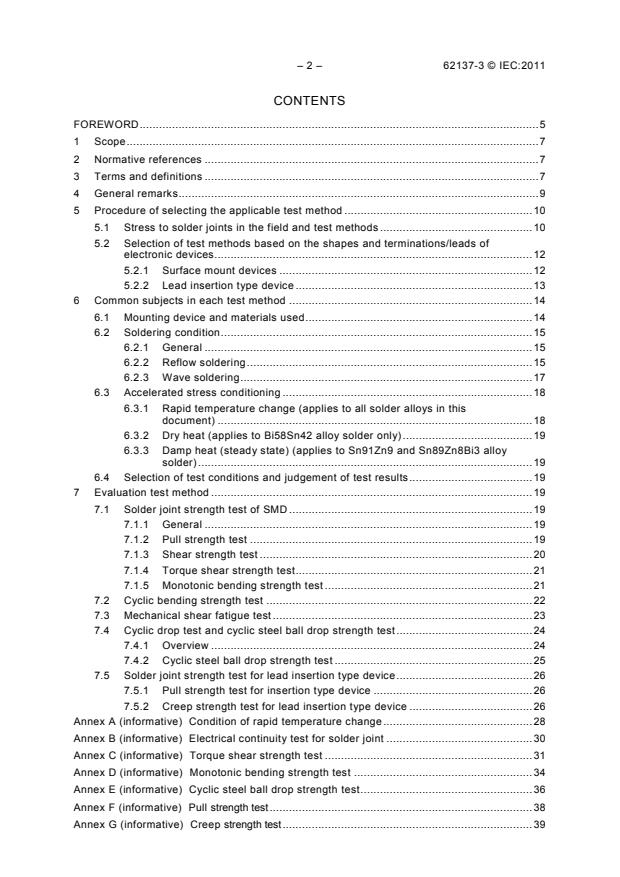
CONTENTS
FOREWORD . 5
1 Scope . 7
2 Normative references . 7
3 Terms and definitions . 7
4 General remarks . 9
5 Procedure of selecting the applicable test method . 10
5.1 Stress to solder joints in the field and test methods . 10
5.2 Selection of test methods based on the shapes and terminations/leads of
electronic devices . 12
5.2.1 Surface mount devices . 12
5.2.2 Lead insertion type device . 13
6 Common subjects in each test method . 14
6.1 Mounting device and materials used . 14
6.2 Soldering condition . 15
6.2.1 General . 15
6.2.2 Reflow soldering . 15
6.2.3 Wave soldering . 17
6.3 Accelerated stress conditioning . 18
6.3.1 Rapid temperature change (applies to all solder alloys in this
document) . 18
6.3.2 Dry heat (applies to Bi58Sn42 alloy solder only) . 19
6.3.3 Damp heat (steady state) (applies to Sn91Zn9 and Sn89Zn8Bi3 alloy
solder) . 19
6.4 Selection of test conditions and judgement of test results . 19
7 Evaluation test method . 19
7.1 Solder joint strength test of SMD . 19
7.1.1 General . 19
7.1.2 Pull strength test . 19
7.1.3 Shear strength test . 20
7.1.4 Torque shear strength test . 21
7.1.5 Monotonic bending strength test . 21
7.2 Cyclic bending strength test . 22
7.3 Mechanical shear fatigue test . 23
7.4 Cyclic drop test and cyclic steel ball drop strength test . 24
7.4.1 Overview . 24
7.4.2 Cyclic steel ball drop strength test . 25
7.5 Solder joint strength test for lead insertion type device . 26
7.5.1 Pull strength test for insertion type device . 26
7.5.2 Creep strength test for lead insertion type device . 26
Annex A (informative) Condition of rapid temperature change . 28
Annex B (informative) Electrical continuity test for solder joint . 30
Annex C (informative) Torque shear strength test . 31
Annex D (informative) Monotonic bending strength test . 34
Annex E (informative) Cyclic steel ball drop strength test . 36
Annex F (informative) Pull strength test . 38
Annex G (informative) Creep strength test . 39
62137-3 © IEC:2011 – 3 –
Annex H (informative) Evaluation method for the fillet lifting phenomenon of a lead
insertion type device solder joint . 41
Bibliography . 43
Figure 1 – Joint regions for the reliability tests . 9
Figure 2 – Factors affecting the joint reliability made by lead-free solder . 10
Figure 3 – An example of the mounting position of SMD for monotonic bending and
cyclic bending tests . 15
Figure 4 – An example of reflow soldering temperature profile (Sn96,5Ag3Cu,5) . 16
Figure 5 – Examples of reflow soldering temperature profile other than
Sn96,5Ag3Cu,5 . 16
Figure 6 – An example of wave soldering temperature profile (Sn96,5Ag3Cu,5) . 17
Figure 7 – An example of wave soldering temperature profile . 18
Figure 8 – Pull strength test . 20
Figure 9 – Shear strength test. 20
Figure 10 – Torque shear strength test . 21
Figure 11 – Monotonic bending strength test . 21
Figure 12 – Cyclic bending strength test . 22
Figure 13 – Structure of cyclic bending strength test . 23
Figure 14 – Schematic diagram of mechanical shear fatigue for solder joint . 24
Figure 15 – Cyclic drop test . 25
Figure 16 – Cyclic steel ball drop test . 25
Figure 17 – Pull strength test . 26
Figure 18 – Creep strength test . 27
Figure A.1 – Stress relation curve for a given strain to a solder joint (Sn96,5Ag3Cu,5) . 28
Figure A.2 – Time to reach steady state in the temperature cycle chamber . 29
Figure B.1 – Example of the test circuit for an electrical continuity test of a solder joint . 30
Figure C.1 – Fixing of substrate for torque shear strength test . 32
Figure C.2 – Torque shear strength test jig and position adjustment . 33
Figure C.3 – Torque shear strength test for a connector . 33
Figure D.1 – Example of a board bending jig . 34
Figure E.1 – Cyclic steel ball drop test . 37
Figure E.2 – Comparison of cyclic drop test and cyclic steel ball drop test . 37
Figure F.1 – Pull strength test . 38
Figure G.1 – Creep strength test . 39
Figure H.1 – Fillet lifting phenomenon of solder joint . 41
Figure H.2 – Example of an electrical continuity test circuit for a lead insertion type
device solder joint . 42
Table 1 – Correlations between test methods and actual stresses in the field . 11
Table 2 – Recommended test methods suitable for specific shapes and
terminations/leads of SMDs . 12
Table 3 – Recommended test methods suitable for application and mass of the lead
insertion type device . 13
Table 4 – Solder alloy composition . 14
– 4 – 62137-3 © IEC:2011
Table 5 – Diameters of through holes and lands in respect to the nominal cross
section and nominal diameter of lead wire . 15
Table 6 – Temperature condition for rapid temperature change. 18
62137-3 © IEC:2011 – 5 –
INTERNATIONAL ELECTROTECHNICAL COMMISSION
____________
ELECTRONICS ASSEMBLY TECHNOLOGY –
Part 3: Selection guidance of environmental and endurance
test methods for solder joints
FOREWORD
1) The International Electrotechnical Commission (IEC) is a worldwide organization for standardization comprising
all national electrotechnical committees (IEC National Committees). The object of IEC is to promote
international co-operation on all questions concerning standardization in the electrical and electronic fields. To
this end and in addition to other activities, IEC publishes International Standards, Technical Specifications,
Technical Reports, Publicly Available Specifications (PAS) and Guides (hereafter referred to as “IEC
Publication(s)”). Their preparation is entrusted to technical committees; any IEC National Committee interested
in the subject dealt with may participate in this preparatory work. International, governmental and non-
governmental organizations liaising with the IEC also participate in this preparation. IEC collaborates closely
with the International Organization for Standardization (ISO) in accordance with conditions determined by
agreement between the two organizations.
2) The formal decisions or agreements of IEC on technical matters express, as nearly as possible, an international
consensus of opinion on the relevant subjects since each technical committee has representation from all
interested IEC National Committees.
3) IEC Publications have the form of recommendations for international use and are accepted by IEC National
Committees in that sense. While all reasonable efforts are made to ensure that the technical content of IEC
Publications is accurate, IEC cannot be held responsible for the way in which they are used or for any
misinterpretation by any end user.
4) In order to promote international uniformity, IEC National Committees undertake to apply IEC Publications
transparently to the maximum extent possible in their national and regional publications. Any divergence
between any IEC Publication and the corresponding national or regional publication shall be clearly indicated in
the latter.
5) IEC itself does not provide any attestation of conformity. Independent certification bodies provide conformity
assessment services and, in some areas, access to IEC marks of conformity. IEC is not responsible for any
services carried out by independent certification bodies.
6) All users should ensure that they have the latest edition of this publication.
7) No liability shall attach to IEC or its directors, employees, servants or agents including individual experts and
members of its technical committees and IEC National Committees for any personal injury, property damage or
other damage of any nature whatsoever, whether direct or indirect, or for costs (including legal fees) and
expenses arising out of the publication, use of, or reliance upon, this IEC Publication or any other IEC
Publications.
8) Attention is drawn to the Normative references cited in this publication. Use of the referenced publications is
indispensable for the correct application of this publication.
9) Attention is drawn to the possibility that some of the elements of this IEC Publication may be the subject of
patent rights. IEC shall not be held responsible for identifying any or all such patent rights.
International Standard IEC 62137-3 has been prepared by IEC technical committee 91:
Electronics assembly technology.
This first edition cancels and replaces IEC/PAS 62137-3, published in 2008, and includes
some editorial revisions. The main changes with respect to the PAS include the following:
– no technical changes;
– some editorial changes and corrections;
– for the sake of convenience some constitutive changes.
– 6 – 62137-3 © IEC:2011
The text of this standard is based on the following documents:
FDIS Report on voting
91/986/FDIS 91/1011/RVD
Full information on the voting for the approval of this standard can be found in the report on
voting indicated in the above table.
This publication has been drafted in accordance with the ISO/IEC Directives, Part 2.
A list of all parts of IEC 62137 under the general title Electronics assembly technology can be
found in the IEC website.
Future standards in this series will carry the new general title as cited above. Titles of existing
standards in this series will be updated at the time of the next edition.
The committee has decided that the contents of this publication will remain unchanged until
the stability date indicated on the IEC web site under "http://webstore.iec.ch" in the data
related to the specific publication. At this date, the publication will be
• reconfirmed,
• withdrawn,
• replaced by a revised edition, or
• amended.
IMPORTANT – The “colour inside” logo on the cover page of this publication indicates
that it contains colours which are considered to be useful for the correct understanding
of its contents. Users should therefore print this publication using a colour printer.
62137-3 © IEC:2011 – 7 –
ELECTRONICS ASSEMBLY TECHNOLOGY –
Part 3: Selection guidance of environmental and endurance
test methods for solder joints
1 Scope
This part of IEC 62137 describes the selection methodology of an appropriate test method for
a reliability test for solder joints of various shapes and types of surface mount devices (SMD),
array type devices and leaded devices, and lead insertion type devices using various types of
solder material alloys.
2 Normative references
The following referenced documents are indispensable for the application of this document.
For a dated reference, only the edition cited applies. For an undated reference, the latest
edition of the referenced document (including any amendment) applies.
IEC 60194, Printed board design, manufacture and assembly – Terms and definitions
IEC 61188-5 (all parts), Printed boards and printed board assemblies – Design and use
IEC 61249-2-7, Materials for printed boards and other interconnecting structures – Part 2-7:
Reinforced base materials clad and unclad – Epoxide woven E-glass laminated sheet of
defined flammability (vertical burning test), copper-clad
IEC 62137-1-1:2007, Surface mounting technology – Environmental and endurance test
methods for surface mount solder joint – Part 1-1: Pull strength test
IEC 62137-1-2:2007, Surface mounting technology – Environmental and endurance test
methods for surface mount solder joint – Part 1-2: Shear strength test
IEC 62137-1-3:2008, Surface mounting technology – Environmental and endurance test
methods for surface mount solder joint – Part 1-3: Cyclic drop test
IEC 62137-1-4:2009, Surface mounting technology – Environmental and endurance test
methods for surface mount solder joint – Part 1-4: Cyclic bending test
IEC 62137-1-5:2009, Surface mounting technology – Environmental and endurance test
methods for surface mount solder joints – Part 1-5: Mechanical shear fatigue test
3 Terms and definitions
For the purposes of this document, the terms and definitions in IEC 60194, as well as the
following, apply.
3.1
pull strength for SMD
maximum force to break the joint of a lead to substrate when a gull-wing lead of a surface
mount device is pulled using a pulling tool at an angle of 45° to the substrate surface
[IEC 62137-1-1:2007, modified]
– 8 – 62137-3 © IEC:2011
3.2
shear strength for SMD
maximum force applied parallel to the substrate and perpendicular to the specimen lateral
surface to break the joint of SMD mounted on a substrate
[IEC 62137-1-2:2007, modified]
3.3
torque shear strength for SMD
maximum rotation moment to SMD which is applied in parallel to the substrate surface, to
break the solder joint between an SMD termination/lead and the land on the substrate
3.4
monotonic bending strength for SMD
strength of solder joints of SMD mounted on substrate when the substrate is bent convex
toward to the mounted SMDs expressed by the maximum bending depth to the break of joints
3.5
cyclic bending strength for SMD
intensity of the strength, which is expressed in the number of cycles to attain the joint fracture
between SMD termination/lead mounted on the substrate and the copper land of the substrate
after bending the substrate cyclically to a specified degree to allow the surface of the device
side of the substrate to become a convex shape
[IEC 62137-1-4:2009, modified]
3.6
mechanical shear fatigue strength for SMD
imposition of cyclic shear deformation on the solder joints by mechanical displacement
instead of relative displacement generated by CTE (coefficient of thermal expansion)
mismatch in thermal cycling testing
NOTE The mechanical shear fatigue tests continues until the maximum force decreases to a specified value,
which corresponds to the appearance of an initial crack, or the electrical resistance-measuring instrument can
detect electric continuity interruption, and the number of cycles is recorded as fatigue life.
3.7
cyclic drop test for SMD
number of drops to break solder joints of an SMD to the lands on a substrate which is fixed to
a jig when the substrate is dropped from a specified height
3.8
cyclic steel ball drop strength for SMD
number of drops to break solder joints of a SMD to the lands on a substrate when the steel
ball is dropped from a specified height on a substrate
3.9
pull strength for lead insertion type device
maximum applied force to break the solder joint of a lead insertion type device to a land on
substrate when the lead is pulled using a jig
3.10
creep strength for lead insertion type device
strength of a solder joint expressed by the time to break the joint when a continuous force is
applied to a lead of a lead insertion type device soldered to a land
62137-3 © IEC:2011 – 9 –
3.11
fillet lifting phenomenon for lead insertion type device
phenomenon whereby a solder fillet of a lead is lifting from a land on a substrate, or of the
land from the substrate (de-lamination)
3.12
daisy chain
all chains of solder joint connections that are connected in series, see Clause B.2
NOTE Lands on both sides of a substrate and lead are solder-connected in a chain in the case of a fillet lifting
test.
4 General remarks
The regions of the joints to be evaluated are shown in Figure 1. The test methods given here
are applicable to evaluate the durability of joints of a device mounted on substrate but not to
test the mechanical strength of the device itself.
The conditions for accelerated stress conditioning (rapid temperature change and dry heat)
may exceed the maximum allowable temperature range for a device.
SMD (leadless termination type)
Device
Device termination
Device termination
Solder
Plating layers
Evaluation
area Solder
Inter-metallic
Compound layers
Substrate Substrate land
Substrate Land
SMD (array type)
Device Substrate
Device
Solder
Substrate
Device termination
Plating layers
Evaluation
area Solder
Inter-metallic
Substrate
Compound layers
SMD (leaded type)
Lead
Substrate Substrate land
Solder
Device
lead
Substrate
Land Plating layers
Evaluation
Inter-metallic
area Solder
Lead insertion type device
Compound layers
(single-sided board)
Lead
Substrate land
Substrate
IEC 2175/11
Substrate
Solder
Land
Figure 1 – Joint regions for the reliability tests
– 10 – 62137-3 © IEC:2011
The lead-free solders have different properties from those of the conventional eutectic or near
eutectic tin-lead solder. The reliability of solder joints using lead-free solder may be reduced
by the composition of the solder used the shape of termination/lead and surface treatment.
The example of factors affect to the joint reliability when using Sn96,5Ag3Cu,5 solder are
shown in Figure 2. This solder has the properties of a higher melting temperature and is
harder than the tin-lead eutectic solder and is hard to deform in the solid-state. Consequently,
the stress induced to the joint becomes higher than the tin-lead eutectic solder.
These properties may induce break of a solder joint by accelerated stress conditioning.
The termination/lead finishes of SMD could affect the test result not only for the drop test, but
also for other tests. Therefore all tests should consider them.
Accelerating
factors
Thermal stress
Temperature cycle
High temperature
Properties Factors affecting joint reliability
Temperature-humidity
Mechanical stress
Static
1) Hard, not easily deformed • Increased stress to solder
Active (vibration, shock/impact)
• Increased stress between Mass of device
2) High melting temp.
Joint/substrate (e.g., fillet lifting)
High solidifying temp.
High soldering temp.
• Growth of reacting layer
3) Increased reactivity (Sn rich)
• Termination/land melting, diffusion
Solder failure
Initiation and
4) Segregation by inclusion of low
Interface failure
growth of crack
• Reduction of reliability by formation of
melting temp. metals (Pb, Bi)
Termination
and fracture
segregation layer
failure
5) Change in materials/structure
• Failure of termination/terminal itself
of termination/lead
* Device body and
• Deformation of fillet, defect formation
6) Decreased solderability
board are excluded
Affecting parameter
Device: structure of termination/lead
Size board: land, thickness, material
Structure of joints
IEC 2176/11
Figure 2 – Factors affecting the joint reliability made by lead-free solder
5 Procedure of selecting the applicable test method
5.1 Stress to solder joints in the field and test methods
The correlations between the test methods and the actual stress induced to devices are
shown in Table 1. The type of substrate and the shapes of termination/lead which affect the
test results to actual stress conditions of the mounted SMDs in the field are also shown as
reference. The selection of a test method suitable for a specific shape and termination/lead
are given in 5.2.
62137-3 © IEC:2011 – 11 –
Table 1 – Correlations between test methods and actual stresses in the field
Test method Accelerated stress Applicable Stress in the field and
(Applicable standard) conditioning board/Compon applicable products
ents
a, b
Rapid temperature SMD The stresses to be assumed are
Continuity test
c
as follows.
Annex B change
c
a
a)Repeated thermal stress
SMD
Pull strength Dry heat
caused by the difference in
(Gull-wing)
IEC 62137-1-1
c
Damp heat thermal expansion coefficients
a
SMD of device and substrate at the
Shear strength
ON/OFF of equipment and/or
IEC 62137-1-2
temperature changes in the
a
SMD
Torque shear strength
surrounding environment
Annex C
b)High temperature environment
a
SMD
Monotonic bending test
c)High temperature and high
Annex D
humidity environment
Cyclic bending strength test Repeated board SMD Repeated mechanical stress
IEC 62137-1-4 bending applied to solder joints and
substrate as in the case of
keying, especially for portable
equipment
Mechanical shear fatigue test Cyclic strain SMD Repeated thermal stress caused
IEC 62137-1-5 by the difference in thermal
expansion coefficients of
device and substrate at the
ON/OFF of equipment and/or
temperature changes in the
surrounding environment
d
Repeated board drop SMD Shock induced to solder joints
Cyclic drop test
when equipment is erratically
IEC 62137-1-3
dropped while the equipment is
d
Cyclic steel ball drop strength test Repeated ball drop SMD
in use
Annex E
Pull strength test Rapid temperature Single-sided Repeated thermal stress caused
c
Annex F TH/Lead by the difference in thermal
change
insertion type expansion coefficients of
device and board at the ON/OFF
of equipment and/or
temperature changes in the
surrounding environment
Creep strength test Mass load at elevated Single-sided Degradation of solder joint when
Annex G temperature TH/Lead a continuous force is applied
insertion type
e
Observe of fillet lifting Double-sided
Not applicable
The fillet lifting phenomenon
phenomenon
TH/Lead
may occur between the solder
Annex H insertion type
alloy and the lead plating and/or
land after soldering
NOTE The vibration test is a test of durability against the vibration a product may receive while in
transportation or in the service in the field. It was not proven that a vibration test, including the most severe
random vibration test, could evaluate degradation of solder joints. The vibration test is, therefore, not included
in this standard.
a
This test is to evaluate degradation of joint strength with repeated thermal stress induced to the joint by
means of rapid temperature change, dry heat and damp heat as accelerated stress conditioning. A proper
test should be selected according to the features of the device under test such as the shape of its leads.
b
This test is to check if there is a failure at a solder joint by measuring changes of resistance of the joint
without applying mechanical stress. This test method is referred to here as an alternative method as it is a
useful test especially for BGA and LGA.
c
The applicable accelerate stress conditioning by the solder alloy is as shown below.
1) Rapid change of temperature: Sn-Zn, Sn-Bi and Sn-In
2) Damp heat: Sn-Zn
3) Dry heat: Sn-Bi
d
The applicable test method for Sn-Zn, Sn-Bi and Sn-In alloy is the cyclic steel ball drop strength test.
e
The rapid temperature change is recommended if observed fillet lifting between land and board exists.
– 12 – 62137-3 © IEC:2011
5.2 Selection of test methods based on the shapes and terminations/leads of
electronic devices
5.2.1 Surface mount devices
The recommended test methods suitable for specific shapes and terminations/lead of devices
are shown in Table 2.
Table 2 – Recommended test methods suitable
for specific shapes and terminations/leads of SMDs
Apply the accelerated stress
Types and terminations/leads of a device
conditioning Mechanical
Cyclic Cyclic
shear
Monoto-
bending drop
Number of Shear Torque
fatigue
Pull Continu nic
test test
Terminations/Leads terminations/ Examples strength shear
test
test ity test bending
leads test test
test
Terminations on Tantalum
2 sides 2 capacitor, - A,B - - - - C -
(bent leads) Inductor
Rectangular
Terminations on chip
2 - A,B - - - - C -
3 sides Resistor/Film
capacitor
Laminated
Terminations on capacitor,
5 sides 2 Thermistor,
- A,B - - - - C -
(including cap) Laminated
inductor, Fuse
Multi
terminations 4 Resistor array,
- A,B - - - C C -
(terminations on or more Capacitor array
sides)
A,
Gull wing – 1 Transformer C - - C - C -
or more
B
Gull wing – 2 Up to 6 Switch - B A,B - - - C -
Gull wing – 3 Connector - A,B A,B - C - C -
or more
Inductor,
Terminations
2 Tantalum - A,B B - - - C -
on bottom
capacitor
Round MELF
termination 2 capacitor/resistor - A,B B - - - C -
(including cap) /fuse
Leads on two
sides 2 Diode - A,B C - - - C -
(bent lead)
Gull wing leads 3 to 6 Small transistor C B C - - - C -
A,
Gull wing leads QFP, SOP - - C C C B B
or more B
Non-lead QFN, SON - - - A,B C B B B
or more
Ball terminations
on Multiple BGA, FBGA - - - A,B C B B B
bottom
Terminations on
bottom without Multiple LGA, FLGA - - - A,B C B B B
ball
NOTE 1 A: Recommended for accelerated stress conditioning, B: Applicable, C: Applicable when conditions are
met, -: Not applicable.
NOTE 2 One of the following static mechanical tests is performed before and after the accelerated stress
conditioning according to the shape of the device under test.
a) Pull strength test: SMD with gull wing leads.
b) Shear strength test: Small rectangular SMD to which a pushing jig can be pressed to a side of the device.
c) Torque shear strength test: SMD that has the shape to which the regular shear strength test is difficult to
apply, and to rather a large device with many terminations or leads such as a semiconductor device or a
connector.
Semiconductor devices General electronics components
62137-3 © IEC:2011 – 13 –
NOTE 3 The continuity test is applicable to devices to which a daisy-chain can be formed on the mounting substrate
or within the device under test itself.
Examples are those semiconductor devices not with leads such as BGA, LGA or QFN.
NOTE 4 The monotonic bending limit test is applicable to those devices with height or large size to which the
resistance measurement test is available and which are not easily deformed.
NOTE 5 The cyclic bending strength test and cyclic drop test are applicable to those devices mainly used in
portable equipment.
The use of these tests should be specified in the specification of the product.
The cyclic bending strength test for substrate is suitable to semiconductor devices mounted on a substrate.
NOTE 6 Each temperature test is applied in the case of the following alloys.
a) Rapid temperature change: Sn-Ag-Cu, Sn-Zn, Sn-Bi and Sn-In
b) Damp heat: Sn-Zn
c) Dry heat: Sn-Bi
NOTE 7 The shape of semiconductor devices is defined in IEC 60191. However, "Terminations on the bottom
without ball package" is not defined yet. Here, "Terminations on the bottom without ball package" defines it as
package (shape) of BGA without solder ball.
5.2.2 Lead insertion type device
The pull strength test is the basic test for lead insertion type devices. The creep test should
also be used for devices of large size, or an external force seems to be applied continuously
from its structure.
The selection of the test shall be stated in the product specification for the device to be
mounted on one side only of a substrate. In many cases, the strength of leads in lead
insertion type devices may be inferior compared to those of solder joints. These tests are not
appropriate for equipment using this type of substrates.
Recommended test methods suitable for the mass of the lead insertion type device, the kind
of board and application of the load are given in Table 3.
Table 3 – Recommended test methods
suitable for application and mass of the lead insertion type device
Application, device type Test Evaluation
Substrate
Pull Observation of
Creep Continuity
type
Application Device mass strength fillet lifting
strength test evaluation
test phenomenon
Light B - - -
No continuous
load
Heavy C B - -
Single-
sided TH
Light B - - -
Continuous load
Heavy C C - -
General lead insertion type device - - B C
Double-
Daisy chain applicable lead - - B B
sided TH
insertion type device
NOTE 1 B: Applicable, C: Applicable when conditions are met, -: Not applicable
NOTE 2 Environment of each test is as follows.
a) Pull strength test: Room temperature
b) Creep strength test: High temperature environment to prescribe in a product standard
c) Fillet lifting observation: Room temperature
d) Continuity evaluation: Rapid temperature change environment to prescribe in a product standard
– 14 – 62137-3 © IEC:2011
NOTE 3 For these tests, the Sn - Ag - Cu alloy and Sn - Zn solder alloy are suitable
NOTE 4 In case of using double-sided TH substrate, the strength of the lead tends to be less than the strength of
solder joint. Therefore, this type substrate is not suitable for a pull strength test.
NOTE 5 The details of the evaluation for double-sided through hole (TH) are given in Annex H.
6 Common subjects in each test method
6.1 Mounting device and materials used
a) Solder
Various compositions of the lead-free solder alloy for interconnections are used in the field.
Unless otherwise specified in the product specification, the lead-free solder alloy shall be
selected from Table 4 given by the solder alloy type.
Table 4 – Solder alloy composition
Solder alloy type Alloy (Short name)
Sn-Ag-Cu Sn96,5Ag3Cu,5(A30C5) –
Sn-Zn Sn91Zn9(Z90) Sn89Zn8Bi3(Z80B30)
Sn-Bi Bi58Sn42(B580) –
Sn-In Sn88In8Ag3,5Bi,5(N80A35B5) –
Sn-Cu Sn99,3Cu,7(C7) –
b) Test substrate
The test substrate shall be the copper-clad laminate of glass-cloth epoxy type specified in
IEC 61249-2-7. When test substrate of other material is used, it is recommended to select
material of less thermal degradation, mechanical deformation and breakage.
The materials hard to deform such as ceramic shall not be used as the test substrate for
monotonic bending strength test, cyclic bending strength test and cyclic drop test.
Other items are specified in the relevant test method.
c) Mounting devices to test substrate
The following are mounting devices to the test substrate.
Tests for SMDs are performed by mounting the devices on single-sided or one side of double-
sided substrate.
Tests for lead insertion type devices are for mounting the devices on one side of substrate.
Tests for lead insertion type devices mounted on a double-sided substrate are not appropriate
as the strength of solder joints in this case is much higher than that of leads themselves to the
device.
Soldering method for SMDs should be reflow soldering and for lead insertion type device
should be wave soldering.
d) Position of devices and land pattern
The SMD to be tested in the monotonic bending strength test, cyclic bending strength test and
cyclic drop test shall be mounted in the centre of a test substrate, as shown in Figure 3. The
position of the device under test for other tests may be determined in an appropriate place on
62137-3 © IEC:2011 – 15 –
the test substrate as agreed between user and supplier. Unless otherwise specified in the
product standard, the land pattern in the IEC 61188-5 series shall be used.
Unit: mm
Device
部品
90 (Span)
IEC 2177/11
Key
PWB thickness 1,6.
Figure 3 – An example of the mounting position of SMD
for monotonic bending and cyclic bending tests
The lead insertion type device to be tested in the pull strength test and creep strength test to
evaluate the strength of solder joint between device and land when connected using lead-free
solder. The test evaluates the durability of a solder joint until break when connecting the lead
of a lead insertion type device to single-sided substrate by wave soldering while measuring
the electric resistance of the joint by applying a specified weight to the lead in a temperature
chamber. Time to break is evaluated because resistance increases if solder joint breaks.
The diameter of a through hole and the diameter of a land are given in Table 5.
Table 5 – Diameters of through holes and lands in respect
to the nominal cross section and nominal diameter of lead wire
Nominal cross sectional Nominal diameter(d) of a round Through hole Land diameter
area (S) cross section type lead diameter
mm mm mm mm
0,8 1,4
S≦0,10 d≦0,35
1,0 1,6
0,10
1,2 1,8
0,28
1,4 2,0
0,50
0,79
6.2 Soldering condition
6.2.1 General
A proper soldering condition shall be selected to form an appropriate solder fillet. Examples of
the temperature profile for the lead free solder for reflow and wave soldering are shown in
6.2.2 and 6.2.3 respectively.
6.2.2 Reflow soldering
Reflow soldering temperature profiles used for actual substrate assembly should always be
optimised by substrate assembler depending on devices substrate layout, and so on. For
Sn96,5Ag3Cu,5 solder, the soldering temperature profile should follow the defaults of
IEC 61760-1 as indicated in Figure 4. Examples of soldering temperature profile other than
Sn96,5Ag3Cu,5 solder are shown in Figure 5.
– 16 – 62137
...
Questions, Comments and Discussion
Ask us and Technical Secretary will try to provide an answer. You can facilitate discussion about the standard in here.
Loading comments...