IEC 62115:2017/AMD1:2025/COR1:2025
(Amendment)Corrigendum 1 - Amendment 1 - Electric toys - Safety
Corrigendum 1 - Amendment 1 - Electric toys - Safety
Corrigendum 1 - Amendement 1 - Jouets électriques - Sécurité
General Information
Relations
Standards Content (Sample)
INTERNATIONAL ELECTROTECHNICAL COMMISSION
COMMISSION ÉLECTROTECHNIQUE INTERNATIONALE
____________
IEC 62115 IEC 62115
Amendment 1 to edition 2.0 2025-10 Amendement 1 à l'édition 2.0 2025-10
Electric toys - Safety Jouets électriques - Sécurité
CO RRI G E NDUM 1
Corrections to the French version appear after the English text.
Les corrections à la version française sont données après le texte anglais.
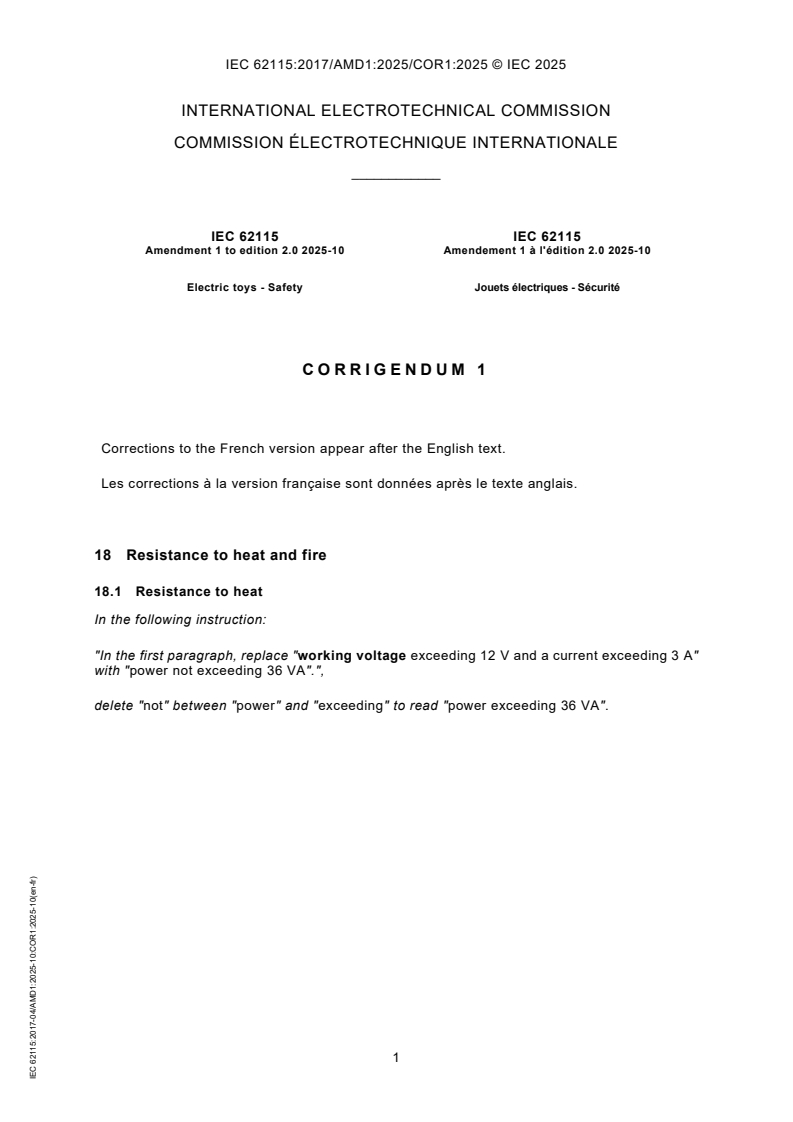
18 Resistance to heat and fire
18.1 Resistance to heat
In the following instruction:
"In the first paragraph, replace "working voltage exceeding 12 V and a current exceeding 3 A"
with "power
...
This May Also Interest You
IEC 62115:2017 specifies safety requirements for electric toys that have at least one function dependant on electricity, electric toys being any product designed or intended, whether or not exclusively, for use in play by children under 14 years of age.
Examples of electric toys also within the scope of this standard are:
- constructional sets;
- experimental sets;
- functional electric toys (an electric toy that performs and is used in the same way as a product, appliance or installation intended for use by adults, and which may be a scale model of such product, appliance or installation);
- electric toy computers as well as a doll's house having an interior lamp.
If the packaging is intended to have play value then it is considered to be part of the electric toy.
This International Standard only covers the safety aspects of electric toys that relate to an electrical function.
This standard covers the safety of electric toys taking power from any source, such as batteries, transformers, solar cells and inductive connections.
This second edition cancels and replaces the first edition published in 2003, Amendment 1 (2004) and Amendment 2 (2010). This edition constitutes a technical revision.
This edition includes the following significant technical changes with respect to the previous edition:
- the general conditions for tests has been rewritten and modified (Clause 5);
- the criteria for reduced testing has been modified (Clause 6);
- warnings for toys using button batteries or coin batteries have been added (7.3.3.2, 7.3.3.3);
- warnings on ride-on toys have been added (7.5);
- the requirements concerning accessibility of batteries have been updated (13.4.1 and 13.4.2);
- added requirements to cover toys placed above a child (13.4.4);
- added requirements to cover toys connected to other equipment (13.9);
- modified the requirements for safety of toys incorporating optical radiation sources (Annex E), to include requirements for using the technical LED data sheet for checking compliance with the specified accessible emission limits (AEL);
- updated the details for measurements of the optical radiation from the toy (Annex E);
- introduced an informative Annex I concerning measurement methods for toys with an integrated field source generating EMF;
- included a normative Annex J concerning safety of remote-controls for electric ride-on toys.
The attention of National Committees is drawn to the fact that equipment manufacturers and testing organizations may need a transitional period following publication of a new, amended or revised IEC publication in which to make products in accordance with the new requirements and to equip themselves for conducting new or revised tests.
It is the recommendation of the committee that the content of this publication be adopted for implementation nationally not earlier than 12 months or later than 36 months from the date of its publication.
Key words: Safety, Electric Toys
The contents of the corrigendum of August 2019 apply to the French text only.
- Standard201 pagesEnglish languagesale 15% off
- Standard198 pagesEnglish and French languagesale 15% off
The content of the corrigendum 1 (2025-10) has been included in this copy.
- Standard10 pagesEnglish languagesale 15% off
- Standard11 pagesFrench languagesale 15% off
- Standard4 pagesEnglish and French languagesale 15% off
Deals with the safety of toys that have at least one function dependent on electricity. Examples of toys within the scope of this standard are constructional sets; experimental sets; functional toys(having a function similar to an appliance or installation used by adults) and video toys(toys having a screen and means of activation, such as a joystick or keyboard. Seperate screens having a rated voltage of more than 24 v are not considered to be part of the toy). Toys using electricty for secondary functions are also within the scope of this standard (a dolls house having an interior lamp is an example of such a toy).
- Standard35 pagesEnglish languagesale 15% off
- Standard36 pagesEnglish languagesale 15% off
- Standard73 pagesEnglish and French languagesale 15% off
- Standard75 pagesEnglish and French languagesale 15% off
- Standard82 pagesEnglish and French languagesale 15% off
- Standard21 pagesEnglish and French languagesale 15% off
- Standard4 pagesEnglish languagesale 15% off
- Standard7 pagesEnglish and French languagesale 15% off
IEC TR 61169-1-8:2025 provides a test method for voltage standing wave ratio (VSWR, hereinafter) of single RF connector by double-connector method. This document is applicable to single RF cable connectors and single microstrip RF connectors as well as single adapters if an estimation of the VSWR of a single completely installed RF-connector is used and a time domain feature is not available on the vector network analyzer.
- Technical report18 pagesEnglish languagesale 15% off
IEC 62541-100:2025 defines the information model associated with Devices. This document describes three models which build upon each other as follows:
• The (base) Device Model is intended to provide a unified view of devices and their hardware and software parts irrespective of the underlying device protocols.
• The Device Communication Model adds Network and Connection information elements so that communication topologies can be created.
• The Device Integration Host Model finally adds additional elements and rules required for host systems to manage integration for a complete system. It enables reflecting the topology of the automation system with the devices as well as the connecting communication networks.
This document also defines AddIns that can be used for the models in this document but also for models in other information models. They are:
• Locking model – a generic AddIn to control concurrent access,
• Software update model – an AddIn to manage software in a Device.
This second edition cancels and replaces the first edition published in 2015. This edition constitutes a technical revision.
This edition includes the following significant technical changes with respect to the previous edition:
a a ComponentType that can be used to model any HW or SW element of a device has been defined and a SoftwareType has been added as subtype of ComponentType;
b the new OPC UA interface concept and defined interfaces for Nameplate, DeviceHealth, and SupportInfo has been added.
c) a new model for Software Update (Firmware Update) has been added;
d) a new entry point for documents where each document is represented by a FileType instance has been specified;
e) a model that provides information about the lifetime, related limits and semantic of the lifetime of things like tools, material or machines has been added.
- Standard152 pagesEnglish languagesale 15% off
- Standard158 pagesFrench languagesale 15% off
- Standard310 pagesEnglish and French languagesale 15% off
IEC TS 63414:2025 is applicable for the determination of the AC and DC pollution flashover and withstand voltage characteristics of insulators with polymeric housing, to be used outdoors in HV applications and exposed to polluted environments. This is also applicable for insulators with hydrophobic coatings. This document refers to AC systems with a rated voltage greater than 1 000 V and DC systems with a rated voltage greater than 1 500 V.
The object of this technical specification is to prescribe standardized test methods, requirements and procedures for artificial pollution tests applicable to polymeric insulators for overhead lines including traction lines, station post and hollow insulators of equipment. Available test experience with polymeric station post and hollow insulators, especially for DC applications, is limited.
The proposed tests are not applicable to ceramic and glass insulators without polymeric housing, to greased insulators or to special types of insulators (e.g., insulators with semiconducting glaze).
Differently to ceramic and glass insulators without polymeric housing:
- The pollution performance of insulators with polymeric housing varies with the hydrophobicity condition of the surface. The specific conditions simulated by standardized tests might not represent the actual dynamic field conditions.
- The determination of the flashover and/or withstand voltage under pollution conditions is not enough for dimensioning. Additional constraints related to possible ageing are also to be considered.
- If the Hydrophobicity Transfer Material (HTM) test according to IEC TR 62039 confirms that an insulator is non-HTM, it can be tested according to IEC 60507 or IEC TS 61245.
- Technical specification39 pagesEnglish languagesale 15% off
IEC 62541-13:2025 is available as IEC 62541-13:2025 RLV which contains the International Standard and its Redline version, showing all changes of the technical content compared to the previous edition.IEC 62541-13:2025 defines the information model associated with Aggregates. Programmatically produced aggregate examples are listed in Annex A. This third edition cancels and replaces the second edition published in 2020. This edition constitutes a technical revision.
This edition includes the following technical changes with respect to the previous edition:
a) Multiple fixes for the computation of aggregates
• The Raw status bit is always set for non-bad StatusCodes for the Start and End aggregates.
• Entries in the Interpolative examples Tables A2.2 Historian1, Historian2, and Historian3 have been changed from Good to Good, Raw status codes when the timestamp matches with the timestamp of the data source.
• Missing tables have been added for DurationInStateZero and DurationInStateNonZero.
• The value of zero has been removed for results with a StatusCode of bad.
• Data Type was listed as "Status Code" when it is "Double" for both Standard Deviation and both Variance Aggregates.
• Rounding Error in TimeAverage and TimeAverage2 have been corrected.
• The status codes have been corrected for the last two intervals and the value has been corrected in the last interval.
• The wording has been changed to be more consistent with the certification testing tool.
• UsedSlopedExtrapolation set to true for Historian2 and all examples locations needed new values or status' are modified.
• Values affected by percent good and percent bad have been updated.
• PercentGood/PercentBad are now accounted for in the calculation.
• TimeAverage uses SlopedInterpolation but the Time aggregate is incorrectly allowed to used Stepped Interpolation.
• Partial bit is now correctly calculated.
• Unclear sentence was removed.
• Examples have been moved to a CSV.
• The value and status code for Historian 3 have been updated.
• TimeAverage2 Historian1 now takes uncertain regions into account when calculating StatusCodes.
• TimeAverage2 Historian2 now takes uncertain regions into account when calculating StatusCodes.
• Total2 Historian1 now takes uncertain regions into account when calculating StatusCodes
• Total2 Historian2 now takes uncertain regions into account when calculating StatusCodes
• Maximum2 Historian1 now takes uncertain regions into account when calculating StatusCodes
• MaximumActualTime2 Historian1 now takes uncertain regions into account when calculating StatusCodes
• Minimum2 Historian1 now takes uncertain regions into account when calculating StatusCodes
• MinimumActualTime2 Historian1 now has the StatusCodes calculated while using the TreatUncertainAsBad flag.
• Range2 Historian1 now looks at TreatUncertainAsBad in the calculation of the StatusCodes.
• Clarifications have been made to the text defining how PercentGood/PercentBad are used. The table values and StatusCodes of the TimeAverage2 and Total2 aggregates have been corrected.
- Standard64 pagesEnglish languagesale 15% off
- Standard64 pagesFrench languagesale 15% off
- Standard128 pagesEnglish and French languagesale 15% off


Questions, Comments and Discussion
Ask us and Technical Secretary will try to provide an answer. You can facilitate discussion about the standard in here.
Loading comments...