

IEC 62115:2003
(Main)Electric toys - Safety
General Information
- Abstract
Deals with the safety of toys that have at least one function dependent on electricity. Examples of toys within the scope of this standard are constructional sets; experimental sets; functional toys(having a function similar to an appliance or installation used by adults) and video toys(toys having a screen and means of activation, such as a joystick or keyboard. Seperate screens having a rated voltage of more than 24 v are not considered to be part of the toy). Toys using electricty for secondary functions are also within the scope of this standard (a dolls house having an interior lamp is an example of such a toy).
- Status
- Published
- Publication Date
- 24-Feb-2011
- Technical Committee
- TC 61 - Safety of household and similar electrical appliances
- Current Stage
- DELPUB - Deleted Publication
- Start Date
- 11-Apr-2017
- Completion Date
- 28-Aug-2026
Buy Documents
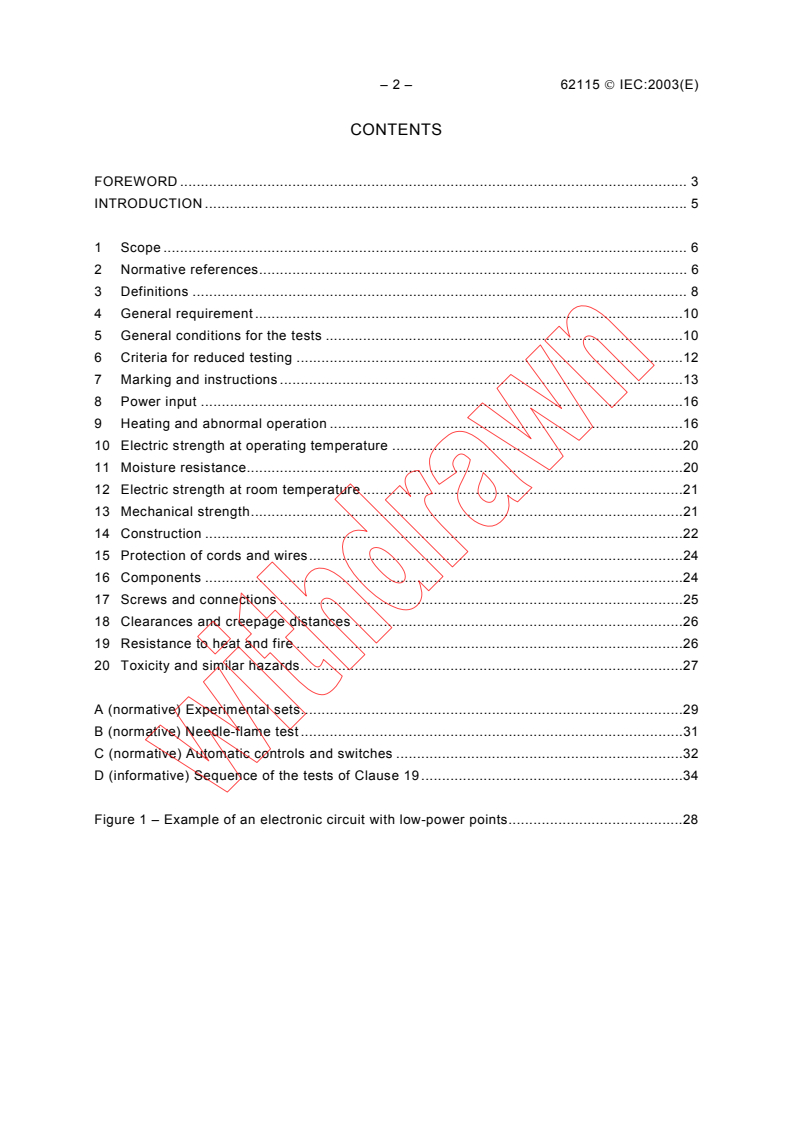
IEC 62115:2003 - Electric toys - Safety Released:1/17/2003
IEC 62115:2003+AMD1:2004 CSV - Electric toys - Safety Released:11/2/2004
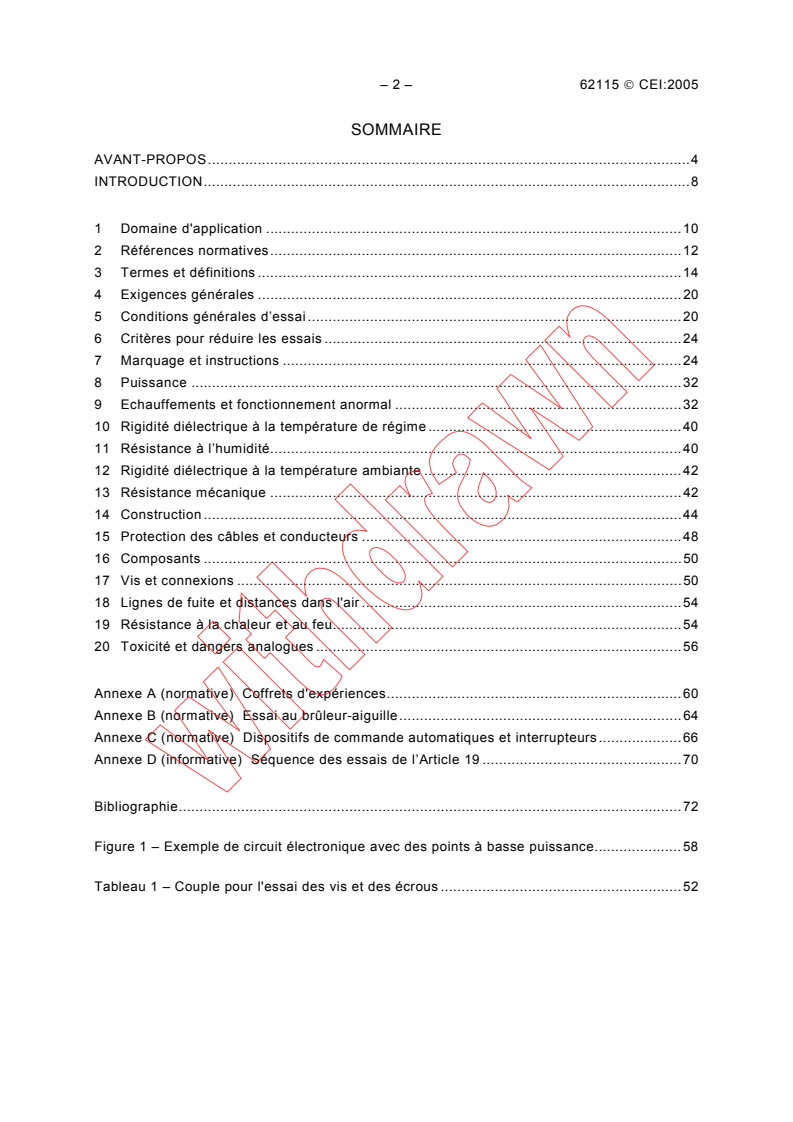
IEC 62115:2003 - Electric toys - Safety Released:1/17/2003
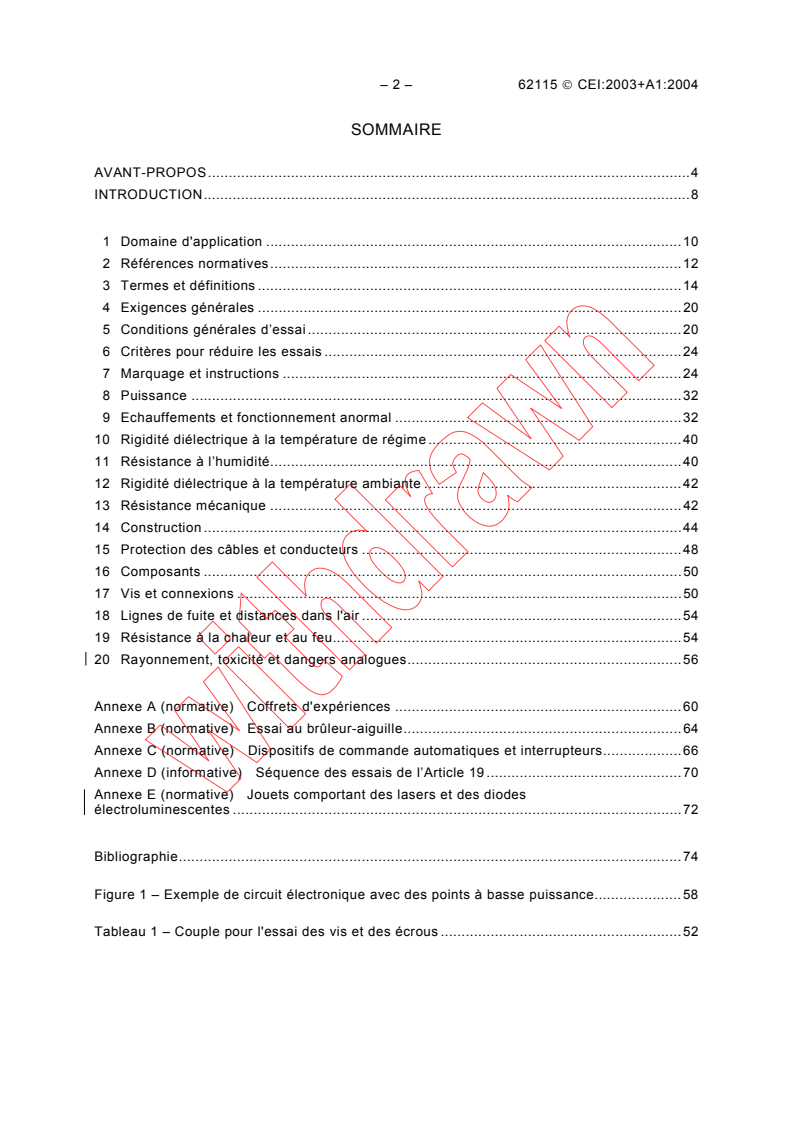
IEC 62115:2003+AMD1:2004 CSV - Electric toys - Safety Released:11/2/2004
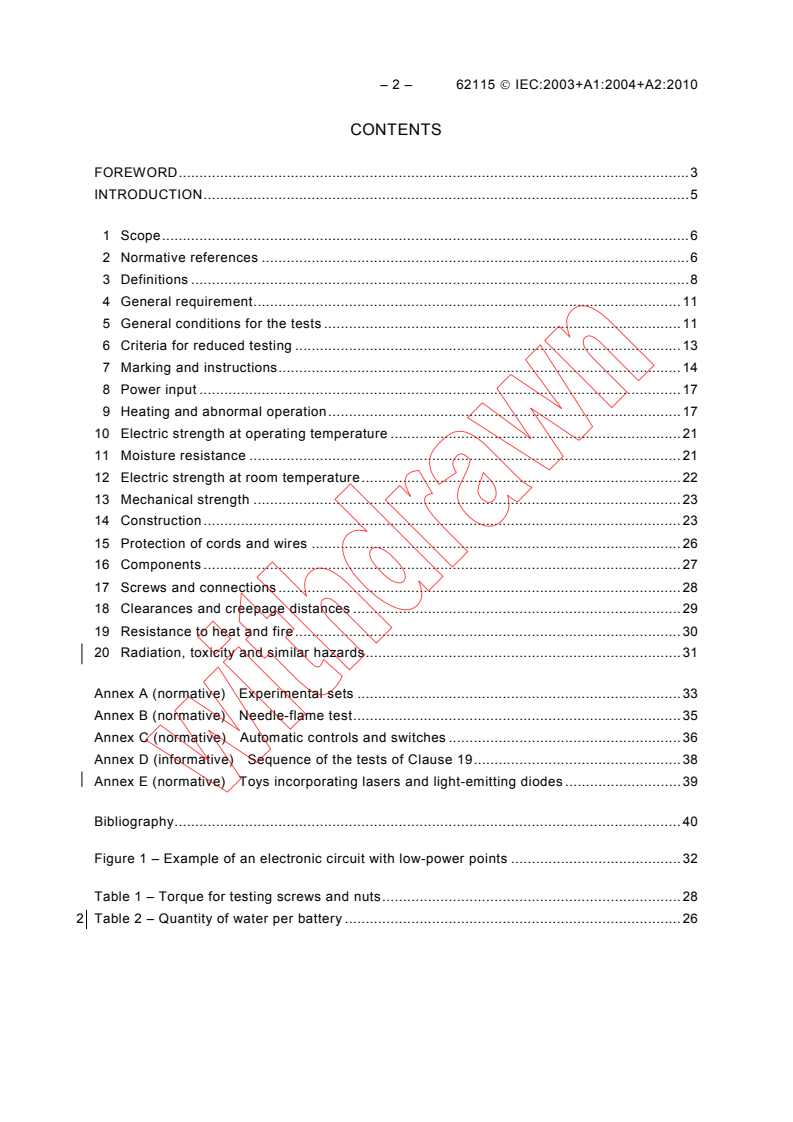
IEC 62115:2003+AMD1:2004+AMD2:2010 CSV - Electric toys - Safety Released:2/25/2011
Overview
IEC 62115:2003 (consolidated with Amendment 1:2004, edition 1.1) is the international safety standard for electric toys - toys that have at least one function dependent on electricity. It covers the full range of electric toys from small battery‑powered lights to large battery‑driven ride‑on toys, and includes toys where electricity is a secondary function (for example, a dollhouse interior lamp). The standard defines safety objectives, testing requirements, and design/marking expectations to reduce electrical, thermal, mechanical and fire hazards in toys intended for children under 14 years.
Key topics and requirements
IEC 62115 organizes safety requirements and test methods across technical areas relevant to electric toys, including:
- Scope and definitions - what counts as an electric toy (battery toys, transformer‑connected toys, video toys) and exclusions (toy steam engines, adult collector models, some luminaires and amusement machines).
- General requirements and tests - construction, protection against electric shock, and performance under normal and abnormal conditions.
- Heating and abnormal operation - evaluation of overheating and potential hazards during fault conditions.
- Electric strength and moisture resistance - dielectric tests at operating and room temperatures and resistance to moisture ingress (IP considerations).
- Mechanical strength and construction - durability, protection of cords/wires, and secure enclosures.
- Components, screws and connections - secure assemblies and safe component selection.
- Clearances and creepage distances - to limit breakdown and arcing risks.
- Fire and flammability - needle‑flame, glow‑wire and related fire tests (see IEC 60695 series).
- Marking and instructions - required warnings, age guidance and user information.
- Special Annexes - Annex A (experimental sets), Annex E (toys incorporating lasers and LEDs), Annex B (needle‑flame test), etc.
- Reduced testing criteria - Clause 6 allows reduced testing where justified by design/voltage/power considerations.
Practical applications and users
IEC 62115 is used by:
- Toy manufacturers and designers to build compliant electric toys and define safety by design.
- Product safety engineers and test laboratories to perform conformity testing and certifications.
- Regulators and market surveillance authorities to assess compliance for market entry.
- Importers and retailers to verify supplier compliance with international safety expectations.
Compliance with IEC 62115 is typically considered together with ISO 8124‑1 (mechanical and physical toy hazards) and other referenced IEC standards for specific tests and components.
Related standards (selection)
- ISO 8124‑1 (Safety of toys - mechanical/physical)
- IEC 60695 series (fire hazard testing)
- IEC 60529 (IP code - enclosure protection)
- IEC 61558‑2‑7 (transformers for toys)
- IEC 60825‑1 (laser safety) - referenced for toys incorporating lasers/LEDs
Keywords: IEC 62115, electric toys safety, toy safety standard, battery toys, transformer toys, toy testing, toy manufacturers, IEC toy standard.
Relations
- Effective Date
- 05-Sep-2023
- Effective Date
- 05-Sep-2023
- Effective Date
- 05-Sep-2023
Buy Documents
IEC 62115:2003 - Electric toys - Safety Released:1/17/2003
IEC 62115:2003+AMD1:2004 CSV - Electric toys - Safety Released:11/2/2004
IEC 62115:2003 - Electric toys - Safety Released:1/17/2003
IEC 62115:2003+AMD1:2004 CSV - Electric toys - Safety Released:11/2/2004
IEC 62115:2003+AMD1:2004+AMD2:2010 CSV - Electric toys - Safety Released:2/25/2011
Get Certified
Connect with accredited certification bodies for this standard

CIS Institut d.o.o.
Personal Protective Equipment (PPE) certification body. Notified Body NB-2890 for EU Regulation 2016/425 PPE.

Kiwa BDA Testing
Building and construction product certification.
Kmetijski inštitut Slovenije
Agricultural Institute of Slovenia. Soil testing, plant health, agricultural product analysis.
Sponsored listings
Frequently Asked Questions
IEC 62115:2003 is a standard published by the International Electrotechnical Commission (IEC). Its full title is "Electric toys - Safety". This standard covers: Deals with the safety of toys that have at least one function dependent on electricity. Examples of toys within the scope of this standard are constructional sets; experimental sets; functional toys(having a function similar to an appliance or installation used by adults) and video toys(toys having a screen and means of activation, such as a joystick or keyboard. Seperate screens having a rated voltage of more than 24 v are not considered to be part of the toy). Toys using electricty for secondary functions are also within the scope of this standard (a dolls house having an interior lamp is an example of such a toy).
Deals with the safety of toys that have at least one function dependent on electricity. Examples of toys within the scope of this standard are constructional sets; experimental sets; functional toys(having a function similar to an appliance or installation used by adults) and video toys(toys having a screen and means of activation, such as a joystick or keyboard. Seperate screens having a rated voltage of more than 24 v are not considered to be part of the toy). Toys using electricty for secondary functions are also within the scope of this standard (a dolls house having an interior lamp is an example of such a toy).
IEC 62115:2003 is classified under the following ICS (International Classification for Standards) categories: 13.120 - Domestic safety; 97.200.50 - Toys. The ICS classification helps identify the subject area and facilitates finding related standards.
IEC 62115:2003 has the following relationships with other standards: It is inter standard links to IEC 62115:2003/AMD2:2010, IEC 62115:2003/AMD1:2004, IEC 62115:2017. Understanding these relationships helps ensure you are using the most current and applicable version of the standard.
IEC 62115:2003 is available in PDF format for immediate download after purchase. The document can be added to your cart and obtained through the secure checkout process. Digital delivery ensures instant access to the complete standard document.
Standards Content (Sample)
INTERNATIONAL IEC
STANDARD
First edition
2003-01
Electric toys –
Safety
Jouets électriques –
Sécurité
Reference number
Publication numbering
As from 1 January 1997 all IEC publications are issued with a designation in the
60000 series. For example, IEC 34-1 is now referred to as IEC 60034-1.
Consolidated editions
The IEC is now publishing consolidated versions of its publications. For example,
edition numbers 1.0, 1.1 and 1.2 refer, respectively, to the base publication, the
base publication incorporating amendment 1 and the base publication incorporating
amendments 1 and 2.
Further information on IEC publications
The technical content of IEC publications is kept under constant review by the IEC,
thus ensuring that the content reflects current technology. Information relating to
this publication, including its validity, is available in the IEC Catalogue of
publications (see below) in addition to new editions, amendments and corrigenda.
Information on the subjects under consideration and work in progress undertaken
by the technical committee which has prepared this publication, as well as the list
of publications issued, is also available from the following:
• IEC Web Site (www.iec.ch)
• Catalogue of IEC publications
The on-line catalogue on the IEC web site (http://www.iec.ch/searchpub/cur_fut.htm)
enables you to search by a variety of criteria including text searches, technical
committees and date of publication. On-line information is also available on
recently issued publications, withdrawn and replaced publications, as well as
corrigenda.
• IEC Just Published
This summary of recently issued publications (http://www.iec.ch/online_news/
justpub/jp_entry.htm) is also available by email. Please contact the Customer
Service Centre (see below) for further information.
• Customer Service Centre
If you have any questions regarding this publication or need further assistance,
please contact the Customer Service Centre:
Email: custserv@iec.ch
Tel: +41 22 919 02 11
Fax: +41 22 919 03 00
INTERNATIONAL IEC
STANDARD
First edition
2003-01
Electric toys –
Safety
Jouets électriques –
Sécurité
IEC 2003 Copyright - all rights reserved
No part of this publication may be reproduced or utilized in any form or by any means, electronic or
mechanical, including photocopying and microfilm, without permission in writing from the publisher.
International Electrotechnical Commission, 3, rue de Varembé, PO Box 131, CH-1211 Geneva 20, Switzerland
Telephone: +41 22 919 02 11 Telefax: +41 22 919 03 00 E-mail: inmail@iec.ch Web: www.iec.ch
PRICE CODE
Commission Electrotechnique Internationale
V
International Electrotechnical Commission
Международная Электротехническая Комиссия
For price, see current catalogue
– 2 – 62115 IEC:2003(E)
CONTENTS
FOREWORD . 3
INTRODUCTION .5
1 Scope . 6
2 Normative references. 6
3 Definitions . 8
4 General requirement .10
5 General conditions for the tests .10
6 Criteria for reduced testing .12
7 Marking and instructions .13
8 Power input .16
9 Heating and abnormal operation .16
10 Electric strength at operating temperature .20
11 Moisture resistance.20
12 Electric strength at room temperature .21
13 Mechanical strength.21
14 Construction .22
15 Protection of cords and wires.24
16 Components .24
17 Screws and connections .25
18 Clearances and creepage distances .26
19 Resistance to heat and fire .26
20 Toxicity and similar hazards.27
A (normative) Experimental sets.29
B (normative) Needle-flame test.31
C (normative) Automatic controls and switches .32
D (informative) Sequence of the tests of Clause 19 .34
Figure 1 – Example of an electronic circuit with low-power points.28
62115 IEC:2003(E) – 3 –
INTERNATIONAL ELECTROTECHNICAL COMMISSION
____________
ELECTRIC TOYS – SAFETY
FOREWORD
1) The IEC (International Electrotechnical Commission) is a worldwide organization for standardization comprising
all national electrotechnical committees (IEC National Committees). The object of the IEC is to promote
international co-operation on all questions concerning standardization in the electrical and electronic fields. To
this end and in addition to other activities, the IEC publishes International Standards. Their preparation is
entrusted to technical committees; any IEC National Committee interested in the subject dealt with may
participate in this preparatory work. International, governmental and non-governmental organizations liaising
with the IEC also participate in this preparation. The IEC collaborates closely with the International
Organization for Standardization (ISO) in accordance with conditions determined by agreement between the
two organizations.
2) The formal decisions or agreements of the IEC on technical matters express, as nearly as possible, an
international consensus of opinion on the relevant subjects since each technical committee has representation
from all interested National Committees.
3) The documents produced have the form of recommendations for international use and are published in the form
of standards, technical specifications, technical reports or guides and they are accepted by the National
Committees in that sense.
4) In order to promote international unification, IEC National Committees undertake to apply IEC International
Standards transparently to the maximum extent possible in their national and regional standards. Any
divergence between the IEC Standard and the corresponding national or regional standard shall be clearly
indicated in the latter.
5) The IEC provides no marking procedure to indicate its approval and cannot be rendered responsible for any
equipment declared to be in conformity with one of its standards.
6) Attention is drawn to the possibility that some of the elements of this International Standard may be the subject
of patent rights. The IEC shall not be held responsible for identifying any or all such patent rights.
International Standard IEC 62115 has been prepared by IEC technical committee 61: Safety
of household and similar electrical appliances.
It forms the first edition of IEC 62115.
The text of this standard is based on the following documents:
FDIS Report on voting
61/2263/FDIS 61/2323/RVD
Full information on the voting for the approval of this standard can be found in the report on
voting indicated in the above table.
This publication has been drafted in accordance with the ISO/IEC Directives, Part 2.
NOTE The following print types are used:
– requirements: in roman type;
– test specifications: in italic type;
– notes: in small roman type.
Words in bold in the text are defined in Clause 3. When a definition concerns an adjective, the adjective and the
associated noun are also in bold.
– 4 – 62115 IEC:2003(E)
The committee has decided that the contents of this publication will remain unchanged until
2004. At this date, the publication will be
• reconfirmed;
• withdrawn;
• replaced by a revised edition, or
• amended.
The following differences exist in the countries indicated below.
– 14.2 Controls for railway sets are also not allowed to be incorporated in the transformer (Austria, Belgium,
Czech Republic, Denmark, Finland, France, Germany, Greece, Iceland, Ireland, Italy, Luxembourg,
Netherlands, Norway, Portugal, Spain, Sweden, Switzerland and United Kingdom).
A bilingual version of this publication may be issued at a later date.
62115 IEC:2003(E) – 5 –
INTRODUCTION
It has been assumed in the drafting of this International Standard that the execution of its
provisions is entrusted to appropriately qualified and experienced people.
As a general rule, toys are designed and manufactured for particular categories of children.
Their characteristics are related to the age and stage of development of the children and their
intended use presupposes certain capabilities.
Accidents are frequently due to a toy either being given to a child for whom it is not intended
or being used for a purpose other than for which it was designed. This standard does not
eliminate parental responsibility for the appropriate selection of toys. It is assumed that when
choosing a toy or a game, account is taken of the physical and mental development of the
child who will be playing with it.
The aim of this standard is to reduce risks when playing with toys, especially those risks that
are not evident to users. However, it has to be recognized that some toys have risks inherent
in their use that cannot be avoided. Consideration has been given to reasonably foreseeable
use, bearing in mind that children are not generally as careful as adults.
While this standard applies to new toys, it nevertheless takes into account the wear and tear
of toys in use.
The fact that a toy complies with this standard does not absolve parents and other persons in
charge of a child from the responsibility of supervising the child. Supervision is also
necessary when children of various ages have access to the same toy.
This standard covers the whole range of electric toys from small button cell operated lights to
large sit-on cars powered by lead-acid cells. This results in different requirements and tests
according to the type of toy. For some toys, testing can be reduced if particular criteria are
met (see Clause 6).
A toy that complies with the text of this standard will not necessarily be judged to comply with
the safety principles of the standard if, when examined and tested, it is found to have other
features that impair the level of safety covered by these requirements.
A toy employing materials or having forms of construction differing from those detailed in the
requirements of this standard may be examined and tested according to the intent of the
requirements and, if found to be substantially equivalent, may be judged to comply with the
standard.
– 6 – 62115 IEC:2003(E)
ELECTRIC TOYS – SAFETY
1 Scope
This International Standard deals with the safety of toys that have at least one function
dependent on electricity.
NOTE 1 Examples of toys also within the scope of this standard are
– constructional sets;
– experimental sets;
– functional toys (models that have a function similar to an appliance or installation used by adults);
– video toys (toys consisting of a screen and activating means, such as a joystick or keyboard. Separate screens
having a rated voltage exceeding 24 V are not considered to be a part of the toy).
Additional requirements for experimental sets are given in Annex A.
Toys using electricity for secondary functions are within the scope of this standard.
NOTE 2 A doll's house having an interior lamp is an example of such a toy.
In order to comply with this standard, electric toys also have to comply with ISO 8124-1, since
it covers hazards other than those arising by the use of electricity.
NOTE 3 Transformers for toys and battery chargers are not considered to be a toy, even if supplied with it.
NOTE 4 If it is intended that a child also plays with the packaging, the latter is considered to be part of the toy.
NOTE 5 This standard does not apply to
– toy steam engines;
– scale models for adult collectors;
– folk dolls and decorative dolls and other similar articles for adult collectors;
– sports equipment;
– aquatic equipment intended to be used in deep water;
– equipment intended to be used collectively in playgrounds;
– amusement machines (IEC 60335-2-82);
– professional toys installed in public places (shopping centres, stations, etc.);
– products containing heating elements intended for use under the supervision of an adult in a teaching context;
– portable child-appealing luminaires (IEC 60598-2-10);
– Christmas decorations.
2 Normative references
The following referenced documents are indispensable for the application of this document.
For dated references, only the edition cited applies. For undated references, the latest edition
of the referenced document (including any amendments) applies.
IEC 60068-2-75, Environmental testing – Part 2-75: Tests – Test Eh: Hammer tests
IEC 60083, Plugs and socket-outlets for domestic and similar general use standardized in
member countries of IEC
IEC 60086-2, Primary batteries – Part 2: Physical and electrical specifications
IEC 60320-1, Appliance couplers for household and similar general purposes – Part 1:
General requirements
62115 IEC:2003(E) – 7 –
IEC 60384-14, Fixed capacitors for use in electronic equipment – Part 14: Sectional
specification – Fixed capacitors for electromagnetic interference suppression and connection
to the supply mains
IEC 60417-1, Graphical symbols for use on equipment – Part 1: Overview and application
IEC 60529:1989, Degrees of protection provided by enclosures (IP Code)
IEC 60695-2-2:1991, Fire hazard testing – Part 2: Test methods – Section 2: Needle-flame
test
IEC 60695-2-11, Fire Hazard testing – Part 2-11: Glowing/hot-wire based test methods –
Glow-wire flammability test method for end-products
IEC 60695-2-13, Fire hazard testing – Part 2-13: Glowing/hot-wire based test methods –
Glow-wire ignitability test method for materials
IEC 60695-10-2, Fire hazard testing – Part 10: Guidance and test methods for the
minimization of the effects of abnormal heat on electrotechnical products involved in fires –
Section 2: Method for testing products made from non-metallic materials for resistance to heat
using the ball pressure test
IEC 60695-11-10, Fire hazard testing – Part 11-10: Test flames – 50 W horizontal and
vertical flame test methods
IEC 60730-1:1999, Automatic electrical controls for household and similar use – Part 1:
General requirements
IEC 60738-1, Thermistors – Directly heated positive step-function temperature coefficient –
Part 1: Generic specification
IEC 61032:1997, Protection of persons and equipment by enclosures – Probes for
verification
IEC 61058-1:2000, Switches for appliances – Part 1: General requirements
IEC 61558-2-7, Safety of power transformers, power supply units and similar – Part 2:
Particular requirements for transformers for toys
ISO 7000, Graphical symbols for use on equipment – Index and synopsis
ISO 8124-1:2000, Safety of toys – Part 1: Safety aspects related to mechanical and physical
properties
ISO 8124-3, Safety of toys – Part 3: Migration of certain elements
ISO 9772, Cellular plastics – Determination of horizontal burning characteristics of small
specimens subjected to a small flame
– 8 – 62115 IEC:2003(E)
3 Definitions
For the purpose of this standard, the following definitions apply.
NOTE When the terms “voltage” and “current” are used, they imply r.m.s. values unless otherwise specified.
3.1.1
toy
product intended for use by children under 14 years old for playing purposes
3.1.2
battery toy
toy that contains or uses one or more batteries as the only source of electrical energy
NOTE The batteries may be in a battery box.
3.1.3
transformer toy
toy that is connected to the supply mains through a transformer for toys and using the
supply mains as the only source of electrical energy
3.1.4
dual-supply toy
toy that can be operated as a battery toy and either simultaneously or alternatively as a
transformer toy
3.1.5
battery box
separate compartment for containing the batteries that is detachable from the toy
3.1.6
replaceable battery
battery that can be replaced without breaking the toy
3.1.7
safety isolating transformer
transformer, the input winding of which is electrically separated from the output winding by
insulation at least equivalent to double insulation or reinforced insulation, which provides a
supply at safety extra-low voltage
3.1.8
transformer for toys
safety isolating transformer specially designed to supply toys operating at safety extra-low
voltage not exceeding 24 V
NOTE The transformer may supply a.c. or d.c., or both.
3.1.9
constructional set
collection of electric, electronic or mechanical parts intended to be assembled as various toys
3.1.10
experimental set
collection of electric, electronic or mechanical components intended to be assembled in
various combinations to demonstrate physical phenomena or other functions by children.
NOTE The assembly is not intended to create a toy or product for practical use.
62115 IEC:2003(E) – 9 –
3.2.1
rated voltage
voltage assigned to the toy by the manufacturer
3.2.2
working voltage
maximum voltage to which the part under consideration is subjected when the toy is supplied
at its rated voltage and operating under normal operation
NOTE The change of voltage resulting from the operation of a switch or failure of a lamp is taken into account.
However, the effect of transient voltages is ignored.
3.2.3
rated power input
power input assigned to the toy by the manufacturer
3.2.4
rated current
current assigned to the toy by the manufacturer
NOTE If no current is assigned to the toy, the rated current is the current measured when the toy is supplied at
rated voltage and operated under normal operation.
3.2.5
normal operation
condition under which the toy is played with as intended or in a foreseeable way when it is
energized.
Sit-on toys and stand-on toys are loaded with
– 25 kg, if intended for children up to 3 years old;
– 50 kg, if intended for older children
3.3.1
clearance
shortest distance in air between two conductive parts or between a conductive part and the
accessible surface
3.3.2
creepage distance
shortest distance along the surface of insulation between two conductive parts or between a
conductive part and the accessible surface
3.4.1
detachable part
part that can be removed without the aid of a tool, a part that can be removed by a tool
supplied with the toy, or a part that is removed in accordance with the instructions for use
even if a tool is needed for removal
NOTE A part that can be opened is considered to be a part that can be removed.
3.4.2
accessible part
part or surface that can be touched by means of test probe 18 or 19 of IEC 61032, depending
on the relevant age group
NOTE Both probes are relevant for toys intended for children spanning the two age groups.
3.4.3
tool
screwdriver, coin or other object that may be used to operate a screw, clip or similar fixing
means
– 10 – 62115 IEC:2003(E)
3.5.1
thermostat
temperature-sensing device, the operating temperature of which may be either fixed or
adjustable and which during normal operation keeps the temperature of the controlled part
between certain limits by automatically opening and closing a circuit
3.5.2
thermal cut-out
device that during abnormal operation limits the temperature of the controlled part by
automatically opening the circuit or by reducing the current and that is constructed so that its
setting cannot be altered by the user
3.5.3
self-resetting thermal cut-out
thermal cut-out that automatically restores the current after the relevant part of the toy has
cooled down sufficiently
3.5.4
non-self-resetting thermal cut-out
thermal cut-out that requires a manual operation for resetting or replacement of a part, in
order to restore the current
3.5.5
electronic component
part in which conduction is achieved principally by electrons moving through a vacuum, gas or
semiconductor
3.5.6
electronic circuit
circuit incorporating at least one electronic component
4 General requirement
Toys shall be constructed so that the risks to persons or surroundings are reduced as far as
possible when the toy is used as intended or in a foreseeable way.
In general, this principle is achieved by fulfilling the relevant requirements specified in this
standard and compliance is checked by carrying out all the relevant tests.
5 General conditions for the tests
Unless otherwise specified, tests are carried out in accordance with this clause.
NOTE Some tests on battery toys can result in rupture or explosion of the batteries. Adequate precautions
should be taken when conducting such tests.
62115 IEC:2003(E) – 11 –
5.1 Tests according to this standard are type tests.
5.2 The tests are carried out on a single sample that shall withstand all the relevant tests.
However, the tests of Clauses 14 to 17 may be made on separate samples. If the toy does
not operate after the tests of Clause 9, the subsequent tests are carried out on a separate
sample.
NOTE 1 Additional samples may be required if the toy is constructed
− for different supply voltages;
− for both a.c. and d.c.;
− for different speeds.
NOTE 2 The testing of components may require the submission of additional samples of these components.
NOTE 3 The cumulative stress resulting from successive tests on electronic circuits is to be avoided. It may be
necessary to replace components or to use additional samples. The number of additional samples should be kept
to a minimum by an evaluation of the relevant electronic circuits.
5.3 The tests are carried out in the order of the clauses.
If it is evident from the construction of the toy that a particular test is not applicable, this test
is not carried out.
5.4 If a toy is intended to be assembled by a child, the requirements apply to each part
accessible to the child and to the assembled toy. If a toy is intended to be assembled by an
adult, the requirements apply to the assembled toy.
5.5 The tests are carried out with the toy or any movable part of it placed in the most
unfavourable position when the toy is used as intended or in any foreseeable way. Battery
compartment covers are opened or removed. Other detachable parts are removed or kept in
position, whichever is more unfavourable.
5.6 Toys provided with controls or switching devices are tested with these controls or
devices adjusted to their most unfavourable setting, if the setting can be altered by the user.
5.7 Detachable cords supplied with the toy are considered to be part of the toy and are
tested with it.
5.8 Battery toys intended for use with a battery box are tested with the battery box
supplied with the toy or with the battery box recommended in the instructions.
Transformer toys are tested with the transformer supplied with the toy. If the toy is supplied
without a transformer, it is tested with a transformer recommended in the instructions.
Dual-supply toys are tested with the most unfavourable supply allowed by the construction,
the type of supply being evaluated for each test.
5.9 Battery toys are tested using new non-rechargeable batteries or fully charged
rechargeable batteries, whichever is more unfavourable.
NOTE 1 In general a fully charged nickel-cadmium battery or a new alkaline battery is considered to be the most
unfavourable battery.
The batteries used are those with the voltage and size specified on the toy or in the
instructions. Similar batteries that are generally available are used if this results in more
unfavourable conditions.
NOTE 2 Lithium batteries are not used unless their use is recommended in the instructions.
NOTE 3 If the toy fails to withstand a test and this could be due to a defective battery, the test is repeated with a
new set of batteries.
– 12 – 62115 IEC:2003(E)
5.10 When alternative accessories are made available by the manufacturer, the toy is tested
with those accessories that give the most unfavourable results.
NOTE 1 Examples of accessories are lamps, motors and rails.
If accessories can be used simultaneously, the combination that gives the most unfavourable
result is used.
NOTE 2 Accessories may be selected from more than one set.
NOTE 3 An accessory may be replaced by a simulated load for the tests.
Toys having lamps used as heating elements that can be removed without the aid of a tool
are tested with lamps of the highest power input that can be fitted, irrespective of any
marking.
NOTE 4 The lamps are selected from the types generally available.
5.11 The tests are carried out in a draught-free location at an ambient temperature of
20 °C ± 5 °C.
5.12 Toys having more than one rated voltage are tested at the most unfavourable voltage.
Toys for a.c. only are tested with a.c. at rated frequency if marked, and those for a.c./d.c. are
tested at the most unfavourable frequency. If the frequency is not marked, the toy is tested
with 50 Hz or 60 Hz as appropriate.
5.13 Battery toys are also tested with the polarity reversed unless such connections are
prevented by the construction.
5.14 Batteries are correctly positioned before evaluating the possibility of bridging insulation
and before carrying out the short-circuit tests.
Only one short circuit is applied at a time. Damage caused by a short circuit that does not
impair compliance with this standard is repaired before a further short circuit is applied.
5.15 Before starting the tests, the toy is preconditioned by subjecting it to the tests of the
following subclauses of ISO 8124-1, the batteries being in position:
– 5.12.5 Overload test, for sit-on toys or stand-on toys;
– 5.24.2 Drop test, for toys having a mass less than 4,5 kg, including batteries,
irrespective of the age group;
– 5.24.4 Dynamic strength test, for wheeled ride-on toys;
– 5.24.6.1 Tension test, for all toys;
– 5.24.6.2 Tension test for seams, for toys having textile or other flexible materials
covering batteries or other electrical parts.
NOTE Compliance with ISO 8124-1 is not checked after the preconditioning. However the security of the battery
compartment cover is checked (see 14.6 and 14.7).
6 Criteria for reduced testing
For some toys, it is not necessary to carry out all the tests specified in this standard if the
conditions of 6.1 or 6.2 are met. The exemptions of 6.1 are applicable to all toys, whereas
those of 6.2 are only applicable to battery toys.
6.1 Toys that comply with the tests of Clause 9 with the insulation between parts of different
polarity short-circuited are considered to comply with Clauses 10 to 12, 15 and 18. The short
circuit is applied at all places in turn where the insulation is liable to breakdown and can be
carried out using a flexible wire.
62115 IEC:2003(E) – 13 –
6.2 Battery toys are considered to comply with Clauses 10, 11 (except 11.1), 12, 15 and 17
to 19 if
– the accessible insulation between parts of different polarity cannot be bridged by a
straight steel pin having a diameter of 0,5 mm and any suitable length over 25 mm,
and
– the total battery voltage does not exceed 2,5 V, measured 1 s after a 1 Ω resistor has
been connected between the supply terminals of the toy, with any current limiting device
short-circuited and without the toy being operated.
7 Marking and instructions
7.1 Toys or their packaging shall be marked with
– the name, trade mark or identification mark of the manufacturer or responsible vendor;
– the model or type reference.
When the toy is marked, these markings shall be on the main part. When the packaging is not
marked and when it is not practical to mark the toy, e.g. due to its size, the markings of 7.1.1
to 7.1.3 may be contained in the instructions instead.
NOTE 1 In addition, the marking requirements of ISO 8124-1 may be applicable.
NOTE 2 Additional markings are allowed, provided they do not give rise to misunderstanding.
Compliance is checked by inspection.
7.1.1 Battery toys with replaceable batteries shall be marked with
– the nominal battery voltage, in or on the battery compartment;
– the symbol for d.c., if the toy has a battery box.
If more than one battery is used, the battery compartment shall be marked with the shape of
the batteries in proportional size, together with their nominal voltage and polarity.
Compliance is checked by inspection.
NOTE Examples representing three batteries are
1,5 V + 1,5 V + 1,5 V +
× 3
1,5 V +
3 × 1,5 V +
3 × 1,5 V
+
IEC 2976/02
– 14 – 62115 IEC:2003(E)
7.1.2 Transformer toys shall be marked with
– their rated voltage, in volts;
– the symbol for a.c. or d.c., as applicable;
– their rated power input, in watts or volt-amperes, if greater than 25 W or 25 VA;
– the symbol for transformer for toys. This symbol shall also be marked on the packaging.
The marking of rated voltage and the symbol for a.c. or d.c. shall be placed adjacent to the
terminals. The marking for a.c. or d.c. is not required if the incorrect supply does not impair
compliance with this standard.
Compliance is checked by inspection.
7.1.3 Dual-supply toys shall be marked with the marking required for both battery toys and
transformer toys.
Compliance is checked by inspection.
7.2 The identification for detachable lamps shall be marked with
– the rated voltage and type number, or
– the maximum power input, or
– the maximum current.
The marking for power input or current of detachable lamps shall be as follows:
lamp max . W or lamp max … A
The word “lamp” may be replaced by symbol 5012 of IEC 60417-1.
The marking shall be visible when replacing the lamp.
This marking is not required if the temperature rises measured during the tests of Clause 9 do
not exceed the limits when a lamp having the highest power input is fitted.
Compliance is checked by inspection.
7.3 When symbols are used, they shall be as follows:
[symbol 5031 of IEC 60417-1] direct current
[symbol 5032 of IEC 60417-1] alternating current
[symbol 5012 of IEC 60417-1] lamp
safety isolating transformer
[symbol 5219 of IEC 60417-1]
for toys (symbol for
transformer toys)
NOTE 1 Additional symbols are allowed, provided they do not give rise to misunderstanding.
NOTE 2 Symbols specified in IEC 60417-1 and ISO 7000 may be used.
62115 IEC:2003(E) – 15 –
Units of physical quantities and their symbols shall be those of the international standardized
system.
Compliance is checked by inspection.
7.4 Instructions shall be provided that give details concerning cleaning and maintenance
when necessary for the safe operation of the toy. They shall state that transformers or battery
chargers used with the toy are to be regularly examined for damage to the cord, plug,
enclosure and other parts, and in the event of such damage, they must not be used until the
damage has been repaired.
Toys shall be provided with instructions for assembly if
– they are intended to be assembled by a child;
– these instructions are necessary for safe operation of the toy.
If the toy is intended to be assembled by an adult, this shall be stated.
The instructions for transformer toys and toys with battery boxes shall state that the toy is
not to be connected to more than the recommended number of power supplies.
Toys having wires without connecting means shall be provided with instructions that state that
the wires are not to be inserted into socket-outlets.
The instructions for battery toys with replaceable batteries shall contain the substance of
the following, as applicable:
– the types of batteries that may be used;
– how to remove and insert the batteries;
– non-rechargeable batteries are not to be recharged;
– rechargeable batteries are only to be charged under adult supervision;
– rechargeable batteries are to be removed from the toy before being charged;
– different types of batteries or new and used batteries are not to be mixed;
– batteries are to be inserted with the correct polarity;
– exhausted batteries are to be removed from the toy;
– the supply terminals are not to be short-circuited.
The instructions for transformer toys shall contain the substance of the following, as
applicable:
– the toy is not intended for children under 3 years old;
– the toy must only be used with the recommended transformer;
– the transformer is not a toy;
– toys liable to be cleaned with liquids are to be disconnected from the transformer before
cleaning.
The instructions may be on a leaflet, on the packaging or on the toy. If the instructions are
marked on the toy, they shall be visible from the outside and if the toy consists of more than
one part, only the main part needs to be marked.
Instructions for battery toys intended to be used in water shall state that the toy is to be
operated in water only when fully assembled in accordance with the instructions.
Compliance is checked by inspection.
– 16 – 62115 IEC:2003(E)
7.5 When markings or instructions are on the packaging, it shall also be stated that the
packaging must be retained since it contains important information.
Compliance is checked by inspection.
7.6 Instructions and other texts required by this standard shall be written in the official
language of the country in which the toy is to be sold.
Compliance is checked by inspection.
7.7 The markings on the toy shall be legible and durable.
Compliance is checked by inspection and by rubbing the marking by hand for 15 s with a
piece of cloth soaked with water and again for 15 s with a piece of cloth soaked with
petroleum spirit. When the use of other liquids is recommended, the rubbing test is also
carried out with the cloth soaked with these liquids.
After all the tests of this standard, the marking shall be legible, it shall not be easily possible
to remove marking plates and they shall show no curling.
NOTE 1 In considering the durability of the marking, the effect of normal wear such as frequent cleaning is taken
into account.
NOTE 2 The petroleum spirit to be used for the test is aliphatic solvent hexane having a maximum aromatics
content of 0,1 % by volume, a kauri-butanol value of 29, an initial boiling point of approximately 65 °C, a dry point
of approximately 69 °C and a specific mass of approximately 0,66 kg/l.
8 Power input
The power input of transformer toys shall not exceed the rated power input by more than
20 %.
Compliance is checked by measurement when the power input has stabilized and the toy has
attained normal operating temperature with
– all circuits that can operate simultaneously being in operation;
– the toy being supplied at rated voltage;
– the toy being operated under normal operation.
NOTE The power input has to be measured to determine if the rated power input needs to be marked.
9 Heating and abnormal operation
9.1 Toys shall not attain excessive temperatures in use. They shall be constructed so that
the risk of fire, mechanical damage impairing safety or other hazards, as a result of careless
use or failure of a component, is obviated as far as is practicable.
Toys are subjected to the tests of 9.3 to 9.8 under the conditions specified in 9.2.
All toys are subjected to the tests of 9.3 to 9.5.
Toys incorporating motors are subjected to the test of 9.6.
Transformer toys and toys with battery boxes are subjected to the test of 9.7.
Toys incorporating electronic circuits are subjected to the test of 9.8.
62115 IEC:2003(E) – 17 –
Toys that only incorporate incandescent lamps having a rated power input not exceeding 1 W
are not subjected to the tests.
Unless otherwise specified, compliance with the tests of this clause is checked as described
in 9.9.
The tests of 9.3 and 9.4 are continued until steady conditions are established. During these
tests, thermal cut-outs shall not operate.
The tests of 9.5 to 9.8 are continued until a non-self-resetting thermal cut-out operates or
until steady conditions are established. If a heating element or an intentionally weak part
becomes permanently open-circuited, the relevant test is repeated on a second sample. This
second test shall be terminated in the same mode unless the test is otherwise satisfactorily
completed.
NOTE 1 An intentionally weak part is a part intended to rupture in order to prevent the occurrence of a condition
that would impair compliance with this standard. Such a part may be a replaceable component, such as a resistor
or a capacitor or a part of a component to be replaced, such as an inaccessible thermal link incorporated in a
motor.
NOTE 2 Fuses, thermal cut-outs, overcurrent protection devices or similar devices incorporated in the toy may
be used to provide the necessary protection.
NOTE 3 If more than one of the tests are applicable to the same toy, these tests are made consecutively after the
toy has cooled down to room temperature.
9.2 Toys are placed in the most unfavourable position that can occur during play.
Hand-held toys are freely suspended.
Other toys are placed on the floor of a test corner as near to the walls as possible or away
from the walls, whichever is more unfavourable. The test corner consists of two walls at right
angles and a floor made of dull black-painted plywood having a thickness of approximately
20 mm. They are covered with four layers of bleached cotton gauze having dimensions of
2 2
500 mm x 500 mm and a specific mass of 40 g/m ± 8 g/m . The gauze is placed on surfaces
where high temperatures and charring may be expected. Toys having dimensions not
exceeding 500 mm are completely covered with the cotton gauze.
Battery toys are supplied at rated voltage.
Transformer toys are supplied at 0,94 times or 1,06 times rated voltage, whichever is more
unfavourable.
The temperature rises are determined by means of fine-wire thermocouples positioned so that
they have minimum effect on the temperature of the part under test.
NOTE Thermocouples having wires with a diameter not exceeding 0,3 mm are considered to be fine-wire
thermocouples.
9.3 Toys are operated under normal operation and the temperature rises of the various
parts are determined.
9.4 The test of 9.3 is repeated, the insulation between parts of different polarity being short-
circuited in turn if it is accessible after the removal of detachable parts, except lamps.
However, the short circuit is only applied if it is possible to bridge the insulation by a straight
steel pin having a diameter of 0,5 mm and any suitable length over 25 mm, or by a rod having
a diameter of 1,0 mm inserted through holes in the enclosure up to a depth of 100 mm. The
pin is applied only with sufficient force to hold it in position.
– 18 – 62115 IEC:2003(E)
9.5 The test of 9.3 is repeated, any control that limits the temperature during the tests of 9.3
and 9.4 being short-circuited. If the toy has more than one control, they are short-circuited in
turn.
9.6 The test of 9.3 is repeated with accessible moving parts locked.
NOTE If the toy incorporates more than one motor, the test is carried out by locking moving parts driven by each
motor in turn.
The test is terminated after 30 s if the toy has to be kept switched on by hand or foot.
9.7 Transformer toys and toys with battery boxes are connected to a power supply in
addition to that recommended in the instructions for use. The additional power supply is
identical to that recommended for the toy and is connected in series or in parallel, whichever
is more unfavourable. The toy is then tested as specified in 9.3 and 9.4.
NOTE The test is only applicable if the connections can be made easily without the aid of a tool and by using
parts from two identical toys or constructional sets
9.8 Compliance for electronic circuits is checked by evaluation of the fault conditions
specified in 9.8.2 for all circuits or parts of circuits, unless they comply with the conditions
specified in 9.8.1.
If a conductor of a printed-circuit board becomes open-circuited, the toy is considered to have
withstood the particular test, provided that the following two conditions are met:
– the material of the printed-circuit board withstands the needle-flame test of Annex B;
– the toy withstands the test of 9.8.2 with the open-circuited conductor bridged.
NOTE In general, examination of the toy and its circuit diagram will reveal the fault conditions that have to be
simulated, so that testing can be limited to those cases that may be expected to give the most unfavourable
results.
9.8.1 Fault conditions a) to f) specified in 9.8.2 are not applied to circuits or parts of circuits
where both of the following conditions are met:
– the electronic circuit is a low-power circuit as described below;
– the protection against fire hazard or dangerous malfunction in other parts of the toy does
not rely on the correct functioning of the electronic circuit.
A low-power circuit is determined as follows; an example is shown in Figure 1.
The toy is supplied at rated voltage and a variable resistor adjusted to its maximum
resistance is connected between the point to be investigated and the opposite pole of the
supply source.
The resistance is then decreased until the power consumed by the resistor reaches a
maximum. Points closest to the supply at which the maximum power delivered to this resistor
does not exceed 15 W at the end of 5 s are called low-power points. The part of the circuit
farther from the supply source than a low-power point is considered to be a low-power circuit.
NOTE 1 The measurements are made from only one pole of the supply source, preferably the one that gives the
fewest low-power points.
NOTE 2 When determining the low-power points, it is recommended to start with points close to the supply
source.
9.8.2 The following fault conditions are considered and, if necessary, applied one at a time,
consequential faults being taken into consideration:
62115 IEC:2003(E) – 19 –
a) short circuit of clearances and creepage distances between parts of different polarity, if
these distances are less than the values specified in Clause 18, unless the relevant part is
adequately encapsulated;
b) open circuit at the terminals of any component;
c) short circuit of capacitors, unless they comply with IEC
...
INTERNATIONAL IEC
STANDARD 62115
Edition 1.1
2004-11
Edition 1:2003 consolidated with amendment 1:2004
Electric toys –
Safety –
Reference number
Publication numbering
As from 1 January 1997 all IEC publications are issued with a designation in the
60000 series. For example, IEC 34-1 is now referred to as IEC 60034-1.
Consolidated editions
The IEC is now publishing consolidated versions of its publications. For example,
edition numbers 1.0, 1.1 and 1.2 refer, respectively, to the base publication, the
base publication incorporating amendment 1 and the base publication incorporating
amendments 1 and 2.
Further information on IEC publications
The technical content of IEC publications is kept under constant review by the IEC,
thus ensuring that the content reflects current technology. Information relating to
this publication, including its validity, is available in the IEC Catalogue of
publications (see below) in addition to new editions, amendments and corrigenda.
Information on the subjects under consideration and work in progress undertaken
by the technical committee which has prepared this publication, as well as the list
of publications issued, is also available from the following:
• IEC Web Site (www.iec.ch)
• Catalogue of IEC publications
The on-line catalogue on the IEC web site (www.iec.ch/searchpub) enables you to
search by a variety of criteria including text searches, technical committees
and date of publication. On-line information is also available on recently issued
publications, withdrawn and replaced publications, as well as corrigenda.
• IEC Just Published
This summary of recently issued publications (www.iec.ch/online_news/ justpub)
is also available by email. Please contact the Customer Service Centre (see
below) for further information.
• Customer Service Centre
If you have any questions regarding this publication or need further assistance,
please contact the Customer Service Centre:
Email: custserv@iec.ch
Tel: +41 22 919 02 11
Fax: +41 22 919 03 00
INTERNATIONAL IEC
STANDARD 62115
Edition 1.1
2004-11
Edition 1:2003 consolidated with amendment 1:2004
Electric toys –
Safety –
IEC 2004 Copyright - all rights reserved
No part of this publication may be reproduced or utilized in any form or by any means, electronic or
mechanical, including photocopying and microfilm, without permission in writing from the publisher.
International Electrotechnical Commission, 3, rue de Varembé, PO Box 131, CH-1211 Geneva 20, Switzerland
Telephone: +41 22 919 02 11 Telefax: +41 22 919 03 00 E-mail: inmail@iec.ch Web: www.iec.ch
PRICE CODE
Commission Electrotechnique Internationale CN
International Electrotechnical Commission
МеждународнаяЭлектротехническаяКомиссия
For price, see current catalogue
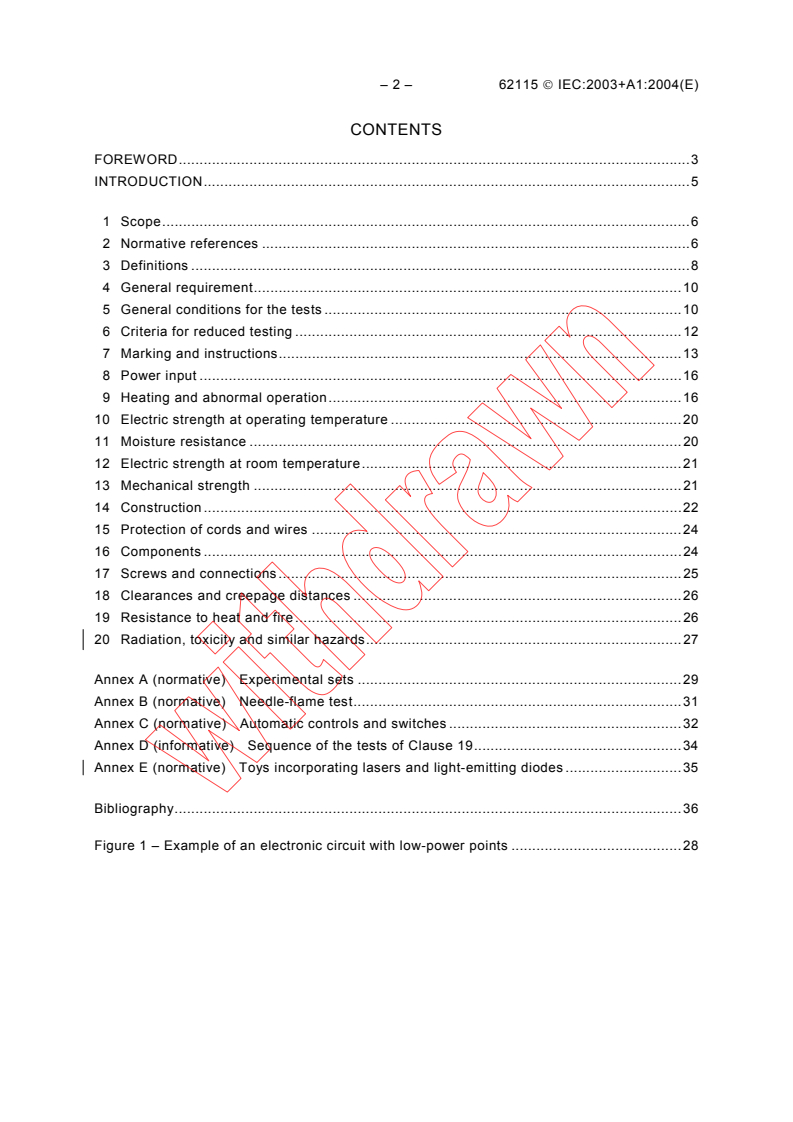
– 2 – 62115 IEC:2003+A1:2004(E)
CONTENTS
FOREWORD.3
INTRODUCTION.5
1 Scope.6
2 Normative references .6
3 Definitions .8
4 General requirement.10
5 General conditions for the tests .10
6 Criteria for reduced testing .12
7 Marking and instructions.13
8 Power input .16
9 Heating and abnormal operation.16
10 Electric strength at operating temperature .20
11 Moisture resistance .20
12 Electric strength at room temperature.21
13 Mechanical strength .21
14 Construction .22
15 Protection of cords and wires .24
16 Components .24
17 Screws and connections .25
18 Clearances and creepage distances .26
19 Resistance to heat and fire.26
20 Radiation, toxicity and similar hazards.27
Annex A (normative) Experimental sets .29
Annex B (normative) Needle-flame test.31
Annex C (normative) Automatic controls and switches .32
Annex D (informative) Sequence of the tests of Clause 19.34
Annex E (normative) Toys incorporating lasers and light-emitting diodes .35
Bibliography.36
Figure 1 – Example of an electronic circuit with low-power points .28
62115 IEC:2003+A1:2004(E) – 3 –
INTERNATIONAL ELECTROTECHNICAL COMMISSION
____________
ELECTRIC TOYS – SAFETY
FOREWORD
1) The International Electrotechnical Commission (IEC) is a worldwide organization for standardization comprising
all national electrotechnical committees (IEC National Committees). The object of IEC is to promote
international co-operation on all questions concerning standardization in the electrical and electronic fields. To
this end and in addition to other activities, IEC publishes International Standards, Technical Specifications,
Technical Reports, Publicly Available Specifications (PAS) and Guides (hereafter referred to as “IEC
Publication(s)”). Their preparation is entrusted to technical committees; any IEC National Committee interested
in the subject dealt with may participate in this preparatory work. International, governmental and non-
governmental organizations liaising with the IEC also participate in this preparation. IEC collaborates closely
with the International Organization for Standardization (ISO) in accordance with conditions determined by
agreement between the two organizations.
2) The formal decisions or agreements of IEC on technical matters express, as nearly as possible, an international
consensus of opinion on the relevant subjects since each technical committee has representation from all
interested IEC National Committees.
3) IEC Publications have the form of recommendations for international use and are accepted by IEC National
Committees in that sense. While all reasonable efforts are made to ensure that the technical content of IEC
Publications is accurate, IEC cannot be held responsible for the way in which they are used or for any
misinterpretation by any end user.
4) In order to promote international uniformity, IEC National Committees undertake to apply IEC Publications
transparently to the maximum extent possible in their national and regional publications. Any divergence
between any IEC Publication and the corresponding national or regional publication shall be clearly indicated in
the latter.
5) IEC provides no marking procedure to indicate its approval and cannot be rendered responsible for any
equipment declared to be in conformity with an IEC Publication.
6) All users should ensure that they have the latest edition of this publication.
7) No liability shall attach to IEC or its directors, employees, servants or agents including individual experts and
members of its technical committees and IEC National Committees for any personal injury, property damage or
other damage of any nature whatsoever, whether direct or indirect, or for costs (including legal fees) and
expenses arising out of the publication, use of, or reliance upon, this IEC Publication or any other IEC
Publications.
8) Attention is drawn to the Normative references cited in this publication. Use of the referenced publications is
indispensable for the correct application of this publication.
9) Attention is drawn to the possibility that some of the elements of this IEC Publication may be the subject of
patent rights. IEC shall not be held responsible for identifying any or all such patent rights.
International Standard IEC 62115 has been prepared by IEC technical committee 61: Safety
of household and similar electrical appliances.
This consolidated version of IEC 62115 is based on the first edition (2003) [documents
61/2263/FDIS and 61/2323/RVD] and its amendment 1 (2004) [documents 61/2711/FDIS and
61/2738/RVD].
It bears the edition number 1.1.
A vertical line in the margin shows where the base publication has been modified by
amendment 1.
This publication has been drafted in accordance with the ISO/IEC Directives, Part 2.
NOTE The following print types are used:
– requirements: in roman type;
– test specifications: in italic type;
– notes: in small roman type.
Words in bold in the text are defined in Clause 3. When a definition concerns an adjective, the adjective and the
associated noun are also in bold.
– 4 – 62115 IEC:2003+A1:2004(E)
The committee has decided that the contents of the base publication and its amendments will
remain unchanged until the maintenance result date indicated on the IEC web site under
"http://webstore.iec.ch" in the data related to the specific publication. At this date, the
publication will be
• reconfirmed,
• withdrawn,
• replaced by a revised edition, or
• amended.
The following differences exist in the countries indicated below.
– 14.2: The requirement that controls shall not be incorporated in the transformer applies to all toys (CENELEC
countries, except Germany).
A bilingual version of this publication may be issued at a later date.
62115 IEC:2003+A1:2004(E) – 5 –
INTRODUCTION
It has been assumed in the drafting of this International Standard that the execution of its
provisions is entrusted to appropriately qualified and experienced people.
As a general rule, toys are designed and manufactured for particular categories of children.
Their characteristics are related to the age and stage of development of the children and their
intended use presupposes certain capabilities.
Accidents are frequently due to a toy either being given to a child for whom it is not intended
or being used for a purpose other than for which it was designed. This standard does not
eliminate parental responsibility for the appropriate selection of toys. It is assumed that when
choosing a toy or a game, account is taken of the physical and mental development of the
child who will be playing with it.
The aim of this standard is to reduce risks when playing with toys, especially those risks that
are not evident to users. However, it has to be recognized that some toys have risks inherent
in their use that cannot be avoided. Consideration has been given to reasonably foreseeable
use, bearing in mind that children are not generally as careful as adults.
While this standard applies to new toys, it nevertheless takes into account the wear and tear
of toys in use.
The fact that a toy complies with this standard does not absolve parents and other persons in
charge of a child from the responsibility of supervising the child. Supervision is also
necessary when children of various ages have access to the same toy.
This standard covers the whole range of electric toys from small button cell operated lights to
large sit-on cars powered by lead-acid cells. This results in different requirements and tests
according to the type of toy. For some toys, testing can be reduced if particular criteria are
met (see Clause 6).
A toy that complies with the text of this standard will not necessarily be judged to comply with
the safety principles of the standard if, when examined and tested, it is found to have other
features that impair the level of safety covered by these requirements.
A toy employing materials or having forms of construction differing from those detailed in the
requirements of this standard may be examined and tested according to the intent of the
requirements and, if found to be substantially equivalent, may be judged to comply with the
standard.
– 6 – 62115 IEC:2003+A1:2004(E)
ELECTRIC TOYS – SAFETY
1 Scope
This International Standard deals with the safety of toys that have at least one function
dependent on electricity.
NOTE 1 Examples of toys also within the scope of this standard are
– constructional sets;
– experimental sets;
– functional toys (models that have a function similar to an appliance or installation used by adults);
– video toys (toys consisting of a screen and activating means, such as a joystick or keyboard. Separate screens
having a rated voltage exceeding 24 V are not considered to be a part of the toy).
Additional requirements for experimental sets are given in Annex A.
Toys using electricity for secondary functions are within the scope of this standard.
NOTE 2 A doll's house having an interior lamp is an example of such a toy.
Additional requirements for toys incorporating lasers and light-emitting diodes are given in
Annex E.
In order to comply with this standard, electric toys also have to comply with ISO 8124-1, since
it covers hazards other than those arising by the use of electricity.
NOTE 3 Transformers for toys and battery chargers are not considered to be a toy, even if supplied with it.
NOTE 4 If it is intended that a child also plays with the packaging, the latter is considered to be part of the toy.
NOTE 5 This standard does not apply to
– toy steam engines;
– scale models for adult collectors;
– folk dolls and decorative dolls and other similar articles for adult collectors;
– sports equipment;
– aquatic equipment intended to be used in deep water;
– equipment intended to be used collectively in playgrounds;
– amusement machines (IEC 60335-2-82);
– professional toys installed in public places (shopping centres, stations, etc.);
– products containing heating elements intended for use under the supervision of an adult in a teaching context;
– portable child-appealing luminaires (IEC 60598-2-10);
– Christmas decorations.
2 Normative references
The following referenced documents are indispensable for the application of this document.
For dated references, only the edition cited applies. For undated references, the latest edition
of the referenced document (including any amendments) applies.
IEC 60068-2-75, Environmental testing – Part 2-75: Tests – Test Eh: Hammer tests
IEC 60083, Plugs and socket-outlets for domestic and similar general use standardized in
member countries of IEC
IEC 60086-2, Primary batteries – Part 2: Physical and electrical specifications
62115 IEC:2003+A1:2004(E) – 7 –
IEC 60320-1, Appliance couplers for household and similar general purposes – Part 1:
General requirements
IEC 60384-14, Fixed capacitors for use in electronic equipment – Part 14: Sectional
specification – Fixed capacitors for electromagnetic interference suppression and connection
to the supply mains
IEC 60417-1, Graphical symbols for use on equipment – Part 1: Overview and application
IEC 60529:1989, Degrees of protection provided by enclosures (IP Code)
IEC 60695-2-2:1991, Fire hazard testing – Part 2: Test methods – Section 2: Needle-flame
test
IEC 60695-2-11, Fire Hazard testing – Part 2-11: Glowing/hot-wire based test methods –
Glow-wire flammability test method for end-products
IEC 60695-2-13, Fire hazard testing – Part 2-13: Glowing/hot-wire based test methods –
Glow-wire ignitability test method for materials
IEC 60695-10-2, Fire hazard testing – Part 10: Guidance and test methods for the
minimization of the effects of abnormal heat on electrotechnical products involved in fires –
Section 2: Method for testing products made from non-metallic materials for resistance to heat
using the ball pressure test
IEC 60695-11-10, Fire hazard testing – Part 11-10: Test flames – 50 W horizontal and
vertical flame test methods
IEC 60730-1:1999, Automatic electrical controls for household and similar use – Part 1:
General requirements
IEC 60738-1, Thermistors – Directly heated positive step-function temperature coefficient –
Part 1: Generic specification
IEC 60825-1:1993, Safety of laser products – Part 1: Equipment classification, requirements
and user’s guide
Amendment 1 (1997)
Amendment 2 (2001) including its corrigendum 1 (2002)
IEC 61032:1997, Protection of persons and equipment by enclosures – Probes for
verification
IEC 61058-1:2000, Switches for appliances – Part 1: General requirements
IEC 61558-2-7, Safety of power transformers, power supply units and similar – Part 2:
Particular requirements for transformers for toys
ISO 7000, Graphical symbols for use on equipment – Index and synopsis
ISO 8124-1:2000, Safety of toys – Part 1: Safety aspects related to mechanical and physical
properties
ISO 8124-3, Safety of toys – Part 3: Migration of certain elements
ISO 9772, Cellular plastics – Determination of horizontal burning characteristics of small
specimens subjected to a small flame
———————
There exists a consolidated edition 1.2 (2001) that includes edition 1 and its amendments 1 and 2.
– 8 – 62115 IEC:2003+A1:2004(E)
3 Definitions
For the purpose of this standard, the following definitions apply.
NOTE When the terms “voltage” and “current” are used, they imply r.m.s. values unless otherwise specified.
3.1.1
toy
product intended for use by children under 14 years old for playing purposes
3.1.2
battery toy
toy that contains or uses one or more batteries as the only source of electrical energy
NOTE The batteries may be in a battery box.
3.1.3
transformer toy
toy that is connected to the supply mains through a transformer for toys and using the
supply mains as the only source of electrical energy
3.1.4
dual-supply toy
toy that can be operated as a battery toy and either simultaneously or alternatively as a
transformer toy
3.1.5
battery box
separate compartment for containing the batteries that is detachable from the toy
3.1.6
replaceable battery
battery that can be replaced without breaking the toy
3.1.7
safety isolating transformer
transformer, the input winding of which is electrically separated from the output winding by
insulation at least equivalent to double insulation or reinforced insulation, which provides a
supply at safety extra-low voltage
3.1.8
transformer for toys
safety isolating transformer specially designed to supply toys operating at safety extra-low
voltage not exceeding 24 V
NOTE The transformer may supply a.c. or d.c., or both.
3.1.9
constructional set
collection of electric, electronic or mechanical parts intended to be assembled as various toys
3.1.10
experimental set
collection of electric, electronic or mechanical components intended to be assembled in
various combinations to demonstrate physical phenomena or other functions by children.
NOTE The assembly is not intended to create a toy or product for practical use.
62115 IEC:2003+A1:2004(E) – 9 –
3.2.1
rated voltage
voltage assigned to the toy by the manufacturer
3.2.2
working voltage
maximum voltage to which the part under consideration is subjected when the toy is supplied
at its rated voltage and operating under normal operation
NOTE The change of voltage resulting from the operation of a switch or failure of a lamp is taken into account.
However, the effect of transient voltages is ignored.
3.2.3
rated power input
power input assigned to the toy by the manufacturer
3.2.4
rated current
current assigned to the toy by the manufacturer
NOTE If no current is assigned to the toy, the rated current is the current measured when the toy is supplied at
rated voltage and operated under normal operation.
3.2.5
normal operation
condition under which the toy is played with as intended or in a foreseeable way when it is
energized.
Sit-on toys and stand-on toys are loaded with
– 25 kg, if intended for children up to 3 years old;
– 50 kg, if intended for older children
3.3.1
clearance
shortest distance in air between two conductive parts or between a conductive part and the
accessible surface
3.3.2
creepage distance
shortest distance along the surface of insulation between two conductive parts or between a
conductive part and the accessible surface
3.4.1
detachable part
part that can be removed without the aid of a tool, a part that can be removed by a tool
supplied with the toy, or a part that is removed in accordance with the instructions for use
even if a tool is needed for removal
NOTE A part that can be opened is considered to be a part that can be removed.
3.4.2
accessible part
part or surface that can be touched by means of test probe 18 or 19 of IEC 61032, depending
on the relevant age group
NOTE Both probes are relevant for toys intended for children spanning the two age groups.
3.4.3
tool
screwdriver, coin or other object that may be used to operate a screw, clip or similar fixing
means
– 10 – 62115 IEC:2003+A1:2004(E)
3.5.1
thermostat
temperature-sensing device, the operating temperature of which may be either fixed or
adjustable and which during normal operation keeps the temperature of the controlled part
between certain limits by automatically opening and closing a circuit
3.5.2
thermal cut-out
device that during abnormal operation limits the temperature of the controlled part by
automatically opening the circuit or by reducing the current and that is constructed so that its
setting cannot be altered by the user
3.5.3
self-resetting thermal cut-out
thermal cut-out that automatically restores the current after the relevant part of the toy has
cooled down sufficiently
3.5.4
non-self-resetting thermal cut-out
thermal cut-out that requires a manual operation for resetting or replacement of a part, in
order to restore the current
3.5.5
electronic component
part in which conduction is achieved principally by electrons moving through a vacuum, gas or
semiconductor
3.5.6
electronic circuit
circuit incorporating at least one electronic component
4 General requirement
Toys shall be constructed so that the risks to persons or surroundings are reduced as far as
possible when the toy is used as intended or in a foreseeable way.
In general, this principle is achieved by fulfilling the relevant requirements specified in this
standard and compliance is checked by carrying out all the relevant tests.
5 General conditions for the tests
Unless otherwise specified, tests are carried out in accordance with this clause.
NOTE Some tests on battery toys can result in rupture or explosion of the batteries. Adequate precautions
should be taken when conducting such tests.
62115 IEC:2003+A1:2004(E) – 11 –
5.1 Tests according to this standard are type tests.
5.2 The tests are carried out on a single sample that shall withstand all the relevant tests.
However, the tests of Clauses 14 to 17 may be made on separate samples. If the toy does
not operate after the tests of Clause 9, the subsequent tests are carried out on a separate
sample.
NOTE 1 Additional samples may be required if the toy is constructed
− for different supply voltages;
− for both a.c. and d.c.;
− for different speeds.
NOTE 2 The testing of components may require the submission of additional samples of these components.
NOTE 3 The cumulative stress resulting from successive tests on electronic circuits is to be avoided. It may be
necessary to replace components or to use additional samples. The number of additional samples should be kept
to a minimum by an evaluation of the relevant electronic circuits.
5.3 The tests are carried out in the order of the clauses.
If it is evident from the construction of the toy that a particular test is not applicable, this test
is not carried out.
5.4 If a toy is intended to be assembled by a child, the requirements apply to each part
accessible to the child and to the assembled toy. If a toy is intended to be assembled by an
adult, the requirements apply to the assembled toy.
5.5 The tests are carried out with the toy or any movable part of it placed in the most
unfavourable position when the toy is used as intended or in any foreseeable way. Battery
compartment covers are opened or removed. Other detachable parts are removed or kept in
position, whichever is more unfavourable.
5.6 Toys provided with controls or switching devices are tested with these controls or
devices adjusted to their most unfavourable setting, if the setting can be altered by the user.
5.7 Detachable cords supplied with the toy are considered to be part of the toy and are
tested with it.
5.8 Battery toys intended for use with a battery box are tested with the battery box
supplied with the toy or with the battery box recommended in the instructions.
Transformer toys are tested with the transformer supplied with the toy. If the toy is supplied
without a transformer, it is tested with a transformer recommended in the instructions.
Dual-supply toys are tested with the most unfavourable supply allowed by the construction,
the type of supply being evaluated for each test.
5.9 Battery toys are tested using new non-rechargeable batteries or fully charged
rechargeable batteries, whichever is more unfavourable.
NOTE 1 In general a fully charged nickel-cadmium battery or a new alkaline battery is considered to be the most
unfavourable battery.
The batteries used are those with the voltage and size specified on the toy or in the
instructions. Similar batteries that are generally available are used if this results in more
unfavourable conditions.
NOTE 2 Lithium batteries are not used unless their use is recommended in the instructions.
NOTE 3 If the toy fails to withstand a test and this could be due to a defective battery, the test is repeated with a
new set of batteries.
– 12 – 62115 IEC:2003+A1:2004(E)
5.10 When alternative accessories are made available by the manufacturer, the toy is tested
with those accessories that give the most unfavourable results.
NOTE 1 Examples of accessories are lamps, motors and rails.
If accessories can be used simultaneously, the combination that gives the most unfavourable
result is used.
NOTE 2 Accessories may be selected from more than one set.
NOTE 3 An accessory may be replaced by a simulated load for the tests.
Toys having lamps used as heating elements that can be removed without the aid of a tool are
tested with lamps of the highest power input that can be fitted, irrespective of any marking.
NOTE 4 The lamps are selected from the types generally available.
5.11 The tests are carried out in a draught-free location at an ambient temperature of
20 °C ± 5 °C.
5.12 Toys having more than one rated voltage are tested at the most unfavourable voltage.
Toys for a.c. only are tested with a.c. at rated frequency if marked, and those for a.c./d.c. are
tested at the most unfavourable frequency. If the frequency is not marked, the toy is tested
with 50 Hz or 60 Hz as appropriate.
5.13 Battery toys are also tested with the polarity reversed unless such connections are
prevented by the construction.
5.14 Batteries are correctly positioned before evaluating the possibility of bridging insulation
and before carrying out the short-circuit tests.
Only one short circuit is applied at a time. Damage caused by a short circuit that does not
impair compliance with this standard is repaired before a further short circuit is applied.
5.15 Before starting the tests, the toy is preconditioned by subjecting it to the tests of the
following subclauses of ISO 8124-1, the batteries being in position:
– 5.12.5 Overload test, for sit-on toys or stand-on toys;
– 5.24.2 Drop test, for toys having a mass less than 4,5 kg, including batteries,
irrespective of the age group;
– 5.24.4 Dynamic strength test, for wheeled ride-on toys;
– 5.24.6.1 Tension test, for all toys;
– 5.24.6.2 Tension test for seams, for toys having textile or other flexible materials
covering batteries or other electrical parts.
NOTE Compliance with ISO 8124-1 is not checked after the preconditioning. However the security of the battery
compartment cover is checked (see 14.6 and 14.7).
6 Criteria for reduced testing
For some toys, it is not necessary to carry out all the tests specified in this standard if the
conditions of 6.1 or 6.2 are met. The exemptions of 6.1 are applicable to all toys, whereas
those of 6.2 are only applicable to battery toys.
6.1 Toys that comply with the tests of Clause 9 with the insulation between parts of different
polarity short-circuited are considered to comply with Clauses 10 to 12, 15 and 18. The short
circuit is applied at all places in turn where the insulation is liable to breakdown and can be
carried out using a flexible wire.
62115 IEC:2003+A1:2004(E) – 13 –
6.2 Battery toys are considered to comply with Clauses 10, 11 (except 11.1), 12, 15 and 17
to 19 if
– the accessible insulation between parts of different polarity cannot be bridged by a
straight steel pin having a diameter of 0,5 mm and any suitable length over 25 mm,
and
– the total battery voltage does not exceed 2,5 V, measured 1 s after a 1 Ω resistor has
been connected between the supply terminals of the toy, with any current limiting device
short-circuited and without the toy being operated.
7 Marking and instructions
7.1 Toys or their packaging shall be marked with
– the name, trade mark or identification mark of the manufacturer or responsible vendor;
– the model or type reference.
When the toy is marked, these markings shall be on the main part. When the packaging is not
marked and when it is not practical to mark the toy, e.g. due to its size, the markings of 7.1.1
to 7.1.3 may be contained in the instructions instead.
NOTE 1 In addition, the marking requirements of ISO 8124-1 may be applicable.
NOTE 2 Additional markings are allowed, provided they do not give rise to misunderstanding.
Compliance is checked by inspection.
7.1.1 Battery toys with replaceable batteries shall be marked with
– the nominal battery voltage, in or on the battery compartment;
– the symbol for d.c., if the toy has a battery box.
If more than one battery is used, the battery compartment shall be marked with the shape of
the batteries in proportional size, together with their nominal voltage and polarity.
Compliance is checked by inspection.
NOTE Examples representing three batteries are
1,5 V + 1,5 V + 1,5 V +
× 3
1,5 V +
3 × 1,5 V +
+ 3 × 1,5 V
IEC 2976/02
– 14 – 62115 IEC:2003+A1:2004(E)
7.1.2 Transformer toys shall be marked with
– their rated voltage, in volts;
– the symbol for a.c. or d.c., as applicable;
– their rated power input, in watts or volt-amperes, if greater than 25 W or 25 VA;
– the symbol for transformer for toys. This symbol shall also be marked on the packaging.
The marking of rated voltage and the symbol for a.c. or d.c. shall be placed adjacent to the
terminals. The marking for a.c. or d.c. is not required if the incorrect supply does not impair
compliance with this standard.
Compliance is checked by inspection.
7.1.3 Dual-supply toys shall be marked with the marking required for both battery toys and
transformer toys.
Compliance is checked by inspection.
7.2 The identification for detachable lamps shall be marked with
– the rated voltage and type number, or
– the maximum power input, or
– the maximum current.
The marking for power input or current of detachable lamps shall be as follows:
lamp max . W or lamp max … A
The word “lamp” may be replaced by symbol 5012 of IEC 60417-1.
The marking shall be visible when replacing the lamp.
This marking is not required if the temperature rises measured during the tests of Clause 9 do
not exceed the limits when a lamp having the highest power input is fitted.
Compliance is checked by inspection.
7.3 When symbols are used, they shall be as follows:
[symbol 5031 of IEC 60417-1] direct current
[symbol 5032 of IEC 60417-1] alternating current
[symbol 5012 of IEC 60417-1] lamp
safety isolating transformer
[symbol 5219 of IEC 60417-1]
for toys (symbol for
transformer toys)
NOTE 1 Additional symbols are allowed, provided they do not give rise to misunderstanding.
NOTE 2 Symbols specified in IEC 60417-1 and ISO 7000 may be used.
62115 IEC:2003+A1:2004(E) – 15 –
Units of physical quantities and their symbols shall be those of the international standardized
system.
Compliance is checked by inspection.
7.4 Instructions shall be provided that give details concerning cleaning and maintenance
when necessary for the safe operation of the toy. They shall state that transformers or battery
chargers used with the toy are to be regularly examined for damage to the cord, plug,
enclosure and other parts, and in the event of such damage, they must not be used until the
damage has been repaired.
Toys shall be provided with instructions for assembly if
– they are intended to be assembled by a child;
– these instructions are necessary for safe operation of the toy.
If the toy is intended to be assembled by an adult, this shall be stated.
The instructions for transformer toys and toys with battery boxes shall state that the toy is
not to be connected to more than the recommended number of power supplies.
Toys having wires without connecting means shall be provided with instructions that state that
the wires are not to be inserted into socket-outlets.
The instructions for battery toys with replaceable batteries shall contain the substance of
the following, as applicable:
– the types of batteries that may be used;
– how to remove and insert the batteries;
– non-rechargeable batteries are not to be recharged;
– rechargeable batteries are only to be charged under adult supervision;
– rechargeable batteries are to be removed from the toy before being charged;
– different types of batteries or new and used batteries are not to be mixed;
– batteries are to be inserted with the correct polarity;
– exhausted batteries are to be removed from the toy;
– the supply terminals are not to be short-circuited.
The instructions for transformer toys shall contain the substance of the following, as
applicable:
– the toy is not intended for children under 3 years old;
– the toy must only be used with the recommended transformer;
– the transformer is not a toy;
– toys liable to be cleaned with liquids are to be disconnected from the transformer before
cleaning.
The instructions may be on a leaflet, on the packaging or on the toy. If the instructions are
marked on the toy, they shall be visible from the outside and if the toy consists of more than
one part, only the main part needs to be marked.
Instructions for battery toys intended to be used in water shall state that the toy is to be
operated in water only when fully assembled in accordance with the instructions.
Compliance is checked by inspection.
– 16 – 62115 IEC:2003+A1:2004(E)
7.5 When markings or instructions are on the packaging, it shall also be stated that the
packaging must be retained since it contains important information.
Compliance is checked by inspection.
7.6 Instructions and other texts required by this standard shall be written in the official
language of the country in which the toy is to be sold.
Compliance is checked by inspection.
7.7 The markings on the toy shall be legible and durable.
Compliance is checked by inspection and by rubbing the marking by hand for 15 s with a
piece of cloth soaked with water and again for 15 s with a piece of cloth soaked with
petroleum spirit. When the use of other liquids is recommended, the rubbing test is also
carried out with the cloth soaked with these liquids.
After all the tests of this standard, the marking shall be legible, it shall not be easily possible
to remove marking plates and they shall show no curling.
NOTE 1 In considering the durability of the marking, the effect of normal wear such as frequent cleaning is taken
into account.
NOTE 2 The petroleum spirit to be used for the test is aliphatic solvent hexane having a maximum aromatics
content of 0,1 % by volume, a kauri-butanol value of 29, an initial boiling point of approximately 65 °C, a dry point
of approximately 69 °C and a specific mass of approximately 0,66 kg/l.
8 Power input
The power input of transformer toys shall not exceed the rated power input by more than
20 %.
Compliance is checked by measurement when the power input has stabilized and the toy has
attained normal operating temperature with
– all circuits that can operate simultaneously being in operation;
– the toy being supplied at rated voltage;
– the toy being operated under normal operation.
NOTE The power input has to be measured to determine if the rated power input needs to be marked.
9 Heating and abnormal operation
9.1 Toys shall not attain excessive temperatures in use. They shall be constructed so that
the risk of fire, mechanical damage impairing safety or other hazards, as a result of careless
use or failure of a component, is obviated as far as is practicable.
Toys are subjected to the tests of 9.3 to 9.8 under the conditions specified in 9.2.
All toys are subjected to the tests of 9.3 to 9.5.
Toys incorporating motors are subjected to the test of 9.6.
Transformer toys and toys with battery boxes are subjected to the test of 9.7.
Toys incorporating electronic circuits are subjected to the test of 9.8.
62115 IEC:2003+A1:2004(E) – 17 –
Toys that only incorporate incandescent lamps having a rated power input not exceeding 1 W
are not subjected to the tests.
Unless otherwise specified, compliance with the tests of this clause is checked as described
in 9.9.
The tests of 9.3 and 9.4 are continued until steady conditions are established. During these
tests, thermal cut-outs shall not operate.
The tests of 9.5 to 9.8 are continued until a non-self-resetting thermal cut-out operates or
until steady conditions are established. If a heating element or an intentionally weak part
becomes permanently open-circuited, the relevant test is repeated on a second sample. This
second test shall be terminated in the same mode unless the test is otherwise satisfactorily
completed.
NOTE 1 An intentionally weak part is a part intended to rupture in order to prevent the occurrence of a condition
that would impair compliance with this standard. Such a part may be a replaceable component, such as a resistor
or a capacitor or a part of a component to be replaced, such as an inaccessible thermal link incorporated in a
motor.
NOTE 2 Fuses, thermal cut-outs, overcurrent protection devices or similar devices incorporated in the toy may
be used to provide the necessary protection.
NOTE 3 If more than one of the tests are applicable to the same toy, these tests are made consecutively after the
toy has cooled down to room temperature.
9.2 Toys are placed in the most unfavourable position that can occur during play.
Hand-held toys are freely suspended.
Other toys are placed on the floor of a test corner as near to the walls as possible or away
from the walls, whichever is more unfavourable. The test corner consists of two walls at right
angles and a floor made of dull black-painted plywood having a thickness of approximately
20 mm. They are covered with four layers of bleached cotton gauze having dimensions of
2 2
500 mm x 500 mm and a specific mass of 40 g/m ± 8 g/m . The gauze is placed on surfaces
where high temperatures and charring may be expected. Toys having dimensions not
exceeding 500 mm are completely covered with the cotton gauze.
Battery toys are supplied at rated voltage.
Transformer toys are supplied at 0,94 times or 1,06 times rated voltage, whichever is more
unfavourable.
The temperature rises are determined by means of fine-wire thermocouples positioned so that
they have minimum effect on the temperature of the part under test.
NOTE Thermocouples having wires with a diameter not exceeding 0,3 mm are considered to be fine-wire
thermocouples.
9.3 Toys are operated under normal operation and the temperature rises of the various
parts are determined.
9.4 The test of 9.3 is repeated, the insulation between parts of different polarity being short-
circuited in turn if it is accessible after the removal of detachable parts, except lamps.
However, the short circuit is only applied if it is possible to bridge the insulation by a straight
steel pin having a diameter of 0,5 mm and any suitable length over 25 mm, or by a rod having
a diameter of 1,0 mm inserted through holes in the enclosure up to a depth of 100 mm. The
pin is applied only with sufficient force to hold it in position.
– 18 – 62115 IEC:2003+A1:2004(E)
9.5 The test of 9.3 is repeated, any control that limits the temperature during the tests of 9.3
and 9.4 being short-circuited. If the toy has more than one control, they are short-circuited in
turn.
9.6 The test of 9.3 is repeated with accessible moving parts locked.
NOTE If the toy incorporates more than one motor, the test is carried out by locking moving parts driven by each
motor in turn.
The test is terminated after 30 s if the toy has to be kept switched on by hand or foot.
9.7 Transformer toys and toys with battery boxes are connected to a power supply in
addition to that recommended in the instructions for use. The additional power supply is
identical to that recommended for the toy and is connected in series or in parallel, whichever
is more unfavourable. The toy is then tested as specified in 9.3 and 9.4.
NOTE The test is only applicable if the connections can be made easily without the aid of a tool and by using
parts from two identical toys or constructional sets
9.8 Compliance for electronic circuits is checked by evaluation of the fault conditions
specified in 9.8.2 for all circuits or parts of circuits, unless they comply with the conditions
specified in 9
...
NORME CEI
INTERNATIONALE
IEC
INTERNATIONAL
Première édition
STANDARD
First edition
2003-01
Jouets électriques –
Sécurité
Electric toys –
Safety
Numéro de référence
Reference number
CEI/IEC 62115:2003
Numérotation des publications Publication numbering
Depuis le 1er janvier 1997, les publications de la CEI As from 1 January 1997 all IEC publications are
sont numérotées à partir de 60000. Ainsi, la CEI 34-1 issued with a designation in the 60000 series. For
devient la CEI 60034-1. example, IEC 34-1 is now referred to as IEC 60034-1.
Editions consolidées Consolidated editions
Les versions consolidées de certaines publications de la The IEC is now publishing consolidated versions of its
CEI incorporant les amendements sont disponibles. Par publications. For example, edition numbers 1.0, 1.1
exemple, les numéros d’édition 1.0, 1.1 et 1.2 indiquent and 1.2 refer, respectively, to the base publication,
respectivement la publication de base, la publication de the base publication incorporating amendment 1 and
base incorporant l’amendement 1, et la publication de the base publication incorporating amendments 1
base incorporant les amendements 1 et 2. and 2.
Informations supplémentaires Further information on IEC publications
sur les publications de la CEI
Le contenu technique des publications de la CEI est The technical content of IEC publications is kept
constamment revu par la CEI afin qu'il reflète l'état under constant review by the IEC, thus ensuring that
actuel de la technique. Des renseignements relatifs à the content reflects current technology. Information
cette publication, y compris sa validité, sont dispo- relating to this publication, including its validity, is
nibles dans le Catalogue des publications de la CEI available in the IEC Catalogue of publications
(voir ci-dessous) en plus des nouvelles éditions, (see below) in addition to new editions, amendments
amendements et corrigenda. Des informations sur les and corrigenda. Information on the subjects under
sujets à l’étude et l’avancement des travaux entrepris consideration and work in progress undertaken by the
par le comité d’études qui a élaboré cette publication, technical committee which has prepared this
ainsi que la liste des publications parues, sont publication, as well as the list of publications issued,
également disponibles par l’intermédiaire de: is also available from the following:
• Site web de la CEI (www.iec.ch) • IEC Web Site (www.iec.ch)
• Catalogue des publications de la CEI • Catalogue of IEC publications
Le catalogue en ligne sur le site web de la CEI The on-line catalogue on the IEC web site
(www.iec.ch/searchpub) vous permet de faire des (www.iec.ch/searchpub) enables you to search by a
recherches en utilisant de nombreux critères, variety of criteria including text searches,
comprenant des recherches textuelles, par comité technical committees and date of publication. On-
d’études ou date de publication. Des informations en line information is also available on recently
ligne sont également disponibles sur les nouvelles issued publications, withdrawn and replaced
publications, les publications remplacées ou retirées, publications, as well as corrigenda.
ainsi que sur les corrigenda.
• IEC Just Published • IEC Just Published
Ce résumé des dernières publications parues This summary of recently issued publications
(www.iec.ch/online_news/justpub) est aussi dispo- (www.iec.ch/online_news/justpub) is also available
nible par courrier électronique. Veuillez prendre by email. Please contact the Customer Service
contact avec le Service client (voir ci-dessous) Centre (see below) for further information.
pour plus d’informations.
• Service clients • Customer Service Centre
Si vous avez des questions au sujet de cette If you have any questions regarding this
publication ou avez besoin de renseignements publication or need further assistance, please
supplémentaires, prenez contact avec le Service contact the Customer Service Centre:
clients:
Email: custserv@iec.ch Email: custserv@iec.ch
Tél: +41 22 919 02 11 Tel: +41 22 919 02 11
Fax: +41 22 919 03 00 Fax: +41 22 919 03 00
.
NORME CEI
INTERNATIONALE
IEC
INTERNATIONAL
Première édition
STANDARD
First edition
2003-01
Jouets électriques –
Sécurité
Electric toys –
Safety
IEC 2003 Droits de reproduction réservés Copyright - all rights reserved
Aucune partie de cette publication ne peut être reproduite ni No part of this publication may be reproduced or utilized in any
utilisée sous quelque forme que ce soit et par aucun procédé, form or by any means, electronic or mechanical, including
électronique ou mécanique, y compris la photocopie et les photocopying and microfilm, without permission in writing from
microfilms, sans l'accord écrit de l'éditeur. the publisher.
International Electrotechnical Commission, 3, rue de Varembé, PO Box 131, CH-1211 Geneva 20, Switzerland
Telephone: +41 22 919 02 11 Telefax: +41 22 919 03 00 E-mail: inmail@iec.ch Web: www.iec.ch
CODE PRIX
W
PRICE CODE
Commission Electrotechnique Internationale
International Electrotechnical Commission
МеждународнаяЭлектротехническаяКомиссия
Pour prix, voir catalogue en vigueur
For price, see current catalogue
– 2 – 62115 CEI:2005
SOMMAIRE
AVANT-PROPOS.4
INTRODUCTION.8
1 Domaine d'application .10
2 Références normatives.12
3 Termes et définitions .14
4 Exigences générales .20
5 Conditions générales d’essai.20
6 Critères pour réduire les essais .24
7 Marquage et instructions .24
8 Puissance .32
9 Echauffements et fonctionnement anormal .32
10 Rigidité diélectrique à la température de régime .40
11 Résistance à l’humidité.40
12 Rigidité diélectrique à la température ambiante .42
13 Résistance mécanique .42
14 Construction .44
15 Protection des câbles et conducteurs .48
16 Composants .50
17 Vis et connexions .50
18 Lignes de fuite et distances dans l'air .54
19 Résistance à la chaleur et au feu.54
20 Toxicité et dangers analogues .56
Annexe A (normative) Coffrets d'expériences.60
Annexe B (normative) Essai au brûleur-aiguille.64
Annexe C (normative) Dispositifs de commande automatiques et interrupteurs.66
Annexe D (informative) Séquence des essais de l’Article 19 .70
Bibliographie.72
Figure 1 – Exemple de circuit électronique avec des points à basse puissance.58
Tableau 1 – Couple pour l'essai des vis et des écrous .52
62115 IEC:2005 – 3 –
CONTENTS
FOREWORD.5
INTRODUCTION.9
1 Scope.11
2 Normative references .13
3 Terms and definitions .15
4 General requirement.21
5 General conditions for the tests .21
6 Criteria for reduced testing .25
7 Marking and instructions.25
8 Power input .33
9 Heating and abnormal operation.33
10 Electric strength at operating temperature .41
11 Moisture resistance .41
12 Electric strength at room temperature.43
13 Mechanical strength .43
14 Construction .45
15 Protection of cords and wires .49
16 Components .51
17 Screws and connections .51
18 Clearances and creepage distances .55
19 Resistance to heat and fire.55
20 Toxicity and similar hazards .57
Annex A (normative) Experimental sets .61
Annex B (normative) Needle-flame test.65
Annex C (normative) Automatic controls and switches .67
Annex D (informative) Sequence of the tests of Clause 19.71
Bibliography.73
Figure 1 – Example of an electronic circuit with low-power points .59
Table 1 – Torque for testing screws and nuts.53
– 4 – 62115 CEI:2005
COMMISSION ÉLECTROTECHNIQUE INTERNATIONALE
____________
JOUETS ÉLECTRIQUES –
SÉCURITÉ
AVANT-PROPOS
1) La Commission Electrotechnique Internationale (CEI) est une organisation mondiale de normalisation
composée de l'ensemble des comités électrotechniques nationaux (Comités nationaux de la CEI). La CEI a
pour objet de favoriser la coopération internationale pour toutes les questions de normalisation dans les
domaines de l'électricité et de l'électronique. A cet effet, la CEI – entre autres activités – publie des Normes
internationales, des Spécifications techniques, des Rapports techniques, des Spécifications accessibles au
public (PAS) et des Guides (ci-après dénommés "Publication(s) de la CEI"). Leur élaboration est confiée à des
comités d'études, aux travaux desquels tout Comité national intéressé par le sujet traité peut participer. Les
organisations internationales, gouvernementales et non gouvernementales, en liaison avec la CEI, participent
également aux travaux. La CEI collabore étroitement avec l'Organisation Internationale de Normalisation (ISO),
selon des conditions fixées par accord entre les deux organisations.
2) Les décisions ou accords officiels de la CEI concernant les questions techniques représentent, dans la mesure
du possible, un accord international sur les sujets étudiés, étant donné que les Comités nationaux de la CEI
intéressés sont représentés dans chaque comité d’études.
3) Les Publications de la CEI se présentent sous la forme de recommandations internationales et sont agréées
comme telles par les Comités nationaux de la CEI. Tous les efforts raisonnables sont entrepris afin que la CEI
s'assure de l'exactitude du contenu technique de ses publications; la CEI ne peut pas être tenue responsable
de l'éventuelle mauvaise utilisation ou interprétation qui en est faite par un quelconque utilisateur final.
4) Dans le but d'encourager l'uniformité internationale, les Comités nationaux de la CEI s'engagent, dans toute la
mesure possible, à appliquer de façon transparente les Publications de la CEI dans leurs publications
nationales et régionales. Toutes divergences entre toutes Publications de la CEI et toutes publications
nationales ou régionales correspondantes doivent être indiquées en termes clairs dans ces dernières.
5) La CEI n’a prévu aucune procédure de marquage valant indication d’approbation et n'engage pas sa
responsabilité pour les équipements déclarés conformes à une de ses Publications.
6) Tous les utilisateurs doivent s'assurer qu'ils sont en possession de la dernière édition de cette publication.
7) Aucune responsabilité ne doit être imputée à la CEI, à ses administrateurs, employés, auxiliaires ou
mandataires, y compris ses experts particuliers et les membres de ses comités d'études et des Comités
nationaux de la CEI, pour tout préjudice causé en cas de dommages corporels et matériels, ou de tout autre
dommage de quelque nature que ce soit, directe ou indirecte, ou pour supporter les coûts (y compris les frais
de justice) et les dépenses découlant de la publication ou de l'utilisation de cette Publication de la CEI ou de
toute autre Publication de la CEI, ou au crédit qui lui est accordé.
8) L'attention est attirée sur les références normatives citées dans cette publication. L'utilisation de publications
référencées est obligatoire pour une application correcte de la présente publication.
9) L’attention est attirée sur le fait que certains des éléments de la présente Publication de la CEI peuvent faire
l’objet de droits de propriété intellectuelle ou de droits analogues. La CEI ne saurait être tenue pour
responsable de ne pas avoir identifié de tels droits de propriété et de ne pas avoir signalé leur existence.
La Norme internationale CEI 62115 a été établie par le comité technique 61 de la CEI:
Sécurité des appareils électrodomestiques et analogues.
Elle constitue la première édition de la CEI 62115.
Cette version bilingue (2005-12) remplace la version monolingue anglaise.
Le texte anglais de cette norme est issu des documents 61/2263/FDIS et 61/2323/RVD. Le
rapport de vote 61/2323/RVD donne toute information sur le vote ayant abouti à l’approbation
de cette norme.
La version française de cette norme n’a pas été soumise au vote.
Cette publication a été rédigée selon les Directives ISO/CEI, Partie 2.
62115 IEC:2005 – 5 –
INTERNATIONAL ELECTROTECHNICAL COMMISSION
____________
ELECTRIC TOYS –
SAFETY
FOREWORD
1) The International Electrotechnical Commission (IEC) is a worldwide organization for standardization comprising
all national electrotechnical committees (IEC National Committees). The object of IEC is to promote
international co-operation on all questions concerning standardization in the electrical and electronic fields. To
this end and in addition to other activities, IEC publishes International Standards, Technical Specifications,
Technical Reports, Publicly Available Specifications (PAS) and Guides (hereafter referred to as “IEC
Publication(s)”). Their preparation is entrusted to technical committees; any IEC National Committee interested
in the subject dealt with may participate in this preparatory work. International, governmental and non-
governmental organizations liaising with the IEC also participate in this preparation. IEC collaborates closely
with the International Organization for Standardization (ISO) in accordance with conditions determined by
agreement between the two organizations.
2) The formal decisions or agreements of IEC on technical matters express, as nearly as possible, an international
consensus of opinion on the relevant subjects since each technical committee has representation from all
interested IEC National Committees.
3) IEC Publications have the form of recommendations for international use and are accepted by IEC National
Committees in that sense. While all reasonable efforts are made to ensure that the technical content of IEC
Publications is accurate, IEC cannot be held responsible for the way in which they are used or for any
misinterpretation by any end user.
4) In order to promote international uniformity, IEC National Committees undertake to apply IEC Publications
transparently to the maximum extent possible in their national and regional publications. Any divergence
between any IEC Publication and the corresponding national or regional publication shall be clearly indicated in
the latter.
5) IEC provides no marking procedure to indicate its approval and cannot be rendered responsible for any
equipment declared to be in conformity with an IEC Publication.
6) All users should ensure that they have the latest edition of this publication.
7) No liability shall attach to IEC or its directors, employees, servants or agents including individual experts and
members of its technical committees and IEC National Committees for any personal injury, property damage or
other damage of any nature whatsoever, whether direct or indirect, or for costs (including legal fees) and
expenses arising out of the publication, use of, or reliance upon, this IEC Publication or any other IEC
Publications.
8) Attention is drawn to the Normative references cited in this publication. Use of the referenced publications is
indispensable for the correct application of this publication.
9) Attention is drawn to the possibility that some of the elements of this IEC Publication may be the subject of
patent rights. IEC shall not be held responsible for identifying any or all such patent rights.
International Standard IEC 62115 has been prepared by IEC technical committee 61: Safety
of household and similar electrical appliances.
It forms the first edition of IEC 62115.
This bilingual version (2005-12) replaces the English version.
The text of this standard is based on the following documents:
FDIS Report on voting
61/2263/FDIS 61/2323/RVD
Full information on the voting for the approval of this standard can be found in the report on
voting indicated in the above table.
The French version of this standard has not been voted upon.
This publication has been drafted in accordance with the ISO/IEC Directives, Part 2.
– 6 – 62115 CEI:2005
NOTE Les caractères d'imprimerie suivants sont utilisés:
– exigences: caractères romains;
– modalités d'essais: caractères italiques;
– notes: petits caractères romains.
Les mots en gras dans le texte sont définis à l'Article 3. Lorsqu'une définition concerne un adjectif, l'adjectif et le
nom associé figurent également en gras.
Le comité a décidé que les contenus de la publication de base et de ses amendements ne
seront pas modifiés avant la date de maintenance indiquée sur le site web de la CEI sous
«http://webstore.iec.ch» dans les données relatives à la publication recherchée. A cette date,
la publication sera
• reconduite;
• supprimée;
• remplacée par une édition révisée, ou
• amendée.
Les différences suivantes existent dans les pays indiqués ci-après.
– 14.2: Les dispositifs de commande des trains électriques n'ont pas la permission d'être incorporés dans le
transformateur (Autriche, Belgique, Tchéquie, Danemark, Finlande, France, Allemagne, Grèce, Islande,
Irlande, Italie, Luxembourg, Pays-Bas, Norvège, Portugal, Espagne, Suède, Suisse et Royaume-Uni).
62115 IEC:2005 – 7 –
NOTE The following print types are used:
– requirements: in roman type;
– test specifications: in italic type;
– notes: in small roman type.
Words in bold in the text are defined in Clause 3. When a definition concerns an adjective, the adjective and the
associated noun are also in bold.
The committee has decided that the contents of this publication will remain unchanged until
the maintenance result date indicated on the IEC web site under "http://webstore.iec.ch" in
the data related to the specific publication. At this date, the publication will be
• reconfirmed;
• withdrawn;
• replaced by a revised edition, or
• amended.
The following differences exist in the countries indicated below.
– 14.2 Controls for railway sets are also not allowed to be incorporated in the transformer (Austria, Belgium,
Czech Republic, Denmark, Finland, France, Germany, Greece, Iceland, Ireland, Italy, Luxembourg,
Netherlands, Norway, Portugal, Spain, Sweden, Switzerland and United Kingdom).
– 8 – 62115 CEI:2005
INTRODUCTION
Il a été considéré en établissant la présente Norme internationale que l'exécution de ses dis-
positions était confiée à des personnes expérimentées et ayant une qualification appropriée.
En règle générale, les jouets sont conçus et fabriqués pour certaines catégories d'enfants.
Leurs caractéristiques sont fonction de l'âge et du stade de développement des enfants et
l'utilisation pour laquelle ils sont prévus présuppose certaines capacités.
Les accidents sont fréquemment dus à un jouet qui est soit donné à un enfant auquel il n'est
pas destiné, soit utilisé à des fins autres que celles pour lesquelles il a été conçu. La
présente norme ne se substitue pas à la responsabilité parentale quant au choix approprié
des jouets. Il est présumé que lors du choix d'un jouet ou d'un jeu, il est tenu compte du stade
de développement physique et mental de l'enfant qui jouera avec.
Le but de la présente norme est de réduire les risques lors du jeu avec des jouets et plus
particulièrement les risques qui ne sont pas évidents pour l'utilisateur. Toutefois il doit être
admis que certains jouets présentent des risques inhérents à leur utilisation qui ne peuvent
être évités. Il a été tenu compte des utilisations raisonnablement prévisibles, en ayant présent
à l'esprit que les enfants ne sont pas en général aussi prudents que des adultes.
Bien que cette norme s'applique aux jouets neufs, elle tient néanmoins compte de l'usure et
des dégradations dues à l'utilisation des jouets.
Le fait qu'un jouet satisfasse à la présente norme ne dégage pas les parents et autres
personnes ayant un enfant en charge de leur responsabilité de surveillance vis à vis de
l'enfant. Une surveillance est aussi nécessaire lorsque des enfants d'âge varié manipulent le
même jouet.
Cette norme s'applique à l'ensemble des jouets électriques, des petites sources de lumière
alimentées par une pile bouton aux grandes voitures électriques dans lesquelles l'enfant peut
s'asseoir, alimentées par des accumulateurs au plomb. Cela conduit à des exigences et à des
essais différents suivant le type de jouet. Pour certains jouets, les essais peuvent être réduits
si des critères particuliers sont satisfaits (voir l'Article 6).
Un jouet conforme au texte de la présente norme ne sera pas nécessairement jugé conforme
aux principes de sécurité de la norme si, lorsqu'il est examiné et soumis aux essais, il
apparaît qu'il présente d'autres caractéristiques qui compromettent le niveau de sécurité visé
par ces exigences.
Un jouet utilisant des matériaux ou présentant des modes de construction différents de ceux
décrits dans les exigences de cette norme peut être examiné et essayé en fonction de
l'objectif poursuivi par ces exigences et, s'il est jugé pratiquement équivalent, il peut être
estimé conforme aux principes de sécurité de la norme.
62115 IEC:2005 – 9 –
INTRODUCTION
It has been assumed in the drafting of this International Standard that the execution of its
provisions is entrusted to appropriately qualified and experienced people.
As a general rule, toys are designed and manufactured for particular categories of children.
Their characteristics are related to the age and stage of development of the children and their
intended use presupposes certain capabilities.
Accidents are frequently due to a toy either being given to a child for whom it is not intended
or being used for a purpose other than for which it was designed. This standard does not
eliminate parental responsibility for the appropriate selection of toys. It is assumed that when
choosing a toy or a game, account is taken of the physical and mental development of the
child who will be playing with it.
The aim of this standard is to reduce risks when playing with toys, especially those risks that
are not evident to users. However, it has to be recognized that some toys have risks inherent
in their use that cannot be avoided. Consideration has been given to reasonably foreseeable
use, bearing in mind that children are not generally as careful as adults.
While this standard applies to new toys, it nevertheless takes into account the wear and tear
of toys in use.
The fact that a toy complies with this standard does not absolve parents and other persons in
charge of a child from the responsibility of supervising the child. Supervision is also
necessary when children of various ages have access to the same toy.
This standard covers the whole range of electric toys from small button cell operated lights to
large sit-on cars powered by lead-acid cells. This results in different requirements and tests
according to the type of toy. For some toys, testing can be reduced if particular criteria are
met (see Clause 6).
A toy that complies with the text of this standard will not necessarily be judged to comply with
the safety principles of the standard if, when examined and tested, it is found to have other
features that impair the level of safety covered by these requirements.
A toy employing materials or having forms of construction differing from those detailed in the
requirements of this standard may be examined and tested according to the intent of the
requirements and, if found to be substantially equivalent, may be judged to comply with the
standard.
– 10 – 62115 CEI:2005
JOUETS ÉLECTRIQUES –
SÉCURITÉ
1 Domaine d'application
La présente Norme internationale traite de la sécurité des jouets qui ont au moins une
fonction dépendant de l'électricité.
NOTE 1 Comme exemples de jouets compris dans le domaine d'application de la présente norme, on peut citer
– les coffrets de construction;
– les coffrets d'expériences
– les jouets fonctionnels (modèles qui ont une fonction similaire à un appareil ou à une installation utilisée par
les adultes);
– jeux vidéo (jeux constitués d'un moniteur et de moyens d'action tels qu'une commande de jeu ou un clavier.
Des moniteurs séparés dont la tension assignée est supérieure à 24 V ne sont pas considérés comme faisant
partie du jeu vidéo).
Des exigences supplémentaires pour les coffrets d'expériences sont données à l'Annexe A.
Les jouets utilisant l'électricité pour des fonctions secondaires sont compris dans le domaine
d'application de la présente norme.
NOTE 2 Comme exemple de tel jouet, on peut citer une maison de poupée ayant une lampe à l'intérieur.
Afin de répondre à la présente norme, les jouets électriques doivent aussi répondre à
l'ISO 8124-1, qui couvre les risques autres que ceux causés par l'utilisation de l'électricité.
NOTE 3 Les transformateurs pour jouets et les chargeurs de batterie ne sont pas considérés comme étant un
jouet, même s'ils sont fournis avec celui-ci.
NOTE 4 Si l'emballage dans lequel le jouet est vendu est également destiné à être utilisé comme jouet, il est
considéré comme étant une partie du jouet.
NOTE 5 La présente norme ne s’applique pas
– aux jouets machines à vapeur;
– aux modèles réduits pour collectionneurs adultes;
– aux poupées folkloriques et décoratives et autres articles similaires destinés à des collectionneurs adultes;
– aux équipements sportifs;
– aux équipements nautiques destinés à être utilisés en eau profonde;
– aux équipements destinés à être utilisés collectivement sur des terrains de jeu;
– aux machines de divertissement (CEI 60335-2-82);
– aux jouets professionnels installés dans des endroits publics (grandes surfaces, stations de service, etc.);
– aux produits comprenant des éléments chauffants, destinés à être utilisés sous la surveillance d'un adulte dans
un cadre pédagogique,
– aux luminaires portatifs pour enfants (CEI 60598-2-10);
– aux ornements de Noël.
62115 IEC:2005 – 11 –
ELECTRIC TOYS –
SAFETY
1 Scope
This International Standard deals with the safety of toys that have at least one function
dependent on electricity.
NOTE 1 Examples of toys also within the scope of this standard are
– constructional sets;
– experimental sets;
– functional toys (models that have a function similar to an appliance or installation used by adults);
– video toys (toys consisting of a screen and activating means, such as a joystick or keyboard. Separate screens
having a rated voltage exceeding 24 V are not considered to be a part of the toy).
Additional requirements for experimental sets are given in Annex A.
Toys using electricity for secondary functions are within the scope of this standard.
NOTE 2 A doll's house having an interior lamp is an example of such a toy.
In order to comply with this standard, electric toys also have to comply with ISO 8124-1, since
it covers hazards other than those arising by the use of electricity.
NOTE 3 Transformers for toys and battery chargers are not considered to be a toy, even if supplied with it.
NOTE 4 If it is intended that a child also plays with the packaging, the latter is considered to be part of the toy.
NOTE 5 This standard does not apply to
– toy steam engines;
– scale models for adult collectors;
– folk dolls and decorative dolls and other similar articles for adult collectors;
– sports equipment;
– aquatic equipment intended to be used in deep water;
– equipment intended to be used collectively in playgrounds;
– amusement machines (IEC 60335-2-82);
– professional toys installed in public places (shopping centres, stations, etc.);
– products containing heating elements intended for use under the supervision of an adult in a teaching context;
– portable child-appealing luminaires (IEC 60598-2-10);
– Christmas decorations.
– 12 – 62115 CEI:2005
2 Références normatives
Les documents de références suivants sont indispensables pour l'application du présent
document. Pour des références datées, seule l'édition citée s'applique. Pour les références
non datées, la dernière édition du document de référence s’applique (y compris les
amendements).
CEI 60068-2-75, Essais d'environnement – Partie 2-75 : Essais – Essai Eh: Essais aux marteaux
CEI 60083, Prises de courant pour usages domestiques et analogues normalisées par les
pays membres de la CEI
CEI 60086-2, Piles électriques – Partie 2: Spécifications physiques et électriques
CEI 60320-1, Connecteurs pour usages domestiques et usages généraux analogues –
Partie 1: Prescriptions générales
CEI 60384-14, Fixed capacitors for use in electronic equipment – Part 14: Sectional
specification – Fixed capacitors for electromagnetic interference suppression and connection
to the supply mains
CEI 60417-DB :2002, Symboles graphiques utilisables sur le matériel – Partie 1: Vue
d’ensemble et application
CEI 60529:1989, Degrés de protection procurés par les enveloppes (Code IP)
CEI 60695-2-2:1991, Essais relatifs aux risques du feu – Partie 2: Méthodes d’essai –
Section 2: Essai au brûleur-aiguille
CEI 60695-2-11, Essais relatifs aux risques du feu – Partie 2-11: Essais au fil incandescent/
chauffant – Méthode d'essai d'inflammabilité pour produits finis
CEI 60695-2-13, Essais relatifs aux risques du feu – Partie 2-13: Essais au fil incandescent/
chauffant – Méthode d'essai d'allumabilité pour matériaux
CEI 60695-10-2, Essais relatifs aux risques du feu – Partie 10: Guide et méthodes d’essai
pour la minimalisation des effets de chaleurs anormales sur des produits électrotechniques
impliqués dans des feux – Section 2: Méthode pour les essais des produits réalisés à partir
de matériaux non métalliques pour la résistance à la chaleur à l’aide de l’essai à la bille
CEI 60695-11-10, Essais relatifs aux risques du feu – Partie 11-10: Flammes d'essai –
Méthodes d'essai horizontale et verticale à la flamme de 50 W
CEI 60730-1:1999 , Dispositifs de commande électrique automatiques à usage domestique et
analogue – Partie 1: Règles générales
Amendement 1 (2003)
CEI 60738-1, Thermistances à basculement à coefficient de température positif à chauffage
direct – Partie 1: Spécification générique
CEI 61032:1997, Protection des personnes et des matériels par les enveloppes – Calibres
d'essai pour la vérification
CEI 61058-1:2000, Interrupteurs pour appareils – Partie 1: Règles générales
———————
"DB" se réfère à la base de données "on-line" de la CEI.
Il existe une édition consolidée 3.1 (2003) comprenant l’édition 3.0 et son amendement 1.
62115 IEC:2005 – 13 –
2 Normative references
The following referenced documents are indispensable for the application of this document.
For dated references, only the edition cited applies. For undated references, the latest edition
of the referenced document (including any amendments) applies.
IEC 60068-2-75, Environmental testing – Part 2-75: Tests – Test Eh: Hammer tests
IEC 60083, Plugs and socket-outlets for domestic and similar general use standardized in
member countries of IEC
IEC 60086-2, Primary batteries – Part 2: Physical and electrical specifications
IEC 60320-1, Appliance couplers for household and similar general purposes – Part 1:
General requirements
IEC 60384-14, Fixed capacitors for use in electronic equipment – Part 14: Sectional
specification – Fixed capacitors for electromagnetic interference suppression and connection
to the supply mains
IEC 60417-DB :2002, Graphical symbols for use on equipment – Part 1: Overview and
application
IEC 60529:1989, Degrees of protection provided by enclosures (IP Code)
IEC 60695-2-2:1991, Fire hazard testing – Part 2: Test methods – Section 2: Needle-flame
test
IEC 60695-2-11, Fire Hazard testing – Part 2-11: Glowing/hot-wire based test methods –
Glow-wire flammability test method for end-products
IEC 60695-2-13, Fire hazard testing – Part 2-13: Glowing/hot-wire based test methods –
Glow-wire ignitability test method for materials
IEC 60695-10-2, Fire hazard testing – Part 10: Guidance and test methods for the
minimization of the effects of abnormal heat on electrotechnical products involved in fires –
Section 2: Method for testing products made from non-metallic materials for resistance to heat
using the ball pressure test
IEC 60695-11-10, Fire hazard testing – Part 11-10: Test flames – 50 W horizontal and vertical
flame test methods
IEC 60730-1:1999 , Automatic electrical controls for household and similar use – Part 1:
General requirements
Amendment 1 (2003)
IEC 60738-1, Thermistors – Directly heated positive step-function temperature coefficient –
Part 1: Generic specification
IEC 61032:1997, Protection of persons and equipment by enclosures – Probes for verification
IEC 61058-1:2000, Switches for appliances – Part 1: General requirements
___________
"DB" refers to the IEC on-line database.
A consolidated edition 3.1 (2003) exists that comprises edition 3.0 and its amendment 1.
– 14 – 62115 CEI:2005
CEI 61558-2-7, Sécurité des transformateurs, blocs d'alimentation et analogues – Partie 2:
Règles particulières pour transformateurs pour jouets
ISO 7000, Symboles graphiques utilisables sur le matériel – Index et tableau synoptique
ISO 8124-1:2000, Sécurité des jouets – Partie 1: Aspects de sécurité relatifs aux propriétés
mécaniques et physiques (disponible en anglais seulement)
ISO 8124-3, Sécurité des jouets – Partie 3: Migration de certains éléments
ISO 9772, Plastiques alvéolaires – Détermination des caractéristiques de combustion de
petites éprouvettes en position horizontale, soumises à une petite flamme
3 Termes et définitions
Pour les besoins de la présente norme, les terme et définitions suivants s'appliquent.
NOTE Lorsque les termes "tension" et "courant" sont employés, ils impliquent, sauf spécification contraire, les
valeurs efficaces.
3.1.1
jouet
produit destiné à être utilisé à des fins de jeux par des enfants de moins de 14 ans
3.1.2
jouet à pile ou accumulateur
jouet qui contient ou utilise une ou plusieurs piles ou un ou plusieurs accumulateurs comme
seule source d’énergie électrique
NOTE Les piles ou accumulateurs peuvent être dans un boîtier d'alimentation.
3.1.3
jouet à transformateur
jouet raccordé au réseau d’alimentation par l’intermédiaire d’un transformateur pour jouets
et dont le réseau d’alimentation est la seule source d’énergie électrique
3.1.4
jouet à double alimentation
jouet qui peut être mis en fonctionnement comme un jouet à pile ou accumulateur et,
simultanément ou alternativement, comme un jouet à transformateur
3.1.5
boîtier d’alimentation
compartiment séparé du jouet dans lequel sont placés les piles ou accumulateurs
3.1.6
pile ou accumulateur remplaçable
pile ou accumulateur qui peut être remplacé(e) sans casser le jouet
3.1.7
transformateur de sécurité
transformateur dont l’enroulement primaire est séparé électriquement des enroulements
secondaires par une isolation au moins équivalente à une double isolation ou à une isolation
renforcée, qui fournit une alimentation à une très basse tension de sécurité
62115 IEC:2005 – 15 –
IEC 61558-2-7, Safety of power transformers, power supply units and similar – Part 2:
Particular requirements for transformers for toys
ISO 7000, Graphical symbols for use on equipment – Index and synopsis
ISO 8124-1:2000, Safety of toys – Part 1: Safety aspects related to mechanical and physical
properties
ISO 8124-3, Safety of toys – Part 3: Migration of certain elements
ISO 9772, Cellular plastics – Determination of horizontal burning characteristics of small
specimens subjected to a small flame
3 Terms and definitions
For the purpose of this standard, the following terms and definitions apply.
NOTE When the terms “voltage” and “current” are used, they imply r.m.s. values unless otherwise specified.
3.1.1
toy
product intended for use by children under 14 years old for playing purposes
3.1.2
battery toy
toy that contains or uses one or more batteries as the only source of electrical energy
NOTE The batteries may be in a battery box.
3.1.3
transformer toy
toy that is connected to the supply mains through a transformer for toys and using the
supply mains as the only source of electrical energy
3.1.4
dual-supply toy
toy that can be operated as a battery toy and either simultaneously or alternatively as a
transformer toy
3.1.5
battery box
separate compartment for containing the batteries that is detachable from the toy
3.1.6
replaceable battery
battery that can be replaced without breaking the toy
3.1.7
safety isolating transformer
transformer, the input winding of which is electrically separated from the output winding by
insulation at least equivalent to double insulation or reinforced insulation, which provides a
supply at safety extra-low voltage
– 16 – 62115 CEI:2005
3.1.8
transformateur pour jouets
transformateur de sécurité spécialement destiné à alimenter des jouets fonctionnant à une
très basse tension de sécurité ne dépassant pas 24 V
NOTE Le transformateur peut délivrer du courant alternatif, du courant continu ou les deux.
3.1.9
coffret de construction
ensemble d’éléments électriques, électroniques ou mécaniques, destinés à être assemblés
pour la construction de jouets différents
3.1.10
coffret d'expériences
ensemble de composants électriques, électroniques ou mécaniques destinés à être
assemblés de diverses façons par un enfant pour démontrer un phénomène physique ou
d'autres fonctions
NOTE L'assemblage n'est pas destiné à la création d'un jouet ou d'un équipement pour une utilisation courante.
3.2.1
tension assignée
tension attribuée au jouet par le fabricant
3.2.2
tension de service
tension maximale à laquelle la partie considérée est soumise lorsque le jouet est alimenté
sous sa tension assignée et mis en fonctionnement dans des conditions de
fonctionnement normal
NOTE La variation de tension résultant du fonctionnement d'un interrupteur ou de la défaillance d'une lampe est
prise en compte. Cependant, l'effet des tensions transitoires est ignoré.
3.2.3
puissance assignée
puissance attribuée au jouet par le fabricant
3.2.4
courant assigné
courant attribué au jouet par le fabricant
NOTE Si aucun courant n'est attribué au jouet, le courant assigné est le courant mesuré lorsque le jouet est
alimenté sous la tension assignée et mis en fonctionnement dans les conditions de fonctionnement normal.
3.2.5
condition de fonctionnement normal
condition dans laquelle le jouet est utilisé pour jouer comme prévu ou d'une façon prévisible
lorsqu'il est alimenté
Les jouets porteurs assis et les jouets porteurs debout ont une charge
– de 25 kg, s'ils sont destinés à des enfants jusqu'à 3 ans;
– de 50 kg, s'ils sont destinés à des enfants plus âgés.
3.3.1
distance dans l'air
plus petite distance dans l’air entre deux parties conductrices ou entre une partie conductrice
et la surface accessible
62115 IEC:2005 – 17 –
3.1.8
transformer for toys
safety isolating transformer s
...
NORME CEI
INTERNATIONALE
IEC
INTERNATIONAL
Edition 1.1
STANDARD
2004-11
Edition 1:2003 consolidée par l'amendement 1:2004
Edition 1:2003 consolidated with amendment 1:2004
Jouets électriques –
Sécurité
Electric toys –
Safety
Numéro de référence
Reference number
CEI/IEC 62115:2003+A1:2004
Numérotation des publications Publication numbering
Depuis le 1er janvier 1997, les publications de la CEI As from 1 January 1997 all IEC publications are
sont numérotées à partir de 60000. Ainsi, la CEI 34-1 issued with a designation in the 60000 series. For
devient la CEI 60034-1. example, IEC 34-1 is now referred to as IEC 60034-1.
Editions consolidées Consolidated editions
Les versions consolidées de certaines publications de la The IEC is now publishing consolidated versions of its
CEI incorporant les amendements sont disponibles. Par publications. For example, edition numbers 1.0, 1.1
exemple, les numéros d’édition 1.0, 1.1 et 1.2 indiquent and 1.2 refer, respectively, to the base publication,
respectivement la publication de base, la publication de the base publication incorporating amendment 1 and
base incorporant l’amendement 1, et la publication de the base publication incorporating amendments 1
base incorporant les amendements 1 et 2. and 2.
Informations supplémentaires Further information on IEC publications
sur les publications de la CEI
Le contenu technique des publications de la CEI est The technical content of IEC publications is kept
constamment revu par la CEI afin qu'il reflète l'état under constant review by the IEC, thus ensuring that
actuel de la technique. Des renseignements relatifs à the content reflects current technology. Information
cette publication, y compris sa validité, sont dispo- relating to this publication, including its validity, is
nibles dans le Catalogue des publications de la CEI available in the IEC Catalogue of publications
(voir ci-dessous) en plus des nouvelles éditions, (see below) in addition to new editions, amendments
amendements et corrigenda. Des informations sur les and corrigenda. Information on the subjects under
sujets à l’étude et l’avancement des travaux entrepris consideration and work in progress undertaken by the
par le comité d’études qui a élaboré cette publication, technical committee which has prepared this
ainsi que la liste des publications parues, sont publication, as well as the list of publications issued,
également disponibles par l’intermédiaire de: is also available from the following:
• Site web de la CEI (www.iec.ch) • IEC Web Site (www.iec.ch)
• Catalogue des publications de la CEI • Catalogue of IEC publications
Le catalogue en ligne sur le site web de la CEI The on-line catalogue on the IEC web site
(www.iec.ch/searchpub) vous permet de faire des (www.iec.ch/searchpub) enables you to search by a
recherches en utilisant de nombreux critères, variety of criteria including text searches,
comprenant des recherches textuelles, par comité technical committees and date of publication. On-
d’études ou date de publication. Des informations en line information is also available on recently
ligne sont également disponibles sur les nouvelles issued publications, withdrawn and replaced
publications, les publications remplacées ou retirées, publications, as well as corrigenda.
ainsi que sur les corrigenda.
• IEC Just Published • IEC Just Published
Ce résumé des dernières publications parues This summary of recently issued publications
(www.iec.ch/online_news/justpub) est aussi dispo- (www.iec.ch/online_news/justpub) is also available
nible par courrier électronique. Veuillez prendre by email. Please contact the Customer Service
contact avec le Service client (voir ci-dessous) Centre (see below) for further information.
pour plus d’informations.
• Service clients • Customer Service Centre
Si vous avez des questions au sujet de cette If you have any questions regarding this
publication ou avez besoin de renseignements publication or need further assistance, please
supplémentaires, prenez contact avec le Service contact the Customer Service Centre:
clients:
Email: custserv@iec.ch Email: custserv@iec.ch
Tél: +41 22 919 02 11 Tel: +41 22 919 02 11
Fax: +41 22 919 03 00 Fax: +41 22 919 03 00
.
NORME CEI
INTERNATIONALE
IEC
INTERNATIONAL
Edition 1.1
STANDARD
2004-11
Edition 1:2003 consolidée par l'amendement 1:2004
Edition 1:2003 consolidated with amendment 1:2004
Jouets électriques –
Sécurité
Electric toys –
Safety
IEC 2006 Droits de reproduction réservés Copyright - all rights reserved
Aucune partie de cette publication ne peut être reproduite ni No part of this publication may be reproduced or utilized in any
utilisée sous quelque forme que ce soit et par aucun procédé, form or by any means, electronic or mechanical, including
électronique ou mécanique, y compris la photocopie et les photocopying and microfilm, without permission in writing from
microfilms, sans l'accord écrit de l'éditeur. the publisher.
International Electrotechnical Commission, 3, rue de Varembé, PO Box 131, CH-1211 Geneva 20, Switzerland
Telephone: +41 22 919 02 11 Telefax: +41 22 919 03 00 E-mail: inmail@iec.ch Web: www.iec.ch
CODE PRIX
CN
Commission Electrotechnique Internationale
PRICE CODE
International Electrotechnical Commission
МеждународнаяЭлектротехническаяКомиссия
Pour prix, voir catalogue en vigueur
For price, see current catalogue
– 2 – 62115 CEI:2003+A1:2004
SOMMAIRE
AVANT-PROPOS.4
INTRODUCTION.8
1 Domaine d'application .10
2 Références normatives.12
3 Termes et définitions .14
4 Exigences générales .20
5 Conditions générales d’essai.20
6 Critères pour réduire les essais .24
7 Marquage et instructions .24
8 Puissance .32
9 Echauffements et fonctionnement anormal .32
10 Rigidité diélectrique à la température de régime .40
11 Résistance à l’humidité.40
12 Rigidité diélectrique à la température ambiante .42
13 Résistance mécanique .42
14 Construction .44
15 Protection des câbles et conducteurs .48
16 Composants .50
17 Vis et connexions .50
18 Lignes de fuite et distances dans l'air .54
19 Résistance à la chaleur et au feu.54
20 Rayonnement, toxicité et dangers analogues.56
Annexe A (normative) Coffrets d'expériences .60
Annexe B (normative) Essai au brûleur-aiguille.64
Annexe C (normative) Dispositifs de commande automatiques et interrupteurs.66
Annexe D (informative) Séquence des essais de l’Article 19 .70
Annexe E (normative) Jouets comportant des lasers et des diodes
électroluminescentes .72
Bibliographie.74
Figure 1 – Exemple de circuit électronique avec des points à basse puissance.58
Tableau 1 – Couple pour l'essai des vis et des écrous .52
62115 IEC:2003+A1:2004 – 3 –
CONTENTS
FOREWORD.5
INTRODUCTION.9
1 Scope.11
2 Normative references .13
3 Definitions .15
4 General requirement.21
5 General conditions for the tests .21
6 Criteria for reduced testing .25
7 Marking and instructions.25
8 Power input .33
9 Heating and abnormal operation.33
10 Electric strength at operating temperature .41
11 Moisture resistance .41
12 Electric strength at room temperature.43
13 Mechanical strength .43
14 Construction .45
15 Protection of cords and wires .49
16 Components .51
17 Screws and connections .51
18 Clearances and creepage distances .55
19 Resistance to heat and fire.55
20 Radiation, toxicity and similar hazards.57
Annex A (normative) Experimental sets .61
Annex B (normative) Needle-flame test.65
Annex C (normative) Automatic controls and switches .67
Annex D (informative) Sequence of the tests of Clause 19.71
Annex E (normative) Toys incorporating lasers and light-emitting diodes .73
Bibliography.75
Figure 1 – Example of an electronic circuit with low-power points .59
Table 1 – Torque for testing screws and nuts.53
– 4 – 62115 © CEI:2003+A1:2004
COMMISSION ÉLECTROTECHNIQUE INTERNATIONALE
____________
JOUETS ÉLECTRIQUES –
SÉCURITÉ
AVANT-PROPOS
1) La Commission Electrotechnique Internationale (CEI) est une organisation mondiale de normalisation
composée de l'ensemble des comités électrotechniques nationaux (Comités nationaux de la CEI). La CEI a
pour objet de favoriser la coopération internationale pour toutes les questions de normalisation dans les
domaines de l'électricité et de l'électronique. A cet effet, la CEI – entre autres activités – publie des Normes
internationales, des Spécifications techniques, des Rapports techniques, des Spécifications accessibles au
public (PAS) et des Guides (ci-après dénommés "Publication(s) de la CEI"). Leur élaboration est confiée à des
comités d'études, aux travaux desquels tout Comité national intéressé par le sujet traité peut participer. Les
organisations internationales, gouvernementales et non gouvernementales, en liaison avec la CEI, participent
également aux travaux. La CEI collabore étroitement avec l'Organisation Internationale de Normalisation (ISO),
selon des conditions fixées par accord entre les deux organisations.
2) Les décisions ou accords officiels de la CEI concernant les questions techniques représentent, dans la mesure
du possible, un accord international sur les sujets étudiés, étant donné que les Comités nationaux de la CEI
intéressés sont représentés dans chaque comité d’études.
3) Les Publications de la CEI se présentent sous la forme de recommandations internationales et sont agréées
comme telles par les Comités nationaux de la CEI. Tous les efforts raisonnables sont entrepris afin que la CEI
s'assure de l'exactitude du contenu technique de ses publications; la CEI ne peut pas être tenue responsable
de l'éventuelle mauvaise utilisation ou interprétation qui en est faite par un quelconque utilisateur final.
4) Dans le but d'encourager l'uniformité internationale, les Comités nationaux de la CEI s'engagent, dans toute la
mesure possible, à appliquer de façon transparente les Publications de la CEI dans leurs publications
nationales et régionales. Toutes divergences entre toutes Publications de la CEI et toutes publications
nationales ou régionales correspondantes doivent être indiquées en termes clairs dans ces dernières.
5) La CEI n’a prévu aucune procédure de marquage valant indication d’approbation et n'engage pas sa
responsabilité pour les équipements déclarés conformes à une de ses Publications.
6) Tous les utilisateurs doivent s'assurer qu'ils sont en possession de la dernière édition de cette publication.
7) Aucune responsabilité ne doit être imputée à la CEI, à ses administrateurs, employés, auxiliaires ou
mandataires, y compris ses experts particuliers et les membres de ses comités d'études et des Comités
nationaux de la CEI, pour tout préjudice causé en cas de dommages corporels et matériels, ou de tout autre
dommage de quelque nature que ce soit, directe ou indirecte, ou pour supporter les coûts (y compris les frais
de justice) et les dépenses découlant de la publication ou de l'utilisation de cette Publication de la CEI ou de
toute autre Publication de la CEI, ou au crédit qui lui est accordé.
8) L'attention est attirée sur les références normatives citées dans cette publication. L'utilisation de publications
référencées est obligatoire pour une application correcte de la présente publication.
9) L’attention est attirée sur le fait que certains des éléments de la présente Publication de la CEI peuvent faire
l’objet de droits de propriété intellectuelle ou de droits analogues. La CEI ne saurait être tenue pour
responsable de ne pas avoir identifié de tels droits de propriété et de ne pas avoir signalé leur existence.
La Norme internationale CEI 62115 a été établie par le comité technique 61 de la CEI:
Sécurité des appareils électrodomestiques et analogues.
La présente version consolidée de la CEI 62115 comprend la première édition (2003)
[documents 61/2263/FDIS et 61/2323/RVD] et son amendement 1 (2004) [documents
61/2711/FDIS et 61/2738/RVD].
Le contenu technique de cette version consolidée est donc identique à celui de l'édition de
base et à son amendement; cette version a été préparée par commodité pour l'utilisateur.
Elle porte le numéro d'édition 1.1.
Une ligne verticale dans la marge indique où la publication de base a été modifiée par
l'amendement 1.
La version française de cette norme n’a pas été soumise au vote.
Cette version bilingue (2006-01) remplace la version monolingue anglaise.
62115 © IEC:2003+A1:2004 – 5 –
INTERNATIONAL ELECTROTECHNICAL COMMISSION
____________
ELECTRIC TOYS – SAFETY
FOREWORD
1) The International Electrotechnical Commission (IEC) is a worldwide organization for standardization comprising
all national electrotechnical committees (IEC National Committees). The object of IEC is to promote
international co-operation on all questions concerning standardization in the electrical and electronic fields. To
this end and in addition to other activities, IEC publishes International Standards, Technical Specifications,
Technical Reports, Publicly Available Specifications (PAS) and Guides (hereafter referred to as “IEC
Publication(s)”). Their preparation is entrusted to technical committees; any IEC National Committee interested
in the subject dealt with may participate in this preparatory work. International, governmental and non-
governmental organizations liaising with the IEC also participate in this preparation. IEC collaborates closely
with the International Organization for Standardization (ISO) in accordance with conditions determined by
agreement between the two organizations.
2) The formal decisions or agreements of IEC on technical matters express, as nearly as possible, an international
consensus of opinion on the relevant subjects since each technical committee has representation from all
interested IEC National Committees.
3) IEC Publications have the form of recommendations for international use and are accepted by IEC National
Committees in that sense. While all reasonable efforts are made to ensure that the technical content of IEC
Publications is accurate, IEC cannot be held responsible for the way in which they are used or for any
misinterpretation by any end user.
4) In order to promote international uniformity, IEC National Committees undertake to apply IEC Publications
transparently to the maximum extent possible in their national and regional publications. Any divergence
between any IEC Publication and the corresponding national or regional publication shall be clearly indicated in
the latter.
5) IEC provides no marking procedure to indicate its approval and cannot be rendered responsible for any
equipment declared to be in conformity with an IEC Publication.
6) All users should ensure that they have the latest edition of this publication.
7) No liability shall attach to IEC or its directors, employees, servants or agents including individual experts and
members of its technical committees and IEC National Committees for any personal injury, property damage or
other damage of any nature whatsoever, whether direct or indirect, or for costs (including legal fees) and
expenses arising out of the publication, use of, or reliance upon, this IEC Publication or any other IEC
Publications.
8) Attention is drawn to the Normative references cited in this publication. Use of the referenced publications is
indispensable for the correct application of this publication.
9) Attention is drawn to the possibility that some of the elements of this IEC Publication may be the subject of
patent rights. IEC shall not be held responsible for identifying any or all such patent rights.
International Standard IEC 62115 has been prepared by IEC technical committee 61: Safety
of household and similar electrical appliances.
This consolidated version of IEC 62115 consists of the first edition (2003) [documents
61/2263/FDIS and 61/2323/RVD] and its amendment 1 (2004) [documents 61/2711/FDIS and
61/2738/RVD].
The technical content is therefore identical to the base edition and its amendment and has
been prepared for user convenience.
It bears the edition number 1.1.
A vertical line in the margin shows where the base publication has been modified by
amendment 1.
The French version of this standard has not been voted upon.
This bilingual version (2006-01) replaces the English version.
– 6 – 62115 CEI:2003+A1:2004
Cette publication a été rédigée selon les Directives ISO/CEI, Partie 2.
NOTE Les caractères d'imprimerie suivants sont utilisés:
– exigences: caractères romains;
– modalités d'essais: caractères italiques;
petits caractères romains.
– notes:
Les mots en gras dans le texte sont définis à l'Article 3. Lorsqu'une définition concerne un adjectif, l'adjectif et le
nom associé figurent également en gras.
Le comité a décidé que les contenus de la publication de base et de ses amendements ne
seront pas modifiés avant la date de maintenance indiquée sur le site web de la CEI sous
«http://webstore.iec.ch» dans les données relatives à la publication recherchée. A cette date,
la publication sera
• reconduite;
• supprimée;
• remplacée par une édition révisée, ou
• amendée.
Les différences suivantes existent dans les pays indiqués ci-après.
– 14.2: L'exigence indiquant que les dispositifs de commande ne doivent pas être incorporés dans le
transformateur s'applique à tous les jouets (pays du CENELEC, à l'exception de l'Allemagne).
62115 IEC:2003+A1:2004 – 7 –
This publication has been drafted in accordance with the ISO/IEC Directives, Part 2.
NOTE The following print types are used:
– requirements: in roman type;
– test specifications: in italic type;
notes: in small roman type.
–
Words in bold in the text are defined in Clause 3. When a definition concerns an adjective, the adjective and the
associated noun are also in bold.
The committee has decided that the contents of the base publication and its amendments will
remain unchanged until the maintenance result date indicated on the IEC web site under
"http://webstore.iec.ch" in the data related to the specific publication. At this date, the
publication will be
• reconfirmed,
• withdrawn,
• replaced by a revised edition, or
• amended.
The following differences exist in the countries indicated below.
– 14.2: The requirement that controls shall not be incorporated in the transformer applies to all toys (CENELEC
countries, except Germany).
– 8 – 62115 CEI:2003+A1:2004
INTRODUCTION
Il a été considéré en établissant la présente Norme internationale que l'exécution de ses dis-
positions était confiée à des personnes expérimentées et ayant une qualification appropriée.
En règle générale, les jouets sont conçus et fabriqués pour certaines catégories d'enfants.
Leurs caractéristiques sont fonction de l'âge et du stade de développement des enfants et
l'utilisation pour laquelle ils sont prévus présuppose certaines capacités.
Les accidents sont fréquemment dus à un jouet qui est soit donné à un enfant auquel il n'est
pas destiné, soit utilisé à des fins autres que celles pour lesquelles il a été conçu. La
présente norme ne se substitue pas à la responsabilité parentale quant au choix approprié
des jouets. Il est présumé que lors du choix d'un jouet ou d'un jeu, il est tenu compte du stade
de développement physique et mental de l'enfant qui jouera avec.
Le but de la présente norme est de réduire les risques lors du jeu avec des jouets et plus
particulièrement les risques qui ne sont pas évidents pour l'utilisateur. Toutefois il doit être
admis que certains jouets présentent des risques inhérents à leur utilisation qui ne peuvent
être évités. Il a été tenu compte des utilisations raisonnablement prévisibles, en ayant présent
à l'esprit que les enfants ne sont pas en général aussi prudents que des adultes.
Bien que cette norme s'applique aux jouets neufs, elle tient néanmoins compte de l'usure et
des dégradations dues à l'utilisation des jouets.
Le fait qu'un jouet satisfasse à la présente norme ne dégage pas les parents et autres
personnes ayant un enfant en charge de leur responsabilité de surveillance vis à vis de
l'enfant. Une surveillance est aussi nécessaire lorsque des enfants d'âge varié manipulent le
même jouet.
Cette norme s'applique à l'ensemble des jouets électriques, des petites sources de lumière
alimentées par une pile bouton aux grandes voitures électriques dans lesquelles l'enfant peut
s'asseoir, alimentées par des accumulateurs au plomb. Cela conduit à des exigences et à des
essais différents suivant le type de jouet. Pour certains jouets, les essais peuvent être réduits
si des critères particuliers sont satisfaits (voir l'Article 6).
Un jouet conforme au texte de la présente norme ne sera pas nécessairement jugé conforme
aux principes de sécurité de la norme si, lorsqu'il est examiné et soumis aux essais, il
apparaît qu'il présente d'autres caractéristiques qui compromettent le niveau de sécurité visé
par ces exigences.
Un jouet utilisant des matériaux ou présentant des modes de construction différents de ceux
décrits dans les exigences de cette norme peut être examiné et essayé en fonction de
l'objectif poursuivi par ces exigences et, s'il est jugé pratiquement équivalent, il peut être
estimé conforme aux principes de sécurité de la norme.
62115 IEC:2003+A1:2004 – 9 –
INTRODUCTION
It has been assumed in the drafting of this International Standard that the execution of its
provisions is entrusted to appropriately qualified and experienced people.
As a general rule, toys are designed and manufactured for particular categories of children.
Their characteristics are related to the age and stage of development of the children and their
intended use presupposes certain capabilities.
Accidents are frequently due to a toy either being given to a child for whom it is not intended
or being used for a purpose other than for which it was designed. This standard does not
eliminate parental responsibility for the appropriate selection of toys. It is assumed that when
choosing a toy or a game, account is taken of the physical and mental development of the
child who will be playing with it.
The aim of this standard is to reduce risks when playing with toys, especially those risks that
are not evident to users. However, it has to be recognized that some toys have risks inherent
in their use that cannot be avoided. Consideration has been given to reasonably foreseeable
use, bearing in mind that children are not generally as careful as adults.
While this standard applies to new toys, it nevertheless takes into account the wear and tear
of toys in use.
The fact that a toy complies with this standard does not absolve parents and other persons in
charge of a child from the responsibility of supervising the child. Supervision is also
necessary when children of various ages have access to the same toy.
This standard covers the whole range of electric toys from small button cell operated lights to
large sit-on cars powered by lead-acid cells. This results in different requirements and tests
according to the type of toy. For some toys, testing can be reduced if particular criteria are
met (see Clause 6).
A toy that complies with the text of this standard will not necessarily be judged to comply with
the safety principles of the standard if, when examined and tested, it is found to have other
features that impair the level of safety covered by these requirements.
A toy employing materials or having forms of construction differing from those detailed in the
requirements of this standard may be examined and tested according to the intent of the
requirements and, if found to be substantially equivalent, may be judged to comply with the
standard.
– 10 – 62115 CEI:2003+A1:2004
JOUETS ÉLECTRIQUES –
SÉCURITÉ
1 Domaine d'application
La présente Norme internationale traite de la sécurité des jouets qui ont au moins une
fonction dépendant de l'électricité.
NOTE 1 Comme exemples de jouets compris dans le domaine d'application de la présente norme, on peut citer
– les coffrets de construction;
– les coffrets d'expériences
– les jouets fonctionnels (modèles qui ont une fonction similaire à un appareil ou à une installation utilisée par
les adultes);
– jeux vidéo (jeux constitués d'un moniteur et de moyens d'action tels qu'une commande de jeu ou un clavier.
Des moniteurs séparés dont la tension assignée est supérieure à 24 V ne sont pas considérés comme faisant
partie du jeu vidéo).
Des exigences supplémentaires pour les coffrets d'expériences sont données à l'Annexe A.
Les jouets utilisant l'électricité pour des fonctions secondaires sont compris dans le domaine
d'application de la présente norme.
NOTE 2 Comme exemple de tel jouet, on peut citer une maison de poupée ayant une lampe à l'intérieur.
Des exigences supplémentaires pour les jouets comportant des lasers et des diodes
électroluminescentes sont données à l'Annexe E.
Afin de répondre à la présente norme, les jouets électriques doivent aussi répondre à
l'ISO 8124-1, qui couvre les risques autres que ceux causés par l'utilisation de l'électricité.
NOTE 3 Les transformateurs pour jouets et les chargeurs de batterie ne sont pas considérés comme étant un
jouet, même s'ils sont fournis avec celui-ci.
NOTE 4 Si l'emballage dans lequel le jouet est vendu est également destiné à être utilisé comme jouet, il est
considéré comme étant une partie du jouet.
NOTE 5 La présente norme ne s’applique pas
– aux jouets machines à vapeur;
– aux modèles réduits pour collectionneurs adultes;
– aux poupées folkloriques et décoratives et autres articles similaires destinés à des collectionneurs adultes;
– aux équipements sportifs;
– aux équipements nautiques destinés à être utilisés en eau profonde;
– aux équipements destinés à être utilisés collectivement sur des terrains de jeu;
– aux machines de divertissement (CEI 60335-2-82);
– aux jouets professionnels installés dans des endroits publics (grandes surfaces, stations de service, etc.);
– aux produits comprenant des éléments chauffants, destinés à être utilisés sous la surveillance d'un adulte dans
un cadre pédagogique,
– aux luminaires portatifs pour enfants (CEI 60598-2-10);
– aux ornements de Noël.
62115 IEC:2003+A1:2004 – 11 –
ELECTRIC TOYS – SAFETY
1 Scope
This International Standard deals with the safety of toys that have at least one function
dependent on electricity.
NOTE 1 Examples of toys also within the scope of this standard are
– constructional sets;
– experimental sets;
– functional toys (models that have a function similar to an appliance or installation used by adults);
– video toys (toys consisting of a screen and activating means, such as a joystick or keyboard. Separate screens
having a rated voltage exceeding 24 V are not considered to be a part of the toy).
Additional requirements for experimental sets are given in Annex A.
Toys using electricity for secondary functions are within the scope of this standard.
NOTE 2 A doll's house having an interior lamp is an example of such a toy.
Additional requirements for toys incorporating lasers and light-emitting diodes are given in
Annex E.
In order to comply with this standard, electric toys also have to comply with ISO 8124-1, since
it covers hazards other than those arising by the use of electricity.
NOTE 3 Transformers for toys and battery chargers are not considered to be a toy, even if supplied with it.
NOTE 4 If it is intended that a child also plays with the packaging, the latter is considered to be part of the toy.
NOTE 5 This standard does not apply to
– toy steam engines;
– scale models for adult collectors;
– folk dolls and decorative dolls and other similar articles for adult collectors;
– sports equipment;
– aquatic equipment intended to be used in deep water;
– equipment intended to be used collectively in playgrounds;
– amusement machines (IEC 60335-2-82);
– professional toys installed in public places (shopping centres, stations, etc.);
– products containing heating elements intended for use under the supervision of an adult in a teaching context;
– portable child-appealing luminaires (IEC 60598-2-10);
– Christmas decorations.
– 12 – 62115 CEI:2003+A1:2004
2 Références normatives
Les documents de références suivants sont indispensables pour l'application du présent
document. Pour des références datées, seule l'édition citée s'applique. Pour les références
non datées, la dernière édition du document de référence s’applique (y compris les
amendements).
CEI 60068-2-75, Essais d'environnement – Partie 2-75 : Essais – Essai Eh: Essais aux marteaux
CEI 60083, Prises de courant pour usages domestiques et analogues normalisées par les
pays membres de la CEI
CEI 60086-2, Piles électriques – Partie 2: Spécifications physiques et électriques
CEI 60320-1, Connecteurs pour usages domestiques et usages généraux analogues –
Partie 1: Prescriptions générales
CEI 60384-14, Fixed capacitors for use in electronic equipment – Part 14: Sectional
specification – Fixed capacitors for electromagnetic interference suppression and connection
to the supply mains
CEI 60417-DB:2002, Symboles graphiques utilisables sur le matériel – Partie 1: Vue
d’ensemble et application
CEI 60529:1989, Degrés de protection procurés par les enveloppes (Code IP)
CEI 60695-2-2:1991, Essais relatifs aux risques du feu – Partie 2: Méthodes d’essai –
Section 2: Essai au brûleur-aiguille
CEI 60695-2-11, Essais relatifs aux risques du feu – Partie 2-11: Essais au fil incandescent/
chauffant – Méthode d'essai d'inflammabilité pour produits finis
CEI 60695-2-13, Essais relatifs aux risques du feu – Partie 2-13: Essais au fil incandescent/
chauffant – Méthode d'essai d'allumabilité pour matériaux
CEI 60695-10-2, Essais relatifs aux risques du feu – Partie 10: Guide et méthodes d’essai
pour la minimalisation des effets de chaleurs anormales sur des produits électrotechniques
impliqués dans des feux – Section 2: Méthode pour les essais des produits réalisés à partir
de matériaux non métalliques pour la résistance à la chaleur à l’aide de l’essai à la bille
CEI 60695-11-10, Essais relatifs aux risques du feu – Partie 11-10: Flammes d'essai –
Méthodes d'essai horizontale et verticale à la flamme de 50 W
CEI 60730-1:1999, Dispositifs de commande électrique automatiques à usage domestique et
analogue – Partie 1: Règles générales
Amendement 1 (2003)
CEI 60738-1, Thermistances à basculement à coefficient de température positif à chauffage
direct – Partie 1: Spécification générique
CEI 60825-1:1993, Sécurité des appareils à laser – Partie 1: Classification des matériels,
prescriptions et guide de l’utilisateur
Amendement 1 (1997)
Amendement 2 (2001) y compris son corrigendum 1 (2002)
CEI 61032:1997, Protection des personnes et des matériels par les enveloppes – Calibres
d'essai pour la vérification
———————
Il existe une édition consolidée 1.2 (2001) qui inclut l'édition 1 et ses amendements 1 et 2.
62115 IEC:2003+A1:2004 – 13 –
2 Normative references
The following referenced documents are indispensable for the application of this document.
For dated references, only the edition cited applies. For undated references, the latest edition
of the referenced document (including any amendments) applies.
IEC 60068-2-75, Environmental testing – Part 2-75: Tests – Test Eh: Hammer tests
IEC 60083, Plugs and socket-outlets for domestic and similar general use standardized in
member countries of IEC
IEC 60086-2, Primary batteries – Part 2: Physical and electrical specifications
IEC 60320-1, Appliance couplers for household and similar general purposes – Part 1:
General requirements
IEC 60384-14, Fixed capacitors for use in electronic equipment – Part 14: Sectional
specification – Fixed capacitors for electromagnetic interference suppression and connection
to the supply mains
IEC 60417-1, Graphical symbols for use on equipment – Part 1: Overview and application
IEC 60529:1989, Degrees of protection provided by enclosures (IP Code)
IEC 60695-2-2:1991, Fire hazard testing – Part 2: Test methods – Section 2: Needle-flame
test
IEC 60695-2-11, Fire Hazard testing – Part 2-11: Glowing/hot-wire based test methods –
Glow-wire flammability test method for end-products
IEC 60695-2-13, Fire hazard testing – Part 2-13: Glowing/hot-wire based test methods –
Glow-wire ignitability test method for materials
IEC 60695-10-2, Fire hazard testing – Part 10: Guidance and test methods for the
minimization of the effects of abnormal heat on electrotechnical products involved in fires –
Section 2: Method for testing products made from non-metallic materials for resistance to heat
using the ball pressure test
IEC 60695-11-10, Fire hazard testing – Part 11-10: Test flames – 50 W horizontal and
vertical flame test methods
IEC 60730-1:1999, Automatic electrical controls for household and similar use – Part 1:
General requirements
IEC 60738-1, Thermistors – Directly heated positive step-function temperature coefficient –
Part 1: Generic specification
IEC 60825-1:1993, Safety of laser products – Part 1: Equipment classification, requirements
and user’s guide
Amendment 1 (1997)
Amendment 2 (2001) including its corrigendum 1 (2002)
IEC 61032:1997, Protection of persons and equipment by enclosures – Probes for
verification
———————
There exists a consolidated edition 1.2 (2001) that includes edition 1 and its amendments 1 and 2.
– 14 – 62115 CEI:2003+A1:2004
CEI 61058-1:2000, Interrupteurs pour appareils – Partie 1: Règles générales
CEI 61558-2-7, Sécurité des transformateurs, blocs d'alimentation et analogues – Partie 2:
Règles particulières pour transformateurs pour jouets
ISO 7000, Symboles graphiques utilisables sur le matériel – Index et tableau synoptique
ISO 8124-1:2000, Sécurité des jouets – Partie 1: Aspects de sécurité relatifs aux propriétés
mécaniques et physiques (disponible en anglais seulement)
ISO 8124-3, Sécurité des jouets – Partie 3: Migration de certains éléments
ISO 9772, Plastiques alvéolaires – Détermination des caractéristiques de combustion de
petites éprouvettes en position horizontale, soumises à une petite flamme
3 Termes et définitions
Pour les besoins de la présente norme, les terme et définitions suivants s'appliquent.
NOTE Lorsque les termes "tension" et "courant" sont employés, ils impliquent, sauf spécification contraire, les
valeurs efficaces.
3.1.1
jouet
produit destiné à être utilisé à des fins de jeux par des enfants de moins de 14 ans
3.1.2
jouet à pile ou accumulateur
jouet qui contient ou utilise une ou plusieurs piles ou un ou plusieurs accumulateurs comme
seule source d’énergie électrique
NOTE Les piles ou accumulateurs peuvent être dans un boîtier d'alimentation.
3.1.3
jouet à transformateur
jouet raccordé au réseau d’alimentation par l’intermédiaire d’un transformateur pour jouets
et dont le réseau d’alimentation est la seule source d’énergie électrique
3.1.4
jouet à double alimentation
jouet qui peut être mis en fonctionnement comme un jouet à pile ou accumulateur et,
simultanément ou alternativement, comme un jouet à transformateur
3.1.5
boîtier d’alimentation
compartiment séparé du jouet dans lequel sont placés les piles ou accumulateurs
3.1.6
pile ou accumulateur remplaçable
pile ou accumulateur qui peut être remplacé(e) sans casser le jouet
3.1.7
transformateur de sécurité
transformateur dont l’enroulement primaire est séparé électriquement des enroulements
secondaires par une isolation au moins équivalente à une double isolation ou à une isolation
renforcée, qui fournit une alimentation à une très basse tension de sécurité
62115 IEC:2003+A1:2004 – 15 –
IEC 61058-1:2000, Switches for appliances – Part 1: General requirements
IEC 61558-2-7, Safety of power transformers, power supply units and similar – Part 2:
Particular requirements for transformers for toys
ISO 7000, Graphical symbols for use on equipment – Index and synopsis
ISO 8124-1:2000, Safety of toys – Part 1: Safety aspects related to mechanical and physical
properties
ISO 8124-3, Safety of toys – Part 3: Migration of certain elements
ISO 9772, Cellular plastics – Determination of horizontal burning characteristics of small
specimens subjected to a small flame
3 Definitions
For the purpose of this standard, the following definitions apply.
NOTE When the terms “voltage” and “current” are used, they imply r.m.s. values unless otherwise specified.
3.1.1
toy
product intended for use by children under 14 years old for playing purposes
3.1.2
battery toy
toy that contains or uses one or more batteries as the only source of electrical energy
NOTE The batteries may be in a battery box.
3.1.3
transformer toy
toy that is connected to the supply mains through a transformer for toys and using the
supply mains as the only source of electrical energy
3.1.4
dual-supply toy
toy that can be operated as a battery toy and either simultaneously or alternatively as a
transformer toy
3.1.5
battery box
separate compartment for containing the batteries that is detachable from the toy
3.1.6
replaceable battery
battery that can be replaced without breaking the toy
3.1.7
safety isolating transformer
transformer, the input winding of which is electrically separated from the output winding by
insulation at least equivalent to double insulation or reinforced insulation, which provides a
supply at safety extra-low voltage
– 16 – 62115 CEI:2003+A1:2004
3.1.8
transformateur pour jouets
transformateur de sécurité spécialement destiné à alimenter des jouets fonctionnant à une
très basse tension de sécurité ne dépassant pas 24 V
NOTE Le transformateur peut délivrer du courant alternatif, du courant continu ou les deux.
3.1.9
coffret de construction
ensemble d’éléments électriques, électroniques ou mécaniques, destinés à être assemblés
pour la construction de jouets différents
3.1.10
coffret d'expériences
ensemble de composants électriques, électroniques ou mécaniques destinés à être
assemblés de diverses façons par un enfant pour démontrer un phénomène physique ou
d'autres fonctions
NOTE L'assemblage n'est pas destiné à la création d'un jouet ou d'un équipement pour une utilisation courante.
3.2.1
tension assignée
tension attribuée au jouet par le fabricant
3.2.2
tension de service
tension maximale à laquelle la partie considérée est soumise lorsque le jouet est alimenté
sous sa tension assignée et m
...
IEC 62115 ®
Edition 1.2 2011-02
INTERNATIONAL
STANDARD
NORME
INTERNATIONALE
Electric toys – Safety
Jouets électriques – Sécurité
All rights reserved. Unless otherwise specified, no part of this publication may be reproduced or utilized in any form or by
any means, electronic or mechanical, including photocopying and microfilm, without permission in writing from either IEC or
IEC's member National Committee in the country of the requester.
If you have any questions about IEC copyright or have an enquiry about obtaining additional rights to this publication,
please contact the address below or your local IEC member National Committee for further information.
Droits de reproduction réservés. Sauf indication contraire, aucune partie de cette publication ne peut être reproduite
ni utilisée sous quelque forme que ce soit et par aucun procédé, électronique ou mécanique, y compris la photocopie
et les microfilms, sans l'accord écrit de la CEI ou du Comité national de la CEI du pays du demandeur.
Si vous avez des questions sur le copyright de la CEI ou si vous désirez obtenir des droits supplémentaires sur cette
publication, utilisez les coordonnées ci-après ou contactez le Comité national de la CEI de votre pays de résidence.
IEC Central Office
3, rue de Varembé
CH-1211 Geneva 20
Switzerland
Email: inmail@iec.ch
Web: www.iec.ch
About the IEC
The International Electrotechnical Commission (IEC) is the leading global organization that prepares and publishes
International Standards for all electrical, electronic and related technologies.
About IEC publications
The technical content of IEC publications is kept under constant review by the IEC. Please make sure that you have the
latest edition, a corrigenda or an amendment might have been published.
Catalogue of IEC publications: www.iec.ch/searchpub
The IEC on-line Catalogue enables you to search by a variety of criteria (reference number, text, technical committee,…).
It also gives information on projects, withdrawn and replaced publications.
IEC Just Published: www.iec.ch/online_news/justpub
Stay up to date on all new IEC publications. Just Published details twice a month all new publications released. Available
on-line and also by email.
Electropedia: www.electropedia.org
The world's leading online dictionary of electronic and electrical terms containing more than 20 000 terms and definitions
in English and French, with equivalent terms in additional languages. Also known as the International Electrotechnical
Vocabulary online.
Customer Service Centre: www.iec.ch/webstore/custserv
If you wish to give us your feedback on this publication or need further assistance, please visit the Customer Service
Centre FAQ or contact us:
Email: csc@iec.ch
Tel.: +41 22 919 02 11
Fax: +41 22 919 03 00
A propos de la CEI
La Commission Electrotechnique Internationale (CEI) est la première organisation mondiale qui élabore et publie des
normes internationales pour tout ce qui a trait à l'électricité, à l'électronique et aux technologies apparentées.
A propos des publications CEI
Le contenu technique des publications de la CEI est constamment revu. Veuillez vous assurer que vous possédez
l’édition la plus récente, un corrigendum ou amendement peut avoir été publié.
Catalogue des publications de la CEI: www.iec.ch/searchpub/cur_fut-f.htm
Le Catalogue en-ligne de la CEI vous permet d’effectuer des recherches en utilisant différents critères (numéro de référence,
texte, comité d’études,…). Il donne aussi des informations sur les projets et les publications retirées ou remplacées.
Just Published CEI: www.iec.ch/online_news/justpub
Restez informé sur les nouvelles publications de la CEI. Just Published détaille deux fois par mois les nouvelles
publications parues. Disponible en-ligne et aussi par email.
Electropedia: www.electropedia.org
Le premier dictionnaire en ligne au monde de termes électroniques et électriques. Il contient plus de 20 000 termes et
définitions en anglais et en français, ainsi que les termes équivalents dans les langues additionnelles. Egalement appelé
Vocabulaire Electrotechnique International en ligne.
Service Clients: www.iec.ch/webstore/custserv/custserv_entry-f.htm
Si vous désirez nous donner des commentaires sur cette publication ou si vous avez des questions, visitez le FAQ du
Service clients ou contactez-nous:
Email: csc@iec.ch
Tél.: +41 22 919 02 11
Fax: +41 22 919 03 00
IEC 62115 ®
Edition 1.2 2011-02
INTERNATIONAL
STANDARD
NORME
INTERNATIONALE
Electric toys – Safety
Jouets électriques – Sécurité
INTERNATIONAL
ELECTROTECHNICAL
COMMISSION
COMMISSION
ELECTROTECHNIQUE
PRICE CODE
INTERNATIONALE
CODE PRIX CQ
ICS 13.120; 97.200.50 ISBN 978-2-88912-339-1
– 2 – 62115 IEC:2003+A1:2004+A2:2010
CONTENTS
FOREWORD . 3
INTRODUCTION . 5
1 Scope . 6
2 Normative references . 6
3 Definitions . 8
4 General requirement . 11
5 General conditions for the tests . 11
6 Criteria for reduced testing . 13
7 Marking and instructions . 14
8 Power input . 17
9 Heating and abnormal operation . 17
10 Electric strength at operating temperature . 21
11 Moisture resistance . 21
12 Electric strength at room temperature . 22
13 Mechanical strength . 23
14 Construction . 23
15 Protection of cords and wires . 26
16 Components . 27
17 Screws and connections . 28
18 Clearances and creepage distances . 29
19 Resistance to heat and fire . 30
20 Radiation, toxicity and similar hazards . 31
Annex A (normative) Experimental sets . 33
Annex B (normative) Needle-flame test . 35
Annex C (normative) Automatic controls and switches . 36
Annex D (informative) Sequence of the tests of Clause 19 . 38
Annex E (normative) Toys incorporating lasers and light-emitting diodes . 39
Bibliography . 40
Figure 1 – Example of an electronic circuit with low-power points . 32
Table 1 – Torque for testing screws and nuts . 28
2 Table 2 – Quantity of water per battery . 26
62115 IEC:2003+A1:2004+A2:2010 – 3 –
INTERNATIONAL ELECTROTECHNICAL COMMISSION
____________
ELECTRIC TOYS – SAFETY
FOREWORD
1) The International Electrotechnical Commission (IEC) is a worldwide organization for standardization comprising
all national electrotechnical committees (IEC National Committees). The object of IEC is to promote
international co-operation on all questions concerning standardization in the electrical and electronic fields. To
this end and in addition to other activities, IEC publishes International Standards, Technical Specifications,
Technical Reports, Publicly Available Specifications (PAS) and Guides (hereafter referred to as “IEC
Publication(s)”). Their preparation is entrusted to technical committees; any IEC National Committee interested
in the subject dealt with may participate in this preparatory work. International, governmental and non-
governmental organizations liaising with the IEC also participate in this preparation. IEC collaborates closely
with the International Organization for Standardization (ISO) in accordance with conditions determined by
agreement between the two organizations.
2) The formal decisions or agreements of IEC on technical matters express, as nearly as possible, an international
consensus of opinion on the relevant subjects since each technical committee has representation from all
interested IEC National Committees.
3) IEC Publications have the form of recommendations for international use and are accepted by IEC National
Committees in that sense. While all reasonable efforts are made to ensure that the technical content of IEC
Publications is accurate, IEC cannot be held responsible for the way in which they are used or for any
misinterpretation by any end user.
4) In order to promote international uniformity, IEC National Committees undertake to apply IEC Publications
transparently to the maximum extent possible in their national and regional publications. Any divergence
between any IEC Publication and the corresponding national or regional publication shall be clearly indicated in
the latter.
5) IEC itself does not provide any attestation of conformity. Independent certification bodies provide conformity
assessment services and, in some areas, access to IEC marks of conformity. IEC is not responsible for any
services carried out by independent certification bodies.
6) All users should ensure that they have the latest edition of this publication.
7) No liability shall attach to IEC or its directors, employees, servants or agents including individual experts and
members of its technical committees and IEC National Committees for any personal injury, property damage or
other damage of any nature whatsoever, whether direct or indirect, or for costs (including legal fees) and
expenses arising out of the publication, use of, or reliance upon, this IEC Publication or any other IEC
Publications.
8) Attention is drawn to the Normative references cited in this publication. Use of the referenced publications is
indispensable for the correct application of this publication.
9) Attention is drawn to the possibility that some of the elements of this IEC Publication may be the subject of
patent rights. IEC shall not be held responsible for identifying any or all such patent rights.
International Standard IEC 62115 has been prepared by IEC technical committee 61: Safety
of household and similar electrical appliances.
This consolidated version of IEC 62115 consists of the first edition (2003) [documents
61/2263/FDIS and 61/2323/RVD], its amendment 1 (2004) [documents 61/2711/FDIS and
61/2738/RVD] and its amendment 2 (2010) [documents 61/4051/FDIS and 61/4079/RVD].
The technical content is therefore identical to the base edition and its amendments and has
been prepared for user convenience.
It bears the edition number 1.2.
A vertical line in the margin shows where the base publication has been modified by
amendments 1 and 2.
The French version of this standard has not been voted upon.
This bilingual version (2006-01) replaces the English version.
– 4 – 62115 IEC:2003+A1:2004+A2:2010
This publication has been drafted in accordance with the ISO/IEC Directives, Part 2.
NOTE The following print types are used:
– requirements: in roman type;
– test specifications: in italic type;
– notes: in small roman type.
Words in bold in the text are defined in Clause 3. When a definition concerns an adjective, the adjective and the
associated noun are also in bold.
The committee has decided that the contents of the base publication and its amendments will
remain unchanged until the stability date indicated on the IEC web site under
"http://webstore.iec.ch" in the data related to the specific publication. At this date, the
publication will be
• reconfirmed,
• withdrawn,
• replaced by a revised edition, or
• amended.
NOTE The attention of National Committees is drawn to the fact that equipment manufacturers and testing
organizations may need a transitional period following publication of a new, amended or revised IEC publication in
which to make products in accordance with the new requirements and to equip themselves for conducting new or
revised tests.
It is the recommendation of the committee that the content of the amendment 2 be adopted for implementation
nationally not earlier than 12 months or later than 36 months from the date of publication.
62115 IEC:2003+A1:2004+A2:2010 – 5 –
INTRODUCTION
It has been assumed in the drafting of this International Standard that the execution of its
provisions is entrusted to appropriately qualified and experienced people.
As a general rule, toys are designed and manufactured for particular categories of children.
Their characteristics are related to the age and stage of development of the children and their
intended use presupposes certain capabilities.
Accidents are frequently due to a toy either being given to a child for whom it is not intended
or being used for a purpose other than for which it was designed. This standard does not
eliminate parental responsibility for the appropriate selection of toys. It is assumed that when
choosing a toy or a game, account is taken of the physical and mental development of the
child who will be playing with it.
The aim of this standard is to reduce risks when playing with toys, especially those risks that
are not evident to users. However, it has to be recognized that some toys have risks inherent
in their use that cannot be avoided. Consideration has been given to reasonably foreseeable
use, bearing in mind that children are not generally as careful as adults.
While this standard applies to new toys, it nevertheless takes into account the wear and tear
of toys in use.
The fact that a toy complies with this standard does not absolve parents and other persons in
charge of a child from the responsibility of supervising the child. Supervision is also
necessary when children of various ages have access to the same toy.
This standard covers the whole range of electric toys from small button cell operated lights to
large sit-on cars powered by lead-acid cells. This results in different requirements and tests
according to the type of toy. For some toys, testing can be reduced if particular criteria are
met (see Clause 6).
A toy that complies with the text of this standard will not necessarily be judged to comply with
the safety principles of the standard if, when examined and tested, it is found to have other
features that impair the level of safety covered by these requirements.
A toy employing materials or having forms of construction differing from those detailed in the
requirements of this standard may be examined and tested according to the intent of the
requirements and, if found to be substantially equivalent, may be judged to comply with the
standard.
– 6 – 62115 IEC:2003+A1:2004+A2:2010
ELECTRIC TOYS – SAFETY
1 Scope
This International Standard deals with the safety of toys that have at least one function
dependent on electricity.
NOTE 1 Examples of toys also within the scope of this standard are
– constructional sets;
– experimental sets;
– functional toys (models that have a function similar to an appliance or installation used by adults);
– computer toys;
– toy computers;.
Additional requirements for experimental sets are given in Annex A.
Toys using electricity for secondary functions are within the scope of this standard.
NOTE 2 A doll's house having an interior lamp is an example of such a toy.
Additional requirements for toys incorporating lasers and light-emitting diodes are given in
Annex E.
In order to comply with this standard, electric toys also have to comply with ISO 8124-1, since
it covers hazards other than those arising by the use of electricity.
NOTE 3 Transformers for toys (IEC 61558-2-7 for linear types or IEC 61558-2-7 and IEC 61558-2-16 for switch
mode types), battery chargers (IEC 60335-2-29) and battery chargers for use by children (IEC 60335-2-29 Annex
AA) are not considered to be part of a toy even if supplied with a toy.
NOTE 4 If it is intended that a child also plays with the packaging, the latter is considered to be part of the toy.
NOTE 5 This standard does not apply to
– toy steam engines;
– scale models for adult collectors;
– folk dolls and decorative dolls and other similar articles for adult collectors;
– sports equipment;
– aquatic equipment intended to be used in deep water;
– equipment intended to be used collectively in playgrounds;
– amusement machines (IEC 60335-2-82);
– professional toys installed in public places (shopping centres, stations, etc.);
– products containing heating elements intended for use under the supervision of an adult in a teaching context;
– portable luminaries for children (IEC 60598-2-10);
– video and computer games;
– blowers for inflatable activity toys (e.g. bouncy castles);
– Christmas decorations.
2 Normative references
The following referenced documents are indispensable for the application of this document.
For dated references, only the edition cited applies. For undated references, the latest edition
of the referenced document (including any amendments) applies.
IEC 60068-2-75, Environmental testing – Part 2-75: Tests – Test Eh: Hammer tests
62115 IEC:2003+A1:2004+A2:2010 – 7 –
IEC 60083, Plugs and socket-outlets for domestic and similar general use standardized in
member countries of IEC
IEC 60086-2, Primary batteries – Part 2: Physical and electrical specifications
IEC 60320-1, Appliance couplers for household and similar general purposes – Part 1:
General requirements
IEC 60335-1: 2010, Household and similar electrical appliances – Safety – Part 1: General
Requirements
IEC 60335-2-29:2002, Household and similar electrical appliances – Safety – Part 2-29:
Particular requirements for battery chargers
Amendment 1 (2004)
Amendment 2 (2009)
IEC 60384-14, Fixed capacitors for use in electronic equipment – Part 14: Sectional
specification – Fixed capacitors for electromagnetic interference suppression and connection
to the supply mains
IEC 60417-1, Graphical symbols for use on equipment – Part 1: Overview and application
IEC 60529:1989, Degrees of protection provided by enclosures (IP Code)
Amendment 1 (1999)
IEC 60695-2-11, Fire Hazard testing – Part 2-11: Glowing/hot-wire based test methods –
Glow-wire flammability test method for end-products
IEC 60695-2-13, Fire hazard testing – Part 2-13: Glowing/hot-wire based test methods –
Glow-wire ignitability test method for materials
IEC 60695-10-2, Fire hazard testing – Part 10: Guidance and test methods for the
minimization of the effects of abnormal heat on electrotechnical products involved in fires –
Section 2: Method for testing products made from non-metallic materials for resistance to heat
using the ball pressure test
IEC 60695-11-5:2004, Fire hazard testing – Part 11-5: Test flames – Needle-flame test
method – Apparatus, confirmatory test arrangement and guidance
IEC 60695-11-10, Fire hazard testing – Part 11-10: Test flames – 50 W horizontal and
vertical flame test methods
2 IEC 60730-1:2010, Automatic electrical controls for household and similar use – Part 1:
General requirements
IEC 60738-1, Thermistors – Directly heated positive step-function temperature coefficient –
Part 1: Generic specification
IEC 60825-1:1993, Safety of laser products – Part 1: Equipment classification, requirements
and user’s guide
Amendment 1 (1997)
Amendment 2 (2001) including its corrigendum 1 (2002)
IEC 60990:1999, Methods of measurement of touch current and protective conductor current
IEC 61032:1997, Protection of persons and equipment by enclosures – Probes for
verification
———————
There exists a consolidated edition 4.2 (2010) that includes edition 4 and its Amendments 1 and 2.
There exists a consolidated edition 2.1 (2001) that includes edition 2 and its Amendment 1.
There exists a consolidated edition 1.2 (2001) that includes edition 1 and its amendments 1 and 2.
– 8 – 62115 IEC:2003+A1:2004+A2:2010
2 IEC 61058-1:2000, Switches for appliances – Part 1: General requirements
Amendment 1 (2001)
Amendment 2 (2007)
IEC 61558-2-7, Safety of power transformers, power supply units and similar – Part 2:
Particular requirements for transformers for toys
ISO 7000, Graphical symbols for use on equipment – Index and synopsis
ISO 8124-1:2009, Safety of toys – Part 1: Safety aspects related to mechanical and physical
properties
ISO 8124-3, Safety of toys – Part 3: Migration of certain elements
ISO 9772, Cellular plastics – Determination of horizontal burning characteristics of small
specimens subjected to a small flame
3 Definitions
For the purpose of this standard, the following definitions apply.
NOTE When the terms “voltage” and “current” are used, they imply r.m.s. values unless otherwise specified.
3.1.1
toy
product intended for use by children under 14 years old for playing purposes
3.1.2
battery toy
toy that contains or uses one or more batteries as the only source of electrical energy
NOTE The batteries may be in a battery box.
3.1.3
transformer toy
toy that is connected to the supply mains through a transformer for toys and using the
supply mains as the only source of electrical energy
3.1.4
dual-supply toy
toy that can be operated as a battery toy and either simultaneously or alternatively as a
transformer toy
3.1.5
battery box
separate compartment for containing the batteries that is detachable from the toy
3.1.6
replaceable battery
battery that can be replaced without breaking the toy
3.1.7
safety isolating transformer
transformer, the input winding of which is electrically separated from the output winding by
insulation at least equivalent to double insulation or reinforced insulation, which provides a
supply at safety extra-low voltage
———————
There exists a consolidated edition 3.2 (2008) that includes edition 4 and its Amendments 1 and 2.
62115 IEC:2003+A1:2004+A2:2010 – 9 –
3.1.8
transformer for toys
safety isolating transformer specially designed to supply toys operating at safety extra-low
voltage not exceeding 24 V
NOTE 1 The transformer may supply a.c. or d.c., or both.
NOTE 2 Transformers for toys are hereinafter also referred to as transformers.
3.1.9
constructional set
collection of electric, electronic or mechanical parts intended to be assembled as various toys
3.1.10
experimental set
collection of electric, electronic or mechanical components intended to be assembled in
various combinations to demonstrate physical phenomena or other functions by children.
NOTE The assembly is not intended to create a toy or product for practical use.
3.1.11
computer toy
toy intended to be used together with a computer, console, monitor screen or other audio-
video equipment
NOTE 1 Computer toys have play value either as
– toys when not connected to a computer or screen such as steering wheels, video guns and toy keyboards;
or
– toys when connected to a computer, console, monitor screen or other audio-video equipment.
NOTE 2 Joysticks and other peripherals without play value in themselves are not considered to be a part of the
computer toy.
NOTE 3 Separate computers, screens, consoles and similar equipment, which the toy can connect to and that
have a rated voltage exceeding 24 V, are not considered to be part of the computer toy.
3.1.12
battery charger
appliance supplied by mains voltage, the only purpose being to recharge the batteries for a
toy
NOTE If the batteries can be charged in the toy, and if the toy can still be operated while the batteries are being
charged, the battery charger is also considered to be a transformer and the toy is considered to be a dual
supply toy.
3.1.13
rechargeable battery toy
toy provided with rechargeable batteries in which the batteries are charged through a
connection to the battery charger without removing the batteries from the toy
3.1.14
functional insulation
insulation between conductive parts of different potential that is necessary only for the proper
functioning of the toy
3.2.1
rated voltage
voltage assigned to the toy by the manufacturer
– 10 – 62115 IEC:2003+A1:2004+A2:2010
3.2.2
working voltage
maximum voltage to which the part under consideration is subjected when the toy is supplied
at its rated voltage and operating under normal operation
NOTE The change of voltage resulting from the operation of a switch or failure of a lamp is taken into account.
However, the effect of transient voltages is ignored.
3.2.3
rated power input
power input assigned to the toy by the manufacturer
3.2.4
rated current
current assigned to the toy by the manufacturer
NOTE If no current is assigned to the toy, the rated current is the current measured when the toy is supplied at
rated voltage and operated under normal operation.
3.2.5
normal operation
condition under which the toy is played with as intended or in a foreseeable way when it is
energized.
Sit-on toys and stand-on toys are loaded with
– 25 kg, if intended for children up to 3 years old;
– 50 kg, if intended for older children
For all rechargeable battery toys, normal operation includes charging and overcharging.
3.3.1
clearance
shortest distance in air between two conductive parts or between a conductive part and the
accessible surface
3.3.2
creepage distance
shortest distance along the surface of insulation between two conductive parts or between a
conductive part and the accessible surface
3.4.1
detachable part
part that can be removed without the aid of a tool, a part that can be removed by a tool
supplied with the toy, or a part that is removed in accordance with the instructions for use
even if a tool is needed for removal
NOTE A part that can be opened is considered to be a part that can be removed.
3.4.2
accessible part
part or surface that can be touched by means of test probe 18 or 19 of IEC 61032, depending
on the relevant age group
NOTE Both probes are relevant for toys intended for children spanning the two age groups.
3.4.3
tool
screwdriver, coin or other object that may be used to operate a screw, clip or similar fixing
means
62115 IEC:2003+A1:2004+A2:2010 – 11 –
3.5.1
thermostat
temperature-sensing device, the operating temperature of which may be either fixed or
adjustable and which during normal operation keeps the temperature of the controlled part
between certain limits by automatically opening and closing a circuit
3.5.2
thermal cut-out
device that during abnormal operation limits the temperature of the controlled part by
automatically opening the circuit or by reducing the current and that is constructed so that its
setting cannot be altered by the user
3.5.3
self-resetting thermal cut-out
thermal cut-out that automatically restores the current after the relevant part of the toy has
cooled down sufficiently
3.5.4
non-self-resetting thermal cut-out
thermal cut-out that requires a manual operation for resetting or replacement of a part, in
order to restore the current
3.5.5
electronic component
part in which conduction is achieved principally by electrons moving through a vacuum, gas or
semiconductor
3.5.6
electronic circuit
circuit incorporating at least one electronic component
4 General requirement
Toys shall be constructed so that the risks to persons or surroundings are reduced as far as
possible when the toy is used as intended or in a foreseeable way.
In general, this principle is achieved by fulfilling the relevant requirements specified in this
standard and compliance is checked by carrying out all the relevant tests.
5 General conditions for the tests
Unless otherwise specified, tests are carried out in accordance with this clause.
NOTE Some tests on battery toys can result in rupture or explosion of the batteries. Adequate precautions
should be taken when conducting such tests.
5.1 Tests according to this standard are type tests.
5.2 The tests are carried out on a single sample that shall withstand all the relevant tests.
However, the tests of Clauses 14 to 17 may be made on separate samples. If the toy does
not operate after the tests of Clause 9, the subsequent tests are carried out on a separate
sample.
NOTE 1 Additional samples may be required if the toy is constructed
− for different supply voltages;
− for both a.c. and d.c.;
− for different speeds.
NOTE 2 The testing of components may require the submission of additional samples of these components.
– 12 – 62115 IEC:2003+A1:2004+A2:2010
NOTE 3 The cumulative stress resulting from successive tests on electronic circuits is to be avoided. It may be
necessary to replace components or to use additional samples. The number of additional samples should be kept
to a minimum by an evaluation of the relevant electronic circuits.
5.3 The tests are carried out in the order of the clauses.
If it is evident from the construction of the toy that a particular test is not applicable, this test
is not carried out.
5.4 If a toy is intended to be assembled by a child, the requirements apply to each part
accessible to the child and to the assembled toy. If a toy is intended to be assembled by an
adult, the requirements apply to the assembled toy.
5.5 The tests are carried out with the toy or any movable part of it placed in the most
unfavourable position when the toy is used as intended or in any foreseeable way. Battery
compartment covers are opened or removed. Other detachable parts are removed or kept in
position, whichever is more unfavourable.
5.6 Toys provided with controls or switching devices are tested with these controls or
devices adjusted to their most unfavourable setting, if the setting can be altered by the user.
5.7 Detachable cords supplied with the toy are considered to be part of the toy and are
tested with it.
5.8 Battery toys intended for use with a battery box are tested with the battery box
supplied with the toy or with the battery box recommended in the instructions.
Transformer toys are tested with the transformer supplied with the toy. If the toy is supplied
without a transformer, it is tested with a transformer recommended in the instructions.
Dual-supply toys are tested with the most unfavourable supply allowed by the construction,
the type of supply being evaluated for each test.
Rechargeable battery toys that can be operated during charging are tested as dual supply
toys because the battery charger is operating as a transformer.
5.9 Battery toys are tested using new non-rechargeable batteries or fully charged
rechargeable batteries, whichever is more unfavourable.
NOTE 1 In general a fully charged rechargeable battery or a new alkaline battery is considered to be the most
unfavourable battery. However, for each test, the battery with the highest current, voltage or capacity that creates
the most onerous condition is considered to be the most unfavourable battery.
The batteries used are those with the voltage and size specified on the toy or in the
instructions. Similar batteries that are generally available are used if this results in more
unfavourable conditions.
NOTE 2 Lithium batteries are not used unless their use is recommended in the instructions.
NOTE 3 If the toy fails to withstand a test and this could be due to a defective battery, the test is repeated with a
new set of batteries.
5.10 When alternative accessories are made available by the manufacturer, the toy is tested
with those accessories that give the most unfavourable results.
NOTE 1 Examples of accessories are lamps, motors and rails.
If accessories can be used simultaneously, the combination that gives the most unfavourable
result is used.
NOTE 2 Accessories may be selected from more than one set.
NOTE 3 An accessory may be replaced by a simulated load for the tests.
62115 IEC:2003+A1:2004+A2:2010 – 13 –
Toys having lamps used as heating elements that can be removed without the aid of a tool are
tested with lamps of the highest power input that can be fitted, irrespective of any marking.
NOTE 4 The lamps are selected from the types generally available.
5.11 The tests are carried out in a draught-free location at an ambient temperature of
20 °C ± 5 °C.
5.12 Toys having more than one rated voltage are tested at the most unfavourable voltage.
Toys for a.c. only are tested with a.c. at rated frequency if marked, and those for a.c./d.c. are
tested at the most unfavourable frequency. If the frequency is not marked, the toy is tested
with 50 Hz or 60 Hz as appropriate.
5.13 Battery toys are also tested with the polarity reversed unless such connections are
prevented by the construction.
5.14 Batteries are correctly positioned before evaluating the possibility of bridging insulation
and before carrying out the short-circuit tests.
Only one short circuit is applied at a time. Damage caused by a short circuit that does not
impair compliance with this standard is repaired before a further short circuit is applied.
5.15 Before starting the tests, the toy is preconditioned by subjecting it to the tests of the
following subclauses of ISO 8124-1, the batteries being in position:
– 5.12.5 Overload test, for sit-on toys or stand-on toys;
– 5.24.2 Drop test, for toys having a mass less than 4,5 kg, including batteries,
irrespective of the age group;
– 5.24.4 Dynamic strength test, for wheeled ride-on toys;
– 5.24.6.1 Tension test, for all toys;
– 5.24.6.2 Tension test for seams, for toys having textile or other flexible materials
covering batteries or other electrical parts.
NOTE Compliance with ISO 8124-1 is not checked after the preconditioning. However the security of the battery
compartment cover is checked (see 14.6 and 14.7).
6 Criteria for reduced testing
For some toys, it is not necessary to carry out all the tests specified in this standard if the
conditions of 6.1 or 6.2 are met. The exemptions of 6.1 are applicable to all toys, whereas
those of 6.2 are only applicable to battery toys.
6.1 Toys that comply with the tests of Clause 9 with the insulation between parts of different
polarity short-circuited are considered to comply with Clauses 10 to 12, 15 and 18. The short
circuit is applied at all places in turn where the insulation is liable to breakdown and can be
carried out using a flexible wire.
6.2 Battery toys are considered to comply with Clauses 10, 11 (except 11.1), 12, 15, 17
(except 17.1 for battery compartments intended to contain button cell batteries), 18 and 19 if
– the accessible insulation between parts of different polarity, except those in battery
compartments, cannot be bridged by a straight steel pin having a diameter of 0,5 mm and
any suitable length over 25 mm,
and
– the total battery voltage does not exceed 2,5 V, measured 1 s after a 1 Ω resistor has
been connected between the supply terminals of the toy, with any current limiting device
short-circuited and without the toy being operated.
– 14 – 62115 IEC:2003+A1:2004+A2:2010
7 Marking and instructions
7.1 Toys or their packaging shall be marked with
– the name, trade mark or identification mark of the manufacturer or responsible vendor;
– the model or type reference.
When the toy is marked, these markings shall be on the main part. When the packaging is not
marked and when it is not practical to mark the toy, e.g. due to its size, the markings of 7.1.1
to 7.1.3 may be contained in the instructions instead.
NOTE 1 In addition, the marking requirements of ISO 8124-1 may be applicable.
NOTE 2 Additional markings are allowed, provided they do not give rise to misunderstanding.
Compliance is checked by inspection.
7.1.1 Battery toys with replaceable batteries shall be marked with
– the nominal battery voltage, in or on the battery compartment;
– the symbol for d.c., if the toy has a battery box.
If more than one battery is used, the battery compartment shall be marked with the shape of
the batteries in proportional size, together with their nominal voltage and polarity.
Compliance is checked by inspection.
NOTE Examples representing three batteries are
1,5 V + 1,5 V + 1,5 V +
× 3
1,5 V +
3 × 1,5 V +
3 × 1,5 V
+
IEC 2976/02
7.1.2 Transformer toys shall be marked with
– their rated voltage, in volts;
– the symbol for a.c. or d.c., as applicable;
– their rated power input, in watts or volt-amperes, if greater than 25 W or 25 VA;
– the symbol for transformer for toys. This symbol shall also be marked on the packaging.
The marking of rated voltage and the symbol for a.c. or d.c. shall be placed adjacent to the
terminals. The marking for a.c. or d.c. is not required if the incorrect supply does not impair
compliance with this standard.
Compliance is checked by inspection.
62115 IEC:2003+A1:2004+A2:2010 – 15 –
7.1.3 Dual-supply toys shall be marked with the marking required for both battery toys and
transformer toys.
Compliance is checked by inspection.
7.2 The identification for detachable lamps shall be marked with
– the rated voltage and type number, or
– the maximum power input, or
– the maximum current.
The marking for power input or current of detachable lamps shall be as follows:
lamp max . W or lamp max … A
The word “lamp” may be replaced by symbol 5012 of IEC 60417-1.
The marking shall be visible when replacing the lamp.
This marking is not required if the temperature rises measured during the tests of Clause 9 do
not exceed the limits when a lamp having the highest power input is fitted.
Compliance is checked by inspection.
7.3 When symbols are used, they shall be as follows:
[symbol 5031 of IEC 60417-1] direct current
[symbol 5032 of IEC 60417-1] alternating current
[symbol 5012 of IEC 60417-1] lamp
safety isolating transformer
[symbol 5219 of IEC 60417-1]
for toys (symbol for
transformer toys)
NOTE 1 Additional symbols are allowed, provided they do not give rise to misunderstanding.
NOTE 2 Symbols specified in IEC 60417-1 and ISO 7000 may be used.
Units of physical quantities and their symbols shall be those of the international standardized
system.
Compliance is checked by inspection.
7.4 Instructions shall be provided that give details concerning cleaning and maintenance
when necessary for the safe operation of the toy. They shall state that transformers or battery
chargers used with the toy are to be regularly examined for damage to the cord, plug,
enclosure and other parts, and in the event of such damage, they must not be used until the
damage has been repaired.
Toys shall be provided with instructions for assembly if
– they are intended to be assembled by a child;
– these instructions are necessary for safe operation of the toy.
– 16 – 62115 IEC:2003+A1:2004+A2:2010
If the toy is intended to be assembled by an adult, this shall be stated.
The instructions for transformer toys and toys with battery boxes shall state that the toy is
not to be connected to more than the recommended number of power supplies.
2 The instructions for dual supply toys shall include the instructions required for both battery
toys and transformer toys.
Toys having wires without connecting means shall be provided with instructions that state that
the wires are not to be inserted into socket-outlets.
The instructions for battery toys with replaceable batteries shall contain the substance of
the following, as applicable:
– the types of batteries that may be used;
– how to remove and insert the batteries;
– non-rechargeable batteries are not to be recharged;
– rechargeable batteries are only to be charged under adult supervision (for toys supplied
with a battery charger for use by children, this instruction may be replaced by: ‘Batteries
are only to be charged by adults or by children at least 8 years old’);
– rechargeable batteries are to be removed from the toy before being charged;
– different types of batteries or new and used batteries are not to be mixed;
– batteries are to be inserted with the correct polarity;
– exhausted batteries are to be removed from the toy;
– the supply terminals are not to be short-circuited.
The instructions for transformer toys shall contain the substance of the following, as
applicable:
– the toy is not intended for children under 3 years old;
– the toy must only be used with the recommended transformer;
– the transformer is not a toy;
– toys liable to be cleaned with liquids are to be disconnected from the transformer before
cleaning.
The instructions may be on a leaflet, on the packaging or on the toy. If the instructions are
marked on the toy, they shall be visible from the outside and if the toy consists of more than
one part, only the main part needs to be marked.
Instructions for battery toys intended to be used in water shall state that the toy is to be
operated in water only when fully assembled in accordance with the instructions.
Compliance is checked by inspection.
7.5 When markings or instructions are on the packaging, it shall also be stated that the
packaging must be retained since it contains important information.
Compliance is checked by inspection.
7.6 Instructions and other texts required by this standard shall be written in the official
language of the country in which the toy is to be sold.
Compliance is checked by inspection.
62115 IEC:2003+A1:2004+A2:2010 – 17 –
7.7 The markings on the toy shall be legib
...