


IEC 60958-4:2003
(Main)Digital audio interface - Part 4: Professional applications
General Information
- Abstract
IEC 60958-4:2003 specifies the professional application of the interface for the interconnection of digital audio equipment defined in IEC 60958-1. This bilingual version (2013-05) corresponds to the monolingual English version, published in 2003-05.
- Status
- Replaced
- Publication Date
- 16-Jul-2008
- Technical Committee
- TA 4 - Digital system interfaces and protocols
- Current Stage
- DELPUB - Deleted Publication
- Start Date
- 24-Mar-2016
- Completion Date
- 28-Aug-2026
Buy Documents
IEC 60958-4:2003 - Digital audio interface - Part 4: Professional applications Released:5/9/2003
IEC 60958-4:2003+AMD1:2008 CSV - Digital audio interface - Part 4: Professional applications Released:7/17/2008
IEC 60958-4:2003 - Digital audio interface - Part 4: Professional applications Released:5/9/2003
IEC 60958-4:2003+AMD1:2008 CSV - Digital audio interface - Part 4: Professional applications Released:7/17/2008
Relations
- Replaced By
IEC 60958-4-1:2016 - Digital audio interface - Part 4-1: Professional applications - Audio content - Effective Date
- 05-Sep-2023
- Effective Date
- 05-Sep-2023
- Effective Date
- 05-Sep-2023
- Effective Date
- 05-Sep-2023
- Effective Date
- 05-Sep-2023
Buy Documents
IEC 60958-4:2003 - Digital audio interface - Part 4: Professional applications Released:5/9/2003
IEC 60958-4:2003+AMD1:2008 CSV - Digital audio interface - Part 4: Professional applications Released:7/17/2008
IEC 60958-4:2003 - Digital audio interface - Part 4: Professional applications Released:5/9/2003
IEC 60958-4:2003+AMD1:2008 CSV - Digital audio interface - Part 4: Professional applications Released:7/17/2008
Get Certified
Connect with accredited certification bodies for this standard

ANCE
Mexican certification and testing association.

Intertek Slovenia
Intertek testing, inspection, and certification services in Slovenia.

LNE (Laboratoire National de Métrologie et d'Essais)
French national laboratory for metrology and testing.
Sponsored listings
Frequently Asked Questions
IEC 60958-4:2003 is a standard published by the International Electrotechnical Commission (IEC). Its full title is "Digital audio interface - Part 4: Professional applications". This standard covers: IEC 60958-4:2003 specifies the professional application of the interface for the interconnection of digital audio equipment defined in IEC 60958-1. This bilingual version (2013-05) corresponds to the monolingual English version, published in 2003-05.
IEC 60958-4:2003 specifies the professional application of the interface for the interconnection of digital audio equipment defined in IEC 60958-1. This bilingual version (2013-05) corresponds to the monolingual English version, published in 2003-05.
IEC 60958-4:2003 is classified under the following ICS (International Classification for Standards) categories: 33.160.30 - Audio systems. The ICS classification helps identify the subject area and facilitates finding related standards.
IEC 60958-4:2003 has the following relationships with other standards: It is inter standard links to IEC 60958-4-1:2016, IEC 60958-4-4:2016, IEC 60958-4-2:2016, IEC 60958-4:2003/AMD1:2008, IEC 60958-4:1999. Understanding these relationships helps ensure you are using the most current and applicable version of the standard.
IEC 60958-4:2003 is available in PDF format for immediate download after purchase. The document can be added to your cart and obtained through the secure checkout process. Digital delivery ensures instant access to the complete standard document.
Standards Content (Sample)
INTERNATIONAL IEC
STANDARD
60958-4
Second edition
2003-05
Digital audio interface –
Part 4:
Professional applications
Interface audionumérique –
Partie 4:
Applications professionnelles
Reference number
Publication numbering
As from 1 January 1997 all IEC publications are issued with a designation in the
60000 series. For example, IEC 34-1 is now referred to as IEC 60034-1.
Consolidated editions
The IEC is now publishing consolidated versions of its publications. For example,
edition numbers 1.0, 1.1 and 1.2 refer, respectively, to the base publication, the
base publication incorporating amendment 1 and the base publication incorporating
amendments 1 and 2.
Further information on IEC publications
The technical content of IEC publications is kept under constant review by the IEC,
thus ensuring that the content reflects current technology. Information relating to
this publication, including its validity, is available in the IEC Catalogue of
publications (see below) in addition to new editions, amendments and corrigenda.
Information on the subjects under consideration and work in progress undertaken
by the technical committee which has prepared this publication, as well as the list
of publications issued, is also available from the following:
• IEC Web Site (www.iec.ch)
• Catalogue of IEC publications
The on-line catalogue on the IEC web site (http://www.iec.ch/searchpub/cur_fut.htm)
enables you to search by a variety of criteria including text searches, technical
committees and date of publication. On-line information is also available on
recently issued publications, withdrawn and replaced publications, as well as
corrigenda.
• IEC Just Published
This summary of recently issued publications (http://www.iec.ch/online_news/
justpub/jp_entry.htm) is also available by email. Please contact the Customer
Service Centre (see below) for further information.
• Customer Service Centre
If you have any questions regarding this publication or need further assistance,
please contact the Customer Service Centre:
Email: custserv@iec.ch
Tel: +41 22 919 02 11
Fax: +41 22 919 03 00
INTERNATIONAL IEC
STANDARD
60958-4
Second edition
2003-05
Digital audio interface –
Part 4:
Professional applications
Interface audionumérique –
Partie 4:
Applications professionnelles
IEC 2003 Copyright - all rights reserved
No part of this publication may be reproduced or utilized in any form or by any means, electronic or
mechanical, including photocopying and microfilm, without permission in writing from the publisher.
International Electrotechnical Commission, 3, rue de Varembé, PO Box 131, CH-1211 Geneva 20, Switzerland
Telephone: +41 22 919 02 11 Telefax: +41 22 919 03 00 E-mail: inmail@iec.ch Web: www.iec.ch
PRICE CODE
Commission Electrotechnique Internationale
S
International Electrotechnical Commission
Международная Электротехническая Комиссия
For price, see current catalogue
– 2 – 60958-4 IEC:2003(E)
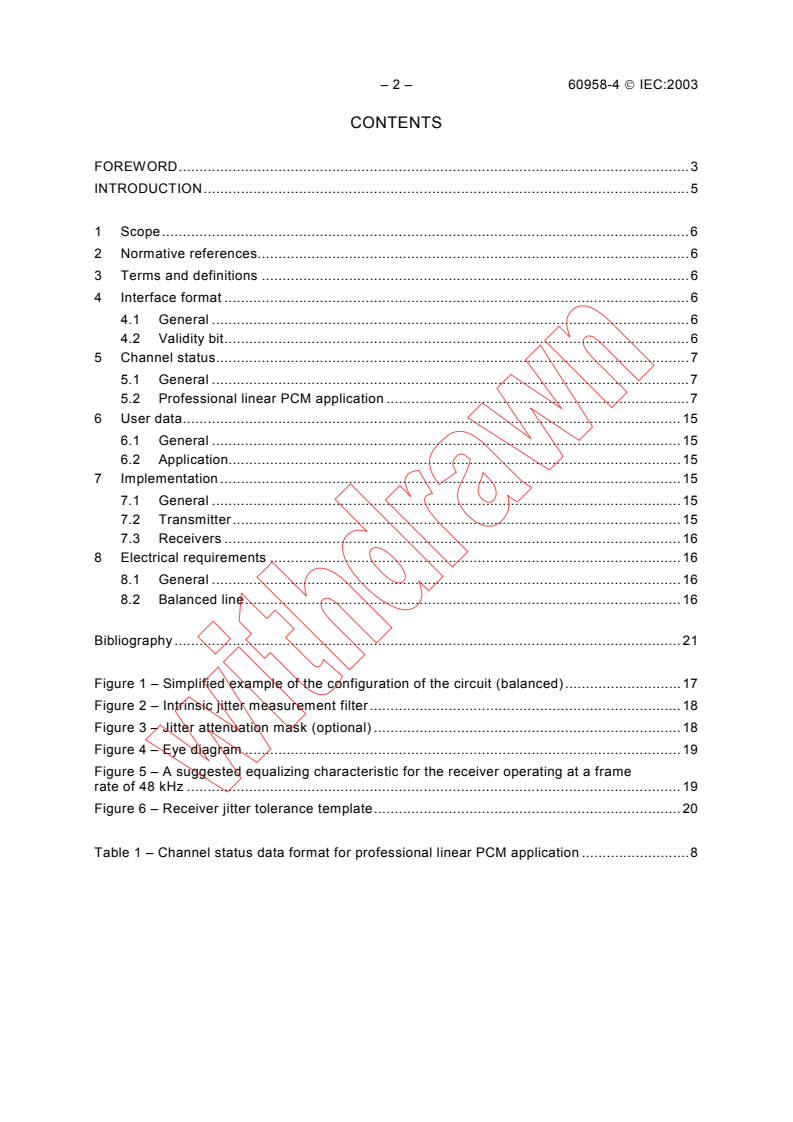
CONTENTS
FOREWORD . 3
INTRODUCTION .5
1 Scope . 6
2 Normative references. 6
3 Terms and definitions. 6
4 Interface format .6
4.1 General . 6
4.2 Validity bit. 6
5 Channel status.7
5.1 General . 7
5.2 Professional linear PCM application . 7
6 User data.15
6.1 General .15
6.2 Application.15
7 Implementation .15
7.1 General .15
7.2 Transmitter .15
7.3 Receivers .16
8 Electrical requirements.16
8.1 General .16
8.2 Balanced line .16
Bibliography .21
Figure 1 – Simplified example of the configuration of the circuit (balanced) .17
Figure 2 – Intrinsic jitter measurement filter .18
Figure 3 – Jitter attenuation mask (optional) .18
Figure 4 – Eye diagram .19
Figure 5 – A suggested equalizing characteristic for the receiver operating at a frame
rate of 48 kHz.19
Figure 6 – Receiver jitter tolerance template .20
Table 1 – Channel status data format for professional linear PCM application . 8
60958-4 IEC:2003(E) – 3 –
INTERNATIONAL ELECTROTECHNICAL COMMISSION
____________
DIGITAL AUDIO INTERFACE –
Part 4: Professional applications
FOREWORD
1) The IEC (International Electrotechnical Commission) is a worldwide organization for standardization comprising
all national electrotechnical committees (IEC National Committees). The object of the IEC is to promote
international co-operation on all questions concerning standardization in the electrical and electronic fields. To
this end and in addition to other activities, the IEC publishes International Standards. Their preparation is
entrusted to technical committees; any IEC National Committee interested in the subject dealt with may
participate in this preparatory work. International, governmental and non-governmental organizations liaising
with the IEC also participate in this preparation. The IEC collaborates closely with the International Organization
for Standardization (ISO) in accordance with conditions determined by agreement between the two
organizations.
2) The formal decisions or agreements of the IEC on technical matters express, as nearly as possible, an
international consensus of opinion on the relevant subjects since each technical committee has representation
from all interested National Committees.
3) The documents produced have the form of recommendations for international use and are published in the form
of standards, technical specifications, technical reports or guides and they are accepted by the National
Committees in that sense.
4) In order to promote international unification, IEC National Committees undertake to apply IEC International
Standards transparently to the maximum extent possible in their national and regional standards. Any
divergence between the IEC Standard and the corresponding national or regional standard shall be clearly
indicated in the latter.
5) The IEC provides no marking procedure to indicate its approval and cannot be rendered responsible for any
equipment declared to be in conformity with one of its standards.
6) Attention is drawn to the possibility that some of the elements of this International Standard may be the subject
of patent rights. The IEC shall not be held responsible for identifying any or all such patent rights.
International Standard IEC 60958-4 has been prepared by IEC technical committee 100: Audio,
video and multimedia systems and equipment.
This second edition of IEC 60958-4 cancels and replaces the first edition published in 1999 and
constitutes a technical revision.
The text of this standard is based on the following documents:
FDIS Report on voting
100/643/FDIS 100/669/RVD
Full information on the voting for the approval of this standard can be found in the report on
voting indicated in the above table.
This publication has been drafted in accordance with the ISO/IEC Directives, Part 2.
The main changes with respect to the previous edition (1999) are listed below.
− The scope specifies the professional application of IEC 60958-1 (generalities have been
removed to an introduction).
− A clause on terms and definitions has been added.
− In Table 1, expanded channel status assignments have been added and channel status
definitions expanded to accommodate extended sampling frequencies, indication of
alignment level and multi-channel options.
– 4 – 60958-4 IEC:2003(E)
− Figure 1 and associated text has been revised to be more generalized. Three notes on cable
performance factors have been added.
− The impedance specification is now dependent on maximum frame rate.
− The common-mode balance specification is now dependent on maximum frame rate
− The impedance specification is now dependent on maximum frame rate.
IEC 60958 consists of the following parts under the generic title Digital audio interface:
Part 1: General
Part 3: Consumer applications
Part 4: Professional applications
The committee has decided that this publication remains valid until September 2005. At this
date, in accordance with the committee’s decision, the publication will be
• reconfirmed;
• withdrawn;
• replaced by a revised edition, or
• amended.
60958-4 IEC:2003(E) – 5 –
INTRODUCTION
The interface specified in this standard is primarily intended to carry monophonic or
stereophonic programmes at a 48 kHz sampling frequency and with a resolution of up to 24 bits
per sample. It may alternatively be used to carry signals sampled at other rates such as
32 kHz, 44,1 kHz, or 96 kHz. Note that conformity to this interface specification does not
require equipment to utilize these rates and also that the capability of the interface to
indicate other sample rates does not imply that it is recommended that equipment supports
these rates. To eliminate doubt, equipment specifications should define the supported sampling
frequencies.
The format is intended for use with shielded twisted-pair cables over distances of up to 100 m
without transmission equalization or any special equalization at the receiver and at frame rates
of up to 50 kHz. Longer cable lengths and higher frame rates may be used with cables better
matched for data transmission, or with receiver equalization, or both.
In both cases, the clock references and auxiliary information are transmitted along with the
audio data. Provision is also made to allow the interface to carry non-audio data.
– 6 – 60958-4 IEC:2003(E)
DIGITAL AUDIO INTERFACE –
Part 4: Professional applications
1 Scope
This International Standard specifies the professional application of the interface for the
interconnection of digital audio equipment defined in IEC 60958-1.
2 Normative references
The following referenced documents are indispensable for the application of this document. For
dated references, only the edition cited applies. For undated references, the latest edition of
the referenced document (including any amendments) applies.
IEC 60268-12:1987, Sound system equipment – Part 12: Application of connectors for
broadcast and similar use
IEC 60958-1, Digital audio interface – Part 1: General
IEC 60958-3, Digital audio interface – Part 3: Consumer applications
ISO/IEC 646:1991, Information technology – ISO 7-bit coded character set for information
interchange
ITU-T Recommendation J.17:1988, Pre-emphasis used on sound-programme circuits
ITU-T Recommendation V.11:1996, Electrical characteristics for balanced double-current inter-
change circuits operating at data signalling rates up to 10 Mbit/s
3 Terms and definitions
The terms and definitions given in IEC 60958-1 apply to this part of IEC 60958.
4 Interface format
4.1 General
The interface format as defined in IEC 60958-1 shall be used.
For historical reasons, preambles “B”, “M” and “W”, as defined in 4.3 of IEC 60958-1, shall, for
use in professional applications, be referred to as “Z”, “X” and “Y”, respectively.
4.2 Validity bit
For this standard, the validity bit shall be used to indicate whether the main data field bits in the
sub-frame are suitable for conversion to an analogue audio signal using linear PCM coding.
60958-4 IEC:2003(E) – 7 –
5 Channel status
5.1 General
The channel status for each audio signal carries information associated with that audio signal;
thus it is possible for different channel status data to be carried in the two sub-frames of the
digital audio signal. Examples of information to be carried in the channel status are: length of
audio sample words, number of audio channels, sampling frequency, sample address code,
alphanumeric source and destination codes, and pre-emphasis.
Channel status information is organized in a 192-bit block, subdivided into 24 bytes, numbered
0 to 23 (see Table 1). The first bit of each block is carried in the frame with preamble “Z”.
The individual bits of a block are numbered 0 to 191.
The primary application is indicated by channel status bit 0.
For the professional applications described here, this first channel status bit equals “1”.
NOTE For consumer digital audio equipment, this first channel status bit equals “0”, and this part of IEC 60958
does not apply.
Secondary applications may be defined within the framework of these primary applications.
5.2 Professional linear PCM application
The specific organization of the channel status data is defined in this clause and summarized
in Table 1.
The significance of byte 0, bit 0 is such that a transmission from an interface conforming to
IEC 60958-3 (“consumer use”) can be identified. Also, a “professional use” transmission,
defined in this part of IEC 60958, can be correctly identified by a “consumer use” receiver.
Connection of a “consumer use” transmitter with a “professional use” receiver or vice versa
might result in unpredictable operation. Thus, the byte definitions in this clause apply only when
bit 0 = “1” and bit 1 = “0” (professional linear PCM use of the channel status block).
– 8 – 60958-4 IEC:2003(E)
Table 1 – Channel status data format for professional linear PCM application
Byte
0 a = “1” b = “0” C d e
Bit01 234 5 67
1fg
Bit8 9 101112 13 1415
2hi j
Bit1617 181920 21 2223
3 k n=”0”
lm n=”1”
Bit2425 262728 29 3031
4opq r
Bit3233 343536 37 3839
5 Reserved but undefined at present
Bit4041 424344 45 4647
6 Alphanumeric channel origin data
Bit4849 505152 53 5455
7 Alphanumeric channel origin data
Bit5657 585960 61 6263
8 Alphanumeric channel origin data
Bit6465 666768 69 7071
9 Alphanumeric channel origin data
Bit7273 747576 77 7879
Alphanumeric channel destination data
bit8081 828384 85 8687
Alphanumeric channel destination data
bit8889 909192 93 9495
Alphanumeric channel destination data
bit 96 97 98 99 100 101 102 103
13 Alphanumeric channel destination data
bit 104 105 106 107 108 109 110 111
14 Local sample address code (32-bit binary)
bit 112 113 114 115 116 117 118 119
15 Local sample address code (32-bit binary)
bit 120 121 122 123 124 125 126 127
16 Local sample address code (32-bit binary)
bit 128 129 130 131 132 133 134 135
17 Local sample address code (32-bit binary)
bit 136 137 138 139 140 141 142 143
18 Time of day code (32-bit binary)
bit 144 145 146 147 148 149 150 151
19 Time of day code (32-bit binary)
bit 152 153 154 155 156 157 158 159
20 Time of day code (32-bit binary)
bit 160 161 162 163 164 165 166 167
21 Time of day code (32-bit binary)
bit 168 169 170 171 172 173 174 175
22 Reliability flags
bit 176 177 178 179 180 181 182 183
Cyclic redundancy check character
bit 184 185 186 187 188 189 190 191
a: use of channel status block j: indication of alignment level
b: linear PCM identification k: channel number
c: audio signal pre-emphasis l: channel number
d: lock indication m: multichannel mode number
e: sampling frequency n: multichannel mode
f: channel mode o: digital audio reference signal
g: user bits management p: reserved but undefined at present
h: use of auxiliary sample bits q: sampling frequency
i: source word length r: sampling frequency scaling flag
60958-4 IEC:2003(E) – 9 –
Byte 0
Bit 0 Use of channel status block
State “1” Professional use of channel status block (note 1)
Bit 1 Linear PCM identification
State “0” Audio sample word represents linear PCM samples (note 1)
“1” Audio sample word used for purposes other than
linear PCM samples
NOTE 1 The functions of channel status bits 0 and 1 are defined in IEC 60958-1.
Bits 2 to 4 Encoded audio signal pre-emphasis.
Bit 2 3 4
State “0 0 0” Pre-emphasis not indicated. Receiver defaults to no pre-
emphasis with manual override enabled.
“1 0 0” No pre-emphasis. Receiver manual override is disabled.
“1 1 0” 50 μs/15 μs pre-emphasis. Receiver manual override
is disabled.
“1 1 1” ITU-T Recommendation J.17 pre-emphasis (with 6,5 dB
insertion loss at 800 Hz). Receiver manual override is
disabled.
All other states of bits 2 to 4 are reserved and shall not be used
until further defined.
Bit 5 Lock indication
State “0” Default, lock condition not indicated.
“1” Source sampling frequency unlocked.
Bits 6 to 7 Encoded sampling frequency
Bit 6 7
State “0 0” Sampling frequency not indicated. Receiver defaults to
48 kHz and manual override or auto set is enabled.
“0 1” 48 kHz sampling frequency. Receiver manual override
or auto set is disabled.
“1 0” 44,1 kHz sampling frequency. Receiver manual override or
auto set is disabled.
“1 1” 32 kHz sampling frequency. Receiver manual override or
auto set is disabled.
NOTE 2 The indication of sampling frequency, or the use of one of the sampling frequencies that can be indicated
in this byte, is not a requirement for operation of the interface. The 00 state of bits 6 to 7 may be used if the
transmitter does not support the indication of sampling frequency, if the sampling frequency is unknown, or if the
sample frequency is not one of those that can be indicated in this byte. In the latter case for some sampling
frequencies byte 4 may be used to indicate the correct value.
NOTE 3 When bits 8 to 11 in byte 1 indicate single-channel double-sampling frequency mode, the sampling
frequency of the audio signal is twice that indicated by bits 6 to 7 in byte 0.
– 10 – 60958-4 IEC:2003(E)
Byte 1
The six modes of transmission are signalled by setting bits 8 to 11 of byte 1 of channel status.
• Two-channel mode: In two-channel mode, the samples from both channels are transmitted
in consecutive sub-frames. Channel 1 is in sub-frame 1 and channel 2 is in sub-frame 2.
• Stereophonic mode: In stereophonic mode, the interface is used to transmit stereophonic
signals, and the two channels are presumed to have been simultaneously sampled. The
left, or “A”, channel is in sub-frame 1 and the right, or “B”, channel is in sub-frame 2.
• Single-channel mode (monophonic): In monophonic mode, the transmitted bit rate remains
at the normal two-channel rate and the audio sample word is placed in sub-frame 1.
Time slots 4 to 31 of sub-frame 2 either carry the bits identical to sub-frame 1 or are set to
logical “0”. A receiver normally defaults to channel 1, unless manual override is provided.
• Primary/secondary mode: In some applications requiring two channels where one of the
channels is the main or primary channel while the other is a secondary channel, the primary
channel is in sub-frame 1 and the secondary channel is in sub-frame 2.
• Multichannel mode: The one or two channels carried on the interface are part of a larger
group. Channel identification within this group is in byte 3.
• Single-channel double-sampling frequency mode: Sub-frames 1 and 2 carry successive
samples of the same signal. The sampling frequency of the signal is double the frame
repetition rate and is double the sampling frequency indicated in byte 0 (but not double
the rate indicated in byte 4, if that is used). Manual override is disabled.
Bits 8 to 11 Encoded channel mode
Bit 8 9 10 1
...
IEC 60958-4
Edition 2.1 2008-07
INTERNATIONAL
STANDARD
Digital audio interface –
Part 4: Professional applications
All rights reserved. Unless otherwise specified, no part of this publication may be reproduced or utilized in any form
or by any means, electronic or mechanical, including photocopying and microfilm, without permission in writing from
either IEC or IEC's member National Committee in the country of the requester.
If you have any questions about IEC copyright or have an enquiry about obtaining additional rights to this publication,
please contact the address below or your local IEC member National Committee for further information.
IEC Central Office
3, rue de Varembé
CH-1211 Geneva 20
Switzerland
Email: inmail@iec.ch
Web: www.iec.ch
About the IEC
The International Electrotechnical Commission (IEC) is the leading global organization that prepares and publishes
International Standards for all electrical, electronic and related technologies.
About IEC publications
The technical content of IEC publications is kept under constant review by the IEC. Please make sure that you have the
latest edition, a corrigenda or an amendment might have been published.
ƒ Catalogue of IEC publications: www.iec.ch/searchpub
The IEC on-line Catalogue enables you to search by a variety of criteria (reference number, text, technical committee,…).
It also gives information on projects, withdrawn and replaced publications.
ƒ IEC Just Published: www.iec.ch/online_news/justpub
Stay up to date on all new IEC publications. Just Published details twice a month all new publications released. Available
on-line and also by email.
ƒ Electropedia: www.electropedia.org
The world's leading online dictionary of electronic and electrical terms containing more than 20 000 terms and definitions
in English and French, with equivalent terms in additional languages. Also known as the International Electrotechnical
Vocabulary online.
ƒ Customer Service Centre: www.iec.ch/webstore/custserv
If you wish to give us your feedback on this publication or need further assistance, please visit the Customer Service
Centre FAQ or contact us:
Email: csc@iec.ch
Tel.: +41 22 919 02 11
Fax: +41 22 919 03 00
IEC 60958-4
Edition 2.1 2008-07
INTERNATIONAL
STANDARD
Digital audio interface –
Part 4: Professional applications
INTERNATIONAL
ELECTROTECHNICAL
COMMISSION
PRICE CODE
CH
ICS 33.160.30 ISBN 2-8318-9703-3
– 2 – 60958-4 © IEC:2003+A1:2008(E)
CONTENTS
INTRODUCTION.5
1 Scope.6
2 Normative references.6
3 Terms and definitions .6
4 Interface format .6
4.1 General .6
4.2 Validity bit.6
5 Channel status.7
5.1 General .7
5.2 Professional linear PCM application .7
6 User data.15
6.1 General .15
6.2 Application.15
7 Implementation .15
7.1 General .15
7.2 Transmitter.15
7.3 Receivers .16
8 Electrical requirements .16
8.1 General .16
8.2 Balanced line.16
8.3 Unbalanced coaxial cables.21
Bibliography .22
Figure 1 – Simplified example of the configuration of the circuit (balanced).17
Figure 2 – Intrinsic jitter measurement filter.18
Figure 3 – Jitter attenuation mask (optional) .18
Figure 4 – Eye diagram .19
Figure 5 – A suggested equalizing characteristic for the receiver operating at a frame
rate of 48 kHz .19
Figure 6 – Receiver jitter tolerance template.20
Table 1 – Channel status data format for professional linear PCM application .8
60958-4 © IEC:2003+A1:2008(E) – 3 –
INTERNATIONAL ELECTROTECHNICAL COMMISSION
____________
DIGITAL AUDIO INTERFACE –
Part 4: Professional applications
1) The International Electrotechnical Commission (IEC) is a worldwide organization for standardization comprising
all national electrotechnical committees (IEC National Committees). The object of IEC is to promote
international co-operation on all questions concerning standardization in the electrical and electronic fields. To
this end and in addition to other activities, IEC publishes International Standards, Technical Specifications,
Technical Reports, Publicly Available Specifications (PAS) and Guides (hereafter referred to as “IEC
Publication(s)”). Their preparation is entrusted to technical committees; any IEC National Committee interested
in the subject dealt with may participate in this preparatory work. International, governmental and non-
governmental organizations liaising with the IEC also participate in this preparation. IEC collaborates closely
with the International Organization for Standardization (ISO) in accordance with conditions determined by
agreement between the two organizations.
2) The formal decisions or agreements of IEC on technical matters express, as nearly as possible, an international
consensus of opinion on the relevant subjects since each technical committee has representation from all
interested IEC National Committees.
3) IEC Publications have the form of recommendations for international use and are accepted by IEC National
Committees in that sense. While all reasonable efforts are made to ensure that the technical content of IEC
Publications is accurate, IEC cannot be held responsible for the way in which they are used or for any
misinterpretation by any end user.
4) In order to promote international uniformity, IEC National Committees undertake to apply IEC Publications
transparently to the maximum extent possible in their national and regional publications. Any divergence
between any IEC Publication and the corresponding national or regional publication shall be clearly indicated in
the latter.
5) IEC provides no marking procedure to indicate its approval and cannot be rendered responsible for any
equipment declared to be in conformity with an IEC Publication.
6) All users should ensure that they have the latest edition of this publication.
7) No liability shall attach to IEC or its directors, employees, servants or agents including individual experts and
members of its technical committees and IEC National Committees for any personal injury, property damage or
other damage of any nature whatsoever, whether direct or indirect, or for costs (including legal fees) and
expenses arising out of the publication, use of, or reliance upon, this IEC Publication or any other IEC
Publications.
8) Attention is drawn to the Normative references cited in this publication. Use of the referenced publications is
indispensable for the correct application of this publication.
9) Attention is drawn to the possibility that some of the elements of this IEC Publication may be the subject of
patent rights. IEC shall not be held responsible for identifying any or all such patent rights.
International Standard IEC 60958-4 has been prepared by IEC technical committee 100: Audio,
video and multimedia systems and equipment.
This consolidated version of IEC 60958-4 consists of the second edition (2003) [documents
100/643/FDIS and 100/669/RVD] and its amendment 1 (2008) [documents 100/1330/FDIS and
100/1355/RVD].
The technical content is therefore identical to the base edition and its amendment and has
been prepared for user convenience.
It bears the edition number 2.1.
A vertical line in the margin shows where the base publication has been modified by
amendment 1.
– 4 – 60958-4 © IEC:2003+A1:2008(E)
This publication has been drafted in accordance with the ISO/IEC Directives, Part 2.
The main changes with respect to the previous edition (1999) are listed below.
− The scope specifies the professional application of IEC 60958-1 (generalities have been
removed to an introduction).
− A clause on terms and definitions has been added.
− In Table 1, expanded channel status assignments have been added and channel status
definitions expanded to accommodate extended sampling frequencies, indication of
alignment level and multi-channel options.
− Figure 1 and associated text has been revised to be more generalized. Three notes on cable
performance factors have been added.
− The impedance specification is now dependent on maximum frame rate.
− The common-mode balance specification is now dependent on maximum frame rate
− The impedance specification is now dependent on maximum frame rate.
IEC 60958 consists of the following parts under the generic title Digital audio interface:
Part 1: General
Part 3: Consumer applications
Part 4: Professional applications
The committee has decided that the contents of the base publication and its amendments will
remain unchanged until the maintenance result date indicated on the IEC web site under
"http://webstore.iec.ch" in the data related to the specific publication. At this date,
the publication will be
• reconfirmed,
• withdrawn,
• replaced by a revised edition, or
• amended.
A bilingual version of this publication may be issued at a later date.
60958-4 © IEC:2003+A1:2008(E) – 5 –
INTRODUCTION
The interface specified in this standard is primarily intended to carry monophonic or
stereophonic programmes at a 48 kHz sampling frequency and with a resolution of up to 24 bits
per sample. It may alternatively be used to carry signals sampled at other rates such as
32 kHz, 44,1 kHz, or 96 kHz. Note that conformity to this interface specification does not
require equipment to utilize these rates and also that the capability of the interface to
indicate other sample rates does not imply that it is recommended that equipment supports
these rates. To eliminate doubt, equipment specifications should define the supported sampling
frequencies.
The format is intended for use with shielded twisted-pair cables over distances of up to 100 m
without transmission equalization or any special equalization at the receiver and at frame rates
of up to 50 kHz. Longer cable lengths and higher frame rates may be used with cables better
matched for data transmission, or with receiver equalization, or both.
In both cases, the clock references and auxiliary information are transmitted along with the
audio data. Provision is also made to allow the interface to carry non-audio data.
– 6 – 60958-4 © IEC:2003+A1:2008(E)
DIGITAL AUDIO INTERFACE –
Part 4: Professional applications
1 Scope
This International Standard specifies the professional application of the interface for the
interconnection of digital audio equipment defined in IEC 60958-1.
2 Normative references
The following referenced documents are indispensable for the application of this document. For
dated references, only the edition cited applies. For undated references, the latest edition of
the referenced document (including any amendments) applies.
IEC 60268-12:1987, Sound system equipment – Part 12: Application of connectors for
broadcast and similar use
IEC 60958-1, Digital audio interface – Part 1: General
IEC 60958-3, Digital audio interface – Part 3: Consumer applications
ISO/IEC 646:1991, Information technology – ISO 7-bit coded character set for information
interchange
ITU-T Recommendation J.17:1988, Pre-emphasis used on sound-programme circuits
ITU-T Recommendation V.11:1996, Electrical characteristics for balanced double-current inter-
change circuits operating at data signalling rates up to 10 Mbit/s
3 Terms and definitions
The terms and definitions given in IEC 60958-1 apply to this part of IEC 60958.
4 Interface format
4.1 General
The interface format as defined in IEC 60958-1 shall be used.
For historical reasons, preambles “B”, “M” and “W”, as defined in 4.3 of IEC 60958-1, shall, for
use in professional applications, be referred to as “Z”, “X” and “Y”, respectively.
4.2 Validity bit
For this standard, the validity bit shall be used to indicate whether the main data field bits in the
sub-frame are suitable for conversion to an analogue audio signal using linear PCM coding.
60958-4 © IEC:2003+A1:2008(E) – 7 –
5 Channel status
5.1 General
The channel status for each audio signal carries information associated with that audio signal;
thus it is possible for different channel status data to be carried in the two sub-frames of the
digital audio signal. Examples of information to be carried in the channel status are: length of
audio sample words, number of audio channels, sampling frequency, sample address code,
alphanumeric source and destination codes, and pre-emphasis.
Channel status information is organized in a 192-bit block, subdivided into 24 bytes, numbered
0 to 23 (see Table 1). The first bit of each block is carried in the frame with preamble “Z”.
The individual bits of a block are numbered 0 to 191.
The primary application is indicated by channel status bit 0.
For the professional applications described here, this first channel status bit equals “1”.
NOTE For consumer digital audio equipment, this first channel status bit equals “0”, and this part of IEC 60958
does not apply.
Secondary applications may be defined within the framework of these primary applications.
5.2 Professional linear PCM application
The specific organization of the channel status data is defined in this clause and summarized
in Table 1.
The significance of byte 0, bit 0 is such that a transmission from an interface conforming to
IEC 60958-3 (“consumer use”) can be identified. Also, a “professional use” transmission,
defined in this part of IEC 60958, can be correctly identified by a “consumer use” receiver.
Connection of a “consumer use” transmitter with a “professional use” receiver or vice versa
might result in unpredictable operation. Thus, the byte definitions in this clause apply only when
bit 0 = “1” and bit 1 = “0” (professional linear PCM use of the channel status block).
– 8 – 60958-4 © IEC:2003+A1:2008(E)
Table 1 – Channel status data format for professional linear PCM application
Byte
0 a = “1” b = “0” C d e
Bit 0 1 2 3 4 5 6 7
1 f g
Bit 8 9 10 11 12 13 14 15
2 h i j
Bit 16 17 18 19 20 21 22 23
3 k n=”0”
l m n=”1”
Bit 24 25 26 27 28 29 30 31
4 o p q r
Bit 32 33 34 35 36 37 38 39
5 Reserved but undefined at present
Bit 40 41 42 43 44 45 46 47
6 Alphanumeric channel origin data
Bit 48 49 50 51 52 53 54 55
7 Alphanumeric channel origin data
Bit 56 57 58 59 60 61 62 63
8 Alphanumeric channel origin data
Bit 64 65 66 67 68 69 70 71
9 Alphanumeric channel origin data
Bit 72 73 74 75 76 77 78 79
Alphanumeric channel destination data
bit 80 81 82 83 84 85 86 87
Alphanumeric channel destination data
bit 88 89 90 91 92 93 94 95
Alphanumeric channel destination data
bit 96 97 98 99 100 101 102 103
13 Alphanumeric channel destination data
bit 104 105 106 107 108 109 110 111
14 Local sample address code (32-bit binary)
bit 112 113 114 115 116 117 118 119
15 Local sample address code (32-bit binary)
bit 120 121 122 123 124 125 126 127
16 Local sample address code (32-bit binary)
bit 128 129 130 131 132 133 134 135
17 Local sample address code (32-bit binary)
bit 136 137 138 139 140 141 142 143
18 Time of day code (32-bit binary)
bit 144 145 146 147 148 149 150 151
19 Time of day code (32-bit binary)
bit 152 153 154 155 156 157 158 159
20 Time of day code (32-bit binary)
bit 160 161 162 163 164 165 166 167
21 Time of day code (32-bit binary)
bit 168 169 170 171 172 173 174 175
Reliability flags
bit 176 177 178 179 180 181 182 183
Cyclic redundancy check character
bit 184 185 186 187 188 189 190 191
a: use of channel status block j: indication of alignment level
b: linear PCM identification k: channel number
c: audio signal pre-emphasis l: channel number
d: lock indication m: multichannel mode number
e: sampling frequency n: multichannel mode
f: channel mode o: digital audio reference signal
g: user bits management p: reserved but undefined at present
h: use of auxiliary sample bits q: sampling frequency
i: source word length r: sampling frequency scaling flag
60958-4 © IEC:2003+A1:2008(E) – 9 –
Byte 0
Bit 0 Use of channel status block
State “1” Professional use of channel status block (note 1)
Bit 1 Linear PCM identification
State “0” Audio sample word represents linear PCM samples (note 1)
“1” Audio sample word used for purposes other than
linear PCM samples
NOTE 1 The functions of channel status bits 0 and 1 are defined in IEC 60958-1.
Bits 2 to 4 Encoded audio signal pre-emphasis.
Bit 2 3 4
State “0 0 0” Pre-emphasis not indicated. Receiver defaults to no pre-
emphasis with manual override enabled.
“1 0 0” No pre-emphasis. Receiver manual override is disabled.
“1 1 0” 50 μs/15 μs pre-emphasis. Receiver manual override
is disabled.
“1 1 1” ITU-T Recommendation J.17 pre-emphasis (with 6,5 dB
insertion loss at 800 Hz). Receiver manual override is
disabled.
All other states of bits 2 to 4 are reserved and shall not be used
until further defined.
Bit 5 Lock indication
State “0” Default, lock condition not indicated.
“1” Source sampling frequency unlocked.
Bits 6 to 7 Encoded sampling frequency
Bit 6 7
State “0 0” Sampling frequency not indicated. Receiver defaults to
48 kHz and manual override or auto set is enabled.
“0 1” 48 kHz sampling frequency. Receiver manual override
or auto set is disabled.
“1 0” 44,1 kHz sampling frequency. Receiver manual override or
auto set is disabled.
“1 1” 32 kHz sampling frequency. Receiver manual override or
auto set is disabled.
NOTE 2 The indication of sampling frequency, or the use of one of the sampling frequencies that can be indicated
in this byte, is not a requirement for operation of the interface. The 00 state of bits 6 to 7 may be used if the
transmitter does not support the indication of sampling frequency, if the sampling frequency is unknown, or if the
sample frequency is not one of those that can be indicated in this byte. In the latter case for some sampling
frequencies byte 4 may be used to indicate the correct value.
NOTE 3 When bits 8 to 11 in byte 1 indicate single-channel double-sampling frequency mode, the sampling
frequency of the audio signal is twice that indicated by bits 6 to 7 in byte 0.
– 10 – 60958-4 © IEC:2003+A1:2008(E)
Byte 1
The six modes of transmission are signalled by setting bits 8 to 11 of byte 1 of channel status.
• Two-channel mode: In two-channel mode, the samples from both channels are transmitted
in consecutive sub-frames. Channel 1 is in sub-frame 1 and channel 2 is in sub-frame 2.
• Stereophonic mode: In stereophonic mode, the interface is used to transmit stereophonic
signals, and the two channels are presumed to have been simultaneously sampled. The
left, or “A”, channel is in sub-frame 1 and the right, or “B”, channel is in sub-frame 2.
• Single-channel mode (monophonic): In monophonic mode, the transmitted bit rate remains
at the normal two-channel rate and the audio sample word is placed in sub-frame 1.
Time slots 4 to 31 of sub-frame 2 either carry the bits identical to sub-frame 1 or are set to
logical “0”. A receiver normally defaults to channel 1, unless manual override is provided.
• Primary/secondary mode: In some applications requiring two channels where one of the
channels is the main or primary channel while the other is a secondary channel, the primary
channel is in sub-frame 1 and the secondary channel is in sub-frame 2.
• Multichannel mode: The one or two channels carried on the interface are part of a larger
group. Channel identification within this group is in byte 3.
• Single-channel double-sampling frequency mode: Sub-frames 1 and 2 carry successive
samples of the same signal. The sampling frequency of the signal is double the frame
repetition rate and is double the sampling frequency indicated in byte 0 (but not double
the rate indicated in byte 4, if that is used). Manual override is disabled.
Bits 8 to 11 Encoded channel mode
Bit 8 9 10 11
State “0 0 0 0” Mode not indicated. Receiver defaults to two-channel
mode and manual override is enabled.
“0 0 0 1” Two-channel mode. Receiver manual override is
disabled.
“0 0 1 0” Single-channel mode (monophonic). Receiver manu
...
IEC 60958-4 ®
Edition 2.0 2003-05
INTERNATIONAL
STANDARD
NORME
INTERNATIONALE
Digital audio interface –
Part 4: Professional applications
Interface audionumérique –
Partie 4: Applications professionnelles
All rights reserved. Unless otherwise specified, no part of this publication may be reproduced or utilized in any form
or by any means, electronic or mechanical, including photocopying and microfilm, without permission in writing from
either IEC or IEC's member National Committee in the country of the requester.
If you have any questions about IEC copyright or have an enquiry about obtaining additional rights to this publication,
please contact the address below or your local IEC member National Committee for further information.
Droits de reproduction réservés. Sauf indication contraire, aucune partie de cette publication ne peut être reproduite ni
utilisée sous quelque forme que ce soit et par aucun procédé, électronique ou mécanique, y compris la photocopie et les
microfilms, sans l'accord écrit de la CEI ou du Comité national de la CEI du pays du demandeur.
Si vous avez des questions sur le copyright de la CEI ou si vous désirez obtenir des droits supplémentaires sur cette
publication, utilisez les coordonnées ci-après ou contactez le Comité national de la CEI de votre pays de résidence.
IEC Central Office Tel.: +41 22 919 02 11
3, rue de Varembé Fax: +41 22 919 03 00
CH-1211 Geneva 20 info@iec.ch
Switzerland www.iec.ch
About the IEC
The International Electrotechnical Commission (IEC) is the leading global organization that prepares and publishes
International Standards for all electrical, electronic and related technologies.
About IEC publications
The technical content of IEC publications is kept under constant review by the IEC. Please make sure that you have the
latest edition, a corrigenda or an amendment might have been published.
Useful links:
IEC publications search - www.iec.ch/searchpub Electropedia - www.electropedia.org
The advanced search enables you to find IEC publications The world's leading online dictionary of electronic and
by a variety of criteria (reference number, text, technical electrical terms containing more than 30 000 terms and
committee,…). definitions in English and French, with equivalent terms in
It also gives information on projects, replaced and additional languages. Also known as the International
withdrawn publications. Electrotechnical Vocabulary (IEV) on-line.
IEC Just Published - webstore.iec.ch/justpublished Customer Service Centre - webstore.iec.ch/csc
Stay up to date on all new IEC publications. Just Published If you wish to give us your feedback on this publication
details all new publications released. Available on-line and or need further assistance, please contact the
also once a month by email. Customer Service Centre: csc@iec.ch.
A propos de la CEI
La Commission Electrotechnique Internationale (CEI) est la première organisation mondiale qui élabore et publie des
Normes internationales pour tout ce qui a trait à l'électricité, à l'électronique et aux technologies apparentées.
A propos des publications CEI
Le contenu technique des publications de la CEI est constamment revu. Veuillez vous assurer que vous possédez
l’édition la plus récente, un corrigendum ou amendement peut avoir été publié.
Liens utiles:
Recherche de publications CEI - www.iec.ch/searchpub Electropedia - www.electropedia.org
La recherche avancée vous permet de trouver des Le premier dictionnaire en ligne au monde de termes
publications CEI en utilisant différents critères (numéro de électroniques et électriques. Il contient plus de 30 000
référence, texte, comité d’études,…). termes et définitions en anglais et en français, ainsi que
Elle donne aussi des informations sur les projets et les les termes équivalents dans les langues additionnelles.
publications remplacées ou retirées. Egalement appelé Vocabulaire Electrotechnique
International (VEI) en ligne.
Just Published CEI - webstore.iec.ch/justpublished
Service Clients - webstore.iec.ch/csc
Restez informé sur les nouvelles publications de la CEI.
Just Published détaille les nouvelles publications parues. Si vous désirez nous donner des commentaires sur
Disponible en ligne et aussi une fois par mois par email. cette publication ou si vous avez des questions
contactez-nous: csc@iec.ch.
IEC 60958-4 ®
Edition 2.0 2003-05
INTERNATIONAL
STANDARD
NORME
INTERNATIONALE
Digital audio interface –
Part 4: Professional applications
Interface audionumérique –
Partie 4: Applications professionnelles
INTERNATIONAL
ELECTROTECHNICAL
COMMISSION
COMMISSION
ELECTROTECHNIQUE
PRICE CODE
INTERNATIONALE
CODE PRIX S
ICS 33.160.30 ISBN 978-2-83220-727-7
– 2 – 60958-4 IEC:2003
CONTENTS
FOREWORD . 3
INTRODUCTION . 5
1 Scope . 6
2 Normative references. 6
3 Terms and definitions . 6
4 Interface format . 6
4.1 General . 6
4.2 Validity bit . 6
5 Channel status . 7
5.1 General . 7
5.2 Professional linear PCM application . 7
6 User data . 15
6.1 General . 15
6.2 Application. 15
7 Implementation . 15
7.1 General . 15
7.2 Transmitter . 15
7.3 Receivers . 16
8 Electrical requirements . 16
8.1 General . 16
8.2 Balanced line . 16
Bibliography . 21
Figure 1 – Simplified example of the configuration of the circuit (balanced) . 17
Figure 2 – Intrinsic jitter measurement filter . 18
Figure 3 – Jitter attenuation mask (optional) . 18
Figure 4 – Eye diagram . 19
Figure 5 – A suggested equalizing characteristic for the receiver operating at a frame
rate of 48 kHz . 19
Figure 6 – Receiver jitter tolerance template . 20
Table 1 – Channel status data format for professional linear PCM application . 8
60958-4 IEC:2003 – 3 –
INTERNATIONAL ELECTROTECHNICAL COMMISSION
____________
DIGITAL AUDIO INTERFACE –
Part 4: Professional applications
FOREWORD
1) The IEC (International Electrotechnical Commission) is a worldwide organization for standardization comprising
all national electrotechnical committees (IEC National Committees). The object of the IEC is to promote
international co-operation on all questions concerning standardization in the electrical and electronic fields. To
this end and in addition to other activities, the IEC publishes International Standards. Their preparation is
entrusted to technical committees; any IEC National Committee interested in the subject dealt with may
participate in this preparatory work. International, governmental and non-governmental organizations liaising
with the IEC also participate in this preparation. The IEC collaborates closely with the International Organization
for Standardization (ISO) in accordance with conditions determined by agreement between the two
organizations.
2) The formal decisions or agreements of the IEC on technical matters express, as nearly as possible, an
international consensus of opinion on the relevant subjects since each technical committee has representation
from all interested National Committees.
3) The documents produced have the form of recommendations for international use and are published in the form
of standards, technical specifications, technical reports or guides and they are accepted by the National
Committees in that sense.
4) In order to promote international unification, IEC National Committees undertake to apply IEC International
Standards transparently to the maximum extent possible in their national and regional standards. Any
divergence between the IEC Standard and the corresponding national or regional standard shall be clearly
indicated in the latter.
5) The IEC provides no marking procedure to indicate its approval and cannot be rendered responsible for any
equipment declared to be in conformity with one of its standards.
6) Attention is drawn to the possibility that some of the elements of this International Standard may be the subject
of patent rights. The IEC shall not be held responsible for identifying any or all such patent rights.
International Standard IEC 60958-4 has been prepared by IEC technical committee 100: Audio,
video and multimedia systems and equipment.
This second edition of IEC 60958-4 cancels and replaces the first edition published in 1999 and
constitutes a technical revision.
This bilingual version (2013-05) corresponds to the monolingual English version, published in
2003-05.
The text of this standard is based on the following documents:
FDIS Report on voting
100/643/FDIS 100/669/RVD
Full information on the voting for the approval of this standard can be found in the report on
voting indicated in the above table.
The French version of this standard has not been voted upon.
This publication has been drafted in accordance with the ISO/IEC Directives, Part 2.
The main changes with respect to the previous edition (1999) are listed below.
− The scope specifies the professional application of IEC 60958-1 (generalities have been
removed to an introduction).
– 4 – 60958-4 IEC:2003
− A clause on terms and definitions has been added.
− In Table 1, expanded channel status assignments have been added and channel status
definitions expanded to accommodate extended sampling frequencies, indication of
alignment level and multi-channel options.
− Figure 1 and associated text has been revised to be more generalized. Three notes on cable
performance factors have been added.
− The impedance specification is now dependent on maximum frame rate.
− The common-mode balance specification is now dependent on maximum frame rate
− The impedance specification is now dependent on maximum frame rate.
IEC 60958 consists of the following parts under the generic title Digital audio interface:
Part 1: General
Part 3: Consumer applications
Part 4: Professional applications
The committee has decided that this publication remains valid until September 2005. At this
date, in accordance with the committee’s decision, the publication will be
• reconfirmed;
• withdrawn;
• replaced by a revised edition, or
• amended.
60958-4 IEC:2003 – 5 –
INTRODUCTION
The interface specified in this standard is primarily intended to carry monophonic or
stereophonic programmes at a 48 kHz sampling frequency and with a resolution of up to 24 bits
per sample. It may alternatively be used to carry signals sampled at other rates such as
32 kHz, 44,1 kHz, or 96 kHz. Note that conformity to this interface specification does not
require equipment to utilize these rates and also that the capability of the interface to
indicate other sample rates does not imply that it is recommended that equipment supports
these rates. To eliminate doubt, equipment specifications should define the supported sampling
frequencies.
The format is intended for use with shielded twisted-pair cables over distances of up to 100 m
without transmission equalization or any special equalization at the receiver and at frame rates
of up to 50 kHz. Longer cable lengths and higher frame rates may be used with cables better
matched for data transmission, or with receiver equalization, or both.
In both cases, the clock references and auxiliary information are transmitted along with the
audio data. Provision is also made to allow the interface to carry non-audio data.
– 6 – 60958-4 IEC:2003
DIGITAL AUDIO INTERFACE –
Part 4: Professional applications
1 Scope
This International Standard specifies the professional application of the interface for the
interconnection of digital audio equipment defined in IEC 60958-1.
2 Normative references
The following referenced documents are indispensable for the application of this document. For
dated references, only the edition cited applies. For undated references, the latest edition of
the referenced document (including any amendments) applies.
IEC 60268-12:1987, Sound system equipment – Part 12: Application of connectors for
broadcast and similar use
IEC 60958-1, Digital audio interface – Part 1: General
IEC 60958-3, Digital audio interface – Part 3: Consumer applications
ISO/IEC 646:1991, Information technology – ISO 7-bit coded character set for information
interchange
ITU-T Recommendation J.17:1988, Pre-emphasis used on sound-programme circuits
ITU-T Recommendation V.11:1996, Electrical characteristics for balanced double-current inter-
change circuits operating at data signalling rates up to 10 Mbit/s
3 Terms and definitions
The terms and definitions given in IEC 60958-1 apply to this part of IEC 60958.
4 Interface format
4.1 General
The interface format as defined in IEC 60958-1 shall be used.
For historical reasons, preambles “B”, “M” and “W”, as defined in 4.3 of IEC 60958-1, shall, for
use in professional applications, be referred to as “Z”, “X” and “Y”, respectively.
4.2 Validity bit
For this standard, the validity bit shall be used to indicate whether the main data field bits in the
sub-frame are suitable for conversion to an analogue audio signal using linear PCM coding.
60958-4 IEC:2003 – 7 –
5 Channel status
5.1 General
The channel status for each audio signal carries information associated with that audio signal;
thus it is possible for different channel status data to be carried in the two sub-frames of the
digital audio signal. Examples of information to be carried in the channel status are: length of
audio sample words, number of audio channels, sampling frequency, sample address code,
alphanumeric source and destination codes, and pre-emphasis.
Channel status information is organized in a 192-bit block, subdivided into 24 bytes, numbered
0 to 23 (see Table 1). The first bit of each block is carried in the frame with preamble “Z”.
The individual bits of a block are numbered 0 to 191.
The primary application is indicated by channel status bit 0.
For the professional applications described here, this first channel status bit equals “1”.
NOTE For consumer digital audio equipment, this first channel status bit equals “0”, and this part of IEC 60958
does not apply.
Secondary applications may be defined within the framework of these primary applications.
5.2 Professional linear PCM application
The specific organization of the channel status data is defined in this clause and summarized
in Table 1.
The significance of byte 0, bit 0 is such that a transmission from an interface conforming to
IEC 60958-3 (“consumer use”) can be identified. Also, a “professional use” transmission,
defined in this part of IEC 60958, can be correctly identified by a “consumer use” receiver.
Connection of a “consumer use” transmitter with a “professional use” receiver or vice versa
might result in unpredictable operation. Thus, the byte definitions in this clause apply only when
bit 0 = “1” and bit 1 = “0” (professional linear PCM use of the channel status block).
– 8 – 60958-4 IEC:2003
Table 1 – Channel status data format for professional linear PCM application
Byte
0 a = “1” b = “0” C d e
Bit 0 1 2 3 4 5 6 7
1 f g
Bit 8 9 10 11 12 13 14 15
2 h i j
Bit 16 17 18 19 20 21 22 23
3 k n=”0”
l m n=”1”
Bit 24 25 26 27 28 29 30 31
4 o p q r
Bit 32 33 34 35 36 37 38 39
5 Reserved but undefined at present
Bit 40 41 42 43 44 45 46 47
6 Alphanumeric channel origin data
Bit 48 49 50 51 52 53 54 55
7 Alphanumeric channel origin data
Bit 56 57 58 59 60 61 62 63
8 Alphanumeric channel origin data
Bit 64 65 66 67 68 69 70 71
9 Alphanumeric channel origin data
Bit 72 73 74 75 76 77 78 79
Alphanumeric channel destination data
bit 80 81 82 83 84 85 86 87
Alphanumeric channel destination data
bit 88 89 90 91 92 93 94 95
Alphanumeric channel destination data
bit 96 97 98 99 100 101 102 103
13 Alphanumeric channel destination data
bit 104 105 106 107 108 109 110 111
14 Local sample address code (32-bit binary)
bit 112 113 114 115 116 117 118 119
15 Local sample address code (32-bit binary)
bit 120 121 122 123 124 125 126 127
16 Local sample address code (32-bit binary)
bit 128 129 130 131 132 133 134 135
17 Local sample address code (32-bit binary)
bit 136 137 138 139 140 141 142 143
18 Time of day code (32-bit binary)
bit 144 145 146 147 148 149 150 151
19 Time of day code (32-bit binary)
bit 152 153 154 155 156 157 158 159
20 Time of day code (32-bit binary)
bit 160 161 162 163 164 165 166 167
21 Time of day code (32-bit binary)
bit 168 169 170 171 172 173 174 175
22 Reliability flags
bit 176 177 178 179 180 181 182 183
Cyclic redundancy check character
bit 184 185 186 187 188 189 190 191
a: use of channel status block j: indication of alignment level
b: linear PCM identification k: channel number
c: audio signal pre-emphasis l: channel number
d: lock indication m: multichannel mode number
e: sampling frequency n: multichannel mode
f: channel mode o: digital audio reference signal
g: user bits management p: reserved but undefined at present
h: use of auxiliary sample bits q: sampling frequency
i: source word length r: sampling frequency scaling flag
60958-4 IEC:2003 – 9 –
Byte 0
Bit 0 Use of channel status block
State “1” Professional use of channel status block (note 1)
Bit 1 Linear PCM identification
State “0” Audio sample word represents linear PCM samples (note 1)
“1” Audio sample word used for purposes other than
linear PCM samples
NOTE 1 The functions of channel status bits 0 and 1 are defined in IEC 60958-1.
Bits 2 to 4 Encoded audio signal pre-emphasis.
Bit 2 3 4
State “0 0 0” Pre-emphasis not indicated. Receiver defaults to no pre-
emphasis with manual override enabled.
“1 0 0” No pre-emphasis. Receiver manual override is disabled.
“1 1 0” 50 µs/15 µs pre-emphasis. Receiver manual override
is disabled.
“1 1 1” ITU-T Recommendation J.17 pre-emphasis (with 6,5 dB
insertion loss at 800 Hz). Receiver manual override is
disabled.
All other states of bits 2 to 4 are reserved and shall not be used
until further defined.
Bit 5 Lock indication
State “0” Default, lock condition not indicated.
“1” Source sampling frequency unlocked.
Bits 6 to 7 Encoded sampling frequency
Bit 6 7
State “0 0” Sampling frequency not indicated. Receiver defaults to
48 kHz and manual override or auto set is enabled.
“0 1” 48 kHz sampling frequency. Receiver manual override
or auto set is disabled.
“1 0” 44,1 kHz sampling frequency. Receiver manual override or
auto set is disabled.
“1 1” 32 kHz sampling frequency. Receiver manual override or
auto set is disabled.
NOTE 2 The indication of sampling frequency, or the use of one of the sampling frequencies that can be indicated
in this byte, is not a requirement for operation of the interface. The 00 state of bits 6 to 7 may be used if the
transmitter does not support the indication of sampling frequency, if the sampling frequency is unknown, or if the
sample frequency is not one of those that can be indicated in this byte. In the latter case for some sampling
frequencies byte 4 may be used to indicate the correct value.
NOTE 3 When bits 8 to 11 in byte 1 indicate single-channel double-sampling frequency mode, the sampling
frequency of the audio signal is twice that indicated by bits 6 to 7 in byte 0.
– 10 – 60958-4 IEC:2003
Byte 1
The six modes of transmission are signalled by setting bits 8 to 11 of byte 1 of channel status.
• Two-channel mode: In two-channel mode, the samples from both channels are transmitted
in consecutive sub-frames. Channel 1 is in sub-frame 1 and channel 2 is in sub-frame 2.
• Stereophonic mode: In stereophonic mode, the interface is used to transmit stereophonic
signals, and the two channels are presumed to have been simultaneously sampled. The
left, or “A”, channel is in sub-frame 1 and the right, or “B”, channel is in sub-frame 2.
• Single-channel mode (monophonic): In monophonic mode, the transmitted bit rate remains
at the normal two-channel rate and the audio sample word is placed in sub-frame 1.
Time slots 4 to 31 of sub-frame 2 either carry the bits identical to sub-frame 1 or are set to
logical “0”. A receiver normally defaults to channel 1, unless manual override is provided.
• Primary/secondary mode: In some applications requiring two channels where one of the
channels is the main or primary channel while the other is a secondary channel, the primary
channel is in sub-frame 1 and the secondary channel is in sub-frame 2.
• Multichannel mode: The one or two channels carried on the interface are part of a larger
group. Channel identification within this group is in byte 3.
• Single-channel double-sampling frequency mode: Sub-frames 1 and 2 carry successive
samples of the same signal. The sampling frequency of the signal is double the frame
repetition rate and is double the sampling frequency indicated in byte 0 (but not double
the rate indicated in byte 4, if that is used). Manual override is disabled.
Bits 8 to 11 Encoded channel mode
Bit 8 9 10 11
State “0 0 0 0” Mode not indicated. Receiver defaults to two-channel
mode and manual override is enabled.
“0 0 0 1” Two-channel mode. Receiver manual override is
disabled.
“0 0 1 0” Single-channel mode (monophonic). Receiver manual
override is disabled.
“0 0 1 1” Primary/secondary mode (sub-frame 1 is primary).
Receiver manual override is disabled.
“0 1 0 0” Stereophonic mode (sub-frame 1 is left channel).
Receiver manual override is disabled.
“0 1 0 1” Reserved for user-defined applications.
and
“0 1 1 0”
“0 1 1 1” Single-channel double-sampling frequency mode –
vector to byte 3 for channel identification.
“1 0 0 0 “ Single-channel double-sampling frequency mode –
stereophonic left.
“1 0 0 1” Single-channel double-sampling frequency mode –
stereophonic right.
“1 1 1 1” Multichannel mode. Vector to byte 3.
All other states of bits 8 to 11 are reserved and shall not be used until
further defined.
60958-4 IEC:2003 – 11 –
Bits 12 to 15 Encoded user bits management
Bit 12 13 14 15
State “0 0 0 0” Default, user data format is undefined.
“0 0 0 1” 192-bit block structure. Preamble “B” indicates the start
of the block.
“0 0 1 0” Reserved for the AES18 standard.
“0 0 1 1” User-defined.
“0 1 0 0” User data conforms to the general user data format as
defined in IEC 60958-3.
All other states of bits 12 to 15 are reserved and shall not be used until
further defined.
Byte 2
Bits 16 to 18 Encoded use of auxiliary sample bits
Bit 16 17 18
State “0 0 0” Maximum audio sample word length is 20 bits (default).
Use of auxiliary sample bits is not defined.
“0 0 1” Maximum audio sample word length is 24 bits. Auxiliary
sample bits are used for main audio sample data.
“0 1 0” Maximum audio sample word length is 20 bits. Auxiliary
sample bits in this channel are used to carry a single co-
ordination signal.
“0 1 1” Reserved for user-defined applications.
All other states of bits 16 to 18 are reserved and shall not be used until
further defined.
Bits 19 to 21 Encoded audio sample word length of transmitted signal
Bit 19 20 21 Audio sample word Audio sample word length,
length, if maximum length if maximum length is
is 24 bits (indicated by 20 bits (indicated by bits
bits 16 to 18 above). 16 to 18 above).
State “0 0 0” Word length not indicated Word length not indicated
(default). (default).
“0 0 1” 23 bits 19 bits
“0 1 0” 22 bits 18 bits
“0 1 1” 21 bits 17 bits
“1 0 0” 20 bits 16 bits
“1 0 1” 24 bits 20 bits
All other states of bits 19 to 21 are reserved and shall not be used
until further defined.
NOTE 4 The default state of bits 19 to 21 indicates that the number of active bits within the 20-bit or 24-bit coding
range is not specified by the transmitter. The receiver should default to the maximum number of bits specified by
the coding range and enable manual override or auto set.
NOTE 5 The non-default state of bits 19 to 21 indicates the number of bits within the 20-bit or 24-bit coding range
which might be active. This is also an indirect expression of the number of LSBs that are certain to be inactive,
which is equal to 20 or 24 minus the number corresponding to the bit state. The receiver should disable manual
override and auto set for these bit states.
NOTE 6 Irrespective of the audio sample word length as indicated by any of the states of bits 19 to 21, the MSB is
in time slot 27 of the transmitted sub-frame as specified in 3.2.1 of IEC 60958-1.
– 12 – 60958-4 IEC:2003
Bits 22 and 23 Indication of alignment level
Bit 22 23
State “0 0” Alignment level not indicated (default).
“0 1” Alignment level is 20 dB below maximum code (refer to
SMPTE RP155).
“1 0” Alignment level is 18,06 dB below maximum code (refer to
EBU R68).
“1 1” Reserved for future use.
Byte 3
Bit 31 Multichannel mode control bit
State “0” Undefined multichannel mode (default).
“1” Defined multichannel modes.
The definition of the remaining bit states depends on the state of bit 31.
When bit 31 is 0:
Bits 24 to 31 Channel number
Bit 24 25 26 27 28 29 30 31
State X X X X X X X 0
LSB MSB
The channel number is the value of the byte plus one.
When bit 31 is 1:
Bits 24 to 31 Channel number and multichannel number.
Bit 24 25 26 27 28 29 30 31
State X X X X Y Y Y 1
LSB MSB
The channel number is one plus the numeric value of the bits shown by
“X” taken as a binary number. The bits shown by “Y” define the
multichannel mode as follows.
Bits 28 to 30 Multichannel mode number
Bit 28 29 30
State “0 0 0” Multichannel mode 0. The channel number is defined by
bits 24 to 27.
“1 0 0” Multichannel mode 1. The channel number is defined
by bits 24 to 27.
“0 1 0” Multichannel mode 2. The channel number is defined by
bits 24 to 27.
“1 1 0” Multichannel mode 3. The channel number is defined
by bits 24 to 27.
“1 1 1” User defined multichannel mode. The channel number
is defined by bits 24 to 27.
All other states of bits 28 to 30 are reserved and are not to be used until
further defined.
60958-4 IEC:2003 – 13 –
Byte 4
Bits 32 to 33 Digital audio reference signal
Bit 32 33
State “0 0” Not a reference signal (default).
“0 1” Grade 1 reference signal.
“1 0” Grade 2 reference signal.
“1 1” Reserved and not used until further defined.
Bit 34 Reserved and set to “0” until further defined.
Bits 35 to 38 Sampling frequency
Bit 35 36 37 38
State “0 0 0 0” Not indicated (default)
“1 0 0 0” 24 kHz
“0 1 0 0” 96 kHz
“1 1 0 0” 192 kHz
“0 0 1 0” Reserved.
“1 0 1 0” Reserved.
“0 1 1 0” Reserved.
“1 1 1 0” Reserved.
“0 0 0 1” Reserved (for vectoring)
“1 0 0 1” 22,05 kHz
“0 1 0 1” 88,2 kHz
“1 1 0 1” 176,4 kHz
“0 0 1 1” Reserved.
“1 0 1 1” Reserved.
“0 1 1 1 “ Reserved.
“1 1 1 1” User defined.
Bit 39 Sampling frequency scaling flag
State “0” No scaling (default)
“1” Sampling frequency is 1/1.001 times that indicated either
in bits 35 to 38 or bits 6 to 7.
Byte 5
Bits 40 to 47 Reserved and set to “0” until further defined
– 14 – 60958-4 IEC:2003
Bytes 6 to 9
Alphanumeric channel origin data. First character in message is byte 6.
Bits 48 to 79 7-bit ISO/IEC 646 (ASCII) data with no parity bit. LSBs are transmitted
first with “0” in bit 7. Non-printing control characters (codes 01 to 1F hex
and 7F hex) are not permitted. Default value is “0” (code 00 hex,
ASCII null).
Bytes 10 to 13
Alphanumeric channel destination. First character in message is byte 10.
Bits 80 to 111 7-bit ISO/IEC 646 (ASCII) data with no parity bit. LSBs are transmitted
first with “0” in bit 7. Non-printing control characters (codes 01 to 1F hex
and 7F hex) are not permitted. Default value is “0” (code 00 hex,
ASCII null).
Bytes 14 to 17
Local sample address code (32-bit binary with LSBs first). Value is of first sample of current
block.
Bits 112 to 143 LSBs are transmitted first. Default value is “0”.
NOTE 7 This has the same function as a recording index counter and increments by 192 for each successive
block, unless a discontinuity or edit occurs.
Bytes 18 to 21
Time-of-day sample address code (32-bit binary with LSBs first). Value is of first sample of
current block.
Bits 144 to 175 LSBs are transmitted first. Default value is “0”.
NOTE 8 This is the time of day laid down during the source encoding of the signal. It remains unchanged during
subsequent operations, and increments by 192 for each successive block, unless a discontinuity or edit occurs.
A value of all zeros for the binary sample address code is, for transcoding to real time, or to time codes in
particular, to be taken as midnight (i.e. 00 h, 00 m, 00 s, 00 frame). Transcoding of the binary number to any
conventional time code requires accurate sample frequency information to provide a sample time accurate to
±1 sample period.
Byte 22
Flag used to identify whether the information carried by the channel status data is reliable.
According to the following list, if data is reliable the appropriate bits are set to “0” (default);
if the data is unreliable, the bits are set to “1”.
Bits 176-179 Reserved, and set to “0” until further defined.
Bit 180 Bytes 0 to 5.
Bit 181 Bytes 6 to 13.
Bit 182 Bytes 14 to 17.
Bit 183 Bytes 18 to 21.
60958-4 IEC:2003 – 15 –
Byte 23
Channel status data cyclic redundancy check character (CRCC).
8 4 3 2
Generating polynomial is: G(X) = X + X + X + X +1
The CRCC conveys information to test valid reception of the entire channel status data block
(bytes 0 to 22 inclusive). For serial implementations, the initial condition of all “1”s should be
used in generating the check bits with the LSBs transmitted first. Default value is logical “0” for
“minimum” implementation of channel status only (see 7.2.1).
6 User data
6.1 General
The default value of the user bits is “0”.
6.2 Application
User data bits may be used in any way desired by the user.
Possible formats for the user data channel are indicated by the channel status byte 1, bits
12 to 15.
7 Implementation
7.1 General
To promote compatible operation between items of equipment built to this standard, it is
necessary to establish which information bits and operational bits need to be encoded and sent
by a transmitter and decoded by an interface receiver.
Documentation shall be provided describing the channel status features supported by the
interface transmitters and receivers.
7.2 Transmitter
Transmitters shall follow all the formatting and channel coding rules established in this
standard. Along with the audio sample word, all transmitters shall correctly encode and
transmit the validity bit, user bit, parity bit, and the three preambles. The channel status shall
be encoded to one of the implementations given in 7.2.1, 7.2.2, and 7.2.3.
These three implementations are defined as minimum, standard, and enhanced. These terms
are used to communicate in a simple manner the level of implementation of the interface
transmitter involving the many features of channel status. Irrespective of the level of
implementation, all reserved states of bits defined in clause 4 shall remain unchanged.
7.2.1 Minimum implementation of channel status
The minimum implementation represents the lowest level of implementation of the interface
that meets the requirements of this standard. In the minimum implementation, transmitters
shall encode and transmit channel status byte 0 bit 0 with a state of logical “1” signifying
“professional use of channel status block”. All other channel status bits of byte 0 to byte 23
inclusive shall be transmitted with the default state of all logical “0”s. In this circumstance, the
receiver shall adopt the default conditions specified in bytes 0 to 2.
– 16 – 60958-4 IEC:2003
If additional bytes of channel status (which do not fully conform to the standard implementation,
given in 7.2.2) are implemented as required by an application, the interface transmitter shall be
classified as a minimum implementation of channel status.
It should be noted that the minimum implementation imposes severe operational restrictions on
some receiving devices that may be connected to it. For example, receivers implementing byte
23 will normally show a cyclic redundancy check error when the default value of logical “0” is
received as the CRCC. Also, reception of the default value for byte 0 bits 6 to 7 might cause
improper operation in receiving devices that do not support manual override or auto-set
capabilities.
7.2.2 Standard implementation of channel status
The standard implementation provides a fundamental level of implementation that should prove
sufficient for general applications in professional audio or broadcasting. In addition to
conforming to the requirements described in 7.2.1 for the minimum implementation, a standard
implementation interface transmitter shall correctly encode and transmit all channel status bits
in byte 0, byte 1, byte 2, and byte 23 (CRCC) in the manner specified in this standard.
7.2.3 Enhanced implementation of channel status
The enhanced implementation shall correctly encode and transmit other channel status bits in
addition to conforming to the requirements described in 7.2.2 for the standard implementation.
7.3 Receivers
Implementation in receivers is highly dependent on the application. Proper documentation shall
be provided on the level of implementation of the interface receiver for decoding the
transmitted information (validity, user, channel status, parity) and on whatever subsequent
response is made by the equipment of which it is a part.
8 Electrical requirements
8.1 General
The type of transmission line and timing accuracy of the transmitted signal wave form shall
meet the required quality or purpose of use.
8.2 Balanced line
8.2.1 General characteristics
The electrical parameters of the interface are based on those defined in ITU-T Recom-
mendation V.11 which allow transmission of balanced-voltage digital signals up to a few
hundred meters in length.
In order to improve the balance of the transmitter or the receiver, or both, beyond that
recommended by the ITU-T, a circuit conforming to the general configuration shown in Figure 1
may be used.
Although equalization may be used at the receiver, there shall be no equalization before
transmission.
The frequency range used to qualify the interface electrical parameters is dependent on the
maximum data rate supported. The upper frequency is 128 times the maximum frame rate.
60958-4 IEC:2003 – 17 –
The interconnecting cable shall be balanced and screened (shielded) with a nominal
characteristic impedance of 110 Ω at frequencies from 100 kHz to 128 times the maximum
frame rate.
Line driver Interconnecting cable Line receiver
ZS = 110 Ω ZC = 110 Ω ZL = 110 Ω
Termination
Driving
and
network isolation
network
IEC 1282/03
NOTE 1 Holding closer tolerances for the characteristic impedance of the cable, and for the driving and
terminating impedances, can increase the cable lengths for reliable transmission and for higher data rates.
NOTE 2 Closer tolerances for the balance of the driving impedance, the terminating impedance, and for the cable
itself can reduce both electromagnetic susceptibility and emissions.
NOTE 3 Using cable having lower loss at higher frequencies can improve the reliability of transmission for greater
distances and higher data rates.
Figure 1 – Simplified example of the configuration of the circuit (balanced)
8.2.2 Line driver characteristics
8.2.2.1 Output impedance
The line driver shall have a balanced output with an internal impedance of 110 Ω with a relative
tolerance of ±20 %, at frequencies from 100 kHz to 128 times the maximum frame rate, when
measured at the output terminals.
8.2.2.2 Signal amplitude
The signal amplitude shall lie between 2 V and 7 V peak-to-peak, when measured across a
resistor of 110 Ω with a relative tolerance of ±1 % connected to the output terminals, without
any interconnecting cable present.
8.2.2.3 Balance
Any common-mode component at the output terminals shall be more than 30 dB below the
signal at frequencies from 100 kHz to 128 times the maximum frame rate.
8.2.2.4 Rise and fall times
The rise and fall times, determined between the 10 % and 90 % amplitude points, shall be
between 5 ns and 30 ns when measured across a 110 Ω resistor connected to the output
terminals, without any interconnecting cable present.
NOTE Operation toward the lower limit of 5 ns may improve the received signal eye pattern, but may increase EMI
at the transmitter. IEC/CISPR standards and local regulations regarding EMI should be taken into account.
8.2.2.5 Output interface jitter
Output jitter is a combination of jitter intrinsic to the device and jitter being passed through from
the timing reference of the device.
– 18 – 60958-4 IEC:2003
8.2.2.5.1 Intrinsic jitter
The peak intrinsic output jitter measured at all the transition zero crossings shall be less than
0,025 unit interval (UI) (see UI definition in IEC 60958-1) when measured with the intrinsic jitter
measurement filter.
NOTE This applies both when the equipment is locked to an effectively jitter-free timing reference (which may be
a modulated digital audio signal) and when the equipment is free-running.
The intrinsic jitter measurement filter is shown in Figure 2. It is a minimum-phase high-pass
filter with a 3 dB frequency of 700 Hz, a first order roll-off to 70 Hz and with a pass-band gain
of unity.
700 700 HHz,z −, -3 3dBdB
−1010
−20
70 Hz, −20 dB
70 Hz, -20dB
−30
3 4 5 6 7
10 100 3 4 5 6 7
1 × 10 1 × 10 1 × 10 1 × 10 1 × 10
. . . . .
10 100 1 10 1 10 1 10 1 10 1 10
JJiittterter f frequencrequenycy ( HHzz )
IEC 1283/03
Figure 2 – Intrinsic jitter measurement filter
8.2.2.5.2 Jitter gain or peaking
The sinusoidal jitter gain from any timing reference input to the signal output shall be less than
2 dB at all frequencies.
NOTE It is recommended that, where jitter attenuation is provided, it should be such that the sinusoidal jitter gain
falls below the jitter attenuation mask shown in Figure 3. It is desirable that the equipment specification states
whether the equipment does or does not have jitter attenuation within this specification. (The mask imposes no
additional limit on low-frequency jitter gain. The limit starts at the input jitter frequency of 500 Hz where it is 0 dB,
and falls to –6 dB at and above 1 kHz.)
500 Hz, 0 dB
−5
1 000 Hz, −6 dB
−10
0,1 1 10 100
Jitter frequency kHz
IEC 1284/03
Figure 3 – Jitter attenuation mask (optional)
Gain dB
Gain (dB)
Jitter gain dB
60958-4 IEC:2003 – 19 –
8.2.3 Line receiver characteristics
8.2.3.1 Terminating impedance
The receiver shall present a substantially resistive impedance of 110 Ω with a relative tolerance
of ±20 % to the interconnecting cable over the frequency band from 100 kHz to 128 times the
maximum frame rate when measured across the input terminals. The application of more than
one receiver to any one line might create transmission errors due to the resulting impedance
mismatch.
8.2.3.2 Maximum input signals
The receiver shall correctly interpret the data when presented with a signal of which the peak-
to-peak voltage, measured in accordance with 8.2.2.2, is 7 V.
NOTE The first edition of the IEC 60958 specification for balanced line driver amplitude was 10 V peak-to-peak
maximum.
8.2.3.3 Minimum input signals
The receiver shall correctly sense the data when a random input signal produces the eye
diagram characterized by a V of 200 mV and T of 0,5 UI (see Figure 4).
min min
Figure 4 – Eye diagram
8.2.3.4 Receiver equalization
Equalization may be applied in the receiver to enable an interconnecting cable longer than
100 m to be used. A suggested equalizing characteristic for operation at a frame rate of 48 kHz
is shown in Figure 5. The receiver shall still meet the requirements specified in 8.2.3.2 and
8.2.3.3.
Figure 5 – A suggested equalizing characteristic for
the receiver operating at a frame rate of 48 kHz
...
IEC 60958-4 ®
Edition 2.1 2008-07
INTERNATIONAL
STANDARD
NORME
INTERNATIONALE
colour
inside
Digital audio interface –
Part 4: Professional applications
Interface audionumérique –
Partie 4: Applications professionnelles
All rights reserved. Unless otherwise specified, no part of this publication may be reproduced or utilized in any form
or by any means, electronic or mechanical, including photocopying and microfilm, without permission in writing from
either IEC or IEC's member National Committee in the country of the requester.
If you have any questions about IEC copyright or have an enquiry about obtaining additional rights to this publication,
please contact the address below or your local IEC member National Committee for further information.
Droits de reproduction réservés. Sauf indication contraire, aucune partie de cette publication ne peut être reproduite ni
utilisée sous quelque forme que ce soit et par aucun procédé, électronique ou mécanique, y compris la photocopie et les
microfilms, sans l'accord écrit de la CEI ou du Comité national de la CEI du pays du demandeur.
Si vous avez des questions sur le copyright de la CEI ou si vous désirez obtenir des droits supplémentaires sur cette
publication, utilisez les coordonnées ci-après ou contactez le Comité national de la CEI de votre pays de résidence.
IEC Central Office Tel.: +41 22 919 02 11
3, rue de Varembé Fax: +41 22 919 03 00
CH-1211 Geneva 20 info@iec.ch
Switzerland www.iec.ch
About the IEC
The International Electrotechnical Commission (IEC) is the leading global organization that prepares and publishes
International Standards for all electrical, electronic and related technologies.
About IEC publications
The technical content of IEC publications is kept under constant review by the IEC. Please make sure that you have the
latest edition, a corrigenda or an amendment might have been published.
Useful links:
IEC publications search - www.iec.ch/searchpub Electropedia - www.electropedia.org
The advanced search enables you to find IEC publications The world's leading online dictionary of electronic and
by a variety of criteria (reference number, text, technical electrical terms containing more than 30 000 terms and
committee,…). definitions in English and French, with equivalent terms in
It also gives information on projects, replaced and additional languages. Also known as the International
withdrawn publications. Electrotechnical Vocabulary (IEV) on-line.
IEC Just Published - webstore.iec.ch/justpublished Customer Service Centre - webstore.iec.ch/csc
Stay up to date on all new IEC publications. Just Published If you wish to give us your feedback on this publication
details all new publications released. Available on-line and or need further assistance, please contact the
also once a month by email. Customer Service Centre: csc@iec.ch.
A propos de la CEI
La Commission Electrotechnique Internationale (CEI) est la première organisation mondiale qui élabore et publie des
Normes internationales pour tout ce qui a trait à l'électricité, à l'électronique et aux technologies apparentées.
A propos des publications CEI
Le contenu technique des publications de la CEI est constamment revu. Veuillez vous assurer que vous possédez
l’édition la plus récente, un corrigendum ou amendement peut avoir été publié.
Liens utiles:
Recherche de publications CEI - www.iec.ch/searchpub Electropedia - www.electropedia.org
La recherche avancée vous permet de trouver des Le premier dictionnaire en ligne au monde de termes
publications CEI en utilisant différents critères (numéro de électroniques et électriques. Il contient plus de 30 000
référence, texte, comité d’études,…). termes et définitions en anglais et en français, ainsi que
Elle donne aussi des informations sur les projets et les les termes équivalents dans les langues additionnelles.
publications remplacées ou retirées. Egalement appelé Vocabulaire Electrotechnique
International (VEI) en ligne.
Just Published CEI - webstore.iec.ch/justpublished
Service Clients - webstore.iec.ch/csc
Restez informé sur les nouvelles publications de la CEI.
Just Published détaille les nouvelles publications parues. Si vous désirez nous donner des commentaires sur
Disponible en ligne et aussi une fois par mois par email. cette publication ou si vous avez des questions
contactez-nous: csc@iec.ch.
IEC 60958-4 ®
Edition 2.1 2008-07
INTERNATIONAL
STANDARD
NORME
INTERNATIONALE
colour
inside
Digital audio interface –
Part 4: Professional applications
Interface audionumérique –
Partie 4: Applications professionnelles
INTERNATIONAL
ELECTROTECHNICAL
COMMISSION
COMMISSION
ELECTROTECHNIQUE
INTERNATIONALE
ICS 33.160.30 ISBN 978-2-8322-0849-6
– 2 – 60958-4 IEC:2003+A1:2008
CONTENTS
FOREWORD . 3
INTRODUCTION . 5
1 Scope . 6
2 Normative references. 6
3 Terms and definitions . 6
4 Interface format . 6
4.1 General . 6
4.2 Validity bit . 6
5 Channel status . 7
5.1 General . 7
5.2 Professional linear PCM application . 7
6 User data . 15
6.1 General . 15
6.2 Application. 15
7 Implementation . 15
7.1 General . 15
7.2 Transmitter . 15
7.3 Receivers . 16
8 Electrical requirements . 16
8.1 General . 16
8.2 Balanced line . 16
8.3 Unbalanced coaxial cables. 21
Bibliography . 22
Figure 1 – Simplified example of the configuration of the circuit (balanced) . 17
Figure 2 – Intrinsic jitter measurement filter . 18
Figure 3 – Jitter attenuation mask (optional) . 18
Figure 4 – Eye diagram . 19
Figure 5 – A suggested equalizing characteristic for the receiver operating at a frame
rate of 48 kHz . 19
Figure 6 – Receiver jitter tolerance template . 20
Table 1 – Channel status data format for professional linear PCM application . 8
60958-4 IEC:2003+A1:2008 – 3 –
INTERNATIONAL ELECTROTECHNICAL COMMISSION
____________
DIGITAL AUDIO INTERFACE –
Part 4: Professional applications
FOREWORD
1) The International Electrotechnical Commission (IEC) is a worldwide organization for standardization comprising
all national electrotechnical committees (IEC National Committees). The object of IEC is to promote
international co-operation on all questions concerning standardization in the electrical and electronic fields. To
this end and in addition to other activities, IEC publishes International Standards, Technical Specifications,
Technical Reports, Publicly Available Specifications (PAS) and Guides (hereafter referred to as “IEC
Publication(s)”). Their preparation is entrusted to technical committees; any IEC National Committee interested
in the subject dealt with may participate in this preparatory work. International, governmental and non-
governmental organizations liaising with the IEC also participate in this preparation. IEC collaborates closely
with the International Organization for Standardization (ISO) in accordance with conditions determined by
agreement between the two organizations.
2) The formal decisions or agreements of IEC on technical matters express, as nearly as possible, an international
consensus of opinion on the relevant subjects since each technical committee has representation from all
interested IEC National Committees.
3) IEC Publications have the form of recommendations for international use and are accepted by IEC National
Committees in that sense. While all reasonable efforts are made to ensure that the technical content of IEC
Publications is accurate, IEC cannot be held responsible for the way in which they are used or for any
misinterpretation by any end user.
4) In order to promote international uniformity, IEC National Committees undertake to apply IEC Publications
transparently to the maximum extent possible in their national and regional publications. Any divergence
between any IEC Publication and the corresponding national or regional publication shall be clearly indicated in
the latter.
5) IEC provides no marking procedure to indicate its approval and cannot be rendered responsible for any
equipment declared to be in conformity with an IEC Publication.
6) All users should ensure that they have the latest edition of this publication.
7) No liability shall attach to IEC or its directors, employees, servants or agents including individual experts and
members of its technical committees and IEC National Committees for any personal injury, property damage or
other damage of any nature whatsoever, whether direct or indirect, or for costs (including legal fees) and
expenses arising out of the publication, use of, or reliance upon, this IEC Publication or any other IEC
Publications.
8) Attention is drawn to the Normative references cited in this publication. Use of the referenced publications is
indispensable for the correct application of this publication.
9) Attention is drawn to the possibility that some of the elements of this IEC Publication may be the subject of
patent rights. IEC shall not be held responsible for identifying any or all such patent rights.
This consolidated version of IEC 60958-4 consists of the second edition (2003)
[documents 100/643/FDIS and 100/669/RVD] and its amendment 1 (2008) [documents
100/1330/FDIS and 100/1355/RVD]. It bears the edition number 2.1.
The technical content is therefore identical to the base edition and its amendment and
has been prepared for user convenience. A vertical line in the margin shows where the
base publication has been modified by amendment 1. Additions and deletions are
displayed in red, with deletions being struck through.
– 4 – 60958-4 IEC:2003+A1:2008
International Standard IEC 60958-4 has been prepared by IEC technical committee 100: Audio,
video and multimedia systems and equipment.
The French versions of the standard and the amendment have not been voted upon.
This publication has been drafted in accordance with the ISO/IEC Directives, Part 2.
The main changes with respect to the previous edition (1999) are listed below.
− The scope specifies the professional application of IEC 60958-1 (generalities have been
removed to an introduction).
− A clause on terms and definitions has been added.
− In Table 1, expanded channel status assignments have been added and channel status
definitions expanded to accommodate extended sampling frequencies, indication of
alignment level and multi-channel options.
− Figure 1 and associated text has been revised to be more generalized. Three notes on cable
performance factors have been added.
− The impedance specification is now dependent on maximum frame rate.
− The common-mode balance specification is now dependent on maximum frame rate
− The impedance specification is now dependent on maximum frame rate.
IEC 60958 consists of the following parts under the generic title Digital audio interface:
Part 1: General
Part 3: Consumer applications
Part 4: Professional applications
The committee has decided that the contents of the base publication and its amendment will
remain unchanged until the stability date indicated on the IEC web site under
"http://webstore.iec.ch" in the data related to the specific publication. At this date, the
publication will be
• reconfirmed,
• withdrawn,
• replaced by a revised edition, or
• amended.
IMPORTANT – The “colour inside” logo on the cover page of this publication indicates
that it contains colours which are considered to be useful for the correct understanding
of its contents. Users should therefore print this publication using a colour printer.
60958-4 IEC:2003+A1:2008 – 5 –
INTRODUCTION
The interface specified in this standard is primarily intended to carry monophonic or
stereophonic programmes at a 48 kHz sampling frequency and with a resolution of up to 24 bits
per sample. It may alternatively be used to carry signals sampled at other rates such as
32 kHz, 44,1 kHz, or 96 kHz. Note that conformity to this interface specification does not
require equipment to utilize these rates and also that the capability of the interface to
indicate other sample rates does not imply that it is recommended that equipment supports
these rates. To eliminate doubt, equipment specifications should define the supported sampling
frequencies.
The format is intended for use with shielded twisted-pair cables over distances of up to 100 m
without transmission equalization or any special equalization at the receiver and at frame rates
of up to 50 kHz. Longer cable lengths and higher frame rates may be used with cables better
matched for data transmission, or with receiver equalization, or both.
In both cases, the clock references and auxiliary information are transmitted along with the
audio data. Provision is also made to allow the interface to carry non-audio data.
– 6 – 60958-4 IEC:2003+A1:2008
DIGITAL AUDIO INTERFACE –
Part 4: Professional applications
1 Scope
This International Standard specifies the professional application of the interface for the
interconnection of digital audio equipment defined in IEC 60958-1.
2 Normative references
The following referenced documents are indispensable for the application of this document. For
dated references, only the edition cited applies. For undated references, the latest edition of
the referenced document (including any amendments) applies.
IEC 60268-12:1987, Sound system equipment – Part 12: Application of connectors for
broadcast and similar use
IEC 60958-1, Digital audio interface – Part 1: General
IEC 60958-3, Digital audio interface – Part 3: Consumer applications
ISO/IEC 646:1991, Information technology – ISO 7-bit coded character set for information
interchange
ITU-T Recommendation J.17:1988, Pre-emphasis used on sound-programme circuits
ITU-T Recommendation V.11:1996, Electrical characteristics for balanced double-current inter-
change circuits operating at data signalling rates up to 10 Mbit/s
3 Terms and definitions
The terms and definitions given in IEC 60958-1 apply to this part of IEC 60958.
4 Interface format
4.1 General
The interface format as defined in IEC 60958-1 shall be used.
For historical reasons, preambles “B”, “M” and “W”, as defined in 4.3 of IEC 60958-1, shall, for
use in professional applications, be referred to as “Z”, “X” and “Y”, respectively.
4.2 Validity bit
For this standard, the validity bit shall be used to indicate whether the main data field bits in the
sub-frame are suitable for conversion to an analogue audio signal using linear PCM coding.
60958-4 IEC:2003+A1:2008 – 7 –
5 Channel status
5.1 General
The channel status for each audio signal carries information associated with that audio signal;
thus it is possible for different channel status data to be carried in the two sub-frames of the
digital audio signal. Examples of information to be carried in the channel status are: length of
audio sample words, number of audio channels, sampling frequency, sample address code,
alphanumeric source and destination codes, and pre-emphasis.
Channel status information is organized in a 192-bit block, subdivided into 24 bytes, numbered
0 to 23 (see Table 1). The first bit of each block is carried in the frame with preamble “Z”.
The individual bits of a block are numbered 0 to 191.
The primary application is indicated by channel status bit 0.
For the professional applications described here, this first channel status bit equals “1”.
NOTE For consumer digital audio equipment, this first channel status bit equals “0”, and this part of IEC 60958
does not apply.
Secondary applications may be defined within the framework of these primary applications.
5.2 Professional linear PCM application
The specific organization of the channel status data is defined in this clause and summarized
in Table 1.
The significance of byte 0, bit 0 is such that a transmission from an interface conforming to
IEC 60958-3 (“consumer use”) can be identified. Also, a “professional use” transmission,
defined in this part of IEC 60958, can be correctly identified by a “consumer use” receiver.
Connection of a “consumer use” transmitter with a “professional use” receiver or vice versa
might result in unpredictable operation. Thus, the byte definitions in this clause apply only when
bit 0 = “1” and bit 1 = “0” (professional linear PCM use of the channel status block).
– 8 – 60958-4 IEC:2003+A1:2008
Table 1 – Channel status data format for professional linear PCM application
Byte
0 a = “1” b = “0” C d e
Bit 0 1 2 3 4 5 6 7
1 f g
Bit 8 9 10 11 12 13 14 15
2 h i j
Bit 16 17 18 19 20 21 22 23
3 k n=”0”
l m n=”1”
Bit 24 25 26 27 28 29 30 31
4 o p q r
Bit 32 33 34 35 36 37 38 39
5 Reserved but undefined at present
Bit 40 41 42 43 44 45 46 47
6 Alphanumeric channel origin data
Bit 48 49 50 51 52 53 54 55
7 Alphanumeric channel origin data
Bit 56 57 58 59 60 61 62 63
8 Alphanumeric channel origin data
Bit 64 65 66 67 68 69 70 71
9 Alphanumeric channel origin data
Bit 72 73 74 75 76 77 78 79
Alphanumeric channel destination data
bit 80 81 82 83 84 85 86 87
Alphanumeric channel destination data
bit 88 89 90 91 92 93 94 95
Alphanumeric channel destination data
bit 96 97 98 99 100 101 102 103
13 Alphanumeric channel destination data
bit 104 105 106 107 108 109 110 111
14 Local sample address code (32-bit binary)
bit 112 113 114 115 116 117 118 119
15 Local sample address code (32-bit binary)
bit 120 121 122 123 124 125 126 127
16 Local sample address code (32-bit binary)
bit 128 129 130 131 132 133 134 135
17 Local sample address code (32-bit binary)
bit 136 137 138 139 140 141 142 143
18 Time of day code (32-bit binary)
bit 144 145 146 147 148 149 150 151
19 Time of day code (32-bit binary)
bit 152 153 154 155 156 157 158 159
20 Time of day code (32-bit binary)
bit 160 161 162 163 164 165 166 167
21 Time of day code (32-bit binary)
bit 168 169 170 171 172 173 174 175
22 Reliability flags
bit 176 177 178 179 180 181 182 183
Cyclic redundancy check character
bit 184 185 186 187 188 189 190 191
a: use of channel status block j: indication of alignment level
b: linear PCM identification k: channel number
c: audio signal pre-emphasis l: channel number
d: lock indication m: multichannel mode number
e: sampling frequency n: multichannel mode
f: channel mode o: digital audio reference signal
g: user bits management p: reserved but undefined at present
h: use of auxiliary sample bits q: sampling frequency
i: source word length r: sampling frequency scaling flag
60958-4 IEC:2003+A1:2008 – 9 –
Byte 0
Bit 0 Use of channel status block
State “1” Professional use of channel status block (note 1)
Bit 1 Linear PCM identification
State “0” Audio sample word represents linear PCM samples (note 1)
“1” Audio sample word used for purposes other than
linear PCM samples
NOTE 1 The functions of channel status bits 0 and 1 are defined in IEC 60958-1.
Bits 2 to 4 Encoded audio signal pre-emphasis.
Bit 2 3 4
State “0 0 0” Pre-emphasis not indicated. Receiver defaults to no pre-
emphasis with manual override enabled.
“1 0 0” No pre-emphasis. Receiver manual override is disabled.
“1 1 0” 50 µs/15 µs pre-emphasis. Receiver manual override
is disabled.
“1 1 1” ITU-T Recommendation J.17 pre-emphasis (with 6,5 dB
insertion loss at 800 Hz). Receiver manual override is
disabled.
All other states of bits 2 to 4 are reserved and shall not be used
until further defined.
Bit 5 Lock indication
State “0” Default, lock condition not indicated.
“1” Source sampling frequency unlocked.
Bits 6 to 7 Encoded sampling frequency
Bit 6 7
State “0 0” Sampling frequency not indicated. Receiver defaults to
48 kHz and manual override or auto set is enabled.
“0 1” 48 kHz sampling frequency. Receiver manual override
or auto set is disabled.
“1 0” 44,1 kHz sampling frequency. Receiver manual override or
auto set is disabled.
“1 1” 32 kHz sampling frequency. Receiver manual override or
auto set is disabled.
NOTE 2 The indication of sampling frequency, or the use of one of the sampling frequencies that can be indicated
in this byte, is not a requirement for operation of the interface. The 00 state of bits 6 to 7 may be used if the
transmitter does not support the indication of sampling frequency, if the sampling frequency is unknown, or if the
sample frequency is not one of those that can be indicated in this byte. In the latter case for some sampling
frequencies byte 4 may be used to indicate the correct value.
NOTE 3 When bits 8 to 11 in byte 1 indicate single-channel double-sampling frequency mode, the sampling
frequency of the audio signal is twice that indicated by bits 6 to 7 in byte 0.
– 10 – 60958-4 IEC:2003+A1:2008
Byte 1
The six modes of transmission are signalled by setting bits 8 to 11 of byte 1 of channel status.
• Two-channel mode: In two-channel mode, the samples from both channels are transmitted
in consecutive sub-frames. Channel 1 is in sub-frame 1 and channel 2 is in sub-frame 2.
• Stereophonic mode: In stereophonic mode, the interface is used to transmit stereophonic
signals, and the two channels are presumed to have been simultaneously sampled. The
left, or “A”, channel is in sub-frame 1 and the right, or “B”, channel is in sub-frame 2.
• Single-channel mode (monophonic): In monophonic mode, the transmitted bit rate remains
at the normal two-channel rate and the audio sample word is placed in sub-frame 1.
Time slots 4 to 31 of sub-frame 2 either carry the bits identical to sub-frame 1 or are set to
logical “0”. A receiver normally defaults to channel 1, unless manual override is provided.
• Primary/secondary mode: In some applications requiring two channels where one of the
channels is the main or primary channel while the other is a secondary channel, the primary
channel is in sub-frame 1 and the secondary channel is in sub-frame 2.
• Multichannel mode: The one or two channels carried on the interface are part of a larger
group. Channel identification within this group is in byte 3.
• Single-channel double-sampling frequency mode: Sub-frames 1 and 2 carry successive
samples of the same signal. The sampling frequency of the signal is double the frame
repetition rate and is double the sampling frequency indicated in byte 0 (but not double
the rate indicated in byte 4, if that is used). Manual override is disabled.
Bits 8 to 11 Encoded channel mode
Bit 8 9 10 11
State “0 0 0 0” Mode not indicated. Receiver defaults to two-channel
mode and manual override is enabled.
“0 0 0 1” Two-channel mode. Receiver manual override is
disabled.
“0 0 1 0” Single-channel mode (monophonic). Receiver manual
override is disabled.
“0 0 1 1” Primary/secondary mode (sub-frame 1 is primary).
Receiver manual override is disabled.
“0 1 0 0” Stereophonic mode (sub-frame 1 is left channel).
Receiver manual override is disabled.
“0 1 0 1” Reserved for user-defined applications.
and
“0 1 1 0”
“0 1 1 1” Single-channel double-sampling frequency mode –
vector to byte 3 for channel identification.
“1 0 0 0 “ Single-channel double-sampling frequency mode –
stereophonic left.
“1 0 0 1” Single-channel double-sampling frequency mode –
stereophonic right.
“1 1 1 1” Multichannel mode. Vector to byte 3.
All other states of bits 8 to 11 are reserved and shall not be used until
further defined.
60958-4 IEC:2003+A1:2008 – 11 –
Bits 12 to 15 Encoded user bits management
Bit 12 13 14 15
State “0 0 0 0” Default, user data format is undefined.
“0 0 0 1” 192-bit block structure. Preamble “B” indicates the start
of the block.
“0 0 1 0” Reserved for the AES18 standard.
“0 0 1 1” User-defined.
“0 1 0 0” User data conforms to the general user data format as
defined in IEC 60958-3.
“0 1 0 1” Reserved for metadata as described in AES52.
All other states of bits 12 to 15 are reserved and shall not be used until
further defined.
Byte 2
Bits 16 to 18 Encoded use of auxiliary sample bits
Bit 16 17 18
State “0 0 0” Maximum audio sample word length is 20 bits (default).
Use of auxiliary sample bits is not defined.
“0 0 1” Maximum audio sample word length is 24 bits. Auxiliary
sample bits are used for main audio sample data.
“0 1 0” Maximum audio sample word length is 20 bits. Auxiliary
sample bits in this channel are used to carry a single co-
ordination signal.
“0 1 1” Reserved for user-defined applications.
All other states of bits 16 to 18 are reserved and shall not be used until
further defined.
Bits 19 to 21 Encoded audio sample word length of transmitted signal
Bit 19 20 21 Audio sample word Audio sample word length,
length, if maximum length if maximum length is
is 24 bits (indicated by 20 bits (indicated by bits
bits 16 to 18 above). 16 to 18 above).
State “0 0 0” Word length not indicated Word length not indicated
(default). (default).
“0 0 1” 23 bits 19 bits
“0 1 0” 22 bits 18 bits
“0 1 1” 21 bits 17 bits
“1 0 0” 20 bits 16 bits
“1 0 1” 24 bits 20 bits
All other states of bits 19 to 21 are reserved and shall not be used
until further defined.
NOTE 4 The default state of bits 19 to 21 indicates that the number of active bits within the 20-bit or 24-bit coding
range is not specified by the transmitter. The receiver should default to the maximum number of bits specified by
the coding range and enable manual override or auto set.
NOTE 5 The non-default state of bits 19 to 21 indicates the number of bits within the 20-bit or 24-bit coding range
which might be active. This is also an indirect expression of the number of LSBs that are certain to be inactive,
which is equal to 20 or 24 minus the number corresponding to the bit state. The receiver should disable manual
override and auto set for these bit states.
NOTE 6 Irrespective of the audio sample word length as indicated by any of the states of bits 19 to 21, the MSB is
in time slot 27 of the transmitted sub-frame as specified in 3.2.1 of IEC 60958-1.
– 12 – 60958-4 IEC:2003+A1:2008
Bits 22 and 23 Indication of alignment level
Bit 22 23
State “0 0” Alignment level not indicated (default).
“0 1” Alignment level is 20 dB below maximum code (refer to
SMPTE RP155).
“1 0” Alignment level is 18,06 dB below maximum code (refer to
EBU R68).
“1 1” Reserved for future use.
Byte 3
Bit 31 Multichannel mode control bit
State “0” Undefined multichannel mode (default).
“1” Defined multichannel modes.
The definition of the remaining bit states depends on the state of bit 31.
When bit 31 is 0:
Bits 24 to 31 Channel number
Bit 24 25 26 27 28 29 30 31
State X X X X X X X 0
LSB MSB
The channel number is the value of the byte plus one.
When bit 31 is 1:
Bits 24 to 31 Channel number and multichannel number.
Bit 24 25 26 27 28 29 30 31
State X X X X Y Y Y 1
LSB MSB
The channel number is one plus the numeric value of the bits shown by
“X” taken as a binary number. The bits shown by “Y” define the
multichannel mode as follows.
Bits 28 to 30 Multichannel mode number
Bit 28 29 30
State “0 0 0” Multichannel mode 0. The channel number is defined by
bits 24 to 27.
“1 0 0” Multichannel mode 1. The channel number is defined
by bits 24 to 27.
“0 1 0” Multichannel mode 2. The channel number is defined by
bits 24 to 27.
“1 1 0” Multichannel mode 3. The channel number is defined
by bits 24 to 27.
“1 1 1” User defined multichannel mode. The channel number
is defined by bits 24 to 27.
All other states of bits 28 to 30 are reserved and are not to be used until
further defined.
60958-4 IEC:2003+A1:2008 – 13 –
Byte 4
Bits 32 to 33 Digital audio reference signal
Bit 32 33
State “0 0” Not a reference signal (default).
“0 1” Grade 1 reference signal.
“1 0” Grade 2 reference signal.
“1 1” Reserved and not used until further defined.
Bit 34 Reserved and set to “0” until further defined.
Bits 35 to 38 Sampling frequency
Bit 35 36 37 38
State “0 0 0 0” Not indicated (default)
“1 0 0 0” 24 kHz
“0 1 0 0” 96 kHz
“1 1 0 0” 192 kHz
“0 0 1 0” Reserved.
“1 0 1 0” Reserved.
“0 1 1 0” Reserved.
“1 1 1 0” Reserved.
“0 0 0 1” Reserved (for vectoring)
“1 0 0 1” 22,05 kHz
“0 1 0 1” 88,2 kHz
“1 1 0 1” 176,4 kHz
“0 0 1 1” Reserved.
“1 0 1 1” Reserved.
“0 1 1 1 “ Reserved.
“1 1 1 1” User defined.
Bit 39 Sampling frequency scaling flag
State “0” No scaling (default)
“1” Sampling frequency is 1/1.001 times that indicated either
in bits 35 to 38 or bits 6 to 7.
Byte 5
Bits 40 to 47 Reserved and set to “0” until further defined
– 14 – 60958-4 IEC:2003+A1:2008
Bytes 6 to 9
Alphanumeric channel origin data. First character in message is byte 6.
Bits 48 to 79 7-bit ISO/IEC 646 (ASCII) data with no parity bit. LSBs are transmitted
first with “0” in bit 7. Non-printing control characters (codes 01 to 1F hex
and 7F hex) are not permitted. Default value is “0” (code 00 hex,
ASCII null).
Bytes 10 to 13
Alphanumeric channel destination. First character in message is byte 10.
Bits 80 to 111 7-bit ISO/IEC 646 (ASCII) data with no parity bit. LSBs are transmitted
first with “0” in bit 7. Non-printing control characters (codes 01 to 1F hex
and 7F hex) are not permitted. Default value is “0” (code 00 hex,
ASCII null).
Bytes 14 to 17
Local sample address code (32-bit binary with LSBs first). Value is of first sample of current
block.
Bits 112 to 143 LSBs are transmitted first. Default value is “0”.
NOTE 7 This has the same function as a recording index counter and increments by 192 for each successive
block, unless a discontinuity or edit occurs.
Bytes 18 to 21
Time-of-day sample address code (32-bit binary with LSBs first). Value is of first sample of
current block.
Bits 144 to 175 LSBs are transmitted first. Default value is “0”.
NOTE 8 This is the time of day laid down during the source encoding of the signal. It remains unchanged during
subsequent operations, and increments by 192 for each successive block, unless a discontinuity or edit occurs.
A value of all zeros for the binary sample address code is, for transcoding to real time, or to time codes in
particular, to be taken as midnight (i.e. 00 h, 00 m, 00 s, 00 frame). Transcoding of the binary number to any
conventional time code requires accurate sample frequency information to provide a sample time accurate to
±1 sample period.
Byte 22
Flag used to identify whether the information carried by the channel status data is reliable.
According to the following list, if data is reliable the appropriate bits are set to “0” (default);
if the data is unreliable, the bits are set to “1”.
Bits 176-179 Reserved, and set to “0” until further defined.
Bit 180 Bytes 0 to 5.
Bit 181 Bytes 6 to 13.
Bit 182 Bytes 14 to 17.
Bit 183 Bytes 18 to 21.
60958-4 IEC:2003+A1:2008 – 15 –
Byte 23
Channel status data cyclic redundancy check character (CRCC).
8 4 3 2
Generating polynomial is: G(X) = X + X + X + X +1
The CRCC conveys information to test valid reception of the entire channel status data block
(bytes 0 to 22 inclusive). For serial implementations, the initial condition of all “1”s should be
used in generating the check bits with the LSBs transmitted first. Default value is logical “0” for
“minimum” implementation of channel status only (see 7.2.1).
6 User data
6.1 General
The default value of the user bits is “0”.
6.2 Application
User data bits may be used in any way desired by the user.
Possible formats for the user data channel are indicated by the channel status byte 1, bits
12 to 15.
7 Implementation
7.1 General
To promote compatible operation between items of equipment built to this standard, it is
necessary to establish which information bits and operational bits need to be encoded and sent
by a transmitter and decoded by an interface receiver.
Documentation shall be provided describing the channel status features supported by the
interface transmitters and receivers.
7.2 Transmitter
Transmitters shall follow all the formatting and channel coding rules established in this
standard. Along with the audio sample word, all transmitters shall correctly encode and
transmit the validity bit, user bit, parity bit, and the three preambles. The channel status shall
be encoded to one of the implementations given in 7.2.1, 7.2.2, and 7.2.3.
These three implementations are defined as minimum, standard, and enhanced. These terms
are used to communicate in a simple manner the level of implementation of the interface
transmitter involving the many features of channel status. Irrespective of the level of
implementation, all reserved states of bits defined in clause 4 shall remain unchanged.
7.2.1 Minimum implementation of channel status
The minimum implementation represents the lowest level of implementation of the interface
that meets the requirements of this standard. In the minimum implementation, transmitters
shall encode and transmit channel status byte 0 bit 0 with a state of logical “1” signifying
“professional use of channel status block”. All other channel status bits of byte 0 to byte 23
inclusive shall be transmitted with the default state of all logical “0”s. In this circumstance, the
receiver shall adopt the default conditions specified in bytes 0 to 2.
– 16 – 60958-4 IEC:2003+A1:2008
If additional bytes of channel status (which do not fully conform to the standard implementation,
given in 7.2.2) are implemented as required by an application, the interface transmitter shall be
classified as a minimum implementation of channel status.
It should be noted that the minimum implementation imposes severe operational restrictions on
some receiving devices that may be connected to it. For example, receivers implementing byte
23 will normally show a cyclic redundancy check error when the default value of logical “0” is
received as the CRCC. Also, reception of the default value for byte 0 bits 6 to 7 might cause
improper operation in receiving devices that do not support manual override or auto-set
capabilities.
7.2.2 Standard implementation of channel status
The standard implementation provides a fundamental level of implementation that should prove
sufficient for general applications in professional audio or broadcasting. In addition to
conforming to the requirements described in 7.2.1 for the minimum implementation, a standard
implementation interface transmitter shall correctly encode and transmit all channel status bits
in byte 0, byte 1, byte 2, and byte 23 (CRCC) in the manner specified in this standard.
7.2.3 Enhanced implementation of channel status
The enhanced implementation shall correctly encode and transmit other channel status bits in
addition to conforming to the requirements described in 7.2.2 for the standard implementation.
7.3 Receivers
Implementation in receivers is highly dependent on the application. Proper documentation shall
be provided on the level of implementation of the interface receiver for decoding the
transmitted information (validity, user, channel status, parity) and on whatever subsequent
response is made by the equipment of which it is a part.
8 Electrical requirements
8.1 General
The type of transmission line and timing accuracy of the transmitted signal wave form shall
meet the required quality or purpose of use.
8.2 Balanced line
8.2.1 General characteristics
The electrical parameters of the interface are based on those defined in ITU-T Recom-
mendation V.11 which allow transmission of balanced-voltage digital signals up to a few
hundred meters in length.
In order to improve the balance of the transmitter or the receiver, or both, beyond that
recommended by the ITU-T, a circuit conforming to the general configuration shown in Figure 1
may be used.
Although equalization may be used at the receiver, there shall be no equalization before
transmission.
The frequency range used to qualify the interface electrical parameters is dependent on the
maximum data rate supported. The upper frequency is 128 times the maximum frame rate.
60958-4 IEC:2003+A1:2008 – 17 –
The interconnecting cable shall be balanced and screened (shielded) with a nominal
characteristic impedance of 110 Ω at frequencies from 100 kHz to 128 times the maximum
frame rate.
Line driver Interconnecting cable Line receiver
ZS = 110 Ω ZC = 110 Ω ZL = 110 Ω
Termination
Driving
and
network isolation
network
IEC 1282/03
NOTE 1 Holding closer tolerances for the characteristic impedance of the cable, and for the driving and
terminating impedances, can increase the cable lengths for reliable transmission and for higher data rates.
NOTE 2 Closer tolerances for the balance of the driving impedance, the terminating impedance, and for the cable
itself can reduce both electromagnetic susceptibility and emissions.
NOTE 3 Using cable having lower loss at higher frequencies can improve the reliability of transmission for greater
distances and higher data rates.
Figure 1 – Simplified example of the configuration of the circuit (balanced)
8.2.2 Line driver characteristics
8.2.2.1 Output impedance
The line driver shall have a balanced output with an internal impedance of 110 Ω with a relative
tolerance of ±20 %, at frequencies from 100 kHz to 128 times the maximum frame rate, when
measured at the output terminals.
8.2.2.2 Signal amplitude
The signal amplitude shall lie between 2 V and 7 V peak-to-peak, when measured across a
resistor of 110 Ω with a relative tolerance of ±1 % connected to the output terminals, without
any interconnecting cable present.
8.2.2.3 Balance
Any common-mode component at the output terminals shall be more than 30 dB below the
signal at frequencies from 100 kHz to 128 times the maximum frame rate.
8.2.2.4 Rise and fall times
The rise and fall times, determined between the 10 % and 90 % amplitude points, shall be
between 5 ns and 30 ns when measured across a 110 Ω resistor connected to the output
terminals, without any interconnecting cable present.
NOTE Operation toward the lower limit of 5 ns may improve the received signal eye pattern, but may increase EMI
at the transmitter. IEC/CISPR standards and local regulations regarding EMI should be taken into account.
8.2.2.5 Output interface jitter
Output jitter is a combination of jitter intrinsic to the device and jitter being passed through from
the timing reference of the device.
– 18 – 60958-4 IEC:2003+A1:2008
8.2.2.5.1 Intrinsic jitter
The peak intrinsic output jitter measured at all the transition zero crossings shall be less than
0,025 unit interval (UI) (see UI definition in IEC 60958-1) when measured with the intrinsic jitter
measurement filter.
NOTE This applies both when the equipment is locked to an effectively jitter-free timing reference (which may be
a modulated digital audio signal) and when the equipment is free-running.
The intrinsic jitter measurement filter is shown in Figure 2. It is a minimum-phase high-pass
filter with a 3 dB frequency of 700 Hz, a first order roll-off to 70 Hz and with a pass-band gain
of unity.
700 H700 Hz,z −, -3 3dBdB
−1010
−20
70 Hz, −20 dB
70 Hz, -20dB
−30
3 4 5 6 7
10 100 3 4 5 6 7
1 × 10 1 × 10 1 × 10 1 × 10 1 × 10
. . . . .
10 100 1 10 1 10 1 10 1 10 1 10
JJiittterter f frequencrequenycy ( HHzz )
IEC 1283/03
Figure 2 – Intrinsic jitter measurement filter
8.2.2.5.2 Jitter gain or peaking
The sinusoidal jitter gain from any timing reference input to the signal output shall be less than
2 dB at all frequencies.
NOTE It is recommended that, where jitter attenuation is provided, it should be such that the sinusoidal jitter gain
falls below the jitter attenuation mask shown in Figure 3. It is desirable that the equipment specification states
whether the equipment does or does not have jitter attenuation within this specification. (The mask imposes no
additional limit on low-frequency jitter gain. The limit starts at the input jitter frequency of 500 Hz where it is 0 dB,
and falls to –6 dB at and above 1 kHz.)
...