

IEC 62702-1-2:2022
(Main)Audio archive system - Part 1-2 : BD disk and data migration for long-term audio data storage
General Information
- Abstract
IEC 62702-1-2:2022 specifies a method of data-quality assurance for writable BD disks (hereafter referred to as "disks") which are specified for long-term data storage, and a data migration method which can sustain the recorded data on disks for long-term audio data preservation. The writable disks include BD recordable disk and BD rewritable disk. IEC 62702-1-2:2022 cancels and replaces the first edition published in 2016. This edition constitutes a technical revision. In order to reflect the updates to ISO/IEC 29121:2021, this edition includes the following significant technical changes with respect to the previous edition:
a) ISO/IEC 16963 has been identified as the referee test method for the estimation of lifetime;
b) the ambient conditions for the measurement of maximum data error have been added;
c) the requirements for test drives have been changed considering the use condition of users;
d) the requirements for the estimated lifetime have been defined more clearly;
e) the requirements for the periodic performance test have been defined more clearly.
- Status
- Published
- Publication Date
- 12-Jun-2022
- Technical Committee
- TA 6 - Storage media, storage data structures, storage systems and equipment
- Drafting Committee
- MT 62702-1-2 - TC 100/TA 6/MT 62702-1-2
- Current Stage
- PPUB - Publication issued
- Start Date
- 13-Jun-2022
- Completion Date
- 28-Jun-2022
Buy Documents
IEC 62702-1-2:2022 RLV - Audio archive system - Part 1-2 : BD disk and data migration for long-term audio data storage Released:6/13/2022
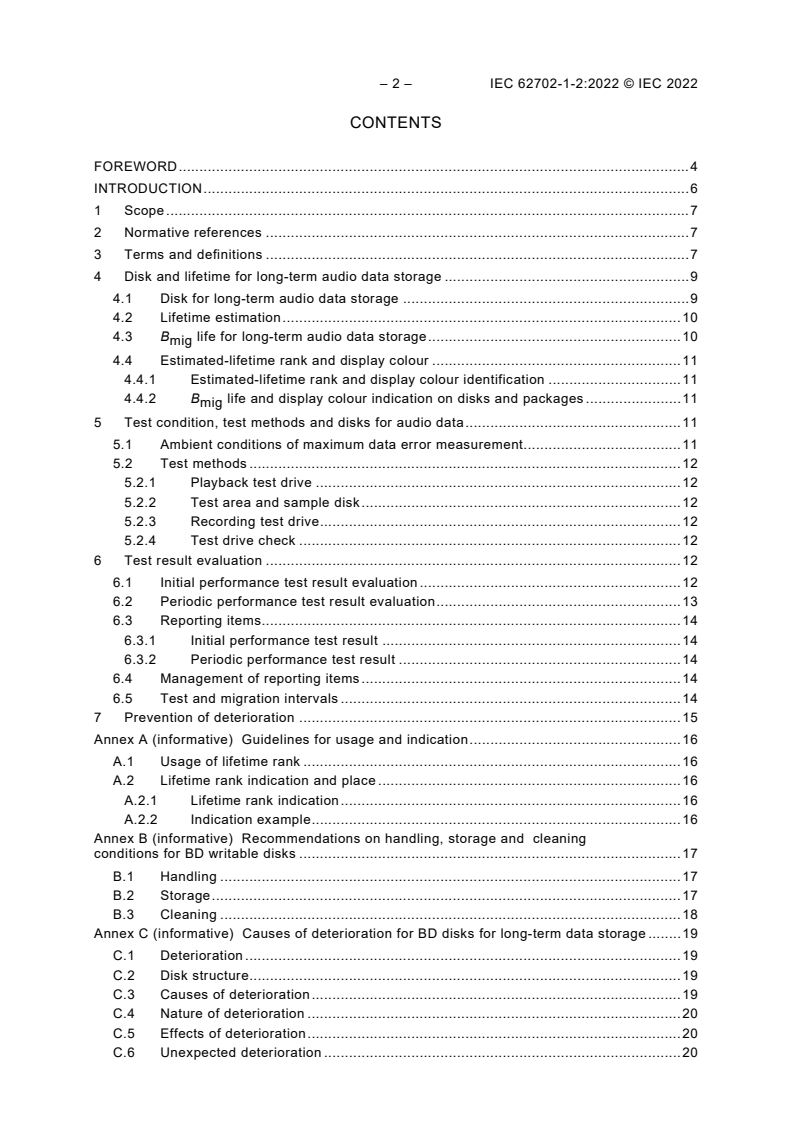
IEC 62702-1-2:2022 - Audio archive system - Part 1-2 : BD disk and data migration for long-term audio data storage Released:6/13/2022
Overview
IEC 62702-1-2:2022 - Audio archive system: BD disk and data migration for long-term audio data storage defines methods for data-quality assurance and data migration of writable Blu-ray (BD) disks intended for long-term audio preservation. This second edition (2022) is a technical revision that replaces the first edition and aligns the standard with updates to ISO/IEC 29121:2021. The standard covers BD recordable and BD rewritable disks and prescribes tests, lifetime estimation and handling guidance to help sustain recorded audio data over time.
Key topics and technical requirements
- Scope and media: Requirements for writable BD disks used in long-term audio archives (BD-R, BD-RE).
- Lifetime estimation: Procedures and classification of estimated disk lifetime (B life), including estimated-lifetime ranks and display colour identification for packaging and labeling.
- Referee test method: ISO/IEC 16963 is identified as the referee method for estimating optical disk lifetime.
- Test conditions and methods:
- Ambient conditions for measurement of maximum data error are specified.
- Initial and periodic performance tests to assess recording and playback reliability.
- Test drive requirements adapted to realistic user conditions (playback and recording test drives, calibration checks).
- Measurement of maximum data error metrics such as Max RSER (referenced in test methods).
- Data migration method: Procedures for migrating recorded audio data from aging media to new media to preserve integrity.
- Reporting and management: Defined reporting items for initial and periodic tests, test/migration intervals, and management of results.
- Prevention and handling: Informative annexes cover guidelines for usage, lifetime-rank indication, handling, storage, cleaning, and causes/nature of BD disk deterioration.
Practical applications
- Establishing QA programs for audio archives, libraries, museums, broadcasters and cultural heritage organizations.
- Setting procurement specifications and labeling for BD media intended for archival use.
- Designing migration schedules and test plans to minimize data loss and ensure long-term accessibility of digitized audio content.
- Supporting lab verification and compliance testing for optical media vendors and third‑party preservation services.
Who should use this standard
- Archivists, audio preservation specialists, collection managers
- IT and media asset managers in cultural institutions and broadcasters
- QA laboratories and manufacturers of writable BD media
- Organizations implementing long-term digital preservation and data migration policies
Related standards
- ISO/IEC 16963:2017 - Test method for estimation of lifetime of optical disks
- ISO/IEC 29121:2021 - Data migration method for optical disks for long-term data storage
- ISO/IEC 30190–30193 - BD media format specifications
Keywords: IEC 62702-1-2:2022, BD disk, Blu-ray archival, long-term audio storage, data migration, lifetime estimation, data-quality assurance.
Relations
- Effective Date
- 05-Sep-2023
Buy Documents
IEC 62702-1-2:2022 RLV - Audio archive system - Part 1-2 : BD disk and data migration for long-term audio data storage Released:6/13/2022
IEC 62702-1-2:2022 - Audio archive system - Part 1-2 : BD disk and data migration for long-term audio data storage Released:6/13/2022
Get Certified
Connect with accredited certification bodies for this standard

BSI Group
BSI (British Standards Institution) is the business standards company that helps organizations make excellence a habit.

NYCE
Mexican standards and certification body.

ANCE
Mexican certification and testing association.
Sponsored listings
Frequently Asked Questions
IEC 62702-1-2:2022 is a standard published by the International Electrotechnical Commission (IEC). Its full title is "Audio archive system - Part 1-2 : BD disk and data migration for long-term audio data storage". This standard covers: IEC 62702-1-2:2022 specifies a method of data-quality assurance for writable BD disks (hereafter referred to as "disks") which are specified for long-term data storage, and a data migration method which can sustain the recorded data on disks for long-term audio data preservation. The writable disks include BD recordable disk and BD rewritable disk. IEC 62702-1-2:2022 cancels and replaces the first edition published in 2016. This edition constitutes a technical revision. In order to reflect the updates to ISO/IEC 29121:2021, this edition includes the following significant technical changes with respect to the previous edition: a) ISO/IEC 16963 has been identified as the referee test method for the estimation of lifetime; b) the ambient conditions for the measurement of maximum data error have been added; c) the requirements for test drives have been changed considering the use condition of users; d) the requirements for the estimated lifetime have been defined more clearly; e) the requirements for the periodic performance test have been defined more clearly.
IEC 62702-1-2:2022 specifies a method of data-quality assurance for writable BD disks (hereafter referred to as "disks") which are specified for long-term data storage, and a data migration method which can sustain the recorded data on disks for long-term audio data preservation. The writable disks include BD recordable disk and BD rewritable disk. IEC 62702-1-2:2022 cancels and replaces the first edition published in 2016. This edition constitutes a technical revision. In order to reflect the updates to ISO/IEC 29121:2021, this edition includes the following significant technical changes with respect to the previous edition: a) ISO/IEC 16963 has been identified as the referee test method for the estimation of lifetime; b) the ambient conditions for the measurement of maximum data error have been added; c) the requirements for test drives have been changed considering the use condition of users; d) the requirements for the estimated lifetime have been defined more clearly; e) the requirements for the periodic performance test have been defined more clearly.
IEC 62702-1-2:2022 is classified under the following ICS (International Classification for Standards) categories: 33.160.30 - Audio systems; 35.220.30 - Optical storage devices. The ICS classification helps identify the subject area and facilitates finding related standards.
IEC 62702-1-2:2022 has the following relationships with other standards: It is inter standard links to IEC 62702-1-2:2017. Understanding these relationships helps ensure you are using the most current and applicable version of the standard.
IEC 62702-1-2:2022 is available in PDF format for immediate download after purchase. The document can be added to your cart and obtained through the secure checkout process. Digital delivery ensures instant access to the complete standard document.
Standards Content (Sample)
IEC 62702-1-2 ®
Edition 2.0 2022-06
REDLINE VERSION
INTERNATIONAL
STANDARD
colour
inside
Audio archive system –
Part 1-2: BD disk and data migration for long-term audio data storage
All rights reserved. Unless otherwise specified, no part of this publication may be reproduced or utilized in any form
or by any means, electronic or mechanical, including photocopying and microfilm, without permission in writing from
either IEC or IEC's member National Committee in the country of the requester. If you have any questions about IEC
copyright or have an enquiry about obtaining additional rights to this publication, please contact the address below or
your local IEC member National Committee for further information.
IEC Secretariat Tel.: +41 22 919 02 11
3, rue de Varembé info@iec.ch
CH-1211 Geneva 20 www.iec.ch
Switzerland
About the IEC
The International Electrotechnical Commission (IEC) is the leading global organization that prepares and publishes
International Standards for all electrical, electronic and related technologies.
About IEC publications
The technical content of IEC publications is kept under constant review by the IEC. Please make sure that you have the
latest edition, a corrigendum or an amendment might have been published.
IEC publications search - webstore.iec.ch/advsearchform IEC Products & Services Portal - products.iec.ch
The advanced search enables to find IEC publications by a Discover our powerful search engine and read freely all the
variety of criteria (reference number, text, technical publications previews. With a subscription you will always
committee, …). It also gives information on projects, replaced have access to up to date content tailored to your needs.
and withdrawn publications.
Electropedia - www.electropedia.org
IEC Just Published - webstore.iec.ch/justpublished
The world's leading online dictionary on electrotechnology,
Stay up to date on all new IEC publications. Just Published
containing more than 22 300 terminological entries in English
details all new publications released. Available online and
and French, with equivalent terms in 19 additional languages.
once a month by email.
Also known as the International Electrotechnical Vocabulary
(IEV) online.
IEC Customer Service Centre - webstore.iec.ch/csc
If you wish to give us your feedback on this publication or
need further assistance, please contact the Customer Service
Centre: sales@iec.ch.
IEC 62702-1-2 ®
Edition 2.0 2022-06
REDLINE VERSION
INTERNATIONAL
STANDARD
colour
inside
Audio archive system –
Part 1-2: BD disk and data migration for long-term audio data storage
INTERNATIONAL
ELECTROTECHNICAL
COMMISSION
ICS 33.160.30; 35.220.30 ISBN 978-2-8322-3916-2
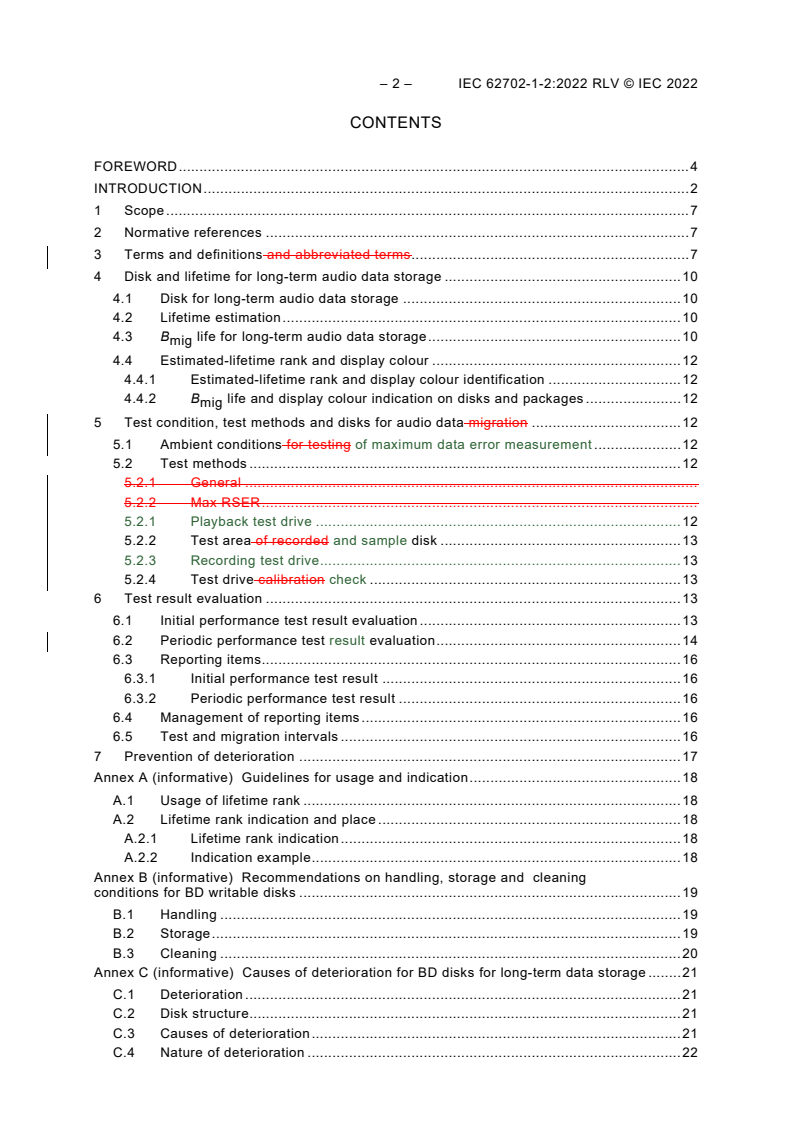
– 2 – IEC 62702-1-2:2022 RLV © IEC 2022
CONTENTS
FOREWORD . 4
INTRODUCTION . 2
1 Scope . 7
2 Normative references . 7
3 Terms and definitions and abbreviated terms . 7
4 Disk and lifetime for long-term audio data storage . 10
4.1 Disk for long-term audio data storage . 10
4.2 Lifetime estimation . 10
4.3 B life for long-term audio data storage . 10
mig
4.4 Estimated-lifetime rank and display colour . 12
4.4.1 Estimated-lifetime rank and display colour identification . 12
4.4.2 B life and display colour indication on disks and packages . 12
mig
5 Test condition, test methods and disks for audio data migration . 12
5.1 Ambient conditions for testing of maximum data error measurement . 12
5.2 Test methods . 12
5.2.1 General .
5.2.2 Max RSER .
5.2.1 Playback test drive . 12
5.2.2 Test area of recorded and sample disk . 13
5.2.3 Recording test drive . 13
5.2.4 Test drive calibration check . 13
6 Test result evaluation . 13
6.1 Initial performance test result evaluation . 13
6.2 Periodic performance test result evaluation . 14
6.3 Reporting items. 16
6.3.1 Initial performance test result . 16
6.3.2 Periodic performance test result . 16
6.4 Management of reporting items . 16
6.5 Test and migration intervals . 16
7 Prevention of deterioration . 17
Annex A (informative) Guidelines for usage and indication . 18
A.1 Usage of lifetime rank . 18
A.2 Lifetime rank indication and place . 18
A.2.1 Lifetime rank indication . 18
A.2.2 Indication example . 18
Annex B (informative) Recommendations on handling, storage and cleaning
conditions for BD writable disks . 19
B.1 Handling . 19
B.2 Storage . 19
B.3 Cleaning . 20
Annex C (informative) Causes of deterioration for BD disks for long-term data storage . 21
C.1 Deterioration . 21
C.2 Disk structure. 21
C.3 Causes of deterioration . 21
C.4 Nature of deterioration . 22
C.5 Effects of deterioration . 22
C.6 Unexpected deterioration . 22
Bibliography . 23
Figure 1 – Data migration flow for the initial and the periodic performance tests . 15
Figure A.1 – Lifetime rank Indication example . 18
Table 1 – Category of initial recording performance . 13
Table 2 – Category of recording performance at periodic performance test . 14
Table B.1 – Recommended conditions for general storage . 19
Table B.2 – Recommended conditions for controlled storage . 19
– 4 – IEC 62702-1-2:2022 RLV © IEC 2022
INTERNATIONAL ELECTROTECHNICAL COMMISSION
____________
AUDIO ARCHIVE SYSTEM –
Part 1-2: BD disk and data migration for long-term audio data storage
FOREWORD
1) The International Electrotechnical Commission (IEC) is a worldwide organization for standardization comprising
all national electrotechnical committees (IEC National Committees). The object of IEC is to promote international
co-operation on all questions concerning standardization in the electrical and electronic fields. To this end and
in addition to other activities, IEC publishes International Standards, Technical Specifications, Technical Reports,
Publicly Available Specifications (PAS) and Guides (hereafter referred to as “IEC Publication(s)”). Their
preparation is entrusted to technical committees; any IEC National Committee interested in the subject dealt with
may participate in this preparatory work. International, governmental and non-governmental organizations liaising
with the IEC also participate in this preparation. IEC collaborates closely with the International Organization for
Standardization (ISO) in accordance with conditions determined by agreement between the two organizations.
2) The formal decisions or agreements of IEC on technical matters express, as nearly as possible, an international
consensus of opinion on the relevant subjects since each technical committee has representation from all
interested IEC National Committees.
3) IEC Publications have the form of recommendations for international use and are accepted by IEC National
Committees in that sense. While all reasonable efforts are made to ensure that the technical content of IEC
Publications is accurate, IEC cannot be held responsible for the way in which they are used or for any
misinterpretation by any end user.
4) In order to promote international uniformity, IEC National Committees undertake to apply IEC Publications
transparently to the maximum extent possible in their national and regional publications. Any divergence between
any IEC Publication and the corresponding national or regional publication shall be clearly indicated in the latter.
5) IEC itself does not provide any attestation of conformity. Independent certification bodies provide conformity
assessment services and, in some areas, access to IEC marks of conformity. IEC is not responsible for any
services carried out by independent certification bodies.
6) All users should ensure that they have the latest edition of this publication.
7) No liability shall attach to IEC or its directors, employees, servants or agents including individual experts and
members of its technical committees and IEC National Committees for any personal injury, property damage or
other damage of any nature whatsoever, whether direct or indirect, or for costs (including legal fees) and
expenses arising out of the publication, use of, or reliance upon, this IEC Publication or any other IEC
Publications.
8) Attention is drawn to the Normative references cited in this publication. Use of the referenced publications is
indispensable for the correct application of this publication.
9) Attention is drawn to the possibility that some of the elements of this IEC Publication may be the subject of patent
rights. IEC shall not be held responsible for identifying any or all such patent rights.
This redline version of the official IEC Standard allows the user to identify the changes made to
the previous edition IEC 62702-1-2:2017. A vertical bar appears in the margin wherever a change
has been made. Additions are in green text, deletions are in strikethrough red text.
IEC 62702-1-2 has been prepared by technical area 6: Storage media, storage data structures,
storage systems and equipment, of IEC technical committee 100: Audio, video and multimedia
systems and equipment. It is an International Standard.
This second edition cancels and replaces the first edition published in 2017. This edition
constitutes a technical revision.
In order to reflect the updates to ISO/IEC 29121:2021, this edition includes the following
significant technical changes with respect to the previous edition:
a) ISO/IEC 16963 has been identified as the referee test method for the estimation of lifetime;
b) the ambient conditions for the measurement of maximum data error have been added;
c) the requirements for test drives have been changed considering the use condition of users;
d) the requirements for the estimated lifetime have been defined more clearly;
e) the requirements for the periodic performance test have been defined more clearly.
The text of this International Standard is based on the following documents:
Draft Report on voting
100/3671/CDV 100/3743/RVC
Full information on the voting for its approval can be found in the report on voting indicated in
the above table.
The language used for the development of this International Standard is English.
A list of all parts in the IEC 62702 series, published under the general title Audio archive system,
can be found on the IEC website.
This document was drafted in accordance with ISO/IEC Directives, Part 2, and developed in
accordance with ISO/IEC Directives, Part 1 and ISO/IEC Directives, IEC Supplement, available
at www.iec.ch/members_experts/refdocs. The main document types developed by IEC are
described in greater detail at www.iec.ch/standardsdev/publications.
The committee has decided that the contents of this document will remain unchanged until the
stability date indicated on the IEC website under webstore.iec.ch in the data related to the
specific document. At this date, the document will be
• reconfirmed,
• withdrawn,
• replaced by a revised edition, or
• amended.
IMPORTANT – The "colour inside" logo on the cover page of this document indicates that it
contains colours which are considered to be useful for the correct understanding of its
contents. Users should therefore print this document using a colour printer.
– 6 – IEC 62702-1-2:2022 RLV © IEC 2022
INTRODUCTION
Sound recordings such as music, speech, and storytelling are an important human heritage and
should be preserved for as long as possible. However, we were not able to record sounds in
order to preserve them in the past. The first recording system, the phonautograph, was invented
by Édouard-Léon Scott de Martinville in 1860 and, after that, Thomas Alva Edison invented the
recording and playback system known as the phonograph in 1877.
Although various technologies were invented later, most of them have limitations for audio
archives because storage lifetime is limited, and the sound quality deteriorates when it is
transferred to the next generation of storage device.
The progress of LSI (Large-Scale Integrated Circuit) technology made digital recording of
recorded sound possible. Digital recording is very suitable for audio archiving because the
migration is performed by copying digital data.
For this purpose, various recording materials exist, such as optical disks, magnetic disks,
magnetic tape, and non-volatile memory (such as phase-change memory).
This International Standard specifies physical and logical aspects for standards of audio
archives of various storage types which are typically used for audio archives on the market.
The IEC 62702 series currently consists of:
• Part 1 specifies the minimum requirements on physical aspects of optical disks for digital
sound recordings. Part 1-1 specifies DVD optical disks, and Part 1-2 specifies BD optical
disks.
NOTE DVD optical disks include DVD-R disk, DVD-RW disk, DVD-RAM disk and +R format disk, +RW format
disk. BD optical disks include BD recordable disk and BD rewritable disk.
• Part 2 specifies the minimum requirements for digitization of content, format of digitised
content, content information and media inspection.
AUDIO ARCHIVE SYSTEM –
Part 1-2: BD disk and data migration for long-term audio data storage
1 Scope
This part of IEC 62702 specifies a method of data-quality assurance for writable BD disks
(hereafter referred to as "disks") which are specified for long-term data storage, and a data
migration method which can sustain the recorded data on disks for long-term audio data
preservation. The writable disks include BD recordable disk and BD rewritable disk.
2 Normative references
The following documents are referred to in the text in such a way that some or all of their content
constitutes requirements of this document. For dated references, only the edition cited applies.
For undated references, the latest edition of the referenced document (including any
amendments) applies.
ISO/IEC 16963:2017, Information technology – Digitally recorded media for information
interchange and storage – Test method for the estimation of lifetime of optical disks for long-
term data storage
ISO/IEC 29121:20172021, Information technology – Digitally recorded media for information
interchange and storage – Data migration method for optical disks for long-term data storage
ISO/IEC 30190:2016, Information technology – Digitally recorded media for information
interchange and storage – 120 mm Single Layer (25,0 Gbytes per disk) and Dual Layer (50,0
Gbytes per disk) BD Recordable disk
ISO/IEC 30191, Information technology – Digitally recorded media for information interchange
and storage – 120 mm Triple Layer (100,0 Gbytes single sided disk and 200,0 Gbytes double
sided disk) and Quadruple Layer (128,0 Gbytes single sided disk) BD Recordable disk
ISO/IEC 30192, Information technology – Digitally recorded media for information interchange
and storage – 120 mm Single Layer (25,0 Gbytes per disk) and Dual Layer (50,0 Gbytes per
disk) BD Rewritable disk
ISO/IEC 30193, Information technology – Digitally recorded media for information interchange
and storage – 120 mm Triple Layer (100,0 Gbytes per disk) BD Rewritable disk
3 Terms and definitions and abbreviated terms
For the purposes of this document, the following terms and definitions apply.
ISO and IEC maintain terminological databases for use in standardization at the following
addresses:
• IEC Electropedia: available at https://www.electropedia.org/
• ISO Online browsing platform: available at https://www.iso.org/obp
– 8 – IEC 62702-1-2:2022 RLV © IEC 2022
3.1 Terms and definitions
3.1
B life
mig
lifetime (3.10) for use of data migration (3.6) and identical to B life which is 0,000 001
0,000 1
quantile of the lifetime distribution (i.e. 0,000 1 % failure time) or 99,999 9 % survival lifetime
distribution (i.e. 0,000 1 % failure time) or 99,999 9 % survival lifetime
[SOURCE: ISO/IEC 29121:20172021, 3.1, modified – Note 1 to entry deleted.]
3.2
B life
5 percentile of the lifetime (3.10) distribution (i.e. 5 % failure time) or 95 % survival lifetime
[SOURCE: ISO/IEC 16963:2017, 3.4]
3.3
(B life)
5 L
95 % lower confidence bound of B life (3.2)
[SOUECE: ISO/IEC 16963:2017, 3.5]
3.4
B life
50 percentile of the lifetime (3.10) distribution (i.e. 50 % failure time) or 50 % survival lifetime
[SOURCE: ISO/IEC 16963:2017, 3.6]
3.5
controlled storage condition
well-controlled storage conditions with full-time air conditioning (25 °C and 50 % relative
humidity) in which can extend the lifetime (3.10) of data stored on optical disks
[SOURCE: ISO/IEC 16963:2017, 3.7]
3.6
data migration
process to copy data from one storage device or medium to another
[SOURCE: ISO/IEC 29121:20172021, 3.5]
3.7
error correction code
ECC
mathematical computation yielding check bytes used for the detection and correction of errors
in data
Note 1 to entry: For BD recordable disk and BD rewritable disks, the long-distance code (LDC) + burst-indicating
subcode (BIS) defined in ISO/IEC 30190, ISO/IEC 30191, ISO/IEC 30192, and ISO/IEC 30193 is applied.
Note 2 to entry: This note applies to the French language only.
[SOURCE: ISO/IEC 29121:2021, 3.6 modified— Note 1 to entry has been shortened to apply
only to BD disks.]
3.8
error rate
rate of errors or error count on the recorded disk measured before on the signal at the input of
error-correction decoder is applied, which represents raw-error rate of data recorded on a disk
[SOURCE: ISO/IEC 29121:20172021, 3.7]
3.9
initial performance test
first test of the recording performance error rate (3.8) of data recorded on a disk before storing
[SOURCE: ISO/IEC 29121:20172021, 3.8]
3.10
lifetime
time that information is retrievable in a system (3.16)
[SOURCE: ISO/IEC 29121: 20172021, 3.9]
3.11
maximum data error
greatest level of error rate (3.8) anywhere in one of the relevant areas on the disk
[SOURCE: ISO/IEC 16963:2017, 3.13, modified — Note 1 to entry has been deleted.]
3.12
RSER
max
greatest level of random symbol error rate measured on the signal in one of the relevant areas
on a disk at the input of error-correction decoder, which excludes burst errors of length greater
than or equal to 40 bytes
Note 1 to entry: See ISO/IEC 30190, ISO/IEC 30191, ISO/IEC 30192, ISO/IEC 30193 and ISO/IEC 16963.
Note 2 to entry: This note applies to the French language only.
3.13
periodic performance test
periodic test of the recording performance error rate (3.8) of data recorded on a disk during the
storage
[SOURCE: ISO/IEC 29121:20172021, 3.15]
3.14
retrievability
ability to recover physical information as recorded
[SOURCE: ISO/IEC 29121:2017, 3.16 ISO/IEC 16963:2017, 3.14]
3.15
substrate
layer, which can be transparent or not, provided for the mechanical support of a recording layer
[SOURCE:ISO/IEC ISO/IEC 30193:2021, 3.43]
– 10 – IEC 62702-1-2:2022 RLV © IEC 2022
3.16
system
combination of hardware, software, storage medium and documentation used to record, retrieve
and reproduce information
[SOURCE: ISO/IEC 16963:2017, 3.20]
3.17
uncorrectable error
error in the playback read-out data that could not cannot be corrected by the error correcting
correction decoders
[SOURCE: ISO/IEC 29121:20172021, 3.18]
3.18
Life interval
X
mig
migration interval (year) which is determined by user
[SOURCE: ISO/IEC 29121:20172021, 3.19, modified — Note 1 to entry has been deleted.]
3.2 Abbreviated terms
Max RSER Max Random Symbol Error Rate
4 Disk and lifetime for long-term audio data storage
4.1 Disk for long-term audio data storage
A disk with a specified lifetime should be used for long-term audio data storage. A disk with an
unspecified lifetime should not be used.
4.2 Lifetime estimation
For the purposes of this document, the lifetime of a disk shall be derived from the measurements
specified in ISO/IEC 16963. The Eyring method is used for lifetime estimation under controlled
storage conditions (25 °C and 50 % relative humidity).
In ISO/IEC 16963:2017, the estimated lifetime can be defined variously as B life, B life and
50 5
the 95 % lower confidence bound of B life [equals (B life) ] and is described as follows.
5 5 L
ˆ ˆ ˆˆ
BBexp ln exp β++βx β x
( ) ( )
50 life 50 0 1 10 2 20
ˆ ˆˆ ˆ
BBexp ln exp β++βx β x−1,64σˆ
( ) ( )
5 life 5 0 1 10 2 20
where
B is the variable for B life;
50 life 50
B is the variable for B life;
5 life 5
x and x are the temperature-dependent factor and the relative-humidity–dependent factor
10 20
at the controlled storage conditions (25 °C/50 % relative humidity) respectively.
Also, the 95 % lower confidence bound of B life becomes
= =
= =
ˆˆ ˆ
B exp lnBBexp ln−1,6l4 var nB
( ) ( )
(5 life)L 5 5 5
L
where
B is the variable for (B life) ;
(5 life)L 5 L
ˆ ˆˆ
and estimated variance of residual errors ˆ are obtained using regression analysis of
β ,,ββ σ
0 12
time-to-failure data.
4.3 B life for long-term audio data storage
mig
The estimated lifetime of B life means 5 % of the products reach failure. It is widely used in
other contexts. However, from the viewpoint of the reliability of long-term audio storage to retain
the integrity of the original data, it is not appropriate to use B life as the estimated lifetime
when determining a test interval and deciding on data migration.
In the case of audio data migration, it is necessary to have a sufficiently low failure probability.
The time at which one millionth of the products reach the failure shall define, in this document,
life is 0,000 001
the estimated lifetime to determine test intervals and migration interval. B
0,000 1
quantile of the lifetime distribution (i.e. 0,000 1% failure time) and expressed as B life in this
mig
document. B life can be calculated using B life and B life as follows (see also
mig 50 5
ISO/IEC 29121:20172021, Annex E).
ˆ ˆ
ln B − ln B
50 5
ˆ ˆ
ˆ
)
B Life =exp(ln B − 4,75σ =exp ln B − 4,75
0,000 1 50 50
1,64
ˆˆ
lnBB− ln
50 5
ˆ ˆ ˆ
B explnB explnB−=4,75σBˆ expln−4,75
( ) ( )
0,000 1 life 0,000 1 50 50
1,64
ˆˆ
exp 2, 9 lnB − 1, 9 lnB
( )
5 50
where
B is the variable for B life
0,000 1 life 0,000 1 .
Thus
ˆ ˆ
B Life = B Life = exp(2,9 ln B −1,9 ln B )
mig 0,000 1 5 50
ˆˆ
B ××24 365 B exp 2, 9 lnBB− 1, 9 ln
( )
mig life 0,000 1 life 5 50
where
B is the variable for B life
mig life mig .
==
= = =
= =
– 12 – IEC 62702-1-2:2022 RLV © IEC 2022
In actual storage conditions, the temperature and relative humidity can deviate from the
controlled storage condition of 25 °C and 50 % relative humidity, which changes the estimated
lifetime. In this case, the estimated lifetime should be adjusted according to the estimated
lifetime at the actual storage conditions, as specified in ISO/IEC 29121:20172021, Annex D.
4.4 Estimated-lifetime rank and display colour
4.4.1 Estimated-lifetime rank and display colour identification
For audio data migration, rank of B life and its identifying display colour are defined as follows.
mig
B life is over 30 years, the display colour is red.
mig
B life is over 60 years, the display colour is green.
mig
B life is over 100 years, the display colour is gold.
mig
Guidelines for use of the ranks of B life and their display colours are shown in Annex A.
mig
4.4.2 B life and display colour indication on disks and packages
mig
life, its display colour and the reference-controlled storage condition shall be
The rank of B
mig
indicated on both the disk and the packaging, excluding a two-sided disk. Indication examples
for ranks and their colours are shown in Annex A.
5 Test condition, test methods and disks for audio data migration
5.1 Ambient conditions for testing of maximum data error measurement
When performing recordings or playbacks, the air immediately surrounding the disk should have
the following properties:
Recording condition: 20 °C to 45 °C;
Playback condition: 20 °C to 45 °C.
The ambient condition is the surrounding condition in a room where a test drive is located. The
ambient conditions for the RSER measurements are as follows:
max
Temperature: 15 °C to 30 °C
Relative humidity: 20 % to 75 %
5.2 Test methods
5.2.1 General
The necessity of data migration is checked in the initial performance test and the periodic
performance tests. When data is recorded on disks, the initial recording performance on the
whole recorded area shall be examined as the initial performance test. The recording
performance of data recorded on a disk during storage should be periodically examined with
the test interval described in 6.5 as the periodic performance tests.
5.2.2 Max RSER
Maximum random SER (max RSER) shall be measured on the test area of the recorded disk,
where max RSER is applied to BD Recordable SL/DL disks, BD Recordable TL/QL disks,
BD Rewritable SL/DL disks and BD Rewritable TL disks defined in ISO/IEC 30190,
ISO/IEC 30191, ISO/IEC 30192 and ISO/IEC 30193 respectively.
5.2.1 Playback test drive
For BD recordable disks and BD rewritable disks, the test drive shall have capability to measure
RSER .
max
The test drive shall have the capability to evaluate the error rate level specified in the initial
performance test and the periodic performance test.
NOTE The measuring circuit for random symbol error rate (RSER) described in ISO/IEC 30191 and ISO/IEC 30193
is different from that described in ISO/IEC 30190 and ISO/IEC 30192, especially for the HF signal pre-processing
circuit. See ISO/IEC 30190:20162021, Annex H, and ISO/IEC 30191:2021, Annex H, for additional information.
5.2.2 Test area of recorded and sample disk
The test area is the recorded area to be tested in a disk.
The whole recorded data area of all disks shall be tested for the initial performance test.
The whole recorded area of all disks should be tested for the periodic performance test.
Although the integrity of the data becomes lower, the user may reduce the test area and/or the
number of sample disks based on a certain sampling method, considering the value of
information (see ISO/IEC 29121:2021, Annex G). For the reduction of test area, see
ISO/IEC 16963:2017, 7.5 for additional information. The number of sample disks should be
enough to guarantee statistical effectiveness. If the sample disks have different attributes such
as disk standards, recording conditions or storage conditions, the disks should be divided into
groups of disks considering the attributes so that the sampling can be applied on each group
with statistical effectiveness.
5.2.3 Recording test drive
There are two cases for the test drive. The first that the drive serves both as a test drive and a
recorder that records the data on the disk. The second is that the test drive is different from the
recorder. For both cases, the data recorded on the disk by the recorder shall fulfil the error rate
level specified in the initial performance test and the periodic performance test.
5.2.4 Test drive calibration check
The playback and recording test drive(s) shall be calibrated by using a calibration disk prepared
by the test drive manufacturer and using the calibration procedure specified by the manufacturer.
The calibration shall be done at the intervals recommended by the manufacturer.
The test drive shall be checked by using a reference disk prepared by the test drive
manufacturer or the disk prepared by the user, so that it fulfils the requirements in 5.2.1, 5.2.2
and 5.2.3. When using a reference disk prepared by the test drive manufacturer, the check of
the test drive shall be done at the intervals recommended by the manufacturer. When using a
disk prepared by the user, it is recommended for the user to set an appropriate interval and to
check the test drive at the interval.
6 Test result evaluation
6.1 Initial performance test result evaluation
The initial performance test result shall be judged by Max RSER, and The initial recording
performance is shall be categorized as Levels 1, 2 and or 3 by Max RSER using RSER for
max
BD recordable disk and BD rewritable disk as shown Table 1.
As a minimum, the initial recording performance should shall be within the limits of Level 1.
Disks showing the initial recording performance of Level 2 should not be used for long-term
– 14 – IEC 62702-1-2:2022 RLV © IEC 2022
audio data storage,. Disks showing the initial recording performance and those of Level 3 are
out of the specification and shall not be used.
If the initial recording performance is worse than Level 1, the performance of the disk and drive
used for recording the data should be verified because Max RSER RSER depends on the
max
performance of both disks and drives. If the drive does not have the performance required of
the drive is not good, the drive should be replaced. If the disk does not have the performance
required of the disk is not good, another lot batch of disks should be used.
Table 1 – Category of initial recording performance
Level Status Max RSER
BD recordable
BD rewritable
-4
1 Recommended
< 5,0 × 10
-4 -3
2 Should not be used
5,0 × 10 to 1,0 × 10
-3
3 Shall not be used > 1,0 × 10
RSER
Maximum data error
max
6.2 Periodic performance test result evaluation
The periodic performance test result shall be judged by Max RSER, and the recording
performance at the periodic performance test is categorized as Level 4, 5 and 6 by Max RSER
as shown in Table 2.
Disks used for storing data should be periodically checked with the test interval described in
6.5. The recording performance at the periodic performance test is categorized in Levels 4, 5
or 6 using RSER for BD recordable disks and BD rewritable disks, as shown in Table 2.
max
If the recording performance is within Level 4, the disk is good enough to continue to be used
stored.
If the recording performance is within Level 5, the data stored on the disk shall be migrated to
another disk as soon as possible.
If the recording performance is in Level 6, the data stored on the disk shall be copied to another
disk immediately, as far as the data can be retrieved. Please note that Max RSER in Level 6 is,
RSER are high enough to disable retrieval of that the retrieved data without can contain
max
uncorrectable errors.
Table 2 – Category of recording performance at periodic performance test
Level Status Max RSER
BD recordable
BD rewritable
-4
4 Use as is
< 7,1 × 10
-4 -3
5 Migrate data as soon as possible
7,1 × 10 to 1,0 × 10
-3
6 Migrate data immediately
>1,0 × 10
RSER
Maximum data error
max
Data migration flow for the initial performance test and periodic performance test is shown in
Figure 1.
Disk
Level 3: Shall not use
Max RSER Level 2: Should not use
Test drive
Level 1: Recommend to use
Initial
Data are recorded and
di k ill b k t i t i i t
Disk
Level 6: Migrate data immediately
Max RSER Level 5: Migrate data as soon as possible
Test drive
Periodic Level 4: Use as it is.
IEC
Figure 1 – Data migration flow for the initial and the periodic performance tests
– 16 – IEC 62702-1-2:2022 RLV © IEC 2022
6.3 Reporting items
6.3.1 Initial performance test result
The date and year of the initial test, the measured errors result, and the evaluation result shall
be reported as part of the history of this disk. The disk type and manufacturer name, the
specified rank of disk, and the next testing year and date should be reported. Moreover, the
test drive manufacturer, model name and serial number should be reported.
6.3.2 Periodic performance test result
At each periodic test, the date and year of the test, the measured errors result, and history of
evaluation results shall be reported. The disk type and manufacturer name, and the specified
rank of the disk should be reported. Moreover, the test drive manufacturer, model name and
serial number should be reported.
6.4 Management of reporting items
Reporting items shall be reported to the host computer.
Reporting items should be recorded on the disk.
6.5 Test and migration intervals
In this document, the test interval between periodic performance tests is set at a half of B
mig
life. Therefore, the test interval for each rank of disk with displayed colours red, green and gold
will be 15 years, 30 years and 50 years respectively.
If a disk with an unspecified lifetime is used, it should be tested every three years or less.
If B life is not available as shown below, the test interval should be three years or less. A
mig
greater test interval causes the risk of data loss and failure in the data migration. If such a risk
is unacceptable, the test interval of three years or less is strongly recommended.
– The estimated lifetime data is not provided.
– The estimated lifetime data is provided but lacks statistical accuracy.
Generational changes of the system, including reading devices, file structures and applications,
which occur during the normal migration interval can affect readability in addition to the quality
of the disk itself. For safety, or if the stored data has high value, the user may choose shorter
intervals for testing and migration.
In consideration of these factors, the migration interval is defined as X (years) interval and
mig
this value shall be determined by the user of this part (see ISO/IEC 29121:2021, Annex F).
X is the variable for X interval, and B is the variable for B life in years.
mig mig mig life mig
Actual test intervals and data migration using B (herein after B ) and X are as follows.
mig life mig mig
a) If X − B /2 is larger than 0, then the test interval of the first periodic performance
mig mig life
test is B /2 years, and the storage is continued. See Annex F in ISO/IEC 29121:2017.
mig life
b) If X − B /2 is less than or equal to 0, then the test interval of the first periodic
mig mig life
performance test is X (years), and the data migration is carried out regardless of the test
mig
result.
If the test interval is very long, for instance over ten years, a sampling check of the stored disks
should be carried out at shorter intervals. The occurrence of retrievability problems or long read
times can indicate an immediate need for detailed testing.
When tests indicate deterioration of one disk, additional tests may be performed on other disks
of the same type, age, or batch to ascertain their condition. Replacement of all similarly affected
disks should be considered if such additional tests indicate significant problems.
7 Prevention of deterioration
Necessary precautions shall be taken to reduce the possibility of deterioration, in order to
ensure the integrity of the disks during their use, storage, handling, or transportation, which are
indicated in Annex B. Causes of deterioration and their effects are indicated in Annex C. For
long-term audio storage, the recommendations in Annex B should be implemented.
– 18 – IEC 62702-1-2:2022 RLV © IEC 2022
Annex A
(informative)
Guidelines for usage and indication
A.1 Usage of lifetime rank
This annex describes how to choose the disk rank which is most desirable as audio information
storage.
a) Display colour: red (indicated B life is over 30 years)
mig
A disk of this rank may be used for general purpose storage of audio information.
b) Display colour: green (indicated B life is over 60 years)
mig
A disk of this rank may be used for long-term audio information storage or important audio
information.
c) Display colour: gold (indicated B life is over 100 years)
mig
A disk of this rank may be used for especially important audio information or historically
valuable audio information.
A.2 Lifetime rank indication and place
A.2.1 Lifetime rank indication
Disk and/or disk packages should display the specified lifetime rank and display colour. Two-
sided disks should display the specified lifetime rank and display colour on the packaging only
A.2.2 Indication example
Figure A.1 shows typical indication examples together with B life, display colour and storage
mig
condition for reference.
Figure A.1 – Lifetime rank Indication example
Annex B
(informative)
Recommendations on handling, storage and
cleaning conditions for BD writable disks
B.1 Handling
Disks intended for long-term audio storage should not be left in readers, or remain exposed to
light, corrosive atmospheres or solvents, or to extremes of temperature or humidity.
The fragile protective coating on the label surface is vulnerable to damage and should be
protected together with the readout surface. Carefully handle the disk, touching only the outer
edge and inner hole. Never touch the readout surface.
Disks should not be subjected to mechanical stresses that might tend to distort the disk.
Disks should be protected from dust and debris. This is especially important for recordable and
rewritable disks during the recording process. The use of a deionizing environment is
recommended to neutralize static charges on the disk that can attract and retain loose
contaminants.
B.2 Storage
For temporary storage such as in an office environment, the storage environment should be
limited to the ranges given in Table B.1.
Table B.1 – Recommended conditions for general storage
Ambient condition Recommended range
Temperature 5 °C to 30 °C
Relative humidity 15 % to 80 %
3 3
Absolute humidity
1 g/m to 24 g/m
Atmospheric pressure 75 kPa to 106 kPa
Temperature gradient 10 °C per hour maximum
Relative humidity gradient 10 % per hour maximum
For long-term storage, conditions should be more tightly controlled, and the storage
environment should be limited to the ranges given in Table B.2.
Table B.2 – Recommended conditions for controlled storage
Ambient condition Recommended range
Temperature 10 °C to 25 °C
Relative humidity 30 % to 50 %
3 3
Absolute humidity
3 g/m to 12 g/m
Atmospheric pressure 75 kPa to 106 kPa
Temperature gradient 10 °C per hour maximum
Relative humidity gradient 10 % per hour maximum
– 20 – IEC 62702-1-2:2022 RLV © IEC 2022
Conditions that could form condensation of moisture on the disk should be avoided. Cool and
dry storage conditions are preferred. To maintain the desirable temperature and humidity
fluctuation tolerance levels, and to protect against high-intensity light and pollutants, BD
writable disks should be stored vertically in clean insulated containers. Dust or debris in
operational or storage locations should be minimized by appropriate maintenance and
monitoring procedures, especially when recording disks.
B.3 Cleaning
Prior to performing cleaning operations of disks containing useful data, tests should be carried
out on disks of the same type and from the same supplier that do not contain any useful data,
in order to ensure that no adverse reaction will occur.
Loose contaminants may can be removed by short, one-second bursts of clean, dry air, avoiding
expulsion of cold propellant
...
IEC 62702-1-2 ®
Edition 2.0 2022-06
INTERNATIONAL
STANDARD
NORME
INTERNATIONALE
colour
inside
Audio archive system –
Part 1-2: BD disk and data migration for long-term audio data storage
Système d'archivage audio –
Partie 1-2: Disque BD et migration de données pour le stockage à long terme des
données audio
All rights reserved. Unless otherwise specified, no part of this publication may be reproduced or utilized in any form
or by any means, electronic or mechanical, including photocopying and microfilm, without permission in writing from
either IEC or IEC's member National Committee in the country of the requester. If you have any questions about IEC
copyright or have an enquiry about obtaining additional rights to this publication, please contact the address below or
your local IEC member National Committee for further information.
Droits de reproduction réservés. Sauf indication contraire, aucune partie de cette publication ne peut être reproduite ni
utilisée sous quelque forme que ce soit et par aucun procédé, électronique ou mécanique, y compris la photocopie et
les microfilms, sans l'accord écrit de l'IEC ou du Comité national de l'IEC du pays du demandeur. Si vous avez des
questions sur le copyright de l'IEC ou si vous désirez obtenir des droits supplémentaires sur cette publication, utilisez
les coordonnées ci-après ou contactez le Comité national de l'IEC de votre pays de résidence.
IEC Secretariat Tel.: +41 22 919 02 11
3, rue de Varembé info@iec.ch
CH-1211 Geneva 20 www.iec.ch
Switzerland
About the IEC
The International Electrotechnical Commission (IEC) is the leading global organization that prepares and publishes
International Standards for all electrical, electronic and related technologies.
About IEC publications
The technical content of IEC publications is kept under constant review by the IEC. Please make sure that you have the
latest edition, a corrigendum or an amendment might have been published.
IEC publications search - webstore.iec.ch/advsearchform IEC Products & Services Portal - products.iec.ch
The advanced search enables to find IEC publications by a Discover our powerful search engine and read freely all the
variety of criteria (reference number, text, technical publications previews. With a subscription you will always have
committee, …). It also gives information on projects, replaced access to up to date content tailored to your needs.
and withdrawn publications.
Electropedia - www.electropedia.org
IEC Just Published - webstore.iec.ch/justpublished
The world's leading online dictionary on electrotechnology,
Stay up to date on all new IEC publications. Just Published
containing more than 22 300 terminological entries in English
details all new publications released. Available online and once
and French, with equivalent terms in 19 additional languages.
a month by email.
Also known as the International Electrotechnical Vocabulary
(IEV) online.
IEC Customer Service Centre - webstore.iec.ch/csc
If you wish to give us your feedback on this publication or need
further assistance, please contact the Customer Service
Centre: sales@iec.ch.
A propos de l'IEC
La Commission Electrotechnique Internationale (IEC) est la première organisation mondiale qui élabore et publie des
Normes internationales pour tout ce qui a trait à l'électricité, à l'électronique et aux technologies apparentées.
A propos des publications IEC
Le contenu technique des publications IEC est constamment revu. Veuillez vous assurer que vous possédez l’édition la
plus récente, un corrigendum ou amendement peut avoir été publié.
Recherche de publications IEC - Découvrez notre puissant moteur de recherche et consultez
webstore.iec.ch/advsearchform gratuitement tous les aperçus des publications. Avec un
La recherche avancée permet de trouver des publications IEC abonnement, vous aurez toujours accès à un contenu à jour
en utilisant différents critères (numéro de référence, texte, adapté à vos besoins.
comité d’études, …). Elle donne aussi des informations sur les
projets et les publications remplacées ou retirées. Electropedia - www.electropedia.org
Le premier dictionnaire d'électrotechnologie en ligne au monde,
IEC Just Published - webstore.iec.ch/justpublished
avec plus de 22 300 articles terminologiques en anglais et en
Restez informé sur les nouvelles publications IEC. Just
français, ainsi que les termes équivalents dans 19 langues
Published détaille les nouvelles publications parues.
additionnelles. Egalement appelé Vocabulaire
Disponible en ligne et une fois par mois par email.
Electrotechnique International (IEV) en ligne.
Service Clients - webstore.iec.ch/csc
Si vous désirez nous donner des commentaires sur cette
publication ou si vous avez des questions contactez-nous:
sales@iec.ch.
IEC Products & Services Portal - products.iec.ch
IEC 62702-1-2 ®
Edition 2.0 2022-06
INTERNATIONAL
STANDARD
NORME
INTERNATIONALE
colour
inside
Audio archive system –
Part 1-2: BD disk and data migration for long-term audio data storage
Système d'archivage audio –
Partie 1-2: Disque BD et migration de données pour le stockage à long terme des
données audio
INTERNATIONAL
ELECTROTECHNICAL
COMMISSION
COMMISSION
ELECTROTECHNIQUE
INTERNATIONALE
ICS 33.160.30; 35.220.30 ISBN 978-2-8322-2292-8
– 2 – IEC 62702-1-2:2022 © IEC 2022
CONTENTS
FOREWORD . 4
INTRODUCTION . 6
1 Scope . 7
2 Normative references . 7
3 Terms and definitions . 7
4 Disk and lifetime for long-term audio data storage . 9
4.1 Disk for long-term audio data storage . 9
4.2 Lifetime estimation . 10
4.3 B life for long-term audio data storage . 10
mig
4.4 Estimated-lifetime rank and display colour . 11
4.4.1 Estimated-lifetime rank and display colour identification . 11
4.4.2 B life and display colour indication on disks and packages . 11
mig
5 Test condition, test methods and disks for audio data . 11
5.1 Ambient conditions of maximum data error measurement. 11
5.2 Test methods . 12
5.2.1 Playback test drive . 12
5.2.2 Test area and sample disk . 12
5.2.3 Recording test drive . 12
5.2.4 Test drive check . 12
6 Test result evaluation . 12
6.1 Initial performance test result evaluation . 12
6.2 Periodic performance test result evaluation . 13
6.3 Reporting items. 14
6.3.1 Initial performance test result . 14
6.3.2 Periodic performance test result . 14
6.4 Management of reporting items . 14
6.5 Test and migration intervals . 14
7 Prevention of deterioration . 15
Annex A (informative) Guidelines for usage and indication . 16
A.1 Usage of lifetime rank . 16
A.2 Lifetime rank indication and place . 16
A.2.1 Lifetime rank indication . 16
A.2.2 Indication example . 16
Annex B (informative) Recommendations on handling, storage and cleaning
conditions for BD writable disks . 17
B.1 Handling . 17
B.2 Storage . 17
B.3 Cleaning . 18
Annex C (informative) Causes of deterioration for BD disks for long-term data storage . 19
C.1 Deterioration . 19
C.2 Disk structure. 19
C.3 Causes of deterioration . 19
C.4 Nature of deterioration . 20
C.5 Effects of deterioration . 20
C.6 Unexpected deterioration . 20
Bibliography . 21
Figure 1 – Data migration flow for the initial and the periodic performance tests . 14
Figure A.1 – Indication example . 16
Table 1 – Category of initial recording performance . 13
Table 2 – Category of recording performance at periodic performance test . 13
Table B.1 – Recommended conditions for general storage . 17
Table B.2 – Recommended conditions for controlled storage . 17
– 4 – IEC 62702-1-2:2022 © IEC 2022
INTERNATIONAL ELECTROTECHNICAL COMMISSION
____________
AUDIO ARCHIVE SYSTEM –
Part 1-2: BD disk and data migration for long-term audio data storage
FOREWORD
1) The International Electrotechnical Commission (IEC) is a worldwide organization for standardization comprising
all national electrotechnical committees (IEC National Committees). The object of IEC is to promote international
co-operation on all questions concerning standardization in the electrical and electronic fields. To this end and
in addition to other activities, IEC publishes International Standards, Technical Specifications, Technical Reports,
Publicly Available Specifications (PAS) and Guides (hereafter referred to as “IEC Publication(s)”). Their
preparation is entrusted to technical committees; any IEC National Committee interested in the subject dealt with
may participate in this preparatory work. International, governmental and non-governmental organizations liaising
with the IEC also participate in this preparation. IEC collaborates closely with the International Organization for
Standardization (ISO) in accordance with conditions determined by agreement between the two organizations.
2) The formal decisions or agreements of IEC on technical matters express, as nearly as possible, an international
consensus of opinion on the relevant subjects since each technical committee has representation from all
interested IEC National Committees.
3) IEC Publications have the form of recommendations for international use and are accepted by IEC National
Committees in that sense. While all reasonable efforts are made to ensure that the technical content of IEC
Publications is accurate, IEC cannot be held responsible for the way in which they are used or for any
misinterpretation by any end user.
4) In order to promote international uniformity, IEC National Committees undertake to apply IEC Publications
transparently to the maximum extent possible in their national and regional publications. Any divergence between
any IEC Publication and the corresponding national or regional publication shall be clearly indicated in the latter.
5) IEC itself does not provide any attestation of conformity. Independent certification bodies provide conformity
assessment services and, in some areas, access to IEC marks of conformity. IEC is not responsible for any
services carried out by independent certification bodies.
6) All users should ensure that they have the latest edition of this publication.
7) No liability shall attach to IEC or its directors, employees, servants or agents including individual experts and
members of its technical committees and IEC National Committees for any personal injury, property damage or
other damage of any nature whatsoever, whether direct or indirect, or for costs (including legal fees) and
expenses arising out of the publication, use of, or reliance upon, this IEC Publication or any other IEC
Publications.
8) Attention is drawn to the Normative references cited in this publication. Use of the referenced publications is
indispensable for the correct application of this publication.
9) Attention is drawn to the possibility that some of the elements of this IEC Publication may be the subject of patent
rights. IEC shall not be held responsible for identifying any or all such patent rights.
IEC 62702-1-2 has been prepared by technical area 6: Storage media, storage data structures,
storage systems and equipment, of IEC technical committee 100: Audio, video and multimedia
systems and equipment. It is an International Standard.
This second edition cancels and replaces the first edition published in 2017. This edition
constitutes a technical revision.
In order to reflect the updates to ISO/IEC 29121:2021, this edition includes the following
significant technical changes with respect to the previous edition:
a) ISO/IEC 16963 has been identified as the referee test method for the estimation of lifetime;
b) the ambient conditions for the measurement of maximum data error have been added;
c) the requirements for test drives have been changed considering the use condition of users;
d) the requirements for the estimated lifetime have been defined more clearly;
e) the requirements for the periodic performance test have been defined more clearly.
The text of this International Standard is based on the following documents:
Draft Report on voting
100/3671/CDV 100/3743/RVC
Full information on the voting for its approval can be found in the report on voting indicated in
the above table.
The language used for the development of this International Standard is English.
A list of all parts in the IEC 62702 series, published under the general title Audio archive system,
can be found on the IEC website.
This document was drafted in accordance with ISO/IEC Directives, Part 2, and developed in
accordance with ISO/IEC Directives, Part 1 and ISO/IEC Directives, IEC Supplement, available
at www.iec.ch/members_experts/refdocs. The main document types developed by IEC are
described in greater detail at www.iec.ch/standardsdev/publications.
The committee has decided that the contents of this document will remain unchanged until the
stability date indicated on the IEC website under webstore.iec.ch in the data related to the
specific document. At this date, the document will be
• reconfirmed,
• withdrawn,
• replaced by a revised edition, or
• amended.
IMPORTANT – The "colour inside" logo on the cover page of this document indicates that it
contains colours which are considered to be useful for the correct understanding of its
contents. Users should therefore print this document using a colour printer.
– 6 – IEC 62702-1-2:2022 © IEC 2022
INTRODUCTION
Sound recordings such as music, speech, and storytelling are an important human heritage and
should be preserved for as long as possible. However, we were not able to record sounds in
order to preserve them in the past. The first recording system, the phonautograph, was invented
by Édouard-Léon Scott de Martinville in 1860 and, after that, Thomas Alva Edison invented the
recording and playback system known as the phonograph in 1877.
Although various technologies were invented later, most of them have limitations for audio
archives because storage lifetime is limited, and the sound quality deteriorates when it is
transferred to the next generation of storage device.
The progress of LSI (Large-Scale Integrated Circuit) technology made digital recording of
recorded sound possible. Digital recording is very suitable for audio archiving because the
migration is performed by copying digital data.
For this purpose, various recording materials exist, such as optical disks, magnetic disks,
magnetic tape, and non-volatile memory (such as phase-change memory).
This International Standard specifies physical and logical aspects for standards of audio
archives of various storage types which are typically used for audio archives on the market.
The IEC 62702 series currently consists of:
• Part 1 specifies the minimum requirements on physical aspects of optical disks for digital
sound recordings. Part 1-1 specifies DVD optical disks, and Part 1-2 specifies BD optical
disks.
NOTE DVD optical disks include DVD-R disk, DVD-RW disk, DVD-RAM disk and +R format disk, +RW format
disk. BD optical disks include BD recordable disk and BD rewritable disk.
• Part 2 specifies the minimum requirements for digitization of content, format of digitised
content, content information and media inspection.
AUDIO ARCHIVE SYSTEM –
Part 1-2: BD disk and data migration for long-term audio data storage
1 Scope
This part of IEC 62702 specifies a method of data-quality assurance for writable BD disks
(hereafter referred to as "disks") which are specified for long-term data storage, and a data
migration method which can sustain the recorded data on disks for long-term audio data
preservation. The writable disks include BD recordable disk and BD rewritable disk.
2 Normative references
The following documents are referred to in the text in such a way that some or all of their content
constitutes requirements of this document. For dated references, only the edition cited applies.
For undated references, the latest edition of the referenced document (including any
amendments) applies.
ISO/IEC 16963:2017, Information technology – Digitally recorded media for information
interchange and storage – Test method for the estimation of lifetime of optical disks for long-
term data storage
ISO/IEC 29121:2021, Information technology – Digitally recorded media for information
interchange and storage – Data migration method for optical disks for long-term data storage
3 Terms and definitions
For the purposes of this document, the following terms and definitions apply.
ISO and IEC maintain terminological databases for use in standardization at the following
addresses:
• IEC Electropedia: available at https://www.electropedia.org/
• ISO Online browsing platform: available at https://www.iso.org/obp
3.1
B life
mig
lifetime (3.10) for use of data migration (3.6) and identical to B life which is 0,000 001
0,000 1
quantile of the lifetime distribution (i.e. 0,000 1 % failure time) or 99,999 9 % survival lifetime
[SOURCE: ISO/IEC 29121:2021, 3.1]
3.2
B life
5 percentile of the lifetime (3.10) distribution (i.e. 5 % failure time) or 95 % survival lifetime
[SOURCE: ISO/IEC 16963:2017, 3.4]
3.3
(B life)
5 L
95 % lower confidence bound of B life (3.2)
– 8 – IEC 62702-1-2:2022 © IEC 2022
[SOURCE: ISO/IEC 16963:2017, 3.5]
3.4
B life
50 percentile of the lifetime (3.10) distribution (i.e. 50 % failure time) or 50 % survival lifetime
[SOURCE: ISO/IEC 16963:2017, 3.6]
3.5
controlled storage condition
well-controlled storage conditions with full-time air conditioning (25 °C and 50 % relative
humidity) in which the lifetime (3.10) of data stored on optical disks
[SOURCE: ISO/IEC 16963:2017, 3.7]
3.6
data migration
process to copy data from one storage device or medium to another
[SOURCE: ISO/IEC 29121:2021, 3.5]
3.7
error correction code
ECC
mathematical computation yielding check bytes used for the detection and correction of errors
in data
Note 1 to entry: For BD recordable disk and BD rewritable disks, the long-distance code (LDC) + burst-indicating
subcode (BIS) defined in ISO/IEC 30190, ISO/IEC 30191, ISO/IEC 30192, and ISO/IEC 30193 is applied.
Note 2 to entry: This note applies to the French language only.
[SOURCE: ISO/IEC 29121:2021, 3.6 modified— Note 1 to entry has been shortened to apply
only to BD disks.]
3.8
error rate
rate of errors or error count measured on the signal at the input of error-correction decoder,
which represents raw-error rate of data recorded on a disk
[SOURCE: ISO/IEC 29121:2021, 3.7]
3.9
initial performance test
first test of the error rate (3.8) of data recorded on a disk before storing
[SOURCE: ISO/IEC 29121:2021, 3.8]
3.10
lifetime
time that information is retrievable in a system (3.16)
[SOURCE: ISO/IEC 29121:2021, 3.9]
3.11
maximum data error
greatest level of error rate (3.8) anywhere in one of the relevant areas on the disk
[SOURCE: ISO/IEC 16963:2017, 3.13, modified — Note 1 to entry has been deleted.]
3.12
RSER
max
greatest level of random symbol error rate measured on the signal in one of the relevant areas
on a disk at the input of error-correction decoder, which excludes burst errors of length greater
than or equal to 40 bytes
Note 1 to entry: See ISO/IEC 30190, ISO/IEC 30191, ISO/IEC 30192, ISO/IEC 30193 and ISO/IEC 16963.
Note 2 to entry: This note applies to the French language only.
3.13
periodic performance test
periodic test of the error rate (3.8) of data recorded on a disk during the storage
[SOURCE: ISO/IEC 29121:2021, 3.15]
3.14
retrievability
ability to recover physical information as recorded
[SOURCE: ISO/IEC 16963:2017, 3.14]
3.15
substrate
layer, which can be transparent or not, provided for the mechanical support of a recording layer
[SOURCE:ISO/IEC ISO/IEC 30193:2021, 3.43]
3.16
system
combination of hardware, software, storage medium and documentation used to record, retrieve
and reproduce information
[SOURCE: ISO/IEC 16963:2017, 3.20]
3.17
uncorrectable error
error in the read-out data that cannot be corrected by the error correction decoders
[SOURCE: ISO/IEC 29121:2021, 3.18]
3.18
X interval
mig
migration interval (year) which is determined by user
[SOURCE: ISO/IEC 29121:2021, 3.19, modified — Note 1 to entry has been deleted.]
4 Disk and lifetime for long-term audio data storage
4.1 Disk for long-term audio data storage
A disk with a specified lifetime should be used for long-term audio data storage. A disk with an
unspecified lifetime should not be used.
– 10 – IEC 62702-1-2:2022 © IEC 2022
4.2 Lifetime estimation
For the purposes of this document, the lifetime of a disk shall be derived from the measurements
specified in ISO/IEC 16963. The Eyring method is used for lifetime estimation under controlled
storage conditions (25 °C and 50 % relative humidity).
In ISO/IEC 16963, the estimated lifetime can be defined variously as B life, B life and the
50 5
95 % lower confidence bound of B life [equals (B life) ] and is described as follows.
5 5 L
ˆ ˆˆ
ˆ
BBexp ln exp β++βx β x
( ) ( )
50 life 50 0 1 10 2 20
ˆˆ ˆ
ˆ
BBexp ln exp β++βx β x−1,64σˆ
( ) ( )
5 life 5 0 1 10 2 20
where
B is the variable for B life;
50 life 50
B is the variable for B life;
5 life 5
x and x are the temperature-dependent factor and the relative-humidity–dependent factor
10 20
at the controlled storage conditions (25 °C/50 % relative humidity) respectively.
Also, the 95 % lower confidence bound of B life becomes
ˆˆ ˆ
B exp lnBBexp ln−1,6l4 var nB
( ) ( )
(5 life)L 5 5 5
L
where
B is the variable for (B life) ;
(5 life)L 5 L
ˆ ˆˆ
ˆ
β ,,ββ and estimated variance of residual errors are obtained using regression analysis of
σ
0 12
time-to-failure data.
4.3 B life for long-term audio data storage
mig
The estimated lifetime of B life means 5 % of the products reach failure. It is widely used in
other contexts. However, from the viewpoint of the reliability of long-term audio storage to retain
life as the estimated lifetime
the integrity of the original data, it is not appropriate to use B
when determining a test interval and deciding on data migration.
In the case of audio data migration, it is necessary to have a sufficiently low failure probability.
The time at which one millionth of the products reach the failure shall define, in this document,
the estimated lifetime to determine test intervals and migration interval. B life is 0,000 001
0,000 1
quantile of the lifetime distribution (i.e. 0,000 1% failure time) and expressed as B life in this
mig
document. B life can be calculated using B life and B life as follows (see also
mig 50 5
ISO/IEC 29121:2021, Annex E).
= =
= =
= =
ˆˆ
lnBB− ln
50 5
ˆ ˆ ˆ
B explnB explnB−=4,75σBˆ expln−4,75
( ) ( )
0,000 1 life 0,000 1 50 50
1,64
ˆˆ
exp 2, 9 lnB − 1, 9 lnB
( )
5 50
where
B is the variable for B life
0,000 1 life 0,000 1 .
Thus
ˆˆ
B××24 365 B exp 2, 9 lnBB− 1, 9 ln
( )
mig life 0,000 1 life 5 50
where
B is the variable for B life
mig life mig .
In actual storage conditions, the temperature and relative humidity can deviate from the
controlled storage condition of 25 °C and 50 % relative humidity, which changes the estimated
lifetime. In this case, the estimated lifetime should be adjusted according to the estimated
lifetime at the actual storage conditions, as specified in ISO/IEC 29121:2021, Annex D.
4.4 Estimated-lifetime rank and display colour
4.4.1 Estimated-lifetime rank and display colour identification
For audio data migration, rank of B life and its identifying display colour are defined as follows.
mig
B life is over 30 years, the display colour is red.
mig
B life is over 60 years, the display colour is green.
mig
B life is over 100 years, the display colour is gold.
mig
Guidelines for use of the ranks of B life and their display colours are shown in Annex A.
mig
4.4.2 B life and display colour indication on disks and packages
mig
The rank of B life, its display colour and the reference-controlled storage condition shall be
mig
indicated on both the disk and the packaging, excluding a two-sided disk. Indication examples
for ranks and their colours are shown in Annex A.
5 Test condition, test methods and disks for audio data
5.1 Ambient conditions of maximum data error measurement
The ambient condition is the surrounding condition in a room where a test drive is located. The
ambient conditions for the RSER measurements are as follows:
max
Temperature: 15 °C to 30 °C
Relative humidity: 20 % to 75 %
==
= = =
– 12 – IEC 62702-1-2:2022 © IEC 2022
5.2 Test methods
5.2.1 Playback test drive
For BD recordable disks and BD rewritable disks, the test drive shall have capability to measure
RSER .
max
The test drive shall have the capability to evaluate the error rate level specified in the initial
performance test and the periodic performance test.
NOTE The measuring circuit for random symbol error rate (RSER) described in ISO/IEC 30191 and ISO/IEC 30193
is different from that described in ISO/IEC 30190 and ISO/IEC 30192, especially for the HF signal pre-processing
circuit. See ISO/IEC 30190:2021, Annex H, and ISO/IEC 30191:2021, Annex H, for additional information.
5.2.2 Test area and sample disk
The test area is the recorded area to be tested in a disk.
The whole recorded area of all disks shall be tested for the initial performance test.
The whole recorded area of all disks should be tested for the periodic performance test.
Although the integrity of the data becomes lower, the user may reduce the test area and/or the
number of sample disks based on a certain sampling method, considering the value of
information (see ISO/IEC 29121:2021, Annex G). For the reduction of test area, see
ISO/IEC 16963:2017, 7.5 for additional information. The number of sample disks should be
enough to guarantee statistical effectiveness. If the sample disks have different attributes such
as disk standards, recording conditions or storage conditions, the disks should be divided into
groups of disks considering the attributes so that the sampling can be applied on each group
with statistical effectiveness.
5.2.3 Recording test drive
There are two cases for the test drive. The first that the drive serves both as a test drive and a
recorder that records the data on the disk. The second is that the test drive is different from the
recorder. For both cases, the data recorded on the disk by the recorder shall fulfil the error rate
level specified in the initial performance test and the periodic performance test.
5.2.4 Test drive check
The test drive shall be checked by using a reference disk prepared by the test drive
manufacturer or the disk prepared by the user, so that it fulfils the requirements in 5.2.1, 5.2.2
and 5.2.3. When using a reference disk prepared by the test drive manufacturer, the check of
the test drive shall be done at the intervals recommended by the manufacturer. When using a
disk prepared by the user, it is recommended for the user to set an appropriate interval and to
check the test drive at the interval.
6 Test result evaluation
6.1 Initial performance test result evaluation
The initial recording performance shall be categorized as Levels 1, 2 or 3 using RSER for
max
BD recordable disk and BD rewritable disk as shown Table 1.
As a minimum, the initial recording performance shall be within the limits of Level 1. Disks
showing the initial recording performance of Level 2 should not be used for long-term audio
data storage, and those of Level 3 are out of the specification and shall not be used.
If the initial recording performance is worse than Level 1, the performance of the drive used for
recording the data should be verified because RSER depends on the performance of both
max
disks and drives. If the performance of the drive is not good, the drive should be replaced. If
the performance of the disk is not good, another batch of disks should be used.
Table 1 – Category of initial recording performance
Level Status BD recordable
BD rewritable
-4
1 Recommended < 5,0 × 10
-4 -3
2 Should not be used
5,0 × 10 to 1,0 × 10
-3
3 Shall not be used > 1,0 × 10
RSER
Maximum data error
max
6.2 Periodic performance test result evaluation
Disks used for storing data should be periodically checked with the test interval described in
6.5. The recording performance at the periodic performance test is categorized in Levels 4, 5
or 6 using RSER for BD recordable disks and BD rewritable disks, as shown in Table 2.
max
If the recording performance is within Level 4, the disk is good enough to continue to be stored.
If the recording performance is within Level 5, the data stored on the disk shall be migrated to
another disk as soon as possible.
If the recording performance is in Level 6, the data stored on the disk shall be copied to another
disk immediately, as far as the data can be retrieved. Please note that in Level 6, RSER are
max
high enough that the retrieved data can contain uncorrectable errors.
Table 2 – Category of recording performance at periodic performance test
Level Status BD recordable
BD rewritable
-4
4 Use as is < 7,1 × 10
-4 -3
5 Migrate data as soon as possible
7,1 × 10 to 1,0 × 10
-3
6 Migrate data immediately
>1,0 × 10
RSER
Maximum data error
max
Data migration flow for the initial performance test and periodic performance test is shown in
Figure 1.
– 14 – IEC 62702-1-2:2022 © IEC 2022
Figure 1 – Data migration flow for the initial and the periodic performance tests
6.3 Reporting items
6.3.1 Initial performance test result
The date and year of the initial test, the measured errors result, and the evaluation result shall
be reported as part of the history of this disk. The disk type and manufacturer name, the
specified rank of disk, and the next testing year and date should be reported. Moreover, the
test drive manufacturer, model name and serial number should be reported.
6.3.2 Periodic performance test result
At each periodic test, the date and year of the test, the measured errors result, and history of
evaluation results shall be reported. The disk type and manufacturer name, and the specified
rank of the disk should be reported. Moreover, the test drive manufacturer, model name and
serial number should be reported.
6.4 Management of reporting items
Reporting items shall be reported to the host computer.
Reporting items should be recorded on the disk.
6.5 Test and migration intervals
In this document, the test interval between periodic performance tests is set at a half of B
mig
life. Therefore, the test interval for each rank of disk with displayed colours red, green and gold
will be 15 years, 30 years and 50 years respectively.
If B life is not available as shown below, the test interval should be three years or less. A
mig
greater test interval causes the risk of data loss and failure in the data migration. If such a risk
is unacceptable, the test interval of three years or less is strongly recommended.
– The estimated lifetime data is not provided.
– The estimated lifetime data is provided but lacks statistical accuracy.
Generational changes of the system, including reading devices, file structures and applications,
which occur during the normal migration interval can affect readability in addition to the quality
of the disk itself. For safety, or if the stored data has high value, the user may choose shorter
intervals for testing and migration.
In consideration of these factors, the migration interval is defined as X interval and this value
mig
shall be determined by the user of this part (see ISO/IEC 29121:2021, Annex F).
X is the variable for X interval, and B is the variable for B life in years.
mig mig mig life mig
Actual test intervals and data migration using B and X are as follows.
mig life mig
a) If X − B /2 is larger than 0, then the test interval of the first periodic performance
mig mig life
test is B /2 years, and the storage is continued.
mig life
b) If X − B /2 is less than or equal to 0, then the test interval of the first periodic
mig mig life
performance test is X , and the data migration is carried out regardless of the test result.
mig
If the test interval is very long, for instance over ten years, a sampling check of the stored disks
should be carried out at shorter intervals. The occurrence of retrievability problems or long read
times can indicate an immediate need for detailed testing.
When tests indicate deterioration of one disk, additional tests may be performed on other disks
of the same type, age, or batch to ascertain their condition. Replacement of all similarly affected
disks should be considered if such additional tests indicate significant problems.
7 Prevention of deterioration
Necessary precautions shall be taken to reduce the possibility of deterioration, in order to
ensure the integrity of the disks during their use, storage, handling, or transportation. Causes
of deterioration and their effects are indicated in Annex C. For long-term audio storage, the
recommendations in Annex B should be implemented.
– 16 – IEC 62702-1-2:2022 © IEC 2022
Annex A
(informative)
Guidelines for usage and indication
A.1 Usage of lifetime rank
This annex describes how to choose the disk rank which is most desirable as audio information
storage.
a) Display colour: red (indicated B life is over 30 years)
mig
A disk of this rank may be used for general purpose storage of audio information.
b) Display colour: green (indicated B life is over 60 years)
mig
A disk of this rank may be used for long-term audio information storage or important audio
information.
c) Display colour: gold (indicated B life is over 100 years)
mig
A disk of this rank may be used for especially important audio information or historically
valuable audio information.
A.2 Lifetime rank indication and place
A.2.1 Lifetime rank indication
Disk and/or disk packages should display the specified lifetime rank and display colour. Two-
sided disks should display the specified lifetime rank and display colour on the packaging only
A.2.2 Indication example
Figure A.1 shows typical indication examples together with B life, display colour and storage
mig
condition for reference.
Figure A.1 – Indication example
Annex B
(informative)
Recommendations on handling, storage and
cleaning conditions for BD writable disks
B.1 Handling
Disks intended for long-term audio storage should not be left in readers, or remain exposed to
light, corrosive atmospheres or solvents, or to extremes of temperature or humidity.
The fragile protective coating on the label surface is vulnerable to damage and should be
protected together with the readout surface. Carefully handle the disk, touching only the outer
edge and inner hole. Never touch the readout surface.
Disks should not be subjected to mechanical stresses that might tend to distort the disk.
Disks should be protected from dust and debris. This is especially important for recordable and
rewritable disks during the recording process. The use of a deionizing environment is
recommended to neutralize static charges on the disk that can attract and retain loose
contaminants.
B.2 Storage
For temporary storage such as in an office environment, the storage environment should be
limited to the ranges given in Table B.1.
Table B.1 – Recommended conditions for general storage
Ambient condition Recommended range
Temperature 5 °C to 30 °C
Relative humidity 15 % to 80 %
3 3
Absolute humidity
1 g/m to 24 g/m
Atmospheric pressure 75 kPa to 106 kPa
Temperature gradient 10 °C per hour maximum
Relative humidity gradient 10 % per hour maximum
For long-term storage, conditions should be more tightly controlled, and the storage
environment should be limited to the ranges given in Table B.2.
Table B.2 – Recommended conditions for controlled storage
Ambient condition Recommended range
Temperature 10 °C to 25 °C
Relative humidity 30 % to 50 %
3 3
Absolute humidity
3 g/m to 12 g/m
Atmospheric pressure 75 kPa to 106 kPa
Temperature gradient 10 °C per hour maximum
Relative humidity gradient 10 % per hour maximum
– 18 – IEC 62702-1-2:2022 © IEC 2022
Conditions that could form condensation of moisture on the disk should be avoided. Cool and
dry storage conditions are preferred. To maintain the desirable temperature and humidity
fluctuation tolerance levels, and to protect against high-intensity light and pollutants, BD
writable disks should be stored vertically in clean insulated containers. Dust or debris in
operational or storage locations should be minimized by appropriate maintenance and
monitoring procedures, especially when recording disks.
B.3 Cleaning
Prior to performing cleaning operations of disks containing useful data, tests should be carried
out on disks of the same type and from the same supplier that do not contain any useful data,
in order to ensure that no adverse reaction will occur.
Loose contaminants can be removed by short, one-second bursts of clean, dry air, avoiding
expulsion of cold propellants. If the manufacturer has not supplied any cleaning information,
organic polymer substrate disks can be cleaned using a lint-free cloth of a non-woven fabric
and either clean or soapy water. It is recommended not use detergents or solvents such as
alcohol. All wiping actions should be in a radial direction, taking care not to exert isolated
pressure or to scratch the disks. It is strongly recommended not to use abrasives. It is
recommended not to use acrylic liquids, waxes, or other coatings on either surface.
Annex C
(informative)
Causes of deterioration for BD disks for long-term data storage
C.1 Deterioration
BD disks for long-term data storage are composed of recording layers and reflective layers.
Deterioration of the recording and reflective layers can occur in the following environments:
– storage at high temperature and/or high humidity;
– storage under sunlight or UV light;
– storage in a high density of corrosive gases (hydrogen sulphide, etc.);
– storage in fluctuating environments (temperature change, humidity change, etc.).
In addition, the laser incident surface can be damaged or contaminated during use.
This deterioration will increase the error rate of disks.
C.2 Disk structure
BD recordable and BD rewritable disks comprise a recording substrate covered with recording,
reflective and over-coating resin layers.
BD recordable and BD rewritable disks adopt an inorganic phase-change recording layer. For
some types of BD recordable disks, an organic dye recording layer is also used instead of an
inorganic ph
...