

IEC 62846:2016
(Main)Railway applications - Current collection systems - Requirements for and validation of measurements of the dynamic interaction between pantograph and overhead contact line
General Information
- Abstract
IEC 62846:2016 specifies the functional requirements for output and accuracy of measurements of the dynamic interaction between pantograph and overhead contact line.
- Status
- Published
- Publication Date
- 03-Oct-2016
- Technical Committee
- TC 9 - Electrical equipment and systems for railways
- Drafting Committee
- PT 62846 - TC 9/PT 62846
- Current Stage
- PPUB - Publication issued
- Start Date
- 04-Oct-2016
- Completion Date
- 15-Nov-2016
Buy Documents
IEC 62846:2016 - Railway applications - Current collection systems - Requirements for and validation of measurements of the dynamic interaction between pantograph and overhead contact line Released:10/4/2016
Overview
IEC 62846:2016 is an international standard developed by the International Electrotechnical Commission (IEC) that specifies the functional requirements for output and accuracy in the measurement of dynamic interaction between a pantograph and the overhead contact line in railway current collection systems. This standard ensures reliable and consistent data quality when assessing how pantographs interact with overhead wires, which is critical for the safety, efficiency, and performance of electric railways.
The standard addresses key measurement parameters, calibration methods, and validation techniques essential to accurately capturing forces, displacements, and arcing phenomena between pantograph contact strips and overhead contact wires. Its application supports optimized pantograph and overhead contact line designs that reduce wear, improve current collection reliability, and enhance operational safety.
Key Topics
Functional Requirements and Accuracy: Defines criteria for how measurements of dynamic pantograph-contact line interaction should be made, including the precision and calibration of instrumentation.
Measurement of Contact Forces: Details requirements for quantifying total mean uplift force and contact force at the mechanical interface, including corrections for inertia and aerodynamic effects.
Displacement Measurement: Provides guidelines for measuring vertical displacement at the contact point and support uplift to evaluate dynamic behavior under operational conditions.
Arcing Detection and Measurement: Establishes requirements for identifying electrical arcing events between pantograph and overhead line, including calibration and threshold adjustments for arc measurement systems.
Correction and Calibration Techniques: Emphasizes necessary corrections such as aerodynamic and inertia correction, alongside systematic calibration processes ensuring measurement validity.
Country-Specific Provisions: Includes annexes addressing particular conditions in some regions (e.g., Japan), reflecting variations in measurement and evaluation practices internationally.
Applications
IEC 62846:2016 plays a vital role in multiple practical scenarios within the railway sector:
Design Validation: Assists manufacturers and engineers in verifying pantograph and overhead contact line designs meet performance and safety requirements under dynamic conditions.
Maintenance and Troubleshooting: Enables railway operators to monitor wear and degradation through precise measurements of contact forces and arcing, facilitating timely interventions.
Performance Optimization: Supports continuous improvement in current collection systems by providing reliable data to analyze pantograph behavior and optimize contact wire profiles or material choices.
Safety Assurance: Accurate dynamic interaction measurements help prevent pantograph detachment or excessive arcing, thereby reducing risk to rolling stock and infrastructure.
Compliance and Standardization: Ensures uniformity in measurement methods worldwide, aiding international cooperation and adoption of best practices across railway networks.
Related Standards
IEC 62486:2010 – Railway applications – Current collection systems – Technical criteria for the interaction between pantograph and overhead line. This complementary standard focuses on design and technical criteria ensuring proper pantograph-access and free movement beneath overhead lines, working hand-in-hand with IEC 62846:2016.
IEC 60494-1:2013 – Railway applications – Current collection systems – Collection of current by sliding contact, part 1: Pantographs – Defines terminology and general requirements for pantographs, used as a basis within IEC 62846.
ISO/IEC Directives, Part 2 – Governing the drafting and formatting of international standards, ensuring IEC 62846’s consistency with global procedural norms.
Why IEC 62846:2016 Matters
Integrated into railway system development and operation, IEC 62846:2016 elevates the measurement integrity of pantograph–overhead contact line interaction, a critical factor influencing the reliability of electric traction systems. Compliance with this standard helps stakeholders maintain efficient current collection, minimize mechanical and electrical wear, and reduce downtime - contributing to more sustainable and cost-effective rail transport worldwide.
Keywords: IEC 62846, pantograph, overhead contact line, railway current collection, dynamic interaction, measurement accuracy, contact force, displacement measurement, arcing detection, railway standards.
Buy Documents
IEC 62846:2016 - Railway applications - Current collection systems - Requirements for and validation of measurements of the dynamic interaction between pantograph and overhead contact line Released:10/4/2016
Get Certified
Connect with accredited certification bodies for this standard

IRIS Certification (UNIFE)
International Railway Industry Standard certification.

TÜV SÜD Rail GmbH
TÜV SÜD railway certification services.

Bureau Veritas Railway Certification
Railway and transportation certification.
Sponsored listings
Frequently Asked Questions
IEC 62846:2016 is a standard published by the International Electrotechnical Commission (IEC). Its full title is "Railway applications - Current collection systems - Requirements for and validation of measurements of the dynamic interaction between pantograph and overhead contact line". This standard covers: IEC 62846:2016 specifies the functional requirements for output and accuracy of measurements of the dynamic interaction between pantograph and overhead contact line.
IEC 62846:2016 specifies the functional requirements for output and accuracy of measurements of the dynamic interaction between pantograph and overhead contact line.
IEC 62846:2016 is classified under the following ICS (International Classification for Standards) categories: 45.060 - Railway rolling stock. The ICS classification helps identify the subject area and facilitates finding related standards.
IEC 62846:2016 is available in PDF format for immediate download after purchase. The document can be added to your cart and obtained through the secure checkout process. Digital delivery ensures instant access to the complete standard document.
Standards Content (Sample)
IEC 62846 ®
Edition 1.0 2016-10
INTERNATIONAL
STANDARD
NORME
INTERNATIONALE
colour
inside
Railway applications – Current collection systems – Requirements for and
validation of measurements of the dynamic interaction between pantograph
and overhead contact line
Applications ferroviaires – Systèmes de captage de courant – Exigences et
validation des mesures de l’interaction dynamique entre le pantographe et la
caténaire
All rights reserved. Unless otherwise specified, no part of this publication may be reproduced or utilized in any form
or by any means, electronic or mechanical, including photocopying and microfilm, without permission in writing from
either IEC or IEC's member National Committee in the country of the requester. If you have any questions about IEC
copyright or have an enquiry about obtaining additional rights to this publication, please contact the address below or
your local IEC member National Committee for further information.
Droits de reproduction réservés. Sauf indication contraire, aucune partie de cette publication ne peut être reproduite
ni utilisée sous quelque forme que ce soit et par aucun procédé, électronique ou mécanique, y compris la photocopie
et les microfilms, sans l'accord écrit de l'IEC ou du Comité national de l'IEC du pays du demandeur. Si vous avez des
questions sur le copyright de l'IEC ou si vous désirez obtenir des droits supplémentaires sur cette publication, utilisez
les coordonnées ci-après ou contactez le Comité national de l'IEC de votre pays de résidence.
IEC Central Office Tel.: +41 22 919 02 11
3, rue de Varembé Fax: +41 22 919 03 00
CH-1211 Geneva 20 info@iec.ch
Switzerland www.iec.ch
About the IEC
The International Electrotechnical Commission (IEC) is the leading global organization that prepares and publishes
International Standards for all electrical, electronic and related technologies.
About IEC publications
The technical content of IEC publications is kept under constant review by the IEC. Please make sure that you have the
latest edition, a corrigenda or an amendment might have been published.
IEC Catalogue - webstore.iec.ch/catalogue Electropedia - www.electropedia.org
The stand-alone application for consulting the entire The world's leading online dictionary of electronic and
bibliographical information on IEC International Standards, electrical terms containing 20 000 terms and definitions in
Technical Specifications, Technical Reports and other English and French, with equivalent terms in 15 additional
documents. Available for PC, Mac OS, Android Tablets and languages. Also known as the International Electrotechnical
iPad. Vocabulary (IEV) online.
IEC publications search - www.iec.ch/searchpub IEC Glossary - std.iec.ch/glossary
The advanced search enables to find IEC publications by a 65 000 electrotechnical terminology entries in English and
variety of criteria (reference number, text, technical French extracted from the Terms and Definitions clause of
committee,…). It also gives information on projects, replaced IEC publications issued since 2002. Some entries have been
and withdrawn publications. collected from earlier publications of IEC TC 37, 77, 86 and
CISPR.
IEC Just Published - webstore.iec.ch/justpublished
Stay up to date on all new IEC publications. Just Published IEC Customer Service Centre - webstore.iec.ch/csc
details all new publications released. Available online and If you wish to give us your feedback on this publication or
also once a month by email. need further assistance, please contact the Customer Service
Centre: csc@iec.ch.
A propos de l'IEC
La Commission Electrotechnique Internationale (IEC) est la première organisation mondiale qui élabore et publie des
Normes internationales pour tout ce qui a trait à l'électricité, à l'électronique et aux technologies apparentées.
A propos des publications IEC
Le contenu technique des publications IEC est constamment revu. Veuillez vous assurer que vous possédez l’édition la
plus récente, un corrigendum ou amendement peut avoir été publié.
Catalogue IEC - webstore.iec.ch/catalogue Electropedia - www.electropedia.org
Application autonome pour consulter tous les renseignements
Le premier dictionnaire en ligne de termes électroniques et
bibliographiques sur les Normes internationales,
électriques. Il contient 20 000 termes et définitions en anglais
Spécifications techniques, Rapports techniques et autres
et en français, ainsi que les termes équivalents dans 15
documents de l'IEC. Disponible pour PC, Mac OS, tablettes
langues additionnelles. Egalement appelé Vocabulaire
Android et iPad.
Electrotechnique International (IEV) en ligne.
Recherche de publications IEC - www.iec.ch/searchpub
Glossaire IEC - std.iec.ch/glossary
La recherche avancée permet de trouver des publications IEC 65 000 entrées terminologiques électrotechniques, en anglais
en utilisant différents critères (numéro de référence, texte, et en français, extraites des articles Termes et Définitions des
comité d’études,…). Elle donne aussi des informations sur les publications IEC parues depuis 2002. Plus certaines entrées
projets et les publications remplacées ou retirées. antérieures extraites des publications des CE 37, 77, 86 et
CISPR de l'IEC.
IEC Just Published - webstore.iec.ch/justpublished
Service Clients - webstore.iec.ch/csc
Restez informé sur les nouvelles publications IEC. Just
Published détaille les nouvelles publications parues. Si vous désirez nous donner des commentaires sur cette
Disponible en ligne et aussi une fois par mois par email. publication ou si vous avez des questions contactez-nous:
csc@iec.ch.
IEC 62846 ®
Edition 1.0 2016-10
INTERNATIONAL
STANDARD
NORME
INTERNATIONALE
colour
inside
Railway applications – Current collection systems – Requirements for and
validation of measurements of the dynamic interaction between pantograph
and overhead contact line
Applications ferroviaires – Systèmes de captage de courant – Exigences et
validation des mesures de l’interaction dynamique entre le pantographe et la
caténaire
INTERNATIONAL
ELECTROTECHNICAL
COMMISSION
COMMISSION
ELECTROTECHNIQUE
INTERNATIONALE
ICS 45.060 ISBN 978-2-8322-3651-2
– 2 – IEC 62846:2016 © IEC 2016
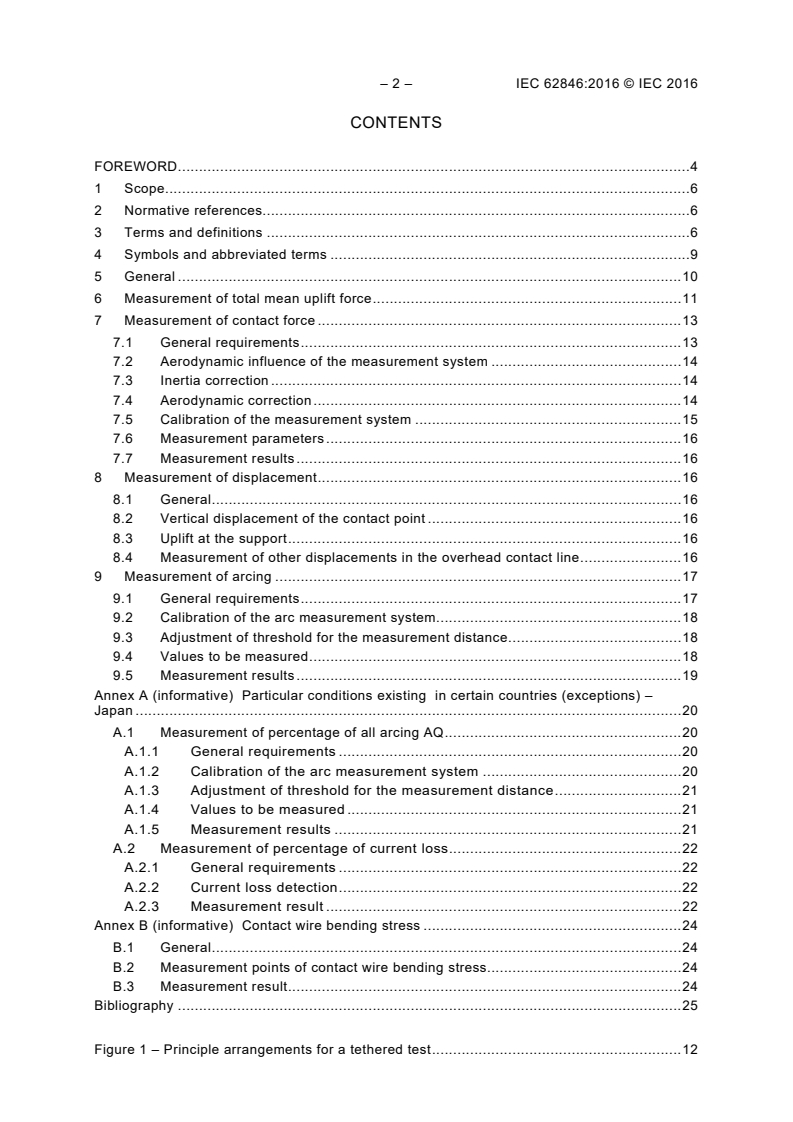
CONTENTS
FOREWORD . 4
1 Scope . 6
2 Normative references. 6
3 Terms and definitions . 6
4 Symbols and abbreviated terms . 9
5 General . 10
6 Measurement of total mean uplift force . 11
7 Measurement of contact force . 13
7.1 General requirements . 13
7.2 Aerodynamic influence of the measurement system . 14
7.3 Inertia correction . 14
7.4 Aerodynamic correction . 14
7.5 Calibration of the measurement system . 15
7.6 Measurement parameters . 16
7.7 Measurement results . 16
8 Measurement of displacement . 16
8.1 General . 16
8.2 Vertical displacement of the contact point . 16
8.3 Uplift at the support . 16
8.4 Measurement of other displacements in the overhead contact line . 16
9 Measurement of arcing . 17
9.1 General requirements . 17
9.2 Calibration of the arc measurement system . 18
9.3 Adjustment of threshold for the measurement distance . 18
9.4 Values to be measured . 18
9.5 Measurement results . 19
Annex A (informative) Particular conditions existing in certain countries (exceptions) –
Japan . 20
A.1 Measurement of percentage of all arcing AQ . 20
A.1.1 General requirements . 20
A.1.2 Calibration of the arc measurement system . 20
A.1.3 Adjustment of threshold for the measurement distance . 21
A.1.4 Values to be measured . 21
A.1.5 Measurement results . 21
A.2 Measurement of percentage of current loss . 22
A.2.1 General requirements . 22
A.2.2 Current loss detection . 22
A.2.3 Measurement result . 22
Annex B (informative) Contact wire bending stress . 24
B.1 General . 24
B.2 Measurement points of contact wire bending stress. 24
B.3 Measurement result . 24
Bibliography . 25
Figure 1 – Principle arrangements for a tethered test . 12
Figure 2 – Contact force measurement . 13
Figure 3 – Example for segmented contact strip . 14
Figure 4 – Detector location . 18
Figure A.1 – Test setup . 22
Table 1 – Initial test speed . 12
– 4 – IEC 62846:2016 © IEC 2016
INTERNATIONAL ELECTROTECHNICAL COMMISSION
____________
RAILWAY APPLICATIONS –
CURRENT COLLECTION SYSTEMS –
REQUIREMENTS FOR AND VALIDATION OF MEASUREMENTS
OF THE DYNAMIC INTERACTION BETWEEN PANTOGRAPH
AND OVERHEAD CONTACT LINE
FOREWORD
1) The International Electrotechnical Commission (IEC) is a worldwide organization for standardization comprising
all national electrotechnical committees (IEC National Committees). The object of IEC is to promote
international co-operation on all questions concerning standardization in the electrical and electronic fields. To
this end and in addition to other activities, IEC publishes International Standards, Technical Specifications,
Technical Reports, Publicly Available Specifications (PAS) and Guides (hereafter referred to as “IEC
Publication(s)”). Their preparation is entrusted to technical committees; any IEC National Committee interested
in the subject dealt with may participate in this preparatory work. International, governmental and non-
governmental organizations liaising with the IEC also participate in this preparation. IEC collaborates closely
with the International Organization for Standardization (ISO) in accordance with conditions determined by
agreement between the two organizations.
2) The formal decisions or agreements of IEC on technical matters express, as nearly as possible, an international
consensus of opinion on the relevant subjects since each technical committee has representation from all
interested IEC National Committees.
3) IEC Publications have the form of recommendations for international use and are accepted by IEC National
Committees in that sense. While all reasonable efforts are made to ensure that the technical content of IEC
Publications is accurate, IEC cannot be held responsible for the way in which they are used or for any
misinterpretation by any end user.
4) In order to promote international uniformity, IEC National Committees undertake to apply IEC Publications
transparently to the maximum extent possible in their national and regional publications. Any divergence
between any IEC Publication and the corresponding national or regional publication shall be clearly indicated in
the latter.
5) IEC itself does not provide any attestation of conformity. Independent certification bodies provide conformity
assessment services and, in some areas, access to IEC marks of conformity. IEC is not responsible for any
services carried out by independent certification bodies.
6) All users should ensure that they have the latest edition of this publication.
7) No liability shall attach to IEC or its directors, employees, servants or agents including individual experts and
members of its technical committees and IEC National Committees for any personal injury, property damage or
other damage of any nature whatsoever, whether direct or indirect, or for costs (including legal fees) and
expenses arising out of the publication, use of, or reliance upon, this IEC Publication or any other IEC
Publications.
8) Attention is drawn to the Normative references cited in this publication. Use of the referenced publications is
indispensable for the correct application of this publication.
9) Attention is drawn to the possibility that some of the elements of this IEC Publication may be the subject of
patent rights. IEC shall not be held responsible for identifying any or all such patent rights.
International Standard IEC 62846 has been prepared by IEC technical committee 9: Electrical
equipment and systems for railways.
This standard has been derived from EN 50317.
The text of this standard is based on the following documents:
FDIS Report on voting
9/2198/FDIS 9/2205/RVD
Full information on the voting for the approval of this standard can be found in the report on
voting indicated in the above table.
This publication has been drafted in accordance with the ISO/IEC Directives, Part 2.
The reader's attention is drawn to the fact that Annex A lists all of the “in-some-country”
clauses on differing practices of a permanent nature relating to the subject of this standard.
The following differing practices of a less permanent nature exist in the countries indicated
below.
– Subclause 3.20: t is the total measuring time (China).
total
– Subclause 9.5: The evaluation of the interaction includes counting the number of arcs
longer than a predefined length (China).
The committee has decided that the contents of this publication will remain unchanged until
the stability date indicated on the IEC web site under "http://webstore.iec.ch" in the data
related to the specific publication. At this date, the publication will be
• reconfirmed,
• withdrawn,
• replaced by a revised edition, or
• amended.
IMPORTANT – The 'colour inside' logo on the cover page of this publication indicates
that it contains colours which are considered to be useful for the correct
understanding of its contents. Users should therefore print this document using a
colour printer.
– 6 – IEC 62846:2016 © IEC 2016
RAILWAY APPLICATIONS –
CURRENT COLLECTION SYSTEMS –
REQUIREMENTS FOR AND VALIDATION OF MEASUREMENTS
OF THE DYNAMIC INTERACTION BETWEEN PANTOGRAPH
AND OVERHEAD CONTACT LINE
1 Scope
This International Standard specifies the functional requirements for output and accuracy of
measurements of the dynamic interaction between pantograph and overhead contact line.
2 Normative references
The following documents are referred to in the text in such a way that some or all of their
content constitutes requirements of this document. For dated references, only the edition
cited applies. For undated references, the latest edition of the referenced document (including
any amendments) applies.
IEC 62486:2010, Railway applications – Current collection systems – Technical criteria for the
interaction between pantograph and overhead line (to achieve free access)
3 Terms and definitions
For the purposes of this document, the following terms and definitions apply.
ISO and IEC maintain terminological databases for use in standardization at the following
addresses:
• IEC Electropedia: available at http://www.electropedia.org/
• ISO Online browsing platform: available at http://www.iso.org/obp
3.1
collector head
pantograph head
part of the pantograph supported by the frame which includes contact strips, horns and may
include a suspension
[SOURCE: IEC 60494-1:2013, 3.2.3, modified – the term "pantograph head" has been added.]
3.2
contact point
point of mechanical contact between a contact strip and a contact wire
3.3
working area of the pantograph head
lateral and vertical range of possible contact points on the contact strips during normal
operation
3.4
contact force
vertical force applied by the pantograph to the overhead contact line. The contact force is the
sum of forces for all contact points of one pantograph
[SOURCE: IEC 62486:2010, 3.2]
3.5
mean contact force
F
m
statistical mean value of the contact force
Note 1 to entry: F is formed by the static and aerodynamic components of the pantograph contact force.
m
[SOURCE: IEC 62486:2010, 3.4, modified – the symbol F and the note have been added.]
m
3.6
static contact force
mean vertical force exerted upwards by the pantograph head on the overhead contact line,
and caused by the pantograph-raising device, whilst the pantograph is raised and the vehicle
is at standstill
[SOURCE: IEC 62486:2010, 3.3]
3.7
standard deviation of contact force σ
square root of the sum of the squared differences between data values and the mean contact
force divided by the number of data values minus 1
3.8
aerodynamic force
additional vertical force applied by the pantograph as a result of air flow around the
pantograph assembly
3.9
statistical minimum of contact force
value of contact force represented by F – 3σ
m
3.10
statistical maximum of contact force
value of contact force represented by F + 3σ
m
3.11
cord force
measured force in a cord restraining a contact strip at a defined height
3.12
total mean uplift force
vertical force measured at the pantograph head, the latter not touching the contact line
Note 1 to entry: It is equal to the sum of static contact force and the aerodynamic force caused by the air at the
considered speed for a given height of contact points.
3.13
transfer function magnitude
magnitude of the ratio between the applied and the measured forces of the pantograph and
instrumentation determined by a dynamic excitation of the pantograph, at the pantograph
head for a range of frequencies
3.14
tension length
length of overhead contact line between two terminating points
– 8 – IEC 62846:2016 © IEC 2016
[SOURCE: IEC 60913:2013, 3.4.1]
3.15
control section
representative part of the total measuring length, over which the measuring conditions are
compliant with standard conditions
3.16
pantograph current
current that flows through the pantograph
3.17
arcing
flow of current through an air gap between a contact strip and a contact wire usually indicated
by the emission of intense light
[SOURCE: IEC 62486:2010, 3.15]
3.18
sensitivity curve
relationship between the power density of the arc in µW/cm² and the response of the detector
in volts within the spectral range of interest
3.19
nominal current
current that flows through one pantograph for nominal power of train
3.20
percentage of arcing
NQ
this is given by the following formula:
t
∑
arc
NQ = ×100
t
total
where
t is the duration of an arc lasting longer than 5 ms;
arc
t is the measuring time with a current greater than 30 % of the nominal current
total
The result, given in percent, is a characteristic for a given speed of the vehicle
Note 1 to entry: Refer to the Foreword for special national conditions.
[SOURCE: IEC 62486:2010, 3.16, modified – a note has been added.]
3.21
contact wire bending stress
bending stress variation of a contact wire which is caused by a passing pantograph
3.22
percentage of all arcing
this is given by the following formula:
t
∑
all_arc
AQ = ×100
t
total
where
t is the duration of an arc by measuring the visible light of arcing;
all_arc
t is the measuring time with a current greater than 30 % of the nominal current.
total
The result, given in percent, is a characteristic for a given speed of the vehicle
[SOURCE: IEC 62486:2010, 3.20]
3.23
percentage of current loss
this is given by the following formula:
t
∑
cl
CQ = ×100
t
total
where
t is the duration of current loss (e.g. measurement with waveform of collected current of
cl
pantograph which is connected with another pantograph);
t is the measuring time with a current greater than 30 % of the nominal current.
total
The result, given in percent, is a characteristic for a given speed of the vehicle
Note 1 to entry: This method is only applicable for at least two electrically connected pantographs. In the context
of this measuring method "current loss" means that the current flowing through one of these pantographs is zero.
[SOURCE: IEC 62486:2010, 3.21, modified – a note has been added.]
3.24
contact loss
condition where the contact force is zero
Note 1 to entry: Contact loss surely induces arcing except in the case of coasting. However, if two or more
pantographs are connected electrically to each other, the arc will immediately disappear and then the condition will
shift to ‘current loss’.
3.25
current loss
condition where current flowing through a pantograph is zero under the condition of contact
loss
Note 1 to entry: When a train is equipped with two or more pantographs electrically connected by a bus cable,
necessary traction power can be supplied by other pantographs through the bus cable in case of contact loss.
Therefore, current loss condition will generally not affect the driving of the train.
4 Symbols and abbreviated terms
a acceleration measured in acceleration sensor i
Sensor,i
c coefficient for calculation of speed dependent limit of effect of measurement
system on the aerodynamic force
– 10 – IEC 62846:2016 © IEC 2016
d measurement distance between arc detector and light source (see Figure 4)
d reference distance between arc detector and light source
ref
F force applied to pantograph head
applied
F contact force
c
F aerodynamic force correction
corr,aero
F mean contact force
m
F force measured
measured
F measured force in sensor i
Sensor,i
F measured force in cord i
z,i
f minimum frequency
f actual frequency
i
f maximum frequency
n
g surface power density generated by the smallest arc that shall be detected at
reference distance
J accuracy of the transfer function
k number of acceleration sensors
a
k number of force sensors
f
m mass between contact point and force sensors
above
NQ percentage of arcing
AQ percentage of all arcing
CQ percentage of current loss
n number of frequency steps
t duration of an arc recorded longer than a specified value
arc
t duration of any arc recorded
all_arc
t duration of current loss
cl
t measured duration with a pantograph current greater than a specified value
total
v speed
x surface power density generated by the smallest arc that shall be detected at
measurement distance
x surface power density generated by the smallest arc that shall be detected at
ref
reference distance
σ standard deviation of contact force
5 General
The measurement of the interaction of the contact line and the pantograph is intended to
prove the safety of operation and the quality of the current collection system. Results of
measurements of different current collection systems shall be comparable, in order to approve
components for free access within operated railway lines.
To check the performance capability of the current collection system, measurements shall be
done in accordance with the requirements for dynamic interaction performance defined in
IEC 62486 including the type of measurement methods which shall be used. The methods are
described in detail in Clauses 6 to 9. Special national conditions are described in Annex A.
In addition to the measured values, the operating conditions (train speed, location, etc.) shall
be recorded and/or processed continuously and the environmental conditions (rain, ice,
temperature, wind, tunnel, etc.) and test configuration (parameters related to pantographs and
overhead line systems, etc.) during the measurement shall be recorded in the test report. This
additional information shall ensure repeatability of the measurement and comparability of the
results.
NOTE In case of assessing the risk of a contact wire fatigue crack caused by bending stress, a measuring method
is provided in Annex B for information.
6 Measurement of total mean uplift force
Where a tethered test (see Figure 1) is used to measure the total mean uplift force the
following requirements shall be fulfilled.
A tethered test determines cord force(s). The total mean uplift force is the sum of all mean
values of the measured cord forces at the chosen height, speed and measurement conditions.
The aerodynamic force is the difference between the total mean uplift force and the static
contact force.
For this measurement the pantograph shall be restrained at a height as near as possible to
the contact wire height for which the result shall be valid. The restraint shall be provided by
vertical cords to each collector strip. The cords shall have adequate tensile stiffness, to
constrain pitching of the head.
The accuracy of adjustment shall be checked on a horizontal track without cant. The collector
strips shall be adjusted so that the along track and cross track errors are less than 1,5°
relative to the plane of rails.
The contact wire shall not touch the testing pantograph during the test.
NOTE 1 A typical distance between collector head and contact wire is 10 cm to 15 cm. Simulation results can be
used to take into account maximum dynamic movement of the contact wire caused by any other pantograph in
operation.
The force in each cord shall be measured.
– 12 – IEC 62846:2016 © IEC 2016
IEC
Key
1 contact wire
2 contact strip(s)
3 suspension of pantograph head
4 upper arm of pantograph
5 base frame or roof of vehicle
6 cord(s)
7 cord force(s) F (t). F (t)
z,1 z,i
Figure 1 – Principle arrangements for a tethered test
The dynamic behaviour of the cord forces depends on a number of influences (surrounding
conditions, turbulence around the cords, track conditions, tunnels, etc.).
To achieve confidence with the results the variance of the forces recorded and their
repeatability over different sections shall be demonstrated.
The speed dependency of the total mean uplift force shall be evaluated by measurement of
the cord force(s) between an initial test speed according to Table 1 and the maximum train
speed in steps. The step shall be chosen in accordance with the maximum train speed.
Table 1 – Initial test speed
≤ 200
Maximum train speed [km/h] > 200
Initial test speed [km/h] 100 160
NOTE 2 A typical step is 20 km/h or 5 steps for the complete speed range.
In addition to the conditions recorded according to Clause 5, the train configuration and
driving direction and also the restrained height and wear conditions of the collector strips shall
be noted.
As a result of the tethered test the total mean uplift force as a function of speed for the
measured configuration shall be presented.
NOTE 3 The results of the test can be used for optimization of pantograph aerodynamic properties, for example
optimization of angle of wind deflectors on the pantograph.
In case the contact wire height is so low that the tethered pantograph is below its height at the
"lower operating position", a wind tunnel test can be chosen as an alternative test method.
The aerodynamic conditions around the pantograph (roof layout) shall be taken into account
for this test method.
7 Measurement of contact force
7.1 General requirements
The measurement of contact force (see Figure 2) shall be carried out on the pantograph using
force sensors. The force sensors shall be located as near as practicable to the contact points.
7, 6
6, 7
3 3
IEC
Key
1 contact wire
2 contact strip(s)
3 suspension of pantograph head
4 upper arm of pantograph
5 base frame
6 force sensor(s) F (t). F (t)
Sensor,1 Sensor,i
7 acceleration sensor(s) a (t). a (t)
Sensor,1 Sensor,i
Figure 2 – Contact force measurement
The measurement system shall measure the vertical component of the contact forces,
minimising interference from forces in other directions (e.g. contact friction).
All sensors shall be temperature compensated for the measuring conditions.
For pantographs with independent contact strips each contact strip shall be measured
separately.
Segmented contact strips (see Figure 3) are considered as one contact strip.
– 14 – IEC 62846:2016 © IEC 2016
IEC
Key
1 segmented contact strip
2 spring
3 main body
Figure 3 – Example for segmented contact strip
The measurement system shall be immune to electromagnetic interference.
Deviations from the original pantograph mass and geometry caused by installation of the
measurement system shall be minimised.
The maximum error of the measurement system shall be less than 10 % of the measured
value.
The contact force shall be calculated by the following formula which includes the signals from
the force sensors and from the acceleration sensors (inertia correction, see 7.3) as well as the
aerodynamic force correction (7.4).
k k
f a
m
above
FF +× a + F (1)
c ∑ Sensor,i ∑ Sensor,i corr,aero
k
i 11a i
7.2 Aerodynamic influence of the measurement system
The measurement system shall not have any effects on the aerodynamic force that changes
2 2
the total mean uplift force by more than 5 % or c × v with c = 8 N/(300 km/h) whichever is
larger.
NOTE The most important influence that a measurement system can create on the results is linked to the
aerodynamic effect. This distortion can be checked by carrying out a measurement in accordance with Clause 6
with and without the measurement system under repeatable conditions (e.g. in a wind tunnel or with a line test).
7.3 Inertia correction
The inertia forces due to the effect of the mass of the components between the sensors and
the contact point shall be corrected. This shall be achieved by measurement of the
acceleration of these components.
7.4 Aerodynamic correction
A correction shall be applied to allow for the influence of aerodynamic forces on the
components between sensors and the contact points.
This aerodynamic correction F in Formula (1) shall be derived from a measurement of
corr,aero
total mean uplift force (e.g. via cords according to Clause 6) and simultaneously measuring
the sensor forces.
==
=
The difference between the total mean uplift force and the mean of the sum of the sensor
forces gives the aerodynamic correction for the measurement system of this pantograph.
The aerodynamic correction shall be established in the defined configuration.
NOTE The aerodynamic correction depends on contact wire height, train configuration, measurement equipment,
environmental conditions, etc.
7.5 Calibration of the measurement system
The measurement system shall be laboratory tested to check the accuracy of the measured
force. This test shall be carried out for the complete pantograph fitted with the complete force
measurement devices and any accelerometers, the data transfer system (telemetry, optical
systems) and amplifiers.
This test shall be carried out with the mean force equal to the static force. If the pantograph
contact force increases with speed, the test shall also be carried out at the predicted mean
contact force appropriate to the maximum train speed.
The transfer function magnitude shall be determined.
NOTE 1 If a sinusoidal force is applied an amplitude of ± 15 % of the predicted mean contact force gives
representative results.
The tests shall be carried out for the two cases:
– the force is being applied centrally to the pantograph head;
– the force is being applied 250 mm from the centre line of the pantograph head, if possible.
Otherwise the point of force application shall be as close as possible to this value. If
another value is used, it shall be noted in the test report.
The test shall be carried with a pantograph extension equivalent to the restrained height used
in Clause 6.
Measurements of the applied force and the measured force shall be taken at frequencies from
0,5 Hz up to 20 Hz in 0,5 Hz steps, with reduced intervals at resonant frequencies. Reduction
of the frequency steps near the resonant frequencies is necessary. The frequency steps near
the resonant frequencies shall be specified.
NOTE 2 The transfer function is a continuous function with greater variations close to the resonant frequencies.
The accuracy J of the transfer function magnitude shall be calculated by using the following
formula:
n−1
1 F
measured
J = 1− (f − f )1− ×100 %
i+1 i
∑
(2)
(f − f ) F
n 1 applied
i=1
The term F / F in Formula (2) is the transfer function.
measured applied
The accuracy of the transfer function magnitude of the measurement systems shall be greater
than 90 % up to a frequency limit of 20 Hz (in accordance with 7.1). To achieve this, a
correction with filters can be made.
– 16 – IEC 62846:2016 © IEC 2016
7.6 Measurement parameters
The sampling rate shall be greater than 200 Hz for time sampling or smaller than 0,40 m for
distance sampling.
The contact force shall be low pass filtered with a cut-off frequency of 20 Hz. The filter shall
be sixth order or higher. Either analogue or digital filters may be used.
The measuring range for the contact force shall be at least:
– for AC-pantographs from 0 N to 500 N,
– for DC-pantographs from 0 N to 700 N.
If it can be proved that the measuring results are not saturated, a lower measuring range can
be used.
7.7 Measurement results
Measurements taken within a control section shall be evaluated.
For calculating statistical values the control section should not be shorter than a tension
length. Depending on the purpose of the measurement, a shorter evaluation section can be
chosen.
As a minimum the following statistical values of the filtered contact force shall be calculated
for a control section:
– mean value (F );
m
– statistical maximum (F +3σ);
m
– statistical minimum (F –3σ);
m
– standard deviation (σ);
– histogram or probability curve.
8 Measurement of displacement
8.1 General
The measurement system shall not have any effects on the measured displacement which
could change the result by more than 3 %.
8.2 Vertical displacement of the contact point
The vertical displacement of the contact point is measured relative to the base frame of the
pantograph.
The accuracy of the measurement system shall be better than 10 mm.
8.3 Uplift at the support
The error of the measurement system including its effects on the overhead line system shall
be smaller than 5 mm. To ensure the measurements are representative the wind speed shall
be recorded at the same location.
8.4 Measurement of other displacements in the overhead contact line
The accuracy of the measurement system shall be better than 10 % of the amplitude of the
measured value or less than or equal to 10 mm, whichever gives a higher accuracy.
NOTE This accuracy is valid for measurements of movements of elements of overhead contact lines, for example
to check electrical clearance under bridges.
9 Measurement of arcing
9.1 General requirements
For the detection of arcs the detector shall be sensitive to the wavelengths of light emitted by
copper materials. For copper and copper alloyed contact wires a wavelength range shall be
used that includes the range 220 nm to 225 nm or 323 nm to 329 nm.
NOTE 1 These two wave length ranges have substantial copper emissivity.
The measurement system shall be insensitive to visible light with wavelength greater than
330 nm.
The detector shall:
– be close enough to the pantograph to achieve a sufficiently high sensitivity,
– be close enough to the vehicle’s longitudinal axis to achieve a sufficiently high sensitivity,
– be located behind the pantograph according to the direction of travel of the vehicle,
– aim at the trailing contact strip according to the direction of travel,
– be sensitive for a field of view over the whole working area of the pantograph head; the
tolerance for this sensitivity shall be better than 10 %,
– have a response time to the beginning and end of an arc of less than 100 µs,
– have a detection threshold depending on the defined minimum power of arcs which shall
be measured.
NOTE 2 The threshold values vary depending on the distance between measurement device and the place where
the arcs occur.
A reference threshold (x ) with a related reference distance (d ) shall be defined,
ref ref
depending on the problem to be investigated.
NOTE 3 Common values of reference threshold (x ), to investigate current collection quality, with a reference
ref
distance (d ) of 5 m are:
ref
– 160 µW/cm ± 10 % for use on 25 kV AC,
– 57,1 µW/cm ± 10 % for use on 15 kV AC,
– 15,1 µW/cm ± 10 % for use on 3 kV DC,
– 12,5 µW/cm ± 10 % for use on 1,5 kV DC.
Figure 4 gives an example of the side view of the location of a detector.
– 18 – IEC 62846:2016 © IEC 2016
d(α)
α
α
IEC
Key
1 maximum working height of pantograph
2 nominal working height of pantograph
3 minimum working height of pantograph
4 arc detector location
5 driving direction
Figure 4 – Detector location
9.2 Calibration of the arc measurement system
The considered detector shall be calibrated for sensitivity to surface power density in the
spectral range of interest according to 9.1.
The sensitivity curve shall be determined by measuring the analogue output of the detector in
response to the calibrated light input on the sensor.
9.3 Adjustment of threshold for the measurement distance
If the distance between the sensor and the light source differs during measurement from the
reference distance (d ), an adjustment of the threshold (x ) of the detector shall be carried
ref ref
out.
This shall be carried out as follows:
– determine the power density of the smallest arc that can be detected at reference distance
in accordance with the 1/d law;
– use the reference values to determine the signal corresponding to this power density level;
– consequently, the value of power density threshold (x) to be detected is a function of the
measurement distance (d) owing to the relation
d
ref
(3)
x = x
ref
d
NOTE An arc is considered to be a point source and consequently the power density is proportional to 1/d (see
Figure 4).
9.4 Values to be measured
As a minimum the system shall measure:
– the duration of each arc,
– the train speed during the test,
– the pantograph current,
– the location of the arc along the overhead contact line (kilometric position).
9.5 Measurement results
The presentation of values shall be carried out for a control section. The control section
should not be shorter than 10 km or the travel time should not be shorter than 200 s and
should be travelled at a constant speed. A tolerance of ± 5 km/h is acceptable. Depending on
the purpose of the measurement, a shorter evaluation section can be chosen.
Multiple consecutive arcs with gaps less than 100 µs shall be counted as continuous arcs.
NOTE 1 Ideal representative results for the overhead contact line would be achieved if the total time with a
pantograph current greater than 30 % of the nominal current is not shorter than the time taken to travel over one
tension length, is not interrupted by sections with reduced currents and if the speed is constant.
NOTE 2 Another possible criterion is the number of arcs per km with a pantograph current greater than 30 % of
the nominal current.
As a minimum for the control section the following values shall be generated:
– train speed;
– number of arcs;
– sum of the duration of all arcs taken into consideration (t );
arc
– largest arc duration;
– total time with a pantograph current greater than 30 % of the nominal current per
pantograph (t );
total
– total run time for the control section;
– percentage of arcing (NQ).
Refer to Annex A for special national conditions.
– 20 – IEC 62846:2016 © IEC 2016
Annex A
(informativ
...