


IEC TS 61936-2:2015
(Main)Power installations exceeding 1 kV a.c. and 1,5 kV d.c. - Part 2: d.c.
General Information
- Abstract
IEC TS 61936-2:2015(E) provides, in a convenient form, common rules for the design and the erection of electrical power installations in systems with nominal voltages above 1,5 kV d.c., so as to provide safety and proper functioning for the use intended.
- Status
- Replaced
- Publication Date
- 04-Mar-2015
- Technical Committee
- TC 99 - Insulation co-ordination and system engineering of high voltage electrical power installations above 1,0 kV AC and 1,5 kV DC
- Drafting Committee
- WG 5 - TC 99/WG 5
- Current Stage
- DELPUB - Deleted Publication
- Start Date
- 26-Sep-2023
- Completion Date
- 12-Apr-2018
Buy Documents
IEC TS 61936-2:2015 - Power installations exceeding 1 kV a.c. and 1,5 kV d.c. - Part 2: d.c.
IEC TS 61936-2:2015 - Power installations exceeding 1 kV a.c. and 1,5 kV d.c. - Part 2: d.c. Released:3/5/2015
Relations
- Effective Date
- 05-Sep-2023
Buy Documents
IEC TS 61936-2:2015 - Power installations exceeding 1 kV a.c. and 1,5 kV d.c. - Part 2: d.c.
IEC TS 61936-2:2015 - Power installations exceeding 1 kV a.c. and 1,5 kV d.c. - Part 2: d.c. Released:3/5/2015
Get Certified
Connect with accredited certification bodies for this standard

IMQ S.p.A. (Certification)
Italian electrical product certification.

SLG Prüf- und Zertifizierungs GmbH
German testing and certification body.

UL Solutions
Global safety science company with testing, inspection and certification.
Sponsored listings
Frequently Asked Questions
IEC TS 61936-2:2015 is a technical specification published by the International Electrotechnical Commission (IEC). Its full title is "Power installations exceeding 1 kV a.c. and 1,5 kV d.c. - Part 2: d.c.". This standard covers: IEC TS 61936-2:2015(E) provides, in a convenient form, common rules for the design and the erection of electrical power installations in systems with nominal voltages above 1,5 kV d.c., so as to provide safety and proper functioning for the use intended.
IEC TS 61936-2:2015(E) provides, in a convenient form, common rules for the design and the erection of electrical power installations in systems with nominal voltages above 1,5 kV d.c., so as to provide safety and proper functioning for the use intended.
IEC TS 61936-2:2015 is classified under the following ICS (International Classification for Standards) categories: 29.020 - Electrical engineering in general; 29.080.01 - Electrical insulation in general. The ICS classification helps identify the subject area and facilitates finding related standards.
IEC TS 61936-2:2015 has the following relationships with other standards: It is inter standard links to IEC 61936-2:2023. Understanding these relationships helps ensure you are using the most current and applicable version of the standard.
IEC TS 61936-2:2015 is available in PDF format for immediate download after purchase. The document can be added to your cart and obtained through the secure checkout process. Digital delivery ensures instant access to the complete standard document.
Standards Content (Sample)
IEC TS 61936-2 ®
Edition 1.0 2015-03
TECHNICAL
SPECIFICATION
colour
inside
Power installations exceeding 1 kV a.c. and 1,5 kV d.c. –
Part 2: d.c.
All rights reserved. Unless otherwise specified, no part of this publication may be reproduced or utilized in any form
or by any means, electronic or mechanical, including photocopying and microfilm, without permission in writing from
either IEC or IEC's member National Committee in the country of the requester. If you have any questions about IEC
copyright or have an enquiry about obtaining additional rights to this publication, please contact the address below or
your local IEC member National Committee for further information.
IEC Central Office Tel.: +41 22 919 02 11
3, rue de Varembé Fax: +41 22 919 03 00
CH-1211 Geneva 20 info@iec.ch
Switzerland www.iec.ch
About the IEC
The International Electrotechnical Commission (IEC) is the leading global organization that prepares and publishes
International Standards for all electrical, electronic and related technologies.
About IEC publications
The technical content of IEC publications is kept under constant review by the IEC. Please make sure that you have the
latest edition, a corrigenda or an amendment might have been published.
IEC Catalogue - webstore.iec.ch/catalogue Electropedia - www.electropedia.org
The stand-alone application for consulting the entire The world's leading online dictionary of electronic and
bibliographical information on IEC International Standards, electrical terms containing more than 30 000 terms and
Technical Specifications, Technical Reports and other definitions in English and French, with equivalent terms in 15
documents. Available for PC, Mac OS, Android Tablets and additional languages. Also known as the International
iPad. Electrotechnical Vocabulary (IEV) online.
IEC publications search - www.iec.ch/searchpub IEC Glossary - std.iec.ch/glossary
The advanced search enables to find IEC publications by a More than 60 000 electrotechnical terminology entries in
variety of criteria (reference number, text, technical English and French extracted from the Terms and Definitions
committee,…). It also gives information on projects, replaced clause of IEC publications issued since 2002. Some entries
and withdrawn publications. have been collected from earlier publications of IEC TC 37,
77, 86 and CISPR.
IEC Just Published - webstore.iec.ch/justpublished
Stay up to date on all new IEC publications. Just Published IEC Customer Service Centre - webstore.iec.ch/csc
details all new publications released. Available online and If you wish to give us your feedback on this publication or
also once a month by email. need further assistance, please contact the Customer Service
Centre: csc@iec.ch.
IEC TS 61936-2 ®
Edition 1.0 2015-03
TECHNICAL
SPECIFICATION
colour
inside
Power installations exceeding 1 kV a.c. and 1,5 kV d.c. –
Part 2: d.c.
INTERNATIONAL
ELECTROTECHNICAL
COMMISSION
ICS 29.020; 29.080.01 ISBN 978-2-8322-2304-8
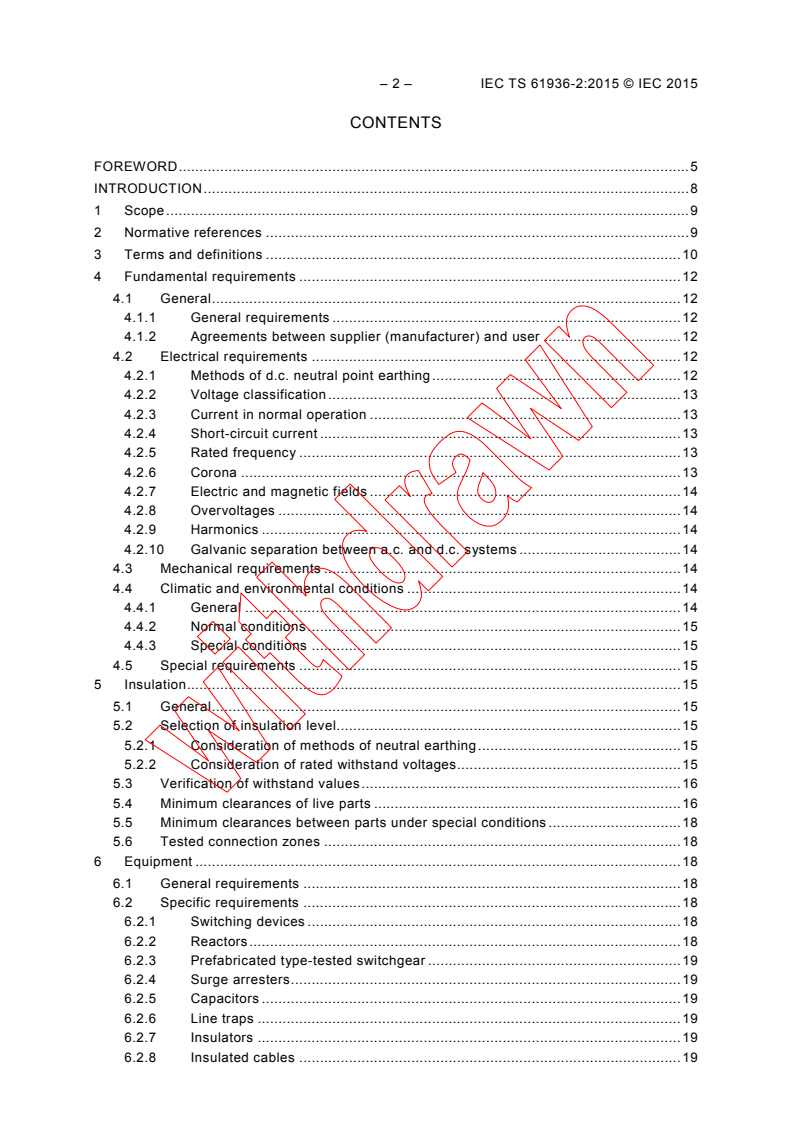
– 2 – IEC TS 61936-2:2015 © IEC 2015
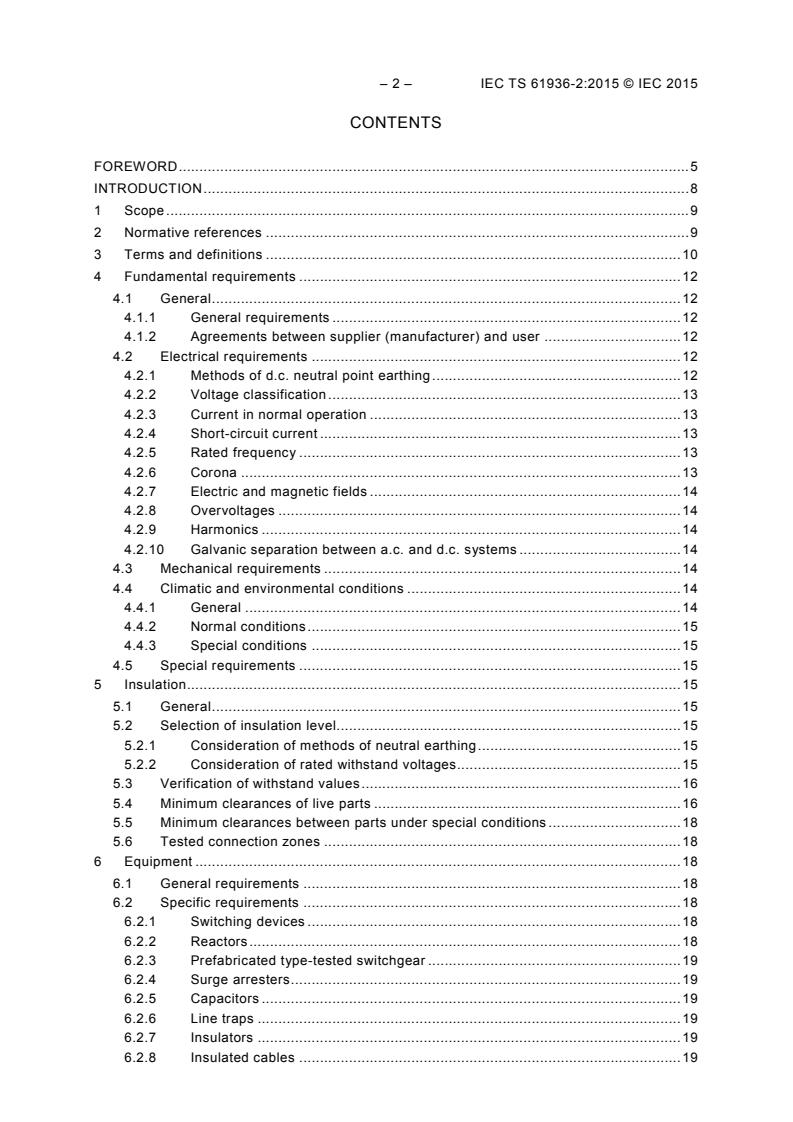
CONTENTS
FOREWORD . 5
INTRODUCTION . 8
1 Scope . 9
2 Normative references . 9
3 Terms and definitions . 10
4 Fundamental requirements . 12
4.1 General . 12
4.1.1 General requirements . 12
4.1.2 Agreements between supplier (manufacturer) and user . 12
4.2 Electrical requirements . 12
4.2.1 Methods of d.c. neutral point earthing . 12
4.2.2 Voltage classification . 13
4.2.3 Current in normal operation . 13
4.2.4 Short-circuit current . 13
4.2.5 Rated frequency . 13
4.2.6 Corona . 13
4.2.7 Electric and magnetic fields . 14
4.2.8 Overvoltages . 14
4.2.9 Harmonics . 14
4.2.10 Galvanic separation between a.c. and d.c. systems . 14
4.3 Mechanical requirements . 14
4.4 Climatic and environmental conditions . 14
4.4.1 General . 14
4.4.2 Normal conditions . 15
4.4.3 Special conditions . 15
4.5 Special requirements . 15
5 Insulation . 15
5.1 General . 15
5.2 Selection of insulation level. 15
5.2.1 Consideration of methods of neutral earthing . 15
5.2.2 Consideration of rated withstand voltages . 15
5.3 Verification of withstand values . 16
5.4 Minimum clearances of live parts . 16
5.5 Minimum clearances between parts under special conditions . 18
5.6 Tested connection zones . 18
6 Equipment . 18
6.1 General requirements . 18
6.2 Specific requirements . 18
6.2.1 Switching devices . 18
6.2.2 Reactors . 18
6.2.3 Prefabricated type-tested switchgear . 19
6.2.4 Surge arresters . 19
6.2.5 Capacitors . 19
6.2.6 Line traps . 19
6.2.7 Insulators . 19
6.2.8 Insulated cables . 19
6.2.9 Conductors and accessories . 20
6.2.10 Rotating electrical machines . 20
6.2.11 Static converters . 20
6.2.12 Fuses . 20
6.2.13 Electrical and mechanical Interlocking . 20
6.2.14 Electronic valve devices . 20
6.2.15 Valve cooling system . 20
7 Installations . 21
7.1 General requirements . 21
7.1.1 Circuit arrangement . 21
7.1.2 Documentation . 21
7.1.3 Transport routes . 21
7.1.4 Aisles and access areas . 21
7.1.5 Lighting . 21
7.1.6 Operational safety . 21
7.1.7 Labelling . 21
7.2 Outdoor installations of open design . 21
7.2.1 Protective barrier clearances . 22
7.2.2 Protective obstacle clearances . 22
7.2.3 Boundary clearances . 22
7.2.4 Minimum height over access area . 22
7.2.5 Clearances to buildings . 23
7.2.6 External fences or walls and access doors . 25
7.3 Indoor installations of open design . 25
7.4 Installation of prefabricated type-tested switchgear . 25
7.5 Requirements for buildings . 25
7.5.1 General . 25
7.5.2 Structural provisions . 25
7.5.3 Rooms for switchgear . 26
7.5.4 Maintenance and operating areas . 26
7.5.5 Doors . 26
7.5.6 Draining of insulating liquids . 26
7.5.7 Air conditioning and ventilation . 26
7.5.8 Buildings which require special consideration . 27
7.6 High voltage/low voltage prefabricated substations . 27
7.7 Electrical installations on mast, pole and tower . 27
8 Safety measures . 27
8.1 General . 27
8.2 Protection against direct contact . 27
8.2.1 Measures for protection against direct contact . 27
8.2.2 Protection requirements . 27
8.3 Means to protect persons in case of indirect contact . 28
8.4 Means to protect persons working on electrical installations . 28
8.5 Protection from danger resulting from arc fault . 28
8.6 Protection against direct lightning strokes . 28
8.7 Protection against fire . 28
8.8 Protection against leakage of insulating liquid . 28
8.9 Identification and marking . 28
9 Protection, control and auxiliary systems . 28
– 4 – IEC TS 61936-2:2015 © IEC 2015
10 Earthing systems . 29
10.1 General . 29
10.2 Fundamental requirements . 29
10.2.1 Safety criteria . 29
10.2.2 Functional requirements . 30
10.2.3 High and low voltage earthing systems . 30
10.3 Design of earthing systems . 30
10.3.1 General . 30
10.3.2 Power system faults. 31
10.3.3 Lightning and transients. 31
10.4 Construction of earthing systems . 31
10.5 Measurements . 31
10.6 Maintainability . 31
10.6.1 Inspections . 31
10.6.2 Measurements . 32
11 Inspection and testing . 32
11.1 General . 32
11.2 Verification of specified performances . 32
11.3 Tests during installation and commissioning . 32
11.4 Trial running . 32
12 Operation and maintenance manual . 32
Annex A (informative) Values of rated insulation levels and minimum clearances in air
based on nominal voltage of some HVDC projects worldwide . 33
Annex B (normative) Method of calculating the voltage limit . 35
Bibliography . 36
Figure 1 – Approaches with buildings (within closed electrical operating areas) . 24
Figure 2 – Touch voltage limit d.c. . 30
INTERNATIONAL ELECTROTECHNICAL COMMISSION
____________
POWER INSTALLATIONS EXCEEDING 1 kV a.c. and 1,5 kV d.c. –
Part 2: d.c.
FOREWORD
1) The International Electrotechnical Commission (IEC) is a worldwide organization for standardization comprising
all national electrotechnical committees (IEC National Committees). The object of IEC is to promote
international co-operation on all questions concerning standardization in the electrical and electronic fields. To
this end and in addition to other activities, IEC publishes International Standards, Technical Specifications,
Technical Reports, Publicly Available Specifications (PAS) and Guides (hereafter referred to as “IEC
Publication(s)”). Their preparation is entrusted to technical committees; any IEC National Committee interested
in the subject dealt with may participate in this preparatory work. International, governmental and non-
governmental organizations liaising with the IEC also participate in this preparation. IEC collaborates closely
with the International Organization for Standardization (ISO) in accordance with conditions determined by
agreement between the two organizations.
2) The formal decisions or agreements of IEC on technical matters express, as nearly as possible, an international
consensus of opinion on the relevant subjects since each technical committee has representation from all
interested IEC National Committees.
3) IEC Publications have the form of recommendations for international use and are accepted by IEC National
Committees in that sense. While all reasonable efforts are made to ensure that the technical content of IEC
Publications is accurate, IEC cannot be held responsible for the way in which they are used or for any
misinterpretation by any end user.
4) In order to promote international uniformity, IEC National Committees undertake to apply IEC Publications
transparently to the maximum extent possible in their national and regional publications. Any divergence
between any IEC Publication and the corresponding national or regional publication shall be clearly indicated in
the latter.
5) IEC itself does not provide any attestation of conformity. Independent certification bodies provide conformity
assessment services and, in some areas, access to IEC marks of conformity. IEC is not responsible for any
services carried out by independent certification bodies.
6) All users should ensure that they have the latest edition of this publication.
7) No liability shall attach to IEC or its directors, employees, servants or agents including individual experts and
members of its technical committees and IEC National Committees for any personal injury, property damage or
other damage of any nature whatsoever, whether direct or indirect, or for costs (including legal fees) and
expenses arising out of the publication, use of, or reliance upon, this IEC Publication or any other IEC
Publications.
8) Attention is drawn to the Normative references cited in this publication. Use of the referenced publications is
indispensable for the correct application of this publication.
9) Attention is drawn to the possibility that some of the elements of this IEC Publication may be the subject of
patent rights. IEC shall not be held responsible for identifying any or all such patent rights.
The main task of IEC technical committees is to prepare International Standards. In
exceptional circumstances, a technical committee may propose the publication of a technical
specification when
• the required support cannot be obtained for the publication of an International Standard,
despite repeated efforts, or
• the subject is still under technical development or where, for any other reason, there is the
future but no immediate possibility of an agreement on an International Standard.
Technical specifications are subject to review within three years of publication to decide
whether they can be transformed into International Standards.
IEC 61936-2, which is a technical specification, has been prepared by technical committee 99:
System engineering and erection of electrical power installations in systems with nominal
voltages above 1 kV a.c. and 1,5 kV d.c., particularly concerning safety aspects.
– 6 – IEC TS 61936-2:2015 © IEC 2015
Future standards in this series will carry the new general title as cited above. Titles of existing
standards in this series will be updated at the time of the next edition.
The text of this technical specification is based on the following documents:
Enquiry draft Report on voting
99/130/DTS 99/132/RVC
Full information on the voting for the approval of this technical specification can be found in
the report on voting indicated in the above table.
This publication has been drafted in accordance with the ISO/IEC Directives, Part 2.
A list of all parts in the IEC 61936 series, published under the general title Power installations
exceeding 1 kV a.c. and 1,5 kV d.c., can be found on the IEC website.
The following differences exist in the countries indicated below:
7.2.4: For live parts without protective facilities, a minimum height H = N + 2 440 mm shall be maintained.
(Australia)
7.2.6: Guidance reference construction can be found at ENA Doc 015. (Australia)
7.5.4: Space for evacuation shall always be at least 600 mm, even when removable parts or open doors, which are
blocked in the direction of escape, intrude into the escape routes. (Australia)
8.7.1: Fire rating of barriers must be a minimum fire rating of 120 minutes. (Australia)
8.7.2: The dimensions G and G are to be measured from the inside edge wall of any bund wall rather than the
1 2
measured point shown in Figure 7a) and 7b) of IEC 61936-1:2010/AMD1:2014 from the transformer where the bund
wall is wider than the transformer. (Australia)
8.8: Spill containment should extend by 50% of the height of the transformer. (Australia)
10: For requirements on earthing, refer to AS 2067, Substations and High Voltage Installations. (Australia)
10.2.1: HV earthing systems should be designed according to tolerable voltages based on body impedances not
exceeded by 5 % of the population, as given in Table 10 of IEC TS 60479-1:2005. (United Kingdom)
10.2.1: Permissible touch and step voltages in power installations shall be in accordance with Federal law
concerning electrical installations (High and low voltage) (SR 734.0) and Regulations for electrical power
installations (SR 743.2 StV). (Switzerland)
10.2.1 and Annex B: Earthing requirements are based on probabilistic calculations and so much of the clause is not
appropriate for Australia. (Australia)
The committee has decided that the contents of this publication will remain unchanged until
the stability date indicated on the IEC website under "http://webstore.iec.ch" in the data
related to the specific publication. At this date, the publication will be
• transformed into an International standard,
• reconfirmed,
• withdrawn,
• replaced by a revised edition, or
• amended.
A bilingual version of this publication may be issued at a later date.
IMPORTANT – The 'colour inside' logo on the cover page of this publication indicates
that it contains colours which are considered to be useful for the correct
understanding of its contents. Users should therefore print this document using a
colour printer.
– 8 – IEC TS 61936-2:2015 © IEC 2015
INTRODUCTION
There are few national laws, standards and internal rules dealing with the matter coming
within the scope of this technical specification, and these practices have been taken as a
basis for this work.
This part of IEC 61936 contains the minimum requirements valid for IEC countries and some
additional information which ensures an acceptable reliability of an installation and its safe
operation.
This part of IEC 61936 is published as a Technical Specification in order to welcome
contribution and involvement from a wider audience. This may provide the basis for a future
international standard.
The publication of this technical specification is believed to be a decisive step towards the
gradual alignment all over the world of the practices concerning the design and erection of
high voltage power installations.
Particular requirements for transmission and distribution installations as well as particular
requirements for power generation and industrial installations are included in this technical
specification.
The relevant laws or regulations of an authority having jurisdiction takes precedence.
POWER INSTALLATIONS EXCEEDING 1 kV a.c. and 1,5 kV d.c. –
Part 2: d.c.
1 Scope
This part of IEC 61936 provides, in a convenient form, common rules for the design and the
erection of electrical power installations in systems with nominal voltages above 1,5 kV d.c.,
so as to provide safety and proper functioning for the use intended.
This technical specification does not apply to the design and erection of any of the following:
– overhead and underground lines between separate installations;
– electric railways;
– mining equipment and installations;
– installations on ships and off-shore installations;
– electrostatic equipment (e.g. electrostatic precipitators, spray-painting units);
– test sites;
– medical equipment, e.g. medical X-ray equipment;
– valve hall.
This technical specification does not apply to the design of factory-built, type-tested
switchgear for which separate IEC standards exist.
This technical specification does not apply to the requirements for carrying out live working on
electrical installations.
This technical specification does not apply to the design of factory-built, type-tested thyristor
valves, VSC valves and switchgear for which separate IEC standards exist.
2 Normative references
The following documents, in whole or in part, are normatively referenced in this document and
are indispensable for its application. For dated references, only the edition cited applies. For
undated references, the latest edition of the referenced document (including any
amendments) applies.
IEC 60060-1, High-voltage test techniques – Part 1: General definitions and test requirements
IEC 60071-1, Insulation co-ordination – Part 1: Definitions, principles and rules
IEC 60071-2:1996, Insulation co-ordination – Part 2: Application guide
IEC 60071-5, Insulation co-ordination – Part 5: Procedures for high voltage direct current
(HVDC) converter stations
IEC 60079-10-1, Explosive atmospheres – Part 10-1: Classification of areas – Explosive gas
atmospheres
– 10 – IEC TS 61936-2:2015 © IEC 2015
− Part 10-2: Classification of areas − Combustible
IEC 60079-10-2, Explosive atmospheres
dust atmospheres
IEC TS 60479-1:2005, Effects of current on human beings and livestock – Part 1: General
aspects
IEC 60529, Degrees of protection provided by enclosures (IP Code)
IEC TR 61000-5-2, Electromagnetic compatibility (EMC) – Part 5: Installation and mitigation
guidelines – Section 2: Earthing and cabling
IEC 61936-1:2010, Power installations exceeding 1 kV a.c. – Part 1: Common rules
IEC 61936-1:2010/AMD1:2014
IEC 62271-1:2007, High-voltage switchgear and controlgear – Part 1: Common specifications
IEC 62271-1:2007/AMD1:2011
3 Terms and definitions
For the purposes of this document, the terms and definitions given in IEC 61936-1 and the
following apply.
3.1
valve
complete operative controllable or non-controllable valve device assembly, normally
conducting in only one direction (the forward direction), which can function as a converter arm
in a converter bridge
Note 1 to entry: An example of a non-controllable valve device assembly is a semiconductor diode valve. An
example of a controllable valve device assembly is a thyristor valve.
[SOURCE: IEC 60633:1998, 6.3]
3.2
electronic valve device
indivisible electronic device for electronic power conversion or electronic power switching,
comprising a single non-controllable or bistably controlled unidirectionally conducting current
path
Note 1 to entry: Typical electronic valve devices are thyristors, power rectifier diodes, power switching bipolar
and field effect transistors and insulated-gate bipolar transistors (IGBT).
Note 2 to entry: Two or more electronic valve devices may be integrated on a common semiconductor chip
(examples: a thyristor and a rectifier diode in a reverse conducting thyristor, a power switching field effect
transistor with its inverse diode) or packaged in a common case (semiconductor power module). These
combinations are to be considered as separate electronic valve devices.
[SOURCE: IEC 60050-551:1998, 551-14-02]
3.3
nominal voltage,
suitable approximate value of voltage used to designate or identify a system
[SOURCE: IEC 60050-601:1985, 601-01-21]
3.4
highest voltage,
U
dm
highest mean or average pole d.c. voltage to earth, excluding harmonics and commutation
overshoots, for which the installation is designed in respect of its insulation
3.5
d.c. neutral point
common point of two monopoles forming a bipole converter or the earthed point of a
monopole converter
3.6
d.c. electrode line
electrical connection between a d.c. earth electrode and the d.c. installation
3.7
high voltage
d.c. voltage exceeding 1 500V d.c.
3.8
low voltage
d.c. voltage not exceeding 1 500V d.c.
3.9
converter station
part of a power system which interconnects an a.c. system to a d.c. system or two d.c.
systems with different voltages enabling power transfer from one system to the other and/or
vice versa
3.10
d.c. earth electrode
d.c. ground electrode
array of conductive elements placed in the earth, or the sea, which provides a low resistance
path between a point in the d.c. circuit and the earth and is capable of carrying continuous
current for some extended period
Note 1 to entry: An earth electrode may be located at a point some distance from the HVDC substation.
Note 2 to entry: Where the electrode is placed in the sea it may be termed as sea electrode.
[SOURCE: IEC 60633:1998, 8.14, modified – The indication "d.c." has been added to the term
and a synonym, d.c. ground electrode, has been added.]
3.11
pole
part of an HVDC system consisting of all the equipment in the HVDC substations and
interconnecting transmission lines, if any, which during normal operation, exhibit a common
direct voltage polarity with respect to earth.
[SOURCE: IEC 60633:1998, 8.5]
3.12
lightning impulse protective level,
U
pl
maximum permissible peak voltage value, on the terminals of a protective device subjected to
lightning impulses under specific conditions
[SOURCE: IEC 60050-604:1987, 604-03-56]
– 12 – IEC TS 61936-2:2015 © IEC 2015
3.13
switching impulse protective level,
U
ps
maximum permissible peak voltage value, on the terminals of a protective device subjected to
switching impulses under specific conditions
[SOURCE: IEC 60050-604:1987, 604-03-57]
4 Fundamental requirements
4.1 General
4.1.1 General requirements
See 4.1.1 of IEC 61936-1:2010.
4.1.2 Agreements between supplier (manufacturer) and user
See 4.1.2 of IEC 61936-1:2010 and IEC 61936-1:2010/AMD1:2014.
4.2 Electrical requirements
4.2.1 Methods of d.c. neutral point earthing
The method of d.c. neutral point earthing of a system is important with regard to the following:
– selection of insulation level;
– characteristics of overvoltage-limiting devices such as spark gaps or surge arresters;
– selection of protective relays.
The following are examples of d.c. neutral point earthing methods:
– isolated neutral;
– high impedance earthing;
– high resistive earthing;
– solid (low impedance) earthing.
The choice of the type of d.c. neutral point earthing is normally based on the following criteria:
– local regulations (if any);
– continuity of service required for the network;
– limitation of damage to equipment caused by earth faults;
– selective elimination of faulty sections of the network;
– detection of fault location;
– touch and step voltages;
– inductive interference;
– operation and maintenance aspects.
One galvanically connected d.c. system has only one method of d.c. neutral point earthing.
Different galvanically independent d.c. systems may have different methods of d.c. neutral
point earthing, so the earthing point could be located in one or both converter stations.
The a.c. and d.c. systems may be either galvanically separated or not. The d.c. neutral point
earthing method of an a.c. system not galvanically separated from the d.c. one has an effect
on the d.c. neutral point earthing and vice versa. Design of equipment and protective system
shall take into account this feature.
If different d.c. neutral point earthing configurations can occur during normal or abnormal
operating conditions, equipment and protective system shall be designed to operate under
these conditions.
4.2.2 Voltage classification
The nominal voltage and the maximum operating voltage of the system shall be agreed
between user and manufacturer.
Based on the maximum operating voltage the highest voltage of a d.c. system (U ) shall be
dm
selected.
4.2.3 Current in normal operation
Every part of an installation shall be designed and constructed to withstand currents under
defined operating conditions.
4.2.4 Short-circuit current
Installations shall be designed, constructed and erected to safely withstand the mechanical
and thermal effects resulting from short-circuit currents.
For the purposes of this standard, all applicable types of short-circuits, which may happen,
shall be considered, e.g.:
– pole-to-earth;
– pole-to-pole;
– double pole-to-earth;
– converter arm.
Installations shall be protected with automatic devices or functions to disconnect or switch off
the d.c. system in case of pole-pole or pole-pole-earth short circuit.
In case of pole-earth or metallic return or d.c. electrode line to earth, installations shall be
protected with automatic devices or functions to disconnect or switch off the d.c. system or
with a device to indicate the earth fault condition.
The selection of the device or function is dependent upon the method of d.c. neutral point
earthing.
Selection of magnitude and duration of short circuit current shall be agreed between
manufacturer and user.
Methods for the calculation of the effects of short-circuit current are given, for power cables,
in IEC 60949.
4.2.5 Rated frequency
The provision of IEC 61936-1:2010, 4.2.5 is not applicable.
4.2.6 Corona
The design of installations shall be such that radio interference due to electromagnetic fields,
e.g. caused by corona effects, will not exceed a specified level.
– 14 – IEC TS 61936-2:2015 © IEC 2015
When the acceptable value is exceeded, the corona level may be controlled, for example, by
the installation of corona rings or the recessing of fasteners on bus fittings for high-voltage
suspension insulator assemblies, bus support assemblies, bus connections and equipment
terminals.
Maximum permissible levels of radio interference are given by national or local authorities in
some countries.
Guidance on acceptable levels of radio interference voltage for a.c. switchgear and
controlgear can be found in IEC 62271-1 in which the emission tests are recommended from
a.c. voltages of 123 kV and above. In absence of other criteria, it is proposed that emission
tests as per IEC 62271-1:2007, 6.9.1 is performed on equipment subjected to a direct voltage
(to earth) U of 123 × √2/√3 = 100 kV or higher. The test voltage shall be corrected to
dm
1,1/√2 × U .
dm
NOTE Recommendations for minimizing the radio interference of high-voltage installations are reported in
CISPR 18-1, CISPR 18-2 and CISPR 18-3 [1,2,3] .
4.2.7 Electric and magnetic fields
The design of an installation shall be such as to limit the electric and magnetic fields
generated by energized equipment to an acceptable level for exposed people.
National and/or international regulations may specify acceptable levels.
4.2.8 Overvoltages
See 4.2.8 of IEC 61936-1:2010.
4.2.9 Harmonics
See 4.2.9 of IEC 61936-1:2010.
4.2.10 Galvanic separation between a.c. and d.c. systems
The a.c. and d.c. systems may be either galvanically separated or not. Galvanic separation
between a.c. and d.c. systems is generally obtained by means of converter transformers.
NOTE Regardless of galvanic separation between a.c. and d.c. systems there is always a portion of a.c. system
comprised within the converter transformer and the electronic valve devices which is not galvanically insulated
from the d.c. system.
4.3 Mechanical requirements
See 4.3 of IEC 61936-1:2010 and IEC 61936-1:2010/AMD1:2014.
4.4 Climatic and environmental conditions
4.4.1 General
Installations, including all devices and auxiliary equipment which form an integral part of them,
shall be designed for operation under the climatic and environmental conditions listed below.
The presence of condensation, precipitation, particles, dust, corrosive elements and
hazardous atmospheres shall be specified in such a manner that appropriate electrical
equipment can be selected. Zone classification for hazardous areas shall be performed in
accordance with IEC 60079-10-1 and IEC 60079-10-2.
______________
Figures in square brackets refer to the bibliography.
Dust accumulates constantly on insulators and conductive surfaces immersed in a d.c. electric
field. In installations with high levels of d.c. electric fields special care shall be paid either to
creapage lengths or air treatment (indoor installations).
In cases with heavy pollution levels, the indoor air could be treated and overpressurized.
4.4.2 Normal conditions
See 4.4.2 of IEC 61936-1:2010.
4.4.3 Special conditions
See 4.4.3 of IEC 61936-1:2010 and IEC 61936-1:2010/AMD1:2014.
4.5 Special requirements
See 4.5 of IEC 61936-1:2010.
5 Insulation
5.1 General
As conventional (air insulated) d.c. installations are normally not impulse tested, the d.c.
installation requires minimum clearances between live parts and earth and between live parts
of poles in order to avoid flashover below the impulse withstand level selected for the
installation.
Insulation coordination shall be in accordance with IEC 60071-5 and IEC 60071-1 as far as
principal definitions and rules are concerned.
5.2 Selection of insulation level
The insulation level shall be chosen according to the established highest d.c. voltage for
equipment U and/or impulse withstand voltage.
dm
5.2.1 Consideration of methods of neutral earthing
The choice should be made primarily to ensure reliability in service, taking into account the
method of d.c. neutral point earthing in the system and the characteristics and the locations of
overvoltage limiting devices to be installed.
In installations in which a high level of safety is required, or in which the configuration of the
system, the adopted method of d.c. neutral point earthing or the protection by surge arresters
make it inappropriate to lower the level of insulation, one of the higher alternative values of
Annex A may be chosen.
In installations in which the configuration of the system, the adopted method of d.c. neutral
point earthing or the protection by surge arresters make it appropriate to lower the level of
insulation, the lower alternative values of Annex A may be sufficient.
5.2.2 Consideration of rated withstand voltages
In the voltage range I (1,5 kV d.c. < U < 500 kV d.c.), the choice is generally based on the
dm
rated lightning impulse withstand voltages given in Annex A; in the voltage range II (U >
dm
500 kV d.c.), the choice is generally based on the rated switching impulse withstand voltages
and the rated lightning impulse withstand voltages given in Annex A.
– 16 – IEC TS 61936-2:2015 © IEC 2015
5.3 Verification of withstand values
5.3.1 If the minimum clearances calculated according to 5.4 are maintained, it is not
necessary to apply dielectric tests.
5.3.2 If the minimum clearances referred to in 5.4 are not maintained, the ability to
withstand the test voltages of the chosen insulation level shall be established by applying the
appropriate dielectric tests in accordance with IEC 60060-1 for the specified withstand voltage
values or by exact calculation of possible overvoltages in the HVDC system and deriving
clearances based on IEC 60071-1 and 60071-2.
5.3.3 If the minimum clearances referenced to in 5.4 are not maintained in parts or areas
of an installation, dielectric tests restricted to these parts or areas will be sufficient.
In accordance with IEC 60071-2:1996, Annex B, minimum clearances may be lower if this has
been proven by tests or by operating experience of lower overvoltages.
5.4 Minimum clearances of live parts
5.4.1 The minimum clearance N shall be chosen as the maximum of the two following
clearances:
– Switching impulse withstand clearance d
sw
– Lightning impulse withstand clearance d
lw
Switching impulse pole-to-earth withstand clearances in air, in meters, are given by the
following Formula (1), based on negative switching impulse withstand, which results from
Formula G.3 of IEC 60071-2:1996 and applies for altitudes up to 1 000 m above sea level. For
higher altitudes, see 4.4.3.2 of IEC 61936-1:2010.
U K [u ]
a S
dm p,u.
( )
1080k⋅ 1−2s
S
−1+ e
d = K
(1)
sw
0,46
The minimum pole-to-pole clearance in meters is given by the following Formula (2), based o
...
IEC TS 61936-2 ®
Edition 1.0 2015-03
TECHNICAL
SPECIFICATION
colour
inside
Power installations exceeding 1 kV a.c. and 1,5 kV d.c. –
Part 2: d.c.
All rights reserved. Unless otherwise specified, no part of this publication may be reproduced or utilized in any form
or by any means, electronic or mechanical, including photocopying and microfilm, without permission in writing from
either IEC or IEC's member National Committee in the country of the requester. If you have any questions about IEC
copyright or have an enquiry about obtaining additional rights to this publication, please contact the address below or
your local IEC member National Committee for further information.
IEC Central Office Tel.: +41 22 919 02 11
3, rue de Varembé Fax: +41 22 919 03 00
CH-1211 Geneva 20 info@iec.ch
Switzerland www.iec.ch
About the IEC
The International Electrotechnical Commission (IEC) is the leading global organization that prepares and publishes
International Standards for all electrical, electronic and related technologies.
About IEC publications
The technical content of IEC publications is kept under constant review by the IEC. Please make sure that you have the
latest edition, a corrigenda or an amendment might have been published.
IEC Catalogue - webstore.iec.ch/catalogue Electropedia - www.electropedia.org
The stand-alone application for consulting the entire The world's leading online dictionary of electronic and
bibliographical information on IEC International Standards, electrical terms containing more than 30 000 terms and
Technical Specifications, Technical Reports and other definitions in English and French, with equivalent terms in 15
documents. Available for PC, Mac OS, Android Tablets and additional languages. Also known as the International
iPad. Electrotechnical Vocabulary (IEV) online.
IEC publications search - www.iec.ch/searchpub IEC Glossary - std.iec.ch/glossary
The advanced search enables to find IEC publications by a More than 60 000 electrotechnical terminology entries in
variety of criteria (reference number, text, technical English and French extracted from the Terms and Definitions
committee,…). It also gives information on projects, replaced clause of IEC publications issued since 2002. Some entries
and withdrawn publications. have been collected from earlier publications of IEC TC 37,
77, 86 and CISPR.
IEC Just Published - webstore.iec.ch/justpublished
Stay up to date on all new IEC publications. Just Published IEC Customer Service Centre - webstore.iec.ch/csc
details all new publications released. Available online and If you wish to give us your feedback on this publication or
also once a month by email. need further assistance, please contact the Customer Service
Centre: csc@iec.ch.
IEC TS 61936-2 ®
Edition 1.0 2015-03
TECHNICAL
SPECIFICATION
colour
inside
Power installations exceeding 1 kV a.c. and 1,5 kV d.c. –
Part 2: d.c.
INTERNATIONAL
ELECTROTECHNICAL
COMMISSION
ICS 29.020; 29.080.01 ISBN 978-2-8322-2304-8
– 2 – IEC TS 61936-2:2015 © IEC 2015
CONTENTS
FOREWORD . 5
INTRODUCTION . 8
1 Scope . 9
2 Normative references . 9
3 Terms and definitions . 10
4 Fundamental requirements . 12
4.1 General . 12
4.1.1 General requirements . 12
4.1.2 Agreements between supplier (manufacturer) and user . 12
4.2 Electrical requirements . 12
4.2.1 Methods of d.c. neutral point earthing . 12
4.2.2 Voltage classification . 13
4.2.3 Current in normal operation . 13
4.2.4 Short-circuit current . 13
4.2.5 Rated frequency . 13
4.2.6 Corona . 13
4.2.7 Electric and magnetic fields . 14
4.2.8 Overvoltages . 14
4.2.9 Harmonics . 14
4.2.10 Galvanic separation between a.c. and d.c. systems . 14
4.3 Mechanical requirements . 14
4.4 Climatic and environmental conditions . 14
4.4.1 General . 14
4.4.2 Normal conditions . 15
4.4.3 Special conditions . 15
4.5 Special requirements . 15
5 Insulation . 15
5.1 General . 15
5.2 Selection of insulation level. 15
5.2.1 Consideration of methods of neutral earthing . 15
5.2.2 Consideration of rated withstand voltages . 15
5.3 Verification of withstand values . 16
5.4 Minimum clearances of live parts . 16
5.5 Minimum clearances between parts under special conditions . 18
5.6 Tested connection zones . 18
6 Equipment . 18
6.1 General requirements . 18
6.2 Specific requirements . 18
6.2.1 Switching devices . 18
6.2.2 Reactors . 18
6.2.3 Prefabricated type-tested switchgear . 19
6.2.4 Surge arresters . 19
6.2.5 Capacitors . 19
6.2.6 Line traps . 19
6.2.7 Insulators . 19
6.2.8 Insulated cables . 19
6.2.9 Conductors and accessories . 20
6.2.10 Rotating electrical machines . 20
6.2.11 Static converters . 20
6.2.12 Fuses . 20
6.2.13 Electrical and mechanical Interlocking . 20
6.2.14 Electronic valve devices . 20
6.2.15 Valve cooling system . 20
7 Installations . 21
7.1 General requirements . 21
7.1.1 Circuit arrangement . 21
7.1.2 Documentation . 21
7.1.3 Transport routes . 21
7.1.4 Aisles and access areas . 21
7.1.5 Lighting . 21
7.1.6 Operational safety . 21
7.1.7 Labelling . 21
7.2 Outdoor installations of open design . 21
7.2.1 Protective barrier clearances . 22
7.2.2 Protective obstacle clearances . 22
7.2.3 Boundary clearances . 22
7.2.4 Minimum height over access area . 22
7.2.5 Clearances to buildings . 23
7.2.6 External fences or walls and access doors . 25
7.3 Indoor installations of open design . 25
7.4 Installation of prefabricated type-tested switchgear . 25
7.5 Requirements for buildings . 25
7.5.1 General . 25
7.5.2 Structural provisions . 25
7.5.3 Rooms for switchgear . 26
7.5.4 Maintenance and operating areas . 26
7.5.5 Doors . 26
7.5.6 Draining of insulating liquids . 26
7.5.7 Air conditioning and ventilation . 26
7.5.8 Buildings which require special consideration . 27
7.6 High voltage/low voltage prefabricated substations . 27
7.7 Electrical installations on mast, pole and tower . 27
8 Safety measures . 27
8.1 General . 27
8.2 Protection against direct contact . 27
8.2.1 Measures for protection against direct contact . 27
8.2.2 Protection requirements . 27
8.3 Means to protect persons in case of indirect contact . 28
8.4 Means to protect persons working on electrical installations . 28
8.5 Protection from danger resulting from arc fault . 28
8.6 Protection against direct lightning strokes . 28
8.7 Protection against fire . 28
8.8 Protection against leakage of insulating liquid . 28
8.9 Identification and marking . 28
9 Protection, control and auxiliary systems . 28
– 4 – IEC TS 61936-2:2015 © IEC 2015
10 Earthing systems . 29
10.1 General . 29
10.2 Fundamental requirements . 29
10.2.1 Safety criteria . 29
10.2.2 Functional requirements . 30
10.2.3 High and low voltage earthing systems . 30
10.3 Design of earthing systems . 30
10.3.1 General . 30
10.3.2 Power system faults. 31
10.3.3 Lightning and transients. 31
10.4 Construction of earthing systems . 31
10.5 Measurements . 31
10.6 Maintainability . 31
10.6.1 Inspections . 31
10.6.2 Measurements . 32
11 Inspection and testing . 32
11.1 General . 32
11.2 Verification of specified performances . 32
11.3 Tests during installation and commissioning . 32
11.4 Trial running . 32
12 Operation and maintenance manual . 32
Annex A (informative) Values of rated insulation levels and minimum clearances in air
based on nominal voltage of some HVDC projects worldwide . 33
Annex B (normative) Method of calculating the voltage limit . 35
Bibliography . 36
Figure 1 – Approaches with buildings (within closed electrical operating areas) . 24
Figure 2 – Touch voltage limit d.c. . 30
INTERNATIONAL ELECTROTECHNICAL COMMISSION
____________
POWER INSTALLATIONS EXCEEDING 1 kV a.c. and 1,5 kV d.c. –
Part 2: d.c.
FOREWORD
1) The International Electrotechnical Commission (IEC) is a worldwide organization for standardization comprising
all national electrotechnical committees (IEC National Committees). The object of IEC is to promote
international co-operation on all questions concerning standardization in the electrical and electronic fields. To
this end and in addition to other activities, IEC publishes International Standards, Technical Specifications,
Technical Reports, Publicly Available Specifications (PAS) and Guides (hereafter referred to as “IEC
Publication(s)”). Their preparation is entrusted to technical committees; any IEC National Committee interested
in the subject dealt with may participate in this preparatory work. International, governmental and non-
governmental organizations liaising with the IEC also participate in this preparation. IEC collaborates closely
with the International Organization for Standardization (ISO) in accordance with conditions determined by
agreement between the two organizations.
2) The formal decisions or agreements of IEC on technical matters express, as nearly as possible, an international
consensus of opinion on the relevant subjects since each technical committee has representation from all
interested IEC National Committees.
3) IEC Publications have the form of recommendations for international use and are accepted by IEC National
Committees in that sense. While all reasonable efforts are made to ensure that the technical content of IEC
Publications is accurate, IEC cannot be held responsible for the way in which they are used or for any
misinterpretation by any end user.
4) In order to promote international uniformity, IEC National Committees undertake to apply IEC Publications
transparently to the maximum extent possible in their national and regional publications. Any divergence
between any IEC Publication and the corresponding national or regional publication shall be clearly indicated in
the latter.
5) IEC itself does not provide any attestation of conformity. Independent certification bodies provide conformity
assessment services and, in some areas, access to IEC marks of conformity. IEC is not responsible for any
services carried out by independent certification bodies.
6) All users should ensure that they have the latest edition of this publication.
7) No liability shall attach to IEC or its directors, employees, servants or agents including individual experts and
members of its technical committees and IEC National Committees for any personal injury, property damage or
other damage of any nature whatsoever, whether direct or indirect, or for costs (including legal fees) and
expenses arising out of the publication, use of, or reliance upon, this IEC Publication or any other IEC
Publications.
8) Attention is drawn to the Normative references cited in this publication. Use of the referenced publications is
indispensable for the correct application of this publication.
9) Attention is drawn to the possibility that some of the elements of this IEC Publication may be the subject of
patent rights. IEC shall not be held responsible for identifying any or all such patent rights.
The main task of IEC technical committees is to prepare International Standards. In
exceptional circumstances, a technical committee may propose the publication of a technical
specification when
• the required support cannot be obtained for the publication of an International Standard,
despite repeated efforts, or
• the subject is still under technical development or where, for any other reason, there is the
future but no immediate possibility of an agreement on an International Standard.
Technical specifications are subject to review within three years of publication to decide
whether they can be transformed into International Standards.
IEC 61936-2, which is a technical specification, has been prepared by technical committee 99:
System engineering and erection of electrical power installations in systems with nominal
voltages above 1 kV a.c. and 1,5 kV d.c., particularly concerning safety aspects.
– 6 – IEC TS 61936-2:2015 © IEC 2015
Future standards in this series will carry the new general title as cited above. Titles of existing
standards in this series will be updated at the time of the next edition.
The text of this technical specification is based on the following documents:
Enquiry draft Report on voting
99/130/DTS 99/132/RVC
Full information on the voting for the approval of this technical specification can be found in
the report on voting indicated in the above table.
This publication has been drafted in accordance with the ISO/IEC Directives, Part 2.
A list of all parts in the IEC 61936 series, published under the general title Power installations
exceeding 1 kV a.c. and 1,5 kV d.c., can be found on the IEC website.
The following differences exist in the countries indicated below:
7.2.4: For live parts without protective facilities, a minimum height H = N + 2 440 mm shall be maintained.
(Australia)
7.2.6: Guidance reference construction can be found at ENA Doc 015. (Australia)
7.5.4: Space for evacuation shall always be at least 600 mm, even when removable parts or open doors, which are
blocked in the direction of escape, intrude into the escape routes. (Australia)
8.7.1: Fire rating of barriers must be a minimum fire rating of 120 minutes. (Australia)
8.7.2: The dimensions G and G are to be measured from the inside edge wall of any bund wall rather than the
1 2
measured point shown in Figure 7a) and 7b) of IEC 61936-1:2010/AMD1:2014 from the transformer where the bund
wall is wider than the transformer. (Australia)
8.8: Spill containment should extend by 50% of the height of the transformer. (Australia)
10: For requirements on earthing, refer to AS 2067, Substations and High Voltage Installations. (Australia)
10.2.1: HV earthing systems should be designed according to tolerable voltages based on body impedances not
exceeded by 5 % of the population, as given in Table 10 of IEC TS 60479-1:2005. (United Kingdom)
10.2.1: Permissible touch and step voltages in power installations shall be in accordance with Federal law
concerning electrical installations (High and low voltage) (SR 734.0) and Regulations for electrical power
installations (SR 743.2 StV). (Switzerland)
10.2.1 and Annex B: Earthing requirements are based on probabilistic calculations and so much of the clause is not
appropriate for Australia. (Australia)
The committee has decided that the contents of this publication will remain unchanged until
the stability date indicated on the IEC website under "http://webstore.iec.ch" in the data
related to the specific publication. At this date, the publication will be
• transformed into an International standard,
• reconfirmed,
• withdrawn,
• replaced by a revised edition, or
• amended.
A bilingual version of this publication may be issued at a later date.
IMPORTANT – The 'colour inside' logo on the cover page of this publication indicates
that it contains colours which are considered to be useful for the correct
understanding of its contents. Users should therefore print this document using a
colour printer.
– 8 – IEC TS 61936-2:2015 © IEC 2015
INTRODUCTION
There are few national laws, standards and internal rules dealing with the matter coming
within the scope of this technical specification, and these practices have been taken as a
basis for this work.
This part of IEC 61936 contains the minimum requirements valid for IEC countries and some
additional information which ensures an acceptable reliability of an installation and its safe
operation.
This part of IEC 61936 is published as a Technical Specification in order to welcome
contribution and involvement from a wider audience. This may provide the basis for a future
international standard.
The publication of this technical specification is believed to be a decisive step towards the
gradual alignment all over the world of the practices concerning the design and erection of
high voltage power installations.
Particular requirements for transmission and distribution installations as well as particular
requirements for power generation and industrial installations are included in this technical
specification.
The relevant laws or regulations of an authority having jurisdiction takes precedence.
POWER INSTALLATIONS EXCEEDING 1 kV a.c. and 1,5 kV d.c. –
Part 2: d.c.
1 Scope
This part of IEC 61936 provides, in a convenient form, common rules for the design and the
erection of electrical power installations in systems with nominal voltages above 1,5 kV d.c.,
so as to provide safety and proper functioning for the use intended.
This technical specification does not apply to the design and erection of any of the following:
– overhead and underground lines between separate installations;
– electric railways;
– mining equipment and installations;
– installations on ships and off-shore installations;
– electrostatic equipment (e.g. electrostatic precipitators, spray-painting units);
– test sites;
– medical equipment, e.g. medical X-ray equipment;
– valve hall.
This technical specification does not apply to the design of factory-built, type-tested
switchgear for which separate IEC standards exist.
This technical specification does not apply to the requirements for carrying out live working on
electrical installations.
This technical specification does not apply to the design of factory-built, type-tested thyristor
valves, VSC valves and switchgear for which separate IEC standards exist.
2 Normative references
The following documents, in whole or in part, are normatively referenced in this document and
are indispensable for its application. For dated references, only the edition cited applies. For
undated references, the latest edition of the referenced document (including any
amendments) applies.
IEC 60060-1, High-voltage test techniques – Part 1: General definitions and test requirements
IEC 60071-1, Insulation co-ordination – Part 1: Definitions, principles and rules
IEC 60071-2:1996, Insulation co-ordination – Part 2: Application guide
IEC 60071-5, Insulation co-ordination – Part 5: Procedures for high voltage direct current
(HVDC) converter stations
IEC 60079-10-1, Explosive atmospheres – Part 10-1: Classification of areas – Explosive gas
atmospheres
– 10 – IEC TS 61936-2:2015 © IEC 2015
− Part 10-2: Classification of areas − Combustible
IEC 60079-10-2, Explosive atmospheres
dust atmospheres
IEC TS 60479-1:2005, Effects of current on human beings and livestock – Part 1: General
aspects
IEC 60529, Degrees of protection provided by enclosures (IP Code)
IEC TR 61000-5-2, Electromagnetic compatibility (EMC) – Part 5: Installation and mitigation
guidelines – Section 2: Earthing and cabling
IEC 61936-1:2010, Power installations exceeding 1 kV a.c. – Part 1: Common rules
IEC 61936-1:2010/AMD1:2014
IEC 62271-1:2007, High-voltage switchgear and controlgear – Part 1: Common specifications
IEC 62271-1:2007/AMD1:2011
3 Terms and definitions
For the purposes of this document, the terms and definitions given in IEC 61936-1 and the
following apply.
3.1
valve
complete operative controllable or non-controllable valve device assembly, normally
conducting in only one direction (the forward direction), which can function as a converter arm
in a converter bridge
Note 1 to entry: An example of a non-controllable valve device assembly is a semiconductor diode valve. An
example of a controllable valve device assembly is a thyristor valve.
[SOURCE: IEC 60633:1998, 6.3]
3.2
electronic valve device
indivisible electronic device for electronic power conversion or electronic power switching,
comprising a single non-controllable or bistably controlled unidirectionally conducting current
path
Note 1 to entry: Typical electronic valve devices are thyristors, power rectifier diodes, power switching bipolar
and field effect transistors and insulated-gate bipolar transistors (IGBT).
Note 2 to entry: Two or more electronic valve devices may be integrated on a common semiconductor chip
(examples: a thyristor and a rectifier diode in a reverse conducting thyristor, a power switching field effect
transistor with its inverse diode) or packaged in a common case (semiconductor power module). These
combinations are to be considered as separate electronic valve devices.
[SOURCE: IEC 60050-551:1998, 551-14-02]
3.3
nominal voltage,
suitable approximate value of voltage used to designate or identify a system
[SOURCE: IEC 60050-601:1985, 601-01-21]
3.4
highest voltage,
U
dm
highest mean or average pole d.c. voltage to earth, excluding harmonics and commutation
overshoots, for which the installation is designed in respect of its insulation
3.5
d.c. neutral point
common point of two monopoles forming a bipole converter or the earthed point of a
monopole converter
3.6
d.c. electrode line
electrical connection between a d.c. earth electrode and the d.c. installation
3.7
high voltage
d.c. voltage exceeding 1 500V d.c.
3.8
low voltage
d.c. voltage not exceeding 1 500V d.c.
3.9
converter station
part of a power system which interconnects an a.c. system to a d.c. system or two d.c.
systems with different voltages enabling power transfer from one system to the other and/or
vice versa
3.10
d.c. earth electrode
d.c. ground electrode
array of conductive elements placed in the earth, or the sea, which provides a low resistance
path between a point in the d.c. circuit and the earth and is capable of carrying continuous
current for some extended period
Note 1 to entry: An earth electrode may be located at a point some distance from the HVDC substation.
Note 2 to entry: Where the electrode is placed in the sea it may be termed as sea electrode.
[SOURCE: IEC 60633:1998, 8.14, modified – The indication "d.c." has been added to the term
and a synonym, d.c. ground electrode, has been added.]
3.11
pole
part of an HVDC system consisting of all the equipment in the HVDC substations and
interconnecting transmission lines, if any, which during normal operation, exhibit a common
direct voltage polarity with respect to earth.
[SOURCE: IEC 60633:1998, 8.5]
3.12
lightning impulse protective level,
U
pl
maximum permissible peak voltage value, on the terminals of a protective device subjected to
lightning impulses under specific conditions
[SOURCE: IEC 60050-604:1987, 604-03-56]
– 12 – IEC TS 61936-2:2015 © IEC 2015
3.13
switching impulse protective level,
U
ps
maximum permissible peak voltage value, on the terminals of a protective device subjected to
switching impulses under specific conditions
[SOURCE: IEC 60050-604:1987, 604-03-57]
4 Fundamental requirements
4.1 General
4.1.1 General requirements
See 4.1.1 of IEC 61936-1:2010.
4.1.2 Agreements between supplier (manufacturer) and user
See 4.1.2 of IEC 61936-1:2010 and IEC 61936-1:2010/AMD1:2014.
4.2 Electrical requirements
4.2.1 Methods of d.c. neutral point earthing
The method of d.c. neutral point earthing of a system is important with regard to the following:
– selection of insulation level;
– characteristics of overvoltage-limiting devices such as spark gaps or surge arresters;
– selection of protective relays.
The following are examples of d.c. neutral point earthing methods:
– isolated neutral;
– high impedance earthing;
– high resistive earthing;
– solid (low impedance) earthing.
The choice of the type of d.c. neutral point earthing is normally based on the following criteria:
– local regulations (if any);
– continuity of service required for the network;
– limitation of damage to equipment caused by earth faults;
– selective elimination of faulty sections of the network;
– detection of fault location;
– touch and step voltages;
– inductive interference;
– operation and maintenance aspects.
One galvanically connected d.c. system has only one method of d.c. neutral point earthing.
Different galvanically independent d.c. systems may have different methods of d.c. neutral
point earthing, so the earthing point could be located in one or both converter stations.
The a.c. and d.c. systems may be either galvanically separated or not. The d.c. neutral point
earthing method of an a.c. system not galvanically separated from the d.c. one has an effect
on the d.c. neutral point earthing and vice versa. Design of equipment and protective system
shall take into account this feature.
If different d.c. neutral point earthing configurations can occur during normal or abnormal
operating conditions, equipment and protective system shall be designed to operate under
these conditions.
4.2.2 Voltage classification
The nominal voltage and the maximum operating voltage of the system shall be agreed
between user and manufacturer.
Based on the maximum operating voltage the highest voltage of a d.c. system (U ) shall be
dm
selected.
4.2.3 Current in normal operation
Every part of an installation shall be designed and constructed to withstand currents under
defined operating conditions.
4.2.4 Short-circuit current
Installations shall be designed, constructed and erected to safely withstand the mechanical
and thermal effects resulting from short-circuit currents.
For the purposes of this standard, all applicable types of short-circuits, which may happen,
shall be considered, e.g.:
– pole-to-earth;
– pole-to-pole;
– double pole-to-earth;
– converter arm.
Installations shall be protected with automatic devices or functions to disconnect or switch off
the d.c. system in case of pole-pole or pole-pole-earth short circuit.
In case of pole-earth or metallic return or d.c. electrode line to earth, installations shall be
protected with automatic devices or functions to disconnect or switch off the d.c. system or
with a device to indicate the earth fault condition.
The selection of the device or function is dependent upon the method of d.c. neutral point
earthing.
Selection of magnitude and duration of short circuit current shall be agreed between
manufacturer and user.
Methods for the calculation of the effects of short-circuit current are given, for power cables,
in IEC 60949.
4.2.5 Rated frequency
The provision of IEC 61936-1:2010, 4.2.5 is not applicable.
4.2.6 Corona
The design of installations shall be such that radio interference due to electromagnetic fields,
e.g. caused by corona effects, will not exceed a specified level.
– 14 – IEC TS 61936-2:2015 © IEC 2015
When the acceptable value is exceeded, the corona level may be controlled, for example, by
the installation of corona rings or the recessing of fasteners on bus fittings for high-voltage
suspension insulator assemblies, bus support assemblies, bus connections and equipment
terminals.
Maximum permissible levels of radio interference are given by national or local authorities in
some countries.
Guidance on acceptable levels of radio interference voltage for a.c. switchgear and
controlgear can be found in IEC 62271-1 in which the emission tests are recommended from
a.c. voltages of 123 kV and above. In absence of other criteria, it is proposed that emission
tests as per IEC 62271-1:2007, 6.9.1 is performed on equipment subjected to a direct voltage
(to earth) U of 123 × √2/√3 = 100 kV or higher. The test voltage shall be corrected to
dm
1,1/√2 × U .
dm
NOTE Recommendations for minimizing the radio interference of high-voltage installations are reported in
CISPR 18-1, CISPR 18-2 and CISPR 18-3 [1,2,3] .
4.2.7 Electric and magnetic fields
The design of an installation shall be such as to limit the electric and magnetic fields
generated by energized equipment to an acceptable level for exposed people.
National and/or international regulations may specify acceptable levels.
4.2.8 Overvoltages
See 4.2.8 of IEC 61936-1:2010.
4.2.9 Harmonics
See 4.2.9 of IEC 61936-1:2010.
4.2.10 Galvanic separation between a.c. and d.c. systems
The a.c. and d.c. systems may be either galvanically separated or not. Galvanic separation
between a.c. and d.c. systems is generally obtained by means of converter transformers.
NOTE Regardless of galvanic separation between a.c. and d.c. systems there is always a portion of a.c. system
comprised within the converter transformer and the electronic valve devices which is not galvanically insulated
from the d.c. system.
4.3 Mechanical requirements
See 4.3 of IEC 61936-1:2010 and IEC 61936-1:2010/AMD1:2014.
4.4 Climatic and environmental conditions
4.4.1 General
Installations, including all devices and auxiliary equipment which form an integral part of them,
shall be designed for operation under the climatic and environmental conditions listed below.
The presence of condensation, precipitation, particles, dust, corrosive elements and
hazardous atmospheres shall be specified in such a manner that appropriate electrical
equipment can be selected. Zone classification for hazardous areas shall be performed in
accordance with IEC 60079-10-1 and IEC 60079-10-2.
______________
Figures in square brackets refer to the bibliography.
Dust accumulates constantly on insulators and conductive surfaces immersed in a d.c. electric
field. In installations with high levels of d.c. electric fields special care shall be paid either to
creapage lengths or air treatment (indoor installations).
In cases with heavy pollution levels, the indoor air could be treated and overpressurized.
4.4.2 Normal conditions
See 4.4.2 of IEC 61936-1:2010.
4.4.3 Special conditions
See 4.4.3 of IEC 61936-1:2010 and IEC 61936-1:2010/AMD1:2014.
4.5 Special requirements
See 4.5 of IEC 61936-1:2010.
5 Insulation
5.1 General
As conventional (air insulated) d.c. installations are normally not impulse tested, the d.c.
installation requires minimum clearances between live parts and earth and between live parts
of poles in order to avoid flashover below the impulse withstand level selected for the
installation.
Insulation coordination shall be in accordance with IEC 60071-5 and IEC 60071-1 as far as
principal definitions and rules are concerned.
5.2 Selection of insulation level
The insulation level shall be chosen according to the established highest d.c. voltage for
equipment U and/or impulse withstand voltage.
dm
5.2.1 Consideration of methods of neutral earthing
The choice should be made primarily to ensure reliability in service, taking into account the
method of d.c. neutral point earthing in the system and the characteristics and the locations of
overvoltage limiting devices to be installed.
In installations in which a high level of safety is required, or in which the configuration of the
system, the adopted method of d.c. neutral point earthing or the protection by surge arresters
make it inappropriate to lower the level of insulation, one of the higher alternative values of
Annex A may be chosen.
In installations in which the configuration of the system, the adopted method of d.c. neutral
point earthing or the protection by surge arresters make it appropriate to lower the level of
insulation, the lower alternative values of Annex A may be sufficient.
5.2.2 Consideration of rated withstand voltages
In the voltage range I (1,5 kV d.c. < U < 500 kV d.c.), the choice is generally based on the
dm
rated lightning impulse withstand voltages given in Annex A; in the voltage range II (U >
dm
500 kV d.c.), the choice is generally based on the rated switching impulse withstand voltages
and the rated lightning impulse withstand voltages given in Annex A.
– 16 – IEC TS 61936-2:2015 © IEC 2015
5.3 Verification of withstand values
5.3.1 If the minimum clearances calculated according to 5.4 are maintained, it is not
necessary to apply dielectric tests.
5.3.2 If the minimum clearances referred to in 5.4 are not maintained, the ability to
withstand the test voltages of the chosen insulation level shall be established by applying the
appropriate dielectric tests in accordance with IEC 60060-1 for the specified withstand voltage
values or by exact calculation of possible overvoltages in the HVDC system and deriving
clearances based on IEC 60071-1 and 60071-2.
5.3.3 If the minimum clearances referenced to in 5.4 are not maintained in parts or areas
of an installation, dielectric tests restricted to these parts or areas will be sufficient.
In accordance with IEC 60071-2:1996, Annex B, minimum clearances may be lower if this has
been proven by tests or by operating experience of lower overvoltages.
5.4 Minimum clearances of live parts
5.4.1 The minimum clearance N shall be chosen as the maximum of the two following
clearances:
– Switching impulse withstand clearance d
sw
– Lightning impulse withstand clearance d
lw
Switching impulse pole-to-
...