

ISO/IEC TR 29107-1:2010
(Main)Information technology - Intelligent homes - Taxonomy of specifications - Part 1: Taxonomy method
General Information
- Abstract
The electronic version of this International Standard can be downloaded from the ISO/IEC Information Technology Task Force (ITTF) website.
ISO/IEC 29107-1:2010 specifies the concept for a taxonomy of standards and other related specifications applicable to intelligent homes. It is intended for the classification of specifications from ISO, IEC, ISO/IEC JTC 1, ITU and from organizations with liaison status with any of these. It is intended to the various standardisation bodies that are contributing to the intelligent home. With the help of the concept described in this report they should be able to classify their specifications. This will benefit the standardisation bodies to determine if there are overlapping specifications or areas for which specifications are missing.
- Status
- Published
- Publication Date
- 17-Mar-2010
- Technical Committee
- ISO/IEC JTC 1/SC 25 - Interconnection of information technology equipment
- Current Stage
- PPUB - Publication issued
- Start Date
- 18-Mar-2010
- Completion Date
- 15-Apr-2010
Buy Documents
ISO/IEC TR 29107-1:2010 - Information technology - Intelligent homes - Taxonomy of specifications - Part 1: Taxonomy method
ISO/IEC TR 29107-1:2010 - Information technology - Intelligent homes - Taxonomy of specifications - Part 1: Taxonomy method
Overview
ISO/IEC TR 29107-1:2010 - Information technology - Intelligent homes - Taxonomy of specifications - Part 1: Taxonomy method - defines a structured taxonomy method for classifying standards and specifications relevant to intelligent homes. Published as a Technical Report (type 3) by ISO/IEC JTC 1/SC 25, this document provides a multidimensional classification scheme intended for ISO, IEC, ITU and organizations in liaison with these bodies. The electronic version is available from the ISO/IEC Information Technology Task Force (ITTF).
Key topics
The report does not impose conformance requirements; instead it specifies the concept and method for organizing and presenting specifications. Principal technical elements include:
- A multidimensional taxonomy limited to seven practical dimensions for classifying specifications:
- Dimension A: Target view (user, manufacturer, service provider, designer/integrator, installer, other)
- Dimension B: Application clusters (home automation, security, appliances, health care, PC/peripherals, entertainment, telecommunications, other)
- Dimension C: Point of control (PC, TV, mobile phone, PDA, fixed display, dedicated control device, other)
- Dimension D: Type of content (architecture, service definitions/protocols, equipment, interoperability, OSI layers 1–7, user interfaces, tests, guidelines, other)
- Dimension E: Service delivery path segments (service protocol, integration points, management protocols, home integration point, ecosystem, device access, device networks, other)
- Dimension F: Geographical target (worldwide, regional, national)
- Dimension G: Specification status (international/regional/national, in progress, or from other bodies/consortia)
- Guidance on presenting classified specifications in tabular form (example table provided).
- Background analysis of market fragmentation, “islands” of residential services, and integration trends that motivate a unified taxonomy.
Applications and users
ISO/IEC 29107-1:2010 is primarily aimed at standardization bodies developing intelligent home standards, but it is also practical for:
- Standards managers and technical committees - to classify deliverables and detect overlaps or gaps.
- Product designers, integrators and system architects - for mapping standards relevant to interoperability, device networks and service integration.
- Service providers and platform vendors - to identify standards affecting service delivery paths and control points (e.g., mobile, TV, PC).
- Policy makers and regional bodies - to compare geographical scope and harmonization needs.
Benefits include improved standards discoverability, clearer scope definitions, reduced duplication, and support for interoperability planning in home automation and smart-home ecosystems.
Related standards
- ISO/IEC TR 29107-2 - Table of specifications (holds the collected classifications; maintained by ISO/IEC JTC 1/SC 25).
- Relevant ISO, IEC and ITU standards and industry consortium specifications for home automation, security, telecommunications and device interoperability.
Buy Documents
ISO/IEC TR 29107-1:2010 - Information technology - Intelligent homes - Taxonomy of specifications - Part 1: Taxonomy method
ISO/IEC TR 29107-1:2010 - Information technology - Intelligent homes - Taxonomy of specifications - Part 1: Taxonomy method
Get Certified
Connect with accredited certification bodies for this standard

BSI Group
BSI (British Standards Institution) is the business standards company that helps organizations make excellence a habit.

NYCE
Mexican standards and certification body.
Sponsored listings
Frequently Asked Questions
ISO/IEC TR 29107-1:2010 is a technical report published by the International Electrotechnical Commission (IEC). Its full title is "Information technology - Intelligent homes - Taxonomy of specifications - Part 1: Taxonomy method". This standard covers: The electronic version of this International Standard can be downloaded from the ISO/IEC Information Technology Task Force (ITTF) website. ISO/IEC 29107-1:2010 specifies the concept for a taxonomy of standards and other related specifications applicable to intelligent homes. It is intended for the classification of specifications from ISO, IEC, ISO/IEC JTC 1, ITU and from organizations with liaison status with any of these. It is intended to the various standardisation bodies that are contributing to the intelligent home. With the help of the concept described in this report they should be able to classify their specifications. This will benefit the standardisation bodies to determine if there are overlapping specifications or areas for which specifications are missing.
The electronic version of this International Standard can be downloaded from the ISO/IEC Information Technology Task Force (ITTF) website. ISO/IEC 29107-1:2010 specifies the concept for a taxonomy of standards and other related specifications applicable to intelligent homes. It is intended for the classification of specifications from ISO, IEC, ISO/IEC JTC 1, ITU and from organizations with liaison status with any of these. It is intended to the various standardisation bodies that are contributing to the intelligent home. With the help of the concept described in this report they should be able to classify their specifications. This will benefit the standardisation bodies to determine if there are overlapping specifications or areas for which specifications are missing.
ISO/IEC TR 29107-1:2010 is classified under the following ICS (International Classification for Standards) categories: 01 - GENERALITIES. TERMINOLOGY. STANDARDIZATION. DOCUMENTATION; 35.200 - Interface and interconnection equipment; 35.240.99 - IT applications in other fields. The ICS classification helps identify the subject area and facilitates finding related standards.
ISO/IEC TR 29107-1:2010 is available in PDF format for immediate download after purchase. The document can be added to your cart and obtained through the secure checkout process. Digital delivery ensures instant access to the complete standard document.
Standards Content (Sample)
ISO/IEC TR 29107-1
Edition 1.0 2010-03
TECHNICAL
REPORT
colour
inside
Information technology – Intelligent homes – Taxonomy of specifications –
Part 1: Taxonomy method
All rights reserved. Unless otherwise specified, no part of this publication may be reproduced or utilized in any form
or by any means, electronic or mechanical, including photocopying and microfilm, without permission in writing from
either IEC or IEC's member National Committee in the country of the requester.
If you have any questions about ISO/IEC copyright or have an enquiry about obtaining additional rights to this
publication, please contact the address below or your local IEC member National Committee for further information.
IEC Central Office
3, rue de Varembé
CH-1211 Geneva 20
Switzerland
Email: inmail@iec.ch
Web: www.iec.ch
About the IEC
The International Electrotechnical Commission (IEC) is the leading global organization that prepares and publishes
International Standards for all electrical, electronic and related technologies.
About IEC publications
The technical content of IEC publications is kept under constant review by the IEC. Please make sure that you have the
latest edition, a corrigenda or an amendment might have been published.
ƒ Catalogue of IEC publications: www.iec.ch/searchpub
The IEC on-line Catalogue enables you to search by a variety of criteria (reference number, text, technical committee,…).
It also gives information on projects, withdrawn and replaced publications.
ƒ IEC Just Published: www.iec.ch/online_news/justpub
Stay up to date on all new IEC publications. Just Published details twice a month all new publications released. Available
on-line and also by email.
ƒ Electropedia: www.electropedia.org
The world's leading online dictionary of electronic and electrical terms containing more than 20 000 terms and definitions
in English and French, with equivalent terms in additional languages. Also known as the International Electrotechnical
Vocabulary online.
ƒ Customer Service Centre: www.iec.ch/webstore/custserv
If you wish to give us your feedback on this publication or need further assistance, please visit the Customer Service
Centre FAQ or contact us:
Email: csc@iec.ch
Tel.: +41 22 919 02 11
Fax: +41 22 919 03 00
ISO/IEC TR 29107-1
Edition 1.0 2010-03
TECHNICAL
REPORT
colour
inside
Information technology – Intelligent homes – Taxonomy of specifications –
Part 1: Taxonomy method
INTERNATIONAL
ELECTROTECHNICAL
COMMISSION
PRICE CODE
P
ICS 35.200 ISBN 978-2-88910-839-8
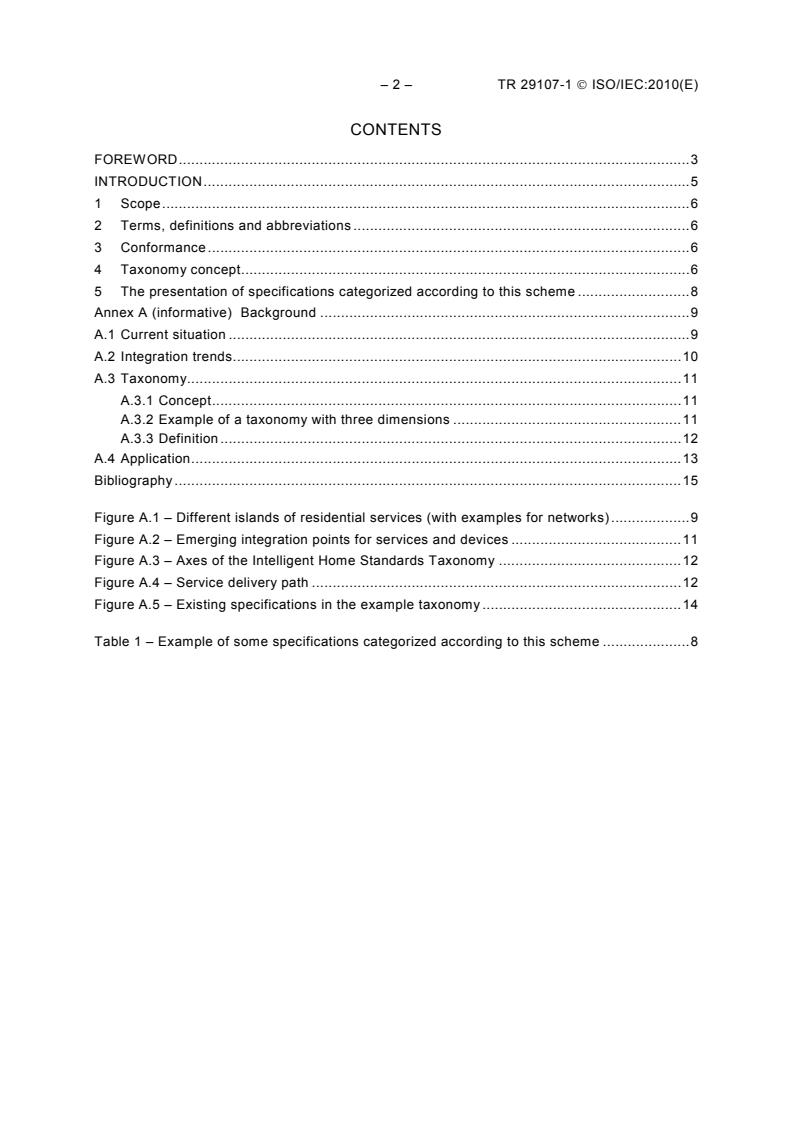
– 2 – TR 29107-1 © ISO/IEC:2010(E)
CONTENTS
FOREWORD.3
INTRODUCTION.5
1 Scope.6
2 Terms, definitions and abbreviations .6
3 Conformance.6
4 Taxonomy concept.6
5 The presentation of specifications categorized according to this scheme .8
Annex A (informative) Background .9
A.1 Current situation .9
A.2 Integration trends.10
A.3 Taxonomy.11
A.3.1 Concept.11
A.3.2 Example of a taxonomy with three dimensions .11
A.3.3 Definition.12
A.4 Application.13
Bibliography .15
Figure A.1 – Different islands of residential services (with examples for networks).9
Figure A.2 – Emerging integration points for services and devices .11
Figure A.3 – Axes of the Intelligent Home Standards Taxonomy .12
Figure A.4 – Service delivery path .12
Figure A.5 – Existing specifications in the example taxonomy .14
Table 1 – Example of some specifications categorized according to this scheme .8
TR 29107-1 © ISO/IEC:2010(E) – 3 –
INTERNATIONAL ELECTROTECHNICAL COMMISSION
_____________
INFORMATION TECHNOLOGY –
INTELLIGENT HOMES –
TAXONOMY OF SPECIFICATIONS –
Part 1: Taxonomy method
FOREWORD
1) ISO (International Organization for Standardization) and IEC (International Electrotechnical Commission) form
the specialized system for worldwide standardization. National bodies that are members of ISO or IEC
participate in the development of International Standards. Their preparation is entrusted to technical
committees; any ISO and IEC member body interested in the subject dealt with may participate in this
preparatory work. International governmental and non-governmental organizations liaising with ISO and IEC
also participate in this preparation.
2) In the field of information technology, ISO and IEC have established a joint technical committee,
ISO/IEC JTC 1. Draft International Standards adopted by the joint technical committee are circulated to
national bodies for voting. Publication as an International Standard requires approval by at least 75 % of the
national bodies casting a vote.
3) The formal decisions or agreements of IEC and ISO on technical matters express, as nearly as possible, an
international consensus of opinion on the relevant subjects since each technical committee has representation
from all interested IEC and ISO member bodies.
4) IEC, ISO and ISO/IEC publications have the form of recommendations for international use and are accepted
by IEC and ISO member bodies in that sense. While all reasonable efforts are made to ensure that the
technical content of IEC, ISO and ISO/IEC publications is accurate, IEC or ISO cannot be held responsible for
the way in which they are used or for any misinterpretation by any end user.
5) In order to promote international uniformity, IEC and ISO member bodies undertake to apply IEC, ISO and
ISO/IEC publications transparently to the maximum extent possible in their national and regional publications.
Any divergence between any ISO/IEC publication and the corresponding national or regional publication should
be clearly indicated in the latter.
6) ISO and IEC provide no marking procedure to indicate their approval and cannot be rendered responsible for
any equipment declared to be in conformity with an ISO/IEC publication.
7) All users should ensure that they have the latest edition of this publication.
8) No liability shall attach to IEC or ISO or its directors, employees, servants or agents including individual
experts and members of their technical committees and IEC or ISO member bodies for any personal injury,
property damage or other damage of any nature whatsoever, whether direct or indirect, or for costs (including
legal fees) and expenses arising out of the publication of, use of, or reliance upon, this ISO/IEC publication or
any other IEC, ISO or ISO/IEC publications.
9) Attention is drawn to the normative references cited in this publication. Use of the referenced publications is
indispensable for the correct application of this publication.
10) Attention is drawn to the possibility that some of the elements of this International Standard may be the subject
of patent rights. ISO and IEC shall not be held responsible for identifying any or all such patent rights.
The main task of IEC and ISO technical committees is to prepare International Standards. In
exceptional circumstances, ISO/IEC JTC 1 or a subcommittee may propose the publication of a
technical report of one of the following types:
• type 1, when the required support cannot be obtained for the publication of an International
Standard, despite repeated efforts;
– 4 – TR 29107-1 © ISO/IEC:2010(E)
• type 2, when the subject is still under technical development or where, for any other
reason, there is the future but not immediate possibility of an agreement on an International
Standard;
• type 3, when the technical committee has collected data of a different kind from that which
is normally published as an International Standard, for example ‘state of the art’.
ISO/IEC 29107-1, which is a Technical Report of type 3, has been prepared by
subcommittee 25: Interconnection of information technology equipment, of ISO/IEC joint
technical committee 1: Information technology
Technical reports of types 1 and 2 are subject to review within three years of publication to
decide whether they can be transformed into International Standards. Technical reports of
type 3 do not necessarily have to be reviewed until the data they provide are considered to be
no longer valid or useful.
This Technical Report of type 3 has been approved by vote of the member bodies, and the
voting results may be obtained from the address given on the second title page.
A list of all parts of the ISO/IEC 29107 series, under the general title Information technology –
Intelligent homes – Taxonomy of specifications, can be found on the IEC website.
This publication has been drafted in accordance with the ISO/IEC Directives, Part 2.
IMPORTANT – The 'colour inside' logo on the cover page of this publication indicates
that it contains colours which are considered to be useful for the correct understanding
of its contents. Users should therefore print this document using a colour printer.
TR 29107-1 © ISO/IEC:2010(E) – 5 –
INTRODUCTION
ISO/IEC 29107 describes a taxonomy for the classification of standards and other
specifications applicable to intelligent homes. It consist of two parts.
Part 1: Taxonomy method.
Part 2: Table of specifications.
– 6 – TR 29107-1 © ISO/IEC:2010(E)
INFORMATION TECHNOLOGY –
INTELLIGENT HOMES –
TAXONOMY OF SPECIFICATIONS –
Part 1: Taxonomy method
1 Scope
This part of ISO/IEC 29107 specifies the concept for a taxonomy of standards and other
related specifications applicable to intelligent homes. It is intended for the classification of
specifications from ISO, IEC, ISO/IEC JTC 1, ITU and from organizations with liaison status
with any of these.
The target of this part of ISO/IEC 29107 are the various standardisation bodies that are
contributing to the intelligent home. With the help of the concept described in this report they
should be able to classify their specifications. This will benefit the standardisation bodies to
determine if there are overlapping specifications or areas for which specifications are missing.
NOTE The collection of all classifications, is intended to be specified in ISO/IEC TR 29107-2. .
2 Terms, definitions and abbreviations
For the purposes of this document, the following terms and definitions apply.
2.1
intelligent home
home in which the integration of services and interworking of devices improve the residents’
comfort, well-being, safety and communication possibilities
NOTE 1 The focus of the integration is on a unified user access to services and devices and the interworking
capabilities between different application areas.
NOTE 2 Example application areas are home security, home entertainment, home automation, health care,
telecommunication, energy management and personalized information (as traffic, weather,.).
3 Conformance
This Technical Report has no conformance requirements.
4 Taxonomy concept
The background for the need for a taxonomy for specifications applicable to intelligent homes
are described in Annex A. It also contains some other alternative taxonomy methods.
The concept of taxonomy in this Technical Report is a multidimensional scheme that allows a
predefined set of categories for each dimension. For each dimension, there may be zero, one
or several categories that the specification under study matches. The number of dimensions is
in principle unlimited, but this Technical Report has limited it to seven that are expected to
cover the need for all relevant specifications.
___________
The table of specifications will be held by ISO/IEC JTC 1/SC 25.
TR 29107-1 © ISO/IEC:2010(E) – 7 –
The intention is that the standardisation body that has completed a specification, or is in the
progress of making one, can see and fill in those boxes in a table of the seven dimensions that
the document matches.
Dimension A: What view is the specification addressing? Or in other words, who is the target
of the specification. The specification can be the view from
a) the user/owner/resident of the intelligent home,
b) the manufacturer of intelligent home devices,
c) providers of intelligent home services,
d) the designer and integrator of intelligent home systems,
e) the installer of intelligent home systems,
f) other.
Dimension B: Which cluster(s), or application area(s) is the specification addressing?
a) home automation,
b) home security,
c) home appliances,
d) health care,
e) PC and peripherals,
f) entertainment,
g) telecommunications,
h) other.
Dimension C: Which point of control is the specification addressing?
a) PC,
b) TV,
c) mobile phone,
d) PDA (Personal Digital Assistant),
e) fixed display,
f) specific home control device,
g) other.
Dimension D: Which type of content is the specification addressing?
a) architecture,
b) service definitions and protocols,
c) equipment,
d) modules,
e) interoperability,
f) OSI layer 1,
g) OSI layer 2,
h) OSI layer 3,
i) OSI layer 4,
j) OSI layer 5,
k) OSI layer 6,
l) OSI layer 7,
– 8 – TR 29107-1 © ISO/IEC:2010(E)
m) user interfaces,
n) test,
o) guidelines,
p) other.
Dimension E: Which part(s) of the service delivery path (from service to a device) is the
specification addressing?
a) services protocol,
b) service integration point,
c) management protocol,
d) home integration point,
e) eco system,
f) device access protocol,
g) device networks,
h) other.
Dimension F: What is the geographical target of the specification?
a) worldwide,
b) regional,
c) national.
Dimension G: What is the status of the specification?
a) international standard,
b) international standard in progress,
c) regional standard,
d) regional standard in progress,
e) national standard,
f) national standard in progress,
g) standard from other standardization bodies, consortia, forum, etc.,
h) standard in progress from other standardization bodies, consortia, forum, etc.
5 The presentation of specifications categorized according to this scheme
The presentation will be in a form of a table where the fields that the specification matches are
indicated. An example is shown in Table 1 below.
Table 1 – Example of some specifications categorized according to this scheme
Specification A1 A2 … B1 B2 … C1 … G1 . G8
Standard 1 X X
Standard 2 X X X
Standard 3 X X X
Standard 4 X X
TR 29107-1 © ISO/IEC:2010(E) – 9 –
Annex A
(informative)
Background
A.1 Current situation
Although the market for (parts of) intelligent homes is growing satisfactorily in some parts of
the world, a mass market for home systems has not developed yet. The main reason for this
difference between expectations and reality are the different directions taken by the different
market players. Suppliers forward different technologies, specifications and business models.
Until now there exist several islands of networked devices in modern residential homes (as the
clusters for telecommunication, PC/Internet, broadcasting/entertainment, home automation,
white goods, home security, energy management and health care. The different technologies
and devices of the different industries are shown as horizontal stripes in Figure A.1.
Figure A.1 – Different islands of residential services (with examples for networks)
There are two main problems arising from this situation:
Incompatible existing and established specifications in the different clusters prohibit the
integration of devices and services from competing physical network solutions in the home to
incompatible protocols for service delivery.
Interworking between different clusters may only be achieved with the extra effort and often
customer specific solutions. There exist various remote controls, at least one for each cluster.
Furthermore, cross-cluster functions as energy management, comfort functions (as scenes or
scenarios) are not possible. However, the consumer mandates unified remote controls and
cross-cluster functions.
– 10 – TR 29107-1 © ISO/IEC:2010(E)
A trend towards digitalization drives new features into devices, making it easier to implement
interworking capabilities. An example is the PC industry driving scenarios and standards for
media distribution in the home (interworking between PC and consumer electronic cluster).
However, it is not clear which specification will succeed. Existing ones (either from one or the
other cluster) or new ones?
Furthermore, different standards across regions lead to a fragmented market and to
incompatible systems.
Some parts of the industry are pushing de-facto standards. Others are pushing them into
international standardization bodies (ISO, IEC and ITU).
The long-term intent of this Technical Report is to identify and classify the various
specifications and standards for intelligent home systems.
A taxonomy for the functions of an intelligent home is the basis for common understanding of
the different parties involved. The application of the taxonomy should allow answering the
following questions in a terminology understood by all players.
• What is the scope of a specification?
• Where are specifications missing?
• Where do competing specifications occur?
• Are there regional differences in requirements?
A.2 Integration trends
In order to achieve the integration of services and devices, two integration points are emerging:
one in the backend for service integration and one in the home for device and network
integration. Figure A.2 shows the two integration points.
___________
NOTE JTC 1 (Resolution 49 of 2008) notes the nature of standardisation is to attract innovative ideas from
multiple sources, choose the best ones and quantify them in specifications that facilitate widespread use.
Further consistent with ISO’s and IEC’s “one standard” principle (for example TMB’s policy and principal
statement on global relevance), there are times when one standard is all that is required instances where
multiple standards make the most sense to respond to market requirements and to the need of our society.
TR 29107-1 © ISO/IEC:2010(E) – 11 –
Service
Access
Services
Home Integr. Bridging Cluster Devices /
Protocol
Network
Network Network
Device Device networks
Home
H-Automation Light/Blind/HVAC
Automation HA protocol
bridge controllers
Service In-home
services
Integration Integration
Point
Point
Home Security
Home Security Security Sensors,
HS protocol
Controller
services keypads, sirens
Whitegood Whitegoods Whitegoods,
WG protocol
services bridge kitchen appliances
Health Care
Health care Health care
HC protocol
services hub sensors
PC Internet PC, printers,
PC protocol
services cameras,…
CE
Entertainment CE devices / A/V
CE protocol
services network equipment
Communication Communication Phones, video
Com protocol
services network phones
Figure A.2 – Emerging integration points for services and devices
The outlined path from the services to the devices is one possible base for classification base
in a taxonomy. See dimension 5 in the following clause.
A.3 Taxonomy
A.3.1 Concept
Basically a taxonomy is a classification of entities into larger categories, in this case
specifications for intelligent homes. Considering the many aspects of intelligent home
specifications, a multi-dimensional classification is necessary.
The following paragraphs provide several aspects or dimensions, that can be useful in the
classification of intelligent home specifications.
A.3.2 Example of a taxonomy with three dimensions
One example of a taxonomy could classify the specifications along three dimensions. The
example shown in Figure A.3 uses dimensions 2 (cluster), 5 (service path) and 6 (regions),
which provide a good visualization of overlapping specifications and white spaces. For visual
representation, a color-coded 2-D diagram is used.
The first axis uses dimension 5, the end-to-end service delivery path from a service provider to
a device in the home. The second axis denotes dimension 2, the application areas (cluster). A
Service Protocol
xDSL, Cable, IEEE 802.16, UMTS, Ethernet,…
ISO/IEC 8802.3/11
– 12 – TR 29107-1 © ISO/IEC:2010(E)
third dimension can be added to differentiate regional markets (dimension 6). For better
visualization, this dimension is color coded.
The other classifications can be used for deeper analysis, especially to find additional missing
standardization aspects.
Figure A.3 – Axes of the intelligent home standards taxonomy
Existing and upcoming standards can be placed in the space. Overlapping areas indicate
competing standards and white spaces indicate missing standardization areas.
A.3.3 Definition
The main axis is derived from the end-to-end service delivery path along the communication
from a residential service to a device in the home. See Figure A.4.
Figure A.4 – Service delivery path
The definition of the service delivery path follows the concept of two integration points: one at a
service provider’s backend (integrated multiple services) and one integration platform in the
home (integrating different devices and networks).
Residential service: an implementation of a value-added service. Can be purely network-based
(e.g. information service), or used in combination with in-home devices. Services can be
accessed by the service protocol. Example of a residential service is an alarm verification
service for home security systems.
Services protocol: the protocol(s) to access services.
TR 29107-1 © ISO/IEC:2010(E) – 13 –
Service integration point: realizes common functions for services as billing, logging, service
subscription, service deployment, remote access and common user interface.
Access network: network for homes to access the internet (as xDSL, Cable, GSM, WiMax,…)
Key aspects in the intelligent home of the access networks are the protocols on top of the
standard IP connectivity to access the home, the devices and from the home the services.
Therefore the taxonomy uses Home Access Protocol as the main aspect of this point in the
service delivery chain.
Home Access Protocol: protocol between the service integration point and the in-home
integration point. Defines secure remote access, remote management and local service
provisioning.
In-home integration point: integrating home devices and networks, running local service
implementations (examples are schedulers, comfort scenes,…)
In-home backbone network: the in-home network for internet access is driven by PC networks
as Ethernet and WLAN. These are the typical interfaces of internet access devices (as router,
DSL- or cable modems). Other networks can be attached by sub-network bridges (as
powerline, other radio networks, twisted pair cabling). The sub-networks typically do not
support IP technology.
Also here the main aspect is on the protocol to access a certain device (the Device Access
Protocol)
Device Access Protocol: Protocols for device functionality (start, stop, program,…)
Another set of standards define the use of the Device Access Protocols to form an eco-system
between different device categories (e.g. between PC and consumer electronics).
Eco system: standards for device to device applications (e.g. specific scenarios as music
streaming from PC to a TV)
Device network: physical protocol for device connectivity (wire, wireless). This is the category
where the greatest diversity of standards exists. Diversity is high (each cluster has different
standards), also the overlap is high (competing standards in different regions and by different
vendors).
A.4 Application
Figure A.5 shows the application of the example taxonomy with a selection of intelligent home
specifications.
Potential key standards (crossing multiple clusters) can be easily identified, but also missing
specification areas (as health care and home security).
ISO/IEC 14908
ISO/IEC 14543
IEC xxxx
ISO/IEC 14543
– 14 – TR 29107-1 © ISO/IEC:2010(E)
Services
Protocol
Web Services, OASIS, W3C
Service Integration
Point
Home Access
TR-069, HGI
Protocol
Home Integration
OSGi
Point
DLNA
Eco System
ISO/IEC 14543-5
ISO/IEC 14543-5
Device Access
ISO/IEC 29341
ISO/IEC 29341
Protocol
DVB
DECT
Device networks
ISO/IEC 8802.x
Ultra Wide Band
1)
Communi-
World Health Home Home
EC. Home
PC Entertainment
cation
Care Appliances Security
Automation
ApplicationArea/ Cluster
Figure A.5 – Existing specifications in the example taxonomy
End-to-End Path
TR 29107-1 © ISO/IEC:2010(E) – 15 –
Bibliography
IEC 62216, Digital terrestrial television receivers for the DVB-T system
IEC 62481-1, Digital living network alliance (DLNA) home networked device interoperability
guidelines – Part 1: Architecture and protocols
IEC 62481-2, Digital living network alliance (DLNA) home networked device interoperability
guidelines – Part 2: DLNA media formats
IEC xxxx, Guidelines for networked home appliances (proposed new work)
ISO/IEC 8802-1, Information technology – Telecommunications and information exchange
between systems – Local and metropolitan area networks – Specific requirements – Part 1:
Overview of Local Area Network Standards
ISO/IEC 8802-2, Information technology – Telecommunications and information exchange
between systems – Local and metropolitan area networks – Specific requirements – Part 2:
Logical link control
ISO/IEC 8802-3, Information technology – Telecommunications and information exchange
between systems – Local and metropolitan area networks – Specific requirements – Part 3:
Carrier sense multiple access with collision detection (CSMA/CD) access method and physical
layer specifications
ISO/IEC 8802-5, Information technology – Telecommunications and information exchange
between systems – Local and metropolitan area networks – Specific requirements – Part 5:
Token ring access method and physical layer specifications
ISO/IEC 8802-11, Information technology – Telecommunications and information exchange
between systems – Local and metropolitan area networks – Specific requirements – Part 11:
Wireless LAN Medium Access Control (MAC) and Physical Layer (PHY) specifications
ISO/IEC 14543-2-1:2006, Information technology – Home electronic system (HES) architecture
– Part 2-1: Introduction and device modularity
ISO/IEC 14543-3-1:2006, Information technology – Home electronic system (HES) architecture
– Part 3-1: Communication layers – Application layer for network based control of HES Class 1
ISO/IEC 14543-3-2:2006, Information technology – Home Electronic System (HES)
Architecture – Part 3-2: Communication layers – Transport, network and general parts of data
link layer for network based control of HES Class 1
ISO/IEC 14543-3-3:2007, Information technology – Home electronic system (HES) architecture
– Part 3-3: User process for network based control of HES Class 1
ISO/IEC 14543-3-4:2007, Information technology – Home electronic system (HES)
architecture – Part 3-4: System management – Management procedures for network based
control of HES Class 1
ISO/IEC 14543-3-5:2007, Information technology – Home electronic system (HES) architecture
– Part 3-5: Media and media dependent layers – Power line for network based control of HES
Class 1
– 16 – TR 29107-1 © ISO/IEC:2010(E)
ISO/IEC 14543-3-6:2007, Information technology – Home electronic system (HES)
architecture – Part 3-6: Media and media dependent layers – Twisted pair for network based
control of HES Class 1
ISO/IEC 14543-3-7:2007, Information technology – Home electronic system (HES)
architecture – Part 3-7: Media and media dependent layers – Radio frequency for network
based control of HES Class 1
ISO/IEC TR 14543-4:2002, Information technology – Home electronic system (HES)
architecture – Part 4: Home and building automation in a mixed-use building
ISO/IEC 14543-4-1:2008, Information technology – Home electronic system (HES)
architecture – Part 4-1: Communication layers – Application layer for network enhanced control
devices of HES Class 1
ISO/IEC 14543-4-2:2008, Information technology – Home electronic system (HES)
architecture – Part 4-2: Communication layers – Transport, network and general parts of data
link layer for network enhanced control devices of HES Class 1
ISO/IEC 14543-5-1, Information technology – Home electronic system (HES) architecture –
Part 5-1: Intelligent grouping and resource sharing for Class 2 and Class 3 – Core protocol
(under consideration)
ISO/IEC 14543-5-3, Information technology – Home electronic system (HES) architecture –
Part 5-3: Intelligent grouping and resource sharing for HES Class 2 and Class 3 – Basic
Application (under consideration)
ISO/IEC 14543-5-4, Information technology – Home electronic system (HES) architecture –
Part 5-4: Intelligent grouping and resource sharing for HES Class 2 and Class 3 – Device
validation (under consideration)
ISO/IEC 14543-5-5, Information technology – Home electronic system (HES) architecture –
Part 5-5: Intelligent grouping and resource sharing for HES Class 2 and Class 3 – Device type
(under consideration)
ISO/IEC 14543-5-6, Information technology – Home electronic system (HES) architecture –
Part 5-6: Intelligent grouping and resource sharing for HES Class 2 and Class 3 – Service type
(under consideration)
ISO/IEC 14543-5-21, Information technology – Home electronic system (HES) architecture –
Part 5-21: Intelligent grouping and resource sharing for HES Class 2 and Class 3 – Application
Profile – AV Profile (under consideration)
ISO/IEC 14543-5-22, Information technology – Home electronic system (HES) architecture –
Part 5-22: Intelligent grouping and resource sharing for HES Class 2 and Class 3 – Application
profile – File profile (under consideration)
ISO/IEC 14908-1, Open data communication in building automation, controls and building
management – Control network protocol – Part 1: Protocol stack (in preparation)
ISO/IEC 14908-2, Open data communication in building automation, controls and building
management – Control network protocol – Part 2: Twisted pair communication (in preparation)
ISO/IEC 14908-3, Open data communication in building automation, controls and building
management – Control network protocol – Part 3: Power line channel (in preparation)
TR 29107-1 © ISO/IEC:2010(E) – 17 –
ISO/IEC 14908-4, Open data communication in building automation, controls and building
management – Control network protocol – Part 4: IP communication (in preparation)
ISO/IEC 29341-1:2008, Information technology – UPnP Device Architecture – Part 1: UPnP
Device Architecture Version 1.0
ISO/IEC 29341-2:2008, Information technology – UPnP Device Architecture – Part 2: Basic
Device Control Protocol – Basic Device
ISO/IEC 29341-3-1:2008, Information technology – UPnP Device Architecture – Part 3-1: Audio
Video Device Control Protocol – Audio Video Architecture
ISO/IEC 29341-3-2:2008, Information technology – UPnP Device Architecture – Part 3-2: Audio
Video Device Control Protocol – Media Renderer Device
ISO/IEC 29341-3-3:2008, Information technology – UPnP Device Architecture – Part 3-3: Audio
Video Device Control Protocol – Media Server Device
ISO/IEC 29341-3-10:2008, Information technology – UPnP Device Architecture – Part 3-10:
Audio Video Device Control Protocol – Audio Video Transport Service
ISO/IEC 29341-3-11:2008, Information technology – UPnP Device Architecture – Part 3-11:
Audio Video Device Control Protocol – Connection Manager Service
ISO/IEC 29341-3-12:2008, Information technology – UPnP Device Architecture – Part 3-12:
Audio Video Device Control Protocol – Content Directory Service
ISO/IEC 29341-3-13:2008, Information technology – UPnP Device Architecture – Part 3-13:
Audio Video Device Control Protocol – Rendering Control Service
ISO/IEC 29341-4-2:2008, Information technology – UPnP Device Architecture – Part 4-2: Audio
Video Device Control Protocol – Level 2 – Media Renderer Device
ISO/IEC 29341-4-3:2008, Information technology – UPnP Device Architecture – Part 4-3: Audio
Video Device Control Protocol – Level 2 – Media Server Device
ISO/IEC 29341-4-4:2008, Information technology – UPnP Device Architecture – Part 4-4: Audio
Video Device Control Protocol – Level 2 – Audio Video Data Structures
ISO/IEC 29341-4-10:2008, Information technology – UPnP Device Architecture – Part 4-10:
Audio Video Device Control Protocol – Level 2 – Audio Video Transport Service
ISO/IEC 29341-4-11:2008, Information technology – UPnP Device Architecture – Part 4-11:
Audio Video Device Control Protocol – Level 2 – Connection Manager Service
ISO/IEC 29341-4-12:2008, Information technology – UPnP Device Architecture – Part 4-12:
Audio Video Device Control Protocol – Level 2 – Content Directory Service
ISO/IEC 29341-4-13:2008, Information technology – UPnP Device Architecture – Part 4-13:
Audio Video Device Control Protocol – Level 2 – Rendering Control Service
ISO/IEC 29341-4-14:2008, Information technology – UPnP Device Architecture – Part 4-14:
Audio Video Device Control Protocol – Level 2 – Scheduled Recording Service
ISO/IEC 29341-5-1:2008, Information technology – UPnP Device Architecture – Part 5-1:
Digital Security Camera Device Control Protocol – Digital Security Camera Device
– 18 – TR 29107-1 © ISO/IEC:2010(E)
ISO/IEC 29341-5-10:2008, Information technology – UPnP Device Architecture – Part 5-10:
Digital Security Camera Device Control Protocol – Digital Security Camera Motion Image
Service
ISO/IEC 29341-5-11:2008, Information technology – UPnP Device Architecture – Part 5-11:
Digital Security Camera Device Control Protocol – Digital Security Camera Settings Service
ISO/IEC 29341-5-12:2008, Information technology – UPnP Device Architecture – Part 5-12:
Digital Security Camera Device Control Protocol – Digital Security Camera Still Image Service
ISO/IEC 29341-6-1:2008, Information technology – UPnP Device Architecture – Part 6-1:
Heating, Ventilation, and Air Conditioning Device Control Protocol – System Device
ISO/IEC 29341-6-2:2008, Information technology – UPnP Device Architecture – Part 6-2:
Heating, Ventilation, and Air Conditioning Device Control Protocol – Zone Thermostat Device
ISO/IEC 29341-6-10:2008, Information technology – UPnP Device Architecture – Part 6-10:
Heating, Ventilation and Air Conditioning Device Control Protocol – Control Valve Service
ISO/IEC 29341-6-11:2008, Information technology – UPnP Device Architecture – Part 6-11:
Heating, Ventilation and Air Conditioning Device Control Protocol – Fan Operating Mode
Service
ISO/IEC 29341-6-12:2008, Information technology – UPnP Device Architecture – Part 6-12:
Heating, Ventilation and Air Conditioning Device Control Protocol – Fan Speed Service
ISO/IEC 29341-6-13:2008, Information technology – UPnP Device Architecture – Part 6-13:
Heating, Ventilation and Air Conditioning Device Control Protocol – House Status Service
ISO/IEC 29341-6-14:2008, Information technology – UPnP Device Architecture – Part 6-14:
Heating, Ventilation and Air Conditioning Device Control Protocol – Setpoint Schedule Service
ISO/IEC 29341-6-15:2008, Information technology – UPnP Device Architecture – Part 6-15:
Heating, Ventilation and Air Conditioning Device Control Protocol – Temperature Sensor
Service
ISO/IEC 29341-6-16:2008, Information technology – UPnP Device Architecture – Part 6-16:
Heating, Ventilation and Air Conditioning Device Control Protocol – Temperature Setpoint
Service
ISO/IEC 29341-6-17:2008, Information technology – UPnP Device Architecture – Part 6-17:
Heating, Ventilation and Air Conditioning Device Control Protocol – User Operating Mode
Service
ISO/IEC 29341-7-1:2008, Information technology – UPnP Device Architecture – Part 7-1:
Lighting Device Control Protocol – Binary Light Device
ISO/IEC 29341-7-2:2008, Information technology – UPnP Device Architecture – Part 7-2:
Lighting Device Control Protocol – Dimmable Light Device
ISO/IEC 29341-7-10:2008, Information technology – UPnP Device Architecture – Part 7-10:
Lighting Device Control Protocol – Dimming Service
ISO/IEC 29341-7-11:2008, Information technology – UPnP Device Architecture – Part 7-11:
Lighting Device Control Protocol – Switch Power Service
TR 29107-1 © ISO/IEC:2010(E) – 19 –
ISO/IEC 29341-8-1:2008, Information technology – UPnP Device Architecture – Part 8-1:
Internet Gateway Device Control Protocol – Internet Gateway Device
ISO/IEC 29341-8-2:2008, Information technology – UPnP Device Architecture – Part 8-2:
Internet Gateway Device Control Protocol – Local Area Network Device
ISO/IEC 29341-8-3:2008, Information technology – UPnP Device Architecture – Part 8-3:
Internet Gateway Device Control Protocol – Wide Area Network Device
ISO/IEC 29341-8-4:2008, Information technology – UPnP Device Architecture – Part 8-4:
Internet Gateway Device Control Protocol – Wide Area Network Connection Device
ISO/IEC 29341-8-5:2008, Information technology – UPnP Device Architecture – Part 8-5:
Internet Gateway Device Control Protocol – Wireless Local Area Network Access Point Device
ISO/IEC 29341-8-10:2008, Information technology – UPnP Device Architecture – Part 8-10:
Internet Gateway Device Control Protocol – Local Area Network Host Configuration
Management Service
ISO/IEC 29341-8-11:2008, Information technology – UPnP Device Architecture – Part 8-11:
Internet Gateway Device Control Protocol – Layer 3 Forwarding Service
ISO/IEC 29341-8-12:2008, Information technology – UPnP Device Architecture – Part 8-12:
Internet Gateway Device Control Protocol – Link Authentication Service
ISO/IEC 29341-8-13:2008, Information technology – UPnP Device Architecture – Part 8-13:
Internet Gateway Device Control Protocol – Radius Client Service
ISO/IEC 29341-8-14:2008, Information technology – UPnP Device Architecture – Part 8-14:
Internet Gateway Device Control Protocol – Wide Area Network Cable Link Configuration
Service
ISO/IEC 29341-8-15:2008, Information technology – UPnP Device Architecture – Part 8-15:
Internet Gateway Device Control Protocol – Wide Area Network Common Interface
Configuration Service
ISO/IEC 29341-8-16:2008, Information technology – UPnP Device Architecture – Part 8-16:
Internet Gateway Device Control Protocol – Wide Area Network Digital Subscriber Line
Configuration Service
ISO/IEC 29341-8-17:2008, Information technology – UPnP Device Architecture – Part 8-17:
Internet Gateway Device Control Protocol – Wide Area Network Ethernet Link Configuration
Service
ISO/IEC 29341-8-18:2008, Information technology – UPnP Device Architecture – Part 8-18:
Internet Gateway Device Control Protocol – Wide Area Network Internet Protocol Connection
Service
ISO/IEC 29341-8-19:2008, Information technology – UPnP Device Architecture – Part 8-19:
Internet Gateway Device Control Protocol – Wide Area Network Plain Old Telephone Service
Link Configuration Service
ISO/IEC 29341-8-20:2008, Information technology – UPnP Device Architecture – Part 8-20:
Internet Gateway Device Control Protocol – Wide Area Network Point-to-Point Protocol
Connection Service
– 20 – TR 29107-1 © ISO/IEC:2010(E)
ISO/IEC 29341-8-21:2008, Information technology – UPnP Device Architecture – Part 8-21:
Internet Gateway Device Control Protocol – Wireless Local Area Network Configuration Service
ISO/IEC 29341-9-1:2008, Information technology – UPnP Device Architecture – Part 9-1:
Imaging Device Control Protocol – Printer Device
ISO/IEC 29341-9-2:2008, Information technology – UPnP Device Architecture – Part 9-2:
Imaging Device Control Protocol – Scanner Device
ISO/IEC 29341-9-10:2008, Information technology – UPnP Device Architecture – Part 9-10:
Imaging Device Control Protocol – External Activity Service
ISO/IEC 29341-9-11:2008, Information technology – UPnP Device Architecture – Part 9-11:
Imaging Device Control Protocol – Feeder Service
ISO/IEC 29341-9-12:2008, Information technology – UPnP Device Architecture – Part 9-12:
Imaging Device Control Protocol – Print Basic Service
ISO/IEC 29341-9-13:2008, Information technology – UPnP Device Architecture – Part 9-13:
Imaging Device Control Protocol – Scan Service
ISO/IEC 29341-10-1:2008, Information technology – UPnP Device Architecture – Part 10-1:
Quality of Service Device Control Protocol – Quality of Service Architecture
ISO/IEC 29341-10-10:2008, Information technology – UPnP Device Architecture – Part 10-10:
Quality of Service Device Control Protocol – Quality of Service Device Service
ISO/IEC 29341-10-11:2008, Information technology – UPnP Device Architecture – Part 10-11:
Quality of Service Device Control Protocol - Quality of Service Manager Service
ISO/IEC 29341-10-12:2008, Information technology – UPnP Device Architecture – Part 10-12:
Quality of Service Device Control Protocol – Quality of Service Policy Holder Service
ISO/IEC 29341-11-1:2008, Information technology – UPnP Device Architecture – Part 11-1:
Quality of Service Device Control Protocol – Level 2 – Quality of Service Architecture
ISO/IEC 29341-11-2:2008, Information technology – UPnP Device Architecture – Part 11-2:
Quality of Service Device Control Protocol – Level 2 – Quality of Service Schemas
ISO/IEC 29341-11-10:2008, Information technology – UPnP Device Architecture – Part 11-10:
Quality of Service Device Control Protocol – Level 2 – Quality of Service Device Service
ISO/IEC 29341-11-11:2008, Information technology – UPnP Device Architecture – Part 11-11:
Quality of Service Device Control Protocol – Level 2 – Quality of Service Manager Service
ISO/IEC 29341-11-12:2008, Information technology – UPnP Device Architecture – Part 11-12:
Quality of Service Device Control Protocol – Level 2 – Quality of Service Policy Holder Service
ISO/IEC 29341-12-1:2008, Information technology – UPnP Device Architecture – Part 12-1:
Remote User Interface D
...
ISO/IEC TR 29107-1
Edition 1.0 2010-03
TECHNICAL
REPORT
colour
inside
Information technology – Intelligent homes – Taxonomy of specifications –
Part 1: Taxonomy method
All rights reserved. Unless otherwise specified, no part of this publication may be reproduced or utilized in any form
or by any means, electronic or mechanical, including photocopying and microfilm, without permission in writing from
either IEC or IEC's member National Committee in the country of the requester.
If you have any questions about ISO/IEC copyright or have an enquiry about obtaining additional rights to this
publication, please contact the address below or your local IEC member National Committee for further information.
IEC Central Office
3, rue de Varembé
CH-1211 Geneva 20
Switzerland
Email: inmail@iec.ch
Web: www.iec.ch
About the IEC
The International Electrotechnical Commission (IEC) is the leading global organization that prepares and publishes
International Standards for all electrical, electronic and related technologies.
About IEC publications
The technical content of IEC publications is kept under constant review by the IEC. Please make sure that you have the
latest edition, a corrigenda or an amendment might have been published.
ƒ Catalogue of IEC publications: www.iec.ch/searchpub
The IEC on-line Catalogue enables you to search by a variety of criteria (reference number, text, technical committee,…).
It also gives information on projects, withdrawn and replaced publications.
ƒ IEC Just Published: www.iec.ch/online_news/justpub
Stay up to date on all new IEC publications. Just Published details twice a month all new publications released. Available
on-line and also by email.
ƒ Electropedia: www.electropedia.org
The world's leading online dictionary of electronic and electrical terms containing more than 20 000 terms and definitions
in English and French, with equivalent terms in additional languages. Also known as the International Electrotechnical
Vocabulary online.
ƒ Customer Service Centre: www.iec.ch/webstore/custserv
If you wish to give us your feedback on this publication or need further assistance, please visit the Customer Service
Centre FAQ or contact us:
Email: csc@iec.ch
Tel.: +41 22 919 02 11
Fax: +41 22 919 03 00
ISO/IEC TR 29107-1
Edition 1.0 2010-03
TECHNICAL
REPORT
colour
inside
Information technology – Intelligent homes – Taxonomy of specifications –
Part 1: Taxonomy method
INTERNATIONAL
ELECTROTECHNICAL
COMMISSION
PRICE CODE
P
ICS 35.200 ISBN 978-2-88910-839-8
– 2 – TR 29107-1 © ISO/IEC:2010(E)
CONTENTS
FOREWORD.3
INTRODUCTION.5
1 Scope.6
2 Terms, definitions and abbreviations .6
3 Conformance.6
4 Taxonomy concept.6
5 The presentation of specifications categorized according to this scheme .8
Annex A (informative) Background .9
A.1 Current situation .9
A.2 Integration trends.10
A.3 Taxonomy.11
A.3.1 Concept.11
A.3.2 Example of a taxonomy with three dimensions .11
A.3.3 Definition.12
A.4 Application.13
Bibliography .15
Figure A.1 – Different islands of residential services (with examples for networks).9
Figure A.2 – Emerging integration points for services and devices .11
Figure A.3 – Axes of the Intelligent Home Standards Taxonomy .12
Figure A.4 – Service delivery path .12
Figure A.5 – Existing specifications in the example taxonomy .14
Table 1 – Example of some specifications categorized according to this scheme .8
TR 29107-1 © ISO/IEC:2010(E) – 3 –
INTERNATIONAL ELECTROTECHNICAL COMMISSION
_____________
INFORMATION TECHNOLOGY –
INTELLIGENT HOMES –
TAXONOMY OF SPECIFICATIONS –
Part 1: Taxonomy method
FOREWORD
1) ISO (International Organization for Standardization) and IEC (International Electrotechnical Commission) form
the specialized system for worldwide standardization. National bodies that are members of ISO or IEC
participate in the development of International Standards. Their preparation is entrusted to technical
committees; any ISO and IEC member body interested in the subject dealt with may participate in this
preparatory work. International governmental and non-governmental organizations liaising with ISO and IEC
also participate in this preparation.
2) In the field of information technology, ISO and IEC have established a joint technical committee,
ISO/IEC JTC 1. Draft International Standards adopted by the joint technical committee are circulated to
national bodies for voting. Publication as an International Standard requires approval by at least 75 % of the
national bodies casting a vote.
3) The formal decisions or agreements of IEC and ISO on technical matters express, as nearly as possible, an
international consensus of opinion on the relevant subjects since each technical committee has representation
from all interested IEC and ISO member bodies.
4) IEC, ISO and ISO/IEC publications have the form of recommendations for international use and are accepted
by IEC and ISO member bodies in that sense. While all reasonable efforts are made to ensure that the
technical content of IEC, ISO and ISO/IEC publications is accurate, IEC or ISO cannot be held responsible for
the way in which they are used or for any misinterpretation by any end user.
5) In order to promote international uniformity, IEC and ISO member bodies undertake to apply IEC, ISO and
ISO/IEC publications transparently to the maximum extent possible in their national and regional publications.
Any divergence between any ISO/IEC publication and the corresponding national or regional publication should
be clearly indicated in the latter.
6) ISO and IEC provide no marking procedure to indicate their approval and cannot be rendered responsible for
any equipment declared to be in conformity with an ISO/IEC publication.
7) All users should ensure that they have the latest edition of this publication.
8) No liability shall attach to IEC or ISO or its directors, employees, servants or agents including individual
experts and members of their technical committees and IEC or ISO member bodies for any personal injury,
property damage or other damage of any nature whatsoever, whether direct or indirect, or for costs (including
legal fees) and expenses arising out of the publication of, use of, or reliance upon, this ISO/IEC publication or
any other IEC, ISO or ISO/IEC publications.
9) Attention is drawn to the normative references cited in this publication. Use of the referenced publications is
indispensable for the correct application of this publication.
10) Attention is drawn to the possibility that some of the elements of this International Standard may be the subject
of patent rights. ISO and IEC shall not be held responsible for identifying any or all such patent rights.
The main task of IEC and ISO technical committees is to prepare International Standards. In
exceptional circumstances, ISO/IEC JTC 1 or a subcommittee may propose the publication of a
technical report of one of the following types:
• type 1, when the required support cannot be obtained for the publication of an International
Standard, despite repeated efforts;
– 4 – TR 29107-1 © ISO/IEC:2010(E)
• type 2, when the subject is still under technical development or where, for any other
reason, there is the future but not immediate possibility of an agreement on an International
Standard;
• type 3, when the technical committee has collected data of a different kind from that which
is normally published as an International Standard, for example ‘state of the art’.
ISO/IEC 29107-1, which is a Technical Report of type 3, has been prepared by
subcommittee 25: Interconnection of information technology equipment, of ISO/IEC joint
technical committee 1: Information technology
Technical reports of types 1 and 2 are subject to review within three years of publication to
decide whether they can be transformed into International Standards. Technical reports of
type 3 do not necessarily have to be reviewed until the data they provide are considered to be
no longer valid or useful.
This Technical Report of type 3 has been approved by vote of the member bodies, and the
voting results may be obtained from the address given on the second title page.
A list of all parts of the ISO/IEC 29107 series, under the general title Information technology –
Intelligent homes – Taxonomy of specifications, can be found on the IEC website.
This publication has been drafted in accordance with the ISO/IEC Directives, Part 2.
IMPORTANT – The 'colour inside' logo on the cover page of this publication indicates
that it contains colours which are considered to be useful for the correct understanding
of its contents. Users should therefore print this document using a colour printer.
TR 29107-1 © ISO/IEC:2010(E) – 5 –
INTRODUCTION
ISO/IEC 29107 describes a taxonomy for the classification of standards and other
specifications applicable to intelligent homes. It consist of two parts.
Part 1: Taxonomy method.
Part 2: Table of specifications.
– 6 – TR 29107-1 © ISO/IEC:2010(E)
INFORMATION TECHNOLOGY –
INTELLIGENT HOMES –
TAXONOMY OF SPECIFICATIONS –
Part 1: Taxonomy method
1 Scope
This part of ISO/IEC 29107 specifies the concept for a taxonomy of standards and other
related specifications applicable to intelligent homes. It is intended for the classification of
specifications from ISO, IEC, ISO/IEC JTC 1, ITU and from organizations with liaison status
with any of these.
The target of this part of ISO/IEC 29107 are the various standardisation bodies that are
contributing to the intelligent home. With the help of the concept described in this report they
should be able to classify their specifications. This will benefit the standardisation bodies to
determine if there are overlapping specifications or areas for which specifications are missing.
NOTE The collection of all classifications, is intended to be specified in ISO/IEC TR 29107-2. .
2 Terms, definitions and abbreviations
For the purposes of this document, the following terms and definitions apply.
2.1
intelligent home
home in which the integration of services and interworking of devices improve the residents’
comfort, well-being, safety and communication possibilities
NOTE 1 The focus of the integration is on a unified user access to services and devices and the interworking
capabilities between different application areas.
NOTE 2 Example application areas are home security, home entertainment, home automation, health care,
telecommunication, energy management and personalized information (as traffic, weather,.).
3 Conformance
This Technical Report has no conformance requirements.
4 Taxonomy concept
The background for the need for a taxonomy for specifications applicable to intelligent homes
are described in Annex A. It also contains some other alternative taxonomy methods.
The concept of taxonomy in this Technical Report is a multidimensional scheme that allows a
predefined set of categories for each dimension. For each dimension, there may be zero, one
or several categories that the specification under study matches. The number of dimensions is
in principle unlimited, but this Technical Report has limited it to seven that are expected to
cover the need for all relevant specifications.
___________
The table of specifications will be held by ISO/IEC JTC 1/SC 25.
TR 29107-1 © ISO/IEC:2010(E) – 7 –
The intention is that the standardisation body that has completed a specification, or is in the
progress of making one, can see and fill in those boxes in a table of the seven dimensions that
the document matches.
Dimension A: What view is the specification addressing? Or in other words, who is the target
of the specification. The specification can be the view from
a) the user/owner/resident of the intelligent home,
b) the manufacturer of intelligent home devices,
c) providers of intelligent home services,
d) the designer and integrator of intelligent home systems,
e) the installer of intelligent home systems,
f) other.
Dimension B: Which cluster(s), or application area(s) is the specification addressing?
a) home automation,
b) home security,
c) home appliances,
d) health care,
e) PC and peripherals,
f) entertainment,
g) telecommunications,
h) other.
Dimension C: Which point of control is the specification addressing?
a) PC,
b) TV,
c) mobile phone,
d) PDA (Personal Digital Assistant),
e) fixed display,
f) specific home control device,
g) other.
Dimension D: Which type of content is the specification addressing?
a) architecture,
b) service definitions and protocols,
c) equipment,
d) modules,
e) interoperability,
f) OSI layer 1,
g) OSI layer 2,
h) OSI layer 3,
i) OSI layer 4,
j) OSI layer 5,
k) OSI layer 6,
l) OSI layer 7,
– 8 – TR 29107-1 © ISO/IEC:2010(E)
m) user interfaces,
n) test,
o) guidelines,
p) other.
Dimension E: Which part(s) of the service delivery path (from service to a device) is the
specification addressing?
a) services protocol,
b) service integration point,
c) management protocol,
d) home integration point,
e) eco system,
f) device access protocol,
g) device networks,
h) other.
Dimension F: What is the geographical target of the specification?
a) worldwide,
b) regional,
c) national.
Dimension G: What is the status of the specification?
a) international standard,
b) international standard in progress,
c) regional standard,
d) regional standard in progress,
e) national standard,
f) national standard in progress,
g) standard from other standardization bodies, consortia, forum, etc.,
h) standard in progress from other standardization bodies, consortia, forum, etc.
5 The presentation of specifications categorized according to this scheme
The presentation will be in a form of a table where the fields that the specification matches are
indicated. An example is shown in Table 1 below.
Table 1 – Example of some specifications categorized according to this scheme
Specification A1 A2 … B1 B2 … C1 … G1 . G8
Standard 1 X X
Standard 2 X X X
Standard 3 X X X
Standard 4 X X
TR 29107-1 © ISO/IEC:2010(E) – 9 –
Annex A
(informative)
Background
A.1 Current situation
Although the market for (parts of) intelligent homes is growing satisfactorily in some parts of
the world, a mass market for home systems has not developed yet. The main reason for this
difference between expectations and reality are the different directions taken by the different
market players. Suppliers forward different technologies, specifications and business models.
Until now there exist several islands of networked devices in modern residential homes (as the
clusters for telecommunication, PC/Internet, broadcasting/entertainment, home automation,
white goods, home security, energy management and health care. The different technologies
and devices of the different industries are shown as horizontal stripes in Figure A.1.
Figure A.1 – Different islands of residential services (with examples for networks)
There are two main problems arising from this situation:
Incompatible existing and established specifications in the different clusters prohibit the
integration of devices and services from competing physical network solutions in the home to
incompatible protocols for service delivery.
Interworking between different clusters may only be achieved with the extra effort and often
customer specific solutions. There exist various remote controls, at least one for each cluster.
Furthermore, cross-cluster functions as energy management, comfort functions (as scenes or
scenarios) are not possible. However, the consumer mandates unified remote controls and
cross-cluster functions.
– 10 – TR 29107-1 © ISO/IEC:2010(E)
A trend towards digitalization drives new features into devices, making it easier to implement
interworking capabilities. An example is the PC industry driving scenarios and standards for
media distribution in the home (interworking between PC and consumer electronic cluster).
However, it is not clear which specification will succeed. Existing ones (either from one or the
other cluster) or new ones?
Furthermore, different standards across regions lead to a fragmented market and to
incompatible systems.
Some parts of the industry are pushing de-facto standards. Others are pushing them into
international standardization bodies (ISO, IEC and ITU).
The long-term intent of this Technical Report is to identify and classify the various
specifications and standards for intelligent home systems.
A taxonomy for the functions of an intelligent home is the basis for common understanding of
the different parties involved. The application of the taxonomy should allow answering the
following questions in a terminology understood by all players.
• What is the scope of a specification?
• Where are specifications missing?
• Where do competing specifications occur?
• Are there regional differences in requirements?
A.2 Integration trends
In order to achieve the integration of services and devices, two integration points are emerging:
one in the backend for service integration and one in the home for device and network
integration. Figure A.2 shows the two integration points.
___________
NOTE JTC 1 (Resolution 49 of 2008) notes the nature of standardisation is to attract innovative ideas from
multiple sources, choose the best ones and quantify them in specifications that facilitate widespread use.
Further consistent with ISO’s and IEC’s “one standard” principle (for example TMB’s policy and principal
statement on global relevance), there are times when one standard is all that is required instances where
multiple standards make the most sense to respond to market requirements and to the need of our society.
TR 29107-1 © ISO/IEC:2010(E) – 11 –
Service
Access
Services
Home Integr. Bridging Cluster Devices /
Protocol
Network
Network Network
Device Device networks
Home
H-Automation Light/Blind/HVAC
Automation HA protocol
bridge controllers
Service In-home
services
Integration Integration
Point
Point
Home Security
Home Security Security Sensors,
HS protocol
Controller
services keypads, sirens
Whitegood Whitegoods Whitegoods,
WG protocol
services bridge kitchen appliances
Health Care
Health care Health care
HC protocol
services hub sensors
PC Internet PC, printers,
PC protocol
services cameras,…
CE
Entertainment CE devices / A/V
CE protocol
services network equipment
Communication Communication Phones, video
Com protocol
services network phones
Figure A.2 – Emerging integration points for services and devices
The outlined path from the services to the devices is one possible base for classification base
in a taxonomy. See dimension 5 in the following clause.
A.3 Taxonomy
A.3.1 Concept
Basically a taxonomy is a classification of entities into larger categories, in this case
specifications for intelligent homes. Considering the many aspects of intelligent home
specifications, a multi-dimensional classification is necessary.
The following paragraphs provide several aspects or dimensions, that can be useful in the
classification of intelligent home specifications.
A.3.2 Example of a taxonomy with three dimensions
One example of a taxonomy could classify the specifications along three dimensions. The
example shown in Figure A.3 uses dimensions 2 (cluster), 5 (service path) and 6 (regions),
which provide a good visualization of overlapping specifications and white spaces. For visual
representation, a color-coded 2-D diagram is used.
The first axis uses dimension 5, the end-to-end service delivery path from a service provider to
a device in the home. The second axis denotes dimension 2, the application areas (cluster). A
Service Protocol
xDSL, Cable, IEEE 802.16, UMTS, Ethernet,…
ISO/IEC 8802.3/11
– 12 – TR 29107-1 © ISO/IEC:2010(E)
third dimension can be added to differentiate regional markets (dimension 6). For better
visualization, this dimension is color coded.
The other classifications can be used for deeper analysis, especially to find additional missing
standardization aspects.
Figure A.3 – Axes of the intelligent home standards taxonomy
Existing and upcoming standards can be placed in the space. Overlapping areas indicate
competing standards and white spaces indicate missing standardization areas.
A.3.3 Definition
The main axis is derived from the end-to-end service delivery path along the communication
from a residential service to a device in the home. See Figure A.4.
Figure A.4 – Service delivery path
The definition of the service delivery path follows the concept of two integration points: one at a
service provider’s backend (integrated multiple services) and one integration platform in the
home (integrating different devices and networks).
Residential service: an implementation of a value-added service. Can be purely network-based
(e.g. information service), or used in combination with in-home devices. Services can be
accessed by the service protocol. Example of a residential service is an alarm verification
service for home security systems.
Services protocol: the protocol(s) to access services.
TR 29107-1 © ISO/IEC:2010(E) – 13 –
Service integration point: realizes common functions for services as billing, logging, service
subscription, service deployment, remote access and common user interface.
Access network: network for homes to access the internet (as xDSL, Cable, GSM, WiMax,…)
Key aspects in the intelligent home of the access networks are the protocols on top of the
standard IP connectivity to access the home, the devices and from the home the services.
Therefore the taxonomy uses Home Access Protocol as the main aspect of this point in the
service delivery chain.
Home Access Protocol: protocol between the service integration point and the in-home
integration point. Defines secure remote access, remote management and local service
provisioning.
In-home integration point: integrating home devices and networks, running local service
implementations (examples are schedulers, comfort scenes,…)
In-home backbone network: the in-home network for internet access is driven by PC networks
as Ethernet and WLAN. These are the typical interfaces of internet access devices (as router,
DSL- or cable modems). Other networks can be attached by sub-network bridges (as
powerline, other radio networks, twisted pair cabling). The sub-networks typically do not
support IP technology.
Also here the main aspect is on the protocol to access a certain device (the Device Access
Protocol)
Device Access Protocol: Protocols for device functionality (start, stop, program,…)
Another set of standards define the use of the Device Access Protocols to form an eco-system
between different device categories (e.g. between PC and consumer electronics).
Eco system: standards for device to device applications (e.g. specific scenarios as music
streaming from PC to a TV)
Device network: physical protocol for device connectivity (wire, wireless). This is the category
where the greatest diversity of standards exists. Diversity is high (each cluster has different
standards), also the overlap is high (competing standards in different regions and by different
vendors).
A.4 Application
Figure A.5 shows the application of the example taxonomy with a selection of intelligent home
specifications.
Potential key standards (crossing multiple clusters) can be easily identified, but also missing
specification areas (as health care and home security).
ISO/IEC 14908
ISO/IEC 14543
IEC xxxx
ISO/IEC 14543
– 14 – TR 29107-1 © ISO/IEC:2010(E)
Services
Protocol
Web Services, OASIS, W3C
Service Integration
Point
Home Access
TR-069, HGI
Protocol
Home Integration
OSGi
Point
DLNA
Eco System
ISO/IEC 14543-5
ISO/IEC 14543-5
Device Access
ISO/IEC 29341
ISO/IEC 29341
Protocol
DVB
DECT
Device networks
ISO/IEC 8802.x
Ultra Wide Band
1)
Communi-
World Health Home Home
EC. Home
PC Entertainment
cation
Care Appliances Security
Automation
ApplicationArea/ Cluster
Figure A.5 – Existing specifications in the example taxonomy
End-to-End Path
TR 29107-1 © ISO/IEC:2010(E) – 15 –
Bibliography
IEC 62216, Digital terrestrial television receivers for the DVB-T system
IEC 62481-1, Digital living network alliance (DLNA) home networked device interoperability
guidelines – Part 1: Architecture and protocols
IEC 62481-2, Digital living network alliance (DLNA) home networked device interoperability
guidelines – Part 2: DLNA media formats
IEC xxxx, Guidelines for networked home appliances (proposed new work)
ISO/IEC 8802-1, Information technology – Telecommunications and information exchange
between systems – Local and metropolitan area networks – Specific requirements – Part 1:
Overview of Local Area Network Standards
ISO/IEC 8802-2, Information technology – Telecommunications and information exchange
between systems – Local and metropolitan area networks – Specific requirements – Part 2:
Logical link control
ISO/IEC 8802-3, Information technology – Telecommunications and information exchange
between systems – Local and metropolitan area networks – Specific requirements – Part 3:
Carrier sense multiple access with collision detection (CSMA/CD) access method and physical
layer specifications
ISO/IEC 8802-5, Information technology – Telecommunications and information exchange
between systems – Local and metropolitan area networks – Specific requirements – Part 5:
Token ring access method and physical layer specifications
ISO/IEC 8802-11, Information technology – Telecommunications and information exchange
between systems – Local and metropolitan area networks – Specific requirements – Part 11:
Wireless LAN Medium Access Control (MAC) and Physical Layer (PHY) specifications
ISO/IEC 14543-2-1:2006, Information technology – Home electronic system (HES) architecture
– Part 2-1: Introduction and device modularity
ISO/IEC 14543-3-1:2006, Information technology – Home electronic system (HES) architecture
– Part 3-1: Communication layers – Application layer for network based control of HES Class 1
ISO/IEC 14543-3-2:2006, Information technology – Home Electronic System (HES)
Architecture – Part 3-2: Communication layers – Transport, network and general parts of data
link layer for network based control of HES Class 1
ISO/IEC 14543-3-3:2007, Information technology – Home electronic system (HES) architecture
– Part 3-3: User process for network based control of HES Class 1
ISO/IEC 14543-3-4:2007, Information technology – Home electronic system (HES)
architecture – Part 3-4: System management – Management procedures for network based
control of HES Class 1
ISO/IEC 14543-3-5:2007, Information technology – Home electronic system (HES) architecture
– Part 3-5: Media and media dependent layers – Power line for network based control of HES
Class 1
– 16 – TR 29107-1 © ISO/IEC:2010(E)
ISO/IEC 14543-3-6:2007, Information technology – Home electronic system (HES)
architecture – Part 3-6: Media and media dependent layers – Twisted pair for network based
control of HES Class 1
ISO/IEC 14543-3-7:2007, Information technology – Home electronic system (HES)
architecture – Part 3-7: Media and media dependent layers – Radio frequency for network
based control of HES Class 1
ISO/IEC TR 14543-4:2002, Information technology – Home electronic system (HES)
architecture – Part 4: Home and building automation in a mixed-use building
ISO/IEC 14543-4-1:2008, Information technology – Home electronic system (HES)
architecture – Part 4-1: Communication layers – Application layer for network enhanced control
devices of HES Class 1
ISO/IEC 14543-4-2:2008, Information technology – Home electronic system (HES)
architecture – Part 4-2: Communication layers – Transport, network and general parts of data
link layer for network enhanced control devices of HES Class 1
ISO/IEC 14543-5-1, Information technology – Home electronic system (HES) architecture –
Part 5-1: Intelligent grouping and resource sharing for Class 2 and Class 3 – Core protocol
(under consideration)
ISO/IEC 14543-5-3, Information technology – Home electronic system (HES) architecture –
Part 5-3: Intelligent grouping and resource sharing for HES Class 2 and Class 3 – Basic
Application (under consideration)
ISO/IEC 14543-5-4, Information technology – Home electronic system (HES) architecture –
Part 5-4: Intelligent grouping and resource sharing for HES Class 2 and Class 3 – Device
validation (under consideration)
ISO/IEC 14543-5-5, Information technology – Home electronic system (HES) architecture –
Part 5-5: Intelligent grouping and resource sharing for HES Class 2 and Class 3 – Device type
(under consideration)
ISO/IEC 14543-5-6, Information technology – Home electronic system (HES) architecture –
Part 5-6: Intelligent grouping and resource sharing for HES Class 2 and Class 3 – Service type
(under consideration)
ISO/IEC 14543-5-21, Information technology – Home electronic system (HES) architecture –
Part 5-21: Intelligent grouping and resource sharing for HES Class 2 and Class 3 – Application
Profile – AV Profile (under consideration)
ISO/IEC 14543-5-22, Information technology – Home electronic system (HES) architecture –
Part 5-22: Intelligent grouping and resource sharing for HES Class 2 and Class 3 – Application
profile – File profile (under consideration)
ISO/IEC 14908-1, Open data communication in building automation, controls and building
management – Control network protocol – Part 1: Protocol stack (in preparation)
ISO/IEC 14908-2, Open data communication in building automation, controls and building
management – Control network protocol – Part 2: Twisted pair communication (in preparation)
ISO/IEC 14908-3, Open data communication in building automation, controls and building
management – Control network protocol – Part 3: Power line channel (in preparation)
TR 29107-1 © ISO/IEC:2010(E) – 17 –
ISO/IEC 14908-4, Open data communication in building automation, controls and building
management – Control network protocol – Part 4: IP communication (in preparation)
ISO/IEC 29341-1:2008, Information technology – UPnP Device Architecture – Part 1: UPnP
Device Architecture Version 1.0
ISO/IEC 29341-2:2008, Information technology – UPnP Device Architecture – Part 2: Basic
Device Control Protocol – Basic Device
ISO/IEC 29341-3-1:2008, Information technology – UPnP Device Architecture – Part 3-1: Audio
Video Device Control Protocol – Audio Video Architecture
ISO/IEC 29341-3-2:2008, Information technology – UPnP Device Architecture – Part 3-2: Audio
Video Device Control Protocol – Media Renderer Device
ISO/IEC 29341-3-3:2008, Information technology – UPnP Device Architecture – Part 3-3: Audio
Video Device Control Protocol – Media Server Device
ISO/IEC 29341-3-10:2008, Information technology – UPnP Device Architecture – Part 3-10:
Audio Video Device Control Protocol – Audio Video Transport Service
ISO/IEC 29341-3-11:2008, Information technology – UPnP Device Architecture – Part 3-11:
Audio Video Device Control Protocol – Connection Manager Service
ISO/IEC 29341-3-12:2008, Information technology – UPnP Device Architecture – Part 3-12:
Audio Video Device Control Protocol – Content Directory Service
ISO/IEC 29341-3-13:2008, Information technology – UPnP Device Architecture – Part 3-13:
Audio Video Device Control Protocol – Rendering Control Service
ISO/IEC 29341-4-2:2008, Information technology – UPnP Device Architecture – Part 4-2: Audio
Video Device Control Protocol – Level 2 – Media Renderer Device
ISO/IEC 29341-4-3:2008, Information technology – UPnP Device Architecture – Part 4-3: Audio
Video Device Control Protocol – Level 2 – Media Server Device
ISO/IEC 29341-4-4:2008, Information technology – UPnP Device Architecture – Part 4-4: Audio
Video Device Control Protocol – Level 2 – Audio Video Data Structures
ISO/IEC 29341-4-10:2008, Information technology – UPnP Device Architecture – Part 4-10:
Audio Video Device Control Protocol – Level 2 – Audio Video Transport Service
ISO/IEC 29341-4-11:2008, Information technology – UPnP Device Architecture – Part 4-11:
Audio Video Device Control Protocol – Level 2 – Connection Manager Service
ISO/IEC 29341-4-12:2008, Information technology – UPnP Device Architecture – Part 4-12:
Audio Video Device Control Protocol – Level 2 – Content Directory Service
ISO/IEC 29341-4-13:2008, Information technology – UPnP Device Architecture – Part 4-13:
Audio Video Device Control Protocol – Level 2 – Rendering Control Service
ISO/IEC 29341-4-14:2008, Information technology – UPnP Device Architecture – Part 4-14:
Audio Video Device Control Protocol – Level 2 – Scheduled Recording Service
ISO/IEC 29341-5-1:2008, Information technology – UPnP Device Architecture – Part 5-1:
Digital Security Camera Device Control Protocol – Digital Security Camera Device
– 18 – TR 29107-1 © ISO/IEC:2010(E)
ISO/IEC 29341-5-10:2008, Information technology – UPnP Device Architecture – Part 5-10:
Digital Security Camera Device Control Protocol – Digital Security Camera Motion Image
Service
ISO/IEC 29341-5-11:2008, Information technology – UPnP Device Architecture – Part 5-11:
Digital Security Camera Device Control Protocol – Digital Security Camera Settings Service
ISO/IEC 29341-5-12:2008, Information technology – UPnP Device Architecture – Part 5-12:
Digital Security Camera Device Control Protocol – Digital Security Camera Still Image Service
ISO/IEC 29341-6-1:2008, Information technology – UPnP Device Architecture – Part 6-1:
Heating, Ventilation, and Air Conditioning Device Control Protocol – System Device
ISO/IEC 29341-6-2:2008, Information technology – UPnP Device Architecture – Part 6-2:
Heating, Ventilation, and Air Conditioning Device Control Protocol – Zone Thermostat Device
ISO/IEC 29341-6-10:2008, Information technology – UPnP Device Architecture – Part 6-10:
Heating, Ventilation and Air Conditioning Device Control Protocol – Control Valve Service
ISO/IEC 29341-6-11:2008, Information technology – UPnP Device Architecture – Part 6-11:
Heating, Ventilation and Air Conditioning Device Control Protocol – Fan Operating Mode
Service
ISO/IEC 29341-6-12:2008, Information technology – UPnP Device Architecture – Part 6-12:
Heating, Ventilation and Air Conditioning Device Control Protocol – Fan Speed Service
ISO/IEC 29341-6-13:2008, Information technology – UPnP Device Architecture – Part 6-13:
Heating, Ventilation and Air Conditioning Device Control Protocol – House Status Service
ISO/IEC 29341-6-14:2008, Information technology – UPnP Device Architecture – Part 6-14:
Heating, Ventilation and Air Conditioning Device Control Protocol – Setpoint Schedule Service
ISO/IEC 29341-6-15:2008, Information technology – UPnP Device Architecture – Part 6-15:
Heating, Ventilation and Air Conditioning Device Control Protocol – Temperature Sensor
Service
ISO/IEC 29341-6-16:2008, Information technology – UPnP Device Architecture – Part 6-16:
Heating, Ventilation and Air Conditioning Device Control Protocol – Temperature Setpoint
Service
ISO/IEC 29341-6-17:2008, Information technology – UPnP Device Architecture – Part 6-17:
Heating, Ventilation and Air Conditioning Device Control Protocol – User Operating Mode
Service
ISO/IEC 29341-7-1:2008, Information technology – UPnP Device Architecture – Part 7-1:
Lighting Device Control Protocol – Binary Light Device
ISO/IEC 29341-7-2:2008, Information technology – UPnP Device Architecture – Part 7-2:
Lighting Device Control Protocol – Dimmable Light Device
ISO/IEC 29341-7-10:2008, Information technology – UPnP Device Architecture – Part 7-10:
Lighting Device Control Protocol – Dimming Service
ISO/IEC 29341-7-11:2008, Information technology – UPnP Device Architecture – Part 7-11:
Lighting Device Control Protocol – Switch Power Service
TR 29107-1 © ISO/IEC:2010(E) – 19 –
ISO/IEC 29341-8-1:2008, Information technology – UPnP Device Architecture – Part 8-1:
Internet Gateway Device Control Protocol – Internet Gateway Device
ISO/IEC 29341-8-2:2008, Information technology – UPnP Device Architecture – Part 8-2:
Internet Gateway Device Control Protocol – Local Area Network Device
ISO/IEC 29341-8-3:2008, Information technology – UPnP Device Architecture – Part 8-3:
Internet Gateway Device Control Protocol – Wide Area Network Device
ISO/IEC 29341-8-4:2008, Information technology – UPnP Device Architecture – Part 8-4:
Internet Gateway Device Control Protocol – Wide Area Network Connection Device
ISO/IEC 29341-8-5:2008, Information technology – UPnP Device Architecture – Part 8-5:
Internet Gateway Device Control Protocol – Wireless Local Area Network Access Point Device
ISO/IEC 29341-8-10:2008, Information technology – UPnP Device Architecture – Part 8-10:
Internet Gateway Device Control Protocol – Local Area Network Host Configuration
Management Service
ISO/IEC 29341-8-11:2008, Information technology – UPnP Device Architecture – Part 8-11:
Internet Gateway Device Control Protocol – Layer 3 Forwarding Service
ISO/IEC 29341-8-12:2008, Information technology – UPnP Device Architecture – Part 8-12:
Internet Gateway Device Control Protocol – Link Authentication Service
ISO/IEC 29341-8-13:2008, Information technology – UPnP Device Architecture – Part 8-13:
Internet Gateway Device Control Protocol – Radius Client Service
ISO/IEC 29341-8-14:2008, Information technology – UPnP Device Architecture – Part 8-14:
Internet Gateway Device Control Protocol – Wide Area Network Cable Link Configuration
Service
ISO/IEC 29341-8-15:2008, Information technology – UPnP Device Architecture – Part 8-15:
Internet Gateway Device Control Protocol – Wide Area Network Common Interface
Configuration Service
ISO/IEC 29341-8-16:2008, Information technology – UPnP Device Architecture – Part 8-16:
Internet Gateway Device Control Protocol – Wide Area Network Digital Subscriber Line
Configuration Service
ISO/IEC 29341-8-17:2008, Information technology – UPnP Device Architecture – Part 8-17:
Internet Gateway Device Control Protocol – Wide Area Network Ethernet Link Configuration
Service
ISO/IEC 29341-8-18:2008, Information technology – UPnP Device Architecture – Part 8-18:
Internet Gateway Device Control Protocol – Wide Area Network Internet Protocol Connection
Service
ISO/IEC 29341-8-19:2008, Information technology – UPnP Device Architecture – Part 8-19:
Internet Gateway Device Control Protocol – Wide Area Network Plain Old Telephone Service
Link Configuration Service
ISO/IEC 29341-8-20:2008, Information technology – UPnP Device Architecture – Part 8-20:
Internet Gateway Device Control Protocol – Wide Area Network Point-to-Point Protocol
Connection Service
– 20 – TR 29107-1 © ISO/IEC:2010(E)
ISO/IEC 29341-8-21:2008, Information technology – UPnP Device Architecture – Part 8-21:
Internet Gateway Device Control Protocol – Wireless Local Area Network Configuration Service
ISO/IEC 29341-9-1:2008, Information technology – UPnP Device Architecture – Part 9-1:
Imaging Device Control Protocol – Printer Device
ISO/IEC 29341-9-2:2008, Information technology – UPnP Device Architecture – Part 9-2:
Imaging Device Control Protocol – Scanner Device
ISO/IEC 29341-9-10:2008, Information technology – UPnP Device Architecture – Part 9-10:
Imaging Device Control Protocol – External Activity Service
ISO/IEC 29341-9-11:2008, Information technology – UPnP Device Architecture – Part 9-11:
Imaging Device Control Protocol – Feeder Service
ISO/IEC 29341-9-12:2008, Information technology – UPnP Device Architecture – Part 9-12:
Imaging Device Control Protocol – Print Basic Service
ISO/IEC 29341-9-13:2008, Information technology – UPnP Device Architecture – Part 9-13:
Imaging Device Control Protocol – Scan Service
ISO/IEC 29341-10-1:2008, Information technology – UPnP Device Architecture – Part 10-1:
Quality of Service Device Control Protocol – Quality of Service Architecture
ISO/IEC 29341-10-10:2008, Information technology – UPnP Device Architecture – Part 10-10:
Quality of Service Device Control Protocol – Quality of Service Device Service
ISO/IEC 29341-10-11:2008, Information technology – UPnP Device Architecture – Part 10-11:
Quality of Service Device Control Protocol - Quality of Service Manager Service
ISO/IEC 29341-10-12:2008, Information technology – UPnP Device Architecture – Part 10-12:
Quality of Service Device Control Protocol – Quality of Service Policy Holder Service
ISO/IEC 29341-11-1:2008, Information technology – UPnP Device Architecture – Part 11-1:
Quality of Service Device Control Protocol – Level 2 – Quality of Service Architecture
ISO/IEC 29341-11-2:2008, Information technology – UPnP Device Architecture – Part 11-2:
Quality of Service Device Control Protocol – Level 2 – Quality of Service Schemas
ISO/IEC 29341-11-10:2008, Information technology – UPnP Device Architecture – Part 11-10:
Quality of Service Device Control Protocol – Level 2 – Quality of Service Device Service
ISO/IEC 29341-11-11:2008, Information technology – UPnP Device Architecture – Part 11-11:
Quality of Service Device Control Protocol – Level 2 – Quality of Service Manager Service
ISO/IEC 29341-11-12:2008, Information technology – UPnP Device Architecture – Part 11-12:
Quality of Service Device Control Protocol – Level 2 – Quality of Service Policy Holder Service
ISO/IEC 29341-12-1:2008, Information technology – UPnP Device Architecture – Part 12-1:
Remote User Interface D
...