

IEC 61010-031:2015
(Main)Safety requirements for electrical equipment for measurement, control and laboratory use - Part 031: Safety requirements for hand-held probe assemblies for electrical measurement and test
General Information
- Abstract
IEC 61010-031:2015 specifies safety requirements for hand-held and hand-manipulated probe assemblies of the types described below, and their related accessories. These probe assemblies are for direct electrical connection between a part and electrical test and measurement equipment. They may be fixed to the equipment or be detachable accessories for the equipment. It has the status of a group safety publication in accordance with IEC GUIDE 104. IEC 61010-031 is a stand-alone standard. This second edition cancels and replaces the first edition published in 2002 and Amendment 1:2008. This edition constitutes a technical revision. This edition includes the following significant changes from the first edition, as well as numerous other changes:
a) Voltages above the levels of 30 V r.m.s., 42,4 V peak, or 60 V d.c. are deemed to be HAZARDOUS LIVE instead of 33 V r.m.s., 46,7 V peak, or 70 V d.c.
b) Servicing is now included within the scope.
c) Extended environmental conditions are included within the scope.
d) New terms have been defined.
e) Tests for REASONABLY FORESEEABLE MISUSE have been added, in particular for fuses.
f) Additional instruction requirements for probe assembly operation have been specified.
g) Limit values for ACCESSIBLE parts and for measurement of voltage and touch current have been modified.
h) SPACINGS requirements for mating of CONNECTORS have been modified.
i) PROBE TIPS and SPRING-LOADED CLIPS requirements have been modified. The PROTECTIVE FINGERGUARD replace the BARRIER with new requirements.
j) Insulation requirements (6.5) and test procedures (6.6.5) have been rewritten and aligned when relevant with Part 1. Specific requirements have been added for solid insulation and thin-film insulation.
k) The terminology for MEASUREMENT CATEGORY I has been replaced with the designation "not RATED for measurements within MEASUREMENT CATEGORIES II, III, or IV".
l) The flexing/pull test (6.7.4.3) has been partially rewritten.
m) Surface temperature limits (Clause 10) have been modified to conform to the limits of IEC Guide 117.
n) Requirements for resistance of PROBE WIRES to mechanical stresses have been added in Clause 12 and a new Annex D.
o) Requirements have been added regarding the prevention of HAZARD from arc flash and short-circuits for SPRING-LOADED CLIPS.
p) A new informative Annex E defines the dimension of the 4 mm banana CONNECTORS.
- Status
- Published
- Publication Date
- 05-Aug-2018
- Technical Committee
- TC 66 - Safety of measuring, control and laboratory equipment
- Drafting Committee
- WG 2 - TC 66/WG 2
- Current Stage
- DELPUB - Deleted Publication
- Start Date
- 22-Dec-2022
- Completion Date
- 02-Aug-2021
Buy Documents
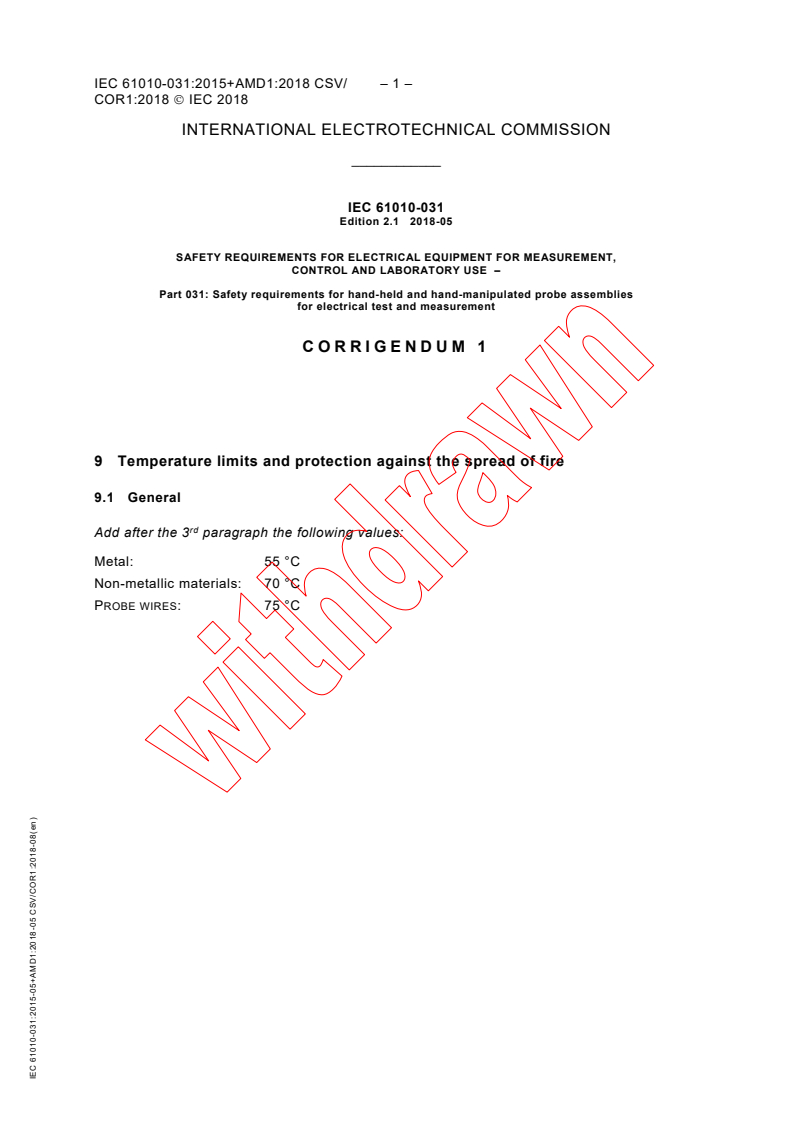


IEC 61010-031:2015+AMD1:2018 CSV/COR1:2018 - Corrigendum 1 - Safety requirements for electrical equipment for measurement, control and laboratory use - Part 031: Safety requirements for hand-held and hand-manipulated probe assemblies for electrical test and measurement Released:8/6/2018

IEC 61010-031:2015+AMD1:2018 CSV - Safety requirements for electrical equipment for measurement, control and laboratory use - Part 031: Safety requirements for hand-held and hand-manipulated probe assemblies for electrical test and measurement Released:5/29/2018
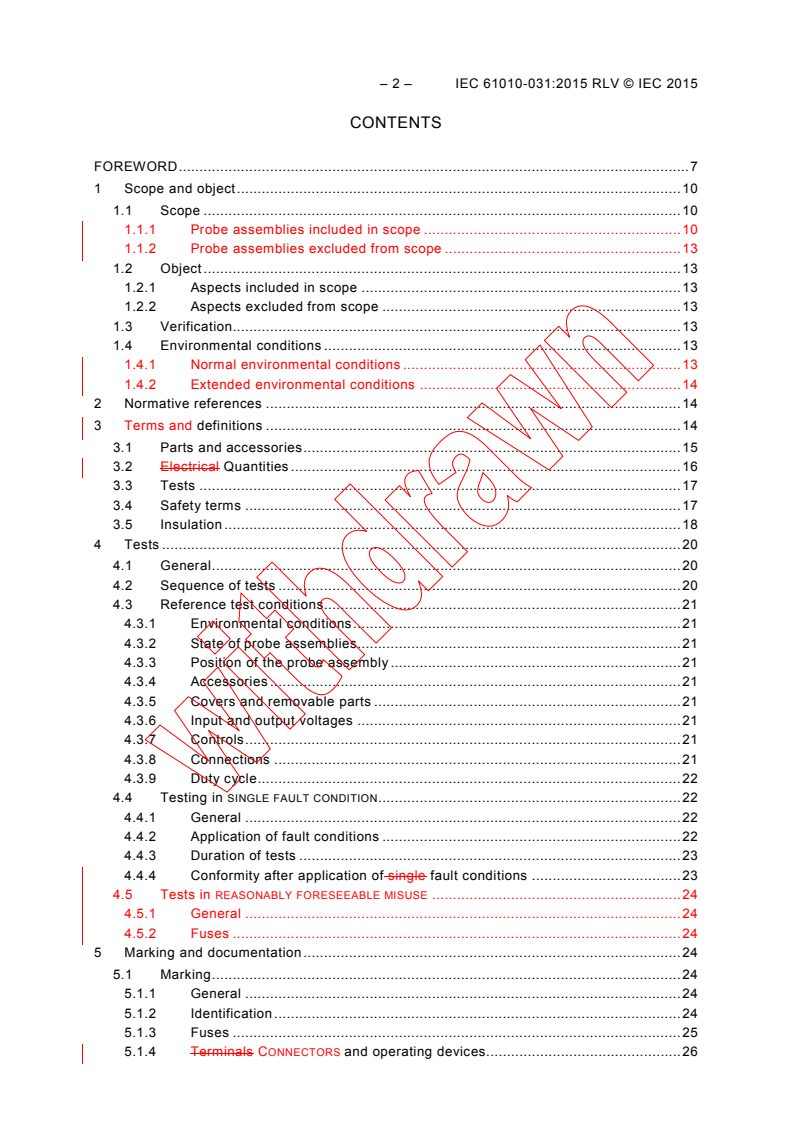
IEC 61010-031:2015 RLV - Safety requirements for electrical equipment for measurement, control and laboratory use - Part 031: Safety requirements for hand-held probe assemblies for electrical measurement and test Released:5/29/2015
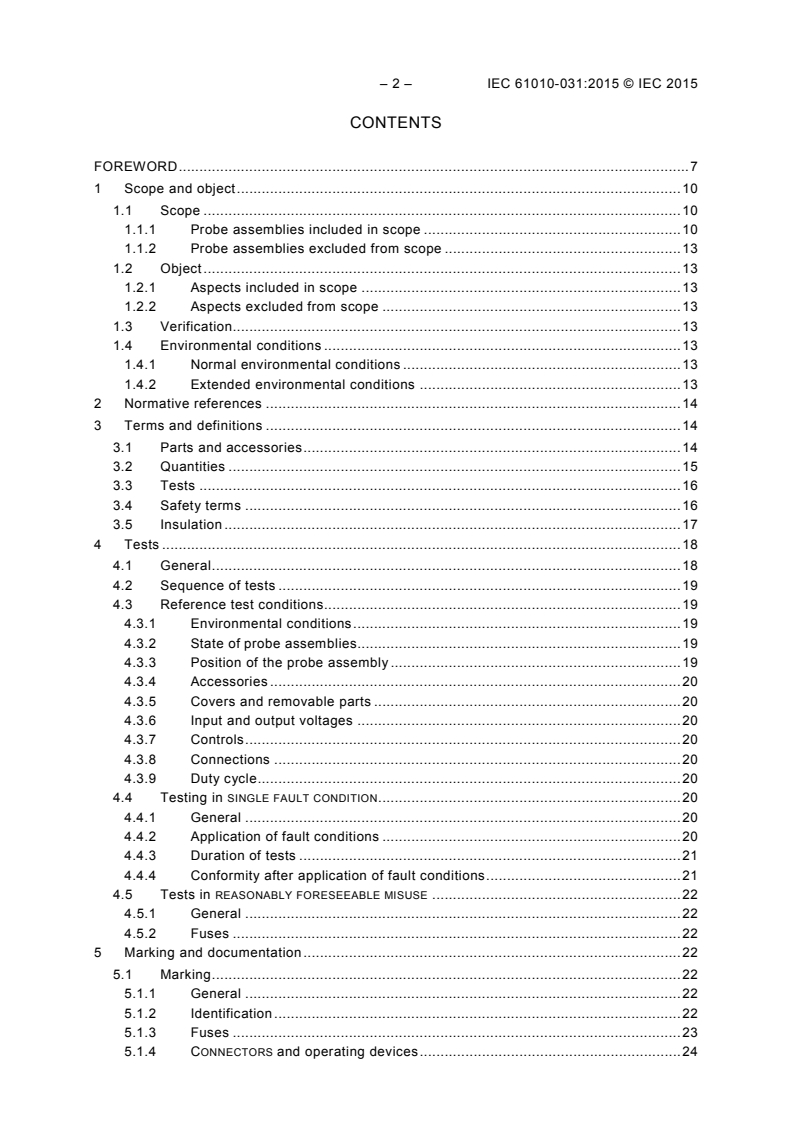
IEC 61010-031:2015 - Safety requirements for electrical equipment for measurement, control and laboratory use - Part 031: Safety requirements for hand-held probe assemblies for electrical measurement and test Released:5/29/2015

IEC 61010-031:2015+AMD1:2018 CSV - Safety requirements for electrical equipment for measurement, control and laboratory use - Part 031: Safety requirements for hand-held and hand-manipulated probe assemblies for electrical test and measurement Released:5/29/2018
Overview
IEC 61010-031:2015 is an international standard developed by the International Electrotechnical Commission (IEC) that specifies comprehensive safety requirements for hand-held and hand-manipulated probe assemblies used for electrical measurement and testing. These assemblies serve as the direct electrical connection between electrical equipment and the measured part, supporting safe and reliable operation in measurement, control, and laboratory environments. The standard includes requirements for both fixed and detachable probe assemblies and their related accessories, reflecting current industry safety practices and technical advancements.
As a group safety publication, IEC 61010-031 serves as a standalone reference, ensuring hand-held electrical probe assemblies protect users and equipment against hazards such as electric shock, mechanical stress, fire, fluids, and arc flash.
Key Topics
IEC 61010-031:2015 addresses several critical safety aspects for hand-held probe assemblies:
- Protection Against Electric Shock: Details on insulation, accessible parts, spacings, touch current measurement, and probe tip requirements to prevent accidental contact with hazardous voltages.
- Extended Environmental Conditions: Compliance under various environmental conditions beyond normal laboratory settings.
- Mechanical Safety: Constructional requirements, resistance to mechanical stresses, and tests for rigidity, impact, drop, and flexing of probe wires.
- Prevention of Fire and Arc Flash: Specifies temperature limits, fire prevention, and special considerations for arc flash hazards, especially regarding spring-loaded clips.
- Marking and Documentation: Requirements for proper labeling, warning markings, ratings, and documentation covering operation, maintenance, and servicing.
- Testing Regimes: Includes both normal operation and reasonably foreseeable misuse, particularly concerning fuses and connectors.
- Connector and Probe Tip Specifications: Updated criteria for 4 mm banana connectors, finger guards, and other interface components.
- Servicing and Maintenance: Explicit inclusion of servicing activities within the scope, ensuring all stages of probe assembly use are covered.
Applications
The guidelines set by IEC 61010-031 are essential for a range of organizations and professionals, including:
- Test and Measurement Equipment Manufacturers: To design and manufacture probe assemblies that are intrinsically safe for end users.
- Calibration Laboratories: For ensuring equipment used meets international safety benchmarks.
- Electrical Test Engineers and Technicians: To verify that hand-held probes and their accessories are compliant before use in the field or lab, thus reducing risk.
- Procurement Departments: To specify products meeting internationally recognized safety standards for use in measurement, control, or laboratory settings.
This standard is vital when sourcing or approving probes, clips, leads, or accessories for tasks involving:
- Electrical testing and troubleshooting
- Calibration and verification of instrumentation
- Industrial process control
- Research and educational laboratory experiments
Related Standards
IEC 61010-031:2015 is part of the broader IEC 61010 series, which outlines safety requirements for electrical measurement, control, and laboratory equipment. Related documents include:
- IEC 61010-1: General safety requirements for electrical measurement, control, and laboratory equipment
- IEC 61010-2-x series: Focused requirements for particular types of equipment (e.g., IEC 61010-2-030 for testing and measuring circuits)
- IEC Guide 104: Guidance on the designation and use of group safety publications
- Additional regional adaptations or harmonized standards may also apply
By adhering to IEC 61010-031, companies and professionals demonstrate due diligence in maintaining a safe working environment and supporting legal and contractual compliance regarding hand-held probe assembly usage for electrical measurement and testing.
Relations
- Effective Date
- 05-Sep-2023
- Effective Date
- 05-Sep-2023
- Effective Date
- 05-Sep-2023
- Effective Date
- 05-Sep-2023
Buy Documents
IEC 61010-031:2015+AMD1:2018 CSV/COR1:2018 - Corrigendum 1 - Safety requirements for electrical equipment for measurement, control and laboratory use - Part 031: Safety requirements for hand-held and hand-manipulated probe assemblies for electrical test and measurement Released:8/6/2018
IEC 61010-031:2015+AMD1:2018 CSV - Safety requirements for electrical equipment for measurement, control and laboratory use - Part 031: Safety requirements for hand-held and hand-manipulated probe assemblies for electrical test and measurement Released:5/29/2018
IEC 61010-031:2015 RLV - Safety requirements for electrical equipment for measurement, control and laboratory use - Part 031: Safety requirements for hand-held probe assemblies for electrical measurement and test Released:5/29/2015
IEC 61010-031:2015 - Safety requirements for electrical equipment for measurement, control and laboratory use - Part 031: Safety requirements for hand-held probe assemblies for electrical measurement and test Released:5/29/2015
IEC 61010-031:2015+AMD1:2018 CSV - Safety requirements for electrical equipment for measurement, control and laboratory use - Part 031: Safety requirements for hand-held and hand-manipulated probe assemblies for electrical test and measurement Released:5/29/2018
Get Certified
Connect with accredited certification bodies for this standard

IMP NDT d.o.o.
Non-destructive testing services. Radiography, ultrasonic, magnetic particle, penetrant, visual inspection.
Inštitut za kovinske materiale in tehnologije
Institute of Metals and Technology. Materials testing, metallurgical analysis, NDT.
Q Techna d.o.o.
NDT and quality assurance specialist. 30+ years experience. NDT personnel certification per ISO 9712, nuclear and thermal power plant inspections, QA/
Sponsored listings
Frequently Asked Questions
IEC 61010-031:2015 is a standard published by the International Electrotechnical Commission (IEC). Its full title is "Safety requirements for electrical equipment for measurement, control and laboratory use - Part 031: Safety requirements for hand-held probe assemblies for electrical measurement and test". This standard covers: IEC 61010-031:2015 specifies safety requirements for hand-held and hand-manipulated probe assemblies of the types described below, and their related accessories. These probe assemblies are for direct electrical connection between a part and electrical test and measurement equipment. They may be fixed to the equipment or be detachable accessories for the equipment. It has the status of a group safety publication in accordance with IEC GUIDE 104. IEC 61010-031 is a stand-alone standard. This second edition cancels and replaces the first edition published in 2002 and Amendment 1:2008. This edition constitutes a technical revision. This edition includes the following significant changes from the first edition, as well as numerous other changes: a) Voltages above the levels of 30 V r.m.s., 42,4 V peak, or 60 V d.c. are deemed to be HAZARDOUS LIVE instead of 33 V r.m.s., 46,7 V peak, or 70 V d.c. b) Servicing is now included within the scope. c) Extended environmental conditions are included within the scope. d) New terms have been defined. e) Tests for REASONABLY FORESEEABLE MISUSE have been added, in particular for fuses. f) Additional instruction requirements for probe assembly operation have been specified. g) Limit values for ACCESSIBLE parts and for measurement of voltage and touch current have been modified. h) SPACINGS requirements for mating of CONNECTORS have been modified. i) PROBE TIPS and SPRING-LOADED CLIPS requirements have been modified. The PROTECTIVE FINGERGUARD replace the BARRIER with new requirements. j) Insulation requirements (6.5) and test procedures (6.6.5) have been rewritten and aligned when relevant with Part 1. Specific requirements have been added for solid insulation and thin-film insulation. k) The terminology for MEASUREMENT CATEGORY I has been replaced with the designation "not RATED for measurements within MEASUREMENT CATEGORIES II, III, or IV". l) The flexing/pull test (6.7.4.3) has been partially rewritten. m) Surface temperature limits (Clause 10) have been modified to conform to the limits of IEC Guide 117. n) Requirements for resistance of PROBE WIRES to mechanical stresses have been added in Clause 12 and a new Annex D. o) Requirements have been added regarding the prevention of HAZARD from arc flash and short-circuits for SPRING-LOADED CLIPS. p) A new informative Annex E defines the dimension of the 4 mm banana CONNECTORS.
IEC 61010-031:2015 specifies safety requirements for hand-held and hand-manipulated probe assemblies of the types described below, and their related accessories. These probe assemblies are for direct electrical connection between a part and electrical test and measurement equipment. They may be fixed to the equipment or be detachable accessories for the equipment. It has the status of a group safety publication in accordance with IEC GUIDE 104. IEC 61010-031 is a stand-alone standard. This second edition cancels and replaces the first edition published in 2002 and Amendment 1:2008. This edition constitutes a technical revision. This edition includes the following significant changes from the first edition, as well as numerous other changes: a) Voltages above the levels of 30 V r.m.s., 42,4 V peak, or 60 V d.c. are deemed to be HAZARDOUS LIVE instead of 33 V r.m.s., 46,7 V peak, or 70 V d.c. b) Servicing is now included within the scope. c) Extended environmental conditions are included within the scope. d) New terms have been defined. e) Tests for REASONABLY FORESEEABLE MISUSE have been added, in particular for fuses. f) Additional instruction requirements for probe assembly operation have been specified. g) Limit values for ACCESSIBLE parts and for measurement of voltage and touch current have been modified. h) SPACINGS requirements for mating of CONNECTORS have been modified. i) PROBE TIPS and SPRING-LOADED CLIPS requirements have been modified. The PROTECTIVE FINGERGUARD replace the BARRIER with new requirements. j) Insulation requirements (6.5) and test procedures (6.6.5) have been rewritten and aligned when relevant with Part 1. Specific requirements have been added for solid insulation and thin-film insulation. k) The terminology for MEASUREMENT CATEGORY I has been replaced with the designation "not RATED for measurements within MEASUREMENT CATEGORIES II, III, or IV". l) The flexing/pull test (6.7.4.3) has been partially rewritten. m) Surface temperature limits (Clause 10) have been modified to conform to the limits of IEC Guide 117. n) Requirements for resistance of PROBE WIRES to mechanical stresses have been added in Clause 12 and a new Annex D. o) Requirements have been added regarding the prevention of HAZARD from arc flash and short-circuits for SPRING-LOADED CLIPS. p) A new informative Annex E defines the dimension of the 4 mm banana CONNECTORS.
IEC 61010-031:2015 is classified under the following ICS (International Classification for Standards) categories: 19.080 - Electrical and electronic testing. The ICS classification helps identify the subject area and facilitates finding related standards.
IEC 61010-031:2015 has the following relationships with other standards: It is inter standard links to IEC 61010-031:2015/AMD1:2018, IEC 61010-031:2002/AMD1:2008, IEC 61010-031:2022, IEC 61010-031:2002. Understanding these relationships helps ensure you are using the most current and applicable version of the standard.
IEC 61010-031:2015 is available in PDF format for immediate download after purchase. The document can be added to your cart and obtained through the secure checkout process. Digital delivery ensures instant access to the complete standard document.
Standards Content (Sample)
COR1:2018 IEC 2018
INTERNATIONAL ELECTROTECHNICAL COMMISSION
____________
IEC 61010-031
Edition 2.1 2018-05
SAFETY REQUIREMENTS FOR ELECTRICAL EQUIPMENT FOR MEASUREMENT,
CONTROL AND LABORATORY USE –
Part 031: Safety requirements for hand-held and hand-manipulated probe assemblies
for e
...
IEC 61010-031 ®
Edition 2.1 2018-05
CONSOLIDATED VERSION
INTERNATIONAL
STANDARD
colour
inside
GROUP SAFETY PUBLICATION
Safety requirements for electrical equipment for measurement, control and
laboratory use –
Part 031: Safety requirements for hand-held and hand-manipulated probe
assemblies for electrical measurement and test and measurement
All rights reserved. Unless otherwise specified, no part of this publication may be reproduced or utilized in any form
or by any means, electronic or mechanical, including photocopying and microfilm, without permission in writing from
either IEC or IEC's member National Committee in the country of the requester. If you have any questions about IEC
copyright or have an enquiry about obtaining additional rights to this publication, please contact the address below or
your local IEC member National Committee for further information.
IEC Central Office Tel.: +41 22 919 02 11
3, rue de Varembé info@iec.ch
CH-1211 Geneva 20 www.iec.ch
Switzerland
About the IEC
The International Electrotechnical Commission (IEC) is the leading global organization that prepares and publishes
International Standards for all electrical, electronic and related technologies.
About IEC publications
The technical content of IEC publications is kept under constant review by the IEC. Please make sure that you have the
latest edition, a corrigenda or an amendment might have been published.
IEC Catalogue - webstore.iec.ch/catalogue Electropedia - www.electropedia.org
The stand-alone application for consulting the entire The world's leading online dictionary of electronic and
bibliographical information on IEC International Standards, electrical terms containing 21 000 terms and definitions in
Technical Specifications, Technical Reports and other English and French, with equivalent terms in 16 additional
documents. Available for PC, Mac OS, Android Tablets and languages. Also known as the International Electrotechnical
iPad. Vocabulary (IEV) online.
IEC publications search - webstore.iec.ch/advsearchform IEC Glossary - std.iec.ch/glossary
The advanced search enables to find IEC publications by a 67 000 electrotechnical terminology entries in English and
variety of criteria (reference number, text, technical French extracted from the Terms and Definitions clause of
committee,…). It also gives information on projects, replaced IEC publications issued since 2002. Some entries have been
and withdrawn publications. collected from earlier publications of IEC TC 37, 77, 86 and
CISPR.
IEC Just Published - webstore.iec.ch/justpublished
Stay up to date on all new IEC publications. Just Published IEC Customer Service Centre - webstore.iec.ch/csc
details all new publications released. Available online and If you wish to give us your feedback on this publication or
also once a month by email. need further assistance, please contact the Customer Service
Centre: sales@iec.ch.
IEC 61010-031 ®
Edition 2.1 2018-05
CONSOLIDATED VERSION
INTERNATIONAL
STANDARD
colour
inside
GROUP SAFETY PUBLICATION
Safety requirements for electrical equipment for measurement, control and
laboratory use –
Part 031: Safety requirements for hand-held and hand-manipulated probe
assemblies for electrical measurement and test and measurement
INTERNATIONAL
ELECTROTECHNICAL
COMMISSION
ICS 19.080 ISBN 978-2-8322-5773-9
IEC 61010-031 ®
Edition 2.1 2018-05
CONSOLIDATED VERSION
REDLINE VERSION
colour
inside
GROUP SAFETY PUBLICATION
Safety requirements for electrical equipment for measurement, control and
laboratory use –
Part 031: Safety requirements for hand-held and hand-manipulated probe
assemblies for electrical measurement and test and measurement
– 2 – IEC 61010-031:2015+AMD1:2018 CSV
© IEC 2018
CONTENTS
FOREWORD . 7
1 Scope and object . 10
1.1 Scope . 10
1.1.1 Probe assemblies included in scope . 10
1.1.2 Probe assemblies excluded from scope . 13
1.2 Object . 13
1.2.1 Aspects included in scope . 13
1.2.2 Aspects excluded from scope . 13
1.3 Verification. 13
1.4 Environmental conditions . 13
1.4.1 Normal environmental conditions . 13
1.4.2 Extended environmental conditions . 13
2 Normative references . 14
3 Terms and definitions . 14
3.1 Parts and accessories . 14
3.2 Quantities . 15
3.3 Tests . 16
3.4 Safety terms . 16
3.5 Insulation . 17
4 Tests . 18
4.1 General . 18
4.2 Sequence of tests . 19
4.3 Reference test conditions. 19
4.3.1 Environmental conditions . 19
4.3.2 State of probe assemblies . 19
4.3.3 Position of the probe assembly . 19
4.3.4 Accessories . 20
4.3.5 Covers and removable parts . 20
4.3.6 Input and output voltages . 20
4.3.7 Controls . 20
4.3.8 Connections . 20
4.3.9 Duty cycle Short-term or intermittent operation . 20
4.4 Testing in SINGLE FAULT CONDITION. 20
4.4.1 General . 20
4.4.2 Application of fault conditions . 20
4.4.3 Duration of tests . 21
4.4.4 Conformity after application of fault conditions . 21
4.5 Tests in REASONABLY FORESEEABLE MISUSE . 22
4.5.1 General . 22
4.5.2 Fuses . 22
5 Marking and documentation . 22
5.1 Marking . 22
5.1.1 General . 22
5.1.2 Identification . 23
5.1.3 Fuses . 23
5.1.4 CONNECTORS and operating devices . 24
© IEC 2018
5.1.5 RATING . 24
5.2 Warning markings . 24
5.3 Durability of markings . 24
5.4 Documentation . 25
5.4.1 General . 25
5.4.2 Probe assembly RATING . 25
5.4.3 Probe assembly operation . 25
5.4.4 Probe assembly maintenance and service . 26
6 Protection against electric shock . 26
6.1 General . 26
6.2 Determination of ACCESSIBLE parts . 27
6.2.1 General . 27
6.2.2 Examination . 27
6.2.3 Openings for pre-set controls . 29
6.3 Limit values for ACCESSIBLE parts . 29
6.3.1 General . 29
6.3.2 Levels in NORMAL CONDITION . 29
6.3.3 Levels in SINGLE FAULT CONDITION . 29
6.3.4 Measurement of voltage and touch current . 32
6.4 Means of protection against electric shock . 35
6.4.1 General . 35
6.4.2 CONNECTORS . 36
6.4.3 PROBE TIPS. 37
6.4.4 Impedance . 39
6.4.5 PROTECTIVE IMPEDANCE . 39
6.4.6 BASIC INSULATION, SUPPLEMENTARY INSULATION, DOUBLE INSULATION and
REINFORCED INSULATION . 40
6.5 Insulation requirements . 40
6.5.1 The nature of insulation . 40
6.5.2 Insulation requirements for probe assemblies . 46
6.6 Procedure for voltage tests . 57
6.6.1 General . 57
6.6.2 Humidity preconditioning . 57
6.6.3 Conduct of tests . 58
6.6.4 Test voltages . 58
6.6.5 Test procedures . 60
6.7 Constructional requirements for protection against electric shock . 61
6.7.1 General . 61
6.7.2 Insulating materials . 61
6.7.3 ENCLOSURES of probe assemblies with DOUBLE INSULATION or REINFORCED
INSULATION . 61
6.7.4 PROBE WIRE attachment . 61
7 Protection against mechanical HAZARDS . 65
8 Resistance to mechanical stresses . 65
8.1 General . 65
8.2 Rigidity test . 66
8.3 Drop test . 66
8.4 Impact swing test . 66
9 Temperature limits and protection against the spread of fire . 67
– 4 – IEC 61010-031:2015+AMD1:2018 CSV
© IEC 2018
9.1 General . 67
9.2 Temperature tests . 68
10 Resistance to heat . 68
10.1 Integrity of SPACINGS . 68
10.2 Resistance to heat . 68
11 Protection against HAZARDS from fluids . 68
11.1 General . 68
11.2 Cleaning . 69
11.3 Specially protected probe assemblies . 69
12 Components . 69
12.1 General . 69
12.2 Fuses. 69
12.3 PROBE WIRE . 70
12.3.1 General . 70
12.3.2 RATING of PROBE WIRE . 70
12.3.3 Pressure test at high temperature for insulations . 70
12.3.4 Tests for resistance of insulation to cracking . 72
12.3.5 Voltage test . 73
12.3.6 Tensile test . 73
13 Prevention of HAZARD from arc flash and short-circuits . 75
13.1 General . 75
13.2 Exposed conductive parts . 75
Bibliography . 96
Annex A (normative) Measuring circuits for touch current (see 6.3) . 77
A.1 Measuring circuits for a.c. with frequencies up to 1 MHz and for d.c. . 77
A.2 Measuring circuits for a.c. with sinusoidal frequencies up to 100 Hz and for
d.c. . 77
A.3 Current measuring circuit for electrical burns at frequencies above 100 kHz . 78
A.4 Current measuring circuit for WET LOCATIONS . 79
Annex B (normative) Standard test fingers . 81
Annex C (normative) Measurement of CLEARANCES and CREEPAGE DISTANCES . 84
Annex D (normative) Routine spark tests on PROBE WIRE . 86
D.1 General . 86
D.2 Spark test procedure . 86
D.3 Routine spark test method for PROBE WIRE . 88
Annex E (informative) 4 mm CONNECTORS . 90
E.1 General . 90
E.2 Dimensions . 90
Annex F (normative) MEASUREMENT CATEGORIES . 93
F.1 General . 93
F.2 MEASUREMENT CATEGORIES . 93
F.2.1 MEASUREMENT CATEGORY II . 93
F.2.2 MEASUREMENT CATEGORY III . 93
F.2.3 MEASUREMENT CATEGORY IV . 93
F.2.4 Probe assemblies without a MEASUREMENT CATEGORY RATING. 94
Annex G Index of defined terms . 95
© IEC 2018
Figure 1 – Examples of type A probe assemblies . 11
Figure 2 – Examples of type B probe assemblies . 11
Figure 3 – Examples of type C probe assemblies . 12
Figure 4 – Examples of type D probe assemblies . 12
Figure 5 – Example of a STACKABLE CONNECTOR with a male CONNECTOR and a female
TERMINAL . 15
Figure 6 – Methods for determination of ACCESSIBLE parts (see 6.2) and for voltage
tests of (see 6.4.2) . 28
Figure 7 – Capacitance level versus voltage in NORMAL CONDITION and SINGLE-FAULT
CONDITION (see 6.3.2 c) and 6.3.3 c)) . 31
Figure 8 – Voltage and touch current measurement . 32
Figure 9 – Voltage and touch current measurement for the reference CONNECTOR . 33
Figure 10 – Voltage and touch current measurement with shielded test probe . 34
Figure 11 – Maximum test probe input voltage for 70 mA touch current. 35
Figure 12 – Protection by a PROTECTIVE FINGERGUARD . 38
Figure 13 – Protection by distance . 38
Figure 14 – Protection by tactile indicator . 39
Figure 15 – Distance between conductors on an interface between two layers . 54
Figure 16 – Distance between adjacent conductors along an interface of two layers . 54
Figure 17 – Distance between adjacent conductors located between the same two
layers. 56
Figure 18 – Example of recurring peak voltage . 49
Figure 19 – Flexing test . 63
Figure 20 – Rotational flexing test . 65
Figure 21 – Impact swing test . 67
Figure 22 – Indentation device . 71
Figure A.1 – Measuring circuit for a.c. with frequencies up to 1 MHz and for d.c. . 77
Figure A.2 – Measuring circuits for a.c. with sinusoidal frequencies up to 100 Hz
and for d.c. . 78
Figure A.3 – Current measuring circuit for electrical burns . 79
Figure A.4 – Current measuring circuit for high frequency test probes . 79
Figure A.5 – Current measuring circuit for WET LOCATIONS . 80
Figure B.1 – Rigid test finger . 81
Figure B.2 – Jointed test finger . 82
Figure D.1 – Bead Chain Configuration (if applicable) . 87
Figure E.1 – Recommended dimensions of 4 mm CONNECTORS . 91
Figure F.1 – Example to identify the locations of MEASUREMENT CATEGORIES. 94
Table 1 – Symbols . 23
Table 2 – SPACINGS for unmated CONNECTORS RATED up to 1 000 V a.c. or 1 500 V d.c.
with HAZARDOUS LIVE conductive parts . 37
Table 3 – Multiplication factors for CLEARANCES of probe assembly RATED for operation
at altitudes up to 5 000 m . 41
Table 4 – Test voltages for testing solid insulation .
Table 4 – a.c. test voltages for testing electric strength of solid insulation in probe
assemblies RATED for MEASUREMENT CATEGORIES . 52
– 6 – IEC 61010-031:2015+AMD1:2018 CSV
© IEC 2018
Table 5 – Minimum values for distance or thickness . 55
Table 6 – CLEARANCES for of probe assemblies RATED of for MEASUREMENT
CATEGORIES II, III and IV. 46
Table 7 – CLEARANCE values for the calculation of 6.5.2.3.2 . 48
Table 8 – CLEARANCES for BASIC INSULATION in probe assemblies subjected to recurring
peak voltages or WORKING VOLTAGES with frequencies above 30 kHz . 50
Table 9 – CREEPAGE DISTANCES for BASIC INSULATION or SUPPLEMENTARY INSULATION . 51
Table 10 – Test voltages based on CLEARANCES . 59
Table 11 – Correction factors according to test site altitude for test voltages
for CLEARANCES . 60
Table 12 – Pull forces for PROBE WIRE attachment tests . 64
Table 13 – Diameter of mandrel and numbers of turns . 72
Table 14 – Impulse test voltages for testing electric strength of solid insulation in
probe assemblies RATED for MEASUREMENT CATEGORIES . 53
Table C.1 – Dimension of X . 84
Table D.1 – Maximum centre-to-centre spacings of bead chains . 86
Table D.2 – Formula for maximum speed of wire in terms of electrode length L of link-
or bead-chain electrode . 88
Table F.1 – Characteristics of MEASUREMENT CATEGORIES . 94
© IEC 2018
INTERNATIONAL ELECTROTECHNICAL COMMISSION
____________
SAFETY REQUIREMENTS FOR ELECTRICAL EQUIPMENT
FOR MEASUREMENT, CONTROL AND LABORATORY USE –
Part 031: Safety requirements for hand-held and hand-manipulated
probe assemblies for electrical measurement and test and measurement
FOREWORD
1) The International Electrotechnical Commission (IEC) is a worldwide organization for standardization comprising
all national electrotechnical committees (IEC National Committees). The object of IEC is to promote
international co-operation on all questions concerning standardization in the electrical and electronic fields. To
this end and in addition to other activities, IEC publishes International Standards, Technical Specifications,
Technical Reports, Publicly Available Specifications (PAS) and Guides (hereafter referred to as “IEC
Publication(s)”). Their preparation is entrusted to technical committees; any IEC National Committee interested
in the subject dealt with may participate in this preparatory work. International, governmental and non-
governmental organizations liaising with the IEC also participate in this preparation. IEC collaborates closely
with the International Organization for Standardization (ISO) in accordance with conditions determined by
agreement between the two organizations.
2) The formal decisions or agreements of IEC on technical matters express, as nearly as possible, an international
consensus of opinion on the relevant subjects since each technical committee has representation from all
interested IEC National Committees.
3) IEC Publications have the form of recommendations for international use and are accepted by IEC National
Committees in that sense. While all reasonable efforts are made to ensure that the technical content of IEC
Publications is accurate, IEC cannot be held responsible for the way in which they are used or for any
misinterpretation by any end user.
4) In order to promote international uniformity, IEC National Committees undertake to apply IEC Publications
transparently to the maximum extent possible in their national and regional publications. Any divergence
between any IEC Publication and the corresponding national or regional publication shall be clearly indicated in
the latter.
5) IEC itself does not provide any attestation of conformity. Independent certification bodies provide conformity
assessment services and, in some areas, access to IEC marks of conformity. IEC is not responsible for any
services carried out by independent certification bodies.
6) All users should ensure that they have the latest edition of this publication.
7) No liability shall attach to IEC or its directors, employees, servants or agents including individual experts and
members of its technical committees and IEC National Committees for any personal injury, property damage or
other damage of any nature whatsoever, whether direct or indirect, or for costs (including legal fees) and
expenses arising out of the publication, use of, or reliance upon, this IEC Publication or any other IEC
Publications.
8) Attention is drawn to the Normative references cited in this publication. Use of the referenced publications is
indispensable for the correct application of this publication.
9) Attention is drawn to the possibility that some of the elements of this IEC Publication may be the subject of
patent rights. IEC shall not be held responsible for identifying any or all such patent rights.
This consolidated version of the official IEC Standard and its amendment has been prepared
for user convenience.
IEC 61010-031 edition 2.1 contains the second edition (2015-05) [documents 66/569/FDIS and
66/571/RVD] and its amendment 1 (2018-05) [documents 66/664/FDIS and 66/670/RVD].
In this Redline version, a vertical line in the margin shows where the technical content is
modified by amendment 1. Additions are in green text, deletions are in strikethrough red text. A
separate Final version with all changes accepted is available in this publication.
– 8 – IEC 61010-031:2015+AMD1:2018 CSV
© IEC 2018
International Standard IEC 61010-031 has been prepared by IEC technical committee 66:
Safety of measuring, control and laboratory equipment.
It has the status of a group safety publication in accordance with IEC GUIDE 104.
IEC 61010-031 is a stand-alone standard. his edition constitutes a technical revision.
This edition includes the following significant changes from the first edition, as well as
numerous other changes:
a) Voltages above the levels of 30 V r.m.s., 42,4 V peak, or 60 V d.c. are deemed to be
HAZARDOUS LIVE instead of 33 V r.m.s., 46,7 V peak, or 70 V d.c.
b) Servicing is now included within the scope.
c) Extended environmental conditions are included within the scope.
d) New terms have been defined.
e) Tests for REASONABLY FORESEEABLE MISUSE have been added, in particular for fuses.
f) Additional instruction requirements for probe assembly operation have been specified.
g) Limit values for ACCESSIBLE parts and for measurement of voltage and touch current have
been modified.
h) SPACINGS requirements for mating of CONNECTORS have been modified.
i) PROBE TIPS and SPRING-LOADED CLIPS requirements have been modified. The PROTECTIVE
FINGERGUARD replace the BARRIER with new requirements.
j) Insulation requirements (6.5) and test procedures (6.6.5) have been rewritten and aligned
when relevant with Part 1. Specific requirements have been added for solid insulation and
thin-film insulation.
k) The terminology for MEASUREMENT CATEGORY I has been replaced with the designation “not
RATED for measurements within MEASUREMENT CATEGORIES II, III, or IV”.
l) The flexing/pull test (6.7.4.3) has been partially rewritten.
m) Surface temperature limits (Clause 10) have been modified to conform to the limits of IEC
Guide 117.
n) Requirements for resistance of PROBE WIRES to mechanical stresses have been added in
Clause 12 and a new Annex D.
o) Requirements have been added regarding the prevention of HAZARD from arc flash and
short-circuits for SPRING-LOADED CLIPS.
p) A new informative Annex E defines the dimension of the 4 mm banana CONNECTORS.
This publication has been drafted in accordance with the ISO/IEC Directives, Part 2.
A list of all parts of the IEC 61010 series, under the general title, Safety requirements for
electrical equipment for measurement, control, and laboratory use, may be found on the IEC
website.
In this standard, the following print types are used:
– requirements and definitions: in roman type;
– NOTES and EXAMPLES: in smaller roman type;
– conformity and tests: in italic type;
© IEC 2018
– terms used throughout this standard which have been defined in Clause 3: SMALL ROMAN
CAPITALS.
The committee has decided that the contents of the base publication and its amendment will
remain unchanged until the stability date indicated on the IEC web site under
"http://webstore.iec.ch" in the data related to the specific publication. At this date, the
publication will be
reconfirmed,
withdrawn,
replaced by a revised edition, or
amended.
The contents of the corrigendum of August 2018 have been included in this copy.
IMPORTANT – The 'colour inside' logo on the cover page of this publication indicates
that it contains colours which are considered to be useful for the correct
understanding of its contents. Users should therefore print this document using a
colour printer.
– 10 – IEC 61010-031:2015+AMD1:2018 CSV
© IEC 2018
SAFETY REQUIREMENTS FOR ELECTRICAL EQUIPMENT
FOR MEASUREMENT, CONTROL AND LABORATORY USE –
Part 031: Safety requirements for hand-held and hand-manipulated
probe assemblies for electrical measurement and test and measurement
1 Scope and object
1.1 Scope
1.1.1 Probe assemblies included in scope
This part of IEC 61010 specifies safety requirements for hand-held and hand-manipulated
probe assemblies of the types described below, and their related accessories. These probe
assemblies are for direct electrical connection between a part and electrical test and
measurement equipment. They may be fixed to the equipment or be detachable accessories
for the equipment.
a) Type A: low-voltage and high-voltage, non-attenuating probe assemblies. Non-attenuating
probe assemblies that are RATED for direct connection to voltages exceeding 30 V r.m.s.,
42,4 V peak, or 60 V d.c., but not exceeding 63 kV. They do not incorporate components
which are intended to provide a voltage divider function or a signal conditioning function,
but they may contain non-attenuating components such as fuses (see Figure 1.)
b) Type B: high-voltage attenuating or divider probe assemblies. Attenuating or divider probe
assemblies that are RATED for direct connection to secondary voltages exceeding
1 kV r.m.s. or 1,5 kV d.c. but not exceeding 63 kV r.m.s. or d.c. The divider function may
be carried out wholly within the probe assembly, or partly within the test or measurement
equipment to be used with the probe assembly (see Figure 2).
c) Type C: low-voltage attenuating or divider probe assemblies. Attenuating or divider probe
assemblies for direct connection to voltages not exceeding 1 kV r.m.s. or 1,5 kV d.c. The
signal conditioning function may be carried out wholly within the probe assembly, or partly
within the test or measurement equipment intended to be used with the probe assembly
(see Figure 3).
d) Type D: low-voltage attenuating, non-attenuating or other signal conditioning probe
assemblies, that are RATED for direct connection only to voltages not exceeding
30 V r.m.s., or 42,4 V peak, or 60 V d.c., and are suitable for currents exceeding 8 A (see
Figure 4).
© IEC 2018
IEC
Key
1 typical CONNECTORS 4 to equipment
2 PROBE TIP 5 SPRING-LOADED CLIP
3 probe body 6 PROBE WIRE
Figure 1 – Examples of type A probe assemblies
4 5
IEC
Key
1 PROBE TIP 4 PROTECTIVE FINGERGUARD
2 to equipment 5 hand-held area of probe body
3 reference CONNECTOR 6 PROBE WIRE
Figure 2 – Examples of type B probe assemblies
– 12 – IEC 61010-031:2015+AMD1:2018 CSV
© IEC 2018
IEC
Key
1 PROBE TIP 5 PROBE WIRE
2 probe body 6 examples of accessories
3 reference CONNECTOR 7 BNC CONNECTOR
4 to equipment
Figure 3 – Examples of type C probe assemblies
IEC
Key
1 CONNECTOR 3 hand-held area of SPRING-LOADED CLIP or clamp
2 PROBE TIP 4 PROBE WIRE
Figure 4 – Examples of type D probe assemblies
© IEC 2018
1.1.2 Probe assemblies excluded from scope
This standard does not apply to current sensors within the scope of IEC 61010-2-032 (Hand-
held and hand-manipulated current sensors), but may apply to their input measuring circuit
leads and accessories.
1.2 Object
1.2.1 Aspects included in scope
The purpose of the requirements of this standard is to ensure that HAZARDS to the OPERATOR
and the surrounding area are reduced to a tolerable level.
Requirements for protection against particular types of HAZARDS are given in Clauses 6 to 13,
as follows:
a) electric shock or burn (see Clauses 6, 10 and 11);
b) mechanical HAZARDS (see Clauses 7, 8 and 11);
c) excessive temperature (see Clause 9);
d) spread of fire from the probe assembly (see Clause 9);
e) arc flash (see Clause 13).
Additional requirements for probe assemblies which are designed to be powered from a low-
voltage mains supply, or include other features not specifically addressed in this standard are
in other parts of IEC 61010.
NOTE Attention is drawn to the possible existence of additional requirements regarding the health and safety of
labour forces.
1.2.2 Aspects excluded from scope
This standard does not cover:
a) reliable function, performance, or other properties of the probe assembly;
b) effectiveness of transport packaging.
1.3 Verification
This standard also specifies methods of verifying that the probe assembly meets the
requirements of this standard, through inspection, TYPE TESTS, and ROUTINE TESTS.
1.4 Environmental conditions
1.4.1 Normal environmental conditions
This standard applies to probe assemblies designed to be safe at least under the following
conditions:
a) altitude up to 2 000 m;
b) ambient temperature of 5 °C to 40 °C;
c) maximum relative humidity of 80 % for temperatures up to 31 °C decreasing linearly to
50 % relative humidity at 40 °C;
d) applicable POLLUTION DEGREE of the intended environment.
1.4.2 Extended environmental conditions
This standard applies to probe assemblies designed to be safe not only in the environmental
conditions specified in 1.4.1, but also in any of the following conditions as RATED by the
manufacturer of the probe assemblies:
– 14 – IEC 61010-031:2015+AMD1:2018 CSV
© IEC 2018
a) outdoor use;
b) altitudes above 2 000 m;
c) ambient temperatures below 5 °C or above 40 °C;
d) relative humidities above the levels specified in 1.4.1;
e) WET LOCATIONS.
2 Normative references
The following documents, in whole or in part, are normatively referenced in this document and
are indispensable for its application. For dated references, only the edition cited applies. For
undated references, the latest edition of the referenced document (including any
amendments) applies.
IEC 60027 (all parts), Letters symbols to be used in electrical technology
IEC 60529, Degrees of protection provided by enclosures (IP Code)
IEC 61010-1:2010, Safety requirements for electrical equipment for measurement, control,
and laboratory use – Part 1: General requirements
IEC 61180-1:1992, High-voltage test techniques for low voltage equipment – Part 1:
Definitions, test and procedure requirements
IEC 61180-2, High-voltage test techniques for low-voltage equipment – Part 2: Test
equipment
IEC GUIDE 104, The preparation of safety publications and the use of basic safety
publications and group safety publications
ISO/IEC GUIDE 51, Safety aspects – Guidelines for their inclusion in standards
3 Terms and definitions
For the purposes of this document, the following terms and definitions apply.
3.1 Parts and accessories
3.1.1
TERMINAL
component provided for the connection of a device (equipment) to external conductors
Note 1 to entry: TERMINALS can contain one or several contacts and the term includes sockets, pins, connectors,
etc.
3.1.2
ENCLOSURE
part providing protection of a probe assembly against certain external influences and, in any
direction, protection against direct contact
3.1.3
PROTECTIVE FINGERGUARD
part of the ENCLOSURE that indicates the limit of safe access and that reduces the risk of the
OPERATOR touching HAZARDOUS LIVE parts
© IEC 2018
3.1.4
PROBE TIP
part of a probe assembly or accessory which makes a connection to the point b
...
IEC 61010-031 ®
Edition 2.0 2015-05
REDLINE VERSION
INTERNATIONAL
STANDARD
colour
inside
GROUP SAFETY PUBLICATION
Safety requirements for electrical equipment for measurement, control and
laboratory use –
Part 031: Safety requirements for hand-held probe assemblies for electrical
measurement and test
All rights reserved. Unless otherwise specified, no part of this publication may be reproduced or utilized in any form
or by any means, electronic or mechanical, including photocopying and microfilm, without permission in writing from
either IEC or IEC's member National Committee in the country of the requester. If you have any questions about IEC
copyright or have an enquiry about obtaining additional rights to this publication, please contact the address below or
your local IEC member National Committee for further information.
IEC Central Office Tel.: +41 22 919 02 11
3, rue de Varembé Fax: +41 22 919 03 00
CH-1211 Geneva 20 info@iec.ch
Switzerland www.iec.ch
About the IEC
The International Electrotechnical Commission (IEC) is the leading global organization that prepares and publishes
International Standards for all electrical, electronic and related technologies.
About IEC publications
The technical content of IEC publications is kept under constant review by the IEC. Please make sure that you have the
latest edition, a corrigenda or an amendment might have been published.
IEC Catalogue - webstore.iec.ch/catalogue Electropedia - www.electropedia.org
The stand-alone application for consulting the entire The world's leading online dictionary of electronic and
bibliographical information on IEC International Standards, electrical terms containing more than 30 000 terms and
Technical Specifications, Technical Reports and other definitions in English and French, with equivalent terms in 15
documents. Available for PC, Mac OS, Android Tablets and additional languages. Also known as the International
iPad. Electrotechnical Vocabulary (IEV) online.
IEC publications search - www.iec.ch/searchpub IEC Glossary - std.iec.ch/glossary
The advanced search enables to find IEC publications by a More than 60 000 electrotechnical terminology entries in
variety of criteria (reference number, text, technical English and French extracted from the Terms and Definitions
committee,…). It also gives information on projects, replaced clause of IEC publications issued since 2002. Some entries
and withdrawn publications. have been collected from earlier publications of IEC TC 37,
77, 86 and CISPR.
IEC Just Published - webstore.iec.ch/justpublished
Stay up to date on all new IEC publications. Just Published IEC Customer Service Centre - webstore.iec.ch/csc
details all new publications released. Available online and If you wish to give us your feedback on this publication or
also once a month by email. need further assistance, please contact the Customer Service
Centre: csc@iec.ch.
IEC 61010-031 ®
Edition 2.0 2015-05
REDLINE VERSION
INTERNATIONAL
STANDARD
colour
inside
Safety requirements for electrical equipment for measurement, control and
laboratory use –
Part 031: Safety requirements for hand-held probe assemblies for electrical
measurement and test
INTERNATIONAL
ELECTROTECHNICAL
COMMISSION
ICS 19.080 ISBN 978-2-8322-2723-7
– 2 – IEC 61010-031:2015 RLV © IEC 2015
CONTENTS
FOREWORD . 7
1 Scope and object . 10
1.1 Scope . 10
1.1.1 Probe assemblies included in scope . 10
1.1.2 Probe assemblies excluded from scope . 13
1.2 Object . 13
1.2.1 Aspects included in scope . 13
1.2.2 Aspects excluded from scope . 13
1.3 Verification. 13
1.4 Environmental conditions . 13
1.4.1 Normal environmental conditions . 13
1.4.2 Extended environmental conditions . 14
2 Normative references . 14
3 Terms and definitions . 14
3.1 Parts and accessories . 15
3.2 Electrical Quantities . 16
3.3 Tests . 17
3.4 Safety terms . 17
3.5 Insulation . 18
4 Tests . 20
4.1 General . 20
4.2 Sequence of tests . 20
4.3 Reference test conditions. 21
4.3.1 Environmental conditions . 21
4.3.2 State of probe assemblies . 21
4.3.3 Position of the probe assembly . 21
4.3.4 Accessories . 21
4.3.5 Covers and removable parts . 21
4.3.6 Input and output voltages . 21
4.3.7 Controls . 21
4.3.8 Connections . 21
4.3.9 Duty cycle . 22
4.4 Testing in SINGLE FAULT CONDITION. 22
4.4.1 General . 22
4.4.2 Application of fault conditions . 22
4.4.3 Duration of tests . 23
4.4.4 Conformity after application of single fault conditions . 23
4.5 Tests in REASONABLY FORESEEABLE MISUSE . 24
4.5.1 General . 24
4.5.2 Fuses . 24
5 Marking and documentation . 24
5.1 Marking . 24
5.1.1 General . 24
5.1.2 Identification . 24
5.1.3 Fuses . 25
5.1.4 Terminals CONNECTORS and operating devices. 26
5.1.5 PARTS PROTECTED by double insulation or reinforced insulation .
5.1.5 RATING . 26
5.2 Warning markings . 26
5.3 Durability of markings . 27
5.4 Documentation . 27
5.4.1 General . 27
5.4.2 Ratings Probe assembly rating . 27
5.4.3 Probe assembly operation . 27
5.4.4 MAINTENANCE Probe assembly maintenance and service . 28
6 Protection against electric shock . 29
6.1 General . 29
6.1.1 EXCEPTIONS .
6.2 Determination of ACCESSIBLE parts . 29
6.2.1 General . 29
6.2.2 General Examination . 29
6.2.3 Openings for pre-set controls . 31
6.3 Permissible limits Limit values for ACCESSIBLE parts . 31
6.3.1 General . 31
6.3.2 VALUES Levels in NORMAL CONDITION . 32
6.3.3 VALUES Levels in SINGLE FAULT CONDITION . 32
6.3.4 Measurement of voltage and touch current . 35
6.4 Insulation requirements for Means of protection against electric shock . 38
6.4.1 General . 38
6.4.2 CONNECTORS . 39
6.4.2 HAND-HELD parts other than CONNECTORS .
6.4.3 Cables .
6.4.4 Impedance . 46
6.4.5 Double insulation and reinforced insulation .
6.4.5 PROTECTIVE IMPEDANCE . 46
6.4.6 BASIC INSULATION, SUPPLEMENTARY INSULATION, DOUBLE INSULATION and
REINFORCED INSULATION . 47
6.5 CLEARANCES and CREEPAGE DISTANCES .
6.5 Insulation requirements . 47
6.5.1 The nature of insulation . 47
6.5.2 Measuring circuits Insulation requirements for probe assemblies . 52
6.6 Dielectric strengh tests Procedure for voltage tests . 59
6.6.1 REFERENCE TEST EARTH General . 59
6.6.2 Humidity preconditioning . 59
6.6.3 Conduct of tests . 59
6.6.4 VOLTAGE TESTS Test voltages . 60
6.6.5 Test procedures . 62
6.7 Constructional requirements for protection against electric shock . 63
6.7.1 General . 63
6.7.2 Insulating materials . 63
6.7.3 ENCLOSURES of probe assemblies with DOUBLE INSULATION or REINFORCED
INSULATION . 63
6.7.3 CORONA and PARTIAL DISCHARGES .
6.7.4 CABLE PROBE WIRE attachment . 64
7 Protection against mechanical HAZARDS . 67
– 4 – IEC 61010-031:2015 RLV © IEC 2015
8 Mechanical resistance to shock and impact Resistance to mechanical stresses . 67
8.1 General . 67
8.2 Rigidity test . 68
8.3 Drop test . 68
8.4 Impact swing test . 68
9 Temperature limits and protection against the spread of fire . 69
9.1 General . 69
9.2 Temperature tests . 70
10 Resistance to heat . 70
10.1 Integrity of CLEARANCES AND CREEPAGE DISTANCES SPACINGS . 70
10.2 Resistance to heat . 70
11 Protection against HAZARDS from fluids . 71
11.1 General . 71
11.2 Cleaning . 71
11.3 Specially protected probe assemblies . 71
12 Components . 71
12.1 General . 71
12.2 Fuses. 72
12.3 High-integrity components .
12.3 PROBE WIRE . 73
13 Prevention of HAZARD from arc flash and short-circuits . 78
13.1 General . 78
13.2 Exposed conductive parts . 78
Annex A (normative) Measuring circuits for ACCESSIBLE touch current (see 6.3) . 80
A.1 Measuring circuits for a.c. with frequencies up to 1 MHz and for d.c . 80
A.2 Measuring circuits for a.c. with sinusoidal frequencies up to 100 Hz and for
d.c. . 81
A.3 Current measuring circuit for electrical burns at high frequencies above
100 kHz . 81
A.4 Current measuring circuit for WET contact LOCATIONS . 83
Annex B (normative) Standard test fingers (see 6.2) . 84
Annex C (normative) Measurement of CLEARANCES and CREEPAGE DISTANCES . 87
Annex D (normative) Routine spark tests on PROBE WIRE . 91
D.1 General . 91
D.2 Spark test procedure . 91
D.3 Routine spark test method for PROBE WIRE . 93
Annex E (informative) 4 mm CONNECTORS . 95
E.1 General . 95
E.2 Dimensions . 95
Annex F (normative) Measurement Categories . 97
F.1 General . 97
F.2 MEASUREMENT CATEGORIES . 97
Annex G Index of defined terms . 99
Bibliography . 101
Figure 1 – Examples of type A and C probe assemblies .
Figure 1 – Examples of type A probe assemblies . 11
Figure 2 – Examples of type B probe assemblies . 11
Figure 3 – Examples of type C probe assemblies . 12
Figure 4 – Example of application of metal foil for ACCESSIBLE current measurement .
Figure 4 – Examples of type D probe assemblies . 12
Figure 5 – Example of a STACKABLE CONNECTOR with a male CONNECTOR and a female
TERMINAL . 16
Figure 6 – Protection against touching a PROBE TIP (see 6.4.4) .
Figure 3 6 – Methods for determination of ACCESSIBLE parts (see 6.2) and for voltage
tests of (see 6.4.2) . 30
Figure 5 7 – Charged Capacitance level versus voltage in NORMAL CONDITION AND
SINGLE-FAULT CONDITION (see 6.3.2.3 6.3.2 c) and 6.3.3 c)) . 34
Figure 8 – Voltage and touch current measurement . 35
Figure 9 – Voltage and touch current measurement for the reference CONNECTOR . 36
Figure 10 – Voltage and touch current measurement with shielded test probe . 37
Figure 11 – Maximum test probe input voltage for 70 mA touch current. 38
Figure 12 – Protection by a PROTECTIVE FINGERGUARD . 43
Figure 13 – Protection by distance . 45
Figure 14 – Protection by tactile indicator . 45
Figure 15 – Distance between conductors on an interface between two layers . 50
Figure 16 – Distance between adjacent conductors along an interface of two layers . 51
Figure 17 – Distance between adjacent conductors located between the same two
layers. 52
Figure 18 – Example of recurring peak voltage . 56
Figure 7 19 – Flexing test . 65
Figure 8 20 – Rotational flexing test for cable used in PROBE ASSEMBLIES (see 6.7.4) . 67
Figure 9 21 – Impact swing test . 69
Figure 22 – Indentation device . 74
Figure A.1 – Measuring circuit for a.c. with frequencies up to 1 MHz and for d.c . 80
Figure A.2 – Measuring circuits for a.c. with sinusoidal frequencies up to 100 Hz and
for d.c. . 81
Figure A.3 – Current measuring circuit for electrical burns . 82
Figure A.4 – Current measuring circuit for high frequency test probes . 82
Figure A.4 A.5 – Current measuring circuit for WET contact LOCATIONS . 83
Figure B.1 – Rigid test finger . 84
Figure B.2 – Jointed test finger . 85
Figure D.1 – Bead Chain Configuration (if applicable) . 92
Figure E.1 – Recommended dimensions of 4 mm CONNECTORS . 95
Figure F.1 – Example to identify the locations of MEASUREMENT CATEGORIES. 98
Table 1 – Symbols . 25
Table 2 – SPACINGS for unmated CONNECTORS RATED up to 1 000 V a.c. or 1 500 V d.c.
with HAZARDOUS LIVE conductive parts . 40
Table 2 3 – Multiplication factors for CLEARANCES of probe assembly rated for operation
at altitudes up to 5 000 m . 46
Table 4 – Test voltages for testing solid insulation . 50
– 6 – IEC 61010-031:2015 RLV © IEC 2015
Table 5 – Minimum values for distance or thickness . 51
Table 3 6 – CLEARANCES for probe assemblies of MEASUREMENT CATEGORIES II, III and
IV 52
Table 4 7 – CLEARANCE values for the calculation of 6.5.2. 3.2 . 55
Table 8 – CLEARANCES for BASIC INSULATION in probe assemblies subjected to recurring
peak voltages or WORKING VOLTAGES with frequencies above 30 kHz . 57
Table 5 9 – CREEPAGE DISTANCES for basic insulation or supplementary insulation . 57
Table 6 10 – Test voltages for BASIC INSULATION based on clearances . 61
Table 7 11 – Correction factors according to test site altitude for test voltages for
clearances . 62
Table 8 12 – Pull forces for cable PROBE WIRE attachment tests . 66
Table 13 – Diameter of mandrel and numbers of turns . 75
Table C.1 – Relation between POLLUTION degrees and width of grooves Dimension of X . 87
Table D.1 – Maximum centre-to-centre spacings of bead chains . 91
Table D.2 – Formula for maximum speed of wire in terms of electrode length L of link-
or bead-chain electrode . 93
Table F.1 – Characteristics of MEASUREMENT CATEGORIES . 98
INTERNATIONAL ELECTROTECHNICAL COMMISSION
____________
SAFETY REQUIREMENTS FOR ELECTRICAL EQUIPMENT
FOR MEASUREMENT, CONTROL AND LABORATORY USE –
Part 031: Safety requirements for hand-held
probe assemblies for electrical measurement and test
FOREWORD
1) The International Electrotechnical Commission (IEC) is a worldwide organization for standardization comprising
all national electrotechnical committees (IEC National Committees). The object of IEC is to promote
international co-operation on all questions concerning standardization in the electrical and electronic fields. To
this end and in addition to other activities, IEC publishes International Standards, Technical Specifications,
Technical Reports, Publicly Available Specifications (PAS) and Guides (hereafter referred to as “IEC
Publication(s)”). Their preparation is entrusted to technical committees; any IEC National Committee interested
in the subject dealt with may participate in this preparatory work. International, governmental and non-
governmental organizations liaising with the IEC also participate in this preparation. IEC collaborates closely
with the International Organization for Standardization (ISO) in accordance with conditions determined by
agreement between the two organizations.
2) The formal decisions or agreements of IEC on technical matters express, as nearly as possible, an international
consensus of opinion on the relevant subjects since each technical committee has representation from all
interested IEC National Committees.
3) IEC Publications have the form of recommendations for international use and are accepted by IEC National
Committees in that sense. While all reasonable efforts are made to ensure that the technical content of IEC
Publications is accurate, IEC cannot be held responsible for the way in which they are used or for any
misinterpretation by any end user.
4) In order to promote international uniformity, IEC National Committees undertake to apply IEC Publications
transparently to the maximum extent possible in their national and regional publications. Any divergence
between any IEC Publication and the corresponding national or regional publication shall be clearly indicated in
the latter.
5) IEC itself does not provide any attestation of conformity. Independent certification bodies provide conformity
assessment services and, in some areas, access to IEC marks of conformity. IEC is not responsible for any
services carried out by independent certification bodies.
6) All users should ensure that they have the latest edition of this publication.
7) No liability shall attach to IEC or its directors, employees, servants or agents including individual experts and
members of its technical committees and IEC National Committees for any personal injury, property damage or
other damage of any nature whatsoever, whether direct or indirect, or for costs (including legal fees) and
expenses arising out of the publication, use of, or reliance upon, this IEC Publication or any other IEC
Publications.
8) Attention is drawn to the Normative references cited in this publication. Use of the referenced publications is
indispensable for the correct application of this publication.
9) Attention is drawn to the possibility that some of the elements of this IEC Publication may be the subject of
patent rights. IEC shall not be held responsible for identifying any or all such patent rights.
This redline version of the official IEC Standard allows the user to identify the changes
made to the previous edition. A vertical bar appears in the margin wherever a change
has been made. Additions are in green text, deletions are in strikethrough red text.
– 8 – IEC 61010-031:2015 RLV © IEC 2015
International Standard IEC 61010-031 has been prepared by IEC technical committee 66:
Safety of measuring, control and laboratory equipment.
It has the status of a group safety publication in accordance with IEC GUIDE 104.
IEC 61010-031 is a stand-alone standard. This second edition cancels and replaces the first
edition published in 2002 and Amendment 1:2008. This edition constitutes a technical
revision.
This edition includes the following significant changes from the first edition, as well as
numerous other changes:
a) Voltages above the levels of 30 V r.m.s., 42,4 V peak, or 60 V d.c. are deemed to be
HAZARDOUS LIVE instead of 33 V r.m.s., 46,7 V peak, or 70 V d.c.
b) Servicing is now included within the scope.
c) Extended environmental conditions are included within the scope.
d) New terms have been defined.
e) Tests for REASONABLY FORESEEABLE MISUSE have been added, in particular for fuses.
f) Additional instruction requirements for probe assembly operation have been specified.
g) Limit values for ACCESSIBLE parts and for measurement of voltage and touch current have
been modified.
h) SPACINGS requirements for mating of CONNECTORS have been modified.
i) PROBE TIPS and SPRING-LOADED CLIPS requirements have been modified. The PROTECTIVE
FINGERGUARD replace the BARRIER with new requirements.
j) Insulation requirements (6.5) and test procedures (6.6.5) have been rewritten and aligned
when relevant with Part 1. Specific requirements have been added for solid insulation and
thin-film insulation.
k) The terminology for MEASUREMENT CATEGORY I has been replaced with the designation “not
RATED for measurements within MEASUREMENT CATEGORIES II, III, or IV”.
l) The flexing/pull test (6.7.4.3) has been partially rewritten.
m) Surface temperature limits (Clause 10) have been modified to conform to the limits of IEC
Guide 117.
n) Requirements for resistance of PROBE WIRES to mechanical stresses have been added in
Clause 12 and a new Annex D.
o) Requirements have been added regarding the prevention of HAZARD from arc flash and
short-circuits for SPRING-LOADED CLIPS.
p) A new informative Annex E defines the dimension of the 4 mm banana CONNECTORS.
The text of this standard is based on the following documents:
FDIS Report on voting
66/569/FDIS 66/571/RVD
Full information on the voting for the approval of this standard can be found in the report on
voting indicated in the above table.
This publication has been drafted in accordance with the ISO/IEC Directives, Part 2.
A list of all parts of the IEC 61010 series, under the general title, Safety requirements for
electrical equipment for measurement, control, and laboratory use, may be found on the IEC
website.
In this standard, the following print types are used:
– requirements and definitions: in roman type;
– NOTES and EXAMPLES: in smaller roman type;
– conformity and tests: in italic type;
– terms used throughout this standard which have been defined in Clause 3: SMALL ROMAN
CAPITALS.
The committee has decided that the contents of this publication will remain unchanged until
the stability date indicated on the IEC web site under "http://webstore.iec.ch" in the data
related to the specific publication. At this date, the publication will be
• reconfirmed,
• withdrawn,
• replaced by a revised edition, or
• amended.
IMPORTANT – The 'colour inside' logo on the cover page of this publication indicates
that it contains colours which are considered to be useful for the correct
understanding of its contents. Users should therefore print this document using a
colour printer.
– 10 – IEC 61010-031:2015 RLV © IEC 2015
SAFETY REQUIREMENTS FOR ELECTRICAL EQUIPMENT
FOR MEASUREMENT, CONTROL AND LABORATORY USE –
Part 031: Safety requirements for hand-held
probe assemblies for electrical measurement and test
1 Scope and object
1.1 Scope
1.1.1 Probe assemblies included in scope
This part of IEC 61010 applies to specifies safety requirements for hand-held and hand-
manipulated probe assemblies of the types described below, and their related accessories
which are intended for professional, industrial process, and educational use. These probe
assemblies are for use in the interface between an direct electrical phenomenon and
connection between a part and electrical test or and measurement equipment. They may be
fixed to the equipment or be detachable accessories for the equipment.
a) Type A: low-voltage and high-voltage, non-attenuating probe assemblies. Non-attenuating
probe assemblies that are RATED for direct connection to voltages exceeding 33 30 V
r.m.s. or 46,7, 42,4 V peak, or 70 60 V d.c., but not exceeding 63 kV. They do not
incorporate active components, nor which are they intended to provide a voltage divider
function or a signal conditioning function, but they may contain passive non-attenuating
components such as fuses (see Figure 1).
b) Type B: high-voltage attenuating or divider probe assemblies. Attenuating or divider probe
assemblies that are RATED for direct connection to secondary voltages exceeding
1 kV r.m.s. or 1,5 kV d.c. but not exceeding 63 kV r.m.s. or d.c. The divider function may
be carried out wholly within the probe assembly, or partly within the test or measurement
equipment to be used with the probe assembly (see Figure 2).
c) Type C: low-voltage attenuating or divider probe assemblies. Attenuating or divider or
other signal conditioning probe assemblies for direct connection to voltages exceeding 33
V r.m.s or 46,7 V peak or 70 V d.c., but not exceeding 1 kV r.m.s. or 1,5 kV d.c. The signal
conditioning function may be carried out wholly within the probe assembly, or partly within
the test or measurement equipment intended to be used with the probe assembly (see
Figure 3).
d) Type D: low-voltage attenuating, non-attenuating or other signal conditioning probe
assemblies, that are RATED for direct connection only to voltages not exceeding
30 V r.m.s., or 42,4 V peak, or 60 V d.c., and are suitable for currents exceeding 8 A (see
Figure 4).
NOTE PROBE ASSEMBLIES which
– are not within the definitions of types A, B or C, or,
– which are designed to be powered from a low-voltage mains supply, or
– include other features not specifically addressed in this standard
1)
may also need to meet the relevant requirements of other parts of IEC 61010 [6] .
—————————
1)
Figures in square brackets refer to the bibliography.
IEC
Key
1 typical connectors 4 to equipment
2 PROBE TIP 5 Crocodile clip SPRING-LOADED CLIP
3 probe body 6 PROBE WIRE
Figure 1 – Examples of type A probe assemblies
4 5
EC
Key
1 PROBE TIP 4 BARRIER PROTECTIVE FINGERGUARD
2 to equipment 5 hand-held area of probe body
3 reference CONNECTOR 6 PROBE WIRE
Figure 2 – Examples of type B probe assemblies
– 12 – IEC 61010-031:2015 RLV © IEC 2015
IEC
Key
1 PROBE TIP 5 PROBE WIRE
2 probe body 6 examples of accessories
3 reference CONNECTOR 7 BNC CONNECTOR
4 to equipment
Figure 3 – Examples of type C probe assemblies
IEC
Key
1 CONNECTOR 3 hand-held area of SPRING-LOADED CLIP or clamp
2 PROBE TIP 4 PROBE WIRE
Figure 4 – Examples of type D probe assemblies
1.1.2 Probe assemblies excluded from scope
This standard does not apply to current sensors within the scope of IEC 61010-2-032 (Hand-
held and hand-manipulated current sensors), but may apply to their input measuring circuit
leads and accessories.
1.2 Object
1.2.1 Aspects included in scope
The purpose of the requirements of this standard is to ensure that the design and methods of
construction used provide adequate protection for HAZARDS to the OPERATOR and the
surrounding area against are reduced to a tolerable level.
Requirements for protection against particular types of HAZARDS are given in Clauses 6 to 13,
as follows:
a) electric shock or burn (see Clauses 6, 10 and 11);
b) mechanical HAZARDS (see Clauses 7, 8 and 11);
c) excessive temperature (see Clause 9);
d) spread of fire from the probe assembly (see Clause 9);
e) arc flash (see Clause 13).
Additional requirements for probe assemblies which are designed to be powered from a low-
voltage mains supply, or include other features not specifically addressed in this standard are
in other parts of IEC 61010.
NOTE Attention is drawn to the possible existence of additional requirements which may be specified by national
authorities responsible for regarding the health and safety of labour forces.
1.2.2 Aspects excluded from scope
This standard does not cover:
a) reliable function, performance, or other properties of the probe assembly;
b) effectiveness of transport packaging.
c) servicing (repair);
d) protection of servicing (repair) personnel.
NOTE Servicing personnel are expected to be reasonably careful in dealing with obvious HAZARDS, but the design
should protect against mishap in an appropriate manner, and the service documentation should point out any
residual HAZARDS.
1.3 Verification
This standard also specifies methods of verifying that the probe assembly meets the
requirements of this standard, through inspection, TYPE TESTS, and ROUTINE TESTS.
1.4 Environmental conditions
1.4.1 Normal environmental conditions
This standard applies to probe assemblies designed to be safe at least under the following
conditions:
a) altitude up to 2 000 m, or above 2 000 m if specified by the manufacturer;
b) ambient temperature of 5 °C to 40 °C; or below 5 °C or above 40 °C if specified by the
manufacturer;
– 14 – IEC 61010-031:2015 RLV © IEC 2015
c) maximum relative humidity of 80 % for temperatures up to 31 °C decreasing linearly to
50 % relative humidity at 40 °C;
d) applicable RATED POLLUTION DEGREE of the intended environment.
1.4.2 Extended environmental conditions
This standard applies to probe assemblies designed to be safe not only in the environmental
conditions specified in 1.4.1, but also in any of the following conditions as RATED by the
manufacturer of the probe assemblies:
a) outdoor use;
b) altitudes above 2 000 m;
c) ambient temperatures below 5 °C or above 40 °C;
d) relative humidities above the levels specified in 1.4.1;
e) WET LOCATIONS.
2 Normative references
The following documents, in whole or in part, are normatively referenced in this document and
are indispensable for its application. For dated references, only the edition cited applies. For
undated references, the latest edition of the referenced document (including any
amendments) applies.
IEC 60027 (all parts), Letters symbols to be used in electrical technology
IEC 60060 (all parts), High-voltage test techniques
IEC 60417 (all parts), Graphical symbols for use on equipment
IEC 60529, Degrees of protection provided by enclosures (IP Code)
IEC 60664-3, Insulation coordination for equipment within low-voltage systems – Part 3: Use
of coatings to achieve insulation coordination of printed board assemblies
IEC 61010-1:2010, Safety requirements for electrical equipment for measurement, control,
and laboratory use – Part 1: General requirements
IEC 61180-1:1992, High-voltage test techniques for low voltage equipment – Part 1:
Definitions, test and procedure requirements
IEC 61180-2, High-voltage test techniques for low-voltage equipment – Part 2: Test
equipment
IEC GUIDE 104, The preparation of safety publications and the use of basic safety
publications and group safety publications
ISO/IEC GUIDE 51, Safety aspects – Guidelines for their inclusion in standards
ISO 7000, Graphical symbols for use on equipment – Index and synopsis
3 Terms and definitions
For the purposes of this document, the following terms and definitions apply.
Unless otherwise specified, the terms "voltage" and "current" mean the r.m.s. values of an
alternating, direct or composite voltage or current. Where the term "mains" is used, it refers to
the low-voltage electricity supply system (above the values of 6.3.2.1).
3.1 Parts and accessories
3.1.1
TERMINAL
component provided for the connection of a device (equipment) to external conductors
Note 1 to entry: TERMINALS can contain one or several contacts and the term i
...
IEC 61010-031 ®
Edition 2.0 2015-05
INTERNATIONAL
STANDARD
NORME
INTERNATIONALE
colour
inside
GROUP SAFETY PUBLICATION
PUBLICATION GROUPÉE DE SÉCURITÉ
Safety requirements for electrical equipment for measurement, control and
laboratory use –
Part 031: Safety requirements for hand-held probe assemblies for electrical
measurement and test
Règles de sécurité pour appareils électriques de mesurage, de régulation et de
laboratoire –
Partie 031: Exigences de sécurité pour sondes équipées tenues à la main pour
mesurage et essais électriques
All rights reserved. Unless otherwise specified, no part of this publication may be reproduced or utilized in any form
or by any means, electronic or mechanical, including photocopying and microfilm, without permission in writing from
either IEC or IEC's member National Committee in the country of the requester. If you have any questions about IEC
copyright or have an enquiry about obtaining additional rights to this publication, please contact the address below or
your local IEC member National Committee for further information.
Droits de reproduction réservés. Sauf indication contraire, aucune partie de cette publication ne peut être reproduite
ni utilisée sous quelque forme que ce soit et par aucun procédé, électronique ou mécanique, y compris la photocopie
et les microfilms, sans l'accord écrit de l'IEC ou du Comité national de l'IEC du pays du demandeur. Si vous avez des
questions sur le copyright de l'IEC ou si vous désirez obtenir des droits supplémentaires sur cette publication, utilisez
les coordonnées ci-après ou contactez le Comité national de l'IEC de votre pays de résidence.
IEC Central Office Tel.: +41 22 919 02 11
3, rue de Varembé Fax: +41 22 919 03 00
CH-1211 Geneva 20 info@iec.ch
Switzerland www.iec.ch
About the IEC
The International Electrotechnical Commission (IEC) is the leading global organization that prepares and publishes
International Standards for all electrical, electronic and related technologies.
About IEC publications
The technical content of IEC publications is kept under constant review by the IEC. Please make sure that you have the
latest edition, a corrigenda or an amendment might have been published.
IEC Catalogue - webstore.iec.ch/catalogue Electropedia - www.electropedia.org
The stand-alone application for consulting the entire The world's leading online dictionary of electronic and
bibliographical information on IEC International Standards, electrical terms containing more than 30 000 terms and
Technical Specifications, Technical Reports and other definitions in English and French, with equivalent terms in 15
documents. Available for PC, Mac OS, Android Tablets and additional languages. Also known as the International
iPad. Electrotechnical Vocabulary (IEV) online.
IEC publications search - www.iec.ch/searchpub IEC Glossary - std.iec.ch/glossary
The advanced search enables to find IEC publications by a More than 60 000 electrotechnical terminology entries in
variety of criteria (reference number, text, technical English and French extracted from the Terms and Definitions
committee,…). It also gives information on projects, replaced clause of IEC publications issued since 2002. Some entries
and withdrawn publications. have been collected from earlier publications of IEC TC 37,
77, 86 and CISPR.
IEC Just Published - webstore.iec.ch/justpublished
Stay up to date on all new IEC publications. Just Published IEC Customer Service Centre - webstore.iec.ch/csc
details all new publications released. Available online and If you wish to give us your feedback on this publication or
also once a month by email. need further assistance, please contact the Customer Service
Centre: csc@iec.ch.
A propos de l'IEC
La Commission Electrotechnique Internationale (IEC) est la première organisation mondiale qui élabore et publie des
Normes internationales pour tout ce qui a trait à l'électricité, à l'électronique et aux technologies apparentées.
A propos des publications IEC
Le contenu technique des publications IEC est constamment revu. Veuillez vous assurer que vous possédez l’édition la
plus récente, un corrigendum ou amendement peut avoir été publié.
Catalogue IEC - webstore.iec.ch/catalogue Electropedia - www.electropedia.org
Application autonome pour consulter tous les renseignements
Le premier dictionnaire en ligne de termes électroniques et
bibliographiques sur les Normes internationales,
électriques. Il contient plus de 30 000 termes et définitions en
Spécifications techniques, Rapports techniques et autres
anglais et en français, ainsi que les termes équivalents dans
documents de l'IEC. Disponible pour PC, Mac OS, tablettes
15 langues additionnelles. Egalement appelé Vocabulaire
Android et iPad.
Electrotechnique International (IEV) en ligne.
Recherche de publications IEC - www.iec.ch/searchpub
Glossaire IEC - std.iec.ch/glossary
Plus de 60 000 entrées terminologiques électrotechniques, en
La recherche avancée permet de trouver des publications IEC
en utilisant différents critères (numéro de référence, texte, anglais et en français, extraites des articles Termes et
comité d’études,…). Elle donne aussi des informations sur les Définitions des publications IEC parues depuis 2002. Plus
projets et les publications remplacées ou retirées. certaines entrées antérieures extraites des publications des
CE 37, 77, 86 et CISPR de l'IEC.
IEC Just Published - webstore.iec.ch/justpublished
Service Clients - webstore.iec.ch/csc
Restez informé sur les nouvelles publications IEC. Just
Published détaille les nouvelles publications parues. Si vous désirez nous donner des commentaires sur cette
Disponible en ligne et aussi une fois par mois par email. publication ou si vous avez des questions contactez-nous:
csc@iec.ch.
IEC 61010-031 ®
Edition 2.0 2015-05
INTERNATIONAL
STANDARD
NORME
INTERNATIONALE
colour
inside
GROUP SAFETY PUBLICATION
PUBLICATION GROUPÉE DE SÉCURITÉ
Safety requirements for electrical equipment for measurement, control and
laboratory use –
Part 031: Safety requirements for hand-held probe assemblies for electrical
measurement and test
Règles de sécurité pour appareils électriques de mesurage, de régulation et de
laboratoire –
Partie 031: Exigences de sécurité pour sondes équipées tenues à la main pour
mesurage et essais électriques
INTERNATIONAL
ELECTROTECHNICAL
COMMISSION
COMMISSION
ELECTROTECHNIQUE
INTERNATIONALE
ICS 19.080 ISBN 978-2-8322-2701-5
– 2 – IEC 61010-031:2015 © IEC 2015
CONTENTS
FOREWORD . 7
1 Scope and object . 10
1.1 Scope . 10
1.1.1 Probe assemblies included in scope . 10
1.1.2 Probe assemblies excluded from scope . 13
1.2 Object . 13
1.2.1 Aspects included in scope . 13
1.2.2 Aspects excluded from scope . 13
1.3 Verification. 13
1.4 Environmental conditions . 13
1.4.1 Normal environmental conditions . 13
1.4.2 Extended environmental conditions . 13
2 Normative references . 14
3 Terms and definitions . 14
3.1 Parts and accessories . 14
3.2 Quantities . 15
3.3 Tests . 16
3.4 Safety terms . 16
3.5 Insulation . 17
4 Tests . 18
4.1 General . 18
4.2 Sequence of tests . 19
4.3 Reference test conditions. 19
4.3.1 Environmental conditions . 19
4.3.2 State of probe assemblies . 19
4.3.3 Position of the probe assembly . 19
4.3.4 Accessories . 20
4.3.5 Covers and removable parts . 20
4.3.6 Input and output voltages . 20
4.3.7 Controls . 20
4.3.8 Connections . 20
4.3.9 Duty cycle . 20
4.4 Testing in SINGLE FAULT CONDITION. 20
4.4.1 General . 20
4.4.2 Application of fault conditions . 20
4.4.3 Duration of tests . 21
4.4.4 Conformity after application of fault conditions . 21
4.5 Tests in REASONABLY FORESEEABLE MISUSE . 22
4.5.1 General . 22
4.5.2 Fuses . 22
5 Marking and documentation . 22
5.1 Marking . 22
5.1.1 General . 22
5.1.2 Identification . 22
5.1.3 Fuses . 23
5.1.4 CONNECTORS and operating devices . 24
5.1.5 RATING . 24
5.2 Warning markings . 24
5.3 Durability of markings . 24
5.4 Documentation . 25
5.4.1 General . 25
5.4.2 Probe assembly RATING . 25
5.4.3 Probe assembly operation . 25
5.4.4 Probe assembly maintenance and service . 26
6 Protection against electric shock . 26
6.1 General . 26
6.2 Determination of ACCESSIBLE parts . 27
6.2.1 General . 27
6.2.2 Examination . 27
6.2.3 Openings for pre-set controls . 28
6.3 Limit values for ACCESSIBLE parts . 28
6.3.1 General . 28
6.3.2 Levels in NORMAL CONDITION . 29
6.3.3 Levels in SINGLE FAULT CONDITION . 29
6.3.4 Measurement of voltage and touch current . 31
6.4 Means of protection against electric shock . 34
6.4.1 General . 34
6.4.2 CONNECTORS . 35
6.4.3 PROBE TIPS. 36
6.4.4 Impedance . 38
6.4.5 PROTECTIVE IMPEDANCE . 38
6.4.6 BASIC INSULATION, SUPPLEMENTARY INSULATION, DOUBLE INSULATION and
REINFORCED INSULATION . 39
6.5 Insulation requirements . 39
6.5.1 The nature of insulation . 39
6.5.2 Insulation requirements for probe assemblies . 44
6.6 Procedure for voltage tests . 50
6.6.1 General . 50
6.6.2 Humidity preconditioning . 50
6.6.3 Conduct of tests . 50
6.6.4 Test voltages . 51
6.6.5 Test procedures . 53
6.7 Constructional requirements for protection against electric shock . 54
6.7.1 General . 54
6.7.2 Insulating materials . 54
6.7.3 ENCLOSURES of probe assemblies with DOUBLE INSULATION or REINFORCED
INSULATION . 54
6.7.4 PROBE WIRE attachment . 54
7 Protection against mechanical HAZARDS . 58
8 Resistance to mechanical stresses . 58
8.1 General . 58
8.2 Rigidity test . 59
8.3 Drop test . 59
8.4 Impact swing test . 59
9 Temperature limits and protection against the spread of fire . 60
– 4 – IEC 61010-031:2015 © IEC 2015
9.1 General . 60
9.2 Temperature tests . 61
10 Resistance to heat . 61
10.1 Integrity of SPACINGS . 61
10.2 Resistance to heat . 61
11 Protection against HAZARDS from fluids . 61
11.1 General . 61
11.2 Cleaning . 61
11.3 Specially protected probe assemblies . 62
12 Components . 62
12.1 General . 62
12.2 Fuses. 62
12.3 PROBE WIRE . 63
12.3.1 General . 63
12.3.2 RATING of PROBE WIRE . 63
12.3.3 Pressure test at high temperature for insulations . 63
12.3.4 Tests for resistance of insulation to cracking . 65
12.3.5 Voltage test . 65
12.3.6 Tensile test . 66
13 Prevention of HAZARD from arc flash and short-circuits . 68
13.1 General . 68
13.2 Exposed conductive parts . 68
Annex A (normative) Measuring circuits for touch current (see 6.3) . 69
A.1 Measuring circuits for a.c. with frequencies up to 1 MHz and for d.c. . 69
A.2 Measuring circuits for a.c. with sinusoidal frequencies up to 100 Hz and for
d.c. . 69
A.3 Current measuring circuit for electrical burns at frequencies above 100 kHz . 70
A.4 Current measuring circuit for WET LOCATIONS . 71
Annex B (normative) Standard test fingers . 73
Annex C (normative) Measurement of CLEARANCES and CREEPAGE DISTANCES . 76
Annex D (normative) Routine spark tests on PROBE WIRE . 78
D.1 General . 78
D.2 Spark test procedure . 78
D.3 Routine spark test method for PROBE WIRE . 80
Annex E (informative) 4 mm CONNECTORS . 82
E.1 General . 82
E.2 Dimensions . 82
Annex F (normative) MEASUREMENT CATEGORIES . 84
F.1 General . 84
F.2 MEASUREMENT CATEGORIES . 84
F.2.1 MEASUREMENT CATEGORY II . 84
F.2.2 MEASUREMENT CATEGORY III . 84
F.2.3 MEASUREMENT CATEGORY IV . 84
F.2.4 Probe assemblies without a MEASUREMENT CATEGORY RATING. 85
Annex G Index of defined terms . 86
Bibliography . 87
Figure 1 – Examples of type A probe assemblies . 11
Figure 2 – Examples of type B probe assemblies . 11
Figure 3 – Examples of type C probe assemblies . 12
Figure 4 – Examples of type D probe assemblies . 12
Figure 5 – Example of a STACKABLE CONNECTOR with a male CONNECTOR and a female
TERMINAL . 15
Figure 6 – Methods for determination of ACCESSIBLE parts (see 6.2) and for voltage
tests of (see 6.4.2) . 28
Figure 7 – Capacitance level versus voltage in NORMAL CONDITION and SINGLE-FAULT
CONDITION (see 6.3.2 c) and 6.3.3 c)) . 30
Figure 8 – Voltage and touch current measurement . 31
Figure 9 – Voltage and touch current measurement for the reference CONNECTOR . 32
Figure 10 – Voltage and touch current measurement with shielded test probe . 33
Figure 11 – Maximum test probe input voltage for 70 mA touch current. 34
Figure 12 – Protection by a PROTECTIVE FINGERGUARD . 37
Figure 13 – Protection by distance . 37
Figure 14 – Protection by tactile indicator . 38
Figure 15 – Distance between conductors on an interface between two layers . 42
Figure 16 – Distance between adjacent conductors along an interface of two layers . 42
Figure 17 – Distance between adjacent conductors located between the same two
layers. 44
Figure 18 – Example of recurring peak voltage . 47
Figure 19 – Flexing test . 56
Figure 20 – Rotational flexing test . 58
Figure 21 – Impact swing test . 60
Figure 22 – Indentation device . 64
Figure A.1 – Measuring circuit for a.c. with frequencies up to 1 MHz and for d.c. . 69
Figure A.2 – Measuring circuits for a.c. with sinusoidal frequencies up to 100 Hz and
for d.c. . 70
Figure A.3 – Current measuring circuit for electrical burns . 71
Figure A.4 – Current measuring circuit for high frequency test probes . 71
Figure A.5 – Current measuring circuit for WET LOCATIONS . 72
Figure B.1 – Rigid test finger . 73
Figure B.2 – Jointed test finger . 74
Figure D.1 – Bead Chain Configuration (if applicable) . 79
Figure E.1 – Recommended dimensions of 4 mm CONNECTORS . 82
Figure F.1 – Example to identify the locations of MEASUREMENT CATEGORIES. 85
Table 1 – Symbols . 23
Table 2 – SPACINGS for unmated CONNECTORS RATED up to 1 000 V a.c. or 1 500 V d.c.
with HAZARDOUS LIVE conductive parts . 36
Table 3 – Multiplication factors for CLEARANCES of probe assembly RATED for operation
at altitudes up to 5 000 m . 40
Table 4 – Test voltages for testing solid insulation . 41
Table 5 – Minimum values for distance or thickness . 43
– 6 – IEC 61010-031:2015 © IEC 2015
Table 6 – CLEARANCES for probe assemblies of MEASUREMENT CATEGORIES II, III and IV . 44
Table 7 – CLEARANCE values for the calculation of 6.5.2.3.2 . 46
Table 8 – CLEARANCES for BASIC INSULATION in probe assemblies subjected to recurring
peak voltages or WORKING VOLTAGES with frequencies above 30 kHz . 48
Table 9 – CREEPAGE DISTANCES for BASIC INSULATION or SUPPLEMENTARY INSULATION . 49
Table 10 – Test voltages based on CLEARANCES . 52
Table 11 – Correction factors according to test site altitude for test voltages for
CLEARANCES . 53
Table 12 – Pull forces for PROBE WIRE attachment tests . 57
Table 13 – Diameter of mandrel and numbers of turns . 65
Table C.1 – Dimension of X . 76
Table D.1 – Maximum centre-to-centre spacings of bead chains . 78
Table D.2 – Formula for maximum speed of wire in terms of electrode length L of link-
or bead-chain electrode . 80
Table F.1 – Characteristics of MEASUREMENT CATEGORIES . 85
INTERNATIONAL ELECTROTECHNICAL COMMISSION
____________
SAFETY REQUIREMENTS FOR ELECTRICAL EQUIPMENT
FOR MEASUREMENT, CONTROL AND LABORATORY USE –
Part 031: Safety requirements for hand-held
probe assemblies for electrical measurement and test
FOREWORD
1) The International Electrotechnical Commission (IEC) is a worldwide organization for standardization comprising
all national electrotechnical committees (IEC National Committees). The object of IEC is to promote
international co-operation on all questions concerning standardization in the electrical and electronic fields. To
this end and in addition to other activities, IEC publishes International Standards, Technical Specifications,
Technical Reports, Publicly Available Specifications (PAS) and Guides (hereafter referred to as “IEC
Publication(s)”). Their preparation is entrusted to technical committees; any IEC National Committee interested
in the subject dealt with may participate in this preparatory work. International, governmental and non-
governmental organizations liaising with the IEC also participate in this preparation. IEC collaborates closely
with the International Organization for Standardization (ISO) in accordance with conditions determined by
agreement between the two organizations.
2) The formal decisions or agreements of IEC on technical matters express, as nearly as possible, an international
consensus of opinion on the relevant subjects since each technical committee has representation from all
interested IEC National Committees.
3) IEC Publications have the form of recommendations for international use and are accepted by IEC National
Committees in that sense. While all reasonable efforts are made to ensure that the technical content of IEC
Publications is accurate, IEC cannot be held responsible for the way in which they are used or for any
misinterpretation by any end user.
4) In order to promote international uniformity, IEC National Committees undertake to apply IEC Publications
transparently to the maximum extent possible in their national and regional publications. Any divergence
between any IEC Publication and the corresponding national or regional publication shall be clearly indicated in
the latter.
5) IEC itself does not provide any attestation of conformity. Independent certification bodies provide conformity
assessment services and, in some areas, access to IEC marks of conformity. IEC is not responsible for any
services carried out by independent certification bodies.
6) All users should ensure that they have the latest edition of this publication.
7) No liability shall attach to IEC or its directors, employees, servants or agents including individual experts and
members of its technical committees and IEC National Committees for any personal injury, property damage or
other damage of any nature whatsoever, whether direct or indirect, or for costs (including legal fees) and
expenses arising out of the publication, use of, or reliance upon, this IEC Publication or any other IEC
Publications.
8) Attention is drawn to the Normative references cited in this publication. Use of the referenced publications is
indispensable for the correct application of this publication.
9) Attention is drawn to the possibility that some of the elements of this IEC Publication may be the subject of
patent rights. IEC shall not be held responsible for identifying any or all such patent rights.
International Standard IEC 61010-031 has been prepared by IEC technical committee 66:
Safety of measuring, control and laboratory equipment.
It has the status of a group safety publication in accordance with IEC GUIDE 104.
IEC 61010-031 is a stand-alone standard. This second edition cancels and replaces the first
edition published in 2002 and Amendment 1:2008. This edition constitutes a technical
revision.
This edition includes the following significant changes from the first edition, as well as
numerous other changes:
a) Voltages above the levels of 30 V r.m.s., 42,4 V peak, or 60 V d.c. are deemed to be
HAZARDOUS LIVE instead of 33 V r.m.s., 46,7 V peak, or 70 V d.c.
– 8 – IEC 61010-031:2015 © IEC 2015
b) Servicing is now included within the scope.
c) Extended environmental conditions are included within the scope.
d) New terms have been defined.
e) Tests for REASONABLY FORESEEABLE MISUSE have been added, in particular for fuses.
f) Additional instruction requirements for probe assembly operation have been specified.
g) Limit values for ACCESSIBLE parts and for measurement of voltage and touch current have
been modified.
h) SPACINGS requirements for mating of CONNECTORS have been modified.
i) PROBE TIPS and SPRING-LOADED CLIPS requirements have been modified. The PROTECTIVE
FINGERGUARD replace the BARRIER with new requirements.
j) Insulation requirements (6.5) and test procedures (6.6.5) have been rewritten and aligned
when relevant with Part 1. Specific requirements have been added for solid insulation and
thin-film insulation.
k) The terminology for MEASUREMENT CATEGORY I has been replaced with the designation “not
RATED for measurements within MEASUREMENT CATEGORIES II, III, or IV”.
l) The flexing/pull test (6.7.4.3) has been partially rewritten.
m) Surface temperature limits (Clause 10) have been modified to conform to the limits of IEC
Guide 117.
n) Requirements for resistance of PROBE WIRES to mechanical stresses have been added in
Clause 12 and a new Annex D.
o) Requirements have been added regarding the prevention of HAZARD from arc flash and
short-circuits for SPRING-LOADED CLIPS.
p) A new informative Annex E defines the dimension of the 4 mm banana CONNECTORS.
The text of this standard is based on the following documents:
FDIS Report on voting
66/569/FDIS 66/571/RVD
Full information on the voting for the approval of this standard can be found in the report on
voting indicated in the above table.
This publication has been drafted in accordance with the ISO/IEC Directives, Part 2.
A list of all parts of the IEC 61010 series, under the general title, Safety requirements for
electrical equipment for measurement, control, and laboratory use, may be found on the IEC
website.
In this standard, the following print types are used:
– requirements and definitions: in roman type;
– NOTES and EXAMPLES: in smaller roman type;
– conformity and tests: in italic type;
– terms used throughout this standard which have been defined in Clause 3: SMALL ROMAN
CAPITALS.
The committee has decided that the contents of this publication will remain unchanged until
the stability date indicated on the IEC web site under "http://webstore.iec.ch" in the data
related to the specific publication. At this date, the publication will be
• reconfirmed,
• withdrawn,
• replaced by a revised edition, or
• amended.
IMPORTANT – The 'colour inside' logo on the cover page of this publication indicates
that it contains colours which are considered to be useful for the correct
understanding of its contents. Users should therefore print this document using a
colour printer.
– 10 – IEC 61010-031:2015 © IEC 2015
SAFETY REQUIREMENTS FOR ELECTRICAL EQUIPMENT
FOR MEASUREMENT, CONTROL AND LABORATORY USE –
Part 031: Safety requirements for hand-held
probe assemblies for electrical measurement and test
1 Scope and object
1.1 Scope
1.1.1 Probe assemblies included in scope
This part of IEC 61010 specifies safety requirements for hand-held and hand-manipulated
probe assemblies of the types described below, and their related accessories. These probe
assemblies are for direct electrical connection between a part and electrical test and
measurement equipment. They may be fixed to the equipment or be detachable accessories
for the equipment.
a) Type A: low-voltage and high-voltage, non-attenuating probe assemblies. Non-attenuating
probe assemblies that are RATED for direct connection to voltages exceeding 30 V r.m.s.,
42,4 V peak, or 60 V d.c., but not exceeding 63 kV. They do not incorporate components
which are intended to provide a voltage divider function or a signal conditioning function,
but they may contain non-attenuating components such as fuses (see Figure 1.)
b) Type B: high-voltage attenuating or divider probe assemblies. Attenuating or divider probe
assemblies that are RATED for direct connection to secondary voltages exceeding
1 kV r.m.s. or 1,5 kV d.c. but not exceeding 63 kV r.m.s. or d.c. The divider function may
be carried out wholly within the probe assembly, or partly within the test or measurement
equipment to be used with the probe assembly (see Figure 2).
c) Type C: low-voltage attenuating or divider probe assemblies. Attenuating or divider probe
assemblies for direct connection to voltages not exceeding 1 kV r.m.s. or 1,5 kV d.c. The
signal conditioning function may be carried out wholly within the probe assembly, or partly
within the test or measurement equipment intended to be used with the probe assembly
(see Figure 3).
d) Type D: low-voltage attenuating, non-attenuating or other signal conditioning probe
assemblies, that are RATED for direct connection only to voltages not exceeding
30 V r.m.s., or 42,4 V peak, or 60 V d.c., and are suitable for currents exceeding 8 A (see
Figure 4).
IEC
Key
1 typical CONNECTORS 4 to equipment
2 PROBE TIP 5 SPRING-LOADED CLIP
3 probe body 6 PROBE WIRE
Figure 1 – Examples of type A probe assemblies
4 5
IEC
Key
1 PROBE TIP 4 PROTECTIVE FINGERGUARD
2 to equipment 5 hand-held area of probe body
3 reference CONNECTOR 6 PROBE WIRE
Figure 2 – Examples of type B probe assemblies
– 12 – IEC 61010-031:2015 © IEC 2015
IEC
Key
1 PROBE TIP 5 PROBE WIRE
2 probe body 6 examples of accessories
3 reference CONNECTOR 7 BNC CONNECTOR
4 to equipment
Figure 3 – Examples of type C probe assemblies
IEC
Key
1 CONNECTOR 3 hand-held area of SPRING-LOADED CLIP or clamp
2 PROBE TIP 4 PROBE WIRE
Figure 4 – Examples of type D probe assemblies
1.1.2 Probe assemblies excluded from scope
This standard does not apply to current sensors within the scope of IEC 61010-2-032 (Hand-
held and hand-manipulated current sensors), but may apply to their input measuring circuit
leads and accessories.
1.2 Object
1.2.1 Aspects included in scope
The purpose of the requirements of this standard is to ensure that HAZARDS to the OPERATOR
and the surrounding area are reduced to a tolerable level.
Requirements for protection against particular types of HAZARDS are given in Clauses 6 to 13,
as follows:
a) electric shock or burn (see Clauses 6, 10 and 11);
b) mechanical HAZARDS (see Clauses 7, 8 and 11);
c) excessive temperature (see Clause 9);
d) spread of fire from the probe assembly (see Clause 9);
e) arc flash (see Clause 13).
Additional requirements for probe assemblies which are designed to be powered from a low-
voltage mains supply, or include other features not specifically addressed in this standard are
in other parts of IEC 61010.
NOTE Attention is drawn to the possible existence of additional requirements regarding the health and safety of
labour forces.
1.2.2 Aspects excluded from scope
This standard does not cover:
a) reliable function, performance, or other properties of the probe assembly;
b) effectiveness of transport packaging.
1.3 Verification
This standard also specifies methods of verifying that the probe assembly meets the
requirements of this standard, through inspection, TYPE TESTS, and ROUTINE TESTS.
1.4 Environmental conditions
1.4.1 Normal environmental conditions
This standard applies to probe assemblies designed to be safe at least under the following
conditions:
a) altitude up to 2 000 m;
b) ambient temperature of 5 °C to 40 °C;
c) maximum relative humidity of 80 % for temperatures up to 31 °C decreasing linearly to
50 % relative humidity at 40 °C;
d) applicable POLLUTION DEGREE of the intended environment.
1.4.2 Extended environmental conditions
This standard applies to probe assemblies designed to be safe not only in the environmental
conditions specified in 1.4.1, but also in any of the following conditions as RATED by the
manufacturer of the probe assemblies:
– 14 – IEC 61010-031:2015 © IEC 2015
a) outdoor use;
b) altitudes above 2 000 m;
c) ambient temperatures below 5 °C or above 40 °C;
d) relative humidities above the levels specified in 1.4.1;
e) WET LOCATIONS.
2 Normative references
The following documents, in whole or in part, are normatively referenced in this document and
are indispensable for its application. For dated references, only the edition cited applies. For
undated references, the latest edition of the referenced document (including any
amendments) applies.
IEC 60027 (all parts), Letters symbols to be used in electrical technology
IEC 60529, Degrees of protection provided by enclosures (IP Code)
IEC 61010-1:2010, Safety requirements for electrical equipment for measurement, control
...
IEC 61010-031 ®
Edition 2.1 2018-05
CONSOLIDATED VERSION
INTERNATIONAL
STANDARD
NORME
INTERNATIONALE
colour
inside
GROUP SAFETY PUBLICATION
PUBLICATION GROUPÉE DE SÉCURITÉ
Safety requirements for electrical equipment for measurement, control and
laboratory use –
Part 031: Safety requirements for hand-held and hand-manipulated probe
assemblies for electrical measurement and test and measurement
Règles de sécurité pour appareils électriques de mesurage, de régulation et de
laboratoire –
Partie 031: Exigences de sécurité pour sondes équipées tenues portatives et
manipulées à la main pour mesurage et essais électriques
All rights reserved. Unless otherwise specified, no part of this publication may be reproduced or utilized in any form
or by any means, electronic or mechanical, including photocopying and microfilm, without permission in writing from
either IEC or IEC's member National Committee in the country of the requester. If you have any questions about IEC
copyright or have an enquiry about obtaining additional rights to this publication, please contact the address below or
your local IEC member National Committee for further information.
Droits de reproduction réservés. Sauf indication contraire, aucune partie de cette publication ne peut être reproduite
ni utilisée sous quelque forme que ce soit et par aucun procédé, électronique ou mécanique, y compris la photocopie
et les microfilms, sans l'accord écrit de l'IEC ou du Comité national de l'IEC du pays du demandeur. Si vous avez des
questions sur le copyright de l'IEC ou si vous désirez obtenir des droits supplémentaires sur cette publication, utilisez
les coordonnées ci-après ou contactez le Comité national de l'IEC de votre pays de résidence.
IEC Central Office Tel.: +41 22 919 02 11
3, rue de Varembé info@iec.ch
CH-1211 Geneva 20 www.iec.ch
Switzerland
About the IEC
The International Electrotechnical Commission (IEC) is the leading global organization that prepares and publishes
International Standards for all electrical, electronic and related technologies.
About IEC publications
The technical content of IEC publications is kept under constant review by the IEC. Please make sure that you have the
latest edition, a corrigenda or an amendment might have been published.
IEC Catalogue - webstore.iec.ch/catalogue Electropedia - www.electropedia.org
The stand-alone application for consulting the entire The world's leading online dictionary of electronic and
bibliographical information on IEC International Standards, electrical terms containing 21 000 terms and definitions in
Technical Specifications, Technical Reports and other English and French, with equivalent terms in 16 additional
documents. Available for PC, Mac OS, Android Tablets and languages. Also known as the International Electrotechnical
iPad. Vocabulary (IEV) online.
IEC publications search - webstore.iec.ch/advsearchform IEC Glossary - std.iec.ch/glossary
The advanced search enables to find IEC publications by a 67 000 electrotechnical terminology entries in English and
variety of criteria (reference number, text, technical French extracted from the Terms and Definitions clause of
committee,…). It also gives information on projects, replaced IEC publications issued since 2002. Some entries have been
and withdrawn publications. collected from earlier publications of IEC TC 37, 77, 86 and
CISPR.
IEC Just Published - webstore.iec.ch/justpublished
Stay up to date on all new IEC publications. Just Published IEC Customer Service Centre - webstore.iec.ch/csc
details all new publications released. Available online and If you wish to give us your feedback on this publication or
also once a month by email. need further assistance, please contact the Customer Service
Centre: sales@iec.ch.
A propos de l'IEC
La Commission Electrotechnique Internationale (IEC) est la première organisation mondiale qui élabore et publie des
Normes internationales pour tout ce qui a trait à l'électricité, à l'électronique et aux technologies apparentées.
A propos des publications IEC
Le contenu technique des publications IEC est constamment revu. Veuillez vous assurer que vous possédez l’édition la
plus récente, un corrigendum ou amendement peut avoir été publié.
Catalogue IEC - webstore.iec.ch/catalogue Electropedia - www.electropedia.org
Application autonome pour consulter tous les renseignements
Le premier dictionnaire en ligne de termes électroniques et
bibliographiques sur les Normes internationales,
électriques. Il contient 21 000 termes et définitions en anglais
Spécifications techniques, Rapports techniques et autres
et en français, ainsi que les termes équivalents dans 16
documents de l'IEC. Disponible pour PC, Mac OS, tablettes
langues additionnelles. Egalement appelé Vocabulaire
Android et iPad.
Electrotechnique International (IEV) en ligne.
Recherche de publications IEC -
Glossaire IEC - std.iec.ch/glossary
webstore.iec.ch/advsearchform
67 000 entrées terminologiques électrotechniques, en anglais
La recherche avancée permet de trouver des publications IEC et en français, extraites des articles Termes et Définitions des
en utilisant différents critères (numéro de référence, texte, publications IEC parues depuis 2002. Plus certaines entrées
comité d’études,…). Elle donne aussi des informations sur les antérieures extraites des publications des CE 37, 77, 86 et
projets et les publications remplacées ou retirées. CISPR de l'IEC.
IEC Just Published - webstore.iec.ch/justpublished Service Clients - webstore.iec.ch/csc
Restez informé sur les nouvelles publications IEC. Just Si vous désirez nous donner des commentaires sur cette
Published détaille les nouvelles publications parues. publication ou si vous avez des questions contactez-nous:
Disponible en ligne et aussi une fois par mois par email. sales@iec.ch.
IEC 61010-031 ®
Edition 2.1 2018-05
CONSOLIDATED VERSION
INTERNATIONAL
STANDARD
NORME
INTERNATIONALE
colour
inside
GROUP SAFETY PUBLICATION
PUBLICATION GROUPÉE DE SÉCURITÉ
Safety requirements for electrical equipment for measurement, control and
laboratory use –
Part 031: Safety requirements for hand-held and hand-manipulated probe
assemblies for electrical measurement and test and measurement
Règles de sécurité pour appareils électriques de mesurage, de régulation et de
laboratoire –
Partie 031: Exigences de sécurité pour sondes équipées tenues portatives et
manipulées à la main pour mesurage et essais électriques
INTERNATIONAL
ELECTROTECHNICAL
COMMISSION
COMMISSION
ELECTROTECHNIQUE
INTERNATIONALE
ICS 19.080 ISBN 978-2-8322-5773-9
IEC 61010-031 ®
Edition 2.1 2018-05
CONSOLIDATED VERSION
REDLINE VERSION
VERSION REDLINE
colour
inside
GROUP SAFETY PUBLICATION
PUBLICATION GROUPÉE DE SÉCURITÉ
Safety requirements for electrical equipment for measurement, control and
laboratory use –
Part 031: Safety requirements for hand-held and hand-manipulated probe
assemblies for electrical measurement and test and measurement
Règles de sécurité pour appareils électriques de mesurage, de régulation et de
laboratoire –
Partie 031: Exigences de sécurité pour sondes équipées tenues portatives et
manipulées à la main pour mesurage et essais électriques
– 2 – IEC 61010-031:2015+AMD1:2018 CSV
© IEC 2018
CONTENTS
FOREWORD . 7
1 Scope and object . 10
1.1 Scope . 10
1.1.1 Probe assemblies included in scope . 10
1.1.2 Probe assemblies excluded from scope . 13
1.2 Object . 13
1.2.1 Aspects included in scope . 13
1.2.2 Aspects excluded from scope . 13
1.3 Verification. 13
1.4 Environmental conditions . 13
1.4.1 Normal environmental conditions . 13
1.4.2 Extended environmental conditions . 13
2 Normative references . 14
3 Terms and definitions . 14
3.1 Parts and accessories . 14
3.2 Quantities . 15
3.3 Tests . 16
3.4 Safety terms . 16
3.5 Insulation . 17
4 Tests . 18
4.1 General . 18
4.2 Sequence of tests . 19
4.3 Reference test conditions. 19
4.3.1 Environmental conditions . 19
4.3.2 State of probe assemblies . 19
4.3.3 Position of the probe assembly . 19
4.3.4 Accessories . 20
4.3.5 Covers and removable parts . 20
4.3.6 Input and output voltages . 20
4.3.7 Controls . 20
4.3.8 Connections . 20
4.3.9 Duty cycle Short-term or intermittent operation . 20
4.4 Testing in SINGLE FAULT CONDITION. 20
4.4.1 General . 20
4.4.2 Application of fault conditions . 20
4.4.3 Duration of tests . 21
4.4.4 Conformity after application of fault conditions . 21
4.5 Tests in REASONABLY FORESEEABLE MISUSE . 22
4.5.1 General . 22
4.5.2 Fuses . 22
5 Marking and documentation . 22
5.1 Marking . 22
5.1.1 General . 22
5.1.2 Identification . 23
5.1.3 Fuses . 23
5.1.4 CONNECTORS and operating devices . 24
© IEC 2018
5.1.5 RATING . 24
5.2 Warning markings . 24
5.3 Durability of markings . 24
5.4 Documentation . 25
5.4.1 General . 25
5.4.2 Probe assembly RATING . 25
5.4.3 Probe assembly operation . 25
5.4.4 Probe assembly maintenance and service . 26
6 Protection against electric shock . 26
6.1 General . 26
6.2 Determination of ACCESSIBLE parts . 27
6.2.1 General . 27
6.2.2 Examination . 27
6.2.3 Openings for pre-set controls . 29
6.3 Limit values for ACCESSIBLE parts . 29
6.3.1 General . 29
6.3.2 Levels in NORMAL CONDITION . 29
6.3.3 Levels in SINGLE FAULT CONDITION . 29
6.3.4 Measurement of voltage and touch current . 32
6.4 Means of protection against electric shock . 35
6.4.1 General . 35
6.4.2 CONNECTORS . 36
6.4.3 PROBE TIPS. 37
6.4.4 Impedance . 39
6.4.5 PROTECTIVE IMPEDANCE . 39
6.4.6 BASIC INSULATION, SUPPLEMENTARY INSULATION, DOUBLE INSULATION and
REINFORCED INSULATION . 40
6.5 Insulation requirements . 40
6.5.1 The nature of insulation . 40
6.5.2 Insulation requirements for probe assemblies . 46
6.6 Procedure for voltage tests . 57
6.6.1 General . 57
6.6.2 Humidity preconditioning . 57
6.6.3 Conduct of tests . 58
6.6.4 Test voltages . 58
6.6.5 Test procedures . 60
6.7 Constructional requirements for protection against electric shock . 61
6.7.1 General . 61
6.7.2 Insulating materials . 61
6.7.3 ENCLOSURES of probe assemblies with DOUBLE INSULATION or REINFORCED
INSULATION . 61
6.7.4 PROBE WIRE attachment . 61
7 Protection against mechanical HAZARDS . 65
8 Resistance to mechanical stresses . 65
8.1 General . 65
8.2 Rigidity test . 66
8.3 Drop test . 66
8.4 Impact swing test . 66
9 Temperature limits and protection against the spread of fire . 67
– 4 – IEC 61010-031:2015+AMD1:2018 CSV
© IEC 2018
9.1 General . 67
9.2 Temperature tests . 68
10 Resistance to heat . 68
10.1 Integrity of SPACINGS . 68
10.2 Resistance to heat . 68
11 Protection against HAZARDS from fluids . 68
11.1 General . 68
11.2 Cleaning . 69
11.3 Specially protected probe assemblies . 69
12 Components . 69
12.1 General . 69
12.2 Fuses. 69
12.3 PROBE WIRE . 70
12.3.1 General . 70
12.3.2 RATING of PROBE WIRE . 70
12.3.3 Pressure test at high temperature for insulations . 70
12.3.4 Tests for resistance of insulation to cracking . 72
12.3.5 Voltage test . 73
12.3.6 Tensile test . 73
13 Prevention of HAZARD from arc flash and short-circuits . 75
13.1 General . 75
13.2 Exposed conductive parts . 75
Bibliography . 96
Annex A (normative) Measuring circuits for touch current (see 6.3) . 77
A.1 Measuring circuits for a.c. with frequencies up to 1 MHz and for d.c. . 77
A.2 Measuring circuits for a.c. with sinusoidal frequencies up to 100 Hz and for
d.c. . 77
A.3 Current measuring circuit for electrical burns at frequencies above 100 kHz . 78
A.4 Current measuring circuit for WET LOCATIONS . 79
Annex B (normative) Standard test fingers . 81
Annex C (normative) Measurement of CLEARANCES and CREEPAGE DISTANCES . 84
Annex D (normative) Routine spark tests on PROBE WIRE . 86
D.1 General . 86
D.2 Spark test procedure . 86
D.3 Routine spark test method for PROBE WIRE . 88
Annex E (informative) 4 mm CONNECTORS . 90
E.1 General . 90
E.2 Dimensions . 90
Annex F (normative) MEASUREMENT CATEGORIES . 93
F.1 General . 93
F.2 MEASUREMENT CATEGORIES . 93
F.2.1 MEASUREMENT CATEGORY II . 93
F.2.2 MEASUREMENT CATEGORY III . 93
F.2.3 MEASUREMENT CATEGORY IV . 93
F.2.4 Probe assemblies without a MEASUREMENT CATEGORY RATING. 94
Annex G Index of defined terms . 95
© IEC 2018
Figure 1 – Examples of type A probe assemblies . 11
Figure 2 – Examples of type B probe assemblies . 11
Figure 3 – Examples of type C probe assemblies . 12
Figure 4 – Examples of type D probe assemblies . 12
Figure 5 – Example of a STACKABLE CONNECTOR with a male CONNECTOR and a female
TERMINAL . 15
Figure 6 – Methods for determination of ACCESSIBLE parts (see 6.2) and for voltage
tests of (see 6.4.2) . 28
Figure 7 – Capacitance level versus voltage in NORMAL CONDITION and SINGLE-FAULT
CONDITION (see 6.3.2 c) and 6.3.3 c)) . 31
Figure 8 – Voltage and touch current measurement . 32
Figure 9 – Voltage and touch current measurement for the reference CONNECTOR . 33
Figure 10 – Voltage and touch current measurement with shielded test probe . 34
Figure 11 – Maximum test probe input voltage for 70 mA touch current. 35
Figure 12 – Protection by a PROTECTIVE FINGERGUARD . 38
Figure 13 – Protection by distance . 38
Figure 14 – Protection by tactile indicator . 39
Figure 15 – Distance between conductors on an interface between two layers . 54
Figure 16 – Distance between adjacent conductors along an interface of two layers . 54
Figure 17 – Distance between adjacent conductors located between the same two
layers. 56
Figure 18 – Example of recurring peak voltage . 49
Figure 19 – Flexing test . 63
Figure 20 – Rotational flexing test . 65
Figure 21 – Impact swing test . 67
Figure 22 – Indentation device . 71
Figure A.1 – Measuring circuit for a.c. with frequencies up to 1 MHz and for d.c. . 77
Figure A.2 – Measuring circuits for a.c. with sinusoidal frequencies up to 100 Hz
and for d.c. . 78
Figure A.3 – Current measuring circuit for electrical burns . 79
Figure A.4 – Current measuring circuit for high frequency test probes . 79
Figure A.5 – Current measuring circuit for WET LOCATIONS . 80
Figure B.1 – Rigid test finger . 81
Figure B.2 – Jointed test finger . 82
Figure D.1 – Bead Chain Configuration (if applicable) . 87
Figure E.1 – Recommended dimensions of 4 mm CONNECTORS . 91
Figure F.1 – Example to identify the locations of MEASUREMENT CATEGORIES. 94
Table 1 – Symbols . 23
Table 2 – SPACINGS for unmated CONNECTORS RATED up to 1 000 V a.c. or 1 500 V d.c.
with HAZARDOUS LIVE conductive parts . 37
Table 3 – Multiplication factors for CLEARANCES of probe assembly RATED for operation
at altitudes up to 5 000 m . 41
Table 4 – Test voltages for testing solid insulation .
Table 4 – a.c. test voltages for testing electric strength of solid insulation in probe
RATED for MEASUREMENT CATEGORIES . 52
assemblies
– 6 – IEC 61010-031:2015+AMD1:2018 CSV
© IEC 2018
Table 5 – Minimum values for distance or thickness . 55
Table 6 – CLEARANCES for of probe assemblies RATED of for MEASUREMENT
CATEGORIES II, III and IV. 46
Table 7 – CLEARANCE values for the calculation of 6.5.2.3.2 . 48
Table 8 – CLEARANCES for BASIC INSULATION in probe assemblies subjected to recurring
WORKING VOLTAGES with frequencies above 30 kHz . 50
peak voltages or
Table 9 – CREEPAGE DISTANCES for BASIC INSULATION or SUPPLEMENTARY INSULATION . 51
Table 10 – Test voltages based on CLEARANCES . 59
Table 11 – Correction factors according to test site altitude for test voltages
for CLEARANCES . 60
Table 12 – Pull forces for PROBE WIRE attachment tests . 64
Table 13 – Diameter of mandrel and numbers of turns . 72
Table 14 – Impulse test voltages for testing electric strength of solid insulation in
probe assemblies RATED for MEASUREMENT CATEGORIES . 53
Table C.1 – Dimension of X . 84
Table D.1 – Maximum centre-to-centre spacings of bead chains . 86
Table D.2 – Formula for maximum speed of wire in terms of electrode length L of link-
or bead-chain electrode . 88
Table F.1 – Characteristics of MEASUREMENT CATEGORIES . 94
© IEC 2018
INTERNATIONAL ELECTROTECHNICAL COMMISSION
____________
SAFETY REQUIREMENTS FOR ELECTRICAL EQUIPMENT
FOR MEASUREMENT, CONTROL AND LABORATORY USE –
Part 031: Safety requirements for hand-held and hand-manipulated
probe assemblies for electrical measurement and test and measurement
FOREWORD
1) The International Electrotechnical Commission (IEC) is a worldwide organization for standardization comprising
all national electrotechnical committees (IEC National Committees). The object of IEC is to promote
international co-operation on all questions concerning standardization in the electrical and electronic fields. To
this end and in addition to other activities, IEC publishes International Standards, Technical Specifications,
Technical Reports, Publicly Available Specifications (PAS) and Guides (hereafter referred to as “IEC
Publication(s)”). Their preparation is entrusted to technical committees; any IEC National Committee interested
in the subject dealt with may participate in this preparatory work. International, governmental and non-
governmental organizations liaising with the IEC also participate in this preparation. IEC collaborates closely
with the International Organization for Standardization (ISO) in accordance with conditions determined by
agreement between the two organizations.
2) The formal decisions or agreements of IEC on technical matters express, as nearly as possible, an international
consensus of opinion on the relevant subjects since each technical committee has representation from all
interested IEC National Committees.
3) IEC Publications have the form of recommendations for international use and are accepted by IEC National
Committees in that sense. While all reasonable efforts are made to ensure that the technical content of IEC
Publications is accurate, IEC cannot be held responsible for the way in which they are used or for any
misinterpretation by any end user.
4) In order to promote international uniformity, IEC National Committees undertake to apply IEC Publications
transparently to the maximum extent possible in their national and regional publications. Any divergence
between any IEC Publication and the corresponding national or regional publication shall be clearly indicated in
the latter.
5) IEC itself does not provide any attestation of conformity. Independent certification bodies provide conformity
assessment services and, in some areas, access to IEC marks of conformity. IEC is not responsible for any
services carried out by independent certification bodies.
6) All users should ensure that they have the latest edition of this publication.
7) No liability shall attach to IEC or its directors, employees, servants or agents including individual experts and
members of its technical committees and IEC National Committees for any personal injury, property damage or
other damage of any nature whatsoever, whether direct or indirect, or for costs (including legal fees) and
expenses arising out of the publication, use of, or reliance upon, this IEC Publication or any other IEC
Publications.
8) Attention is drawn to the Normative references cited in this publication. Use of the referenced publications is
indispensable for the correct application of this publication.
9) Attention is drawn to the possibility that some of the elements of this IEC Publication may be the subject of
patent rights. IEC shall not be held responsible for identifying any or all such patent rights.
This consolidated version of the official IEC Standard and its amendment has been prepared
for user convenience.
IEC 61010-031 edition 2.1 contains the second edition (2015-05) [documents 66/569/FDIS and
66/571/RVD] and its amendment 1 (2018-05) [documents 66/664/FDIS and 66/670/RVD].
In this Redline version, a vertical line in the margin shows where the technical content is
modified by amendment 1. Additions are in green text, deletions are in strikethrough red text. A
separate Final version with all changes accepted is available in this publication.
– 8 – IEC 61010-031:2015+AMD1:2018 CSV
© IEC 2018
International Standard IEC 61010-031 has been prepared by IEC technical committee 66:
Safety of measuring, control and laboratory equipment.
It has the status of a group safety publication in accordance with IEC GUIDE 104.
IEC 61010-031 is a stand-alone standard. his edition constitutes a technical revision.
This edition includes the following significant changes from the first edition, as well as
numerous other changes:
a) Voltages above the levels of 30 V r.m.s., 42,4 V peak, or 60 V d.c. are deemed to be
HAZARDOUS LIVE instead of 33 V r.m.s., 46,7 V peak, or 70 V d.c.
b) Servicing is now included within the scope.
c) Extended environmental conditions are included within the scope.
terms have been defined.
d) New
e) Tests for REASONABLY FORESEEABLE MISUSE have been added, in particular for fuses.
f) Additional instruction requirements for probe assembly operation have been specified.
g) Limit values for ACCESSIBLE parts and for measurement of voltage and touch current have
been modified.
h) SPACINGS requirements for mating of CONNECTORS have been modified.
i) PROBE TIPS and SPRING-LOADED CLIPS requirements have been modified. The PROTECTIVE
FINGERGUARD replace the BARRIER with new requirements.
j) Insulation requirements (6.5) and test procedures (6.6.5) have been rewritten and aligned
when relevant with Part 1. Specific requirements have been added for solid insulation and
thin-film insulation.
k) The terminology for MEASUREMENT CATEGORY I has been replaced with the designation “not
RATED for measurements within MEASUREMENT CATEGORIES II, III, or IV”.
l) The flexing/pull test (6.7.4.3) has been partially rewritten.
m) Surface temperature limits (Clause 10) have been modified to conform to the limits of IEC
Guide 117.
PROBE WIRES to mechanical stresses have been added in
n) Requirements for resistance of
Clause 12 and a new Annex D.
o) Requirements have been added regarding the prevention of HAZARD from arc flash and
short-circuits for SPRING-LOADED CLIPS.
p) A new informative Annex E defines the dimension of the 4 mm banana CONNECTORS.
This publication has been drafted in accordance with the ISO/IEC Directives, Part 2.
A list of all parts of the IEC 61010 series, under the general title, Safety requirements for
electrical equipment for measurement, control, and laboratory use, may be found on the IEC
website.
In this standard, the following print types are used:
– requirements and definitions: in roman type;
– NOTES and EXAMPLES: in smaller roman type;
– conformity and tests: in italic type;
© IEC 2018
– terms used throughout this standard which have been defined in Clause 3: SMALL ROMAN
CAPITALS.
The committee has decided that the contents of the base publication and its amendment will
remain unchanged until the stability date indicated on the IEC web site under
"http://webstore.iec.ch" in the data related to the specific publication. At this date, the
publication will be
• reconfirmed,
• withdrawn,
• replaced by a revised edition, or
• amended.
The contents of the corrigendum of August 2018 have been included in this copy.
IMPORTANT – The 'colour inside' logo on the cover page of this publication indicates
that it contains colours which are considered to be useful for the correct
understanding of its contents. Users should therefore print this document using a
colour printer.
– 10 – IEC 61010-031:2015+AMD1:2018 CSV
© IEC 2018
SAFETY REQUIREMENTS FOR ELECTRICAL EQUIPMENT
FOR MEASUREMENT, CONTROL AND LABORATORY USE –
Part 031: Safety requirements for hand-held and hand-manipulated
probe assemblies for electrical measurement and test and measurement
1 Scope and object
1.1 Scope
1.1.1 Probe assemblies included in scope
This part of IEC 61010 specifies safety requirements for hand-held and hand-manipulated
probe assemblies of the types described below, and their related accessories. These probe
assemblies are for direct electrical connection between a part and electrical test and
measurement equipment. They may be fixed to the equipment or be detachable accessories
for the equipment.
a) Type A: low-voltage and high-voltage, non-attenuating probe assemblies. Non-attenuating
probe assemblies that are RATED for direct connection to voltages exceeding 30 V r.m.s.,
42,4 V peak, or 60 V d.c., but not exceeding 63 kV. They do not incorporate components
which are intended to provide a voltage divider function or a signal conditioning function,
but they may contain non-attenuating components such as fuses (see Figure 1.)
b) Type B: high-voltage attenuating or divider probe assemblies. Attenuating or divider probe
assemblies that are RATED for direct connection to secondary voltages exceeding
1 kV r.m.s. or 1,5 kV d.c. but not exceeding 63 kV r.m.s. or d.c. The divider function may
be carried out wholly within the probe assembly, or partly within the test or measurement
equipment to be used with the probe assembly (see Figure 2).
c) Type C: low-voltage attenuating or divider probe assemblies. Attenuating or divider probe
assemblies for direct connection to voltages not exceeding 1 kV r.m.s. or 1,5 kV d.c. The
signal conditioning function may be carried out wholly within the probe assembly, or partly
within the test or measurement equipment intended to be used with the probe assembly
(see Figure 3).
d) Type D: low-voltage attenuating, non-attenuating or other signal conditioning probe
assemblies, that are RATED for direct connection only to voltages not exceeding
30 V r.m.s., or 42,4 V peak, or 60 V d.c., and are suitable for currents exceeding 8 A (see
Figure 4).
© IEC 2018
IEC
Key
1 typical CONNECTORS 4 to equipment
2 PROBE TIP 5 SPRING-LOADED CLIP
3 probe body 6 PROBE WIRE
Figure 1 – Examples of type A probe assemblies
4 5
IEC
Key
1 PROBE TIP 4 PROTECTIVE FINGERGUARD
2 to equipment 5 hand-held area of probe body
3 reference CONNECTOR 6 PROBE WIRE
Figure 2 – Examples of type B probe assemblies
– 12 – IEC 61010-031:2015+AMD1:2018 CSV
© IEC 2018
IEC
Key
1 PROBE TIP 5 PROBE WIRE
2 probe body 6 examples of accessories
3 reference CONNECTOR 7 BNC CONNECTOR
4 to equipment
Figure 3 – Examples of type C probe assemblies
IEC
Key
1 CONNECTOR 3 hand-held area of SPRING-LOADED CLIP or clamp
2 PROBE TIP 4 PROBE WIRE
Figure 4 – Examples of type D probe assemblies
© IEC 2018
1.1.2 Probe assemblies excluded from scope
This standard does not apply to current sensors within the scope of IEC 61010-2-032 (Hand-
held and hand-manipulated current sensors), but may apply to their input measuring circuit
leads and accessories.
1.2 Object
1.2.1 Aspects included in scope
The purpose of the requirements of this standard is to ensure that HAZARDS to the OPERATOR
and the surrounding area are reduced to a tolerable level.
Requirements for protection against particular types of HAZARDS are given in Clauses 6 to 13,
as follows:
a) electric shock or burn (see Clauses 6, 10 and 11);
HAZARDS (see Clauses 7, 8 and 11);
b) mechanical
c) excessive temperature (see Clause 9);
d)
...