

IEC 61010-031:2002
(Main)Safety requirements for electrical equipment for measurement, control and laboratory use - Part 031: Safety requirements for hand-held probe assemblies for electrical measurement and test
General Information
- Abstract
Deals with the safety of hand-held and hand-manipulated probe assemblies. They are for use in the interface between an electrical phenomenon and test or measurement equipment. Three main types are described: (A) Low-voltage and high-voltage, non-attenuating probe assemblies. For voltages less lthan 63 kV. They do not incorporate active components. (B) High-voltage attenuating or divider probe assemblies. For voltages less than 63 kV. They incorporate a divider function. (C) Low voltage attenuating or divider probe assemblies. For voltages less than 1 kV r.m.s or 1,5 kV d.c. They incorporate a signal conditioning function. It has the status of a group safety publication in accordance with IEC Guide 104.
- Status
- Published
- Publication Date
- 23-Jun-2008
- Technical Committee
- TC 66 - Safety of measuring, control and laboratory equipment
- Drafting Committee
- WG 2 - TC 66/WG 2
- Current Stage
- DELPUB - Deleted Publication
- Start Date
- 29-May-2015
- Completion Date
- 28-Aug-2026
Buy Documents
IEC 61010-031:2002 - Safety requirements for electrical equipment for measurement, control and laboratory use - Part 031: Safety requirements for hand-held probe assemblies for electrical measurement and test Released:1/10/2002
IEC 61010-031:2002+AMD1:2008 CSV - Safety requirements for electrical equipment for measurement, control and laboratory use - Part 031: Safety requirements for hand-held probe assemblies for electrical measurement and test Released:6/24/2008
Overview
IEC 61010-031:2002 is an international standard developed by the International Electrotechnical Commission (IEC) for ensuring the safety of hand-held and hand-manipulated probe assemblies used in electrical measurement and test setups. This standard establishes requirements for the design, construction, and testing of probe assemblies, which serve as the critical interface between electrical phenomena and test or measurement equipment in professional, industrial, process control, and laboratory environments.
These probe assemblies can either be fixed or detachable accessories, and are intended to provide a safe means for operators to conduct measurements on live circuits. The standard applies to probe assemblies handling voltages up to 63 kV and currents above 8 A, focusing on operator safety and the minimization of electrical, mechanical, and thermal hazards.
Key Topics
Types of Probe Assemblies:
The standard outlines four main types of probe assemblies:- Type A: Low- and high-voltage, non-attenuating probe assemblies (no active or divider function; up to 63 kV).
- Type B: High-voltage attenuating or divider probe assemblies (with divider function; up to 63 kV).
- Type C: Low-voltage attenuating or divider probe assemblies (signal conditioning included; up to 1 kV r.m.s or 1.5 kV d.c.).
- Type D: Low-voltage, non-attenuating probe assemblies for currents over 8 A (up to 33 V r.m.s.).
Safety Objectives:
IEC 61010-031 establishes safety requirements to protect operators and their surroundings against:- Electric shock and burns
- Mechanical hazards
- Excessive temperature
- Fire hazards
- Arc flash risks
Testing and Verification:
The standard prescribes type testing strategies, inspection regimes, and methods for verifying conformity, ensuring that protective measures are effective under normal and fault conditions.Marking and Documentation:
Requirements for clear markings, warning labels, and durable instructions to inform and protect users.
Applications
IEC 61010-031 is widely adopted in the development and selection of probe assemblies for:
- Electrical measurement equipment: Oscilloscopes, multimeters, and specialized test instruments
- Industrial process monitoring: Safe probing in high-voltage environments and process control installations
- Laboratory use: Reliable hand-held probes for research and educational laboratory measurements
- Field test equipment: Hand-manipulated accessories for on-site diagnostics and maintenance
Users of this standard include electrical engineers, manufacturers of test and measurement equipment, safety officers, and regulatory bodies. Adoption of IEC 61010-031 ensures probe assemblies meet global safety benchmarks, reducing hazards associated with live circuit measurements.
Related Standards
- IEC 61010-1: General safety requirements for electrical equipment for measurement, control, and laboratory use
- IEC 60529: Degrees of protection provided by enclosures (IP code)
- IEC 60060 series: High-voltage test techniques
- IEC 60417 / ISO 7000: Graphical symbols for use on equipment
- IEC 60664-3: Insulation coordination for equipment within low-voltage systems
Practical Value
Implementing IEC 61010-031 is essential for:
- Enhancing operator safety when handling probe assemblies
- Facilitating global market acceptance by demonstrating compliance with internationally recognized safety standards
- Reducing liability by adhering to best practices in electrical test equipment safety
- Supporting continuous safety improvement in test environments for both manufacturers and end users
Compliance with IEC 61010-031 helps companies deliver safe, reliable, and robust measurement solutions, fostering confidence among users and regulators.
Relations
- Effective Date
- 05-Sep-2023
- Effective Date
- 05-Sep-2023
Buy Documents
IEC 61010-031:2002 - Safety requirements for electrical equipment for measurement, control and laboratory use - Part 031: Safety requirements for hand-held probe assemblies for electrical measurement and test Released:1/10/2002
IEC 61010-031:2002+AMD1:2008 CSV - Safety requirements for electrical equipment for measurement, control and laboratory use - Part 031: Safety requirements for hand-held probe assemblies for electrical measurement and test Released:6/24/2008
Get Certified
Connect with accredited certification bodies for this standard

IMP NDT d.o.o.
Non-destructive testing services. Radiography, ultrasonic, magnetic particle, penetrant, visual inspection.
Inštitut za kovinske materiale in tehnologije
Institute of Metals and Technology. Materials testing, metallurgical analysis, NDT.
Q Techna d.o.o.
NDT and quality assurance specialist. 30+ years experience. NDT personnel certification per ISO 9712, nuclear and thermal power plant inspections, QA/
Sponsored listings
Frequently Asked Questions
IEC 61010-031:2002 is a standard published by the International Electrotechnical Commission (IEC). Its full title is "Safety requirements for electrical equipment for measurement, control and laboratory use - Part 031: Safety requirements for hand-held probe assemblies for electrical measurement and test". This standard covers: Deals with the safety of hand-held and hand-manipulated probe assemblies. They are for use in the interface between an electrical phenomenon and test or measurement equipment. Three main types are described: (A) Low-voltage and high-voltage, non-attenuating probe assemblies. For voltages less lthan 63 kV. They do not incorporate active components. (B) High-voltage attenuating or divider probe assemblies. For voltages less than 63 kV. They incorporate a divider function. (C) Low voltage attenuating or divider probe assemblies. For voltages less than 1 kV r.m.s or 1,5 kV d.c. They incorporate a signal conditioning function. It has the status of a group safety publication in accordance with IEC Guide 104.
Deals with the safety of hand-held and hand-manipulated probe assemblies. They are for use in the interface between an electrical phenomenon and test or measurement equipment. Three main types are described: (A) Low-voltage and high-voltage, non-attenuating probe assemblies. For voltages less lthan 63 kV. They do not incorporate active components. (B) High-voltage attenuating or divider probe assemblies. For voltages less than 63 kV. They incorporate a divider function. (C) Low voltage attenuating or divider probe assemblies. For voltages less than 1 kV r.m.s or 1,5 kV d.c. They incorporate a signal conditioning function. It has the status of a group safety publication in accordance with IEC Guide 104.
IEC 61010-031:2002 is classified under the following ICS (International Classification for Standards) categories: 19.080 - Electrical and electronic testing. The ICS classification helps identify the subject area and facilitates finding related standards.
IEC 61010-031:2002 has the following relationships with other standards: It is inter standard links to IEC 61010-031:2002/AMD1:2008, IEC 61010-031:2015. Understanding these relationships helps ensure you are using the most current and applicable version of the standard.
IEC 61010-031:2002 is available in PDF format for immediate download after purchase. The document can be added to your cart and obtained through the secure checkout process. Digital delivery ensures instant access to the complete standard document.
Standards Content (Sample)
NORME CEI
INTERNATIONALE IEC
61010-031
INTERNATIONAL
Première édition
STANDARD
First edition
2002-01
PUBLICATION GROUPÉE DE SÉCURITÉ
GROUPED SAFETY PUBLICATION
Règles de sécurité pour appareils électriques
de mesurage, de régulation et de laboratoire –
Partie 031:
Prescriptions de sécurité pour sondes équipées
tenues à la main pour mesurage et essais
électriques
Safety requirements for electrical equipment
for measurement, control and laboratory use –
Part 031:
Safety requirements for hand-held probe
assemblies for electrical measurement and test
Numéro de référence
Reference number
CEI/IEC 61010-031:2002
Numérotation des publications Publication numbering
Depuis le 1er janvier 1997, les publications de la CEI As from 1 January 1997 all IEC publications are
sont numérotées à partir de 60000. Ainsi, la CEI 34-1 issued with a designation in the 60000 series. For
devient la CEI 60034-1. example, IEC 34-1 is now referred to as IEC 60034-1.
Editions consolidées Consolidated editions
Les versions consolidées de certaines publications de la The IEC is now publishing consolidated versions of its
CEI incorporant les amendements sont disponibles. Par publications. For example, edition numbers 1.0, 1.1
exemple, les numéros d’édition 1.0, 1.1 et 1.2 indiquent and 1.2 refer, respectively, to the base publication,
respectivement la publication de base, la publication de the base publication incorporating amendment 1 and
base incorporant l’amendement 1, et la publication de the base publication incorporating amendments 1
base incorporant les amendements 1 et 2. and 2.
Informations supplémentaires Further information on IEC publications
sur les publications de la CEI
Le contenu technique des publications de la CEI est The technical content of IEC publications is kept
constamment revu par la CEI afin qu'il reflète l'état under constant review by the IEC, thus ensuring that
actuel de la technique. Des renseignements relatifs à the content reflects current technology. Information
cette publication, y compris sa validité, sont dispo- relating to this publication, including its validity, is
nibles dans le Catalogue des publications de la CEI available in the IEC Catalogue of publications
(voir ci-dessous) en plus des nouvelles éditions, (see below) in addition to new editions, amendments
amendements et corrigenda. Des informations sur les and corrigenda. Information on the subjects under
sujets à l’étude et l’avancement des travaux entrepris consideration and work in progress undertaken by the
par le comité d’études qui a élaboré cette publication, technical committee which has prepared this
ainsi que la liste des publications parues, sont publication, as well as the list of publications issued,
également disponibles par l’intermédiaire de: is also available from the following:
• Site web de la CEI (www.iec.ch) • IEC Web Site (www.iec.ch)
• Catalogue des publications de la CEI • Catalogue of IEC publications
Le catalogue en ligne sur le site web de la CEI The on-line catalogue on the IEC web site
(www.iec.ch/catlg-f.htm) vous permet de faire des (www.iec.ch/catlg-e.htm) enables you to search
recherches en utilisant de nombreux critères, by a variety of criteria including text searches,
comprenant des recherches textuelles, par comité technical committees and date of publication. On-
d’études ou date de publication. Des informations line information is also available on recently
en ligne sont également disponibles sur les issued publications, withdrawn and replaced
nouvelles publications, les publications rempla- publications, as well as corrigenda.
cées ou retirées, ainsi que sur les corrigenda.
• IEC Just Published
• IEC Just Published
Ce résumé des dernières publications parues
This summary of recently issued publications
(www.iec.ch/JP.htm) est aussi disponible par
(www.iec.ch/JP.htm) is also available by email.
courrier électronique. Veuillez prendre contact
Please contact the Customer Service Centre (see
avec le Service client (voir ci-dessous) pour plus
below) for further information.
d’informations.
• Service clients
• Customer Service Centre
Si vous avez des questions au sujet de cette
If you have any questions regarding this
publication ou avez besoin de renseignements
publication or need further assistance, please
supplémentaires, prenez contact avec le Service
contact the Customer Service Centre:
clients:
Email: custserv@iec.ch
Email: custserv@iec.ch
Tél: +41 22 919 02 11
Tel: +41 22 919 02 11
Fax: +41 22 919 03 00
Fax: +41 22 919 03 00
.
NORME CEI
INTERNATIONALE IEC
61010-031
INTERNATIONAL
Première édition
STANDARD
First edition
2002-01
PUBLICATION GROUPÉE DE SÉCURITÉ
GROUPED SAFETY PUBLICATION
Règles de sécurité pour appareils électriques
de mesurage, de régulation et de laboratoire –
Partie 031:
Prescriptions de sécurité pour sondes équipées
tenues à la main pour mesurage et essais
électriques
Safety requirements for electrical equipment
for measurement, control and laboratory use –
Part 031:
Safety requirements for hand-held probe
assemblies for electrical measurement and test
IEC 2002 Droits de reproduction réservés Copyright - all rights reserved
Aucune partie de cette publication ne peut être reproduite ni No part of this publication may be reproduced or utilized in
utilisée sous quelque forme que ce soit et par aucun procédé, any form or by any means, electronic or mechanical,
électronique ou mécanique, y compris la photocopie et les including photocopying and microfilm, without permission in
microfilms, sans l'accord écrit de l'éditeur. writing from the publisher.
International Electrotechnical Commission 3, rue de Varembé Geneva, Switzerland
Telefax: +41 22 919 0300 e-mail: inmail@iec.ch IEC web site http://www.iec.ch
CODE PRIX
Commission Electrotechnique Internationale
XB
PRICE CODE
International Electrotechnical Commission
Pour prix, voir catalogue en vigueur
For price, see current catalogue
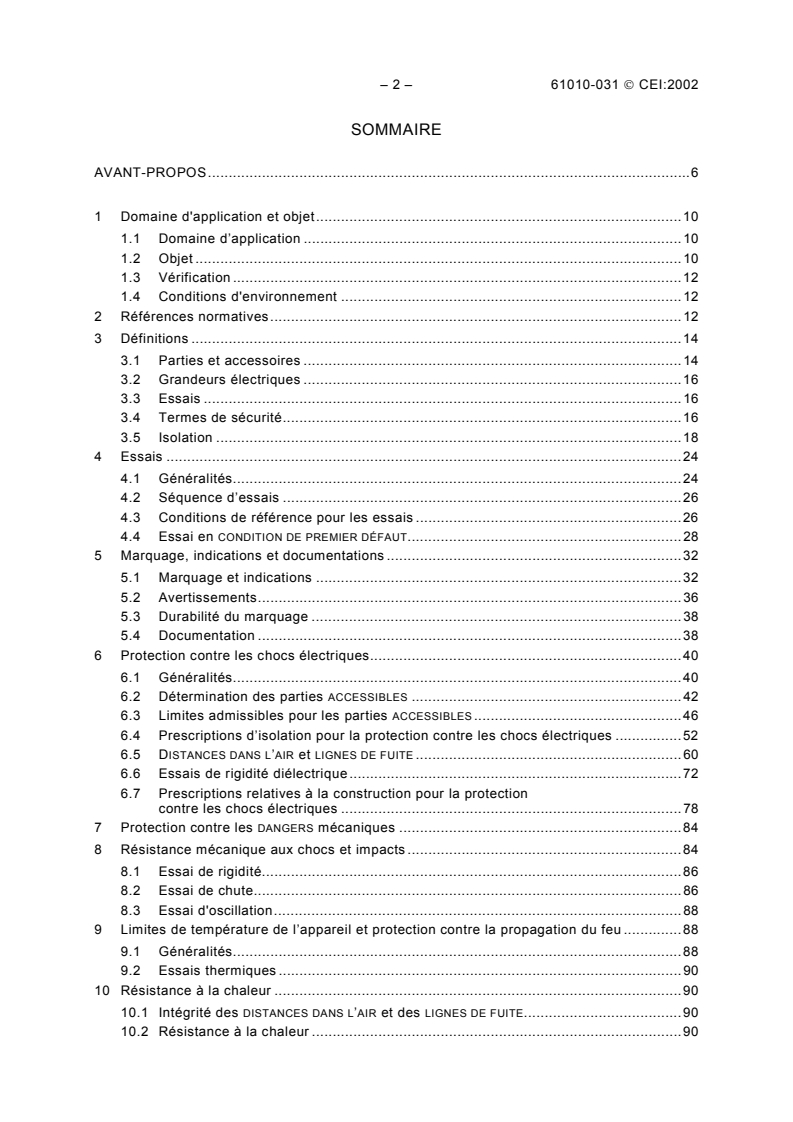
– 2 – 61010-031 CEI:2002
SOMMAIRE
AVANT-PROPOS.6
1 Domaine d'application et objet.10
1.1 Domaine d’application .10
1.2 Objet .10
1.3 Vérification .12
1.4 Conditions d'environnement .12
2 Références normatives.12
3 Définitions .14
3.1 Parties et accessoires .14
3.2 Grandeurs électriques .16
3.3 Essais .16
3.4 Termes de sécurité.16
3.5 Isolation .18
4 Essais .24
4.1 Généralités.24
4.2 Séquence d’essais .26
4.3 Conditions de référence pour les essais .26
4.4 Essai en CONDITION DE PREMIER DÉFAUT.28
5 Marquage, indications et documentations .32
5.1 Marquage et indications .32
5.2 Avertissements.36
5.3 Durabilité du marquage .38
5.4 Documentation .38
6 Protection contre les chocs électriques.40
6.1 Généralités.40
6.2 Détermination des parties ACCESSIBLES .42
6.3 Limites admissibles pour les parties ACCESSIBLES.46
6.4 Prescriptions d’isolation pour la protection contre les chocs électriques .52
6.5 DISTANCES DANS L’AIR et LIGNES DE FUITE .60
6.6 Essais de rigidité diélectrique.72
6.7 Prescriptions relatives à la construction pour la protection
contre les chocs électriques .78
7 Protection contre les DANGERS mécaniques .84
8 Résistance mécanique aux chocs et impacts .84
8.1 Essai de rigidité.86
8.2 Essai de chute.86
8.3 Essai d'oscillation.88
9 Limites de température de l’appareil et protection contre la propagation du feu .88
9.1 Généralités.88
9.2 Essais thermiques .90
10 Résistance à la chaleur .90
10.1 Intégrité des DISTANCES DANS L’AIR et des LIGNES DE FUITE.90
10.2 Résistance à la chaleur .90
61010-031 IEC:2002 – 3 –
CONTENTS
FOREWORD.7
1 Scope and object .11
1.1 Scope.11
1.2 Object .11
1.3 Verification .13
1.4 Environmental conditions .13
2 Normative references.13
3 Definitions .15
3.1 Parts and accessories .15
3.2 Electrical quantities .17
3.3 Tests.17
3.4 Safety terms .17
3.5 Insulation.19
4 Tests .25
4.1 General .25
4.2 Sequence of tests.27
4.3 Reference test conditions .27
4.4 Testing in SINGLE FAULT CONDITION .29
5 Marking and documentation .33
5.1 Marking .33
5.2 Warning markings .37
5.3 Durability of markings .39
5.4 Documentation .39
6 Protection against electric shock.41
6.1 General .41
6.2 Determination of ACCESSIBLE parts .43
6.3 Permissible limits for ACCESSIBLE parts .47
6.4 Insulation requirements for protection against electric shock .53
6.5 CLEARANCES and CREEPAGE DISTANCES.61
6.6 Dielectric strength tests .73
6.7 Constructional requirements for protection against electric shock .79
7 Protection against mechanical HAZARDS .85
8 Mechanical resistance to shock and impact.85
8.1 Rigidity test .87
8.2 Drop test .87
8.3 Impact swing test.89
9 Temperature limits and protection against the spread of fire.89
9.1 General .89
9.2 Temperature tests .91
10 Resistance to heat .91
10.1 Integrity of CLEARANCES and CREEPAGE DISTANCES .91
10.2 Resistance to heat.91
– 4 – 61010-031 CEI:2002
11 Protection contre les dangers provenant des fluides.92
11.1 Généralités.47
11.2 Nettoyage.92
11.3 SONDES ÉQUIPÉES avec protection spéciale.47
12 Composants .92
12.1 Généralités.92
12.2 Fusibles .94
12.3 Composants de HAUTE INTÉGRITÉ .94
Annexe A (normative) Circuits de mesure du courant ACCESSIBLE (voir 6.3) .98
Annexe B (normative) Doigts d'épreuve normalisés (voir 6.2) .106
Annexe C (normative) Mesure des DISTANCES DANS L’AIR et des LIGNES DES FUITES.110
Annexe D (informative) Index des termes définis .118
Bibliographie.120
Figure 1 – Exemples de SONDES ÉQUIPÉES de type A et C .22
Figure 2 – Exemples de SONDES ÉQUIPÉES de type B.24
Figure 3 – Méthodes de détermination des parties ACCESSIBLES (voir 6.2)
et des essais de tension (voir 6.4.1) .44
Figure 4 – Exemple d’application de la feuille métallique pour la mesure
du courant ACCESSIBLE .46
Figure 5 – Niveau de capacité chargée en CONDITION DE PREMIER DÉFAUT (voir 6.3.2.3) .50
Figure 6 – Protection contre le contact avec la POINTE DE TOUCHE (voir 6.4.4) .58
Figure 7 – Essai de flexion.82
Figure 8 – Essai de flexion pour les câbles utilisés dans les SONDES ÉQUIPÉES (voir
6.7.4).84
Figure 9 – Essai d'oscillation (voir 8.3).88
Figure A.1 – Circuit de mesure d'un courant continu et d'un courant alternatif
avec des fréquences allant jusqu'à 1 MHz.98
Figure A.2 – Circuits de mesure d'un courant continu et d'un courant alternatif
sinusoïdal avec des fréquences allant jusqu'à 100 Hz.100
Figure A.3 – Circuit de mesure du courant pour brûlures électriques.102
Figure A.4 – Circuit de mesure du courant pour contact en AMBIANCE HUMIDE.104
Figure B.1 – Doigt d'épreuve rigide.106
Figure B.2 – Doigt d'épreuve articulé .108
Tableau 1 – Symboles .34
Tableau 2 – Coefficient multiplicateur pour les DISTANCES DANS L’AIR
jusqu’à 5 000 m d’altitude .62
Tableau 3 – DISTANCES DANS L’AIR pour les catégories de mesure II, III et IV.64
Tableau 4 – Valeurs des DISTANCES DANS L’AIR pour le calcul de 6.5.2.2.68
Tableau 5 – LIGNES DE FUITE .70
Tableau 6 – Tensions d’essai pour L’ISOLATION PRINCIPALE .76
Tableau 7 – Coefficients de correction pour tension d’essai selon l’altitude du site
d’essai .78
Tableau 8 – Force de traction pour l'attache du câble .82
Tableau C.1 – Relation entre les degrés DE POLLUTION et la largeur des rainures .110
61010-031 IEC:2002 – 5 –
11 Protection against hazards from fluids.93
11.1 General .93
11.2 Cleaning.93
11.3 Specially protected PROBE ASSEMBLIES .47
12 Components .93
12.1 General .93
12.2 Fuses .95
12.3 HIGH-INTEGRITY components .95
Annex A (normative) Measuring circuits for ACCESSIBLE current (see 6.3).99
Annex B (normative) Standard test fingers (see 6.2). 107
Annex C (normative) Measurement of CREEPAGE DISTANCES and CLEARANCES . 111
Annex D (informative) Index of defined terms . 119
Bibliography . 121
Figure 1 – Examples of type A and C PROBE ASSEMBLIES.23
Figure 2 – Examples of type B PROBE ASSEMBLIES.25
Figure 3 – Methods for determination of ACCESSIBLE parts (see 6.2)
and for voltage tests of (see 6.4.1) .45
Figure 4 – Example of application of metal foil for ACCESSIBLE current measurement.47
Figure 5 – Charged capacitance level in SINGLE FAULT CONDITION (see 6.3.2.3).51
Figure 6 – Protection against touching a PROBE TIP (see 6.4.4) .59
Figure 7 – Flexing test.83
Figure 8 – Flexing test for cable used in PROBE ASSEMBLIES (see 6.7.4).85
Figure 9 – Impact swing test (see 8.3) .89
Figure A.1 – Measuring circuit for d.c. and for a.c. with frequencies up to 1 MHz.99
Figure A.2 – Measuring circuits for d.c. and for a.c. with sinusoidal frequencies
up to 100 Hz . 101
Figure A.3 – Current measuring circuit for electrical burns . 103
Figure A.4 – Current measuring circuit for WET CONTACT . 105
Figure B.1 – Rigid test finger . 107
Figure B.2 – Jointed test finger. 109
Table 1 – Symbols .35
Table 2 – Multiplication factors for CLEARANCE for altitudes up to 5 000 m .63
Table 3 – CLEARANCES for measurement categories II, III and IV.65
Table 4 – CLEARANCE values for the calculation of 6.5.2.2.69
Table 5 – CREEPAGE DISTANCES .71
Table 6 – Test voltages for BASIC INSULATION .77
Table 7 – Correction factors for test voltage according to test site altitude .79
Table 8 – Pull force for cable attachment.83
Table C.1 – Relation between POLLUTION degrees and width of grooves . 111
– 6 – 61010-031 CEI:2002
COMMISSION ÉLECTROTECHNIQUE INTERNATIONALE
____________
RÈGLES DE SÉCURITÉ POUR APPAREILS ÉLECTRIQUES DE MESURAGE,
DE RÉGULATION ET DE LABORATOIRE –
Partie 031: Prescriptions de sécurité pour sondes équipées
tenues à la main pour mesurage et essais électriques
AVANT-PROPOS
1) La CEI (Commission Électrotechnique Internationale) est une organisation mondiale de normalisation
composée de l'ensemble des comités électrotechniques nationaux (Comités nationaux de la CEI). La CEI a
pour objet de favoriser la coopération internationale pour toutes les questions de normalisation dans les
domaines de l'électricité et de l'électronique. A cet effet, la CEI, entre autres activités, publie des Normes
internationales. Leur élaboration est confiée à des comités d'études, aux travaux desquels tout Comité national
intéressé par le sujet traité peut participer. Les organisations internationales, gouvernementales et non
gouvernementales, en liaison avec la CEI, participent également aux travaux. La CEI collabore étroitement
avec l'Organisation Internationale de Normalisation (ISO), selon des conditions fixées par accord entre les
deux organisations.
2) Les décisions ou accords officiels de la CEI concernant les questions techniques représentent, dans la mesure
du possible, un accord international sur les sujets étudiés, étant donné que les Comités nationaux intéressés
sont représentés dans chaque comité d’études.
3) Les documents produits se présentent sous la forme de recommandations internationales. Ils sont publiés
comme normes, spécifications techniques, rapports techniques ou guides et agréés comme tels par les
Comités nationaux.
4) Dans le but d'encourager l'unification internationale, les Comités nationaux de la CEI s'engagent à appliquer de
façon transparente, dans toute la mesure possible, les Normes internationales de la CEI dans leurs normes
nationales et régionales. Toute divergence entre la norme de la CEI et la norme nationale ou régionale
correspondante doit être indiquée en termes clairs dans cette dernière.
5) La CEI n’a fixé aucune procédure concernant le marquage comme indication d’approbation et sa responsabilité
n’est pas engagée quand un matériel est déclaré conforme à l’une de ses normes.
6) L’attention est attirée sur le fait que certains des éléments de la présente Norme internationale peuvent faire
l’objet de droits de propriété intellectuelle ou de droits analogues. La CEI ne saurait être tenue pour
responsable de ne pas avoir identifié de tels droits de propriété et de ne pas avoir signalé leur existence.
La Norme internationale CEI 61010-031 a été établie par le comité d'études 66 de la CEI:
Sécurité des appareils de mesure, de commande et de laboratoire.
Cette nouvelle édition annule et remplace la première édition de la CEI 61010-2-031 (1993).
Elle a le statut d'une publication groupée de sécurité conformément au Guide 104 de la CEI.
La CEI 61010-031 est une norme autonome. Par conséquent il n'y a pas lieu de se référer à
la CEI 61010-1, sauf comme indiqué dans la note en 1.1.
Le texte de cette norme est issu des documents suivants:
FDIS Rapport de vote
66/262/FDIS 66/272/RVD
Le rapport de vote indiqué dans le tableau ci-dessus donne toute information sur le vote ayant
abouti à l'approbation de cette norme.
Cette publication a été rédigée selon les Directives ISO/CEI, Partie 3.
Les annexes A, B et C font partie intégrante de cette norme.
61010-031 IEC:2002 – 7 –
INTERNATIONAL ELECTROTECHNICAL COMMISSION
___________
SAFETY REQUIREMENTS FOR ELECTRICAL EQUIPMENT
FOR MEASUREMENT, CONTROL AND LABORATORY USE –
Part 031: Safety requirements for hand-held probe assemblies
for electrical measurement and test
FOREWORD
1) The IEC (International Electrotechnical Commission) is a worldwide organization for standardization comprising
all national electrotechnical committees (IEC National Committees). The object of the IEC is to promote
international co-operation on all questions concerning standardization in the electrical and electronic fields. To
this end and in addition to other activities, the IEC publishes International Standards. Their preparation is
entrusted to technical committees; any IEC National Committee interested in the subject dealt with may
participate in this preparatory work. International, governmental and non-governmental organizations liaising
with the IEC also participate in this preparation. The IEC collaborates closely with the International Organization
for Standardization (ISO) in accordance with conditions determined by agreement between the two
organizations.
2) The formal decisions or agreements of the IEC on technical matters express, as nearly as possible, an
international consensus of opinion on the relevant subjects since each technical committee has representation
from all interested National Committees.
3) The documents produced have the form of recommendations for international use and are published in the form
of standards, technical specifications, technical reports or guides and they are accepted by the National
Committees in that sense.
4) In order to promote international unification, IEC National Committees undertake to apply IEC International
Standards transparently to the maximum extent possible in their national and regional standards. Any
divergence between the IEC Standard and the corresponding national or regional standard shall be clearly
indicated in the latter.
5) The IEC provides no marking procedure to indicate its approval and cannot be rendered responsible for any
equipment declared to be in conformity with one of its standards.
6) Attention is drawn to the possibility that some of the elements of this International Standard may be the subject
of patent rights. The IEC shall not be held responsible for identifying any or all such patent rights.
International Standard IEC 61010-031 has been prepared by IEC technical committee 66:
Safety of measuring, control and laboratory equipment.
This new edition cancels and replaces the first edition of IEC 61010-2-031 (1993).
It has the status of a group safety publication in accordance with IEC Guide 104.
IEC 61010-031 is a stand-alone standard and consequently no reference is required to
IEC 61010-1, except as mentioned in the note to 1.1.
The text of this standard is based on the following documents:
FDIS Report on voting
66/262/FDIS 66/272/RVD
Full information on the voting for the approval of this standard can be found in the report on
voting indicated in the above table.
This publication has been drafted in accordance with the ISO/IEC Directives, Part 3.
Annexes A, B and C form an integral part of this standard.
– 8 – 61010-031 CEI:2002
Dans la présente norme, les caractères d'imprimerie suivants sont employés:
– prescriptions et définitions: caractères romains;
– NOTES: petits caractères romains;
– conformité et essais: caractères italiques;
– termes définis à l'article 3 et utilisés dans toute cette norme: CARACTÈRES ROMAINS EN
PETITES CAPITALES.
Le comité a décidé que le contenu de cette publication ne sera pas modifié avant 2004.
A cette date, la publication sera
• reconduite;
• supprimée;
• remplacée par une édition révisée, ou
• amendée.
61010-031 IEC:2002 – 9 –
In this standard the following print types are used:
– requirements and definitions: in roman type;
– NOTES: in smaller roman type;
– conformity and tests: in italic type;
– terms used throughout this standard which have been defined in clause 3: SMALL ROMAN
CAPITALS.
The committee has decided that the contents of this publication will remain unchanged until 2004.
At this date, the publication will be
• reconfirmed;
• withdrawn;
• replaced by a revised edition, or
• amended.
– 10 – 61010-031 CEI:2002
RÈGLES DE SÉCURITÉ POUR APPAREILS ÉLECTRIQUES DE MESURAGE,
DE RÉGULATION ET DE LABORATOIRE –
Partie 031: Prescriptions de sécurité pour sondes équipées
tenues à la main pour mesurage et essais électriques
1 Domaine d'application et objet
1.1 Domaine d’application
La présente partie de la CEI 61010 s’applique aux SONDES ÉQUIPÉES tenues à la main et
manipulées, correspondant aux types décrits ci-dessous, ainsi qu’à leurs accessoires
destinés aux usages professionnels, industriels (processus) et éducatifs. Ces SONDES
ÉQUIPÉES sont destinées à être utilisées dans l’interface entre un phénomène électrique et
un instrument de mesure ou d’essai. Elles peuvent être liées à l'appareil ou en être des
accessoires détachables.
a) SONDES ÉQUIPÉES, sans atténuation, à basse tension et à haute tension (type A). SONDES
ÉQUIPÉES, sans atténuation ASSIGNÉES pour connexion directe à des tensions supérieures
à 33 V efficaces ou à 46,7 V crête ou à 70 V continu mais ne dépassant pas 63 kV. Elles
ne comportent aucun composant actif, et ne sont pas non plus conçues pour assurer la
fonction de diviseur capacitif ou de mise en forme de signaux, mais elles peuvent contenir
des composants passifs ne provoquant pas d’atténuation tels que des fusibles.
b) SONDES ÉQUIPÉES à atténuateur ou diviseur à haute tension (type B). SONDES ÉQUIPÉES à
atténuateur ou diviseur ASSIGNÉES pour connexion directe sur des tensions secondaires
supérieures à 1 kV mais n’excédant pas 63 kV. La fonction diviseur peut être réalisée
dans sa totalité à l’intérieur de la SONDE ÉQUIPÉE, ou en partie dans l’appareil de mesurage
ou d’essai destiné à être utilisé avec la SONDE ÉQUIPÉE.
c) SONDES ÉQUIPÉES à atténuateur ou diviseur à basse tension (type C). SONDES ÉQUIPÉES à
atténuateur, à diviseur ou autre conditionneur de signal pour connexion directe à des
tensions supérieures à 33 V efficaces ou à 46,7 V crête ou à 70 V continu, mais ne
dépassant pas 1 kV efficace ou 1,5 kV continu. La fonction conditionneur de signal peut
être réalisée dans sa totalité à l’intérieur de la SONDE ÉQUIPÉE, ou en partie à l’intérieur de
l’appareil de mesurage ou d’essai destiné à être utilisé avec la SONDE ÉQUIPÉE.
NOTE Les SONDES ÉQUIPÉES
– qui ne correspondent pas aux définitions des types A, B ou C, ou,
– qui sont conçues pour être alimentées à partir d’un réseau de distribution basse tension, ou,
– qui incorporent d'autres fonctionnalités non particulièrement adressées dans cette présente norme
1)
peuvent avoir aussi besoin d’être conformes aux prescriptions pertinentes des autres parties de la CEI 61010 [6] .
1.2 Objet
1.2.1 Aspects inclus dans le domaine d'application
L’objet de cette norme est de garantir que la conception et la construction assurent une
protection adéquate de l’OPÉRATEUR et de la zone environnante contre
a) les chocs électriques et les brûlures (voir articles 6, 10 et 11);
b) les DANGERS d’ordre mécanique (voir articles 7, 8 et 11);
c) les températures excessives (voir article 9);
d) la propagation du feu à partir de la SONDE ÉQUIPÉE (voir article 9).
NOTE L’attention est attirée sur l’existence de règles supplémentaires qui peuvent être spécifiées par les
responsables nationaux de la santé et de la sécurité des travailleurs.
________
1)
Les chiffres entre crochets renvoient à la bibliographie.
61010-031 IEC:2002 – 11 –
SAFETY REQUIREMENTS FOR ELECTRICAL EQUIPMENT
FOR MEASUREMENT, CONTROL AND LABORATORY USE –
Part 031: Safety requirements for hand-held probe assemblies
for electrical measurement and test
1 Scope and object
1.1 Scope
This part of IEC 61010 applies to hand-held and hand-manipulated PROBE ASSEMBLIES of the
types described below, and related accessories which are intended for professional, industrial
process, and educational use. These PROBE ASSEMBLIES are for use in the interface between an
electrical phenomenon and test or measurement equipment. They may be fixed to the
equipment or be detachable accessories for the equipment.
a) Low-voltage and high-voltage, non-attenuating PROBE ASSEMBLIES (type A). Non-attenuating
PROBE ASSEMBLIES that are RATED for direct connection to voltages exceeding 33 V r.m.s. or
46,7 V peak or 70 V d.c., but not exceeding 63 kV. They do not incorporate active
components, nor are they intended to provide a voltage divider function or a signal
conditioning function, but they may contain passive non-attenuating components such as
fuses.
b) High-voltage attenuating or divider PROBE ASSEMBLIES (type B). Attenuating or divider
PROBE ASSEMBLIES that are RATED for direct connection to secondary voltages exceeding
1 kV but not exceeding 63 kV. The divider function may be carried out wholly within the
PROBE ASSEMBLY, or partly within the test or measurement equipment to be used with the
PROBE ASSEMBLY.
c) Low-voltage attenuating or divider PROBE ASSEMBLIES (type C). Attenuating, divider or other
signal conditioning PROBE ASSEMBLIES for direct connection to voltages exceeding 33 V
r.m.s or 46,7 V peak or 70 V d.c., but not exceeding 1 kV r.m.s. or 1,5 kV d.c. The signal
conditioning function may be carried out wholly within the PROBE ASSEMBLY, or partly within
the test or measurement equipment intended to be used with the PROBE ASSEMBLY.
NOTE PROBE ASSEMBLIES which
– are not within the definitions of types A, B or C, or,
– which are designed to be powered from a low-voltage mains supply, or
– include other features not specifically addressed in this standard
1)
may also need to meet the relevant requirements of other parts of IEC 61010 [6] .
1.2 Object
1.2.1 Aspects included in scope
The object of this standard is to ensure that the design and methods of construction used
provide adequate protection for the OPERATOR and the surrounding area against:
a) electric shock or burn (see clauses 6, 10 and 11);
b) mechanical HAZARDS (see clauses 7, 8 and 11);
c) excessive temperature (see clause 9);
d) spread of fire from the PROBE ASSEMBLY (see clause 9).
NOTE Attention is drawn to the existence of additional requirements which may be specified by national
authorities responsible for health and safety of labour forces.
________
1)
Figures in square brackets refer to the bibliography.
– 12 – 61010-031 CEI:2002
1.2.2 Aspects exclus du domaine d'application
Cette norme ne couvre pas
a) la fiabilité de fonctionnement, les qualités de fonctionnement ni les autres caractéristiques
de la SONDE ÉQUIPÉE;
b) la qualité de l'emballage de transport;
c) la maintenance (réparations);
d) la protection du personnel de maintenance (réparations).
NOTE Il est attendu que le personnel de maintenance prenne des précautions raisonnables pour faire face aux
DANGERS évidents, mais il convient que la conception des SONDES ÉQUIPÉES protège contre les incidents d’une
manière adaptée, et que la documentation de maintenance indique tout DANGER résiduel.
1.3 Vérification
Cette norme spécifie également les méthodes de vérification, par contrôle et par ESSAIS DE
TYPE, de la conformité de la SONDE ÉQUIPÉE aux prescriptions de cette norme.
1.4 Conditions d'environnement
Cette norme est applicable aux SONDES ÉQUIPÉES conçues pour être sûres au moins dans les
conditions suivantes:
a) altitude jusqu’à 2 000 m ou supérieure à 2 000 m si spécifié par le fabricant;
b) températures de 5 °C à 40 °C; ou inférieures à 5 °C ou supérieures à 40 °C si spécifié par
le fabricant;
c) humidité relative maximale de 80 % pour des températures jusqu’à 31 °C, avec
décroissance linéaire jusqu’à 50 % d’humidité relative à 40 °C;
d) degré de POLLUTION ASSIGNÉ applicable.
2 Références normatives
Les documents normatifs suivants contiennent des dispositions qui, par suite de la référence
qui y est faite, constituent des dispositions valables pour la présente partie de la CEI 61010.
Pour les références datées, les amendements ultérieurs ou les révisions de ces publications
ne s’appliquent pas. Toutefois, les parties prenantes aux accords fondés sur la présente
partie de la CEI 61010 sont invitées à rechercher la possibilité d'appliquer les éditions les
plus récentes des documents normatifs indiqués ci-après. Pour les références non datées, la
dernière édition du document normatif en référence s’applique. Les membres de la CEI et de
l'ISO possèdent le registre des Normes internationales en vigueur.
CEI 60027 (toutes les parties), Symboles littéraux à utiliser en électrotechnique
CEI 60060 (toutes les parties), Techniques des essais à haute tension
CEI 60417 (toutes les parties), Symboles graphiques utilisables sur le matériel
CEI 60529, Degrés de protection procurés par les enveloppes (Code IP)
CEI 60664-3, Coordination de l’isolement des matériels dans les systèmes (réseaux) à basse
tension – Partie 3: Utilisation de revêtements pour réaliser la coordination de l’isolement des
cartes imprimées équipées
ISO 7000, Symboles graphiques utilisables sur le matériel – Index et tableau synoptique
61010-031 IEC:2002 – 13 –
1.2.2 Aspects excluded from scope
This standard does not cover
a) reliable function, performance or other properties of the PROBE ASSEMBLY;
b) effectiveness of transport packaging;
c) servicing (repair);
d) protection of servicing (repair) personnel.
NOTE Servicing personnel are expected to be reasonably careful in dealing with obvious HAZARDS, but the design
should protect against mishap in an appropriate manner, and the service documentation should point out any
residual HAZARDS.
1.3 Verification
This standard also specifies methods of verifying, through inspection and TYPE TESTING, that
the PROBE ASSEMBLY meets the requirements of this standard.
1.4 Environmental conditions
This standard applies to PROBE ASSEMBLIES designed to be safe at least under the following
conditions:
a) altitude up to 2 000 m, or above 2 000 m if specified by the manufacturer;
b) temperature 5 °C to 40 °C; or below 5 °C or above 40 °C if specified by the manufacturer;
c) maximum relative humidity 80 % for temperatures up to 31 °C decreasing linearly to 50 %
relative humidity at 40 °C;
d) applicable RATED POLLUTION degree.
2 Normative references
The following normative documents contain provisions which, through reference in this text,
constitute provisions of this part of IEC 61010. For dated references, subsequent amendments
to, or revisions of, any of these publications do not apply. However, parties to agreements
based on this part of IEC 61010 are encouraged to investigate the possibility of applying the
most recent editions of the normative documents indicated below. For undated references,
the latest edition of the normative document referred to applies. Members of IEC and ISO
maintain registers of currently valid International Standards.
IEC 60027 (all parts), Letter symbols to be used in electrical technology
IEC 60060
...
IEC 61010-031
Edition 1.1 2008-06
INTERNATIONAL
STANDARD
NORME
INTERNATIONALE
GROUP SAFETY PUBLICATION
PUBLICATION GROUPÉE DE SÉCURITÉ
Safety requirements for electrical equipment for measurement, control and
laboratory use –
Part 031: Safety requirements for hand-held probe assemblies for electrical
measurement and test
Règles de sécurité pour appareils électriques de mesurage, de régulation et de
laboratoire –
Partie 031: Prescriptions de sécurité pour sondes équipées tenues à la main
pour mesurage et essais électriques
All rights reserved. Unless otherwise specified, no part of this publication may be reproduced or utilized in any form or by
any means, electronic or mechanical, including photocopying and microfilm, without permission in writing from either IEC or
IEC's member National Committee in the country of the requester.
If you have any questions about IEC copyright or have an enquiry about obtaining additional rights to this publication,
please contact the address below or your local IEC member National Committee for further information.
Droits de reproduction réservés. Sauf indication contraire, aucune partie de cette publication ne peut être reproduite
ni utilisée sous quelque forme que ce soit et par aucun procédé, électronique ou mécanique, y compris la photocopie
et les microfilms, sans l'accord écrit de la CEI ou du Comité national de la CEI du pays du demandeur.
Si vous avez des questions sur le copyright de la CEI ou si vous désirez obtenir des droits supplémentaires sur cette
publication, utilisez les coordonnées ci-après ou contactez le Comité national de la CEI de votre pays de résidence.
IEC Central Office
3, rue de Varembé
CH-1211 Geneva 20
Switzerland
Email: inmail@iec.ch
Web: www.iec.ch
About the IEC
The International Electrotechnical Commission (IEC) is the leading global organization that prepares and publishes
International Standards for all electrical, electronic and related technologies.
About IEC publications
The technical content of IEC publications is kept under constant review by the IEC. Please make sure that you have the
latest edition, a corrigenda or an amendment might have been published.
ƒ Catalogue of IEC publications: www.iec.ch/searchpub
The IEC on-line Catalogue enables you to search by a variety of criteria (reference number, text, technical committee,…).
It also gives information on projects, withdrawn and replaced publications.
ƒ IEC Just Published: www.iec.ch/online_news/justpub
Stay up to date on all new IEC publications. Just Published details twice a month all new publications released. Available
on-line and also by email.
ƒ Electropedia: www.electropedia.org
The world's leading online dictionary of electronic and electrical terms containing more than 20 000 terms and definitions
in English and French, with equivalent terms in additional languages. Also known as the International Electrotechnical
Vocabulary online.
ƒ Customer Service Centre: www.iec.ch/webstore/custserv
If you wish to give us your feedback on this publication or need further assistance, please visit the Customer Service
Centre FAQ or contact us:
Email: csc@iec.ch
Tel.: +41 22 919 02 11
Fax: +41 22 919 03 00
A propos de la CEI
La Commission Electrotechnique Internationale (CEI) est la première organisation mondiale qui élabore et publie des
normes internationales pour tout ce qui a trait à l'électricité, à l'électronique et aux technologies apparentées.
A propos des publications CEI
Le contenu technique des publications de la CEI est constamment revu. Veuillez vous assurer que vous possédez
l’édition la plus récente, un corrigendum ou amendement peut avoir été publié.
ƒ Catalogue des publications de la CEI: www.iec.ch/searchpub/cur_fut-f.htm
Le Catalogue en-ligne de la CEI vous permet d’effectuer des recherches en utilisant différents critères (numéro de référence,
texte, comité d’études,…). Il donne aussi des informations sur les projets et les publications retirées ou remplacées.
ƒ Just Published CEI: www.iec.ch/online_news/justpub
Restez informé sur les nouvelles publications de la CEI. Just Published détaille deux fois par mois les nouvelles
publications parues. Disponible en-ligne et aussi par email.
ƒ Electropedia: www.electropedia.org
Le premier dictionnaire en ligne au monde de termes électroniques et électriques. Il contient plus de 20 000 termes et
définitions en anglais et en français, ainsi que les termes équivalents dans les langues additionnelles. Egalement appelé
Vocabulaire Electrotechnique International en ligne.
ƒ Service Clients: www.iec.ch/webstore/custserv/custserv_entry-f.htm
Si vous désirez nous donner des commentaires sur cette publication ou si vous avez des questions, visitez le FAQ du
Service clients ou contactez-nous:
Email: csc@iec.ch
Tél.: +41 22 919 02 11
Fax: +41 22 919 03 00
IEC 61010-031
Edition 1.1 2008-06
INTERNATIONAL
STANDARD
NORME
INTERNATIONALE
GROUP SAFETY PUBLICATION
PUBLICATION GROUPÉE DE SÉCURITÉ
Safety requirements for electrical equipment for measurement, control and
laboratory use –
Part 031: Safety requirements for hand-held probe assemblies for electrical
measurement and test
Règles de sécurité pour appareils électriques de mesurage, de régulation et de
laboratoire –
Partie 031: Prescriptions de sécurité pour sondes équipées tenues à la main
pour mesurage et essais électriques
INTERNATIONAL
ELECTROTECHNICAL
COMMISSION
COMMISSION
ELECTROTECHNIQUE
PRICE CODE
INTERNATIONALE
CR
CODE PRIX
ICS 19.080 ISBN 2-8318-9701-7
– 2 – 61010-031 © IEC:2002+A1:2008
CONTENTS
FOREWORD.5
1 Scope and object .7
1.1 Scope.7
1.2 Object .7
1.3 Verification .8
1.4 Environmental conditions .8
2 Normative references.8
3 Definitions .9
3.1 Parts and accessories .9
3.2 Electrical quantities .10
3.3 Tests.10
3.4 Safety terms .10
3.5 Insulation.11
4 Tests .15
4.1 General .15
4.2 Sequence of tests.16
4.3 Reference test conditions .16
4.4 Testing in SINGLE FAULT CONDITION .17
5 Marking and documentation .19
5.1 Marking .19
5.2 Warning markings .21
5.3 Durability of markings .21
5.4 Documentation .21
6 Protection against electric shock.23
6.1 General .23
6.2 Determination of ACCESSIBLE parts .23
6.3 Permissible limits for ACCESSIBLE parts .25
6.4 Insulation requirements for protection against electric shock .28
6.5 CLEARANCES and CREEPAGE DISTANCES.32
6.6 Voltage test .37
6.7 Constructional requirements .40
7 Protection against mechanical HAZARDS .46
8 Mechanical resistance to shock and impact.46
8.1 Rigidity test .46
8.2 Drop test .46
8.3 Impact swing test.47
9 Temperature limits and protection against the spread of fire.47
9.1 General .47
9.2 Temperature tests .48
10 Resistance to heat .48
10.1 Integrity of CLEARANCES and CREEPAGE DISTANCES .48
10.2 Resistance to heat.48
61010-031 © IEC:2002+A1:2008 – 3 –
11 Protection against hazards from fluids.49
11.1 General .49
11.2 Cleaning.49
11.3 Specially protected PROBE ASSEMBLIES .49
12 Components .49
12.1 General .49
12.2 Fuses .50
12.3 HIGH-INTEGRITY components .50
13 Prevention of HAZARD from arc flash and short-circuits .51
13.1 General .51
13.2 Exposed conductive parts .51
Annex A (normative) Measuring circuits for ACCESSIBLE current (see 6.3).52
Annex B (normative) Standard test fingers (see 6.2).56
Annex C (normative) Measurement of CREEPAGE DISTANCES and CLEARANCES .58
Annex D (informative) Index of defined terms .62
Bibliography .63
Figure 1 – Examples of type A and C PROBE ASSEMBLIES.13
Figure 2 – Examples of type B PROBE ASSEMBLIES.14
Figure 10 – Examples of type D PROBE ASSEMBLIES.15
Figure 3 – Methods for determination of ACCESSIBLE parts (see 6.2)
and for voltage tests of (see 6.4.1) .24
Figure 4 – Example of application of metal foil for ACCESSIBLE current measurement.25
Figure 5 – Charged capacitance level in NORMAL CONDITION and SINGLE-FAULT CONDITION
(see 6.3.1.3 and 6.3.2.3) .27
Figure 6 – Protection against touching a PROBE TIP (see 6.4.4) .31
Figure 7 – Flexing test.42
Figure 8 – Flexing test for cable used in PROBE ASSEMBLIES (see 6.7.4).43
Figure 11 – Treatment of the insulation of probe cable.45
Figure 12 – Pulley for the treatment of Figure 11 .45
Figure 9 – Impact swing test (see 8.3) .47
Figure A.1 – Measuring circuit for d.c. and for a.c. with frequencies up to 1 MHz.52
Figure A.2 – Measuring circuits for d.c. and for a.c. with sinusoidal frequencies
up to 100 Hz .53
Figure A.3 – Current measuring circuit for electrical burns .54
Figure A.4 – Current measuring circuit for wet contact .55
Figure B.1 – Rigid test finger .56
Figure B.2 – Jointed test finger.57
– 4 – 61010-031 © IEC:2002+A1:2008
Table 1 – Symbols .20
Table 2 – Multiplication factors for CLEARANCE for altitudes up to 5 000 m .33
Table 3 – CLEARANCES for measurement categories II, III and IV.34
Table 4 – CLEARANCE values for the calculation of 6.5.2.2.35
Table 5 – CREEPAGE DISTANCES .36
Table 6 – Test voltages for BASIC INSULATION .39
Table 7 – Correction factors for test voltage according to test site altitude .40
Table 8 – Pull force for cable attachment.41
Table 9 – Forces for flexing/pull test for single core probe cable .43
Table C.1 – Relation between POLLUTION degrees and width of grooves .58
61010-031 © IEC:2002+A1:2008 – 5 –
INTERNATIONAL ELECTROTECHNICAL COMMISSION
___________
SAFETY REQUIREMENTS FOR ELECTRICAL EQUIPMENT
FOR MEASUREMENT, CONTROL AND LABORATORY USE –
Part 031: Safety requirements for hand-held probe assemblies
for electrical measurement and test
FOREWORD
1) The International Electrotechnical Commission (IEC) is a worldwide organization for standardization comprising
all national electrotechnical committees (IEC National Committees). The object of IEC is to promote
international co-operation on all questions concerning standardization in the electrical and electronic fields. To
this end and in addition to other activities, IEC publishes International Standards, Technical Specifications,
Technical Reports, Publicly Available Specifications (PAS) and Guides (hereafter referred to as “IEC
Publication(s)”). Their preparation is entrusted to technical committees; any IEC National Committee interested
in the subject dealt with may participate in this preparatory work. International, governmental and non-
governmental organizations liaising with the IEC also participate in this preparation. IEC collaborates closely
with the International Organization for Standardization (ISO) in accordance with conditions determined by
agreement between the two organizations.
2) The formal decisions or agreements of IEC on technical matters express, as nearly as possible, an international
consensus of opinion on the relevant subjects since each technical committee has representation from all
interested IEC National Committees.
3) IEC Publications have the form of recommendations for international use and are accepted by IEC National
Committees in that sense. While all reasonable efforts are made to ensure that the technical content of IEC
Publications is accurate, IEC cannot be held responsible for the way in which they are used or for any
misinterpretation by any end user.
4) In order to promote international uniformity, IEC National Committees undertake to apply IEC Publications
transparently to the maximum extent possible in their national and regional publications. Any divergence
between any IEC Publication and the corresponding national or regional publication shall be clearly indicated in
the latter.
5) IEC provides no marking procedure to indicate its approval and cannot be rendered responsible for any
equipment declared to be in conformity with an IEC Publication.
6) All users should ensure that they have the latest edition of this publication.
7) No liability shall attach to IEC or its directors, employees, servants or agents including individual experts and
members of its technical committees and IEC National Committees for any personal injury, property damage or
other damage of any nature whatsoever, whether direct or indirect, or for costs (including legal fees) and
expenses arising out of the publication, use of, or reliance upon, this IEC Publication or any other IEC
Publications.
8) Attention is drawn to the Normative references cited in this publication. Use of the referenced publications is
indispensable for the correct application of this publication.
9) Attention is drawn to the possibility that some of the elements of this IEC Publication may be the subject of
patent rights. IEC shall not be held responsible for identifying any or all such patent rights.
International Standard IEC 61010-031 has been prepared by IEC technical committee 66:
Safety of measuring, control and laboratory equipment.
It has the status of a group safety publication in accordance with IEC Guide 104.
IEC 61010-031 is a stand-alone standard and consequently no reference is required to
IEC 61010-1, except as mentioned in the note to 1.1.
This consolidated version of IEC 61010-031 consists of the first edition (2002) [documents
66/262/FDIS and 66/272/RVD] and its amendment 1 (2008) [documents 66/383/CDV and
66/394/RVC].
The technical content is therefore identical to the base edition and its amendment and has
been prepared for user convenience.
It bears the edition number 1.1.
– 6 – 61010-031 © IEC:2002+A1:2008
A vertical line in the margin shows where the base publication has been modified by
amendment 1.
Annexes A, B and C form an integral part of this standard.
In this standard the following print types are used:
– requirements and definitions: in roman type;
– NOTES: in smaller roman type;
– conformity and tests: in italic type;
– terms used throughout this standard which have been defined in clause 3: SMALL ROMAN
CAPITALS.
The committee has decided that the contents of the base publication and its amendments will
remain unchanged until the maintenance result date indicated on the IEC web site under
"http://webstore.iec.ch" in the data related to the specific publication. At this date,
the publication will be
• reconfirmed,
• withdrawn,
• replaced by a revised edition, or
• amended.
61010-031 © IEC:2002+A1:2008 – 7 –
SAFETY REQUIREMENTS FOR ELECTRICAL EQUIPMENT
FOR MEASUREMENT, CONTROL AND LABORATORY USE –
Part 031: Safety requirements for hand-held probe assemblies
for electrical measurement and test
1 Scope and object
1.1 Scope
This part of IEC 61010 applies to hand-held and hand-manipulated PROBE ASSEMBLIES of the
types described below, and related accessories which are intended for professional, industrial
process, and educational use. These PROBE ASSEMBLIES are for use in the interface between an
electrical phenomenon and test or measurement equipment. They may be fixed to the
equipment or be detachable accessories for the equipment.
a) Low-voltage and high-voltage, non-attenuating PROBE ASSEMBLIES (type A). Non-attenuating
PROBE ASSEMBLIES that are RATED for direct connection to voltages exceeding 33 V r.m.s. or
46,7 V peak or 70 V d.c., but not exceeding 63 kV. They do not incorporate active
components, nor are they intended to provide a voltage divider function or a signal
conditioning function, but they may contain passive non-attenuating components such as
fuses.
b) High-voltage attenuating or divider PROBE ASSEMBLIES (type B). Attenuating or divider
PROBE ASSEMBLIES that are RATED for direct connection to secondary voltages exceeding
1 kV but not exceeding 63 kV. The divider function may be carried out wholly within the
PROBE ASSEMBLY, or partly within the test or measurement equipment to be used with the
PROBE ASSEMBLY.
c) Low-voltage attenuating or divider PROBE ASSEMBLIES (type C). Attenuating, divider or other
signal conditioning PROBE ASSEMBLIES for direct connection to voltages exceeding 33 V
r.m.s or 46,7 V peak or 70 V d.c., but not exceeding 1 kV r.m.s. or 1,5 kV d.c. The signal
conditioning function may be carried out wholly within the PROBE ASSEMBLY, or partly within
the test or measurement equipment intended to be used with the PROBE ASSEMBLY.
d) Low-voltage attenuating and non-attenuating PROBE ASSEMBLIES (type D), that are RATED for
direct connection only to voltages not exceeding 33 V r.m.s., or 46,7 V peak, or 70 V d.c.,
and are suitable for currents exceeding 8 A.
NOTE PROBE ASSEMBLIES which
– are not within the definitions of types A, B, C, or D, or,
– which are designed to be powered from a low-voltage mains supply, or
– include other features not specifically addressed in this standard
1)
may also need to meet the relevant requirements of other parts of IEC 61010 [6] .
1.2 Object
1.2.1 Aspects included in scope
The object of this standard is to ensure that the design and methods of construction used
provide adequate protection for the OPERATOR and the surrounding area against:
a) electric shock or burn (see clauses 6, 10 and 11);
HAZARDS (see clauses 7, 8 and 11);
b) mechanical
c) excessive temperature (see clause 9);
________
1)
Figures in square brackets refer to the bibliography.
– 8 – 61010-031 © IEC:2002+A1:2008
d) spread of fire from the PROBE ASSEMBLY (see clause 9);
e) arc flash (see Clause 13).
NOTE Attention is drawn to the existence of additional requirements which may be specified by national
authorities responsible for health and safety of labour forces.
1.2.2 Aspects excluded from scope
This standard does not cover
a) reliable function, performance or other properties of the PROBE ASSEMBLY;
b) effectiveness of transport packaging;
c) servicing (repair);
d) protection of servicing (repair) personnel.
NOTE Servicing personnel are expected to be reasonably careful in dealing with obvious HAZARDS, but the design
should protect against mishap in an appropriate manner, and the service documentation should point out any
residual HAZARDS.
1.3 Verification
This standard also specifies methods of verifying, through inspection and TYPE TESTING, that
the PROBE ASSEMBLY meets the requirements of this standard.
1.4 Environmental conditions
This standard applies to PROBE ASSEMBLIES designed to be safe at least under the following
conditions:
a) altitude up to 2 000 m, or above 2 000 m if specified by the manufacturer;
b) temperature 5 °C to 40 °C; or below 5 °C or above 40 °C if specified by the manufacturer;
c) maximum relative humidity 80 % for temperatures up to 31 °C decreasing linearly to 50 %
relative humidity at 40 °C;
d) applicable RATED POLLUTION degree.
2 Normative references
The following referenced documents are indispensable for the application of this document. For
dated references, only the edition cited applies. For undated references, the latest edition of
the referenced document (including any amendments) applies.
IEC 60027 (all parts), Letter symbols to be used in electrical technology
IEC 60060 (all parts), High-voltage test techniques
IEC 60417 (all parts), Graphical symbols for use on equipment
IEC 60529, Degrees of protection provided by enclosures (IP Code)
IEC 60664-3, Insulation coordination for equipment within low-voltage systems – Part 3: Use of
coatings to achieve insulation coordination of printed board assemblies
ISO 7000, Graphical symbols for use on equipment – Index and synopsis
61010-031 © IEC:2002+A1:2008 – 9 –
3 Definitions
For the purpose of this part of IEC 61010, the following definitions apply.
Unless otherwise specified, the terms "voltage" and "current" mean the r.m.s. values of an
alternating, direct or composite voltage or current. Where the term "mains" is used, it refers to
the low-voltage electricity supply system (above the values of 6.3.2.1).
3.1 Parts and accessories
3.1.1
TERMINAL
component provided for the connection of a device (equipment) to external conductors
[IEV 151-01-03, modified]
NOTE TERMINALS can contain one or several contacts and the term includes sockets, pins, connectors, etc.
3.1.2
ENCLOSURE
part providing protection of equipment against certain external influences and, in any direction,
protection against direct contact
3.1.3
BARRIER
part providing protection against direct contact from any usual direction of access
NOTE ENCLOSURES and BARRIERS may provide protection against the spread of fire (see 9.1).
3.1.4
PROBE ASSEMBLY
device for making temporary contact between test or measurement equipment and a point on
an electrical circuit being measured or tested. It includes the cable and the means for making a
connection with the test or measurement equipment
NOTE See Figures 1, 2, and 10 for examples of PROBE ASSEMBLIES and an explanation of the function of their
parts.
3.1.5
PROBE TIP
part of the PROBE ASSEMBLY which makes the connection to the point being measured or tested
3.1.6
REFERENCE CONNECTOR
device used to connect a reference point in the test or measurement equipment (usually the
functional earth TERMINAL) to a reference point on the electrical circuit being measured or
tested
3.1.7
TOOL
external device, including a key or coin, used to aid a person to perform a mechanical function
– 10 – 61010-031 © IEC:2002+A1:2008
3.2 Electrical quantities
3.2.1
RATED (value)
quantity value assigned, generally by a manufacturer, for a specified operating condition of a
component, device or equipment
[IEV 151-04-03]
3.2.2
RATING
RATED values and operating conditions
set of
[IEV 151-04-04]
3.2.3
WORKING VOLTAGE
highest voltage which can continuously appear across an insulation during NORMAL USE
NOTE Both open-circuit conditions and normal operating conditions are taken into account.
3.3 Tests
3.3.1
TYPE TEST
test of one or more samples of equipment (or parts of equipment) made to a particular design,
to show that the design and construction meet one or more requirements of this standard
NOTE This is an amplification of the IEV 151-04-15 definition to cover both design and construction requirements.
3.4 Safety terms
3.4.1
ACCESSIBLE (of a part)
able to be touched with a standard test finger or test pin, when used as specified in 6.2
3.4.2
HAZARDOUS LIVE
capable of rendering an electric shock or electric burn in NORMAL CONDITION or SINGLE FAULT
CONDITION (see 6.3.1 for values applicable to NORMAL CONDITION and 6.3.2 for the higher values
deemed to be appropriate in SINGLE FAULT CONDITION)
3.4.3
HIGH INTEGRITY
not liable to become defective in such a manner as to cause a risk of HAZARD; a HIGH INTEGRITY
part is considered as not subject to failure when tests under fault conditions are made
3.4.4
PROTECTIVE IMPEDANCE
component, assembly of components or the combination of BASIC INSULATION and a current or
voltage limiting device, the impedance, construction and reliability of which are such that when
connected between parts which are HAZARDOUS LIVE and ACCESSIBLE conductive parts,
it provides protection to the extent required by this standard in NORMAL CONDITION and SINGLE
FAULT CONDITION
61010-031 © IEC:2002+A1:2008 – 11 –
3.4.5
NORMAL USE
operation, including stand-by, according to the instructions for use or for the obvious intended
purpose
NOTE In most cases, NORMAL USE also implies NORMAL CONDITION, because the instructions for use will warn
against using the equipment when it is not in NORMAL CONDITION.
3.4.6
NORMAL CONDITION
condition in which all means for protection against HAZARDS are intact
3.4.7
SINGLE FAULT CONDITION
condition in which one means for protection against HAZARD is defective or one fault is present
which could cause a HAZARD
NOTE If a SINGLE FAULT CONDITION results unavoidably in another SINGLE FAULT CONDITION, the two failures are
considered as one SINGLE FAULT CONDITION.
3.4.8
OPERATOR
person operating equipment for its intended purpose
NOTE The OPERATOR should have received training appropriate for this purpose.
3.4.9
RESPONSIBLE BODY
individual or group responsible for the use and maintenance of equipment, and for ensuring
that OPERATORS are adequately trained
3.4.10
WET LOCATION
Location where water or another conductive liquid may be present and is likely to cause
reduced human body impedance due to wetting of the contact between the human body and
the equipment, or wetting of the contact between the human body and the environment
3.4.11
HAZARD
potential source of harm (see 1.2)
3.5 Insulation
3.5.1
BASIC INSULATION
insulation, the failure of which could cause a risk of electric shock
NOTE BASIC INSULATION may serve also for functional purposes.
3.5.2
SUPPLEMENTARY INSULATION
independent insulation applied in addition to BASIC INSULATION in order to provide protection
against electric shock in the event of a failure of BASIC INSULATION
3.5.3
DOUBLE INSULATION
insulation comprising both BASIC INSULATION and SUPPLEMENTARY INSULATION
– 12 – 61010-031 © IEC:2002+A1:2008
3.5.4
REINFORCED INSULATION
insulation which provides protection against electric shock not less than that provided by
DOUBLE INSULATION
NOTE REINFORCED INSULATION may comprise several layers which cannot be tested singly as SUPPLEMENTARY
INSULATION or BASIC INSULATION.
3.5.5
POLLUTION
any addition of foreign matter, solid, liquid or gaseous (ionized gases), that may produce a
reduction of dielectric strength or surface resistively
3.5.6
POLLUTION DEGREE
a numeral indicating the level of POLLUTION that may be present in the environment
3.5.6.1
POLLUTION DEGREE 1
no POLLUTION or only dry, non-conductive POLLUTION
NOTE The POLLUTION has no influence.
3.5.6.2
POLLUTION DEGREE 2
only non-conductive POLLUTION. Occasionally, however, a temporary conductivity caused by
condensation must be expected
3.5.6.3
POLLUTION DEGREE 3
conductive POLLUTION occurs or dry non-conductive POLLUTION occurs which becomes conduc-
tive due to condensation which is to be expected
3.5.7
CLEARANCE
shortest distance in air between two conductive parts
3.5.8
CREEPAGE DISTANCE
shortest distance along the surface of the insulating material between two conductive parts
[IEV 151-03-37]
61010-031 © IEC:2002+A1:2008 – 13 –
IEC 2597/01
Key
1 Typical connectors 5 Crocodile clip
2 PROBE TIP 6 Reference connector
3 Probe body 7 BNC connector
4 To equipment 8 Examples of accessories
Figure 1 – Examples of type A and C PROBE ASSEMBLIES
– 14 – 61010-031 © IEC:2002+A1:2008
IEC 2598/01
Key
1 PROBE TIP
2 To equipment
3 Reference connector
4 BARRIER
5 Hand-held area of probe body
Figure 2 – Examples of type B PROBE ASSEMBLIES
61010-031 © IEC:2002+A1:2008 – 15 –
IEC 076/08
Key
1 connector
2 jaw
3 hand-held area of crocodile clip or clamp
Figure 10 – Examples of type D PROBE ASSEMBLIES
4 Tests
4.1 General
Tests in this standard are TYPE TESTS to be carried out on samples of PROBE ASSEMBLIES or
their parts. Their only purpose is to check that the design and construction ensure conformity
with this standard.
Tests on components or parts of the PROBE ASSEMBLY meeting the requirements of the relevant
standards need not be repeated during TYPE TESTS of the whole PROBE ASSEMBLY.
If a PROBE ASSEMBLY is of more than one probe type (see 1.1), each type shall be tested
according to its applicable requirements.
– 16 – 61010-031 © IEC:2002+A1:2008
Conformity with the requirements of this standard is checked by carrying out all applicable
tests, except that a test may be omitted if examination of the PROBE ASSEMBLY demonstrates
conclusively that it would pass the test. Tests are carried out under
a) reference test conditions (see 4.3);
b) SINGLE FAULT CONDITIONS (see 4.4).
NOTE 1 If the RATED range of environmental conditions for PROBE ASSEMBLIES is wider than that stated in 1.4,
the manufacturer should make sure (for example, by suitable alteration of test requirements or additional tests) that
the safety requirements of this standard are still fulfilled.
NOTE 2 If when carrying out a conformity test, there is any uncertainty about the exact value of the applied or
measured quantity (for example, voltage) due to the tolerance,
– the manufacturer should ensure that at least the specified test value is applied;
– the test house should ensure that no more than the specified test value is applied.
NOTE 3 PROBE ASSEMBLIES which have been TYPE TESTED may no longer be suitable for their intended function
because of the residual effect of stresses resulting from tests. For this reason TYPE TESTS should never be carried
out (for example, by the RESPONSIBLE BODY) after the PROBE ASSEMBLIES have left the manufacturer.
4.2 Sequence of tests
The sequence of tests is optional unless otherwise specified in the standard. The PROBE
ASSEMBLIES under test shall be carefully inspected after each test. If the result of a test causes
doubt whether any earlier tests would have been passed if the sequence had been reversed,
these earlier tests shall be repeated. Tests under fault conditions may be destructive and may
follow those under reference test conditions.
4.3 Reference test conditions
4.3.1 Environmental conditions
Unless otherwise specified in this standard, the following environmental conditions (but not
conflicting with those of 1.4) shall exist in the test location:
a) a temperature of 15 °C to 35 °C;
b) a relative humidity of not more than 75 %;
c) an air pressure of 75 kPa to 106 kPa;
d) no hoarfrost, dew, percolating water, rain, solar irradiation, etc.
4.3.2 State of PROBE ASSEMBLIES
Unless otherwise specified, tests shall be carried out on the PROBE ASSEMBLIES assembled for
NORMAL USE and under the least favourable combination of the conditions given in 4.3.3 to 4.3.9.
When dimensions or mass make it unsuitable to carry out particular tests on a complete PROBE
ASSEMBLY, tests on sub-assemblies are allowed, provided it is verified that the assembled
PROBE ASSEMBLY will be in accordance with this standard.
4.3.3 Position of the PROBE ASSEMBLY
The PROBE ASSEMBLY shall be in any position of NORMAL USE and with any ventilation
unimpeded
4.3.4 Accessories
Accessories and OPERATOR interchangeable parts available from, or recommended by, the
manufacturer for use with the PROBE ASSEMBLY under test shall be either connected or not
connected.
61010-031 © IEC:2002+A1:2008 – 17 –
4.3.5 Covers and removable parts
Covers or parts which can be removed without using a TOOL shall be removed or not removed.
4.3.6 Input and output voltages
Input and output voltages, including floating voltages shall be set to any voltage within the
RATED voltage range.
4.3.7 Controls
Controls which the OPERATOR can adjust by hand shall be set to any position except for
combinations of settings prohibited by the manufacturer, as shown by marking on the PROBE
ASSEMBLY.
4.3.8 Connections
The PROBE ASSEMBLY shall be connected for its intended purpose, or not connected.
4.3.9 Duty cycle
PROBE ASSEMBLIES for short-term or intermittent operation shall be operated for the longest
period and have the shortest recovery period consistent with the manufacturer's instructions.
4.4 Testing in SINGLE FAULT CONDITION
4.4.1 General
The following requirements apply.
a) Examination of the PROBE ASSEMBLY and its circuit diagram will generally show the fault
conditions which are liable to result in HAZARDS within the meaning of this standard and
which, therefore, shall be applied.
b) Fault tests shall be made unless it can be demonstrated that no HAZARD could arise from a
particular fault condition.
c) The PROBE ASSEMBLY shall be operated under the least favourable combination of reference
test conditions (see 4.3). These combinations may be different for different faults and they
should be recorded for each test.
4.4.2 Application of fault conditions
Fault conditions shall include those specified in 4.4.2.1 to 4.4.2.4. They shall be applied only
one at a time and shall be applied in turn in the most convenient order. Multiple simultaneous
faults shall not be applied unless they are a consequence of an applied fault.
After each application of a fault condition, the PROBE ASSEMBLY or part shall pass the applicable
tests of 4.4.4.
4.4.2.1 PROBE ASSEMBLIES or parts for short-term or intermittent operation
These shall be operated continuously if continuous operation could occur in a SINGLE FAULT
CONDITION.
4.4.2.2 Outputs
Outputs of type B and C PROBE ASSEMBLIES shall be short-circuited one at a time.
– 18 – 61010-031 © IEC:2002+A1:2008
4.4.2.3 Insulation between circuits and parts
Insulation between circuits and parts which is below the level specified for BASIC INSULATION
shall be bridged to check against the spread of fire.
NOTE See 9.1 for an alternative method of checking protection against spread of fire.
4.4.2.4 Components
Components (except HIGH INTEGRITY components) of type B and type C PROBE ASSEMBLIES shall
be short-circuited or open-circuited, whichever is less favourable.
4.4.3 Duration of tests
The PROBE ASSEMBLY shall be operated until further change as a result of the applied fault
is unlikely. Each test is normally limited to 1 h since any secondary fault arising from a SINGLE
FAULT CONDITION will usually manifest itself within that time. If at the end of 1 h there is an
indication that a risk of electric shock, spread of fire or injury to persons may eventually occur, the
test shall be continued until one of these HAZARDS does occur or for a maximum period of 4 h.
If a fault is terminated by the opening of a fuse and if the fuse does not operate within
approximately 1 s, the current through the fuse under the relevant fault condition shall be
measured. Evaluation with the pre-arcing time/current characteristics shall be made to find out
whether the minimum operating current of the fuse is reached or exceeded and what is the
maximum time before the fuse operates. The current through the fuse may vary as a function
of time. If the minimum operating current of the fuse is not reached in the test, the PROBE
ASSEMBLY shall be operated for a period corresponding to the maximum fusing time or
continuously for 1 h or 4 h, as specified above.
4.4.4 Conformity after application of SINGLE FAULT CONDITIONS
4.4.4.1 Conformity with requirements for electric shock protection is checked after the
application of SINGLE FAULTS as follows:
a) by making the measurements of 6.3.2 to check that no ACCESSIBLE conductive parts have
become HAZARDOUS LIVE, except as permitted by 6.1.1;
b) by performing a voltage test on DOUBLE INSULATION or REINFORCED INSULATION to check that
there is still one level of protection by insulation. The voltage test is made as specified
BASIC INSULATION.
in 6.6 (without humidity preconditioning) with the test voltage for
4.4.4.2 Conformity with requirements for temperature protection is checked by determining
the temperature of the outer surface of the PROBE ASSEMBLY.
RATED ambient
The temperature of the outer surface shall not exceed 105 °C at maximum
temperature.
This temperature is determined by measuring the temperature rise of the surface or part and
adding it to the maximum RATED ambient temperature.
4.4.4.3 Conformity with requirements for protection against the spread of fire is checked by
placing the PROBE ASSEMBLY on white tissue-paper covering a softwood surface and covering
the PROBE ASSEMBLY with cheesecloth. No molten metal, burning insulation, flaming particles,
PROBE ASSEMBLY stands and there shall be no
etc. shall fall on the surface on which the
charring, glowing, or flaming of the tissue paper or cheesecloth. Melting of insulation material
shall be ignored if the molten material could not contribute to starting a fire, and if it would be
obvious to the operator that the PROBE ASSEMBLY needs to be de-energized and allowed to cool
before it is touched.
61010-031 © IEC:2002+A1:2008 – 19 –
4.4.4.4 Conformity with the requirements for protection against other HAZARDS is checked as
specified in clauses 7 to 11.
5 Marking and documentation
5.1 Marking
5.1.1 General
PROBE ASSEMBLIES shall bear markings in accordance with 5.1.2 to 5.2. Markings applying to a
PROBE ASSEMBLY as a whole shall not be put on parts which can be removed by an OPERATOR
without the use of a TOOL.
Letter symbols for quantities and units shall be in accordance with IEC 60027. Graphic symb
...