

IEC 61010-2-040:2020
(Main)Safety requirements for electrical equipment for measurement, control, and laboratory use - Part 2-040: Particular requirements for sterilizers and washer-disinfectors used to treat medical materials
General Information
- Abstract
IEC 61010-2-040:2020 specifies safety requirements for electrical equipment intended for sterilization, washing, and disinfection of medical materials in the medical, veterinary, pharmaceutical and laboratory fields, when used under the environmental conditions of 1.4. Examples of such equipment include the following:
- sterilizers and disinfectors using steam and/or hot water as the sterilant;
- sterilizers and disinfectors using toxic gas, toxic aerosol or toxic vapour as the sterilant;
- sterilizers and disinfectors using hot air or hot inert gas as the sterilant; and
- washer-disinfectors.
This third edition cancels and replaces the second edition published in 2015. This edition constitutes a technical revision. This edition includes the following significant technical changes with respect to the previous edition:
- it is established on the basis of the third edition (2010) of IEC 61010‑1 and its Amendment 1 (2016);
- added tolerance for stability of a.c. voltage test equipment to 6.8.3.1;
- the status of a Group Safety Publication has been removed (this does not change the technical requirements in the document).
- Status
- Published
- Publication Date
- 13-May-2020
- Technical Committee
- TC 66 - Safety of measuring, control and laboratory equipment
- Drafting Committee
- MT 15 - TC 66/MT 15
- Current Stage
- PPUB - Publication issued
- Start Date
- 14-May-2020
- Completion Date
- 05-Jun-2020
Buy Documents
IEC 61010-2-040:2020 RLV - Safety requirements for electrical equipment for measurement, control, and laboratory use - Part 2-040: Particular requirements for sterilizers and washer-disinfectors used to treat medical materials Released:5/14/2020
IEC 61010-2-040:2020 - Safety requirements for electrical equipment for measurement, control, and laboratory use - Part 2-040: Particular requirements for sterilizers and washer-disinfectors used to treat medical materials Released:5/14/2020
Overview
IEC 61010-2-040:2020 is the Part 2 specification of the IEC 61010 series that sets safety requirements for electrical equipment used to sterilize, wash and disinfect medical materials. This third edition (2020) supersedes the 2015 edition and is aligned with IEC 61010-1 (3rd ed.) and Amendment 1 (2016). It applies to sterilizers and washer-disinfectors used in medical, veterinary, pharmaceutical and laboratory settings and covers devices using steam, hot water, toxic gases/aerosols/vapours, hot air or inert gas, as well as washer-disinfectors.
Key topics and technical requirements
- Scope and exclusions: Defines included equipment (steam, gas, hot-air sterilizers, washer-disinfectors) and excludes certain items (equipment for hazardous atmospheres covered by IEC 60079, general laundry/dishwasher appliances, and non-sterilization heating equipment).
- Safety structure: Supplements and modifies IEC 61010-1 clauses where specific hazards for sterilizers/washer-disinfectors are present.
- Risk and testing requirements: Detailed clauses on tests, RISK assessment, and conformity verification (see Clause 4 and Clause 17).
- Electrical safety: Protection against electric shock and requirements for components and subassemblies (Clauses 6 and 14).
- Mechanical and pressure safety: Protection against mechanical hazards, shock/impact resistance, and specific treatment of PRESSURE VESSEL assemblies (Clauses 7–9, Annex G addresses leakage and rupture from fluids under pressure).
- Fluid, gas and biological hazards: Controls for liberated gases, toxic vapours, pathogenic substances, explosion/implosion risks (Clause 13).
- Interlocks, marking and documentation: Specific requirements for interlocks, user documentation, and markings to ensure safe operation (Clause 15 and Clause 5).
- Notable technical change: Added tolerance for stability of a.c. voltage test equipment (clause 6.8.3.1) and removal of Group Safety Publication status without changing technical requirements.
Practical applications - who uses this standard
- Manufacturers of sterilizers and washer-disinfectors to design, test and document equipment that meets international safety expectations.
- Test laboratories and certification bodies performing conformity assessment against IEC 61010 series requirements.
- Healthcare and laboratory procurement teams evaluating safety and compliance of sterilization equipment.
- Regulatory authorities and safety engineers referencing harmonized requirements for product approval and incident investigations.
Related standards (useful references)
- IEC 61010-1 (general safety requirements for measurement/control/laboratory equipment)
- IEC 60079 (equipment for hazardous atmospheres) - for excluded scope items
- IEC 61770 (avoidance of backsiphonage)
- IEC 62471 and IEC TR 62471-2 (photobiological safety of lamps)
- ISO 3585, ISO 4126-1/2 (pressure safety devices)
- Appliance standards referenced for exclusions: IEC 60335-2-4/5/7/11/58, ISO 10472
Keywords: IEC 61010-2-040, sterilizers, washer-disinfectors, medical sterilization safety, pressure vessel, electrical safety standard, IEC 61010 series.
Relations
- Effective Date
- 09-Feb-2026
- Effective Date
- 09-Feb-2026
- Effective Date
- 05-Sep-2023
Buy Documents
IEC 61010-2-040:2020 RLV - Safety requirements for electrical equipment for measurement, control, and laboratory use - Part 2-040: Particular requirements for sterilizers and washer-disinfectors used to treat medical materials Released:5/14/2020
IEC 61010-2-040:2020 - Safety requirements for electrical equipment for measurement, control, and laboratory use - Part 2-040: Particular requirements for sterilizers and washer-disinfectors used to treat medical materials Released:5/14/2020
Get Certified
Connect with accredited certification bodies for this standard

ECOCERT
Organic and sustainability certification.

Eurofins Food Testing Global
Global leader in food, environment, and pharmaceutical product testing.

IMP NDT d.o.o.
Non-destructive testing services. Radiography, ultrasonic, magnetic particle, penetrant, visual inspection.
Sponsored listings
Frequently Asked Questions
IEC 61010-2-040:2020 is a standard published by the International Electrotechnical Commission (IEC). Its full title is "Safety requirements for electrical equipment for measurement, control, and laboratory use - Part 2-040: Particular requirements for sterilizers and washer-disinfectors used to treat medical materials". This standard covers: IEC 61010-2-040:2020 specifies safety requirements for electrical equipment intended for sterilization, washing, and disinfection of medical materials in the medical, veterinary, pharmaceutical and laboratory fields, when used under the environmental conditions of 1.4. Examples of such equipment include the following: - sterilizers and disinfectors using steam and/or hot water as the sterilant; - sterilizers and disinfectors using toxic gas, toxic aerosol or toxic vapour as the sterilant; - sterilizers and disinfectors using hot air or hot inert gas as the sterilant; and - washer-disinfectors. This third edition cancels and replaces the second edition published in 2015. This edition constitutes a technical revision. This edition includes the following significant technical changes with respect to the previous edition: - it is established on the basis of the third edition (2010) of IEC 61010‑1 and its Amendment 1 (2016); - added tolerance for stability of a.c. voltage test equipment to 6.8.3.1; - the status of a Group Safety Publication has been removed (this does not change the technical requirements in the document).
IEC 61010-2-040:2020 specifies safety requirements for electrical equipment intended for sterilization, washing, and disinfection of medical materials in the medical, veterinary, pharmaceutical and laboratory fields, when used under the environmental conditions of 1.4. Examples of such equipment include the following: - sterilizers and disinfectors using steam and/or hot water as the sterilant; - sterilizers and disinfectors using toxic gas, toxic aerosol or toxic vapour as the sterilant; - sterilizers and disinfectors using hot air or hot inert gas as the sterilant; and - washer-disinfectors. This third edition cancels and replaces the second edition published in 2015. This edition constitutes a technical revision. This edition includes the following significant technical changes with respect to the previous edition: - it is established on the basis of the third edition (2010) of IEC 61010‑1 and its Amendment 1 (2016); - added tolerance for stability of a.c. voltage test equipment to 6.8.3.1; - the status of a Group Safety Publication has been removed (this does not change the technical requirements in the document).
IEC 61010-2-040:2020 is classified under the following ICS (International Classification for Standards) categories: 19.080 - Electrical and electronic testing; 71.040.10 - Chemical laboratories. Laboratory equipment. The ICS classification helps identify the subject area and facilitates finding related standards.
IEC 61010-2-040:2020 has the following relationships with other standards: It is inter standard links to EN ISO 15883-7:2025, EN ISO 15883-1:2025, IEC 61010-2-040:2015. Understanding these relationships helps ensure you are using the most current and applicable version of the standard.
IEC 61010-2-040:2020 is available in PDF format for immediate download after purchase. The document can be added to your cart and obtained through the secure checkout process. Digital delivery ensures instant access to the complete standard document.
Standards Content (Sample)
IEC 61010-2-040 ®
Edition 3.0 2020-05
REDLINE VERSION
INTERNATIONAL
STANDARD
colour
inside
Safety requirements for electrical equipment for measurement, control, and
laboratory use –
Part 2-040: Particular requirements for sterilizers and washer-disinfectors used
to treat medical materials
All rights reserved. Unless otherwise specified, no part of this publication may be reproduced or utilized in any form
or by any means, electronic or mechanical, including photocopying and microfilm, without permission in writing from
either IEC or IEC's member National Committee in the country of the requester. If you have any questions about IEC
copyright or have an enquiry about obtaining additional rights to this publication, please contact the address below or
your local IEC member National Committee for further information.
IEC Central Office Tel.: +41 22 919 02 11
3, rue de Varembé info@iec.ch
CH-1211 Geneva 20 www.iec.ch
Switzerland
About the IEC
The International Electrotechnical Commission (IEC) is the leading global organization that prepares and publishes
International Standards for all electrical, electronic and related technologies.
About IEC publications
The technical content of IEC publications is kept under constant review by the IEC. Please make sure that you have the
latest edition, a corrigendum or an amendment might have been published.
IEC publications search - webstore.iec.ch/advsearchform Electropedia - www.electropedia.org
The advanced search enables to find IEC publications by a The world's leading online dictionary on electrotechnology,
variety of criteria (reference number, text, technical containing more than 22 000 terminological entries in English
committee,…). It also gives information on projects, replaced and French, with equivalent terms in 16 additional languages.
and withdrawn publications. Also known as the International Electrotechnical Vocabulary
(IEV) online.
IEC Just Published - webstore.iec.ch/justpublished
Stay up to date on all new IEC publications. Just Published IEC Glossary - std.iec.ch/glossary
details all new publications released. Available online and 67 000 electrotechnical terminology entries in English and
once a month by email. French extracted from the Terms and Definitions clause of
IEC publications issued since 2002. Some entries have been
IEC Customer Service Centre - webstore.iec.ch/csc collected from earlier publications of IEC TC 37, 77, 86 and
If you wish to give us your feedback on this publication or CISPR.
need further assistance, please contact the Customer Service
Centre: sales@iec.ch.
IEC 61010-2-040 ®
Edition 3.0 2020-05
REDLINE VERSION
INTERNATIONAL
STANDARD
colour
inside
Safety requirements for electrical equipment for measurement, control, and
laboratory use –
Part 2-040: Particular requirements for sterilizers and washer-disinfectors used
to treat medical materials
INTERNATIONAL
ELECTROTECHNICAL
COMMISSION
ICS 19.080; 71.040.10 ISBN 978-2-8322-8363-9
– 2 – IEC 61010-2-040:2020 RLV © IEC 2020
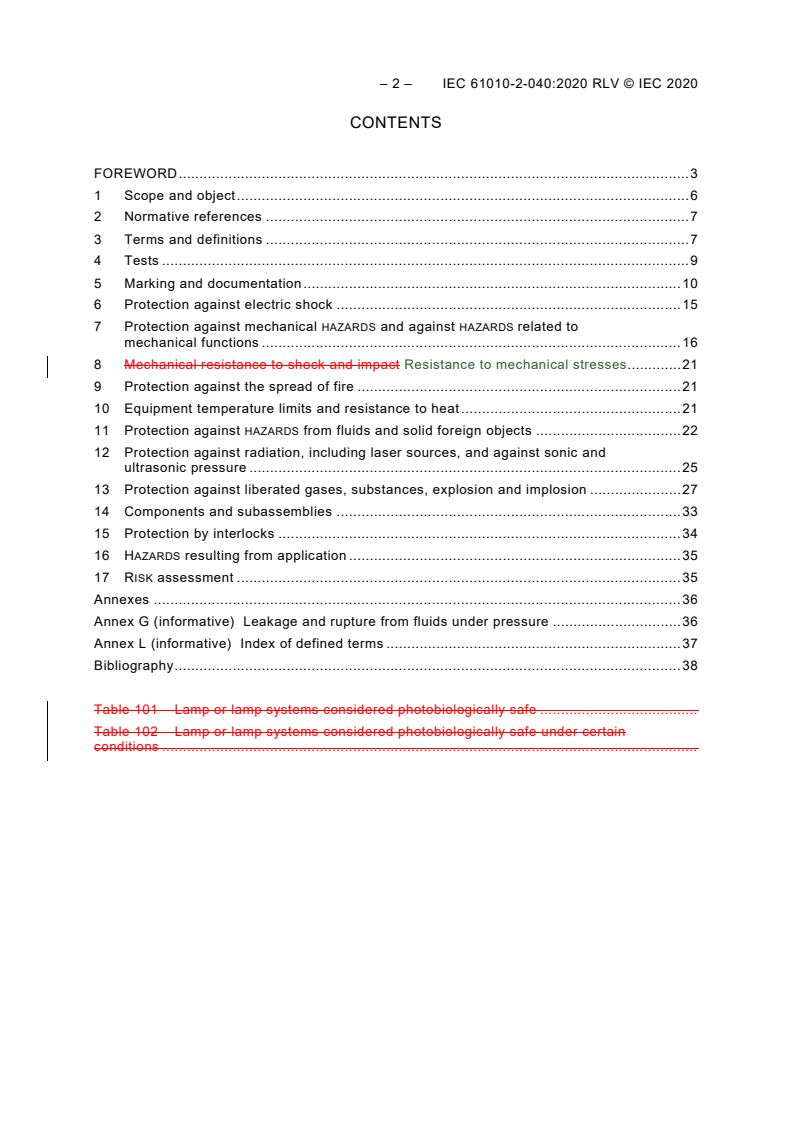
CONTENTS
FOREWORD . 3
1 Scope and object . 6
2 Normative references . 7
3 Terms and definitions . 7
4 Tests . 9
5 Marking and documentation . 10
6 Protection against electric shock . 15
7 Protection against mechanical HAZARDS and against HAZARDS related to
mechanical functions . 16
8 Mechanical resistance to shock and impact Resistance to mechanical stresses . 21
9 Protection against the spread of fire . 21
10 Equipment temperature limits and resistance to heat . 21
11 Protection against HAZARDS from fluids and solid foreign objects . 22
12 Protection against radiation, including laser sources, and against sonic and
ultrasonic pressure . 25
13 Protection against liberated gases, substances, explosion and implosion . 27
14 Components and subassemblies . 33
15 Protection by interlocks . 34
16 HAZARDS resulting from application . 35
17 RISK assessment . 35
Annexes . 36
Annex G (informative) Leakage and rupture from fluids under pressure . 36
Annex L (informative) Index of defined terms . 37
Bibliography . 38
Table 101 – Lamp or lamp systems considered photobiologically safe .
Table 102 – Lamp or lamp systems considered photobiologically safe under certain
conditions .
INTERNATIONAL ELECTROTECHNICAL COMMISSION
____________
SAFETY REQUIREMENTS FOR ELECTRICAL EQUIPMENT FOR
MEASUREMENT, CONTROL, AND LABORATORY USE –
Part 2-040: Particular requirements for STERILIZERS and
WASHER-DISINFECTORS used to treat medical materials
FOREWORD
1) The International Electrotechnical Commission (IEC) is a worldwide organization for standardization comprising
all national electrotechnical committees (IEC National Committees). The object of IEC is to promote
international co-operation on all questions concerning standardization in the electrical and electronic fields. To
this end and in addition to other activities, IEC publishes International Standards, Technical Specifications,
Technical Reports, Publicly Available Specifications (PAS) and Guides (hereafter referred to as "IEC
Publication(s)"). Their preparation is entrusted to technical committees; any IEC National Committee interested
in the subject dealt with may participate in this preparatory work. International, governmental and non-
governmental organizations liaising with the IEC also participate in this preparation. IEC collaborates closely
with the International Organization for Standardization (ISO) in accordance with conditions determined by
agreement between the two organizations.
2) The formal decisions or agreements of IEC on technical matters express, as nearly as possible, an international
consensus of opinion on the relevant subjects since each technical committee has representation from all
interested IEC National Committees.
3) IEC Publications have the form of recommendations for international use and are accepted by IEC National
Committees in that sense. While all reasonable efforts are made to ensure that the technical content of IEC
Publications is accurate, IEC cannot be held responsible for the way in which they are used or for any
misinterpretation by any end user.
4) In order to promote international uniformity, IEC National Committees undertake to apply IEC Publications
transparently to the maximum extent possible in their national and regional publications. Any divergence
between any IEC Publication and the corresponding national or regional publication shall be clearly indicated in
the latter.
5) IEC itself does not provide any attestation of conformity. Independent certification bodies provide conformity
assessment services and, in some areas, access to IEC marks of conformity. IEC is not responsible for any
services carried out by independent certification bodies.
6) All users should ensure that they have the latest edition of this publication.
7) No liability shall attach to IEC or its directors, employees, servants or agents including individual experts and
members of its technical committees and IEC National Committees for any personal injury, property damage or
other damage of any nature whatsoever, whether direct or indirect, or for costs (including legal fees) and
expenses arising out of the publication, use of, or reliance upon, this IEC Publication or any other IEC
Publications.
8) Attention is drawn to the Normative references cited in this publication. Use of the referenced publications is
indispensable for the correct application of this publication.
9) Attention is drawn to the possibility that some of the elements of this IEC Publication may be the subject of
patent rights. IEC shall not be held responsible for identifying any or all such patent rights.
This redline version of the official IEC Standard allows the user to identify the changes
made to the previous edition. A vertical bar appears in the margin wherever a change
has been made. Additions are in green text, deletions are in strikethrough red text.
– 4 – IEC 61010-2-040:2020 RLV © IEC 2020
International Standard IEC 61010-2-040 has been prepared by IEC technical committee 66:
Safety of measuring, control and laboratory equipment.
This third edition cancels and replaces the second edition published in 2015. This edition
constitutes a technical revision.
This edition includes the following significant technical changes with respect to the previous
edition:
a) it is established on the basis of the third edition (2010) of IEC 61010‑1 and its
Amendment 1 (2016);
b) added tolerance for stability of a.c. voltage test equipment to 6.8.3.1;
c) the status of a Group Safety Publication has been removed (this does not change the
technical requirements in the document).
The text of this International Standard is based on the following documents:
CDV Report on voting
66/699/CDV 66/716/RVC
Full information on the voting for the approval of this International Standard can be found in
the report on voting indicated in the above table.
This document has been drafted in accordance with the ISO/IEC Directives, Part 2.
The reader's attention is drawn to the fact that Annex G lists all of the "in-some-country"
clauses on differing practices of a less permanent nature relating to the subject of this
standard.
A list of all parts in the IEC 61010 series, published under the general title Safety
requirements for electrical equipment for measurement, control, and laboratory use, can be
found on the IEC website.
This Part 2-040 is to be used in conjunction with IEC 61010-1. It was established on the basis
of the third edition (2010) of IEC 61010-1 and its Amendment 1 (2016), hereinafter referred to
as Part 1.
This Part 2-040 supplements or modifies the corresponding clauses in Part 1 so as to convert
that publication into the IEC standard: Particular requirements for STERILIZERS and WASHER-
DISINFECTORS used to treat medical materials.
Where a particular subclause of Part 1 is not mentioned in this Part 2-040, that subclause
applies as far as is reasonable. Where this Part 2-040 states "addition", "modification",
"replacement", or "deletion", the relevant requirement, test specification or note in Part 1 shall
be adapted accordingly.
In this standard:
1) the following print types are used:
– requirements: in roman type;
– NOTES: in small roman type;
– conformity and tests: in italic type;
– terms used throughout this standard which have been defined in Clause 3: SMALL
ROMAN CAPITALS.
2) subclauses, figures, and tables which are additional to those in Part 1 are numbered
starting from 101; additional annexes are lettered starting from AA and additional list
items are lettered from aa).
The committee has decided that the contents of this document will remain unchanged until the
stability date indicated on the IEC website under "http://webstore.iec.ch" in the data related to
the specific document. At this date, the document will be
• reconfirmed,
• withdrawn,
• replaced by a revised edition, or
• amended.
IMPORTANT – The 'colour inside' logo on the cover page of this publication indicates
that it contains colours which are considered to be useful for the correct
understanding of its contents. Users should therefore print this document using a
colour printer.
– 6 – IEC 61010-2-040:2020 RLV © IEC 2020
SAFETY REQUIREMENTS FOR ELECTRICAL EQUIPMENT FOR
MEASUREMENT, CONTROL, AND LABORATORY USE –
Part 2-040: Particular requirements for STERILIZERS and
WASHER-DISINFECTORS used to treat medical materials
1 Scope and object
This clause of Part 1 is applicable except as follows:
1.1.1 Equipment included in scope
Replacement:
Replace the existing text with the following:
This part of IEC 61010 specifies safety requirements for electrical equipment intended for
sterilization, washing, and disinfection of medical materials in the medical, veterinary,
pharmaceutical and laboratory fields, when used under the environmental conditions of 1.4.
Examples of such equipment include the following:
a) STERILIZERS and disinfectors using steam and/or hot water as the sterilant;
b) STERILIZERS and disinfectors using toxic gas, toxic aerosol or toxic vapour as the sterilant;
c) STERILIZERS and disinfectors using hot air or hot inert gas as the sterilant; and
d) WASHER-DISINFECTORS.
1.1.2 Equipment excluded from scope
Addition:
Add the following note to item f):
NOTE IEC 60601-1:2005, 3.63, defines "medical electrical equipment" as follows (notes to entry are omitted):
Electrical equipment, having an applied part or transferring energy to or from the patient or detecting such energy
transfer to or from the patient and which is:
a) provided with not more than one connection to a particular supply MAINS; and
b) intended by its manufacturer to be used:
1) in the diagnosis, treatment, or monitoring of a patient; and that makes physical or electrical contact with
the patient or transfers energy to or from the patient or detects such energy transfer to or from the patient
or
2) for compensation or alleviation of disease, injury or disability.
Addition:
Add the following new second paragraph after the lettered list:
This document does not apply to the following types of equipment:
aa) equipment for use in hazardous atmospheres (see IEC 60079); however this document
does apply to an atmosphere created inside equipment by a flammable sterilizing
agent (see 13.0 13.2.101 and 13.2.102);
bb) laboratory equipment for the heating of materials for purposes other than sterilization
or disinfection (see IEC 61010-2-010);
cc) laundry equipment (see IEC 60335-2-4, IEC 60335-2-7, IEC 60335-2-11, and
ISO 10472 (all parts)), unless designed for disinfecting medical materials;
dd) dishwashers (see IEC 60335-2-5 and IEC 60335-2-58).
1.2.1 Aspects included in scope
Replacement:
Replace item g) with the following new text:
g) liberated gases (including the non-intentional escape of toxic gas), pathogenic
substances, explosion and implosion (see Clause 13).
1.2.2 Aspects excluded from scope
Addition:
Add the following two new items:
aa) special requirements for protection against chemical and high-risk micro-biological
HAZARDS associated with the LOAD;
bb) general requirements for the design of calorifiers, shell boilers and PRESSURE VESSELS.
NOTE National and other regulations or codes apply for the safety of calorifiers, shell boilers and
PRESSURE VESSELS (see 14.101).
2 Normative references
This clause of Part 1 is applicable except as follows:
Addition:
Add the following new references:
IEC 61770, Electric appliances connected to the water mains – Avoidance of backsiphonage
and failure of hose-sets
IEC 62471, Photobiological safety of lamps and lamp systems
IEC TR 62471-2, Photobiological safety of lamps and lamp systems – Part 2: Guidance on
manufacturing requirements relating to non-laser optical radiation safety
ISO 3585, Borosilicate glass 3.3 – Properties
ISO 4126-1, Safety devices for protection against excessive pressure – Part 1: Safety valves
ISO 4126-2, Safety devices for protection against excessive pressure – Part 2: Bursting disc
safety devices
3 Terms and definitions
This clause of Part 1 is applicable except as follows:
Addition:
– 8 – IEC 61010-2-040:2020 RLV © IEC 2020
Add the following new terms and definitions:
3.2 Parts and accessories
3.2.101
CHAMBER
part of the equipment which receives the LOAD
3.2.102
LOAD
CHAMBER to be processed through an OPERATING CYCLE
equipment or materials put into a
3.2.103
STERILIZER
equipment designed to achieve sterilization which comprises a series of actions or operations
needed to achieve the specified requirements for sterility
3.2.104
PRESSURE VESSEL
assembly comprising the CHAMBER, the jacket (if fitted), doors, and all other components in
permanent open connection with the CHAMBER
Note 1 to entry: The PRESSURE VESSEL does not include parts from which it can be isolated, such as steam
generators, pipework, and fittings.
3.2.105
OPERATING CYCLE
complete set of stages of the process that is carried out in a specified sequence
Note 1 to entry: Loading and unloading are not part of the OPERATING CYCLE.
3.2.106
WASHER-DISINFECTOR
equipment intended to clean and disinfect medical devices and other articles used in the
context for example of medical, dental, pharmaceutical and veterinary practice
3.5 Safety terms
3.5.2
HAZARD
Addition:
Add the following new Note 1 to entry:
Note 1 to entry: In the context of this document, the term HAZARD relates only to potential sources of harm to the
OPERATOR and surroundings (see 1.2.1), and does not include potential sources of harm related to the efficacy of
the process.
3.5.11
OPERATOR
Addition:
Add the following Note 1 to entry:
Note 1 to entry: An OPERATOR includes persons installing, operating, adjusting, maintaining, cleaning, repairing or
moving equipment.
4 Tests
This clause of Part 1 is applicable except as follows:
4.3.2.4 Covers and removable parts
Addition:
Add the following new second paragraph:
Covers including panels and control box ENCLOSURES which do not require the use of a TOOL
for removal need not be removed if they have interlocks which meet the requirements of
Clause 15, and which automatically de-activate all parts which would otherwise present a
HAZARD when the cover is opened.
4.3.2.12 Duty cycle
Addition:
Add the following new second paragraph:
Equipment which can be operated continuously shall also be tested without any interval
between consecutive OPERATING CYCLES.
Addition:
Add the following new subclause:
4.3.2.101 Non-electrical supplies and services
Non-electrical supplies and services shall be set to the least favourable RATED settings.
4.4.2.1 General
Replacement:
Replace the first sentence of the first paragraph with the following sentence:
Fault conditions shall include those specified in 4.4.2.2 to 4.4.2.14 and 4.4.2.101 to 4.4.2.103.
4.4.2.5 Motors
Addition:
Add the following new second paragraph:
If it is impracticable to test a motor in place when installed, a separate identical motor can be
tested but it shall be tested in the same conditions that meet or exceed the conditions within
exist inside the equipment.
4.4.2.13 Interlocks
Addition:
Add the following new second paragraph:
– 10 – IEC 61010-2-040:2020 RLV © IEC 2020
If an interlock provides protection against accidental contact with a hazardous substance, the
interlock is tested using a non-hazardous substance.
Addition:
Add the following three new subclauses:
4.4.2.101 Pressure controllers
Pressure controllers, except for overpressure safety devices meeting the requirements of
11.7.4, shall be overridden to supply the service continuously.
MAINS supply
4.4.2.102 Failure, or partial failure, of the
The equipment shall be operated at 90 % and 110 % of the RATED voltage for one cycle. The
RATED voltage for 5 min. The voltage shall then be
voltage shall then be set to 90 % of the
reduced gradually at a rate of approximately 10 V per min until the equipment fails to operate
normally. The voltage shall then be reset to the RATED voltage with the equipment still
switched on.
4.4.2.103 Failure, or partial failure, of other supplies and services
In turn, each non-electrical supply and service shall be interrupted, or partially interrupted,
whichever is less favourable.
NOTE Examples include air, steam, feedwater, sterilant gas, detergent, disinfectant, and systems for drainage,
exhaust, and ventilation.
5 Marking and documentation
This clause of Part 1 is applicable except as follows:
5.1.2 Identification
Replacement:
Replace the existing text by the following:
The equipment shall as a minimum be marked with at least the following:
a) the name and address of the manufacturer;
b) any additional markings required by national and local regulations, including the name and
address of the manufacturer's authorized representative in the country of intended use;
c) a marking that uniquely identifies the individual unit of manufacture such as a serial
number;
d) year and place of manufacture, if different from manufacturer's address;
e) model identification;
f) designated purpose of the equipment.
Conformity is checked by inspection
Addition:
Add the following two new subclauses:
5.1.101 Overpressure safety protective device
The device (see 11.7.4) shall be marked with the name of the manufacturer of the device, the
model number, and the pressure to which it is set. If a bursting disc is located between the
CHAMBER and the overpressure safety device, the disc shall be marked with its specified
bursting pressure and associated temperature.
NOTE National, local regulations and other codes may can apply.
5.1.102 PRESSURE VESSELS and shell boilers
Attention is drawn to the existence of national and local regulations that can require additional
markings.
5.2 Warning markings
Replacement:
Replace the first paragraph by the following new paragraph:
Warning markings specified in 5.1.5.1,5.1.5.2 c), 5.1.5.2 d), 5.1.8, 5.4.4 r), 6.1.2 b), 7.3.2,
7.102 b), 7.102 c), 9.1, 10.1, 13.2.2, and 14.103 shall meet the following requirements.
Warning and Caution symbols shall be at least 10 mm high.
Addition:
Add the following new second paragraph:
Warning and caution symbols shall be at least 10 mm high.
5.4.1 General
Replacement:
Replace the first paragraph (excluding lettered list) by the following new paragraph:
The following documentation necessary for safety purposes, as needed by the OPERATOR or
RESPONSIBLE BODY, shall be marked with its date of issue or revision status and be provided
with the equipment:
Add the following two new items to the first new paragraph after item h) of the lettered list:
aa) attention is drawn to the existence of national and local regulations that can apply to the
documentation,
bb) If NORMAL USE involves the handling of a hazardous substance, documentation shall
include information on constituents, correct storage, use, and safe disposal.
Delete the second note.
Replace Note 2 by the following new Note 2:
NOTE 2 Attention is drawn to the existence of national and local regulations that can apply to the documentation.
Add a new paragraph directly before the conformity statement:
– 12 – IEC 61010-2-040:2020 RLV © IEC 2020
Marking, information, and language shall:
1) comply with regulations applying in the country of intended use;
NOTE 2 3 ISO 15223-2 offers guidance for equipment classified as a medical device.
2) include instructions for the disposal of the equipment, its accessories and its packaging;
3) give due consideration to the technical knowledge, education and training of different
OPERATOR categories;
4) not contradict information contained in documentation provided to describe the equipment.
5.4.2 Equipment RATINGS
Addition:
Add the following new item to the first paragraph lettered list after item f):
aa) for each non-electrical service, if applicable, the RATED ranges of temperature,
pressure and flow-rate.
5.4.3 Equipment installation
Replacement:
Replace items a) to g) with the following:
a) location and mounting instructions;
b) space required for safe and efficient maintenance;
c) individual weights of principal heavy subassemblies;
d) overall weight and floor loading requirements;
e) unpacking and assembly instructions (see also 7.108);
f) MAINS supply requirements and connections, including the temperature rating of any cable
required to meet the requirements in 5.1.8;
g) for PERMANENTLY CONNECTED EQUIPMENT:
1) supply wiring requirements;
2) requirements for any external switch or circuit-breaker (see 6.11.3.1) and external
overcurrent protection devices (see 9.6.1) and a recommendation that the switch or
circuit-breaker be near the equipment;
h) ventilation requirements (see 11.101, 13.1.103.1, and 13.1.101);
i) drainage requirements (see 11.101);
j) instructions for protective earthing;
k) instructions relating to sound level (see 12.5.1);
l) requirements for special services, for example air, feedwater, cooling liquid;
m) requirements related to hazardous gas atmospheres (see Clause 13);
n) instructions to position the equipment so that it is not difficult to operate the disconnecting
device;
o) instructions relating to the handling and containment of hazardous substances, including
any need for additional equipment that can be required to control emissions (see 13.1);
p) instructions relating to HAZARDS caused by liquids or hot items falling from the equipment
(see 9.1);
q) requirements for material used in the installation of the equipment and which can come
into contact with sterilant (see 13.1.103.4 and 13.2.101);
r) instructions for ambient illumination (see also 11.102);
NOTE ISO 12100 and EN 1837 give guidance on lighting.
s) instructions relating to heat emission.
Addition:
Add the following new subclause:
5.4.3.101 Special systems
Installation instructions shall include details of the following special systems, if needed to
protect against possible HAZARDS:
a) non-recirculating ventilation system for the room in which the equipment is installed (also
see 13.1.103.3);
Such a ventilation system shall normally give a minimum of 10 air changes per hour, but
for large installations this may need to be increased.
b) for equipment using toxic sterilant, means to protect against HAZARDS arising from failure
of the room ventilation system (see 13.1.103.3);
c) a non-recirculating local exhaust system to remove fugitive emissions (see 13.1.101.4);
d) a drainage system (see 13.1.101.3);
e) a venting system for the drain (see 13.1.101.3);
f) a CHAMBER exhaust system (see 13.1.101.2);
g) a system used to control escaping biological emissions (see 13.1.104);
h) any other supply, for example sterilant, steam, compressed air, hot or cold water
(including instructions on the prevention of backsiphonage (see 11.104).
Conformity is checked by inspection.
5.4.4 Equipment operation
Replacement:
Replace items a) to j) with the following:
a) identification of operating controls and their use in all operating modes;
b) an instruction not to position the equipment so that it is difficult to operate the
disconnecting device;
c) instructions for interconnection to accessories and other equipment, including details of
suitable accessories, detachable parts and any special materials;
d) specification of limits for intermittent operation;
e) an explanation of symbols related to safety which are used on the equipment (see 5.2);
f) instructions for cleaning (see 11.2);
g) instructions for making the equipment safe after an incomplete OPERATING CYCLE;
h) instructions for the correct use of the lockable door closure prevention device
(see 7.102 b));
i) instructions to the RESPONSIBLE BODY for safe access to the LOAD in the CHAMBER in the
event of a fault (see 13.1.102);
j) instructions for action in case of a malfunction, including fault diagnosis;
NOTE 1 These instructions can include any special methods of interpreting data recorded or noted during the
OPERATING CYCLE, to detect failure or trends that can lead to failure, for example the use of a temperature
recorder.
k) loading procedure;
– 14 – IEC 61010-2-040:2020 RLV © IEC 2020
l) instructions for safe disposal of parts such as detergent containers, sterilant containers
and parts contaminated by pathogenic material;
NOTE 2 Additional requirements on methods of disposal can be specified by national or local authorities.
m) instructions for testing the function of critical safety devices in a safe manner, for example
overpressure safety devices (see 11.7.4);
n) if NORMAL USE involves the handling of substances, instructions on correct use and safety
provisions. In addition, instructions shall be given on methods of safe handling before
disposal, and recommendations on disposal (also see Note 2 above);
o) details of methods of reducing burn HAZARDS from surfaces permitted to exceed the
temperature limits specified in Table 19;
p) guidelines to be followed in cases of emergency in which eye or skin contact or inhalation
could occur, such as release of toxic material or pathogenic material, or leakage from a
sterilizing agent container or disinfectant container or enzymatic, alkaline or acidic
detergent container;
These guidelines shall also be prominently displayed on or near the equipment
q) instructions for safely replenishing containers of dosing chemicals (see 13.102);
r) if a HAZARD could result from the use of equipment with a type of LOAD other than those for
which it is intended, there shall be an appropriate warning in the instructions, and a
warning marking (see 5.2) shall state the types of LOAD which can be used. If small
equipment has insufficient space for this warning marking, symbol 14 of Table 1 shall be
marked;
S) instructions for inspection, replenishment, and storage of consumable materials which
could cause a HAZARD, including details of HAZARDS which could arise from the introduction
of incorrect quantities of recommended consumable materials, also procedures and details
of the protection needed to minimize such HAZARDS;
t) identification of residual RISKS and instructions on necessary protective procedures
(see Clause 17).
5.4.5 Equipment maintenance and service
Replacement:
Replace the existing text with the following new text:
Instructions shall be provided to the RESPONSIBLE BODY in sufficient detail to permit safe
maintenance, inspection and testing of the equipment and to ensure continued safety of the
equipment after the maintenance, inspection and test procedure.
Instructions shall include:
A) details of maintenance required on parts subject to wear and tear if failure could lead to a
HAZARD;
b) inspection and replacement, if necessary, of any hoses/pipes or other parts containing
fluids, if their failure could cause a HAZARD;
c) details of safety devices fitted together with their settings and replacement procedures;
d) procedures for making the equipment safe prior to maintenance;
e) maintenance schedules and repair procedures, including ambient lighting level
(see 11.102) and any special precautions necessary to protect against HAZARDS during
maintenance;
f) methods of safe handling for repair or disposal of any part containing or contaminated by
toxic and/or pathogenic material;
NOTE 1 Requirements on methods of disposal can be specified by national or local authorities.
NOTE 2 Aspects of environmental impact are addressed in ISO 14971 and in applicable parts of IEC 61508.
g) battery types for equipment using replaceable batteries;
h) RATINGS and characteristics of replaceable fuses;
i) a list of parts (if any), restricted to examination and/or supply by the manufacturer or the
manufacturer's agent;
j) residual RISKS (see Clause 17) and protective measures for these RISKS;
k) verification of the safe state of the equipment after repair.
Conformity is checked by inspection.
Addition:
Add the following two new subclauses:
5.4.101 OPERATOR training
5.4.101.1 General
In order that OPERATORS be adequately trained in the safe use of the equipment, the
manufacturer's instructions shall state that the RESPONSIBLE BODY should ensure:
a) that all personnel who operate or maintain the equipment are trained in its operation and
in its safe use;
b) that, if exposure limits (i.e. short-term exposure limit (STEL) or long-term exposure limit
(LTEL)) or permissible working environmental concentration limit (see the notes to 13.1)
could be exceeded during NORMAL USE, personnel working with toxic chemicals, gases,
and vapours are given comprehensive instructions in the process. These instructions
include information on relevant health HAZARDS, national regulations, methods for safe
use, and methods to detect escape of the agent;
c) that there is regular training of all personnel concerned with the operation and
maintenance of the equipment, including emergency procedures for any toxic, flammable,
explosive or pathogenic material released into the environment. Records of attendance at
training are maintained, and evidence of understanding demonstrated.
Also see 7.3.2 b).
Conformity is checked by inspection.
5.4.101.2 Procedures for potentially hazardous actions
The manufacturer shall specify safety procedures for any potentially hazardous actions
OPERATOR, for example the replacement of parts or the
intended to be carried out by an
adjustment of internal controls. The instructions shall specify that the RESPONSIBLE BODY must
provide OPERATORS with training in these procedures.
Conformity is checked by inspection.
6 Protection against electric shock
This clause of Part 1 is applicable except as follows:
6.2.2 Examination
Addition:
Add the following new third paragraph after Figure 1:
– 16 – IEC 61010-2-040:2020 RLV © IEC 2020
FIXED EQUIPMENT, and equipment with a weight exceeding 80 kg, is not tilted or moved in
order to check the bottom, but the test finger is applied to any part of the bottom that can be
reached when the equipment is installed according to the manufacturer's instructions.
6.8.3.1 The a.c. voltage test
Replacement:
Replace the first sentence with the following sentence:
The voltage tester shall be capable of maintaining the test voltage throughout the test within
±5 % of the specified value.
6.9.2 Insulating materials
Addition:
Add the following new note at the end of the subclause, before the conformity statement:
NOTE Although ceramics can provide satisfactory electrical insulation at ambient temperature, attention is drawn
to the possibility that some ceramics show reduced insulating properties at high temperatures. This is not only
because they are susceptible to progressive mechanical deterioration, but also because they can become
electrically conductive at high temperatures and in NORMAL USE can be contaminated by conductive material.
7 Protection against mechanical HAZARDS
This clause of Part 1 is applicable except as follows:
Replacement:
Replace the title with the following new title:
7 Protection against mechanical HAZARDS and against HAZARDS related to
mechanical functions
7.1 General
Replacement:
Replace the second paragraph by the following new paragraph:
Replace the conformity statement with the following new conformity statement:
Conformity is checked as specified in 7.2 to 7.7 and in 7.101 to 7.111 7.110.
7.4 Stability
Addition:
Add the following new item to the lettered list, after the note in item e):
aa) For equipment with a door which, when open, is horizontal or nearly horizontal, and
which could be used to support the LOAD, a weight equal to 1,2 times the heaviest
RATED LOAD (specified in the instruction manual) is applied to, or suspended from, the
centre of an the open door.
7.5 Provisions for lifting and carrying
Addition:
Add the following new subclause:
7.5.101 Transfer of LOADS into and out of the CHAMBER
Means shall be provided to protect the OPERATOR against mechanical HAZARDS that could arise
during transfer of the LOAD into or out of the CHAMBER.
Means shall be provided to locate and retain the LOAD and its carrier (if any) in the correct
position for transfer of the LOAD into or out of the CHAMBER.
If a sliding shelf within the CHAMBER has to be pulled out to accept the LOAD or permit its
withdrawal, means shall be provided to prevent the shelf from tilting or becoming
unintentionally disengaged when pulled out.
The force required by an OPERATOR to put the LOAD into the CHAMBER or to remove it from the
CHAMBER shall not exceed 250 N.
Conformity is checked by inspection and test, using the least favourable LOAD specified by the
manufacturer.
Addition:
Add the following new subclauses:
7.101 Doors, conveyors, etc
A HAZARD shall not be caused in NORMAL CONDITION or in SINGLE FAULT CONDITION by:
a) a mechanism used to open, close, or retain a door;
b) wear on threaded parts;
NOTE Threads meeting the requirements of ISO 2901, ISO 2902, ISO 2903 and ISO 2904 can be suitable.
c) residual movement caused by any of the following:
1) operation of an emergency shutdown device (see 7.1.111 7.110);
2) loss of power;
3) component failure;
4) removal of an obstruction;
d) a part which is powered or driven from stored energy.
Conformity with a) and b) is checked by inspection. Conformity with c) and d) is checked by
measurement to confirm that any residual movement cannot cause a force of more than 150 N
from any easily touched part.
7.102 Access to the CHAMBER
Access to the CHAMBER during an OPERATING CYCLE shall not be possible if this could cause a
HAZARD.
Conformity is checked by inspection of the door design. In case of doubt a test is carried out
simulating an attempt to open the door using reasonable force.
Means shall be provided to prevent:
– 18 – IEC 61010-2-040:2020 RLV © IEC 2020
a) starting of the OPERATING CYCLE while an OPERATOR is completely inside the CHAMBER;
a) a door (if fitted) closing while an OPERATOR is completely inside the CHAMBER.
The means shall be lockable by a dedicated key, TOOL, or other mechanism, and the
manufacturer's instructions shall specify that the OPERATOR must retain the key or TOOL while
inside the CHAMBER. A warning marking (see 5.2) on the equipment clearly visible to the
OPERATOR shall instruct the OPERATOR to lock the means before entering the CHAMBER and to
retain the locking key, or TOOL, at all times while in the CHAMBER.
Conformity is checked by inspection and test.
If in NORMAL CONDITION a HAZARD could arise from touching hot liquid remaining in the
CHAMBER, there shall be a warning in the manufacturer's instructions and a warning marking
(see 5.2) on the equipment.
In a SINGLE FAULT CONDITION, no HAZARD shall be caused by liquid and steam flowing out of the
CHAMBER when the door is opened or when an attempt is made to open it.
Conformity is checked by inspection and test.
7.103 Prevention of entry of gases, steam or liquids
Interlocks shall be provided so that sterilant gas, carrier gas, steam, or other gases cannot
enter or be generated in the CHAMBER until the door is closed and secured with all door
pressure-retaining parts engaged to the extent specified by the manufacturer, in order to
withstand the design pressure.
Conformity is checked by inspection and test.
7.104 Prevention of new OPERATING CYCLE
It shall not be possible to start a new OPERATING CYCLE if this could cause a HAZARD arising
from a residual fault. Such faults include but are not limited to:
a) failure of a door operating system;
b) failure of the LOAD transport system;
c) failure of an exhaust system;
d) failure of any other device (for example a timer or sensor);
e) operation of the emergency shutdown device (see 7.1.111 7.110).
Conformity is checked by review of the manufacturer's inspection and by tests to show that a
OPERATING CYCLE cannot be started in any of the circumstances listed in a) to e) above.
new
7.105 Pressure-retaining parts of a door
Interlocks shall prevent the pressure-retaining parts of the door from being fully released until
the CHAMBER has been vented to atmospheric pressure.
Conformity is checked by operating the equipment through the OPERATING CYCLE that gives the
maximum internal pressure, and confirming that the CHAMBER remains sealed while the
pressure in the CHAMBER exceeds 0,2 bar (20 kPa) and that the door cannot open until the
CHAMBER has vented to atmospheric pressure.
7.106 Doors of equipment for use with fluids in containers
It shall not be possible to open the door until the temperature of the entire LOAD, and of the
CHAMBER is below the boiling point of the fluid at ambient atmospheric pressure.
fluid in the
Conformity is checked by loading the CHAMBER with the maximum LOAD of the largest size
container of fluid that the equipment is designed to process, ensuring the container is free to
vent and, after a full OPERATING CYCLE, determining the highest temperature of the LOAD, and
of the fluid in the CHAMBER, immediately before the door can be opened.
Equipment designed to process fluid in sealed unvented containers shall incorporate
additional controls to ensure that it is not possible to open the door until the temperature of
the fluid in the containers has fallen to a safe value.
The safe temperature for glass containers is 20 K below the boiling point of water at ambient
atmospheric pressure, and for flexible containers (for example PVC bags), it is 10 K below the
boiling point of water at ambient atmospheric pressure.
In order to compensate for the reduction in the boiling point at increased altitude, the
...
IEC 61010-2-040 ®
Edition 3.0 2020-05
INTERNATIONAL
STANDARD
NORME
INTERNATIONALE
Safety requirements for electrical equipment for measurement, control, and
laboratory use –
Part 2-040: Particular requirements for sterilizers and washer-disinfectors used
to treat medical materials
Exigences de sécurité pour appareils électriques de mesurage, de régulation
et de laboratoire –
Partie 2-040: Exigences particulières pour sterilisateurs et laveurs desinfecteurs
utilisés pour traiter le matériel médical
All rights reserved. Unless otherwise specified, no part of this publication may be reproduced or utilized in any form
or by any means, electronic or mechanical, including photocopying and microfilm, without permission in writing from
either IEC or IEC's member National Committee in the country of the requester. If you have any questions about IEC
copyright or have an enquiry about obtaining additional rights to this publication, please contact the address below or
your local IEC member National Committee for further information.
Droits de reproduction réservés. Sauf indication contraire, aucune partie de cette publication ne peut être reproduite
ni utilisée sous quelque forme que ce soit et par aucun procédé, électronique ou mécanique, y compris la photocopie
et les microfilms, sans l'accord écrit de l'IEC ou du Comité national de l'IEC du pays du demandeur. Si vous avez des
questions sur le copyright de l'IEC ou si vous désirez obtenir des droits supplémentaires sur cette publication, utilisez
les coordonnées ci-après ou contactez le Comité national de l'IEC de votre pays de résidence.
IEC Central Office Tel.: +41 22 919 02 11
3, rue de Varembé info@iec.ch
CH-1211 Geneva 20 www.iec.ch
Switzerland
About the IEC
The International Electrotechnical Commission (IEC) is the leading global organization that prepares and publishes
International Standards for all electrical, electronic and related technologies.
About IEC publications
The technical content of IEC publications is kept under constant review by the IEC. Please make sure that you have the
latest edition, a corrigendum or an amendment might have been published.
IEC publications search - webstore.iec.ch/advsearchform Electropedia - www.electropedia.org
The advanced search enables to find IEC publications by a The world's leading online dictionary on electrotechnology,
variety of criteria (reference number, text, technical containing more than 22 000 terminological entries in English
committee,…). It also gives information on projects, replaced and French, with equivalent terms in 16 additional languages.
and withdrawn publications. Also known as the International Electrotechnical Vocabulary
(IEV) online.
IEC Just Published - webstore.iec.ch/justpublished
Stay up to date on all new IEC publications. Just Published IEC Glossary - std.iec.ch/glossary
details all new publications released. Available online and 67 000 electrotechnical terminology entries in English and
once a month by email. French extracted from the Terms and Definitions clause of
IEC publications issued since 2002. Some entries have been
IEC Customer Service Centre - webstore.iec.ch/csc collected from earlier publications of IEC TC 37, 77, 86 and
If you wish to give us your feedback on this publication or CISPR.
need further assistance, please contact the Customer Service
Centre: sales@iec.ch.
A propos de l'IEC
La Commission Electrotechnique Internationale (IEC) est la première organisation mondiale qui élabore et publie des
Normes internationales pour tout ce qui a trait à l'électricité, à l'électronique et aux technologies apparentées.
A propos des publications IEC
Le contenu technique des publications IEC est constamment revu. Veuillez vous assurer que vous possédez l’édition la
plus récente, un corrigendum ou amendement peut avoir été publié.
Recherche de publications IEC - Electropedia - www.electropedia.org
webstore.iec.ch/advsearchform Le premier dictionnaire d'électrotechnologie en ligne au
La recherche avancée permet de trouver des publications IEC monde, avec plus de 22 000 articles terminologiques en
en utilisant différents critères (numéro de référence, texte, anglais et en français, ainsi que les termes équivalents dans
comité d’études,…). Elle donne aussi des informations sur les 16 langues additionnelles. Egalement appelé Vocabulaire
projets et les publications remplacées ou retirées. Electrotechnique International (IEV) en ligne.
IEC Just Published - webstore.iec.ch/justpublished Glossaire IEC - std.iec.ch/glossary
Restez informé sur les nouvelles publications IEC. Just 67 000 entrées terminologiques électrotechniques, en anglais
Published détaille les nouvelles publications parues. et en français, extraites des articles Termes et Définitions des
Disponible en ligne et une fois par mois par email. publications IEC parues depuis 2002. Plus certaines entrées
antérieures extraites des publications des CE 37, 77, 86 et
Service Clients - webstore.iec.ch/csc CISPR de l'IEC.
Si vous désirez nous donner des commentaires sur cette
publication ou si vous avez des questions contactez-nous:
sales@iec.ch.
IEC 61010-2-040 ®
Edition 3.0 2020-05
INTERNATIONAL
STANDARD
NORME
INTERNATIONALE
Safety requirements for electrical equipment for measurement, control, and
laboratory use –
Part 2-040: Particular requirements for sterilizers and washer-disinfectors used
to treat medical materials
Exigences de sécurité pour appareils électriques de mesurage, de régulation
et de laboratoire –
Partie 2-040: Exigences particulières pour sterilisateurs et laveurs desinfecteurs
utilisés pour traiter le matériel médical
INTERNATIONAL
ELECTROTECHNICAL
COMMISSION
COMMISSION
ELECTROTECHNIQUE
INTERNATIONALE
ICS 19.080; 71.040.10 ISBN 978-2-8322-8301-1
– 2 – IEC 61010-2-040:2020 © IEC 2020
CONTENTS
FOREWORD . 3
1 Scope and object . 5
2 Normative references . 6
3 Terms and definitions . 6
4 Tests . 7
5 Marking and documentation . 9
6 Protection against electric shock . 14
7 Protection against mechanical HAZARDS and against HAZARDS related to
mechanical functions . 15
8 Resistance to mechanical stresses . 19
9 Protection against the spread of fire . 19
10 Equipment temperature limits and resistance to heat . 20
11 Protection against HAZARDS from fluids and solid foreign objects . 21
12 Protection against radiation, including laser sources, and against sonic and
ultrasonic pressure . 24
13 Protection against liberated gases, substances, explosion and implosion . 25
14 Components and subassemblies . 30
15 Protection by interlocks . 32
16 HAZARDS resulting from application . 32
17 RISK assessment . 32
Annexes . 33
Annex G (informative) Leakage and rupture from fluids under pressure . 33
Annex L (informative) Index of defined terms . 34
Bibliography . 35
INTERNATIONAL ELECTROTECHNICAL COMMISSION
____________
SAFETY REQUIREMENTS FOR ELECTRICAL EQUIPMENT FOR
MEASUREMENT, CONTROL, AND LABORATORY USE –
Part 2-040: Particular requirements for STERILIZERS and
WASHER-DISINFECTORS used to treat medical materials
FOREWORD
1) The International Electrotechnical Commission (IEC) is a worldwide organization for standardization comprising
all national electrotechnical committees (IEC National Committees). The object of IEC is to promote
international co-operation on all questions concerning standardization in the electrical and electronic fields. To
this end and in addition to other activities, IEC publishes International Standards, Technical Specifications,
Technical Reports, Publicly Available Specifications (PAS) and Guides (hereafter referred to as "IEC
Publication(s)"). Their preparation is entrusted to technical committees; any IEC National Committee interested
in the subject dealt with may participate in this preparatory work. International, governmental and non-
governmental organizations liaising with the IEC also participate in this preparation. IEC collaborates closely
with the International Organization for Standardization (ISO) in accordance with conditions determined by
agreement between the two organizations.
2) The formal decisions or agreements of IEC on technical matters express, as nearly as possible, an international
consensus of opinion on the relevant subjects since each technical committee has representation from all
interested IEC National Committees.
3) IEC Publications have the form of recommendations for international use and are accepted by IEC National
Committees in that sense. While all reasonable efforts are made to ensure that the technical content of IEC
Publications is accurate, IEC cannot be held responsible for the way in which they are used or for any
misinterpretation by any end user.
4) In order to promote international uniformity, IEC National Committees undertake to apply IEC Publications
transparently to the maximum extent possible in their national and regional publications. Any divergence
between any IEC Publication and the corresponding national or regional publication shall be clearly indicated in
the latter.
5) IEC itself does not provide any attestation of conformity. Independent certification bodies provide conformity
assessment services and, in some areas, access to IEC marks of conformity. IEC is not responsible for any
services carried out by independent certification bodies.
6) All users should ensure that they have the latest edition of this publication.
7) No liability shall attach to IEC or its directors, employees, servants or agents including individual experts and
members of its technical committees and IEC National Committees for any personal injury, property damage or
other damage of any nature whatsoever, whether direct or indirect, or for costs (including legal fees) and
expenses arising out of the publication, use of, or reliance upon, this IEC Publication or any other IEC
Publications.
8) Attention is drawn to the Normative references cited in this publication. Use of the referenced publications is
indispensable for the correct application of this publication.
9) Attention is drawn to the possibility that some of the elements of this IEC Publication may be the subject of
patent rights. IEC shall not be held responsible for identifying any or all such patent rights.
International Standard IEC 61010-2-040 has been prepared by IEC technical committee 66:
Safety of measuring, control and laboratory equipment.
This third edition cancels and replaces the second edition published in 2015. This edition
constitutes a technical revision.
This edition includes the following significant technical changes with respect to the previous
edition:
a) it is established on the basis of the third edition (2010) of IEC 61010‑1 and its
Amendment 1 (2016);
b) added tolerance for stability of a.c. voltage test equipment to 6.8.3.1;
– 4 – IEC 61010-2-040:2020 © IEC 2020
c) the status of a Group Safety Publication has been removed (this does not change the
technical requirements in the document).
The text of this International Standard is based on the following documents:
CDV Report on voting
66/699/CDV 66/716/RVC
Full information on the voting for the approval of this International Standard can be found in
the report on voting indicated in the above table.
This document has been drafted in accordance with the ISO/IEC Directives, Part 2.
The reader's attention is drawn to the fact that Annex G lists all of the "in-some-country"
clauses on differing practices of a less permanent nature relating to the subject of this
standard.
A list of all parts in the IEC 61010 series, published under the general title Safety
requirements for electrical equipment for measurement, control, and laboratory use, can be
found on the IEC website.
This Part 2-040 is to be used in conjunction with IEC 61010-1. It was established on the basis
of the third edition (2010) of IEC 61010-1 and its Amendment 1 (2016), hereinafter referred to
as Part 1.
This Part 2-040 supplements or modifies the corresponding clauses in Part 1 so as to convert
that publication into the IEC standard: Particular requirements for STERILIZERS and WASHER-
DISINFECTORS used to treat medical materials.
Where a particular subclause of Part 1 is not mentioned in this Part 2-040, that subclause
applies as far as is reasonable. Where this Part 2-040 states "addition", "modification",
"replacement", or "deletion", the relevant requirement, test specification or note in Part 1 shall
be adapted accordingly.
In this standard:
1) the following print types are used:
– requirements: in roman type;
– NOTES: in small roman type;
– conformity and tests: in italic type;
– terms used throughout this standard which have been defined in Clause 3: SMALL
ROMAN CAPITALS.
2) subclauses, figures, and tables which are additional to those in Part 1 are numbered
starting from 101; additional annexes are lettered starting from AA and additional list
items are lettered from aa).
The committee has decided that the contents of this document will remain unchanged until the
stability date indicated on the IEC website under "http://webstore.iec.ch" in the data related to
the specific document. At this date, the document will be
• reconfirmed,
• withdrawn,
• replaced by a revised edition, or
• amended.
SAFETY REQUIREMENTS FOR ELECTRICAL EQUIPMENT FOR
MEASUREMENT, CONTROL, AND LABORATORY USE –
Part 2-040: Particular requirements for STERILIZERS and
WASHER-DISINFECTORS used to treat medical materials
1 Scope and object
This clause of Part 1 is applicable except as follows:
1.1.1 Equipment included in scope
Replacement:
Replace the existing text with the following:
This part of IEC 61010 specifies safety requirements for electrical equipment intended for
sterilization, washing, and disinfection of medical materials in the medical, veterinary,
pharmaceutical and laboratory fields, when used under the environmental conditions of 1.4.
Examples of such equipment include the following:
a) STERILIZERS and disinfectors using steam and/or hot water as the sterilant;
b) STERILIZERS and disinfectors using toxic gas, toxic aerosol or toxic vapour as the sterilant;
c) STERILIZERS and disinfectors using hot air or hot inert gas as the sterilant; and
d) WASHER-DISINFECTORS.
1.1.2 Equipment excluded from scope
Addition:
Add the following note to item f):
NOTE IEC 60601-1:2005, 3.63, defines "medical electrical equipment" as follows (notes to entry are omitted):
Electrical equipment, having an applied part or transferring energy to or from the patient or detecting such energy
transfer to or from the patient and which is:
a) provided with not more than one connection to a particular supply MAINS; and
b) intended by its manufacturer to be used:
1) in the diagnosis, treatment, or monitoring of a patient; or
2) for compensation or alleviation of disease, injury or disability.
Addition:
Add the following new second paragraph after the lettered list:
This document does not apply to the following types of equipment:
aa) equipment for use in hazardous atmospheres (see IEC 60079); however this document
does apply to an atmosphere created inside equipment by a flammable sterilizing
agent (see 13.2.101 and 13.2.102);
bb) laboratory equipment for the heating of materials for purposes other than sterilization
or disinfection (see IEC 61010-2-010);
– 6 – IEC 61010-2-040:2020 © IEC 2020
cc) laundry equipment (see IEC 60335-2-4, IEC 60335-2-7, IEC 60335-2-11, and
ISO 10472 (all parts)), unless designed for disinfecting medical materials;
dd) dishwashers (see IEC 60335-2-5 and IEC 60335-2-58).
1.2.1 Aspects included in scope
Replacement:
Replace item g) with the following new text:
g) liberated gases (including the non-intentional escape of toxic gas), pathogenic
substances, explosion and implosion (see Clause 13).
1.2.2 Aspects excluded from scope
Addition:
Add the following two new items:
aa) special requirements for protection against chemical and high-risk micro-biological
HAZARDS associated with the LOAD;
PRESSURE VESSELS.
bb) general requirements for the design of calorifiers, shell boilers and
NOTE National and other regulations or codes apply for the safety of calorifiers, shell boilers and
PRESSURE VESSELS (see 14.101).
2 Normative references
This clause of Part 1 is applicable except as follows:
Addition:
Add the following new references:
IEC 61770, Electric appliances connected to the water mains – Avoidance of backsiphonage
and failure of hose-sets
ISO 3585, Borosilicate glass 3.3 – Properties
ISO 4126-1, Safety devices for protection against excessive pressure – Part 1: Safety valves
ISO 4126-2, Safety devices for protection against excessive pressure – Part 2: Bursting disc
safety devices
3 Terms and definitions
This clause of Part 1 is applicable except as follows:
3.2 Parts and accessories
Addition:
Add the following new terms and definitions:
3.2.101
CHAMBER
LOAD
part of the equipment which receives the
3.2.102
LOAD
equipment or materials put into a CHAMBER to be processed through an OPERATING CYCLE
3.2.103
STERILIZER
equipment designed to achieve sterilization which comprises a series of actions or operations
needed to achieve the specified requirements for sterility
3.2.104
PRESSURE VESSEL
assembly comprising the CHAMBER, the jacket (if fitted), doors, and all other components in
permanent open connection with the CHAMBER
Note 1 to entry: The PRESSURE VESSEL does not include parts from which it can be isolated, such as steam
generators, pipework, and fittings.
3.2.105
OPERATING CYCLE
complete set of stages of the process that is carried out in a specified sequence
Note 1 to entry: Loading and unloading are not part of the OPERATING CYCLE.
3.2.106
WASHER-DISINFECTOR
equipment intended to clean and disinfect medical devices and other articles used in the
context for example of medical, dental, pharmaceutical and veterinary practice
3.5 Safety terms
3.5.2
HAZARD
Addition:
Add the following new Note 1 to entry:
Note 1 to entry: In the context of this document, the term HAZARD relates only to potential sources of harm to the
OPERATOR and surroundings (see 1.2.1), and does not include potential sources of harm related to the efficacy of
the process.
3.5.11
OPERATOR
Addition:
Add the following Note 1 to entry:
Note 1 to entry: An OPERATOR includes persons installing, operating, adjusting, maintaining, cleaning, repairing or
moving equipment.
4 Tests
This clause of Part 1 is applicable except as follows:
4.3.2.4 Covers and removable parts
Addition:
Add the following new second paragraph:
– 8 – IEC 61010-2-040:2020 © IEC 2020
Covers including panels and control box ENCLOSURES which do not require the use of a TOOL
for removal need not be removed if they have interlocks which meet the requirements of
Clause 15, and which automatically de-activate all parts which would otherwise present a
HAZARD when the cover is opened.
4.3.2.12 Duty cycle
Addition:
Add the following new second paragraph:
Equipment which can be operated continuously shall also be tested without any interval
between consecutive OPERATING CYCLES.
Addition:
Add the following new subclause:
4.3.2.101 Non-electrical supplies and services
Non-electrical supplies and services shall be set to the least favourable RATED settings.
4.4.2.1 General
Replacement:
Replace the first sentence of the first paragraph with the following sentence:
Fault conditions shall include those specified in 4.4.2.2 to 4.4.2.14 and 4.4.2.101 to 4.4.2.103.
4.4.2.5 Motors
Addition:
Add the following new second paragraph:
If it is impracticable to test a motor when installed, a separate identical motor can be tested
but it shall be tested in the same conditions that exist inside the equipment.
4.4.2.13 Interlocks
Addition:
Add the following new second paragraph:
If an interlock provides protection against accidental contact with a hazardous substance, the
interlock is tested using a non-hazardous substance.
Addition:
Add the following three new subclauses:
4.4.2.101 Pressure controllers
Pressure controllers, except for overpressure safety devices meeting the requirements of
11.7.4, shall be overridden to supply the service continuously.
4.4.2.102 Failure, or partial failure, of the MAINS supply
The equipment shall be operated at 90 % and 110 % of the RATED voltage for one cycle. The
voltage shall then be set to 90 % of the RATED voltage for 5 min. The voltage shall then be
reduced gradually at a rate of approximately 10 V per min until the equipment fails to operate
normally. The voltage shall then be reset to the RATED voltage with the equipment still
switched on.
4.4.2.103 Failure, or partial failure, of other supplies and services
In turn, each non-electrical supply and service shall be interrupted, or partially interrupted,
whichever is less favourable.
NOTE Examples include air, steam, feedwater, sterilant gas, detergent, disinfectant, and systems for drainage,
exhaust, and ventilation.
5 Marking and documentation
This clause of Part 1 is applicable except as follows:
5.1.2 Identification
Replacement:
Replace the existing text by the following:
The equipment shall as a minimum be marked with the following:
a) the name and address of the manufacturer;
b) any additional markings required by national and local regulations, including the name and
address of the manufacturer's authorized representative in the country of intended use;
c) a marking that uniquely identifies the individual unit of manufacture such as a serial
number;
d) year and place of manufacture, if different from manufacturer's address;
e) model identification;
f) designated purpose of the equipment.
Conformity is checked by inspection
Addition:
Add the following two new subclauses:
5.1.101 Overpressure protective device
The device (see 11.7.4) shall be marked with the name of the manufacturer of the device, the
model number, and the pressure to which it is set. If a bursting disc is located between the
CHAMBER and the overpressure safety device, the disc shall be marked with its specified
bursting pressure and associated temperature.
NOTE National, local regulations and other codes can apply.
5.1.102 PRESSURE VESSELS and shell boilers
Attention is drawn to the existence of national and local regulations that can require additional
markings.
– 10 – IEC 61010-2-040:2020 © IEC 2020
5.2 Warning markings
Addition:
Add the following new second paragraph:
Warning and caution symbols shall be at least 10 mm high.
5.4.1 General
Replacement:
Replace the first paragraph (excluding lettered list) by the following new paragraph:
The following documentation necessary for safety purposes, as needed by the OPERATOR or
RESPONSIBLE BODY, shall be marked with its date of issue or revision status and be provided
with the equipment:
Add the following new paragraph after item h) of the lettered list:
If NORMAL USE involves the handling of a hazardous substance, documentation shall include
information on constituents, correct storage, use, and safe disposal.
Replace Note 2 by the following new Note 2:
NOTE 2 Attention is drawn to the existence of national and local regulations that can apply to the documentation.
Add a new paragraph directly before the conformity statement:
Marking, information, and language shall:
1) comply with regulations applying in the country of intended use;
NOTE 3 ISO 15223-2 offers guidance for equipment classified as a medical device.
2) include instructions for the disposal of the equipment, its accessories and its packaging;
3) give due consideration to the technical knowledge, education and training of different
OPERATOR categories;
4) not contradict information contained in documentation provided to describe the equipment.
5.4.2 Equipment RATINGS
Addition:
Add the following new item to the lettered list after item f):
aa) for each non-electrical service, if applicable, the RATED ranges of temperature,
pressure and flow-rate.
5.4.3 Equipment installation
Replacement:
Replace items a) to g) with the following:
a) location and mounting instructions;
b) space required for safe and efficient maintenance;
c) individual weights of principal heavy subassemblies;
d) overall weight and floor loading requirements;
e) unpacking and assembly instructions (see also 7.108);
f) MAINS supply requirements and connections, including the temperature rating of any cable
required to meet the requirements in 5.1.8;
g) for PERMANENTLY CONNECTED EQUIPMENT:
1) supply wiring requirements;
2) requirements for any external switch or circuit-breaker (see 6.11.3.1) and external
overcurrent protection devices (see 9.6.1) and a recommendation that the switch or
circuit-breaker be near the equipment;
h) ventilation requirements (see 11.101, 13.1.103.1, and 13.1.101);
i) drainage requirements (see 11.101);
j) instructions for protective earthing;
k) instructions relating to sound level (see 12.5.1);
l) requirements for special services, for example air, feedwater, cooling liquid;
m) requirements related to hazardous gas atmospheres (see Clause 13);
n) instructions to position the equipment so that it is not difficult to operate the disconnecting
device;
o) instructions relating to the handling and containment of hazardous substances, including
any need for additional equipment that can be required to control emissions (see 13.1);
HAZARDS caused by liquids or hot items falling from the equipment
p) instructions relating to
(see 9.1);
q) requirements for material used in the installation of the equipment and which can come
into contact with sterilant (see 13.1.103.4 and 13.2.101);
r) instructions for ambient illumination (see also 11.102);
NOTE ISO 12100 and EN 1837 give guidance on lighting.
s) instructions relating to heat emission.
Addition:
Add the following new subclause:
5.4.3.101 Special systems
Installation instructions shall include details of the following special systems, if needed to
protect against possible HAZARDS:
a) non-recirculating ventilation system for the room in which the equipment is installed (also
see 13.1.103.3);
Such a ventilation system shall normally give a minimum of 10 air changes per hour, but
for large installations this may need to be increased.
b) for equipment using toxic sterilant, means to protect against HAZARDS arising from failure
of the room ventilation system (see 13.1.103.3);
c) a non-recirculating local exhaust system to remove fugitive emissions (see 13.1.101.4);
d) a drainage system (see 13.1.101.3);
e) a venting system for the drain (see 13.1.101.3);
f) a CHAMBER exhaust system (see 13.1.101.2);
g) a system used to control escaping biological emissions (see 13.1.104);
h) any other supply, for example sterilant, steam, compressed air, hot or cold water
(including instructions on the prevention of backsiphonage (see 11.104).
– 12 – IEC 61010-2-040:2020 © IEC 2020
Conformity is checked by inspection.
5.4.4 Equipment operation
Replacement:
Replace items a) to j) with the following:
a) identification of operating controls and their use in all operating modes;
b) an instruction not to position the equipment so that it is difficult to operate the
disconnecting device;
c) instructions for interconnection to accessories and other equipment, including details of
suitable accessories, detachable parts and any special materials;
d) specification of limits for intermittent operation;
e) an explanation of symbols related to safety which are used on the equipment (see 5.2);
f) instructions for cleaning (see 11.2);
g) instructions for making the equipment safe after an incomplete OPERATING CYCLE;
closure prevention device
h) instructions for the correct use of the lockable door
(see 7.102 b));
i) instructions to the RESPONSIBLE BODY for safe access to the LOAD in the CHAMBER in the
event of a fault (see 13.1.102);
j) instructions for action in case of a malfunction, including fault diagnosis;
NOTE 1 These instructions can include any special methods of interpreting data recorded or noted during the
OPERATING CYCLE, to detect failure or trends that can lead to failure, for example the use of a temperature
recorder.
k) loading procedure;
l) instructions for safe disposal of parts such as detergent containers, sterilant containers
and parts contaminated by pathogenic material;
NOTE 2 Additional requirements on methods of disposal can be specified by national or local authorities.
m) instructions for testing the function of critical safety devices in a safe manner, for example
overpressure safety devices (see 11.7.4);
n) if NORMAL USE involves the handling of substances, instructions on correct use and safety
provisions. In addition, instructions shall be given on methods of safe handling before
disposal, and recommendations on disposal (also see Note 2 above);
o) details of methods of reducing burn HAZARDS from surfaces permitted to exceed the
temperature limits specified in Table 19;
p) guidelines to be followed in cases of emergency in which eye or skin contact or inhalation
could occur, such as release of toxic material or pathogenic material, or leakage from a
sterilizing agent container or disinfectant container or enzymatic, alkaline or acidic
detergent container;
These guidelines shall also be prominently displayed on or near the equipment
q) instructions for safely replenishing containers of dosing chemicals (see 13.102);
r) if a HAZARD could result from the use of equipment with a type of LOAD other than those for
which it is intended, there shall be an appropriate warning in the instructions, and a
warning marking (see 5.2) shall state the types of LOAD which can be used. If small
equipment has insufficient space for this warning marking, symbol 14 of Table 1 shall be
marked;
s) instructions for inspection, replenishment, and storage of consumable materials which
could cause a HAZARD, including details of HAZARDS which could arise from the introduction
of incorrect quantities of recommended consumable materials, also procedures and details
of the protection needed to minimize such HAZARDS;
t) identification of residual RISKS and instructions on necessary protective procedures
(see Clause 17).
5.4.5 Equipment maintenance and service
Replacement:
Replace the existing text with the following new text:
Instructions shall be provided to the RESPONSIBLE BODY in sufficient detail to permit safe
maintenance, inspection and testing of the equipment and to ensure continued safety of the
equipment after the maintenance, inspection and test procedure.
Instructions shall include:
a) details of maintenance required on parts subject to wear and tear if failure could lead to a
HAZARD;
b) inspection and replacement, if necessary, of any hoses/pipes or other parts containing
fluids, if their failure could cause a HAZARD;
c) details of safety devices fitted together with their settings and replacement procedures;
d) procedures for making the equipment safe prior to maintenance;
e) maintenance schedules and repair procedures, including ambient lighting level
(see 11.102) and any special precautions necessary to protect against HAZARDS during
maintenance;
f) methods of safe handling for repair or disposal of any part containing or contaminated by
toxic and/or pathogenic material;
NOTE 1 Requirements on methods of disposal can be specified by national or local authorities.
NOTE 2 Aspects of environmental impact are addressed in ISO 14971 and in applicable parts of IEC 61508.
g) battery types for equipment using replaceable batteries;
h) RATINGS and characteristics of replaceable fuses;
i) a list of parts (if any), restricted to examination and/or supply by the manufacturer or the
manufacturer's agent;
j) residual RISKS (see Clause 17) and protective measures for these RISKS;
k) verification of the safe state of the equipment after repair.
Conformity is checked by inspection.
Addition:
Add the following two new subclauses:
5.4.101 OPERATOR training
5.4.101.1 General
In order that OPERATORS be adequately trained in the safe use of the equipment, the
manufacturer's instructions shall state that the RESPONSIBLE BODY should ensure:
a) that all personnel who operate or maintain the equipment are trained in its operation and
in its safe use;
b) that, if exposure limits (i.e. short-term exposure limit (STEL) or long-term exposure limit
(LTEL)) or permissible working environmental concentration limit (see the notes to 13.1)
could be exceeded during NORMAL USE, personnel working with toxic chemicals, gases,
and vapours are given comprehensive instructions in the process. These instructions
– 14 – IEC 61010-2-040:2020 © IEC 2020
include information on relevant health HAZARDS, national regulations, methods for safe
use, and methods to detect escape of the agent;
c) that there is regular training of all personnel concerned with the operation and
maintenance of the equipment, including emergency procedures for any toxic, flammable,
explosive or pathogenic material released into the environment. Records of attendance at
training are maintained, and evidence of understanding demonstrated.
Also see 7.3.2 b).
Conformity is checked by inspection.
5.4.101.2 Procedures for potentially hazardous actions
The manufacturer shall specify safety procedures for any potentially hazardous actions
intended to be carried out by an OPERATOR, for example the replacement of parts or the
adjustment of internal controls. The instructions shall specify that the RESPONSIBLE BODY must
provide OPERATORS with training in these procedures.
Conformity is checked by inspection.
6 Protection against electric shock
This clause of Part 1 is applicable except as follows:
6.2.2 Examination
Addition:
Add the following new third paragraph after Figure 1:
FIXED EQUIPMENT, and equipment with a weight exceeding 80 kg, is not tilted or moved in
order to check the bottom, but the test finger is applied to any part of the bottom that can be
reached when the equipment is installed according to the manufacturer's instructions.
6.8.3.1 The a.c. voltage test
Replacement:
Replace the first sentence with the following sentence:
The voltage tester shall be capable of maintaining the test voltage throughout the test within
±5 % of the specified value.
6.9.2 Insulating materials
Addition:
Add the following new note at the end of the subclause, before the conformity statement:
NOTE Although ceramics can provide satisfactory electrical insulation at ambient temperature, attention is drawn
to the possibility that some ceramics show reduced insulating properties at high temperatures. This is not only
because they are susceptible to progressive mechanical deterioration, but also because they can become
electrically conductive at high temperatures and in NORMAL USE can be contaminated by conductive material.
7 Protection against mechanical HAZARDS
This clause of Part 1 is applicable except as follows:
Replacement:
Replace the title with the following new title:
7 Protection against mechanical HAZARDS and against HAZARDS related to
mechanical functions
7.1 General
Replacement:
Replace the conformity statement with the following new conformity statement:
Conformity is checked as specified in 7.2 to 7.7 and in 7.101 to 7.110.
7.4 Stability
Addition:
Add the following new item to the lettered list, after the note in item e):
aa) For equipment with a door which, when open, is horizontal or nearly horizontal, and
which could be used to support the LOAD, a weight equal to 1,2 times the heaviest
RATED LOAD (specified in the instruction manual) is applied to, or suspended from, the
centre of the open door.
7.5 Provisions for lifting and carrying
Addition:
Add the following new subclause:
LOADS into and out of the CHAMBER
7.5.101 Transfer of
Means shall be provided to protect the OPERATOR against mechanical HAZARDS that could arise
during transfer of the LOAD into or out of the CHAMBER.
Means shall be provided to locate and retain the LOAD and its carrier (if any) in the correct
position for transfer of the LOAD into or out of the CHAMBER.
If a sliding shelf within the CHAMBER has to be pulled out to accept the LOAD or permit its
withdrawal, means shall be provided to prevent the shelf from tilting or becoming
unintentionally disengaged when pulled out.
The force required by an OPERATOR to put the LOAD into the CHAMBER or to remove it from the
CHAMBER shall not exceed 250 N.
Conformity is checked by inspection and test, using the least favourable LOAD specified by the
manufacturer.
– 16 – IEC 61010-2-040:2020 © IEC 2020
Addition:
Add the following new subclauses:
7.101 Doors, conveyors, etc
A HAZARD shall not be caused in NORMAL CONDITION or in SINGLE FAULT CONDITION by:
a) a mechanism used to open, close, or retain a door;
b) wear on threaded parts;
NOTE Threads meeting the requirements of ISO 2901, ISO 2902, ISO 2903 and ISO 2904 can be suitable.
c) residual movement caused by any of the following:
1) operation of an emergency shutdown device (see 7.110);
2) loss of power;
3) component failure;
4) removal of an obstruction;
d) a part which is powered or driven from stored energy.
Conformity with a) and b) is checked by inspection. Conformity with c) and d) is checked by
measurement to confirm that any residual movement cannot cause a force of more than 150 N
from any easily touched part.
7.102 Access to the CHAMBER
Access to the CHAMBER during an OPERATING CYCLE shall not be possible if this could cause a
HAZARD.
Conformity is checked by inspection of the door design. In case of doubt a test is carried out
simulating an attempt to open the door using reasonable force.
Means shall be provided to prevent:
a) starting of the OPERATING CYCLE while an OPERATOR is completely inside the CHAMBER;
b) a door (if fitted) closing while an OPERATOR is completely inside the CHAMBER.
The means shall be lockable by a dedicated key, TOOL, or other mechanism, and the
manufacturer's instructions shall specify that the OPERATOR must retain the key or TOOL while
inside the CHAMBER. A warning marking (see 5.2) on the equipment clearly visible to the
OPERATOR shall instruct the OPERATOR to lock the means before entering the CHAMBER and to
retain the locking key, or TOOL, at all times while in the CHAMBER.
Conformity is checked by inspection and test.
If in NORMAL CONDITION a HAZARD could arise from touching hot liquid remaining in the
CHAMBER, there shall be a warning in the manufacturer's instructions and a warning marking
(see 5.2) on the equipment.
In a SINGLE FAULT CONDITION, no HAZARD shall be caused by liquid and steam flowing out of the
CHAMBER when the door is opened or when an attempt is made to open it.
Conformity is checked by inspection and test.
7.103 Prevention of entry of gases, steam or liquids
Interlocks shall be provided so that sterilant gas, carrier gas, steam, or other gases cannot
enter or be generated in the CHAMBER until the door is closed and secured with all door
pressure-retaining parts engaged to the extent specified by the manufacturer, in order to
withstand the design pressure.
Conformity is checked by inspection and test.
7.104 Prevention of new OPERATING CYCLE
It shall not be possible to start a new OPERATING CYCLE if this could cause a HAZARD arising
from a residual fault. Such faults include but are not limited to:
a) failure of a door operating system;
b) failure of the LOAD transport system;
c) failure of an exhaust system;
d) failure of any other device (for example a timer or sensor);
e) operation of the emergency shutdown device (see 7.110).
Conformity is checked by review of the manufacturer's inspection and by tests to show that a
new OPERATING CYCLE cannot be started in any of the circumstances listed in a) to e) above.
7.105 Pressure-retaining parts of a door
Interlocks shall prevent the pressure-retaining parts of the door from being fully released until
the CHAMBER has been vented to atmospheric pressure.
Conformity is checked by operating the equipment through the OPERATING CYCLE that gives the
maximum internal pressure, and confirming that the CHAMBER remains sealed while the
pressure in the CHAMBER exceeds 0,2 bar (20 kPa) and that the door cannot open until the
CHAMBER has vented to atmospheric pressure.
7.106 Doors of equipment for use with fluids in containers
It shall not be possible to open the door until the temperature of the entire LOAD, and of the
fluid in the CHAMBER is below the boiling point of the fluid at ambient atmospheric pressure.
Conformity is checked by loading the CHAMBER with the maximum LOAD of the larg
...