

IEC 81346-2:2009
(Main)Industrial systems, installations and equipment and industrial products - Structuring principles and reference designations - Part 2: Classification of objects and codes for classes
General Information
- Abstract
IEC 81346-2:2009, published jointly by IEC and ISO defines classes and subclasses of objects based on a purpose- or task-related view of the objects, together with their associated letter codes to be used in reference designations. The classification is applicable for objects in all technical areas, e.g. electrical, mechanical and civil engineering as well as all branches of industry, e.g. energy, chemical industry, building technology, shipbuilding and marine technology, and can be used by all technical disciplines in any design process. It has the status of a horizontal standard in accordance with IEC Guide 108.
- Status
- Published
- Publication Date
- 29-Jul-2009
- Technical Committee
- TC 3 - Documentation, graphical symbols and representations of technical information
- Drafting Committee
- MT 18 - TC 3/MT 18
- Current Stage
- DELPUB - Deleted Publication
- Start Date
- 18-Jun-2019
- Completion Date
- 28-Aug-2026
Buy Documents
IEC 81346-2:2009 - Industrial systems, installations and equipment and industrial products - Structuring principles and reference designations - Part 2: Classification of objects and codes for classes Released:7/30/2009
Overview
IEC 81346-2:2009 is an international standard jointly published by the International Electrotechnical Commission (IEC) and the International Organization for Standardization (ISO). This standard specifies classification principles and letter codes for classes of industrial objects based on purpose or task-related perspectives. It is part of the IEC 81346 series, which outlines structuring principles and reference designations for industrial systems, installations, and equipment.
The classification system defined in IEC 81346-2:2009 applies across all technical areas-including electrical, mechanical, and civil engineering-and across diverse industries such as energy, chemical processing, building technology, shipbuilding, and marine technology. This horizontal standard provides a consistent way to classify objects in engineering design processes, supporting clear and uniform reference designation.
Key Topics
Classification Principles: Objects are classified based on their intended purpose or task, ensuring each class and subclass is distinctly defined. Hierarchical classification enables a clear structure from broad main classes to more specific subclasses.
Letter Codes: Each class and subclass is assigned specific letter codes, which serve as standardized shorthand in reference designations, facilitating multi-disciplinary communication and documentation.
Independence from Object Location: The classification focuses on object type rather than physical placement in a system. This allows consistent classification regardless of how or where an object is used.
Scalability and Expansion: The classification scheme is designed for future expansion, accommodating new types of objects and evolving needs across technical areas.
Comprehensive Applicability: The classifications apply to all technical disciplines and industries, supporting interdisciplinary integration for industrial systems and products.
Structured Tables and Annexes: The standard includes detailed tables outlining classes and subclasses (e.g., codes A to Z), as well as informative annexes illustrating classification of objects related to generic processes and infrastructure.
Applications
IEC 81346-2:2009 is essential in various practical contexts where standardized object classification improves system design, documentation, and communication:
Industrial Design Processes: Enables engineers and designers across electrical, mechanical, and civil domains to apply consistent object classifications when developing industrial installations.
Multi-disciplinary Projects: Facilitates a unified classification language across different engineering teams and industry sectors, such as energy, shipbuilding, and chemical processing.
Documentation and Reference Designations: Supports clear and standardized reference designations, improving interoperability and traceability in technical documents, manuals, and databases.
Asset Management and Maintenance: Helps classify equipment and components for systematic maintenance planning and inventory management.
Building and Infrastructure Technology: Assists architects and engineers to classify system components according to their functional roles in complex infrastructures.
Related Standards
IEC 81346-2:2009 is part of the broader IEC 81346 series, dedicated to structuring principles and reference designations for industrial systems and products:
IEC 81346-1: Provides general rules for the construction of reference designations, complementing the classification schemes of Part 2.
Other IEC 81346 Parts: Further parts elaborate on specific aspects such as requirements, applications, and classification in different contexts.
The standard also aligns with IEC Guide 108 recommendations for horizontal standards, ensuring consistency with other IEC and ISO technical product documentation standards. Practitioners are encouraged to use the latest editions and supplementary materials available through IEC to ensure compliance and up-to-date practices.
Keywords: IEC 81346-2, industrial classification standard, reference designations, object classification, letter codes, engineering standards, industrial systems, multi-disciplinary classification, IEC standard, process classification, infrastructure classification, technical documentation.
Relations
- Effective Date
- 05-Sep-2023
- Effective Date
- 05-Sep-2023
- Effective Date
- 05-Sep-2023
Buy Documents
IEC 81346-2:2009 - Industrial systems, installations and equipment and industrial products - Structuring principles and reference designations - Part 2: Classification of objects and codes for classes Released:7/30/2009
Get Certified
Connect with accredited certification bodies for this standard

IMQ S.p.A. (Certification)
Italian electrical product certification.

SLG Prüf- und Zertifizierungs GmbH
German testing and certification body.

UL Solutions
Global safety science company with testing, inspection and certification.
Sponsored listings
Frequently Asked Questions
IEC 81346-2:2009 is a standard published by the International Electrotechnical Commission (IEC). Its full title is "Industrial systems, installations and equipment and industrial products - Structuring principles and reference designations - Part 2: Classification of objects and codes for classes". This standard covers: IEC 81346-2:2009, published jointly by IEC and ISO defines classes and subclasses of objects based on a purpose- or task-related view of the objects, together with their associated letter codes to be used in reference designations. The classification is applicable for objects in all technical areas, e.g. electrical, mechanical and civil engineering as well as all branches of industry, e.g. energy, chemical industry, building technology, shipbuilding and marine technology, and can be used by all technical disciplines in any design process. It has the status of a horizontal standard in accordance with IEC Guide 108.
IEC 81346-2:2009, published jointly by IEC and ISO defines classes and subclasses of objects based on a purpose- or task-related view of the objects, together with their associated letter codes to be used in reference designations. The classification is applicable for objects in all technical areas, e.g. electrical, mechanical and civil engineering as well as all branches of industry, e.g. energy, chemical industry, building technology, shipbuilding and marine technology, and can be used by all technical disciplines in any design process. It has the status of a horizontal standard in accordance with IEC Guide 108.
IEC 81346-2:2009 is classified under the following ICS (International Classification for Standards) categories: 01.110 - Technical product documentation; 29.020 - Electrical engineering in general. The ICS classification helps identify the subject area and facilitates finding related standards.
IEC 81346-2:2009 has the following relationships with other standards: It is inter standard links to IEC PAS 62400:2005, IEC 61346-2:2000, IEC 81346-2:2019. Understanding these relationships helps ensure you are using the most current and applicable version of the standard.
IEC 81346-2:2009 is available in PDF format for immediate download after purchase. The document can be added to your cart and obtained through the secure checkout process. Digital delivery ensures instant access to the complete standard document.
Standards Content (Sample)
IEC 81346-2
Edition 1.0 2009-07
INTERNATIONAL
STANDARD
NORME
INTERNATIONALE
Industrial systems, installations and equipment and industrial products –
Structuring principles and reference designations –
Part 2: Classification of objects and codes for classes
Systèmes industriels, installations et appareils, et produits industriels –
Principes de structuration et désignations de référence –
Partie 2: Classification des objets et codes pour les classes
All rights reserved. Unless otherwise specified, no part of this publication may be reproduced or utilized in any form or by
any means, electronic or mechanical, including photocopying and microfilm, without permission in writing from either IEC or
IEC's member National Committee in the country of the requester.
If you have any questions about IEC copyright or have an enquiry about obtaining additional rights to this publication,
please contact the address below or your local IEC member National Committee for further information.
Droits de reproduction réservés. Sauf indication contraire, aucune partie de cette publication ne peut être reproduite
ni utilisée sous quelque forme que ce soit et par aucun procédé, électronique ou mécanique, y compris la photocopie
et les microfilms, sans l'accord écrit de la CEI ou du Comité national de la CEI du pays du demandeur.
Si vous avez des questions sur le copyright de la CEI ou si vous désirez obtenir des droits supplémentaires sur cette
publication, utilisez les coordonnées ci-après ou contactez le Comité national de la CEI de votre pays de résidence.
IEC Central Office
3, rue de Varembé
CH-1211 Geneva 20
Switzerland
Email: inmail@iec.ch
Web: www.iec.ch
About the IEC
The International Electrotechnical Commission (IEC) is the leading global organization that prepares and publishes
International Standards for all electrical, electronic and related technologies.
About IEC publications
The technical content of IEC publications is kept under constant review by the IEC. Please make sure that you have the
latest edition, a corrigenda or an amendment might have been published.
ƒ Catalogue of IEC publications: www.iec.ch/searchpub
The IEC on-line Catalogue enables you to search by a variety of criteria (reference number, text, technical committee,…).
It also gives information on projects, withdrawn and replaced publications.
ƒ IEC Just Published: www.iec.ch/online_news/justpub
Stay up to date on all new IEC publications. Just Published details twice a month all new publications released. Available
on-line and also by email.
ƒ Electropedia: www.electropedia.org
The world's leading online dictionary of electronic and electrical terms containing more than 20 000 terms and definitions
in English and French, with equivalent terms in additional languages. Also known as the International Electrotechnical
Vocabulary online.
ƒ Customer Service Centre: www.iec.ch/webstore/custserv
If you wish to give us your feedback on this publication or need further assistance, please visit the Customer Service
Centre FAQ or contact us:
Email: csc@iec.ch
Tel.: +41 22 919 02 11
Fax: +41 22 919 03 00
A propos de la CEI
La Commission Electrotechnique Internationale (CEI) est la première organisation mondiale qui élabore et publie des
normes internationales pour tout ce qui a trait à l'électricité, à l'électronique et aux technologies apparentées.
A propos des publications CEI
Le contenu technique des publications de la CEI est constamment revu. Veuillez vous assurer que vous possédez
l’édition la plus récente, un corrigendum ou amendement peut avoir été publié.
ƒ Catalogue des publications de la CEI: www.iec.ch/searchpub/cur_fut-f.htm
Le Catalogue en-ligne de la CEI vous permet d’effectuer des recherches en utilisant différents critères (numéro de référence,
texte, comité d’études,…). Il donne aussi des informations sur les projets et les publications retirées ou remplacées.
ƒ Just Published CEI: www.iec.ch/online_news/justpub
Restez informé sur les nouvelles publications de la CEI. Just Published détaille deux fois par mois les nouvelles
publications parues. Disponible en-ligne et aussi par email.
ƒ Electropedia: www.electropedia.org
Le premier dictionnaire en ligne au monde de termes électroniques et électriques. Il contient plus de 20 000 termes et
définitions en anglais et en français, ainsi que les termes équivalents dans les langues additionnelles. Egalement appelé
Vocabulaire Electrotechnique International en ligne.
ƒ Service Clients: www.iec.ch/webstore/custserv/custserv_entry-f.htm
Si vous désirez nous donner des commentaires sur cette publication ou si vous avez des questions, visitez le FAQ du
Service clients ou contactez-nous:
Email: csc@iec.ch
Tél.: +41 22 919 02 11
Fax: +41 22 919 03 00
IEC 81346-2
Edition 1.0 2009-07
INTERNATIONAL
STANDARD
NORME
INTERNATIONALE
Industrial systems, installations and equipment and industrial products –
Structuring principles and reference designations –
Part 2: Classification of objects and codes for classes
Systèmes industriels, installations et appareils, et produits industriels –
Principes de structuration et désignations de référence –
Partie 2: Classification des objets et codes pour les classes
INTERNATIONAL
ELECTROTECHNICAL
COMMISSION
COMMISSION
ELECTROTECHNIQUE
PRICE CODE
INTERNATIONALE
X
CODE PRIX
ICS 01.110; 29.020 ISBN 978-2-88910-786-5
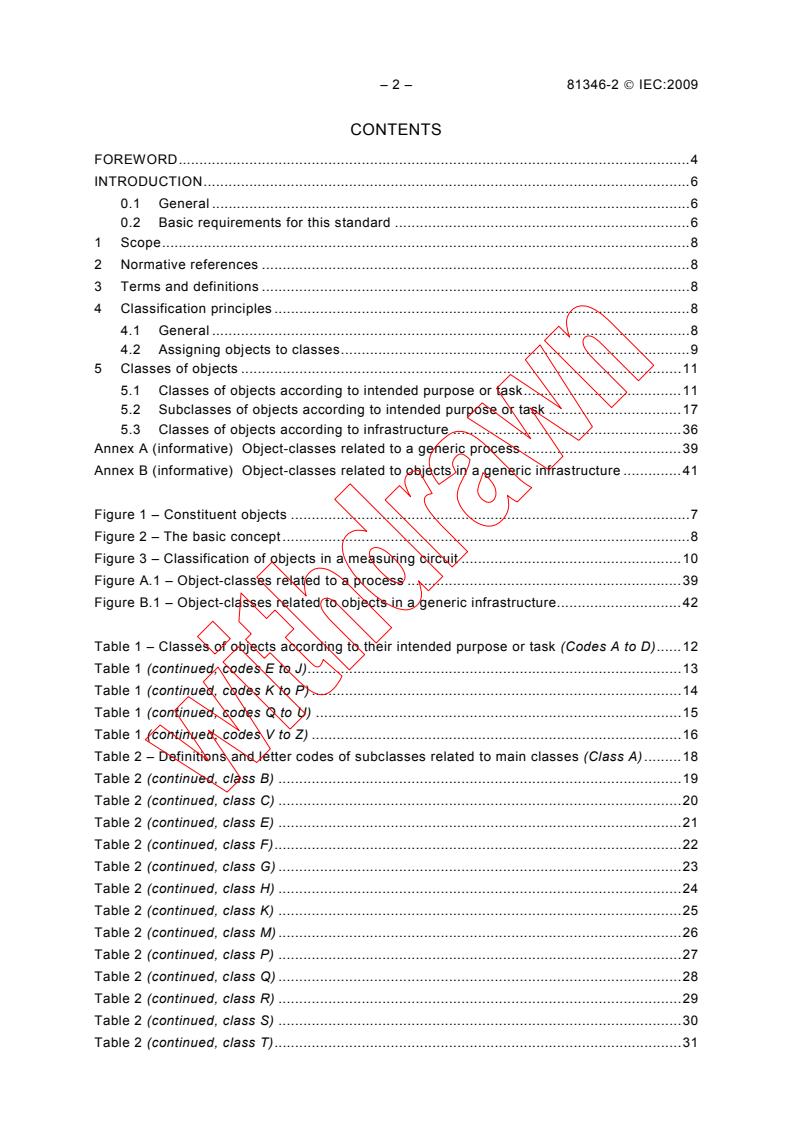
– 2 – 81346-2 © IEC:2009
CONTENTS
FOREWORD.4
INTRODUCTION.6
0.1 General.6
0.2 Basic requirements for this standard .6
1 Scope.8
2 Normative references .8
3 Terms and definitions .8
4 Classification principles .8
4.1 General .8
4.2 Assigning objects to classes.9
5 Classes of objects .11
5.1 Classes of objects according to intended purpose or task.11
5.2 Subclasses of objects according to intended purpose or task .17
5.3 Classes of objects according to infrastructure .36
Annex A (informative) Object-classes related to a generic process .39
Annex B (informative) Object-classes related to objects in a generic infrastructure .41
Figure 1 – Constituent objects .7
Figure 2 – The basic concept.8
Figure 3 – Classification of objects in a measuring circuit .10
Figure A.1 – Object-classes related to a process .39
Figure B.1 – Object-classes related to objects in a generic infrastructure.42
Table 1 – Classes of objects according to their intended purpose or task (Codes A to D).12
Table 1 (continued, codes E to J).13
Table 1 (continued, codes K to P) .14
Table 1 (continued, codes Q to U) .15
Table 1 (continued, codes V to Z) .16
Table 2 – Definitions and letter codes of subclasses related to main classes (Class A).18
Table 2 (continued, class B) .19
Table 2 (continued, class C) .20
Table 2 (continued, class E) .21
Table 2 (continued, class F).22
Table 2 (continued, class G) .23
Table 2 (continued, class H) .24
Table 2 (continued, class K) .25
Table 2 (continued, class M) .26
Table 2 (continued, class P) .27
Table 2 (continued, class Q) .28
Table 2 (continued, class R) .29
Table 2 (continued, class S) .30
Table 2 (continued, class T).31
81346-2 © IEC:2009 – 3 –
Table 2 (continued, class U) .32
Table 2 (continued, class V) .33
Table 2 (continued, class W).34
Table 2 (continued, class X) .35
Table 3 – Classes of infrastructure objects .37
Table 4 – Examples of branch-related classes B to U of Table 3 .38
– 4 – 81346-2 © IEC:2009
INTERNATIONAL ELECTROTECHNICAL COMMISSION
____________
INDUSTRIAL SYSTEMS, INSTALLATIONS
AND EQUIPMENT AND INDUSTRIAL PRODUCTS –
STRUCTURING PRINCIPLES AND REFERENCE DESIGNATIONS –
Part 2: Classification of objects and codes for classes
FOREWORD
1) The International Electrotechnical Commission (IEC) is a worldwide organization for standardization comprising
all national electrotechnical committees (IEC National Committees). The object of IEC is to promote
international co-operation on all questions concerning standardization in the electrical and electronic fields. To
this end and in addition to other activities, IEC publishes International Standards, Technical Specifications,
Technical Reports, Publicly Available Specifications (PAS) and Guides (hereafter referred to as “IEC
Publication(s)”). Their preparation is entrusted to technical committees; any IEC National Committee interested
in the subject dealt with may participate in this preparatory work. International, governmental and non-
governmental organizations liaising with the IEC also participate in this preparation. IEC collaborates closely
with the International Organization for Standardization (ISO) in accordance with conditions determined by
agreement between the two organizations.
2) The formal decisions or agreements of IEC on technical matters express, as nearly as possible, an international
consensus of opinion on the relevant subjects since each technical committee has representation from all
interested IEC National Committees.
3) IEC Publications have the form of recommendations for international use and are accepted by IEC National
Committees in that sense. While all reasonable efforts are made to ensure that the technical content of IEC
Publications is accurate, IEC cannot be held responsible for the way in which they are used or for any
misinterpretation by any end user.
4) In order to promote international uniformity, IEC National Committees undertake to apply IEC Publications
transparently to the maximum extent possible in their national and regional publications. Any divergence
between any IEC Publication and the corresponding national or regional publication shall be clearly indicated in
the latter.
5) IEC provides no marking procedure to indicate its approval and cannot be rendered responsible for any
equipment declared to be in conformity with an IEC Publication.
6) All users should ensure that they have the latest edition of this publication.
7) No liability shall attach to IEC or its directors, employees, servants or agents including individual experts and
members of its technical committees and IEC National Committees for any personal injury, property damage or
other damage of any nature whatsoever, whether direct or indirect, or for costs (including legal fees) and
expenses arising out of the publication, use of, or reliance upon, this IEC Publication or any other IEC
Publications.
8) Attention is drawn to the Normative references cited in this publication. Use of the referenced publications is
indispensable for the correct application of this publication.
9) Attention is drawn to the possibility that some of the elements of this IEC Publication may be the subject of
patent rights. IEC shall not be held responsible for identifying any or all such patent rights.
International Standard IEC 81346-2 has been prepared by IEC technical committee 3:
Information structures, documentation and graphical symbols and ISO technical committee
10: Technical product documentation.
It is published as a double logo standard.
This edition cancels and replaces the first edition of IEC 61346-2, published in 2000 and the
first edition of IEC/PAS 62400, published in 2005.
This edition includes the following technical changes with respect to IEC 61346-2 Ed.1:
• all rules concerning the application of letter codes have been removed as these should be
included in another publication dealing with the application of letter codes within reference
designations;
and, with respect to IEC/PAS 62400 Ed.1:
81346-2 © IEC:2009 – 5 –
• the definitions of the sub-classes have been reviewed and made consistent;
• the basis for the sub-classification is indicated;
• some new subclasses for class B and class P have been added;
• the table of terms sorted according to the two-letter code has been removed;
The text of this standard is based on the following documents:
FDIS Report on voting
3/945/FDIS 3/957RVD
Full information on the voting for the approval of this standard can be found in the report on
voting indicated in the above table. In ISO, the standard has been approved by 12 members
out of 13 having cast a vote.
This publication has been drafted in accordance with the ISO/IEC Directives, Part 2.
A list of all parts of IEC 81346 series, formerly IEC 61346 series, published under the general
title Industrial systems, installations and equipment and industrial products – Structuring
principles and reference designations, can be found on the IEC website.
Future standards in this series will carry the new general number 81346. Numbers of existing
standards in this series will be updated at the time of the next edition.
The committee has decided that the contents of this publication will remain unchanged until
the maintenance result date indicated on the IEC web site under “http://webstore.iec.ch” in the
data related to the specific publication. At this date, the publication will be
• reconfirmed,
• withdrawn,
• replaced by a revised edition, or
• amended.
– 6 – 81346-2 © IEC:2009
INTRODUCTION
0.1 General
The aim of this part of IEC 81346 is to establish classification schemes for objects with
associated letter codes which can be applied throughout all technical areas, e.g. electrical,
mechanical and civil engineering as well as all branches of industry, e.g. energy, chemical
industry, building technology, shipbuilding and marine technology. The letter codes are
intended for use with the rules for the construction of reference designations in accordance
with IEC 81346-1.
Annex A illustrates how objects may be classified according to their intended purpose or task
related to a generic process.
Annex B illustrates how objects may be classified according to their position in an
infrastructure.
0.2 Basic requirements for this standard
The basic requirements were developed during the preparation of IEC 61346-2 Ed. 1, and
accepted by vote by the national committees.
NOTE These basic requirements concern the development of the letter code classification system in this standard
and not its application. They are therefore not normative vis-à-vis the application of this standard.
(1) Letter codes shall be based on a classification scheme.
(2) A classification scheme is the set of definitions for the types of objects (for example, a
classification scheme for function types containing the definition of the different function
types of objects).
(3) A classification scheme shall allow for hierarchical classification of types of objects, i.e.
subclasses and superclasses.
(4) A letter code for a type of object shall be independent of the actual position of the
instances of that type of object in a system.
(5) Distinct classes shall be defined on each level of the classification scheme.
(6) The definitions of the classes of a particular level within a classification scheme shall
have a common basis (for example, a classification scheme that, on one level, classifies
objects according to colour shall not contain classes that classify objects by shape). The
basis, however, may vary from one level to another.
(7) A letter code should indicate the type of object and not an aspect of this object.
(8) A classification scheme shall allow for expansion in order to take into account future
development and needs.
(9) A classification scheme shall be usable within all technical areas without favouring a
specific area.
(10) It shall be possible to use the letter codes consistently throughout all technical areas.
The same type of object should preferably have only one letter code independent of the
technical area where it is being used.
(11) It should be possible to indicate in a letter code from which technical area the object
originates, if this is wanted.
(12) A classification scheme should reflect the practical application of letter codes.
(13) Letter codes should not be mnemonic, as this cannot be implemented consistently
throughout a classification scheme and for different languages.
(14) Letter codes shall be formed using capital letters from the Latin alphabet, excluding I
and O due to possible confusion with the digits 1 (one) and 0 (zero).
81346-2 © IEC:2009 – 7 –
(15) Different classification schemes shall be allowed and be applicable for the same type of
object.
(16) Objects may be classified for example according to function types, shapes, colours, or
material. This means that the same type of object may be assigned different letter
codes according to the different classification schemes.
(17) Objects that are directly constituents of another object using the same aspect shall be
assigned letter codes according to the same classification scheme as shown in Figure
1. See also Figure A.1.
IEC 1272/09
Objects 2, 3, and 4, which are direct constituents of object 1, shall be assigned letter codes from the same
classification scheme.
Objects 5 and 6, which are direct constituents of object 2, shall be assigned letter codes from the same
classification scheme.
Objects 7 and 8, which are direct constituents of object 4, shall be assigned letter codes from the same
classification scheme.
Objects 9, 10, 11, and 12, which are direct constituents of object 6, shall be assigned letter codes from the same
classification scheme.
Objecst 13, 14, 15, and 16, which are direct constituents of object 8, shall be assigned letter codes from the same
classification scheme.
Figure 1 – Constituent objects
(18) If products from different manufacturers are combined into a new product, the
constituents of this product may be assigned codes according to different classification
schemes.
– 8 – 81346-2 © IEC:2009
INDUSTRIAL SYSTEMS, INSTALLATIONS
AND EQUIPMENT AND INDUSTRIAL PRODUCTS –
STRUCTURING PRINCIPLES AND REFERENCE DESIGNATIONS –
Part 2: Classification of objects and codes for classes
1 Scope
This part of International Standard 81346, published jointly by IEC and ISO defines classes
and subclasses of objects based on a purpose- or task-related view of the objects, together
with their associated letter codes to be used in reference designations.
The classification is applicable for objects in all technical areas, e.g. electrical, mechanical
and civil engineering as well as all branches of industry, e.g. energy, chemical industry,
building technology, shipbuilding and marine technology, and can be used by all technical
disciplines in any design process.
2 Normative references
The following referenced documents are indispensable for the application of this document.
For dated references, only the edition cited applies. For undated references, the latest edition
of the referenced document (including any amendments) applies.
IEC 81346-1, Industrial systems, installations and equipment and industrial products –
Structuring principles and reference designations – Part 1: Basic rules
ISO 14617-6:2002 Graphical symbols for diagrams – Part 6: Measurement and control
functions
3 Terms and definitions
For the purposes of this document, the terms and definitions given in IEC 81346-1 apply.
4 Classification principles
4.1 General
The principle of classification of objects is based on viewing each object as a means for
performing an activity often with input and output (see Figure 2). In this respect, the internal
structure of an object is not important.
IEC 1273/09
Figure 2 – The basic concept
81346-2 © IEC:2009 – 9 –
Annex A shows the generic process model used for the establishment of the classification
scheme based on intended purpose or task as shown in Table 1.
An alternative classification according to purpose or task in the special case of an object
regarded as part of an infrastructure is presented in Table 3.
Each class defined in Table 1 is in this standard associated with a set of predefined
subclasses allowing a more detailed characterization of a component, if required. The
definitions of subclasses of objects are presented in Table 2 together with their associated
letter codes of class and subclass.
NOTE 1 Subclasses do not define a new level in a structure, i.e. they do not describe a subdivision of the object.
Class and subclass refer to the same object.
NOTE 2 The use of subclasses for the coding of technical attributes should be avoided, as this is a separate kind
of information presented in the documentation, for example in a technical specification or in a parts list.
4.2 Assigning objects to classes
For the assignment of objects (i.e. components belonging to the system under consideration)
to classes, the following rules apply:
Rule 1 For the classification of objects according to their intended purpose or task, main
classes and letter codes in accordance with Table 1 or Table 3 shall be applied.
Rule 2 For assigning an object to a class according to Table 1 or Table 3, the object shall
be viewed with respect to its intended purpose or task, as a component in the
system under consideration, without considering the means for implementation
(e.g. the kind of product).
EXAMPLE The desired purpose of an object is “heating”. A possible component required to fulfil this
is a “heater”. According to Table 1, this object is clearly related to class E. It is not of importance, or
simply not known at an early stage of a design process, how the required purpose is realized. This
needed component may be satisfied by using a gas or oil burner or an electric heater (which all may
be products delivered by others). In the case of an electric heater, the heat may be produced by a
product called electric resistor. This product may, in other cases, be classified by its purpose
“restricting a flow” according to class R if that describes it use as a component in those contexts.
It is the component that is classified – not the product used for implementation!
Rule 3 For objects with more than one intended purpose or task, the object shall be
classified according to the intended purpose or task considered to be the main
one.
Table 1 shall only be applied for objects
Rule 4 The class with letter code A according to
with no explicit main purpose or task.
EXAMPLE A flow rate recorder stores measured values for later use but, at the same time, delivers
an output in visible form. If storing is regarded as the main purpose, the object is related to class C
of Table 1. If the indication of measured values is regarded as the main purpose, the object is
related to class P. If the two purposes are considered equally valid, the object is related to class A.
Figure 3 illustrates the principle of assigning classes to objects in the case of a measuring
circuit. The left-hand side illustrates how the requirements are turned into objects with input
and output. On the right-hand side, the used components are shown.
– 10 – 81346-2 © IEC:2009
Required process activity
Required system object
Different possible realizations
a) Direct measuring and indication
b) Measuring and indication circuit consisting of discrete components
c) One device integrating discrete components
Indicating device
Class P
Transducer
Instrument
Sensor
class T
class P
class B
Indicated,
measured
property
Classification of internal
components is of interest only
Process flow if they are accessible.
d) One device integrating discrete components and for combined purposes; for measuring (primary purpose),
and for indicating (secondary purpose)
IEC 1274/09
NOTE The classes are taken from Table 1.
Figure 3 – Classification of objects in a measuring circuit
81346-2 © IEC:2009 – 11 –
5 Classes of objects
5.1 Classes of objects according to intended purpose or task
Table 1 constitutes the main classification method applicable for any object from any field of
technology.
The most important element in the table is the description of the intended purpose or task of
an object to which it is to be referred when searching for an appropriate class for an object.
– 12 – 81346-2 © IEC:2009
Table 1 – Classes of objects according to their intended purpose or task
(Codes A to D)
Code Intended purpose or Examples of terms Examples of typical Examples of typical
task of object describing the mechanical/fluid electrical components
intended purpose or components
task of objects
A Two or more purposes or
tasks
NOTE This class is only
for objects for which no
main intended purpose
or task can be identified.
B Converting an input Detecting Orifice plate (for Buchholz relay
variable (physical Measuring (picking-up of measuring) Current transformer
property, condition or values) Sensor Flame detector
event) into a signal for Monitoring Measuring relay
further processing Sensing Measuring shunt
Weighing (picking-up of (resistance)
values) Microphone
Movement detector
Overload relay
Photocell
Position switch
Proximity sensor
Proximity switch
Smoke sensor
Tachometer
Temperature sensor
Video camera
Voltage transformer
C Storing of energy, Recording Barrel Buffer battery
information or material Storing Buffer Capacitor
Cistern Event recorder (mainly for
Container storing purposes)
Hot water accumulator Hard disk
Paper reel stand Magnetic tape recorder
Tank (mainly for storing
purposes)
Memory
RAM
Storage battery
Video recorder (mainly for
storing purposes)
Voltage recorder (mainly
for storing purposes)
D Reserved for future
standardization
81346-2 © IEC:2009 – 13 –
Table 1 (continued, codes E to J)
Code Intended purpose or Examples of terms Examples of typical Examples of typical
task of object describing the mechanical/fluid electrical components
intended purpose or components
task of objects
E Providing radiant or Cooling Boiler Boiler
thermal energy Heating Freezer Electrical heater
Lighting Furnace Electrical radiator
Radiating Gas lamp Fluorescent lamp
Heater Lamp
Heat exchanger Lamp bulb
Nuclear reactor Laser
Paraffin lamp Luminaire
Radiator Maser
Refrigerator
F Direct protection (self- Absorbing Airbag Cathodic protection anode
acting) of a flow of Guarding Guard Faraday cage
energy, signals, Preventing Rupture disc Fuse
personnel or equipment Protecting Safety belt Miniature circuit-breaker
from dangerous or Securing Safety valve Surge arrester
unwanted conditions Shielding Thermal overload release
Including systems and
equipment for protective
purposes
G Initiating a flow of energy Generating Blower Dry cell battery
or material Conveyor, (driven) Dynamo
Fan Fuel cell
Generating signals used
Pump Generator
as information carriers or
Vacuum pump Rotating generator
reference source
Ventilator Signal generator
Solar cell
Wave generator
H Producing a new kind of Assembling Component insertion Absorption washer
material or product Crushing machine Centrifuge
Disassembling Crusher Crusher
Fractionating Mixer Distillation column
Material removing Emulsifier
Milling Fermenter
Mixing Magnetic separator
Producing Mill
Pulverizing Pellet maker
Rake
Reactor
Separator
Sintering facility
I Not to be applied --- --- ---
J Reserved for future
standardization
– 14 – 81346-2 © IEC:2009
Table 1 (continued, codes K to P)
Code Intended purpose or Examples of terms Examples of typical Examples of typical
task of object describing the mechanical/fluid electrical components
intended purpose or components
task of objects
K Processing (receiving, Closing (of control Fluid feedback controller All-or-nothing relay
treating and providing) circuits) Pilot valve Analogue integrated
signals or information Continuous controlling circuit
(excluding objects for Delaying Binary integrated circuit
protective purposes, see Opening (of control Contactor relay
Class F) circuits) CPU
Postponing Delay line
Switching (of control Electronic valve
circuits) Electronic tube
Synchronizing Feedback controller
Filter, a.c. or d.c.
Induction stirrer
Microprocessor
Programmable controller
Synchronizing device
Time relay
Transistor
L Reserved for future
standardization
M Providing mechanical Actuating Combustion engine Actuating coil
energy (rotational or Driving Fluid cylinder Actuator
linear mechanical Heat engine Electric motor
motion) for driving Hydraulic turbine Linear motor
purposes Mechanical actuator
Spring-loaded actuator
Steam turbine
Wind turbine
N Reserved for future
standardization
O Not to be applied --- --- ---
P Presenting information Alarming Balance (for weighing) Ammeter
Communicating Bell Bell
Displaying Clock Clock
Indicating Flow meter Continuous line recorder
Informing Manometer Event counter
Measuring (presentation Printer Geiger counter
of variables) Text display LED
Presenting Thermometer Loudspeaker
Printing Printer
Warning Recording voltmeter
(mainly for presentation
purposes)
Signal lamp
Signal vibrator
Synchroscope
Text display
Voltmeter
Wattmeter
Watt-hour meter
81346-2 © IEC:2009 – 15 –
Table 1 (continued, codes Q to U)
Code Intended purpose or Examples of terms Examples of typical Examples of typical
task of object describing the mechanical/fluid electrical components
intended purpose or components
task of objects
Q Controlled switching or Opening (of energy, Brake Circuit-breaker
varying a flow of energy, signals and material Control valve Contactor (for power)
of signals (for signals in flow) Door Disconnector
control circuits, see Closing (of energy, Gate Fuse switch (if main
Classes K and S) or of signals and material Shut-off valve purpose is protection, see
material flow) Lock Class F)
Switching (of energy, Fuse-switch-disconnector
signals and material flow (if main purpose is
Clutching protection, see Class F)
Motor starter
Power transistor
Thyristor
R Restricting or stabilizing Blocking Blocking device Diode
motion or a flow of Damping Check valve Inductor
energy, information or Restricting Fence Limiter
material Limiting Latch Resistor
Stabilizing Lock
Orifice plate
Shock absorber
Shutter
S Converting a manual Influencing Push-button valve Control switch
operation into a signal Manually controlling Selector switch Cordless mouse
for further processing Selecting Discrepancy switch
Keyboard
Light pen
Push-button switch
Selector switch
Set-point adjuster
T Conversion of energy Amplifying Fluid amplifier AC/DC converter
maintaining the kind of Modulating Automatic gear Aerial
energy Transforming Pressure amplifier Amplifier
Torque converter Electrical transducer
Conversion of an
Casting Frequency convertor
established signal
Compressing Casting machine Power transformer
maintaining the content
Converting Extruder Rectifier
of information
Cutting Saw Signal converter
Material deforming
Conversion of the form
Expanding
or shape of a material
Forging
Grinding
Rolling
Size enlargement
Size reduction
Turning
U Keeping objects in a Bearing Bracket Insulator
defined position Carrying Cabinet
Holding Cable duct
Supporting Cable tray
Centring device
Corridor
Duct
Fixture
Building foundation
Insulator
Pipe bridge
Roller bearing
Room
– 16 – 81346-2 © IEC:2009
Table 1 (continued, codes V to Z)
Code Intended purpose or Examples of terms Examples of typical Examples of typical
task of object describing the mechanical/fluid electrical components
intended purpose or components
task of objects
V Processing (treating) of Coating Balancing machine
material or products Cleaning Drum
(including preparatory Dehydrating Grinder
and post-treatment) Derusting Packaging machine
Drying Palletizer
Filtering Sack
Heat treatment Vacuum cleaner
Packing Washing machine
Preconditioning Wrapping machine
Recovering Wetting
Re-finishing
Sealing
Separating
Sorting
Stirring
Surface treatment
Wrapping
W Guiding or transporting Conducting Channel Busbar
energy, signals, material Distributing Duct Bushing
or products from one Guiding Hose Cable
place to another Leading Linkage Conductor
Positioning Mirror Data bus
Transporting Roller table Optical fibre
Pipe
Shaft
Turntable
X Connecting objects Connecting Flange Connector
Coupling Hook Hub
Joining Hose coupling Plug connector
Piping fitting Terminal
Piping flange Terminal block
Rigid coupling Terminal strip
Y Reserved for future
standardization
Z Reserved for future
standardization
81346-2 © IEC:2009 – 17 –
5.2 Subclasses of objects according to intended purpose or task
It is sometimes necessary or helpful to provide a more detailed classification of an object than
the classification provided by the classes in Table 1.
Rule 5 Objects classified according to Table 1 shall be sub-classified according to Table 2
hereinafter, if such sub-classification is required.
Rule 6 Additional subclasses to those defined in Table 2, may be applied if:
Table 2 is applicable;
• no subclass of
• the subclasses are defined in accordance with the basic grouping of subclasses
in Table 2;
• the application of the subclasses is explained in the document where it is used or
in supporting documentation.
Each subclass provided in Table 2 characterizes the object, and the different subclasses are
arranged according to a relationship to a technical sector. The grouping is as follows:
• Subclass A – E for objects related to electrical energy;
• Subclass F – K, excluding I, for objects related to information and signals;
• Subclass L – Y, excluding O, for objects related to process, mechanical and civil
engineering;
• Subclass Z for objects related to combined tasks.
This basic grouping is fixed for all classes of Table 1 except for the Class B where the letter
codes specified for the subclasses are based on those in ISO 14617-6.
NOTE 1 It should be noted that the letter codes in ISO 14617-6 are intended to be used as qualifying symbols to
graphical symbols for measurement and control functions. Although they do not represent a classification scheme
in a very strict sense, their application may lead to sufficiently differentiating single-level reference designations in
most cases. Example: A temperature sensor may be assigned class BT if the designation according to class B
alone is not sufficient for an intended purpose.
NOTE 2 Table 2 defines the subclasses, and provides also a non-exhaustive list of components considered to be
related to the actual subclass. It is not in the scope of this International standard to list all components related to a
certain subclass.
NOTE 3 In Table 2, the phrase “Not used” indicates that the corresponding letter code is not defined in this
classification scheme. It does not prohibit the use of such a letter code if required for a class not defined so far.
There is however a risk that in a later edition of the standard these letter codes will represent additional
standardized classes that are different from the freely applied ones.
– 18 – 81346-2 © IEC:2009
Table 2 – Definitions and letter codes of subclasses related to main classes
(Class A)
Main class A
Two or more purposes or tasks
Code Definition of subclass Examples of components
AA
AB
Objects related to electrical energy (free for
AC
definition by the user
AD
AE
AF
AG
Objects related to information and signals (free for
AH
definition by the user)
AJ
AK
AL
AM
AN
AP
AQ
AR
Objects related to process, mechanical and civil
AS
engineering (free for definition by the user)
AT
AU
AV
AW
AX
AY
AZ Combined tasks
NOTE Main class A is only for objects for which no main intended purpose or task can be identified.
81346-2 © IEC:2009 – 19 –
Table 2 (continued, class B)
Main class B
Converting an input variable (physical property, condition or event) into a signal for further processing
Definition of subclass
Code Examples of components
based on input measured variable
BA Electrical potential Measuring relay (voltage), measuring
shunt (voltage), measuring transformer
(voltage), voltage transformer
BB Not used
BC Electrical current Current transformer, measuring relay
(current), measuring transformer
(current), overload relay (current)
BD Density
BE Other electrical or electromagnetic variable Measuring relay, measuring shunt
(resistance), measuring transformer
BF Flow Flow meter, gas meter, water meter
BG Gauge, position, length Motion sensor, movement detector,
(including distance, elongation, amplitude) position switch, proximity switch,
proximity sensor
BH Not used
BJ Power
BK Time Clock, time counter
BL Level Sonic depth finder (sonar)
BM Moisture, humidity Humidity meter
BN Not used
BP Pressure, vacuum Pressure gauge, pressure sensor
BQ Quality Gas analyzer, non-destructive testing
(composition, concentration, purity, material device, ph electrode
property)
BR Radiation Flame detector, photocell,
smoke detector
BS Speed, frequency Accelerometer, speedometer,
(including acceleration) tachometer, vibration pickup
BT Temperature Temperature sensor
BU Multi-variable Buchholz relay
BV Not used
BW Weight, force Load cell
BX Other quantities Microphone, video camera
BY Not used
BZ Number of events, counts, Switching cycle detector
combined tasks
NOTE The letter codes in accordance with 7.3.1 of ISO 14617-6:2002 are used for the subclasses together with
some additions required for the purpose of this standard. Descriptions of letter codes BA, BC, BV and BX have
been added. The letter code BZ is additionally made available for “combined tasks” which allows it to be in line
with the other main classes.
– 20 – 81346-2 © IEC:2009
Table 2 (continued, class C)
Main class C
Storing of energy, information or material
Definition of subclass
Code Examples of components
based on kind of storage
CA Capacitive storage of electric energy Capacitor
CB Inductive storage of electric energy Coil, superconductor
CC Chemical storage of electric energy Buffer battery
NOTE Batteries seen as energy sources
are assigned to main Class G.
CD Not used
CE Not used
CF Storage of information CD-ROM, EPROM, event recorder,
hard disk, magnetic tape recorder,
memory, RAM, video recorder,
voltage recorder
CG Not used
CH Not used
CJ Not used
CK Not used
CL Open storage of material at fixed location Bunker, cistern, paper reel stand, pit,
(collection, housing) pool
CM Closed storage of material at fixed location Accumulator, barrel, boiler, buffer,
(collection, housing) container, depository, flash tank, gas
holder, safe, silo, tank
CN Moveable storage of material (collection, housing) Container, drum, gas cylinder,
shipping container
CP Storage of thermal energy Hot water accumulator, hybrid heat
storage, ice tank, steam storage,
thermal energy storage,
underground thermal energy storage
CQ Storage of mechanical energy Flywheel, rubber band
CR Not used
CS Not used
CT Not used
CU Not used
CV Not used
CW Not used
CX Not used
CY Not used
CZ Combined tasks
81346-2 © IEC:2009 – 21 –
Table 2 (continued, class E)
Main class E
Providing radiant or
...