

IEC 62569-1:2017
(Main)Generic specification of information on products by properties - Part 1: Principles and methods
General Information
- Abstract
IEC 62569-1:2017 specifies several qualifiers to be used with object or (dictionary) properties and their values indicating life cycle and other aspects of the property. It is a prerequisite for the usage of the other parts of IEC 62569. This first edition cancels and replaces IEC PAS 62569-1:2009. This edition constitutes a technical revision.
- Status
- Published
- Publication Date
- 11-Jul-2017
- Technical Committee
- TC 3 - Documentation, graphical symbols and representations of technical information
- Drafting Committee
- PT 62569 - TC 3/PT 62569
- Current Stage
- PPUB - Publication issued
- Start Date
- 12-Jul-2017
- Completion Date
- 30-Jun-2017
Buy Documents
IEC 62569-1:2017 - Generic specification of information on products by properties - Part 1: Principles and methods Released:7/12/2017
IEC 62569-1:2017 - Generic specification of information on products by properties - Part 1: Principles and methods Released:2/8/2018
Overview
IEC 62569-1:2017 - "Generic specification of information on products by properties - Part 1: Principles and methods" defines the principles and methods for expressing product-related information as properties and qualifiers. It establishes a common framework for managing product information across the product life cycle and is a prerequisite for other parts of the IEC 62569 series. The standard replaces IEC PAS 62569-1:2009 and constitutes a technical revision.
Keywords: IEC 62569-1:2017, product information standards, property qualifiers, data dictionary, product lifecycle information, interoperability.
Key topics and technical requirements
The standard focuses on consistent, machine-readable expression of product properties and metadata. Major technical topics include:
Properties
- Differentiates object properties and (dictionary) properties, and explains how sets of properties are organized (clauses 5.x).
Property qualifiers (clause 6) - qualifiers provide context for property values. Categories include:
- Life cycle qualifier (e.g., SPE, INQ, OFF, CON, SUP, BUILT, OP, DECOM) to indicate when a property value applies during a product’s life cycle.
- Applicability qualifier (e.g., AVP, AVN, AVA, NA) to mark whether a property is applicable.
- Value origin qualifier (e.g., EST, CAL, MEA, SET) to indicate how a value was obtained.
- Value processing qualifier (e.g., ARITHM, MED, MOD, WARITHM, GEOM, WGEOM, HARM, RMS) for processed or aggregated values.
- Rules for combining multiple qualifiers and examples for XML-based transactions are provided.
Property values and units (clause 7) - guidance on special values, level types, unit systems and use of units in software.
Data reliability and quality (clause 8) - methods to describe inaccuracies, tolerances and intended design tolerances.
Dictionary definitions - normative Annex A contains (dictionary) property definitions and classes.
Practical applications and users
IEC 62569-1 is aimed at organizations and professionals needing standardized product information exchange and management:
- Product data managers, information architects and data governance teams
- PLM/PDM/ERP vendors and system integrators implementing product metadata models
- Manufacturers, suppliers and procurement teams exchanging product specifications
- Standards developers and technical committees harmonizing product dictionaries
- Software developers implementing XML/JSON transactions or data dictionaries for interoperability
Practical uses include creating interoperable data dictionaries, tagging property values with life-cycle context, clarifying value provenance (measured vs. estimated), documenting processing methods for aggregated values, and improving product data quality for downstream systems.
Related standards
- Other parts of the IEC 62569 series (IEC 62569-2, etc.) - IEC 62569-1 provides the foundational principles required by subsequent parts that define structures, formats and domain-specific property sets.
Relations
- Effective Date
- 05-Sep-2023
Buy Documents
IEC 62569-1:2017 - Generic specification of information on products by properties - Part 1: Principles and methods Released:7/12/2017
IEC 62569-1:2017 - Generic specification of information on products by properties - Part 1: Principles and methods Released:2/8/2018
Get Certified
Connect with accredited certification bodies for this standard

IMQ S.p.A. (Certification)
Italian electrical product certification.

SLG Prüf- und Zertifizierungs GmbH
German testing and certification body.

UL Solutions
Global safety science company with testing, inspection and certification.
Sponsored listings
Frequently Asked Questions
IEC 62569-1:2017 is a standard published by the International Electrotechnical Commission (IEC). Its full title is "Generic specification of information on products by properties - Part 1: Principles and methods". This standard covers: IEC 62569-1:2017 specifies several qualifiers to be used with object or (dictionary) properties and their values indicating life cycle and other aspects of the property. It is a prerequisite for the usage of the other parts of IEC 62569. This first edition cancels and replaces IEC PAS 62569-1:2009. This edition constitutes a technical revision.
IEC 62569-1:2017 specifies several qualifiers to be used with object or (dictionary) properties and their values indicating life cycle and other aspects of the property. It is a prerequisite for the usage of the other parts of IEC 62569. This first edition cancels and replaces IEC PAS 62569-1:2009. This edition constitutes a technical revision.
IEC 62569-1:2017 is classified under the following ICS (International Classification for Standards) categories: 01.110 - Technical product documentation; 29.020 - Electrical engineering in general. The ICS classification helps identify the subject area and facilitates finding related standards.
IEC 62569-1:2017 has the following relationships with other standards: It is inter standard links to IEC PAS 62569-1:2009. Understanding these relationships helps ensure you are using the most current and applicable version of the standard.
IEC 62569-1:2017 is available in PDF format for immediate download after purchase. The document can be added to your cart and obtained through the secure checkout process. Digital delivery ensures instant access to the complete standard document.
Standards Content (Sample)
IEC 62569-1 ®
Edition 1.0 2017-07
INTERNATIONAL
STANDARD
colour
inside
HORIZONTAL STANDARD
Generic specification of information on products by properties –
Part 1: Principles and methods
All rights reserved. Unless otherwise specified, no part of this publication may be reproduced or utilized in any form
or by any means, electronic or mechanical, including photocopying and microfilm, without permission in writing from
either IEC or IEC's member National Committee in the country of the requester. If you have any questions about IEC
copyright or have an enquiry about obtaining additional rights to this publication, please contact the address below or
your local IEC member National Committee for further information.
IEC Central Office Tel.: +41 22 919 02 11
3, rue de Varembé Fax: +41 22 919 03 00
CH-1211 Geneva 20 info@iec.ch
Switzerland www.iec.ch
About the IEC
The International Electrotechnical Commission (IEC) is the leading global organization that prepares and publishes
International Standards for all electrical, electronic and related technologies.
About IEC publications
The technical content of IEC publications is kept under constant review by the IEC. Please make sure that you have the
latest edition, a corrigenda or an amendment might have been published.
IEC Catalogue - webstore.iec.ch/catalogue Electropedia - www.electropedia.org
The stand-alone application for consulting the entire The world's leading online dictionary of electronic and
bibliographical information on IEC International Standards, electrical terms containing 20 000 terms and definitions in
Technical Specifications, Technical Reports and other English and French, with equivalent terms in 16 additional
documents. Available for PC, Mac OS, Android Tablets and languages. Also known as the International Electrotechnical
iPad. Vocabulary (IEV) online.
IEC publications search - www.iec.ch/searchpub IEC Glossary - std.iec.ch/glossary
The advanced search enables to find IEC publications by a 65 000 electrotechnical terminology entries in English and
variety of criteria (reference number, text, technical French extracted from the Terms and Definitions clause of
committee,…). It also gives information on projects, replaced IEC publications issued since 2002. Some entries have been
and withdrawn publications. collected from earlier publications of IEC TC 37, 77, 86 and
CISPR.
IEC Just Published - webstore.iec.ch/justpublished
Stay up to date on all new IEC publications. Just Published IEC Customer Service Centre - webstore.iec.ch/csc
details all new publications released. Available online and If you wish to give us your feedback on this publication or
also once a month by email. need further assistance, please contact the Customer Service
Centre: csc@iec.ch.
IEC 62569-1 ®
Edition 1.0 2017-07
INTERNATIONAL
STANDARD
colour
inside
HORIZONTAL STANDARD
Generic specification of information on products by properties –
Part 1: Principles and methods
INTERNATIONAL
ELECTROTECHNICAL
COMMISSION
ICS 01.110 ; 29.020 ISBN 978-2-8322-4428-9
– 2 – IEC 62569-1:2017 © IEC 2017
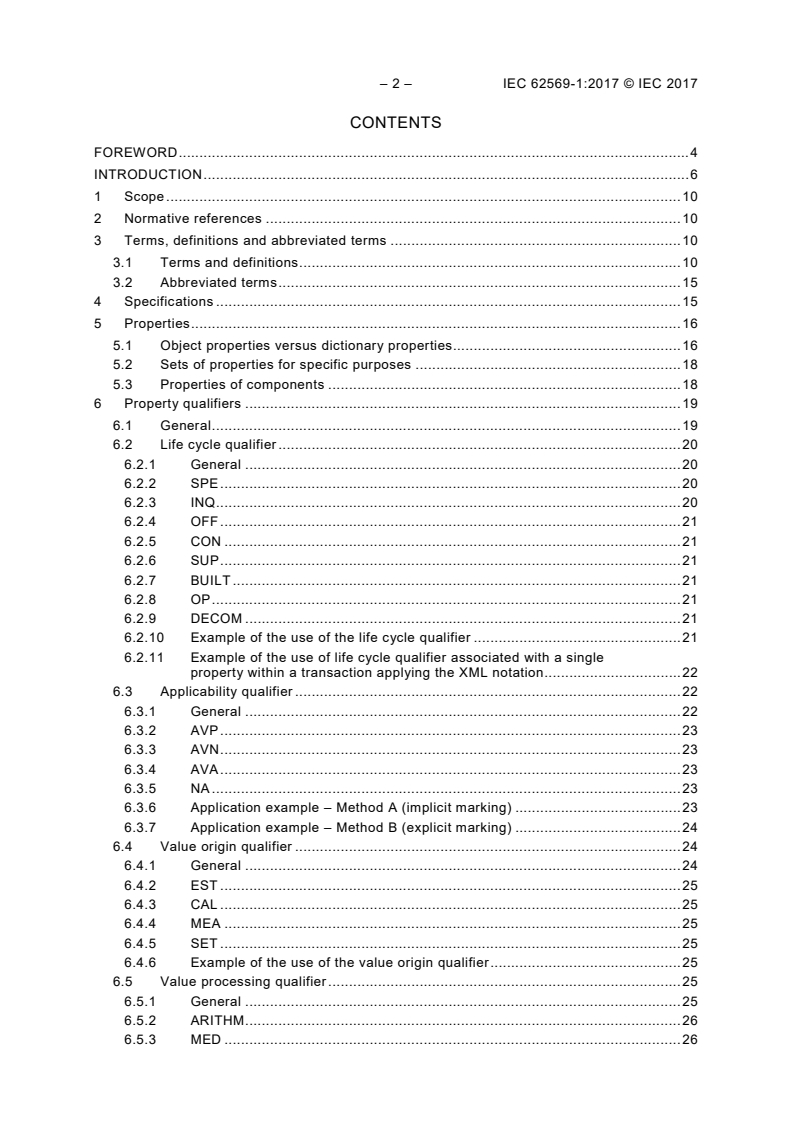
CONTENTS
FOREWORD . 4
INTRODUCTION . 6
1 Scope . 10
2 Normative references . 10
3 Terms, definitions and abbreviated terms . 10
3.1 Terms and definitions . 10
3.2 Abbreviated terms . 15
4 Specifications . 15
5 Properties . 16
5.1 Object properties versus dictionary properties. 16
5.2 Sets of properties for specific purposes . 18
5.3 Properties of components . 18
6 Property qualifiers . 19
6.1 General . 19
6.2 Life cycle qualifier . 20
6.2.1 General . 20
6.2.2 SPE . 20
6.2.3 INQ . 20
6.2.4 OFF . 21
6.2.5 CON . 21
6.2.6 SUP . 21
6.2.7 BUILT . 21
6.2.8 OP . 21
6.2.9 DECOM . 21
6.2.10 Example of the use of the life cycle qualifier . 21
6.2.11 Example of the use of life cycle qualifier associated with a single
property within a transaction applying the XML notation . 22
6.3 Applicability qualifier . 22
6.3.1 General . 22
6.3.2 AVP . 23
6.3.3 AVN . 23
6.3.4 AVA . 23
6.3.5 NA . 23
6.3.6 Application example – Method A (implicit marking) . 23
6.3.7 Application example – Method B (explicit marking) . 24
6.4 Value origin qualifier . 24
6.4.1 General . 24
6.4.2 EST . 25
6.4.3 CAL . 25
6.4.4 MEA . 25
6.4.5 SET . 25
6.4.6 Example of the use of the value origin qualifier . 25
6.5 Value processing qualifier . 25
6.5.1 General . 25
6.5.2 ARITHM . 26
6.5.3 MED . 26
6.5.4 MOD . 26
6.5.5 WARITHM . 27
6.5.6 GEOM . 27
6.5.7 WGEOM . 27
6.5.8 HARM . 28
6.5.9 RMS . 28
6.6 Multiple qualifiers . 28
6.7 When to use a qualifier . 28
6.8 Example of the use of multiple qualifiers associated with a single property
within a transaction applying, for example, the XML notation based on the
example shown in 6.6 . 29
7 Property values . 29
7.1 General . 29
7.2 How to deal with special values . 29
7.3 How to use the level type concept . 30
7.4 Availability of values associated with (dictionary) properties . 30
7.5 Application of unit systems . 30
7.6 Use of units in software applications . 30
8 Data reliability and quality . 31
8.1 General . 31
8.2 Description of inaccuracies of quantitative values . 31
8.3 Intended design tolerances on products . 32
Annex A (normative) (Dictionary) property definitions . 33
A.1 General . 33
A.2 Source definitions of (dictionary) properties and classes of (dictionary)
properties in this document . 33
A.2.1 Definitions of class of (dictionary) properties . 33
A.2.2 Definition of (dictionary) properties to class AAB001: . 34
Bibliography . 36
Figure 1 – Context of generic specification for information on products . 8
Figure 2 – Business scenario between parties . 9
Figure 3 – Import and export possibilities using tagged formats . 9
Figure 4 – Relation between the properties of a product type and the (dictionary)
properties of a data dictionary used for their expression . 17
Figure 5 – Inclusion of sets of properties . 18
Figure 6 – Relation between the components of a product type and the product type
used for their implementation . 19
Figure 7 – Development of life cycle qualifier over time. 22
Table 1 – Example of the use of the life cycle qualifier . 21
Table 2 – Example of the use of the value origin qualifier . 25
Table 3 – Example of the use of multiple qualifiers . 28
Table 4 – Tolerance concept . 32
– 4 – IEC 62569-1:2017 © IEC 2017
INTERNATIONAL ELECTROTECHNICAL COMMISSION
____________
GENERIC SPECIFICATION OF INFORMATION
ON PRODUCTS BY PROPERTIES –
Part 1: Principles and methods
FOREWORD
1) The International Electrotechnical Commission (IEC) is a worldwide organization for standardization comprising
all national electrotechnical committees (IEC National Committees). The object of IEC is to promote
international co-operation on all questions concerning standardization in the electrical and electronic fields. To
this end and in addition to other activities, IEC publishes International Standards, Technical Specifications,
Technical Reports, Publicly Available Specifications (PAS) and Guides (hereafter referred to as “IEC
Publication(s)”). Their preparation is entrusted to technical committees; any IEC National Committee interested
in the subject dealt with may participate in this preparatory work. International, governmental and non-
governmental organizations liaising with the IEC also participate in this preparation. IEC collaborates closely
with the International Organization for Standardization (ISO) in accordance with conditions determined by
agreement between the two organizations.
2) The formal decisions or agreements of IEC on technical matters express, as nearly as possible, an international
consensus of opinion on the relevant subjects since each technical committee has representation from all
interested IEC National Committees.
3) IEC Publications have the form of recommendations for international use and are accepted by IEC National
Committees in that sense. While all reasonable efforts are made to ensure that the technical content of IEC
Publications is accurate, IEC cannot be held responsible for the way in which they are used or for any
misinterpretation by any end user.
4) In order to promote international uniformity, IEC National Committees undertake to apply IEC Publications
transparently to the maximum extent possible in their national and regional publications. Any divergence
between any IEC Publication and the corresponding national or regional publication shall be clearly indicated in
the latter.
5) IEC itself does not provide any attestation of conformity. Independent certification bodies provide conformity
assessment services and, in some areas, access to IEC marks of conformity. IEC is not responsible for any
services carried out by independent certification bodies.
6) All users should ensure that they have the latest edition of this publication.
7) No liability shall attach to IEC or its directors, employees, servants or agents including individual experts and
members of its technical committees and IEC National Committees for any personal injury, property damage or
other damage of any nature whatsoever, whether direct or indirect, or for costs (including legal fees) and
expenses arising out of the publication, use of, or reliance upon, this IEC Publication or any other IEC
Publications.
8) Attention is drawn to the Normative references cited in this publication. Use of the referenced publications is
indispensable for the correct application of this publication.
9) Attention is drawn to the possibility that some of the elements of this IEC Publication may be the subject of
patent rights. IEC shall not be held responsible for identifying any or all such patent rights.
International Standard IEC 62569-1 has been prepared by IEC technical committee 3:
Information structures and elements, identification and marking principles, documentation and
graphical symbols.
This first edition cancels and replaces IEC PAS 62569-1:2009. This edition constitutes a
technical revision.
The text of this International Standard is based on the following documents:
FDIS Report on voting
3/1310/FDIS 3/1314/RVD
Full information on the voting for the approval of this International Standard can be found in
the report on voting indicated in the above table.
This document has been drafted in accordance with the ISO/IEC Directives, Part 2.
Terms which are defined in Clause 3 are italicized when they occur in definitions of other
terms in Clause 3.
A list of all parts in the IEC 62569 series, published under the general title Generic
specification of information on products by properties, can be found on the IEC website.
The committee has decided that the contents of this document will remain unchanged until the
stability date indicated on the IEC website under "http://webstore.iec.ch" in the data related to
the specific document. At this date, the document will be
• reconfirmed,
• withdrawn,
• replaced by a revised edition, or
• amended.
A bilingual version of this publication may be issued at a later date.
IMPORTANT – The 'colour inside' logo on the cover page of this publication indicates
that it contains colours which are considered to be useful for the correct
understanding of its contents. Users should therefore print this document using a
colour printer.
– 6 – IEC 62569-1:2017 © IEC 2017
INTRODUCTION
This document establishes general principles and methods required for all parts of IEC 62569,
to manage the product-related information as described in the following parts along the life
cycle of an object, e.g. a product during its operational use.
IEC 62569-2 provides a generally applicable structure of a generic specification of information
on products presenting those common clauses which are independent of any specific
equipment, component and device. It serves as a guide for the preparation of technical
specifications for various objects. Due to its generic type, particular issues referring to
specific product groups are excluded. These need to be obtained from the specific product
descriptions within product standards.
IEC 62569-3 provides a collection of generally applicable object properties used in
conjunction with the predefined structure in IEC 62569-2, being the basis for, for example, an
XML-based electronic template, serving as generic template for the development of product-
specific specifications of information by product committees within IEC and ISO, industrial
consortia or other industrial organizations.
Figure 1 provides an overview of the intention of this standard. The generic specification for
information of objects represents an overall approach for those mainly technical information
issues which are generally required by users of an object, and being independent of any
specific product class, such as identification, classification or accessibility information for
logical or physical interconnection to other products. It provides sets of object properties
which may contain quantitative, non-quantitative or conditional types, containing predefined
value sets for the non-quantitative, or units for the quantitative types.
The next step is the application of the available generic information on a specific product
class such as motor, transformer or resistor. In this step the previously available generic
information is aggregated by additional information focusing on that information which is
typically applicable for the considered specific class. The result is applicable only for that
considered class, and named product-class-specific blank detail specification. For each
further class, such a step is repeated. The object properties contained in a blank detail
specification for a specific product class are either of the quantitative or non-quantitative type
and also foreseen with predefined value sets for the non-quantitative, or units for the
quantitative types.
These blank detail specifications should be made available (e.g. as a web-based collection),
allowing users to establish the detail specifications (instantiate or populate with data) for
automated and controlled use by industry in the business process.
The next step is the application of blank detail specifications in daily practice in industry,
when a user populates the object properties of the blank detail specification with required
values for his specific application. Depending on the needs, further object properties may be
added, marked as not applicable or complemented by qualifiers, etc.
The result may be used, for example, as a functional specification for a specific object within
a system or plant, or used for an inquiry.
From this perspective it is easy to deduce that a prerequisite for an economic implementation
of the above specifications is the existence of an internationally available data dictionary with
public access, providing internationally standardized collections of (dictionary) properties
following common methods as defined in the IEC 61360 series.
Referring from object descriptions to previously defined standardized semantic (dictionary)
property descriptions is the key issue of an effective, reliable and secure electronic business.
For the relations among (dictionary) properties, the associated data dictionary and the
different specifications, see Figure 1.
Within this document two main concepts are differentiated:
A. a specification concept for “real or abstract” objects;
B. a data dictionary containing predefined information elements, each described by a
rigorous set of attributes and unambiguously identified, so that its information elements
can be used as a reference when preparing the concept A. Such a data dictionary is an
optional tool to make the descriptions for concept A. It is of course a “real world” object
but a quite different one and separated from the “real world” intended to be described.
For concept A, the term object property and set of object properties will be applied. For issues
relating to concept B, the term (dictionary) property and set of (dictionary) properties will be
applied to indicate that here a property or set of properties residing in a data dictionary is
meant.
The purpose of this document is to describe how real world specifications or descriptions are
to be prepared by making use of the data dictionary defined in IEC 61360.
The IEC 62569 series is a companion standard providing methods of expanding the use of
existing standardized (dictionary) properties as provided in the IEC CDD (Common Data
Dictionary) along the life cycle periods without the need to define additional (dictionary)
properties or to redefine such supporting economic engineering and data management.
NOTE 1 As the referred data dictionary of IEC 61360 is quite different from a dictionary, the term "data dictionary"
is consistently used within this document.
NOTE 2 Such a data dictionary is available as a data base application to be found under
http://std.iec.ch/iec61360 [retrieved 2016-05-03].
– 8 – IEC 62569-1:2017 © IEC 2017
contained in
contained in
IEC 61360
Data
Dictionary (Dictionary)
Qualifier
Properties
refers to
refers to
Generic specification
for information on
products
refers to
refers to
is based on
refers to
refers to
Product-class-specific
Blank Detail
Specification *
is based on
Product-specific
Detail Specification
e.g. power transformer **
* Developed by Product ** Filled with product specific data at a
Committees, Consortia or specified time in the life cycle process of a
other Organizations, e.g. for power transformer; used in a defined
lifting cranes, capacitors, business scenario among industrial
resistors, power transformers partners, e.g. seller,buyer
IEC
Figure 1 – Context of generic specification for information on products
Usage view of a specific
Specific view of a Generic view independent Basic methods and
product in business scenarios
product class of any product principles
among partners
Figure 2 shows a business scenario about the usage of a detail specification (based on the
generic specification) for information on products between business parties.
IEC
Figure 2 – Business scenario between parties
If a specification for information in the form of an electronic template is associated with a
schema for data exchange, for example an XML schema or any other tagged electronic file
format, the content of the product-specific detail specification can be easily used for import
and export of data values in conjunction with data bases for material management systems.
See Figure 3.
A specification template can also be imported for the setting up of the internal structures
within a data base without having the need to import associated values.
Conversely, detail specifications can be generated to export data using a predefined template
based on the generic specification for information on products.
IEC
Figure 3 – Import and export possibilities using tagged formats
– 10 – IEC 62569-1:2017 © IEC 2017
GENERIC SPECIFICATION OF INFORMATION
ON PRODUCTS BY PROPERTIES –
Part 1: Principles and methods
1 Scope
The IEC 62569 series defines principles and methods for the specification of objects by object
properties, for example in data sheets, by utilizing predefined and internationally standardized
(dictionary) properties residing in the data dictionary of IEC 61360.
The IEC 62569 series is being developed to transfer the former paper-based applications of
blank detail specifications or product descriptions towards supporting electronic business
allowing the evaluation and management of described items by computers.
This part of IEC 62569 specifies several qualifiers to be used with object or (dictionary)
properties and their values indicating life cycle and other aspects of the property. It is a
prerequisite for the usage of the other parts of IEC 62569.
2 Normative references
The following documents are referred to in the text in such a way that some or all of their
content constitutes requirements of this document. For dated references, only the edition
cited applies. For undated references, the latest edition of the referenced document (including
any amendments) applies.
— ,
IEC 61360-1: Standard data element types with associated classification scheme for
electric components – Part 1: Definitions, principles and methods
IEC TS 62720, Identification of units of measurement for computer-based processing
3 Terms, definitions and abbreviated terms
3.1 Terms and definitions
For the purposes of this document, the following terms and definitions apply.
ISO and IEC maintain terminological databases for use in standardization at the following
addresses:
• IEC Electropedia: available at http://www.electropedia.org/
• ISO Online browsing platform: available at http://www.iso.org/obp
3.1.1
attribute
data element for the computer-sensible description of a property, a relation or a class
Note 1 to entry: An attribute describes only one single detail of a property, of a class or of a relation.
___________
Under preparation. Stage at time of publication: IEC CDV 61360-1:2016.
EXAMPLE The names of a property, the code of a class, the measure unit in which values of a property are
provided.
[SOURCE: ISO/IEC Guide 77-2:2008, 2.2, modified – Editorial correction in the example.]
3.1.2
class
abstraction of a set of similar products
[SOURCE: ISO/IEC Guide 77-2:2008, 2.3, modified – The second preferred term "class of
products" is omitted.]
3.1.3
enumeration
list of named constants called enumerator
Note 1 to entry: Within an enumeration the names of the enumerators shall be unique.
[SOURCE: IEC 61360-1:—, 3.1.13]
3.1.4
life cycle
consecutive and interlinked stages of a product or system, from raw
material acquisition or generation of natural resources to final disposal
[SOURCE: ISO 14040:2006, 3.1, modified – Specific context information is added.]
3.1.5
life cycle
consecutive and interlinked stages of a product type from conception to
phasing out
3.1.6
life cycle
consecutive and interlinked stages of a component
occurrence in a product or system from identification of need over implementation with a
product specimen, replacement, etc., to final disposition
Note 1 to entry: The life cycle concept in this document is focused on the period of the operational use of a
product.
3.1.7
object
entity treated in a process of development, implementation, usage and disposal
Note 1 to entry: The object may refer to a physical or non-physical “thing”, i.e. anything that might exist, exists or
did exist.
Note 2 to entry: The object has information associated to it.
[SOURCE: IEC 81346-1:2009, 3.1]
3.1.8
occurrence
use of an object type for a specific function, as a specific component, or in a specific location
within a plant or system
Note 1 to entry: This definition is taken from IEC 81346-1:2009, 4.8.
– 12 – IEC 62569-1:2017 © IEC 2017
3.1.9
product
result of labour or of a natural or industrial process
[SOURCE: IEC 61360-1:—, 3.1.23]
3.1.10
product specimen
product instance
physical implementation of a product type
3.1.11
product type
result of a specific development process for a range of products belonging to the same
product class
3.1.12
product standard
standard that specifies requirements to be fulfilled by a product or group of products to
establish its fitness for purpose
Note 1 to entry: A product standard may include, in addition to the fitness-for-purpose requirements, directly or by
reference, aspects such as terminology, sampling, testing, packaging and labelling and, sometimes, processing
requirements.
Note 2 to entry: A product standard can either be complete or not, according to whether it specifies all or only a
part of the necessary requirements. In this respect, one may differentiate between standards such as dimensional,
material and technical delivery standards.
Note 3 to entry: This definition is taken from ISO/IEC Guide 2:2004.
3.1.13
property
data element type
defined parameter suitable for the description and differentiation of objects
Note 1 to entry: A property describes one characteristic of a given object.
Note 2 to entry: A property can have attributes such as code, version, and revision.
Note 3 to entry: The specification of a property can include predefined choices of values.
[SOURCE: ISO/IEC Guide 77-2:2008, 2.18, modified – Note 4 is omitted.]
3.1.14
quantitative property
property with a numerical value representing a physical quantity, a quantity of information or a
count of objects
[SOURCE: IEC 61360-2:2012, 3.40, modified – The previous term data element type is
replaced by the term property.]
3.1.15
non-quantitative property
property that identifies or describes an object by means of codes, abbreviations, names,
references or descriptions
Note 1 to entry: Typical information content of non-quantitative properties is items such as codes, abbreviations,
names, references, or descriptions.
[SOURCE: IEC 61360-2:2012, 3.28, modified – The previous term data element type is
replaced by the term property.]
3.1.16
condition property
property information object that affects the value of another property
Note 1 to entry: A condition property has only a meaning when it is used in combination with another property.
Note 2 to entry: Within a specification there is normally a set of conditions (general or overall conditions) whose
values are considered constant throughout the specification and which need to be considered, unless a property
value is locally overwritten. Such set of conditions is normally provided in the header section of a specification.
Note 3 to entry: The value of a specific property may depend on one or many other property values; the latter
ones serving as conditions influencing the value of the referred property. This kind of condition may appear
throughout a specification and is independently managed from those conditions as described under Note 2.
Note 4 to entry: This definition is taken from IEC 61360-2:2012, 5.9.5.1.
3.1.17
dependent condition property
property whose value depends explicitly on the value(s) of some condition(s)
Note 1 to entry: This definition is taken from IEC 61360-2:2012, 5.9.5.2
3.1.18
(object) property
information element used to describe the characteristics of an object of interest
Note 1 to entry: The term information element is within this document understood in a generic sense providing
information about something which is considered relevant, not limited for example to the strict description of an
attribute of a property or conditions, etc., as is used for data modelling in IEC 61360-1.
3.1.19
(dictionary) property
predefined and standardized information element residing in a data dictionary, each described
by a rigorous set of attributes and unambiguously identified, so that it can be referenced
3.1.20
specification
document that states requirements, functionally related characteristics, processes, or rules
related to a unique quality that an in-process part, a finished part, or a product or service shall
possess
3.1.21
generic blank detail specification
object class independent specification of the properties of an object by the use of (dictionary)
properties
3.1.22
blank detail specification
generic blank detail specification adapted to a specific product class
Note 1 to entry: A product-class-specific specification is often used as a basis for the development of templates
for use in engineering activities. Depending on the tools in use, different templates can be developed for the same
purpose.
3.1.23
product-type blank detail specification
blank detail information adapted to a specific product type
3.1.24
detail specification
product-class-specific or product-type-specific specification with filled in values of the
properties
– 14 – IEC 62569-1:2017 © IEC 2017
3.1.25
base quantity
quantity in a conventionally chosen subset of a given system of quantities, where no quantity
within the subset can be expressed in terms of the others
Note 1 to entry: The subset mentioned in the definition is termed the set of base quantities. The International
System of Quantities (ISQ) is defined by a set of seven base quantities.
Note 2 to entry: Base quantities are referred to as being mutually independent since a base quantity cannot be
expressed as a product of powers of the other base quantities.
Note 3 to entry: The quantity “number of entities” can be regarded as a base quantity in any system of quantities.
[SOURCE: IEC 60050-112:2010, 112-01-08]
3.1.26
derived quantity
quantity, in a system of quantities, defined in terms of the base quantities of that system
Note 1 to entry: For example, in a system of quantities having the base quantities length and mass, mass density
is a derived quantity defined as the quotient of mass by volume (length to the third power).
[SOURCE: IEC 60050-112:2010, 112-01-10]
3.1.27
value of a quantity
quantity value
value
number and reference together expressing magnitude of a quantity
Note 1 to entry: For related examples see the full IEC 60050-112 reference.
[SOURCE: IEC 60050-112:2010, 112-01-28]
3.1.28
unit of measurement
measurement unit
unit
real scalar quantity, defined and adopted by convention, with which any other quantity of the
same kind can be compared to express the ratio of the second quantity to the first one as a
number
Note 1 to entry: Units of measurement are designated by conventionally assigned names and symbols.
Note 2 to entry: Units of quantities of the same dimension may be designated by the same name and symbol even
when the quantities are not of the same kind. For example joule per kelvin and J/K are respectively the name and
symbol of both a unit of heat capacity and a unit of entropy, which are generally not considered to be quantities of
the same kind. Another example is the unit ohm (Ω) for both electric resistance and electric impedance. However,
in some cases special unit names are restricted to be used with quantities of specific kind only. For example, the
unit second to the power minus one (1/s) is called hertz (Hz) when used for frequencies and becquerel (Bq) when
used for activities of radionuclides. Another example is joule (J), used for energy, but never for moment of force,
the unit of which is newton metre (N·m).
Note 3 to entry: Units of quantities of dimension one are numbers. In some cases, these units are given special
names, e.g. radian (rad), steradian (sr), and decibel (dB), or are expressed by quotients such as millimole per mole
−3 −9
(mmol/mol) equal to 10 , and microgram per kilogram (µg/kg) equal to 10 .
Note 4 to entry: For a given quantity, the short term “unit” is often combined with the quantity name, such as "unit
of mass".
[SOURCE: IEC 60050-112:2010, 112-01-14]
3.1.29
base unit
unit of measurement that is adopted by convention for a base quantity
Note 1 to entry: In each coherent system of units, there is only one base unit for each base quantity. In the SI for
example, the metre is the base unit of length. The centimetre and the kilometre are also units of length, but they
are not base units in the SI. However, in the CGS systems, the centimetre is the base unit of length.
Note 2 to entry: A base unit may also serve for a derived quantity of the same dimension. For example, rainfall,
when defined as volume per area (areic volume), has the metre as a coherent derived unit in the SI. The ampere,
base unit of electric current, is also the coherent derived unit of scalar magnetic potential.
Note 3 to entry: For the quantity “number of entities”, the number one, symbol 1, can be regarded as a base unit
in any system of units
[SOURCE: IEC 60050-112:2010, 112-01-18]
3.1.30
derived unit
unit of measurement for a derived quantity
Note 1 to entry: Some derived units in the International System of Units (SI) have special names, e.g. hertz for
frequency and joule for energy, but others have compound names, e.g. metre per second for speed. Compounds
including units with special names are also used, e.g. volt per metre for the electric field strength, and newton
metre for torque. See in particular ISO 31 and International Standard 80000.
Note 2 to entry: Derived units can also be expressed by using multiples and submultiples. For example, the metre
per second, symbol m/s, and the centimetre per second, symbol cm/s, are derived units of speed in the SI. The
kilometre per hour, symbol km/h, is a unit of speed outside the SI but accepted for use with the SI, because the
unit hour is accepted for use with the SI. The knot, equal to one nautical mile per hour, is a unit of speed outside
the SI that is used by special interest groups.
[SOURCE: IEC 60050-112:2010, 112-01-19]
3.2 Abbreviated terms
DS detail specification
BDS blank detail specification
DS detail specification
GSIP generic specification of information for products
CDD common data dictionary
4 Specifications
Product class or product type specific specifications, often also known as functional
specifications, device profiles or blank detail specifications, are used widely in industry. Such
specifications apply predefined properties of products. The properties can be independent of
any specific product specimen at the time of preparing the specification or may be based on
characteristics inherent in a specimen that has demonstrated suitability for the application.
During the life cycle of a product, each property will be associated with specific values which
are either specific to the referred product type or product specimen. The values of a property
may be selected from a range of predefined values.
The first specification in the life cycle of a product (type) is usually based on functional
aspects.
Depending on the size of the product to be specified, it is recommended to structure it into
objects of interest. IEC 81346-1 provides methods to structure objects under functional,
locational or product aspects. A specification under functional aspects provides requirements
to an object looking only at those features that the object is designed to have. A functional
specification may therefore include specifications for multiple product classes or product type
specifications.
– 16 – IEC 62569-1:2017 © IEC 2017
This document takes provisions in order to reuse the once defined properties of a referred
product for different purposes at different points in time, e.g. starting with the inquiry, offer,
contract, delivery, operation, maintenance, etc.
NOTE Functional specifications can play different roles in different contexts, for example in the integration of
enterprise control systems, see IEC 62264, or in industrial–process measurement and control, see IEC 61987-10.
In the past, product class specific specifications were used mostly on paper or in electronic
form intended for human reading only.
Today, such specifications need also to be made available as computer interpretable
templates downloadable from a web server or other future web-based applications.
An electronic template is structured, grouping information in the form of sets of properties
required for specification, procurement, engineering planning and construction, operation and
maintenance along the life cycle of the referred product.
A generic structure should be applied for all specifications for products independent of their
types in order to ease and accelerate the use of a template also by humans.
Due to occurring changes of the value(s) associated with the same property of the same
product type in the development process, it is necessary to keep track of those changes made
at the differ
...
IEC 62569-1 ®
Edition 1.0 2017-07
INTERNATIONAL
STANDARD
NORME
INTERNATIONALE
colour
inside
Generic specification of information on products by properties –
Part 1: Principles and methods
Spécification générique d’informations sur des produits au moyen de propriétés –
Partie 1: Principes et méthodes
All rights reserved. Unless otherwise specified, no part of this publication may be reproduced or utilized in any form
or by any means, electronic or mechanical, including photocopying and microfilm, without permission in writing from
either IEC or IEC's member National Committee in the country of the requester. If you have any questions about IEC
copyright or have an enquiry about obtaining additional rights to this publication, please contact the address below or
your local IEC member National Committee for further information.
Droits de reproduction réservés. Sauf indication contraire, aucune partie de cette publication ne peut être reproduite
ni utilisée sous quelque forme que ce soit et par aucun procédé, électronique ou mécanique, y compris la photocopie
et les microfilms, sans l'accord écrit de l'IEC ou du Comité national de l'IEC du pays du demandeur. Si vous avez des
questions sur le copyright de l'IEC ou si vous désirez obtenir des droits supplémentaires sur cette publication, utilisez
les coordonnées ci-après ou contactez le Comité national de l'IEC de votre pays de résidence.
IEC Central Office Tel.: +41 22 919 02 11
3, rue de Varembé info@iec.ch
CH-1211 Geneva 20 www.iec.ch
Switzerland
About the IEC
The International Electrotechnical Commission (IEC) is the leading global organization that prepares and publishes
International Standards for all electrical, electronic and related technologies.
About IEC publications
The technical content of IEC publications is kept under constant review by the IEC. Please make sure that you have the
latest edition, a corrigenda or an amendment might have been published.
IEC Catalogue - webstore.iec.ch/catalogue Electropedia - www.electropedia.org
The stand-alone application for consulting the entire The world's leading online dictionary of electronic and
bibliographical information on IEC International Standards, electrical terms containing 21 000 terms and definitions in
Technical Specifications, Technical Reports and other English and French, with equivalent terms in 16 additional
documents. Available for PC, Mac OS, Android Tablets and languages. Also known as the International Electrotechnical
iPad. Vocabulary (IEV) online.
IEC publications search - webstore.iec.ch/advsearchform IEC Glossary - std.iec.ch/glossary
The advanced search enables to find IEC publications by a 67 000 electrotechnical terminology entries in English and
variety of criteria (reference number, text, technical French extracted from the Terms and Definitions clause of
committee,…). It also gives information on projects, replaced IEC publications issued since 2002. Some entries have been
and withdrawn publications. collected from earlier publications of IEC TC 37, 77, 86 and
CISPR.
IEC Just Published - webstore.iec.ch/justpublished
Stay up to date on all new IEC publications. Just Published IEC Customer Service Centre - webstore.iec.ch/csc
details all new publications released. Available online and If you wish to give us your feedback on this publication or
also once a month by email. need further assistance, please contact the Customer Service
Centre: sales@iec.ch.
A propos de l'IEC
La Commission Electrotechnique Internationale (IEC) est la première organisation mondiale qui élabore et publie des
Normes internationales pour tout ce qui a trait à l'électricité, à l'électronique et aux technologies apparentées.
A propos des publications IEC
Le contenu technique des publications IEC est constamment revu. Veuillez vous assurer que vous possédez l’édition la
plus récente, un corrigendum ou amendement peut avoir été publié.
Catalogue IEC - webstore.iec.ch/catalogue Electropedia - www.electropedia.org
Application autonome pour consulter tous les renseignements
Le premier dictionnaire en ligne de termes électroniques et
bibliographiques sur les Normes internationales,
électriques. Il contient 21 000 termes et définitions en anglais
Spécifications techniques, Rapports techniques et autres
et en français, ainsi que les termes équivalents dans 16
documents de l'IEC. Disponible pour PC, Mac OS, tablettes
langues additionnelles. Egalement appelé Vocabulaire
Android et iPad.
Electrotechnique International (IEV) en ligne.
Recherche de publications IEC -
Glossaire IEC - std.iec.ch/glossary
webstore.iec.ch/advsearchform
67 000 entrées terminologiques électrotechniques, en anglais
La recherche avancée permet de trouver des publications IEC et en français, extraites des articles Termes et Définitions des
en utilisant différents critères (numéro de référence, texte, publications IEC parues depuis 2002. Plus certaines entrées
comité d’études,…). Elle donne aussi des informations sur les antérieures extraites des publications des CE 37, 77, 86 et
projets et les publications remplacées ou retirées. CISPR de l'IEC.
IEC Just Published - webstore.iec.ch/justpublished Service Clients - webstore.iec.ch/csc
Restez informé sur les nouvelles publications IEC. Just Si vous désirez nous donner des commentaires sur cette
Published détaille les nouvelles publications parues. publication ou si vous avez des questions contactez-nous:
Disponible en ligne et aussi une fois par mois par email. sales@iec.ch.
IEC 62569-1 ®
Edition 1.0 2017-07
INTERNATIONAL
STANDARD
NORME
INTERNATIONALE
colour
inside
Generic specification of information on products by properties –
Part 1: Principles and methods
Spécification générique d’informations sur des produits au moyen de propriétés –
Partie 1: Principes et méthodes
INTERNATIONAL
ELECTROTECHNICAL
COMMISSION
COMMISSION
ELECTROTECHNIQUE
INTERNATIONALE
ICS 01.110; 29.020 ISBN 978-2-8322-5368-7
– 2 – IEC 62569-1:2017 © IEC 2017
CONTENTS
FOREWORD . 4
INTRODUCTION . 6
1 Scope . 10
2 Normative references . 10
3 Terms, definitions and abbreviated terms . 10
3.1 Terms and definitions . 10
3.2 Abbreviated terms . 15
4 Specifications . 15
5 Properties . 16
5.1 Object properties versus dictionary properties. 16
5.2 Sets of properties for specific purposes . 18
5.3 Properties of components . 18
6 Property qualifiers . 19
6.1 General . 19
6.2 Life cycle qualifier . 20
6.2.1 General . 20
6.2.2 SPE . 20
6.2.3 INQ . 20
6.2.4 OFF . 21
6.2.5 CON . 21
6.2.6 SUP . 21
6.2.7 BUILT . 21
6.2.8 OP . 21
6.2.9 DECOM . 21
6.2.10 Example of the use of the life cycle qualifier . 21
6.2.11 Example of the use of life cycle qualifier associated with a single
property within a transaction applying the XML notation . 22
6.3 Applicability qualifier . 22
6.3.1 General . 22
6.3.2 AVP . 23
6.3.3 AVN . 23
6.3.4 AVA . 23
6.3.5 NA . 23
6.3.6 Application example – Method A (implicit marking) . 23
6.3.7 Application example – Method B (explicit marking) . 24
6.4 Value origin qualifier . 24
6.4.1 General . 24
6.4.2 EST . 25
6.4.3 CAL . 25
6.4.4 MEA . 25
6.4.5 SET . 25
6.4.6 Example of the use of the value origin qualifier . 25
6.5 Value processing qualifier . 25
6.5.1 General . 25
6.5.2 ARITHM . 26
6.5.3 MED . 26
6.5.4 MOD . 26
6.5.5 WARITHM . 27
6.5.6 GEOM . 27
6.5.7 WGEOM . 27
6.5.8 HARM . 28
6.5.9 RMS . 28
6.6 Multiple qualifiers . 28
6.7 When to use a qualifier . 28
6.8 Example of the use of multiple qualifiers associated with a single property
within a transaction applying, for example, the XML notation based on the
example shown in 6.6 . 29
7 Property values . 29
7.1 General . 29
7.2 How to deal with special values . 29
7.3 How to use the level type concept . 30
7.4 Availability of values associated with (dictionary) properties . 30
7.5 Application of unit systems . 30
7.6 Use of units in software applications . 30
8 Data reliability and quality . 31
8.1 General . 31
8.2 Description of inaccuracies of quantitative values . 31
8.3 Intended design tolerances on products . 32
Annex A (normative) (Dictionary) property definitions . 33
A.1 General . 33
A.2 Source definitions of (dictionary) properties and classes of (dictionary)
properties in this document . 33
A.2.1 Definitions of class of (dictionary) properties . 33
A.2.2 Definition of (dictionary) properties to class AAB001: . 34
Bibliography . 36
Figure 1 – Context of generic specification for information on products . 8
Figure 2 – Business scenario between parties . 9
Figure 3 – Import and export possibilities using tagged formats . 9
Figure 4 – Relation between the properties of a product type and the (dictionary)
properties of a data dictionary used for their expression . 17
Figure 5 – Inclusion of sets of properties . 18
Figure 6 – Relation between the components of a product type and the product type
used for their implementation . 19
Figure 7 – Development of life cycle qualifier over time. 22
Table 1 – Example of the use of the life cycle qualifier . 21
Table 2 – Example of the use of the value origin qualifier . 25
Table 3 – Example of the use of multiple qualifiers . 28
Table 4 – Tolerance concept . 32
– 4 – IEC 62569-1:2017 © IEC 2017
INTERNATIONAL ELECTROTECHNICAL COMMISSION
____________
GENERIC SPECIFICATION OF INFORMATION
ON PRODUCTS BY PROPERTIES –
Part 1: Principles and methods
FOREWORD
1) The International Electrotechnical Commission (IEC) is a worldwide organization for standardization comprising
all national electrotechnical committees (IEC National Committees). The object of IEC is to promote
international co-operation on all questions concerning standardization in the electrical and electronic fields. To
this end and in addition to other activities, IEC publishes International Standards, Technical Specifications,
Technical Reports, Publicly Available Specifications (PAS) and Guides (hereafter referred to as “IEC
Publication(s)”). Their preparation is entrusted to technical committees; any IEC National Committee interested
in the subject dealt with may participate in this preparatory work. International, governmental and non-
governmental organizations liaising with the IEC also participate in this preparation. IEC collaborates closely
with the International Organization for Standardization (ISO) in accordance with conditions determined by
agreement between the two organizations.
2) The formal decisions or agreements of IEC on technical matters express, as nearly as possible, an international
consensus of opinion on the relevant subjects since each technical committee has representation from all
interested IEC National Committees.
3) IEC Publications have the form of recommendations for international use and are accepted by IEC National
Committees in that sense. While all reasonable efforts are made to ensure that the technical content of IEC
Publications is accurate, IEC cannot be held responsible for the way in which they are used or for any
misinterpretation by any end user.
4) In order to promote international uniformity, IEC National Committees undertake to apply IEC Publications
transparently to the maximum extent possible in their national and regional publications. Any divergence
between any IEC Publication and the corresponding national or regional publication shall be clearly indicated in
the latter.
5) IEC itself does not provide any attestation of conformity. Independent certification bodies provide conformity
assessment services and, in some areas, access to IEC marks of conformity. IEC is not responsible for any
services carried out by independent certification bodies.
6) All users should ensure that they have the latest edition of this publication.
7) No liability shall attach to IEC or its directors, employees, servants or agents including individual experts and
members of its technical committees and IEC National Committees for any personal injury, property damage or
other damage of any nature whatsoever, whether direct or indirect, or for costs (including legal fees) and
expenses arising out of the publication, use of, or reliance upon, this IEC Publication or any other IEC
Publications.
8) Attention is drawn to the Normative references cited in this publication. Use of the referenced publications is
indispensable for the correct application of this publication.
9) Attention is drawn to the possibility that some of the elements of this IEC Publication may be the subject of
patent rights. IEC shall not be held responsible for identifying any or all such patent rights.
International Standard IEC 62569-1 has been prepared by IEC technical committee 3:
Information structures and elements, identification and marking principles, documentation and
graphical symbols.
This first edition cancels and replaces IEC PAS 62569-1:2009. This edition constitutes a
technical revision.
This bilingual version (2018-02) corresponds to the monolingual English version, published in
2017-07.
The text of this International Standard is based on the following documents:
FDIS Report on voting
3/1310/FDIS 3/1314/RVD
Full information on the voting for the approval of this International Standard can be found in
the report on voting indicated in the above table.
The French version of this standard has not been voted upon.
This document has been drafted in accordance with the ISO/IEC Directives, Part 2.
Terms which are defined in Clause 3 are italicized when they occur in definitions of other
terms in Clause 3.
A list of all parts in the IEC 62569 series, published under the general title Generic
specification of information on products by properties, can be found on the IEC website.
The committee has decided that the contents of this document will remain unchanged until the
stability date indicated on the IEC website under "http://webstore.iec.ch" in the data related to
the specific document. At this date, the document will be
• reconfirmed,
• withdrawn,
• replaced by a revised edition, or
• amended.
IMPORTANT – The 'colour inside' logo on the cover page of this publication indicates
that it contains colours which are considered to be useful for the correct
understanding of its contents. Users should therefore print this document using a
colour printer.
– 6 – IEC 62569-1:2017 © IEC 2017
INTRODUCTION
This document establishes general principles and methods required for all parts of IEC 62569,
to manage the product-related information as described in the following parts along the life
cycle of an object, e.g. a product during its operational use.
IEC 62569-2 provides a generally applicable structure of a generic specification of information
on products presenting those common clauses which are independent of any specific
equipment, component and device. It serves as a guide for the preparation of technical
specifications for various objects. Due to its generic type, particular issues referring to
specific product groups are excluded. These need to be obtained from the specific product
descriptions within product standards.
IEC 62569-3 provides a collection of generally applicable object properties used in
conjunction with the predefined structure in IEC 62569-2, being the basis for, for example, an
XML-based electronic template, serving as generic template for the development of
product-specific specifications of information by product committees within IEC and ISO,
industrial consortia or other industrial organizations.
Figure 1 provides an overview of the intention of this standard. The generic specification for
information of objects represents an overall approach for those mainly technical information
issues which are generally required by users of an object, and being independent of any
specific product class, such as identification, classification or accessibility information for
logical or physical interconnection to other products. It provides sets of object properties
which may contain quantitative, non-quantitative or conditional types, containing predefined
value sets for the non-quantitative, or units for the quantitative types.
The next step is the application of the available generic information on a specific product
class such as motor, transformer or resistor. In this step the previously available generic
information is aggregated by additional information focusing on that information which is
typically applicable for the considered specific class. The result is applicable only for that
considered class, and named product-class-specific blank detail specification. For each
further class, such a step is repeated. The object properties contained in a blank detail
specification for a specific product class are either of the quantitative or non-quantitative type
and also foreseen with predefined value sets for the non-quantitative, or units for the
quantitative types.
These blank detail specifications should be made available (e.g. as a web-based collection),
allowing users to establish the detail specifications (instantiate or populate with data) for
automated and controlled use by industry in the business process.
The next step is the application of blank detail specifications in daily practice in industry,
when a user populates the object properties of the blank detail specification with required
values for his specific application. Depending on the needs, further object properties may be
added, marked as not applicable or complemented by qualifiers, etc.
The result may be used, for example, as a functional specification for a specific object within
a system or plant, or used for an inquiry.
From this perspective it is easy to deduce that a prerequisite for an economic implementation
of the above specifications is the existence of an internationally available data dictionary with
public access, providing internationally standardized collections of (dictionary) properties
following common methods as defined in the IEC 61360 series.
Referring from object descriptions to previously defined standardized semantic (dictionary)
property descriptions is the key issue of an effective, reliable and secure electronic business.
For the relations among (dictionary) properties, the associated data dictionary and the
different specifications, see Figure 1.
Within this document two main concepts are differentiated:
A. a specification concept for “real or abstract” objects;
B. a data dictionary containing predefined information elements, each described by a
rigorous set of attributes and unambiguously identified, so that its information elements
can be used as a reference when preparing the concept A. Such a data dictionary is an
optional tool to make the descriptions for concept A. It is of course a “real world” object
but a quite different one and separated from the “real world” intended to be described.
For concept A, the term object property and set of object properties will be applied. For issues
relating to concept B, the term (dictionary) property and set of (dictionary) properties will be
applied to indicate that here a property or set of properties residing in a data dictionary is
meant.
The purpose of this document is to describe how real world specifications or descriptions are
to be prepared by making use of the data dictionary defined in IEC 61360.
The IEC 62569 series is a companion standard providing methods of expanding the use of
existing standardized (dictionary) properties as provided in the IEC CDD (Common Data
Dictionary) along the life cycle periods without the need to define additional (dictionary)
properties or to redefine such supporting economic engineering and data management.
NOTE 1 As the referred data dictionary of IEC 61360 is quite different from a dictionary, the term "data dictionary"
is consistently used within this document.
NOTE 2 Such a data dictionary is available as a data base application to be found under
http://std.iec.ch/iec61360 [retrieved 2016-05-03].
– 8 – IEC 62569-1:2017 © IEC 2017
contained in
contained in
IEC 61360
Data
Dictionary (Dictionary)
Qualifier
Properties
refers to
refers to
Generic specification
for information on
products
refers to
refers to
is based on
refers to
refers to
Product-class-specific
Blank Detail
Specification *
is based on
Product-specific
Detail Specification
e.g. power transformer **
* Developed by Product ** Filled with product specific data at a
Committees, Consortia or specified time in the life cycle process of a
other Organizations, e.g. for power transformer; used in a defined
lifting cranes, capacitors, business scenario among industrial
resistors, power transformers partners, e.g. seller,buyer
IEC
Figure 1 – Context of generic specification for information on products
Usage view of a specific
Specific view of a Generic view independent Basic methods and
product in business scenarios
product class of any product principles
among partners
Figure 2 shows a business scenario about the usage of a detail specification (based on the
generic specification) for information on products between business parties.
IEC
Figure 2 – Business scenario between parties
If a specification for information in the form of an electronic template is associated with a
schema for data exchange, for example an XML schema or any other tagged electronic file
format, the content of the product-specific detail specification can be easily used for import
and export of data values in conjunction with data bases for material management systems.
See Figure 3.
A specification template can also be imported for the setting up of the internal structures
within a data base without having the need to import associated values.
Conversely, detail specifications can be generated to export data using a predefined template
based on the generic specification for information on products.
IEC
Figure 3 – Import and export possibilities using tagged formats
– 10 – IEC 62569-1:2017 © IEC 2017
GENERIC SPECIFICATION OF INFORMATION
ON PRODUCTS BY PROPERTIES –
Part 1: Principles and methods
1 Scope
The IEC 62569 series defines principles and methods for the specification of objects by object
properties, for example in data sheets, by utilizing predefined and internationally standardized
(dictionary) properties residing in the data dictionary of IEC 61360.
The IEC 62569 series is being developed to transfer the former paper-based applications of
blank detail specifications or product descriptions towards supporting electronic business
allowing the evaluation and management of described items by computers.
This part of IEC 62569 specifies several qualifiers to be used with object or (dictionary)
properties and their values indicating life cycle and other aspects of the property. It is a
prerequisite for the usage of the other parts of IEC 62569.
2 Normative references
The following documents are referred to in the text in such a way that some or all of their
content constitutes requirements of this document. For dated references, only the edition
cited applies. For undated references, the latest edition of the referenced document (including
any amendments) applies.
— ,
IEC 61360-1: Standard data element types with associated classification scheme for
electric components – Part 1: Definitions, principles and methods
IEC TS 62720, Identification of units of measurement for computer-based processing
3 Terms, definitions and abbreviated terms
3.1 Terms and definitions
For the purposes of this document, the following terms and definitions apply.
ISO and IEC maintain terminological databases for use in standardization at the following
addresses:
• IEC Electropedia: available at http://www.electropedia.org/
• ISO Online browsing platform: available at http://www.iso.org/obp
3.1.1
attribute
data element for the computer-sensible description of a property, a relation or a class
Note 1 to entry: An attribute describes only one single detail of a property, of a class or of a relation.
___________
Under preparation. Stage at time of publication: IEC CDV 61360-1:2016.
EXAMPLE The names of a property, the code of a class, the measure unit in which values of a property are
provided.
[SOURCE: ISO/IEC Guide 77-2:2008, 2.2, modified – Editorial correction in the example.]
3.1.2
class
abstraction of a set of similar products
[SOURCE: ISO/IEC Guide 77-2:2008, 2.3, modified – The second preferred term "class of
products" is omitted.]
3.1.3
enumeration
list of named constants called enumerator
Note 1 to entry: Within an enumeration the names of the enumerators shall be unique.
[SOURCE: IEC 61360-1:—, 3.1.13]
3.1.4
life cycle
consecutive and interlinked stages of a product or system, from raw
material acquisition or generation of natural resources to final disposal
[SOURCE: ISO 14040:2006, 3.1, modified – Specific context information is added.]
3.1.5
life cycle
consecutive and interlinked stages of a product type from conception to
phasing out
3.1.6
life cycle
consecutive and interlinked stages of a component
occurrence in a product or system from identification of need over implementation with a
product specimen, replacement, etc., to final disposition
Note 1 to entry: The life cycle concept in this document is focused on the period of the operational use of a
product.
3.1.7
object
entity treated in a process of development, implementation, usage and disposal
Note 1 to entry: The object may refer to a physical or non-physical “thing”, i.e. anything that might exist, exists or
did exist.
Note 2 to entry: The object has information associated to it.
[SOURCE: IEC 81346-1:2009, 3.1]
3.1.8
occurrence
use of an object type for a specific function, as a specific component, or in a specific location
within a plant or system
Note 1 to entry: This definition is taken from IEC 81346-1:2009, 4.8.
– 12 – IEC 62569-1:2017 © IEC 2017
3.1.9
product
result of labour or of a natural or industrial process
[SOURCE: IEC 61360-1:—, 3.1.23]
3.1.10
product specimen
product instance
physical implementation of a product type
3.1.11
product type
result of a specific development process for a range of products belonging to the same
product class
3.1.12
product standard
standard that specifies requirements to be fulfilled by a product or group of products to
establish its fitness for purpose
Note 1 to entry: A product standard may include, in addition to the fitness-for-purpose requirements, directly or by
reference, aspects such as terminology, sampling, testing, packaging and labelling and, sometimes, processing
requirements.
Note 2 to entry: A product standard can either be complete or not, according to whether it specifies all or only a
part of the necessary requirements. In this respect, one may differentiate between standards such as dimensional,
material and technical delivery standards.
Note 3 to entry: This definition is taken from ISO/IEC Guide 2:2004.
3.1.13
property
data element type
defined parameter suitable for the description and differentiation of objects
Note 1 to entry: A property describes one characteristic of a given object.
Note 2 to entry: A property can have attributes such as code, version, and revision.
Note 3 to entry: The specification of a property can include predefined choices of values.
[SOURCE: ISO/IEC Guide 77-2:2008, 2.18, modified – Note 4 is omitted.]
3.1.14
quantitative property
property with a numerical value representing a physical quantity, a quantity of information or a
count of objects
[SOURCE: IEC 61360-2:2012, 3.40, modified – The previous term data element type is
replaced by the term property.]
3.1.15
non-quantitative property
property that identifies or describes an object by means of codes, abbreviations, names,
references or descriptions
Note 1 to entry: Typical information content of non-quantitative properties is items such as codes, abbreviations,
names, references, or descriptions.
[SOURCE: IEC 61360-2:2012, 3.28, modified – The previous term data element type is
replaced by the term property.]
3.1.16
condition property
property information object that affects the value of another property
Note 1 to entry: A condition property has only a meaning when it is used in combination with another property.
Note 2 to entry: Within a specification there is normally a set of conditions (general or overall conditions) whose
values are considered constant throughout the specification and which need to be considered, unless a property
value is locally overwritten. Such set of conditions is normally provided in the header section of a specification.
Note 3 to entry: The value of a specific property may depend on one or many other property values; the latter
ones serving as conditions influencing the value of the referred property. This kind of condition may appear
throughout a specification and is independently managed from those conditions as described under Note 2.
Note 4 to entry: This definition is taken from IEC 61360-2:2012, 5.9.5.1.
3.1.17
dependent condition property
property whose value depends explicitly on the value(s) of some condition(s)
Note 1 to entry: This definition is taken from IEC 61360-2:2012, 5.9.5.2
3.1.18
(object) property
information element used to describe the characteristics of an object of interest
Note 1 to entry: The term information element is within this document understood in a generic sense providing
information about something which is considered relevant, not limited for example to the strict description of an
attribute of a property or conditions, etc., as is used for data modelling in IEC 61360-1.
3.1.19
(dictionary) property
predefined and standardized information element residing in a data dictionary, each described
by a rigorous set of attributes and unambiguously identified, so that it can be referenced
3.1.20
specification
document that states requirements, functionally related characteristics, processes, or rules
related to a unique quality that an in-process part, a finished part, or a product or service shall
possess
3.1.21
generic blank detail specification
object class independent specification of the properties of an object by the use of (dictionary)
properties
3.1.22
blank detail specification
generic blank detail specification adapted to a specific product class
Note 1 to entry: A product-class-specific specification is often used as a basis for the development of templates
for use in engineering activities. Depending on the tools in use, different templates can be developed for the same
purpose.
3.1.23
product-type blank detail specification
blank detail information adapted to a specific product type
3.1.24
detail specification
product-class-specific or product-type-specific specification with filled in values of the
properties
– 14 – IEC 62569-1:2017 © IEC 2017
3.1.25
base quantity
quantity in a conventionally chosen subset of a given system of quantities, where no quantity
within the subset can be expressed in terms of the others
Note 1 to entry: The subset mentioned in the definition is termed the set of base quantities. The International
System of Quantities (ISQ) is defined by a set of seven base quantities.
Note 2 to entry: Base quantities are referred to as being mutually independent since a base quantity cannot be
expressed as a product of powers of the other base quantities.
Note 3 to entry: The quantity “number of entities” can be regarded as a base quantity in any system of quantities.
[SOURCE: IEC 60050-112:2010, 112-01-08]
3.1.26
derived quantity
quantity, in a system of quantities, defined in terms of the base quantities of that system
Note 1 to entry: For example, in a system of quantities having the base quantities length and mass, mass density
is a derived quantity defined as the quotient of mass by volume (length to the third power).
[SOURCE: IEC 60050-112:2010, 112-01-10]
3.1.27
value of a quantity
quantity value
value
number and reference together expressing magnitude of a quantity
Note 1 to entry: For related examples see the full IEC 60050-112 reference.
[SOURCE: IEC 60050-112:2010, 112-01-28]
3.1.28
unit of measurement
measurement unit
unit
real scalar quantity, defined and adopted by convention, with which any other quantity of the
same kind can be compared to express the ratio of the second quantity to the first one as a
number
Note 1 to entry: Units of measurement are designated by conventionally assigned names and symbols.
Note 2 to entry: Units of quantities of the same dimension may be designated by the same name and symbol even
when the quantities are not of the same kind. For example joule per kelvin and J/K are respectively the name and
symbol of both a unit of heat capacity and a unit of entropy, which are generally not considered to be quantities of
the same kind. Another example is the unit ohm (Ω) for both electric resistance and electric impedance. However,
in some cases special unit names are restricted to be used with quantities of specific kind only. For example, the
unit second to the power minus one (1/s) is called hertz (Hz) when used for frequencies and becquerel (Bq) when
used for activities of radionuclides. Another example is joule (J), used for energy, but never for moment of force,
the unit of which is newton metre (N·m).
Note 3 to entry: Units of quantities of dimension one are numbers. In some cases, these units are given special
names, e.g. radian (rad), steradian (sr), and decibel (dB), or are expressed by quotients such as millimole per mole
−3 −9
(mmol/mol) equal to 10 , and microgram per kilogram (µg/kg) equal to 10 .
Note 4 to entry: For a given quantity, the short term “unit” is often combined with the quantity name, such as "unit
of mass".
[SOURCE: IEC 60050-112:2010, 112-01-14]
3.1.29
base unit
unit of measurement that is adopted by convention for a base quantity
Note 1 to entry: In each coherent system of units, there is only one base unit for each base quantity. In the SI for
example, the metre is the base unit of length. The centimetre and the kilometre are also units of length, but they
are not base units in the SI. However, in the CGS systems, the centimetre is the base unit of length.
Note 2 to entry: A base unit may also serve for a derived quantity of the same dimension. For example, rainfall,
when defined as volume per area (areic volume), has the metre as a coherent derived unit in the SI. The ampere,
base unit of electric current, is also the coherent derived unit of scalar magnetic potential.
Note 3 to entry: For the quantity “number of entities”, the number one, symbol 1, can be regarded as a base unit
in any system of units
[SOURCE: IEC 60050-112:2010, 112-01-18]
3.1.30
derived unit
unit of measurement for a derived quantity
Note 1 to entry: Some derived units in the International System of Units (SI) have special names, e.g. hertz for
frequency and joule for energy, but others have compound names, e.g. metre per second for speed. Compounds
including units with special names are also used, e.g. volt per metre for the electric field strength, and newton
metre for torque. See in particular ISO 31 and International Standard 80000.
Note 2 to entry: Derived units can also be expressed by using multiples and submultiples. For example, the metre
per second, symbol m/s, and the centimetre per second, symbol cm/s, are derived units of speed in the SI. The
kilometre per hour, symbol km/h, is a unit of speed outside the SI but accepted for use with the SI, because the
unit
...