

IEC 81346-1:2009
(Main)Industrial systems, installations and equipment and industrial products - Structuring principles and reference designations - Part 1: Basic rules
General Information
- Abstract
IEC 81346-1:2009, published jointly by IEC and ISO, establishes general principles for the structuring of systems including structuring of the information about systems. Based on these principles, rules and guidance are given for the formulation of unambiguous reference designations for objects in any system. The reference designation identifies objects for the purpose of creation and retrieval of information about an object, and where realized about its corresponding component. This edition includes the following substantial changes with respect to the previous one:
- a new introductory clause providing a description and explanation to the concepts used elsewhere in the publication;
- a more comprehensive description of the structuring principles and rules for structuring are provided;
- "other aspects" are introduced, and the prefix sign # is assigned to these aspects;
- the concept of reference designation group has been deleted;
- the specific term "transition" has been avoided and been replaced by an improved textual description of this phenomenon in annex D;
- a new clause about labelling is introduced;
- the old annexes have been removed with the exception of the annex showing an example of the application of reference designations within a system;
- a new annex explaining the manipulation of objects is introduced;
- 4 new annexes are introduced as rearrangement of detailed examples or explanatory information.
IEC 81346-1:2009 has the status of a horizontal standard in accordance with IEC Guide 108.
- Status
- Published
- Publication Date
- 29-Jul-2009
- Technical Committee
- TC 3 - Documentation, graphical symbols and representations of technical information
- Drafting Committee
- MT 18 - TC 3/MT 18
- Current Stage
- DELPUB - Deleted Publication
- Start Date
- 30-Mar-2022
- Completion Date
- 31-Oct-2019
Buy Documents
IEC 81346-1:2009 - Industrial systems, installations and equipment and industrial products - Structuring principles and reference designations - Part 1: Basic rules Released:7/30/2009
Overview
IEC 81346-1:2009 is an international standard jointly published by the International Electrotechnical Commission (IEC) and the International Organization for Standardization (ISO). This standard outlines basic rules and structuring principles for industrial systems, installations, equipment, and industrial products. It provides a unified approach to the structuring of objects within complex systems and the formulation of clear, unambiguous reference designations. These designations are essential for accurately identifying components or objects to facilitate consistent information creation, retrieval, and management throughout a system's lifecycle.
A horizontal standard by nature, IEC 81346-1:2009 supports various industries by standardizing the way systems and their elements are categorized and named based on different aspects, such as function, product, location, or other characteristics.
Key Topics
Structuring Principles
The standard defines general principles for decomposing industrial systems into manageable, well-defined parts. It describes three primary structuring aspects:- Function-oriented structures: Decomposition based on the purpose or role of components.
- Product-oriented structures: Organizing elements by tangible products or components.
- Location-oriented structures: Classification by physical or spatial placement.
Reference Designations
IEC 81346-1 details rules for creating unambiguous reference codes that uniquely identify objects within a system hierarchy. This includes:- Single-level and multi-level designation formats.
- Use of letter codes that represent different aspects for clarity.
- Managing multiple structures based on varying aspects in parallel.
Labelling Guidelines
The standard introduces clear rules and recommendations related to the labelling of components and objects, which assists in physical identification and supports digital documentation efforts.Object Concepts and Life Cycle
It elaborates on terminology such as objects, aspects, types, occurrences, and individuals, clarifying how these interact throughout the life cycle of an industrial system or product.Handling Complex Systems
Updates include detailed explanations and examples on manipulation of objects, managing multiple aspects simultaneously, and clarification on transitioning between aspect views.
Applications
IEC 81346-1:2009 is widely applicable in fields requiring structured management of complex industrial and technical systems, including:
Manufacturing Plants and Industrial Automation
Assists engineers and project managers in consistently structuring documentation and components for systems such as assembly lines, process units, and control installations.Electrical and Mechanical Engineering
Facilitates the design and maintenance of electrical installations, machinery, and equipment with clear identification for components, simplifying troubleshooting and upgrades.Asset and Maintenance Management
Helps organizations maintain an accurate registry of assets, their functions, and locations-improving lifecycle management and reducing downtime.Information Systems and CAD Integration
Establishes a foundation for integrating structured data into Computer-Aided Design (CAD) and enterprise information systems, enhancing interoperability and data exchange accuracy.Project Documentation and Standardization
Supports consistent documentation practices across projects, aiding manufacturers, contractors, and stakeholders in comprehending complex system architectures.
Related Standards
IEC 81346-1 forms part of a broader series related to reference designation principles and industrial system structuring, including:
- IEC 81346-2: Focuses on structuring rules for power systems, ground systems, and cable trees.
- IEC 81346-3: Addresses structuring aspects specific to manufacturing systems.
- IEC Guide 108: Defines the role of horizontal standards like IEC 81346-1 in providing foundational, cross-sector principles.
Together, these standards enable harmonized system descriptions and support comprehensive object identification and information management solutions for diverse industrial sectors.
By implementing IEC 81346-1:2009, companies and engineers ensure high levels of consistency, accuracy, and efficiency in the structuring, naming, and management of industrial systems. This not only enhances internal process workflows but also supports global interoperability, making it a cornerstone standard for industrial standardization efforts worldwide.
Relations
- Effective Date
- 05-Sep-2023
Buy Documents
IEC 81346-1:2009 - Industrial systems, installations and equipment and industrial products - Structuring principles and reference designations - Part 1: Basic rules Released:7/30/2009
Get Certified
Connect with accredited certification bodies for this standard

IMQ S.p.A. (Certification)
Italian electrical product certification.

SLG Prüf- und Zertifizierungs GmbH
German testing and certification body.

UL Solutions
Global safety science company with testing, inspection and certification.
Sponsored listings
Frequently Asked Questions
IEC 81346-1:2009 is a standard published by the International Electrotechnical Commission (IEC). Its full title is "Industrial systems, installations and equipment and industrial products - Structuring principles and reference designations - Part 1: Basic rules". This standard covers: IEC 81346-1:2009, published jointly by IEC and ISO, establishes general principles for the structuring of systems including structuring of the information about systems. Based on these principles, rules and guidance are given for the formulation of unambiguous reference designations for objects in any system. The reference designation identifies objects for the purpose of creation and retrieval of information about an object, and where realized about its corresponding component. This edition includes the following substantial changes with respect to the previous one: - a new introductory clause providing a description and explanation to the concepts used elsewhere in the publication; - a more comprehensive description of the structuring principles and rules for structuring are provided; - "other aspects" are introduced, and the prefix sign # is assigned to these aspects; - the concept of reference designation group has been deleted; - the specific term "transition" has been avoided and been replaced by an improved textual description of this phenomenon in annex D; - a new clause about labelling is introduced; - the old annexes have been removed with the exception of the annex showing an example of the application of reference designations within a system; - a new annex explaining the manipulation of objects is introduced; - 4 new annexes are introduced as rearrangement of detailed examples or explanatory information. IEC 81346-1:2009 has the status of a horizontal standard in accordance with IEC Guide 108.
IEC 81346-1:2009, published jointly by IEC and ISO, establishes general principles for the structuring of systems including structuring of the information about systems. Based on these principles, rules and guidance are given for the formulation of unambiguous reference designations for objects in any system. The reference designation identifies objects for the purpose of creation and retrieval of information about an object, and where realized about its corresponding component. This edition includes the following substantial changes with respect to the previous one: - a new introductory clause providing a description and explanation to the concepts used elsewhere in the publication; - a more comprehensive description of the structuring principles and rules for structuring are provided; - "other aspects" are introduced, and the prefix sign # is assigned to these aspects; - the concept of reference designation group has been deleted; - the specific term "transition" has been avoided and been replaced by an improved textual description of this phenomenon in annex D; - a new clause about labelling is introduced; - the old annexes have been removed with the exception of the annex showing an example of the application of reference designations within a system; - a new annex explaining the manipulation of objects is introduced; - 4 new annexes are introduced as rearrangement of detailed examples or explanatory information. IEC 81346-1:2009 has the status of a horizontal standard in accordance with IEC Guide 108.
IEC 81346-1:2009 is classified under the following ICS (International Classification for Standards) categories: 01.110 - Technical product documentation; 29.020 - Electrical engineering in general. The ICS classification helps identify the subject area and facilitates finding related standards.
IEC 81346-1:2009 has the following relationships with other standards: It is inter standard links to IEC 81346-1:2022. Understanding these relationships helps ensure you are using the most current and applicable version of the standard.
IEC 81346-1:2009 is available in PDF format for immediate download after purchase. The document can be added to your cart and obtained through the secure checkout process. Digital delivery ensures instant access to the complete standard document.
Standards Content (Sample)
IEC 81346-1
Edition 1.0 2009-07
INTERNATIONAL
STANDARD
NORME
INTERNATIONALE
colour
inside
HORIZONTAL STANDARD
NORME HORIZONTALE
Industrial systems, installations and equipment and industrial products –
Structuring principles and reference designations –
Part 1: Basic rules
Systèmes industriels, installations et appareils, et produits industriels –
Principes de structuration et désignations de référence –
Partie 1: Règles de base
All rights reserved. Unless otherwise specified, no part of this publication may be reproduced or utilized in any form
or by any means, electronic or mechanical, including photocopying and microfilm, without permission in writing from
either IEC or IEC's member National Committee in the country of the requester. If you have any questions about IEC
copyright or have an enquiry about obtaining additional rights to this publication, please contact the address below or
your local IEC member National Committee for further information.
Droits de reproduction réservés. Sauf indication contraire, aucune partie de cette publication ne peut être reproduite
ni utilisée sous quelque forme que ce soit et par aucun procédé, électronique ou mécanique, y compris la photocopie
et les microfilms, sans l'accord écrit de l'IEC ou du Comité national de l'IEC du pays du demandeur. Si vous avez des
questions sur le copyright de l'IEC ou si vous désirez obtenir des droits supplémentaires sur cette publication, utilisez
les coordonnées ci-après ou contactez le Comité national de l'IEC de votre pays de résidence.
IEC Central Office Tel.: +41 22 919 02 11
3, rue de Varembé info@iec.ch
CH-1211 Geneva 20 www.iec.ch
Switzerland
About the IEC
The International Electrotechnical Commission (IEC) is the leading global organization that prepares and publishes
International Standards for all electrical, electronic and related technologies.
About IEC publications
The technical content of IEC publications is kept under constant review by the IEC. Please make sure that you have the
latest edition, a corrigendum or an amendment might have been published.
IEC publications search - webstore.iec.ch/advsearchform Electropedia - www.electropedia.org
The advanced search enables to find IEC publications by a The world's leading online dictionary on electrotechnology,
variety of criteria (reference number, text, technical containing more than 22 000 terminological entries in English
committee,…). It also gives information on projects, replaced and French, with equivalent terms in 16 additional languages.
and withdrawn publications. Also known as the International Electrotechnical Vocabulary
(IEV) online.
IEC Just Published - webstore.iec.ch/justpublished
Stay up to date on all new IEC publications. Just Published IEC Glossary - std.iec.ch/glossary
details all new publications released. Available online and 67 000 electrotechnical terminology entries in English and
once a month by email. French extracted from the Terms and Definitions clause of
IEC publications issued since 2002. Some entries have been
IEC Customer Service Centre - webstore.iec.ch/csc collected from earlier publications of IEC TC 37, 77, 86 and
If you wish to give us your feedback on this publication or CISPR.
need further assistance, please contact the Customer Service
Centre: sales@iec.ch.
A propos de l'IEC
La Commission Electrotechnique Internationale (IEC) est la première organisation mondiale qui élabore et publie des
Normes internationales pour tout ce qui a trait à l'électricité, à l'électronique et aux technologies apparentées.
A propos des publications IEC
Le contenu technique des publications IEC est constamment revu. Veuillez vous assurer que vous possédez l’édition la
plus récente, un corrigendum ou amendement peut avoir été publié.
Recherche de publications IEC - Electropedia - www.electropedia.org
webstore.iec.ch/advsearchform Le premier dictionnaire d'électrotechnologie en ligne au
La recherche avancée permet de trouver des publications IEC monde, avec plus de 22 000 articles terminologiques en
en utilisant différents critères (numéro de référence, texte, anglais et en français, ainsi que les termes équivalents dans
comité d’études,…). Elle donne aussi des informations sur les 16 langues additionnelles. Egalement appelé Vocabulaire
projets et les publications remplacées ou retirées. Electrotechnique International (IEV) en ligne.
IEC Just Published - webstore.iec.ch/justpublished Glossaire IEC - std.iec.ch/glossary
Restez informé sur les nouvelles publications IEC. Just 67 000 entrées terminologiques électrotechniques, en anglais
Published détaille les nouvelles publications parues. et en français, extraites des articles Termes et Définitions des
Disponible en ligne et une fois par mois par email. publications IEC parues depuis 2002. Plus certaines entrées
antérieures extraites des publications des CE 37, 77, 86 et
Service Clients - webstore.iec.ch/csc CISPR de l'IEC.
Si vous désirez nous donner des commentaires sur cette
publication ou si vous avez des questions contactez-nous:
sales@iec.ch.
IEC 81346-1
Edition 1.0 2009-07
INTERNATIONAL
STANDARD
NORME
INTERNATIONALE
colour
inside
HORIZONTAL STANDARD
NORME HORIZONTALE
Industrial systems, installations and equipment and industrial products –
Structuring principles and reference designations –
Part 1: Basic rules
Systèmes industriels, installations et appareils, et produits industriels –
Principes de structuration et désignations de référence –
Partie 1: Règles de base
INTERNATIONAL
ELECTROTECHNICAL
COMMISSION
COMMISSION
ELECTROTECHNIQUE
INTERNATIONALE
ICS 01.110; 29.020 ISBN 978-2-8891-0785-8
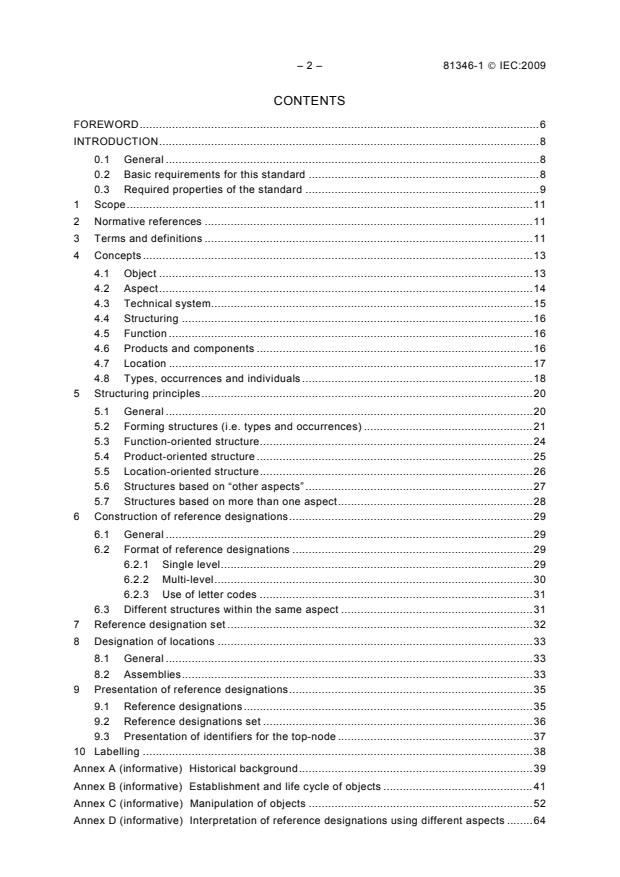
– 2 – 81346-1 © IEC:2009
CONTENTS
FOREWORD.6
INTRODUCTION.8
0.1 General.8
0.2 Basic requirements for this standard .8
0.3 Required properties of the standard .9
1 Scope.11
2 Normative references .11
3 Terms and definitions .11
4 Concepts .13
4.1 Object .13
4.2 Aspect.14
4.3 Technical system.15
4.4 Structuring .16
4.5 Function .16
4.6 Products and components .16
4.7 Location .17
4.8 Types, occurrences and individuals .18
5 Structuring principles.20
5.1 General .20
5.2 Forming structures (i.e. types and occurrences) .21
5.3 Function-oriented structure.24
5.4 Product-oriented structure .25
5.5 Location-oriented structure.26
5.6 Structures based on “other aspects” .27
5.7 Structures based on more than one aspect.28
6 Construction of reference designations.29
6.1 General .29
6.2 Format of reference designations .29
6.2.1 Single level.29
6.2.2 Multi-level.30
6.2.3 Use of letter codes .31
6.3 Different structures within the same aspect .31
7 Reference designation set .32
8 Designation of locations .33
8.1 General .33
8.2 Assemblies.33
9 Presentation of reference designations.35
9.1 Reference designations.35
9.2 Reference designations set .36
9.3 Presentation of identifiers for the top-node .37
10 Labelling .38
Annex A (informative) Historical background.39
Annex B (informative) Establishment and life cycle of objects .41
Annex C (informative) Manipulation of objects .52
Annex D (informative) Interpretation of reference designations using different aspects .64
81346-1 © IEC:2009 – 3 –
Annex E (normative) Object represented with several top nodes in an aspect .67
Annex F (informative) Examples of multiple structures based on the same aspect .69
Annex G (informative) Example of structures and reference designations .73
Annex H (informative) Example of reference designations within a system.75
Bibliography.82
Figure 1 – International standards providing a consistent system for designation,
documentation and presentation of information .10
Figure 2 – Illustration of an object.13
Figure 3 – Aspects of an object.15
Figure 4 – Illustration of a function and its sub-functions.16
Figure 5 – Illustration of the concepts product, component, type, individual and
occurrence.19
Figure 6 – Illustration of structural decomposition of an object from different aspects .20
Figure 7 – Illustration of a function-oriented decomposition and product-oriented
composition .21
Figure 8 – Structure tree of object A (alternative 1).22
Figure 9 – Structure tree of object A (alternative 2).22
Figure 10 – Constituents in one aspect of object type 1 .23
Figure 11 – Constituents in one aspect of object type 2 .23
Figure 12 – Constituents in one aspect of object type 5 .23
Figure 13 – Structure tree of object type 1 .24
Figure 14 – Illustration of a function-oriented structure .25
Figure 15 – Illustration of a product-oriented structure .26
Figure 16 – Illustration of a location-oriented structure.27
Figure 17 – Example of the use of “other aspect” .28
Figure 18 – Illustration of an object accessible from three aspects, and where these
aspects are used also for internal structuring.28
Figure 19 – Illustration of an object identified by means of one aspect and with sub-
objects identified by means of another aspect.29
Figure 20 – Examples of single-level reference designations .30
Figure 21 – Relation between a multi-level reference designation and its single-level
reference designations.30
Figure 22 – Examples of multi-level reference designations with multiple prefix signs .31
Figure 23 – Example of reference designation sets.32
Figure 24 – Example of designation of mounting planes inside a factory build assembly .34
Figure 25 – Examples of designation of locations inside a factory build assembly.35
Figure 26 – Examples of presentations of multi-level reference designations .36
Figure 27 – Presentation of reference designations of a reference designation set .37
Figure 28 – Different objects on a site identified with top node identifiers.37
Figure 29 – The common initial portion of reference designations .38
Figure 30 – Labelling of reference designations .38
Figure A.1 – Scope of reference designation standards .39
Figure B.1 – Development situations of an object .41
Figure B.2 – The object’s life cycle .44
– 4 – 81346-1 © IEC:2009
Figure C.1 – Integration of external information by copying.53
Figure C.2 – Integration of an external object by referencing .54
Figure C.3 – Three independently defined objects .54
Figure C.4 – Three separate objects with mutual relations .55
Figure C.5 – The three objects are merged into one.55
Figure C.6 – Overview of the process system .56
Figure C.7 – Tree-like structures of the technical system .57
Figure C.8 – Completed structures of the technical system .58
Figure C.9 – Structures with designated sub-objects.58
Figure C.10 – Structures with some merged-and shared objects .59
Figure C.11 – Relations expressed by reference designation sets in which both
designations are unambiguous.60
Figure C.12 – Relations expressed by reference designation sets in which one
designation is ambiguous.60
Figure C.13 – Situations in the beginning of an object’s life cycle accessible from three
aspects.61
Figure C.14 – Situations in the beginning of the life cycle of closely related objects,
each accessible from one aspect .62
Figure D.1 – Shift from function to product aspect.64
Figure D.2 – Shift from product to function aspect.64
Figure D.3 – Shift from product to location aspect.65
Figure D.4 – Shift from location to product aspect.65
Figure D.5 – Shift from function to location aspect .66
Figure D.6 – Shift from location to function aspect .66
Figure E.1 – Object represented with several independent top nodes in one aspect.67
Figure E.2 – Example of multi-level reference designations using different aspects of
an object with several independent top nodes in one aspect .68
Figure F.1 – Illustration of the concept of additional functional views of an industrial
process plant .69
Figure F.2 – Location-oriented structure of a plant.70
Figure F.3 – Location-oriented structure within an assembly unit .70
Figure F.4 – Location-oriented structures of the plant .71
Figure F.5 – Example of additional product-oriented structures .72
Figure G.1 – Function-oriented structure of object type 1.73
Figure G.2 – Function-oriented structure of object type 2.73
Figure G.3 – Function-oriented structure of object type 5.73
Figure G.4 – Concatenated function-oriented structure tree of object type A .74
Figure H.1 – Process flow diagram for a material handling plant .75
Figure H.2 – Overview diagram of part of the process system (=V1) and part of the
power supply system (=G1) .76
Figure H.3 – Structure tree for parts of the material handling plant .77
Figure H.4 – Layout drawing of the components of the MCC =G1=W1 .78
Figure H.5 – Layout drawing of the locations of the MCC =G1=W1 .79
Figure H.6 – Motor starter.79
Figure H.7 – Product- and location-oriented structure trees for the MCC.80
81346-1 © IEC:2009 – 5 –
Table 1 – Identification of types, occurrences and individuals within different contexts .19
Table C.1 – Possible reference designation sets.59
Table H.1 – Reference designation set for the constituents of the products MCC and
motor starter .81
– 6 – 81346-1 IEC:2009
INTERNATIONAL ELECTROTECHNICAL COMMISSION
____________
INDUSTRIAL SYSTEMS, INSTALLATIONS
AND EQUIPMENT AND INDUSTRIAL PRODUCTS –
STRUCTURING PRINCIPLES AND REFERENCE DESIGNATIONS –
Part 1: Basic rules
FOREWORD
1) The International Electrotechnical Commission (IEC) is a worldwide organization for standardization comprising
all national electrotechnical committees (IEC National Committees). The object of IEC is to promote
international co-operation on all questions concerning standardization in the electrical and electronic fields. To
this end and in addition to other activities, IEC publishes International Standards, Technical Specifications,
Technical Reports, Publicly Available Specifications (PAS) and Guides (hereafter referred to as “IEC
Publication(s)”). Their preparation is entrusted to technical committees; any IEC National Committee interested
in the subject dealt with may participate in this preparatory work. International, governmental and non-
governmental organizations liaising with the IEC also participate in this preparation. IEC collaborates closely
with the International Organization for Standardization (ISO) in accordance with conditions determined by
agreement between the two organizations.
2) The formal decisions or agreements of IEC on technical matters express, as nearly as possible, an international
consensus of opinion on the relevant subjects since each technical committee has representation from all
interested IEC National Committees.
3) IEC Publications have the form of recommendations for international use and are accepted by IEC National
Committees in that sense. While all reasonable efforts are made to ensure that the technical content of IEC
Publications is accurate, IEC cannot be held responsible for the way in which they are used or for any
misinterpretation by any end user.
4) In order to promote international uniformity, IEC National Committees undertake to apply IEC Publications
transparently to the maximum extent possible in their national and regional publications. Any divergence
between any IEC Publication and the corresponding national or regional publication shall be clearly indicated in
the latter.
5) IEC provides no marking procedure to indicate its approval and cannot be rendered responsible for any
equipment declared to be in conformity with an IEC Publication.
6) All users should ensure that they have the latest edition of this publication.
7) No liability shall attach to IEC or its directors, employees, servants or agents including individual experts and
members of its technical committees and IEC National Committees for any personal injury, property damage or
other damage of any nature whatsoever, whether direct or indirect, or for costs (including legal fees) and
expenses arising out of the publication, use of, or reliance upon, this IEC Publication or any other IEC
Publications.
8) Attention is drawn to the normative references cited in this publication. Use of the referenced publications is
indispensable for the correct application of this publication.
9) Attention is drawn to the possibility that some of the elements of this IEC Publication may be the subject of
patent rights. IEC shall not be held responsible for identifying any or all such patent rights.
International Standard IEC 81346-1 has been prepared by IEC technical committee 3:
Information structures, documentation and graphical symbols, in close co-operation with ISO
technical committee 10: Technical product documentation.
It is published as a double logo standard.
It has the status of a horizontal standard in accordance with IEC Guide 108.
This edition cancels and replaces the first edition of IEC 61346-1, published in 1996. This
edition constitutes a technical revision.
This edition includes the following substantial changes with respect to the first edition of
IEC 61346-1:
– a new introductory clause providing a description and explanation to the concepts used
elsewhere in the publication;
– a more comprehensive description of the structuring principles and rules for structuring
are provided;
81346-1 © IEC:2009 – 7 –
– “other aspects” are introduced, and the prefix sign # is assigned to these aspects;
– the concept of reference designation group has been deleted;
– the specific term “transition” has been avoided and been replaced by an improved textual
description of this phenomenon in annex D;
– a new clause about labelling is introduced;
– the old annexes have been removed with the exception of the annex showing an example
of the application of reference designations within a system;
– a new annex explaining the manipulation of objects is introduced;
– 4 new annexes are introduced as rearrangement of detailed examples or explanatory
information.
The text of this standard is based on the following documents:
FDIS Report on voting
3/947/FDIS 3/958/RVD
Full information on the voting for the approval of this standard can be found in the report on
voting indicated in the above table. In ISO, the standard has been approved by 12 members
out of 13 having cast a vote.
This publication has been drafted in accordance with the ISO/IEC Directives, Part 2.
A list of all parts of the International Standard 81346 series, formerly IEC 61346 series, under
the general title Industrial systems, installations and equipment and industrial products –
structuring principles and reference designations, can be found on the IEC website.
Future standards in this series will carry the new general number 81346. Numbers of existing
standards in this series will be updated at the time of the next edition.
The committee has decided that the contents of this publication will remain unchanged until
the maintenance result date indicated on the IEC web site under "http://webstore.iec.ch" in
the data related to the specific publication. At this date, the publication will be
• reconfirmed,
• withdrawn,
• replaced by a revised edition, or
• amended.
IMPORTANT – The “colour inside” logo on the cover page of this publication indicates
that it contains colours which are considered to be useful for the correct understanding
of its contents. Users should therefore print this publication using a colour printer.
– 8 – 81346-1 © IEC:2009
INTRODUCTION
0.1 General
This standard establishes a further development of earlier and withdrawn standards
(IEC 60113-2, IEC 60750) on item designation, see Annex A. It provides basics for
establishing models of plants, machines, buildings etc.
The standard specifies:
• principles for structuring of objects including associated information;
• rules on forming of reference designations based on the resulting structure.
By applying the structuring principles, even very large sets of information in a complex
installation can be handled efficiently.
The structuring principles and the rules for reference designations are applicable to objects of
both physical and non-physical character.
The structuring principles and the rules for reference designations provide a system that is
easy to navigate within and easy to maintain. This system provides an excellent overview on
a technical system since composite structures are simple to establish and understand.
The structuring principles and the rules for reference designations support alternative design
and engineering processes in the life cycle of an object since they are based on the
successively established results of this process and not on how the engineering process itself
is carried out.
The structuring principles and the rules for reference designations allow, by accepting more
than one aspect, that more than one coding principle can be applied. This technique also
allows ‘old structures’ to be handled together with ‘new structures’ by using multiple
unambiguous identifiers.
The structuring principles and the rules for reference designations support individual
management for the establishment of reference designations, and enable subsequent
integration of modules into larger constructs. They also support the establishment of reusable
modules, either as functional specifications or as physical deliverables.
NOTE The concept of reusable modules encompasses for example, for manufacturers: the establishment of
contract independent modules, and, for operators of complex assemblies: the description of requirements in terms
of supplier independent modules.
The structuring principles and the rules for reference designations support concurrent work
and allow different partners within a project to add and / or remove data to the structured
project result as it proceeds.
The structuring principles and the rules for reference designations recognize time factor within
the life-cycle as important for the application of different structures based on different views
on the considered technical system.
0.2 Basic requirements for this standard
The basic requirements were developed during the preparation of IEC 61346-1 Ed. 1, and
accepted by vote by the national committees.
NOTE These basic requirements concern the development of the structuring principles in this standard and not its
application. They are therefore not normative vis-à-vis the application of this standard.
81346-1 © IEC:2009 – 9 –
• This standard should be applicable to all technical areas and enable a common
application.
• This standard shall be applicable to all kind of objects and their constituents, such as
plants, systems, assemblies, software programs, spaces, etc.
• This standard should be capable of being consistently applied in all phases (i.e.
conceptual development, planning, specification, design, engineering, construction,
erection, commissioning, operation, maintenance, decommissioning, disposal, etc.) of the
life time of an object of interest, i.e. an object to be identified.
• This standard shall provide the ability to identify unambiguously any single object being a
constituent of another object.
• This standard shall support the incorporation of sub-object structures from multiple
organizations into objects from other organizations without change to the original object
structures and neither to the sub-object structures nor any of their documentation.
• This standard shall support a representation of an object independently of the complexity
of the object
• This standard should be easy to apply and the designations should be easy for the user to
understand.
• This standard should support the use of, and should be able to be implemented by,
computer-aided tools for conceptual development, planning, specification, design,
engineering, construction, erection, commissioning, operation, maintenance,
decommissioning, disposal, etc.
0.3 Required properties of the standard
The required properties were developed during the preparation of IEC 61346-1 Ed. 1, and
accepted by vote by the national committees.
NOTE 1 These required properties concern the development of the letter code classification system in this
standard and not its application. They are therefore not normative vis-à-vis the application of this standard.
• This standard shall not contain rules and restrictions that prohibit its use within a technical
area.
• This standard shall cover all its foreseeable applications within all technical areas.
• This standard shall support addressing of information to objects at all phases in their life
time.
• This standard shall allow construction of designations at any time from the currently
available information.
• This standard shall support the identification of objects based on a constituency principle.
• This standard shall contain rules that enable the formulation of unambiguous designations.
• This standard shall be open and allow a designation to be extended.
• This standard shall support modularity and reusability of objects.
• This standard shall support the description of different users’ views on the object
• This standard shall provide rules for the interpretation of designations where needed.
Figure 1 provides an overview on international standards providing a consistent system for
designation, documentation and presentation of information.
– 10 – 81346-1 © IEC:2009
IEC 1386/09
Figure 1 – International standards providing a consistent system for designation,
documentation and presentation of information
NOTE 2 The titles of the publications shown in Figure 1 are not complete.
81346-1 © IEC:2009 – 11 –
INDUSTRIAL SYSTEMS, INSTALLATIONS
AND EQUIPMENT AND INDUSTRIAL PRODUCTS –
STRUCTURING PRINCIPLES AND REFERENCE DESIGNATIONS –
Part 1: Basic rules
1 Scope
This part of IEC 81346, published jointly by IEC and ISO, establishes general principles for
the structuring of systems including structuring of the information about systems.
Based on these principles, rules and guidance are given for the formulation of unambiguous
reference designations for objects in any system.
The reference designation identifies objects for the purpose of creation and retrieval of
information about an object, and where realized about its corresponding component.
A reference designation labelled at a component is the key to find information about that
object among different kinds of documents.
The principles are general and are applicable to all technical areas (for example mechanical
engineering, electrical engineering, construction engineering, process engineering). They can
be used for systems based on different technologies or for systems combining several
technologies.
2 Normative references
The following referenced documents are indispensable for the application of this document.
For dated references, only the edition cited applies. For undated references, the latest edition
of the referenced document (including any amendments) applies.
ISO/IEC 646, Information technology – ISO 7-bit coded character set for information
interchange
3 Terms and definitions
For the purposes of this document, the following terms and definitions apply.
NOTE Terms given in italics are defined elsewhere in this clause.
3.1
object
entity treated in a process of development, implementation, usage and disposal
NOTE 1 The object may refer to a physical or non-physical “thing”, i.e. anything that might exist, exists or did
exist.
NOTE 2 The object has information associated to it.
3.2
system
set of interrelated objects considered in a defined context as a whole and separated from their
environment
– 12 – 81346-1 © IEC:2009
NOTE 1 A system is generally defined with the view of achieving a given objective, e.g. by performing a definite
function.
NOTE 2 Elements of a system may be natural or man-made material objects, as well as modes of thinking and the
results thereof (e.g. forms of organisation, mathematical methods, programming languages).
NOTE 3 The system is considered to be separated from the environment and from the other external systems by
an imaginary surface, which cuts the links between them and the system.
NOTE 4 The term “system” should be qualified when it is not clear from the context to what it refers, e.g. control
system, colorimetric system, system of units, transmission system.
NOTE 5 When a system is part of another system, it may be considered as an object as defined in this standard.
[IEV 151-11-27, modified]
3.3
aspect
specified way of viewing an object
3.4
process
set of interacting operations by which material, energy or information is transformed,
transported or stored
NOTE In the context of this standard the term "process" refers to the industrial process (assembly, construction,
installation, etc.) through which an object is realized.
[IEV 351-21-43, modified]
3.5
function
intended or accomplished purpose or task
3.6
product
intended or accomplished result of labour, or of a natural or artificial process
3.7
component
product used as a constituent in an assembled product, system or plant
3.8
location
intended or accomplished space
3.9
structure
organization of relations among objects of a system describing constituency relations
(consists-of / is-a-part-of)
3.10
identifier
attribute associated with an object to unambiguously distinguish it from other objects within a
specified domain
3.11
reference designation
identifier of a specific object formed with respect to the system of which the object is a
constituent, based on one or more aspects of that system
81346-1 © IEC:2009 – 13 –
3.12
single-level reference designation
reference designation assigned with respect to the object of which the specific object is a
direct constituent in one aspect
NOTE A single-level reference designation does not include any reference designations of upper level or lower
level objects.
3.13
multi-level reference designation
reference designation consisting of concatenated single-level reference designations
3.14
reference designation set
collection of two or more reference designations assigned to an object of which at least one
unambiguously identifies this object
4 Concepts
4.1 Object
The definition of the term ”object” is very general (see 3.1) and covers all items that are
subject to activities in the whole life cycle of a system.
Most objects have a physical existence as they are tangible (e.g. a transformer, a lamp, a
valve, a building). However, there are objects that do not have a physical existence but exist
for different purposes, for example:
• an object exists only by means of the existence of its sub-objects, thus the considered
object is defined for structuring purposes (i.e. a system);
• for identification of a set of information.
This international standard does not distinguish between those objects that have a physical
existence and those that have not. Both kinds of objects can be relevant for being identified
and handled in the life-cycle of a system.
There are no genuine rules on how an object is established. In fact, it is the designer/engineer
who decides that an object exists and establishes the need to identify this object.
When an object is established, information may be associated with it. This information may
change throughout the life cycle of that object
Figure 2 illustrates an object where the surface of each side of the cube represents one
aspect of the object. This representation of an object is used in further figures for the
explanation of the concepts.
IEC 1387/09
Figure 2 – Illustration of an object
– 14 – 81346-1 © IEC:2009
An object is established when there is a need for that particular object.
An object is removed when the object is no longer needed.
NOTE 1 The object may also be removed when its properties are found to be covered by another object. This is
frequently the case during engineering when objects initially may have been distinctively subdivided and later are
found possible to be combined or merged.
NOTE 2 The removal/deletion of a physical object is not the same as the complete deletion of the object, as the
information on the object may be kept for retention reasons.
4.2 Aspect
If interior objects of an object or the interrelations of this object to other objects are to be
studied, it is useful to look at these objects from different views. For the purpose of this
international standard, these views are called aspects.
Aspects act like filters on an object, see Figure 3, and "highlight" the information that is of
relevance. The aspects dealt with in this international standard are focused on:
• what an object is intended to do or what it actually does – the function aspect;
• by which means an object does what it is intended to do – the product aspect;
• intended or actual space of the object – the location aspect.
In addition other aspects may be applied when none of the three above are applicable or
sufficient (see 5. 6) .
The aspect concept is, in this international standard, used for structuring purposes.
Looking at an object under an aspect, only constituent objects (i.e. sub-objects) are seen that
are relevant in that aspect. Other sub-objects may exist but they have then no relevance in
the considered aspect. On the other hand, it may happen that a sub-object is seen under
different aspects, if this sub-object has relevance in all those aspects.
When a sub-object is recognized by means of an aspect of an object, all available information
on the sub-object is accessible, including information related to its other aspects.
81346-1 © IEC:2009 – 15 –
IEC 1388/09
Figure 3 – Aspects of an object
4.3 Technical system
A “technical system” is a group of components working together for a specific purpose.
The technical system is the “infrastructure” for a process consisting of a number of activities,
such as cooking, screening, transporting, welding, and driving, to achieve the intended
outcome. The components of the technical system are the static prerequisite for the dynamic
activities of the process.
NOTE One and the same component may be part of (play a role in) more than one technical system.
A technical system can be delivered as a completed assembled system. The components of
the technical system can, however, be delivered individually or as assembled parts; possibly
of other systems. The technical system is in that case completed during the installation and
connection of the components.
In the context of structuring, the technical system is seen as an object and its components as
physical sub-objects.
– 16 – 81346-1 © IEC:2009
4.4 Structuring
In order for a system to be efficiently specified, designed, manufactured, serviced or
operated,
...