

IEC 62491:2008
(Main)Industrial systems, installations and equipment and industrial products - Labelling of cables and cores
General Information
- Abstract
IEC 62491:2008 provides rules and guidelines for the labelling of cables and cores/conductors used in industrial installations, equipment and products, in order to maintain a clear relation between the technical documentation and the actual equipment and for other purposes. International Standard IEC 62491 has been prepared by IEC technical committee 3: Information structures, documentation and graphical symbols.
- Status
- Published
- Publication Date
- 25-Mar-2008
- Technical Committee
- TC 3 - Documentation, graphical symbols and representations of technical information
- Drafting Committee
- PT 35 - TC 3/PT 35
- Current Stage
- PPUB - Publication issued
- Start Date
- 26-Mar-2008
- Completion Date
- 30-Jun-2008
Overview
IEC 62491:2008 is an international standard developed by the International Electrotechnical Commission (IEC) that specifies requirements and best practices for the labelling of cables and cores (conductors) within industrial systems, installations, and equipment. The purpose of this standard is to ensure a clear relationship between technical documentation and the actual equipment, thus enhancing traceability, safety, and efficiency in industrial environments. It covers various labelling methods, supporting accurate identification, connection, and signalling within industrial products and installations.
Key Topics
Labelling Types: The standard outlines rules for different forms of cable and core labelling, including:
- Identification labelling: Shows the identifier of the cable or core as part of a system.
- Connection labelling: Indicates specific terminal designations for each cable or core end.
- Signal labelling: Specifies the identifier(s) of the signal(s) carried.
- Composite labelling: Combines two or more labelling types for comprehensive information.
Clarity in Documentation and Equipment:
- Ensures that cables and cores are easily traceable between technical documentation and physical equipment.
- Minimizes ambiguity, especially when installations have many cables or identically colored cores.
Application of Manufacturer Markings vs. Additional Labelling:
- Encourages the use of manufacturer-applied colour codes and numbering when sufficient.
- Recommends additional labelling in complex systems for further clarity and error reduction.
Arrangement and Formatting:
- Guidance on how to physically arrange labels, such as ordering and separating different types of information (e.g., using rows, spaces, or symbols like "/").
- Specifies the use of characters aligned with referenced standards (e.g., ISO/IEC 646).
Supporting Information:
- Encourages referencing relevant standards for colour designation, terminal identification, and signal naming in documentation.
Applications
The labelling guidelines in IEC 62491:2008 are applicable throughout the lifecycle of industrial electrical installations and equipment, including:
- Design and Assembly: Assists engineers and technicians during the assembly stage, facilitating accurate layout and efficient panel or system builds.
- Operation and Maintenance: Simplifies troubleshooting, reduces downtime, and prevents connection errors during ongoing operations, service, and repairs.
- Upgrades and Modifications: Eases the process of system upgrades or component replacements by providing clear cable and core identification, helping avoid costly mistakes.
- Compliance and Standardization: Ensures that industrial installations comply with international best practices for wiring labelling and documentation, which is increasingly required in global markets.
Practical use cases include the clear labelling of control panels, machinery connections, process automation installations, and distributed control systems in manufacturing plants, utilities, and infrastructure projects.
Related Standards
IEC 62491:2008 is designed to work in conjunction with several other international standards that address complementary aspects of industrial systems and documentation:
- IEC 60445: Basic and safety principles for man-machine interface, marking, and identification.
- IEC 60757: Colour coding for cables and cores.
- IEC 61082-1: Preparation of documents used in electrotechnology.
- IEC 61175: Designation of signals in industrial systems.
- IEC 81346-1: Structuring principles and reference designations.
- IEC 61666: Identification of terminals within a system.
- ISO/IEC 646: 7-bit coded character set for information interchange.
By integrating the recommendations of IEC 62491 and these related standards, organizations can achieve a high degree of clarity, consistency, and safety in labelling cables and conductors across diverse industrial contexts.
Keywords: IEC 62491, cable labelling, conductor identification, industrial systems, technical documentation, connection labelling, signal labelling, industrial cable standards, core labelling, IEC standards, electrical installation labelling, industrial equipment labelling.
Get Certified
Connect with accredited certification bodies for this standard

IMQ S.p.A. (Certification)
Italian electrical product certification.

SLG Prüf- und Zertifizierungs GmbH
German testing and certification body.

UL Solutions
Global safety science company with testing, inspection and certification.
Sponsored listings
Frequently Asked Questions
IEC 62491:2008 is a standard published by the International Electrotechnical Commission (IEC). Its full title is "Industrial systems, installations and equipment and industrial products - Labelling of cables and cores". This standard covers: IEC 62491:2008 provides rules and guidelines for the labelling of cables and cores/conductors used in industrial installations, equipment and products, in order to maintain a clear relation between the technical documentation and the actual equipment and for other purposes. International Standard IEC 62491 has been prepared by IEC technical committee 3: Information structures, documentation and graphical symbols.
IEC 62491:2008 provides rules and guidelines for the labelling of cables and cores/conductors used in industrial installations, equipment and products, in order to maintain a clear relation between the technical documentation and the actual equipment and for other purposes. International Standard IEC 62491 has been prepared by IEC technical committee 3: Information structures, documentation and graphical symbols.
IEC 62491:2008 is classified under the following ICS (International Classification for Standards) categories: 01.110 - Technical product documentation; 29.020 - Electrical engineering in general. The ICS classification helps identify the subject area and facilitates finding related standards.
IEC 62491:2008 is available in PDF format for immediate download after purchase. The document can be added to your cart and obtained through the secure checkout process. Digital delivery ensures instant access to the complete standard document.
Standards Content (Sample)
IEC 62491
Edition 1.0 2008-03
INTERNATIONAL
STANDARD
NORME
INTERNATIONALE
Industrial systems, installations and equipment and industrial products –
Labelling of cables and cores
Systèmes industriels, installations et appareils et produits industriels –
Etiquetage des câbles et des conducteurs isolés
All rights reserved. Unless otherwise specified, no part of this publication may be reproduced or utilized in any form or by
any means, electronic or mechanical, including photocopying and microfilm, without permission in writing from either IEC or
IEC's member National Committee in the country of the requester.
If you have any questions about IEC copyright or have an enquiry about obtaining additional rights to this publication,
please contact the address below or your local IEC member National Committee for further information.
Droits de reproduction réservés. Sauf indication contraire, aucune partie de cette publication ne peut être reproduite
ni utilisée sous quelque forme que ce soit et par aucun procédé, électronique ou mécanique, y compris la photocopie
et les microfilms, sans l'accord écrit de la CEI ou du Comité national de la CEI du pays du demandeur.
Si vous avez des questions sur le copyright de la CEI ou si vous désirez obtenir des droits supplémentaires sur cette
publication, utilisez les coordonnées ci-après ou contactez le Comité national de la CEI de votre pays de résidence.
IEC Central Office
3, rue de Varembé
CH-1211 Geneva 20
Switzerland
Email: inmail@iec.ch
Web: www.iec.ch
About the IEC
The International Electrotechnical Commission (IEC) is the leading global organization that prepares and publishes
International Standards for all electrical, electronic and related technologies.
About IEC publications
The technical content of IEC publications is kept under constant review by the IEC. Please make sure that you have the
latest edition, a corrigenda or an amendment might have been published.
ƒ Catalogue of IEC publications: www.iec.ch/searchpub
The IEC on-line Catalogue enables you to search by a variety of criteria (reference number, text, technical committee,…).
It also gives information on projects, withdrawn and replaced publications.
ƒ IEC Just Published: www.iec.ch/online_news/justpub
Stay up to date on all new IEC publications. Just Published details twice a month all new publications released. Available
on-line and also by email.
ƒ Electropedia: www.electropedia.org
The world's leading online dictionary of electronic and electrical terms containing more than 20 000 terms and definitions
in English and French, with equivalent terms in additional languages. Also known as the International Electrotechnical
Vocabulary online.
ƒ Customer Service Centre: www.iec.ch/webstore/custserv
If you wish to give us your feedback on this publication or need further assistance, please visit the Customer Service
Centre FAQ or contact us:
Email: csc@iec.ch
Tel.: +41 22 919 02 11
Fax: +41 22 919 03 00
A propos de la CEI
La Commission Electrotechnique Internationale (CEI) est la première organisation mondiale qui élabore et publie des
normes internationales pour tout ce qui a trait à l'électricité, à l'électronique et aux technologies apparentées.
A propos des publications CEI
Le contenu technique des publications de la CEI est constamment revu. Veuillez vous assurer que vous possédez
l’édition la plus récente, un corrigendum ou amendement peut avoir été publié.
ƒ Catalogue des publications de la CEI: www.iec.ch/searchpub/cur_fut-f.htm
Le Catalogue en-ligne de la CEI vous permet d’effectuer des recherches en utilisant différents critères (numéro de référence,
texte, comité d’études,…). Il donne aussi des informations sur les projets et les publications retirées ou remplacées.
ƒ Just Published CEI: www.iec.ch/online_news/justpub
Restez informé sur les nouvelles publications de la CEI. Just Published détaille deux fois par mois les nouvelles
publications parues. Disponible en-ligne et aussi par email.
ƒ Electropedia: www.electropedia.org
Le premier dictionnaire en ligne au monde de termes électroniques et électriques. Il contient plus de 20 000 termes et
définitions en anglais et en français, ainsi que les termes équivalents dans les langues additionnelles. Egalement appelé
Vocabulaire Electrotechnique International en ligne.
ƒ Service Clients: www.iec.ch/webstore/custserv/custserv_entry-f.htm
Si vous désirez nous donner des commentaires sur cette publication ou si vous avez des questions, visitez le FAQ du
Service clients ou contactez-nous:
Email: csc@iec.ch
Tél.: +41 22 919 02 11
Fax: +41 22 919 03 00
IEC 62491
Edition 1.0 2008-03
INTERNATIONAL
STANDARD
NORME
INTERNATIONALE
Industrial systems, installations and equipment and industrial products –
Labelling of cables and cores
Systèmes industriels, installations et appareils et produits industriels –
Etiquetage des câbles et des conducteurs isolés
INTERNATIONAL
ELECTROTECHNICAL
COMMISSION
COMMISSION
ELECTROTECHNIQUE
PRICE CODE
INTERNATIONALE
CODE PRIX U
ICS 01.110; 29.020.20 ISBN 2-8318-9663-0
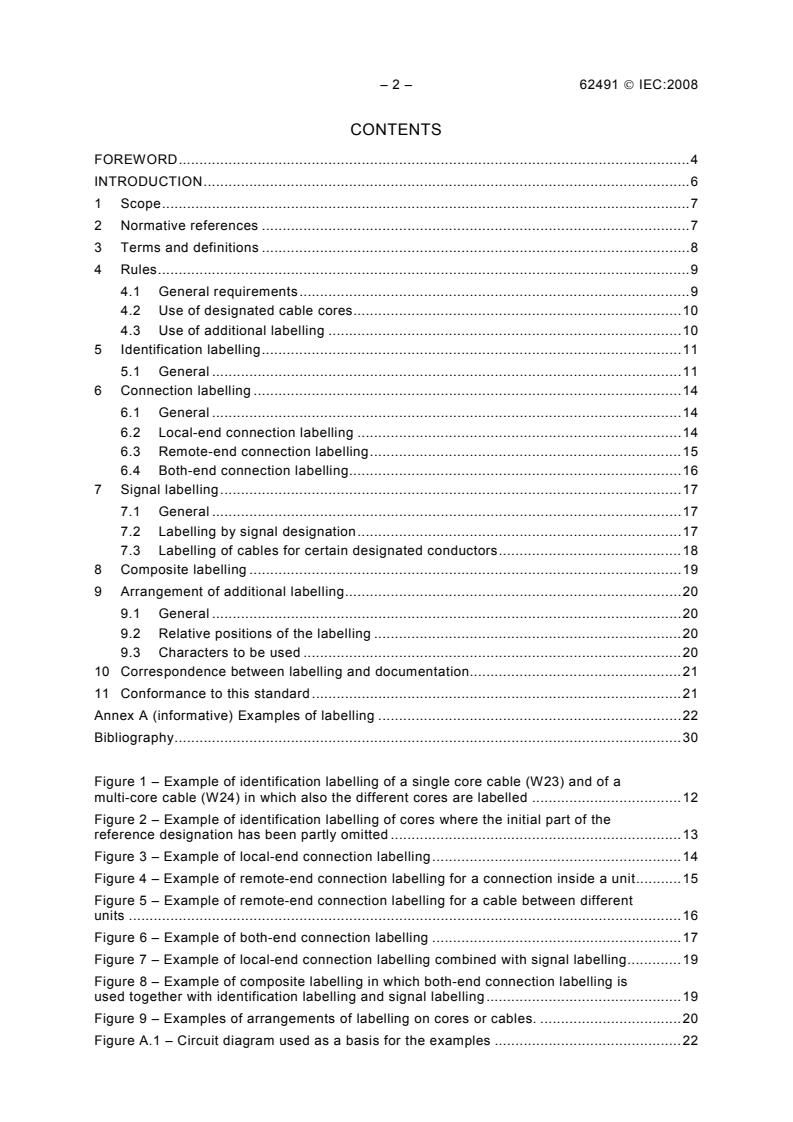
– 2 – 62491 © IEC:2008
CONTENTS
FOREWORD.4
INTRODUCTION.6
1 Scope.7
2 Normative references .7
3 Terms and definitions .8
4 Rules.9
4.1 General requirements.9
4.2 Use of designated cable cores.10
4.3 Use of additional labelling .10
5 Identification labelling.11
5.1 General .11
6 Connection labelling .14
6.1 General .14
6.2 Local-end connection labelling .14
6.3 Remote-end connection labelling.15
6.4 Both-end connection labelling.16
7 Signal labelling.17
7.1 General .17
7.2 Labelling by signal designation.17
7.3 Labelling of cables for certain designated conductors.18
8 Composite labelling .19
9 Arrangement of additional labelling.20
9.1 General .20
9.2 Relative positions of the labelling .20
9.3 Characters to be used .20
10 Correspondence between labelling and documentation.21
11 Conformance to this standard.21
Annex A (informative) Examples of labelling .22
Bibliography.30
Figure 1 – Example of identification labelling of a single core cable (W23) and of a
multi-core cable (W24) in which also the different cores are labelled .12
Figure 2 – Example of identification labelling of cores where the initial part of the
reference designation has been partly omitted .13
Figure 3 – Example of local-end connection labelling.14
Figure 4 – Example of remote-end connection labelling for a connection inside a unit.15
Figure 5 – Example of remote-end connection labelling for a cable between different
units .16
Figure 6 – Example of both-end connection labelling .17
Figure 7 – Example of local-end connection labelling combined with signal labelling.19
Figure 8 – Example of composite labelling in which both-end connection labelling is
used together with identification labelling and signal labelling.19
Figure 9 – Examples of arrangements of labelling on cores or cables. .20
Figure A.1 – Circuit diagram used as a basis for the examples .22
62491 © IEC:2008 – 3 –
Figure A.2 – Example of identification labelling .23
Figure A.3 – Example of local-end labelling .24
Figure A.4 – Example of both-end connection labelling .25
Figure A.5 – Example of local end connection labelling with additional information .26
Figure A.6 – Example of signal labelling .27
Figure A.7 – Example of composite labelling.28
Figure A.8 – Example where use is made of the cable colours .29
Table 1 – Example of connection table in which the cable cores are identified by
means of codes for their colour.10
Table 2 – Connection table corresponding to Figure 1 with labelling .12
Table 3 – Connection table corresponding to Figure 2 with labelling .13
Table 4 – Marking of certain designated conductors.18
Table 5 – Methods of labelling defined in this standard .21
– 4 – 62491 © IEC:2008
INTERNATIONAL ELECTROTECHNICAL COMMISSION
____________
INDUSTRIAL SYSTEMS, INSTALLATIONS
AND EQUIPMENT AND INDUSTRIAL PRODUCTS –
LABELLING OF CABLES AND CORES
FOREWORD
1) The International Electrotechnical Commission (IEC) is a worldwide organization for standardization comprising
all national electrotechnical committees (IEC National Committees). The object of IEC is to promote
international co-operation on all questions concerning standardization in the electrical and electronic fields. To
this end and in addition to other activities, IEC publishes International Standards, Technical Specifications,
Technical Reports, Publicly Available Specifications (PAS) and Guides (hereafter referred to as “IEC
Publication(s)”). Their preparation is entrusted to technical committees; any IEC National Committee interested
in the subject dealt with may participate in this preparatory work. International, governmental and non-
governmental organizations liaising with the IEC also participate in this preparation. IEC collaborates closely
with the International Organization for Standardization (ISO) in accordance with conditions determined by
agreement between the two organizations.
2) The formal decisions or agreements of IEC on technical matters express, as nearly as possible, an international
consensus of opinion on the relevant subjects since each technical committee has representation from all
interested IEC National Committees.
3) IEC Publications have the form of recommendations for international use and are accepted by IEC National
Committees in that sense. While all reasonable efforts are made to ensure that the technical content of IEC
Publications is accurate, IEC cannot be held responsible for the way in which they are used or for any
misinterpretation by any end user.
4) In order to promote international uniformity, IEC National Committees undertake to apply IEC Publications
transparently to the maximum extent possible in their national and regional publications. Any divergence
between any IEC Publication and the corresponding national or regional publication shall be clearly indicated in
the latter.
5) IEC provides no marking procedure to indicate its approval and cannot be rendered responsible for any
equipment declared to be in conformity with an IEC Publication.
6) All users should ensure that they have the latest edition of this publication.
7) No liability shall attach to IEC or its directors, employees, servants or agents including individual experts and
members of its technical committees and IEC National Committees for any personal injury, property damage or
other damage of any nature whatsoever, whether direct or indirect, or for costs (including legal fees) and
expenses arising out of the publication, use of, or reliance upon, this IEC Publication or any other IEC
Publications.
8) Attention is drawn to the Normative references cited in this publication. Use of the referenced publications is
indispensable for the correct application of this publication.
9) Attention is drawn to the possibility that some of the elements of this IEC Publication may be the subject of
patent rights. IEC shall not be held responsible for identifying any or all such patent rights.
International Standard IEC 62491 has been prepared by IEC technical committee 3:
Information structures, documentation and graphical symbols.
The text of this standard is based on the following documents:
CDV Report on voting
3/849/CDV 3/881/RVC
Full information on the voting for the approval of this standard can be found in the report on
voting indicated in the above table.
This publication has been drafted in accordance with the ISO/IEC Directives, Part 2.
62491 © IEC:2008 – 5 –
The committee has decided that the contents of this publication will remain unchanged until
the maintenance result date indicated on the IEC web site under "http://webstore.iec.ch" in
the data related to the specific publication. At this date, the publication will be
• reconfirmed,
• withdrawn,
• replaced by a revised edition, or
• amended.
– 6 – 62491 © IEC:2008
INTRODUCTION
Additional labelling of cables and cores might be required within larger systems or
installations with many cores of the same colour or with many cables, and where therefore the
use of the designations provided by the cable manufacturer only would be ambiguous.
Due consideration should be given to the fact that additional labelling will cause additional
cost, usually increasing with the number of characters in the labelling string and the number
of different labelling elements. The available space may also impose restrictions with regard
to the number of characters, their height and the length of the labelling. As a general rule the
use of additional labelling should therefore be limited to a necessary minimum and be kept as
short as practicable.
However, also the advantages and benefits should be taken into considerations in choosing
additional labelling of cables and cores.
It is important to notice that a single machine or a system has different needs of information in
the different phases of its lifecycles (assembling, production, service and maintenance).
Additional labelling of cables and cores gives the following advantages:
• the possibilities to communicate and identify signals and connections across different
involved engineering disciplines and departments like:
– process engineering,
– software engineering,
– electrical engineering,
– mechanical/fluid engineering,
– control engineering;
• minimizing the time used to locate an eventual error (and the reason for it) in the test
phase;
• saving time when locating an eventual error (and the reason for it) in the service and
maintenance phase;
• remove the doubt of which core should be connected to which terminal, when replacing
components that are placed close to each other;
• if used in pre-planning, it gives a clear view for panel-builders, electricians/technicians;
service/maintenance and system controllers which will minimize misunderstandings
regarding connections.
Besides being used in connections between terminal blocks, labelling can also be used when
single core cables connect components inside units as: cubicle, pulpit, case, etc.; such
methods make possible:
• a rapid and secure cabling between the terminals of two objects;
• a rapid visual check of cabling, not necessarily looking up in the circuit diagrams;
• a correct and secure change of an object during the maintenance operations of plants.
62491 © IEC:2008 – 7 –
INDUSTRIAL SYSTEMS, INSTALLATIONS
AND EQUIPMENT AND INDUSTRIAL PRODUCTS –
LABELLING OF CABLES AND CORES
1 Scope
This standard provides rules and guidelines for the labelling of cables and cores/conductors
used in industrial installations, equipment and products, in order to maintain a clear relation
between the technical documentation and the actual equipment and for other purposes. The
following methods are described and designated:
• use of coloured cables and designated cores;
• additional identification labelling;
• additional connection labelling; and
• additional signal labelling.
The physical design of the labels, the material to be used for the labels as well as cable
manufacturers’ product bound marking of cables and cores are not part of this standard.
2 Normative references
The following referenced documents are indispensable for the application of this document.
For dated references, only the edition cited applies. For undated references, the latest edition
of the referenced document (including any amendments) applies.
IEC 60445, Basic and safety principles for man-machine interface, marking and identification
– Identification of equipment terminals and conductor terminations
IEC 60757, Code for designation of colours
IEC 61082-1:2006, Preparation of documents used in electrotechnology – Part 1: Rules
IEC 61175, Industrial systems, installations and equipment and industrial products –
Designation of signals
IEC 81346-1, Industrial systems, installations and equipment and industrial products –
Structuring principles and reference designations – Part 1: Basic rules (to be published)
IEC 61666, Industrial systems, installations and equipment and industrial products –
Identification of terminals within a system
ISO/IEC 646, Information technology – ISO 7-bit coded character set for information
interchange
– 8 – 62491 © IEC:2008
3 Terms and definitions
For the purposes of this document, the following terms and definitions apply.
3.1
conductor (of a cable)
part of a cable which has the specific function of carrying current
[IEV 461-01-01]
3.2
cable
assembly of one or more conductors and/or optical fibres, with a protective covering and
possibly filling, insulating and protective material
[IEV 151-12-38]
3.3
core
assembly comprising a conductor with its own insulation (and screens if any)
[IEV 461-04-04]
3.4
terminal
conductive part of a device, electric circuit or electric network, provided for connecting that
device, electric circuit or electric network to one or more external conductors
[IEV 151-12-12, modified]
3.5
terminal block
assembly of terminals in a housing or body of insulating material to facilitate interconnection
between multiple conductors
[IEV 581-06-36]
3.6
terminal designation
identifier of a terminal with respect to the object to which it belongs, related to one aspect of
the object.
[IEC 61666, 3.8]
3.7
signal designation
unambiguous identifier of a signal within a system
[IEC 61175, 3.2]
3.8
reference designation
identifier of a specific object with respect to the system of which the object is a constituent,
based on one or more aspects of that system
3.9
labelling (of a cable or core)
label or labels attached to a cable or core indicating appropriate characteristics
62491 © IEC:2008 – 9 –
3.10
identification labelling
labelling showing the identifier of an object as a constituent of a specific installation, system,
equipment or product
3.11
connection labelling
labelling of a cable or core showing the identifier of the terminal, terminal block or equipment
to which it is connected
3.12
local-end connection labelling
system of labelling of cables and cores where the labelling of the end of the cable or core
refers to the terminal, terminal block or equipment to which it is connected
3.13
remote-end connection labelling
system of labelling of cables and cores where the labelling of the end of the cable or core
refers to the terminal, terminal block or equipment to which the other end of it is connected
3.14
both-end connection labelling
system of labelling of cables and cores where each end of a cable or core is provided with
local-end connection labelling and remote-end connection labelling
3.15
signal labelling
system of labelling of cables and cores used as a supplement to other labelling generally
based on the signal(s) carried by the cable or core
3.16
composite labelling
system of labelling where two or more of the identification labelling, connection labelling and
signal labelling systems are used together
4 Rules
4.1 General requirements
Cables and cores shall be recognizable at each end; it shall be possible to relate cables and
cores to the technical documentation.
This may be carried out by:
• the designation and marking provided by the manufacturer of the cable, see 4.2, or
• an additional labelling, see 4.3.
Additional labelling might be required within larger systems or installations with many cores of
the same colour or with many cables, and where therefore the use only of the designations
provided by the cable or core manufacturer would be ambiguous.
The additional labelling shall be based on one or more of the following:
• the identifier of the cable or core, see Clause 5;
• the connection of the cable or core, see Clause 6, or
• the signal carried by the cable or core, see Clause 7.
– 10 – 62491 © IEC:2008
4.2 Use of designated cable cores
Cable cores are often designated by the manufacturer applying methods such as:
• coloured insulation of the single cores;
• differently coloured (including multi-coloured) insulation of the cores of the cables, or
• differently numbered cores of cables.
These designations should, to the extent possible, be used for the identification of the cores.
Additional labelling is in such cases normally not required.
The use of such designations shall be described in the documentation of the equipment in
accordance with 7.5 and 9.3 of IEC 61082-1.
For the indication of the colours of cable cores in the documentation, the colour coding of
IEC 60757 shall be applied.
NOTE The colour does not provide any information on where the core is to be connected. The connection
information is in entirety to be found in associated connection table or connection diagram.
Table 1 shows an example of a connection table in which the colours (designated in
accordance with IEC 60757) of the cable cores are used for the identification
Table 1 – Example of connection table in which the cable
cores are identified by means of codes for their colour
Core colour Local end Remote end
GNYE A4X1:PE B4X1:PE
BK A4X1:11 B4X1:33
BN A4X1:17 B4X1:34
RD A4X1:18 B4X1:35
4.3 Use of additional labelling
The additional labelling, where required, shall be one of the following types:
• identification labelling of the cable or core, see Clause 5;
• connection labelling of the cable or core, see Clause 6:
– local-end connection labelling,
– remote-end connection labelling,
– both-end connection labelling;
• signal labelling of the cable or core, see Clause 7.
• Composite labelling, see Clause 8.
The method used shall be specified in the supporting documentation, see Clause 11.
Additional information, for example a reference to a page number of the circuit diagram, may
be added on the label. The use of such additional information shall be explained in the
technical documentation. For an example, see Clause A.5.
62491 © IEC:2008 – 11 –
5 Identification labelling
5.1 General
The purpose of identification labelling is to show the identifier of the cable or core as a
constituent of the system of which it is a part. The same labelling is valid and may be used all
along a cable or core, even if it has junctions in its run.
The identification labelling does not provide any information on the connection. The
connection information is in its entirety to be found in associated documentation.
NOTE 1 For further information on the preparation of the relevant document types, see IEC 61082-1.
The preferred identifier of a cable or core is a reference designation in accordance with
IEC 81346-1. That standard provides further guidance on how to create unambiguous
reference designations within an installation, system or equipment.
The reference designation can take different forms depending on, in which structure the core
is identified and to which object the core is associated.
NOTE 2 “Cable numbers” are considered as a kind of reference designation. For further information,
see IEC 81346-1.
The reference designation should normally be shown with relevant prefix sign, but this may be
omitted if no ambiguity can arise.
NOTE 3 In the examples of this standard the first prefix sign of the reference designations (even if named
“complete”) has been deliberately omitted in order not to give a reader the impression that a specific one is
required for cables and connections.
EXAMPLE 1:
Cables between terminals belonging to the same object within which cable or core are
identified. See Figure 1 and Table 2. The labels at each end as well as possible intermediate
labels are shown.
• W23 is a single core cable with end labels and an intermediate label;
• W24 is a cable with end labels and intermediate labels. Also, the labels of each core of
this cable are shown in the example. Note that the additional labelling of the cable cores
could be omitted if the cable cores are unambiguously designated by numerals or colours
by the cable manufacturer as described in 4.2.
– 12 – 62491 © IEC:2008
X1
1 W24-2
W24
2 W24-1
4 W23
W23 W24
X2
1 W23
2 W24-1
3 W24
4 W24-2
IEC 407/08
Figure 1 – Example of identification labelling of a single core cable (W23) and of a
multi-core cable (W24) in which also the different cores are labelled
Table 2 – Connection table corresponding to Figure 1 with labelling
Cable Core Terminal Terminal Labelling
reference reference
designation designation
W23 X1:4 X2:1 W23
W24 -1 X1:2 X2:2 W24-1
-2 X1:1 X2:4 W24-2
The initial part of the reference designation identifying the object within which the labelling is
required to be unambiguous may be omitted if no ambiguity can occur. This requires that the
reference designation of this object is clearly shown on a label related to that object.
NOTE 4 The complete reference designation of the cable or core is still the concatenation of the reference
designation of the object and that of the cable or core.
EXAMPLES 2 (see Figure 2 and Table 3):
If the object of which the cable core is completely a constituent has a reference designation
A1B2C3D4 and if the cable core is connecting two terminals within this unit, then the core
labelling could be abbreviated to W23 while the full reference designation of that core is
A1B2C3D4W23.
62491 © IEC:2008 – 13 –
A1
B2
X1
2 A1B2W23
C3
D4
X1
1 A1B2W23
4 W23
X2
1 W23
IEC 408/08
Figure 2 – Example of identification labelling of cores where the initial part
of the reference designation has been partly omitted
Table 3 – Connection table corresponding to Figure 2 with labelling
Reference Terminal Terminal Labelling
designation
A1B2C3D4W23 A1B2C3D4X1:4 A1B2C3D4X2:1 W23
A1B2W23 A1B2X1:2 A1B2C3D4X1:1 A1B2W23
EXAMPLES 3 (see Figure 2 and Table 3):
If the core is crossing border lines between objects, the full reference designation that is
relevant in this case needs to be presented on the label. For example the core connecting
terminal block X1 inside A1B2C3D4 and terminal block X1 inside A1B2 is identified with
respect to the object of which it is completely a constituent (i.e. A1B2) by A1B2W23.
– 14 – 62491 © IEC:2008
6 Connection labelling
6.1 General
The purpose of connection labelling is to show, by means of the terminal designation, the
identifier of the terminal to which the cable or cable core is (to be) connected.
For a multi-core cable it may only be possible to show the identifier of the terminal block or of
the equipment to which the cable is to be connected.
The preferred identifier for a terminal is a terminal designation in accordance with IEC 61666.
That standard provides further guidance on how to create unambiguous terminal designations
within an installation or system.
The initial part of the terminal designation of the object within which the labelling is required
to be unambiguous can be omitted if no ambiguity can occur.
6.2 Local-end connection labelling
In local-end connection labelling, each core end shall be labelled with the designation of the
terminal to which it is connected. This permits the core to be removed and reconnected to the
terminal without having to refer to a connection table or connection diagram.
Cables and cable cores inside a unit may be marked with the single-level reference
designation of the terminal only, omitting the reference designation of the unit of which it is a
constituent, see Figure 3. (The complete terminal designation may be A1S1X1:2 in the
example.)
A1S1
X1
2 X1:2
X2
3 X2:3
IEC 409/08
Figure 3 – Example of local-end connection labelling
62491 © IEC:2008 – 15 –
6.3 Remote-end connection labelling
In remote-end connection labelling each cable or core end shall be labelled with the
designation of the terminal to which the other end of the cable or core is connected. This may
be convenient for fault location and maintenance work, but requires access to a connection
table or connection diagram to enable any connection which has been removed to be replaced
correctly.
Cables and cores inside a unit may be marked with the single-level reference designation of
the terminal only, omitting the reference designation of the unit of which it is a constituent,
see Figure 4. (The complete terminal designation may be A1S1X2:3 in the example.)
A1S1
X1
2 X2:3
X2
3 X1:2
IEC 410/08
Figure 4 – Example of remote-end connection labelling for a connection inside a unit
If the core connects different units, complete reference designations of the remote end
terminals shall be shown, see Figure 5.
– 16 – 62491 © IEC:2008
A1S1
X1
2 B3S2X1:3
B3S2
X1
3 A1S1X1:2
IEC 411/08
Figure 5 – Example of remote-end connection labelling
for a cable between different units
6.4 Both-end connection labelling
In both-end connection labelling each cable or core end shall be marked with the terminal
designation of the local-end as well as the remote-end terminal to which the core is
connected, see Figure 6.
62491 © IEC:2008 – 17 –
A1S1
X1
2 X1:2/B3S2X1:3
B3S2
X1
3 X1:3/A1S1X1:2
IEC 412/08
Figure 6 – Example of both-end connection labelling
7 Signal labelling
7.1 General
The purpose of signal labelling is to show the identifier(s) of the carried signal(s). Except for
the labelling of certain designated cores, described in 7.3, signal labelling should be
considered as a supplementary labelling.
The preferred identifier of a signal is a signal designation in accordance with IEC 61175. That
standard provides further guidance on how to create unambiguous signal designations within
an installation or system.
Constant-level power supplies are according to IEC 61175 to be considered as special types
of signal. The labelling of the termination of certain cores according to IEC 60445 is therefore
in this context considered as signal labelling.
7.2 Labelling by signal designation
Signal designations in accordance with IEC 61175 have the following structure:
Reference designation; signal name: variant (additional information)
Complete signal designations can be long and the information presented on a label attached
to a cable or core should therefore be restricted to a purpose-related minimum.
In many cases the “signal name” or even the “basic signal name” (see IEC 61175 for the
description) is sufficient, especially if it is shown in combination with an identifying labelling.
Due consideration should also be given the fact that one core (pair) often transmits more than
– 18 – 62491 © IEC:2008
one signal (e.g. CIRCUIT BREAKER ON – CIRCUIT BREAKER OFF), especially in digital
applications.
EXAMPLE 1:
In the complete signal designation =A5W1M1;C_Motor_Stop the part “Motor_Stop” is the
basic signal name that describes the “message”, that may be sufficient for the labelling.
7.3 Labelling of cables for certain designated conductors
The letter codes in Table 4 are specified in IEC 60445 for marking of the terminals intended
for certain designated conductors. They are used as part of the signal designation for
constant-level power supplies, and should be used for signal labelling of corresponding cables
or cores if required.
Table 4 – Marking of certain designated conductors
Labelling Conductor
L1 Phase 1 for a.c. supply
L2 Phase 2 for a.c. supply
L3 Phase 3 for a.c. supply
M Mid-point conductor for a.c. supply
N Neutral for a.c. supply
L+ Positive for d.c. supply
L - Negative for d.c. supply
PE Protective conductor
PEN Protective PEN conductor (see definition in IEC 60050-195)
PEL Protective PEL conductor (see definition in IEC 60050-195)
PEM Protective PEM conductor (see definition in IEC 60050-195)
PB Protective bonding conductor (see definition in IEC 60050-195)
PBE Earthed protective bonding conductor
PBU Unearthed protective bonding conductor
FE Functional earthing conductor
FB Functional bonding conductor
EXAMPLE 1:
Figure 7 shows a case where local-end connection labelling is combined with signal labelling:
the actual conductor is used for functional earth.
62491 © IEC:2008 – 19 –
X1
2 X1:2/FE
X2
3 X2:3/FE
IEC 413/08
Figure 7 – Example of local-end connection labelling combined with signal labelling
8 Composite labelling
Composite labelling shall consist of the combination of two or more labels like an identification
labelling and a connection labelling. The connection labelling might be local-end, remote-end
or both-end.
For any intermediate label that may be required along the cable local-end and remote-end
labelling as well as signal labelling may be omitted. See Figure 8.
X1
2 X1:2/W23/L1/X2:3
W23
X2
3 X2:3/W23/L1/X1:2
IEC 414/08
Figure 8 – Example of composite labelling in which both-end connection labelling is
used together with identification labelling and signal labelling
– 20 – 62491 © IEC:2008
9 Arrangement of additional labelling
9.1 General
Additional labelling shall be placed at the ends of cables or cores and, where necessary for
reasons of clarity, at visible points along their length.
If a labelling consists of various elements, each of these shall be distinguished from others
by, for example (see Figure 9):
• arranging each element on a separate row;
• separating the elements by an appropriate sign, e.g. a solidus (/);
• separating the elements by sufficient space (blank signs);
• the use of recognizable different typographic characters.
NOTE The labelling in Figure 9 refers to the same example as in Figure 8.
X1:2 / W23 /L1 / X2:3
Separation by character solidus ” / ”
X1:2
W23
L1
X2:3
Arrangement on separate rows
IEC 415/08
Figure 9 – Examples of arrangements of labelling on cores or cables.
9.2 Relative positions of the labelling
The different labels shall be arranged in the following order, starting with the local end
connection labelling closest to the local terminal:
local-end connection / identification / signal / remote-end connection
or
local-end connection
identification
signal
remote-end connection
This order shall be maintained also if one or more of the labels are omitted.
9.3 Characters to be used
The information used for labelling shall correspond to the information presented in related
documentation, normally prepared in accordance with IEC 61082-1. This includes that the
characters should be restricted to the characters in the ISO/IEC 646 7-bit character set, basic
code table, excluding control characters and national replacement characters.
62491 © IEC:2008 – 21 –
10 Correspondence between labelling and documentation
In the documentation shall be stated which type of labelling system is applied (see Clause 11)
and, if applicable, how the different kinds of labelling are separated or else recognized (see
Clause 9).
If the documentation is prepared in accordance with IEC 61082-1, then all the identifiers on
which the labelling is based (i.e. reference designations, terminal designations, signal
designations) are present in the documentation. There is therefore no need to make any extra
inscriptions with regard to the labelling.
11 Conformance to this standard
Conformance to this standard shall be expressed by stating the method of labelling applied in
accordance with Table 5.
Table 5 – Methods of labelling defined in this standard
Method Clause/subclause Description Remarks
0 - No labelling All cables can be visibly followed.
A 4.2 Use of designated cables or cores No additional labelling. The
permanent marking of the
insulation by means of colours or
numerals is used.
R 5 Identification labelling by means of Additional labelling
reference designation (including cable
number)
CL 6.2 Local-end connection labelling Additional labelling
CR 6.3 Remote-end connection labelling Additional labelling
CB 6.4 Both-end connection labelling Additional labelling
S
7 Signal labelling Additional labelling
Specify by means 8 Composite labelling Additional labelling
of two or more of
the methods
above
– 22 – 62491 © IEC:2008
Annex A
(informative)
Examples of labelling
A.1 General
This annex provides a number of examples applying the different labelling methods of the
cables within an assembled unit.
Figure A.1 is used as a common basis for the examples of labelling. In
The circuit diagram in
order to facilitate the differentiation of the designations appearing in the diagram, they are
shown with a coloured background as follows:
• yellow: reference designations of objects to which connections are made;
• green: reference designations of cables, and
• grey: signal designations.
-XC11
-W107
-W106 -W109
-Q11
-W105
-Q12
-Q11
-W104 -W103 -W108
-Q11
-K31 -Q12
L- -W101 -W102
Page 323 Page 324
IEC 416/08
Figure A.1 – Circuit diagram used as a basis for the examples
62491 © IEC:2008 – 23 –
A.2 Identification labelling (method R)
The basis for the identification labelling is the reference designation of the cables or cores in
accordance with Clause 5. In the example, the reference designations are assigned in the
product-oriented structure and for the cables they consist of 3-character numbers.
In the following example, the prefix signs of the reference designations have been omitted on
the labels since all reference designations in this case are related to the product-oriented
structure.
See Figure A.2.
NOTE In the “Illustration of labelling” the labels in the right hand end of the cable (end 2) are shown upside down
in order to properly illustrate the prescribed arrangement order in both ends in accordance with 9.2. This
phenomenon appears in an illustration when both ends are shown together on a straight cable, but has no other
practical consequences.
End 1 End 2
Cable Signal Illustration of labelling
Object Term. Label Object Term. Label
-W101 L- -Q11 :A2 101 -K31 :A2 101
-W102 L- -K31 :A2 102 -Q12 :A2 102
-W103 01 -Q11 :A1 103 -K31 :A1 103
-W104 01 -Q11 :A1 104 -Q12 :22 104
-W105 02 -Q12 :21 105 -Q11 :14 105
-W106 02 -Q12 :21 106 -XC11 :2 106
-W107 03 -Q12 :13 107 -XC11 :3 107
-W108 04 -Q12 :A1 108 -Q11 :22 108
-W109 05 -Q11 :21 109 -XC11 :4 109
IEC 417/08
Figure A.2 – Example of identification labelling
A.3 Local-end connection labelling (method CL)
The basis for the labelling is the reference designation for the terminal to which the cable is
connected in accordance with 6.2. This labelling is applied at both ends of the cable.
In the following example the prefix signs of the reference designations have been omitted on
the labels since all reference designations in this case are related to the product-oriented
structure.
– 24 – 62491 © IEC:2008
See
Figure A.3.
End 1 End 2
Cable Signal Illustration of labelling
Object Term. Label Object Term. Label
-W101 L- -Q11 :A2 Q11:A2 -K31 :A2 K31:A2
-W102 L- -K31 :A2 K31:A2 -Q12 :A2 Q12:A2
-W103 01 -Q11 :A1 Q11:A1 -K31 :A1 K31:A1
-W104 01 -Q11 :A1 Q11:A1 -Q12 :22 Q12:A22
-W105 02 -Q12 :21 Q12:21 -Q11 :14 Q11:14
-W106 02 -Q12 :21 Q12:21 -XC11 :2 XC11:2
-W107 03 -Q11 :13 Q11:13 -XC11 :3 XC11:3
-W108 04 -Q12 :A1 Q12:A1 -Q11 :22 Q11:22
-W109 05 -Q11 :21 Q11:21 -XC11 :4 XC11:4
...