


IEC PAS 60050-732:2007
(Main)International Electrotechnical Vocabulary (IEV) - Part 732: Computer network technology
General Information
- Abstract
This part of IEC 60050 defines terms specifically relevant to computer network technology. It has the status of a horizontal standard in accordance with IEC Guide 108.
- Status
- Replaced
- Publication Date
- 05-Jun-2007
- Technical Committee
- TC 1 - Terminology
- Drafting Committee
- PT 60050-732 - TC 1/PT 60050-732
- Current Stage
- DELPUB - Deleted Publication
- Start Date
- 29-Jun-2010
- Completion Date
- 28-Aug-2026
Relations
- Effective Date
- 05-Sep-2023
Get Certified
Connect with accredited certification bodies for this standard

BSI Group
BSI (British Standards Institution) is the business standards company that helps organizations make excellence a habit.

NYCE
Mexican standards and certification body.
Sponsored listings
Frequently Asked Questions
IEC PAS 60050-732:2007 is a technical specification published by the International Electrotechnical Commission (IEC). Its full title is "International Electrotechnical Vocabulary (IEV) - Part 732: Computer network technology". This standard covers: This part of IEC 60050 defines terms specifically relevant to computer network technology. It has the status of a horizontal standard in accordance with IEC Guide 108.
This part of IEC 60050 defines terms specifically relevant to computer network technology. It has the status of a horizontal standard in accordance with IEC Guide 108.
IEC PAS 60050-732:2007 is classified under the following ICS (International Classification for Standards) categories: 01.040.01 - Generalities. Terminology. Standardization. Documentation (Vocabularies); 35.020 - Information technology (IT) in general. The ICS classification helps identify the subject area and facilitates finding related standards.
IEC PAS 60050-732:2007 has the following relationships with other standards: It is inter standard links to IEC 60050-732:2010. Understanding these relationships helps ensure you are using the most current and applicable version of the standard.
IEC PAS 60050-732:2007 is available in PDF format for immediate download after purchase. The document can be added to your cart and obtained through the secure checkout process. Digital delivery ensures instant access to the complete standard document.
Standards Content (Sample)
PUBLICLY
IEC
AVAILABLE
PAS 60050-732
SPECIFICATION
First edition
Pre-Standard
2007-06
International Electrotechnical Vocabulary
Part 732:
Techniques des réseaux d'ordinateurs
Vocabulaire Electrotechnique International
Partie 732:
Computer network technology
Internationales elektrotechnisches wörterbuch –
Teil 732:
Rechnernetztechnik
Reference number
IEC/PAS 60050-732:2007(E)
All rights reserved. Unless otherwise specified, no part of this publication may be reproduced or utilized in any form
or by any means, electronic or mechanical, including photocopying and microfilm, without permission in writing from
either IEC or IEC's member National Committee in the country of the requester.
If you have any questions about IEC copyright or have an enquiry about obtaining additional rights to this publication,
please contact the address below or your local IEC member National Committee for further information.
IEC Central Office
3, rue de Varembé
CH-1211 Geneva 20
Switzerland
Email: inmail@iec.ch
Web: www.iec.ch
About the IEC
The International Electrotechnical Commission (IEC) is the leading global organization that prepares and publishes
International Standards for all electrical, electronic and related technologies.
About IEC publications
The technical content of IEC publications is kept under constant review by the IEC. Please make sure that you have the
latest edition, a corrigenda or an amendment might have been published.
ƒ Catalogue of IEC publications: www.iec.ch/searchpub
The IEC on-line Catalogue enables you to search by a variety of criteria (reference number, text, technical committee,…).
It also gives information on projects, withdrawn and replaced publications.
ƒ IEC Just Published: www.iec.ch/online_news/justpub
Stay up to date on all new IEC publications. Just Published details twice a month all new publications released. Available
on-line and also by email.
ƒ Customer Service Centre: www.iec.ch/webstore/custserv
If you wish to give us your feedback on this publication or need further assistance, please visit the Customer Service
Centre FAQ or contact us:
Email: csc@iec.ch
Tel.: +41 22 919 02 11
Fax: +41 22 919 03 00
PUBLICLY
IEC
AVAILABLE
PAS 60050-732
SPECIFICATION
First edition
Pre-Standard
2007-06
International Electrotechnical Vocabulary
Part 732:
Techniques des réseaux d'ordinateurs
Vocabulaire Electrotechnique International
Partie 732:
Computer network technology
Internationales elektrotechnisches wörterbuch –
Teil 732:
Rechnernetztechnik
PRICE CODE
Commission Electrotechnique Internationale XA
International Electrotechnical Commission
МеждународнаяЭлектротехническаяКомиссия
For price, see current catalogue
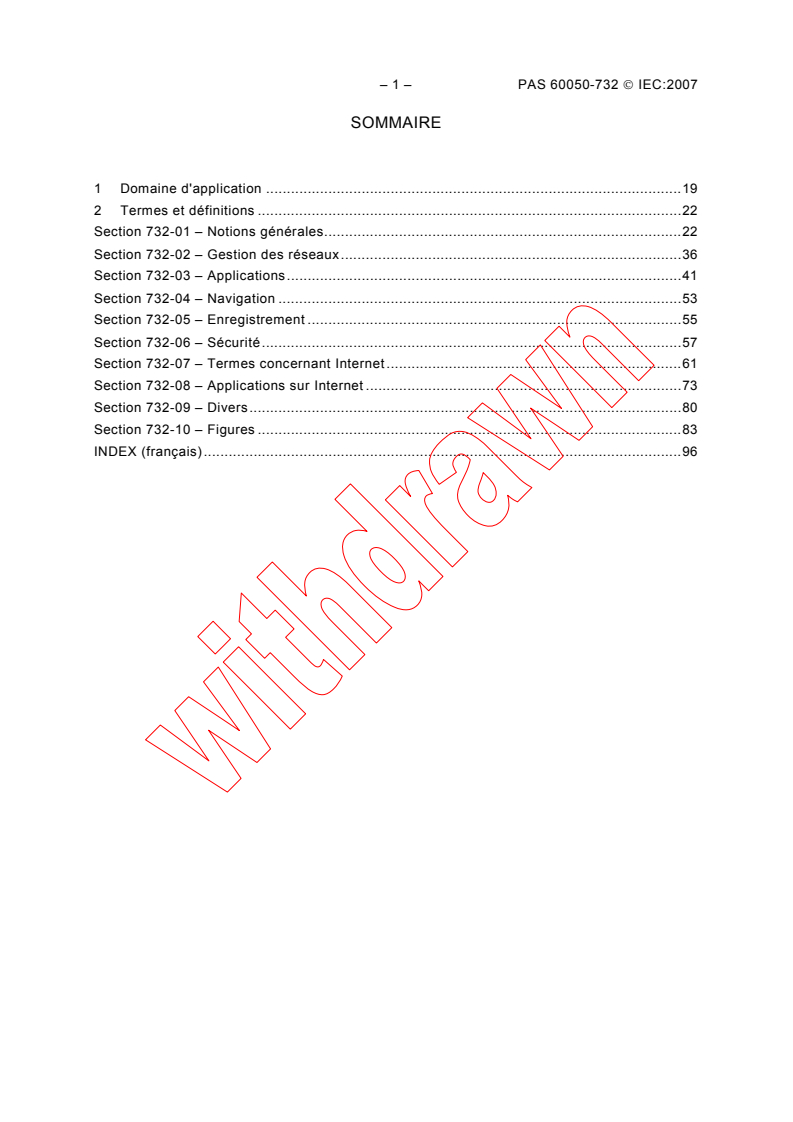
– 1 – PAS 60050-732 © IEC:2007
SOMMAIRE
1 Domaine d'application .19
2 Termes et définitions .22
Section 732-01 – Notions générales.22
Section 732-02 – Gestion des réseaux.36
Section 732-03 – Applications.41
Section 732-04 – Navigation .53
Section 732-05 – Enregistrement .55
Section 732-06 – Sécurité.57
Section 732-07 – Termes concernant Internet .61
Section 732-08 – Applications sur Internet .73
Section 732-09 – Divers.80
Section 732-10 – Figures .83
INDEX (français).96
PAS 60050-732 © IEC:2007 –2–
CONTENTS
1 Scope.20
2 Terms and definitions .22
Section 732-01 – General concepts .22
Section 732-02 – Network management .36
Section 732-03 – Applications.41
Section 732-04 – Navigation .53
Section 732-05 – Registration .55
Section 732-06 – Security .57
Section 732-07 – Internet terms .61
Section 732-08 – Internet applications .73
Section 732-09 – Miscellaneous.80
Section 732-10 – Figures .83
INDEX (English).96
– 3 – PAS 60050-732 © IEC:2007
INHALT
1 Anwendungsbereich .21
2 Begriffe und Definitionen .22
Hauptabschnitt 732-01 – Allgemeine Begriffe.22
Hauptabschnitt 732-02 – Netzverwaltung .36
Hauptabschnitt 732-03 – Anwendungen .41
Hauptabschnitt 732-04 – Navigation.53
Hauptabschnitt 732-05 – Registrierung .55
Hauptabschnitt 732-06 – Sicherheit .57
Hauptabschnitt 732-07 – Internet-Begriffe.61
Hauptabschnitt 732-08 – Anwendungen im Internet.73
Hauptabschnitt 732-09 – Verschiedenes .80
Hauptabschnitt 732-10 – Bilder .83
STICHWORTVERZEICHNIS (deutsch).101
PAS 60050-732 © IEC:2007 –4–
COMMISSION ÉLECTROTECHNIQUE INTERNATIONALE
____________
VOCABULAIRE ÉLECTROTECHNIQUE INTERNATIONAL –
PARTIE 732: Techniques des réseaux d'ordinateurs
AVANT-PROPOS
1) La Commission Électrotechnique Internationale (CEI) est une organisation mondiale de normalisation
composée de l'ensemble des comités électrotechniques nationaux (Comités nationaux de la CEI). La CEI a
pour objet de favoriser la coopération internationale pour toutes les questions de normalisation dans les
domaines de l'électricité et de l'électronique. A cet effet, la CEI – entre autres activités – publie des Normes
internationales, des Spécifications techniques, des Rapports techniques, des Spécifications accessibles au
public (PAS) et des Guides (ci-après dénommés "Publication(s) de la CEI"). Leur élaboration est confiée à des
comités d'études, aux travaux desquels tout Comité national intéressé par le sujet traité peut participer. Les
organisations internationales, gouvernementales et non gouvernementales, en liaison avec la CEI, participent
également aux travaux. La CEI collabore étroitement avec l'Organisation Internationale de Normalisation (ISO),
selon des conditions fixées par accord entre les deux organisations.
2) Les décisions ou accords officiels de la CEI concernant les questions techniques représentent, dans la mesure
du possible, un accord international sur les sujets étudiés, étant donné que les Comités nationaux intéressés
sont représentés dans chaque comité d’études.
3) Les publications de la CEI se présentent sous la forme de recommandations internationales et sont agréées
comme tels par les Comités nationaux de la CEI. Tous les efforts raisonnables sont entrepris afin que la CEI
s'assure de l'exactitude du contenu technique de ses publications; la CEI ne peut pas être tenue responsable
de l'éventuelle mauvaise utilisation ou interprétation qui en est faite par un quelconque utilisateur final
4) Dans le but d'encourager l'uniformité internationale, les Comités nationaux de la CEI s'engagent, dans toute la
mesure possible, à appliquer de façon transparente les Publications de la CEI dans leurs publications
nationales et régionales. Toute divergence entre toute Publication de la CEI et toute publication nationale ou
régionale correspondante doit être indiquée en termes clairs dans cette dernière.
5) La CEI n’a fixé aucune procédure concernant le marquage comme indication d’approbation et sa responsabilité
n’est pas engagée quand un matériel est déclaré conforme à l’une de ses normes.
6) Tous les utilisateurs doivent s'assurer qu'ils sont en possession de la dernière édition de cette publication.
7) Aucune responsabilité ne doit être imputée à la CEI, à ses administrateurs, employés, auxiliaires ou
mandataires, y compris ses experts particuliers et les membres de ses comités d'études et des Comités
nationaux de la CEI, pour tout préjudice causé en cas de dommages corporels et matériels, ou de tout autre
dommage de quelque nature que ce soit, directe ou indirecte, ou pour supporter les coûts (y compris les frais
de justice) et les dépenses découlant de la publication ou de l'utilisation de cette Publication de la CEI ou de
toute autre Publication de la CEI, ou au crédit qui lui est accordé.
8) L'attention est attirée sur les références normatives citées dans cette publication. L'utilisation de publications
référencées est obligatoire pour une application correcte de la présente publication.
9) L’attention est attirée sur le fait que certains des éléments de la présente publication CEI peuvent faire l’objet
de droits de propriété intellectuelle ou de droits analogues. La CEI ne saurait être tenue pour responsable de
ne pas avoir identifié de tels droits de propriété ou de ne pas avoir signalé leur existence.
Une PAS est une spécification technique ne remplissant pas les exigences pour devenir une
norme mais qui est accessible au public.
La CEI-PAS 60050-732 a été traitée par le comité d’études 1 de la CEI: Terminologie
Le texte de cette PAS est basé sur Cette PAS a été acceptée pour
le document suivant: publication par les membres P du
comité concerné, comme indiqué
dans le document suivant:
Projet PAS Rapport de vote
1/2000/NP 1/2019/RVN
Après la publication de cette PAS, qui est une publication prénorme, le comité d’études ou le
sous-comité concerné la transformera en Norme internationale.
– 5 – PAS 60050-732 © IEC:2007
Cette PAS doit rester valide pour une période initiale maximale de trois ans commençant en
2007-07. La validité peut être prolongée pour une unique période de trois ans, après laquelle
elle doit être revue pour devenir un document normatif d’un autre type ou être retirée.
PAS 60050-732 © IEC:2007 –6–
INTERNATIONAL ELECTROTECHNICAL COMMISSION
____________
INTERNATIONAL ELECTROTECHNICAL VOCABULARY
PART 732: Computer network technology
FOREWORD
1) The International Electrotechnical Commission (IEC) is a worldwide organization for standardization comprising
all national electrotechnical committees (IEC National Committees). The object of IEC is to promote
international co-operation on all questions concerning standardization in the electrical and electronic fields. To
this end and in addition to other activities, IEC publishes International Standards, Technical Specifications,
Technical Reports, Publicly Available Specifications (PAS) and Guides (hereafter referred to as “IEC
Publication(s)”). Their preparation is entrusted to technical committees; any IEC National Committee interested
in the subject dealt with may participate in this preparatory work. International, governmental and non-
governmental organizations liaising with the IEC also participate in this preparation. IEC collaborates closely
with the International Organization for Standardization (ISO) in accordance with conditions determined by
agreement between the two organizations.
2) The formal decisions or agreements of IEC on technical matters express, as nearly as possible, an international
consensus of opinion on the relevant subjects since each technical committee has representation from all
interested IEC National Committees.
3) IEC Publications have the form of recommendations for international use and are accepted by IEC National
Committees in that sense. While all reasonable efforts are made to ensure that the technical content of IEC
Publications is accurate, IEC cannot be held responsible for the way in which they are used or for any
misinterpretation by any end user.
4) In order to promote international uniformity, IEC National Committees undertake to apply IEC Publications
transparently to the maximum extent possible in their national and regional publications. Any divergence
between any IEC Publication and the corresponding national or regional publication shall be clearly indicated in
the latter.
5) IEC provides no marking procedure to indicate its approval and cannot be rendered responsible for any
equipment declared to be in conformity with an IEC Publication.
6) All users should ensure that they have the latest edition of this publication.
7) No liability shall attach to IEC or its directors, employees, servants or agents including individual experts and
members of its technical committees and IEC National Committees for any personal injury, property damage or
other damage of any nature whatsoever, whether direct or indirect, or for costs (including legal fees) and
expenses arising out of the publication, use of, or reliance upon, this IEC Publication or any other IEC
Publications.
8) Attention is drawn to the Normative references cited in this publication. Use of the referenced publications is
indispensable for the correct application of this publication.
9) Attention is drawn to the possibility that some of the elements of this IEC Publication may be the subject of
patent rights. IEC shall not be held responsible for identifying any or all such patent rights.
A PAS is a technical specification not fulfilling the requirements for a standard but made
available to the public.
IEC-PAS 60050-732 has been processed by IEC technical committee 1:Terminology.
The text of this PAS is based on the This PAS was approved for
following document: publication by the P-members of the
committee concerned as indicated in
the following document:
Draft PAS Report on voting
1/2000/NP 1/2019/RVN
Following publication of this PAS, which is a pre-standard publication, the technical committee
or subcommittee concerned will transform it into an International Standard.
– 7 – PAS 60050-732 © IEC:2007
This PAS shall remain valid for an initial maximum period of three years starting from
2007-07. The validity may be extended for a single three-year period, following which it shall
be revised to become another type of normative document or shall be withdrawn.
PAS 60050-732 © IEC:2007 –8–
INTERNATIONALE ELEKTROTECHNISCHE KOMMISSION
____________
INTERNATIONALES ELEKTROTECHNISCHES WÖRTERBUCH –
TEIL 732: Rechnernetztechnik
VORWORT
1) Die IEC (Internationale Elektrotechnische Kommission) ist eine weltweite Normungsorganisation, die alle
Nationalen Elektrotechnischen Komitees (Nationale Komitees der IEC) umfasst. Die IEC hat das Ziel, die
internationale Zusammenarbeit in allen Fragen der Normung auf dem Gebiet der Elektrotechnik und Elektronik
zu fördern. Zu diesem Zweck und neben anderen Aktivitäten veröffentlicht die IEC Internationale Normen,
Technische Spezifikationen, Technische Berichte, Öffentliche Verfügbare Spezifikationen und Leitlinien (im
Folgenden als IEC Publikationen bezeichnet). Mit der Vorbereitung sind die Technischen Komitees beauftragt.
Jedes Nationale Komitee der IEC, das an dem behandelten Thema interessiert ist, darf an dieser
Vorbereitungsarbeit teilnehmen. Internationale Organisationen, Regierungs- und Nichtregierungsstellen, die mit
der IEC in Verbindung stehen, nehmen ebenfalls an diesen Vorbereitungsarbeiten teil. Die IEC arbeitet eng mit
der Internationalen Organisation für Normung (ISO) nach den in der Vereinbarung zwischen beiden
Organisationen festgelegten Bedingungen zusammen.
2) Die offiziellen Beschlüsse oder Vereinbarungen der IEC über technische Fragen, die in Technischen Komitees
von Vertretern aller an dem behandelten Thema besonders interessierten Nationalen Komitees erarbeitet
werden, bringen das höchstmögliche Maß internationaler Übereinstimmung für das behandelte Sachgebiet zum
Ausdruck.
3) Die IEC Publikationen stellen Empfehlungen zur internationalen Anwendung dar, die als solche von den
Nationalen Komitees angenommen sind. Während alle Anstrengungen unternommen wurden, um sicher zu
stellen, dass die die IEC Publikationen inhaltlich korrekt sind, kann die IEC nicht dafür verantwortlich gemacht
werden, wie sie angewandt werden, oder dafür, dass sie von einem Endbenutzer falsch interpretiert werden.
4) Um die internationale Vereinheitlichung zu fördern, verpflichten sich die Nationalen Komitees der IEC,
Internationale Normen der IEC so durchschaubar wie möglich in ihren nationalen und regionalen Normen
anzuwenden. Jede Abweichung zwischen der IEC-Norm und der entsprechenden nationalen oder regionalen
Norm muss in dieser deutlich gekennzeichnet werden.
5) Die IEC hat kein Verfahren für die Kennzeichnung der Konformität festgelegt und übernimmt keine
Verantwortung, wenn ein Gegenstand als konform mit einer ihrer Normen erklärt wird.
6) Alle Nutzer sollten sich vergewissern, dass sie die neueste Ausgabe dieser Publikation besitzen.
7) Weder die IEC noch ihre Direktoren, Angestellten, Bediensteten oder Agenten einschließlich Experten oder
Mitglieder ihrer Technischen Komitees und Nationalen Komitees der IEC können haftbar gemacht werden für
irgendwelche Personenschäden, Sachschäden oder andere Schäden jedweder Natur, seien sie direkt oder
indirekt entstanden, oder für Kosten (einschließlich Gerichtskosten) und Ausgaben, die durch diese Publikation
oder irgend eine andere IEC Publikation, deren Anwendung oder im Verlass hierauf entstehen.
8) Auf die Normativen Verweisungen, die in dieser Publikation angeführt werden, wird ausdrücklich verwiesen. Die
Anwendung der zitierten Publikationen ist für die korrekte Anwendung dieser Publikation unerlässlich.
9) Es besteht die Möglichkeit, dass Bestandteile dieser Internationalen Norm Gegenstand von Patentrechten sind.
Die IEC hat nicht die Verantwortung, das Vorhandensein solcher Patentrechte festzustellen und auf deren
Existenz hinzuweisen.
Eine Öffentliche Verfügbare Spezifikation (Publicly Available Specification) im Folgenden als
PAS bezeichnet, ist eine Technische Spezifikation, die nicht alle Anforderungen einer Norm
erfüllt, der Öffentlichkeit jedoch zur Verfügung gestellt wird.
IEC-PAS 60050-732 wurde bearbeitet vom Technischen Komitee 1 der IEC: Terminologie.
Der Text dieser PAS basiert Diese PAS wurde zur Veröffentlichung
auf folgendem Schriftstück durch die zuständigen P-Mitglieder
angenommen, wie im folgenden
Schriftstück dargestellt
Entwurf Abstimmungsbericht
1/2000/NP 1/2019/RVN
Nach der Veröffentlichung dieser PAS, die einer Vornorm entspricht, wird das zuständige
Technische Komitee oder ein Unterkomite diese in eine Internationale Norm überführen.
– 9 – PAS 60050-732 © IEC:2007
Diese PAS soll vorerst für einen Zeitraum von drei Jahren gültig bleiben, beginnend mit 2007-
07. Die Gültigkeit kann um einen weiteren Drei-Jahres-Zeitraum verlängert werden; danach
soll die PAS in eine andere Form eines normativen Schriftstücks überführt oder
zurückgezogen werden.
PAS 60050-732 © IEC:2007 –10–
INTRODUCTION
Principes d’établissement et règles suivies
Généralités
Le VEI (série de normes CEI 60050) est un vocabulaire multilingue à usage général couvrant
le champ de l’électrotechnique, de l’électronique et des télécommunications. Il comprend
environ 18 000 articles terminologiques correspondant chacune à une notion. Ces articles
sont répartis dans environ 80 parties, chacune correspondant à un domaine donné.
Exemples:
Partie 161 (CEI 60050-161): Compatibilité électromagnétique
Partie 411 (CEI 60050-411): Machines tournantes
Les articles suivent un schéma de classification hiérarchique Partie/Section/Notion, les
notions étant, au sein des sections, classées par ordre systématique.
Les termes, définitions et notes des articles sont donnés dans les trois langues de la CEI,
c’est-à-dire français, anglais et russe (langues principales du VEI).
Dans chaque article, les termes seuls sont également donnés dans les langues additionnelles
du VEI (arabe, chinois, allemand, grec, espagnol, italien, japonais, polonais, portugais et
suédois).
De plus, chaque partie comprend un index alphabétique des termes inclus dans cette partie,
et ce pour chacune des langues du VEI.
NOTE Certaines langues peuvent manquer.
Constitution d’un article terminologique
Chacun des articles correspond à une notion, et comprend:
- un numéro d’article,
- éventuellement un symbole littéral de grandeur ou d’unité,
puis, pour chaque langue principale du VEI:
- le terme désignant la notion, appelé ‘ terme privilégié ’, éventuellement accompagné de
synonymes et d’abréviations,
- la définition de la notion,
- éventuellement la source,
- éventuellement des notes,
et enfin, pour les langues additionnelles du VEI, les termes seuls.
Numéro d’article
Le numéro d’article comprend trois éléments, séparés par des traits d’union:
- Numéro de partie: 3 chiffres,
- Numéro de section: 2 chiffres,
- Numéro de la notion: 2 chiffres (01 à 99).
Exemple: 131-13-22
– 11 – PAS 60050-732 © IEC:2007
INTRODUCTION
Principles and rules followed
General
The IEV (IEC 60050 series) is a general purpose multilingual vocabulary covering the field of
electrotechnology, electronics and telecommunication. It comprises about 18 000
terminological entries, each corresponding to a concept. These entries are distributed among
about 80 parts, each part corresponding to a given field.
Examples:
Part 161 (IEC 60050-161): Electromagnetic compatibility
Part 411 (IEC 60050-411): Rotating machines
The entries follow a hierarchical classification scheme Part/Section/Concept, the concepts
being, within the sections, organized in a systematic order.
The terms, definitions and notes in the entries are given in the three IEC languages, that is
French, English and Russian (principal IEV languages).
In each entry, the terms alone are also given in the additional IEV languages (Arabic,
Chinese, German, Greek, Spanish, Italian, Japanese, Polish, Portuguese, and Swedish).
In addition, each part comprises an alphabetical index of the terms included in that part, for
each of the IEV languages.
NOTE Some languages may be missing.
Organization of a terminological entry
Each of the entries corresponds to a concept, and comprises:
- an entry number,
- possibly a letter symbol for quantity or unit,
then, for each of the principal IEV languages:
- the term designating the concept, called ‘preferred term’, possibly accompanied by
synonyms and abbreviations,
- the definition of the concept,
- possibly the source,
- possibly notes,
and finally, for the additional IEV languages, the terms alone.
Entry number
The entry number is comprised of three elements, separated by hyphens:
- Part number: 3 digits,
- Section number: 2 digits,
- Concept number: 2 digits (00 to 99).
Example: 131-13-22
PAS 60050-732 © IEC:2007 –12–
EINLEITUNG
Grundsätze und Regeln für die Gestaltung des
Internationalen Elektrotechnischen Wörterbuchs (IEV)
Allgemeines
Das IEV (Normenreihe IEC 60050) ist ein mehrsprachiges Wörterbuch zur allgemeinen
Anwendung auf den Gebieten der Elektrotechnik, Elektronik und Telekommunikation. Es
enthält rund 18 000 terminologische Einträge, die jeweils einem Begriff entsprechen. Diese
Einträge sind auf rund 80 Teile aufgeteilt, wobei jeder Teil ein bestimmtes Gebiet abdeckt.
Beispiele:
Teil 161 (IEC 60050-161): Elektromagnetische Verträglichkeit
Teil 411 (IEC 60050-411): Drehende Maschinen
Die Einträge gehorchen dem hierarchischen Klassifizierungsschema Teil / Hauptabschnitt /
Begriff, wobei die Begriffe innerhalb eines Hauptabschnitts systematisch geordnet werden.
Die Begriffe, Definitionen und ANMERKUNGen in den Einträgen werden in den drei offiziellen
Sprachen der IEC, d. h. in Französisch, Englisch und Russisch, angegeben.
Zu jedem Eintrag wird die jeweilige Benennung zusätzlich in den Nebensprachen des IEV
(Arabisch, Chinesisch, Deutsch, Griechisch, Spanisch, Italienisch, Japanisch, Polnisch,
Portugiesisch und Schwedisch) angegeben.
Zusätzlich enthält jeder Teil alphabetische Stichwortverzeichnisse der in diesen Teil
aufgenommenen Benennungen in allen IEV-Sprachen.
ANMERKUNG Einige Sprachen können fehlen.
Gliederung eines terminologischen Eintrags
Jeder Eintrag entspricht einem Begriff und enthält:
– eine Eintragsnummer,
– möglicherweise ein Formelzeichen oder Einheitenzeichen,
weiterhin für jede der offiziellen IEV-Sprachen:
– die den Begriff bezeichnende Benennung, genannt ‘Vorzugsbenennung’, möglicherweise
ergänzt durch Synonyme und Abkürzungen,
– die Definition des Begriffs,
– möglicherweise die Quelle,
– möglicherweise Anmerkungen,
und schließlich die Benennungen in den IEV-Nebensprachen.
Eintragsnummer
Die Eintragsnummer besteht aus drei durch Bindestriche getrennten Elementen:
– Nummer des Teils: 3 Digits,
– Nummer des Hauptabschnitts: 2 Digits,
– Nummer des Begriffs: 2 Digits (00 bis 99).
Beispiel: 131-13-22
– 13 – PAS 60050-732 © IEC:2007
Symboles littéraux de grandeurs et unités
Ces symboles, indépendants de la langue, sont donnés sur une ligne séparée suivant le
numéro d’article.
Exemple:
131-12-04
symb.: R
résistance, f
Terme privilégié et synonymes
Le terme privilégié est le terme qui figure en tête d’un article ; il peut être suivi par des
synonymes. Il est imprimé en gras.
Synonymes:
Les synonymes sont imprimés sur des lignes séparées sous le terme privilégié: ils sont
également imprimés en gras, sauf les synonymes déconseillés, qui sont imprimés en maigre,
et suivis par l’attribut ‘ (déconseillé) ’.
Parties pouvant être omises:
Certaines parties d’un terme peuvent être omises, soit dans le domaine considéré, soit dans
un contexte approprié. Ces parties sont alors imprimées en gras, entre parenthèses:
Exemple: émission (électromagnétique)
Absence de terme approprié:
Lorsqu’il n’existe pas de terme approprié dans une langue, le terme privilégié est remplacé
par cinq points, comme ceci:
.....
‘ ‘ (et il n’y a alors bien entendu pas de synonymes).
Attributs
Chaque terme (ou synonyme) peut être suivi d’attributs donnant des informations supplé-
mentaires ; ces attributs sont imprimés en maigre, à la suite de ce terme, et sur la même
ligne.
Exemples d’attributs:
- spécificité d’utilisation du terme:
rang (d’un harmonique)
- variante nationale:
unité de traitement CA
- catégorie grammaticale:
électronique, adj
électronique, f
- abréviation:
CEM (abréviation)
- déconseillé:
déplacement (terme déconseillé)
PAS 60050-732 © IEC:2007 –14–
Letter symbols for quantities and units
These symbols, which are language independent, are given on a separate line following the
entry number.
Example:
131-12-04
symb.: R
résistance, f
Preferred term and synonyms
The preferred term is the term that heads a terminological entry; it may be followed by
synonyms. It is printed in boldface.
Synonyms:
The synonyms are printed on separate lines under the preferred term: they are also printed in
boldface, excepted for deprecated synonyms, which are printed in lightface, and followed by
the attribute ‘(deprecated)’.
Parts that may be omitted:
Some parts of a term may be omitted, either in the field under consideration or in an
appropriate context. Such parts are printed in boldface type, and placed in parentheses:
Example: (electromagnetic) emission
Absence of an appropriate term:
When no adequate term exists in a given language, the preferred term is replaced by five
.....
dots, like that: ‘ ‘ (and there are of course no synonyms).
Attributes
Each term (or synonym) may be followed by attributes giving additional information, and
printed on the same line as the corresponding term, following this term.
Examples of attributes:
- specific use of the term:
transmission line (in electric power systems)
- national variant:
lift GB
- grammatical information:
thermoplastic, noun
AC, qualifier
- abbreviation:
EMC (abbreviation)
- deprecated: choke (deprecated)
– 15 – PAS 60050-732 © IEC:2007
Formelzeichen und Einheitenzeichen
Diese sprachenunabhängigen Zeichen werden in einer getrennten, der Eintragsnummer
folgenden Zeile angegeben.
Beispiel:
131-12-04
Formelzeichen: R
Widerstand, m
Vorzugsbenennungen und Synonyme
Vorzugsbenennung ist die Benennung zu Beginn des terminologischen Eintrags; ihr können
Synonyme folgen. Die Vorzugsbenennung wird im Fettdruck angegeben.
Synonyme:
Synonyme werden in getrennten Zeilen unter der Vorzugsbenennung gedruckt; sie werden
ebenfalls im Fettdruck angegeben. Eine Ausnahme bilden abgelehnte Benennungen, die im
Normaldruck angegeben werden und mit dem Zusatz ‘(abgelehnt)’ versehen sind.
Teile, die weggelassen werden können:
Einige Teile einer Benennung können weggelassen werden – entweder auf einem noch in
Bearbeitung befindlichen Gebiet oder in einem geeigneten Kontext. Diese Teile werden im
Fettdruck angegeben und in Klammern gesetzt.
Beispiel: (elektromagnetische) Aussendung
Fehlen einer geeigneten Benennung:
Wenn in einer gegebenen Sprache keine passende Benennung existiert, wird die
Vorzugsbenennung durch fünf Punkte ersetzt, d.h.
.....
‘ ‘ (natürlich gibt es dafür keine Synonyme).
Beifügungen
An jede Benennung (oder jedes Synonym) dürfen auf der gleichen Zeile Beifügungen mit
zusätzlichen Informationen angefügt werden.
Beispiele für Beifügungen:
-spezifische Verwendung der Benennung:
Übertragungsleitung (in Elektrizitätsversorgungssystemen)
- nationale Variante:
lift (GB)
- grammatikalische Information:
Thermoplast (Substantiv)
Wechselstrom. (in Zusammensetzungen)
- Abkürzung:
EMV (Abkürzung)
- abgelehnt:
Dielektrizitätskonstante (abgelehnt)
PAS 60050-732 © IEC:2007 –16–
Source
Dans certains cas, il a été nécessaire d’inclure dans une partie du VEI une notion prise dans
une autre partie du VEI, ou dans un autre document de terminologie faisant autorité (VIM,
ISO/CEI 2382, etc.), dans les deux cas avec ou sans modification de la définition (ou
éventuellement du terme).
Ceci est indiqué par la mention de cette source, imprimée en maigre et placée entre crochets
à la fin de la définition:
Exemple: [131-03-13 MOD]
(MOD indique que la définition a été modifiée)
Termes dans les langues additionnelles du VEI
Ces termes sont placés à la fin de l’article, sur des lignes séparées (une ligne par langue),
précédés par le code alpha-2 de la langue, défini dans l’ISO 639, et dans l’ordre alphabétique
de ce code. Les synonymes sont séparés par des points-virgules.
– 17 – PAS 60050-732 © IEC:2007
Source
In some cases, it has been necessary to include in an IEV part a concept taken from another
IEV part, or from another authoritative terminology document (VIM, ISO/IEC 2382, etc.), in
both cases with or without modification to the definition (and possibly to the term).
This is indicated by the mention of this source, printed in lightface, and placed between
square brackets at the end of the definition.
Example: [131-03-13 MOD]
(MOD indicates that the definition has been modified)
Terms in additional IEV languages
These terms are placed at the end of the entry, on separate lines (one single line for each
language), preceded by the alpha-2 code for the language defined in ISO 639, and in the
alphabetic order of this code. Synonyms are separated by semicolons.
PAS 60050-732 © IEC:2007 –18–
Quelle
In einigen Fällen war es erforderlich, in ein IEV-Teil einen Begriff aufzunehmen, der aus
einem anderen IEVTeil oder aus einem anderen verbindlichen Terminologiedokument (VIM,
ISO/IEC 2382 u. a.) entnommen wurde, in beiden Fällen mit oder ohne Veränderung der
Definition (und möglicherweise der Benennung).
Dies wird durch Nennung dieser Quelle angezeigt, gedruckt im Normaldruck und platziert in
eckigen Klammern am Ende der Definition.
Beispiel: [131-03-13 MOD]
(MOD zeigt an, dass die Definition abgeändert wurde)
Benennungen in Nebensprachen
Diese Benennungen werden am Ende des Eintrags in getrennten Zeilen (eine Zeile je
Nebensprache) mit Voransetzung des Alpha-2-Codes der Sprache nach ISO 639 und in
alphabetischer Reihenfolge dieses Codes angegeben. Synonyme werden dabei durch
Semikolon getrennt.
– 19 – PAS 60050-732 © IEC:2007
VOCABULAIRE ÉLECTROTECHNIQUE INTERNATIONAL
PARTIE 732: Techniques des réseaux d'ordinateurs
1 Domaine d'application
La présente partie de la CEI 60050 définit les termes relatifs spécifiquement aux techniques
des réseaux d'ordinateurs.
2 Références normatives
Les documents de référence suivants sont indispensables pour l'application du présent
document. Pour les références datées, seule l'édition citée s'applique. Pour les références
non datées, la dernière édition du document de référence s'applique (y compris les éventuels
amendements).
ISO 3166-1, Codes pour la représentation des noms de pays et de leurs subdivisions –
Partie 1: Codes de pays
PAS 60050-732 © IEC:2007 –20–
INTERNATIONAL ELECTROTECHNICAL VOCABULARY
PART 732: Computer network technology
1 Scope
This part of IEC 60050 defines terms specifically relevant to computer network technology.
2 Normative references
The following referenced documents are indispensable for the application of this document.
For dated references, only the edition cited applies. For undated references, the latest edition
of the referenced document (including any amendments) applies.
ISO 3166-1, Codes for the representation of names of countries and their subdivisions –
Part 1: Country codes
– 21 – PAS 60050-732 © IEC:2007
INTERNATIONALES ELEKTROTECHNISCHES WÖRTERBUCH
TEIL 732: Rechnernetztechnik
1 Anwendungsbereich
Dieser Teil der Norm IEC 60050 enthält die allgemeine Terminologie für Rechnernetztechnik.
2 Normative Verweisungen
Die im Folgenden genannten Schriftstücke sind für die Anwendung dieses Schriftstücks
erforderlich. Bei datierten Schriftstücken ist nur die betreffende Ausgabe zu verwenden. Bei
undatierten Schriftstücken ist die letzte Ausgabe (einschließlich eventueller Verbesserungen)
zu verwenden.
ISO 3166-1, Codes for the representation of names of countries and their subdivisions –
Part 1: Country codes
PAS 60050-732 © IEC:2007 –22–
3 Termes et définitions
3 Terms and definitions
3 Begriffe und Definitionen
Section 732-01 – Notions générales
Section 732-01 – General concepts
Hauptabschnitt 732-01 – Allgemeine Begriffe
732-01-01
réseau
ensemble formé par des nœuds, et par les branches qui les réunissent
network
arrangement of nodes and interconnecting branches
Netz
Anordnung von Knoten und der sie verbindenden Zweige
732-01-02
réseautique
ensemble des techniques destinées à créer, gérer, exploiter et utiliser des réseaux
networking
set of techniques involved with establishing, managing, operating, and using networks
Netztechnologie
Gesamtheit der Techniken, die bei der Einrichtung, der Verwaltung, dem Betrieb und der
Nutzung von Netzen eine Rolle spielen
732-01-03
réseau d’ordinateurs
réseau dont les nœuds sont composés d’ordinateurs et de matériels de communication de
données, et dont les branches sont des liaisons de données
computer network
network whose nodes consist of computers and data communication equipment, and whose
branches are data links
Rechnernetz
Netz, dessen Knoten aus Rechnern und Datenübermittlungseinrichtungen bestehen und
dessen Zweige Übermittlungsabschnitte sind
– 23 – PAS 60050-732 © IEC:2007
732-01-04
réseau local
réseau local d’entreprise
RLE (abréviation)
réseau d’ordinateurs situé dans un domaine privé et géographiquement limité
NOTE Les communications internes à un réseau local ne sont pas soumises aux réglementations
d’organismes extérieurs à ce réseau. Par contre, les communications franchissant les limites du réseau
peuvent être soumises à des réglementations extérieures.
local area network
LAN (abbreviation)
computer network located on a user’s premises within a limited geographical area
NOTE Communication within a local area network is not subject to external regulations; however,
communication across the network boundary may be subject to some form of regulation.
lokales Netz
LAN (Abkürzung)
Rechnernetz, das auf dem Gelände eines Anwenders installiert und geographisch begrenzt ist
ANMERKUNG Die Kommunikation innerhalb eines lokalen Netzes unterliegt nicht den Bestimmungen
externer Organisationen; Kommunikation über LAN-Grenzen hinweg kann jedoch bestimmten
Vorschriften unterliegen.
732-01-05
réseau local sans fil
WLAN (abréviation)
réseau local dans lequel les données sont transmises sans fil
wireless LAN
WLAN (abbreviation)
local area network in which data are transferred without the use of wires
drahtloses lokales Netz
WLAN (Abkürzung)
lokales Netz, in dem die Daten drahtlos übertragen werden
PAS 60050-732 © IEC:2007 –24–
732-01-06
réseau métropolitain
MAN (abréviation)
réseau dont le but est de réunir des réseaux locaux situés dans une même agglomération
urbaine
NOTE Un réseau métropolitain traverse des limites administratives et peut utiliser plusieurs méthodes
d’accès.
metropolitan area network
MAN (abbreviation)
network for connecting local area networks located in the same urban area
NOTE A metropolitan area network crosses administrative boundaries and supports several access
methods.
regionales Netz
MAN (Abkürzung)
Netz, das lokale Netze innerhalb eines urbanen Bereichs miteinander verbindet
ANMERKUNG Ein regionales Netz überschreitet Grenzen von Verantwortungsbereichen und
unterstützt mehrere Zugriffsverfahren.
732-01-07
réseau étendu
réseau à longue distance
réseau fournissant des services de télécommunication à une zone géographique plus grande
qu'une seule agglomération urbaine
NOTE 1 En général, un réseau étendu couvre un seul pays.
NOTE 2 En français, le terme ‘ réseau étendu ’ remplace le terme ‘ réseau général ’ qui n'est plus
employé dans ce sens.
wide area network
WAN (abbreviation)
network that provides communication services to a geographic area larger than a single urban
area
NOTE 1 Typically, a wide area network covers a single country.
NOTE 2 In French, the term ‘réseau étendu’ replaces the term ‘réseau general’ which is no longer
used in this sense.
Weitverkehrsnetz
WAN (Abkürzung)
Netz, das Kommunikationsdienste für geographisch größere Gebiete anbietet als ein
regionales Netz
ANMERKUNG 1 Üblicherweise überdeckt ein Weitverkehrsnetz ein einzelnes Land.
ANMERKUNG 2 Die französische Benennung ‘réseau général’ wird durch ‘réseau étendu’ ersetzt, da
sie in diesem Sinne nicht mehr benutzt wird.
– 25 – PAS 60050-732 © IEC:2007
732-01-08
réseau mondial
interconnexion de plusieurs réseaux de types différents, qui couvre une zone géographique
non limitée
global area network
GAN (abbreviation)
interconnection of networks of different types that covers an unlimited geographical area
globales Netz
GAN (Abkürzung)
Verbund von Netzen unterschiedlicher Art, der ein Gebiet überdeckt, das geographisch nicht
begrenzt ist
732-01-09
interréseautage
fonctionnement en interréseau
processus consistant à interconnecter plusieurs réseaux, en vue de fournir aux utilisateurs
des services unifiés
internetworking
internetting
process of interconnecting two or more networks for providing unified services to the users
Vernetzung
Zusammenschluss mehrerer Netze, um Nutzern einheitliche Dienste zur Verfügung zu stellen
PAS 60050-732 © IEC:2007 –26–
732-01-10
réseau local virtuel
réseau privé virtuel
réseau d’ordinateurs utilisant des réseaux intermédiaires pour obtenir des communications de
données transparentes pour les utilisateurs, et qui n’impose pas de restrictions sur les
protocoles, de sorte que ce réseau se comporte comme un réseau local
NOTE Les communications de données sur les réseaux intermédiaires utilisent généralement une
tunnellisation.
virtual local area network
...