

IEC GUIDE 115:2021
(Main)Application of uncertainty of measurement to conformity assessment activities in the electrotechnical sector
General Information
- Abstract
IEC Guide 115:2021 presents a practical approach to the application of uncertainty of measurement to conformity assessment activities in the electrotechnical sector. It is specifically conceived for use in IECEE Schemes as well as by testing laboratories engaged in testing electrical products to national safety standards. It describes the application of uncertainty of measurement principles and provides guidance on making uncertainty of measurement calculations. It also gives some examples relating to uncertainty of measurement calculations for product conformity assessment testing. IEC Guide 115 has been prepared by the IECEE Committee of Testing Laboratories (CTL) to provide guidance on the practical application of the measurement uncertainty requirements of ISO/IEC 17025 to the electrical safety testing conducted within the IECEE CB Scheme. The IECEE CB Scheme is a multilateral, international agreement, among over 40 countries and some 60 national certification bodies, for the acceptance of test reports on electrical products tested to IEC standards.The aim of the CTL is, among other tasks, to define a common understanding of the test methodology with regard to the IEC standards as well as to ensure and continually improve the repeatability and reproducibility of test results among the member laboratories. The practical approach to measurement uncertainty outlined in this document has been adopted for use in the IECEE Schemes, and is also extensively used around the world by testing laboratories engaged in testing electrical products to national safety standards.
- Status
- Published
- Publication Date
- 10-Mar-2021
- Technical Committee
- SMB - STANDARDIZATION MANAGEMENT BOARD
- Current Stage
- DELPUB - Deleted Publication
- Start Date
- 12-Apr-2023
- Completion Date
- 28-Aug-2026
Buy Documents
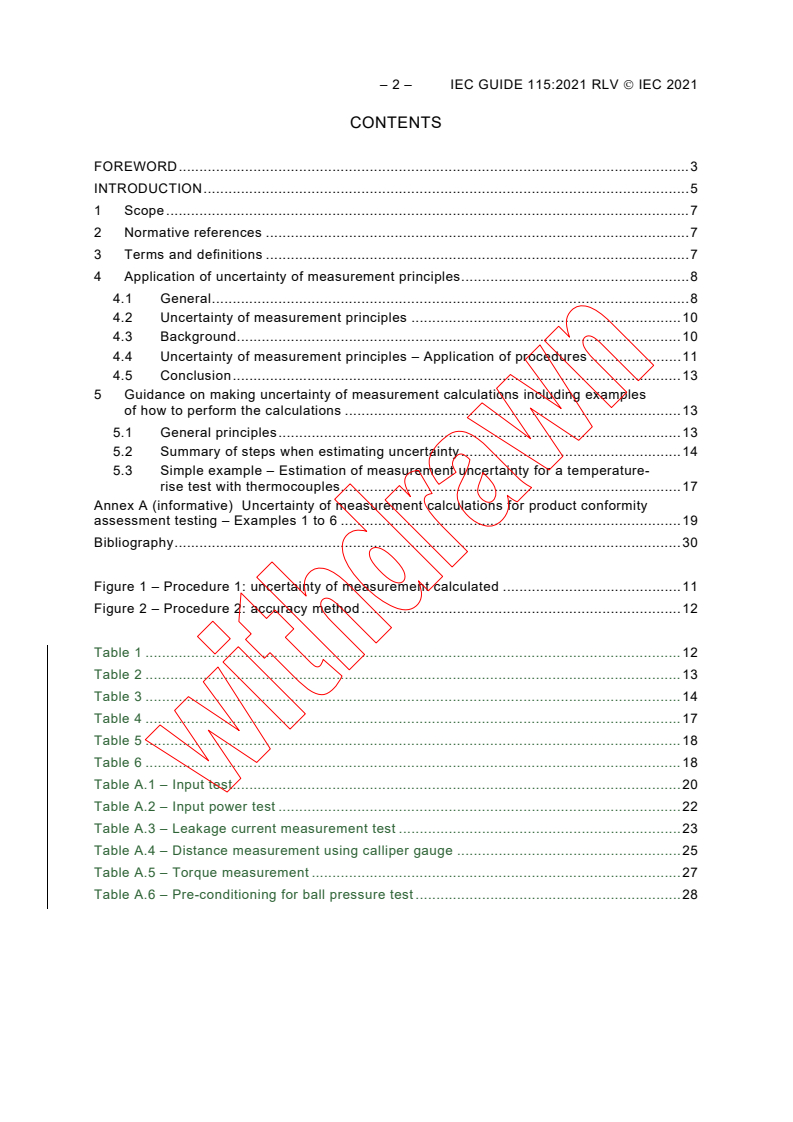
IEC GUIDE 115:2021 RLV - Application of uncertainty of measurement to conformity assessment activities in the electrotechnical sector Released:3/11/2021
IEC GUIDE 115:2021 - Application of uncertainty of measurement to conformity assessment activities in the electrotechnical sector Released:3/11/2021
Overview
IEC Guide 115:2021 - "Application of uncertainty of measurement to conformity assessment activities in the electrotechnical sector" - provides a practical, sector‑specific approach to applying measurement uncertainty principles to electrical product testing and conformity assessment. Prepared by the IECEE Committee of Testing Laboratories (CTL), this Guide aligns with ISO/IEC 17025 requirements and the Guide to the Expression of Uncertainty in Measurement (GUM). It is intended primarily for use in the IECEE CB Scheme and by testing laboratories performing electrical safety tests to IEC or national standards.
Key topics and requirements
- Scope and purpose: Practical application of measurement uncertainty for conformity assessment in the electrotechnical sector, with guidance geared to IECEE activities.
- Standards alignment: Harmonizes uncertainty practices with ISO/IEC 17025, GUM, and relevant vocabulary (VIM).
- Measurement uncertainty concepts: Definitions and use of terms such as measurand, standard/combined standard uncertainty, expanded uncertainty, coverage factor, Type A/Type B evaluations and level of confidence.
- Calculation procedures: Step‑by‑step guidance for estimating uncertainty, including two illustrated procedures (uncertainty calculation and accuracy‑method approach).
- Worked examples: Practical examples and templates for common safety tests (e.g., temperature‑rise with thermocouples, input and power tests, leakage current, distance measurement, torque, pre‑conditioning for ball pressure tests).
- Quality and repeatability: Emphasis on improving repeatability and reproducibility across IECEE member laboratories and establishing common test methodology interpretations.
Practical applications and who uses it
IEC Guide 115 is useful to:
- Testing laboratories that perform electrical safety testing and must demonstrate compliance with ISO/IEC 17025 and IECEE requirements.
- Conformity assessment bodies / national certification bodies participating in the IECEE CB Scheme that accept test reports from international labs.
- Laboratory managers and metrologists implementing uncertainty estimation procedures, preparing test reports, or establishing measurement traceability.
- Technical committees and standard developers seeking a consistent approach to uncertainty within electrotechnical test methods.
Practical benefits:
- Consistent uncertainty reporting on test reports accepted under the IECEE CB Scheme.
- Clear guidance for selecting Type A or Type B methods and combining uncertainty components.
- Real examples reduce interpretation differences between laboratories and support regulatory acceptance.
Related standards
- ISO/IEC 17025 - General requirements for the competence of testing and calibration laboratories (primary competence framework).
- GUM (Guide to the Expression of Uncertainty in Measurement) - Core methodology for uncertainty evaluation.
- VIM (International Vocabulary of Metrology) - Definitions for metrology terms.
Keywords: measurement uncertainty, IEC Guide 115, conformity assessment, electrotechnical sector, IECEE CB Scheme, ISO/IEC 17025, GUM, testing laboratories, electrical safety testing.
Relations
- Effective Date
- 05-Sep-2023
- Effective Date
- 05-Sep-2023
Buy Documents
IEC GUIDE 115:2021 RLV - Application of uncertainty of measurement to conformity assessment activities in the electrotechnical sector Released:3/11/2021
IEC GUIDE 115:2021 - Application of uncertainty of measurement to conformity assessment activities in the electrotechnical sector Released:3/11/2021
Get Certified
Connect with accredited certification bodies for this standard

BSMI (Bureau of Standards, Metrology and Inspection)
Taiwan's standards and inspection authority.
IMP NDT d.o.o.
Non-destructive testing services. Radiography, ultrasonic, magnetic particle, penetrant, visual inspection.
Inštitut za kovinske materiale in tehnologije
Institute of Metals and Technology. Materials testing, metallurgical analysis, NDT.
Sponsored listings
Frequently Asked Questions
IEC GUIDE 115:2021 is a guide published by the International Electrotechnical Commission (IEC). Its full title is "Application of uncertainty of measurement to conformity assessment activities in the electrotechnical sector". This standard covers: IEC Guide 115:2021 presents a practical approach to the application of uncertainty of measurement to conformity assessment activities in the electrotechnical sector. It is specifically conceived for use in IECEE Schemes as well as by testing laboratories engaged in testing electrical products to national safety standards. It describes the application of uncertainty of measurement principles and provides guidance on making uncertainty of measurement calculations. It also gives some examples relating to uncertainty of measurement calculations for product conformity assessment testing. IEC Guide 115 has been prepared by the IECEE Committee of Testing Laboratories (CTL) to provide guidance on the practical application of the measurement uncertainty requirements of ISO/IEC 17025 to the electrical safety testing conducted within the IECEE CB Scheme. The IECEE CB Scheme is a multilateral, international agreement, among over 40 countries and some 60 national certification bodies, for the acceptance of test reports on electrical products tested to IEC standards.The aim of the CTL is, among other tasks, to define a common understanding of the test methodology with regard to the IEC standards as well as to ensure and continually improve the repeatability and reproducibility of test results among the member laboratories. The practical approach to measurement uncertainty outlined in this document has been adopted for use in the IECEE Schemes, and is also extensively used around the world by testing laboratories engaged in testing electrical products to national safety standards.
IEC Guide 115:2021 presents a practical approach to the application of uncertainty of measurement to conformity assessment activities in the electrotechnical sector. It is specifically conceived for use in IECEE Schemes as well as by testing laboratories engaged in testing electrical products to national safety standards. It describes the application of uncertainty of measurement principles and provides guidance on making uncertainty of measurement calculations. It also gives some examples relating to uncertainty of measurement calculations for product conformity assessment testing. IEC Guide 115 has been prepared by the IECEE Committee of Testing Laboratories (CTL) to provide guidance on the practical application of the measurement uncertainty requirements of ISO/IEC 17025 to the electrical safety testing conducted within the IECEE CB Scheme. The IECEE CB Scheme is a multilateral, international agreement, among over 40 countries and some 60 national certification bodies, for the acceptance of test reports on electrical products tested to IEC standards.The aim of the CTL is, among other tasks, to define a common understanding of the test methodology with regard to the IEC standards as well as to ensure and continually improve the repeatability and reproducibility of test results among the member laboratories. The practical approach to measurement uncertainty outlined in this document has been adopted for use in the IECEE Schemes, and is also extensively used around the world by testing laboratories engaged in testing electrical products to national safety standards.
IEC GUIDE 115:2021 is classified under the following ICS (International Classification for Standards) categories: 17.020 - Metrology and measurement in general; 19.080 - Electrical and electronic testing. The ICS classification helps identify the subject area and facilitates finding related standards.
IEC GUIDE 115:2021 has the following relationships with other standards: It is inter standard links to IEC GUIDE 115:2007, IEC GUIDE 115:2023. Understanding these relationships helps ensure you are using the most current and applicable version of the standard.
IEC GUIDE 115:2021 is available in PDF format for immediate download after purchase. The document can be added to your cart and obtained through the secure checkout process. Digital delivery ensures instant access to the complete standard document.
Standards Content (Sample)
IEC GUIDE 115 ®
Edition 2.0 2021-03
REDLINE VERSION
GUIDE
colour
inside
Application of uncertainty of measurement to conformity assessment activities
in the electrotechnical sector
All rights reserved. Unless otherwise specified, no part of this publication may be reproduced or utilized in any form
or by any means, electronic or mechanical, including photocopying and microfilm, without permission in writing from
either IEC or IEC's member National Committee in the country of the requester. If you have any questions about IEC
copyright or have an enquiry about obtaining additional rights to this publication, please contact the address below or
your local IEC member National Committee for further information.
IEC Central Office Tel.: +41 22 919 02 11
3, rue de Varembé info@iec.ch
CH-1211 Geneva 20 www.iec.ch
Switzerland
About the IEC
The International Electrotechnical Commission (IEC) is the leading global organization that prepares and publishes
International Standards for all electrical, electronic and related technologies.
About IEC publications
The technical content of IEC publications is kept under constant review by the IEC. Please make sure that you have the
latest edition, a corrigendum or an amendment might have been published.
IEC publications search - webstore.iec.ch/advsearchform IEC online collection - oc.iec.ch
The advanced search enables to find IEC publications by a Discover our powerful search engine and read freely all the
variety of criteria (reference number, text, technical publications previews. With a subscription you will always have
committee, …). It also gives information on projects, replaced access to up to date content tailored to your needs.
and withdrawn publications.
Electropedia - www.electropedia.org
IEC Just Published - webstore.iec.ch/justpublished
The world's leading online dictionary on electrotechnology,
Stay up to date on all new IEC publications. Just Published
containing more than 22 000 terminological entries in English
details all new publications released. Available online and once
and French, with equivalent terms in 18 additional languages.
a month by email.
Also known as the International Electrotechnical Vocabulary
(IEV) online.
IEC Customer Service Centre - webstore.iec.ch/csc
If you wish to give us your feedback on this publication or need
further assistance, please contact the Customer Service
Centre: sales@iec.ch.
IEC GUIDE 115 ®
Edition 2.0 2021-03
REDLINE VERSION
GUIDE
colour
inside
Application of uncertainty of measurement to conformity assessment activities
in the electrotechnical sector
INTERNATIONAL
ELECTROTECHNICAL
COMMISSION
ICS 17.020; 19.080 ISBN 978-2-8322-9569-4
– 2 – IEC GUIDE 115:2021 RLV IEC 2021
CONTENTS
FOREWORD . 3
INTRODUCTION . 5
1 Scope . 7
2 Normative references . 7
3 Terms and definitions . 7
4 Application of uncertainty of measurement principles . 8
4.1 General . 8
4.2 Uncertainty of measurement principles . 10
4.3 Background. 10
4.4 Uncertainty of measurement principles – Application of procedures . 11
4.5 Conclusion . 13
5 Guidance on making uncertainty of measurement calculations including examples
of how to perform the calculations . 13
5.1 General principles . 13
5.2 Summary of steps when estimating uncertainty . 14
5.3 Simple example – Estimation of measurement uncertainty for a temperature-
rise test with thermocouples . 17
Annex A (informative) Uncertainty of measurement calculations for product conformity
assessment testing – Examples 1 to 6 . 19
Bibliography . 30
Figure 1 – Procedure 1: uncertainty of measurement calculated . 11
Figure 2 – Procedure 2: accuracy method . 12
Table 1 . 12
Table 2 . 13
Table 3 . 14
Table 4 . 17
Table 5 . 18
Table 6 . 18
Table A.1 – Input test. 20
Table A.2 – Input power test . 22
Table A.3 – Leakage current measurement test . 23
Table A.4 – Distance measurement using calliper gauge . 25
Table A.5 – Torque measurement . 27
Table A.6 – Pre-conditioning for ball pressure test . 28
INTERNATIONAL ELECTROTECHNICAL COMMISSION
____________
APPLICATION OF UNCERTAINTY OF MEASUREMENT
TO CONFORMITY ASSESSMENT ACTIVITIES
IN THE ELECTROTECHNICAL SECTOR
FOREWORD
1) The International Electrotechnical Commission (IEC) is a worldwide organization for standardization comprising
all national electrotechnical committees (IEC National Committees). The object of IEC is to promote
international co-operation on all questions concerning standardization in the electrical and electronic fields. To
this end and in addition to other activities, IEC publishes International Standards, Technical Specifications,
Technical Reports, Publicly Available Specifications (PAS) and Guides (hereafter referred to as “IEC
Publication(s)”). Their preparation is entrusted to technical committees; any IEC National Committee interested
in the subject dealt with may participate in this preparatory work. International, governmental and non-
governmental organizations liaising with the IEC also participate in this preparation. IEC collaborates closely
with the International Organization for Standardization (ISO) in accordance with conditions determined by
agreement between the two organizations.
2) The formal decisions or agreements of IEC on technical matters express, as nearly as possible, an international
consensus of opinion on the relevant subjects since each technical committee has representation from all
interested IEC National Committees.
3) IEC Publications have the form of recommendations for international use and are accepted by IEC National
Committees in that sense. While all reasonable efforts are made to ensure that the technical content of IEC
Publications is accurate, IEC cannot be held responsible for the way in which they are used or for any
misinterpretation by any end user.
4) In order to promote international uniformity, IEC National Committees undertake to apply IEC Publications
transparently to the maximum extent possible in their national and regional publications. Any divergence
between any IEC Publication and the corresponding national or regional publication shall be clearly indicated in
the latter.
5) IEC itself does not provide any attestation of conformity. Independent certification bodies provide conformity
assessment services and, in some areas, access to IEC marks of conformity. IEC is not responsible for any
services carried out by independent certification bodies.
6) All users should ensure that they have the latest edition of this publication.
7) No liability shall attach to IEC or its directors, employees, servants or agents including individual experts and
members of its technical committees and IEC National Committees for any personal injury, property damage or
other damage of any nature whatsoever, whether direct or indirect, or for costs (including legal fees) and
expenses arising out of the publication, use of, or reliance upon, this IEC Publication or any other IEC
Publications.
8) Attention is drawn to the Normative references cited in this publication. Use of the referenced publications is
indispensable for the correct application of this publication.
9) Attention is drawn to the possibility that some of the elements of this IEC Publication may be the subject of
patent rights. IEC shall not be held responsible for identifying any or all such patent rights.
This redline version of the official IEC Standard allows the user to identify the changes
made to the previous edition GUIDE 115:2007. A vertical bar appears in the margin
wherever a change has been made. Additions are in green text, deletions are in
strikethrough red text.
– 4 – IEC GUIDE 115:2021 RLV IEC 2021
This second edition of IEC Guide 115 has been prepared, in accordance with
ISO/IEC Directives, Part 1, Annex A, by IECEE/CTL. This is a non-mandatory guide in
accordance with SMB Decision 136/8.
This second edition cancels and replaces the first edition published in 2007.
The main changes with respect to the previous edition are as follows:
a) editorial alignment to ISO/IEC 17025:2017 without adapting the technical content;
b) references to ISO/IEC 17025:2005 and ISO/IEC 17025:2017 in order to help for the
transition to the new edition of ISO/IEC 17025.
The text of this IEC Guide is based on the following documents:
Four months' vote Report on voting
SMBNC/8/DV SMBNC/14/RV
Full information on the voting for its approval can be found in the report on voting indicated in
the above table.
The language used for the development of this Guide is English.
This publication has been drafted in accordance with the ISO/IEC Directives, Part 2, and
developed in accordance with ISO/IEC Directives, Part 1 and ISO/IEC Directives, IEC
Supplement, available at www.iec.ch/members_experts/refdocs. The main document types
developed by IEC are described in greater detail at www.iec.ch/standardsdev/publications.
IMPORTANT – The 'colour inside' logo on the cover page of this publication indicates
that it contains colours which are considered to be useful for the correct
understanding of its contents. Users should therefore print this document using a
colour printer.
INTRODUCTION
This document has been prepared by the IECEE Committee of Testing Laboratories (CTL) to
provide guidance on the practical application of the measurement uncertainty requirements of
ISO/IEC 17025 to the electrical safety testing conducted within the IECEE CB Scheme.
The IECEE CB Scheme is a multilateral, international agreement, among over 40 countries
and some 60 national certification bodies, for the acceptance of test reports on electrical
products tested to IEC standards.
The aim of the CTL is, among other tasks, to define a common understanding of the test
methodology with regard to the IEC standards as well as to ensure and continually improve
the repeatability and reproducibility of test results among the member laboratories.
The practical approach to measurement uncertainty outlined in this document has been
adopted for use in the IECEE Schemes, and is also extensively used around the world by
testing laboratories engaged in testing electrical products to national safety standards.
This document is of particular interest to the following IEC technical committees, which may
can decide to make use of it if necessary:
TECHNICAL COMMITTEE 13: EQUIPMENT FOR ELECTRICAL ENERGY MEASUREMENT,
TARIFF AND LOAD CONTROL
ELECTRICAL ENERGY MEASUREMENT AND CONTROL
TECHNICAL COMMITTEE 17: HIGH-VOLTAGE SWITCHGEAR AND CONTROLGEAR
TECHNICAL COMMITTEE 18: ELECTRICAL INSTALLATIONS OF SHIPS AND OF MOBILE
AND FIXED OFFSHORE UNITS
TECHNICAL COMMITTEE 20: ELECTRIC CABLES
TECHNICAL COMMITTEE 21: SECONDARY CELLS AND BATTERIES
TECHNICAL COMMITTEE 22: POWER ELECTRONIC SYSTEMS AND EQUIPMENT
TECHNICAL COMMITTEE 23: ELECTRICAL ACCESSORIES
TECHNICAL COMMITTEE 32: FUSES
TECHNICAL COMMITTEE 33: POWER CAPACITORS AND THEIR APPLICATIONS
TECHNICAL COMMITTEE 34: LAMPS AND RELATED EQUIPMENT LIGHTING
TECHNICAL COMMITTEE 35: PRIMARY CELLS AND BATTERIES
TECHNICAL COMMITTEE 38: INSTRUMENT TRANSFORMERS
TECHNICAL COMMITTEE 39: ELECTRONIC TUBES
TECHNICAL COMMITTEE 40: CAPACITORS AND RESISTORS FOR ELECTRONIC
EQUIPMENT
TECHNICAL COMMITTEE 47: SEMICONDUCTOR DEVICES
TECHNICAL COMMITTEE 59: PERFORMANCE OF HOUSEHOLD AND SIMILAR
ELECTRICAL APPLIANCES
TECHNICAL COMMITTEE 61: SAFETY OF HOUSEHOLD AND SIMILAR ELECTRICAL
APPLIANCES
TECHNICAL COMMITTEE 62: ELECTRICAL EQUIPMENT IN MEDICAL PRACTICE
TECHNICAL COMMITTEE 64: ELECTRICAL INSTALLATIONS AND PROTECTION
AGAINST ELECTRIC SHOCK
TECHNICAL COMMITTEE 65: INDUSTRIAL-PROCESS MEASUREMENT, CONTROL AND
AUTOMATION
– 6 – IEC GUIDE 115:2021 RLV IEC 2021
TECHNICAL COMMITTEE 66: SAFETY OF MEASURING, CONTROL AND LABORATORY
EQUIPMENT
TECHNICAL COMMITTEE 76: OPTICAL RADIATION SAFETY AND LASER EQUIPMENT
TECHNICAL COMMITTEE 77: ELECTROMAGNETIC COMPATIBILITY
TECHNICAL COMMITTEE 78: LIVE WORKING
TECHNICAL COMMITTEE 80: MARITIME NAVIGATION AND RADIOCOMMUNICATION
EQUIPMENT AND SYSTEMS
TECHNICAL COMMITTEE 82: SOLAR PHOTOVOLTAIC ENERGY SYSTEMS
TECHNICAL COMMITTEE 110: ELECTRONIC DISPLAYS
APPLICATION OF UNCERTAINTY OF MEASUREMENT
TO CONFORMITY ASSESSMENT ACTIVITIES
IN THE ELECTROTECHNICAL SECTOR
1 Scope
This Guide presents a practical approach to the application of uncertainty of measurement to
conformity assessment activities in the electrotechnical sector. It is specifically conceived for
use in IECEE Schemes as well as by testing laboratories engaged in testing electrical
products to national safety standards. It describes the application of uncertainty of
measurement principles and provides guidance on making uncertainty of measurement
calculations. It also gives some examples relating to uncertainty of measurement calculations
for product conformity assessment testing.
2 Normative references
The following documents are referred to in the text in such a way that some or all of their
content constitutes requirements of this document. For dated references, only the edition
cited applies. For undated references, the latest edition of the referenced document (including
any amendments) applies.
ISO/IEC 17025, General requirements for the competence of testing and calibration
laboratories
Guide to the expression of uncertainty in measurement (GUM) (1995)
[BIPM, IEC, IFCC, ISO, IUPAC, IUPAP, OIML]
International vocabulary of basic and general terms in metrology (VIM) (1996)
[BIPM, IEC, IFCC, ISO, IUPAC, IUPAP, OIML]
3 Terms and definitions
For the purposes of this document, the following terms and definitions apply.
ISO and IEC maintain terminological databases for use in standardization at the following
addresses:
• IEC Electropedia: available at http://www.electropedia.org/
• ISO Online browsing platform: available at http://www.iso.org/obp
3.1
coverage factor
number that, when multiplied by the combined standard uncertainty, produces an interval
(the expanded uncertainty) about the measurement result that may can be expected to
encompass a large, specified fraction (e.g. 95 %) of the distribution of values that could be
reasonably attributed to the measurand
3.2
combined standard uncertainty
result of the combination of standard uncertainty components
– 8 – IEC GUIDE 115:2021 RLV IEC 2021
3.3
error of measurement
result of a measurement minus a true value of the measurand (not precisely quantifiable
because true value lies somewhere unknown within the range of uncertainty)
Note 1 to entry: The error of measurement is not precisely quantifiable because the true value lies somewhere
unknown within the range of measurement uncertainty.
3.4
expanded uncertainty
value obtained by multiplying the combined standard uncertainty by a coverage factor
3.5
level of confidence
probability that the value of the measurand lies within the quoted range of uncertainty
3.6
measurand
quantity subjected to measurement, evaluated in the state assumed by the measured system
during the measurement itself
[SOURCE: IEC 60359:2001, 3.1.1, modified – The NOTES have been deleted.]
3.7
quantity X
i
source of uncertainty
3.8
standard deviation
positive square root of the variance
3.9
standard uncertainty
estimated standard deviation
3.10
uncertainty of measurement
parameter, associated with the result of a measurement, that characterizes the dispersion of
the values that could reasonably be attributed to the measurand
[SOURCE: IEC 60359:2001, 3.1.4, modified – The NOTES have been deleted.]
3.11
Type A evaluation method
method of evaluation of uncertainty of measurement by the statistical analysis of a series of
observations
3.12
Type B evaluation method
method of evaluation of uncertainty of measurement by means other than the statistical
analysis of a series of observations
4 Application of uncertainty of measurement principles
4.1 General
4.1.1 Qualification and acceptance of CB test laboratories (CBTL), e.g. in the IECEE, is
performed according to IEC/ISO 17025, which states in 5.4.6.2:
Qualification and acceptance of Certification Body Testing Laboratories (CBTLs), e.g. in the
IECEE, are performed according to ISO/IEC 17025.
ISO/IEC 17025:2005, 5.4.6.2
"Testing laboratories shall have and apply procedures for estimating uncertainty of measure-
ment. In certain cases, the nature of the test method may preclude rigourous, metrologically
and statistically valid, calculation of uncertainty of measurement. In these cases the
laboratory shall at least attempt to identify all the components of uncertainty and make a
reasonable estimation, and shall ensure that the form of reporting of the result does not give a
wrong impression of the uncertainty. Reasonable estimation shall be based on knowledge of
the performance of the method and on the measurement scope and shall make use of, for
example, previous experience and validation data.
NOTE 1 The degree of rigour needed in an estimation of uncertainty of measurement depends on factors such as:
– the requirements of the test method;
– the requirements of the client;
– the existence of narrow limits on which decisions on conformance to a specification are based.
NOTE 2 In those cases where a well-recognized test method specifies limits to the values of the major sources of
uncertainty of measurement and specifies the form of presentation of calculated results, the laboratory is
considered to have satisfied this clause by following the test method and reporting instructions (see 5.10)."
ISO/IEC 17025:2017, 7.6
"7.6 Evaluation of measurement uncertainty
7.6.1 Laboratories shall identify the contributions to measurement uncertainty. When
evaluating measurement uncertainty, all contributions that are of significance, including those
arising from sampling, shall be taken into account using appropriate methods of analysis.
7.6.2 A laboratory performing calibrations, including of its own equipment, shall evaluate the
measurement uncertainty for all calibrations.
7.6.3 A laboratory performing testing shall evaluate measurement uncertainty. Where the
test method precludes rigorous evaluation of measurement uncertainty, an estimation shall be
made based on an understanding of the theoretical principles or practical experience of the
performance of the method.
NOTE 1 In those cases where a well-recognized test method specifies limits to the values of the major sources of
measurement uncertainty and specifies the form of presentation of the calculated results, the laboratory is
considered to have satisfied 7.6.3 by following the test method and reporting instructions.
NOTE 2 For a particular method where the measurement uncertainty of the results has been established and
verified, there is no need to evaluate measurement uncertainty for each result if the laboratory can demonstrate
that the identified critical influencing factors are under control."
4.1.2 IEC/ISO 17025 ISO/IEC 17025:2005, 5.10.3.1 c) states:
“Subclause 5.10.3.1 includes the following:
"c) where applicable, a statement on the estimated uncertainty of measurement; information
on uncertainty is needed in test reports, when it is relevant to the validity of or application
of the test results, when a client’s customer’s instruction so requires, or when the
uncertainty affects compliance to a specification limit;".
– 10 – IEC GUIDE 115:2021 RLV IEC 2021
ISO/IEC17025:2017, 7.8.3.1 c) states:
"c) where applicable, the measurement uncertainty presented in the same unit as that of the
measurand or in a term relative to the measurand (e.g. percent) when:
– it is relevant to the validity or application of the test results;
– a customer's instruction so requires, or
– the measurement uncertainty affects conformity to a specification limit;".
4.1.3 IEC/ISO 17025 ISO/IEC 17025 was written as a general use document, for all
industries. Uncertainty of measurement principles are applied to laboratory testing and
presentation of test results to provide a degree of assurance that decisions made about
conformance of the products tested according to the relevant requirements are valid.
Procedures and techniques for uncertainty of measurement calculations are well established.
This CB Testing Laboratory (CBTL) procedure document is written to provide more specific
guidance on the application of uncertainty of measurement principles to reporting of testing
results under the CB Scheme.
4.1.4 Clause 4 of CBTL procedure this document focuses on the application of uncertainty of
measurement principles under the CB Scheme, while Clause 5 of CBTL procedure provides
guidance on making uncertainty of measurement calculations and includes examples.
4.2 Uncertainty of measurement principles
4.2.1 A challenge to applying uncertainty of measurement principles to conformity assess-
ment activities is managing the cost, time and practical aspects of determining the
relationships between various sources of uncertainty. Some relationships are either unknown
or would take considerable effort, time and cost to establish. There are a number of proven
techniques available to address this challenge. These techniques include eliminating from
consideration those sources of variability which have little influence on the outcome and
minimizing significant sources of variability by controlling them.
4.3 Background
4.3.1 Test methods used under the IECEE CB Scheme are in essence consensus standards.
Criteria used to determine conformance with requirements are most often based on a
consensus of judgment of what the limits of the test result should be. Exceeding the limit by a
small amount does not result in an imminent hazard. Test methods used may can have a
precision statement expressing the maximum permissible uncertainty expected to be achieved
when the method is used. Historically, test laboratories have used state-of-the-art equipment
and not considered uncertainty of measurement when comparing results to limits. Safety
standards have been developed in this environment and the limits in the standards reflect this
practice.
4.3.2 Test parameters that influence the results of tests can be numerous. Nominal
variations in some test parameters have little effect on the uncertainty of the measurement
result. Variations in other parameters may can have an effect. However, the degree of
influence can be minimized by limiting the variability of the parameter when performing the
test.
4.3.3 A frequent way of accounting for the effects of test parameters on test results is to
define the acceptable limits of variability of test parameters. When this is done, any variability
in measurement results obtained due to changes in the controlled parameters is not
considered significant if the parameters are controlled within the limits. Examples of the
application of this technique require:
a) input power source to be maintained: voltage ±2 %, frequency ±0,5 %, total harmonic
distortion maximum 3 %;
b) ambient temperature: 23 °C ± 2 °C;
c) relative humidity: 93 % ± 2 % (RH);
d) personnel: documented technical competency requirements for the test;
e) procedures: documented laboratory procedures;
f) equipment accuracy: instrumentation with accuracy according to CTL decision 251A OD-
5014.
NOTE The acceptable limits in items a) through c) are given as examples and do not necessarily represent actual
limits established.
4.3.4 The end result of controlling sources of variability within prescribed limits is that the
measurement result can be used as the best estimate of the measurand. In effect, the
uncertainty of measurement about the measured result is negligible with regard to the final
pass/fail decision.
4.4 Uncertainty of measurement principles – Application of procedures
4.4.1 When a test results in measurement of a variable, there is uncertainty associated with
the test result obtained.
4.4.2 Procedure 1, see Figure 1, is used when calculation of uncertainty of measurement is
required by IEC /ISO 17025, 5.4.6.2 and 5.10.3.1 item c) ISO/IEC 17025:2017, 7.6.3 and
7.8.3.1 c). Calculate the uncertainty for measurement (see Clause 5) and compare the
measured result with the uncertainty band to a defined acceptable limit. The measurement
complies with the requirement if the probability of its being within the limit is at least 50 %.
Figure 1 – Procedure 1: uncertainty of measurement calculated
4.4.3 Procedure 2, see Figure 2, is used when IEC /ISO 17025, 5.4.6.2
ISO/IEC 17025:2017, 7.6.3, Note 2, applies. Procedure 2 is the traditional method used under
the CB Scheme and has been referred to as the "accuracy method". The test performed is
routine. Sources of uncertainty are minimized so that the uncertainty of the measurement
need not be calculated to determine conformance with the limit. Variability in test parameters
is within acceptable limits. Test parameters such as power source voltage, ambient
temperature and ambient humidity are maintained within the defined acceptable limits for the
test. Personnel training and laboratory procedures minimize uncertainty of measurement due
to human factors. Instrumentation used has an uncertainty within prescribed limits.
– 12 – IEC GUIDE 115:2021 RLV IEC 2021
NOTE The name, accuracy method, comes from the concept of limiting uncertainty due to instrumentation by
using instruments within prescribed accuracy limits. For this purpose, the accuracy specification for an instrument
is considered the maximum uncertainty of measurement attributable to the instrument.
Figure 2 – Procedure 2: accuracy method
4.4.4 The measurement result is considered in conformance with the requirement if it is
within the prescribed limit. It is not necessary to calculate the uncertainty associated with the
measurement result.
4.4.5 Example – Procedure 2
• Power supply output voltage measurement test
a) Method
Connect the power supply to a mains source of rated voltage, ±2 %, and rated
frequency. Measure output voltage from power supply while loaded to rated current,
±2 %, with a non-inductive resistive load. The test is to be performed in an ambient
temperature of 23 °C ± 2 °C.
Use meters having an accuracy conforming to CTL decision 251A OD-5014.
The power supply conforms to the requirements if the output voltage is ±5 % of rated
value.
b) Results
Power supply rating: 240 V, 50 Hz input; 5 V d.c., 2 A output. See Table 1.
Table 1
Input Output
U Frequency I U
V Hz A V
242 50 2,01 5,1
Test ambient temperature: 24 °C.
The accuracy of the instruments used is shown in the following table Table 2.
Table 2
Meter Calibrated accuracy for scale CTL decision 251A, max.
used for measurement
Thermometer ±1,0 °C ±2,0 °C
Voltmeter ±0,5 % ±1,5 %
Frequency meter ±0,2 % ±0,2 %
Current meter ±0,5 % ±1,5 %
The conclusion of the test is that the power supply conforms to the requirement.
4.5 Conclusion
4.5.1 The traditional approach to addressing uncertainty of measurement for conformity
assessment activities under the CB Scheme has been the application of the accuracy method.
This method minimizes sources of uncertainty associated with the performance of routine
tests so that the measurement result can be directly compared with the test limit to determine
conformance with the requirement. This method conforms to the requirements in IEC/ISO
17025 ISO/IEC 17025. The accuracy method takes less time and costs less to implement than
detailed uncertainty of measurement calculations and the conclusions reached are valid with
regard to the final pass/fail decision.
4.5.2 In situations where the traditional, accuracy method does not apply, uncertainty of
measurement values are calculated and reported along with the variables results obtained
during testing.
5 Guidance on making uncertainty of measurement calculations including
examples of how to perform the calculations
5.1 General principles
5.1.1 Clause 5 is meant to be a short and simplified summary of the steps to be taken by a
CBTL when the need to estimate uncertainties arises. It also includes examples of how to
perform the calculations.
5.1.2 It is by no means a comprehensive paper about measurement uncertainty (MU), its
sources and estimation in general, but is supposed to offer a practical approach for most
applicable circumstances within a CBTL in the IECEE CB Scheme.
5.1.3 No measurement is perfect and the imperfections give rise to error of measurement in
the result. Consequently, the result of a measurement is only an approximation to the
measured value (measurand) and is only complete when accompanied by a statement of the
uncertainty of that approximation. Indeed, because of measurement uncertainty, a true value
can never be known.
5.1.4 The total uncertainty of a measurement is a combination of a number of component
uncertainties. Even a single instrument reading may be influenced by several factors. Careful
consideration of each measurement involved in the test is required to identify and list all the
factors that contribute to the overall uncertainty. This is a very important step and requires a
good understanding of the measuring equipment, the principles and practice of the test and
the influence of environment.
5.1.5 The Guide to the expression of uncertainty in measurement (GUM) ISO/IEC GUIDE 98-
3:2008 has adopted the approach of grouping uncertainty components into two categories
– 14 – IEC GUIDE 115:2021 RLV IEC 2021
based on their method of evaluation: Type A and Type B. This categorization of the methods
of evaluation, rather than of the components themselves, avoids certain ambiguities.
5.1.6 Type A evaluation is carried out by calculation from a series of repeated observations,
using statistical methods.
5.1.7 Type B evaluation is carried out by means other than that used for Type A. For
example, by judgment based on the following table Table 3.
Table 3
Data in calibration certificates This enables corrections to be made and Type B
uncertainties to be assigned
Previous measurement data For example, history graphs can be constructed and
yield useful information about changes with time
Experience or general knowledge Behaviour and properties of similar materials and
equipment
Accepted values of constants Associated with materials and quantities
Manufacturers' specifications
All other relevant information
5.1.8 Individual uncertainties are evaluated by the appropriate method and each is
expressed as a standard deviation and is referred to as a standard uncertainty.
5.2 Summary of steps when estimating uncertainty
5.2.1 Identify the factors that may can significantly influence the measured values and
review
their applicability. There are many possible sources in practice, mainly including the following.
a) Contribution from calibration of the measuring instruments, including contribution from
reference or working standards.
b) Temperature error at the beginning and end of a test (e.g. winding resistance method).
c) Uncertainty related to the loading applied and the measurement of it.
d) Velocity of air flow over the test sample and uncertainty in measuring it.
e) For digital instruments, there are the number of displayed digits and the stability of the
display at the time the reading is taken. In addition, the reported uncertainty of an
instrument does not necessarily include the display.
f) Instrument resolution, limits in graduation of a scale.
g) Approximations and assumptions incorporated in the measurement method.
h) Uncertainty due to the procedures used to prepare the sample for test and actually testing
it.
i) If a computer is used to acquire the readings from the instrument, there is uncertainty
associated with the processing of the data due to calculations or other manipulations
within the computer such as analogue-to-digital conversions, and conversions between
floating point and integer numbers.
k) Rounded values of constants and other parameters used for calculations.
m) Effects of environmental conditions (e.g. variation in ambient temperature) or
measurement of these on the measurement.
NOTE 1 Negligible in case environmental conditions are stable (which is assumed and expected from a
CBTL).
n) Variability of the power supply source (voltage, current, frequency) the sample is
connected to and the uncertainty in measuring it.
NOTE 2 Negligible in case stabilized supply sources are used (which is assumed and expected from a CBTL).
o) Personal bias in reading analogue instruments (e.g. parallax error or the number of
significant figures that can be interpolated).
NOTE 3 Negligible in case of digital displays or in case of appropriate training (which is assumed and
expected from a CBTL).
p) Variation between test samples and in case the samples are not fully representative.
Unless the IEC standard specifies tests on multiple samples, only one sample is tested.
NOTE 4 The variation between test samples is assumed to be negligible by CBTLs.
NOTE 5 This list does not state all of the items that can contribute to MU. It is possible that other factors may
have will need to be identified and considered by each individual laboratory respectively.
5.2.2 Transform influencing factors x to the unit of the measured value (quantify), for which
i
you are going to estimate the uncertainty, if not already given in that unit (e.g. if the unit of the
measured value is the volt (V) and a resistor's tolerance in ohms (Ω) is one of the influencing
factors, transform the change of resistance to the resulting contribution in volts).
Once the uncertainty contributions associated with a measurement process have been
identified and quantified, it is necessary to combine a combination of them in some manner in
order to provide provides a single value of uncertainty that can be associated with the
measurement result.
5.2.3 Determine the probability distribution
The probability distribution of the measured quantity describes the variation in probability of
the true value lying at any particular difference from the measured or assigned result. The
form of the probability distribution will often not be known, and an assumption has to shall be
made, based on prior knowledge or theory, that it approximates to one of the common forms.
It is then possible to calculate the standard uncertainty, U(x ), for the assigned form from
i
simple expressions. The four main distributions of interest are
– normal,
– rectangular,
– triangular, and
– U-shaped.
5.2.4 Normal distribution is assigned when the uncertainty is taken from, for example, a
calibration certificate/report where the coverage factor, k, is stated. The standard uncertainty
is found by dividing the stated uncertainty from the calibration certificate by its coverage
factor k, which is k = 2 for a level of confidence of approximately 95 % (recommended for
confirm
CBTLs in the IECEE CB Scheme). It may be necessary is possible that k will need to
k be confirmed with the calibration laboratory in case it is not stated on the certificate.
U
Normal: u(x ) =
i
k
where U is the expanded uncertainty stated on the certificate.
5.2.5 Rectangular distribution means that the probability density is constant within the
prescribed limits. A rectangular distribution should be assigned where a manufacturer's
specification limits are used as the uncertainty, unless there is a statement of confidence
associated with the specification, in which case a normal distribution can be assumed.
a
i
Rectangular:
ux() =
i
where a is the half width of the rectangular distribution.
i
– 16 – IEC GUIDE 115:2021 RLV IEC 2021
5.2.6 U-shaped distribution is applicable to mismatch uncertainty. The value of the limit for
the mismatch uncertainty, M, associated with the power transfer at a junction is obtained from
100 ((1 ±−Γ Γ) 1) % or 20 log (1 ±Γ Γ) dB (logarithmic units)
G L 10 G L
where and are the reflection coefficients for the source and load.
Γ Γ
G L
The mismatch uncertainty is asymmetric about the measured result; however, the difference
this makes to the total uncertainty is often insignificant, and it is acceptable to use the larger
of the two limits.
U-shaped distribution is used for EMC electromagnetic compatibility purposes but also for
climatic control of temperature and humidity.
M
U-shaped: ux() =
i
5.2.7 Triangular distribution means that the probability of the true value lying at a point
between two prescribed limits increases uniformly from zero at the extremities to the
maximum at the centre. A triangular distribution should be assigned where the contribution
has a distribution with defined limits and where the majority of the values between the limits
lie around the central point.
a
i
Triangular:
ux() =
i
5.2.8 A detailed approach to the determination of probability distribution can be found in the
Guide to the expression of uncertainty in measurement (GUM) ISO/IEC GUIDE 98-3:2008.
5.2.9 Correlation: For the statistical approach to the combination of individual uncertainty
contributions to be valid, it is assumed that there shall be are no common factors associated
with these contributions.
5.2.10 The effect of correlated input quantities may can be to increase or decrease the
combined standard uncertainty. For example, if the area of a rectangle is determined by
measurement of its width and height using the same measuring implement the correlation will
increase the uncertainty. On the other hand, if a gauge block were to be measured by
comparison with another of identical material, the effect of uncertainty due to temperature will
depend on the difference in temperature between the two blocks and will therefore tend to
cancel.
5.2.11 If the correlation is such that the combined standard uncertainty is increased, the
most straightforward approach is to add the standard uncertainties for these quantities before
combining the result statistically with other contributions.
5.2.12 If, however, the correlation is such that the combined standard uncertainty will be
decreased, as in the gauge-block comparison above, the difference in standard uncertainty
would be used as the input quantity.
5.2.13 A detailed approach to the treatment of correlated input quantities can be found in the
GUM ISO/IEC GUIDE 98-3:2008.
5.2.14 Establish the uncertainty budget m , containing the standard uncertainties of each
x
influencing factor (quantity) u(x). Usually u(x) will already represent the uncertainty
i i
contribution u (y) of each factor. A convenient way to do that is to write the identified and
i
potential contributing factors and their estimates into a table (see examples). The uncertainty
contribution u(m ) is calculated by the formula:
x
2 2 2
u(m ) = SQRT (u (y) + u (y) + . + u (y) )
x 1 2 i
22 2
um u y+ u y++ u y
( ) ( ) ( ) ( )
x1( 2 i )
5.2.15 Calculate the expanded uncertainty U, considering your level of confidence.
The expanded uncertainty is calculated by multiplying the standard uncertainty with the
coverage factor k, which is k = 2 for a level of confidence of approximately 95 %
(recommended for CBTLs in the IECEE CB Scheme), or k = 3 for approximately 99,7 % level
of confidence.
u = k × u(m )
x
5.2.16 Report the result of the measurement comprising the measured value, the associated
expanded uncertainty U and the coverage factor k.
EXAMPLE 10,5 V ± 0,4 V (coverage factor k = 2, for a level of confidence of approximately 95 %).
5.3 Simple example – Estimation of measurement uncertainty for a temperature-rise
test with thermocouples
The following ex
...
IEC GUIDE 115 ®
Edition 2.0 2021-03
GUIDE
GUIDE
Application of uncertainty of measurement to conformity assessment activities
in the electrotechnical sector
Application de l’incertitude de mesure aux activités d’évaluation de la
conformité dans le secteur électrotechnique
All rights reserved. Unless otherwise specified, no part of this publication may be reproduced or utilized in any form
or by any means, electronic or mechanical, including photocopying and microfilm, without permission in writing from
either IEC or IEC's member National Committee in the country of the requester. If you have any questions about IEC
copyright or have an enquiry about obtaining additional rights to this publication, please contact the address below or
your local IEC member National Committee for further information.
Droits de reproduction réservés. Sauf indication contraire, aucune partie de cette publication ne peut être reproduite ni
utilisée sous quelque forme que ce soit et par aucun procédé, électronique ou mécanique, y compris la photocopie et
les microfilms, sans l'accord écrit de l'IEC ou du Comité national de l'IEC du pays du demandeur. Si vous avez des
questions sur le copyright de l'IEC ou si vous désirez obtenir des droits supplémentaires sur cette publication, utilisez
les coordonnées ci-après ou contactez le Comité national de l'IEC de votre pays de résidence.
IEC Central Office Tel.: +41 22 919 02 11
3, rue de Varembé info@iec.ch
CH-1211 Geneva 20 www.iec.ch
Switzerland
About the IEC
The International Electrotechnical Commission (IEC) is the leading global organization that prepares and publishes
International Standards for all electrical, electronic and related technologies.
About IEC publications
The technical content of IEC publications is kept under constant review by the IEC. Please make sure that you have the
latest edition, a corrigendum or an amendment might have been published.
IEC publications search - webstore.iec.ch/advsearchform IEC online collection - oc.iec.ch
The advanced search enables to find IEC publications by a Discover our powerful search engine and read freely all the
variety of criteria (reference number, text, technical publications previews. With a subscription you will always have
committee, …). It also gives information on projects, replaced access to up to date content tailored to your needs.
and withdrawn publications.
Electropedia - www.electropedia.org
IEC Just Published - webstore.iec.ch/justpublished
The world's leading online dictionary on electrotechnology,
Stay up to date on all new IEC publications. Just Published
containing more than 22 000 terminological entries in English
details all new publications released. Available online and once
and French, with equivalent terms in 18 additional languages.
a month by email.
Also known as the International Electrotechnical Vocabulary
(IEV) online.
IEC Customer Service Centre - webstore.iec.ch/csc
If you wish to give us your feedback on this publication or need
further assistance, please contact the Customer Service
Centre: sales@iec.ch.
A propos de l'IEC
La Commission Electrotechnique Internationale (IEC) est la première organisation mondiale qui élabore et publie des
Normes internationales pour tout ce qui a trait à l'électricité, à l'électronique et aux technologies apparentées.
A propos des publications IEC
Le contenu technique des publications IEC est constamment revu. Veuillez vous assurer que vous possédez l’édition la
plus récente, un corrigendum ou amendement peut avoir été publié.
Recherche de publications IEC - Découvrez notre puissant moteur de recherche et consultez
webstore.iec.ch/advsearchform gratuitement tous les aperçus des publications. Avec un
La recherche avancée permet de trouver des publications IEC abonnement, vous aurez toujours accès à un contenu à jour
en utilisant différents critères (numéro de référence, texte, adapté à vos besoins.
comité d’études, …). Elle donne aussi des informations sur les
projets et les publications remplacées ou retirées. Electropedia - www.electropedia.org
Le premier dictionnaire d'électrotechnologie en ligne au monde,
IEC Just Published - webstore.iec.ch/justpublished
avec plus de 22 000 articles terminologiques en anglais et en
Restez informé sur les nouvelles publications IEC. Just
français, ainsi que les termes équivalents dans 16 langues
Published détaille les nouvelles publications parues.
additionnelles. Egalement appelé Vocabulaire
Disponible en ligne et une fois par mois par email.
Electrotechnique International (IEV) en ligne.
Service Clients - webstore.iec.ch/csc
Si vous désirez nous donner des commentaires sur cette
publication ou si vous avez des questions contactez-nous:
sales@iec.ch.
IEC online collection - oc.iec.ch
IEC GUIDE 115 ®
Edition 2.0 2021-03
GUIDE
GUIDE
Application of uncertainty of measurement to conformity assessment activities
in the electrotechnical sector
Application de l’incertitude de mesure aux activités d’évaluation de la
conformité dans le secteur électrotechnique
INTERNATIONAL
ELECTROTECHNICAL
COMMISSION
COMMISSION
ELECTROTECHNIQUE
INTERNATIONALE
ICS 17.020; 19.080 ISBN 978-2-8322-9480-2
– 2 – IEC GUIDE 115:2021 IEC 2021
CONTENTS
FOREWORD . 3
INTRODUCTION . 5
1 Scope . 7
2 Normative references . 7
3 Terms and definitions . 7
4 Application of uncertainty of measurement principles . 8
4.1 General . 8
4.2 Uncertainty of measurement principles . 10
4.3 Background. 10
4.4 Uncertainty of measurement principles – Application of procedures . 11
4.5 Conclusion . 13
5 Guidance on making uncertainty of measurement calculations including examples
of how to perform the calculations . 13
5.1 General principles . 13
5.2 Summary of steps when estimating uncertainty . 14
5.3 Simple example – Estimation of measurement uncertainty for a temperature-
rise test with thermocouples . 17
Annex A (informative) Uncertainty of measurement calculations for product conformity
assessment testing – Examples 1 to 6 . 19
Bibliography . 30
Figure 1 – Procedure 1: uncertainty of measurement calculated . 11
Figure 2 – Procedure 2: accuracy method . 12
Table 1 . 12
Table 2 . 13
Table 3 . 14
Table 4 . 17
Table 5 . 18
Table 6 . 18
Table A.1 – Input test. 20
Table A.2 – Input power test . 22
Table A.3 – Leakage current measurement test . 23
Table A.4 – Distance measurement using calliper gauge . 25
Table A.5 – Torque measurement . 27
Table A.6 – Pre-conditioning for ball pressure test . 28
INTERNATIONAL ELECTROTECHNICAL COMMISSION
____________
APPLICATION OF UNCERTAINTY OF MEASUREMENT
TO CONFORMITY ASSESSMENT ACTIVITIES
IN THE ELECTROTECHNICAL SECTOR
FOREWORD
1) The International Electrotechnical Commission (IEC) is a worldwide organization for standardization comprising
all national electrotechnical committees (IEC National Committees). The object of IEC is to promote
international co-operation on all questions concerning standardization in the electrical and electronic fields. To
this end and in addition to other activities, IEC publishes International Standards, Technical Specifications,
Technical Reports, Publicly Available Specifications (PAS) and Guides (hereafter referred to as “IEC
Publication(s)”). Their preparation is entrusted to technical committees; any IEC National Committee interested
in the subject dealt with may participate in this preparatory work. International, governmental and non-
governmental organizations liaising with the IEC also participate in this preparation. IEC collaborates closely
with the International Organization for Standardization (ISO) in accordance with conditions determined by
agreement between the two organizations.
2) The formal decisions or agreements of IEC on technical matters express, as nearly as possible, an international
consensus of opinion on the relevant subjects since each technical committee has representation from all
interested IEC National Committees.
3) IEC Publications have the form of recommendations for international use and are accepted by IEC National
Committees in that sense. While all reasonable efforts are made to ensure that the technical content of IEC
Publications is accurate, IEC cannot be held responsible for the way in which they are used or for any
misinterpretation by any end user.
4) In order to promote international uniformity, IEC National Committees undertake to apply IEC Publications
transparently to the maximum extent possible in their national and regional publications. Any divergence
between any IEC Publication and the corresponding national or regional publication shall be clearly indicated in
the latter.
5) IEC itself does not provide any attestation of conformity. Independent certification bodies provide conformity
assessment services and, in some areas, access to IEC marks of conformity. IEC is not responsible for any
services carried out by independent certification bodies.
6) All users should ensure that they have the latest edition of this publication.
7) No liability shall attach to IEC or its directors, employees, servants or agents including individual experts and
members of its technical committees and IEC National Committees for any personal injury, property damage or
other damage of any nature whatsoever, whether direct or indirect, or for costs (including legal fees) and
expenses arising out of the publication, use of, or reliance upon, this IEC Publication or any other IEC
Publications.
8) Attention is drawn to the Normative references cited in this publication. Use of the referenced publications is
indispensable for the correct application of this publication.
9) Attention is drawn to the possibility that some of the elements of this IEC Publication may be the subject of
patent rights. IEC shall not be held responsible for identifying any or all such patent rights.
This second edition of IEC Guide 115 has been prepared, in accordance with
ISO/IEC Directives, Part 1, Annex A, by IECEE/CTL. This is a non-mandatory guide in
accordance with SMB Decision 136/8.
This second edition cancels and replaces the first edition published in 2007.
The main changes with respect to the previous edition are as follows:
a) editorial alignment to ISO/IEC 17025:2017 without adapting the technical content;
b) references to ISO/IEC 17025:2005 and ISO/IEC 17025:2017 in order to help for the
transition to the new edition of ISO/IEC 17025.
– 4 – IEC GUIDE 115:2021 IEC 2021
The text of this IEC Guide is based on the following documents:
Four months' vote Report on voting
SMBNC/8/DV SMBNC/14/RV
Full information on the voting for its approval can be found in the report on voting indicated in
the above table.
The language used for the development of this Guide is English.
This publication has been drafted in accordance with the ISO/IEC Directives, Part 2, and
developed in accordance with ISO/IEC Directives, Part 1 and ISO/IEC Directives, IEC
Supplement, available at www.iec.ch/members_experts/refdocs. The main document types
developed by IEC are described in greater detail at www.iec.ch/standardsdev/publications.
INTRODUCTION
This document has been prepared by the IECEE Committee of Testing Laboratories (CTL) to
provide guidance on the practical application of the measurement uncertainty requirements of
ISO/IEC 17025 to the electrical safety testing conducted within the IECEE CB Scheme.
The IECEE CB Scheme is a multilateral, international agreement, among over 40 countries
and some 60 national certification bodies, for the acceptance of test reports on electrical
products tested to IEC standards.
The aim of the CTL is, among other tasks, to define a common understanding of the test
methodology with regard to the IEC standards as well as to ensure and continually improve
the repeatability and reproducibility of test results among the member laboratories.
The practical approach to measurement uncertainty outlined in this document has been
adopted for use in the IECEE Schemes, and is also extensively used around the world by
testing laboratories engaged in testing electrical products to national safety standards.
This document is of particular interest to the following IEC technical committees, which can
decide to make use of it if necessary:
TECHNICAL COMMITTEE 13: ELECTRICAL ENERGY MEASUREMENT AND CONTROL
TECHNICAL COMMITTEE 17: HIGH-VOLTAGE SWITCHGEAR AND CONTROLGEAR
TECHNICAL COMMITTEE 18: ELECTRICAL INSTALLATIONS OF SHIPS AND OF MOBILE
AND FIXED OFFSHORE UNITS
TECHNICAL COMMITTEE 20: ELECTRIC CABLES
TECHNICAL COMMITTEE 21: SECONDARY CELLS AND BATTERIES
TECHNICAL COMMITTEE 22: POWER ELECTRONIC SYSTEMS AND EQUIPMENT
TECHNICAL COMMITTEE 23: ELECTRICAL ACCESSORIES
TECHNICAL COMMITTEE 32: FUSES
TECHNICAL COMMITTEE 33: POWER CAPACITORS AND THEIR APPLICATIONS
TECHNICAL COMMITTEE 34: LIGHTING
TECHNICAL COMMITTEE 35: PRIMARY CELLS AND BATTERIES
TECHNICAL COMMITTEE 38: INSTRUMENT TRANSFORMERS
TECHNICAL COMMITTEE 40: CAPACITORS AND RESISTORS FOR ELECTRONIC
EQUIPMENT
TECHNICAL COMMITTEE 47: SEMICONDUCTOR DEVICES
TECHNICAL COMMITTEE 59: PERFORMANCE OF HOUSEHOLD AND SIMILAR
ELECTRICAL APPLIANCES
TECHNICAL COMMITTEE 61: SAFETY OF HOUSEHOLD AND SIMILAR ELECTRICAL
APPLIANCES
TECHNICAL COMMITTEE 62: ELECTRICAL EQUIPMENT IN MEDICAL PRACTICE
TECHNICAL COMMITTEE 64: ELECTRICAL INSTALLATIONS AND PROTECTION
AGAINST ELECTRIC SHOCK
TECHNICAL COMMITTEE 65: INDUSTRIAL-PROCESS MEASUREMENT, CONTROL AND
AUTOMATION
TECHNICAL COMMITTEE 66: SAFETY OF MEASURING, CONTROL AND LABORATORY
EQUIPMENT
TECHNICAL COMMITTEE 76: OPTICAL RADIATION SAFETY AND LASER EQUIPMENT
TECHNICAL COMMITTEE 77: ELECTROMAGNETIC COMPATIBILITY
– 6 – IEC GUIDE 115:2021 IEC 2021
TECHNICAL COMMITTEE 78: LIVE WORKING
TECHNICAL COMMITTEE 80: MARITIME NAVIGATION AND RADIOCOMMUNICATION
EQUIPMENT AND SYSTEMS
TECHNICAL COMMITTEE 82: SOLAR PHOTOVOLTAIC ENERGY SYSTEMS
TECHNICAL COMMITTEE 110: ELECTRONIC DISPLAYS
APPLICATION OF UNCERTAINTY OF MEASUREMENT
TO CONFORMITY ASSESSMENT ACTIVITIES
IN THE ELECTROTECHNICAL SECTOR
1 Scope
This Guide presents a practical approach to the application of uncertainty of measurement to
conformity assessment activities in the electrotechnical sector. It is specifically conceived for
use in IECEE Schemes as well as by testing laboratories engaged in testing electrical
products to national safety standards. It describes the application of uncertainty of
measurement principles and provides guidance on making uncertainty of measurement
calculations. It also gives some examples relating to uncertainty of measurement calculations
for product conformity assessment testing.
2 Normative references
The following documents are referred to in the text in such a way that some or all of their
content constitutes requirements of this document. For dated references, only the edition
cited applies. For undated references, the latest edition of the referenced document (including
any amendments) applies.
ISO/IEC 17025, General requirements for the competence of testing and calibration
laboratories
3 Terms and definitions
For the purposes of this document, the following terms and definitions apply.
ISO and IEC maintain terminological databases for use in standardization at the following
addresses:
• IEC Electropedia: available at http://www.electropedia.org/
• ISO Online browsing platform: available at http://www.iso.org/obp
3.1
coverage factor
number that, when multiplied by the combined standard uncertainty, produces an interval
(the expanded uncertainty) about the measurement result that can be expected to encompass
a large, specified fraction (e.g. 95 %) of the distribution of values that could be reasonably
attributed to the measurand
3.2
combined standard uncertainty
result of the combination of standard uncertainty components
3.3
error of measurement
result of a measurement minus a true value of the measurand
Note 1 to entry: The error of measurement is not precisely quantifiable because the true value lies somewhere
unknown within the range of measurement uncertainty.
– 8 – IEC GUIDE 115:2021 IEC 2021
3.4
expanded uncertainty
value obtained by multiplying the combined standard uncertainty by a coverage factor
3.5
level of confidence
probability that the value of the measurand lies within the quoted range of uncertainty
3.6
measurand
quantity subjected to measurement, evaluated in the state assumed by the measured system
during the measurement itself
[SOURCE: IEC 60359:2001, 3.1.1, modified – The NOTES have been deleted.]
3.7
quantity X
i
source of uncertainty
3.8
standard deviation
positive square root of the variance
3.9
standard uncertainty
estimated standard deviation
3.10
uncertainty of measurement
parameter, associated with the result of a measurement, that characterizes the dispersion of
the values that could reasonably be attributed to the measurand
[SOURCE: IEC 60359:2001, 3.1.4, modified – The NOTES have been deleted.]
3.11
Type A evaluation method
method of evaluation of uncertainty of measurement by the statistical analysis of a series of
observations
3.12
Type B evaluation method
method of evaluation of uncertainty of measurement by means other than the statistical
analysis of a series of observations
4 Application of uncertainty of measurement principles
4.1 General
4.1.1 Qualification and acceptance of Certification Body Testing Laboratories (CBTLs), e.g.
in the IECEE, are performed according to ISO/IEC 17025.
ISO/IEC 17025:2005, 5.4.6.2
"Testing laboratories shall have and apply procedures for estimating uncertainty of measure-
ment. In certain cases, the nature of the test method may preclude rigourous, metrologically
and statistically valid, calculation of uncertainty of measurement. In these cases the
laboratory shall at least attempt to identify all the components of uncertainty and make a
reasonable estimation, and shall ensure that the form of reporting of the result does not give a
wrong impression of the uncertainty. Reasonable estimation shall be based on knowledge of
the performance of the method and on the measurement scope and shall make use of, for
example, previous experience and validation data.
NOTE 1 The degree of rigour needed in an estimation of uncertainty of measurement depends on factors such as:
– the requirements of the test method;
– the requirements of the client;
– the existence of narrow limits on which decisions on conformance to a specification are based.
NOTE 2 In those cases where a well-recognized test method specifies limits to the values of the major sources of
uncertainty of measurement and specifies the form of presentation of calculated results, the laboratory is
considered to have satisfied this clause by following the test method and reporting instructions (see 5.10)."
ISO/IEC 17025:2017, 7.6
"7.6 Evaluation of measurement uncertainty
7.6.1 Laboratories shall identify the contributions to measurement uncertainty. When
evaluating measurement uncertainty, all contributions that are of significance, including those
arising from sampling, shall be taken into account using appropriate methods of analysis.
7.6.2 A laboratory performing calibrations, including of its own equipment, shall evaluate the
measurement uncertainty for all calibrations.
7.6.3 A laboratory performing testing shall evaluate measurement uncertainty. Where the
test method precludes rigorous evaluation of measurement uncertainty, an estimation shall be
made based on an understanding of the theoretical principles or practical experience of the
performance of the method.
NOTE 1 In those cases where a well-recognized test method specifies limits to the values of the major sources of
measurement uncertainty and specifies the form of presentation of the calculated results, the laboratory is
considered to have satisfied 7.6.3 by following the test method and reporting instructions.
NOTE 2 For a particular method where the measurement uncertainty of the results has been established and
verified, there is no need to evaluate measurement uncertainty for each result if the laboratory can demonstrate
that the identified critical influencing factors are under control."
4.1.2 ISO/IEC 17025:2005, 5.10.3.1 c) states:
"c) where applicable, a statement on the estimated uncertainty of measurement; information
on uncertainty is needed in test reports, when it is relevant to the validity or application of
the test results, when a customer’s instruction so requires, or when the uncertainty affects
compliance to a specification limit;".
ISO/IEC17025:2017, 7.8.3.1 c) states:
"c) where applicable, the measurement uncertainty presented in the same unit as that of the
measurand or in a term relative to the measurand (e.g. percent) when:
– it is relevant to the validity or application of the test results;
– a customer's instruction so requires, or
– 10 – IEC GUIDE 115:2021 IEC 2021
– the measurement uncertainty affects conformity to a specification limit;".
4.1.3 ISO/IEC 17025 was written as a general use document, for all industries. Uncertainty
of measurement principles are applied to laboratory testing and presentation of test results to
provide a degree of assurance that decisions made about conformance of the products tested
according to the relevant requirements are valid. Procedures and techniques for uncertainty of
measurement calculations are well established. This document is written to provide more
specific guidance on the application of uncertainty of measurement principles to reporting of
testing results under the CB Scheme.
4.1.4 Clause 4 of this document focuses on the application of uncertainty of measurement
principles under the CB Scheme, while Clause 5 provides guidance on making uncertainty of
measurement calculations and includes examples.
4.2 Uncertainty of measurement principles
A challenge to applying uncertainty of measurement principles to conformity assessment
activities is managing the cost, time and practical aspects of determining the relationships
between various sources of uncertainty. Some relationships are either unknown or would take
considerable effort, time and cost to establish. There are a number of proven techniques
available to address this challenge. These techniques include eliminating from consideration
those sources of variability which have little influence on the outcome and minimizing
significant sources of variability by controlling them.
4.3 Background
4.3.1 Test methods used under the IECEE CB Scheme are in essence consensus standards.
Criteria used to determine conformance with requirements are most often based on a
consensus of judgment of what the limits of the test result should be. Exceeding the limit by a
small amount does not result in an imminent hazard. Test methods used can have a precision
statement expressing the maximum permissible uncertainty expected to be achieved when the
method is used. Historically, test laboratories have used state-of-the-art equipment and not
considered uncertainty of measurement when comparing results to limits. Safety standards
have been developed in this environment and the limits in the standards reflect this practice.
4.3.2 Test parameters that influence the results of tests can be numerous. Nominal
variations in some test parameters have little effect on the uncertainty of the measurement
result. Variations in other parameters can have an effect. However, the degree of influence
can be minimized by limiting the variability of the parameter when performing the test.
4.3.3 A frequent way of accounting for the effects of test parameters on test results is to
define the acceptable limits of variability of test parameters. When this is done, any variability
in measurement results obtained due to changes in the controlled parameters is not
considered significant if the parameters are controlled within the limits. Examples of the
application of this technique require:
a) input power source to be maintained: voltage ±2 %, frequency ±0,5 %, total harmonic
distortion maximum 3 %;
b) ambient temperature: 23 °C ± 2 °C;
c) relative humidity: 93 % ± 2 % (RH);
d) personnel: documented technical competency requirements for the test;
e) procedures: documented laboratory procedures;
f) equipment accuracy: instrumentation with accuracy according to CTL OD-5014.
NOTE The acceptable limits in items a) through c) are given as examples and do not necessarily represent actual
limits established.
4.3.4 The end result of controlling sources of variability within prescribed limits is that the
measurement result can be used as the best estimate of the measurand. In effect, the
uncertainty of measurement about the measured result is negligible with regard to the final
pass/fail decision.
4.4 Uncertainty of measurement principles – Application of procedures
4.4.1 When a test results in measurement of a variable, there is uncertainty associated with
the test result obtained.
4.4.2 Procedure 1, see Figure 1, is used when calculation of uncertainty of measurement is
required by ISO/IEC 17025:2017, 7.6.3 and 7.8.3.1 c). Calculate the uncertainty for
measurement (see Clause 5) and compare the measured result with the uncertainty band to a
defined acceptable limit. The measurement complies with the requirement if the probability of
its being within the limit is at least 50 %.
Figure 1 – Procedure 1: uncertainty of measurement calculated
4.4.3 Procedure 2, see Figure 2, is used when ISO/IEC 17025:2017, 7.6.3, Note 2, applies.
Procedure 2 is the traditional method used under the CB Scheme and has been referred to as
the "accuracy method". The test performed is routine. Sources of uncertainty are minimized
so that the uncertainty of the measurement need not be calculated to determine conformance
with the limit. Variability in test parameters is within acceptable limits. Test parameters such
as power source voltage, ambient temperature and ambient humidity are maintained within
the defined acceptable limits for the test. Personnel training and laboratory procedures
minimize uncertainty of measurement due to human factors. Instrumentation used has an
uncertainty within prescribed limits.
NOTE The name, accuracy method, comes from the concept of limiting uncertainty due to instrumentation by
using instruments within prescribed accuracy limits. For this purpose, the accuracy specification for an instrument
is considered the maximum uncertainty of measurement attributable to the instrument.
– 12 – IEC GUIDE 115:2021 IEC 2021
Figure 2 – Procedure 2: accuracy method
4.4.4 The measurement result is considered in conformance with the requirement if it is
within the prescribed limit. It is not necessary to calculate the uncertainty associated with the
measurement result.
4.4.5 Example – Procedure 2
• Power supply output voltage measurement test
a) Method
Connect the power supply to a mains source of rated voltage, ±2 %, and rated
frequency. Measure output voltage from power supply while loaded to rated current,
±2 %, with a non-inductive resistive load. The test is to be performed in an ambient
temperature of 23 °C ± 2 °C.
Use meters having an accuracy conforming to CTL OD-5014.
The power supply conforms to the requirements if the output voltage is ±5 % of rated
value.
b) Results
Power supply rating: 240 V, 50 Hz input; 5 V d.c., 2 A output. See Table 1.
Table 1
Input Output
U Frequency I U
V Hz A V
242 50 2,01 5,1
Test ambient temperature: 24 °C.
The accuracy of the instruments used is shown in Table 2.
Table 2
Meter Calibrated accuracy for scale CTL decision 251A, max.
used for measurement
Thermometer ±1,0 °C ±2,0 °C
Voltmeter ±0,5 % ±1,5 %
Frequency meter ±0,2 % ±0,2 %
Current meter ±0,5 % ±1,5 %
The conclusion of the test is that the power supply conforms to the requirement.
4.5 Conclusion
4.5.1 The traditional approach to addressing uncertainty of measurement for conformity
assessment activities under the CB Scheme has been the application of the accuracy method.
This method minimizes sources of uncertainty associated with the performance of routine
tests so that the measurement result can be directly compared with the test limit to determine
conformance with the requirement. This method conforms to the requirements in
ISO/IEC 17025. The accuracy method takes less time and costs less to implement than
detailed uncertainty of measurement calculations and the conclusions reached are valid with
regard to the final pass/fail decision.
4.5.2 In situations where the traditional, accuracy method does not apply, uncertainty of
measurement values are calculated and reported along with the variables results obtained
during testing.
5 Guidance on making uncertainty of measurement calculations including
examples of how to perform the calculations
5.1 General principles
5.1.1 Clause 5 is meant to be a short and simplified summary of the steps to be taken by a
CBTL when the need to estimate uncertainties arises. It also includes examples of how to
perform the calculations.
5.1.2 It is by no means a comprehensive paper about measurement uncertainty (MU), its
sources and estimation in general, but is supposed to offer a practical approach for most
applicable circumstances within a CBTL in the IECEE CB Scheme.
5.1.3 No measurement is perfect and the imperfections give rise to error of measurement in
the result. Consequently, the result of a measurement is only an approximation to the
measured value (measurand) and is only complete when accompanied by a statement of the
uncertainty of that approximation. Indeed, because of measurement uncertainty, a true value
can never be known.
5.1.4 The total uncertainty of a measurement is a combination of a number of component
uncertainties. Even a single instrument reading may be influenced by several factors. Careful
consideration of each measurement involved in the test is required to identify and list all the
factors that contribute to the overall uncertainty. This is a very important step and requires a
good understanding of the measuring equipment, the principles and practice of the test and
the influence of environment.
5.1.5 ISO/IEC GUIDE 98-3:2008 has adopted the approach of grouping uncertainty
components into two categories based on their method of evaluation: Type A and Type B.
This categorization of the methods of evaluation, rather than of the components themselves,
avoids certain ambiguities.
– 14 – IEC GUIDE 115:2021 IEC 2021
5.1.6 Type A evaluation is carried out by calculation from a series of repeated observations,
using statistical methods.
5.1.7 Type B evaluation is carried out by means other than that used for Type A. For
example, by judgment based on Table 3.
Table 3
Data in calibration certificates This enables corrections to be made and Type B
uncertainties to be assigned
Previous measurement data For example, history graphs can be constructed and
yield useful information about changes with time
Experience or general knowledge Behaviour and properties of similar materials and
equipment
Accepted values of constants Associated with materials and quantities
Manufacturers' specifications
All other relevant information
5.1.8 Individual uncertainties are evaluated by the appropriate method and each is
expressed as a standard deviation and is referred to as a standard uncertainty.
5.2 Summary of steps when estimating uncertainty
5.2.1 Identify the factors that can significantly influence the measured values and review
their applicability. There are many possible sources in practice, mainly including the following.
a) Contribution from calibration of the measuring instruments, including contribution from
reference or working standards.
b) Temperature error at the beginning and end of a test (e.g. winding resistance method).
c) Uncertainty related to the loading applied and the measurement of it.
d) Velocity of air flow over the test sample and uncertainty in measuring it.
e) For digital instruments, there are the number of displayed digits and the stability of the
display at the time the reading is taken. In addition, the reported uncertainty of an
instrument does not necessarily include the display.
f) Instrument resolution, limits in graduation of a scale.
g) Approximations and assumptions incorporated in the measurement method.
h) Uncertainty due to the procedures used to prepare the sample for test and actually testing
it.
i) If a computer is used to acquire the readings from the instrument, there is uncertainty
associated with the processing of the data due to calculations or other manipulations
within the computer such as analogue-to-digital conversions, and conversions between
floating point and integer numbers.
j) Rounded values of constants and other parameters used for calculations.
k) Effects of environmental conditions (e.g. variation in ambient temperature) or
measurement of these on the measurement.
NOTE 1 Negligible in case environmental conditions are stable (which is assumed and expected from a
CBTL).
l) Variability of the power supply source (voltage, current, frequency) the sample is
connected to and the uncertainty in measuring it.
NOTE 2 Negligible in case stabilized supply sources are used (which is assumed and expected from a CBTL).
m) Personal bias in reading analogue instruments (e.g. parallax error or the number of
significant figures that can be interpolated).
NOTE 3 Negligible in case of digital displays or in case of appropriate training (which is assumed and
expected from a CBTL).
n) Variation between test samples and in case the samples are not fully representative.
Unless the IEC standard specifies tests on multiple samples, only one sample is tested.
NOTE 4 The variation between test samples is assumed to be negligible by CBTLs.
NOTE 5 This list does not state all of the items that can contribute to MU. It is possible that other factors will need
to be identified and considered by each individual laboratory.
5.2.2 Transform influencing factors x to the unit of the measured value (quantify), for which
i
you are going to estimate the uncertainty, if not already given in that unit (e.g. if the unit of the
measured value is the volt (V) and a resistor's tolerance in ohms (Ω) is one of the influencing
factors, transform the change of resistance to the resulting contribution in volts).
Once the uncertainty contributions associated with a measurement process have been
identified and quantified, a combination of them in some manner provides a single value of
uncertainty that can be associated with the measurement result.
5.2.3 Determine the probability distribution
The probability distribution of the measured quantity describes the variation in probability of
the true value lying at any particular difference from the measured or assigned result. The
form of the probability distribution will often not be known, and an assumption shall be made,
based on prior knowledge or theory, that it approximates to one of the common forms. It is
then possible to calculate the standard uncertainty, U(x ), for the assigned form from simple
i
expressions. The four main distributions of interest are
– normal,
– rectangular,
– triangular, and
– U-shaped.
5.2.4 Normal distribution is assigned when the uncertainty is taken from, for example, a
calibration certificate/report where the coverage factor, k, is stated. The standard uncertainty
is found by dividing the stated uncertainty from the calibration certificate by its coverage
factor k, which is k = 2 for a level of confidence of approximately 95 % (recommended for
CBTLs in the IECEE CB Scheme). It is possible that k will need to be confirmed with the
calibration laboratory in case it is not stated on the certificate.
U
Normal: u(x ) =
i
k
where U is the expanded uncertainty stated on the certificate.
5.2.5 Rectangular distribution means that the probability density is constant within the
prescribed limits. A rectangular distribution should be assigned where a manufacturer's
specification limits are used as the uncertainty, unless there is a statement of confidence
associated with the specification, in which case a normal distribution can be assumed.
a
i
Rectangular: ux()=
i
where a is the half width of the rectangular distribution.
i
– 16 – IEC GUIDE 115:2021 IEC 2021
5.2.6 U-shaped distribution is applicable to mismatch uncertainty. The value of the limit for
the mismatch uncertainty, M, associated with the power transfer at a junction is obtained from
100 ((1±−Γ Γ) 1) % or 20 log (1±Γ Γ) dB (logarithmic units)
G L 10 G L
where Γ and Γ are the reflection coefficients for the source and load.
G L
The mismatch uncertainty is asymmetric about the measured result; however, the difference
this makes to the total uncertainty is often insignificant, and it is acceptable to use the larger
of the two limits.
U-shaped distribution is used for electromagnetic compatibility purposes but also for climatic
control of temperature and humidity.
M
U-shaped: ux()=
i
5.2.7 Triangular distribution means that the probability of the true value lying at a point
between two prescribed limits increases uniformly from zero at the extremities to the
maximum at the centre. A triangular distribution should be assigned where the contribution
has a distribution with defined limits and where the majority of the values between the limits
lie around the central point.
a
i
Triangular:
ux()=
i
5.2.8 A detailed approach to the determination of probability distribution can be found in
ISO/IEC GUIDE 98-3:2008.
5.2.9 Correlation: For the statistical approach to the combination of individual uncertainty
contributions to be valid, it is assumed that there are no common factors associated with
these contributions.
5.2.10 The effect of correlated input quantities can be to increase or decrease the combined
standard uncertainty. For example, if the area of a rectangle is determined by measurement of
its width and height using the same measuring implement the correlation will increase the
uncertainty. On the other hand, if a gauge block were to be measured by comparison with
another of identical material, the effect of uncertainty due to temperature will depend on the
difference in temperature between the two blocks and will therefore tend to cancel.
5.2.11 If the correlation is such that the combined standard uncertainty is increased, the
most straightforward approach is to add the standard uncertainties for these quantities before
combining the result statistically with other contributions.
5.2.12 If, however, the correlation is such that the combined standard uncertainty will be
decreased, as in the gauge-block comparison above, the difference in standard uncertainty
would be used as the input quantity.
5.2.13 A detailed approach to the treatment of correlated input quantities can be found in
ISO/IEC GUIDE 98-3:2008.
5.2.14 Establish the uncertainty budget m , containing the standard uncertainties of each
x
influencing factor (quantity) u(x). Usually u(x) will already represent the uncertainty
i i
contribution u (y) of each factor. A convenient way to do that is to write the identified and
i
potential contributing factors and their estimates into a table (see examples). The uncertainty
contribution u(m ) is calculated by the formula:
x
22 2
um u y+ u y++ u y
( ) ( ) ( ) ( )
x1( 2 i )
5.2.15 Calculate the expanded uncertainty U, considering your level of confidence.
The expanded uncertainty is calculated by multiplying the standard uncertainty with the
coverage factor k, which is k = 2 for a level of confidence of approximately 95 %
(recommended for CBTLs in the IECEE CB Scheme), or k = 3 for approxim
...