

IEC TS 62791:2015
(Main)Ultrasonics - Pulse-echo scanners - Low-echo sphere phantoms and method for performance testing of gray-scale medical ultrasound scanners applicable to a broad range of transducer types
General Information
- Abstract
IEC TS 62791:2015(E) defines terms and specifies methods for quantifying the imaging performance of real-time, ultrasound B-mode scanners. The test methodology is applicable for transducers operating in the 2 MHz to 15 MHz frequency range.
- Status
- Published
- Publication Date
- 07-Sep-2015
- Technical Committee
- TC 87 - Ultrasonics
- Drafting Committee
- WG 9 - TC 87/WG 9
- Current Stage
- DELPUB - Deleted Publication
- Start Date
- 18-Jul-2022
- Completion Date
- 11-Dec-2020
Buy Documents



IEC TS 62791:2015 - Ultrasonics - Pulse-echo scanners - Low-echo sphere phantoms and method for performance testing of gray-scale medical ultrasound scanners applicable to a broad range of transducer types


IEC TS 62791:2015 - Ultrasonics - Pulse-echo scanners - Low-echo sphere phantoms and method for performance testing of gray-scale medical ultrasound scanners applicable to a broad range of transducer types Released:9/8/2015
Overview
IEC TS 62791:2015 provides a standardized test method for quantifying the imaging performance of real‑time, gray‑scale (B‑mode) medical ultrasound scanners using low‑echo sphere phantoms. The technical specification is applicable to a broad range of transducer types operating in the 2 MHz to 15 MHz frequency range. It defines terms, phantom geometries, data‑acquisition procedures and automated analysis steps to produce reproducible measures of sphere detectability and image quality.
Key topics and requirements
- Scope and applicability: Performance testing of pulse‑echo B‑mode scanners with transducers from 2 MHz to 15 MHz.
- Phantom design: Guidance for tissue‑mimicking (TM) phantoms containing a spatially random distribution of low‑echo spheres; separate geometry recommendations for 2–7 MHz and 7–15 MHz transducers (annex examples include 4 mm, 3.2 mm and 2 mm sphere sets).
- Imaging conditions: Environmental and general test conditions are specified to ensure repeatability.
- Data acquisition and storage: Procedures for acquiring multiple image frames, storing digitized images, and handling scanner‑native or archived image files.
- Automated analysis: Computation of mean pixel values (MPVs), identification of sphere centres and calculation of the LSNR‑value (a standardized detectability metric defined in the TS) as a function of depth; includes estimation of standard errors and reproducibility checks.
- Special cases: Advice on total internal reflection surfaces, 3‑D probe considerations (2‑D imaging mode, 3‑D reconstructions, mechanically driven probes) and recommendations for sufficient image counts to assure reproducibility.
Practical applications and users
Who benefits from IEC TS 62791:2015:
- Ultrasound manufacturers - for design validation, performance benchmarking and acceptance testing across transducer types.
- Clinical engineers and medical physicists - for routine quality assurance (QA), acceptance testing and longitudinal performance monitoring of ultrasound systems.
- Independent test laboratories and regulators - to produce reproducible, comparable performance reports for devices under test.
- R&D teams and procurement groups - for objective comparison of gray‑scale imaging performance when evaluating systems or new transducer designs.
Typical uses:
- Acceptance testing of new scanners
- Periodic QA and regression testing after software/hardware changes
- Comparative studies between scanners or transducer models
- Development and validation of image‑processing features that affect gray‑scale detectability
Related standards
See the IEC catalogue and other IEC publications on medical ultrasound and tissue‑mimicking phantoms for complementary guidance. IEC TS 62791 references normative documents and provides cross‑links to broader IEC resources (webstore.iec.ch, Electropedia) for up‑to‑date standards and terminology.
Relations
- Effective Date
- 05-Sep-2023
Buy Documents
IEC TS 62791:2015 - Ultrasonics - Pulse-echo scanners - Low-echo sphere phantoms and method for performance testing of gray-scale medical ultrasound scanners applicable to a broad range of transducer types
IEC TS 62791:2015 - Ultrasonics - Pulse-echo scanners - Low-echo sphere phantoms and method for performance testing of gray-scale medical ultrasound scanners applicable to a broad range of transducer types Released:9/8/2015
Get Certified
Connect with accredited certification bodies for this standard

BSI Group
BSI (British Standards Institution) is the business standards company that helps organizations make excellence a habit.

TÜV Rheinland
TÜV Rheinland is a leading international provider of technical services.

TÜV SÜD
TÜV SÜD is a trusted partner of choice for safety, security and sustainability solutions.
Sponsored listings
Frequently Asked Questions
IEC TS 62791:2015 is a technical specification published by the International Electrotechnical Commission (IEC). Its full title is "Ultrasonics - Pulse-echo scanners - Low-echo sphere phantoms and method for performance testing of gray-scale medical ultrasound scanners applicable to a broad range of transducer types". This standard covers: IEC TS 62791:2015(E) defines terms and specifies methods for quantifying the imaging performance of real-time, ultrasound B-mode scanners. The test methodology is applicable for transducers operating in the 2 MHz to 15 MHz frequency range.
IEC TS 62791:2015(E) defines terms and specifies methods for quantifying the imaging performance of real-time, ultrasound B-mode scanners. The test methodology is applicable for transducers operating in the 2 MHz to 15 MHz frequency range.
IEC TS 62791:2015 is classified under the following ICS (International Classification for Standards) categories: 11.040.50 - Radiographic equipment; 17.140.50 - Electroacoustics. The ICS classification helps identify the subject area and facilitates finding related standards.
IEC TS 62791:2015 has the following relationships with other standards: It is inter standard links to IEC TS 62791:2022. Understanding these relationships helps ensure you are using the most current and applicable version of the standard.
IEC TS 62791:2015 is available in PDF format for immediate download after purchase. The document can be added to your cart and obtained through the secure checkout process. Digital delivery ensures instant access to the complete standard document.
Standards Content (Sample)
IEC TS 62791 ®
Edition 1.0 2015-09
TECHNICAL
SPECIFICATION
colour
inside
Ultrasonics – Pulse-echo scanners – Low-echo sphere phantoms and method
for performance testing of gray-scale medical ultrasound scanners applicable to
a broad range of transducer types
All rights reserved. Unless otherwise specified, no part of this publication may be reproduced or utilized in any form
or by any means, electronic or mechanical, including photocopying and microfilm, without permission in writing from
either IEC or IEC's member National Committee in the country of the requester. If you have any questions about IEC
copyright or have an enquiry about obtaining additional rights to this publication, please contact the address below or
your local IEC member National Committee for further information.
IEC Central Office Tel.: +41 22 919 02 11
3, rue de Varembé Fax: +41 22 919 03 00
CH-1211 Geneva 20 info@iec.ch
Switzerland www.iec.ch
About the IEC
The International Electrotechnical Commission (IEC) is the leading global organization that prepares and publishes
International Standards for all electrical, electronic and related technologies.
About IEC publications
The technical content of IEC publications is kept under constant review by the IEC. Please make sure that you have the
latest edition, a corrigenda or an amendment might have been published.
IEC Catalogue - webstore.iec.ch/catalogue Electropedia - www.electropedia.org
The stand-alone application for consulting the entire The world's leading online dictionary of electronic and
bibliographical information on IEC International Standards, electrical terms containing more than 30 000 terms and
Technical Specifications, Technical Reports and other definitions in English and French, with equivalent terms in 15
documents. Available for PC, Mac OS, Android Tablets and additional languages. Also known as the International
iPad. Electrotechnical Vocabulary (IEV) online.
IEC publications search - www.iec.ch/searchpub IEC Glossary - std.iec.ch/glossary
The advanced search enables to find IEC publications by a More than 60 000 electrotechnical terminology entries in
variety of criteria (reference number, text, technical English and French extracted from the Terms and Definitions
committee,…). It also gives information on projects, replaced clause of IEC publications issued since 2002. Some entries
and withdrawn publications. have been collected from earlier publications of IEC TC 37,
77, 86 and CISPR.
IEC Just Published - webstore.iec.ch/justpublished
Stay up to date on all new IEC publications. Just Published IEC Customer Service Centre - webstore.iec.ch/csc
details all new publications released. Available online and If you wish to give us your feedback on this publication or
also once a month by email. need further assistance, please contact the Customer Service
Centre: csc@iec.ch.
IEC TS 62791 ®
Edition 1.0 2015-09
TECHNICAL
SPECIFICATION
colour
inside
Ultrasonics – Pulse-echo scanners – Low-echo sphere phantoms and method
for performance testing of gray-scale medical ultrasound scanners applicable to
a broad range of transducer types
INTERNATIONAL
ELECTROTECHNICAL
COMMISSION
ICS 11.040.50; 17.140.50 ISBN 978-2-8322-2902-6
– 2 – IEC TS 62791:2015 © IEC 2015
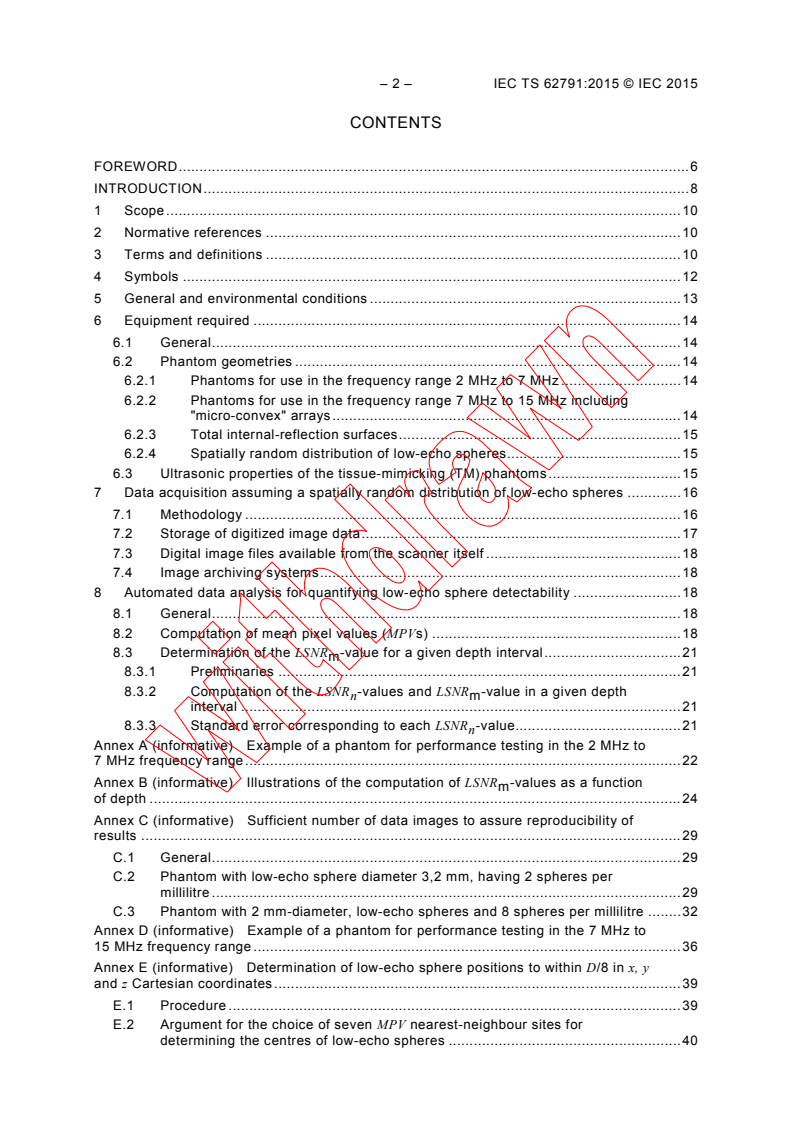
CONTENTS
FOREWORD . 6
INTRODUCTION . 8
1 Scope . 10
2 Normative references . 10
3 Terms and definitions . 10
4 Symbols . 12
5 General and environmental conditions . 13
6 Equipment required . 14
6.1 General . 14
6.2 Phantom geometries . 14
6.2.1 Phantoms for use in the frequency range 2 MHz to 7 MHz . 14
6.2.2 Phantoms for use in the frequency range 7 MHz to 15 MHz including
"micro-convex" arrays . 14
6.2.3 Total internal-reflection surfaces . 15
6.2.4 Spatially random distribution of low-echo spheres. 15
6.3 Ultrasonic properties of the tissue-mimicking (TM) phantoms . 15
7 Data acquisition assuming a spatially random distribution of low-echo spheres . 16
7.1 Methodology . 16
7.2 Storage of digitized image data . 17
7.3 Digital image files available from the scanner itself . 18
7.4 Image archiving systems . 18
8 Automated data analysis for quantifying low-echo sphere detectability . 18
8.1 General . 18
8.2 Computation of mean pixel values (MPVs) . 18
8.3 Determination of the LSNR -value for a given depth interval . 21
m
8.3.1 Preliminaries . 21
8.3.2 Computation of the LSNR -values and LSNR -value in a given depth
n m
interval . 21
8.3.3 Standard error corresponding to each LSNR -value. 21
n
Annex A (informative) Example of a phantom for performance testing in the 2 MHz to
7 MHz frequency range . 22
Annex B (informative) Illustrations of the computation of LSNR -values as a function
m
of depth . 24
Annex C (informative) Sufficient number of data images to assure reproducibility of
results . 29
C.1 General . 29
C.2 Phantom with low-echo sphere diameter 3,2 mm, having 2 spheres per
millilitre . 29
C.3 Phantom with 2 mm-diameter, low-echo spheres and 8 spheres per millilitre . 32
Annex D (informative) Example of a phantom for performance testing in the 7 MHz to
15 MHz frequency range . 36
Annex E (informative) Determination of low-echo sphere positions to within D/8 in x, y
and z Cartesian coordinates . 39
E.1 Procedure . 39
E.2 Argument for the choice of seven MPV nearest-neighbour sites for
determining the centres of low-echo spheres . 40
Annex F (informative) Test of total internal reflection produced by alumina and plate-
glass, plane reflectors . 41
Annex G (informative) Results of a test of reproducibility of LSNR versus depth for a
m
phantom with 4 mm-diameter low-echo spheres and 2 spheres per millilitre . 48
Annex H (informative) Results for low-echo sphere-concentration dependence of
LSNR versus depth for phantoms with 4 mm-diameter spheres . 50
m
Annex I (informative) Results for low-echo sphere-concentration dependence of
LSNR versus depth for phantoms with 3,2 mm-diameter spheres . 53
m
Annex J (informative) Comparison of two different makes of scanner with similar
transducers and console settings . 57
Annex K (informative) Special considerations for 3-D probes . 59
K.1 3-D probes operating in 2-D imaging mode . 59
K.2 2-D arrays operating in 3-D imaging mode for determining LSNR -values as
m
a function of depth for reconstructed images . 59
K.3 Mechanically driven 3-D probes operating in 3-D imaging mode . 59
Bibliography . 60
Figure 1 – Flow chart . 17
Figure 2 – Schematic of an image plane . 20
Figure A.1 – End view of the phantom applicable for 2 MHz to 7 MHz showing the
spatially random distribution of 4-mm diameter low-echo spheres . 22
Figure A.2 – Top view of phantom with 4 mm-diameter, low-echo spheres . 23
Figure B.1 – Convex-array image of a prototype 4 mm-diameter low-echo sphere
phantom for use in the 2 MHz to 7 MHz frequency range . 24
Figure B.2 – Auxiliary figures relating to Figure B.1 . 25
Figure B.3 – Results corresponding to Figures B.1 and B.2, demonstrating
reproducibility . 25
Figure B.4 – Results corresponding to Figures B.1, B.2 and B.3 . 26
Figure B.5 – One of 80 parallel linear-array images of the phantom containing 4 mm-
diameter, low-echo spheres, at 4 MHz with focus at 3 cm . 26
Figure B.6 – Three successive images of the set of 80, separated by D/4 equal to
1 mm . 27
Figure B.7 – Results for the 4 cm-wide, 3 cm-focus, linear array addressed in Figures
B.5 and B.6 . 27
Figure B.8 – Results for the 4 cm-wide, 3 cm-focus, linear array addressed in
Figures B.5, B.6 and B.7, using all 80 image frames corresponding to Figure B.7 . 28
Figure C.1 – One image obtained from a phantom containing 3,2 mm-diameter, low-
echo spheres by using a 4 MHz linear array focused at 3 cm . 29
Figure C.2 – Reproducibility result for two independent sets of 70 images with a mean
number of low-echo sphere centres that is about 15 per 5 mm-depth interval . 30
Figure C.3 – Results obtained by using both sets of 70 independent images
corresponding to Figure C.2 . 30
Figure C.4 – Sector image (curved array) at 4,5 MHz with multiple foci at 4 cm, 8 cm
and 12 cm depths; the low-echo spheres are 3,2 mm in diameter . 31
Figure C.5 – Reproducibility results for a multiple-lateral-focus (4 cm, 8 cm and 12 cm)
case corresponding to Figure C.4 . 31
Figure C.6 – Reproducibility results for the case corresponding to Figure C.5, except
that there is a single focus at 10 cm depth . 32
Figure C.7 – Reproducibility results for the case corresponding to Figure C.5, except
that there is a single focus at 4 cm depth . 32
– 4 – IEC TS 62791:2015 © IEC 2015
Figure C.8 – Image of the phantom containing 2 mm-diameter, low-echo spheres,
made with a curved array having 1,5 cm radius of curvature, with its focus at 3 cm . 33
Figure C.9 – Reproducibility results corresponding to Figure C.8 . 33
Figure C.10 – Results using all 100 images in the image set that gave rise to
Figure C.9 . 34
Figure C.11 – Image of the phantom containing 2 mm-diameter, low-echo spheres,
made with a high-frequency (15 MHz) linear array, laterally focused at 4 cm. 34
Figure C.12 – Reproducibility results corresponding to Figure C.11 . 35
Figure C.13 – Results using all 200 images in the image set that gave rise to Figure
C.12 . 35
Figure D.1 – End- and top-view diagrams of the phantom containing 2 mm-diameter,
low-echo spheres for use in the 7 MHz to 15 MHz frequency range. 37
Figure D.2 – Image obtained by using the phantom containing 2 mm-diameter, low-
echo spheres and a pediatric transducer with a radius of curvature of about 1,5 cm . 38
Figure F.1 – Average of 10 images obtained by using a phased array . 42
Figure F.2 – Plot of the data with blue data computed in the left rectangle in Figure F.1
and red data computed in the right rectangle . 42
Figure F.3 – Plot of the data when the reflector is on the right side with blue computed
in the left rectangle and red computed in the right rectangle . 43
Figure F.4 – The percentage by which the mean pixel values resulting from reflections
differ from the mean pixel values not involving reflections . 44
Figure F.5 – Wide sector (153°), 1 cm-radius-of-curvature transducer with alumina
reflector on the left . 45
Figure F.6 – Plot of the data with blue computed in the left rectangle in Figure F.5 and
red computed in the right rectangle . 45
Figure F.7 – Plot of the data when the reflector is on the right side with blue computed
in the left rectangle and red computed in the right rectangle . 46
Figure F.8 – The percentage by which the mean pixel values resulting from reflections
differ from the mean pixel values not involving reflections . 46
Figure G.1 – Example image of the phantom with a 4,2 MHz curved array and two low-
echo spheres per millilitre . 48
Figure G.2 – Reproducibility results corresponding to the image set, one of which is
shown in Figure G.1 . 49
Figure H.1 – Example of an image from the image set giving rise to the results in
Figure H.2; the phantom contained an average of one 4 mm-diameter, low-echo sphere
per millilitre . 50
Figure H.2 – Results corresponding to an image set, one of which is shown in Figure
H.1 51
Figure H.3 – Example of an image from the data set giving rise to the results in Figure
H.4; the phantom contained an average of two 4 mm-diameter, low-echo spheres per
millilitre . 51
Figure H.4 – Results corresponding to an image set, one of which is shown in Figure
H.3 52
−1
Figure I.1 – Example of an image from the 4 ml data set producing the results shown
in Figure I.2 . 53
Figure I.2 – Results for the phantom containing four 3,2 mm-diameter, low-echo
spheres per millilitre. 54
−1
Figure I.3 – Example of an image from the 2 ml data set producing the results shown
in Figure I.4 . 54
Figure I.4 – Results for the phantom containing two 3,2 mm-diameter, low-echo
spheres per millilitre. 55
−1
Figure I.5 – Example of an image from the 1 ml data set producing the results shown
in Figure I.6 . 55
Figure I.6 – Results for the phantom containing one 3,2 mm-diameter, low-echo sphere
per millilitre . 56
Figure J.1 – Results for System A scanner and 7CF2 3-D (swept convex array)
transducer focused at 4 cm and operated at 4,5 MHz in 2-D mode . 57
Figure J.2 – Results for System B scanner with a 4DC7-3 3-D (convex array)
transducer, operated at 4 MHz in 2-D mode and focused at 4 cm. The sector angle and
all other console settings mimicked those for the System A case (Figure J.1) . 57
– 6 – IEC TS 62791:2015 © IEC 2015
INTERNATIONAL ELECTROTECHNICAL COMMISSION
____________
ULTRASONICS – PULSE-ECHO SCANNERS – LOW-ECHO
SPHERE PHANTOMS AND METHOD FOR PERFORMANCE
TESTING OF GRAY-SCALE MEDICAL ULTRASOUND SCANNERS
APPLICABLE TO A BROAD RANGE OF TRANSDUCER TYPES
FOREWORD
1) The International Electrotechnical Commission (IEC) is a worldwide organization for standardization comprising
all national electrotechnical committees (IEC National Committees). The object of IEC is to promote
international co-operation on all questions concerning standardization in the electrical and electronic fields. To
this end and in addition to other activities, IEC publishes International Standards, Technical Specifications,
Technical Reports, Publicly Available Specifications (PAS) and Guides (hereafter referred to as “IEC
Publication(s)”). Their preparation is entrusted to technical committees; any IEC National Committee interested
in the subject dealt with may participate in this preparatory work. International, governmental and non-
governmental organizations liaising with the IEC also participate in this preparation. IEC collaborates closely
with the International Organization for Standardization (ISO) in accordance with conditions determined by
agreement between the two organizations.
2) The formal decisions or agreements of IEC on technical matters express, as nearly as possible, an international
consensus of opinion on the relevant subjects since each technical committee has representation from all
interested IEC National Committees.
3) IEC Publications have the form of recommendations for international use and are accepted by IEC National
Committees in that sense. While all reasonable efforts are made to ensure that the technical content of IEC
Publications is accurate, IEC cannot be held responsible for the way in which they are used or for any
misinterpretation by any end user.
4) In order to promote international uniformity, IEC National Committees undertake to apply IEC Publications
transparently to the maximum extent possible in their national and regional publications. Any divergence
between any IEC Publication and the corresponding national or regional publication should be clearly indicated
in the latter.
5) IEC itself does not provide any attestation of conformity. Independent certification bodies provide conformity
assessment services and, in some areas, access to IEC marks of conformity. IEC is not responsible for any
services carried out by independent certification bodies.
6) All users should ensure that they have the latest edition of this publication.
7) No liability should attach to IEC or its directors, employees, servants or agents including individual experts and
members of its technical committees and IEC National Committees for any personal injury, property damage or
other damage of any nature whatsoever, whether direct or indirect, or for costs (including legal fees) and
expenses arising out of the publication, use of, or reliance upon, this IEC Publication or any other IEC
Publications.
8) Attention is drawn to the Normative references cited in this publication. Use of the referenced publications is
indispensable for the correct application of this publication.
The main task of IEC technical committees is to prepare International Standards. In
exceptional circumstances, a technical committee may propose the publication of a Technical
Specification when
• the required support cannot be obtained for the publication of an International Standard,
despite repeated efforts, or
• the subject is still under technical development or where, for any other reason, there is the
future but no immediate possibility of an agreement on an International Standard.
Technical Specifications are subject to review within three years of publication to decide
whether they can be transformed into International Standards.
Technical Specification IEC TS 62791 has been prepared by IEC technical committee 87
Ultrasonics.
The text of this Technical Specification is based on the following documents:
DTS Report on voting
87/554/DTS 87/570/RVC
Full information on the voting for the approval of this Technical Specification can be found in
the report on voting indicated in the above table.
This publication has been drafted in accordance with the ISO/IEC Directives, Part 2.
Terms in bold in the text are defined in Clause 3.
The committee has decided that the contents of this publication will remain unchanged until
the stability date indicated on the IEC website under "http://webstore.iec.ch" in the data
related to the specific publication. At this date, the publication will be
• transformed into an International standard,
• reconfirmed,
• withdrawn,
• replaced by a revised edition, or
• amended.
IMPORTANT – The 'colour inside' logo on the cover page of this publication indicates
that it contains colours which are considered to be useful for the correct
understanding of its contents. Users should therefore print this document using a
colour printer.
A bilingual version of this publication may be issued at a later date.
– 8 – IEC TS 62791:2015 © IEC 2015
INTRODUCTION
Ultrasonic pulse-echo scanners are widely used in medical practice to produce images of soft
tissue organs throughout the human body. Most ultrasonic pulse-echo scanners produce real-
time images of tissue in a scan plane by sweeping a narrow, pulsed beam of ultrasound
through the tissue section of interest and detecting the echoes generated by reflection at
tissue boundaries and by scattering within tissues. Generally, the sweep that generates an
image frame is repeated at least 20 times per second, giving rise to the real-time aspect of
the displayed image. The axes of the pulsed beams generally lie in a plane that defines the
scan plane.
Various transducer types are employed to operate in a transmit/receive mode to
generate/detect the ultrasonic signals. Linear arrays, in which the beam axes are all parallel
to one another, resulting in a rectangular image, consist of a line of hundreds of parallel
transducer elements with a subset of adjacent elements producing one pulse at a time.
Convex arrays are similar to linear arrays but the element arrangements define part of the
surface of a short right circular cylinder with the array elements parallel to the axis of the
cylinder. The radius of curvature of the cylinder (and therefore the array) can have values
between 0,5 cm and 7 cm. The convex array generates a sector image since the beam axes
fan out over the scan plane. A phased array has a linear arrangement of elements, where all
elements act together to form a pulse and the direction and focus of an emitted pulse is
determined by the timing of excitations of the elements. The phased array generates a sector
image. Another type of sector scanner is the mechanical sector scanner in which a single
element transducer or an annular array transducer is rotated about a fixed axis during pulse
emissions. All the foregoing transducer types commonly operate within the frequency range
2 MHz to 15 MHz, to which this Technical Specification applies.
A 2-dimensional array (2-D array) is restricted to an array of transducer elements distributed
over a square area or a spherical cap. Such an array receives echoes from a 3-D volume and
can produce images corresponding to any planar surface in that volume. A 3-D mechanically
driven, convex array (3-D MD convex array) means a convex array that acquires images as it
is rotated mechanically about an axis lying in its image plane or an extension of that plane.
A 3-D mechanically driven, linear array (3-D MD linear array) is similar to a 3-D MD convex
array, where the array radius of curvature is infinite and the array is either rotated about an
axis or is translated perpendicularly to the scan plane of the linear array. For an overview of
current 3-D and 4-D systems, see sections 1.5 and 10.2.2 of [1] .
One means for testing the imaging performance of an ultrasound pulse-echo scanner is to
quantify the degree to which a small cyst-like (low-echo) object is distinguished from the
surrounding soft tissue, i.e. the degree to which a small cyst-like (low-echo) object is
detectable in the surrounding soft tissue. It is reasonable to assume that the smaller the low-
echo sphere that can be detected at some position, the better the resolution of the scanner,
i.e. the better it will delineate the boundary of an abnormal object, such as a tumour. There
are three components of resolution defined in pulse-echo ultrasound:
– axial resolution (parallel to the local pulse propagation direction);
– lateral resolution (perpendicular to the local pulse propagation direction and parallel to the
scan plane); and
– elevational resolution (perpendicular to the local pulse propagation direction and also to
the scan plane).
Axial resolution usually – but not always – is better than lateral and elevational resolutions.
Thus, all three components should be given equal weight in measuring detectability. A
sphere has no preferred orientation and is therefore the best shape for a cyst-like object for
two reasons. First, all three components of resolution are weighted equally no matter what the
beam’s incident direction is. Second, the incident beam’s propagation direction will vary
____________
The numbers in square brackets refer to the Bibliography.
considerably in the case of convex and phased arrays depending on where the object exists
in the imaged volume.
It is important that the phantom allows quantification of detectability to be carried out over
the entire depth range imaged; thus, it is important that the low-echo spheres exist up to the
entire scanning window. A phantom limited to a flat scanning surface is acceptable for a linear
array, phased array, or a flat 2-D array, but not for the remaining types of arrays. Each of the
phantoms described in this Technical Specification contains a random distribution of equal
diameter [2], low-echo spheres existing at all depths, including the case of those designed for
testing convex (curved) arrays.
This Technical Specification summarizes the requirements for a phantom to provide for
determination of detectability of low-echo (cyst-like) objects for any type of pulse-echo
transducer, except (perhaps) a 2-D array with a spherical-cap surface.
The International Electrotechnical Commission (IEC) draws attention to the fact that it is
claimed that compliance with this document may involve the use of US Patents 5,574,212 and
8,887,552, concerning an “Automated System and Method for Testing Resolution of
Ultrasound Scanners” and an “Ultrasound Phantom Having a Curved Surface”, respectively,
given in 8.2 and 8.3, and Annexes A and D.
IEC takes no position concerning the evidence, validity and scope of this patent right.
The holder of this patent right has assured the IEC that he/she is willing to negotiate licences
under reasonable and non-discriminatory terms and conditions with applicants throughout the
world. In this respect, the statement of the holder of this patent right is registered with IEC.
Information may be obtained from:
Wisconsin Alumni Research Foundation,
614 Walnut Street. 13th Floor,
Madison, WI 53726,
USA
Attention is drawn to the possibility that some of the elements of this document may be the
subject of patent rights other than those identified above. IEC shall not be held responsible for
identifying any or all such patent rights.
ISO (www.iso.org/patents) and IEC (http://patents.iec.ch) maintain on-line data bases of
patents relevant to their standards. Users are encouraged to consult the data bases for the
most up to date information concerning patents.
– 10 – IEC TS 62791:2015 © IEC 2015
ULTRASONICS – PULSE-ECHO SCANNERS – LOW-ECHO
SPHERE PHANTOMS AND METHOD FOR PERFORMANCE
TESTING OF GRAY-SCALE MEDICAL ULTRASOUND SCANNERS
APPLICABLE TO A BROAD RANGE OF TRANSDUCER TYPES
1 Scope
This Technical Specification defines terms and specifies methods for quantifying the imaging
performance of real-time, ultrasound B-mode scanners. The types of transducers used (see
sections 7.6 and 10.7 of [1]) with these scanners include
a) phased array,
b) linear arrays,
c) convex arrays,
d) mechanical sector scanners,
e) 3-D probes operating in 2-D imaging mode (see Annex K),
f) 3-D probes operating in 3-D imaging mode for a limited number of sets of reconstructed
2-D images (see Annex K).
The test methodology is applicable for transducers operating in the 2 MHz to 15 MHz
frequency range.
2 Normative references
The following documents, in whole or in part, are normatively referenced in this document and
are indispensable for its application. For dated references, only the edition cited applies. For
undated references, the latest edition of the referenced document (including any
amendments) applies.
IEC 60050-802, International Electrotechnical Vocabulary – Ultrasonics (available at:
http://www.electropedia.org)
IEC 61391-1, Ultrasonics – Pulse-echo scanners – Part 1: Techniques for calibrating spatial
measurement systems and measurement of system point-spread function response
IEC 61391-2:2010, Ultrasonics – Pulse-echo scanners – Part 2: Measurement of maximum
depth of penetration and local dynamic range
3 Terms and definitions
For the purposes of this document, the terms and definitions given in IEC 60050-802,
IEC 61391-1 and the following apply.
3.1
active area of a transducer
area over which transducer transmitting and/or receiving elements are distributed
3.2
backscatter coefficient
intrinsic backscatter coefficient
BSC
intrinsic property of a material at some frequency, equal to the differential scattering cross-
section per unit volume for a scattering angle of 180°
Note 1 to entry: See [4], [5], [6].
[SOURCE: IEC 61391-1:2006, 3.6, modified]
3.3
low-echo sphere
spherical inclusion in a phantom with backscatter coefficient much lower than that of the
background tissue-mimicking material
Note 1 to entry: All low-echo spheres in a phantom have the same diameter with a tolerance of ±1 %.
3.4
low-echo sphere diameter
D
diameter of the low-echo spherical inclusions in a phantom
Note 1 to entry: It is generally assumed that all low-echo spheres in a particular phantom have the same
diameter D. The diameter tolerance is ±1 %.
3.5
pixel
smallest spatial unit or cell size of a digitized 2-dimensional array representation of an image
Note 1 to entry: Each pixel has an address corresponding to its position in the array.
Note 2 to entry: Pixel is a contraction of ‘picture element’.
[SOURCE: IEC 61391-1:2006, 3.23, modified]
3.6
pixel value
integer value of a processed signal level or integer values of processed colour levels,
provided to the display for a given pixel
Note 1 to entry: In a gray-scale display the pixel value is converted to a luminance by some, usually monotonic,
(M – 1)
function. The set of integer values representing the gray scale runs from 0 (black) to 2 (white), where M is a
positive integer, commonly called the bit depth. Thus, if M = 8, the largest pixel value in the set is 255.
3.7
digitized image data
two-dimensional set of pixel values derived from the ultrasound echo signals that form an
ultrasound image
3.8
mean pixel value
MPV
mean of pixel values detected over an area A in a phantom image, where A is somewhat
smaller than the area of a circle of diameter D
Note 1 to entry: The phrase “somewhat less than” is introduced as partial compensation for the partial volume
effect in the elevational dimension [3].
Note 2 to entry: The partial volume effect is a term common in CT and MR imaging, namely if an object is smaller
than the slice thickness, then the signal will include the contribution of that object and the material around it. For
example, if the object is a sphere, then contribution to the signal will occur from material surrounding the sphere
– 12 – IEC TS 62791:2015 © IEC 2015
and in a cylinder with radius equal to that of the sphere and perpendicular to the slice. In the ultrasound case, the
slice corresponds to the elevational beam profile.
3.9
depth interval
interval in depth of area segments into which an image area is subdivided for computation of
LSNR -values as a function of depth
m
Note 1 to entry: Experience determining LSNR -values for numerous cases has led to the conclusion that a 5 mm-
m
depth interval is adequate for the phantoms containing 3,2 mm-diameter and 4 mm-diameter, low-echo spheres,
and a 2 mm-depth interval is adequate for the phantoms containing 2 mm-diameter, low-echo spheres.
Note 2 to entry: The maximum depth (depth of field) is the sum of a set of contiguous depth intervals; thus, if the
depth of field is 14 cm and each depth interval spans 5 mm = 0,5 cm, then there are 14 cm/0,5 cm = 28 depth
intervals.
Note 3 to entry: A rectangular scan area will be subdivided into horizontal bands; a sector scan area will be
subdivided into annular ring segments, the angular limits being determined by the sector angle [see Figure B.2 d)].
Rectilinear projection of these area segments in the elevational direction will create volume segments analogous to
slabs and partial cylindrical shells with thickness equal to the depth interval, respectively.
Note 4 to entry: Depth interval is expressed in millimetres (mm).
3.10
detectability
numerical value quantifying the probability that a human observer will detect an object in an
image having background speckle
3.11
lesion signal-to-noise ratio for the nth low-echo sphere
LSNR
n
numerical value quantifying the detectability of a macroscopically uniform, low-echo sphere
in a macroscopically uniform, surrounding-background material and having its centre in a
volume segment determined by a given depth interval in the phantom
Note 1 to entry: Low-echo spheres with centres located less than a distance, 2D, from a lateral image boundary
are excluded.
3.12
mean lesion signal-to-noise ratio
LSNR
m
mean value of lesion signal-to-noise ratios for low-echo spheres whose centres lie in a
volume segment determined by a given depth interval in the phantom
Note 1 to entry: Low-echo spheres with centres located less than a distance, 2D, from a lateral image boundary
are excluded.
4 Symbols
Symbol Meaning Clause
A area in an image plane selected for calculation of MPV 3.8
BSC , BSC backscatter coefficient 3.2
obj bkg
D low-echo sphere diameter 3.4
d integer for counting depth intervals E.1
i, j, k integers corresponding to rows and columns and the 8.2
elevational direction of the cubic array, respectively
i (in Annex F)
index taking values 1 or 2 to indicate one side or opposite Formula
side of a phantom, where a reflector is situated (F.1)
Symbol Meaning Clause
LSNR mean lesion signal-to-noise ratio
m 3.12
LSNR lesion signal-to-noise ratio for the nth low-echo sphere 3.11
n
M mean of all MPVs with centres lying within volume segment, d, E.1
d
using the entire image set
MPV mean pixel value
3.8
(MPV) MPV at the ijk-site of the cubic array 8.2
ijk
(MPV) = S MPV calculated over area A centred at the projection of 8.2
n Ln
(x , y ) onto the image plane nearest to z
CMn CMn CM
N
total number of detected low-echo spheres with centres in the 8.3.2
volume segment determined by a depth interval (including
all image frames)
n
integer for counting low-echo spheres 3.11
P(u) probability of there being u low-echo sphere centres in an
6.2.4
arbitrarily chosen 1 ml volume
q
exponent of the frequency dependence of the backscatter 6.3
coefficient
R and N mean pixel values on the reflector side and non-reflector Formula
i i
side of phantom (F.1)
S = (MPV) MPV calculated over area A centred at the projection of
8.3.2
Ln n
(x , y ) onto the image plane nearest to z
CMn CMn CM
S mean of all MPVs in the specified image plane whose centres 8.3.2
mBn
are within the annulus defined by radii equal to (3/4)D and 2D
and centred at the coordinates of S
Ln
SD standard deviation of all MPVs with centres lying within E.1
d
volume segment, d, using the entire image set
x , y , z coordinates of the centre of mass of the nth low-echo sphere E.1
CMn CMn CMn
x , y projections onto the nearest image plane of the x- and y- 8.2
n n
coordinates of the centre of mass of the nth low-echo sphere
(x , y )
CMn CMn
v mean number of low-echo sphere centres per millilitre 6.2.4
standard deviation of all MPVs contributing to S 8.3.2
σ
mBn
Bn
NOTE Additional symbols used only in relation to Figure F.4 are defined in the text below that figure.
5 General and environmental conditions
The manufacturer’s specification should allow comparison with the results obtained from the
tests described in this Technical Specification.
– 14 – IEC TS 62791:2015 © IEC 2015
All measurements should be performed within the following ambient conditions:
– temperature, 23 °C ± 3 °C;
– relative humidity, 10 % to 95 %;
– atmospheric pressure, 66 kPa to 106 kPa.
Properties of ultrasound phantoms, such as speed of sound and attenuation coefficient, can
vary with temperature. Consult the specifications published by the phantom manufacturer to
determine whether the expected acoustic properties are maintained under the above
environmental conditions. If not, the environmental conditions over which expected and
reproducible results can be obtained from the phantom or test object should be adopted for
tests described below.
6 Equipment required
6.1 General
The test procedures described in this Technical Specification should be carried out using
tissue-mimicking phantoms with digitized image data acquired from the ultrasound scanner.
6.2 Phantom geometries
6.2.1 Phantoms for use in the frequency range 2 MHz to 7 MHz
The phantom should allow imaging to a depth of at least 16 cm and provide for display of the
entire B-scan image frame. Low-echo spheres should be available for detectability
assessment over the entire image frame and the diameter of these spheres should be
specified by the manufacturer within ±1 %. The mean number of spheres per unit volume
should be at least 1 per millilitre, but the volume fraction consisting of spheres should not
exceed 3,3 %. Scanning windows should provide for contact of the entire emitting surface of
the transducer (active area of a transducer), while allowing elevational translation of the
transducer over a sufficient distance that the most likely number of spheres traversed by the
scan plane at or near the focal distance(s) is 25 or more in a 5-mm depth interval.
A low-echo sphere diameter between 3 mm and 4 mm is recommended for adequate
performance assessment in the 2 MHz to 7 MHz range.
NOTE One low-echo sphere can serve as two such spheres if total internal reflection at a planar surface provides
an independent image. See Annex A for an example of geometry.
6.2.2 Phantoms for use in the frequency range 7 MHz to 15 MHz including "micro-
convex" arrays
The phantom should allow imaging to a depth of at least 10 cm and provide for display of the
entire B-scan image frame. Low-echo spheres should be available for detectability
assessment over the entire image frame and the diameter of these spheres should be
specified by the manufacturer within ±1 %. The mean number of spheres per unit volume
should be at least 8 per millilitre, but the volume fraction consisting of such spheres should
not exceed 3,3 %. Scanning windows should provide for contact of the entire emitting surface
of
...
IEC TS 62791 ®
Edition 1.0 2015-09
TECHNICAL
SPECIFICATION
colour
inside
Ultrasonics – Pulse-echo scanners – Low-echo sphere phantoms and method
for performance testing of gray-scale medical ultrasound scanners applicable to
a broad range of transducer types
All rights reserved. Unless otherwise specified, no part of this publication may be reproduced or utilized in any form
or by any means, electronic or mechanical, including photocopying and microfilm, without permission in writing from
either IEC or IEC's member National Committee in the country of the requester. If you have any questions about IEC
copyright or have an enquiry about obtaining additional rights to this publication, please contact the address below or
your local IEC member National Committee for further information.
IEC Central Office Tel.: +41 22 919 02 11
3, rue de Varembé Fax: +41 22 919 03 00
CH-1211 Geneva 20 info@iec.ch
Switzerland www.iec.ch
About the IEC
The International Electrotechnical Commission (IEC) is the leading global organization that prepares and publishes
International Standards for all electrical, electronic and related technologies.
About IEC publications
The technical content of IEC publications is kept under constant review by the IEC. Please make sure that you have the
latest edition, a corrigenda or an amendment might have been published.
IEC Catalogue - webstore.iec.ch/catalogue Electropedia - www.electropedia.org
The stand-alone application for consulting the entire The world's leading online dictionary of electronic and
bibliographical information on IEC International Standards, electrical terms containing more than 30 000 terms and
Technical Specifications, Technical Reports and other definitions in English and French, with equivalent terms in 15
documents. Available for PC, Mac OS, Android Tablets and additional languages. Also known as the International
iPad. Electrotechnical Vocabulary (IEV) online.
IEC publications search - www.iec.ch/searchpub IEC Glossary - std.iec.ch/glossary
The advanced search enables to find IEC publications by a More than 60 000 electrotechnical terminology entries in
variety of criteria (reference number, text, technical English and French extracted from the Terms and Definitions
committee,…). It also gives information on projects, replaced clause of IEC publications issued since 2002. Some entries
and withdrawn publications. have been collected from earlier publications of IEC TC 37,
77, 86 and CISPR.
IEC Just Published - webstore.iec.ch/justpublished
Stay up to date on all new IEC publications. Just Published IEC Customer Service Centre - webstore.iec.ch/csc
details all new publications released. Available online and If you wish to give us your feedback on this publication or
also once a month by email. need further assistance, please contact the Customer Service
Centre: csc@iec.ch.
IEC TS 62791 ®
Edition 1.0 2015-09
TECHNICAL
SPECIFICATION
colour
inside
Ultrasonics – Pulse-echo scanners – Low-echo sphere phantoms and method
for performance testing of gray-scale medical ultrasound scanners applicable to
a broad range of transducer types
INTERNATIONAL
ELECTROTECHNICAL
COMMISSION
ICS 11.040.50; 17.140.50 ISBN 978-2-8322-2902-6
– 2 – IEC TS 62791:2015 © IEC 2015
CONTENTS
FOREWORD . 6
INTRODUCTION . 8
1 Scope . 10
2 Normative references . 10
3 Terms and definitions . 10
4 Symbols . 12
5 General and environmental conditions . 13
6 Equipment required . 14
6.1 General . 14
6.2 Phantom geometries . 14
6.2.1 Phantoms for use in the frequency range 2 MHz to 7 MHz . 14
6.2.2 Phantoms for use in the frequency range 7 MHz to 15 MHz including
"micro-convex" arrays . 14
6.2.3 Total internal-reflection surfaces . 15
6.2.4 Spatially random distribution of low-echo spheres. 15
6.3 Ultrasonic properties of the tissue-mimicking (TM) phantoms . 15
7 Data acquisition assuming a spatially random distribution of low-echo spheres . 16
7.1 Methodology . 16
7.2 Storage of digitized image data . 17
7.3 Digital image files available from the scanner itself . 18
7.4 Image archiving systems . 18
8 Automated data analysis for quantifying low-echo sphere detectability . 18
8.1 General . 18
8.2 Computation of mean pixel values (MPVs) . 18
8.3 Determination of the LSNR -value for a given depth interval . 21
m
8.3.1 Preliminaries . 21
8.3.2 Computation of the LSNR -values and LSNR -value in a given depth
n m
interval . 21
8.3.3 Standard error corresponding to each LSNR -value. 21
n
Annex A (informative) Example of a phantom for performance testing in the 2 MHz to
7 MHz frequency range . 22
Annex B (informative) Illustrations of the computation of LSNR -values as a function
m
of depth . 24
Annex C (informative) Sufficient number of data images to assure reproducibility of
results . 29
C.1 General . 29
C.2 Phantom with low-echo sphere diameter 3,2 mm, having 2 spheres per
millilitre . 29
C.3 Phantom with 2 mm-diameter, low-echo spheres and 8 spheres per millilitre . 32
Annex D (informative) Example of a phantom for performance testing in the 7 MHz to
15 MHz frequency range . 36
Annex E (informative) Determination of low-echo sphere positions to within D/8 in x, y
and z Cartesian coordinates . 39
E.1 Procedure . 39
E.2 Argument for the choice of seven MPV nearest-neighbour sites for
determining the centres of low-echo spheres . 40
Annex F (informative) Test of total internal reflection produced by alumina and plate-
glass, plane reflectors . 41
Annex G (informative) Results of a test of reproducibility of LSNR versus depth for a
m
phantom with 4 mm-diameter low-echo spheres and 2 spheres per millilitre . 48
Annex H (informative) Results for low-echo sphere-concentration dependence of
LSNR versus depth for phantoms with 4 mm-diameter spheres . 50
m
Annex I (informative) Results for low-echo sphere-concentration dependence of
LSNR versus depth for phantoms with 3,2 mm-diameter spheres . 53
m
Annex J (informative) Comparison of two different makes of scanner with similar
transducers and console settings . 57
Annex K (informative) Special considerations for 3-D probes . 59
K.1 3-D probes operating in 2-D imaging mode . 59
K.2 2-D arrays operating in 3-D imaging mode for determining LSNR -values as
m
a function of depth for reconstructed images . 59
K.3 Mechanically driven 3-D probes operating in 3-D imaging mode . 59
Bibliography . 60
Figure 1 – Flow chart . 17
Figure 2 – Schematic of an image plane . 20
Figure A.1 – End view of the phantom applicable for 2 MHz to 7 MHz showing the
spatially random distribution of 4-mm diameter low-echo spheres . 22
Figure A.2 – Top view of phantom with 4 mm-diameter, low-echo spheres . 23
Figure B.1 – Convex-array image of a prototype 4 mm-diameter low-echo sphere
phantom for use in the 2 MHz to 7 MHz frequency range . 24
Figure B.2 – Auxiliary figures relating to Figure B.1 . 25
Figure B.3 – Results corresponding to Figures B.1 and B.2, demonstrating
reproducibility . 25
Figure B.4 – Results corresponding to Figures B.1, B.2 and B.3 . 26
Figure B.5 – One of 80 parallel linear-array images of the phantom containing 4 mm-
diameter, low-echo spheres, at 4 MHz with focus at 3 cm . 26
Figure B.6 – Three successive images of the set of 80, separated by D/4 equal to
1 mm . 27
Figure B.7 – Results for the 4 cm-wide, 3 cm-focus, linear array addressed in Figures
B.5 and B.6 . 27
Figure B.8 – Results for the 4 cm-wide, 3 cm-focus, linear array addressed in
Figures B.5, B.6 and B.7, using all 80 image frames corresponding to Figure B.7 . 28
Figure C.1 – One image obtained from a phantom containing 3,2 mm-diameter, low-
echo spheres by using a 4 MHz linear array focused at 3 cm . 29
Figure C.2 – Reproducibility result for two independent sets of 70 images with a mean
number of low-echo sphere centres that is about 15 per 5 mm-depth interval . 30
Figure C.3 – Results obtained by using both sets of 70 independent images
corresponding to Figure C.2 . 30
Figure C.4 – Sector image (curved array) at 4,5 MHz with multiple foci at 4 cm, 8 cm
and 12 cm depths; the low-echo spheres are 3,2 mm in diameter . 31
Figure C.5 – Reproducibility results for a multiple-lateral-focus (4 cm, 8 cm and 12 cm)
case corresponding to Figure C.4 . 31
Figure C.6 – Reproducibility results for the case corresponding to Figure C.5, except
that there is a single focus at 10 cm depth . 32
Figure C.7 – Reproducibility results for the case corresponding to Figure C.5, except
that there is a single focus at 4 cm depth . 32
– 4 – IEC TS 62791:2015 © IEC 2015
Figure C.8 – Image of the phantom containing 2 mm-diameter, low-echo spheres,
made with a curved array having 1,5 cm radius of curvature, with its focus at 3 cm . 33
Figure C.9 – Reproducibility results corresponding to Figure C.8 . 33
Figure C.10 – Results using all 100 images in the image set that gave rise to
Figure C.9 . 34
Figure C.11 – Image of the phantom containing 2 mm-diameter, low-echo spheres,
made with a high-frequency (15 MHz) linear array, laterally focused at 4 cm. 34
Figure C.12 – Reproducibility results corresponding to Figure C.11 . 35
Figure C.13 – Results using all 200 images in the image set that gave rise to Figure
C.12 . 35
Figure D.1 – End- and top-view diagrams of the phantom containing 2 mm-diameter,
low-echo spheres for use in the 7 MHz to 15 MHz frequency range. 37
Figure D.2 – Image obtained by using the phantom containing 2 mm-diameter, low-
echo spheres and a pediatric transducer with a radius of curvature of about 1,5 cm . 38
Figure F.1 – Average of 10 images obtained by using a phased array . 42
Figure F.2 – Plot of the data with blue data computed in the left rectangle in Figure F.1
and red data computed in the right rectangle . 42
Figure F.3 – Plot of the data when the reflector is on the right side with blue computed
in the left rectangle and red computed in the right rectangle . 43
Figure F.4 – The percentage by which the mean pixel values resulting from reflections
differ from the mean pixel values not involving reflections . 44
Figure F.5 – Wide sector (153°), 1 cm-radius-of-curvature transducer with alumina
reflector on the left . 45
Figure F.6 – Plot of the data with blue computed in the left rectangle in Figure F.5 and
red computed in the right rectangle . 45
Figure F.7 – Plot of the data when the reflector is on the right side with blue computed
in the left rectangle and red computed in the right rectangle . 46
Figure F.8 – The percentage by which the mean pixel values resulting from reflections
differ from the mean pixel values not involving reflections . 46
Figure G.1 – Example image of the phantom with a 4,2 MHz curved array and two low-
echo spheres per millilitre . 48
Figure G.2 – Reproducibility results corresponding to the image set, one of which is
shown in Figure G.1 . 49
Figure H.1 – Example of an image from the image set giving rise to the results in
Figure H.2; the phantom contained an average of one 4 mm-diameter, low-echo sphere
per millilitre . 50
Figure H.2 – Results corresponding to an image set, one of which is shown in Figure
H.1 51
Figure H.3 – Example of an image from the data set giving rise to the results in Figure
H.4; the phantom contained an average of two 4 mm-diameter, low-echo spheres per
millilitre . 51
Figure H.4 – Results corresponding to an image set, one of which is shown in Figure
H.3 52
−1
Figure I.1 – Example of an image from the 4 ml data set producing the results shown
in Figure I.2 . 53
Figure I.2 – Results for the phantom containing four 3,2 mm-diameter, low-echo
spheres per millilitre. 54
−1
Figure I.3 – Example of an image from the 2 ml data set producing the results shown
in Figure I.4 . 54
Figure I.4 – Results for the phantom containing two 3,2 mm-diameter, low-echo
spheres per millilitre. 55
−1
Figure I.5 – Example of an image from the 1 ml data set producing the results shown
in Figure I.6 . 55
Figure I.6 – Results for the phantom containing one 3,2 mm-diameter, low-echo sphere
per millilitre . 56
Figure J.1 – Results for System A scanner and 7CF2 3-D (swept convex array)
transducer focused at 4 cm and operated at 4,5 MHz in 2-D mode . 57
Figure J.2 – Results for System B scanner with a 4DC7-3 3-D (convex array)
transducer, operated at 4 MHz in 2-D mode and focused at 4 cm. The sector angle and
all other console settings mimicked those for the System A case (Figure J.1) . 57
– 6 – IEC TS 62791:2015 © IEC 2015
INTERNATIONAL ELECTROTECHNICAL COMMISSION
____________
ULTRASONICS – PULSE-ECHO SCANNERS – LOW-ECHO
SPHERE PHANTOMS AND METHOD FOR PERFORMANCE
TESTING OF GRAY-SCALE MEDICAL ULTRASOUND SCANNERS
APPLICABLE TO A BROAD RANGE OF TRANSDUCER TYPES
FOREWORD
1) The International Electrotechnical Commission (IEC) is a worldwide organization for standardization comprising
all national electrotechnical committees (IEC National Committees). The object of IEC is to promote
international co-operation on all questions concerning standardization in the electrical and electronic fields. To
this end and in addition to other activities, IEC publishes International Standards, Technical Specifications,
Technical Reports, Publicly Available Specifications (PAS) and Guides (hereafter referred to as “IEC
Publication(s)”). Their preparation is entrusted to technical committees; any IEC National Committee interested
in the subject dealt with may participate in this preparatory work. International, governmental and non-
governmental organizations liaising with the IEC also participate in this preparation. IEC collaborates closely
with the International Organization for Standardization (ISO) in accordance with conditions determined by
agreement between the two organizations.
2) The formal decisions or agreements of IEC on technical matters express, as nearly as possible, an international
consensus of opinion on the relevant subjects since each technical committee has representation from all
interested IEC National Committees.
3) IEC Publications have the form of recommendations for international use and are accepted by IEC National
Committees in that sense. While all reasonable efforts are made to ensure that the technical content of IEC
Publications is accurate, IEC cannot be held responsible for the way in which they are used or for any
misinterpretation by any end user.
4) In order to promote international uniformity, IEC National Committees undertake to apply IEC Publications
transparently to the maximum extent possible in their national and regional publications. Any divergence
between any IEC Publication and the corresponding national or regional publication should be clearly indicated
in the latter.
5) IEC itself does not provide any attestation of conformity. Independent certification bodies provide conformity
assessment services and, in some areas, access to IEC marks of conformity. IEC is not responsible for any
services carried out by independent certification bodies.
6) All users should ensure that they have the latest edition of this publication.
7) No liability should attach to IEC or its directors, employees, servants or agents including individual experts and
members of its technical committees and IEC National Committees for any personal injury, property damage or
other damage of any nature whatsoever, whether direct or indirect, or for costs (including legal fees) and
expenses arising out of the publication, use of, or reliance upon, this IEC Publication or any other IEC
Publications.
8) Attention is drawn to the Normative references cited in this publication. Use of the referenced publications is
indispensable for the correct application of this publication.
The main task of IEC technical committees is to prepare International Standards. In
exceptional circumstances, a technical committee may propose the publication of a Technical
Specification when
• the required support cannot be obtained for the publication of an International Standard,
despite repeated efforts, or
• the subject is still under technical development or where, for any other reason, there is the
future but no immediate possibility of an agreement on an International Standard.
Technical Specifications are subject to review within three years of publication to decide
whether they can be transformed into International Standards.
Technical Specification IEC TS 62791 has been prepared by IEC technical committee 87
Ultrasonics.
The text of this Technical Specification is based on the following documents:
DTS Report on voting
87/554/DTS 87/570/RVC
Full information on the voting for the approval of this Technical Specification can be found in
the report on voting indicated in the above table.
This publication has been drafted in accordance with the ISO/IEC Directives, Part 2.
Terms in bold in the text are defined in Clause 3.
The committee has decided that the contents of this publication will remain unchanged until
the stability date indicated on the IEC website under "http://webstore.iec.ch" in the data
related to the specific publication. At this date, the publication will be
• transformed into an International standard,
• reconfirmed,
• withdrawn,
• replaced by a revised edition, or
• amended.
IMPORTANT – The 'colour inside' logo on the cover page of this publication indicates
that it contains colours which are considered to be useful for the correct
understanding of its contents. Users should therefore print this document using a
colour printer.
A bilingual version of this publication may be issued at a later date.
– 8 – IEC TS 62791:2015 © IEC 2015
INTRODUCTION
Ultrasonic pulse-echo scanners are widely used in medical practice to produce images of soft
tissue organs throughout the human body. Most ultrasonic pulse-echo scanners produce real-
time images of tissue in a scan plane by sweeping a narrow, pulsed beam of ultrasound
through the tissue section of interest and detecting the echoes generated by reflection at
tissue boundaries and by scattering within tissues. Generally, the sweep that generates an
image frame is repeated at least 20 times per second, giving rise to the real-time aspect of
the displayed image. The axes of the pulsed beams generally lie in a plane that defines the
scan plane.
Various transducer types are employed to operate in a transmit/receive mode to
generate/detect the ultrasonic signals. Linear arrays, in which the beam axes are all parallel
to one another, resulting in a rectangular image, consist of a line of hundreds of parallel
transducer elements with a subset of adjacent elements producing one pulse at a time.
Convex arrays are similar to linear arrays but the element arrangements define part of the
surface of a short right circular cylinder with the array elements parallel to the axis of the
cylinder. The radius of curvature of the cylinder (and therefore the array) can have values
between 0,5 cm and 7 cm. The convex array generates a sector image since the beam axes
fan out over the scan plane. A phased array has a linear arrangement of elements, where all
elements act together to form a pulse and the direction and focus of an emitted pulse is
determined by the timing of excitations of the elements. The phased array generates a sector
image. Another type of sector scanner is the mechanical sector scanner in which a single
element transducer or an annular array transducer is rotated about a fixed axis during pulse
emissions. All the foregoing transducer types commonly operate within the frequency range
2 MHz to 15 MHz, to which this Technical Specification applies.
A 2-dimensional array (2-D array) is restricted to an array of transducer elements distributed
over a square area or a spherical cap. Such an array receives echoes from a 3-D volume and
can produce images corresponding to any planar surface in that volume. A 3-D mechanically
driven, convex array (3-D MD convex array) means a convex array that acquires images as it
is rotated mechanically about an axis lying in its image plane or an extension of that plane.
A 3-D mechanically driven, linear array (3-D MD linear array) is similar to a 3-D MD convex
array, where the array radius of curvature is infinite and the array is either rotated about an
axis or is translated perpendicularly to the scan plane of the linear array. For an overview of
current 3-D and 4-D systems, see sections 1.5 and 10.2.2 of [1] .
One means for testing the imaging performance of an ultrasound pulse-echo scanner is to
quantify the degree to which a small cyst-like (low-echo) object is distinguished from the
surrounding soft tissue, i.e. the degree to which a small cyst-like (low-echo) object is
detectable in the surrounding soft tissue. It is reasonable to assume that the smaller the low-
echo sphere that can be detected at some position, the better the resolution of the scanner,
i.e. the better it will delineate the boundary of an abnormal object, such as a tumour. There
are three components of resolution defined in pulse-echo ultrasound:
– axial resolution (parallel to the local pulse propagation direction);
– lateral resolution (perpendicular to the local pulse propagation direction and parallel to the
scan plane); and
– elevational resolution (perpendicular to the local pulse propagation direction and also to
the scan plane).
Axial resolution usually – but not always – is better than lateral and elevational resolutions.
Thus, all three components should be given equal weight in measuring detectability. A
sphere has no preferred orientation and is therefore the best shape for a cyst-like object for
two reasons. First, all three components of resolution are weighted equally no matter what the
beam’s incident direction is. Second, the incident beam’s propagation direction will vary
____________
The numbers in square brackets refer to the Bibliography.
considerably in the case of convex and phased arrays depending on where the object exists
in the imaged volume.
It is important that the phantom allows quantification of detectability to be carried out over
the entire depth range imaged; thus, it is important that the low-echo spheres exist up to the
entire scanning window. A phantom limited to a flat scanning surface is acceptable for a linear
array, phased array, or a flat 2-D array, but not for the remaining types of arrays. Each of the
phantoms described in this Technical Specification contains a random distribution of equal
diameter [2], low-echo spheres existing at all depths, including the case of those designed for
testing convex (curved) arrays.
This Technical Specification summarizes the requirements for a phantom to provide for
determination of detectability of low-echo (cyst-like) objects for any type of pulse-echo
transducer, except (perhaps) a 2-D array with a spherical-cap surface.
The International Electrotechnical Commission (IEC) draws attention to the fact that it is
claimed that compliance with this document may involve the use of US Patents 5,574,212 and
8,887,552, concerning an “Automated System and Method for Testing Resolution of
Ultrasound Scanners” and an “Ultrasound Phantom Having a Curved Surface”, respectively,
given in 8.2 and 8.3, and Annexes A and D.
IEC takes no position concerning the evidence, validity and scope of this patent right.
The holder of this patent right has assured the IEC that he/she is willing to negotiate licences
under reasonable and non-discriminatory terms and conditions with applicants throughout the
world. In this respect, the statement of the holder of this patent right is registered with IEC.
Information may be obtained from:
Wisconsin Alumni Research Foundation,
614 Walnut Street. 13th Floor,
Madison, WI 53726,
USA
Attention is drawn to the possibility that some of the elements of this document may be the
subject of patent rights other than those identified above. IEC shall not be held responsible for
identifying any or all such patent rights.
ISO (www.iso.org/patents) and IEC (http://patents.iec.ch) maintain on-line data bases of
patents relevant to their standards. Users are encouraged to consult the data bases for the
most up to date information concerning patents.
– 10 – IEC TS 62791:2015 © IEC 2015
ULTRASONICS – PULSE-ECHO SCANNERS – LOW-ECHO
SPHERE PHANTOMS AND METHOD FOR PERFORMANCE
TESTING OF GRAY-SCALE MEDICAL ULTRASOUND SCANNERS
APPLICABLE TO A BROAD RANGE OF TRANSDUCER TYPES
1 Scope
This Technical Specification defines terms and specifies methods for quantifying the imaging
performance of real-time, ultrasound B-mode scanners. The types of transducers used (see
sections 7.6 and 10.7 of [1]) with these scanners include
a) phased array,
b) linear arrays,
c) convex arrays,
d) mechanical sector scanners,
e) 3-D probes operating in 2-D imaging mode (see Annex K),
f) 3-D probes operating in 3-D imaging mode for a limited number of sets of reconstructed
2-D images (see Annex K).
The test methodology is applicable for transducers operating in the 2 MHz to 15 MHz
frequency range.
2 Normative references
The following documents, in whole or in part, are normatively referenced in this document and
are indispensable for its application. For dated references, only the edition cited applies. For
undated references, the latest edition of the referenced document (including any
amendments) applies.
IEC 60050-802, International Electrotechnical Vocabulary – Ultrasonics (available at:
http://www.electropedia.org)
IEC 61391-1, Ultrasonics – Pulse-echo scanners – Part 1: Techniques for calibrating spatial
measurement systems and measurement of system point-spread function response
IEC 61391-2:2010, Ultrasonics – Pulse-echo scanners – Part 2: Measurement of maximum
depth of penetration and local dynamic range
3 Terms and definitions
For the purposes of this document, the terms and definitions given in IEC 60050-802,
IEC 61391-1 and the following apply.
3.1
active area of a transducer
area over which transducer transmitting and/or receiving elements are distributed
3.2
backscatter coefficient
intrinsic backscatter coefficient
BSC
intrinsic property of a material at some frequency, equal to the differential scattering cross-
section per unit volume for a scattering angle of 180°
Note 1 to entry: See [4], [5], [6].
[SOURCE: IEC 61391-1:2006, 3.6, modified]
3.3
low-echo sphere
spherical inclusion in a phantom with backscatter coefficient much lower than that of the
background tissue-mimicking material
Note 1 to entry: All low-echo spheres in a phantom have the same diameter with a tolerance of ±1 %.
3.4
low-echo sphere diameter
D
diameter of the low-echo spherical inclusions in a phantom
Note 1 to entry: It is generally assumed that all low-echo spheres in a particular phantom have the same
diameter D. The diameter tolerance is ±1 %.
3.5
pixel
smallest spatial unit or cell size of a digitized 2-dimensional array representation of an image
Note 1 to entry: Each pixel has an address corresponding to its position in the array.
Note 2 to entry: Pixel is a contraction of ‘picture element’.
[SOURCE: IEC 61391-1:2006, 3.23, modified]
3.6
pixel value
integer value of a processed signal level or integer values of processed colour levels,
provided to the display for a given pixel
Note 1 to entry: In a gray-scale display the pixel value is converted to a luminance by some, usually monotonic,
(M – 1)
function. The set of integer values representing the gray scale runs from 0 (black) to 2 (white), where M is a
positive integer, commonly called the bit depth. Thus, if M = 8, the largest pixel value in the set is 255.
3.7
digitized image data
two-dimensional set of pixel values derived from the ultrasound echo signals that form an
ultrasound image
3.8
mean pixel value
MPV
mean of pixel values detected over an area A in a phantom image, where A is somewhat
smaller than the area of a circle of diameter D
Note 1 to entry: The phrase “somewhat less than” is introduced as partial compensation for the partial volume
effect in the elevational dimension [3].
Note 2 to entry: The partial volume effect is a term common in CT and MR imaging, namely if an object is smaller
than the slice thickness, then the signal will include the contribution of that object and the material around it. For
example, if the object is a sphere, then contribution to the signal will occur from material surrounding the sphere
– 12 – IEC TS 62791:2015 © IEC 2015
and in a cylinder with radius equal to that of the sphere and perpendicular to the slice. In the ultrasound case, the
slice corresponds to the elevational beam profile.
3.9
depth interval
interval in depth of area segments into which an image area is subdivided for computation of
LSNR -values as a function of depth
m
Note 1 to entry: Experience determining LSNR -values for numerous cases has led to the conclusion that a 5 mm-
m
depth interval is adequate for the phantoms containing 3,2 mm-diameter and 4 mm-diameter, low-echo spheres,
and a 2 mm-depth interval is adequate for the phantoms containing 2 mm-diameter, low-echo spheres.
Note 2 to entry: The maximum depth (depth of field) is the sum of a set of contiguous depth intervals; thus, if the
depth of field is 14 cm and each depth interval spans 5 mm = 0,5 cm, then there are 14 cm/0,5 cm = 28 depth
intervals.
Note 3 to entry: A rectangular scan area will be subdivided into horizontal bands; a sector scan area will be
subdivided into annular ring segments, the angular limits being determined by the sector angle [see Figure B.2 d)].
Rectilinear projection of these area segments in the elevational direction will create volume segments analogous to
slabs and partial cylindrical shells with thickness equal to the depth interval, respectively.
Note 4 to entry: Depth interval is expressed in millimetres (mm).
3.10
detectability
numerical value quantifying the probability that a human observer will detect an object in an
image having background speckle
3.11
lesion signal-to-noise ratio for the nth low-echo sphere
LSNR
n
numerical value quantifying the detectability of a macroscopically uniform, low-echo sphere
in a macroscopically uniform, surrounding-background material and having its centre in a
volume segment determined by a given depth interval in the phantom
Note 1 to entry: Low-echo spheres with centres located less than a distance, 2D, from a lateral image boundary
are excluded.
3.12
mean lesion signal-to-noise ratio
LSNR
m
mean value of lesion signal-to-noise ratios for low-echo spheres whose centres lie in a
volume segment determined by a given depth interval in the phantom
Note 1 to entry: Low-echo spheres with centres located less than a distance, 2D, from a lateral image boundary
are excluded.
4 Symbols
Symbol Meaning Clause
A area in an image plane selected for calculation of MPV 3.8
BSC , BSC backscatter coefficient 3.2
obj bkg
D low-echo sphere diameter 3.4
d integer for counting depth intervals E.1
i, j, k integers corresponding to rows and columns and the 8.2
elevational direction of the cubic array, respectively
i (in Annex F)
index taking values 1 or 2 to indicate one side or opposite Formula
side of a phantom, where a reflector is situated (F.1)
Symbol Meaning Clause
LSNR mean lesion signal-to-noise ratio
m 3.12
LSNR lesion signal-to-noise ratio for the nth low-echo sphere 3.11
n
M mean of all MPVs with centres lying within volume segment, d, E.1
d
using the entire image set
MPV mean pixel value
3.8
(MPV) MPV at the ijk-site of the cubic array 8.2
ijk
(MPV) = S MPV calculated over area A centred at the projection of 8.2
n Ln
(x , y ) onto the image plane nearest to z
CMn CMn CM
N
total number of detected low-echo spheres with centres in the 8.3.2
volume segment determined by a depth interval (including
all image frames)
n
integer for counting low-echo spheres 3.11
P(u) probability of there being u low-echo sphere centres in an
6.2.4
arbitrarily chosen 1 ml volume
q
exponent of the frequency dependence of the backscatter 6.3
coefficient
R and N mean pixel values on the reflector side and non-reflector Formula
i i
side of phantom (F.1)
S = (MPV) MPV calculated over area A centred at the projection of
8.3.2
Ln n
(x , y ) onto the image plane nearest to z
CMn CMn CM
S mean of all MPVs in the specified image plane whose centres 8.3.2
mBn
are within the annulus defined by radii equal to (3/4)D and 2D
and centred at the coordinates of S
Ln
SD standard deviation of all MPVs with centres lying within E.1
d
volume segment, d, using the entire image set
x , y , z coordinates of the centre of mass of the nth low-echo sphere E.1
CMn CMn CMn
x , y projections onto the nearest image plane of the x- and y- 8.2
n n
coordinates of the centre of mass of the nth low-echo sphere
(x , y )
CMn CMn
v mean number of low-echo sphere centres per millilitre 6.2.4
standard deviation of all MPVs contributing to S 8.3.2
σ
mBn
Bn
NOTE Additional symbols used only in relation to Figure F.4 are defined in the text below that figure.
5 General and environmental conditions
The manufacturer’s specification should allow comparison with the results obtained from the
tests described in this Technical Specification.
– 14 – IEC TS 62791:2015 © IEC 2015
All measurements should be performed within the following ambient conditions:
– temperature, 23 °C ± 3 °C;
– relative humidity, 10 % to 95 %;
– atmospheric pressure, 66 kPa to 106 kPa.
Properties of ultrasound phantoms, such as speed of sound and attenuation coefficient, can
vary with temperature. Consult the specifications published by the phantom manufacturer to
determine whether the expected acoustic properties are maintained under the above
environmental conditions. If not, the environmental conditions over which expected and
reproducible results can be obtained from the phantom or test object should be adopted for
tests described below.
6 Equipment required
6.1 General
The test procedures described in this Technical Specification should be carried out using
tissue-mimicking phantoms with digitized image data acquired from the ultrasound scanner.
6.2 Phantom geometries
6.2.1 Phantoms for use in the frequency range 2 MHz to 7 MHz
The phantom should allow imaging to a depth of at least 16 cm and provide for display of the
entire B-scan image frame. Low-echo spheres should be available for detectability
assessment over the entire image frame and the diameter of these spheres should be
specified by the manufacturer within ±1 %. The mean number of spheres per unit volume
should be at least 1 per millilitre, but the volume fraction consisting of spheres should not
exceed 3,3 %. Scanning windows should provide for contact of the entire emitting surface of
the transducer (active area of a transducer), while allowing elevational translation of the
transducer over a sufficient distance that the most likely number of spheres traversed by the
scan plane at or near the focal distance(s) is 25 or more in a 5-mm depth interval.
A low-echo sphere diameter between 3 mm and 4 mm is recommended for adequate
performance assessment in the 2 MHz to 7 MHz range.
NOTE One low-echo sphere can serve as two such spheres if total internal reflection at a planar surface provides
an independent image. See Annex A for an example of geometry.
6.2.2 Phantoms for use in the frequency range 7 MHz to 15 MHz including "micro-
convex" arrays
The phantom should allow imaging to a depth of at least 10 cm and provide for display of the
entire B-scan image frame. Lo
...