


IEC TR 62061-1:2010
(Main)Guidance on the application of ISO 13849-1 and IEC 62061 in the design of safety-related control systems for machinery
General Information
- Abstract
IEC/TR 62061-1:2010 is intended to explain the application of IEC 62061 and ISO 13849-1 in the design of safety-related control systems for machinery.
- Status
- Withdrawn
- Publication Date
- 11-Jul-2010
- Withdrawal Date
- 29-Sep-2021
- Technical Committee
- TC 44 - Safety of machinery - Electrotechnical aspects
- Current Stage
- WPUB - Publication withdrawn
- Start Date
- 30-Sep-2021
- Completion Date
- 30-Sep-2021
Buy Documents


IEC TR 62061-1:2010 - Guidance on the application of ISO 13849-1 and IEC 62061 in the design of safety-related control systems for machinery
IEC TR 62061-1:2010 - Guidance on the application of ISO 13849-1 and IEC 62061 in the design of safety-related control systems for machinery Released:7/12/2010
Buy Documents
IEC TR 62061-1:2010 - Guidance on the application of ISO 13849-1 and IEC 62061 in the design of safety-related control systems for machinery
IEC TR 62061-1:2010 - Guidance on the application of ISO 13849-1 and IEC 62061 in the design of safety-related control systems for machinery Released:7/12/2010
Get Certified
Connect with accredited certification bodies for this standard

DVS-ZERT GmbH
German welding certification society.

IMQ S.p.A. (Certification)
Italian electrical product certification.

SLG Prüf- und Zertifizierungs GmbH
German testing and certification body.
Sponsored listings
Frequently Asked Questions
IEC TR 62061-1:2010 is a technical report published by the International Electrotechnical Commission (IEC). Its full title is "Guidance on the application of ISO 13849-1 and IEC 62061 in the design of safety-related control systems for machinery". This standard covers: IEC/TR 62061-1:2010 is intended to explain the application of IEC 62061 and ISO 13849-1 in the design of safety-related control systems for machinery.
IEC/TR 62061-1:2010 is intended to explain the application of IEC 62061 and ISO 13849-1 in the design of safety-related control systems for machinery.
IEC TR 62061-1:2010 is classified under the following ICS (International Classification for Standards) categories: 13.110 - Safety of machinery; 25.040.99 - Other industrial automation systems; 29.020 - Electrical engineering in general. The ICS classification helps identify the subject area and facilitates finding related standards.
IEC TR 62061-1:2010 is available in PDF format for immediate download after purchase. The document can be added to your cart and obtained through the secure checkout process. Digital delivery ensures instant access to the complete standard document.
Standards Content (Sample)
IEC/TR 62061-1 ®
Edition 1.0 2010-07
TECHNICAL
REPORT
RAPPORT
TECHNIQUE
Guidance on the application of ISO 13849-1 and IEC 62061 in the design of
safety-related control systems for machinery
Lignes directrices relatives à l'application de l'ISO 13849-1 et de la CEI 62061
dans la conception des systèmes de commande des machines relatifs à la
sécurité
IEC/TR 62061-1:2010
All rights reserved. Unless otherwise specified, no part of this publication may be reproduced or utilized in any form or by
any means, electronic or mechanical, including photocopying and microfilm, without permission in writing from either IEC or
IEC's member National Committee in the country of the requester.
If you have any questions about IEC copyright or have an enquiry about obtaining additional rights to this publication,
please contact the address below or your local IEC member National Committee for further information.
Droits de reproduction réservés. Sauf indication contraire, aucune partie de cette publication ne peut être reproduite
ni utilisée sous quelque forme que ce soit et par aucun procédé, électronique ou mécanique, y compris la photocopie
et les microfilms, sans l'accord écrit de la CEI ou du Comité national de la CEI du pays du demandeur.
Si vous avez des questions sur le copyright de la CEI ou si vous désirez obtenir des droits supplémentaires sur cette
publication, utilisez les coordonnées ci-après ou contactez le Comité national de la CEI de votre pays de résidence.
IEC Central Office
3, rue de Varembé
CH-1211 Geneva 20
Switzerland
Email: inmail@iec.ch
Web: www.iec.ch
About the IEC
The International Electrotechnical Commission (IEC) is the leading global organization that prepares and publishes
International Standards for all electrical, electronic and related technologies.
About IEC publications
The technical content of IEC publications is kept under constant review by the IEC. Please make sure that you have the
latest edition, a corrigenda or an amendment might have been published.
ƒ Catalogue of IEC publications: www.iec.ch/searchpub
The IEC on-line Catalogue enables you to search by a variety of criteria (reference number, text, technical committee,…).
It also gives information on projects, withdrawn and replaced publications.
ƒ IEC Just Published: www.iec.ch/online_news/justpub
Stay up to date on all new IEC publications. Just Published details twice a month all new publications released. Available
on-line and also by email.
ƒ Electropedia: www.electropedia.org
The world's leading online dictionary of electronic and electrical terms containing more than 20 000 terms and definitions
in English and French, with equivalent terms in additional languages. Also known as the International Electrotechnical
Vocabulary online.
ƒ Customer Service Centre: www.iec.ch/webstore/custserv
If you wish to give us your feedback on this publication or need further assistance, please visit the Customer Service
Centre FAQ or contact us:
Email: csc@iec.ch
Tel.: +41 22 919 02 11
Fax: +41 22 919 03 00
A propos de la CEI
La Commission Electrotechnique Internationale (CEI) est la première organisation mondiale qui élabore et publie des
normes internationales pour tout ce qui a trait à l'électricité, à l'électronique et aux technologies apparentées.
A propos des publications CEI
Le contenu technique des publications de la CEI est constamment revu. Veuillez vous assurer que vous possédez
l’édition la plus récente, un corrigendum ou amendement peut avoir été publié.
ƒ Catalogue des publications de la CEI: www.iec.ch/searchpub/cur_fut-f.htm
Le Catalogue en-ligne de la CEI vous permet d’effectuer des recherches en utilisant différents critères (numéro de référence,
texte, comité d’études,…). Il donne aussi des informations sur les projets et les publications retirées ou remplacées.
ƒ Just Published CEI: www.iec.ch/online_news/justpub
Restez informé sur les nouvelles publications de la CEI. Just Published détaille deux fois par mois les nouvelles
publications parues. Disponible en-ligne et aussi par email.
ƒ Electropedia: www.electropedia.org
Le premier dictionnaire en ligne au monde de termes électroniques et électriques. Il contient plus de 20 000 termes et
définitions en anglais et en français, ainsi que les termes équivalents dans les langues additionnelles. Egalement appelé
Vocabulaire Electrotechnique International en ligne.
ƒ Service Clients: www.iec.ch/webstore/custserv/custserv_entry-f.htm
Si vous désirez nous donner des commentaires sur cette publication ou si vous avez des questions, visitez le FAQ du
Service clients ou contactez-nous:
Email: csc@iec.ch
Tél.: +41 22 919 02 11
Fax: +41 22 919 03 00
IEC/TR 62061-1 ®
Edition 1.0 2010-07
TECHNICAL
REPORT
RAPPORT
TECHNIQUE
Guidance on the application of ISO 13849-1 and IEC 62061 in the design of
safety-related control systems for machinery
Lignes directrices relatives à l'application de l'ISO 13849-1 et de la CEI 62061
dans la conception des systèmes de commande des machines relatifs à la
sécurité
INTERNATIONAL
ELECTROTECHNICAL
COMMISSION
COMMISSION
ELECTROTECHNIQUE
PRICE CODE
INTERNATIONALE
R
CODE PRIX
ICS 13.110; 25.040.99; 29.020 ISBN 978-2-88912-042-0
– 2 – TR 62061-1 © IEC:2010
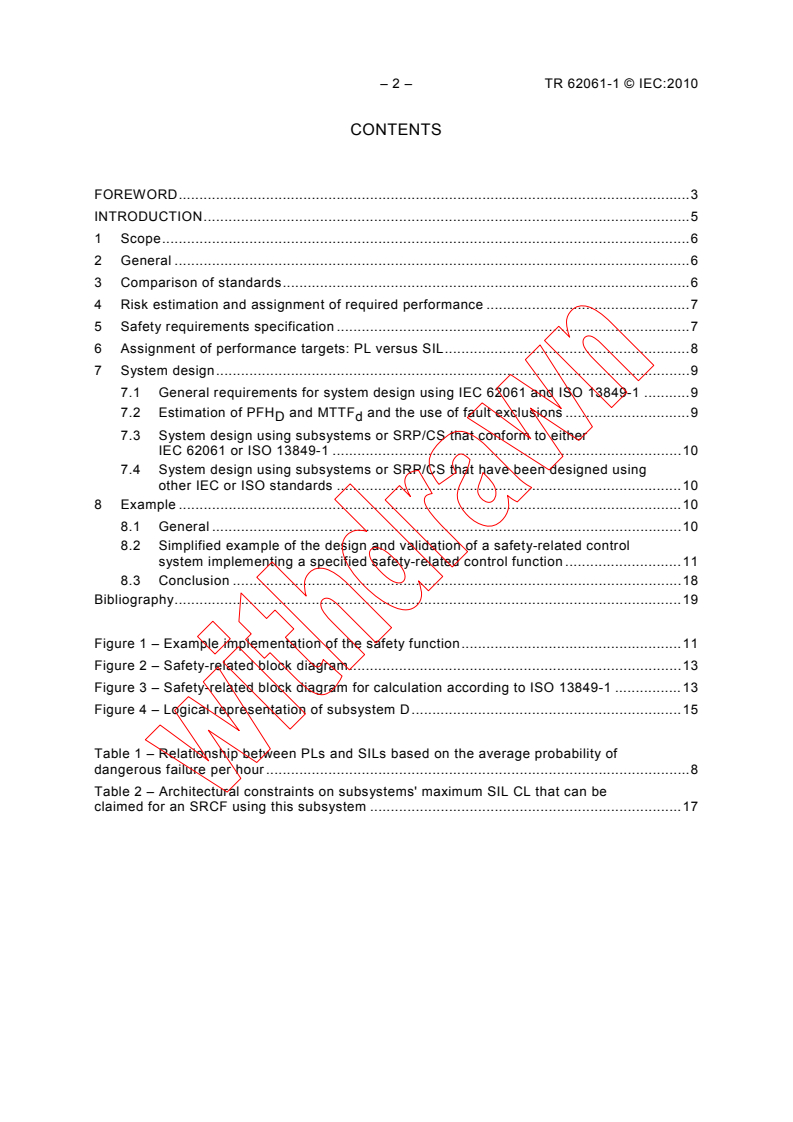
CONTENTS
FOREWORD.3
INTRODUCTION.5
1 Scope.6
2 General .6
3 Comparison of standards.6
4 Risk estimation and assignment of required performance .7
5 Safety requirements specification .7
6 Assignment of performance targets: PL versus SIL.8
7 System design.9
7.1 General requirements for system design using IEC 62061 and ISO 13849-1 .9
7.2 Estimation of PFH and MTTF and the use of fault exclusions .9
D d
7.3 System design using subsystems or SRP/CS that conform to either
IEC 62061 or ISO 13849-1 .10
7.4 System design using subsystems or SRP/CS that have been designed using
other IEC or ISO standards .10
8 Example .10
8.1 General .10
8.2 Simplified example of the design and validation of a safety-related control
system implementing a specified safety-related control function .11
8.3 Conclusion .18
Bibliography.19
Figure 1 – Example implementation of the safety function.11
Figure 2 – Safety-related block diagram.13
Figure 3 – Safety-related block diagram for calculation according to ISO 13849-1 .13
Figure 4 – Logical representation of subsystem D.15
Table 1 – Relationship between PLs and SILs based on the average probability of
dangerous failure per hour.8
Table 2 – Architectural constraints on subsystems' maximum SIL CL that can be
claimed for an SRCF using this subsystem .17
TR 62061-1 © IEC:2010 – 3 –
INTERNATIONAL ELECTROTECHNICAL COMMISSION
____________
GUIDANCE ON THE APPLICATION OF ISO 13849-1 AND IEC 62061
IN THE DESIGN OF SAFETY-RELATED CONTROL SYSTEMS
FOR MACHINERY
FOREWORD
1) The International Electrotechnical Commission (IEC) is a worldwide organization for standardization comprising
all national electrotechnical committees (IEC National Committees). The object of IEC is to promote
international co-operation on all questions concerning standardization in the electrical and electronic fields. To
this end and in addition to other activities, IEC publishes International Standards, Technical Specifications,
Technical Reports, Publicly Available Specifications (PAS) and Guides (hereafter referred to as “IEC
Publication(s)”). Their preparation is entrusted to technical committees; any IEC National Committee interested
in the subject dealt with may participate in this preparatory work. International, governmental and non-
governmental organizations liaising with the IEC also participate in this preparation. IEC collaborates closely
with the International Organization for Standardization (ISO) in accordance with conditions determined by
agreement between the two organizations.
2) The formal decisions or agreements of IEC on technical matters express, as nearly as possible, an international
consensus of opinion on the relevant subjects since each technical committee has representation from all
interested IEC National Committees.
3) IEC Publications have the form of recommendations for international use and are accepted by IEC National
Committees in that sense. While all reasonable efforts are made to ensure that the technical content of IEC
Publications is accurate, IEC cannot be held responsible for the way in which they are used or for any
misinterpretation by any end user.
4) In order to promote international uniformity, IEC National Committees undertake to apply IEC Publications
transparently to the maximum extent possible in their national and regional publications. Any divergence
between any IEC Publication and the corresponding national or regional publication shall be clearly indicated in
the latter.
5) IEC itself does not provide any attestation of conformity. Independent certification bodies provide conformity
assessment services and, in some areas, access to IEC marks of conformity. IEC is not responsible for any
services carried out by independent certification bodies.
6) All users should ensure that they have the latest edition of this publication.
7) No liability shall attach to IEC or its directors, employees, servants or agents including individual experts and
members of its technical committees and IEC National Committees for any personal injury, property damage or
other damage of any nature whatsoever, whether direct or indirect, or for costs (including legal fees) and
expenses arising out of the publication, use of, or reliance upon, this IEC Publication or any other IEC
Publications.
8) Attention is drawn to the Normative references cited in this publication. Use of the referenced publications is
indispensable for the correct application of this publication.
9) Attention is drawn to the possibility that some of the elements of this IEC Publication may be the subject of
patent rights. IEC shall not be held responsible for identifying any or all such patent rights.
The main task of IEC technical committees is to prepare International Standards. However, a
technical committee may propose the publication of a technical report when it has collected
data of a different kind from that which is normally published as an International Standard, for
example "state of the art".
IEC 62016-1, which is a technical report, has been prepared jointly by Technical Committee
ISO/TC 199, Safety of machinery, and Technical Committee IEC/TC 44, Safety of machinery –
Electrotechnical aspects. The draft was circulated for voting to the national bodies of both ISO
and IEC. These technical committees have agreed that no modification will be made to this
Technical Report except by mutual agreement .
This Technical Report is published at the ISO as ISO/TR 23849.
– 4 – TR 62061-1 © IEC:2010
The text of this technical report is based on the following documents:
Enquiry draft Report on voting
44/598/DTR 44/608/RVC
Full information on the voting for the approval of this technical report can be found in the
report on voting indicated in the above table.
This publication has been drafted in accordance with the ISO/IEC Directives, Part 2.
The committee has decided that the contents of this publication will remain unchanged until
the stability date indicated on the IEC web site under "http://webstore.iec.ch" in the data
related to the specific publication. At this date, the publication will be
• reconfirmed,
• withdrawn,
• replaced by a revised edition, or
• amended.
TR 62061-1 © IEC:2010 – 5 –
INTRODUCTION
This Technical Report has been prepared by experts from both IEC/TC 44/WG 7 and
ISO/TC 199/WG 8 in response to requests from their Technical Committees to explain the
relationship between IEC 62061 and ISO 13849-1. In particular, it is intended to assist users
of these International Standards in terms of the interaction(s) that can exist between the
standards to ensure that confidence can be given to the design of safety-related systems
made in accordance with either standard.
It is intended that this Technical Report be incorporated into both IEC 62061 and ISO 13849-1
by means of corrigenda that reference the published version of this document. These
corrigenda will also remove the information given in Table 1, Recommended application of
IEC 62061 and ISO 13849-1, provided in the common introduction to both standards, which is
now recognized as being out of date. Subsequently, it is intended to merge ISO 13849-1 and
IEC 62061 by means of a JWG of ISO/TC 199 and IEC/TC 44.
– 6 – TR 62061-1 © IEC:2010
GUIDANCE ON THE APPLICATION OF ISO 13849-1 AND IEC 62061
IN THE DESIGN OF SAFETY-RELATED CONTROL SYSTEMS
FOR MACHINERY
1 Scope
2)
This Technical Report is intended to explain the application of IEC 62061 and ISO 13849-1
in the design of safety-related control systems for machinery.
2 General
2.1 Both IEC 62061 and ISO 13849-1 specify requirements for the design and
3)
implementation of safety-related control systems of machinery . The methods developed in
both of these standards are different but, when correctly applied, can achieve a comparable
level of risk reduction.
2.2 These standards classify safety-related control systems that implement safety functions
into levels that are defined in terms of their probability of dangerous failure per hour.
ISO 13849-1 has five Performance Levels (PLs), a, b, c, d and e, while IEC 62061 has three
safety integrity levels (SILs), 1, 2 and 3.
2.3 Product standards (type-C) committees specify the safety requirements for safety-related
control systems and it is recommended that these committees classify the levels of
confidence required for them in terms of PLs and SILs.
2.4 Machinery designers may choose to use either IEC 62061 or ISO 13849-1 depending on
the specific features of the application.
2.5 The selection and use of either standard is likely to be determined by, for example:
– previous knowledge and experience in the design of machinery safety-related control
systems based upon the concept of categories described in ISO 13849-1:1999 can mean
that the use of ISO 13849-1:2006 is more appropriate;
– safety-related control systems based upon media other than electrical can mean that the
use of ISO 13849-1 is more appropriate;
– customer requirements to demonstrate the safety integrity of a machine safety-related
control system in terms of a SIL can mean that the use of IEC 62061 is more appropriate;
– safety-related control systems of machinery used in, for example, the process industries,
where other safety-related systems (such as safety instrumented systems in accordance
with IEC 61511) are characterized in terms of SILs, can mean that the use of IEC 62061 is
more appropriate.
3 Comparison of standards
3.1 A comparison of the technical requirements in ISO 13849-1 and IEC 62061 has been
carried out in respect of the following aspects:
2) This Technical Report considers ISO 13849-1:2006 rather than ISO 13849-1:1999, which has been withdrawn.
3) These standards have been adopted by the European standardization bodies CEN and CENELEC as
ISO 13849-1 and EN 62061, respectively, where they are published with the status of transposed harmonized
standards under the Machinery Directive (98/37/EC and 2006/42/EC). Under the conditions of their publication,
the correct use of either of these standards is presumed to conform to the relevant essential safety
requirements of the Machinery Directive (98/37/EC and 2006/42/EC).
TR 62061-1 © IEC:2010 – 7 –
– terminology;
– risk estimation and performance allocation;
– safety requirements specification;
– systematic integrity requirements;
– diagnostic functions;
– software safety requirements.
3.2 Additionally, an evaluation of the use of the simplified mathematical formulae to
determine the probability of dangerous failures (PFH ) and MTTF according to both
D d
standards has been carried out.
3.3 The conclusions from this work are the following.
– Safety-related control systems can be designed to achieve acceptable levels of functional
4)
safety using either of the two standards by integrating non-complex SRECS (safety-
related electrical control system) subsystems or SRP/CS (safety-related parts of a control
system) designed in accordance with IEC 62061 and ISO 13849-1, respectively.
– Both standards can also be used to provide design solutions for complex SRECS and
SRP/CS by integrating electrical/electronic/programmable electronic subsystems designed
in accordance with IEC 61508.
– Both standards currently have value to users in the machinery sector and benefits will be
gained from experience in their use. Feedback over a reasonable period on their practical
application is essential to support any future initiatives to move towards a standard that
merges the contents of both IEC 62061 and ISO 13849-1.
– Differences exist in detail and it is recognized that some concepts (e.g. functional safety
management) will need further work to establish equivalence between respective design
methodologies and some technical requirements.
4 Risk estimation and assignment of required performance
4.1 A comparison has been carried out on the use of the methods to assign a SIL and/or PL
r
to a specific safety function. This has established that there is a good level of correspondence
between the respective methods provided in Annex A of each standard.
4.2 It is important, regardless of which method is used, that attention be given to ensure that
appropriate judgements are made on the risk parameters to determine the SIL and/or PL that
r
is likely to apply to a specific safety function. These judgements can often best be made by
bringing together a range of personnel (e.g. design, maintenance, operators) to ensure that
the hazards that may be present at machinery are properly understood.
4.3 Further information on the process of risk estimation and the assignment of performance
targets can be found in ISO 14121-1 and IEC 61508-5.
5 Safety requirements specification
5.1 A first stage in the respective methodologies of both ISO 13849-1 and IEC 62061
requires that the safety function(s) to be implemented by the safety-related control system are
specified.
5.2 An assessment should have been performed relevant to each safety function that is to
be implemented by a control circuit by, for example, using ISO 13849-1, Annex A, or
IEC 62061, Annex A. This should have determined what risk reduction needs to be provided
4) Although there is no definition for the term “non-complex” SRECS or SRP/CS this should be considered
equivalent to low complexity in the context of IEC 62061:2005, 3.2.7.
– 8 – TR 62061-1 © IEC:2010
by each particular safety function at a machine and, in turn, what level of confidence is
required for the control circuit that performs this safety function.
5.3 The level of confidence specified as a PL and/or a SIL is relevant to a specific safety
function.
5.4 The following shows the information that should be provided in relation to safety
functions by a product (type-C) standard.
Safety function(s) to be implemented by a control circuit:
Name of safety function
Description of the function
Required level of performance according to ISO 13849-1: PL a to e
r
and/or
Required safety integrity according to IEC 62061: SIL 1 to 3
6 Assignment of performance targets: PL versus SIL
Table 1 gives the relationship between PL and SIL based on the average probability of a
dangerous failure per hour. However, both standards have requirements (e.g. systematic
safety integrity) additional to these probabilistic targets that are also to be applied to a safety-
related control system. The rigour of these requirements is related to the respective PL and
SIL.
Table 1 – Relationship between PLs and SILs based on the average probability
of dangerous failure per hour
Average probability of a dangerous
Performance level (PL) Safety integrity level (SIL)
failure per hour (1/h)
−5 −4
a No special safety requirements
W 10 to < 10
−6 −5
b 1
W 3 × 10 to < 10
−6 −6
c W 10 to < 3 × 10 1
−7 −6
d W 10 to < 10 2
−8 −7
e W 10 to < 10 3
TR 62061-1 © IEC:2010 – 9 –
7 System design
7.1 General requirements for system design using IEC 62061 and ISO 13849-1
The following aspects should be taken into account when designing a SRECS/SRP/CS.
– When applied within the limitations of their respective scopes either of the two standards
can be used to design safety-related control systems with acceptable functional safety, as
indicated by the achieved SIL or PL.
– Non-complex safety-related parts that are designed to the relevant PL in accordance with
ISO 13849-1 can be integrated as subsystems into a safety-related electrical control
system (SRECS) designed in accordance with IEC 62061. Any complex safety-related
parts that are designed to the relevant PL in accordance with ISO 13849-1 can be
integrated into safety-related parts of a control system (SRP/CS) designed in accordance
with ISO 13849-1.
– Any non-complex subsystem that is designed in accordance with IEC 62061 to the
relevant SIL can be integrated as a safety-related part into a combination of SRP/CS
designed in accordance with ISO 13849-1.
– Any complex subsystem that is designed in accordance with IEC 61508 to the relevant SIL
can be integrated as a safety-related part into a combination of SRP/CS designed in
accordance with ISO 13849-1 or as subsystems into a SRECS designed in accordance
with IEC 62061.
7.2 Estimation of PFH and MTTF and the use of fault exclusions
D d
7.2.1 PFH and MTTF
D d
7.2.1.1 The value of MTTF in the context of ISO 13849-1 relates to a single channel
d
SRP/CS without diagnostics and, only in this case, is the reciprocal of PFH in IEC 62061.
D
7.2.1.2 MTTF is a parameter of a component(s) and/or single channel without any
d
consideration being given to factors such as diagnostics and architecture, while PFH is a
D
parameter of a subsystem that takes into account the contribution of factors such as
diagnostics and architecture depending on the design structure.
7.2.1.3 Annex K of ISO 13849-1 describes the relationship between MTTF and the PFH of
d D
an SRP/CS for different architectures classified in terms of category and diagnostic coverage
(DC).
7.2.1.4 The estimation of PFH for a series connected combination of SRP/CS in
D
accordance with ISO 13849-1 can also be performed by adding PFH values (e.g. derived
D
from Annex K of ISO 13849-1) of each SRP/CS in a similar manner to that used with
subsystems in IEC 62061.
7.2.2 Use of fault exclusions
7.2.2.1 Both standards permit the use of fault exclusions, see 6.7.7 of IEC 62061 and 7.3 of
ISO 13849-1. IEC 62061 does not permit the use of fault exclusions for a SRECS without
hardware fault tolerance required to achieve SIL 3 without hardware fault tolerance.
7.2.2.2 It is important that where fault exclusions are used that they be properly justified and
valid for the intended lifetime of an SRP/CS or SRECS.
7.2.2.3 In general, where PL e or SIL 3 is specified for a safety function to be implemented
by an SRP/CS or SRECS, it is not normal to rely upon fault exclusions alone to achieve this
level of performance. This is dependent upon the technology used and the intended operating
– 10 – TR 62061-1 © IEC:2010
environment. Therefore it is essential that the designer takes additional care in the use of
fault exclusions as PL or SIL increases.
7.2.2.4 In general the use of fault exclusions is not applicable to the mechanical aspects of
electromechanical position switches and manually operated switches (e.g. an emergency stop
device) in order to achieve PL e or SIL 3 in the design of an SRP/CS or SRECS. Those fault
exclusions that can be applied to specific mechanical fault conditions (e.g. wear/corrosion,
fracture) are described in ISO 13849-2.
7.2.2.5 For example, a door interlocking system that has to achieve PL e or SIL 3 will need
to incorporate a minimum fault tolerance of 1 (e.g. two conventional mechanical position
switches) in order to achieve this level of performance since it is not normally justifiable to
exclude faults such as broken switch actuators. However, it may be acceptable to exclude
faults such as short circuit of wiring within a control panel designed in accordance with
relevant standards.
7.2.2.6 Further information on the use of fault exclusions is to be provided in the forthcoming
revision of ISO 13849-2 currently being developed by ISO/TC 199/WG 8.
7.3 System design using subsystems or SRP/CS that conform to either IEC 62061 or
ISO 13849-1
7.3.1 In all cases where subsystems or safety-related parts of control systems are designed
to either ISO 13849-1 or IEC 62061, conformance to the system level standard can only be
claimed if all the requirements of the system level standard (as relevant) are satisfied.
7.3.2 For the design of a subsystem or a part of safety-related parts of control systems
either IEC 62061 or ISO 13849-1, respectively, shall be satisfied. It is permissible to satisfy
more than one of these standards provided that those standards used are fully complied with.
7.3.3 It is not permissible to mix requirements of the standards when designing a subsystem
or part of safety-related parts of control systems.
7.4 System design using subsystems or SRP/CS that have been designed using other
IEC or ISO standards
7.4.1 It may be possible to select subsystems, for example, electrosensitive protective
equipment, that comply with relevant IEC or ISO product standards and either IEC 61508,
IEC 62061 or ISO 13849-1 in their design. The vendor(s) of these types of subsystems should
provide the necessary information to facilitate their integration into a safety-related control
system in accordance with either IEC 62061 or ISO 13849-1.
7.4.2 Subsystems, for example, adjustable speed electrical power drive systems, that have
been designed using product standards, such as IEC 61800-5-2, that implement the
requirements of IEC 61508 can be used in safety-related control systems in accordance with
IEC 62061 (see also 6.7.3 of IEC 62061) and ISO 13849-1.
7.4.3 In accordance with IEC 62061 other subsystems that have been designed using IEC,
ISO or other standard(s) are subject to 6.7.3 of IEC 62061.
8 Example
8.1 General
The following example assumes that all the requirements of the standards have been satisfied.
The example is only intended to demonstrate specific aspects of the application of the
standards.
TR 62061-1 © IEC:2010 – 11 –
8.2 Simplified example of the design and validation of a safety-related control system
implementing a specified safety-related control function
8.2.1 This simplified example is intended to demonstrate the use of subsystems or SRP/CS
that comply with IEC 62061 and/or ISO 13849-1 in a SRECS/SRP/CS. The example is based
on the implementation of a safety function described as a safety-related stop function
associated with position monitoring of a moveable guard, with a specified safety integrity level
of SIL 3/required performance level PL e as described in Figure 1.
r
IEC 1625/10
shown in actuated position
a
Open.
b
Closed.
c
START.
d
Feedback circuit.
Figure 1 – Example implementation of the safety function
8.2.2 The following information is relevant to the safety requirements specification for this
example.
– 12 – TR 62061-1 © IEC:2010
Safety function
– Safety-related stop function, initiated by a protective device: opening of the moveable
guard initiates the safety function STO (safe torque off).
Functional description
– Trapping hazards are safeguarded by means of a moveable guard (protective grating).
Opening of the interlocked guard is detected by two position switches, B1/B2, employing a
break contact/make contact combination, and evaluation by a central safety module, K1.
K1 actuates two contactors, Q1 and Q2, dropping out of which interrupts or prevents
hazardous movements or states.
– The position switches are monitored for plausibility in K1 for the purpose of fault detection.
Faults in Q1 and Q2 are detected by a start-up test in K1. A start command is successful
only if Q1 and Q2 had previously dropped out. Start-up testing by opening and closing of
the interlocked guard is not required.
– The safety function remains intact in the event of a component failure. Faults are detected
during operation or at actuation (opening and closing) of the interlocked guard resulting in
the dropping out of Q1 and Q2 and operational disabling.
– An accumulation of more than two faults in the period between two successive actuations
can lead to loss of the safety function.
8.2.3 The following features should also be provided.
– Basic and well-tried safety principles are observed (e.g. the load current for the contactors
Q1 and Q2 is de-rated by a factor of 50 %) and the requirements of Category B are met.
Protective circuits (e.g. contact protection) are implemented.
– A stable arrangement of the protective devices is assured for actuation of the position
switches.
– Switch B1 is a position switch with direct opening action in accordance with IEC 60947-5-
1:2003, Annex K.
– The supply conductors to position switches B1 and B2 are laid separately or with
protection.
8.2.4 The following information is available from the manufacturers for each part within the
design of SRP/CS.
5)
– The safety module K1 is declared by the manufacturer as satisfying the requirements for
Category 4, PL e and SIL CL 3.
– The contactors Q1 and Q2 possess mechanically linked contact elements conforming with
IEC 60947-5-1:2003, Annex L.
8.2.5 The following observation can be made on the design of SRP/CS and/or SRECS.
– Category 4 can only be achieved where several mechanical position switches for different
protective devices are not connected in a series arrangement (i.e. no cascading). This is
necessary, as faults in the switches cannot otherwise be detected.
8.2.6 Calculation of the probability of failure in accordance with ISO 13849-1
Figure 2 shows a logic subsystem (safety module K1) to which two-channel input and output
elements are connected. Since an abstraction of the hardware level is already performed in
the safety-related block diagram, the sequence of the subsystems is in principle
interchangeable. It is therefore recommended that subsystems sharing the same structure be
grouped together, as shown in Figure 3. This makes calculation of the PL simpler by reducing
the number of times limitation of the MTTF of a channel to 100 years is performed in the
d
estimation.
5) This module is dealt with as a subsystem and, as such, the MTTF of its individual channels need not be given
d
(see 7.2.1.1).
TR 62061-1 © IEC:2010 – 13 –
IEC 1626/10
Figure 2 – Safety-related block diagram
IEC 1627/10
Key
1 hardware related representation: three SRP/CS as subsystems
2 simplified logical representation: two SRP/CS as subsystems
Figure 3 – Safety-related block diagram for calculation according to ISO 13849-1
The probability of failure of the safety module K1 is declared by the manufacturer and is
−9
added at the end of the calculation [2,31 × 10 per hour (manufacturer's value), suitable for
PL e]. For the remaining subsystem, the probability of failure is calculated as follows:
– MTTF : the B value of 1 000 000 cycles [manufacturer's value] is stated for the
d 10d
mechanical part of B1. For the position switch B2, the B value is 500 000 cycles
10d
(manufacturer's value). At 365 working days per year, 24 working hours per day and a
cycle time of 900 s (15 min), n is 35 040 cycles per year for these components
op
calculated by using Equations (C.2) and (C.7) of ISO 13849-1:
dh s
s
365⋅⋅24 3600
dh⋅⋅ 3600
op op
yd h cycles
h
n = == 35040
op
s
t y
cycle
cycle
B 1 000000 cycles
10d
MTTF== = 285y
d,B1
cycles
0,1⋅n
op
0,1⋅35040
y
B 1000000 cycles
10d
T == = 28,5 y
10d,B1
cycles
n
op
y
B
500000 cycles
10d
MTTF== = 143 y
d,B2
cycles
0,1⋅n
op
0,1⋅35040
y
– 14 – TR 62061-1 © IEC:2010
B 500000 cycles
10d
T == = 14,3 y
10d,B2
cycles
n
op
y
The T value of B2 is 14,3 years. After this time B2 shall be replaced if a mission time of 20
10d
years is intended for the whole SRP/CS.
– For the contactors Q1 and Q2, the B value corresponds under inductive load (AC 3) to
an electrical lifetime of 1 000 000 cycles (manufacturer's value). If 50 % of failures are
assumed to be dangerous, the B value is produced by doubling of the B value:
10d 10
B 2 000000cycles
10d
MTTF == = 571y
d,Q1/Q2
cycles
0,1⋅n
op
0,1⋅35040
y
B 2000000cycles
10d
T == = 57,1y
10d,Q1/ Q2
cycles
n
op
y
– For both channels the MTTF is calculated by using Equation (D.1) of ISO 13849-1:
d
N
=
∑
MTTF MTTF
ddi
i =1
11 1 1
=+ =
MTTF 285 y 571y 190y
d,Ch1
11 1 1
=+ =
MTTF 143 y 571y 114 y
d,Ch2
This gives an MTTF of 190 years and an MTTF of 114 years. In accordance with
d,Ch1 d,Ch2
ISO 13849-1 the MTTF of both channels is limited to 100 years and, in this case, as the
d
MTTF of both channels are equal after limiting it is not necessary to perform symmetrization.
d
– DC : the DC of 99 % for B1 and B2 is based upon plausibility monitoring of the
avg
break/make contact combination in K1. The DC of 99 % for contactors Q1 and Q2 is
derived from regular monitoring by K1 during start-up. The DC values stated correspond to
the DC for each subsystem. The DC will be calculated according to Equation (E.1) of
avg
avg
ISO 13849-1. Because each single DC is 99 %, the DC is also 99 %.
avg
– Adequate measures against common-cause failure in the subsystems B1/B2 and Q1/Q2
(70 points): separation (15), well-tried components (5), protection against overvoltage, etc.
(15) and environmental conditions (25 + 10).
– Mission time: for the simplified approach of ISO 13849-1 a mission time of 20 years is
assumed.
– The subsystem B1/B2/Q1/Q2 corresponds to Category 4 with a high MTTF (100 years)
d
and high DC (99 %). This results in an average probability of dangerous failure of
avg
−8
2,47 × 10 per hour (see Table K.1 of ISO 13849-1). Following addition of the subsystem
−8
K1, the average probability of dangerous failure is 2,70 × 10 per hour. This corresponds
to PL e.
8.2.7 Calculation of the probability of failure in accordance with IEC 62061
8.2.7.1 In accordance with 6.6.2 of IEC 62061, the circuit arrangement can be divided into
three subsystems: B1/B2, K and Q1/Q2 as shown in the safety-related block diagram.
TR 62061-1 © IEC:2010 – 15 –
−9
8.2.7.2 For subsystem K, the probability of failure of 2,31 × 10 per hour and a SIL claim
limit of 3 for the safety module K1 is declared by the manufacturer.
8.2.7.3 For the remaining subsystems, the probability of failure can be estimated as follows.
– Subsystem B1/B2: the B value of 1 000 000 cycles [manufacturer's value] is stated for
10d
the mechanical part of B1. For the position switch B2, the B value is 500 000 cycles
10d
[manufacturer's value]. At 365 working days per year, 24 working hours per day and a
cycle time of 15 min, C is 4 cycles per hour for these components. The failure rate is
−7 −7
calculated as 0,1 × C/B = 4, 00 × 10 /h. For B2 this gives a failure rate of 8,00 × 10 /h.
10d
NOTE The number of operating cycles, C, of the application according to IEC 62061 corresponds
to the mean number of annual operations, n , according to ISO 13849-1. Since C is stated in
op
cycles per hour and n in cycles per year, the following relation applies:
op
y
Cn=⋅
op
365 ⋅ 24h
Thus the mean operation in hours per day and days per year has influence on the value of
C as well as of n .
op
– The logical architecture of this subsystem equates to diagram D from 6.7.8.2.5 of
IEC 62061 as shown in Figure 4.
IEC 1628/10
Key
1 subsystem D
2 subsystem element λ
De1
3 diagnostic function(s)
4 subsystem element, λ
De2
5 common cause failure
Figure 4 – Logical representation of subsystem D
– 16 – TR 62061-1 © IEC:2010
– The subsystem elements (switches B1 and B2) are of different design, therefore the
following, Equation (D.1) from 6.7.8.2.5 of IEC 62061, is used to determine the PFH of
D
the subsystem.
⎡⎤
λβ=−(1 )⎡⎤λ ×λ × DC+ DC ×TT/ 2+λ ×λ × 2− DC− DC × / 2+
() ( )
{ }
DssD De1 De2 1 2 2 De1 De2 1 2 1
⎣⎦
⎣⎦
βλ×+λ /2
()
De1 De2
PFH =×λ 1h
DssD DssD
where
T is the diagnostic test interval; for subsystem B1/B2, this is 15 min.
T is the proof test interval or lifetime, whichever is the smaller. For subsystem B1/B2, the
lifetime interval is 125 000 h (14,3 years) at the given rate of use based on the lowest
subsystem element T value (see ISO 13849-1, C.4.2). Switch B2 has the lowest T
10d 10d
value. The proof test interval (see Foreword of IEC 62061) is assumed to be 20 years
(175 200 h), which is greater than the lifetime. So T is 125 000 h.
β is the susceptibility to common cause failures. This has a value of 5 % (0,05) resulting
from 42 points scored in the simplified method in IEC 62061, Annex F. Separation
(5 + 5 + 5), assessment/analysis (9) and environmental conditions (9 + 9).
λ is the dangerous failure rate of subsystem element 1. For switch B1 this equates to
De1
−7
4,00 × 10 /h (see above).
DC is the diagnostic coverage of subsystem element 1. For switch B1, this is estimated to
be 99 %, based upon plausibility monitoring of the break/make contacts of B1 and B2 in
combination with K1.
λ is the dangerous failure rate of subsystem element 2. For switch B2 this equates to
De2
−7
8,00 × 10 /h (see above).
DC is the diagnostic coverage of subsystem element 2. For switch B2 this is estimated to be
99 %, based upon plausibility monitoring of the break/make contacts of B1 and B2 in
combination with K1.
−8
8.2.7.4 The data above is entered into the formula to give a PFH of 3,04 × 10 .
D
8.2.7.5 Similarly, for subsystem Q1/Q2: contactors Q1 and Q2 have a B value that
corresponds under inductive load (AC 3) to an electrical lifetime of 10 cycles (manufacturer's
value). If 50 % of failures are assumed to be dangerous, the B value is produced by
10d
doubling the B value. The value assumed above for C results in a failure rate of
−7
2,00 × 10 /h for each contactor.
8.2.7.6 The logical architecture of subsystem Q1/Q2 equates to diagram D from 6.7.8.2.5 of
IEC 62061. The subsystem elements (contactors Q1 and Q2) are of the same design,
therefore Equation (D.1) is used to determine the PFH of the subsystem:
D
⎡⎤ ⎡ ⎤
λ =−12βλλ××DC×TT/2+ ×1−DC × + β× λ
() ( )
DssD { De 2 De 1} De
⎣⎦ ⎣ ⎦
PFH =×λ 1h
DssD DssD
where
T is the diagnostic test interval; for subsystem Q1/Q2, this is 15 min.
TR 62061-1 © IEC:2010 – 17 –
T is the proof test interval or lifetime, whichever is the smaller; for subsystem Q1/Q2 the
lifetime is 500 000 h (57,1 years) at the given usage rate based on the subsystem
element T value (see ISO 13849-1, C.4.2). The proof test interval (see Foreword of
10d
IEC 62061) is assumed to be 20 years (175 200 h), which is smaller than the lifetime.
So T is 175 200 h.
λ is the dangerous failure rate of each subsystem element (contactors Q1 and
De
−
Q2) = 2,00 × 10 /h (see above).
DC is the diagnostic coverage of each subsystem element (contactors Q1 and Q2) = 99 %
based upon regular monitoring of mechanically linked mirror contacts by K1 during start-
up.
β is the susceptibility to common cause failures; this has a value of 5 % (0,05) resulting
from 42 points scored in the simplified method in IEC 62061, Annex F. Separation
(5 + 5 + 5), assessment/analysis (9) and environmental conditions (9 + 9).
−8
The data above is entered into the formula that produces a PFH of 1,01 × 10 .
D
8.2.7.7 The subsystems B1/B2 and Q1/Q2 are then subjected to the architectural constraints
given in Table 5 of IEC 62061.
See Table 2.
Table 2 – Architectural constraints on subsystems' maximum
SIL CL that can be claimed for an SRCF using this subsystem
a
Hardware fault tolerance
Safe failure fraction
0 1 2
c
< 60 % Not allowed SIL 1 SIL 2
60 % to < 90 % SIL 1 SIL 2 SIL 3
b
90 % to < 99 % SIL 2 SIL 3 SIL 3
b b
W 99 %
SIL 3 SIL 3 SIL 3
a
A hardware fault tolerance of N means that N+1 faults could cause a loss of the safety-related control function.
b
A SIL 4 claim limit is not considered in this standard. For SIL 4 see IEC 61508-1.
c
See 6.7.6.4 of IEC 62061 or, for subsystems where fault exclusions have been applied to faults that could lead to
a dangerous failure, see 6.7.7.
8.2.7.8 Each subsystem has a safe failure fraction of 99 % (based on their DC) and a
hardware fault tolerance of 1. That produces a SIL CL (SIL claim limit) of 3 for each
subsystem.
−9
8.2.7.9 For subsystem K1 the PFH of 2,31 × 10 per hour and SIL CL 3 have been
D
declared by the manufacture (see above).
8.2.7.10 The maximum SIL that can be claimed based on the lowest SIL CL is therefore 3.
8.2.7.11 The PFH of each subsystem is added together:
D
−8 −9 −8
3,04 × 10 (subsystem B1/B2) + 2,31 × 10 (subsystem K) + 1,01 × 10 (subsystem
−8
Q1/Q2) = 4,28 × 10
– 18 – TR 62061-1 © IEC:2010
−8 −7
This satisfies the range W 10 to < 10 as given in IEC 62061, Table 3. Therefore if all other
requirements of IE
...
IEC/TR 62061-1 ®
Edition 1.0 2010-07
TECHNICAL
REPORT
RAPPORT
TECHNIQUE
Guidance on the application of ISO 13849-1 and IEC 62061 in the design of
safety-related control systems for machinery
Lignes directrices relatives à l'application de l'ISO 13849-1 et de la CEI 62061
dans la conception des systèmes de commande des machines relatifs à la
sécurité
IEC/TR 62061-1:2010
All rights reserved. Unless otherwise specified, no part of this publication may be reproduced or utilized in any form or by
any means, electronic or mechanical, including photocopying and microfilm, without permission in writing from either IEC or
IEC's member National Committee in the country of the requester.
If you have any questions about IEC copyright or have an enquiry about obtaining additional rights to this publication,
please contact the address below or your local IEC member National Committee for further information.
Droits de reproduction réservés. Sauf indication contraire, aucune partie de cette publication ne peut être reproduite
ni utilisée sous quelque forme que ce soit et par aucun procédé, électronique ou mécanique, y compris la photocopie
et les microfilms, sans l'accord écrit de la CEI ou du Comité national de la CEI du pays du demandeur.
Si vous avez des questions sur le copyright de la CEI ou si vous désirez obtenir des droits supplémentaires sur cette
publication, utilisez les coordonnées ci-après ou contactez le Comité national de la CEI de votre pays de résidence.
IEC Central Office
3, rue de Varembé
CH-1211 Geneva 20
Switzerland
Email: inmail@iec.ch
Web: www.iec.ch
About the IEC
The International Electrotechnical Commission (IEC) is the leading global organization that prepares and publishes
International Standards for all electrical, electronic and related technologies.
About IEC publications
The technical content of IEC publications is kept under constant review by the IEC. Please make sure that you have the
latest edition, a corrigenda or an amendment might have been published.
ƒ Catalogue of IEC publications: www.iec.ch/searchpub
The IEC on-line Catalogue enables you to search by a variety of criteria (reference number, text, technical committee,…).
It also gives information on projects, withdrawn and replaced publications.
ƒ IEC Just Published: www.iec.ch/online_news/justpub
Stay up to date on all new IEC publications. Just Published details twice a month all new publications released. Available
on-line and also by email.
ƒ Electropedia: www.electropedia.org
The world's leading online dictionary of electronic and electrical terms containing more than 20 000 terms and definitions
in English and French, with equivalent terms in additional languages. Also known as the International Electrotechnical
Vocabulary online.
ƒ Customer Service Centre: www.iec.ch/webstore/custserv
If you wish to give us your feedback on this publication or need further assistance, please visit the Customer Service
Centre FAQ or contact us:
Email: csc@iec.ch
Tel.: +41 22 919 02 11
Fax: +41 22 919 03 00
A propos de la CEI
La Commission Electrotechnique Internationale (CEI) est la première organisation mondiale qui élabore et publie des
normes internationales pour tout ce qui a trait à l'électricité, à l'électronique et aux technologies apparentées.
A propos des publications CEI
Le contenu technique des publications de la CEI est constamment revu. Veuillez vous assurer que vous possédez
l’édition la plus récente, un corrigendum ou amendement peut avoir été publié.
ƒ Catalogue des publications de la CEI: www.iec.ch/searchpub/cur_fut-f.htm
Le Catalogue en-ligne de la CEI vous permet d’effectuer des recherches en utilisant différents critères (numéro de référence,
texte, comité d’études,…). Il donne aussi des informations sur les projets et les publications retirées ou remplacées.
ƒ Just Published CEI: www.iec.ch/online_news/justpub
Restez informé sur les nouvelles publications de la CEI. Just Published détaille deux fois par mois les nouvelles
publications parues. Disponible en-ligne et aussi par email.
ƒ Electropedia: www.electropedia.org
Le premier dictionnaire en ligne au monde de termes électroniques et électriques. Il contient plus de 20 000 termes et
définitions en anglais et en français, ainsi que les termes équivalents dans les langues additionnelles. Egalement appelé
Vocabulaire Electrotechnique International en ligne.
ƒ Service Clients: www.iec.ch/webstore/custserv/custserv_entry-f.htm
Si vous désirez nous donner des commentaires sur cette publication ou si vous avez des questions, visitez le FAQ du
Service clients ou contactez-nous:
Email: csc@iec.ch
Tél.: +41 22 919 02 11
Fax: +41 22 919 03 00
IEC/TR 62061-1 ®
Edition 1.0 2010-07
TECHNICAL
REPORT
RAPPORT
TECHNIQUE
Guidance on the application of ISO 13849-1 and IEC 62061 in the design of
safety-related control systems for machinery
Lignes directrices relatives à l'application de l'ISO 13849-1 et de la CEI 62061
dans la conception des systèmes de commande des machines relatifs à la
sécurité
INTERNATIONAL
ELECTROTECHNICAL
COMMISSION
COMMISSION
ELECTROTECHNIQUE
PRICE CODE
INTERNATIONALE
R
CODE PRIX
ICS 13.110; 25.040.99; 29.020 ISBN 978-2-88912-042-0
– 2 – TR 62061-1 © IEC:2010
CONTENTS
FOREWORD.3
INTRODUCTION.5
1 Scope.6
2 General .6
3 Comparison of standards.6
4 Risk estimation and assignment of required performance .7
5 Safety requirements specification .7
6 Assignment of performance targets: PL versus SIL.8
7 System design.9
7.1 General requirements for system design using IEC 62061 and ISO 13849-1 .9
7.2 Estimation of PFH and MTTF and the use of fault exclusions .9
D d
7.3 System design using subsystems or SRP/CS that conform to either
IEC 62061 or ISO 13849-1 .10
7.4 System design using subsystems or SRP/CS that have been designed using
other IEC or ISO standards .10
8 Example .10
8.1 General .10
8.2 Simplified example of the design and validation of a safety-related control
system implementing a specified safety-related control function .11
8.3 Conclusion .18
Bibliography.19
Figure 1 – Example implementation of the safety function.11
Figure 2 – Safety-related block diagram.13
Figure 3 – Safety-related block diagram for calculation according to ISO 13849-1 .13
Figure 4 – Logical representation of subsystem D.15
Table 1 – Relationship between PLs and SILs based on the average probability of
dangerous failure per hour.8
Table 2 – Architectural constraints on subsystems' maximum SIL CL that can be
claimed for an SRCF using this subsystem .17
TR 62061-1 © IEC:2010 – 3 –
INTERNATIONAL ELECTROTECHNICAL COMMISSION
____________
GUIDANCE ON THE APPLICATION OF ISO 13849-1 AND IEC 62061
IN THE DESIGN OF SAFETY-RELATED CONTROL SYSTEMS
FOR MACHINERY
FOREWORD
1) The International Electrotechnical Commission (IEC) is a worldwide organization for standardization comprising
all national electrotechnical committees (IEC National Committees). The object of IEC is to promote
international co-operation on all questions concerning standardization in the electrical and electronic fields. To
this end and in addition to other activities, IEC publishes International Standards, Technical Specifications,
Technical Reports, Publicly Available Specifications (PAS) and Guides (hereafter referred to as “IEC
Publication(s)”). Their preparation is entrusted to technical committees; any IEC National Committee interested
in the subject dealt with may participate in this preparatory work. International, governmental and non-
governmental organizations liaising with the IEC also participate in this preparation. IEC collaborates closely
with the International Organization for Standardization (ISO) in accordance with conditions determined by
agreement between the two organizations.
2) The formal decisions or agreements of IEC on technical matters express, as nearly as possible, an international
consensus of opinion on the relevant subjects since each technical committee has representation from all
interested IEC National Committees.
3) IEC Publications have the form of recommendations for international use and are accepted by IEC National
Committees in that sense. While all reasonable efforts are made to ensure that the technical content of IEC
Publications is accurate, IEC cannot be held responsible for the way in which they are used or for any
misinterpretation by any end user.
4) In order to promote international uniformity, IEC National Committees undertake to apply IEC Publications
transparently to the maximum extent possible in their national and regional publications. Any divergence
between any IEC Publication and the corresponding national or regional publication shall be clearly indicated in
the latter.
5) IEC itself does not provide any attestation of conformity. Independent certification bodies provide conformity
assessment services and, in some areas, access to IEC marks of conformity. IEC is not responsible for any
services carried out by independent certification bodies.
6) All users should ensure that they have the latest edition of this publication.
7) No liability shall attach to IEC or its directors, employees, servants or agents including individual experts and
members of its technical committees and IEC National Committees for any personal injury, property damage or
other damage of any nature whatsoever, whether direct or indirect, or for costs (including legal fees) and
expenses arising out of the publication, use of, or reliance upon, this IEC Publication or any other IEC
Publications.
8) Attention is drawn to the Normative references cited in this publication. Use of the referenced publications is
indispensable for the correct application of this publication.
9) Attention is drawn to the possibility that some of the elements of this IEC Publication may be the subject of
patent rights. IEC shall not be held responsible for identifying any or all such patent rights.
The main task of IEC technical committees is to prepare International Standards. However, a
technical committee may propose the publication of a technical report when it has collected
data of a different kind from that which is normally published as an International Standard, for
example "state of the art".
IEC 62016-1, which is a technical report, has been prepared jointly by Technical Committee
ISO/TC 199, Safety of machinery, and Technical Committee IEC/TC 44, Safety of machinery –
Electrotechnical aspects. The draft was circulated for voting to the national bodies of both ISO
and IEC. These technical committees have agreed that no modification will be made to this
Technical Report except by mutual agreement .
This Technical Report is published at the ISO as ISO/TR 23849.
– 4 – TR 62061-1 © IEC:2010
The text of this technical report is based on the following documents:
Enquiry draft Report on voting
44/598/DTR 44/608/RVC
Full information on the voting for the approval of this technical report can be found in the
report on voting indicated in the above table.
This publication has been drafted in accordance with the ISO/IEC Directives, Part 2.
The committee has decided that the contents of this publication will remain unchanged until
the stability date indicated on the IEC web site under "http://webstore.iec.ch" in the data
related to the specific publication. At this date, the publication will be
• reconfirmed,
• withdrawn,
• replaced by a revised edition, or
• amended.
TR 62061-1 © IEC:2010 – 5 –
INTRODUCTION
This Technical Report has been prepared by experts from both IEC/TC 44/WG 7 and
ISO/TC 199/WG 8 in response to requests from their Technical Committees to explain the
relationship between IEC 62061 and ISO 13849-1. In particular, it is intended to assist users
of these International Standards in terms of the interaction(s) that can exist between the
standards to ensure that confidence can be given to the design of safety-related systems
made in accordance with either standard.
It is intended that this Technical Report be incorporated into both IEC 62061 and ISO 13849-1
by means of corrigenda that reference the published version of this document. These
corrigenda will also remove the information given in Table 1, Recommended application of
IEC 62061 and ISO 13849-1, provided in the common introduction to both standards, which is
now recognized as being out of date. Subsequently, it is intended to merge ISO 13849-1 and
IEC 62061 by means of a JWG of ISO/TC 199 and IEC/TC 44.
– 6 – TR 62061-1 © IEC:2010
GUIDANCE ON THE APPLICATION OF ISO 13849-1 AND IEC 62061
IN THE DESIGN OF SAFETY-RELATED CONTROL SYSTEMS
FOR MACHINERY
1 Scope
2)
This Technical Report is intended to explain the application of IEC 62061 and ISO 13849-1
in the design of safety-related control systems for machinery.
2 General
2.1 Both IEC 62061 and ISO 13849-1 specify requirements for the design and
3)
implementation of safety-related control systems of machinery . The methods developed in
both of these standards are different but, when correctly applied, can achieve a comparable
level of risk reduction.
2.2 These standards classify safety-related control systems that implement safety functions
into levels that are defined in terms of their probability of dangerous failure per hour.
ISO 13849-1 has five Performance Levels (PLs), a, b, c, d and e, while IEC 62061 has three
safety integrity levels (SILs), 1, 2 and 3.
2.3 Product standards (type-C) committees specify the safety requirements for safety-related
control systems and it is recommended that these committees classify the levels of
confidence required for them in terms of PLs and SILs.
2.4 Machinery designers may choose to use either IEC 62061 or ISO 13849-1 depending on
the specific features of the application.
2.5 The selection and use of either standard is likely to be determined by, for example:
– previous knowledge and experience in the design of machinery safety-related control
systems based upon the concept of categories described in ISO 13849-1:1999 can mean
that the use of ISO 13849-1:2006 is more appropriate;
– safety-related control systems based upon media other than electrical can mean that the
use of ISO 13849-1 is more appropriate;
– customer requirements to demonstrate the safety integrity of a machine safety-related
control system in terms of a SIL can mean that the use of IEC 62061 is more appropriate;
– safety-related control systems of machinery used in, for example, the process industries,
where other safety-related systems (such as safety instrumented systems in accordance
with IEC 61511) are characterized in terms of SILs, can mean that the use of IEC 62061 is
more appropriate.
3 Comparison of standards
3.1 A comparison of the technical requirements in ISO 13849-1 and IEC 62061 has been
carried out in respect of the following aspects:
2) This Technical Report considers ISO 13849-1:2006 rather than ISO 13849-1:1999, which has been withdrawn.
3) These standards have been adopted by the European standardization bodies CEN and CENELEC as
ISO 13849-1 and EN 62061, respectively, where they are published with the status of transposed harmonized
standards under the Machinery Directive (98/37/EC and 2006/42/EC). Under the conditions of their publication,
the correct use of either of these standards is presumed to conform to the relevant essential safety
requirements of the Machinery Directive (98/37/EC and 2006/42/EC).
TR 62061-1 © IEC:2010 – 7 –
– terminology;
– risk estimation and performance allocation;
– safety requirements specification;
– systematic integrity requirements;
– diagnostic functions;
– software safety requirements.
3.2 Additionally, an evaluation of the use of the simplified mathematical formulae to
determine the probability of dangerous failures (PFH ) and MTTF according to both
D d
standards has been carried out.
3.3 The conclusions from this work are the following.
– Safety-related control systems can be designed to achieve acceptable levels of functional
4)
safety using either of the two standards by integrating non-complex SRECS (safety-
related electrical control system) subsystems or SRP/CS (safety-related parts of a control
system) designed in accordance with IEC 62061 and ISO 13849-1, respectively.
– Both standards can also be used to provide design solutions for complex SRECS and
SRP/CS by integrating electrical/electronic/programmable electronic subsystems designed
in accordance with IEC 61508.
– Both standards currently have value to users in the machinery sector and benefits will be
gained from experience in their use. Feedback over a reasonable period on their practical
application is essential to support any future initiatives to move towards a standard that
merges the contents of both IEC 62061 and ISO 13849-1.
– Differences exist in detail and it is recognized that some concepts (e.g. functional safety
management) will need further work to establish equivalence between respective design
methodologies and some technical requirements.
4 Risk estimation and assignment of required performance
4.1 A comparison has been carried out on the use of the methods to assign a SIL and/or PL
r
to a specific safety function. This has established that there is a good level of correspondence
between the respective methods provided in Annex A of each standard.
4.2 It is important, regardless of which method is used, that attention be given to ensure that
appropriate judgements are made on the risk parameters to determine the SIL and/or PL that
r
is likely to apply to a specific safety function. These judgements can often best be made by
bringing together a range of personnel (e.g. design, maintenance, operators) to ensure that
the hazards that may be present at machinery are properly understood.
4.3 Further information on the process of risk estimation and the assignment of performance
targets can be found in ISO 14121-1 and IEC 61508-5.
5 Safety requirements specification
5.1 A first stage in the respective methodologies of both ISO 13849-1 and IEC 62061
requires that the safety function(s) to be implemented by the safety-related control system are
specified.
5.2 An assessment should have been performed relevant to each safety function that is to
be implemented by a control circuit by, for example, using ISO 13849-1, Annex A, or
IEC 62061, Annex A. This should have determined what risk reduction needs to be provided
4) Although there is no definition for the term “non-complex” SRECS or SRP/CS this should be considered
equivalent to low complexity in the context of IEC 62061:2005, 3.2.7.
– 8 – TR 62061-1 © IEC:2010
by each particular safety function at a machine and, in turn, what level of confidence is
required for the control circuit that performs this safety function.
5.3 The level of confidence specified as a PL and/or a SIL is relevant to a specific safety
function.
5.4 The following shows the information that should be provided in relation to safety
functions by a product (type-C) standard.
Safety function(s) to be implemented by a control circuit:
Name of safety function
Description of the function
Required level of performance according to ISO 13849-1: PL a to e
r
and/or
Required safety integrity according to IEC 62061: SIL 1 to 3
6 Assignment of performance targets: PL versus SIL
Table 1 gives the relationship between PL and SIL based on the average probability of a
dangerous failure per hour. However, both standards have requirements (e.g. systematic
safety integrity) additional to these probabilistic targets that are also to be applied to a safety-
related control system. The rigour of these requirements is related to the respective PL and
SIL.
Table 1 – Relationship between PLs and SILs based on the average probability
of dangerous failure per hour
Average probability of a dangerous
Performance level (PL) Safety integrity level (SIL)
failure per hour (1/h)
−5 −4
a No special safety requirements
W 10 to < 10
−6 −5
b 1
W 3 × 10 to < 10
−6 −6
c W 10 to < 3 × 10 1
−7 −6
d W 10 to < 10 2
−8 −7
e W 10 to < 10 3
TR 62061-1 © IEC:2010 – 9 –
7 System design
7.1 General requirements for system design using IEC 62061 and ISO 13849-1
The following aspects should be taken into account when designing a SRECS/SRP/CS.
– When applied within the limitations of their respective scopes either of the two standards
can be used to design safety-related control systems with acceptable functional safety, as
indicated by the achieved SIL or PL.
– Non-complex safety-related parts that are designed to the relevant PL in accordance with
ISO 13849-1 can be integrated as subsystems into a safety-related electrical control
system (SRECS) designed in accordance with IEC 62061. Any complex safety-related
parts that are designed to the relevant PL in accordance with ISO 13849-1 can be
integrated into safety-related parts of a control system (SRP/CS) designed in accordance
with ISO 13849-1.
– Any non-complex subsystem that is designed in accordance with IEC 62061 to the
relevant SIL can be integrated as a safety-related part into a combination of SRP/CS
designed in accordance with ISO 13849-1.
– Any complex subsystem that is designed in accordance with IEC 61508 to the relevant SIL
can be integrated as a safety-related part into a combination of SRP/CS designed in
accordance with ISO 13849-1 or as subsystems into a SRECS designed in accordance
with IEC 62061.
7.2 Estimation of PFH and MTTF and the use of fault exclusions
D d
7.2.1 PFH and MTTF
D d
7.2.1.1 The value of MTTF in the context of ISO 13849-1 relates to a single channel
d
SRP/CS without diagnostics and, only in this case, is the reciprocal of PFH in IEC 62061.
D
7.2.1.2 MTTF is a parameter of a component(s) and/or single channel without any
d
consideration being given to factors such as diagnostics and architecture, while PFH is a
D
parameter of a subsystem that takes into account the contribution of factors such as
diagnostics and architecture depending on the design structure.
7.2.1.3 Annex K of ISO 13849-1 describes the relationship between MTTF and the PFH of
d D
an SRP/CS for different architectures classified in terms of category and diagnostic coverage
(DC).
7.2.1.4 The estimation of PFH for a series connected combination of SRP/CS in
D
accordance with ISO 13849-1 can also be performed by adding PFH values (e.g. derived
D
from Annex K of ISO 13849-1) of each SRP/CS in a similar manner to that used with
subsystems in IEC 62061.
7.2.2 Use of fault exclusions
7.2.2.1 Both standards permit the use of fault exclusions, see 6.7.7 of IEC 62061 and 7.3 of
ISO 13849-1. IEC 62061 does not permit the use of fault exclusions for a SRECS without
hardware fault tolerance required to achieve SIL 3 without hardware fault tolerance.
7.2.2.2 It is important that where fault exclusions are used that they be properly justified and
valid for the intended lifetime of an SRP/CS or SRECS.
7.2.2.3 In general, where PL e or SIL 3 is specified for a safety function to be implemented
by an SRP/CS or SRECS, it is not normal to rely upon fault exclusions alone to achieve this
level of performance. This is dependent upon the technology used and the intended operating
– 10 – TR 62061-1 © IEC:2010
environment. Therefore it is essential that the designer takes additional care in the use of
fault exclusions as PL or SIL increases.
7.2.2.4 In general the use of fault exclusions is not applicable to the mechanical aspects of
electromechanical position switches and manually operated switches (e.g. an emergency stop
device) in order to achieve PL e or SIL 3 in the design of an SRP/CS or SRECS. Those fault
exclusions that can be applied to specific mechanical fault conditions (e.g. wear/corrosion,
fracture) are described in ISO 13849-2.
7.2.2.5 For example, a door interlocking system that has to achieve PL e or SIL 3 will need
to incorporate a minimum fault tolerance of 1 (e.g. two conventional mechanical position
switches) in order to achieve this level of performance since it is not normally justifiable to
exclude faults such as broken switch actuators. However, it may be acceptable to exclude
faults such as short circuit of wiring within a control panel designed in accordance with
relevant standards.
7.2.2.6 Further information on the use of fault exclusions is to be provided in the forthcoming
revision of ISO 13849-2 currently being developed by ISO/TC 199/WG 8.
7.3 System design using subsystems or SRP/CS that conform to either IEC 62061 or
ISO 13849-1
7.3.1 In all cases where subsystems or safety-related parts of control systems are designed
to either ISO 13849-1 or IEC 62061, conformance to the system level standard can only be
claimed if all the requirements of the system level standard (as relevant) are satisfied.
7.3.2 For the design of a subsystem or a part of safety-related parts of control systems
either IEC 62061 or ISO 13849-1, respectively, shall be satisfied. It is permissible to satisfy
more than one of these standards provided that those standards used are fully complied with.
7.3.3 It is not permissible to mix requirements of the standards when designing a subsystem
or part of safety-related parts of control systems.
7.4 System design using subsystems or SRP/CS that have been designed using other
IEC or ISO standards
7.4.1 It may be possible to select subsystems, for example, electrosensitive protective
equipment, that comply with relevant IEC or ISO product standards and either IEC 61508,
IEC 62061 or ISO 13849-1 in their design. The vendor(s) of these types of subsystems should
provide the necessary information to facilitate their integration into a safety-related control
system in accordance with either IEC 62061 or ISO 13849-1.
7.4.2 Subsystems, for example, adjustable speed electrical power drive systems, that have
been designed using product standards, such as IEC 61800-5-2, that implement the
requirements of IEC 61508 can be used in safety-related control systems in accordance with
IEC 62061 (see also 6.7.3 of IEC 62061) and ISO 13849-1.
7.4.3 In accordance with IEC 62061 other subsystems that have been designed using IEC,
ISO or other standard(s) are subject to 6.7.3 of IEC 62061.
8 Example
8.1 General
The following example assumes that all the requirements of the standards have been satisfied.
The example is only intended to demonstrate specific aspects of the application of the
standards.
TR 62061-1 © IEC:2010 – 11 –
8.2 Simplified example of the design and validation of a safety-related control system
implementing a specified safety-related control function
8.2.1 This simplified example is intended to demonstrate the use of subsystems or SRP/CS
that comply with IEC 62061 and/or ISO 13849-1 in a SRECS/SRP/CS. The example is based
on the implementation of a safety function described as a safety-related stop function
associated with position monitoring of a moveable guard, with a specified safety integrity level
of SIL 3/required performance level PL e as described in Figure 1.
r
IEC 1625/10
shown in actuated position
a
Open.
b
Closed.
c
START.
d
Feedback circuit.
Figure 1 – Example implementation of the safety function
8.2.2 The following information is relevant to the safety requirements specification for this
example.
– 12 – TR 62061-1 © IEC:2010
Safety function
– Safety-related stop function, initiated by a protective device: opening of the moveable
guard initiates the safety function STO (safe torque off).
Functional description
– Trapping hazards are safeguarded by means of a moveable guard (protective grating).
Opening of the interlocked guard is detected by two position switches, B1/B2, employing a
break contact/make contact combination, and evaluation by a central safety module, K1.
K1 actuates two contactors, Q1 and Q2, dropping out of which interrupts or prevents
hazardous movements or states.
– The position switches are monitored for plausibility in K1 for the purpose of fault detection.
Faults in Q1 and Q2 are detected by a start-up test in K1. A start command is successful
only if Q1 and Q2 had previously dropped out. Start-up testing by opening and closing of
the interlocked guard is not required.
– The safety function remains intact in the event of a component failure. Faults are detected
during operation or at actuation (opening and closing) of the interlocked guard resulting in
the dropping out of Q1 and Q2 and operational disabling.
– An accumulation of more than two faults in the period between two successive actuations
can lead to loss of the safety function.
8.2.3 The following features should also be provided.
– Basic and well-tried safety principles are observed (e.g. the load current for the contactors
Q1 and Q2 is de-rated by a factor of 50 %) and the requirements of Category B are met.
Protective circuits (e.g. contact protection) are implemented.
– A stable arrangement of the protective devices is assured for actuation of the position
switches.
– Switch B1 is a position switch with direct opening action in accordance with IEC 60947-5-
1:2003, Annex K.
– The supply conductors to position switches B1 and B2 are laid separately or with
protection.
8.2.4 The following information is available from the manufacturers for each part within the
design of SRP/CS.
5)
– The safety module K1 is declared by the manufacturer as satisfying the requirements for
Category 4, PL e and SIL CL 3.
– The contactors Q1 and Q2 possess mechanically linked contact elements conforming with
IEC 60947-5-1:2003, Annex L.
8.2.5 The following observation can be made on the design of SRP/CS and/or SRECS.
– Category 4 can only be achieved where several mechanical position switches for different
protective devices are not connected in a series arrangement (i.e. no cascading). This is
necessary, as faults in the switches cannot otherwise be detected.
8.2.6 Calculation of the probability of failure in accordance with ISO 13849-1
Figure 2 shows a logic subsystem (safety module K1) to which two-channel input and output
elements are connected. Since an abstraction of the hardware level is already performed in
the safety-related block diagram, the sequence of the subsystems is in principle
interchangeable. It is therefore recommended that subsystems sharing the same structure be
grouped together, as shown in Figure 3. This makes calculation of the PL simpler by reducing
the number of times limitation of the MTTF of a channel to 100 years is performed in the
d
estimation.
5) This module is dealt with as a subsystem and, as such, the MTTF of its individual channels need not be given
d
(see 7.2.1.1).
TR 62061-1 © IEC:2010 – 13 –
IEC 1626/10
Figure 2 – Safety-related block diagram
IEC 1627/10
Key
1 hardware related representation: three SRP/CS as subsystems
2 simplified logical representation: two SRP/CS as subsystems
Figure 3 – Safety-related block diagram for calculation according to ISO 13849-1
The probability of failure of the safety module K1 is declared by the manufacturer and is
−9
added at the end of the calculation [2,31 × 10 per hour (manufacturer's value), suitable for
PL e]. For the remaining subsystem, the probability of failure is calculated as follows:
– MTTF : the B value of 1 000 000 cycles [manufacturer's value] is stated for the
d 10d
mechanical part of B1. For the position switch B2, the B value is 500 000 cycles
10d
(manufacturer's value). At 365 working days per year, 24 working hours per day and a
cycle time of 900 s (15 min), n is 35 040 cycles per year for these components
op
calculated by using Equations (C.2) and (C.7) of ISO 13849-1:
dh s
s
365⋅⋅24 3600
dh⋅⋅ 3600
op op
yd h cycles
h
n = == 35040
op
s
t y
cycle
cycle
B 1 000000 cycles
10d
MTTF== = 285y
d,B1
cycles
0,1⋅n
op
0,1⋅35040
y
B 1000000 cycles
10d
T == = 28,5 y
10d,B1
cycles
n
op
y
B
500000 cycles
10d
MTTF== = 143 y
d,B2
cycles
0,1⋅n
op
0,1⋅35040
y
– 14 – TR 62061-1 © IEC:2010
B 500000 cycles
10d
T == = 14,3 y
10d,B2
cycles
n
op
y
The T value of B2 is 14,3 years. After this time B2 shall be replaced if a mission time of 20
10d
years is intended for the whole SRP/CS.
– For the contactors Q1 and Q2, the B value corresponds under inductive load (AC 3) to
an electrical lifetime of 1 000 000 cycles (manufacturer's value). If 50 % of failures are
assumed to be dangerous, the B value is produced by doubling of the B value:
10d 10
B 2 000000cycles
10d
MTTF == = 571y
d,Q1/Q2
cycles
0,1⋅n
op
0,1⋅35040
y
B 2000000cycles
10d
T == = 57,1y
10d,Q1/ Q2
cycles
n
op
y
– For both channels the MTTF is calculated by using Equation (D.1) of ISO 13849-1:
d
N
=
∑
MTTF MTTF
ddi
i =1
11 1 1
=+ =
MTTF 285 y 571y 190y
d,Ch1
11 1 1
=+ =
MTTF 143 y 571y 114 y
d,Ch2
This gives an MTTF of 190 years and an MTTF of 114 years. In accordance with
d,Ch1 d,Ch2
ISO 13849-1 the MTTF of both channels is limited to 100 years and, in this case, as the
d
MTTF of both channels are equal after limiting it is not necessary to perform symmetrization.
d
– DC : the DC of 99 % for B1 and B2 is based upon plausibility monitoring of the
avg
break/make contact combination in K1. The DC of 99 % for contactors Q1 and Q2 is
derived from regular monitoring by K1 during start-up. The DC values stated correspond to
the DC for each subsystem. The DC will be calculated according to Equation (E.1) of
avg
avg
ISO 13849-1. Because each single DC is 99 %, the DC is also 99 %.
avg
– Adequate measures against common-cause failure in the subsystems B1/B2 and Q1/Q2
(70 points): separation (15), well-tried components (5), protection against overvoltage, etc.
(15) and environmental conditions (25 + 10).
– Mission time: for the simplified approach of ISO 13849-1 a mission time of 20 years is
assumed.
– The subsystem B1/B2/Q1/Q2 corresponds to Category 4 with a high MTTF (100 years)
d
and high DC (99 %). This results in an average probability of dangerous failure of
avg
−8
2,47 × 10 per hour (see Table K.1 of ISO 13849-1). Following addition of the subsystem
−8
K1, the average probability of dangerous failure is 2,70 × 10 per hour. This corresponds
to PL e.
8.2.7 Calculation of the probability of failure in accordance with IEC 62061
8.2.7.1 In accordance with 6.6.2 of IEC 62061, the circuit arrangement can be divided into
three subsystems: B1/B2, K and Q1/Q2 as shown in the safety-related block diagram.
TR 62061-1 © IEC:2010 – 15 –
−9
8.2.7.2 For subsystem K, the probability of failure of 2,31 × 10 per hour and a SIL claim
limit of 3 for the safety module K1 is declared by the manufacturer.
8.2.7.3 For the remaining subsystems, the probability of failure can be estimated as follows.
– Subsystem B1/B2: the B value of 1 000 000 cycles [manufacturer's value] is stated for
10d
the mechanical part of B1. For the position switch B2, the B value is 500 000 cycles
10d
[manufacturer's value]. At 365 working days per year, 24 working hours per day and a
cycle time of 15 min, C is 4 cycles per hour for these components. The failure rate is
−7 −7
calculated as 0,1 × C/B = 4, 00 × 10 /h. For B2 this gives a failure rate of 8,00 × 10 /h.
10d
NOTE The number of operating cycles, C, of the application according to IEC 62061 corresponds
to the mean number of annual operations, n , according to ISO 13849-1. Since C is stated in
op
cycles per hour and n in cycles per year, the following relation applies:
op
y
Cn=⋅
op
365 ⋅ 24h
Thus the mean operation in hours per day and days per year has influence on the value of
C as well as of n .
op
– The logical architecture of this subsystem equates to diagram D from 6.7.8.2.5 of
IEC 62061 as shown in Figure 4.
IEC 1628/10
Key
1 subsystem D
2 subsystem element λ
De1
3 diagnostic function(s)
4 subsystem element, λ
De2
5 common cause failure
Figure 4 – Logical representation of subsystem D
– 16 – TR 62061-1 © IEC:2010
– The subsystem elements (switches B1 and B2) are of different design, therefore the
following, Equation (D.1) from 6.7.8.2.5 of IEC 62061, is used to determine the PFH of
D
the subsystem.
⎡⎤
λβ=−(1 )⎡⎤λ ×λ × DC+ DC ×TT/ 2+λ ×λ × 2− DC− DC × / 2+
() ( )
{ }
DssD De1 De2 1 2 2 De1 De2 1 2 1
⎣⎦
⎣⎦
βλ×+λ /2
()
De1 De2
PFH =×λ 1h
DssD DssD
where
T is the diagnostic test interval; for subsystem B1/B2, this is 15 min.
T is the proof test interval or lifetime, whichever is the smaller. For subsystem B1/B2, the
lifetime interval is 125 000 h (14,3 years) at the given rate of use based on the lowest
subsystem element T value (see ISO 13849-1, C.4.2). Switch B2 has the lowest T
10d 10d
value. The proof test interval (see Foreword of IEC 62061) is assumed to be 20 years
(175 200 h), which is greater than the lifetime. So T is 125 000 h.
β is the susceptibility to common cause failures. This has a value of 5 % (0,05) resulting
from 42 points scored in the simplified method in IEC 62061, Annex F. Separation
(5 + 5 + 5), assessment/analysis (9) and environmental conditions (9 + 9).
λ is the dangerous failure rate of subsystem element 1. For switch B1 this equates to
De1
−7
4,00 × 10 /h (see above).
DC is the diagnostic coverage of subsystem element 1. For switch B1, this is estimated to
be 99 %, based upon plausibility monitoring of the break/make contacts of B1 and B2 in
combination with K1.
λ is the dangerous failure rate of subsystem element 2. For switch B2 this equates to
De2
−7
8,00 × 10 /h (see above).
DC is the diagnostic coverage of subsystem element 2. For switch B2 this is estimated to be
99 %, based upon plausibility monitoring of the break/make contacts of B1 and B2 in
combination with K1.
−8
8.2.7.4 The data above is entered into the formula to give a PFH of 3,04 × 10 .
D
8.2.7.5 Similarly, for subsystem Q1/Q2: contactors Q1 and Q2 have a B value that
corresponds under inductive load (AC 3) to an electrical lifetime of 10 cycles (manufacturer's
value). If 50 % of failures are assumed to be dangerous, the B value is produced by
10d
doubling the B value. The value assumed above for C results in a failure rate of
−7
2,00 × 10 /h for each contactor.
8.2.7.6 The logical architecture of subsystem Q1/Q2 equates to diagram D from 6.7.8.2.5 of
IEC 62061. The subsystem elements (contactors Q1 and Q2) are of the same design,
therefore Equation (D.1) is used to determine the PFH of the subsystem:
D
⎡⎤ ⎡ ⎤
λ =−12βλλ××DC×TT/2+ ×1−DC × + β× λ
() ( )
DssD { De 2 De 1} De
⎣⎦ ⎣ ⎦
PFH =×λ 1h
DssD DssD
where
T is the diagnostic test interval; for subsystem Q1/Q2, this is 15 min.
TR 62061-1 © IEC:2010 – 17 –
T is the proof test interval or lifetime, whichever is the smaller; for subsystem Q1/Q2 the
lifetime is 500 000 h (57,1 years) at the given usage rate based on the subsystem
element T value (see ISO 13849-1, C.4.2). The proof test interval (see Foreword of
10d
IEC 62061) is assumed to be 20 years (175 200 h), which is smaller than the lifetime.
So T is 175 200 h.
λ is the dangerous failure rate of each subsystem element (contactors Q1 and
De
−
Q2) = 2,00 × 10 /h (see above).
DC is the diagnostic coverage of each subsystem element (contactors Q1 and Q2) = 99 %
based upon regular monitoring of mechanically linked mirror contacts by K1 during start-
up.
β is the susceptibility to common cause failures; this has a value of 5 % (0,05) resulting
from 42 points scored in the simplified method in IEC 62061, Annex F. Separation
(5 + 5 + 5), assessment/analysis (9) and environmental conditions (9 + 9).
−8
The data above is entered into the formula that produces a PFH of 1,01 × 10 .
D
8.2.7.7 The subsystems B1/B2 and Q1/Q2 are then subjected to the architectural constraints
given in Table 5 of IEC 62061.
See Table 2.
Table 2 – Architectural constraints on subsystems' maximum
SIL CL that can be claimed for an SRCF using this subsystem
a
Hardware fault tolerance
Safe failure fraction
0 1 2
c
< 60 % Not allowed SIL 1 SIL 2
60 % to < 90 % SIL 1 SIL 2 SIL 3
b
90 % to < 99 % SIL 2 SIL 3 SIL 3
b b
W 99 %
SIL 3 SIL 3 SIL 3
a
A hardware fault tolerance of N means that N+1 faults could cause a loss of the safety-related control function.
b
A SIL 4 claim limit is not considered in this standard. For SIL 4 see IEC 61508-1.
c
See 6.7.6.4 of IEC 62061 or, for subsystems where fault exclusions have been applied to faults that could lead to
a dangerous failure, see 6.7.7.
8.2.7.8 Each subsystem has a safe failure fraction of 99 % (based on their DC) and a
hardware fault tolerance of 1. That produces a SIL CL (SIL claim limit) of 3 for each
subsystem.
−9
8.2.7.9 For subsystem K1 the PFH of 2,31 × 10 per hour and SIL CL 3 have been
D
decla
...