

IEC 61058-1:2016
(Main)Switches for appliances - Part 1: General requirements
General Information
- Abstract
IEC 61058-1:2016 applies to switches for appliances. The switches are intended to control electrical appliances and other equipment for household or similar purposes with a rated voltage not exceeding 480 V and a rated current not exceeding 63 A. This fourth edition cancels and replaces the third edition published in 2000, Amendment 1:2001 and Amendment 2:2007. This edition constitutes a technical revision. This edition includes the following significant technical changes with respect to the previous edition:
a) requirements for mechanical switches are now given in IEC 61058-1-1;
b) requirements for electronic switches are now given in IEC 61058-1-2.
- Status
- Published
- Publication Date
- 19-Jul-2016
- Technical Committee
- SC 23J - Switches for appliances
- Drafting Committee
- MT 1 - TC 23/SC 23J/MT 1
Buy Documents
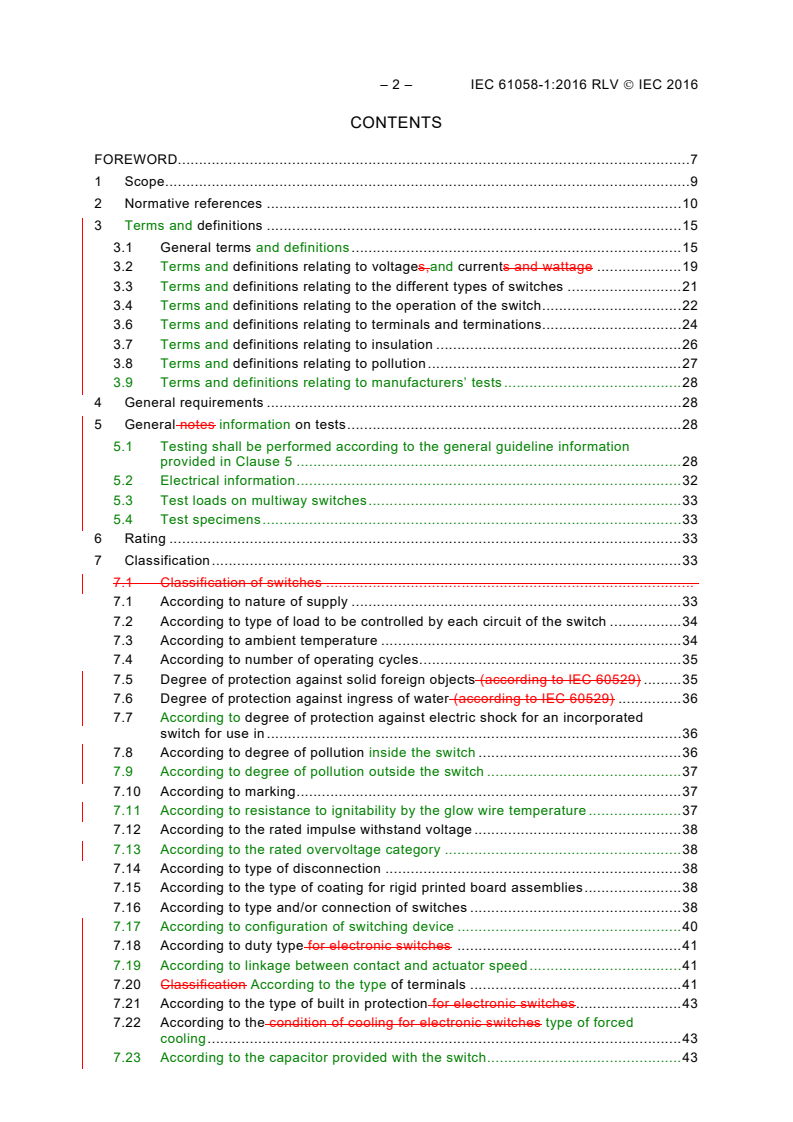
IEC 61058-1:2016 RLV - Switches for appliances - Part 1: General requirements Released:7/20/2016
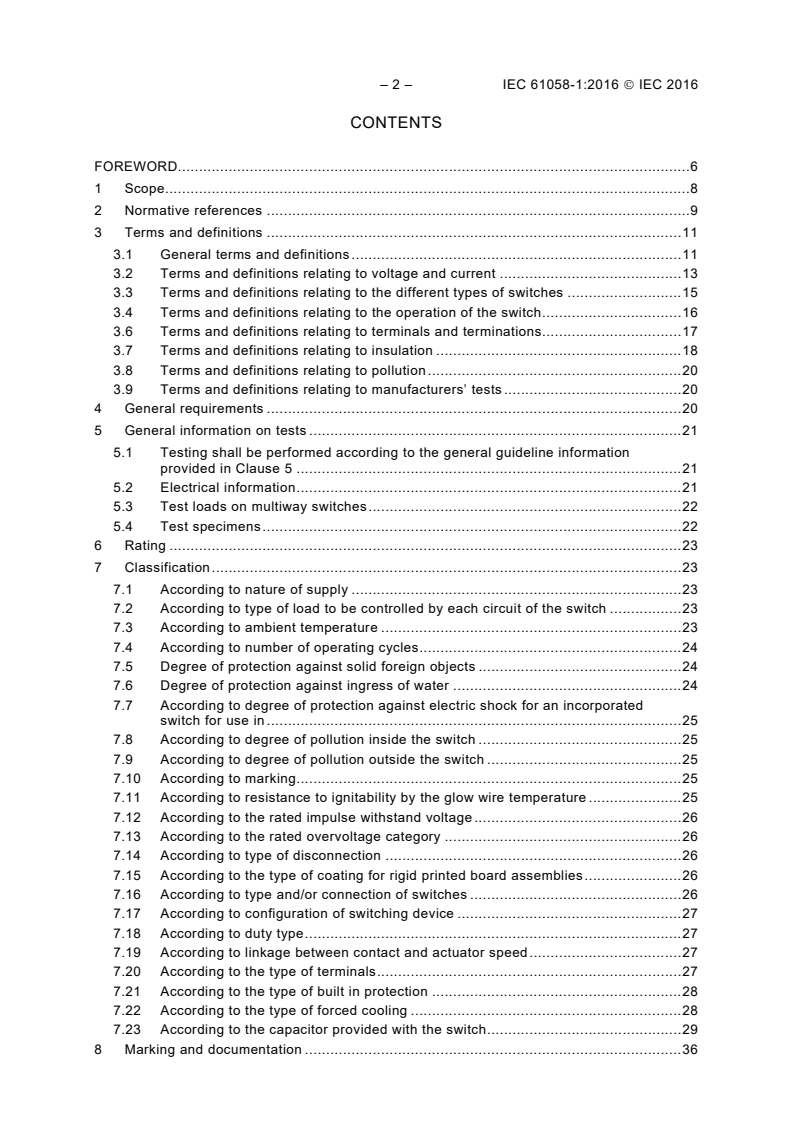
IEC 61058-1:2016 - Switches for appliances - Part 1: General requirements Released:7/20/2016
Overview
IEC 61058-1:2016 is an international standard published by the International Electrotechnical Commission (IEC) that defines the general requirements for switches used in appliances. This standard applies to switches intended to control electrical appliances and other equipment for household or similar purposes, with a rated voltage not exceeding 480 V and a rated current not exceeding 63 A. The scope covers both mechanical and electronic switches, although specific detailed requirements for each are now provided in separate parts: IEC 61058-1-1 (mechanical switches) and IEC 61058-1-2 (electronic switches).
As part of the IEC 61058 series, this fourth edition updates and consolidates requirements to align with current technology and market needs, enhancing product safety and performance globally.
Key Topics
IEC 61058-1:2016 addresses several key aspects to ensure the safety, reliability, and proper functioning of appliance switches:
- Scope and Classification: Defines types of switches covered, including actuation methods (manual, indirect, sensing unit), and applicable environments (household, similar uses).
- Marking and Documentation: Outlines marking requirements for switches, ensuring traceability and clear identification.
- Protection Against Electric Shock: Sets provisions to minimize electrical hazards to users.
- Construction and Mechanical Strength: Specifies constructional requirements, including insulation, terminal design, and resistance to heat and rust.
- Testing Requirements: Details general and specific testing conditions, including endurance, mechanical strength, thermal stress, and EMC (Electromagnetic Compatibility) requirements.
- Performance Under Environmental Conditions: Requirements for switches’ protection against solid objects, water, humidity, and pollution.
- Safety Compliance: Addresses the need for conformity to safety standards and references for equipment and end-product requirements.
Technical Changes in This Edition:
- Mechanical switch requirements moved to IEC 61058-1-1.
- Electronic switch requirements now in IEC 61058-1-2.
Applications
Appliance switches covered by IEC 61058-1:2016 are fundamental components in:
- Household Appliances: Ovens, refrigerators, washing machines, small kitchen appliances, and more.
- Consumer Electronics: Audio/video devices and other home entertainment equipment.
- Similar Environments: Appliances used in residential, commercial, and light industrial settings, wherever manual or automated switching is needed for control or safety.
Applying this standard ensures products are safe, reliable, and meet global market access requirements. Manufacturers, testing laboratories, and conformity assessment bodies use IEC 61058-1:2016 to design, test, and certify appliance switches for compliance.
Related Standards
For comprehensive compliance and to address specific requirements, IEC 61058-1:2016 should be used with the following related standards:
- IEC 61058-1-1: Requirements for mechanical switches
- IEC 61058-1-2: Requirements for electronic switches
- IEC 60669 series: Switches for household and similar fixed electrical installations
- IEC 60730 series: Automatic electrical controls
- IEC 60529: Degrees of protection provided by enclosures (IP code)
- IEC 61000 series: Electromagnetic compatibility (EMC)
- IEC 60068, IEC 60112, IEC 60691, and IEC 60695: Covering environmental, insulation, and fire hazard testing
Practical Value
Complying with IEC 61058-1:2016 helps manufacturers deliver safer, more reliable appliance switches, facilitating international trade by ensuring compatibility with regulatory requirements worldwide. By adhering to this standard, stakeholders demonstrate commitment to safety, reduce liability, and meet the expectations of consumers and regulators for high-quality electrical components.
Keywords: IEC 61058-1, appliance switches, switch standards, household switches, safety requirements, electrical appliance compliance, international electrical standards, switch testing, IEC standards, mechanical switches, electronic switches.
Relations
- Effective Date
- 25-Aug-2026
- Revises
IEC 61058-1:2000/AMD2:2007 - Amendment 2 - Switches for appliances - Part 1: General requirements - Effective Date
- 05-Sep-2023
- Effective Date
- 05-Sep-2023
- Revises
IEC 61058-1:2000/AMD1:2001 - Amendment 1 - Switches for appliances - Part 1: General requirements - Effective Date
- 05-Sep-2023
- Revises
IEC 61058-1:2000/COR1:2009 - Corrigendum 1 - Switches for appliances - Part 1: General requirements - Effective Date
- 05-Sep-2023
- Effective Date
- 05-Sep-2023
Buy Documents
IEC 61058-1:2016 RLV - Switches for appliances - Part 1: General requirements Released:7/20/2016
IEC 61058-1:2016 - Switches for appliances - Part 1: General requirements Released:7/20/2016
Get Certified
Connect with accredited certification bodies for this standard

IMQ S.p.A. (Certification)
Italian electrical product certification.

SLG Prüf- und Zertifizierungs GmbH
German testing and certification body.

UL Solutions
Global safety science company with testing, inspection and certification.
Sponsored listings
Frequently Asked Questions
IEC 61058-1:2016 is a standard published by the International Electrotechnical Commission (IEC). Its full title is "Switches for appliances - Part 1: General requirements". This standard covers: IEC 61058-1:2016 applies to switches for appliances. The switches are intended to control electrical appliances and other equipment for household or similar purposes with a rated voltage not exceeding 480 V and a rated current not exceeding 63 A. This fourth edition cancels and replaces the third edition published in 2000, Amendment 1:2001 and Amendment 2:2007. This edition constitutes a technical revision. This edition includes the following significant technical changes with respect to the previous edition: a) requirements for mechanical switches are now given in IEC 61058-1-1; b) requirements for electronic switches are now given in IEC 61058-1-2.
IEC 61058-1:2016 applies to switches for appliances. The switches are intended to control electrical appliances and other equipment for household or similar purposes with a rated voltage not exceeding 480 V and a rated current not exceeding 63 A. This fourth edition cancels and replaces the third edition published in 2000, Amendment 1:2001 and Amendment 2:2007. This edition constitutes a technical revision. This edition includes the following significant technical changes with respect to the previous edition: a) requirements for mechanical switches are now given in IEC 61058-1-1; b) requirements for electronic switches are now given in IEC 61058-1-2.
IEC 61058-1:2016 is classified under the following ICS (International Classification for Standards) categories: 29.120.40 - Switches. The ICS classification helps identify the subject area and facilitates finding related standards.
IEC 61058-1:2016 has the following relationships with other standards: It is inter standard links to EN ISO 23553-1:2022, IEC 61058-1:2000/AMD2:2007, IEC 61058-1:2000, IEC 61058-1:2000/AMD1:2001, IEC 61058-1:2000/COR1:2009, IEC 61058-1:2026. Understanding these relationships helps ensure you are using the most current and applicable version of the standard.
IEC 61058-1:2016 is available in PDF format for immediate download after purchase. The document can be added to your cart and obtained through the secure checkout process. Digital delivery ensures instant access to the complete standard document.
Standards Content (Sample)
IEC 61058-1 ®
Edition 4.0 2016-07
REDLINE VERSION
INTERNATIONAL
STANDARD
colour
inside
Switches for appliances –
Part 1: General requirements
All rights reserved. Unless otherwise specified, no part of this publication may be reproduced or utilized in any form
or by any means, electronic or mechanical, including photocopying and microfilm, without permission in writing from
either IEC or IEC's member National Committee in the country of the requester. If you have any questions about IEC
copyright or have an enquiry about obtaining additional rights to this publication, please contact the address below or
your local IEC member National Committee for further information.
IEC Central Office Tel.: +41 22 919 02 11
3, rue de Varembé Fax: +41 22 919 03 00
CH-1211 Geneva 20 info@iec.ch
Switzerland www.iec.ch
About the IEC
The International Electrotechnical Commission (IEC) is the leading global organization that prepares and publishes
International Standards for all electrical, electronic and related technologies.
About IEC publications
The technical content of IEC publications is kept under constant review by the IEC. Please make sure that you have the
latest edition, a corrigenda or an amendment might have been published.
IEC Catalogue - webstore.iec.ch/catalogue Electropedia - www.electropedia.org
The stand-alone application for consulting the entire The world's leading online dictionary of electronic and
bibliographical information on IEC International Standards, electrical terms containing 20 000 terms and definitions in
Technical Specifications, Technical Reports and other English and French, with equivalent terms in 15 additional
documents. Available for PC, Mac OS, Android Tablets and languages. Also known as the International Electrotechnical
iPad. Vocabulary (IEV) online.
IEC publications search - www.iec.ch/searchpub IEC Glossary - std.iec.ch/glossary
The advanced search enables to find IEC publications by a 65 000 electrotechnical terminology entries in English and
variety of criteria (reference number, text, technical French extracted from the Terms and Definitions clause of
committee,…). It also gives information on projects, replaced IEC publications issued since 2002. Some entries have been
and withdrawn publications. collected from earlier publications of IEC TC 37, 77, 86 and
CISPR.
IEC Just Published - webstore.iec.ch/justpublished
Stay up to date on all new IEC publications. Just Published IEC Customer Service Centre - webstore.iec.ch/csc
details all new publications released. Available online and If you wish to give us your feedback on this publication or
also once a month by email. need further assistance, please contact the Customer Service
Centre: csc@iec.ch.
IEC 61058-1 ®
Edition 4.0 2016-07
REDLINE VERSION
INTERNATIONAL
STANDARD
colour
inside
Switches for appliances –
Part 1: General requirements
INTERNATIONAL
ELECTROTECHNICAL
COMMISSION
ICS 29.120.40 ISBN 978-2-8322-3544-7
– 2 – IEC 61058-1:2016 RLV IEC 2016
CONTENTS
FOREWORD. 7
1 Scope . 9
2 Normative references . 10
3 Terms and definitions . 15
3.1 General terms and definitions . 15
3.2 Terms and definitions relating to voltages,and currents and wattage . 19
3.3 Terms and definitions relating to the different types of switches . 21
3.4 Terms and definitions relating to the operation of the switch . 22
3.6 Terms and definitions relating to terminals and terminations . 24
3.7 Terms and definitions relating to insulation . 26
3.8 Terms and definitions relating to pollution . 27
3.9 Terms and definitions relating to manufacturers’ tests . 28
4 General requirements . 28
5 General notes information on tests . 28
5.1 Testing shall be performed according to the general guideline information
provided in Clause 5 . 28
5.2 Electrical information . 32
5.3 Test loads on multiway switches . 33
5.4 Test specimens . 33
6 Rating . 33
7 Classification . 33
7.1 Classification of switches .
7.1 According to nature of supply . 33
7.2 According to type of load to be controlled by each circuit of the switch . 34
7.3 According to ambient temperature . 34
7.4 According to number of operating cycles . 35
7.5 Degree of protection against solid foreign objects (according to IEC 60529) . 35
7.6 Degree of protection against ingress of water (according to IEC 60529) . 36
7.7 According to degree of protection against electric shock for an incorporated
switch for use in . 36
7.8 According to degree of pollution inside the switch . 36
7.9 According to degree of pollution outside the switch . 37
7.10 According to marking . 37
7.11 According to resistance to ignitability by the glow wire temperature . 37
7.12 According to the rated impulse withstand voltage . 38
7.13 According to the rated overvoltage category . 38
7.14 According to type of disconnection . 38
7.15 According to the type of coating for rigid printed board assemblies . 38
7.16 According to type and/or connection of switches . 38
7.17 According to configuration of switching device . 40
7.18 According to duty type for electronic switches . 41
7.19 According to linkage between contact and actuator speed . 41
7.20 Classification According to the type of terminals . 41
7.21 According to the type of built in protection for electronic switches . 43
7.22 According to the condition of cooling for electronic switches type of forced
cooling . 43
7.23 According to the capacitor provided with the switch . 43
8 Marking and documentation . 51
8.1 Switch information . 51
8.3 Load rating . 57
8.4 Temperature rating . 62
8.5 Operating cycles . 62
8.6 Switches intended for use in Class II equipment or appliances . 63
8.7 Required marking . 63
8.8 Legibility and durability of marking . 63
8.9 Switches with their own enclosure . 63
9 Protection against electric shock . 64
10 Provision for earthing . 66
11 Terminals and terminations . 67
11.1 Terminals for copper conductors .
11.1 Common requirements to terminals . 76
11.2 Fixing of terminals . 78
11.3 Location and shielding of terminals . 78
11.4 Terminals for interconnection of more than one conductors . 78
11.5 Thermal stress . 79
11.6 Test sequences . 79
11.7 Conductor escape test (TT1) . 79
11.8 Terminal displacement test (TT2) . 80
11.9 Strand escape test (TT3) . 81
11.10 Multiple conductors (TT4) . 82
12 Construction . 82
12.1 Constructional requirements relating to protection against electric shock . 82
12.2 Constructional requirements relating to safety during mounting and normal
operation of the switch . 83
12.3 Constructional requirements relating to the mounting of switches and to the
attachment of cords . 84
13 Mechanism . 84
14 Protection against ingress of solid foreign objects, ingress of dutst, water and
humid conditions . 85
14.1 Protection against ingress of solid foreign objects . 85
14.2 Protection against ingress of dust .
14.2 Protection against ingress of water . 87
14.3 Protection against humid conditions . 87
15 Insulation resistance and dielectric strength . 88
15.1 General requirements . 88
15.2 Measurement of insulation resistance . 89
15.3 Insulation test voltage . 89
16 Heating . 90
16.1 General requirements . 90
16.2 Contacts and terminals . 90
16.3 Other parts . 92
16.4 Heating test . 96
17 Endurance . 97
17.1 General requirements .
17.2 Electrical endurance tests .
– 4 – IEC 61058-1:2016 RLV IEC 2016
18 Mechanical strength . 108
18.1 General requirements . 108
18.2 Impact . 108
18.3 Pull . 110
18.4 Push . 111
19 Screws, current-carrying parts and connections . 111
19.1 General requirements for electrical connections . 111
19.2 Screwed connections . 111
19.3 Current-carrying parts . 114
20 Clearances, creepage distances, solid insulation and coatings of rigid printed
board assemblies . 115
20.1 General requirements . 115
20.2 Clearances . 116
20.3 Clearances for disconnection . 118
20.4 Creepage distances . 118
20.5 Solid insulation . 121
20.6 Coatings of rigid printed board assemblies . 121
21 Resistance to heat and fire .
21 Fire hazard . 123
21.1 Resistance to heat . 123
21.2 Resistance to abnormal heat . 124
22 Resistance to rusting . 125
23 Abnormal operation and fault conditions for electronic switches . 125
24 Components for switches . 130
24.1 General requirements . 130
24.2 Protective devices . 130
24.3 Capacitors . 132
24.4 Resistors . 133
25 EMC requirements . 134
25.1 General . 134
25.2 Immunity . 134
25.3 Emission . 137
Annex A (normative) Measurement of clearances and creepage distances . 153
Annex B (informative) Diagram for the dimensioning of clearances and creepage
distances . 159
Annex C (normative) Glow-wire test .
Annex C (normative) Proof tracking test . 161
Annex D (informative) Switch application guide . 163
Annex E (normative) Ball-pressure test .
Annex E (normative) Relation between rated impulse withstand voltage, rated voltage
and overvoltage category . 168
Annex F (normative) Pollution degree . 169
Annex G (informative) Schematic diagram of families of terminals .
Annex G (normative) Impulse voltage test . 170
Annex H (informative) Flat quick-connect terminations, method for selection
of female connectors .
Annex H (normative) Altitude correction factors . 171
Annex I (normative) Types of coatings for rigid printed board assemblies . 172
Annex J (informative) Selection and sequence of tests of clause 21 .
Annex J (normative) Measuring the insulation distance of a coated printed board with
type 1 coating . 173
Annex K (normative) Routine tests . 174
Annex L (informative) Sampling tests . 175
Annex M (normative) Switch families . 177
Annex N (informative) Dimensions of tabs forming part of a switch . 179
Annex O (informative) Common end product standards . 180
Bibliography . 181
Figure 1 – Examples of pillar terminals . 139
Figure 2 – Examples of screw terminals and stud terminals . 140
Figure 3 – Examples of saddle terminals . 141
Figure 4 – Examples of lug terminals . 141
Figure 5 – Examples of mantle terminals . 142
Figure 6 – Examples of screwless terminals . 143
Figure 7 – Tabs of flat quick-connect terminations .
Figure 7 – Example of female (test) connector of flat quick-connect terminations . 145
Figure 8 – Circuit for capacitive load test and simulated tungsten filament lamp load
test for AC circuits . 146
Figure 9 – Circuit for capacitive load test and simulated lamp load test for DC circuits . 147
Figure 10 – Values of the capacitive load test circuit for test of switches rated 10/100
A 250 V∼ . 148
Figure 11 – Mounting device for the impact tests . 149
Figure 12 – Ball pressure apparatus .
Figure 12 – Continuous duty – Duty type S1 (see 7.18.1) . 151
Figure 13 – Test pin .
Figure 13 – Short-time duty – Duty type S2 (see 7.18.2) . 151
Figure 14 – Intermittent periodic duty – Duty-type S3 (see 7.18.3) . 151
Figure 15 – Diagram for heating test . 151
Figure 16 – Diagram for endurance test . 152
Figure J.1 – Measurement of the insulation distance . 173
Table 1 – Test specimens .
Table 1 – Test loads for multiway switches . 33
Table 2 – Type and connection of switches (1 of 8) . 44
Table 3 – Switch information and loads placed in groups . 52
Table 4 – Resistive current carried by the terminal and related cross-sectional areas
of terminals for unprepared conductors . 77
Table 5 – Maximum diameters of circular copper conductors.
Table 5 – Terminal test sequence. 79
Table 6 – Pulling forces for screw-type terminals . 81
Table 7 – Material and plating for tabs.
– 6 – IEC 61058-1:2016 RLV IEC 2016
Table 7 – Minimum insulation resistance . 89
Table 8 – Push and pull forces for tabs .
Table 8 – Dielectric strength . 90
Table 9 – Test conditions for Ta .
Table 9 – Minimum values of pull force . 110
Table 10 – Test conditions for Tb .
Table 10 – Torque values . 113
Table 11 – Torque values for screwed glands . 113
Table 12 – Minimum clearances for basic insulation . 117
Table 13 – Permissible maximum temperatures .
Table 13 – Minimum creepage distances for basic insulation . 119
Table 14 – Temperatures for thermosetting materials used for electronic switches .
Table 14 – Minimum creepage distances for functional insulation . 120
Table 15 – Electrical endurance tests for the different types of electronic switches
with or without electrical contact(s) .
Table 15 – Test levels and conditions . 122
Table 16 – Test loads for multiway switches .
Table 16 – Minimum requirements for capacitors . 133
Table 17 – Test loads for electrical endurance tests for a.c. circuits .
Table 17 – Test levels and duration for voltage dips and short interruptions . 135
Table 18 – Test loads for electrical endurance tests for d.c. circuits .
Table 18 – Fast transient bursts . 136
Table 26 – Conventional fusing current versus rated current .
Table A.1 – Minimum values for distances with specific pollution degrees . 153
Table E.1 – Rated impulse withstand voltage for switches energized directly from the
low voltage mains . 168
Table G.1 – Test voltages for verifying clearances at sea-level . 170
Table H.1 – Insertion and withdrawal forces for flat quick-connect terminations .
Table H.1 – Altitude correction factors . 171
INTERNATIONAL ELECTROTECHNICAL COMMISSION
____________
SWITCHES FOR APPLIANCES –
Part 1: General requirements
FOREWORD
1) The International Electrotechnical Commission (IEC) is a worldwide organization for standardization comprising
all national electrotechnical committees (IEC National Committees). The object of IEC is to promote
international co-operation on all questions concerning standardization in the electrical and electronic fields. To
this end and in addition to other activities, IEC publishes International Standards, Technical Specifications,
Technical Reports, Publicly Available Specifications (PAS) and Guides (hereafter referred to as “IEC
Publication(s)”). Their preparation is entrusted to technical committees; any IEC National Committee interested
in the subject dealt with may participate in this preparatory work. International, governmental and non-
governmental organizations liaising with the IEC also participate in this preparation. IEC collaborates closely
with the International Organization for Standardization (ISO) in accordance with conditions determined by
agreement between the two organizations.
2) The formal decisions or agreements of IEC on technical matters express, as nearly as possible, an international
consensus of opinion on the relevant subjects since each technical committee has representation from all
interested IEC National Committees.
3) IEC Publications have the form of recommendations for international use and are accepted by IEC National
Committees in that sense. While all reasonable efforts are made to ensure that the technical content of IEC
Publications is accurate, IEC cannot be held responsible for the way in which they are used or for any
misinterpretation by any end user.
4) In order to promote international uniformity, IEC National Committees undertake to apply IEC Publications
transparently to the maximum extent possible in their national and regional publications. Any divergence
between any IEC Publication and the corresponding national or regional publication shall be clearly indicated in
the latter.
5) IEC itself does not provide any attestation of conformity. Independent certification bodies provide conformity
assessment services and, in some areas, access to IEC marks of conformity. IEC is not responsible for any
services carried out by independent certification bodies.
6) All users should ensure that they have the latest edition of this publication.
7) No liability shall attach to IEC or its directors, employees, servants or agents including individual experts and
members of its technical committees and IEC National Committees for any personal injury, property damage or
other damage of any nature whatsoever, whether direct or indirect, or for costs (including legal fees) and
expenses arising out of the publication, use of, or reliance upon, this IEC Publication or any other IEC
Publications.
8) Attention is drawn to the Normative references cited in this publication. Use of the referenced publications is
indispensable for the correct application of this publication.
9) Attention is drawn to the possibility that some of the elements of this IEC Publication may be the subject of
patent rights. IEC shall not be held responsible for identifying any or all such patent rights.
This redline version of the official IEC Standard allows the user to identify the changes
made to the previous edition. A vertical bar appears in the margin wherever a change
has been made. Additions are in green text, deletions are in strikethrough red text.
– 8 – IEC 61058-1:2016 RLV IEC 2016
International Standard IEC 61058-1 has been prepared by subcommittee 23J: Switches for
appliances, of IEC technical committee 23: Electrical accessories.
This fourth edition cancels and replaces the third edition published in 2000,
Amendment 1:2001 and Amendment 2:2007. This edition constitutes a technical revision.
This edition includes the following significant technical changes with respect to the previous
edition:
a) requirements for mechanical switches are now given in IEC 61058-1-1;
b) requirements for electronic switches are now given in IEC 61058-1-2.
The text of this standard is based on the following documents:
FDIS Report on voting
23J/401/FDIS 23J/405/RVD
Full information on the voting for the approval of this standard can be found in the report on
voting indicated in the above table.
This publication has been drafted in accordance with the ISO/IEC Directives, Part 2.
A list of all parts in the IEC 61058 series, published under the general title Switches for
appliances, can be found on the IEC website.
In this part, the following print types are used:
• requirements proper: roman type;
• test specifications: italic type;
• notes: smaller roman type.
The committee has decided that the contents of this publication will remain unchanged until
the stability date indicated on the IEC website under "http://webstore.iec.ch" in the data
related to the specific publication. At this date, the publication will be
• reconfirmed,
• withdrawn,
• replaced by a revised edition, or
• amended.
IMPORTANT – The “colour inside” logo on the cover page of this publication indicates
that it contains colours which are considered to be useful for the correct understanding
of its contents. Users should therefore print this publication using a colour printer.
SWITCHES FOR APPLIANCES –
Part 1: General requirements
1 Scope
1.1 This part of IEC 61058 applies to switches (mechanical or electronic) for appliances
actuated by hand, by foot or by other human activity. The switches are intended to operate or
control electrical appliances and other equipment for household or similar purposes with a
rated voltage not exceeding 440 480 V and a rated current not exceeding 63 A.
Switches for appliances are intended to be operated by
– a person via an actuating member or by,
– indirect actuation,
– an actuating sensing unit.
The actuating member or sensing unit can be integral with or arranged separately, either
physically or electrically, from the switch and may involve transmission of a signal, for
example electrical, optical, acoustic or thermal, between the actuating member or sensing unit
and the switch.
Switches which incorporate additional control functions governed by the switch function are
within the scope of this standard.
This standard also covers the indirect actuation of the switch when the operation of the
actuating member or sensing unit is provided by a remote control or a part of an appliance or
equipment such as a door.
NOTE 1 Electronic switches may be combined with mechanical switches giving full disconnection or micro-
disconnection.
NOTE 2 Electronic switches without a mechanical switch in the supply circuit provide only electronic
disconnection. Therefore, the circuit on the load side is always considered to be live.
NOTE 3 For switches used in tropical climates, additional requirements may be necessary.
NOTE 4 Attention is drawn to the fact that the standards for appliances may contain additional or alternative
requirements for switches.
NOTE 5 Throughout this standard, the word "appliance" means "appliance or equipment".
NOTE 6 This part of IEC 61058 is applicable when testing incorporated switches. When other types of switches
for appliances are tested, this part is applicable together with the relevant IEC 61058-2.
This part may, however, be applied for other types of switches which are not mentioned in IEC 61058-2, provided
that the electrical safety is not disregarded.
1.2 This standard applies to switches intended to be incorporated in, on or with an
appliance.
1.3 This standard also applies to switches incorporating electronic devices.
1.4 This standard also applies to switches for appliances such as
– switches intended to be connected to a flexible cable (cord switches);
NOTE In this document, the word "cable" means "cable or cord".
– 10 – IEC 61058-1:2016 RLV IEC 2016
– switches integrated in an appliance (integrated switches);
– switches intended to be mounted apart from the appliance (independently mounted
switches) other than those within the scope of IEC 60669-1;
– change-over selectors for which, however, particular requirements are given in IEC 61058-2.
1.5 This standard does not contain requirements for isolating switches.
NOTE Requirements for isolating switches are under consideration.
1.6 This standard does not apply to devices which control appliances and equipment not
actuated intentionally by a person. These are covered by IEC 60730.
Transmission of a signal between the actuating member or sensing unit and the switch may
be connected by optical, acoustic, thermal, electrical or other relevant connection and may
include remote controlled units.
This part of IEC 61058 applies to switches for appliances provided with additional control
functions governed by the switch provided with electronic circuits and devices that are
necessary for the intended and/or correct operation of the switch.
This part of IEC 61058 applies to circuitry when evaluated with a switch and necessary for the
switching function.
This part of IEC 61058 applies in general to switches for appliances in conjunction with the
following parts:
– Part 1-1: Requirements for mechanical switches, and/or
– Part 1-2: Requirements for electronic switches.
This part of IEC 61058 does not apply to devices covered by:
– IEC 60669 (all parts), Switches for household and similar fixed-electrical installations, and
– IEC 60730 (all parts), Automatic electrical controls.
This part of IEC 61058 does not contain requirements for safety isolating switches
(IEC 60050-811:1991, 811-29-17).
NOTE 1 For switches used in tropical climates, additional requirements may be necessary.
NOTE 2 Attention is drawn to the fact that the end product standards for appliances may contain additional or
alternative requirements for switches.
NOTE 3 Throughout this part of IEC 61058, the word "appliance" means "appliance or equipment".
2 Normative references
The following documents, in whole or in part, are normatively referenced in this document and
are indispensable for its application. For dated references, only the edition cited applies. For
undated references, the latest edition of the referenced document (including any
amendments) applies.
1)
IEC 60034-1:1996, Rotating electrical machines – Part 1: Rating and performance
Amendment 1 (1997)
Amendment 2 (1999)
___________
1)
There is a consolidated edition 10.2 (1999) that includes IEC 60034-1 and its amendments 1 (1997) and
2 (1999).
IEC 60038:1983, IEC standard voltages
IEC 60050(151):1978, International Electrotechnical Vocabulary (IEV) – Chapter 151:
Electrical and magnetic devices
IEC 60050(411):1973, International Electrotechnical Vocabulary (IEV) – Chapter 411:
Rotating machinery
IEC 60050(441):1984, International Electrotechnical Vocabulary (IEV) – Chapter 441:
Switchgear, controlgear and fuses
IEC 60050(826):1982, International Electrotechnical Vocabulary (IEV) – Chapter 826:
Electrical installations of buildings
Amendment 1 (1990)
Amendment 2 (1995)
IEC 60060-1:1989, High-voltage techniques – Part 1: General definitions and test
requirements
IEC 60065:2014, Audio, video and similar electronic apparatus – Safety requirements
IEC 60068-2-20:1979, Environmental testing – Part 2-20: Tests – Test T: Soldering
IEC 60068-2-75:1997, Environmental testing – Part 2-75: Tests – Test Eh: Hammer tests
IEC 60085:1984, Thermal evaluation and classification of electrical insulation
IEC 60112:1979 2003, Method for the determination of the proof and the comparative tracking
indices of solid insulating materials under moist conditions
Amendment 1:2009
IEC 60127 (all parts), Miniature fuses
IEC 60127-2:1989, Miniature fuses – Part 2: Cartridge fuse-links
IEC 60228:1978, Conductors of insulated cables
IEC 60228A:1982, Conductors of insulated cables – First supplement: Guide to the
dimensional limits of circular conductors
IEC 60269-1:1998, Low-voltage fuses – Part 1: General requirements
IEC 60269-3, Low-voltage fuses – Part 3: Supplementary requirements for fuses for use by
unskilled persons (fuses mainly for household or similar applications) – Examples of
standardized systems of fuses A to F
IEC 60269-3-1:1994, Low-voltage fuses – Part 3-1: Supplementary requirements for fuses for
use by unskilled persons (fuses mainly for household and similar applications) – Sections I to IV
IEC 60335-1:1991, Safety of household and similar electrical appliances – Part 1: General
requirements
Amendment 1 (1994)
IEC 60335 (all parts 2), Safety for household and similar electrical appliances
– 12 – IEC 61058-1:2016 RLV IEC 2016
IEC 60364-4-41:1992, Electrical installations of buildings – Part 4: Protection for safety –
2)
Chapter 41: Protection against electric shock
Amendment 1 (1996)
Amendment 2 (1999)
IEC 60364-4-442:1993, Electrical installations of buildings – Part 4: Protection for safety –
Chapter 44: Protection against overvoltage – Section 442: Protection of low-voltage
3)
installations against faults between high-voltage systems and earth
Amendment 1 (1995)
Amendment 2 (1999)
IEC 60364-4-443:1995, Electrical installations of buildings – Part 4: Protection for safety –
Chapter 44: Protection against overvoltages – Section 443: Protection against overvoltages of
4)
atmospheric origin or due to switching
Amendment 1 (1998)
IEC 60384-14:1993, Fixed capacitors for use in electronic equipment – Part 14: Sectional
specification – Fixed capacitors for electromagnetic interference suppression and connection
to the supply mains
IEC 60417, Graphical symbols for use on equipment (available at: http://www.graphical-
symbols.info/equipment)
IEC 60417-1:1998, Graphical symbols for use on equipment – Part 1: Overview and
application
IEC 60529:1989, Degree of protection provided by enclosures (IP code)
Amendment 1:1999
Amendment 2:2013
IEC 60617, Graphical symbols for diagrams (available at: http://std.iec.ch/iec60617)
IEC 60617-2:1996, Graphical symbols for diagrams – Part 2: Symbol elements, qualifying
symbols and other symbols having general application
IEC 60664-1:1992, Insulation coordination for equipment within low-voltage systems – Part 1:
Principles, requirements and tests
IEC 60664-3:1992 2003, Insulation coordination for equipment within low-voltage systems –
Part 3: Use of coatings to achieve insulation coordination of printed board assemblies, potting
or molding for protection against pollution
Amendment 1:2010
IEC 60669-1:1998, Switches for household and similar fixed electrical installations – Part 1:
General requirements
IEC 60691:1993, Thermal-links – Requirements and application guide
IEC 60695-2-1 (all sheets), Fire hazard testing – Part 2-1: Test methods
___________
2)
There is a consolidated edition 3.2 (1999) that includes IEC 60364-4-41 and its amendments 1 (1996) and
2 (1999).
3)
There is a consolidated edition 1.2 (1999) that includes IEC 60364-4-442 and its amendments 1 (1995) and
2 (1999).
4)
There is a consolidated edition 3.2 (1999) that includes IEC 60364-4-443 and its amendment 1 (1998).
IEC 60695-2-11, Fire hazard testing – Part 2-11: Glowing/hot-wire based test methods –
Glow-wire flammability test method for end-products
IEC 60695-10-2, Fire hazard testing – Part 10-2: Abnormal heat – Ba
...
IEC 61058-1 ®
Edition 4.0 2016-07
INTERNATIONAL
STANDARD
NORME
INTERNATIONALE
Switches for appliances –
Part 1: General requirements
Interrupteurs pour appareils –
Partie 1: Exigences générales
All rights reserved. Unless otherwise specified, no part of this publication may be reproduced or utilized in any form
or by any means, electronic or mechanical, including photocopying and microfilm, without permission in writing from
either IEC or IEC's member National Committee in the country of the requester. If you have any questions about IEC
copyright or have an enquiry about obtaining additional rights to this publication, please contact the address below or
your local IEC member National Committee for further information.
Droits de reproduction réservés. Sauf indication contraire, aucune partie de cette publication ne peut être reproduite
ni utilisée sous quelque forme que ce soit et par aucun procédé, électronique ou mécanique, y compris la photocopie
et les microfilms, sans l'accord écrit de l'IEC ou du Comité national de l'IEC du pays du demandeur. Si vous avez des
questions sur le copyright de l'IEC ou si vous désirez obtenir des droits supplémentaires sur cette publication, utilisez
les coordonnées ci-après ou contactez le Comité national de l'IEC de votre pays de résidence.
IEC Central Office Tel.: +41 22 919 02 11
3, rue de Varembé Fax: +41 22 919 03 00
CH-1211 Geneva 20 info@iec.ch
Switzerland www.iec.ch
About the IEC
The International Electrotechnical Commission (IEC) is the leading global organization that prepares and publishes
International Standards for all electrical, electronic and related technologies.
About IEC publications
The technical content of IEC publications is kept under constant review by the IEC. Please make sure that you have the
latest edition, a corrigenda or an amendment might have been published.
IEC Catalogue - webstore.iec.ch/catalogue Electropedia - www.electropedia.org
The stand-alone application for consulting the entire The world's leading online dictionary of electronic and
bibliographical information on IEC International Standards, electrical terms containing 20 000 terms and definitions in
Technical Specifications, Technical Reports and other English and French, with equivalent terms in 15 additional
documents. Available for PC, Mac OS, Android Tablets and languages. Also known as the International Electrotechnical
iPad. Vocabulary (IEV) online.
IEC publications search - www.iec.ch/searchpub IEC Glossary - std.iec.ch/glossary
The advanced search enables to find IEC publications by a 65 000 electrotechnical terminology entries in English and
variety of criteria (reference number, text, technical French extracted from the Terms and Definitions clause of
committee,…). It also gives information on projects, replaced IEC publications issued since 2002. Some entries have been
and withdrawn publications. collected from earlier publications of IEC TC 37, 77, 86 and
CISPR.
IEC Just Published - webstore.iec.ch/justpublished
Stay up to date on all new IEC publications. Just Published IEC Customer Service Centre - webstore.iec.ch/csc
details all new publications released. Available online and If you wish to give us your feedback on this publication or
also once a month by email. need further assistance, please contact the Customer Service
Centre: csc@iec.ch.
A propos de l'IEC
La Commission Electrotechnique Internationale (IEC) est la première organisation mondiale qui élabore et publie des
Normes internationales pour tout ce qui a trait à l'électricité, à l'électronique et aux technologies apparentées.
A propos des publications IEC
Le contenu technique des publications IEC est constamment revu. Veuillez vous assurer que vous possédez l’édition la
plus récente, un corrigendum ou amendement peut avoir été publié.
Catalogue IEC - webstore.iec.ch/catalogue Electropedia - www.electropedia.org
Application autonome pour consulter tous les renseignements
Le premier dictionnaire en ligne de termes électroniques et
bibliographiques sur les Normes internationales,
électriques. Il contient 20 000 termes et définitions en anglais
Spécifications techniques, Rapports techniques et autres
et en français, ainsi que les termes équivalents dans 15
documents de l'IEC. Disponible pour PC, Mac OS, tablettes
langues additionnelles. Egalement appelé Vocabulaire
Android et iPad.
Electrotechnique International (IEV) en ligne.
Recherche de publications IEC - www.iec.ch/searchpub
Glossaire IEC - std.iec.ch/glossary
La recherche avancée permet de trouver des publications IEC 65 000 entrées terminologiques électrotechniques, en anglais
en utilisant différents critères (numéro de référence, texte, et en français, extraites des articles Termes et Définitions des
comité d’études,…). Elle donne aussi des informations sur les publications IEC parues depuis 2002. Plus certaines entrées
projets et les publications remplacées ou retirées. antérieures extraites des publications des CE 37, 77, 86 et
CISPR de l'IEC.
IEC Just Published - webstore.iec.ch/justpublished
Service Clients - webstore.iec.ch/csc
Restez informé sur les nouvelles publications IEC. Just
Published détaille les nouvelles publications parues. Si vous désirez nous donner des commentaires sur cette
Disponible en ligne et aussi une fois par mois par email. publication ou si vous avez des questions contactez-nous:
csc@iec.ch.
IEC 61058-1 ®
Edition 4.0 2016-07
INTERNATIONAL
STANDARD
NORME
INTERNATIONALE
Switches for appliances –
Part 1: General requirements
Interrupteurs pour appareils –
Partie 1: Exigences générales
INTERNATIONAL
ELECTROTECHNICAL
COMMISSION
COMMISSION
ELECTROTECHNIQUE
INTERNATIONALE
ICS 29.120.40 ISBN 978-2-8322-3466-2
– 2 – IEC 61058-1:2016 IEC 2016
CONTENTS
FOREWORD. 6
1 Scope . 8
2 Normative references . 9
3 Terms and definitions . 11
3.1 General terms and definitions . 11
3.2 Terms and definitions relating to voltage and current . 13
3.3 Terms and definitions relating to the different types of switches . 15
3.4 Terms and definitions relating to the operation of the switch . 16
3.6 Terms and definitions relating to terminals and terminations . 17
3.7 Terms and definitions relating to insulation . 18
3.8 Terms and definitions relating to pollution . 20
3.9 Terms and definitions relating to manufacturers’ tests . 20
4 General requirements . 20
5 General information on tests . 21
5.1 Testing shall be performed according to the general guideline information
provided in Clause 5 . 21
5.2 Electrical information . 21
5.3 Test loads on multiway switches . 22
5.4 Test specimens . 22
6 Rating . 23
7 Classification . 23
7.1 According to nature of supply . 23
7.2 According to type of load to be controlled by each circuit of the switch . 23
7.3 According to ambient temperature . 23
7.4 According to number of operating cycles . 24
7.5 Degree of protection against solid foreign objects . 24
7.6 Degree of protection against ingress of water . 24
7.7 According to degree of protection against electric shock for an incorporated
switch for use in . 25
7.8 According to degree of pollution inside the switch . 25
7.9 According to degree of pollution outside the switch . 25
7.10 According to marking . 25
7.11 According to resistance to ignitability by the glow wire temperature . 25
7.12 According to the rated impulse withstand voltage . 26
7.13 According to the rated overvoltage category . 26
7.14 According to type of disconnection . 26
7.15 According to the type of coating for rigid printed board assemblies . 26
7.16 According to type and/or connection of switches . 26
7.17 According to configuration of switching device . 27
7.18 According to duty type . 27
7.19 According to linkage between contact and actuator speed . 27
7.20 According to the type of terminals . 27
7.21 According to the type of built in protection . 28
7.22 According to the type of forced cooling . 28
7.23 According to the capacitor provided with the switch . 29
8 Marking and documentation . 36
8.1 Switch information . 36
8.2 Symbols . 39
8.3 Load rating . 40
8.4 Temperature rating . 42
8.5 Operating cycles . 43
8.6 Switches intended for use in Class II equipment or appliances . 43
8.7 Required marking . 43
8.8 Legibility and durability of marking . 43
8.9 Switches with their own enclosure . 44
9 Protection against electric shock . 44
10 Provision for earthing . 46
11 Terminals and terminations . 47
11.1 Common requirements to terminals . 47
11.2 Fixing of terminals . 49
11.3 Location and shielding of terminals . 49
11.4 Terminals for interconnection of more than one conductors . 49
11.5 Thermal stress . 49
11.6 Test sequences . 50
11.7 Conductor escape test (TT1) . 50
11.8 Terminal displacement test (TT2) . 51
11.9 Strand escape test (TT3) . 52
11.10 Multiple conductors (TT4) . 53
12 Construction . 53
12.1 Constructional requirements relating to protection against electric shock . 53
12.2 Constructional requirements relating to safety during mounting and normal
operation of the switch . 54
12.3 Constructional requirements relating to the mounting of switches and to the
attachment of cords . 54
13 Mechanism . 55
14 Protection against ingress of solid foreign objects, ingress of water and humid
conditions . 56
14.1 Protection against ingress of solid foreign objects . 56
14.2 Protection against ingress of water . 56
14.3 Protection against humid conditions . 57
15 Insulation resistance and dielectric strength . 58
15.1 General requirements . 58
15.2 Measurement of insulation resistance . 58
15.3 Insulation test voltage . 59
16 Heating . 60
16.1 General requirements . 60
16.2 Contacts and terminals . 60
16.3 Other parts . 60
16.4 Heating test . 60
17 Endurance . 61
18 Mechanical strength . 61
18.1 General requirements . 61
18.2 Impact . 61
18.3 Pull . 62
– 4 – IEC 61058-1:2016 IEC 2016
18.4 Push . 62
19 Screws, current-carrying parts and connections . 63
19.1 General requirements for electrical connections . 63
19.2 Screwed connections . 63
19.3 Current-carrying parts . 66
20 Clearances, creepage distances, solid insulation and coatings of rigid printed
board assemblies . 66
20.1 General requirements . 66
20.2 Clearances . 67
20.3 Clearances for disconnection . 68
20.4 Creepage distances . 69
20.5 Solid insulation . 72
20.6 Coatings of rigid printed board assemblies . 72
21 Fire hazard . 73
21.1 Resistance to heat . 73
21.2 Resistance to abnormal heat . 74
22 Resistance to rusting . 75
23 Abnormal operation and fault conditions for switches . 75
24 Components for switches . 75
24.1 General requirements . 75
24.2 Protective devices . 76
24.3 Capacitors . 78
24.4 Resistors . 79
25 EMC requirements . 79
25.1 General . 79
25.2 Immunity . 80
25.3 Emission . 82
Annex A (normative) Measurement of clearances and creepage distances . 96
Annex B (informative) Diagram for the dimensioning of clearances and creepage
distances . 102
Annex C (normative) Proof tracking test . 103
Annex D (informative) Switch application guide . 104
Annex E (normative) Relation between rated impulse withstand voltage, rated voltage
and overvoltage category . 106
Annex F (normative) Pollution degree . 107
Annex G (normative) Impulse voltage test . 108
Annex H (normative) Altitude correction factors . 109
Annex I (normative) Types of coatings for rigid printed board assemblies . 110
Annex J (normative) Measuring the insulation distance of a coated printed board with
type 1 coating . 111
Annex K (normative) Routine tests . 112
Annex L (informative) Sampling tests . 113
Annex M (normative) Switch families . 115
Annex N (informative) Dimensions of tabs forming part of a switch . 117
Annex O (informative) Common end product standards . 118
Bibliography . 119
Figure 1 – Examples of pillar terminals . 84
Figure 2 – Examples of screw terminals and stud terminals . 85
Figure 3 – Examples of saddle terminals . 86
Figure 4 – Examples of lug terminals . 86
Figure 5 – Examples of mantle terminals . 87
Figure 6 – Examples of screwless terminals . 88
Figure 7 – Example of female (test) connector of flat quick-connect terminations . 89
Figure 8 – Circuit for capacitive load test and simulated tungsten filament lamp load
test for AC circuits . 90
Figure 9 – Circuit for capacitive load test and simulated lamp load test for DC circuits . 91
Figure 10 – Values of the capacitive load test circuit for test of switches rated 10/100
A 250 V∼ . 92
Figure 11 – Mounting device for the impact tests . 93
Figure 12 – Continuous duty – Duty type S1 (see 7.18.1) . 94
Figure 13 – Short-time duty – Duty type S2 (see 7.18.2) . 94
Figure 14 – Intermittent periodic duty – Duty-type S3 (see 7.18.3) . 94
Figure 15 – Diagram for heating test . 94
Figure 16 – Diagram for endurance test . 95
Figure J.1 – Measurement of the insulation distance . 111
Table 1 – Test loads for multiway switches . 22
Table 2 – Type and connection of switches . 29
Table 3 – Switch information and loads placed in groups . 37
Table 4 – Resistive current carried by the terminal and related cross-sectional areas
of terminals for unprepared conductors . 48
Table 5 – Terminal test sequence. 50
Table 6 – Pulling forces for screw-type terminals . 52
Table 7 – Minimum insulation resistance . 59
Table 8 – Dielectric strength . 59
Table 9 – Minimum values of pull force . 62
Table 10 – Torque values . 65
Table 11 – Torque values for screwed glands . 65
Table 12 – Minimum clearances for basic insulation . 68
Table 13 – Minimum creepage distances for basic insulation . 70
Table 14 – Minimum creepage distances for functional insulation . 71
Table 15 – Test levels and conditions . 73
Table 16 – Minimum requirements for capacitors . 79
Table 17 – Test levels and duration for voltage dips and short interruptions . 80
Table 18 – Fast transient bursts . 81
Table A.1 – Minimum values for distances with specific pollution degrees . 96
Table E.1 – Rated impulse withstand voltage for switches energized directly from the
low voltage mains . 106
Table G.1 – Test voltages for verifying clearances at sea-level . 108
Table H.1 – Altitude correction factors . 109
– 6 – IEC 61058-1:2016 IEC 2016
INTERNATIONAL ELECTROTECHNICAL COMMISSION
____________
SWITCHES FOR APPLIANCES –
Part 1: General requirements
FOREWORD
1) The International Electrotechnical Commission (IEC) is a worldwide organization for standardization comprising
all national electrotechnical committees (IEC National Committees). The object of IEC is to promote
international co-operation on all questions concerning standardization in the electrical and electronic fields. To
this end and in addition to other activities, IEC publishes International Standards, Technical Specifications,
Technical Reports, Publicly Available Specifications (PAS) and Guides (hereafter referred to as “IEC
Publication(s)”). Their preparation is entrusted to technical committees; any IEC National Committee interested
in the subject dealt with may participate in this preparatory work. International, governmental and non-
governmental organizations liaising with the IEC also participate in this preparation. IEC collaborates closely
with the International Organization for Standardization (ISO) in accordance with conditions determined by
agreement between the two organizations.
2) The formal decisions or agreements of IEC on technical matters express, as nearly as possible, an international
consensus of opinion on the relevant subjects since each technical committee has representation from all
interested IEC National Committees.
3) IEC Publications have the form of recommendations for international use and are accepted by IEC National
Committees in that sense. While all reasonable efforts are made to ensure that the technical content of IEC
Publications is accurate, IEC cannot be held responsible for the way in which they are used or for any
misinterpretation by any end user.
4) In order to promote international uniformity, IEC National Committees undertake to apply IEC Publications
transparently to the maximum extent possible in their national and regional publications. Any divergence
between any IEC Publication and the corresponding national or regional publication shall be clearly indicated in
the latter.
5) IEC itself does not provide any attestation of conformity. Independent certification bodies provide conformity
assessment services and, in some areas, access to IEC marks of conformity. IEC is not responsible for any
services carried out by independent certification bodies.
6) All users should ensure that they have the latest edition of this publication.
7) No liability shall attach to IEC or its directors, employees, servants or agents including individual experts and
members of its technical committees and IEC National Committees for any personal injury, property damage or
other damage of any nature whatsoever, whether direct or indirect, or for costs (including legal fees) and
expenses arising out of the publication, use of, or reliance upon, this IEC Publication or any other IEC
Publications.
8) Attention is drawn to the Normative references cited in this publication. Use of the referenced publications is
indispensable for the correct application of this publication.
9) Attention is drawn to the possibility that some of the elements of this IEC Publication may be the subject of
patent rights. IEC shall not be held responsible for identifying any or all such patent rights.
International Standard IEC 61058-1 has been prepared by subcommittee 23J: Switches for
appliances, of IEC technical committee 23: Electrical accessories.
This fourth edition cancels and replaces the third edition published in 2000,
Amendment 1:2001 and Amendment 2:2007. This edition constitutes a technical revision.
This edition includes the following significant technical changes with respect to the previous
edition:
a) requirements for mechanical switches are now given in IEC 61058-1-1;
b) requirements for electronic switches are now given in IEC 61058-1-2.
The text of this standard is based on the following documents:
FDIS Report on voting
23J/401/FDIS 23J/405/RVD
Full information on the voting for the approval of this standard can be found in the report on
voting indicated in the above table.
This publication has been drafted in accordance with the ISO/IEC Directives, Part 2.
A list of all parts in the IEC 61058 series, published under the general title Switches for
appliances, can be found on the IEC website.
In this part, the following print types are used:
• requirements proper: roman type;
• test specifications: italic type;
• notes: smaller roman type.
The committee has decided that the contents of this publication will remain unchanged until
the stability date indicated on the IEC website under "http://webstore.iec.ch" in the data
related to the specific publication. At this date, the publication will be
• reconfirmed,
• withdrawn,
• replaced by a revised edition, or
• amended.
– 8 – IEC 61058-1:2016 IEC 2016
SWITCHES FOR APPLIANCES –
Part 1: General requirements
1 Scope
This part of IEC 61058 applies to switches for appliances. The switches are intended to
control electrical appliances and other equipment for household or similar purposes with a
rated voltage not exceeding 480 V and a rated current not exceeding 63 A.
Switches for appliances are intended to be operated by
– a person via an actuating member,
– indirect actuation,
– an actuating sensing unit.
Transmission of a signal between the actuating member or sensing unit and the switch may
be connected by optical, acoustic, thermal, electrical or other relevant connection and may
include remote controlled units.
This part of IEC 61058 applies to switches for appliances provided with additional control
functions governed by the switch provided with electronic circuits and devices that are
necessary for the intended and/or correct operation of the switch.
This part of IEC 61058 applies to circuitry when evaluated with a switch and necessary for the
switching function.
This part of IEC 61058 applies in general to switches for appliances in conjunction with the
following parts:
– Part 1-1: Requirements for mechanical switches, and/or
– Part 1-2: Requirements for electronic switches.
This part of IEC 61058 does not apply to devices covered by:
– IEC 60669 (all parts), Switches for household and similar fixed-electrical installations, and
– IEC 60730 (all parts), Automatic electrical controls.
This part of IEC 61058 does not contain requirements for safety isolating switches
(IEC 60050-811:1991, 811-29-17).
NOTE 1 For switches used in tropical climates, additional requirements may be necessary.
NOTE 2 Attention is drawn to the fact that the end product standards for appliances may contain additional or
alternative requirements for switches.
NOTE 3 Throughout this part of IEC 61058, the word "appliance" means "appliance or equipment".
2 Normative references
The following documents, in whole or in part, are normatively referenced in this document and
are indispensable for its application. For dated references, only the edition cited applies. For
undated references, the latest edition of the referenced document (including any
amendments) applies.
IEC 60038, IEC standard voltages
IEC 60060-1, High-voltage techniques – Part 1: General definitions and test requirements
IEC 60065:2014, Audio, video and similar electronic apparatus – Safety requirements
IEC 60068-2-75, Environmental testing – Part 2-75: Tests – Test Eh: Hammer tests
IEC 60112:2003, Method for the determination of the proof and the comparative tracking
indices of solid insulating materials
Amendment 1:2009
IEC 60127 (all parts), Miniature fuses
IEC 60127-2, Miniature fuses – Part 2: Cartridge fuse-links
IEC 60269-3, Low-voltage fuses – Part 3: Supplementary requirements for fuses for use by
unskilled persons (fuses mainly for household or similar applications) – Examples of
standardized systems of fuses A to F
IEC 60384-14, Fixed capacitors for use in electronic equipment – Part 14: Sectional
specification – Fixed capacitors for electromagnetic interference suppression and connection
to the supply mains
IEC 60417, Graphical symbols for use on equipment (available at: http://www.graphical-
symbols.info/equipment)
IEC 60529:1989, Degree of protection provided by enclosures (IP code)
Amendment 1:1999
Amendment 2:2013
IEC 60617, Graphical symbols for diagrams (available at: http://std.iec.ch/iec60617)
IEC 60664-3:2003, Insulation coordination for equipment within low-voltage systems – Part 3:
Use of coating, potting or molding for protection against pollution
Amendment 1:2010
IEC 60691, Thermal-links – Requirements and application guide
IEC 60695-2-11, Fire hazard testing – Part 2-11: Glowing/hot-wire based test methods –
Glow-wire flammability test method for end-products
IEC 60695-10-2, Fire hazard testing – Part 10-2: Abnormal heat – Ball pressure test method
IEC 60695-11-10, Fire hazard testing – Part 11-10: Test flames – 50 W horizontal and vertical
flame test methods
IEC 60695-11-20, Fire hazard testing – Part 11-20: Test flames – 500 W flame test method
– 10 – IEC 61058-1:2016 IEC 2016
IEC 60730 (all parts), Automatic electrical controls
IEC 60730-1:2013, Automatic electrical controls – Part 1: General requirements
IEC 60730-2-9:2015, Automatic electrical controls – Part 2-9: Particular requirements for
temperature sensing control
IEC 60738-1, Thermistors – Directly heated positive temperature coefficient – Part 1: Generic
specification
IEC 61000-3-2, Electromagnetic compatibility (EMC) – Part 3.2: Limits – Limits for harmonic
current emissions (equipment input current ≤ 16 A per phase)
IEC 61000-3-3, Electromagnetic compatibility (EMC) – Part 3-3: Limits – Limitation of voltage
changes, voltage fluctuations and flicker in public low-voltage supply systems, for equipment
with rated current ≤16 A per phase and not subject to conditional connection
IEC TS 61000-3-5, Electromagnetic compatibility (EMC) – Part 3-5: Limits – Limitation of
voltage fluctuations and flicker in low-voltage power supply systems for equipment with rated
current greater than 75 A
IEC 61000-4-2, Electromagnetic compatibility (EMC) – Part 4-2: Testing and measurement
techniques – Electrostatic discharge immunity test
IEC 61000-4-3, Electromagnetic compatibility (EMC) – Part 4-3: Testing and measurement
techniques – Radiated, radio-frequency, electromagnetic field immunity test
IEC 61000-4-4, Electromagnetic compatibility (EMC) – Part 4-4: Testing and measurement
techniques – Electrical fast transient/burst immunity test
IEC 61000-4-5, Electromagnetic compatibility (EMC) – Part 4-5: Testing and measurement
techniques – Surge immunity test
IEC 61000-4-8, Electromagnetic compatibility (EMC) – Part 4-8: Testing and measurement
techniques – Power frequency magnetic field immunity test
IEC 61000-4-11, Electromagnetic compatibility (EMC) – Part 4-11: Testing and measurement
techniques – Voltage dips, short interruptions and voltage variations immunity tests
IEC 61032:1997, Protection of persons and equipment by enclosures – Probes for verification
IEC 61058-1-1, Switches for appliances – Part 1-1: Requirements for mechanical switches
IEC 61058-1-2, Switches for appliances – Part 1-2: Requirements for electronic switches.
IEC 61210:2010, Connecting devices – Flat quick-connect terminations for electrical copper
conductors – Safety requirements
CISPR 14-1, Electromagnetic compatibility – Requirements for household appliances, electric
tools and similar apparatus – Part 1: Emission
CISPR 15:2013, Limits and methods of measurement of radio disturbance characteristics of
electrical lighting and similar equipment
3 Terms and definitions
For the purposes of this document, the following terms and definitions apply.
3.1 General terms and definitions
3.1.1
mechanical switching device
switching device designed to close and open one or more electric circuits by means of
separable contacts
Note 1 to entry: In the IEC 61058 series the terms “switching devices” and “switches” are used interchangeably.
[SOURCE: IEC 60050-441:1984, 441-14-02]
3.1.2
conductive part
part which is capable of conducting current although it may not necessarily be used for
carrying service current
[SOURCE: IEC 60050-441: 1984, 441-11-09]
3.1.3
live part
conductor or conductive part intended to be energized in normal operation, including a neutral
conductor, but by convention not a PEN/PEM/PEL conductor
Note 1 to entry: For appliance switches, “live part” implies a risk of electric shock.
Note 2 to entry: Unless otherwise specified, parts connected to a SELV supply or equal to or less than 24 V are
not considered to be live parts.
3.1.4
pole of a switch
portion of a switching device associated exclusively with one electrically separated conducting
path of its main circuit and excluding those portions which provide a means for mounting and
operating all poles together
Note 1 to entry: A switch is called "single pole" if it has only one pole. If it has more than one pole, it may be
called "multipole" (two-pole, three-pole, etc.) provided that the poles are coupled in such a manner as to operate
together.
[SOURCE: IEC 60050-441:1984, 441-15-01, modified — Pole of a switching device replaced
by pole of a switch]
3.1.5
detachable part
part which is removable without the use of a tool when the switch is mounted as in normal use
3.1.6
tool
screwdriver, coin, or any other object which may be used to operate a nut, a screw or a
similar part
3.1.7
normal use
use of the switch for the purpose for which it was made and declared
– 12 – IEC 61058-1:2016 IEC 2016
3.1.8
unique type reference
UT
identification marking on a switch such that by quoting it in full to the switch manufacturer a
unique switch model can be identified
Note 1 to entry: This note applies to the French language only.
3.1.9
common type reference
CT
identification marking on a switch which does not require any further specific information
additional to that provided by the marking requirements of this part of IEC 61058 for selection,
installation and use in accordance with this part of IEC 61058
Note 1 to entry: This note applies to the French language only.
3.1.10
cover
cover plate
protective cover
cover made of insulating material, used to cover live parts in order to avoid accidental electric
contact and which is accessible when the switch is mounted as in normal use but which can
be removed with the aid of a tool
3.1.11
signal indicator
device associated with a switch to indicate the circuit state visually
Note 1 to entry: The device may or may not be controlled by the switch.
3.1.12
unprepared conductor
a conductor which has been cut and the insulation of which has been removed for insertion
into a terminal.
[SOURCE: IEC 60050-442:1998, 442-01-26]
3.1.13
prepared conductor
a conductor the end of which is fitted with an attachment such as eyelet, sleeve or cable lug
[SOURCE: IEC 60050-442:1998, 442-01-27]
3.1.14
polarity reversal
change of the polarity on the terminals connected to the load by a switching action
3.1.15
semiconductor device
SD
device whose essential characteristics are due to the flow of charge carriers within a
semiconductor
Note 1 to entry: Previous editions of IEC 61058-1 refer to a semiconductor device as a “semiconductor switching
device or solid state device (SD)”.
[SOURCE: IEC 60050-521:2002, 521-04-01]
3.1.16
semiconductor circuit
circuit containing multiple components, where at least one is a semiconductor device
3.1.17
electronic switch
switch for appliances provided with a semiconductor device or a semiconductor circuit in its
intended load path
Note 1 to entry: The electronic switch may be provided with series and/or parallel mechanical contacts. See
examples in Table 15 in IEC 61058-1-2:2016.
3.1.18
duty
statement of the load to which the switch is su
...