

IEC 61058-2-6:2018
(Main)Switches for appliances - Part 2-6: Particular requirements for switches used in electric motor-operated hand-held tools, transportable tools and lawn and garden machinery
General Information
- Abstract
IEC 61058-2-6:2018 is a subset based on IEC 61058-1. The clauses outlined below are intended to address the specific requirements for switches incorporated into or integrated with electric motor-operated hand-held tools, transportable tools and lawn and garden machinery.
This document is intended for switches with an ambient temperature up to and including 55 °C. Switches tested according to IEC 61058-1 are considered to comply with this document and additional testing is not required provided ratings, loads, and endurance are correct.
This second edition cancels and replaces the first edition published in 2016. It constitutes a technical revision.
This edition includes the following significant change with respect to the previous edition:
Overall format to support IEC 61058-1, IEC 61058-1-1 and IEC 61058-1-2.
- Status
- Published
- Publication Date
- 22-Nov-2018
- Technical Committee
- SC 23J - Switches for appliances
- Drafting Committee
- MT 1 - TC 23/SC 23J/MT 1
- Current Stage
- PPUB - Publication issued
- Start Date
- 23-Nov-2018
- Completion Date
- 14-Dec-2018
Buy Documents
IEC 61058-2-6:2018 RLV - Switches for appliances - Part 2-6: Particular requirements for switches used in electric motor-operated hand-held tools, transportable tools and lawn and garden machinery Released:11/23/2018
IEC 61058-2-6:2018 - Switches for appliances - Part 2-6: Particular requirements for switches used in electric motor-operated hand-held tools, transportable tools and lawn and garden machinery Released:11/23/2018
Overview
IEC 61058-2-6:2018 is an international standard developed by the International Electrotechnical Commission (IEC) that specifies particular requirements for switches used in electric motor-operated hand-held tools, transportable tools, and lawn and garden machinery. It functions as a subset of IEC 61058-1, focusing on ambient operating temperatures up to and including 55°C. This standard is relevant for manufacturers, product designers, and compliance professionals involved with electrical accessories, ensuring switches integrated into tools and outdoor equipment meet tailored operational and safety benchmarks.
This second edition supersedes the previous 2016 edition, featuring an updated format aligned with IEC 61058-1, IEC 61058-1-1, and IEC 61058-1-2 to streamline referencing and ensure consistency across related standards.
Key Topics
- Scope: Defines requirements specifically for switches in electric motor-driven hand-held tools, transportable tools, and lawn and garden equipment, with a focus on ambient temperatures up to 55°C.
- Compliance: Switches compliant with IEC 61058-1 are recognized as meeting this standard, provided they match the necessary ratings, loads, and endurance criteria-eliminating redundant testing.
- Marking and Documentation: Specifies the unique identification of switches, including manufacturer details, model numbers, and explicit declaration of compliance with IEC 61058-2-6 (marked as "PT").
- Testing Requirements: Outlines endurance, dielectric strength, and mechanical testing procedures necessary for switch reliability and user safety under demanding tool and equipment conditions.
- Protection and Safety: Addresses requirements for protection against electric shock, ingress of foreign objects and water, and ensures robust insulation and resilience against mechanical and electrical stress.
Applications
IEC 61058-2-6:2018 is widely applicable in the following areas:
- Electric motor-operated hand-held tools: Ensures switch performance in drills, grinders, saws, and similar portable tools that operate in diverse and sometimes harsh environments.
- Transportable tools: Applies to machinery that, while not permanently installed, is meant to be moved or reconfigured as part of its normal use-such as table saws or portable compressors.
- Lawn and garden machinery: Supports manufacturers of equipment like lawnmowers, hedge trimmers, and leaf blowers in integrating switches that stand up to outdoor use, moisture, and dirt.
- Product compliance and safety evaluation: Regulatory agencies and certification bodies reference this standard to verify product compliance and to guide type testing and factory surveillance.
Adoption of this standard provides clear benchmarks for switch safety, performance, and labeling, facilitating market access, reducing liability, and promoting end-user safety across global markets.
Related Standards
For comprehensive compliance and design considerations, IEC 61058-2-6:2018 should be used in conjunction with:
- IEC 61058-1: General requirements for appliance switches
- IEC 61058-1-1 & IEC 61058-1-2: Additional requirements and specifications for particular switch types
- IEC 60335 series: Safety standards for household and similar electrical appliances, including gardening equipment
- IEC 60745 & IEC 62841 series: Safety for hand-held and transportable electric motor-operated tools
Referencing these standards together ensures robust, harmonized design and testing practices for switches incorporated within a wide spectrum of electrical tools and outdoor equipment.
Adhering to IEC 61058-2-6:2018 demonstrates a commitment to both international safety standards and product quality, enhancing trust with regulators and end users in the appliance and power tool sectors.
Relations
- Effective Date
- 05-Sep-2023
Buy Documents
IEC 61058-2-6:2018 RLV - Switches for appliances - Part 2-6: Particular requirements for switches used in electric motor-operated hand-held tools, transportable tools and lawn and garden machinery Released:11/23/2018
IEC 61058-2-6:2018 - Switches for appliances - Part 2-6: Particular requirements for switches used in electric motor-operated hand-held tools, transportable tools and lawn and garden machinery Released:11/23/2018
Get Certified
Connect with accredited certification bodies for this standard

IMQ S.p.A. (Certification)
Italian electrical product certification.

SLG Prüf- und Zertifizierungs GmbH
German testing and certification body.

UL Solutions
Global safety science company with testing, inspection and certification.
Sponsored listings
Frequently Asked Questions
IEC 61058-2-6:2018 is a standard published by the International Electrotechnical Commission (IEC). Its full title is "Switches for appliances - Part 2-6: Particular requirements for switches used in electric motor-operated hand-held tools, transportable tools and lawn and garden machinery". This standard covers: IEC 61058-2-6:2018 is a subset based on IEC 61058-1. The clauses outlined below are intended to address the specific requirements for switches incorporated into or integrated with electric motor-operated hand-held tools, transportable tools and lawn and garden machinery. This document is intended for switches with an ambient temperature up to and including 55 °C. Switches tested according to IEC 61058-1 are considered to comply with this document and additional testing is not required provided ratings, loads, and endurance are correct. This second edition cancels and replaces the first edition published in 2016. It constitutes a technical revision. This edition includes the following significant change with respect to the previous edition: Overall format to support IEC 61058-1, IEC 61058-1-1 and IEC 61058-1-2.
IEC 61058-2-6:2018 is a subset based on IEC 61058-1. The clauses outlined below are intended to address the specific requirements for switches incorporated into or integrated with electric motor-operated hand-held tools, transportable tools and lawn and garden machinery. This document is intended for switches with an ambient temperature up to and including 55 °C. Switches tested according to IEC 61058-1 are considered to comply with this document and additional testing is not required provided ratings, loads, and endurance are correct. This second edition cancels and replaces the first edition published in 2016. It constitutes a technical revision. This edition includes the following significant change with respect to the previous edition: Overall format to support IEC 61058-1, IEC 61058-1-1 and IEC 61058-1-2.
IEC 61058-2-6:2018 is classified under the following ICS (International Classification for Standards) categories: 29.120.40 - Switches. The ICS classification helps identify the subject area and facilitates finding related standards.
IEC 61058-2-6:2018 has the following relationships with other standards: It is inter standard links to IEC 61058-2-6:2016. Understanding these relationships helps ensure you are using the most current and applicable version of the standard.
IEC 61058-2-6:2018 is available in PDF format for immediate download after purchase. The document can be added to your cart and obtained through the secure checkout process. Digital delivery ensures instant access to the complete standard document.
Standards Content (Sample)
IEC 61058-2-6 ®
Edition 2.0 2018-11
REDLINE VERSION
INTERNATIONAL
STANDARD
colour
inside
Switches for appliances –
Part 2-6: Particular requirements for switches used in electric motor-operated
hand-held tools, transportable tools and lawn and garden machinery
All rights reserved. Unless otherwise specified, no part of this publication may be reproduced or utilized in any form
or by any means, electronic or mechanical, including photocopying and microfilm, without permission in writing from
either IEC or IEC's member National Committee in the country of the requester. If you have any questions about IEC
copyright or have an enquiry about obtaining additional rights to this publication, please contact the address below or
your local IEC member National Committee for further information.
IEC Central Office Tel.: +41 22 919 02 11
3, rue de Varembé Fax: +41 22 919 03 00
CH-1211 Geneva 20 info@iec.ch
Switzerland www.iec.ch
About the IEC
The International Electrotechnical Commission (IEC) is the leading global organization that prepares and publishes
International Standards for all electrical, electronic and related technologies.
About IEC publications
The technical content of IEC publications is kept under constant review by the IEC. Please make sure that you have the
latest edition, a corrigenda or an amendment might have been published.
IEC Catalogue - webstore.iec.ch/catalogue Electropedia - www.electropedia.org
The stand-alone application for consulting the entire The world's leading online dictionary of electronic and
bibliographical information on IEC International Standards, electrical terms containing 20 000 terms and definitions in
Technical Specifications, Technical Reports and other English and French, with equivalent terms in 15 additional
documents. Available for PC, Mac OS, Android Tablets and languages. Also known as the International Electrotechnical
iPad. Vocabulary (IEV) online.
IEC publications search - www.iec.ch/searchpub IEC Glossary - std.iec.ch/glossary
The advanced search enables to find IEC publications by a 65 000 electrotechnical terminology entries in English and
variety of criteria (reference number, text, technical French extracted from the Terms and Definitions clause of
committee,…). It also gives information on projects, replaced IEC publications issued since 2002. Some entries have been
and withdrawn publications. collected from earlier publications of IEC TC 37, 77, 86 and
CISPR.
IEC Just Published - webstore.iec.ch/justpublished
Stay up to date on all new IEC publications. Just Published IEC Customer Service Centre - webstore.iec.ch/csc
details all new publications released. Available online and If you wish to give us your feedback on this publication or
also once a month by email. need further assistance, please contact the Customer Service
Centre: csc@iec.ch.
IEC 61058-2-6 ®
Edition 2.0 2018-11
REDLINE VERSION
INTERNATIONAL
STANDARD
colour
inside
Switches for appliances –
Part 2-6: Particular requirements for switches used in electric motor-operated
hand-held tools, transportable tools and lawn and garden machinery
INTERNATIONAL
ELECTROTECHNICAL
COMMISSION
ICS 29.120.40 ISBN 978-2-8322-6325-9
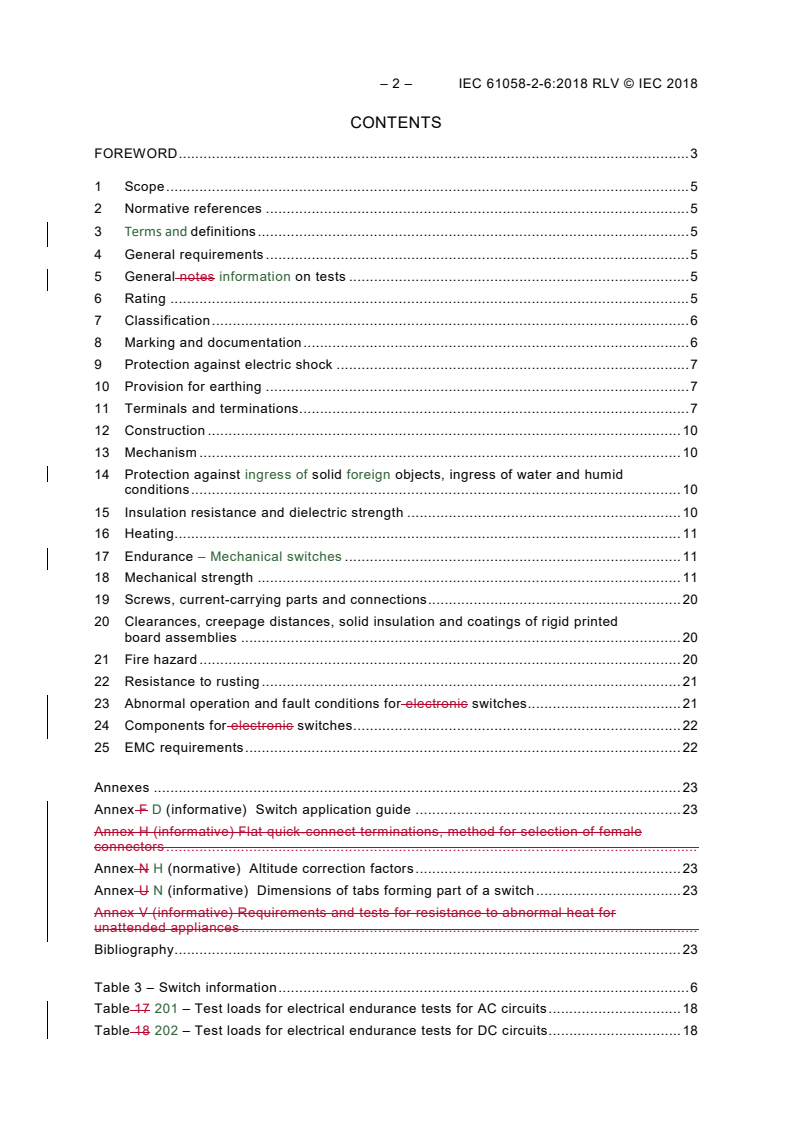
– 2 – IEC 61058-2-6:2018 RLV © IEC 2018
CONTENTS
FOREWORD . 3
1 Scope . 5
2 Normative references . 5
3 Terms and definitions . 5
4 General requirements . 5
5 General notes information on tests . 5
6 Rating . 5
7 Classification . 6
8 Marking and documentation . 6
9 Protection against electric shock . 7
10 Provision for earthing . 7
11 Terminals and terminations. 7
12 Construction . 10
13 Mechanism . 10
14 Protection against ingress of solid foreign objects, ingress of water and humid
conditions . 10
15 Insulation resistance and dielectric strength . 10
16 Heating . 11
17 Endurance – Mechanical switches . 11
18 Mechanical strength . 11
19 Screws, current-carrying parts and connections . 20
20 Clearances, creepage distances, solid insulation and coatings of rigid printed
board assemblies . 20
21 Fire hazard . 20
22 Resistance to rusting . 21
23 Abnormal operation and fault conditions for electronic switches . 21
24 Components for electronic switches . 22
25 EMC requirements . 22
Annexes . 23
Annex F D (informative) Switch application guide . 23
Annex H (informative) Flat quick-connect terminations, method for selection of female
connectors .
Annex N H (normative) Altitude correction factors . 23
Annex U N (informative) Dimensions of tabs forming part of a switch . 23
Annex V (informative) Requirements and tests for resistance to abnormal heat for
unattended appliances .
Bibliography . 23
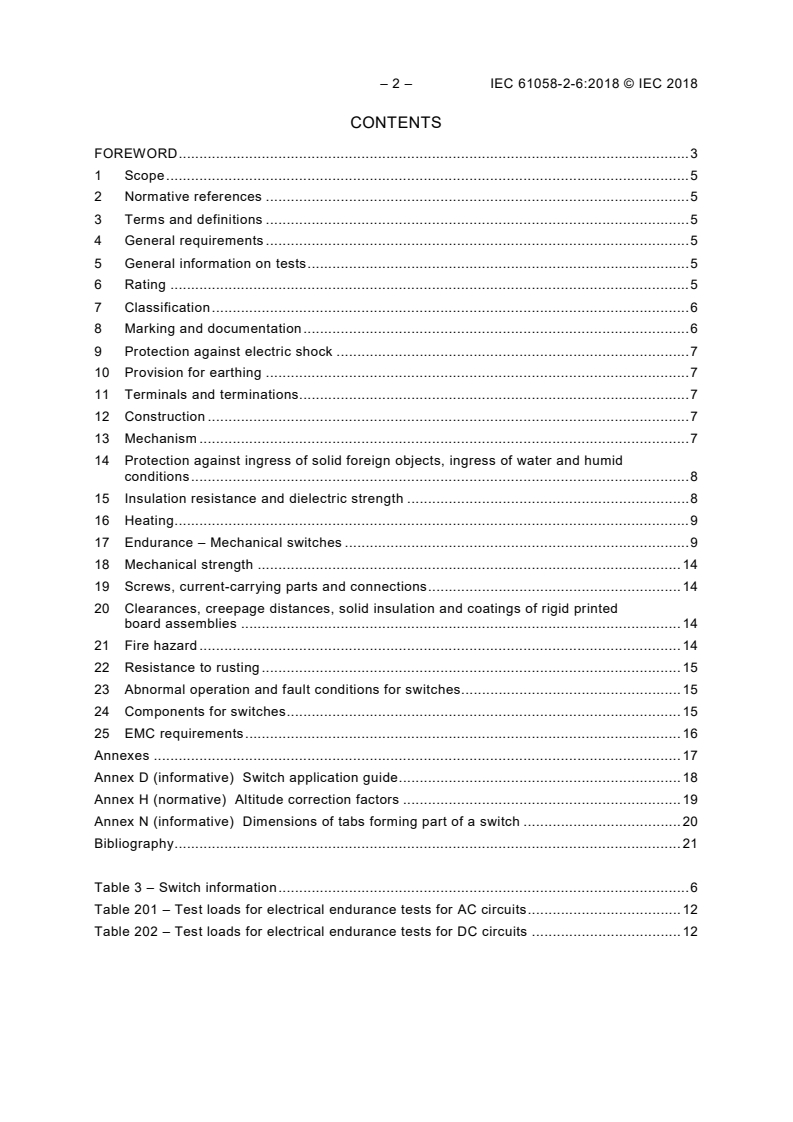
Table 3 – Switch information . 6
Table 17 201 – Test loads for electrical endurance tests for AC circuits . 18
Table 18 202 – Test loads for electrical endurance tests for DC circuits . 18
INTERNATIONAL ELECTROTECHNICAL COMMISSION
____________
SWITCHES FOR APPLIANCES –
Part 2-6: Particular requirements for switches used
in electric motor-operated hand-held tools, transportable
tools and lawn and garden machinery
FOREWORD
1) The International Electrotechnical Commission (IEC) is a worldwide organization for standardization comprising
all national electrotechnical committees (IEC National Committees). The object of IEC is to promote
international co-operation on all questions concerning standardization in the electrical and electronic fields. To
this end and in addition to other activities, IEC publishes International Standards, Technical Specifications,
Technical Reports, Publicly Available Specifications (PAS) and Guides (hereafter referred to as "IEC
Publication(s)"). Their preparation is entrusted to technical committees; any IEC National Committee interested
in the subject dealt with may participate in this preparatory work. International, governmental and non-
governmental organizations liaising with the IEC also participate in this preparation. IEC collaborates closely
with the International Organization for Standardization (ISO) in accordance with conditions determined by
agreement between the two organizations.
2) The formal decisions or agreements of IEC on technical matters express, as nearly as possible, an international
consensus of opinion on the relevant subjects since each technical committee has representation from all
interested IEC National Committees.
3) IEC Publications have the form of recommendations for international use and are accepted by IEC National
Committees in that sense. While all reasonable efforts are made to ensure that the technical content of IEC
Publications is accurate, IEC cannot be held responsible for the way in which they are used or for any
misinterpretation by any end user.
4) In order to promote international uniformity, IEC National Committees undertake to apply IEC Publications
transparently to the maximum extent possible in their national and regional publications. Any divergence
between any IEC Publication and the corresponding national or regional publication shall be clearly indicated in
the latter.
5) IEC itself does not provide any attestation of conformity. Independent certification bodies provide conformity
assessment services and, in some areas, access to IEC marks of conformity. IEC is not responsible for any
services carried out by independent certification bodies.
6) All users should ensure that they have the latest edition of this publication.
7) No liability shall attach to IEC or its directors, employees, servants or agents including individual experts and
members of its technical committees and IEC National Committees for any personal injury, property damage or
other damage of any nature whatsoever, whether direct or indirect, or for costs (including legal fees) and
expenses arising out of the publication, use of, or reliance upon, this IEC Publication or any other IEC
Publications.
8) Attention is drawn to the Normative references cited in this publication. Use of the referenced publications is
indispensable for the correct application of this publication.
9) Attention is drawn to the possibility that some of the elements of this IEC Publication may be the subject of
patent rights. IEC shall not be held responsible for identifying any or all such patent rights.
This redline version of the official IEC Standard allows the user to identify the changes
made to the previous edition. A vertical bar appears in the margin wherever a change
has been made. Additions are in green text, deletions are in strikethrough red text.
– 4 – IEC 61058-2-6:2018 RLV © IEC 2018
International Standard IEC 61058-2-6 has been prepared by subcommittee 23J: Switches for
appliances, of IEC technical committee 23: Electrical accessories.
This second edition cancels and replaces the first edition published in 2016. It constitutes a
technical revision.
This edition includes the following significant change with respect to the previous edition:
Overall format to support IEC 61058-1, IEC 61058-1-1 and IEC 61058-1-2.
The text of this International Standard is based on the following documents:
FDIS Report on voting
3J/450/FDIS 23J/452/RVD
Full information on the voting for the approval of this International Standard can be found in
the report on voting indicated in the above table.
This document has been drafted in accordance with the ISO/IEC Directives, Part 2.
This document is to be used in conjunction with IEC 61058-1:2016.
This document supplements or modifies the corresponding clauses in IEC 61058-1, so as to
convert that publication into the IEC standard: Particular requirements for switches used in
electric motor-operated hand-held tools, transportable tools and lawn and garden machinery.
When a particular subclause of IEC 61058-1 is not mentioned in this document, that
subclause applies as far as reasonable. Where this document states "addition", "modification"
or "replacement", the relevant text of IEC 61058-1 is to be adapted accordingly.
In this standard:
1) the following print types are used:
• requirements proper: in roman type;
• test specifications: in italic type;
• notes/explanatory matter: in small roman type.
2) subclauses, notes, figures and tables which are additional to those in IEC 61058-1 are
numbered starting from 101.
A list of all the parts in the IEC 61058 series, under the general title Switches for appliances,
can be found on the IEC website.
The committee has decided that the contents of this document will remain unchanged until the
stability date indicated on the IEC website under "http://webstore.iec.ch" in the data related to
the specific document. At this date, the document will be
• reconfirmed,
• withdrawn,
• replaced by a revised edition, or
• amended.
IMPORTANT – The 'colour inside' logo on the cover page of this publication indicates
that it contains colours which are considered to be useful for the correct
understanding of its contents. Users should therefore print this document using a
colour printer.
SWITCHES FOR APPLIANCES –
Part 2-6: Particular requirements for switches used
in electric motor-operated hand-held tools, transportable
tools and lawn and garden machinery
1 Scope
Clause 1 of IEC 61058-1:2016 is applicable except as follows.
1.1 Addition:
This part of IEC 61058 is a subset based on IEC 61058-1. The clauses outlined below are
intended to address the specific requirements for switches incorporated into or integrated with
electric motor-operated hand-held tools, transportable tools and lawn and garden machinery.
This document is intended for switches with an ambient temperature up to and including
55 °C. Switches tested according to IEC 61058-1 are considered to comply with this document
and additional testing is not required provided ratings, loads, and endurance are correct.
NOTE This document takes into account the fact that tests are conducted as part of the end-product evaluation
(e.g. products tested according to the IEC 60745 and IEC 62841 series, and lawn and gardening equipment tested
according to the IEC 60335 series), and need not be that tests are not conducted on the component switch.
2 Normative references
Clause 2 of IEC 61058-1:2016 is applicable except as follows.
Addition:
IEC 61058-1:2016, Switches for appliances – Part 1: General requirements
3 Terms and definitions
Clause 3 of IEC 61058-1:2016 is applicable.
4 General requirements
Clause 4 of IEC 61058-1:2016 is applicable.
5 General notes information on tests
Clause 5 of IEC 61058-1:2016 is applicable.
6 Rating
Clause 6 of IEC 61058-1:2016 is applicable.
– 6 – IEC 61058-2-6:2018 RLV © IEC 2018
7 Classification
Clause 7 of IEC 61058-1:2016 is applicable except as follows.
7.1.3.2 IEC 61058-1:2016, 7.3.2 is not applicable.
7.1.3.3 IEC 61058-1:2016, 7.3.3 is not applicable.
7.1.5.3.1 7.7.1 IEC 61058-1:2016, 7.7.1 is not applicable.
7.1.5.3.2 7.7.2 IEC 61058-1:2016, 7.7.2 is not applicable.
8 Marking and documentation
Clause 8 of IEC 61058-1:2016 is applicable except as follows.
8.1.1 General
Addition:
Switches declared for use in appliances such as power tools are considered unique type (U.T)
when referencing Table 3.
8.1.3 By documentation
Replacement of Table 3:
Table 3 – Switch information
Characteristic Means of information
SWITCH IDENTIFICATION – UNIQUE TYPE REFERENCE U.T.
(7.10.1)
Manufacturer's name or trade mark Marking (Ma)
Type reference (model or catalogue number) Marking (Ma)
Identification that the switch is in compliance with this document (8.101) Marking (Ma)
Type of appliance for which a switch shall be used (hand-held tools, Documentation (Do)
transportable tools, or lawn and garden machinery)
Number of operating cycles (7.1.4) Documentation (Do)
Degree of protection against electric shock, from outside an appliance Documentation
(7.1.5.3 7.7)
Number of contact only cycles (TC 7 for electronic switches) (17.2.4.7) Documentation (Do)
Number of cycles with switching device only (TC 7) (17.5.7)
All terminals shall be suitably identified, or their purpose self-evident, or Marking
the switch circuitry visually apparent. For terminals intended for the
connection of supply conductors, the identification may take the form of
a letter L, a number or an arrow
The rated current and electrical load type Documentation (Do)
Ambient temperature limits if different from 0 °C to 55 °C Documentation (Do)
Duty-type and relevant information (e.g. ON/OFF-time) (7.18) Documentation (Do)
For electronic switches, the duty-type S1 (7.1.16) Documentation (Do)
8.3 Load rating
IEC 61058-1:2016, 8.3 is applicable except as follows.
8.3.2 Substantially restive load
IEC 61058-1:2016, 8.3.2 is not applicable.
8.3.4 Resistive load and capacitive load
IEC 61058-1:2016, 8.3.4 is not applicable.
8.3.5 Resistive load and tungsten filament lamp load
IEC 61058-1:2016, 8.3.5 is not applicable.
8.3.6 Declared specific load
IEC 61058-1:2016, 8.3.6 is not applicable.
8.3.8 General purpose loads
IEC 61058-1:2016, 8.3.8 is not applicable.
Addition:
8.101 Switch compliance with IEC 61058-2-6
The marking to indicate compliance with IEC 61058-2-6 shall be "PT".
Compliance is checked by inspection.
9 Protection against electric shock
Clause 9 of IEC 61058-1:2016 is applicable except as follows.
9.1 IEC 61058-1:2016, 9.1 is not applicable.
NOTE The requirements of this subclause is are covered in the end-product standard.
9.2 This subclause is not applicable.
NOTE This subclause is covered in the end.
10 Provision for earthing
Clause 10 of IEC 61058-1:2016 is not applicable.
11 Terminals and terminations
Clause 11 of IEC 61058-1:2016 is applicable, except as follows:.
11.1.1.2 This subclause is not applicable.
NOTE This subclause is covered in the end product standard.
– 8 – IEC 61058-2-6:2018 RLV © IEC 2018
11.1.1.3 This subclause is not applicable except Table 4.
NOTE This subclause is covered in the end product standard.
11.1.1.4 This subclause is not applicable.
NOTE This subclause is covered in the end product standard.
11.1.1.5 This subclause is not applicable.
11.1.1.6 Replacement:
Terminals shall be designed so that the end of a conductor introduced into the hole is visible
or that the insertion of the conductor is prevented by a stop if further insertion may reduce
creepage distances and/or clearances or influence the mechanism of the switch.
Compliance is checked by inspection.
11.1.2 Screw-type terminals for unprepared conductors
Addition:
Screw type terminals for unprepared conductors are permitted but tested as part of the end
product evaluation.
11.1.2.1 This subclause is not applicable.
11.1.2.2 This subclause is not applicable.
11.1.2.3 This subclause is not applicable.
11.1.3.1 Replacement:
Screwless terminals shall allow, according to their classification, the proper connection of
conductors having cross-sectional areas as declared.
The intended disconnection of a conductor shall require an operation other than a pull at the
conductor, such that it can be effected manually with or without the help of a tool in normal
use.
11.1.3.2 Replacement:
Screwless terminals shall withstand the mechanical stress occurring in normal use. The
conductor shall be clamped reliably and between metal surfaces, except that, for screwless
terminals intended to be used in circuits carrying a current not exceeding 0,2 A, one of the
surfaces may be non-metallic.
Compliance is checked by the following test, which is carried out with uninsulated copper
conductors, first having the largest declared cross-sectional area, and then having the
smallest declared cross-sectional area:
a) either rigid: five insertions and disconnections for solid conductors and one insertion and
disconnection for stranded conductors; or
b) flexible: five insertions and disconnections; or
c) rigid and flexible: if the terminal can accept both types of conductors, the tests are carried
out with rigid and flexible conductors for the number of times indicated above.
The conductors are inserted and disconnected for the number of times indicated above using
new conductors each time, except for the last time, when the conductors used for the last but
one insertion are clamped at the same place.
For each insertion, the conductors shall be either pushed as far as possible into the terminal
or shall be inserted to ensure that the connection is adequate. After each insertion, the
conductor is twisted through 90° in an axial direction and then subjected to a pull force of
35 N; the pull force is applied without jerks, for 1 min, in the direction of the axis of the
conductor space.
If the terminal is declared as suitable for two or more conductors, the appropriate pull force is
applied consecutively to each conductor. During the application of the pull force, the
conductor shall not come out of the terminal. After these tests, neither the screwless terminals
nor the clamping means shall have become loose.
11.1.3.4 This subclause of Part 1 is not applicable.
11.2 Terminals for prepared copper conductors and/or terminals requiring the use of a
special purpose tool
This subclause of Part 1 is applicable, except as follows:
11.2.1 Common requirements
This subclause is not applicable.
11.2.3.2 This subclause is not applicable.
11.2.4 Non-disconnectable screwless terminations
Addition:
Non-disconnectable screwless terminations are permitted but tested as part of the end
product evaluation.
11.2.4.1 This subclause is not applicable.
11.2.4.2 This subclause is not applicable.
11.2.4.3 This subclause is not applicable.
11.2.5.1 This subclause is not applicable.
11.2.5.2 This subclause is not applicable.
11.2.5.3 Replacement:
Tabs shall allow the application and withdrawal of female connectors without damage to the
switch so as not to impair compliance with this standard.
Compliance is checked by applying a 10 N axial pull force without jerks. No damage or
disengagement shall occur.
11.2.5.4 This subclause is not applicable.
– 10 – IEC 61058-2-6:2018 RLV © IEC 2018
11.2.7 Solder terminations
Addition:
Solder terminations are permitted but tested as part of the end product evaluation.
11.2.7.1 This subclause is not applicable.
11.2.7.2 This subclause is not applicable.
11.2.7.3 This subclause is not applicable.
12 Construction
Clause 12 of IEC 61058-1:2016 is not applicable.
NOTE The requirements of this clause is are covered in the end-product standard.
13 Mechanism
Clause 13 of IEC 61058-1:2016 is not applicable.
NOTE The requirements of this clause is are covered in the end-product standard.
14 Protection against ingress of solid foreign objects, ingress of water and
humid conditions
Clause 14 of IEC 61058-1:2016 is applicable except as follows.
14.3 Protection against humid conditions
Replacement of the second paragraph:
Compliance is checked by the humidity treatment described in IEC 61058-1:2016, 14.3,
followed by the test of 15.1. Cable inlet openings, if any, and drain-holes are left open. If a
drain-hole is provided for a water-tight switch, it is opened.
15 Insulation resistance and dielectric strength
Clause 15 of IEC 61058-1:2016 is applicable except as follows.
15.1 General requirements
Replacement:
The dielectric strength of switches shall be adequate.
Compliance is checked by the test of 15.3, the test being made immediately after the test of
14.3.
The test voltage according to Table 12 8 is applied in the case of:
• functional insulation: between the different poles of a switch. For the purpose of the test,
all the parts of each pole are connected together;
• basic insulation: between all live parts connected together and a metal foil covering the
outer accessible surface of the basic insulation and accessible metal parts in contact with
the basic insulation;
• double insulation: between all live parts connected together and a metal foil covering the
outer, normally not accessible, surface of basic insulation and non-accessible metal parts;
then: between two metal foils covering separately the inner, normally not accessible,
surface of supplementary insulation and connected to non-accessible metal parts, and the
outer accessible surface of supplementary insulation and connected to accessible metal
parts;
• reinforced insulation: between all live parts connected together and a metal foil covering
the outer accessible surface of reinforced insulation and accessible metal parts;
• contacts: between the open contacts of each pole of a switch at the test voltages for
"across electronic disconnection".
The foils are not pressed into openings but are pushed into corners and the like by means of
the standard test finger.
In cases where basic insulation and supplementary insulation cannot be tested separately,
the insulation provided is subjected to the test voltages specified for reinforced insulation.
For electronic switches, the test is carried out at the test voltages for "across full
disconnection" and "across micro-disconnection" only on electronic switches with mechanical
switching devices connected in series with the semiconductor switching device. For electronic
switches, The tests are not carried out across protective impedances and poles
interconnected by components.
15.2 Measurement of insulation resistance
IEC 61058-1:2016, 15.2 is not applicable.
16 Heating
Clause 16 of IEC 61058-1:2016 is not applicable.
NOTE The requirements of this clause is are covered in the end-product standard.
17 Endurance – Mechanical switches
This clause of Part 1 is applicable, except as follows:
17.1.2 Replacement:
The sequence of tests for all switches except electronic switches is as follows:
• when declared for locked rotor, a test at accelerated speed as specified in 17.2.4.9 (TC9);
• a test at accelerated speed as specified in 17.2.4.4 (TC4);
• a functional compliance test in accordance with 17.2.5.1 (TE1);
• a dielectric strength test in accordance with 17.2.5.3 (TE3).
17.1.3 Replacement:
For electronic switches (complete switch) the sequence of tests is as follows:
• a test at accelerated speed as specified in 17.2.4.4 (TC4);
• when declared for locked rotor, a test at accelerated speed as specified in 17.2.4.9 (TC9);
– 12 – IEC 61058-2-6:2018 RLV © IEC 2018
• a functional compliance test in accordance with 17.2.5.1 (TE1);
• a dielectric strength test in accordance with 17.2.5.3 (TE3).
Additionally 3 new specimens shall be prepared and tested as follows:
• the SSD (solid state switching device and assembly) in series with contact(s) is short
circuited and/or the SSD in parallel with contact(s) is disconnected;
• a test at accelerated speed as specified in 17.2.4.7 (TC7).
The number of operating cycles is 1 000 or the declared number (if different).
17.1.4 Replacement:
After all the tests specified, the specimens shall meet the requirements of 17.2.5.1 (TE1) and
17.2.5.3 (TE3).
17.2.1.2 This subclause is applicable, except as follows:
Replacement of Table 17 and Table 18:
Table 17 – Test loads for electrical endurance tests for a.c. circuits
Type of circuit as Operation Test Test current Power
1) 3)
classified in 7.1.2 of contacts voltage
r.m.s. factor
Motor-operated tools and motor-
6 × I-M 0,60 (+0,05)
operated lawn and garden
2)
Rated voltage
Making or or
machinery
I-R ≥ 0,9
I-R ≥ 0,9
Breaking Rated voltage or
or
4)
I-M
≥ 0,9
Magnetically driven tools and
2)
Rated voltage 6 × I-I 0,60 (+0,05)
Making
magnetically driven lawn and
garden machinery; also acceptable
for motor-operated tools and
motor-operated lawn and garden
Breaking Rated voltage I-I 0,60 (+0,05)
machinery
Declared specific load (classified in Making and
As determined by load
7.1.2.5) breaking
NOTE
I-I: inductive-load current
I-M: motor-load current
I-R: resistive-load current
1)
Whichever is arithmetically greater or the most unfavourable value in case of equal values.
2)
The specified making conditions are maintained for a period between 50 ms and 100 ms, and are then
reduced by an auxiliary switch to the specified breaking conditions.
For all switches except electronic switches the test current may be reduced to I-R by introducing a resistor in
the circuit. Short interruptions of the test current during the reduction to I-R not exceeding a period of 50 ms
to 100 ms are permitted.
For electronic switches, the reduction to the break current should be achieved without any open circuiting of
the simulated inductive loads circuit, to ensure that no abnormal voltage transients are generated.
A typical method of achieving this is shown in Figure 19.
3)
Resistors and inductors are not connected in parallel except that if any air-core inductor is used, a resistor
taking approximately 1 % of the current through the inductor is connected in parallel with it. Iron-core
inductors may be used provided that the current has a substantial sine-wave form. For three-phase tests,
three-core inductors are used.
4)
The test circuit condition for testing electronic switches, according to Figure 18, shall be substantially
resistive.
Table 18 – Test loads for electrical endurance tests for d.c. circuits
Type of circuit as classified in Operation of contacts Test voltage Test Time constant
7.1.2 current
Declared specific load (classified Making and breaking Rated voltage As determined by load
in 7.1.2.5)
17.2.2 Thermal conditions
This subclause is not applicable.
17.2.3.1 Replacement:
The switches are operated by means of their actuating member either manually or by an
appropriate apparatus which is arranged to simulate normal actuation.
– 14 – IEC 61058-2-6:2018 RLV © IEC 2018
The operating speed for the operating cycles shall be as follows:
• for linear actions, the switch actuation speed shall be approximately 80 mm/s (mechanical)
and 25 mm/s (electronic);
• for rotary actions, the switch actuation speed shall be approximately 90°/s (mechanical)
and 45°/s (electronic).
17.2.3.3 This subclause is not applicable.
17.2.4.1 Increased-voltage test at accelerated speed (TC1)
This subclause is not applicable.
17.2.4.2 Test at slow speed (TC2)
This subclause is not applicable.
17.2.4.3 Test at high speed (TC3)
This subclause is not applicable.
17.2.4.4 Test at accelerated speed (TC4)
Replacement:
The electrical conditions are those specified in 17.2.1.
The thermal conditions are as follows: Tests are carried out at 25 °C ± 10 °C.
The total number of operations shall be declared by the manufacturer.
NOTE Typically the total number of operations is 50 000 for hand-held tools, 10 000 for transportable tools and
10 000 for lawn and garden machinery.
The method of operation is that specified for accelerated speed in 17.2.3.
17.2.4.5 Manual functional test (TC5)
This subclause is not applicable.
17.2.4.6 Functional test at minimum load (TC6)
This subclause is not applicable.
17.2.4.7 Test with limited number of operations (TC7)
Replacement:
The electrical conditions are those specified in 17.2.1.
The thermal conditions are 25 °C ± 10 °C.
The number of operating cycles is 1 000 or greater as declared by the manufacturer.
The method of operation is that specified in 17.2.3 for accelerated speed.
17.2.4.8 Endurance test (TC8)
This subclause is not applicable.
17.2.4.10 Test at very slow speed (TC10)
This subclause is not applicable.
17.2.5 Evaluation of compliance
This subclause is applicable, except as follows:
17.2.5.2 Thermal compliance (TE2)
This subclause is not applicable.
Clause 17 of IEC 61058-1:2016 is replaced by the following.
Clause 17 of IEC 61058-1-1 is applicable, except as follows.
NOTE The requirements for mechanical switches (IEC 61058-1-1) are followed by the requirements specific to
electronic switches (IEC 61058-1-2). As a result, some subclause numbers are repeated.
17.1.2 Replacement:
The sequence of tests to be completed on the same 3 samples is as follows:
• a test at accelerated speed as specified in 17.5.4 (TC4);
• a functional compliance test in accordance with 17.6.1 (TE1);
• a dielectric strength test in accordance with 17.6.3 (TE3).
17.1.3 IEC 61058-1-1:2016, 17.1.3 is not applicable.
17.2 Electrical endurance tests
Replacement:
The switch shall be loaded as specified in Table 201 and/or Table 202 and connected in
accordance with the circuit as given in IEC 61058-1:2016, Table 2.
a) Where, in IEC 61058-1:2016, Table 2, an auxiliary switch (A) is symbolized in the test
circuit, the tests for the two ON-positions of the specimen (S) are performed on two
separate sets of test samples. The connection to the test load to be performed for the two
tests is symbolized in IEC 61058-1:2016, Table 2 by an auxiliary switch A.
b) Multiway switches are loaded according to IEC 61058-1:2016, Table 1. The load for the
other switch positions is that resulting from the loads necessary to achieve the conditions
specified above.
c) No electrical load is applied during the endurance tests for switches classified according
to 7.2.6 with a rating of 20 mA or less.
Replacement:
Table 102 (IEC 61058-1-1:2016) with Table 201 (IEC 61058-2-6:2018)
Table 103 (IEC 61058-1-1:2016) with Table 202 (IEC 61058-2-6:2018)
17.3 Thermal conditions
IEC 61058-1-1:2016, 17.3 is not applicable.
– 16 – IEC 61058-2-6:2018 RLV © IEC 2018
17.4 Actuating conditions
IEC 61058-1-1:2016, 17.4 is applicable except as follows.
17.4.1 Replacement:
The switches are operated by means of their actuating member either manually or by an
appropriate apparatus which is arranged to simulate normal actuation.
The operating speed for the operating cycles shall be as follows:
• for linear actions, the switch actuation speed shall be approximately 80 mm/s
(mechanical);
• for rotary actions, the switch actuation speed shall be approximately 90°/s (mechanical).
17.4.3 IEC 61058-1-1:2016, 17.4.3 is not applicable.
17.5 Type of test condition (TC)
IEC 61058-1-1:2016, 17.5 is applicable except as follows.
17.5.1 Increased-voltage test at accelerated speed (TC1)
IEC 61058-1-1:2016, 17.5.1 is not applicable.
17.5.2 Test at slow speed (TC2)
IEC 61058-1-1:2016, 17.5.2 is not applicable.
17.5.3 Test at high speed (TC3)
IEC 61058-1-1:2016, 17.5.3 is not applicable.
17.5.4 Test at accelerated speed (TC4)
Replacement:
The electrical conditions are those specified in 17.2.
The thermal conditions are as follows: Tests are carried out at 25 °C ± 10 °C. The total
number of operations shall be declared by the manufacturer.
NOTE Typically the total number of operations is 50 000 for hand-held tools, 10 000 for transportable tools and
10 000 for lawn and garden machinery.
The method of operation is that specified for accelerated speed in 17.4.
17.5.5 Locked-rotor test (TC9)
IEC 61058-1-1:2016, 17.5.5 is not applicable.
17.5.6 Test at very slow speed (TC10)
IEC 61058-1-1:2016, 17.5.6 is not applicable.
17.6 Evaluation of compliance
IEC 61058-1-1:2016, 17.6 is applicable, except as follows.
17.6.2 Thermal compliance (TE2)
IEC 61058-1-1:2016, 17.6.2 is not applicable.
17 Endurance – Electronic switches
Clause 17 of IEC 61058-1-2:2016 is applicable, except as follows.
17.1.2 Replacement:
For electronic switches (complete switch) the sequence of tests to be completed on the same
3 samples is as follows:
• a test at accelerated speed as specified in 17.5.4 (TC4);
• when declared for locked rotor, a test at accelerated speed as specified in 17.5.9 (TC9);
• a functional compliance test in accordance with 17.6.1 (TE1);
• a dielectric strength test in accordance with 17.6.3 (TE3).
Additionally 3 new specimens shall be prepared and tested as follows:
• the SD (semiconductor device and assembly) in series with contact(s) is short circuited
and/or the SD in parallel with contact(s) is disconnected;
• a test at accelerated speed as specified in 17.5.7 (TC7).
The number of operating cycles is 1 000 or the declared number (if different).
17.2 Electrical conditions
Replacement:
The switch shall be loaded and tested as specified in Table 201 and/or Table 202, and
connected in accordance with the circuit in IEC 61058-1:2016, Table 2.
d) Where, in IEC 61058-1:2016, Table 2, an auxiliary switch (A) is symbolized in the test
circuit, the tests for the two ON-positions of the specimen (S) are performed on two
separate sets of test samples. The connection to the test load to be performed for the two
tests is symbolized in IEC 61058-1:2016, Table 2 by an auxiliary switch A.
e) Multiway switches are loaded according to IEC 61058-1:2016, Table 1. The load for the
other switch positions is that resulting from the loads necessary to achieve the conditions
specified above.
f) No electrical load is applied during the endurance tests for switches classified according
to 7.2.6 with a rating of 20 mA or less.
g) For electronic switches, the test circuit shall be as shown in IEC 61058-1:2016, Figure 16.
The declared load shall be set at rated voltage before the electronic switch is inserted into
the circuit (the load is not readjusted).
Replacement:
Table 104 (IEC 61058-1-2) with Table 201 (IEC 61058-2-6:2018)
Table 105 (IEC 61058-1-2) with Table 202 (IEC 61058-2-6:2018)
– 18 – IEC 61058-2-6:2018 RLV © IEC 2018
Table 201 – Test loads for electrical endurance tests for AC circuits
Type of circuit as Operation of Test Test current Power
1) 3)
classified in 7.2 contacts voltage
RMS factor
Motor-operated tools and motor- 6 × I-M 0,60 (+0,05)
operated lawn and garden
2)
Making Rated voltage or or
machinery
I-R ≥ 0,9
I-R ≥ 0,9
Breaking Rated voltage or
or
4)
I-M ≥ 0,9
Magnetically driven tools and
2)
Rated voltage 6 × I-I 0,60 (+0,05)
magnetically driven lawn and garden Making
machinery; also acceptable for
motor-operated tools and motor-
operated lawn and garden
Breaking Rated voltage I-I 0,60 (+0,05)
machinery
Declared specific load (classified in Making and
As determined by load
7.2.5) breaking
NOTE
I-I: inductive-load current
I-M: motor-load current
I-R: resistive-load current
1)
Whichever is arithmetically greater or the most unfavourable value in case of equal values.
2)
The specified making conditions are maintained for a period between 50 ms and 100 ms, and are then
reduced by an auxiliary switch to the specified breaking conditions.
For all switches except electronic switches the test current may be reduced to I-R by introducing a resistor
in the circuit. Short interruptions of the test current during the reduction to I-R not exceeding a period of
50 ms to 100 ms are permitted.
For electronic switches, the reduction to the break current should be achieved without any open circuiting
of the simulated inductive loads circuit, to ensure that no abnormal voltage transients are generated.
A typical method of achieving this is shown in Figure 16.
3)
Resistors and inductors are not connected in parallel except that if any air-core inductor is used, a
resistor taking approximately 1 % of the current through the inductor is connected in parallel with it. Iron-core
inductors may be used provided that the current has a substantial sine-wave form. For three-phase
tests, three-core inductors are used.
4)
The test circuit condition for testing electronic switches, according to Figure 16, shall be substantially
resistive.
Table 202 – Test loads for electrical endurance tests for DC circuits
Type of circuit as classified in Operation of contacts Test Test current Time
7.2 voltage constant
Declared specific load (classified Making and breaking Rated As determined by load
in 7.2.5) voltage
17.3 Thermal conditions
IEC 61058-1-2:2016, 17.3 is not applicable.
17.4 Actuating conditions
IEC 61058-1-2:2016, 17.4 applies with the following exceptions.
17.4.1 Replacement:
The switches are operated by means of their actuating member either manually or by an
appropriate apparatus which is arranged to simulate normal actuation.
The operating speed for the operating cycles shall be as follows:
• for linear actions, the switch actuation speed shall be approximately 25 mm/s (electronic);
• for rotary actions, the switch actuation speed shall be approximately 45°/s (electronic).
17.4.3 IEC 61058-1-2:2016, 17.4.3 is not applicable.
17.5 Type of test condition (TC)
IEC 61058-1-2:2016, 17.5 applies with the following exceptions.
17.5.1 Increased-voltage test at accelerated speed (TC1)
IEC 61058-1-2:2016, 17.5.1 is not applicable.
17.5.2 Test at slow speed (TC2)
IEC 61058-1-2:2016, 17.5.2 is not applicable.
17.5.3 Test at high speed (TC3)
IEC 61058-1-2:2016, 17.5.3 is not applicable.
17.5.4 Test at accelerated speed (TC4)
Replacement:
The electrical conditions are those specified in 17.2.
The thermal conditions are as follows: Tests are carried out at 25 °C ± 10 °C. The total
number of operations shall be declared by the manufacturer.
NOTE Typically the total number of operations is 50 000 for hand-held tools, 10 000 for transportable tools and
10 000 for lawn and garden machinery.
The method of operation is that specified for accelerated speed in 17.4.
17.5.5 Manual functional test (TC5)
IEC 61058-1-2:2016, 17.5.5 is not applicable.
17.5.6 Functional test at minimum load (TC6)
IEC 61058-1-2:2016, 17.5.6 is not applicable.
17.5.7 Test with limited number of operations (TC7)
Replacement:
The electrical conditions are those specified in 17.2. The thermal conditions are
...
IEC 61058-2-6 ®
Edition 2.0 2018-11
INTERNATIONAL
STANDARD
NORME
INTERNATIONALE
Switches for appliances –
Part 2-6: Particular requirements for switches used in electric motor-operated
hand-held tools, transportable tools and lawn and garden machinery
Interrupteurs pour appareils –
Partie 2-6: Exigences particulières pour les interrupteurs utilisés sur les outils
électroportatifs à moteur, les outils portables et les machines pour jardins et
pelouses
All rights reserved. Unless otherwise specified, no part of this publication may be reproduced or utilized in any form
or by any means, electronic or mechanical, including photocopying and microfilm, without permission in writing from
either IEC or IEC's member National Committee in the country of the requester. If you have any questions about IEC
copyright or have an enquiry about obtaining additional rights to this publication, please contact the address below or
your local IEC member National Committee for further information.
Droits de reproduction réservés. Sauf indication contraire, aucune partie de cette publication ne peut être reproduite
ni utilisée sous quelque forme que ce soit et par aucun procédé, électronique ou mécanique, y compris la photocopie
et les microfilms, sans l'accord écrit de l'IEC ou du Comité national de l'IEC du pays du demandeur. Si vous avez des
questions sur le copyright de l'IEC ou si vous désirez obtenir des droits supplémentaires sur cette publication, utilisez
les coordonnées ci-après ou contactez le Comité national de l'IEC de votre pays de résidence.
IEC Central Office Tel.: +41 22 919 02 11
3, rue de Varembé info@iec.ch
CH-1211 Geneva 20 www.iec.ch
Switzerland
About the IEC
The International Electrotechnical Commission (IEC) is the leading global organization that prepares and publishes
International Standards for all electrical, electronic and related technologies.
About IEC publications
The technical content of IEC publications is kept under constant review by the IEC. Please make sure that you have the
latest edition, a corrigenda or an amendment might have been published.
IEC Catalogue - webstore.iec.ch/catalogue Electropedia - www.electropedia.org
The stand-alone application for consulting the entire The world's leading online dictionary of electronic and
bibliographical information on IEC International Standards, electrical terms containing 21 000 terms and definitions in
Technical Specifications, Technical Reports and other English and French, with equivalent terms in 16 additional
documents. Available for PC, Mac OS, Android Tablets and languages. Also known as the International Electrotechnical
iPad. Vocabulary (IEV) online.
IEC publications search - webstore.iec.ch/advsearchform IEC Glossary - std.iec.ch/glossary
The advanced search enables to find IEC publications by a 67 000 electrotechnical terminology entries in English and
variety of criteria (reference number, text, technical French extracted from the Terms and Definitions clause of
committee,…). It also gives information on projects, replaced IEC publications issued since 2002. Some entries have been
and withdrawn publications. collected from earlier publications of IEC TC 37, 77, 86 and
CISPR.
IEC Just Published - webstore.iec.ch/justpublished
Stay up to date on all new IEC publications. Just Published IEC Customer Service Centre - webstore.iec.ch/csc
details all new publications released. Available online and If you wish to give us your feedback on this publication or
also once a month by email. need further assistance, please contact the Customer Service
Centre: sales@iec.ch.
A propos de l'IEC
La Commission Electrotechnique Internationale (IEC) est la première organisation mondiale qui élabore et publie des
Normes internationales pour tout ce qui a trait à l'électricité, à l'électronique et aux technologies apparentées.
A propos des publications IEC
Le contenu technique des publications IEC est constamment revu. Veuillez vous assurer que vous possédez l’édition la
plus récente, un corrigendum ou amendement peut avoir été publié.
Catalogue IEC - webstore.iec.ch/catalogue Electropedia - www.electropedia.org
Application autonome pour consulter tous les renseignements
Le premier dictionnaire en ligne de termes électroniques et
bibliographiques sur les Normes internationales,
électriques. Il contient 21 000 termes et définitions en anglais
Spécifications techniques, Rapports techniques et autres
et en français, ainsi que les termes équivalents dans 16
documents de l'IEC. Disponible pour PC, Mac OS, tablettes
langues additionnelles. Egalement appelé Vocabulaire
Android et iPad.
Electrotechnique International (IEV) en ligne.
Recherche de publications IEC -
Glossaire IEC - std.iec.ch/glossary
webstore.iec.ch/advsearchform
67 000 entrées terminologiques électrotechniques, en anglais
La recherche avancée permet de trouver des publications IEC et en français, extraites des articles Termes et Définitions des
en utilisant différents critères (numéro de référence, texte, publications IEC parues depuis 2002. Plus certaines entrées
comité d’études,…). Elle donne aussi des informations sur les antérieures extraites des publications des CE 37, 77, 86 et
projets et les publications remplacées ou retirées. CISPR de l'IEC.
IEC Just Published - webstore.iec.ch/justpublished Service Clients - webstore.iec.ch/csc
Restez informé sur les nouvelles publications IEC. Just Si vous désirez nous donner des commentaires sur cette
Published détaille les nouvelles publications parues. publication ou si vous avez des questions contactez-nous:
Disponible en ligne et aussi une fois par mois par email. sales@iec.ch.
IEC 61058-2-6 ®
Edition 2.0 2018-11
INTERNATIONAL
STANDARD
NORME
INTERNATIONALE
Switches for appliances –
Part 2-6: Particular requirements for switches used in electric motor-operated
hand-held tools, transportable tools and lawn and garden machinery
Interrupteurs pour appareils –
Partie 2-6: Exigences particulières pour les interrupteurs utilisés sur les outils
électroportatifs à moteur, les outils portables et les machines pour jardins et
pelouses
INTERNATIONAL
ELECTROTECHNICAL
COMMISSION
COMMISSION
ELECTROTECHNIQUE
INTERNATIONALE
ICS 29.120.40 ISBN 978-2-8322-6282-5
– 2 – IEC 61058-2-6:2018 © IEC 2018
CONTENTS
FOREWORD . 3
1 Scope . 5
2 Normative references . 5
3 Terms and definitions . 5
4 General requirements . 5
5 General information on tests . 5
6 Rating . 5
7 Classification . 6
8 Marking and documentation . 6
9 Protection against electric shock . 7
10 Provision for earthing . 7
11 Terminals and terminations. 7
12 Construction . 7
13 Mechanism . 7
14 Protection against ingress of solid foreign objects, ingress of water and humid
conditions . 8
15 Insulation resistance and dielectric strength . 8
16 Heating . 9
17 Endurance – Mechanical switches . 9
18 Mechanical strength . 14
19 Screws, current-carrying parts and connections . 14
20 Clearances, creepage distances, solid insulation and coatings of rigid printed
board assemblies . 14
21 Fire hazard . 14
22 Resistance to rusting . 15
23 Abnormal operation and fault conditions for switches. 15
24 Components for switches . 15
25 EMC requirements . 16
Annexes . 17
Annex D (informative) Switch application guide . 18
Annex H (normative) Altitude correction factors . 19
Annex N (informative) Dimensions of tabs forming part of a switch . 20
Bibliography . 21
Table 3 – Switch information . 6
Table 201 – Test loads for electrical endurance tests for AC circuits . 12
Table 202 – Test loads for electrical endurance tests for DC circuits . 12
INTERNATIONAL ELECTROTECHNICAL COMMISSION
____________
SWITCHES FOR APPLIANCES –
Part 2-6: Particular requirements for switches used
in electric motor-operated hand-held tools, transportable
tools and lawn and garden machinery
FOREWORD
1) The International Electrotechnical Commission (IEC) is a worldwide organization for standardization comprising
all national electrotechnical committees (IEC National Committees). The object of IEC is to promote
international co-operation on all questions concerning standardization in the electrical and electronic fields. To
this end and in addition to other activities, IEC publishes International Standards, Technical Specifications,
Technical Reports, Publicly Available Specifications (PAS) and Guides (hereafter referred to as "IEC
Publication(s)"). Their preparation is entrusted to technical committees; any IEC National Committee interested
in the subject dealt with may participate in this preparatory work. International, governmental and non-
governmental organizations liaising with the IEC also participate in this preparation. IEC collaborates closely
with the International Organization for Standardization (ISO) in accordance with conditions determined by
agreement between the two organizations.
2) The formal decisions or agreements of IEC on technical matters express, as nearly as possible, an international
consensus of opinion on the relevant subjects since each technical committee has representation from all
interested IEC National Committees.
3) IEC Publications have the form of recommendations for international use and are accepted by IEC National
Committees in that sense. While all reasonable efforts are made to ensure that the technical content of IEC
Publications is accurate, IEC cannot be held responsible for the way in which they are used or for any
misinterpretation by any end user.
4) In order to promote international uniformity, IEC National Committees undertake to apply IEC Publications
transparently to the maximum extent possible in their national and regional publications. Any divergence
between any IEC Publication and the corresponding national or regional publication shall be clearly indicated in
the latter.
5) IEC itself does not provide any attestation of conformity. Independent certification bodies provide conformity
assessment services and, in some areas, access to IEC marks of conformity. IEC is not responsible for any
services carried out by independent certification bodies.
6) All users should ensure that they have the latest edition of this publication.
7) No liability shall attach to IEC or its directors, employees, servants or agents including individual experts and
members of its technical committees and IEC National Committees for any personal injury, property damage or
other damage of any nature whatsoever, whether direct or indirect, or for costs (including legal fees) and
expenses arising out of the publication, use of, or reliance upon, this IEC Publication or any other IEC
Publications.
8) Attention is drawn to the Normative references cited in this publication. Use of the referenced publications is
indispensable for the correct application of this publication.
9) Attention is drawn to the possibility that some of the elements of this IEC Publication may be the subject of
patent rights. IEC shall not be held responsible for identifying any or all such patent rights.
International Standard IEC 61058-2-6 has been prepared by subcommittee 23J: Switches for
appliances, of IEC technical committee 23: Electrical accessories.
This second edition cancels and replaces the first edition published in 2016. It constitutes a
technical revision.
This edition includes the following significant change with respect to the previous edition:
Overall format to support IEC 61058-1, IEC 61058-1-1 and IEC 61058-1-2.
– 4 – IEC 61058-2-6:2018 © IEC 2018
The text of this International Standard is based on the following documents:
FDIS Report on voting
3J/450/FDIS 23J/452/RVD
Full information on the voting for the approval of this International Standard can be found in
the report on voting indicated in the above table.
This document has been drafted in accordance with the ISO/IEC Directives, Part 2.
This document is to be used in conjunction with IEC 61058-1:2016.
This document supplements or modifies the corresponding clauses in IEC 61058-1, so as to
convert that publication into the IEC standard: Particular requirements for switches used in
electric motor-operated hand-held tools, transportable tools and lawn and garden machinery.
When a particular subclause of IEC 61058-1 is not mentioned in this document, that
subclause applies as far as reasonable. Where this document states "addition", "modification"
or "replacement", the relevant text of IEC 61058-1 is to be adapted accordingly.
In this standard:
1) the following print types are used:
• requirements proper: in roman type;
• test specifications: in italic type;
• notes/explanatory matter: in small roman type.
2) subclauses, notes, figures and tables which are additional to those in IEC 61058-1 are
numbered starting from 101.
A list of all the parts in the IEC 61058 series, under the general title Switches for appliances,
can be found on the IEC website.
The committee has decided that the contents of this document will remain unchanged until the
stability date indicated on the IEC website under "http://webstore.iec.ch" in the data related to
the specific document. At this date, the document will be
• reconfirmed,
• withdrawn,
• replaced by a revised edition, or
• amended.
SWITCHES FOR APPLIANCES –
Part 2-6: Particular requirements for switches used
in electric motor-operated hand-held tools, transportable
tools and lawn and garden machinery
1 Scope
Clause 1 of IEC 61058-1:2016 is applicable except as follows.
Addition:
This part of IEC 61058 is a subset based on IEC 61058-1. The clauses outlined below are
intended to address the specific requirements for switches incorporated into or integrated with
electric motor-operated hand-held tools, transportable tools and lawn and garden machinery.
This document is intended for switches with an ambient temperature up to and including
55 °C. Switches tested according to IEC 61058-1 are considered to comply with this document
and additional testing is not required provided ratings, loads, and endurance are correct.
NOTE This document takes into account the fact that tests are conducted as part of the end-product evaluation
(e.g. products tested according to the IEC 60745 and IEC 62841 series, and lawn and gardening equipment tested
according to the IEC 60335 series), and that tests are not conducted on the component switch.
2 Normative references
Clause 2 of IEC 61058-1:2016 is applicable except as follows.
Addition:
IEC 61058-1:2016, Switches for appliances – Part 1: General requirements
3 Terms and definitions
Clause 3 of IEC 61058-1:2016 is applicable.
4 General requirements
Clause 4 of IEC 61058-1:2016 is applicable.
5 General information on tests
Clause 5 of IEC 61058-1:2016 is applicable.
6 Rating
Clause 6 of IEC 61058-1:2016 is applicable.
– 6 – IEC 61058-2-6:2018 © IEC 2018
7 Classification
Clause 7 of IEC 61058-1:2016 is applicable except as follows.
7.3.2 IEC 61058-1:2016, 7.3.2 is not applicable.
7.3.3 IEC 61058-1:2016, 7.3.3 is not applicable.
7.7.1 IEC 61058-1:2016, 7.7.1 is not applicable.
7.7.2 IEC 61058-1:2016, 7.7.2 is not applicable.
8 Marking and documentation
Clause 8 of IEC 61058-1:2016 is applicable except as follows.
8.1.1 General
Addition:
Switches declared for use in appliances such as power tools are considered unique type (UT)
when referencing Table 3.
8.1.3 By documentation
Replacement of Table 3:
Table 3 – Switch information
Characteristic Means of information
SWITCH IDENTIFICATION – UNIQUE TYPE REFERENCE UT
(7.10.1)
Manufacturer's name or trade mark Marking
Type reference (model or catalogue number) Marking
Identification that the switch is in compliance with this document (8.101) Marking
Type of appliance for which a switch shall be used (hand-held tools, Documentation
transportable tools, or lawn and garden machinery)
Number of operating cycles (7.4) Documentation
Degree of protection against electric shock, from outside an appliance Documentation
(7.7)
Number of cycles with switching device only (TC 7) (17.5.7) Documentation
All terminals shall be suitably identified, or their purpose self-evident, or Marking
the switch circuitry visually apparent. For terminals intended for the
connection of supply conductors, the identification may take the form of
a letter L, a number or an arrow
The rated current and electrical load type Documentation
Ambient temperature limits if different from 0 °C to 55 °C Documentation
Duty-type and relevant information (e.g. ON/OFF-time) (7.18) Documentation
8.3 Load rating
IEC 61058-1:2016, 8.3 is applicable except as follows.
8.3.2 Substantially restive load
IEC 61058-1:2016, 8.3.2 is not applicable.
8.3.4 Resistive load and capacitive load
IEC 61058-1:2016, 8.3.4 is not applicable.
8.3.5 Resistive load and tungsten filament lamp load
IEC 61058-1:2016, 8.3.5 is not applicable.
8.3.6 Declared specific load
IEC 61058-1:2016, 8.3.6 is not applicable.
8.3.8 General purpose loads
IEC 61058-1:2016, 8.3.8 is not applicable.
Addition:
8.101 Switch compliance with IEC 61058-2-6
The marking to indicate compliance with IEC 61058-2-6 shall be "PT".
Compliance is checked by inspection.
9 Protection against electric shock
Clause 9 of IEC 61058-1:2016 is applicable except as follows.
9.1 IEC 61058-1:2016, 9.1 is not applicable.
NOTE The requirements of this subclause are covered in the end-product standard.
10 Provision for earthing
Clause 10 of IEC 61058-1:2016 is not applicable.
11 Terminals and terminations
Clause 11 of IEC 61058-1:2016 is applicable.
12 Construction
Clause 12 of IEC 61058-1:2016 is not applicable.
NOTE The requirements of this clause are covered in the end-product standard.
13 Mechanism
Clause 13 of IEC 61058-1:2016 is not applicable.
NOTE The requirements of this clause are covered in the end-product standard.
– 8 – IEC 61058-2-6:2018 © IEC 2018
14 Protection against ingress of solid foreign objects, ingress of water and
humid conditions
Clause 14 of IEC 61058-1:2016 is applicable except as follows.
14.3 Protection against humid conditions
Replacement of the second paragraph:
Compliance is checked by the humidity treatment described in IEC 61058-1:2016, 14.3,
followed by the test of 15.1. Cable inlet openings, if any, and drain-holes are left open. If a
drain-hole is provided for a water-tight switch, it is opened.
15 Insulation resistance and dielectric strength
Clause 15 of IEC 61058-1:2016 is applicable except as follows.
15.1 General requirements
Replacement:
The dielectric strength of switches shall be adequate.
Compliance is checked by the test of 15.3, the test being made immediately after the test of
14.3.
The test voltage according to Table 8 is applied in the case of:
• functional insulation: between the different poles of a switch. For the purpose of the test,
all the parts of each pole are connected together;
• basic insulation: between all live parts connected together and a metal foil covering the
outer accessible surface of the basic insulation and accessible metal parts in contact with
the basic insulation;
• double insulation: between all live parts connected together and a metal foil covering the
outer, normally not accessible, surface of basic insulation and non-accessible metal parts;
then: between two metal foils covering separately the inner, normally not accessible,
surface of supplementary insulation and connected to non-accessible metal parts, and the
outer accessible surface of supplementary insulation and connected to accessible metal
parts;
• reinforced insulation: between all live parts connected together and a metal foil covering
the outer accessible surface of reinforced insulation and accessible metal parts;
• contacts: between the open contacts of each pole of a switch at the test voltages for
"across electronic disconnection".
The foils are not pressed into openings but are pushed into corners and the like by means of
the standard test finger.
In cases where basic insulation and supplementary insulation cannot be tested separately,
the insulation provided is subjected to the test voltages specified for reinforced insulation.
For electronic switches, the test is carried out at the test voltages for "across full
disconnection" and "across micro-disconnection" only on electronic switches with mechanical
switching devices connected in series with the semiconductor switching device. The tests are
not carried out across protective impedances and poles interconnected by components.
15.2 Measurement of insulation resistance
IEC 61058-1:2016, 15.2 is not applicable.
16 Heating
Clause 16 of IEC 61058-1:2016 is not applicable.
NOTE The requirements of this clause are covered in the end-product standard.
17 Endurance – Mechanical switches
Clause 17 of IEC 61058-1:2016 is replaced by the following.
Clause 17 of IEC 61058-1-1 is applicable, except as follows.
NOTE The requirements for mechanical switches (IEC 61058-1-1) are followed by the requirements specific to
electronic switches (IEC 61058-1-2). As a result, some subclause numbers are repeated.
17.1.2 Replacement:
The sequence of tests to be completed on the same 3 samples is as follows:
• a test at accelerated speed as specified in 17.5.4 (TC4);
• a functional compliance test in accordance with 17.6.1 (TE1);
• a dielectric strength test in accordance with 17.6.3 (TE3).
17.1.3 IEC 61058-1-1:2016, 17.1.3 is not applicable.
17.2 Electrical endurance tests
Replacement:
The switch shall be loaded as specified in Table 201 and/or Table 202 and connected in
accordance with the circuit as given in IEC 61058-1:2016, Table 2.
a) Where, in IEC 61058-1:2016, Table 2, an auxiliary switch (A) is symbolized in the test
circuit, the tests for the two ON-positions of the specimen (S) are performed on two
separate sets of test samples. The connection to the test load to be performed for the two
tests is symbolized in IEC 61058-1:2016, Table 2 by an auxiliary switch A.
b) Multiway switches are loaded according to IEC 61058-1:2016, Table 1. The load for the
other switch positions is that resulting from the loads necessary to achieve the conditions
specified above.
c) No electrical load is applied during the endurance tests for switches classified according
to 7.2.6 with a rating of 20 mA or less.
Replacement:
Table 102 (IEC 61058-1-1:2016) with Table 201 (IEC 61058-2-6:2018)
Table 103 (IEC 61058-1-1:2016) with Table 202 (IEC 61058-2-6:2018)
17.3 Thermal conditions
IEC 61058-1-1:2016, 17.3 is not applicable.
– 10 – IEC 61058-2-6:2018 © IEC 2018
17.4 Actuating conditions
IEC 61058-1-1:2016, 17.4 is applicable except as follows.
17.4.1 Replacement:
The switches are operated by means of their actuating member either manually or by an
appropriate apparatus which is arranged to simulate normal actuation.
The operating speed for the operating cycles shall be as follows:
• for linear actions, the switch actuation speed shall be approximately 80 mm/s
(mechanical);
• for rotary actions, the switch actuation speed shall be approximately 90°/s (mechanical).
17.4.3 IEC 61058-1-1:2016, 17.4.3 is not applicable.
17.5 Type of test condition (TC)
IEC 61058-1-1:2016, 17.5 is applicable except as follows.
17.5.1 Increased-voltage test at accelerated speed (TC1)
IEC 61058-1-1:2016, 17.5.1 is not applicable.
17.5.2 Test at slow speed (TC2)
IEC 61058-1-1:2016, 17.5.2 is not applicable.
17.5.3 Test at high speed (TC3)
IEC 61058-1-1:2016, 17.5.3 is not applicable.
17.5.4 Test at accelerated speed (TC4)
Replacement:
The electrical conditions are those specified in 17.2.
The thermal conditions are as follows: Tests are carried out at 25 °C ± 10 °C. The total
number of operations shall be declared by the manufacturer.
NOTE Typically the total number of operations is 50 000 for hand-held tools, 10 000 for transportable tools and
10 000 for lawn and garden machinery.
The method of operation is that specified for accelerated speed in 17.4.
17.5.5 Locked-rotor test (TC9)
IEC 61058-1-1:2016, 17.5.5 is not applicable.
17.5.6 Test at very slow speed (TC10)
IEC 61058-1-1:2016, 17.5.6 is not applicable.
17.6 Evaluation of compliance
IEC 61058-1-1:2016, 17.6 is applicable, except as follows.
17.6.2 Thermal compliance (TE2)
IEC 61058-1-1:2016, 17.6.2 is not applicable.
17 Endurance – Electronic switches
Clause 17 of IEC 61058-1-2:2016 is applicable, except as follows.
17.1.2 Replacement:
For electronic switches (complete switch) the sequence of tests to be completed on the same
3 samples is as follows:
• a test at accelerated speed as specified in 17.5.4 (TC4);
• when declared for locked rotor, a test at accelerated speed as specified in 17.5.9 (TC9);
• a functional compliance test in accordance with 17.6.1 (TE1);
• a dielectric strength test in accordance with 17.6.3 (TE3).
Additionally 3 new specimens shall be prepared and tested as follows:
• the SD (semiconductor device and assembly) in series with contact(s) is short circuited
and/or the SD in parallel with contact(s) is disconnected;
• a test at accelerated speed as specified in 17.5.7 (TC7).
The number of operating cycles is 1 000 or the declared number (if different).
17.2 Electrical conditions
Replacement:
The switch shall be loaded and tested as specified in Table 201 and/or Table 202, and
connected in accordance with the circuit in IEC 61058-1:2016, Table 2.
a) Where, in IEC 61058-1:2016, Table 2, an auxiliary switch (A) is symbolized in the test
circuit, the tests for the two ON-positions of the specimen (S) are performed on two
separate sets of test samples. The connection to the test load to be performed for the two
tests is symbolized in IEC 61058-1:2016, Table 2 by an auxiliary switch A.
b) Multiway switches are loaded according to IEC 61058-1:2016, Table 1. The load for the
other switch positions is that resulting from the loads necessary to achieve the conditions
specified above.
c) No electrical load is applied during the endurance tests for switches classified according
to 7.2.6 with a rating of 20 mA or less.
d) For electronic switches, the test circuit shall be as shown in IEC 61058-1:2016, Figure 16.
The declared load shall be set at rated voltage before the electronic switch is inserted into
the circuit (the load is not readjusted).
Replacement:
Table 104 (IEC 61058-1-2) with Table 201 (IEC 61058-2-6:2018)
Table 105 (IEC 61058-1-2) with Table 202 (IEC 61058-2-6:2018)
– 12 – IEC 61058-2-6:2018 © IEC 2018
Table 201 – Test loads for electrical endurance tests for AC circuits
Type of circuit as Operation of Test Test current Power
1) 3)
classified in 7.2 contacts voltage
RMS factor
Motor-operated tools and motor- 6 × I-M 0,60 (+0,05)
operated lawn and garden
2)
Making Rated voltage or or
machinery
I-R ≥ 0,9
I-R ≥ 0,9
Breaking Rated voltage or
or
4)
I-M ≥ 0,9
Magnetically driven tools and
2)
Rated voltage 6 × I-I 0,60 (+0,05)
magnetically driven lawn and garden Making
machinery; also acceptable for
motor-operated tools and motor-
operated lawn and garden
Breaking Rated voltage I-I 0,60 (+0,05)
machinery
Declared specific load (classified in Making and
As determined by load
7.2.5) breaking
NOTE
I-I: inductive-load current
I-M: motor-load current
I-R: resistive-load current
1)
Whichever is arithmetically greater or the most unfavourable value in case of equal values.
2)
The specified making conditions are maintained for a period between 50 ms and 100 ms, and are then
reduced by an auxiliary switch to the specified breaking conditions.
For all switches except electronic switches the test current may be reduced to I-R by introducing a resistor
in the circuit. Short interruptions of the test current during the reduction to I-R not exceeding a period of
50 ms to 100 ms are permitted.
For electronic switches, the reduction to the break current should be achieved without any open circuiting
of the simulated inductive loads circuit, to ensure that no abnormal voltage transients are generated.
A typical method of achieving this is shown in Figure 16.
3)
Resistors and inductors are not connected in parallel except that if any air-core inductor is used, a
resistor taking approximately 1 % of the current through the inductor is connected in parallel with it. Iron-core
inductors may be used provided that the current has a substantial sine-wave form. For three-phase
tests, three-core inductors are used.
4)
The test circuit condition for testing electronic switches, according to Figure 16, shall be substantially
resistive.
Table 202 – Test loads for electrical endurance tests for DC circuits
Type of circuit as classified in Operation of contacts Test Test current Time
7.2 voltage constant
Declared specific load (classified Making and breaking Rated As determined by load
in 7.2.5) voltage
17.3 Thermal conditions
IEC 61058-1-2:2016, 17.3 is not applicable.
17.4 Actuating conditions
IEC 61058-1-2:2016, 17.4 applies with the following exceptions.
17.4.1 Replacement:
The switches are operated by means of their actuating member either manually or by an
appropriate apparatus which is arranged to simulate normal actuation.
The operating speed for the operating cycles shall be as follows:
• for linear actions, the switch actuation speed shall be approximately 25 mm/s (electronic);
• for rotary actions, the switch actuation speed shall be approximately 45°/s (electronic).
17.4.3 IEC 61058-1-2:2016, 17.4.3 is not applicable.
17.5 Type of test condition (TC)
IEC 61058-1-2:2016, 17.5 applies with the following exceptions.
17.5.1 Increased-voltage test at accelerated speed (TC1)
IEC 61058-1-2:2016, 17.5.1 is not applicable.
17.5.2 Test at slow speed (TC2)
IEC 61058-1-2:2016, 17.5.2 is not applicable.
17.5.3 Test at high speed (TC3)
IEC 61058-1-2:2016, 17.5.3 is not applicable.
17.5.4 Test at accelerated speed (TC4)
Replacement:
The electrical conditions are those specified in 17.2.
The thermal conditions are as follows: Tests are carried out at 25 °C ± 10 °C. The total
number of operations shall be declared by the manufacturer.
NOTE Typically the total number of operations is 50 000 for hand-held tools, 10 000 for transportable tools and
10 000 for lawn and garden machinery.
The method of operation is that specified for accelerated speed in 17.4.
17.5.5 Manual functional test (TC5)
IEC 61058-1-2:2016, 17.5.5 is not applicable.
17.5.6 Functional test at minimum load (TC6)
IEC 61058-1-2:2016, 17.5.6 is not applicable.
17.5.7 Test with limited number of operations (TC7)
Replacement:
The electrical conditions are those specified in 17.2. The thermal conditions are
25 °C ± 10 °C.
– 14 – IEC 61058-2-6:2018 © IEC 2018
The number of operating cycles is 1 000 or greater as declared by the manufacturer.
The method of operation is that specified in 17.4.1 for accelerated speed.
17.5.8 Endurance complete switch (TC8)
IEC 61058-1-2:2016, 17.5.8 is not applicable.
17.5.10 Test at very slow speed (TC10)
IEC 61058-1-2:2016, 17.5.10 is not applicable.
17.6 Evaluation of compliance
IEC 61058-1-2:2016, 17.6 is applicable, except as follows.
17.6.2 Thermal compliance (TE2)
IEC 61058-1-2:2016, 17.6.2 is not applicable.
18 Mechanical strength
Clause 18 of IEC 61058-1:2016 is not applicable.
NOTE The requirements of this clause are covered in the end-product standard.
19 Screws, current-carrying parts and connections
Clause 19 of IEC 61058-1:2016 is applicable.
20 Clearances, creepage distances, solid insulation and coatings of rigid
printed board assemblies
Clause 20 of IEC 61058-1:2016 is applicable.
21 Fire hazard
Clause 21 of IEC 61058-1:2016 is applicable except as follows.
21.1 Resistance to heat
Replacement: (replacing 21.1.1, 21.1.2, 21.1.3 and 21.1.4)
Parts of non-metallic material shall be resistant to heat.
This requirement does not apply to small parts, to decorative trims, actuators which are not
integral with the actuating means, or to other parts for which no tests are required.
NOTE The definition for small parts is given in 3.15 of IEC 60695-2-11:2014.
Compliance is checked with new samples using the ball pressure test according to
IEC 60695-10-2 at the following temperatures:
a) at 75 °C ± 2 °C:
for parts which are accessible when the switch is mounted as declared, and the
deterioration of which may result in the switch becoming unsafe (e.g. reduction in the
declared degree of protection, or reduction of creepage and clearances below those
values required according to Clause 20);
b) at 125 °C ± 2 °C:
– for parts which are in contact with, maintain or retain in position electrical connections
including those parts which maintain an electrical connection under spring force, for
example a connection within the switch maintained in position by a spring in
association with a non-metallic part, the deterioration of which could cause
overheating;
– for parts which are in contact with or support heat-sources (for example, heat sinks).
21.2 Resistance to abnormal heat
Replacement:
Parts of non-metallic material shall be resistant to abnormal heat.
For decorative trims, actuating members which are not integral with the actuating means, and
parts which are unlikely to be ignited or to propagate flames, no test is required.
In cases where it is neither practical nor possible to carry out the tests on a complete switch,
for example, when the switch is either too small or of an inconvenient shape, then the test is
carried out using a specimen of the material from which the relevant part is manufactured.
The size of the specimen shall be greater than 60 mm × 60 mm and with a thickness equal to
the minimum thickness as measured for the relevant part.
NOTE A switch is considered to be practical for testing if a 15 mm diameter circle can be inscribed within the
surface to be tested.
Compliance is checked with one new sample using the glow wire test of IEC 60695-2-11 at
the glow wire temperature of minimum 650 °C.
The test specimen is considered to have passed the glow-wire test if flames or the glowing of
the test specimen extinguish within 30 s after removal of the glow wire and there is no ignition
of the layer of wrapping tissue.
If there is no flame or ignition, this shall be reported.
22 Resistance to rusting
Clause 22 of IEC 61058-1:2016 is applicable.
23 Abnormal operation and fault conditions for switches
Clause 23 of IEC 61058-1:2016 is applicable.
24 Components for switches
Clause 24 of IEC 61058-1:2016 is not applicable.
NOTE Specific requirements for components are covered by the end-product standard.
– 16 – IEC 61058-2-6:2018 © IEC 2018
25 EMC requirements
Clause 25 of IEC 61058-1:2016 is not applicable.
NOTE The requirements of this clause are covered in the end-product standard.
Annexes
The annexes of IEC 61058-1:2016 are applicable, except as follows.
– 18 – IEC 61058-2-6:2018 © IEC 2018
Annex D
(informative)
Switch application guide
Annex D of IEC 61058-1:2016 is not applicable.
Annex H
(normative)
Altitude correction factors
Annex H of IEC 61058-1:2016 is not applicable.
– 20 – IEC 61058-2-6:2018 © IEC 2018
Annex N
(informative)
Dimensions of tabs forming part of a switch
Annex N of IEC 61058-1:2016 is not applicable.
Bibliography
The Bibliography of IEC 61058-1:2016 is applicable, except as follows.
Addition:
IEC 60745-1, Hand-held motor-operated electric tools – Safety – Part 1: General
requirements
IEC 62841-1, Electric motor-operated hand-held tools, transportable tools and lawn and
garden machinery – Safety – Part 1: General requirements
___________
– 22 – IEC 61058-2-6:2018 © IEC 2018
SOMMAIRE
AVANT-PROPOS . 23
1 Domaine d'application . 25
2 Références normatives . 25
3 Termes et définitions . 25
4 Exigences générales . 25
5 Informations générales sur les essais . 25
6 Caractéristiques assignées . 25
7 Classification . 26
8 Marquage et documentation . 26
9 Protection contre les chocs électriques . 27
10 Dispositions en vue de la mise à la terre . 27
11 Bornes et terminaisons . 27
12 Construction . 27
13 Mécanisme . 28
14 Protection contre la pénétration de corps solides étrangers, la pénétration de l'eau
et les conditions d'humidité . 28
15 Résistance d'isolement et rigidité diélectrique . 28
16 Echauffements . 29
17 Endurance – Interrupteurs mécaniques . 29
18 Résistance mécanique. 35
19 Vis, parties conduisant le courant et raccordements . 35
20 Distances d'isolement dans l'air, lignes de fuite, isolation solide et revêtements
des cartes imprimées rigides équipées . 35
21 Danger d'incendie . 35
22 Protection contre la rouille . 36
23 Fonctionnement anormal et conditions de défaut pour les interrupteurs . 37
24 Composants pour interrupteurs . 37
25 Exigences CEM . 37
Annexes .
...