

IEC 61058-1-2:2016
(Main)Switches for appliances - Part 1-2: Requirements for electronic switches
General Information
- Abstract
IEC 61058-1-2:2016 applies to electronic switching devices and
This publication is to be read in conjunction with IEC 61058-1:2000
- Status
- Published
- Publication Date
- 24-May-2016
- Technical Committee
- SC 23J - Switches for appliances
- Drafting Committee
- MT 1 - TC 23/SC 23J/MT 1
- Current Stage
- PPUB - Publication issued
- Start Date
- 25-May-2016
- Completion Date
- 30-Jun-2016
Overview
IEC 61058-1-2:2016 is an international standard published by the International Electrotechnical Commission (IEC) detailing the requirements for electronic switches used in electrical appliances. This standard is part of the broader IEC 61058 series titled Switches for appliances. It supplements and modifies the general requirements defined in IEC 61058-1:2000, focusing specifically on the electronic switching devices.
This standard ensures electronic switches in appliances meet stringent safety, performance, durability, and reliability criteria. By aligning with IEC 61058-1-2, manufacturers and engineers can guarantee switches perform reliably in various electrical and environmental conditions while minimizing risks such as electric shock, fire hazards, and mechanical failure.
Key Topics
Scope and Applicability
IEC 61058-1-2 applies exclusively to electronic switching devices and must be used in conjunction with IEC 61058-1. It provides additional or modified provisions tailored to electronic switches, extending general appliance switch requirements to cover their specific characteristics.General & Construction Requirements
The standard covers detailed construction, classification, marking, and documentation protocols. It ensures switches are designed for adequate protection against electric shock, provision for earthing, proper terminals and terminations, and resistance to ingress of solid foreign objects, water, and humid conditions.Testing and Endurance
Extensive testing procedures are outlined, including mechanical strength, insulation resistance, heating, electrical endurance under various loads and duty cycles, and abnormal operation/fault conditions. Special attention is given to endurance tests simulating real-world electrical and thermal stresses to validate switch durability.Safety and Protection
IEC 61058-1-2 emphasizes protection against electric shock, fire hazards, and rusting. It mandates adequate creepage distances and clearances in electrical design to prevent short circuits and insulation failures. Protection during abnormal and fault conditions is critical to ensure appliance and user safety.Electromagnetic Compatibility (EMC)
The document also highlights EMC requirements, ensuring electronic switches do not cause or are not susceptible to electromagnetic interference that could degrade appliance operation or safety.
Applications
IEC 61058-1-2:2016 is essential for:
- Appliance Manufacturers developing electronic switches to be integrated into home appliances, industrial equipment, and consumer electronics.
- Switch Designers and Engineers needing guidance on mechanical and electrical design parameters to meet global safety and quality standards.
- Testing Laboratories conducting conformance verification, including endurance tests, ingress protection, insulation, and abnormal operation simulations.
- Certification Bodies and Regulators requiring an internationally recognized benchmark to assess the compliance and safety of electronic switching devices.
Electronic switches governed by this standard are commonly found in household appliances such as washing machines, ovens, refrigerators, and industrial appliances where reliable switching performance and user safety are paramount.
Related Standards
- IEC 61058-1:2000 - General requirements for switches used in appliances, providing foundational guidelines.
- IEC 60439 / IEC 61439 - Standards for electrical switchgear assemblies, relevant for integrating switches into larger systems.
- IEC 60529 - Degrees of protection provided by enclosures (IP Codes), relevant for ingress protection requirements.
- IEC 60664 - Insulation coordination for low-voltage equipment, important for understanding clearance and creepage distances.
- IEC 61000 series - Electromagnetic compatibility standards, supporting EMC requirements described in IEC 61058-1-2.
By adhering to IEC 61058-1-2, stakeholders ensure electronic switches deliver safe, reliable, and durable operation in a variety of appliance applications, harmonizing with international safety and performance standards and facilitating market access worldwide.
Get Certified
Connect with accredited certification bodies for this standard

IMQ S.p.A. (Certification)
Italian electrical product certification.

SLG Prüf- und Zertifizierungs GmbH
German testing and certification body.

UL Solutions
Global safety science company with testing, inspection and certification.
Sponsored listings
Frequently Asked Questions
IEC 61058-1-2:2016 is a standard published by the International Electrotechnical Commission (IEC). Its full title is "Switches for appliances - Part 1-2: Requirements for electronic switches". This standard covers: IEC 61058-1-2:2016 applies to electronic switching devices and This publication is to be read in conjunction with IEC 61058-1:2000
IEC 61058-1-2:2016 applies to electronic switching devices and This publication is to be read in conjunction with IEC 61058-1:2000
IEC 61058-1-2:2016 is classified under the following ICS (International Classification for Standards) categories: 29.120.40 - Switches. The ICS classification helps identify the subject area and facilitates finding related standards.
IEC 61058-1-2:2016 is available in PDF format for immediate download after purchase. The document can be added to your cart and obtained through the secure checkout process. Digital delivery ensures instant access to the complete standard document.
Standards Content (Sample)
IEC 61058-1-2 ®
Edition 1.0 2016-05
INTERNATIONAL
STANDARD
NORME
INTERNATIONALE
Switches for appliances –
Part 1-2: Requirements for electronic switches
Interrupteurs pour appareils –
Partie 1-2: Exigences relatives aux interrupteurs électroniques
All rights reserved. Unless otherwise specified, no part of this publication may be reproduced or utilized in any form
or by any means, electronic or mechanical, including photocopying and microfilm, without permission in writing from
either IEC or IEC's member National Committee in the country of the requester. If you have any questions about IEC
copyright or have an enquiry about obtaining additional rights to this publication, please contact the address below or
your local IEC member National Committee for further information.
Droits de reproduction réservés. Sauf indication contraire, aucune partie de cette publication ne peut être reproduite
ni utilisée sous quelque forme que ce soit et par aucun procédé, électronique ou mécanique, y compris la photocopie
et les microfilms, sans l'accord écrit de l'IEC ou du Comité national de l'IEC du pays du demandeur. Si vous avez des
questions sur le copyright de l'IEC ou si vous désirez obtenir des droits supplémentaires sur cette publication, utilisez
les coordonnées ci-après ou contactez le Comité national de l'IEC de votre pays de résidence.
IEC Central Office Tel.: +41 22 919 02 11
3, rue de Varembé Fax: +41 22 919 03 00
CH-1211 Geneva 20 info@iec.ch
Switzerland www.iec.ch
About the IEC
The International Electrotechnical Commission (IEC) is the leading global organization that prepares and publishes
International Standards for all electrical, electronic and related technologies.
About IEC publications
The technical content of IEC publications is kept under constant review by the IEC. Please make sure that you have the
latest edition, a corrigenda or an amendment might have been published.
IEC Catalogue - webstore.iec.ch/catalogue Electropedia - www.electropedia.org
The stand-alone application for consulting the entire The world's leading online dictionary of electronic and
bibliographical information on IEC International Standards, electrical terms containing 20 000 terms and definitions in
Technical Specifications, Technical Reports and other English and French, with equivalent terms in 15 additional
documents. Available for PC, Mac OS, Android Tablets and languages. Also known as the International Electrotechnical
iPad. Vocabulary (IEV) online.
IEC publications search - www.iec.ch/searchpub IEC Glossary - std.iec.ch/glossary
The advanced search enables to find IEC publications by a 65 000 electrotechnical terminology entries in English and
variety of criteria (reference number, text, technical French extracted from the Terms and Definitions clause of
committee,…). It also gives information on projects, replaced IEC publications issued since 2002. Some entries have been
and withdrawn publications. collected from earlier publications of IEC TC 37, 77, 86 and
CISPR.
IEC Just Published - webstore.iec.ch/justpublished
Stay up to date on all new IEC publications. Just Published IEC Customer Service Centre - webstore.iec.ch/csc
details all new publications released. Available online and If you wish to give us your feedback on this publication or
also once a month by email. need further assistance, please contact the Customer Service
Centre: csc@iec.ch.
A propos de l'IEC
La Commission Electrotechnique Internationale (IEC) est la première organisation mondiale qui élabore et publie des
Normes internationales pour tout ce qui a trait à l'électricité, à l'électronique et aux technologies apparentées.
A propos des publications IEC
Le contenu technique des publications IEC est constamment revu. Veuillez vous assurer que vous possédez l’édition la
plus récente, un corrigendum ou amendement peut avoir été publié.
Catalogue IEC - webstore.iec.ch/catalogue Electropedia - www.electropedia.org
Application autonome pour consulter tous les renseignements
Le premier dictionnaire en ligne de termes électroniques et
bibliographiques sur les Normes internationales,
électriques. Il contient 20 000 termes et définitions en anglais
Spécifications techniques, Rapports techniques et autres
et en français, ainsi que les termes équivalents dans 15
documents de l'IEC. Disponible pour PC, Mac OS, tablettes
langues additionnelles. Egalement appelé Vocabulaire
Android et iPad.
Electrotechnique International (IEV) en ligne.
Recherche de publications IEC - www.iec.ch/searchpub
Glossaire IEC - std.iec.ch/glossary
La recherche avancée permet de trouver des publications IEC 65 000 entrées terminologiques électrotechniques, en anglais
en utilisant différents critères (numéro de référence, texte, et en français, extraites des articles Termes et Définitions des
comité d’études,…). Elle donne aussi des informations sur les publications IEC parues depuis 2002. Plus certaines entrées
projets et les publications remplacées ou retirées. antérieures extraites des publications des CE 37, 77, 86 et
CISPR de l'IEC.
IEC Just Published - webstore.iec.ch/justpublished
Service Clients - webstore.iec.ch/csc
Restez informé sur les nouvelles publications IEC. Just
Published détaille les nouvelles publications parues. Si vous désirez nous donner des commentaires sur cette
Disponible en ligne et aussi une fois par mois par email. publication ou si vous avez des questions contactez-nous:
csc@iec.ch.
IEC 61058-1-2 ®
Edition 1.0 2016-05
INTERNATIONAL
STANDARD
NORME
INTERNATIONALE
Switches for appliances –
Part 1-2: Requirements for electronic switches
Interrupteurs pour appareils –
Partie 1-2: Exigences relatives aux interrupteurs électroniques
INTERNATIONAL
ELECTROTECHNICAL
COMMISSION
COMMISSION
ELECTROTECHNIQUE
INTERNATIONALE
ICS 29.120.40 ISBN 978-2-8322-3397-9
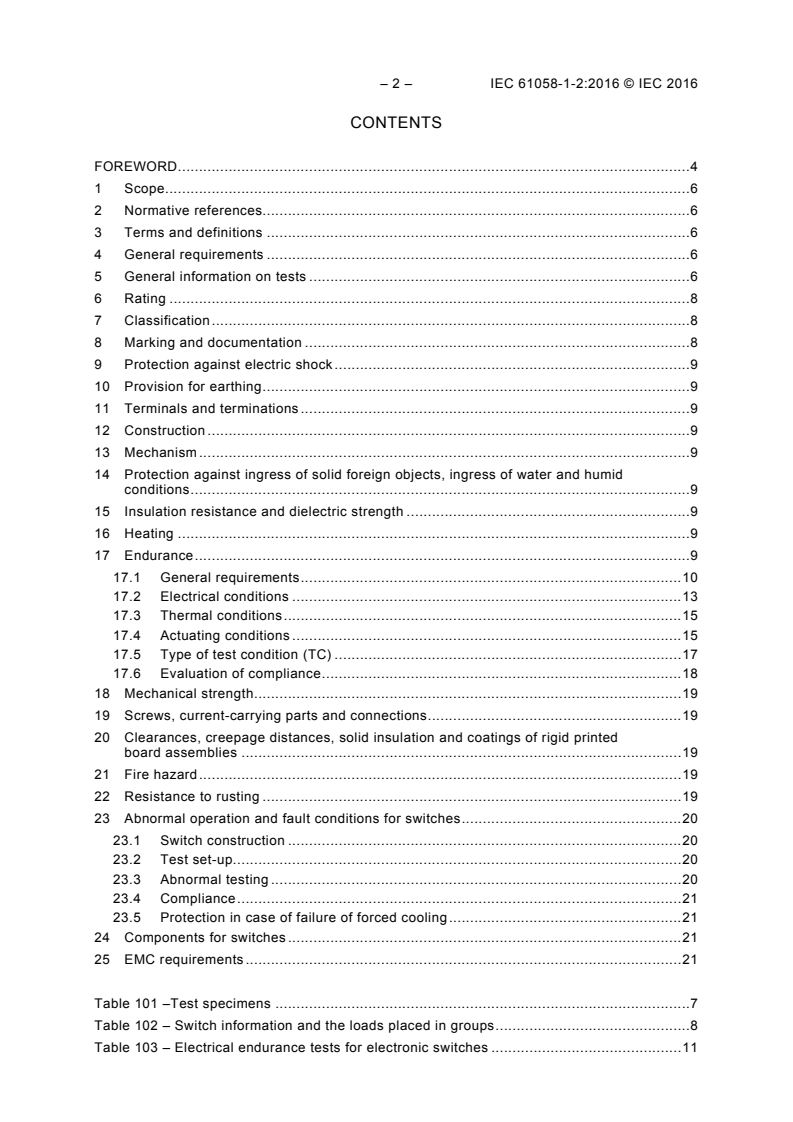
– 2 – IEC 61058-1-2:2016 © IEC 2016
CONTENTS
FOREWORD . 4
1 Scope . 6
2 Normative references. 6
3 Terms and definitions . 6
4 General requirements . 6
5 General information on tests . 6
6 Rating . 8
7 Classification . 8
8 Marking and documentation . 8
9 Protection against electric shock . 9
10 Provision for earthing . 9
11 Terminals and terminations . 9
12 Construction . 9
13 Mechanism . 9
14 Protection against ingress of solid foreign objects, ingress of water and humid
conditions . 9
15 Insulation resistance and dielectric strength . 9
16 Heating . 9
17 Endurance . 9
17.1 General requirements . 10
17.2 Electrical conditions . 13
17.3 Thermal conditions . 15
17.4 Actuating conditions . 15
17.5 Type of test condition (TC) . 17
17.6 Evaluation of compliance . 18
18 Mechanical strength . 19
19 Screws, current-carrying parts and connections . 19
20 Clearances, creepage distances, solid insulation and coatings of rigid printed
board assemblies . 19
21 Fire hazard . 19
22 Resistance to rusting . 19
23 Abnormal operation and fault conditions for switches . 20
23.1 Switch construction . 20
23.2 Test set-up. 20
23.3 Abnormal testing . 20
23.4 Compliance . 21
23.5 Protection in case of failure of forced cooling . 21
24 Components for switches . 21
25 EMC requirements . 21
Table 101 –Test specimens . 7
Table 102 – Switch information and the loads placed in groups . 8
Table 103 – Electrical endurance tests for electronic switches . 11
Table 104 – Test loads for electrical endurance tests for a.c. circuits . 14
Table 105 – Test loads for electrical endurance tests for d.c. circuits . 15
Table 106 – Switch operating conditions . 16
– 4 – IEC 61058-1-2:2016 © IEC 2016
INTERNATIONAL ELECTROTECHNICAL COMMISSION
____________
SWITCHES FOR APPLIANCES –
Part 1-2: Requirements for electronic switches
FOREWORD
1) The International Electrotechnical Commission (IEC) is a worldwide organization for standardization comprising
all national electrotechnical committees (IEC National Committees). The object of IEC is to promote
international co-operation on all questions concerning standardization in the electrical and electronic fields. To
this end and in addition to other activities, IEC publishes International Standards, Technical Specifications,
Technical Reports, Publicly Available Specifications (PAS) and Guides (hereafter referred to as “IEC
Publication(s)”). Their preparation is entrusted to technical committees; any IEC National Committee interested
in the subject dealt with may participate in this preparatory work. International, governmental and non-
governmental organizations liaising with the IEC also participate in this preparation. IEC collaborates closely
with the International Organization for Standardization (ISO) in accordance with conditions determined by
agreement between the two organizations.
2) The formal decisions or agreements of IEC on technical matters express, as nearly as possible, an international
consensus of opinion on the relevant subjects since each technical committee has representation from all
interested IEC National Committees.
3) IEC Publications have the form of recommendations for international use and are accepted by IEC National
Committees in that sense. While all reasonable efforts are made to ensure that the technical content of IEC
Publications is accurate, IEC cannot be held responsible for the way in which they are used or for any
misinterpretation by any end user.
4) In order to promote international uniformity, IEC National Committees undertake to apply IEC Publications
transparently to the maximum extent possible in their national and regional publications. Any divergence
between any IEC Publication and the corresponding national or regional publication shall be clearly indicated in
the latter.
5) IEC itself does not provide any attestation of conformity. Independent certification bodies provide conformity
assessment services and, in some areas, access to IEC marks of conformity. IEC is not responsible for any
services carried out by independent certification bodies.
6) All users should ensure that they have the latest edition of this publication.
7) No liability shall attach to IEC or its directors, employees, servants or agents including individual experts and
members of its technical committees and IEC National Committees for any personal injury, property damage or
other damage of any nature whatsoever, whether direct or indirect, or for costs (including legal fees) and
expenses arising out of the publication, use of, or reliance upon, this IEC Publication or any other IEC
Publications.
8) Attention is drawn to the Normative references cited in this publication. Use of the referenced publications is
indispensable for the correct application of this publication.
9) Attention is drawn to the possibility that some of the elements of this IEC Publication may be the subject of
patent rights. IEC shall not be held responsible for identifying any or all such patent rights.
International Standard IEC 61058-1-2 has been prepared by subcommittee 23J: Switches for
appliances, of IEC technical committee 23: Electrical accessories.
The text of this standard is based on the following documents:
FDIS Report on voting
23J/400/FDIS 23J/404/RVD
Full information on the voting for the approval of this standard can be found in the report on
voting indicated in the above table.
This publication has been drafted in accordance with the ISO/IEC Directives, Part 2.
A list of all parts in the IEC 61058 series, published under the general title Switches for
appliances, can be found on the IEC website.
This part of IEC 61058 is to be used in conjunction with IEC 61058-1(2016).
This Part 1-2 supplements or modifies the corresponding clauses in IEC 61058-1, so as to
convert that publication into the IEC standard: Requirements for electronic switches.
When a particular subclause of Part 1 is not mentioned in this Part 1-2, that subclause applies
as far as reasonable. Where this standard states “addition”, “modification” or “replacement”,
the relevant text of Part 1 is to be adapted accordingly.
In this standard:
1) the following print types are used:
– requirements proper: in roman type;
– test specifications: in italic type;
– notes/explanatory matters: in small roman type.
2) subclauses, notes, figures and tables which are additional to those in Part 1 are numbered
starting from 101. Annexes which are additional to those in Part 1 are lettered AA, BB, etc.
The committee has decided that the contents of this publication will remain unchanged until
the stability date indicated on the IEC website under "http://webstore.iec.ch" in the data
related to the specific publication. At this date, the publication will be
• reconfirmed,
• withdrawn,
• replaced by a revised edition, or
• amended.
– 6 – IEC 61058-1-2:2016 © IEC 2016
SWITCHES FOR APPLIANCES –
Part 1-2: Requirements for electronic switches
1 Scope
This clause of part 1 is applicable.
Add the following at the end of Clause 1.
This part of IEC 61058 applies to electronic switching devices and shall be used in
conjunction with the general requirements of IEC 61058-1.
NOTE Additional requirements for particular switches may be found in the relevant part 2 of IEC 61058.
2 Normative references
This clause of part 1 is applicable.
3 Terms and definitions
This clause of part 1 is applicable.
4 General requirements
This clause of part 1 is applicable.
5 General information on tests
This clause of part 1 is applicable with the following addition.
Add the following at the end of 5.3.
Table 101 provides information on:
– The minimum number of specimens needed for each test.
– The minimum number of total specimens, when applicable tests are added, needed for
each evaluation.
– Additional specimens that may be required as a result of additional electrical rating,
unique construction or damage /breakage during testing.
Table 101 –Test specimens
Minimum number of
Clause Description Notes
a)
specimens for each test
b)
– i ii
5 General information on tests
c)
6 Rating 1
7 Classification
8 Marking and documentation
9 Protection against electric shock
10 Provision for earthing
11 Terminals
12 Construction
13 Mechanism
d)
14.1 Protection against ingress of solid foreign objects 1
d)
14.2 Protection against ingress of water 1
e), m)
14.3 to Protection against humid conditions 3
15 Insulation resistance and dielectric strength
f), m)
16 Heating – 3 3
f), m)
17 Endurance – 3 3
c)
18 Mechanical strength 1
c)
19 Screws, current-carrying parts and connections 1
g), h)
20 Clearance, creepage distances 1
i), c)
21 Fire hazard 2
c)
22 Resistance to rusting 1
l)
23 Abnormal operation and fault conditions for switches 1
j)
24 Components for switches 3
k)
25 EMC requirements 1
a)
Additional specimens may be required depending on the construction and declaration of the switch.
b)
Each electrical rating submitted to the testing of Clauses 16 and 17 requires an additional 3 specimens (such
as rating i = 3 specimens, rating ii = additional 3 specimens).
c)
The specimen may be used for more than 1 test, if cumulative stress as a result of sequential testing is
avoided. When a specimen is damaged a new specimen shall be used for the next test.
d)
In general 1 specimen for ingress of solid foreign objects (dust), and 1 specimen for ingress of water.
Specific IP ratings (such as IP5x, IP6x and protection against water) require a special enclosure to be
provided with the switch specimen in order to complete the testing.
e)
The same test specimens are used to complete the testing of 14.3 and 15. The test are completed in
immediate sequence.
f)
Heating and endurance is recommended to be tested on the same specimens. If declared, separate
specimens may be used when noted on the test record.
g)
Three additional new specimens may be required according to Clause 20, for the test according to annex G.
h)
For testing coatings on printed boards according to 20.4, the number of printed boards needed is determined
by the testing of IEC 60664-3.
i)
For testing glow wire and ball pressure special test specimens according to 60695-2-11 and 60695-10-2,
respectively may be required.
j)
The number of specimens for specific test and examination of Clause 24 is according to the individual
subclasses.
k)
EMC testing may require additional specimens according to the EMC test program and switch construction.
l)
Abnormal operation and fault conditions are generally destructive, typically the switch cannot be repaired
and reused for the next fault. Specially prepared specimens (such as with wires soldered to the internal
circuit) may be necessary in order to complete the testing. The total number of specimens depends on the
switch construction, for details see Clause 23.
m)
This test is part of a sequence, and a new set of 3 specimens shall not be used except as permitted by 5.1.2.
– 8 – IEC 61058-1-2:2016 © IEC 2016
6 Rating
This clause of part 1 is applicable.
7 Classification
This clause of part 1 is applicable with the following addition.
Add the following at the end of Clause 7.
7.24 Operating cycles with mechanical switching device only (TC7)
7.25 Endurance method
7.25.1 Electrical endurance method “a” (Table 103)
7.25.2 Electrical endurance method “b” (Table 103)
7.26 Minimum load for electronic switches
7.27 According to test conditions for electronic switches:
7.27.1 Functional test conditions for electronic switches with thermal current or maximum
rated resistive current.
NOTE This test condition reflects the proper functioning of the switch. This test does not simulate the actual load
of the end application.
7.27.2 Simulated test conditions for electronic switches with type of load as classified in 7.2.
NOTE This test condition reflects the proper functioning of the switch. It also simulates all conditions of the end
application.
7.27.3 Specific test conditions of end application for electronic switches, i.e. in or together
with the appliance and under the cooling conditions of the appliance.
8 Marking and documentation
This clause of part 1 is applicable with exceptions as below.
Table 3 is applicable with the following addition.
Table 102 – Switch information and the loads placed in groups
Characteristic Subclause Means of information
No Common type Unique type
reference CT reference UT
12.3 Thermal current if defined 3.2.12 Documentation Documentation
12.4 Number of cycles with electronic 7.24 Documentation Documentation
control failed (TC 7)
12.5 Endurance method “a” or “b” 7.25 Documentation Documentation
12.6 Minimum test load if required 7.26 Documentation Documentation
12.7 Test conditions functional or 7.27 Documentation Documentation
simulated
12.8 Cooling conditions 7.22 Documentation Documentation
9 Protection against electric shock
This clause of part 1 is applicable.
10 Provision for earthing
This clause of part 1 is applicable.
11 Terminals and terminations
This clause of part 1 is applicable with the following addition.
Add the following 11.5:
Compliance is checked according to TE2 in Clause 17. For electronic switches rated for less
than 1E4 cycles the TE2 test shall be performed on the complete switch.
12 Construction
This clause of part 1 is applicable.
13 Mechanism
This clause of part 1 is applicable.
14 Protection against ingress of solid foreign objects, ingress of water and
humid conditions
This clause of part 1 is applicable.
15 Insulation resistance and dielectric strength
This clause of part 1 is applicable with the following addition.
Add the following to 15.1:
– For electronic switches, the test is carried out across full disconnection and micro-
disconnection only on electronic switches with mechanical switching devices connected in
series with the semiconductor switching device.
– For electronic switches, the tests are not carried out across protective impedances and
poles interconnected by components.
16 Heating
This clause of part 1 is applicable.
17 Endurance
Replace the existing text by the following:
– 10 – IEC 61058-1-2:2016 © IEC 2016
17.1 General requirements
17.1.1 Switches shall withstand without excessive wear or other harmful effect the
electrical, thermal and mechanical stresses that occur in normal use.
17.1.2 Electronic switches are tested in an increasing TC order as specified in Table 103.
The test conditions are according to the following depending on their classification in 7.27.
– under functional test conditions according to 7.27.1 with thermal current or with maximum
rated resistive current, if no thermal current is declared, and without forced cooling;
– under simulated test conditions according to 7.27.2 and with type of load according to 7.2
and under the cooling conditions classified in 7.22 and with test conditions as specified in
Tables 104 and 105;
– under specific test conditions of end application according to 7.27.3, in or together with
the appliance and under the cooling conditions of the appliance;
– under test conditions according to duty type according to 7.18, the tests may be performed
in combination with simulated test conditions or specific test conditions of the end
application.
NOTE Additional mechanical operating means (for example, actuating member such as speed-limit settings for
electric tools) are ignored.
Table 103 – Electrical endurance tests for electronic switches
Test conditions
Functional test (7.27.1) Simulated test (7.27.2) Specific test condition of end application
Type of electronic switch3)
(Tables 104 and 105) (7.27.3)
Complete switch Contacts only Complete switch Contacts only Complete switch Contacts only
1)
SD without TL1 TC5, TC6, TC8 --- TL3 TC5, TC6, TC8 --- TL4 TC5, TC6, TC8 ---
electrical TE1, TE3 TE1, TE3 TE1, TE3
contact(s)
SD with serial TL1 TC5, TC6, TC8 Serial contact: a) TL1 TC5, TC6, a) Serial contact: TL4 TC5, TC8 TE1, Serial contact:
contact(s) TE1, TE3 TC8 TE1, TE3 TE3
TC1, TC4 with TL2 TL3, TC1, TC4 TE1 TC7 with TL4 TE1 to
TE1 to TE3 (SD to TE3 (SD short- TE3 (SD short-
short-circuited) 2) circuited) 2) circuited) 2)
b) TL3 TC5, TC6, b) Serial contact:
TC8 TE1, TE3
TL3, TC1, TC7 TE1
to TE3 (SD short-
circuited) 2)
SD with TL1 TC5, TC6, TC8 Parallel contact: TL3 TC5, TC6, TC8 Parallel contact: TL4 TC5, TC8 TE1, Parallel contact:
parallel TE1, TE3 TE1, TE3 TE3
TC1, TC4 with TL2 TL3, TC1, TC4 TC7 with TL4 TE1 to
contact(s)
TE1 to TE3 (SD TE3 (SD
TE1 to TE3
disconnected) disconnected)
(SD disconnected)
SD with serial TL1 TC5, TC6, TC8 Serial contact: a) TL1 TC5, TC6, a) Serial contact: TL4 TC5, TC8 TE1, Serial contact:
and parallel TE1, TE3 TC8 TE1, TE3 TE3
TC1, TC4 with TL2 TL3, TC1, TC4 TE1 TC7 with TL4 TE1 to
contact(s)
TE1 to TE3 (SD to TE3 (SD short- TE3 (SD short-
short-circuited) 2) circuited) 2) circuited) 2)
b) TL3 TC5, TC6, b) Serial contact:
TC8 TE1, TE3
TL3, TC1, TC7 TE1
to TE3 (SD short-
circuited) 2)
Parallel contact: a) and b) Parallel Parallel contact:
contact:
TC1, TC4 with TL2 TC7 with TL4 TE1 to
TE1 to TE3 (SD TL3, TC1, TC7 TE1 TE3 (SD
disconnected) to TE3 (SD disconnected)
disconnected)
– 12 – IEC 61058-1-2:2016 © IEC 2016
TL : type of test load*
TL1 : thermal current or maximum rated resistive current, if no thermal current is declared
TL2 : maximum rated resistive current
TL3 : rated load (7.2)
TL4 : declared specific load (7.2.5)
TC : type of test condition:
TC1 : increased-voltage test (17.5.1)
TC4 : accelerated speed test (17.5.4)
TC5 : manual functional test (17.5.5)
TC6 : manual functional test at minimum load – optional (17.5.6)
TC7 : limited number of operation test (17.5.7)
TC8 : endurance test (17.5.8)
TE : Type of evaluation test:
TE1 : functional compliance (17.6.1)
TE2 : thermal compliance (17.6.2)
TE3 : insulating compliance (17.6.3)
*
Tests which are not in the normal test sequence of Table 103 (such as TC3 and TC9) may be added to the test sequence when required for the rating. These test are to be
added before the test cycling test condition.
Switch designs not covered by the four construction of Table 103, test method(s) most suitable to the switch design shall be applied.
1)
SD : semiconductor device
2)
The short circuit shall be performed in a way to allow the terminals and contacts and other parts designed for the maximum rated current to be loaded with the maximum test
current.
3)
For combinations of SD and mechanical contacts, where the function of the SD and the mechanical contacts are independent of each other, the requirements of IEC 61058-1-
1 apply for the mechanical contacts.
a/b)
Testing shall be completed using either method “a” or method “b”. The same method shall be used for both “complete switch” and the “contacts only” testing. Switches with
series and parallel contacts test shall add the parallel contact test with the same method “a” or ”b” used for the series contact test. Testing to both method “a” and method “b”
is not required.
17.2 Electrical conditions
The switch shall be loaded as specified in Table 103, and connected in accordance with the
test circuit in 61058-1:2016, Table 2.
a) Where, in IEC 61058-1:2016, Table 2, an auxiliary switch (A) is symbolized in the test
circuit, the tests for the two ON-positions of the specimen (S) are performed on two
separate sets of test samples. The connection to the test load to be performed for the two
tests is symbolized in IEC 61058-1:2016, Table 2 by an auxiliary switch A.
b) Multiway switches are loaded according to 61058-1:2016, Table 1. The load for the other
switch positions is that resulting from the loads necessary to achieve the conditions
specified above.
c) For circuits according to 7.2.7 for specific lamp load, the connection and test load are as
specified by the manufacturer using the maximum occurring inrush current at room
temperature. For a specific lamp load, it is recommended that the specimen be operated
with loads that are used in the field rather than with synthetic loads. Forced cooling of the
specific lamp load may be applied in order to ensure cold resistance for each operating
cycle and shorten the test time.
d) No electrical load is applied during the endurance tests for switches classified to 7.2.6
with a rating of 20 mA or less.
e) For electronic switches, the test circuit shall be as shown in Figure 16. The declared load
shall be set at rated voltage before the electronic switch is inserted into the circuit (the
load is not readjusted).
– 14 – IEC 61058-1-2:2016 © IEC 2016
Table 104 – Test loads for electrical endurance tests for a.c. circuits
Type of circuit as classified in 7.2 Operation of Test Test Power
c)
contacts voltage current factor
r.m.s.
Substantially resistive (classified in 7.2.1) Making and Rated
Ι-R ≥0,9
breaking voltage
General Purpose (classified in 7.2.10) Making and Rated
Ι-GP ≥0,75
breaking voltage
(+0,05)
b)
Resistive and/or motor (classified in 7.2.2) Making Rated 0,60
6 × Ι-M
voltage
(+0,05)
or
or
a)
Ι-R ≥0,9
Breaking Rated
Ι-R ≥0,9
voltage
or or
a) e)
Ι-M ≥0,9
Circuit for specific load of motor with a locked rotor Making Rated 6 × Ι-M 0,60
and with a power factor not less than 0,6 (classified in voltage
(+0,05)
7.2.9)
Breaking Rated 0,60
6 × Ι-M
voltage (+0,05)
b)
Circuit for an inductive load (classified in 7.2.8) Making Rated 0,60
6 × Ι-Ι
voltage
(+0,05)
Breaking Rated 0,60
Ι-Ι
voltage (+0,05)
Resistive and capacitive (classified in 7.2.3) Making and Tested in a circuit as shown in
breaking Figure 8
Tungsten filament lamp load (classified in 7.2.4) Making and Tested in a circuit as shown in
d)
breaking Figure 8
Rated voltage ≥ 110 V a.c., X = 16
Rated voltage < 110 V a.c., X = 10
Circuit for specific lamp load (classified in 7.2.7) Making and Rated As determined by load
breaking voltage
Specified declared (classified in 7.2.5) Making and Rated As determined by load
breaking voltage
I-I: inductive-load current
I-M: motor-load current
I-R: resistive-load current
a)
Whichever is arithmetically greater or the most unfavourable value in case of equal values.
b)
The specified making conditions are maintained for a period between 50 ms and 100 ms, and are then
reduced by an auxiliary switch to the specified breaking conditions.
For electronic switches, the reduction to the break current should be achieved without any open circuiting of
the simulated inductive loads circuit, to ensure that no abnormal voltage transients are generated.
c)
Resistors and inductors are not connected in parallel except that if any air-core inductor is used, a resistor
taking approximately 1 % of the current through the inductor is connected in parallel with it. Iron-core
inductors may be used provided that the current has a substantial sine-wave form. For three-phase tests,
three-core inductors are used.
d)
In the case where the tests are performed with tungsten filament lamp bulbs, the following test conditions
apply:
e)
The test circuit condition for testing electronic switches, according to figure 16, shall be substantially
resistive.
– the ratio X = 16 or X = 10 shall be achieved;
– the cold resistance of the lamps shall be ensured for each operating cycle;
– the resistance of connections within the load circuit (for example lamp sockets) shall be constant;
– the proper function of the lamps performing the load set shall be ensured for each operating cycle.
Table 105 – Test loads for electrical endurance tests for d.c. circuits
Type of circuit as Operation of Test voltage Test current Time constant
classified in 7.2 contacts
Substantially resistive load Making and Rated Ι-R L/R < 1,15 ms
breaking voltage
Tungsten filament lamp load Making and breaking Rated Tested in a circuit as shown in
(classified in 7.2.4) voltage Figure 9
Rated voltage ≥ 110 V d.c., X = 16
Rated voltage < 110 V d.c., X = 10
a)
Resistive and capacitive load Making and Tested in a circuit as shown in Figure 9
(classified in 7.2.3) breaking
Circuit for specific lamp load Making and Rated As determined by load
(classified in 7.2.7) breaking voltage
Declared specific load (classified Making and Rated As determined by load
in 7.2.5) breaking voltage
I-R = resistive load current
a)
In case where the tests are performed with tungsten filament lamp bulbs, the following test conditions apply:
– the ratio X = 16 or X = 10 shall be achieved;
– the cold resistance of the lamps shall be ensured for each operating cycle;
– the resistance of connections within the load circuit (for example, lamp sockets) shall be constant;
– the proper function of the lamps performing the load set shall be ensured for each operating cycle.
17.3 Thermal conditions
17.3.1 For switches according to 7.3.2, during the tests in 17.5.8 (TC8) all parts are
exposed to temperatures as follows: For the first half of the test period at maximum air
temperature (T +5/0) °C. For the second half of the test period at 25 °C ± 10 °C or at the
minimum air temperature (T 0/-5) °C if T is less than 0 °C.
17.3.2 For switches according to 7.3.3, during the tests in 17.5.8 (TC8), those parts that are
declared for use at 0 °C to 55 °C shall be exposed to a temperature within this range for the
complete test period.
For the first half of the test period, the air temperature of the remainder of the switch shall be
maintained at the maximum air temperature (T +5/0) °C.
For the second half of the test period the tests are carried out at 25 °C ± 10 °C or at the
minimum air temperature (T 0/-5) °C if it is less than 0 °C.
17.3.3 For switches according to 7.3.1, during the tests in 17.5.8 (TC8), the switch shall be
exposed to an air temperature of the 25 °C ± 10 °C.
17.4 Actuating conditions
17.4.1 The switches are operated by means of its actuating member either manually or by
an appropriate apparatus which is arranged to simulate normal actuation.
The operating speed for the operating cycles shall be as follows:
For the tests of electronic switches:
a) For very slow speed:
– approximately 1°/s for rotary actuation;
– 16 – IEC 61058-1-2:2016 © IEC 2016
– approximately 0,5 mm/s for linear actuation.
b) For slow speed:
– approximately 9°/s for rotary actions;
– approximately 5 mm/s for linear actions;
c) For high speed, the actuation member shall be actuated by hand as fast as possible or
using the accelerated speed from the mechanical switch testing IEC 61058-1-1.
d) for accelerated speed:
– approximately 45°/s for rotary actions,
– approximately 20 mm/s to 25 mm/s for linear actions.
17.4.2 For biased switches, the actuating member shall be moved to the limit of travel of the
opposite position.
17.4.3 During the testing, care is taken that the test apparatus drives the actuating member,
without impeding the designed movements of the switch.
17.4.4 During the accelerated speed test,
a) care shall be taken to ensure that the test apparatus allows the actuating member to
operate freely, so that there is no interference with the normal action of the mechanism;
b) for switches designed for a rotary actuation where the movement is not limited in either
direction, three-quarters of the total number of operating cycles in each test shall be made
in a clockwise direction, and one-quarter in an anti-clockwise direction;
c) for switches which are designed for rotary actuation in one direction only, the test shall be
performed in the designed direction, provided that it is not possible to rotate the actuating
member in the reverse direction using the torques necessary for actuation in the designed
direction;
d) additional lubrication shall not be applied during these tests;
e) the forces applied to the end stops of the actuating members shall not exceed the
declared values (if any) for rotary and linear actuation. The declared full travel of the
actuating member (if any) shall be applied during these tests.
17.4.5 So far as the design allows, switches are operated with the following conditions:
Table 106 – Switch operating conditions
Load type ON (s) OFF (s) Notifications
Up to 10 A 1 3 Approximately 15 operating cycles per minute.
2 6 Approximately 7,5 operating cycles per minute.
>10 up to 25 A
>25 up to 63 A 4 12 Approximately 3,75 operating cycles per minute.
Capacitive and simulated 2 15 To allow for the discharge of the capacitive load. See
lamp load Figure 8 and Figure 9
Tungsten lamp loads Minimum 1 Minimum 55 55 s to allow for cooling of the tungsten lamps for
inrush current; in case of more than one load sets the
minimum cooling time for each load set shall be 55 s
and the cycle rate for the switch may be increased.
Required very slow speed Minimum 2 Minimum 6 To allow arcing at the make and break.
TC10
Locked rotor tests (TC9) 1 30 To allow for the inrush.
For switches with more than one load (throw), each operating in the test circuit such as
IEC 61058-1:2016, Table 2 test codes 2.3, 2.5, 2.7 or 2.9, the ON periods will be
approximately 50 %.
Multi-way switches are operated in compliance with the table above, or actuated with the
speed indicated in 17.4 and a minimum ON period of 25 %.
This requirement in Table 106 is not valid for very slow speed (TC10), the on time shall be
sufficient to allow arcing.
17.5 Type of test condition (TC)
17.5.1 Increased-voltage test at accelerated speed (TC1):
– Electrical conditions: The load specified according to Tables 104 and 105, the voltage
increased to 1,15 the rated voltage (the load is not readjusted).
– Capacitive load and simulated lamp load tests for a.c. circuits, the test voltage is the rated
voltage and the test currents are increased to 1,15 rated currents.
– Thermal conditions: 25 °C ± 10 °C.
Actuating speed: accelerated speed in 17.4.
– Operating cycles: 100.
17.5.2 Test at slow speed (TC2):
– Electrical conditions: specified in 17.2.
– Thermal conditions: 25 °C ± 10 °C.
– Actuating speed: slow speed in 17.4.
– Operating cycles: 100.
17.5.3 Test at high speed (TC3):
– Electrical conditions: specified in 17.2.
– Thermal conditions: 25 °C ± 10 °C.
– Actuating speed: high speed in 17.4.
– Operating cycles: 100.
This test applies only to switches which have more than one pole and when polarity reversal
occurs (when it is possible to move from one polarity to the opposite without a mechanical
interlock or similar mechanical impediment).
17.5.4 Test at accelerated speed (TC4):
– Electrical conditions: specified in Table 17.2
– Thermal conditions: 25 °C ± 10 °C.
– Actuating speed: accelerated speed in 17.4.
– Operating cycles: Total number declared (7.4) less the number already made during tests
of 17.5.1, 17.5.2 and 17.5.3.
17.5.5 Manual functional test (TC5):
– Electrical conditions: specified in 17.2
– Thermal conditions: 25 °C ± 10 °C.
– Actuating speed: high speed in 17.4.
– Operating cycles: 10 (across the full range of the device).
17.5.6 Functional test at minimum load (TC6) − optional:
– Electrical conditions: minimum load or current at 0,9 times rated voltage
– 18 – IEC 61058-1-2:2016 © IEC 2016
– Thermal conditions: 25 °C ± 10 °C.
– Actuating Sseed: manually actuated to be able to follow the correct operation.
– Operating cycles: 10.
The cycles are conducted over the whole range from minimum to maximum and back to
minimum by means of its actuating member. In addition, where appropriate, the switch is
operated 10 times over the whole range from minimum to maximum and back to minimum by
means of a remote control.
During and after the test, the specimens shall operate correctly.
For electronic switches for which a minimum load or minimum current is specified by the
manufacturer, the characteristic is additionally tested with the specified conditions.
17.5.7 Test with limited number of operations (TC7):
– Electrical conditions: specified in 17.2
– Thermal conditions: 25 °C ± 10 °C.
– Actuating speed: accelerated speed in 17.4.
– Operating sycles: 1 000 or the declared number.
17.5.8 Endurance complete switch (TC8):
– Electrical conditions: specified in 17.2.
– Thermal conditions: specified in 17.3.
– Actuating speed: accelerated speed in 17.4.
– Operating cycles: Total number of cycles declared in 7.4.
17.5.9 Locked-rotor test (TC9):
– Electrical conditions: specified in 17.2.
– Thermal conditions: 25 °C ± 10 °C.
– Actuating speed: Accelerated speed in 17.4.
– Operating cycles: 50.
17.5.10 Test at very slow speed (TC10):
– Electrical conditions: specified in 17.2.
– Thermal conditions: 25 °C ± 10 °C.
– Actuating speed: very slow speed in 17.4.
– Operating cycles: 100.
TC10 when required by
...