

IEC 61058-2-4:2018
(Main)Switches for appliances - Part 2-4: Particular requirements for independently mounted switches
General Information
- Abstract
IEC 61058-2-4:2018 applies to independently mounted switches for appliances (mechanical or electronic) actuated by hand, by foot or by other human activity, to operate or control electrical appliances and other equipment for household or similar purposes with a rated voltage not exceeding 480 V and a rated current not exceeding 63 A. This second edition cancels and replaces the first edition published in 1995 and constitutes a technical revision. This edition includes the following significant technical changes with respect to the previous edition:
- overall format modified to support the revised structure of the series;
- Annexes K and M have been included as an integral part of this document;
- Annex L has been included for information purposes only.
This document is to be used in conjunction with IEC 61058-1:2016.
- Status
- Published
- Publication Date
- 11-Oct-2018
- Technical Committee
- SC 23J - Switches for appliances
- Drafting Committee
- MT 1 - TC 23/SC 23J/MT 1
- Current Stage
- PPUB - Publication issued
- Start Date
- 12-Oct-2018
- Completion Date
- 11-Oct-2018
Buy Documents
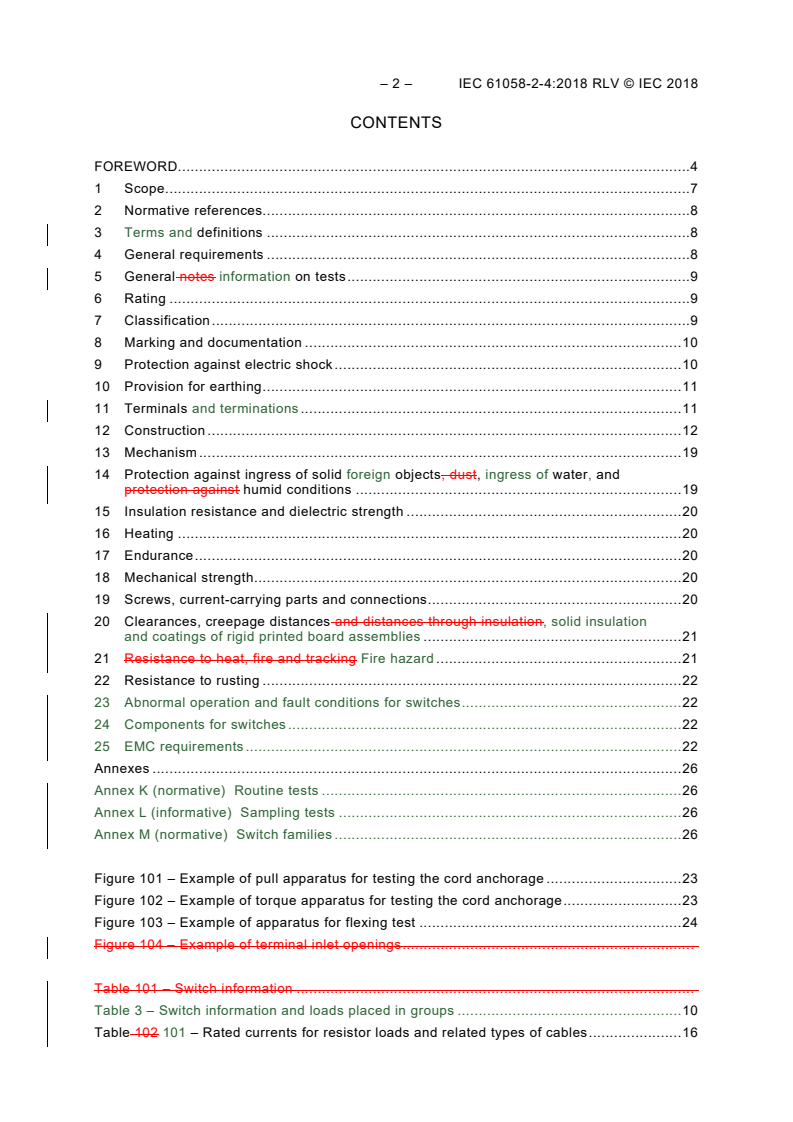
IEC 61058-2-4:2018 RLV - Switches for appliances - Part 2-4: Particular requirements for independently mounted switches Released:10/12/2018
IEC 61058-2-4:2018 - Switches for appliances - Part 2-4: Particular requirements for independently mounted switches Released:10/12/2018
Overview
IEC 61058-2-4:2018 - “Switches for appliances - Part 2‑4: Particular requirements for independently mounted switches” specifies safety and performance requirements for independently mounted mechanical or electronic switches used to operate or control household and similar appliances. It covers switches actuated by hand, foot or other human activity, with a rated voltage not exceeding 480 V and a rated current not exceeding 63 A. This 2nd edition (2018) replaces the 1995 edition, aligns the format with the IEC 61058 series structure, and incorporates Annexes K and M as normative (Annex L informative). It is intended to be used together with IEC 61058‑1:2016.
Key topics and technical requirements
The standard supplements and modifies the general requirements in IEC 61058‑1 and focuses on aspects specific to independently mounted switches:
- Scope & definitions: clarifies “independently mounted switch” and design types (Design A and B).
- Ratings and classification: rated voltage/current limits and classification by degree of protection and intended use.
- Marking and documentation: required product information, identification and instructions.
- Safety protections: requirements for protection against electric shock, earthing provisions and terminals/terminations.
- Construction & mechanism: mechanical design, actuator arrangements, and internal construction for safe operation.
- Environmental protection: ingress protection, resistance to humidity, dust and water where applicable.
- Electrical tests: insulation resistance, dielectric strength, clearances and creepage distances.
- Reliability tests: heating, endurance, mechanical strength, resistance to rusting and abnormal/fault condition tests.
- Fire and tracking resistance: requirements for materials and coatings to limit fire hazard and tracking.
- EMC and components: electromagnetic compatibility requirements and rules for substituted components.
- Annexes: routine tests (K), sampling tests (L - informative), and switch family provisions (M).
Applications
IEC 61058‑2‑4 is directly applicable to:
- Manufacturers of independently mounted switches for household and similar appliances.
- Design engineers specifying switch components or actuator interfaces.
- Test laboratories and certification bodies performing conformity assessment and type testing.
- OEMs integrating switches into appliances or remote-actuated controls.
- Regulatory and compliance teams ensuring product safety for markets using IEC standards.
Who should use this standard
- Switch designers and component manufacturers
- Appliance manufacturers and product development teams
- Compliance engineers, safety assessors and test houses
- Certification bodies that assess electrical safety of appliance controls
Related standards
- IEC 61058‑1:2016 - Switches for appliances (general requirements) - mandatory companion document.
- IEC 60669‑1:2017 - Switches for household and similar fixed installations.
- Relevant cable standards: IEC 60227, IEC 60245 series.
Keywords: IEC 61058-2-4, independently mounted switches, switch standards, appliance switches, switch testing, rated voltage 480 V, rated current 63 A, IEC 61058 series.
Relations
- Effective Date
- 05-Sep-2023
- Effective Date
- 05-Sep-2023
Buy Documents
IEC 61058-2-4:2018 RLV - Switches for appliances - Part 2-4: Particular requirements for independently mounted switches Released:10/12/2018
IEC 61058-2-4:2018 - Switches for appliances - Part 2-4: Particular requirements for independently mounted switches Released:10/12/2018
Get Certified
Connect with accredited certification bodies for this standard

IMQ S.p.A. (Certification)
Italian electrical product certification.

SLG Prüf- und Zertifizierungs GmbH
German testing and certification body.

UL Solutions
Global safety science company with testing, inspection and certification.
Sponsored listings
Frequently Asked Questions
IEC 61058-2-4:2018 is a standard published by the International Electrotechnical Commission (IEC). Its full title is "Switches for appliances - Part 2-4: Particular requirements for independently mounted switches". This standard covers: IEC 61058-2-4:2018 applies to independently mounted switches for appliances (mechanical or electronic) actuated by hand, by foot or by other human activity, to operate or control electrical appliances and other equipment for household or similar purposes with a rated voltage not exceeding 480 V and a rated current not exceeding 63 A. This second edition cancels and replaces the first edition published in 1995 and constitutes a technical revision. This edition includes the following significant technical changes with respect to the previous edition: - overall format modified to support the revised structure of the series; - Annexes K and M have been included as an integral part of this document; - Annex L has been included for information purposes only. This document is to be used in conjunction with IEC 61058-1:2016.
IEC 61058-2-4:2018 applies to independently mounted switches for appliances (mechanical or electronic) actuated by hand, by foot or by other human activity, to operate or control electrical appliances and other equipment for household or similar purposes with a rated voltage not exceeding 480 V and a rated current not exceeding 63 A. This second edition cancels and replaces the first edition published in 1995 and constitutes a technical revision. This edition includes the following significant technical changes with respect to the previous edition: - overall format modified to support the revised structure of the series; - Annexes K and M have been included as an integral part of this document; - Annex L has been included for information purposes only. This document is to be used in conjunction with IEC 61058-1:2016.
IEC 61058-2-4:2018 is classified under the following ICS (International Classification for Standards) categories: 29.120.40 - Switches. The ICS classification helps identify the subject area and facilitates finding related standards.
IEC 61058-2-4:2018 has the following relationships with other standards: It is inter standard links to IEC 61058-2-4:1995/AMD1:2003, IEC 61058-2-4:1995. Understanding these relationships helps ensure you are using the most current and applicable version of the standard.
IEC 61058-2-4:2018 is available in PDF format for immediate download after purchase. The document can be added to your cart and obtained through the secure checkout process. Digital delivery ensures instant access to the complete standard document.
Standards Content (Sample)
IEC 61058-2-4 ®
Edition 2.0 2018-10
REDLINE VERSION
INTERNATIONAL
STANDARD
colour
inside
Switches for appliances –
Part 2-4: Particular requirements for independently mounted switches
All rights reserved. Unless otherwise specified, no part of this publication may be reproduced or utilized in any form
or by any means, electronic or mechanical, including photocopying and microfilm, without permission in writing from
either IEC or IEC's member National Committee in the country of the requester. If you have any questions about IEC
copyright or have an enquiry about obtaining additional rights to this publication, please contact the address below or
your local IEC member National Committee for further information.
IEC Central Office Tel.: +41 22 919 02 11
3, rue de Varembé info@iec.ch
CH-1211 Geneva 20 www.iec.ch
Switzerland
About the IEC
The International Electrotechnical Commission (IEC) is the leading global organization that prepares and publishes
International Standards for all electrical, electronic and related technologies.
About IEC publications
The technical content of IEC publications is kept under constant review by the IEC. Please make sure that you have the
latest edition, a corrigenda or an amendment might have been published.
IEC Catalogue - webstore.iec.ch/catalogue Electropedia - www.electropedia.org
The stand-alone application for consulting the entire The world's leading online dictionary of electronic and
bibliographical information on IEC International Standards, electrical terms containing 21 000 terms and definitions in
Technical Specifications, Technical Reports and other English and French, with equivalent terms in 16 additional
documents. Available for PC, Mac OS, Android Tablets and languages. Also known as the International Electrotechnical
iPad. Vocabulary (IEV) online.
IEC publications search - webstore.iec.ch/advsearchform IEC Glossary - std.iec.ch/glossary
The advanced search enables to find IEC publications by a 67 000 electrotechnical terminology entries in English and
variety of criteria (reference number, text, technical French extracted from the Terms and Definitions clause of
committee,…). It also gives information on projects, replaced IEC publications issued since 2002. Some entries have been
and withdrawn publications. collected from earlier publications of IEC TC 37, 77, 86 and
CISPR.
IEC Just Published - webstore.iec.ch/justpublished
Stay up to date on all new IEC publications. Just Published IEC Customer Service Centre - webstore.iec.ch/csc
details all new publications released. Available online and If you wish to give us your feedback on this publication or
also once a month by email. need further assistance, please contact the Customer Service
Centre: sales@iec.ch.
IEC 61058-2-4 ®
Edition 2.0 2018-10
REDLINE VERSION
INTERNATIONAL
STANDARD
colour
inside
Switches for appliances –
Part 2-4: Particular requirements for independently mounted switches
INTERNATIONAL
ELECTROTECHNICAL
COMMISSION
ICS 29.120.40 ISBN 978-2-8322-6123-1
– 2 – IEC 61058-2-4:2018 RLV © IEC 2018
CONTENTS
FOREWORD . 4
1 Scope . 7
2 Normative references. 8
3 Terms and definitions . 8
4 General requirements . 8
5 General notes information on tests . 9
6 Rating . 9
7 Classification . 9
8 Marking and documentation . 10
9 Protection against electric shock . 10
10 Provision for earthing . 11
11 Terminals and terminations . 11
12 Construction . 12
13 Mechanism . 19
14 Protection against ingress of solid foreign objects, dust, ingress of water, and
protection against humid conditions . 19
15 Insulation resistance and dielectric strength . 20
16 Heating . 20
17 Endurance . 20
18 Mechanical strength . 20
19 Screws, current-carrying parts and connections . 20
20 Clearances, creepage distances and distances through insulation, solid insulation
and coatings of rigid printed board assemblies . 21
21 Resistance to heat, fire and tracking Fire hazard . 21
22 Resistance to rusting . 22
23 Abnormal operation and fault conditions for switches . 22
24 Components for switches . 22
25 EMC requirements . 22
Annexes . 26
Annex K (normative) Routine tests . 26
Annex L (informative) Sampling tests . 26
Annex M (normative) Switch families . 26
Figure 101 – Example of pull apparatus for testing the cord anchorage . 23
Figure 102 – Example of torque apparatus for testing the cord anchorage . 23
Figure 103 – Example of apparatus for flexing test . 24
Figure 104 – Example of terminal inlet openings .
Table 101 – Switch information .
Table 3 – Switch information and loads placed in groups . 10
Table 102 101 – Rated currents for resistor loads and related types of cables . 16
Table 103 102 – Torque values for torque test . 17
Table 104 103 – Torque values for screws of insulating material screws . 20
– 4 – IEC 61058-2-4:2018 RLV © IEC 2018
INTERNATIONAL ELECTROTECHNICAL COMMISSION
____________
SWITCHES FOR APPLIANCES –
Part 2-4: Particular requirements for
independently mounted switches
FOREWORD
1) The International Electrotechnical Commission (IEC) is a worldwide organization for standardization comprising
all national electrotechnical committees (IEC National Committees). The object of IEC is to promote
international co-operation on all questions concerning standardization in the electrical and electronic fields. To
this end and in addition to other activities, IEC publishes International Standards, Technical Specifications,
Technical Reports, Publicly Available Specifications (PAS) and Guides (hereafter referred to as “IEC
Publication(s)”). Their preparation is entrusted to technical committees; any IEC National Committee interested
in the subject dealt with may participate in this preparatory work. International, governmental and non-
governmental organizations liaising with the IEC also participate in this preparation. IEC collaborates closely
with the International Organization for Standardization (ISO) in accordance with conditions determined by
agreement between the two organizations.
2) The formal decisions or agreements of IEC on technical matters express, as nearly as possible, an international
consensus of opinion on the relevant subjects since each technical committee has representation from all
interested IEC National Committees.
3) IEC Publications have the form of recommendations for international use and are accepted by IEC National
Committees in that sense. While all reasonable efforts are made to ensure that the technical content of IEC
Publications is accurate, IEC cannot be held responsible for the way in which they are used or for any
misinterpretation by any end user.
4) In order to promote international uniformity, IEC National Committees undertake to apply IEC Publications
transparently to the maximum extent possible in their national and regional publications. Any divergence
between any IEC Publication and the corresponding national or regional publication shall be clearly indicated in
the latter.
5) IEC itself does not provide any attestation of conformity. Independent certification bodies provide conformity
assessment services and, in some areas, access to IEC marks of conformity. IEC is not responsible for any
services carried out by independent certification bodies.
6) All users should ensure that they have the latest edition of this publication.
7) No liability shall attach to IEC or its directors, employees, servants or agents including individual experts and
members of its technical committees and IEC National Committees for any personal injury, property damage or
other damage of any nature whatsoever, whether direct or indirect, or for costs (including legal fees) and
expenses arising out of the publication, use of, or reliance upon, this IEC Publication or any other IEC
Publications.
8) Attention is drawn to the Normative references cited in this publication. Use of the referenced publications is
indispensable for the correct application of this publication.
9) Attention is drawn to the possibility that some of the elements of this IEC Publication may be the subject of
patent rights. IEC shall not be held responsible for identifying any or all such patent rights.
This redline version of the official IEC Standard allows the user to identify the changes
made to the previous edition. A vertical bar appears in the margin wherever a change
has been made. Additions are in green text, deletions are in strikethrough red text.
International Standard IEC 61058-2-4 has been prepared by subcommittee 23J: Switches for
appliances, of IEC technical committee 23: Electrical accessories.
This second edition cancels and replaces the first edition published in 1995 and constitutes a
technical revision.
This edition includes the following significant technical changes with respect to the previous
edition:
a) overall format modified to support the revised structure of the series;
b) Annexes K and M have been included as an integral part of this document;
c) Annex L has been included for information purposes only.
The text of this International Standard is based on the following documents:
CDV Report on voting
23J/433/CDV 23J/441/RVC
Full information on the voting for the approval of this International Standard can be found in
the report on voting indicated in the above table.
This document has been drafted in accordance with the ISO/IEC Directives, Part 2.
This document is to be used in conjunction with IEC 61058-1:2016.
This document supplements or modifies the corresponding clauses in IEC 61058-1, so as to
convert that publication into the IEC standard: Particular requirements for independently
mounted switches.
When a particular subclause of IEC 61058-1 is not mentioned in this document, that
subclause applies as far as reasonable. Where this document states "addition", "modification"
or "replacement", the relevant text of IEC 61058-1 is to be adapted accordingly.
In this document:
1) the following print types are used:
– requirements proper: in roman type;
– test specifications: in italic type;
– explanatory matter: in smaller roman type.
2) subclauses, figures or tables which are additional to those in IEC 61058-1 are numbered
starting from 101.
A list of all the parts in the IEC 61058 series, under the general title Switches for appliances,
can be found on the IEC website.
– 6 – IEC 61058-2-4:2018 RLV © IEC 2018
The committee has decided that the contents of this document will remain unchanged until the
stability date indicated on the IEC website under "http://webstore.iec.ch" in the data related to
the specific document. At this date, the document will be
• reconfirmed,
• withdrawn,
• replaced by a revised edition, or
• amended.
IMPORTANT – The “colour inside” logo on the cover page of this publication indicates
that it contains colours which are considered to be useful for the correct understanding
of its contents. Users should therefore print this publication using a colour printer.
SWITCHES FOR APPLIANCES –
Part 2-4: Particular requirements for
independently mounted switches
1 Scope
Clause 1 of IEC 61058-1:2016 is applicable, except as follows.
1.1 Replacement:
Addition:
This document applies to independently mounted switches for appliances (mechanical or
electronic) actuated by hand, by foot or by other human activity for use with, to operate or
control electrical appliances and other equipment for household and or similar purposes with
a rated voltage not exceeding 440 480 V and a rated current not exceeding 63 A.
These switches are intended to be operated by a person, via an actuating member or by
actuating a sensing unit. The actuating member or sensing unit can be integral with or
arranged separately, either physically or electrically, from the switch and involve transmission
of a signal, for example, electrical, optical, acoustic or thermal, between the actuating
member or sensing unit and the switch.
Switches which incorporate additional control functions governed by the switch function are
within the scope of this document.
1.2 Replacement:
This standard applies to independently mounted switches intended to be used with an
appliance or equipment.
This document also covers the indirect actuation of the switch when the operation of the
actuating member or sensing unit is provided by a remote control or by a part of an appliance
or equipment, such as a door.
NOTE 1 Electronic switches can be combined with mechanical switches giving full disconnection or micro-
disconnection.
NOTE 2 Electronic switches without a mechanical switch in the supply circuit provide only electronic
disconnection. Therefore, the circuit on the load side is always considered to be live.
NOTE 3 For switches used in tropical climates, additional requirements may be necessary can apply.
NOTE 4 Attention is drawn to the fact that the standards for appliances and equipment may can contain additional
or alternative requirements for switches.
NOTE 4 Throughout this standard the word "switch" means "independently mounted switch" unless otherwise
stated.
NOTE 5 Throughout this document, the word "appliance" means "appliance or equipment".
1.3 Replacement:
This standard applies to switches intended to be mounted apart from the appliance
(independently mounted switches) other than those within the scope of IEC 669-1.
– 8 – IEC 61058-2-4:2018 RLV © IEC 2018
2 Normative references
Clause 2 of IEC 61058-1:2016 is applicable except as follows:.
2.1 IEC standards
Replacement of IEC 669-1:1981 by IEC 669-1:1993.
Addition:
IEC 60227-3:1993, Polyvinyl chloride insulated cables of rated voltages up to and including
450/750 V – Part 3: Non-sheathed cables for fixed wiring
IEC 60227-5, Polyvinyl chloride insulated cables of rated voltages up to and including
450/750 V – Part 5: Flexible cables (cords)
IEC 60245-4, Rubber insulated cables – Rated voltages up to and including 450/750 V –
Part 4: Cords and flexible cables
IEC 60669-1:2017, Switches for household and similar fixed-electrical installations – Part 1:
General requirements
IEC 61058-1:2016, Switches for appliances – Part 1: General requirements
3 Terms and definitions
Clause 3 of IEC 61058-1:2016 is applicable, except as follows.
3.3 Terms and definitions relating to the different types of switches
Additional terms and definitions:
3.3.101
independently mounted switch
switch intended to be mounted away from the controlled appliance or equipment and intended
to be connected to the fixed wiring on the supply side
3.3.102
design A switch
switch where the cover or coverplate can be removed without displacement of the
conductor(s)
NOTE Displacement means movement of the conductor, see IEC 60669-1, subclause 7.1.7.
3.3.103
design B switch
switch where the cover or coverplate cannot be removed without displacement of the
conductor(s)
NOTE Displacement means movement of the conductor, see IEC 60669-1, subclause 7.1.7.
4 General requirements
Clause 4 of IEC 61058-1:2016 is applicable.
5 General notes information on tests
Clause 5 of IEC 61058-1:2016 is applicable.
6 Rating
Clause 6 of IEC 61058-1:2016 is applicable.
7 Classification
Clause 7 of IEC 61058-1:2016 is applicable except as follows.
7.5 Degree of protection against solid foreign objects
Replacement:
7.1.5 According to the degree of protection provided by the switch, when mounted as
declared:
7.1.5.1.1, 7.1.5.1.2 and 7.1.9.1 are not applicable.
The degree of protection against solid foreign objects is declared.
With the exception of IP0X and IP1X, all IP ratings are allowed.
7.11 According to resistance to ignitability by the glow wire temperature
Subclause 7.11.1 of IEC 61058-1:2016 is not applicable.
7.22 According to the type of forced cooling
Subclause 7.22.2 of IEC 61058-1:2016 is not applicable.
Additional subclauses:
7.1.101 According to design
7.1.101.1 design A switch;
7.1.101.2 design B switch.
NOTE 1 See definitions 3.3.102 and 3.3.103.
NOTE 2 If a switch has a base which cannot be separated from the cover or cover plate, and requires an
intermediate plate which can be removed for redecorating the wall, it is considered to be of design A, provided the
intermediate plate meets the requirements specified for covers and cover plates.
7.1.102 According to outlet facilities
7.1.102.1 switch with inlet/outlet facilities for rigid cables;
7.1.102.2 switch with inlet facilities for rigid cables and outlet facilities for flexible cables.
– 10 – IEC 61058-2-4:2018 RLV © IEC 2018
8 Marking and documentation
Clause 8 of IEC 61058-1:2016 is applicable, except as follows with the following modifications
to Table 3:
Addition:
Table 101 – Switch information
No. Subclause
Switch with unique-type-reference ……………………………………. U.t.
Switch with common-type-reference ………………………….…………. C.T.
101 SWITCH DESIGN
101.1 Type of switch design 7.1.101 Do Do
102 OUTLET FACILITIES
102.1 Type of outlet facilities 7.1.102 Do Do
Table 3 – Switch information and loads placed in groups
Modification:
Means of information
Common Unique
Characteristic Subclause
No.
type type
reference reference
CT UT
2 SWITCH ENVIRONMENT/MOUNTING
2.1 Degree of protection provided for the switch when 7.5 and 7.6 Marking Marking
mounted according to documentation
(IP code of IEC 60529)
NOTE Additional letters listed in IEC 60529 are not
used.
4 ELECTRICAL LOAD/CONNECTION
4.1 Rated voltage or rated voltage range 6.1 Marking Marking
Additional rows:
101 SWITCH DESIGN
101.1 Type of switch design 7.101.1 and Document- Document-
7.101.2 ation ation
102 OUTLET FACILITIES
102.1 Type of outlet facilities 7.102 Document- Document-
ation ation
9 Protection against electric shock
Clause 9 of IEC 61058-1:2016 is applicable, except as follows.
9.1 Addition of the following sentence to a):
The switch shall be fitted with the cable conductor of the smallest or largest nominal cross-
sectional area according to Table 3 4 whichever is more unfavourable, or with a rigid conduit,
a pliable conduit or a flexible conduit.
Addition to b d):
This test finger, with an electrical indicator, is not applied to membranes in inlet openings and
is applied to thin-walled knock-outs with a force of only 10 N.
Additional subclause:
9.101 Switches operated by means of a removable key or by means of an intermediate part,
such as a cord, a chain or a rod, shall be so designed that the key or intermediate part can
only touch parts which are insulated from live parts.
The key or intermediate part shall be insulated from metal parts of the mechanism, unless the
clearances and creepage distances between live parts and metal parts of the mechanism
have at least twice the values specified in 20.2.5 and 20.4.5.
Compliance is checked by inspection, by the test of 15.3 and, if necessary, by measurement.
NOTE Lacquer or enamel is not considered to be insulating material for the purpose of 9.101.
10 Provision for earthing
Clause 10 of IEC 61058-1:2016 is applicable, except as follows.
Additional subclause:
10.101 Switches for class I appliances shall have provision for earthing continuity
connection.
11 Terminals and terminations
Clause 11 of IEC 61058-1:2016 is applicable, except as follows.
Table 3 Additional note:
NOTE Switches with a rated current of 10 A and less shall have terminals accepting 1,5 mm conductors.
11.1.1.2.2 Addition to a):
When testing with rigid conductors the tests are carried out first with rigid stranded conductors
and the tests are then repeated with rigid solid conductors if a solid conductor with the same
cross-sectional area is specified in IEC 60227-3.
Additional subclauses:
11.1.2.101 Terminals classified in 7.2.4 are in general not permitted. Such terminals may
however in particular cases be permitted for the load side of the switch (see 11.1.3).
– 12 – IEC 61058-2-4:2018 RLV © IEC 2018
11.1.3.101 The power supply cable shall be connected only by a method of attachment such
that the cable can be replaced without the aid of special purpose tools or by a cable not
requiring special preparation. Connection from the switch to the appliance shall normally be
performed in a similar way, but may in particular cases (e.g. a particular manufactured
connection between the switch and the appliance) be made by a method of attachment such
that the cable can only be replaced with the aid of special purpose tools normally available to
the manufacturer or his agent.
A method of attachment such that the cable cannot be replaced without destroying the
integrity of the switch shall not be used.
12 Construction
Clause 12 of IEC 61058-1:2016 is not applicable.
Replacement:
Additional subclauses:
12.101 Insulating linings, barriers and the like, shall have adequate mechanical strength and
shall be secured in a reliable manner.
Compliance is checked by inspection after the tests of Clause 18.
12.102 Switches shall be so constructed as to permit:
• easy introduction and connection of the conductors in the terminals;
• adequate space between the underside of the base and the surface on which the base is
mounted or between the sides of the base and the enclosure (cover or box) so that, after
installation of the switch, the insulation of the conductors does not come in contact with
live parts of different polarity or with moving parts of the mechanism, such as the spindle
of a rotary switch;
NOTE This requirement does not imply that the metal parts of the terminals are necessarily protected by
insulating barriers or insulating shoulders to avoid contacts, due to incorrect installation of the terminal metal
parts, with the insulation of the conductor.
• easy fixing of the base to a wall or in a box and correct positioning of the conductors.
NOTE For surface-type switches, mounted on a mounting plate, a wiring channel may be
needed to comply with this requirement.
In addition, switches classified according to 7.1.101.1 (design A switch) shall permit an easy
positioning and removal of the cover or cover plate, without displacing the conductors.
Compliance is checked by inspection and by an installation test with conductors of the largest
cross-sectional area for the relevant terminal size, in Table 3 4.
12.103 Covers and cover plates or parts thereof, which are intended to ensure protection
against electric shock, shall be held in place at two or more points by effective fixing.
Covers and cover plates or parts thereof may be fixed by means of a single fixing, for
example by a screw, provided that they are retained in position by another means (e.g. by a
shoulder).
NOTE 1 It is recommended that the fixings of covers and cover plates or parts thereof be
captive. The use of tight fixing washers of cardboard or the like is deemed to be an adequate
method for securing screws intended to be captive.
NOTE 2 Live parts and non-earthed metal parts separated from live parts in such a way that creepage distances
and clearances have values specified in Clause 20 are not considered as accessible if the requirements of 12.103
are met.
For switches with a degree of protection IPX0, the fixing of covers or cover plates shall not
serve to fix any other part, except the knobs.
When the fixings of covers or cover plates also serve to fix the base, there shall be sufficient
means to maintain the base in position after removal of the cover or cover plate.
Decorative covers, cover plates or parts thereof not providing protection against electric shock
are not considered as covers or cover plates within the meaning of 12.103.
12.103.1 For covers and cover plates or parts thereof whose fixing is of the screw-type,
compliance is checked by inspection and by an installation test.
12.103.2 For covers and cover plates or parts thereof whose fixing is not dependent on
screws and whose removal is obtained by applying a force in a direction approximately
perpendicular to the mounting/supporting surface, compliance is checked by applying the test
described in 13.3.2 of IEC 60669-1:2017 under the conditions set out in 20.4 to 20.6 of
IEC 60669-1:2017.
12.104 Surface-type switches with degree of protection IPX0 shall be so constructed that,
when they are fixed and wired as in normal use, there are no free openings in their
enclosures.
Compliance is checked by inspection and by an installation test with conductors of the cross-
sectional area specified in Table 3 4.
NOTE Small gaps between enclosures and conduits or cables, or between enclosures and operating means are
neglected disregarded.
12.105 Knobs of rotary switches shall be securely coupled to the shaft or part operating the
mechanism.
The knob is subjected for 1 min to an axial pull of 100 N .
In addition, for knobs of switches having only one direction of operation, a torque of 1 Nm or
the actuating torque if this is greater, is applied 100 times in the direction opposite to the
direction of operation.
During the test, the knob shall not become detached.
NOTE Requirements for the fixation of other types of actuating members are under consideration.
12.106 Screws or other means for mounting the switch on a surface or in a box or enclosure
apart from panel mounting shall be easily accessible from the front. These means shall not
serve any other fixing purpose.
12.107 Other electrical accessories combined with switches shall comply with the
requirements of the standard for the accessory in question.
12.108 Switches other than those with degree of protection IPX0 shall be totally enclosed
when fitted with conduits or cables.
Surface-type switches other than those with degree of protection IPX0 shall have provision for
opening a drain hole at least 5 mm in diameter, or 20 mm in area with a width and length of
at least 3 mm.
– 14 – IEC 61058-2-4:2018 RLV © IEC 2018
The drain hole shall be effective in at least two positions of the switch when this is mounted
on a vertical wall, one of these with the conductors entering at the top and the other with the
conductors entering at the bottom.
Compliance is checked by measurement and by inspection during the relevant tests of 14.32.
NOTE A drain hole in the back of the enclosure is deemed to be effective only if the design of the enclosure
ensures a clearance of at least 5 mm from the wall, or provides a drainage channel of at least the size specified.
12.109 Switches to be installed in a box shall be so designed that the conductor ends can be
prepared after the box is mounted in position, but before the switch is fitted in the box.
In addition, the base shall have adequate stability when mounted in the box.
Compliance is checked by inspection and by an installation test with the appropriate cable
with conductors of the largest cross-sectional areas specified, for the relevant terminal size, in
Table 3 4.
12.110 Single pole surface type switches of an IP degree higher than X0 with an enclosure
having more than one inlet opening shall be provided with an additional terminal for
maintaining the continuity of a second current carrying conductor and complying with the
appropriate requirements of Clause 10 11, or with an adequate space for a floating terminal.
Compliance is checked by inspection and by the relevant tests of Clause 11.
NOTE For switches for Class I appliances, this terminal is additional to the terminal required according to
Clause 10.101.
12.111 Inlet openings shall allow the introduction of the conduit or the protective covering of
the sheathed cable so as to afford complete mechanical protection.
IPX0 surface-type switches shall be so constructed that the conduit or protective covering can
enter at least 1 mm into the enclosure.
In IPX0 surface-type switches, the inlet opening for conduit entries, or at least two of them
if there are more than one, shall be capable of accepting conduit sizes of 16, 20, 25 or 32 or a
combination of at least two of any of these sizes.
Compliance is checked by inspection during the test of 12.109 and by measurement.
NOTE Inlet openings of adequate size may can also be obtained by the use of knock-outs or of suitable insertion
pieces.
If ordinary surface-type switches are intended for back entry from a conduit they shall be so
designed that they have provision for back entry from a conduit perpendicular to the mounting
surface of the switch.
Compliance is checked by inspection.
If the switch is provided with membranes in inlet openings, these shall be replaceable.
Compliance is checked by inspection.
12.112 Switches classified according to 7.1.102.2 shall have cord anchorages at the
declared outlet facilities for flexible cables such that the conductors are relieved from strain,
including twisting, where they are connected to the terminals, and such that their covering is
protected from abrasion and kept in position.
12.112.1 It shall be clear how the relief from strain and the prevention of twisting is intended
to be effected.
12.112.2 The inlet or bushing shall be provided with a smoothly rounded opening.
12.112.3 Makeshift methods such as tying the cable into a knot, or tying the ends with string
shall not be used.
12.112.4 Cord anchorages of switches shall be of insulating material, or, if of metal, be insu-
lated from accessible metal parts or accessible insulating surfaces, by insulation complying
with the requirements for supplementary insulation.
The cord anchorages shall be so designed that their parts do not fall out when the cover is
removed, even if the switches are not fitted with their cables.
12.112.5 Cord anchorages shall further be so designed that:
• for any attachment method, the cable is not fixed by penetration of its insulation in such a
way that the insulation of the cable is cut or otherwise significantly damaged.
NOTE A slight deformation of the insulation, in such a way that the insulation of the cable is
not cut or otherwise significantly damaged, is allowed;
• the cable cannot touch clamping screws of the cord anchorage if these screws are
accessible or electrically connected to accessible metal parts;
• the cable is not clamped by a screw which bears directly on the cable, except where the
screw is made of insulating material;
• at least one part is securely fixed to the switch;
• replacement of the cable does not require the use of a special purpose tool;
• they are suitable for the different types of cables which may be connected.
12.112.6 Cord anchorages shall be so designed and located that replacement of the cable is
easily possible.
12.112.7 Screws, if any, which have to be operated when replacing the cable, shall not
serve to fix any other component, unless either the switch is rendered inoperable or
manifestly incomplete if they are omitted or incorrectly replaced, or the component intended to
be fixed cannot be removed without the aid of a tool when replacing the cable.
Compliance is checked by inspection and by a pull test in an apparatus similar to that shown
in Figure 101, followed by a torque test in an apparatus similar to that shown in Figure 102:
• three new switches are tested with PVC sheathed cables as declared by the manufacturer
having the smallest and largest cross-sectional area as specified in Table 102 101. Before
the test the free length of the cable shall be cut to 150 mm ± 5 mm;
• switches provided with entries specially designed for the connection of PVC insulated flat
cables (60227 IEC 52) are tested with flat cables only.
– 16 – IEC 61058-2-4:2018 RLV © IEC 2018
Table 102 101 – Rated currents for resistor loads and related types of cables
Rated current for Number of cores Nominal cross- Types of cables Overall diameter
resistor load sectional area of
Min. Max.
each conductor
2 mm mm
A mm
4,8 6,0
Up to and including 2 0,5 60227 IEC 52
5,2 6,4
0,75 60227 IEC 52
3,2 × 5,2 3,9 × 6,4
60227 IEC 52 fl
5,0 6,2
3 0,5 60227 IEC 52
5,4 6,8
0,75 60227 IEC 52
5,2 6,4
Over 3 and up to 2 0,75 60227 IEC 52
and including 6
3,2 × 5,2 3,9 × 6,4
60227 IEC 52 fl
6,0 7,6
60227 IEC 53
3,8 × 6,0 5,2 × 7,6
60227 IEC 53 fl
5,4 6,8
3 0,75 60227 IEC 52
6,4 8,8
60227 IEC 53
7,6 9,4
4 1,0 60227 IEC 53
5,2 6,4
Over 6 and up to 2 0,75 60227 IEC 52
and including 16
3,2 × 5,2 3,9 × 6,4
60227 IEC 52 fl
6,0 7,6
60227 IEC 53
3,8 × 6,0 5,2 × 7,6
60227 IEC 53 fl
6,4 8,0
1,0 60227 IEC 53
7,4 9,0
1,5 60227 IEC 53
5,4 6,8
3 0,75 60227 IEC 52
6,4 8,0
60227 IEC 53
6,8 8,4
1,0 60227 IEC 53
8,0 9,8
1,5 60227 IEC 53
7,6 9,4
4 1,0 60227 IEC 53
9,0 11,0
1,5 60227 IEC 53
7,4 9,0
Over 16 and up to 2
and including 25
12,0 15,0
8,0 9,8
3 1,5 60227 IEC 53
9,6 12,5
9,0 11,0
4 4 60245 IEC 66
14,5 18,0
8,9 11,0
Over 25 and up to 2
and including 32
13,5 18,5
9,6 12,0
3 2,5 60227 IEC 53
14,5 20,0
10,5 13,0
4 6 60245 IEC 66
16,5 22,0
10,0 12,0
Over 32 and up to 2
and including 40
18,5 24,0
11,0 13,0
3 4 60227 IEC 53
20,0 25,5
Rated current for Number of cores Nominal cross- Types of cables Overall diameter
resistor load sectional area of
Min. Max.
each conductor
2 mm mm
A mm
12,0 14,0
4 10 60245 IEC 66
21,5 28,0
10,0 12,0
Over 40 and up to 2
and including 63
18,5 24,0
11,0 13,0
3 4 60227 IEC 53
20,0 25,5
12,0 14,0
4 10 60245 IEC 66
21,5 28,0
Conductors of the cable are introduced into the terminals, and the terminal metal screws are
tightened just sufficiently to prevent the conductors from easily changing their position.
The cord anchorage is used in the normal way, metal clamping screws being tightened with
two-thirds of the torque specified in Table 16 10 and clamping screws of insulating material
with two-thirds of the torque specified in Table 104 103. After reassembly of the switch, its
component parts shall fit snugly and it shall not be possible to push the cable into the switch
to any appreciable extent.
The switch is first fixed in a test apparatus similar to that shown in Figure 101 so that the axis
of the cable is vertical where it enters the switch. The cable is then subjected 100 times to a
pull of:
• 60 N if the rated current is not more than 16 A;
• 100 N if the rated current is more than 16 A.
The pulls are applied without jerks, each time for 1 s.
Immediately after this test, the cable is subjected for 1 min to a torque as specified in
Table 103 102 with an apparatus similar to that shown in Figure 102.
Table 103 102 – Torque values for torque test
Flexible cable
Rated current for
2 … 5 × 1
resistor load
2 × 0,5 2 × 0,75 3 × 0,5 3 × 0,75
(or larger)
Up to and including 16 A 0,1 Nm 0,15 Nm 0,15 Nm 0,25 Nm 0,25 Nm
Over 16 A 0,425 Nm
The torque is applied as near as possible to the switch.
During the tests, neither the cable nor the switch shall be damaged within the meaning of this
document. After the tests, the cable shall not have been displaced longitudinally by more than
2 mm, and there shall be no appreciable strain at the connection. Creepage distances and
clearances shall not have been reduced below the value specified in Clause 20.
For the measurement of the longitudinal displacement a mark is made on the cable while it is
subjected to the first pull. After the tests the displacement of the mark on the cable in relation
to the switch is measured while the cable is subjected to an additional pull.
– 18 – IEC 61058-2-4:2018 RLV © IEC 2018
12.112.8 Switches shall be designed so that the cables incur no damage due to the bending
likely to occur in normal use.
Cord guards shall not be integral with the cable.
Exempted from this requirement are switches with terminals classified according to 7.2.3
7.20.2, where the method of attachment is such that the cable can be replaced without the aid
of a special purpose tool by a special cable with for example a moulded-on cord guard. For
those terminals it shall not be possible to fit a cable without a cord guard during servicing.
Compliance is checked by subjecting the switch, fitted with the cable, or range of cables,
for which it is designed, to the following tests.
The switch is mounted in the flexing apparatus similar to that shown in Figure 103. For the
purpose of the test, the following conditions apply.
a) The test is performed only once with a cable of the maximum dimension attached.
b) For switches having a rated current over 3 A, a cable of type 60227 IEC 53 shall be used.
The axis of oscillation is so chosen that the weight attached to the cable, and the cable itself,
make the minimum lateral movement during the test. Switches with flat cables are mounted so
that the major axis of the cross-section is parallel to the axis of oscillation. Each cable
passing through the inlet opening is loaded with a weight having a mass of 1 kg. A current
equal to the current passing through that particular core when the switch is operated at rated
voltage is passed through each core, the voltage between the cores being the maximum rated
voltage. The oscillating member is moved backwards and forwards through an angle of 22,5°
(on either side of the vertical), the number of flexings (that is one movement through 45°)
being 5 000, and the rate of the flexing being 60 flexings per minute.
During the test there shall be no interruption of the test current and no short circuit between
conductors.
After the test, the switch shall show no damage within the meaning of this document.
12.112.9 The space for the external conductors inside the switch shall be adequate to allow
the conductors to be easily introduced and connected, and the cover, if any, fitted without risk
of damage to the conductors or their insulation. It shall be possible to check that the
conductors are correctly connected and positioned before the cover is fitted.
Compliance is checked by inspection and by connecting cables with cores of the maximum
cross-sectional area specified in table 102 according to Table 101.
12.112.10 Switches with terminals for the connection of the earth conductor (earthing
continuity) and classified according to 7.2.8 7.20.4 or 7.20.5 shall be designed with ample
space for slack of the protective earth conductor in such a way that, if the strain relief should
fail, the connection of the protective earth conductor is subjected to strain after the
connections of the current-carrying conductors and that, in case of excessive stresses, the
protective earth conductor will break after the current-carrying conductors.
Compliance is checked by the following test:
• the cable is connected to the switch in such a way that the current-carrying conductors are
led from the strain relief to the corresponding terminals along the shortest possible path;
• after they are correctly connected, the core of the protective earth conductor is led to its
terminal and cut off at a distance 8 mm longer than necessary for its correct connection;
• the protective earth conductor is then connected to its terminal. It must shall then be
possible to house the loop, which is formed by the protective earth conductor owing to its
surplus length, freely in the wiring space without squeezing or pressing the core when the
cover of the switch is remounted and fixed correctly.
13 Mechanism
Clause 13 of IEC 61058-1:2016 is applicable.
14 Protection against ingress of solid foreign objects, dust, ingress of water,
and protection against humid conditions
Clause 14
...
IEC 61058-2-4 ®
Edition 2.0 2018-10
INTERNATIONAL
STANDARD
NORME
INTERNATIONALE
Switches for appliances –
Part 2-4: Particular requirements for independently mounted switches
Interrupteurs pour appareils –
Partie 2-4: Exigences particulières pour les interrupteurs à montage indépendant
All rights reserved. Unless otherwise specified, no part of this publication may be reproduced or utilized in any form
or by any means, electronic or mechanical, including photocopying and microfilm, without permission in writing from
either IEC or IEC's member National Committee in the country of the requester. If you have any questions about IEC
copyright or have an enquiry about obtaining additional rights to this publication, please contact the address below or
your local IEC member National Committee for further information.
Droits de reproduction réservés. Sauf indication contraire, aucune partie de cette publication ne peut être reproduite
ni utilisée sous quelque forme que ce soit et par aucun procédé, électronique ou mécanique, y compris la photocopie
et les microfilms, sans l'accord écrit de l'IEC ou du Comité national de l'IEC du pays du demandeur. Si vous avez des
questions sur le copyright de l'IEC ou si vous désirez obtenir des droits supplémentaires sur cette publication, utilisez
les coordonnées ci-après ou contactez le Comité national de l'IEC de votre pays de résidence.
IEC Central Office Tel.: +41 22 919 02 11
3, rue de Varembé info@iec.ch
CH-1211 Geneva 20 www.iec.ch
Switzerland
About the IEC
The International Electrotechnical Commission (IEC) is the leading global organization that prepares and publishes
International Standards for all electrical, electronic and related technologies.
About IEC publications
The technical content of IEC publications is kept under constant review by the IEC. Please make sure that you have the
latest edition, a corrigenda or an amendment might have been published.
IEC Catalogue - webstore.iec.ch/catalogue Electropedia - www.electropedia.org
The stand-alone application for consulting the entire The world's leading online dictionary of electronic and
bibliographical information on IEC International Standards, electrical terms containing 21 000 terms and definitions in
Technical Specifications, Technical Reports and other English and French, with equivalent terms in 16 additional
documents. Available for PC, Mac OS, Android Tablets and languages. Also known as the International Electrotechnical
iPad. Vocabulary (IEV) online.
IEC publications search - webstore.iec.ch/advsearchform IEC Glossary - std.iec.ch/glossary
The advanced search enables to find IEC publications by a 67 000 electrotechnical terminology entries in English and
variety of criteria (reference number, text, technical French extracted from the Terms and Definitions clause of
committee,…). It also gives information on projects, replaced IEC publications issued since 2002. Some entries have been
and withdrawn publications. collected from earlier publications of IEC TC 37, 77, 86 and
CISPR.
IEC Just Published - webstore.iec.ch/justpublished
Stay up to date on all new IEC publications. Just Published IEC Customer Service Centre - webstore.iec.ch/csc
details all new publications released. Available online and If you wish to give us your feedback on this publication or
also once a month by email. need further assistance, please contact the Customer Service
Centre: sales@iec.ch.
A propos de l'IEC
La Commission Electrotechnique Internationale (IEC) est la première organisation mondiale qui élabore et publie des
Normes internationales pour tout ce qui a trait à l'électricité, à l'électronique et aux technologies apparentées.
A propos des publications IEC
Le contenu technique des publications IEC est constamment revu. Veuillez vous assurer que vous possédez l’édition la
plus récente, un corrigendum ou amendement peut avoir été publié.
Catalogue IEC - webstore.iec.ch/catalogue Electropedia - www.electropedia.org
Application autonome pour consulter tous les renseignements
Le premier dictionnaire en ligne de termes électroniques et
bibliographiques sur les Normes internationales,
électriques. Il contient 21 000 termes et définitions en anglais
Spécifications techniques, Rapports techniques et autres
et en français, ainsi que les termes équivalents dans 16
documents de l'IEC. Disponible pour PC, Mac OS, tablettes
langues additionnelles. Egalement appelé Vocabulaire
Android et iPad.
Electrotechnique International (IEV) en ligne.
Recherche de publications IEC -
Glossaire IEC - std.iec.ch/glossary
webstore.iec.ch/advsearchform
67 000 entrées terminologiques électrotechniques, en anglais
La recherche avancée permet de trouver des publications IEC et en français, extraites des articles Termes et Définitions des
en utilisant différents critères (numéro de référence, texte, publications IEC parues depuis 2002. Plus certaines entrées
comité d’études,…). Elle donne aussi des informations sur les antérieures extraites des publications des CE 37, 77, 86 et
projets et les publications remplacées ou retirées. CISPR de l'IEC.
IEC Just Published - webstore.iec.ch/justpublished Service Clients - webstore.iec.ch/csc
Restez informé sur les nouvelles publications IEC. Just Si vous désirez nous donner des commentaires sur cette
Published détaille les nouvelles publications parues. publication ou si vous avez des questions contactez-nous:
Disponible en ligne et aussi une fois par mois par email. sales@iec.ch.
IEC 61058-2-4 ®
Edition 2.0 2018-10
INTERNATIONAL
STANDARD
NORME
INTERNATIONALE
Switches for appliances –
Part 2-4: Particular requirements for independently mounted switches
Interrupteurs pour appareils –
Partie 2-4: Exigences particulières pour les interrupteurs à montage indépendant
INTERNATIONAL
ELECTROTECHNICAL
COMMISSION
COMMISSION
ELECTROTECHNIQUE
INTERNATIONALE
ICS 29.120.40 ISBN 978-2-8322-6090-6
– 2 – IEC 61058-2-4:2018 © IEC 2018
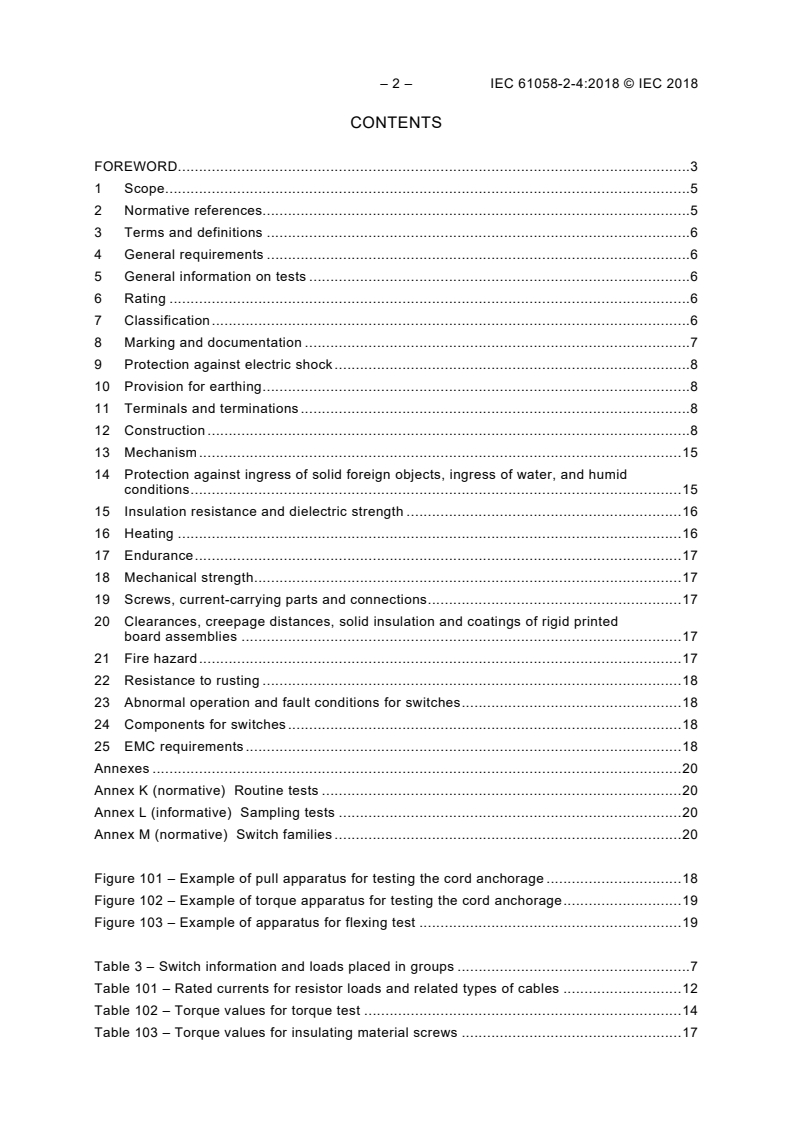
CONTENTS
FOREWORD . 3
1 Scope . 5
2 Normative references. 5
3 Terms and definitions . 6
4 General requirements . 6
5 General information on tests . 6
6 Rating . 6
7 Classification . 6
8 Marking and documentation . 7
9 Protection against electric shock . 8
10 Provision for earthing . 8
11 Terminals and terminations . 8
12 Construction . 8
13 Mechanism . 15
14 Protection against ingress of solid foreign objects, ingress of water, and humid
conditions . 15
15 Insulation resistance and dielectric strength . 16
16 Heating . 16
17 Endurance . 17
18 Mechanical strength . 17
19 Screws, current-carrying parts and connections . 17
20 Clearances, creepage distances, solid insulation and coatings of rigid printed
board assemblies . 17
21 Fire hazard . 17
22 Resistance to rusting . 18
23 Abnormal operation and fault conditions for switches . 18
24 Components for switches . 18
25 EMC requirements . 18
Annexes . 20
Annex K (normative) Routine tests . 20
Annex L (informative) Sampling tests . 20
Annex M (normative) Switch families . 20
Figure 101 – Example of pull apparatus for testing the cord anchorage . 18
Figure 102 – Example of torque apparatus for testing the cord anchorage . 19
Figure 103 – Example of apparatus for flexing test . 19
Table 3 – Switch information and loads placed in groups . 7
Table 101 – Rated currents for resistor loads and related types of cables . 12
Table 102 – Torque values for torque test . 14
Table 103 – Torque values for insulating material screws . 17
INTERNATIONAL ELECTROTECHNICAL COMMISSION
____________
SWITCHES FOR APPLIANCES –
Part 2-4: Particular requirements for
independently mounted switches
FOREWORD
1) The International Electrotechnical Commission (IEC) is a worldwide organization for standardization comprising
all national electrotechnical committees (IEC National Committees). The object of IEC is to promote
international co-operation on all questions concerning standardization in the electrical and electronic fields. To
this end and in addition to other activities, IEC publishes International Standards, Technical Specifications,
Technical Reports, Publicly Available Specifications (PAS) and Guides (hereafter referred to as “IEC
Publication(s)”). Their preparation is entrusted to technical committees; any IEC National Committee interested
in the subject dealt with may participate in this preparatory work. International, governmental and non-
governmental organizations liaising with the IEC also participate in this preparation. IEC collaborates closely
with the International Organization for Standardization (ISO) in accordance with conditions determined by
agreement between the two organizations.
2) The formal decisions or agreements of IEC on technical matters express, as nearly as possible, an international
consensus of opinion on the relevant subjects since each technical committee has representation from all
interested IEC National Committees.
3) IEC Publications have the form of recommendations for international use and are accepted by IEC National
Committees in that sense. While all reasonable efforts are made to ensure that the technical content of IEC
Publications is accurate, IEC cannot be held responsible for the way in which they are used or for any
misinterpretation by any end user.
4) In order to promote international uniformity, IEC National Committees undertake to apply IEC Publications
transparently to the maximum extent possible in their national and regional publications. Any divergence
between any IEC Publication and the corresponding national or regional publication shall be clearly indicated in
the latter.
5) IEC itself does not provide any attestation of conformity. Independent certification bodies provide conformity
assessment services and, in some areas, access to IEC marks of conformity. IEC is not responsible for any
services carried out by independent certification bodies.
6) All users should ensure that they have the latest edition of this publication.
7) No liability shall attach to IEC or its directors, employees, servants or agents including individual experts and
members of its technical committees and IEC National Committees for any personal injury, property damage or
other damage of any nature whatsoever, whether direct or indirect, or for costs (including legal fees) and
expenses arising out of the publication, use of, or reliance upon, this IEC Publication or any other IEC
Publications.
8) Attention is drawn to the Normative references cited in this publication. Use of the referenced publications is
indispensable for the correct application of this publication.
9) Attention is drawn to the possibility that some of the elements of this IEC Publication may be the subject of
patent rights. IEC shall not be held responsible for identifying any or all such patent rights.
International Standard IEC 61058-2-4 has been prepared by subcommittee 23J: Switches for
appliances, of IEC technical committee 23: Electrical accessories.
This second edition cancels and replaces the first edition published in 1995 and constitutes a
technical revision.
This edition includes the following significant technical changes with respect to the previous
edition:
a) overall format modified to support the revised structure of the series;
b) Annexes K and M have been included as an integral part of this document;
c) Annex L has been included for information purposes only.
– 4 – IEC 61058-2-4:2018 © IEC 2018
The text of this International Standard is based on the following documents:
CDV Report on voting
23J/433/CDV 23J/441/RVC
Full information on the voting for the approval of this International Standard can be found in
the report on voting indicated in the above table.
This document has been drafted in accordance with the ISO/IEC Directives, Part 2.
This document is to be used in conjunction with IEC 61058-1:2016.
This document supplements or modifies the corresponding clauses in IEC 61058-1, so as to
convert that publication into the IEC standard: Particular requirements for independently
mounted switches.
When a particular subclause of IEC 61058-1 is not mentioned in this document, that
subclause applies as far as reasonable. Where this document states "addition", "modification"
or "replacement", the relevant text of IEC 61058-1 is to be adapted accordingly.
In this document:
1) the following print types are used:
– requirements proper: in roman type;
– test specifications: in italic type;
– explanatory matter: in smaller roman type.
2) subclauses, figures or tables which are additional to those in IEC 61058-1 are numbered
starting from 101.
A list of all the parts in the IEC 61058 series, under the general title Switches for appliances,
can be found on the IEC website.
The committee has decided that the contents of this document will remain unchanged until the
stability date indicated on the IEC website under "http://webstore.iec.ch" in the data related to
the specific document. At this date, the document will be
• reconfirmed,
• withdrawn,
• replaced by a revised edition, or
• amended.
SWITCHES FOR APPLIANCES –
Part 2-4: Particular requirements for
independently mounted switches
1 Scope
Clause 1 of IEC 61058-1:2016 is applicable, except as follows.
Addition:
This document applies to independently mounted switches for appliances (mechanical or
electronic) actuated by hand, by foot or by other human activity, to operate or control
electrical appliances and other equipment for household or similar purposes with a rated
voltage not exceeding 480 V and a rated current not exceeding 63 A.
These switches are intended to be operated by a person, via an actuating member or by
actuating a sensing unit. The actuating member or sensing unit can be integral with or
arranged separately, either physically or electrically, from the switch and involve transmission
of a signal, for example, electrical, optical, acoustic or thermal, between the actuating
member or sensing unit and the switch.
Switches which incorporate additional control functions governed by the switch function are
within the scope of this document.
This document also covers the indirect actuation of the switch when the operation of the
actuating member or sensing unit is provided by a remote control or by a part of an appliance
or equipment, such as a door.
NOTE 1 Electronic switches can be combined with mechanical switches giving full disconnection or micro-
disconnection.
NOTE 2 Electronic switches without a mechanical switch in the supply circuit provide only electronic
disconnection. Therefore, the circuit on the load side is always considered to be live.
NOTE 3 For switches used in tropical climates, additional requirements can apply.
NOTE 4 Attention is drawn to the fact that the standards for appliances can contain additional or alternative
requirements for switches.
NOTE 5 Throughout this document, the word "appliance" means "appliance or equipment".
2 Normative references
Clause 2 of IEC 61058-1:2016 is applicable except as follows.
Addition:
IEC 60227-5, Polyvinyl chloride insulated cables of rated voltages up to and including
450/750 V – Part 5: Flexible cables (cords)
IEC 60245-4, Rubber insulated cables – Rated voltages up to and including 450/750 V –
Part 4: Cords and flexible cables
– 6 – IEC 61058-2-4:2018 © IEC 2018
IEC 60669-1:2017, Switches for household and similar fixed-electrical installations – Part 1:
General requirements
IEC 61058-1:2016, Switches for appliances – Part 1: General requirements
3 Terms and definitions
Clause 3 of IEC 61058-1:2016 is applicable, except as follows.
3.3 Terms and definitions relating to the different types of switches
Additional terms and definitions:
3.3.101
independently mounted switch
switch intended to be mounted away from the controlled appliance or equipment
3.3.102
design A switch
switch where the cover or coverplate can be removed without displacement of the
conductor(s)
3.3.103
design B switch
switch where the cover or coverplate cannot be removed without displacement of the
conductor(s)
4 General requirements
Clause 4 of IEC 61058-1:2016 is applicable.
5 General information on tests
Clause 5 of IEC 61058-1:2016 is applicable.
6 Rating
Clause 6 of IEC 61058-1:2016 is applicable.
7 Classification
Clause 7 of IEC 61058-1:2016 is applicable except as follows.
7.5 Degree of protection against solid foreign objects
Replacement:
The degree of protection against solid foreign objects is declared.
With the exception of IP0X and IP1X, all IP ratings are allowed.
7.11 According to resistance to ignitability by the glow wire temperature
Subclause 7.11.1 of IEC 61058-1:2016 is not applicable.
7.22 According to the type of forced cooling
Subclause 7.22.2 of IEC 61058-1:2016 is not applicable.
Additional subclauses:
7.101 According to design
7.101.1 design A switch;
7.101.2 design B switch.
NOTE 1 See definitions 3.3.102 and 3.3.103.
NOTE 2 If a switch has a base which cannot be separated from the cover or cover plate, and requires an
intermediate plate which can be removed for redecorating the wall, it is considered to be of design A, provided the
intermediate plate meets the requirements specified for covers and cover plates.
7.102 According to outlet facilities
7.102.1 switch with inlet/outlet facilities for rigid cables;
7.102.2 switch with inlet facilities for rigid cables and outlet facilities for flexible cables.
8 Marking and documentation
Clause 8 of IEC 61058-1:2016 is applicable with the following modifications to Table 3:
Table 3 – Switch information and loads placed in groups
Modification:
Means of information
Common Unique
Characteristic Subclause
No.
type type
reference reference
CT UT
2 SWITCH ENVIRONMENT/MOUNTING
2.1 Degree of protection provided for the switch when 7.5 and 7.6 Marking Marking
mounted according to documentation
(IP code of IEC 60529)
NOTE Additional letters listed in IEC 60529 are not
used.
4 ELECTRICAL LOAD/CONNECTION
4.1 Rated voltage or rated voltage range 6.1 Marking Marking
– 8 – IEC 61058-2-4:2018 © IEC 2018
Additional rows:
101 SWITCH DESIGN
101.1 Type of switch design 7.101.1 and Document- Document-
7.101.2 ation ation
102 OUTLET FACILITIES
102.1 Type of outlet facilities 7.102 Document- Document-
ation ation
9 Protection against electric shock
Clause 9 of IEC 61058-1:2016 is applicable, except as follows.
9.1 Addition of the following sentence to a):
The switch shall be fitted with the conductor of the smallest or largest nominal cross-sectional
area according to Table 4 whichever is more unfavourable, or with a rigid conduit, a pliable
conduit or a flexible conduit.
Addition to d):
This test finger, with an electrical indicator, is not applied to membranes in inlet openings and
is applied to thin-walled knock-outs with a force of only 10 N.
Additional subclause:
9.101 Switches operated by means of a removable key or by means of an intermediate part,
such as a cord, a chain or a rod, shall be so designed that the key or intermediate part can
only touch parts which are insulated from live parts.
The key or intermediate part shall be insulated from metal parts of the mechanism, unless the
clearances and creepage distances between live parts and metal parts of the mechanism
have at least the values specified in 20.2.5 and 20.4.5.
Compliance is checked by inspection, by the test of 15.3 and, if necessary, by measurement.
NOTE Lacquer or enamel is not considered to be insulating material for the purpose of 9.101.
10 Provision for earthing
Clause 10 of IEC 61058-1:2016 is applicable.
11 Terminals and terminations
Clause 11 of IEC 61058-1:2016 is applicable.
12 Construction
Clause 12 of IEC 61058-1:2016 is not applicable.
Additional subclauses:
12.101 Insulating linings, barriers and the like, shall have adequate mechanical strength and
shall be secured in a reliable manner.
Compliance is checked by inspection after the tests of Clause 18.
12.102 Switches shall be so constructed as to permit:
• easy introduction and connection of the conductors in the terminals;
• adequate space between the underside of the base and the surface on which the base is
mounted or between the sides of the base and the enclosure (cover or box) so that, after
installation of the switch, the insulation of the conductors does not come in contact with
live parts of different polarity or with moving parts of the mechanism, such as the spindle
of a rotary switch;
NOTE This requirement does not imply that the metal parts of the terminals are necessarily protected by
insulating barriers or insulating shoulders to avoid contact, due to incorrect installation of the terminal metal
parts, with the insulation of the conductor.
• easy fixing of the base to a wall or in a box and correct positioning of the conductors. For
surface-type switches, mounted on a mounting plate, a wiring channel may be needed to
comply with this requirement.
In addition, switches classified according to 7.101.1 (design A switch) shall permit an easy
positioning and removal of the cover or cover plate, without displacing the conductors.
Compliance is checked by inspection and by an installation test with conductors of the largest
cross-sectional area for the relevant terminal size, in Table 4.
12.103 Covers and cover plates or parts thereof, which are intended to ensure protection
against electric shock, shall be held in place at two or more points by effective fixing.
Covers and cover plates or parts thereof may be fixed by means of a single fixing, for
example by a screw, provided that they are retained in position by another means (e.g. by a
shoulder).
It is recommended that the fixings of covers and cover plates or parts thereof be captive. The
use of tight fixing washers of cardboard or the like is deemed to be an adequate method for
securing screws intended to be captive.
NOTE Live parts and non-earthed metal parts separated from live parts in such a way that creepage distances
and clearances have values specified in Clause 20 are not considered as accessible if the requirements of 12.103
are met.
For switches with a degree of protection IPX0, the fixing of covers or cover plates shall not
serve to fix any other part, except the knobs.
When the fixings of covers or cover plates also serve to fix the base, there shall be sufficient
means to maintain the base in position after removal of the cover or cover plate.
Decorative covers, cover plates or parts thereof not providing protection against electric shock
are not considered as covers or cover plates within the meaning of 12.103.
For covers and cover plates or parts thereof whose fixing is of the screw-type, compliance is
checked by inspection and by an installation test.
For covers and cover plates or parts thereof whose fixing is not dependent on screws and
whose removal is obtained by applying a force in a direction approximately perpendicular to
the mounting/supporting surface, compliance is checked by applying the test described in
13.3.2 of IEC 60669-1:2017 under the conditions set out in 20.4 to 20.6 of IEC 60669-1:2017.
– 10 – IEC 61058-2-4:2018 © IEC 2018
12.104 Surface-type switches with degree of protection IPX0 shall be so constructed that,
when they are fixed and wired as in normal use, there are no free openings in their
enclosures.
Compliance is checked by inspection and by an installation test with conductors of the cross-
sectional area specified in Table 4.
NOTE Small gaps between enclosures and conduits or cables, or between enclosures and operating means are
disregarded.
12.105 Knobs of rotary switches shall be securely coupled to the shaft or part operating the
mechanism.
The knob is subjected for 1 min to an axial pull of 100 N .
In addition, for knobs of switches having only one direction of operation, a torque of 1 Nm or
the actuating torque if this is greater, is applied 100 times in the direction opposite to the
direction of operation.
During the test, the knob shall not become detached.
NOTE Requirements for the fixation of other types of actuating members are under consideration.
12.106 Screws or other means for mounting the switch on a surface or in a box or enclosure
apart from panel mounting shall be easily accessible from the front. These means shall not
serve any other fixing purpose.
12.107 Other electrical accessories combined with switches shall comply with the
requirements of the standard for the accessory in question.
12.108 Switches other than those with degree of protection IPX0 shall be totally enclosed
when fitted with conduits or cables.
Surface-type switches other than those with degree of protection IPX0 shall have provision for
opening a drain hole at least 5 mm in diameter, or 20 mm in area with a width and length of
at least 3 mm.
The drain hole shall be effective in at least two positions of the switch when this is mounted
on a vertical wall, one of these with the conductors entering at the top and the other with the
conductors entering at the bottom.
Compliance is checked by measurement and by inspection during the relevant tests of 14.2.
NOTE A drain hole in the back of the enclosure is deemed to be effective only if the design of the enclosure
ensures a clearance of at least 5 mm from the wall, or provides a drainage channel of at least the size specified.
12.109 Switches to be installed in a box shall be so designed that the conductor ends can be
prepared after the box is mounted in position, but before the switch is fitted in the box.
In addition, the base shall have adequate stability when mounted in the box.
Compliance is checked by inspection and by an installation test with the appropriate cable
with conductors of the largest cross-sectional areas specified, for the relevant terminal size, in
Table 4.
12.110 Single pole surface type switches of an IP degree higher than X0 with an enclosure
having more than one inlet opening shall be provided with an additional terminal for
maintaining the continuity of a second current carrying conductor and complying with the
appropriate requirements of Clause 11, or with an adequate space for a floating terminal.
Compliance is checked by inspection and by the relevant tests of Clause 11.
NOTE For switches for Class I appliances, this terminal is additional to the terminal required according to
Clause 10.
12.111 Inlet openings shall allow the introduction of the conduit or the protective covering of
the sheathed cable so as to afford complete mechanical protection.
IPX0 surface-type switches shall be so constructed that the conduit or protective covering can
enter at least 1 mm into the enclosure.
In IPX0 surface-type switches, the inlet opening for conduit entries, or at least two of them
if there are more than one, shall be capable of accepting conduit sizes of 16, 20, 25 or 32 or a
combination of at least two of any of these sizes.
Compliance is checked by inspection during the test of 12.109 and by measurement.
NOTE Inlet openings of adequate size can also be obtained by the use of knock-outs or of suitable insertion
pieces.
If ordinary surface-type switches are intended for back entry from a conduit they shall be so
designed that they have provision for back entry from a conduit perpendicular to the mounting
surface of the switch.
Compliance is checked by inspection.
If the switch is provided with membranes in inlet openings, these shall be replaceable.
Compliance is checked by inspection.
12.112 Switches classified according to 7.102.2 shall have cord anchorages at the declared
outlet facilities for flexible cables such that the conductors are relieved from strain, including
twisting, where they are connected to the terminals, and such that their covering is protected
from abrasion and kept in position.
12.112.1 It shall be clear how the relief from strain and the prevention of twisting is intended
to be effected.
12.112.2 The inlet or bushing shall be provided with a smoothly rounded opening.
12.112.3 Makeshift methods such as tying the cable into a knot, or tying the ends with string
shall not be used.
12.112.4 Cord anchorages of switches shall be of insulating material, or, if of metal, be insu-
lated from accessible metal parts or accessible insulating surfaces, by insulation complying
with the requirements for supplementary insulation.
The cord anchorages shall be so designed that their parts do not fall out when the cover is
removed, even if the switches are not fitted with their cables.
12.112.5 Cord anchorages shall further be so designed that:
• for any attachment method, the cable is not fixed by penetration of its insulation in such a
way that the insulation of the cable is cut or otherwise significantly damaged. A slight
– 12 – IEC 61058-2-4:2018 © IEC 2018
deformation of the insulation, in such a way that the insulation of the cable is not cut or
otherwise significantly damaged, is allowed;
• the cable cannot touch clamping screws of the cord anchorage if these screws are
accessible or electrically connected to accessible metal parts;
• the cable is not clamped by a screw which bears directly on the cable, except where the
screw is made of insulating material;
• at least one part is securely fixed to the switch;
• replacement of the cable does not require the use of a special purpose tool;
• they are suitable for the different types of cables which may be connected.
12.112.6 Cord anchorages shall be so designed and located that replacement of the cable is
easily possible.
12.112.7 Screws, if any, which have to be operated when replacing the cable, shall not
serve to fix any other component, unless either the switch is rendered inoperable or
manifestly incomplete if they are omitted or incorrectly replaced, or the component intended to
be fixed cannot be removed without the aid of a tool when replacing the cable.
Compliance is checked by inspection and by a pull test in an apparatus similar to that shown
in Figure 101, followed by a torque test in an apparatus similar to that shown in Figure 102:
• three new switches are tested with cables as declared by the manufacturer having the
smallest and largest cross-sectional area as specified in Table 101. Before the test the
free length of the cable shall be cut to 150 mm ± 5 mm;
• switches provided with entries specially designed for the connection of PVC insulated flat
cables (60227 IEC 52) are tested with flat cables only.
Table 101 – Rated currents for resistor loads and related types of cables
Rated current for Number of cores Nominal cross-sectional Types of cables
resistor load area of each conductor
A mm
Up to and including 3 2 0,5 60227 IEC 52
0,75 60227 IEC 52
60227 IEC 52 fl
3 0,5 60227 IEC 52
0,75 60227 IEC 52
Over 3 and up to and 2 0,75 60227 IEC 52
including 6
60227 IEC 52 fl
60227 IEC 53
60227 IEC 53 fl
3 0,75 60227 IEC 52
60227 IEC 53
4 1,0 60227 IEC 53
Over 6 and up to and 2 0,75 60227 IEC 52
including 16
60227 IEC 52 fl
60227 IEC 53
60227 IEC 53 fl
1,0 60227 IEC 53
1,5 60227 IEC 53
Rated current for Number of cores Nominal cross-sectional Types of cables
resistor load area of each conductor
A mm
3 0,75 60227 IEC 52
60227 IEC 53
1,0 60227 IEC 53
1,5 60227 IEC 53
4 1,0 60227 IEC 53
1,5 60227 IEC 53
Over 16 and up to and 2
including 25
3 1,5 60227 IEC 53
4 4 60245 IEC 66
Over 25 and up to and 2
including 32
3 2,5 60227 IEC 53
4 6 60245 IEC 66
Over 32 and up to and 2
including 40
3 4 60227 IEC 53
4 10 60245 IEC 66
Over 40 and up to and 2
including 63
3 4 60227 IEC 53
4 10 60245 IEC 66
Conductors of the cable are introduced into the terminals, and the terminal metal screws are
tightened just sufficiently to prevent the conductors from easily changing their position.
The cord anchorage is used in the normal way, metal clamping screws being tightened with
two-thirds of the torque specified in Table 10 and clamping screws of insulating material with
two-thirds of the torque specified in Table 103. After reassembly of the switch, its component
parts shall fit snugly and it shall not be possible to push the cable into the switch to any
appreciable extent.
The switch is first fixed in a test apparatus similar to that shown in Figure 101 so that the axis
of the cable is vertical where it enters the switch. The cable is then subjected 100 times to a
pull of:
– 14 – IEC 61058-2-4:2018 © IEC 2018
• 60 N if the rated current is not more than 16 A;
• 100 N if the rated current is more than 16 A.
The pulls are applied without jerks, each time for 1 s.
Immediately after this test, the cable is subjected for 1 min to a torque as specified in
Table 102 with an apparatus similar to that shown in Figure 102.
Table 102 – Torque values for torque test
Flexible cable
Rated current for
2 … 5 × 1
resistor load
2 × 0,5 2 × 0,75 3 × 0,5 3 × 0,75
(or larger)
Up to and including 16 A 0,1 Nm 0,15 Nm 0,15 Nm 0,25 Nm 0,25 Nm
Over 16 A 0,425 Nm
The torque is applied as near as possible to the switch.
During the tests, neither the cable nor the switch shall be damaged within the meaning of this
document. After the tests, the cable shall not have been displaced longitudinally by more than
2 mm, and there shall be no appreciable strain at the connection. Creepage distances and
clearances shall not have been reduced below the value specified in Clause 20.
For the measurement of the longitudinal displacement a mark is made on the cable while it is
subjected to the first pull. After the tests the displacement of the mark on the cable in relation
to the switch is measured while the cable is subjected to an additional pull.
12.112.8 Switches shall be designed so that the cables incur no damage due to the bending
likely to occur in normal use.
Cord guards shall not be integral with the cable.
Exempted from this requirement are switches with terminals classified according to 7.20.2,
where the method of attachment is such that the cable can be replaced without the aid of a
special purpose tool by a special cable with for example a moulded-on cord guard. For those
terminals it shall not be possible to fit a cable without a cord guard during servicing.
Compliance is checked by subjecting the switch, fitted with the cable, or range of cables,
for which it is designed, to the following tests.
The switch is mounted in the flexing apparatus similar to that shown in Figure 103. For the
purpose of the test, the following conditions apply.
a) The test is performed only once with a cable of the maximum dimension attached.
b) For switches having a rated current over 3 A, a cable of type 60227 IEC 53 shall be used.
The axis of oscillation is so chosen that the weight attached to the cable, and the cable itself,
make the minimum lateral movement during the test. Switches with flat cables are mounted so
that the major axis of the cross-section is parallel to the axis of oscillation. Each cable
passing through the inlet opening is loaded with a weight having a mass of 1 kg. A current
equal to the current passing through that particular core when the switch is operated at rated
voltage is passed through each core, the voltage between the cores being the maximum rated
voltage. The oscillating member is moved backwards and forwards through an angle of 22,5°
(on either side of the vertical), the number of flexings (that is one movement through 45°)
being 5 000, and the rate of the flexing being 60 flexings per minute.
During the test there shall be no interruption of the test current and no short circuit between
conductors.
After the test, the switch shall show no damage within the meaning of this document.
12.112.9 The space for the external conductors inside the switch shall be adequate to allow
the conductors to be easily introduced and connected, and the cover, if any, fitted without risk
of damage to the conductors or their insulation.
Compliance is checked by inspection and by connecting cables with cores of the maximum
cross-sectional area according to Table 101.
12.112.10 Switches with terminals for the connection of the earth conductor (earthing
continuity) and classified according to 7.20.4 or 7.20.5 shall be designed with ample space for
slack of the protective earth conductor in such a way that, if the strain relief should fail, the
connection of the protective earth conductor is subjected to strain after the connections of the
current-carrying conductors and that, in case of excessive stresses, the protective earth
conductor will break after the current-carrying conductors.
Compliance is checked by the following test:
• the cable is connected to the switch in such a way that the current-carrying conductors are
led from the strain relief to the corresponding terminals along the shortest possible path;
• after they are correctly connected, the core of the protective earth conductor is led to its
terminal and cut off at a distance 8 mm longer than necessary for its correct connection;
• the protective earth conductor is then connected to its terminal. It shall then be possible to
house the loop, which is formed by the protective earth conductor owing to its surplus
length, freely in the wiring space without squeezing or pressing the core when the cover of
the switch is remounted and fixed correctly.
13 Mechanism
Clause 13 of IEC 61058-1:2016 is applicable.
14 Protection against ingress of solid foreign objects, ingress of water, and
humid conditions
Clause 14 of IEC 61058-1:2016 is applicable, except as follows.
14.3 Protection against humid conditions
Addition of the following item e) to the list:
e) The switch shall show no crack visible to normal or corrected vision without magnification
nor shall the material have become sticky or greasy, this being judged as follows:
– with the forefinger wrapped in a dry piece of rough cloth, the sample is pressed with a
force of 5 N;
– no traces of the cloth shall remain on the sample and the material of the sample shall
not stick to the cloth;
– after the test, the samples shall show no damage which would lead to non-compliance
with this document.
The force of 5 N can be obtained in the following way:
– the switch is placed on one of the pans of a balance and the other pan is loaded with a
mass equal to the mass of the switch plus 500 g;
– 16 – IEC 61058-2-4:2018 © IEC 2018
– equilibrium is then restored by pressing the switch with the forefinger, wrapped in a dry
piece of rough cloth.
Additional subclauses:
14.101 Membranes shall be reliably fixed and shall not be displaced by the mechanical and
the thermal stresses occurring in normal use.
Compliance is checked by the following test:
• membranes are tested when assembled in the switch;
• first the switch is fitted with membranes which have been subjected to the treatment
specified in Clause 14;
• the switch is then placed for 2 h in a heating cabinet as described in Clause 14, the
temperature being maintained at 40 °C ± 2 °C;
• immediately after this period, a force of 30 N is applied for 5 s to various parts of the
membranes by means of the tip of a straight unjointed test finger of the same dimensions
as the standard test finger according to IEC 60529.
During these tests, the membranes shall not deform to such an extent that live parts become
accessible.
For membranes likely to be subjected to an axial pull in normal u
...