

IEC 61058-1:2000
(Main)Switches for appliances - Part 1: General requirements
General Information
- Abstract
Applies to switches for appliances actuated by hand, by foot or by other human activity for use in, on or with appliances and other equipment for household and similar purposes, with a rated voltage not exceeding 440 V and a rated current not exceeding 63 A. Also covers the indirect actuation of the switch when the function of the actuating member is provided by a part of an appliance or equipment. Replaces IEC 60328 (1972). The contents of the corrigendum of January 2009 have been included in this copy.
- Status
- Published
- Publication Date
- 15-Apr-2008
- Technical Committee
- SC 23J - Switches for appliances
- Drafting Committee
- MT 1 - TC 23/SC 23J/MT 1
- Current Stage
- DELPUB - Deleted Publication
- Start Date
- 20-Jul-2016
- Completion Date
- 28-Aug-2026
Buy Documents
IEC 61058-1:2000+AMD1:2001 CSV - Switches for appliances - Part 1: General requirements Released:11/20/2001
IEC 61058-1:2000+AMD1:2001 CSV - Interrupteurs pour appareils - Partie 1 : Regles générales Released:11/20/2001
IEC 61058-1:2000+AMD1:2001 CSV - Switches for appliances - Part 1: General requirements Released:11/20/2001
IEC 61058-1:2000 - Switches for appliances - Part 1: General requirements Released:7/31/2000
IEC 61058-1:2000+AMD1:2001+AMD2:2007 CSV - Switches for appliances - Part 1: General requirements Released:4/16/2008
Overview
IEC 61058-1:2000+A1:2001 (Edition 3.1) - "Switches for appliances - Part 1: General requirements" - is the International Electrotechnical Commission (IEC) standard that sets general safety, performance and testing requirements for appliance switches. It applies to switches actuated by hand, foot or other human activity, including indirectly actuated mechanisms, intended for use in or on household and similar appliances with a rated voltage up to 440 V and rated current up to 63 A. This consolidated edition replaces IEC 60328 (1972) and includes the January 2009 corrigendum in this copy.
Key Topics
The standard defines terminology, classification and detailed requirements covering the full lifecycle of a switch:
- Scope, definitions and classification of switch types, terminals and ratings.
- Marking and documentation requirements for safe use and identification.
- Protection against electric shock and earthing provisions for appliance switches.
- Terminals and terminations, including screw, stud, lug and flat quick‑connect types.
- Construction and mechanism requirements to ensure mechanical strength and safe mounting.
- Ingress protection and environmental tests (dust, water, humid conditions).
- Insulation resistance and dielectric strength requirements.
- Heating, temperature limits and endurance (electrical and mechanical life).
- Clearances, creepage distances and solid insulation for safe voltages and pollution degrees.
- Resistance to heat and fire, rusting and abnormal/fault conditions (including electronic switches).
- Components and EMC - treatment of capacitors, resistors, protective devices and immunity/emission requirements.
- Normative and informative test methods and annexes, e.g. glow‑wire test, proof‑tracking test, ball‑pressure test, endurance and routine test procedures.
Applications
IEC 61058-1 is essential for:
- Appliance manufacturers designing control switches for domestic and similar equipment.
- Switch designers and component suppliers ensuring products meet safety and performance requirements.
- Product safety engineers and compliance teams preparing technical files for certification.
- Test laboratories and certification bodies executing standardized tests and conformity assessments.
- Regulatory authorities and purchasers specifying safety requirements for household appliance switches.
Practical uses include designing switch enclosures and terminals, selecting materials and components, defining test programs (endurance, dielectric, thermal, EMC) and producing required markings and documentation.
Related Standards
- Replaces IEC 60328 (1972).
- Cross-references IEC publications on testing and numbering conventions (see IEC catalogue).
Keywords: IEC 61058-1, switches for appliances, appliance switch standard, electrical safety, creepage distances, dielectric strength, endurance testing, glow-wire test, appliance switch certification.
Relations
- Amended By
IEC 61058-1:2000/AMD2:2007 - Amendment 2 - Switches for appliances - Part 1: General requirements - Effective Date
- 05-Sep-2023
- Amended By
IEC 61058-1:2000/AMD1:2001 - Amendment 1 - Switches for appliances - Part 1: General requirements - Effective Date
- 05-Sep-2023
- Corrected By
IEC 61058-1:2000/COR1:2009 - Corrigendum 1 - Switches for appliances - Part 1: General requirements - Effective Date
- 05-Sep-2023
- Effective Date
- 05-Sep-2023
- Revises
IEC 61058-1:1996/AMD1:1997 - Amendment 1 - Switches for appliances - Part 1: General requirements - Effective Date
- 05-Sep-2023
- Effective Date
- 05-Sep-2023
Buy Documents
IEC 61058-1:2000+AMD1:2001 CSV - Switches for appliances - Part 1: General requirements Released:11/20/2001
IEC 61058-1:2000+AMD1:2001 CSV - Interrupteurs pour appareils - Partie 1 : Regles générales Released:11/20/2001
IEC 61058-1:2000+AMD1:2001 CSV - Switches for appliances - Part 1: General requirements Released:11/20/2001
IEC 61058-1:2000 - Switches for appliances - Part 1: General requirements Released:7/31/2000
IEC 61058-1:2000+AMD1:2001+AMD2:2007 CSV - Switches for appliances - Part 1: General requirements Released:4/16/2008
Get Certified
Connect with accredited certification bodies for this standard

IMQ S.p.A. (Certification)
Italian electrical product certification.

SLG Prüf- und Zertifizierungs GmbH
German testing and certification body.

UL Solutions
Global safety science company with testing, inspection and certification.
Sponsored listings
Frequently Asked Questions
IEC 61058-1:2000 is a standard published by the International Electrotechnical Commission (IEC). Its full title is "Switches for appliances - Part 1: General requirements". This standard covers: Applies to switches for appliances actuated by hand, by foot or by other human activity for use in, on or with appliances and other equipment for household and similar purposes, with a rated voltage not exceeding 440 V and a rated current not exceeding 63 A. Also covers the indirect actuation of the switch when the function of the actuating member is provided by a part of an appliance or equipment. Replaces IEC 60328 (1972). The contents of the corrigendum of January 2009 have been included in this copy.
Applies to switches for appliances actuated by hand, by foot or by other human activity for use in, on or with appliances and other equipment for household and similar purposes, with a rated voltage not exceeding 440 V and a rated current not exceeding 63 A. Also covers the indirect actuation of the switch when the function of the actuating member is provided by a part of an appliance or equipment. Replaces IEC 60328 (1972). The contents of the corrigendum of January 2009 have been included in this copy.
IEC 61058-1:2000 is classified under the following ICS (International Classification for Standards) categories: 29.120.40 - Switches. The ICS classification helps identify the subject area and facilitates finding related standards.
IEC 61058-1:2000 has the following relationships with other standards: It is inter standard links to IEC 61058-1:2000/AMD2:2007, IEC 61058-1:2000/AMD1:2001, IEC 61058-1:2000/COR1:2009, IEC 61058-1:2016, IEC 61058-1:1996/AMD1:1997, IEC 61058-1:1996. Understanding these relationships helps ensure you are using the most current and applicable version of the standard.
IEC 61058-1:2000 is available in PDF format for immediate download after purchase. The document can be added to your cart and obtained through the secure checkout process. Digital delivery ensures instant access to the complete standard document.
Standards Content (Sample)
INTERNATIONAL IEC
STANDARD 61058-1
Edition 3.1
2001-11
Edition 3:2000 consolidated with amendment 1:2001
Switches for appliances –
Part 1:
General requirements
This English-language version is derived from the original
bilingual publication by leaving out all French-language
pages. Missing page numbers correspond to the French-
language pages.
Reference number
Publication numbering
As from 1 January 1997 all IEC publications are issued with a designation in the
60000 series. For example, IEC 34-1 is now referred to as IEC 60034-1.
Consolidated editions
The IEC is now publishing consolidated versions of its publications. For example,
edition numbers 1.0, 1.1 and 1.2 refer, respectively, to the base publication, the
base publication incorporating amendment 1 and the base publication incorporating
amendments 1 and 2.
Further information on IEC publications
The technical content of IEC publications is kept under constant review by the IEC,
thus ensuring that the content reflects current technology. Information relating to
this publication, including its validity, is available in the IEC Catalogue of
publications (see below) in addition to new editions, amendments and corrigenda.
Information on the subjects under consideration and work in progress undertaken
by the technical committee which has prepared this publication, as well as the list
of publications issued, is also available from the following:
• IEC Web Site (www.iec.ch)
• Catalogue of IEC publications
The on-line catalogue on the IEC web site (www.iec.ch/searchpub) enables you to
search by a variety of criteria including text searches, technical committees
and date of publication. On-line information is also available on recently issued
publications, withdrawn and replaced publications, as well as corrigenda.
• IEC Just Published
This summary of recently issued publications (www.iec.ch/online_news/ justpub)
is also available by email. Please contact the Customer Service Centre (see
below) for further information.
• Customer Service Centre
If you have any questions regarding this publication or need further assistance,
please contact the Customer Service Centre:
Email: custserv@iec.ch
Tel: +41 22 919 02 11
Fax: +41 22 919 03 00
INTERNATIONAL IEC
STANDARD 61058-1
Edition 3.1
2001-11
Edition 3:2000 consolidated with amendment 1:2001
Switches for appliances –
Part 1:
General requirements
IEC 2001 Copyright - all rights reserved
No part of this publication may be reproduced or utilized in any form or by any means, electronic or mechanical,
including photocopying and microfilm, without permission in writing from the publisher.
International Electrotechnical Commission, 3, rue de Varembé, PO Box 131, CH-1211 Geneva 20, Switzerland
Telephone: +41 22 919 02 11 Telefax: +41 22 919 03 00 E-mail: inmail@iec.ch Web: www.iec.ch
PRICE CODE
CR
Commission Electrotechnique Internationale
International Electrotechnical Commission
МеждународнаяЭлектротехническаяКомиссия
For price, see current catalogue
61058-1 © IEC:2000+A1:2001 – 3 –
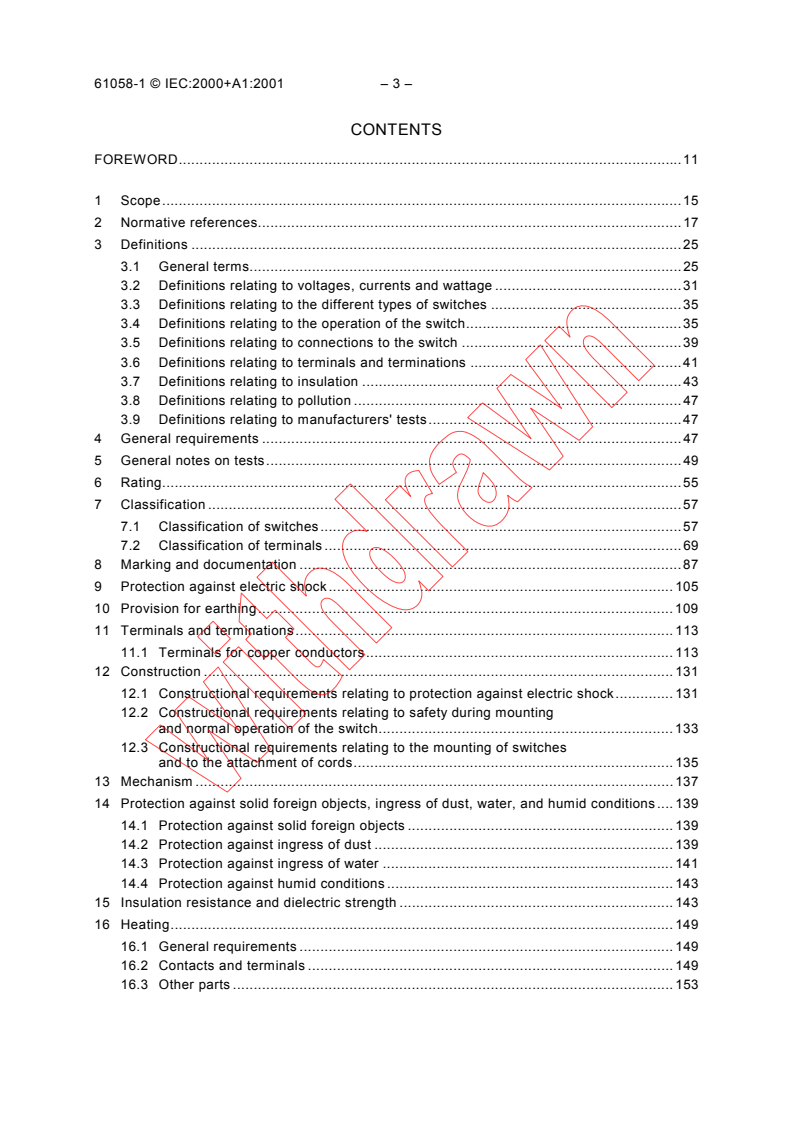
CONTENTS
FOREWORD.11
1 Scope.15
2 Normative references.17
3 Definitions .25
3.1 General terms.25
3.2 Definitions relating to voltages, currents and wattage .31
3.3 Definitions relating to the different types of switches .35
3.4 Definitions relating to the operation of the switch.35
3.5 Definitions relating to connections to the switch .39
3.6 Definitions relating to terminals and terminations .41
3.7 Definitions relating to insulation .43
3.8 Definitions relating to pollution .47
3.9 Definitions relating to manufacturers' tests.47
4 General requirements .47
5 General notes on tests.49
6 Rating.55
7 Classification .57
7.1 Classification of switches.57
7.2 Classification of terminals .69
8 Marking and documentation .87
9 Protection against electric shock. 105
10 Provision for earthing. 109
11 Terminals and terminations. 113
11.1 Terminals for copper conductors. 113
12 Construction .131
12.1 Constructional requirements relating to protection against electric shock. 131
12.2 Constructional requirements relating to safety during mounting
and normal operation of the switch. 133
12.3 Constructional requirements relating to the mounting of switches
and to the attachment of cords. 135
13 Mechanism . 137
14 Protection against solid foreign objects, ingress of dust, water, and humid conditions. 139
14.1 Protection against solid foreign objects . 139
14.2 Protection against ingress of dust . 139
14.3 Protection against ingress of water . 141
14.4 Protection against humid conditions . 143
15 Insulation resistance and dielectric strength . 143
16 Heating. 149
16.1 General requirements . 149
16.2 Contacts and terminals . 149
16.3 Other parts . 153
61058-1 © IEC:2000+A1:2001 – 5 –
17 Endurance .161
17.1 General requirements . 161
17.2 Electrical endurance tests. 169
18 Mechanical strength. 185
19 Screws, current-carrying parts and connections . 189
19.1 General requirements for electrical connections . 189
19.2 Screwed connections. 189
19.3 Current-carrying parts. 195
20 Clearances, creepage distances, solid insulation and coatings of rigid
printed board assemblies . 197
20.1 Clearances . 197
20.2 Creepage distances. 203
20.3 Solid insulation . 209
20.4 Coatings of rigid printed board assemblies. 209
21 Resistance to heat and fire . 211
22 Resistance to rusting . 213
23 Abnormal operation and fault conditions for electronic switches. 215
24 Components . 223
24.1 Protective devices . 225
24.2 Capacitors . 229
24.3 Resistors . 231
25 EMC requirements . 231
25.1 Immunity . 233
25.2 Emission . 237
Annex A (normative) Measurement of clearances and creepage distances. 271
Annex B (informative) Diagram for the dimensioning of clearances and
creepage distances . 281
Annex C (normative) Glow-wire test. 283
Annex D (normative) Proof tracking test . 285
Annex E (normative) Ball-pressure test. 287
Annex F (informative) Switch application guide . 289
Annex G (informative) Schematic diagram of families of terminals . 293
Annex H (informative) Flat quick-connect terminations, method for selection
of female connectors.295
Annex J (informative) Selection and sequence of tests of clause 21. 297
Annex K (normative) Relation between rated impulse withstand voltage,
rated voltage and overvoltage category . 299
Annex L (normative) Pollution degree . 301
Annex M (normative) Impulse voltage test . 303
Annex N (normative) Altitude correction factors . 305
Annex P (normative) Types of coatings for rigid printed board assemblies . 307
Annex Q (normative) Measuring the insulation distance of a coated printed board
with type A coating . 309
Annex R (normative) Routine tests . 311
Annex S (informative) Sampling tests . 313
Annex T (informative) Switch families . 317
61058-1 © IEC:2000+A1:2001 – 7 –
Figure 1 – Examples of pillar terminals . 241
Figure 2 – Examples of screw terminals and stud terminals . 243
Figure 3 – Examples of saddle terminals . 245
Figure 4 – Examples of lug terminals. 245
Figure 5 – Examples of mantle terminals . 247
Figure 6 – Examples of screwless terminals . 249
Figure 7 – Tabs of flat quick-connect terminations . 251
Figure 8 – Female (test) connector of flat quick-connect termination. 253
Figure 9a – Circuit for capacitive load test and simulated tungsten filament lamp
load test for a.c. circuits . 255
Figure 9b – Circuit for capacitive load test and simulated lamp load test for d.c. circuits. 255
Figure 10 – Values of the capacitive load test circuit for test
of switches rated 10/100 A 250 V~ . 257
Figure 11 – Mounting device for the impact test. 259
Figure 12 – Ball pressure apparatus . 261
Figure 13 – Test pin . 261
Figure 14 – Continuous duty – Duty type S1 . 263
Figure 15 – Short-time duty – Duty type S2. 265
Figure 16 – Intermittent periodic duty – Duty-type S3 . 267
Figure 17 – Diagram for short-circuit test. 267
Figure 18 – Diagram for heating test. 269
Figure 19 – Diagram for endurance test. 269
Figure Q.1 – Measurement of the insulation distance. 309
Table 1 – Test specimens .53
Table 2 – Type and connection of switches.73
Table 3 – Switch information .89
Table 4 – Resistive current carried by the terminal and related cross-sectional areas
of terminals for unprepared conductors . 115
Table 5 – Maximum diameters of circular copper conductors . 117
Table 6 – Pulling forces for screw-type terminals . 119
Table 7 – Material and plating for tabs. 127
Table 8 – Push and pull forces for tabs. 127
Table 9 – Test conditions for Ta . 129
Table 10 – Test conditions for Tb . 131
Table 11 – Minimum insulation resistance . 145
Table 12 – Dielectric strength. 147
Table 13 – Permissible maximum temperatures. 157
Table 14 – Temperatures for thermosetting materials used for electronic switches. 161
Table 15 – Electrical endurance tests for the different types of electronic switches
with or without electrical contact(s). 165
61058-1 © IEC:2000+A1:2001 – 9 –
Table 16 – Test loads for multiway switches . 169
Table 17 – Test loads for electrical endurance tests for a.c. circuits. 173
Table 18 – Test loads for electrical endurance tests for d.c. circuits. 175
Table 19 – Minimum values of pull force. 187
Table 20 – Torque values. 191
Table 21 – Torque values for screwed glands . 193
Table 22 – Minimum clearances for basic insulation . 201
Table 23 – Minimum creepage distances for basic insulation . 205
Table 24 – Minimum creepage distances for functional insulation . 207
Table 25 – Test levels and conditions. 211
Table 26 – Conventional fusing current versus rated current. 219
Table 27 – Requirements for capacitors . 231
Table 28 – Test levels and duration for voltage dips and short interruptions . 233
Table 29 – Fast transient bursts . 235
Table H.1 – Insertion and withdrawal forces for flat quick-connect terminations. 295
Table K.1 – Rated impulse withstand voltage for switches energized directly
from the low voltage mains. 299
Table M.1 – Test voltages for verifying clearances at sea level . 303
Table N.1 – Altitude correction factors. 305
61058-1 © IEC:2000+A1:2001 – 11 –
INTERNATIONAL ELECTROTECHNICAL COMMISSION
____________
SWITCHES FOR APPLIANCES –
Part 1: General requirements
FOREWORD
1) The IEC (International Electrotechnical Commission) is a worldwide organization for standardization comprising
all national electrotechnical committees (IEC National Committees). The object of the IEC is to promote
international co-operation on all questions concerning standardization in the electrical and electronic fields. To
this end and in addition to other activities, the IEC publishes International Standards. Their preparation is
entrusted to technical committees; any IEC National Committee interested in the subject dealt with may
participate in this preparatory work. International, governmental and non-governmental organizations liaising
with the IEC also participate in this preparation. The IEC collaborates closely with the International Organization
for Standardization (ISO) in accordance with conditions determined by agreement between the two
organizations.
2) The formal decisions or agreements of the IEC on technical matters express, as nearly as possible, an
international consensus of opinion on the relevant subjects since each technical committee has representation
from all interested National Committees.
3) The documents produced have the form of recommendations for international use and are published in the form
of standards, technical specifications, technical reports or guides and they are accepted by the National
Committees in that sense.
4) In order to promote international unification, IEC National Committees undertake to apply IEC International
Standards transparently to the maximum extent possible in their national and regional standards. Any
divergence between the IEC Standard and the corresponding national or regional standard shall be clearly
indicated in the latter.
5) The IEC provides no marking procedure to indicate its approval and cannot be rendered responsible for any
equipment declared to be in conformity with one of its standards.
6) Attention is drawn to the possibility that some of the elements of this International Standard may be the subject
of patent rights. The IEC shall not be held responsible for identifying any or all such patent rights.
International Standard IEC 61058-1 has been prepared by subcommittee 23J: Switches for
appliances, of IEC technical committee 23: Electrical accessories.
This consolidated version of IEC 61058-1 consists of the third edition (2000) [documents
23J/221/FDIS and 23J/222/RVD] and its amendment 1 (2001) [documents 23J/232/FDIS and
23J/233/RVD].
The technical content is therefore identical to the base edition and its amendment and has
been prepared for user convenience.
It bears the edition number 3.1.
A vertical line in the margin shows where the base publication has been modified by
amendment 1.
This publication has been drafted in accordance with the ISO/IEC Directives, Part 3.
IEC 61058 consists of the following parts:
Part 1: General requirements;
Part 2-1: Particular requirements for cord switches;
Part 2-4: Particular requirements for independently mounted switches;
Part 2-5: Particular requirements for change-over selectors.
61058-1 © IEC:2000+A1:2001 – 13 –
In this part, the following print types are used:
– requirements proper: roman type;
– test specifications: italic type;
– notes: smaller roman type.
Annexes A, C, D, E, K, L, M, N, P, Q and R form an integral part of this standard.
Annexes B, F, G, H, J, S and T are for information only.
The following differences exist in some countries:
– 7.1.2.9 The locked rotor power factor is 0,4 to 0,5 to reflect application conditions
(USA).
– 15.3 The duration of the application of the test voltage is 1 min to assure the
detection of defects in the insulation (USA).
– 17.2.4.7 The minimum number of operating cycles is 6 000 (USA).
– 17.2.5 The temperature rise at the terminals shall not exceed 30 °C (USA).
– Table 16 The make current for the inductive circuit is I-I to reflect actual application
conditions (USA).
– Table 16 The horsepower ratings are used when controlling a motor rated in horsepower
(USA).
– 25 EMC is not considered to be a safety-related matter (USA).
The committee has decided that the contents of the base publication and its amendment will
remain unchanged until 2006. At this date, the publication will be
• reconfirmed;
• withdrawn;
• replaced by a revised edition, or
• amended.
61058-1 © IEC:2000+A1:2001 – 15 –
SWITCHES FOR APPLIANCES –
Part 1: General requirements
1 Scope
1.1 This International Standard applies to switches (mechanical or electronic) for appliances
actuated by hand, by foot or by other human activity, to operate or control electrical appliances
and other equipment for household or similar purposes with a rated voltage not exceeding
440 V and a rated current not exceeding 63 A.
These switches are intended to be operated by a person, via an actuating member or by
actuating a sensing unit. The actuating member or sensing unit can be integral with or
arranged separately, either physically or electrically, from the switch and may involve
transmission of a signal, for example electrical, optical, acoustic or thermal, between the
actuating member or sensing unit and the switch.
Switches which incorporate additional control functions governed by the switch function are
within the scope of this standard.
This standard also covers the indirect actuation of the switch when the operation of the
actuating member or sensing unit is provided by a remote control or a part of an appliance or
equipment such as a door.
NOTE 1 Electronic switches may be combined with mechanical switches giving full disconnection or micro-
disconnection.
NOTE 2 Electronic switches without a mechanical switch in the supply circuit provide only electronic
disconnection. Therefore, the circuit on the load side is always considered to be live.
NOTE 3 For switches used in tropical climates, additional requirements may be necessary.
NOTE 4 Attention is drawn to the fact that the standards for appliances may contain additional or alternative
requirements for switches.
NOTE 5 Throughout this standard, the word "appliance" means "appliance or equipment".
NOTE 6 This part of IEC 61058 is applicable when testing incorporated switches. When other types of switches for
appliances are tested, this part is applicable together with the relevant IEC 61058-2.
This part may, however, be applied for other types of switches which are not mentioned in IEC 61058-2, provided
that the electrical safety is not disregarded.
1.2 This standard applies to switches intended to be incorporated in, on or with an appliance.
1.3 This standard also applies to switches incorporating electronic devices.
1.4 This standard also applies to switches for appliances such as
– switches intended to be connected to a flexible cable (cord switches);
NOTE In this document, the word "cable" means "cable or cord".
– switches integrated in an appliance (integrated switches);
– switches intended to be mounted apart from the appliance (independently mounted
switches) other than those within the scope of IEC 60669-1;
– change-over selectors for which, however, particular requirements are given in IEC 61058-2.
61058-1 © IEC:2000+A1:2001 – 17 –
1.5 This standard does not contain requirements for isolating switches.
NOTE Requirements for isolating switches are under consideration.
1.6 This standard does not apply to devices which control appliances and equipment not
actuated intentionally by a person. These are covered by IEC 60730.
2 Normative references
The following referenced documents are indispensable for the application of this document. For
dated references, only the edition cited applies. For undated references, the latest edition of
the referenced document (including any amendments) applies.
1)
IEC 60034-1:1996, Rotating electrical machines – Part 1: Rating and performance
Amendment 1 (1997)
Amendment 2 (1999)
IEC 60038:1983, IEC standard voltages
IEC 60050(151):1978, International Electrotechnical Vocabulary (IEV) – Chapter 151: Electrical
and magnetic devices
IEC 60050(411):1973, International Electrotechnical Vocabulary (IEV) – Chapter 411: Rotating
machinery
IEC 60050(441):1984, International Electrotechnical Vocabulary (IEV) – Chapter 441:
Switchgear, controlgear and fuses
IEC 60050(826):1982, International Electrotechnical Vocabulary (IEV) – Chapter 826: Electrical
installations of buildings
Amendment 1 (1990)
Amendment 2 (1995)
IEC 60060-1:1989: High-voltage techniques – Part 1: General definitions and test requirements
IEC 60068-2-20:1979, Environmental testing – Part 2-20: Tests – Test T: Soldering
IEC 60068-2-75:1997, Environmental testing – Part 2-75: Tests – Test Eh: Hammer tests
IEC 60085:1984, Thermal evaluation and classification of electrical insulation
IEC 60112:1979, Method for determining the comparative and the proof tracking indices of solid
insulating materials under moist conditions
IEC 60127 (all parts), Miniature fuses
IEC 60127-2:1989, Miniature fuses – Part 2: Cartridge fuse-links
___________
1)
There is a consolidated edition 10.2 (1999) that includes IEC 60034-1 and its amendments 1 (1997) and
2 (1999).
61058-1 © IEC:2000+A1:2001 – 19 –
IEC 60228:1978, Conductors of insulated cables
IEC 60228A:1982, Conductors of insulated cables – First supplement: Guide to the dimensional
limits of circular conductors
IEC 60269-1:1998, Low-voltage fuses – Part 1: General requirements
IEC 60269-3-1:1994, Low-voltage fuses – Part 3-1: Supplementary requirements for fuses for
use by unskilled persons (fuses mainly for household and similar applications) – Sections I to IV
IEC 60335-1:1991, Safety of household and similar electrical appliances – Part 1: General
requirements
Amendment 1 (1994)
IEC 60335 (all parts 2), Safety for household and similar electrical appliances
IEC 60364-4-41:1992, Electrical installations of buildings – Part 4: Protection for safety –
2)
Chapter 41: Protection against electric shock
Amendment 1 (1996)
Amendment 2 (1999)
IEC 60364-4-442:1993, Electrical installations of buildings – Part 4: Protection for safety –
Chapter 44: Protection against overvoltage – Section 442: Protection of low-voltage
3)
installations against faults between high-voltage systems and earth
Amendment 1 (1995)
Amendment 2 (1999)
IEC 60364-4-443:1995, Electrical installations of buildings – Part 4: Protection for safety –
Chapter 44: Protection against overvoltages – Section 443: Protection against overvoltages of
4)
atmospheric origin or due to switching
Amendment 1 (1998)
IEC 60384-14:1993, Fixed capacitors for use in electronic equipment – Part 14: Sectional
specification: Fixed capacitors for electromagnetic suppression and connection to the supply
mains
IEC 60417-1:1998, Graphical symbols for use on equipment – Part 1: Overview and application
IEC 60529:1989, Degree of protection provided by enclosures (IP code)
IEC 60617-2:1996, Graphical symbols for diagrams – Part 2: Symbol elements, qualifying
symbols and other symbols having general application
IEC 60664-1:1992, Insulation coordination for equipment within low-voltage systems – Part 1:
Principles, requirements and tests
___________
2)
There is a consolidated edition 3.2 (1999) that includes IEC 60364-4-41 and its amendments 1 (1996) and
2 (1999).
3)
There is a consolidated edition 1.2 (1999) that includes IEC 60364-4-442 and its amendments 1 (1995) and
2 (1999).
4)
There is a consolidated edition 3.2 (1999) that includes IEC 60364-4-443 and its amendment 1 (1998).
61058-1 © IEC:2000+A1:2001 – 21 –
IEC 60664-3:1992, Insulation coordination for equipment within low-voltage systems – Part 3:
Use of coatings to achieve insulation coordination of printed board assemblies
IEC 60669-1:1998, Switches for household and similar fixed electrical installations – Part 1:
General requirements
IEC 60691:1993, Thermal-links – Requirements and application guide
IEC 60695-2-1 (all sheets), Fire hazard testing – Part 2-1: Test methods
IEC 60707:1999, Flammability of solid non-metallic materials when exposed to flame sources –
List of methods
IEC 60730 (all parts), Automatic electrical controls for household and similar use
IEC 60730-1:1999, Automatic electrical controls for household and similar use – Part 1:
General requirements
IEC 60730-2-9:2000, Automatic electrical controls for household and similar use – Part 2-9:
Particular requirements for temperature sensing controls
IEC 60738-1:1998, Thermistors directly heated positive step-function temperature efficient
thermistors – Part 1: Generic specification
IEC 60760:1989, Flat, quick-connect terminations
IEC 60893-1:1987, Specification for industrial rigid laminated sheets based on thermosetting
resins for electrical purposes – Part 1: Definitions, designations and general requirements
IEC 60998-2-3:1991, Connecting devices for low-voltage circuits for household and similar
purposes – Part 2-3: Particular requirements for connecting devices as separate entities with
insulation piercing clamping units
IEC 61000 (all parts), Electromagnetic compatibility (EMC)
IEC 61000-3-2:1995, Electromagnetic compatibility (EMC) – Part 3: Limits – Section 2: Limits
5)
for harmonic current emissions (equipment input current ≤16 A per phase)
Amendment 1 (1997)
Amendment 2 (1998)
IEC 61000-3-3:1994, Electromagnetic compatibility (EMC) – Part 3: Limits – Section 3:
Limitation of voltage fluctuations and flicker in low-voltage power supply systems for equipment
with rated current ≤16 A
___________
5)
There is a consolidated edition 1.2 (1998) that includes IEC 61000-3-2 and its amendments 1 (1997) and
2 (1998).
61058-1 © IEC:2000+A1:2001 – 23 –
IEC/TR2 61000-3-5:1994, Electromagnetic compatibility (EMC) – Part 3: Limits – Section 5:
Limitation of voltage fluctuations and flicker in low-voltage power supply systems for equipment
with rated current greater than 16 A
IEC 61000-4-1:1992, Electromagnetic compatibility (EMC) – Part 4: Testing and measurement
techniques – Section 1: Overview of immunity tests. Basic EMC publication
IEC 61000-4-2:1995, Electromagnetic compatibility (EMC) – Part 4: Testing and measurement
6)
techniques – Section 2: Electrostatic discharge immunity test. Basic EMC publication
Amendment 1 (1998)
IEC 61000-4-3:1995, Electromagnetic compatibility (EMC) – Part 4: Testing and measurement
7)
techniques – Section 3: Radiated, radio-frequency, electromagnetic field immunity test
Amendment 1 (1998)
IEC 61000-4-4:1995, Electromagnetic compatibility (EMC) – Part 4: Testing and measurement
techniques – Section 4: Electrical fast transient/burst immunity test. Basic EMC publication
IEC 61000-4-6:1996, Electromagnetic compatibility (EMC) – Part 4: Testing and measurement
techniques – Section 6: Immunity to conducted disturbances, induced by radio-frequency fields
IEC 61000 4-11:1994, Electromagnetic compatibility (EMC) – Part 4: Testing and measurement
techniques – Section 11: Voltage dips, short interruptions and voltage variations immunity tests
IEC 61032:1997, Protection of persons and equipment by enclosures – Probes for verification
IEC 61058-2-1, Switches for appliances – Part 2-1: Particular requirements for cord switches
IEC 61058-2-4, Switches for appliances – Part 2-4: Particular requirements for independently
mounted switches
ISO 1456:1988, Metallic coatings – Electrodeposited coatings of nickel plus chromium and of
copper plus nickel plus chromium
ISO 2081:1986, Metallic coatings – Electroplated coatings of zinc of iron or steel
ISO 2093:1986, Electroplated coatings of tin – Specification and test methods
ISO 4046:1978, Paper, board, pulp and related terms – Vocabulary
___________
6)
There is a consolidated edition 1.1 (1999) that includes IEC 61000-4-2 and its amendment 1 (1998).
7)
There is a consolidated edition 1.1 (1998) that includes IEC 61000-4-3 and its amendment 1 (1998).
61058-1 © IEC:2000+A1:2001 – 25 –
3 Definitions
For the purpose of this International Standard, the following definitions apply.
3.1 General terms
3.1.1
mechanical switching device
a switching device designed to close and open one or more electric circuits by means of
separable contacts
[IEV 441-14-02]
3.1.2
switch (mechanical)
a mechanical switching device capable of making, carrying and breaking currents under normal
circuit conditions which may include specified operating overload conditions and also carrying
for a specified time currents under specified abnormal circuit conditions such as those
of short circuit
NOTE A switch may be capable of making but not breaking short-circuit currents.
[IEV 441-14-10]
3.1.3
conductive part
part which is capable of conducting current although it may not necessarily be used for carrying
service current
[IEV 441-11-09]
3.1.4
live part
a conductor or conductive part intended to be energized in normal use, including a neutral
conductor, but, by convention, not a PEN conductor
[IEV 826-03-01]
3.1.5
pole of a switch
the part of the switch associated exclusively with one, electrically separated, conducting path of
the switch
NOTE 1 Those parts that provide a means for mounting and operating all poles together are excluded from the
definition of a pole.
NOTE 2 A switch is called "single-pole" if it has only one pole. If it has more than one pole, it may be called
"multipole" (two-pole, three-pole, etc.) provided that the poles are coupled in such a manner as to operate together.
3.1.6
clearance
the shortest distance in air between two conductive parts
3.1.7
creepage distance
the shortest distance along the surface of the insulation material between two conductive parts
[IEV 151-03-37]
3.1.8
detachable part
part which is removable without the use of a tool when the switch is mounted as in normal use
61058-1 © IEC:2000+A1:2001 – 27 –
3.1.9
tool
screwdriver, coin, or any other object which may be used to operate a nut, a screw, or a similar part
3.1.10
special purpose tool
tool which is unlikely to be readily available in a normal household, for example, a key for a
three-angle headed screw
NOTE Tools such as coins, screwdrivers and spanners designed to operate square or hexagonal nuts are not
special purpose tools.
3.1.11
normal use
use of the switch for the purpose for which it was made and declared
3.1.12
ambient air temperature
the temperature or temperatures, determined under prescribed conditions, of the air sur-
rounding the switch when mounted as declared by the manufacturer
3.1.13
proof tracking index (PTI)
the numerical value of the proof voltage in volts, at which a material withstands 50 drops of test
solution without tracking
3.1.14
unique type reference
identification marking on a switch such that by quoting it in full to the switch manufacturer the
electrical, mechanical, dimensional and functional parameters of the original switch can be
unequivocally specified
3.1.15
common type reference
identification marking on a switch which does not require any further specific information
additional to that provided by the marking requirements of this standard for selection,
installation and use in accordance with this standard
3.1.16
cover or cover plate
part which is accessible when the switch is mounted as in normal use but which can be
removed with the aid of a tool
3.1.17
signal indicator
device associated with a switch to indicate the circuit state visually
NOTE The device may or may not be controlled by the switch.
3.1.18
unprepared conductor
conductor which has been cut and the insulation of which has been removed for insertion into a
clamping unit
NOTE A conductor the shape of which is arranged for introduction into a clamping unit or the strands of which are
twisted to consolidate the end, is considered to be an unprepared conductor.
3.1.19
prepared conductor
conductor, the stripped end of which is fitted with an eyelet, a terminal end, a cable lug, etc.
61058-1 © IEC:2000+A1:2001 – 29 –
3.1.20
base material
insulating material, supporting electronic circuits
3.1.21
printed board
a sized base material including holes, if any, and bearing at least one conductive pattern
3.1.22
printed board assembly
printed board with electrical and mechanical components and/or other printed boards attached
to it, with all manufacturing processes, soldering, coating etc. completed
3.1.23
insulation distance
the shortest distance of a coated printed board between conductive parts located on the base
material.
See figure Q.1.
3.1.24
polarity reversal
change of the terminals connected to the load by a switching action
3.1.25
semiconductor switching device
a switching device designed to make, carry, break and/or control the current in an electric
circuit by means of the controlled conductivity of a semiconductor
3.1.26
electronic step-down convertor (convertor)
unit inserted between the supply and one or more tungsten-halogen or other filament lamps
which serves to supply the lamp(s) with its (their) rated voltage, generally at high frequency.
The unit may consist of one or more separate components
3.1.27
electronic switch
a device capable of making, carrying, breaking and/or controlling currents under normal circuit
conditions which may include specified operating overload conditions and also carrying for a
specified time currents under specified abnormal circuit conditions such as those of a short
circuit. The device contains actuating members, actuating means and switching devices which
may be mechanical or electronic. At least one of these must be electronic
3.1.28
duty
the statement of the load(s) to which the electronic switch is subjected, including, if applicable,
making, controlling and breaking and including their durations and sequence in time
[IEV 411-21-07, modified]
3.1.29
duty-type
a continuous, short-time or periodic duty, comprising one or more loads remaining constant for
the duration specified, or a non-periodic duty in which generally the load varies within the
permissible operating range
[IEV 411-21-13, modified]
61058-1 © IEC:2000+A1:2001 – 31 –
3.1.30
cyclic duration factor
the ratio between the period of loading, including making and breaking, and the duration of the
duty cycle, expressed as a percentage
[IEV 411-21-10, modified]
3.1.31
protective impedance
an impedance connected between live parts and accessible conductive parts, of such value
that the current, in normal use and under likely fault conditions in the electronic switch, is
limited to a safe value; it is so constructed that the reliability is maintained throughout the life of
the electronic switch
NOTE Details of the likely fault conditions, the safe current and the requirements for reliability are as given in this
IEC standard.
3.2 Definitions relating to voltages, currents and wattage
NOTE Where the terms "voltage" and "current" are used, they imply the r.m.s. values unless otherwise specified.
3.2.1
rated voltage, current, frequency, wattage etc.
voltage, current, frequency, wattage etc. assigned to a switch by the manufacturer and to which
operation and performance characteristics are referred
3.2.2
SELV
voltage which does n
...
NORME CEI
INTERNATIONALE 61058-1
Edition 3.1
2001-11
Edition 3:2000 consolidée par l’amendement 1:2001
Interrupteurs pour appareils –
Partie 1:
Règles générales
Cette version française découle de la publication d’origine
bilingue dont les pages anglaises ont été supprimées.
Les numéros de page manquants sont ceux des pages
supprimées.
Numéro de référence
CEI 61058-1:2000+A1:2001(F)
Numérotation des publications
Depuis le 1er janvier 1997, les publications de la CEI sont numérotées à partir de
60000. Ainsi, la CEI 34-1 devient la CEI 60034-1.
Editions consolidées
Les versions consolidées de certaines publications de la CEI incorporant les
amendements sont disponibles. Par exemple, les numéros d’édition 1.0, 1.1 et 1.2
indiquent respectivement la publication de base, la publication de base incorporant
l’amendement 1, et la publication de base incorporant les amendements 1 et 2.
Informations supplémentaires
sur les publications de la CEI
Le contenu technique des publications de la CEI est constamment revu par la CEI
afin qu'il reflète l'état actuel de la technique. Des renseignements relatifs à cette
publication, y compris sa validité, sont disponibles dans le Catalogue des
publications de la CEI (voir ci-dessous) en plus des nouvelles éditions, amende-
ments et corrigenda. Des informations sur les sujets à l’étude et l’avancement des
travaux entrepris par le comité d’études qui a élaboré cette publication, ainsi que la
liste des publications parues, sont également disponibles par l’intermédiaire de:
• Site web de la CEI (www.iec.ch)
• Catalogue des publications de la CEI
Le catalogue en ligne sur le site web de la CEI (www.iec.ch/searchpub) vous permet
de faire des recherches en utilisant de nombreux critères, comprenant des
recherches textuelles, par comité d’études ou date de publication. Des informations
en ligne sont également disponibles sur les nouvelles publications, les publications
remplacées ou retirées, ainsi que sur les corrigenda.
• IEC Just Published
Ce résumé des dernières publications parues (www.iec.ch/online_news/justpub)
est aussi disponible par courrier électronique. Veuillez prendre contact avec le
Service client (voir ci-dessous) pour plus d’informations.
• Service clients
Si vous avez des questions au sujet de cette publication ou avez besoin de
renseignements supplémentaires, prenez contact avec le Service clients:
Email: custserv@iec.ch
Tél: +41 22 919 02 11
Fax: +41 22 919 03 00
NORME CEI
INTERNATIONALE 61058-1
Edition 3.1
2001-11
Edition 3:2000 consolidée par l’amendement 1:2001
Interrupteurs pour appareils –
Partie 1:
Règles générales
© IEC 2001 Droits de reproduction réservés
Aucune partie de cette publication ne peut être reproduite ni utilisée sous quelque forme que ce soit et par aucun
procédé, électronique ou mécanique, y compris la photocopie et les microfilms, sans l'accord écrit de l'éditeur.
International Electrotechnical Commission, 3, rue de Varembé, PO Box 131, CH-1211 Geneva 20, Switzerland
Telephone: +41 22 919 02 11 Telefax: +41 22 919 03 00 E-mail: inmail@iec.ch Web: www.iec.ch
CODE PRIX
CR
Commission Electrotechnique Internationale
International Electrotechnical Commission
МеждународнаяЭлектротехническаяКомиссия
Pour prix, voir catalogue en vigueur
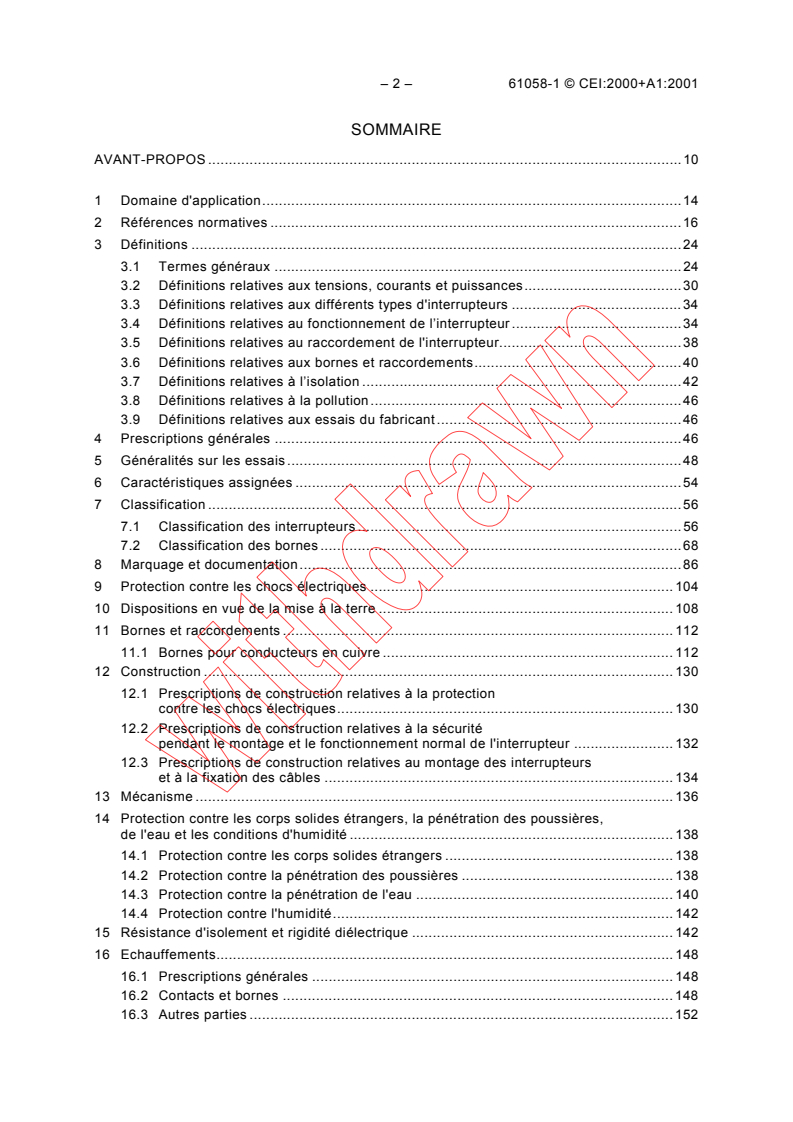
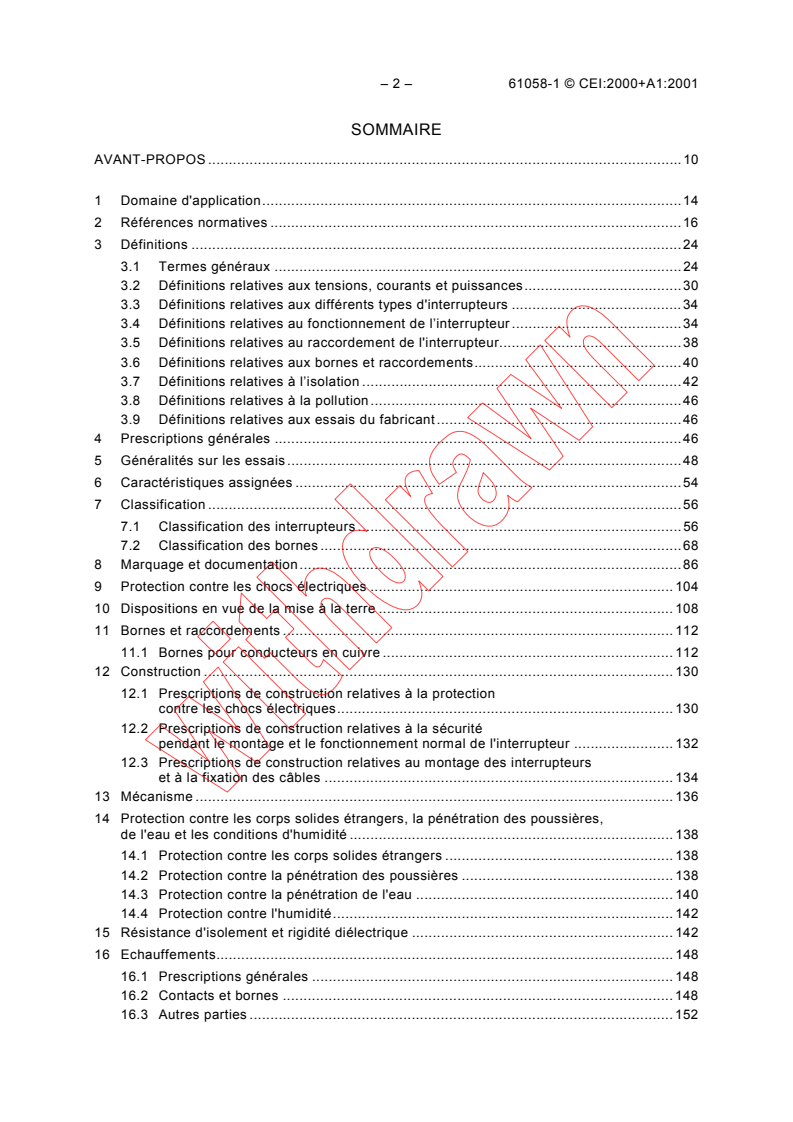
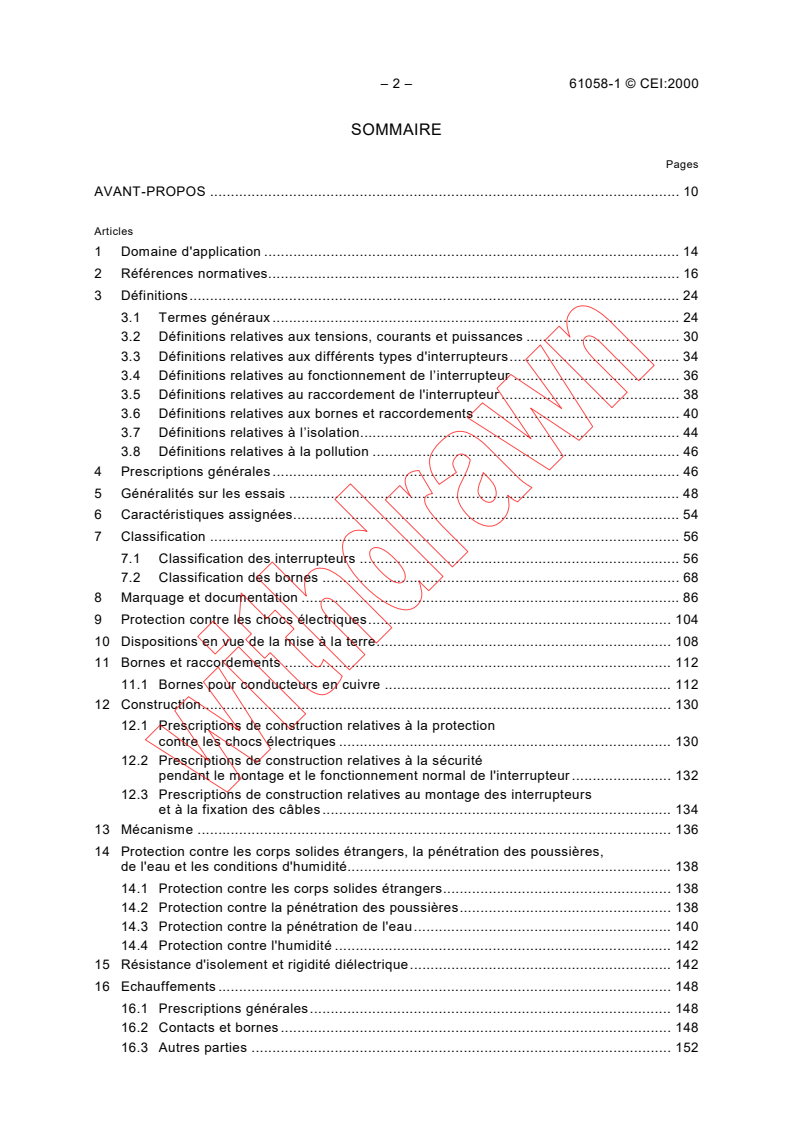
– 2 – 61058-1 © CEI:2000+A1:2001
SOMMAIRE
AVANT-PROPOS .10
1 Domaine d'application.14
2 Références normatives .16
3 Définitions .24
3.1 Termes généraux .24
3.2 Définitions relatives aux tensions, courants et puissances.30
3.3 Définitions relatives aux différents types d'interrupteurs .34
3.4 Définitions relatives au fonctionnement de l’interrupteur .34
3.5 Définitions relatives au raccordement de l'interrupteur.38
3.6 Définitions relatives aux bornes et raccordements.40
3.7 Définitions relatives à l’isolation .42
3.8 Définitions relatives à la pollution.46
3.9 Définitions relatives aux essais du fabricant .46
4 Prescriptions générales .46
5 Généralités sur les essais.48
6 Caractéristiques assignées .54
7 Classification .56
7.1 Classification des interrupteurs .56
7.2 Classification des bornes .68
8 Marquage et documentation.86
9 Protection contre les chocs électriques . 104
10 Dispositions en vue de la mise à la terre . 108
11 Bornes et raccordements . 112
11.1 Bornes pour conducteurs en cuivre . 112
12 Construction .130
12.1 Prescriptions de construction relatives à la protection
contre les chocs électriques. 130
12.2 Prescriptions de construction relatives à la sécurité
pendant le montage et le fonctionnement normal de l'interrupteur . 132
12.3 Prescriptions de construction relatives au montage des interrupteurs
et à la fixation des câbles . 134
13 Mécanisme . 136
14 Protection contre les corps solides étrangers, la pénétration des poussières,
de l'eau et les conditions d'humidité . 138
14.1 Protection contre les corps solides étrangers . 138
14.2 Protection contre la pénétration des poussières . 138
14.3 Protection contre la pénétration de l'eau . 140
14.4 Protection contre l'humidité. 142
15 Résistance d'isolement et rigidité diélectrique . 142
16 Echauffements. 148
16.1 Prescriptions générales . 148
16.2 Contacts et bornes . 148
16.3 Autres parties . 152
– 4 – 61058-1 © CEI:2000+A1:2001
17 Endurance .160
17.1 Prescriptions générales . 160
17.2 Essais d'endurance électrique. 168
18 Résistance mécanique. 184
19 Vis, parties transportant le courant et connexions. 188
19.1 Prescriptions générales pour les connexions électriques . 188
19.2 Connexions vissées. 188
19.3 Parties transportant le courant . 194
20 Distances d'isolement dans l'air, lignes de fuite, isolation solide et revêtements
des cartes imprimées rigides équipées. 196
20.1 Distances d'isolement dans l'air . 196
20.2 Lignes de fuite. 202
20.3 Isolation solide . 208
20.4 Revêtements des cartes imprimées équipées rigides . 208
21 Résistance à la chaleur et au feu . 210
22 Protection contre la rouille . 212
23 Fonctionnement anormal et conditions de défaut pour les interrupteurs électroniques. 214
24 Composants . 222
24.1 Dispositifs de protection. 224
24.2 Condensateurs . 228
24.3 Résistances. 230
25 Prescriptions CEM . 230
25.1 Immunité . 232
25.2 Emission . 236
Annexe A (normative) Mesurage des distances dans l'air et des lignes de fuite. 270
Annexe B (informative) Diagramme pour le dimensionnement des distances
dans l'air et des lignes de fuite . 280
Annexe C (normative) Essai au fil incandescent . 282
Annexe D (normative) Essai de tenue au cheminement . 284
Annexe E (normative) Essais à la bille. 286
Annexe F (informative) Guide d'utilisation de l'interrupteur. 288
Annexe G (informative) Diagramme schématique des familles de bornes. 292
Annexe H (informative) Bornes plates à connexion rapide, méthode de sélection des clips. 294
Annexe J (informative) Sélection et séquences d'essais de l'article 21 . 296
Annexe K (normative) Relation entre tension assignée de tenue aux chocs,
tension assignée et catégorie de surtension . 298
Annexe L (normative) Degré de pollution . 300
Annexe M (normative) Essai de tension de choc. 302
Annexe N (normative) Facteurs de correction d'altitude . 304
Annexe P (normative) Types de revêtement pour les cartes imprimées équipées rigides. 306
Annexe Q (normative) Mesure de la distance d'isolement d'une carte imprimée
revêtement de type A . 308
Annexe R (normative) Essais individuels . 310
Annexe S (informative) Essais sur prélèvement . 312
Annexe T (informative) Familles d’interrupteurs . 316
– 6 – 61058-1 © CEI:2000+A1:2001
Figure 1 – Exemples de bornes à trous . 240
Figure 2 – Exemples de bornes à serrage sous tête de vis et bornes à goujon fileté. 242
Figure 3 – Exemples de bornes à plaquettes . 244
Figure 4 – Exemples de bornes pour cosses et barrettes . 244
Figure 5 – Exemples de bornes à capot taraudé . 246
Figure 6 – Exemples de bornes sans vis. 248
Figure 7 – Languettes de bornes plates à connexion rapide . 250
Figure 8 – Clip (d’essai) de borne plate à connexion rapide . 252
Figure 9a – Circuit pour l’essai de charge capacitive et l’essai de charge de lampe
à filament de tungstène simulée pour les circuits à courant alternatif . 254
Figure 9b – Circuit pour l’essai de charge capacitive et l’essai de charge
de lampe simulée pour les circuits à courant continu . 254
Figure 10 – Valeurs du circuit d'essai de charge capacitive pour les essais
d’interrupteurs de valeurs assignées 10/100 A 250 V~. 256
Figure 11 – Dispositif de montage pour l’essai de choc. 258
Figure 12 – Appareil pour l'essai à la bille. 260
Figure 13 – Broche d'essai . 260
Figure 14 – Service continu – Service-type S1. 262
Figure 15 – Service temporaire – Service-type S2. 264
Figure 16 – Service périodique à charge variable – Service-type S3. 266
Figure 17 – Schéma pour l'essai de court-circuit. 266
Figure 18 – Diagramme pour l’essai d’échauffement. 268
Figure 19 – Diagramme pour l’essai d’endurance . 268
Figure Q.1 – Mesure de la distance d'isolement. 308
Tableau 1 – Spécimens d'essai .52
Tableau 2 – Type et raccordement des interrupteurs .72
Tableau 3 – Informations sur l'interrupteur.88
Tableau 4 – Courant résistif transporté par la borne et sections correspondantes
des conducteurs non préparés . 114
Tableau 5 – Diamètres maximaux des conducteurs circulaires en cuivre. 116
Tableau 6 – Force de traction pour les bornes du type à vis. 118
Tableau 7 – Matériau et revêtement pour les languettes . 126
Tableau 8 – Forces de traction et de poussée pour les languettes . 126
Tableau 9 – Conditions d'essais pour l'essai Ta. 128
Tableau 10 – Conditions d'essai pour l'essai Tb. 130
Tableau 11 – Résistance d'isolement minimale. 144
Tableau 12 – Rigidité diélectrique. 146
Tableau 13 – Températures maximales admissibles . 156
Tableau 14 – Températures maximales admissibles pour les matériaux thermo-
durcissables pour interrupteurs électroniques . 160
Tableau 15 – Essais d’endurance électrique pour les différents types d’interrupteurs
électroniques avec ou sans contacts électriques combinés . 164
– 8 – 61058-1 © CEI:2000+A1:2001
Tableau 16 – Essais de charge des interrupteurs à direction multiples . 168
Tableau 17 – Charges d’essais pour les essais d’endurance électrique
des circuits en courant alternatif. 172
Tableau 18 – Charges d'essais pour les essais d'endurance électrique des circuits
en courant continu . 174
Tableau 19 – Valeurs minimales de la force de traction . 186
Tableau 20 – Valeurs des couples. 190
Tableau 21 – Valeurs du couple pour les presse-étoupe filetés . 192
Tableau 22 – Distances minimales d'isolement dans l'air pour l'isolation principale . 200
Tableau 23 – Lignes de fuite minimales pour l'isolation principale . 204
Tableau 24 – Lignes de fuite minimales pour l'isolation fonctionnelle . 206
Tableau 25 – Niveaux d’essais et conditions. 210
Tableau 26 – Courant de fonctionnement conventionnel selon le courant assigné . 218
Tableau 27 – Prescriptions pour condensateurs. 230
Tableau 28 – Niveaux d'essai et durée pour les creux de tension et les coupures brèves . 232
Tableau 29 – Pics de surtension transitoires rapides . 234
Tableau H.1 – Forces d'insertion et de retrait pour bornes plates à connexions rapides . 294
Tableau K.1 – Tension assignée de tenue aux chocs pour les interrupteurs alimentés
directement par le réseau basse tension . 298
Tableau M.1 – Tensions d'essai pour vérifier les distances dans l'air au niveau de la mer . 302
Tableau N.1 – Facteurs de correction d’altitude . 304
– 10 – 61058-1 © CEI:2000+A1:2001
COMMISSION ÉLECTROTECHNIQUE INTERNATIONALE
_________
INTERRUPTEURS POUR APPAREILS –
Partie 1: Règles générales
AVANT-PROPOS
1) La CEI (Commission Electrotechnique Internationale) est une organisation mondiale de normalisation composée
de l'ensemble des comités électrotechniques nationaux (Comités nationaux de la CEI). La CEI a pour objet de
favoriser la coopération internationale pour toutes les questions de normalisation dans les domaines de
l'électricité et de l'électronique. A cet effet, la CEI, entre autres activités, publie des Normes Internationales.
Leur élaboration est confiée à des comités d'études, aux travaux desquels tout Comité national intéressé par le
sujet traité peut participer. Les organisations internationales, gouvernementales et non gouvernementales, en
liaison avec la CEI, participent également aux travaux. La CEI collabore étroitement avec l'Organisation
Internationale de Normalisation (ISO), selon des conditions fixées par accord entre les deux organisations.
2) Les décisions ou accords officiels de la CEI concernant les questions techniques, représentent, dans la mesure
du possible un accord international sur les sujets étudiés, étant donné que les Comités nationaux intéressés
sont représentés dans chaque comité d’études.
3) Les documents produits se présentent sous la forme de recommandations internationales. Ils sont publiés
comme normes, spécifications techniques, rapports techniques ou guides et agréés comme tels par les Comités
nationaux.
4) Dans le but d'encourager l'unification internationale, les Comités nationaux de la CEI s'engagent à appliquer de
façon transparente, dans toute la mesure possible, les Normes internationales de la CEI dans leurs normes
nationales et régionales. Toute divergence entre la norme CEI et la norme nationale ou régionale
correspondante doit être indiquée en termes clairs dans cette dernière.
5) La CEI n’a fixé aucune procédure concernant le marquage comme indication d’approbation et sa responsabilité
n’est pas engagée quand un matériel est déclaré conforme à l’une de ses normes.
6) L’attention est attirée sur le fait que certains des éléments de la présente Norme internationale peuvent faire
l’objet de droits de propriété intellectuelle ou de droits analogues. La CEI ne saurait être tenue pour
responsable de ne pas avoir identifié de tels droits de propriété et de ne pas avoir signalé leur existence.
La Norme internationale CEI 61058-1 a été établie par le sous-comité 23J: Interrupteurs pour
appareils, du comité d'études 23 de la CEI: Petit appareillage.
La présente version consolidée de la CEI 61058-1 comprend la troisième édition (2000)
[documents 23J/221/FDIS et 23J/222/RVD] et son amendement 1 (2001) [documents
23J/232/FDIS et 23J/233/RVD].
Le contenu technique de cette version consolidée est donc identique à celui de l'édition de
base et à son amendement; cette version a été préparée par commodité pour l'utilisateur.
Elle porte le numéro d'édition 3.1.
Une ligne verticale dans la marge indique où la publication de base a été modifiée par les
amendement 1.
Cette publication a été rédigée selon les Directives ISO/CEI, Partie 3.
La CEI 61058 comprend les parties suivantes:
Partie 1: Règles générales;
Partie 2-1: Règles particulières pour les interrupteurs pour câbles souples;
Partie 2-4: Règles particulières pour les interrupteurs à montage indépendant;
Partie 2-5: Règles particulières pour les sélecteurs.
– 12 – 61058-1 © CEI:2000+A1:2001
Dans la présente partie, les caractères d’imprimerie suivants sont employés:
– prescriptions proprement dites: caractères romains;
– modalités d’essai: caractères italiques;
– notes: petits caractères romains.
Les annexes A, C, D, E, K, L, M, N, P, Q et R font partie intégrante de cette norme.
Les annexes B, F, G, H, J,S et T sont données uniquement à titre d'information.
Les différences suivantes existent dans certains pays:
– 7.1.2.9 Le facteur de puissance pour une charge de moteur spécifique avec un rotor
bloqué est compris entre 0,4 et 0,5 pour refléter les conditions d’application
(USA).
– 15.3 La durée d’application de la tension d’essai est 1 min pour garantir la
détection des défauts dans l’isolation (USA).
– 17.2.4.7 Le nombre minimal de cycles de manoeuvre est 6 000 (USA).
– 17.2.5 L’échauffement aux bornes ne doit pas dépasser 30 °C (USA).
– Tableau 16 Le courant obtenu pour les circuits inductifs est I-I pour refléter les conditions
réelles d’application (USA).
– Tableau 16 Les caractéristiques de puissance exprimées en chevaux sont utilisées pour
les commandes de moteur dont la puissance assignée est exprimée dans
cette unité (USA).
– 25 La CEM n’est pas considérée comme un aspect lié à la sécurité (USA).
Le comité a décidé que le contenu de la publication de base et de son amendement ne sera
pas modifié avant 2006. A cette date, la publication sera
• reconduite;
• supprimée;
• remplacée par une édition révisée, ou
• amendée.
– 14 – 61058-1 © CEI:2000+A1:2001
INTERRUPTEURS POUR APPAREILS –
Partie 1: Règles générales
1 Domaine d'application
1.1 La présente Norme internationale s'applique aux interrupteurs (mécaniques ou
électroniques) pour appareils manoeuvrés à la main, au pied ou par d'autres activités
humaines, pour faire fonctionner ou commander des appareils électriques et autres matériels
pour usage domestique et analogue de tension assignée ne dépassant pas 440 V et de courant
assigné ne dépassant pas 63 A.
Ces interrupteurs sont prévus pour être manoeuvrés par une personne, via un organe de
manoeuvre ou par action d'une unité sensible. L'organe de manoeuvre ou l'unité sensible peut
être intégré avec ou disposé séparément, soit physiquement soit électriquement, de
l'interrupteur et peut associer la transmission d'un signal, par exemple électrique, optique,
acoustique ou thermique, entre l'organe de manoeuvre ou l'unité sensible et l'interrupteur.
Les interrupteurs qui incorporent des fonctions de commande supplémentaires gérées par la
fonction de coupure sont inclus dans le domaine d'application de cette norme.
La présente norme couvre aussi la manoeuvre indirecte de l'interrupteur, le fonctionnement de
l'organe de manoeuvre ou de l'unité sensible étant réalisé par une commande à distance ou
une partie d'appareil ou d'équipement telle qu'une porte.
NOTE 1 Les interrupteurs électroniques peuvent être combinés avec des interrupteurs mécaniques donnant la
coupure complète ou la microcoupure.
NOTE 2 Les interrupteurs électroniques sans interrupteur mécanique ou dans le circuit d'alimentation procurent
seulement une coupure électronique. Le circuit du côté de la charge est donc toujours considéré comme actif.
NOTE 3 Pour les interrupteurs utilisés dans des climats tropicaux, des prescriptions supplémentaires peuvent être
nécessaires.
NOTE 4 L'attention est attirée sur le fait que les normes pour appareils peuvent contenir des prescriptions ou
variantes supplémentaires pour les interrupteurs.
NOTE 5 Dans toute la norme, le terme «appareil» signifie «appareil ou équipement».
NOTE 6 Cette partie de la CEI 61058 est applicable pour les essais des interrupteurs incorporés. Lorsque d'autres
types d'interrupteurs pour appareils sont essayés, la partie 1 est applicable avec la CEI 61058-2 correspondante.
Cette partie de la CEI 61058 peut toutefois être appliquée à d'autres types d'interrupteurs qui ne sont pas
mentionnés dans la CEI 61058-2 à condition que la sécurité électrique ne soit pas négligée.
1.2 Cette norme s'applique aux interrupteurs destinés à être incorporés dans, sur ou avec un
appareil.
1.3 Cette norme s'applique aussi aux interrupteurs incorporant des dispositifs électroniques.
1.4 Cette norme s'applique aussi aux interrupteurs pour appareils tels que
– interrupteurs destinés à être raccordés à un câble (interrupteurs pour câbles souples);
NOTE Dans ce document, le mot «câble» désigne un câble ou un câble souple.
– interrupteurs intégrés à un appareil (interrupteurs intégrés);
– interrupteurs destinés à être montés hors de l'appareil (à montage indépendant) autres que
ceux du domaine d'application de la CEI 60669-1;
– interrupteurs sélecteurs, pour lesquels des règles particulières sont cependant données
dans la CEI 61058-2.
– 16 – 61058-1 © CEI:2000+A1:2001
1.5 Cette norme ne comprend pas de prescription pour les interrupteurs sectionneurs.
NOTE Les prescriptions pour les interrupteurs sectionneurs sont à l’étude.
1.6 Cette norme ne s'applique pas aux dispositifs qui commandent des appareils ou des
équipements non actionnés intentionnellement par une personne, ceux-ci étant couverts par la
CEI 60730.
2 Références normatives
Les documents de référence suivants sont indispensables pour l'application du présent
document. Pour les références datées, seule l'édition citée s'applique. Pour les références non
datées, la dernière édition du document de référence s'applique (y compris les éventuels
amendements).
CEI 60034-1:1996, Machines électriques tournantes – Partie 1: Caractéristiques assignées et
1)
caractéristiques de fonctionnement
Amendement 1(1997)
Amendement 2 (1999)
CEI 60038:1983, Tensions normales de la CEI
CEI 60050(151):1978, Vocabulaire Electrotechnique International (VEI) – Chapitre 151:
Dispositifs électriques et magnétiques
CEI 60050(411):1973, Vocabulaire Electrotechnique International (VEI) – Chapitre 411:
Machines tournantes
CEI 60050(441):1984, Vocabulaire Electrotechnique International (VEI) – Chapitre 441:
Appareillage et fusibles
CEI 60050(826):1982, Vocabulaire Electrotechnique International (VEI) – Chapitre 826:
Installations électriques des bâtiments
Amendement 1 (1990)
Amendement 2 (1995)
CEI 60060-1:1989, Techniques des essais à haute tension – Première partie: Définitions et
descriptions générales relatives aux essais
CEI 60068-2-20:1979, Essais d’environnement – Partie 2-20: Essais – Essai T: soudure
CEI 60068-2-75:1997, Essais d'environnement – Partie 2-75: Essai Eh: Essais aux marteaux
CEI 60085:1984, Evaluation et classification thermiques de l'isolation électrique
CEI 60112:1979, Méthode pour déterminer les indices de résistance et de tenue au
cheminement des matériaux isolants solides dans des conditions humides
CEI 60127 (toutes les parties): Coupe-circuit miniatures
CEI 60127-2:1989, Coupe-circuit miniatures – Partie 2: Cartouches
––––––––
1)
Il existe une édition consolidée 10.2 (1999) qui comprend la CEI 60034-1 ainsi que l'amendement 1 (1997) et
l'amendement 2 (1999).
– 18 – 61058-1 © CEI:2000+A1:2001
CEI 60228:1978, Ames des câbles isolés
CEI 60228A:1982, Ames des câbles isolés – Premier complément: Guides pour les limites
dimensionnelles des âmes circulaires
CEI 60269-1:1998, Fusibles basse tension – Partie 1: Prescriptions générales;
CEI 60269-3-1:1994, Fusibles basse tension – Partie 3-1: Règles supplémentaires pour les
fusibles destinés à être utilisés par les personnes non qualifiées (fusibles pour usages
essentiellement domestiques et analogues) – Section I à IV
CEI 60335-1:1991, Sécurité des appareils électrodomestiques et analogues – Première partie:
Prescriptions générales
Amendement 1 (1994)
CEI 60335 (toutes les parties 2): Sécurité des appareils domestiques et analogues
CEI 60364-4-41:1992, Installations électriques des bâtiments – Partie 4: Protection pour
2)
assurer la sécurité – Chapitre 41: Protection contre les chocs électriques
Amendement 1 (1996)
Amendement 2 (1999)
CEI 60364-4-442:1993, Installations électriques des bâtiments – Quatrième partie: Protection
pour assurer la sécurité – Chapitre 44: Protection contre les surtensions – Section 442:
Protection des installations à basse tension contre les surtensions temporaires et contre les
3)
défauts à la terre dans les installations à haute tension
Amendement 1 (1995)
Amendement 2 (1999)
CEI 60364-4-443:1995, Installations électriques des bâtiments – Partie 4: Protection pour
assurer la sécurité.– Chapitre 44: Protection contre les surtensions – Section 443: Protection
4)
contre les surtensions d’origine atmosphérique ou dues à des manoeuvres
Amendement 1 (1998)
CEI 60384-14:1993, Condensateurs fixes utilisés dans les équipements électroniques –
Partie 14: Spécification intermédiaire: Condensateurs fixes d’antiparasitage et raccordement à
l’alimentation
CEI 60417-1:1998, Symboles graphiques utilisables sur le matériel – Partie 1: Vue d'ensemble
et application
CEI 60529:1989, Degrés de protection procurés par les enveloppes (code IP)
CEI 60617-2:1996, Symboles graphiques pour schémas – Partie 2: Eléments de symboles,
symboles distinctifs et autres symboles d’application générale
CEI 60664-1:1992, Coordination de l’isolement des matériels dans les systèmes (réseaux) à
basse tension – Partie 1: Principes, prescriptions et essais
––––––––
2)
Il existe une édition consolidée 3.2 (1999) qui comprend la CEI 60364-4-41 ainsi que l'amendement 1 (1996) et
l'amendement 2 (1999).
3)
Il existe une édition consolidée 1.2 (1999) qui comprend la CEI 60364-4-442 ainsi que l'amendement 1 (1995) et
l'amendement 2 (1999).
4)
Il existe une édition consolidée 3.2 (1999) qui comprend la CEI 60364-4-443 ainsi que l'amendement 1 (1998).
– 20 – 61058-1 © CEI:2000+A1:2001
CEI 60664-3:1992, Coordination de l’isolement des matériels dans les systèmes (réseaux) à
basse tension – Partie 3: Utilisation de revêtements pour réaliser la coordination de l’isolement
des cartes imprimées équipées
CEI 60669-1:1998, Interrupteurs pour installations électriques fixes domestiques et analogues –
Partie 1: Prescriptions générales
CEI 60691:1993, Protecteurs thermiques – Prescriptions et guide d'application
CEI 60695-2-1 (toutes les feuilles): Essais relatifs aux risques du feu – Partie 2-1: Méthodes
d’essai
CEI 60707:1999, Inflammabilité des matériaux solides non métalliques soumis à des sources
d’allumage à flamme – Liste des méthodes d'essai
CEI 60730 (toutes les parties), Dispositifs de commande électrique automatique à usage
domestique et analogue
CEI 60730-1:1999, Dispositifs de commande électrique automatiques à usage domestique et
analogue – Partie 1: Règles générales
CEI 60730-2-9:2000, Dispositifs de commande électrique automatiques à usage domestique et
analogue – Partie 2-9: Règles particulières pour les dispositifs de commande thermosensibles
CEI 60738-1:1998, Thermistances à basculement à coefficient de température positif à
chauffage direct – Partie 1: Spécifications génériques
CEI 60760:1989, Bornes plates à connexion rapide
CEI 60893-1:1987, Spécification pour les stratifiés industriels rigides en planche à base de
résines thermodurcissables à usages électriques – Première partie: Définitions, désignations et
prescriptions générales
CEI 60998-2-3:1991, Dispositifs de connexion pour circuits basse tension pour usage
domestique et analogue – Partie 2-3: Règles particulières pour dispositifs de connexion en tant
que parties séparées avec organes de serrage à perçage d'isolant
CEI 61000 (toutes les parties), Compatibilité électromagnétique (CEM)
CEI 61000-3-2:1995, Compatibilité électromagnétique (CEM) – Partie 3: Limites – Section 2:
Limites pour les émissions de courant harmonique (courant appelé par les appareils ≤16 A par
5)
phase)
Amendement 1 (1997)
Amendement 2 (1998)
CEI 61000-3-3:1994, Compatibilité électromagnétique (CEM) – Partie 3: Limites – Section 3:
Limitation des fluctuations de tension et du flicker dans les réseaux basse tension pour les
équipements ayant un courant appelé ≤16 A
––––––––
5)
Il existe une édition consolidée 1.2 (1998) qui comprend la CEI 61000-3-2 ainsi que l'amendement 1 (1997) et
l'amendement 2 (1998)
– 22 – 61058-1 © CEI:2000+A1:2001
CEI/TR2 61000-3-5:1994, Compatibilité électromagnétique (CEM) – Partie 3: Limites – Section 5:
Limitation des fluctuations de tension et du flicker dans les réseaux basse tension pour les
équipements ayant un courant appelé supérieur à 16 A
CEI 61000-4-1:1992, Compatibilité électromagnétique (CEM) – Partie 4: Techniques d'essai et
de mesure – Section 1: Vue d'ensemble sur les essais d'immunité. Publication fondamentale en
CEM
CEI 61000-4-2:1995, Compatibilité électromagnétique (CEM) – Partie 4: Techniques d'essai et
de mesure – Section 2: Essais d'immunité aux décharges électrostatiques. Publication
6)
fondamentale en CEM
Amendement 1 (1998)
CEI 61000-4-3:1995, Compatibilité électromagnétique (CEM) – Partie 4: Techniques d'essai et
de mesure – Section 3: Essais d'immunité aux champs électromagnétiques rayonnés aux
7)
fréquences radioélectriques
Amendement 1 (1998)
CEI 61000-4-4:1995, Compatibilité électromagnétique (CEM) – Partie 4: Techniques d'essai et
de mesure – Section 4: Essais d'immunité aux transitoires électriques rapides en salves.
Publication fondamentale en CEM
CEI 61000-4-6:1996, Compatibilité électromagnétique (CEM) – Partie 4: Techniques d'essai et
de mesure – Section 6: Immunité aux perturbations conduites, induites par les champs
radioélectriques
CEI 61000-4-11:1994, Compatibilité électromagnétique (CEM) – Partie 4: Techniques d'essai
et de mesure – Section 11: Essais d'immunité aux creux de tension, coupures brèves et
variations de tension
CEI 61032:1997, Protection des personnes et des matériels par les enveloppes – Calibres
d'essai pour la vérification
CEI 61058-2-1, Interrupteurs pour appareils – Partie 2-1: Règles particulières pour les
interrupteurs pour câbles souples
IEC 61058-2-4, Interrupteurs pour appareils – Partie 2-4: Règles particulières pour les
interrupteurs à montage indépendant
ISO 1456:1988, Revêtements métalliques – Dépôts électrolytiques de nickel plus chrome et de
cuivre plus nickel plus chrome
ISO 2081:1986, Revêtements métalliques – Dépôts électrolytiques de zinc sur fer ou acier
ISO 2093:1986, Dépôts électrolytiques d'étain – Spécifications et méthodes d'essai
ISO 4046:1978, Papier, carton, pâtes et termes connexes – Vocabulaire
––––––––
6)
Il existe une édition consolidée 1.1 (1999) qui comprend la CEI 61000-4-2 ainsi que l'amendement 1 (1998).
7)
Il existe une édition consolidée 1.1 (1998) qui comprend la CEI 61000-4-3 ainsi que l'amendement 1 (1998).
– 24 – 61058-1 © CEI:2000+A1:2001
3 Définitions
Pour les besoins de la présente Norme internationale, les définitions suivantes s'appliquent.
3.1 Termes généraux
3.1.1
appareil mécanique de connexion
appareil de connexion destiné à former ou à ouvrir un ou plusieurs circuits électriques au
moyen de contacts séparables
[VEI 441-14-02]
3.1.2
interrupteur (mécanique)
appareil mécanique de connexion capable d'établir, de supporter et d'interrompre des courants
dans les conditions normales du circuit y compris éventuellement les conditions spécifiées de
surcharge en service, ainsi que de supporter pendant une durée spécifiée des courants dans
des conditions anormales spécifiées du circuit telles que celles du court-circuit
NOTE Un interrupteur peut être capable d'établir des courants de court-circuit mais n'est pas capable de les
couper.
[VEI 441-14-10]
3.1.3
partie conductrice
partie capable de conduire du courant, bien qu'elle ne soit pas nécessairement utilisée pour
conduire du courant en service normal
[VEI 441-11-09]
3.1.4
partie active
tout conducteur ou toute partie conductrice destiné à être sous tension en service normal, ainsi
que le conducteur neutre mais, par convention, non le conducteur PEN
[VEI 826-03-01]
3.1.5
pôle d'un interrupteur
partie d'un interrupteur associée exclusivement à un chemin de conduction électriquement
séparé de l'interrupteur
NOTE 1 Les parties permettant le montage et la manoeuvre simultanée de tous les pôles ne font pas partie de la
définition d'un pôle.
NOTE 2 Un interrupteur est dit «unipolaire» s'il n'a qu'un seul pôle. S'il possède plus d'un pôle, il peut être appelé
«multipolaire» (bipolaire, tripolaire, etc.) à condition que tous les pôles soient couplés de façon à être manoeuvrés
simultanément.
3.1.6
distance d'isolement dans l'air
distance la plus courte dans l'air entre deux parties conductrices
3.1.7
ligne de fuite
distance la plus courte, le long de la surface d'un isolant entre deux parties conductrices
[VEI 151-03-37]
3.1.8
partie amovible
partie enlevée sans l'usage d'un outil, l'interrupteur étant monté comme en usage normal
– 26 – 61058-1 © CEI:2000+A1:2001
3.1.9
outil
tournevis, pièce de monnaie ou autre objet pouvant être utilisé pour manoeuvrer un écrou, une
vis ou un élément analogue
3.1.10
outil spécial
outil qui ne se trouve pas normalement dans une maison, tel qu'une clé pour vis à tête
triangulaire
NOTE Les pièces de monnaie et les outils tels que les tournevis et les clés destinées à manoeuvrer les écrous
carrés ou hexagonaux ne sont pas considérés comme des outils spéciaux.
3.1.11
usage normal
usage de l'interrupteur dans le but pour lequel il a été fabriqué et déclaré
3.1.12
température ambiante
la ou les températures, déterminées dans des conditions prescrites, de l'air autour de
l'interrupteur, quand celui-ci est monté selon les indications du fabricant
3.1.13
indice de tenue au cheminement (ITC)
valeur numérique de la tension d’épreuve en volts, pour laquelle un matériau supporte sans
cheminer le dépôt de 50 gouttes d’une solution d’examen
3.1.14
référence unique de type
identification de marquage d'un interrupteur telle que, lorsqu'elle est transmise dans son libellé
complet au constructeur de l'interrupteur, les paramètres électriques, mécaniques, dimensionnels
et fonctionnels de l'interrupteur original puissent être spécifiés sans équivoque
3.1.15
référence commune de type
identification de marquage sur un interrupteur ne nécessitant pas d'autres informations
spécifiques que celles qui sont fournies par les prescriptions de marquage de la présente
norme pour la sélection, l'installation et l'utilisation conformément à cette norme
3.1.16
capot ou plaque de recouvrement
partie qui est accessible quand l'interrupteur est monté comme en usage normal mais qui peut
être enlevée à l'aide d'un outil
3.1.17
indicateur de signalisation
dispositif associé à un interrupteur pour visualiser l'état des circuits
NOTE Le dispositif peut être ou ne pas être commandé par l'interrupteur.
3.1.18
conducteur non préparé
conducteur dont l'extrémité coupée a été dénudée pour être insérée dans la borne
NOTE Un conducteur dont l'âme est remise en forme avant son introduction dans la borne, ou dont les brins sont
retoronnés pour consolider l'extrémité, est considéré comme un conducteur non préparé.
3.1.19
conducteur préparé
conducteur dont l'extrémité dénudée nécessite une cosse, un embout, la formation d'oeillet,
etc.
– 28 – 61058-1 © CEI:2000+A1:2001
3.1.20
matériau de base
matériau isolant sur lequel l'impression peut être réalisée
3.1.21
carte imprimée
matériau de base découpé aux dimensions demandées, percé de tous les trous prévus, et
portant au moins une impression conductrice
3.1.22
carte imprimée équipée
carte imprimée munie de composants électriques et mécaniques et, éventuellement, d'autres
cartes imprimées, une fois toutes les opérations de fabrication, de soudage, d'enrobage, etc.
terminées
3.1.23
distance d'isolement
distance la plus courte su
...
NORME CEI
INTERNATIONALE IEC
61058-1
INTERNATIONAL
Edition 3.1
STANDARD
2001-11
Edition 3:2000 consolidée par l'amendement 1:2001
Edition 3:2000 consolidated with amendment 1:2001
Interrupteurs pour appareils –
Partie 1:
Règles générales
Switches for appliances –
Part 1:
General requirements
Numéro de référence
Reference number
CEI/IEC 61058-1:2000+A1:2001
Numérotation des publications Publication numbering
Depuis le 1er janvier 1997, les publications de la CEI As from 1 January 1997 all IEC publications are
sont numérotées à partir de 60000. Ainsi, la CEI 34-1 issued with a designation in the 60000 series. For
devient la CEI 60034-1. example, IEC 34-1 is now referred to as IEC 60034-1.
Editions consolidées Consolidated editions
Les versions consolidées de certaines publications de la The IEC is now publishing consolidated versions of its
CEI incorporant les amendements sont disponibles. Par publications. For example, edition numbers 1.0, 1.1
exemple, les numéros d’édition 1.0, 1.1 et 1.2 indiquent and 1.2 refer, respectively, to the base publication,
respectivement la publication de base, la publication de the base publication incorporating amendment 1 and
base incorporant l’amendement 1, et la publication de the base publication incorporating amendments 1
base incorporant les amendements 1 et 2. and 2.
Informations supplémentaires Further information on IEC publications
sur les publications de la CEI
Le contenu technique des publications de la CEI est The technical content of IEC publications is kept
constamment revu par la CEI afin qu'il reflète l'état under constant review by the IEC, thus ensuring that
actuel de la technique. Des renseignements relatifs à the content reflects current technology. Information
cette publication, y compris sa validité, sont dispo- relating to this publication, including its validity, is
nibles dans le Catalogue des publications de la CEI available in the IEC Catalogue of publications
(voir ci-dessous) en plus des nouvelles éditions, (see below) in addition to new editions, amendments
amendements et corrigenda. Des informations sur les and corrigenda. Information on the subjects under
sujets à l’étude et l’avancement des travaux entrepris consideration and work in progress undertaken by the
par le comité d’études qui a élaboré cette publication, technical committee which has prepared this
ainsi que la liste des publications parues, sont publication, as well as the list of publications issued,
également disponibles par l’intermédiaire de: is also available from the following:
• Site web de la CEI (www.iec.ch) • IEC Web Site (www.iec.ch)
• Catalogue des publications de la CEI • Catalogue of IEC publications
Le catalogue en ligne sur le site web de la CEI The on-line catalogue on the IEC web site
(www.iec.ch/catlg-f.htm) vous permet de faire des (www.iec.ch/catlg-e.htm) enables you to search
recherches en utilisant de nombreux critères, by a variety of criteria including text searches,
comprenant des recherches textuelles, par comité technical committees and date of publication. On-
d’études ou date de publication. Des informations line information is also available on recently
en ligne sont également disponibles sur les issued publications, withdrawn and replaced
nouvelles publications, les publications rempla- publications, as well as corrigenda.
cées ou retirées, ainsi que sur les corrigenda.
• IEC Just Published
• IEC Just Published
Ce résumé des dernières publications parues
This summary of recently issued publications
(www.iec.ch/JP.htm) est aussi disponible par
(www.iec.ch/JP.htm) is also available by email.
courrier électronique. Veuillez prendre contact
Please contact the Customer Service Centre (see
avec le Service client (voir ci-dessous) pour plus
below) for further information.
d’informations.
• Service clients
• Customer Service Centre
Si vous avez des questions au sujet de cette
If you have any questions regarding this
publication ou avez besoin de renseignements
publication or need further assistance, please
supplémentaires, prenez contact avec le Service
contact the Customer Service Centre:
clients:
Email: custserv@iec.ch
Email: custserv@iec.ch
Tél: +41 22 919 02 11
Tel: +41 22 919 02 11
Fax: +41 22 919 03 00
Fax: +41 22 919 03 00
.
NORME CEI
INTERNATIONALE IEC
61058-1
INTERNATIONAL
Edition 3.1
STANDARD
2001-11
Edition 3:2000 consolidée par l'amendement 1:2001
Edition 3:2000 consolidated with amendment 1:2001
Interrupteurs pour appareils –
Partie 1:
Règles générales
Switches for appliances –
Part 1:
General requirements
IEC 2001 Droits de reproduction réservés Copyright - all rights reserved
Aucune partie de cette publication ne peut être reproduite ni No part of this publication may be reproduced or utilized in
utilisée sous quelque forme que ce soit et par aucun procédé, any form or by any means, electronic or mechanical,
électronique ou mécanique, y compris la photocopie et les including photocopying and microfilm, without permission in
microfilms, sans l'accord écrit de l'éditeur. writing from the publisher.
International Electrotechnical Commission 3, rue de Varembé Geneva, Switzerland
Telefax: +41 22 919 0300 e-mail: inmail@iec.ch IEC web site http://www.iec.ch
CODE PRIX
Commission Electrotechnique Internationale
CR
PRICE CODE
International Electrotechnical Commission
Pour prix, voir catalogue en vigueur
For price, see current catalogue
– 2 – 61058-1 © CEI:2000+A1:2001
SOMMAIRE
AVANT-PROPOS .10
1 Domaine d'application.14
2 Références normatives .16
3 Définitions .24
3.1 Termes généraux .24
3.2 Définitions relatives aux tensions, courants et puissances.30
3.3 Définitions relatives aux différents types d'interrupteurs .34
3.4 Définitions relatives au fonctionnement de l’interrupteur .34
3.5 Définitions relatives au raccordement de l'interrupteur.38
3.6 Définitions relatives aux bornes et raccordements.40
3.7 Définitions relatives à l’isolation .42
3.8 Définitions relatives à la pollution.46
3.9 Définitions relatives aux essais du fabricant .46
4 Prescriptions générales .46
5 Généralités sur les essais.48
6 Caractéristiques assignées .54
7 Classification .56
7.1 Classification des interrupteurs .56
7.2 Classification des bornes .68
8 Marquage et documentation.86
9 Protection contre les chocs électriques . 104
10 Dispositions en vue de la mise à la terre . 108
11 Bornes et raccordements . 112
11.1 Bornes pour conducteurs en cuivre . 112
12 Construction .130
12.1 Prescriptions de construction relatives à la protection
contre les chocs électriques. 130
12.2 Prescriptions de construction relatives à la sécurité
pendant le montage et le fonctionnement normal de l'interrupteur . 132
12.3 Prescriptions de construction relatives au montage des interrupteurs
et à la fixation des câbles . 134
13 Mécanisme . 136
14 Protection contre les corps solides étrangers, la pénétration des poussières,
de l'eau et les conditions d'humidité . 138
14.1 Protection contre les corps solides étrangers . 138
14.2 Protection contre la pénétration des poussières . 138
14.3 Protection contre la pénétration de l'eau . 140
14.4 Protection contre l'humidité. 142
15 Résistance d'isolement et rigidité diélectrique . 142
16 Echauffements. 148
16.1 Prescriptions générales . 148
16.2 Contacts et bornes . 148
16.3 Autres parties . 152
61058-1 © IEC:2000+A1:2001 – 3 –
CONTENTS
FOREWORD.11
1 Scope.15
2 Normative references.17
3 Definitions .25
3.1 General terms.25
3.2 Definitions relating to voltages, currents and wattage .31
3.3 Definitions relating to the different types of switches .35
3.4 Definitions relating to the operation of the switch.35
3.5 Definitions relating to connections to the switch .39
3.6 Definitions relating to terminals and terminations .41
3.7 Definitions relating to insulation .43
3.8 Definitions relating to pollution .47
3.9 Definitions relating to manufacturers' tests.47
4 General requirements .47
5 General notes on tests.49
6 Rating.55
7 Classification .57
7.1 Classification of switches.57
7.2 Classification of terminals .69
8 Marking and documentation .87
9 Protection against electric shock. 105
10 Provision for earthing. 109
11 Terminals and terminations. 113
11.1 Terminals for copper conductors. 113
12 Construction .131
12.1 Constructional requirements relating to protection against electric shock. 131
12.2 Constructional requirements relating to safety during mounting
and normal operation of the switch. 133
12.3 Constructional requirements relating to the mounting of switches
and to the attachment of cords. 135
13 Mechanism . 137
14 Protection against solid foreign objects, ingress of dust, water, and humid conditions. 139
14.1 Protection against solid foreign objects . 139
14.2 Protection against ingress of dust . 139
14.3 Protection against ingress of water . 141
14.4 Protection against humid conditions . 143
15 Insulation resistance and dielectric strength . 143
16 Heating. 149
16.1 General requirements . 149
16.2 Contacts and terminals . 149
16.3 Other parts . 153
– 4 – 61058-1 © CEI:2000+A1:2001
17 Endurance .160
17.1 Prescriptions générales . 160
17.2 Essais d'endurance électrique. 168
18 Résistance mécanique. 184
19 Vis, parties transportant le courant et connexions. 188
19.1 Prescriptions générales pour les connexions électriques . 188
19.2 Connexions vissées. 188
19.3 Parties transportant le courant . 194
20 Distances d'isolement dans l'air, lignes de fuite, isolation solide et revêtements
des cartes imprimées rigides équipées. 196
20.1 Distances d'isolement dans l'air . 196
20.2 Lignes de fuite. 202
20.3 Isolation solide . 208
20.4 Revêtements des cartes imprimées équipées rigides . 208
21 Résistance à la chaleur et au feu . 210
22 Protection contre la rouille . 212
23 Fonctionnement anormal et conditions de défaut pour les interrupteurs électroniques. 214
24 Composants . 222
24.1 Dispositifs de protection. 224
24.2 Condensateurs . 228
24.3 Résistances. 230
25 Prescriptions CEM . 230
25.1 Immunité . 232
25.2 Emission . 236
Annexe A (normative) Mesurage des distances dans l'air et des lignes de fuite. 270
Annexe B (informative) Diagramme pour le dimensionnement des distances
dans l'air et des lignes de fuite . 280
Annexe C (normative) Essai au fil incandescent . 282
Annexe D (normative) Essai de tenue au cheminement . 284
Annexe E (normative) Essais à la bille. 286
Annexe F (informative) Guide d'utilisation de l'interrupteur. 288
Annexe G (informative) Diagramme schématique des familles de bornes. 292
Annexe H (informative) Bornes plates à connexion rapide, méthode de sélection des clips. 294
Annexe J (informative) Sélection et séquences d'essais de l'article 21 . 296
Annexe K (normative) Relation entre tension assignée de tenue aux chocs,
tension assignée et catégorie de surtension . 298
Annexe L (normative) Degré de pollution . 300
Annexe M (normative) Essai de tension de choc. 302
Annexe N (normative) Facteurs de correction d'altitude . 304
Annexe P (normative) Types de revêtement pour les cartes imprimées équipées rigides. 306
Annexe Q (normative) Mesure de la distance d'isolement d'une carte imprimée
revêtement de type A . 308
Annexe R (normative) Essais individuels . 310
Annexe S (informative) Essais sur prélèvement . 312
Annexe T (informative) Familles d’interrupteurs . 316
61058-1 © IEC:2000+A1:2001 – 5 –
17 Endurance .161
17.1 General requirements . 161
17.2 Electrical endurance tests. 169
18 Mechanical strength. 185
19 Screws, current-carrying parts and connections . 189
19.1 General requirements for electrical connections . 189
19.2 Screwed connections. 189
19.3 Current-carrying parts. 195
20 Clearances, creepage distances, solid insulation and coatings of rigid
printed board assemblies . 197
20.1 Clearances . 197
20.2 Creepage distances. 203
20.3 Solid insulation . 209
20.4 Coatings of rigid printed board assemblies. 209
21 Resistance to heat and fire . 211
22 Resistance to rusting . 213
23 Abnormal operation and fault conditions for electronic switches. 215
24 Components . 223
24.1 Protective devices . 225
24.2 Capacitors . 229
24.3 Resistors . 231
25 EMC requirements . 231
25.1 Immunity . 233
25.2 Emission . 237
Annex A (normative) Measurement of clearances and creepage distances. 271
Annex B (informative) Diagram for the dimensioning of clearances and
creepage distances . 281
Annex C (normative) Glow-wire test. 283
Annex D (normative) Proof tracking test . 285
Annex E (normative) Ball-pressure test. 287
Annex F (informative) Switch application guide . 289
Annex G (informative) Schematic diagram of families of terminals . 293
Annex H (informative) Flat quick-connect terminations, method for selection
of female connectors.295
Annex J (informative) Selection and sequence of tests of clause 21. 297
Annex K (normative) Relation between rated impulse withstand voltage,
rated voltage and overvoltage category . 299
Annex L (normative) Pollution degree . 301
Annex M (normative) Impulse voltage test . 303
Annex N (normative) Altitude correction factors . 305
Annex P (normative) Types of coatings for rigid printed board assemblies . 307
Annex Q (normative) Measuring the insulation distance of a coated printed board
with type A coating . 309
Annex R (normative) Routine tests . 311
Annex S (informative) Sampling tests . 313
Annex T (informative) Switch families . 317
– 6 – 61058-1 © CEI:2000+A1:2001
Figure 1 – Exemples de bornes à trous . 240
Figure 2 – Exemples de bornes à serrage sous tête de vis et bornes à goujon fileté. 242
Figure 3 – Exemples de bornes à plaquettes . 244
Figure 4 – Exemples de bornes pour cosses et barrettes . 244
Figure 5 – Exemples de bornes à capot taraudé . 246
Figure 6 – Exemples de bornes sans vis. 248
Figure 7 – Languettes de bornes plates à connexion rapide . 250
Figure 8 – Clip (d’essai) de borne plate à connexion rapide . 252
Figure 9a – Circuit pour l’essai de charge capacitive et l’essai de charge de lampe
à filament de tungstène simulée pour les circuits à courant alternatif . 254
Figure 9b – Circuit pour l’essai de charge capacitive et l’essai de charge
de lampe simulée pour les circuits à courant continu . 254
Figure 10 – Valeurs du circuit d'essai de charge capacitive pour les essais
d’interrupteurs de valeurs assignées 10/100 A 250 V~. 256
Figure 11 – Dispositif de montage pour l’essai de choc. 258
Figure 12 – Appareil pour l'essai à la bille. 260
Figure 13 – Broche d'essai . 260
Figure 14 – Service continu – Service-type S1. 262
Figure 15 – Service temporaire – Service-type S2. 264
Figure 16 – Service périodique à charge variable – Service-type S3. 266
Figure 17 – Schéma pour l'essai de court-circuit. 266
Figure 18 – Diagramme pour l’essai d’échauffement. 268
Figure 19 – Diagramme pour l’essai d’endurance . 268
Figure Q.1 – Mesure de la distance d'isolement. 308
Tableau 1 – Spécimens d'essai .52
Tableau 2 – Type et raccordement des interrupteurs .72
Tableau 3 – Informations sur l'interrupteur.88
Tableau 4 – Courant résistif transporté par la borne et sections correspondantes
des conducteurs non préparés . 114
Tableau 5 – Diamètres maximaux des conducteurs circulaires en cuivre. 116
Tableau 6 – Force de traction pour les bornes du type à vis. 118
Tableau 7 – Matériau et revêtement pour les languettes . 126
Tableau 8 – Forces de traction et de poussée pour les languettes . 126
Tableau 9 – Conditions d'essais pour l'essai Ta. 128
Tableau 10 – Conditions d'essai pour l'essai Tb. 130
Tableau 11 – Résistance d'isolement minimale. 144
Tableau 12 – Rigidité diélectrique. 146
Tableau 13 – Températures maximales admissibles . 156
Tableau 14 – Températures maximales admissibles pour les matériaux thermo-
durcissables pour interrupteurs électroniques . 160
Tableau 15 – Essais d’endurance électrique pour les différents types d’interrupteurs
électroniques avec ou sans contacts électriques combinés . 164
61058-1 © IEC:2000+A1:2001 – 7 –
Figure 1 – Examples of pillar terminals . 241
Figure 2 – Examples of screw terminals and stud terminals . 243
Figure 3 – Examples of saddle terminals . 245
Figure 4 – Examples of lug terminals. 245
Figure 5 – Examples of mantle terminals . 247
Figure 6 – Examples of screwless terminals . 249
Figure 7 – Tabs of flat quick-connect terminations . 251
Figure 8 – Female (test) connector of flat quick-connect termination. 253
Figure 9a – Circuit for capacitive load test and simulated tungsten filament lamp
load test for a.c. circuits . 255
Figure 9b – Circuit for capacitive load test and simulated lamp load test for d.c. circuits. 255
Figure 10 – Values of the capacitive load test circuit for test
of switches rated 10/100 A 250 V~ . 257
Figure 11 – Mounting device for the impact test. 259
Figure 12 – Ball pressure apparatus . 261
Figure 13 – Test pin . 261
Figure 14 – Continuous duty – Duty type S1 . 263
Figure 15 – Short-time duty – Duty type S2. 265
Figure 16 – Intermittent periodic duty – Duty-type S3 . 267
Figure 17 – Diagram for short-circuit test. 267
Figure 18 – Diagram for heating test. 269
Figure 19 – Diagram for endurance test. 269
Figure Q.1 – Measurement of the insulation distance. 309
Table 1 – Test specimens .53
Table 2 – Type and connection of switches.73
Table 3 – Switch information .89
Table 4 – Resistive current carried by the terminal and related cross-sectional areas
of terminals for unprepared conductors . 115
Table 5 – Maximum diameters of circular copper conductors . 117
Table 6 – Pulling forces for screw-type terminals . 119
Table 7 – Material and plating for tabs. 127
Table 8 – Push and pull forces for tabs. 127
Table 9 – Test conditions for Ta . 129
Table 10 – Test conditions for Tb . 131
Table 11 – Minimum insulation resistance . 145
Table 12 – Dielectric strength. 147
Table 13 – Permissible maximum temperatures. 157
Table 14 – Temperatures for thermosetting materials used for electronic switches. 161
Table 15 – Electrical endurance tests for the different types of electronic switches
with or without electrical contact(s). 165
– 8 – 61058-1 © CEI:2000+A1:2001
Tableau 16 – Essais de charge des interrupteurs à direction multiples . 168
Tableau 17 – Charges d’essais pour les essais d’endurance électrique
des circuits en courant alternatif. 172
Tableau 18 – Charges d'essais pour les essais d'endurance électrique des circuits
en courant continu . 174
Tableau 19 – Valeurs minimales de la force de traction . 186
Tableau 20 – Valeurs des couples. 190
Tableau 21 – Valeurs du couple pour les presse-étoupe filetés . 192
Tableau 22 – Distances minimales d'isolement dans l'air pour l'isolation principale . 200
Tableau 23 – Lignes de fuite minimales pour l'isolation principale . 204
Tableau 24 – Lignes de fuite minimales pour l'isolation fonctionnelle . 206
Tableau 25 – Niveaux d’essais et conditions. 210
Tableau 26 – Courant de fonctionnement conventionnel selon le courant assigné . 218
Tableau 27 – Prescriptions pour condensateurs. 230
Tableau 28 – Niveaux d'essai et durée pour les creux de tension et les coupures brèves . 232
Tableau 29 – Pics de surtension transitoires rapides . 234
Tableau H.1 – Forces d'insertion et de retrait pour bornes plates à connexions rapides . 294
Tableau K.1 – Tension assignée de tenue aux chocs pour les interrupteurs alimentés
directement par le réseau basse tension . 298
Tableau M.1 – Tensions d'essai pour vérifier les distances dans l'air au niveau de la mer . 302
Tableau N.1 – Facteurs de correction d’altitude . 304
61058-1 © IEC:2000+A1:2001 – 9 –
Table 16 – Test loads for multiway switches . 169
Table 17 – Test loads for electrical endurance tests for a.c. circuits. 173
Table 18 – Test loads for electrical endurance tests for d.c. circuits. 175
Table 19 – Minimum values of pull force. 187
Table 20 – Torque values. 191
Table 21 – Torque values for screwed glands . 193
Table 22 – Minimum clearances for basic insulation . 201
Table 23 – Minimum creepage distances for basic insulation . 205
Table 24 – Minimum creepage distances for functional insulation . 207
Table 25 – Test levels and conditions. 211
Table 26 – Conventional fusing current versus rated current. 219
Table 27 – Requirements for capacitors . 231
Table 28 – Test levels and duration for voltage dips and short interruptions . 233
Table 29 – Fast transient bursts . 235
Table H.1 – Insertion and withdrawal forces for flat quick-connect terminations. 295
Table K.1 – Rated impulse withstand voltage for switches energized directly
from the low voltage mains. 299
Table M.1 – Test voltages for verifying clearances at sea level . 303
Table N.1 – Altitude correction factors. 305
– 10 – 61058-1 © CEI:2000+A1:2001
COMMISSION ÉLECTROTECHNIQUE INTERNATIONALE
_________
INTERRUPTEURS POUR APPAREILS –
Partie 1: Règles générales
AVANT-PROPOS
1) La CEI (Commission Electrotechnique Internationale) est une organisation mondiale de normalisation composée
de l'ensemble des comités électrotechniques nationaux (Comités nationaux de la CEI). La CEI a pour objet de
favoriser la coopération internationale pour toutes les questions de normalisation dans les domaines de
l'électricité et de l'électronique. A cet effet, la CEI, entre autres activités, publie des Normes Internationales.
Leur élaboration est confiée à des comités d'études, aux travaux desquels tout Comité national intéressé par le
sujet traité peut participer. Les organisations internationales, gouvernementales et non gouvernementales, en
liaison avec la CEI, participent également aux travaux. La CEI collabore étroitement avec l'Organisation
Internationale de Normalisation (ISO), selon des conditions fixées par accord entre les deux organisations.
2) Les décisions ou accords officiels de la CEI concernant les questions techniques, représentent, dans la mesure
du possible un accord international sur les sujets étudiés, étant donné que les Comités nationaux intéressés
sont représentés dans chaque comité d’études.
3) Les documents produits se présentent sous la forme de recommandations internationales. Ils sont publiés
comme normes, spécifications techniques, rapports techniques ou guides et agréés comme tels par les Comités
nationaux.
4) Dans le but d'encourager l'unification internationale, les Comités nationaux de la CEI s'engagent à appliquer de
façon transparente, dans toute la mesure possible, les Normes internationales de la CEI dans leurs normes
nationales et régionales. Toute divergence entre la norme CEI et la norme nationale ou régionale
correspondante doit être indiquée en termes clairs dans cette dernière.
5) La CEI n’a fixé aucune procédure concernant le marquage comme indication d’approbation et sa responsabilité
n’est pas engagée quand un matériel est déclaré conforme à l’une de ses normes.
6) L’attention est attirée sur le fait que certains des éléments de la présente Norme internationale peuvent faire
l’objet de droits de propriété intellectuelle ou de droits analogues. La CEI ne saurait être tenue pour
responsable de ne pas avoir identifié de tels droits de propriété et de ne pas avoir signalé leur existence.
La Norme internationale CEI 61058-1 a été établie par le sous-comité 23J: Interrupteurs pour
appareils, du comité d'études 23 de la CEI: Petit appareillage.
La présente version consolidée de la CEI 61058-1 est issue de la troisième édition (2000)
[documents 23J/221/FDIS et 23J/222/RVD] et de son amendement 1 (2001) [documents
23J/232/FDIS et 23J/233/RVD].
Elle porte le numéro d'édition 3.1.
Une ligne verticale dans la marge indique où la publication de base a été modifiée par les
amendement 1.
Cette publication a été rédigée selon les Directives ISO/CEI, Partie 3.
La CEI 61058 comprend les parties suivantes:
Partie 1: Règles générales;
Partie 2-1: Règles particulières pour les interrupteurs pour câbles souples;
Partie 2-4: Règles particulières pour les interrupteurs à montage indépendant;
Partie 2-5: Règles particulières pour les sélecteurs.
61058-1 © IEC:2000+A1:2001 – 11 –
INTERNATIONAL ELECTROTECHNICAL COMMISSION
____________
SWITCHES FOR APPLIANCES –
Part 1: General requirements
FOREWORD
1) The IEC (International Electrotechnical Commission) is a worldwide organization for standardization comprising
all national electrotechnical committees (IEC National Committees). The object of the IEC is to promote
international co-operation on all questions concerning standardization in the electrical and electronic fields. To
this end and in addition to other activities, the IEC publishes International Standards. Their preparation is
entrusted to technical committees; any IEC National Committee interested in the subject dealt with may
participate in this preparatory work. International, governmental and non-governmental organizations liaising
with the IEC also particip
...
NORME CEI
INTERNATIONALE IEC
61058-1
INTERNATIONAL
Troisième édition
STANDARD
Third edition
2000-07
Interrupteurs pour appareils –
Partie 1:
Règles générales
Switches for appliances –
Part 1:
General requirements
Numéro de référence
Reference number
CEI/IEC 61058-1:2000
Numéros des publications Numbering
Depuis le 1er janvier 1997, les publications de la CEI As from 1 January 1997 all IEC publications are
sont numérotées à partir de 60000. issued with a designation in the 60000 series.
Publications consolidées Consolidated publications
Les versions consolidées de certaines publications de Consolidated versions of some IEC publications
la CEI incorporant les amendements sont disponibles. including amendments are available. For example,
Par exemple, les numéros d’édition 1.0, 1.1 et 1.2 edition numbers 1.0, 1.1 and 1.2 refer, respectively, to
indiquent respectivement la publication de base, la the base publication, the base publication incor-
publication de base incorporant l’amendement 1, et la porating amendment 1 and the base publication
publication de base incorporant les amendements 1 incorporating amendments 1 and 2.
et 2.
Validité de la présente publication Validity of this publication
Le contenu technique des publications de la CEI est The technical content of IEC publications is kept
constamment revu par la CEI afin qu'il reflète l'état under constant review by the IEC, thus ensuring that
actuel de la technique. the content reflects current technology.
Des renseignements relatifs à la date de reconfir- Information relating to the date of the reconfirmation
mation de la publication sont disponibles dans le of the publication is available in the IEC catalogue.
Catalogue de la CEI.
Les renseignements relatifs à des questions à l’étude et Information on the subjects under consideration and
des travaux en cours entrepris par le comité technique work in progress undertaken by the technical
qui a établi cette publication, ainsi que la liste des committee which has prepared this publication, as well
publications établies, se trouvent dans les documents ci- as the list of publications issued, is to be found at the
dessous: following IEC sources:
• «Site web» de la CEI* • IEC web site*
• Catalogue des publications de la CEI • Catalogue of IEC publications
Publié annuellement et mis à jour Published yearly with regular updates
régulièrement
(Catalogue en ligne)* (On-line catalogue)*
• Bulletin de la CEI • IEC Bulletin
Disponible à la fois au «site web» de la CEI* Available both at the IEC web site* and
et comme périodique imprimé as a printed periodical
Terminologie, symboles graphiques Terminology, graphical and letter
et littéraux symbols
En ce qui concerne la terminologie générale, le lecteur For general terminology, readers are referred to
se reportera à la CEI 60050: Vocabulaire Electro- IEC 60050: International Electrotechnical Vocabulary
technique International (VEI). (IEV).
Pour les symboles graphiques, les symboles littéraux For graphical symbols, and letter symbols and signs
et les signes d'usage général approuvés par la CEI, le approved by the IEC for general use, readers are
lecteur consultera la CEI 60027: Symboles littéraux à referred to publications IEC 60027: Letter symbols to
utiliser en électrotechnique, la CEI 60417: Symboles be used in electrical technology, IEC 60417: Graphical
graphiques utilisables sur le matériel. Index, relevé et symbols for use on equipment. Index, survey and
compilation des feuilles individuelles, et la CEI 60617: compilation of the single sheets and IEC 60617:
Symboles graphiques pour schémas. Graphical symbols for diagrams.
* Voir adresse «site web» sur la page de titre. * See web site address on title page.
NORME CEI
INTERNATIONALE IEC
61058-1
INTERNATIONAL
Troisième édition
STANDARD
Third edition
2000-07
Interrupteurs pour appareils –
Partie 1:
Règles générales
Switches for appliances –
Part 1:
General requirements
IEC 2000 Droits de reproduction réservés Copyright - all rights reserved
Aucune partie de cette publication ne peut être reproduite ni No part of this publication may be reproduced or utilized in
utilisée sous quelque forme que ce soit et par aucun procédé, any form or by any means, electronic or mechanical,
électronique ou mécanique, y compris la photocopie et les including photocopying and microfilm, without permission in
microfilms, sans l'accord écrit de l'éditeur. writing from the publisher.
International Electrotechnical Commission 3, rue de Varembé Geneva, Switzerland
Telefax: +41 22 919 0300 e-mail: inmail@iec.ch IEC web site http://www.iec.ch
CODE PRIX
Commission Electrotechnique Internationale
XG
PRICE CODE
International Electrotechnical Commission
Pour prix, voir catalogue en vigueur
For price, see current catalogue
– 2 – 61058-1 © CEI:2000
SOMMAIRE
Pages
AVANT-PROPOS . 10
Articles
1 Domaine d'application . 14
2 Références normatives. 16
3 Définitions. 24
3.1 Termes généraux . 24
3.2 Définitions relatives aux tensions, courants et puissances . 30
3.3 Définitions relatives aux différents types d'interrupteurs. 34
3.4 Définitions relatives au fonctionnement de l’interrupteur . 36
3.5 Définitions relatives au raccordement de l'interrupteur . 38
3.6 Définitions relatives aux bornes et raccordements . 40
3.7 Définitions relatives à l’isolation. 44
3.8 Définitions relatives à la pollution . 46
4 Prescriptions générales . 46
5 Généralités sur les essais . 48
6 Caractéristiques assignées. 54
7 Classification .56
7.1 Classification des interrupteurs . 56
7.2 Classification des bornes . 68
8 Marquage et documentation . 86
9 Protection contre les chocs électriques. 104
10 Dispositions en vue de la mise à la terre. 108
11 Bornes et raccordements . 112
11.1 Bornes pour conducteurs en cuivre . 112
12 Construction. 130
12.1 Prescriptions de construction relatives à la protection
contre les chocs électriques . 130
12.2 Prescriptions de construction relatives à la sécurité
pendant le montage et le fonctionnement normal de l'interrupteur . 132
12.3 Prescriptions de construction relatives au montage des interrupteurs
et à la fixation des câbles. 134
13 Mécanisme . 136
14 Protection contre les corps solides étrangers, la pénétration des poussières,
de l'eau et les conditions d'humidité. 138
14.1 Protection contre les corps solides étrangers. 138
14.2 Protection contre la pénétration des poussières. 138
14.3 Protection contre la pénétration de l'eau. 140
14.4 Protection contre l'humidité . 142
15 Résistance d'isolement et rigidité diélectrique. 142
16 Echauffements . 148
16.1 Prescriptions générales. 148
16.2 Contacts et bornes . 148
16.3 Autres parties . 152
61058-1 © IEC:2000 – 3 –
CONTENTS
Page
FOREWORD .11
Clause
1 Scope . 15
2 Normative references . 17
3 Definitions. 25
3.1 General terms . 25
3.2 Definitions relating to voltages, currents and wattage. 31
3.3 Definitions relating to the different types of switches. 35
3.4 Definitions relating to the operation of the switch . 37
3.5 Definitions relating to connections to the switch. 39
3.6 Definitions relating to terminals and terminations . 41
3.7 Definitions relating to insulation. 45
3.8 Definitions relating to pollution. 47
4 General requirements. 47
5 General notes on tests . 49
6 Rating . 55
7 Classification .57
7.1 Classification of switches . 57
7.2 Classification of terminals . 69
8 Marking and documentation. 87
9 Protection against electric shock . 105
10 Provision for earthing . 109
11 Terminals and terminations . 113
11.1 Terminals for copper conductors . 113
12 Construction. 131
12.1 Constructional requirements relating to protection against electric shock . 131
12.2 Constructional requirements relating to safety during mounting
and normal operation of the switch . 133
12.3 Constructional requirements relating to the mounting of switches
and to the attachment of cords . 135
13 Mechanism . 137
14 Protection against solid foreign objects, ingress of dust, water, and humid conditions . 139
14.1 Protection against solid foreign objects. 139
14.2 Protection against ingress of dust. 139
14.3 Protection against ingress of water. 141
14.4 Protection against humid conditions . 143
15 Insulation resistance and dielectric strength. 143
16 Heating . 149
16.1 General requirements. 149
16.2 Contacts and terminals. 149
16.3 Other parts. 153
– 4 – 61058-1 © CEI:2000
Articles Pages
17 Endurance . 160
17.1 Prescriptions générales. 160
17.2 Essais d'endurance électrique . 168
18 Résistance mécanique . 184
19 Vis, parties transportant le courant et connexions . 188
19.1 Prescriptions générales pour les connexions électriques. 188
19.2 Connexions vissées . 188
19.3 Parties transportant le courant . 194
20 Distances d'isolement dans l'air, lignes de fuite, isolation solide et revêtements
des cartes imprimées rigides équipées . 196
20.1 Distances d'isolement dans l'air. 196
20.2 Lignes de fuite . 202
20.3 Isolation solide. 208
20.4 Revêtements des cartes imprimées équipées rigides. 208
21 Résistance à la chaleur et au feu. 210
22 Protection contre la rouille. 212
23 Fonctionnement anormal et conditions de défaut pour les interrupteurs électroniques . 214
24 Composants. 222
24.1 Dispositifs de protection . 224
24.2 Condensateurs. 228
24.3 Résistances . 230
25 Prescriptions CEM. 230
25.1 Immunité. 232
25.2 Emission. 236
Annexe A (normative) Mesurage des distances dans l'air et des lignes de fuite . 270
Annexe B (informative) Diagramme pour le dimensionnement des distances
dans l'air et des lignes de fuite. 280
Annexe C (normative) Essai au fil incandescent. 282
Annexe D (normative) Essai de tenue au cheminement. 284
Annexe E (normative) Essais à la bille . 286
Annexe F (informative) Guide d'utilisation de l'interrupteur . 288
Annexe G (informative) Diagramme schématique des familles de bornes . 292
Annexe H (informative) Bornes plates à connexion rapide, méthode de sélection des clips . 294
Annexe J (informative) Sélection et séquences d'essais de l'article 21 . 296
Annexe K (normative) Relation entre tension assignée de tenue aux chocs,
tension assignée et catégorie de surtension. 298
Annexe L (normative) Degré de pollution. 300
Annexe M (normative) Essai de tension de choc . 302
Annexe N (normative) Facteurs de correction d'altitude. 304
Annexe P (normative) Types de revêtement pour les cartes imprimées équipées rigides . 306
Annexe Q (normative) Mesure de la distance d'isolement d'une carte imprimée
revêtement de type A. 308
61058-1 © IEC:2000 – 5 –
Clause Page
17 Endurance . 161
17.1 General requirements. 161
17.2 Electrical endurance tests . 169
18 Mechanical strength . 185
19 Screws, current-carrying parts and connections . 189
19.1 General requirements for electrical connections . 189
19.2 Screwed connections . 189
19.3 Current-carrying parts . 195
20 Clearances, creepage distances, solid insulation and coatings of rigid
printed board assemblies . 197
20.1 Clearances . 197
20.2 Creepage distances . 203
20.3 Solid insulation. 209
20.4 Coatings of rigid printed board assemblies . 209
21 Resistance to heat and fire. 211
22 Resistance to rusting. 213
23 Abnormal operation and fault conditions for electronic switches . 215
24 Components. 223
24.1 Protective devices. 225
24.2 Capacitors . 229
24.3 Resistors . 231
25 EMC requirements . 231
25.1 Immunity. 233
25.2 Emission. 237
Annex A (normative) Measurement of clearances and creepage distances . 271
Annex B (informative) Diagram for the dimensioning of clearances and
creepage distances . 281
Annex C (normative) Glow-wire test . 283
Annex D (normative) Proof tracking test. 285
Annex E (normative) Ball-pressure test . 287
Annex F (informative) Switch application guide . 289
Annex G (informative) Schematic diagram of families of terminals. 293
Annex H (informative) Flat quick-connect terminations, method for selection
of female connectors . 295
Annex J (informative) Selection and sequence of tests of clause 21 . 297
Annex K (normative) Relation between rated impulse withstand voltage,
rated voltage and overvoltage category. 299
Annex L (normative) Pollution degree . 301
Annex M (normative) Impulse voltage test. 303
Annex N (normative) Altitude correction factors. 305
Annex P (normative) Types of coatings for rigid printed board assemblies. 307
Annex Q (normative) Measuring the insulation distance of a coated printed board
with type A coating . 309
– 6 – 61058-1 © CEI:2000
Pages
Figure 1 – Exemples de bornes à trous . 240
Figure 2 – Exemples de bornes à serrage sous tête de vis et bornes à goujon fileté . 242
Figure 3 – Exemples de bornes à plaquettes. 244
Figure 4 – Exemples de bornes pour cosses et barrettes . 244
Figure 5 – Exemples de bornes à capot taraudé. 246
Figure 6 – Exemples de bornes sans vis . 248
Figure 7 – Languettes de bornes plates à connexion rapide . 250
Figure 8 – Clip (d’essai) de borne plate à connexion rapide. 252
Figure 9a – Circuit pour l’essai de charge capacitive et l’essai de charge de lampe
à filament de tungstène simulée pour les circuits à courant alternatif. 254
Figure 9b – Circuit pour l’essai de charge capacitive et l’essai de charge
de lampe simulée pour les circuits à courant continu. 254
Figure 10 – Valeurs du circuit d'essai de charge capacitive pour les essais
d’interrupteurs de valeurs assignées 10/100 A 250 V~ . 256
Figure 11 – Dispositif de montage pour l’essai de choc . 258
Figure 12 – Appareil pour l'essai à la bille . 260
Figure 13 – Broche d'essai . 260
Figure 14 – Service continu – Service-type S1 . 262
Figure 15 – Service temporaire – Service-type S2 . 264
Figure 16 – Service périodique à charge variable – Service-type S3 . 266
Figure 17 – Schéma pour l'essai de court-circuit . 266
Figure 18 – Diagramme pour l’essai d’échauffement . 268
Figure 19 – Diagramme pour l’essai d’endurance. 268
Figure Q.1 – Mesure de la distance d'isolement . 308
Tableau 1 – Spécimens d'essai. 52
Tableau 2 – Type et raccordement des interrupteurs. 72
Tableau 3 – Informations sur l'interrupteur . 88
Tableau 4 – Courant résistif transporté par la borne et sections correspondantes
des conducteurs non préparés. 114
Tableau 5 – Diamètres maximaux des conducteurs circulaires en cuivre . 116
Tableau 6 – Force de traction pour les bornes du type à vis . 118
Tableau 7 – Matériau et revêtement pour les languettes. 126
Tableau 8 – Forces de traction et de poussée pour les languettes. 126
Tableau 9 – Conditions d'essais pour l'essai Ta . 128
Tableau 10 – Conditions d'essai pour l'essai Tb . 130
Tableau 11 – Résistance d'isolement minimale . 144
Tableau 12 – Rigidité diélectrique . 146
Tableau 13 – Températures maximales admissibles . 156
Tableau 14 – Températures maximales admissibles pour les matériaux thermo-
durcissables pour interrupteurs électroniques . 160
Tableau 15 – Essais d’endurance électrique pour les différents types d’interrupteurs
électroniques avec ou sans contacts électriques combinés . 164
61058-1 © IEC:2000 – 7 –
Page
Figure 1 – Examples of pillar terminals . 241
Figure 2 – Examples of screw terminals and stud terminals. 243
Figure 3 – Examples of saddle terminals. 245
Figure 4 – Examples of lug terminals . 245
Figure 5 – Examples of mantle terminals . 247
Figure 6 – Examples of screwless terminals. 249
Figure 7 – Tabs of flat quick-connect terminations . 251
Figure 8 – Female (test) connector of flat quick-connect termination . 253
Figure 9a – Circuit for capacitive load test and simulated tungsten filament lamp
load test for a.c. circuits. 255
Figure 9b – Circuit for capacitive load test and simulated lamp load test for d.c. circuits . 255
Figure 10 – Values of the capacitive load test circuit for test
of switches rated 10/100 A 250 V~. 257
Figure 11 – Mounting device for the impact test . 259
Figure 12 – Ball pressure apparatus. 261
Figure 13 – Test pin. 261
Figure 14 – Continuous duty – Duty type S1. 263
Figure 15 – Short-time duty – Duty type S2 . 265
Figure 16 – Intermittent periodic duty – Duty-type S3. 267
Figure 17 – Diagram for short-circuit test . 267
Figure 18 – Diagram for heating test . 269
Figure 19 – Diagram for endurance test . 269
Figure Q.1 – Measurement of the insulation distance . 309
Table 1 – Test specimens. 53
Table 2 – Type and connection of switches . 73
Table 3 – Switch information. 89
Table 4 – Resistive current carried by the terminal and related cross-sectional areas
of terminals for unprepared conductors . 115
Table 5 – Maximum diameters of circular copper conductors. 117
Table 6 – Pulling forces for screw-type terminals . 119
Table 7 – Material and plating for tabs . 127
Table 8 – Push and pull forces for tabs . 127
Table 9 – Test conditions for Ta. 129
Table 10 – Test conditions for Tb. 131
Table 11 – Minimum insulation resistance. 145
Table 12 – Dielectric strength . 147
Table 13 – Permissible maximum temperatures . 157
Table 14 – Temperatures for thermosetting materials used for electronic switches . 161
Table 15 – Electrical endurance tests for the different types of electronic switches
with or without electrical contact(s) . 165
– 8 – 61058-1 © CEI:2000
Pages
Tableau 16 – Essais de charge des interrupteurs à direction multiples . 168
Tableau 17 – Charges d’essais pour les essais d’endurance électrique
des circuits en courant alternatif . 172
Tableau 18 – Charges d'essais pour les essais d'endurance électrique des circuits
en courant continu . 174
Tableau 19 – Valeurs minimales de la force de traction. 186
Tableau 20 – Valeurs des couples . 190
Tableau 21 – Valeurs du couple pour les presse-étoupe filetés . 192
Tableau 22 – Distances minimales d'isolement dans l'air pour l'isolation principale. 200
Tableau 23 – Lignes de fuite minimales pour l'isolation principale . 204
Tableau 24 – Lignes de fuite minimales pour l'isolation fonctionnelle. 206
Tableau 25 – Niveaux d’essais et conditions . 210
Tableau 26 – Courant de fonctionnement conventionnel selon le courant assigné. 218
Tableau 27 – Prescriptions pour condensateurs . 230
Tableau 28 – Niveaux d'essai et durée pour les creux de tension et les coupures brèves . 232
Tableau 29 – Pics de surtension transitoires rapides. 234
Tableau H.1 – Forces d'insertion et de retrait pour bornes plates à connexions rapides . 294
Tableau K.1 – Tension assignée de tenue aux chocs pour les interrupteurs alimentés
directement par le réseau basse tension . 298
Tableau M.1 – Tensions d'essai pour vérifier les distances dans l'air au niveau de la mer . 302
Tableau N.1 – Facteurs de correction d’altitude. 304
61058-1 © IEC:2000 – 9 –
Page
Table 16 – Test loads for multiway switches. 169
Table 17 – Test loads for electrical endurance tests for a.c. circuits . 173
Table 18 – Test loads for electrical endurance tests for d.c. circuits . 175
Table 19 – Minimum values of pull force . 187
Table 20 – Torque values . 191
Table 21 – Torque values for screwed glands . 193
Table 22 – Minimum clearances for basic insulation. 201
Table 23 – Minimum creepage distances for basic insulation. 205
Table 24 – Minimum creepage distances for functional insulation. 207
Table 25 – Test levels and conditions . 211
Table 26 – Conventional fusing current versus rated current . 219
Table 27 – Requirements for capacitors. 231
Table 28 – Test levels and duration for voltage dips and short interruptions. 233
Table 29 – Fast transient bursts. 235
Table H.1 – Insertion and withdrawal forces for flat quick-connect terminations . 295
Table K.1 – Rated impulse withstand voltage for switches energized directly
from the low voltage mains . 299
Table M.1 – Test voltages for verifying clearances at sea level. 303
Table N.1 – Altitude correction factors . 305
– 10 – 61058-1 © CEI:2000
COMMISSION ÉLECTROTECHNIQUE INTERNATIONALE
_________
INTERRUPTEURS POUR APPAREILS –
Partie 1: Règles générales
AVANT-PROPOS
1) La CEI (Commission Electrotechnique Internationale) est une organisation mondiale de normalisation composée
de l'ensemble des comités électrotechniques nationaux (Comités nationaux de la CEI). La CEI a pour objet de
favoriser la coopération internationale pour toutes les questions de normalisation dans les domaines de
l'électricité et de l'électronique. A cet effet, la CEI, entre autres activités, publie des Normes Internationales.
Leur élaboration est confiée à des comités d'études, aux travaux desquels tout Comité national intéressé par le
sujet traité peut participer. Les organisations internationales, gouvernementales et non gouvernementales, en
liaison avec la CEI, participent également aux travaux. La CEI collabore étroitement avec l'Organisation
Internationale de Normalisation (ISO), selon des conditions fixées par accord entre les deux organisations.
2) Les décisions ou accords officiels de la CEI concernant les questions techniques, représentent, dans la mesure
du possible un accord international sur les sujets étudiés, étant donné que les Comités nationaux intéressés
sont représentés dans chaque comité d’études.
3) Les documents produits se présentent sous la forme de recommandations internationales. Ils sont publiés
comme normes, spécifications techniques, rapports techniques ou guides et agréés comme tels par les Comités
nationaux.
4) Dans le but d'encourager l'unification internationale, les Comités nationaux de la CEI s'engagent à appliquer de
façon transparente, dans toute la mesure possible, les Normes internationales de la CEI dans leurs normes
nationales et régionales. Toute divergence entre la norme CEI et la norme nationale ou régionale
correspondante doit être indiquée en termes clairs dans cette dernière.
5) La CEI n’a fixé aucune procédure concernant le marquage comme indication d’approbation et sa responsabilité
n’est pas engagée quand un matériel est déclaré conforme à l’une de ses normes.
6) L’attention est attirée sur le fait que certains des éléments de la présente Norme internationale peuvent faire
l’objet de droits de propriété intellectuelle ou de droits analogues. La CEI ne saurait être tenue pour
responsable de ne pas avoir identifié de tels droits de propriété et de ne pas avoir signalé leur existence.
La Norme internationale CEI 61058-1 a été établie par le sous-comité 23J: Interrupteurs pour
appareils, du comité d'études 23 de la CEI: Petit appareillage.
Cette troisième édition annule et remplace la deuxième édition parue en 1996 et l’amendement 1
(1997). Cette troisième édition constitue une révision technique.
Le texte de la présente norme est issu de la deuxième édition, de l’amendement 1 et des
documents suivants:
FDIS Rapport de vote
23J/221/FDIS 23J/222/RVD
Le rapport de vote indiqué dans le tableau ci-dessus donne toute information sur le vote ayant
abouti à l'approbation de cette norme.
Cette publication a été rédigée selon les Directives ISO/CEI, Partie 3.
La CEI 61058 comprend les parties suivantes:
Partie 1: Règles générales;
Partie 2-1: Règles particulières pour les interrupteurs pour câbles souples;
Partie 2-4: Règles particulières pour les interrupteurs à montage indépendant;
Partie 2-5: Règles particulières pour les sélecteurs.
61058-1 © IEC:2000 – 11 –
INTERNATIONAL ELECTROTECHNICAL COMMISSION
____________
SWITCHES FOR APPLIANCES –
Part 1: General requirements
FOREWORD
1) The IEC (International Electrotechnical Commission) is a worldwide organization for standardization comprising
all national electrotechnical committees (IEC National Committees). The object of the IEC is to promote
international co-operation on all questions concerning standardization in the electrical and electronic fields. To
this end and in addition to other activities, the IEC publishes International Standards. Their preparation is
entrusted to technical committees; any IEC National Committee interested in the subject dealt with may
participate in this preparatory work. International, governmental and non-governmental organizations liaising
with the IEC also participate in this preparation. The IEC collaborates closely with the International Organization
for Standardization (ISO) in accordance with conditions determined by agreement between the two
organizations.
2) The formal decisions or agreements of the IEC on technical matters express, as nearly as possible, an
international consensus of opinion on the relevant subjects since each technical committee has representation
from all interested National Committees.
3) The documents produced have the form of recommendations for international use and are published in the form
of standards, technical specifications, technical reports or guides and they are accepted by the National
Committees in that sense.
4) In order to promote international unification, IEC National Committees undertake to apply IEC International
Standards transparently to the maximum extent possible in their national and regional standards. Any
divergence between the IEC Standard and the corresponding national or regional standard shall be clearly
indicated in the latter.
5) The IEC provides no marking procedure to indicate its approval and cannot be rendered responsible for any
equipment declared to be in conformity with one of its standards.
6) Attention is drawn to the possibility that some of the elements of this International Standard may be the subject
of patent rights. The IEC shall not be held responsible for identifying any or all such patent rights.
International Standard IEC 61058-1 has been prepared by subcommittee 23J: Switches for
appliances, of IEC technical committee 23: Electrical accessories.
This third edition cancels and replaces the second edition published in 1996 and amendment 1
(1997). This third edition constitutes a technical revision.
The text of this standard is based on the second edition, amendment 1 and the following
documents:
FDIS Report on voting
23J/221/FDIS 23J/222/RVD
Full information on the voting
...
IEC 61058-1
Edition 3.2 2008-04
INTERNATIONAL
STANDARD
NORME
INTERNATIONALE
Switches for appliances –
Part 1: General requirements
Interrupteurs pour appareils –
Partie 1: Règles générales
All rights reserved. Unless otherwise specified, no part of this publication may be reproduced or utilized in any form or by
any means, electronic or mechanical, including photocopying and microfilm, without permission in writing from either IEC or
IEC's member National Committee in the country of the requester.
If you have any questions about IEC copyright or have an enquiry about obtaining additional rights to this publication,
please contact the address below or your local IEC member National Committee for further information.
Droits de reproduction réservés. Sauf indication contraire, aucune partie de cette publication ne peut être reproduite
ni utilisée sous quelque forme que ce soit et par aucun procédé, électronique ou mécanique, y compris la photocopie
et les microfilms, sans l'accord écrit de la CEI ou du Comité national de la CEI du pays du demandeur.
Si vous avez des questions sur le copyright de la CEI ou si vous désirez obtenir des droits supplémentaires sur cette
publication, utilisez les coordonnées ci-après ou contactez le Comité national de la CEI de votre pays de résidence.
IEC Central Office
3, rue de Varembé
CH-1211 Geneva 20
Switzerland
Email: inmail@iec.ch
Web: www.iec.ch
About the IEC
The International Electrotechnical Commission (IEC) is the leading global organization that prepares and publishes
International Standards for all electrical, electronic and related technologies.
About IEC publications
The technical content of IEC publications is kept under constant review by the IEC. Please make sure that you have the
latest edition, a corrigenda or an amendment might have been published.
ƒ Catalogue of IEC publications: www.iec.ch/searchpub
The IEC on-line Catalogue enables you to search by a variety of criteria (reference number, text, technical committee,…).
It also gives information on projects, withdrawn and replaced publications.
ƒ IEC Just Published: www.iec.ch/online_news/justpub
Stay up to date on all new IEC publications. Just Published details twice a month all new publications released. Available
on-line and also by email.
ƒ Electropedia: www.electropedia.org
The world's leading online dictionary of electronic and electrical terms containing more than 20 000 terms and definitions
in English and French, with equivalent terms in additional languages. Also known as the International Electrotechnical
Vocabulary online.
ƒ Customer Service Centre: www.iec.ch/webstore/custserv
If you wish to give us your feedback on this publication or need further assistance, please visit the Customer Service
Centre FAQ or contact us:
Email: csc@iec.ch
Tel.: +41 22 919 02 11
Fax: +41 22 919 03 00
A propos de la CEI
La Commission Electrotechnique Internationale (CEI) est la première organisation mondiale qui élabore et publie des
normes internationales pour tout ce qui a trait à l'électricité, à l'électronique et aux technologies apparentées.
A propos des publications CEI
Le contenu technique des publications de la CEI est constamment revu. Veuillez vous assurer que vous possédez
l’édition la plus récente, un corrigendum ou amendement peut avoir été publié.
ƒ Catalogue des publications de la CEI: www.iec.ch/searchpub/cur_fut-f.htm
Le Catalogue en-ligne de la CEI vous permet d’effectuer des recherches en utilisant différents critères (numéro de référence,
texte, comité d’études,…). Il donne aussi des informations sur les projets et les publications retirées ou remplacées.
ƒ Just Published CEI: www.iec.ch/online_news/justpub
Restez informé sur les nouvelles publications de la CEI. Just Published détaille deux fois par mois les nouvelles
publications parues. Disponible en-ligne et aussi par email.
ƒ Electropedia: www.electropedia.org
Le premier dictionnaire en ligne au monde de termes électroniques et électriques. Il contient plus de 20 000 termes et
définitions en anglais et en français, ainsi que les termes équivalents dans les langues additionnelles. Egalement appelé
Vocabulaire Electrotechnique International en ligne.
ƒ Service Clients: www.iec.ch/webstore/custserv/custserv_entry-f.htm
Si vous désirez nous donner des commentaires sur cette publication ou si vous avez des questions, visitez le FAQ du
Service clients ou contactez-nous:
Email: csc@iec.ch
Tél.: +41 22 919 02 11
Fax: +41 22 919 03 00
IEC 61058-1
Edition 3.2 2008-04
INTERNATIONAL
STANDARD
NORME
INTERNATIONALE
Switches for appliances –
Part 1: General requirements
Interrupteurs pour appareils –
Partie 1: Règles générales
INTERNATIONAL
ELECTROTECHNICAL
COMMISSION
COMMISSION
ELECTROTECHNIQUE
PRICE CODE
INTERNATIONALE
CV
CODE PRIX
ICS 29.120.40 ISBN 2-8318-9649-5
– 2 – 61058-1 © IEC:2000+A1:2001+A2:2007
CONTENTS
FOREWORD.6
1 Scope.8
2 Normative references.9
3 Definitions .13
3.1 General terms.13
3.2 Definitions relating to voltages, currents and wattage .16
3.3 Definitions relating to the different types of switches .18
3.4 Definitions relating to the operation of the switch.18
3.5 Definitions relating to connections to the switch .20
3.6 Definitions relating to terminals and terminations .21
3.7 Definitions relating to insulation .22
3.8 Definitions relating to pollution .24
3.9 Definitions relating to manufacturers’ tests.24
4 General requirements .24
5 General notes on tests.25
6 Rating.28
7 Classification .29
7.1 Classification of switches.29
7.2 Classification of terminals .35
8 Marking and documentation .43
9 Protection against electric shock.51
10 Provision for earthing.54
11 Terminals and terminations.55
11.1 Terminals for unprepared copper conductors .55
11.2 Terminals for prepared copper conductors and/or terminals requiring the use
of a special purpose tool.60
11.3 Additional requirements for terminals for supply connection and connection
of external cords.64
12 Construction .65
12.1 Constructional requirements relating to protection against electric shock.65
12.2 Constructional requirements relating to safety during mounting
and normal operation of the switch.66
12.3 Constructional requirements relating to the mounting of switches
and to the attachment of cords.66
13 Mechanism .67
14 Protection against solid foreign objects, ingress of water and humid conditions .68
14.1 Protection against ingress of solid foreign objects .68
14.2 Protection against ingress of water .68
14.3 Protection against humid conditions .69
15 Insulation resistance and dielectric strength .70
16 Heating.72
16.1 General requirements .72
16.2 Contacts and terminals .72
16.3 Other parts .74
61058-1 © IEC:2000+A1:2001+A2:2007 – 3 –
17 Endurance .78
17.1 General requirements .78
17.2 Electrical endurance tests.82
18 Mechanical strength.89
19 Screws, current-carrying parts and connections .91
19.1 General requirements for electrical connections .91
19.2 Screwed connections.91
19.3 Current-carrying parts.94
20 Clearances, creepage distances, solid insulation and coatings
of rigid printed board assemblies .95
20.1 Clearances .95
20.2 Creepage distances.97
20.3 Solid insulation .100
20.4 Coatings of rigid printed board assemblies. 100
21 Fire hazard . 101
21.1 Resistance to heat. 101
21.2 Resistance to abnormal heat. 102
22 Resistance to rusting .102
23 Abnormal operation and fault conditions for electronic switches. 103
24 Components for electronic switches . 107
24.1 Protective devices . 107
24.2 Capacitors . 110
24.3 Resistors .110
25 EMC requirements .110
25.1 Immunity . 111
25.2 Emission .113
Annex A (normative) Measurement of clearances and creepage distances . 130
Annex B (informative) Diagram for the dimensioning of clearances
and creepage distances . 135
Annex C (Void) .136
Annex D (normative) Proof tracking test . 137
Annex E (Void).138
Annex F (informative) Switch application guide. 139
Annex G (Void) .141
Annex H (informative) Flat quick-connect terminations, method for selection
of female connectors.142
Annex J (Void) .143
Annex K (normative) Relation between rated impulse withstand voltage,
rated voltage and overvoltage category . 144
Annex L (normative) Pollution degree. 145
Annex M (normative) Impulse voltage test .146
Annex N (normative) Altitude correction factors . 147
Annex P (normative) Types of coatings for rigid printed board assemblies . 148
Annex Q (normative) Measuring the insulation distance of a coated printed board
with type A coating . 149
– 4 – 61058-1 © IEC:2000+A1:2001+A2:2007
Annex R (normative) Routine tests . 150
Annex S (informative) Sampling tests. 151
Annex T (informative) Switch families. 153
Annex U (normative) Dimensions of tabs forming part of a switch. 155
Annex V (informative) Requirements and tests for resistance to abnormal heat
)
for unattended appliances .156
Bibliography . 158
Figure 1 – Examples of pillar terminals .115
Figure 2 – Examples of screw terminals and stud terminals . 116
Figure 3 – Examples of saddle terminals .117
Figure 4 – Examples of lug terminals.117
Figure 5 – Examples of mantle terminals .118
Figure 6 – Examples of screwless terminals . 119
Figure 7 – (Void) .120
Figure 8 – Female (test) connector of flat quick-connect termination. 121
Figure 9a – Circuit for capacitive load test and simulated tungsten filament lamp
load test for a.c. circuits . 122
Figure 9b – Circuit for capacitive load test and simulated lamp load test for d.c. circuits. 122
Figure 10 – Values of the capacitive load test circuit for test
of switches rated 10/100 A 250 V~ . 123
Figure 11 – Mounting device for the impact test. 124
Figure 12 – Ball pressure apparatus . 125
Figure 13 – Test pin . 125
Figure 14 – Continuous duty – Duty type S1 . 126
Figure 15 – Short-time duty – Duty type S2 .127
Figure 16 – Intermittent periodic duty – Duty-type S3 . 128
Figure 17 – Diagram for short-circuit test. 128
Figure 18 – Diagram for heating test.129
Figure 19 – Diagram for endurance test.129
Figure Q.1 – Measurement of the insulation distance. 149
Figure U.1 – Tabs of flat quick-connect terminations. 155
Table 1 – Test specimens .27
Table 2 – Type and connection of switches.36
Table 3 – Switch information .44
Table 4 – Resistive current carried by the terminal and related cross-sectional areas
of terminals for unprepared conductors .56
Table 5 – (Void) .56
Table 6 – Pulling forces for screw-type terminals .58
Table 7 – Material and plating for tabs.62
Table 8 – Push and pull forces for tabs.62
Table 9 – Test conditions for Ta .63
Table 10 – Test conditions for Tb .64
61058-1 © IEC:2000+A1:2001+A2:2007 – 5 –
Table 11 – Minimum insulation resistance .70
Table 12 – Dielectric strength.71
Table 13 – Permissible maximum temperatures.76
Table 14 – Temperatures for thermosetting materials used for electronic switches.78
Table 15 – Electrical endurance tests for the different types of electronic switches
with or without electrical contact(s).80
Table 16 – Test loads for multiway switches .82
Table 17 – Test loads for electrical endurance tests for a.c. circuits.83
Table 18 – Test loads for electrical endurance tests for d.c. circuits.84
Table 19 – Minimum values of pull force.90
Table 20 – Torque values.92
Table 21 – Torque values for screwed glands .93
Table 22 – Minimum clearances for basic insulation .96
Table 23 – Minimum creepage distances for basic insulation .98
Table 24 - Minimum creepage distances for functional insulation .99
Table 25 – Test levels and conditions. 101
Table 26 – Conventional fusing current versus rated current. 105
Table 27 – Requirements for capacitors . 110
Table 28 – Test levels and duration for voltage dips and short interruptions . 111
Table 29 – Fast transient bursts . 112
Table H.1 – Insertion and withdrawal forces for flat quick-connect terminations. 142
Table K.1 – Rated impulse withstand voltage for switches energized directly
from the low voltage mains. 144
Table M.1 – Test voltages for verifying clearances at sea-level . 146
Table N.1 – Altitude correction factors. 147
– 6 – 61058-1 © IEC:2000+A1:2001+A2:2007
INTERNATIONAL ELECTROTECHNICAL COMMISSION
____________
SWITCHES FOR APPLIANCES –
Part 1: General requirements
FOREWORD
1) The International Electrotechnical Commission (IEC) is a worldwide organization for standardization comprising
all national electrotechnical committees (IEC National Committees). The object of IEC is to promote
international co-operation on all questions concerning standardization in the electrical and electronic fields. To
this end and in addition to other activities, IEC publishes International Standards, Technical Specifications,
Technical Reports, Publicly Available Specifications (PAS) and Guides (hereafter referred to as “IEC
Publication(s)”). Their preparation is entrusted to technical committees; any IEC National Committee interested
in the subject dealt with may participate in this preparatory work. International, governmental and non-
governmental organizations liaising with the IEC also participate in this preparation. IEC collaborates closely
with the International Organization for Standardization (ISO) in accordance with conditions determined by
agreement between the two organizations.
2) The formal decisions or agreements of IEC on technical matters express, as nearly as possible, an international
consensus of opinion on the relevant subjects since each technical committee has representation from all
interested IEC National Committees.
3) IEC Publications have the form of recommendations for international use and are accepted by IEC National
Committees in that sense. While all reasonable efforts are made to ensure that the technical content of IEC
Publications is accurate, IEC cannot be held responsible for the way in which they are used or for any
misinterpretation by any end user.
4) In order to promote international uniformity, IEC National Committees undertake to apply IEC Publications
transparently to the maximum extent possible in their national and regional publications. Any divergence
between any IEC Publication and the corresponding national or regional publication shall be clearly indicated in
the latter.
5) IEC provides no marking procedure to indicate its approval and cannot be rendered responsible for any
equipment declared to be in conformity with an IEC Publication.
6) All users should ensure that they have the latest edition of this publication.
7) No liability shall attach to IEC or its directors, employees, servants or agents including individual experts and
members of its technical committees and IEC National Committees for any personal injury, property damage or
other damage of any nature whatsoever, whether direct or indirect, or for costs (including legal fees) and
expenses arising out of the publication, use of, or reliance upon, this IEC Publication or any other IEC
Publications.
8) Attention is drawn to the Normative references cited in this publication. Use of the referenced publications is
indispensable for the correct application of this publication.
9) Attention is drawn to the possibility that some of the elements of this IEC Publication may be the subject of
patent rights. IEC shall not be held responsible for identifying any or all such patent rights.
International Standard IEC 61058-1 has been prepared by subcommittee 23J: Switches for
appliances, of IEC technical committee 23: Electrical accessories.
This consolidated version of IEC 61058-1 consists of the third edition (2000) [documents
23J/221/FDIS and 23J/222/RVD], its amendment 1 (2001) [documents 23J/232/FDIS and
23J/233/RVD] and its amendment 2 (2007) [documents 23J/298/FDIS and 23J/299/RVD].
The technical content is therefore identical to the base edition and its amendments and has
been prepared for user convenience.
It bears the edition number 3.2.
A vertical line in the margin shows where the base publication has been modified by
amendments 1 and 2.
61058-1 © IEC:2000+A1:2001+A2:2007 – 7 –
IEC 61058 consists of the following parts:
Part 1: General requirements;
Part 2-1: Particular requirements for cord switches;
Part 2-4: Particular requirements for independently mounted switches;
Part 2-5: Particular requirements for change-over selectors.
In this part, the following print types are used:
– requirements proper: roman type;
– test specifications: italic type;
– notes: smaller roman type.
Annexes A, C, D, E, K, L, M, N, P, Q and R form an integral part of this standard.
Annexes B, F, G, H, J, S and T are for information only.
The following differences exist in some countries:
– 7.1.2.9 The locked rotor power factor is 0,4 to 0,5 to reflect application conditions
(USA).
– 15.3 The duration of the application of the test voltage is 1 min to assure the
detection of defects in the insulation (USA).
– 17.2.4.7 The minimum number of operating cycles is 6 000 (USA).
– 17.2.5 The temperature rise at the terminals shall not exceed 30 °C (USA).
– Table 17 The make current for the inductive circuit is I-I to reflect actual application
conditions (USA).
– Table 17 The horsepower ratings are used when controlling a motor rated in horsepower
(USA).
– 25 EMC is not considered to be a safety-related matter (USA).
The committee has decided that the contents of the base publication and its amendments will
remain unchanged until the maintenance result date indicated on the IEC web site under
"http://webstore.iec.ch" in the data related to the specific publication. At this date,
the publication will be
• reconfirmed,
• withdrawn,
• replaced by a revised edition, or
• amended.
The contents of the corrigendum of January 2009 have been included in this copy.
– 8 – 61058-1 © IEC:2000+A1:2001+A2:2007
SWITCHES FOR APPLIANCES –
Part 1: General requirements
1 Scope
1.1 This International Standard applies to switches (mechanical or electronic) for appliances
actuated by hand, by foot or by other human activity, to operate or control electrical appliances
and other equipment for household or similar purposes with a rated voltage not exceeding
480 V and a rated current not exceeding 63 A.
These switches are intended to be operated by a person, via an actuating member or by
actuating a sensing unit. The actuating member or sensing unit can be integral with or
arranged separately, either physically or electrically, from the switch and may involve
transmission of a signal, for example electrical, optical, acoustic or thermal, between the
actuating member or sensing unit and the switch.
Switches which incorporate additional control functions governed by the switch function are
within the scope of this standard.
This standard also covers the indirect actuation of the switch when the operation of the
actuating member or sensing unit is provided by a remote control or a part of an appliance or
equipment such as a door.
NOTE 1 Electronic switches may be combined with mechanical switches giving full disconnection or micro-
disconnection.
NOTE 2 Electronic switches without a mechanical switch in the supply circuit provide only electronic
disconnection. Therefore, the circuit on the load side is always considered to be live.
NOTE 3 For switches used in tropical climates, additional requirements may be necessary.
NOTE 4 Attention is drawn to the fact that the standards for appliances may contain additional or alternative
requirements for switches.
NOTE 5 Throughout this standard, the word "appliance" means "appliance or equipment".
NOTE 6 This part of IEC 61058 is applicable when testing incorporated switches. When other types of switches for
appliances are tested, this part is applicable together with the relevant Part 2 of IEC 61058.
This part of IEC 61058 may, however, be applied for other types of switches which are not mentioned in a relevant
Part 2 of IEC 61058, provided that the electrical safety is not disregarded.
1.2 This standard applies to switches intended to be incorporated in, on or with an appliance.
1.3 This standard also applies to switches incorporating electronic devices.
1.4 This standard also applies to switches for appliances such as
– switches intended to be connected to a flexible cable (cord switches) for which, however,
particular requirements are given in IEC 61058-2-1;
NOTE In this document, the word "cable" means "cable or cord".
– switches integrated in an appliance (integrated switches);
– switches intended to be mounted separately from the appliance (independently mounted
switches) other than those within the scope of IEC 60669-1, for which, however, particular
requirements are given in IEC 61058-2-4;
– change-over selectors for which, however, particular requirements are given in
IEC 61058-2-5.
61058-1 © IEC:2000+A1:2001+A2:2007 – 9 –
1.5 This standard does not contain requirements for isolating switches.
1.6 This standard does not apply to devices which control appliances and equipment not
actuated intentionally by a person. These are covered by IEC 60730.
2 Normative references
The following referenced documents are indispensable for the application of this document. For
dated references, only the edition cited applies. For undated references, the latest edition of
the referenced document (including any amendments) applies.
CISPR 14-1, Electromagnetic compatibility – Requirements for household appliances, electric
tools and similar apparatus – Part 1: Emission
CISPR 15:2005, Limits and methods of measurement of radio disturbance characteristics of
electrical lighting and similar equipment
Amendment 1 (2006)
IEC 60034-1:1996, Rotating electrical machines – Part 1: Rating and performance
Amendment 1 (1997)
Amendment 2 (1999)
IEC 60038:1983, IEC standard voltages
IEC 60050(151):1978, International Electrotechnical Vocabulary (IEV) – Chapter 151: Electrical
and magnetic devices
IEC 60050(411):1973, International Electrotechnical Vocabulary (IEV) – Chapter 411: Rotating
machinery
IEC 60050(441):1984, International Electrotechnical Vocabulary (IEV) – Chapter 441:
Switchgear, controlgear and fuses
IEC 60050(826):1982, International Electrotechnical Vocabulary (IEV) – Chapter 826: Electrical
installations of buildings
Amendment 1 (1990)
Amendment 2 (1995)
IEC 60060-1:1989: High-voltage techniques – Part 1: General definitions and test requirements
IEC 60065:2001, Audio, video and similar electronic apparatus – Safety requirements
Amendment 1 (2005)
IEC 60068-2-20:1979, Environmental testing – Part 2-20: Tests – Test T: Soldering
IEC 60068-2-75:1997, Environmental testing – Part 2-75: Tests – Test Eh: Hammer tests
IEC 60085:1984, Thermal evaluation and classification of electrical insulation
___________
A consolidated edition 7.1 (2007) exists, that includes CISPR 15 (2005) and its Amendment 1.
There is a consolidated edition 10.2 (1999) that includes IEC 60034-1 and its amendments 1 (1997)
and 2 (1999).
A consolidated edition 7.1 (2005) exists, that includes IEC 60065 (2001) and its Amendment 1.
– 10 – 61058-1 © IEC:2000+A1:2001+A2:2007
IEC 60112:1979, Method for determining the comparative and the proof tracking indices of solid
insulating materials under moist conditions
IEC 60127 (all parts), Miniature fuses
IEC 60127-2:1989, Miniature fuses – Part 2: Cartridge fuse-links
IEC 60228:1978, Conductors of insulated cables
IEC 60269-1:1998, Low-voltage fuses – Part 1: General requirements
IEC 60269-3-1:1994, Low-voltage fuses – Part 3-1: Supplementary requirements for fuses for
use by unskilled persons (fuses mainly for household and similar applications) – Sections I to IV
IEC 60335-1:1991, Safety of household and similar electrical appliances – Part 1: General
requirements
Amendment 1 (1994)
IEC 60335 (all parts 2), Safety for household and similar electrical appliances
IEC 60384-14:1993, Fixed capacitors for use in electronic equipment – Part 14: Sectional
specification: Fixed capacitors for electromagnetic suppression and connection to the supply
mains
IEC 60417, Graphical symbols for use on equipment
IEC 60529:1989, Degree of protection provided by enclosures (IP code)
IEC 60617-2:1996, Graphical symbols for diagrams – Part 2: Symbol elements, qualifying
symbols and other symbols having general application
IEC 60664-1:1992, Insulation coordination for equipment within low-voltage systems – Part 1:
Principles, requirements and tests
IEC 60664-3:1992, Insulation coordination for equipment within low-voltage systems – Part 3:
Use of coatings to achieve insulation coordination of printed board assemblies
IEC 60669-1:1998, Switches for household and similar fixed electrical installations – Part 1:
General requirements
IEC 60691:1993, Thermal-links – Requirements and application guide
IEC 60695-2-10:2000, Fire hazard testing – Part 2-10: Glowing/hot-wire based test methods –
Glow-wire apparatus and common test procedure
IEC 60695-2-11:2000, Fire hazard testing – Part 2-11: Glowing/hot-wire based test methods –
Glow-wire flammability test method for end-products
IEC 60695-2-12, Fire hazard testing – Part 2-12: Glowing/hot-wire based test methods – Glow-
wire flammability test method for materials
IEC 60695-2-13, Fire hazard testing – Part 2-13: Glowing/hot-wire based test methods – Glow-
wire ignitability test method for materials
61058-1 © IEC:2000+A1:2001+A2:2007 – 11 –
IEC 60695-10-2, Fire hazard testing – Part 10-2: Abnormal heat – Ball pressure test
IEC 60707:1999, Flammability of solid non-metallic materials when exposed to flame sources –
List of methods
IEC 60730 (all parts), Automatic electrical controls for household and similar use
IEC 60730-1:1999, Automatic electrical controls for household and similar use – Part 1:
General requirements
IEC 60730-2-9:2000, Automatic electrical controls for household and similar use – Part 2-9:
Particular requirements for temperature sensing controls
IEC 60738-1:1998, Thermistors directly heated positive step-function temperature efficient
thermistors – Part 1: Generic specification
IEC 60760:1989, Flat, quick-connect terminations
IEC 60893-1:1987, Specification for industrial rigid laminated sheets based on thermosetting
resins for electrical purposes – Part 1: Definitions, designations and general requirements
IEC 60998-2-3:1991, Connecting devices for low-voltage circuits for household and similar
purposes – Part 2-3: Particular requirements for connecting devices as separate entities with
insulation piercing clamping units
IEC 61000 (all parts), Electromagnetic compatibility (EMC)
IEC 61000-3-2:1995, Electromagnetic compatibility (EMC) – Part 3: Limits – Section 2: Limits
for harmonic current emissions (equipment input current ≤16 A per phase)
Amendment 1 (1997)
Amendment 2 (1998)
IEC 61000-3-3:1994, Electromagnetic compatibility (EMC) – Part 3: Limits – Section 3:
Limitation of voltage fluctuations and flicker in low-voltage power supply systems for equipment
with rated current ≤16 A
IEC/TR2 61000-3-5:1994, Electromagnetic compatibility (EMC) – Part 3: Limits – Section 5:
Limitation of voltage fluctuations and flicker in low-voltage power supply systems for equipment
with rated current greater than 16 A
IEC 61000-4-1:1992, Electromagnetic compatibility (EMC) – Part 4: Testing and measurement
techniques – Section 1: Overview of immunity tests. Basic EMC publication
IEC 61000-4-2:1995, Electromagnetic compatibility (EMC) – Part 4: Testing and measurement
techniques – Section 2: Electrostatic discharge immunity test. Basic EMC publication
Amendment 1 (1998)
IEC 61000-4-3:1995, Electromagnetic compatibility (EMC) – Part 4: Testing and measurement
techniques – Section 3: Radiated, radio-frequency, electromagnetic field immunity test
Amendment 1 (1998)
___________
There is a consolidated edition 1.2 (1998) that includes IEC 61000-3-2 and its amendments 1 (1997) and 2 (1998).
There is a consolidated edition 1.1 (1999) that includes IEC 61000-4-2 and its amendment 1 (1998).
There is a consolidated edition 1.1 (1998) that includes IEC 61000-4-3 and its amendment 1 (1998).
– 12 – 61058-1 © IEC:2000+A1:2001+A2:2007
IEC 61000-4-4:1995, Electromagnetic compatibility (EMC) – Part 4: Testing and measurement
techniques – Section 4: Electrical fast transient/burst immunity test. Basic EMC publication
IEC 61000-4-6:1996, Electromagnetic compatibility (EMC) – Part 4: Testing and measurement
techniques – Section 6: Immunity to conducted disturbances, induced by radio-frequency fields
IEC 61000-4-8, Electromagnetic compatibility (EMC) – Part 4-8: Testing and measurement
techniques – Power frequency magnetic field immunity test
IEC 61000 4-11:1994, Electromagnetic compatibility (EMC) – Part 4: Testing and measurement
techniques – Section 11: Voltage dips, short interruptions and voltage variations immunity tests
IEC 61032:1997, Protection of persons and equipment by enclosures – Probes for verification
IEC 61058-2-1, Switches for appliances – Part 2-1: Particular requirements for cord switches
IEC 61058-2-4, Switches for appliances – Part 2-4: Particular requirements for independently
mounted switches
IEC 61058-2-5, Switches for appliances – Part 2-5: Particular requirements for change-over
selectors
IEC 61140, Protection against electric shock – Common aspects for installation and equipment
IEC 61210:1993, Connecting devices – FIat quick-connect terminations for electrical copper
conductors - Safety requirements
ISO 1456:1988, Metallic coatings – Electrodeposited coatings of nickel plus chromium and of
copper plus nickel plus chromium
ISO 2081:1986, Metallic coatings – Electroplated coatings of zinc of iron or steel
ISO 2093:1986, Electroplated coatings of tin – Specification and test methods
ISO 4046:1978, Paper, board, pulp and related terms – Vocabulary
61058-1 © IEC:2000+A1:2001+A2:2007 – 13 –
3 Definitions
For the purpose of this International Standard, the following definitions apply.
3.1 General terms
3.1.1
mechanical switching device
a switching device designed to close and open one or more electric circuits by means of
separable contacts
[IEV 441-14-02]
3.1.2
switch (mechanical)
a mechanical switching device capable of making, carrying and breaking currents under normal
circuit conditions which may include specified operating overload conditions and also carrying
for a specified time currents under specified abnormal circuit conditions such as those of short
circuit
NOTE A switch may be capable of making but not breaking short-circuit currents.
[IEV 441-14-10]
3.1.3
conductive part
part which is capable of conducting current although it may not necessarily be used for carrying
service current
[IEV 441-11-09]
3.1.4
live part
a conductor or conductive part intended to be energized in normal use, including a neutral
conductor, but, by convention, not a PEN conductor
[IEV 826-03-01]
3.1.5
pole of a switch
the part of the switch associated exclusively with one, electrically separated, conducting path of
the switch
NOTE 1 Those parts that provide a means for mounting and operating all poles together are excluded from the
definition of a pole.
NOTE 2 A switch is called "single-pole" if it has only one pole. If it has more than one pole, it may be called
"multipole" (two-pole, three-pole, etc.) provided that the poles are coupled in such a manner as to operate together.
3.1.6
clearance
the shortest distance in air between two conductive parts
3.1.7
creepage distance
the shortest distance along the surface of the insulation material between two conductive parts
[IEV 151-03-37]
3.1.8
detachable part
part which is removable without the use of a tool when the switch is mounted as in normal use
– 14 – 61058-1 © IEC:2000+A1:2001+A2:2007
3.1.9
tool
screwdriver, coin, or any other object which may be used to operate a nut, a screw, or a similar part
3.1.10
special purpose tool
tool which is unlikely to be readily available in a normal household, for example, a key for a
three-angle headed screw
NOTE Tools such as coins, screwdrivers and spanners designed to operate square or hexagonal nuts are not
special purpose tools.
3.1.11
normal use
use of the switch for the purpose for which it was made and declared
3.1.12
ambient air temperature
the temperature or temperatures, determined under prescribed conditions, of the air sur-
rounding t
...