

IEC 60728-13:2010
(Main)Cable networks for television signals, sound signals and interactive services - Part 13: Optical systems for broadcast signal transmissions
General Information
- Abstract
IEC 60728-13:2010 specifies the basic system parameters and methods of measurement for optical distribution system having a system outlet in order to assess the system performance and its performance limits. It describes the system specification of FTTH (fibre to the home) network for broadcast signal transmission. It is also applicable to the broadcast signal transmission using telecommunication network if it satisfies the optical portion of this standard. It describes RF transmission for broadcast and narrowcast (limited area distribution of broadcast) signals over FTTH, and introduces xPON system as a physical layer media. The contents of the corrigendum of August 2010 have been included in this copy.
- Status
- Published
- Publication Date
- 20-Jan-2010
- Technical Committee
- TC 100 - Audio, video and multimedia systems and equipment
- Drafting Committee
- WG 1 - TC 100/TA 5/WG 1
- Current Stage
- PPUB - Publication issued
- Start Date
- 21-Jan-2010
- Completion Date
- 31-Jan-2010
Buy Documents
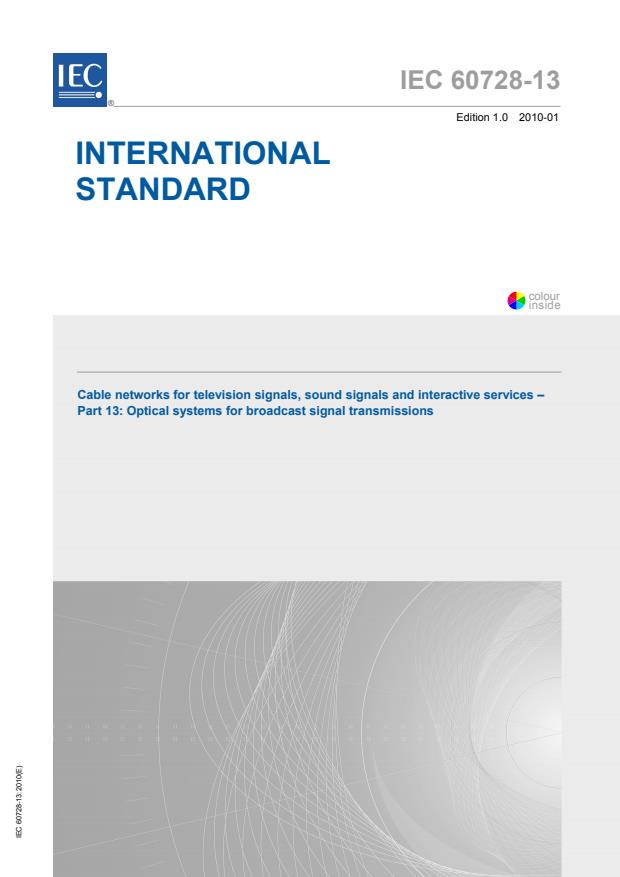
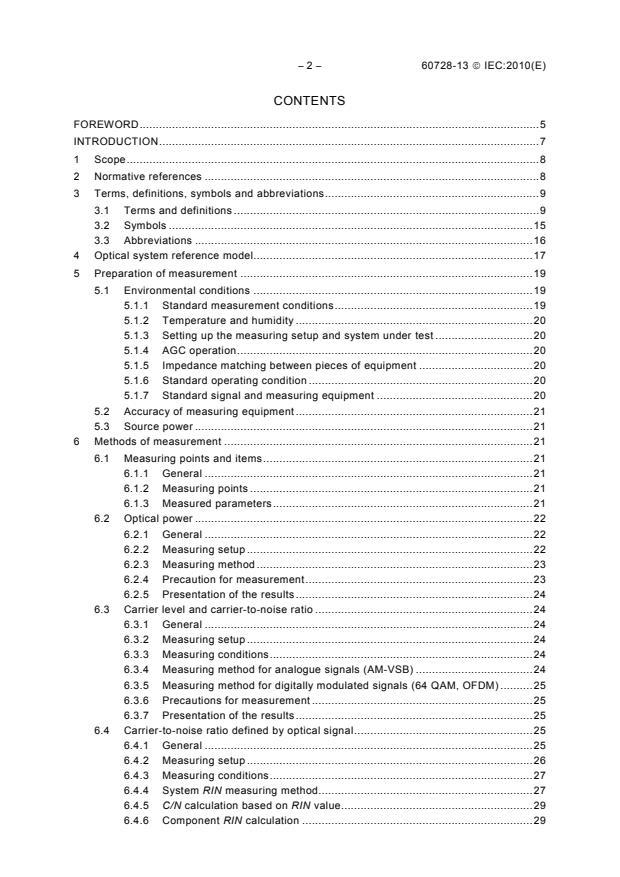
IEC 60728-13:2010 - Cable networks for television signals, sound signals and interactive services - Part 13: Optical systems for broadcast signal transmissions Released:1/21/2010
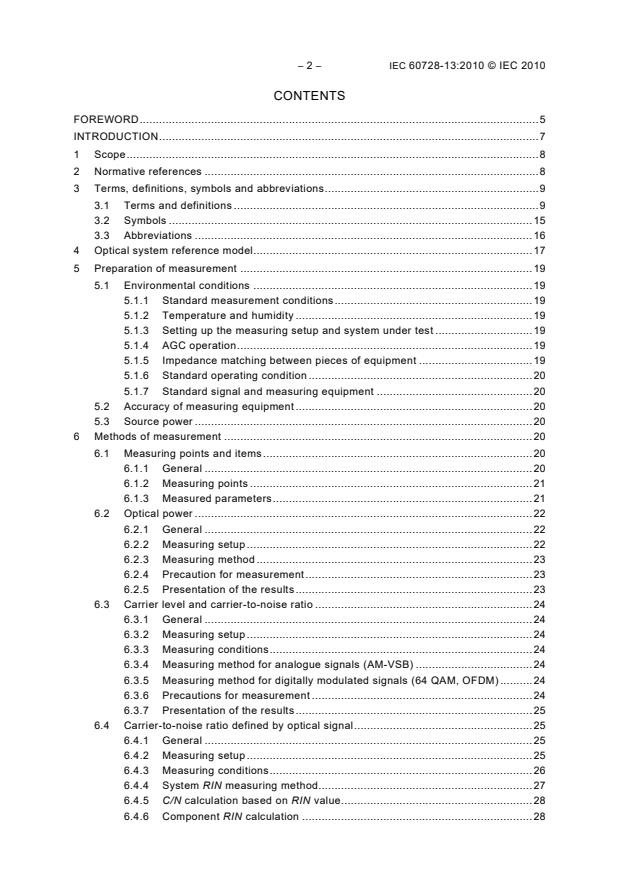
IEC 60728-13:2010 - Cable networks for television signals, sound signals and interactive services - Part 13: Optical systems for broadcast signal transmissions Released:1/21/2010
Overview
IEC 60728-13:2010 - "Cable networks for television signals, sound signals and interactive services - Part 13: Optical systems for broadcast signal transmissions" - defines the basic system parameters and measurement methods for optical distribution systems with a system outlet. The standard specifies performance limits and test procedures for FTTH (fibre to the home) networks used to deliver broadcast and narrowcast TV and radio signals, and it also applies to broadcast over telecommunication networks when the optical portion meets this standard. The published edition includes the August 2010 corrigendum.
Key topics and technical requirements
IEC 60728-13 focuses on measurable system performance and contains normative guidance on:
- Optical system reference models (one-fibre and two-fibre solutions) and measurement point definitions
- Measurement preparation: standard environmental and operating conditions, equipment accuracy and source power requirements
- Methods of measurement for:
- Optical power
- Carrier level and carrier-to-noise ratio (C/N) for analogue (AM‑VSB) and digital (QAM, OFDM) signals
- Relative intensity noise (RIN) and deriving C/N from optical noise
- Optical modulation index and carrier-to-crosstalk ratio (CCR)
- System specifications for broadcast over optical networks: wavelength allocations, frequency bands, minimum operational C/N and RIN requirements, and crosstalk/non-linearity considerations
- Environmental conditions and in‑house/in‑building wiring performance allocations
- Annexes covering real-world system examples, optical system overview, degradation mechanisms (e.g., scattering, non-linearities), and detailed parameter measurement procedures
Keywords: IEC 60728-13, optical systems, FTTH, xPON, broadcast signal transmission, C/N ratio, RIN, optical power measurement.
Practical applications and who uses the standard
IEC 60728-13 is intended for professionals involved in the planning, deployment, testing and regulation of optical broadcast distribution:
- Cable and IPTV operators deploying FTTH broadcast and narrowcast services
- System architects and network designers defining optical link budgets and in‑building allocations
- Equipment manufacturers (optical transmitters, receivers, WDM/PON components) ensuring product compliance to broadcast requirements
- Test laboratories and field technicians performing optical power, C/N, RIN and CCR measurements
- Regulatory bodies and service providers assessing interoperability and service quality for broadcast over optical infrastructures
Related standards
- Other parts of the IEC 60728 series (cable networks for television and sound)
- Telecom PON standards and profiles (the standard introduces xPON as the physical media; related PON work includes IEEE 802.3ah references cited in the document)
IEC 60728-13 is a practical reference for ensuring reliable broadcast signal transmission over fibre, providing standardized measurement methods and performance criteria essential for modern FTTH broadcast deployments.
Relations
- Effective Date
- 05-Sep-2023
Buy Documents
IEC 60728-13:2010 - Cable networks for television signals, sound signals and interactive services - Part 13: Optical systems for broadcast signal transmissions Released:1/21/2010
IEC 60728-13:2010 - Cable networks for television signals, sound signals and interactive services - Part 13: Optical systems for broadcast signal transmissions Released:1/21/2010
Get Certified
Connect with accredited certification bodies for this standard

ANCE
Mexican certification and testing association.

Intertek Slovenia
Intertek testing, inspection, and certification services in Slovenia.

LNE (Laboratoire National de Métrologie et d'Essais)
French national laboratory for metrology and testing.
Sponsored listings
Frequently Asked Questions
IEC 60728-13:2010 is a standard published by the International Electrotechnical Commission (IEC). Its full title is "Cable networks for television signals, sound signals and interactive services - Part 13: Optical systems for broadcast signal transmissions". This standard covers: IEC 60728-13:2010 specifies the basic system parameters and methods of measurement for optical distribution system having a system outlet in order to assess the system performance and its performance limits. It describes the system specification of FTTH (fibre to the home) network for broadcast signal transmission. It is also applicable to the broadcast signal transmission using telecommunication network if it satisfies the optical portion of this standard. It describes RF transmission for broadcast and narrowcast (limited area distribution of broadcast) signals over FTTH, and introduces xPON system as a physical layer media. The contents of the corrigendum of August 2010 have been included in this copy.
IEC 60728-13:2010 specifies the basic system parameters and methods of measurement for optical distribution system having a system outlet in order to assess the system performance and its performance limits. It describes the system specification of FTTH (fibre to the home) network for broadcast signal transmission. It is also applicable to the broadcast signal transmission using telecommunication network if it satisfies the optical portion of this standard. It describes RF transmission for broadcast and narrowcast (limited area distribution of broadcast) signals over FTTH, and introduces xPON system as a physical layer media. The contents of the corrigendum of August 2010 have been included in this copy.
IEC 60728-13:2010 is classified under the following ICS (International Classification for Standards) categories: 33.160.01 - Audio, video and audiovisual systems in general; 33.180.01 - Fibre optic systems in general. The ICS classification helps identify the subject area and facilitates finding related standards.
IEC 60728-13:2010 has the following relationships with other standards: It is inter standard links to IEC 60728-13:2010/COR1:2010. Understanding these relationships helps ensure you are using the most current and applicable version of the standard.
IEC 60728-13:2010 is available in PDF format for immediate download after purchase. The document can be added to your cart and obtained through the secure checkout process. Digital delivery ensures instant access to the complete standard document.
Standards Content (Sample)
IEC 60728-13 ®
Edition 1.0 2010-01
INTERNATIONAL
STANDARD
colour
inside
Cable networks for television signals, sound signals and interactive services –
Part 13: Optical systems for broadcast signal transmissions
All rights reserved. Unless otherwise specified, no part of this publication may be reproduced or utilized in any form
or by any means, electronic or mechanical, including photocopying and microfilm, without permission in writing from
either IEC or IEC's member National Committee in the country of the requester.
If you have any questions about IEC copyright or have an enquiry about obtaining additional rights to this publication,
please contact the address below or your local IEC member National Committee for further information.
IEC Central Office
3, rue de Varembé
CH-1211 Geneva 20
Switzerland
Email: inmail@iec.ch
Web: www.iec.ch
About the IEC
The International Electrotechnical Commission (IEC) is the leading global organization that prepares and publishes
International Standards for all electrical, electronic and related technologies.
About IEC publications
The technical content of IEC publications is kept under constant review by the IEC. Please make sure that you have the
latest edition, a corrigenda or an amendment might have been published.
ƒ Catalogue of IEC publications: www.iec.ch/searchpub
The IEC on-line Catalogue enables you to search by a variety of criteria (reference number, text, technical committee,…).
It also gives information on projects, withdrawn and replaced publications.
ƒ IEC Just Published: www.iec.ch/online_news/justpub
Stay up to date on all new IEC publications. Just Published details twice a month all new publications released. Available
on-line and also by email.
ƒ Electropedia: www.electropedia.org
The world's leading online dictionary of electronic and electrical terms containing more than 20 000 terms and definitions
in English and French, with equivalent terms in additional languages. Also known as the International Electrotechnical
Vocabulary online.
ƒ Customer Service Centre: www.iec.ch/webstore/custserv
If you wish to give us your feedback on this publication or need further assistance, please visit the Customer Service
Centre FAQ or contact us:
Email: csc@iec.ch
Tel.: +41 22 919 02 11
Fax: +41 22 919 03 00
IEC 60728-13 ®
Edition 1.0 2010-01
INTERNATIONAL
STANDARD
colour
inside
Cable networks for television signals, sound signals and interactive services –
Part 13: Optical systems for broadcast signal transmissions
INTERNATIONAL
ELECTROTECHNICAL
COMMISSION
PRICE CODE
XB
ICS 33.160.01; 33.180.01 ISBN 978-2-88910-264-8
– 2 – 60728-13 © IEC:2010(E)
CONTENTS
FOREWORD.5
INTRODUCTION.7
1 Scope.8
2 Normative references .8
3 Terms, definitions, symbols and abbreviations.9
3.1 Terms and definitions .9
3.2 Symbols .15
3.3 Abbreviations .16
4 Optical system reference model.17
5 Preparation of measurement .19
5.1 Environmental conditions .19
5.1.1 Standard measurement conditions.19
5.1.2 Temperature and humidity .20
5.1.3 Setting up the measuring setup and system under test .20
5.1.4 AGC operation.20
5.1.5 Impedance matching between pieces of equipment .20
5.1.6 Standard operating condition .20
5.1.7 Standard signal and measuring equipment .20
5.2 Accuracy of measuring equipment.21
5.3 Source power .21
6 Methods of measurement .21
6.1 Measuring points and items.21
6.1.1 General .21
6.1.2 Measuring points .21
6.1.3 Measured parameters.21
6.2 Optical power .22
6.2.1 General .22
6.2.2 Measuring setup .22
6.2.3 Measuring method .23
6.2.4 Precaution for measurement.23
6.2.5 Presentation of the results.24
6.3 Carrier level and carrier-to-noise ratio .24
6.3.1 General .24
6.3.2 Measuring setup .24
6.3.3 Measuring conditions.24
6.3.4 Measuring method for analogue signals (AM-VSB) .24
6.3.5 Measuring method for digitally modulated signals (64 QAM, OFDM) .25
6.3.6 Precautions for measurement .25
6.3.7 Presentation of the results.25
6.4 Carrier-to-noise ratio defined by optical signal.25
6.4.1 General .25
6.4.2 Measuring setup .26
6.4.3 Measuring conditions.27
6.4.4 System RIN measuring method.27
6.4.5 C/N calculation based on RIN value.29
6.4.6 Component RIN calculation .29
60728-13 © IEC:2010(E) – 3 –
6.5 Optical modulation index .31
6.6 Carrier-to-crosstalk ratio (CCR) .31
6.6.1 General .31
6.6.2 Equipment .31
6.6.3 General measurements .32
6.6.4 Procedure.32
6.6.5 Potential sources of error .33
6.6.6 Presentation of the results.33
7 Specification of optical system for broadcast signal transmission .33
7.1 Analogue and digital broadcast system over optical network .33
7.2 International TV systems .34
7.3 Relationship between RIN and C/N.35
7.4 Optical wavelength .36
7.5 Frequency of source signal .36
7.6 Optical system specification for broadcast signal transmission .36
7.7 C/N ratio specification for in-house and in-building wirings .37
7.8 Crosstalk due to optical fibre non-linearity.39
7.9 Single frequency interference level due to fibre non-linearity.40
7.10 Environmental conditions .40
Annex A (informative) Actual service systems and design considerations .41
Annex B (informative) Optical system overview.56
Annex C (informative) Optical system degradations .60
Annex D (normative) Measurement of parameters (R, I , I and G) required for RIN
d0 eq
calculation .66
Bibliography.68
Figure 1 – Optical system reference model for one-fibre solution .18
Figure 2 – Optical system reference model for two-fibres solution.18
Figure 3 – Example of PON triplexer.19
Figure 4 – Performance specified points of the optical system .19
Figure 5 – Typical optical video distribution system.21
Figure 6 – Measurement of optical power using a WDM coupler .23
Figure 7 – Measurement of optical power using a wavelength filter .23
Figure 8 – Arrangement of test equipment for carrier-to-noise ratio measurement.24
Figure 9 – Measuring points in the optical cable TV network .26
Figure 10 – RIN measurement setup.27
Figure 11 – Arrangement of test equipment for measuring other services crosstalk.32
Figure 12 – Performance allocation and measuring points .33
Figure 13 – Section of C/N ratio specification (45 dB) for in-house wiring (specified for
electrical signals).38
Figure 14 – Section of C/N ratio specification for in-house wiring (specified for optical
signals).39
Figure A.1 – Example of a multi-channel service system of one million terminals .41
Figure A.2 – Example of a multi-channel service system of 2 000 terminals .42
Figure A.3 – Example of re-transmission service system of 72 terminals.43
Figure A.4 – Example of re-transmission service system of 144 terminals.43
– 4 – 60728-13 © IEC:2010(E)
Figure A.5 – Model No.1 of a system performance calculation .47
Figure A.6 – Model No.2 of a system performance calculation .48
Figure A.7 – Model No.3 a of system performance calculation .49
Figure A.8 – Model No.4 of a system performance calculation .50
Figure A.9 – Model No.5 of a system performance calculation .51
Figure A.10 – Model No.6 of a system performance calculation .52
Figure A.11 – Model No.7 of system performance calculation .53
Figure B.1 – Topology of optical system .56
Figure B.2 – Network composition.57
Figure B.3 – Example of SS system .58
Figure B.4 – Example of ADS system.58
Figure B.5 – Example of PON system .59
Figure C.1 – Reflection model.60
Figure C.2 – Degradation factors of optical transmission system.61
Figure C.3 – SBS generation image .61
Figure C.4 – Interference between two wavelengths .63
Figure C.5 – Simulation of SRS(OLT transmission power versus D/U) .63
Figure C.6 – Simulation of SRS (D/U in arbitrary unit versus fibre length) .64
Figure C.7 – Fibre length of the first peak of SRS D/U versus frequency.64
Figure C.8 – GE-PON idle pattern spectrum (IEEE 802.3ah 1000Base-PX) (62,5 MHz =
1 250 Mbps/20 bit) .65
Figure D.1 – Measurement of gain (G) .67
Table 1 – Level of RF signals.12
Table 2 – Measuring instruments .20
Table 3 – Measuring points and measured parameters .22
Table 4 – Parameters used for the calculation of carrier-to-noise ratio (C/N).30
Table 5 – Minimum C/N requirements in operation.34
Table 6 – Minimum RF signal-to-noise ratio requirements in operation.34
Table 7 – Types of broadcast services .36
Table 8 – Type of service and minimum operational RIN values.36
Table 9 – Optical system specification .37
Table 10 – Section of C/N ratio specification for in-house/in-building wiring .38
Table 11 – Interference level due to fibre non-linearity.40
Table 12 – Environmental conditions .40
Table A.1 – Operating conditions of a multi-channel service system .42
Table A.2 – Operating conditions of re-transmission service system .43
Table A.3 – Basic system parameters for multi-channel and re-transmission service
systems .45
Table A.4 – Verified optimum operation .54
Table B.1 – PON systems and main parameters .59
Table C.1 – Disturbance parameter of Raman crosstalk.62
60728-13 © IEC:2010(E) – 5 –
INTERNATIONAL ELECTROTECHNICAL COMMISSION
____________
CABLE NETWORKS FOR TELEVISION SIGNALS,
SOUND SIGNALS AND INTERACTIVE SERVICES –
Part 13: Optical systems for broadcast signal transmissions
FOREWORD
1) The International Electrotechnical Commission (IEC) is a worldwide organization for standardization comprising
all national electrotechnical committees (IEC National Committees). The object of IEC is to promote
international co-operation on all questions concerning standardization in the electrical and electronic fields. To
this end and in addition to other activities, IEC publishes International Standards, Technical Specifications,
Technical Reports, Publicly Available Specifications (PAS) and Guides (hereafter referred to as “IEC
Publication(s)”). Their preparation is entrusted to technical committees; any IEC National Committee interested
in the subject dealt with may participate in this preparatory work. International, governmental and non-
governmental organizations liaising with the IEC also participate in this preparation. IEC collaborates closely
with the International Organization for Standardization (ISO) in accordance with conditions determined by
agreement between the two organizations.
2) The formal decisions or agreements of IEC on technical matters express, as nearly as possible, an international
consensus of opinion on the relevant subjects since each technical committee has representation from all
interested IEC National Committees.
3) IEC Publications have the form of recommendations for international use and are accepted by IEC National
Committees in that sense. While all reasonable efforts are made to ensure that the technical content of IEC
Publications is accurate, IEC cannot be held responsible for the way in which they are used or for any
misinterpretation by any end user.
4) In order to promote international uniformity, IEC National Committees undertake to apply IEC Publications
transparently to the maximum extent possible in their national and regional publications. Any divergence
between any IEC Publication and the corresponding national or regional publication shall be clearly indicated in
the latter.
5) IEC itself does not provide any attestation of conformity. Independent certification bodies provide conformity
assessment services and, in some areas, access to IEC marks of conformity. IEC is not responsible for any
services carried out by independent certification bodies.
6) All users should ensure that they have the latest edition of this publication.
7) No liability shall attach to IEC or its directors, employees, servants or agents including individual experts and
members of its technical committees and IEC National Committees for any personal injury, property damage or
other damage of any nature whatsoever, whether direct or indirect, or for costs (including legal fees) and
expenses arising out of the publication, use of, or reliance upon, this IEC Publication or any other IEC
Publications.
8) Attention is drawn to the Normative references cited in this publication. Use of the referenced publications is
indispensable for the correct application of this publication.
9) Attention is drawn to the possibility that some of the elements of this IEC Publication may be the subject of
patent rights. IEC shall not be held responsible for identifying any or all such patent rights.
International Standard IEC 60728-13 has been prepared by technical area 5: Cable networks
for television signals, sound signals and interactive services, of IEC technical committee 100:
Audio, video and multimedia systems and equipment.
The text of this standard is based on the following documents:
FDIS Report on voting
100/1623/FDIS 100/1646/RVD
Full information on the voting for the approval of this standard can be found in the report on
voting indicated in the above table.
This publication has been drafted in accordance with the ISO/IEC Directives, Part 2.
– 6 – 60728-13 © IEC:2010(E)
The list of all the parts of the IEC 60728 series, under the general title Cable networks for
television signals, sound signals and interactive services, can be found on the IEC website.
The committee has decided that the contents of this publication will remain unchanged until
the maintenance result date indicated on the IEC web site under "http://webstore.iec.ch" in
the data related to the specific publication. At this date, the publication will be
• reconfirmed,
• withdrawn,
• replaced by a revised edition, or
• amended.
A bilingual version of this publication may be issued at a later date.
The contents of the corrigendum of August 2010 have been included in this copy.
IMPORTANT – The 'colour inside' logo on the cover page of this publication indicates
that it contains colours which are considered to be useful for the correct
understanding of its contents. Users should therefore print this document using a
colour printer.
60728-13 © IEC:2010(E) – 7 –
INTRODUCTION
Standards of the IEC 60728 series deal with cable networks including equipment and
associated methods of measurement for headend reception, processing and distribution of
television signals, sound signals and their associated data signals and for processing,
interfacing and transmitting all kinds of signals for interactive services using all applicable
transmission media.
This includes
• CATV0-networks;
• MATV-networks and SMATV-networks;
• individual receiving networks;
and all kinds of equipment, systems and installations installed in such networks.
The extent of this standardization work is from the antennas and/or special signal source
inputs to the headend or other interface points to the network up to the terminal input.
The standardization of any user terminals (i.e., tuners, receivers, decoders, multimedia
terminals, etc.) as well as of any coaxial, balanced and optical cables and accessories thereof
is excluded.
—————————
This word encompasses the HFC (Hybrid Fibre Cable) networks used nowadays to provide telecommunications
services, voice, data, audio and video both broadcast and narrowcast.
– 8 – 60728-13 © IEC:2010(E)
CABLE NETWORKS FOR TELEVISION SIGNALS,
SOUND SIGNALS AND INTERACTIVE SERVICES –
Part 13: Optical systems for broadcast signal transmissions
1 Scope
This part of IEC 60728 is applicable to optical transmission system for broadcast signal
transmission that consists of a head-end equipment, optical transmission lines, in-house
wirings and a system outlet. The system is primarily intended for television and sound signals
using analogue and/or digital transmission technology. This standard specifies the basic
system parameters and methods of measurement for optical distribution system having a
system outlet in order to assess the system performance and its performance limits.
The purpose of this part of IEC 60728 is to describe the system specification of FTTH (fibre to
the home) network for broadcast signal transmission. This standard is also applicable to the
broadcast signal transmission using telecommunication network if it satisfies the optical
portion of this standard. This standard describes RF transmission for broadcast and
narrowcast (limited area distribution of broadcast) signals over FTTH, and introduces xPON
system as a physical layer media. The detailed description of physical layer is out of the
scope of this standard. The scope is limited to RF signal transmission over FTTH, thus, it
does not include IP transport technologies, such as IP Multicast and associate protocols.
Some interference descriptions between telecommunication system and broadcast system
addressed in Clause 7 and Annex D should be referred to for detailed explanations. Annex A
describes actual service systems with design consideration based on this standard. Annex B
gives an overview of the optical transmission systems applicable for broadcast signal
transmission.
2 Normative references
The following referenced documents are indispensable for the application of this document.
For dated references, only the edition cited applies. For undated references, the latest edition
of the referenced document (including any amendments) applies.
IEC 60068-1:1988, Environmental testing – Part 1: General and guidance
IEC 60728-1:2007, Cable networks for television signals, sound signals and interactive
services – Part 1: System performance of forward paths
IEC 60728-6:2003, Cable networks for television signals, sound signals and interactive
services – Part 6: Optical equipment
IEC/TR 60728-6-1:2006, Cable networks for television signals, sound signals and interactive
services – Part 6-1: System guidelines for analogue optical transmission systems
IEC 60825-1, Safety of laser products – Part 1: Equipment classification and requirements
IEC 60825-2, Safety of laser products – Part 2: Safety of optical fibre communication
systems (OFCS)
IEC 60825-12, Safety of laser products – Part 12: Safety of free space optical
communication systems used for transmission of information
60728-13 © IEC:2010(E) – 9 –
IEC 61291-1:2006, Optical amplifiers – Part 1: Generic specification
IEC 61755-1:2005, Fibre optic connector optical interfaces – Part 1: Optical interfaces for
single mode non-dispersion shifted fibres – General and guidance
IEC 61930:1998, Fibre optic graphical symbology
IEC 61931:1998, Fibre optic – Terminology
ITU-T Recommendation G.692, Optical interfaces for multichannel systems with optical
amplifiers
ITU-T Recommendation G.694.2, 0H0HSpectral grids for WDM applications: CWDM wavelength
grid
3 Terms, definitions, symbols and abbreviations
3.1 Terms and definitions
For the purposes of this document, the following terms and definitions apply.
3.1.1
optical transmitting unit
optical transmitter
transmit fibre optic terminal device accepting at its input port an electrical signal and providing
at its output port an optical carrier modulated by that input signal
[IEC 61931, definition 2.9.6]
NOTE 1 For the purposes of this document, optical transmitters may have more than one input port accepting
electrical RF signals.
NOTE 2 This piece of equipment amplifies frequency multiplexed electrical signals and converts these electrical
signals into optical signals. The optical wavelength is a 1 500 nm band (1 550 ± 10 nm in 1 530 nm to 1 625 nm
region).
3.1.2
optical receiving unit
optical receiver
receive fibre optic terminal device accepting at its input port a modulated optical carrier, and
providing at its output port the corresponding demodulated electrical signal (with the
associated clock, if digital)
[IEC 61931, definition 2.9.7]
NOTE For the purposes of this document, optical receivers may have more than one output port providing
electrical RF signals.
3.1.3
optical amplifier
optical waveguide device containing a suitably pumped, active medium which is able to
amplify an optical signal
[IEC 61931, definition 2.7.75]
NOTE 1 In this document, Erbium Doped Fibre Amplifier (EDFA) is used for amplification in the 1 550 nm band.
NOTE 2 There are several methods based on wavelength to be used for amplification. The term “Erbium Doped
Fibre Amplifier (EDFA)” is the synonym of optical amplifier in this document.
– 10 – 60728-13 © IEC:2010(E)
3.1.4
fibre optic branching device
optical fibre coupler
splitter
optical fibre device, possessing three or more optical ports, which shares optical power
among its ports in a predetermined fashion, at the same wavelength or wavelengths, without
wavelength conversion
NOTE The ports may be connected to fibres, detectors, etc.
[IEC 61931, definition 2.6.21, modified]
3.1.5
multiplexing device
WDM device
wavelength selective branching device (used in WDM transmission systems) in which optical
signals can be transferred between two predetermined ports, depending on the wavelength of
the signal
[IEC 61931, definition 2.6.51]
3.1.6
optical modulation index
th
optical modulation index of k RF carrier,m is defined as
k
φφ−
hl
m =
k
φφ+
hl
total optical modulation index, M is defined as
K
M = m
∑
k
k =1
where
φ is the highest and
h
φ is the lowest instantaneous optical power of the intensity modulated optical signal,
l
K is the total number of RF carriers and
M is the total optical modulation index.
NOTE This term is mainly used for analogue systems.
[IEC 60728-6, definition 3.1.10, modified]
3.1.7
noise figure
decrease of the signal-to-noise ratio (SNR), at the output of an optical detector with unitary
quantum efficiency and zero excess noise, due to the propagation of a shot noise-limited
signal through the optical fibre amplifier, expressed in dB
[IEC 61291-1, definition 3.2.38]
NOTE The noise figure of optical amplifiers depends on the optical input power and on the wavelength used.
60728-13 © IEC:2010(E) – 11 –
3.1.8
relative intensity noise
RIN
ratio of the mean square of the intensity fluctuations in the optical power of a light source to
the square of the mean of the optical output power
−1
NOTE 1 The RIN is usually expressed in dB(Hz ) resulting in negative values.
[IEC 60728-6, definition 3.1.12, modified]
NOTE 2 The value of RIN can also be calculated from the results of a carrier-to-noise measurement for the
system.
3.1.9
responsivity
ratio of an optical detector’s electrical output to its optical input at a given wavelength
NOTE 1 The responsivity is generally expressed in Ampere per Watt or Volt per Watt of incident radiant power.
NOTE 2 Sensitivity is sometimes used as an imprecise synonym for responsivity.
NOTE 3 The wavelength interval around the given wavelength may be specified.
[IEC 60728-6, definition 3.1.15]
3.1.10
wavelength
distance covered in a period by the wavefront of a harmonic plane wave
NOTE The wavelength of light in vacuum is given by
λ
c
λ =
f
where
c
is the speed of light in vacuum c = 2,997 92 × 10 m/s);
f is the optical frequency
Although the wavelength in dielectric material, such as fibres, is shorter than in vacuum, only the wavelength of
light in vacuum is used.
[IEC 60728-6, definition 3.1.17, modified]
3.1.11
central wavelength
the average of those wavelengths at which the amplitude of a light source reaches or last falls
to half of the maximum amplitude
[IEC 60728-6, definition 3.1.26]
3.1.12
AM-VSB signal
sideband in which only the spectral components corresponding to the lower frequencies of the
modulating signals are preserved, the other components being strongly attenuated
[IEV 702-06-28, modified]
NOTE This is the abbreviation for the vestigial sideband amplitude modulated signal used in the terrestrial
broadcasting and CATV transmission system.
– 12 – 60728-13 © IEC:2010(E)
3.1.13
QAM signal
quadrature amplitude modulation
QAM
amplitude modulation by two separate signals of two sinusoidal carriers having the same
amplitude and frequency but being in phase quadrature, the modulated signals being added
for transmission in a single channel
[IEV 702-06-63, modified]
3.1.14
OFDM signal
orthogonal frequency division multiplexing is one of the multiplexing schemes used for the
transportation of terrestrial digital broadcasting SDTV and HDTV signals
NOTE OFDM is based on the idea of frequency-division multiplexing, where each frequency channel is modulated
with a simpler modulation, and the frequencies and modulation of FDM are arranged to be orthogonal with each
other, which almost eliminates the interference between channels.
3.1.15
RF signal level definition
level of an RF signal is defined in 128H128HTable 1; it is expressed in microvolt or in dB(μV) or
in dB(mW)
3.1.16
AM-VSB analogue signals
vision carrier signal level is the RMS value of the vision carrier at the peak of the modulation
envelope (C ), expressed in dB(μV) and measured across a 75 Ω termination or referred to
rms
75 Ω
NOTE This will correspond, in negative modulation systems, to the carrier amplitude during synchronizing pulses
and, in positive modulation systems, to that at peak white level without a chrominance signal, as shown in ITU-R
Recommendation BT.470, Figure 1.
3.1.17
FM radio or FM audio carrier of a TV signals
level of an FM radio or of an FM audio carrier of a TV signal is the RMS value of the carrier
expressed in dB(μV) and measured across a 75 Ω termination or referred to 75 Ω
3.1.18
digitally modulated signals
level of a digitally modulated signal is given by the RMS power of the signal within the
channel bandwidth (S ) and can be expressed in dB(mW) or in dB(μV) referred to 75 Ω
D,RF
NOTE The level of an OFDM signal is the average electrical power of the overall signal comprised of multi-
carriers and is not the individual carrier level of the multi-carrier signal, as shown in Table 1.
Table 1 – Level of RF signals
Remarks
Signal Level detection Symbol
AM-VSB RMS value of the carrier at the peak of the
peak value C
rms
video carrier modulation envelope.
Analogue
TV signal
FM audio
RMS value C The carrier level is a constant value.
rms
carrier
QAM signal RMS value
The value is averaged over a sufficiently long
S period of time compared to period of the lowest
D,RF
frequency used for the modulation.
OFDM signal RMS value
60728-13 © IEC:2010(E) – 13 –
3.1.19
carrier-to-noise ratio
C/N
signal-to-noise ratio
S /N
D,RF
ratios are given by
C/N (dB) = C – N (for analogue signals)
rms rms
S /N (dB) = S – N (for digital signals)
D,RF D,RF rms
where N is the RMS level of the noise in the equivalent noise bandwidth of the RF channel,
rms
expressed in dB(mW) or in dB(μV) referred to 75 Ω
NOTE The level of the analogue modulated carrier or of the RF digitally modulated signal and the level of the
noise shall be expressed in the same units, in dB(mW) or in dB(μV) measured across a 75 Ω termination or
referred to 75 Ω.
3.1.20
D/U ratio
ratio of desired signal level, D[dB(μV)], to undesired signal level, U[dB(μV)]
NOTE The D/U ratio is generally used for multiple frequency interference as CSO and CTB, for single frequency
interference as CCR.
3.1.21
single or multiple frequency interference
besides the C/N and S /N ratios, single or multiple frequency interference to video signal is
D.RF
defined as the ratio of desired signal level and undesired signal level
NOTE 1 The ratio of desired signal level, D(dB(μV)), to undesired signal level, U(dB(μV)) is given by
D/U (dB) = D − U
NOTE 2 The desired and the undesired signals can also be expressed both in dB(mW).
3.1.22
optical line terminal
OLT
central office-terminal equipment that is linked with the Optical Network Unit (ONU) in
customer premises
NOTE OLT usually connects with headend equipment.
3.1.23
optical network unit
ONU
terminal equipment linked with OLT
3.1.24
video-optical network unit
V-ONU
terminal unit that changes the optical signal of a broadcast system into an electric signal
NOTE The term V-ONU is used as the synonym of optical receiver (O/E) in this standard.
– 14 – 60728-13 © IEC:2010(E)
3.1.25
stimulated Brillouin scattering
SBS
non-linear scattering of optical radiation characterized by a frequency shift as for the Raman
scattering, but accompanied by a lower frequency (acoustical) vibration of the medium lattice;
the light is scattered backward with respect to the incident radiation
[IEC 61931, definition 2.1.88]
NOTE 1 In silica fibres the frequency shift is typically around 10 GHz.
NOTE 2 SBS results in loss of optical level and affects the performance of analogue optical system.
NOTE 3 The frequency shift is characterized by a frequency downshift (that is to a longer wavelength) due to
a GHz frequency acoustical vibration (frequency downshift is 10 or 11 GHz, and gain bandwidth 20 MHz).
3.1.26
self-phase modulation
SPM
increase of the refractive index of optical fibres due to excessive optical power launched into
the fibre
NOTE 1 Modulated optical signal induces modulation of refractive index, which means that the phase of optical
signal varies in time. The nonlinear phase modulation is caused by a device or a system itself, therefore it is called
self-phase modulation.
NOTE 2 SPM affect the distortion properties of an analogue optical transmission.
3.1.27
stimulated Raman scattering
SRS
non-linear scattering of optical radiation characterized by a wavelength shift and accompanied
by very high frequency vibration of the medium lattice, strongly enhanced by the presence of
already scattered radiation
[IEC 61931, definition 2.1.87]
NOTE 1 In silica fibres the wavelength shift is typically around 100 nm for an exciting radiation with a wavelength
around 1 550 nm.
NOTE 2 Stimulated Raman scattering can occur in both forward and backward directions and can cause crosstalk
between optical signals of different wavelengths.
NOTE 3 Frequency downshift is about 13 THz and gain bandwidth about 20 GHz.
3.1.28
cross-phase modulation
XPM
caused by the nonlinear refractive index of the fibre material
NOTE 1 XPM has a relationship with the wavelength spacing in an optical transmission system. The more the
spacing increases, the more the XPM value decreases. In such a WDM system having 1 490 nm (communication
signal) and 1 550 nm (broadcast signal) wavelengths, XPM becomes negligibly small compared to SRS due to this
relationship.
NOTE 2 XPM affects the performance of the wavelength division multiplex system.
3.1.29
Rayleigh scattering
light scattering in a medium due to in-homogeneity in material density or composition of that
medium which are small with respect to wavelength
NOTE The scattered power is inversely proportional to the fourth power of the wavelength.
60728-13 © IEC:2010(E) – 15 –
[IEV 731-03-37] and [IEC 61931, definition 2.1.76]
3.1.30
crosstalk
carrier-to-crosstalk ratio
CCR
level difference of CATV broadcast carrier level and worst case of other services single
frequency crosstalk signal measured at RF output port of optical receiver for CATV broadcast
service
CCR =D −U
CATV OtherService
where
D is the nominal level of CATV broadcast signal in dB(µV) at RF output port of
CATV
optical CATV broadcast receiver,
U is the worst case level of another service’s single frequency crosstalk in dB(µV)
OtherService
at RF output port of optical CATV broadcast receiver. The value of U is
OtherService
mainly due to the Raman scattering effect.
CCR is expressed in dB.
3.2 Symbols
The following graphical symbols are used in the figures of this standard. These symbols are
either listed in IEC 60617 or based on symbols defined in IEC 60617.
Optical transmitter Optical amplifier
based on
[IEC 60617-S00127
[IEC 60617-S01231 and
(2001-07)]
IEC 60617-S01239
(2001-07)]
Optical fibre
Variable attenuator
[IEC 60617-S01318 [IEC 60617-S01245,
(2001-07)]
modified
(2001-07)]
Optical receiver Power meter
based on
[IEC 60617-S00059,
[IEC 60617-S00213
IEC 60617-S00910
(2001-07)] (2001-07)]
Electrical spectrum Amplifier
analyzer
[IEC 60617-S01239
based on
modified
[IEC 60617-S00059 (2001-07)]
and
IEC 60617-S00910
(2001-07)]
– 16 – 60728-13 © IEC:2010(E)
Ammeter Photodiode with fibre
based on
pigtail
[IEC 60617-S00059
[IEC 60617-S01327
and
(2001-07)]
IEC 60617-S00910
(2001-07)]
Coupler
[IEC 60617-S00059 Optical filter
Optical
and
Filter
IEC 60617-S01188
(2001-07)]
Optical terminator
[IEC 60617-S01389 NF meter
NF
and
Meter
IEC 60617-S013182F1F ]
Optical splitter
[3.33.1 of IEC 61930] Television set
TVTV
Video optical network
V-ONU unit
3.3 Abbreviations
ADS Active Double Star AGC Automatic Gain Control
AM Amplitude Modulation APC Angled Physical Contact optical
connector
BCH Bose-Chaudhuri-Hocquenghem CATV Community Antenna Television
multiple error correction binary (network)
block code
CODFM Coded Orthogonal Frequency CCR Carrier-To-Crosstalk ratio
Division Multiplex
C/N Carrier-to-Noise ratio CPE Customer Premises Equipment
CSO CTB
Composite Second Order Composite Triple Beat
CW Continuous Wave
DS Down Stream or Double Star DSF Dispersion Shifted Fibre
D/U Desired to Undesired signal ratio EDFA Erbium-Doped Fibre Amplifier
E/O Optical transmitter (Electrical-to-FM Frequency Modulation
Optical transducer)
FTTB Fibre To The Building FTTH Fibre To The Home
HDTV High Definition Television H/E Headend
HFC Hybrid Fibre Coaxial ITU-T International Telecommunication
Union – Telecommunication
sector
LD Laser Diode LDPC Low-Density Parity Check (codes)
—————————
IEC 60617-S01318 is for reference only, obsolete since 1996-05.
60728-13 © IEC:2010(E) – 17 –
MC Media Converter MDU Multiple Dwelling Unit
MER Modulation Error Ratio NF Noise Figure
O/E Optical Receiver (OpticaltTo OFCS Optical Fibre Communication
Electrical transducer) System
OFDM Orthogonal Frequency Division OLT Optical Line Terminal
Multiplex
OMI Optical Modulation Index ONU Optical Network Unit
PD Photo Diode PDS Passive Double Star
PER Packet Error Ratio PON Passive Optical Network
QAM Quadrature Amplitude Modulation QPSK Quaternary Phase Shift Keying
RIN Relative Intensity Noise RBW Resolution Bandwidth
RF Radio Frequency SBS Stimulated Brillouin Scattering
SDTV Standard Definition Television SDU Single Dwelling Unit
SMF Single Mode Fibre S/N Signal-to-Noise ratio
SPM Self-Phase Modulation
SRS Stimulated Raman Scattering SS Single Star
US Up Stream VBW Video Bandwidth
V-ONU Video Optical Network Unit AM-VSB Amplitude Modulation-Vestigial
Side Band
WDM Wavelength Division Multiplexing XPM Cross-Phase Modulation
SW Switch
4 Optical system reference model
129H129HFigure 1 and Figure 2 show the optical system reference model for broadcast signal
transmission
...
IEC 60728-13 ®
Edition 1.0 2010-01
INTERNATIONAL
STANDARD
NORME
INTERNATIONALE
colour
inside
Cable networks for television signals, sound signals and interactive services –
Part 13: Optical systems for broadcast signal transmissions
Réseaux de distribution par câbles pour signaux de télévision, signaux de
radiodiffusion sonore et services interactifs –
Partie 13: Systèmes optiques pour la transmission de signaux de diffusion
All rights reserved. Unless otherwise specified, no part of this publication may be reproduced or utilized in any form
or by any means, electronic or mechanical, including photocopying and microfilm, without permission in writing from
either IEC or IEC's member National Committee in the country of the requester. If you have any questions about IEC
copyright or have an enquiry about obtaining additional rights to this publication, please contact the address below or
your local IEC member National Committee for further information.
Droits de reproduction réservés. Sauf indication contraire, aucune partie de cette publication ne peut être reproduite
ni utilisée sous quelque forme que ce soit et par aucun procédé, électronique ou mécanique, y compris la photocopie
et les microfilms, sans l'accord écrit de l'IEC ou du Comité national de l'IEC du pays du demandeur. Si vous avez des
questions sur le copyright de l'IEC ou si vous désirez obtenir des droits supplémentaires sur cette publication, utilisez
les coordonnées ci-après ou contactez le Comité national de l'IEC de votre pays de résidence.
IEC Central Office Tel.: +41 22 919 02 11
3, rue de Varembé info@iec.ch
CH-1211 Geneva 20 www.iec.ch
Switzerland
About the IEC
The International Electrotechnical Commission (IEC) is the leading global organization that prepares and publishes
International Standards for all electrical, electronic and related technologies.
About IEC publications
The technical content of IEC publications is kept under constant review by the IEC. Please make sure that you have the
latest edition, a corrigendum or an amendment might have been published.
IEC publications search - webstore.iec.ch/advsearchform IEC online collection - oc.iec.ch
The advanced search enables to find IEC publications by a Discover our powerful search engine and read freely all the
variety of criteria (reference number, text, technical publications previews. With a subscription you will always
committee, …). It also gives information on projects, replaced have access to up to date content tailored to your needs.
and withdrawn publications.
Electropedia - www.electropedia.org
IEC Just Published - webstore.iec.ch/justpublished
The world's leading online dictionary on electrotechnology,
Stay up to date on all new IEC publications. Just Published
containing more than 22 000 terminological entries in English
details all new publications released. Available online and
and French, with equivalent terms in 18 additional languages.
once a month by email.
Also known as the International Electrotechnical Vocabulary
(IEV) online.
IEC Customer Service Centre - webstore.iec.ch/csc
If you wish to give us your feedback on this publication or
need further assistance, please contact the Customer Service
Centre: sales@iec.ch.
A propos de l'IEC
La Commission Electrotechnique Internationale (IEC) est la première organisation mondiale qui élabore et publie des
Normes internationales pour tout ce qui a trait à l'électricité, à l'électronique et aux technologies apparentées.
A propos des publications IEC
Le contenu technique des publications IEC est constamment revu. Veuillez vous assurer que vous possédez l’édition la
plus récente, un corrigendum ou amendement peut avoir été publié.
Recherche de publications IEC - IEC online collection - oc.iec.ch
webstore.iec.ch/advsearchform Découvrez notre puissant moteur de recherche et consultez
La recherche avancée permet de trouver des publications IEC gratuitement tous les aperçus des publications. Avec un
en utilisant différents critères (numéro de référence, texte, abonnement, vous aurez toujours accès à un contenu à jour
comité d’études, …). Elle donne aussi des informations sur adapté à vos besoins.
les projets et les publications remplacées ou retirées.
Electropedia - www.electropedia.org
IEC Just Published - webstore.iec.ch/justpublished
Le premier dictionnaire d'électrotechnologie en ligne au
Restez informé sur les nouvelles publications IEC. Just
monde, avec plus de 22 000 articles terminologiques en
Published détaille les nouvelles publications parues.
anglais et en français, ainsi que les termes équivalents dans
Disponible en ligne et une fois par mois par email.
16 langues additionnelles. Egalement appelé Vocabulaire
Electrotechnique International (IEV) en ligne.
Service Clients - webstore.iec.ch/csc
Si vous désirez nous donner des commentaires sur cette
publication ou si vous avez des questions contactez-nous:
sales@iec.ch.
IEC 60728-13 ®
Edition 1.0 2010-01
INTERNATIONAL
STANDARD
NORME
INTERNATIONALE
colour
inside
Cable networks for television signals, sound signals and interactive services –
Part 13: Optical systems for broadcast signal transmissions
Réseaux de distribution par câbles pour signaux de télévision, signaux de
radiodiffusion sonore et services interactifs –
Partie 13: Systèmes optiques pour la transmission de signaux de diffusion
INTERNATIONAL
ELECTROTECHNICAL
COMMISSION
COMMISSION
ELECTROTECHNIQUE
INTERNATIONALE
ICS 33.160.01; 33.180.01 ISBN 978-2-8322-9340-9
– 2 – IEC 60728-13:2010 © IEC 2010
CONTENTS
FOREWORD . 5
INTRODUCTION . 7
1 Scope . 8
2 Normative references . 8
3 Terms, definitions, symbols and abbreviations . 9
3.1 Terms and definitions . 9
3.2 Symbols . 15
3.3 Abbreviations . 16
4 Optical system reference model. 17
5 Preparation of measurement . 19
5.1 Environmental conditions . 19
5.1.1 Standard measurement conditions . 19
5.1.2 Temperature and humidity . 19
5.1.3 Setting up the measuring setup and system under test . 19
5.1.4 AGC operation . 19
5.1.5 Impedance matching between pieces of equipment . 19
5.1.6 Standard operating condition . 20
5.1.7 Standard signal and measuring equipment . 20
5.2 Accuracy of measuring equipment . 20
5.3 Source power . 20
6 Methods of measurement . 20
6.1 Measuring points and items . 20
6.1.1 General . 20
6.1.2 Measuring points . 21
6.1.3 Measured parameters . 21
6.2 Optical power . 22
6.2.1 General . 22
6.2.2 Measuring setup . 22
6.2.3 Measuring method . 23
6.2.4 Precaution for measurement . 23
6.2.5 Presentation of the results . 23
6.3 Carrier level and carrier-to-noise ratio . 24
6.3.1 General . 24
6.3.2 Measuring setup . 24
6.3.3 Measuring conditions . 24
6.3.4 Measuring method for analogue signals (AM-VSB) . 24
6.3.5 Measuring method for digitally modulated signals (64 QAM, OFDM) . 24
6.3.6 Precautions for measurement . 24
6.3.7 Presentation of the results . 25
6.4 Carrier-to-noise ratio defined by optical signal . 25
6.4.1 General . 25
6.4.2 Measuring setup . 25
6.4.3 Measuring conditions . 26
6.4.4 System RIN measuring method. 27
6.4.5 C/N calculation based on RIN value . 28
6.4.6 Component RIN calculation . 28
6.5 Optical modulation index . 31
6.6 Carrier-to-crosstalk ratio (CCR) . 31
6.6.1 General . 31
6.6.2 Equipment . 31
6.6.3 General measurements . 31
6.6.4 Procedure . 31
6.6.5 Potential sources of error . 32
6.6.6 Presentation of the results . 32
7 Specification of optical system for broadcast signal transmission . 33
7.1 Analogue and digital broadcast system over optical network . 33
7.2 International TV systems . 33
7.3 Relationship between RIN and C/N. 35
7.4 Optical wavelength . 36
7.5 Frequency of source signal . 36
7.6 Optical system specification for broadcast signal transmission . 36
7.7 C/N ratio specification for in-house and in-building wirings . 37
7.8 Crosstalk due to optical fibre non-linearity . 39
7.9 Single frequency interference level due to fibre non-linearity . 40
7.10 Environmental conditions . 40
Annex A (informative) Actual service systems and design considerations . 41
Annex B (informative) Optical system overview . 56
Annex C (informative) Optical system degradations . 60
Annex D (normative) Measurement of parameters (R, Id0, Ieq and G) required for RIN
calculation . 66
Bibliography . 68
Figure 1 – Optical system reference model for one-fibre solution . 17
Figure 2 – Optical system reference model for two-fibres solution . 18
Figure 3 – Example of PON triplexer . 18
Figure 4 – Performance specified points of the optical system . 19
Figure 5 – Typical optical video distribution system. 21
Figure 6 – Measurement of optical power using a WDM coupler . 22
Figure 7 – Measurement of optical power using a wavelength filter . 23
Figure 8 – Arrangement of test equipment for carrier-to-noise ratio measurement . 24
Figure 9 – Measuring points in the optical cable TV network . 26
Figure 10 – RIN measurement setup . 26
Figure 11 – Arrangement of test equipment for measuring other services crosstalk . 32
Figure 12 – Performance allocation and measuring points . 33
Figure 13 – Section of C/N ratio specification (45 dB) for in-house wiring (specified for
electrical signals) . 38
Figure 14 – Section of C/N ratio specification for in-house wiring (specified for optical
signals) . 39
Figure A.1 – Example of a multi-channel service system of one million terminals . 41
Figure A.2 – Example of a multi-channel service system of 2 000 terminals . 42
Figure A.3 – Example of re-transmission service system of 72 terminals . 43
Figure A.4 – Example of re-transmission service system of 144 terminals . 43
– 4 – IEC 60728-13:2010 © IEC 2010
Figure A.5 – Model No.1 of a system performance calculation . 47
Figure A.6 – Model No.2 of a system performance calculation . 48
Figure A.7 – Model No.3 a of system performance calculation . 49
Figure A.8 – Model No.4 of a system performance calculation . 50
Figure A.9 – Model No.5 of a system performance calculation . 51
Figure A.10 – Model No.6 of a system performance calculation . 52
Figure A.11 – Model No.7 of system performance calculation . 53
Figure B.1 – Topology of optical system . 56
Figure B.2 – Network composition . 57
Figure B.3 – Example of SS system . 58
Figure B.4 – Example of ADS system. 58
Figure B.5 – Example of PON system . 59
Figure C.1 – Reflection model . 60
Figure C.2 – Degradation factors of optical transmission system . 61
Figure C.3 – SBS generation image . 61
Figure C.4 – Interference between two wavelengths . 63
Figure C.5 – Simulation of SRS(OLT transmission power versus D/U) . 63
Figure C.6 – Simulation of SRS (D/U in arbitrary unit versus fibre length) . 64
Figure C.7 – Fibre length of the first peak of SRS D/U versus frequency . 64
Figure C.8 – GE-PON idle pattern spectrum (IEEE 802.3ah 1000Base-PX) (62,5 MHz =
1 250 Mbps/20 bit) . 65
Figure D.1 – Measurement of gain (G) . 67
Table 1 – Level of RF signals . 12
Table 2 – Measuring instruments . 20
Table 3 – Measuring points and measured parameters . 22
Table 4 – Parameters used for the calculation of carrier-to-noise ratio (C/N) . 30
Table 5 – Minimum C/N requirements in operation . 34
Table 6 – Minimum RF signal-to-noise ratio requirements in operation . 34
Table 7 – Types of broadcast services . 36
Table 8 – Type of service and minimum operational RIN values . 36
Table 9 – Optical system specification . 37
Table 10 – Section of C/N ratio specification for in-house/in-building wiring . 38
Table 11 – Interference level due to fibre non-linearity . 40
Table 12 – Environmental conditions . 40
Table A.1 – Operating conditions of a multi-channel service system . 42
Table A.2 – Operating conditions of re-transmission service system . 43
Table A.3 – Basic system parameters for multi-channel and re-transmission service
systems . 45
Table A.4 – Verified optimum operation . 54
Table B.1 – PON systems and main parameters . 59
Table C.1 – Disturbance parameter of Raman crosstalk . 62
INTERNATIONAL ELECTROTECHNICAL COMMISSION
____________
CABLE NETWORKS FOR TELEVISION SIGNALS,
SOUND SIGNALS AND INTERACTIVE SERVICES –
Part 13: Optical systems for broadcast signal transmissions
FOREWORD
1) The International Electrotechnical Commission (IEC) is a worldwide organization for standardization comprising
all national electrotechnical committees (IEC National Committees). The object of IEC is to promote
international co-operation on all questions concerning standardization in the electrical and electronic fields. To
this end and in addition to other activities, IEC publishes International Standards, Technical Specifications,
Technical Reports, Publicly Available Specifications (PAS) and Guides (hereafter referred to as “IEC
Publication(s)”). Their preparation is entrusted to technical committees; any IEC National Committee interested
in the subject dealt with may participate in this preparatory work. International, governmental and non-
governmental organizations liaising with the IEC also participate in this preparation. IEC collaborates closely
with the International Organization for Standardization (ISO) in accordance with conditions determined by
agreement between the two organizations.
2) The formal decisions or agreements of IEC on technical matters express, as nearly as possible, an international
consensus of opinion on the relevant subjects since each technical committee has representation from all
interested IEC National Committees.
3) IEC Publications have the form of recommendations for international use and are accepted by IEC National
Committees in that sense. While all reasonable efforts are made to ensure that the technical content of IEC
Publications is accurate, IEC cannot be held responsible for the way in which they are used or for any
misinterpretation by any end user.
4) In order to promote international uniformity, IEC National Committees undertake to apply IEC Publications
transparently to the maximum extent possible in their national and regional publications. Any divergence
between any IEC Publication and the corresponding national or regional publication shall be clearly indicated in
the latter.
5) IEC itself does not provide any attestation of conformity. Independent certification bodies provide conformity
assessment services and, in some areas, access to IEC marks of conformity. IEC is not responsible for any
services carried out by independent certification bodies.
6) All users should ensure that they have the latest edition of this publication.
7) No liability shall attach to IEC or its directors, employees, servants or agents including individual experts and
members of its technical committees and IEC National Committees for any personal injury, property damage or
other damage of any nature whatsoever, whether direct or indirect, or for costs (including legal fees) and
expenses arising out of the publication, use of, or reliance upon, this IEC Publication or any other IEC
Publications.
8) Attention is drawn to the Normative references cited in this publication. Use of the referenced publications is
indispensable for the correct application of this publication.
9) Attention is drawn to the possibility that some of the elements of this IEC Publication may be the subject of
patent rights. IEC shall not be held responsible for identifying any or all such patent rights.
International Standard IEC 60728-13 has been prepared by technical area 5: Cable networks
for television signals, sound signals and interactive services, of IEC technical committee 100:
Audio, video and multimedia systems and equipment.
The text of this standard is based on the following documents:
FDIS Report on voting
100/1623/FDIS 100/1646/RVD
Full information on the voting for the approval of this standard can be found in the report on
voting indicated in the above table.
This publication has been drafted in accordance with the ISO/IEC Directives, Part 2.
– 6 – IEC 60728-13:2010 © IEC 2010
The list of all the parts of the IEC 60728 series, under the general title Cable networks for
television signals, sound signals and interactive services, can be found on the IEC website.
The committee has decided that the contents of this publication will remain unchanged until
the maintenance result date indicated on the IEC web site under "http://webstore.iec.ch" in
the data related to the specific publication. At this date, the publication will be
• reconfirmed,
• withdrawn,
• replaced by a revised edition, or
• amended.
The contents of the corrigendum of August 2010 have been included in this copy.
IMPORTANT – The 'colour inside' logo on the cover page of this publication indicates
that it contains colours which are considered to be useful for the correct
understanding of its contents. Users should therefore print this document using a
colour printer.
INTRODUCTION
Standards of the IEC 60728 series deal with cable networks including equipment and
associated methods of measurement for headend reception, processing and distribution of
television signals, sound signals and their associated data signals and for processing,
interfacing and transmitting all kinds of signals for interactive services using all applicable
transmission media.
This includes
-networks;
• CATV
• MATV-networks and SMATV-networks;
• individual receiving networks;
and all kinds of equipment, systems and installations installed in such networks.
The extent of this standardization work is from the antennas and/or special signal source
inputs to the headend or other interface points to the network up to the terminal input.
The standardization of any user terminals (i.e., tuners, receivers, decoders, multimedia
terminals, etc.) as well as of any coaxial, balanced and optical cables and accessories thereof
is excluded.
—————————
This word encompasses the HFC (Hybrid Fibre Cable) networks used nowadays to provide telecommunications
services, voice, data, audio and video both broadcast and narrowcast.
– 8 – IEC 60728-13:2010 © IEC 2010
CABLE NETWORKS FOR TELEVISION SIGNALS,
SOUND SIGNALS AND INTERACTIVE SERVICES –
Part 13: Optical systems for broadcast signal transmissions
1 Scope
This part of IEC 60728 is applicable to optical transmission system for broadcast signal
transmission that consists of a head-end equipment, optical transmission lines, in-house
wirings and a system outlet. The system is primarily intended for television and sound signals
using analogue and/or digital transmission technology. This standard specifies the basic
system parameters and methods of measurement for optical distribution system having a
system outlet in order to assess the system performance and its performance limits.
The purpose of this part of IEC 60728 is to describe the system specification of FTTH (fibre to
the home) network for broadcast signal transmission. This standard is also applicable to the
broadcast signal transmission using telecommunication network if it satisfies the optical
portion of this standard. This standard describes RF transmission for broadcast and
narrowcast (limited area distribution of broadcast) signals over FTTH, and introduces xPON
system as a physical layer media. The detailed description of physical layer is out of the
scope of this standard. The scope is limited to RF signal transmission over FTTH, thus, it
does not include IP transport technologies, such as IP Multicast and associate protocols.
Some interference descriptions between telecommunication system and broadcast system
addressed in Clause 7 and Annex D should be referred to for detailed explanations. Annex A
describes actual service systems with design consideration based on this standard. Annex B
gives an overview of the optical transmission systems applicable for broadcast signal
transmission.
2 Normative references
The following referenced documents are indispensable for the application of this document.
For dated references, only the edition cited applies. For undated references, the latest edition
of the referenced document (including any amendments) applies.
IEC 60068-1:1988, Environmental testing – Part 1: General and guidance
IEC 60728-1:2007, Cable networks for television signals, sound signals and interactive
services – Part 1: System performance of forward paths
IEC 60728-6:2003, Cable networks for television signals, sound signals and interactive
services – Part 6: Optical equipment
IEC/TR 60728-6-1:2006, Cable networks for television signals, sound signals and interactive
services – Part 6-1: System guidelines for analogue optical transmission systems
IEC 60825-1, Safety of laser products – Part 1: Equipment classification and requirements
IEC 60825-2, Safety of laser products – Part 2: Safety of optical fibre communication
systems (OFCS)
IEC 60825-12, Safety of laser products – Part 12: Safety of free space optical
communication systems used for transmission of information
IEC 61291-1:2006, Optical amplifiers – Part 1: Generic specification
IEC 61755-1:2005, Fibre optic connector optical interfaces – Part 1: Optical interfaces for
single mode non-dispersion shifted fibres – General and guidance
IEC 61930:1998, Fibre optic graphical symbology
IEC 61931:1998, Fibre optic – Terminology
ITU-T Recommendation G.692, Optical interfaces for multichannel systems with optical
amplifiers
ITU-T Recommendation G.694.2, Spectral grids for WDM applications: CWDM wavelength
grid
3 Terms, definitions, symbols and abbreviations
3.1 Terms and definitions
For the purposes of this document, the following terms and definitions apply.
3.1.1
optical transmitting unit
optical transmitter
transmit fibre optic terminal device accepting at its input port an electrical signal and providing
at its output port an optical carrier modulated by that input signal
[IEC 61931, definition 2.9.6]
NOTE 1 For the purposes of this document, optical transmitters may have more than one input port accepting
electrical RF signals.
NOTE 2 This piece of equipment amplifies frequency multiplexed electrical signals and converts these electrical
signals into optical signals. The optical wavelength is a 1 500 nm band (1 550 ± 10 nm in 1 530 nm to 1 625 nm
region).
3.1.2
optical receiving unit
optical receiver
receive fibre optic terminal device accepting at its input port a modulated optical carrier, and
providing at its output port the corresponding demodulated electrical signal (with the
associated clock, if digital)
[IEC 61931, definition 2.9.7]
NOTE For the purposes of this document, optical receivers may have more than one output port providing
electrical RF signals.
3.1.3
optical amplifier
optical waveguide device containing a suitably pumped, active medium which is able to
amplify an optical signal
[IEC 61931, definition 2.7.75]
NOTE 1 In this document, Erbium Doped Fibre Amplifier (EDFA) is used for amplification in the 1 550 nm band.
NOTE 2 There are several methods based on wavelength to be used for amplification. The term “Erbium Doped
Fibre Amplifier (EDFA)” is the synonym of optical amplifier in this document.
– 10 – IEC 60728-13:2010 © IEC 2010
3.1.4
fibre optic branching device
optical fibre coupler
splitter
optical fibre device, possessing three or more optical ports, which shares optical power
among its ports in a predetermined fashion, at the same wavelength or wavelengths, without
wavelength conversion
NOTE The ports may be connected to fibres, detectors, etc.
[IEC 61931, definition 2.6.21, modified]
3.1.5
multiplexing device
WDM device
wavelength selective branching device (used in WDM transmission systems) in which optical
signals can be transferred between two predetermined ports, depending on the wavelength of
the signal
[IEC 61931, definition 2.6.51]
3.1.6
optical modulation index
th
optical modulation index of k RF carrier, is defined as
m
k
φφ−
h l
m =
k
φφ+
hl
total optical modulation index, M is defined as
K
Mm=
∑ k
k =1
where
is the highest and
φ
h
φ is the lowest instantaneous optical power of the intensity modulated optical signal,
l
K is the total number of RF carriers and
M is the total optical modulation index.
NOTE This term is mainly used for analogue systems.
[IEC 60728-6, definition 3.1.10, modified]
3.1.7
noise figure
decrease of the signal-to-noise ratio (SNR), at the output of an optical detector with unitary
quantum efficiency and zero excess noise, due to the propagation of a shot noise-limited
signal through the optical fibre amplifier, expressed in dB
[IEC 61291-1, definition 3.2.38]
NOTE The noise figure of optical amplifiers depends on the optical input power and on the wavelength used.
3.1.8
relative intensity noise
RIN
ratio of the mean square of the intensity fluctuations in the optical power of a light source to
the square of the mean of the optical output power
−1
NOTE 1 The RIN is usually expressed in dB(Hz ) resulting in negative values.
[IEC 60728-6, definition 3.1.12, modified]
NOTE 2 The value of RIN can also be calculated from the results of a carrier-to-noise measurement for the
system.
3.1.9
responsivity
ratio of an optical detector’s electrical output to its optical input at a given wavelength
NOTE 1 The responsivity is generally expressed in Ampere per Watt or Volt per Watt of incident radiant power.
NOTE 2 Sensitivity is sometimes used as an imprecise synonym for responsivity.
NOTE 3 The wavelength interval around the given wavelength may be specified.
[IEC 60728-6, definition 3.1.15]
3.1.10
wavelength
distance covered in a period by the wavefront of a harmonic plane wave
NOTE The wavelength λ of light in vacuum is given by
c
λ =
f
where
c is the speed of light in vacuum c = 2,997 92 × 10 m/s);
f
is the optical frequency
Although the wavelength in dielectric material, such as fibres, is shorter than in vacuum, only the wavelength of
light in vacuum is used.
[IEC 60728-6, definition 3.1.17, modified]
3.1.11
central wavelength
the average of those wavelengths at which the amplitude of a light source reaches or last falls
to half of the maximum amplitude
[IEC 60728-6, definition 3.1.26]
3.1.12
AM-VSB signal
sideband in which only the spectral components corresponding to the lower frequencies of the
modulating signals are preserved, the other components being strongly attenuated
[IEV 702-06-28, modified]
NOTE This is the abbreviation for the vestigial sideband amplitude modulated signal used in the terrestrial
broadcasting and CATV transmission system.
– 12 – IEC 60728-13:2010 © IEC 2010
3.1.13
QAM signal
quadrature amplitude modulation
QAM
amplitude modulation by two separate signals of two sinusoidal carriers having the same
amplitude and frequency but being in phase quadrature, the modulated signals being added
for transmission in a single channel
[IEV 702-06-63, modified]
3.1.14
OFDM signal
orthogonal frequency division multiplexing is one of the multiplexing schemes used for the
transportation of terrestrial digital broadcasting SDTV and HDTV signals
NOTE OFDM is based on the idea of frequency-division multiplexing, where each frequency channel is modulated
with a simpler modulation, and the frequencies and modulation of FDM are arranged to be orthogonal with each
other, which almost eliminates the interference between channels.
3.1.15
RF signal level definition
level of an RF signal is defined in Table 1; it is expressed in microvolt or in dB(µV) or
in dB(mW)
3.1.16
AM-VSB analogue signals
vision carrier signal level is the RMS value of the vision carrier at the peak of the modulation
), expressed in dB(µV) and measured across a 75 Ω termination or referred to
envelope (C
rms
75 Ω
NOTE This will correspond, in negative modulation systems, to the carrier amplitude during synchronizing pulses
and, in positive modulation systems, to that at peak white level without a chrominance signal, as shown in ITU-R
Recommendation BT.470, Figure 1.
3.1.17
FM radio or FM audio carrier of a TV signals
level of an FM radio or of an FM audio carrier of a TV signal is the RMS value of the carrier
expressed in dB(µV) and measured across a 75 Ω termination or referred to 75 Ω
3.1.18
digitally modulated signals
level of a digitally modulated signal is given by the RMS power of the signal within the
channel bandwidth (S ) and can be expressed in dB(mW) or in dB(µV) referred to 75 Ω
D,RF
NOTE The level of an OFDM signal is the average electrical power of the overall signal comprised of multi-
carriers and is not the individual carrier level of the multi-carrier signal, as shown in Table 1.
Table 1 – Level of RF signals
Remarks
Signal Level detection Symbol
AM-VSB RMS value of the carrier at the peak of the
peak value C
rms
video carrier modulation envelope.
Analogue
TV signal
FM audio
RMS value C The carrier level is a constant value.
rms
carrier
QAM signal RMS value
The value is averaged over a sufficiently long
S period of time compared to period of the lowest
D,RF
frequency used for the modulation.
OFDM signal RMS value
3.1.19
carrier-to-noise ratio
C/N
signal-to-noise ratio
S /N
D,RF
ratios are given by
C/N (dB) = C – N (for analogue signals)
rms rms
S /N (dB) = S – N (for digital signals)
D,RF D,RF rms
where N is the RMS level of the noise in the equivalent noise bandwidth of the RF channel,
rms
expressed in dB(mW) or in dB(μV) referred to 75 Ω
NOTE The level of the analogue modulated carrier or of the RF digitally modulated signal and the level of the
noise shall be expressed in the same units, in dB(mW) or in dB(µV) measured across a 75 Ω termination or
referred to 75 Ω.
3.1.20
D/U ratio
ratio of desired signal level, D[dB(µV)], to undesired signal level, U[dB(µV)]
NOTE The D/U ratio is generally used for multiple frequency interference as CSO and CTB, for single frequency
interference as CCR.
3.1.21
single or multiple frequency interference
besides the C/N and S /N ratios, single or multiple frequency interference to video signal is
D.RF
defined as the ratio of desired signal level and undesired signal level
NOTE 1 The ratio of desired signal level, D(dB(µV)), to undesired signal level, U(dB(µV)) is given by
D/U (dB) = D − U
NOTE 2 The desired and the undesired signals can also be expressed both in dB(mW).
3.1.22
optical line terminal
OLT
central office-terminal equipment that is linked with the Optical Network Unit (ONU) in
customer premises
NOTE OLT usually connects with headend equipment.
3.1.23
optical network unit
ONU
terminal equipment linked with OLT
3.1.24
video-optical network unit
V-ONU
terminal unit that changes the optical signal of a broadcast system into an electric signal
NOTE The term V-ONU is used as the synonym of optical receiver (O/E) in this standard.
– 14 – IEC 60728-13:2010 © IEC 2010
3.1.25
stimulated Brillouin scattering
SBS
non-linear scattering of optical radiation characterized by a frequency shift as for the Raman
scattering, but accompanied by a lower frequency (acoustical) vibration of the medium lattice;
the light is scattered backward with respect to the incident radiation
[IEC 61931, definition 2.1.88]
NOTE 1 In silica fibres the frequency shift is typically around 10 GHz.
NOTE 2 SBS results in loss of optical level and affects the performance of analogue optical system.
NOTE 3 The frequency shift is characterized by a frequency downshift (that is to a longer wavelength) due to
a GHz frequency acoustical vibration (frequency downshift is 10 or 11 GHz, and gain bandwidth 20 MHz).
3.1.26
self-phase modulation
SPM
increase of the refractive index of optical fibres due to excessive optical power launched into
the fibre
NOTE 1 Modulated optical signal induces modulation of refractive index, which means that the phase of optical
signal varies in time. The nonlinear phase modulation is caused by a device or a system itself, therefore it is called
self-phase modulation.
NOTE 2 SPM affect the distortion properties of an analogue optical transmission.
3.1.27
stimulated Raman scattering
SRS
non-linear scattering of optical radiation characterized by a wavelength shift and accompanied
by very high frequency vibration of the medium lattice, strongly enhanced by the presence of
already scattered radiation
[IEC 61931, definition 2.1.87]
NOTE 1 In silica fibres the wavelength shift is typically around 100 nm for an exciting radiation with a wavelength
around 1 550 nm.
NOTE 2 Stimulated Raman scattering can occur in both forward and backward directions and can cause crosstalk
between optical signals of different wavelengths.
NOTE 3 Frequency downshift is about 13 THz and gain bandwidth about 20 GHz.
3.1.28
cross-phase modulation
XPM
caused by the nonlinear refractive index of the fibre material
NOTE 1 XPM has a relationship with the wavelength spacing in an optical transmission system. The more the
spacing increases, the more the XPM value decreases. In such a WDM system having 1 490 nm (communication
signal) and 1 550 nm (broadcast signal) wavelengths, XPM becomes negligibly small compared to SRS due to this
relationship.
NOTE 2 XPM affects the performance of the wavelength division multiplex system.
3.1.29
Rayleigh scattering
light scattering in a medium due to in-homogeneity in material density or composition of that
medium which are small with respect to wavelength
NOTE The scattered power is inversely proportional to the fourth power of the wavelength.
[IEV 731-03-37] and [IEC 61931, definition 2.1.76]
3.1.30
crosstalk
carrier-to-crosstalk ratio
CCR
level difference of CATV broadcast carrier level and worst case of other services single
frequency crosstalk signal measured at RF output port of optical receiver for CATV broadcast
service
CCR =D −U
CATV OtherService
where
is the nominal level of CATV broadcast signal in dB(µV) at RF output port of
D
CATV
optical CATV broadcast receiver,
is the worst case level of another service’s single frequency crosstalk in dB(µV)
U
OtherService
at RF output port of optical CATV broadcast receiver. The value of U
OtherService
is mainly due to the Raman scattering eff
...