


IEC 61000-4-3:2006/ISH1:2008
(Main)Interpretation sheet 1 - Electromagnetic compatibility (EMC) - Part 4-3: Testing and measurement techniques - Radiated, radio-frequency, electromagnetic field immunity test
General Information
- Abstract
- Status
- Published
- Publication Date
- 27-Aug-2008
- Technical Committee
- SC 77B - High frequency phenomena
- Drafting Committee
- WG 10 - TC 77/SC 77B/WG 10
- Current Stage
- DELPUB - Deleted Publication
- Start Date
- 08-Sep-2020
- Completion Date
- 28-Aug-2026
Buy Documents
IEC 61000-4-3:2006/ISH1:2008 - Interpretation sheet 1 - Electromagnetic compatibility (EMC) - Part 4-3: Testing and measurement techniques - Radiated, radio-frequency, electromagnetic field immunity test Released:8/28/2008
Relations
- Effective Date
- 05-Sep-2023
- Effective Date
- 05-Sep-2023
Buy Documents
IEC 61000-4-3:2006/ISH1:2008 - Interpretation sheet 1 - Electromagnetic compatibility (EMC) - Part 4-3: Testing and measurement techniques - Radiated, radio-frequency, electromagnetic field immunity test Released:8/28/2008
Get Certified
Connect with accredited certification bodies for this standard

ANCE
Mexican certification and testing association.

Intertek Slovenia
Intertek testing, inspection, and certification services in Slovenia.

LNE (Laboratoire National de Métrologie et d'Essais)
French national laboratory for metrology and testing.
Sponsored listings
Frequently Asked Questions
IEC 61000-4-3:2006/ISH1:2008 is a standard published by the International Electrotechnical Commission (IEC). Its full title is "Interpretation sheet 1 - Electromagnetic compatibility (EMC) - Part 4-3: Testing and measurement techniques - Radiated, radio-frequency, electromagnetic field immunity test". This standard covers: Interpretation sheet 1 - Electromagnetic compatibility (EMC) - Part 4-3: Testing and measurement techniques - Radiated, radio-frequency, electromagnetic field immunity test
Interpretation sheet 1 - Electromagnetic compatibility (EMC) - Part 4-3: Testing and measurement techniques - Radiated, radio-frequency, electromagnetic field immunity test
IEC 61000-4-3:2006/ISH1:2008 is classified under the following ICS (International Classification for Standards) categories: 33.100.20 - Immunity. The ICS classification helps identify the subject area and facilitates finding related standards.
IEC 61000-4-3:2006/ISH1:2008 has the following relationships with other standards: It is inter standard links to IEC 61000-4-3:2006, IEC 61000-4-3:2020. Understanding these relationships helps ensure you are using the most current and applicable version of the standard.
IEC 61000-4-3:2006/ISH1:2008 is available in PDF format for immediate download after purchase. The document can be added to your cart and obtained through the secure checkout process. Digital delivery ensures instant access to the complete standard document.
Standards Content (Sample)
Publication IEC 61000-4-3 (Edition 3.0 – 2008) I-SH 01
Electromagnetic compatibility (EMC) – Part 4-3: Testing and measurement
techniques – Radiated, radio-frequency, electromagnetic
field immunity test
INTERPRETATION SHEET 1
This interpretation sheet has been prepared by SC 77B: High frequency phenomena, of IEC
technical committee 77: Electromagnetic compatibility.
The text of this interpretation sheet is based on the following documents:
ISH Report on voting
77B/568/ISH 77B/573/RVD
Full information on the voting for the approval of this interpretation sheet can be found in the
report on voting indicated in the above table.
___________
IEC 61000-4-3 contains quick checks embedded in the field calibration process (subclause
6.2), in which the operator tests whether the amplifier is able to produce the desired RF power
without saturation.
Step j) of the calibration process as per 6.2.1 describes this check for the constant field
strength calibration method:
j) Confirm that the test system (e.g. the power amplifier) is not in saturation. Assuming
that E has been chosen as 1,8 times E, perform the following procedure at each
C t
calibration frequency:
j-1) Decrease the output from the signal generator by 5,1 dB from the level needed to
establish a forward power of P , as determined in the above steps (-5,1 dB is the same
C
as E /1,8);
C
j-2) Record the new forward power delivered to the antenna;
j-3) Subtract the forward power measured in step j-2 from P . If the difference is between
C
3,1 and 5,1 dB, then the amplifier is not saturated and the test system sufficient for
testing. If the difference is less than 3,1 dB, then the amplifier is saturated and is not
suitable for testing.
The corresponding check within the constant power calibration method as per 6.2.2 is defined
as step m):
m) Confirm that the test system (e. g. the power amplifier) is not in saturation. Assuming
that E has been chosen as 1,8 times E, perform the following procedure at each
C t
calibration frequency:
m-1) Decrease the output from the signal generator by 5,1 dB from the level needed to
establish a forward power of P , as determined in the above steps (-5,1 dB is the same
C
as E /1,8);
C
- 2 -
m-2) Record the new forward power delivered to the antenna;
m-3) Subtract the forward power measured in step m-2 from P . If the difference is between
C
3,1 dB and 5,1 dB, then the amplifier is not saturated and the test system is sufficient
for testing. If the difference is less than 3,1 dB, then the amplifier is saturated and is not
suitable for testing.
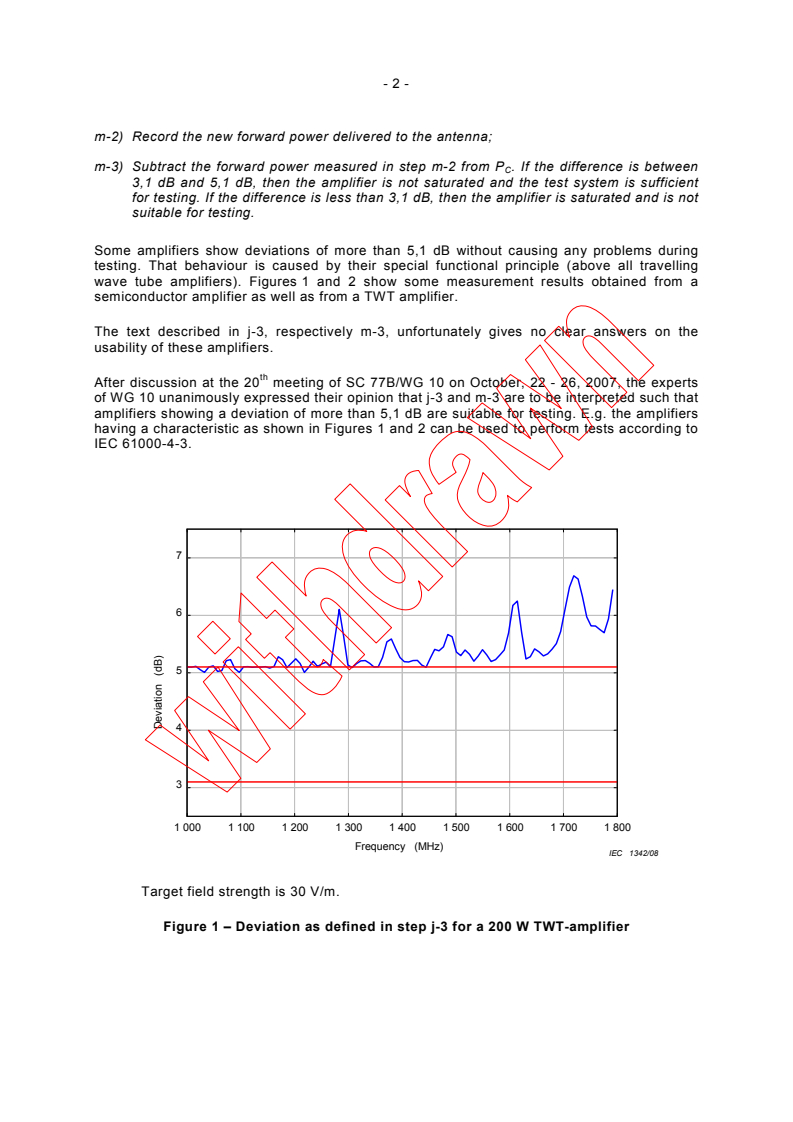
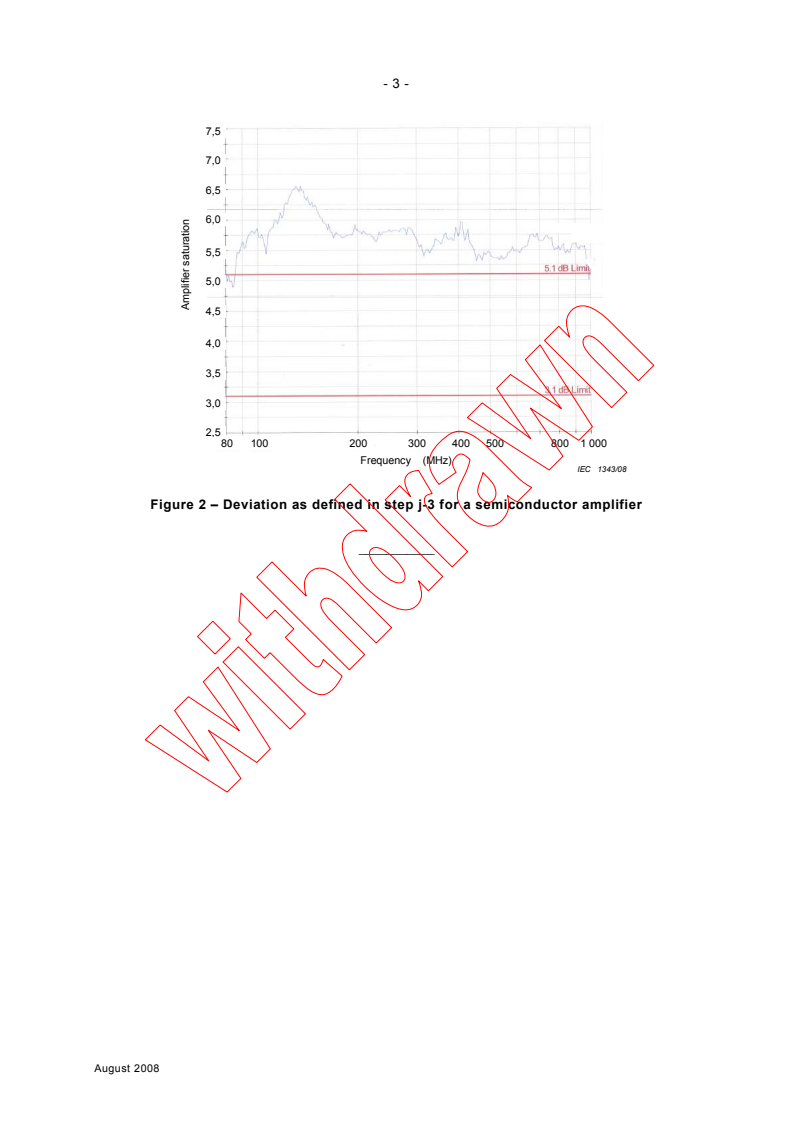
Some amplifiers show deviations of more than 5,1 dB without causing any problems during
testing. That behaviour is caused by their special functional principle (above all travelling
wave tube amplifiers). Figures 1 and 2 show some measurement results obtained from a
semiconductor amplifier as well as from a TWT amplifier.
The text described in j-3, respectively m-3, unfortunately gives no clear answers on the
usability of these amplifiers.
th
After discussion at the 20 meeting of SC 77B/WG 10 on October, 22 - 26, 2007, the experts
of WG 10 unanimously expressed their opinion that j-3 and m-3 are to be interpreted such that
amplifiers showing a deviation of more than 5,1 dB are suitable for testing. E.g. the amplifiers
having a characteristic as shown in Figures 1 and 2 can be used to perform tests according to
IEC 61000-4-3.
1 000 1 100 1 200 1 300 1 400 1 500 1 600 1 700 1 800
Frequency (MHz)
IEC 1342/08
Target field strength is 30 V/m.
Figure 1 – Deviation as defined in step j-3 for a 200 W TWT-amplifier
Deviation (dB)
- 3 -
7,5
7,0
6,5
6,0
5,5
5,0
4,5
4,0
3,5
3,0
2,5
80 100 200 300 400 500 800 1 000
Frequency (MHz)
IEC 1343/08
Figure 2 – Deviation as defined in step j-3 for a semiconductor amplifier
___________
August 2008
Amplifier saturation
Publication CEI 61000-4-3 (Edition 3.0 – 2008) I-SH 01
Compatibilité électromagnétique (CEM) – Partie 4-3: Techniques d‘essai
et de mesure – Essai d’immunité aux champs électromagnétiques
rayonnés aux fréquences radioélectriques
FEUILLE D
...