

CISPR 16-4-2:2011/AMD2:2018
(Amendment)Amendment 2 - Specification for radio disturbance and immunity measuring apparatus and methods - Part 4-2: Uncertainties, statistics and limit modelling - Measurement instrumentation uncertainty
General Information
- Abstract
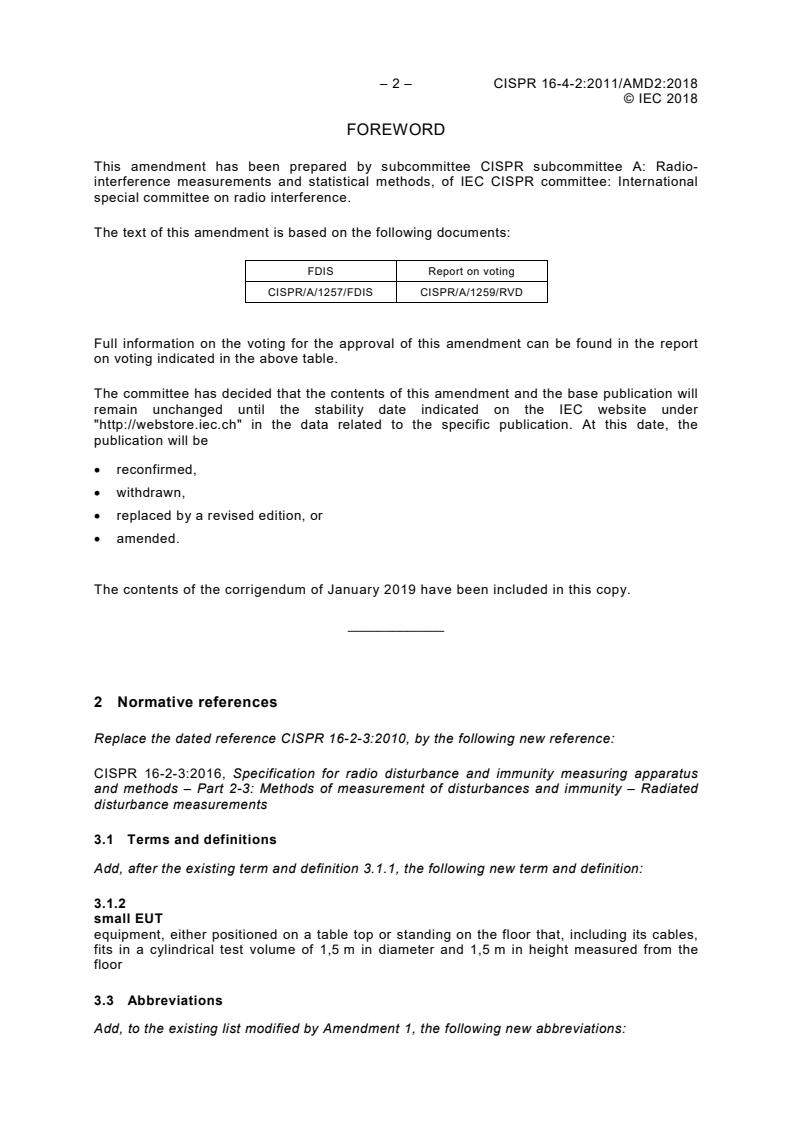
- Status
- Published
- Publication Date
- 14-Aug-2018
- Technical Committee
- CIS/A - Radio-interference measurements and statistical methods
- Current Stage
- PPUB - Publication issued
- Start Date
- 15-Aug-2018
- Completion Date
- 10-Aug-2018
Buy Documents
CISPR 16-4-2:2011/AMD2:2018 - Amendment 2 - Specification for radio disturbance and immunity measuring apparatus and methods - Part 4-2: Uncertainties, statistics and limit modelling - Measurement instrumentation uncertainty Released:8/15/2018
Overview
CISPR 16-4-2:2011/AMD2:2018 is the second amendment to the international standard specifying measurement instrumentation uncertainty in radio disturbance and immunity testing. Developed by the International Electrotechnical Commission (IEC) under the CISPR subcommittee specializing in radio-interference measurements and statistical methods, this amendment advances the clarification and methodology for assessing uncertainties related to measurement apparatus and procedures. It primarily addresses uncertainties, statistics, and limit modelling aspects of electromagnetic compatibility (EMC) measurements, focusing particularly on measurement instrumentation uncertainty.
Key Topics
Measurement Instrumentation Uncertainty: Detailed specifications on evaluating and quantifying uncertainties in EMC test instruments, enhancing the accuracy and repeatability of radio disturbance and immunity measurements.
Updated Measurement Methods: Inclusion of updated and new measurement techniques such as conducted disturbance measurements with voltage artificial mains networks (V-AMN) and delta artificial networks (Δ-AN).
Defined Terms and Abbreviations: Introduction of new terminology, including "small EUT" (equipment under test fitting within specific test volume dimensions) and expanded abbreviations related to measurement methods and networks like AN, V-AMN, Δ-AN, LLAS (large loop antenna system), and more.
Uncertainty Budgets and Rationale: Presentation of comprehensive uncertainty budgets for different measurement scenarios, including conducted disturbances at mains and telecommunications ports and radiated disturbance measurements in the 9 kHz to 30 MHz frequency range.
Corrections and Validation Factors: Specification of necessary corrections such as for voltage division factors, environment effects, impedance mismatches, and supply disturbances, plus validation factors relevant to measurement accuracy.
Extended Frequency Range Coverage: Emphasis on measurements covering a wide frequency spectrum (9 kHz to 30 MHz), with explicit details for both conducted and radiated disturbance measurement standards.
Calibration and Traceability Guidance: Recommendations to base uncertainty estimates on calibration reports, including detailed factors like voltage division factors, admittance, and transfer characteristics, ensuring traceability and consistency.
Applications
Electromagnetic Compatibility (EMC) Testing: This amendment serves as a critical reference for manufacturers, test laboratories, and certification bodies conducting EMC testing to ensure compliance with international standards for radio disturbance and immunity.
Instrumentation Design and Calibration: Designer and calibrators of EMC measuring apparatus can utilize the uncertainty models and budgets provided to optimize instrument performance and provide precise calibration.
Certification and Compliance Assurance: Regulatory agencies and accreditation bodies rely on these specifications to validate measurement results, ensuring that uncertainty is properly calculated and factored into conformity assessment decisions.
Research and Development: Technical teams developing new measurement methods or enhancing existing EMC test setups can refer to this standard to incorporate rigorous statistical and uncertainty procedures.
Related Standards
CISPR 16-2-3:2016 – Methods of measurement of disturbances and immunity for radiated disturbance measurements, referenced for harmonized measurement techniques.
CISPR 16-1-2 – Specification for radio disturbance and immunity measuring apparatus and methods general requirements for EMI receivers.
CISPR 22:2008 and CISPR 32:2015 – Standards referenced for calibration and uncertainty contributions related to voltages and admittance factors, supporting measurement accuracy.
IEC Publications on EMC – Broader IEC publications catalog encompasses various foundational EMC standards harmonizing terminology, methodology, and uncertainty assessments.
Keywords: CISPR 16-4-2 amendment 2, measurement instrumentation uncertainty, radio disturbance, immunity measuring apparatus, EMC test uncertainty, conducted disturbance measurements, V-AMN, Δ-AN, large loop antenna system (LLAS), frequency range 9 kHz to 30 MHz, electromagnetic compatibility standards, uncertainty budgets, IEC CISPR standards, EMC test calibration.
Relations
- Effective Date
- 05-Sep-2023
- Effective Date
- 05-Sep-2023
Buy Documents
CISPR 16-4-2:2011/AMD2:2018 - Amendment 2 - Specification for radio disturbance and immunity measuring apparatus and methods - Part 4-2: Uncertainties, statistics and limit modelling - Measurement instrumentation uncertainty Released:8/15/2018
Get Certified
Connect with accredited certification bodies for this standard

ANCE
Mexican certification and testing association.

Intertek Slovenia
Intertek testing, inspection, and certification services in Slovenia.

LNE (Laboratoire National de Métrologie et d'Essais)
French national laboratory for metrology and testing.
Sponsored listings
Frequently Asked Questions
CISPR 16-4-2:2011/AMD2:2018 is a standard published by the International Electrotechnical Commission (IEC). Its full title is "Amendment 2 - Specification for radio disturbance and immunity measuring apparatus and methods - Part 4-2: Uncertainties, statistics and limit modelling - Measurement instrumentation uncertainty". This standard covers: Amendment 2 - Specification for radio disturbance and immunity measuring apparatus and methods - Part 4-2: Uncertainties, statistics and limit modelling - Measurement instrumentation uncertainty
Amendment 2 - Specification for radio disturbance and immunity measuring apparatus and methods - Part 4-2: Uncertainties, statistics and limit modelling - Measurement instrumentation uncertainty
CISPR 16-4-2:2011/AMD2:2018 is classified under the following ICS (International Classification for Standards) categories: 33.100.10 - Emission; 33.100.20 - Immunity. The ICS classification helps identify the subject area and facilitates finding related standards.
CISPR 16-4-2:2011/AMD2:2018 has the following relationships with other standards: It is inter standard links to CISPR 16-4-2:2011, CISPR 16-4-2:2011/AMD2:2018/COR1:2019. Understanding these relationships helps ensure you are using the most current and applicable version of the standard.
CISPR 16-4-2:2011/AMD2:2018 is available in PDF format for immediate download after purchase. The document can be added to your cart and obtained through the secure checkout process. Digital delivery ensures instant access to the complete standard document.
Standards Content (Sample)
CISPR 16-4-2 ®
Edition 2.0 2018-08
INTERNATIONAL
STANDARD
NORME
INTERNATIONALE
INTERNATIONAL SPECIAL COMMITTEE ON RADIO INTERFERENCE
COMITÉ INTERNATIONAL SPÉCIAL DES PERTURBATIONS RADIOÉLECTRIQUES
BASIC EMC PUBLICATION
PUBLICATION FONDAMENTALE EN CEM
AMENDMENT 2
AMENDEMENT 2
Specification for radio disturbance and immunity measuring apparatus
and methods –
Part 4-2: Uncertainties, statistics and limit modelling – Measurement
instrumentation uncertainty
Spécifications des méthodes et des appareils de mesure des perturbations
radioélectriques et de l'immunité aux perturbations radioélectriques –
Partie 4-2: Incertitudes, statistiques et modélisation des limites – Incertitudes
de mesure de l’instrumentation
CISPR 16-4-2:2011-06/AMD2:2018-08(en-fr)
All rights reserved. Unless otherwise specified, no part of this publication may be reproduced or utilized in any form
or by any means, electronic or mechanical, including photocopying and microfilm, without permission in writing from
either IEC or IEC's member National Committee in the country of the requester. If you have any questions about IEC
copyright or have an enquiry about obtaining additional rights to this publication, please contact the address below or
your local IEC member National Committee for further information.
Droits de reproduction réservés. Sauf indication contraire, aucune partie de cette publication ne peut être reproduite
ni utilisée sous quelque forme que ce soit et par aucun procédé, électronique ou mécanique, y compris la photocopie
et les microfilms, sans l'accord écrit de l'IEC ou du Comité national de l'IEC du pays du demandeur. Si vous avez des
questions sur le copyright de l'IEC ou si vous désirez obtenir des droits supplémentaires sur cette publication, utilisez
les coordonnées ci-après ou contactez le Comité national de l'IEC de votre pays de résidence.
IEC Central Office Tel.: +41 22 919 02 11
3, rue de Varembé info@iec.ch
CH-1211 Geneva 20 www.iec.ch
Switzerland
About the IEC
The International Electrotechnical Commission (IEC) is the leading global organization that prepares and publishes
International Standards for all electrical, electronic and related technologies.
About IEC publications
The technical content of IEC publications is kept under constant review by the IEC. Please make sure that you have the
latest edition, a corrigenda or an amendment might have been published.
IEC Catalogue - webstore.iec.ch/catalogue Electropedia - www.electropedia.org
The stand-alone application for consulting the entire The world's leading online dictionary of electronic and
bibliographical information on IEC International Standards, electrical terms containing 21 000 terms and definitions in
Technical Specifications, Technical Reports and other English and French, with equivalent terms in 16 additional
documents. Available for PC, Mac OS, Android Tablets and languages. Also known as the International Electrotechnical
iPad. Vocabulary (IEV) online.
IEC publications search - webstore.iec.ch/advsearchform IEC Glossary - std.iec.ch/glossary
The advanced search enables to find IEC publications by a 67 000 electrotechnical terminology entries in English and
variety of criteria (reference number, text, technical French extracted from the Terms and Definitions clause of
committee,…). It also gives information on projects, replaced IEC publications issued since 2002. Some entries have been
and withdrawn publications. collected from earlier publications of IEC TC 37, 77, 86 and
CISPR.
IEC Just Published - webstore.iec.ch/justpublished
Stay up to date on all new IEC publications. Just Published IEC Customer Service Centre - webstore.iec.ch/csc
details all new publications released. Available online and If you wish to give us your feedback on this publication or
also once a month by email. need further assistance, please contact the Customer Service
Centre: sales@iec.ch.
A propos de l'IEC
La Commission Electrotechnique Internationale (IEC) est la première organisation mondiale qui élabore et publie des
Normes internationales pour tout ce qui a trait à l'électricité, à l'électronique et aux technologies apparentées.
A propos des publications IEC
Le contenu technique des publications IEC est constamment revu. Veuillez vous assurer que vous possédez l’édition la
plus récente, un corrigendum ou amendement peut avoir été publié.
Catalogue IEC - webstore.iec.ch/catalogue Electropedia - www.electropedia.org
Application autonome pour consulter tous les renseignements
Le premier dictionnaire en ligne de termes électroniques et
bibliographiques sur les Normes internationales,
électriques. Il contient 21 000 termes et définitions en anglais
Spécifications techniques, Rapports techniques et autres
et en français, ainsi que les termes équivalents dans 16
documents de l'IEC. Disponible pour PC, Mac OS, tablettes
langues additionnelles. Egalement appelé Vocabulaire
Android et iPad.
Electrotechnique International (IEV) en ligne.
Recherche de publications IEC -
Glossaire IEC - std.iec.ch/glossary
webstore.iec.ch/advsearchform
67 000 entrées terminologiques électrotechniques, en anglais
La recherche avancée permet de trouver des publications IEC et en français, extraites des articles Termes et Définitions des
en utilisant différents critères (numéro de référence, texte, publications IEC parues depuis 2002. Plus certaines entrées
comité d’études,…). Elle donne aussi des informations sur les antérieures extraites des publications des CE 37, 77, 86 et
projets et les publications remplacées ou retirées. CISPR de l'IEC.
IEC Just Published - webstore.iec.ch/justpublished Service Clients - webstore.iec.ch/csc
Restez informé sur les nouvelles publications IEC. Just Si vous désirez nous donner des commentaires sur cette
Published détaille les nouvelles publications parues. publication ou si vous avez des questions contactez-nous:
Disponible en ligne et aussi une fois par mois par email. sales@iec.ch.
CISPR 16-4-2 ®
Edition 2.0 2018-08
INTERNATIONAL
STANDARD
NORME
INTERNATIONALE
INTERNATIONAL SPECIAL COMMITTEE ON RADIO INTERFERENCE
COMITÉ INTERNATIONAL SPÉCIAL DES PERTURBATIONS RADIOÉLECTRIQUES
BASIC EMC PUBLICATION
PUBLICATION FONDAMENTALE EN CEM
AMENDMENT 2
AMENDEMENT 2
Specification for radio disturbance and immunity measuring apparatus
and methods –
Part 4-2: Uncertainties, statistics and limit modelling – Measurement
instrumentation uncertainty
Spécifications des méthodes et des appareils de mesure des perturbations
radioélectriques et de l'immunité aux perturbations radioélectriques –
Partie 4-2: Incertitudes, statistiques et modélisation des limites – Incertitudes
de mesure de l’instrumentation
INTERNATIONAL
ELECTROTECHNICAL
COMMISSION
COMMISSION
ELECTROTECHNIQUE
INTERNATIONALE
ICS 33.100.10; 33.100.20 ISBN 978-2-8322-5920-7
– 2 – CISPR 16-4-2:2011/AMD2:2018
© IEC 2018
FOREWORD
This amendment has been prepared by subcommittee CISPR subcommittee A: Radio-
interference measurements and statistical methods, of IEC CISPR committee: International
special committee on radio interference.
The text of this amendment is based on the following documents:
FDIS Report on voting
CISPR/A/1257/FDIS CISPR/A/1259/RVD
Full information on the voting for the approval of this amendment can be found in the report
on voting indicated in the above table.
The committee has decided that the contents of this amendment and the base publication will
remain unchanged until the stability date indicated on the IEC website under
"http://webstore.iec.ch" in the data related to the specific publication. At this date, the
publication will be
• reconfirmed,
• withdrawn,
• replaced by a revised edition, or
• amended.
The contents of the corrigendum of January 2019 have been included in this copy.
_____________
2 Normative references
Replace the dated reference CISPR 16-2-3:2010, by the following new reference:
CISPR 16-2-3:2016, Specification for radio disturbance and immunity measuring apparatus
and methods – Part 2-3: Methods of measurement of disturbances and immunity – Radiated
disturbance measurements
3.1 Terms and definitions
Add, after the existing term and definition 3.1.1, the following new term and definition:
3.1.2
small EUT
equipment, either positioned on a table top or standing on the floor that, including its cables,
fits in a cylindrical test volume of 1,5 m in diameter and 1,5 m in height measured from the
floor
3.3 Abbreviations
Add, to the existing list modified by Amendment 1, the following new abbreviations:
© IEC 2018
AN artificial network
Δ-AN artificial Δ-network (‘Δ’ is pronounced ‘delta’)
LLAS large loop antenna system
LV low voltage
V-AMN artificial mains V-network
Table 1 – Values of U
cispr
Replace the first three lines of this table, modified by Amendment 1, by the following new
lines:
Conducted disturbance at AC mains and other power ports using a V-AMN (9 kHz to 150 kHz) 3,8 dB B.1
(150 kHz to 30 MHz) 3,4 dB B.2
Conducted disturbance at AC mains ports using a voltage probe (9 kHz to 30 MHz) 2,9 dB B.3
Add, after the measurement method “Conducted disturbance at telecommunication port using
CP”, the following new line:
Conducted disturbance at telecommunication port using CP and CVP (150 kHz to 30 MHz) 4,0 dB B.5
Add before “Radiated disturbance (electric field strength at an OATS or in a SAC)” the
following new line:
Radiated disturbance (disturbance current in a LLAS) (9 kHz to 30 MHz) 3,3 dB F.1
Add, after the existing NOTE 2, the following new notes:
NOTE 3 The value of U for conducted disturbances at telecommunication ports using CP and CVP is based on
cispr
the expanded uncertainty in Table B.5 with consideration of additional uncertainties attributed to the CP transfer
admittance Y and mismatch uncertainty CP-receiver δM; see comment B18).
T
NOTE 4 The values of U for the OATS, SAC and FAR are based on a small EUT – an EUT fitting in a
cispr
cylindrical test volume of 1,5 m in diameter and 1,5 m in height – for a 3 m measurement distance (per 3.1.2).
5.1 Conducted disturbance measurements at a mains port using an AMN
Replace, in the title, the phrase "an AMN" by the phrase "a V-AMN".
5.1.1 Measurand for measurements using an AMN
Replace, in the title, the phrase "an AMN" by the phrase "a V-AMN".
– 4 – CISPR 16-4-2:2011/AMD2:2018
© IEC 2018
5.1.2 Symbols of input quantities specific to measurements using an AMN
Replace in the title the phrase "an AMN" by the phrase "a V-AMN".
Replace the line starting with δD by the following new line:
mains
δD Correction for the error caused by AC mains and other power supply disturbances,
mains
in dB
5.1.3 Input quantities to be considered for conducted disturbance measurements at a
mains port using an AMN
Replace, in the title, the phrase "an AMN" by the phrase "a V-AMN".
Replace the eighth dashed item by the following new text:
– Effect of disturbances originating from the laboratory AC mains or other power supply
Add, after the existing Subclause 5.6.3 added by Amendment 1, the following new Subclause
5.7:
5.7 Conducted disturbance measurements at AC mains and other power ports using a
Δ-AN
5.7.1 Measurand for measurements using a Δ-AN
V Asymmetric voltage in dB(μV), measured at the EUT port of the Δ-AN relative to the
reference ground plane, and also symmetric voltage between two terminals at the
EUT port of the Δ-AN not including reference ground; optionally also the
unsymmetric voltage in dB(μV), measured at the EUT port of the Δ-AN relative to
the reference ground plane, if the Δ-AN is furnished with a respective port for
connection of the measuring receiver
5.7.2 Symbols of input quantities specific to measurements using a Δ-AN
F Voltage division factor (asymmetric resp. symmetric) of the Δ-AN, in dB
AN
δF Correction for voltage division factor (VDF) frequency interpolation error, in dB
AN f
δD Correction for the error caused by AC mains and other power supply disturbances,
mains
in dB
δV Correction for the effect of the environment, in dB
env
δZ Correction for imperfect asymmetric or symmetric Δ-AN impedance, in dB
AN
5.7.3 Input quantities to be considered for conducted disturbance measurements
at AC mains and other power ports using a Δ-AN
– Receiver reading
– Attenuation of the connection between AN and receiver
– AN voltage division factor (asymmetric and symmetric)
– AN VDF frequency interpolation
– Receiver related input quantities:
• Receiver sine-wave voltage accuracy
• Receiver pulse amplitude response
© IEC 2018
• Receiver pulse response variation with repetition frequency
• Receiver noise floor
– Mismatch effects between the AN's receiver port and receiver
– AN impedance
– Effect of disturbances originating from the laboratory AC mains or other power supply
– Effect of environment
Add, after the existing Clause 8, the following new Clause 9:
9 Radiated disturbance measurements in the frequency range 9 kHz to 30 MHz
9.1 Magnetic field disturbance measurements using the LLAS in the frequency range
9 kHz to 30 MHz (see also Clause F.1)
9.1.1 Measurand for LLAS measurements
I Current in dB(µA), measured in each of the three loops of the LLAS
9.1.2 Symbols of input quantities specific for LLAS measurements
δZ
vf
Correction for validation factor deviation, in dB
δZ
fi
Correction for validation factor frequency interpolation, in dB
9.1.3 Input quantities to be considered for LLAS measurements
– Receiver reading
– Attenuation of connecting cable between LLAS and receiver
– Validation factor deviation
– Validation factor frequency interpolation
– Receiver related input quantities:
• Receiver sine-wave voltage accuracy
• Receiver pulse amplitude response
• Receiver pulse response variation with repetition frequency
• Receiver noise floor
– Mismatch between LLAS and receiver
9.2 Magnetic field disturbance measurement in the frequency range 9 kHz to 30 MHz
using a loop antenna at various distances from the EUT
(Void)
Annex A – Basis for U values in Table 1, general information and rationale
cispr
for input quantities common to all measurement methods
A.2 Rationale for the estimates of input quantities common to all disturbance
measurements (“A” comments)
Replace, in the existing item A2) modified by Amendment 1, the abbreviation "AMN" by the
abbreviation "V-AMN".
– 6 – CISPR 16-4-2:2011/AMD2:2018
© IEC 2018
Add in the first paragraph of A2), after “AMN, AAN, CDNE, CP, CVP, VP” added by
Amendment 1, the abbreviation “LLAS”.
Add, in the first sentence of the first paragraph of item A6), the abbreviation "AN" between the
abbreviations "AMN" and "AAN". Add, in the second paragraph, the term "δF " between
AN f
respective terms for "δF " and "δF ".
AMN f VPf
Replace in the first paragraph of A6), the phrase “absorbing clamp factor and antenna factor”,
by the new phrase “absorbing clamp factor, LLAS validation factor and antenna factor”.
Replace, in item A7) a), the abbreviation "AMN" by the abbreviation "AN".
Replace, in item A7) c) Note 12, the abbreviation "AMN" by the abbreviation "AN".
Annex B – Basis for U values in Table 1, uncertainty budgets and rationale
cispr
for conducted disturbance measurements
B.1 Uncertainty budget for conducted disturbance measurements at a mains
port using an artificial mains network (AMN)
Replace the existing title by the following new title:
B.1 Uncertainty budget for conducted disturbance measurements at AC mains
ports using a V-AMN
Replace the existing Equation (B.1) by the following new equation:
V=V++A F +δF +δV +δV+δV+δV+δδM+ Z +δD +δE (B.1)
r c AN ANf sw pa pr nf AN mains
Table B.1 − Conducted disturbance measurements from 9 kHz to 150 kHz using a
50 Ω/50 μH + 5 Ω AMN
Replace, in the existing title, the abbreviation "AMN" by the new abbreviation "V-AMN".
Table B.2 − Conducted disturbance measurements from 150 kHz to 30 MHz using a
50 Ω/50 μH AMN
Replace, in the existing title, the abbreviation "AMN" by the new abbreviation "V-AMN".
B.6 Rationale for the estimates of input quantities specific to conducted
disturbance measurement methods
Replace the existing comment B10) by the following new comment:
B10) An estimate of the CVP voltage division factor F is assumed to be available from a
CVP
calibration report for the cable type to be measured, along with an expanded uncertainty and
a coverage factor. The uncertainty includes the calibration setup.
© IEC 2018
Add, after the phrase “C.1.3 of CISPR 22:2008” in the existing comment B18), the new phrase
“and in C.4.1.6.4 of CISPR 32:2015 [19]”.
Add, after the existing Clause B.8 added by Amendment 1, the following new Clauses B.9 and
B.10:
B.9 Basis for U values in Table 1, uncertainty budgets and rationale for
cispr
conducted disturbance measurements at mains and other ports using a Δ-
AN
The measurand V is calculated using:
V=V++a F +δF +δV +δV +δV+δV+ δZ +δδM+ D +δV (B.7)
r c AN ANf sw pa pr nf AN mains env
Table B.8 − Conducted disturbances measurements from
150 kHz to 30 MHz using a 150 Ω Δ-AN
b
a X Uncertainty of x c u(x )
Input quantity i i i i
Probability
dB dB
distribution function
A1)
V
Receiver reading ± 0,1 k = 1 0,10
r
A2)
a
Cable attenuation: AN-receiver ± 0,1 k = 2 0,05
c
B25)
F
AN voltage division factor ± 0,2 k = 2 0,10
AN
Receiver corrections:
A3)
δV
Sine wave voltage ± 1,0 k = 2 0,50
sw
A4)
δV
Pulse amplitude response ± 1,5 Rectangular 0,87
pa
A4)
δV ± 1,5 Rectangular 0,87
Pulse repetition rate response
pr
A5)
δV ± 0,0 Rectangular 0,00
Noise floor proximity
nf
A6)
δF
± 0,1 Rectangular 0,06
AN VDF frequency interpolation
ANf
A7)
± 0,07 U-shaped 0,05
Mismatch AN-receiver δM
B26)
δΖ
AN Impedance (CM) tolerances + 5,37/- 3,67 Triangular 1,84
AN-CM
B26)
δΖ
AN Impedance (DM) tolerances + 5,37/–1,94 Triangular 1,49
AN-DM
B27)
δD ± 0,0 0,00
Effect of mains disturbances
mains
B19)
δV
Effect of the environment
env
a
Superscripts refer to numbered comments in A.2 and in this annex.
b
All sensitivity coefficients c are assumed to be equal to 1, see A.2.
i
u
Combined standard uncertainty 2,93
c
Expanded uncertainty (U ) 2 u
5,86
CISPR c
– 8 – CISPR 16-4-2:2011/AMD2:2018
© IEC 2018
B.10 Rationale for the estimates of input quantities specific to the measurement
method using a Δ-AN
B25) Estimates of the Δ-AN voltage division factors F (F and F )
AN AN_asymmetric AN_symmetric
are assumed to be available from a calibration report, along with their expanded
uncertainties and coverage factors.
B26) CISPR 16-1-2 defines the CM impedance of the 150 Ω Δ-AN as 150 Ω with a
magnitude tolerance of ±30 Ω and a phase tolerance of ± 40°. Taking the extremes of
all combinations of the constrained AN CM impedance and the unconstrained EUT
impedance the estimate of the correction δZ is zero with a deviation of + 5,37/-
AN-CM
3,67 dB. A triangular probability distribution is assumed because there is only a small
chance of encountering the particular combinations of AN impedance and EUT
impedance needed to produce those extremes. The triangular distribution is assumed
to be symmetric.
The actual uncertainty will be reduced if the actual CM impedance does not reach the
tolerance limits.
CISPR 16-1-2 defines the DM impedance of the 150 Ω Δ-AN as 150 Ω with a
magnitude tolerance of ± 30 Ω and a phase tolerance of ±40°. Taking the extremes of
all combinations of the constrained AN differential mode impedance and the
unconstrained EUT impedance the estimate of the correction δZ is zero with a
AN-DM
deviation of +5,37/–1,94 dB. A triangular probability distribution is assumed because
there is only a small chance of encountering the particular combinations of AN
impedance and EUT impedance needed to produce those extremes. The triangular
distribution is assumed to be symmetric.
The actual uncertainty will be reduced if the actual DM impedance does not reach the
tolerance limits.
B27) For measurements using a Δ-AN, disturbances from the AC mains, other kind of
power supply or from an external load are assumed to be suppressed by the Δ-AN
itself or by additional filters inserted in the power supply line – if necessary.
Annex D – Basis for U values in Table 1 – Radiated disturbance
cispr
measurements from 30 MHz to 1 000 MHz
Table D.1 – Horizontally polarized radiated disturbances from 30 MHz to 200 MHz
using a biconical antenna at a distance of 3 m, 10 m or 30 m
Replace the table title by the following new title:
Table D.1 – Horizontally polarized radiated disturbances from 30 MHz to 200 MHz using
a biconical antenna at an OATS/SAC at a distance of 3 m, 10 m or 30 m
Table D.2 – Vertically polarized radiated disturbances from 30 MHz to 200 MHz
using a biconical antenna at a distance of 3 m, 10 m or 30 m
Replace the table title by the following new title:
Table D.2 – Vertically polarized radiated disturbances from 30 MHz to 200 MHz using
a biconical antenna at an OATS/SAC at a distance of 3 m, 10 m or 30 m
Table D.3 – Horizontally polarized radiated disturbances from 200 MHz to 1 GHz using
an LPDA antenna at a distance of 3 m, 10 m or 30 m
Replace the table title by the following new title:
© IEC 2018
Table D.3 – Horizontally polarized radiated disturbances from 200 MHz to 1 GHz using
an LPDA antenna at an OATS/SAC at a distance of 3 m, 10 m or 30 m
Replace, in the “LPDA antenna corrections” section of the table, the “Phase centre location
D4)
” details as follows:
D4)
δF
Phase centre location at 3 m ± 0,20 Rectangular 0,12
aph
δF
or 10 m ± 0,06 Rectangular 0,03
aph
δF
or 30 m ± 0,02 Rectangular 0,01
aph
Replace the expanded uncertainty details located just below Table D.3 by the following:
5,12dB, at a separation of 3 m (with tilting)
5,21 dB, at a separation of 3 m (without tilting)
U(E)= 2u (E)=
Hence, expanded uncertainty c
5,20 dB, at a separation of 10 m
5,19 dB, at a separation of 30 m
Table D.4 – Vertically polarized radiated disturbances from 200 MHz to 1 GHz using an
LPDA antenna at a distance of 3 m, 10 m or 30 m
Replace the table title by the following new title:
Table D.4 – Vertically polarized radiated disturbances from 200 MHz to 1 GHz using an
LPDA antenna at an OATS/SAC at a distance of 3 m, 10 m or 30 m
Replace, in the “LPDA antenna corrections” section of the table, the “Phase centre location
D4)
” details as follows:
D4)
δF
Phase centre location at 3 m ± 0,20 Rectangular 0,12
aph
δF
or 10 m ± 0,06 Rectangular 0,03
aph
δF
or 30 m Rectangular 0,01
± 0,02
aph
Replace the expanded uncertainty details located just below Table D.4 by the following:
5,14 dB, at a separation of 3 m (with tilting)
6,21 dB, at a separation of 3 m (without tilting)
U(E)= 2u (E)=
Hence, expanded uncertainty
c
5,21 dB, at a separation of 10 m
5,18 dB, at a separation of 30 m
D.3 Rationale for the estimates of input quantities specific to radiated
disturbance measurement methods from 30 MHz to 1 000 MHz
Replace, in comment D4), all of the existing text and notes by the following new text and
notes:
D4) The correction δF for phase centre location is negligible for a biconical antenna. The
aph
variation in phase-centre location with frequency for an LPDA antenna can be corrected
as recommended in CISPR 16-2-3.
– 10 – CISPR 16-4-2:2011/AMD2:2018
© IEC 2018
For an LPDA antenna, the correction δF was assumed to be applied e.g. by
aph
equivalent corrections of the AFs for the specified measurement distance (see
CISPR 16-2-3). The remaining reduced uncertainty is given in Tables D.3 and D.4 with a
rectangular probability distribution, having a half-width evaluated by considering the
effect of an error of ± 0,07 m in the separation, and assuming that field strength is
inversely proportional to separation. For example for d = 10 m,
20 lg(1 + 0,07/10) = 0,06 dB.
NOTE 4 If a tuned dipole is the measuring antenna, the correction δF is negligible.
aph
NOTE 5 For hybrid antennas, the correction δF for the systematic effect is more complicated [see
aph
comment D12)].
nd
Replace, in comment D11) 2 paragraph, the existing text “Subclause 7.2.3 of
CISPR 16-2-3:2010”, by the following new text:
Subclause 7.3.4 of CISPR 16-2-3:2016
Replace, in comment D12), all of the existing text, equations and notes by the following new
text, equations, notes and tables:
D12) Hybrid antennas are taken into account in the calculation of Tables D.7, D.8 and D.9.
Hybrid antennas, used for radiated disturbance measurements in the frequency range
30 MHz to 1 000 MHz and consisting of a broadband dipole section and an LPDA
antenna section, typically have the following characteristics (different parameters for
specific designs may be provided by antenna manufacturers):
– a frequency range up to about 100 MHz, where the antenna acts like a biconical
antenna (see Tables D.1, D.2 and D.5);
– a transition frequency range from about 100 MHz up to about 200 MHz (see below
within this comment); and
– a frequency range above about 200 MHz where the antenna acts like an LPDA
δF it is considered that
antenna (see Tables D.3, D.4 and D.6). For the correction
adir
the LPDA part is usually closer to the EUT than above in comment D3), which means
that the correction factors are slightly higher and the uncertainties are slightly larger.
In the frequency range up to 100 MHz, the following is assumed:
– the AF variation relative to F for horizontal polarization at a height of 1 m reaches a
a
maximum vs. frequency of ± 2 dB around 60 MHz and at a height of 4 m the variation
is around ± 0,5 dB (data specific for individual antenna types need to be supplied by
the antenna manufacturer). Since at horizontal polarization the antenna height for
OATS/SAC measurements in the frequency range below 100 MHz is at its maximum,
the lower AF height deviation has been assumed.
In the transition frequency range, the following may be assumed for uncertainty
considerations:
– the antenna gain (in dBi) and, by association, the pattern directivity (in dB), increase
linearly with the frequency (detailed antenna patterns for the correction δF may be
adir
obtained from the manufacturer);
– as the frequency increases, the active phase centre travels linearly from the
broadband dipole elements to the 200 MHz elements of the LPDA part [a detailed
calculation of the AF correction δF is given below in Equation (D.4)];
aph
– the cross polarization suppression is equal to or above 20 dB; and
– the balun imbalance will normally be as low as that of the broadband dipole
elements.
© IEC 2018
It is assumed that the antenna is provided with free-space AFs. Free-space AFs apply
to the location of the phase centre. Because the phase centre location on the antenna is
frequency dependent, the distance from a fixed EUT is also frequency dependent.
Equation (8) of CISPR 16-2-3:2016, as well as Equation (A.1) of CISPR 16-1-6:2014 [18],
suggests a field-strength correction. For a given frequency, the following correction, ΔE in dB,
is added to the measured electric field strength:
d
phase d+ Δd
ΔE= 20 lg = 20lg
d d
(D.3)
According to a note in CISPR 16-2-3 this correction can also be done using distance-
dependent AFs. In order to correct for the deviation from the reference distance, e.g. 10 m or
3 m, the AF is assumed to be corrected. A marker is assumed to be provided on the antenna
midpoint, which is used to define the EUT-to-antenna distance d. Then, the actual AF F is
a act
calculated using the following equations:
F = F +δF
aact a aph
(D.4)
dd+ Δ
where δ F = 20lg
aph
d
and
F
-1
a act
is the actual (corrected) AF in dB(m );
-1
F
is the free-space AF in dB(m );
a
is the correction for phase centre variation in dB;
δF
aph
d is the EUT-to-antenna midpoint distance in m;
d is the EUT-to-phase-centre distance in m;
phase
– 12 – CISPR 16-4-2:2011/AMD2:2018
© IEC 2018
Δd is the distance between phase centre and antenna midpoint (positive if phase
centre further away from the EUT than antenna midpoint) in m.
For the frequency range 30 MHz to 100 MHz,∆d= c , i.e. a constant (the distance
of the broadband dipole elements feedpoint from the antenna midpoint).
For the frequency range 100 MHz to 200 MHz, ∆d= c + (c f ), where
1 2
c = c + (100c ), so that at 100 MHz is equal to the value in the lower
∆d
0 1 2
frequency range and f is in MHz. ∆d at 200 MHz (the position defined by the
LPDA elements resonant at 200 MHz) should agree with the value of ∆d in the
upper frequency range.
For the frequency range 200 MHz to 1 000 MHz, ∆d= c + (c / f ), where the
3 4
constants c and c should be chosen so that ∆d meets the phase centre
3 4
locations at 200 MHz and 1 000 MHz.
NOTE 7 c , c , c , c and c are constants for the calculation of ∆d that might be provided by an
0 1 2 3 4
antenna manufacturer.
EXAMPLE For c = 0,47 m; c = 0,61 m; c = 0,001 4 m/MHz; c = -0,58 m and c = 182,5 m × MHz:
0 1 2 3 4
Below 100 MHz, the distance of the phase centre from the antenna midpoint Δd = 0,47 m and for a
measurement distance of 3 m (d = 3 m), the antenna factor correction is
3 m+ 0,47 m .
δF = 20lg =+1,26 dB
aph
3 m
Between 100 MHz and 200 MHz, the phase centre position ∆d varies between 0,47 m and 0,33 m.
At 200 MHz, δF = +0,91 dB (for d = 3 m).
aph
Between 200 MHz and 1 000 MHz, the phase centre position referred to the antenna midpoint varies
between 0,33 m and –0,40 m, resulting in an antenna factor correction of –1,24 dB at 1 000 MHz (for
d = 3 m). The phase centre is at the antenna midpoint at 314,6 MHz.
For an estimate of the uncertainty of δF , the model is considered an approximation. The
aph
δF is lower if the antenna is tilted [as in comment D3)], because the angles
uncertainty of
aph
of incidence are closer to boresight.
Hybrid antennas can consist of a V-type LPDA section, for higher antenna gain and similar E-
and H-plane radiation patterns. In this case antenna tilting at 3 m distance reduces directivity
uncertainty in both horizontal and vertical polarizations.
Hybrid antennas usually have the high VSWR (up to 40:1) of biconical antennas around
30 MHz. In combination with a low loss cable and a receiver VSWR of 2:1, this can result in a
standard mismatch uncertainty of up to 1,8 dB. Fortunately not all extremes happen at the
same frequency, i.e. high antenna mismatch in combination with low receiver mismatch and
lower antenna mismatch where the AF strongly varies with height and where directivity
uncertainty increases.
© IEC 2018
Table D.7 – Horizontally polarized radiated disturbances from 30 MHz to 1 000 MHz
using a hybrid antenna at an OATS/SAC at a distance of 3 m, 10 m, or 30 m
b
a
X
Uncertainty of x c u(x )
Input quantity
i
i i i
Probability
dB distribution dB
function
A1)
V
Receiver reading ± 0,1 k = 1 0,10
r
A2)
a
± 0,2 k = 2 0,10
Attenuation: antenna-receiver
c
D1)
F
k = 2 1,00
AF of hybrid antenna ± 2,0
a
Receiver corrections:
A3)
δV
k = 2 0,50
Sine wave voltage ± 1,0
sw
A4)
δV
Pulse amplitude response ± 1,5 Rectangular 0,87
pa
A4)
δV
± 1,5 Rectangular 0,87
Pulse repetition rate response
pr
A5)
δV
+0,5/0,0 Rectangular 0,29
Noise floor proximity
nf
A7)
+0,9/–1,0 U-shaped 0,67
Mismatch: antenna-receiver δM
Hybrid antenna corrections:
A6)
δF
AF frequency interpolation ± 0,3 Rectangular 0,17
af
D2)
δF
± 0,5 Rectangular 0,35
AF variation with height
ah
D3)
δF
Rectangular 0,29
Directivity difference at 3 m <100 MHz ± 0,5
adir
δF
Directivity difference at 3 m >100 MHz ± 1,0 Rectangular 0,58
adir
D3)
δF
± 1,0 Rectangular 0,58
Directivity difference > 200 MHz at 3 m
adir
δF
3 m with tilting Rectangular 0,29
± 0,5
adir
δF
or 10 m ± 0,2 Rectangular 0,12
adir
δF
or 30 m ± 0,1 Rectangular 0,06
adir
D4)
δF
3 m ± 0,3 Rectangular 0,17
Phase centre location at
aph
δF
or 10 m ± 0,2 Rectangular 0,12
aph
δF
or 30 m ± 0,1 Rectangular 0,06
aph
D5)
δF
± 0,9 Rectangular 0,52
Cross-polarization
acp
D6)
δF
Balance ± 0,3 Rectangular 0,17
abal
Site corrections:
D7)
δA
Site imperfections ± 4,0 Triangular 1,63
N
D8)
3 m δd ± 0,3 Rectangular 0,17
Separation distance at
or 10 m δd ± 0,1 Rectangular 0,06
or 30 m δd ± 0,0 Rectangular 0,00
D10)
δA
± 0,5 Rectangular 0,29
Effect of setup table material
NT
D9)
k = 2 0,05
Table height at 3 m, 10 m or 30 m δh ± 0,1
D13)
δE
0,00
Effect of ambient noise on OATS ± 0,0
amb
a A1)
Superscripts [e.g. ] correspond to numbered comments in the annexes (see A.2 and D.3).
b
All c = 1 (see A.1).
i
– 14 – CISPR 16-4-2:2011/AMD2:2018
© IEC 2018
5,11dB, at a separation of 3 m (with tilting)
5,21 dB, at a separation of 3 m (without tilting)
U(E )= 2u (E )=
Hence, expanded uncertainty:
c
5,10 dB, at a separation of 10 m
5,09 dB, at a separation of 30 m
Table D.8 – Vertically polarized radiated disturbances from 30 MHz to 1 000 MHz
using a hybrid antenna at an OATS/SAC at a distance of 3 m, 10 m, or 30 m
b
a
X Uncertainty of x
c u(x )
Input quantity
i i
i i
Probability
dB distribution dB
function
A1)
V
± 0,1 k = 1 0,10
Receiver reading
r
A2)
a
Attenuation: antenna-receiver ± 0,2 k = 2 0,10
c
D1)
F
± 2,0 k = 2 1,00
AF of hybrid antenna
a
Receiver corrections:
A3)
δV
± 1,0 k = 2 0,50
Sine wave voltage
sw
A4)
δV
Pulse amplitude response ± 1,5 Rectangular 0,87
pa
A4)
δV
Pulse repetition rate response ± 1,5 Rectangular 0,87
pr
A5)
δV
+0,5/0,0 Rectangular 0,29
Noise floor proximity
nf
A7)
δM +0,9/–1,0 U-shaped 0,67
Mismatch: antenna-receiver
Hybrid antenna corrections:
A6)
δF
AF frequency interpolation ± 0,3 Rectangular 0,17
af
D2) D12)
δF
AF variation with height ± 0,3 Rectangular 0,17
ah
D3) D12)
δF
± 0,5 Rectangular 0,29
Directivity difference at 3 m <100 MHz
adir
δF
Directivity difference at 3 m >100 MHz Rectangular 1,7
± 3,0
adir
δF
Directivity difference at 3 m >200 MHz ± 3,2 Rectangular 1,8
adir
δF
Directivity difference at 3 m with tilting ± 0,75 Rectangular 0,43
adir
δF
or 10 m Rectangular 0,29
± 0,5
adir
δF
or 30 m ± 0,15 Rectangular 0,09
adir
D4) D12)
δF
3 m ± 0,3 Rectangular 0,17
Phase centre location at
aph
δF
or 10 m Rectangular 0,12
± 0,2
aph
δF
or 30 m ± 0,1 Rectangular 0,06
aph
D5)
δF
± 0,9 Rectangular 0,52
Cross-polarization
acp
D6)
δF
± 1,0 Rectangular 0,58
Balance
abal
Site corrections:
D7)
δA
Site imperfections ± 4,0 Triangular 1,63
N
D8)
Separation distance at 3 m δd ± 0,3 Rectangular 0,17
or 10 m δd ± 0,1 Rectangular 0,06
or 30 m δd ± 0,0 Rectangular 0,00
D10)
δA
Effect of setup table material ± 0,5 Rectangular 0,0
NT
D9)
δh ± 0,1 k = 2 0,05
Table height at 3 m, 10 m or 30 m
D13)
δE
Effect of ambient noise on OATS ± 0,0 0,00
amb
a A1)
Superscripts [e.g. ] correspond to numbered comments in the annexes (see A.2 and D.3).
b
All c = 1 (see A.1).
i
© IEC 2018
5,26 dB, at a separation of 3 m (with tilting)
6,32 dB, at a separation of 3 m (without tilting)
U(E )= 2u (E )=
Hence, expanded uncertainty c
5,22 dB, at a separation of 10 m
5,18 dB, at a separation of 30 m
Table D.9 – Radiated disturbance measurements from 30 MHz to 1 000 MHz
using a hybrid antenna in a FAR at a distance of 3 m
b
a
X Uncertainty of x c u(x )
Input quantity
i i i i
Probability
dB distribution dB
function
A1)
V
Receiver reading ± 0,1 k = 1 0,10
r
A2)
a
k = 2 0,10
Attenuation: antenna-receiver ± 0,2
c
D1)
F
AF of hybrid antenna ± 2,0 k = 2 1,00
a
Receiver corrections:
A3)
δV
Sine wave voltage ± 1,0 k = 2 0,50
sw
A4)
δV
± 1,5 Rectangular 0,87
Pulse amplitude response
pa
A4)
δV
Rectangular 0,87
Pulse repetition rate response ± 1,5
pr
A5)
δV
Noise floor proximity +0,5/0,0 Rectangular 0,29
nf
A7)
Mismatch: antenna-receiver δM +0,9/–1,0 U-shaped 0,67
Hybrid antenna corrections:
A6)
δF
± 0,3 Rectangular 0,17
AF frequency interpolation
af
D2)
δF
Rectangular 0,29
AF variation due to FAR influence ± 0,5
ah
D3)
δF
Directivity difference ± 0,5 Rectangular 0,29
adir
D4)
δF
± 0,2 Rectangular 0,17
Phase centre location
aph
D6)
δF
Rectangular 0,29
Balance ± 0,5
abal
Site corrections:
D7)
δA
Site imperfections ± 4,0 Triangular 1,63
N
D10)
δA
± 0,5 Rectangular 0,29
Effect of setup table material
NT
D8)
δd ± 0,3 Rectangular 0,17
Separation distance
D9)
Table height δh ± 0,0 k = 2 0,00
a A1)
Superscripts [e.g. ] correspond to numbered comments in the annexes, see A.2 and D.3.
b
All c = 1 (see A.1).
i
Hence, expanded uncertainty U(E) = 2u (E) = 5,29 dB
c
Replace in comment D13), penultimate sentence, the existing text “Annex A of
CISPR 16-2-3:2010”, by the following new text:
Annex A of CISPR 16-2-3:2016
– 16 – CISPR 16-4-2:2011/AMD2:2018
© IEC 2018
Annex E – Basis for U values in Table 1 – Radiated disturbance
cispr
measurements from 1 GHz to 18 GHz
E.2 Rationale for the estimates of input quantities specific to the radiated
disturbance measurement method from 1 GHz to 18 GHz
Replace, in comment E2), the text “Equation (9) of CISPR 16-2-3:2010” twice by the following
new text:
Equation (13) of CISPR 16-2-3:2016
Add, after the existing Annex E, the following new Annex F:
© IEC 2018
Annex F
(informative)
Basis for U values in Table 1 –
cispr
Radiated disturbance measurements from 9 kHz to 30 MHz (LLAS)
F.1 Uncertainty budget for LLAS measurements
The measurand I is calculated using:
(F.1)
I= V + a +δZ +δZ +δV +δV +δV +δV +δM
r c vf fi sw pa pr nf
Table F.1 – Radiated disturbance measurements
from 9 kHz to 30 MHz in a LLAS of any diameter
a b
X Uncertainty of x
Input quantity c u(x )
i i
i i
Probability
dB distribution dB
function
A1)
V ±0,1 k = 1 0,10
Receiver reading
r
A2)
a
Attenuation between LLAS and receiver ±0,1 k = 2 0,05
c
F1)
δZ
Validation factor deviation ±2,0 Triangular 0,82
vf
A6)
δZ
±0,1 Rectangular 0,06
Validation factor frequency interpolation
fi
Receiver corrections:
A3)
δV
Sine wave voltage ±1,0 k = 2 0,50
sw
A4)
δV ±1,5 Rectangular 0,87
Pulse amplitude response
pa
A4)
δV
Pulse repetition rate response ±1,5 Rectangular 0,87
pr
A5)
δV
Noise floor proximity ±0,0 0,00
nf
+0,7/
A7)
δM U-shaped 0,53
Mismatch: LLAS – receiver
-0,8
a A1)
Superscripts [e.g. ] refer to numbered comments in the annexes (see A.2 and F.2).
b
All c = 1 (see A.1).
i
Hence, expanded uncertainty U(I) = 2u (I) = 3,3 dB.
c
F.2 Rationale for the estimates of input quantities specific to the LLAS-
measurement method
F1) The performance of the LLAS is verified using responses to the standardized balun-
antenna at various positions inside the LLAS. The results are to be compared with the
theoretical validation factors (Figures C.8 and C.11 of [17]) which are determined using a
theoretical model of the LLAS validation set-up [14] and are the reference for verification
of the actual validation factor of the LLAS. In this way the validation factor is a verification
of the overall LLAS performance, and it includes all uncertainties arising from the
geometrical construction of the LLAS, the coaxial cables, termination resistors, the 1 V/A
current probes, unbalances and even the effect of the site. So, the validation factor
verification is a combined verification of the LLAS and the LLAS test site.
The deviation of the actual validation factor with regard to the theoretical validation factor
is less than ± 2 dB (see C.4 of [17]). Hence, the actual deviation can directly be used in
– 18 – CISPR 16-4-2:2011/AMD2:2018
© IEC 2018
the uncertainty budget. The estimate of the correction δZ is zero and the probability
vf
distribution for the validation factor deviation is assumed to be a triangular distribution
(coverage factor k = 6 = 2,45).
The original publication of Bergervoet [14] as well as other publications [15] [16] have
analyzed uncertainties of the LLAS validation factor due to imperfections of the
construction and materials. The uncertainty of the theoretical validation factor is
considered less than 0,1 dB.
© IEC 2018
Bibliography
Add, after reference [13], the following new references:
[14] J.R. BERGERVOET, H. van VEEN, A Large-Loop Antenna for Magnetic Field
Measurements, Proceedings of the 8th International Zürich Symposium on
Electromagnetic Compatibility, March 1989, ETH Zentrum – IKT, 8092 Zürich,
Switzerland, p. 29-34.
[15] J. McLEAN, H. SAKO, A. MEDINA, R. SUTTON, Operation of the Van Veen Loop in a
shielded chamber, Instrumentation and Measurement Technology Conference
(I2MTC), May 2013.
[16] J. McLEAN, K. TAKIZAWA, M. MIDORI, H. KURIHARA, R. SUTTON, The Effects of
Asymmetry on the operation of the Van Veen Loop, Proceedings of the 2014
International Symposium on Electromagnetic Compatibility (EMC Europe 2014),
Gothenburg, Sweden, September 1-4, 2014.
[17] CISPR 16-1-4:2010, Specification for radio disturbance and immunity measuring
apparatus and methods – Part 1-4: Radio disturbance and immunity measuring
apparatus – Antennas and test sites for radiated disturbance measurements.
[18] CISPR 16-1-6:2014, Specification for radio disturbance and immunity measuring
apparatus and methods – Part 1-6: Radio disturbance and immunity measuring
apparatus – EMC antenna calibration
[19] CISPR 32:2015, Electromagnetic compatibility of multimedia equipment – Emission
requirements
___________
– 20 – CISPR 16-4-2:2011/AMD2:2018
© IEC 2018
AVANT-PROPOS
Le présent amendement a été établi par le sous-comité A du CISPR: Mesures des
perturbations radioélectriques et méthodes statistiques, du comité d'études CISPR de l'IEC:
Comité international spécial des perturbations radioélectriques.
Le texte de cet amendement est issu des documents suivants:
FDIS Rapport de vote
CISPR/A/1257/FDIS CISPR/A/1259/RVD
Le rapport de vote indiqué dans le tableau ci-dessus donne toute information sur le vote ayant
abouti à l'approbation de cet amendement.
Le comité a décidé que le contenu de cet amendement et de la publication de base ne sera
pas modifié avant la date de stabilité indiquée sur le site web de l'IEC sous
"http://webstore.iec.ch" dans les données relatives à la publication recherchée. A cette date,
la publication sera
• reconduite,
• supprimée,
• remplacée par une édition révisée, ou
• amendée.
Le contenu du corrigendum de janvier 2019 a été pris en considération dans cet exemplaire.
_____
...