

IEC 62599-2:2010
(Main)Alarm systems - Part 2: Electromagnetic compatibility - Immunity requirements for components of fire and security alarm systems
General Information
- Abstract
IEC 62599-2:2010 for immunity requirements applies to the components of the following alarm systems, intended for use in and around buildings in residential, commercial, light industrial and industrial environments:
- access control systems, for security applications;
- alarm transmission systems;
- CCTV systems, for security applications;
- fire detection and fire alarm systems;
- intruder and hold-up alarm systems;
- social alarm systems.
- Status
- Published
- Publication Date
- 18-May-2010
- Technical Committee
- TC 79 - Alarm and electronic security systems
- Current Stage
- PPUB - Publication issued
- Start Date
- 19-May-2010
- Completion Date
- 31-May-2010


Overview
IEC 62599-2:2010 is an international standard published by the International Electrotechnical Commission (IEC) that specifies electromagnetic compatibility (EMC) immunity requirements for the components of fire and security alarm systems. This standard is part of the IEC 62599 series focused on alarm systems, and Part 2 addresses the immunity of components against electromagnetic disturbances. It applies to alarm systems used in and around buildings in residential, commercial, light industrial, and industrial environments.
The standard particularly covers components of various alarm systems including access control, alarm transmission, CCTV for security purposes, fire detection and fire alarm, intruder and hold-up alarms, and social alarm systems. Ensuring immunity to electromagnetic interference (EMI) is critical to maintaining reliable operation and safety of these alarm systems.
Key Topics
Scope of Application: IEC 62599-2 applies to fire and security alarm system components installed in diverse environments such as residential dwellings, commercial buildings, and industrial sites.
Immunity Requirements: The standard defines specific immunity tests components must pass to withstand electromagnetic phenomena without performance degradation, thereby guaranteeing system reliability.
Testing Conditions and Procedures: Detailed testing methodologies for assessing immunity under various electromagnetic disturbances, including:
- Mains supply voltage variations
- Voltage dips and short interruptions
- Electrostatic discharges
- Radiated electromagnetic fields
- Conducted disturbances from electromagnetic fields
- Fast transient bursts and voltage surges
Compliance Criteria: Requirements establish functional performance criteria post-testing to confirm that devices maintain operational integrity under electromagnetic stresses.
Configuration and Operating Conditions: Test configurations and environmental parameters are standardized to ensure reproducibility and reliability of immunity assessments.
Applications
IEC 62599-2:2010 is vital for manufacturers, integrators, and testing laboratories involved in the design, production, and verification of fire and security alarm system components. Its practical applications include:
Product Development: Guiding design engineers to integrate electromagnetic immunity considerations from early development stages to ensure robust alarm system components.
Quality Assurance: Providing criteria and test methods for manufacturers to validate electromagnetic compatibility and immunity, thus minimizing malfunction risks due to EMI.
Regulatory Compliance: Assisting stakeholders in meeting national and international EMC regulations and certification requirements for alarm systems.
System Reliability: Enhancing the operational safety of fire and security alarm systems in environments susceptible to electromagnetic disturbances, ensuring timely alarms and reducing false activations.
Cross-sector Use: Applicable for a wide range of alarm systems employed in residential, commercial, industrial, and social care settings, ensuring broad market relevance.
Related Standards
For comprehensive electromagnetic compatibility management in alarm systems, IEC 62599-2:2010 should be referenced alongside related standards such as:
IEC 62599-1: Alarm systems – General requirements and tests for alarm transmission and fault warning systems.
IEC 61000 Series: International standards on electromagnetic compatibility testing and measurement techniques, providing foundational test methods referenced within IEC 62599-2.
ISO/IEC 27001: Though focused on information security, this standard complements alarm system reliability by addressing secure system management practices.
Local EMC Regulations: National or regional EMC directives and certifications that implement or build upon IEC standards to regulate alarm system deployments.
Keywords: IEC 62599-2, electromagnetic compatibility, EMC immunity, fire alarm systems, security alarm systems, alarm system components, electromagnetic interference immunity, IEC standards, alarm transmission, access control, CCTV security, intruder alarms, social alarm systems, electrical testing standards, fire safety systems.
Relations
- Referred By
EN IEC 62820-1-1:2026 - Building intercom systems - Part 1-1: System requirements - General - Effective Date
- 28-Apr-2026
- Effective Date
- 10-Feb-2026
- Effective Date
- 10-Feb-2026
- Effective Date
- 10-Feb-2026
- Effective Date
- 10-Feb-2026
Get Certified
Connect with accredited certification bodies for this standard

CIS Institut d.o.o.
Personal Protective Equipment (PPE) certification body. Notified Body NB-2890 for EU Regulation 2016/425 PPE.

Kiwa BDA Testing
Building and construction product certification.
Kmetijski inštitut Slovenije
Agricultural Institute of Slovenia. Soil testing, plant health, agricultural product analysis.
Sponsored listings
Frequently Asked Questions
IEC 62599-2:2010 is a standard published by the International Electrotechnical Commission (IEC). Its full title is "Alarm systems - Part 2: Electromagnetic compatibility - Immunity requirements for components of fire and security alarm systems". This standard covers: IEC 62599-2:2010 for immunity requirements applies to the components of the following alarm systems, intended for use in and around buildings in residential, commercial, light industrial and industrial environments: - access control systems, for security applications; - alarm transmission systems; - CCTV systems, for security applications; - fire detection and fire alarm systems; - intruder and hold-up alarm systems; - social alarm systems.
IEC 62599-2:2010 for immunity requirements applies to the components of the following alarm systems, intended for use in and around buildings in residential, commercial, light industrial and industrial environments: - access control systems, for security applications; - alarm transmission systems; - CCTV systems, for security applications; - fire detection and fire alarm systems; - intruder and hold-up alarm systems; - social alarm systems.
IEC 62599-2:2010 is classified under the following ICS (International Classification for Standards) categories: 13.320 - Alarm and warning systems. The ICS classification helps identify the subject area and facilitates finding related standards.
IEC 62599-2:2010 has the following relationships with other standards: It is inter standard links to EN IEC 62820-1-1:2026, EN 62820-1-1:2016, EN IEC 62820-3-2:2018, EN 60839-11-1:2013, EN 62676-1-1:2014. Understanding these relationships helps ensure you are using the most current and applicable version of the standard.
IEC 62599-2:2010 is available in PDF format for immediate download after purchase. The document can be added to your cart and obtained through the secure checkout process. Digital delivery ensures instant access to the complete standard document.
Standards Content (Sample)
IEC 62599-2 ®
Edition 1.0 2010-05
INTERNATIONAL
STANDARD
NORME
INTERNATIONALE
Alarm systems –
Part 2: Electromagnetic compatibility – Immunity requirements for components
of fire and security alarm systems
Systèmes d'alarme –
Partie 2: Compatibilité électromagnétique – Exigences relatives à l’immunité des
composants des systèmes d’alarme de détection d’incendie et de sécurité
All rights reserved. Unless otherwise specified, no part of this publication may be reproduced or utilized in any form or by
any means, electronic or mechanical, including photocopying and microfilm, without permission in writing from either IEC or
IEC's member National Committee in the country of the requester.
If you have any questions about IEC copyright or have an enquiry about obtaining additional rights to this publication,
please contact the address below or your local IEC member National Committee for further information.
Droits de reproduction réservés. Sauf indication contraire, aucune partie de cette publication ne peut être reproduite
ni utilisée sous quelque forme que ce soit et par aucun procédé, électronique ou mécanique, y compris la photocopie
et les microfilms, sans l'accord écrit de la CEI ou du Comité national de la CEI du pays du demandeur.
Si vous avez des questions sur le copyright de la CEI ou si vous désirez obtenir des droits supplémentaires sur cette
publication, utilisez les coordonnées ci-après ou contactez le Comité national de la CEI de votre pays de résidence.
IEC Central Office
3, rue de Varembé
CH-1211 Geneva 20
Switzerland
Email: inmail@iec.ch
Web: www.iec.ch
About the IEC
The International Electrotechnical Commission (IEC) is the leading global organization that prepares and publishes
International Standards for all electrical, electronic and related technologies.
About IEC publications
The technical content of IEC publications is kept under constant review by the IEC. Please make sure that you have the
latest edition, a corrigenda or an amendment might have been published.
ƒ Catalogue of IEC publications: www.iec.ch/searchpub
The IEC on-line Catalogue enables you to search by a variety of criteria (reference number, text, technical committee,…).
It also gives information on projects, withdrawn and replaced publications.
ƒ IEC Just Published: www.iec.ch/online_news/justpub
Stay up to date on all new IEC publications. Just Published details twice a month all new publications released. Available
on-line and also by email.
ƒ Electropedia: www.electropedia.org
The world's leading online dictionary of electronic and electrical terms containing more than 20 000 terms and definitions
in English and French, with equivalent terms in additional languages. Also known as the International Electrotechnical
Vocabulary online.
ƒ Customer Service Centre: www.iec.ch/webstore/custserv
If you wish to give us your feedback on this publication or need further assistance, please visit the Customer Service
Centre FAQ or contact us:
Email: csc@iec.ch
Tel.: +41 22 919 02 11
Fax: +41 22 919 03 00
A propos de la CEI
La Commission Electrotechnique Internationale (CEI) est la première organisation mondiale qui élabore et publie des
normes internationales pour tout ce qui a trait à l'électricité, à l'électronique et aux technologies apparentées.
A propos des publications CEI
Le contenu technique des publications de la CEI est constamment revu. Veuillez vous assurer que vous possédez
l’édition la plus récente, un corrigendum ou amendement peut avoir été publié.
ƒ Catalogue des publications de la CEI: www.iec.ch/searchpub/cur_fut-f.htm
Le Catalogue en-ligne de la CEI vous permet d’effectuer des recherches en utilisant différents critères (numéro de référence,
texte, comité d’études,…). Il donne aussi des informations sur les projets et les publications retirées ou remplacées.
ƒ Just Published CEI: www.iec.ch/online_news/justpub
Restez informé sur les nouvelles publications de la CEI. Just Published détaille deux fois par mois les nouvelles
publications parues. Disponible en-ligne et aussi par email.
ƒ Electropedia: www.electropedia.org
Le premier dictionnaire en ligne au monde de termes électroniques et électriques. Il contient plus de 20 000 termes et
définitions en anglais et en français, ainsi que les termes équivalents dans les langues additionnelles. Egalement appelé
Vocabulaire Electrotechnique International en ligne.
ƒ Service Clients: www.iec.ch/webstore/custserv/custserv_entry-f.htm
Si vous désirez nous donner des commentaires sur cette publication ou si vous avez des questions, visitez le FAQ du
Service clients ou contactez-nous:
Email: csc@iec.ch
Tél.: +41 22 919 02 11
Fax: +41 22 919 03 00
IEC 62599-2 ®
Edition 1.0 2010-05
INTERNATIONAL
STANDARD
NORME
INTERNATIONALE
Alarm systems –
Part 2: Electromagnetic compatibility – Immunity requirements for components
of fire and security alarm systems
Systèmes d'alarme –
Partie 2: Compatibilité électromagnétique – Exigences relatives à l’immunité des
composants des systèmes d’alarme de détection d’incendie et de sécurité
INTERNATIONAL
ELECTROTECHNICAL
COMMISSION
COMMISSION
ELECTROTECHNIQUE
PRICE CODE
INTERNATIONALE
T
CODE PRIX
ICS 13.320 ISBN 978-2-88910-924-1
– 2 – 62599-2 © IEC:2010
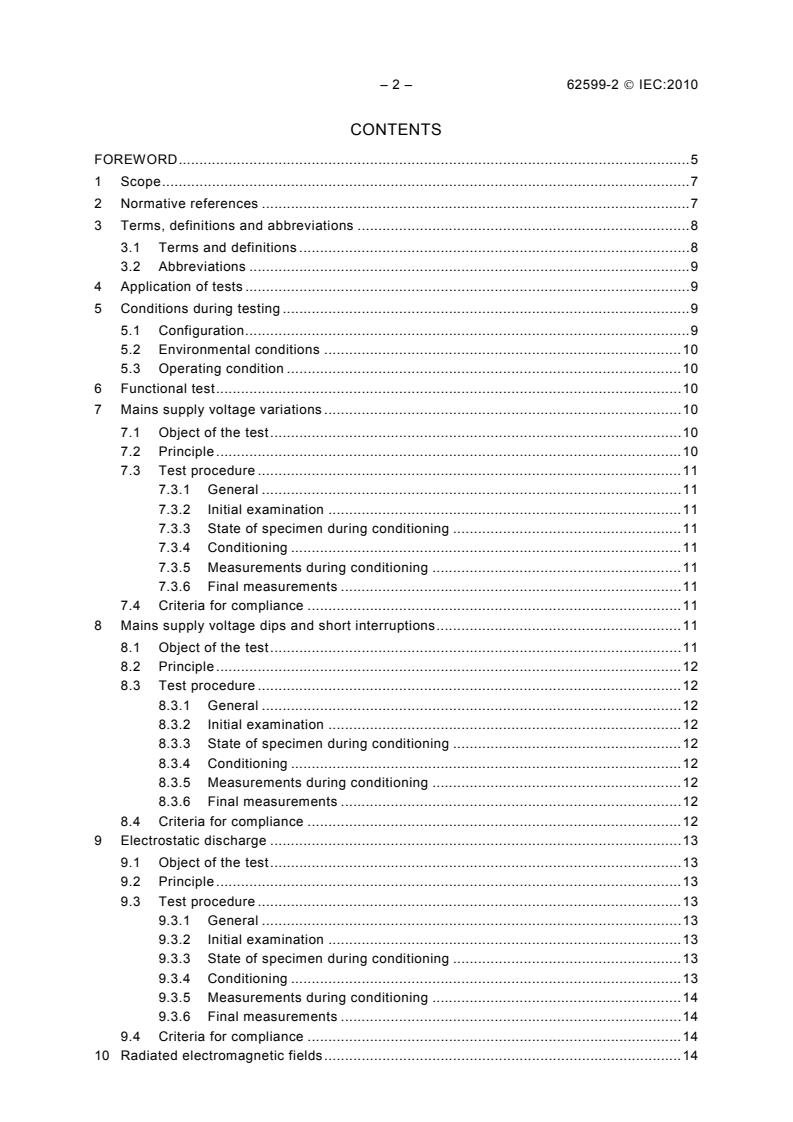
CONTENTS
FOREWORD.5
1 Scope.7
2 Normative references .7
3 Terms, definitions and abbreviations .8
3.1 Terms and definitions .8
3.2 Abbreviations .9
4 Application of tests .9
5 Conditions during testing .9
5.1 Configuration.9
5.2 Environmental conditions .10
5.3 Operating condition .10
6 Functional test.10
7 Mains supply voltage variations .10
7.1 Object of the test.10
7.2 Principle.10
7.3 Test procedure .11
7.3.1 General .11
7.3.2 Initial examination .11
7.3.3 State of specimen during conditioning .11
7.3.4 Conditioning .11
7.3.5 Measurements during conditioning .11
7.3.6 Final measurements .11
7.4 Criteria for compliance .11
8 Mains supply voltage dips and short interruptions.11
8.1 Object of the test.11
8.2 Principle.12
8.3 Test procedure .12
8.3.1 General .12
8.3.2 Initial examination .12
8.3.3 State of specimen during conditioning .12
8.3.4 Conditioning .12
8.3.5 Measurements during conditioning .12
8.3.6 Final measurements .12
8.4 Criteria for compliance .12
9 Electrostatic discharge .13
9.1 Object of the test.13
9.2 Principle.13
9.3 Test procedure .13
9.3.1 General .13
9.3.2 Initial examination .13
9.3.3 State of specimen during conditioning .13
9.3.4 Conditioning .13
9.3.5 Measurements during conditioning .14
9.3.6 Final measurements .14
9.4 Criteria for compliance .14
10 Radiated electromagnetic fields.14
62599-2 © IEC:2010 – 3 –
10.1 Object of the test.14
10.2 Principle.14
10.3 Test procedure .14
10.3.1 General .14
10.3.2 Initial examination .15
10.3.3 State of specimen during conditioning .15
10.3.4 Conditioning .15
10.3.5 Measurements during conditioning .16
10.3.6 Final measurements .16
10.4 Criteria for compliance .16
11 Conducted disturbances induced by electromagnetic fields .17
11.1 Object of the test.17
11.2 Principle.17
11.3 Test procedure .17
11.3.1 General .17
11.3.2 Initial examination .18
11.3.3 State of specimen during conditioning .18
11.3.4 Conditioning .18
11.3.5 Measurements during conditioning .18
11.3.6 Final measurements .18
11.4 Criteria for compliance .19
12 Fast transient bursts.19
12.1 Object of the test.19
12.2 Principle.19
12.3 Test procedure .19
12.3.1 General .19
12.3.2 Initial examination .19
12.3.3 State of specimen during conditioning .19
12.3.4 Conditioning .19
12.3.5 Measurements during conditioning .20
12.3.6 Final measurements .20
12.4 Criteria for compliance .20
13 Slow high energy voltage surge.20
13.1 Object of the test.20
13.2 Principle.20
13.3 Test procedure .21
13.3.1 General .21
13.3.2 Initial examination .22
13.3.3 State of specimen during conditioning .22
13.3.4 Conditioning .22
13.3.5 Measurements during conditioning .23
13.3.6 Final measurements .23
13.4 Criteria for compliance .23
Figure 1 – Example of relative orientations of the EUT and the field vectors .15
Figure 2 – Forms of the modulation types relative to the continuous wave .16
Figure 3 – Typical arrangement for coupling onto screened signal lines.22
– 4 – 62599-2 © IEC:2010
Table 1 .11
Table 2 .12
Table 3 .13
Table 4 .16
Table 5 .18
Table 6 .20
Table 7 .22
62599-2 © IEC:2010 – 5 –
INTERNATIONAL ELECTROTECHNICAL COMMISSION
____________
ALARM SYSTEMS –
Part 2: Electromagnetic compatibility –
Immunity requirements for components of fire
and security alarm systems
FOREWORD
1) The International Electrotechnical Commission (IEC) is a worldwide organization for standardization comprising
all national electrotechnical committees (IEC National Committees). The object of IEC is to promote
international co-operation on all questions concerning standardization in the electrical and electronic fields. To
this end and in addition to other activities, IEC publishes International Standards, Technical Specifications,
Technical Reports, Publicly Available Specifications (PAS) and Guides (hereafter referred to as “IEC
Publication(s)”). Their preparation is entrusted to technical committees; any IEC National Committee interested
in the subject dealt with may participate in this preparatory work. International, governmental and non-
governmental organizations liaising with the IEC also participate in this preparation. IEC collaborates closely
with the International Organization for Standardization (ISO) in accordance with conditions determined by
agreement between the two organizations.
2) The formal decisions or agreements of IEC on technical matters express, as nearly as possible, an international
consensus of opinion on the relevant subjects since each technical committee has representation from all
interested IEC National Committees.
3) IEC Publications have the form of recommendations for international use and are accepted by IEC National
Committees in that sense. While all reasonable efforts are made to ensure that the technical content of IEC
Publications is accurate, IEC cannot be held responsible for the way in which they are used or for any
misinterpretation by any end user.
4) In order to promote international uniformity, IEC National Committees undertake to apply IEC Publications
transparently to the maximum extent possible in their national and regional publications. Any divergence
between any IEC Publication and the corresponding national or regional publication shall be clearly indicated in
the latter.
5) IEC itself does not provide any attestation of conformity. Independent certification bodies provide conformity
assessment services and, in some areas, access to IEC marks of conformity. IEC is not responsible for any
services carried out by independent certification bodies.
6) All users should ensure that they have the latest edition of this publication.
7) No liability shall attach to IEC or its directors, employees, servants or agents including individual experts and
members of its technical committees and IEC National Committees for any personal injury, property damage or
other damage of any nature whatsoever, whether direct or indirect, or for costs (including legal fees) and
expenses arising out of the publication, use of, or reliance upon, this IEC Publication or any other IEC
Publications.
8) Attention is drawn to the Normative references cited in this publication. Use of the referenced publications is
indispensable for the correct application of this publication.
9) Attention is drawn to the possibility that some of the elements of this IEC Publication may be the subject of
patent rights. IEC shall not be held responsible for identifying any or all such patent rights.
International Standard IEC 62599-2 has been prepared by IEC technical committee 79: Alarm
and electronic security systems.
This standard is based on EN 50130-4 (1995) and its amendments 1 (1998) and 2 (2003), and
integrates the most recent ACEC recommendations .
___________
ACEC: Advisory Committee on Electromagnetic Compatibility is an IEC committee.
– 6 – 62599-2 © IEC:2010
The text of this standard is based on the following documents:
FDIS Report on voting
79/277/FDIS 79/293/RVD
Full information on the voting for the approval of this standard can be found in the report on
voting indicated in the above table.
This publication has been drafted in accordance with the ISO/IEC Directives, Part 2.
A list of all parts in the IEC 62599 series, under the general title Alarm systems, can be found
on the IEC website.
The committee has decided that the contents of this publication will remain unchanged until
the stability date indicated on the IEC web site under "http://webstore.iec.ch" in the data
related to the specific publication. At this date, the publication will be
• reconfirmed,
• withdrawn,
• replaced by a revised edition, or
• amended.
62599-2 © IEC:2010 – 7 –
ALARM SYSTEMS –
Part 2: Electromagnetic compatibility –
Immunity requirements for components of fire
and security alarm systems
1 Scope
This part of IEC 62599 for immunity requirements applies to the components of the following
alarm systems, intended for use in and around buildings in residential, commercial, light
industrial and industrial environments:
– access control systems, for security applications;
– alarm transmission systems ;
– CCTV systems, for security applications;
– fire detection and fire alarm systems;
– intruder and hold-up alarm systems;
– social alarm systems.
The tests and severities that should be used are the same for indoor and outdoor applications
of fixed, movable and portable equipment.
The levels do not cover extreme cases, which may occur in any location, but with an
extremely low probability of occurrence, or in special locations close to powerful emitters (e.g.
radar transmitters).
Equipment within the scope of this standard should be designed in order to operate
satisfactorily in the environmental electromagnetic conditions of residential, commercial, light
industrial and industrial environments. This implies particularly that it should be able to
operate correctly within the conditions fixed by the electromagnetic compatibility levels for the
various disturbances on the low voltage public supply system as defined by IEC 61000-2-2.
The immunity tests in this standard only concern the most critical disturbance phenomena.
For equipment using radio signalling, mains signalling or with connections to the public
telephone system, additional requirements, from other standards specific to these signalling
media, may apply.
This standard does not specify basic safety requirements, such as protection against
electrical shocks, unsafe operation, insulation coordination and related dielectric tests.
This standard does not cover EMC emission requirements. These are covered by other
appropriate standards.
2 Normative references
The following referenced documents are indispensable for the application of this document.
For dated references, only the edition cited applies. For undated references, the latest edition
of the referenced document (including any amendments) applies.
___________
Apart from equipment which is part of a public telecommunication network.
– 8 – 62599-2 © IEC:2010
IEC 60068-1:1988, Environmental testing – Part 1: General and guidance
Amendment 1 (1992)
IEC 61000-2-2:2002, Electromagnetic compatibility (EMC) – Part 2-2: Environment –
Compatibility levels for low-frequency conducted disturbances and signalling in public low-
voltage power supply systems
IEC 61000-4-2:2008, Electromagnetic compatibility (EMC) – Part 4-2: Testing and
measurement techniques – Electrostatic discharge immunity test
IEC 61000-4-3:2006, Electromagnetic compatibility (EMC) – Part 4-3: Testing and
measurement techniques – Radiated, radio-frequency, electromagnetic field immunity test
IEC 61000-4-4:2004, Electromagnetic compatibility (EMC) – Part 4-4: Testing and
measurement techniques – Electrical fast transient/burst immunity test
IEC 61000-4-5:2005, Electromagnetic compatibility (EMC) – Part 4-5: Testing and
measurement techniques – Surge immunity test
IEC 61000-4-6:2008, Electromagnetic compatibility (EMC) – Part 4-6: Testing and
measurement techniques – Immunity to conducted disturbances, induced by radio-frequency
fields
IEC 61000-4-11:2004, Electromagnetic compatibility (EMC) – Part 4-11: Testing and
measurement techniques – Voltage dips, short interruptions and voltage variations immunity
tests
ETSI EN 301 489 (all parts), Electromagnetic compatibility and radio spectrum matters (ERM)
– Electromagnetic compatibility (EMC) standard for radio equipment and services
ETSI EN 300 339, Electromagnetic compatibility and radio spectrum matters (ERM) – General
Electromagnetic compatibility (EMC) for radio communications equipment
3 Terms, definitions and abbreviations
For the purposes of this document, the following terms, definitions and abbreviations apply.
3.1 Terms and definitions
3.1.1
regional product performance standard
regional standard which specifies the product performance requirements
NOTE Such a standard may include EMC requirements but is not limited to EMC requirements. (e.g. series for fire
alarm systems, series for intruder alarm systems).
3.1.2
basic EMC standard
standards giving the description of, and test and measurement methods for an EMC
phenomenon, along with details of the test apparatus and test set-up
NOTE Although a basic EMC standard may give guidance on the choice of severity, it does not give the
prescribed limits or criteria for compliance.
3.1.3
intruder alarm system
alarm system to detect and indicate the presence, entry or attempted entry of an intruder into
supervised premises
62599-2 © IEC:2010 – 9 –
3.1.4
fire detection and fire alarm system
alarm system to detect the presence of fire in supervised premises and to raise the
appropriate alarm
3.1.5
hold-up alarm system
alarm system designed to permit the deliberate creation of an alarm condition in the case of a
hold-up
3.1.6
social alarm system
alarm system, providing facilities to summon assistance, for use by persons, who can be
considered to be living at risk.
3.2 Abbreviations
EUT : equipment under test
EMC : electromagnetic compatibility
CDN : coupling and decoupling network
CW : continuous wave (carrier wave)
4 Application of tests
The tests shall be carried out as single tests, as described in the following clauses of this
standard, and the equipment shall meet the criteria for compliance for each test. If a number
of tests are made on a single specimen of the equipment, the sequence of testing is optional
and it is permissible to substitute the intermediate functional tests with a reduced version of
the functional test and to conduct a full functional test at the end of the sequence. However, it
should be noted that, in this case, in the event of a failure, it may not be possible to identify
which test exposure caused the failure.
Where appropriate basic EMC standards exist, these are referred to in the relevant clauses.
The content of these basic EMC standards (i.e. the description of the test procedure, test
apparatus and test set-up) are not repeated here in full. However, modifications or additional
information needed for the particular application of the tests are given in this standard.
It may be determined, from consideration of the electrical characteristics and usage of
particular equipment, that some of the tests are inappropriate and therefore unnecessary. In
such a case, it is required that the decision not to conduct the test be recorded in the report,
along with the justification for this decision.
5 Conditions during testing
5.1 Configuration
If the EUT is part of a system, or can be connected to other equipment, then it shall be tested
while connected in at least the minimum configuration necessary for verifying its performance.
If the EUT has a large number of inputs/outputs, then a sufficient number shall be selected to
simulate actual operating conditions and to ensure that all the different types of inputs/outputs
are covered. The connections to inputs and outputs, which may be separated into different
cables in a real installation, shall be separated into different cables for the tests (e.g. detector
loops).
– 10 – 62599-2 © IEC:2010
During conditioning, the EUT shall be monitored to detect any change in its status, including
any change in outputs, which could be interpreted by associated equipment as a change in
status.
5.2 Environmental conditions
Unless otherwise indicated in the basic standard or test procedure, the tests shall be carried
out within the rated supply voltage for the EUT and the following standard atmospheric
conditions for measurements and tests, as specified in 5.3.1 of IEC 60068-1:1988.
– temperature: 15 °C to 35 °C;
– relative humidity: 25 % to 75 %;
– air pressure: 86 kPa to 106 kPa.
5.3 Operating condition
Where a relevant regional product performance standard exists which defines suitable
operating condition(s) during environmental or EMC tests (e.g. series for fire alarm systems,
series for intruder alarm systems), the operating condition(s) of the EUT during the test
conditions shall be as defined in that standard.
Where no relevant regional product performance standard exists, the operating condition(s) of
the EUT during the test conditioning shall include at least that corresponding to the main
functional mode (appropriate to the test being undertaken) of the system of which it forms part
(e.g. corresponding to the "set" mode, for an intruder alarm system during a radiated immunity
test).
NOTE The configuration and mode(s) of operation during the tests should be precisely noted in the test report.
6 Functional test
The variety and diversity of the equipment within the scope of this standard makes it difficult
to define a precise functional test for evaluation of the EUT performance:
– where a relevant regional product performance standard exists which defines a suitable
functional test for assessing the performance of the EUT before and after environmental or
EMC tests (e.g. series for fire alarm systems, series for intruder alarm systems), the
functional test to be applied and its acceptance criteria shall be as defined in that
standard;
– where a relevant regional product performance standard does not exist, the functional test
shall be at least a test or measurement of the main function(s) of the equipment. The
acceptance criteria for this functional test shall be that there is no change in the
functioning of the equipment and no significant change in any measurement (e.g.
sensitivity of a detector), which shall also remain within specification.
7 Mains supply voltage variations
7.1 Object of the test
To demonstrate the ability of the equipment to function correctly over the anticipated range of
mains supply voltage conditions.
7.2 Principle
The test consists of exposing the specimen to each of the maximum and minimum power
supply conditions for a sufficient time to obtain temperature stability and to perform the
functional test.
62599-2 © IEC:2010 – 11 –
7.3 Test procedure
7.3.1 General
No reference can be made to an internationally accepted standard at present.
7.3.2 Initial examination
Before conditioning, subject the specimen to the functional test (see Clause 6).
7.3.3 State of specimen during conditioning
Connect the specimen to suitable power supply, monitoring and loading equipment (see 5.1).
The specimen shall be in its operating condition (see 5.3).
7.3.4 Conditioning
Subject the specimen to each of the power supply conditions, indicated in Table 1, until
temperature stability is reached.
Table 1
a
Supply voltage max (U ) U + 10 %
max nom
a
Supply voltage min (U ) U – 15 %
min nom
a
U = Nominal mains voltage. Where provision is made to adapt the equipment to suit a number of
nom
nominal supply voltages (e.g. by transformer tap changing), the above conditioning severity shall be applied
for each nominal voltage, with the equipment suitably adapted. For equipment which is claimed to be suitable
for a range of nominal mains voltages (e.g. 220/240 V) without adaptation, U = (maximum U ) + 10 %, and
max nom
U = (minimum U ) – 15 %. In any case the range of U shall include the regional nominal mains voltage,
min nom nom
e.g. 230 V for Europe.
7.3.5 Measurements during conditioning
Monitor the specimen during conditioning to detect any change in status. When temperature
stability has been obtained, at each of the supply conditions, subject the specimen to the
functional test (see Clause 6).
7.3.6 Final measurements
After conditioning, for both of the specified power supply conditions inspect the specimen
visually for mechanical damage.
7.4 Criteria for compliance
There shall be no damage, malfunction or change of status due to the different supply voltage
conditions.
During conditioning, the EUT shall meet the acceptance criteria for the functional test (see
Clause 6).
8 Mains supply voltage dips and short interruptions
8.1 Object of the test
To demonstrate the immunity of the equipment to short duration dips (reductions) and
interruptions in the a.c. mains voltage, such as those caused by load switching and operation
of protection devices on the mains distribution network.
– 12 – 62599-2 © IEC:2010
8.2 Principle
The test consists of applying short duration dips and interruptions to the a.c. mains supply to
the equipment.
8.3 Test procedure
8.3.1 General
The test apparatus and procedure shall be as described in IEC 61000-4-11.
8.3.2 Initial examination
Before conditioning, subject the specimen to the functional test (see Clause 6).
8.3.3 State of specimen during conditioning
Connect the specimen to a suitable power supply, monitoring and loading equipment (see
5.1). The specimen shall be in its operating condition (see 5.3).
8.3.4 Conditioning
Reduce the a.c. mains supply voltage from the nominal value by the following reductions for
the specified periods in accordance with Table 2. The voltage changes shall occur at the zero
crossings of the voltage wave.
Table 2
Voltage reduction % 20 30 60 100
Duration of reduction (no. of periods) 0,5; 1;
a a a
250/300 25/30 10/12
a
(i.e. cycles of the voltage wave) 250/300
Number of reductions at each duration 3 3 3 3
Interval between reductions s
≥ 10 ≥ 10 ≥ 10 ≥ 10
a
The lower number is for 50 Hz testing and the higher number for 60 Hz testing.
8.3.5 Measurements during conditioning
Monitor the specimen during the conditioning period to detect any change in status.
8.3.6 Final measurements
After conditioning, subject the specimen to the functional test (see Clause 6), and inspect it
visually for mechanical damage.
8.4 Criteria for compliance
There shall be no damage, malfunction or change of status due to the conditioning. Flickering
of an indicator during conditioning is permissible, providing that there is no residual change in
the EUT or any change in outputs, which could be interpreted by associated equipment as a
change.
After conditioning, the EUT shall meet the acceptance criteria for the functional test (see
Clause 6).
62599-2 © IEC:2010 – 13 –
9 Electrostatic discharge
9.1 Object of the test
To demonstrate the immunity of equipment to electrostatic discharges caused by personnel,
who may have become electrostatically charged, touching the equipment or other equipment
nearby.
9.2 Principle
The test consists of the application of electrostatic discharges onto parts of the equipment
accessible to the operator and onto coupling planes 0,1 m from the equipment. The
discharges are generated by apparatus intended to simulate the capacity and discharge
resistance of a human body.
9.3 Test procedure
9.3.1 General
The test apparatus and procedure shall be as described in IEC 61000-4-2. The test procedure
for type tests performed in laboratories shall be used. For wall and ceiling mounted
equipment, follow the procedure for floor standing equipment, but with the equipment
arranged with its normal mounting surface 0,1 m from the earth reference plane.
Contact discharges shall be applied to conductive surfaces and the coupling plane(s) and air
discharges shall be applied to insulating surfaces. Ten direct discharges shall be applied, at
each test voltage to each preselected point, on any part of the specimen, which is normally
accessible when in the installed condition or is accessible to the normal operator. Ten indirect
discharges shall be applied via the appropriate coupling plane(s).
Unless stated otherwise in a product related standard, surfaces only accessible during
infrequent service by the end user or a service engineer (e.g. battery terminals) may be
excluded, providing there is an appropriate ESD hazard symbol or warning associated with
these surfaces and appropriate ESD mitigation procedures are given in the operating
instructions.
9.3.2 Initial examination
Before conditioning, subject the specimen to the functional test (see Clause 6).
9.3.3 State of specimen during conditioning
Connect the specimen to suitable power supply, monitoring and loading equipment (see 5.1).
The specimen shall be in its operating condition (see 5.3).
9.3.4 Conditioning
Apply the severity of conditioning indicated in Table 3:
Table 3
a
Test voltages: Air discharges (kV) 2, 4 and 8
Contact discharges (kV) 6
Polarity + and –
Number of discharges per point for each voltage and polarity 10
Interval between discharges (s) ≥ 1
a
The test voltages specified are the open-circuit voltages. Where the test voltages for the lower severity
levels are included, they shall also be satisfied.
– 14 – 62599-2 © IEC:2010
9.3.5 Measurements during conditioning
Monitor the specimen during the conditioning period to detect any change in status.
9.3.6 Final measurements
After conditioning, subject the specimen to the functional test (see Clause 6), and inspect it
visually for mechanical damage.
9.4 Criteria for compliance
There shall be no damage, malfunction or change of status due to the conditioning. Flickering
of an indicator during the application of the discharges is permissible, providing that there is
no residual change in the EUT or any change in outputs, which could be interpreted by
associated equipment as a change.
After conditioning, the EUT shall meet the acceptance criteria for the functional test (see
Clause 6).
10 Radiated electromagnetic fields
10.1 Object of the test
To demonstrate the immunity of equipment to electromagnetic fields (e.g. such as produced
by portable radio transceivers, radio telephones etc.).
10.2 Principle
The test consists of exposing the equipment to electromagnetic radiation swept between
80 MHz and 2,7 GHz. The equipment is exposed to both sinusoidal amplitude modulated and
pulse modulated (switched CW) signals. The pulse modulated exposure has been added as it
has been found by experience that some components of alarm systems are particularly
susceptible to pulsed or switched signals.
10.3 Test procedure
10.3.1 General
The test apparatus and procedure shall be as described in IEC 61000-4-3, with the following
modifications and clarifications taken into account.
The electromagnetic fields can be generated by the use of antennas in anechoic or semi-
anechoic chambers or by other means (e.g. TEM or GTEM cells), providing fields with the
required uniformity and repeatability can be generated in a large enough test area for the
EUT. The conditions (e.g. power levels) required to generate the required CW field strength,
in the position to be occupied by the EUT (test area), shall be established, throughout the
frequency range (80 MHz to 2,7 GHz), before the test. The EUT shall then be installed in the
test area and the frequency range shall be swept using these conditions, with the required
modulation applied, to subject the EUT to the severity of conditioning specified in 10.3.4.
Where the frequency range is swept incrementally, the step size shall not exceed 1 % of the
fundamental frequency (i.e. the frequency of the previous step). The choice of sweep rate
shall allow time for the EUT to respond, taking account of any delay, integration or processing
times. During the sweeps with sinusoidal amplitude modulation, the frequency shall not
change by more than 1 % of the fundamental frequency in the time required for the EUT to
respond or 3 s, whichever is the greater. During the sweeps with pulse modulation, the
frequency shall not change by more than 1 % of the fundamental frequency in the time
required to switch the continuous wave ON and OFF at least 3 times, at the required rate
(see 10.3.4).
62599-2 © IEC:2010 – 15 –
For EUTs with particularly long response times, it may be impractical to sweep at the rate
described above due to time constraints. In such cases, it may be possible to increase the
required sweep rate to a practical value by applying one or more of the following:
– by modifying the operation of the EUT to reduce its overall response time (e.g. by
implementation of special test modes or software that reduce delays or sampling periods
but maintain the main functionality of the EUT);
– by monitoring EUT parameters, which may reveal malfunctions before the EUT exhibits
them to the user/interface;
– by comparing infrequent functions with frequent functions which have similar operation.
In some cases, it may not be possible to detect all possible malfunctions within an acceptable
time frame. In such cases, the likelihood and consequences of the malfunctions should be
considered and the sweep rate should be agreed by the manufacturer and/or test/certification
organization.
The EUT shall be subjected to the conditioning in three orientations relative to the field, such
that the electric E and magnetic H components of the field are applied in each of three
orthogonal axes of the EUT (e.g. see Figure 1).
E H
P
P
E H
P E
H
IEC 1000/10
Key
E electric field vector
H magnetic field vector
P propagation vector
Figure 1 – Example of relative orientations of the EUT and the field vectors
10.3.2 Initial examination
Before conditioning, subject the specimen to the functional test (see Clause 6).
10.3.3 State of specimen during conditioning
Connect the specimen to suitable power supply, monitoring and loading equipment (see
5.1).he specimen shall be in its operating condition (see 5.3).
10.3.4
...