

IEC 62676-2-31:2019
(Main)Video surveillance systems for use in security applications - Part 2-31: Live streaming and control based on web services
General Information
- Abstract
IEC 62676-2-31:2019 defines procedures for communication between network video clients and video transmitter devices. This new set of specifications makes it possible to build network video systems with devices and receivers from different manufacturers using common and well-defined interfaces.
These interfaces cover functions such as media and imaging configuration, real-time streaming of audio and video, pan, tilt and zoom (PTZ) control as well as analytics.
The management and control interfaces defined in this document are described as web services. Annex F contains XML schema and Web Service Description Language (WSDL) definitions for the introduced network services.
This first edition, together with IEC 60839-11-31 and IEC 62676-2-32, cancels and replaces IEC 62676-2-3:2013. This edition includes the following significant technical changes with respect to IEC 62676-2-3:2013:
a) addition of the Media2 service;
b) additional methods for the imaging service;
c) method duplicates from the device IO service have been removed;
d) both the display and analytics device service are no more included.
- Status
- Published
- Publication Date
- 25-Jun-2019
- Technical Committee
- TC 79 - Alarm and electronic security systems
- Drafting Committee
- WG 12 - TC 79/WG 12
- Current Stage
- PPUB - Publication issued
- Start Date
- 26-Jun-2019
- Completion Date
- 28-Jun-2019
Overview
IEC 62676-2-31:2019 is an international standard developed by the International Electrotechnical Commission (IEC) that focuses on video surveillance systems used for security applications. This standard specifically addresses live streaming and control based on web services, defining procedures that enable communication between network video clients and video transmitter devices.
By providing well-defined, vendor-neutral interfaces, IEC 62676-2-31 facilitates interoperability and integration of network video systems composed of devices from different manufacturers. The standard covers key functionalities such as media and imaging configuration, real-time streaming of audio and video, pan-tilt-zoom (PTZ) control, and analytics.
The interfaces are based on widely adopted web services technology, with Annex F containing XML schema and WSDL (Web Service Description Language) definitions for these network services. This modern approach supports scalable, flexible, and extensible video surveillance systems that meet the demands of today’s security environments.
Key Topics
Device IO Service
Defines control and status interfaces related to video and audio inputs and outputs, supporting functions like querying and configuring video outputs and sources.Media Service
Covers creation and management of media profiles, configurations of video and audio sources/encoders, and real-time streaming. Includes support for unicast and multicast streaming, snapshot URI retrieval, and on-screen display (OSD) and privacy mask management.Imaging Service
Provides mechanisms to configure imaging parameters to improve picture quality, including focus operations and preset management to optimize camera performance.PTZ Control
Enables precise control over camera pan, tilt, and zoom functions through standardized interfaces, essential for effective surveillance monitoring.Analytics Integration
Though analytics device services were excluded in this edition, the standard supports analytics configuration as part of media service, allowing integration with video analysis technologies.Web Services Interfaces
Ensures interoperability via standardized web service protocols making it possible for multi-vendor systems to communicate seamlessly, enhancing system flexibility and scalability.
Applications
IEC 62676-2-31:2019 is applicable to a wide range of security video surveillance solutions, particularly those requiring:
- Networked video streaming with multi-vendor compatibility
- Real-time controls for PTZ cameras in environments like city surveillance, transportation hubs, and commercial facilities
- Remote camera configuration and media streaming over IP networks
- Integration of video surveillance with enterprise security management systems
- Implementation of privacy controls through configurable masking and OSD
- Enhanced security monitoring solutions that leverage web services for flexible deployment
Organizations deploying IP-based video security infrastructures will find this standard crucial for designing interoperable and future-proof surveillance systems.
Related Standards
IEC 62676-2-31:2019 is part of the IEC 62676 series, which deals comprehensively with video surveillance systems used in security contexts. It replaces and updates IEC 62676-2-3:2013 and works in conjunction with other related standards, including:
- IEC 60839-11-31: Security Systems - Electronic Access Control Systems
- IEC 62676-2-32: Video Surveillance Systems - Video Analytics
- Other parts of IEC 62676 series that define video system architecture, data exchange, and quality requirements
Adherence to this standard alongside companion standards ensures robust, interoperable, and scalable implementations of video security systems that comply with international best practices.
Keywords: IEC 62676-2-31, video surveillance standards, live streaming, web services, network video systems, PTZ control, media configuration, video security interoperability, IP video surveillance, security system standards.
Relations
- Effective Date
- 05-Sep-2023
Get Certified
Connect with accredited certification bodies for this standard

CIS Institut d.o.o.
Personal Protective Equipment (PPE) certification body. Notified Body NB-2890 for EU Regulation 2016/425 PPE.

Kiwa BDA Testing
Building and construction product certification.
Kmetijski inštitut Slovenije
Agricultural Institute of Slovenia. Soil testing, plant health, agricultural product analysis.
Sponsored listings
Frequently Asked Questions
IEC 62676-2-31:2019 is a standard published by the International Electrotechnical Commission (IEC). Its full title is "Video surveillance systems for use in security applications - Part 2-31: Live streaming and control based on web services". This standard covers: IEC 62676-2-31:2019 defines procedures for communication between network video clients and video transmitter devices. This new set of specifications makes it possible to build network video systems with devices and receivers from different manufacturers using common and well-defined interfaces. These interfaces cover functions such as media and imaging configuration, real-time streaming of audio and video, pan, tilt and zoom (PTZ) control as well as analytics. The management and control interfaces defined in this document are described as web services. Annex F contains XML schema and Web Service Description Language (WSDL) definitions for the introduced network services. This first edition, together with IEC 60839-11-31 and IEC 62676-2-32, cancels and replaces IEC 62676-2-3:2013. This edition includes the following significant technical changes with respect to IEC 62676-2-3:2013: a) addition of the Media2 service; b) additional methods for the imaging service; c) method duplicates from the device IO service have been removed; d) both the display and analytics device service are no more included.
IEC 62676-2-31:2019 defines procedures for communication between network video clients and video transmitter devices. This new set of specifications makes it possible to build network video systems with devices and receivers from different manufacturers using common and well-defined interfaces. These interfaces cover functions such as media and imaging configuration, real-time streaming of audio and video, pan, tilt and zoom (PTZ) control as well as analytics. The management and control interfaces defined in this document are described as web services. Annex F contains XML schema and Web Service Description Language (WSDL) definitions for the introduced network services. This first edition, together with IEC 60839-11-31 and IEC 62676-2-32, cancels and replaces IEC 62676-2-3:2013. This edition includes the following significant technical changes with respect to IEC 62676-2-3:2013: a) addition of the Media2 service; b) additional methods for the imaging service; c) method duplicates from the device IO service have been removed; d) both the display and analytics device service are no more included.
IEC 62676-2-31:2019 is classified under the following ICS (International Classification for Standards) categories: 13.320 - Alarm and warning systems. The ICS classification helps identify the subject area and facilitates finding related standards.
IEC 62676-2-31:2019 has the following relationships with other standards: It is inter standard links to IEC 62676-2-3:2013. Understanding these relationships helps ensure you are using the most current and applicable version of the standard.
IEC 62676-2-31:2019 is available in PDF format for immediate download after purchase. The document can be added to your cart and obtained through the secure checkout process. Digital delivery ensures instant access to the complete standard document.
Standards Content (Sample)
IEC 62676-2-31 ®
Edition 1.0 2019-06
INTERNATIONAL
STANDARD
NORME
INTERNATIONALE
colour
inside
Video surveillance systems for use in security applications –
Part 2-31: Live streaming and control based on web services
Systèmes de vidéosurveillance destinés à être utilisés dans les applications de
sécurité –
Partie 2-31: Transmission en continu en direct et contrôle basé sur les services
web
All rights reserved. Unless otherwise specified, no part of this publication may be reproduced or utilized in any form
or by any means, electronic or mechanical, including photocopying and microfilm, without permission in writing from
either IEC or IEC's member National Committee in the country of the requester. If you have any questions about IEC
copyright or have an enquiry about obtaining additional rights to this publication, please contact the address below or
your local IEC member National Committee for further information.
Droits de reproduction réservés. Sauf indication contraire, aucune partie de cette publication ne peut être reproduite
ni utilisée sous quelque forme que ce soit et par aucun procédé, électronique ou mécanique, y compris la photocopie
et les microfilms, sans l'accord écrit de l'IEC ou du Comité national de l'IEC du pays du demandeur. Si vous avez des
questions sur le copyright de l'IEC ou si vous désirez obtenir des droits supplémentaires sur cette publication, utilisez
les coordonnées ci-après ou contactez le Comité national de l'IEC de votre pays de résidence.
IEC Central Office Tel.: +41 22 919 02 11
3, rue de Varembé info@iec.ch
CH-1211 Geneva 20 www.iec.ch
Switzerland
About the IEC
The International Electrotechnical Commission (IEC) is the leading global organization that prepares and publishes
International Standards for all electrical, electronic and related technologies.
About IEC publications
The technical content of IEC publications is kept under constant review by the IEC. Please make sure that you have the
latest edition, a corrigendum or an amendment might have been published.
IEC publications search - webstore.iec.ch/advsearchform Electropedia - www.electropedia.org
The advanced search enables to find IEC publications by a The world's leading online dictionary on electrotechnology,
variety of criteria (reference number, text, technical containing more than 22 000 terminological entries in English
committee,…). It also gives information on projects, replaced and French, with equivalent terms in 16 additional languages.
and withdrawn publications. Also known as the International Electrotechnical Vocabulary
(IEV) online.
IEC Just Published - webstore.iec.ch/justpublished
Stay up to date on all new IEC publications. Just Published IEC Glossary - std.iec.ch/glossary
details all new publications released. Available online and 67 000 electrotechnical terminology entries in English and
once a month by email. French extracted from the Terms and Definitions clause of
IEC publications issued since 2002. Some entries have been
IEC Customer Service Centre - webstore.iec.ch/csc collected from earlier publications of IEC TC 37, 77, 86 and
If you wish to give us your feedback on this publication or CISPR.
need further assistance, please contact the Customer Service
Centre: sales@iec.ch.
A propos de l'IEC
La Commission Electrotechnique Internationale (IEC) est la première organisation mondiale qui élabore et publie des
Normes internationales pour tout ce qui a trait à l'électricité, à l'électronique et aux technologies apparentées.
A propos des publications IEC
Le contenu technique des publications IEC est constamment revu. Veuillez vous assurer que vous possédez l’édition la
plus récente, un corrigendum ou amendement peut avoir été publié.
Recherche de publications IEC - Electropedia - www.electropedia.org
webstore.iec.ch/advsearchform Le premier dictionnaire d'électrotechnologie en ligne au
La recherche avancée permet de trouver des publications IEC monde, avec plus de 22 000 articles terminologiques en
en utilisant différents critères (numéro de référence, texte, anglais et en français, ainsi que les termes équivalents dans
comité d’études,…). Elle donne aussi des informations sur les 16 langues additionnelles. Egalement appelé Vocabulaire
projets et les publications remplacées ou retirées. Electrotechnique International (IEV) en ligne.
IEC Just Published - webstore.iec.ch/justpublished Glossaire IEC - std.iec.ch/glossary
Restez informé sur les nouvelles publications IEC. Just 67 000 entrées terminologiques électrotechniques, en anglais
Published détaille les nouvelles publications parues. et en français, extraites des articles Termes et Définitions des
Disponible en ligne et une fois par mois par email. publications IEC parues depuis 2002. Plus certaines entrées
antérieures extraites des publications des CE 37, 77, 86 et
Service Clients - webstore.iec.ch/csc CISPR de l'IEC.
Si vous désirez nous donner des commentaires sur cette
publication ou si vous avez des questions contactez-nous:
sales@iec.ch.
IEC 62676-2-31 ®
Edition 1.0 2019-06
INTERNATIONAL
STANDARD
NORME
INTERNATIONALE
colour
inside
Video surveillance systems for use in security applications –
Part 2-31: Live streaming and control based on web services
Systèmes de vidéosurveillance destinés à être utilisés dans les applications de
sécurité –
Partie 2-31: Transmission en continu en direct et contrôle basé sur les services
web
INTERNATIONAL
ELECTROTECHNICAL
COMMISSION
COMMISSION
ELECTROTECHNIQUE
INTERNATIONALE
ICS 13.320 ISBN 978-2-8322-7035-6
– 2 – IEC 62676-2-31:2019 IEC 2019
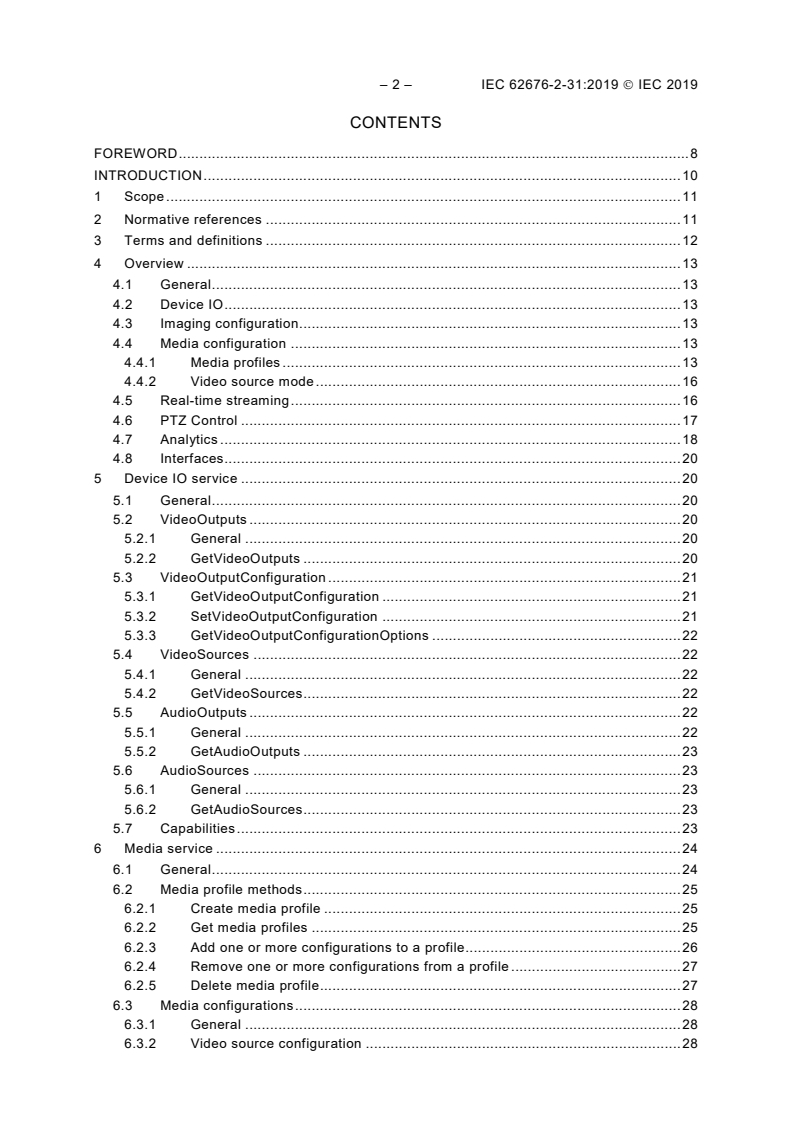
CONTENTS
FOREWORD . 8
INTRODUCTION . 10
1 Scope . 11
2 Normative references . 11
3 Terms and definitions . 12
4 Overview . 13
4.1 General . 13
4.2 Device IO . 13
4.3 Imaging configuration . 13
4.4 Media configuration . 13
4.4.1 Media profiles . 13
4.4.2 Video source mode . 16
4.5 Real-time streaming . 16
4.6 PTZ Control . 17
4.7 Analytics . 18
4.8 Interfaces . 20
5 Device IO service . 20
5.1 General . 20
5.2 VideoOutputs . 20
5.2.1 General . 20
5.2.2 GetVideoOutputs . 20
5.3 VideoOutputConfiguration . 21
5.3.1 GetVideoOutputConfiguration . 21
5.3.2 SetVideoOutputConfiguration . 21
5.3.3 GetVideoOutputConfigurationOptions . 22
5.4 VideoSources . 22
5.4.1 General . 22
5.4.2 GetVideoSources . 22
5.5 AudioOutputs . 22
5.5.1 General . 22
5.5.2 GetAudioOutputs . 23
5.6 AudioSources . 23
5.6.1 General . 23
5.6.2 GetAudioSources . 23
5.7 Capabilities . 23
6 Media service . 24
6.1 General . 24
6.2 Media profile methods . 25
6.2.1 Create media profile . 25
6.2.2 Get media profiles . 25
6.2.3 Add one or more configurations to a profile . 26
6.2.4 Remove one or more configurations from a profile . 27
6.2.5 Delete media profile . 27
6.3 Media configurations . 28
6.3.1 General . 28
6.3.2 Video source configuration . 28
6.3.3 Video encoder configuration . 29
6.3.4 Audio source configuration . 29
6.3.5 Audio encoder configuration . 29
6.3.6 PTZ Configuration . 29
6.3.7 Analytics configuration . 29
6.3.8 Metadata configuration . 30
6.3.9 Audio output configuration . 30
6.3.10 Audio decoder configuration . 31
6.4 Media Configuration Methods . 31
6.4.1 General . 31
6.4.2 Get configurations . 31
6.4.3 Modify a configuration . 32
6.4.4 Get configuration options . 32
6.4.5 GetVideoEncoderInstances. 33
6.5 GetStreamUri . 34
6.6 GetSnapshotUri . 35
6.7 Multicast . 35
6.7.1 General . 35
6.7.2 Start multicast streaming . 36
6.7.3 Stop multicast streaming . 36
6.8 SetSynchronizationPoint . 37
6.9 Video source mode . 37
6.9.1 General . 37
6.9.2 GetVideoSourceModes . 37
6.9.3 SetVideoSourceMode . 38
6.10 OSD (on-screen display) . 38
6.10.1 General . 38
6.10.2 CreateOSD . 39
6.10.3 DeleteOSD . 40
6.10.4 GetOSDs . 40
6.10.5 SetOSD . 41
6.10.6 GetOSDOptions . 41
6.11 Privacy masks . 42
6.11.1 General . 42
6.11.2 CreateMask . 43
6.11.3 DeleteMask . 43
6.11.4 GetMasks . 44
6.11.5 SetMask . 44
6.11.6 GetMaskOptions . 45
6.12 Capabilities . 45
6.13 Events . 46
6.13.1 ProfileChange . 46
6.13.2 ConfigurationChange . 46
6.13.3 ActiveConnections . 47
6.14 Deviations of media service version 1 . 47
6.14.1 General . 47
6.14.2 Profile management . 47
6.14.3 Configuration listing . 48
6.14.4 Privacy masks . 48
– 4 – IEC 62676-2-31:2019 IEC 2019
7 Imaging service . 48
7.1 General . 48
7.2 Imaging settings. 48
7.2.1 Parameters . 48
7.2.2 GetImagingSettings . 50
7.2.3 SetImagingSettings. 51
7.2.4 GetOptions . 51
7.3 Imaging Presets . 52
7.3.1 General . 52
7.3.2 GetPresets . 52
7.3.3 GetCurrentPreset . 52
7.3.4 SetCurrentPreset . 53
7.4 Focus operations . 54
7.4.1 Move . 54
7.4.2 GetMoveOptions . 54
7.4.3 Stop. 55
7.4.4 GetImagingStatus . 55
7.5 Capabilities . 56
8 PTZ service . 56
8.1 General . 56
8.2 PTZ node . 57
8.2.1 General . 57
8.2.2 GetNodes . 57
8.2.3 GetNode . 57
8.3 PTZ configuration . 58
8.3.1 General . 58
8.3.2 GetConfigurations . 59
8.3.3 GetConfiguration . 59
8.3.4 GetConfigurationOptions . 60
8.3.5 SetConfiguration . 60
8.3.6 GetCompatibleConfigurations . 61
8.4 Move operations . 61
8.4.1 General . 61
8.4.2 AbsoluteMove . 61
8.4.3 RelativeMove . 62
8.4.4 ContinuousMove . 63
8.4.5 GeoMove . 64
8.4.6 Stop. 66
8.4.7 GetStatus . 66
8.5 Preset operations . 67
8.5.1 General . 67
8.5.2 SetPreset . 67
8.5.3 GetPresets . 68
8.5.4 GotoPreset . 69
8.5.5 RemovePreset . 69
8.6 Home position operations . 70
8.6.1 General . 70
8.6.2 GotoHomePosition . 70
8.6.3 SetHomePosition . 71
8.7 Auxiliary operations . 71
8.7.1 General . 71
8.7.2 SendAuxiliaryCommand . 71
8.8 Predefined PTZ Spaces . 72
8.8.1 General . 72
8.8.2 Absolute position spaces . 72
8.8.3 Relative translation spaces . 77
8.8.4 Continuous velocity spaces . 78
8.8.5 Speed spaces . 79
8.9 Preset tour operations . 80
8.9.1 General . 80
8.9.2 GetPresetTours . 81
8.9.3 GetPresetTour . 81
8.9.4 GetPresetTourOptions . 82
8.9.5 CreatePresetTour . 82
8.9.6 ModifyPresetTour . 83
8.9.7 OperatePresetTour . 83
8.9.8 RemovePresetTour . 84
8.9.9 Preset tour parameters . 85
8.10 Pan/tilt control direction configuration . 86
8.11 Capabilities . 87
8.12 Events . 88
8.12.1 General . 88
8.12.2 PTZ presets . 88
8.12.3 PresetTours . 88
9 Analytics service. 89
9.1 General . 89
9.2 Scene description interface . 89
9.2.1 Overview . 89
9.2.2 Frame-related content . 89
9.2.3 Scene elements . 92
9.3 Rule interface . 99
9.3.1 General . 99
9.3.2 Rule representation . 100
9.3.3 Rule description language . 100
9.3.4 Operations on rules . 101
9.4 Analytics modules interface . 104
9.4.1 General . 104
9.4.2 Analytics module configuration . 105
9.4.3 Analytics module description language . 105
9.4.4 Operations on analytics modules . 105
9.5 GetAnalyticsModuleOptions . 108
9.6 Capabilities . 109
9.7 Events – Audio Detected . 109
10 Real-time streaming . 110
10.1 General . 110
10.2 Media stream protocol. 110
10.2.1 Transport format . 110
10.2.2 Media transport . 111
– 6 – IEC 62676-2-31:2019 IEC 2019
10.2.3 Synchronization points . 115
10.2.4 JPEG over RTP . 116
10.3 Media control protocol . 118
10.3.1 RTSP stream control . 118
10.3.2 Keep-alive method for RTSP session . 120
10.3.3 RTSP audio and video synchronization . 121
10.3.4 RTSP session for a metadata stream . 121
10.3.5 Multicast streaming . 122
10.3.6 RTSP message example . 122
10.3.7 RTSP over HTTP . 123
10.4 Back channel connection . 123
10.4.1 General . 123
10.4.2 RTSP Require tag . 123
10.4.3 Connection setup for a bi- directional connection . 124
10.4.4 Describe example for a server without backchannel support: . 124
10.4.5 Describe example for a server with ONVIF backchannel support: . 124
10.4.6 Multicast streaming . 126
10.5 Error handling . 126
Annex A (normative) Efficient XML Interchange (EXI) . 127
Annex B (normative) Lens description . 128
Annex C (informative) Specified rules . 130
C.1 General . 130
C.2 LineDetector . 130
C.3 FieldDetector . 130
C.4 LoiteringDetector . 131
C.5 Declarative motion detector . 132
C.6 Counting rule . 133
C.7 Query rule . 134
Annex D (informative) Cell motion detection . 135
D.1 Cell motion detector . 135
D.2 Cell motion analytics engine . 136
D.2.1 General . 136
D.2.2 Module configuration . 137
Annex E (normative) Motion detection . 139
Annex F (normative) Schema files . 141
F.1 Device IO . 141
F.2 Imaging . 156
F.3 Media. 162
F.4 Media 2 . 199
F.5 PTZ . 221
F.6 Analytics . 234
F.7 Common schema . 240
F.8 Streaming metadata schema . 279
Bibliography . 284
Figure 1 – A media profile . 14
Figure 2 – Complete profile configuration . 15
Figure 3 – Layer structure . 16
Figure 4 – Analytics architecture . 19
Figure 5 – Example with four OSD configurations . 39
Figure 6 – Example of screen with mask and coordinate system . 42
Figure 7 – Spherical pan/tilt position space in degrees for a camera mounted on the
ceiling . 74
Figure 8 – Example of changes of pan/tilt control direction by E-Flip and Reverse . 87
Figure 9 – Default frame coordinate system . 91
Figure 10 – RTP header . 111
Figure 11 – RTCP sequence . 114
Figure 12 – RTCP Sender Report . 115
Figure 13 – Media synchronization . 115
Figure 14 – RTP/JPEG packet structure . 116
Figure 15 – Stream control. 119
Figure 16 – Keep alive . 121
Figure B.1 – Optical mapping of angle (α) via radius (R) to normalized x/y coordinates . 128
Figure B.2 – Smooth mapping using B-splines . 128
Figure B.3 – Compensation of vertical axis offset . 129
Figure D.1 – CellLayout of an 8 × 6 CellMotionEngine . 138
Table 1 – Referenced namespaces (with prefix) . 20
Table 2 – Colourspace namespace values . 97
Table 3 – Description of attributes of MotionInCells type . 99
Table 4 – RTP header value . 112
Table 5 – RTSP methods . 120
Table A.1 – ONVIF defined EXI header settings . 127
Table A.2 – ONVIF defined EXI configuration settings . 127
Table C.1 – Loitering Detector rule configuration parameters . 132
Table C.2 – Description of loitering event fields . 132
Table C.3 – Declarative motion detector rule configuration parameters . 133
Table C.4 – Description of declarative motion event fields . 133
Table C.5 – Counting rule configuration parameters . 134
Table C.6 – Description of counting event fields. 134
Table C.7 – Query Rule configuration parameters . 134
Table D.1 – Cell motion detector rule configuration parameters . 136
Table D.2 – Description cell motion detected event fields. 136
Table D.3 – Module configuration parameters . 137
Table D.4 – Description of CellLayout fields . 137
Table E.1 – Motion Region Detector Rule configuration parameters . 139
Table E.2 – Motion region detector rule configuration options . 140
Table E.3 – Description of the motion region detector event fields . 140
– 8 – IEC 62676-2-31:2019 IEC 2019
INTERNATIONAL ELECTROTECHNICAL COMMISSION
____________
VIDEO SURVEILLANCE SYSTEMS FOR
USE IN SECURITY APPLICATIONS –
Part 2-31: Live streaming and control
based on web services
FOREWORD
1) The International Electrotechnical Commission (IEC) is a worldwide organization for standardization comprising
all national electrotechnical committees (IEC National Committees). The object of IEC is to promote
international co-operation on all questions concerning standardization in the electrical and electronic fields. To
this end and in addition to other activities, IEC publishes International Standards, Technical Specifications,
Technical Reports, Publicly Available Specifications (PAS) and Guides (hereafter referred to as "IEC
Publication(s)"). Their preparation is entrusted to technical committees; any IEC National Committee interested
in the subject dealt with may participate in this preparatory work. International, governmental and non-
governmental organizations liaising with the IEC also participate in this preparation. IEC collaborates closely
with the International Organization for Standardization (ISO) in accordance with conditions determined by
agreement between the two organizations.
2) The formal decisions or agreements of IEC on technical matters express, as nearly as possible, an international
consensus of opinion on the relevant subjects since each technical committee has representation from all
interested IEC National Committees.
3) IEC Publications have the form of recommendations for international use and are accepted by IEC National
Committees in that sense. While all reasonable efforts are made to ensure that the technical content of IEC
Publications is accurate, IEC cannot be held responsible for the way in which they are used or for any
misinterpretation by any end user.
4) In order to promote international uniformity, IEC National Committees undertake to apply IEC Publications
transparently to the maximum extent possible in their national and regional publications. Any divergence
between any IEC Publication and the corresponding national or regional publication shall be clearly indicated in
the latter.
5) IEC itself does not provide any attestation of conformity. Independent certification bodies provide conformity
assessment services and, in some areas, access to IEC marks of conformity. IEC is not responsible for any
services carried out by independent certification bodies.
6) All users should ensure that they have the latest edition of this publication.
7) No liability shall attach to IEC or its directors, employees, servants or agents including individual experts and
members of its technical committees and IEC National Committees for any personal injury, property damage or
other damage of any nature whatsoever, whether direct or indirect, or for costs (including legal fees) and
expenses arising out of the publication, use of, or reliance upon, this IEC Publication or any other IEC
Publications.
8) Attention is drawn to the Normative references cited in this publication. Use of the referenced publications is
indispensable for the correct application of this publication.
9) Attention is drawn to the possibility that some of the elements of this IEC Publication may be the subject of
patent rights. IEC shall not be held responsible for identifying any or all such patent rights.
International Standard IEC 62676-2-31 has been prepared by IEC technical committee 79:
Alarm and electronic security systems.
This first edition, together with IEC 60839-11-31 and IEC 62676-2-32, cancels and replaces
IEC 62676-2-3:2013.
This edition includes the following significant technical changes with respect to
IEC 62676-2-3:2013:
a) addition of the Media2 service;
b) additional methods for the imaging service;
c) method duplicates from the device IO service have been removed;
d) both the display and analytics device service are no more included.
This publication contains attached schema files. These files are intended to be used as a
complement and do not form an integral part of the standard
The text o
...