

IEC 62820-1-1:2026
(Main)Building intercom systems - Part 1-1: System requirements - General
General Information
- Abstract
IEC 62820-1-1:2026 specifies the technical requirements for building intercom systems and equipment used for building entry.
- Status
- Published
- Publication Date
- 29-Mar-2026
- Technical Committee
- TC 79 - Alarm and electronic security systems
- Drafting Committee
- WG 13 - TC 79/WG 13
- Current Stage
- PPUB - Publication issued
- Start Date
- 30-Mar-2026
- Completion Date
- 27-Mar-2026
Buy Documents
REDLINE IEC 62820-1-1:2026 RLV - Building intercom systems - Part 1-1: System requirements - General
iec62820-1-1{ed2.0}en - Building intercom systems - Part 1-1: System requirements - General
iec62820-1-1{ed2.0}fr - Systemes d'interphone de bâtiment - Partie 1-1: Exigences du systeme - Généralités
Overview
IEC 62820-1-1:2026 is the leading international standard specifying system requirements for building intercom systems and the associated equipment used for building entry. Developed by the International Electrotechnical Commission (IEC), this standard establishes essential technical specifications for the design, performance, and functional requirements of building intercom systems (BIS) in both residential and commercial environments. As part of the IEC 62820 series, it provides a foundation for ensuring reliable communication, safety, and access control at building entrances.
Key Topics
IEC 62820-1-1:2026 covers a range of core topics vital for manufacturers, system integrators, and facility managers involved in building intercom solutions:
- System Composition and Functions: Defines components such as visitor call units (VCU), user receiver units (URU), security management units (SMU), power supplies, auxiliary devices, and interfacing elements.
- Functional Requirements:
- Call initiation and signaling between visitors and occupants
- Secure two-way voice communication, either simultaneous or sequential
- Optional video integration for enhanced identification
- Controlled unlocking of entry points via electronic signals
- Operational status feedback and security alerts
- Performance Criteria:
- Audio quality (sound pressure level, clarity, background noise)
- Video performance (image resolution, color reproduction, responsiveness to lighting conditions)
- Environmental adaptability (functionality in varying temperatures, humidity, and physical environments)
- Safety and reliability (protection against electric shock, tampering, and vandalism)
- Electromagnetic compatibility (immunity and emission levels)
- Classification:
- Level 1: General entry systems with basic requirements primarily for user convenience
- Level 2: Enhanced requirements for security-oriented applications
- Testing and Compliance: Standardized test methods for verifying performance, environmental resilience, and marking requirements
Applications
IEC 62820-1-1:2026 is applicable to a variety of modern building types and security strategies, supporting global trends in smart buildings, access control, and visitor management:
- Residential Buildings: Ensures reliable and secure communication between residents and visitors, improving safety and convenience.
- Commercial and Office Complexes: Supports multi-tenant access and security management, including integration with concierge or security personnel stations.
- Mixed-Use Developments: Allows for differentiated access levels and centralized monitoring.
- Security Upgrades: Facilitates retrofitting of older buildings with modern intercom technology, promoting compliance with international safety standards.
- Integration with Other Security Systems: Outlines requirements for interfacing with alarms, video surveillance, and fire detection systems, supporting holistic building management solutions.
Related Standards
To ensure comprehensive compliance and interoperability, IEC 62820-1-1:2026 references or aligns with several key international standards:
- IEC 60529: Degrees of protection provided by enclosures (IP code)
- IEC 62262: Protection against mechanical impacts (IK code)
- IEC 61000-6-1/-6-3/-6-8: Electromagnetic compatibility requirements
- IEC 62368-1: Safety requirements for audio/video and communication technologies
- ISO 12233: Digital camera resolution and frequency response
- European Standard EN 50486 and Chinese Standard GB/T 31070.1, for regional harmonization
By following the system requirements outlined in IEC 62820-1-1:2026, stakeholders ensure that building intercom systems deliver consistent performance, enhanced safety, and robust access control, all while meeting international compliance and best practices in the field of building security and communication technology.
Relations
- Effective Date
- 05-Sep-2023
Buy Documents
REDLINE IEC 62820-1-1:2026 RLV - Building intercom systems - Part 1-1: System requirements - General
iec62820-1-1{ed2.0}en - Building intercom systems - Part 1-1: System requirements - General
iec62820-1-1{ed2.0}fr - Systemes d'interphone de bâtiment - Partie 1-1: Exigences du systeme - Généralités
Get Certified
Connect with accredited certification bodies for this standard

CIS Institut d.o.o.
Personal Protective Equipment (PPE) certification body. Notified Body NB-2890 for EU Regulation 2016/425 PPE.

Kiwa BDA Testing
Building and construction product certification.
Kmetijski inštitut Slovenije
Agricultural Institute of Slovenia. Soil testing, plant health, agricultural product analysis.
Sponsored listings
Frequently Asked Questions
IEC 62820-1-1:2026 is a standard published by the International Electrotechnical Commission (IEC). Its full title is "Building intercom systems - Part 1-1: System requirements - General". This standard covers: IEC 62820-1-1:2026 specifies the technical requirements for building intercom systems and equipment used for building entry.
IEC 62820-1-1:2026 specifies the technical requirements for building intercom systems and equipment used for building entry.
IEC 62820-1-1:2026 is classified under the following ICS (International Classification for Standards) categories: 13.320 - Alarm and warning systems. The ICS classification helps identify the subject area and facilitates finding related standards.
IEC 62820-1-1:2026 has the following relationships with other standards: It is inter standard links to IEC 62820-1-1:2016. Understanding these relationships helps ensure you are using the most current and applicable version of the standard.
IEC 62820-1-1:2026 is available in PDF format for immediate download after purchase. The document can be added to your cart and obtained through the secure checkout process. Digital delivery ensures instant access to the complete standard document.
Standards Content (Sample)
IEC 62820-1-1 ®
Edition 2.0 2026-03
INTERNATIONAL
STANDARD
REDLINE VERSION
Building intercom systems -
Part 1-1: System requirements - General
ICS 13.320 ISBN 978-2-8327-1183-5
All rights reserved. Unless otherwise specified, no part of this publication may be reproduced or utilized in any form or
by any means, electronic or mechanical, including photocopying and microfilm, without permission in writing from either
IEC or IEC's member National Committee in the country of the requester. If you have any questions about IEC copyright
or have an enquiry about obtaining additional rights to this publication, please contact the address below or your local
IEC member National Committee for further information.
IEC Secretariat Tel.: +41 22 919 02 11
3, rue de Varembé info@iec.ch
CH-1211 Geneva 20 www.iec.ch
Switzerland
About the IEC
The International Electrotechnical Commission (IEC) is the leading global organization that prepares and publishes
International Standards for all electrical, electronic and related technologies.
About IEC publications
The technical content of IEC publications is kept under constant review by the IEC. Please make sure that you have the
latest edition, a corrigendum or an amendment might have been published.
IEC publications search - IEC Products & Services Portal - products.iec.ch
webstore.iec.ch/advsearchform Discover our powerful search engine and read freely all the
The advanced search enables to find IEC publications by a publications previews, graphical symbols and the glossary.
variety of criteria (reference number, text, technical With a subscription you will always have access to up to date
committee, …). It also gives information on projects, content tailored to your needs.
replaced and withdrawn publications.
Electropedia - www.electropedia.org
The world's leading online dictionary on electrotechnology,
IEC Just Published - webstore.iec.ch/justpublished
Stay up to date on all new IEC publications. Just Published containing more than 22 500 terminological entries in English
details all new publications released. Available online and and French, with equivalent terms in 25 additional languages.
once a month by email. Also known as the International Electrotechnical Vocabulary
(IEV) online.
IEC Customer Service Centre - webstore.iec.ch/csc
If you wish to give us your feedback on this publication or
need further assistance, please contact the Customer
Service Centre: sales@iec.ch.
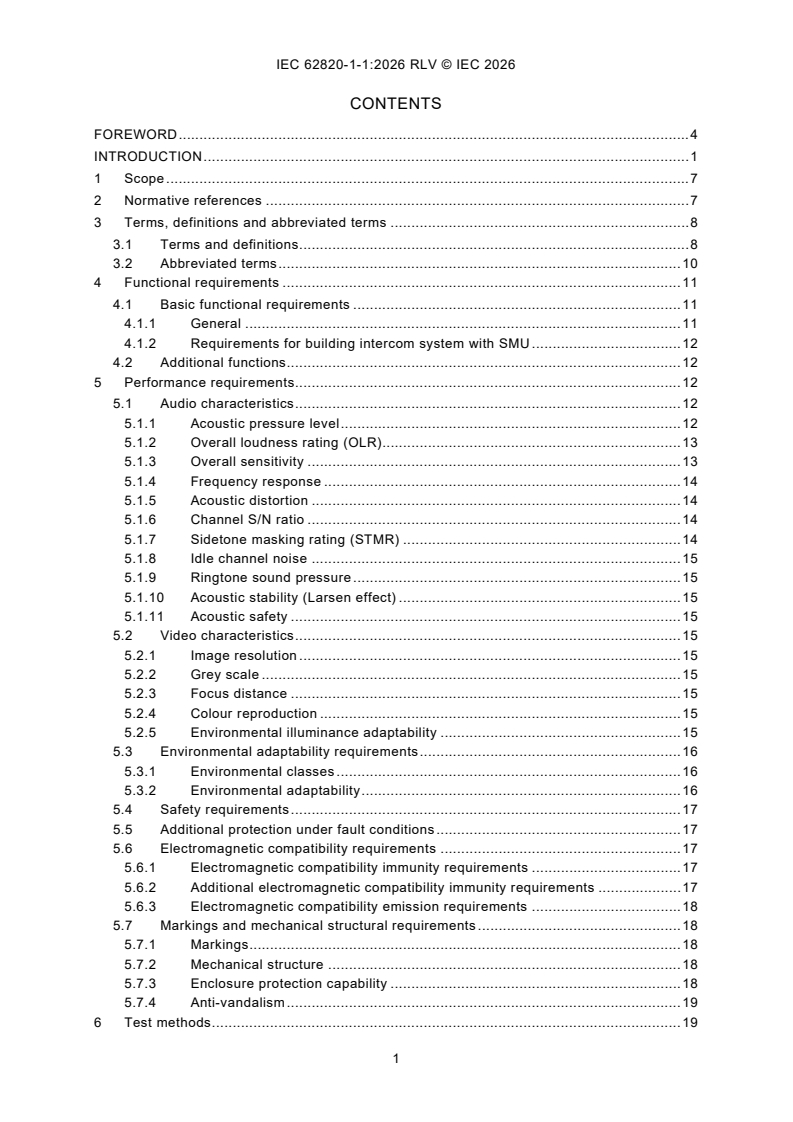
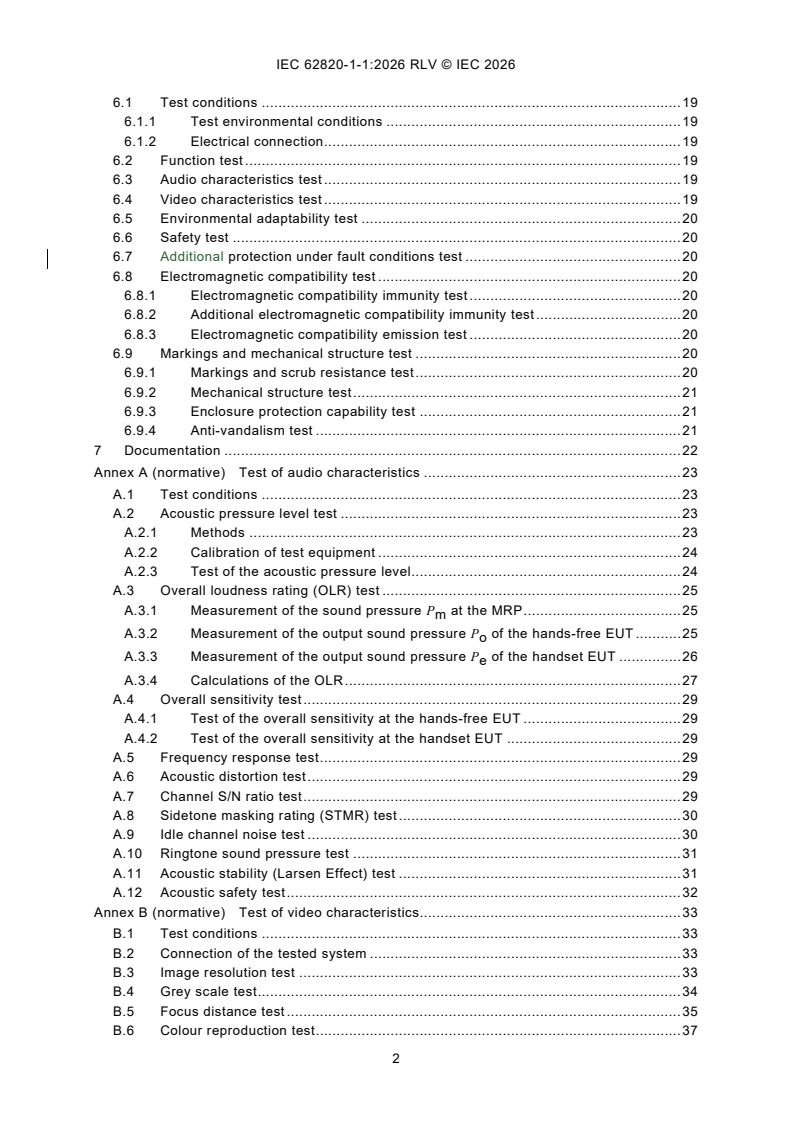
CONTENTS
FOREWORD . 4
INTRODUCTION . 1
1 Scope . 7
2 Normative references . 7
3 Terms, definitions and abbreviated terms . 8
3.1 Terms and definitions . 8
3.2 Abbreviated terms . 10
4 Functional requirements . 11
4.1 Basic functional requirements . 11
4.1.1 General . 11
4.1.2 Requirements for building intercom system with SMU . 12
4.2 Additional functions . 12
5 Performance requirements. 12
5.1 Audio characteristics . 12
5.1.1 Acoustic pressure level . 12
5.1.2 Overall loudness rating (OLR). 13
5.1.3 Overall sensitivity . 13
5.1.4 Frequency response . 14
5.1.5 Acoustic distortion . 14
5.1.6 Channel S/N ratio . 14
5.1.7 Sidetone masking rating (STMR) . 14
5.1.8 Idle channel noise . 15
5.1.9 Ringtone sound pressure . 15
5.1.10 Acoustic stability (Larsen effect) . 15
5.1.11 Acoustic safety . 15
5.2 Video characteristics . 15
5.2.1 Image resolution . 15
5.2.2 Grey scale . 15
5.2.3 Focus distance . 15
5.2.4 Colour reproduction . 15
5.2.5 Environmental illuminance adaptability . 15
5.3 Environmental adaptability requirements . 16
5.3.1 Environmental classes . 16
5.3.2 Environmental adaptability . 16
5.4 Safety requirements . 17
5.5 Additional protection under fault conditions . 17
5.6 Electromagnetic compatibility requirements . 17
5.6.1 Electromagnetic compatibility immunity requirements . 17
5.6.2 Additional electromagnetic compatibility immunity requirements . 17
5.6.3 Electromagnetic compatibility emission requirements . 18
5.7 Markings and mechanical structural requirements . 18
5.7.1 Markings . 18
5.7.2 Mechanical structure . 18
5.7.3 Enclosure protection capability . 18
5.7.4 Anti-vandalism . 19
6 Test methods . 19
6.1 Test conditions . 19
6.1.1 Test environmental conditions . 19
6.1.2 Electrical connection . 19
6.2 Function test . 19
6.3 Audio characteristics test . 19
6.4 Video characteristics test . 19
6.5 Environmental adaptability test . 20
6.6 Safety test . 20
6.7 Additional protection under fault conditions test . 20
6.8 Electromagnetic compatibility test . 20
6.8.1 Electromagnetic compatibility immunity test . 20
6.8.2 Additional electromagnetic compatibility immunity test . 20
6.8.3 Electromagnetic compatibility emission test . 20
6.9 Markings and mechanical structure test . 20
6.9.1 Markings and scrub resistance test . 20
6.9.2 Mechanical structure test . 21
6.9.3 Enclosure protection capability test . 21
6.9.4 Anti-vandalism test . 21
7 Documentation . 22
Annex A (normative) Test of audio characteristics . 23
A.1 Test conditions . 23
A.2 Acoustic pressure level test . 23
A.2.1 Methods . 23
A.2.2 Calibration of test equipment . 24
A.2.3 Test of the acoustic pressure level. 24
A.3 Overall loudness rating (OLR) test . 25
A.3.1 Measurement of the sound pressure P at the MRP . 25
m
A.3.2 Measurement of the output sound pressure P of the hands-free EUT . 25
o
A.3.3 Measurement of the output sound pressure P of the handset EUT . 26
e
A.3.4 Calculations of the OLR . 27
A.4 Overall sensitivity test . 29
A.4.1 Test of the overall sensitivity at the hands-free EUT . 29
A.4.2 Test of the overall sensitivity at the handset EUT . 29
A.5 Frequency response test . 29
A.6 Acoustic distortion test . 29
A.7 Channel S/N ratio test . 29
A.8 Sidetone masking rating (STMR) test . 30
A.9 Idle channel noise test . 30
A.10 Ringtone sound pressure test . 31
A.11 Acoustic stability (Larsen Effect) test . 31
A.12 Acoustic safety test . 32
Annex B (normative) Test of video characteristics. 33
B.1 Test conditions . 33
B.2 Connection of the tested system . 33
B.3 Image resolution test . 33
B.4 Grey scale test . 34
B.5 Focus distance test . 35
B.6 Colour reproduction test . 37
B.7 Environmental illumination adaptability test . 38
Annex C (normative) Different requirements between grade 1 and grade 2 . 39
Annex D (normative) Safety requirements correspondence in IEC 60065 or
IEC 60950-1 or IEC 62368-1 . 41
Bibliography . 43
Figure 1 – Overall sensitivity at the hands-free unit . 13
Figure 2 – Overall sensitivity at the handset unit . 14
Figure A.1 – Measurement of the sound pressure P at the MRP . 25
m
Figure A.2 – Measurement of the output sound pressure P when connected with the
o
handset unit . 26
Figure A.3 – Measurement of the output sound pressure P when connected with the
o
hands-free unit. 26
Figure A.4 – Measurement of the output sound pressure P when connected with the
e
handset unit . 26
Figure A.5 – Measurement of the output sound pressure P when connected with the
e
hands-free unit. 27
Figure A.6 – Measurement of STMR at the handset EUT . 30
Figure A.7 – Measurement of ringtone sound pressure . 31
Figure A.8 – Acoustic stability test for handset EUT . 31
Figure A.9 – Acoustic stability test for hands-free EUT. 32
Figure A.10 – Acoustic safety test . 32
Figure B.1 – Connection diagram for the test of video characteristics . 33
Figure B.2 – TE170 test chart . 34
Figure B.3 – TE83 test chart .
Figure B.3 – TE83 and TE84 test charts . 35
Figure B.4 – Focus test chart . 36
Figure B.5 – Position of the external ring area . 37
Figure B.6 – TE106 test chart . 38
Table 1 – Environmental adaptability requirements . 16
Table A.1 – Factors for OLR . 28
Table C.1 – Requirements of grade 1 and grade 2 . 39
Table D.1 – Correspondence between IEC 60065 and IEC 60950-1 and IEC 62368-1 . 41
INTERNATIONAL ELECTROTECHNICAL COMMISSION
____________
Building intercom systems -
Part 1-1: System requirements - General
FOREWORD
1) The International Electrotechnical Commission (IEC) is a worldwide organization for standardization comprising
all national electrotechnical committees (IEC National Committees). The object of IEC is to promote international
co-operation on all questions concerning standardization in the electrical and electronic fields. To this end and
in addition to other activities, IEC publishes International Standards, Technical Specifications, Technical Reports,
Publicly Available Specifications (PAS) and Guides (hereafter referred to as “IEC Publication(s)”). Their
preparation is entrusted to technical committees; any IEC National Committee interested in the subject dealt with
may participate in this preparatory work. International, governmental and non-governmental organizations liaising
with the IEC also participate in this preparation. IEC collaborates closely with the International Organization for
Standardization (ISO) in accordance with conditions determined by agreement between the two organizations.
2) The formal decisions or agreements of IEC on technical matters express, as nearly as possible, an international
consensus of opinion on the relevant subjects since each technical committee has representation from all
interested IEC National Committees.
3) IEC Publications have the form of recommendations for international use and are accepted by IEC National
Committees in that sense. While all reasonable efforts are made to ensure that the technical content of IEC
Publications is accurate, IEC cannot be held responsible for the way in which they are used or for any
misinterpretation by any end user.
4) In order to promote international uniformity, IEC National Committees undertake to apply IEC Publications
transparently to the maximum extent possible in their national and regional publications. Any divergence between
any IEC Publication and the corresponding national or regional publication shall be clearly indicated in the latter.
5) IEC itself does not provide any attestation of conformity. Independent certification bodies provide conformity
assessment services and, in some areas, access to IEC marks of conformity. IEC is not responsible for any
services carried out by independent certification bodies.
6) All users should ensure that they have the latest edition of this publication.
7) No liability shall attach to IEC or its directors, employees, servants or agents including individual experts and
members of its technical committees and IEC National Committees for any personal injury, property damage or
other damage of any nature whatsoever, whether direct or indirect, or for costs (including legal fees) and
expenses arising out of the publication, use of, or reliance upon, this IEC Publication or any other IEC
Publications.
8) Attention is drawn to the Normative references cited in this publication. Use of the referenced publications is
indispensable for the correct application of this publication.
9) IEC draws attention to the possibility that the implementation of this document may involve the use of (a)
patent(s). IEC takes no position concerning the evidence, validity or applicability of any claimed patent rights in
respect thereof. As of the date of publication of this document, IEC had received notice of (a) patent(s), which
may be required to implement this document. However, implementers are cautioned that this may not represent
the latest information, which may be obtained from the patent database available at https://patents.iec.ch. IEC
shall not be held responsible for identifying any or all such patent rights.
This redline version of the official IEC Standard allows the user to identify the changes made
to the previous edition IEC 62820-1-1:2016. A vertical bar appears in the margin wherever a
change has been made. Additions are in green text, deletions are in strikethrough red text.
IEC 62820-1-1 has been prepared by IEC technical committee 79: Alarm and electronic security
systems. It is an International Standard.
This second edition cancels and replaces the first edition published in 2016. This edition
constitutes a technical revision.
This edition includes the following significant technical changes with respect to the previous
edition:
a) addition of IEC 61000-6-8 and IEC 62368-1:2023 as normative references;
b) update of ISO 12233 to the latest version and addition of this reference as a normative
reference;
c) modification of the light source colour temperature from 3 100 K ± 100 K to 6 500 K ± 100 K;
d) addition of TE84 test chart and update of the focus test chart.
The text of this International Standard is based on the following documents:
Draft Report on voting
79/738/FDIS 79/741/RVD
Full information on the voting for its approval can be found in the report on voting indicated in
the above table.
The language used for the development of this International Standard is English.
This document was drafted in accordance with ISO/IEC Directives, Part 2, and developed in
accordance with ISO/IEC Directives, Part 1 and ISO/IEC Directives, IEC Supplement, available
at www.iec.ch/members_experts/refdocs. The main document types developed by IEC are
described in greater detail at www.iec.ch/publications.
A list of all parts in the IEC 62820 series, published under the general title Building intercom
systems, can be found on the IEC website.
The committee has decided that the contents of this document will remain unchanged until the
stability date indicated on the IEC website under webstore.iec.ch in the data related to the
specific document. At this date, the document will be
– reconfirmed,
– withdrawn, or
– revised.
INTRODUCTION
IEC 62820-1-1 specifies the technical requirements for building intercom systems and
equipment used for building entry. Building intercom systems can function independently and
may can be extendable extended to support building security management functions, e.g.
extendable with security management unit (SMU) operated by security staff (door-man,
concierge, security-guard, porter, etc.), or in conjunction with other systems as per the security
requirements of the building. It may can consist of: Visitor call unit (VCU), User receiver unit
(URU), SMU, power supply, auxiliary device, as well as interface-unit to other security-systems.
The IEC 62820 series of standards sets out the technical requirements for the composition,
functions, performance, test methods of building intercom systems for building entry and
application guidelines and consists of five parts:
Part 1-1: System requirements - General
Part 1-2: System requirements - Building intercom systems using the internet protocol (IP)
Part 2: Requirements for advanced security building intercom systems
Part 3-1: Application guidelines - General
Part 3-2: Application guidelines - Advanced security building intercom systems
IEC 62820-1-1 is based on Chinese standard GB/T 31070.1-2014 and European standard
EN 50486:2008.
1 Scope
IEC 62820-1-1 specifies the technical requirements for the composition, functions, performance,
and test methods of general building intercom systems.
This document is applicable to the general intercom systems for building entry in residential or
commercial buildings.
Door-Entry-System (DES) is a simple kind of convenient Building-Intercom-System (BIS) mainly
for user’s comfort. This document has classified the general building intercom systems into two
grades in IEC 62820-1-1. Grade 1 adopts lower requirements to cover DES not used for
relevant security applications while grade 2 adopts higher requirements for building intercom
systems for security applications. Each grade may can adopt different functional and
performance requirements, test methods and normative references.
NOTE The different requirements between grade 1 and grade 2 are summarized in Table C.1 of Annex C.
2 Normative references
The following documents are referred to in the text in such a way that some or all of their content
constitutes requirements of this document. For dated references, only the edition cited applies.
For undated references, the latest edition of the referenced document (including any
amendments) applies.
IEC 60065:2014, Audio, video and similar electronic apparatus - Safety requirements
IEC 60529:1989, Degrees of protection provided by enclosures (IP Code)
IEC 60529:1989/AMD1:1999
IEC 60529:1989/AMD2:2013
IEC 60950-1:2005, Information technology equipment - Safety - Part 1: General requirements
IEC 61000-6-1, Electromagnetic compatibility (EMC) - Part 6-1: Generic standards - Immunity
standard for residential, commercial and light-industrial environments
IEC 61000-6-3, Electromagnetic compatibility (EMC) - Part 6-3: Generic standards - Emission
standard for equipment in residential, commercial and light-industrial environments
IEC 61000-6-8, Electromagnetic compatibility (EMC) - Part 6-8: Generic standards - Emission
standard for professional equipment in commercial and light-industrial locations
IEC 62262, Degrees of protection provided by enclosures for electrical equipment against
external mechanical impacts (IK code)
IEC 62368-1:2023, Audio/video, information and communication technology equipment - Part 1:
Safety requirements
IEC 62599-1, Alarm systems - Part 1: Environmental test methods
IEC 62599-2, Alarm systems - Part 2: Electromagnetic compatibility - Immunity requirements
for components of fire and security alarm systems
___________
This publication was withdrawn.
This publication was withdrawn.
ISO 12233:20142024, Photography – Electronic still picture imaging – Digital camera -
Resolution and spatial frequency responses
ITU-T P.50, Artificial voices
ITU-T P.51-1996, Artificial mouth
ITU-T P.79-2007, Calculation of loudness ratings for telephone sets
ITU-T P.501, Test signals for use in telephonometry telephony and other speech-based
applications
3 Terms, definitions and abbreviated terms
3.1 Terms and definitions
For the purposes of this document, the following terms and definitions apply.
ISO and IEC maintain terminology databases for use in standardization at the following
addresses:
– IEC Electropedia: available at https://www.electropedia.org/
– ISO Online browsing platform: available at https://www.iso.org/obp
3.1.1
2-way speech
speech between any two units (VCU, URU or SMU) in each direction which may can be
simultaneous or non-simultaneous
3.1.2
acoustic distortion
distortion of signals at the receiving terminal of the system as a result of system transmission
non-linearity and ground noise, expressed as a ratio percentage of the harmonic signal and
ground noise at the receiving terminal in proportion to the overall sound pressure
3.1.3
acoustic pressure level
measurement of the acoustic pressure level generated by the equipment under test (EUT) in
normal conditions
3.1.4
artificial ear
device used to calibrate the receiver and containing an acoustic coupler and a calibrated
microphone used to measure sound pressure
Note 1 to entry: Its overall acoustic impedance within a given frequency band is similar to that of the average human
ear, and its characteristics comply with the requirements of type 1 provided by Clause 6.1 of ITU-T P.57-2021 or
type 3.2 provided by Article 5 Clause 6.3.2 of ITU-T P.57-20112021.
3.1.5
artificial mouth
analogue device the sound characteristics of which are similar to the directivity and radiation
pattern of the average human mouth
Note 1 to entry: It conforms to the requirements set forth in Clause 5 of ITU-T P.51-1996.
3.1.6
auxiliary device
device which extends or facilitates additional functions and interfaces of a building intercom
rd
party devices interfaces etc.
system, such as communications, remote control, 3
3.1.7
building intercom system
BIS
system designed for entry communication in residential or commercial buildings which provides
addressing calls, speech and optional video function and is equipped with an electronic
unlocking device
3.1.8
channel S/N
sound pressure ratio between signal and ground noise at the receiving terminal under excitation
of the nominal sound pressure at the transmitting terminal, expressed in dB
3.1.9
handset unit
device typically coupled to the ear by hand as can be a handset URU or handset SMU
3.1.10
hands-free unit
device that does not need to use the hand during the communication as can be a VCU, hands-
free URU or hands-free SMU
3.1.11
idle channel noise
noise expressed in dB(A) which is received in the terminal after the channel connection is
established when no signal is transferred
3.1.12
loudness rating guard-ring position
LRGP
fixed position in which the handset of the URU or SMU is used to measure the rating of system
loudness
[SOURCE: adapted from ITU-T P.64:20072022, Annex C]
3.1.13
overall loudness rating
OLR
measurement of the loudness in the entire channel from the reference point of the mouth at the
transmitting terminal to the ear reference point (ERP) at the receiving terminal, expressed in
dB
Note 1 to entry: The source definition is adapted to align with the test methods.
[SOURCE: adapted from ITU-T P.79:200710:2017, definition 6.191]
3.1.14
overall sensitivity
gain of the sound pressure at the reference point of the ear at the reception terminal relative to
the excitation sound pressure at the mouth reference point (MRP) at the transmitting terminal,
expressed in dB
Note 1 to entry: It is a function of frequency.
3.1.15
security management unit
SMU
device which can be addressed from the call unit (VCU, URU or SMU), provides the means of
addressing the calling signal to the desired receiver unit(s) which can be URU or SMU, 2-way
speech, the activation of the audio and/or video connection with the VCU and the means to
initiate remote unlocking of the controlled entrance
3.1.16
sidetone masking rating
STMR
measurement of sidetone loudness after factoring in the masking effects of the human head on
sidetone, expressed in dB
Note 1 to entry: The source definition is adapted to align with the test methods.
[SOURCE: adapted from ITU-T P.79:200710:2017, definition 6.240]
3.1.17
user receiver unit
URU
addressable user device which provides 2-way speech with optional video, and a means to
initiate remote unlocking of the controlled entrance
3.1.18
visitor call unit
VCU
device installed outside a controlled entrance which provides the means of addressing the
calling signal to the desired URU or SMU and 2-way speech with optional video capture
Note 1 to entry: The device can also provide the means of unlocking the controlled entrance and other function(s)
or these function(s) can be contained within a separate associated device normally located within the controlled
premises and which can also contain the system power supply.
3.2 Abbreviated terms
BIS building intercom system
DES door entry system
ERP ear reference point
EUT equipment under test
Lpm level (sound) pressure mean
LRGP loudness rating guard-ring position
MRP mouth reference point
OLR overall loudness rating
PIN personal identification number
SMU security management unit
STMR sidetone masking rating
TVL television lines
URU user receiver unit
VCU visitor call unit
4 Functional requirements
4.1 Basic functional requirements
4.1.1 General
A building intercom system shall meet the following requirements. The different requirements
between grade 1 and grade 2 are summarized in Table C.1 of Annex C.
a) Call function
The VCU shall be able to address the desired URU. The VCU shall be able to produce a
visible and/or audible call alert signal. The URU shall be able to produce a response prompt
signal that can be visible- or audible, etc.
b) Speech function
2-way speech shall be provided, which can be either non-simultaneous or simultaneous. It
may can be of limited duration controlled by a system timer such that the speech channel
cannot be accidentally occupied for an unlimited time.
c) Unlocking function
The unlocking function shall be provided with an electric or electronic signal to an electric
or electronic locking device for securing a building entrance. This function shall be controlled
by URU at the user’s discretion. In grade 2 the URU shall be in communication with the VCU
to perform the unlocking function.
The unlocking function could also be activated by other means:
1) The VCU may can be provided with a means for authorized users to directly activate the
unlocking function, such as by PIN code or secure proximity card or other security grade
dependent means.
2) Request to exit button or switch located inside the controlled area and normally adjacent
to the controlled entrance. According to the security requirements of the installation this
button or switch may can be a simple switch or require a PIN or other secure means of
operation.
3) Other system signal such as an activated fire alarm signal, a building evacuation signal
etc.
d) Nighttime operability
Grade 1: No requirement;
Grade 2: The VCU shall provide illumination or visible prompts to facilitate the visitor’s
operations at night.
e) Video and image recording and replaying function
When a URU is equipped with a video function it shall be able to display images captured
by the VCU. The functions of storing, replaying the visitor’s images are optional.
f) Operational indication
The system shall provide the operating and operational information to the visitor. The VCU
should provide a comfort indication that the call is being processed, such as a low-level
audible tone and/ or visible indication. The VCU should also give audio and/or visible
indication when the lock has been released and that entry to the premises is permitted.
NOTE The VCU can give clear indication or prompts to the visitor on how to address the desired URU.
g) Anti listen-in
Grade 1: No requirement.
Grade 2: After connecting the VCU with the URU, the audio information shall not be
monitored by other URU connected to the system.
4.1.2 Requirements for building intercom system with SMU
A building intercom system with SMU shall meet the following requirements:
a) The SMU shall be able to address and initiate calls to selected URU. The VCU and the URU
shall be able to initiate calls to the SMU. If multiple SMU are connected to the system, they
shall be able to call each other. All the calls shall be able to produce call alert and response
prompt signals. The signals can be visible or audible, etc.
b) The SMU shall be capable of 2-way speech with the VCU or the URU. If multiple SMU are
connected to the system, they shall be capable of 2-way speech with each other.
c) The SMU shall be able to control the VCU or auxiliary device to perform electrical or
electronic unlocking.
d) When a SMU is equipped with a video function it shall be able to display images captured
by the VCU. The URU shall be able to display images captured by SMU equipped with a
video camera.
e) For grade 2: After connecting the SMU with the VCU or the URU, the audio and video
information shall not be monitored by other URU connected to the system.
f) For grade 2: The SMU shall be able to address and communicate to selected VCU.
4.2 Additional functions
A building intercom system can also provide the following functions:
a) If the unsecured state of the controlled entrance lasts beyond the configured time, the SMU
may can be able to receive a warning message.
NOTE Unsecured state: the door opened for too long, the tamper switch triggered, etc.
b) The system may can have the possibility of transmitting images and texts to the URU.
c) The SMU may can have a timed and dated event log with security graded access and
recording access events at the VCU.
1) URU’s called and if unlocking function operated by the URU.
2) VCU unlocking carried out directly at the VCU, identifying the authorized user.
3) Programming events such as adding or subtracting users and URU’s.
4) Identification of the operator accessing the event log.
d) SMU may can intercept incoming calls from a VCU directed to an URU and then redirect the
call to desired URU.
e) If a SMU operator is not available, SMU may can record details of URU which called the
SMU in order to allow the operator to call back the URU.
5 Performance requirements
5.1 Audio characteristics
5.1.1 Acoustic pressure level
Grade 1: The acoustic pressure level shall meet the following requirements:
a) Acoustic pressure level value generated by hands-free unit:
1) For discrete measurement, it shall be ≥ 70 dBSPL.
2) For continue measurement, it shall be ≥ 70 dB(A).
b) Acoustic pressure level value generated by handset unit:
1) For discrete measurement, it shall be ≥ 77 dBSPL.
2) For continue measurement, it shall be ≥ 77 dB(A).
Grade 2: No requirementNot applicable.
5.1.2 Overall loudness rating (OLR)
Grade 1: No requirement.
Grade 2: The OLR shall meet the following requirements:
+10
At the VCU: dB.
−5
+10
a) At the hands-free URU and hands-free SMU: dB
−5
b) At the handset unit: (15 ± 5) dB.
5.1.3 Overall sensitivity
Grade 1: No requirement.
Grade 2: The typical curve and its tolerance range of overall sensitivity between 500 Hz and
3 400 Hz shall meet the following requirements:
a) At the hands-free unit: The typical curve is the dotted line shown in Figure 1 and its
tolerance range is the solid line shown in Figure 1.
b) At the handset unit: the typical curve is the dotted line shown in Figure 2 and its tolerance
range is the solid line shown in Figure 2.
NOTE Best fit or floating mask are referred to Figure 1 and Figure 2.
Figure 1 – Overall sensitivity at the hands-free unit
Figure 2 – Overall sensitivity at the handset unit
5.1.4 Frequency response
Grade 1: Once the VCU, the URU and the SMU are connected for speech, the difference
between the higher and lower measurement of acoustic pressure level shall not be greater than
25 dB.
Grade 2: No requirementNot applicable.
5.1.5 Acoustic distortion
Grade 1: No requirement.
Grade 2: The acoustic distortion shall meet the following requirements when the excitation
sound pressure is 0 dBPa:
a) At the hands-free unit: it shall not be greater than 10 %.
b) At the handset unit: it shall not be greater than 7 %.
5.1.6 Channel S/N ratio
Grade 1: No requirement.
Grade 2: The channel S/N ratio shall meet the following requirements when the excitation sound
pressure is 0 dBPa:
a) At the hands-free unit: it shall not be less than 25 dB.
b) At the handset unit: it shall not be less than 30 dB.
5.1.7 Sidetone masking rating (STMR)
Grade 1: No requirement.
Grade 2: The STMR of the handset unit shall not be less than 5 dB.
5.1.8 Idle channel noise
Grade 1: No requirement.
Grade 2: The idle channel noise shall meet the following requirements:
a) At the hands-free unit: it shall not be greater than 45 dB(A).
b) At the handset unit: it shall not be greater than 48 dB(A).
5.1.9 Ringtone sound pressure
The ringtone sound pressure shall not be less than 73 dB(A) and not greater than 106 dB(A).
5.1.10 Acoustic stability (Larsen effect)
Once the VCU, the URU and the SMU are connected for speech, there shall not be high pitched
whistling noise present.
5.1.11 Acoustic safety
In any operational state, the generated acoustic pressure level shall not exceed 120 dB(A).
5.2 Video characteristics
5.2.1 Image resolution
The image resolution (at the centre) shall not be less than 130 TVL for the visible area smaller
than 101,6 mm (4,0 inches), and shall not be less than 200 TVL for the visible area of 101,6 mm
(4,0 inches) or larger.
5.2.2 Grey scale
The grey scale shall not be less than 8 levels when using TE83 test chart.
The grey scale shall not be less than 6 levels when using TE84 test chart.
5.2.3 Focus distance
Minimum focus distance: 0,3 m.
The object that is more than 0,3 m away from the camera shall be clearly focused.
5.2.4 Colour reproduction
This requirement applies to colour video BIS. No obvious chromatic aberration between the
colour of the displayed image and the actual object captured by camera should be distinguished.
5.2.5 Environmental illuminance adaptability
At an environmental illuminance of 0,5 lx, the image resolution (at the centre) shall meet the
requirements set forth in 5.2.1.
Select the test chart with proper size and adjust the distance between the camera of the EUT
and the test chart from 0,3 m to 0,5 m, and make sure the image of the chart is fully displayed
on the monitor.
5.3 Environmental adaptability requirements
5.3.1 Environmental classes
Four classes of environment are designated for system equipment in accordance with
IEC 62599-1. They are as follows:
a) Class I: Indoor but restricted to residential/ and office environment (e.g. living rooms and
offices).
NOTE Class I covers also commercial properties (e.g. shops, restaurants) where the temperature is well
maintained.
b) Class II: Indoor in general (e.g. sales floors, shops, restaurants, stairways, manufacturing
and assembly areas, entrances and storage rooms).
c) Class III: Outdoor but sheltered from direct rain and sunshine, or indoor with extreme
environmental conditions (e.g. garages, lofts, barns and loading bays).
d) Class IV: Outdoor in general.
Classes I to IV are progressively more severe, and therefore class IV an equipment of a higher
class may can be used in a lower class III applications, etc. A special suffix “A” can be added
to classes III and IV to cater for especially cold conditions
...
IEC 62820-1-1 ®
Edition 2.0 2026-03
INTERNATIONAL
STANDARD
Building intercom systems -
Part 1-1: System requirements - General
ICS 13.320 ISBN 978-2-8327-1122-4
All rights reserved. Unless otherwise specified, no part of this publication may be reproduced or utilized in any form or
by any means, electronic or mechanical, including photocopying and microfilm, without permission in writing from either
IEC or IEC's member National Committee in the country of the requester. If you have any questions about IEC copyright
or have an enquiry about obtaining additional rights to this publication, please contact the address below or your local
IEC member National Committee for further information.
IEC Secretariat Tel.: +41 22 919 02 11
3, rue de Varembé info@iec.ch
CH-1211 Geneva 20 www.iec.ch
Switzerland
About the IEC
The International Electrotechnical Commission (IEC) is the leading global organization that prepares and publishes
International Standards for all electrical, electronic and related technologies.
About IEC publications
The technical content of IEC publications is kept under constant review by the IEC. Please make sure that you have the
latest edition, a corrigendum or an amendment might have been published.
IEC publications search - IEC Products & Services Portal - products.iec.ch
webstore.iec.ch/advsearchform Discover our powerful search engine and read freely all the
The advanced search enables to find IEC publications by a publications previews, graphical symbols and the glossary.
variety of criteria (reference number, text, technical With a subscription you will always have access to up to date
committee, …). It also gives information on projects, content tailored to your needs.
replaced and withdrawn publications.
Electropedia - www.electropedia.org
The world's leading online dictionary on electrotechnology,
IEC Just Published - webstore.iec.ch/justpublished
Stay up to date on all new IEC publications. Just Published containing more than 22 500 terminological entries in English
details all new publications released. Available online and and French, with equivalent terms in 25 additional languages.
once a month by email. Also known as the International Electrotechnical Vocabulary
(IEV) online.
IEC Customer Service Centre - webstore.iec.ch/csc
If you wish to give us your feedback on this publication or
need further assistance, please contact the Customer
Service Centre: sales@iec.ch.
CONTENTS
FOREWORD . 4
INTRODUCTION . 6
1 Scope . 7
2 Normative references . 7
3 Terms, definitions and abbreviated terms . 8
3.1 Terms and definitions . 8
3.2 Abbreviated terms . 10
4 Functional requirements . 11
4.1 Basic functional requirements . 11
4.1.1 General . 11
4.1.2 Requirements for building intercom system with SMU . 12
4.2 Additional functions . 12
5 Performance requirements. 12
5.1 Audio characteristics . 12
5.1.1 Acoustic pressure level . 12
5.1.2 Overall loudness rating (OLR). 13
5.1.3 Overall sensitivity . 13
5.1.4 Frequency response . 14
5.1.5 Acoustic distortion . 14
5.1.6 Channel S/N ratio . 14
5.1.7 Sidetone masking rating (STMR) . 14
5.1.8 Idle channel noise . 15
5.1.9 Ringtone sound pressure . 15
5.1.10 Acoustic stability (Larsen effect) . 15
5.1.11 Acoustic safety . 15
5.2 Video characteristics . 15
5.2.1 Image resolution . 15
5.2.2 Grey scale . 15
5.2.3 Focus distance . 15
5.2.4 Colour reproduction . 15
5.2.5 Environmental illuminance adaptability . 15
5.3 Environmental adaptability requirements . 16
5.3.1 Environmental classes . 16
5.3.2 Environmental adaptability . 16
5.4 Safety requirements . 17
5.5 Additional protection under fault conditions . 17
5.6 Electromagnetic compatibility requirements . 17
5.6.1 Electromagnetic compatibility immunity requirements . 17
5.6.2 Additional electromagnetic compatibility immunity requirements . 17
5.6.3 Electromagnetic compatibility emission requirements . 18
5.7 Markings and mechanical structural requirements . 18
5.7.1 Markings . 18
5.7.2 Mechanical structure . 18
5.7.3 Enclosure protection capability . 18
5.7.4 Anti-vandalism . 19
6 Test methods . 19
6.1 Test conditions . 19
6.1.1 Test environmental conditions . 19
6.1.2 Electrical connection . 19
6.2 Function test . 19
6.3 Audio characteristics test . 19
6.4 Video characteristics test . 19
6.5 Environmental adaptability test . 19
6.6 Safety test . 20
6.7 Additional protection under fault conditions test . 20
6.8 Electromagnetic compatibility test . 20
6.8.1 Electromagnetic compatibility immunity test . 20
6.8.2 Additional electromagnetic compatibility immunity test . 20
6.8.3 Electromagnetic compatibility emission test . 20
6.9 Markings and mechanical structure test . 20
6.9.1 Markings and scrub resistance test . 20
6.9.2 Mechanical structure test . 20
6.9.3 Enclosure protection capability test . 20
6.9.4 Anti-vandalism test . 21
7 Documentation . 22
Annex A (normative) Test of audio characteristics . 23
A.1 Test conditions . 23
A.2 Acoustic pressure level test . 23
A.2.1 Methods . 23
A.2.2 Calibration of test equipment . 24
A.2.3 Test of the acoustic pressure level. 24
A.3 Overall loudness rating (OLR) test . 25
A.3.1 Measurement of the sound pressure P at the MRP . 25
m
A.3.2 Measurement of the output sound pressure P of the hands-free EUT . 25
o
A.3.3 Measurement of the output sound pressure P of the handset EUT . 26
e
A.3.4 Calculations of the OLR . 27
A.4 Overall sensitivity test . 28
A.4.1 Test of the overall sensitivity at the hands-free EUT . 28
A.4.2 Test of the overall sensitivity at the handset EUT . 28
A.5 Frequency response test . 29
A.6 Acoustic distortion test . 29
A.7 Channel S/N ratio test . 29
A.8 Sidetone masking rating (STMR) test . 29
A.9 Idle channel noise test . 30
A.10 Ringtone sound pressure test . 30
A.11 Acoustic stability (Larsen Effect) test . 30
A.12 Acoustic safety test . 31
Annex B (normative) Test of video characteristics. 33
B.1 Test conditions . 33
B.2 Connection of the tested system . 33
B.3 Image resolution test . 33
B.4 Grey scale test . 34
B.5 Focus distance test . 35
B.6 Colour reproduction test . 36
B.7 Environmental illumination adaptability test . 37
Annex C (normative) Different requirements between grade 1 and grade 2 . 38
Annex D (normative) Safety requirements correspondence in IEC 60065 or
IEC 60950-1 or IEC 62368-1 . 40
Bibliography . 42
Figure 1 – Overall sensitivity at the hands-free unit . 13
Figure 2 – Overall sensitivity at the handset unit . 14
Figure A.1 – Measurement of the sound pressure P at the MRP . 25
m
Figure A.2 – Measurement of the output sound pressure P when connected with the
o
handset unit . 26
Figure A.3 – Measurement of the output sound pressure P when connected with the
o
hands-free unit. 26
Figure A.4 – Measurement of the output sound pressure P when connected with the
e
handset unit . 26
Figure A.5 – Measurement of the output sound pressure P when connected with the
e
hands-free unit. 27
Figure A.6 – Measurement of STMR at the handset EUT . 30
Figure A.7 – Measurement of ringtone sound pressure . 30
Figure A.8 – Acoustic stability test for handset EUT . 31
Figure A.9 – Acoustic stability test for hands-free EUT. 31
Figure A.10 – Acoustic safety test . 32
Figure B.1 – Connection diagram for the test of video characteristics . 33
Figure B.2 – TE170 test chart . 34
Figure B.3 – TE83 and TE84 test charts . 35
Figure B.4 – Focus test chart . 36
Figure B.5 – Position of the external ring area . 36
Figure B.6 – TE106 test chart . 37
Table 1 – Environmental adaptability requirements . 16
Table A.1 – Factors for OLR . 28
Table C.1 – Requirements of grade 1 and grade 2 . 38
Table D.1 – Correspondence between IEC 60065 and IEC 60950-1 and IEC 62368-1 . 40
INTERNATIONAL ELECTROTECHNICAL COMMISSION
____________
Building intercom systems -
Part 1-1: System requirements - General
FOREWORD
1) The International Electrotechnical Commission (IEC) is a worldwide organization for standardization comprising
all national electrotechnical committees (IEC National Committees). The object of IEC is to promote international
co-operation on all questions concerning standardization in the electrical and electronic fields. To this end and
in addition to other activities, IEC publishes International Standards, Technical Specifications, Technical Reports,
Publicly Available Specifications (PAS) and Guides (hereafter referred to as “IEC Publication(s)”). Their
preparation is entrusted to technical committees; any IEC National Committee interested in the subject dealt with
may participate in this preparatory work. International, governmental and non-governmental organizations liaising
with the IEC also participate in this preparation. IEC collaborates closely with the International Organization for
Standardization (ISO) in accordance with conditions determined by agreement between the two organizations.
2) The formal decisions or agreements of IEC on technical matters express, as nearly as possible, an international
consensus of opinion on the relevant subjects since each technical committee has representation from all
interested IEC National Committees.
3) IEC Publications have the form of recommendations for international use and are accepted by IEC National
Committees in that sense. While all reasonable efforts are made to ensure that the technical content of IEC
Publications is accurate, IEC cannot be held responsible for the way in which they are used or for any
misinterpretation by any end user.
4) In order to promote international uniformity, IEC National Committees undertake to apply IEC Publications
transparently to the maximum extent possible in their national and regional publications. Any divergence between
any IEC Publication and the corresponding national or regional publication shall be clearly indicated in the latter.
5) IEC itself does not provide any attestation of conformity. Independent certification bodies provide conformity
assessment services and, in some areas, access to IEC marks of conformity. IEC is not responsible for any
services carried out by independent certification bodies.
6) All users should ensure that they have the latest edition of this publication.
7) No liability shall attach to IEC or its directors, employees, servants or agents including individual experts and
members of its technical committees and IEC National Committees for any personal injury, property damage or
other damage of any nature whatsoever, whether direct or indirect, or for costs (including legal fees) and
expenses arising out of the publication, use of, or reliance upon, this IEC Publication or any other IEC
Publications.
8) Attention is drawn to the Normative references cited in this publication. Use of the referenced publications is
indispensable for the correct application of this publication.
9) IEC draws attention to the possibility that the implementation of this document may involve the use of (a)
patent(s). IEC takes no position concerning the evidence, validity or applicability of any claimed patent rights in
respect thereof. As of the date of publication of this document, IEC had received notice of (a) patent(s), which
may be required to implement this document. However, implementers are cautioned that this may not represent
the latest information, which may be obtained from the patent database available at https://patents.iec.ch. IEC
shall not be held responsible for identifying any or all such patent rights.
IEC 62820-1-1 has been prepared by IEC technical committee 79: Alarm and electronic security
systems. It is an International Standard.
This second edition cancels and replaces the first edition published in 2016. This edition
constitutes a technical revision.
This edition includes the following significant technical changes with respect to the previous
edition:
a) addition of IEC 61000-6-8 and IEC 62368-1:2023 as normative references;
b) update of ISO 12233 to the latest version and addition of this reference as a normative
reference;
c) modification of the light source colour temperature from 3 100 K ± 100 K to 6 500 K ± 100 K;
d) addition of TE84 test chart and update of the focus test chart.
The text of this International Standard is based on the following documents:
Draft Report on voting
79/738/FDIS 79/741/RVD
Full information on the voting for its approval can be found in the report on voting indicated in
the above table.
The language used for the development of this International Standard is English.
This document was drafted in accordance with ISO/IEC Directives, Part 2, and developed in
accordance with ISO/IEC Directives, Part 1 and ISO/IEC Directives, IEC Supplement, available
at www.iec.ch/members_experts/refdocs. The main document types developed by IEC are
described in greater detail at www.iec.ch/publications.
A list of all parts in the IEC 62820 series, published under the general title Building intercom
systems, can be found on the IEC website.
The committee has decided that the contents of this document will remain unchanged until the
stability date indicated on the IEC website under webstore.iec.ch in the data related to the
specific document. At this date, the document will be
– reconfirmed,
– withdrawn, or
– revised.
INTRODUCTION
IEC 62820-1-1 specifies the technical requirements for building intercom systems and
equipment used for building entry. Building intercom systems can function independently and
can be extended to support building security management functions, e.g. extendable with
security management unit (SMU) operated by security staff (door-man, concierge, security-
guard, porter, etc.), or in conjunction with other systems as per the security requirements of the
building. It can consist of: Visitor call unit (VCU), User receiver unit (URU), SMU, power supply,
auxiliary device, as well as interface-unit to other security-systems.
The IEC 62820 series of standards sets out the technical requirements for the composition,
functions, performance, test methods of building intercom systems for building entry and
application guidelines and consists of five parts:
Part 1-1: System requirements - General
Part 1-2: System requirements - Building intercom systems using the internet protocol (IP)
Part 2: Requirements for advanced security building intercom systems
Part 3-1: Application guidelines - General
Part 3-2: Application guidelines - Advanced security building intercom systems
IEC 62820-1-1 is based on Chinese standard GB/T 31070.1-2014 and European standard
EN 50486:2008.
1 Scope
IEC 62820-1-1 specifies the technical requirements for the composition, functions, performance,
and test methods of general building intercom systems.
This document is applicable to the general intercom systems for building entry in residential or
commercial buildings.
Door-Entry-System (DES) is a simple kind of convenient Building-Intercom-System (BIS) mainly
for user’s comfort. This document has classified the general building intercom systems into two
grades in IEC 62820-1-1. Grade 1 adopts lower requirements to cover DES not used for
relevant security applications while grade 2 adopts higher requirements for building intercom
systems for security applications. Each grade can adopt different functional and performance
requirements, test methods and normative references.
NOTE The different requirements between grade 1 and grade 2 are summarized in Table C.1 of Annex C.
2 Normative references
The following documents are referred to in the text in such a way that some or all of their content
constitutes requirements of this document. For dated references, only the edition cited applies.
For undated references, the latest edition of the referenced document (including any
amendments) applies.
IEC 60065:2014, Audio, video and similar electronic apparatus - Safety requirements
IEC 60529:1989, Degrees of protection provided by enclosures (IP Code)
IEC 60529:1989/AMD1:1999
IEC 60529:1989/AMD2:2013
IEC 60950-1:2005, Information technology equipment - Safety - Part 1: General requirements
IEC 61000-6-1, Electromagnetic compatibility (EMC) - Part 6-1: Generic standards - Immunity
standard for residential, commercial and light-industrial environments
IEC 61000-6-3, Electromagnetic compatibility (EMC) - Part 6-3: Generic standards - Emission
standard for equipment in residential environments
IEC 61000-6-8, Electromagnetic compatibility (EMC) - Part 6-8: Generic standards - Emission
standard for professional equipment in commercial and light-industrial locations
IEC 62262, Degrees of protection provided by enclosures for electrical equipment against
external mechanical impacts (IK code)
IEC 62368-1:2023, Audio/video, information and communication technology equipment - Part 1:
Safety requirements
IEC 62599-1, Alarm systems - Part 1: Environmental test methods
IEC 62599-2, Alarm systems - Part 2: Electromagnetic compatibility - Immunity requirements
for components of fire and security alarm systems
___________
This publication was withdrawn.
This publication was withdrawn.
ISO 12233:2024, Digital camera - Resolution and spatial frequency responses
ITU-T P.50, Artificial voices
ITU-T P.79-2007, Calculation of loudness ratings for telephone sets
ITU-T P.501, Test signals for use in telephony and other speech-based applications
3 Terms, definitions and abbreviated terms
3.1 Terms and definitions
For the purposes of this document, the following terms and definitions apply.
ISO and IEC maintain terminology databases for use in standardization at the following
addresses:
– IEC Electropedia: available at https://www.electropedia.org/
– ISO Online browsing platform: available at https://www.iso.org/obp
3.1.1
2-way speech
speech between any two units (VCU, URU or SMU) in each direction which can be simultaneous
or non-simultaneous
3.1.2
acoustic distortion
distortion of signals at the receiving terminal of the system as a result of system transmission
non-linearity and ground noise, expressed as a ratio percentage of the harmonic signal and
ground noise at the receiving terminal in proportion to the overall sound pressure
3.1.3
acoustic pressure level
measurement of the acoustic pressure level generated by the equipment under test (EUT) in
normal conditions
3.1.4
artificial ear
device used to calibrate the receiver and containing an acoustic coupler and a calibrated
microphone used to measure sound pressure
Note 1 to entry: Its overall acoustic impedance within a given frequency band is similar to that of the average human
ear, and its characteristics comply with the requirements of type 1 provided by Clause 6.1 of ITU-T P.57-2021 or
type 3.2 provided by Clause 6.3.2 of ITU-T P.57-2021.
3.1.5
artificial mouth
analogue device the sound characteristics of which are similar to the directivity and radiation
pattern of the average human mouth
Note 1 to entry: It conforms to the requirements set forth in Clause 5 of ITU-T P.51-1996.
3.1.6
auxiliary device
device which extends or facilitates additional functions and interfaces of a building intercom
rd
system, such as communications, remote control, 3 party devices interfaces
3.1.7
building intercom system
BIS
system designed for entry communication in residential or commercial buildings which provides
addressing calls, speech and optional video function and is equipped with an electronic
unlocking device
3.1.8
channel S/N
sound pressure ratio between signal and ground noise at the receiving terminal under excitation
of the nominal sound pressure at the transmitting terminal, expressed in dB
3.1.9
handset unit
device typically coupled to the ear by hand as can be a handset URU or handset SMU
3.1.10
hands-free unit
device that does not need to use the hand during the communication as can be a VCU, hands-
free URU or hands-free SMU
3.1.11
idle channel noise
noise expressed in dB(A) which is received in the terminal after the channel connection is
established when no signal is transferred
3.1.12
loudness rating guard-ring position
LRGP
fixed position in which the handset of the URU or SMU is used to measure the rating of system
loudness
[SOURCE: adapted from ITU-T P.64:2022, Annex C]
3.1.13
overall loudness rating
OLR
measurement of the loudness in the entire channel from the reference point of the mouth at the
transmitting terminal to the ear reference point (ERP) at the receiving terminal, expressed in
dB
Note 1 to entry: The source definition is adapted to align with the test methods.
[SOURCE: adapted from ITU-T P.10:2017, definition 6.191]
3.1.14
overall sensitivity
gain of the sound pressure at the reference point of the ear at the reception terminal relative to
the excitation sound pressure at the mouth reference point (MRP) at the transmitting terminal,
expressed in dB
Note 1 to entry: It is a function of frequency.
3.1.15
security management unit
SMU
device which can be addressed from the call unit (VCU, URU or SMU), provides the means of
addressing the calling signal to the desired receiver unit(s) which can be URU or SMU, 2-way
speech, the activation of the audio or video connection with the VCU and the means to initiate
remote unlocking of the controlled entrance
3.1.16
sidetone masking rating
STMR
measurement of sidetone loudness after factoring in the masking effects of the human head on
sidetone, expressed in dB
Note 1 to entry: The source definition is adapted to align with the test methods.
[SOURCE: adapted from ITU-T P.10:2017, definition 6.240]
3.1.17
user receiver unit
URU
addressable user device which provides 2-way speech with optional video, and a means to
initiate remote unlocking of the controlled entrance
3.1.18
visitor call unit
VCU
device installed outside a controlled entrance which provides the means of addressing the
calling signal to the desired URU or SMU and 2-way speech with optional video capture
Note 1 to entry: The device can also provide the means of unlocking the controlled entrance and other function(s)
or these function(s) can be contained within a separate associated device normally located within the controlled
premises and which can also contain the system power supply.
3.2 Abbreviated terms
BIS building intercom system
DES door entry system
ERP ear reference point
EUT equipment under test
LRGP loudness rating guard-ring position
MRP mouth reference point
OLR overall loudness rating
PIN personal identification number
SMU security management unit
STMR sidetone masking rating
TVL television lines
URU user receiver unit
VCU visitor call unit
4 Functional requirements
4.1 Basic functional requirements
4.1.1 General
A building intercom system shall meet the following requirements. The different requirements
between grade 1 and grade 2 are summarized in Table C.1 of Annex C.
a) Call function
The VCU shall be able to address the desired URU. The VCU shall be able to produce a
visible or audible call alert signal. The URU shall be able to produce a response prompt
signal that can be visible- or audible.
b) Speech function
2-way speech shall be provided, which can be either non-simultaneous or simultaneous. It
can be of limited duration controlled by a system timer such that the speech channel cannot
be accidentally occupied for an unlimited time.
c) Unlocking function
The unlocking function shall be provided with an electric or electronic signal to an electric
or electronic locking device for securing a building entrance. This function shall be controlled
by URU at the user’s discretion. In grade 2 the URU shall be in communication with the VCU
to perform the unlocking function.
The unlocking function could also be activated by other means:
1) The VCU can be provided with a means for authorized users to directly activate the
unlocking function, such as by PIN code or secure proximity card or other security grade
dependent means.
2) Request to exit button or switch located inside the controlled area and normally adjacent
to the controlled entrance. According to the security requirements of the installation this
button or switch can be a simple switch or require a PIN or other secure means of
operation.
3) Other system signal such as an activated fire alarm signal, a building evacuation signal.
d) Nighttime operability
Grade 1: No requirement;
Grade 2: The VCU shall provide illumination or visible prompts to facilitate the visitor’s
operations at night.
e) Video and image recording and replaying function
When a URU is equipped with a video function it shall be able to display images captured
by the VCU. The functions of storing, replaying the visitor’s images are optional.
f) Operational indication
The system shall provide the operating and operational information to the visitor. The VCU
should provide a comfort indication that the call is being processed, such as a low-level
audible tone or visible indication. The VCU should also give audio or visible indication when
the lock has been released and that entry to the premises is permitted.
NOTE The VCU can give clear indication or prompts to the visitor on how to address the desired URU.
g) Anti listen-in
Grade 1: No requirement.
Grade 2: After connecting the VCU with the URU, the audio information shall not be
monitored by other URU connected to the system.
4.1.2 Requirements for building intercom system with SMU
A building intercom system with SMU shall meet the following requirements:
a) The SMU shall be able to address and initiate calls to selected URU. The VCU and the URU
shall be able to initiate calls to the SMU. If multiple SMU are connected to the system, they
shall be able to call each other. All the calls shall be able to produce call alert and response
prompt signals. The signals can be visible or audible.
b) The SMU shall be capable of 2-way speech with the VCU or the URU. If multiple SMU are
connected to the system, they shall be capable of 2-way speech with each other.
c) The SMU shall be able to control the VCU or auxiliary device to perform electrical or
electronic unlocking.
d) When a SMU is equipped with a video function it shall be able to display images captured
by the VCU. The URU shall be able to display images captured by SMU equipped with a
video camera.
e) For grade 2: After connecting the SMU with the VCU or the URU, the audio and video
information shall not be monitored by other URU connected to the system.
f) For grade 2: The SMU shall be able to address and communicate to selected VCU.
4.2 Additional functions
A building intercom system can also provide the following functions:
a) If the unsecured state of the controlled entrance lasts beyond the configured time, the SMU
can be able to receive a warning message.
NOTE Unsecured state: the door opened for too long, the tamper switch triggered, etc.
b) The system can have the possibility of transmitting images and texts to the URU.
c) The SMU can have a timed and dated event log with security graded access and recording
access events at the VCU.
1) URU’s called and if unlocking function operated by the URU.
2) VCU unlocking carried out directly at the VCU, identifying the authorized user.
3) Programming events such as adding or subtracting users and URU’s.
4) Identification of the operator accessing the event log.
d) SMU can intercept incoming calls from a VCU directed to an URU and then redirect the call
to desired URU.
e) If a SMU operator is not available, SMU can record details of URU which called the SMU in
order to allow the operator to call back the URU.
5 Performance requirements
5.1 Audio characteristics
5.1.1 Acoustic pressure level
Grade 1: The acoustic pressure level shall meet the following requirements:
a) Acoustic pressure level value generated by hands-free unit:
1) For discrete measurement, it shall be ≥ 70 dBSPL.
2) For continue measurement, it shall be ≥ 70 dB(A).
b) Acoustic pressure level value generated by handset unit:
1) For discrete measurement, it shall be ≥ 77 dBSPL.
2) For continue measurement, it shall be ≥ 77 dB(A).
Grade 2: Not applicable.
5.1.2 Overall loudness rating (OLR)
Grade 1: No requirement.
Grade 2: The OLR shall meet the following requirements:
+10
At the VCU: 20 dB.
−5
+10
a) At the hands-free URU and hands-free SMU: 23 dB
−5
b) At the handset unit: (15 ± 5) dB.
5.1.3 Overall sensitivity
Grade 1: No requirement.
Grade 2: The typical curve and its tolerance range of overall sensitivity between 500 Hz and
3 400 Hz shall meet the following requirements:
a) At the hands-free unit: The typical curve is the dotted line shown in Figure 1 and its tolerance
range is the solid line shown in Figure 1.
b) At the handset unit: the typical curve is the dotted line shown in Figure 2 and its tolerance
range is the solid line shown in Figure 2.
NOTE Best fit or floating mask are referred to Figure 1 and Figure 2.
Figure 1 – Overall sensitivity at the hands-free unit
Figure 2 – Overall sensitivity at the handset unit
5.1.4 Frequency response
Grade 1: Once the VCU, the URU and the SMU are connected for speech, the difference
between the higher and lower measurement of acoustic pressure level shall not be greater than
25 dB.
Grade 2: Not applicable.
5.1.5 Acoustic distortion
Grade 1: No requirement.
Grade 2: The acoustic distortion shall meet the following requirements when the excitation
sound pressure is 0 dBPa:
a) At the hands-free unit: it shall not be greater than 10 %.
b) At the handset unit: it shall not be greater than 7 %.
5.1.6 Channel S/N ratio
Grade 1: No requirement.
Grade 2: The channel S/N ratio shall meet the following requirements when the excitation sound
pressure is 0 dBPa:
a) At the hands-free unit: it shall not be less than 25 dB.
b) At the handset unit: it shall not be less than 30 dB.
5.1.7 Sidetone masking rating (STMR)
Grade 1: No requirement.
Grade 2: The STMR of the handset unit shall not be less than 5 dB.
5.1.8 Idle channel noise
Grade 1: No requirement.
Grade 2: The idle channel noise shall meet the following requirements:
a) At the hands-free unit: it shall not be greater than 45 dB(A).
b) At the handset unit: it shall not be greater than 48 dB(A).
5.1.9 Ringtone sound pressure
The ringtone sound pressure shall not be less than 73 dB(A) and not greater than 106 dB(A).
5.1.10 Acoustic stability (Larsen effect)
Once the VCU, the URU and the SMU are connected for speech, there shall not be high pitched
whistling noise present.
5.1.11 Acoustic safety
In any operational state, the generated acoustic pressure level shall not exceed 120 dB(A).
5.2 Video characteristics
5.2.1 Image resolution
The image resolution (at the centre) shall not be less than 130 TVL for the visible area smaller
than 101,6 mm (4,0 inches), and shall not be less than 200 TVL for the visible area of 101,6 mm
(4,0 inches) or larger.
5.2.2 Grey scale
The grey scale shall not be less than 8 levels when using TE83 test chart.
The grey scale shall not be less than 6 levels when using TE84 test chart.
5.2.3 Focus distance
Minimum focus distance: 0,3 m.
The object that is more than 0,3 m away from the camera shall be clearly focused.
5.2.4 Colour reproduction
This requirement applies to colour video BIS. No obvious chromatic aberration between the
colour of the displayed image and the actual object captured by camera should be distinguished.
5.2.5 Environmental illuminance adaptability
At an environmental illuminance of 0,5 lx, the image resolution (at the centre) shall meet the
requirements set forth in 5.2.1.
Select the test chart with proper size and adjust the distance between the camera of the EUT
and the test chart from 0,3 m to 0,5 m, and make sure the image of the chart is fully displayed
on the monitor.
5.3 Environmental adaptability requirements
5.3.1 Environmental classes
Four classes of environment are designated for system equipment in accordance with
IEC 62599-1. They are as follows:
a) Class I: Indoor but restricted to residential and office environment (e.g. living rooms and
offices).
NOTE Class I covers also commercial properties (e.g. shops, restaurants) where the temperature is well
maintained.
b) Class II: Indoor in general (e.g. sales floors, shops, restaurants, stairways, manufacturing
and assembly areas, entrances and storage rooms).
c) Class III: Outdoor but sheltered from direct rain and sunshine, or indoor with extreme
environmental conditions (e.g. garages, lofts, barns and loading bays).
d) Class IV: Outdoor in general.
Classes I to IV are progressively more severe, and therefore an equipment of a higher class
can be used in a lower class application. A special suffix “A” can be added to classes III and IV
for especially cold conditions found in the frigid regions.
5.3.2 Environmental adaptability
The environmental adaptability of VCU, URU, SMU and auxiliary device shall meet the relevant
minimum requirements specified in IEC 62599-1, as presented in Table 1. During and after the
test the device shall operate as intended.
Table 1 – Environmental adaptability requirements
Level of environmental adaptability
Item Device
Level A Level B Level C Level D
VCU and auxiliary device installed
II II IV IV
outdoor
Dry heat
(operational)
URU, SMU and auxiliary device installed
I II II II
indoor
VCU and auxiliary device installed
II II III IIIA
Cold outdoor
(operational)
URU, SMU and auxiliary device installed
I II II II
indoor
VCU and auxiliary device installed
I I I I
Damp heat,
outdoor
steady state
URU, SMU and auxiliary device installed
(operational)
I I
...
IEC 62820-1-1 ®
Edition 2.0 2026-03
NORME
INTERNATIONALE
Systèmes d'interphone de bâtiment -
Partie 1-1: Exigences du système - Généralités
ICS 13.320 ISBN 978-2-8327-1122-4
Droits de reproduction réservés. Sauf indication contraire, aucune partie de cette publication ne peut être reproduite ni
utilisée sous quelque forme que ce soit et par aucun procédé, électronique ou mécanique, y compris la photocopie et
les microfilms, sans l'accord écrit de l'IEC ou du Comité national de l'IEC du pays du demandeur. Si vous avez des
questions sur le copyright de l'IEC ou si vous désirez obtenir des droits supplémentaires sur cette publication, utilisez
les coordonnées ci-après ou contactez le Comité national de l'IEC de votre pays de résidence.
IEC Secretariat Tel.: +41 22 919 02 11
3, rue de Varembé info@iec.ch
CH-1211 Geneva 20 www.iec.ch
Switzerland
A propos de l'IEC
La Commission Electrotechnique Internationale (IEC) est la première organisation mondiale qui élabore et publie des
Normes internationales pour tout ce qui a trait à l'électricité, à l'électronique et aux technologies apparentées.
A propos des publications IEC
Le contenu technique des publications IEC est constamment revu. Veuillez vous assurer que vous possédez l’édition la
plus récente, un corrigendum ou amendement peut avoir été publié.
Recherche de publications IEC - IEC Products & Services Portal - products.iec.ch
webstore.iec.ch/advsearchform Découvrez notre puissant moteur de recherche et consultez
La recherche avancée permet de trouver des publications gratuitement tous les aperçus des publications, symboles
IEC en utilisant différents critères (numéro de référence, graphiques et le glossaire. Avec un abonnement, vous aurez
texte, comité d’études, …). Elle donne aussi des toujours accès à un contenu à jour adapté à vos besoins.
informations sur les projets et les publications remplacées
ou retirées. Electropedia - www.electropedia.org
Le premier dictionnaire d'électrotechnologie en ligne au
IEC Just Published - webstore.iec.ch/justpublished monde, avec plus de 22 500 articles terminologiques en
Restez informé sur les nouvelles publications IEC. Just anglais et en français, ainsi que les termes équivalents
dans 25 langues additionnelles. Egalement appelé
Published détaille les nouvelles publications parues.
Disponible en ligne et une fois par mois par email. Vocabulaire Electrotechnique International (IEV) en ligne.
Service Clients - webstore.iec.ch/csc
Si vous désirez nous donner des commentaires sur cette
publication ou si vous avez des questions contactez-
nous: sales@iec.ch.
SOMMAIRE
AVANT-PROPOS . 4
INTRODUCTION . 6
1 Domaine d’application . 7
2 Références normatives . 7
3 Termes, définitions et abréviations . 8
3.1 Termes et définitions . 8
3.2 Abréviations . 10
4 Exigences fonctionnelles . 11
4.1 Exigences fonctionnelles de base . 11
4.1.1 Généralités . 11
4.1.2 Exigences relatives au système d’interphone de bâtiment équipé d’une
SMU . 12
4.2 Fonctions supplémentaires . 12
5 Exigences de performances . 13
5.1 Caractéristiques audio . 13
5.1.1 Niveau de pression acoustique . 13
5.1.2 Équivalent global pour la sonie (OLR) . 13
5.1.3 Sensibilité totale . 13
5.1.4 Réponse harmonique . 14
5.1.5 Distorsion acoustique . 15
5.1.6 Rapport signal sur bruit du canal . 15
5.1.7 Affaiblissement d’effet local par la méthode de masquage (STMR) . 15
5.1.8 Bruit sur une voie au repos . 15
5.1.9 Pression acoustique de la sonnerie . 15
5.1.10 Stabilité acoustique (effet Larsen) . 15
5.1.11 Sécurité acoustique . 15
5.2 Caractéristiques vidéo . 15
5.2.1 Résolution d’image . 15
5.2.2 Échelle de gris . 16
5.2.3 Distance de mise au point. 16
5.2.4 Reproduction des couleurs . 16
5.2.5 Adaptabilité à l’éclairement ambiant . 16
5.3 Exigences d’adaptabilité environnementale . 16
5.3.1 Classes d’environnement . 16
5.3.2 Adaptabilité environnementale . 16
5.4 Exigences de sécurité . 17
5.5 Protection supplémentaire dans les conditions de défaut . 17
5.6 Exigences de compatibilité électromagnétique . 18
5.6.1 Exigences d’immunité en matière de compatibilité électromagnétique. 18
5.6.2 Exigences d’immunité supplémentaires en matière de compatibilité
électromagnétique . 18
5.6.3 Exigences d’émissions en matière de compatibilité électromagnétique . 18
5.7 Exigences en matière de marquages et de structure mécanique . 18
5.7.1 Marquages . 18
5.7.2 Structure mécanique . 19
5.7.3 Capacité de protection de l’enveloppe . 19
5.7.4 Antivandalisme . 19
6 Méthodes d’essai. 20
6.1 Conditions d’essai . 20
6.1.1 Conditions environnementales des essais . 20
6.1.2 Connexions électriques . 20
6.2 Essai de fonctionnement . 20
6.3 Essais des caractéristiques audio . 20
6.4 Essais des caractéristiques vidéo . 20
6.5 Essais d’adaptabilité environnementale . 20
6.6 Essai de sécurité . 20
6.7 Protection supplémentaire dans les conditions de défaut . 20
6.8 Essais de compatibilité électromagnétique . 21
6.8.1 Essai d’immunité en matière de compatibilité électromagnétique . 21
6.8.2 Essai d’immunité supplémentaire en matière de compatibilité
électromagnétique . 21
6.8.3 Essai d’émissions en matière de compatibilité électromagnétique . 21
6.9 Marquages et essai de la structure mécanique . 21
6.9.1 Marquages et essai de résistance à l’abrasion . 21
6.9.2 Essai de la structure mécanique . 21
6.9.3 Essai de capacité de protection de l’enveloppe . 21
6.9.4 Essai antivandalisme . 21
7 Documentation . 22
Annexe A (normative) Essai des caractéristiques audio . 23
A.1 Conditions d’essai . 23
A.2 Essai de niveau de pression acoustique. 23
A.2.1 Méthodes . 23
A.2.2 Étalonnage de l’appareillage d’essai . 24
A.2.3 Essai du niveau de pression acoustique . 24
A.3 Essai d’équivalent global pour la sonie (OLR) . 25
A.3.1 Mesure de la pression acoustique, P , au niveau du point de référence
m
de la bouche . 25
A.3.2 Mesure de la pression acoustique de sortie, P , de l’EUT mains libres . 25
o
A.3.3 Mesure de la pression acoustique de sortie, P , de l’EUT à combiné . 26
e
A.3.4 Calcul de l’OLR . 27
A.4 Essai de sensibilité totale . 28
A.4.1 Essai de la sensibilité totale au niveau de l’EUT mains libres . 28
A.4.2 Essai de la sensibilité totale au niveau de l’EUT à combiné . 28
A.5 Essai de réponse en fréquence . 29
A.6 Essai de distorsion acoustique . 29
A.7 Essai du rapport signal sur bruit du canal . 29
A.8 Essai d’affaiblissement d’effet local par la méthode de masquage (STMR) . 30
A.9 Essai de bruit sur une voie au repos . 30
A.10 Essai de pression acoustique de la sonnerie . 30
A.11 Essai de stabilité acoustique (effet Larsen) . 31
A.12 Essai de sécurité acoustique . 32
Annexe B (normative) Essai des caractéristiques vidéo . 33
B.1 Conditions d’essai . 33
B.2 Connexion du système soumis à essai . 33
B.3 Essai de résolution d’image . 33
B.4 Essai d’échelle de gris . 34
B.5 Essai de distance de mise au point . 35
B.6 Essai de reproduction des couleurs . 36
B.7 Essais d’adaptabilité à l’éclairage ambiant . 37
Annexe C (normative) Différentes exigences entre le niveau 1 et le niveau 2. 38
Annexe D (normative) Correspondance des exigences de sécurité dans l’IEC 60065,
l’IEC 60950-1 ou l’IEC 62368-1 . 40
Bibliographie . 42
Figure 1 – Sensibilité totale au niveau de l’unité mains libres. 14
Figure 2 – Sensibilité totale au niveau de l’unité à combiné . 14
Figure A.1 – Mesure de la pression acoustique, P , au niveau du point de référence
m
de la bouche . 25
Figure A.2 – Mesure de la pression acoustique de sortie, P , en cas de connexion à
o
l’unité à combiné . 26
Figure A.3 – Mesure de la pression acoustique de sortie, P , en cas de connexion à
o
l’unité mains libres . 26
Figure A.4 – Mesure de la pression acoustique de sortie, P , en cas de connexion à
e
l’unité à combiné . 26
Figure A.5 – Mesure de la pression acoustique de sortie, P , en cas de connexion à
e
l’unité mains libres . 27
Figure A.6 – Mesure du STMR au niveau de l’EUT à combiné . 30
Figure A.7 – Mesure de la pression acoustique de la sonnerie . 31
Figure A.8 – Essai de stabilité acoustique de l’EUT à combiné . 31
Figure A.9 – Essai de stabilité acoustique de l’EUT mains libres . 32
Figure A.10 – Essai de sécurité acoustique . 32
Figure B.1 – Schéma des connexions pour l’essai des caractéristiques vidéo . 33
Figure B.2 – Mire TE170 . 34
Figure B.3 – Mires TE83 et TE84 . 35
Figure B.4 – Mire d’essai de mise au point . 36
Figure B.5 – Position de la surface de l’anneau externe . 36
Figure B.6 – Mire TE106 . 37
Tableau 1 – Exigences d’adaptabilité environnementale . 17
Tableau A.1 – Facteurs pour l’OLR . 28
Tableau C.1 Exigences du niveau 1 et du niveau 2 . 38
Tableau D.1 – Correspondance entre l’IEC 60065 et l’IEC 60950-1 et l’IEC 62368-1 . 40
COMMISSION ÉLECTROTECHNIQUE INTERNATIONALE
____________
Systèmes d’interphone de bâtiment -
Partie 1-1: Exigences du système - Généralités
AVANT-PROPOS
1) La Commission Électrotechnique Internationale (IEC) est une organisation mondiale de normalisation composée
de l’ensemble des comités électrotechniques nationaux (Comités nationaux de l’IEC). L’IEC a pour objet de
favoriser la coopération internationale pour toutes les questions de normalisation dans les domaines de
l’électricité et de l’électronique. À cet effet, l’IEC – entre autres activités – publie des Normes internationales,
des Spécifications techniques, des Rapports techniques, des Spécifications accessibles au public (PAS) et des
Guides (ci-après dénommés "Publication(s) de l’IEC"). Leur élaboration est confiée à des comités d’études, aux
travaux desquels tout Comité national intéressé par le sujet traité peut participer. Les organisations
internationales, gouvernementales et non gouvernementales, en liaison avec l’IEC, participent également aux
travaux. L’IEC collabore étroitement avec l’Organisation Internationale de Normalisation (ISO), selon des
conditions fixées par accord entre les deux organisations.
2) Les décisions ou accords officiels de l’IEC concernant les questions techniques représentent, dans la mesure du
possible, un accord international sur les sujets étudiés, étant donné que les Comités nationaux de l’IEC intéressés
sont représentés dans chaque comité d’études.
3) Les Publications de l’IEC se présentent sous la forme de recommandations internationales et sont agréées
comme telles par les Comités nationaux de l’IEC. Tous les efforts raisonnables sont entrepris afin que l’IEC
s’assure de l’exactitude du contenu technique de ses publications; l’IEC ne peut pas être tenue responsable de
l’éventuelle mauvaise utilisation ou interprétation qui en est faite par un quelconque utilisateur final.
4) Dans le but d’encourager l’uniformité internationale, les Comités nationaux de l’IEC s’engagent, dans toute la
mesure possible, à appliquer de façon transparente les Publications de l’IEC dans leurs publications nationales
et régionales. Toutes divergences entre toutes Publications de l’IEC et toutes publications nationales ou
régionales correspondantes doivent être indiquées en termes clairs dans ces dernières.
5) L’IEC elle-même ne fournit aucune attestation de conformité. Des organismes de certification indépendants
fournissent des services d’évaluation de conformité et, dans certains secteurs, accèdent aux marques de
conformité de l’IEC. L’IEC n’est responsable d’aucun des services effectués par les organismes de certification
indépendants.
6) Tous les utilisateurs doivent s’assurer qu’ils sont en possession de la dernière édition de cette publication.
7) Aucune responsabilité ne doit être imputée à l’IEC, à ses administrateurs, employés, auxiliaires ou mandataires,
y compris ses experts particuliers et les membres de ses comités d’études et des Comités nationaux de l’IEC,
pour tout préjudice causé en cas de dommages corporels et matériels, ou de tout autre dommage de quelque
nature que ce soit, directe ou indirecte, ou pour supporter les coûts (y compris les frais de justice) et les dépenses
découlant de la publication ou de l’utilisation de cette Publication de l’IEC ou de toute autre Publication de l’IEC,
ou au crédit qui lui est accordé.
8) L’attention est attirée sur les références normatives citées dans cette publication. L’utilisation de publications
référencées est obligatoire pour une application correcte de la présente publication.
9) L’IEC attire l’attention sur le fait que la mise en application du présent document peut entraîner l’utilisation d’un
ou de plusieurs brevets. L’IEC ne prend pas position quant à la preuve, à la validité et à l’applicabilité de tout
droit de brevet revendiqué à cet égard. À la date de publication du présent document, l’IEC avait reçu notification
qu’un ou plusieurs brevets pouvaient être nécessaires à sa mise en application. Toutefois, il y a lieu d’avertir les
responsables de la mise en application du présent document que des informations plus récentes sont
susceptibles de figurer dans la base de données de brevets, disponible à l’adresse https://patents.iec.ch. L’IEC
ne saurait être tenue pour responsable de ne pas avoir identifié de tels droits de brevet.
L’IEC 62820-1-1 a été établie par le comité d’études 79 de l’IEC: Systèmes d’alarme et de
sécurité électroniques. Il s’agit d’une Norme internationale.
Cette deuxième édition annule et remplace la première édition parue en 2016. Cette édition
constitue une révision technique.
Cette édition inclut les modifications techniques majeures suivantes par rapport à l’édition
précédente:
a) ajout de l’IEC 61000-6-8 et de l’IEC 62368-1:2023 en tant que références normatives;
b) mise à jour de l’ISO 12233 à la dernière version et ajout en tant que référence normative;
c) modification de la température de couleur de la source de lumière de (3 100 ± 100) K à
(6 500 ± 100) K;
d) ajout de la mire TE84 et mise à jour de la mire d’essai de mise au point.
Le texte de cette Norme internationale est issu des documents suivants:
Projet Rapport de vote
79/738/FDIS 79/741/RVD
Le rapport de vote indiqué dans le tableau ci-dessus donne toute information sur le vote ayant
abouti à son approbation.
La langue employée pour l’élaboration de cette Norme internationale est l’anglais.
Ce document a été rédigé selon les Directives ISO/IEC, Partie 2, il a été développé selon les
Directives ISO/IEC, Partie 1 et les Directives ISO/IEC, Supplément IEC, disponibles sous
www.iec.ch/members_experts/refdocs. Les principaux types de documents développés par
l’IEC sont décrits plus en détail sous www.iec.ch/publications.
Une liste de toutes les parties de la série IEC 62820, publiées sous le titre général Systèmes
d’interphone de bâtiment, peut être consultée sur le site web de l’IEC.
Le comité a décidé que le contenu de ce document ne sera pas modifié avant la date de stabilité
indiquée sur le site web de l’IEC sous webstore.iec.ch dans les données relatives au document
recherché. À cette date, le document sera
– reconduit,
– supprimé, ou
– révisé.
INTRODUCTION
L’IEC 62820-1-1 spécifie les exigences techniques relatives aux systèmes et équipements
d’interphone installés dans les entrées de bâtiment. Les systèmes d’interphone de bâtiment
peuvent fonctionner de manière indépendante et peuvent être déployés pour prendre en charge
les fonctions de gestion de la sécurité du bâtiment, par exemple avec une unité de gestion de
la sécurité (SMU) utilisée par le personnel de sécurité (un portier, un concierge, un agent de
sécurité, un bagagiste, etc.) ou conjointement avec d’autres systèmes, selon les exigences de
sécurité du bâtiment. Ils peuvent être composés: d’une unité d’appel du visiteur (VCU), d’une
unité de réception d’utilisateur (URU), d’une SMU, d’une alimentation électrique, d’un dispositif
auxiliaire et d’une unité d’interface vers d’autres systèmes de sécurité.
La série de normes IEC 62820 définit les exigences techniques relatives à la composition, aux
fonctions, aux performances et aux méthodes d’essai des systèmes d’interphone installés dans
les entrées de bâtiment, ainsi que les lignes directrices d’application. Elle est composée de
cinq parties:
Partie 1-1: Exigences du système - Généralités
Partie 1-2: Exigences du système - Systèmes d’interphone de bâtiment utilisant le protocole
internet (IP);
Partie 2: Exigences pour les systèmes d’interphone de bâtiment à sécurité avancée (ASBIS);
Partie 3-1: Lignes directrices d’application - Généralités;
Partie 3-2: Lignes directrices d’application - Systèmes d’interphone de bâtiment à sécurité
avancée (ASBIS).
L’IEC 62820-1-1 s’appuie sur la Norme chinoise GB/T 31070.1-2014 et sur la
Norme européenne EN 50486:2008.
1 Domaine d’application
L’IEC 62820-1-1 spécifie les exigences techniques relatives à la composition, aux fonctions,
aux performances et aux méthodes d’essai des systèmes généraux d’interphone de bâtiment.
Le présent document est applicable aux systèmes généraux d’interphone pour entrée de
bâtiments résidentiels ou commerciaux.
Le système de contrôle d’accès (DES) est un simple système pratique d’interphone de bâtiment
(BIS) destiné essentiellement au confort de l’utilisateur. Le présent document a classé les
systèmes généraux d’interphone de bâtiment en deux niveaux dans l’IEC 62820-1-1.
Le niveau 1 adopte des exigences moins strictes pour couvrir les DES non utilisés pour les
applications de sécurité correspondantes, le niveau 2 s’appuyant sur des exigences plus
strictes pour les systèmes d’interphone de bâtiment destinés aux applications de sécurité.
Chaque niveau peut s’appuyer sur des exigences fonctionnelles et de performances, des
méthodes d’essai et des références normatives différentes.
NOTE Le Tableau C.1 de l’Annexe C récapitule les différentes exigences entre le niveau 1 et le niveau 2.
2 Références normatives
Les documents suivants sont cités dans le texte de sorte qu’ils constituent, pour tout ou partie
de leur contenu, des exigences du présent document. Pour les références datées, seule
l’édition citée s’applique. Pour les références non datées, la dernière édition du document de
référence s’applique (y compris les éventuels amendements).
IEC 60065:2014, Appareils audio, vidéo et appareils électroniques analogues - Exigences de
sécurité
IEC 60529:1989, Degrés de protection procurés par les enveloppes (Code IP)
IEC 60529:1989/AMD1:1999
IEC 60529:1989/AMD2:2013
IEC 60950-1:2005, Matériels de traitement de l’information - Sécurité - Partie 1: Exigences
générales
IEC 61000-6-1, Compatibilité électromagnétique (CEM) - Partie 6-1: Normes génériques -
Norme d’immunité pour les environnements résidentiels, commerciaux et de l'industrie légère
IEC 61000-6-3, Compatibilité électromagnétique (CEM) - Partie 6-3: Normes génériques -
Norme sur l’émission relative aux appareils utilisés dans les environnements résidentiels
IEC 61000-6-8, Compatibilité électromagnétique (CEM) - Partie 6-8: Normes génériques -
Norme d’émission pour les matériels professionnels utilisés dans des environnements
commerciaux et de l’industrie légère
IEC 62262, Degrés de protection procurés par les enveloppes de matériels électriques contre
les impacts mécaniques externes (Code IK)
IEC 62368-1:2023, Équipements des technologies de l’audio/vidéo, de l’information et de la
communication - Partie 1: Exigences de sécurité
___________
Cette publication a été retirée.
Cette publication a été retirée.
IEC 62599-1, Systèmes d’alarme - Partie 1: Méthodes d’essai d’environnement
IEC 62599-2, Systèmes d’alarme - Partie 2: Compatibilité électromagnétique - Exigences
relatives à l’immunité des composants des systèmes d’alarme de détection d’incendie et de
sécurité
ISO 12233:2024, Caméras numériques - Résolution et réponses en fréquence spatiale
UIT-T P.50, Voix artificielle
UIT-T P.79-2007, Calculation of loudness ratings for telephone sets (disponible en anglais
seulement)
UIT-T P.501, Signaux d'essai à utiliser en téléphonie et dans d'autres applications vocales
3 Termes, définitions et abréviations
3.1 Termes et définitions
Pour les besoins du présent document, les termes et définitions suivants s’appliquent.
L’ISO et l’IEC tiennent à jour des bases de données terminologiques destinées à être utilisées
en normalisation, consultables aux adresses suivantes:
– IEC Electropedia: disponible à l’adresse https://www.electropedia.org/
– ISO Online browsing platform: disponible à l’adresse https://www.iso.org/obp
3.1.1
communication vocale bidirectionnelle
communication entre deux unités (VCU, URU ou SMU) dans chaque direction, qui peut être
simultanée ou non simultanée
3.1.2
distorsion acoustique
distorsion des signaux au niveau de la borne de réception du système résultant de la
non-linéarité d’émission et du bruit de fond, exprimée en pourcentage du signal harmonique et
du bruit de fond au niveau de la borne de réception sur la pression acoustique totale
3.1.3
niveau de pression acoustique
mesure du niveau de pression acoustique généré par l’équipement en essai (EUT) dans les
conditions normales
3.1.4
oreille artificielle
dispositif utilisé pour étalonner le récepteur et contenant un coupleur acoustique et un
microphone étalonné permettant de mesurer la pression acoustique
Note 1 à l’article: Son impédance acoustique globale dans une bande de fréquences donnée est similaire à celle
de l’oreille humaine moyenne, et ses caractéristiques satisfont aux exigences du type 1 indiquées à l’Article 6.1 de
l’UIT-T P.57-2021 ou du type 3.2 indiquées à l’Article 6.3.2 de l’UIT-T P.57-2021.
3.1.5
bouche artificielle
dispositif analogique dont les caractéristiques acoustiques s’apparentent au motif de directivité
et de rayonnement d’une bouche humaine moyenne
Note 1 à l’article: Ce dispositif satisfaisait aux exigences définies à l’Article 5 de l’UIT-T P.51-1996.
3.1.6
dispositif auxiliaire
dispositif qui étend ou facilite les fonctions et interfaces supplémentaires d’un système
d’interphone de bâtiment, telles que les communications, la télécommande, les interfaces de
dispositifs tiers
3.1.7
système d’interphone de bâtiment
BIS
système conçu pour la communication d’entrée dans des bâtiments résidentiels ou
commerciaux, traitant les appels, la parole et les fonctions vidéo en option, et équipé d’un
dispositif de déverrouillage électronique
Note 1 à l'article: L’abréviation "BIS" est dérivée du terme anglais développé correspondant "Building Intercom
System".
3.1.8
rapport signal sur bruit du canal
rapport de pression acoustique entre le signal et le bruit de fond au niveau de la borne de
réception sous l’excitation de la pression acoustique nominale au niveau de la borne
d’émission, exprimé en dB
3.1.9
unité à combiné
dispositif en général porté à l’oreille avec la main (il peut s’agir d’une URU à combiné ou d’une
SMU à combiné)
3.1.10
unité mains libres
dispositif utilisable sans les mains pendant les communications (VCU, URU mains libres ou
SMU mains libres)
3.1.11
bruit sur une voie au repos
bruit exprimé en dB(A), reçu dans la borne après l’établissement de la connexion du canal
lorsqu’aucun signal n’est transféré
3.1.12
position de l’anneau de garde pour l’évaluation de l’équivalent pour la sonie
LRGP
position fixe dans laquelle le combiné de l’URU ou de la SMU est utilisé pour mesurer les
caractéristiques assignées de la sonie du système
[SOURCE: adapté de l’UIT-T P.64:2022, Annexe C]
3.1.13
équivalent global pour la sonie
OLR
mesure de la sonie dans l’ensemble du canal entre le point de référence de la bouche au niveau
de la borne d’émission et le point de référence de l’oreille (ERP) au niveau de la borne de
réception, exprimée en dB
Note 1 à l'article: La définition source a été adaptée pour s’adapter aux méthodes d’essai.
Note 2 à l'article: L’abréviation "OLR" est dérivée du terme anglais développé correspondant "Overall Loudness
Rating".
[SOURCE: adapté de l’UIT-T P.10:2017, définition 6.191]
3.1.14
sensibilité totale
gain, exprimé en dB, de la pression acoustique au point de référence de l’oreille au niveau de
la borne de réception par rapport à la pression acoustique d’excitation au niveau du point de
référence de la bouche (MRP) à la borne d’émission
Note 1 à l’article: Il est fonction de la fréquence.
3.1.15
unité de gestion de la sécurité
SMU
dispositif qui peut être adressé à partir de l’unité d’appel (VCU, URU ou SMU) et permet
d’adresser le signal d’appel aux unités de réception choisies (URU ou SMU), d’assurer la
communication vocale bidirectionnelle, l’activation de la connexion audio ou vidéo avec la VCU
et de procéder au déverrouillage à distance de l’entrée contrôlée
3.1.16
affaiblissement d’effet local par la méthode de masquage
STMR
mesure de la sonie de l’effet local après factorisation dans les effets de masquage de la tête
humaine sur la tonalité, exprimée en dB
Note 1 à l’article: La définition source a été adaptée en fonction des méthodes d’essai.
[SOURCE: adapté de l’UIT-T P.10:2017, définition 6.240]
3.1.17
unité de réception d’utilisateur
URU
dispositif utilisateur adressable assurant la communication vocale bidirectionnelle, avec option
vidéo, et un moyen de procéder au déverrouillage à distance de l’entrée contrôlée
Note 1 à l'article: L’abréviation "URU" est dérivée du terme anglais développé correspondant "User Receiver Unit".
3.1.18
unité d’appel du visiteur
VCU
dispositif installé à l’extérieur d’une entrée contrôlée et qui offre la possibilité d’adresser un
signal d’appel à l’URU ou la SMU souhaitée, et d’assurer une communication vocale
bidirectionnelle avec capture vidéo en option
Note 1 à l’article: Le dispositif peut également permettre de déverrouiller l’entrée contrôlée, ainsi que d’autres
fonctions, ou ces fonctions peuvent être contenues dans un dispositif associé séparé se trouvant en général dans
les locaux contrôlés et qui peuvent également contenir l’alimentation électrique du système.
Note 2 à l'article: L’abréviation "VCU" est dérivée du terme anglais développé correspondant "Visitor Call Unit".
3.2 Abréviations
BIS système d’interphone de bâtiment
DES Door Entry System (système de contrôle d’accès)
ERP Ear Reference Point (point de référence de l’oreille)
EUT Equipment Under Test (équipement en essai)
LRGP position de l’anneau de garde pour l’évaluation de l’équivalent pour la sonie
MRP Mouth Reference Point (point de référence bouche)
OLR équivalent global pour la sonie
PIN Personal Identification Number (numéro d’identification personnel)
SMU unité de gestion de la sécurité
STMR affaiblissement d’effet local par la méthode de masquage
TVL TeleVision Lines (lignes TV)
URU unité de réception d’utilisateur
VCU unité d’appel du visiteur
4 Exigences fonctionnelles
4.1 Exigences fonctionnelles de base
4.1.1 Généralités
Un système d’interphone de bâtiment doit satisfaire aux exigences suivantes. Le Tableau C.1
de l’Annexe C récapitule les différentes exigences entre le niveau 1 et le niveau 2.
a) Fonction d’appel
La VCU doit être en mesure de s’adresser à l’URU souhaitée. La VCU doit être en mesure
de générer un signal d’alerte d’appel visible ou audible. L’URU doit être en mesure de
générer un signal d’invite de réponse qui peut être visible ou audible.
b) Fonction vocale
La communication vocale bidirectionnelle doit être assurée, et peut être non simultanée ou
simultanée. Elle peut présenter une durée limitée, contrôlée par un temporisateur système
tel que la voie téléphonique ne puisse pas être accidentellement occupée pendant une
durée illimitée.
c) Fonction de déverrouillage
La fonction de déverrouillage doit être assurée à l’aide d’un signal électrique ou électronique
transmis à un dispositif de verrouillage électrique ou électronique permettant d’assurer la
sécurité à l’entrée d’un bâtiment. Cette fonction doit être commandée par l’URU à la
discrétion de l’utilisateur. Au niveau 2, l’URU doit communiquer avec la VCU pour utiliser la
fonction de déverrouillage.
La fonction de déverrouillage peut également être activée par d’autres moyens:
1) la VCU peut être équipée de moyens permettant aux utilisateurs autorisés d’activer
directement la fonction de déverrouillage, par code PIN, carte de proximité sécurisée ou
d’autres moyens en fonction du niveau de sécurité;
2) un bouton ou interrupteur de sortie situé à l’intérieur de la zone contrôlée et en principe
adjacent à l’entrée contrôlée. En fonction des exigences de sécurité de l’installation, ce
bouton ou cet interrupteur peut être un simple interrupteur ou exiger un code PIN ou
d’autres moyens de fonctionnement sécurisés;
3) un autre signal système tel qu’un signal d’alarme incendie activé, un signal d’évacuation
de bâtiment.
d) Aptitude au fonctionnement de nuit
Niveau 1: aucune exigence.
Niveau 2: la VCU doit donner un éclairage ou des guides visibles afin de faciliter les actions
du visiteur la nuit.
e) Fonction vidéo et d’enregistrement et de lecture d’image
Si une URU est dotée d’une fonction vidéo, elle doit pouvoir afficher des images filmées par
la VCU. Les fonctions de stockage et de lecture des images du visiteur sont facultatives.
f) Indication d’état opérationnel
Le système doit fournir des informations de fonctionnement et d’état opérationnel au
visiteur. Il convient que la VCU indique clairement que l’appel est en cours de traitement
(une alarme audible sur niveau bas ou une indication visible). Il convient également que la
VCU donne une indication sonore ou visible du déverrouillage et de l’autorisation d’entrer
dans les locaux.
NOTE La VCU peut donner une indication claire ou des invites au visiteur quant à la manière de s’adresser à l’URU
souhaitée.
g) Antiécoute
Niveau 1: aucune exigence.
Niveau 2: après la connexion de la VCU à l’URU, l’autre URU connectée au système ne doit
pas surveiller les informations audio.
4.1.2 Exigences relatives au système d’interphone de bâtiment équipé d’une SMU
Un système d’interphone de bâtiment équipé d’une SMU doit satisfaire aux exigences suivantes:
a) la SMU doit pouvoir s’adresser et lancer des appels à l’URU sélectionnée. La VCU et l’URU
doivent pouvoir appeler la SMU. Si plusieurs SMU sont connectées au système, elles
doivent pouvoir s’appeler l’une et l’autre. Tous les appels doivent pouvoir produire des
signaux d’alerte d’appel et d’invite de réponse. Les signaux peuvent être visibles ou
audibles.
b) la SMU doit être capable d’assurer une communication vocale bidirectionnelle avec la VCU
ou l’URU. Si plusieurs SMU sont connectées au système, elles doivent être capables
d’assurer une communication vocale bidirectionnelle entre elles;
c) la SMU doit pouvoir commander la VCU afin de procéder à un déverrouillage électrique ou
électronique;
d) si une SMU est dotée d’une fonction vidéo, elle doit pouvoir afficher des images filmées par
la VCU. L’URU doit pouvoir afficher les images filmées par la SMU équipée d’une caméra
vidéo;
e) pour le niveau 2: après la connexion de la SMU à la VCU ou à l’URU, l’autre URU connectée
au système ne doit pas surveiller les informations audio et vidéo;
f) pour le niveau 2: la SMU doit pouvoir s’adresser et communiquer avec la VCU sélectionnée.
4.2 Fonctions supplémentaires
Un système d’interphone de bâtiment peut également assurer les fonctions suivantes:
a) si l’état non sécurisé de l’entrée contrôlée dure plus longtemps que la durée configurée, la
SMU peut recevoir un message de mise en garde;
NOTE État non sécurisé: porte ouverte pendant trop longtemps, interrupteur de dérangement déclenché, etc.
b) le système peut avoir la possibilité de transmettre des images et des textes à l’URU;
c) la SMU peut disposer d’un journal d’événements horodaté avec accès sécurisé et
enregistrement des événements d’accès au niveau de la VCU;
1) URU appelée et si la fonction de déverrouillage a été actionnée par l’URU;
2) déverrouillage VCU réalisé directement au niveau de la VCU, identifiant les utilisateurs
autorisés;
3) programmation d’événements tels que l’ajout ou le retrait d’utilisateurs et d’URU;
4) identification de l’opérateur qui accède au journal d’événements;
d) la SMU peut intercepter les appels entrants entre une VCU et une URU, puis les rediriger
vers l’URU souhaitée;
e) si l’opérateur d’une SMU n’est pas disponible, la SMU peut enregistrer les détails de l’URU
qui a appelé la SMU, afin de permettre à l’opérateur de rappeler l’URU.
5 Exigences de performances
5.1 Caractéristiques audio
5.1.1 Niveau de pression acoustique
Niveau 1: le niveau de pression acoustique doit satisfaire aux exigences suivantes:
a) valeur du niveau de pression acoustique généré par l’unité mains libres:
1) pour la mesure discrète, la valeur doit être ≥ 70 dBSPL;
2) pour la mesure continue, la valeur , doit être ≥ 70 dB(A).
b) valeur du niveau de pression acoustique généré par l’unité à combiné:
1) pour la mesure discrète, la valeur doit être ≥ 77 dBSPL;
2) pour la mesure continue, la valeur , doit être ≥ 77 dB(A).
Niveau 2: non applicable.
5.1.2 Équivalent global pour la sonie (OLR)
Niveau 1: aucune exigence.
Niveau 2: l’OLR doit satisfaire aux exigences suivantes:
+10
au niveau de la VCU: 20 dB.
−5
+10
a) au niveau de l’URU mains libres et de la SMU mains libres: 23 dB
−5
b) au niveau de l’unité à combiné: (15 ± 5) dB.
5.1.3 Sensibilité totale
Niveau 1: aucune exigence.
Niveau 2: la courbe classique et sa plage de tolérance de sensibilité totale entre 500 Hz et
3 400 Hz doivent satisfaire aux exigences suivantes:
a) au niveau de l’unité mains libres: la courbe classique est la ligne en pointillés de la Figure 1,
et sa plage de tolérance la ligne continue de la Figure 1;
b) au niveau de l’unité à combiné: la courbe classique est la ligne en pointillés de la Figure 2
et sa plage de tolérance la ligne continue de la Figure 2.
NOTE Le meilleur ajustement ou le masque flottant sont présentés à la Figure 1 et la Figure 2.
Figure 1 – Sensibilité totale au niveau de l’unité mains libres
Figure 2 – Sensibilité totale au niveau de l’unité à combiné
5.1.4 Réponse harmonique
Niveau 1: une fois la VCU, l’URU et la SMU connectées pour la communication vocale,
la différence entre la mesure supérieure et inférieure du niveau de pression acoustique ne doit
pas dépasser 25 dB.
Niveau 2: non applicable.
5.1.5 Distorsion acoustique
Niveau 1: aucune exigence.
Niveau 2: la distorsion acoustique doit satisfaire aux exigences suivantes lorsque la pression
acoustique d’excitation est de 0 dBPa:
a) au niveau de l’unité mains libres: elle ne doit pas être supérieure à 10 %;
b) au n
...