

IEC 62820-1-1:2016
(Main)Building intercom systems - Part 1-1: System requirements - General
General Information
- Abstract
IEC 62820-1-1:2016 specifies the technical requirements for the composition, functions, performance, and test methods of general building intercom systems. This part is applicable to the general intercom systems for building entry in residential or commercial buildings. General building intercom systems have been classified into two grades: Grade 1 adopts lower requirements to cover door-entry-systems not used for relevant security applications while grade 2 adopts higher requirements for building intercom systems for security applications. Each grade may adopt different functional and performance requirements, test methods and normative references.
- Status
- Published
- Publication Date
- 21-Sep-2016
- Technical Committee
- TC 79 - Alarm and electronic security systems
- Drafting Committee
- WG 13 - TC 79/WG 13
Overview
IEC 62820-1-1:2016 is an international standard published by the International Electrotechnical Commission (IEC) that specifies the general system requirements for building intercom systems. This standard outlines the technical requirements, functional capabilities, performance criteria, and recommended test methods for intercom systems intended for building entry in both residential and commercial environments. The standard classifies intercom systems into two grades: Grade 1 for basic door-entry systems without security functions, and Grade 2 for intercom systems supporting higher security requirements. By adhering to IEC 62820-1-1:2016, manufacturers, installers, and building managers can ensure interoperability, reliability, and basic security for building communication systems.
Key Topics
System Composition: The standard defines the essential components of building intercom systems, including Visitor Call Units (VCU), User Receiver Units (URU), Security Management Units (SMU), power supplies, and interfaces to auxiliary/security devices.
Functional Requirements:
- 2-way speech communication between units.
- Electronic unlocking for controlled entrances.
- Audible and/or visible call and response alerts.
- Nighttime operability, with higher requirements for systems used in security applications.
- Anti listen-in protections for confidential communication (Grade 2).
- Video functions, such as image display and optional image recording and replaying.
Performance Requirements:
- Audio Characteristics: Standards for acoustic pressure level, loudness rating, sensitivity, frequency response, channel noise, and acoustic safety.
- Video Characteristics: Image resolution, color reproduction, focus distance, and adaptability to environmental lighting.
- Environmental Adaptability: Requirements for operating under different environmental and mechanical conditions.
- Safety and Electromagnetic Compatibility (EMC): Ensures system robustness against faults, electromagnetic interference, and includes marking and structural integrity criteria.
Test Methods: Includes guidelines for testing system functions, audio/video quality, environmental conditions, safety features, and EMC compliance.
Applications
IEC 62820-1-1:2016 is designed for use in a wide range of applications where building intercom systems are necessary for access control and communication:
- Residential Buildings: Facilitating secure and convenient entry for residents and visitors, ensuring basic communication and controlled access.
- Commercial Buildings: Enhancing security by providing controlled entry to office complexes, retail establishments, or multi-use properties.
- Security Applications: Grade 2 systems are particularly suitable for buildings requiring higher levels of safety and privacy, such as schools, hospitals, data centers, and managed residential complexes.
- New Builds and Retrofits: The standard provides clear guidelines that support the integration of modern intercom functions in both new construction and the upgrading of existing systems.
- Integration with Security Systems: IEC 62820-1-1:2016 enables seamless interfacing between building intercoms and broader security management systems, offering scalability and future-proofing.
Related Standards
For a comprehensive implementation and testing of building intercom systems as required by IEC 62820-1-1:2016, consider the following related standards:
IEC 62820 Series:
- Part 1-2: System requirements - IP building intercom systems
- Part 2: Requirements for advanced security building intercom systems
- Part 3-1 and 3-2: Application guidelines
IEC 60065: Audio, video and similar electronic apparatus - Safety requirements
IEC 60950-1: Information technology equipment - Safety
IEC 60529: Degrees of protection provided by enclosures (IP Code)
IEC 62262: Protection against external mechanical impacts (IK code)
IEC 61000-6-1/6-3: Electromagnetic compatibility (EMC) standards
ISO 12233: Resolution and spatial frequency for electronic imaging
Practical Value
Implementing IEC 62820-1-1:2016 ensures that building intercom systems deliver reliable, safe, and interoperable communication and access control. Adhering to this standard:
- Increases user comfort and building security.
- Provides a clear framework for manufacturers and installers.
- Supports compliance with regulatory and security requirements in both residential and commercial properties.
- Facilitates integration with other building management and security systems for a holistic approach to building safety and access control.
By utilizing IEC 62820-1-1:2016, organizations can select and deploy building intercom systems that meet recognized international benchmarks for performance, safety, and interoperability.
Relations
- Effective Date
- 05-Sep-2023
Get Certified
Connect with accredited certification bodies for this standard

CIS Institut d.o.o.
Personal Protective Equipment (PPE) certification body. Notified Body NB-2890 for EU Regulation 2016/425 PPE.

Kiwa BDA Testing
Building and construction product certification.
Kmetijski inštitut Slovenije
Agricultural Institute of Slovenia. Soil testing, plant health, agricultural product analysis.
Sponsored listings
Frequently Asked Questions
IEC 62820-1-1:2016 is a standard published by the International Electrotechnical Commission (IEC). Its full title is "Building intercom systems - Part 1-1: System requirements - General". This standard covers: IEC 62820-1-1:2016 specifies the technical requirements for the composition, functions, performance, and test methods of general building intercom systems. This part is applicable to the general intercom systems for building entry in residential or commercial buildings. General building intercom systems have been classified into two grades: Grade 1 adopts lower requirements to cover door-entry-systems not used for relevant security applications while grade 2 adopts higher requirements for building intercom systems for security applications. Each grade may adopt different functional and performance requirements, test methods and normative references.
IEC 62820-1-1:2016 specifies the technical requirements for the composition, functions, performance, and test methods of general building intercom systems. This part is applicable to the general intercom systems for building entry in residential or commercial buildings. General building intercom systems have been classified into two grades: Grade 1 adopts lower requirements to cover door-entry-systems not used for relevant security applications while grade 2 adopts higher requirements for building intercom systems for security applications. Each grade may adopt different functional and performance requirements, test methods and normative references.
IEC 62820-1-1:2016 is classified under the following ICS (International Classification for Standards) categories: 13.320 - Alarm and warning systems. The ICS classification helps identify the subject area and facilitates finding related standards.
IEC 62820-1-1:2016 has the following relationships with other standards: It is inter standard links to IEC 62820-1-1:2026. Understanding these relationships helps ensure you are using the most current and applicable version of the standard.
IEC 62820-1-1:2016 is available in PDF format for immediate download after purchase. The document can be added to your cart and obtained through the secure checkout process. Digital delivery ensures instant access to the complete standard document.
Standards Content (Sample)
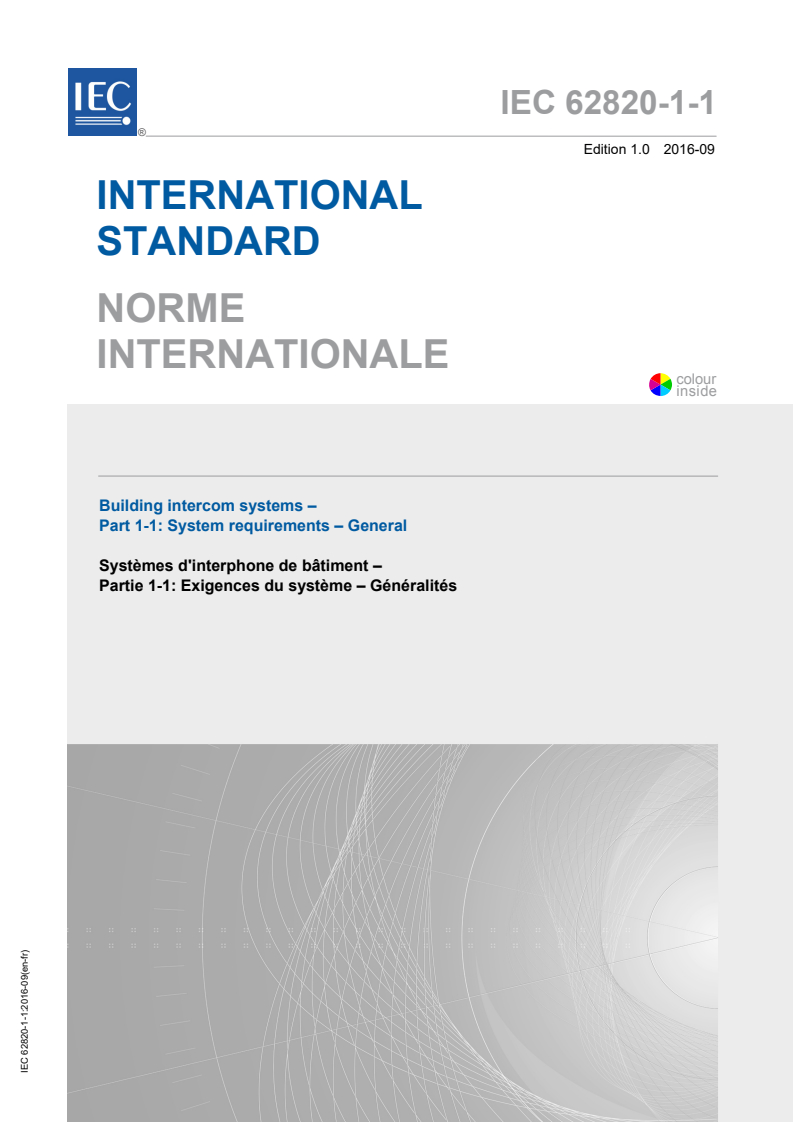
IEC 62820-1-1 ®
Edition 1.0 2016-09
INTERNATIONAL
STANDARD
NORME
INTERNATIONALE
colour
inside
Building intercom systems –
Part 1-1: System requirements – General
Systèmes d'interphone de bâtiment –
Partie 1-1: Exigences du système – Généralités
All rights reserved. Unless otherwise specified, no part of this publication may be reproduced or utilized in any form
or by any means, electronic or mechanical, including photocopying and microfilm, without permission in writing from
either IEC or IEC's member National Committee in the country of the requester. If you have any questions about IEC
copyright or have an enquiry about obtaining additional rights to this publication, please contact the address below or
your local IEC member National Committee for further information.
Droits de reproduction réservés. Sauf indication contraire, aucune partie de cette publication ne peut être reproduite
ni utilisée sous quelque forme que ce soit et par aucun procédé, électronique ou mécanique, y compris la photocopie
et les microfilms, sans l'accord écrit de l'IEC ou du Comité national de l'IEC du pays du demandeur. Si vous avez des
questions sur le copyright de l'IEC ou si vous désirez obtenir des droits supplémentaires sur cette publication, utilisez
les coordonnées ci-après ou contactez le Comité national de l'IEC de votre pays de résidence.
IEC Central Office Tel.: +41 22 919 02 11
3, rue de Varembé Fax: +41 22 919 03 00
CH-1211 Geneva 20 info@iec.ch
Switzerland www.iec.ch
About the IEC
The International Electrotechnical Commission (IEC) is the leading global organization that prepares and publishes
International Standards for all electrical, electronic and related technologies.
About IEC publications
The technical content of IEC publications is kept under constant review by the IEC. Please make sure that you have the
latest edition, a corrigenda or an amendment might have been published.
IEC Catalogue - webstore.iec.ch/catalogue Electropedia - www.electropedia.org
The stand-alone application for consulting the entire The world's leading online dictionary of electronic and
bibliographical information on IEC International Standards, electrical terms containing 20 000 terms and definitions in
Technical Specifications, Technical Reports and other English and French, with equivalent terms in 15 additional
documents. Available for PC, Mac OS, Android Tablets and languages. Also known as the International Electrotechnical
iPad. Vocabulary (IEV) online.
IEC publications search - www.iec.ch/searchpub IEC Glossary - std.iec.ch/glossary
The advanced search enables to find IEC publications by a 65 000 electrotechnical terminology entries in English and
variety of criteria (reference number, text, technical French extracted from the Terms and Definitions clause of
committee,…). It also gives information on projects, replaced IEC publications issued since 2002. Some entries have been
and withdrawn publications. collected from earlier publications of IEC TC 37, 77, 86 and
CISPR.
IEC Just Published - webstore.iec.ch/justpublished
Stay up to date on all new IEC publications. Just Published IEC Customer Service Centre - webstore.iec.ch/csc
details all new publications released. Available online and If you wish to give us your feedback on this publication or
also once a month by email. need further assistance, please contact the Customer Service
Centre: csc@iec.ch.
A propos de l'IEC
La Commission Electrotechnique Internationale (IEC) est la première organisation mondiale qui élabore et publie des
Normes internationales pour tout ce qui a trait à l'électricité, à l'électronique et aux technologies apparentées.
A propos des publications IEC
Le contenu technique des publications IEC est constamment revu. Veuillez vous assurer que vous possédez l’édition la
plus récente, un corrigendum ou amendement peut avoir été publié.
Catalogue IEC - webstore.iec.ch/catalogue Electropedia - www.electropedia.org
Application autonome pour consulter tous les renseignements
Le premier dictionnaire en ligne de termes électroniques et
bibliographiques sur les Normes internationales,
électriques. Il contient 20 000 termes et définitions en anglais
Spécifications techniques, Rapports techniques et autres
et en français, ainsi que les termes équivalents dans 15
documents de l'IEC. Disponible pour PC, Mac OS, tablettes
langues additionnelles. Egalement appelé Vocabulaire
Android et iPad.
Electrotechnique International (IEV) en ligne.
Recherche de publications IEC - www.iec.ch/searchpub
Glossaire IEC - std.iec.ch/glossary
La recherche avancée permet de trouver des publications IEC 65 000 entrées terminologiques électrotechniques, en anglais
en utilisant différents critères (numéro de référence, texte, et en français, extraites des articles Termes et Définitions des
comité d’études,…). Elle donne aussi des informations sur les publications IEC parues depuis 2002. Plus certaines entrées
projets et les publications remplacées ou retirées. antérieures extraites des publications des CE 37, 77, 86 et
CISPR de l'IEC.
IEC Just Published - webstore.iec.ch/justpublished
Service Clients - webstore.iec.ch/csc
Restez informé sur les nouvelles publications IEC. Just
Published détaille les nouvelles publications parues. Si vous désirez nous donner des commentaires sur cette
Disponible en ligne et aussi une fois par mois par email. publication ou si vous avez des questions contactez-nous:
csc@iec.ch.
IEC 62820-1-1 ®
Edition 1.0 2016-09
INTERNATIONAL
STANDARD
NORME
INTERNATIONALE
colour
inside
Building intercom systems –
Part 1-1: System requirements – General
Systèmes d'interphone de bâtiment –
Partie 1-1: Exigences du système – Généralités
INTERNATIONAL
ELECTROTECHNICAL
COMMISSION
COMMISSION
ELECTROTECHNIQUE
INTERNATIONALE
ICS 13.320 ISBN 978-2-8322-3626-0
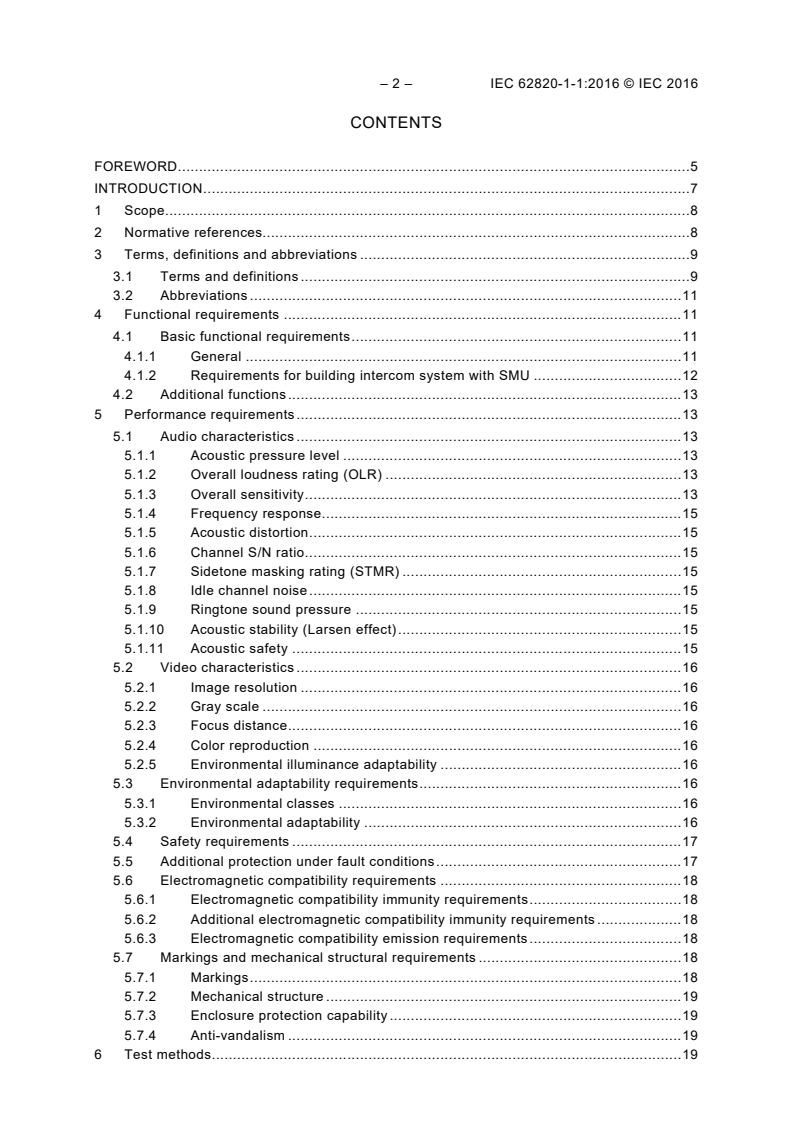
– 2 – IEC 62820-1-1:2016 © IEC 2016
CONTENTS
FOREWORD . 5
INTRODUCTION . 7
1 Scope . 8
2 Normative references. 8
3 Terms, definitions and abbreviations . 9
3.1 Terms and definitions . 9
3.2 Abbreviations . 11
4 Functional requirements . 11
4.1 Basic functional requirements . 11
4.1.1 General . 11
4.1.2 Requirements for building intercom system with SMU . 12
4.2 Additional functions . 13
5 Performance requirements . 13
5.1 Audio characteristics . 13
5.1.1 Acoustic pressure level . 13
5.1.2 Overall loudness rating (OLR) . 13
5.1.3 Overall sensitivity . 13
5.1.4 Frequency response . 15
5.1.5 Acoustic distortion . 15
5.1.6 Channel S/N ratio . 15
5.1.7 Sidetone masking rating (STMR) . 15
5.1.8 Idle channel noise . 15
5.1.9 Ringtone sound pressure . 15
5.1.10 Acoustic stability (Larsen effect) . 15
5.1.11 Acoustic safety . 15
5.2 Video characteristics . 16
5.2.1 Image resolution . 16
5.2.2 Gray scale . 16
5.2.3 Focus distance . 16
5.2.4 Color reproduction . 16
5.2.5 Environmental illuminance adaptability . 16
5.3 Environmental adaptability requirements . 16
5.3.1 Environmental classes . 16
5.3.2 Environmental adaptability . 16
5.4 Safety requirements . 17
5.5 Additional protection under fault conditions . 17
5.6 Electromagnetic compatibility requirements . 18
5.6.1 Electromagnetic compatibility immunity requirements . 18
5.6.2 Additional electromagnetic compatibility immunity requirements . 18
5.6.3 Electromagnetic compatibility emission requirements . 18
5.7 Markings and mechanical structural requirements . 18
5.7.1 Markings . 18
5.7.2 Mechanical structure . 19
5.7.3 Enclosure protection capability . 19
5.7.4 Anti-vandalism . 19
6 Test methods . 19
6.1 Test conditions . 19
6.1.1 Test environmental conditions . 19
6.1.2 Electrical connection . 20
6.2 Function test . 20
6.3 Audio characteristics test . 20
6.4 Video characteristics test . 20
6.5 Environmental adaptability test . 20
6.6 Safety test . 20
6.7 Protection under fault conditions test . 20
6.8 Electromagnetic compatibility test . 20
6.8.1 Electromagnetic compatibility immunity test . 20
6.8.2 Additional electromagnetic compatibility immunity test . 20
6.8.3 Electromagnetic compatibility emission test . 21
6.9 Markings and mechanical structure test . 21
6.9.1 Markings and scrub resistance test . 21
6.9.2 Mechanical structure test . 21
6.9.3 Enclosure protection capability test . 21
6.9.4 Anti-vandalism test . 21
7 Documentation . 22
Annex A (normative) Test of audio characteristics . 23
A.1 Test conditions . 23
A.2 Acoustic pressure level test . 23
A.2.1 Methods . 23
A.2.2 Calibration of test equipment . 24
A.2.3 Test of the acoustic pressure level . 24
A.3 Overall loudness rating (OLR) test . 25
A.3.1 Measurement of sound pressure P at the MRP . 25
m
A.3.2 Measurement of output sound pressure P of the hands-free EUT . 25
o
A.3.3 Measurement of output sound pressure P of the handset EUT . 26
e
A.3.4 Calculations of the OLR . 27
A.4 Overall sensitivity test . 28
A.4.1 Test of the overall sensitivity at the hands-free EUT . 28
A.4.2 Test of the overall sensitivity at the handset EUT . 28
A.5 Frequency response test . 28
A.6 Acoustic distortion test . 29
A.7 Channel S/N ratio test . 29
A.8 Sidetone masking rating (STMR) test . 29
A.9 Idle channel noise test . 30
A.10 Ringtone sound pressure test . 30
A.11 Acoustic stability (Larsen Effect) test . 30
A.12 Acoustic safety test . 31
Annex B (normative) Test of video characteristics . 33
B.1 Test conditions . 33
B.2 Connection of the tested system . 33
B.3 Image resolution test . 33
B.4 Gray scale test . 34
B.5 Focus distance test . 34
B.6 Color reproduction test . 35
B.7 Environmental illumination adaptability test . 36
– 4 – IEC 62820-1-1:2016 © IEC 2016
Annex C (normative) Different requirements between grade 1 and grade 2 . 37
Annex D (normative) Safety requirements correspondence in IEC 60065 or
IEC 60950-1 . 39
Bibliography . 40
Figure 1 – Overall sensitivity at the hands-free unit . 14
Figure 2 – Overall sensitivity at the handset unit . 14
Figure A.1 – Measurement of sound pressure P at the MRP . 25
m
Figure A.2 – Measurement of output sound pressure P when connected with the
o
handset unit . 25
Figure A.3 – Measurement of output sound pressure P when connected with the
o
hands-free unit . 26
Figure A.4 – Measurement of output sound pressure P when connected with the
e
handset unit . 26
Figure A.5 – Measurement of output sound pressure P when connected with the
e
hands-free unit . 26
Figure A.6 – Measurement of STMR at the handset EUT . 30
Figure A.7 – Measurement of ringtone sound pressure . 30
Figure A.8 – Acoustic stability test for handset EUT . 31
Figure A.9 – Acoustic stability test for hands-free EUT . 31
Figure A.10 – Acoustic safety test . 32
Figure B.1 – Connection diagram for test of video characteristics . 33
Figure B.2 – TE170 test chart . 34
Figure B.3 – TE83 test chart . 34
Figure B.4 – Focus test chart . 35
Figure B.5 – Position of the external ring area . 35
Figure B.6 – TE106 test chart . 36
Table 1 – Environmental adaptability requirements . 17
Table A.1 – Factors for OLR . 28
Table C.1 – Requirements of grade 1 and grade 2 . 37
Table D.1 – Correspondence between IEC 60065 and IEC 60950-1 . 39
INTERNATIONAL ELECTROTECHNICAL COMMISSION
____________
BUILDING INTERCOM SYSTEMS –
Part 1-1: System requirements – General
FOREWORD
1) The International Electrotechnical Commission (IEC) is a worldwide organization for standardization comprising
all national electrotechnical committees (IEC National Committees). The object of IEC is to promote international
co-operation on all questions concerning standardization in the electrical and electronic fields. To this end and in
addition to other activities, IEC publishes International Standards, Technical Specifications, Technical Reports,
Publicly Available Specifications (PAS) and Guides (hereafter referred to as “IEC Publication(s)”). Their
preparation is entrusted to technical committees; any IEC National Committee interested in the subject dealt with
may participate in this preparatory work. International, governmental and non-governmental organizations liaising
with the IEC also participate in this preparation. IEC collaborates closely with the International Organization for
Standardization (ISO) in accordance with conditions determined by agreement between the two organizations.
2) The formal decisions or agreements of IEC on technical matters express, as nearly as possible, an international
consensus of opinion on the relevant subjects since each technical committee has representation from all
interested IEC National Committees.
3) IEC Publications have the form of recommendations for international use and are accepted by IEC National
Committees in that sense. While all reasonable efforts are made to ensure that the technical content of IEC
Publications is accurate, IEC cannot be held responsible for the way in which they are used or for any
misinterpretation by any end user.
4) In order to promote international uniformity, IEC National Committees undertake to apply IEC Publications
transparently to the maximum extent possible in their national and regional publications. Any divergence between
any IEC Publication and the corresponding national or regional publication shall be clearly indicated in the latter.
5) IEC itself does not provide any attestation of conformity. Independent certification bodies provide conformity
assessment services and, in some areas, access to IEC marks of conformity. IEC is not responsible for any
services carried out by independent certification bodies.
6) All users should ensure that they have the latest edition of this publication.
7) No liability shall attach to IEC or its directors, employees, servants or agents including individual experts and
members of its technical committees and IEC National Committees for any personal injury, property damage or
other damage of any nature whatsoever, whether direct or indirect, or for costs (including legal fees) and expenses
arising out of the publication, use of, or reliance upon, this IEC Publication or any other IEC Publications.
8) Attention is drawn to the Normative references cited in this publication. Use of the referenced publications is
indispensable for the correct application of this publication.
9) Attention is drawn to the possibility that some of the elements of this IEC Publication may be the subject of patent
rights. IEC shall not be held responsible for identifying any or all such patent rights.
International Standard IEC 62820-1-1 has been prepared by IEC technical committee 79: Alarm
and electronic security systems.
The text of this standard is based on the following documents:
FDIS Report on voting
79/559/FDIS 79/563/RVD
Full information on the voting for the approval of this standard can be found in the report on
voting indicated in the above table.
This publication has been drafted in accordance with the ISO/IEC Directives, Part 2.
A list of all parts in the IEC 62820 series, published under the general title Building intercom
systems, can be found on the IEC website.
– 6 – IEC 62820-1-1:2016 © IEC 2016
The committee has decided that the contents of this publication will remain unchanged until the
stability date indicated on the IEC website under "http://webstore.iec.ch" in the data related to
the specific publication. At this date, the publication will be
• reconfirmed,
• withdrawn,
• replaced by a revised edition, or
• amended.
IMPORTANT – The 'colour inside' logo on the cover page of this publication indicates
that it contains colours which are considered to be useful for the correct understanding
of its contents. Users should therefore print this document using a colour printer.
INTRODUCTION
This part of IEC 62820 specifies the technical requirements for building intercom systems and
equipment used for building entry. Building intercom systems can function independently and
may be extendable to support building security management functions, e.g. extendable with
security management unit (SMU) operated by security staff (door-man, concierge,
security-guard, porter, etc.), or in conjunction with other systems as per the security
requirements of the building. It may consist of: Visitor call unit (VCU), user receiver unit (URU),
SMU, power supply, auxiliary device as well as interface-unit to other security-systems.
The IEC 62820 series of standards set out the technical requirements for the composition,
functions, performance, test methods of building intercom systems for building entry and
application guidelines and consist of five parts:
Part 1-1: System requirements – General
Part 1-2: System requirements – IP building intercom systems
Part 2: Requirements for advanced security building intercom systems
Part 3-1: Application guidelines – General
Part 3-2: Application guidelines – Advanced security building intercom systems
The Part 1-1 of IEC 62820 is based on Chinese standard GB/T 31070.1-2014 and European
standard EN 50486:2008.
– 8 – IEC 62820-1-1:2016 © IEC 2016
BUILDING INTERCOM SYSTEMS –
Part 1-1: System requirements – General
1 Scope
This Part of IEC 62820 specifies the technical requirements for the composition, functions,
performance, and test methods of general building intercom systems.
This part is applicable to the general intercom systems for building entry in residential or
commercial buildings.
Door-Entry-System (DES) is a simple kind of convenient Building-Intercom-System (BIS) mainly
for user’s comfort. This document has classified the general building intercom systems into two
grades in Part 1-1. Grade 1 adopts lower requirements to cover DES not used for relevant
security applications while grade 2 adopts higher requirements for building intercom systems for
security applications. Each grade may adopt different functional and performance requirements,
test methods and normative references.
NOTE The different requirements between grade 1 and grade 2 are summarized in Table C.1.
2 Normative references
The following documents are referred to in the text in such a way that some or all of their content
constitutes requirements of this document. For dated references, only the edition cited applies.
For undated references, the latest edition of the referenced document (including any
amendments) applies.
IEC 60065:2014, Audio, video and similar electronic apparatus – Safety requirements
IEC 60529:1989, Degrees of protection provided by enclosures (IP Code)
IEC 60529:1989/AMD1:1999
IEC 60529:1989/AMD2:2013
IEC 60950-1:2005, Information technology equipment – Safety – Part 1: General requirements
IEC 61000-6-1, Electromagnetic compatibility (EMC) – Part 6-1: Generic standards – Immunity
for residential, commercial and light-industrial environments
IEC 61000-6-3, Electromagnetic compatibility (EMC) – Part 6-3: Generic standards – Emission
standard for residential, commercial and light-industrial environments
IEC 62262, Degrees of protection provided by enclosures for electrical equipment against
external mechanical impacts (IK code)
IEC 62599-1, Alarm systems – Part 1: Environmental test methods
IEC 62599-2, Alarm systems – Part 2: Electromagnetic compatibility – Immunity requirements
for components of fire and security alarm systems
ISO 12233:2014, Photography – Electronic still picture imaging – Resolution and spatial
frequency responses
ITU-T P.50, Artificial voices
ITU-T P.51-1996, Artificial mouth
ITU-T P.79-2007, Calculation of loudness ratings for telephone sets
ITU-T P.501, Test signals for use in telephonometry
3 Terms, definitions and abbreviations
3.1 Terms and definitions
For the purposes of this document, the following terms and definitions apply.
ISO and IEC maintain terminological databases for use in standardization at the following
addresses:
• IEC Electropedia: available at http://www.electropedia.org/
• ISO Online browsing platform: available at http://www.iso.org/obp
3.1.1
2-way speech
speech between any two units (VCU, URU or SMU) in each direction which may be simultaneous
or non-simultaneous
3.1.2
acoustic distortion
distortion of signals at the receiving terminal of the system as a result of system transmission
non-linearity and ground noise, expressed as a ratio percentage of the harmonic signal and
ground noise at the receiving terminal in proportion to the overall sound pressure
3.1.3
acoustic pressure level
measurement of the acoustic pressure level generated by the equipment under test (EUT) in
normal conditions
3.1.4
artificial ear
device used to calibrate the receiver and containing an acoustic coupler and a calibrated
microphone used to measure sound pressure
Note 1 to entry: Its overall acoustic impedance within a given frequency band is similar to that of the average human
ear, and its characteristics comply with the requirements of type 1 or type 3.2 provided by Article 5 of
ITU-T P.57-2011.
3.1.5
artificial mouth
analogue device the sound characteristics of which are similar to the directivity and radiation
pattern of the average human mouth
Note 1 to entry: It conforms to the requirements set forth in Article 5 of ITU-T P.51-1996.
3.1.6
auxiliary device
device which extends or facilitates additional functions and interfaces of a building intercom
rd
system, such as communications, remote control, 3 party devices interfaces etc.
– 10 – IEC 62820-1-1:2016 © IEC 2016
3.1.7
building intercom system
BIS
system designed for entry communication in residential or commercial buildings which provides
addressing calls, speech and optional video function and is equipped with an electronic
unlocking device
3.1.8
channel S/N
sound pressure ratio between signal and ground noise at the receiving terminal under excitation
of the nominal sound pressure at the transmitting terminal, expressed in dB
3.1.9
handset unit
device typically coupled to the ear by hand as can be a handset URU or handset SMU
3.1.10
hands-free unit
device that does not need to use the hand during the communication as can be a VCU,
hands-free URU or hands-free SMU
3.1.11
idle channel noise
noise expressed in dB(A) which is received in the terminal after the channel connection is
established when no signal is transferred
3.1.12
loudness rating guard-ring position
LRGP
fixed position in which the handset of the URU or SMU is used to measure the rating of system
loudness
[SOURCE: adapted from ITU-T P.64:2007]
3.1.13
overall loudness rating
OLR
measurement of the loudness in the entire channel from the reference point of the mouth at the
transmitting terminal to the ear reference point (ERP) at the receiving terminal, expressed in dB
[SOURCE: adapted from ITU-T P.79:2007]
3.1.14
overall sensitivity
gain of the sound pressure at the reference point of the ear at the reception terminal relative to
the excitation sound pressure at the mouth reference point (MRP) at the transmitting terminal,
expressed in dB
Note 1 to entry: It is a function of frequency.
3.1.15
security management unit
SMU
device which can be addressed from the call unit (VCU, URU or SMU), provides the means of
addressing the calling signal to the desired receiver unit(s) which can be URU or SMU, 2-way
speech, the activation of the audio and/or video connection with the VCU and the means to
initiate remote unlocking of the controlled entrance
3.1.16
sidetone masking rating
STMR
measurement of sidetone loudness after factoring in the masking effects of the human head on
sidetone, expressed in dB
[SOURCE: adapted from ITU-T P.79:2007]
3.1.17
user receiver unit
URU
addressable user device which provides 2-way speech with optional video, and a means to
initiate remote unlocking of the controlled entrance
3.1.18
visitor call unit
VCU
device installed outside a controlled entrance which provides the means of addressing the
calling signal to the desired URU or SMU and 2-way speech with optional video capture
Note 1 to entry: The device can also provide the means of unlocking the controlled entrance and other function(s) or
these function(s) can be contained within a separate associated device normally located within the controlled
premises and which can also contain the system power supply.
3.2 Abbreviations
BIS building intercom system
DES door entry system
ERP ear reference point
EUT equipment under test
Lpm level (sound) pressure mean
LRGP loudness rating guard-ring position
MRP mouth reference point
OLR overall loudness rating
PIN personal identification number
SMU security management unit
STMR sidetone masking rating
URU user receiver unit
VCU visitor call unit
4 Functional requirements
4.1 Basic functional requirements
4.1.1 General
A building intercom system shall meet the following requirements:
a) Call function
The VCU shall be able to address the desired URU. The VCU shall be able to produce a
visible and/or audible call alert signal. The URU shall be able to produce a response prompt
signal that can be visible, audible, etc.
b) Speech function
– 12 – IEC 62820-1-1:2016 © IEC 2016
2-way speech shall be provided, which can be either non-simultaneous or simultaneous. It
may be of limited duration controlled by a system timer such that the speech channel cannot
be accidentally occupied for an unlimited time.
c) Unlocking function
The unlocking function shall be provided with an electric or electronic signal to an electric or
electronic locking device for securing a building entrance. This function shall be controlled
by URU at the user’s discretion. In grade 2 the URU shall be in communication with the VCU
to perform the unlocking function.
The unlocking function could also be activated by other means:
1) The VCU may be provided with a means for authorized users to directly activate the
unlocking function, such as by PIN code or secure proximity card or other security grade
dependent means.
2) Request to exit button or switch located inside the controlled area and normally adjacent
to the controlled entrance. According to the security requirements of the installation this
button or switch may be a simple switch or require a PIN or other secure means of
operation.
3) Other system signal such as an activated fire alarm signal, a building evacuation signal
etc.
d) Nighttime operability
Grade 1: No requirement;
Grade 2: The VCU shall provide illumination or visible prompts to facilitate the visitor’s
operations at night.
e) Video and image recording and replaying function
When a URU is equipped with a video function it shall be able to display images captured by
the VCU. The functions of storing, replaying the visitor’s images are optional.
f) Operational indication
The system shall provide the operating and operational information to the visitor. The VCU
should provide a comfort indication that the call is being processed, such as a low level
audible tone and/ or visible indication. The VCU should also give audio and/or visible
indication when the lock has been released and that entry to the premises is permitted.
NOTE The VCU can give clear indication or prompts to the visitor how to address the desired URU.
g) Anti listen-in
Grade 1: No requirement.
Grade 2: After connecting the VCU with the URU, the audio information shall not be
monitored by other URU connected to the system.
4.1.2 Requirements for building intercom system with SMU
A building intercom system with SMU shall meet the following requirements:
a) The SMU shall be able to address and initiate calls to selected URU. The VCU and the URU
shall be able to initiate calls to the SMU. If multiple SMU are connected to the system, they
shall be able to call each other. All the calls shall be able to produce call alert and response
prompt signals. The signals can be visible, audible, etc.
b) The SMU shall be capable of 2-way speech with the VCU or the URU. If multiple SMU are
connected to the system, they shall be capable of 2-way speech with each other.
c) The SMU shall be able to control the VCU to perform electrical or electronic unlocking.
d) When a SMU is equipped with a video function it shall be able to display images captured by
the VCU. The URU shall be able to display images captured by SMU equipped with a video
camera.
e) For grade 2: After connecting the SMU with the VCU or the URU, the audio and video
information shall not be monitored by other URU connected to the system.
f) For grade 2: The SMU shall be able to address and communicate to selected VCU.
4.2 Additional functions
A building intercom system can also provide the following functions:
a) If the unsecured state of the controlled entrance lasts beyond the configured time, the SMU
may be able to receive a warning message.
NOTE Unsecured state: the door opened for too long, the tamper switch triggered, etc.
b) The system may have the possibility of transmitting images and texts to the URU.
c) The SMU may have a timed and dated event log with security graded access and recording
access events at the VCU.
1) URU’s called and if unlocking function operated by the URU.
2) VCU unlocking carried out directly at the VCU, identifying the authorized user.
3) Programming events such as adding or subtracting users and URU’s.
4) Identification of the operator accessing the event log.
d) SMU may intercept incoming calls from a VCU directed to an URU and then redirect the call
to desired URU.
e) If a SMU operator is not available, SMU may record details of URU which called the SMU in
order to allow the operator to call back the URU.
5 Performance requirements
5.1 Audio characteristics
5.1.1 Acoustic pressure level
Grade 1: Acoustic pressure level shall meet the following requirements:
a) Acoustic pressure level value generated by hands-free unit:
– For discrete measurement shall be ≥ 70 dBSPL.
– For continue measurement shall be ≥ 70 dB(A).
b) Acoustic pressure level value generated by handset unit:
– For discrete measurement shall be ≥ 77 dBSPL.
– For continue measurement shall be ≥ 77 dB(A).
Grade 2: No requirement.
5.1.2 Overall loudness rating (OLR)
Grade 1: No requirement.
Grade 2: The OLR shall meet the following requirements:
+10
a) At the VCU: dB.
−5
+10
b) At the hands-free URU and hands-free SMU: dB.
−5
c) At the handset unit: (15 ± 5) dB.
5.1.3 Overall sensitivity
Grade 1: No requirement.
– 14 – IEC 62820-1-1:2016 © IEC 2016
Grade 2: The typical curve and its tolerance range of overall sensitivity between 500 Hz and
3 400 Hz shall meet the following requirements:
a) At the hands-free unit: The typical curve is the dotted line shown in Figure 1 and its tolerance
range is the solid line shown in Figure 1.
b) At the handset unit: the typical curve is the dotted line shown in Figure 2 and its tolerance
range is the solid line shown in Figure 2.
NOTE Best fit or floating mask, refer to Figure 1 and Figure 2.
–4
–8
–12
–16
Frequency (Hz)
IEC
Figure 1 – Overall sensitivity at the hands-free unit
–4
–8
–12
–16
Frequency (Hz)
IEC
Figure 2 – Overall sensitivity at the handset unit
Relative sensitivity (dB) Relative sensitivity (dB)
100 100
125 125
160 160
200 200
250 250
500 500
630 630
800 800
1 000
1 000
1 250 1 250
1 600 1 600
2 000 2 000
20 dB
23 dB
2 500 2 500
3 150
3 150
3 400 3 400
4 000 4 000
5 000
5 000
6 300 6 300
5.1.4 Frequency response
Grade 1: Once the VCU, the URU and the SMU are connected for speech, the difference
between the higher and lower measurement of acoustic pressure level shall not be greater than
25 dB.
Grade 2: No requirement.
5.1.5 Acoustic distortion
Grade 1: No requirement.
Grade 2: The acoustic distortion shall meet the following requirements when the excitation
sound pressure is 0 dBPa:
a) At the hands-free unit: shall not be greater than 10 %.
b) At the handset unit: shall not be greater than 7 %.
5.1.6 Channel S/N ratio
Grade 1: No requirement.
Grade 2: The channel S/N ratio shall meet the following requirements when the excitation sound
pressure is 0 dBPa:
a) At the hands-free unit: shall not be less than 25 dB.
b) At the handset unit: shall not be less than 30 dB.
5.1.7 Sidetone masking rating (STMR)
Grade 1: No requirement.
Grade 2: The STMR of the handset unit shall not be less than 5 dB.
5.1.8 Idle channel noise
Grade 1: No requirement.
Grade 2: The idle channel noise shall meet the following requirements:
a) At the hands-free unit: shall not be greater than 45 dB(A).
b) At the handset unit: shall not be greater than 48 dB(A).
5.1.9 Ringtone sound pressure
The ringtone sound pressure shall not be less than 73 dB(A) and not greater than 106 dB(A).
5.1.10 Acoustic stability (Larsen effect)
Once the VCU, the URU and the SMU are connected for speech, there shall not be high pitched
whistling noise present.
5.1.11 Acoustic safety
In any operational state, the generated acoustic pressure level shall not exceed 120 dB(A).
– 16 – IEC 62820-1-1:2016 © IEC 2016
5.2 Video characteristics
5.2.1 Image resolution
The image resolution (at the center) shall not be less than 130 TVL for the visible area smaller
than 101,6 mm (4,0 inches), and shall not be less than 200 TVL for the visible area of 101,6 mm
(4,0 inches) or larger.
5.2.2 Gray scale
The gray scale shall not be less than 8 levels.
5.2.3 Focus distance
Minimum focus distance: 0,3 m.
The object that is more than 0,3 m away from the camera shall be clearly focused.
5.2.4 Color reproduction
This requirement applies to color video BIS. No obvious chromatic aberration between the color
of
...