


IEC 62676-4:2025
(Main)Video surveillance systems for use in security applications - Part 4: Application guidelines
Video surveillance systems for use in security applications - Part 4: Application guidelines
IEC 62676-4:2025 describes the planning, design, installation, testing, commissioning, and maintaining of video surveillance systems (VSS) comprising image capture device(s), interconnection(s) and image handling device(s), for use in security applications within private or public spaces.
Systèmes de vidéosurveillance destinés à être utilisés dans les applications de sécurité - Partie 4: Directives d'application
L’IEC 62676-4:2025 décrit la planification, la conception, l’installation, les procédures d’essai, la mise en service et l’entretien des systèmes de vidéosurveillance (VSS) comprenant un ou plusieurs dispositifs de capture d’images, une ou plusieurs interconnexions et un ou plusieurs dispositifs de manipulation d’images, destinés à être utilisés dans des applications de sécurité dans des espaces privés ou publics.
General Information
- Status
- Published
- Publication Date
- 08-Oct-2025
- Technical Committee
- TC 79 - Alarm and electronic security systems
- Drafting Committee
- WG 12 - TC 79/WG 12
- Current Stage
- PPUB - Publication issued
- Start Date
- 09-Oct-2025
- Completion Date
- 03-Oct-2025
Relations
- Effective Date
- 05-Sep-2023
Overview
IEC 62676-4:2025 - Video surveillance systems for use in security applications - Part 4: Application guidelines - provides comprehensive guidance for the lifecycle of video surveillance systems (VSS) used in private and public security applications. The standard covers planning, design, installation, testing, commissioning and maintenance of VSS comprised of image capture device(s), interconnection(s) and image handling device(s). It is intended to help organisations deliver reliable, legally defensible and operationally effective surveillance deployments.
Key topics and technical requirements
The standard addresses practical and technical aspects of VSS design and operation, including:
- Planning & risk assessment: security concept, selecting security grades, operational requirements, site surveys and site plans.
- System design: camera siting, fields of view, object sizing and pixel density, lens and housing selection, illumination and tamper protection.
- Equipment selection: camera types (including PTZ), lenses, housings, IP video equipment and interoperability considerations.
- Transmission & networking: wired and wireless link considerations, IP video performance classes and network-related requirements.
- Image quality & performance: resolution, frame rate, image compression and video performance characteristics.
- Storage & export: storage requirements, metadata (time/date/camera ID), encryption, export formats and replay of exported images.
- Control room configuration: display sizing/positioning, number of operator workstations, backup power and environmental protections.
- Testing & acceptance: development of test plans, factory/user/technical acceptance testing and image quality verification.
- Documentation & maintenance: design specifications, test plans, commissioning records, operating logbooks, preventive and corrective maintenance procedures.
Practical applications
IEC 62676-4 is practical guidance for anyone responsible for specifying, delivering or operating surveillance systems in commercial buildings, transport hubs, utilities, public spaces, retail environments and critical infrastructure. Typical uses include:
- Developing tender/operational requirement documents for VSS projects
- Designing camera coverage to meet identification and evidential needs
- Specifying IP video systems, storage and export workflows for compliance and forensic quality
- Creating commissioning and acceptance test plans to validate system performance
- Establishing maintenance contracts and operating procedures to ensure long-term reliability
Who should use this standard
- Security system designers and integrators
- Facility and security managers
- Project specifiers and procurement teams
- Installers, testers and commissioning engineers
- Regulators and stakeholders overseeing public-space surveillance
Related standards
Refer to other parts of the IEC 62676 series and complementary industry standards for device-level, interoperability and performance specifications when developing a complete VSS solution.
Buy Documents

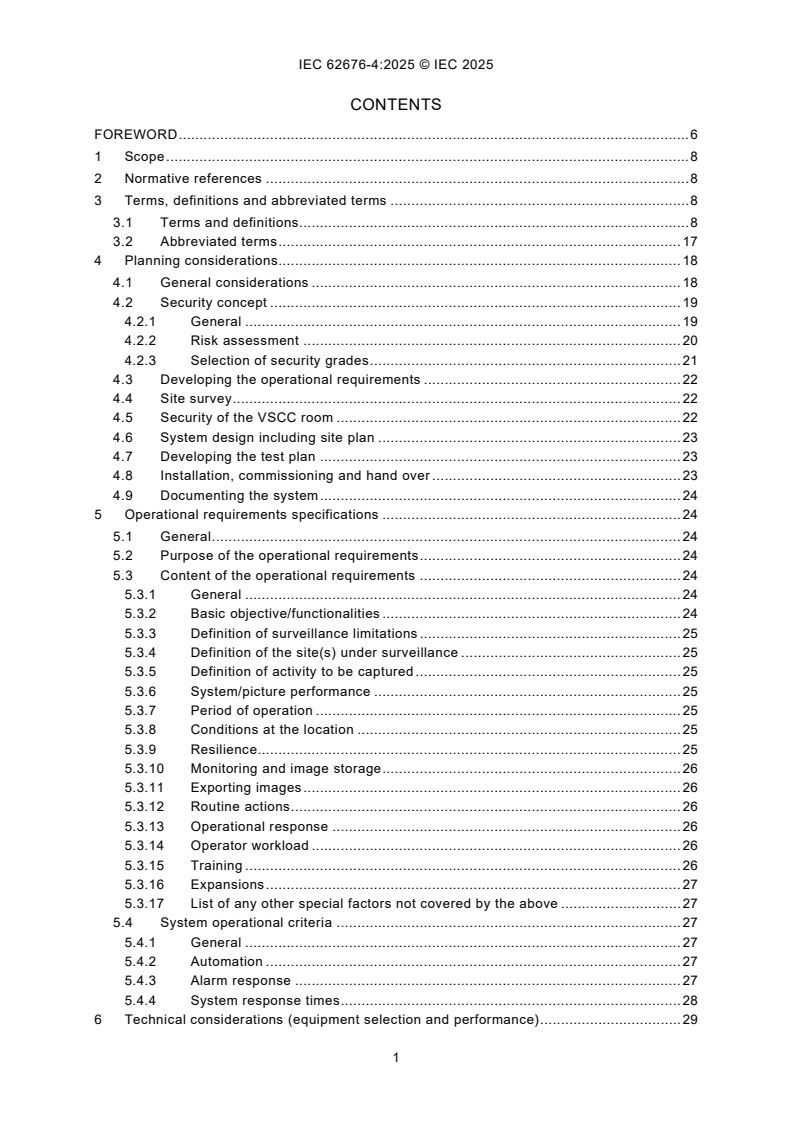
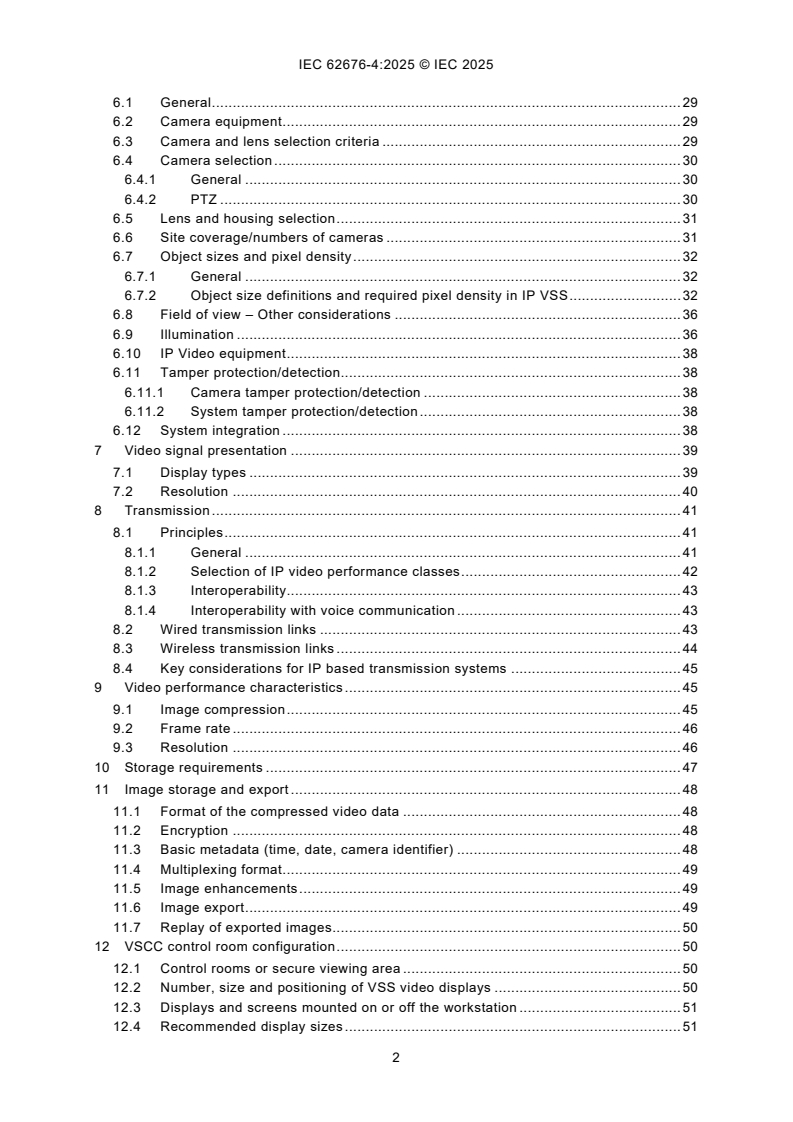
IEC 62676-4:2025 - Video surveillance systems for use in security applications - Part 4: Application guidelines Released:10/9/2025 Isbn:9782832706978


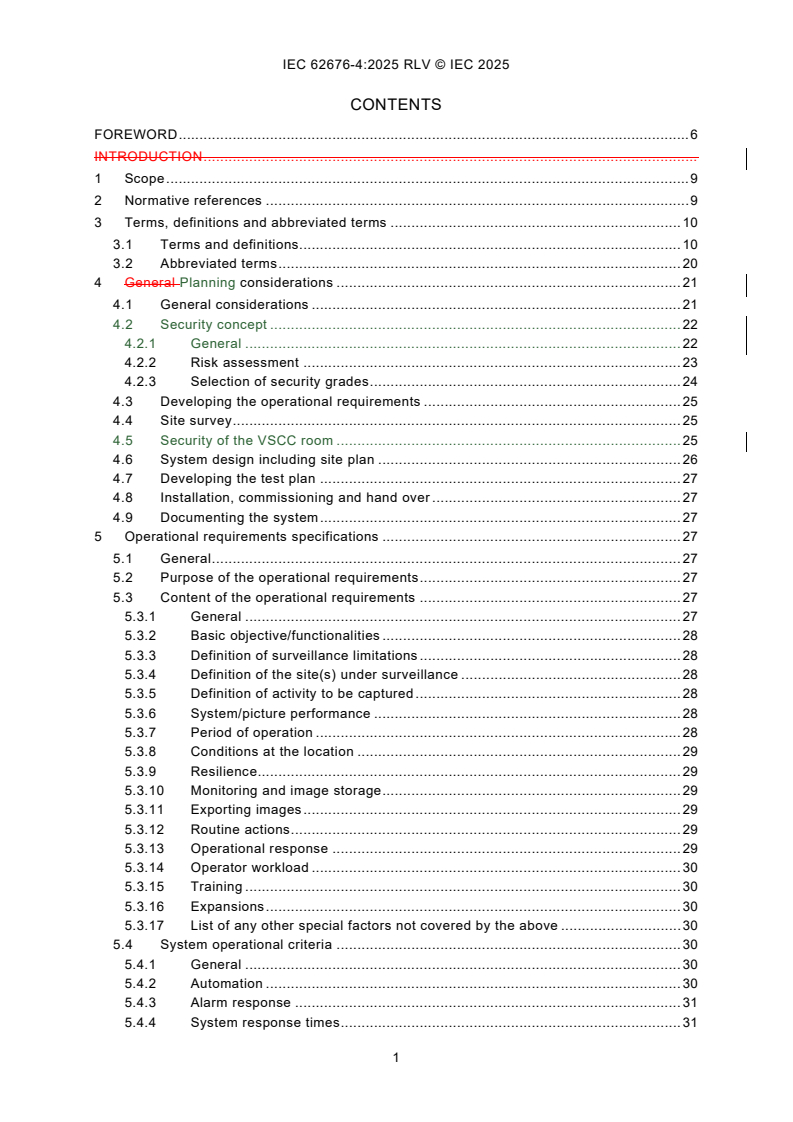
IEC 62676-4:2025 RLV - Video surveillance systems for use in security applications - Part 4: Application guidelines Released:10/9/2025 Isbn:9782832707791


IEC 62676-4:2025 - Systèmes de vidéosurveillance destinés à être utilisés dans les applications de sécurité - Partie 4: Directives d'application Released:10/9/2025 Isbn:9782832706978


IEC 62676-4:2025 - Video surveillance systems for use in security applications - Part 4: Application guidelines Released:10/9/2025 Isbn:9782832706978
Get Certified
Connect with accredited certification bodies for this standard

NSF International
Global independent organization facilitating standards development and certification.

CIS Institut d.o.o.
Personal Protective Equipment (PPE) certification body. Notified Body NB-2890 for EU Regulation 2016/425 PPE.

Kiwa BDA Testing
Building and construction product certification.
Sponsored listings
Frequently Asked Questions
IEC 62676-4:2025 is a standard published by the International Electrotechnical Commission (IEC). Its full title is "Video surveillance systems for use in security applications - Part 4: Application guidelines". This standard covers: IEC 62676-4:2025 describes the planning, design, installation, testing, commissioning, and maintaining of video surveillance systems (VSS) comprising image capture device(s), interconnection(s) and image handling device(s), for use in security applications within private or public spaces.
IEC 62676-4:2025 describes the planning, design, installation, testing, commissioning, and maintaining of video surveillance systems (VSS) comprising image capture device(s), interconnection(s) and image handling device(s), for use in security applications within private or public spaces.
IEC 62676-4:2025 is classified under the following ICS (International Classification for Standards) categories: 13.320 - Alarm and warning systems. The ICS classification helps identify the subject area and facilitates finding related standards.
IEC 62676-4:2025 has the following relationships with other standards: It is inter standard links to IEC 62676-4:2014. Understanding these relationships helps ensure you are using the most current and applicable version of the standard.
IEC 62676-4:2025 is available in PDF format for immediate download after purchase. The document can be added to your cart and obtained through the secure checkout process. Digital delivery ensures instant access to the complete standard document.
Standards Content (Sample)
IEC 62676-4 ®
Edition 2.0 2025-10
INTERNATIONAL
STANDARD
Video surveillance systems for use in security applications -
Part 4: Application guidelines
ICS 13.320 ISBN 978-2-8327-0697-8
All rights reserved. Unless otherwise specified, no part of this publication may be reproduced or utilized in any form or
by any means, electronic or mechanical, including photocopying and microfilm, without permission in writing from either
IEC or IEC's member National Committee in the country of the requester. If you have any questions about IEC copyright
or have an enquiry about obtaining additional rights to this publication, please contact the address below or your local
IEC member National Committee for further information.
IEC Secretariat Tel.: +41 22 919 02 11
3, rue de Varembé info@iec.ch
CH-1211 Geneva 20 www.iec.ch
Switzerland
About the IEC
The International Electrotechnical Commission (IEC) is the leading global organization that prepares and publishes
International Standards for all electrical, electronic and related technologies.
About IEC publications
The technical content of IEC publications is kept under constant review by the IEC. Please make sure that you have the
latest edition, a corrigendum or an amendment might have been published.
IEC publications search - IEC Products & Services Portal - products.iec.ch
webstore.iec.ch/advsearchform Discover our powerful search engine and read freely all the
The advanced search enables to find IEC publications by a publications previews, graphical symbols and the glossary.
variety of criteria (reference number, text, technical With a subscription you will always have access to up to date
committee, …). It also gives information on projects, content tailored to your needs.
replaced and withdrawn publications.
Electropedia - www.electropedia.org
The world's leading online dictionary on electrotechnology,
IEC Just Published - webstore.iec.ch/justpublished
Stay up to date on all new IEC publications. Just Published containing more than 22 500 terminological entries in English
details all new publications released. Available online and and French, with equivalent terms in 25 additional languages.
once a month by email. Also known as the International Electrotechnical Vocabulary
(IEV) online.
IEC Customer Service Centre - webstore.iec.ch/csc
If you wish to give us your feedback on this publication or
need further assistance, please contact the Customer
Service Centre: sales@iec.ch.
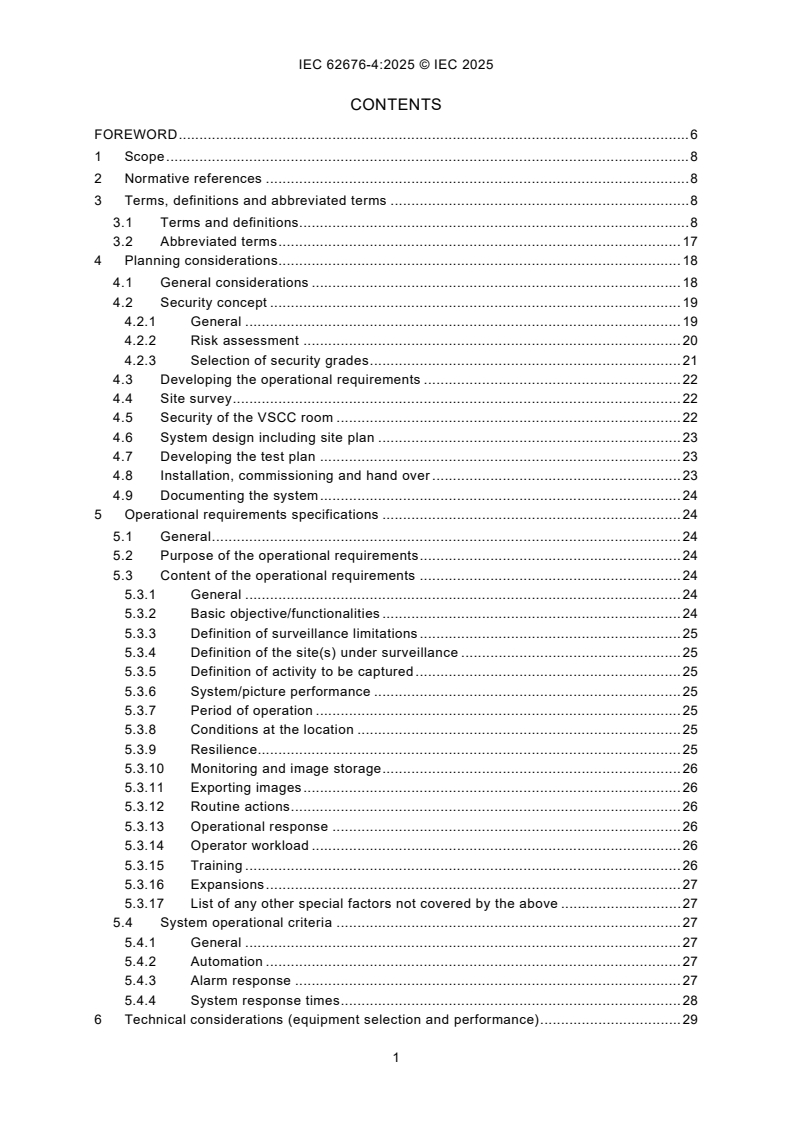
CONTENTS
FOREWORD . 6
1 Scope . 8
2 Normative references . 8
3 Terms, definitions and abbreviated terms . 8
3.1 Terms and definitions. 8
3.2 Abbreviated terms . 17
4 Planning considerations. 18
4.1 General considerations . 18
4.2 Security concept . 19
4.2.1 General . 19
4.2.2 Risk assessment . 20
4.2.3 Selection of security grades . 21
4.3 Developing the operational requirements . 22
4.4 Site survey . 22
4.5 Security of the VSCC room . 22
4.6 System design including site plan . 23
4.7 Developing the test plan . 23
4.8 Installation, commissioning and hand over . 23
4.9 Documenting the system . 24
5 Operational requirements specifications . 24
5.1 General . 24
5.2 Purpose of the operational requirements . 24
5.3 Content of the operational requirements . 24
5.3.1 General . 24
5.3.2 Basic objective/functionalities . 24
5.3.3 Definition of surveillance limitations . 25
5.3.4 Definition of the site(s) under surveillance . 25
5.3.5 Definition of activity to be captured . 25
5.3.6 System/picture performance . 25
5.3.7 Period of operation . 25
5.3.8 Conditions at the location . 25
5.3.9 Resilience. 25
5.3.10 Monitoring and image storage . 26
5.3.11 Exporting images . 26
5.3.12 Routine actions . 26
5.3.13 Operational response . 26
5.3.14 Operator workload . 26
5.3.15 Training . 26
5.3.16 Expansions . 27
5.3.17 List of any other special factors not covered by the above . 27
5.4 System operational criteria . 27
5.4.1 General . 27
5.4.2 Automation . 27
5.4.3 Alarm response . 27
5.4.4 System response times . 28
6 Technical considerations (equipment selection and performance) . 29
6.1 General . 29
6.2 Camera equipment . 29
6.3 Camera and lens selection criteria . 29
6.4 Camera selection . 30
6.4.1 General . 30
6.4.2 PTZ . 30
6.5 Lens and housing selection . 31
6.6 Site coverage/numbers of cameras . 31
6.7 Object sizes and pixel density . 32
6.7.1 General . 32
6.7.2 Object size definitions and required pixel density in IP VSS . 32
6.8 Field of view – Other considerations . 36
6.9 Illumination . 36
6.10 IP Video equipment . 38
6.11 Tamper protection/detection. 38
6.11.1 Camera tamper protection/detection . 38
6.11.2 System tamper protection/detection . 38
6.12 System integration . 38
7 Video signal presentation . 39
7.1 Display types . 39
7.2 Resolution . 40
8 Transmission . 41
8.1 Principles . 41
8.1.1 General . 41
8.1.2 Selection of IP video performance classes . 42
8.1.3 Interoperability. 43
8.1.4 Interoperability with voice communication . 43
8.2 Wired transmission links . 43
8.3 Wireless transmission links . 44
8.4 Key considerations for IP based transmission systems . 45
9 Video performance characteristics . 45
9.1 Image compression . 45
9.2 Frame rate . 46
9.3 Resolution . 46
10 Storage requirements . 47
11 Image storage and export . 48
11.1 Format of the compressed video data . 48
11.2 Encryption . 48
11.3 Basic metadata (time, date, camera identifier) . 48
11.4 Multiplexing format. 49
11.5 Image enhancements . 49
11.6 Image export . 49
11.7 Replay of exported images. 50
12 VSCC control room configuration . 50
12.1 Control rooms or secure viewing area . 50
12.2 Number, size and positioning of VSS video displays . 50
12.3 Displays and screens mounted on or off the workstation . 51
12.4 Recommended display sizes . 51
12.5 Number of camera images per operator . 51
12.6 Number of work stations . 52
12.7 Equipment siting . 52
12.8 Backup power supply provision . 52
12.9 Operating temperature . 53
12.10 Lightning and surge protection . 53
13 Defining the test plan . 53
13.1 Purpose of the test plan . 53
13.2 User acceptance testing/inspection . 53
13.3 Technical acceptance testing . 53
13.3.1 Imaging chain consistency . 53
13.3.2 Image quality . 53
14 Documentational considerations (pre-installation) . 56
14.1 General . 56
14.2 Risk assessment . 56
14.3 Operational requirements . 56
14.4 Design specification . 56
14.5 Site plan . 56
14.6 Test plan. 56
15 System installation and commissioning . 56
15.1 Factory acceptance testing . 56
15.2 Installation process . 57
15.3 User acceptance testing, commissioning and handover . 57
15.4 Declaration of conformance to standards . 58
16 Final documentation . 58
16.1 General . 58
16.2 Complete system drawings . 58
16.3 System commission (with camera specific audits) . 59
16.4 Interface descriptions . 59
16.5 Operating logbook VSS . 59
16.6 Compliance with legislation (for information) . 59
17 Operation of VSS. 59
17.1 General . 59
17.2 Behaviour in the event of malfunctions . 61
17.3 At-site visual check . 61
17.4 Deviation of requirements for at-site visual checks and maintenance . 62
17.5 Maintenance . 62
17.6 Inspection (part of preventive maintenance) . 62
17.7 Service checks (part of preventive maintenance) . 64
17.8 Repair (corrective maintenance) . 64
17.9 Improvement . 64
Annex A (informative) Video standard formats . 65
A.1 Current video standard format . 65
A.2 Pixel densities for recognition of other objects of interest . 65
Annex B (normative) Test protocol for VSS target . 66
B.1 Scope of the test . 66
B.2 Test prerequisites . 66
B.3 Preconditions . 66
B.4 Face selection . 66
B.5 Live view methodology (faces) . 67
B.6 Live view methodology (VRN) . 67
B.7 Recorded view methodology (faces) . 67
B.8 Recorded view methodology (VRN) . 68
B.9 Motion . 68
B.10 Faces: scoring criteria . 68
B.11 VRN: scoring criteria . 69
B.12 Heads control sheet (for example only) . 71
B.13 VRN control sheet (for example only) . 72
Annex C (normative) Test method of image quality: Guidance for the use of the video
test target . 73
Annex D (informative) Guidelines to specifying VSS parameters and security gradings . 79
D.1 VSS parameters . 79
D.2 Suggested building blocks . 79
D.3 Security gradings . 80
D.4 Security grading by system view: . 80
D.5 Security grading by size view: . 81
D.6 Security grading by application view . 81
D.7 Number of frames depending on the object speed in a scene width. 85
Annex E (normative) Detection response testing and acceptability criteria . 87
E.1 General . 87
E.2 False and nuisance alarms . 87
E.3 Setting the response time . 88
E.4 PTZ response time test procedure . 88
E.5 Observer cueing and prompting . 88
E.6 Detection test locations . 89
E.7 Target camouflage . 89
E.8 Tests with moving targets . 89
E.9 Test conditions . 89
E.10 Testing a 'live' system . 90
E.11 Detection test results tables . 90
Bibliography . 91
Figure 1 – Process visualization . 19
Figure 2 – Structure of a security concept . 20
Figure 3 – HD and UHD screen percentages occupied by various categories . 34
Figure 4 – Pixel density formula . 35
Figure 5 – Operation of a VSS . 60
Figure B.1 – Heads control sheet . 71
Figure B.2 – VRN control sheet example . 72
Figure C.1 – Test charts . 74
Figure C.2 – Key to Figure C.1 . 77
Figure C.3 – Avoiding optical distortion . 78
Table 1 – Measures depending on security grades . 23
Table 2 – Example of system feedback – PTZ control responding time, performance
and operator . 29
Table 3 – Group names for test charts . 34
Table 4 – Typical lux levels . 36
Table 5 – Examples of display technologies . 39
Table 6 – Example resolutions . 41
Table 7 – Wireless transmission options . 44
Table 8 – Inspection cycles versus security grading . 60
Table A.1 – Recommendations for recognition of some “non-human” objects . 65
Table B.1 – Example auditor log sheet . 69
Table B.2 – Example control room observer log sheet. 69
Table B.3 – Example camera audit sheet . 69
Table B.4 – Blank auditor log sheet . 70
Table B.5 – Blank control room observer log sheet . 70
Table B.6 – Blank camera audit sheet . 70
Table C.1 – Test targets . 73
Table D.1 – Suggested VSS building blocks. 79
Table D.2 – Security grading by size view . 81
Table D.3 – Security grading by application . 81
Table D.4 – Security grading by critical infrastructure . 83
Table D.5 – Number of frames depending of object speed – Low pixel density objects . 85
Table D.6 – Number of frames depending of object speed - High Pixel Density Objects . 86
Table E.1 – Detection test results . 90
INTERNATIONAL ELECTROTECHNICAL COMMISSION
____________
Video surveillance systems for use in security applications -
Part 4: Application guidelines
FOREWORD
1) The International Electrotechnical Commission (IEC) is a worldwide organization for standardization comprising
all national electrotechnical committees (IEC National Committees). The object of IEC is to promote international
co-operation on all questions concerning standardization in the electrical and electronic fields. To this end and
in addition to other activities, IEC publishes International Standards, Technical Specifications, Technical Reports,
Publicly Available Specifications (PAS) and Guides (hereafter referred to as “IEC Publication(s)”). Their
preparation is entrusted to technical committees; any IEC National Committee interested in the subject dealt with
may participate in this preparatory work. International, governmental and non-governmental organizations liaising
with the IEC also participate in this preparation. IEC collaborates closely with the International Organization for
Standardization (ISO) in accordance with conditions determined by agreement between the two organizations.
2) The formal decisions or agreements of IEC on technical matters express, as nearly as possible, an international
consensus of opinion on the relevant subjects since each technical committee has representation from all
interested IEC National Committees.
3) IEC Publications have the form of recommendations for international use and are accepted by IEC National
Committees in that sense. While all reasonable efforts are made to ensure that the technical content of IEC
Publications is accurate, IEC cannot be held responsible for the way in which they are used or for any
misinterpretation by any end user.
4) In order to promote international uniformity, IEC National Committees undertake to apply IEC Publications
transparently to the maximum extent possible in their national and regional publications. Any divergence between
any IEC Publication and the corresponding national or regional publication shall be clearly indicated in the latter.
5) IEC itself does not provide any attestation of conformity. Independent certification bodies provide conformity
assessment services and, in some areas, access to IEC marks of conformity. IEC is not responsible for any
services carried out by independent certification bodies.
6) All users should ensure that they have the latest edition of this publication.
7) No liability shall attach to IEC or its directors, employees, servants or agents including individual experts and
members of its technical committees and IEC National Committees for any personal injury, property damage or
other damage of any nature whatsoever, whether direct or indirect, or for costs (including legal fees) and
expenses arising out of the publication, use of, or reliance upon, this IEC Publication or any other IEC
Publications.
8) Attention is drawn to the Normative references cited in this publication. Use of the referenced publications is
indispensable for the correct application of this publication.
9) IEC draws attention to the possibility that the implementation of this document may involve the use of (a)
patent(s). IEC takes no position concerning the evidence, validity or applicability of any claimed patent rights in
respect thereof. As of the date of publication of this document, IEC had not received notice of (a) patent(s), which
may be required to implement this document. However, implementers are cautioned that this may not represent
the latest information, which may be obtained from the patent database available at https://patents.iec.ch. IEC
shall not be held responsible for identifying any or all such patent rights.
IEC 62676-4 has been prepared by IEC technical committee 79: Alarm and electronic security
systems. It is an International Standard.
This second edition cancels and replaces the first edition published in 2014. This edition
constitutes a technical revision.
This edition includes the following significant technical changes with respect to the previous
edition:
a) implementing request for define a security concept (instead of just a risk analysis) (4.2);
b) selection of security grades (4.2.3);
c) complete redefinition of pixel densities (6.7) including new test charts (Annex C):
– upgrade of previous MDORII system with 6 pixel densities (12,5 pixels/meter; 25
pixels/meter; 62,5 pixels/meter ; 125 pixels/meter; 250 pixels/meter; 1 000 pixels/meter)
into new O2DCPVS system with 7 pixel densities (20 pixels/meter; 40 pixels/meter; 80
pixels/meter; 125 pixels/meter; 250 pixels/meter; 500 pixels/meter; 1 500 pixels/meter
d) operation of VSS (Clause 17);
e) security grading by size view (Annex D, Table D.2);
f) security grading by application (Annex D, Table D.3);
g) security grading by critical infrastructure (Annex D, Table D.4);
h) tables for number of frames depending on object speed (Annex D, Table D.5 and Table D.6);
i) general updates of tables in entire document.
The text of this International Standard is based on the following documents:
Draft Report on voting
79/727/FDIS 79/732/RVD
Full information on the voting for its approval can be found in the report on voting indicated in
the above table.
The language used for the development of this International Standard is English
A list of all parts in the IEC 62676 series, published under the general title Video surveillance
systems for use in security applications, can be found on the IEC website.
This document was drafted in accordance with ISO/IEC Directives, Part 2, and developed in
accordance with ISO/IEC Directives, Part 1 and ISO/IEC Directives, IEC Supplement, available
at www.iec.ch/members_experts/refdocs. The main document types developed by IEC are
described in greater detail at www.iec.ch/publications.
The committee has decided that the contents of this document will remain unchanged until the
stability date indicated on the IEC website under webstore.iec.ch in the data related to the
specific document. At this date, the document will be
• reconfirmed,
• withdrawn, or
• revised.
1 Scope
This part of IEC 62676 describes the planning, design, installation, testing, commissioning, and
maintaining of video surveillance systems (VSS) comprising image capture device(s),
interconnection(s) and image handling device(s), for use in security applications within private
or public spaces.
The objectives of this document are to:
a) provide a framework to assist all interested parties in establishing their requirements,
b) assist specifiers and users in determining the appropriate equipment required for a given
application,
c) provide means of evaluating objectively the performance of the VSS.
2 Normative references
The following documents are referred to in the text in such a way that some or all of their content
constitutes requirements of this document. For dated references, only the edition cited applies.
For undated references, the latest edition of the referenced document (including any
amendments) applies.
IEC 62676-1-1:2013, Video surveillance systems for use in security applications - Part 1-1:
System requirements - General
IEC 62676-1-2:2013, Video surveillance systems for use in security applications - Part 1-2:
System requirements - Performance requirements for video transmission
IEC 62676-2 (all parts), Video surveillance systems for use in security applications - Part 2-X:
Video transmission protocols
IEC 62676-2-1, Video surveillance systems for use in security applications - Part 2-1: Video
transmission protocols - General requirements
IEC 62676-3, Video surveillance systems for use in security applications - Part 3: Analog and
digital video interfaces
IEC 62820-2, Building intercom systems - Part 2: Requirements for advanced security building
intercom systems (ASBIS)
IEC 62820-3-2, Building intercom systems - Part 3-2: Application guidelines - Advanced security
building intercom systems (ASBIS)
3 Terms, definitions and abbreviated terms
3.1 Terms and definitions
For the purposes of this document, the following terms and definitions apply.
ISO and IEC maintain terminology databases for use in standardization at the following
addresses:
• IEC Electropedia: available at https://www.electropedia.org/
• ISO Online browsing platform: available at https://www.iso.org/obp
3.1.1
4K
UHD
standard for ultra high-definition television (UHDTV) defined by SMPTE 2036 to be with
3 840 pixels × 2 160 pixels at 25 fps or 30 fps
3.1.2
8K
UHD
standard for ultra high-definition television (UHDTV) defined by SMPTE 2036 to be with
7 680 pixels × 4 320 pixels at 25 fps or 30 fps
3.1.3
at-site visual check
activity to determine and assess the feasibility of implementing the safety concept per camera
location to be monitored as well as checks of visible disturbances and defects at site on the
monitoring tasks of a VSS that are not evaluated operationally and whether there are deviations
from the function of the VSS required in the safety concept
Note 1 to entry: In particular for influences occurring outside of VSS system parts.
Note 2 to entry: The at-site visual check is the responsibility of the operator, who can, however, hand over the
inspection to a competent person VSS or to a competent system engineer VSS.
3.1.4
camera housing
enclosure to provide both physical and environmental protection of the camera, lens and
ancillary equipment
3.1.5
camera sensitivity
image capturing device capability to produce an image in certain light conditions
3.1.6
characterise
defined functional purpose of a VSS camera to enable characterisation of a target, e.g. person
(type of person, gait and action can be characterised) and vehicles (vehicle brand can be
characterised) with a pixel density of > 250 pixels/meter
3.1.7
competent person VSS
person who has been instructed by a competent system engineer VSS about the assigned tasks
within the scope of the on-site check and the possible dangers and consequences of improper
behaviour
Note 1 to entry: This includes the necessary knowledge for the assessment of the object requirements, with regard
to the type of danger and the required function of the VSS, the influence of the use as well as the limits of use and
the instruction about the security concept of the video surveillance system, about existing requirements as well as
legal requirements or requirements of the operator from safety aspects as personal and property protection measures
or to avoid personal injury.
Note 2 to entry: The task requires competences for independent planning and processing of the requirements from
the at-site visual check as well as in-depth general knowledge and specialist theoretical knowledge in order to be
able to assess to what extent environmental or object changes can influence the effectiveness of a video surveillance
system. The recognition of possible interactions from other requirements as well as the development of alternative
actions is necessary. Detected deviations shall be securely justified, responsibly communicated and, if necessary,
retracted if no other problem solutions can be found.
3.1.8
competent system engineer VSS
person who, on the basis of professional technical training, knowledge and experience as well
as knowledge of the relevant standards, regulations and directives, is able to assess the work
to be carried out and recognise possible hazards
Note 1 to entry: A competent system engineer VSS can be employed by either an installation company/system
integrator company, project planning company or at owner or at user of the VSS.
Note 2 to entry: For the field of video surveillance systems, training from the spectrum of electrical engineering in
the field of communications, information, microprocessor, measurement and control or general electrical engineering
is required, and experience in the respective other fields as well as system knowledge of video security technology
shall be demonstrated. Qualification of competence for VSS knowledge can be proven by training certificates of e.g.,
local security associations or vendors of VSS.
Note 3 to entry: Several years of activity in the relevant fields of work can also be used to assess the professional
training.
Note 4 to entry: The activity requires the ability to independently plan and process comprehensive technical tasks
in a complex, specialised, changing environment. Integrated technical knowledge and in-depth theoretical knowledge
of the subject shall be available. The scope and limits of the possible applications of a video surveillance system
shall be known. A very broad spectrum of specialised cognitive and practical skills is required. Work processes are
to be planned in a comprehensive manner and assessed with comprehensive consideration of handling alternatives
and interactions with neighbouring areas. The competence to guide others and to support them with well-founded
learning guidance shall be given. Interdisciplinary complex issues shall be presented in a structured, target-oriented
and addressee-related manner. Own and externally set learning and working goals shall be reflected upon, evaluated,
pursued in a self-directed manner and answered.
3.1.9
constant bit rate
bit rate of a camera stream kept constant regardless of the image quality or movement in the
scene
3.1.10
corrective maintenance
maintenance carried out after failure detection to restore a VSS to a condition in which it can
perform its required function
Note 1 to entry: Corrective maintenance corresponds to repair and serves as a corrective measure after a failure
has been detected.
3.1.11
discern
defined functional purpose of a VSS camera to enable discerning of a target, e.g. objects and
their movements with a pixel density of > 80 pixels/meter
3.1.12
electronic iris
automatic electronic shutter which changes the camera sensitivity in relation to the varying light
conditions in order to maintain the video output signal within defined limits
3.1.13
electronic shutter
arrangement in the camera changing its sensitivity by electronically controlling its exposure
time
3.1.14
event recording
event controlled recording or storing of image signals for a pre-determined time
Note 1 to entry: Refers to video recording not to system log of events.
3.1.15
external synchronisation
method of feeding reference timing signals to all connected devices to ensure that their video
output signals are synchronous
3.1.16
focal length
f
measurement of the converging power of a lens, normally expressed in mm, which can be used
to determine the angle of view for a given sensor size
3.1.17
geo data
digital information assigning a certain spatial location to the earth's surface
3.1.18
High Definition
HD
contemporary television standard with 1 920 pixels × 1 080 pixels, interlaced (1 080i) or
progressive (1 080p), as defined by SMPTE 274, and with 1 280 pixels × 720 pixels,
progressive (720p), as defined by SMPTE 296
3.1.19
imaging device
device that converts an optical image into an electrical signal
3.1.20
imaging device illumination
level of illumination at the photosensitive surface of the imaging device
3.1.21
improvement
additions or changes to a VSS that improve the reliability or functional safety of a VSS during
operation without changing its original function
Note 1 to entry: An improvement shall be carried out by a competent system engineer VSS and shall be documented
in the operating logbook VSS. An improvement can be, for example, a firmware or software update.
3.1.22
inspection (part of preventive maintenance)
testing for conformity of the relevant characteristics of a VSS by measurement, observation and
testing
Note 1 to entry: The checking of all system parts for technical functionality of the VSS is done according to general
manufacturer-independent criteria.
Note 2 to entry: An inspect
...
IEC 62676-4 ®
Edition 2.0 2025-10
INTERNATIONAL
STANDARD
REDLINE VERSION
Video surveillance systems for use in security applications -
Part 4: Application guidelines
ICS 13.320 ISBN 978-2-8327-0779-1
All rights reserved. Unless otherwise specified, no part of this publication may be reproduced or utilized in any form or
by any means, electronic or mechanical, including photocopying and microfilm, without permission in writing from either
IEC or IEC's member National Committee in the country of the requester. If you have any questions about IEC copyright
or have an enquiry about obtaining additional rights to this publication, please contact the address below or your local
IEC member National Committee for further information.
IEC Secretariat Tel.: +41 22 919 02 11
3, rue de Varembé info@iec.ch
CH-1211 Geneva 20 www.iec.ch
Switzerland
About the IEC
The International Electrotechnical Commission (IEC) is the leading global organization that prepares and publishes
International Standards for all electrical, electronic and related technologies.
About IEC publications
The technical content of IEC publications is kept under constant review by the IEC. Please make sure that you have the
latest edition, a corrigendum or an amendment might have been published.
IEC publications search - IEC Products & Services Portal - products.iec.ch
webstore.iec.ch/advsearchform Discover our powerful search engine and read freely all the
The advanced search enables to find IEC publications by a publications previews, graphical symbols and the glossary.
variety of criteria (reference number, text, technical With a subscription you will always have access to up to date
committee, …). It also gives information on projects, content tailored to your needs.
replaced and withdrawn publications.
Electropedia - www.electropedia.org
The world's leading online dictionary on electrotechnology,
IEC Just Published - webstore.iec.ch/justpublished
Stay up to date on all new IEC publications. Just Published containing more than 22 500 terminological entries in English
details all new publications released. Available online and and French, with equivalent terms in 25 additional languages.
once a month by email. Also known as the International Electrotechnical Vocabulary
(IEV) online.
IEC Customer Service Centre - webstore.iec.ch/csc
If you wish to give us your feedback on this publication or
need further assistance, please contact the Customer
Service Centre: sales@iec.ch.
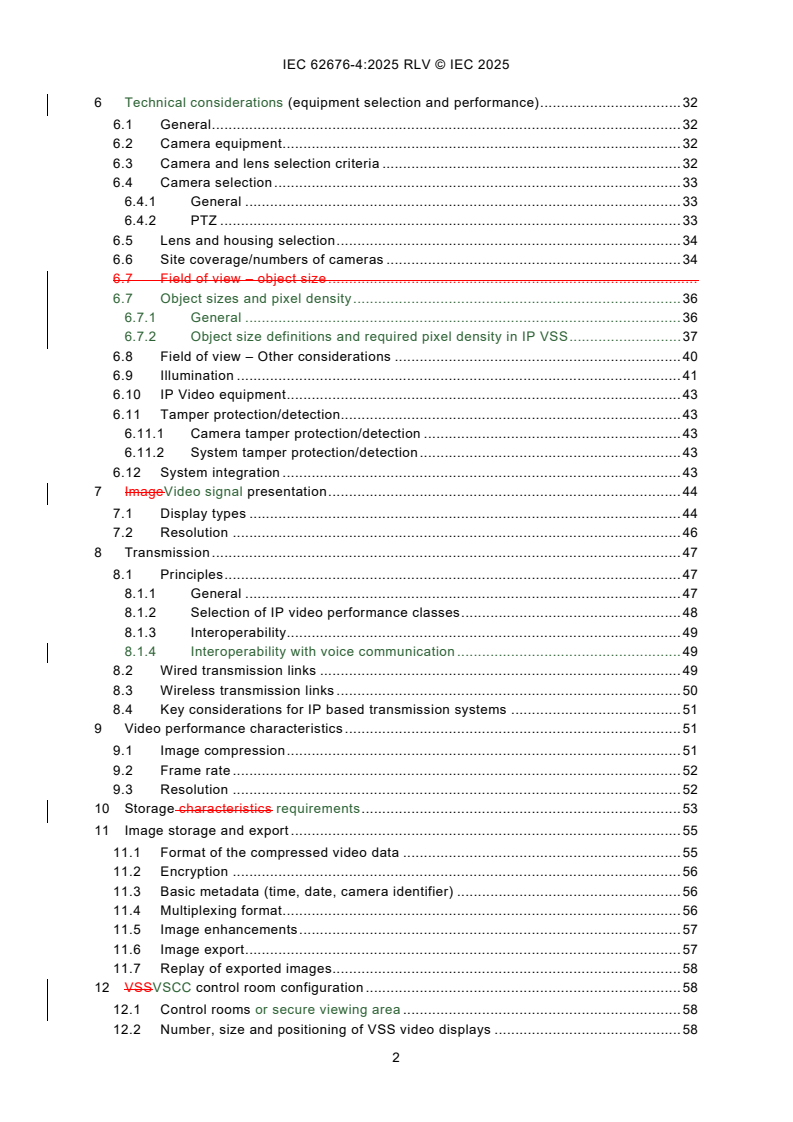
CONTENTS
FOREWORD . 6
INTRODUCTION .
1 Scope . 9
2 Normative references . 9
3 Terms, definitions and abbreviated terms . 10
3.1 Terms and definitions. 10
3.2 Abbreviated terms . 20
4 General Planning considerations . 21
4.1 General considerations . 21
4.2 Security concept . 22
4.2.1 General . 22
4.2.2 Risk assessment . 23
4.2.3 Selection of security grades . 24
4.3 Developing the operational requirements . 25
4.4 Site survey . 25
4.5 Security of the VSCC room . 25
4.6 System design including site plan . 26
4.7 Developing the test plan . 27
4.8 Installation, commissioning and hand over . 27
4.9 Documenting the system . 27
5 Operational requirements specifications . 27
5.1 General . 27
5.2 Purpose of the operational requirements . 27
5.3 Content of the operational requirements . 27
5.3.1 General . 27
5.3.2 Basic objective/functionalities . 28
5.3.3 Definition of surveillance limitations . 28
5.3.4 Definition of the site(s) under surveillance . 28
5.3.5 Definition of activity to be captured . 28
5.3.6 System/picture performance . 28
5.3.7 Period of operation . 28
5.3.8 Conditions at the location . 29
5.3.9 Resilience. 29
5.3.10 Monitoring and image storage . 29
5.3.11 Exporting images . 29
5.3.12 Routine actions . 29
5.3.13 Operational response . 29
5.3.14 Operator workload . 30
5.3.15 Training . 30
5.3.16 Expansions . 30
5.3.17 List of any other special factors not covered by the above . 30
5.4 System operational criteria . 30
5.4.1 General . 30
5.4.2 Automation . 30
5.4.3 Alarm response . 31
5.4.4 System response times . 31
6 Technical considerations (equipment selection and performance) . 32
6.1 General . 32
6.2 Camera equipment . 32
6.3 Camera and lens selection criteria . 32
6.4 Camera selection . 33
6.4.1 General . 33
6.4.2 PTZ . 33
6.5 Lens and housing selection . 34
6.6 Site coverage/numbers of cameras . 34
6.7 Field of view – object size .
6.7 Object sizes and pixel density . 36
6.7.1 General . 36
6.7.2 Object size definitions and required pixel density in IP VSS . 37
6.8 Field of view – Other considerations . 40
6.9 Illumination . 41
6.10 IP Video equipment . 43
6.11 Tamper protection/detection. 43
6.11.1 Camera tamper protection/detection . 43
6.11.2 System tamper protection/detection . 43
6.12 System integration . 43
7 ImageVideo signal presentation . 44
7.1 Display types . 44
7.2 Resolution . 46
8 Transmission . 47
8.1 Principles . 47
8.1.1 General . 47
8.1.2 Selection of IP video performance classes . 48
8.1.3 Interoperability. 49
8.1.4 Interoperability with voice communication . 49
8.2 Wired transmission links . 49
8.3 Wireless transmission links . 50
8.4 Key considerations for IP based transmission systems . 51
9 Video performance characteristics . 51
9.1 Image compression . 51
9.2 Frame rate . 52
9.3 Resolution . 52
10 Storage characteristics requirements . 53
11 Image storage and export . 55
11.1 Format of the compressed video data . 55
11.2 Encryption . 56
11.3 Basic metadata (time, date, camera identifier) . 56
11.4 Multiplexing format. 56
11.5 Image enhancements . 57
11.6 Image export . 57
11.7 Replay of exported images. 58
12 VSSVSCC control room configuration . 58
12.1 Control rooms or secure viewing area . 58
12.2 Number, size and positioning of VSS video displays . 58
12.3 Displays and screens mounted on or off the workstation . 59
12.4 Recommended display sizes . 59
12.5 Number of camera images per operator . 59
12.6 Number of work stations . 60
12.7 Equipment siting . 60
12.8 Backup power supply provision . 60
12.9 Operating temperature . 61
12.10 Lightning and surge protection . 61
13 Defining the test plan . 61
13.1 Purpose of the test plan . 61
13.2 User acceptance testing/inspection . 61
13.3 Technical acceptance testing . 61
13.3.1 Imaging chain consistency . 61
13.3.2 Image quality . 62
14 Summary of the documentation – Documentational considerations (pre-
installation) . 64
14.1 General . 64
14.2 Risk assessment . 64
14.3 Operational requirements . 64
14.4 Design specification . 64
14.5 Site plan . 64
14.6 Test plan. 64
15 System installation and commissioning . 64
15.1 Factory acceptance testing . 64
15.2 Installation process . 65
15.3 User acceptance testing, commissioning and handover . 66
15.4 Declaration of conformance to standards . 66
16 Final documentation . 66
16.1 General . 66
16.2 Complete system drawings . 67
16.3 System commission (with camera specific audits) . 67
16.4 Interface descriptions . 67
16.5 Operating logbook VSS . 67
16.6 Compliance with legislation (informativefor information) . 67
17 Maintenance .
17.1 Maintenance service agreements .
17.2 Staff .
17.3 Corrective maintenance .
17.4 Preventive maintenance .
17 Operation of VSS. 70
17.1 General . 70
17.2 Behaviour in the event of malfunctions . 71
17.3 At-site visual check . 71
17.4 Deviation of requirements for at-site visual checks and maintenance . 72
17.5 Maintenance . 72
17.6 Inspection (part of preventive maintenance) . 72
17.7 Service checks (part of preventive maintenance) . 74
17.8 Repair (corrective maintenance) . 74
17.9 Improvement . 74
Annex A (informative) Current Video standard formats . 75
A.1 Current video standard format . 75
A.2 Pixel densities for recognition of other objects of interest . 75
Annex B (normative) Test protocol for VSS target . 76
B.1 Scope of the test . 76
B.2 Test prerequisites . 76
B.3 Preconditions . 76
B.4 Face selection . 76
B.5 Live view methodology (faces) . 77
B.6 Live view methodology (VRN) . 77
B.7 Recorded view methodology (faces) . 77
B.8 Recorded view methodology (VRN) . 78
B.9 Motion . 78
B.10 Faces: scoring criteria . 78
B.11 VRN: scoring criteria . 79
B.12 Heads control sheet (for example only) . 81
B.13 VRN control sheet (for example only) . 82
Annex C (normative) Test method of image quality: Guidance for the use of the video
test target . 83
Annex D (informative) Guidelines to specifying VSS parameters and security gradings . 93
D.1 VSS parameters . 93
D.2 Suggested building blocks . 93
D.3 Security gradings . 95
D.4 Security grading by system view: . 95
D.5 Security grading by size view: . 96
D.6 Security grading by application view . 96
D.7 Number of frames depending on the object speed in a scene width. 100
Annex E (normative) Detection response testing and acceptability criteria . 102
E.1 General . 102
E.2 False and nuisance alarms . 102
E.3 Setting the response time . 103
E.4 PTZ response time test procedure . 103
E.5 Observer cueing and prompting . 103
E.6 Detection test locations . 104
E.7 Target camouflage . 104
E.8 Tests with moving targets . 104
E.9 Test conditions . 104
E.10 Testing a 'live' system . 105
E.11 Detection test results tables . 105
Bibliography . 106
Figure 1 – Process visualization . 22
Figure 2 – Structure of a security concept . 23
Figure 1 – Recommended minimum sizes for PAL (576i) resolution .
Figure 3 – HD and UHD screen percentages occupied by various categories . 39
Figure 4 – Pixel density formula . 40
Figure 5 – Operation of a VSS . 70
Figure B.1 – Heads control sheet . 81
Figure B.2 – VRN control sheet example . 82
Figure C.1 – A3 test target .
Figure C.2 – Avoiding optical distortion .
Figure C.1 – Test charts . 88
Figure C.2 – Key to Figure C.1 . 91
Figure C.3 – Avoiding optical distortion . 92
Table 1 – Measures depending on security grades . 26
Table 2 – Commonly encountered resolutions (in pixels) .
Table 3 – Person screen height equivalent for different digital resolutions (in percent) .
Table 2 – Example of system feedback – PTZ control responding time, performance
and operator . 32
Table 3 – Group names for test charts . 38
Table 4 – Typical lux levels . 41
Table 5 – Examples of display technologies . 45
Table 6 – Example resolutions . 46
Table 7 – Factors affecting the storage capacity required for a video recorder .
Table 7 – Wireless transmission options . 50
Table 8 – Inspection cycles versus security grading . 70
Table A.1 – Recommendations for recognition of some “non-human” objects . 75
Table B.1 – Example auditor log sheet . 79
Table B.2 – Example control room observer log sheet. 79
Table B.3 – Example camera audit sheet . 79
Table B.4 – Blank auditor log sheet . 80
Table B.5 – Blank control room observer log sheet . 80
Table B.6 – Blank camera audit sheet . 80
Table C.1 – Test targets . 83
Table D.1 – Suggested VSS building blocks. 93
Table D.2 – Security grading by size view . 96
Table D.3 – Security grading by application . 96
Table D.4 – Security grading by critical infrastructure . 98
Table D.5 – Number of frames depending of object speed – Low pixel density objects . 100
Table D.6 – Number of frames depending of object speed - High Pixel Density Objects . 101
Table E.1 – Detection test results . 105
INTERNATIONAL ELECTROTECHNICAL COMMISSION
____________
Video surveillance systems for use in security applications -
Part 4: Application guidelines
FOREWORD
1) The International Electrotechnical Commission (IEC) is a worldwide organization for standardization comprising
all national electrotechnical committees (IEC National Committees). The object of IEC is to promote international
co-operation on all questions concerning standardization in the electrical and electronic fields. To this end and
in addition to other activities, IEC publishes International Standards, Technical Specifications, Technical Reports,
Publicly Available Specifications (PAS) and Guides (hereafter referred to as “IEC Publication(s)”). Their
preparation is entrusted to technical committees; any IEC National Committee interested in the subject dealt with
may participate in this preparatory work. International, governmental and non-governmental organizations liaising
with the IEC also participate in this preparation. IEC collaborates closely with the International Organization for
Standardization (ISO) in accordance with conditions determined by agreement between the two organizations.
2) The formal decisions or agreements of IEC on technical matters express, as nearly as possible, an international
consensus of opinion on the relevant subjects since each technical committee has representation from all
interested IEC National Committees.
3) IEC Publications have the form of recommendations for international use and are accepted by IEC National
Committees in that sense. While all reasonable efforts are made to ensure that the technical content of IEC
Publications is accurate, IEC cannot be held responsible for the way in which they are used or for any
misinterpretation by any end user.
4) In order to promote international uniformity, IEC National Committees undertake to apply IEC Publications
transparently to the maximum extent possible in their national and regional publications. Any divergence between
any IEC Publication and the corresponding national or regional publication shall be clearly indicated in the latter.
5) IEC itself does not provide any attestation of conformity. Independent certification bodies provide conformity
assessment services and, in some areas, access to IEC marks of conformity. IEC is not responsible for any
services carried out by independent certification bodies.
6) All users should ensure that they have the latest edition of this publication.
7) No liability shall attach to IEC or its directors, employees, servants or agents including individual experts and
members of its technical committees and IEC National Committees for any personal injury, property damage or
other damage of any nature whatsoever, whether direct or indirect, or for costs (including legal fees) and
expenses arising out of the publication, use of, or reliance upon, this IEC Publication or any other IEC
Publications.
8) Attention is drawn to the Normative references cited in this publication. Use of the referenced publications is
indispensable for the correct application of this publication.
9) IEC draws attention to the possibility that the implementation of this document may involve the use of (a)
patent(s). IEC takes no position concerning the evidence, validity or applicability of any claimed patent rights in
respect thereof. As of the date of publication of this document, IEC had not received notice of (a) patent(s), which
may be required to implement this document. However, implementers are cautioned that this may not represent
the latest information, which may be obtained from the patent database available at https://patents.iec.ch. IEC
shall not be held responsible for identifying any or all such patent rights.
This redline version of the official IEC Standard allows the user to identify the changes made
to the previous edition IEC 62676-4:2014. A vertical bar appears in the margin wherever a
change has been made. Additions are in green text, deletions are in strikethrough red text.
IEC 62676-4 has been prepared by IEC technical committee 79: Alarm and electronic security
systems. It is an International Standard.
This second edition cancels and replaces the first edition published in 2014. This edition
constitutes a technical revision.
This edition includes the following significant technical changes with respect to the previous
edition:
a) implementing request for define a security concept (instead of just a risk analysis) (4.2);
b) selection of security grades (4.2.3);
c) complete redefinition of pixel densities (6.7) including new test charts (Annex C):
– upgrade of previous MDORII system with 6 pixel densities (12,5 pixels/meter; 25
pixels/meter; 62,5 pixels/meter ; 125 pixels/meter; 250 pixels/meter; 1 000 pixels/meter)
into new O2DCPVS system with 7 pixel densities (20 pixels/meter; 40 pixels/meter; 80
pixels/meter; 125 pixels/meter; 250 pixels/meter; 500 pixels/meter; 1 500 pixels/meter
d) operation of VSS (Clause 17);
e) security grading by size view (Annex D, Table D.2);
f) security grading by application (Annex D, Table D.3);
g) security grading by critical infrastructure (Annex D, Table D.4);
h) tables for number of frames depending on object speed (Annex D, Table D.5 and Table D.6);
i) general updates of tables in entire document.
The text of this International Standard is based on the following documents:
Draft Report on voting
79/727/FDIS 79/732/RVD
Full information on the voting for its approval can be found in the report on voting indicated in
the above table.
The language used for the development of this International Standard is English
A list of all parts in the IEC 62676 series, published under the general title Video surveillance
systems for use in security applications, can be found on the IEC website.
This document was drafted in accordance with ISO/IEC Directives, Part 2, and developed in
accordance with ISO/IEC Directives, Part 1 and ISO/IEC Directives, IEC Supplement, available
at www.iec.ch/members_experts/refdocs. The main document types developed by IEC are
described in greater detail at www.iec.ch/publications.
The committee has decided that the contents of this document will remain unchanged until the
stability date indicated on the IEC website under webstore.iec.ch in the data related to the
specific document. At this date, the document will be
• reconfirmed,
• withdrawn, or
• revised.
INTRODUCTION
The IEC Technical Committee 79 in charge of alarm and electronic security systems together
with many governmental organisations, test houses and equipment manufacturers has defined
a common framework for video surveillance transmission in order to achieve interoperability
between products.
The IEC 62676 series of standards on video surveillance system is divided into 4 independent
parts:
Part 1: System requirements
Part 2: Video transmission protocols
Part 3: Analog and digital video interfaces
Part 4: Application guidelines
Each part offers its own clauses for the scope, normative references, definitions and
requirements.
The purpose of this part of IEC 62676 is to provide guidance on how to ensure that video
surveillance systems (VSS), thus far referred to as closed circuit television (CCTV), meet their
functional and performance requirements.
This part of IEC 62676 will prove useful to those responsible for establishing operational
requirements, writing specifications, selecting, installing, commissioning, using and maintaining
a VSS.
VSS, in its simplest form, is a means of providing images from security cameras and recorders
for viewing on a display via a transmission system. There is no theoretical limit to the number
of cameras and displays which may be used in a VSS installation but in practice will be limited
by the efficient combination of control and display equipment and the operator's ability to
manage the system.
The successful operation of a VSS requires the active co-operation of the user in carrying out
the recommended procedures.
Due to the wide range of VSS applications, for example security, safety, public safety,
transportation, etc. only the minimum requirements are covered in this part of IEC 62676.
1 Scope
This part of IEC 62676 gives recommendations and requirements for the selection, describes
the planning, design, installation, testing, commissioning, and maintaining and testing of video
surveillance systems (VSS) comprising image capture device(s), interconnection(s) and image
handling device(s), for use in security applications within private or public spaces.
The objectives of this document are to:
a) provide a framework to assist customers, installers and users all interested parties in
establishing their requirements,
b) assist specifiers and users in determining the appropriate equipment required for a given
application,
c) provide means of evaluating objectively the performance of the VSS.
2 Normative references
The following documents are referred to in the text in such a way that some or all of their content
constitutes requirements of this document. For dated references, only the edition cited applies.
For undated references, the latest edition of the referenced document (including any
amendments) applies.
IEC 62676-1-1:2013, Video surveillance systems for use in security applications - Part 1-1:
System requirements - General
IEC 62676-1-2:2013, Video surveillance systems for use in security applications - Part 1-2:
System requirements - Performance requirements for video transmission
IEC 62676-2 (all parts), Video surveillance systems for use in security applications - Part 2-X:
Video transmission protocols
IEC 62676-2-1, Video surveillance systems for use in security applications - Part 2-1: Video
transmission protocols - General requirements
IEC 62676-2-2, Video surveillance systems for use in security applications – Part 2-2: Video
transmission protocols – IP interoperability implementation based on HTTP and REST services
IEC 62676-2-3, Video surveillance systems for use in security applications – Part 2-3: Video
transmission protocols – IP interoperability implementation based on Web services
IEC 62676-3, Video surveillance systems for use in security applications - Part 3: Analog and
digital video interfaces
IEC 62820-2, Building intercom systems - Part 2: Requirements for advanced security building
intercom systems (ASBIS)
IEC 62820-3-2, Building intercom systems - Part 3-2: Application guidelines - Advanced security
building intercom systems (ASBIS)
3 Terms, definitions and abbreviated terms
3.1 Terms and definitions
For the purposes of this document, the following terms and definitions apply.
ISO and IEC maintain terminology databases for use in standardization at the following
addresses:
• IEC Electropedia: available at https://www.electropedia.org/
• ISO Online browsing platform: available at https://www.iso.org/obp
3.1.1
4K
UHD
standard for ultra high-definition television (UHDTV) defined by SMPTE 2036 to be with
3 840 pixels × 2 160 pixels at 25 fps or 30 fps
3.1.2
8K
UHD
standard for ultra high-definition television (UHDTV) defined by SMPTE 2036 to be with
7 680 pixels × 4 320 pixels at 25 fps or 30 fps
3.1.3
at-site visual check
activity to determine and assess the feasibility of implementing the safety concept per camera
location to be monitored as well as checks of visible disturbances and defects at site on the
monitoring tasks of a VSS that are not evaluated operationally and whether there are deviations
from the function of the VSS required in the safety concept
Note 1 to entry: In particular for influences occurring outside of VSS system parts.
Note 2 to entry: The at-site visual check is the responsibility of the operator, who can, however, hand over the
inspection to a competent person VSS or to a competent system engineer VSS.
3.1.4
camera housing
enclosure to provide both physical and/or environmental protection of the camera, lens and
ancillary equipment
3.1.5
camera sensitivity
image capturing device capability to produce an image in certain light conditions
Note 1 to entry: The report may be an electronic document.
3.1.6
characterise
defined functional purpose of a VSS camera to enable characterisation of a target, e.g. person
(type of person, gait and action can be characterised) and vehicles (vehicle brand can be
characterised) with a pixel density of > 250 pixels/meter
3.1.11
company
organization providing design, installation or maintenance of the VSS system
3.1.7
competent person VSS
person who has been instructed by a competent system engineer VSS about the assigned tasks
within the scope of the on-site check and the possible dangers and consequences of improper
behaviour
Note 1 to entry: This includes the necessary knowledge for the assessment of the object requirements, with regard
to the type of danger and the required function of the VSS, the influence of the use as well as the limits of use and
the instruction about the security concept of the video surveillance system, about existing requirements as well as
legal requirements or requirements of the operator from safety aspects as personal and property protection measures
or to avoid personal injury.
Note 2 to entry: The task requires competences for independent planning and processing of the requirements from
the at-site visual check as well as in-depth general knowledge and specialist theoretical knowledge in order to be
able to assess to what extent environmental or object changes can influence the effectiveness of a video surveillance
system. The recognition of possible interactions from other requirements as well as the development of alternative
actions is necessary. Detected deviations shall be securely justified, responsibly communicated and, if necessary,
retracted if no other problem solutions can be found.
3.1.8
competent system engineer VSS
person who, on the basis of professional technical training, knowledge and experience as well
as knowledge of the relevant standards, regulations and directives, is able to assess the work
to be carried out and recognise possible hazards
Note 1 to entry: A competent system engineer VSS can be employed by either an installation company/system
integrator company, project
...
IEC 62676-4 ®
Edition 2.0 2025-10
NORME
INTERNATIONALE
Systèmes de vidéosurveillance destinés à être utilisés dans les applications de
sécurité -
Partie 4: Directives d'application
ICS 13.320 ISBN 978-2-8327-0697-8
Droits de reproduction réservés. Sauf indication contraire, aucune partie de cette publication ne peut être reproduite ni
utilisée sous quelque forme que ce soit et par aucun procédé, électronique ou mécanique, y compris la photocopie et
les microfilms, sans l'accord écrit de l'IEC ou du Comité national de l'IEC du pays du demandeur. Si vous avez des
questions sur le copyright de l'IEC ou si vous désirez obtenir des droits supplémentaires sur cette publication, utilisez
les coordonnées ci-après ou contactez le Comité national de l'IEC de votre pays de résidence.
IEC Secretariat Tel.: +41 22 919 02 11
3, rue de Varembé info@iec.ch
CH-1211 Geneva 20 www.iec.ch
Switzerland
A propos de l'IEC
La Commission Electrotechnique Internationale (IEC) est la première organisation mondiale qui élabore et publie des
Normes internationales pour tout ce qui a trait à l'électricité, à l'électronique et aux technologies apparentées.
A propos des publications IEC
Le contenu technique des publications IEC est constamment revu. Veuillez vous assurer que vous possédez l’édition la
plus récente, un corrigendum ou amendement peut avoir été publié.
Recherche de publications IEC - IEC Products & Services Portal - products.iec.ch
webstore.iec.ch/advsearchform Découvrez notre puissant moteur de recherche et consultez
La recherche avancée permet de trouver des publications gratuitement tous les aperçus des publications, symboles
IEC en utilisant différents critères (numéro de référence, graphiques et le glossaire. Avec un abonnement, vous aurez
texte, comité d’études, …). Elle donne aussi des toujours accès à un contenu à jour adapté à vos besoins.
informations sur les projets et les publications remplacées
ou retirées. Electropedia - www.electropedia.org
Le premier dictionnaire d'électrotechnologie en ligne au
IEC Just Published - webstore.iec.ch/justpublished monde, avec plus de 22 500 articles terminologiques en
Restez informé sur les nouvelles publications IEC. Just anglais et en français, ainsi que les termes équivalents
dans 25 langues additionnelles. Egalement appelé
Published détaille les nouvelles publications parues.
Disponible en ligne et une fois par mois par email. Vocabulaire Electrotechnique International (IEV) en ligne.
Service Clients - webstore.iec.ch/csc
Si vous désirez nous donner des commentaires sur cette
publication ou si vous avez des questions contactez-
nous: sales@iec.ch.
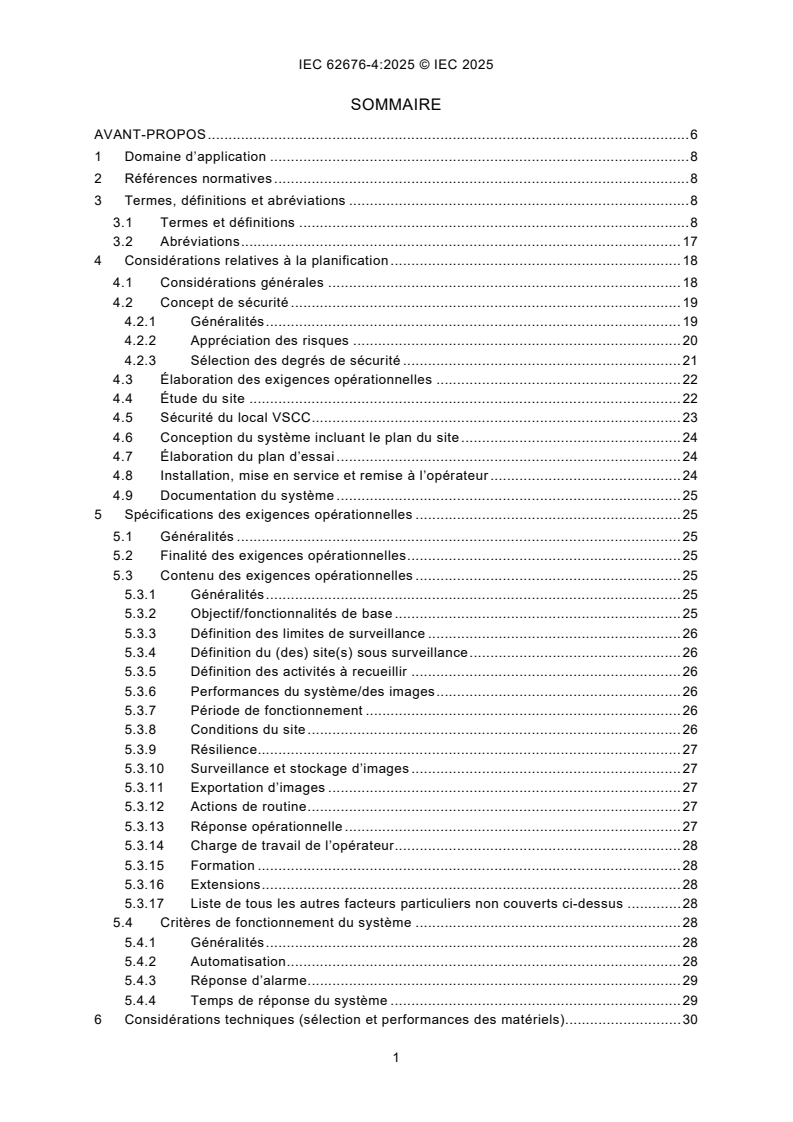
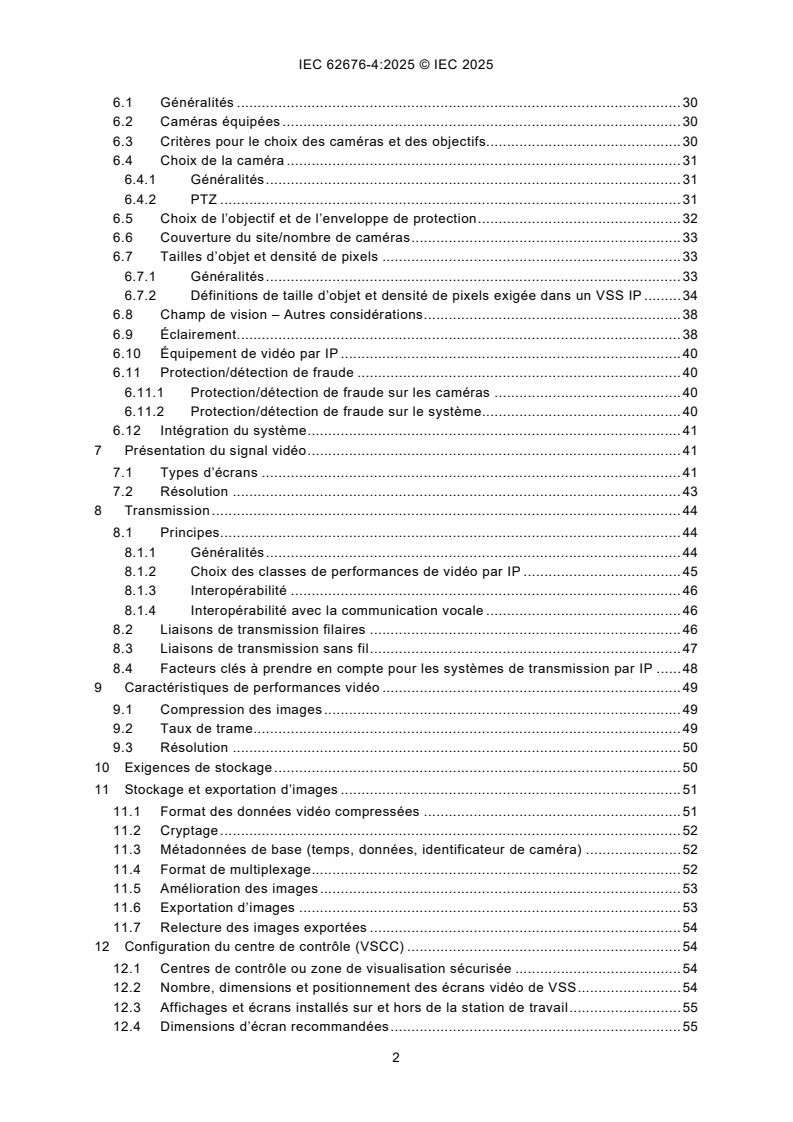
SOMMAIRE
AVANT-PROPOS . 6
1 Domaine d’application . 8
2 Références normatives . 8
3 Termes, définitions et abréviations . 8
3.1 Termes et définitions . 8
3.2 Abréviations . 17
4 Considérations relatives à la planification . 18
4.1 Considérations générales . 18
4.2 Concept de sécurité . 19
4.2.1 Généralités . 19
4.2.2 Appréciation des risques . 20
4.2.3 Sélection des degrés de sécurité . 21
4.3 Élaboration des exigences opérationnelles . 22
4.4 Étude du site . 22
4.5 Sécurité du local VSCC . 23
4.6 Conception du système incluant le plan du site . 24
4.7 Élaboration du plan d’essai . 24
4.8 Installation, mise en service et remise à l’opérateur . 24
4.9 Documentation du système . 25
5 Spécifications des exigences opérationnelles . 25
5.1 Généralités . 25
5.2 Finalité des exigences opérationnelles . 25
5.3 Contenu des exigences opérationnelles . 25
5.3.1 Généralités . 25
5.3.2 Objectif/fonctionnalités de base . 25
5.3.3 Définition des limites de surveillance . 26
5.3.4 Définition du (des) site(s) sous surveillance . 26
5.3.5 Définition des activités à recueillir . 26
5.3.6 Performances du système/des images . 26
5.3.7 Période de fonctionnement . 26
5.3.8 Conditions du site . 26
5.3.9 Résilience. 27
5.3.10 Surveillance et stockage d’images . 27
5.3.11 Exportation d’images . 27
5.3.12 Actions de routine . 27
5.3.13 Réponse opérationnelle . 27
5.3.14 Charge de travail de l’opérateur . 28
5.3.15 Formation . 28
5.3.16 Extensions . 28
5.3.17 Liste de tous les autres facteurs particuliers non couverts ci-dessus . 28
5.4 Critères de fonctionnement du système . 28
5.4.1 Généralités . 28
5.4.2 Automatisation . 28
5.4.3 Réponse d’alarme. 29
5.4.4 Temps de réponse du système . 29
6 Considérations techniques (sélection et performances des matériels). 30
6.1 Généralités . 30
6.2 Caméras équipées . 30
6.3 Critères pour le choix des caméras et des objectifs. 30
6.4 Choix de la caméra . 31
6.4.1 Généralités . 31
6.4.2 PTZ . 31
6.5 Choix de l’objectif et de l’enveloppe de protection . 32
6.6 Couverture du site/nombre de caméras . 33
6.7 Tailles d’objet et densité de pixels . 33
6.7.1 Généralités . 33
6.7.2 Définitions de taille d’objet et densité de pixels exigée dans un VSS IP . 34
6.8 Champ de vision – Autres considérations . 38
6.9 Éclairement. 38
6.10 Équipement de vidéo par IP . 40
6.11 Protection/détection de fraude . 40
6.11.1 Protection/détection de fraude sur les caméras . 40
6.11.2 Protection/détection de fraude sur le système. 40
6.12 Intégration du système . 41
7 Présentation du signal vidéo . 41
7.1 Types d’écrans . 41
7.2 Résolution . 43
8 Transmission . 44
8.1 Principes. 44
8.1.1 Généralités . 44
8.1.2 Choix des classes de performances de vidéo par IP . 45
8.1.3 Interopérabilité . 46
8.1.4 Interopérabilité avec la communication vocale . 46
8.2 Liaisons de transmission filaires . 46
8.3 Liaisons de transmission sans fil . 47
8.4 Facteurs clés à prendre en compte pour les systèmes de transmission par IP . 48
9 Caractéristiques de performances vidéo . 49
9.1 Compression des images . 49
9.2 Taux de trame. 49
9.3 Résolution . 50
10 Exigences de stockage . 50
11 Stockage et exportation d’images . 51
11.1 Format des données vidéo compressées . 51
11.2 Cryptage . 52
11.3 Métadonnées de base (temps, données, identificateur de caméra) . 52
11.4 Format de multiplexage . 52
11.5 Amélioration des images . 53
11.6 Exportation d’images . 53
11.7 Relecture des images exportées . 54
12 Configuration du centre de contrôle (VSCC) . 54
12.1 Centres de contrôle ou zone de visualisation sécurisée . 54
12.2 Nombre, dimensions et positionnement des écrans vidéo de VSS . 54
12.3 Affichages et écrans installés sur et hors de la station de travail . 55
12.4 Dimensions d’écran recommandées . 55
12.5 Nombre d’images de caméras par opérateur . 56
12.6 Nombre de stations de travail . 56
12.7 Installation sur site des matériels . 57
12.8 Alimentation de secours . 57
12.9 Température de fonctionnement. 57
12.10 Protection contre la foudre et les surtensions. 57
13 Définition du plan d’essai . 57
13.1 Finalité du plan d’essai . 57
13.2 Inspection/essais de réception utilisateur . 58
13.3 Essais de réception technique . 58
13.3.1 Cohérence de la chaîne d’imagerie . 58
13.3.2 Qualité d’image . 58
14 Considérations documentaires (pré-installation) . 61
14.1 Généralités . 61
14.2 Appréciation des risques . 61
14.3 Exigences opérationnelles . 61
14.4 Spécifications de conception . 61
14.5 Plan du site . 61
14.6 Plan d’essai . 61
15 Installation et mise en service du système . 61
15.1 Recette en usine . 61
15.2 Processus d’installation . 62
15.3 Essai de réception utilisateur, mise en service et remise au client . 62
15.4 Déclaration de conformité aux normes . 63
16 Documentation finale . 63
16.1 Généralités . 63
16.2 Schémas complets du système . 63
16.3 Mise en service du système (avec audits spécifiques des caméras) . 64
16.4 Description des interfaces . 64
16.5 Registre de fonctionnement du VSS . 64
16.6 Conformité à la législation (pour information) . 64
17 Exploitation du VSS . 64
17.1 Généralités . 64
17.2 Comportement en cas de dysfonctionnements . 66
17.3 Contrôle visuel sur site . 66
17.4 Déviation des exigences relatives aux contrôles visuels sur site et à la
maintenance . 67
17.5 Maintenance . 67
17.6 Inspection (partie de la maintenance préventive) . 67
17.7 contrôles en service (partie de la maintenance préventive) . 69
17.8 Réparation (maintenance corrective) . 69
17.9 Amélioration. 70
Annexe A (informative) Formats vidéo normaux . 71
A.1 Formats vidéo normaux courants . 71
A.2 Densités de pixels pour la reconnaissance d’autres objets d’intérêt . 71
Annexe B (normative) Protocole d’essai pour cibles de VSS . 72
B.1 Objet de l’essai . 72
B.2 Conditions préalables à l’essai . 72
B.3 Conditions préalables . 72
B.4 Sélection des visages . 72
B.5 Méthodologie d’examen d’images en direct (visages) . 73
B.6 Méthodologie d’examen d’images en direct (plaques d’immatriculation de
véhicules) . 73
B.7 Méthodologie d’examen d’images enregistrées (visages) . 74
B.8 Méthodologie d’examen d’images enregistrées (plaques d’immatriculation de
véhicules) . 74
B.9 Mouvement . 74
B.10 Visages: critères de résultats . 74
B.11 VRN: critères de résultats . 75
B.12 Feuille de contrôle des visages (pour exemple seulement) . 78
B.13 Feuille de contrôle des plaques d’immatriculation (pour exemple
uniquement) . 79
Annexe C (normative) Méthode d’essai de qualité d’image: Recommandations
d’utilisation de la mire vidéo d’essai . 80
Annexe D (informative) Lignes directrices pour la spécification des paramètres VSS et
des degrés de sécurité . 86
D.1 Paramètres VSS . 86
D.2 Modules suggérés . 86
D.3 Degrés de sécurité . 88
D.4 Degré de sécurité selon l’approche basée sur le système: . 88
D.5 Degré de sécurité selon l’approche basée sur la taille: . 88
D.6 Degré de sécurité selon l’approche basée sur l’application . 89
D.7 Nombre de trames en fonction de la vitesse de l’objet dans une largeur de
scène . 92
Annexe E (normative) Essai de réponse à la détection et critères d’acceptabilité . 95
E.1 Généralités . 95
E.2 Fausses alarmes et alarmes perturbatrices . 96
E.3 Définition du temps de réponse . 96
E.4 Procédure d’essai du temps de réponse des caméras PTZ . 97
E.5 Repérage et sollicitation de l’observateur . 97
E.6 Localisations de l’essai de détection . 97
E.7 Camouflage de la cible . 98
E.8 Essais avec des cibles mobiles . 98
E.9 Conditions d’essai . 98
E.10 Essai d’un système "en direct" . 98
E.11 Tableaux de résultats de l’essai de détection . 99
Bibliographie . 100
Figure 1 – Visualisation du processus . 19
Figure 2 – Structure d’un concept de sécurité . 20
Figure 3 – Pourcentages d’écrans HD et UHD occupés par différentes catégories . 36
Figure 4 – Formule de calcul de la densité de pixels . 37
Figure 5 – Exploitation d’un VSS. 65
Figure B.1 – Feuille de contrôle des visages . 78
Figure B.2 – Exemple de feuille de contrôle des VRN . 79
Figure C.1 – Mires d’essai . 81
Figure C.2 – Légende de la Figure C.1 . 84
Figure C.3 – Suppression de la distorsion optique . 85
Tableau 1 – Mesures en fonction des degrés de sécurité . 24
Tableau 2 – Exemple de réaction du système – Temps de réponse et performances du
contrôle PTZ, et réaction de l’opérateur . 30
Tableau 3 – Noms des groupes pour les mires d’essai . 35
Tableau 4 – Niveaux types en lux . 38
Tableau 5 – Exemples de technologies d’écrans . 42
Tableau 6 – Exemples de résolutions . 43
Tableau 7 – Options de transmission sans fil . 47
Tableau 8 – Cycles d’inspection en fonction du degré de sécurité . 65
Tableau A.1 – Recommandations pour la reconnaissance de certains objets
"non humains" . 71
Tableau B.1 – Exemple de feuille de script de l’auditeur . 75
Tableau B.2 – Exemple de feuille de script de l’observateur au centre de contrôle . 75
Tableau B.3 – Exemple de feuille d’audit de caméra . 76
Tableau B.4 – Exemple de feuille de script de l’auditeur vierge . 76
Tableau B.5 – Feuille de script vierge de l’observateur au centre de contrôle . 76
Tableau B.6 – Feuille vierge d’audit de caméra . 77
Tableau C.1 – Mires d’essai . 80
Tableau D.1 – Modules VSS suggérés . 86
Tableau D.2 – Degré de sécurité selon l’approche basée sur la taille . 88
Tableau D.3 – Degrés de sécurité par application . 89
Tableau D.4 – Degré de sécurité par infrastructure critique . 90
Tableau D.5 – Nombre de trames en fonction de la vitesse de l’objet – Objets à faible
densité de pixels . 93
Tableau D.6 – Nombre de trames en fonction de la vitesse de l’objet – Objets à haute
densité de pixels . 94
Tableau E.1 – Résultats de l’essai de détection . 99
COMMISSION ÉLECTROTECHNIQUE INTERNATIONALE
____________
Systèmes de vidéosurveillance destinés à être utilisés
dans les applications de sécurité -
Partie 4: Directives d’application
AVANT-PROPOS
1) La Commission Électrotechnique Internationale (IEC) est une organisation mondiale de normalisation composée
de l’ensemble des comités électrotechniques nationaux (Comités nationaux de l’IEC). L’IEC a pour objet de
favoriser la coopération internationale pour toutes les questions de normalisation dans les domaines de
l’électricité et de l’électronique. À cet effet, l’IEC – entre autres activités – publie des Normes internationales,
des Spécifications techniques, des Rapports techniques, des Spécifications accessibles au public (PAS) et des
Guides (ci-après dénommés "Publication(s) de l’IEC"). Leur élaboration est confiée à des comités d’études, aux
travaux desquels tout Comité national intéressé par le sujet traité peut participer. Les organisations
internationales, gouvernementales et non gouvernementales, en liaison avec l’IEC, participent également aux
travaux. L’IEC collabore étroitement avec l’Organisation Internationale de Normalisation (ISO), selon des
conditions fixées par accord entre les deux organisations.
2) Les décisions ou accords officiels de l’IEC concernant les questions techniques représentent, dans la mesure du
possible, un accord international sur les sujets étudiés, étant donné que les Comités nationaux de l’IEC intéressés
sont représentés dans chaque comité d’études.
3) Les Publications de l’IEC se présentent sous la forme de recommandations internationales et sont agréées
comme telles par les Comités nationaux de l’IEC. Tous les efforts raisonnables sont entrepris afin que l’IEC
s’assure de l’exactitude du contenu technique de ses publications; l’IEC ne peut pas être tenue responsable de
l’éventuelle mauvaise utilisation ou interprétation qui en est faite par un quelconque utilisateur final.
4) Dans le but d’encourager l’uniformité internationale, les Comités nationaux de l’IEC s’engagent, dans toute la
mesure possible, à appliquer de façon transparente les Publications de l’IEC dans leurs publications nationales
et régionales. Toutes divergences entre toutes Publications de l’IEC et toutes publications nationales ou
régionales correspondantes doivent être indiquées en termes clairs dans ces dernières.
5) L’IEC elle-même ne fournit aucune attestation de conformité. Des organismes de certification indépendants
fournissent des services d’évaluation de conformité et, dans certains secteurs, accèdent aux marques de
conformité de l’IEC. L’IEC n’est responsable d’aucun des services effectués par les organismes de certification
indépendants.
6) Tous les utilisateurs doivent s’assurer qu’ils sont en possession de la dernière édition de cette publication.
7) Aucune responsabilité ne doit être imputée à l’IEC, à ses administrateurs, employés, auxiliaires ou mandataires,
y compris ses experts particuliers et les membres de ses comités d’études et des Comités nationaux de l’IEC,
pour tout préjudice causé en cas de dommages corporels et matériels, ou de tout autre dommage de quelque
nature que ce soit, directe ou indirecte, ou pour supporter les coûts (y compris les frais de justice) et les dépenses
découlant de la publication ou de l’utilisation de cette Publication de l’IEC ou de toute autre Publication de l’IEC,
ou au crédit qui lui est accordé.
8) L’attention est attirée sur les références normatives citées dans cette publication. L’utilisation de publications
référencées est obligatoire pour une application correcte de la présente publication.
9) L’IEC attire l’attention sur le fait que la mise en application du présent document peut entraîner l’utilisation d’un
ou de plusieurs brevets. L’IEC ne prend pas position quant à la preuve, à la validité et à l’applicabilité de tout
droit de propriété revendiqué à cet égard. À la date de publication du présent document, l’IEC n’avait pas reçu
notification qu’un ou plusieurs brevets pouvaient être nécessaires à sa mise en application. Toutefois, il y a lieu
d’avertir les responsables de la mise en application du présent document que des informations plus récentes
sont susceptibles de figurer dans la base de données de brevets, disponible à l’adresse https://patents.iec.ch.
L’IEC ne saurait être tenue pour responsable de ne pas avoir identifié de tels droits de brevet.
L’IEC 62676-4 a été établie par le comité d’études 79 de l’IEC: Systèmes d’alarme et de sécurité
électroniques. Il s’agit d’une Norme internationale.
Cette deuxième édition annule et remplace la première édition parue en 2014. Cette édition
constitue une révision technique.
Cette édition inclut les modifications techniques majeures suivantes par rapport à l’édition
précédente:
a) mise en œuvre de la demande visant à définir un concept de sécurité (plutôt qu’une simple
analyse des risques) (4.2);
b) sélection des degrés de sécurité (4.2.3);
c) redéfinition complète des densités de pixels (6.7), incluant de nouvelles mires d’essai
(Annexe C):
– mise à niveau du précédent système MDORII, avec 6 densités de pixels
(12,5 pixels/mètre; 25 pixels/mètre; 62,5 pixels/mètre; 125 pixels/mètre;
250 pixels/mètre; 1 000 pixels/mètre), vers le nouveau système O2DCPVS avec
7 densités de pixels (20 pixels/mètre; 40 pixels/mètre; 80 pixels/mètre;
125 pixels/mètre; 250 pixels/mètre; 500 pixels/mètre; 1 500 pixels/mètre
d) exploitation du VSS (Article 17);
e) degré de sécurité selon l’approche basée sur la taille (Annexe D, Tableau D.2);
f) degrés de sécurité par application (Annexe D, Tableau D.3);
g) degré de sécurité par infrastructure critique (Annexe D, Tableau D.4);
h) tableaux énumérant les nombres de trames en fonction de la vitesse de l’objet (Annexe D,
Tableau D.5 et Tableau D.6);
i) mises à jour générales des tableaux sur l’ensemble du document.
Le texte de cette Norme internationale est issu des documents suivants:
Projet Rapport de vote
79/727/FDIS 79/732/RVD
Le rapport de vote indiqué dans le tableau ci-dessus donne toute information sur le vote ayant
abouti à son approbation.
La langue employée pour l’élaboration de cette Norme internationale est l’anglais.
Une liste de toutes les parties de la série IEC 62676, publiées sous le titre général Systèmes de
vidéosurveillance destinés à être utilisés dans les applications de sécurité, se trouve sur le site
web de l’IEC.
Ce document a été rédigé selon les Directives ISO/IEC, Partie 2, il a été développé selon les
Directives ISO/IEC, Partie 1 et les Directives ISO/IEC, Supplément IEC, disponibles sous
www.iec.ch/members_experts/refdocs. Les principaux types de documents développés par
l’IEC sont décrits plus en détail sous www.iec.ch/publications.
Le comité a décidé que le contenu de ce document ne sera pas modifié avant la date de stabilité
indiquée sur le site web de l’IEC sous webstore.iec.ch dans les données relatives au document
recherché. À cette date, le document sera
• reconduit,
• supprimé, ou
• révisé.
1 Domaine d’application
La présente partie de l’IEC 62676 décrit la planification, la conception, l’installation,
les procédures d’essai, la mise en service et l’entretien des systèmes de vidéosurveillance
(VSS) comprenant un ou plusieurs dispositifs de capture d’images, une ou plusieurs
interconnexions et un ou plusieurs dispositifs de manipulation d’images, destinés à être utilisés
dans des applications de sécurité dans des espaces privés ou publics.
Le présent document a pour objet:
a) de fournir un cadre pour aider toutes les parties intéressées à établir leurs exigences
opérationnelles;
b) d’aider les rédacteurs de spécifications et les utilisateurs en déterminant le matériel
approprié, exigé pour une application donnée;
c) de fournir un moyen d’évaluer objectivement les performances du VSS.
2 Références normatives
Les documents suivants sont cités dans le texte de sorte qu’ils constituent, pour tout ou partie
de leur contenu, des exigences du présent document. Pour les références datées,
seule l’édition citée s’applique. Pour les références non datées, la dernière édition du document
de référence s’applique (y compris les éventuels amendements).
IEC 62676-1-1:2013, Systèmes de vidéosurveillance destinés à être utilisés dans les
applications de sécurité - Partie 1-1: Exigences systèmes - Généralités
IEC 62676-1-2:2013, Systèmes de vidéosurveillance destinés à être utilisés dans les
applications de sécurité - Partie 1-2: Exigences systèmes - Exigences de performances pour la
transmission vidéo
IEC 62676-2 (toutes les parties), Systèmes de vidéosurveillance destinés à être utilisés dans
les applications de sécurité - Partie 2-X: Protocoles de transmission vidéo
IEC 62676-2-1, Systèmes de vidéosurveillance destinés à être utilisés dans les applications de
sécurité - Partie 2-1: Protocoles de transmission vidéo - Exigences générales
IEC 62676-3, Systèmes de vidéosurveillance destinés à être utilisés dans les applications de
sécurité - Partie 3: Interfaces vidéo analogiques et vidéo numériques
IEC 62820-2, Systèmes d’interphone de bâtiment - Partie 2: Exigences pour les systèmes
d’interphone de bâtiment à sécurité avancée (ASBIS)
IEC 62820-3-2, Systèmes d’interphone de bâtiment - Partie 3-2: Lignes directrices
d’application - Systèmes d’interphone de bâtiment à sécurité avancée (ASBIS)
3 Termes, définitions et abréviations
3.1 Termes et définitions
Pour les besoins du présent document, les termes et définitions suivants s’appliquent.
L’ISO et l’IEC tiennent à jour des bases de données terminologiques destinées à être utilisées
en normalisation, consultables aux adresses suivantes:
• IEC Electropedia: disponible à l’adresse https://www.electropedia.org/
• ISO Online browsing platform: disponible à l’adresse https://www.iso.org/obp
3.1.1
4K
UHD
format de télévision en Ultra Haute Définition de 3 840 × 2 160 pixels à 25 fps ou 30 fps
(UHDTV), défini par la norme SMPTE 2036
3.1.2
8K
UHD
format de télévision en Ultra Haute Définition de 7 680 × 4 320 pixels à 25 fps ou 30 fps
(UHDTV), défini par la norme SMPTE 2036
3.1.3
contrôle visuel sur site
activité ayant pour but de déterminer et d’évaluer la possibilité de mise en œuvre du concept
de sécurité pour chaque emplacement de caméra à surveiller, d’effectuer des contrôles de
perturbations et de défauts visibles sur site, pour les tâches de surveillance d’un VSS qui ne
font pas l’objet d’une évaluation opérationnelle, ainsi que d’établir les éventuels écarts par
rapport à la fonction du VSS exigé dans le concept de sécurité
Note 1 à l’article: Cela concerne en particulier les influences extérieures aux parties du système VSS.
Note 2 à l’article: Le contrôle visuel sur site relève de la responsabilité de l’opérateur qui peut toutefois confier
l’inspection à une personne ou un ingénieur système compétent en VSS.
3.1.4
enveloppe de protection de caméra
enveloppe fournissant à la fois une protection physique et environnementale pour la caméra,
l’objectif et les accessoires
3.1.5
sensibilité de la caméra
aptitude du dispositif de capture d’images à produire une image dans certaines conditions
d’éclairage
3.1.6
caractérisation
finalité fonctionnelle définie d’une caméra VSS pour permettre la caractérisation d’une cible,
par exemple une personne (le type de personne, ainsi que sa démarche et son action, peuvent
être caractérisés) et des véhicules (la marque du véhicule peut être caractérisée) avec une
densité de pixels > 250 pixels/mètre
3.1.7
personne compétente en VSS
personne ayant été formée par un ingénieur système compétent en VSS sur les tâches
assignées dans le cadre du contrôle sur site ainsi que les dangers et conséquences possibles
d’un comportement inapproprié
Note 1 à l’article: Cette compétence sous-entend de posséder les connaissances nécessaires à l’évaluation des
exigences relatives à l’objet, en ce qui concerne le type de danger et la fonction exigée du VSS, l’influence de
l’utilisation ainsi que les limites d’utilisation et la formation au concept de sécurité du système de vidéosurveillance,
aux exigences existantes et légales ou aux exigences de l’opérateur en matière de sécurité telles que les mesures
de protection des personnes et des biens ou pour éviter des dommages corporels.
Note 2 à l’article: Cette tâche exige des compétences en matière de planification indépendante et de traitement
des exigences liées au contrôle visuel sur site, ainsi que des connaissances générales approfondies et des
connaissances théoriques pointues pour pouvoir évaluer dans quelle mesure les changements environnementaux ou
liés aux objets peuvent influer sur l’efficacité d’un système de vidéosurveillance. La reconnaissance des interactions
possibles avec d’autres exigences est nécessaire ainsi que l’élaboration d’actions alternatives. Les écarts détectés
doivent être justifiés de façon sécurisée, communiqués au responsable et, si nécessaire, éliminés si aucune autre
solution ne peut être apportée au problème.
3.1.8
ingénieur système compétent en VSS
personne qui, sur la base d’une formation, de connaissances et d’une expertise techniques
professionnelles, ainsi que de connaissances des normes, réglementations et directives
pertinentes, est en mesure d’évaluer le travail à réaliser et de reconnaître les dangers potentiels
Note 1 à l’article: Un ingénieur système compétent en VSS peut être employé par une société
d’installation/d’intégration de systèmes, une société de planification de projets, ou encore par le propriétaire ou
l’utilisateur du VSS
Note 2 à l’article: Dans le domaine des systèmes de vidéosurveillance, une formation couvrant le spectre de
l’ingénierie électrique dans le domaine des communications, de l’information, des microprocesseurs, de la mesure
et du contrôle ou de l’ingénierie électrique générale, est exigée et une expérience dans les autres domaines
respectifs doit être démontrée ainsi que les connaissances dans les technologies de systèmes de sécurité vidéo.
Une qualification des compétences et connaissances en VSS peut être prouvée par des certificats de formation
délivrés, par exemple, par des associations de sécurité locales ou des vendeurs de VSS.
Note 3 à l’article: Plusieurs années d’activité dans les domaines de travail concernés peuvent également servir à
évaluer la formation professionnelle.
Note 4 à l’article: L’activité exige une capacité à planifier de façon indépendante et traiter des tâches techniques
étendues dans un environnement complexe, spécialisé et évolutif. Les connaissances techniques et les
connaissances théoriques approfondies du sujet doivent être acquises. Le domaine d’application et les limites des
possibles applications d’un système de vidéosurveillance doivent être connus. Un très large spectre de capacités
cognitives et pratiques spécialisées est exigé. Les processus de travail doivent être planifiés de manière globale et
évalués en gardant une vue d’ensemble des alternatives de traitement et des interactions avec les zones voisines.
La capacité à guider les autres et à les aider par des conseils d’apprentissage bienfondés doit être acquise.
Les problèmes interdisciplinaires complexes doivent être présentés de manière structurée, centrée sur l’objectif et
liée au destinataire. Les objectifs d’apprentissage et de travail personnels et externes doivent être pris en compte,
évalués, recherchés de manière autonome et atteints.
3.1.9
débit binaire constant
débit d’un flux de caméra maintenu constant quel que soit le mouvement dans la scène ou la
qualité de l’image
3.1.10
maintenance corrective
maintenance réalisée après la détection d’u
...
IEC 62676-4 ®
Edition 2.0 2025-10
INTERNATIONAL
STANDARD
NORME
INTERNATIONALE
Video surveillance systems for use in security applications -
Part 4: Application guidelines
Systèmes de vidéosurveillance destinés à être utilisés dans les applications de
sécurité -
Partie 4: Directives d'application
ICS 13.320 ISBN 978-2-8327-0697-8
All rights reserved. Unless otherwise specified, no part of this publication may be reproduced or utilized in any form or
by any means, electronic or mechanical, including photocopying and microfilm, without permission in writing from either
IEC or IEC's member National Committee in the country of the requester. If you have any questions about IEC copyright
or have an enquiry about obtaining additional rights to this publication, please contact the address below or your local
IEC member National Committee for further information.
Droits de reproduction réservés. Sauf indication contraire, aucune partie de cette publication ne peut être reproduite ni
utilisée sous quelque forme que ce soit et par aucun procédé, électronique ou mécanique, y compris la photocopie et
les microfilms, sans l'accord écrit de l'IEC ou du Comité national de l'IEC du pays du demandeur. Si vous avez des
questions sur le copyright de l'IEC ou si vous désirez obtenir des droits supplémentaires sur cette publication, utilisez
les coordonnées ci-après ou contactez le Comité national de l'IEC de votre pays de résidence.
IEC Secretariat Tel.: +41 22 919 02 11
3, rue de Varembé info@iec.ch
CH-1211 Geneva 20 www.iec.ch
Switzerland
About the IEC
The International Electrotechnical Commission (IEC) is the leading global organization that prepares and publishes
International Standards for all electrical, electronic and related technologies.
About IEC publications
The technical content of IEC publications is kept under constant review by the IEC. Please make sure that you have the
latest edition, a corrigendum or an amendment might have been published.
IEC publications search - IEC Products & Services Portal - products.iec.ch
webstore.iec.ch/advsearchform Discover our powerful search engine and read freely all the
The advanced search enables to find IEC publications by a publications previews, graphical symbols and the glossary.
variety of criteria (reference number, text, technical With a subscription you will always have access to up to date
committee, …). It also gives information on projects, content tailored to your needs.
replaced and withdrawn publications.
Electropedia - www.electropedia.org
IEC Just Published - webstore.iec.ch/justpublished The world's leading online dictionary on electrotechnology,
Stay up to date on all new IEC publications. Just Published containing more than 22 500 terminological entries in English
details all new publications released. Available online and and French, with equivalent terms in 25 additional languages.
once a month by email. Also known as the International Electrotechnical Vocabulary
(IEV) online.
IEC Customer Service Centre - webstore.iec.ch/csc
If you wish to give us your feedback on this publication or
need further assistance, please contact the Customer
Service Centre: sales@iec.ch.
A propos de l'IEC
La Commission Electrotechnique Internationale (IEC) est la première organisation mondiale qui élabore et publie des
Normes internationales pour tout ce qui a trait à l'électricité, à l'électronique et aux technologies apparentées.
A propos des publications IEC
Le contenu technique des publications IEC est constamment revu. Veuillez vous assurer que vous possédez l’édition la
plus récente, un corrigendum ou amendement peut avoir été publié.
Recherche de publications IEC - IEC Products & Services Portal - products.iec.ch
webstore.iec.ch/advsearchform Découvrez notre puissant moteur de recherche et consultez
La recherche avancée permet de trouver des publications gratuitement tous les aperçus des publications, symboles
IEC en utilisant différents critères (numéro de référence, graphiques et le glossaire. Avec un abonnement, vous aurez
texte, comité d’études, …). Elle donne aussi des toujours accès à un contenu à jour adapté à vos besoins.
informations sur les projets et les publications remplacées
ou retirées. Electropedia - www.electropedia.org
Le premier dictionnaire d'électrotechnologie en ligne au
IEC Just Published - webstore.iec.ch/justpublished monde, avec plus de 22 500 articles terminologiques en
Restez informé sur les nouvelles publications IEC. Just anglais et en français, ainsi que les termes équivalents
Published détaille les nouvelles publications parues. dans 25 langues additionnelles. Egalement appelé
Disponible en ligne et une fois par mois par email. Vocabulaire Electrotechnique International (IEV) en ligne.
Service Clients - webstore.iec.ch/csc
Si vous désirez nous donner des commentaires sur cette
publication ou si vous avez des questions contactez-
nous: sales@iec.ch.
CONTENTS
FOREWORD . 6
1 Scope . 8
2 Normative references . 8
3 Terms, definitions and abbreviated terms . 8
3.1 Terms and definitions. 8
3.2 Abbreviated terms . 17
4 Planning considerations. 18
4.1 General considerations . 18
4.2 Security concept . 19
4.2.1 General . 19
4.2.2 Risk assessment . 20
4.2.3 Selection of security grades . 21
4.3 Developing the operational requirements . 22
4.4 Site survey . 22
4.5 Security of the VSCC room . 22
4.6 System design including site plan . 23
4.7 Developing the test plan . 23
4.8 Installation, commissioning and hand over . 23
4.9 Documenting the system . 24
5 Operational requirements specifications . 24
5.1 General . 24
5.2 Purpose of the operational requirements . 24
5.3 Content of the operational requirements . 24
5.3.1 General . 24
5.3.2 Basic objective/functionalities . 24
5.3.3 Definition of surveillance limitations . 25
5.3.4 Definition of the site(s) under surveillance . 25
5.3.5 Definition of activity to be captured . 25
5.3.6 System/picture performance . 25
5.3.7 Period of operation . 25
5.3.8 Conditions at the location . 25
5.3.9 Resilience. 25
5.3.10 Monitoring and image storage . 26
5.3.11 Exporting images . 26
5.3.12 Routine actions . 26
5.3.13 Operational response . 26
5.3.14 Operator workload . 26
5.3.15 Training . 26
5.3.16 Expansions . 27
5.3.17 List of any other special factors not covered by the above . 27
5.4 System operational criteria . 27
5.4.1 General . 27
5.4.2 Automation . 27
5.4.3 Alarm response . 27
5.4.4 System response times . 28
6 Technical considerations (equipment selection and performance) . 29
6.1 General . 29
6.2 Camera equipment . 29
6.3 Camera and lens selection criteria . 29
6.4 Camera selection . 30
6.4.1 General . 30
6.4.2 PTZ . 30
6.5 Lens and housing selection . 31
6.6 Site coverage/numbers of cameras . 31
6.7 Object sizes and pixel density . 32
6.7.1 General . 32
6.7.2 Object size definitions and required pixel density in IP VSS . 32
6.8 Field of view – Other considerations . 36
6.9 Illumination . 36
6.10 IP Video equipment . 38
6.11 Tamper protection/detection. 38
6.11.1 Camera tamper protection/detection . 38
6.11.2 System tamper protection/detection . 38
6.12 System integration . 38
7 Video signal presentation . 39
7.1 Display types . 39
7.2 Resolution . 40
8 Transmission . 41
8.1 Principles . 41
8.1.1 General . 41
8.1.2 Selection of IP video performance classes . 42
8.1.3 Interoperability. 43
8.1.4 Interoperability with voice communication . 43
8.2 Wired transmission links . 43
8.3 Wireless transmission links . 44
8.4 Key considerations for IP based transmission systems . 45
9 Video performance characteristics . 45
9.1 Image compression . 45
9.2 Frame rate . 46
9.3 Resolution . 46
10 Storage requirements . 47
11 Image storage and export . 48
11.1 Format of the compressed video data . 48
11.2 Encryption . 48
11.3 Basic metadata (time, date, camera identifier) . 48
11.4 Multiplexing format. 49
11.5 Image enhancements . 49
11.6 Image export . 49
11.7 Replay of exported images. 50
12 VSCC control room configuration . 50
12.1 Control rooms or secure viewing area . 50
12.2 Number, size and positioning of VSS video displays . 50
12.3 Displays and screens mounted on or off the workstation . 51
12.4 Recommended display sizes . 51
12.5 Number of camera images per operator . 51
12.6 Number of work stations . 52
12.7 Equipment siting . 52
12.8 Backup power supply provision . 52
12.9 Operating temperature . 53
12.10 Lightning and surge protection . 53
13 Defining the test plan . 53
13.1 Purpose of the test plan . 53
13.2 User acceptance testing/inspection . 53
13.3 Technical acceptance testing . 53
13.3.1 Imaging chain consistency . 53
13.3.2 Image quality . 53
14 Documentational considerations (pre-installation) . 56
14.1 General . 56
14.2 Risk assessment . 56
14.3 Operational requirements . 56
14.4 Design specification . 56
14.5 Site plan . 56
14.6 Test plan. 56
15 System installation and commissioning . 56
15.1 Factory acceptance testing . 56
15.2 Installation process . 57
15.3 User acceptance testing, commissioning and handover . 57
15.4 Declaration of conformance to standards . 58
16 Final documentation . 58
16.1 General . 58
16.2 Complete system drawings . 58
16.3 System commission (with camera specific audits) . 59
16.4 Interface descriptions . 59
16.5 Operating logbook VSS . 59
16.6 Compliance with legislation (for information) . 59
17 Operation of VSS. 59
17.1 General . 59
17.2 Behaviour in the event of malfunctions . 61
17.3 At-site visual check . 61
17.4 Deviation of requirements for at-site visual checks and maintenance . 62
17.5 Maintenance . 62
17.6 Inspection (part of preventive maintenance) . 62
17.7 Service checks (part of preventive maintenance) . 64
17.8 Repair (corrective maintenance) . 64
17.9 Improvement . 64
Annex A (informative) Video standard formats . 65
A.1 Current video standard format . 65
A.2 Pixel densities for recognition of other objects of interest . 65
Annex B (normative) Test protocol for VSS target . 66
B.1 Scope of the test . 66
B.2 Test prerequisites . 66
B.3 Preconditions . 66
B.4 Face selection . 66
B.5 Live view methodology (faces) . 67
B.6 Live view methodology (VRN) . 67
B.7 Recorded view methodology (faces) . 67
B.8 Recorded view methodology (VRN) . 68
B.9 Motion . 68
B.10 Faces: scoring criteria . 68
B.11 VRN: scoring criteria . 69
B.12 Heads control sheet (for example only) . 71
B.13 VRN control sheet (for example only) . 72
Annex C (normative) Test method of image quality: Guidance for the use of the video
test target . 73
Annex D (informative) Guidelines to specifying VSS parameters and security gradings . 79
D.1 VSS parameters . 79
D.2 Suggested building blocks . 79
D.3 Security gradings . 80
D.4 Security grading by system view: . 80
D.5 Security grading by size view: . 81
D.6 Security grading by application view . 81
D.7 Number of frames depending on the object speed in a scene width. 85
Annex E (normative) Detection response testing and acceptability criteria . 87
E.1 General . 87
E.2 False and nuisance alarms . 87
E.3 Setting the response time . 88
E.4 PTZ response time test procedure . 88
E.5 Observer cueing and prompting . 88
E.6 Detection test locations . 89
E.7 Target camouflage . 89
E.8 Tests with moving targets . 89
E.9 Test conditions . 89
E.10 Testing a 'live' system . 90
E.11 Detection test results tables . 90
Bibliography . 91
Figure 1 – Process visualization . 19
Figure 2 – Structure of a security concept . 20
Figure 3 – HD and UHD screen percentages occupied by various categories . 34
Figure 4 – Pixel density formula . 35
Figure 5 – Operation of a VSS . 60
Figure B.1 – Heads control sheet . 71
Figure B.2 – VRN control sheet example . 72
Figure C.1 – Test charts . 74
Figure C.2 – Key to Figure C.1 . 77
Figure C.3 – Avoiding optical distortion . 78
Table 1 – Measures depending on security grades . 23
Table 2 – Example of system feedback – PTZ control responding time, performance
and operator . 29
Table 3 – Group names for test charts . 34
Table 4 – Typical lux levels . 36
Table 5 – Examples of display technologies . 39
Table 6 – Example resolutions . 41
Table 7 – Wireless transmission options . 44
Table 8 – Inspection cycles versus security grading . 60
Table A.1 – Recommendations for recognition of some “non-human” objects . 65
Table B.1 – Example auditor log sheet . 69
Table B.2 – Example control room observer log sheet. 69
Table B.3 – Example camera audit sheet . 69
Table B.4 – Blank auditor log sheet . 70
Table B.5 – Blank control room observer log sheet . 70
Table B.6 – Blank camera audit sheet . 70
Table C.1 – Test targets . 73
Table D.1 – Suggested VSS building blocks. 79
Table D.2 – Security grading by size view . 81
Table D.3 – Security grading by application . 81
Table D.4 – Security grading by critical infrastructure . 83
Table D.5 – Number of frames depending of object speed – Low pixel density objects . 85
Table D.6 – Number of frames depending of object speed - High Pixel Density Objects . 86
Table E.1 – Detection test results . 90
INTERNATIONAL ELECTROTECHNICAL COMMISSION
____________
Video surveillance systems for use in security applications -
Part 4: Application guidelines
FOREWORD
1) The International Electrotechnical Commission (IEC) is a worldwide organization for standardization comprising
all national electrotechnical committees (IEC National Committees). The object of IEC is to promote international
co-operation on all questions concerning standardization in the electrical and electronic fields. To this end and
in addition to other activities, IEC publishes International Standards, Technical Specifications, Technical Reports,
Publicly Available Specifications (PAS) and Guides (hereafter referred to as “IEC Publication(s)”). Their
preparation is entrusted to technical committees; any IEC National Committee interested in the subject dealt with
may participate in this preparatory work. International, governmental and non-governmental organizations liaising
with the IEC also participate in this preparation. IEC collaborates closely with the International Organization for
Standardization (ISO) in accordance with conditions determined by agreement between the two organizations.
2) The formal decisions or agreements of IEC on technical matters express, as nearly as possible, an international
consensus of opinion on the relevant subjects since each technical committee has representation from all
interested IEC National Committees.
3) IEC Publications have the form of recommendations for international use and are accepted by IEC National
Committees in that sense. While all reasonable efforts are made to ensure that the technical content of IEC
Publications is accurate, IEC cannot be held responsible for the way in which they are used or for any
misinterpretation by any end user.
4) In order to promote international uniformity, IEC National Committees undertake to apply IEC Publications
transparently to the maximum extent possible in their national and regional publications. Any divergence between
any IEC Publication and the corresponding national or regional publication shall be clearly indicated in the latter.
5) IEC itself does not provide any attestation of conformity. Independent certification bodies provide conformity
assessment services and, in some areas, access to IEC marks of conformity. IEC is not responsible for any
services carried out by independent certification bodies.
6) All users should ensure that they have the latest edition of this publication.
7) No liability shall attach to IEC or its directors, employees, servants or agents including individual experts and
members of its technical committees and IEC National Committees for any personal injury, property damage or
other damage of any nature whatsoever, whether direct or indirect, or for costs (including legal fees) and
expenses arising out of the publication, use of, or reliance upon, this IEC Publication or any other IEC
Publications.
8) Attention is drawn to the Normative references cited in this publication. Use of the referenced publications is
indispensable for the correct application of this publication.
9) IEC draws attention to the possibility that the implementation of this document may involve the use of (a)
patent(s). IEC takes no position concerning the evidence, validity or applicability of any claimed patent rights in
respect thereof. As of the date of publication of this document, IEC had not received notice of (a) patent(s), which
may be required to implement this document. However, implementers are cautioned that this may not represent
the latest information, which may be obtained from the patent database available at https://patents.iec.ch. IEC
shall not be held responsible for identifying any or all such patent rights.
IEC 62676-4 has been prepared by IEC technical committee 79: Alarm and electronic security
systems. It is an International Standard.
This second edition cancels and replaces the first edition published in 2014. This edition
constitutes a technical revision.
This edition includes the following significant technical changes with respect to the previous
edition:
a) implementing request for define a security concept (instead of just a risk analysis) (4.2);
b) selection of security grades (4.2.3);
c) complete redefinition of pixel densities (6.7) including new test charts (Annex C):
– upgrade of previous MDORII system with 6 pixel densities (12,5 pixels/meter; 25
pixels/meter; 62,5 pixels/meter ; 125 pixels/meter; 250 pixels/meter; 1 000 pixels/meter)
into new O2DCPVS system with 7 pixel densities (20 pixels/meter; 40 pixels/meter; 80
pixels/meter; 125 pixels/meter; 250 pixels/meter; 500 pixels/meter; 1 500 pixels/meter
d) operation of VSS (Clause 17);
e) security grading by size view (Annex D, Table D.2);
f) security grading by application (Annex D, Table D.3);
g) security grading by critical infrastructure (Annex D, Table D.4);
h) tables for number of frames depending on object speed (Annex D, Table D.5 and Table D.6);
i) general updates of tables in entire document.
The text of this International Standard is based on the following documents:
Draft Report on voting
79/727/FDIS 79/732/RVD
Full information on the voting for its approval can be found in the report on voting indicated in
the above table.
The language used for the development of this International Standard is English
A list of all parts in the IEC 62676 series, published under the general title Video surveillance
systems for use in security applications, can be found on the IEC website.
This document was drafted in accordance with ISO/IEC Directives, Part 2, and developed in
accordance with ISO/IEC Directives, Part 1 and ISO/IEC Directives, IEC Supplement, available
at www.iec.ch/members_experts/refdocs. The main document types developed by IEC are
described in greater detail at www.iec.ch/publications.
The committee has decided that the contents of this document will remain unchanged until the
stability date indicated on the IEC website under webstore.iec.ch in the data related to the
specific document. At this date, the document will be
• reconfirmed,
• withdrawn, or
• revised.
1 Scope
This part of IEC 62676 describes the planning, design, installation, testing, commissioning, and
maintaining of video surveillance systems (VSS) comprising image capture device(s),
interconnection(s) and image handling device(s), for use in security applications within private
or public spaces.
The objectives of this document are to:
a) provide a framework to assist all interested parties in establishing their requirements,
b) assist specifiers and users in determining the appropriate equipment required for a given
application,
c) provide means of evaluating objectively the performance of the VSS.
2 Normative references
The following documents are referred to in the text in such a way that some or all of their content
constitutes requirements of this document. For dated references, only the edition cited applies.
For undated references, the latest edition of the referenced document (including any
amendments) applies.
IEC 62676-1-1:2013, Video surveillance systems for use in security applications - Part 1-1:
System requirements - General
IEC 62676-1-2:2013, Video surveillance systems for use in security applications - Part 1-2:
System requirements - Performance requirements for video transmission
IEC 62676-2 (all parts), Video surveillance systems for use in security applications - Part 2-X:
Video transmission protocols
IEC 62676-2-1, Video surveillance systems for use in security applications - Part 2-1: Video
transmission protocols - General requirements
IEC 62676-3, Video surveillance systems for use in security applications - Part 3: Analog and
digital video interfaces
IEC 62820-2, Building intercom systems - Part 2: Requirements for advanced security building
intercom systems (ASBIS)
IEC 62820-3-2, Building intercom systems - Part 3-2: Application guidelines - Advanced security
building intercom systems (ASBIS)
3 Terms, definitions and abbreviated terms
3.1 Terms and definitions
For the purposes of this document, the following terms and definitions apply.
ISO and IEC maintain terminology databases for use in standardization at the following
addresses:
• IEC Electropedia: available at https://www.electropedia.org/
• ISO Online browsing platform: available at https://www.iso.org/obp
3.1.1
4K
UHD
standard for ultra high-definition television (UHDTV) defined by SMPTE 2036 to be with
3 840 pixels × 2 160 pixels at 25 fps or 30 fps
3.1.2
8K
UHD
standard for ultra high-definition television (UHDTV) defined by SMPTE 2036 to be with
7 680 pixels × 4 320 pixels at 25 fps or 30 fps
3.1.3
at-site visual check
activity to determine and assess the feasibility of implementing the safety concept per camera
location to be monitored as well as checks of visible disturbances and defects at site on the
monitoring tasks of a VSS that are not evaluated operationally and whether there are deviations
from the function of the VSS required in the safety concept
Note 1 to entry: In particular for influences occurring outside of VSS system parts.
Note 2 to entry: The at-site visual check is the responsibility of the operator, who can, however, hand over the
inspection to a competent person VSS or to a competent system engineer VSS.
3.1.4
camera housing
enclosure to provide both physical and environmental protection of the camera, lens and
ancillary equipment
3.1.5
camera sensitivity
image capturing device capability to produce an image in certain light conditions
3.1.6
characterise
defined functional purpose of a VSS camera to enable characterisation of a target, e.g. person
(type of person, gait and action can be characterised) and vehicles (vehicle brand can be
characterised) with a pixel density of > 250 pixels/meter
3.1.7
competent person VSS
person who has been instructed by a competent system engineer VSS about the assigned tasks
within the scope of the on-site check and the possible dangers and consequences of improper
behaviour
Note 1 to entry: This includes the necessary knowledge for the assessment of the object requirements, with regard
to the type of danger and the required function of the VSS, the influence of the use as well as the limits of use and
the instruction about the security concept of the video surveillance system, about existing requirements as well as
legal requirements or requirements of the operator from safety aspects as personal and property protection measures
or to avoid personal injury.
Note 2 to entry: The task requires competences for independent planning and processing of the requirements from
the at-site visual check as well as in-depth general knowledge and specialist theoretical knowledge in order to be
able to assess to what extent environmental or object changes can influence the effectiveness of a video surveillance
system. The recognition of possible interactions from other requirements as well as the development of alternative
actions is necessary. Detected deviations shall be securely justified, responsibly communicated and, if necessary,
retracted if no other problem solutions can be found.
3.1.8
competent system engineer VSS
person who, on the basis of professional technical training, knowledge and experience as well
as knowledge of the relevant standards, regulations and directives, is able to assess the work
to be carried out and recognise possible hazards
Note 1 to entry: A competent system engineer VSS can be employed by either an installation company/system
integrator company, project planning company or at owner or at user of the VSS.
Note 2 to entry: For the field of video surveillance systems, training from the spectrum of electrical engineering in
the field of communications, information, microprocessor, measurement and control or general electrical engineering
is required, and experience in the respective other fields as well as system knowledge of video security technology
shall be demonstrated. Qualification of competence for VSS knowledge can be proven by training certificates of e.g.,
local security associations or vendors of VSS.
Note 3 to entry: Several years of activity in the relevant fields of work can also be used to assess the professional
training.
Note 4 to entry: The activity requires the ability to independently plan and process comprehensive technical tasks
in a complex, specialised, changing environment. Integrated technical knowledge and in-depth theoretical knowledge
of the subject shall be available. The scope and limits of the possible applications of a video surveillance system
shall be known. A very broad spectrum of specialised cognitive and practical skills is required. Work processes are
to be planned in a comprehensive manner and assessed with comprehensive consideration of handling alternatives
and interactions with neighbouring areas. The competence to guide others and to support them with well-founded
learning guidance shall be given. Interdisciplinary complex issues shall be presented in a structured, target-oriented
and addressee-related manner. Own and externally set learning and working goals shall be reflected upon, evaluated,
pursued in a self-directed manner and answered.
3.1.9
constant bit rate
bit rate of a camera stream kept constant regardless of the image quality or movement in the
scene
3.1.10
corrective maintenance
maintenance carried out after failure detection to restor
...
Questions, Comments and Discussion
Ask us and Technical Secretary will try to provide an answer. You can facilitate discussion about the standard in here.
Loading comments...