

EN IEC 80000-6:2022
(Main)Quantities and units - Part 6: Electromagnetism
General Information
- Abstract
IEC 80000-6:2022 gives names, symbols, and definitions for quantities and units of electromagnetism. Where appropriate, conversion factors are also given. International Standard IEC 80000-6 has been prepared by IEC technical committee 25: Quantities and units, and their letter symbols in close cooperation with ISO/TC 12, Quantities and units. This standard is based on classical electromagnetism, i.e. mainly Maxwell’s equations. No reference is made to quantum field theories. IEC 80000-6:2022 cancels and replaces the first edition published in 2008. This edition constitutes a technical revision. This edition includes the following significant technical changes with respect to the previous edition: 1) With the new definitions in SI, some previously exact values for quantities now must be determined experimentally while other quantities are given as exact values; 2) Item 6-2.2, elementary charge added; 3) Item 6-11.4, induced voltage, added; 4) Index of entries added; 5) Editorial alignment to other parts of the IEC and ISO 80000 series.
- Status
- Published
- Publication Date
- 22-Dec-2022
- Technical Committee
- CLC/SR 25 - Quantities and units, and their letter symbols
- Drafting Committee
- IEC/TC 25 - IEC_TC_25
- Current Stage
- 6060 - Document made available - Publishing
- Start Date
- 23-Dec-2022
- Completion Date
- 23-Dec-2022
Buy Documents

Overview
EN IEC 80000-6:2022 - Quantities and units, Part 6: Electromagnetism is the European adoption of IEC 80000-6:2022 prepared by IEC/TC 25 in cooperation with ISO/TC 12. It defines names, symbols, definitions and coherent units for electromagnetism quantities (based on classical electromagnetism and mainly Maxwell’s equations). Where appropriate, conversion factors are provided. This second edition (2022) replaces the 2008 edition and incorporates technical and editorial updates aligned with other ISO/IEC 80000 series parts.
Key topics
- Defined quantities and symbols: authoritative list of electromagnetism quantities (scalar, vectorial or tensorial), their recommended symbols and concise definitions.
- Units and conversion factors: SI base and derived units, endorsed non‑SI units for use with SI, and conversion factors where applicable.
- SI revisions impact: notes on how recent SI redefinitions affect which quantities are exact and which require experimental determination.
- New and updated entries (2022):
- Elementary charge added (item 6-2.2).
- Induced voltage defined (item 6-11.4).
- Alphabetical index of entries for easier reference.
- Special topics and usage guidance:
- Handling dimensionless quantities, radian and steradian treatment.
- Sinusoidal quantities and RMS value conventions.
- Notation for numerical statements and measurement uncertainty.
- Annexes and legacy units: informative Annex A lists deprecated CGS units with special names for reference.
Applications and who uses it
EN IEC 80000-6:2022 is essential for consistency in documentation, measurement, design and education across:
- Electrical and electronics engineers (design, simulation, documentation).
- Metrologists and test laboratories (traceable measurements, unit coherence).
- Standards writers and technical editors (harmonized symbols and unit usage).
- Educators and authors of textbooks and technical reports (uniform terminology).
- Regulators and conformity assessment bodies requiring standardised quantities and unit declarations.
Using the standard helps avoid ambiguity in specifications, enables interoperable datasets, and ensures correct unit conversion and reporting in research, product development and compliance.
Related standards
- Other parts of IEC/ISO 80000 (e.g., Parts 1, 2, 3, 4, 5, 7–12, 13, 15–17) cover general rules, mathematics, space/time, mechanics, thermodynamics, light, acoustics and more.
- Cross‑references to the SI Brochure (BIPM) and International Electrotechnical Vocabulary (IEV, IEC 60050 series) are relevant for normative usage.
Keywords: EN IEC 80000-6:2022, IEC 80000-6, quantities and units, electromagnetism, SI units, Maxwell’s equations, induced voltage, elementary charge, metrology, electrical engineering.
Relations
- Effective Date
- 27-Dec-2022
- Effective Date
- 09-Feb-2026
- Effective Date
- 03-Feb-2026
- Effective Date
- 03-Feb-2026
- Effective Date
- 03-Feb-2026
- Referred By
EN 60115-1:2023 - Fixed resistors for use in electronic equipment - Part 1: Generic specification - Effective Date
- 03-Feb-2026
- Effective Date
- 03-Feb-2026
- Effective Date
- 03-Feb-2026
- Effective Date
- 03-Feb-2026
- Effective Date
- 03-Feb-2026
- Effective Date
- 23-Sep-2025
Buy Documents
Get Certified
Connect with accredited certification bodies for this standard

BSMI (Bureau of Standards, Metrology and Inspection)
Taiwan's standards and inspection authority.
Sponsored listings
Frequently Asked Questions
EN IEC 80000-6:2022 is a standard published by CLC. Its full title is "Quantities and units - Part 6: Electromagnetism". This standard covers: IEC 80000-6:2022 gives names, symbols, and definitions for quantities and units of electromagnetism. Where appropriate, conversion factors are also given. International Standard IEC 80000-6 has been prepared by IEC technical committee 25: Quantities and units, and their letter symbols in close cooperation with ISO/TC 12, Quantities and units. This standard is based on classical electromagnetism, i.e. mainly Maxwell’s equations. No reference is made to quantum field theories. IEC 80000-6:2022 cancels and replaces the first edition published in 2008. This edition constitutes a technical revision. This edition includes the following significant technical changes with respect to the previous edition: 1) With the new definitions in SI, some previously exact values for quantities now must be determined experimentally while other quantities are given as exact values; 2) Item 6-2.2, elementary charge added; 3) Item 6-11.4, induced voltage, added; 4) Index of entries added; 5) Editorial alignment to other parts of the IEC and ISO 80000 series.
IEC 80000-6:2022 gives names, symbols, and definitions for quantities and units of electromagnetism. Where appropriate, conversion factors are also given. International Standard IEC 80000-6 has been prepared by IEC technical committee 25: Quantities and units, and their letter symbols in close cooperation with ISO/TC 12, Quantities and units. This standard is based on classical electromagnetism, i.e. mainly Maxwell’s equations. No reference is made to quantum field theories. IEC 80000-6:2022 cancels and replaces the first edition published in 2008. This edition constitutes a technical revision. This edition includes the following significant technical changes with respect to the previous edition: 1) With the new definitions in SI, some previously exact values for quantities now must be determined experimentally while other quantities are given as exact values; 2) Item 6-2.2, elementary charge added; 3) Item 6-11.4, induced voltage, added; 4) Index of entries added; 5) Editorial alignment to other parts of the IEC and ISO 80000 series.
EN IEC 80000-6:2022 is classified under the following ICS (International Classification for Standards) categories: 01.040.29 - Electrical engineering (Vocabularies); 17.220.01 - Electricity. Magnetism. General aspects. The ICS classification helps identify the subject area and facilitates finding related standards.
EN IEC 80000-6:2022 has the following relationships with other standards: It is inter standard links to EN 80000-6:2008, EN 16263-5:2015, EN IEC 62604-1:2022, EN IEC 60938-1:2021, EN 60862-1:2015, EN 60115-1:2023, EN 60027-7:2010, EN 61360-1:2017, EN IEC 61293:2020, EN 62604-1:2015, prEN IEC 80000-6:2026. Understanding these relationships helps ensure you are using the most current and applicable version of the standard.
EN IEC 80000-6:2022 is available in PDF format for immediate download after purchase. The document can be added to your cart and obtained through the secure checkout process. Digital delivery ensures instant access to the complete standard document.
Standards Content (Sample)
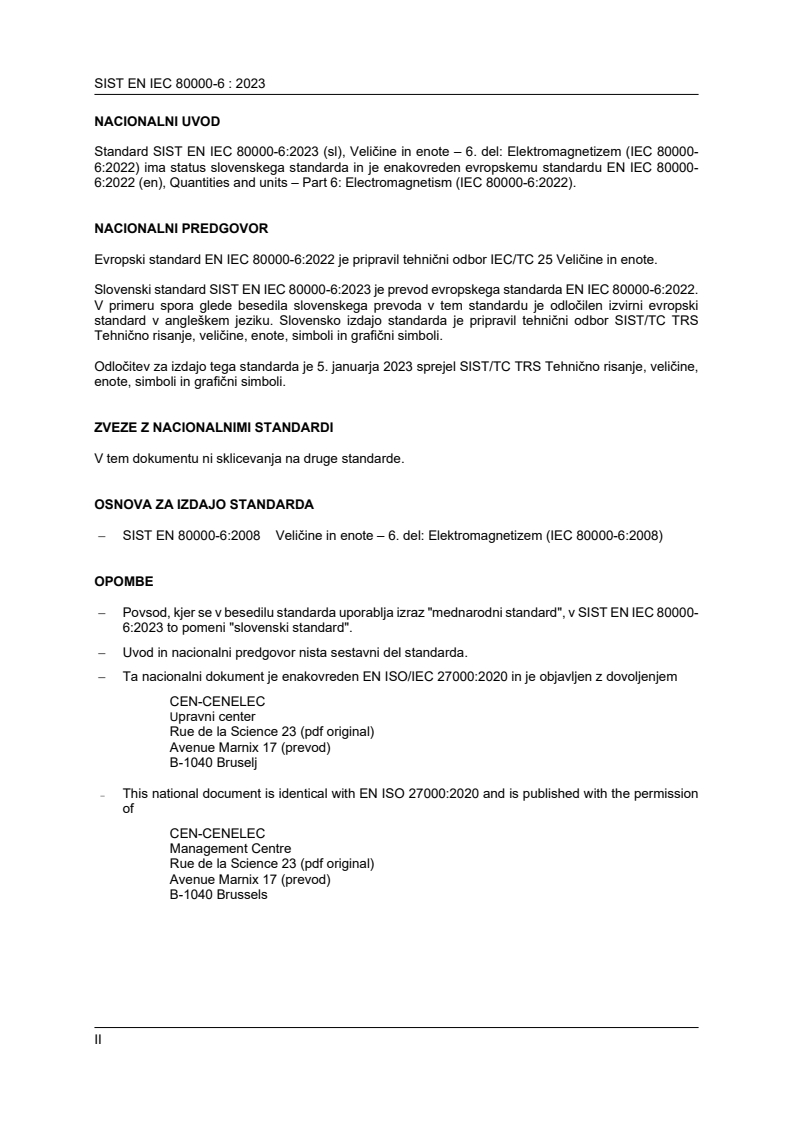
SLOVENSKI STANDARD
01-februar-2023
Nadomešča:
SIST EN 80000-6:2008
SIST IEC 80000-6:2014
Veličine in enote - 6. del: Elektromagnetizem (IEC 80000-6:2022)
Quantities and units - Part 6: Electromagnetism (IEC 80000-6:2022)
Größen und Einheiten - Teil 6: Elektromagnetismus (IEC 80000-6:2022)
Grandeurs et unités - Partie 6: Electromagnétisme (IEC 80000-6:2022)
Ta slovenski standard je istoveten z: EN IEC 80000-6:2022
ICS:
01.060 Veličine in enote Quantities and units
17.220.01 Elektrika. Magnetizem. Electricity. Magnetism.
Splošni vidiki General aspects
2003-01.Slovenski inštitut za standardizacijo. Razmnoževanje celote ali delov tega standarda ni dovoljeno.
EUROPEAN STANDARD EN IEC 80000-6
NORME EUROPÉENNE
EUROPÄISCHE NORM December 2022
ICS 01.040.29; 17.220.01 Supersedes EN 80000-6:2008
English Version
Quantities and units - Part 6: Electromagnetism
(IEC 80000-6:2022)
Grandeurs et unités - Partie 6: Electromagnétisme Größen und Einheiten - Teil 6: Elektromagnetismus
(IEC 80000-6:2022) (IEC 80000-6:2022)
This European Standard was approved by CENELEC on 2022-12-21. CENELEC members are bound to comply with the CEN/CENELEC
Internal Regulations which stipulate the conditions for giving this European Standard the status of a national standard without any alteration.
Up-to-date lists and bibliographical references concerning such national standards may be obtained on application to the CEN-CENELEC
Management Centre or to any CENELEC member.
This European Standard exists in three official versions (English, French, German). A version in any other language made by translation
under the responsibility of a CENELEC member into its own language and notified to the CEN-CENELEC Management Centre has the
same status as the official versions.
CENELEC members are the national electrotechnical committees of Austria, Belgium, Bulgaria, Croatia, Cyprus, the Czech Republic,
Denmark, Estonia, Finland, France, Germany, Greece, Hungary, Iceland, Ireland, Italy, Latvia, Lithuania, Luxembourg, Malta, the
Netherlands, Norway, Poland, Portugal, Republic of North Macedonia, Romania, Serbia, Slovakia, Slovenia, Spain, Sweden, Switzerland,
Türkiye and the United Kingdom.
European Committee for Electrotechnical Standardization
Comité Européen de Normalisation Electrotechnique
Europäisches Komitee für Elektrotechnische Normung
CEN-CENELEC Management Centre: Rue de la Science 23, B-1040 Brussels
© 2022 CENELEC All rights of exploitation in any form and by any means reserved worldwide for CENELEC Members.
Ref. No. EN IEC 80000-6:2022 E
European foreword
The text of document 25/732/FDIS, future edition 2 of IEC 80000-6, prepared by IEC/TC 25
"Quantities and units" was submitted to the IEC-CENELEC parallel vote and approved by CENELEC
as EN IEC 80000-6:2022.
The following dates are fixed:
• latest date by which the document has to be implemented at national (dop) 2023-09-21
level by publication of an identical national standard or by endorsement
• latest date by which the national standards conflicting with the (dow) 2025-12-21
document have to be withdrawn
This document supersedes EN 80000-6:2008 and all of its amendments and corrigenda (if any).
Attention is drawn to the possibility that some of the elements of this document may be the subject of
patent rights. CENELEC shall not be held responsible for identifying any or all such patent rights.
Any feedback and questions on this document should be directed to the users’ national committee. A
complete listing of these bodies can be found on the CENELEC website.
Endorsement notice
The text of the International Standard IEC 80000-6:2022 was approved by CENELEC as a European
Standard without any modification.
In the official version, for Bibliography, the following notes have to be added for the standard indicated:
IEC 60027-1 NOTE Harmonized as EN 60027-1
ISO 80000-2 NOTE Harmonized as EN ISO 80000-2
ISO 80000-3 NOTE Harmonized as EN ISO 80000-3
ISO 80000-4 NOTE Harmonized as EN ISO 80000-4
IEC 80000-6
Edition 2.0 2022-11
INTERNATIONAL
STANDARD
NORME
INTERNATIONALE
Quantities and units –
Part 6: Electromagnetism
Grandeurs et unités –
Partie 6: Électromagnétisme
INTERNATIONAL
ELECTROTECHNICAL
COMMISSION
COMMISSION
ELECTROTECHNIQUE
INTERNATIONALE
ICS 01.040.29; 17.220.01 ISBN 978-2-8322-5706-7
– 2 – IEC 80000-6:2022 © IEC 2022
CONTENTS
FOREWORD . 3
INTRODUCTION . 5
0.1 Tables of quantities. 5
0.2 Units . 5
0.2.1 General . 5
0.2.2 Remark on units for quantities of dimension one, or dimensionless
quantities . 5
0.3 Numerical statements in this document . 6
0.4 Special remarks . 6
0.4.1 General . 6
0.4.2 System of quantities . 6
0.4.3 Sinusoidal quantities. 7
0.4.4 Root-mean-square value, RMS value . 7
1 Scope . 8
2 Normative references . 8
3 Names, symbols, definitions and units of quantities . 8
Annex A (informative) Units in the CGS system with special names . 27
Alphabetical index . 28
Bibliography . 34
Table 1 – Quantities and units in electromagnetism . 9
Table A.1 – Deprecated units with special names taken from the CGS system . 27
IEC 80000-6:2022 © IEC 2022 – 3 –
INTERNATIONAL ELECTROTECHNICAL COMMISSION
____________
QUANTITIES AND UNITS –
Part 6: Electromagnetism
FOREWORD
1) The International Electrotechnical Commission (IEC) is a worldwide organization for standardization comprising
all national electrotechnical committees (IEC National Committees). The object of IEC is to promote international
co-operation on all questions concerning standardization in the electrical and electronic fields. To this end and
in addition to other activities, IEC publishes International Standards, Technical Specifications, Technical Reports,
Publicly Available Specifications (PAS) and Guides (hereafter referred to as "IEC Publication(s)"). Their
preparation is entrusted to technical committees; any IEC National Committee interested in the subject dealt with
may participate in this preparatory work. International, governmental and non-governmental organizations liaising
with the IEC also participate in this preparation. IEC collaborates closely with the International Organization for
Standardization (ISO) in accordance with conditions determined by agreement between the two organizations.
2) The formal decisions or agreements of IEC on technical matters express, as nearly as possible, an international
consensus of opinion on the relevant subjects since each technical committee has representation from all
interested IEC National Committees.
3) IEC Publications have the form of recommendations for international use and are accepted by IEC National
Committees in that sense. While all reasonable efforts are made to ensure that the technical content of IEC
Publications is accurate, IEC cannot be held responsible for the way in which they are used or for any
misinterpretation by any end user.
4) In order to promote international uniformity, IEC National Committees undertake to apply IEC Publications
transparently to the maximum extent possible in their national and regional publications. Any divergence between
any IEC Publication and the corresponding national or regional publication shall be clearly indicated in the latter.
5) IEC itself does not provide any attestation of conformity. Independent certification bodies provide conformity
assessment services and, in some areas, access to IEC marks of conformity. IEC is not responsible for any
services carried out by independent certification bodies.
6) All users should ensure that they have the latest edition of this publication.
7) No liability shall attach to IEC or its directors, employees, servants or agents including individual experts and
members of its technical committees and IEC National Committees for any personal injury, property damage or
other damage of any nature whatsoever, whether direct or indirect, or for costs (including legal fees) and
expenses arising out of the publication, use of, or reliance upon, this IEC Publication or any other IEC
Publications.
8) Attention is drawn to the Normative references cited in this publication. Use of the referenced publications is
indispensable for the correct application of this publication.
9) Attention is drawn to the possibility that some of the elements of this IEC Publication may be the subject of patent
rights. IEC shall not be held responsible for identifying any or all such patent rights.
IEC 80000-6 has been prepared by IEC technical committee 25: Quantities and units, and their
letter symbols in close cooperation with ISO/TC 12, Quantities and units. It is an International
Standard.
This second edition of IEC 80000-6 cancels and replaces the first edition published in 2008.
This edition constitutes a technical revision.
This edition includes the following significant technical changes with respect to the previous
edition:
a) With the new definitions in SI, some previously exact values for quantities now must be
determined experimentally while other quantities are given as exact values;
b) Item 6-2.2, elementary charge added;
c) Item 6-11.4, induced voltage, added;
d) Index of entries added;
e) Editorial alignment to other parts of the IEC and ISO 80000 series.
– 4 – IEC 80000-6:2022 © IEC 2022
The text of this International Standard is based on the following documents:
Draft Report on voting
25/732/FDIS 25/740/RVD
Full information on the voting for its approval can be found in the report on voting indicated in
the above table.
The language used for the development of this International Standard is English.
IEC 80000 consists of the following parts, under the general title Quantities and units:
1) Part 6: Electromagnetism
2) Part 13: Information science and technology
3) Part 15: Logarithmic and related quantities, and their units
4) Part 16: Printing and writing rules
5) Part 17: Time dependency
The following parts are published by ISO:
1) Part 1: General
2) Part 2: Mathematical signs and symbols to be used in the natural sciences and technology
3) Part 3: Space and time
4) Part 4: Mechanics
5) Part 5: Thermodynamics
6) Part 7: Light
7) Part 8: Acoustics
8) Part 9: Physical chemistry and molecular physics
9) Part 10: Atomic and nuclear physics
10) Part 11: Characteristic numbers
11) Part 12: Condensed matter physics
This document was drafted in accordance with ISO/IEC Directives, Part 2, and developed in
accordance with ISO/IEC Directives, Part 1 and ISO/IEC Directives, IEC Supplement, available
at www.iec.ch/members_experts/refdocs. The main document types developed by IEC are
described in greater detail at www.iec.ch/publications.
The committee has decided that the contents of this document will remain unchanged until the
stability date indicated on the IEC website under webstore.iec.ch in the data related to the
specific document. At this date, the document will be
• reconfirmed,
• withdrawn,
• replaced by a revised edition, or
• amended.
IEC 80000-6:2022 © IEC 2022 – 5 –
INTRODUCTION
0.1 Tables of quantities
The names in English of the most important quantities within the field of this document are given
together with their symbols and, in most cases, their definitions. The definitions are given for
identification of the quantities in the International System of Quantities (ISQ), listed in Table 1;
they are not intended to be complete.
The scalar, vectorial or tensorial character of quantities is pointed out, especially when this is
needed for the definitions.
In most cases, only one name and only one symbol for the quantity are given; where two or
more names or two or more symbols are given for one quantity and no special distinction is
made, they are on an equal footing. When two types of italic letters exist (for example as with
ϑ and θ; φ and φ; a and a; g and g) only one of these is given. This does not mean that the other
is not equally acceptable. It is recommended that such variants should not be given different
meanings. A symbol within parenthesis implies that it is an alternative symbol, to be used when,
in a particular context, the main symbol is in use with a different meaning.
0.2 Units
0.2.1 General
The names of units for the corresponding quantities are given together with the international
symbols and the definitions. These unit names are language-dependent, but the symbols are
th
international and the same in all languages. For further information, see the SI Brochure (9
edition 2019) from BIPM and ISO 80000-1.
The units are arranged in the following way:
a) The base SI units are given first. The SI units have been adopted by the General Conference
on Weights and Measures (Conférence Générale des Poids et Mesures, CGPM). The use
of base SI units, and their decimal multiples and submultiples formed with the SI prefixes
are recommended, although the decimal multiples and submultiples are not explicitly
mentioned. The order of the units is kg, m, s, A, K, mol, cd.
b) Some non-SI units are then given, being those accepted by the International Committee for
Weights and Measures (Comité International des Poids et Mesures, CIPM), or by the
International Organization of Legal Metrology (Organisation Internationale de Métrologie
Légale, OIML), or by ISO and IEC, for use with the SI.
c) Non-SI units that are not recommended are given only in annexes in some parts of
ISO 80000 and IEC 80000. These annexes are informative, in the first place for the
conversion factors, and are not integral parts of the standard. These deprecated units are
arranged in two groups:
1) units in the CGS system with special names, see Annex A;
2) units based on the foot, pound, and some other related units.
0.2.2 Remark on units for quantities of dimension one, or dimensionless quantities
The coherent unit for any quantity of dimension one, also called a dimensionless quantity, is
the number one, symbol 1. When the value of such a quantity is expressed, the unit symbol 1
is generally not written out explicitly.
EXAMPLE
Refractive index n = 1,53 × 1 = 1,53
– 6 – IEC 80000-6:2022 © IEC 2022
Prefixes shall not be used to form multiples or submultiples of this unit. Instead of prefixes,
powers of 10 are recommended.
EXAMPLE
Reynolds number Re = 1,32 × 10
Considering that plane angle is generally expressed as the ratio of two lengths and solid angle
as the ratio of two areas, in 1995 the CGPM specified that, in the SI, the radian, symbol rad,
and steradian, symbol sr, are dimensionless derived units. This implies that the quantities plane
angle and solid angle are considered as derived quantities of dimension one. The units radian
and steradian are thus equal to one; they may either be omitted, or they may be used in
expressions for derived units to facilitate distinction between quantities of different kinds, but
having the same dimension.
0.3 Numerical statements in this document
The sign = is used to denote "is exactly equal to" and the sign ≈ is used to denote "is
approximately equal to".
Numerical values of physical quantities that have been experimentally determined always have
an associated measurement uncertainty. This uncertainty should always be specified. In this
document, the magnitude of the uncertainty is represented as in the following example.
EXAMPLE
l = 2,347 82(32) m
In this example, l = a(b) m, the numerical value of the uncertainty b indicated in parentheses is
assumed to apply to the last (and least significant) digits of the numerical value a of the length
l. This notation is used when b represents one standard uncertainty (estimated standard
deviation) in the last digits of a. The numerical example given above can be interpreted to mean
that the best estimate of the numerical value of the length l, when l is expressed in the unit
metre, is 2,347 82 and that the unknown value of l is believed to lie between
(2,347 82 −0,000 32) m and (2,347 82 +0,000 32) m with a probability determined by the
standard uncertainty 0,000 32 m and the probability distribution of the values of l.
0.4 Special remarks
0.4.1 General
The items given in IEC 80000-6 are generally in conformity with the International
Electrotechnical Vocabulary (IEV), especially IEC 60050-121 and IEC 60050-131. For each
quantity, the reference to IEV is given in the form: "See IEC 60050-121:20XX, 121-xx-xxx.".
The font used for text is sans serif; that used for quantities is serif.
0.4.2 System of quantities
For electromagnetism, several different systems of quantities have been developed and used
depending on the number and the choice of base quantities on which the system is based.
However, in electromagnetism and electrical engineering, only the International System of
Quantities, ISQ, and the associated International System of Units, SI, are acknowledged and
are reflected in the standards of ISO and IEC. The SI has seven base units, among them are
the kilogram (kg), the metre (m), the second (s), and the ampere (A).
IEC 80000-6:2022 © IEC 2022 – 7 –
0.4.3 Sinusoidal quantities
For quantities that vary sinusoidally with time, and for their complex representations, the IEC
has standardized two ways to build symbols. Capital and lowercase letters are generally used
for electric current (item 6-1) and for voltage (item 6-11.3), and additional symbols for other
quantities. These are given in IEC 60027-1.
EXAMPLE 1
The sinusoidal variation with time of an electric current (item 6-1) can be expressed in real
representation as
i = 2 I cos ωt – φ
( )
and its complex representation (termed phasor) is expressed as
−jφ
i = I e
where i is the instantaneous value of the current, I, is its root-mean-square (RMS) value
(see 0.4.4), (ωt − φ) is the phase, φ is the initial phase, and j is the imaginary unit (j = −1), in
mathematics often denoted by i.
EXAMPLE 2
The sinusoidal variation with time of a magnetic flux (item 6-22.1) can be expressed in real
representation as
Φ Φ cos ωt – φφ 2 Φ cos ωt –
( ) ( )
eff
where Φ is the instantaneous value of the flux, is its peak value and Φ is its RMS value.
Φ
eff
0.4.4 Root-mean-square value, RMS value
For a time-depending quantity a, the positive square root of the mean value of the square of the
quantity taken over a given time interval is called root-mean-square value, i.e.
T
atd
∫
T
The root-mean-square value of a periodic quantity is usually taken over an integration interval,
the range of which is the period multiplied by a natural number. For a sinusoidal quantity
a(t) = Â cos(ωt + φ), the root-mean-square value is Â/ 2 .
The root-mean-square value of a quantity may be denoted by adding one of the subscripts "eff"
or "RMS" to the symbol of the quantity. In electrical technology, the root-mean-square values
of electric current i(t) and voltage u(t) are usually denoted I and U, respectively.
==
– 8 – IEC 80000-6:2022 © IEC 2022
QUANTITIES AND UNITS –
Part 6: Electromagnetism
1 Scope
This part of IEC 80000 gives names, symbols, and definitions for quantities and units of
electromagnetism. Where appropriate, conversion factors are also given.
This document is based on classical electromagnetism, i.e. mainly Maxwell’s equations. No
reference is made to quantum field theories.
2 Normative references
There are no normative references in this document.
3 Names, symbols, definitions and units of quantities
The names, symbols, and definitions for quantities and units of electromagnetism are given in
the tables on the following pages. For units in the CGS system with special names, see Annex A.
NOTE 1 In general, these quantities can depend on time even when not explicitly noted. All surfaces are assumed
to be oriented surfaces (see IEC 60050-102, item 102-04-37)
NOTE 2 The font in the formulas is different from the font of the main text.
ISO and IEC maintain terminological databases for use in standardization at the following
addresses:
• IEC Electropedia: available at https://www.electropedia.org/
• ISO Online browsing platform: available at https://www.iso.org/obp
IEC 80000-6:2022 © IEC 2022 – 9 –
Table 1 – Quantities and units in electromagnetism
Quantity Unit
Item No. Remarks
Name Symbol Definition Symbol
6-1 electric current I scalar quantity equal to the quotient of the net A Electric current is one of the base
quasi-infinitesimal (see IEC 60050-121, item quantities in the International System of
i
121-11-06) electric charge dQ (item 6-2.1) Quantities, ISQ, on which the
transferred through a surface during a quasi- International System of Units, SI, is
infinitesimal time interval and the duration dt of based.
that interval:
Electric current I through a surface S
can also be written as
dQ
I =
dt
IA J⋅ e d
∫ n
S
where J is the electric current density
(item 6-8) and where e dA is the vector
n
surface element.
Electric current produces a magnetic
field.
For related definitions, see item 6-8 and
IEC 60050-121:1998, 121-11-13.
6-2.1 electric charge Q additive scalar quantity attributed to any particle C To denote a point charge, q is often
and, generally, any system of them, to used, as is done in this document.
q A s
characterize its electromagnetic interactions
Electromagnetic interactions are
s A
Coulomb-Lorentz forces, see
IEC 60050 121:1998, 121-11-20.
The coherent SI unit of charge is
coulomb, C. Another frequently used unit
is the ampere-hour (Ah) mentioned in
IEC 60050-313:2020, 313-01-16, widely
used for battery characteristics.
=
– 10 – IEC 80000-6:2022 © IEC 2022
Quantity Unit
Item No. Remarks
Name Symbol Definition Symbol
6-2.2 elementary charge e magnitude of the negative electric charge carried C In the SI system the elementary charge,
by a single electron, which has charge −1 e e, is one of the fundamental constants
A s
with an exact value
s A
−19
e = 1,602 176 634 × 10 C, see the SI
Brochure.
Electric charge can be positive, negative
or zero. The sign convention is such that
the elementary electric charge, e, of the
proton, is positive. See IEC 60050-113,
item 113-02-12.
6-3 electric charge density, scalar quantity representing the spatial distribution See IEC 60050-121:1998, 121-11-07.
ρ C/m
volumic electric charge of electric charge,
−3
m s A
volumic charge
dQ
ρ r =
( )
dV
where dQ is quasi-infinitesimal (see
IEC 60050-121:2008, 121-11-06) electric charge
(item 6-2.1) contained in a quasi-infinitesimal 3D
domain located at position r and dV is quasi-
infinitesimal volume (ISO 80000-3) of this domain
6-4 surface density of electric charge, scalar quantity representing the areal distribution See IEC 60050-121:1998, 121-11-08.
σ C/m
areic electric charge of electric charge,
−2
m s A
areic charge
dQ
σσ r
( )
dA
where dQ is a quasi-infinitesimal (see
IEC 60050-121:2008, 121-11-06) electric charge
(item 6-2.1) contained in a quasi-infinitesimal 2D
domain located at position r, and dA is a quasi-
infinitesimal area (ISO 80000-3) of this domain
==
IEC 80000-6:2022 © IEC 2022 – 11 –
Quantity Unit
Item No. Remarks
Name Symbol Definition Symbol
6-5 linear density of electric charge, scalar quantity representing the linear distribution C/m See IEC 60050-121, item 121-11-09.
τ
lineic electric charge of electric charge,
−1
m s A
lineic charge
dQ
τ τ (r )
dl
where dQ is a quasi-infinitesimal (see
IEC 60050-121:2008, 121-11-06) electric charge
(item 6-2.1) contained in a quasi-infinitesimal
domain located at position r and dl is a quasi-
infinitesimal length (ISO 80000-3) of this domain
6-6 electric dipole moment p vector quantity given by C m The electric dipole moment of a
substance within a domain is the vector
p = q(r – r ) m s A
+ – sum of electric dipole moments of all
electric dipoles contained in the domain.
where r and r are the position vectors
+ –
See IEC 60050-121:1998, 121-11-35
(ISO 80000-3) of the carriers of electric charges q
and 121-11-36.
and −q (item 6-2), respectively
6-7 electric polarization P vector quantity representing the spatial distribution See IEC 60050-121:1998, 121-11-37.
C/m
of electric dipole moment,
−2
m s A
dp
Pr( ) =
dV
where dp is quasi-infinitesimal (see
IEC 60050-121:2008, 121-11-06) electric dipole
moment (item 6-6) of a substance in a quasi-
infinitesimal domain at position r and dV is quasi-
infinitesimal volume (ISO 80000-3) of this domain
6-8 electric current density J vector quantity equal to the sum, for the charge There can be different charge carriers
A/m
carriers within a volume element of quasi- with different velocities.
−2
m A
infinitesimal volume V, of the products of their
Electric current I (item 6-1) through a
electric charge Q and their velocity v , divided by
i i
surface S is
the volume V, given by
I = J e dA
Jr( ) J ρv n
∫
S
where i is the rank of the charge carrier
where e dA is the vector surface
n
element.
See IEC 60050-121:1998, 121-11-11.
= =
==
– 12 – IEC 80000-6:2022 © IEC 2022
Quantity Unit
Item No. Remarks
Name Symbol Definition Symbol
6-9 linear electric current density J vector quantity equal to the sum, for the charge A/m See IEC 60050-121:1998, 121-11-12.
S
carriers confined to a surface element of quasi-
−1
m A
infinitesimal area S, of the products of their electric
charge Q and their velocity v , divided by the area
i i
S
J r J σv
( )
SS
where i is the rank of the charge carrier
6-10 electric field strength E additive vector field quantity that exerts on any V/m See IEC 60050-121:1998, 121-11-18.
charged particle located at position r a force F
−3 −1
kg m s A
(ISO 80000-4) equal to the product of E and
electric charge q (item 6-2.1) of the particle, thus:
F
Er( ) =
q
6-11.1 electric potential V scalar quantity expressed by V The electric potential is not unique since
any constant scalar field quantity can be
2 −3 −1
φ
kg m s A
added to it without changing its gradient.
∂A
–grad V = E +
The electric potential, the electric field,
∂t
and the magnetic vector potential
where E is electric field strength (item 6-10), A is
depend on the position.
magnetic vector potential (item 6-32) and t is time
See IEC 60050-121:1998, 121-11-25.
(ISO 80000-3)
6-11.2 electric potential difference V scalar quantity given by V r
b
ab
∂A
V Er+⋅ d
∫
2 −3 −1 ab
V = V − V
kg m s A
∂t
ab a b
r
a (C)
where V and V are the electric potentials (item
a b
where E is electric field strength (item 6-
6-11.1) at points a and b, respectively
10), A is magnetic vector potential (item
6-32), t is time (ISO 80000-3), and r is
the position vector (ISO 80000-3) along
a given curve C, from point a to point b.
See IEC 60050-121, item 121-11-26.
=
= =
IEC 80000-6:2022 © IEC 2022 – 13 –
Quantity Unit
Item No. Remarks
Name Symbol Definition Symbol
6-11.3 voltage, U for a conductor, scalar quantity given by the V The name "voltage", commonly used in
electric tension electric potential difference V (6-11.2) between the English language, is given in the
ab
2 −3 −1
U
kg m s A
ab, IEV, but it is an exception to the
two points a and b respectively
principle that a quantity name should not
u
refer to any name of a unit.
See IEC 60050-121:2002, 121-11-27.
6-11.4 induced voltage U negative of time derivative of protoflux (item V If the integration path is closed, the loop
i
6-22.2) voltage is
2 −3 −1
kg m s A
d ddΦ
U – A⋅ dr U =− A⋅=dr −
i ∫ l
∫
C
C
dt ddt t
6-12 electric flux density, D vector quantity given by The electric flux density is related to
C/m
electric displacement
electric charge density via div D = ρ
−2
D = ε E + P
m s A
0 where div denotes divergence.
is electric constant (item 6-14.1), E is
where ε The electric flux density, the electric
field strength, and the polarization
electric field strength (item 6-10), and P is electric
depend on the position.
polarization (item 6-7)
See IEC 60050-121:1998, 121-11-40.
6-13 capacitance C for a capacitive element, quotient of electric F The electric charge of a capacitive
charge Q and voltage U (item 6-11.3); element is given by the time integral of
−1 −2 4 2
kg m s A
the electric current.
Q
C =
See IEC 60050-131:2008, 131-12-11.
U
6-14.1 electric constant, ε scalar quantity given by F/m See IEC 60050-121:2021, 121-11-03.
permittivity of vacuum
−1 −3 4 2
This quantity is considered to be
kg m s A
ε = constant in time.
μc
where µ is the magnetic constant (item 6-26.1)
and c is luminal speed (item 6-35.2)
=
– 14 – IEC 80000-6:2022 © IEC 2022
Quantity Unit
Item No. Remarks
Name Symbol Definition Symbol
6-14.2 permittivity ε for linear media, proportionality constant between F/m Permittivity ε is a property of a medium.
electric flux density D (item 6-12) and electric field For an inhomogeneous medium,
‒1 ‒3 4 2
kg m s A
strength E (item 6-10); permittivity ε depends on position.
D = εE For an isotropic medium, ε is a scalar
quantity; for an anisotropic medium, ε is
a second-order tensor.
See IEC 60050-121:2021, 121-12-12.
6-15 relative permittivity ε 1 See IEC 60050-121:2021, 121-12-13.
for linear media, quotient of permittivity ε (item 6-
r
14.2) and the electric constant ε (item 6-14.1);
ε
ε =
r
ε
6-16 electric susceptibility χ for linear media, scalar quantity expressed by 1 χ = ε − 1 where ε is relative permittivity
r r
(item 6-15)
P = ε χ E
Electric susceptibility χ is a property of a
where P is electric polarization (item 6-7), ε is the
medium. For an inhomogeneous
electric constant (item 6-14.1), and E is electric
medium, electric susceptibility χ
field strength (item 6-10)
depends on position.
For an isotropic medium, χ is a scalar
quantity; for an anisotropic medium, χ is
a second order tensor.
See IEC 60050-121:1998, 121-12-19.
6-17 electric flux Ψ scalar quantity given by the integral C See IEC 60050-121:1998, 121-11-41.
s A
ΨA= D ⋅ e d
∫ n
S
over a surface S, where D is electric flux density
(item 6-12) and e dA is a vector surface element
n
(ISO 80000-3)
IEC 80000-6:2022 © IEC 2022 – 15 –
Quantity Unit
Item No. Remarks
Name Symbol Definition Symbol
6-18 displacement current density J vector quantity given by See IEC 60050-121:1998, 121-11-42.
A/m
D
−2
m A
∂D
J =
D
∂t
where D is electric flux density (item 6-12) and t is
time (ISO 80000-3)
I
6-19.1 displacement current scalar quantity given by the integral A See IEC 60050-121:1998, 121-11-43.
D
IA Je⋅d
D ∫ Dn
S
over a surface S, where J is displacement current
D
density (item 6-18) and e dA is a vector surface
n
element (ISO 80000-3)
6-19.2 total current I , I scalar quantity given by the sum of electric current A See IEC 60050-121:1998, 121-11-45.
tot t
I (item 6-1) and displacement current I (item
D
6-19.1);
I = I + I
tot D
6-20 total current density J , J vector quantity given by the sum of electric current See IEC 60050-121:1998, 121-11-44.
A/m
tot t
density J (item 6-8) and displacement current
−2
m A
density J (item 6-18);
D
J = J + J
tot D
6-21 magnetic flux density B vector quantity expressed by T The magnetic flux density depends on
position.
−2 −1
F = qv × B
kg s A
See IEC 60050-121:1998, 121-11-19.
where F is the force (ISO 80000-4) acting on a test
particle with electric charge q (item 6-2) traversing
a magnetic field with flux density B, with velocity v
(ISO 80000-3)
=
– 16 – IEC 80000-6:2022 © IEC 2022
Quantity Unit
Item No. Remarks
Name Symbol Definition Symbol
6-22.1 magnetic flux Φ scalar quantity given by the integral Wb Magnetic flux can also be given by the
line integral of the magnetic vector
2 −2 −1
kg m s A
potential A, (item 6-32) over a closed
ΦA Be⋅d
∫ n
S
curve C which is the border of area S:
over a surface S, where B is magnetic flux density
Φ = Ar d
∫
(item 6-21) and e dA is a vector surface element C
n
(ISO 80000-3)
See IEC 60050-121:1998, 121-11-21.
6-22.2 protoflux Ψ scalar quantity given by the integral Wb The former name "linked flux" is
p
deprecated.
2 −2 −1
kg m s A
Ψ Ar⋅d
p ∫
See IEC 60050-121:2021, 121-11-24.
C
where A is magnetic vector potential (item 6-32)
and dr is a line vector element of the path C
6-22.3 linked magnetic flux Φ magnetic flux (6-22.1), the integration surface of Wb See IEC 60050-121:2021, 121-11-24.
l
which is such that magnetic field lines cross it in
2 −2 −1
kg m s A
the same orientation more than once
6-22.4 total magnetic flux Ψ highest value of the magnetic flux (6-22.1) Wb The integration surface for the magnetic
produced by a current loop flux has to be chosen such that it is
2 ‒2 ‒1
Φ
kg m s A
m crossed in the same direction by all
magnetic field lines produced by the
current loop.
The total flux can be a linked flux
(6-22.3).
=
=
IEC 80000-6:2022 © IEC 2022 – 17 –
Quantity Unit
Item No. Remarks
Name Symbol Definition Symbol
6-23 magnetic moment, m additive vector quantity, for a quasi-infinitesimal A magnetic moment is associated with
A m
magnetic area moment (see IEC 60050-121:2008, 121-11-06) planar loop systems of charged particles, such as
m A
given by atoms, molecules, atomic nuclei,
nucleons. It can be considered as a
m = I e A
n product of the motion of charged
particles and the magnetic moments of
where I is the electric current (item 6-1) in a loop,
these particles.
e is a unit vector perpendicular to the planar
n
Magnetic moment is also an intrinsic
surface S enclosed by the loop, and A is the area
property of any charged elementary
(ISO 80000-3) in the loop
particle with half-integer spin (e.g. an
electron, a neutron or a quark).
The magnetic moment of a substance
within a domain is the vector sum of the
magnetic moments of all entities
contained in the domain.
See IEC 60050-121:1998, 121-11-49
and 121-11-50.
6-24 magnetization M, H vector quantity representing the spatial distribution A/m See IEC 60050-121:1998, 121-11-52.
i
of the magnetic moment,
−1
m A
dm
Mr( ) =
dV
where dm is quasi-infinitesimal (see
IEC 60050-121:2008, 121-11-06) magnetic
moment (item 6-23) of a substance contained in a
3D domain located at position r, and dV is volume
(ISO 80000-3) of this domain
6-25 magnetic field strength, H vector quantity given by A/m The magnetic field strength is related to
magnetizing field the total current density J (item 6-20)
tot
−1
m A
B
via
H − M
μ
rot H = J
tot
where B is magnetic flux density (item 6-21), μ is
The magnetic field strength, the
the magnetic constant (item 6-26.1), and M is the
magnetic flux density, and the
magnetization (item 6-24)
magnetization depend on the position.
See IEC 60050-121:1998, 121-11-56.
=
– 18 – IEC 80000-6:2022 © IEC 2022
Quantity Unit
Item No. Remarks
Name Symbol Definition Symbol
6-26.1 magnetic constant, μ scalar quantity given by H/m This quantity is considered to be
permeability of vacuum constant in time.
−7 −2 −2
μ ≈ 4π × 10 H/m with a relative standard kg m s A
The numerical value of the magnetic
−10
uncertainty of 2,3 × 10
constant was originally exactly
−7
4π × 10 . It must be determined
experimentally; see the SI Brochure.
See the SI Brochure and IEC 60050-
121:2021, 121-11-14.
6-26.2 permeability μ for linear media, proportionality constant between H/m Permeability µ is a property of a
magnetic flux density B (item 6-21) and magnetic medium. For an inhomogeneous
−2 −2
kg m s A
field strength H (item 6-25) medium, permeability µ depends on
position. For an isotropic medium, µ is a
B = μH
scalar quantity; for an anisotropic
medium, µ is a second order tensor.
See IEC 60050-121:2021, 121-12-28.
6-27 relative permeability μ for linear media, quotient of permeability μ (item 6- 1 See IEC 60050-121:2021, 121-12-29.
r
26.2) and the magnetic constant μ (item 6-26.1)
μ
μ =
r
μ
6-28 magnetic susceptibility for linear media, proportionality constant between 1 κ = µ – 1 where μ is relative
κ, χ
r r
m
magnetization M (item 6-24) and magnetic field
permeability (item 6-27).
strength H (item 6-25)
This definition applies to an isotropic
M = κ H
medium. For an anisotropic medium,
magnetic susceptibility is a second order
tensor.
The magnetization and the magnetic
field strength depend on position.
See IEC 60050-121:1998, 121-12-37.
6-29 magnetic polarization J vector quantity given by the product of the T See IEC 60050-121:1998, 121-11-54.
m
magnetic constant μ (item 6-26.1) and
Wb/m
magnetization M (item 6-24)
−2 −1
kg s A
J = μ M
m 0
IEC 80000-6:2022 © IEC 2022 – 19 –
Quantity Unit
Item No. Remarks
Name Symbol Definition Symbol
6-30 magnetic dipole moment j , j vector quantity given by the product of the Wb m See IEC 60050-121:1998, 121-11-55.
m
magnetic constant μ (item 6-26.1) and magnetic
3 −2 −1
kg m s A
moment m (item 6-23)
j = μ m
m 0
6-31 coercivity, H scalar quantity giving the magnetic field strength A/m See IEC 60050-121:1998, 121-12-69.
c
coercive field strength (item 6-25) to be applied to bring the magnetic flux
−1
m A
density (item 6-21) in a substance from its
remanent magnetic flux density to zero
6-32 magnetic vector potential A vector quantity expressed by J/(A m) The magnetic vector potential is not
unique since any irrotational vector field
−2 −1
B = rot A
kg m s A
can be added to it without changing its
rotation.
where B is magnetic flux density (item 6-21)
The magnetic vector potential and the
magnetic flux density depend on
position.
See IEC 60050-121:1998, 121-11-23.
6-33 electromagnetic energy density w scalar quantity given by the sum of scalar Electromagnetic energy is a special kind
J/m
products: of energy (ISO 80000-5). The
−1 −2
kg m s
electromagnetic energy density depends
w = (1/2)(E ⋅ D + B ⋅ H)
on position.
where E is electric field strength (item 6-10), D is
See IEC 60050-121:1998, 121-11-65.
electric flux density (item 6-12), B is magnetic flux
density (item 6-21), and H is magnetic field
strength (item 6-25)
6-34 Poynting vector S vector quantity given by the vector product The Poynting vector depends on the
W/m
position.
−3
S = E × H
kg s
See IEC 60050-121:2019, 121-11-66.
where E is electric field strength (item 6-10) and H
is magnetic field strength (item 6-25)
6-35.1 phase speed of electromagnetic c scalar quantity given by the quotient of angular m/s See ISO 80000-3.
waves frequency ω (ISO 80000-3) and angular
−1
m s
wavenumber k (ISO 80000-3) in a given direction:
ω
c =
k
– 20 – IEC 80000-6:2022 © IEC 2022
Quantity Unit
Item No. Remarks
Name Symbol Definition Symbol
6-35.2 speed of light in vacuum, c scalar quantity equal to the speed of m/s This value is not only valid for
light speed in vacuum, electromagnetic waves in vacuum (ISO 80000-1) electromagnetic waves in vacuum, but
−1
m s
luminal speed also for gravitational waves. It is also the
c = 299 792 458 m/s
0 upper limit for the speed of propagation
of information since this requires a
physical carrier. This quantity is
considered to be constant in time.
Its value has been fixed by CGMP (see
the SI Brochure).
See also IEC 60050-113:2020,
113-01-34.
6-36 source voltage, U voltage (item 6-11.3) between the two terminals of V The name "electromotive force" with the
s
source tension an electric source when there is no electric current abbreviated term EMF, and the symbol E
2 −3 −1
kg m s A
(item 6-1) through the source are deprecated.
See IEC 60050-131:2013, 131-12-22.
for an irrotational magnetic field strength, scalar The magnetic scalar potential is not
6-37.1 magnetic potential V , φ A
m
quantity expressed by unique since any constant scalar field
can be added to it without changing its
H = –grad V
m gradient.
where H is magnetic field strength (item 6-25) See IEC 60050-121:1998, 121-11-58.
6-37.2 magnetic tension U in a magnetic field strength, scalar quantity given A For an irrotational magnetic field
m
by the line integral along a given curve C from strength, this quantity is equal to the
point a to point b; magnetic potential difference.
See IEC 60050-121:1998, 121-11-57.
r
b
U Hr⋅ d
m
∫
r C
( )
a
where H is magnetic field strength (item 6-25) and
r is position vector (ISO 80000-3)
F
6-37.3 magnetomotive force scalar quantity given by the line integral along a A Compare to the remark in item 6-36.
m
closed curve C;
See IEC 60050-121:1998, 121-11-60.
F H⋅ dr
m ∫
C
where H is magnetic field strength (item 6-25) and
r is position vector (ISO 80000-3)
6-38 number of turns in a winding N number of turns 1 N may be a non-integer number, see
ISO 80000-3.
=
...
SL OVEN SK I SIST EN IEC 80000-6
S T A NDA RD
februar 2023
Veličine in enote – 6. del: Elektromagnetizem (IEC 80000-6:2022)
Quantities and units – Part 6: Electromagnetism (IEC 80000-6:2022)
Größen und Einheiten – Teil 6: Elektromagnetismus (IEC 80000-6:2022)
Grandeurs et unités – Partie 6: Electromagnétisme (IEC 80000-6:2022)
Referenčna oznaka
ICS 01.060; 17.220.01 SIST EN IEC 80000-6:2023 (sl)
Nadaljevanje na straneh II in od 2 do 36
© 2026-09. Slovenski inštitut za standardizacijo. Razmnoževanje celote ali delov tega standarda ni dovoljeno.
SIST EN IEC 80000-6 : 2023
NACIONALNI UVOD
Standard SIST EN IEC 80000-6:2023 (sl), Veličine in enote – 6. del: Elektromagnetizem (IEC 80000-
6:2022) ima status slovenskega standarda in je enakovreden evropskemu standardu EN IEC 80000-
6:2022 (en), Quantities and units – Part 6: Electromagnetism (IEC 80000-6:2022).
NACIONALNI PREDGOVOR
Evropski standard EN IEC 80000-6:2022 je pripravil tehnični odbor IEC/TC 25 Veličine in enote.
Slovenski standard SIST EN IEC 80000-6:2023 je prevod evropskega standarda EN IEC 80000-6:2022.
V primeru spora glede besedila slovenskega prevoda v tem standardu je odločilen izvirni evropski
standard v angleškem jeziku. Slovensko izdajo standarda je pripravil tehnični odbor SIST/TC TRS
Tehnično risanje, veličine, enote, simboli in grafični simboli.
Odločitev za izdajo tega standarda je 5. januarja 2023 sprejel SIST/TC TRS Tehnično risanje, veličine,
enote, simboli in grafični simboli.
ZVEZE Z NACIONALNIMI STANDARDI
V tem dokumentu ni sklicevanja na druge standarde.
OSNOVA ZA IZDAJO STANDARDA
̶ SIST EN 80000-6:2008 Veličine in enote – 6. del: Elektromagnetizem (IEC 80000-6:2008)
OPOMBE
̶ Povsod, kjer se v besedilu standarda uporablja izraz "mednarodni standard", v SIST EN IEC 80000-
6:2023 to pomeni "slovenski standard".
̶ Uvod in nacionalni predgovor nista sestavni del standarda.
̶ Ta nacionalni dokument je enakovreden EN ISO/IEC 27000:2020 in je objavljen z dovoljenjem
CEN-CENELEC
Upravni center
Rue de la Science 23 (pdf original)
Avenue Marnix 17 (prevod)
B-1040 Bruselj
̶ This national document is identical with EN ISO 27000:2020 and is published with the permission
of
CEN-CENELEC
Management Centre
Rue de la Science 23 (pdf original)
Avenue Marnix 17 (prevod)
B-1040 Brussels
II
EVROPSKI STANDARD EN IEC 80000-6
EUROPEAN STANDARD
NORME EUROPÉENNE
december 2022
EUROPÄISCHE NORM
ICS 01.040.29; 17.220.01
Slovenska izdaja
Veličine in enote – 6. del: Elektromagnetizem
(IEC 80000-6:2022)
Quantities and units – Part 6: Grandeurs et unités – Partie 6: Größen und Einheiten – Teil 6:
Electromagnetism Electromagnétisme Elektromagnetismus
(IEC 80000-6:2022) (IEC 80000-6:2022) (IEC 80000-6:2022)
Ta evropski standard je CENELEC sprejel 21. decembra 2022. Člani CENELEC morajo izpolnjevati notranje predpise
CEN/CENELEC, ki določajo pogoje, pod katerimi dobi ta evropski standard status nacionalnega standarda brez
kakršnihkoli sprememb.
Seznami najnovejših izdaj teh nacionalnih standardov in njihovi bibliografski podatki se na zahtevo lahko dobijo pri
Upravnem centru CEN-CENELEC ali članih CENELEC.
Ta evropski standard obstaja v treh uradnih izdajah (angleški, francoski in nemški). Izdaje v drugih jezikih, ki jih
člani CENELEC na lastno odgovornost prevedejo in izdajo ter prijavijo pri Upravnem centru CEN-CENELEC, veljajo
kot uradne izdaje.
Člani CENELEC so nacionalni elektrotehniški komiteji Avstrije, Belgije, Bolgarije, Cipra, Češke republike, Danske,
Estonije, Finske, Francije, Nemčije, Grčije, Hrvaške, Irske, Islandije, Italije, Latvije, Litve, Luksemburga, Madžarske,
Malte, Nizozemske, Norveške, Poljske, Portugalske, Republike Severne Makedonije, Romunije, Srbije, Slovaške,
Slovenije, Španije, Švedske, Švice, Turčije in Združenega kraljestva.
CENELEC
Evropski komite za standardizacijo v elektrotehniki
European Committee for Electrotechnical Standardization
Comité Européen de Normalisation Electrotechnique
Europäisches Komitee für Elektrotechnische Normung
Upravni center CEN-CENELEC: Rue de la Science 23, B-1040 Bruselj
© 2022 CEN/CENELEC Vse pravice do uporabe v kakršnikoli obliki in s katerimikoli Ref. št. EN IEC 80000-6:2022 E
sredstvi so po vsem svetu pridržane za člane CENELEC.
SIST EN IEC 80000-6 : 2023
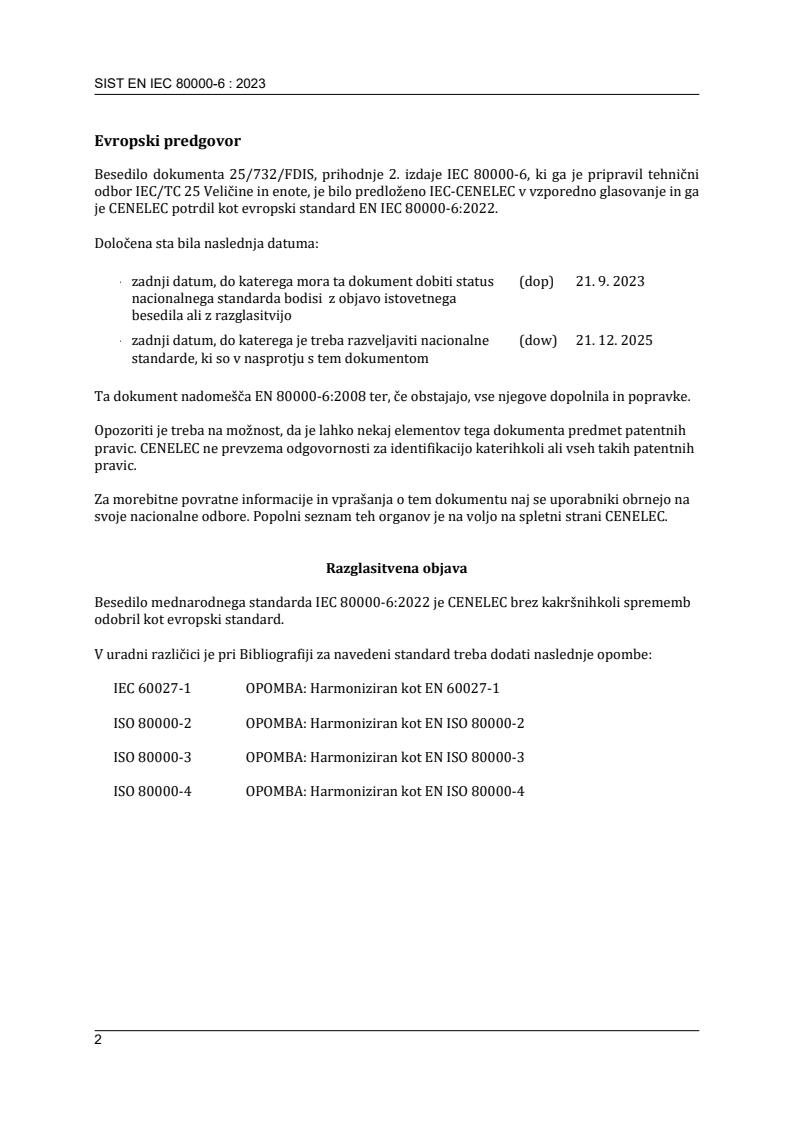
Evropski predgovor
Besedilo dokumenta 25/732/FDIS, prihodnje 2. izdaje IEC 80000-6, ki ga je pripravil tehnični
odbor IEC/TC 25 Veličine in enote, je bilo predloženo IEC-CENELEC v vzporedno glasovanje in ga
je CENELEC potrdil kot evropski standard EN IEC 80000-6:2022.
Določena sta bila naslednja datuma:
‒ zadnji datum, do katerega mora ta dokument dobiti status (dop) 21. 9. 2023
nacionalnega standarda bodisi z objavo istovetnega
besedila ali z razglasitvijo
‒ zadnji datum, do katerega je treba razveljaviti nacionalne (dow) 21. 12. 2025
standarde, ki so v nasprotju s tem dokumentom
Ta dokument nadomešča EN 80000-6:2008 ter, če obstajajo, vse njegove dopolnila in popravke.
Opozoriti je treba na možnost, da je lahko nekaj elementov tega dokumenta predmet patentnih
pravic. CENELEC ne prevzema odgovornosti za identifikacijo katerihkoli ali vseh takih patentnih
pravic.
Za morebitne povratne informacije in vprašanja o tem dokumentu naj se uporabniki obrnejo na
svoje nacionalne odbore. Popolni seznam teh organov je na voljo na spletni strani CENELEC.
Razglasitvena objava
Besedilo mednarodnega standarda IEC 80000-6:2022 je CENELEC brez kakršnihkoli sprememb
odobril kot evropski standard.
V uradni različici je pri Bibliografiji za navedeni standard treba dodati naslednje opombe:
IEC 60027-1 OPOMBA: Harmoniziran kot EN 60027-1
ISO 80000-2 OPOMBA: Harmoniziran kot EN ISO 80000-2
ISO 80000-3 OPOMBA: Harmoniziran kot EN ISO 80000-3
ISO 80000-4 OPOMBA: Harmoniziran kot EN ISO 80000-4
SIST EN IEC 80000-6 : 2023
Vsebina
PREDGOVOR . 4
Uvod . 7
0.1 Preglednice veličin .7
0.2 Enote .7
0.2.1 Splošno .7
0.2.2 Opomba za enote veličin z dimenzijo ena oziroma brezdimenzijskih veličin . 7
0.3 Številske navedbe v tem dokumentu .8
0.4 Posebne opombe .8
0.4.1 Splošno .8
0.4.2 Sistem veličin .8
0.4.3 Sinusoidne veličine .9
0.4.4 Dejanska vrednost, vrednost RMS .9
1 Področje uporabe . 10
2 Zveze s standardi . 10
3 Imena, simboli, definicije in enote veličin . 10
Dodatek A (informativni) Enote v Gaussovem sistemu CGS s posebnimi imeni . 29
Abecedno kazalo . 30
Bibliografija . 36
Preglednica 1: Veličine in enote na področju elektromagnetizma . 11
Preglednica A.1: Zastarele enote s posebnimi imeni, prevzete iz sistema CGS . 29
SIST EN IEC 80000-6 : 2023
MEDNARODNA ELEKTROTEHNIŠKA KOMISIJA
VELIČINE IN ENOTE –
6. del: Elektromagnetizem
PREDGOVOR
1) Mednarodna elektrotehniška komisija (IEC) je svetovna organizacija za standardizacijo, ki združuje
vse nacionalne elektrotehniške odbore (nacionalni odbori IEC). Cilj IEC je pospeševati mednarodno
sodelovanje v vseh vprašanjih standardizacije s področja elektrotehnike in elektronike. V ta namen
poleg drugih aktivnosti IEC izdaja mednarodne standarde, tehnične specifikacije, tehnična poročila,
javno dostopne specifikacije (PAS) in vodila (v nadaljevanju: objave IEC) Za njihovo pripravo so
odgovorni tehnični odbori; vsak nacionalni odbori IEC, ki ga zanima obravnavana tema, lahko sodeluje
v tem pripravljalnem delu. Prav tako lahko v pripravi sodelujejo mednarodne organizacije ter vladne
in nevladne organizacije, ki so povezane z IEC. IEC deluje v tesni povezavi z Mednarodno organizacijo
za standardizacijo (ISO) skladno s pogoji, določenimi v soglasju med obema organizacijama.
2) Uradne odločitve ali sporazumi IEC o tehničnih vprašanjih, pripravljeni v tehničnih odborih, kjer so
pristoni vsi nacionalni odbori, ki jih tema zanima, izražajo, kolikor je mogoče, mednarodno soglasje o
obravnavani temi.
3) Objave IEC imajo obliko priporočil za mednarodno uporabo in jih kot takšne sprejmejo nacionalni
odbori IEC. Čeprav IEC skuša po najboljših močeh zagotavljati točnost tehničnih vsebin v publikacijah
IEC, IEC ne more biti odgovoren za način njihove uporabe ali za kakršnokoli napačno razlago
katerihkoli končnih uporabnikov.
4) Za pospeševanje mednarodnega poenotenja se so nacionalni odbori IEC zavezali, da bodo v svojih
nacionalnih in regionalnih publikacijah čim pregledneje uporabljali objave IEC. Vsako odstopanje med
katerokoli publikacijo IEC in ustrezno nacionalno ali regionalno publikacijo je treba v slednji jasno
označiti.
5) IEC sam ne izvaja potrjevanja skladnosti. Storitve ugotavljanja skladnosti in na nekaterih območjih
dostop do oznak skladnosti IEC zagotavljajo neodvisni certifikacijski organi. IEC ne prevzema
odgovornosti za nobeno od storitev, ki jih izvajajo neodvisni certifikacijski organi.
6) Vsi uporabniki naj si zagotovijo najnovejšo izdajo te objave.
7) IEC ali njegovi direktorji, zaposleni, uslužbenci ali agenti, vključno s posameznimi izvedenci ter člani
njegovih tehničnih odborov in nacionalnih odborov IEC, ne prevzemajo nobene odgovornosti za
kakršnokoli osebno poškodbo, škodo na premoženju ali katerokoli drugo škodo kakršnekoli vrste,
bodisi posredne ali neposredne, ali za stroške (vključno z odvetniškimi stroški) in izdatke, nastale
zaradi te objave, njeno uporabo ali zanašanje na to publikacijo IEC ali katerokoli drugo publikacijo
IEC.
8) Opozoriti je treba na zveze s standardi, navedene v tej publikaciji. Uporaba navedenih publikacij je
nujna za pravilno uporabo te objave.
9) Opozoriti je treba na možnost, da bi lahko bil kateri od elementov te objave IEC predmet patentnih
pravic. IEC ni odgovoren za enačenje nobene od teh patentnih pravic.
Standard IEC 80000-6 je pripravil tehnični odbor IEC/TC 25 Veličine in enote ter njihovi črkovni
simboli, v tesnem sodelovanju s tehničnim odborom ISO/TC 12, Veličine in enote. IEC 80000-6 je
mednarodni standard.
SIST EN IEC 80000-6 : 2023
Ta druga izdaja standarda IEC 80000-6 razveljavlja in nadomešča prvo izdajo, ki je izšla leta 2008.
Ta izdaja pomeni tehnično revizijo.
Ta izdaja v primerjavi s prejšnjo vključuje naslednje pomembne tehnične spremembe:
a) z novimi definicijami v SI je treba nekatere prej natančno določene vrednosti veličin sedaj
določiti eksperimentalno, medtem ko so druge veličine podane kot natančne vrednosti,
b) v točki 6-2.2 je dodan osnovni naboj,
c) v točki 6-11.4 je dodana inducirana napetost,
d) dodano je kazalo vnosov,
e) uredniška uskladitev z drugimi deli skupine standardov IEC in ISO 80000.
Besedilo tega mednarodnega standarda temelji na naslednjih dokumentih:
FDIS Poročilo o glasovanju
25/732/FDIS 25/740/RVD
Vse informacije o glasovanju za potrditev tega standarda lahko najdete v poročilu o glasovanju,
navedenem v zgornji preglednici.
Jezik, uporabljen za razvoj tega mednarodnega standarda, je angleščina.
Serijo standardov IEC 80000 s skupnim naslovom Veličine in enote sestavljajo naslednji deli:
1) 6. del: Elektromagnetizem
2) 13. del: Informacijska znanost in tehnologija
3) 15. del: Logaritemske in sorodne veličine ter njihove enote
4) 16. del: Pravila za tiskanje in pisanje
5) 17. del: Časovna odvisnost
Naslednje dele je izdala ISO:
1) 1. del: Splošno
2) 2. del: Matematika
3) 3. del: Prostor in čas
4) 4. del: Mehanika
5) 5. del: Termodinamika
6) 7. del: Svetloba in sevanje
SIST EN IEC 80000-6 : 2023
7) 8. del: Akustika
8) 9. del: Fizikalna kemija in molekulska fizika
9) 10. del: Atomska in jedrska fizika
10) 11. del: Značilna števila
11) 12. del: Fizika kondenzirane snovi
Ta dokument je bil pripravljen v skladu z 2. delom Direktiv ISO/IEC in pripravljen v skladu s 1.
delom Direktiv ISO/IEC ter Direktivami ISO/IEC, Dodatek IEC, ki je na voljo na povezavi
www.iec.ch/members_experts/refdocs. Glavne vrste dokumentov, ki jih pripravlja IEC, so
podrobneje opisane na povezavi www.iec.ch/publications.
Odbor je sklenil, da bo vsebina tega dokumenta ostala nespremenjena do datuma objave,
navedene na spletni strani IEC, na naslovu webstore.iec.ch, v podatkih, povezanih z ustreznim
dokumentom. Na ta datum bo dokument:
– ponovno potrjen,
– razveljavljen,
– zamenjan z revidirano izdajo ali
– dopolnjen.
SIST EN IEC 80000-6 : 2023
Uvod
0.1 Preglednice veličin
Imena najpomembnejših veličin so v tem dokumentu podana skupaj s svojimi simboli in
največkrat tudi z definicijami. Definicije so podane za identifikacijo veličin, navedenih v
preglednici 1, v mednarodnem sistemu veličin (ISQ) in niso nujno namenjene temu, da bi bile
dokončne.
Skalarni, vektorski ali tenzorski značaj nekaterih veličin je prikazan predvsem takrat ko je to
potrebno za podajanje definicije.
Večina veličin ima podano samo eno ime in samo en simbol; če sta za eno veličino podani dve
imeni ali več oziroma dva simbola ali več in razlika ni opredeljena, so enakovredni. Kadar
obstajata dva tipa poševnih črk (kot npr. ϑ in θ, φ in ϕ, a in a ter g in g), je uporabljen samo eden;
to pa ne pomeni, da drugi ni enako sprejemljiv. Takšnim različicam ni priporočljivo pripisovati
različnih pomenov. Če je simbol v oklepaju, pomeni, da je to alternativni simbol in se v besedilu
uporablja takrat, kadar ima glavni simbol drugačen pomen.
0.2 Enote
0.2.1 Splošno
Imena enot za ustrezne veličine so podana skupaj z mednarodnimi simboli in definicijami. Ta
imena enot so odvisna od jezika, simboli pa so mednarodni in enaki v vseh jezikih. Več informacij
o tem najdete v Brošuri SI (9. izdaja, 2019), ki jo je izdal BIPM, in v ISO 80000-1.
Enote so razporejene na naslednji način:
a) Najprej so podane osnovne enote SI. Enote SI je sprejela Generalna konferenca za uteži in
mere (Conférence Générale des Poids et Mesures, CGPM). Priporoča se uporaba osnovnih
enot SI ter njihovih desetiških večkratnikov in manjkratnikov, ki se tvorijo s predponami SI,
tudi če desetiški večkratniki in manjkratniki niso posebej navedeni. Vrstni red enot je: kg, m,
s, A, K, mol, cd.
b) Sledi nekaj enot, ki niso enote SI, a so jih za uporabo skupaj z enotami SI sprejeli Mednarodni
odbor za uteži in mere (Comité International des Poids et Mesures, CIPM) ali Mednarodna
organizacija za zakonsko meroslovje (Organisation Internationale de Métrologie Légale,
OIML) ali ISO in IEC.
c) Enote, ki niso enote SI in se ne priporočajo, so podane samo v dodatkih k nekaterim delom
ISO/IEC 80000 in IEC 80000. Ti dodatki so informativni, namenjeni predvsem pretvornikom,
in niso sestavni del standarda. Te zastarele enote so razvrščene v dve skupini:
1) enote s posebnimi imeni v sistemu CGS, glej dodatek A,
2) enote, ki temeljijo na enotah čevelj, funt, ter nekatere druge, sorodne enote.
0.2.2 Opomba za enote veličin z dimenzijo ena oziroma brezdimenzijskih veličin
Koherentna enota za katerokoli veličino z dimenzijo ena, ki se imenuje tudi brezdimenzijska
veličina, je število ena, simbol 1. Pri izražanju vrednosti takšne veličine se simbol enote 1 navadno
SIST EN IEC 80000-6 : 2023
ne piše.
PRIMER:
Lomni količnik n = 1,53 × 1 = 1,53
Za večkratnike ali manjkratnike te enote se predpone ne smejo uporabljati. Namesto predpon se
priporoča uporaba potenc števila 10.
PRIMER:
³
Reynoldsovo število Re = 1,32 × 10
Če upoštevamo, da je ravninski kot na splošno izražen z razmerjem med dvema dolžinama,
prostorski kot pa z razmerjem med dvema ploščinama, je CGPM leta 1995 določil, da sta v
mednarodnem sistemu enot radian (rad) in steradian (sr) brezdimenzijski izpeljani enoti. Torej
se veličini ravninski kot in prostorski kot obravnavata kot izpeljani veličini z dimenzijo ena. Enoti
radian in steradian sta tako enaki ena; lahko se izpustita ali uporabljata v izrazih za izpeljane
enote, da se olajša razlikovanje med veličinami različnih vrst, toda enakih dimenzij.
0.3 Številske navedbe v tem dokumentu
Znak = se uporablja za označevanje, da "je točno enako", in znak ≈ se uporablja za označevanje, da
"je približno enako".
Številske vrednosti fizikalnih veličin, ki so določene eksperimentalno, imajo vedno pripadajočo
merilno negotovost. Ta negotovost naj se vedno navede. V tem dokumentu se velikost negotovosti
izrazi tako, kot kaže naslednji primer.
PRIMER:
l = 2,347 82(32) m
V tem primeru, l = a(b) m, se številska vrednost negotovosti b, navedena v oklepaju, domnevno
nanaša na zadnje (in najmanj pomembne) števke številske vrednosti a dolžine l. Ta zapis se
uporabi, kadar b izraža standardno negotovost (ocenjeni standardni odklon) v zadnjih števkah
vrednosti a. Zgoraj navedeni številski primer se lahko razlaga, kot da pomeni, da je najboljša ocena
številske vrednosti dolžine l (če je l izražen v enoti meter) 2,347 82, in da je neznana vrednost l
domnevno med (2,347 82 – 0,000 32) m in (2,347 82 + 0,000 32) m, s tem da je verjetnost določena
s standardno negotovostjo 0,000 32 m in porazdelitvijo verjetnosti vrednosti l.
0.4 Posebne opombe
0.4.1 Splošno
Točke, podane v ISO 80000-6, so na splošno v skladu z Mednarodnim elektrotehniškim slovarjem
(IEV), zlasti IEC 60050-121 in IEC 60050-131. Za vsako veličino je sklic na IEV podan v obliki: "Glej
IEC 60050-121, 121-xx-xxx.".
0.4.2 Sistem veličin
SIST EN IEC 80000-6 : 2023
Za uporabo v elektromagnetizmu je razvitih več različnih sistemov veličin, odvisno od števila in
izbire osnovnih veličin, na katerih sistem temelji. Vendar pa sta v elektromagnetizmu in
elektrotehniki priznana samo mednarodni sistem veličin ISQ in z njim povezani mednarodni
sistem enot SI, ki se odražata v standardih ISO in IEC. Mednarodni sistem SI ima sedem osnovnih
enot, med njimi so kilogram (kg), meter (m), sekunda (s) in amper (A).
0.4.3 Sinusoidne veličine
Za veličine, ki se sinusoidno spreminjajo s časom, in za njihove kompleksne predstavitve je IEC
standardizirala dva načina tvorbe simbolov. Velike in male črke se praviloma uporabljajo za
električni tok (točka 6-1) in za napetost (točka 6-11.3), dodatne oznake pa za druge veličine. Te
so podane v IEC 60027-1.
PRIMER 1:
Sinusoidno spreminjanje električnega toka (točka 6-1) s časom se lahko dejansko izrazi v obliki
njegov kompleksni prikaz (imenovan fazor) pa se izrazi v obliki
−jφ
i = I e
kjer je i trenutna vrednost toka, I njegova dejanska (RMS) vrednost (glej 0.4.4), (ωt − φ) faza, φ
začetna faza in j imaginarna enota (j = −1), ki je v matematiki pogosto označena s črko i.
PRIMER 2:
Sinusoidno spreminjanje magnetnega pretoka (točka 6-22.1) s časom se lahko izrazi z dejanskim
prikazom v obliki
Kjer je Φ trenutna vrednost pretoka, njegova temenska vrednost in Φ njegova dejanska
eff
vrednost.
0.4.4 Dejanska vrednost, vrednost RMS
Za časovno odvisno veličino a se pozitivni kvadratni koren srednje vrednosti kvadrata te veličine,
vzet v določenem časovnem intervalu, imenuje dejanska vrednost, tj.:
Dejanska vrednost periodične veličine se običajno izračuna v integracijskem intervalu, katerega
obseg je zmnožek periode s celim številom. Za sinusno veličino a(t) = Â cos(ωt + φ) je dejanska
vrednost Â/√2.
Dejansko vrednost veličine lahko označimo z dodajanjem enega izmed indeksov "eff" ali "RMS" k
simbolu veličine. V elektrotehniki so dejanskevrednosti električnega toka i(t) in napetosti u(t)
navadno označene z I oziroma U.
SIST EN IEC 80000-6 : 2023
Veličine in enote –
6. del:
Elektromagnetizem
1 Področje uporabe
V tem delu standarda IEC 80000 so podani imena, simboli in definicije za veličine in enote na
področju elektromagnetizma. Kjer je primerno, so podani tudi pretvorni faktorji.
Ta dokument temelji na klasičnem elektromagnetizmu, tj. predvsem na Maxwellovih enačbah. Ne
sklicuje se na kvantno teorijo polja.
2 Zveze s standardi
V tem dokumentu ni zvez s standardi.
3 Imena, simboli, definicije in enote veličin
Imena, simboli in definicije za veličine in enote na področju elektromagnetizma so podani v
preglednicah na naslednjih straneh. Za enote s posebnimi imeni v sistemu CGS glej dodatek A.
OPOMBA 1: Na splošno se, kadar to ni izrecno navedeno, te veličine lahko spreminjajo tudi s
časom. Vse površine veljajo za usmerjene površine (glej IEC 60050-102, točka 102-
04-37).
OPOMBA 2: Pisava v enačbah se razlikuje od pisave v glavnem besedilu.
ISO in IEC vzdržujeta terminološke podatkovne baze za uporabo na področju standardizacije na
naslednjih naslovih:
– Elektropedija IEC: na voljo na https://www.electropedia.org/
– platforma za spletno brskanje ISO: na voljo na https://www.iso.org/obp
SIST EN IEC 80000-6 : 2023
SIST EN IEC 80000-6 : 2023
SIST EN IEC 80000-6 : 2023
SIST EN IEC 80000-6 : 2023
SIST EN IEC 80000-6 : 2023
SIST EN IEC 80000-6 : 2023
SIST EN IEC 80000-6 : 2023
SIST EN IEC 80000-6 : 2023
SIST EN IEC 80000-6 : 2023
SIST EN IEC 80000-6 : 2023
SIST EN IEC 80000-6 : 2023
SIST EN IEC 80000-6 : 2023
SIST EN IEC 80000-6 : 2023
SIST EN IEC 80000-6 : 2023
SIST EN IEC 80000-6 : 2023
SIST EN IEC 80000-6 : 2023
SIST EN IEC 80000-6 : 2023
SIST EN IEC 80000-6 : 2023
SIST EN IEC 80000-6 : 2023
Dodatek A
(informativni)
Enote v Gaussovem sistemu CGS s posebnimi imeni
Enote v preglednici A.1 so zastarele.
1 Preglednica A.1: Zastarele enote s posebnimi imeni, prevzete iz sistema CGS
Veličina Veličina Ime enote s simbolom Pretvorni faktorji in
opombe
točka
št.
−4
6-21 gostota magnetnega gauss 1 G = 10 T
pretoka
G Gauss se označuje tudi kot
Gs.
−8
6-22.1 magnetni pretok maxwell 1 Mx = 10 Wb
Mx
6-25 magnetna poljska oersted 1 Oe = 10 /(4π) A/m
jakost
Oe
OPOMBA 1: Te enote niso sprejete za uporabo s SI.
OPOMBA 2: Poleg enot, navedenih v tej preglednici, obstaja še več drugih enot CGS.
SIST EN IEC 80000-6 : 2023
Abecedno kazalo
Točna imena veličin so natisnjena krepko. V kazalo so vključeni tudi drugi vnosi, ki omogočajo
lažje iskanje veličin.
Ime . Zap.Zap. št.
admitanca . 6-52.1
admitanca vakuuma . 6-52.2
admitanca, navidezna . 6-52.5
admitančni modul . 6-52.5
admitančni modul . 6-52.5
aktivna energija . 6-62
aktivna moč . 6-56
celotni magnetni pretok . 6-22.4
celotni tok . 6-19.2
delovna moč . 6-56
dielektričnost . 6-14.2
dipolni moment, električni .6 -6
dipolni moment, magnetni . 6-30
dolžinska gostota električnega naboja . 6-5
dolžinska gostota električnega toka . 6-9
dolžinski (električni) naboj . 6-5
električna indukcija . 6-12
električna konstanta . 6-14.1
električna napetost . 6-11.3
električna napetost, inducirana . 6-11.4
električna polarizacija . 6-7
električna poljska jakost . 6-10
električna susceptibilnost . 6-16
električni dipolni moment . 6-6
električni naboj . 6-2.1
električni naboj, dolžinska gostota .6 -5
električni naboj, dolžinski .6 -5
električni naboj, dolžinski .6 -5
električni naboj, ploščinski .6 -4
električni naboj, površinska gostota .
...