


EN 50131-4:2009
(Main)Alarm systems - Intrusion and hold-up systems - Part 4: Warning devices
General Information
- Abstract
This European Standard includes requirements for warning devices used for notification in intrusion and hold up alarm systems installed in buildings. Four grades of warning device are described corresponding to each of the four security grades given in EN 50131-1. Requirements are also given for four environmental classes covering applications in internal and outdoor locations as specified in EN 50130-5.
- Status
- Withdrawn
- Publication Date
- 03-Jun-2009
- Withdrawal Date
- 30-Apr-2012
- Technical Committee
- CLC/TC 79 - Alarm systems
- Drafting Committee
- CLC/TC 79 - Alarm systems
- Current Stage
- 9960 - Withdrawal effective - Withdrawal
- Start Date
- 31-Dec-2021
- Completion Date
- 31-Dec-2021

Relations
- Replaces
CLC/TS 50131-4:2006 - Alarm systems - Intrusion and hold-up systems - Part 4: Warning devices - Effective Date
- 28-Jan-2023
- Replaced By
EN 50131-4:2019 - Alarm systems - Intrusion and hold-up systems - Part 4: Warning devices - Effective Date
- 30-Apr-2019
- Effective Date
- 02-Jun-2026
- Effective Date
- 03-Feb-2026
- Effective Date
- 03-Feb-2026
- Effective Date
- 03-Feb-2026
- Effective Date
- 03-Feb-2026
- Effective Date
- 03-Feb-2026
- Effective Date
- 03-Feb-2026
- Effective Date
- 03-Feb-2026
- Effective Date
- 03-Feb-2026
- Effective Date
- 03-Feb-2026
- Effective Date
- 03-Feb-2026
- Effective Date
- 03-Feb-2026
- Effective Date
- 03-Feb-2026
Get Certified
Connect with accredited certification bodies for this standard

CIS Institut d.o.o.
Personal Protective Equipment (PPE) certification body. Notified Body NB-2890 for EU Regulation 2016/425 PPE.

Kiwa BDA Testing
Building and construction product certification.
Kmetijski inštitut Slovenije
Agricultural Institute of Slovenia. Soil testing, plant health, agricultural product analysis.
Sponsored listings
Frequently Asked Questions
EN 50131-4:2009 is a standard published by CLC. Its full title is "Alarm systems - Intrusion and hold-up systems - Part 4: Warning devices". This standard covers: This European Standard includes requirements for warning devices used for notification in intrusion and hold up alarm systems installed in buildings. Four grades of warning device are described corresponding to each of the four security grades given in EN 50131-1. Requirements are also given for four environmental classes covering applications in internal and outdoor locations as specified in EN 50130-5.
This European Standard includes requirements for warning devices used for notification in intrusion and hold up alarm systems installed in buildings. Four grades of warning device are described corresponding to each of the four security grades given in EN 50131-1. Requirements are also given for four environmental classes covering applications in internal and outdoor locations as specified in EN 50130-5.
EN 50131-4:2009 is classified under the following ICS (International Classification for Standards) categories: 13.320 - Alarm and warning systems. The ICS classification helps identify the subject area and facilitates finding related standards.
EN 50131-4:2009 has the following relationships with other standards: It is inter standard links to CLC/TS 50131-4:2006, EN 50131-4:2019, EN IEC 61000-6-3:2026, EN IEC 61000-6-3:2021, EN 60068-2-75:2014, EN 60068-1:2014, EN 61672-1:2013, EN 50131-6:2017, EN 50131-1:1997, EN 50131-1:2006, EN IEC 62368-1:2024, EN 62262:2002, EN 60529:1991, EN 50600-2-5:2021, EN 50600-2-5:2016. Understanding these relationships helps ensure you are using the most current and applicable version of the standard.
EN 50131-4:2009 is available in PDF format for immediate download after purchase. The document can be added to your cart and obtained through the secure checkout process. Digital delivery ensures instant access to the complete standard document.
Standards Content (Sample)
2003-01.Slovenski inštitut za standardizacijo. Razmnoževanje celote ali delov tega standarda ni dovoljeno.Alarmni sistemi - Sistemi za javljanje vloma in ropa - 4. del: Opozorilne napraveAlarmanlagen - Einbruch- und Überfallmeldeanlagen -- Teil 4: SignalgeberSystèmes d'alarme - Systèmes d'alarme contre l’intrusion et les hold-up -- Partie 4: Dispositifs d'avertissementAlarm systems - Intrusion and hold-up systems -- Part 4: Warning devices13.320Alarmni in opozorilni sistemiAlarm and warning systems13.310Varstvo pred kriminalomProtection against crimeICS:Ta slovenski standard je istoveten z:EN 50131-4:2009SIST EN 50131-4:2009en01-oktober-2009SIST EN 50131-4:2009SLOVENSKI
STANDARDSIST-TS CLC/TS 50131-4:20071DGRPHãþD
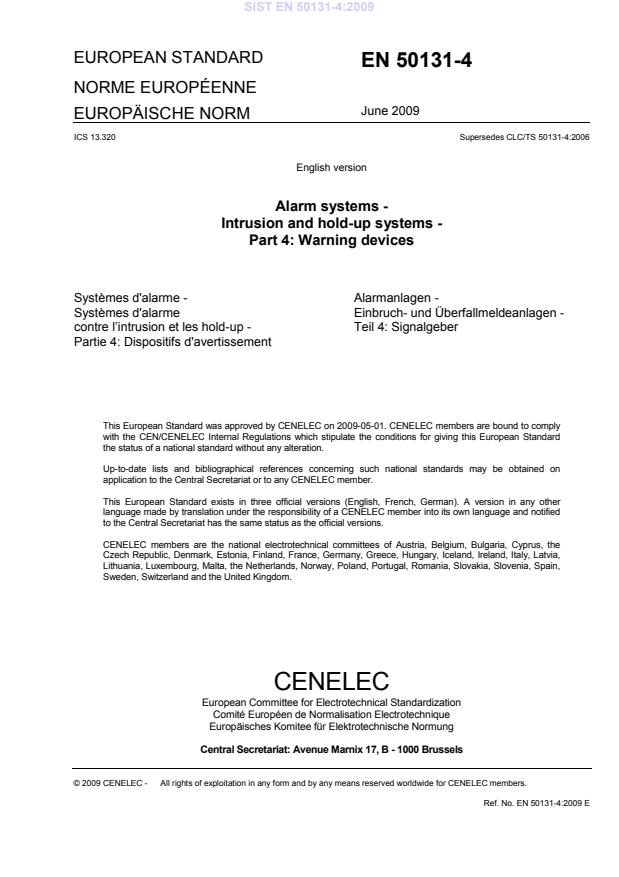
EUROPEAN STANDARD EN 50131-4 NORME EUROPÉENNE
EUROPÄISCHE NORM June 2009
CENELEC European Committee for Electrotechnical Standardization Comité Européen de Normalisation Electrotechnique Europäisches Komitee für Elektrotechnische Normung
Central Secretariat: Avenue Marnix 17, B - 1000 Brussels
© 2009 CENELEC -
All rights of exploitation in any form and by any means reserved worldwide for CENELEC members.
Ref. No. EN 50131-4:2009 E
ICS 13.320 Supersedes CLC/TS 50131-4:2006
English version
Alarm systems -
Intrusion and hold-up systems -
Part 4: Warning devices
Systèmes d'alarme -
Systèmes d'alarme
contre l’intrusion et les hold-up -
Partie 4: Dispositifs d'avertissement
Alarmanlagen -
Einbruch- und Überfallmeldeanlagen -
Teil 4: Signalgeber
This European Standard was approved by CENELEC on 2009-05-01. CENELEC members are bound to comply with the CEN/CENELEC Internal Regulations which stipulate the conditions for giving this European Standard the status of a national standard without any alteration.
Up-to-date lists and bibliographical references concerning such national standards may be obtained on application to the Central Secretariat or to any CENELEC member.
This European Standard exists in three official versions (English, French, German). A version in any other language made by translation under the responsibility of a CENELEC member into its own language and notified to the Central Secretariat has the same status as the official versions.
CENELEC members are the national electrotechnical committees of Austria, Belgium, Bulgaria, Cyprus, the Czech Republic, Denmark, Estonia, Finland, France, Germany, Greece, Hungary, Iceland, Ireland, Italy, Latvia, Lithuania, Luxembourg, Malta, the Netherlands, Norway, Poland, Portugal, Romania, Slovakia, Slovenia, Spain, Sweden, Switzerland and the United Kingdom.
(dop)
2010-05-01 – latest date by which the national standards conflicting with the EN have to be withdrawn
(dow)
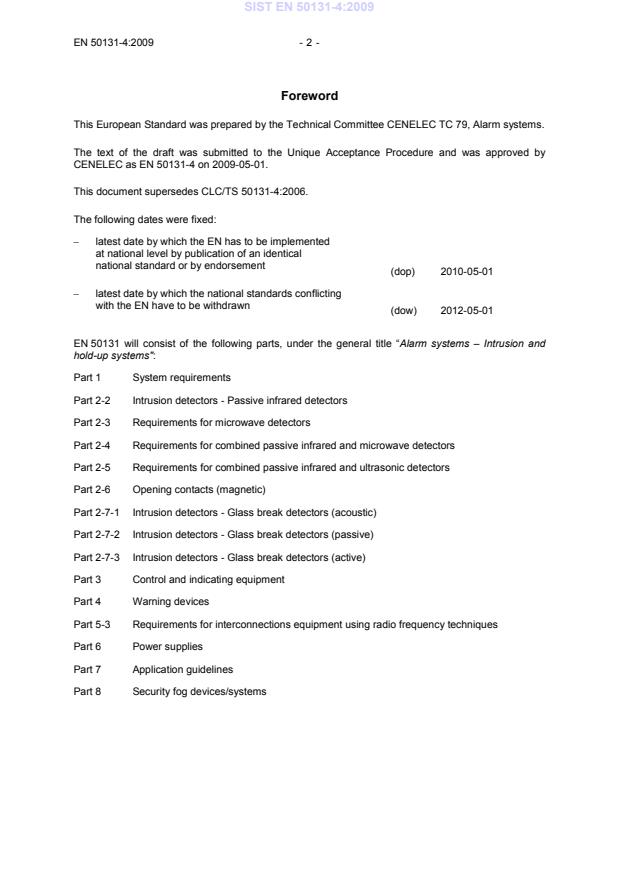
2012-05-01 EN 50131 will consist of the following parts, under the general title “Alarm systems – Intrusion and hold-up systems": Part 1 System requirements Part 2-2 Intrusion detectors - Passive infrared detectors Part 2-3 Requirements for microwave detectors Part 2-4 Requirements for combined passive infrared and microwave detectors Part 2-5 Requirements for combined passive infrared and ultrasonic detectors Part 2-6 Opening contacts (magnetic) Part 2-7-1 Intrusion detectors - Glass break detectors (acoustic) Part 2-7-2 Intrusion detectors - Glass break detectors (passive) Part 2-7-3 Intrusion detectors - Glass break detectors (active) Part 3 Control and indicating equipment Part 4 Warning devices Part 5-3 Requirements for interconnections equipment using radio frequency techniques Part 6 Power supplies Part 7 Application guidelines Part 8 Security fog devices/systems SIST EN 50131-4:2009
- 3 - EN 50131-4:2009 Contents 1 Scope . 5 2 Normative references . 5 3 Definitions and abbreviations . 6 3.1 Definitions . 6 3.2 Abbreviations . 7 4 General considerations . 7 5 Requirements . 7 5.1 Functional . 7 5.2 Tamper . 9 5.3 Environmental .11 5.4 EMC .11 5.5 Safety .11 5.6 Electrical .12 5.7 Self test requirements .14 5.8 Marking .15 5.9 Documentation .15 6 Test section .15 6.1 Functional .16 6.2 Reduced functional test .16 6.3 Response to events .17 6.4 Acoustic .19 6.5 Tamper .19 6.6 Electrical tests .23 6.7 Marking .29 6.8 Documentation .30 6.9 Environmental .30 Annex A (normative)
Sound level test for warning devices .33 Annex B (informative)
Example remote test protocol .36 SIST EN 50131-4:2009
- 5 - EN 50131-4:2009 1 Scope This European Standard includes requirements for warning devices used for notification in intrusion and hold up alarm systems installed in buildings. Four grades of warning device are described corresponding to each of the four security grades given in EN 50131-1. Requirements are also given for four environmental classes covering applications in internal and outdoor locations as specified in EN 50130-5.
2 Normative references The following referenced documents are indispensable for the application of this document. For dated references, only the edition cited applies. For undated references, the latest edition of the referenced document (including any amendments) applies. EN 50130-4:1995, Alarm systems – Part 4: Electromagnetic compatibility – Product family standard: Immunity requirements for components of fire, intruder and social alarm systems A1:1998 A2:2003 EN 50130-5:1998, Alarm systems – Part 5: Environmental test methods EN 50131-1:2006, Alarm systems – Intrusion and hold-up systems – Part 1: System requirements
EN 50131-6:2008, Alarm systems – Intrusion and hold-up systems – Part 6: Power supplies EN 60065:2002, Audio, video and similar electronic apparatus – Safety requirements (IEC 60065:2001, mod.) EN 60068-1:1994, Environmental testing – Part 1: General and guidance
(IEC 60068-1:1988 + corrigendum October 1988 + A1:1992) EN 60068-2-75:1997, Environmental testing – Part 2-75: Tests – Test Eh: Hammer tests (IEC 60068-2-75:1997) EN 60529:1993 + corrigendum May 1991, Degrees of protection provided by enclosures (IP codes) (IEC 60529:1989) EN 60950-1:2006, Information technology equipment – Safety – Part 1: General requirements (IEC 60950-1:2005, mod.) EN 61000-6-3:2007, Electromagnetic compatibility (EMC) – Part 6-3: Generic standards – Emission standard for residential, commercial and light-industrial environments (IEC 61000-6-3:2006) EN 61672-1:2003, Electroacoustics – Sound level meters – Part 1: Specifications (IEC 61672-1:2002) EN 62262:2002, Degrees of protection provided by enclosure for electrical equipment against external mechanical impacts (IK code) (IEC 62262:2002) SIST EN 50131-4:2009
audible alarm distinctive sound generated in response to an alarm condition 3.1.2
warning device device that gives an audible alarm in response to a notification NOTE A warning device may also provide alert indications. 3.1.3
external warning device
warning device designed to be located outside the supervised premises which gives an external audible alarm in response to a notification 3.1.4
internal warning device
warning device designed to be located within the supervised premises which gives an internal audible alarm in response to a notification 3.1.5
enclosure
housing that contains the components, normally comprises a backplate and a cover 3.1.6
external power source
energy supply external to the I&HAS which may be non-continuous, e.g. mains supply 3.1.7
remote power source
electrical supply, which is not a part of the warning device, meeting the requirements of EN 50131-6 3.1.8
remotely powered warning device
warning device that does not incorporate its own power source 3.1.9
self powered warning device
warning device that incorporates its own power source 3.1.10
standby condition
operational mode of a self powered warning device during which it is powered from its internal storage device, whilst not notifying an alarm condition 3.1.11
storage device – failure
condition of the storage device where it is no longer able to power the warning device 3.1.12
storage device – low voltage
voltage specified by the warning device manufacturer which indicates that the storage device is nearly discharged
3.1.13
trigger command
notification signal or message passed to the warning device
3.1.14
visible damage
damage that would be visible to a person of normal eyesight viewing at a distance of 2 m under an illumination level of 2 000 lx SIST EN 50131-4:2009
- 7 - EN 50131-4:2009 3.2 Abbreviations For the purposes of this document, the following abbreviations are used: CIE - control and Indicating Equipment EPS - external power source I&HAS - intrusion and Hold-up Alarm System(s) WD - warning device IWD - internal warning device EWD
- external warning device 4 General considerations This European Standard considers two different categories of warning device, remotely powered and self powered devices. Self powered warning devices are classified into one of four types, dependent upon the recharge characteristics of the storage device and the source of recharge power. These four types are defined in Table 8. 5 Requirements 5.1 Functional 5.1.1 Response Depending upon the grade, warning devices shall have the functionality as defined in Table 1. Where a function is provided, the warning device shall operate in accordance with the requirements of Table 2. Table 1 – Warning device functionality Function Self powered Remotely powered Grade Grade 1 2 3 4 1 2 3 4 Trigger command M M M M M M M M Tamper signal or message output M M M M M M M M Fault signal or message output Op b Op b M M Op Op Op Op Monitor of remote power a M M M M Op Op Op Op Monitor integrity of trigger command interconnection
Op Op M M Op Op Op Op Local self test Op b Op b M M Op Op Op Op Remote test input Op Op Op M Op Op Op Op Key Op Optional M Mandatory a Remote power monitoring only applies to warning devices with a remote power source and an internal storage device, see types X and Z as defined in Table 8. b Mandatory for type W devices as defined in Table 8.
Self powered WD Remote powered WD Event Audible alarm Tamper signal or message Fault signal or message Audible alarm Tamper signal or message Fault signal or message a
Trigger command M NP NP M NP NP Tamper event at the WD Op M NP Op M NP Loss of remote power source Op b Op b Op b N/A Op Op Loss of trigger command interconnection integrity Op c Op c Op c Op Op Op Local self test pass NP NP NP NP NP NP Local self test fail NP NP M a NP NP M Remote self test pass NP NP M d NP NP M d Remote self test fail NP NP M d NP NP M d Key M Mandatory Op Optional NP Not Permitted N/A Not applicable a The provision of a fault signal or message is not mandatory for all grades, see Table 1. b At least one of these actions shall occur at the warning device. For grade 3 and grade 4 warning devices, if the loss of remote power source can be shown to be caused by a fault then a fault signal shall be generated, otherwise a tamper signal shall be generated. c At least one of these actions shall occur at the warning device. For grade 3 and grade 4 warning devices, if the loss of trigger command integrity can be shown to be caused by a fault then a fault signal shall be generated, otherwise a tamper signal shall be generated. d The response to a remote test pass shall be different from the response to a remote test fail.
5.1.2 Acoustic A warning device shall produce a varying sound output, which is distinctive and likely to attract attention, with a mean acoustic output of no less than that defined in Table 3 at 1 m from the mounting surface of the warning device throughout the manufacturers specified operating voltage range. Peak acoustic output levels, taken at 30° intervals in the horizontal plane, shall not be below the minimum individual level defined in Table 3 at 1 m from the mounting surface. The mean acoustic output shall be calculated by the arithmetic sum of these values divided by the number of measurements. For surface mounted devices (e.g. wall mounted devices) this is required at angles between 15° and 165° to the surface, and for pole mounted devices it is for the full 360°.
- 9 - EN 50131-4:2009 Table 3 – Acoustic output levels
Internal warning device External warning device Minimum mean acoustic output level 80 dB(A) 100 dB(A) Minimum individual acoustic output level 75 dB(A) 95 dB(A)
NOTE 1 It is considered restrictive to define exact waveforms of acceptable alarm tones, therefore the only tests that can be applied are on the acoustic output level and that the tone is varying. NOTE 2 Voice alarms are deemed to meet the requirements of a varying sound output. NOTE 3 A warning device may also provide audible alert indications providing such indications are easily distinguishable from an alarm. NOTE 4 The acoustic output (sound level and/or frequency) of a warning device may be subject to variation depending on local or national requirements. 5.1.3 Timing
A trigger command exceeding 400 ms shall be processed by the warning device. A warning device shall commence its audible alarm within 1 s of receiving a valid trigger command to do so. It shall cease its audible alarm within 1 s of receiving a valid cancellation of the trigger command. The warning device shall sound between these signals. The maximum time for which an audible warning device shall sound continuously is 15 min. NOTE 1 Where applicable this requirement may be achieved by the CIE. NOTE 2 The duration of the operational period of a warning device may be subject to variation depending on local or national requirements A tamper signal or message shall be generated within 1 s of a tamper condition occurring. There shall be a response to loss of remote power source or loss of trigger command interconnection integrity according to Tables 1 and 2, within 10 s of the fault occurring. A response to local test fail according to Tables 1 and 2 shall occur within 10 s of detection of the fault. 5.2 Tamper 5.2.1 Protection All component parts shall be housed in an enclosure meeting the impact requirements of the appropriate grade given in Table 4. Provision shall be made to allow adequate fixing of the enclosure to the mounting surface. SIST EN 50131-4:2009
Internal warning device External warning device Grade
1 2 3 4 1 2 3 4 Resistance to impact (IK rating according to EN 62262) 06 06 07 08 07 07 08 08 The cover of the enclosure shall be secured with one or more screws or bolts or alternatively by a mechanical lock. The cover of the enclosure shall be opened only with the use of one or more keys or suitable tools. It shall not be possible, without causing visible damage, to gain access to any electrical connections, or elements providing adjustment, without first generating a tamper signal or message. When the unit is mounted normally it shall not be possible, without causing visible damage, to introduce a tool, as defined in Table 5, such that the operation of the warning device could be adversely affected. Table 5 – Tool dimension for tamper detection Dimensions in millimetres
Grade 1 Grade 2 Grade 3 Grade 4 Steel rod, diameter (± 0,05 mm) 2,5 2,5 1 1 Flat bar dimensions (± 0,05 mm) 10 x 1 x 300 10 x 1 x 300 5 x 0,5 x 300 5 x 0,5 x 300 5.2.2 Detection The tamper detection requirements for warning devices relative to the security grade are given in Table 6. Opening the warning device enclosure by normal means shall generate a tamper signal or message. The enclosure shall not permit the introduction of a tool of dimension as specified in Table 5 and type as specified in EN 60529, to defeat the tamper detection. Attempts to remove the warning device from its mounting surface for a distance defined in Table 7 in a perpendicular direction shall generate a tamper signal or message according to Table 6.
It shall not be possible to defeat the removal from mounting detection by sliding a 25 mm x 1 mm x 300 mm blade, or by use of pliers (of thickness 5 mm and reach 150 mm), between the mounting surface and the warning device.
The warning device shall include means to detect penetration of the enclosure, which could cause mis-operation of the warning device, as specified in Table 6, when a hole of 4 mm is made in the enclosure. SIST EN 50131-4:2009
- 11 - EN 50131-4:2009 Table 6 – Tamper detection
Internal warning device External warning device Security grade
1 2 3 4 1 2 3 4 Opening by normal means M M M M M M M M Removal from mounting –
Wire free WD Op M
M M Op M
M M Removal from mounting –
Wired WD Op Op M M Op Op M M Detection of penetration of enclosure Op Op Op Op Op Op Op M Key Op Optional M Mandatory
Table 7 – Removal from mounting
Grade 1 Grade 2 Grade 3 Grade 4 Maximum distance before tamper detection 10 mm a 10 mm 5 mm 5 mm a If removal from mounting detection is provided.
5.3 Environmental The environmental classification shall be as described in EN 50131-1. All the relevant environmental tests shall be carried out at the appropriate level for all security grades, as given in EN 50130-5. The warning device shall meet the requirements of the relevant environmental class as specified by the manufacturer. For operational tests, the warning device shall not generate unintentional activations, tamper, fault or other signals or messages, when subjected to the specified range of environmental conditions. For endurance tests, the warning device shall continue to meet the requirements of this European Standard after being subjected to the specified range of environmental conditions. See 6.9 for the relevant tests and severity. 5.4 EMC For all grades of WD the WD shall not generate or be affected by the EMC conditions and severity levels defined in EN 50130-4 and EN 61000-6-3. 5.5 Safety The warning device shall provide protection against electrical shock and consequential hazards by compliance with the requirements of EN 60950-1 or EN 60065. SIST EN 50131-4:2009
- 13 - EN 50131-4:2009 5.6.3.2 Storage device standby time The storage device shall have sufficient capacity to maintain the warning device in standby condition for the periods specified in Table 8. Table 8 – Storage device standby duration Type Remote power source
Storage device type Integral recharge capability Grade 1 Grade 2 Grade 3 Grade 4 W None Non rechargeable Not applicable 1 year 1 year 1 year 1 year X Yes Non rechargeable Not applicable 24 h 24 h 120 h 120 h Y None Rechargeable Yes 24 h 24 h 120 h 120 h Z Yes Rechargeable Yes, from remote power source 12 h 12 h 60 h 60 h NOTE 1 A type W warning device could, for example, have a dry cell as its only means of power. This storage device has no means of recharge, and will need replacing before it is completely exhausted. NOTE 2 A type X warning device could, for example, be remotely powered from the I&HAS and with a dry cell as its storage device. This storage device has no means of recharge, and will need replacing before it is completely exhausted. NOTE 3 A type Y warning device could, for example, recharge its storage device by means of a solar cell, or connection to an external power source (e.g. mains supply). NOTE 4 A type Z warning device could, for example, be normally powered from the I&HAS, and this power source is also used to recharge its storage device.
At the end of the standby period, the storage device shall meet the operating time requirements of 5.6.3.1. For types X and Z, where loss of remote power supply causes the warning device to activate (see Table 2) then the requirements of Table 8 do not apply, and the storage device shall only meet the operating time requirements of 5.6.3.1. 5.6.3.3 Recharge rate Type Y and Z warning devices shall be capable of supplying current at the appropriate voltage to recharge the storage device equivalent to 80 % of that supplied by the storage device in meeting the requirements of 5.6.3.1 and 5.6.3.2 within the periods as specified in Table 9. Table 9 – Recharge periods
Grade 1 Grade 2 Grade 3 Grade 4 Time to recharge 72 h 72 h 24 h 24 h
5.6.3.4 Remote power monitoring Where the warning device has a remote power source and this power source is lost, then the warning device shall respond according to Table 2. SIST EN 50131-4:2009
Grade 1 Grade 2 Grade 3 Grade 4 Storage device - low voltage Op a Op a M M Storage device -failure Op Op M M Key Op Optional M Mandatory a Mandatory for type W devices as defined in Table 8.
5.7.1.2 Storage device monitoring 5.7.1.2.1 Storage device monitoring – Low voltage The voltage of non rechargeable storage devices shall be monitored continuously. The voltage of rechargeable storage devices shall only be monitored when the warning device is in its standby condition. A storage device low voltage fault occurs when the voltage of the storage device falls below that specified by the warning device manufacturer. This voltage shall be greater than the minimum voltage required to operate the warning device. 5.7.1.2.2 Storage device monitoring – Failure Where the storage device is rechargeable, means shall be provided to determine whether the storage device is no longer able to power the warning device e.g. by applying a load to the storage device and monitoring the terminal voltage. These means shall not be achieved by monitoring terminal voltage alone. The maximum time period for detection of a storage device failure shall be 24 h. SIST EN 50131-4:2009
- 15 - EN 50131-4:2009 5.7.2 Remote self test Any remote test sequence shall not prevent the warning device from operating in accordance with Table 2. If a remote test is initiated, the warning device shall not remain in test mode for a period in excess of 60 s. An audible alarm or a tamper signal or message shall not be used to communicate the pass or fail of a remote test request. One possible test sequence is shown in Annex B. 5.8 Marking The warning device shall be marked in accordance with EN 50131-1. 5.9 Documentation The warning device shall be accompanied by documentation in accordance with EN 50131-1. Additionally, the documentation shall contain the following information: a) brief description of operation; b) type of warning device (i.e. internal or external, remote or self powered); c) installation requirements, (e.g. wall or pole mounting); d) method of adjustment/configuration; e) operating instructions; f) connection details, including sufficient detail to enable effective interface and operation as part of the I&HAS; g) supply voltage range and nominal supply voltage(s); h) quiescent and peak current consumption on each connection in the alarm sounding and non alarm sounding states, at the nominal supply voltage; i) suitable storage device type, capacity and low voltage failure threshold (where applicable); j) response of the warning device to loss of remote power, and tr
...