

EN 60068-1:2014
(Main)Environmental testing - Part 1: General and guidance
General Information
- Abstract
IEC 60068-1:2013 includes a series of methods for environmental testing along with their appropriate severities, and prescribes various atmospheric conditions for measurements and tests designed to assess the ability of specimens to perform under expected conditions of transportation, storage and all aspects of operational use. Although primarily intended for electrotechnical products, this standard is not restricted to them and may be used in other fields where desired. Other methods of environmental testing, specific to the individual types of specimen, may be included in the relevant specifications. The framework of environmental test tailoring process is given in order to assist the production of test specifications with appropriate tests and test severities. This seventh edition cancels and replaces the sixth edition, published in 1988, and constitutes a technical revision. The main changes with respect to the previous edition are listed below: - updated normative reference list; - indication of normative and informative annexes; - new informative Annex C, Environmental test tailoring.
- Status
- Published
- Publication Date
- 20-Mar-2014
- Withdrawal Date
- 10-Nov-2016
- Technical Committee
- CLC/SR 104 - Environmental conditions, classification and methods of test
- Drafting Committee
- IEC/TC 104 - IEC_TC_104
- Current Stage
- 9093 - Decision to confirm - Review Enquiry
- Start Date
- 09-Mar-2026
- Completion Date
- 25-Aug-2026



Overview
EN 60068-1:2014 (identical to IEC 60068-1:2013) is the general and guidance part of the IEC 60068 series for environmental testing. It sets out the framework, terminology and atmospheric conditions used to design, specify and interpret environmental tests that assess how specimens perform during transportation, storage and operational use. Although primarily targeted at electrotechnical products, the standard is applicable to other industries where environmental conditioning is needed.
Key topics
- Scope and purpose: Guidance for preparing test specifications, ensuring uniformity and reproducibility in environmental testing.
- Standard atmospheric conditions: Definitions of reference atmospheres and standard conditions for measurements, tests and recovery procedures (tables provided in the standard).
- Use of test methods: Instructions on when and how to apply Part 2 test methods (IEC/EN 60068-2 series).
- Climatic sequence and component climatic category: Principles for sequencing tests and assigning climatic categories to components (Annex A).
- Environmental test tailoring: New informative Annex C provides a structured process for tailoring tests and severities to product-specific risks and lifecycle requirements (includes process flow – Figure C.1 and Table C.1).
- Supporting guidance: Informative Annex B gives general guidance, test selection recommendations and typical effects of environmental parameters.
- Updated normative references and annex indications: Reflects a technical revision from previous editions.
Practical applications
- Creating or verifying environmental test specifications for products, subassemblies and components.
- Defining test severities, sequences and recovery conditions for qualification and reliability testing.
- Supporting procurement, contract specifications and compliance evidence for products exposed to temperature, humidity, vibration, shock, dust, salt mist, pressure and radiation.
- Guiding test laboratories in applying consistent standard atmospheres and measurement conditions.
Who uses this standard
- Test engineers and qualification specialists in electronics, electromechanical and industrial product development.
- Environmental test laboratories and certification bodies.
- Product designers and reliability engineers defining lifecycle and field performance requirements.
- Procurement teams and standards committees preparing product specifications.
Related standards
- EN/IEC 60068-2 series (Part 2: Tests) - specific test procedures referenced by EN 60068-1.
- EN 60721, EN 60529 and other referenced normative documents for related classification and ingress protection guidance (as noted in the bibliography).
EN 60068-1:2014 is an essential reference for anyone specifying or conducting environmental testing. Use it together with the specific Part 2 test methods to ensure relevant, repeatable, and economically justified environmental qualification.
Relations
- Effective Date
- 28-Jan-2023
- Effective Date
- 03-Feb-2026
- Effective Date
- 03-Feb-2026
- Effective Date
- 03-Feb-2026
- Effective Date
- 03-Feb-2026
- Effective Date
- 03-Feb-2026
- Effective Date
- 03-Feb-2026
- Effective Date
- 03-Feb-2026
- Effective Date
- 03-Feb-2026
- Effective Date
- 03-Feb-2026
- Effective Date
- 03-Feb-2026
- Refers
EN IEC 60068-2-14:2023 - Environmental testing - Part 2-14: Tests - Test N: Change of temperature - Effective Date
- 03-Feb-2026
- Effective Date
- 03-Feb-2026
- Effective Date
- 03-Feb-2026
- Effective Date
- 03-Feb-2026
Get Certified
Connect with accredited certification bodies for this standard

IMP NDT d.o.o.
Non-destructive testing services. Radiography, ultrasonic, magnetic particle, penetrant, visual inspection.
Inštitut za kovinske materiale in tehnologije
Institute of Metals and Technology. Materials testing, metallurgical analysis, NDT.
Q Techna d.o.o.
NDT and quality assurance specialist. 30+ years experience. NDT personnel certification per ISO 9712, nuclear and thermal power plant inspections, QA/
Sponsored listings
Frequently Asked Questions
EN 60068-1:2014 is a standard published by CLC. Its full title is "Environmental testing - Part 1: General and guidance". This standard covers: IEC 60068-1:2013 includes a series of methods for environmental testing along with their appropriate severities, and prescribes various atmospheric conditions for measurements and tests designed to assess the ability of specimens to perform under expected conditions of transportation, storage and all aspects of operational use. Although primarily intended for electrotechnical products, this standard is not restricted to them and may be used in other fields where desired. Other methods of environmental testing, specific to the individual types of specimen, may be included in the relevant specifications. The framework of environmental test tailoring process is given in order to assist the production of test specifications with appropriate tests and test severities. This seventh edition cancels and replaces the sixth edition, published in 1988, and constitutes a technical revision. The main changes with respect to the previous edition are listed below: - updated normative reference list; - indication of normative and informative annexes; - new informative Annex C, Environmental test tailoring.
IEC 60068-1:2013 includes a series of methods for environmental testing along with their appropriate severities, and prescribes various atmospheric conditions for measurements and tests designed to assess the ability of specimens to perform under expected conditions of transportation, storage and all aspects of operational use. Although primarily intended for electrotechnical products, this standard is not restricted to them and may be used in other fields where desired. Other methods of environmental testing, specific to the individual types of specimen, may be included in the relevant specifications. The framework of environmental test tailoring process is given in order to assist the production of test specifications with appropriate tests and test severities. This seventh edition cancels and replaces the sixth edition, published in 1988, and constitutes a technical revision. The main changes with respect to the previous edition are listed below: - updated normative reference list; - indication of normative and informative annexes; - new informative Annex C, Environmental test tailoring.
EN 60068-1:2014 is classified under the following ICS (International Classification for Standards) categories: 19.040 - Environmental testing. The ICS classification helps identify the subject area and facilitates finding related standards.
EN 60068-1:2014 has the following relationships with other standards: It is inter standard links to EN 60068-1:1994, EN IEC 60068-2-88:2025, EN IEC 60068-2-82:2019, EN IEC 60068-2-85:2019, EN IEC 60068-2-86:2024, EN IEC 60068-2-2:2025, EN IEC 60068-2-52:2018, EN IEC 60068-2-5:2018, EN IEC 60068-2-78:2025, EN IEC 60068-2-30:2025, EN IEC 60068-2-87:2024, EN IEC 60068-2-14:2023, EN IEC 60068-2-13:2021, EN IEC 60068-2-21:2021, EN IEC 60068-2-83:2025. Understanding these relationships helps ensure you are using the most current and applicable version of the standard.
EN 60068-1:2014 is available in PDF format for immediate download after purchase. The document can be added to your cart and obtained through the secure checkout process. Digital delivery ensures instant access to the complete standard document.
Standards Content (Sample)
SLOVENSKI STANDARD
01-maj-2014
Okoljsko preskušanje - 1. del: Splošno in navodila
Environmental testing - Part 1: General and guidance
Umweltprüfungen - Teil 1: Allgemeines und Leitfaden
Essais d'environnement - Partie 1: Généralités et guide
Ta slovenski standard je istoveten z: EN 60068-1:2014
ICS:
19.040 Preskušanje v zvezi z Environmental testing
okoljem
2003-01.Slovenski inštitut za standardizacijo. Razmnoževanje celote ali delov tega standarda ni dovoljeno.
EUROPEAN STANDARD
EN 60068-1
NORME EUROPÉENNE
March 2014
EUROPÄISCHE NORM
ICS 19.040 Supersedes EN 60068-1:1994
English version
Environmental testing -
Part 1: General and guidance
(IEC 60068-1:2013)
Essais d'environnement - Umgebungseinflüsse -
Partie 1: Généralités et lignes directrices Teil 1: Allgemeines und Leitfaden
(CEI 60068-1:2013) (IEC 60068-1:2013)
This European Standard was approved by CENELEC on 2013-11-11. CENELEC members are bound to comply
with the CEN/CENELEC Internal Regulations which stipulate the conditions for giving this European Standard
the status of a national standard without any alteration.
Up-to-date lists and bibliographical references concerning such national standards may be obtained on
application to the CEN-CENELEC Management Centre or to any CENELEC member.
This European Standard exists in three official versions (English, French, German). A version in any other
language made by translation under the responsibility of a CENELEC member into its own language and notified
to the CEN-CENELEC Management Centre has the same status as the official versions.
CENELEC members are the national electrotechnical committees of Austria, Belgium, Bulgaria, Croatia, Cyprus,
the Czech Republic, Denmark, Estonia, Finland, Former Yugoslav Republic of Macedonia, France, Germany,
Greece, Hungary, Iceland, Ireland, Italy, Latvia, Lithuania, Luxembourg, Malta, the Netherlands, Norway, Poland,
Portugal, Romania, Slovakia, Slovenia, Spain, Sweden, Switzerland, Turkey and the United Kingdom.
CENELEC
European Committee for Electrotechnical Standardization
Comité Européen de Normalisation Electrotechnique
Europäisches Komitee für Elektrotechnische Normung
CEN-CENELEC Management Centre: Avenue Marnix 17, B - 1000 Brussels
© 2014 CENELEC - All rights of exploitation in any form and by any means reserved worldwide for CENELEC members.
Ref. No. EN 60068-1:2014 E
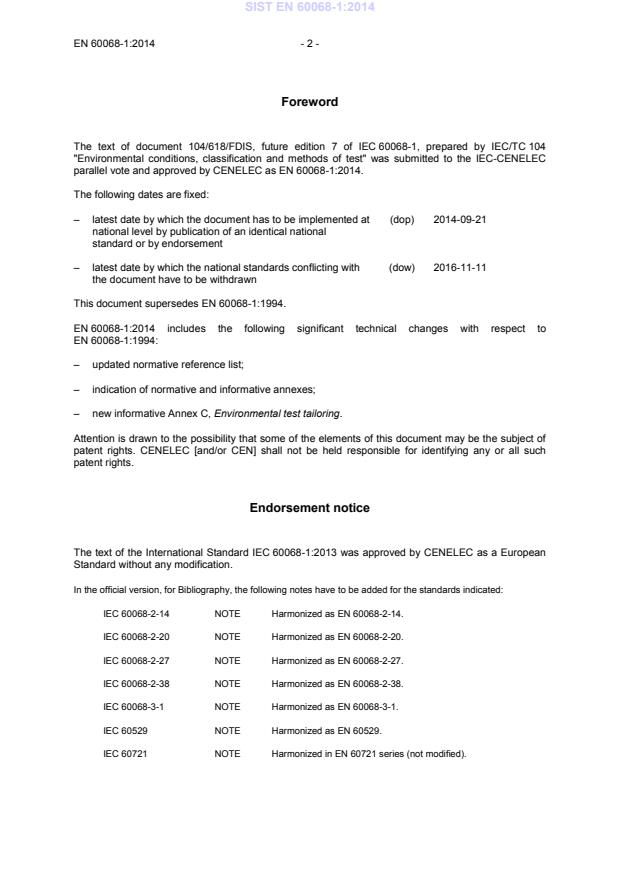
Foreword
The text of document 104/618/FDIS, future edition 7 of IEC 60068-1, prepared by IEC/TC 104
"Environmental conditions, classification and methods of test" was submitted to the IEC-CENELEC
parallel vote and approved by CENELEC as EN 60068-1:2014.
The following dates are fixed:
– latest date by which the document has to be implemented at (dop) 2014-09-21
national level by publication of an identical national
standard or by endorsement
– latest date by which the national standards conflicting with (dow) 2016-11-11
the document have to be withdrawn
This document supersedes EN 60068-1:1994.
EN 60068-1:1994:
– updated normative reference list;
– indication of normative and informative annexes;
– new informative Annex C, Environmental test tailoring.
Attention is drawn to the possibility that some of the elements of this document may be the subject of
patent rights. CENELEC [and/or CEN] shall not be held responsible for identifying any or all such
patent rights.
Endorsement notice
The text of the International Standard IEC 60068-1:2013 was approved by CENELEC as a European
Standard without any modification.
In the official version, for Bibliography, the following notes have to be added for the standards indicated:
IEC 60068-2-14 NOTE Harmonized as EN 60068-2-14.
IEC 60068-2-20 NOTE Harmonized as EN 60068-2-20.
IEC 60068-2-27 NOTE Harmonized as EN 60068-2-27.
IEC 60068-2-38 NOTE Harmonized as EN 60068-2-38.
IEC 60068-3-1 NOTE Harmonized as EN 60068-3-1.
IEC 60529 NOTE Harmonized as EN 60529.
IEC 60721 NOTE Harmonized in EN 60721 series (not modified).
- 3 - EN 60068-1:2014
Annex ZA
(normative)
Normative references to international publications
with their corresponding European publications
The following documents, in whole or in part, are normatively referenced in this document and are
indispensable for its application. For dated references, only the edition cited applies. For undated
references, the latest edition of the referenced document (including any amendments) applies.
NOTE When an international publication has been modified by common modifications, indicated by (mod), the
relevant EN/HD applies.
Publication Year Title EN/HD Year
IEC 60068-2 series Environmental testing EN 60068-2 series
Part 2: Tests
IEC 60068-1 ®
Edition 7.0 2013-10
INTERNATIONAL
STANDARD
NORME
INTERNATIONALE
Environmental testing –
Part 1: General and guidance
Essais d’environnement –
Partie 1: Généralités et lignes directrices
INTERNATIONAL
ELECTROTECHNICAL
COMMISSION
COMMISSION
ELECTROTECHNIQUE
PRICE CODE
INTERNATIONALE
CODE PRIX V
ICS 19.040 ISBN 978-2-8322-1110-6
– 2 – 60068-1 © IEC:2013
CONTENTS
FOREWORD . 3
INTRODUCTION . 5
1 Scope . 7
2 Normative references . 8
3 Terms and definitions . 8
4 Standard atmospheric conditions . 11
4.1 Standard reference atmosphere . 11
4.2 Standard atmospheres for referee measurements and tests . 12
4.3 Standard atmospheric conditions for measurements and tests . 12
4.4 Recovery conditions . 13
4.4.1 General . 13
4.4.2 Controlled recovery conditions . 13
4.4.3 Recovery procedure . 14
4.5 Standard conditions for assisted drying . 14
5 Use of test methods . 14
6 Climatic sequence . 14
7 Component climatic category . 15
8 Application of tests . 15
9 Significance of the numerical value of a quantity . 15
9.1 General . 15
9.2 Quantity expressed as nominal value with tolerance . 15
9.3 Quantity expressed as a range of values . 16
Annex A (normative) Component climatic category . 18
Annex B (informative) General guidance . 19
Annex C (informative) Environmental test tailoring . 25
Bibliography . 31
Figure C.1 – Environmental test tailoring process . 26
Table 1 – Standard atmospheres for referee measurements and tests . 12
Table 2 – Standard atmospheres for measurements and tests . 13
Table 3 – Standard conditions for assisted drying . 14
Table B.1 – Choice of tests as a function of objectives and applications . 21
Table B.2 – General sequence of tests . 23
Table B.3 – Principal effects of single environmental parameters . 24
Table C.1 – Test tailoring process with information flow and the corresponding
activities . 27
60068-1 © IEC:2013 – 3 –
INTERNATIONAL ELECTROTECHNICAL COMMISSION
____________
ENVIRONMENTAL TESTING –
Part 1: General and guidance
FOREWORD
1) The International Electrotechnical Commission (IEC) is a worldwide organization for standardization comprising
all national electrotechnical committees (IEC National Committees). The object of IEC is to promote
international co-operation on all questions concerning standardization in the electrical and electronic fields. To
this end and in addition to other activities, IEC publishes International Standards, Technical Specifications,
Technical Reports, Publicly Available Specifications (PAS) and Guides (hereafter referred to as “IEC
Publication(s)”). Their preparation is entrusted to technical committees; any IEC National Committee interested
in the subject dealt with may participate in this preparatory work. International, governmental and non-
governmental organizations liaising with the IEC also participate in this preparation. IEC collaborates closely
with the International Organization for Standardization (ISO) in accordance with conditions determined by
agreement between the two organizations.
2) The formal decisions or agreements of IEC on technical matters express, as nearly as possible, an international
consensus of opinion on the relevant subjects since each technical committee has representation from all
interested IEC National Committees.
3) IEC Publications have the form of recommendations for international use and are accepted by IEC National
Committees in that sense. While all reasonable efforts are made to ensure that the technical content of IEC
Publications is accurate, IEC cannot be held responsible for the way in which they are used or for any
misinterpretation by any end user.
4) In order to promote international uniformity, IEC National Committees undertake to apply IEC Publications
transparently to the maximum extent possible in their national and regional publications. Any divergence
between any IEC Publication and the corresponding national or regional publication shall be clearly indicated in
the latter.
5) IEC itself does not provide any attestation of conformity. Independent certification bodies provide conformity
assessment services and, in some areas, access to IEC marks of conformity. IEC is not responsible for any
services carried out by independent certification bodies.
6) All users should ensure that they have the latest edition of this publication.
7) No liability shall attach to IEC or its directors, employees, servants or agents including individual experts and
members of its technical committees and IEC National Committees for any personal injury, property damage or
other damage of any nature whatsoever, whether direct or indirect, or for costs (including legal fees) and
expenses arising out of the publication, use of, or reliance upon, this IEC Publication or any other IEC
Publications.
8) Attention is drawn to the Normative references cited in this publication. Use of the referenced publications is
indispensable for the correct application of this publication.
9) Attention is drawn to the possibility that some of the elements of this IEC Publication may be the subject of
patent rights. IEC shall not be held responsible for identifying any or all such patent rights.
International Standard IEC 60068-1 has been prepared by IEC technical committee 104:
Environmental conditions, classification and methods of test.
This seventh edition cancels and replaces the sixth edition, published in 1988, and constitutes
a technical revision.
The main changes with respect to the previous edition are listed below:
– updated normative reference list;
– indication of normative and informative annexes;
– new informative Annex C, Environmental test tailoring.
– 4 – 60068-1 © IEC:2013
The text of this standard is based on the following documents:
FDIS Report on voting
104/618/FDIS 104/627/RVD
Full information on the voting for the approval of this standard can be found in the report on
voting indicated in the above table.
This publication has been drafted in accordance with the ISO/IEC Directives, Part 2.
A list of all the parts in the IEC 60068 series, published under the general title Environmental
testing, can be found on the IEC website.
This standard should be used in conjunction with the relevant specification which will define
the tests to be used, the required degree of severity for each of them, their order (if relevant),
and the permissible performance limits.
The committee has decided that the contents of this publication will remain unchanged until
the stability date indicated on the IEC web site under "http://webstore.iec.ch" in the data
related to the specific publication. At this date, the publication will be
• reconfirmed,
• withdrawn,
• replaced by a revised edition, or
• amended.
60068-1 © IEC:2013 – 5 –
INTRODUCTION
The IEC 60068 series contains fundamental information on environmental testing procedures
and severities of tests. In addition, this Part 1 contains information on atmospheric conditions
for measurement and testing.
It is intended to be used in those cases where a relevant specification for a certain type of
product (electrical, electromechanical or electronic equipment and devices, their
subassemblies and constituent parts and components), hereinafter referred to as the
“specimen”, is to be prepared, so as to achieve uniformity and reproducibility in the
environmental testing of this product.
NOTE 1 Although primarily intended for electrotechnical products, many of the environmental testing procedures
in Part 2 of this series are equally applicable to other industrial products.
The expression “environmental conditioning” or “environmental testing” covers the natural and
artificial environments to which specimens may be subjected and exposed to in practice so
that an assessment can be made of their performance under conditions of storage,
transportation, installation and use.
The requirements for the performance of specimens subjected to environmental conditioning
are not covered by this standard. The relevant specification for the specimen under test
defines the allowed performance limits during and after environmental testing.
When drafting a relevant specification or purchasing contract, only those tests should be
specified that are necessary for the relevant specimen, taking into account the technical and
economic aspects.
The IEC 60068 series consists of:
a) this first part, IEC 60068-1 – General and guidance, which deals with generalities;
b) the second part, IEC 60068-2 – Tests – which publishes particular tests separately for
different applications;
c) the third part, IEC 60068-3 – Supporting documentation and guidance, which deals with
background information on a family of tests.
The families of tests comprising Part 2 of the IEC 60068 series are designated by the
following upper-case letters:
A: Cold
B: Dry heat
C: Damp heat (steady-state)
D: Damp heat (cyclic)
E: Impact (for example shock and rough handling shocks)
F: Vibration
G: Acceleration (steady state)
H: (Awaiting allocation)
NOTE 2 Originally allotted to storage tests.
J: Mould growth
K: Corrosive atmospheres (for example salt mist)
L: Dust and sand
M: Air pressure (high or low)
N: Change of temperature
– 6 – 60068-1 © IEC:2013
P: (Awaiting allocation)
NOTE 3 Originally allotted to “flammability”.
Q: Sealing (including panel sealing, container sealing and protection against ingress and
leakage of fluid)
R: Water (for example rain, dripping water)
S: Radiation (for example solar, but excluding electromagnetic)
T: Soldering (including resistance to heat from soldering)
U: Robustness of terminations (of components)
V: (Awaiting allocation)
NOTE 4 Originally allocated to “acoustic noise” but “vibration, acoustically induced” will now be Test Fg,
one of the “vibration” family of tests.
W: (Awaiting allocation)
Y: (Awaiting allocation)
The letter X is used as a prefix together with a second lower-case letter providing for
extension of the list of families of tests, e.g. Test Xa: Immersion in cleaning solvents. The
letter Z is used to denote combined tests and composite tests as follows: Z is followed by a
solidus (slash) and a group of lower-case letters relating to the combined or composite
stresses, for example Test Z/am: Combined cold and low air pressure tests.
If appropriate, a test may be designated as “primarily intended for components” or “primarily
intended for equipment”.
To provide for future expansion within a family of tests and to maintain consistency of
presentation, each family of tests may be subdivided. The subdivisions are identified by the
addition of a (lower-case) second letter, for example:
U: Robustness of terminations and integral mounting devices
Test Ua: Subdivided as Test Ua : Tensile; and Test Ua : Thrust
1 2
Test Ub: Bending
Test Uc: Torsion
Test Ud: Torque
This subdivision is made even though only one test is published and no further tests are
immediately contemplated in the relevant family.
In order to avoid confusion with numbers, the letters i, I, o and O are not used.
60068-1 © IEC:2013 – 7 –
ENVIRONMENTAL TESTING –
Part 1: General and guidance
1 Scope
The IEC 60068 series includes a series of methods for environmental testing along with their
appropriate severities, and prescribes various atmospheric conditions for measurements and
tests designed to assess the ability of specimens to perform under expected conditions of
transportation, storage and all aspects of operational use.
Although primarily intended for electrotechnical products, this standard is not restricted to
them and may be used in other fields where desired.
Other methods of environmental testing, specific to the individual types of specimen, may be
included in the relevant specifications.
The framework of environmental test tailoring process is given in order to assist the
production of test specifications with appropriate tests and test severities.
The IEC 60068 series provides a series of uniform and reproducible environmental, climatic,
dynamic and combined tests, performed and measured under standard atmospheric
conditions, for those preparing specifications and those engaged in the testing of products.
These test methods are based upon available international engineering experience and
judgement and are primarily designed to provide information on the following properties of
specimens:
a) the ability to operate within specified limits of temperature, pressure, humidity, mechanical
stress or other environmental conditions and combinations of these conditions;
b) the ability to withstand conditions of transportation, storage and installation.
NOTE 1 The IEC 60721 series provides a system for classification of environmental conditions and gives relevant
definitions.
The tests in this standard permit the comparison of the performance of sample products. To
assess the quality or useful life of a given production lot, the test methods should be applied
in accordance with a suitable sampling plan and may be supplemented by appropriate
additional tests, if necessary.
NOTE 2 ISO defines “quality” as the degree to which a set of inherent characteristics fulfils requirements.
NOTE 3 "Useful life": under given conditions, the time interval beginning, at a given instant of time, and ending
when the failure intensity becomes unacceptable or when the item is considered unrepairable as a result of a fault.
To provide tests appropriate to the different intensities of an environmental condition, some of
the test procedures have a number of degrees of severity. These different degrees of severity
are obtained by varying the time, temperature, air pressure or some other determining factor,
separately or in combination.
As the tests and their degrees of severity should be based on real environmental conditions
that a particular specimen might encounter, the framework and the necessary phases for the
environmental test tailoring process are provided. The test tailoring process may be used to
produce the required relevant test specification for the particular specimen.
– 8 – 60068-1 © IEC:2013
2 Normative references
The following documents, in whole or in part, are normatively referenced in this document and
are indispensable for its application. For dated references, only the edition cited applies. For
undated references, the latest edition of the referenced document (including any
amendments) applies.
IEC 60068-2 (all parts), Environmental testing – Tests
3 Terms and definitions
For the purposes of this document, the following terms and definitions apply.
NOTE Tests covered by this standard may, in themselves, consist of a series of operations in order to determine
the effect of such a test, or series of tests, on a specimen.
3.1
test
complete series of operations implied by its title, normally comprising the following operations,
if required:
a) pre-conditioning;
b) initial examination and measurements;
c) testing;
d) recovery;
e) final examination and measurements.
Note 1 to entry: Intermediate measurements may be required during conditioning and/or recovery.
Note 2 to entry: When the temperature and humidity for conditioning of a specimen for measurement are the
same as those prescribed for pre-conditioning, the pre-conditioning and conditioning may be merged, and the pre-
conditioning may be said to take the place of conditioning for measurement.
3.2
pre-conditioning
treatment of a specimen with the object of removing, or partly counteracting, the effects of its
previous history
Note 1 to entry: Where pre-conditioning is called for, it is the first process in the test procedure.
Note 2 to entry: Pre-conditioning may be affected by subjecting the specimen to climatic, electrical, or any other
conditions required by the relevant specification in order that the properties of the specimen may be stabilized
before measurement and test.
3.3
testing
exposure of a specimen to environmental conditions in order to determine the effect of such
conditions on the specimen
3.4
recovery
treatment of a specimen, after conditioning, in order that the properties of the specimen may
be stabilized before measurement
3.5
specimen
product designated to be tested in accordance with the procedures of the IEC 60068 series
Note 1 to entry: The term “specimen” includes any auxiliary parts or systems that are integral functional features
of the specimen, for example systems for cooling and heating.
60068-1 © IEC:2013 – 9 –
3.6
heat-dissipating specimen
specimen with the hottest point on its surface, measured in free air conditions and under the
air pressure as specified in 4.3, more than 5 K above the ambient temperature of the
surrounding atmosphere after thermal stability has been reached
Note 1 to entry: Measurements required to prove that a specimen can be classified as either heat-dissipating or
non-heat-dissipating can be made under standard atmospheric conditions for measurement and tests if care has
been taken that no outside influence (for example draughts or sunlight) affects the measurements. In the case of
large or complicated specimens, it may be necessary to make measurements at several points.
3.7
air conditions
conditions within an infinite space where the movement of the air is affected only by the heat-
dissipating specimen itself
3.8
relevant specification
set of requirements to be satisfied by a specimen, indicating the method(s) necessary to
determine whether the requirements given are satisfied
3.9
ambient temperature
temperature of the air (further defined in 3.9.1 and 3.9.2)
Note 1 to entry: In applying these definitions, guidance should be sought from IEC 60068-3-1.
3.9.1
non-heat-dissipating specimens
temperature of the air surrounding the specimen
3.9.2
heat-dissipating specimens
temperature of the air in free air conditions at such a distance from the specimen that the
effect of the dissipation is negligible
Note 1 to entry: In practice, the ambient temperature is taken as the average of temperatures measured at a
number of points in a horizontal plane situated between 0 mm and 50 mm below the specimen, at half the distance
between the specimen and the wall of the chamber, or at 1 m distance from the specimen, whichever is less.
Suitable precautions should be taken to avoid heat radiation affecting these measurements.
3.10
surface temperature
case temperature
temperature measured at one or more specified points on the surface of the specimen
3.11
thermal stability
state when the temperatures of all parts of the specimen are within 3 K, or as otherwise
prescribed by the relevant specification, of their final temperature
Note 1 to entry: For non-heat-dissipating specimens, the final temperature will be the mean (in time) temperature
of the chamber in which the specimen is placed. For heat-dissipating specimens, it is necessary to make repeated
measurements to determine the interval of time for the temperature to change 3 K, or as otherwise prescribed by
the relevant specification. Thermal stability has been reached when the ratio between two consecutive time
intervals exceeds 1,7.
Note 2 to entry: Where the thermal time constant of the specimen is short compared with the duration of the
exposure to a given temperature, no measurement is needed. Where the thermal time constant of the specimen is
of the same order as the duration of the exposure, checks should be made to ascertain that
a) non-heat-dissipating specimens are within the required limit of the mean (in time) ambient temperature,
– 10 – 60068-1 © IEC:2013
b) for heat-dissipating specimens the ratio between two consecutive time intervals exceeds 1,7 when repeated
measurements are made to determine the interval of time required for the temperature to change by 3 K, or as
otherwise prescribed by the relevant specification.
IEC 60068-3-1 gives background information on the testing of specimens with and without heat-dissipation.
Note 3 to entry: In practice, it may not be possible to make direct measurements of the internal temperature of the
specimen. A check may then be made by measuring some other parameter which is temperature-dependent and for
which the temperature dependence is known.
3.12
chamber
enclosure or space in some part of which the specified conditions can be achieved
3.13
working space
part of the chamber in which the specified conditions can be maintained within the specified
tolerances
3.14
combined test
tests during which a specimen is subjected simultaneously to two or more environmental
influences
Note 1 to entry: Tests with a simultaneous influence of a) temperature and humidity; b) temperature, humidity
and a specific (including chemically active) medium; and c) temperature and solar radiation, are not related to
combined tests.
Note 2 to entry: Combined tests, as a rule, are used to provide simultaneous climatic and mechanical influences.
Note 3 to entry: Measurements are usually taken at the start and at the end of the test.
3.15
composite test
test in which the specimen is exposed to two or more test environments in close succession
Note 1 to entry: The intervals of time between the exposures to different test environments are defined precisely
since they may have a significant effect on the specimen.
Note 2 to entry: Pre-conditioning, recovery or stabilization periods are usually not included between each
exposure.
Note 3 to entry: Measurements are usually taken prior to the start of the first exposure and at the conclusion of
the last exposure.
3.16
sequence of tests
sequence in which the specimen is exposed successively to two or more test environments
Note 1 to entry: The durations of interval between the exposures to different test environments are such that they
normally have no significant effect on the specimen.
Note 2 to entry: Pre-conditioning and recovery periods are usually performed between the different exposures.
Note 3 to entry: Measurements are usually taken before and after each exposure, the final measurement of one
test being the initial measurement of the next.
3.17
reference atmosphere
atmosphere to which values measured under any other conditions are corrected by calculation
3.18
referee measurements
measurements repeated under closely controlled atmospheric conditions when the correction
factors to adjust atmospheric-sensitive parameters to their standard reference atmosphere
60068-1 © IEC:2013 – 11 –
values are unknown, and measurements under the recommended range of ambient
atmospheric conditions are unsatisfactory
3.19
conditioning (of a specimen for measurement)
subjection of the specimen to an atmosphere of a specified relative humidity, or complete
immersion in water or other liquid, at a specified temperature for a specified period of time
Note 1 to entry: According to circumstances, the space used for conditioning of a specimen for measurement may
be a whole laboratory room in which the specified conditions are maintained within the prescribed tolerances, or a
special chamber.
3.20
environmental test tailoring
process of producing testing procedures and test specifications on the basis of actual field
conditions encountered by the particular specimen, derived from measurements, literature or
other relevant sources and reduced and transformed so that it can be used for a test
specification
Note 1 to entry: The environmental test tailoring process described in this standard is given in a general form in
order to give a framework for consistent flow of information.
Note 2 to entry: There are various methods and practices for test tailoring and care should be taken to ensure the
consistent tailoring process with compatible analysis methods and test procedures.
Note 3 to entry: In practice, it may not be possible to obtain reliable data, e.g. from literature, or to make
measurements of the physical parameters of the specimen and its environment. Numerical simulation may be used
to determine the environmental conditions and product responses needed to be used for the derivation of the test
specifications. In particular, simulation may be valuable for the determination of product subassembly and
constituent part and component level environmental conditions.
Note 4 to entry: For the specifications derived from the environmental test tailoring process, the tests and
severities of this standard should be used. Other test procedures and test severities may be used only if reliable
technical and/or proven economical benefits are found. In this case, the reasoning of the diversion from the
standard tests should be included in the specification.
Note 5 to entry: With environmental test tailoring, it is not essential to reproduce the environmental conditions,
only the critical failure mechanisms.
Note 6 to entry: If acceleration factors are used, they should always be chosen so as to avoid the introduction of
mechanisms of failure which differ from those occurring in service, storage, or transportation.
Note 7 to entry: With environmental test tailoring, checks should be made to ascertain:
a) specimen life cycle profile;
b) critical failure mechanisms;
c) proper acceleration factors;
d) proper specimen modelling.
3.21
quality
ability of a product or a service to satisfy user's need
3.22
useful life
under given conditions, the time interval of the beginning, at a given instance of time, and
ending when the failure intensity becomes unacceptable or when the item is considered
unrepeatable as a result of a fault
4 Standard atmospheric conditions
4.1 Standard reference atmosphere
– temperature: 20 °C;
– air pressure: 101,3 kPa (1 013 mbar).
– 12 – 60068-1 © IEC:2013
NOTE No requirement for relative humidity is given because correction by calculation is generally not possible.
If the parameters to be measured depend on temperature and/or pressure, and the law of
dependence is known, the values shall be measured under the conditions specified in 4.3 and,
if necessary, corrected by calculation to the standard reference atmosphere above.
4.2 Standard atmospheres for referee measurements and tests
If the parameters to be measured depend on temperature, pressure and humidity, and the law
of dependence is unknown, the atmospheres to be specified shall be selected from Table 1.
Table 1 – Standard atmospheres for referee measurements and tests
a a
Temperature Relative humidity Air pressure
°C %
Nominal Close Wide Close Wide
kPa mbar
value tolerance tolerance range range
20 ±1 ±2 63 to 67 60 to 70 86 to 106 (860 to 1 060)
23 48 to 52 45 to 55 86 to 106 (860 to 1 060)
±1 ±2
25 48 to 52 45 to 55 86 to 106 (860 to 1 060)
±1 ±2
27 63 to 67 60 to 70 86 to 106 (860 to 1 060)
±1 ±2
NOTE 1 The above values include those published in this standard as well as those given in ISO 554 and
ISO 3205.
NOTE 2 The value of 25 °C is included primarily because of its interest for the testing of semiconductor
devices and integrated circuits (It does not appear in ISO 554 and ISO 3205).
NOTE 3 The close tolerances may be used for the referee measurements. The wider tolerances may be used
only when allowed by the relevant specification.
NOTE 4 The relative humidity may be disregarded when it has no influence on the test results.
a
Inclusive values.
4.3 Standard atmospheric conditions for measurements and tests
The standard range of atmospheric conditions for carrying out measurements and tests is
shown in Table 2.
60068-1 © IEC:2013 – 13 –
Table 2 – Standard atmospheres for measurements and tests
a a a
Temperature Relative humidity Air pressure
°C %
86 kPa to 106 kPa
15 to 35 25 to 75
(860 mbar to 1 060 mbar)
a
Inclusive values.
Variations in temperature and humidity should be kept to a minimum during a series of
measurements carried out as a part of one test on one specimen.
NOTE 1 For large specimens or in test chambers where it is difficult to maintain the temperature within the limits
specified above, the range may be extended beyond these limits either down to 10 °C or up to 40 °C, when allowed
by the relevant specification. Absolute humidity should not exceed 22 g/m .
Where the relevant specification recognizes that it is impracticable to carry out measurements
in standard atmospheric conditions, a note stating the actual conditions shall be added to the
test report.
NOTE 2 The relative humidity may be disregarded when it has no influence on the results of the test.
4.4 Recovery conditions
4.4.1 General
After the conditioning period and before making the final measurements, the specimens
should be allowed to stabilize at the ambient temperature. Measurements shall be made after
stabilization.
The “controlled recovery conditions” shall be applied if the electrical parameters to be
measured are affected by absorbed humidity or by surface conditions of the specimens and if
such parameters change rapidly, for example if the insulation resistance rises considerably
within approximately 2 h after removal of the specimens from a humidity chamber.
If the electrical parameters of the specimens affected by absorbed humidity or surface
conditions do not vary rapidly, recovery may be carried out in the conditions of standard
atmospheric conditions for tests and measurements.
If recovery and measurements are performed in separate chambers, the combination of
temperature and humidity conditions shall be such that condensation on the surface of the
specimens does not occur when the specimen is transferred to the measurement chamber.
Most of the tests of IEC 60068-2 give the appropriate recovery conditions and duration. These
conditions shall apply, unless otherwise prescribed by the relevant specification.
4.4.2 Controlled recovery conditions
NOTE 1 Controlled recovery conditions are also referred to as "standard recovery conditions".
The controlled recovery conditions are as follows:
– temperature: actual laboratory temperature ± 1 °C provided that it is within the limits
specified in 4.3, between +15 °C and +35 °C;
– relative humidity: between 73 % and 77 %;
– air pressure: between 86 kPa and 106 kPa (860 mbar and 1 060 mbar);
– recovery period: to be stated in the relevant specification if different from that given in
the appropriate method of test of IEC 60068-2.
– 14 – 60068-1 © IEC:2013
If, for specific cases, different recovery conditions are necessary, they shall be prescribed by
the relevant specification.
NOTE 2 These controlled recovery conditions may also be used for pre-conditioning.
4.4.3 Recovery procedure
The specimen shall be placed in the recovery chamber (if a separate chamber is necessary)
within 10 min of the completion of conditioning. Where the relevant specification requires
measurements to be made immediately after the recovery period, these measurements shall
be completed within 30 min of removal from the recovery chamber. Those characteristics
which are expected to change most rapidly after the specimen is removed from the recovery
atmosphere shall be measured first.
In order to prevent moisture being absorbed or lost by the specimen when removed from the
recovery chamber, the temperature of the recovery chamber shall not deviate from the
laboratory ambient temperature by more than 1 °C. This necessitates the use of a chamber
having good thermal conductivity in which the relative humidity can be closely controlled.
4.5 Standard conditions for assisted drying
Where assisted drying is required before commencing a series of measurements, the
conditions in Table 3 shall be used for 6 h, unless otherwise prescribed by the relevant
specification.
Table 3 – Standard conditions for assisted drying
a
Temperature Relative humidity Air pressure
°C %
86 kPa to 106 kPa
Not exceeding 20
55 ± 2
(860 mbar to 1 060 mbar)
a
Inclusive values.
If it is impracticable to carry out assisted drying under the standard conditions for assisted
drying, a note stating the actual conditions shall be added to the test report.
When the specified temperature for the dry heat test is lower than 55 °C, the assisted drying
shall be carried out at that lower temperature.
5 Use of test methods
As prescribed by the relevant specification test methods may be used for type approval,
qualification, quality conformance or any related purposes.
6 Climatic sequence
In order to have available for use when required a sequence of climatic tests primarily
intended for components, the cold, dry heat, low air pressure and damp heat cyclic
conditioning are regarded as interdependent and are referred to as the “climatic sequence”.
The order in which these conditionings shall be carried out is as follows:
– dry heat;
– damp heat, cyclic (first cycle of test Db with the upper temperature of 55 °C);
– cold;
– low air pressure (if required);
60068-1 © IEC:2013 – 15 –
– damp heat, cyclic (remaining cycles of test Db with the upper temperature of 55 °C).
An interval of not more than three days is permitted between any two of these conditionings
except for the interval between the first cycle of the damp heat cyclic conditioning and the
cold conditioning when the interval shall be not more than 2 h, including recovery.
Measurements are normally made only at the commencement and conclusion of the climatic
sequence, except when prescribed during conditioning.
7 Component climatic category
Where it is desired to adopt a system of component climatic classification, it shall be based on
the general principles contained in Annex A. The common part of all systems shall be the
climatic categories.
8 Application of tests
General guidance on environmental testing is given in Annex B.
The relevant specification shall prescribe whether tests are to be carried out on specimens in
the “energized” or “non-energized” condition. The relevant specification may also, when
applicable, prescribe that testing shall be carried out on “packed” specimens if a transport
case is considered to be a part of the specimen.
When the sizes and/or weights of specimens are such that testing of the complete specimens
is not justified or practicable, the necessary information may be obtained by testing major
subassemblies separately. Details of the procedures to be followed shall be given in the
relevant specification.
NOTE This procedure is applicable only to those cases where the subassemblies are not subject to mutual
influence(s) unless such influences are taken into account.
9 Significance of the numerical value of a quantity
9.1 General
The numerical values of quantities for the various parameters (temperature, humidity, stress,
duration, etc.) given in IEC 60068-2 are expressed in different ways according to the needs of
each individual test.
The two cases which most frequently arise are
a) the quantity is expressed as a nominal value with a tolerance,
b) the quantity is expressed as a range of values.
For these two cases, the signific
...